Category Archives: Project: Enfield Himalayan

Quick Spin: Enfield Himalayan

Update: I bought one: Enfield Himalayan Index Page 
Him - 16
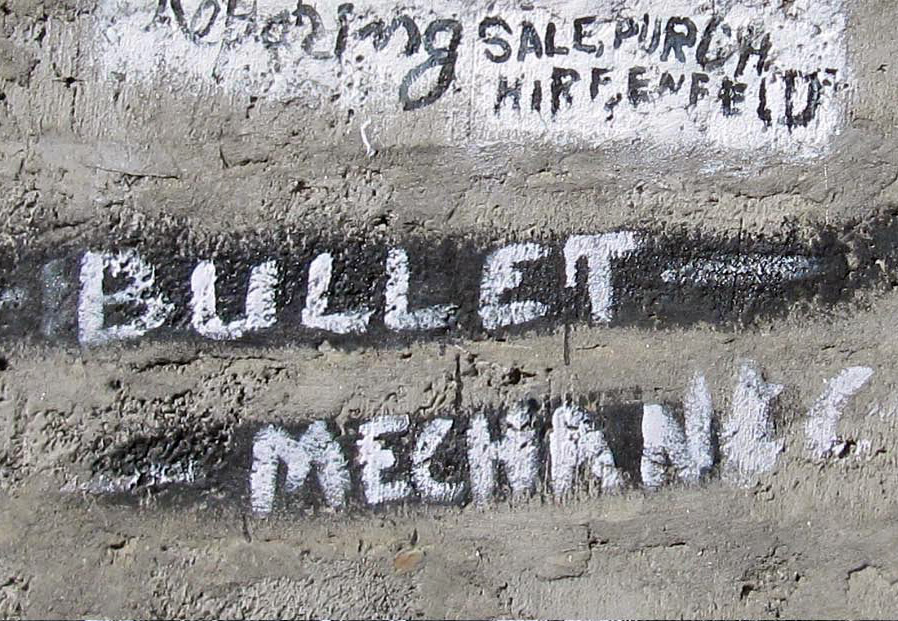
bullet-mechanic

In the 1990s, long before retro-looking bikes became a thing, buying and running a locally built Enfield Bullet around the Indian subcontinent caught on with Western tourists. It was a proper adventure all right, tinged with a certain ‘open face and goggles’ romance.
Always sick; never terminal was how one early AMH contributor described running her Bullet around India and back to the UK. It staggered home, but she sure met a lot of roadside mechanics along the way. Jacqui Furneaux is another intrepid Bulletriste, covering over 40,000 miles across the planet. At bike shows visitors literally get a kick out of trying to start her old bike.

bullet

Not High
As a travel bike I can very much see the appeal of a low-revving, low consumption, low compression, low priced, low saddled plodder – now more than ever. But you want low maintenance on that list, too. With my desert riding background, reliability, economy, durability (and lately, comfort) have long trounced anything else.
Now, 30 years after taking a clapped-out Bullet up the Khyber became a travel biking niche, we’re told the Indian economy booms and RE are booming with it. It’s India, not China, who’s now the world’s biggest motorcycle manufacturer. Annually, 17.5m bikes (albeit mostly <125s) are sold there. In the US it’s just half a million, and on the home market RE sell more bikes in a year than all other manufactures can manage across Europe.

him-motor
Him-spex

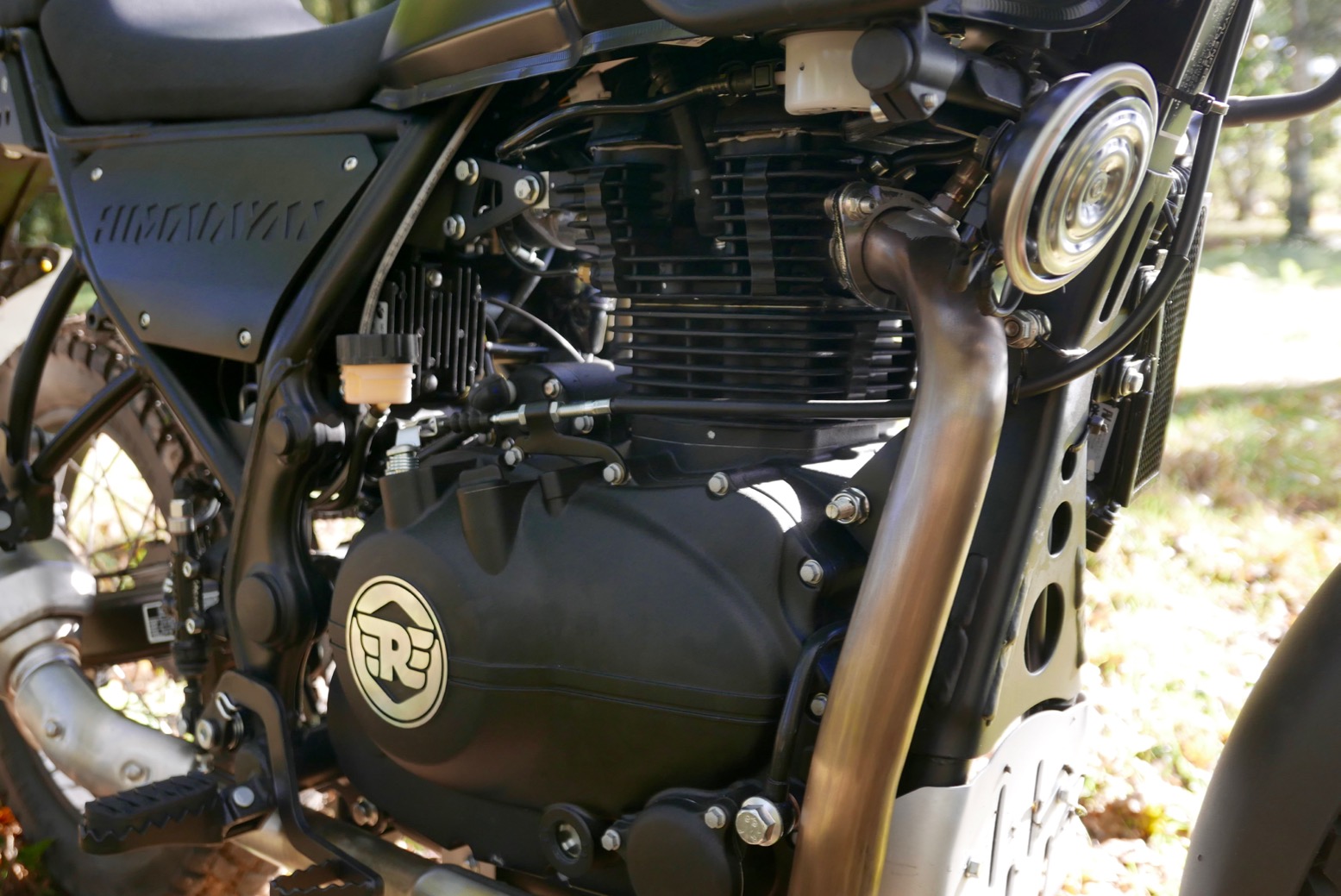
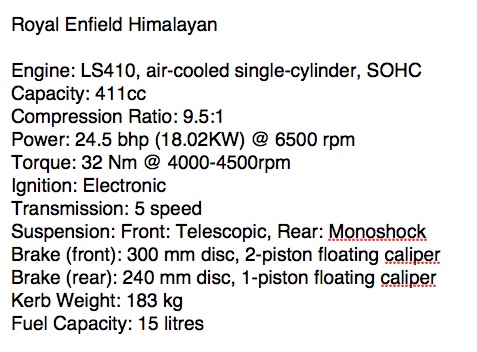
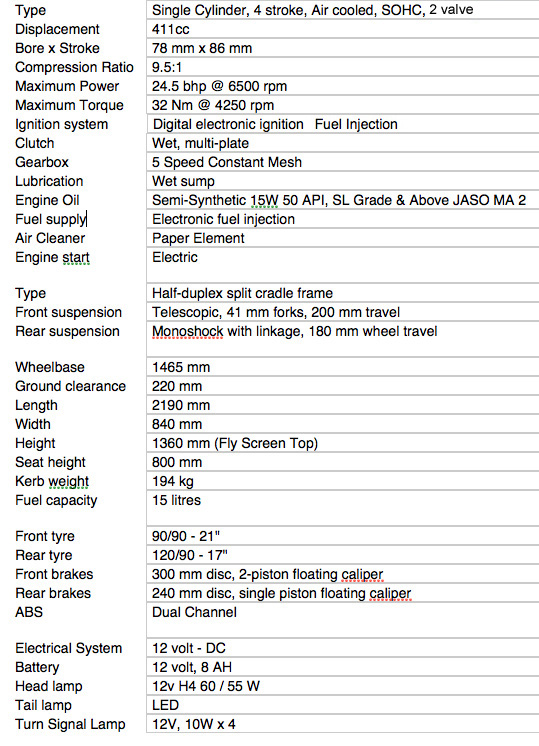
Released in 2016, the Himalayan was RE’s first stab at a do-it-all, adventure-styled machine. It wasn’t just yet another restyled spin-off from the Bullet range, but it did retain some of the Bullet’s better DNA, a 411-cc, long-stroke, two-valve single recalling a 1960s BSA thumper.
Unfortunately many found that the Himalayan’s first iteration – the BS3 carb model (reviewed here) paid a little too much homage to the slapdash nadir of the Brit bike industry. A litany of widely reported faults and failures saw production suspended, problems addressed and assembly workers spanked and retrained. In 2018 the BS4 version was released abroad, with some Western export markets (notably not Australia and NZ) getting fuel injection and in Europe, Euro 4-compliant motors come with the now-mandatory ABS.
The near-new bike I tried came from Hartgate in Mitcham. They’ve been around since before I started riding in the mid-70s, but these days sell only Chinese and Taiwanese 125s and scooters, plus Benellis and with a special part of their showroom designated for Enfields.

What they say
Royal Enfield’s most versatile motorcycle, able to take riders almost everywhere they want to go – on road or off-road. The only motorcycle you will ever need. The Himalayan combines outstanding versatility and all-day comfort for all rides. Long-travel suspension, natural upright riding position, a durable and torquey engine all add up to a comfortable ride for you, whether it’s on the highway, city streets, or remote mountain roads. The Himalayan is fit to be your only motorcycle.


In a line
Give it a look; it’s much better than you might expect.

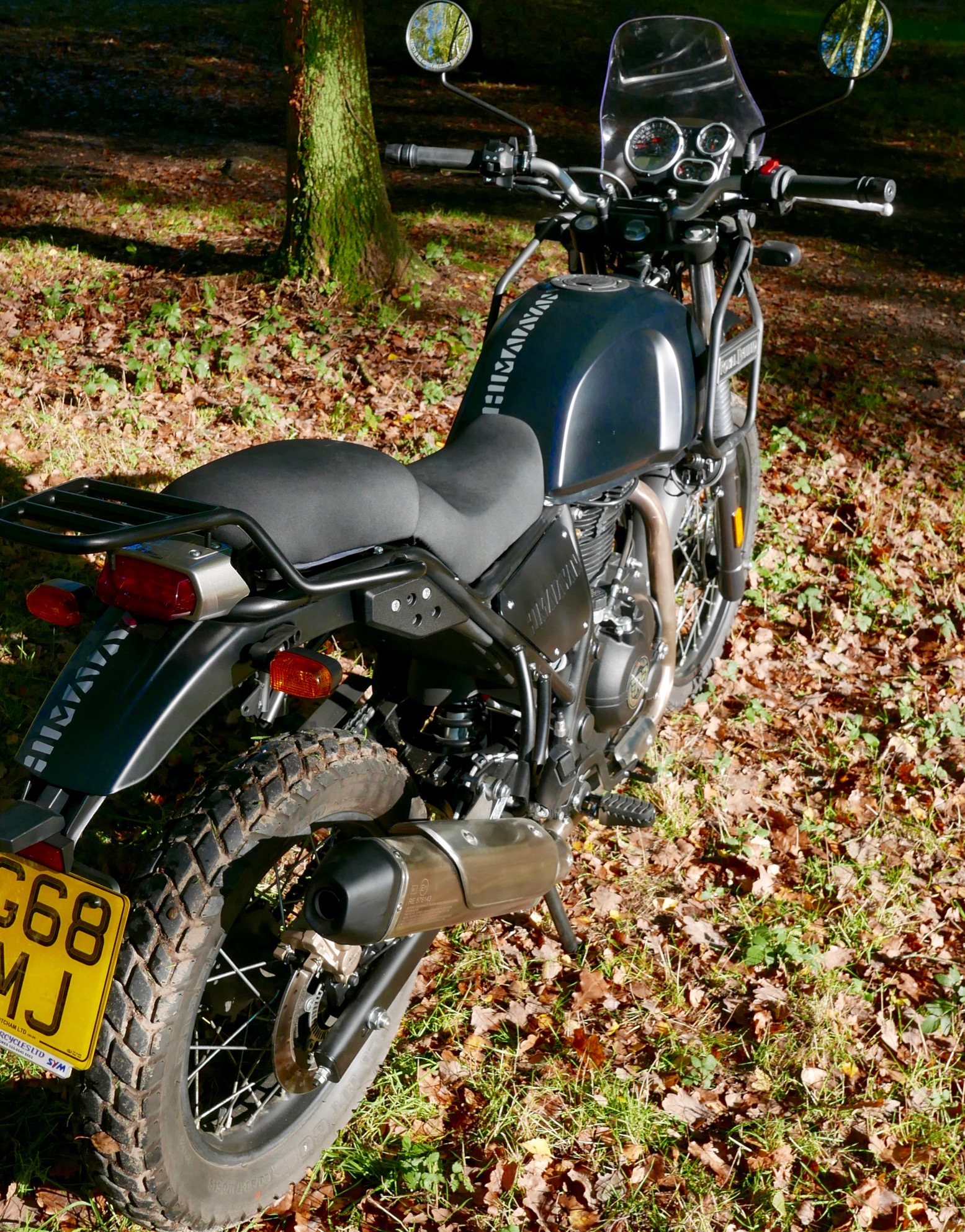
• Feels easy to ride and manoeuvre, despite the 194-kg kerb weight
• Low seat height (800mm; 31.5″)
• Indian build quality looks solid
• Efi motor starts and fuels smoothly
• Great price
• Pirelli MT60 tyres (as opposed to some obscure brand)
• Suspension surprisingly firm
• Can’t verify economy yet, but 15-L tank should be good for 400km.
• Love the tank bars as supplementary baggage racks
• Comes with slim tail rack and centre stand

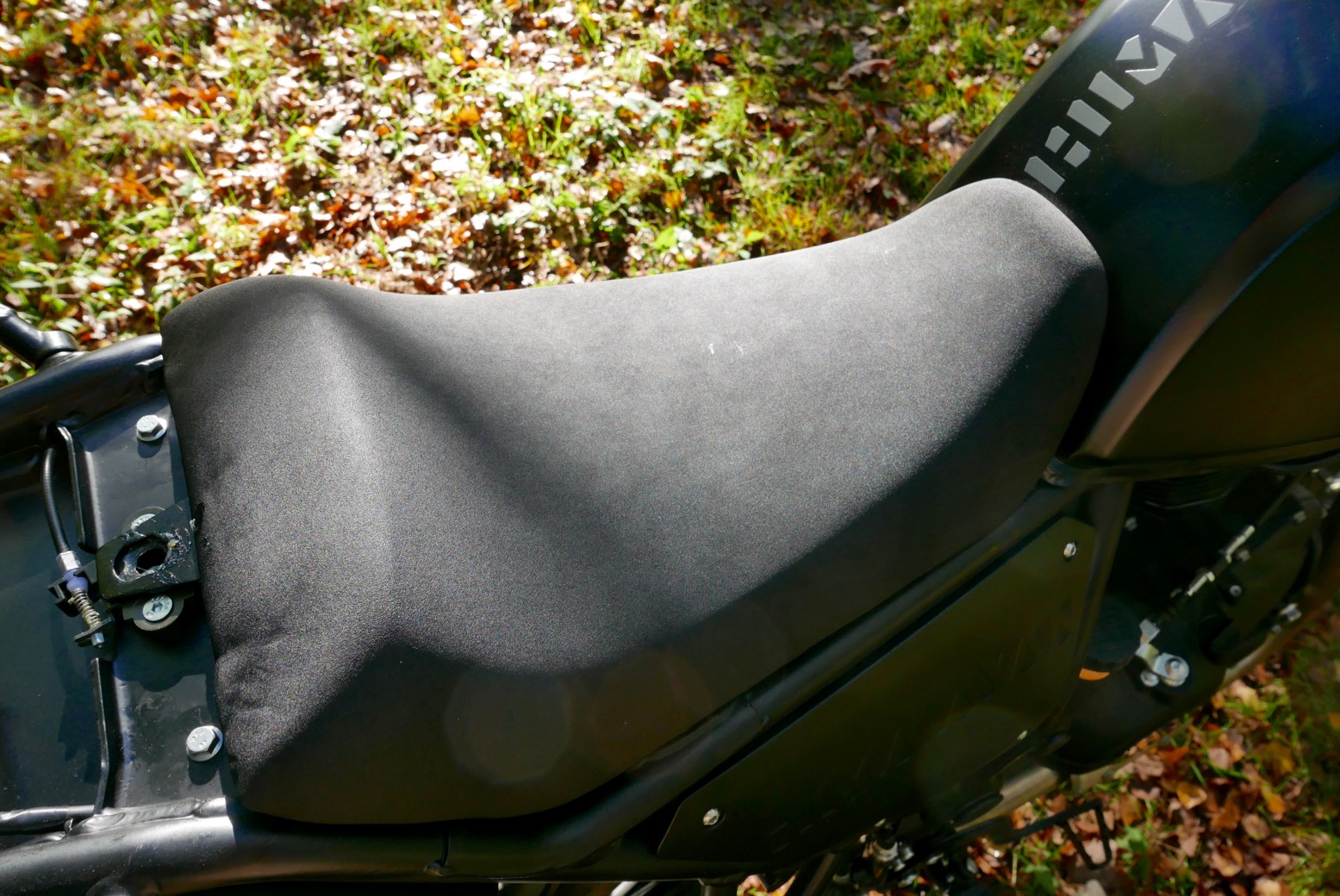
• Soft seat foam (for my weight)
• Feels like a tall first gear (for off-road)
• LCD display hard to read
• Screen a bit small (for my height)
• Front end felt a bit heavy (it is)
• 3000-miles valve checks
• Front brake lacks bite
• A bit cramped for me at 6’1″
• Low, 220-watt alternator output

Him - 18
Him - 20

Review
Pulling away from Hartgate’s, the seat was nice and low but felt way too soft. I could see it being agony in an hour or two, but I’ve had that on BMWs costing twice as much. At 6’1″ I was also a bit cramped between the stepped seat which angled me forward a little, and my knees are just an inch from the tank rack bars. Removing peg rubbers might provide more leg room and I’d have turned the bars back a tad. The gear change lever also felt too short for my size-11 Blunnies, but I soon adapted. The clutch was light, the gears clicked reassuringly and fuelling felt glitch-free. It’s an effortless bike to ride, with the power of a Jap 250 single or a Chinese Mash 400.

Him - 14
Him - 8

It may only have the 24-hp of a 2nd-gen CRF250L, but on paper it puts out nearby 50% more torque at just 4250rpm, 2500rpm lower than the Honda. Riding along the flat A24 towards Box Hill in 40- and a brief 60mph limit, I can’t say I noticed the torque, but the bike never felt under-powered or noticeably vibey.
Pulling away from lights, I did find myself consciously slipping the clutch to get over the tall first gear – or maybe to avoid stalling an unfamiliar bike. While you don’t want to sacrifice too much of the modest 82-mph top speed, for off-roading I’d consider dropping a tooth to 14T on the front.
Him - 15


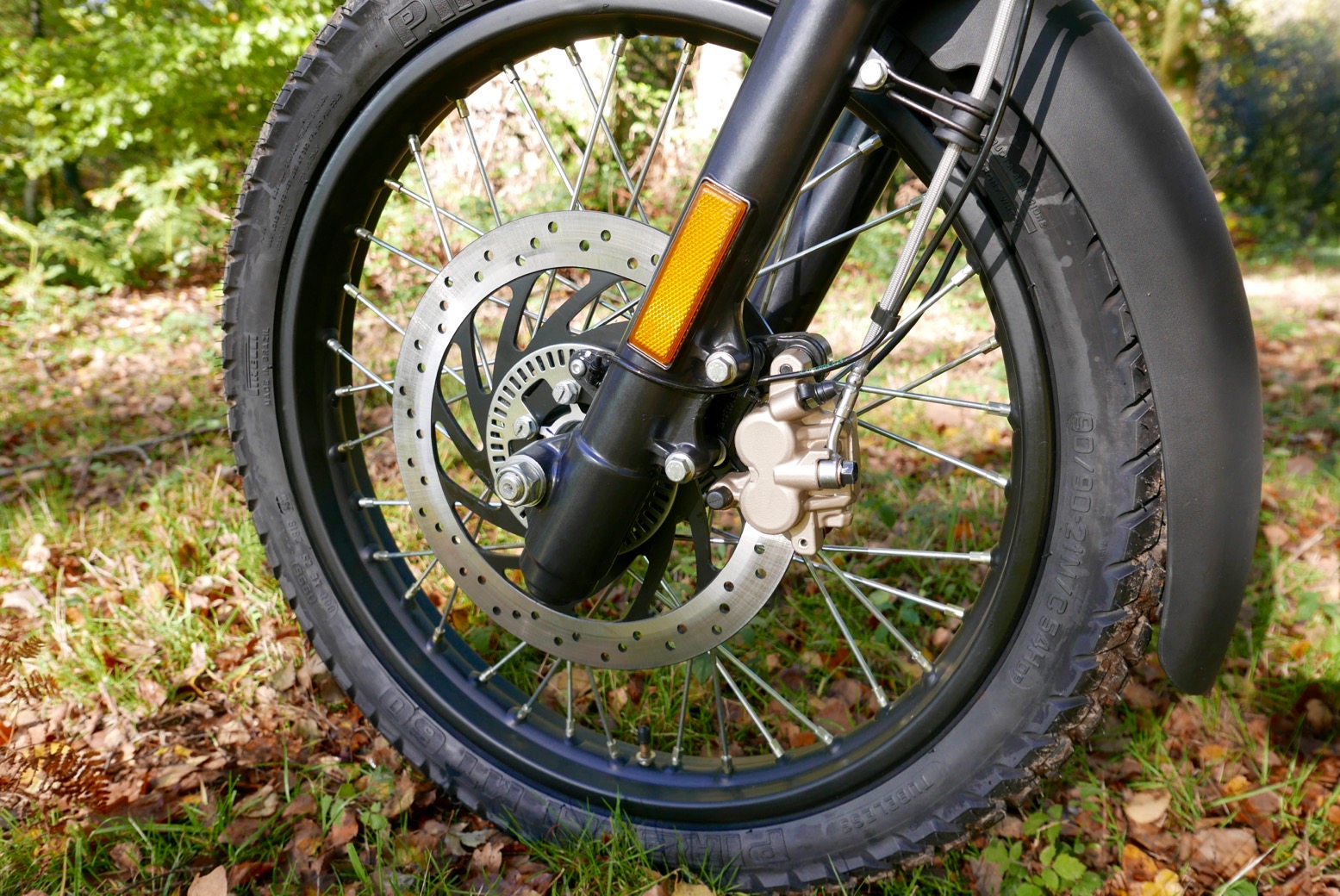
The front end felt oddly sluggish (maybe the tyre was soft, or you can feel those 194kgs?) and I was surprised to learn the rims are steel. To be expected on Bullets, but I didn’t think modern bikes use steel wheels any more. Minimising unsprung weight has a big effect on efficiency, acceleration and suspension. But then cheek-distorting acceleration isn’t really a Himalayan’s USP and perhaps the wheels’ flywheel effect helps maintain momentum once up to speed.

As had been widely reported, despite a steel braided line the front brake lacks bite (perhaps the ABS dulls response) while the rear may have a little too much, but up to a point the non-switchable (but probably disable-able) ABS ought to iron out ham-fisted braking. It didn’t engage in a bit of a panic when a car pulled out across a dual carriageway. Not had one of those in a while…
Him - 12

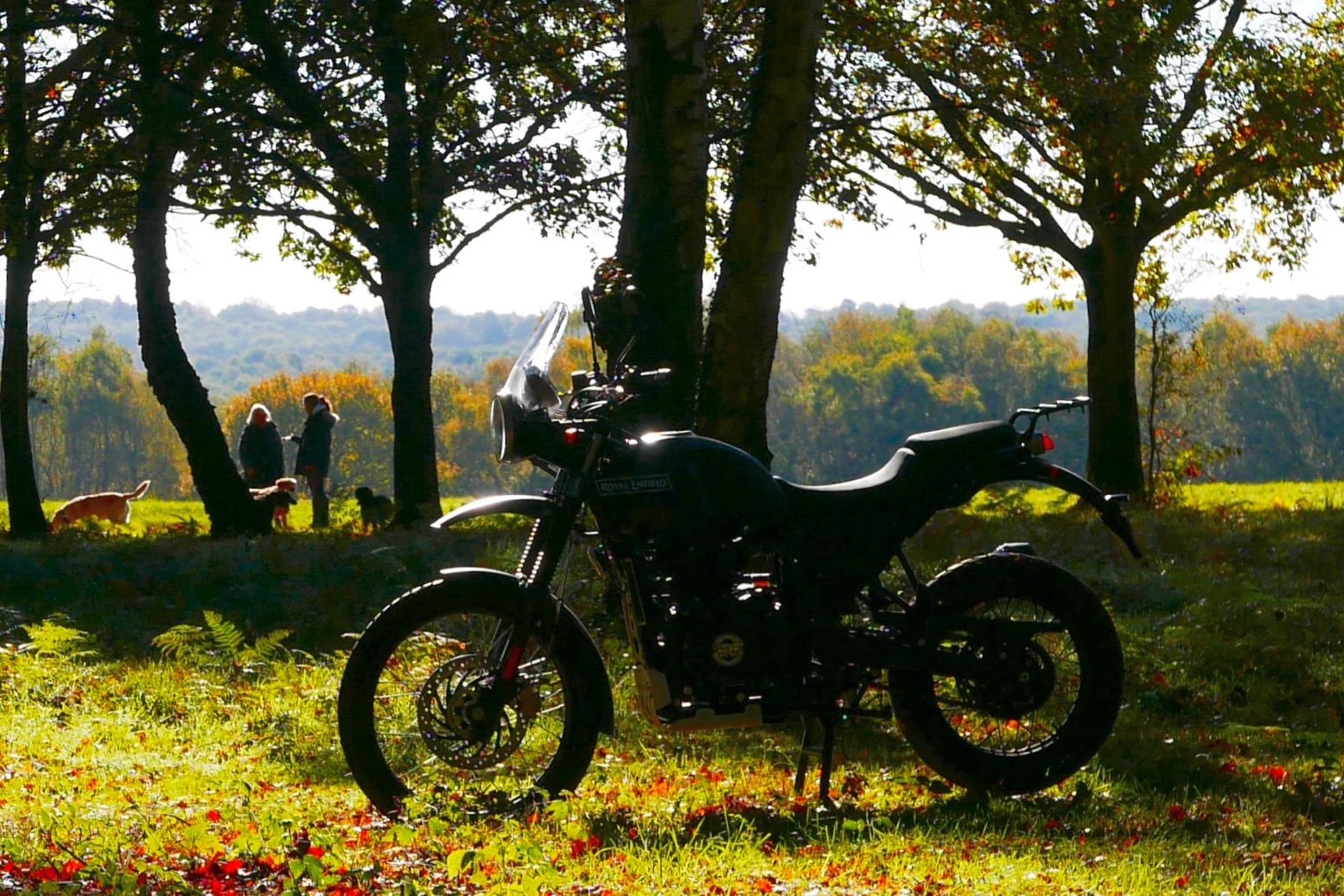
Both for road riding and when manoeuvring it in the woodland mud for photos, I find it hard to believe it really weighs 194 kilos wet (it does). That weight is clearly set low which, along with the low seat, will make a big difference in control and confidence on rough terrain, as well as picking it up when the terrain gets the better of you. And yet you still get a reasonable 220mm (8.5″) of ground clearance which makes the Himalayan a rare and much sought-after thing: a functional trail bike for shorter legged riders who don’t want to have to settle for a TW200. I stood up on the pegs and – with the usual risers added under the narrow-ish bars – would find gripping the slim bike sustainable on the trail.

Him - 2

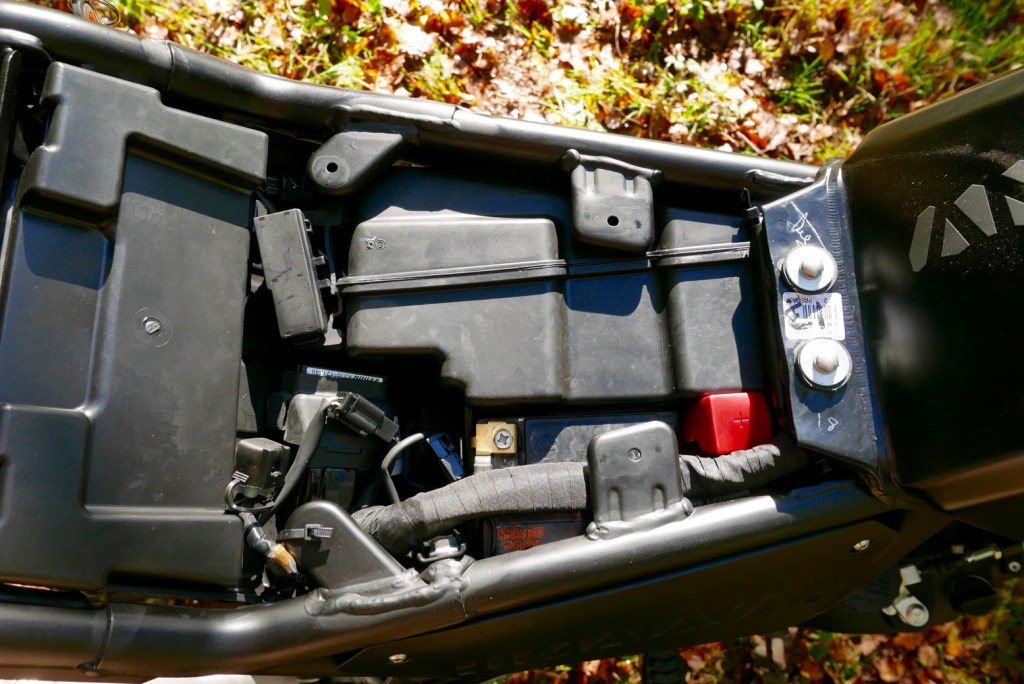
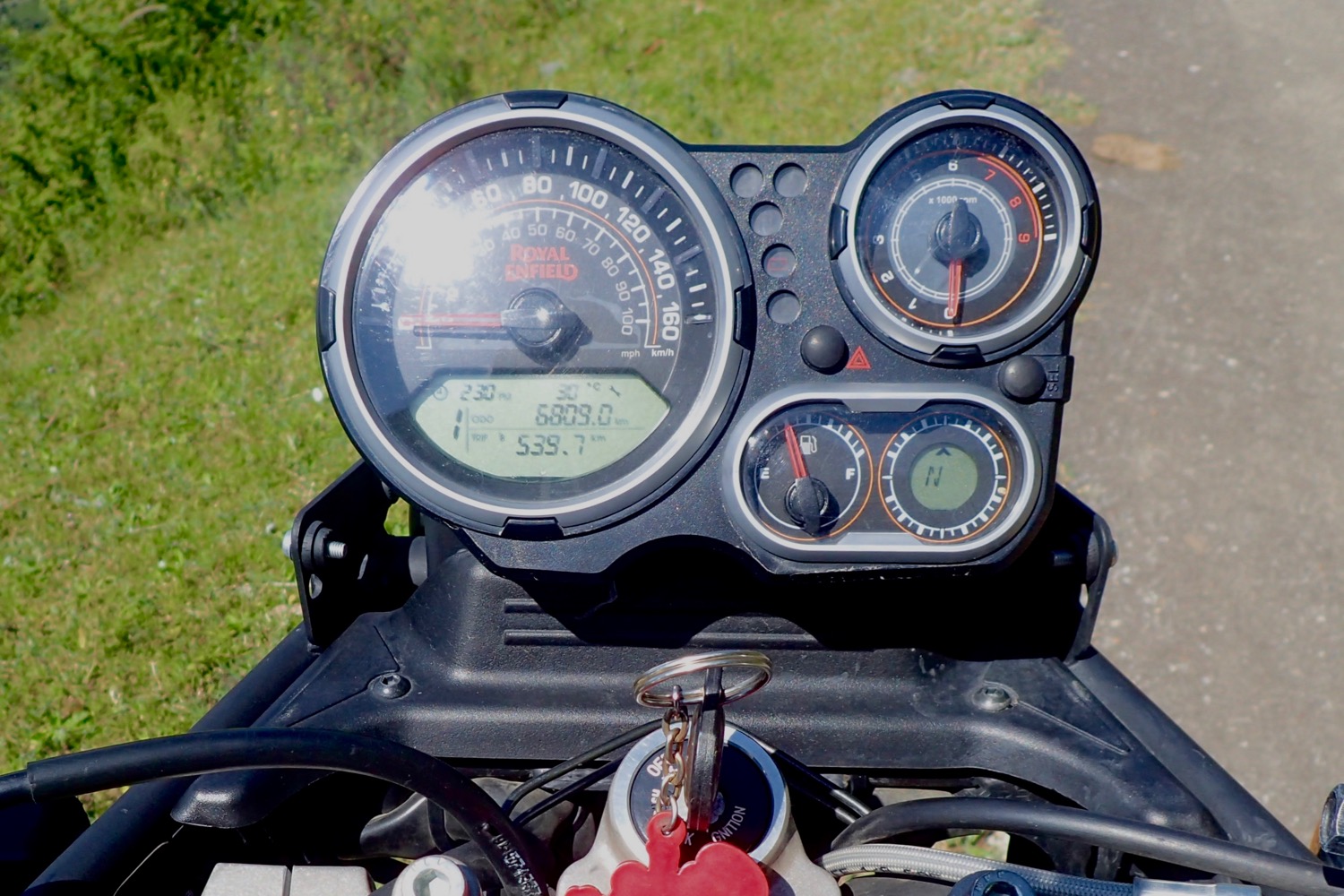
The dash’s lit section usefully shows time of day; ambient temperature, then gear position, odo and trip metre (and average speed), plus ‘side stand down’. But apart from the gear position it’s too small and messy to easily read at a glance. Chances are, familiarity will improve reading skills.
compass

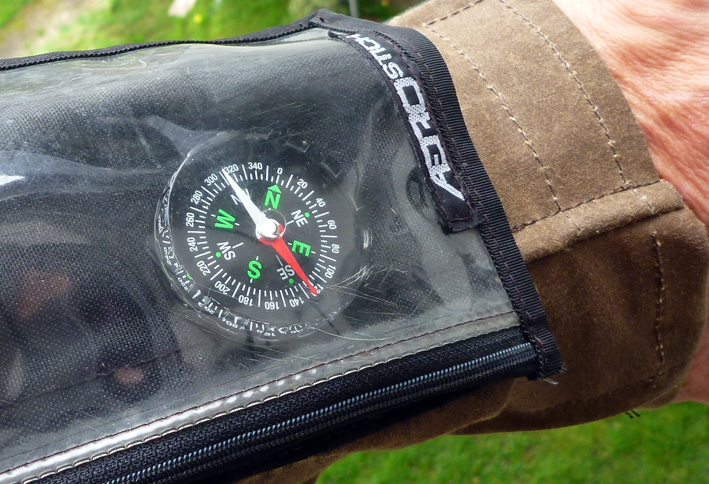
To the right below the small rev counter (red-lined at 6500rpm) is the digital compass. It’s a gimmicky nod to the bike’s adventurous intent, but as many users have found, most of the time it’s way off. If ‘CA HO’ flash up, recalibrate the compass by pushing the bike in a circle four times while patting your head. It may have to be done fairly regularly so I’d sooner rely on the sun or of course, a GPS compass, if orientation is that important.
Talking of plugging in accessories, the Himalayan’s claimed 220w alternator output is  not so impressive when you need heated grips and a heated vest approaching the north face of Kanchenjunga. Fitting a switch to the always-on headlights may help, as well as fitting LED lighting.
Him - 4
tektemp

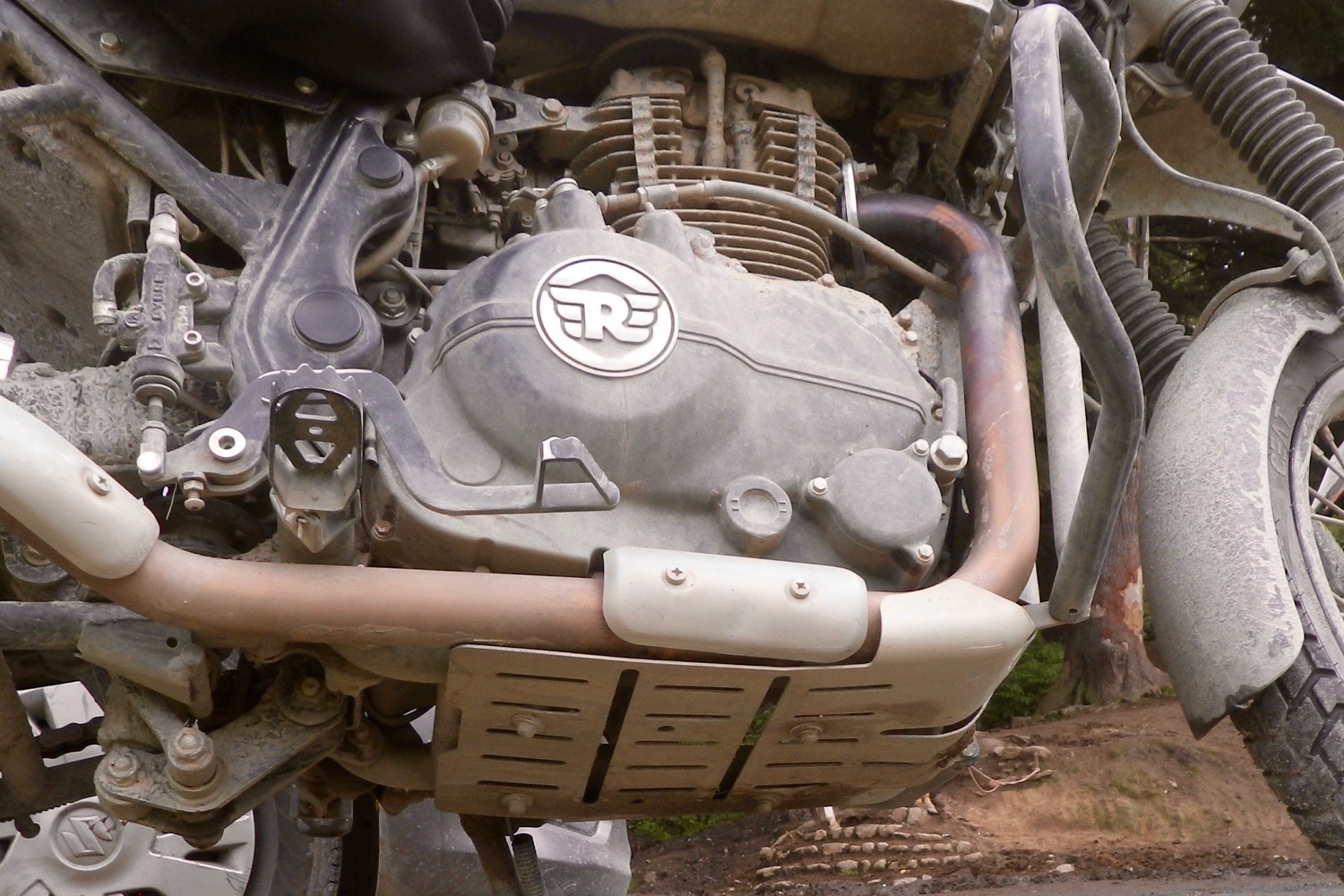
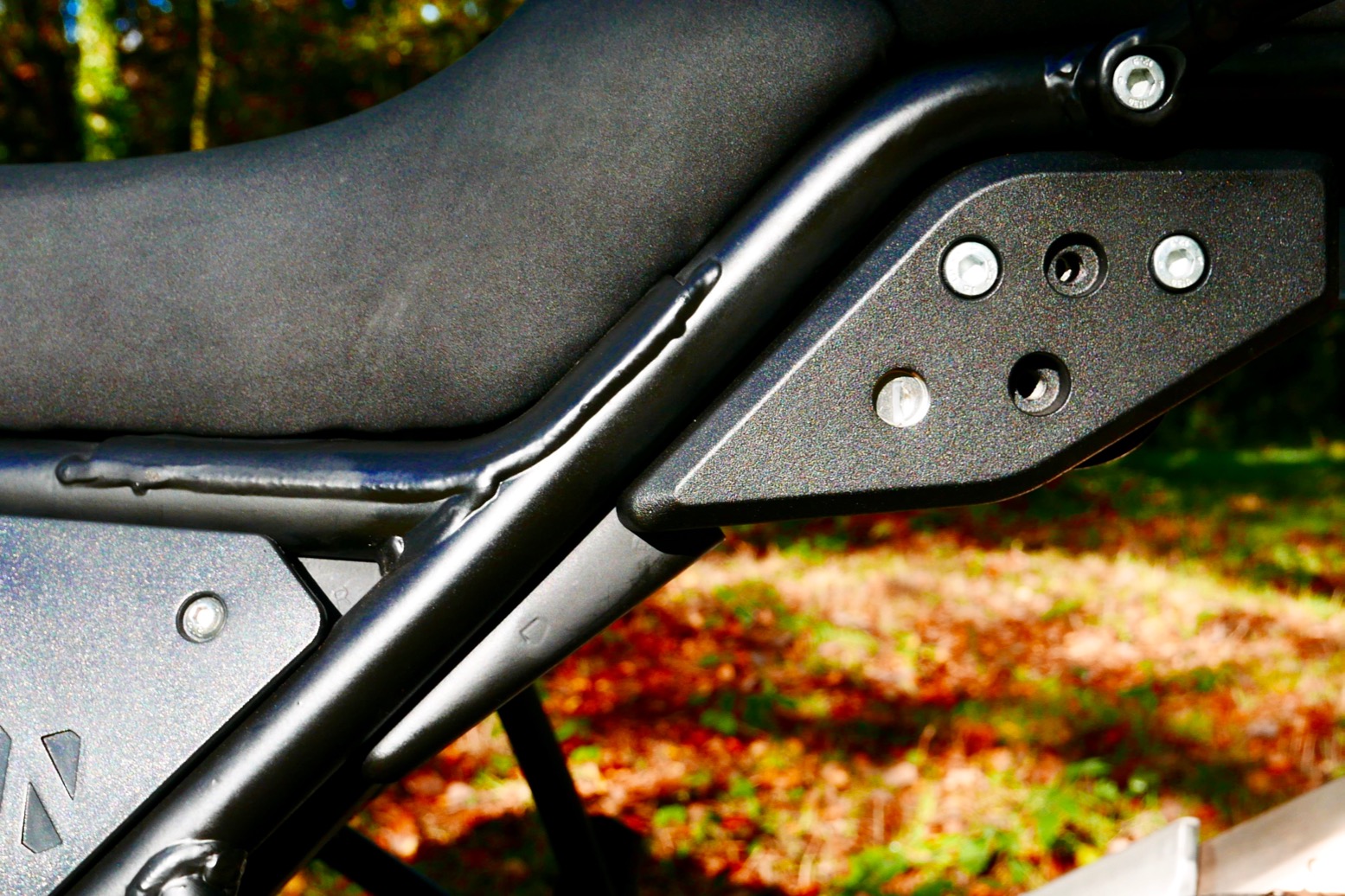
The fit and finish looked pretty good, but only time will tell how it all holds up. Zinc paint brushed over rusty headers looks clumsy. Welds (left) are robotic and if some of that near-200-kilo heft is in the subframe, that’s right where you want it for load-carrying duties off road.
By the book you need to dealer adjust  the valves every 3000 miles (only two and they’re easy screw and locknut jobs) to keep the two-year warranty running. Unless they’re made from the final remnants of 1970s monkey metal, it’s hard to think a low-revving bike like this needs the tappets done twice as frequently as recommended oil changes, but valves clearances tend to tighten not increase. Some say its a way of subsidising the low purchase price.
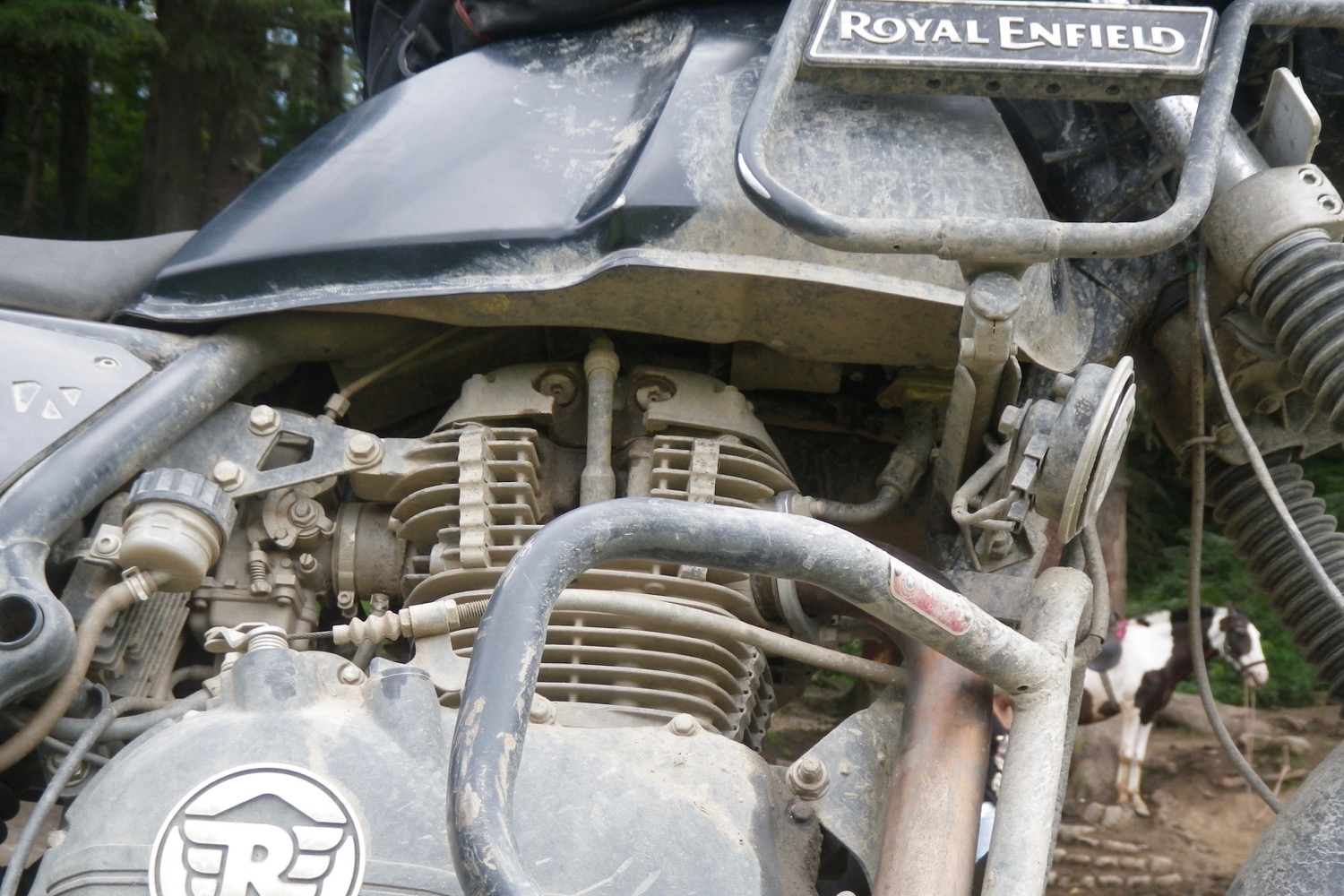
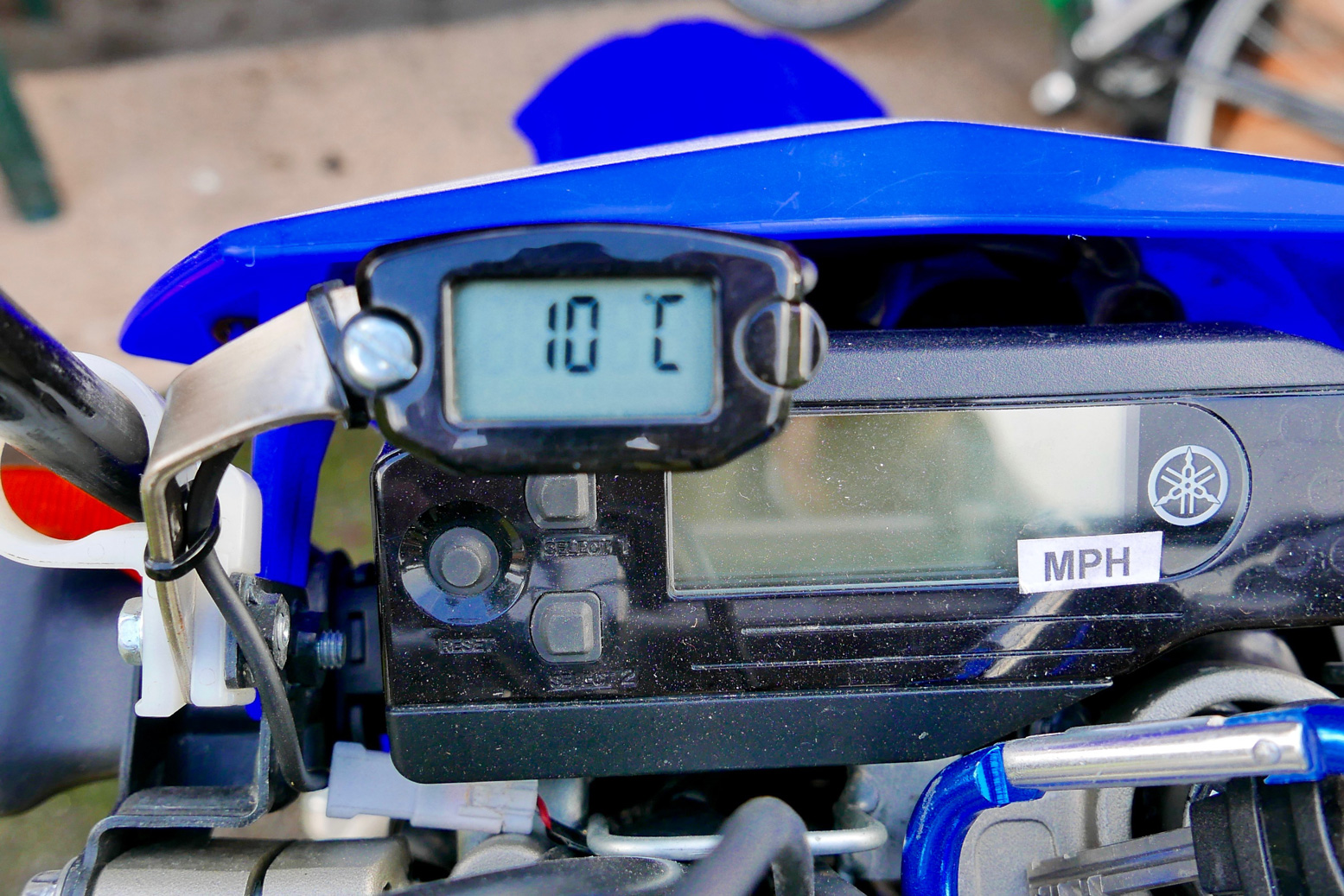
Unusually for an efi bike, there’s a cold-start lever on the left bar, and the air-an-oil cooled engine comes with a big oil cooler. Some say the ambient air temp sensor under the seat could do with repositioning to give a truer reading away from the warmed up engine, but one thing I’d definitely add is an engine temp sensor, like the Trail Tech one off my WR250R, right.
aspecnoslev
mashadv1

Himalayan alternatives
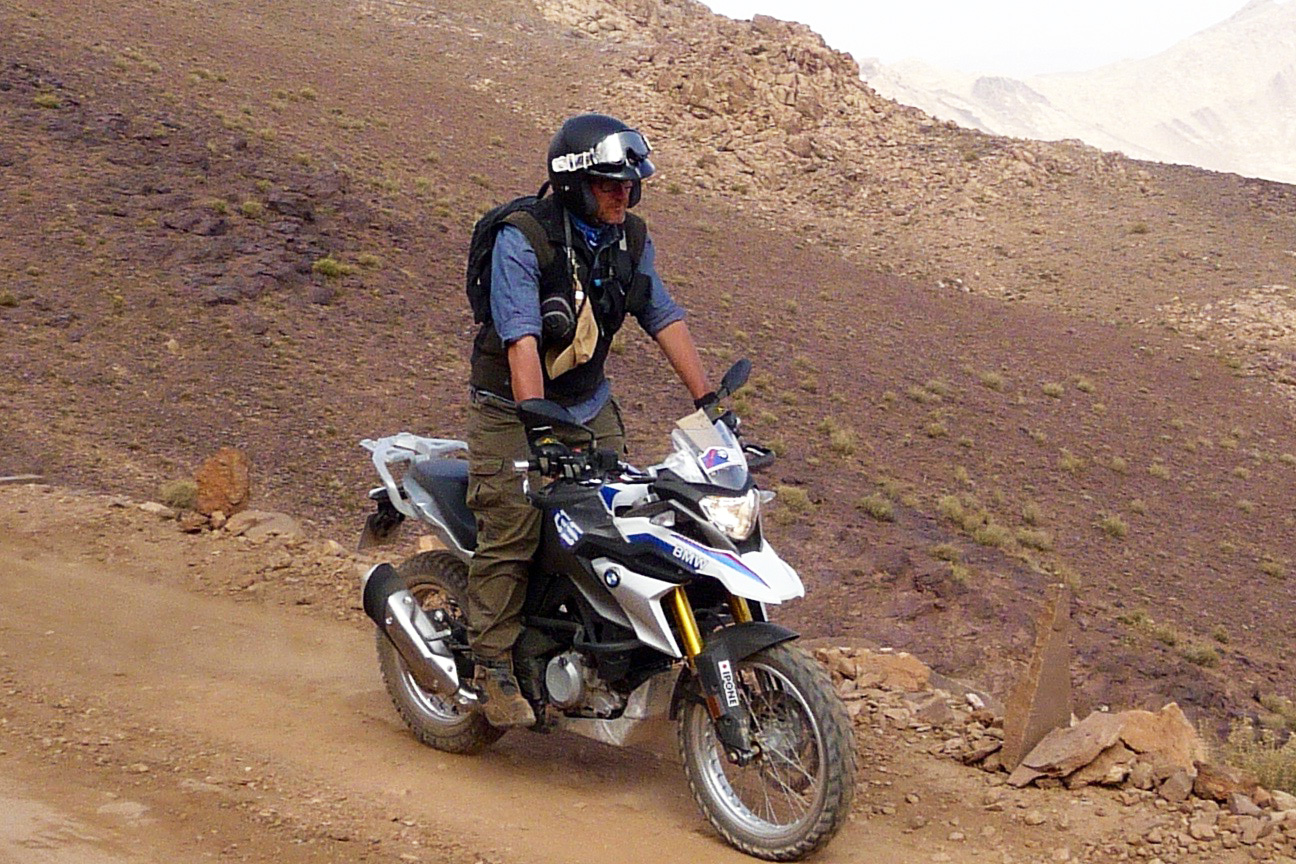
For the money, spec and intended use, very little comes close to the Himalayan’s simple, agricultural charm. Comparing it with the BMW 310GS (right; also Indian built), Versys 300, Suzuki 250 V-Strom or Honda CRF250L misses the Himalayan’s distinctive niche. Riders aren’t buying Hims solely by its displacement category, and to its credit the Himalayan isn’t a repurposed high-revving road bike motor slotted in an adv-styled bike. It was planned from the ground up ‘fit to be your only motorcycle.’ 
sr400

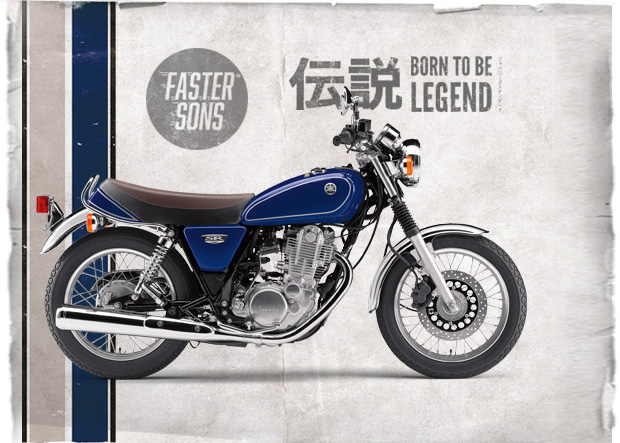
I’d say its low-seat and low rpm characteristics have more in common with Honda’s unfashionable but quietly popular NC twins, Yamaha’s stillborn SR400 (left; dropped in 2017) or your Chinese-made Mash 400s and the like.
It’s closest true competitor is the now seemingly discontinued Mash 400 Adventure (right) / WK Trail 400, which used a 400cc Chinese Shineray engine based on the old Honda XBR500. You may find new, end-of-line Mash Advs in the UK for the same price as a Himalayan. The frames on these Chinese mini Advs are different from the many twin-shock road models, but the motor’s the same.

Him - 3

Conclusion
All of an hour spent on the Himalayan pretty much matched what I’d read and seen, but not what I thought. Cynically, I assumed testers where being a bit soft on the old-style thumper, but after the ride I warmed to the concept too.
Him - 24
Him - 6

People will say ‘Just a bit more power and it would be perfect’ and my experience with similar-hp 250s, loaded up at modest altitude can leave nothing in reserve at 50mph. Sure, you’re still moving forward, but on busier roads and steeper hills, that speed can make you feel vulnerable which induces fatigue over a long day. But out in the slower-paced AM Zone the Himalayan ought to slip right in. The added capacity over a typical Jap 250 only delivers more torque and less revviness which will certainly help on rough trails. Elsewhere, the hefty weight and low power may leave you struggling in headwinds and on long climbs.
Maybe it’s just nostalgia but I’ve had bikes like this in mind for years. Something like my old Triumph T140V or XT500. My GS500R project or more recently, XSR Scrambler were attempts to realise it, but despite weighing less than RE’s claim, the XSR sure didn’t feel lighter.
The Himalayan is the first mid-sized thumper that could fit the bill as a long-range travel bike, much more than the variously badged Shineray 400cc equivalents mentioned above and of course, much more than the CRF450L. By now there’s enough Himalayan chat and know-how online, much of it in India.
Setting off for a long trip what would this bike actually need? Handguards, a bigger screen, a rack for panniers (£500 fitted; right). The upswept pipe might hamper an ideal pannier position low down (here’s one solution) but the  nifty tank racks mean less bulk at the back.
People looking for the ideal light weight, low-displacement travel bike are comparing it with BMW’s 310GS, but only because they’ve come out around the same time and are also Indian made. Knowing the 310 quite well now, as a travel bike I’d sooner get a Himalayan.

Jan 2019: I bought one and rode it to the Sahara.
Him - 22

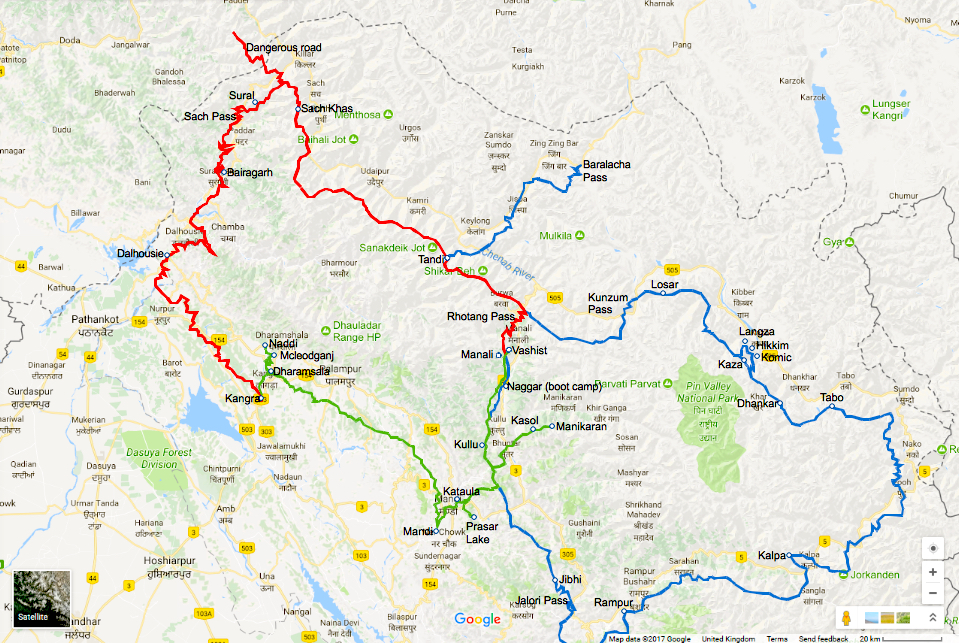
Royal Enfield Himalayan tested in the Himalaya

My Enfield Himalayan Index Page

Dave King

“Our single biggest insight in all these years of riding has been that the best motorcycle for the Himalayas is not one that tries to dominate its landscape, but one that is able to go with its flow. … ​With its purpose-built ground-up design, the Himalayan is a simple and capable go-anywhere motorcycle that will redefine adventure touring…”
Siddhartha Lal, CEO, Royal Enfield

himsdd- - 22

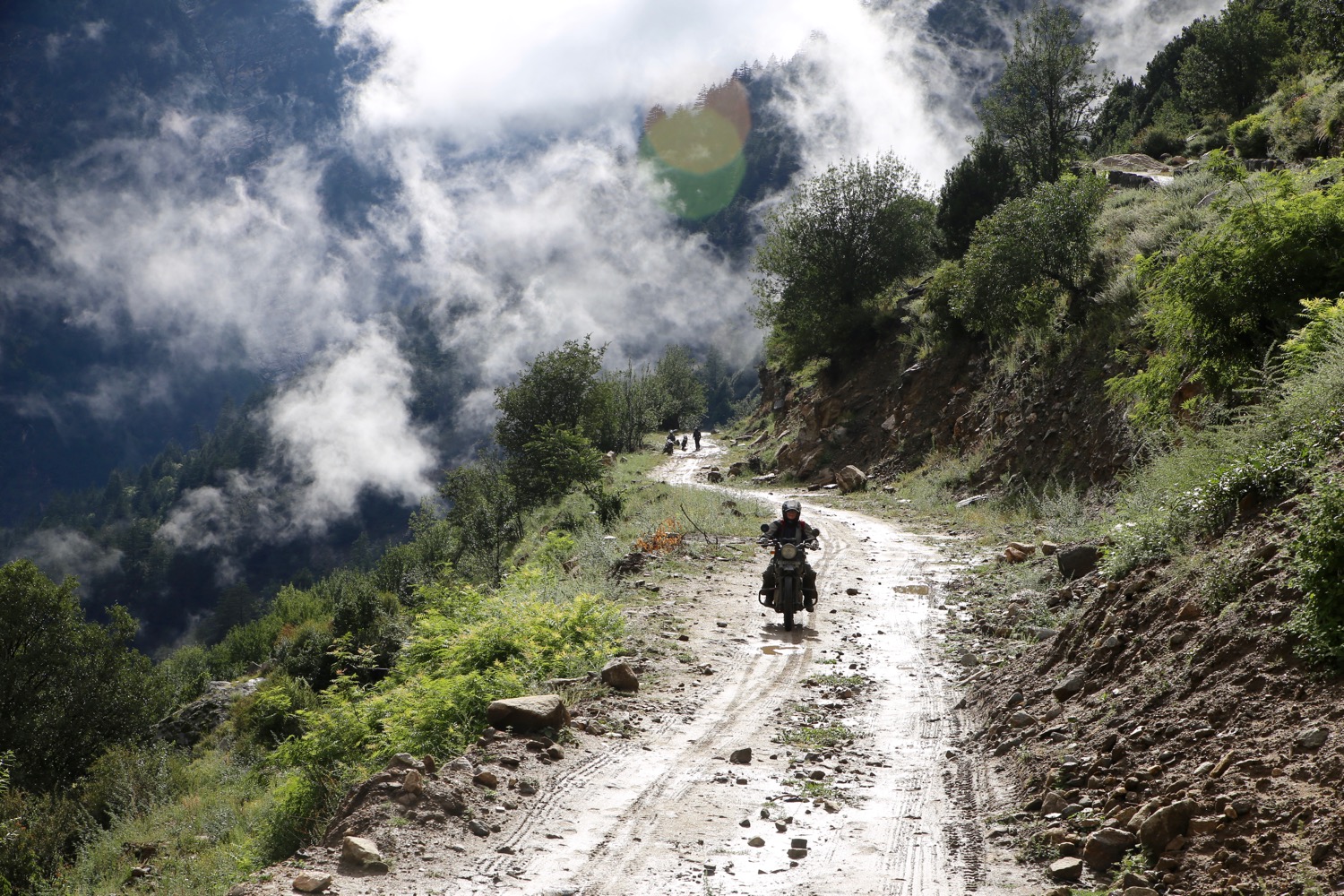
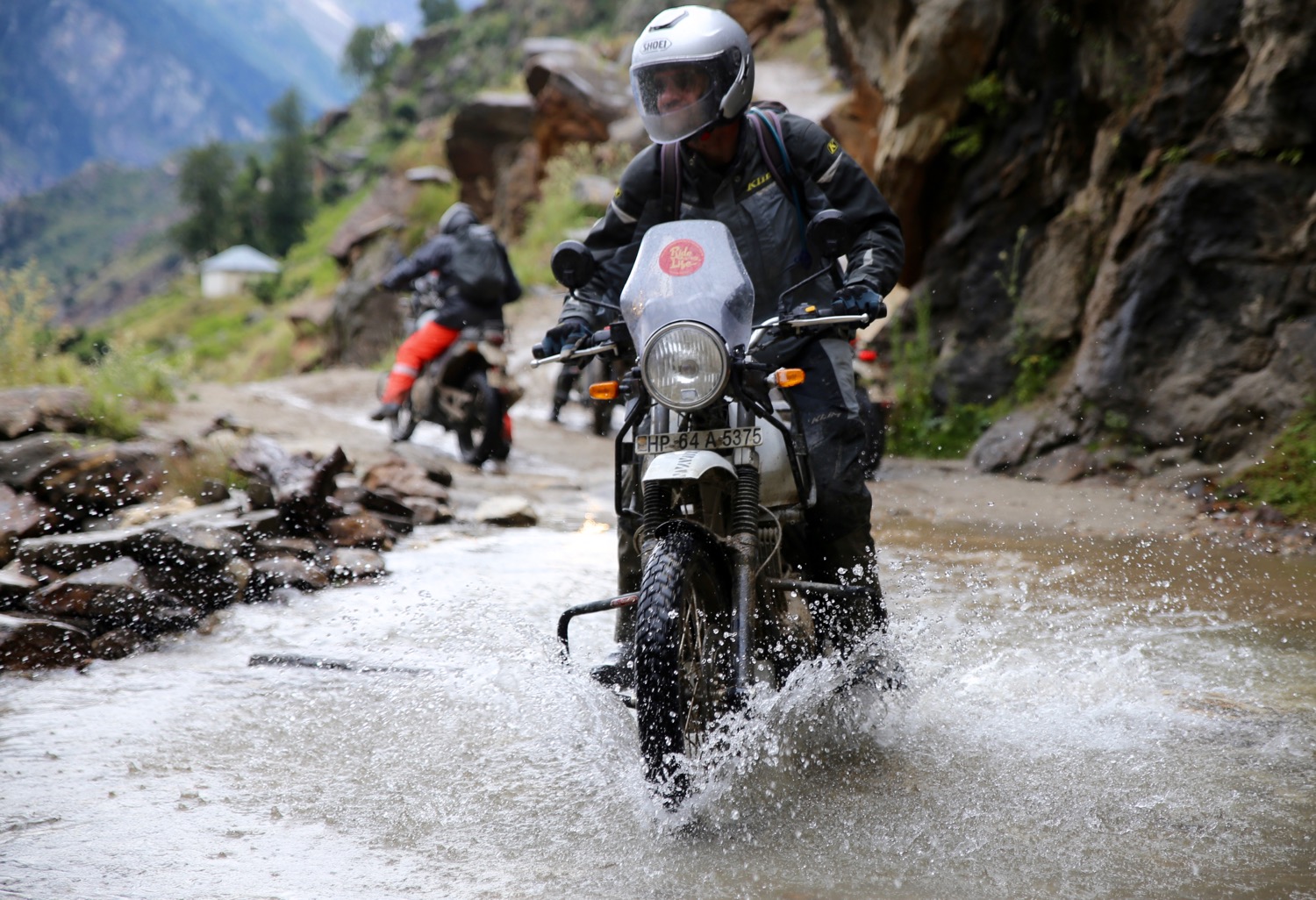
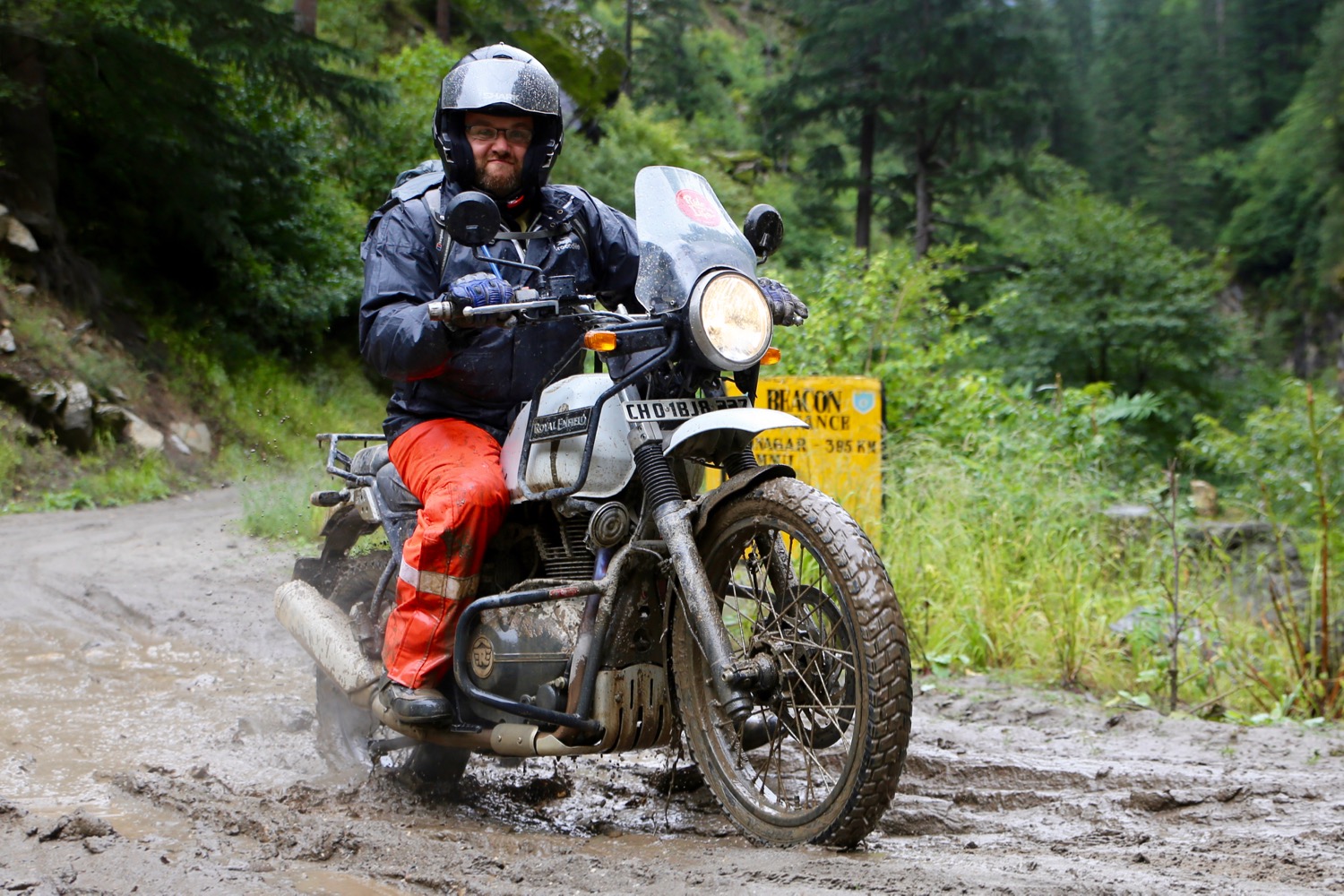
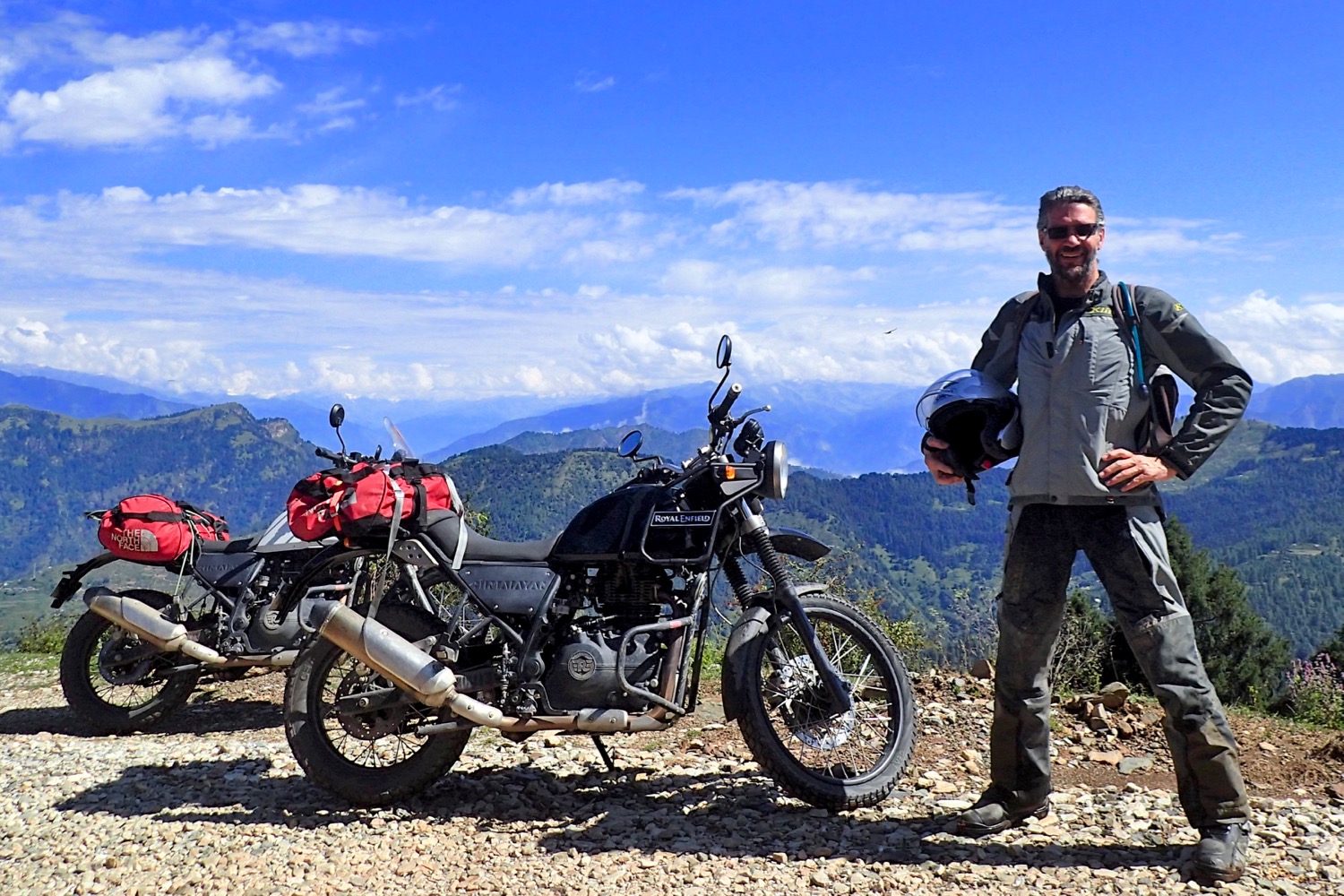
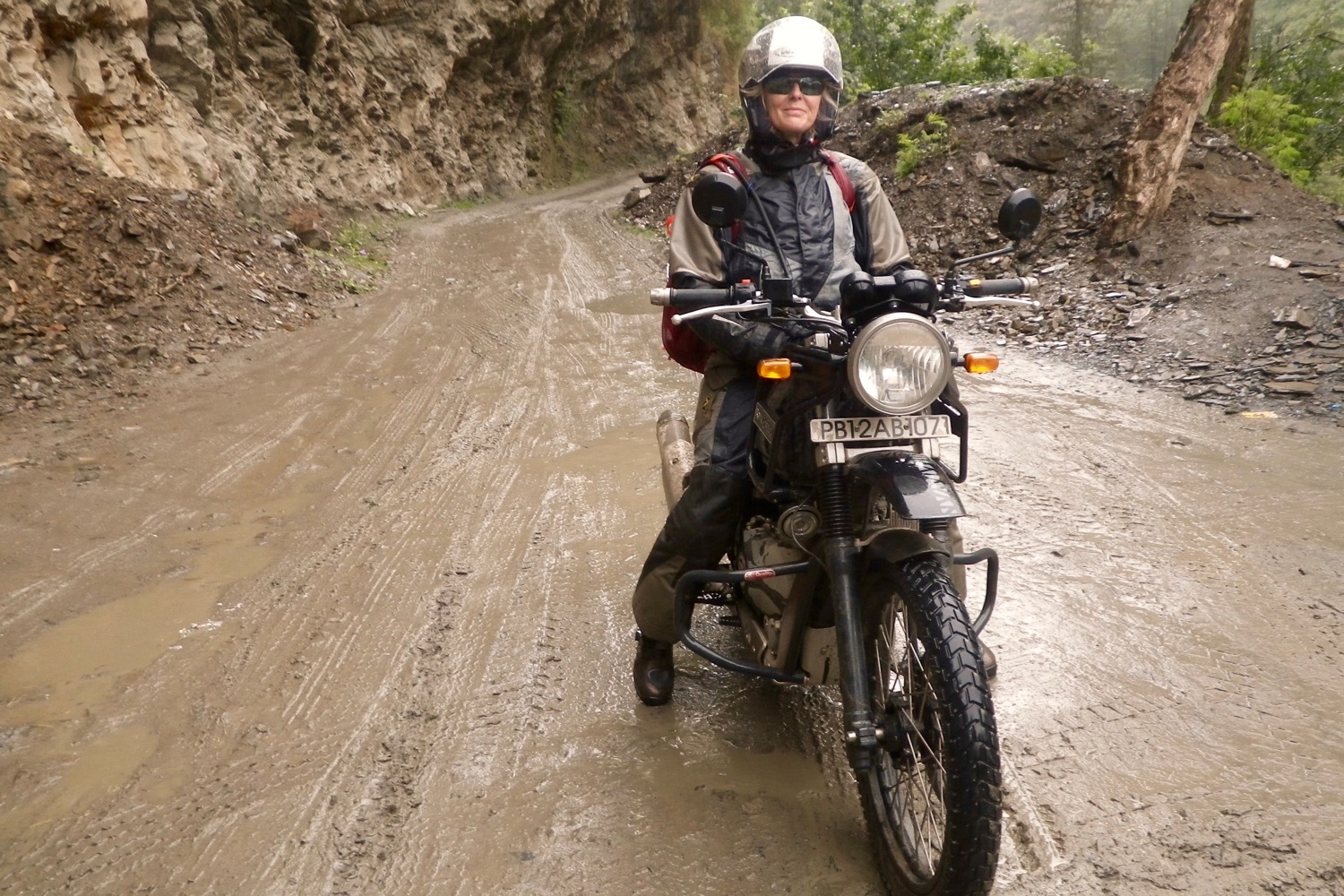
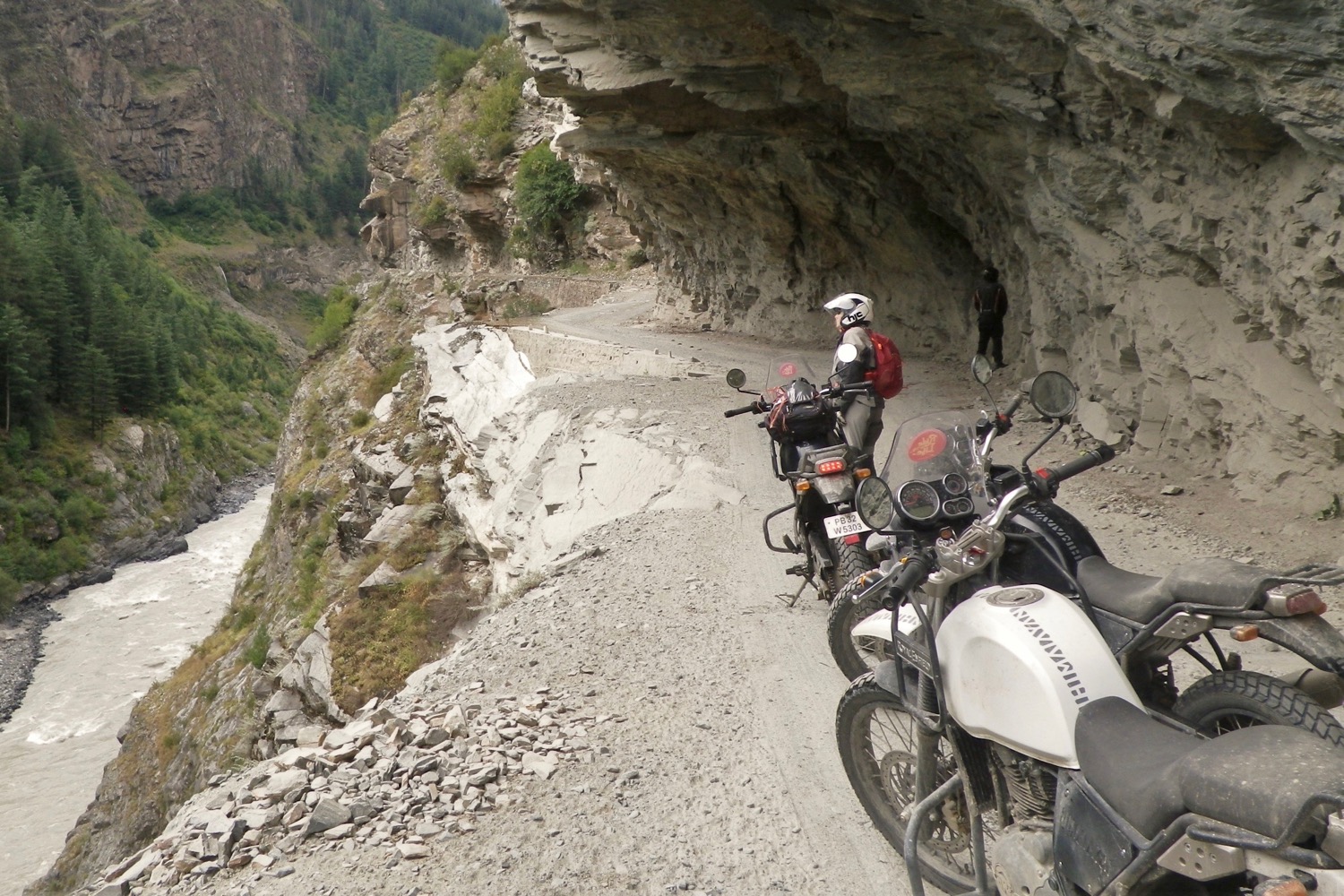
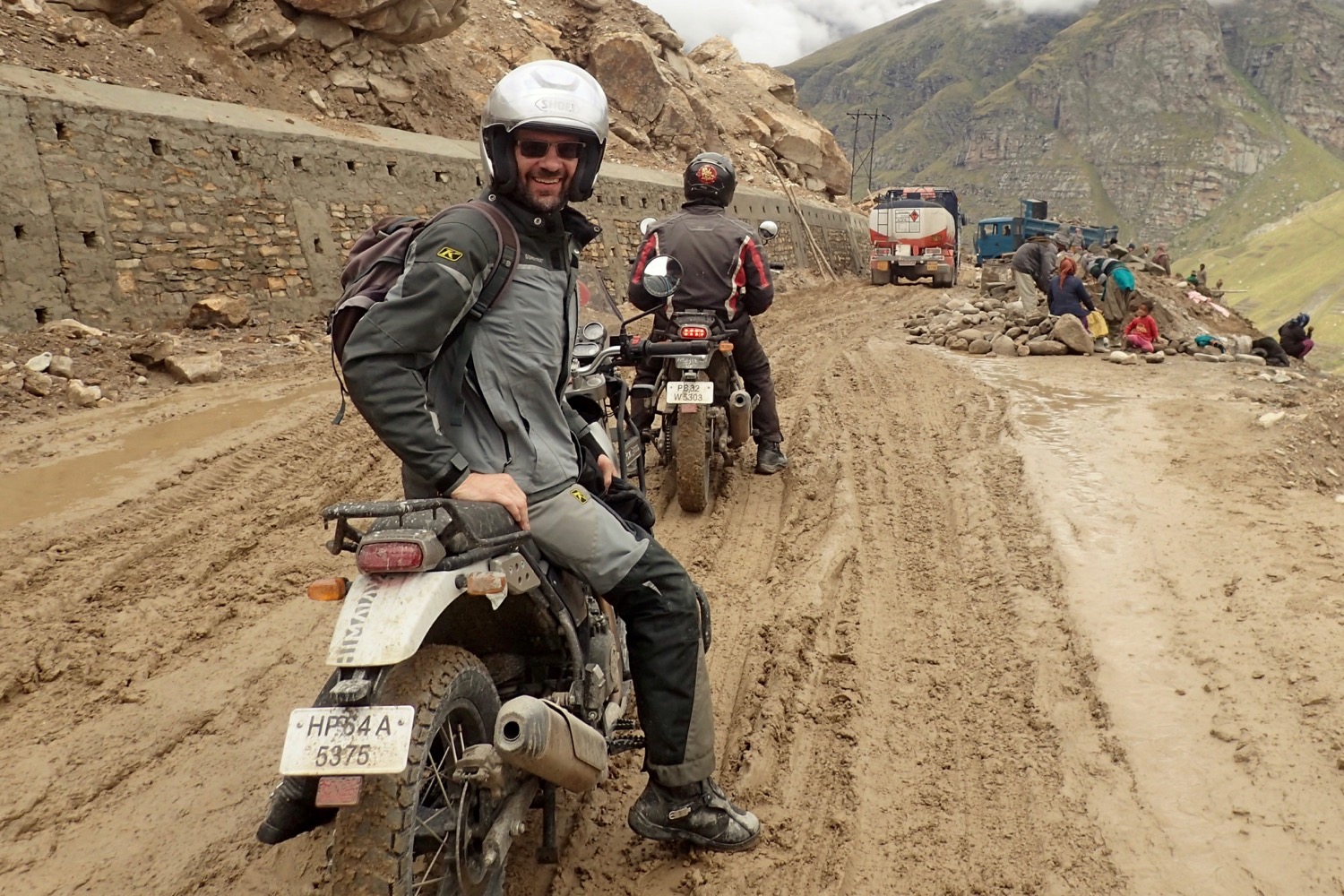
The climb ahead of us resembled something I’ve encountered many times trail riding in Wales or Devon; a steep, rocky ascent of loose stones with mud, water and a thought-provoking drop to one side. The difference here was that the drop to my left was at least 1000′ straight down to a distant river, and the tyres on our bikes didn’t look like they could grip their way out of a wet paper bag. Despite that, the Enfields bounded up the slope like a Himalayan oryx, quite an achievement considering that some in our tour party had little off-road riding experience.

himsdd- - 9
himspex

The new Himalayan is the first completely new bike from Indian Royal Enfield company. The well-known Bullet and its many derivatives can trace their ancestry back to the original British-built thumper from the 1950s. Danielle and I have done several Bullet tours in Rajasthan, Arunachal Pradesh, Ladakh and Nepal. It’s a fantastic bike but when the terrain gets really rough and the riding technical, the lack of ground clearance and poor ergonomics on the pegs expose its limitations.

himsdd- - 16


In contrast the Himalayan has been designed to be ridden sitting or standing. It has much better ground clearance of 8.6” (220mm) but a modest seat height of just 31.5″ (800mm); which potentially opens the bike out to many less tall riders. It was also designed to be comfortable on the road over long distances, handle  the twisties (lots of these in the Himalayas) and have a fuel range of over 250 miles from the 14-litre tank, (sounds like at least 70mpg). If this sounds like an adventure bike as opposed to another adventure-styled bike, then you’d be right. What it’s not really suited to is cruising all day at European motorway speeds, but then India isn’t known for this sort of riding. In India in 2017 it sells for 155,000 INR, or under £1900. When it arrives, UK efi Euro 4 prices are quoted at £3999. Below, a 2018 US review of the efi model.

himsdd- - 18

Styling
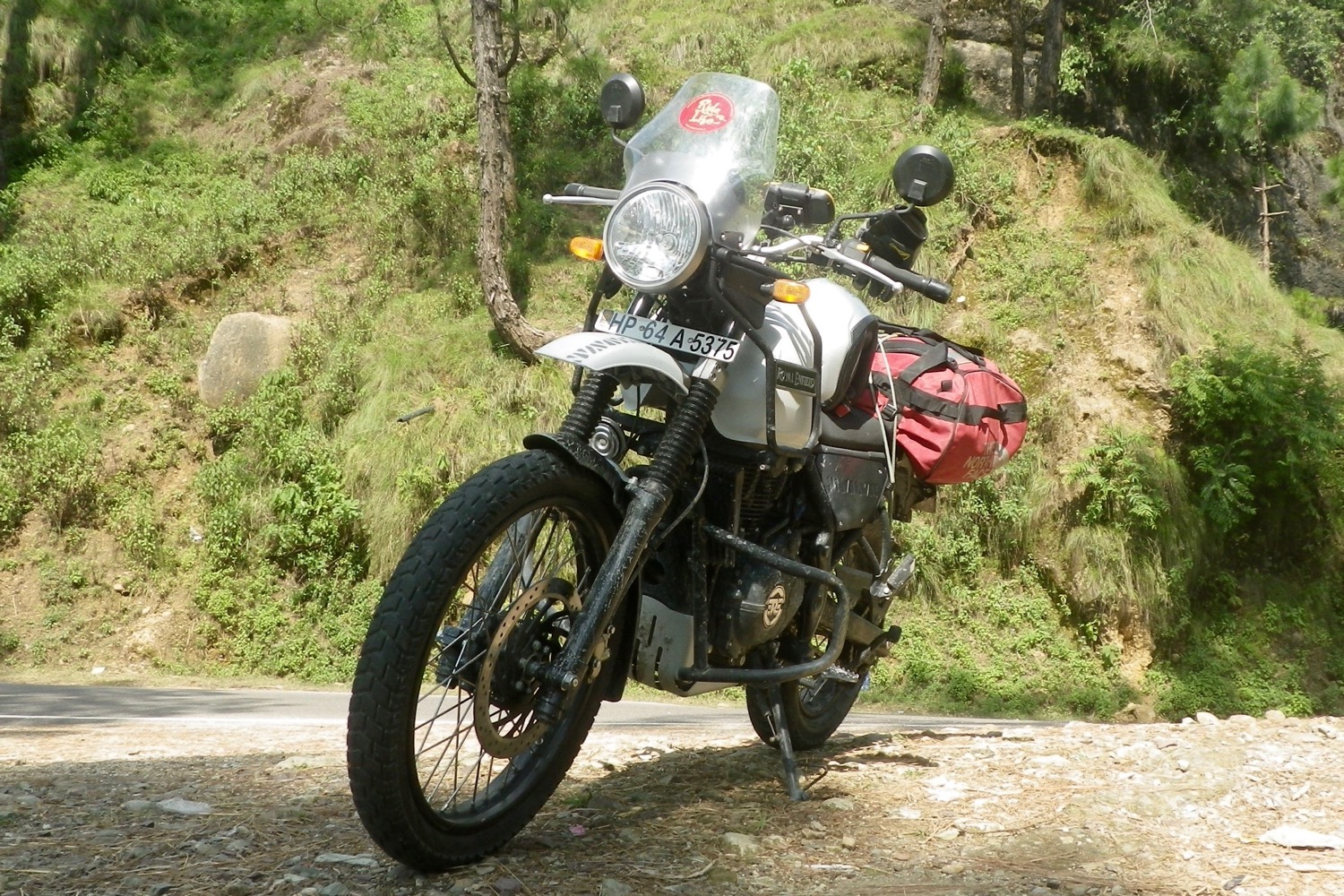
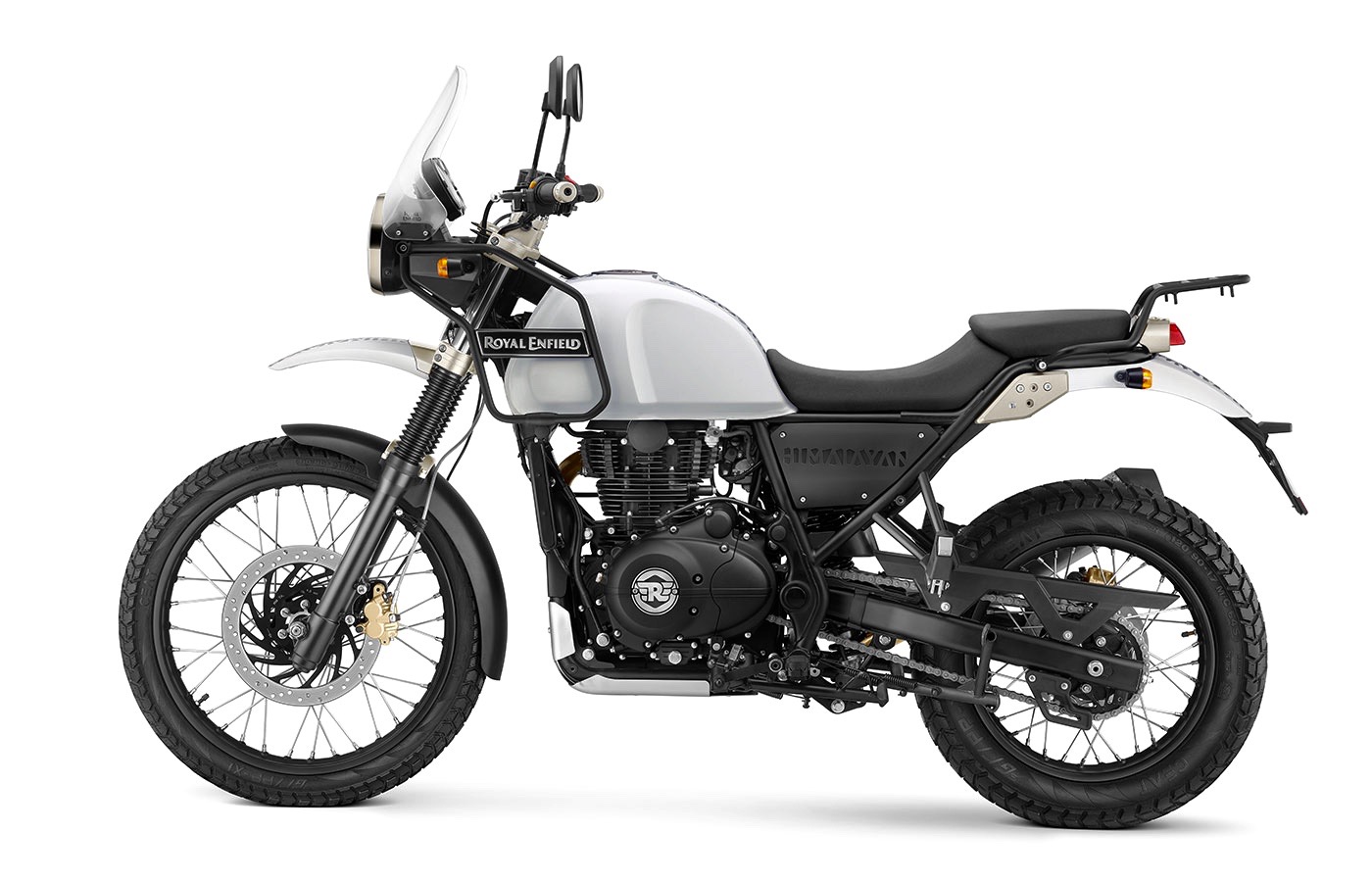
The look is a bit 1980s, recalling the Suzuki DR400 or DR600, although the headlight and instrument cluster are mounted on the frame, not the forks. There’s an element of BMW F650GS Dakar in there too.
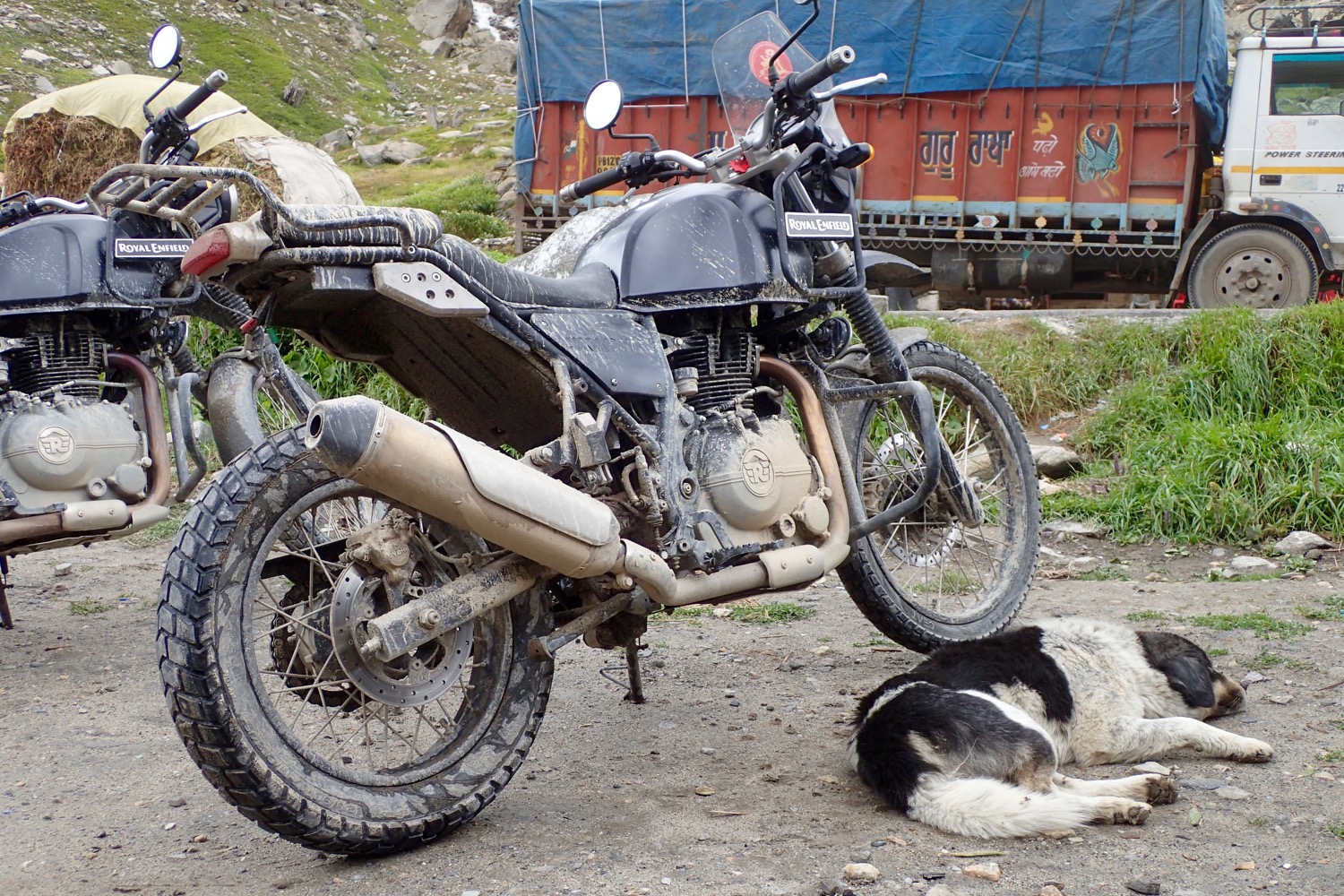
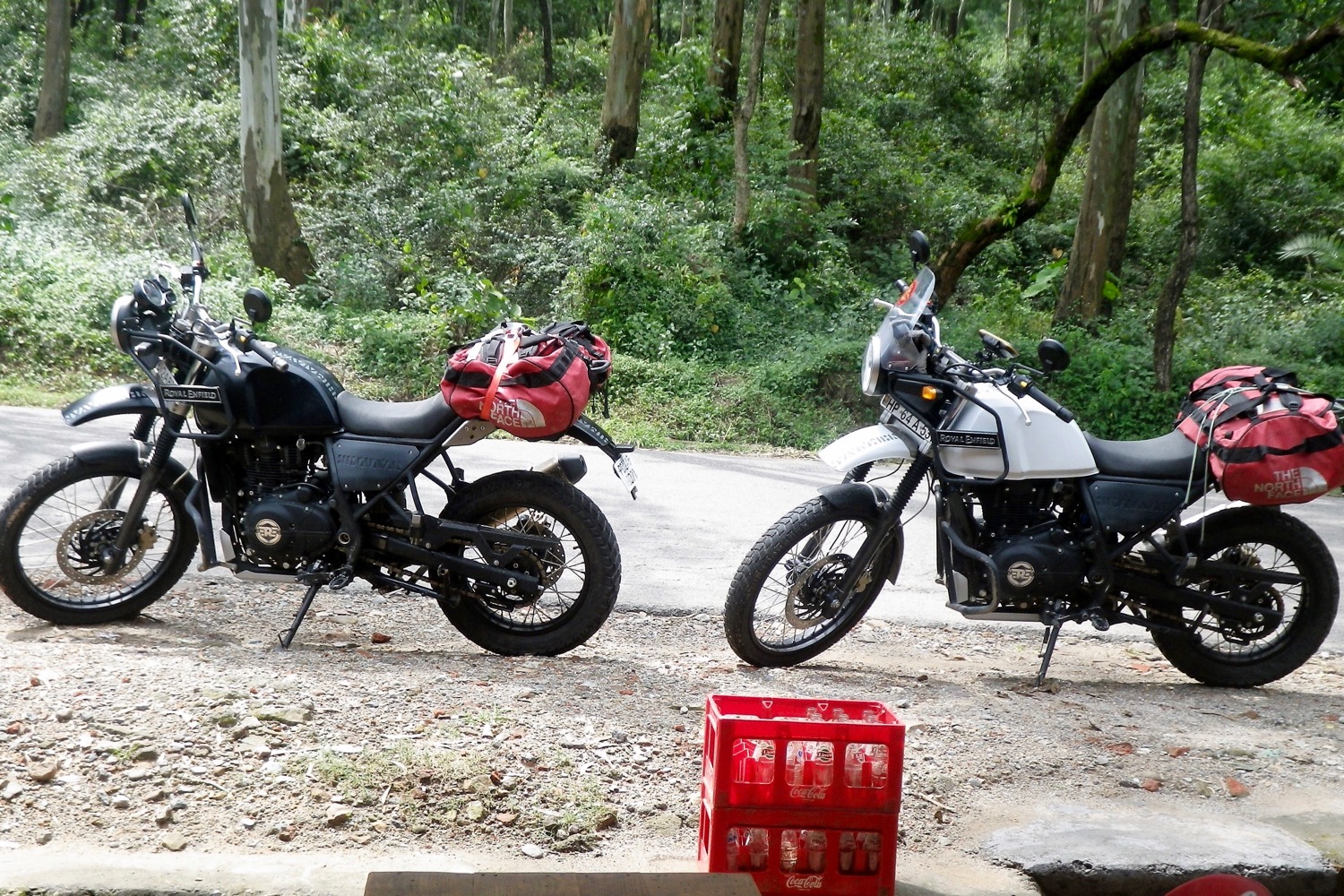
For me the greatest impression was one of practicality and quality, from the solid paint finish to the alluringly cryptic HIMALAYAN logos on the tank, mudguards and side panels, as well as the large LED tail light. It comes in appropriately mountainous Granite or Snow (black or white to you and me) and looks purposeful in either.

himsdd- - 10
himsdd- - 11

Engine
The engine is a long-stroke 411-cc air and oil-cooled lump with a balancer shaft. The word ‘lump’ being appropriate, as the crankcases appear to be off a much larger bike; maybe they intend to produce a large capacity version in the future?
Peak horsepower is claimed to be 24.5 bhp, about the same as the 2017 Honda CRF250L, but there’s 50% more torque, and crucially it’s all delivered at much lower revs.

Coming off my 70-bhp KTM 690R (left) and a R1200GS, I didn’t find the lack of power a problem. The bottom-end torque and smooth power delivery made that modest power very usable. The only glitch with the engine was a flat spot around 4000rpm, most noticeable at altitude (we rode up to 16,000ft/4870m on this trip). You soon learn to ride round it and I suspect a good engine tuner could sort the carburetted version we rode. The fuel-injected version to be sold both in India and globally is bound to  be better in this respect.
On the left of the front down-tube is a good-sized oil cooler, and there’s an all-stainless exhaust with a nicely shaped, cat-free silencer. I imagine the UK version will need a bulky cat. At the other end is a well-sealed airbox with a high air intake and a large, cylindrical dry-element filter.
Top speed is claimed to be 134kph or about 84mph, but the nature of the terrain we rode meant the most I saw was just under 100kph. It’s a long old way down.
Some riders thought the 5-speed gearbox was a little stiff, but on our bikes the clutch cable had been routed around the outside of the aftermarket crash bars causing a bit of cable drag.

himsdd- - 25

Frame
The frame is a conventional steel-tube cradle designed by Harris Performance (who Enfield bought out in 2015) and finished in satin black. The rear end is monoshock and perhaps the only unconventional feature are the subframes either side of the tank which support the headlight and instruments. Each includes a series of threaded mounts to attach extra tanks, luggage carriers or an aftermarket fairing.

himroot
The aluminium bash plate looks a bit flimsy, but proved to be up to the job as the clearance was generous. Surprisingly, hand guards are not standard, though our rental bikes did have poorly fitted aftermarket crash bars which clanged over bigger bumps. I cured this by jamming a wooden wedge into the mounting assembly. You also get sturdy centre- and side-stands which tuck out of the way.

OLYMPUS DIGITAL CAMERA
himsdd- - 8

Wheels and tyres
Wheels are 21” front and a 120/90 section 17” at the rear on black alloy rims shod with Indian Ceat Gripp XL trail tyres which resemble Dunlop Trailmaxs. On rocks, gravel and dry mud, they worked well enough if pressures were dropped to 20 psi.
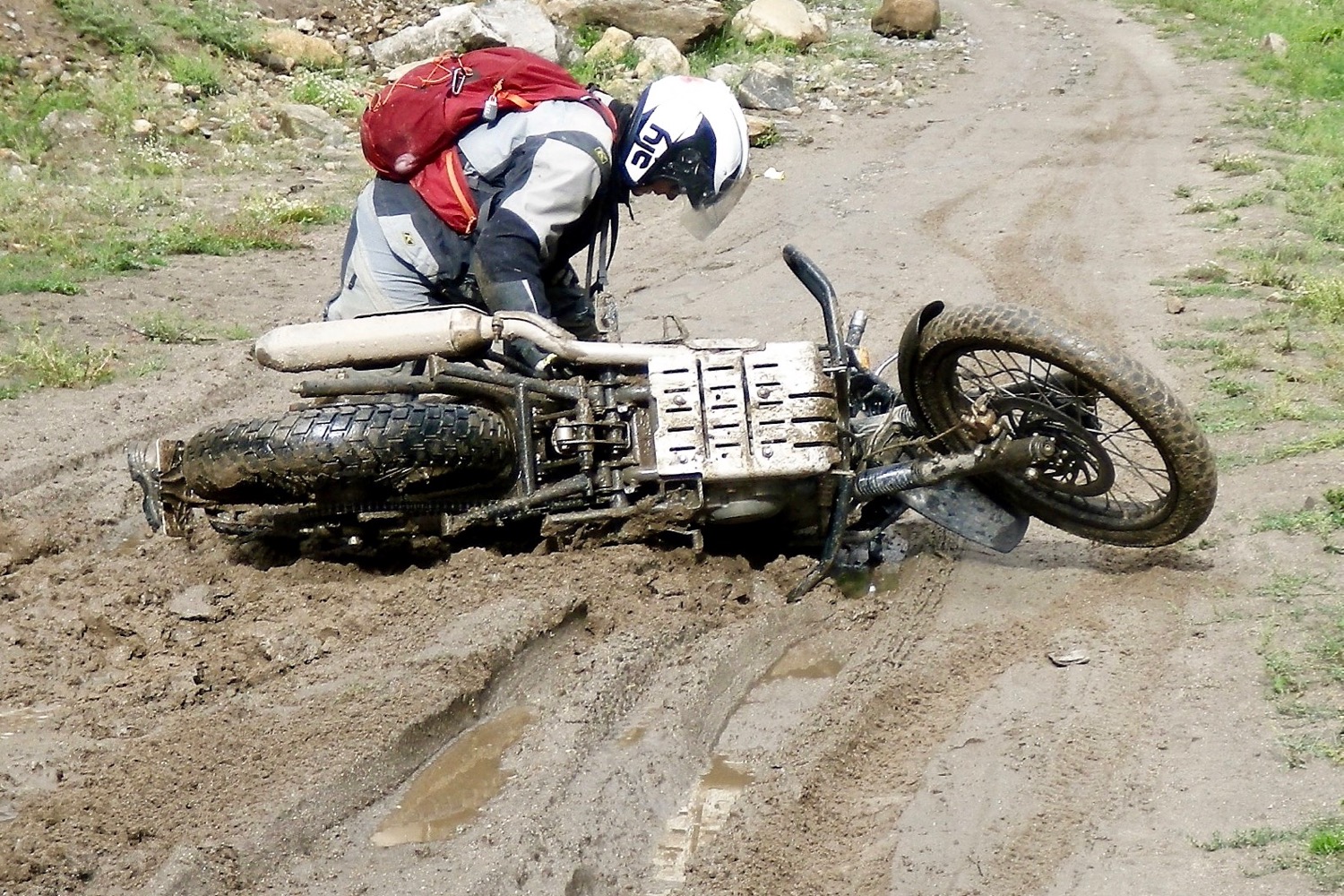
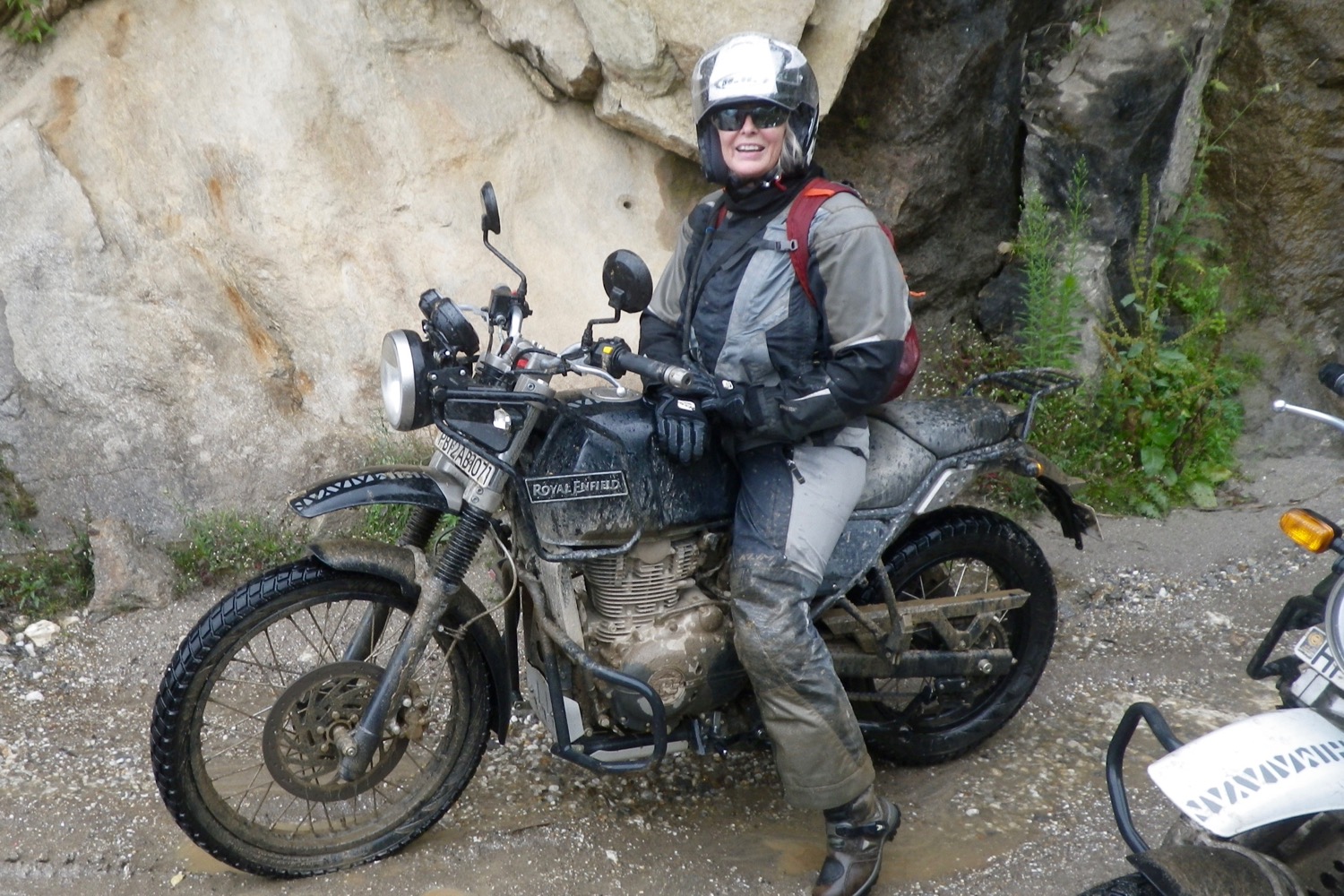
On muddy ruts and wet grass you just have to take it easy or you’ll end up as on the right, but they’re helped by the gentle power delivery; it’s almost like having traction control. The Himalayan does not, of course, have traction control, ABS (in India at least), power modes, suspension modes or any a la modes, but manages fine without them.

Suspension and brakes
Initially the forks (180mm) felt very softly sprung; far more trail bike than my hard-charging 690 enduro. However, the springing and damping were well matched making riding over rocks very easy; the bike always went where it was pointed. There’s no adjustment on the 200-mm-travel rear shock except preload. The brakes look like Brembo copies with braided, stainless brake lines. At the speeds attained they worked for me.

himsdd- - 20

Ergonomics
If the bike were mine, I’d fit one-inch bar risers, but then I am 6’ 1” and fit risers to all my dirt bikes. The 31.5-inch seat is low for an off roader which makes standing up a bit more of an effort, but was comfortable enough for all-day riding. Before the trip Dan (5’ 6”)  had some concerns that the 182-kilo Himalayan would be too tall and heavy but she easily got both feet on the ground and loved the bike too.
The bike is fitted with a small screen to help reduce the wind pressure at speed (or at least the speeds we reached on this trip). Dan removed hers to improve visibility on dirt roads. It can make a real difference to confidence.

himsdd- - 17

Instruments
The analogue instruments have enough of the information and features you’d expect of a modern bike, plus a couple you wouldn’t: oil temperature and an electronic compass. I love the latter idea; in a country where fitted GPS is rare, it helps affirm you’re heading in the right direction.

Luggage attachment
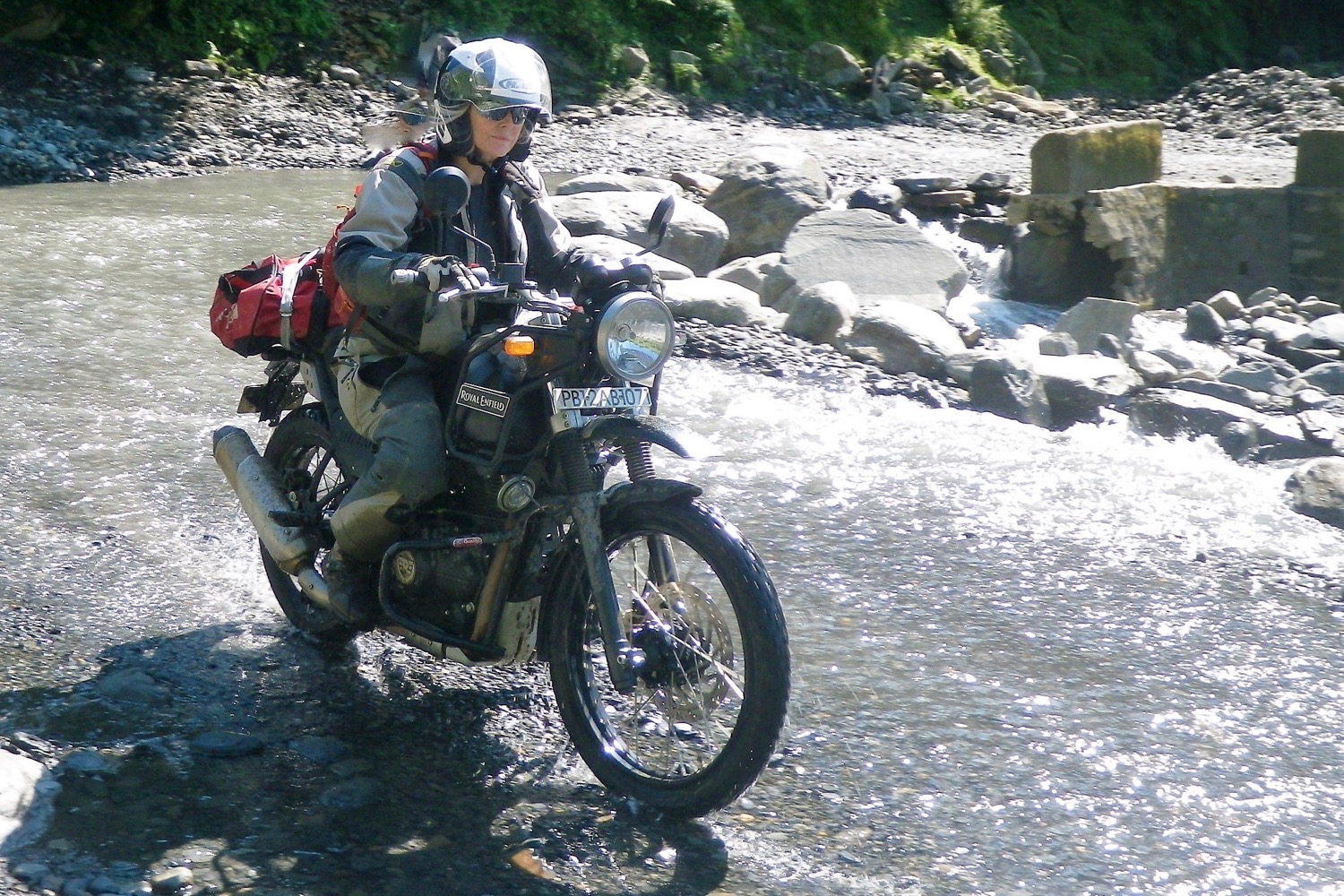
Besides the tank frames the bike also comes with a small rear rack and several points to attach pannier frames. Some people complained the upswept exhaust made mounting luggage more difficult than on a Bullet, but if they stall in a river at least it won’t fill with water.

Maintenance
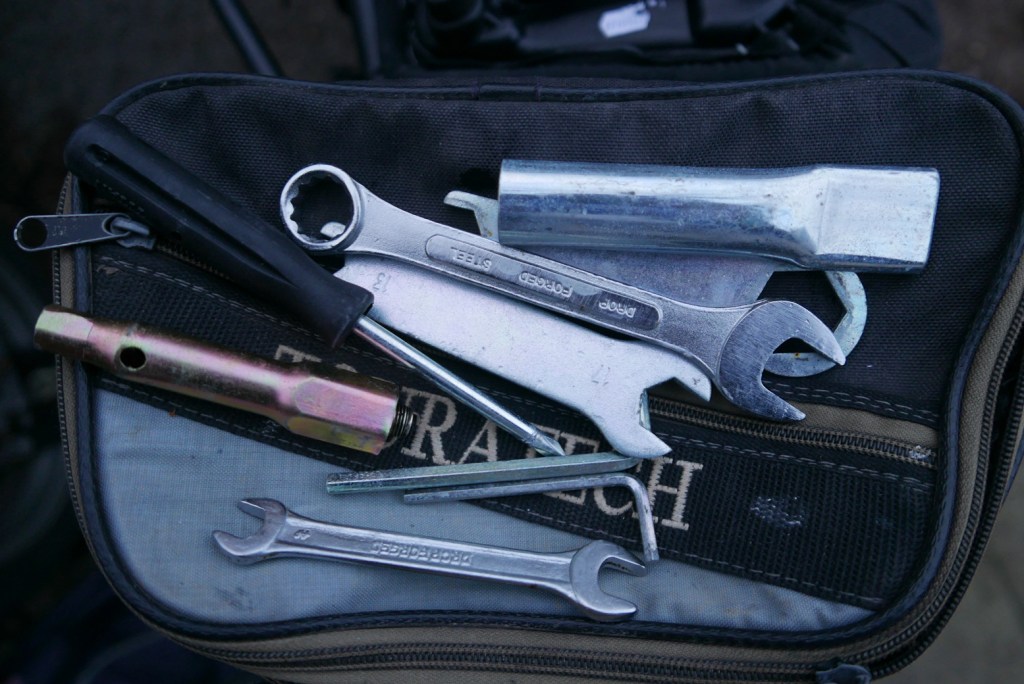
Compared to most modern bikes the Himalayan is basic, but everything appears readily accessible with a comprehensive tool kit sits under the lockable back seat. According to the service interval, the 2.6 litres of oil needs changing every 6000 miles or 10,000km.

Summary
I’ve ridden all sorts of bikes in all sorts of places and am convinced Royal Enfield have done something special with the Himalayan. There’ve been a few teething troubles, as you’d expect for a new design from any manufacturer, but Royal Enfield have been responsive and you’d hope by the time we get the Himalayan in the UK, these will have been sorted.

himsdd- - 24


The suitability of the bike for India and specifically the Himalayas is undeniable, but would it be suitable elsewhere?
After a month and a few thousand kilometres in India, I’ve no doubt that given a set of better tyres it would be able to tackle the majority of the UK trails I regularly ride. At over 180 kilos it is significantly heavier than other trail bikes of this capacity, even a KTM 690R or BMW XChallenge, but the low seat combined with the soft suspension and progressive power delivery make it very easy to ride.
Would I enter it in an enduro? Only if I felt like winding people up. Would I ride the Trans-Am Trail on it? Absolutely. Round the World? Maybe, once I assessed long-distance, all-day road comfort and reliability. Is it fun? Yes!

tik
• General off-road rideability
• Ergonomics
• Functional looks
• Luggage attachment points
• Compass
cros
• Flat spot at altitude (carb model)
• Lack of top-end power (but yet to test above 60 mph)
• Lack of hand guards
• Wretched aftermarket crash bars
• Will cost twice as much in the UK
 

Fitting Tubliss liners (GS500R; Himalayan)

Updated 2020
Tubeless Conversion Index Page
GS500R Index Page Himalayan Index Page

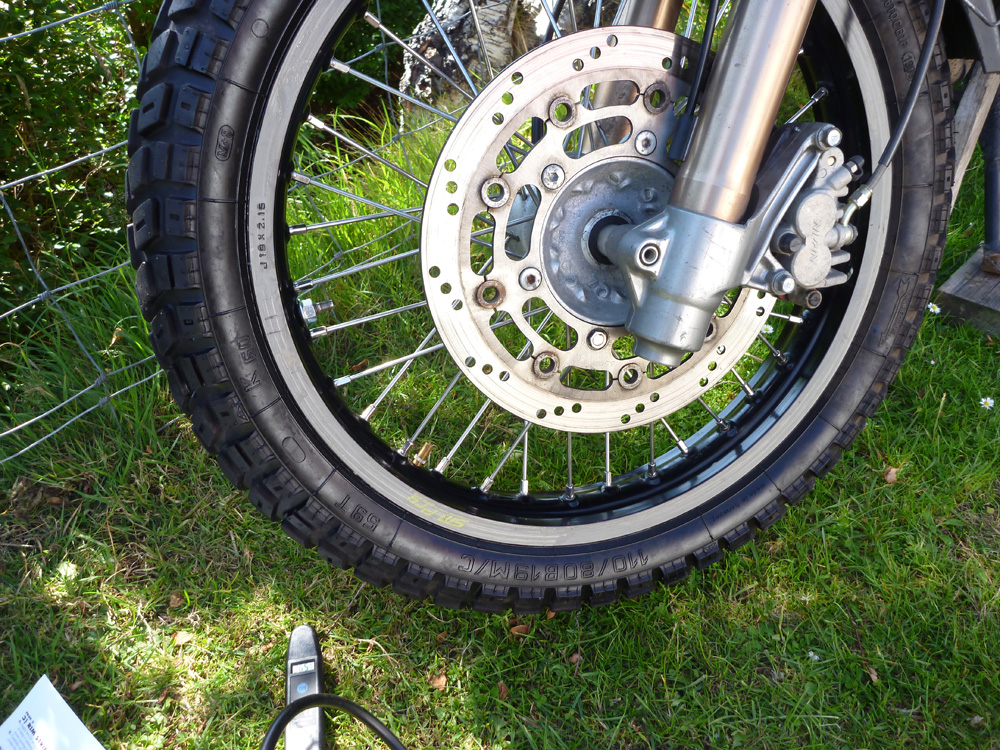
Tubliss Generation 2 is now widely available in 18, 19 and 21-inch sizes for WM3 (2.15”) or slimmer rims. I fitted one to the front of my Himalayan

himtublie

My Suzuki GS-R ran 19-inch SM Pros and the plan was always to have them running tubeless, hopefully doing a more successful job than I did on my Tenere’s wheels a couple of years earlier. On that bike the sealed-up rear never missed a beat, but the 21-inch front leaked off-road and as I failed to monitor it, it got soft enough to ding a rim on a gnarly Moroccan climb and with that lose all pressure.
Back then I wanted to try Tubliss but they weren’t sold in Tenere sizes in the UK. I picked some up in the US for around £55 each. The vid below explains it all very loudly. Man that guy can talk!

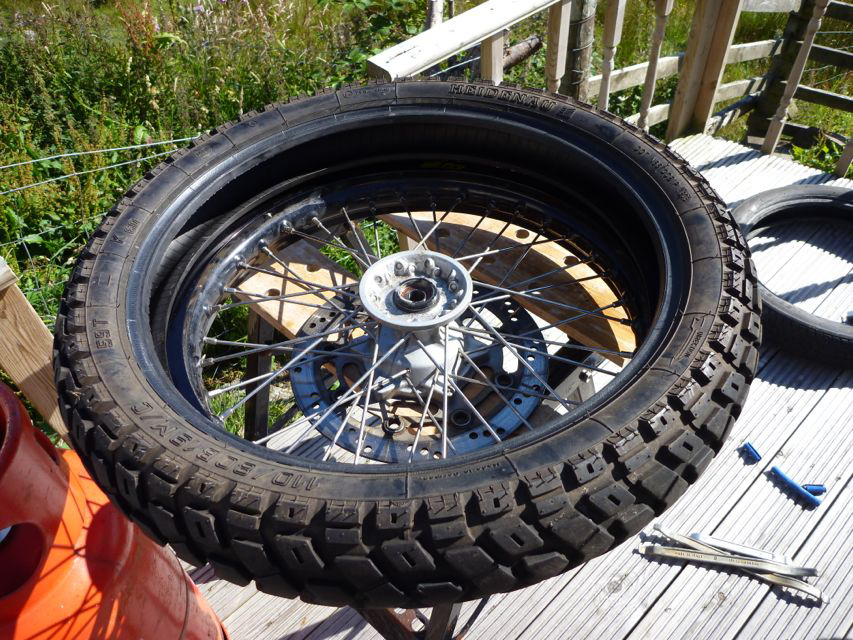
I was expecting a hard time fitting them in my Heidenau K60s – it’s a stiff tyre and you’d imagine the bulk or shape of the red plastic core and rim-lock might make tyre mounting even harder. When a sunny afternoon came by, I left the 4000-mile old K60 out against a wall to warm up a bit and then followed the clear instructions carefully. Off with the old Cheng Shin without too much difficulty, clean off the duct tape/rim tape residue and the drill an 11mm hole a few spokes up from the regular valve hole. I then talc’ed the inside of the red liner to slide better against its mini tube, lined up the rim lock clamp/tyre inflation valve and the nearby core inflator valve with the two holes in the rim (pic above; the instructions stress this is critical) and then mounted the core onto the rim.

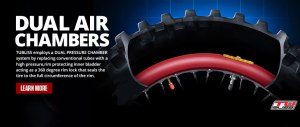
tubli-dual-airHow it works
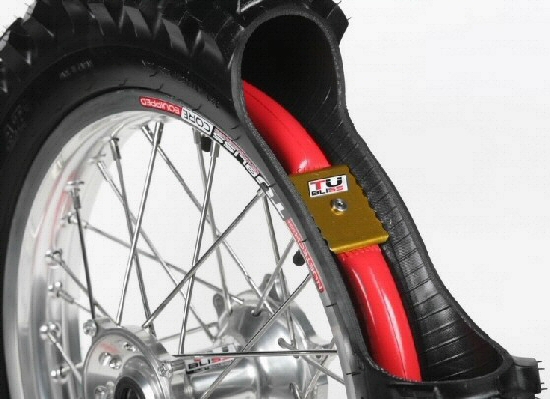
Tubliss works by using a small but extra thick bicycle-sized inner tube at very high pressure to expand the red casing onto the tyre’s bead, sealing it against the rim (see image below). By doing so it isolates the tyre’s main air chamber from the spoke nipples where air would otherwise slowly leak out.
This can be an odd concept to get your head around; a high-pressure mini-tube is still used to press and seal the tyre bead against the rim, but the tyre chamber itself is effectively tubeless. An additional hole for a rim lock is required so as to pin down the red
casing and completely eliminate tyre slip and valve lean at low pressures (as happens with regular tubes at low psi). Because the thick Tubliss mini tube isn’t anywhere near the flexing tyre carcass and is inside the red casing, it would take an exceedingly long and sharp spike to puncture it. Plus everything remains cooler; the benefit of all tubeless tyres. You can still tune spokes, something not be so easily done with other spoke nipple-sealing methods. The rim lock uses a ‘hollow bolt’ which is also a valve to inflate the tyre chamber to a regular pressure. The original valve hole is used to inflate the red casing tube to 100 psi.

tubly

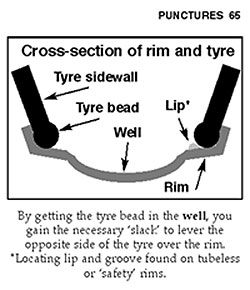
The core went onto the rim easily. Just follow normal bike tyre mounting techniques: make sure the red core is right down in the well of the rim as you lever the other end on.
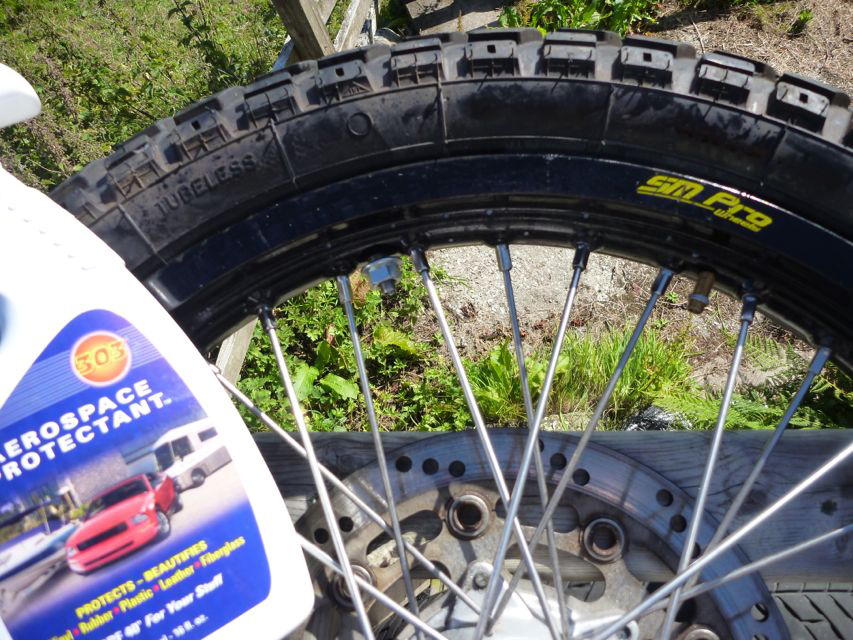
Usually I use diluted washing-up liquid but that tends to dry up quickly. This time I used more slimy 303 Protectorant; it’s the same as Armor All that Tubliss recommend. Use lots so it’s lubed forever inside. The core slipped on with no levers. WD40 will do, if stuck.

Next came the tyre. This was going to be hard, or so I thought. I double checked I had the direction arrow in the right orientation, then pushed the wheel down into the tyre using the folded metal plate which Tubliss supply, rim-lock down. Following the instructions closely (and having changed a few tyres in my time), the plate did genuinely help the core-fitted wheel slide into the tyre with less effort than normal. And if you kept pushing down as they advise, with a bit of multi-armed Vishnu-ing I got the wheel inside the tyre walls.

The rest – levering the tyre bead back onto the rim – was like regular tyre mounting: minimal lever force where possible combined with maximum lube, while always making sure the tyre bead opposite the levers is being kicked and crammed into the tyre’s well (central dip) so as to free up vital slack when levering to reduce the effort which is when mistakes are made and tubes get pinched.
Like they say on the leaflet, lube is the key to this. In the end the last bit of tyre went on without the final lever. This used Heidi was not so hard to mount after all. The same-sized new K60 for the back was a bit more effort shoving inside the wheel, even with the Tubliss plate, but with slack and lube, it got there.

tbs-front

With all this done the next step was to see if the system held air once everything’s pumped up. There’s no reason to think the mini tube got pinched, protected as it is inside the red plastic core. The key is the red liner sealing against the bead of the tyre to keep the tyre at the right pressure. You need to put 100 psi into the mini tube to make sure it seals: You want to check your average mini compressor will have the power to do that, but because the volume is tiny it may be easier than you think – it’s not like pumping up a full sized moto tyre to 100 psi.

bestguage

Testing, testing
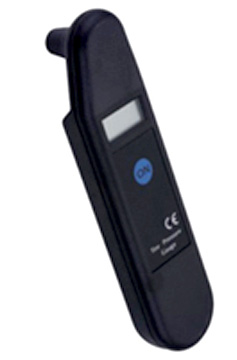
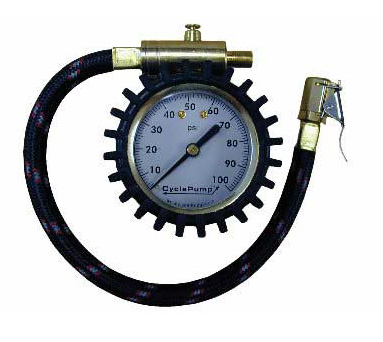
You may read complaints that fitting Tubliss doesn’t work first time round or doesn’t work at all – the tyre goes down – but so far overnight both tyres have held their pressure. Checking the tyre and core pressures after 10 days, I found both cores down by about 10%. I think that’s acceptable and can’t be sure everything was at the right or equal pressures to start with so I topped it all up to 100 psi and 33 for the tyres and will check again in a while. Tubliss do say to check pressures before each ride. Unfortunately, checking the high pressure cores blew the brains out of my digital tyre gauge (right) and those metal sliding rod types only go up to 50 psi. I have a bulky Cycle Pump gauge (left) that’s sat around for years and whose moment may have come. As mentioned, a mini-compressor able to deliver 100 psi without fatal results will be needed. Not sure my Cycle Pump (below) or anything like it can manage – we’ll see on the Himalayan. Anyway, there are always roadside garages.

tltwit

Should you have a flat on the road it’s only the tyre chamber that loses pressure, not the small sealing tube of course. Once quickly plugged (left), the tyre can be reinflated with a regular bike compressor to normal road pressures.
Initially Tubliss didn’t claim to be suited to road riding let alone overlanding, but that seems to be changing as the system has proved itself. What is important is making sure the tyre sealing tube is kept at around 100psi. That may take more frequent checking than you’re used to, at least until you get a feel for the rate of loss, if any. On the road and out in the world a reliable mini-compressor is a vital tool.

cyclepump
tubeless-slimer

A mate with Tubliss in his TTR has had no probs, including air freighting it around the world. He’s reminded me that, as the video above mentions, injecting sealant like Slime/Oko/Ultraseal (right) is a good idea and over time helps seal the tyre right up. I did the same to the Tenere when I sealed those wheels (right) and if nothing else it helped highlight leaks oozing out of the front.

More impressions to come with the Himalayan.

gsr-gsr