Category Archives: AMH News

The Future of UK Trail Biking 2. Another FS e-MTB review.

See also:
Full sus Marin e-bike in Wales

After 2.5 days riding a full sus e-MTB along New Zealand’s 300-km Alps to Ocean bike trail (A2O map below), again I wonder if e-MTBs are an answer to trail biking in the UK where there are way more bridleways than byways, let alone the wild expanse of the Scottish Highlands excluded to motos and 4x4s.

Southern Alps to Pacific Ocean. 300km and not one gate!

Many ride the popular A2O on regular bikes, even ultralight, no-sus MTBs. With the decadence of baggage getting transported daily, I like to think I could have also managed this on my Merida Big Trail 500 home bike (left), but e-assistance was the safe option. And to paraphrase Mike Hailwood, ‘the on-off switch works both ways’.

I first tried an e-MTB in Wales in 2022 (video above), seeking to speed up map checking on a new walking guidebook. The Marin was a nice ride, leaving me pedal-tired but not beaten up at the end of the day. But at that time it cost more than a new CRF300L, and I got back thinking I quite like the simplicity of my 15-kilo Merida hardtail.

Now I’m wondering again: could an e-MTB with a day’s range of at least 100km, be my new trail & travel project bike? Even in my prime – and bar a couple of Himalayan trips which were mostly road (below) – I never really had enough grit to explore far off road with my hardtails. Day-ride road and trail loops are my limit.

But add a potential 100km+ of assisted range and a suitable e-bike could be a contender. Part of this re-epiphany is I now realise most e-bikes are easily rideable switched off when you don’t need assist. The Marin rental shop advised the Shimano’s electronics didn’t respond well to doing this, but every e-bike I’ve tried since runs fine turned off. It’s just a bit heavier. The geef’s Yamaha PW-ST powered Lapierre home bike is an exception; there’s too much motor drag either to ride switched off or to keep accelerating once you hit the assistance limit at 25mph on the flat.

To segue less noticeably here from moto to velo, I considered Yamaha’s Moro 07 of a couple of years ago (above). I’ve learned that along with Bosch and Shimano, Yamaha e-bike motors are one of the Big Three used by many brands (including the geef’s Lapierre Overvolt). But although Nick Sanders rode a Yam e-bike across Europe then RTW, it turns out that, unusually for Yamaha, the Moro 07 MTB was a dud and soon slipped out of showrooms and off the radar.

E-biking Alps to Ocean

The A2O runs from the Southern Alps to the Pacific. A few sections follow quite roads with other traffic, but generally you’re on a dirt bike trail far from any road and sometimes on a trail alongside a road. You’d think mountains to sea is generally downhill, but it doesn’t feel like that, though the trail is mostly flat.

The ride kicks off by getting you and the bikes choppered over a braided glacial river (below) to the trail head a few miles below the snowy, 3224-m summit of Mount Cook or Aoraki.

From here Day 1 is a 75-km ride along Lake Pukati. We were on Merida Big Tour hardtail rentals (below) but it soon transpired my bike, (with nearly 10,000km on the clock!) was cutting out e-assistance with each bump; the battery connection was probably breaking. I called it in, but though only an hour’s drive away, the shop didn’t offer to come out with a replacement. So instead I learned the Big Tour actually had little drag when pedalled switched off. On what few climbs there were, I could re-power up and snatch enough assist before another bump killed the connection.

For a 75-km day, probably half pedalled unassisted and mostly dirt, I came in pretty fresh. Along with the thrill of the setting, I put much of that down to the unusually comfy saddle. It was so good I took a picture and back home, ID’d it as a Serfas Dual Density going from 22 quid on eBay. Just as with motos, if not more so, saddle comfort is vital. A few days earlier I rented a non-e Marin Stinson 2 hybrid in Christchurch. It’s a cool cruiser I’ve eyed up before, but the ‘Marin Comfort’ saddle was agony from the get go.
The Serfas’ lycra cover resembles one of those naff gel seat pads I tried years ago until I realised cycling shorts and even a little creme are a must. Anyway, I hope the Serfas’ comfort translates to my home bike.

A replacement Big Tour was delivered to our motel next morning, but in Large (not XL). Two more amazing days A2O days on that showed up a crappy spring fork with no rebound. By chance Day 3 ended at the bike rental outfit town where, long story short, the helpful woman offered an upgrade me to a Sinch Force 4 EQ full sus in XL with just 550km on the clock for just a tenner a day. Though it had been a spectacular ride so far, my A2O was about to get even better!

Sinch is a Kiwi bike brand, probably made in Taiwan, and the Force 4 EQ model comes with an 85nm Bosch CX motor, a 625w battery and a claimed weight of 29kg. Good numbers, though weight’s on the high side. In New Zealand e-bikes are assisted up to 32kph (UK is 25kph).

Suspension is Rock Shox 160mm front; 150mm rear. Gearing is Deore XT and the Force 4 comes with a sturdy rack, kick stand, fenders and built-in lights.
The front wheel is 29″; the back 27.5, like the Marin. ‘Mullet’ they call this arrangement – but if they mean like the haircut (left), isn’t that long at the back and short at the front? Maybe I’m over thinking it. Lately there’s talk of 32-inch MTB wheels where ‘safer’ seems to be the impression of most test riders.
Right now Force 4s are going for just NZ$6500 which is under £3000. I settled very comfortably into my EQ, and if I’d had a bit longer to ride it and think about it, I might have bought one right there. Even with a UK tax that’s still a lot of bike for the money.
Sat on the spacious Sinch with a gel seat cover thrown in, I felt right at home. The suspension felt compliant (probably in need of a pump), the display was easy to read, the remote easy to use, it braked confidently it pedalled effortlessly switched off.

Yep, that’s a gel seat cover strap on. Worked great. I rode the last day without it and missed it

The Bosch CX is configured with Eco, [Auto], Sport and Turbo assist levels. The shop advised me to leave it in Auto, but right away I could tell it selected way too juiced up ‘Sport’ mode, even on the flat and with my 95kg. The geef’s Yamaha powered e-MTB back home runs a similar Auto set up and she doesn’t get on with it either.

Had I known about the Bosch Flow App, I might have retuned the Sinch’s power levels. But I didn’t so just switched off when pedalling effort was minimal. On longer inclines I flipped briefly into Eco or even Sport. As with the Marin or any other e-bike I’ve tried, I never saw the need for Turbo, and on the Sinch didn’t even try it. The steepest, longest climbs were all doable in Sport.
Also like the Marin, I didn’t notice any power absorbing bounce from the shock, so left it unlocked. Same with the front. I wonder if over the years they’ve sorted out damping and geometry. I just let the air springs do their work, enjoying not needing to brace or stand up for the hits.

Climb into Sailers Gap and Benmore

Maybe it’s the long suspension travel, but these modern MTBs are more raked out. With the 29 up front and perched on an XL, it makes the Sinch slow to turn tightly until you get the knack with weight distribution, like a moto. There were few naggery single track sections on the A20 but one notable short climb south of Duntroon was a half dozen very short and tight hairpins (left). Even with the saddle dropped, I lacked pedal-assist finesse and balance and only managed to clean a couple. It would have been fun to go back and try again. I like to think the low-saddled Serow would have made short work of this climb, feathering the clutch in first while knowing the ground was in easy reach.

Elsewhere the A2O is technically dead easy, varying from single track and a few quiet roads, farm tracks (above) or bike trails paralleling a road. But Omarama to Kurow (68km; below) included a spectacular and exposed section above Lake Benmore, another of the South Island’s many dammed lakes.

Edgy

One misstep here would see a long tumble down the steep stony slope into the water. We came across a couple of accidents – one was possibly an ‘Selfie Insta Back Flip’ – a short tumble onto the rocks which left the old rider concussed and confused. And just 500m on a woman had gone off the edge but was luckily caught by a shrub. Soon we heard the drone of a helicopter coming in to take them both to Dunedin hospital where we heard later all ended well. This is not a stage where you’d want to start off in Turbo mode by mistake. Just touch the pedals and an e-bike can shoot ahead quicker than you can catch it.

It’s the trail but you don’t want to do this too often on an e-bike

With the most climbing of the entire route, I used a lot of assistance and got in to Kurow with just 12% in the battery, and some 14km range. Not quite a 100km/day target, but attainable with some riding refinement.

39% used over 65km. Not bad

Next day was another 65km to Burnside. This time I was determined to eke things right out. Using about 10-15km of assistance over the day, I came in with 65% battery which would surely exceed 100km range. Target achieved, and at no point did I strain myself, powering up when needed as the trail passed into more agricultural terrain.
Eventually we reached the Pacific coast at Oamaru, the unheralded Steam Punk capital of the southern hemisphere. As we chowed down on a celebratory lunch in the cafe at Holmes Wharf jetty, successive groups of A2O-ers followed us up to the finish line to snap photos (below). Doubtless they’d all enjoyed the A2O as much as we had.

Trail’s end on the Pacific at Oamaru

Back home I soon learned the fully accessorised Sinch was in a bike category I’d never heard of: SUV e-bikes; full sus MTB meets cargo/utility. I like to think SUV e-bikes havesome genuine potential for exploring. SUV e-bikes also get described as travel or adventure e-bikes with the range, load-carrying ability and all-terrain comfort to cover a full day’s ride to the next recharge. Have a read of this forensic 2025 review of ten SUVs which lays it all on the line. I did, and after going Full Rabbithole online for a couple of days, I came up for air and bought myself one of their choices for this summer’s project ride. More about that soon.

Serow 250: fitting £90 fork emulators

Serow Index Page

When I think back to my early travels, the idea of doing anything more than just jacking up the shock to carry the load never occurred to me. With suspension, it has to be pretty terrible for you to notice, and for that to happen – or for good suspension to show it’s worth – you need to be either riding pretty fast, or hammering over rough terrain. If you don’t do much of either or don’t have up to a grand to spare (or have good, fully adjustable forks) it’s not worth it. But for under £100 it is possible to improve a non-adjustable fork’s damping action. And my Serow could do with some of that.

Can’t be bothered to read another word, but still curious? Watch the 12-min vid at the bottom
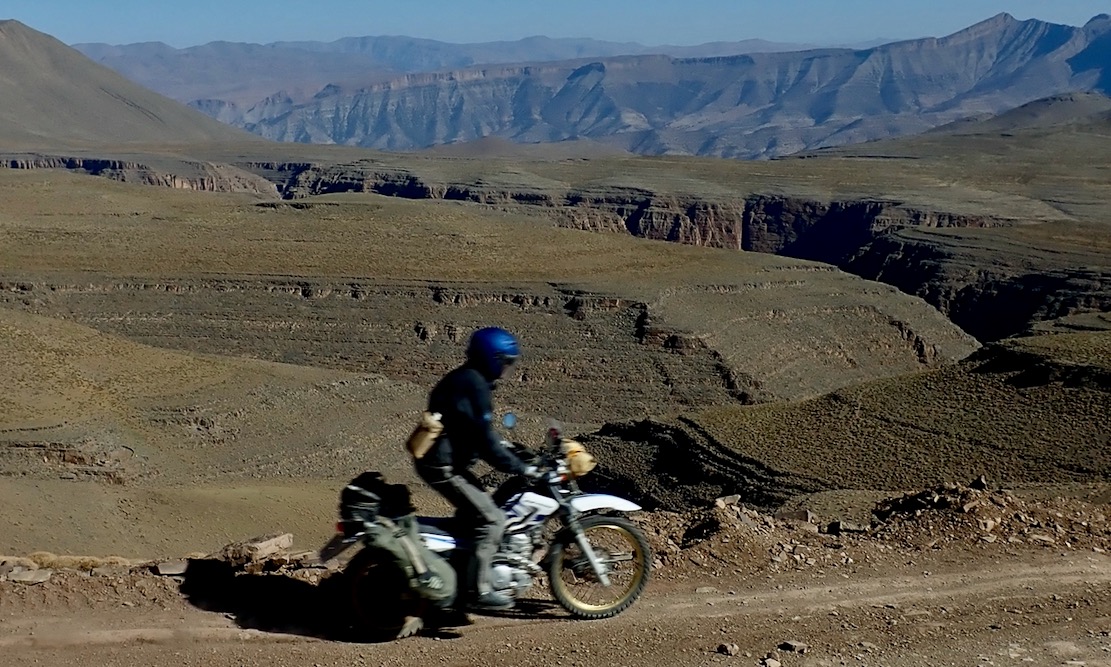
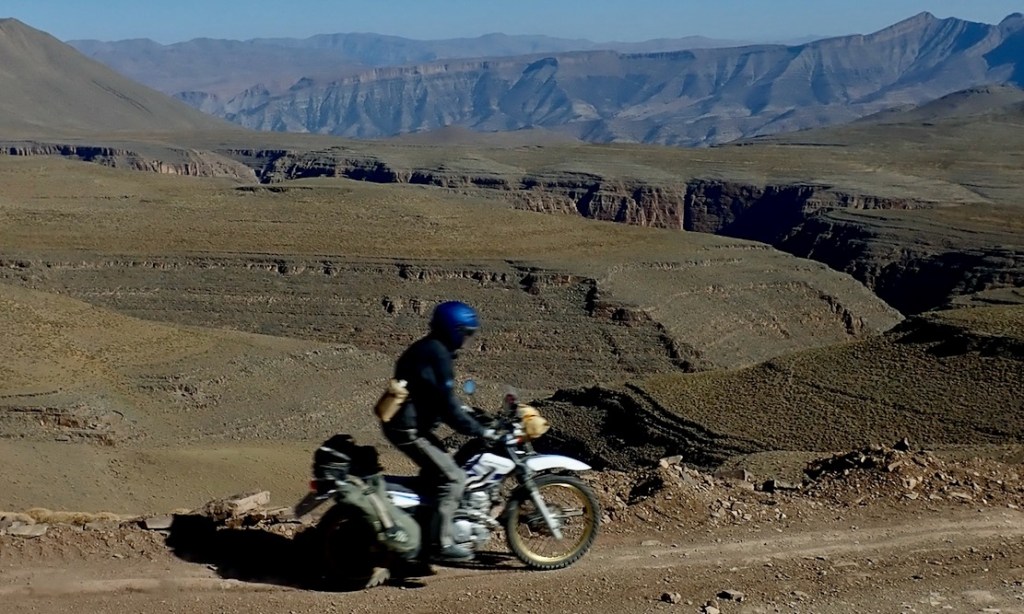
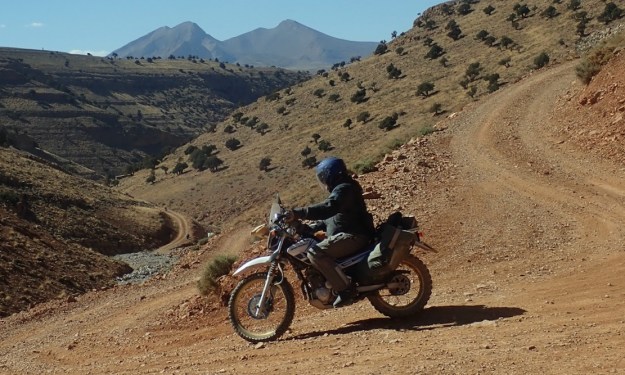
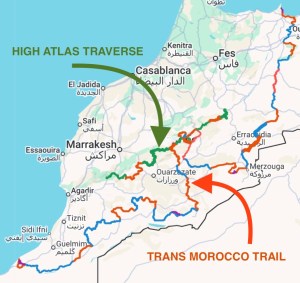
On our H.A.T recce in Morocco last November (left), right off the bat the Serow’s front end was all over the place on stony climbs. Notably worse than other bikes I’d ridden lately. It never bottomed out and the back end wasn’t sagging, so I presumed it was a combination of too stiff front tyre and negligible damping, that inscrutable function which controls spring rebound.
Spend a grand plus taxes on a full, US-imported Cogent front and rear Serow set up‘ they said. ‘Night and day or your money back!’ Cogent also do a fork kit with drop in emulator valves, replacement springs plus oil for around $400. I didn’t need a new spring or oil, only valves, just to end up with better, but still unadjustable forks. Next stop were Race Tech Gold Valves for $230 (FEGV 3311). Still quite a lot with import tax and all, and unlike Cogent, you need to drill extra holes in your damper rods (a lot of added work). You’ll find much online chat about the pros and cons of Cogent vs Race Tech emulators. Like here.
Long story short, widely sold in the UK YSS also do a range of emulator valves for just 90 quid (below). They’re not gold, and I’d need to drill the rods but as I needed a new fork seal anyway, it seemed worth a shot to DIY, even though I’d never taken forks apart before.
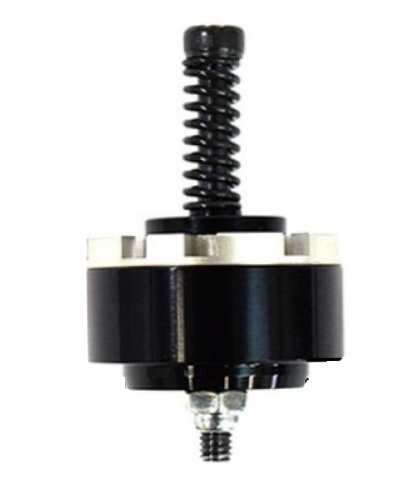
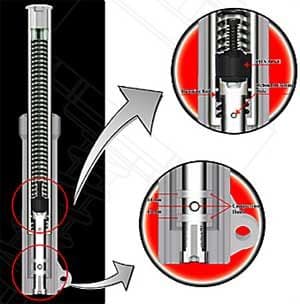
I’d heard of emulators but wasn’t really sure what they were. Turns out they’re easily fitted valves which enable conventional, archaic damper rod forks to ’emulate’ supposedly superior cartridge forks (Cart-what? For another time).
The valve (above left) is a preload adjustable spring loaded plunger which sits between the fork’s fixed damper rod and the spring (right). As forks compress, oil is pushed through the valve, opening the sprung valve which is otherwise closed. Oil flows through progressively relative to force, compared to static conventional damping rods with just a couple of drilled holes. The vid below made similar Race Tech installation on an XT500 look relatively easy. If only.
You need a set matching the internal diameter of your fork tube. For a Serow it wasn’t possible to find that info online, and guessing from the fork tube outer ø is sketchy (I now know…). The best way to verify your fork tube’s internal ø is to undo a fork cap, lift out the spacer/spring, and measure ID with some verniers. On the Serow fork ID was ~30mm – not my 31mm estimate. The 31s got sent back for exchange but never made it. But by chance I found some next-size-down YSS 29s used on ebay for half price. Weeks passed by for all these fascinating events to work themselves out.

If it was only as easy as the slick vid below with a well lit and superbly equipped workshop and dinky music tinkling in the background. Whip out the springs, tip out the effortlessly unscrewed rod, pop in the new valves and reverse the rest before damping progressively into the sunset. My damper rods didn’t slip out nicely (and wouldn’t have easily dropped back in, either) so the entire fork leg needed to be disassembled.
Unless using drop-in Cogent valves, you need to get your hands on the damper rod because additional holes must be drilled for oil to pass unfettered up to the new emulator valve. A hex bolt at the base of the fork secures the damper rod inside the lower fork. They’re notoriously tricky to remove because it’s like trying to undo a bolt from an unseen uncaptive nut without any means of restraining the nut.
More tools to buy. Sigh…

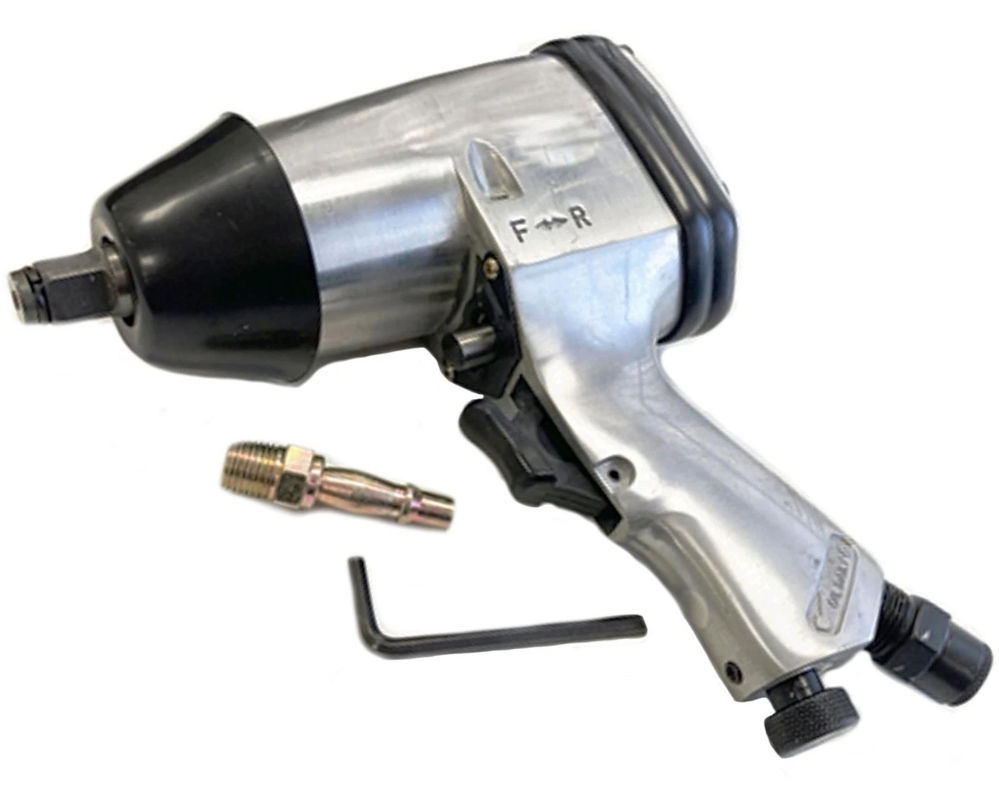
‘Get a rattle gun’ I was advised (left; pneumatic impact driver), to ‘shock’ the allen bolt from the damper rod to which it’s been seized for the last 15 years.
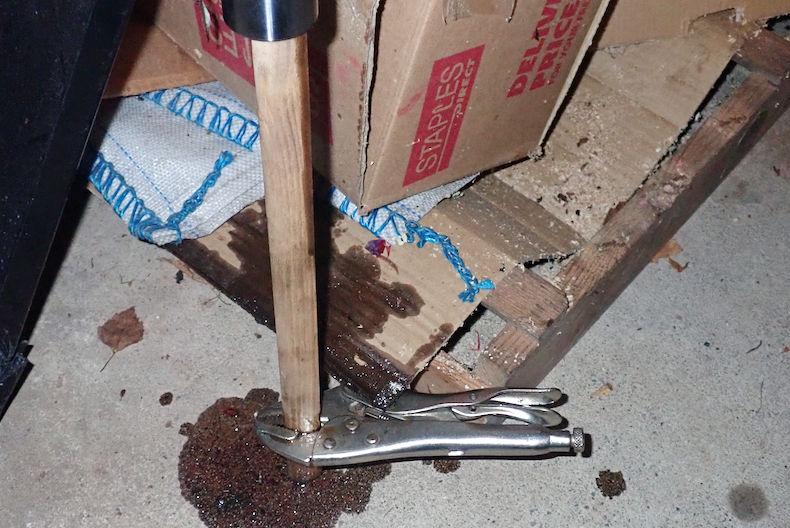
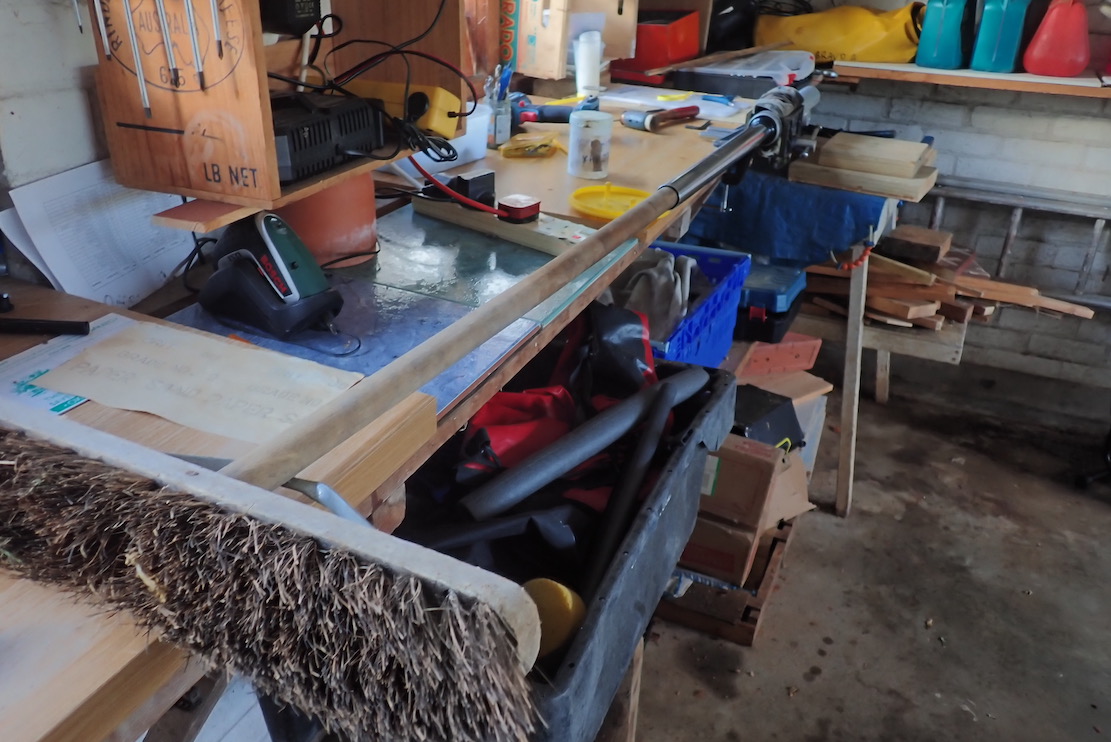
I have an 80-bar compressor tank and found a 25 quid rattler on ebay – ker-ching. But air gun shock therapy wasn’t working. The rod was spinning inside – as you’d expect. A ha, I thought, I will ram a whittled stick in the other end to stop the rod spinning, lock it off with some Moles (below left), then apply rattle. That worked – eventually, but on reassembly it didn’t, so I deployed the ‘broom trick’ I’d seen mentioned online. Same idea: slide it down the fork tube to press against the damper rod top, then pull the trigger. Long arms or step ladder needed. All this seemed a bit less faff than entirely reassembling the fork (as suggested in the vid) to add tension to the rod for removal/refitting.
Much faffing later (have I mentioned faffing yet?) I had the forks in bits by which time I realised I could have fitted the new fork seal myself, not at the LBS.
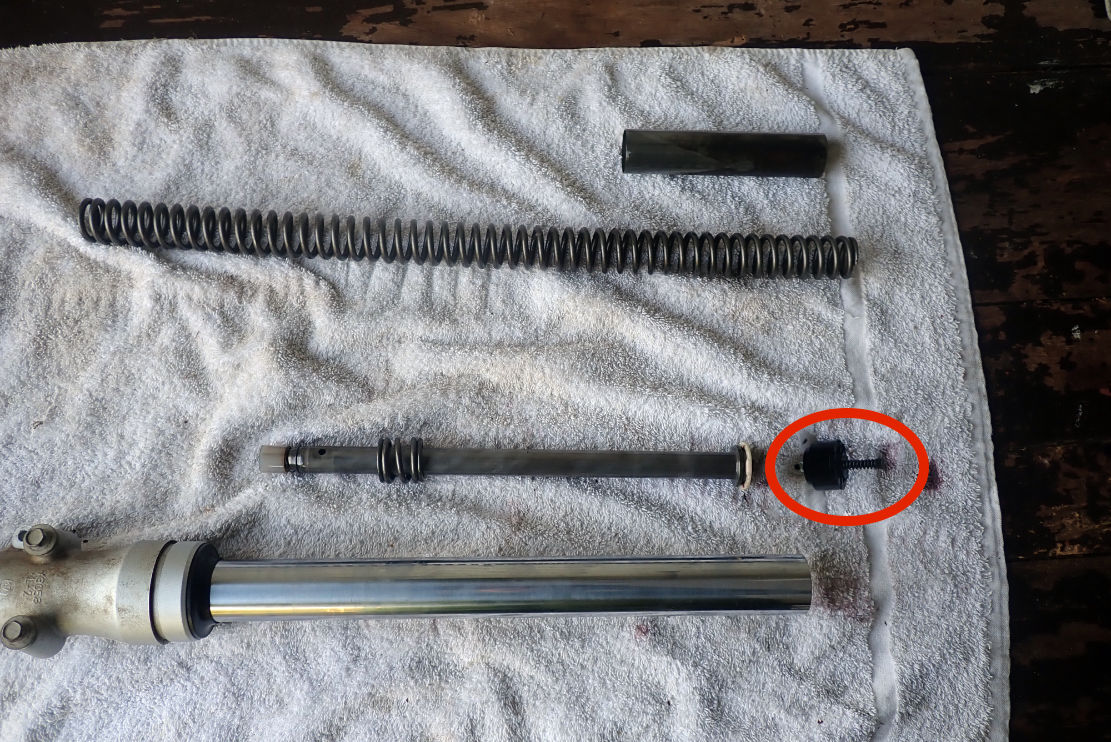
Emulator ringed alongside damper rod prior to drilling. Fork spring spacer up top

To maintain your fork spring effective length & vpreload (FSEL&P) and not void your insurance, you need to saw off the effective height of the valve’s body – about an inch – from the spacer tubes so it all fits back together again (below). A fairly easy job even I’d find hard to mess up.
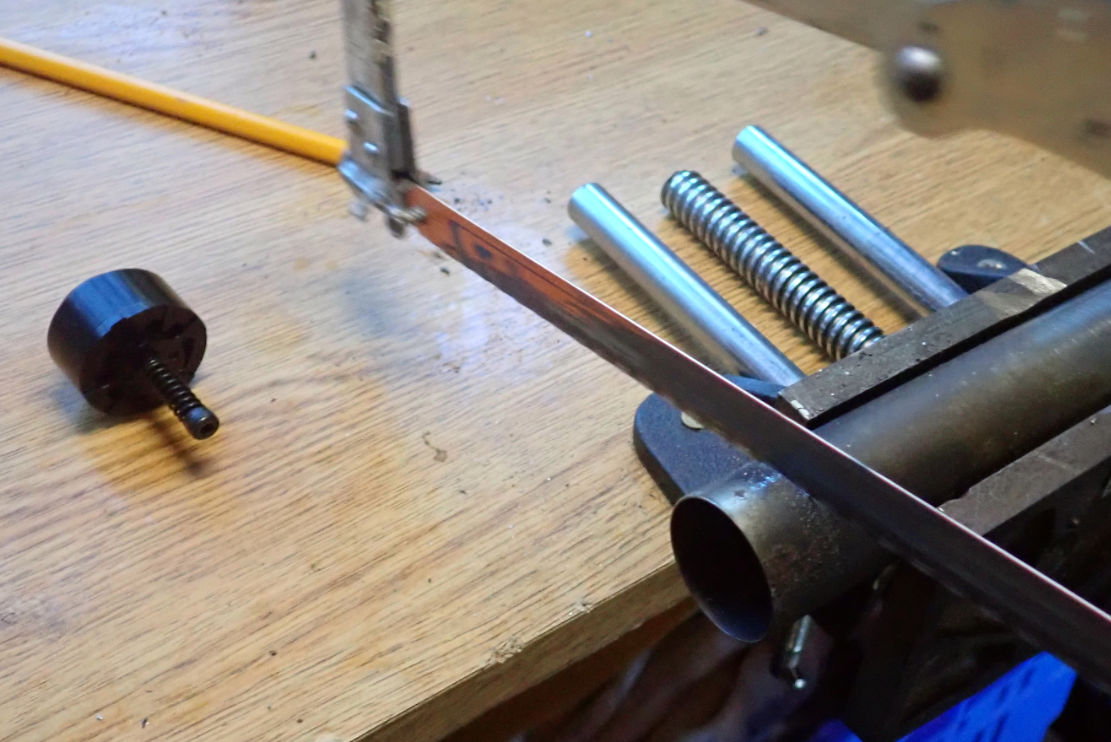
Next job was drilling several extra flow holes in the damper rods which normally have just a couple near the bottom. Like much of the Serow, this is 1970s technology, maybe older, but I suppose it worked well enough. Additional holes allow the oil to move up to the sprung emulator valve which controls the variable flow. Another thing I learned: on Serow forks the drilled rods pass through a close-fitting nylon collar at some stage of reassembly, so any protruding burrs left over from the drilling will lock the fork action. Grind the rods smooth to slide through the collar smoothly, then clean off any remaining swarf with solvent.
By now Christmas had come and gone, so had New Year and there were already chocolate eggs in the shops and daffs blooming. But I was getting close and the forks now slid smoothy in and out, like they should. I did the ‘broom trick’ as mentioned above to tighten the rods back onto the fork leg with the air gun, and was so amazed it worked first time, I stopped right there and took the rest of the day off before another cock up kicked me in the nuts.
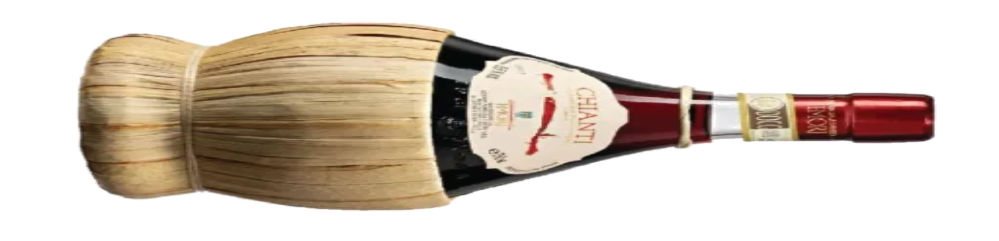
“Refitting is the reverse sequence to removal.” to quote M Haynes, and amazingly, only one bolt had escaped in the weeks it took to complete a one-day task. But let’s snatch a positive from this elongated fiasco (above ;-): I’d leaned all about damper rod fork internals. Having avoided fork disassembly all these decades, I can now see they’re not so complicated, at least old-style RWU forks. USDs, who knows, but it’s said that, apart from fork seal weepage, they’re more complicated inside but are often higher spec and have adjustment, so emulation maybe not needed.
Amazingly, a simple circlip appears to hold the two parts of a leg together. Undo that and whack the two sections apart like a Christmas cracker to get to the seal or damper rod. Along with rod loosening, refitting a seal without damage and without the correct slide tool is probably the hardest job.
Deciding on fork oil weight and volume/height is another opportunity to tie yourself in knots of self doubt. I found several values online for the ‘XT250’ until I realised just measure the volume of watery, brown swill which poured out of the non-leaky leg – 350cc. On reassembly I poured in just 300cc of fresh 10W, thinking it’d be easier to add more if something felt very off, rather than try and suck some out. The damper and emulator valve is surely be submerged in the oil full time. I think oil volume is more to do with how much air remains in the forks and it’s effect on compression. Less air = more compression.
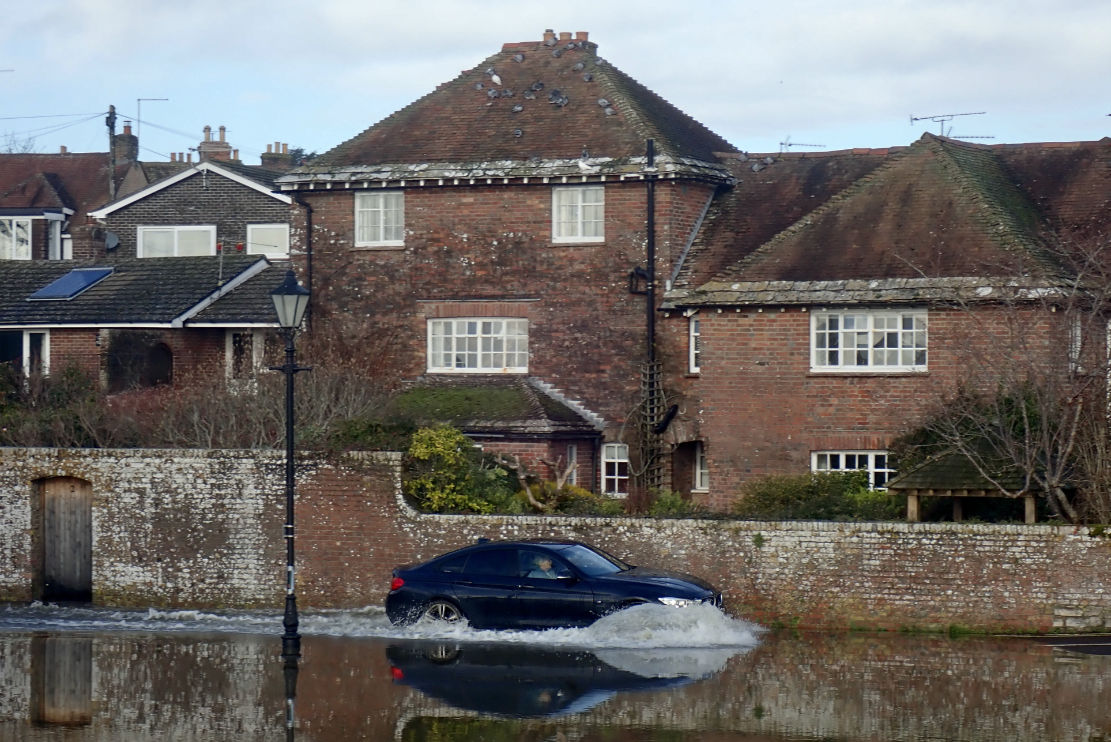
By the time I reached this climactic peak of enlightenment, the Serow’s previous owner got in touch, enquiring whether I knew anyone with a Serow Touring for sale. Someone must have told her I was a serial bike quickshifter! With Morocco snowed out and me elsewhere this winter, a deal was made and a date was set. I topped up the leaky rear tubeless tyre and took the Serow out for one last ride along Purbeck’s flooded lanes.
The forks felt the same – fine on normal roads, as before. No great surprise. I’d need to find a rocky climb to see if the front responded any better, but right now what few local lanes I knew around here where probably knee-deep in mud or carpets of rotting leaf sludge. On these tyres? I don’t think so.
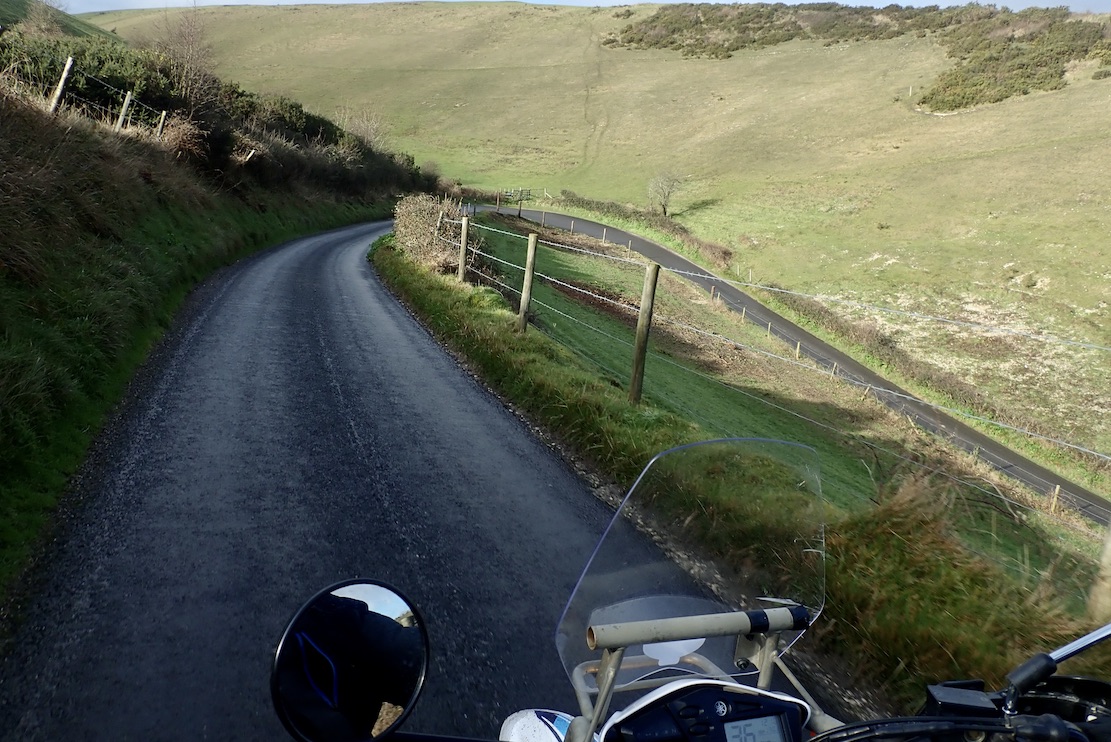
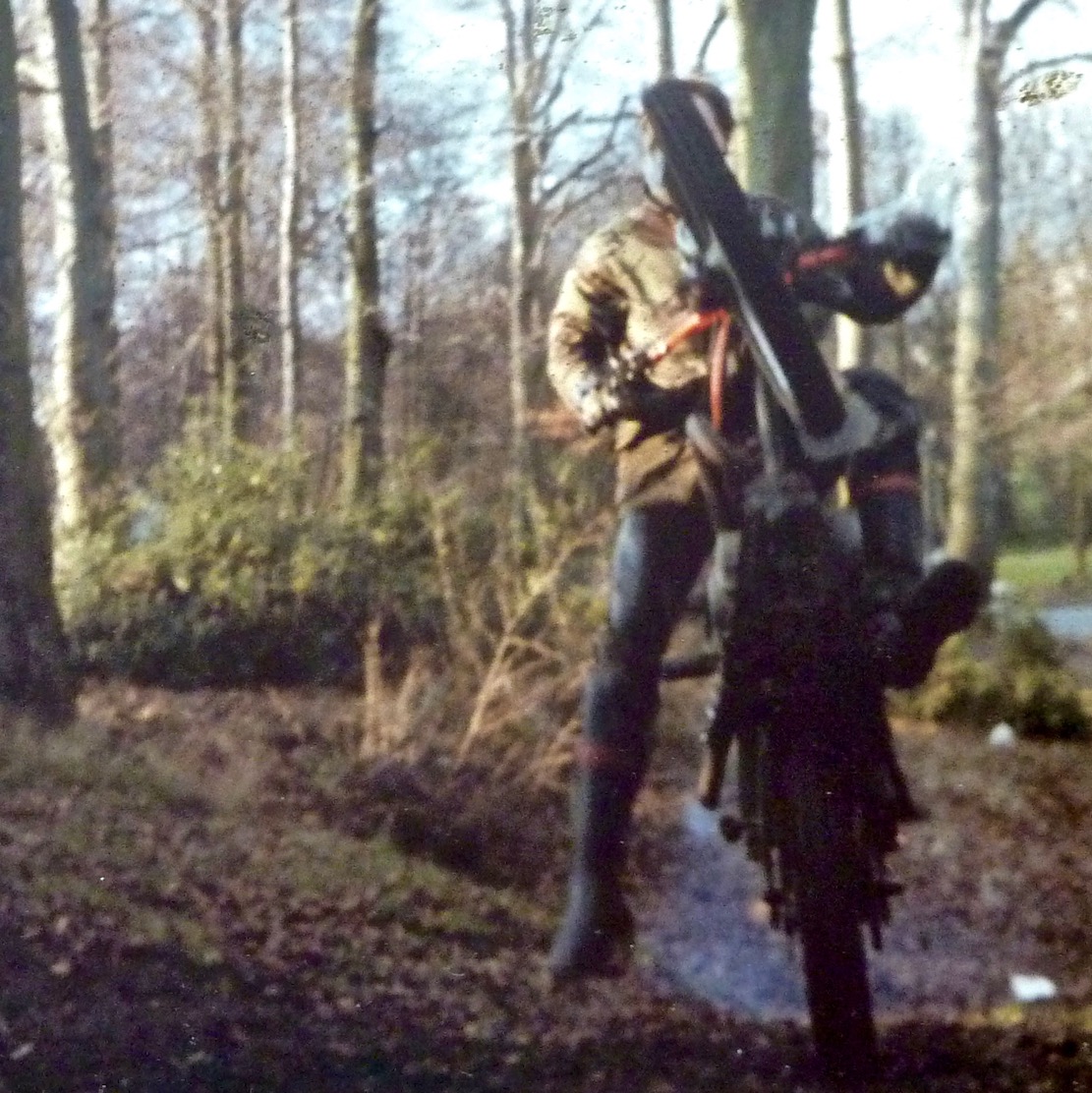
So I puttered merrily around the Purbeck Hills I usually cycle in the summer and tried to think what could replace the agreeable Serow. As I did so, the sweet aroma of mud thrown up onto the hot pipe took me right back to my earliest days dicking about on Surrey wastelands with ratty trail bikes (left).
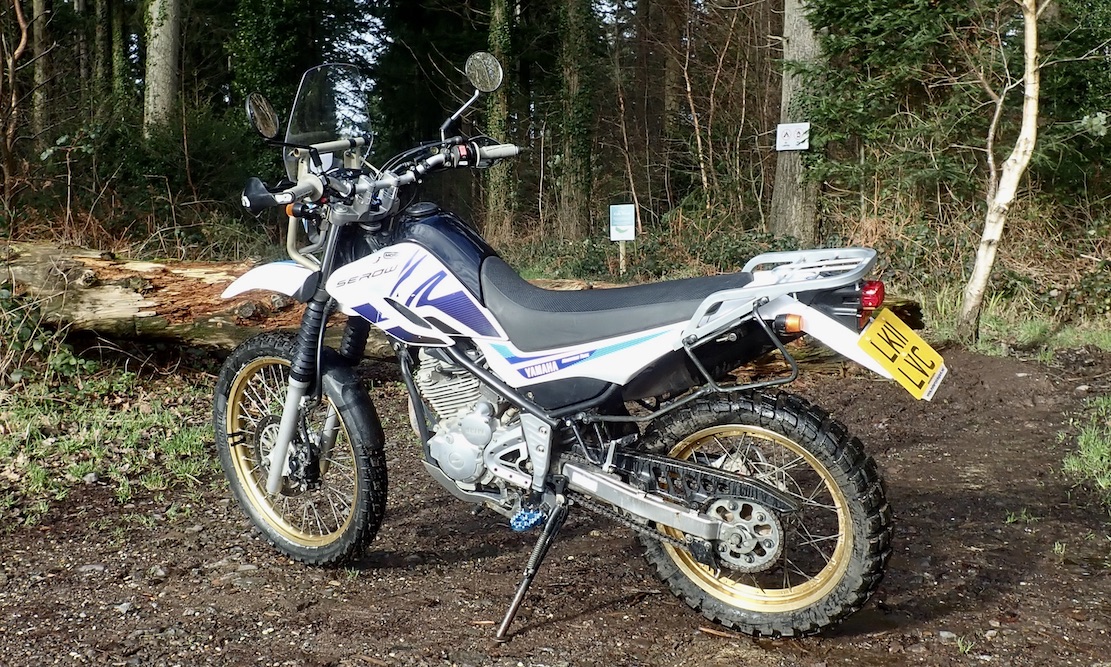
What trail bike was as light, low saddled, semi-tubeless, economical, started on the button and came with racks and a screen? Probably my CRF300L a couple of bikes back, but look at the huge amount of spending and work it required to reach that stage. I guess that’s why these old Serows hold their value.
My 3 Innovations for 2026

Like many two-wheel travellers, I enjoy coming up with creative ways of doing things or adapting gear to suit my specific riding needs. Over the last year I had what I thought were noteworthy innovations. There were a couple more, but clearly they did not survive the memory test.

Pillion Peg Panniers
People ask: Where should panniers be positioned? ‘As Low and Forward as Possible’ (AL&FAP) comes the cry, because an all-terrain travel bike is more stable and responds more predictably when the loaded mass is centralised, especially when off road. I would also add ‘As Narrow’ to the acronym, but in the end we need the volume.
Behold the pillion peg mounting

The AL&FAP optimum can be hard to achieve given that most off-the-shelf racks are set too far back and panniers – soft or hard – are usually box shaped. (this combination is probably designed to accommodate pillions).
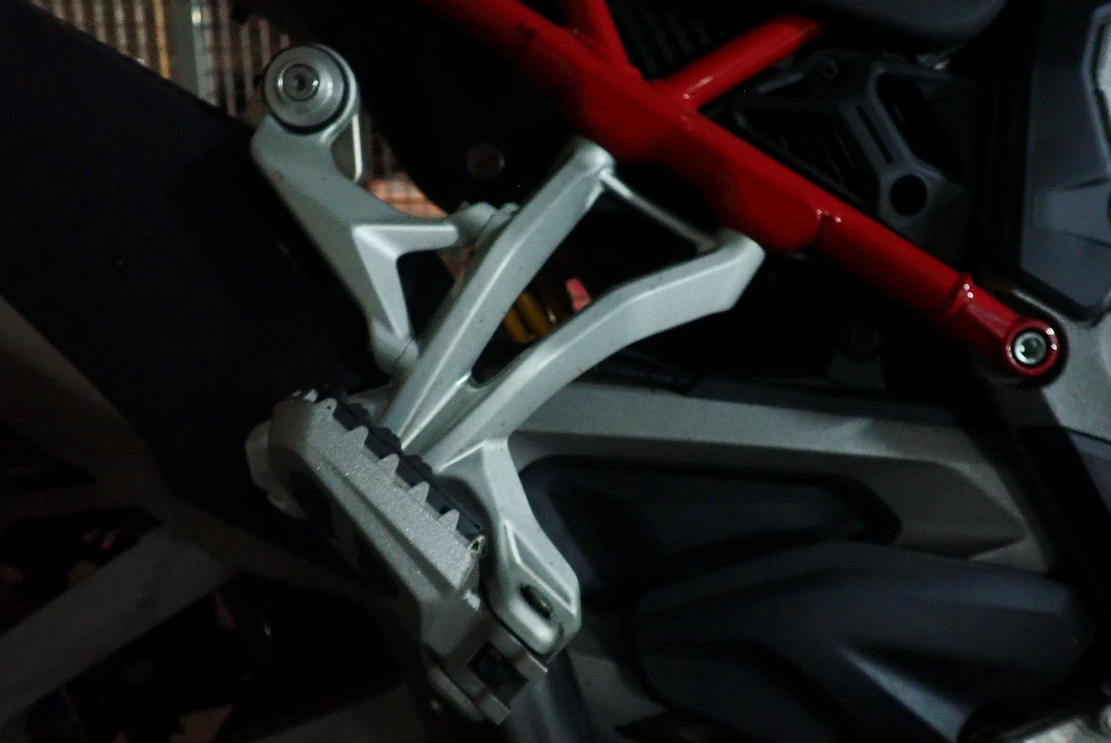
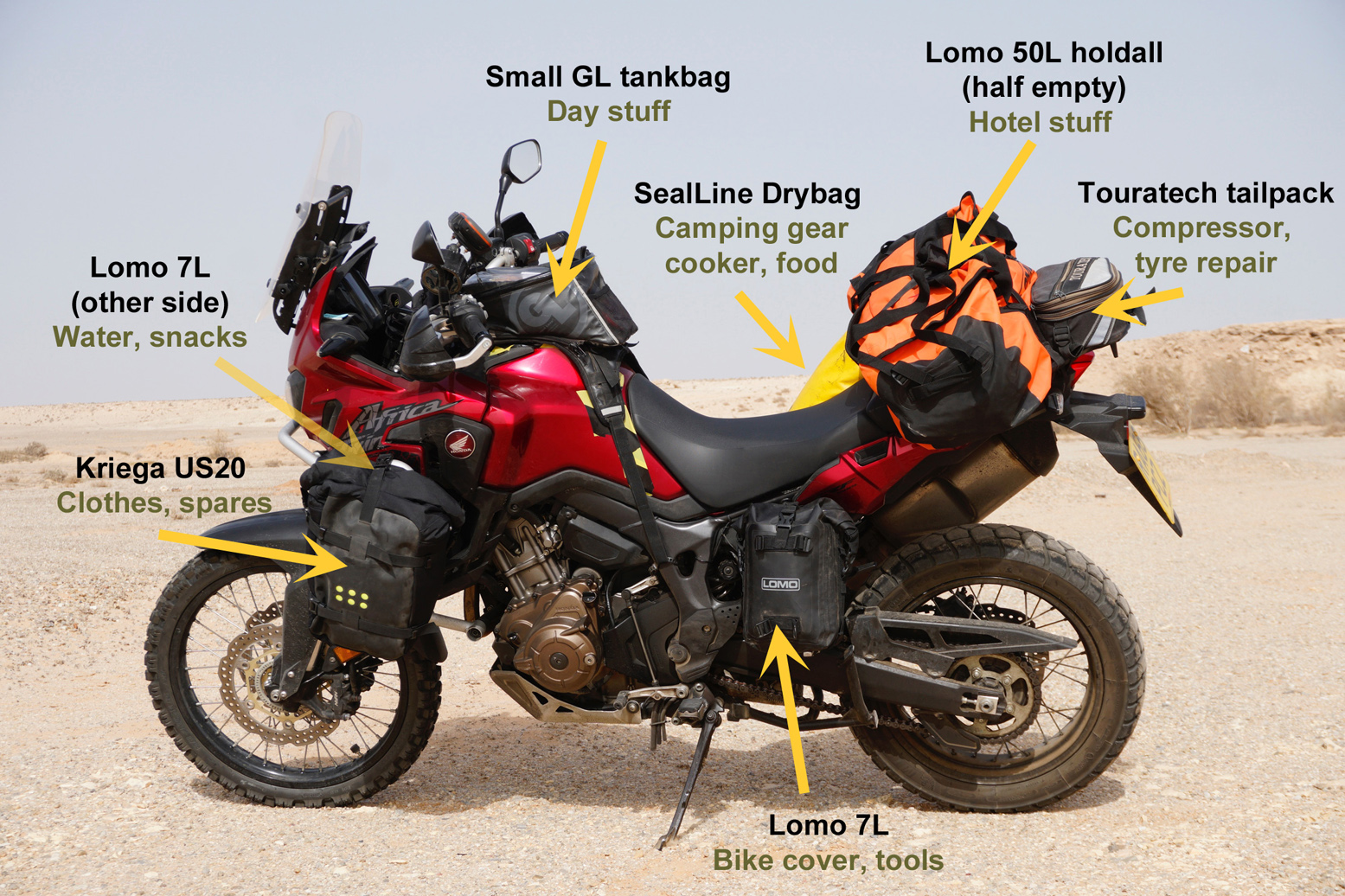
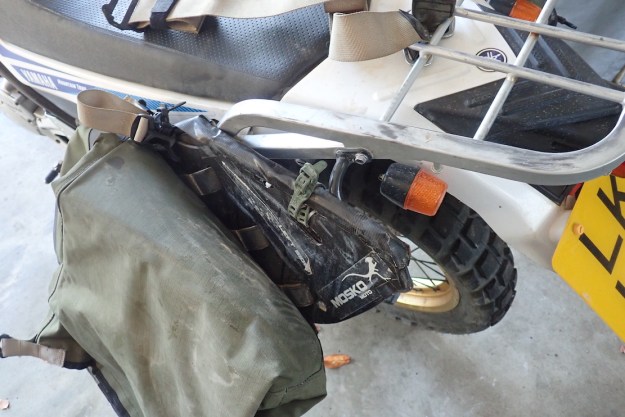
The elephant on the subframe are the pillion pegs: a mounting point as strong as any rack. Support your mass on them (while ensuring room for paddling) achieves the AL&FAP ideal.
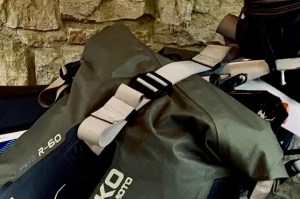
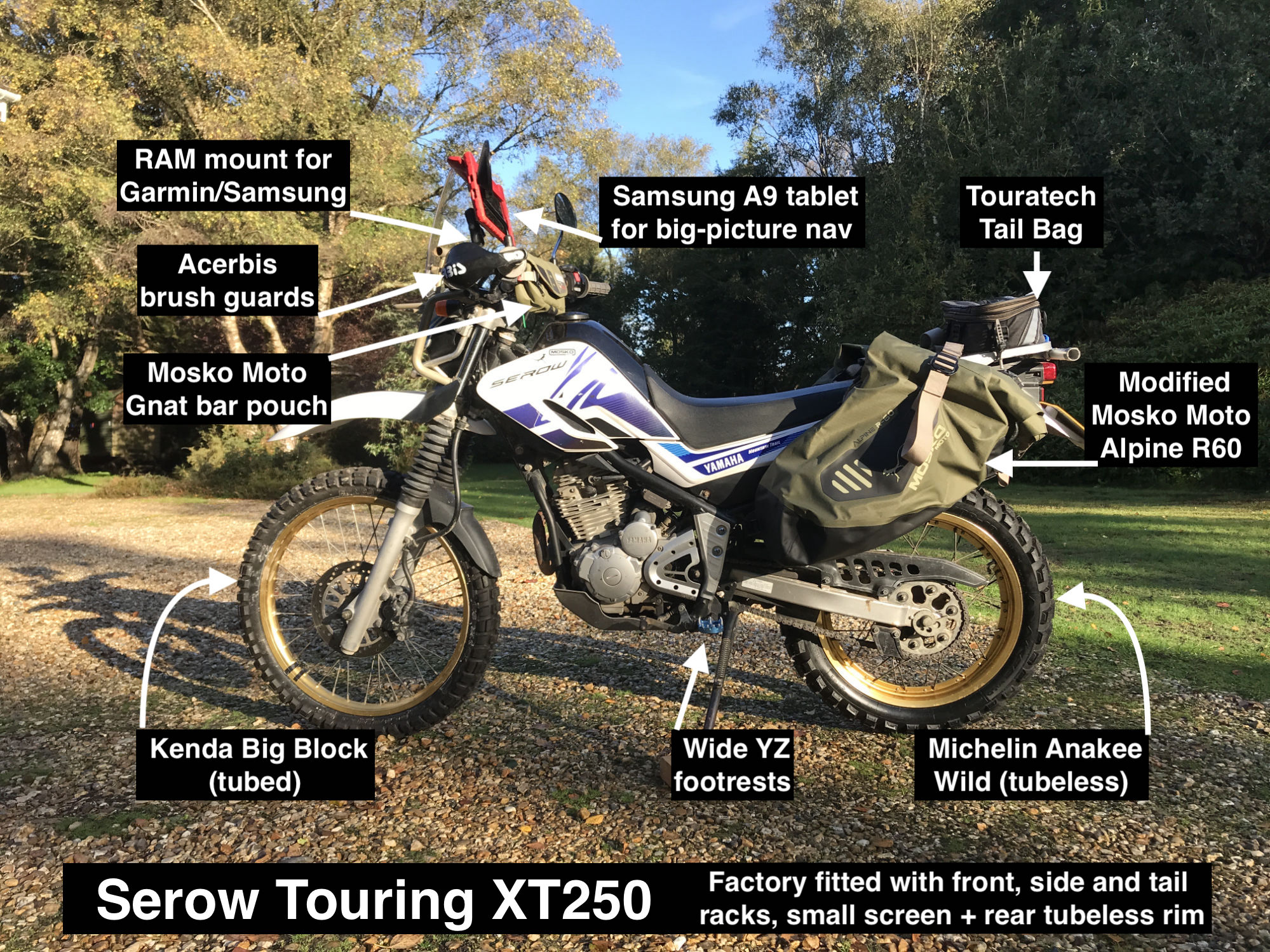
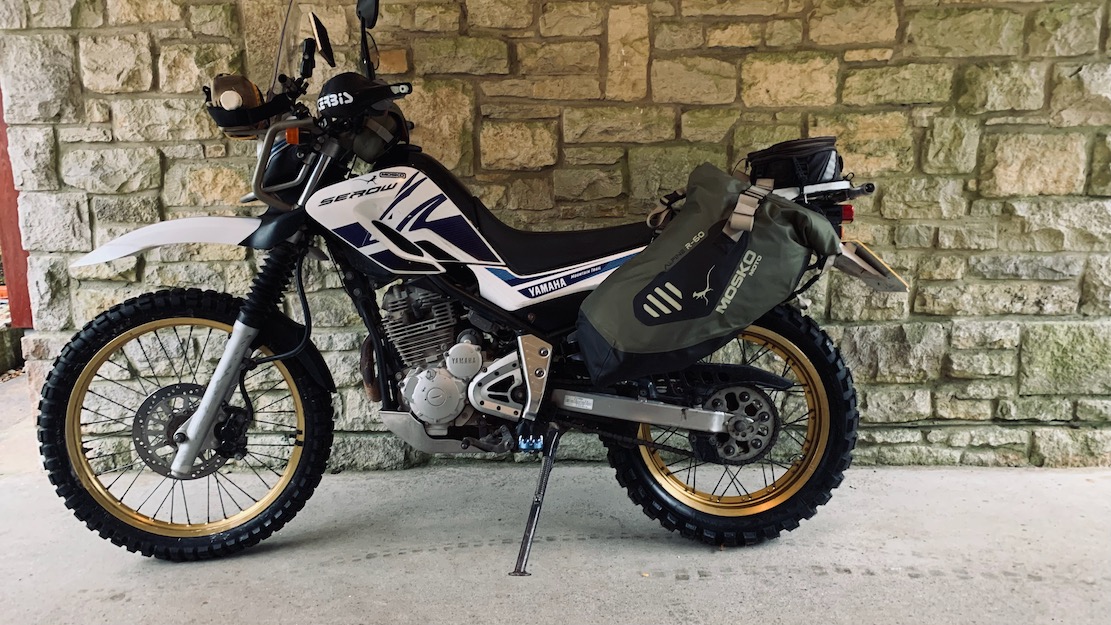
I first experimented with this idea riding a massively heavy Africa Twin to the Mauritanian border during Covid, refined it on my 450MT in 2024, and stumbled on the best solution so far adapting Mosko Moto’s Alpine R60s on my skimpy Serow. The Alpine’s ‘sock’ shape is perhaps coincidentally ideal for the application of AL&FAP.
Click the links for more.

Seat pad inserts for riding pants
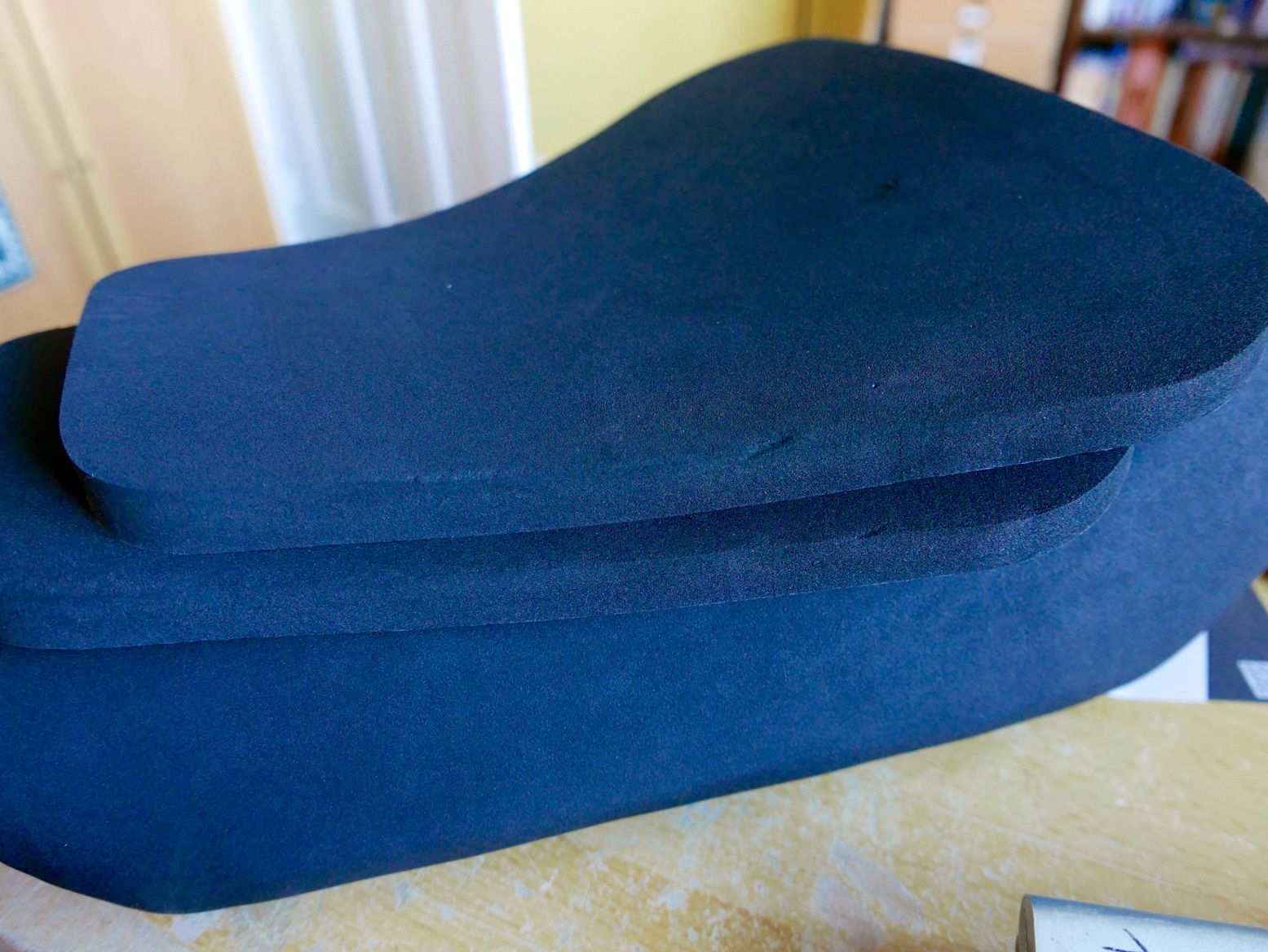
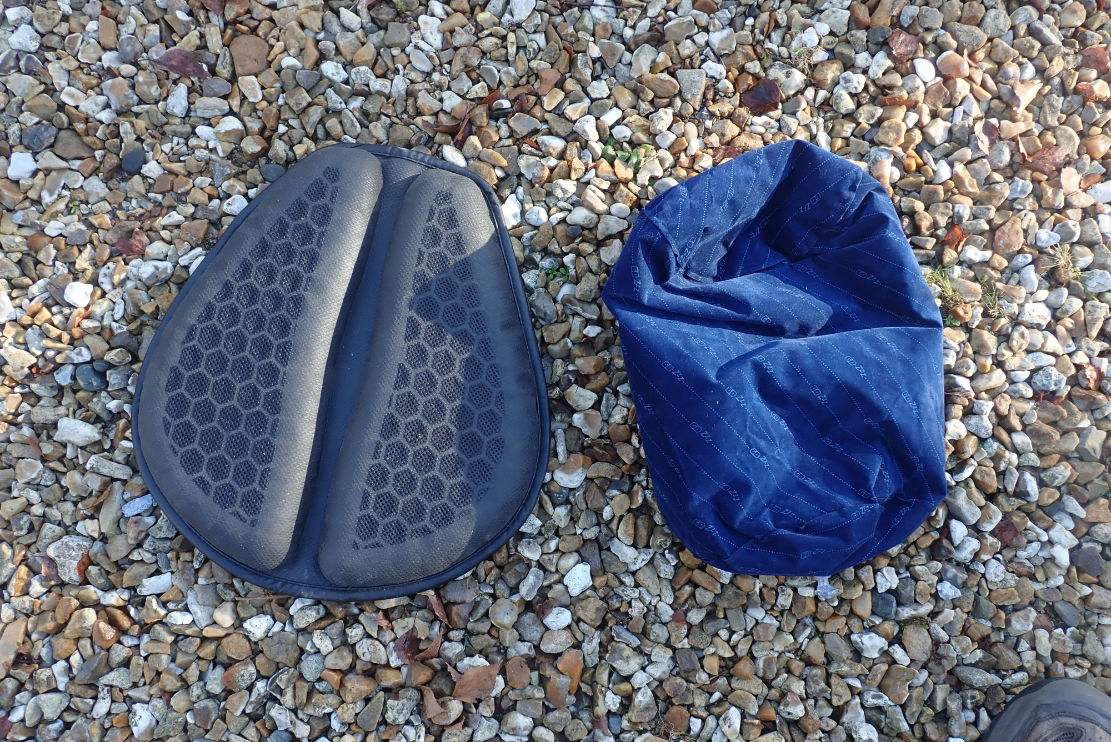
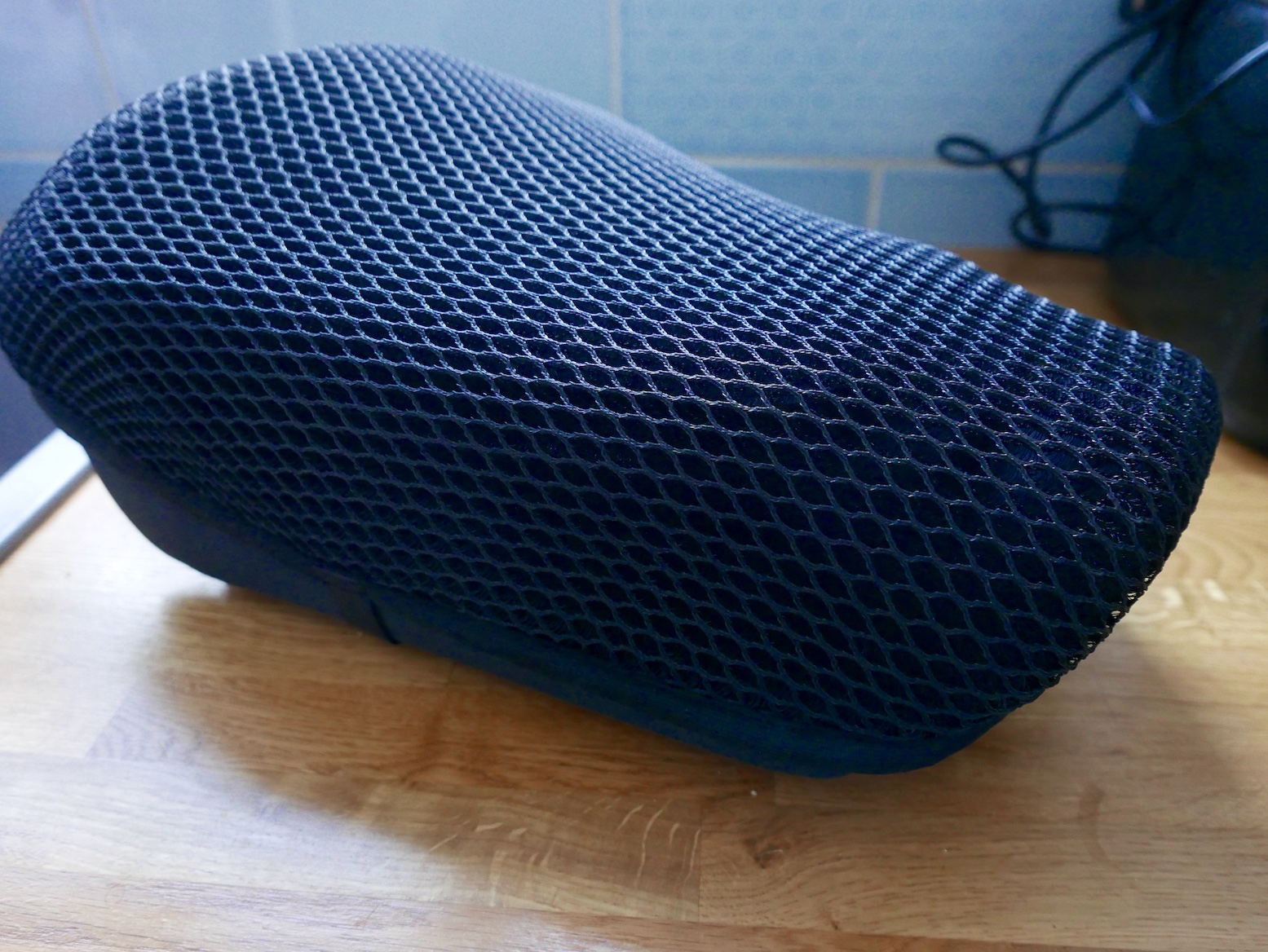
Sore arses on narrow trail bike seats; What. Is. New? Apart from changing or reupholstering the seat (a bit of a black art, imo), there are all sort sorts of seat pad solutions: DIY neoprene foam slabs which worked well on my Himalayan 411, air cushions, sheep skins, ibuprofen, mesh seat covers,

I’ve tried them all but one problem is they increase the seat height which – 411 excepted – may not be what you want, especially on a CRF300L. Then I moved the padding from the bike’s seat to my own seat with some Moto Skiveez padded pants, similar to cycling pants but not quite as close fitting. They worked well on the CRF, extending the comfort range, but as some reviewers have noted, it’s a bit like wearing a filled nappy, plus makes having an urgent roadside slash a bit awkward. Another thing I found was forgetting to put them on each morning until, just as I’m clamping up the boots I think scheisse, I need to go back three spaces and pull on my riding nappies or I’ll regret it in a few hours.
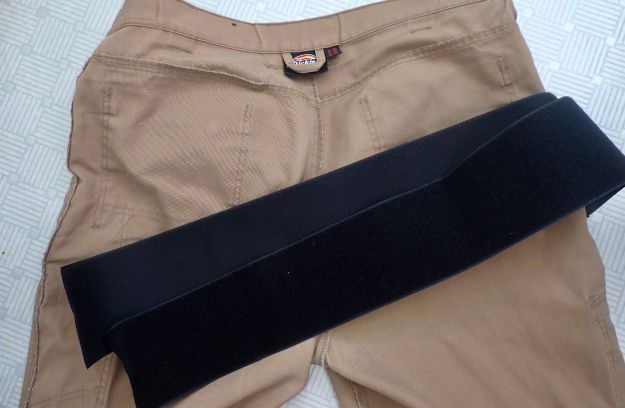
With riding pants we have knee armour pockets or velcro, and even hip padding. Why not add something similar but obviously softer to the seat of the pants. No Skiveez needed which means no additional washing, dozy forgetfulness or desperate roadside fumbling – and no elevated seat heights. Slip on your riding trousers or over-trousers with the optional butt pads fitted and ride off into the sunrise.

If like me you prefer to wear normal cargo trousers like above, plus over trousers when needed, sewn-in velcro patches for quick removal won’t spoil your butt line when off the bike. On the bike attach the foam pads and hit the road.

Dynamically adjustable seat height
I probably ride my MTB more than motos in the UK, and this is another pushbike derived idea that’s a bit left field. It gets its own post. Click this.

Quick look: Rhinowalk 48L Saddle Bags

IN A LINE
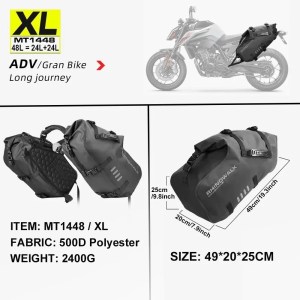
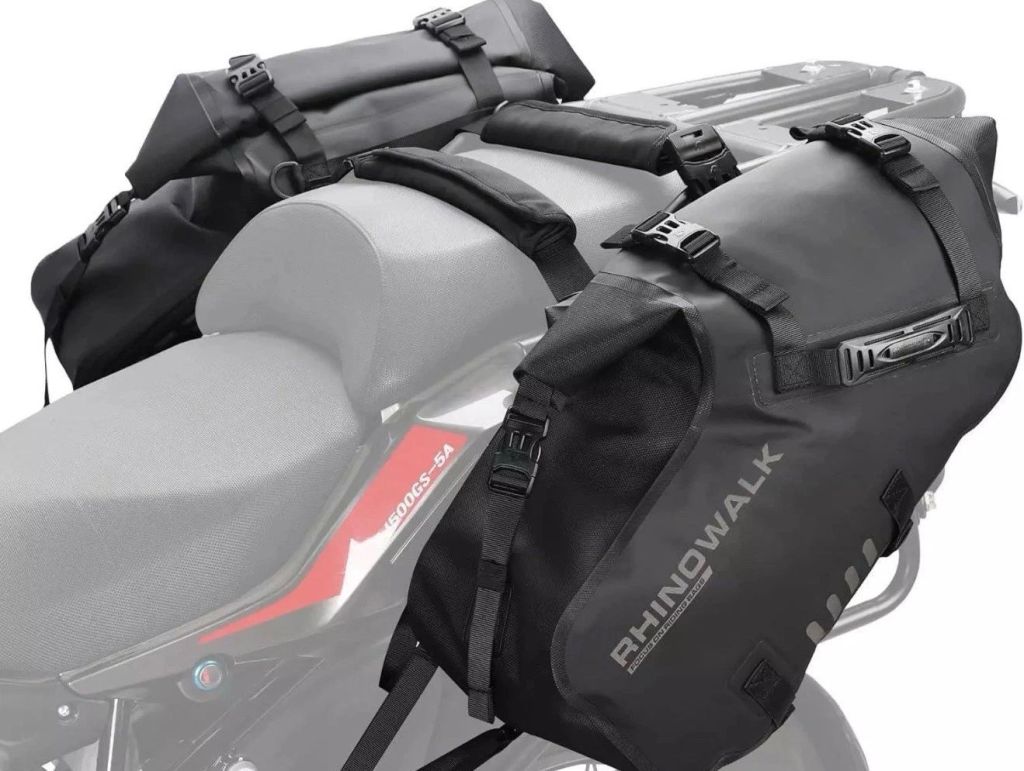
Inexpensive basic 500D PVC throwovers with more straps than the gimp in Pulp Fiction.

WHERE TESTED
Nowhere really.

COST & WEIGHT
£110 unused off ebay (from £140 new). 2900g est.

WHAT THEY SAY (shortened)
✔ EXCELLENT WATERPROOF: The motorcycle saddle bag is made of 500D PVC tarpaulin material, which is 100% waterproof and the most stand wear and tear motorcycle material. The roll-up design provides waterproof guarantee while supporting quick opening and closing.
✔ LARGE CAPACITY FOR DAILY NEEDS: Waterproof motorcycle bag is specially designed for those who like to travel by motorcycle, outdoor adventure. 2 side pockets with a total of 24L large capacity to meet your daily needs.
✔ STAND WEAR AND TEAR MATERIAL: Different from ordinary waterproof material, we use PVC tarpaulin as motorcycle bag shell material, which is stand wear and tear and suitable for daily use. High-density PVC resists dust and is easy to clean.

  • Cheap
  • Light
  • Simple
  • Loads of long strapping
  • Can mount low and forward with a rack
  • Inner padding may be OK without a rack
  • 500D PVC is not particularly thick
  • May not survive heavy loads off road
  • Understraps for more external gear get in the way
  • Despite rackless claim, best with a rack in this XL size

REVIEW
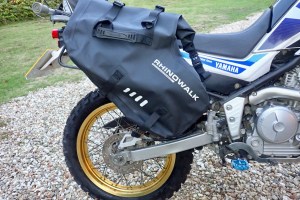
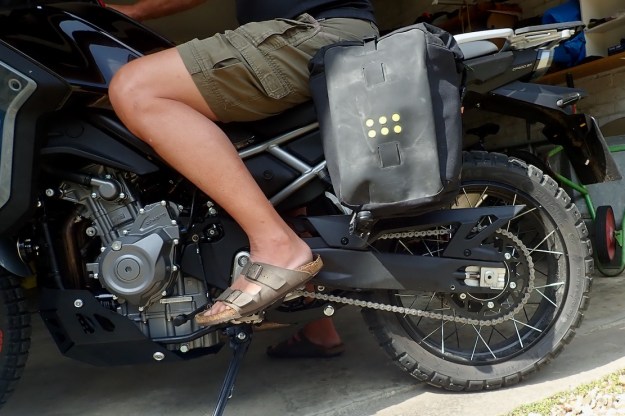
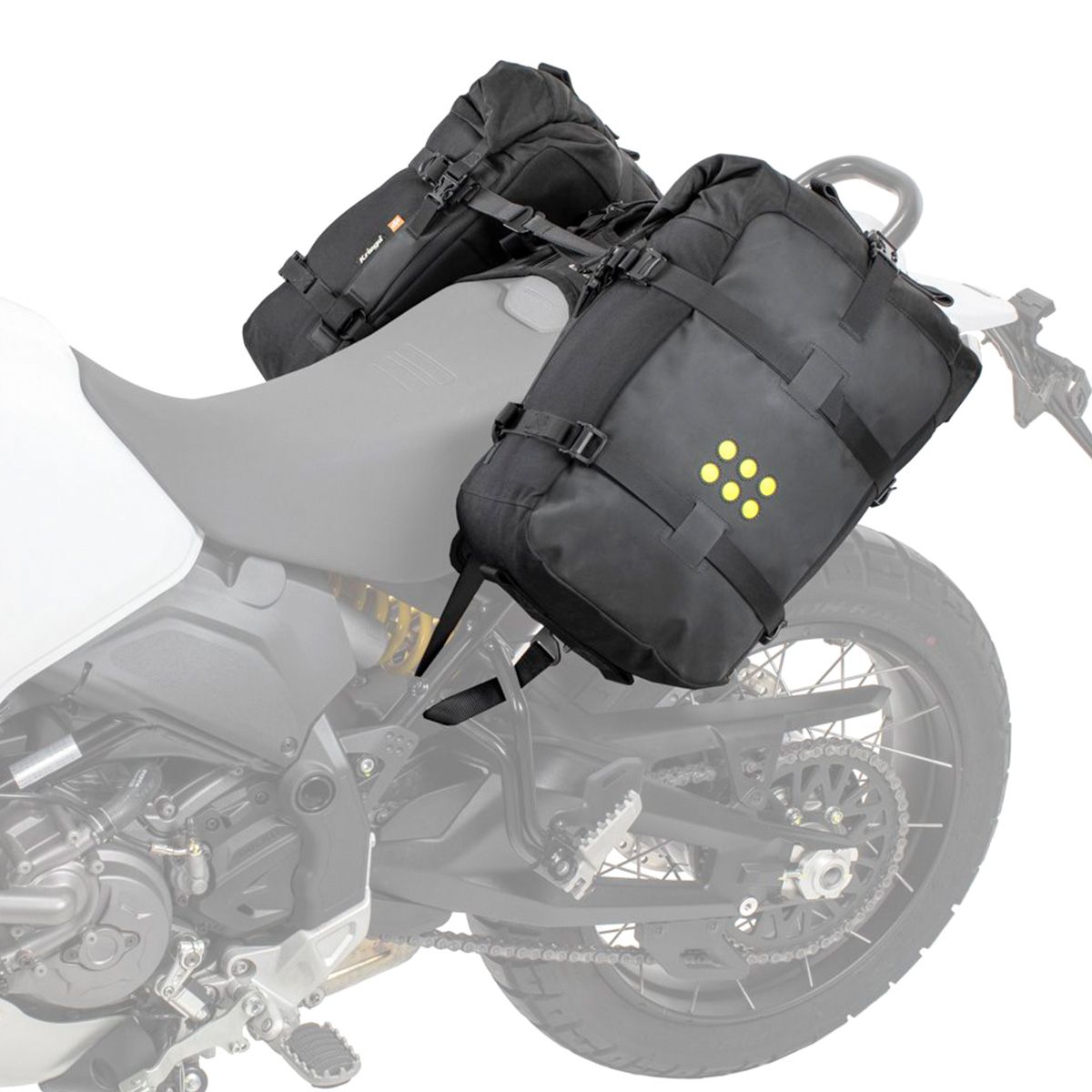
Rackless side bags from the well-known soft luggage manufacturers have been a thing for years. It will vary from bike to bike, but without a rack they have to be mounted high, almost on the side of the seat (right), to stop them swinging about into the wheel or bouncing on the pipe.
For better handling on the trail, low and forward is the way I like to do it, like the Kriega OS18 resting on the pillion footpeg on last year’s 450MT. Sadly this rackless innovation went unnoticed in the biking world.

Low and forward

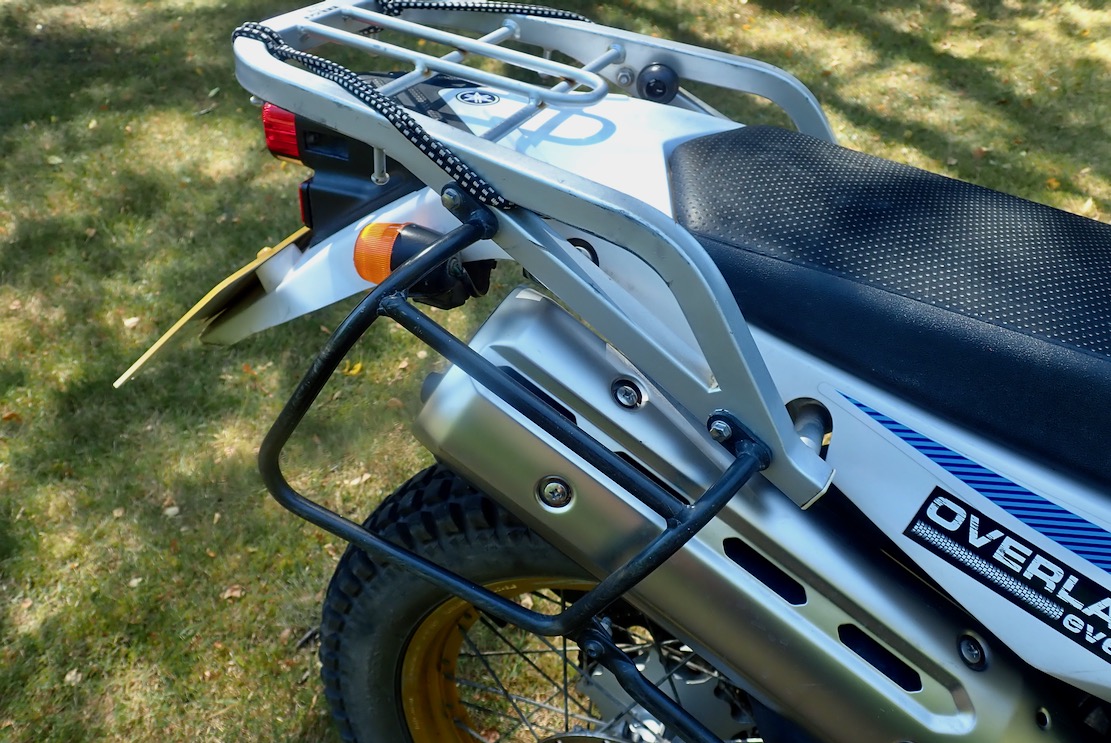
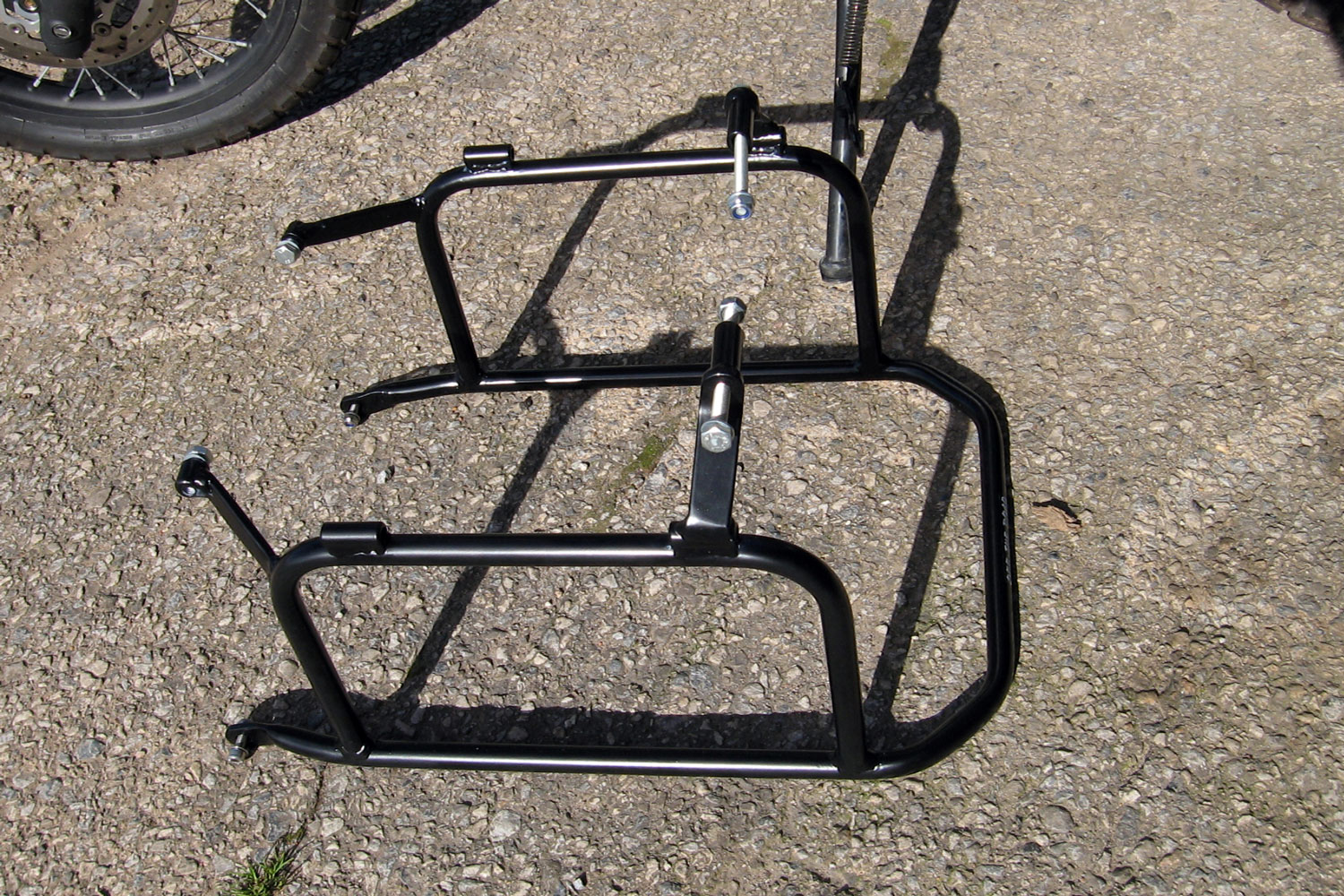
My Serow Touring came stock with light side racks (left). They’re a bit far back (like so many racks) but are just the job to support throwovers which would otherwise swing into the wheel or melt on the pipe. Without a rack you’d need to hang them high on the side of the seat to avoid swinging, but that means a higher mass; less good for handling.
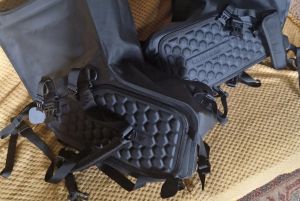
I was eyeing up these Rhinos for a while and got a barely used XL set on ebay, at 24L a side. The rationale being I won’t need any other bags bar a tank bag (though I admit, many bags or pockets makes quick day-access easier). As one reviewer observed, they’re like a pair of giant socks, the upper part rolling down to clip down the sides and over the top

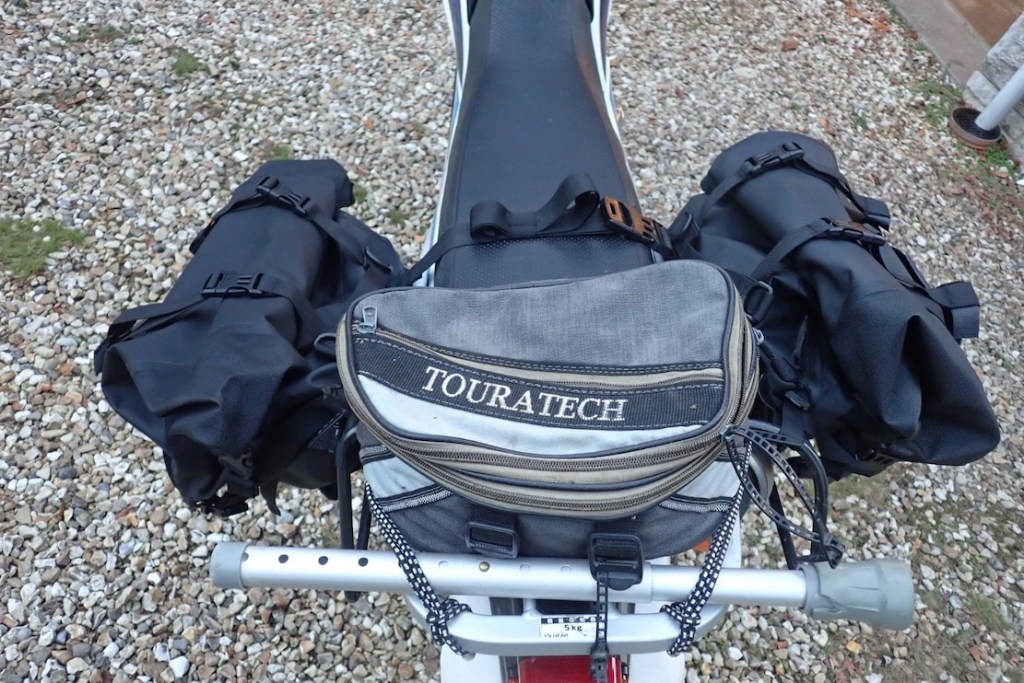
Lashing on was dead easy once you get your head round the mass of long straps. (Better too long than too short.) Over the seat, I removed the unnecessary padding sleeves and cinched them up through a loop in my tail rack with cam and clip plastic buckles I’ve not seen before. At the lower ‘toe’ end, another ridiculously long strap loops through the pillion peg mount, or is long enough to go round the main frame to connect back to a metal cam lock buckle.
As said, at the back my over-seat straps went through the tail rack to stop them sliding forward. But there’s another metal buckle at the ‘back ‘heel’ of each bag to do the same job. Use a loose strap supplied to cross and loop over the tail rack (or whatever you got) from one rear bag’s rear cam buckle to the other.
Instead, I used a knotted offcut from the front strap to lash this rear point to my rack to better support it all Once bouncing loaded up along the trail, the more weight you can take off the over-seat straps the better.

External lashing. Hmm

There are also some long straps for lashing more gear on the outside under the bags, like the tripod shown right. But unsupported, I can’t see anything staying there for long (or staying clean) on the trail. Molle webbing would be better, or a pocket. Or just lash on top where it’ll stay put.

The honeycomb padding on the inner surface (left) claims to resist 160°C and looks OK but once splattered with gritty mud will rub on your plastics if you’ve no rack. On the trail I was not expecting to carry more than 10kg in each bag which ought to make them last. But in the end Mosko Moto sent me some of their new Alpine R60s to try so I went with them and resold the Rhinos.

Tested: Mosko Moto Alpine R60 Rackless review

See also
Soft Baggage 2026
Serow Index page

Everything in two, well positioned big bags

In a line
Mounted separately and semi-permanently to a light rack and without rear duffle – not as Mosko intended – but was exactly what I wanted.

Price and verified weights
Bags £476.
Right side 1350g; left 1530g; hardware 130g, Duffle 650g. Total: 3.7kg/8.1lbs
Gnoblin q/d mount (optional; £39) 182g.
As mounted (no duffle or Gnoblin): 2.5kg

  • Mounts low and forward, ideal shape for optimal load distribution
  • Well put together and clever design elements
  • Light: my adapted set-up just 2.5kg
  • Looks more than 22 litres per side
  • The outward flex of the CURV board (not used) limits pressure on sidepanels
  • With CURV board sits high on some bikes
  • If you want the q/d element make sure the CURV board suits your bike
  • OTT strap hard to cinch down with changing bag volumes

Alpine R60s supplied free by Mosko for testing and review

What they say
The Alpine 60L Rackless is Mosko Moto’s lightest weight dual sport and ADV luggage setup with the capacity for multi-day trips. Designed for riders who seek minimalist, lightweight luggage, it provides the three-bag organization and packing system of a traditional pannier setup (two side panniers and a rear duffle) in a lightweight, waterproof, abrasion-resistant ripstop nylon rackless bag. Featuring our super durable CURV® chassis, the universally-mounting A60 can be easily swapped between multiple bikes, and can be packed and checked for fly-to-ride adventures.

Alpine Style
For this autumn’s recce of the High Atlas Traverse I wanted to try something different. Though never a fan of the one-piece Giant Loop Coyotes and the like, I’ve been interested in separate throwover side-bags which can manage without a full racktangle™ (right). I also like the idea of tough drybags sleeved in a holster, as on Mosko’s Rackless 40 and 80, although these look a bit heavy and over-designed for my little Yam 250 on this trip.
You should make something in between the 40 and 80, and simpler‘, I suggested to Roel as Mosko EU.
Give it a month or two and I’ll have our new Alpine 60L to show you‘, he replied.

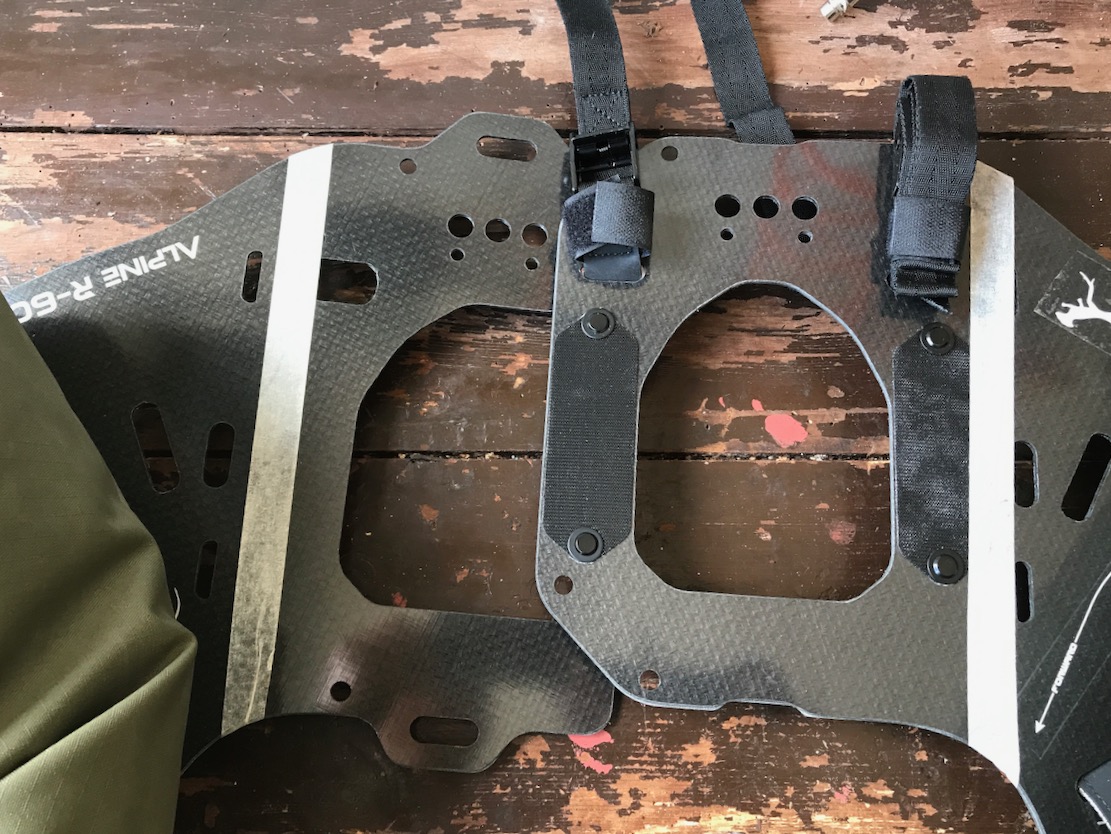
A week before wheels-up and Mosko’s Alpine R60 arrive in Woodland Green and Black. Two sidebags of 22 litres (but look bigger), plus a 15-litre top duffle which I didn’t plan to use. Each bag comes mounted on a bendy, two-piece U-shaped composite CURV® backplate which you bolt together with supplied hardware. That straps to the bike at the pillion pegs or rear downtube, to be tensioned from the tail rack, either with an optional and neat peg called a Gnoblin (below), or just a strap or two. Result: a quickly detachable 3-point fitting using the backplate to part-stabilise the load. Mosko are pitching the Alpine 60s at the harder-riding, ‘light-is-right’, crowd, but anyone who appreciates a minimalist, light throwover that’s easily removable will like the R60.

The clever thing about the composite CURV® plate to which each bag is semi-permanently buckled, is that the flexible board naturally bows outwards to resist pressing on the sides of the bike causing rubbing; a quasi-rack. A replaceable, full-length, 8-mil EVA foam pad is velcro’d to the plate. The bags come securely anchor-buckled to the plate which is velcro’d to the EVA pad. To avoid pipeburn use the Mosko heatshield, at only £22 it’s cheaper and neater than a C-channel off-cut and clips.
Set up this way, removing the whole rig is a 10-second job (discounting the duffle), while secure mounting in the morning might take as long as 30 seconds, so make sure to set the alarm. I’ll take q/d soft bags if they have a bombproof and foolproof attachment system which can be used daily without thinking too much. Otherwise, most nights in Morocco I leave partly loaded bags on the securely parked bike and bring what I need into the room.

Too far back as usual… sigh

My Serow Touring came stock with an old-school alloy tube tailrack and light-gauge steel side frames (left) which are way too far back as usual, but otherwise ideal for stabilising the low weights I typically carry in Morocco, lodging each night, as I do. Out of the box I could see issues fitting the Alpine 60s onto my racking, but could also see a solution.

Looking at the vid above. Either those bags are full to overflowing, or the stiffness of the flexible backplate means they sit high on that Kove, even without the duffle which might be hidden from view.
The A60 is a rackless system” says our man Coleman at 0:52, but at that point you can see the Kove has been fitted with a CNC FishRacing integrated full rack system (right), or the 25-quid Ali-X knock-off. It’s much wider than my Serow set up which may explain why the bags sit so high. I’m not a fan of this current, easily cut (aka: cheap) CNC trend, when hand-formed and braised tubing uses less metal for half the weight (rant ends ;-).
As said the R60 baggage appears to sit high on the racked Kove, but it also does in the Mosko video (below), fitted to a Moroccan T7 rental with only a tail rack. I think it’s a seat-width thing. As we know modern pipes are huge.

There are some long-winded R60 video reviewers out there. MoskoPete is not one of them. Job done in 3:29.

Last year I tried to fit the Kriega OS-Base Universal harness (below left) for my 450MT but the one-piece grab handles/tail rack got in the way. I could have swapped in an aftermarket CNC tail rack (and lost the handy handles), or cut a hole in the harness for the alloy handle to pass through, before rebolting.
I liked the idea of being able to lash anything to the harness, not just Kriega’s OS bags, but again, their fitted bags seem to sit high, effectively resting on the side of the seat (below right) to limit swinging about in the rack-free void below. This is the weak spot of the rackless idea on monoshockers: the side panels become a necessary but over-high support point.
For me the ethos has long been as low and forward as possible – or ‘AL&FAP if you’re in a hurry. These set ups may save rack weight, but are higher and further back than ideal. With minimal loads it’s not critical, but it’s not great for CoG and bike control, especially weaving around off road, picking up or when getting out of shape.

This is where panniers should sit when not two-up.

I returned the Kriega harness and went with the usual tailpack-sat-on-a-tailpack, plus my novel and as yet unrecognised 3P idea, as well as small tankside bags on radiator crash bars (left). Baggage ends up all over the bike which is handy for daytime access and organisation, but a bit of a faff to bring it all in overnight (if necessary), plus a messy look.

Up at 3200 metres on the High Atlas Traverse

This time I wanted to try everything in one place. I could see the R60s might not sit well on my bike but I liked the bag shape more than the q/d feature. The R60’s ‘short sock’ shape potentially puts loads in the right place. Heavy or rarely used Items like tools and tubes can go it the bag’s ‘toe’; light stuff up top with all the rest in between.

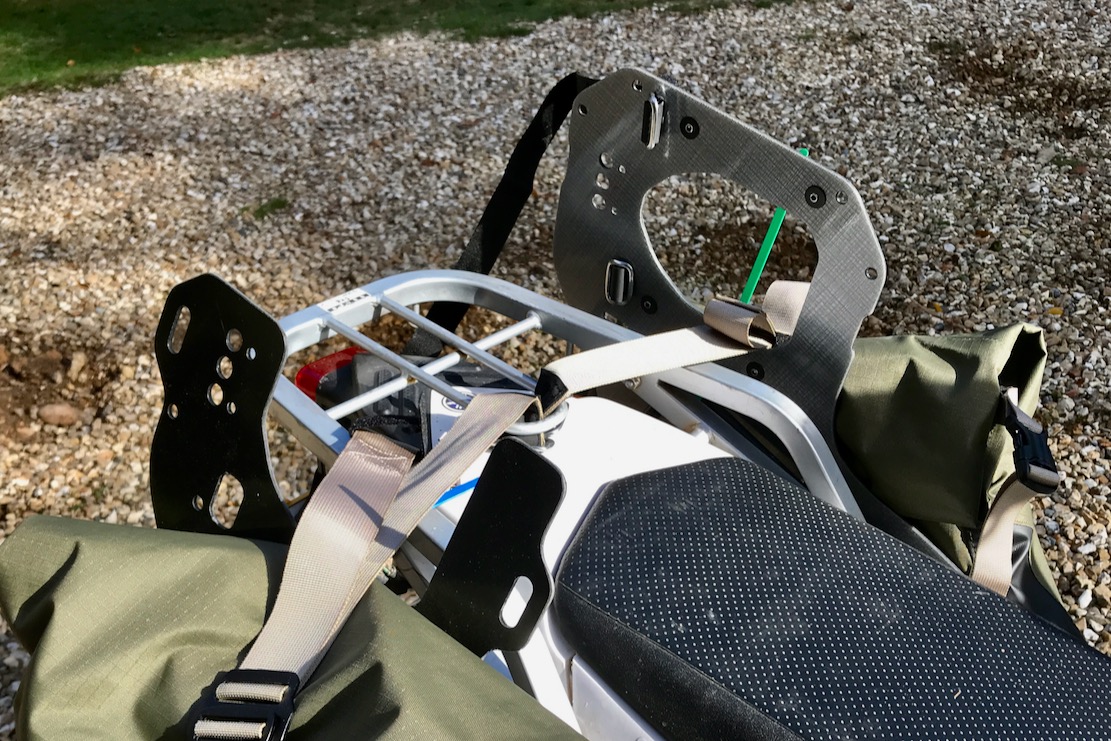
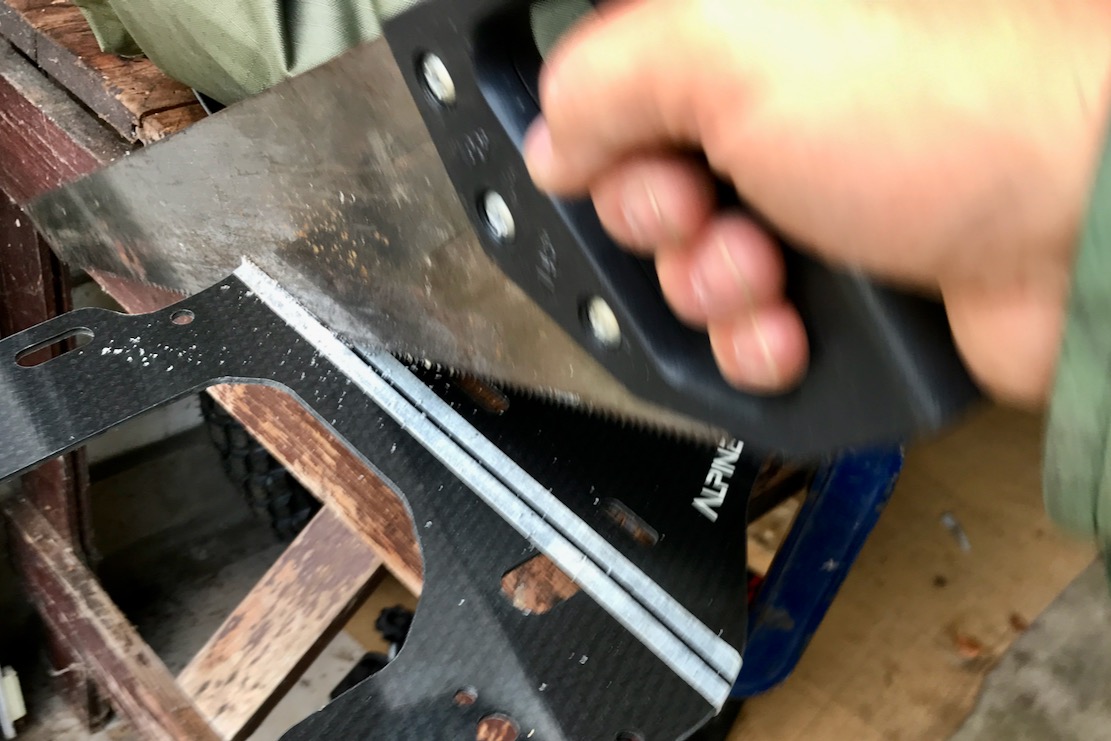
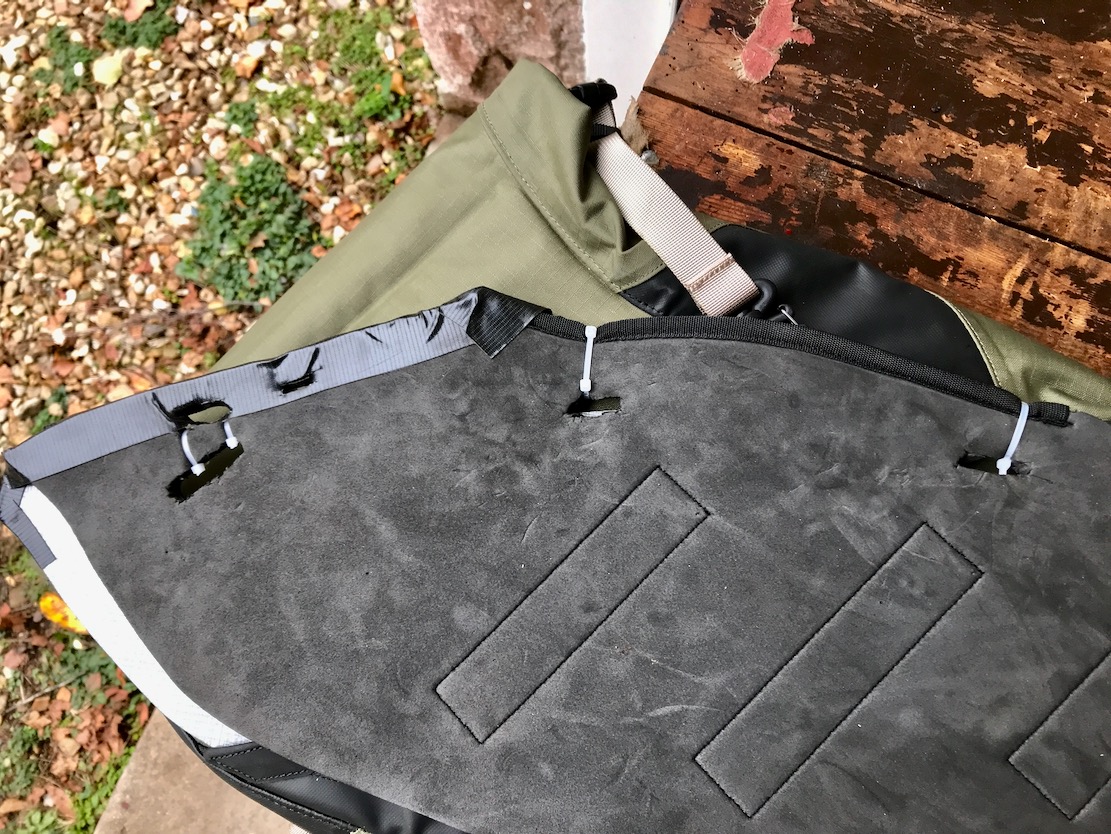
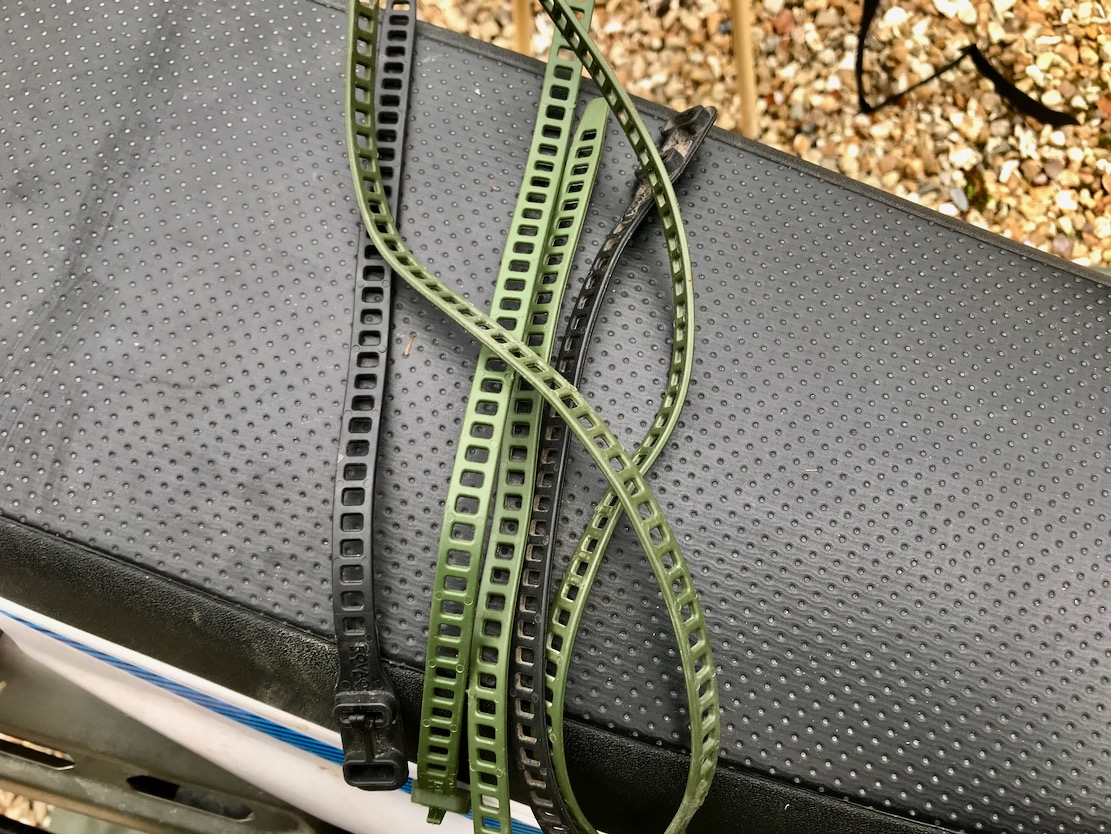
I test mounted the unjoined Alpines with zip ties; holes pre-cut into the CURV-plate make this easy. After seeing that it could all fit very well, I removed the bags and sawed off the rear parts of the plate and EVA pad, making two separate panniers. I then taped and zip-tied the trimmed board and foam (below left) and re-attached each 1.25-kilo bag using the much shortened strap to the front of the pillion peg hanger and at three more points along the upper edge of the board with reusable TPU RovaFlex SoftTies (below right) which adorn just about all of my outdoor gear.

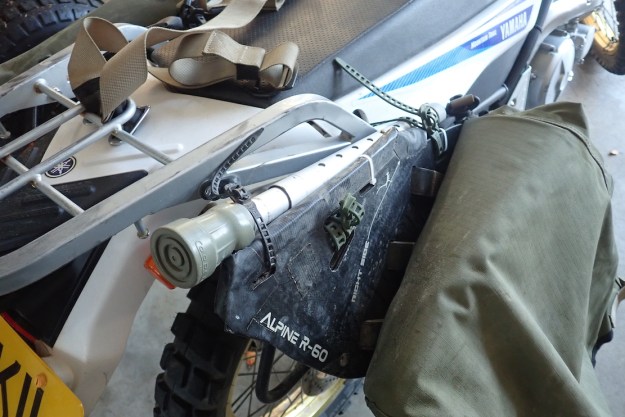
By chance, the bag’s lowest point also rested on the Serow’s unfolded pillion peg, additionally supporting heavy weights positioned in that area, reviving my unsung 3P idea mentioned above and effectively giving up to five contact points per side.

The 50-mil OTT-straps anchored themselves through a gap in my tail rack (left) to pull the bags close in against the rack. There was no need to run an additional strap around the whole bag and rack to hold it in, as Adv Spec suggest with their Magadans.
As it’s set up now, the seat can be removed as normal, the side panel can be accessed by undoing the pillion strap and lifting each bag. For insecure overnight parkings, I just fill a light 70-litre sack with what I need for the night.

All in all, the trimmed R60s could not have fitted better: secure, low, forward and as light as you’ll get for the volume and durability.
In Morocco a couple of tumbles didn’t affect the bags, though we didn’t have any pelting rain to test the waterproofing. On the road load volumes vary from day to day depending on what you’re wearing an so on. So the only complaint I have was that it was hard to cinch down the 50-mm male metal anchor buckle to pull the top down tightly. The strap was jammed too tight. It was more easily done on the upper part of the strap which is less intuitive for a good yank. Other than that, the OTT strap and two clips per side made things easily to access during the day. You soon learn to pack a day-access bag on one side so the other can be left till the evening. Everything in several pouches or bags shoved down inside easily, using all the space.
Once I get the Serow sorted, I’m looking forward to taking out the R60 for another run.