Tag Archives: Rally Raid Products

Honda CRF300L 9000km review

CRF300L Index Page
CRF300 Rally quick ride

In a Line
Light enough to tackle any trail I dare, but too tall and uncomfortable as a do-it-all travel bike for most.
  • Rally Raid suspension
  • Great range with Acerbis tank
  • 19-inch front wheel conversion
  • Screen with MRA lip
  • You know it will start and run like clockwork
  • Inexpensive and easy fit NiceCNC lowering link
  • Weighs about 162kg tanked up and with all the gear
  • Needs loads of add-ons to make it a functional traveller
  • For a trail bike, stock 894mm seat height is ridiculous
  • Negligible power increase over CRF250L
  • Seat comfort on long or rough rides
  • ‘Average Mpg’ or ‘remaining fuel level’ read-outs both out by 10%+
  • Reduced stability with big tank and other add-ons
  • 17-inch rear knocks out speedo accuracy (unless you size up the tyre)
  • Acerbis fuel cap always cross threads
  • Front brake is weak
  • Front brake switch failed ;-O
  • Negligible lowering with 17/19 wheel combo
Review
October 2023 I got my CRF shipped to southern Spain to leave in Morocco for six months. I flew down to carry on scouting new tracks for my next Morocco route guide, while also leading my one-week tours with 310GSs in between times.
I’m not quite finished with the 300L yet, but last week it turned 10,000km (6200 miles). High time to share my impressions after 8 months of riding.

Taking comfort
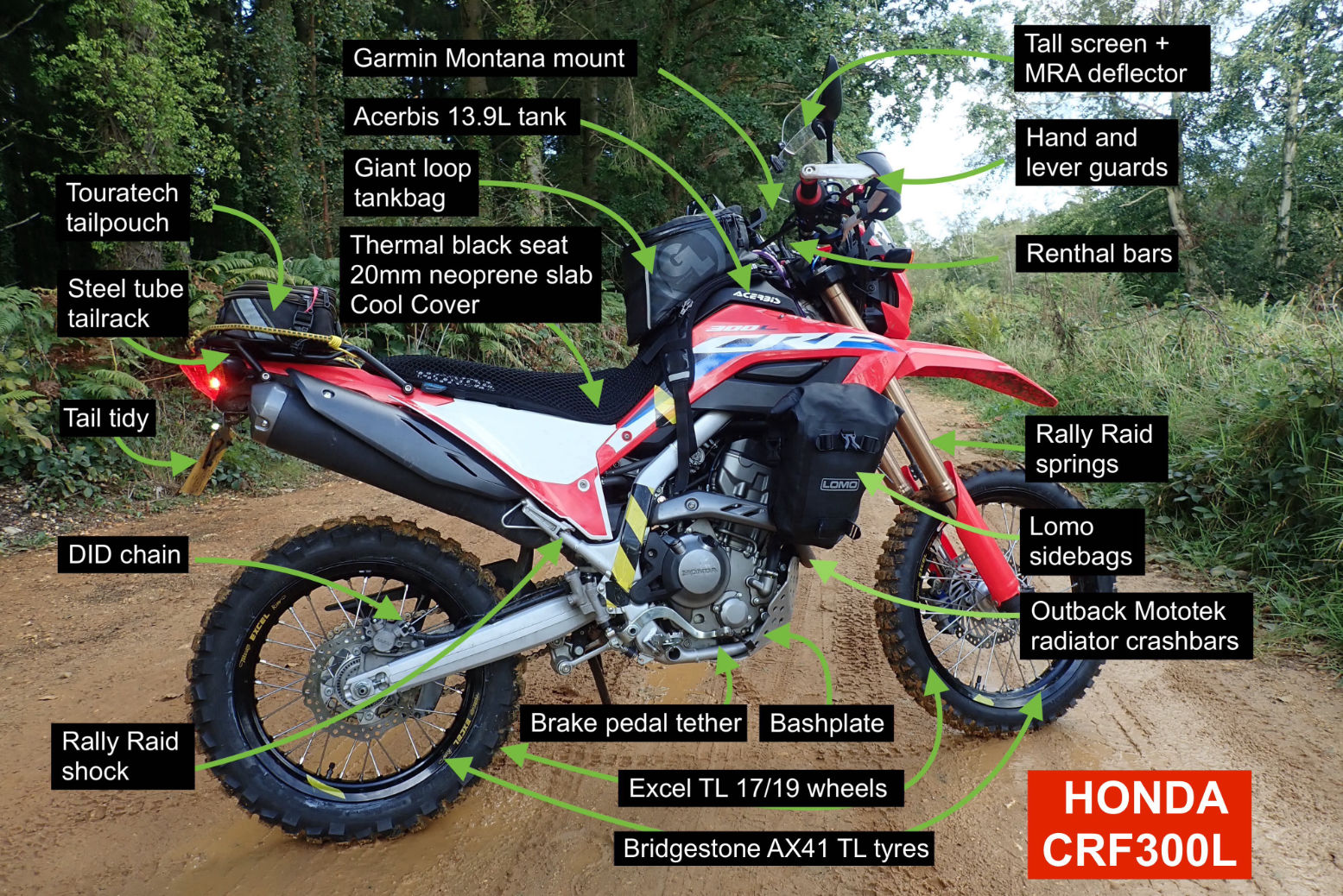
I bought a very well equipped 2021 300L from its second owner with just 1000 miles on the clock. It still needed a bigger tank, radiator protection and tubeless wheels (plus whatever’s shown in the graphic above). The bike came with a lowered seat (read: thinned out). At 34.5″/876mm it was 0.7″/18mm lower than Honda’s claimed OE specs of 35.2″/894mm. I tried to make the thin seat more comfortable by adding a 20mm neoprene pad under a Cool Cover which increased my back end’s mileage. But judged by side stand angle, the 17-inch rear wheel with a stock width AX41 tyre didn’t lower the back noticeably.
I then bought a stock black seat (full foam) and, with my added padding, probably went up to 35.7″ or a whopping 907mm. Then one day in Morocco I knew I’d need a low seat for a tough day, so removed the padding and Cool Cover. My backside was pummeled at the end of that 300-km ride, but I never refitted the Cool Cover and kept the neoprene slab held down with a bungy.

Later, I ditched the neoprene too and wore some Moto Skivvies and have settled for these plus opiates on a bare stock seat in a bid to keep it as low- and me as comfortable as possible. It’s still too high for easy mounting/dismounting, though the anterior agony got muted on some days. As we all know, once the drugs wear off, getting off/standing up for just a few minutes can offer respite.

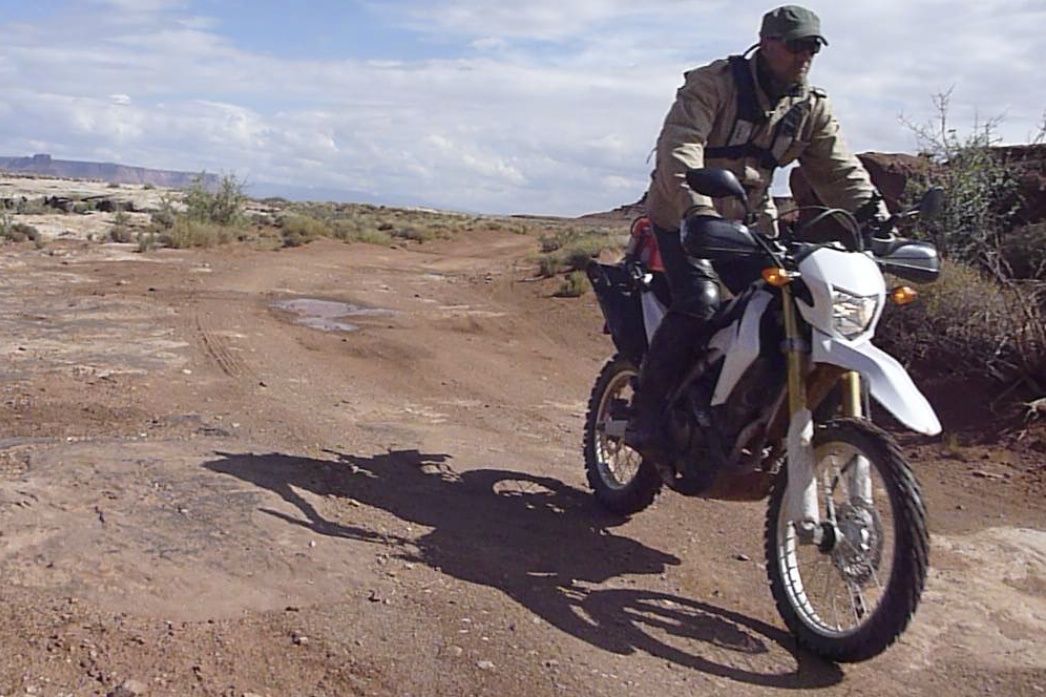
High Atlas near Toubkal

286cc
The 300 is only 36.4cc bigger than a 250L when you’d hope that’d be nearer to 50cc. I owned a 250L in the US a decade ago and for what it was (left) enjoyed it greatly. Along with other factors (like the existence of the CBR300R and worldwide >300cc licensing regs), I guess there’s only so much metal in a 250L barrel to bore out.
I knew it before I bought it of course – a quick ride of a 300 Rally didn’t set my hair ablaze – but the increase in power on the 300 is negligible. It’s still essentially a ‘250’ with the same-ish 27hp as a WR-R, along with all the inherent benefits and limitations: light enough to tackle or turn around on anything the seat height allows, while being a slog on long uphills or a headwind, plus uncomfortable after more than an hour or two. So not much different to my previous WR250R or KLX250 then. In many ways my less powerful Himalayan 400 suits my ‘old man’s’ riding style better, but was no faster on the road.
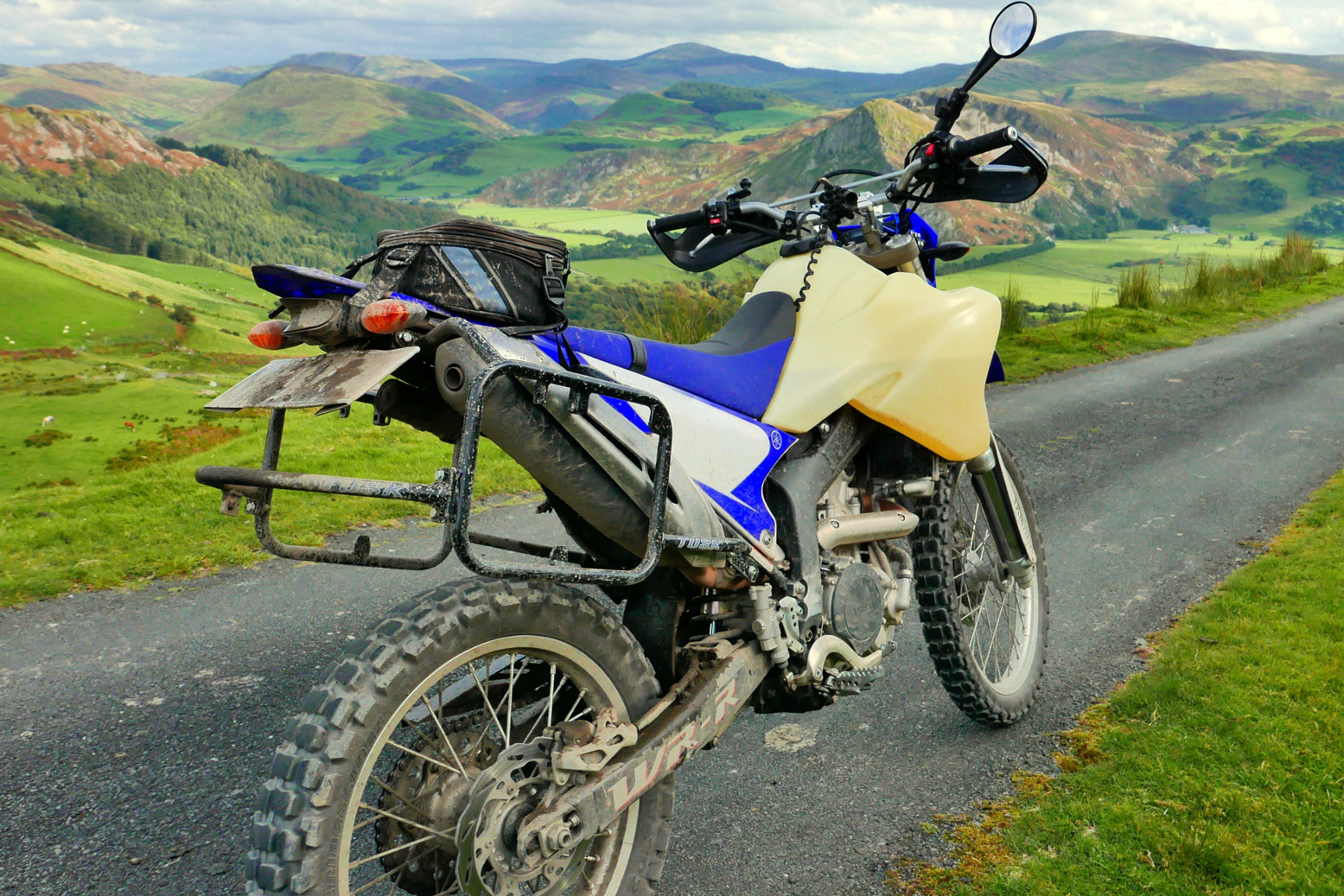
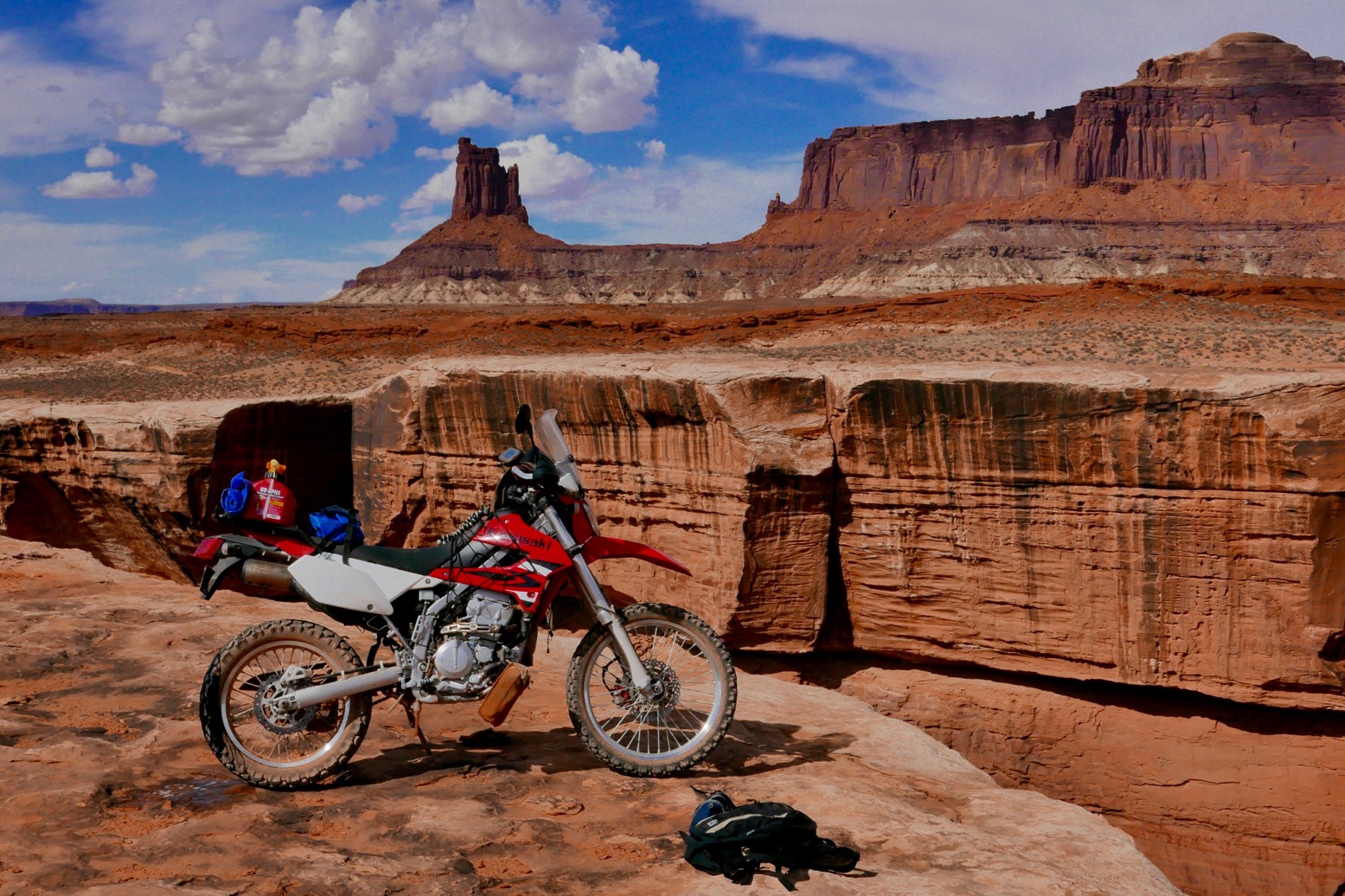
The best things about my 300L are the easy 400-km range from the Acerbis tank (despite the maddening cap) and the Rally Raid suspension. While both ends might benefit from a bit of tweaking for my mass, it just works; very occasionally bottoming out at the back and never at the front. After a few weeks in Morocco I thought the rear shock was sagging a bit, raking out the forks and slowing the steering. So, lacking the shock tool, I dropped the clamps around the front forks 5mm to produce the same levelling-off effect, but can’t say it rode any better.

Ten inches of suspension and clearance?! Way higher than it needs to be for most users.

Something’s Off
The way I’d set it up something felt off on my bike. For a while I thought it was the tubeless AX41 tyres. No so much the tread pattern which is pretty conventional, but perhaps the added sidewall stiffness in the tubeless carcass, intended for GSs and the like, not dinky ‘250s’ weighing 100 kilos less. Airing down to as much as 20psi didn’t help.
Then I tried dropping the forks 5mm, as mentioned; no noticeable change. So was it a high CoG, especially with a full 14 litres on board and exacerbated by the tall screen, radiator bars with side bags and so on? It certainly felt less stable tanked up, but no more than you’d expect. I tried to avoid setting off for potentially tricky unknown tracks with a full tank. I even blamed the hefty Outback Mototek rad bars, but while heavy, they’re actually set pretty low down.

17/19 wheels. Was it worth it?
My main motivation was to convert the stock wheels to tubeless, not have smaller wheels. I knew the stock front 21 rim wouldn’t have the required ‘MT’ safety lips. As MT 21s are rare anyway, I thought I may as well try a 19 as an experiment; it’s a better all-round travel size and there’s more tubeless tyre choice. Then it turned out the rear 18 wasn’t MT either, so I may as well try a 17 which also offers greater do-it-all travel tyre choice and might even lower the bike. Note: fitting a 17 raises the gearing a bit – you won’t pull away in 2nd so often. But it also throws the speedo out from ~8 to 14%. You’re going a lot slower than the speedo indicates and may want a DRD or similar black box
to correct it. But: fitting an oversized Mitas E07 at 10,400km put the speedo error back in the ~8% ballpark. DRD not needed.
I rushed the original job and had a manageable slow leak from the 17 and a meltdown on the 19 front arriving in hot Marrakech (fitted a tube). But the 21 I left at home has held its air fine for months. In Marrakech the mechanic re-sealed the rear in between my trips, cleaning then applying a continuous band of Puraflex. He then did the same to my 19 front and both hold air fine now. Summary: technique works if you take your time and allow a day or two of curing.
All done, the bike was barely lower and, as mentioned below, the 19’s benefits only became evident with the screen removed. Obviously, I can’t tell a 17 from an 18 on the back, but running a front 19, at the donkey speeds I ride at I can’t say I noticed any detrimental effects on the dirt over a 21. Crossing gravelly oueds, I did try riding feet-up, but the front soon tucked in and deflected, as you’d expect. Through thick bull dust same thing: go deep and the wheel folds. So much for improved flotation from the fatter front: you need to attack such crossings with momentum to push the front through (see AMH8, p205), while wrangling the bucking bike and spinning back end. We know how that can end, so I often paddle like a duck.
Bend swinging on the road the AX41’s ‘50% vacant’ contact patch held me back, but I did perceive – or persuaded myself – the 19 tracked better through bends than a 21 would. Occasionally banked over
it would twitch, but the asphalt surface is rarely pristine and debris-free in Morocco. So 19: no difference over a 21 on dry, loose dirt at trail riding speeds. Deep sand, mud ruts and snow may be different. On dry asphalt it corners with more perceived confidence, depending on tyres and minimal CoG interference.
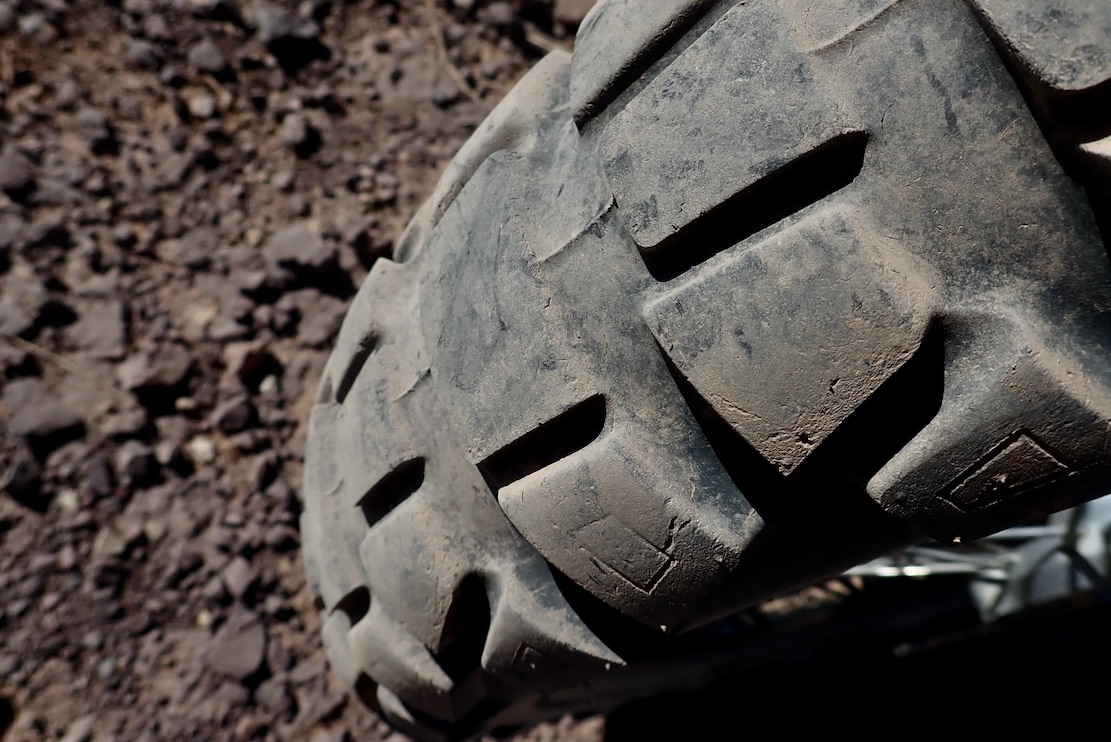
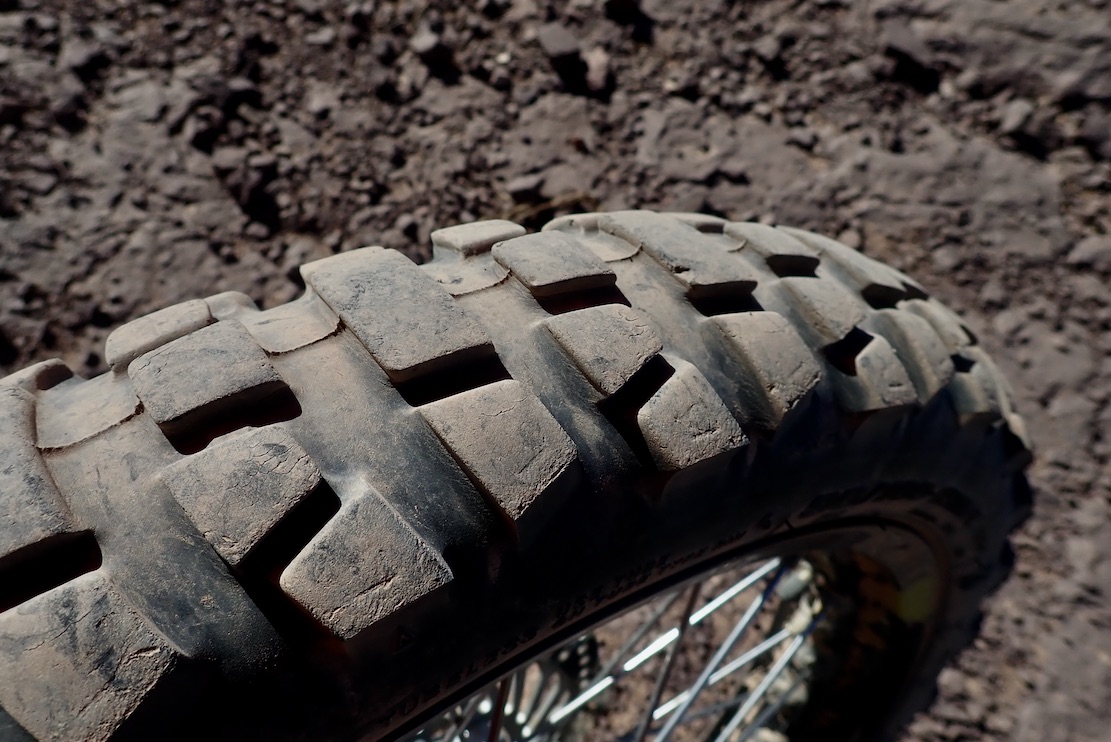
Talking of the Bridgestone AX41s, the rear TL had had it by the time I rolled back into Marrakech, having covered only 7000km or 4400 miles. I ran it at around 25psi, though it would lose about 7-8psi overnight. I went out of my way to select a tyre of identical width to the stock 18-inch IRC, but next tyre am going fatter all round: a less knobblesome 130 80 17 Mitas E07, partly because that’s the nearest the shop in Morocco can get in TL. It span less readily on loose dirt and certainly rode the roads better, like a 310 with its massive 150 rear. The front AX41 got replaced 2000km later with a bigger 19″ E07. Initially it felt heavier but the bike rode more like a supermoto on the road and is OK on the piste.

Returning in December for a week, I got to the bottom of it. Undertaking day rides, I left my baggage in the hotel (<6kg), but also removed the screen (1.5kg?) with an MRA spoiler. The bike now felt a lot more chuckable and connected. I could even ‘feel’ the 19-inch tyre’s benefits and managed the odd side-slip on the dirt, as on other bikes.
Was it purely height + weight, or also a ‘vision’ thing? Who knows, but after a week I refitted the screen and all my clobber for the ride back to Marrakech over Jebel Saghro, including a tricky a ‘4WD only’ descent, and the bike felt OK. My parameters had been reset, though I’ll definitely remove the screen again for day rides and even tours. It’s not needed and only takes 5 minutes.

In the late 70s I remember my 900SS was mysteriously transformed once I removed the half fairing. On that bike it was definitely about being able to see the front wheel (or just the front) directly, a bit like a forward control (‘cab over’) vehicle like a a VW Kombi or my old 101.

Ditching what little overnight baggage I carry certainly helped (and no tailpack made swinging the leg over so much easier), but removing the screen turned the 300L to what I’d expect: a fun, nippy, lightweight trail bike.
And yet every bike I’ve had for the last 15 years has had a screen of some sort, including the 250L (a plain, light Slipstream windshield which I reused on several later bikes). With the 300L I think it was a cumulative amassing of stuff, not just the screen, but the bigger tank, heavy radiator bars with side bags, handguards, tankbag, GPS, breakfast. From the Mototek crashbars upwards, and with a full tank, that’s up to 18kg of added mass over a stock 300L all up on the front, or way over 10% of the bike’s stock weight. Too much.
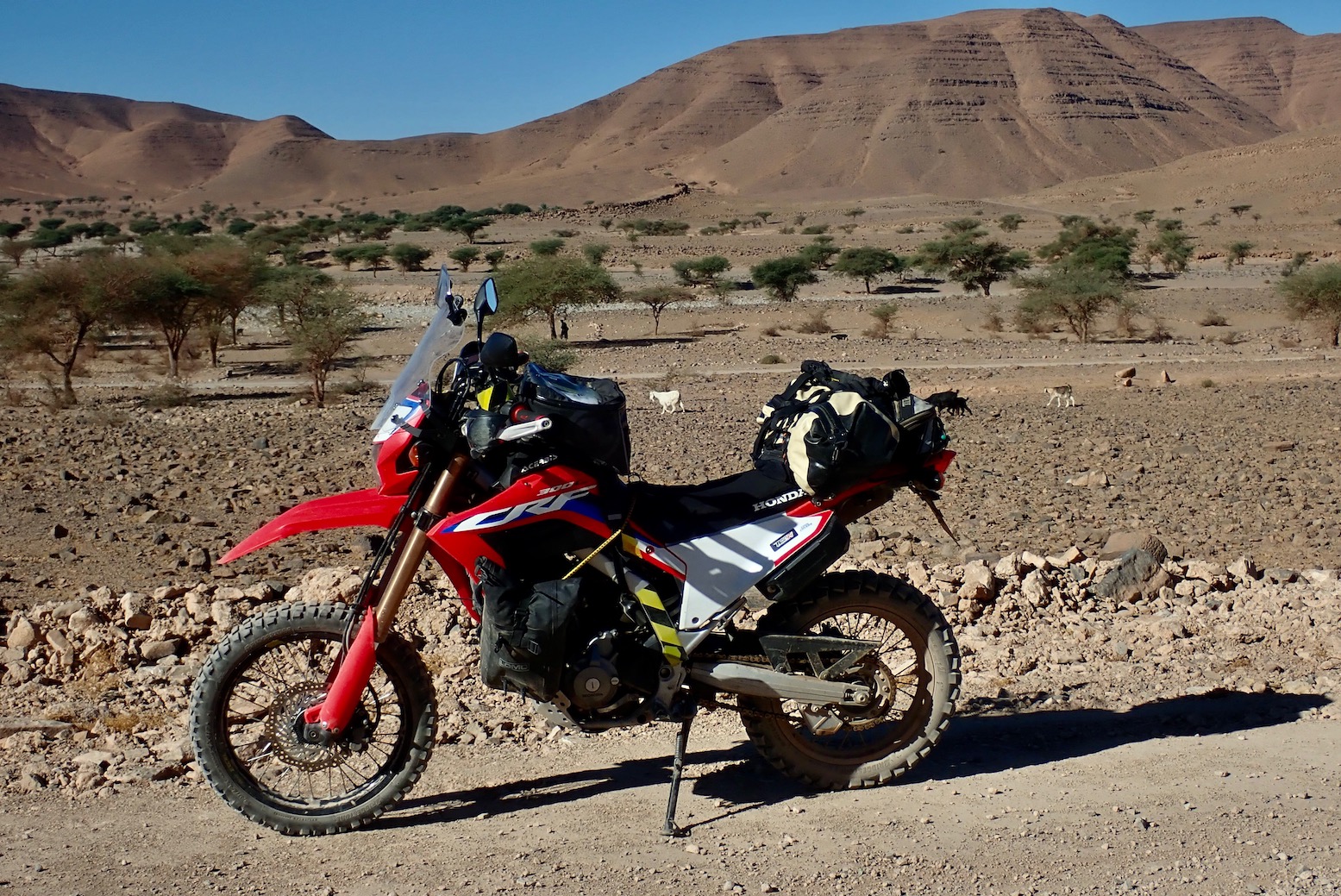
With that sorted, it’s only really comfort that holds me back, not helped by the fact that my knees are going (or are having a bad year). I’ve always been a lazy ‘sit when you can; stand when you must’ rider, but now I’m less able to hop onto the pegs or even just weight the footrests like I ought to to spare the hit when crossing a run-off ditch. Standing up is actually a good stance (compared to a 310GS), with knees pressing into the cushy sides of the seat just like they should. There’s a bit of a stoop for me (6′ 1″) at the bars, but that’s without any risers that I usually have to fit.

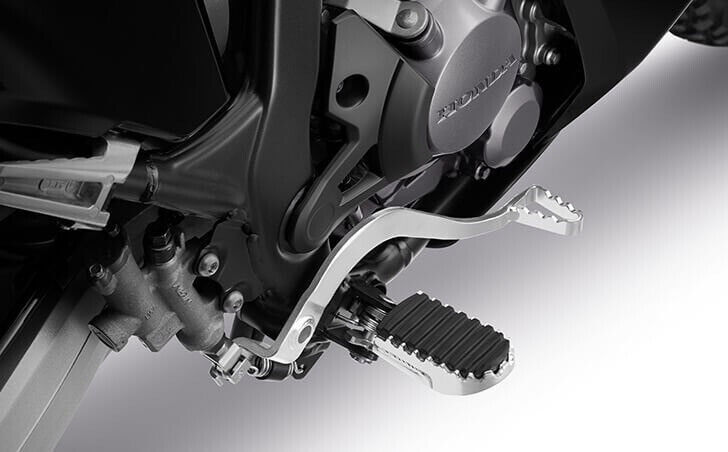
I do stand up on smoother terrain at the end of a ride to revive the backside and stretch out, but find, even in my TCX dirt boots, that my insteps ache after 20 minutes. Fitting wider footrests is something I overlooked in the prep, I now realise. Africa Twin Rally footrests fit right on they say, and have a third bar to support the load, but I bet other pegs fit too. The cheapest AT pegs I found were £80 on ebay, with DRC, or similar but unbranded Chinese alloys, costing around £50. Then I realised that replacing the missing footrest rubbers for 20 quid a pair will probably have the same effect, but same soreness so must be much TCX boots.

300LS – a lot lower

On the dirt I wouldn’t want any more weight nor need more power, but would love an inch less height for what I do. In the US (and maybe elsewhere one day) they now offer a 300LS, with inch less suspension and an inch less in the seat. For those without a calculator to hand, that’s two inches lower seat height.
The 300LS should have been the stock 300 back in 2021, with an ‘HS’ option for the lanky hardcore. Over ten inches of travel is excessive for a trail bike like the L; the CoG is too high making it twitchy, and it discourages ownership by less tall folk. I’ve never came close to hitting the bashplate which could easily be 2 inches lower, as on the LS. Honda could even take another inch out of the springs and put some padding back on the saddle where it’s still needed.
It’s a shame the TracTive shock from Rally Raid isn’t length-adjustable like the Wilbers on my XSR700 or YSS on the Him, though of course there’s nothing to stop me fitting a lowering Kouba Link (or similar knock off), then raising the forks in the clamps some more. In fact I have talked myself into trying just that for the next lap.

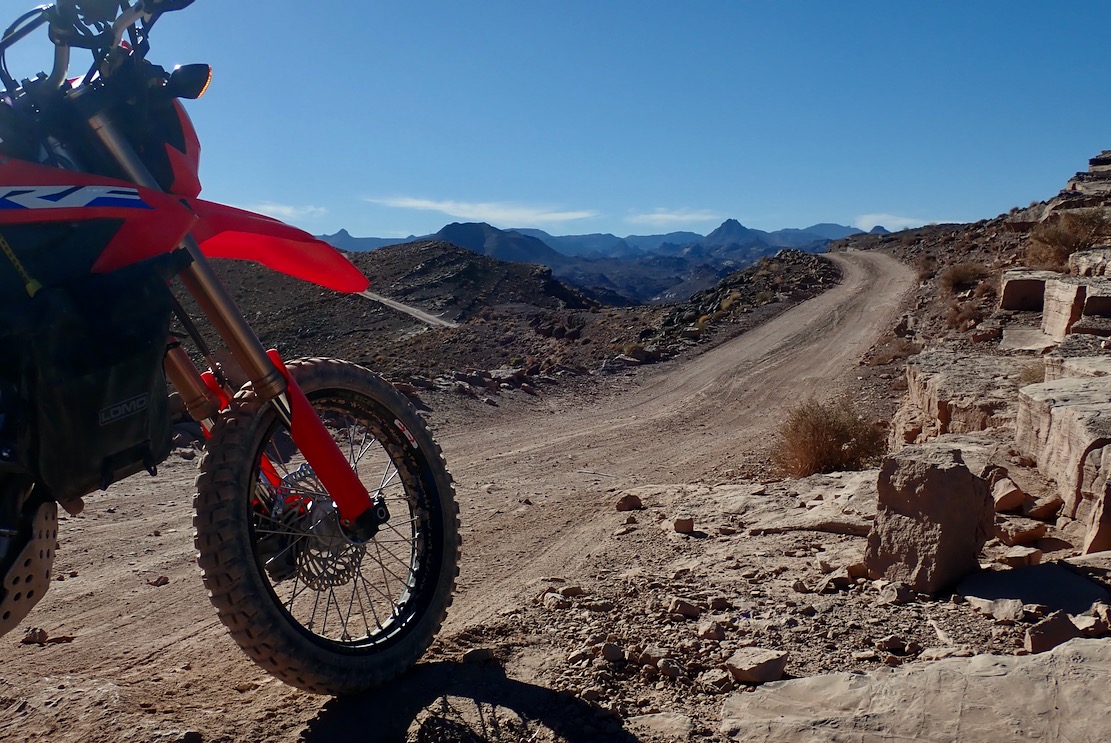
There were some long spells of oued paddling (too loose or rocky to ride) at which time the low first gear was just right, ticking over at 2mph or so, with no need to feather the clutch. But as mentioned, my speedo read-out was way out until I fitted a fatter Mitas when it went back to stock 8% error.

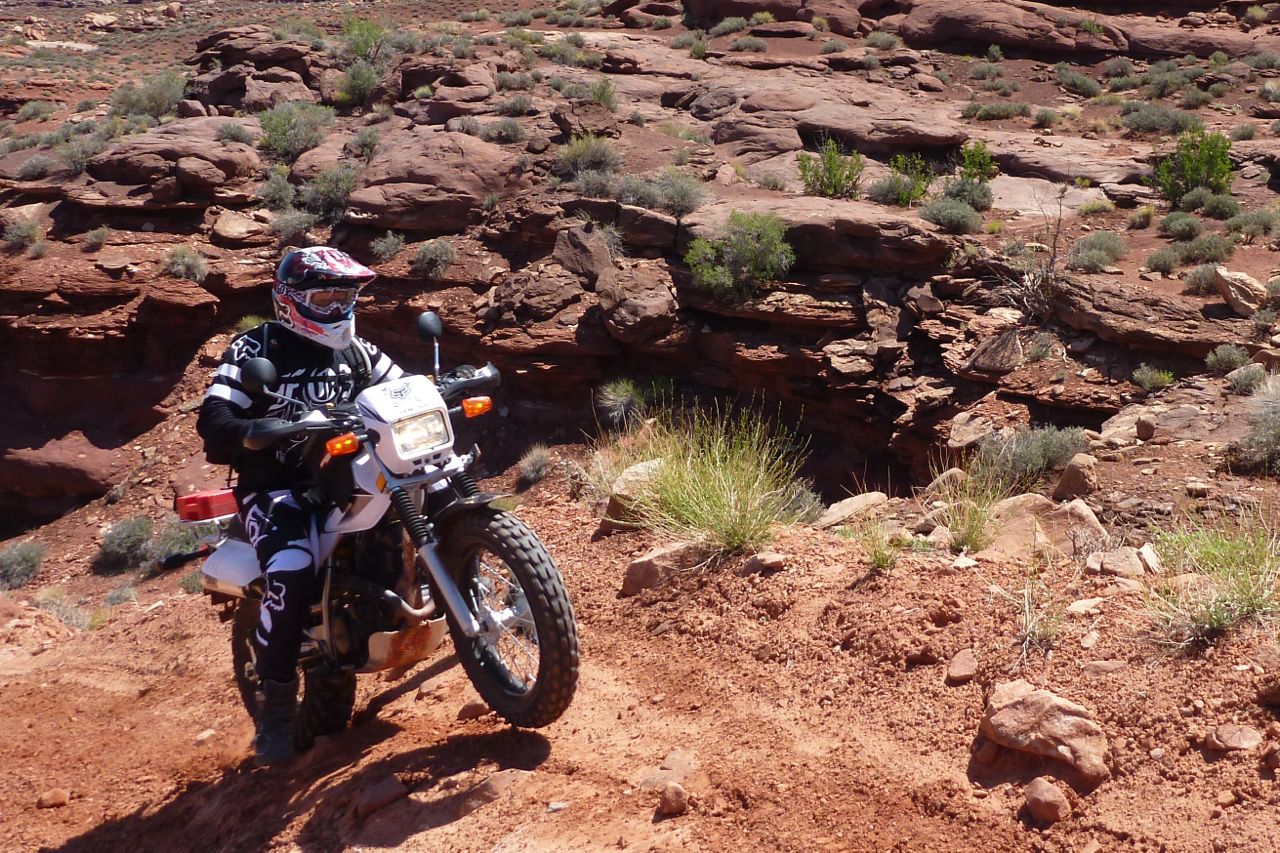
All in all, while the 300L was a great deal and is making my task out there easy, I’m at an age where I want a lower saddle alongside the low weight to be able to chuck it about with greater confidence, and get on and off without scuffing the saddle with a boot. I’ve matured into one of those old guys I met on my 250L in Canyonlands 10 years ago who’d ditched their KTMs for TW200s (left). Plus I’d like more day-long comfort, like a 310GS, though am not sure I’ll ever get it. All this holds back the fun of being on a planted bike like the 400 Himalayan.

On one of the tours one of the riders who owned a 450L wanted to try my adapted 300L, so I hopped on his rental 310GS. What a great bike that was, and not just the cushy, full-width saddle! Something about the steering also felt just right (this was before my de-screened epiphany). He also thought my 300 was off, and put it down to the 19-inch conversion. As John M at Rally Raid will tell you, the 310 (especially with his RR mods) is a much under-rated bike, though he rides a low-wheel 300L too.

Snatchy throttle? Can’t say I’ve noticed by found this tip on Advrider.

Of course I never expected a 27-hp 300 to be the long sought after do-it-all travel bike. That machine is more likely to be a twin or single around the 450cc mark, like the forthcoming CFMoto 450T or the Himalayan 450. I bought the more dirt-focussed CRF for the specific purpose of bagging pistes in southern Morocco while leading a few tours. I could’ve saved myself the transit costs by hiring a 310GS, but the Rally Raid sprung 300L is a better ride off road, especially if you don’t know what’s ahead. And anyway, I wanted to try the popular 300L, and can’t wait to do another couple of months riding in Morocco. The long ride back to northern Spain in late March, not so much.


Coulda, Shoulda, Woulda.
Next time I will…

  • Not rush the DIY tubeless sealing, or just cough up for CWC Airtight.
  • Get the Adv Spec radiator brace instead of the heavy Outback Mototeks and find a way of hanging the side bags off the tank to cushion the rads in a fall
  • Hardwire in the GPS, then [buy] a proper USB plug, not the unreliable cigarette-bodge
  • Leave the Cycle Pump at home and rely on the handheld USB pump
  • Try some Moto Skivvies for long runs
  • Get a Rally Raid HPA for the shock
  • Try a lowering link
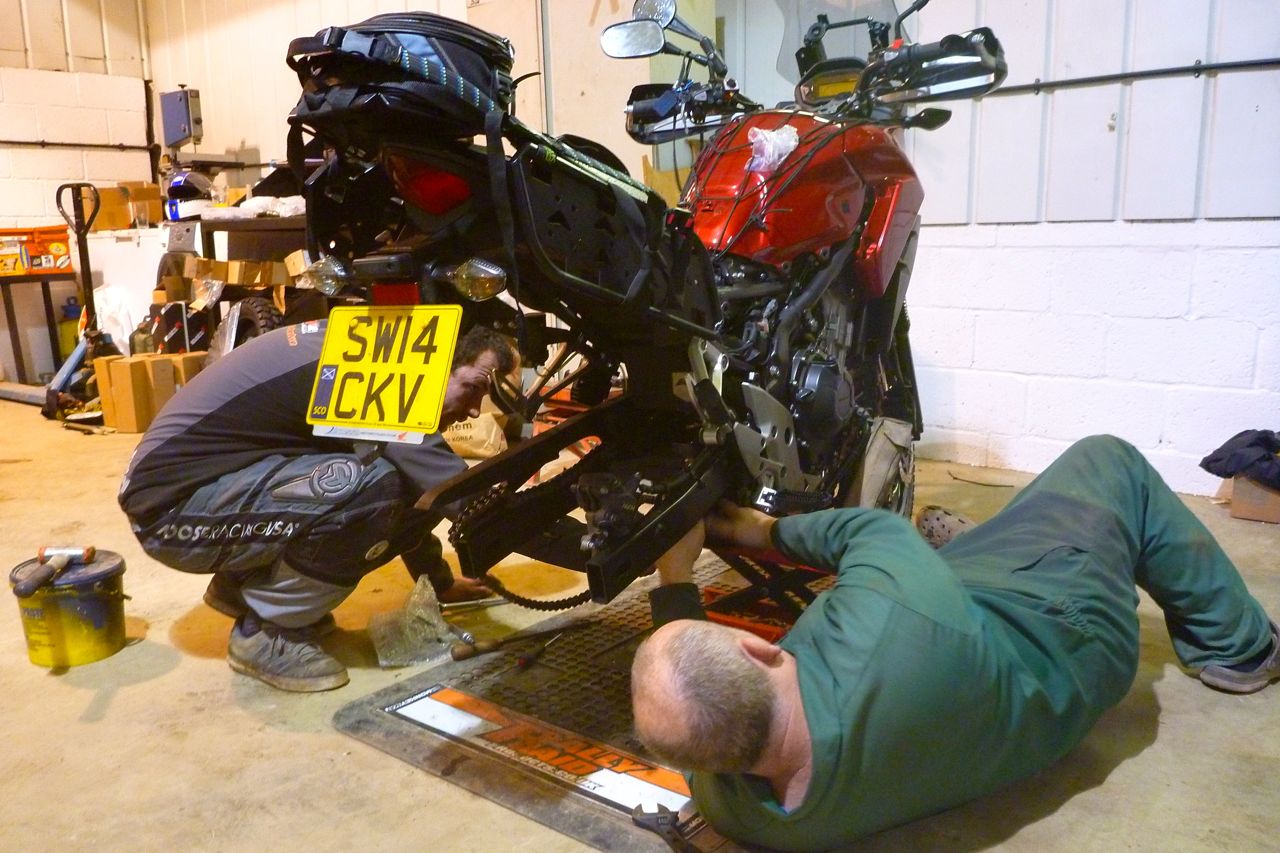
CB500X Rally Raid ready to roll

CB500X RR Index page
Tubeless Conversion Index Page
wgr
cbxL309

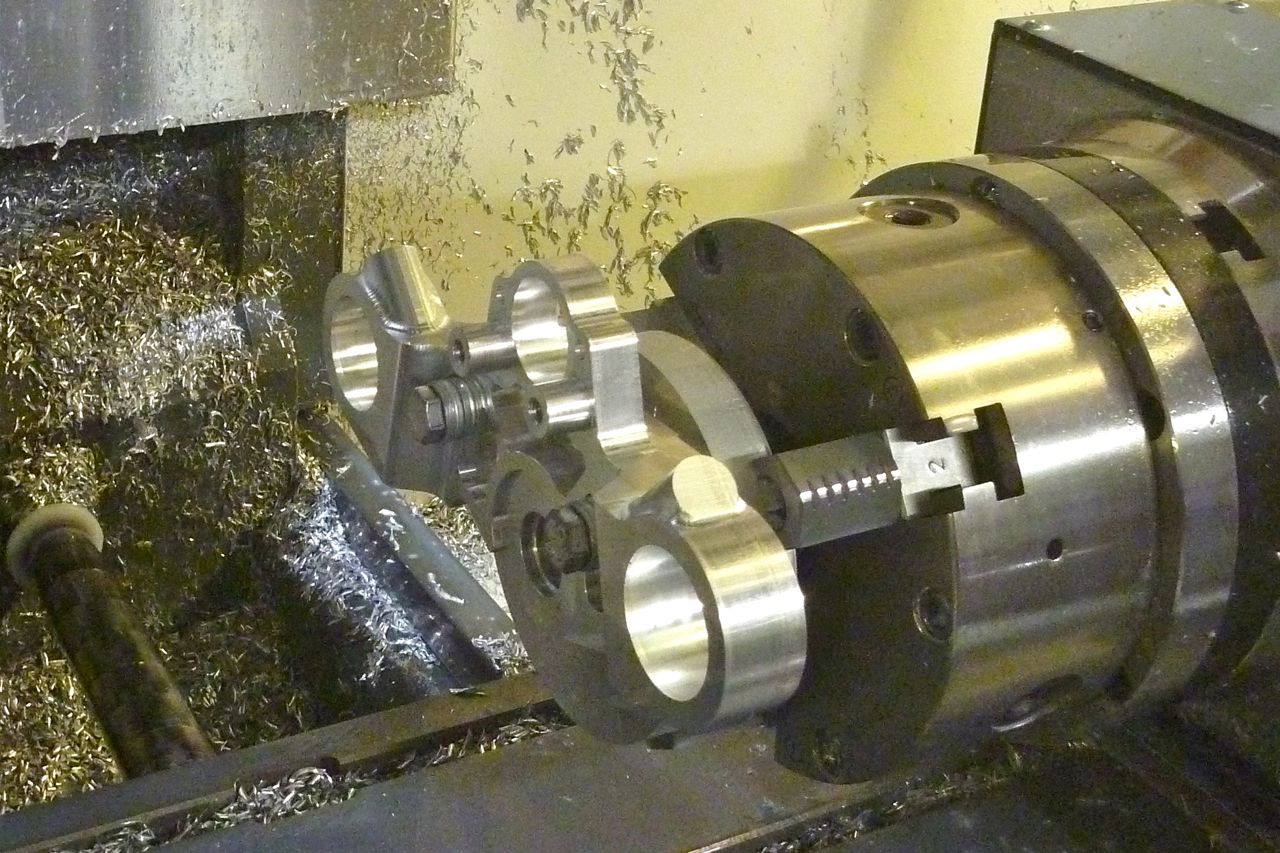
Just a couple of days before I’m off and I’ve finally got the CB-X converted to full Level III spec at Rally Raid. I started the job at home by fitting the clever drop top clamp, precision milled on John’s CNC 4-axis milling machine (right). Marvel what a 5-axis miller can do in this mind-boggling vid. The clamp enables positioning the fork tops 20mm lower which with the 30mm longer damper rods gives two inches more travel and room for the bigger wheel. It’s a more expensive solution to screwing on dodgy fork extenders – something I looked into when trying to Tenerise a TDM900 earlier in the year.

cbxL304

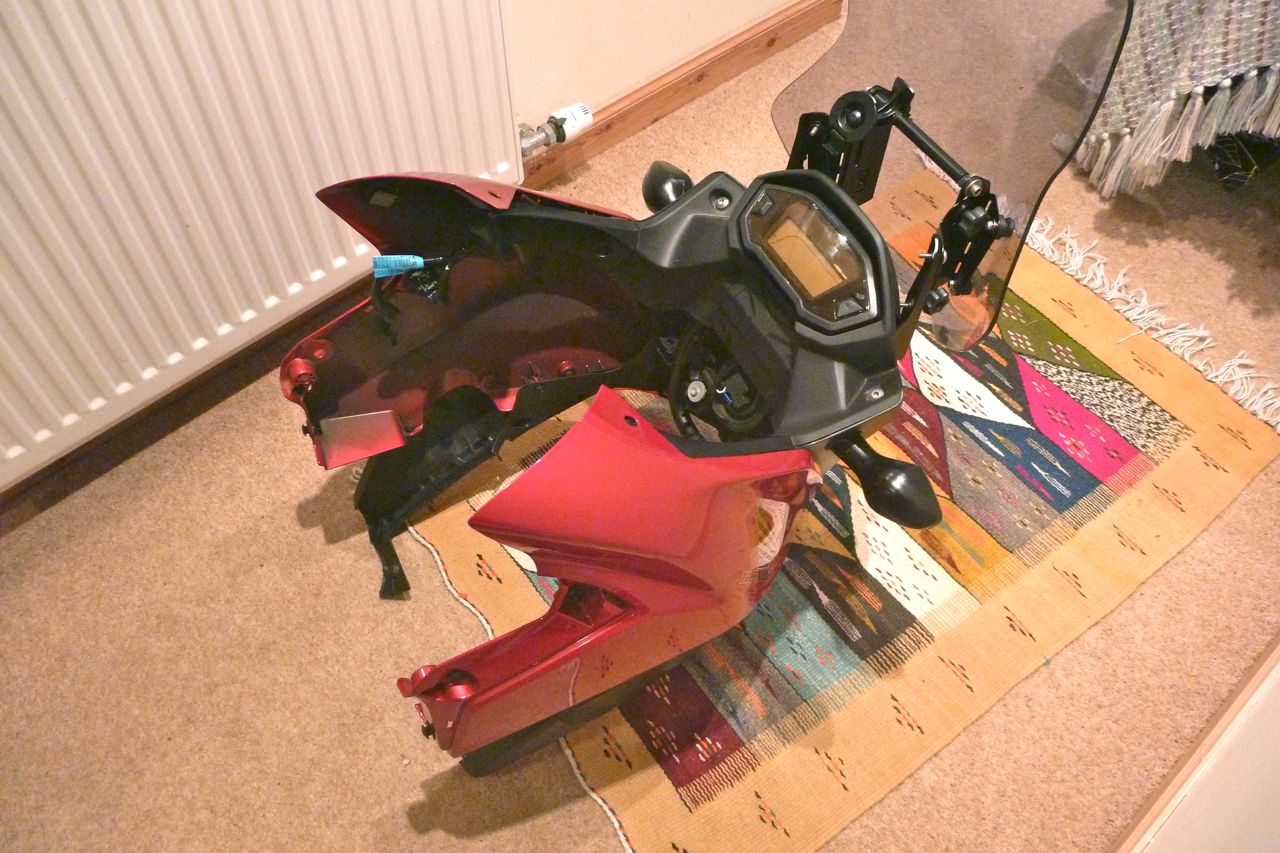
Removing the whole headlight/fairing/dash unit (left) is actually quite simple once you get your head around it. The pdf instructions from RRP are all clear – all the more so when you look back at them. Side panels off then three screws on each side of the fairing and then the crucial double 12-mil bolts on the steering head which take all the weight. Ease back the LHS to unplug a couple of connector blocks and away it comes. RRP include some alternative 12 mils with nylocs in the kit. I saved them for later and a 1000 miles down the road, when I got to their workshop one had fallen out. RTFpdf.

JIS

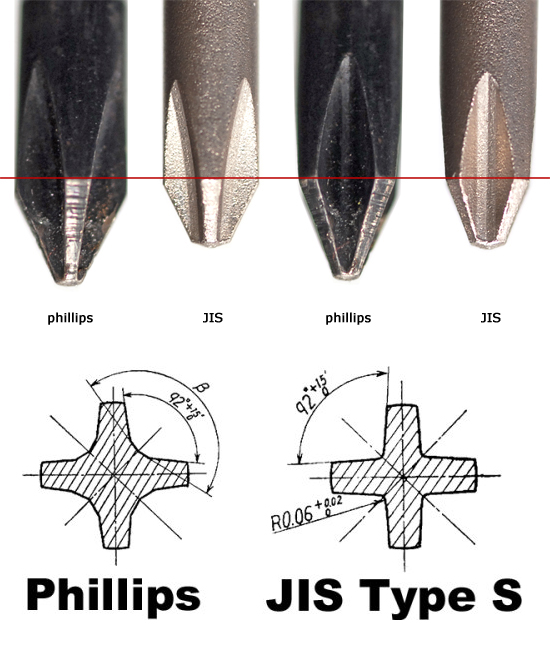
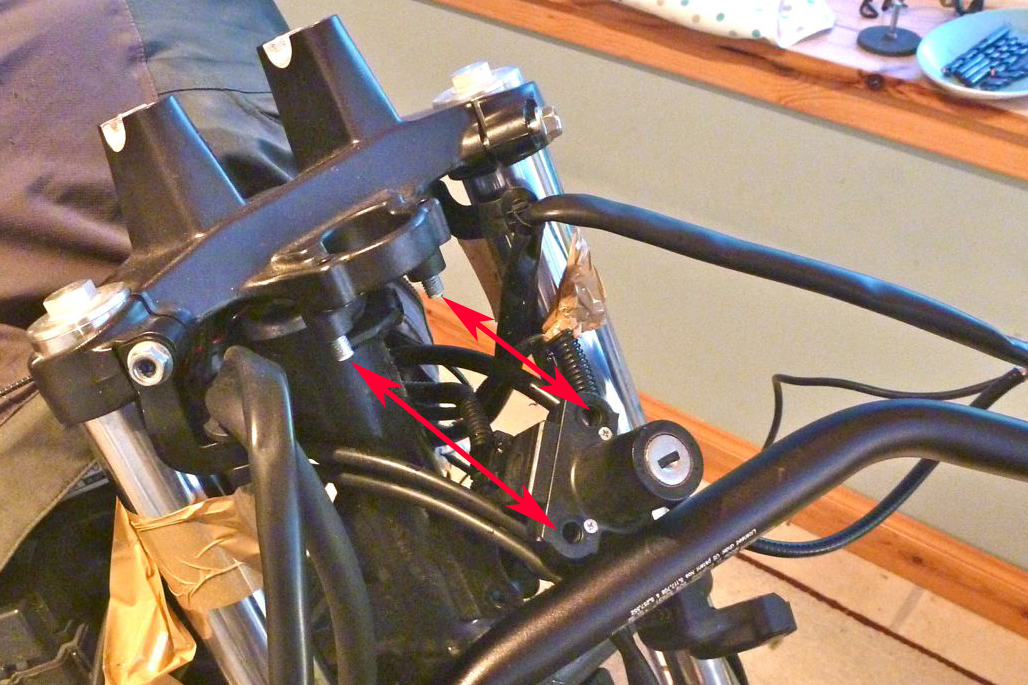
Removing the ignition barrel from the OE top clamp is where things slowed down. First, two crosshead screws holding on the HISS ring needed undoing from underneath. Why crossheads FFS? I almost lifted the bike off the ground getting the pressure in there – luckily they both turned with a nice crack of shearing Loctite. Later John advised these are actually JIS head screws – some sort of Japanese standard that’s possibly better than Phillips. Could that be why we had all that trouble using Phillips drivers on Jap monkey metal crossheads in the bad old days? Probably not.

cbxL303

The next step required drilling out the chunkier undoable barrel security bolts (left) and – long story short – that took me days of faffing: blunting and crudely resharpening drill bits over and over on a distant neighbour’s grinding wheel. It’s an awkward job with an upside-down drill just off centre and the chuck spinning close to cables and wires, but I got one out then Mr Postie delivered a few cobalt drills the day before we had to pack up and relocate cross country. never heard of cobalt drill bits but with a better technique (slow rpm, nib in oil), the second bolt head fell away in a few seconds. John at RRP says he may include a cobalt 9mm with future kits.

cbxL305

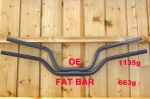
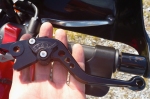
I was hoping to fit some stronger Renthal fatbars (right) but the taller RRP clamps aren’t quite ready yet, so it was back on with the taller OE bars, (left) – there’s plenty of cable slack to do this – the lift is not that great. On went my trusty Barkbuster Storms (now on their 4th bike) as well as some Daytona heated grips I’ve had lying around for so long the rubber’s gone grey. They look a bit crap compared to the Oxfords that came with my last couple of bikes, but they’ll last as long as they last and were dead easy to fit. I also fitted RRP’s 12-volt double PTO mounting plate – much neater than having the PTO zip-tied to the ignition barrel. The Barks required the usual compromises with lever angles – apparently, a Bark V-Strom mount has the curve to get under or over a brake hose. I have some neat shortie adjustable levers (right) from RRP too but will fit them if mine snap. The Storms ought to reduce the chances of that.

cbxL308

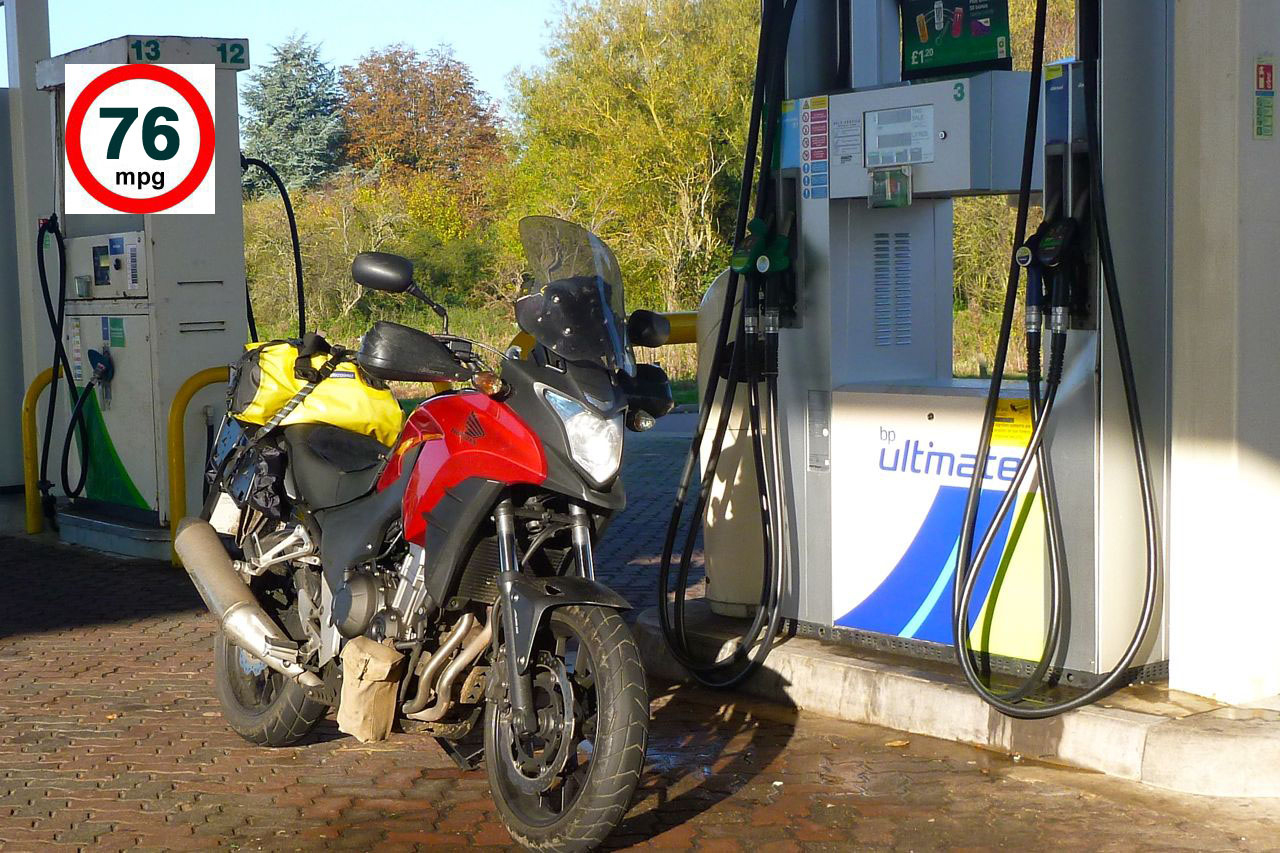
The next day I set off on a 480-mile run down to North Yorkshire, including the full length of the fabulous A68. I was trying out a new Powerlet heated vest which I’m sure helped me arrive less tired, with just one stop at a Gregg’s 350 miles in. The 500X returning an average of 76mpg while I marvelled at the OE Pirelli tyres’ grip in the wet.

tech7
reduce

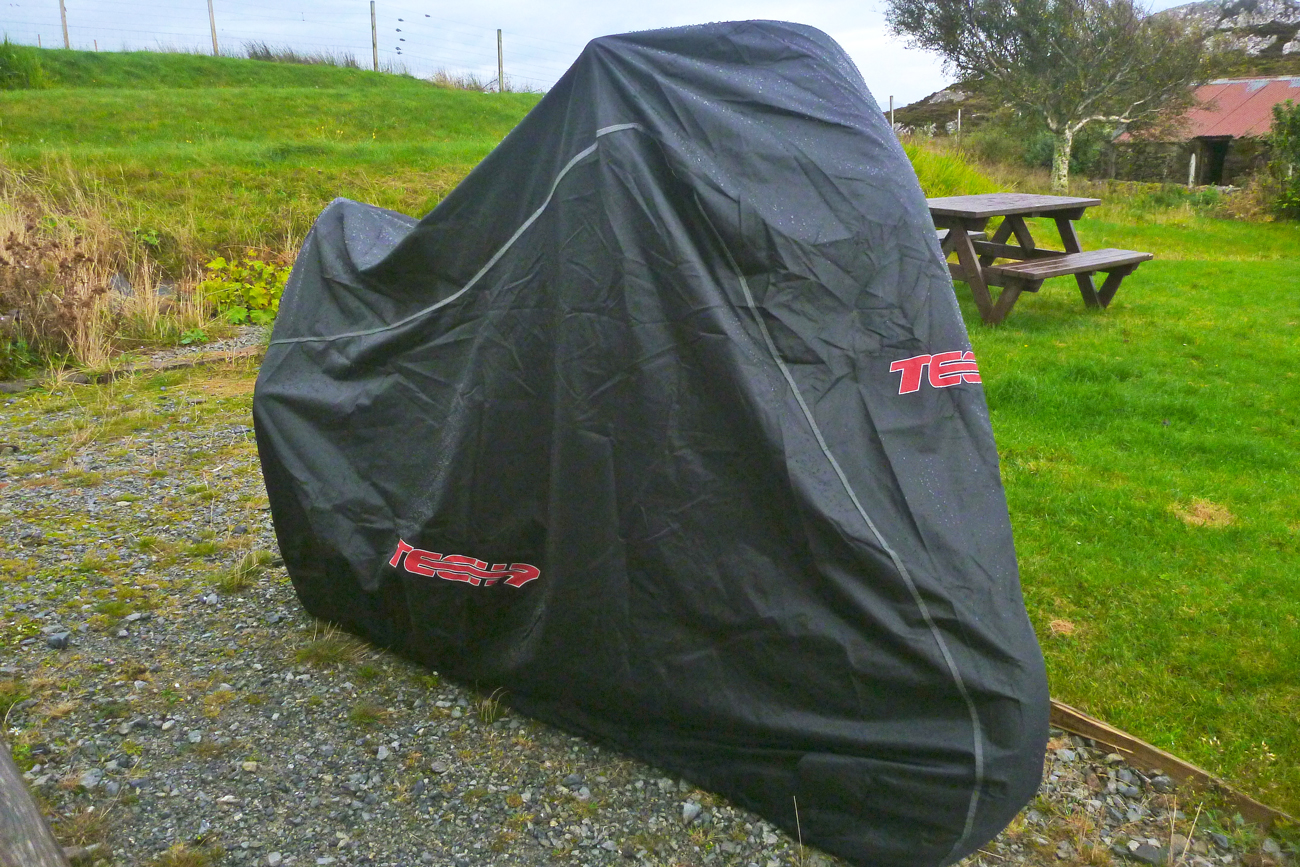
BTW, let me put in a good word for the big Tech 7 Adventure Bike cover. Yes, there is such a thing, and it fits bikes up to tall screened GS12s and S10s. Still only £23 from M&P, I’m sure it’s much tougher than those £10, last-a-year silver jobbies, has two under straps just inside each wheel, but also has an elastic bottom to make those straps unnecessary unless it’s very windy.  Low-profile black to reduce visibility on dark streets and compact enough to make a handy travel cover or groundsheet.
Update 2019: After 3.5 years the waterproofish laminate is shot and the fabric is sun faded, but all the stitching and elasticity and clips are intact and it all hangs together. I need waterproofing, so bought an Oxford Aquatex for £20 for my Himalayan.


A few days later at John’s workshop near Bedford wheels and suspension were needed to finish the Level 3 job. I’m trying out some RRP wheels sealed with a mystery polymer by BARtubeless in Italy to run tyres tubeless. With his rally racing background John’s more of a tube or mousse man. For less aggressive solo travels to which the CB-X is more suited, I err towards tubeless and gel, as do a few other potential RRP customers. RRP may end up being the UK supplier for BARTubeless.

cbxL315
cbxL320

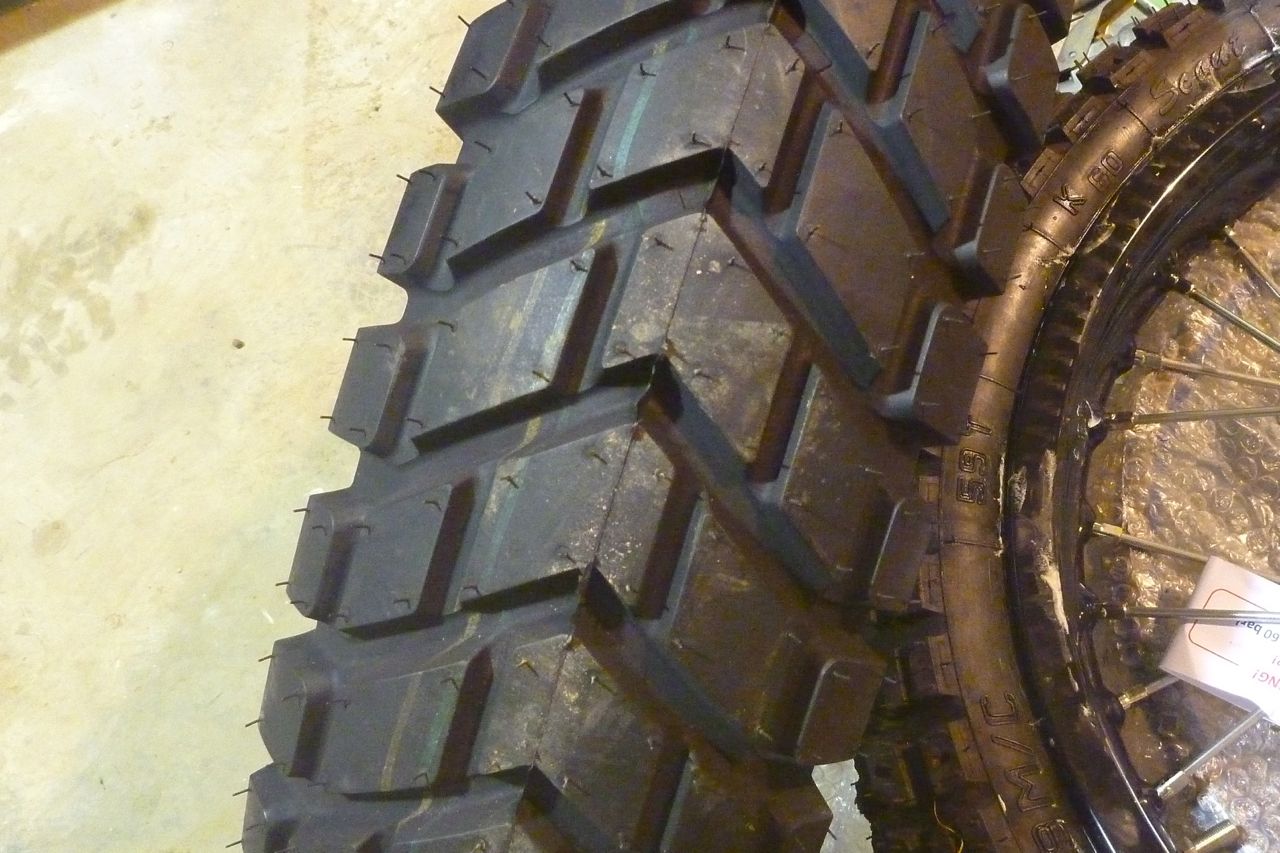
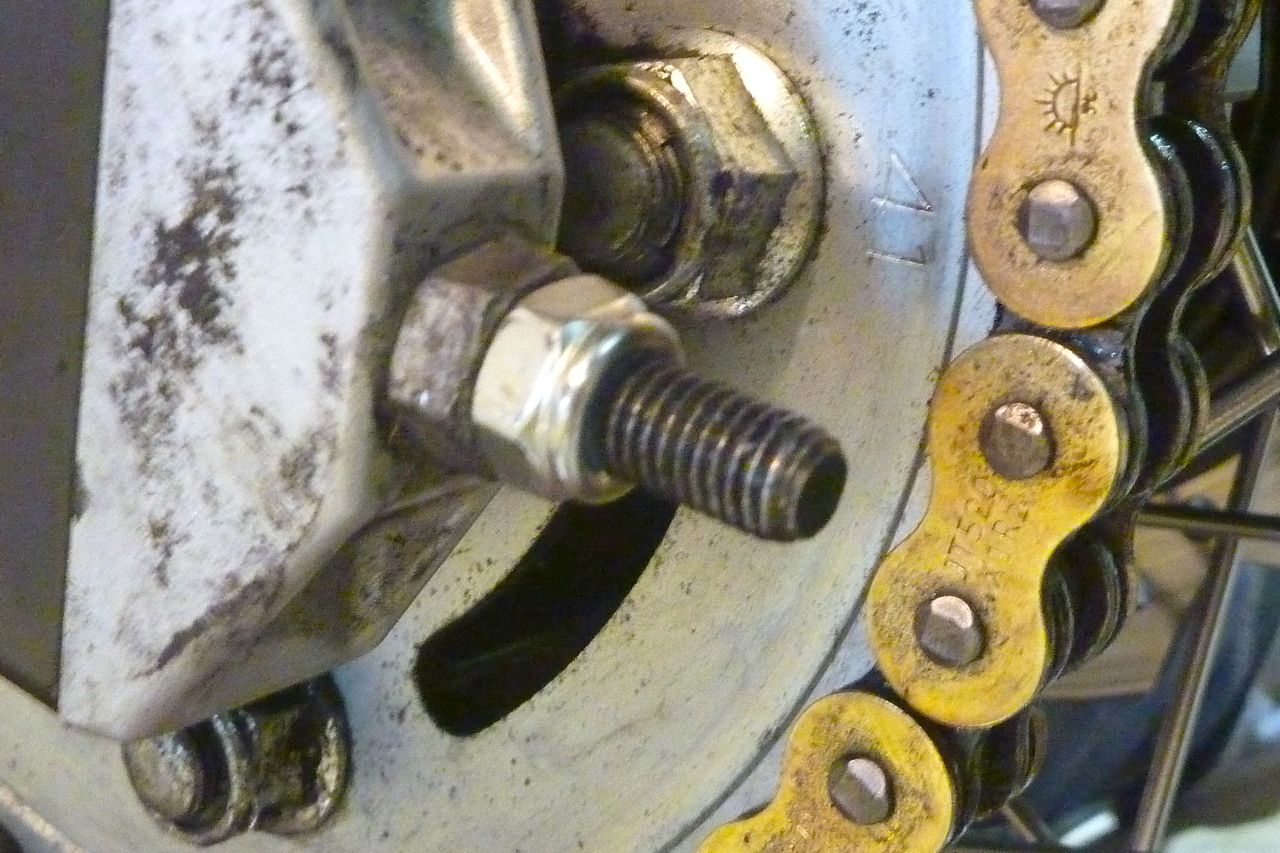
One problem with them is the thick layer of polymer in the well of the rear rim making tyre mounting difficult. That’s what they found earlier fitting a Golden Tyre GT 201 (left; 150 / 70 R 17 TL 69V) I bought from Adv Spec. You need the depth in the rim’s well to give enough slack in the bead when doing that last bit of levering. Of course, some tyres are harder to mount than others and the GT201 (a K60/MT60 look-alike) is stiffer than the TKC which RRP typically use. While in the area they adjusted my recently bedded-in x-ring chain and John recommended fitting a nyloc nut on the chain adjuster bolt (right); apparently the OE nuts fall off.

cbxL314

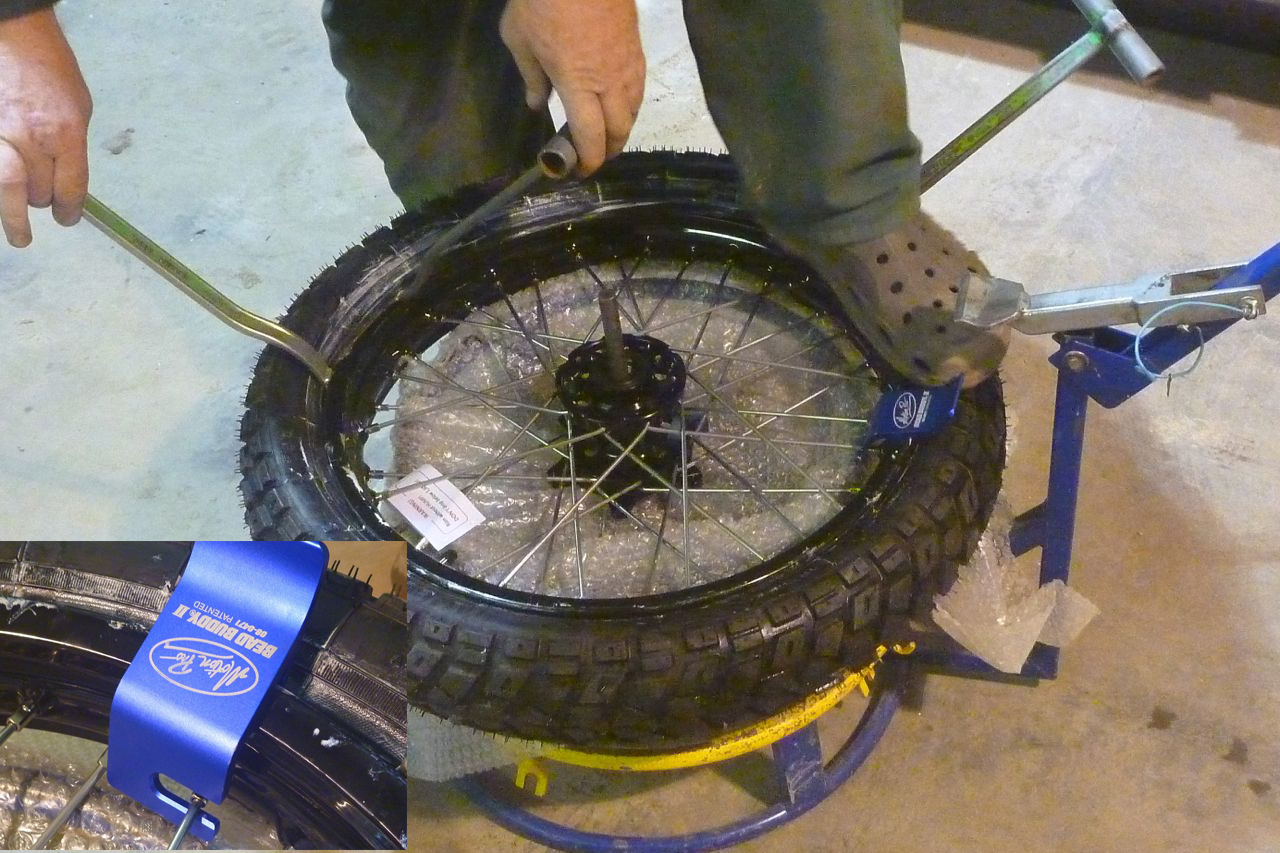
Heidenau K60 19-er leftover from my old GS500 project went onto the front rim with no hassle. I got a chance to try out my Motion Pro Bead Buddy II (left, blue), a ‘hands-free’ clamp that forces the bead down in the well when levering on the opposite side. It’s the same as putting your weight on the tyre to push it down (not so easy on the tyre rack, left) and it did the job.

cbxL311
cbxL312

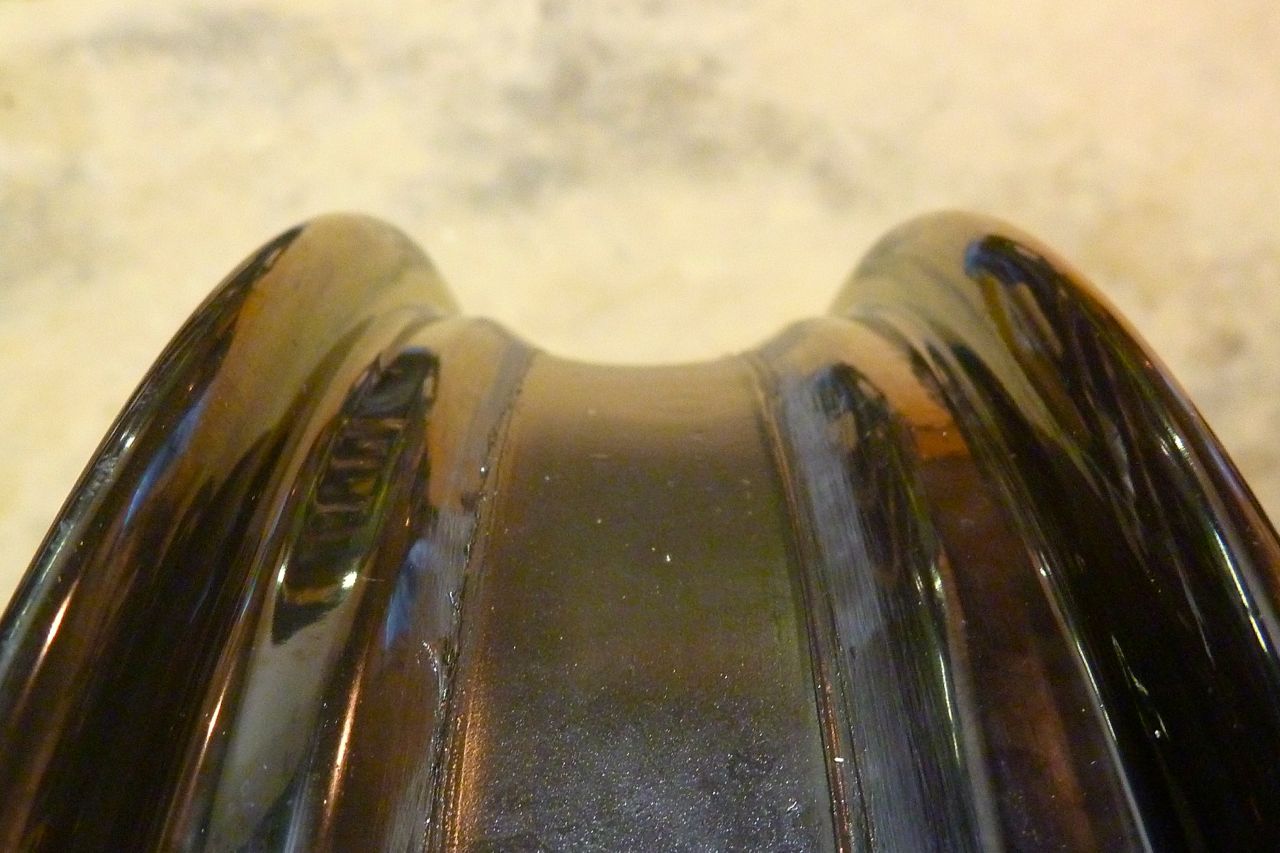
Another problem is this RRP front wheel doesn’t have a rim with the vital bead retaining lip for tubeless use. A label from BARTubeless warned to keep the pressure at least at 1.6 bar or 23 psi to reduce the risk of it dislodging into the well and losing pressure. As it is, 1.6 bar is the lowest I’d run tyres on a CB-X at anyway, so it should be OK. I know when I DIY sealed my Tenere’s 21-inch front wheel (also no lip, unlike the rear) I had leaking problems, but that could be down to the 21’s narrower section (don’t ask me how or why). Anyway, I’ve Slime’d both wheels, will keep checks on the pressure and am taking a light inner tube just in case (although that embossing – above – would need nuking to stop rubbing a tube up the wrong way). Hopefully, this experimentation won’t impinge on my Morocco ride, as it did with the Tenere.

cbxrrpsprings
rrp-dampers

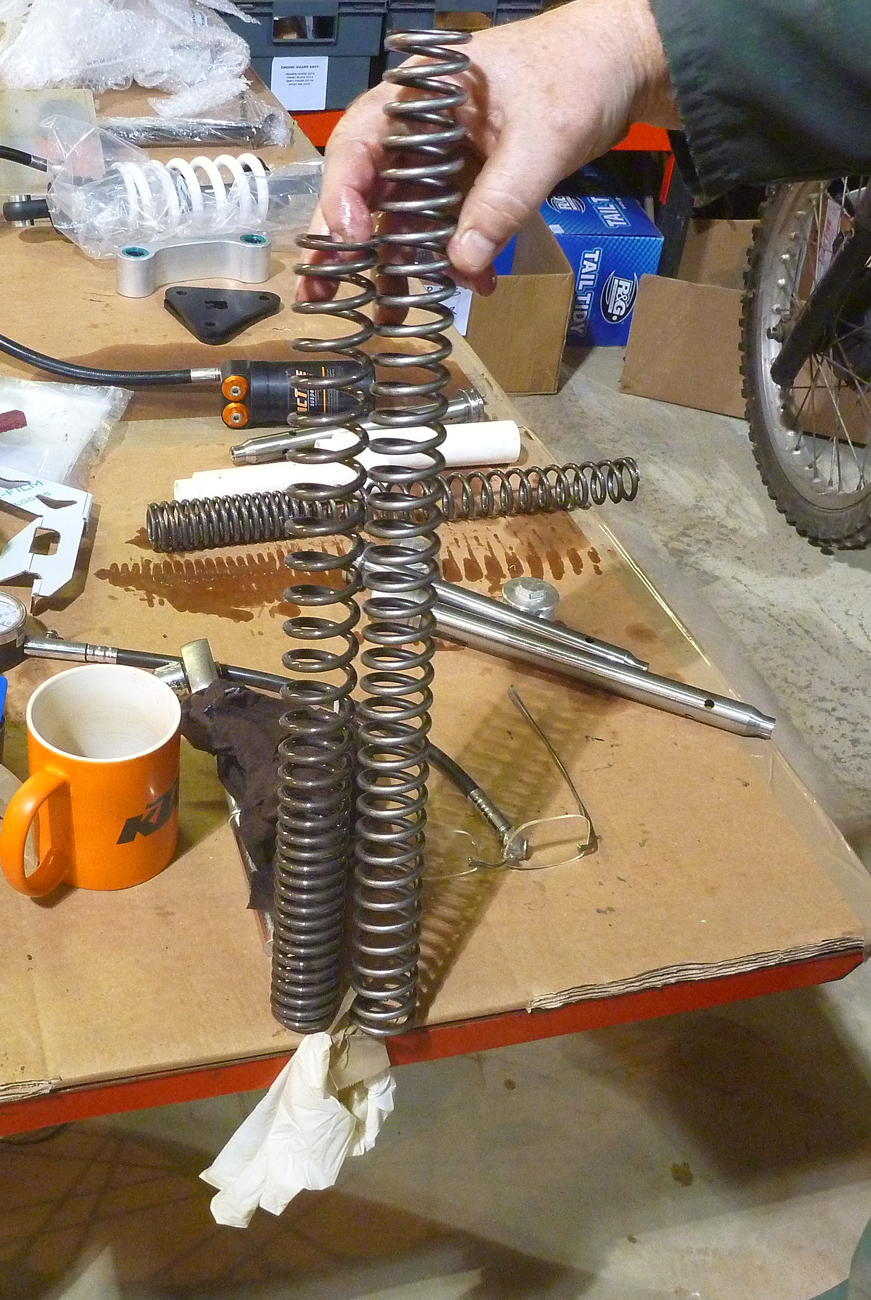
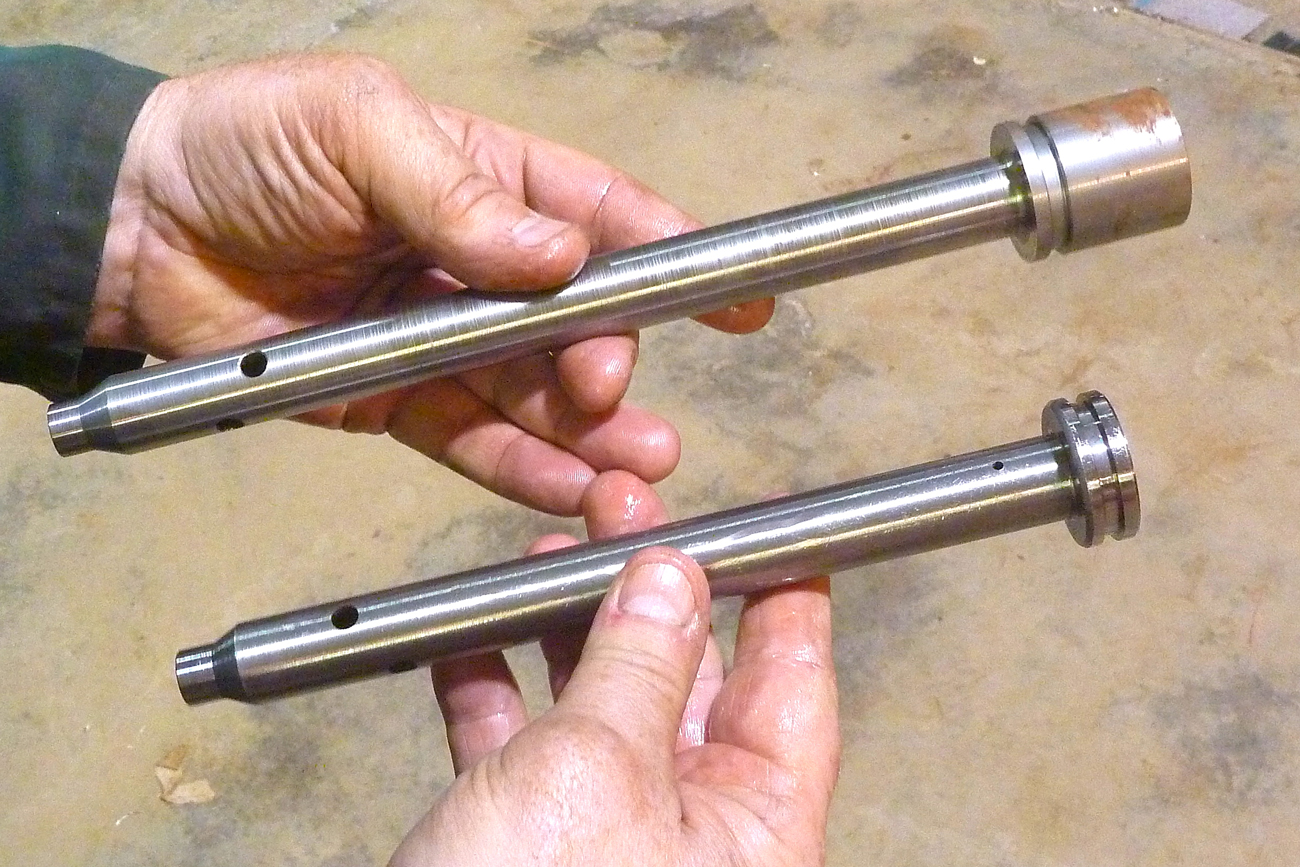
The forks came out, got cleaned up and the internals were all replaced. John showed me the Honda ‘progressive’ spring which is really a ‘twin rate’ coil off something shorter with a tacky white plastic spacer to elongate it for the CB-X (visible back left). John replaces it with a full length linear spring from Tractive (left) and tackles the progressive response with a 30mm-longer damper rod (right) using some clever deforming shims as well as some much lighter fork oil that’s less prone to losing viscosity when hot. On top, the forks get pre-load adjusters (as will 2016 CB500Xs)  and air bleeders.

cbxL301

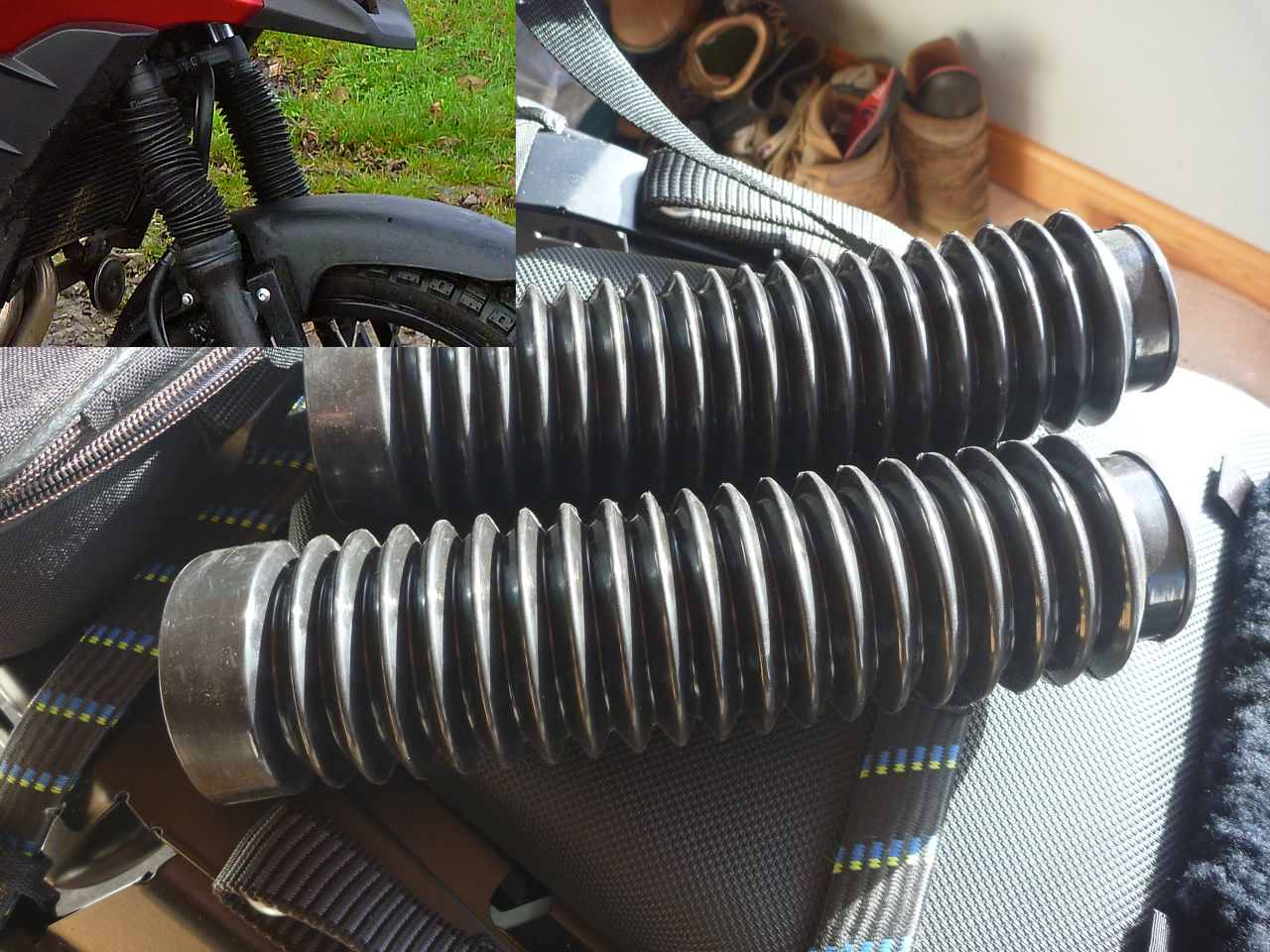
While the forks were off he slipped on some gaiters I tracked down on ebay and which John told me where the best fit he’d found so far. Gaiters are an old-school thing so it’s hard to find sets that are short enough for a modern 41mm fork which in the gaiters’ heyday would have correlated with a ten-inch travel MX fork. As you can see left, these 41 x 60 x 250 fit well on the 2-inch longer travel forks.

cbxL318

Like a pampered factory rider letting his pit crew take care of things, I wasn’t paying attention when the Tractive shock and revised linkage plates got fitted, but that looks like a tricky job needing a spare pair of hands. A small dent needs bashing into the silencer and the remote reservoir fitted by the engine on the other side.
There’s full 3-way adjustment on the Tractive, but apparently, the shock preload is a bit of a faff with the Tractive took supplied. What I’d like is a hydraulic preload knob option. I found that so handy on last year’s Xcountry as loads changed, but I never touched my Hyperpro’s other settings once set up for me. TBH I’d struggle to know exactly what needed doing. Again, it’s a rally vs travel thing. I spec’d a 120Nm spring as I’m fond of food.

All this extra suspension needs a two-inch longer sidestand which Rally Raid fitted. It’s a shame it doesn’t include an extended foot for soft terrain support, but something can be bodged on down the road. They did mention that with the longer stand the greater weight can cause the stand to swing down on heavy drops which can engage the engine cut out. Another reason to get ride of those annoying switches. Or maybe more spring tension.

cbxL321
cbxL307

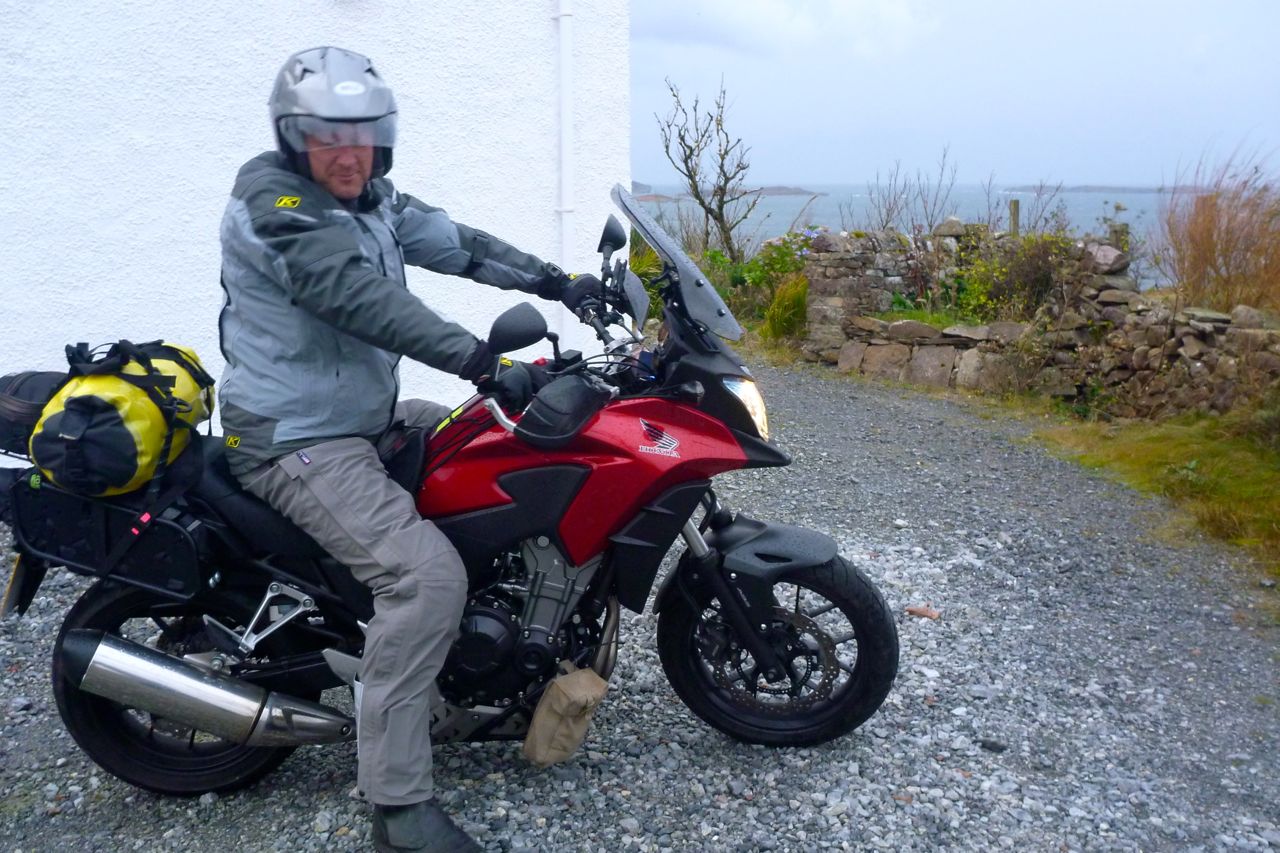
We went out for a quick spin around the back lanes, but new tyres, wet leaves and the completely new feel to the front end made for an edgy ‘on marbles’ ride. The bike’s added tallness suits my 6′ 1″ much better (you can see how low the bike sat on the right, with a bit of baggage on the back). Now I can still almost get both feet flat on the ground, though the shock is bound to loosen and sag a bit in the upcoming miles.

cbx-footrests
rrp-footresters

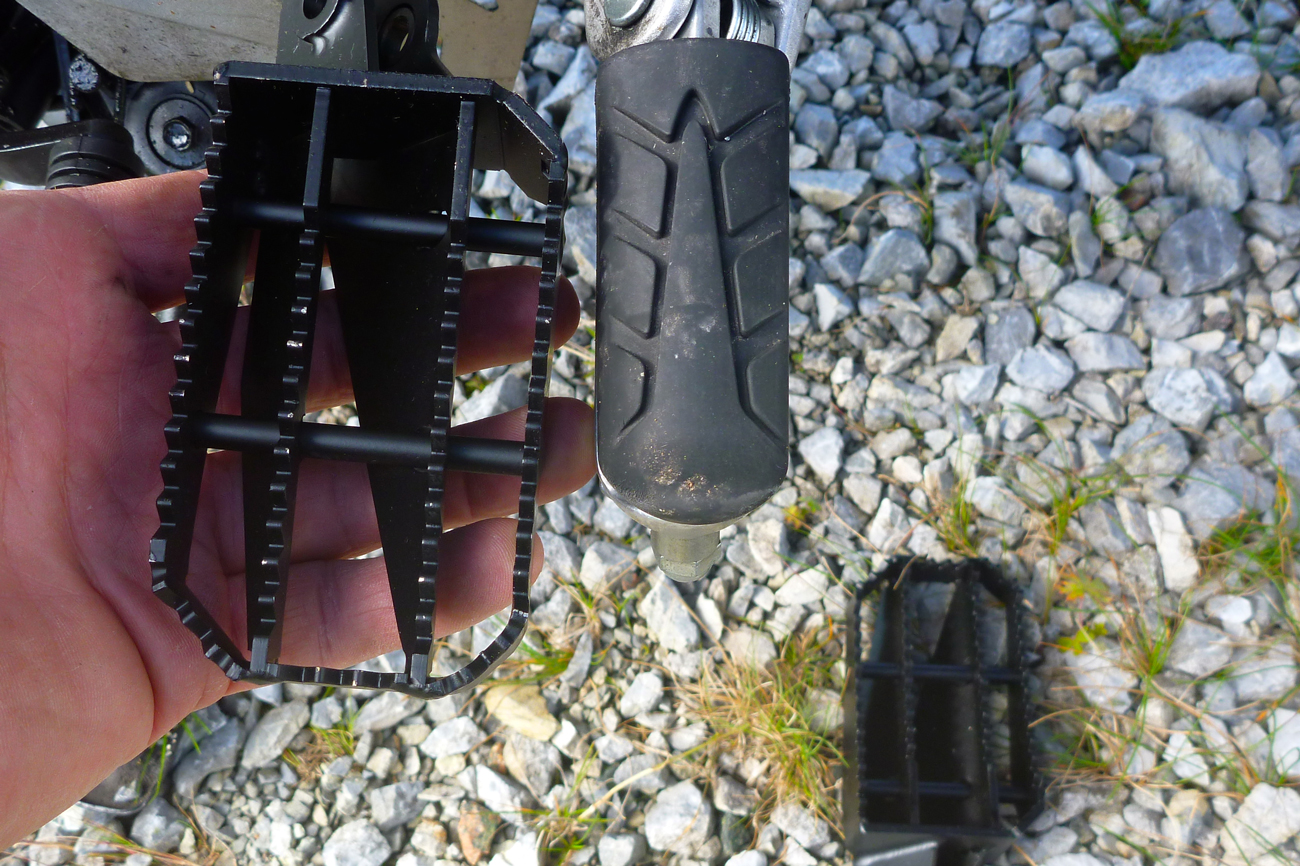
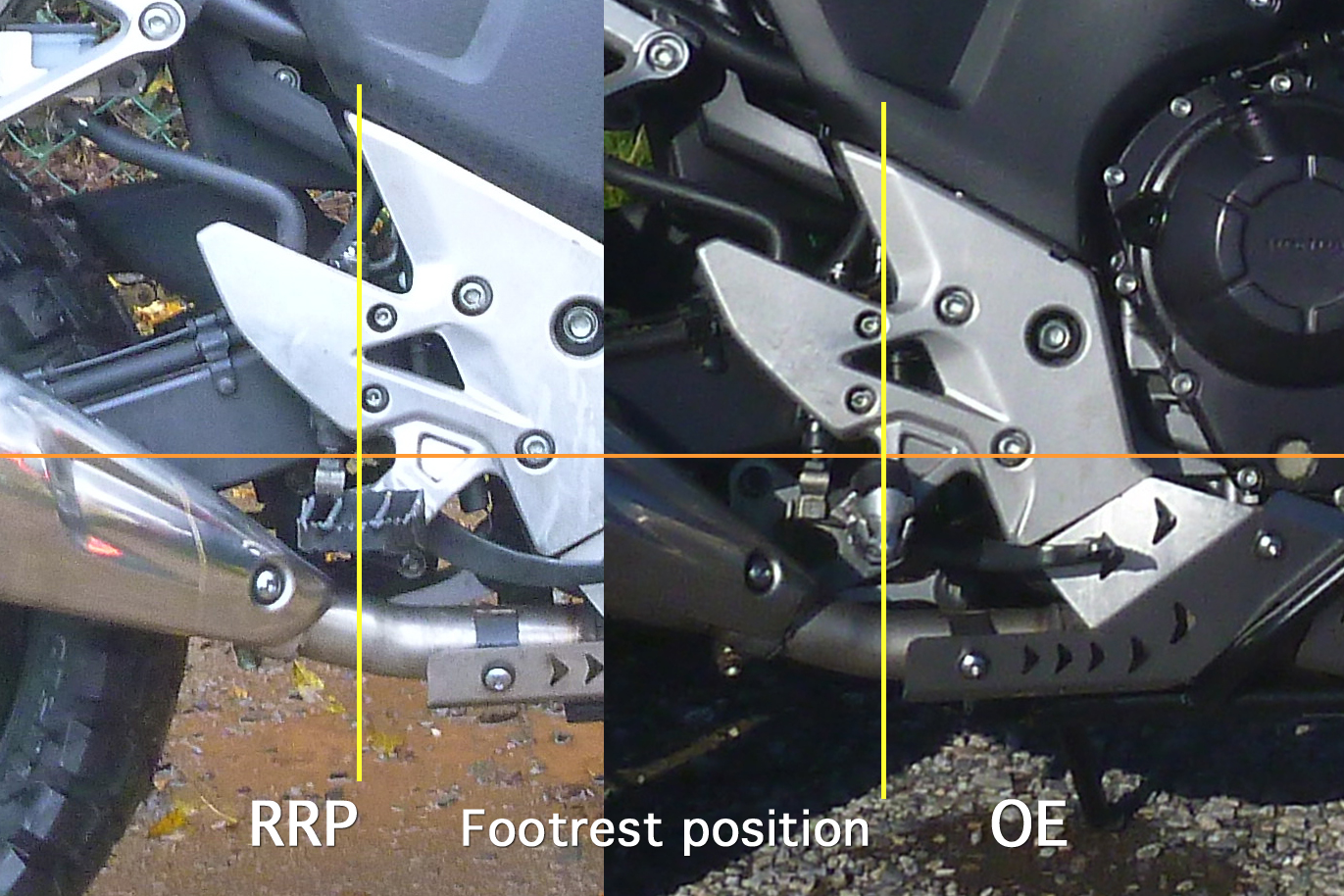
One good thing is the RRP platform footrests (left) feel up to an inch lower than the rubber-capped OEs which makes less of a leg bend and also standing up less effort. Turns out they’re a bit further back too (see image, right).
We rode up a local potholed ‘dogging’ lane (complete with a scrunched-up copy of Razzle – that takes me back…) and standing on the X felt spot-on for my height – very comfy indeed – thanks to retaining the higher OE bars and helped by those big pegs. No more stooping, as on last year’s X bike.

hyper

A bigger diametre front wheel has a greater gyroscopic effect which makes changes in direction (aka: steering) slower. That’s why road bikes run 17s, even if they look all wrong when fitted to an ‘adventure’ bike like the Ducati, right. Initially, it feels like the rake’s gone all Easy Rider or the head bearings are too tight, though actually the new K60 19-er noticeably lightens the steering – good for pivoting through traffic. That greater force also improves tracking (straight-line stability), not that the OE X was deficient in that respect.

cbx-sp

Setting off back to London in the dark and the rain I took it easy, and once I dead reckoned my way out of Bedford and onto the M1 (compass on my jacket sleeve proving useful), I sat it out on the motorway and by the time it came to tackling Hyde Park Corner at Friday rush hour I was fully accustomed to the Honda’s new feel. Taller may mean higher CoG, fewer dabbing chances and the need to step on a footrest to get on, but it’s all given the CB-X that trail bike stance which I know and love. Only thing is this time it won’t be accompanied by the thump of a big single, but a smooth and as economical 500 twin.

logo-rallyraid

Thanks to John and Adam for doing in half a day what would take me half a week. There’s more on their CB500X conversions here – and more from me and the bike later.

Some of the RRP parts I bought, some were exchanged for advertising in the 2016 edition of AMH.

CB500X Tutoro Oiler Take 2 – and grab handles

CB500x Index page
cb5-10
previo

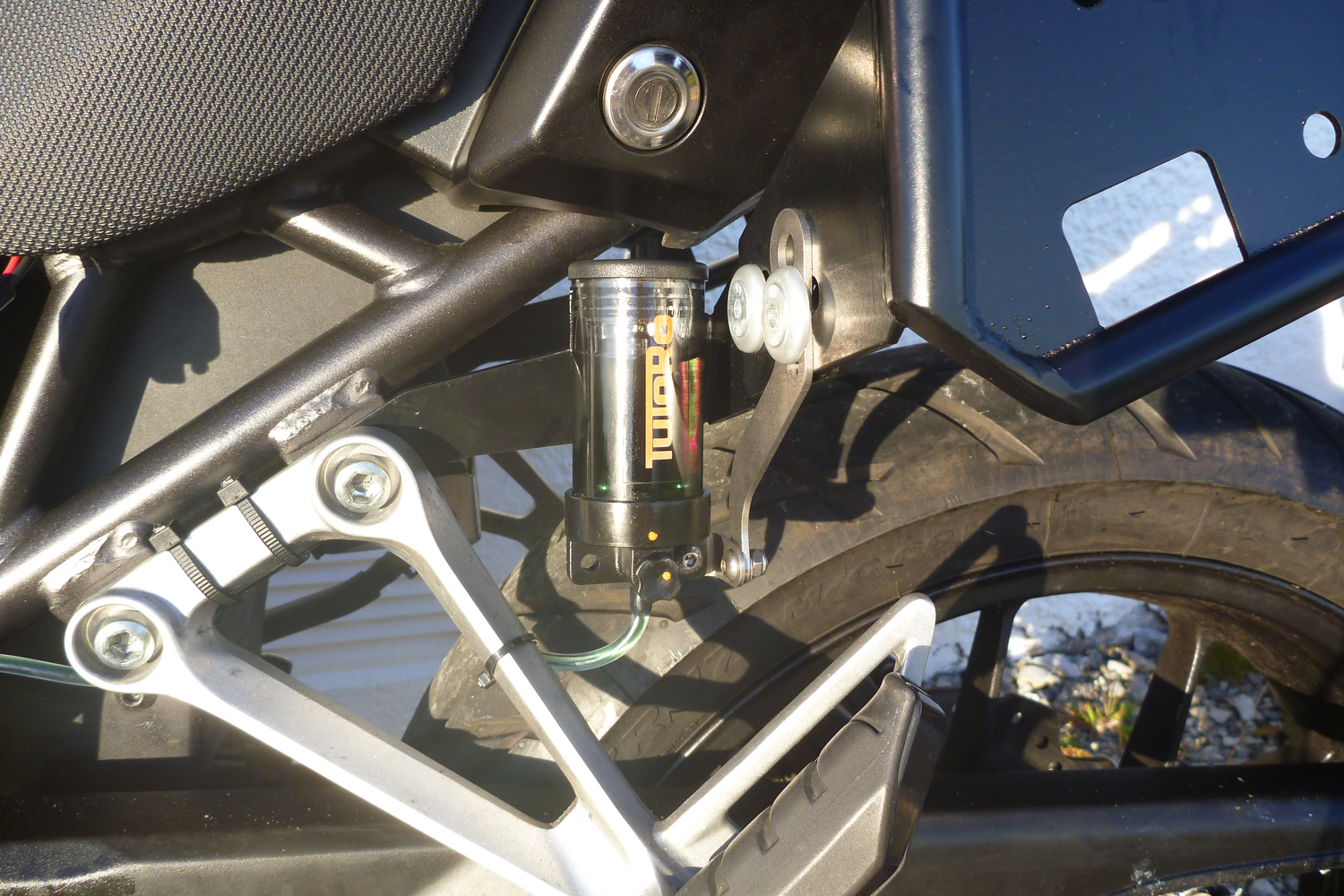
Previously… on the AM Website… I fitted a rack and chain oiler to the CB-X. But my chain oiler by the rad (right) wasn’t such a good idea according to Tutoro – too hot for the oil and too hot for the reservoir.
At one point I thought somewhere inside the fairing or on the fork would work. I noted some dirtsome travelling KTMs put their oilers up front for the same reason: out of the way of flying rocks. But on the more cluttered CB-X the fairing makes access and topping up too awkward. Can’t be having that.

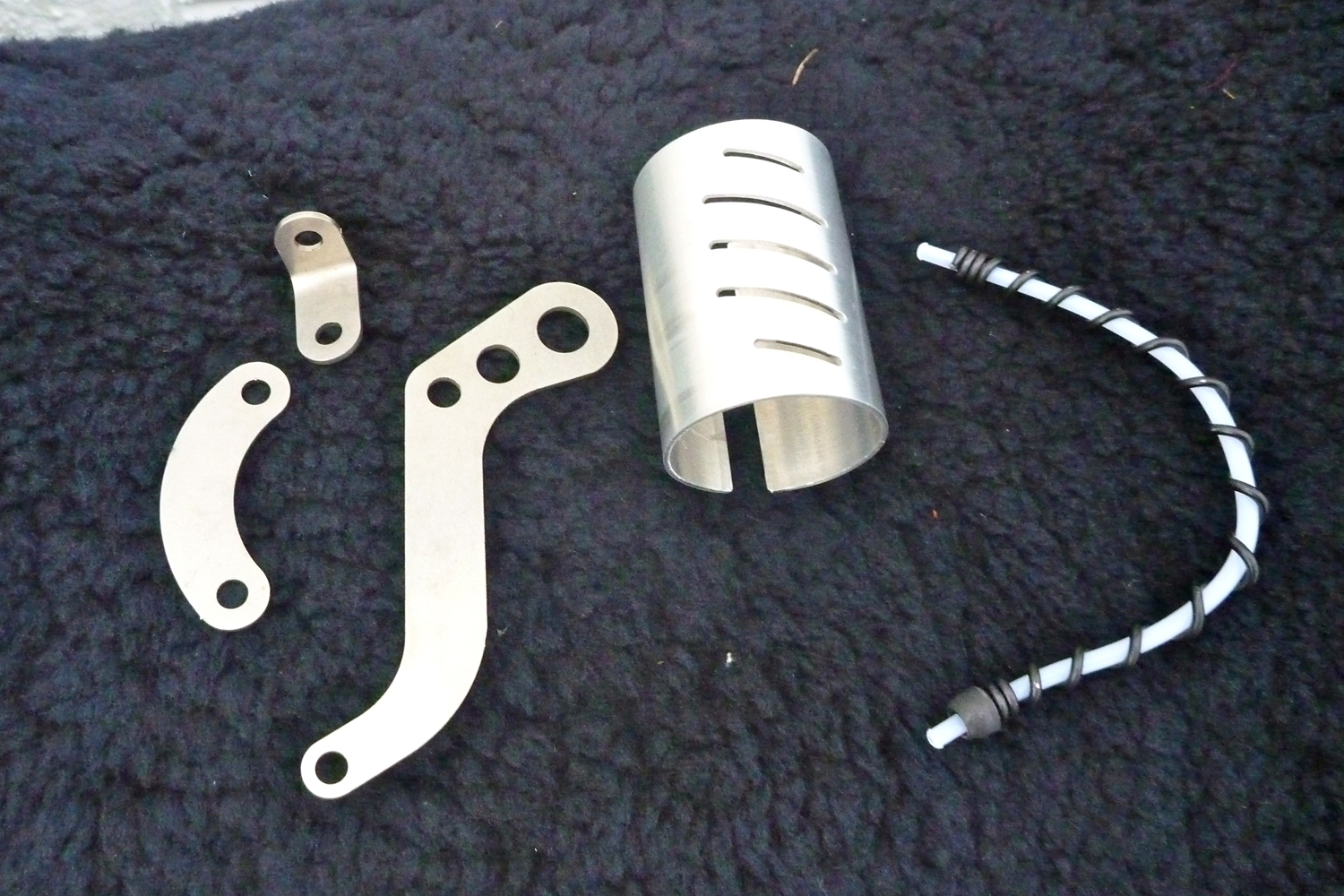
I had another look and decided inside the fold of the Rally Raid pannier rack was as good as it would get on the back. Easy access for flow adjustment and topping up, and anyway it will be the feed nozzle that will get knocked about before the reservoir. The kit with the Tuturo Auto Pro comes with a range of brackets (right) to help you fit it in the best space available.

cb5-1

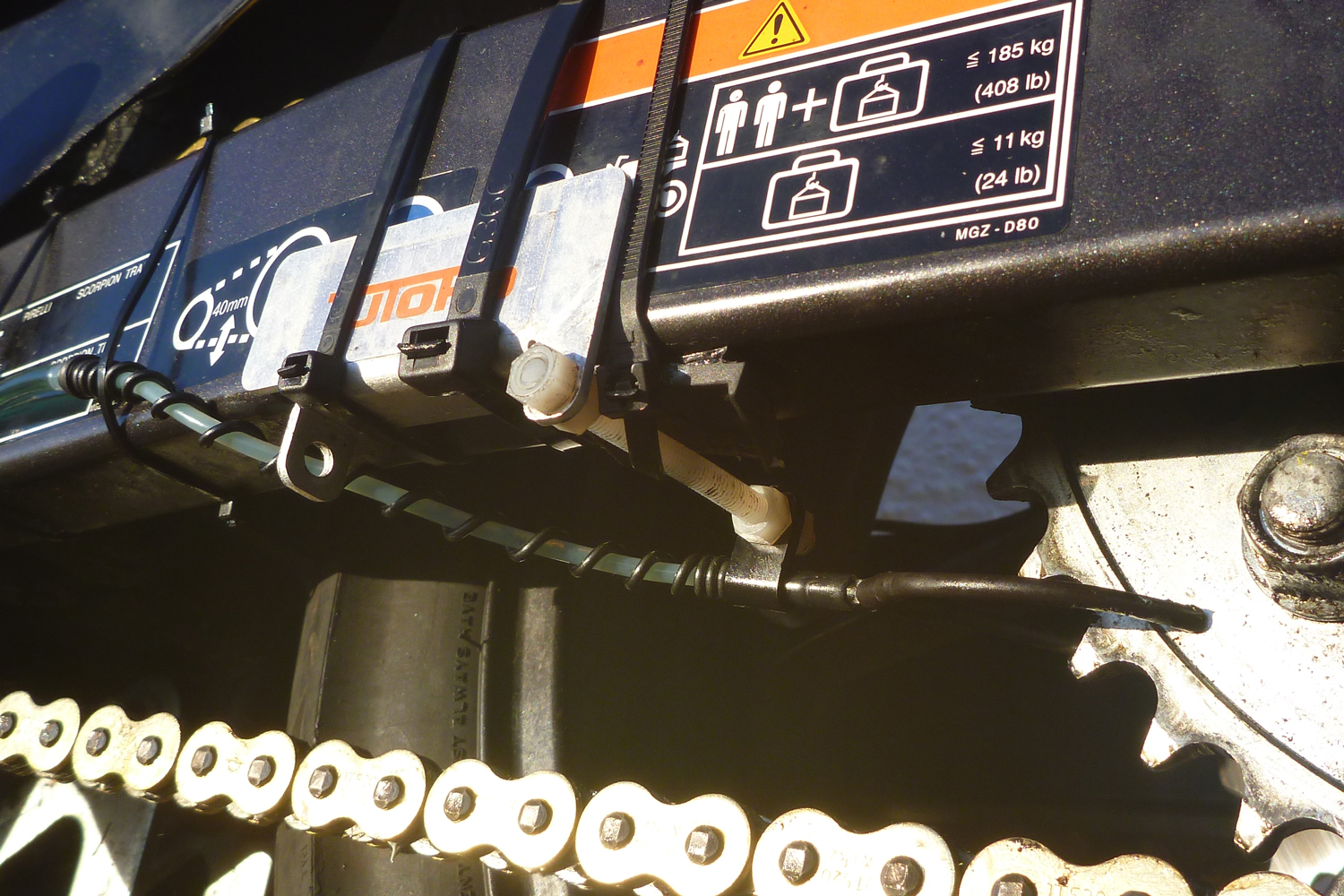
While in the area I also took a chance to beef up the support for the twin-feed nozzle by adding a spring-coiled section of hose and supporting the sacrificial white nylon bolt with a bit of hard-to-see rubber between it and the swingarm, then zip-tied together (left). Like I say, one flying stone and it’s all gone – better ideas may evolve.

I fitted a JT x-ring chain. At only 2600 miles I wasn’t convinced the OE chain – branded a ‘DID’ no less – would last the distance (see the previous post).

It gave me a chance to use a Motion Pro chain breaker (left) to separate the linkless OE chain – a solid, compact and easy to use bit of kit. I can’t recall the last time I actually did this – usually I just sell the bike. I also had a Motion Pro chain press (right) but decided to go with the spring link despite dire warnings from JT. If it was that deadly they wouldn’t include it in the kit. Adventure Spec sells the Motion Pro chain tools.
cb5-14

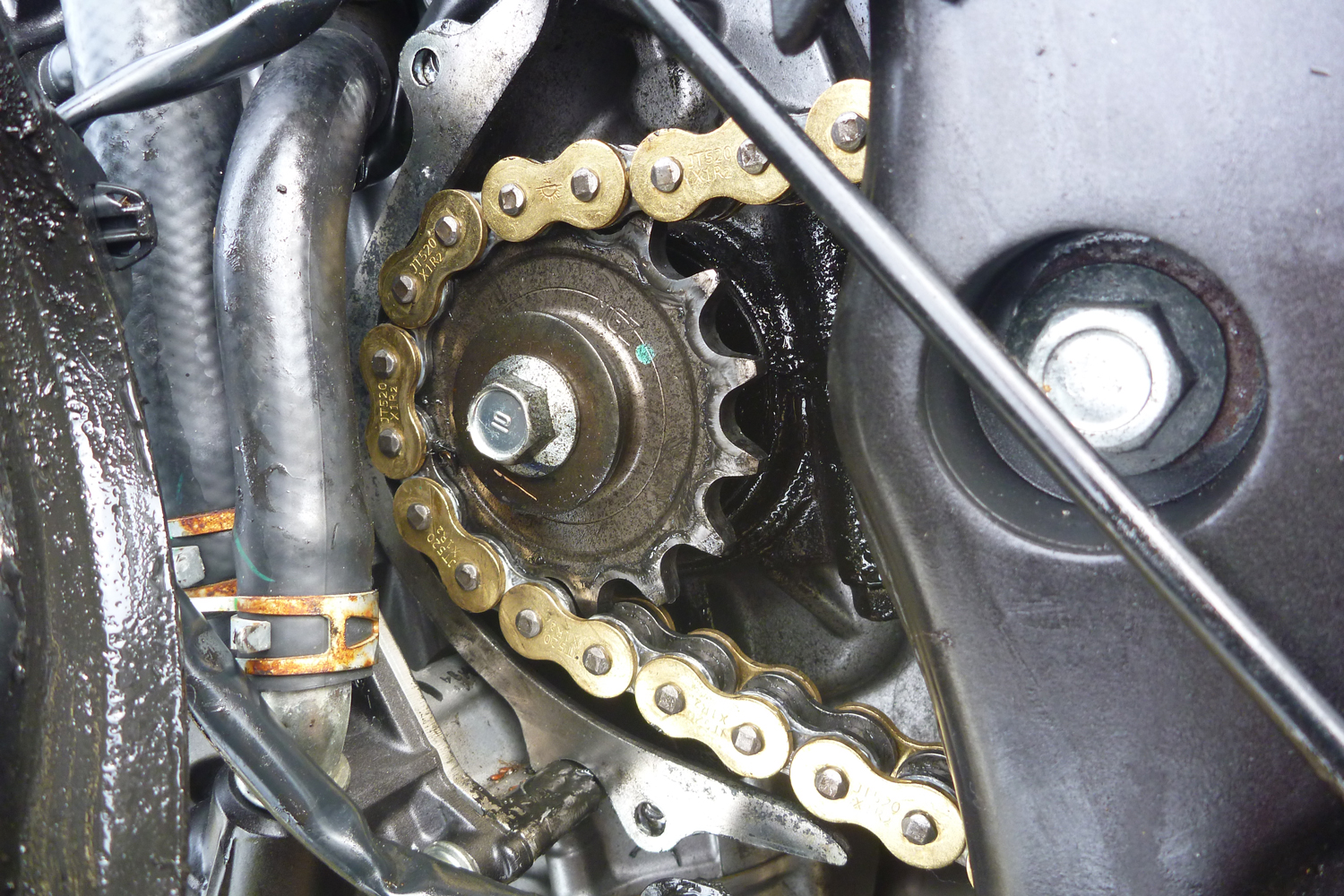
Speaking of broken chains, it was good to see that there was a semblance of a case saver tucked in around the front sprocket (right), though if that hefty JT gold-plate lets go I don’t think there’ll be much to hold it back.
cb5-8

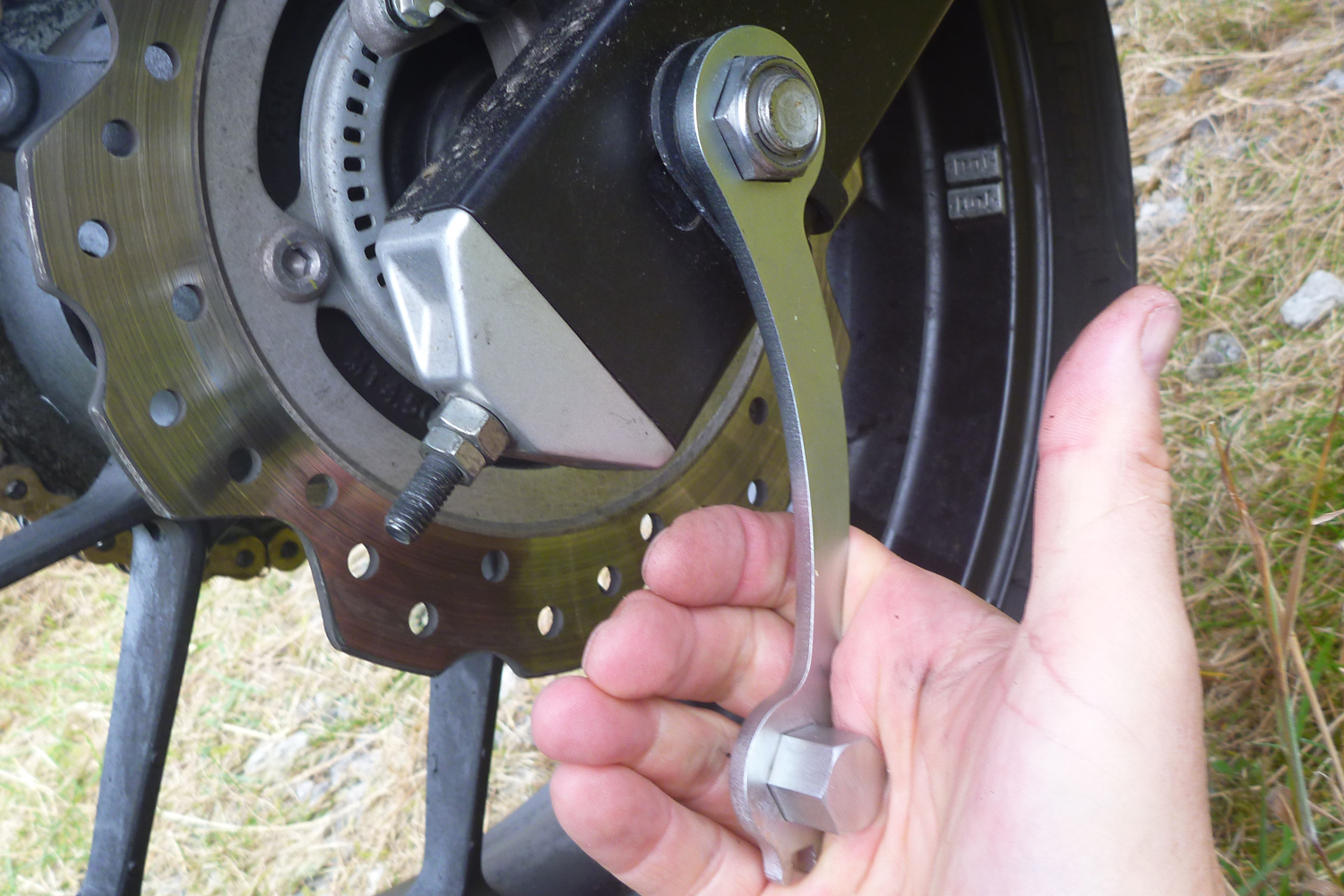
Also, re-adjusting the new chain gave me a chance to use the nifty RRP axle wrench (left) which, it must be said, fits in the hand very nicely and spins round 360° behind the pipe without snagging. Well worth a tenner.
Why oh why can’t we have snail cam chain adjusters back? I’d happily pay the extra £3.76 on the price of a bike. There are no usefully visible alignment marks worth noting on the Honda.

With the new x-ring and chain oiler I’m hopeful I’ll get a good 15,000 miles worth of chain life, even with some desert biking thrown in.


cb5-2

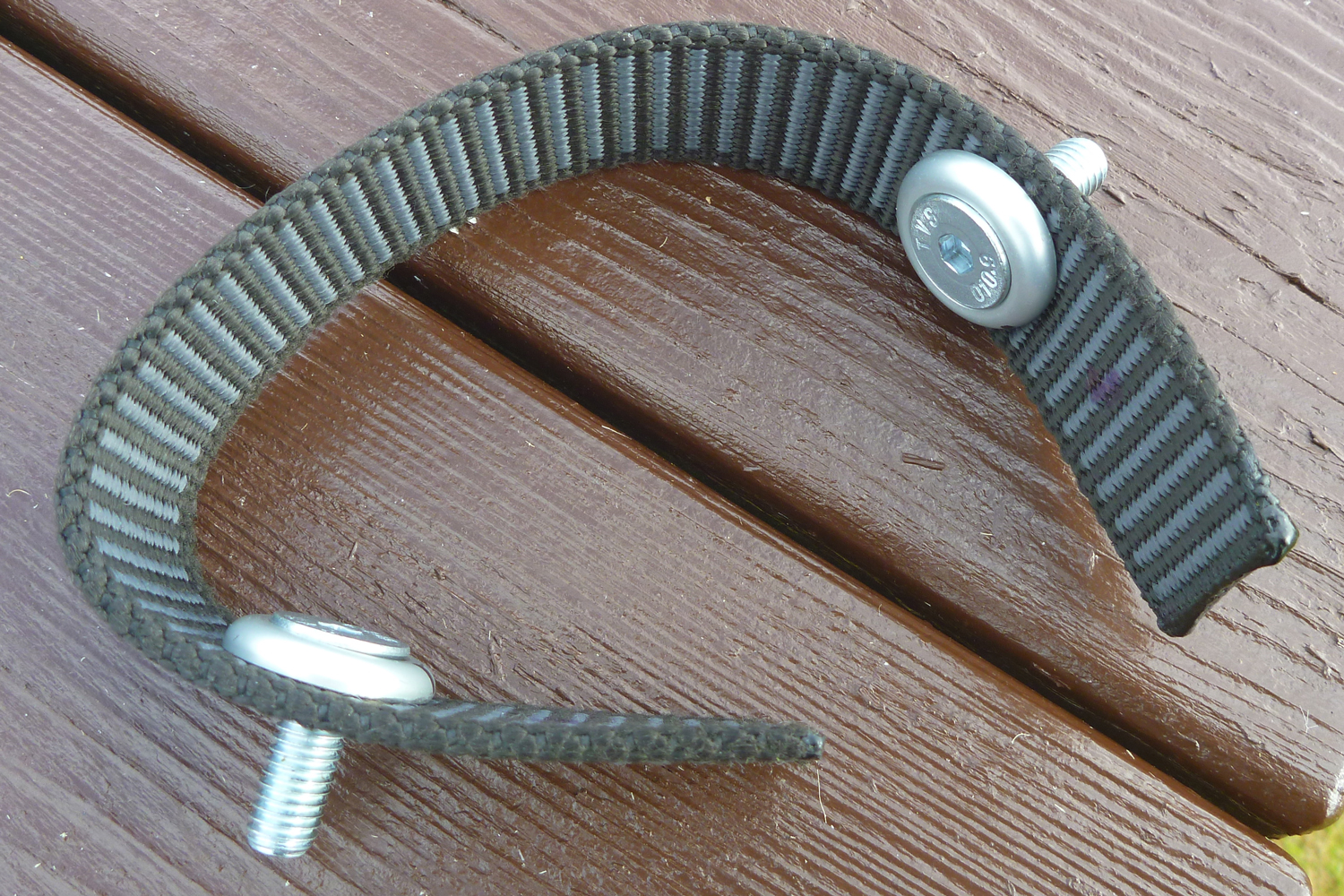
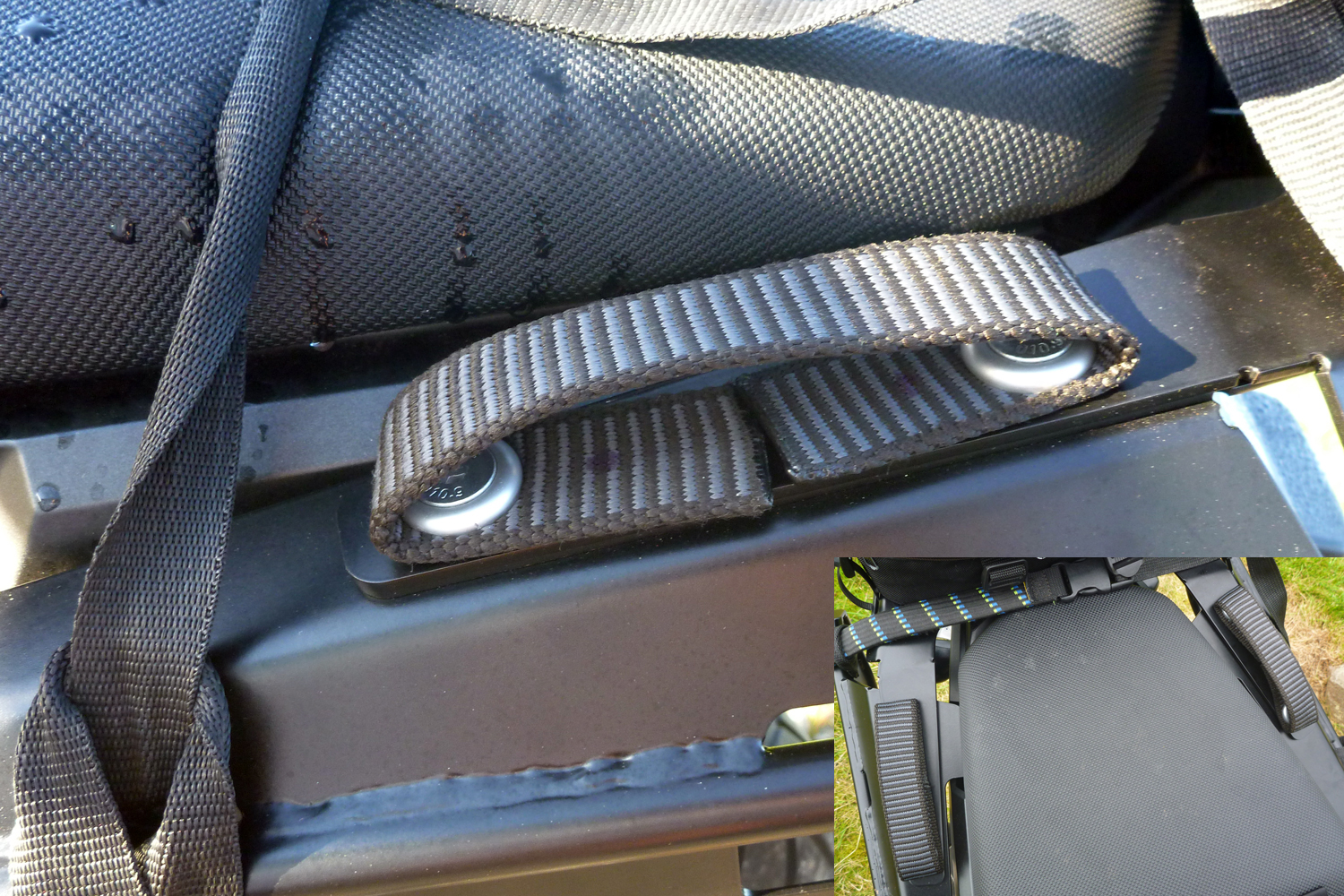
This lack of grab rails with the new RRP pannier rack was driving me nuts. With plate rather than tube there’s nothing solid to grab on to when you want to move or pick up the bike. As it looks like getting a sheep rack made for the back isn’t going to happen, I decided on a quick, easy, free and light solution: a thick bit of belt (right).
cbx5-16

cbx5-17

Even before the new chain was dry they came in handy hauling the bike back up to vertical. And if they break I can make another from a passing postman’s satchel or whatever’s lying around. As for the sheep rack; if it’s that important to get a bit of useful width on the back I can screw a bread board to the RRP tail rack. More next time on the AM Website.

cbx5-17