Category Archives: Project Bikes

What I’ve ridden and what I’m riding

XSR 700 Scrambler: the plan

Scramlogo
XSR 700 Scrambler index page
jigsawtracker

Yamaha’s XSR 700 is my sort of bike: the great motor from the MT07 in a more comfortable and better-looking package, and with the potential to become something more dirtsome, like the Jigsaw Customs flat tracker (right, and in the vid below). Plus I got it cheap so I can afford to experiment :-D
t77

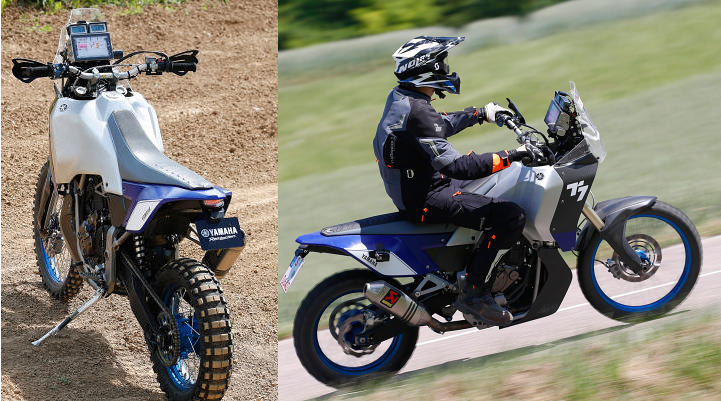
I’m taking ideas from Rally Raid’s innovative CB500X RR I rode in 2015, but am hoping to end up with something more like Ducati’s inspired Desert Sled (below). Like many riders my age, that’s a bike that, if I’m honest, appeals to me more than the forthcoming, over-tall, razor-saddled T7 (right) which I’m sure will also be a hit.

dezled


Obviously, your superbly detailed, BikeEXIF-type ‘urban scrambler’ (see video below) is not what I’m about. I want an actual scrambler, not just ‘the look’ while dodging the elephant in the bike shed: the huge costs for the huge amount of work required. Note that many, if not all of the bikes and OE parts in the promotional video below were supplied by Yamaha to promote their ‘Yard Built‘ program at the 2017 Wheels & Waves show.

What’s the plan?
Function first – form will be as it comes. The harmless scratches and dents remaining on my repaired bike can stay for the moment. I need my XSR to get me down to Morocco this autumn, run a few thousand clicks leading my tours, then fetch me back as winter sets in over the sierras. The mods that it adds up to are:
• tyres – easy
• protection – advisable
• lift – optional
• luggage – useful
• engine – unnecessary

The XSR doesn’t lend itself to these adaptions half as well as Honda’s CB500X. So the plan is to spend carefully, then if the machine shows promise and I’m still interested, finish the job with a fork transplant and a new wheels.

xsr-derest

My bike is restricted from ~74hp to ~46hp (numbers vary) for A2 license holders. I have a full license so can run it unrestricted but to be honest it runs great at 46hp and a year later I feel the same: loads of satisfying grunt where you want it. It just goes to prove the old adage: ‘50hp is all you need‘.
The way the restriction works on early model XSR/MT07s like mine is mechanical: a simple plate (left) stops the throttle opening fully. I read recently in a magazine somewhere that later model XSRs and MT07s had a detuned ECU, not the mechanical restrictor and which, I imagine, is less easy to derestrict. And in poor old Ozzie they get a reduced power 655-cc learner version. Got luck changing that!
As I’ve never come against the restricted throttle’s stop in over a year’s riding my XSR. Derestricting it by unbolting that plate doesn’t seem worth the bother as there’s no power or torque to be gained in the throttle and rpm-range I ride at. I only wish I could have got cheaper insurance by running it like this.
Tyres
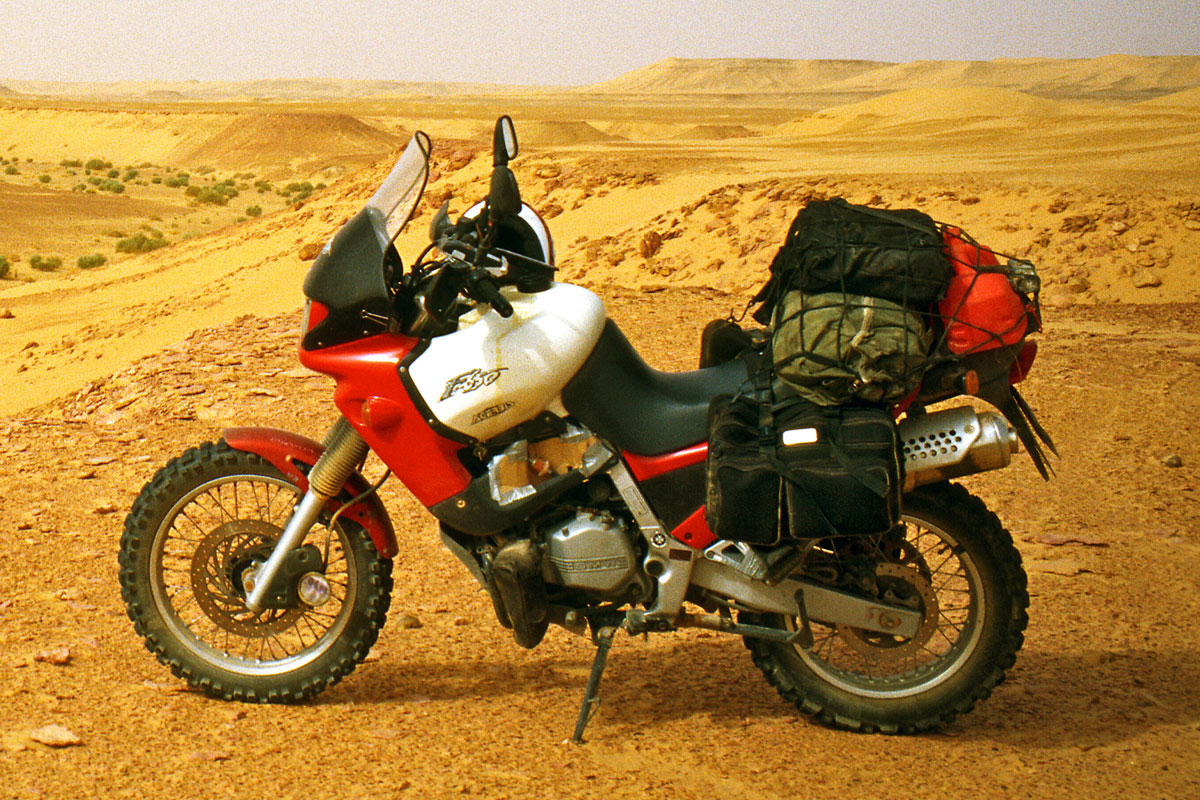
As the vid above reminds us, anyone can slap on some TKCs, but would you want to corner on a fat, 17-inch front Conti? I recall years ago a disgruntled mechanic told me off; he’d just shat himself taking my Pirelli MT21-shod Funduro (left) out for a spin. You need to ride on eggshells until you get a feel for such tyres. Cool-looking thought it may be, I just can’t see a rear TKC or similar put on a 17-inch XSR front wheel working well on loose surfaces. I’m certain the CB500X RR rode better on road and track with the 19-inch front wheel, so that’s the plan with my Yam. A good old Heidi-Hi K60 will do me.

Protection and racks
I bought my XSR in a bit of a state (right), but it only took a day or two to fix up once the parts were in (with ‘Woodcutter‘ Kev’s help).
A lack of frame tubes under the engine complicates sump protection, but SW Motech make an alloy spoiler (left; top left; £120). Otherwise I’ve picked up an OE exhaust system which could be extended forward as a sacrificial bashplate to protect the more important sump and exposed oil filter. Doing this will probably lose any height gains from tyre and suspension. And if the OE system gets ruined I have the scratched but fruity Akrapovic which came with the bike. In the end the spoiler never bottomed out and barely scrapped once over a hump, but it fought off showers of stones.

xsrakanbar

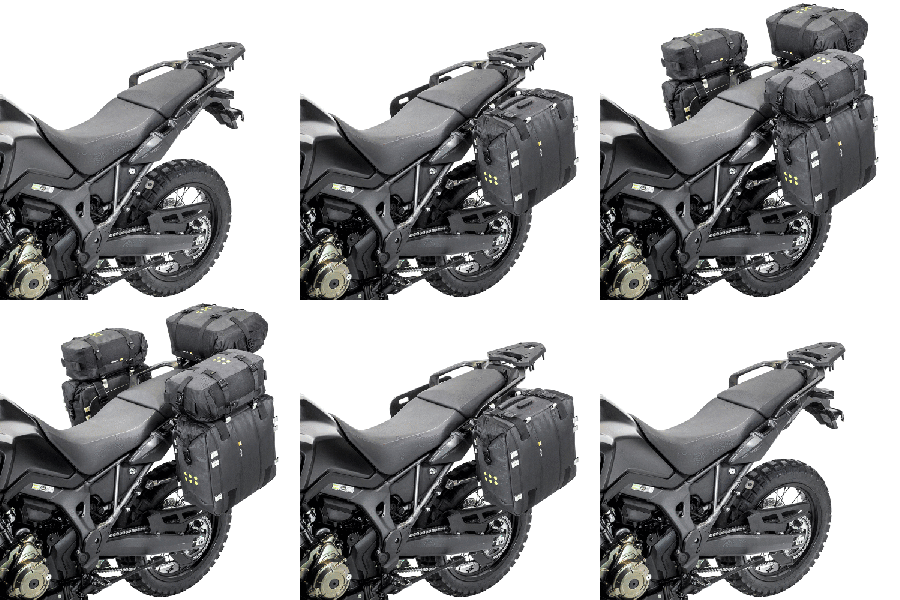
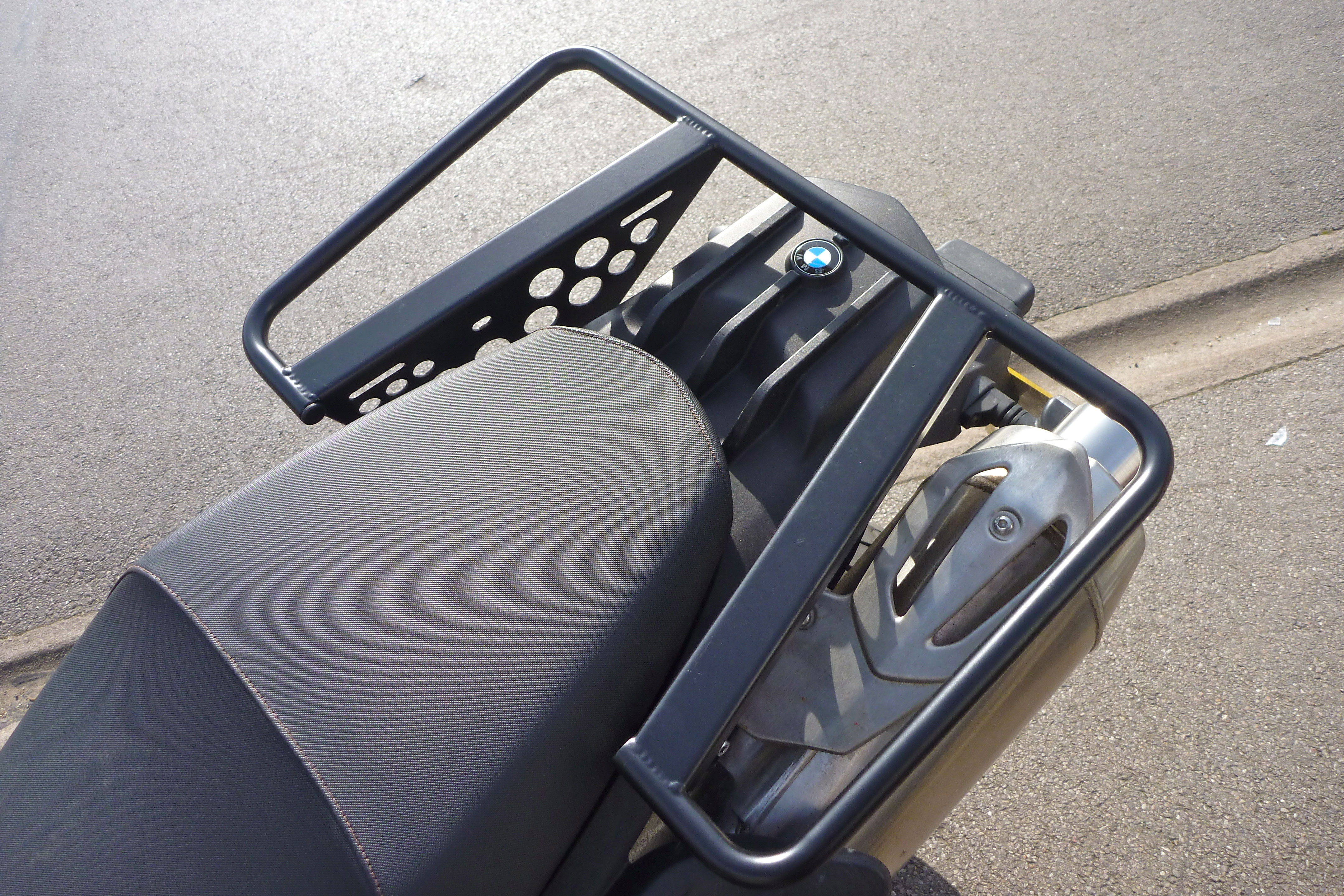
Crash bars from 3Rmoto (above left; top right; £106) look better at protecting the lower engine than offerings from Hepco or SW Motech. Small side pannier racks from Motech (above left; bottom left) could be fitted (or copied without the unnecessary fittings) for some Kriega Duos bags (right) or similar, with a wider tailrack in the style of the HotRod rack I  had on my BMW XCountry (left).

krigduo

Lift
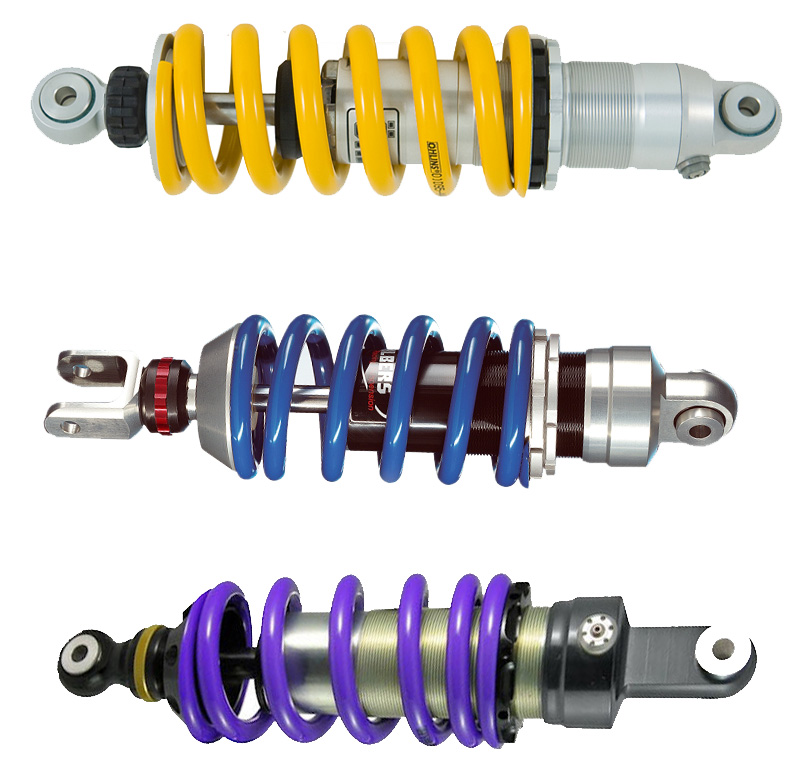
You can gain clearance with taller suspension or, at the back, modifying the rear linkage. Or it can be raised with taller tyres or wheels. This is the route I’ll follow, along with uprated standard suspension from Ohlins, Wilbers or Hyperpro which ought to maintain clearance and of course control the bike better on the rough. (Hyperpro don’t officially make a shock for an XSR; the MT07 one is the same).
forkpreloaders
cartfork

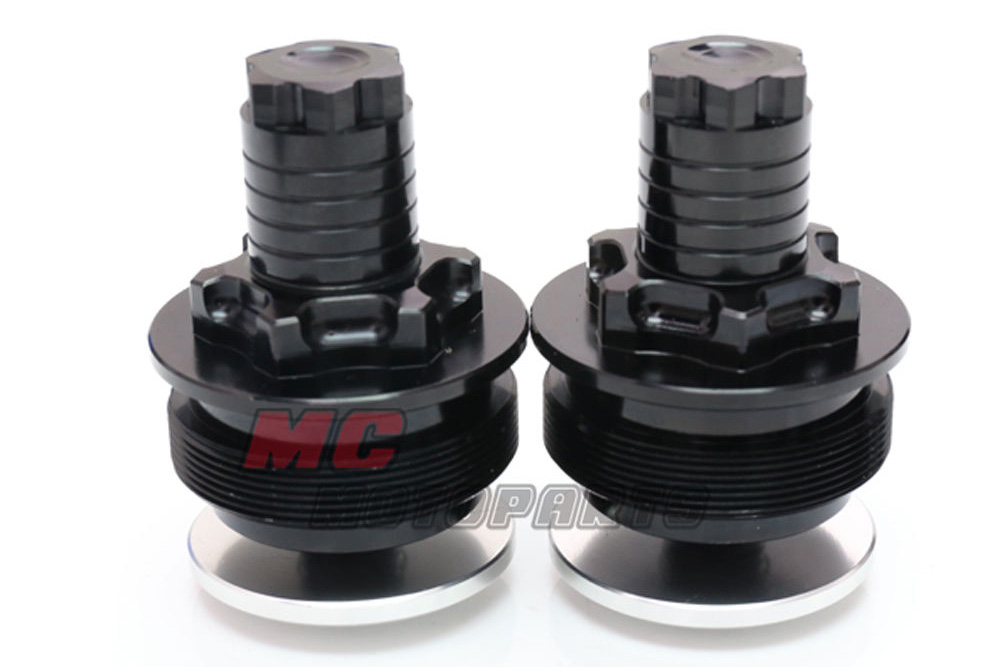
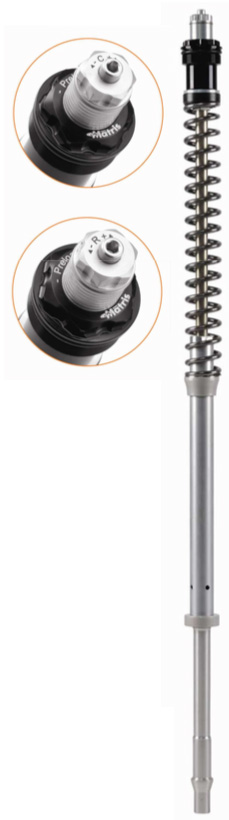
On the front I’m going to try out some inexpensive fork preloaders (left; £28) before probably resorting to an aftermarket spring (Got KTechs in the end, < £100), after which the preloaders will be a good back-up. There are also cartridge fork inserts (right) from the main suspension makers enabling preload and various damping adjustments, but they go for a staggering £500. Like the CB500X, the XSR comes with short springs plus a long plastic spacer. Seeing as aftermarket springs are the same, I assume this isn’t the cost-saving bodge it appears to be. Weight is certainly saved, though you’d think a full-length spring would have a more supple, progressive action,

xsr-shoklug

The XSR/MT07 come  with a preloadable shock with the usual deficiency of  rebound damping that goes back to as long as I’ve ridden Jap bikes. You can now buy used MT shocks on ebay for a fiver. Meantime, I’ve learned the value of a shock with adjustable rebound damping (around £500). I can hardly tell on good roads at normal speeds, but sure can on rough backroads and tracks.
80-xtjumper

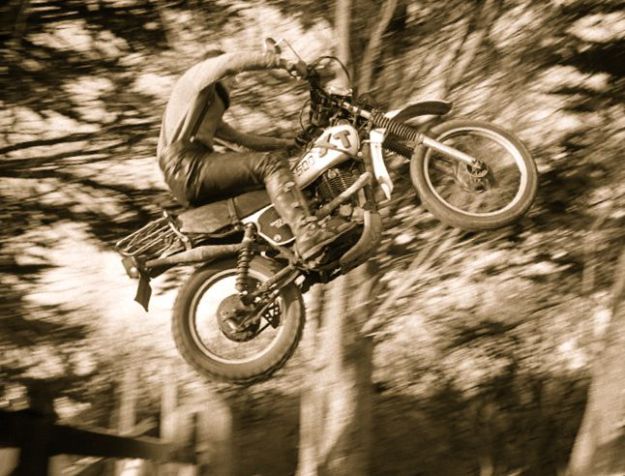
One important point that Jenny Morgan (Rally Raid 500X developer) notes with the XSR/MT07 is that the top of the near-horizontal shock (above left) mounts to a bracket bolted to the crankcase, not a frame member. A very hard bottoming-out could possibly damage the crankcase; a very complicated and costly repair. All the more reason then to fit a good shock, keep preload and tyre pressures on the high side (as I tend to do anyway), and where possible, resist jumps as pictured.
wr-hpa

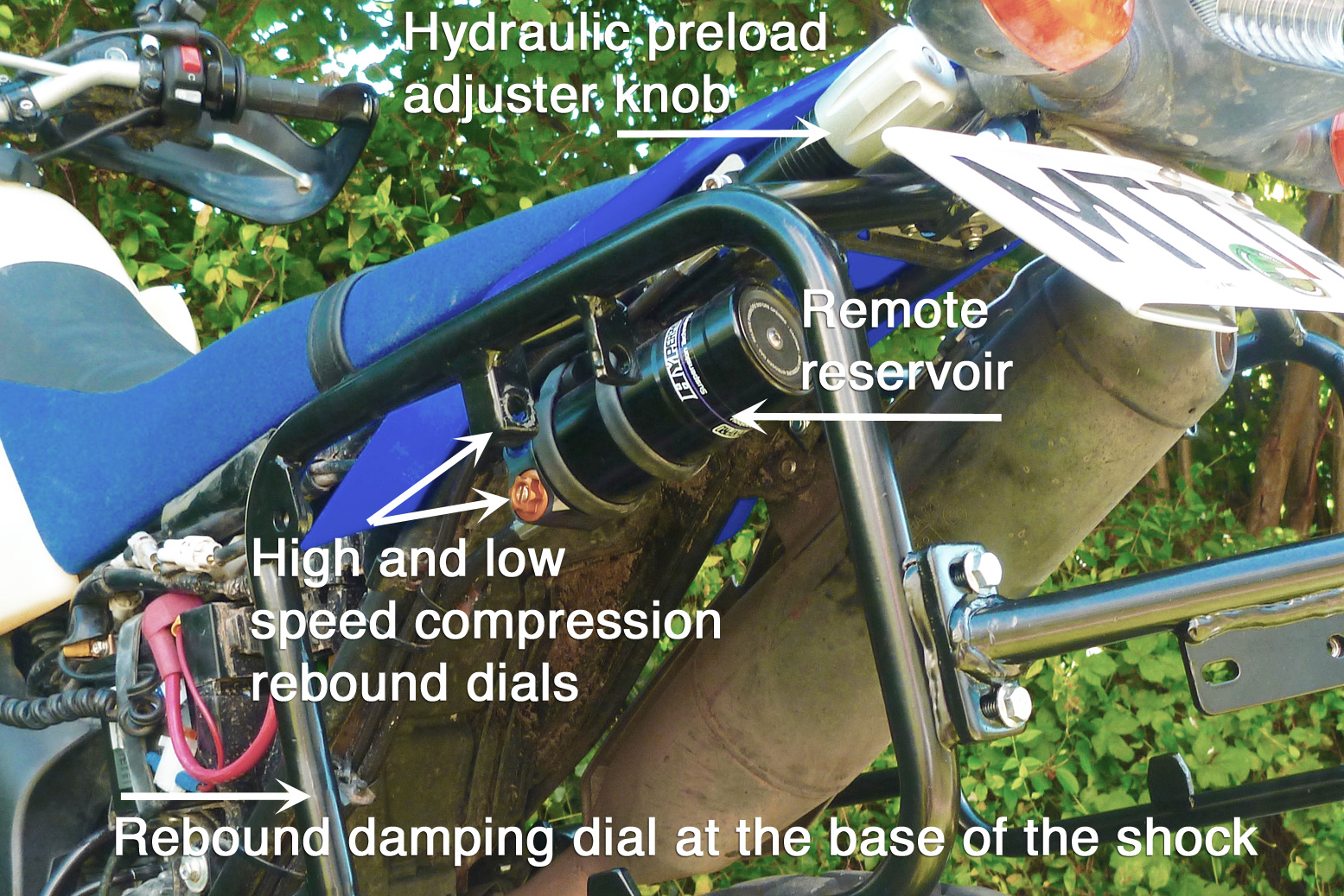
The Hyperpro on the WR (right) had rebound damping as well as low- and high-speed compression damping, though adjusting all these permutations, I got in a twist on the last big piste in Morocco while heavily loaded. I think what was actually needed was the maxed-out HPA (hydraulic preload adjuster) collar screwing down the shock body a bit to reset the preload at a higher rate. Turn-knob HPAs are great; give me one of those (or a mechanical version) any day before three types of damping and different coloured springs. An HPA replaces C-spanners and skinned knuckles; when I jacked up my XSR I made sure I wore gloves.
linkers
Arm-relay

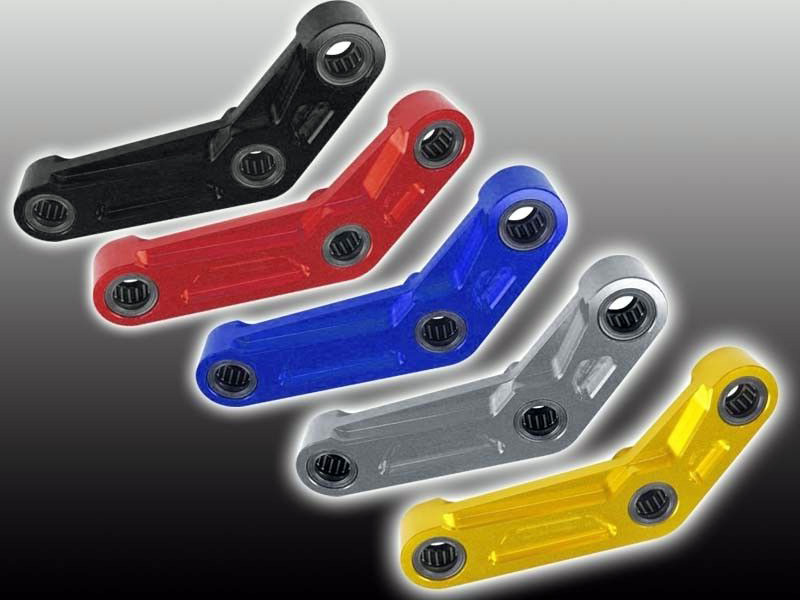
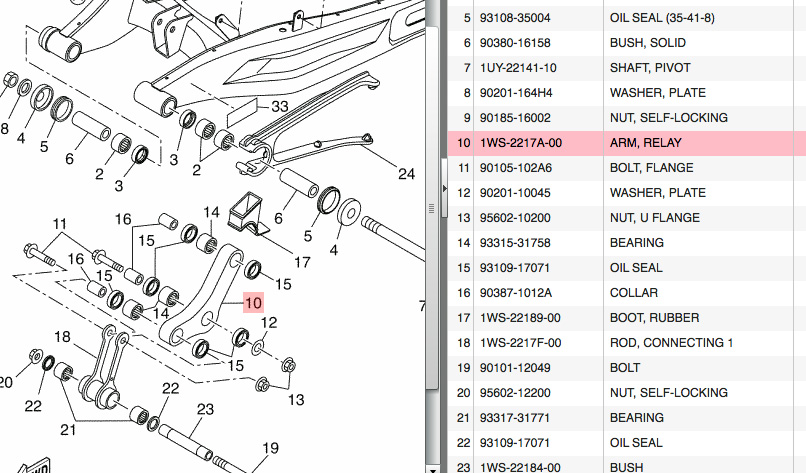
Among others, at the ordering stage only Wilbers offer varying shock lengths to modify standard ride height (most want a lower bike). With other shocks once you’ve spent your £500 you’re stuck with the length. You can get ride-lowering ‘dogbone’ linkages on ebay or, for the 700s, the ‘relay link’ (right) in an array of anodised colours (left). Fitting looks quite a faff and again, like a longer shock, you’re stuck with what you’ve got.
KLX1 - 10

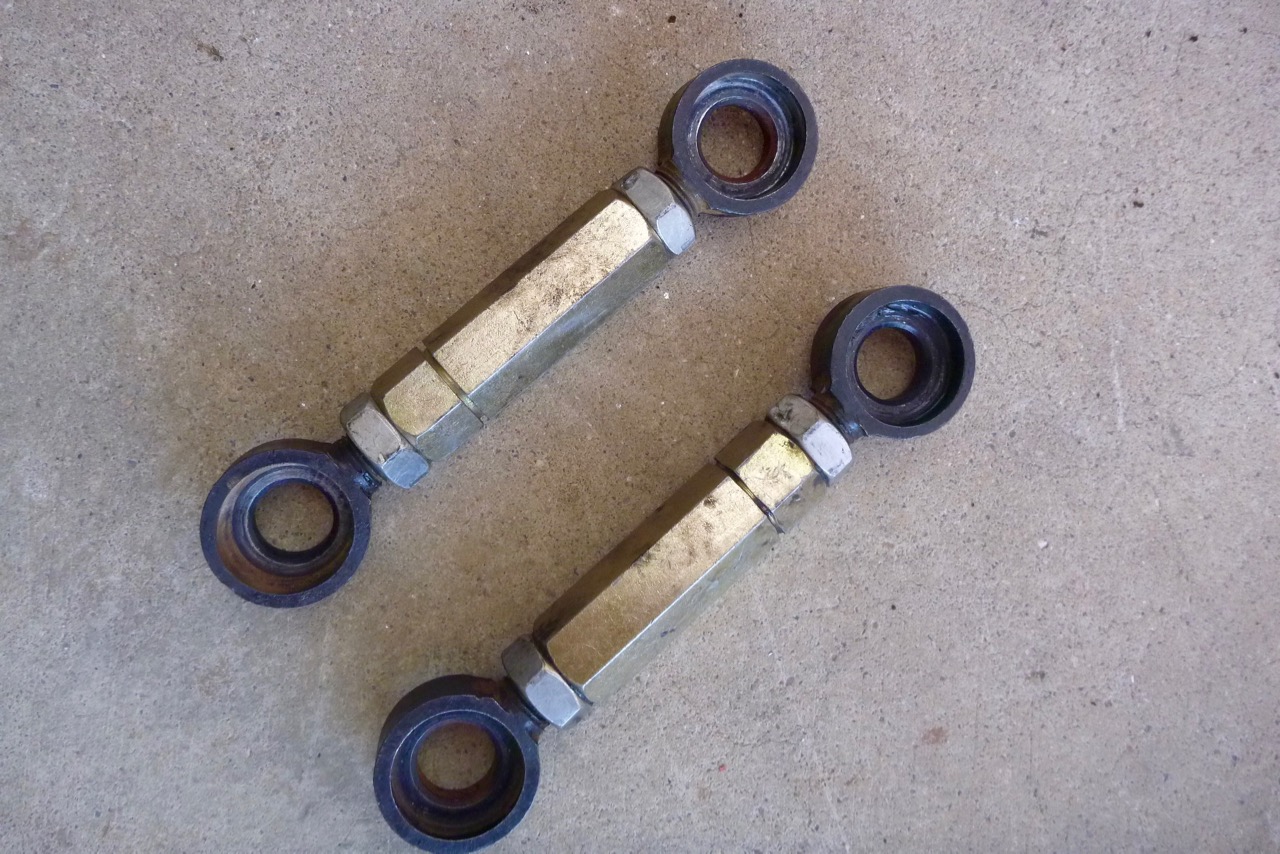
If taking this route I much prefer the idea of variably adjustable links, aka turnbuckle links (left). I first came across them on a KLX250 I had in the US in 2016.  They’re only made in the US by this lot, afaict, and cost four up to times more than a fixed link. And the problem is they only make them to go standard or lower by lengthening the link. To gain ride height you need to shorten that link, which requires chopping maybe 10mm off the body and perhaps 5mm off the threaded ends too. One flaw with messing about with linkage length it that it also messes with the carefully calculated progressive action of the whole system. Rally Raid noticed this shortcoming early on in the 500X’s development and after some calculations, milled a new ‘relay link’ for the Honda.
Up to a point, clearance could also be improved by making the sump shallower and/or rerouting the pipe. The latter is actually the lowest point, but moving it is complicated and expensive. As mentioned, a used OE system can do the job providing the sump’s protected. With the sump, every 10mm less sump depth loses about 280cc or 10% oil capacity, raising temps and reducing oil life. Maybe OK for a racer; not so good on a travel bike, let alone the fabrication effort involved. Better all round to fit solid protection here and achieve / maintain lift from wheels and suspension.

Small jobs already done
My old Spitfire screen fitted, as you can see. I’m getting my money’s worth out of that one and again, I’m amazed how securely the basic fitting works at up to 90mph. The screen can be removed in a minute.
xsrbar

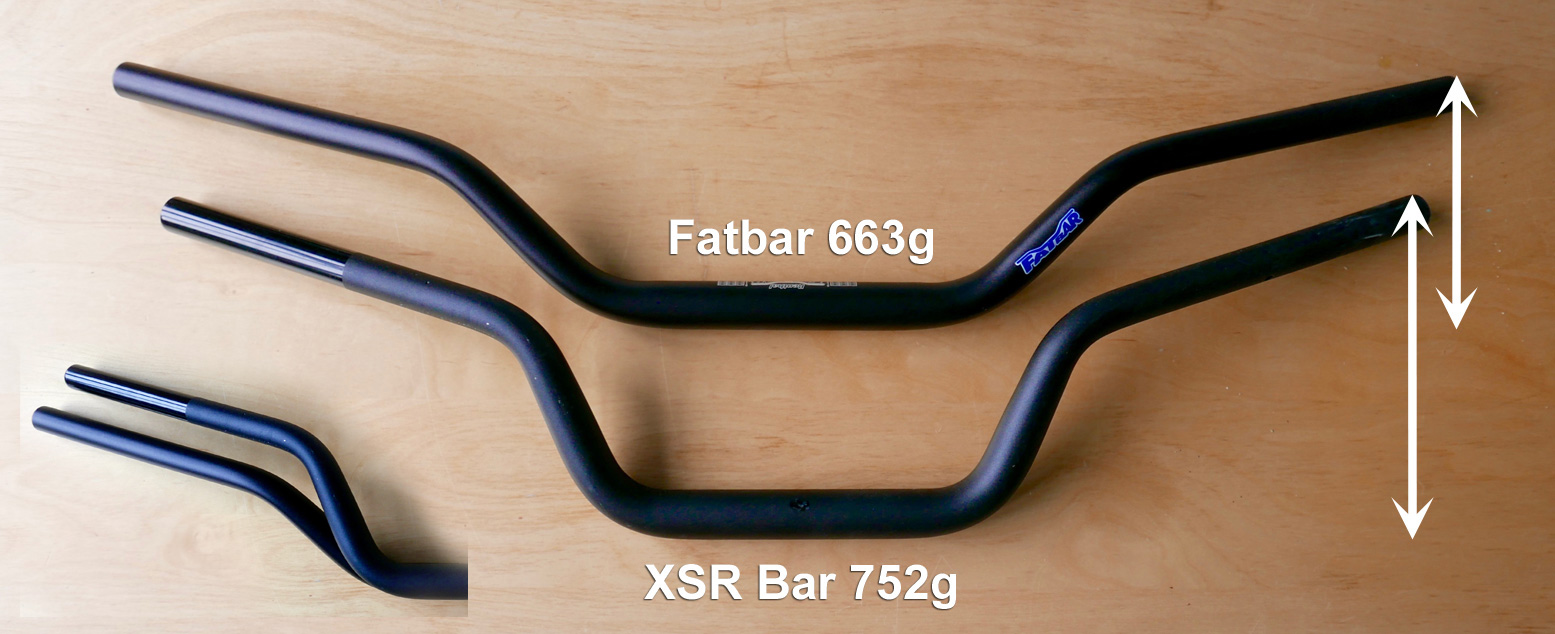
Something was bent up front, but it wasn’t the forks, tfft. I bought a new/removed OE bar, but a closer look showed on of  the bar risers was a little bent; they’re both part of one block (£80). The so-called Yamaha accessory knuckle guards (£160!) absorbed the impact. It’s actually a pretty good fatbar, 2 inches taller and narrower and only 90g heavier than my Renthal fatties (right) which still wait to make their debut.
ledlamper
xsrlampers

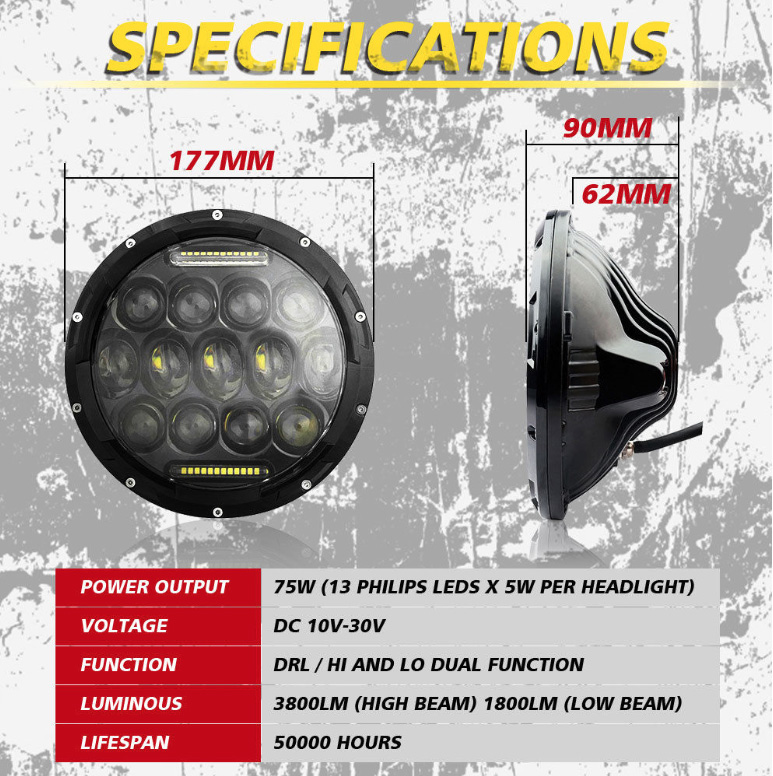
The headlamp shell was caved in and the rim was gouged. That’s about £130 quid’s worth and many agree, the OE lamp is not a great look. Instead, I bought a 2000-lumen LED off ebay, and some steel, fork-rubber-mounting brackets for £25. Removing the OE headlamp mounting frame, the cast alloy indicator brackets and a couple of other fittings saves weight overall but leaves nowhere to mount the indicators. I knocked some up from some scrap formica to get me home, but later got the lamp brackets remade properly in alloy with holes to fit the indicator rubbers.
evotech

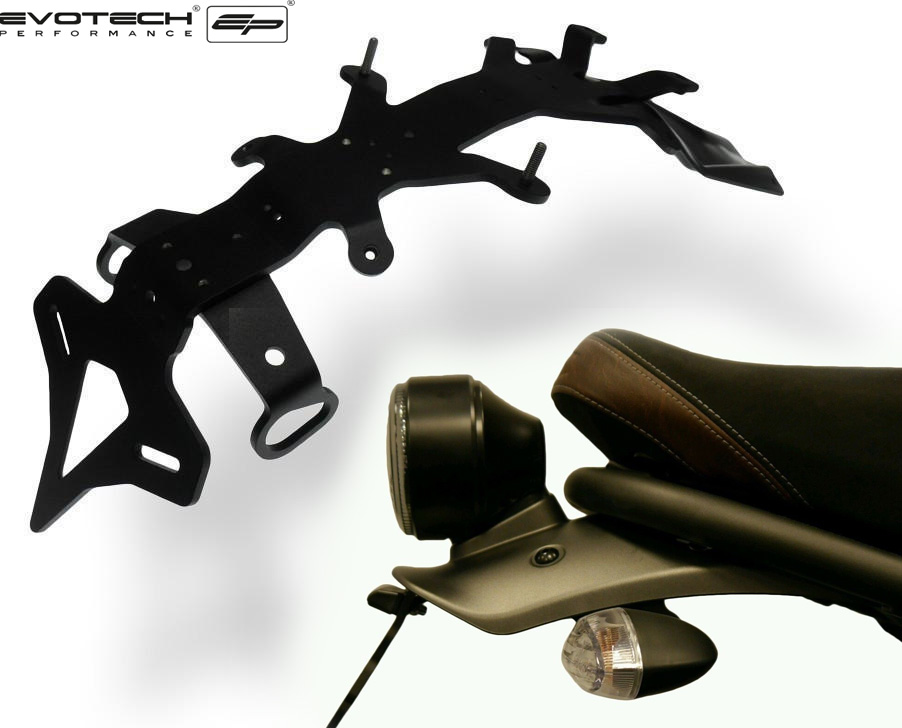
I’m tempted to fit an Evotech tail tidy (using OE indicators) as I know well that running on corrugations and rough tracks can stress taillight mounts which way out back.
strapon

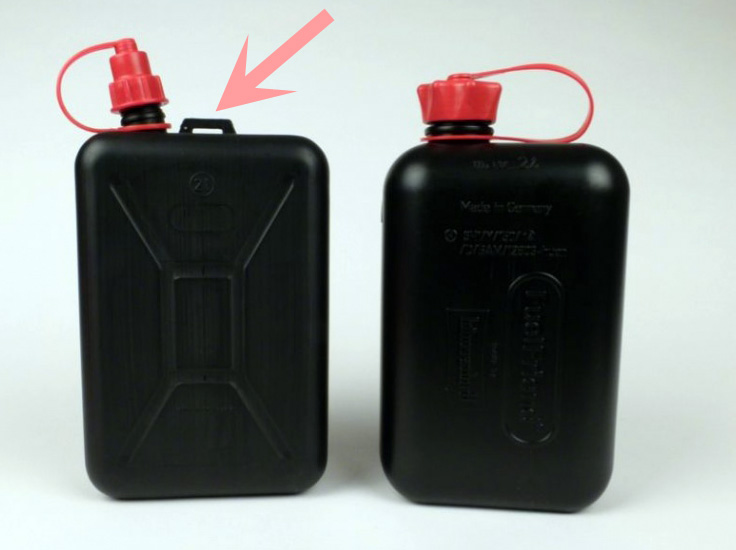
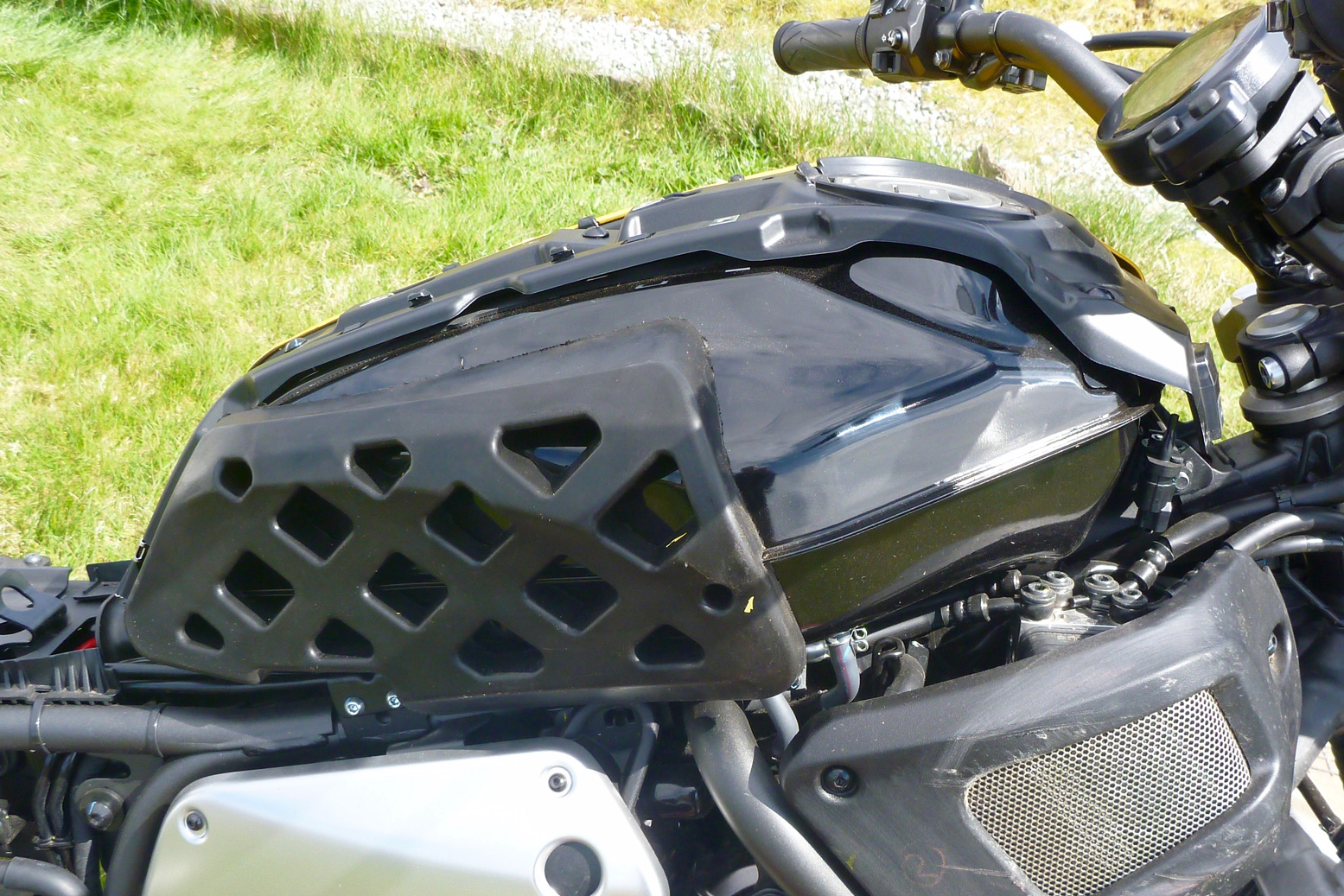
The ‘tank‘ is ally panels covering a 14-litre steel reservoir. One of mine was dented; I tapped it out with a hammer. Right now I get 200 miles to a tank. A little more would be better and looking underneath it appears it would be quite easy to enlarge the tank but really, for 2-3 extra litres I’m better off with some £10 fuel cans.
xsrtank
bolt-xvs950r

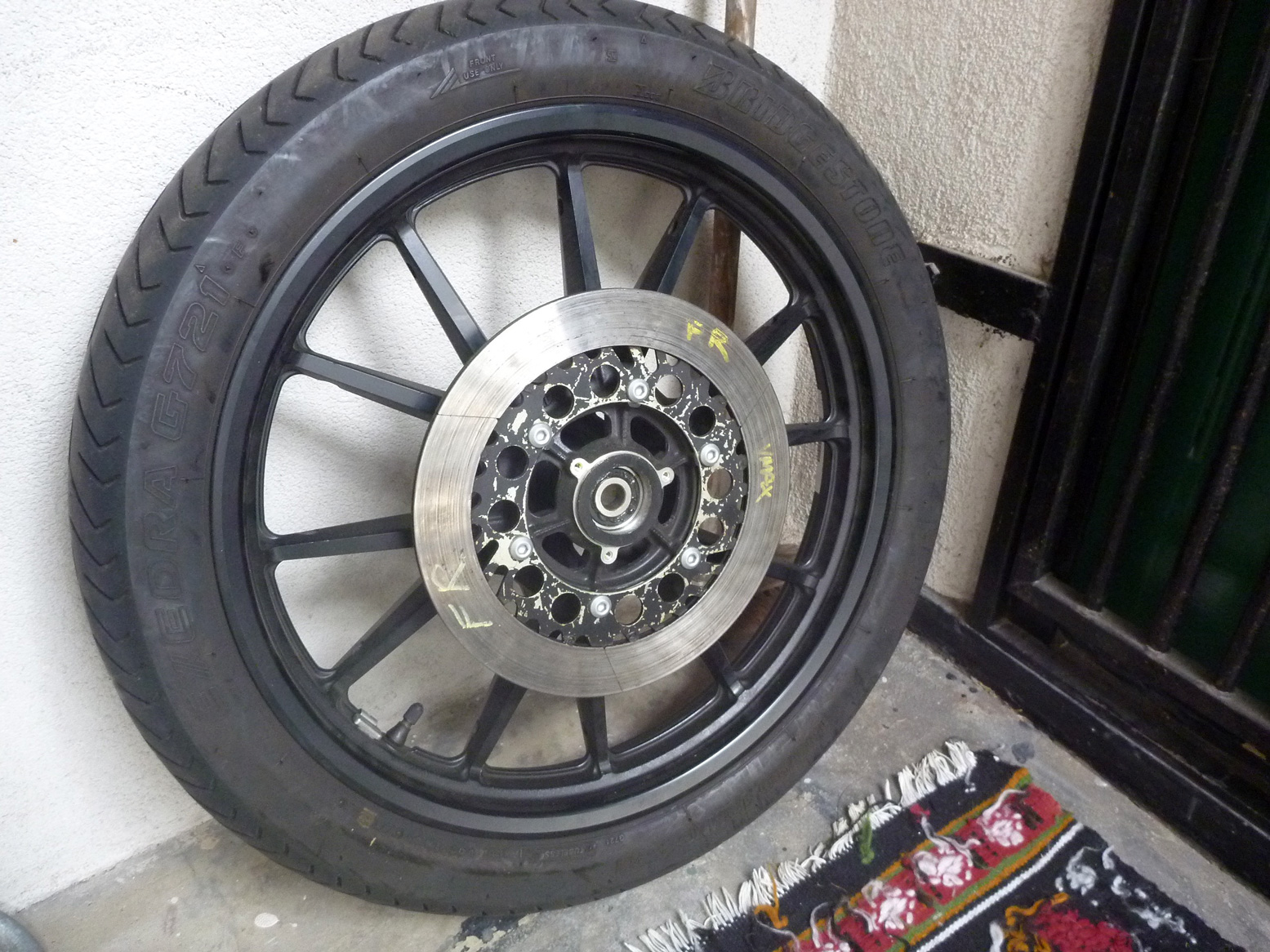
First main job: fit the wheel off a 2016 XVS950R (right). Spindles are the same diameter, but almost certainly new spacers will be needed as well as probable brake caliper spacing to line it up with the V-Max rotor. Luckily the ABS ring may fit – a benefit of using parts from a similar/same era bike. One disc you say? All will be explained.
Tested: Kriega Overlander S – OS-32

See also:
Soft Baggage Comparison
Overlander OS-22, on a Himalayan 410 in Morocco

klou14
krig

Kriega’s new Overlander-S is their second iteration of a luggage system suited to bike travel. A few years ago they brought out a similar plate-on-rack idea (below right) but, with modularity using their existing 15-litre packs (or Rotopax), which were semi-permanently riveted to the HDPE plate which itself attached to the rack with fiddly skewer clamps. I never used them myself, but has a close look once and it wasn’t really for me. I prefer one big bag, like the Adventure Spec Magadans, and an easier way of getting the bags on and off a rack.

OVERLANDER

tik • Good volume
• Rugged construction
• Easy mounting and removal
• Exterior tabs for expandability
• Option to not use platform/plate

cros • Expensive, once you add it all up

M3-17 - 43

I just spent a month in southern Morocco and Western Sahara with prototypes of Kriega’s new OS-32 panniers, the core of their new Overlander-S system (below right) using a similar bag-on-plate-on-rack system.
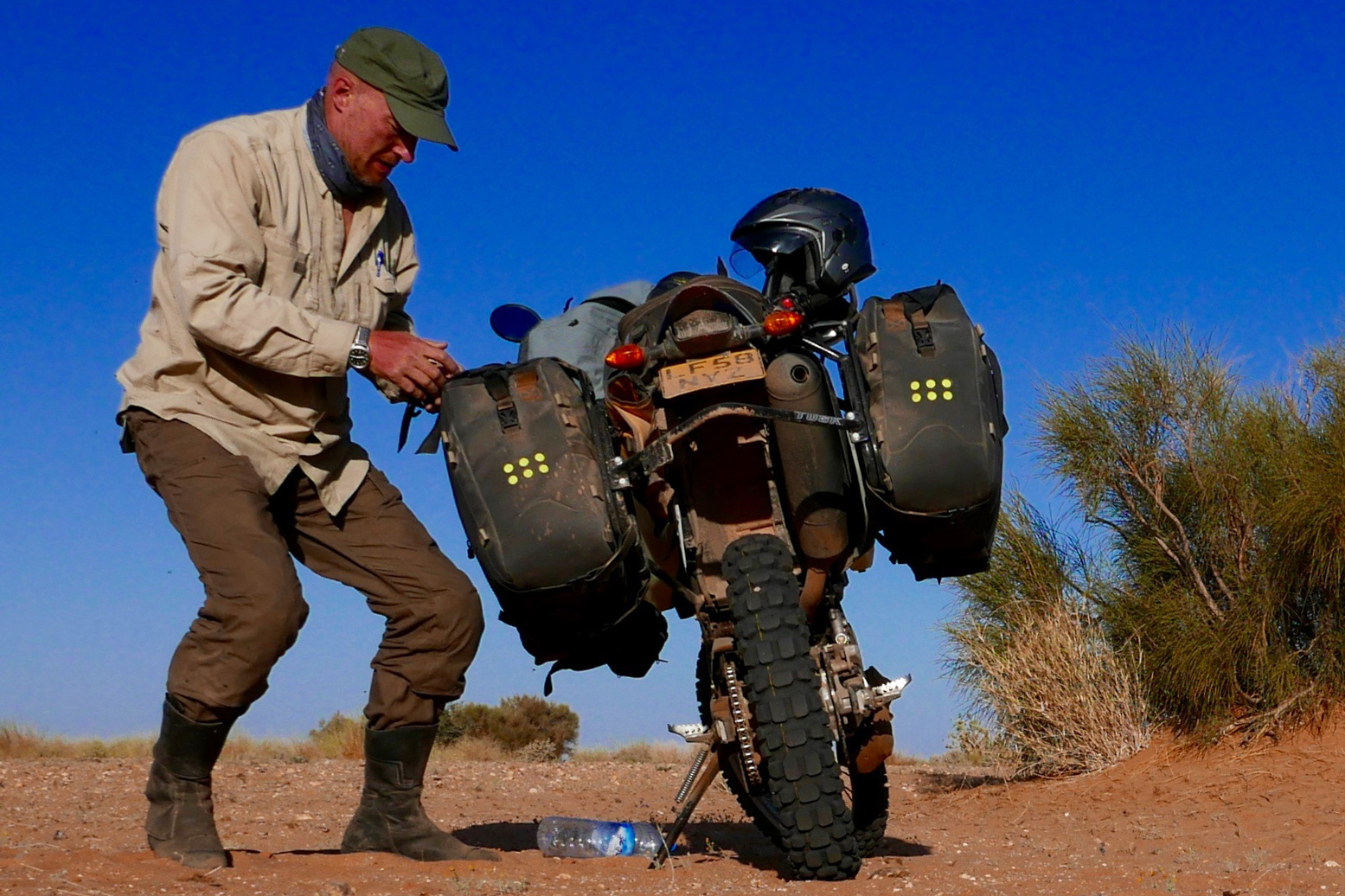
My load was only about 10-15kgs each side, depending on water, and I was set up for tentless camping with a few days food. A nifty Giant Loop tankbag, a trusty old Touratech tail pouch and Kriega R15 backpack with Hydrapak added up to the rest of my baggage.

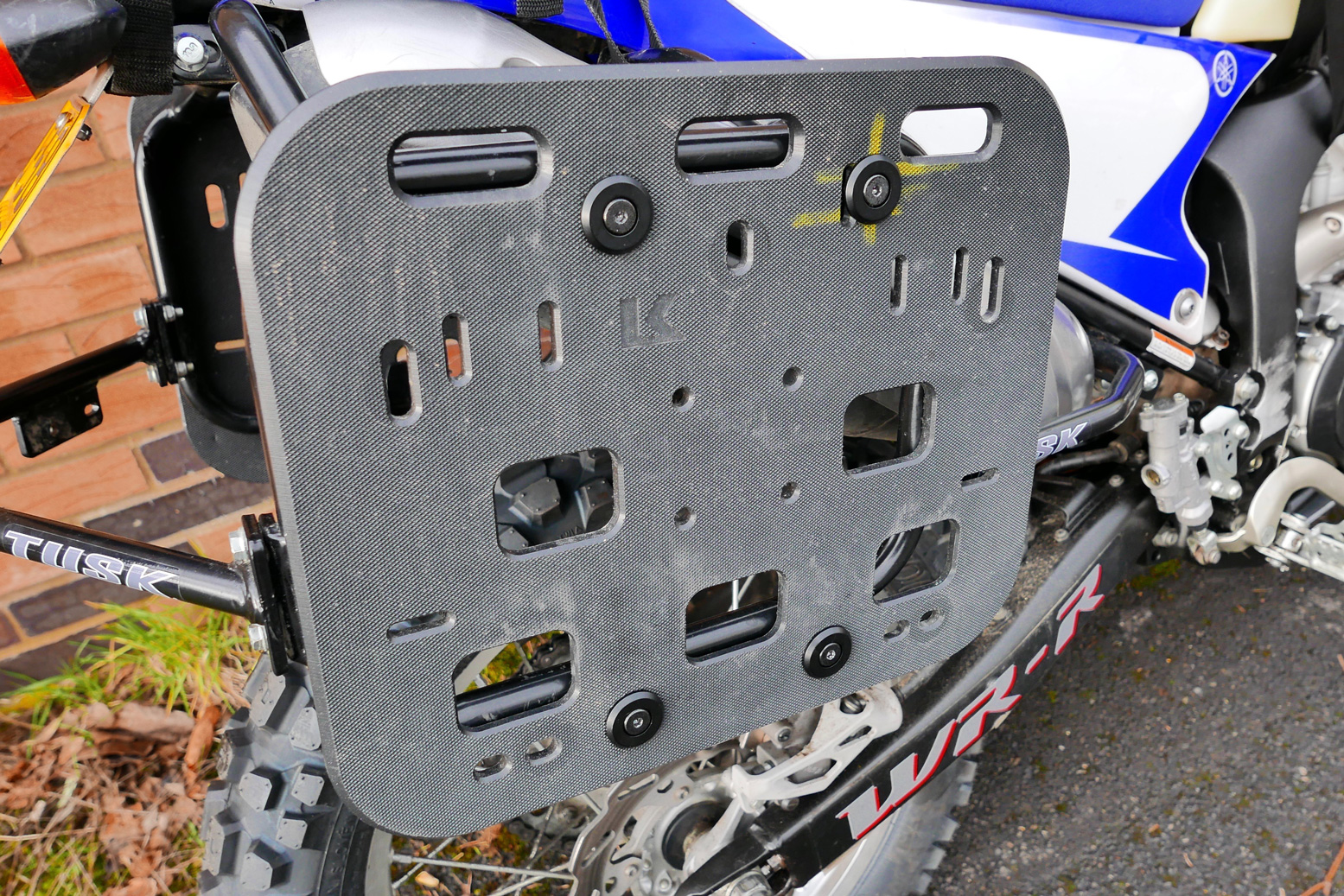
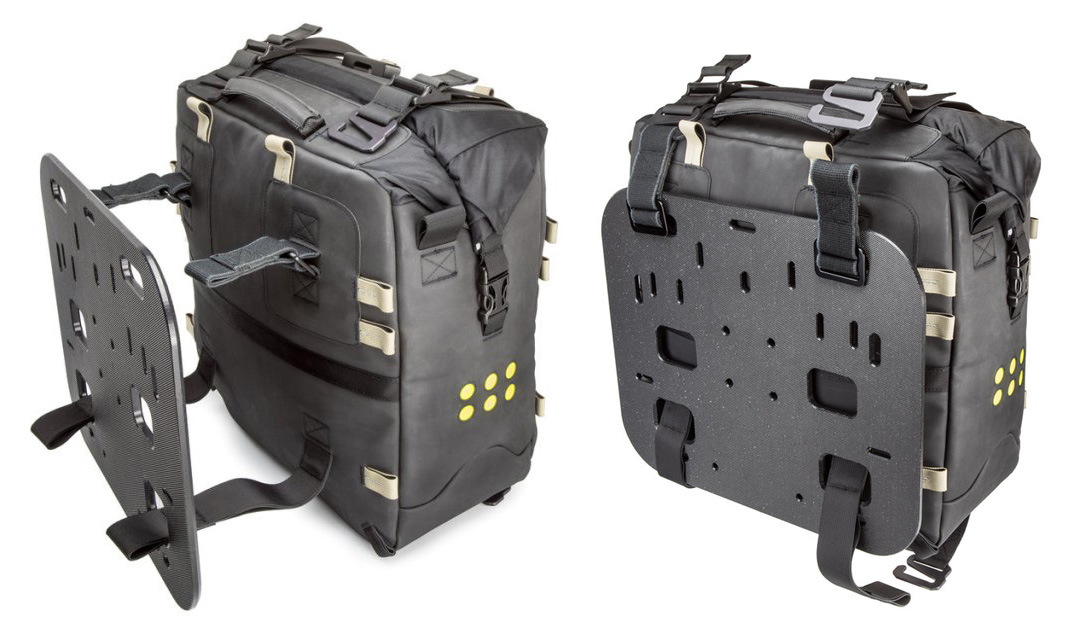
With Kriega OS panniers, an HDPE plate  or ‘platform’ in Kriegaspeak (left) can be bolted to a rack. You may think it just adds weight and expense. Both true, but a plate is actually a smart way to fit any rack. HDPE (think: kitchen chopping board) is great stuff, too: light, rigid and dead easy to drill or even just poke with a red-hot skewer.
The Kriega plate and its adapter clamps have been designed to fit just about any round-tube, 18mm/¾” rack and offer a broad, grippy surface for the hypalon-backed OS bag to cinch up against. Making your own fitting to fatter or square tubed racks would be easy enough. The Kriega OS bags use a cunning anchor and strap-up system to make a very secure fitting while enabling easy fitting or removal – a key element when on the long road. Strapping the hypalon-backed bag to the grippy plate surface spreads loads over a broad area too, meaning no failure-prone stress points.
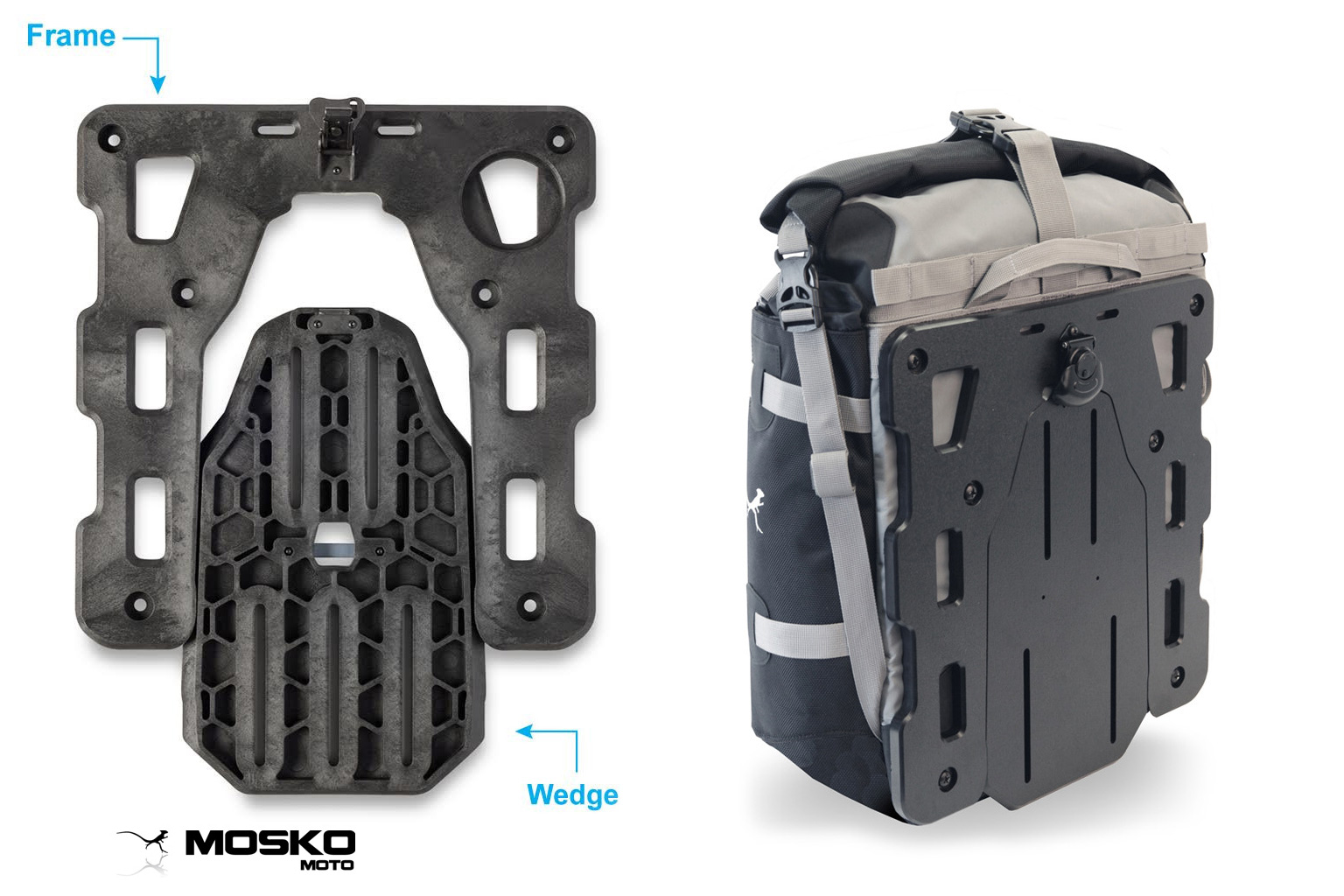
moskrackMosko Moto also use a plate for their Backcountry bags; a GRP wedge and ‘frame’ (right). The wedge attaches upwards to your bike rack, and the full-width frame permanently to the back of the bag which slides down onto the wedge and clips in with a latch. Originals were also made in HDPE, but either wore too quickly or were too soft. GRP (fibreglass) gets round this, but can be brittle stuff. I’ve not tried Backcountry bags, but intuitively I feel old-school soft-strapping to a plate spreads and secures loads better than two bits of GRP slotting, clipping and grinding together, even if it does just take seconds to fit and remove. It’s probably fine for road riding, less so for off road.

86-agadez

For a big trip with heavy/variable loads, a travel bike is better off with a rack, unless you take very little or can be certain your gear will stay put, be easy to get to and remove, and of course, won’t catch fire off the pipe (left; Niger ’86). It’s a load-carrying interface between your baggage and your bike to enable secure fitting on a variety of bikes, like saddles on a horse, a roofrack on your car, a packframe in a rucksack, or even the shoes on your feet.
You can use Kriega’s OS-32s as throwovers, in which case you could dispense with the plate, but you will need some sort of rack to stop them swinging about. You could duplicate the HDPE plate’s strap holes on a rack frame to effectively mount in the same way. It won’t spread the load and secure the bag as well, but it will save 2.4kg of plate and a hundred quid.

wrs1-13
wrs1-133

I used a Tusk rack from Rocky Mountain (4kg, left). Great price, well made in ¾” and solid mounting. It stood up to the beating well and was only spoiled by the clumsy extra bracketry for mounting hard cases. I removed what I could from the rack, but some welded-on bits (right) got in the way of mounting the Kriega rack plate as low and far forward as practical. I suppose I could have ground them off.

krigfeed

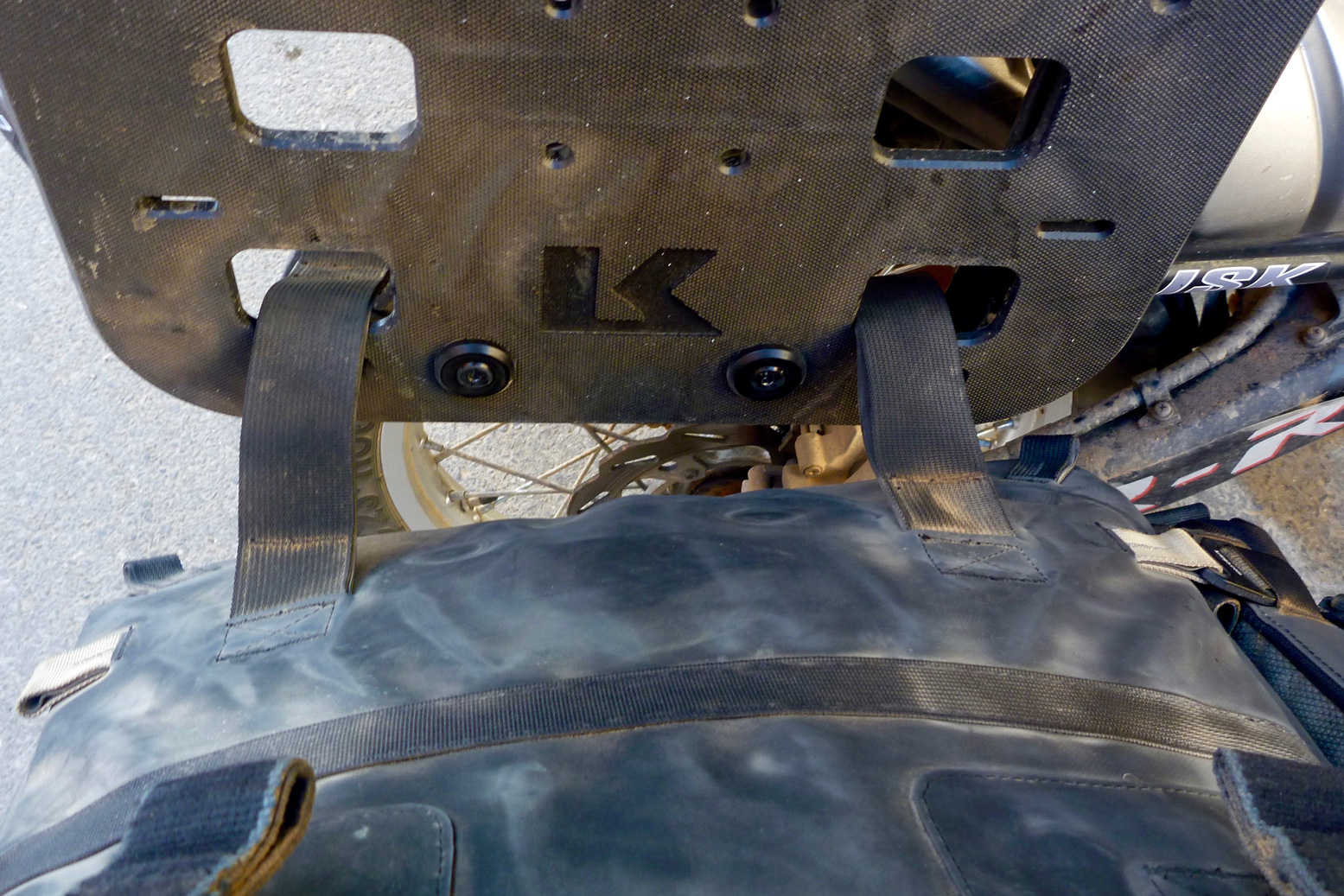
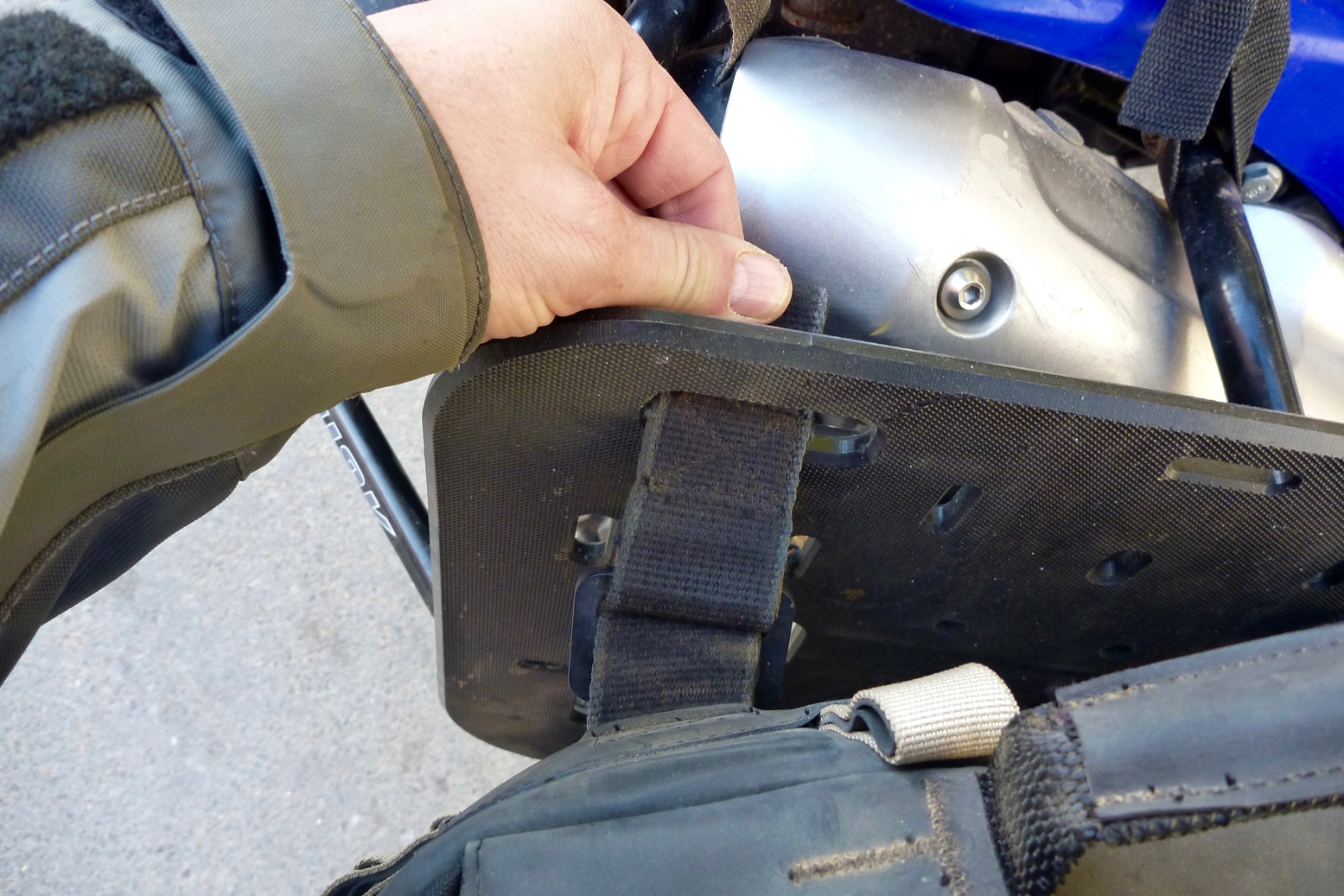
The plates (1.2kg each) have four slots for the upper and lower bag straps. To mount a bag (2.6kg), you rest it on your knee and feed  the lower straps through – below.

krigtopfeed

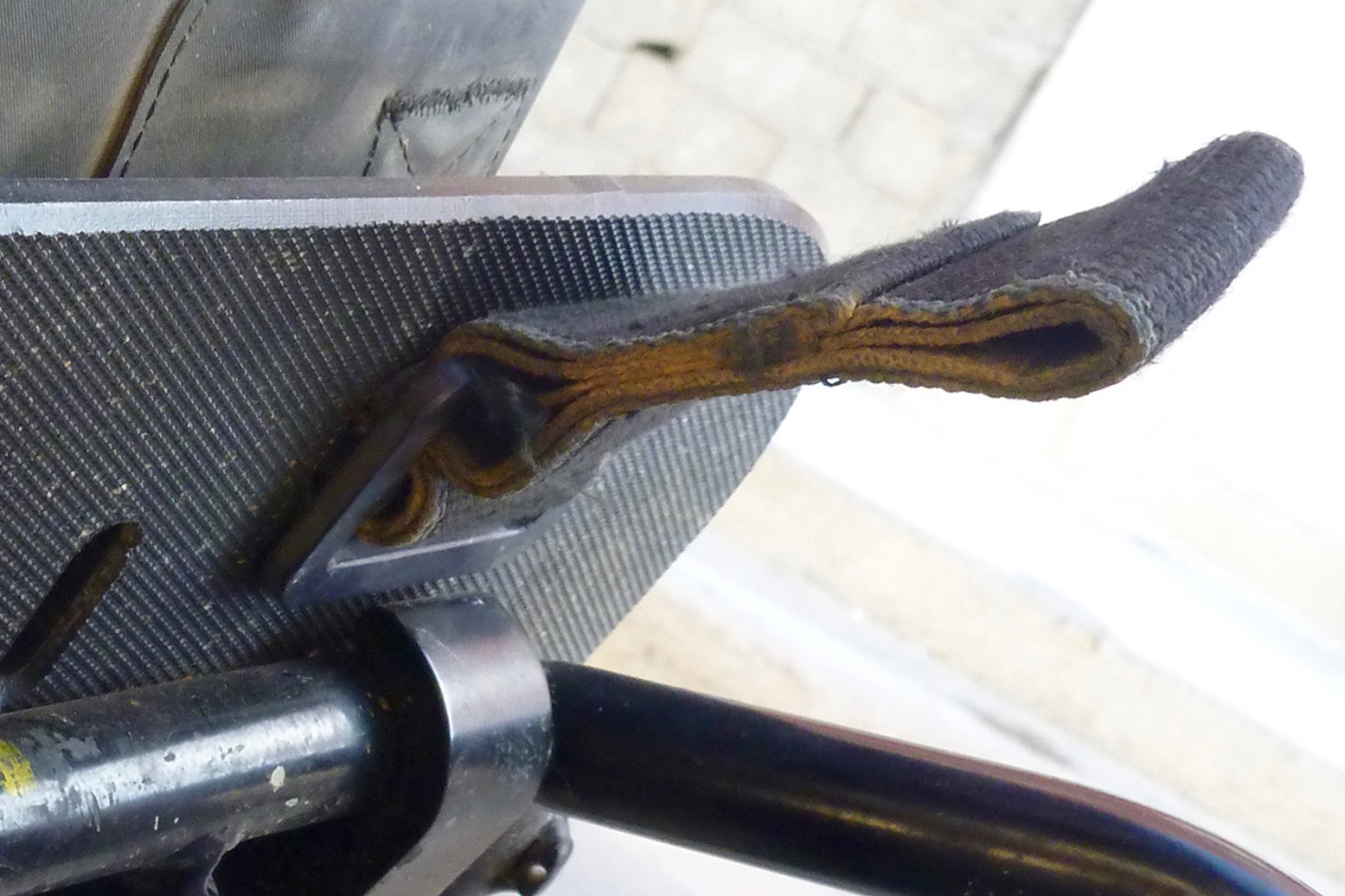
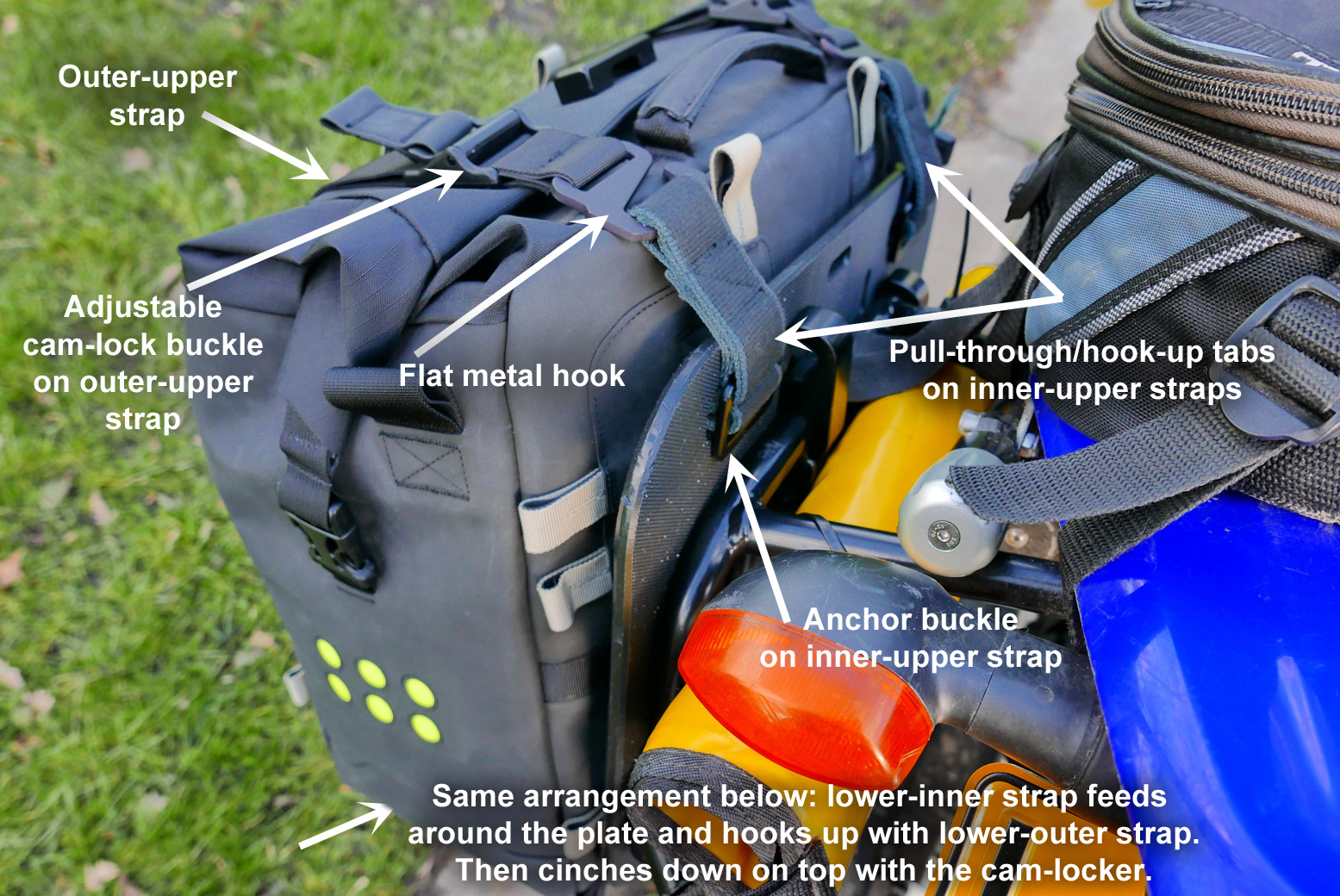
Then you feed the top straps through the slots and pull the ‘anchor buckle’ through – works a bit like a shirt button and similar to Wolfman’s idea which cinched smaller bags directly onto racks.

krigbukview

Viewed from behind – the anchor buckles (as I call them) pull through and take the weight.

kriega-os32-fit1


With those buckles pulled through, the bag now hangs on the plate not unlike a throwover. You could probably ride on roads like that. For a bombproof mounting, you now crouch down and connect the dangling lower straps to the outer strap with a flat metal hook. This is about as arduous and fiddly as the whole bag-mounting process gets. Then, on top you do the same: hook the outer strap to the chunky tab off the anchor buckle, then cinch it all up and lock it down with the cam buckle. Sorted!
krigstrappMounting takes about 40 secs each side once you’re practised – demounting a bit less.

klou10
krigpokit

One of the best things about the Magadans are the big exterior pockets – a lot of soft luggageers dodge this necessity. Kriega supplied me with two OS6, 6-litre strap-on pockets (550g) which are part of the OS system and which I hooked on the front of the bags. They’re ideal for daily or heavy items to keep the CoG central. The OS6s cinch down on themselves to stop stuff shaking about. You could put two more on the back and another on top. There are over a dozen hook-on tabs on the main bags and the system includes an optional pair of shoulder straps which make it easier to do the bike-to-hotel-room-walk in one go.

M3-17 - 40

All bags came with the usual Kriega white liners to enhance rummaging visibility and which are more durable than previous liners. I didn’t use them, and bagged stuff individually. Even then, what rain I got – a few hours a couple of times – didn’t penetrate the bags. They’re covered in hypalon panels (think: whitewater raft fabric; lasts for decades) which slow the wetting out of the bag’s Cordura body and of course will scoff at any abrasion, be it the constant rubbing against the plate, or sliding down the road hoping not to loosen your load. Daytime access requires uncam-locking and loosening the top straps and pushing to the sides, then unclipping the roll top folds from the sides and unrolling – about 15 secs.

magwalter
krigsecure

On the top panel you’ll see a chunky metal fitting to feed a cable lock, like the Steel Core recommended by Mosko Moto. I initially just used them to secure the loose strap ends (left). Kriega tell me if I fold the ends over they’ll have the rigidity to slip into the outer sleeves, even when the bags are packed full. I never tried that and in the end just let the straps flap.

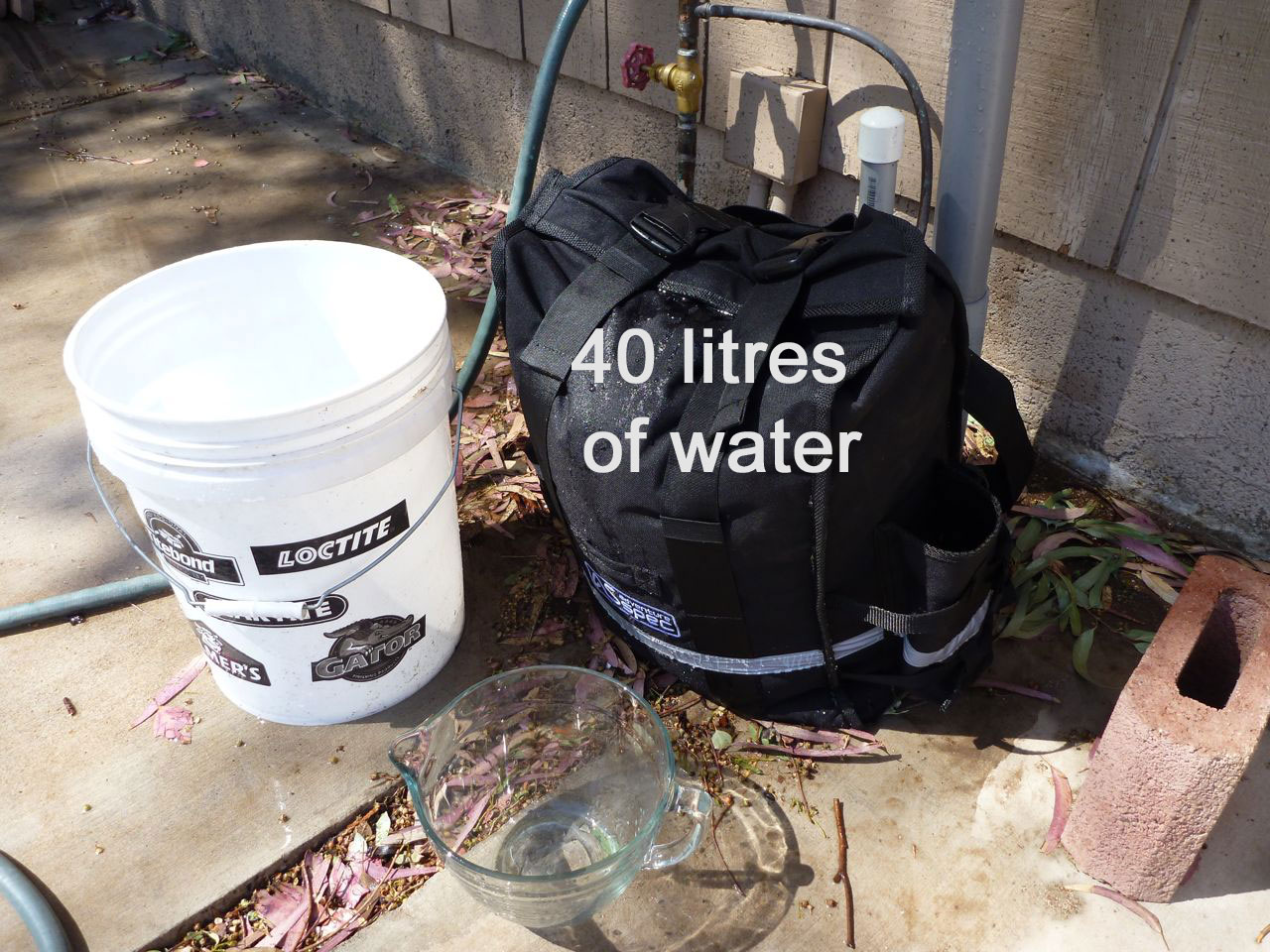
The bags have interior stiffening panels to help give shape, but fold down flat for shipping or shoving under the bed between adventures. The volume is 32 litres according to the brochure, but as I discovered here, a flexible, rectilinear box will actually increase in volume when filled with fluids as it seeks to attain spherical equilibrium. Who wouldn’t want some of that. For example, my notional ’24-litre’ Magadans (right) actually took 40 litres of water, and that increase will be the same with any similar flexible rectilinear pannier.

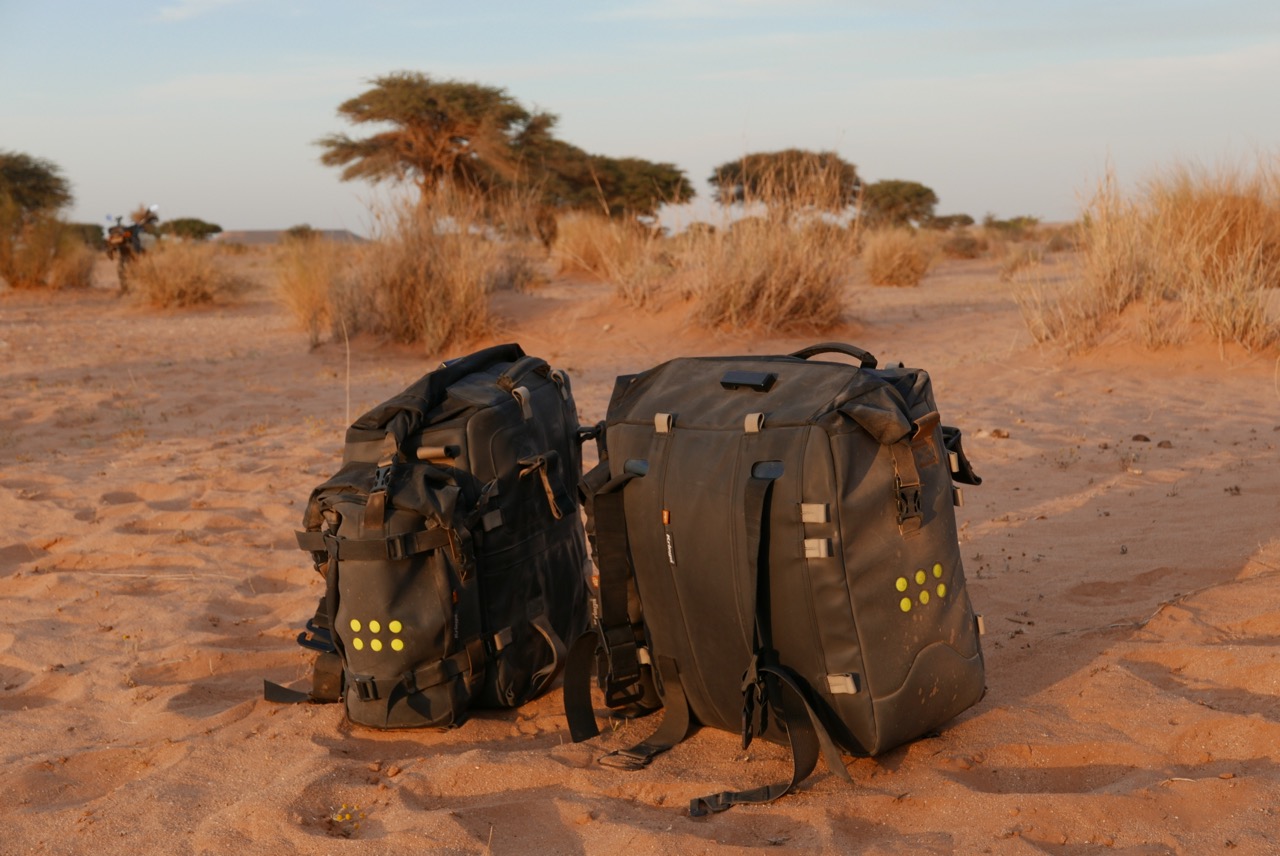
So, masses of volume meant I didn’t need an annoying tailpack, and low-mounting probably didn’t do any harm to stability either. Yes, they’re wide because the rack is wide. On the chain side I could’ve used the inner space better (just a rolled up 10-L fuel bag, yellow thing on the left). There’s four litres of volume to be had there, easily. A Rotopax won’t fit.

On road and trail the OS-32s never missed a beat or felt annoying to use. In fact the pulling up of the anchor buckles and then cinching up were quite satisfying actions – I suspect ‘actuation gratification’ (the satisfying click of a clip, for example; there’s probably better jargon for it) may be something that better designers think more about than others.
With my throwover-on-rack Mags (left) I removed the liner to take indoors as the bags needed careful lashing to the rack to stay put. With the Overlander-S it was no bother to:
• lift the cam locks
• loosen then unhook the lower straps
• unhook the top straps
• lift the bag on its handle, release the anchor buckles and carry it away

Your OS32s are a travel solution to long overland journeys. For dirtbike weekends or fast and light BDR-ing, I imagine a GL Great Basin, Mosko Moto Reckless, or alternative Kriega packs will suit riders prioritising agility. Me, I’m more of a traveller and prefer big, side-mounted saddle bags with minimal junk loaded on top. Slimmer would be nice, but that’s just conventional rack design and high dirt-bike pipes for you.


The Mags are still great bags and bound to be cheaper. The OS-32 kit as I used it with plates and two pockets would come to £710. That’s a lot of money, but of all the accessories you lash to a genuine travel bike, surely the baggage system is the most critical and will be the most used.  I hope to carry over these OS-32s to my next adv bike. Good job Kriega, a well thought out bit of kit.

For more images from my ride in Morocco, see this.

M3-17 - 19

WR250R – Ready for the Desert

wrr-label
WR250R 4000-km review
WR Introduction
WR250R Stage 1
WRing about in Wales
WR250R ready for the desert
Morocco trip report, 1–9
Fuel log

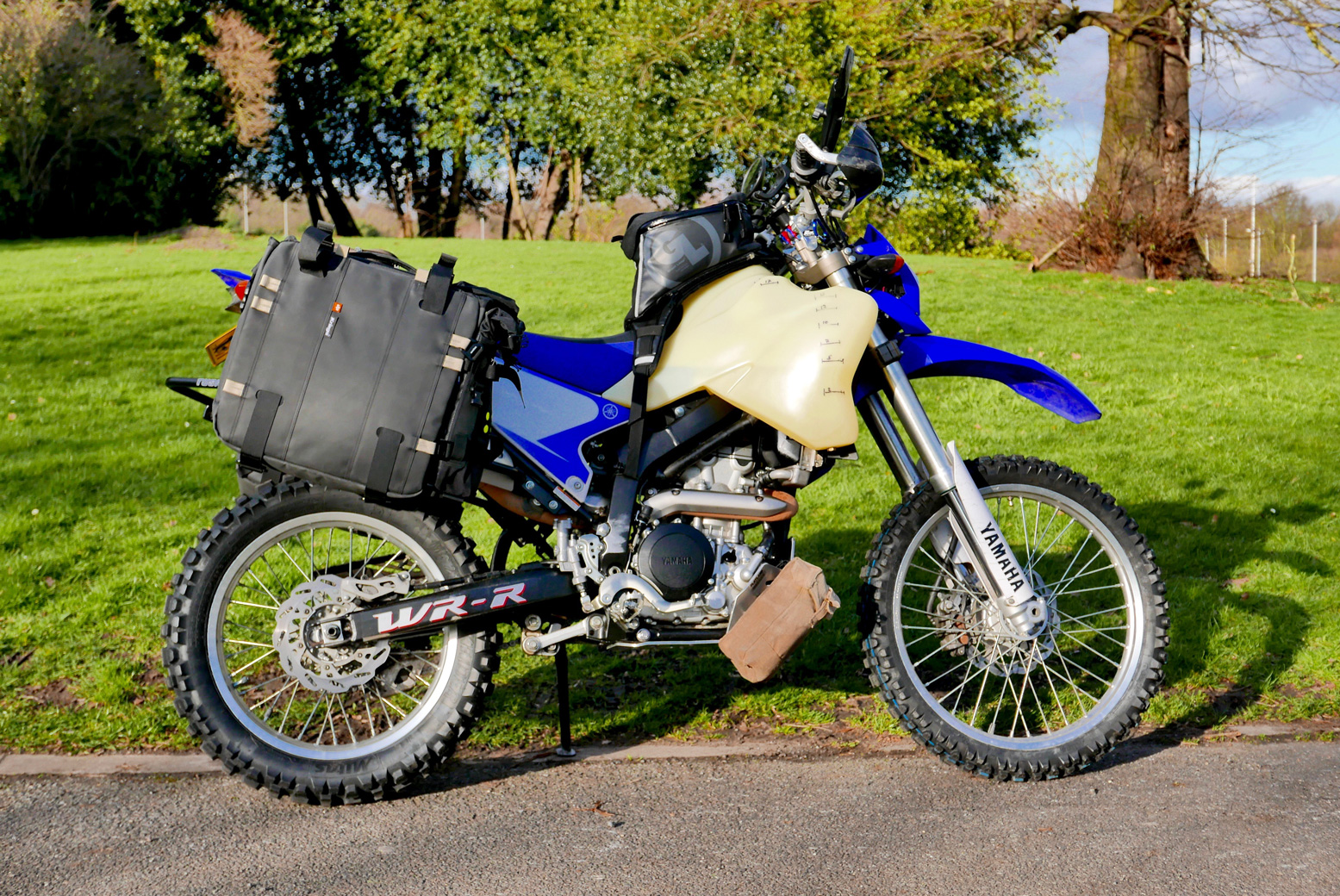
While in Morocco last year and not riding around on my WR250R, I left it with a list and a bunch of stuff with Karim, a desert bikey mate with a lavishly equipped garage and some spare time on his hands. Over the weeks he tinkered away, finishing the job I’d started in the summer, converting the WR into a lightweight desert bike.

tektemp
ktmfry

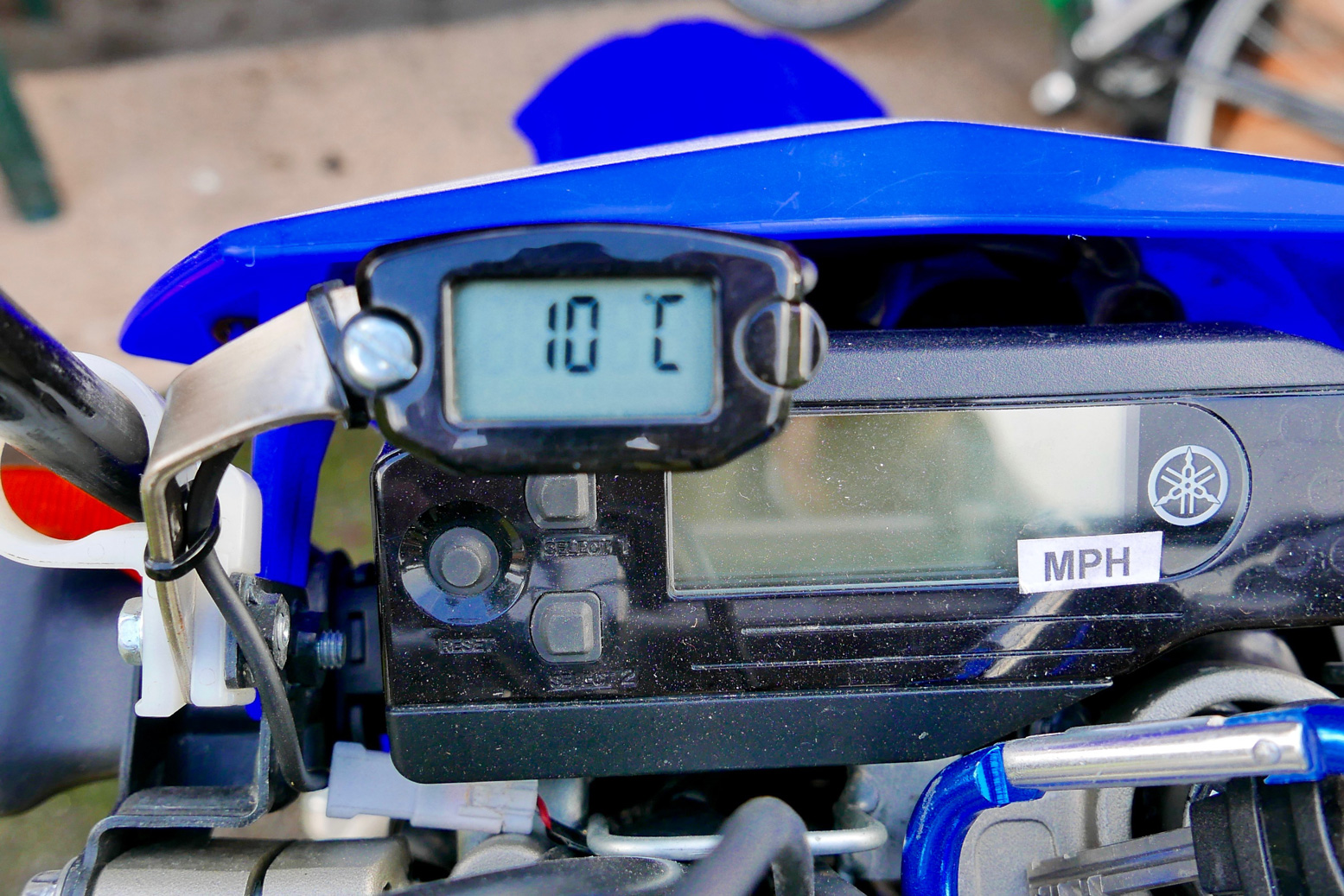
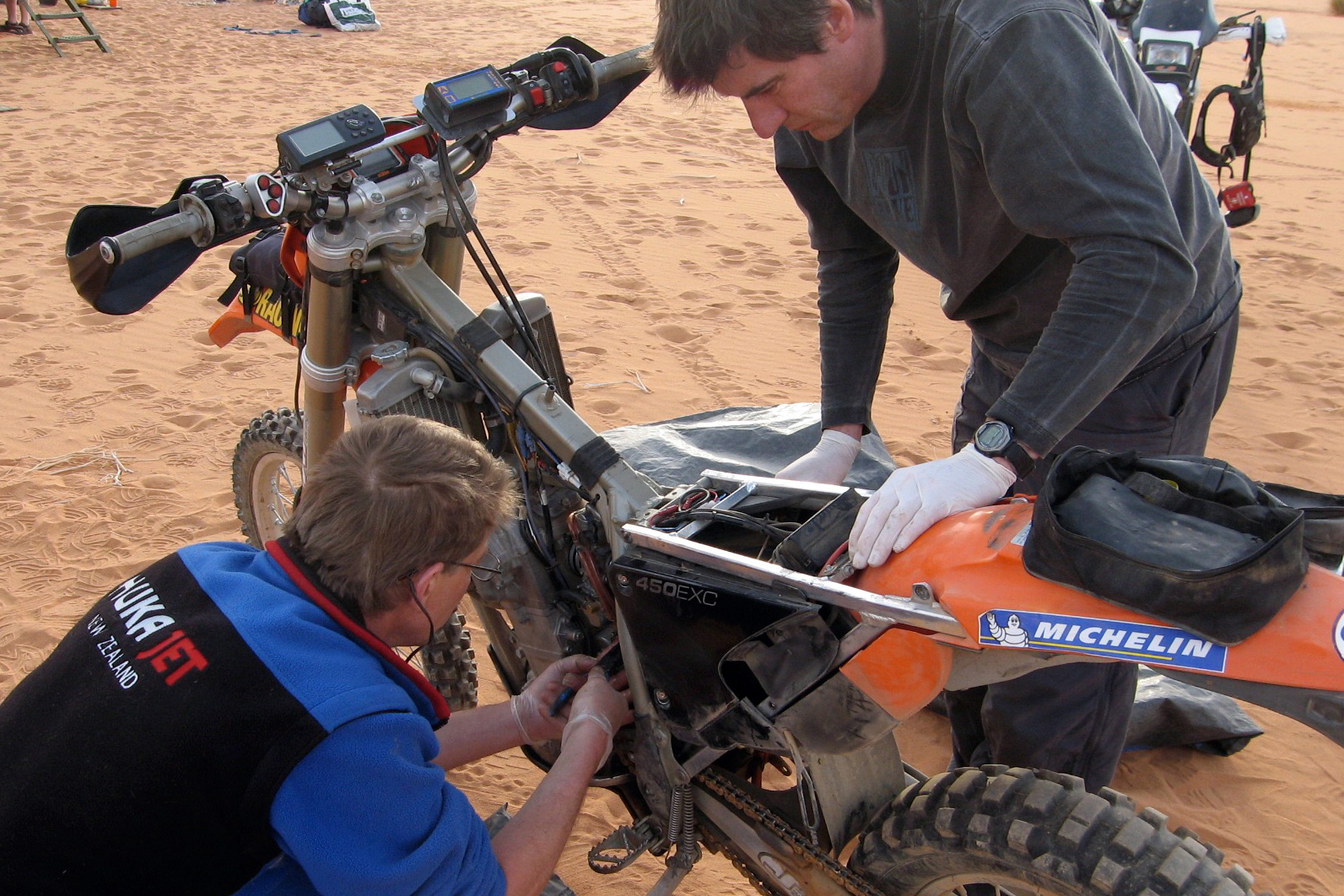
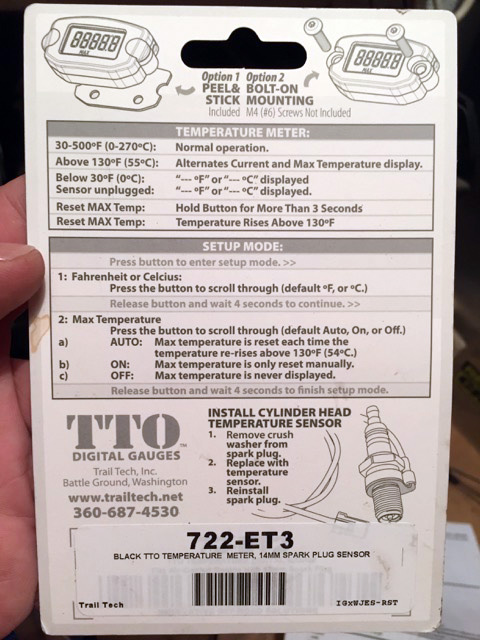
The list included a TrailTech engine temperature gauge (above). IMO it’s vital to be able to know an engine’s temperature – air or water-cooled; I don’t want to hope some warning light might chip in just as steam starts wafting up from under the tank (as happened to a 450 KTM in the desert once, left: engine fried, end of his ride). The gauge’s pick-up sensor can be mounted anywhere very hot including splicing into the radiator hose to read water temps – all you’re really looking for is a representative value from which to evaluate a normal reading.

tecktemp

If it starts straying into unusually high figures you can choose to back off, or even stop and turn into the wind at tickover. On the ride back to London in a backwind gale the temperature varied from 85°C up to 115°C flat out or at the lights, but usually around 100. Another handy thing is it reads even when the engine’s off – a handy air temp reading when camping.
At the same time one fan blade got tippexed white to make it easier to see at a glance if it was spinning when it should be.

wr3-12v
wrr-ram

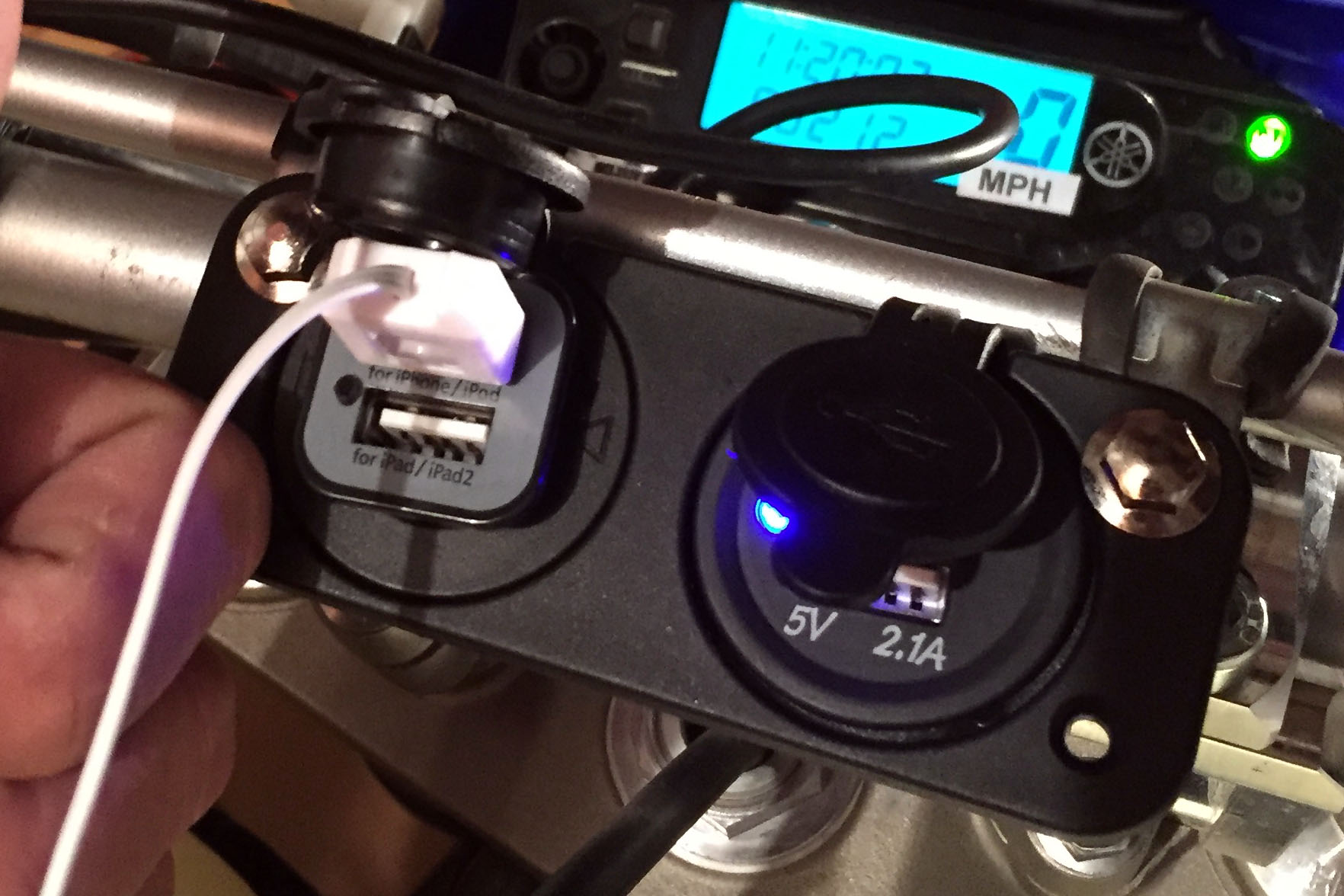
A RAM mount and wire for my Montana got hardwired in (left) to guarantee a reliable, clip-on connection, and some 12-volt and USB plugs got added to the cross-bar (right). Got no actual use for them but handy to have. There’s also a DIN plug tucked in by the seat base to power a heated jacket and the tyre pump.

wrr-krigovls
wrr-krigstrap

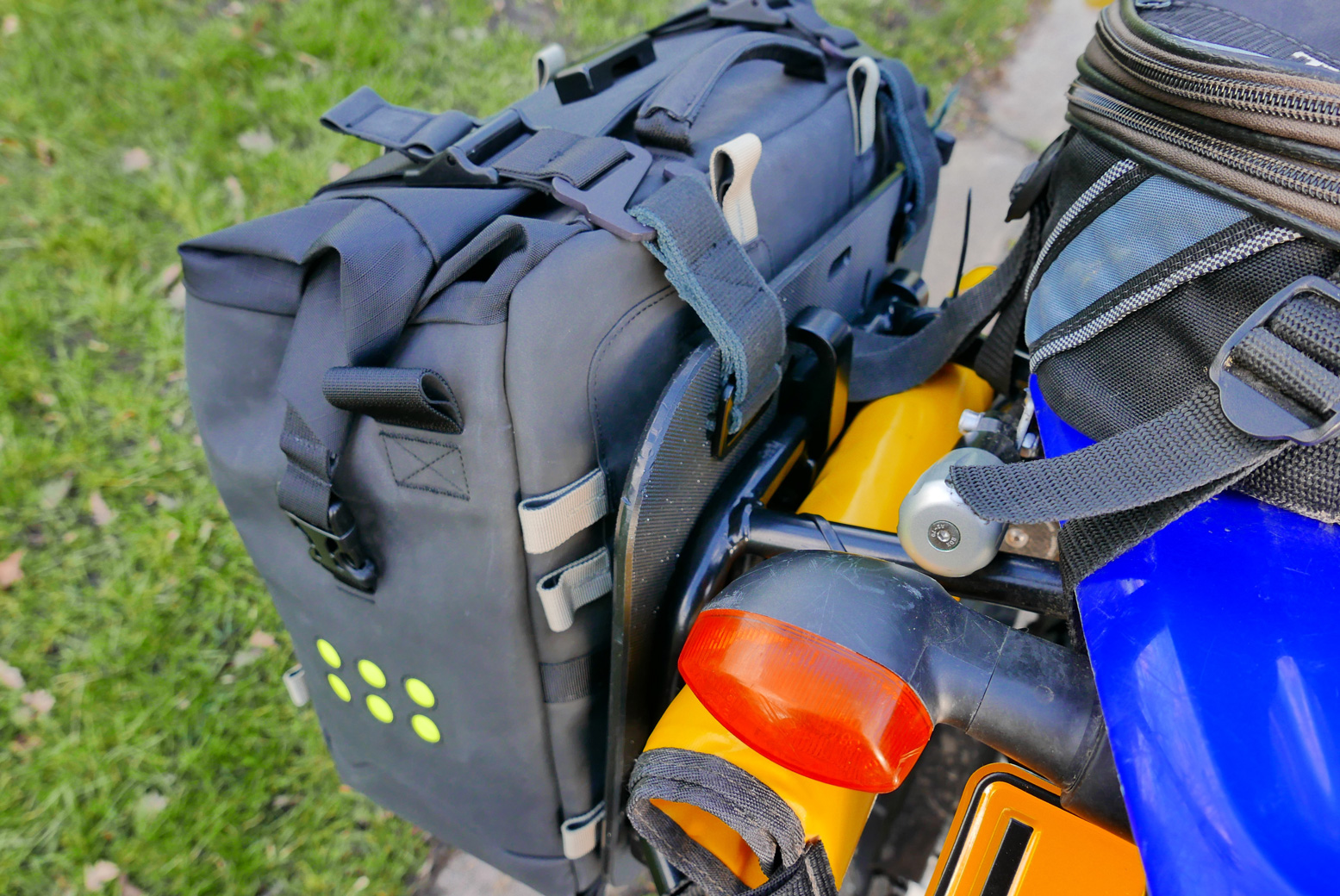
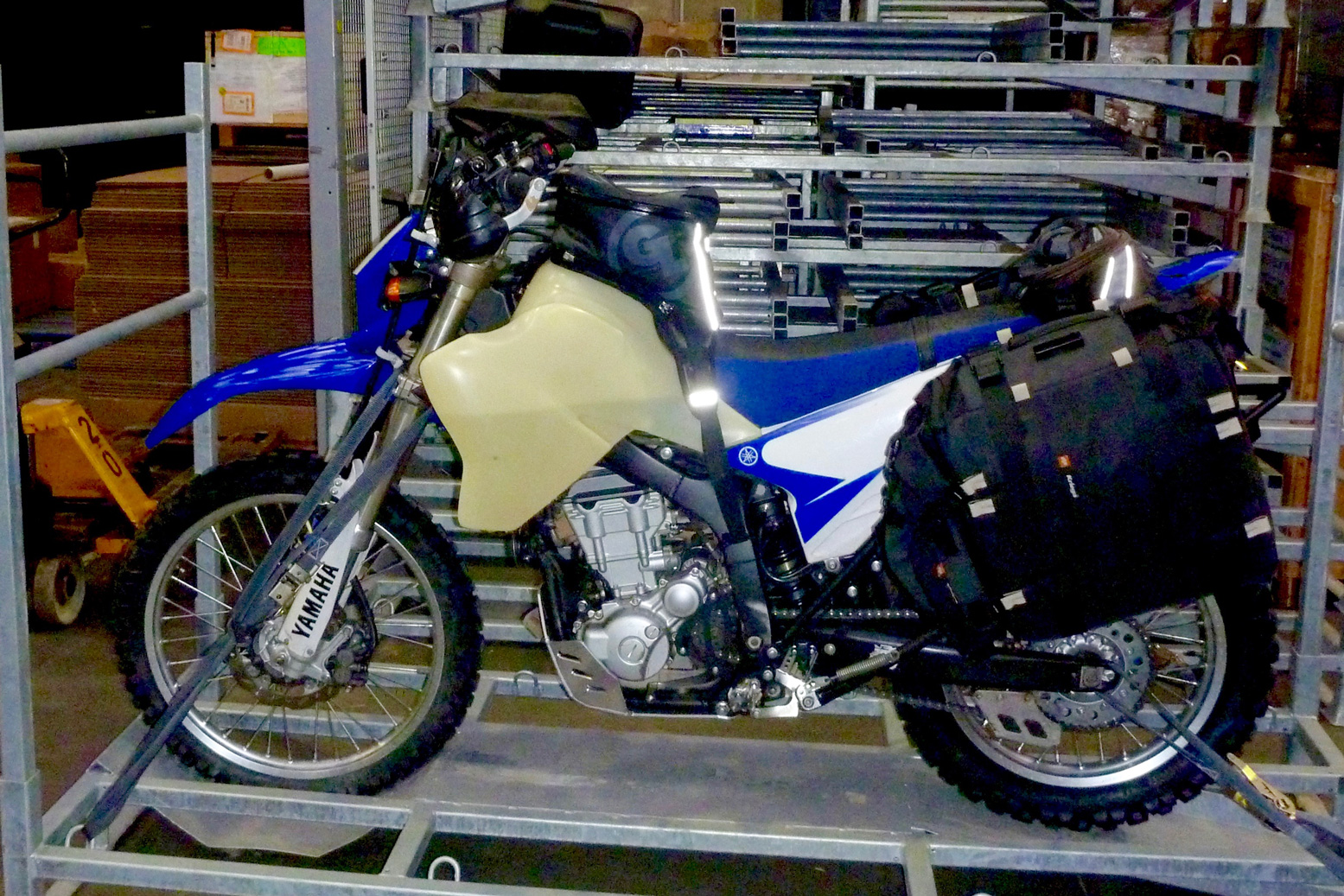
I’m going to be trying out some new Kriega Overlander-S panniers – OS32 – which mount and strap on quite cleverly to an HDPE platform that’s clamped to the rack. I’ll do a fuller review of the system once on a road a couple of weeks, but as you can see, the volume means a large tailpack isn’t needed, even with basic camping gear. I find that makes swinging a leg over the high saddle easier and a less cluttered look.

wrr-bork
doris

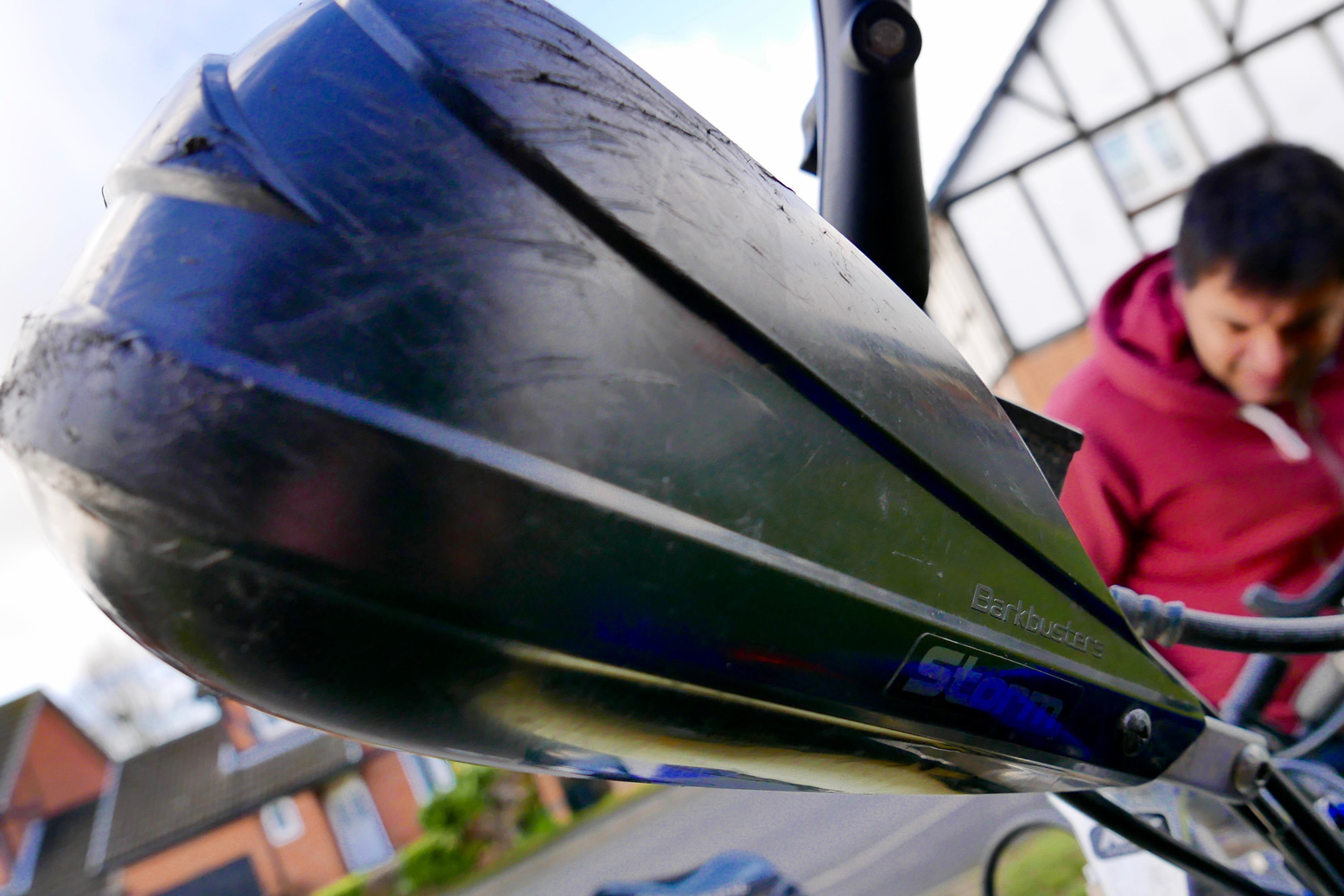
My trusty old Barkbuster Storms are getting what must be their fifth fitting on the WR. Whatever came with the bike was all plastic and not really up to the job. And before I’d even loaded the bike to head back to London, the Barks saved the day when a gust from Storm Doris (right) blew the WR over.

wrr-lamp
wrr-sand

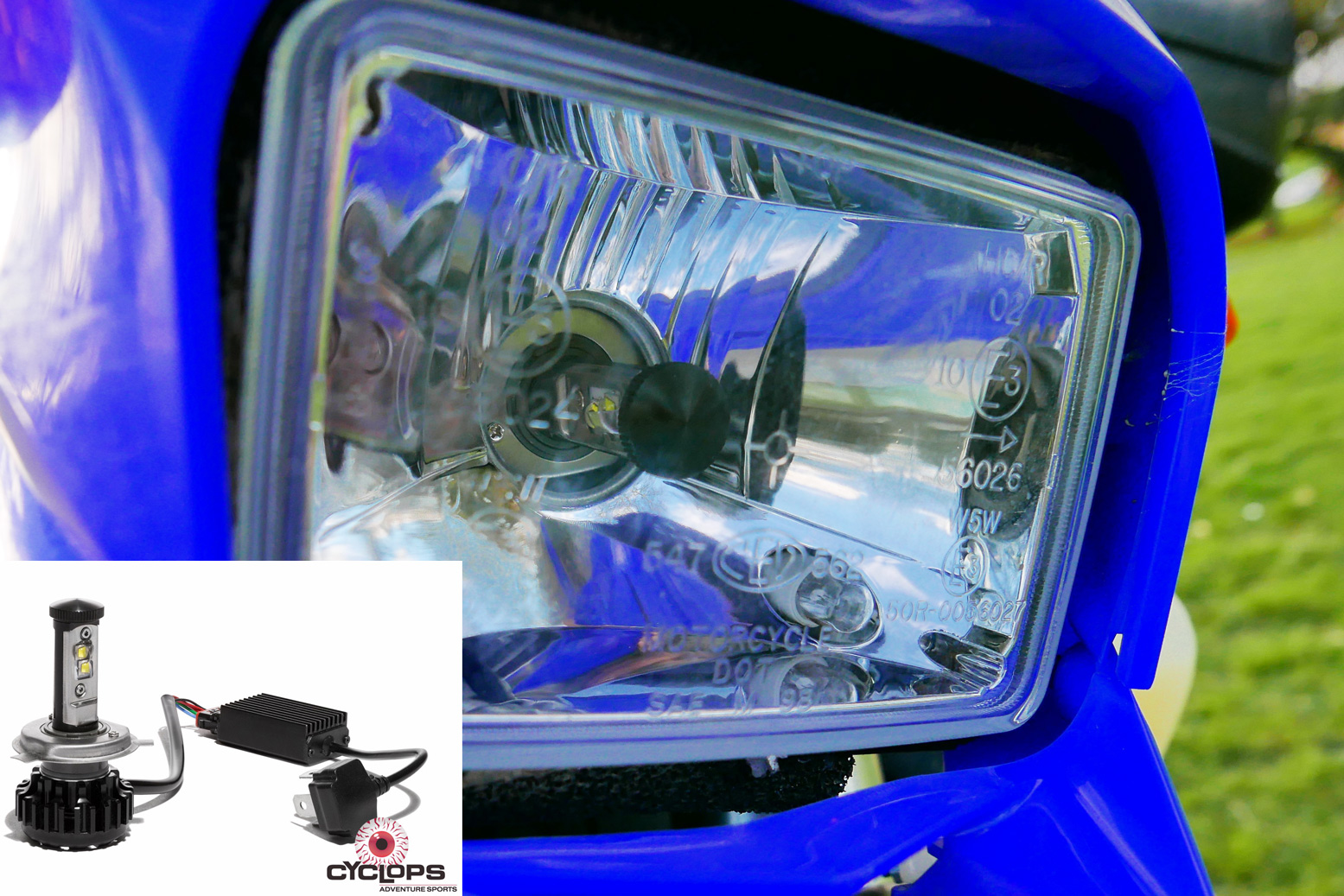
The headlight bulb has been uprated to a Cyclops H4 LED (on ebay) which emits a bluey light, and they promise will cut through the night sky like a meteor shower as well as consume less juice.
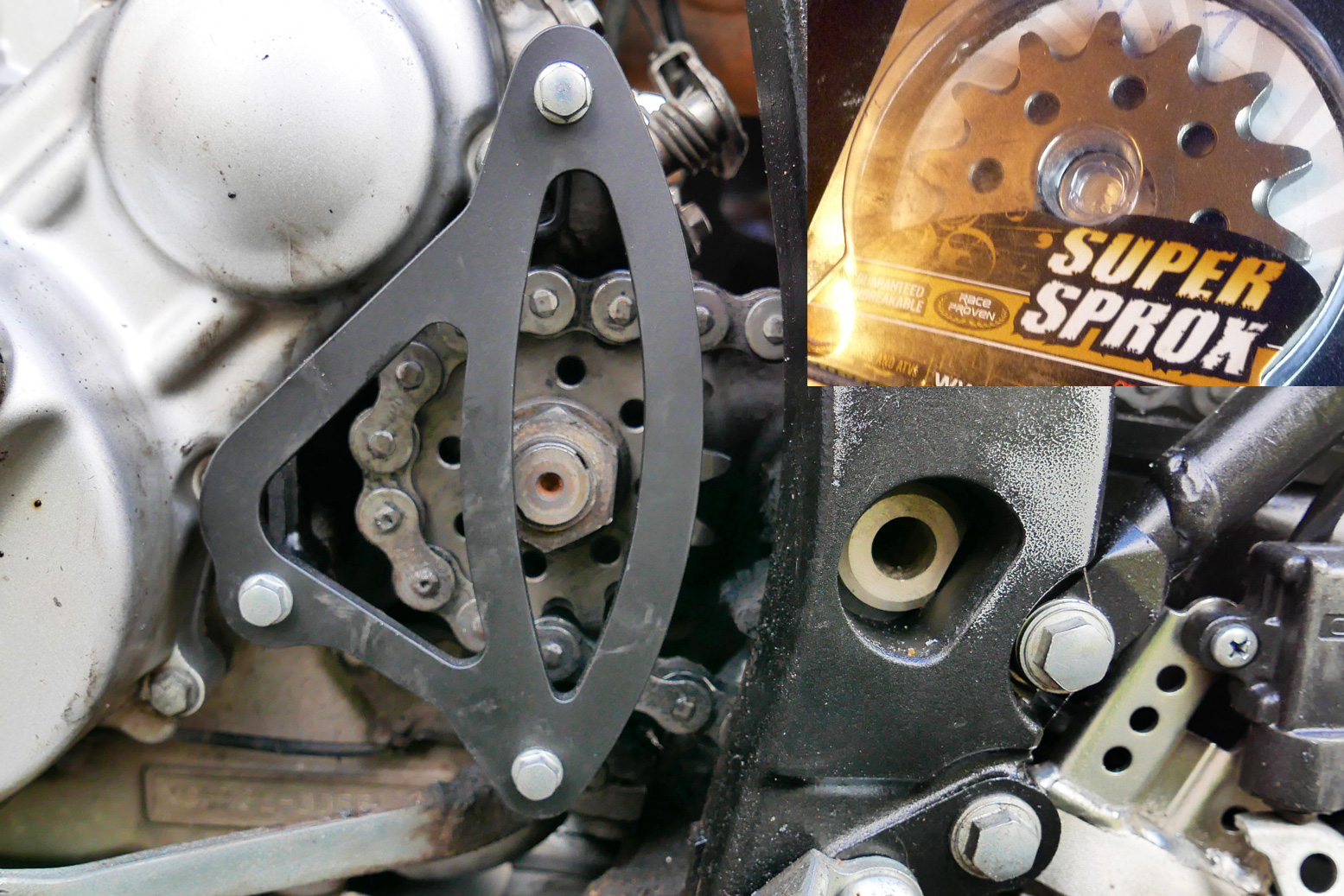
And down by the front sprocket I added a Sandman case saver kit from Basher in Missouri. I’m starting on a 14T (on 46), and swapping to a 13T (about 10% lower gearing if the speedo error is any judge), should the need arise.

wrmc23fr
wrr-rokrider

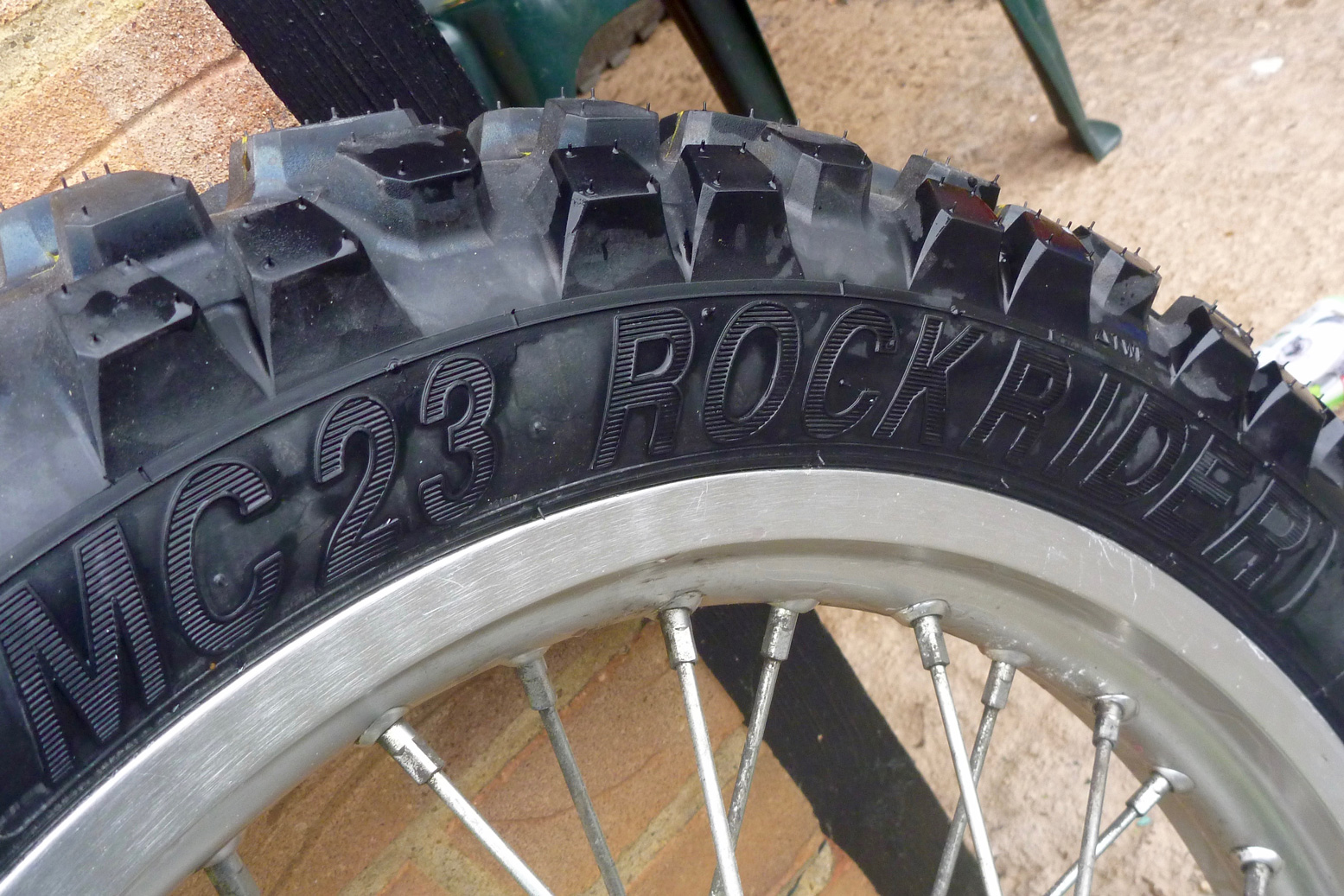
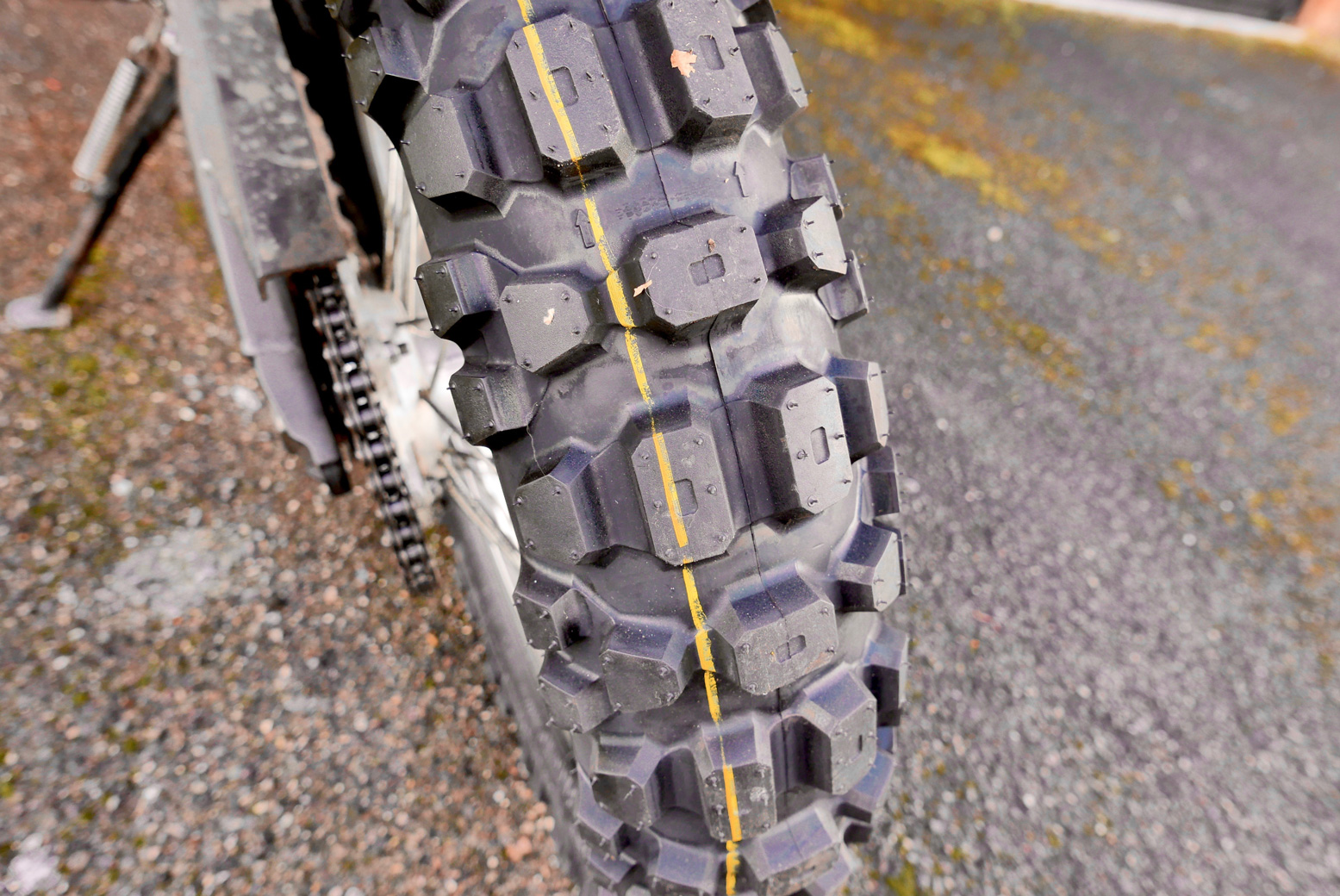
Tyres, you ask: I try never to use the same type twice and this time around I’m on Mitas (formerly Sava) MC23 Rockriders. I was hoping to go tubeless until I saw the back DID rim doesn’t have the lip (in which case this would work, were it in my size). I’m confident the Mitaii will easily last the trip of about 5000km, helped with a splash of Slime and a few Hail Marys.

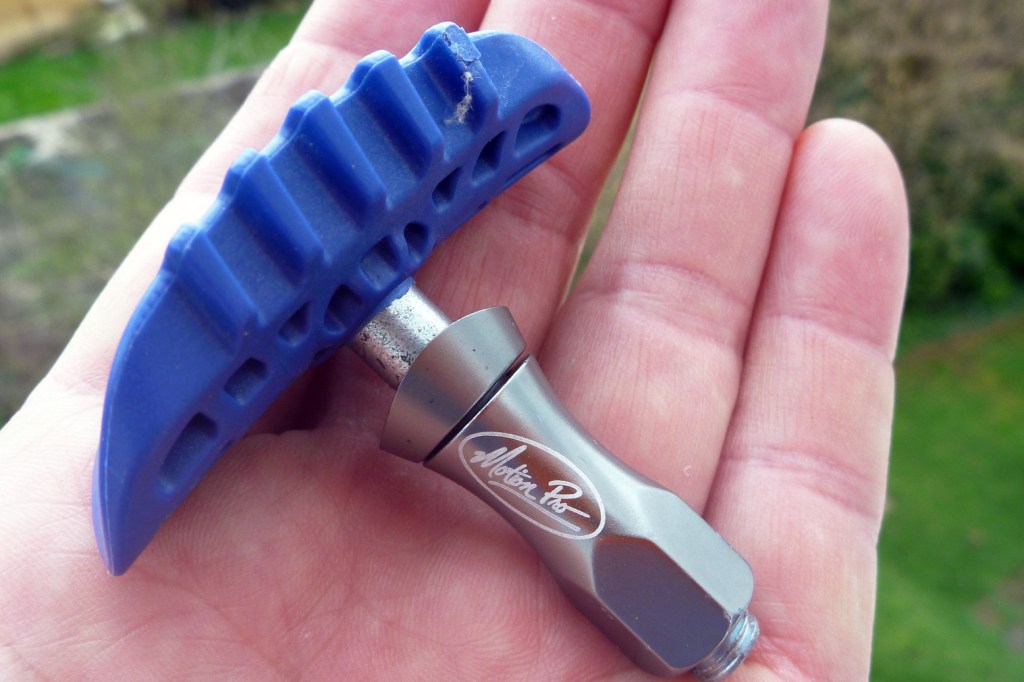
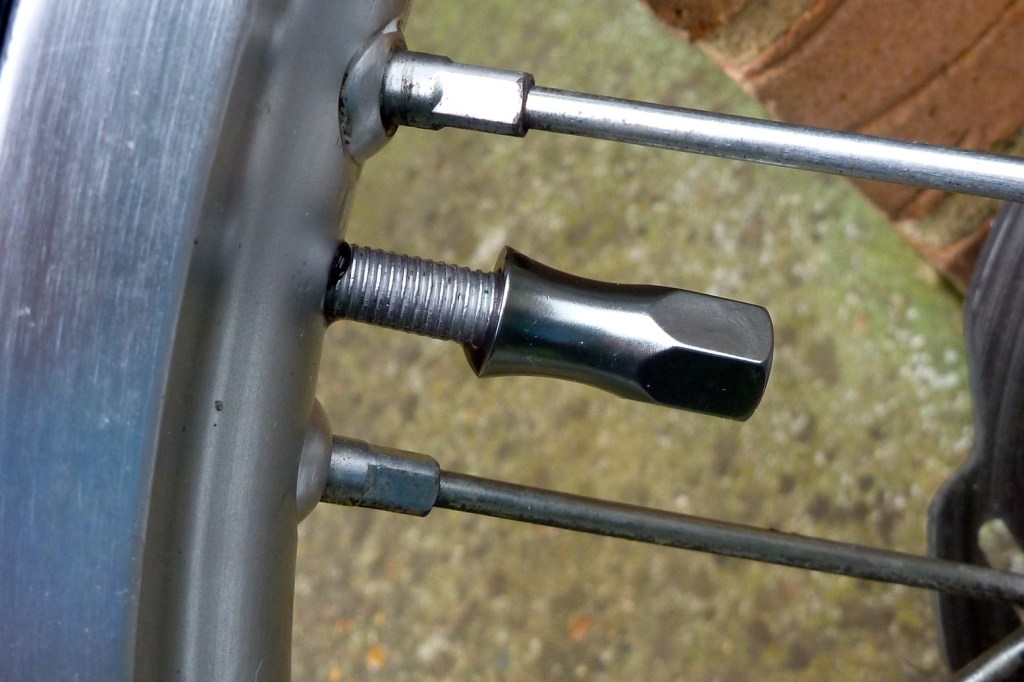
I’ve also added a dinky Motion Pro rim lock on the back which weighs next to nothing, but will hopefully bite when the need arises. I can’t see me running pressures low enough where the scant torque of a WR250 will be able to pull the tyre round the rim. The whole point of running knobblies like the MC23s is – away from deep sand plains and dunes – you will get great grip on the dirt without the need to run them at 1 bar and risk flats.

wrr-fandr
flyandride

And that is that. The rest of the adaptions are here. The bike is on its way to Malaga in a Fly and Ride artic which, at £595 return, actually works out quicker and cheaper than a ferry-and-Spain crossing.

fj12

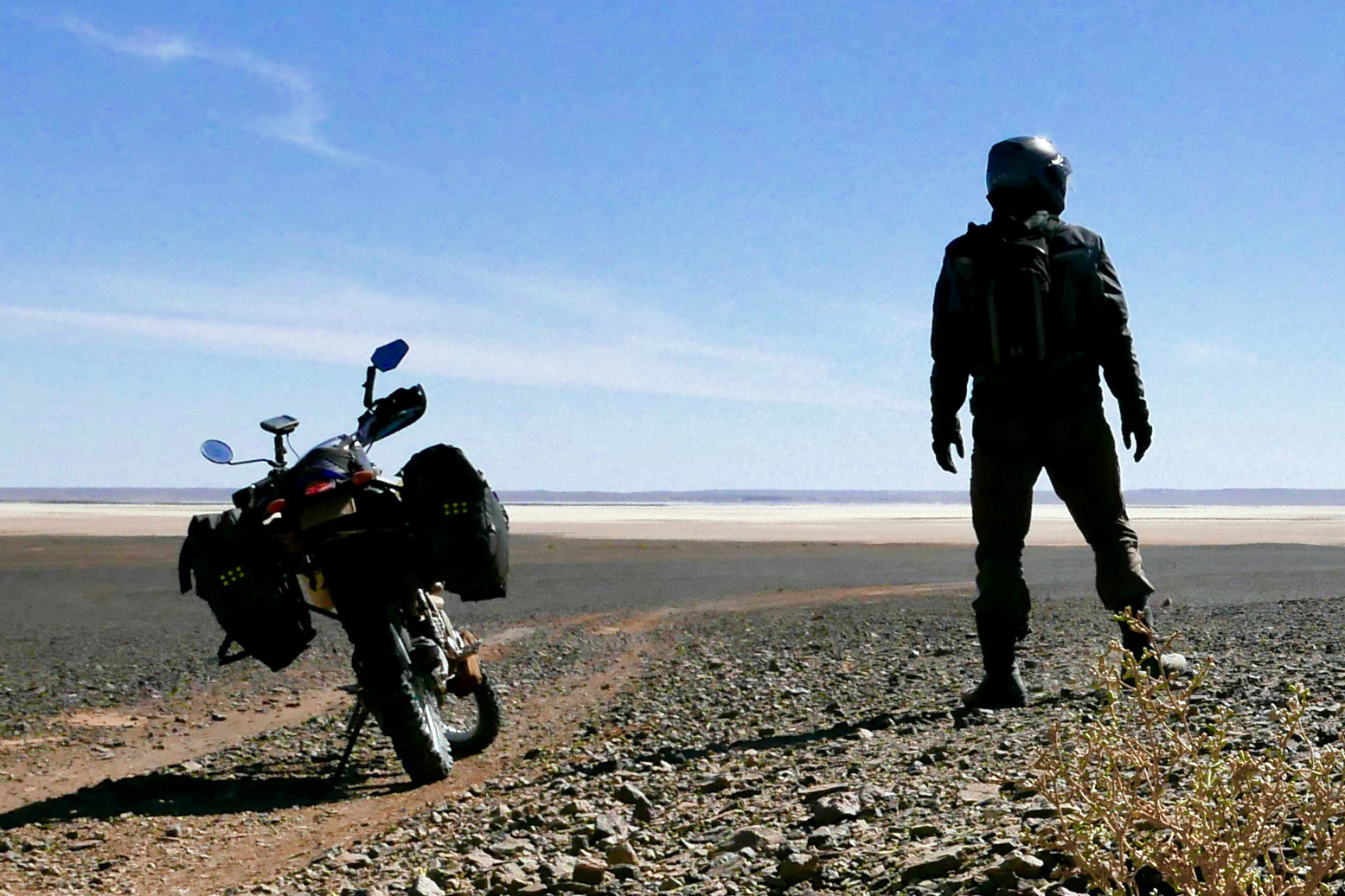
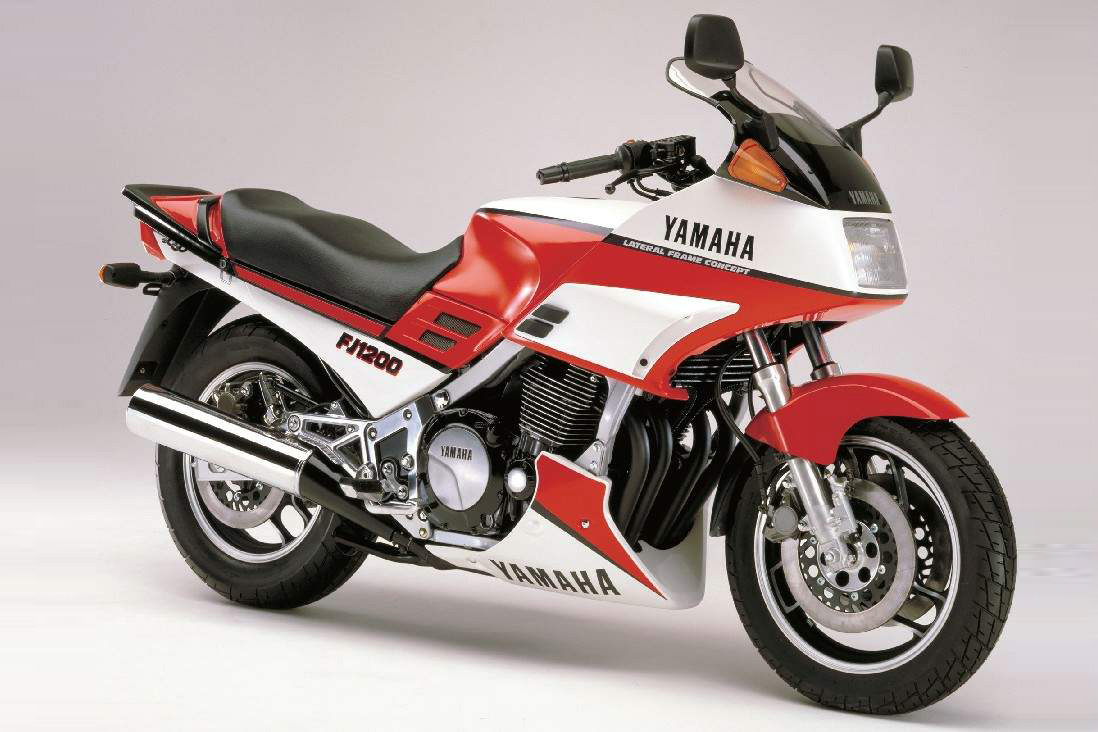
I readily admit the WR is no FJ12 on the open road and makes you feel a bit vulnerable dicing with fast European highway traffic – but then again it won’t be an FJ12 on rough backroads or the pistes either. So far I have a good feeling about the untried WR-R: I love the lightness and the better than average poke for a 250, along with great mpg and desert-ready suspension and tyres. But of course, I’ll miss the comfort of last year’s La Mancha-munching CB500X. What we have here is a specialised, lightweight desert touring bike.
Stick around to see how the WR performs in Morocco and, if it behaves, in Western Sahara too.

wrr-wrr

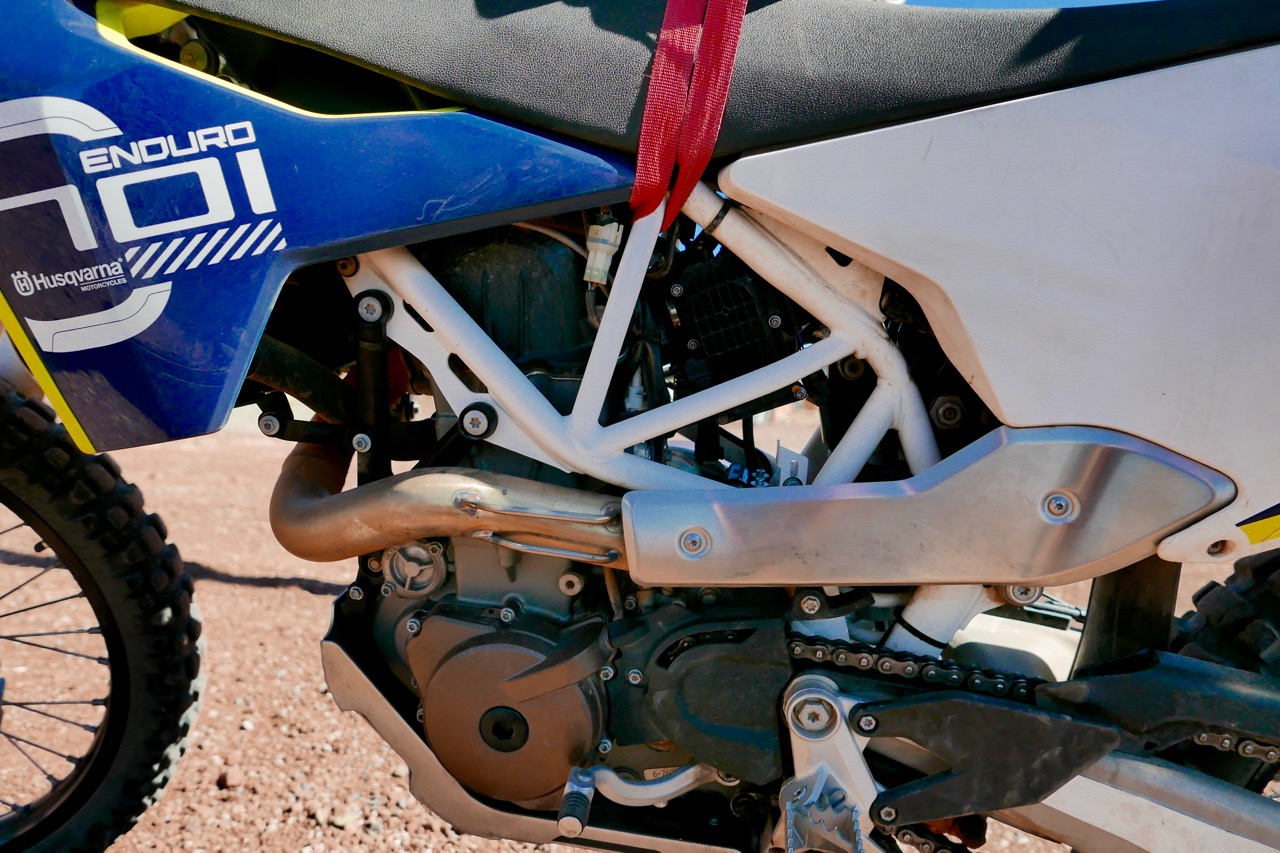
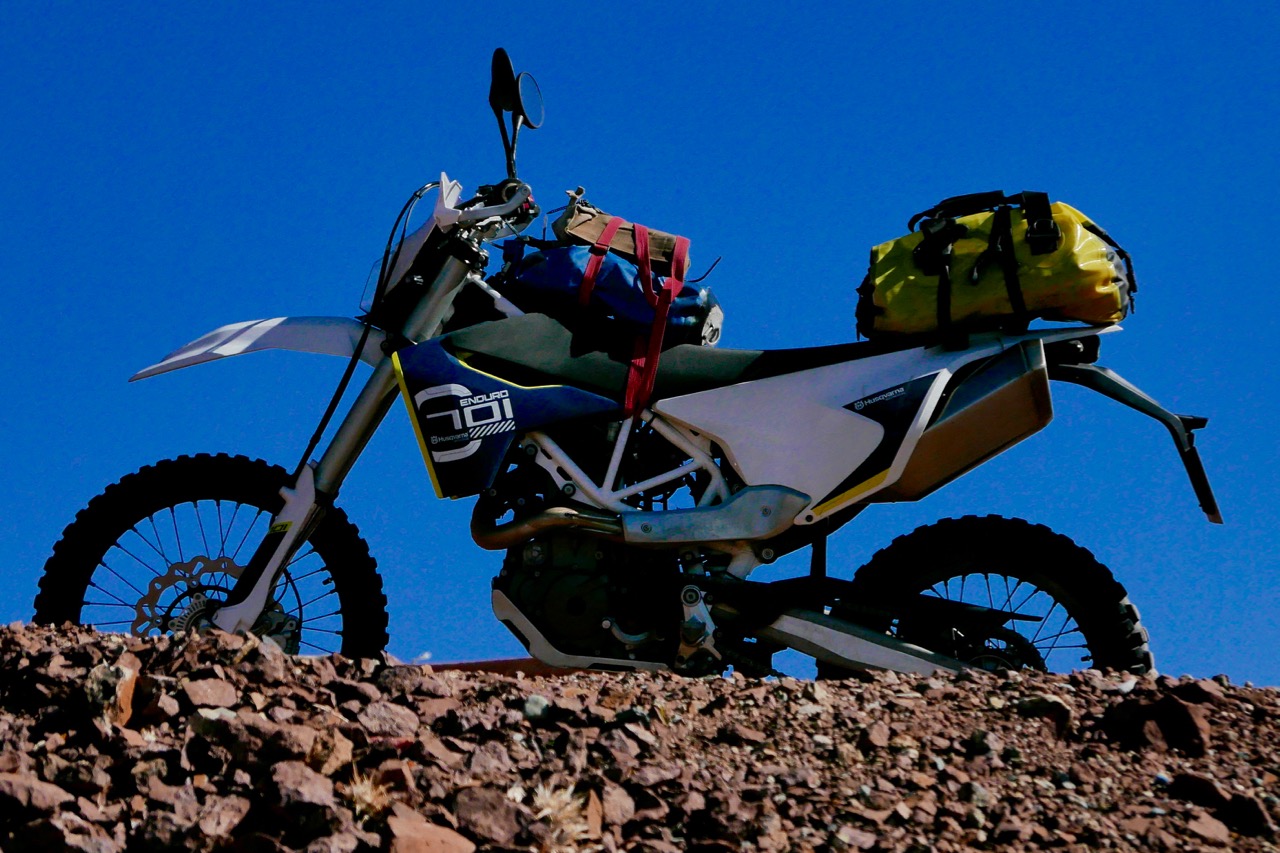
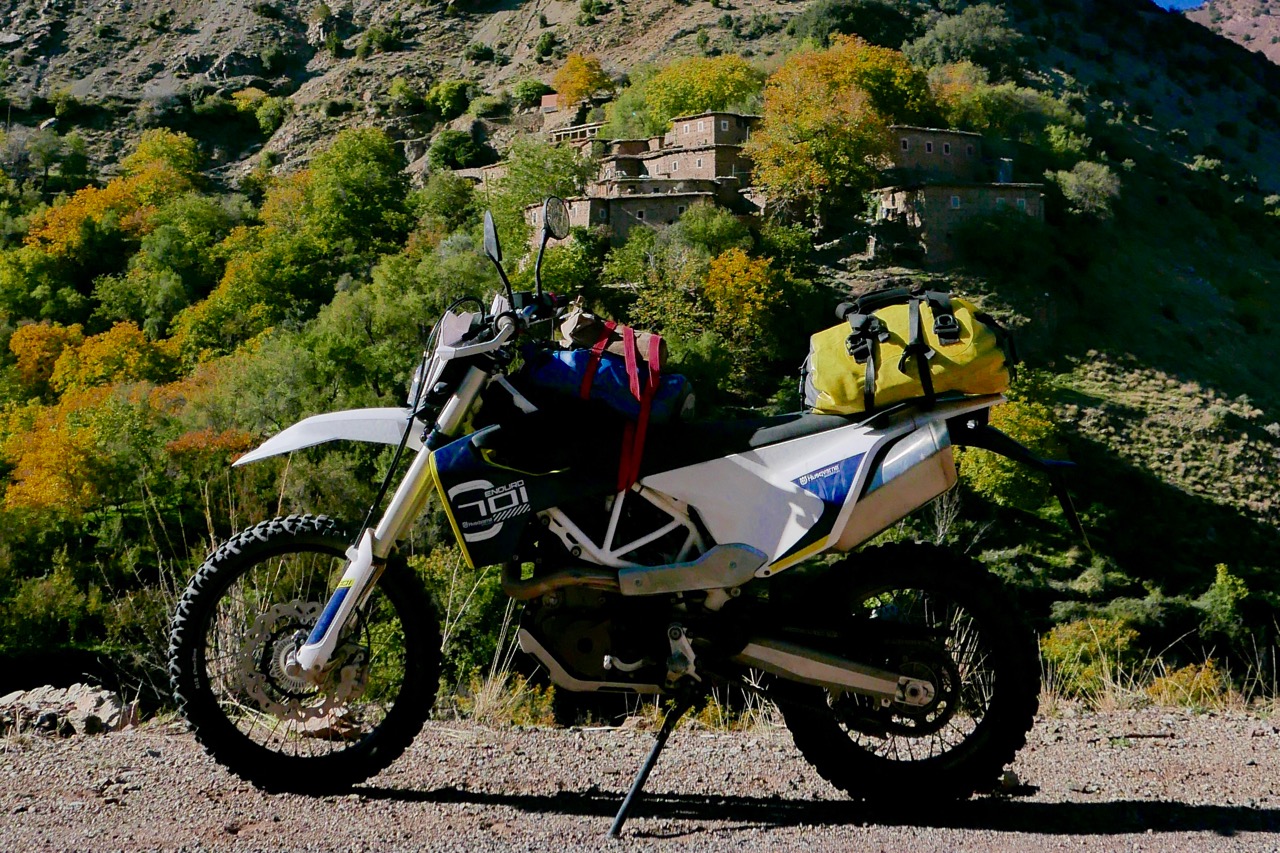
Tested: a week on a Husqvarna 701 review

husk-2
husk-6

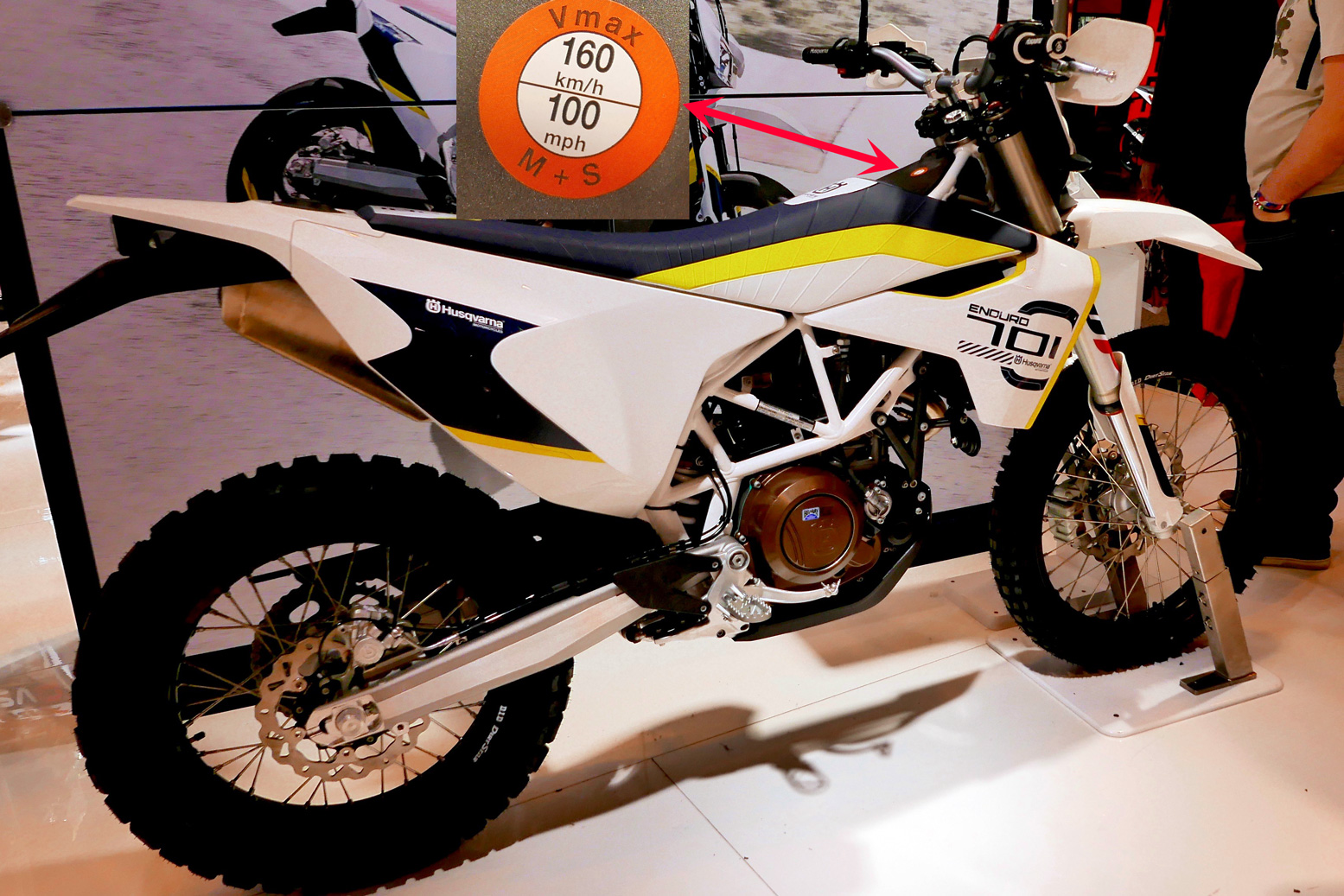
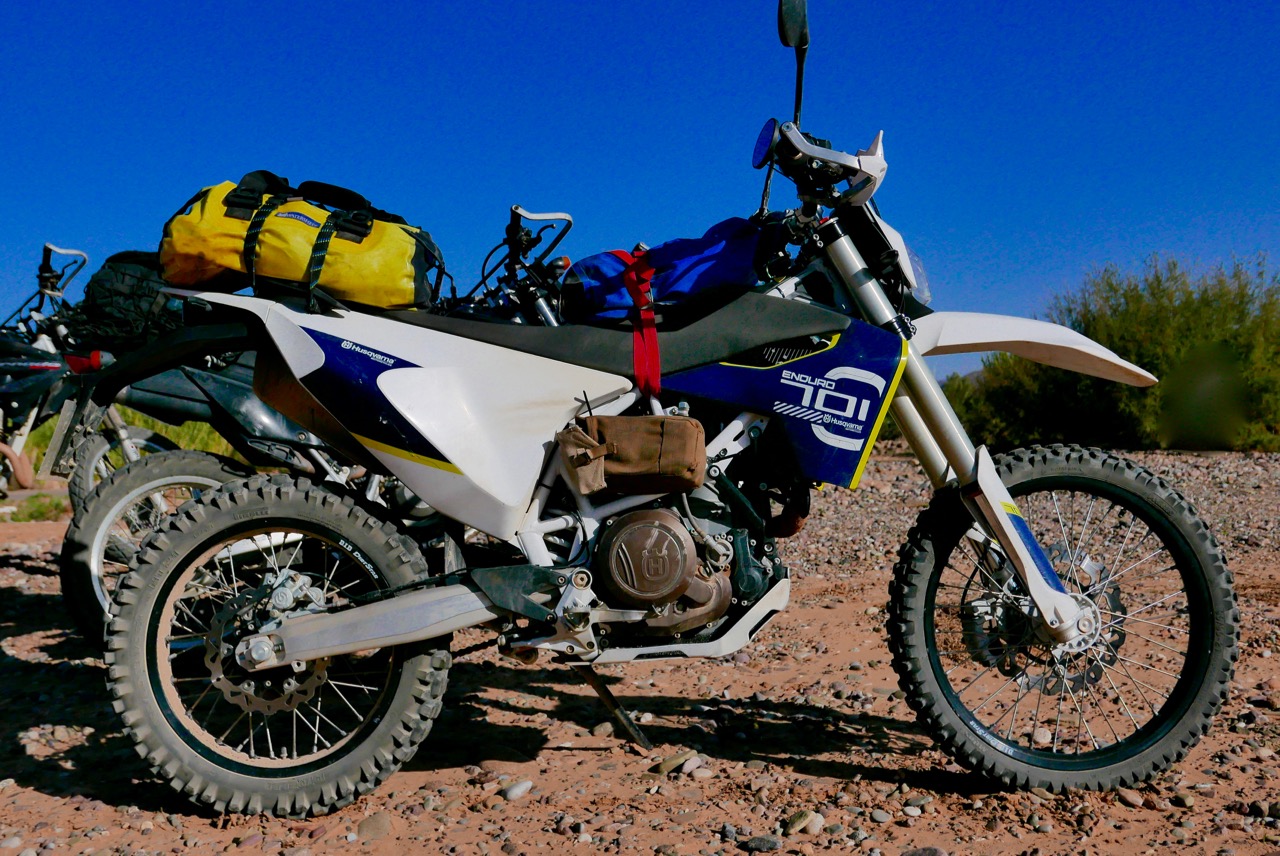
The first generation Husky 701 was a slightly toned down KTM 690: a bit less power, less fierce delivery and less suspension travel with different settings – but still plenty to be getting on with.
Until the old Husky TE 610-engined  SWMs, AJP PR7 and CCM GP450-replacement catch on, currently there’s nothing much like these two bikes since BMW’s Xchallenge was dropped in 2009. The short-lived Husky Terra and ancient XR650Ls and DR650s don’t compare. The 690/701s are hardcore, dirt thumpers where light weight (146kg dry) and performance trounce the comfort and equipment of your typical Tenere or KLR sofas, while still delivering excellent economy and RTW-usable service intervals.

Quick stats

  • 67hp with 3 maps + bad fuel map
  • 146kg dry
  • 10,000km oil changes
  • 36.6” / 927mm claimed seat height
  • 13 litre tank (~390km possible range)
  • ABS disengageable at the rear (or altogether with a widget)
  • 18/21-inch wheels
  • 2016 model £8000 / US$11,300 (or about two XR650Ls)
  • The 2017s are more powerful and much smoother.

tik
  • husk-4Quiet pipe and motor
  • Impression of quality and solid build
  • Minimal transmission lash
  • Light for what it is
  • Usable low-down power
  • Smooth hydraulic clutch
  • Powerful but usable brakes
  • Great WP suspension on all but roughest trails
  • Great economy with a potential range of over 350km
  • 10,000-km oil changes
cros
husk-3
  • Vibration at >80kph
  • Seat height
  • Bit of a Picasso to look at, IMO
  • Fuel filler will be under a tail pack
  • Low-speed ABS gave me a fright, but it’s switchable

Husky’s 701 proves you can have nearly all your cake and eat it. It must be the lightest road-ready big thumper around, while not compromising on great suspension, brakes and response that can be mellow or a blast, depending on your mood or needs.

husk-7
OLYMPUS DIGITAL CAMERA

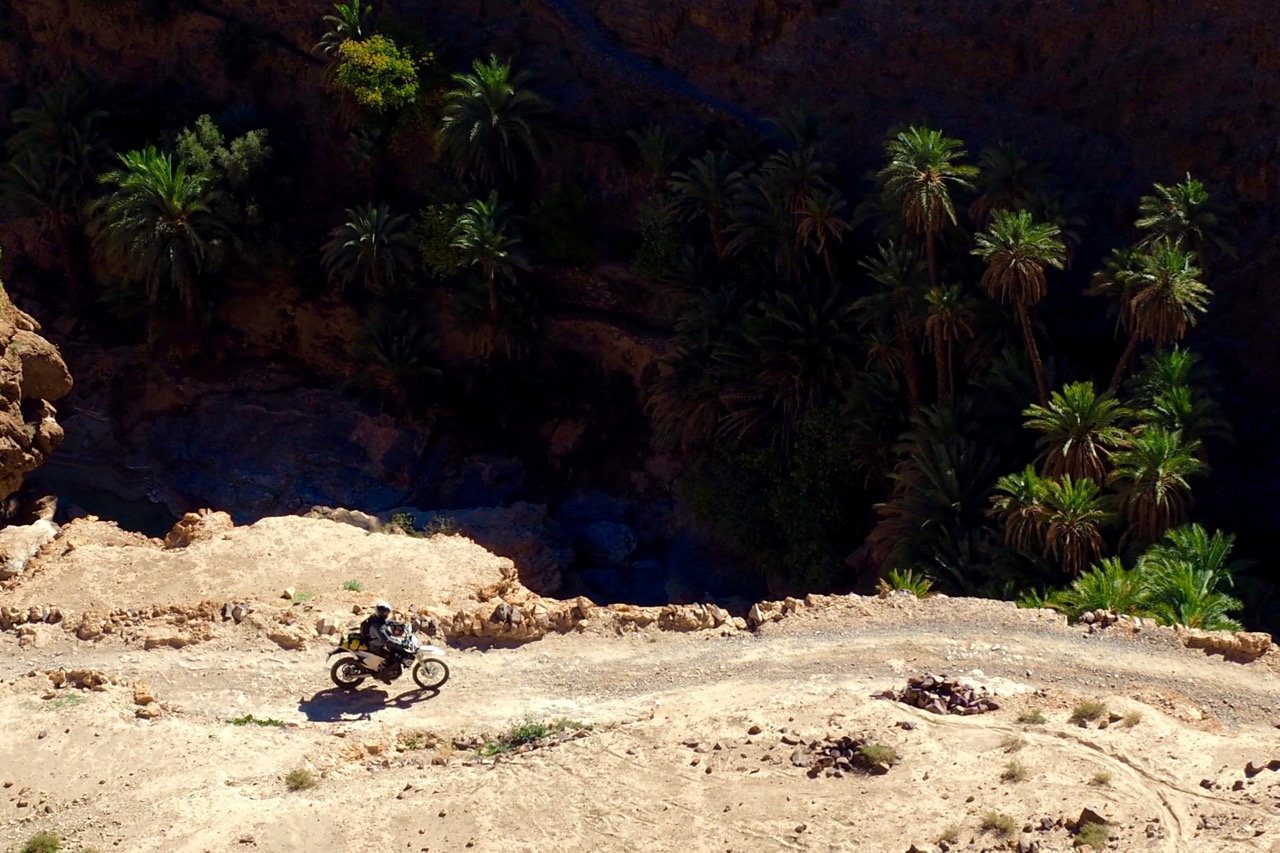
I’ve been curious to try out the 701 or its KTM cousin, and had a chance to rent one while on one of my Morocco tours. Although the trails we ride are easy enough, I was expecting it to be a handful, based on a short 690 ride a few weeks earlier.
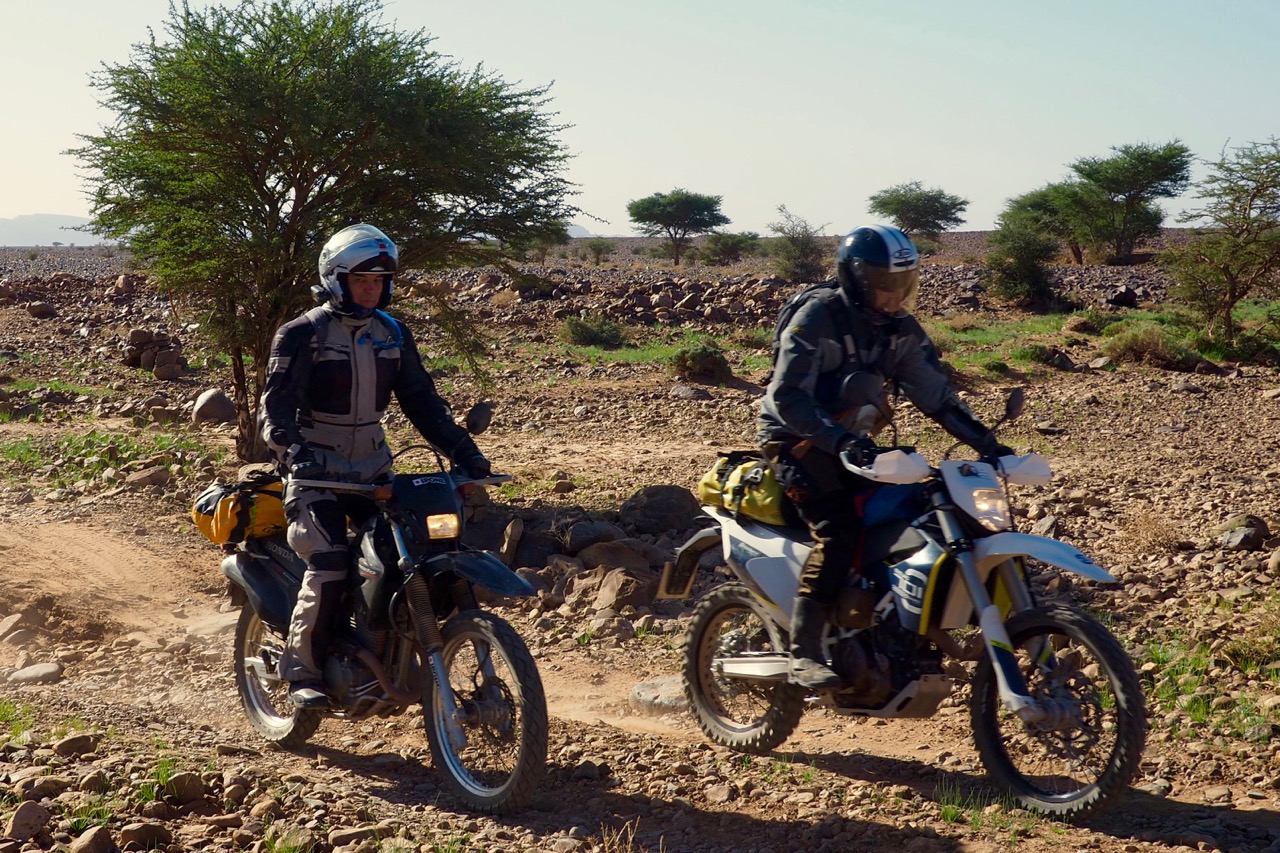
In fact, once I got accustomed to the knobblies on the road (worn MT21 rear, Mitas Rockrider front) the 701 surprised me by being very manageable both there and on the trail. The thing would happily plod along at XR250 speeds (the bikes I rode with) without any impression it was straining at the leash. The suspension took it all in its stride and the brakes required no more finesse than you’d apply to any big thumper on the dirt.

husk-1

The engine was torquey and felt much less harsh than what I recall of my BMW XCountry (some 10kg heavier with 20% less power). Like most modern, lean-burning engines it runs hot – the fan kicked in while pootling along on a warm 20°C afternoon at 1800m with a strong backwind, but the fuelling remained steady. (I don’t know which of the three engine maps I was on; the softest I suspect.)

husk-switch

There’s a switch under the seat – right). Only trickling along on a virtually closed throttle did it hesitate a bit, but that never affected the riding. The hydraulic clutch never varied in feel either, the gear changes were slick and even with a cush drive in the rear hub there was a welcome absence of the transmission lash commonly found on Jap equivalents. (This bike had around 5500 rental kms on the clock.)

husk-10

When the time came, it was great to be able to blast from 100 to 130kph with confidence – a typical overtaking manoeuvre. And all this achieved while returning the high 70s mpg (27.3 kpl  – 77.3 mpgUK – 64.3 mpgUS). With the claimed 13-litre tank, that’s an very useful potential range of over 350km  when herding a bunch of feline XRs. A year later a customer rode the same bike as hard as he could to the point of crashing, and was getting about 50mpg.
This all makes it sound like a great travel bike now that the remaining Japanese thumpers: XR650L; DR650; the late XT660Z, Kawasaki KLR650 (some in production for over a quarter century) clock in at up to 200 kilos and with little more than half the Husky’s power, even if they are up to half the price.

OLYMPUS DIGITAL CAMERA

For me the fly in the ointment was vibration on the road. It may have been exaggerated by the knobblies, but you just can’t get away with it on any 690cc single banging out nearly 100hp/litre. Have I got so used to smooth bikes like 250s and Honda’s CB500X? It shocked me when I tried the 690 after riding my WR250 the other week – and it felt even worse on the 701 at over 80kph. My throttle hand was going numb, and you’d have to be in a real hurry or somehow immunised to want to sustain over 100kph for long. Softer grips might help. The seat while hard, but over a full day actually no less butt-numbing than the XRs I rode later. It’s the same on my WR – a narrow seat need not be a write off; it must be down to the foam. But when I took a well-used XR250 for a quick spin I was staggered by how smooth and cushy it was. A week earlier I rode everything the Husky managed with near equal ease and as much fun.

OLYMPUS DIGITAL CAMERA

At rest I got my toes down OK but getting your leg over the 36-inch + seat height will become a pain when you’re on the road with all your clobber and getting tired. A weekend’s trail biking might not be a bother, but travelling for weeks or months it might just get on your wick.

OLYMPUS DIGITAL CAMERA
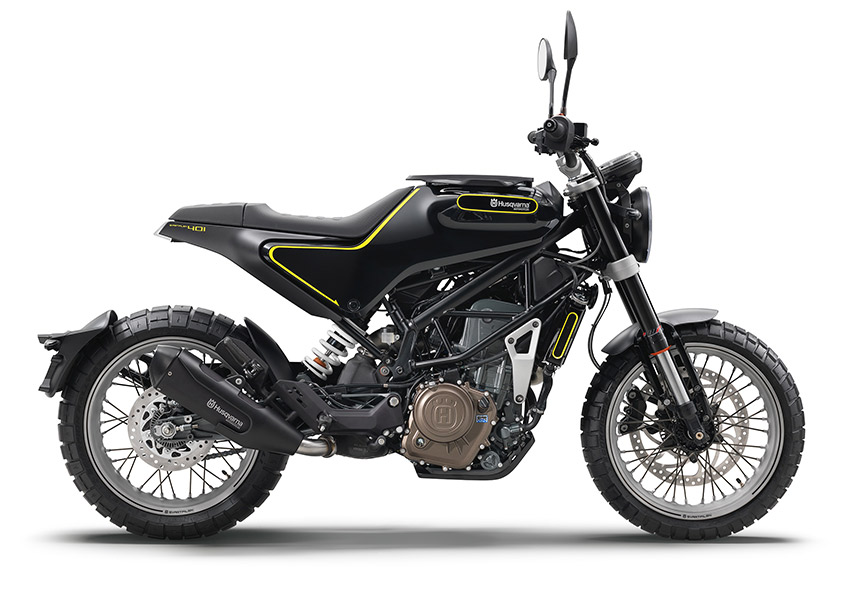
401-svartpilen-production

As a travel bike I’d say it only suits those committed to uncompromising off-road touring but even then, do you really need 67hp to manage the BAM track; the gnarliest Sahara crossing or highest Himalayan traverse? Even on some sort of semi-competitive event or rec’ riding with your mates, using it to it’s full potential, the weight – modest though it is – would soon become hard to handle.

OLYMPUS DIGITAL CAMERA
husky17

I’d be happy to lose 10-20% off that peak power if it corresponded to much less vibration and so a more usable travel machine which would still have amazing (or perhaps even better?) economy and oil change intervals with the light weight. That bike probably isn’t the SWM’s SuperDual 650X  but might be AJP’s PR7 or the forthcoming CCM GP600 – all use the old Husky red-top TE630 motor. But anyway, cushy travel bikes are not what KTM (Husky owners) do. These days it has to be all or nothing or an overweight Japanese dinosaur. Still, KTM/Husky at least prove that an economical, sub-150-kilo big thumper with a useful range and rideable engine can be produced.

A review from Dirt Rider (US).
Some pics by J-M and Y VdL
husk-16

KLX 250S – mountain and desert

• KLX250S main page
• KLX in Mohave
KLX – Baja Gallery
coutmap

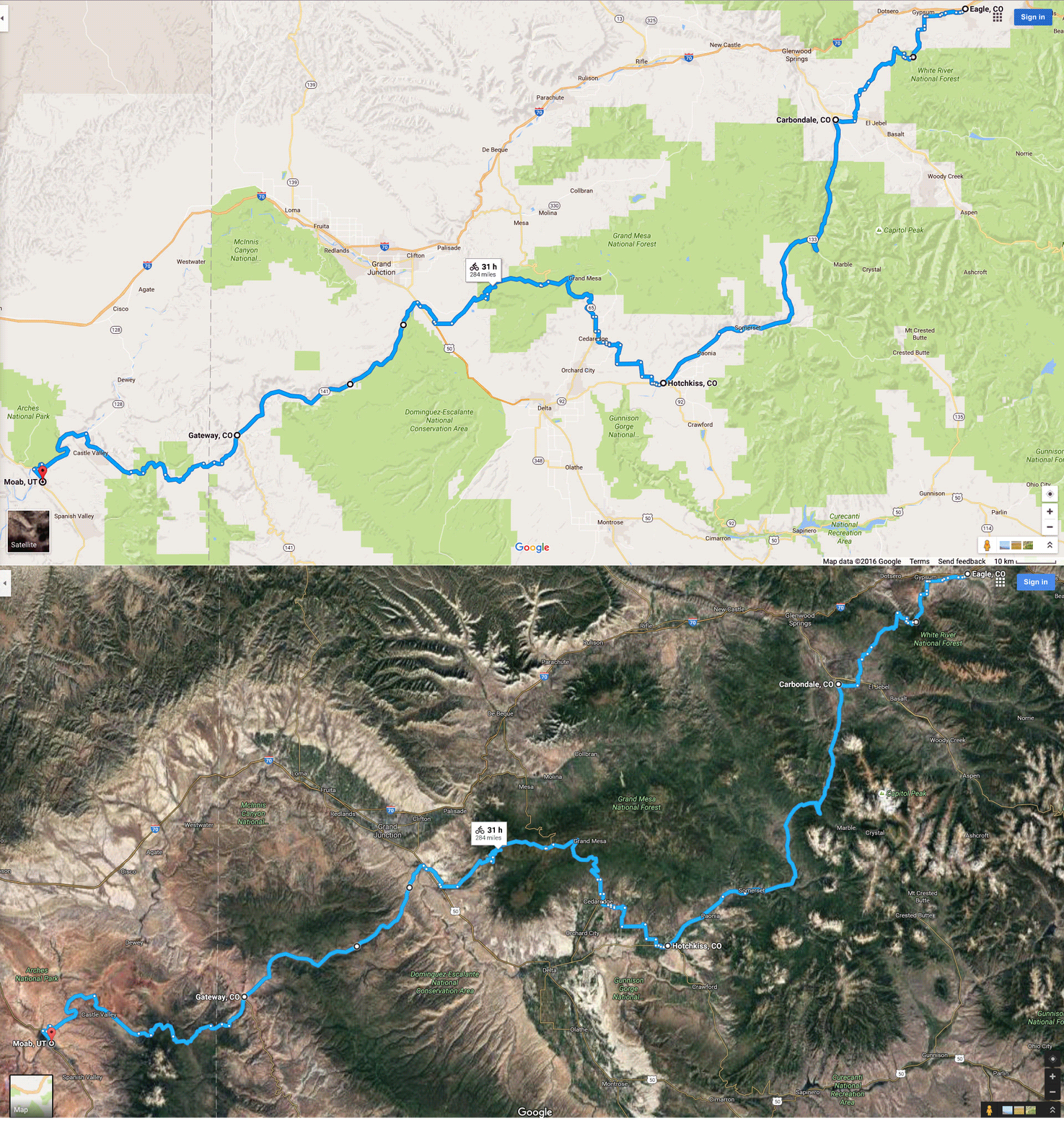
Parachute blind somewhere into SW USA, spin a bottle and head that way. Chances are in a short time you’ll be riding through epic scenery. Whether you ride road or trail, there are no bad routes out here, and over the summer I got my KLX relocated to the west Colorado to knock out the classic Rocky Mountain passes. But as it was now a bit late in the season, that plan got downsized to riding back to Phoenix via Moab, UT. It still couldn’t fail to be a great ride.

macys-logo

From Eagle, CO I’d pre-mapped a 300-mile network of backroads and trails (above left) towards the La Sal Mountain Loop just out of Moab which I did one brilliant afternoon on the CRF a few years back.
And out of Moab I could think of nothing better that riding the White Rim Trail again, then continuing down through the Lockhart Basin on the Utah BDR towards Monument Valley. from there nip over to Macy’s in Flagstaff for a snack, and it’s all downhill to baking Phoenix from there.

krigdupak

Rocking up on the outskirts of Eagle one freezing morning, the KLX’s battery was as flat as trampled roadkill. Even if it recharged, it would be a risk while riding alone en brousse, so at the quad shop downtown I fitted a new one for $35 and set off along Cottonwood Pass Road. The aspens were on the turn and shimmered when backlit by the low autumn sunshine. Maybe it wasn’t so late in the season after all?

klx-3

Annoyingly, the map tile I was on didn’t display on the Montana GPS so I was riding on the memory of the Google Map and blundering around a bit. I should have picked up a Colorado Benchmark or similar, but I was only one day in the state so would muddle through. From Carbondale, 133 lead south along a chilly valley, then switched back up the 8700-foot Ragged Mountain Pass which had the KLX down to fourth, but still plugging away at 45mph.

klx-6

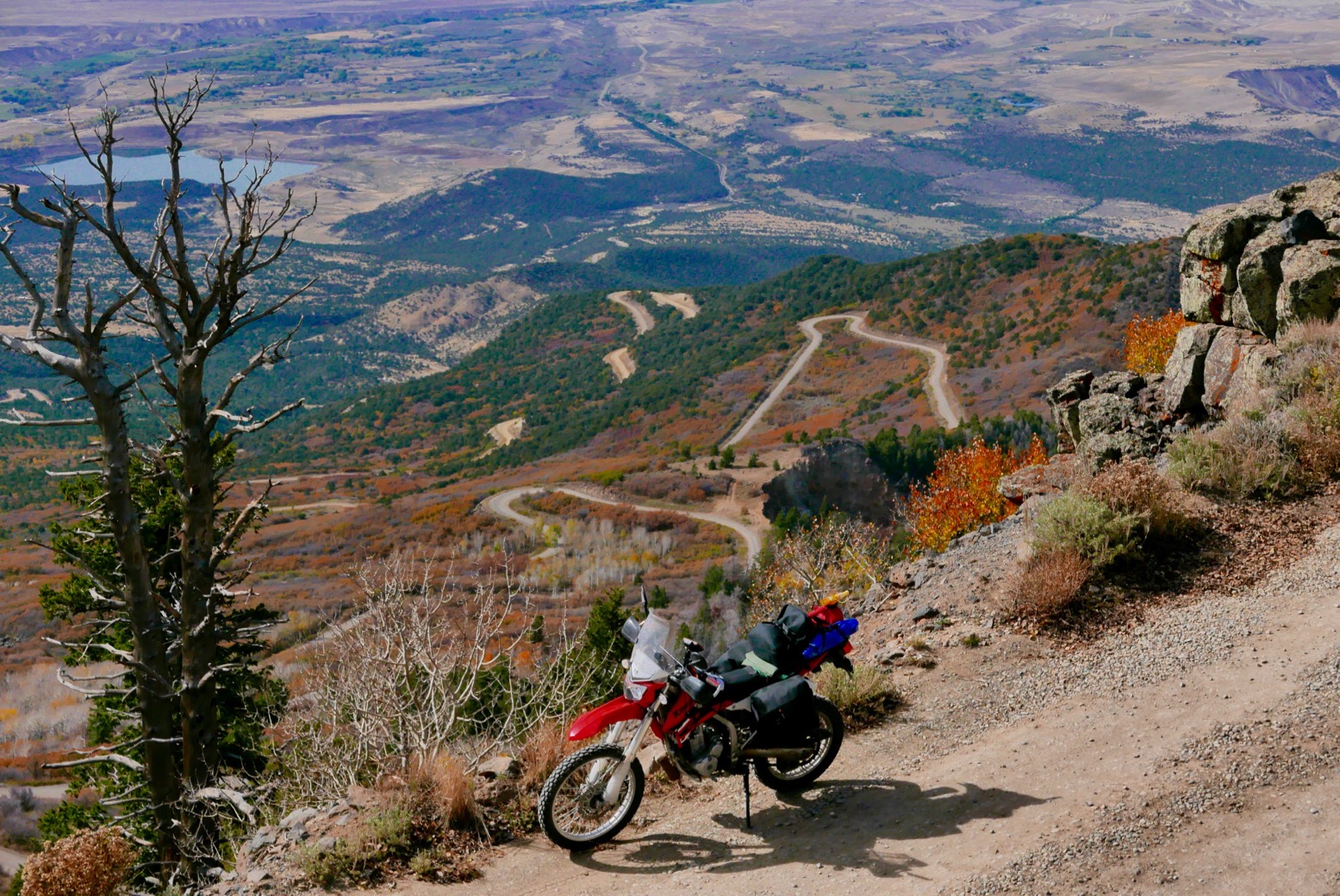
Next morning in Delta, it didn’t look like the Grand Mesa to the north was snowed-over yet, so the little 250 chugged up to nearly 11,000′ (3300m) where an easy dirt road contoured past the thin snow to the plateau’s southern rim, before dropping down spectacularly at Lands End Observatory (left). On the level at this height the KLX again managed surprisingly well, but some inclines and another few thousand feet would have had it struggling, I’m sure.

klx-8
klx-7
bedro

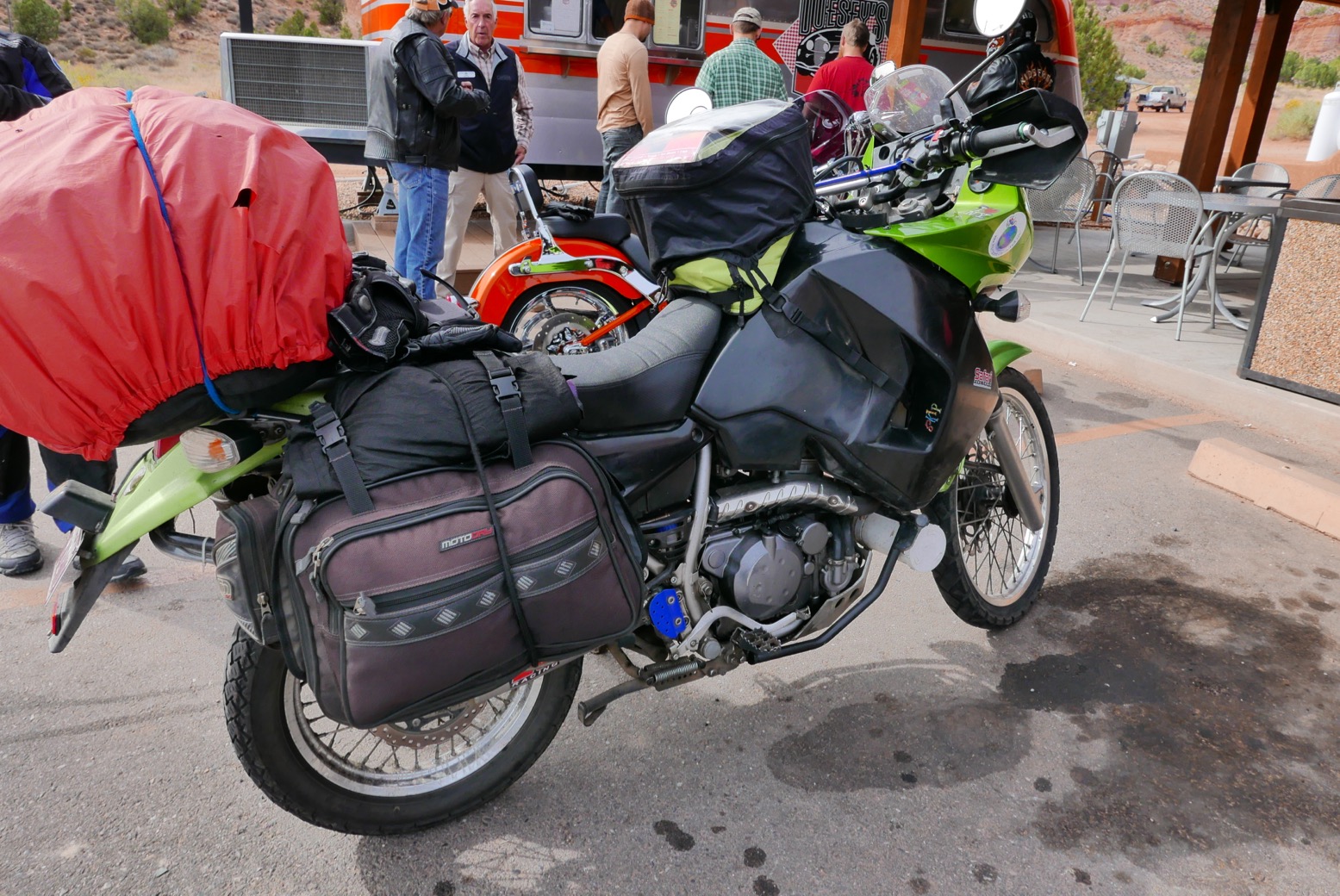
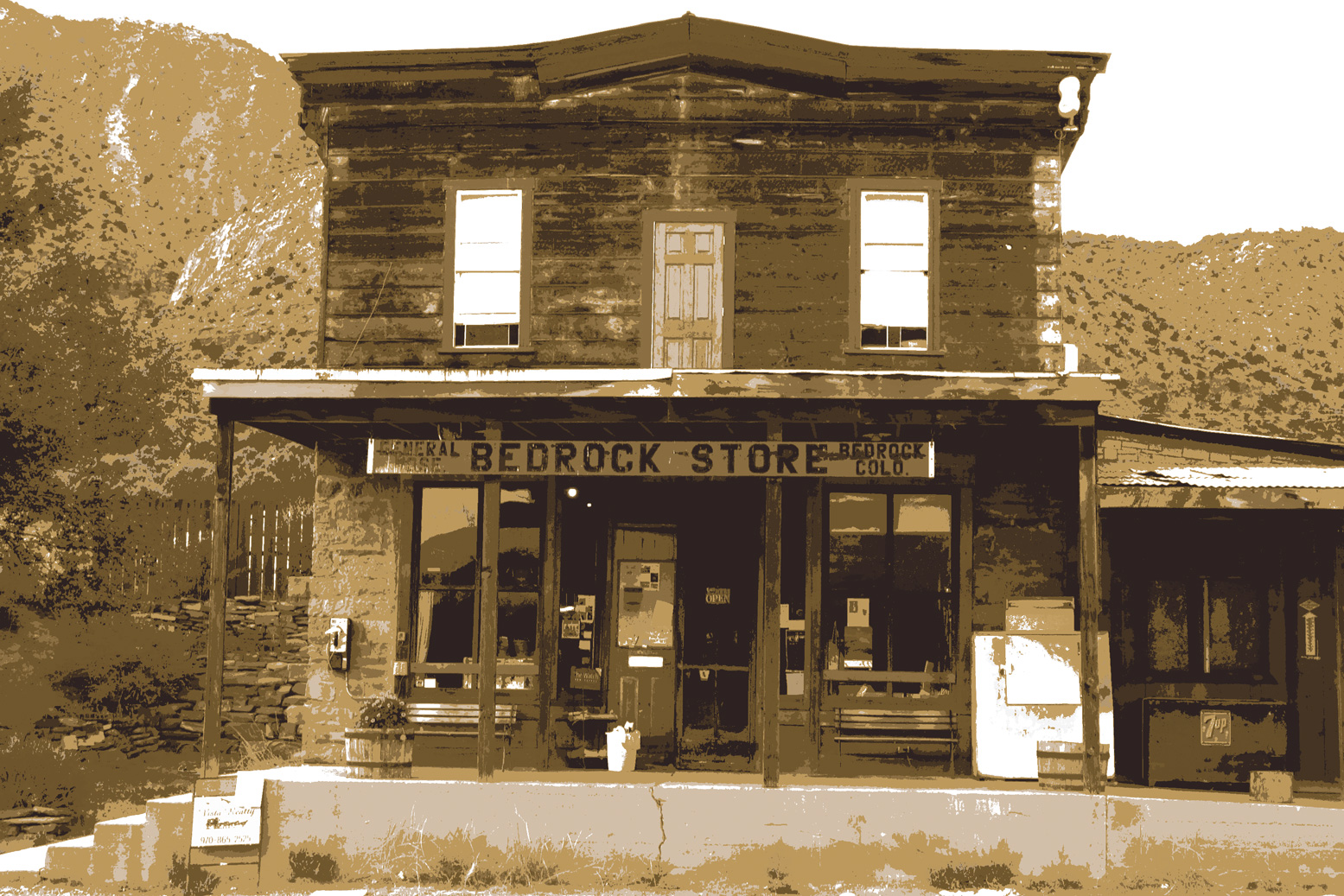
A quick blast in the slow lane up Highway 50 led to 141, apparently a well-known bikers’ road. At Gateway general store (right) there were more bikes than cars: a CB500X, MV triple, an H-D plus an intrepid Ozzie couple on a KLR (above).
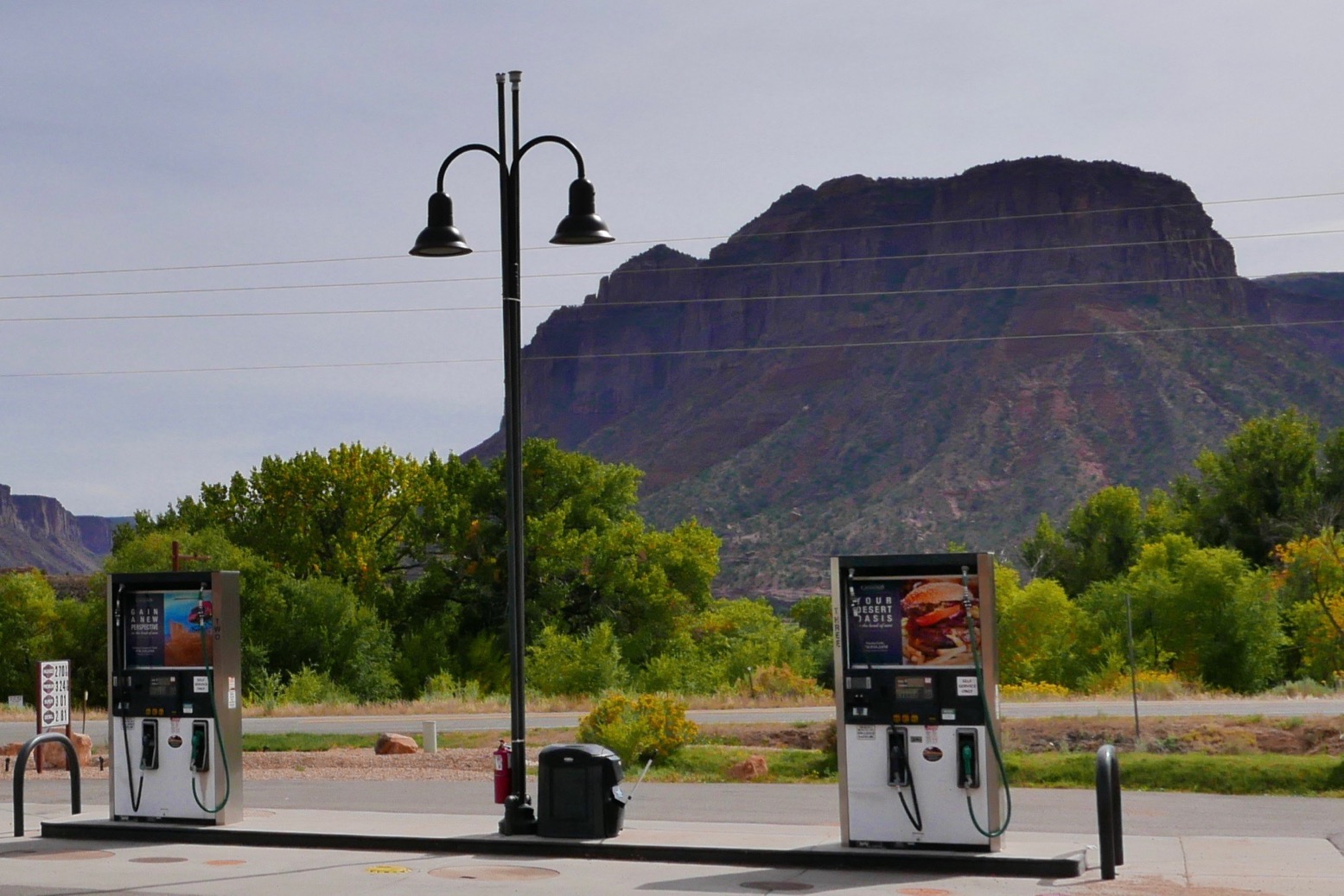
The food van here made an outstanding bacon-avocado wrap and proper chips but, as I’ve often found, the fuel in these outback places is often rough as well as expensive, even so-called 91 premium. Perhaps it sits in the tanks for too long.

liz

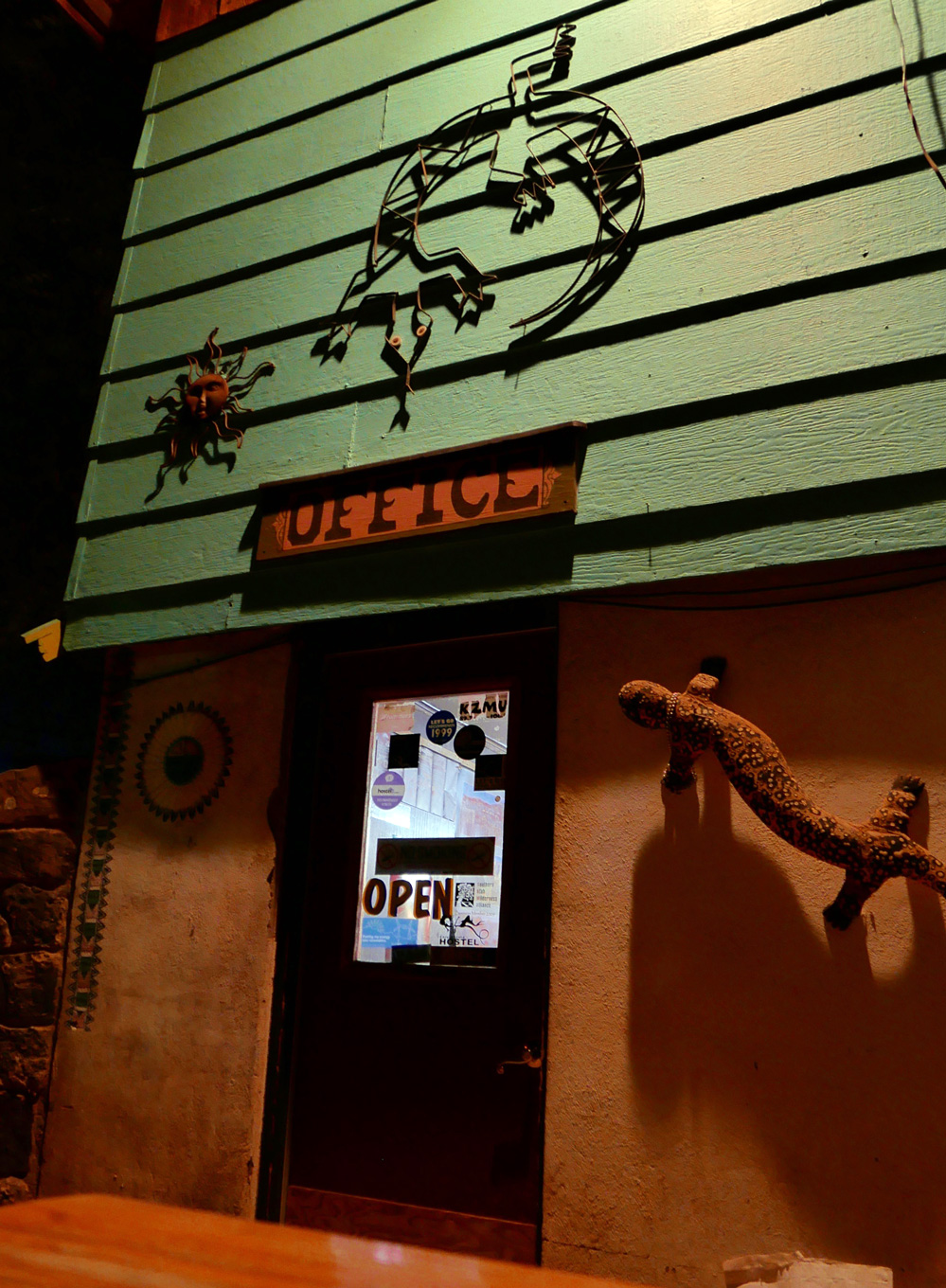
I was looking for something called 4.4 Road to connect with the La Sal Loop for Moab, but still off the map tile, I blundered up 42.10 instead. The nav felt off but it took me ten miles to admit it, and by the time I found 4.4 it was too late in the day to risk unravelling what looked like a mass of tracks to get to Moab before the slavering coyotes came out. So I carried on along the much longer 141 bikers’ road – nice, but nothing special – then swung back west via Bedrock and Paradox. Somewhere here I had a gas and lodging moment; none of either in Paradox, so I turned down the wick, slipped between some kamikaze deer while faffing again with the GPS, and rolled into Moab’s Lazy Lizard on fumes.

wrtmap

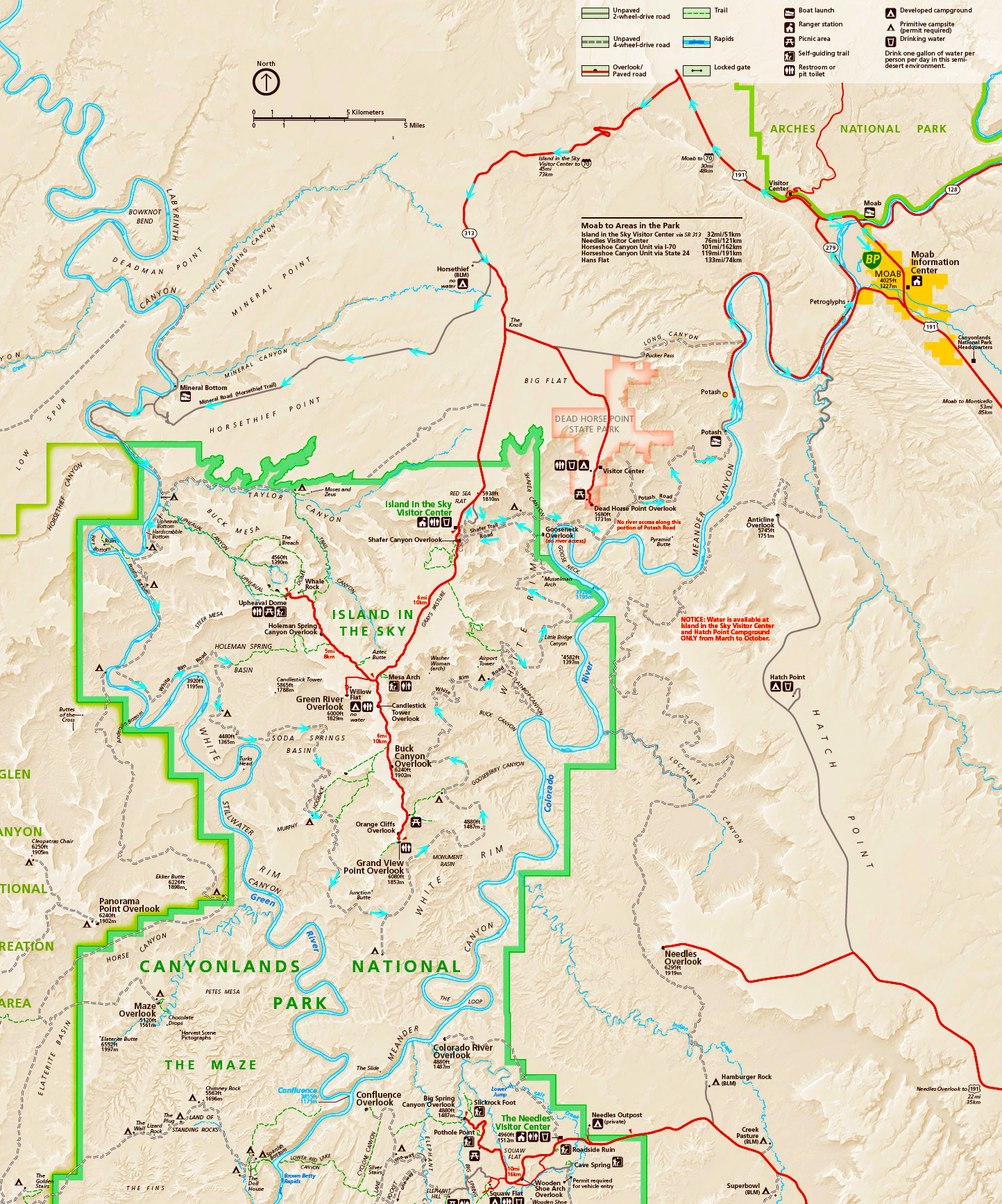
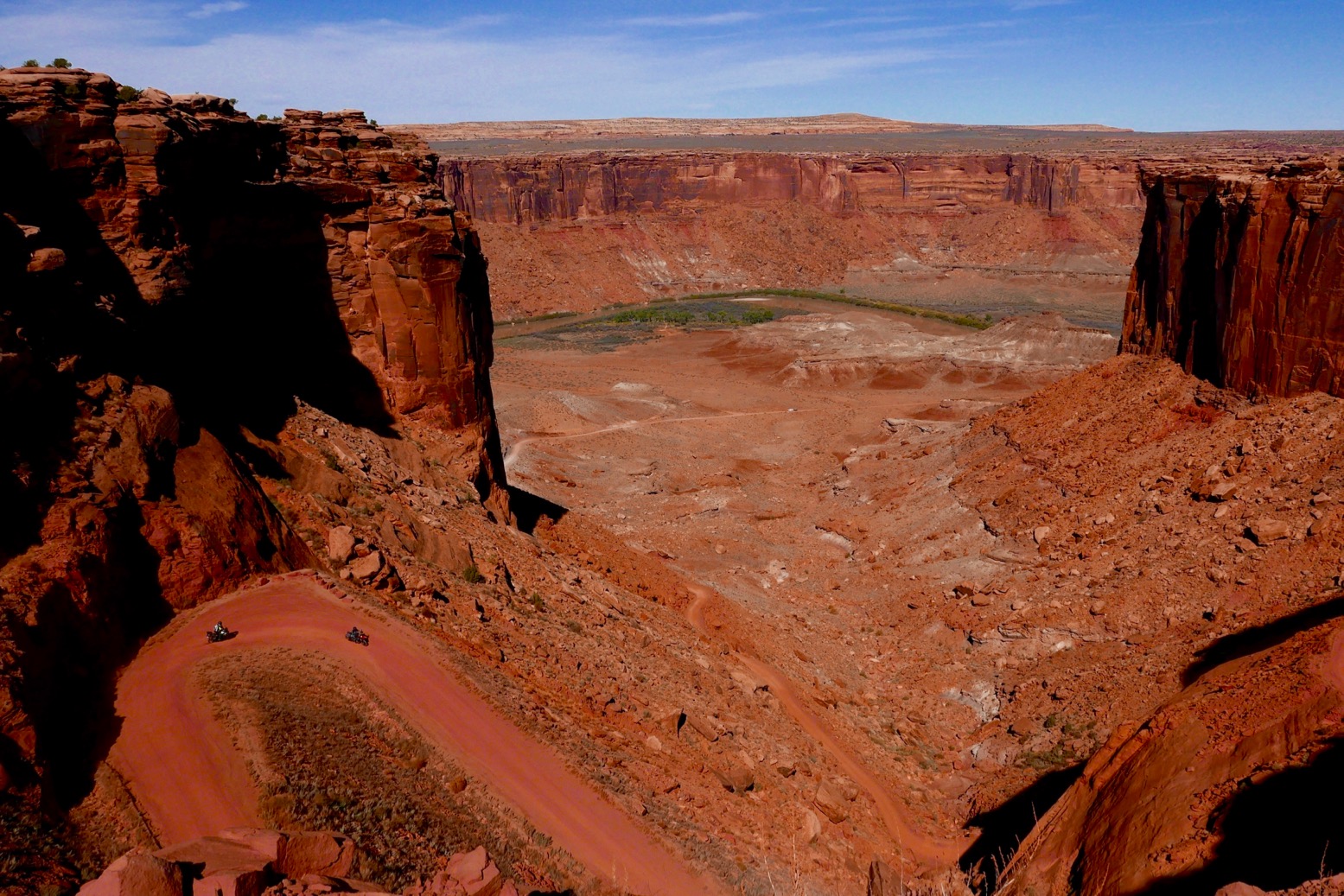
Next day I ditched the baggage and set off for the White Rim Trail, a 150-mile round trip from Moab. An old uranium prospecting road built in the 50s, half the distance is the off road and all of it is like turning the HDR setting to 11.
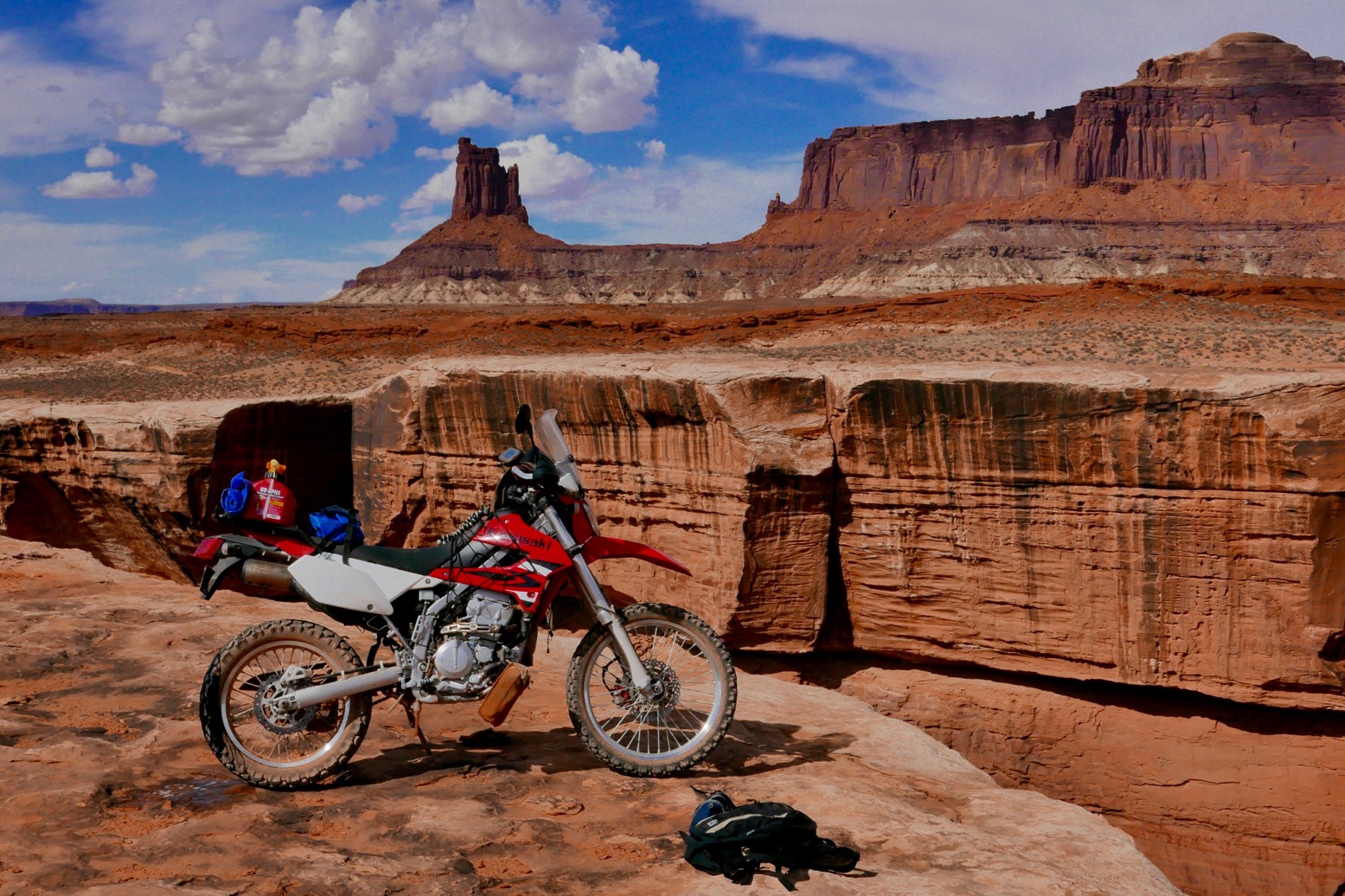
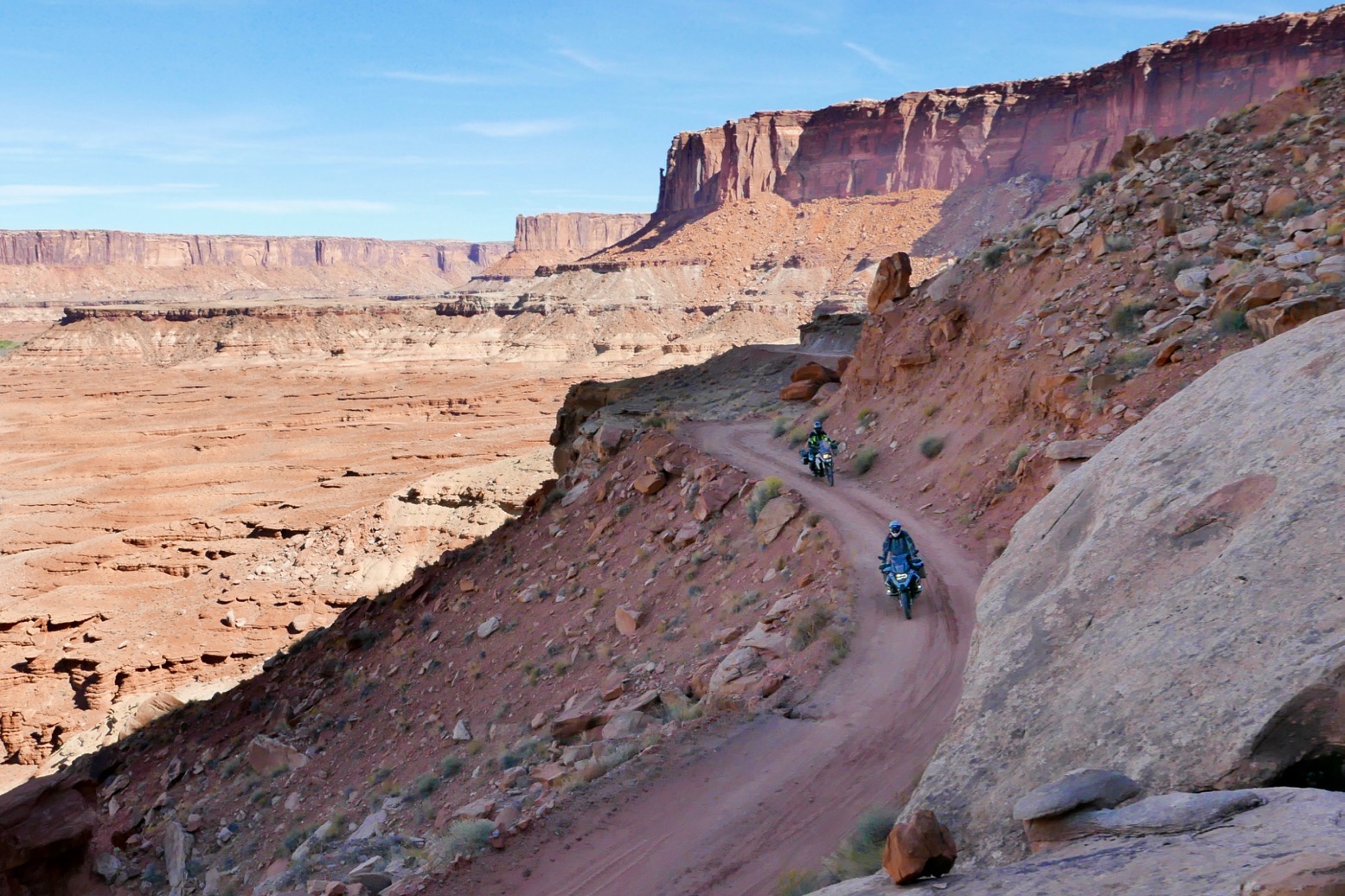
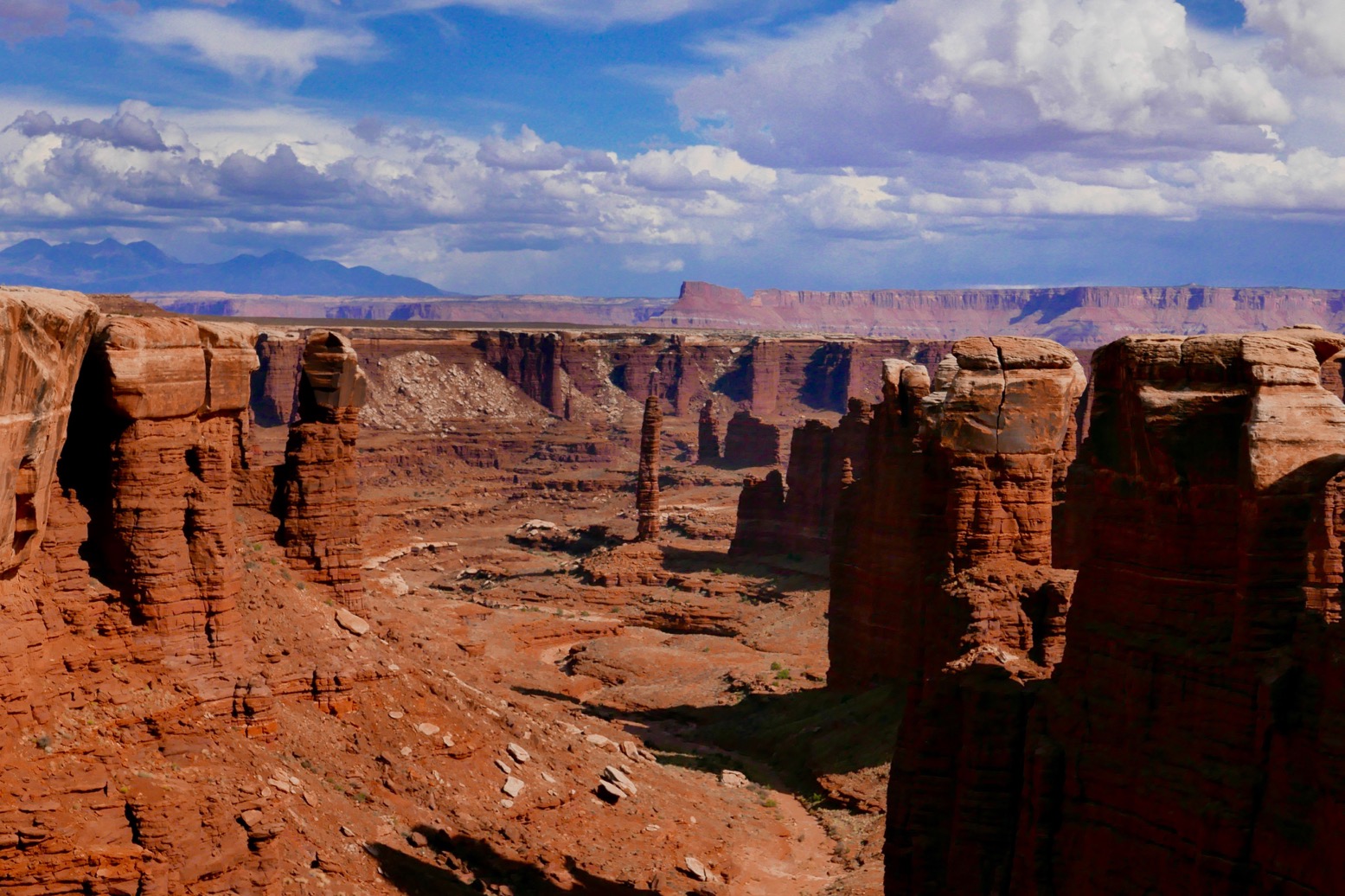
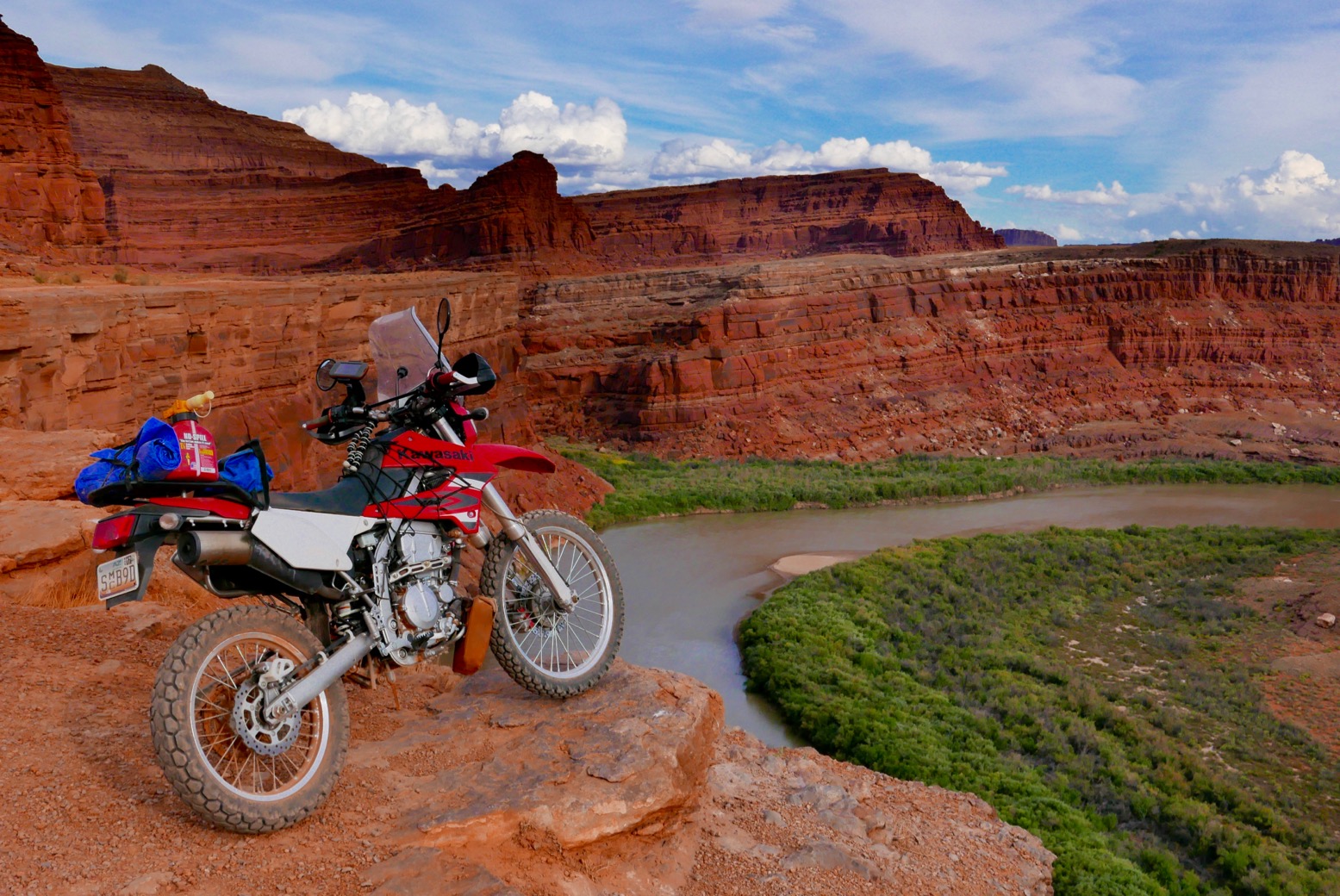
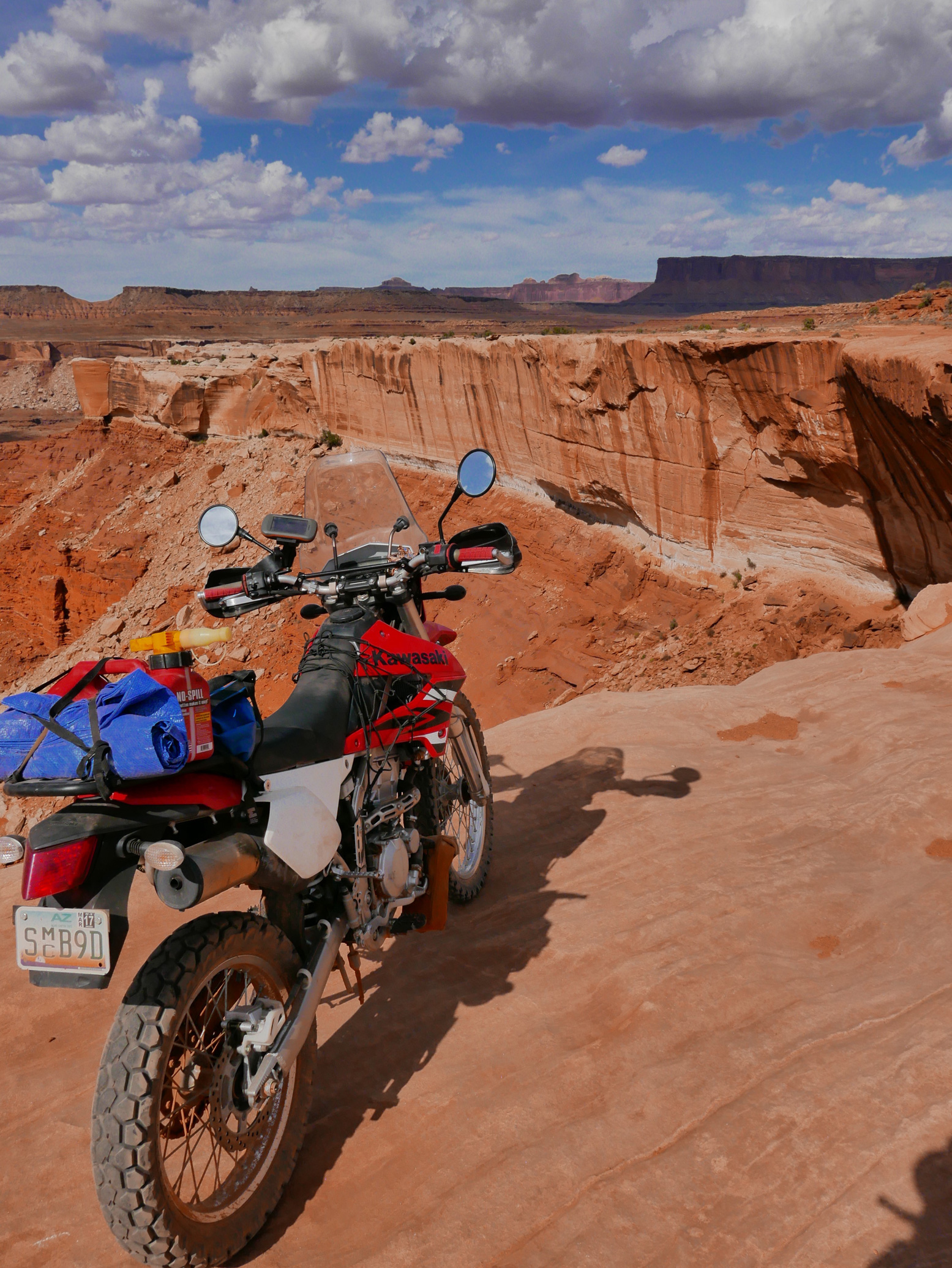
Most of the time the trail traverses a broad ‘white’ sandstone terrace – hence the name. And every once in a while the track comes right to a cliff edge with staggering vistas over eroded buttes, mesas, canyons and pencil-thin spires as far as the eye can see. And all without a single warning sign, guardrail or any signs at all. It all helps you feel you’re out in the wilds and, along with the ease of the riding, it’s the frequency of these mind-boggling outlooks that gives the WRT its well-earned reputation.

klx-15

A light trail bike can manage the WRT in about seven hours. A full-on OHV dirt bike will be faster but won’t have the fuel range – and anyway there’s a 15mph speed limit. MTBs take days or do sections with support, and 4x4s typically take two days. You can average about 25mph on a bike, which is a realistic top speed on the dirt too, depending on what you’re riding.

klx-11
klx-9

A bunch of big 800-1200 advs flew past me on the wide track heading to the start of the trail proper (right). Rather them than me, I thought, but what do I know? They could be old enduro pros looking for some exercise.

klx-12

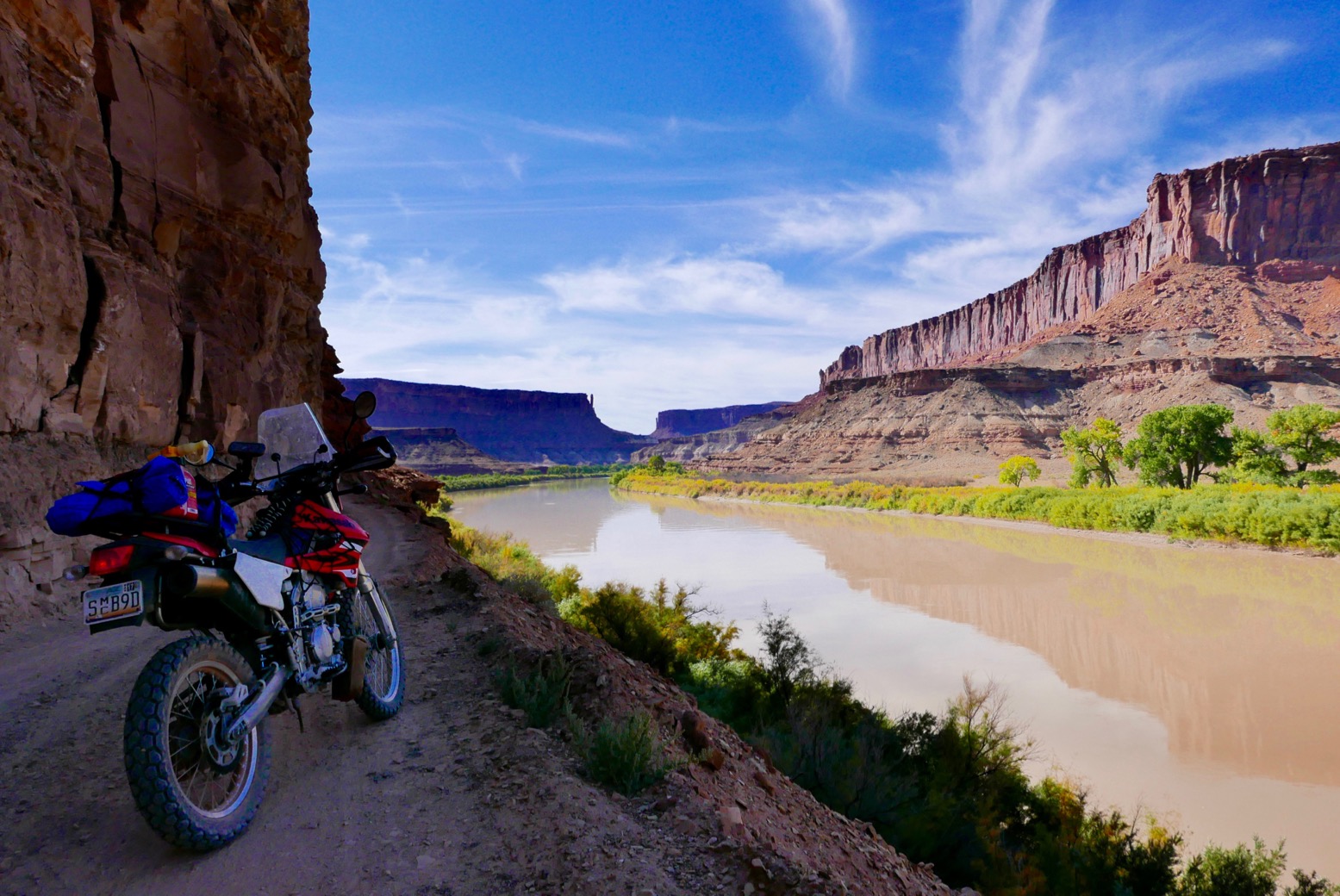
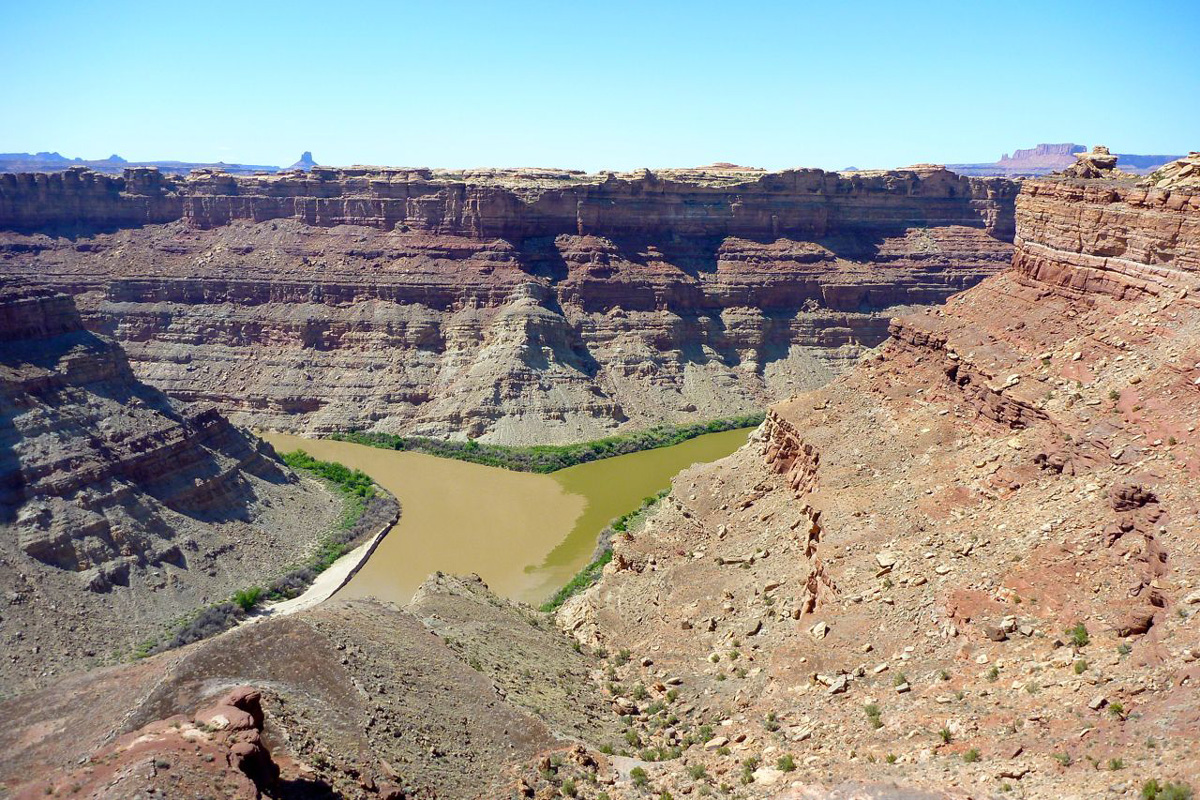
The WRT starts with a stunning switchback drop into Mineral Canyon (left) and the banks of the Green river which it then follows for a few miles (left). It was definitely sandier than when I did it one spring on the CRF-L. Perhaps summer storms wash silt down. But even at road pressures on worn trail tyres, the KLR was easy to balance in the ruts, and this felt like ‘good’ sand – more crystalline and ‘grain-locking’ so less sinky than weathered and rounded Saharan sand.

klx-13

At one point the trail climbed steeply onto a shelf, not something you want to cock up. I passed the big bike group (left), had a little chat, but never saw them again after that. Soon a steep, 4×4-gouged drop led back down to the terrace, followed by a few short sandy sections before we were back on the bedrock.
Many stunning vistas, like the one below, pass by before the other major climb and drop over Murphy’s Hogsback. The climb is easy enough providing you attack it and there’s no one in the way. The descent felt a little more thought-provoking this time round. My KLX stalled on a washed-out hairpin, but was light enough to roll down without drama. I did wonder how those big advs would manage this bit.

klx-19
klx-conflu
klx-23

By now you’re past the unseen confluence of the Green and Colorado rivers (right, on another trip) and are heading back north towards Island in the Sky – way above. This is the place where regular day-tourists congregate; down here there’s no one. Glimpses of the Colorado river appear (left), the track levels off and stays that way, often crossing bare rock. I’d have found it a cushier ride on aired-down tyres, but was prepared to suffer a little to avoid punctures.
At a junction the Shafer Grade lies straight ahead to climb 1300-feet up the cliff into national park babylon. I went up and down it last time, but it was late now, I was a bit weary and fuel was low, so I took the Potash Road back east to town via the salt works. What a great day out.

p1150982
klx-26
klx-25

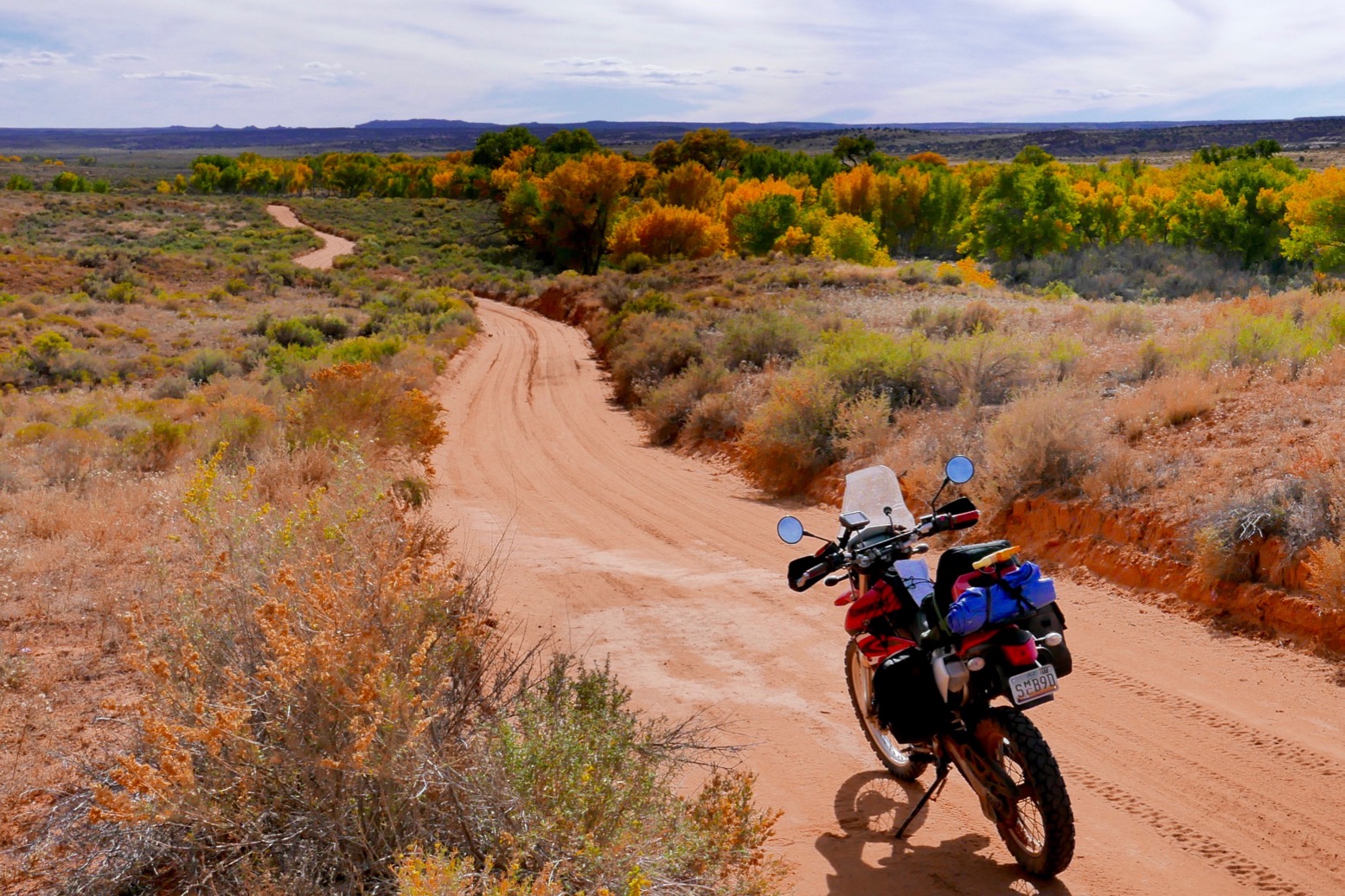
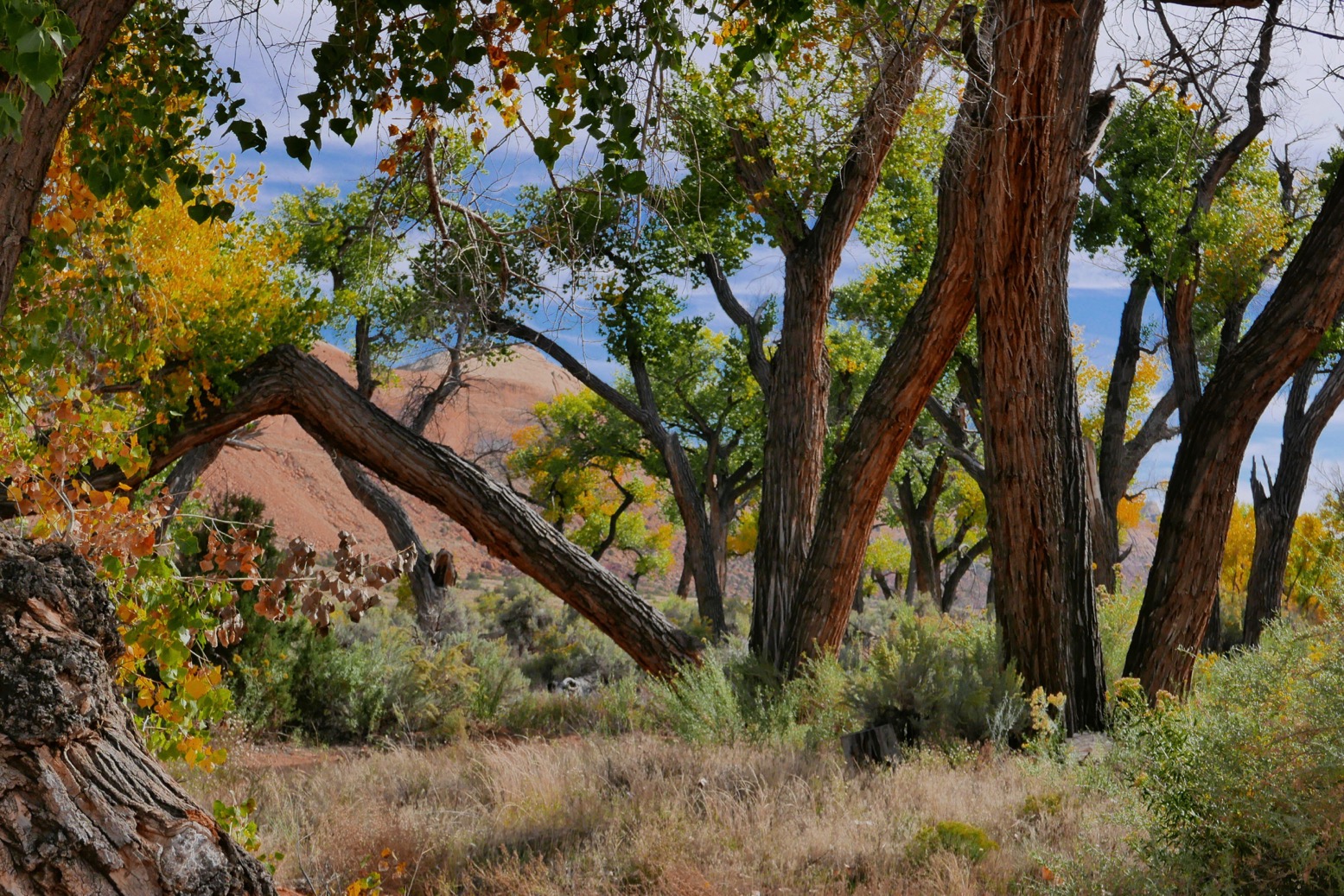
Next day the BDR trail into the Lockhart Basin was closed. Still off the tile, I didn’t have the wits to find another way round so instead road-hauled south to Blanding and worked my way towards a little sandy valley I discovered last time (left). I parked up under the rustling trees, read a bit, ate a bit, dozed a bit and moved on.
At the far end I took a ‘wrong’ turn onto the road, but it’s all good around here as long as the fuel lasts. Riding next day up to the 7000-foot rim on which Flagstaff rests, it was one final blast of cool air before rolling down into the 36-degree cauldron of Phoenix. Oil change, jet wash, pack up, fly home.

klx-28
klx-27

After 4000 miles I feel the same way about the great little KLX250 as I did following last February’s rides. Compared to the very popular CRF-L, it’s an under-rated 250 that’s almost certainly all the better in efi form sold in the Uk for years and now available in the US.

tikLight
Fully adjustable suspension
Looks good in red
Seems to run cool
crosWould prefer the efi model (now sold in US)
Seat as bad as they get, but lycra cycling shorts work wonders
Tiny tank. The biggest aftermarket tank is only 50% bigger but the same size as my $20 can
Tiresomely tall at normal height, but [mine] easy to lower
ertt.jpg