Most of the tyres compared here are what you’d call ‘street-legalknobblies’. They work fine on dry roads as long as you remember what you’re riding, but some may give you a bit of a fright if you don’t, especially in the wet.
There’s no free lunch: road-legal knobblies wear faster than Road Touring or Do-It-All 80/20 tyres – the reward is more secure grip on loose surfaces which may be more of a priority on your trip. It’s certainly less tiring to ride the dirt with tyres like this. Traction is OK on a dry road where there’s usually plenty to spare anyway, but at the cost of smoothness, noise, braking and perhaps, getting the pegs down. Up to a point modern ABS systems compensate for a knobbly’s reduced traction on road, but that won’t stop you sliding off a wet hairpin. I’d designate these tyres as 50/50 road/dirt use; they do the job on the dry highway and work better than anything else on the dirt, including sand and mud.
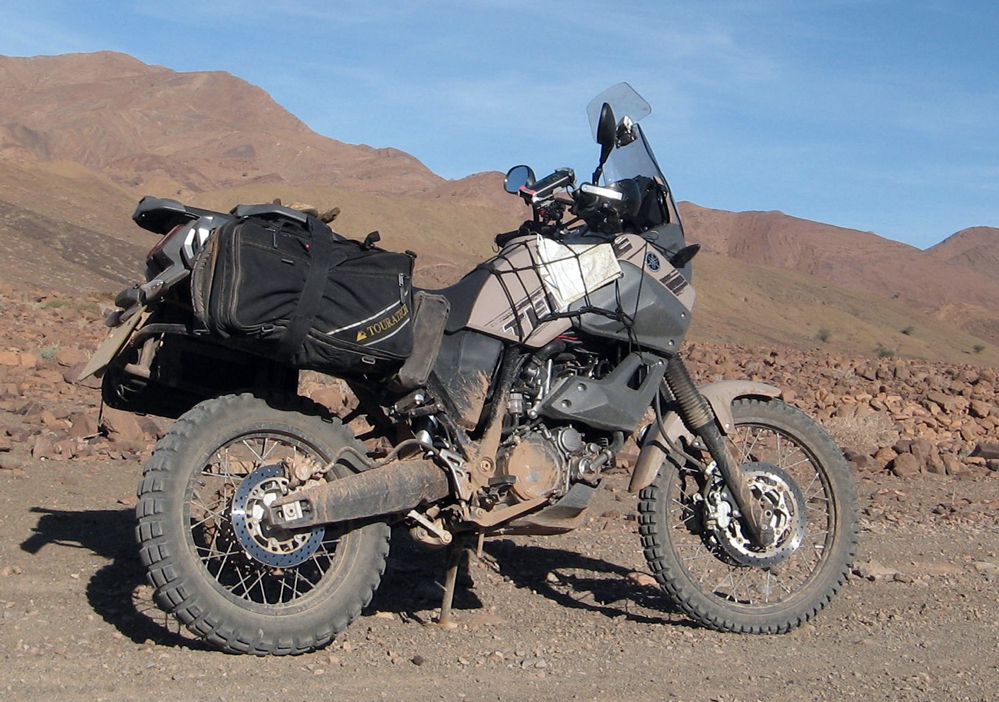
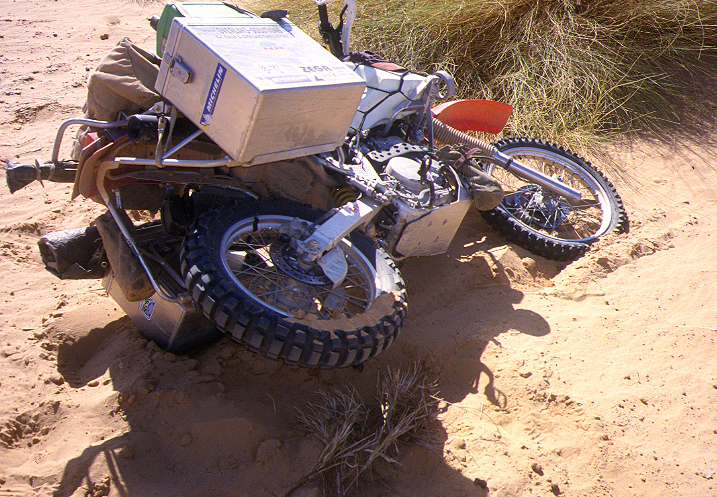
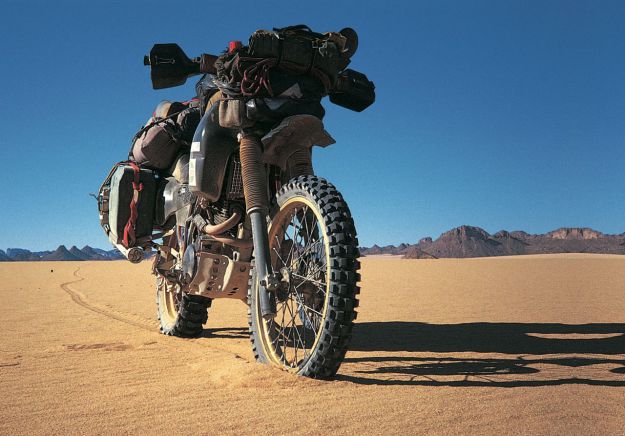
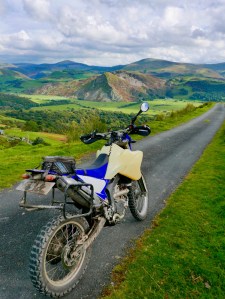
Tyres include Continental’s TKC 80 on the Tenere above, a discontinued Michelin T63 (replaced with Anakee Wild) on the fallen XRL, an original Michelin Desert on the black Tenere below.
The BMW Funduro anove has a Pirelli MT21 Rallycross which has been around since the 1980s. It’s a Mitas MC23 Rockrider on the WR250 (below left), and a Mitas E09 on the XR400 below right.
Tenere with super-stiff original Michelin Deserts. Job done (in the desert, at least)
One time I spent the weekend in Wales with my WR on its original Bridgestone TW 301/2s (left) and expected the worst. Though they were at least eight years old they managed just fine in everything except perhaps wet grassy ruts. Not a single slide in 150 miles. And with a dense knob pattern they ought to last OK and made no noise that I could hear.
There are scores more examples of full-on, balls-out, off-road racing knobblies. But on a big, loaded travel bike their aggressive tread patterns with tall, widely spaced knobs will wear very quickly on loaded edges, causing cupping on the front (uneven knob wear; below) to eventually give a horrible ride on the road, as well as gripping poorly and squirming (knob-flexing) on road bends. Knobs may even break off at high speeds when a tyre gets hot.
Africa Twin Motoz Tractionator Adv 2000 miles in and cupping under braking forces
These tyres can work on a light and low-powered bike like the CRF250L left (Maxxis Desert) but Conti’s popular TKC80 have shallow knobs for just that reason; to avoid flexing and cupping
On the left, my Yamaha XT500 travel bike in 1982, fitted with Dunlop K70 and Avon Speedmaster tyres. Both are now classed as ‘vintage’ but they got me to the Sahara and back. Fast forward a few decades past the invention of adventure motorcycling, and the tyres listed below from long-established brands are often what you’ll get fitted to a new adventure-style bike. They include:
Avon Trailrider
Bridgestone Battle Wing and some Trail Wings
Conti Trail Attack (right) and TKC70
Dunlop TrailSmart or Max (below left)
Metzeler Tourance
Michelin Anakee (Adventure)
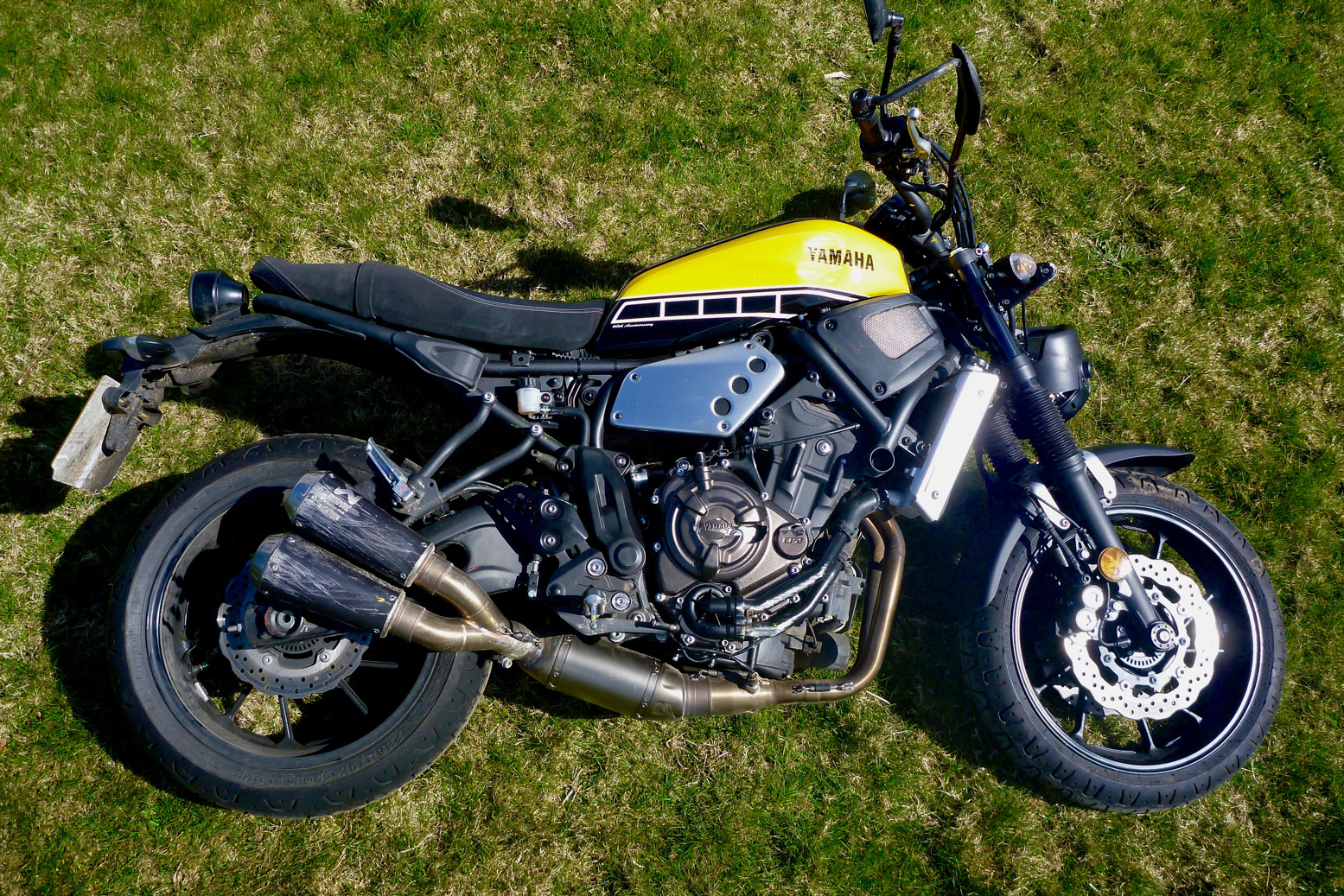
Pirelli Scorpion Trail II (yellow bike, below)
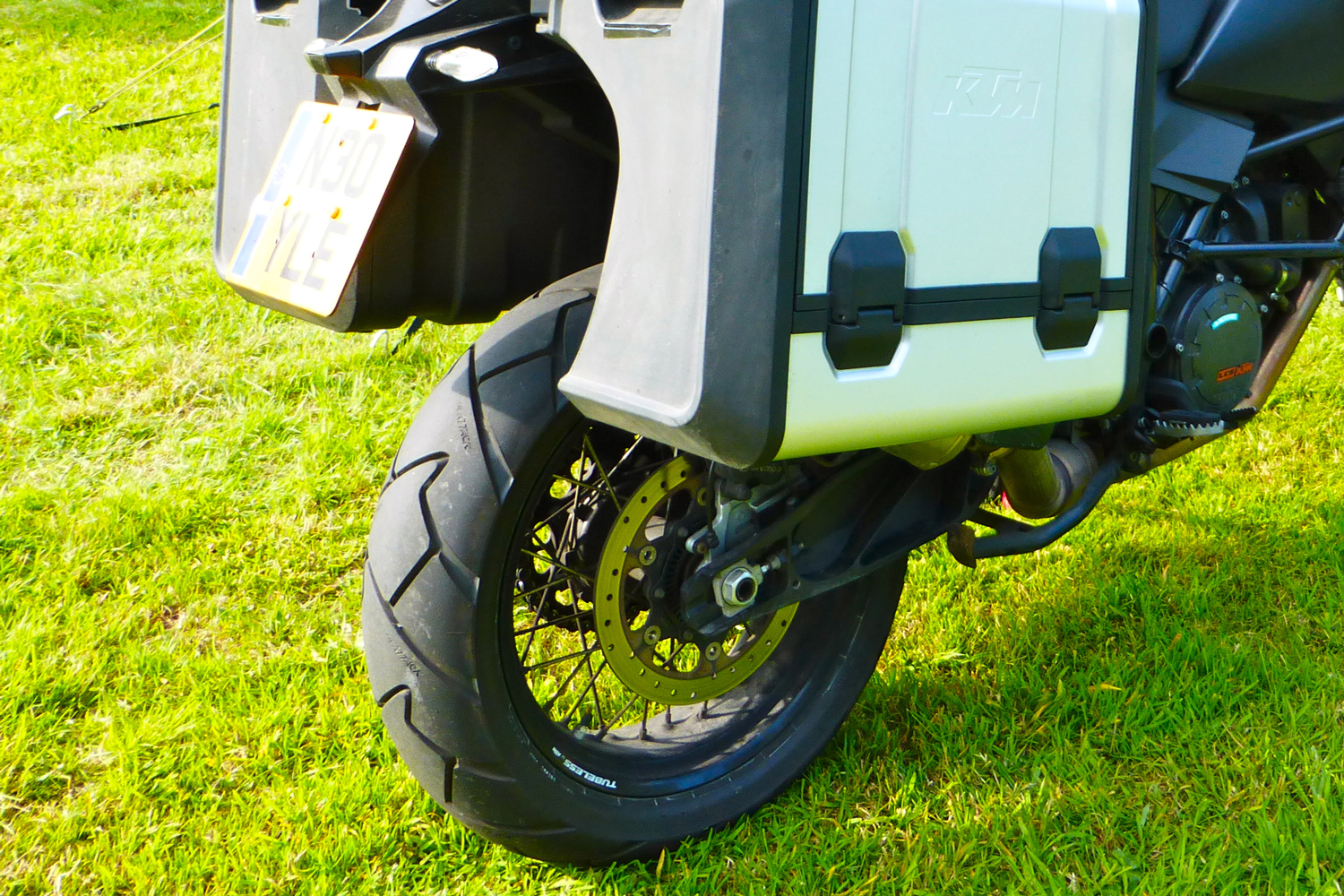
They may have sexy names shared with genuine off-road tyres from the same brands, as well as a token wide and shallow blocky pattern (below). In dry and consolidated conditions it’s amazing how well they work (as will any street tyre) and just a 15% drop in road pressures can make a big difference. But in deep sand or mud don’t kid yourself: they’ll be no better than an actual road tyre. Some, like the TKC70 self-designate themselves as 70/30 road/dirt. I’d say they’re more like 90/10 at best – in other words, virtually the same as a regular road tyre.
The better-known brands in radial and tubeless are suited to heavy, powerful bikes sticking to the road (in both senses); they’ll give excellent mileage, run cool and quiet, and grip securely in all conditions. Just don’t be under any illusions that they possess any special attributes off the bitumen just because they have the word ‘trail’ in their names.
If you’re heading out on a long overland trip into the AM Zone where transportation infrastructure is less developed, think about fitting ‘do-it-all’ road and trail tyres instead. They can last as long, grip nearly as well providing you’re not seeking to get your elbows down, and behave much more predictably on the loose surfaces you’re bound to encounter from time to time.
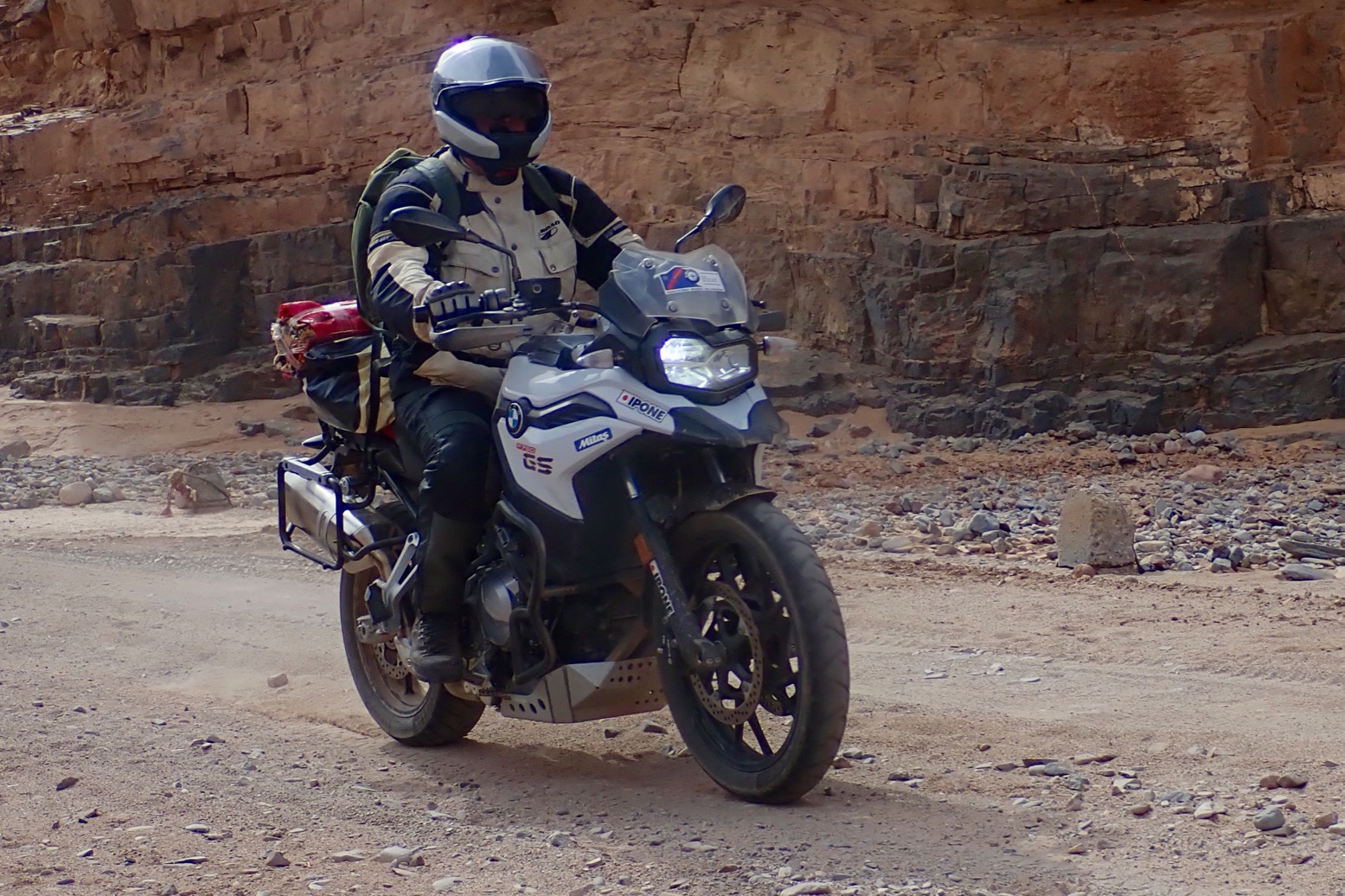
Below: an old F700GS on Anakees. Left, a 750GS on the same. Both worked fine on familiar, dry desert tracks providing I took it easy. But on mountain roads commonly sprinkled with gravel or other loose detritus, they can roll sideways and slip a little in bends. In the same situation, a shallow-blocked, wider-gaped ‘do-it-all’ tyre slips less and grips more.
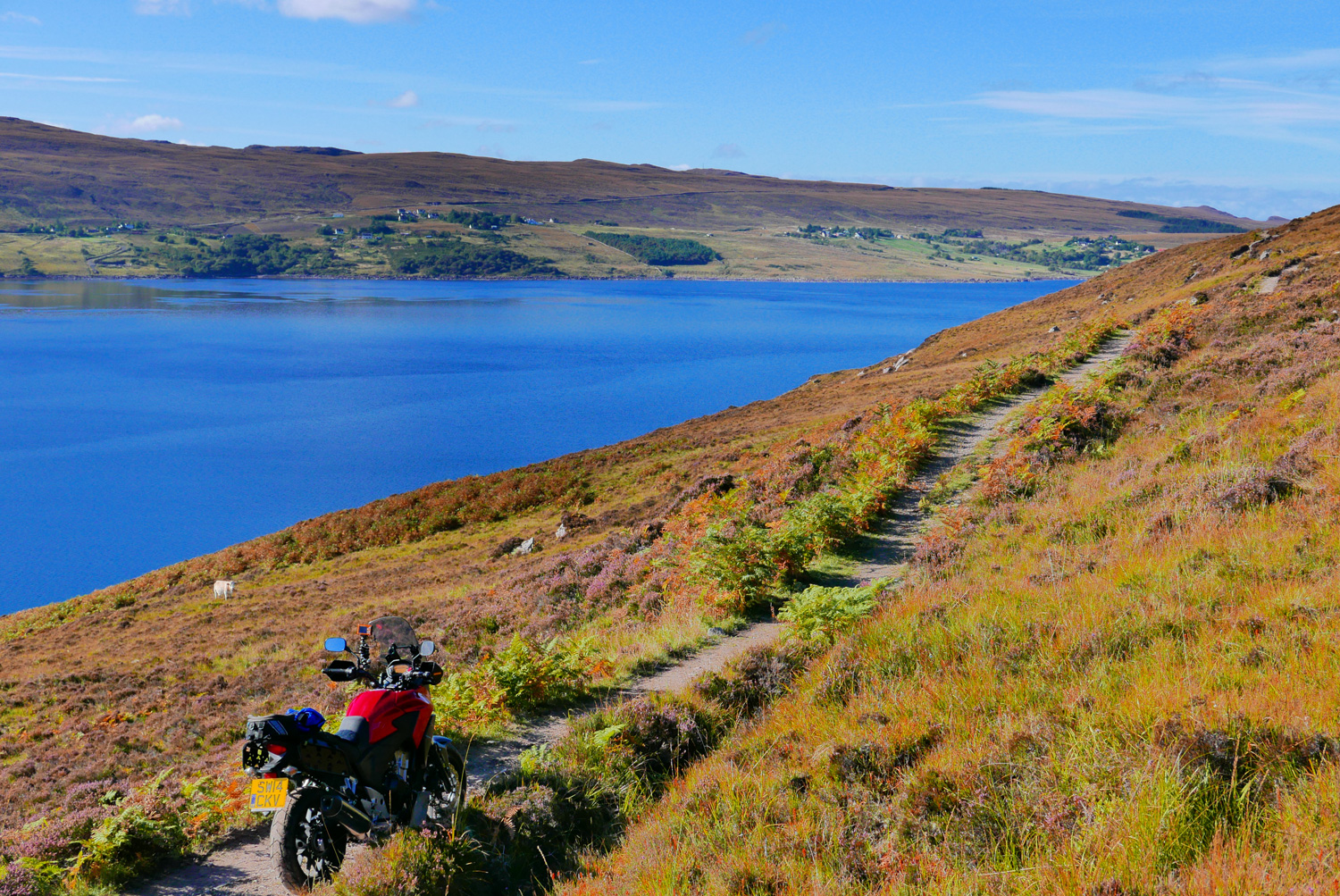
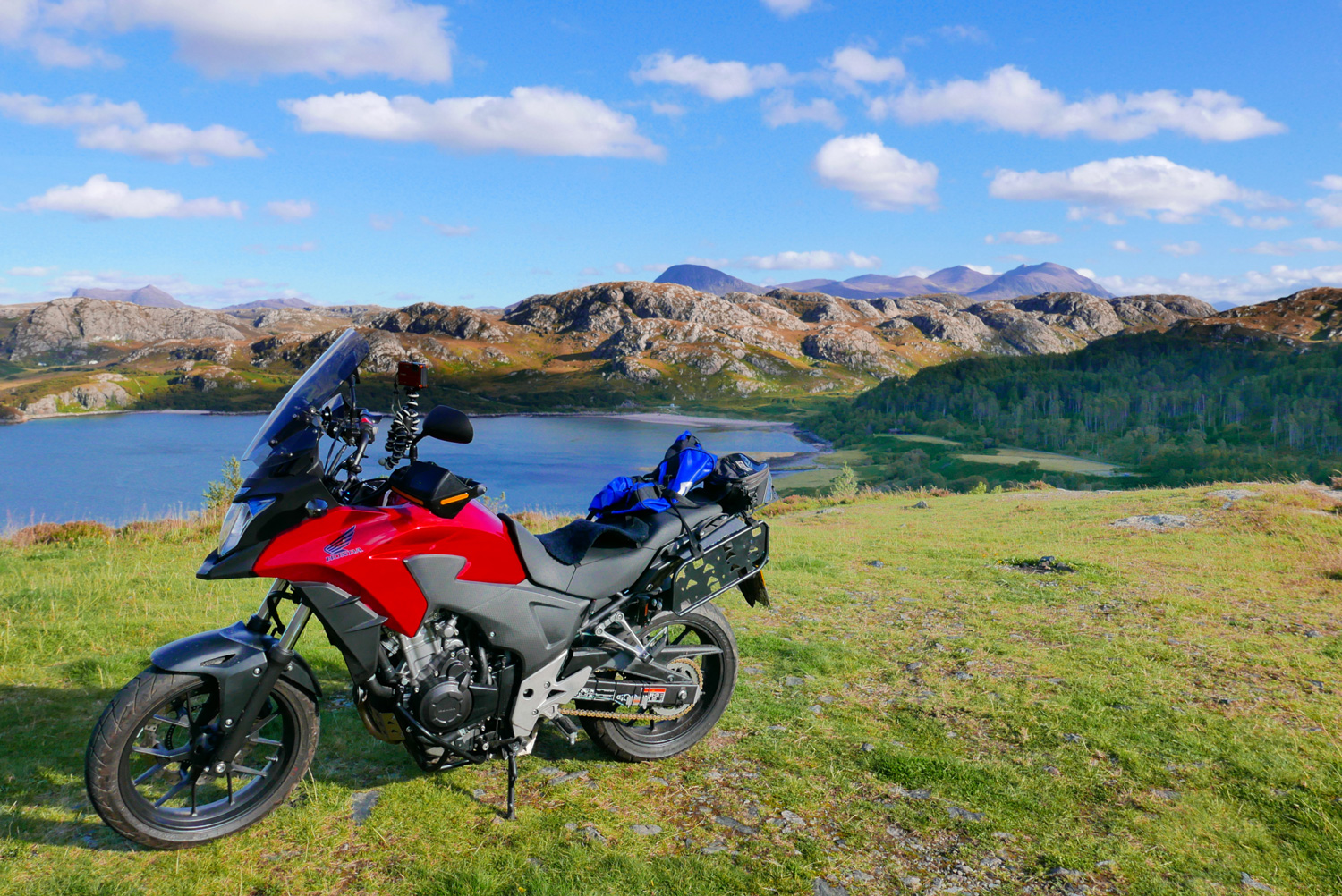
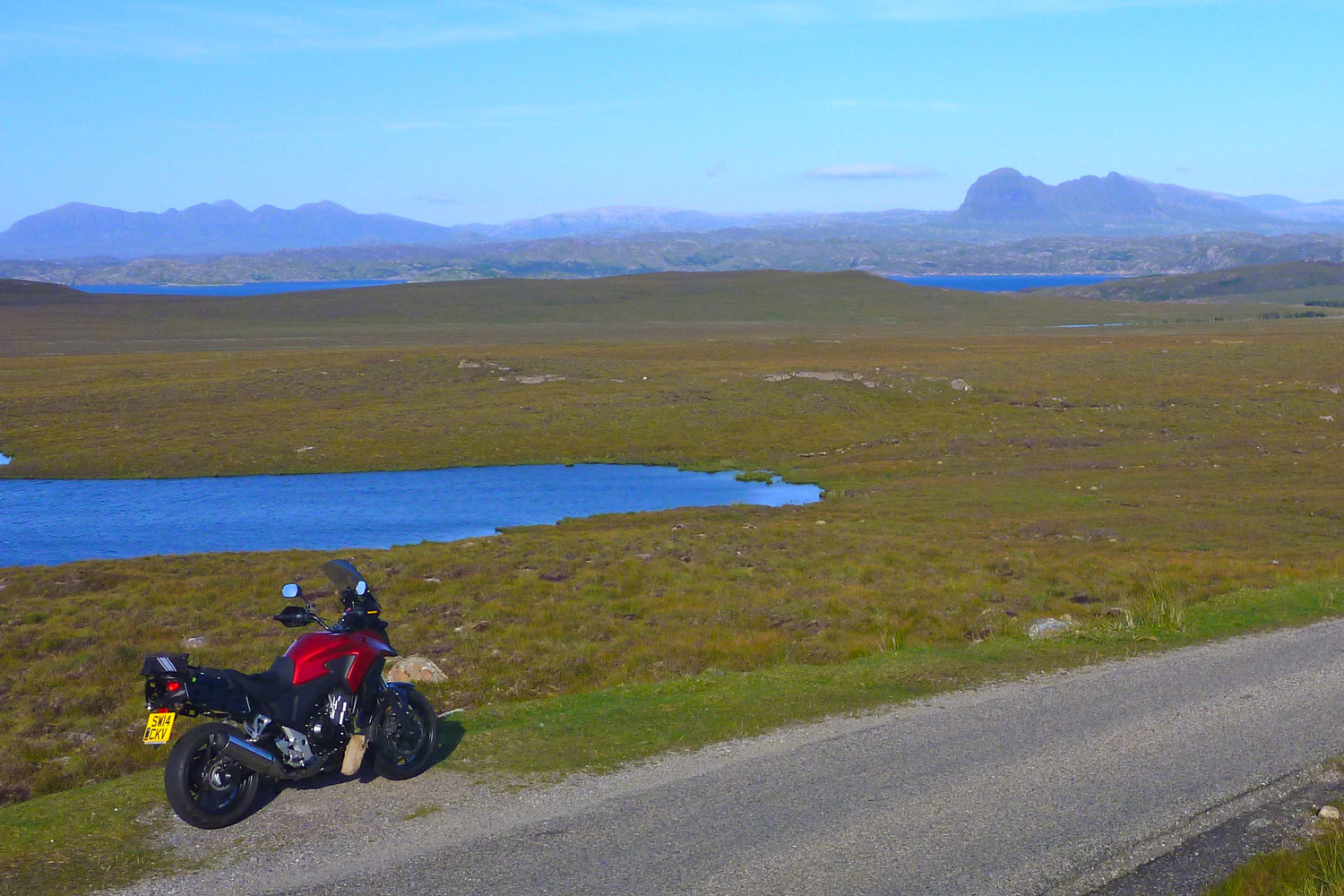
The cupboard was bare, the fridge was an icy cavern bereft of succulent goodies, and the sun was shining. It was high time for a shopping run to Ullapool. And, finding myself between chapters on the new AMH, it was also high time to saddle up the CB-X for a ride along the lochs and glens to try out some new gear.
Adventure Spec supply me with free or reduced cost gear in return for advertising in AMH
In need of a decent coat for a winter getting to and from the desert, Adventure Spec recently sent me a Powerlet Rapidfire heated jacket and Klim’s Overland jacket. AS had already sent me a Latitude to look at a couple of months back. But considering the investment in such a key item of gear, I found the Latitude either a little small in L, or way too big in XL. And in other ways it didn’t quite compare with an Aerostich Darien Light which I still consider a benchmark in travelling jackets.
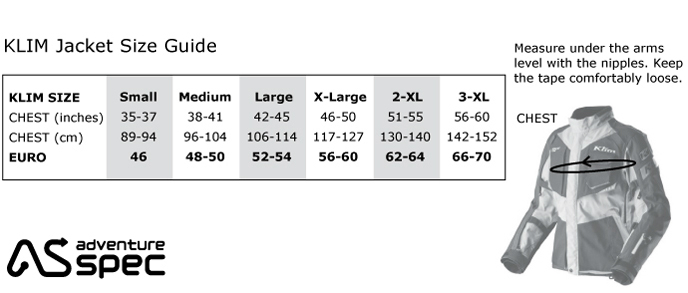
Wearing the Powerlet liner (about the bulk of a fleece), the Overland in Large felt tight across the chest and shoulders and yet, according to the chart on the right, I’m (42″ chest, 6’1″, 95kg) at the lower end of their Large range. The Overland was snug on me dressed in full gear – but still useable.
What Klim say If you’re taking your first steps into Adventure and Adventure Touring, the all new Overland series from KLIM® is a tremendous value [sic].
My first impressions Good value, solidly built three-season shell that’s well-designed, has some tidy features and an understated look. Warmer than you think too, but could use more- or just bigger pockets in and out. And beware: Klim sizing comes up small.
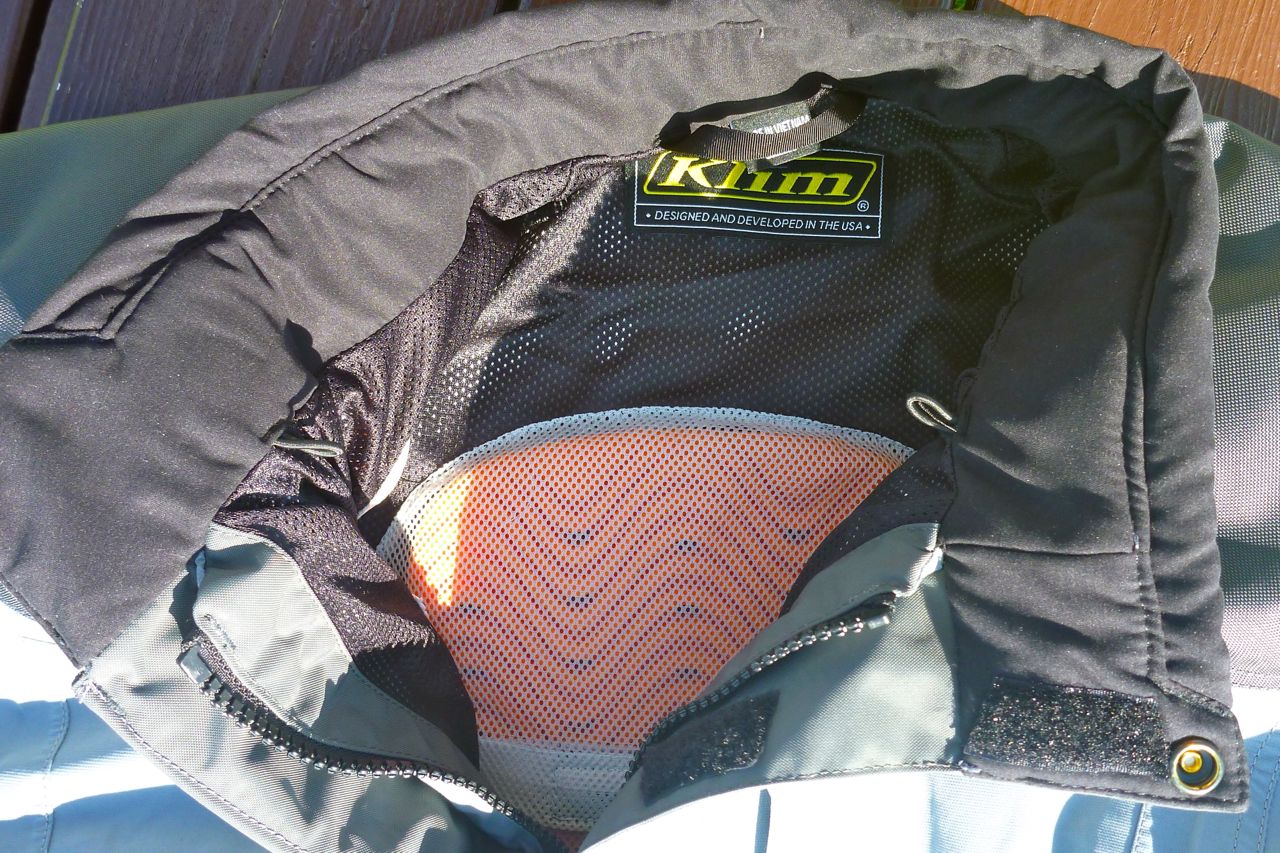
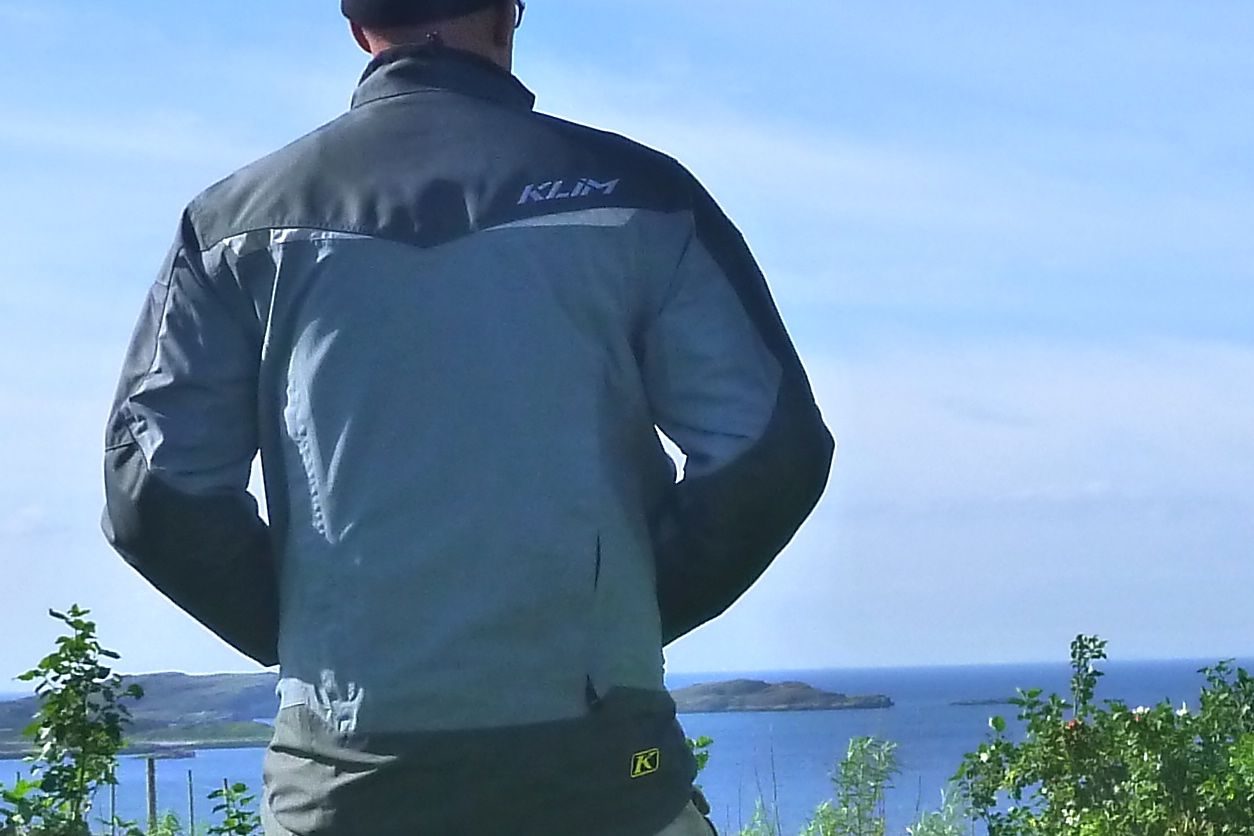
Klim Overland – a quick look • The Overland costs £379 with tax from AS and is listed as $429 + tax in the US or another $50 for the huge 3XL size • My Large weighs 2.04kg, less 330g without back armour pad • It has four pockets: two hand pockets the hem with vertical entry water-resistant zips, a smaller vertical chest pocket and a similarly small one on the mesh inside (right) • There are water-resistant zipped armpit vents down the sides that you might just undo on the move, and two corresponding long vertical back vents (right) • The front two-way zip lies under a velcro flap with a stud at each end, and the soft, Tricot-lined collar can be cinched for a snug seal. There are also cinch cords on each side of the hem, velcro arm tabs below the elbow and velcro at the wrists • The jacket has ventilated D30 E5 EVO XT armour on elbows, shoulders with a slightly less highly rated slab of non T5 D30 across the back (right) • Eight discreet 3M Scotchlite reflective flashes front and back • The cut is boxy and most of the arms and shoulders are over-layered with coarser and darker abrasion-resistant panels of 840D weight Cordura. The light grey body is made of much less stiff regular nylon fabric of about half that weight. The mesh lining is polyester and the membrane is Gore-Tex tw0-layer Performance Shell which is ‘Guaranteed to keep you dry ®’ and the jacket has a lifetime warranty too.
Review A few years ago when Klim first came to the UK, I remember looking at a Badlands or something at the Ace Cafe Adventure Day and thinking: £800 for a jacket – really? Of course Rukka had come to price themselves up there too, incorporating what I considered fussy, over-complicated ‘technical’ designs that seems to be a way of justifying high prices on a lot of stuff these days. But 800 quid for a garment made in Southeast Asia?
Maybe ‘start high – bring in the cheaper stuff later’ is a recognised marketing strategy. That’s how it looks to me with Klim in the UK and now we have more normally priced jackets like the Traverse, and the second take on the Traverse which is known as the Overland.
As I say in the book, setting off on a long trip you’ll be wearing your jacket just about all the time for weeks or months. It’s got to work well, feel right and be up to the task as it’ll become your second skin. One thing that categorises Klim as a serious contender is they only make rugged waterproof shells and eschew what is to me the cheap measure of a zip-out membrane. If you want a serious Gore-tex type jacket, get one where it’s laminated to the outer shell. Yes, it costs more.
I set off for what turned out to be a 180-mile ride on an October day with temps peaking at 13° and strong winds forecast. Underneath I was wearing the Powerlet, a thick shirt and a vest, and leather trousers plus thin unlined gloves. I planned to fire up the Powerlet when the chill got to me. As it turned out – perhaps because I was stopping a lot – that never happened. The Overland kept me warm all day right up to sunset which was impressive. It means you can wear less clobber underneath but I suppose may get hot working hard off road in a warmer climate. For that reason I chose the grey version rather than the black. It really can make a difference.
Doing it up I noticed that with the Powerlet’s high wire-laden collar and a shirt collar too, there wasn’t really room for my thin neck buff I usually wear. The front collar stud was a two hand squeeze to do up and the collar felt tight at the front while loose at the back where the cinch is. In other words the collar fitting was too upright or – like many humans in this digital, screen-staring era – my neck and head stick forward like a round-spined Australopithecus. Trying it again now it definitely presses on my Adam’s apple, but not unbearably so. Normally I prefer loose clothing and the Overland is a ‘snug’ fit round the neck and in the arms and across the shoulders with arms pulled backed which is probably more flattering, cosier and aerodynamic.
Riding along I thought I felt a chill under the arms through the vent zips, but not enough to plug in the heated jacket. And anyway this could be attributable to my bike / screen /posture / speed. Later on I didn’t even notice it.
At one point I left the bike perched on a sunlit hillside track and walked on to recce the route. In a black jacket I’d have cooked like a Findus boil-in the-bag cod in parsley sauce, but the Overland was surprisingly cool. By the time I got back to the bike I did have a bit of a glow on, but rode back the few miles to the main road unzipped and flapping by which time normal operating temps had resumed.
An hour and lots of lipsmacking pics later I pulled in at a cafe near Poolewe and instinctively went to slot my gloves into a pocket to came up against the Overland’s main flaw: too small pockets. I suppose I could have stuffed then into one of the lower pockets but what I’d like a decent, map-sized chest pocket or some meshy drop pockets low down inside (they could actually be easily tacked on to the mesh. What do other riders do? – cart around a tank bag or backpack – or slip them in a topbox I suppose. A jacket called Overland needs overlandable storage. For the return run I also removed the back armour to free up some room. It made the jacket lighter and more flexible, but I can’t say it felt significantly more roomy. For that the shoulder pads need to come out but I’ll keep those for the moment.
Riding back with the sun now dipping behind the hills, I expected to resort to the Powerlet, but riding up to 80mph the Klim still hung in there. The wind was up now too, pushing me around on the single track roads and at one point coming over a pass I distinctly felt the wind catch the back vent flaps and pull me around in the seat.
So – preliminary findings on the Klim Overland adventure touring jacket. Warmer than you’d think, under pocketed but the plain looks that are growing on me. Great armour and adjustability too. Resistance to pelting rain and ventability to be established. I always wonder if the latter might compromise the former.
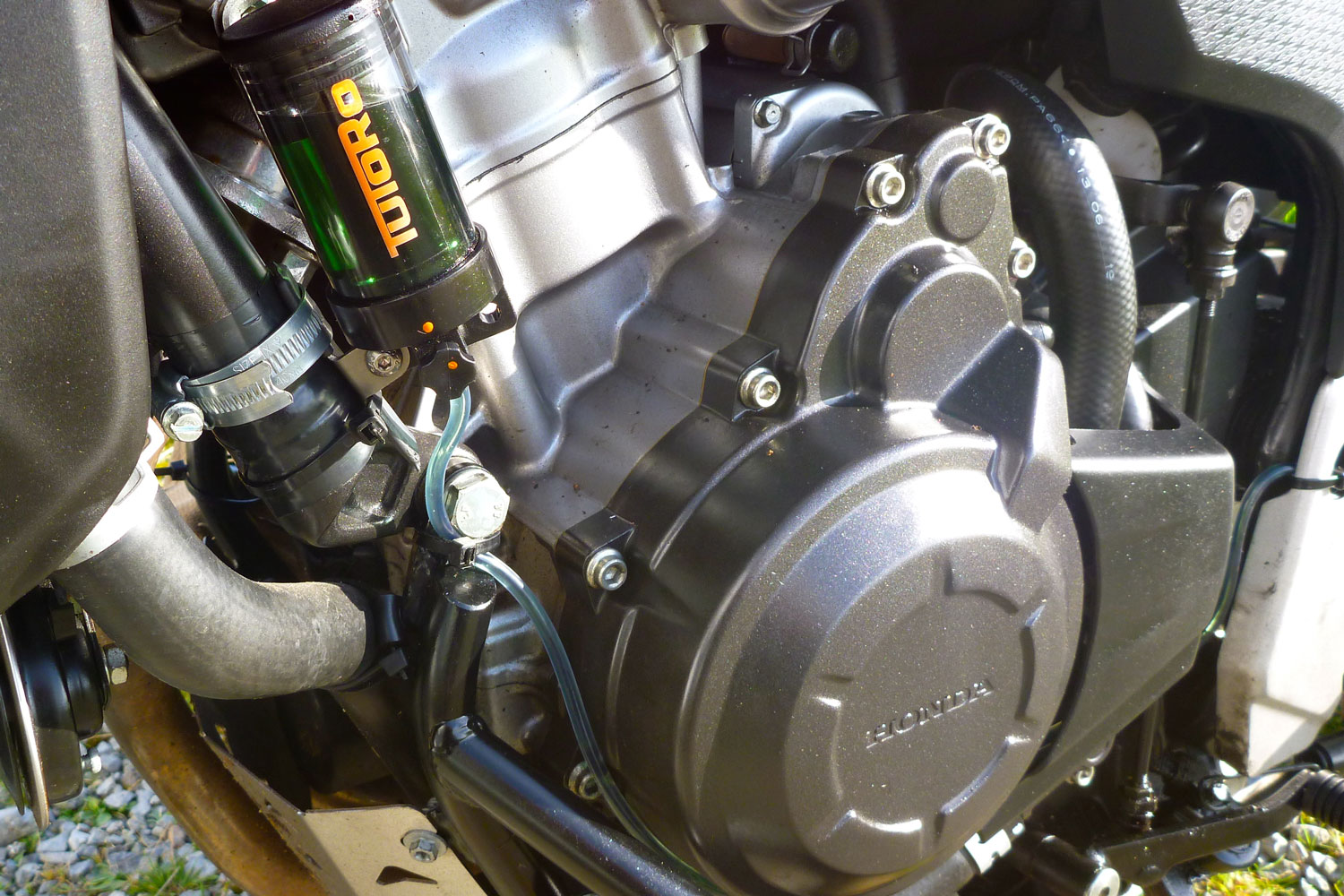
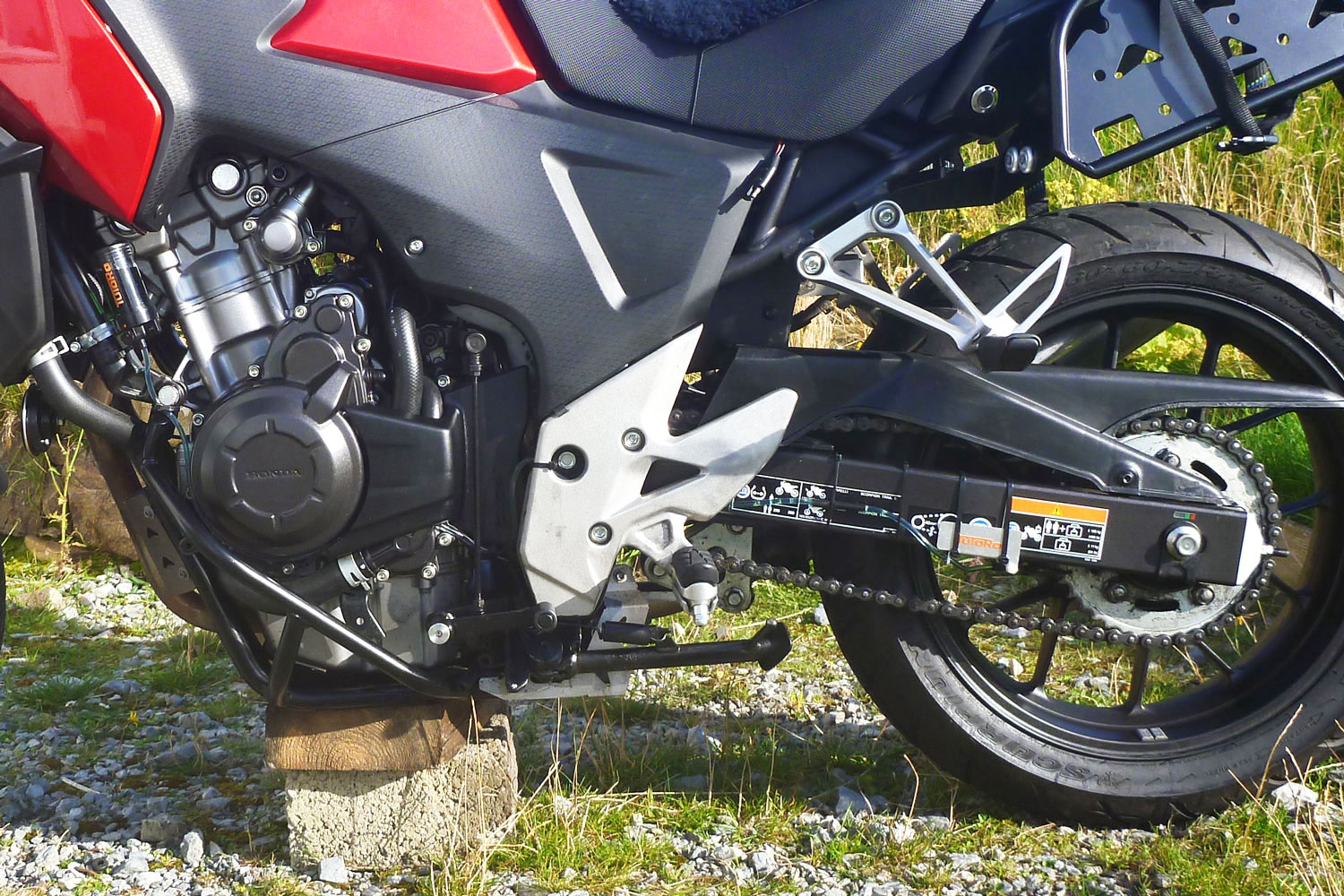
On the CB-X there wasn’t an obvious place around the back to mount a new model Auto Pro 1 Tutoro chain oiler. I saw a couple of people on the forum perched theirs on the pillion footpeg mount, but with off-roading and stone flying on the agenda, I can’t see mine lasting too long back there, even with the reservoir rock guard that comes with the latest model.
The next best place I could find was on a front downtube behind the radiator. Who knows, the warmth might make the oil runnier and better penetrating – or maybe just more splashy. The delivery tube needed an extra 6 inches which I had from an old Tuturo kit.
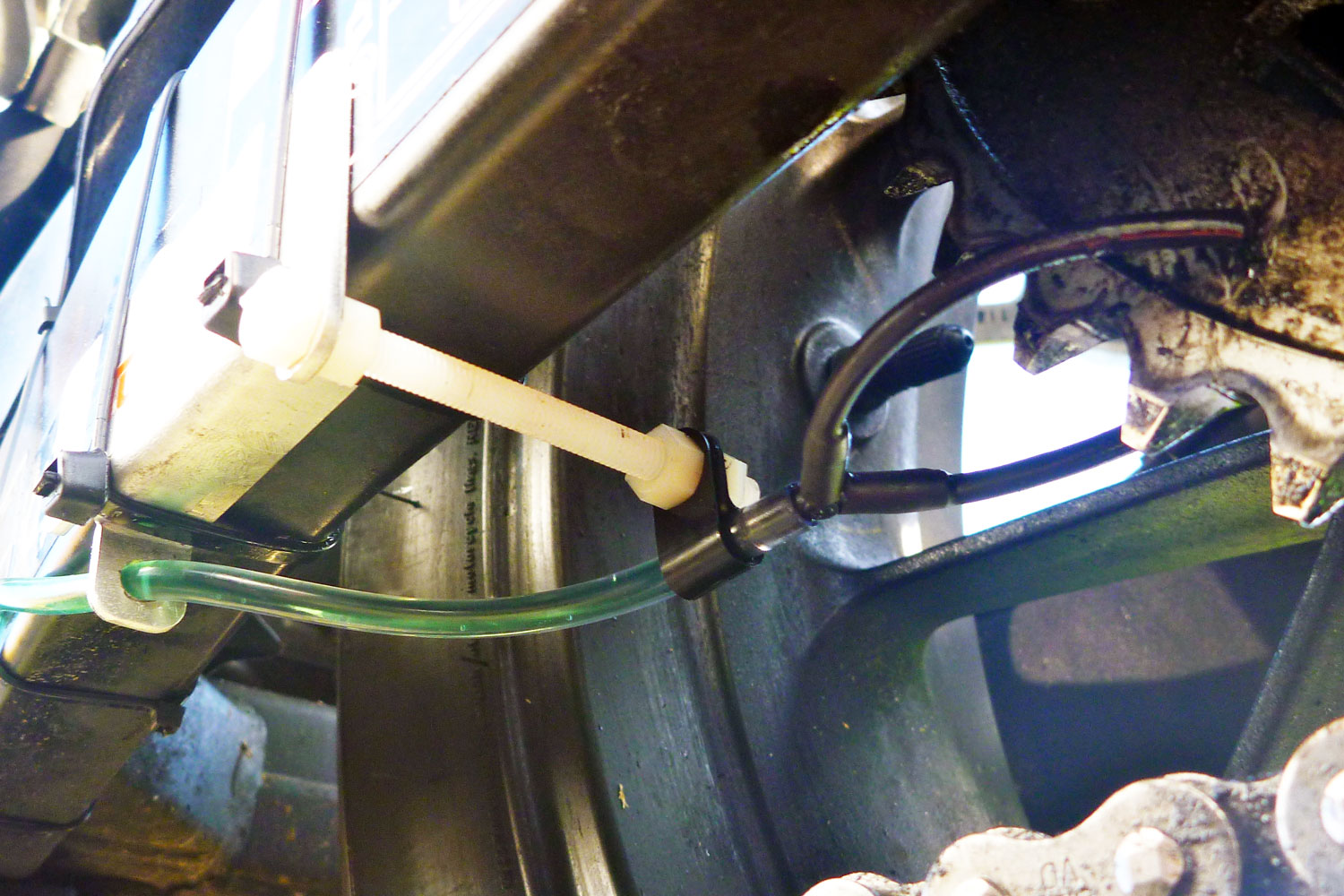
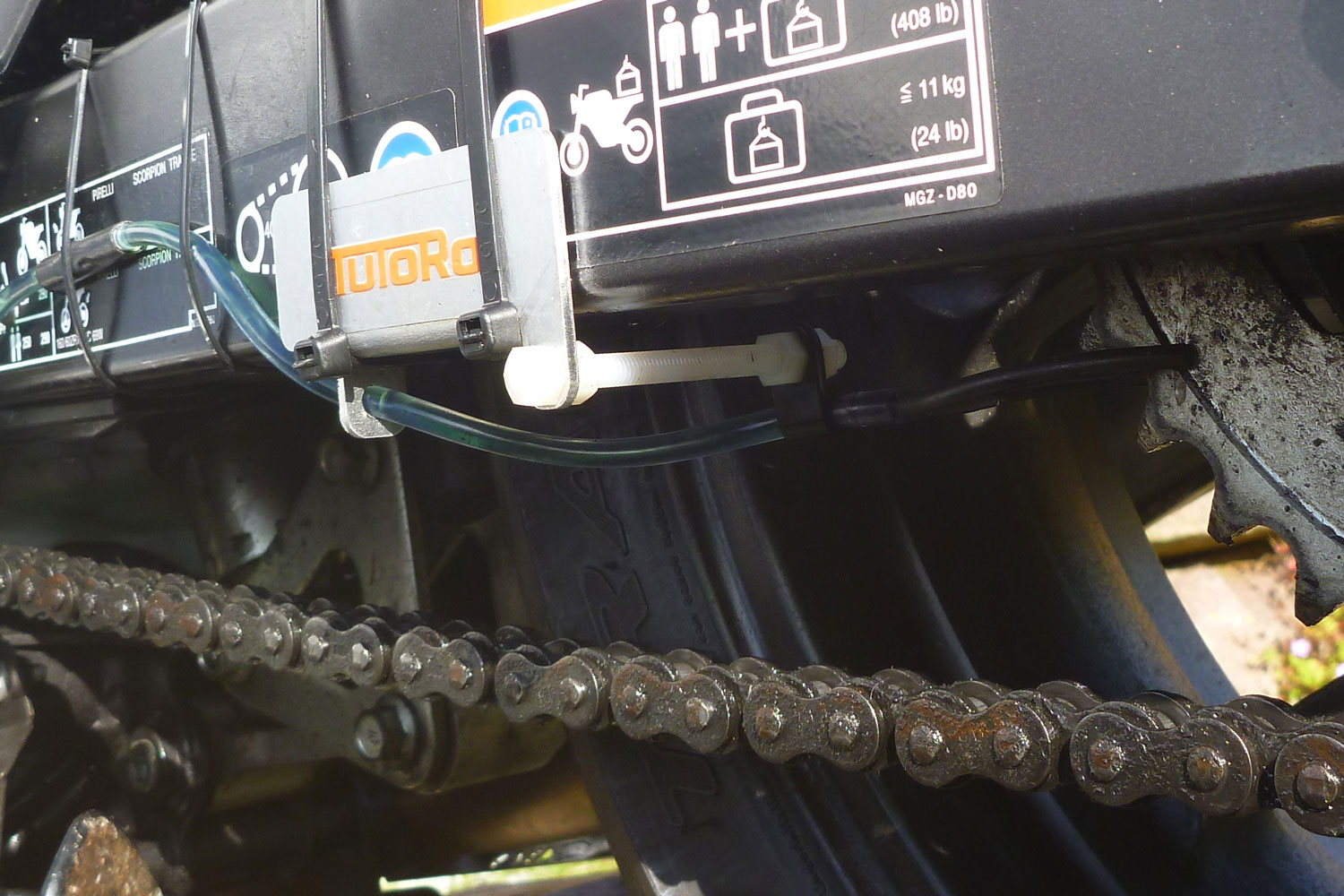
They have a new nozzle swingarm mount too: a plate and nylon bolt (right) you zip tie on to better secure the twin nozzle in front of the sprocket, instead of positioning it with a coil of bent wire. I think I’ll add some more support to the nylon bolt at the inside of the swingarm to stop it getting snapped off. As it is, I can see it all getting swept off by off-road debris. At least with the bendy coil you can bend it back. I may add that too.
I’m a bit concerned about the state of my chain. At only 3000 miles there’s rust on the outer plates which probably means rust on the inside too which will ruin the o-rings soon enough. Neither I nor I doubt the previous owners neglected it that much, so it must have been a cheap batch, like those that found their way onto some F-series BMW twins a few years back.
Even though it’s far from worn out, I think I’ll have to take a leaf out of my own book and fit new. The upcoming trip to Western Sahara and back will rack up at least 7000 miles, and even with the new oiler, in the sands I doubt my dud OE chain will make it to 10k.
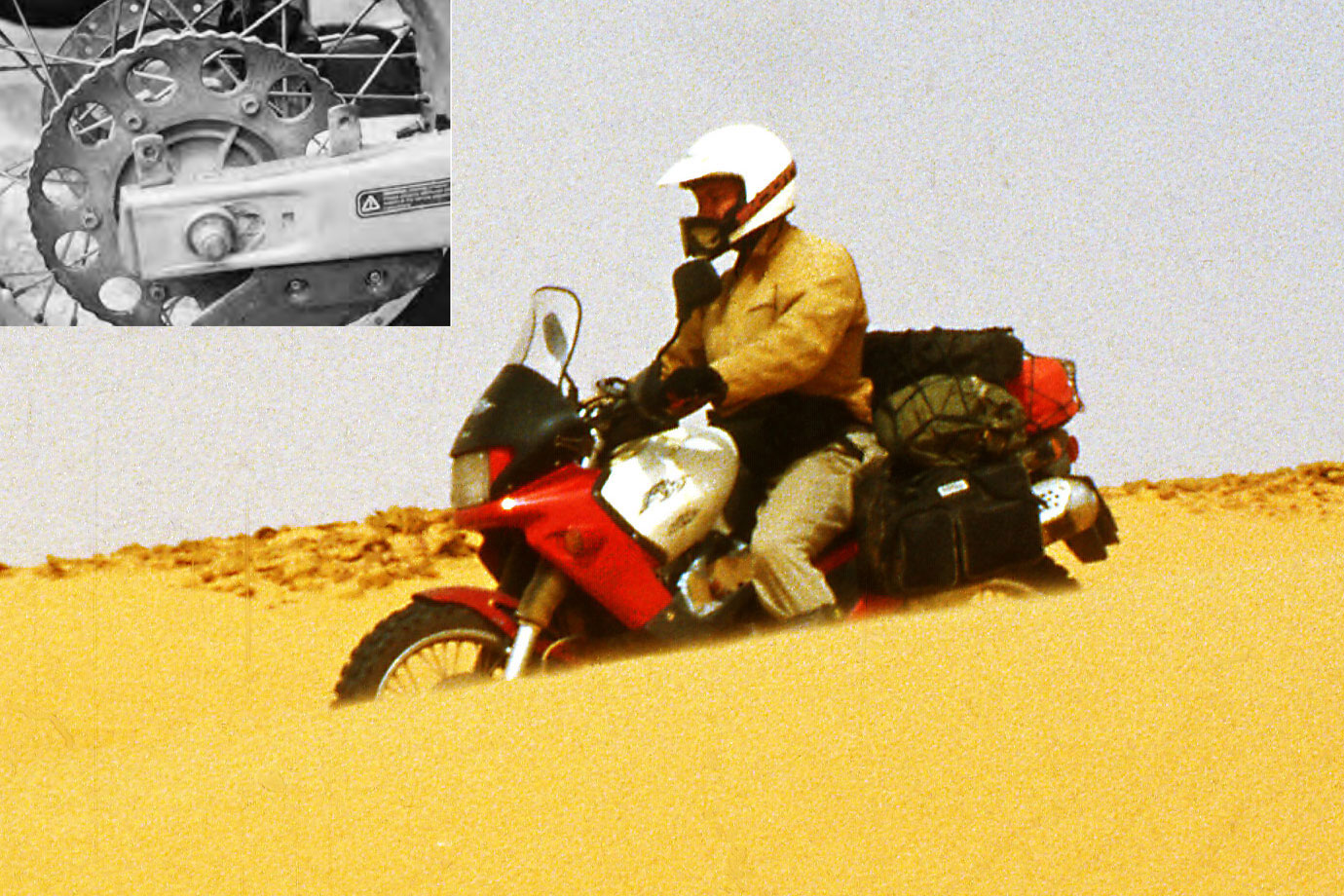
I made that mistake on a Funduro ride to Libya once (left). Lots of sand on that trip and the no-name chain was slipping by Tunisia on the way back and despite my best efforts, the back sprocket was totally shot by Maidstone. I had to hire a van the last 25 miles home. On other Sahara trips o-ring DIDs have lasted fine.
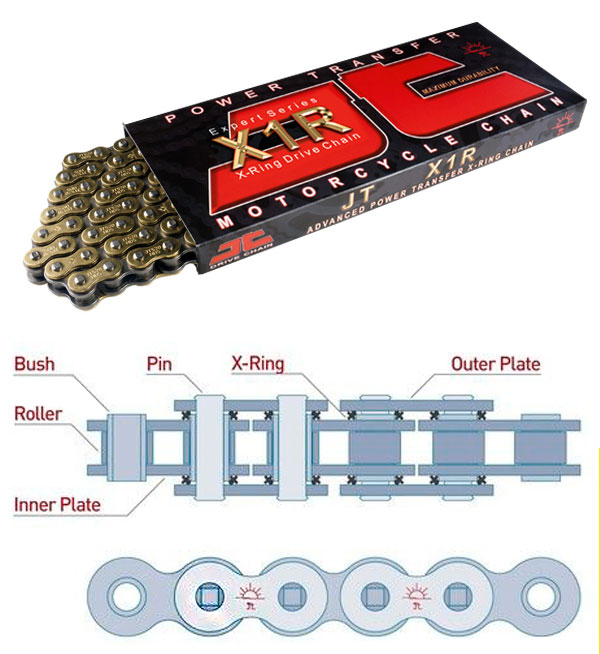
Again the forum has mixed reports on chain life, even with very regular maintenance. A quality chain wants to get on there quick before the sprockets wear. Normally that would be a DID gold x-ring, but I couldn’t find an X on ebay so let’s take a chance on a JT X1R version for £53. It’s good to try new stuff anyway, and I’m sure it will last the run in the desert sands, now the Tutoro is lubing it.
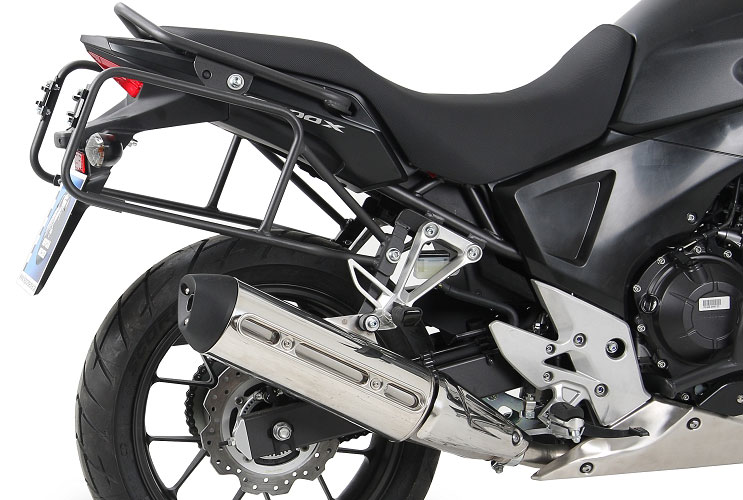
Rally Raid’s pannier rack arrived, along with a few extras. At £230 delivered, it was a good deal more expensive than a regular Hepco pannier rack (right) which seems to be the only one that’s a general purpose rack, and not specified for a certain type of luggage. As it is, it’s way too far back like so many of these racks, though with throwovers that doesn’t matter too much.
The RRP side rack weights 4.7kg in steel and seems based on their KTM690 rack, a bike whose plastic fuel tank is the rear subframe and so needs a bit of extra support. Being more heavily built than your H&B, the RRP CB-X rack does away with the rear cross brace and is said to be made to fit the Giant Loop Siskiyou throwovers.
The rack replaces the 1.8kg pair of grabrails and uses their six mounts on the chunky subframe, so that’s actually less than 3 kilos added overall. The third mount is a bracket that goes behind the pillion peg mounts and the whole lot was easy to fit and lined up precisely.
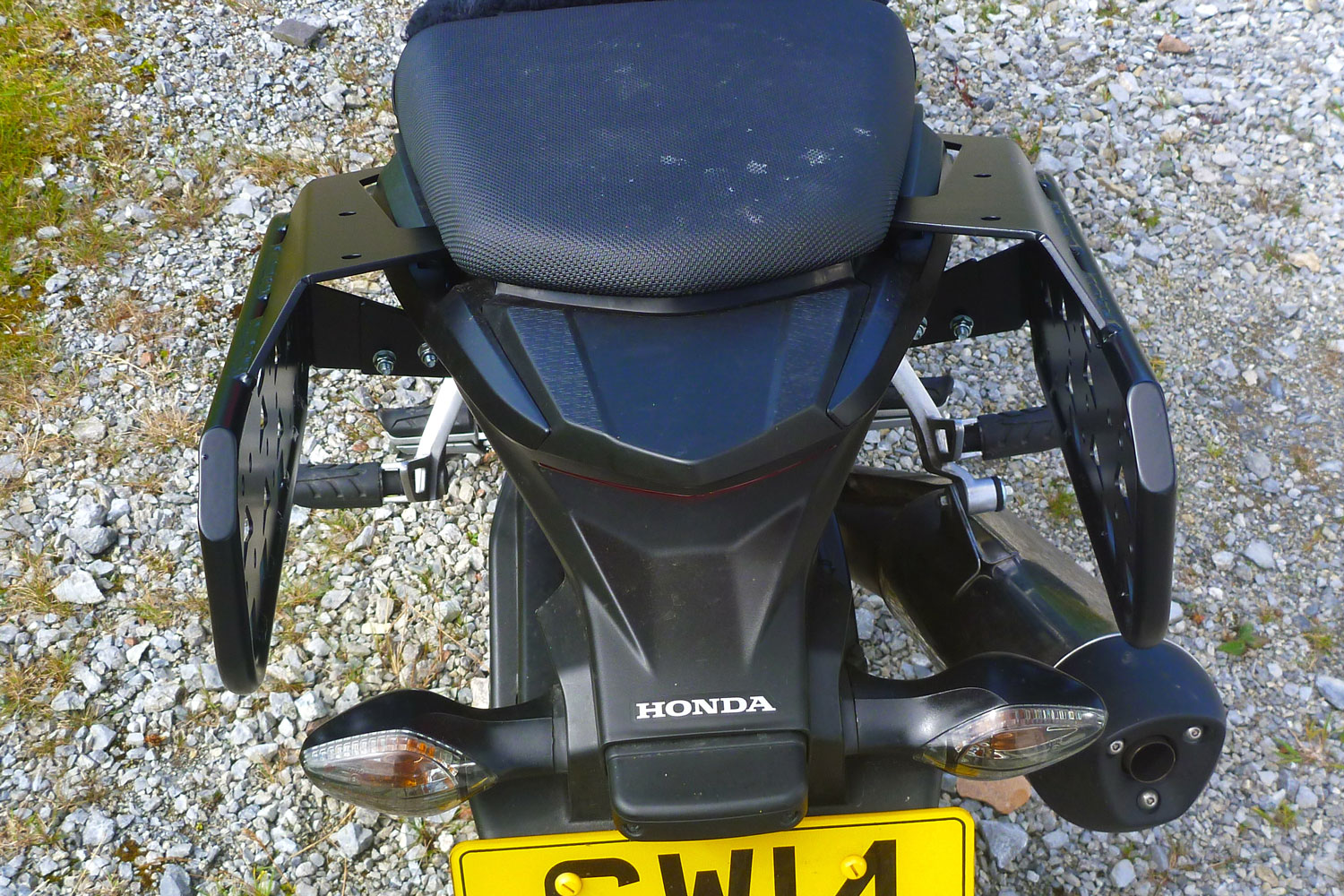
I did wonder if the short side height might not support my tall Magadans so well. As it is on the right the upswept silencer will get in the way whatever set up you use. Sticking out equally on both sides, there’s heaps of room to stash stuff behind (left) or fit one of those tool tubes. Though I’d rather have a slim rack, I can see those spaces becoming handy.
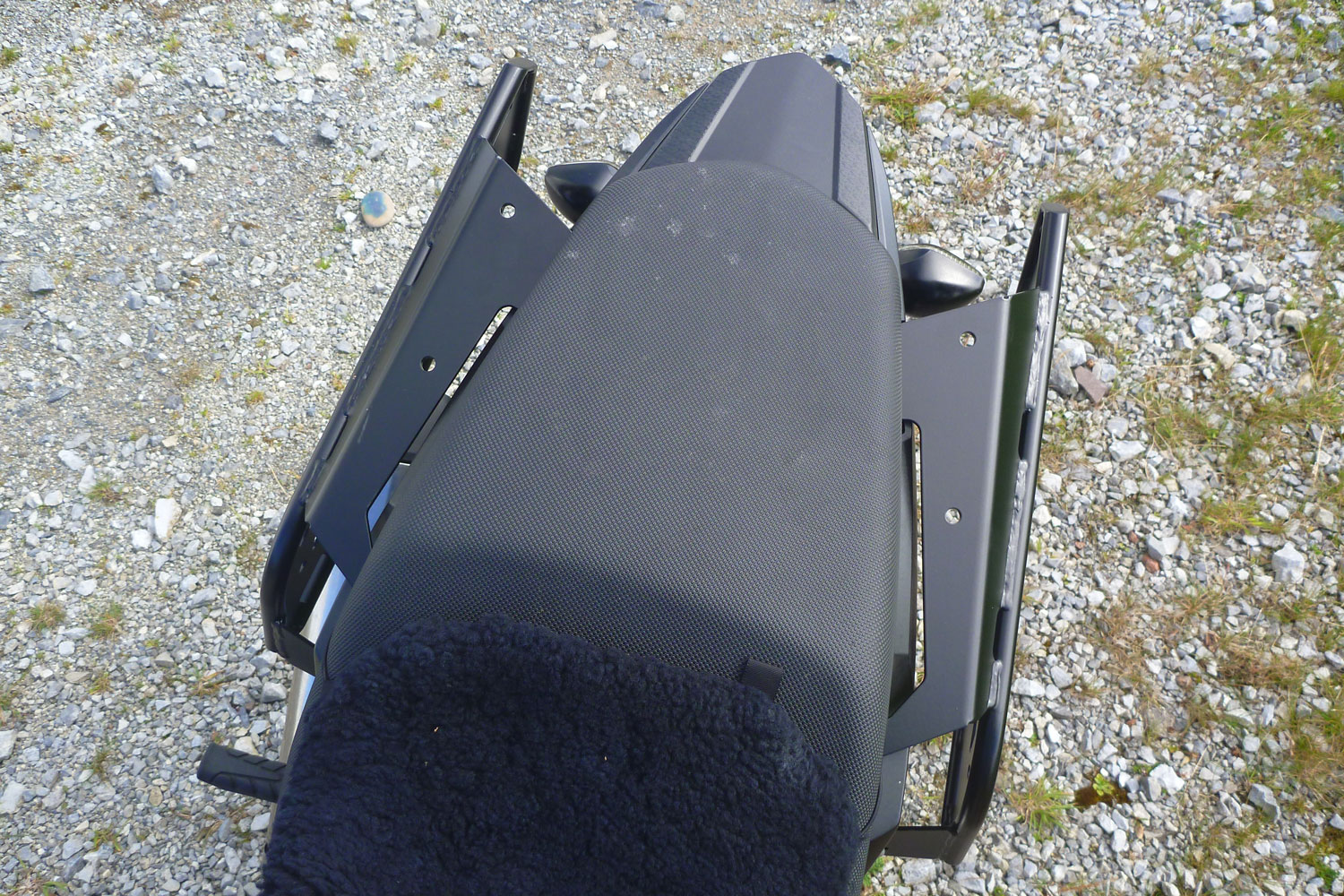
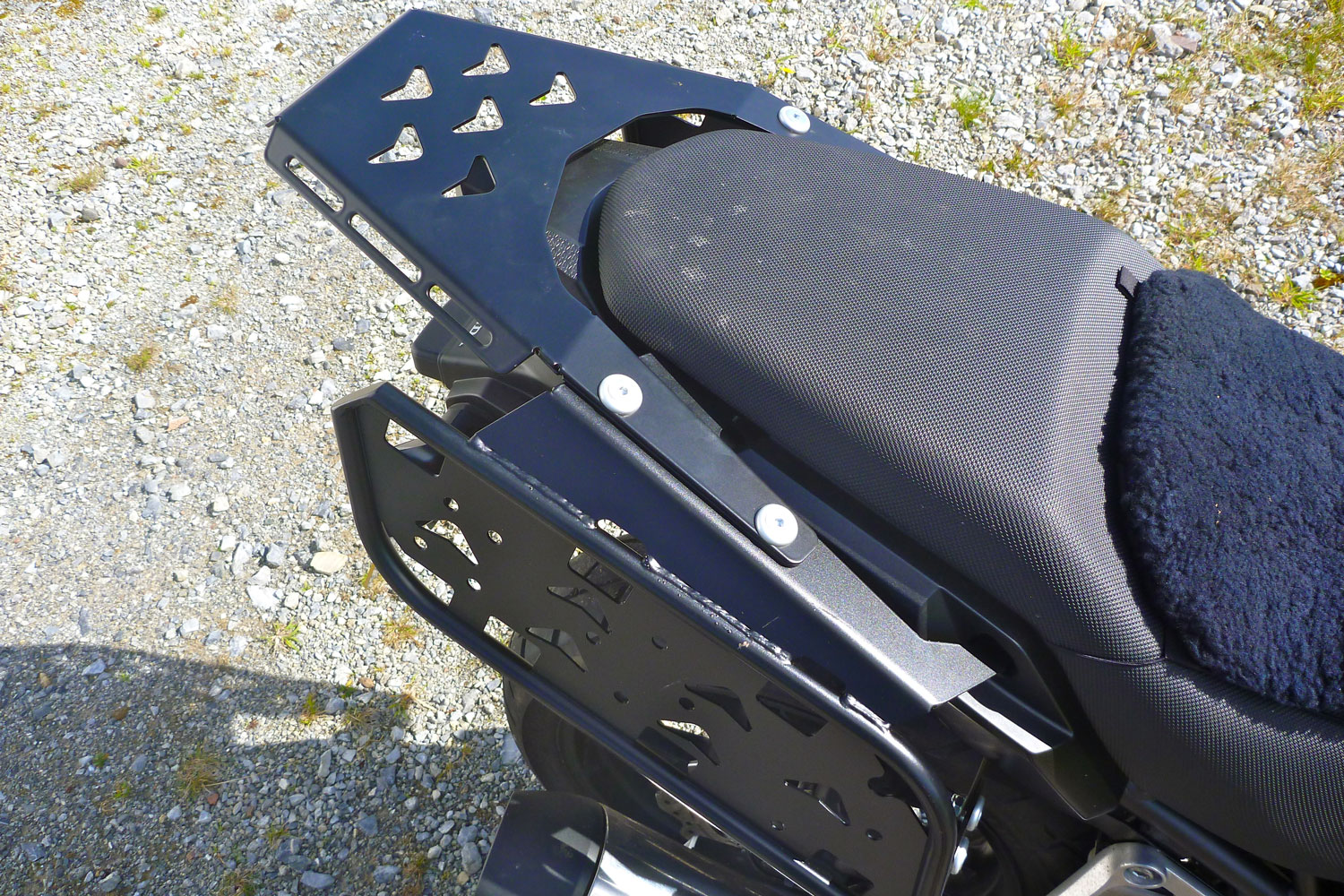
RRP also sent me their 1.8kg tail rack to look at, though I’m not a fan of these CNC ‘plate racks’. I fitted it anyway to see how it looks, as it mounts on the side racks very easily.
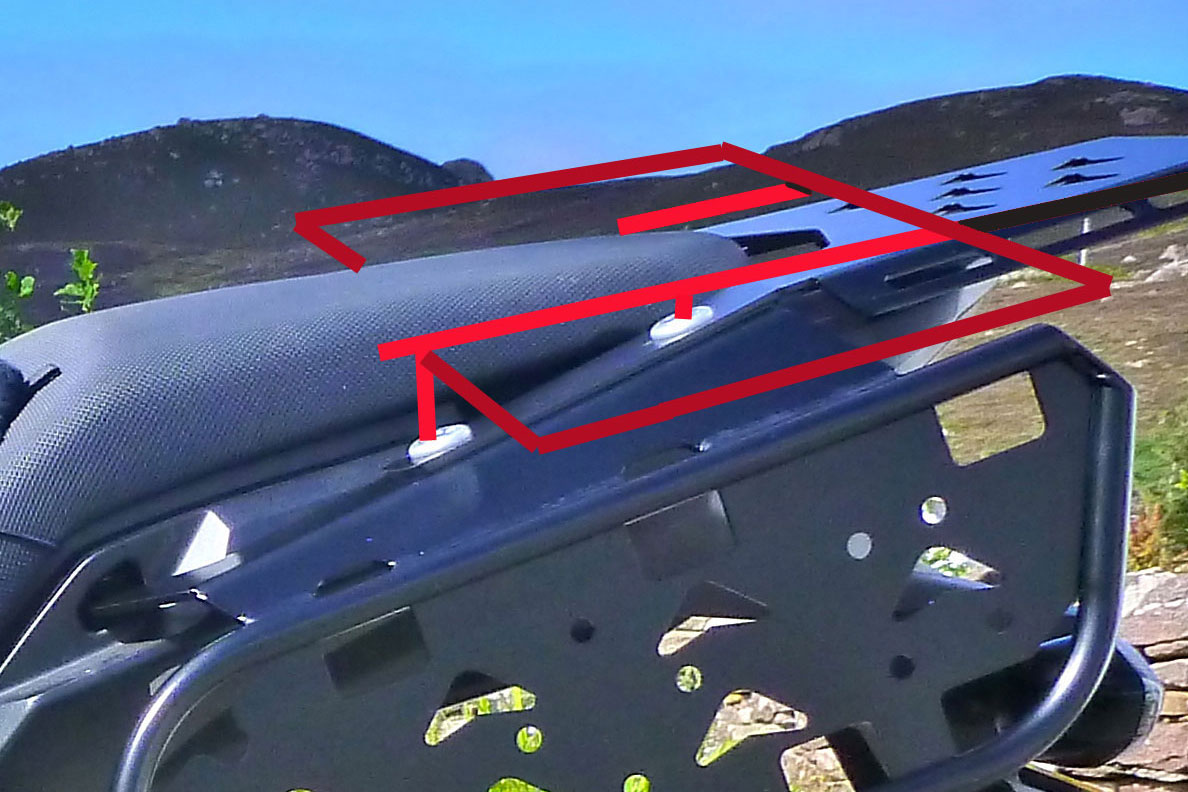
I prefer traditional tube racks and the reason becomes clear once the grab rails are removed: there’s nothing to grab on to! Not so much for a pillion but when picking up or manoeuvering or back-end dragging the bike into the cow shed where it currently lives. It’s really quite frustrating. For a while I thought I might bolt on grab loops to the tail rack mounts, but have decided to try and get an X-rack style sheep rack made (right).
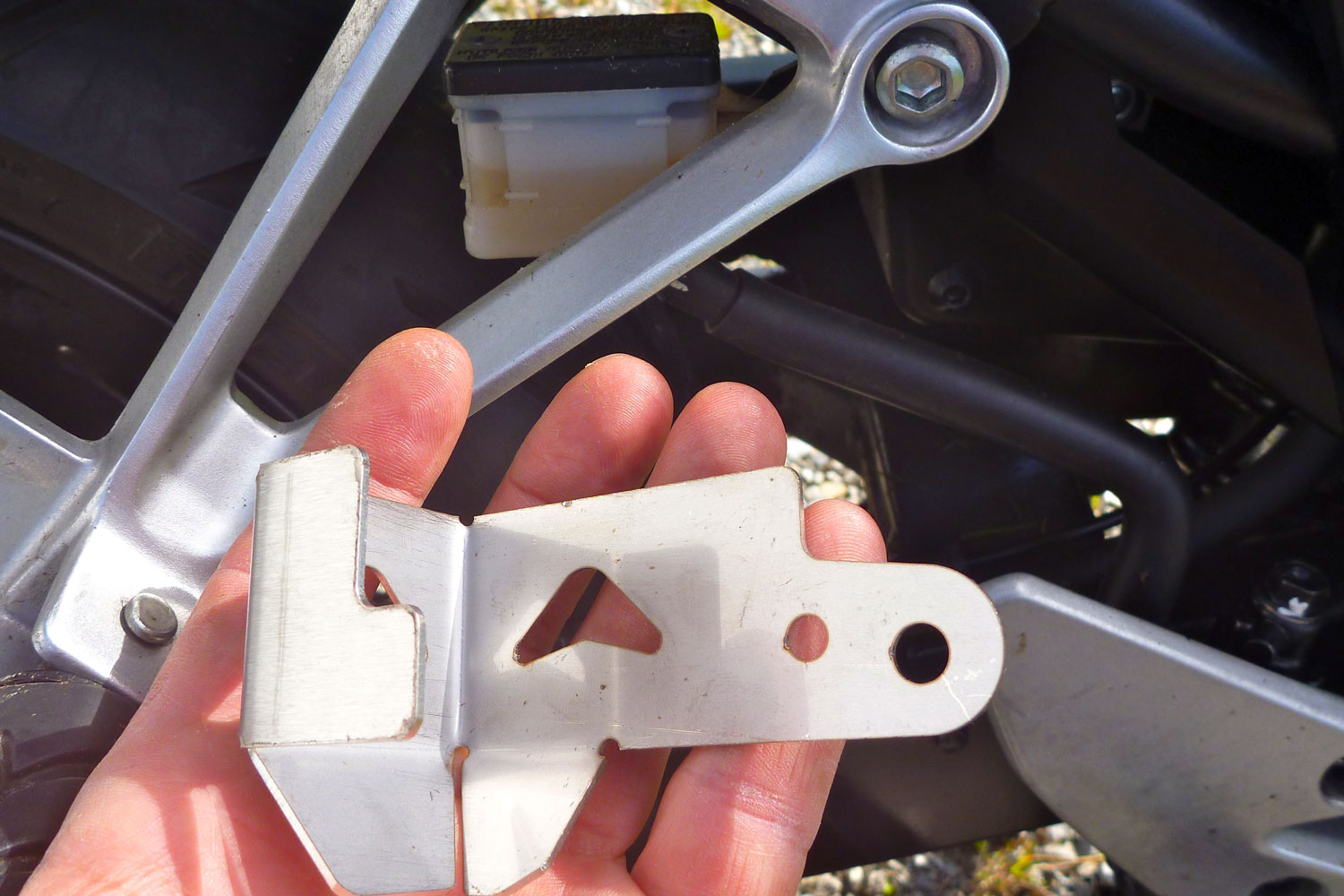
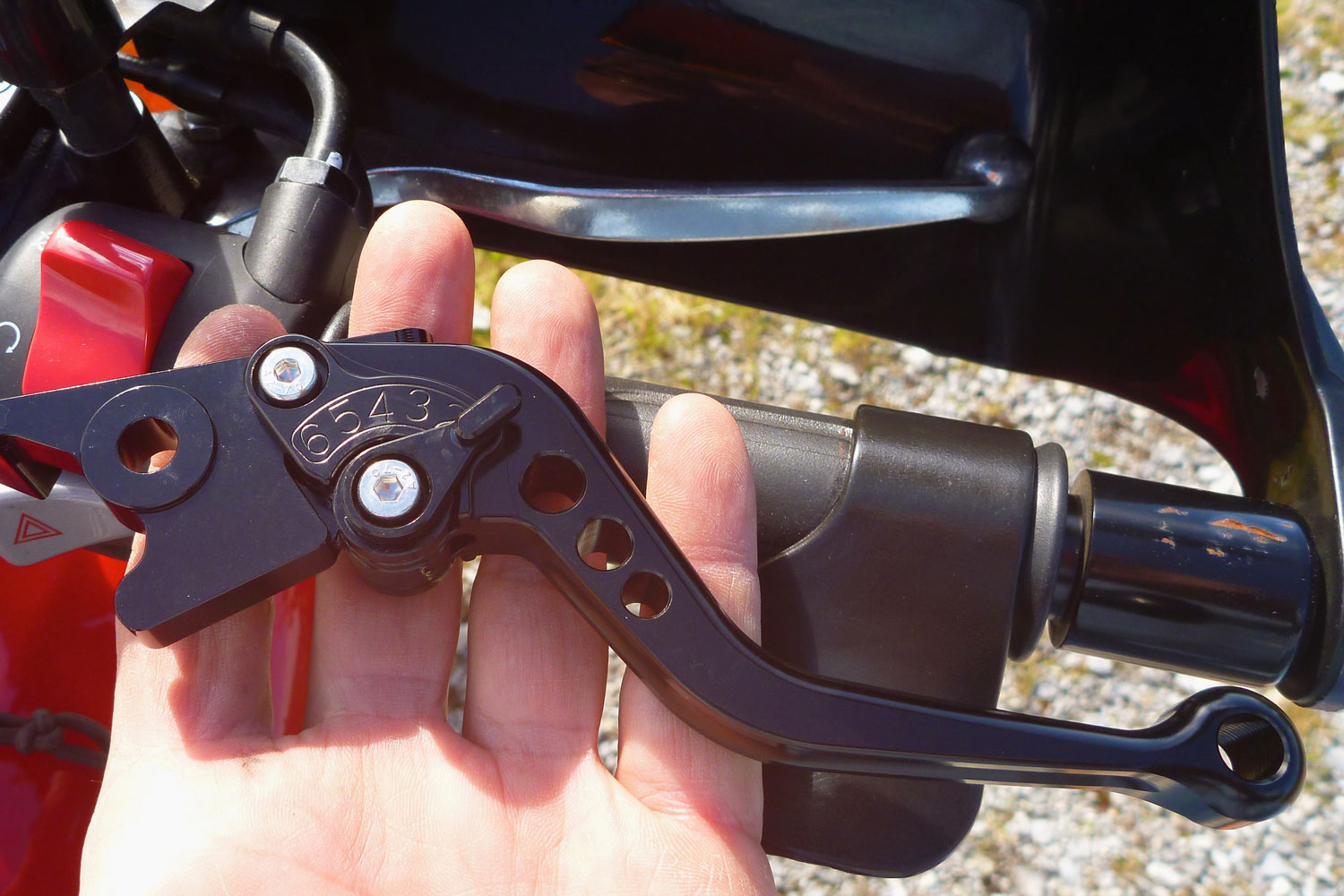
Other RRP goodies included a nifty rear brake reservoir guard (left). Now I look at it, it’s quite exposed, just as the oiler would have been back there. And a nifty pair of adjustable shorty levers. I’ll get round to them when the new front end arrives.



















 Adventure Motorcycling Handbook