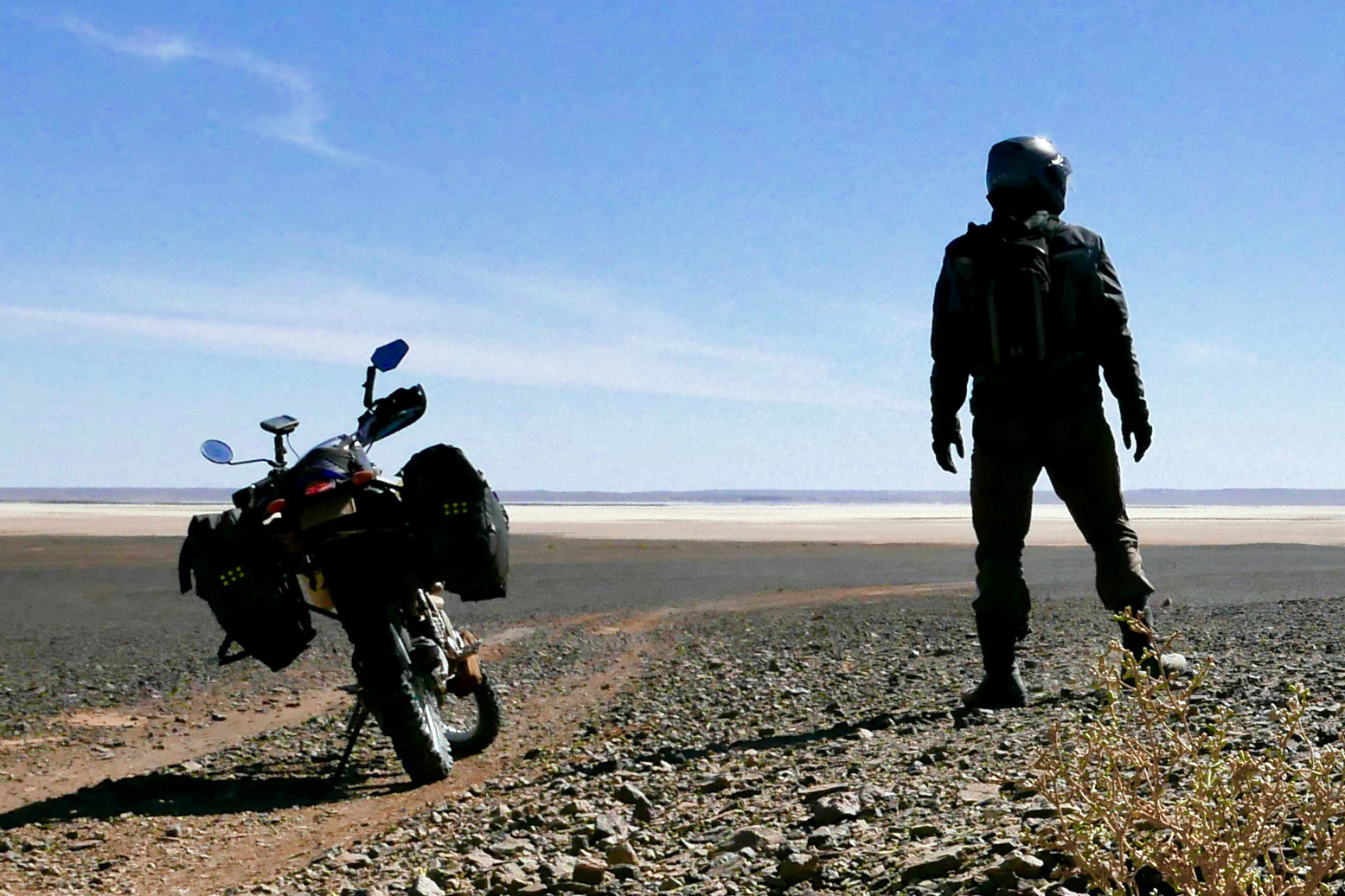
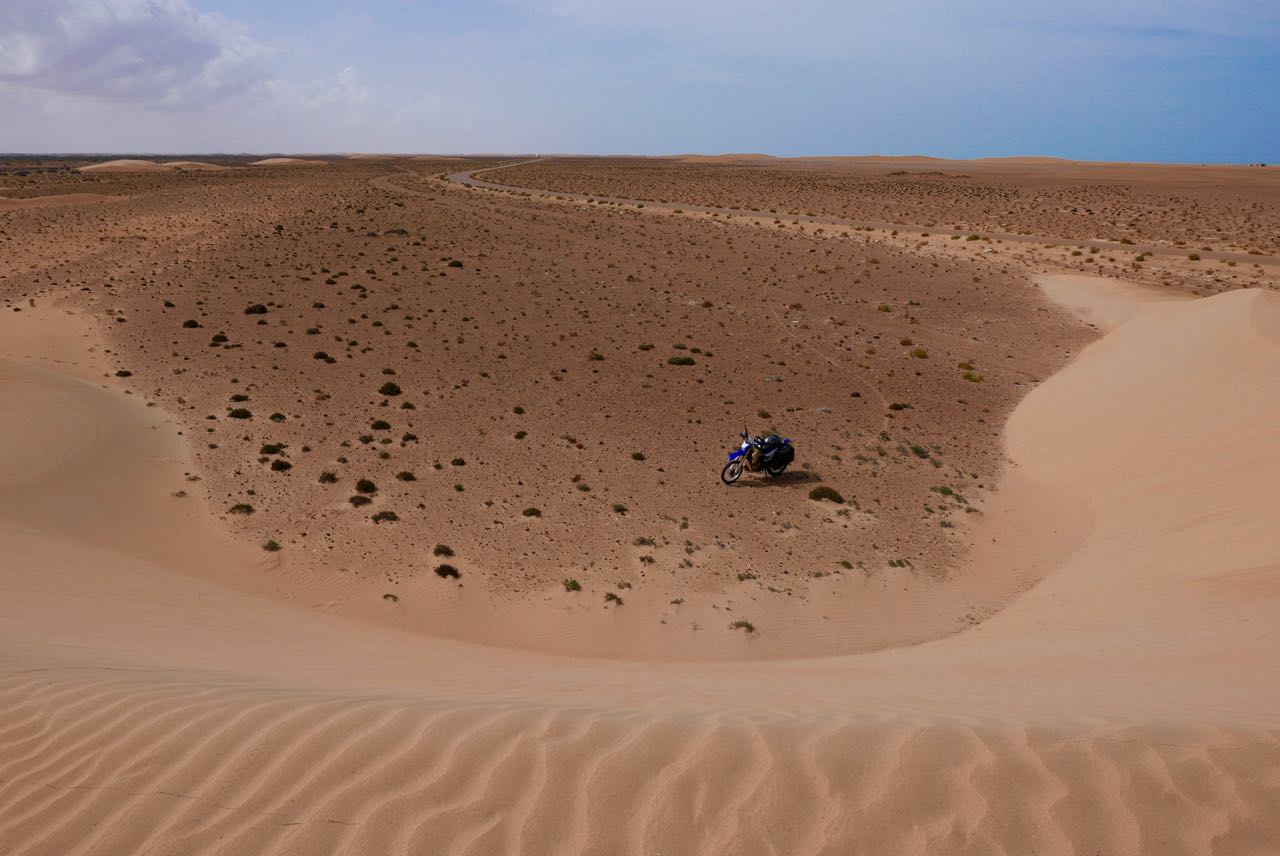
A trip report from March 2017 while updating my Morocco Overland book. It got very hot in the desert for a while which wore me right out, but I rested in Tan Tan where it cooled off for a few days, so I dived back in before the heat came back for good.
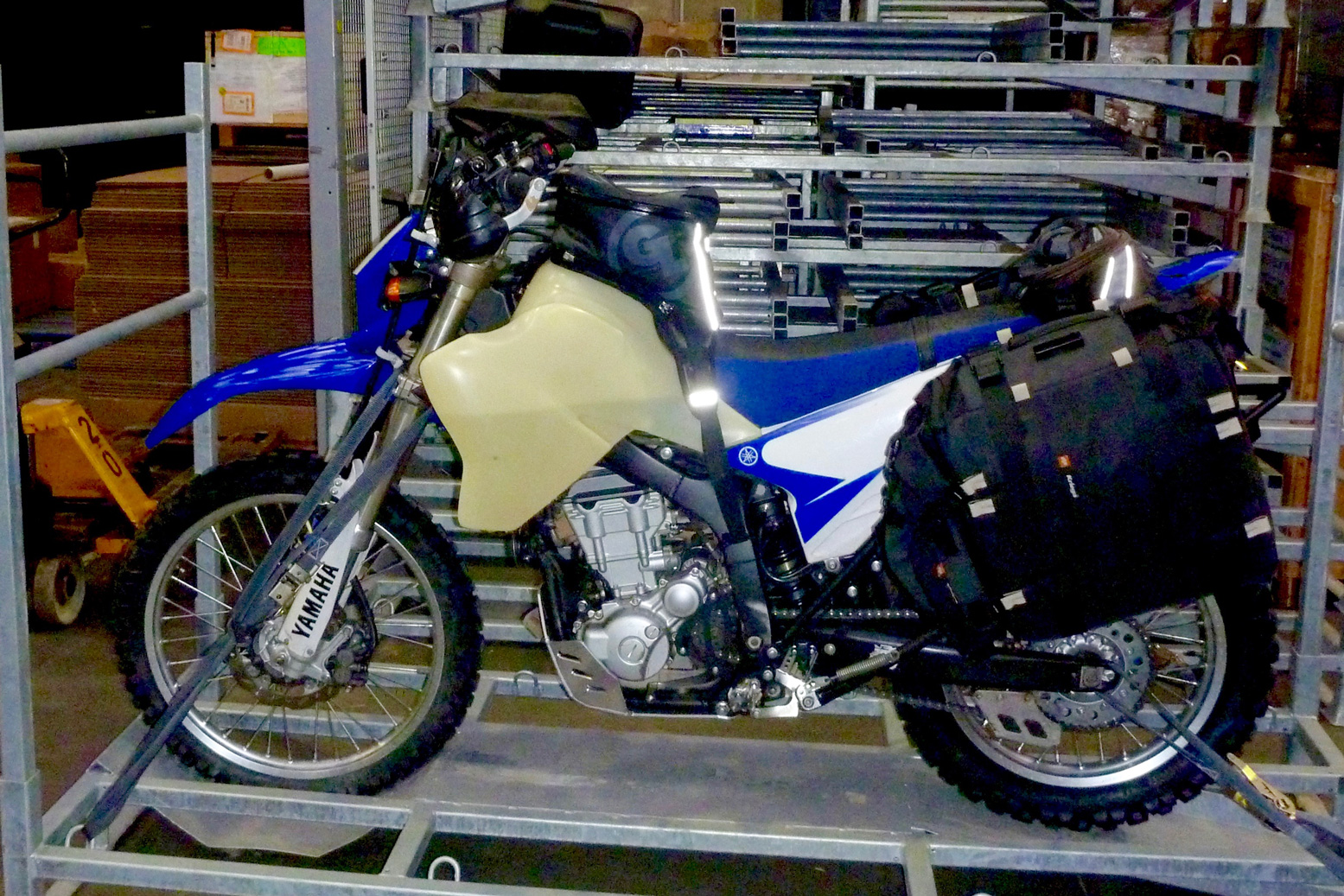
This time I used Fly & Ride to get the 250 to Malaga. Didn’t fancy Spain at 57mph. Works out cheaper too when you add it all up. Done trans-Spain enough times.
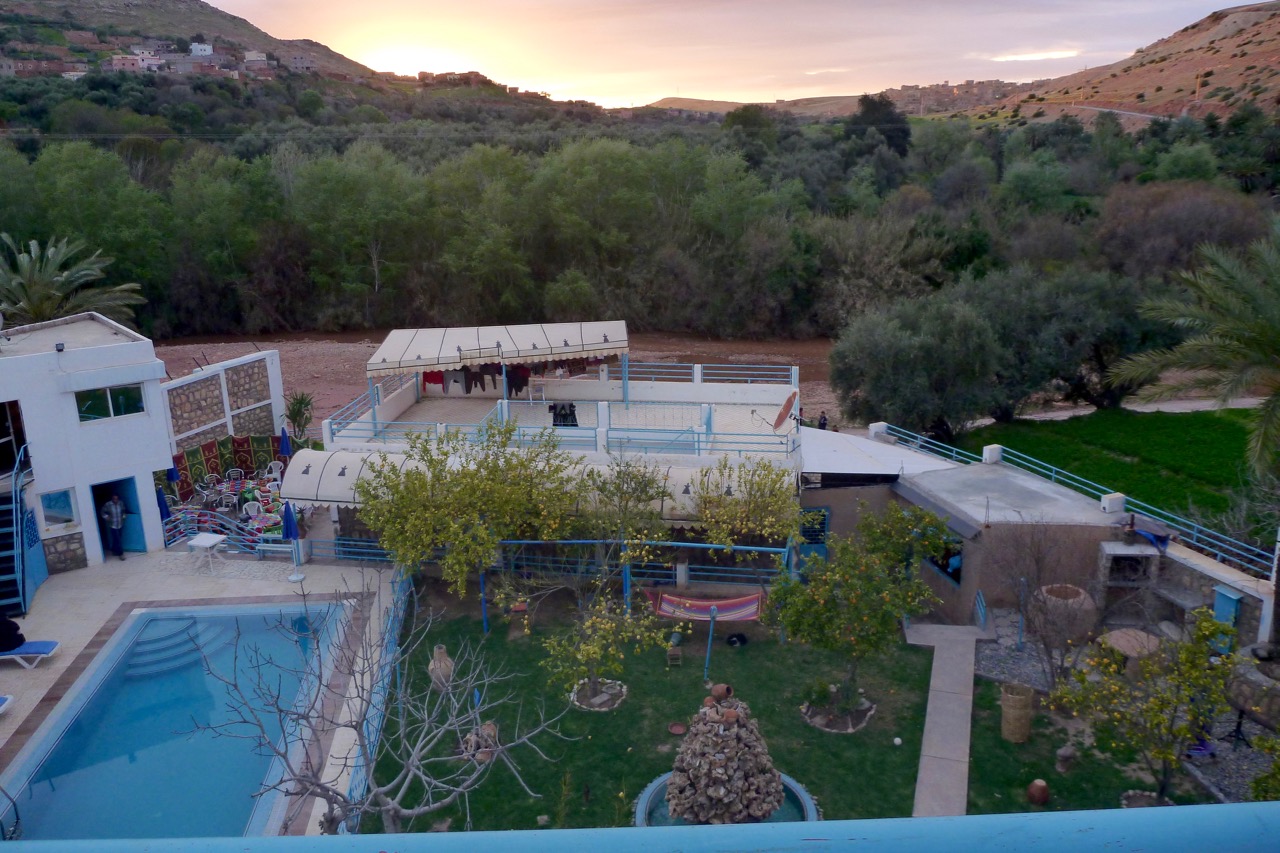
Gales meant the ferry took over an hour to dock at TanMed, and next day was miserable – down to 45 in 4th at times. But there’s no quick way to get south as nothing was going to Nador. I try Airbnb and find this lost resort up a valley near Bzou.
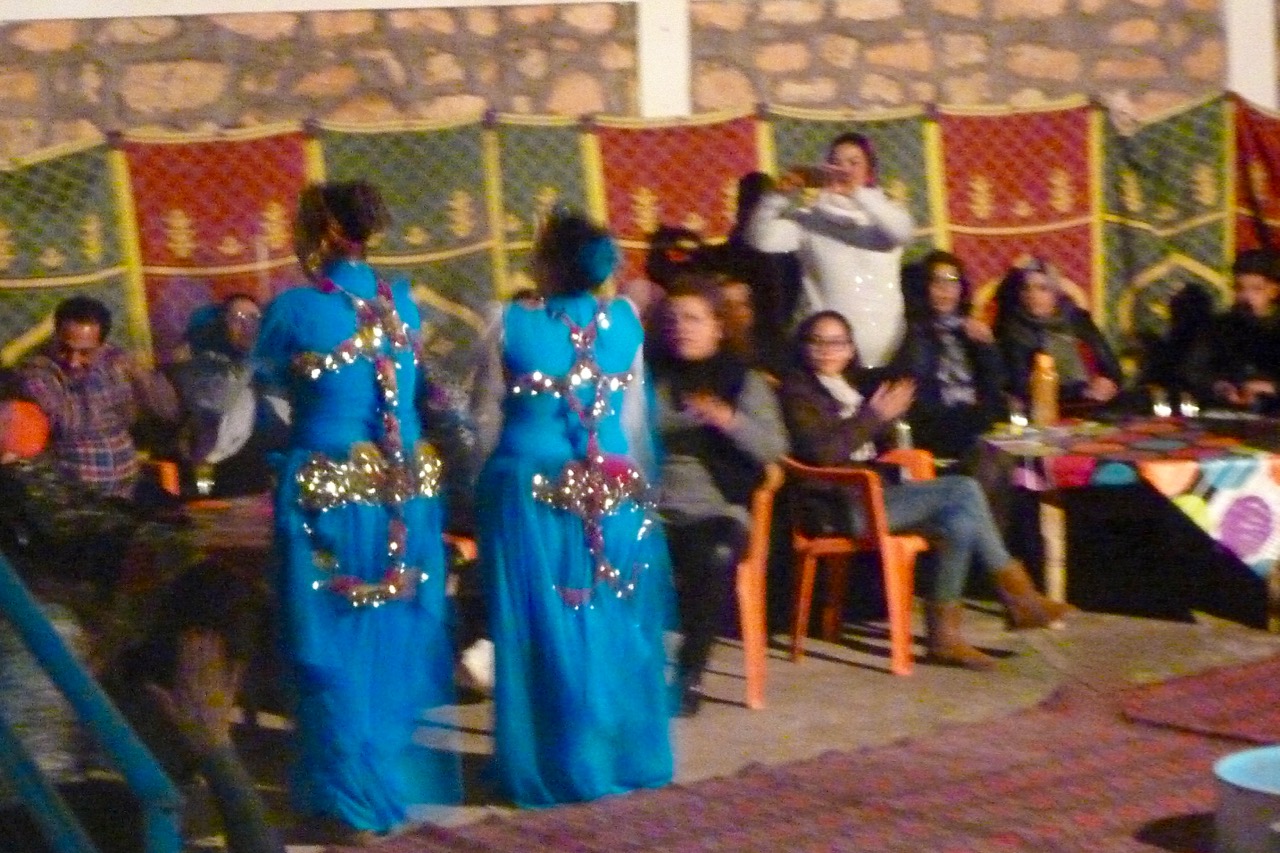
I inadvertently gatecrash a Berber soiree. No room at the inn so he feeds me and puts me up down the road.
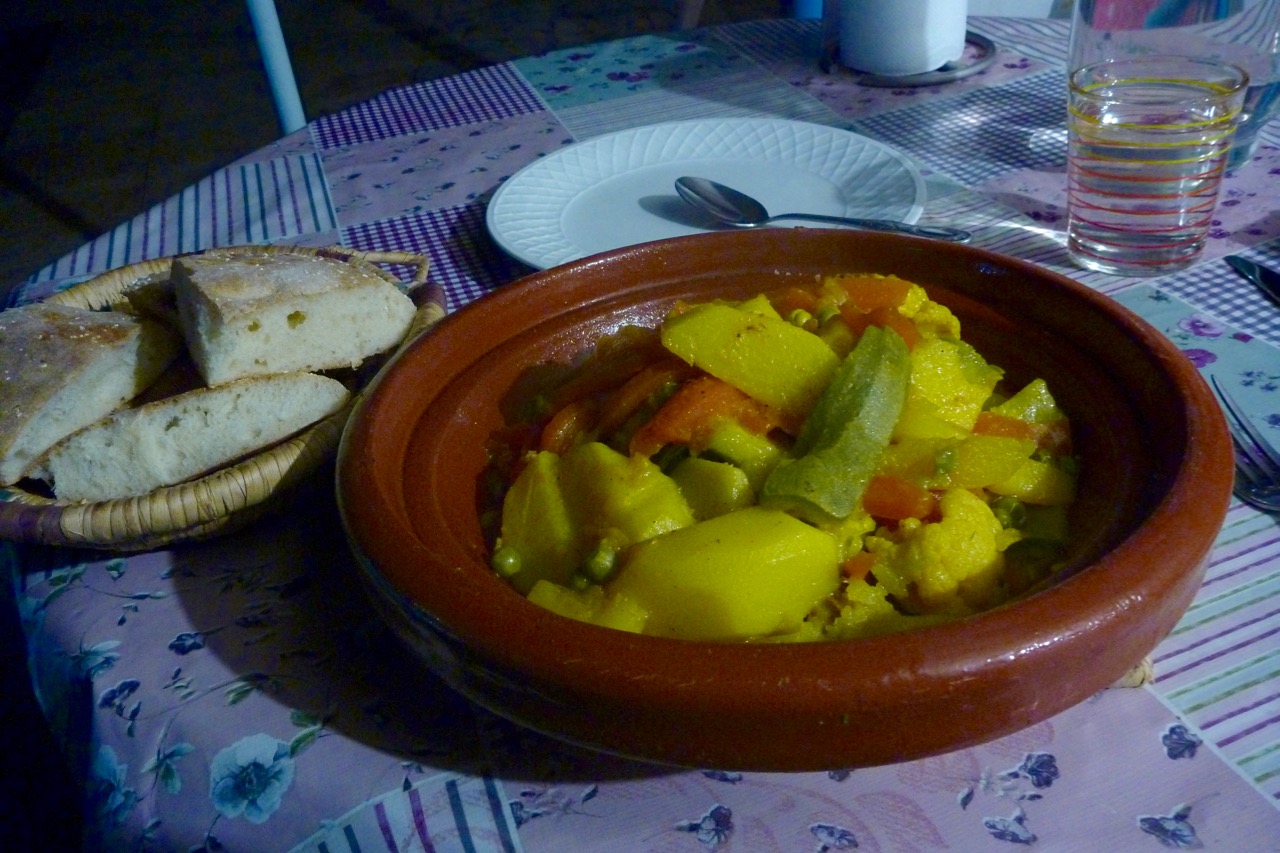
My first tajeeen of twenty-seventeeen.
Next day I got my bike back – pootling though the springtime Middle Atlas without fighting gales and showers and trucks. 95mpg thankyouverymuch.
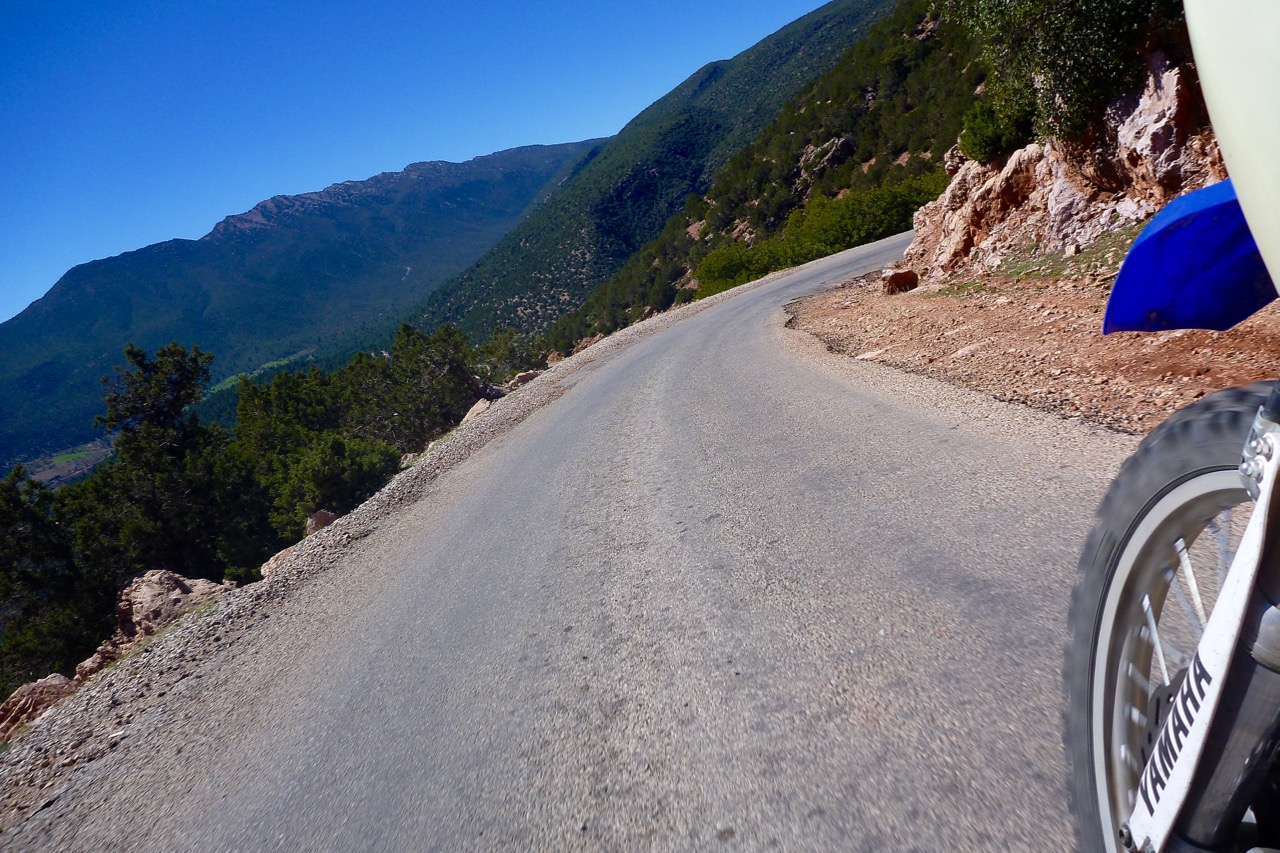
I take the old Demnate route over the High Atlas. Last did it on the XT660Z in 2008
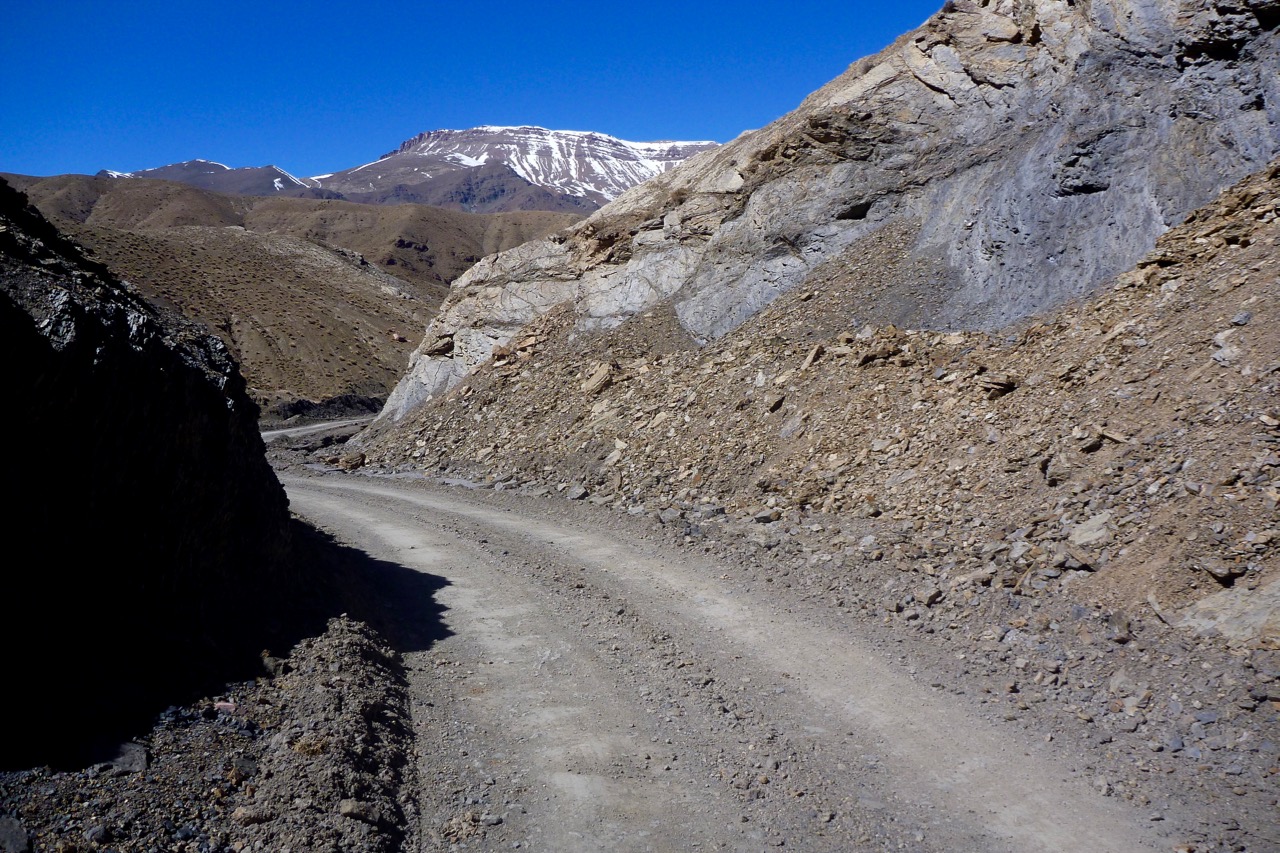
The road deteriorates in places. Lots of landslides. Near zero traffic.
I pop out on the south side overlooking the headwaters of the Oued Draa near Ouarzazate. There’s a huge new solar farm down there.
After some fumbling about, I pick up a new piste from Ouarzazate to Tazenacht.
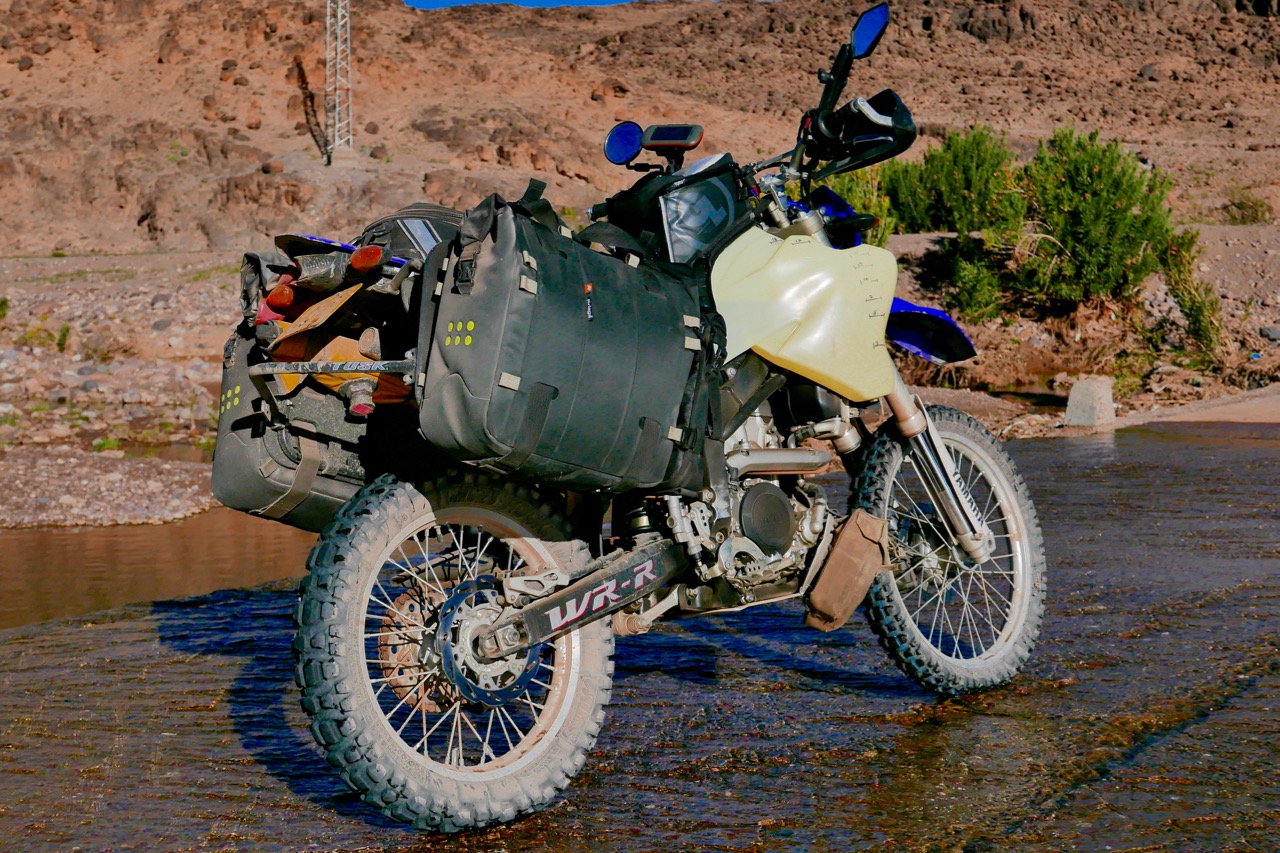
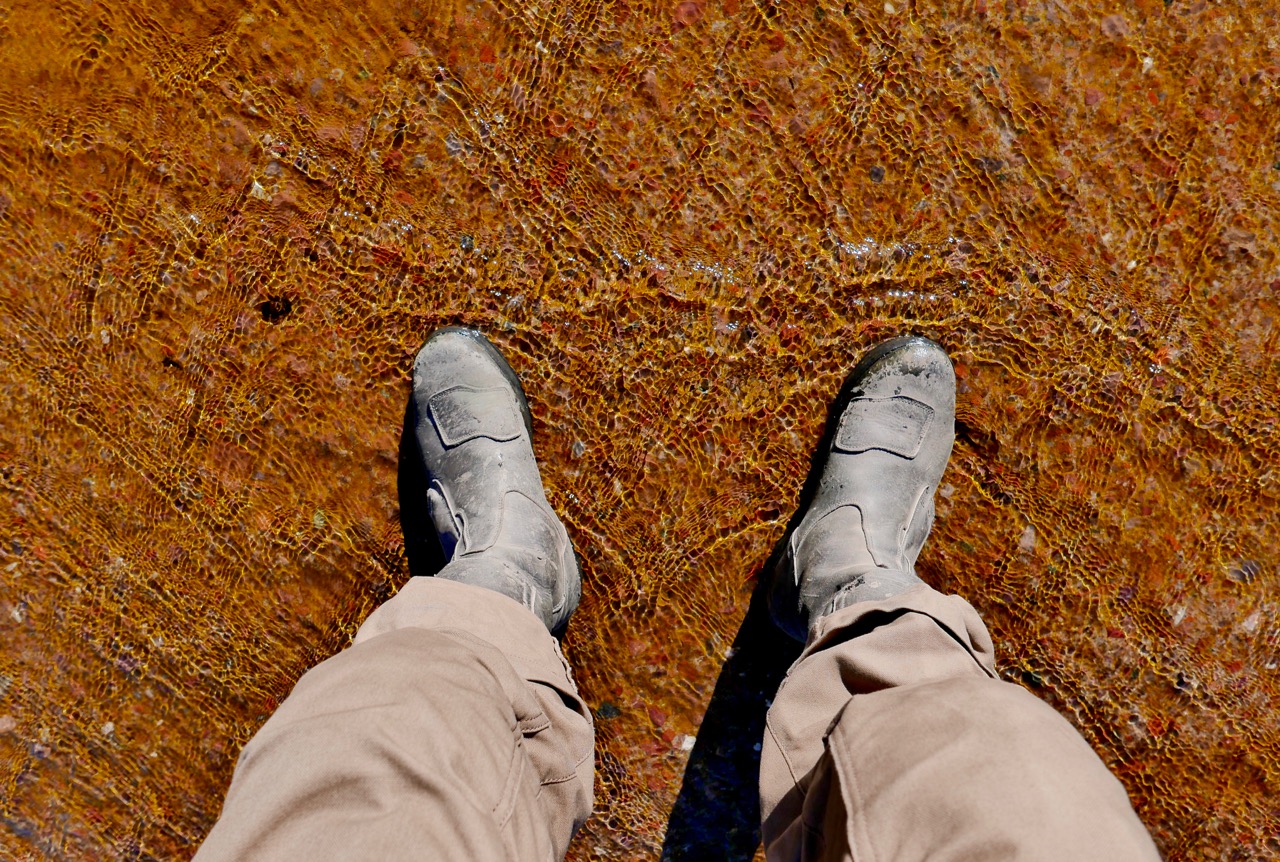
Nice colours on the ford
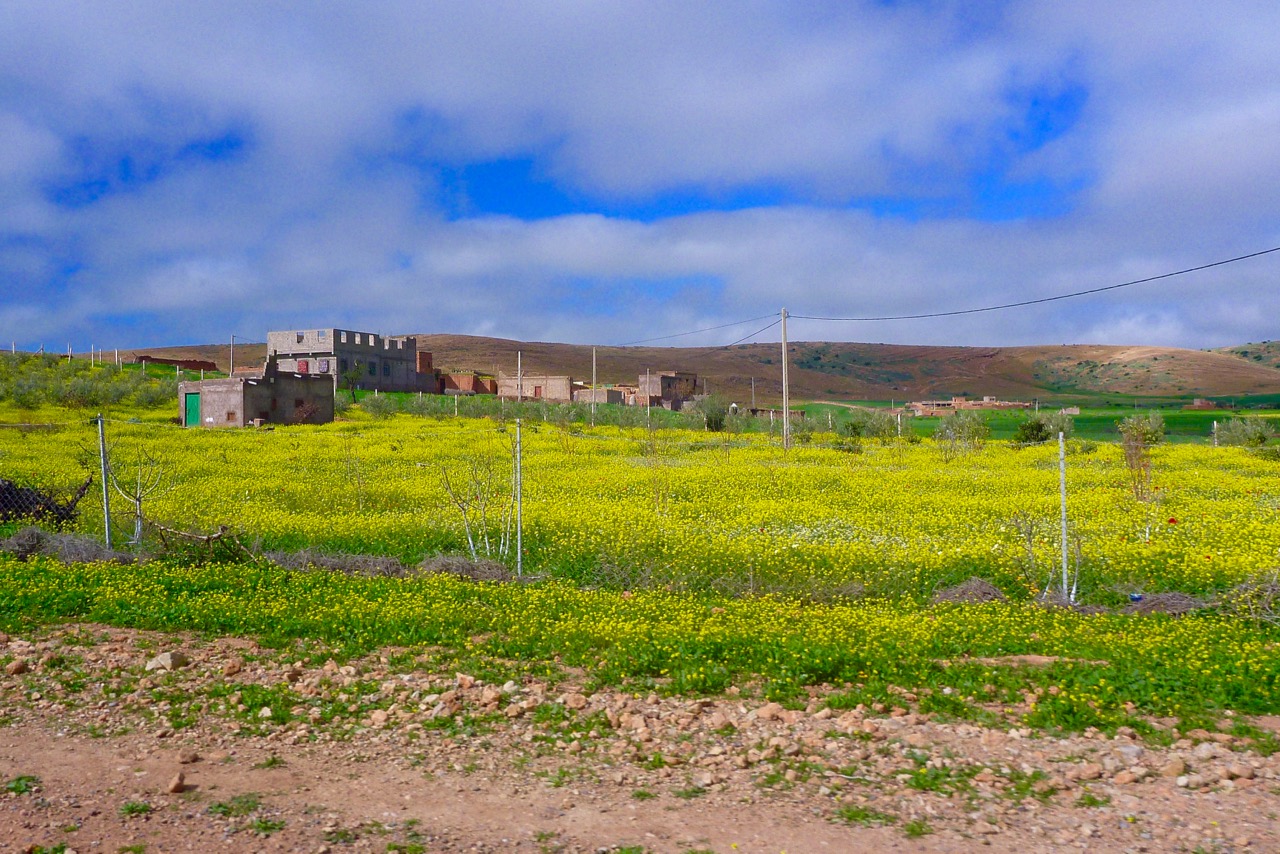
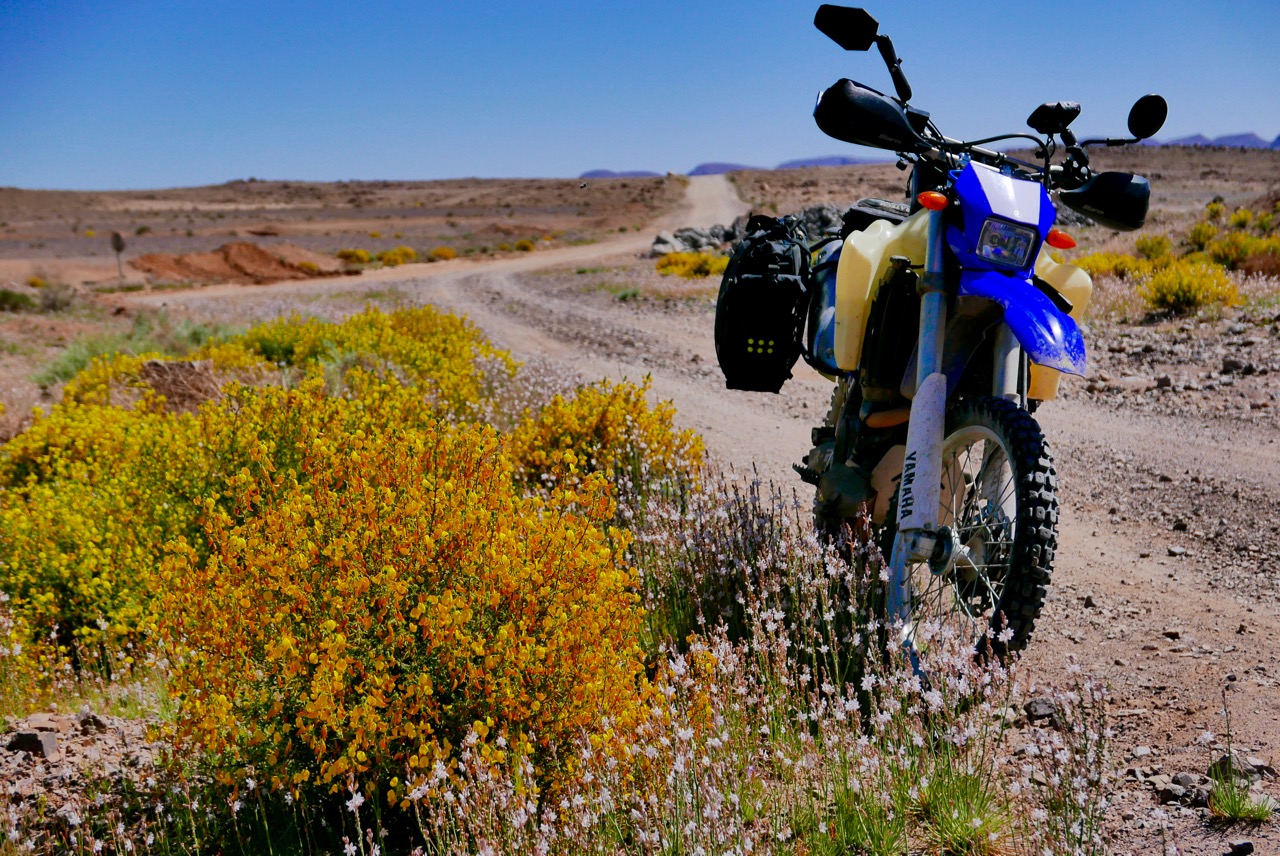
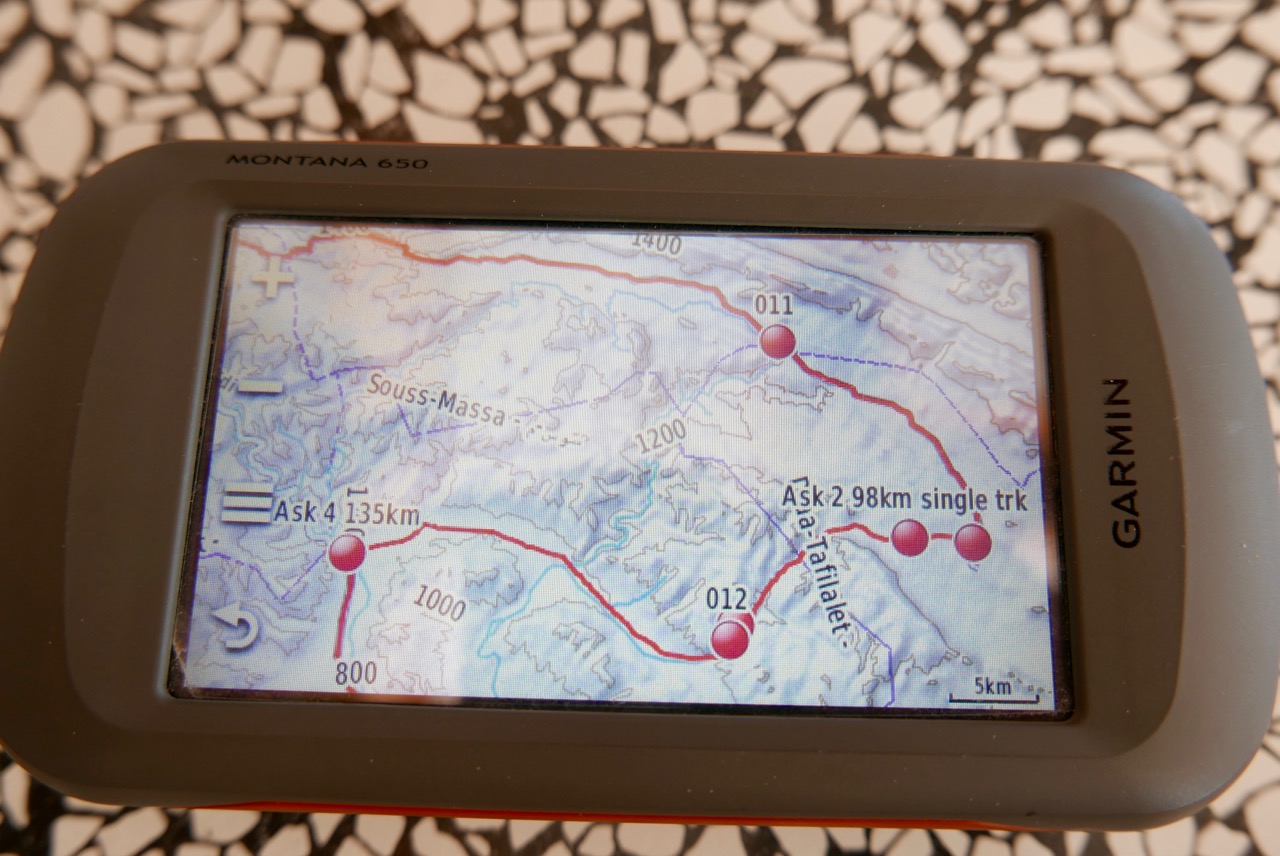
Next day another new piste I’ve been wanting to unravel for ages. Olaf map is confusing, but an old man in a village puts me straight Wildflowers are out.
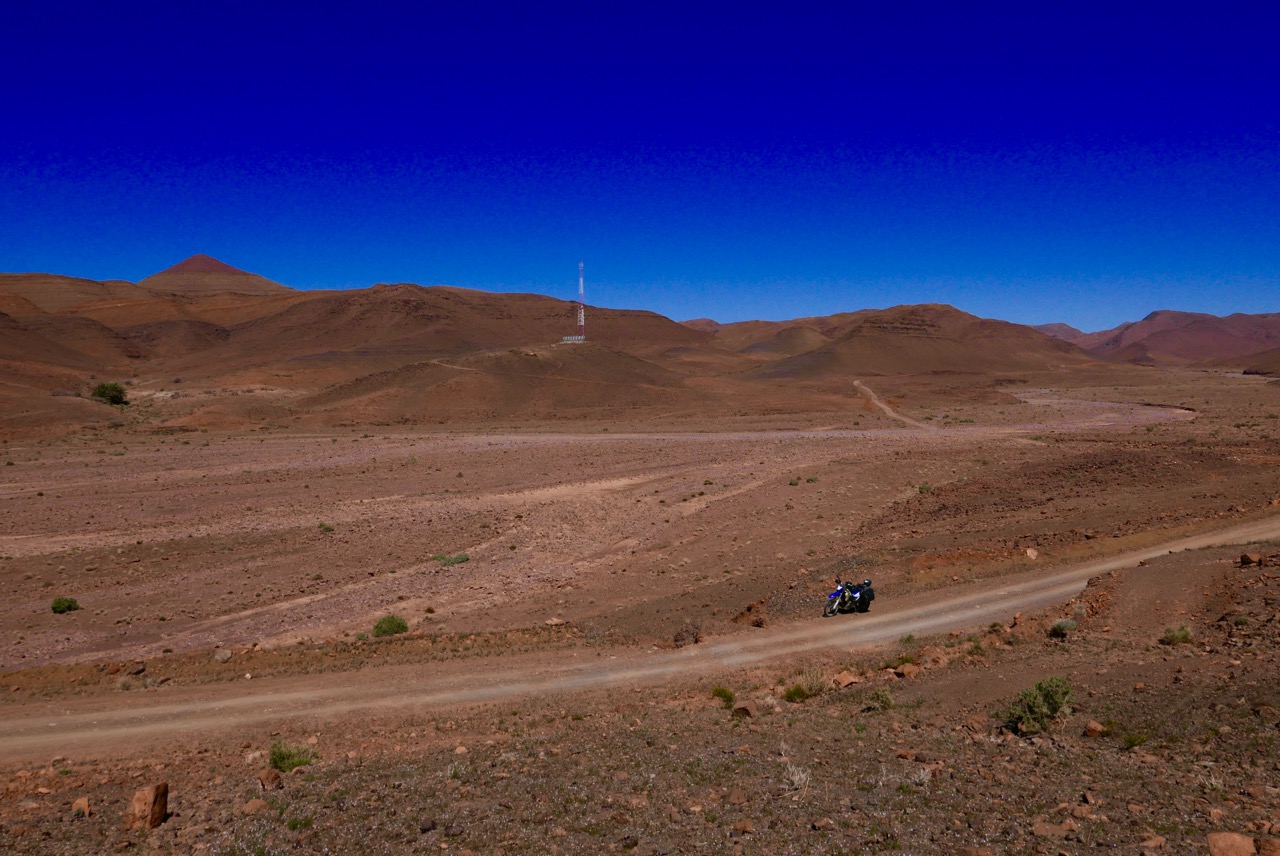
I’ll take the odd mast over photo-bombing telegraph lines any day
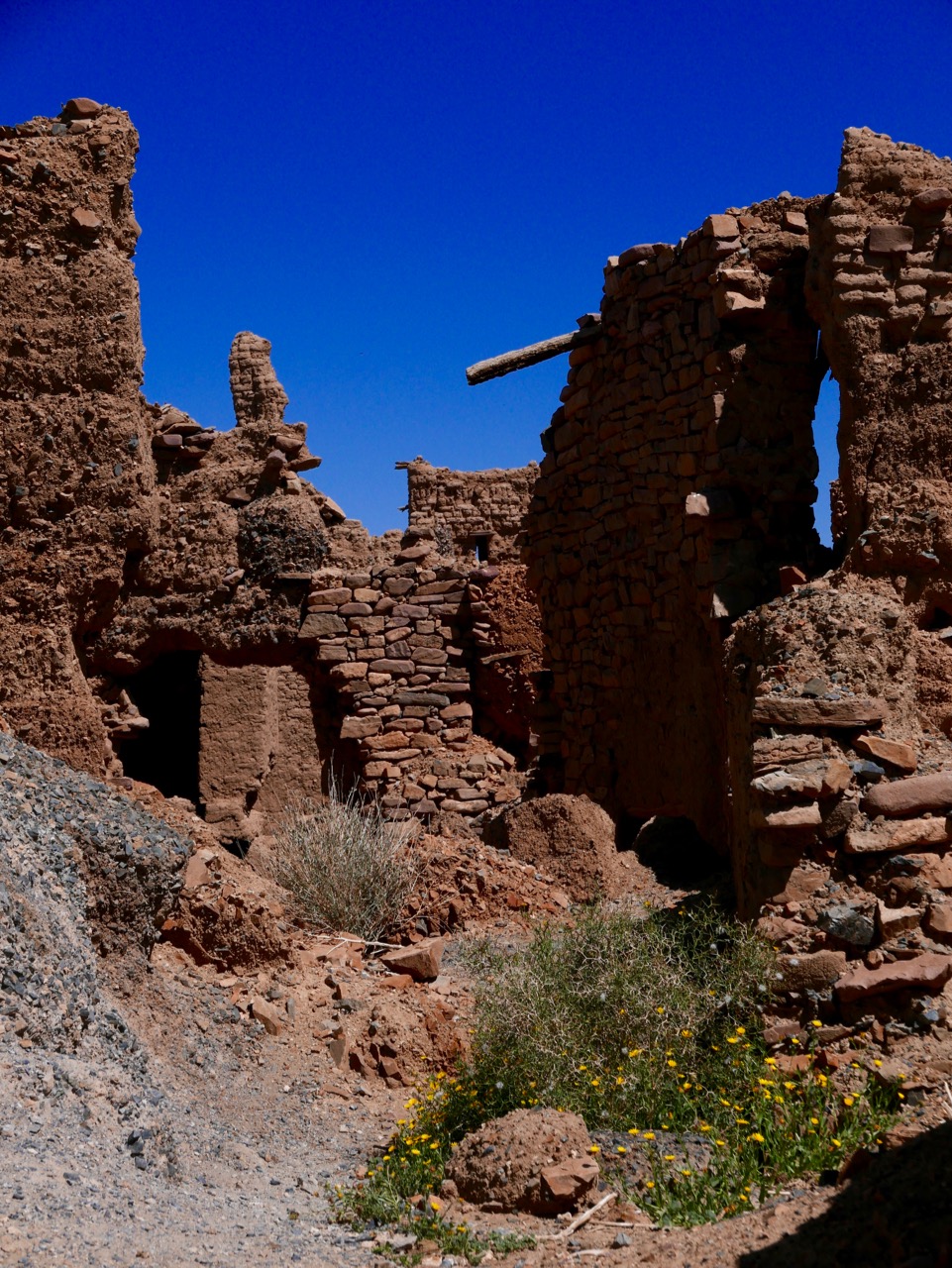
The ruins of Assaka ksar.
No Canoeing? Shame.
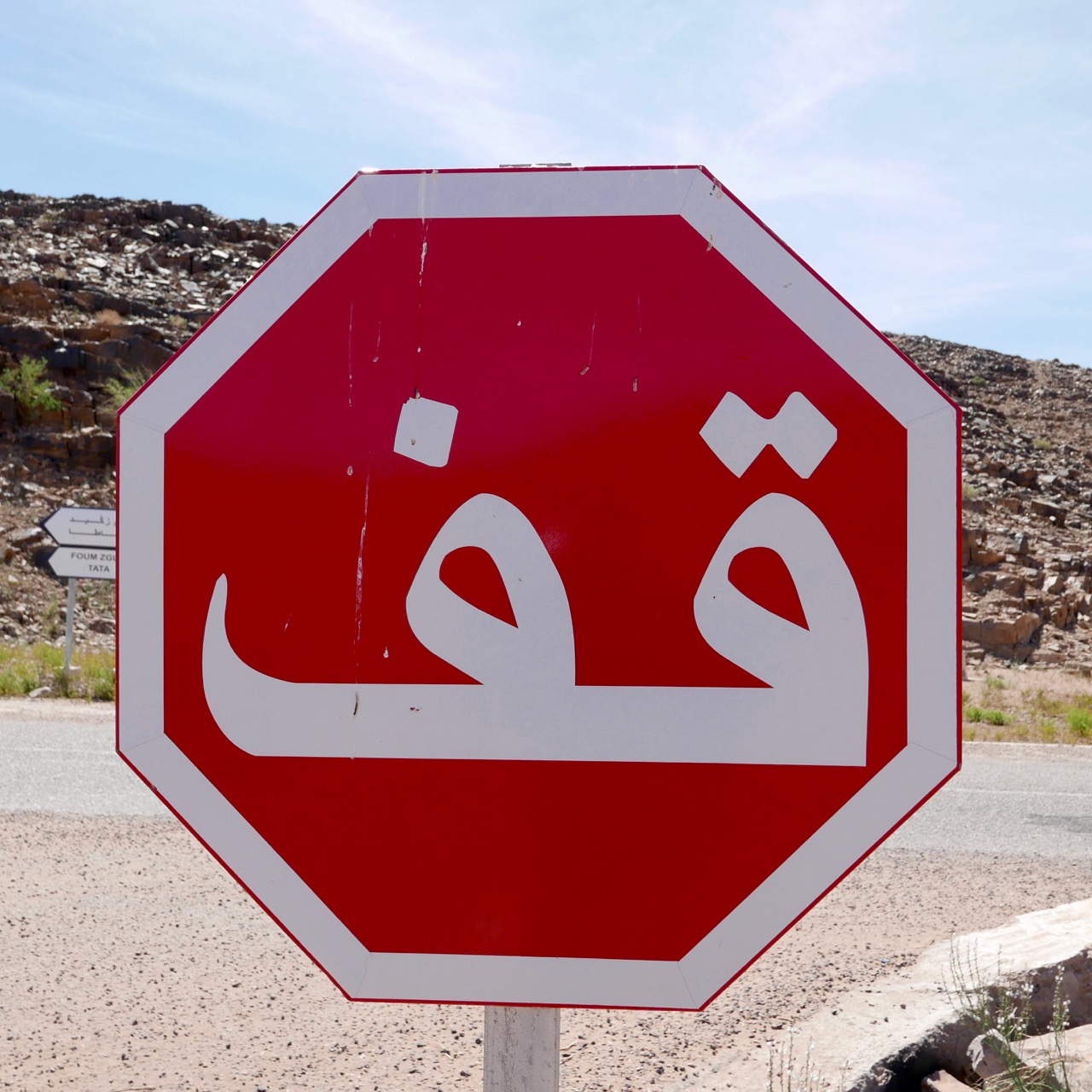
Perfect lunch at Foum Zguid roadhouse
A good morning’s work – but it is now as hot as.
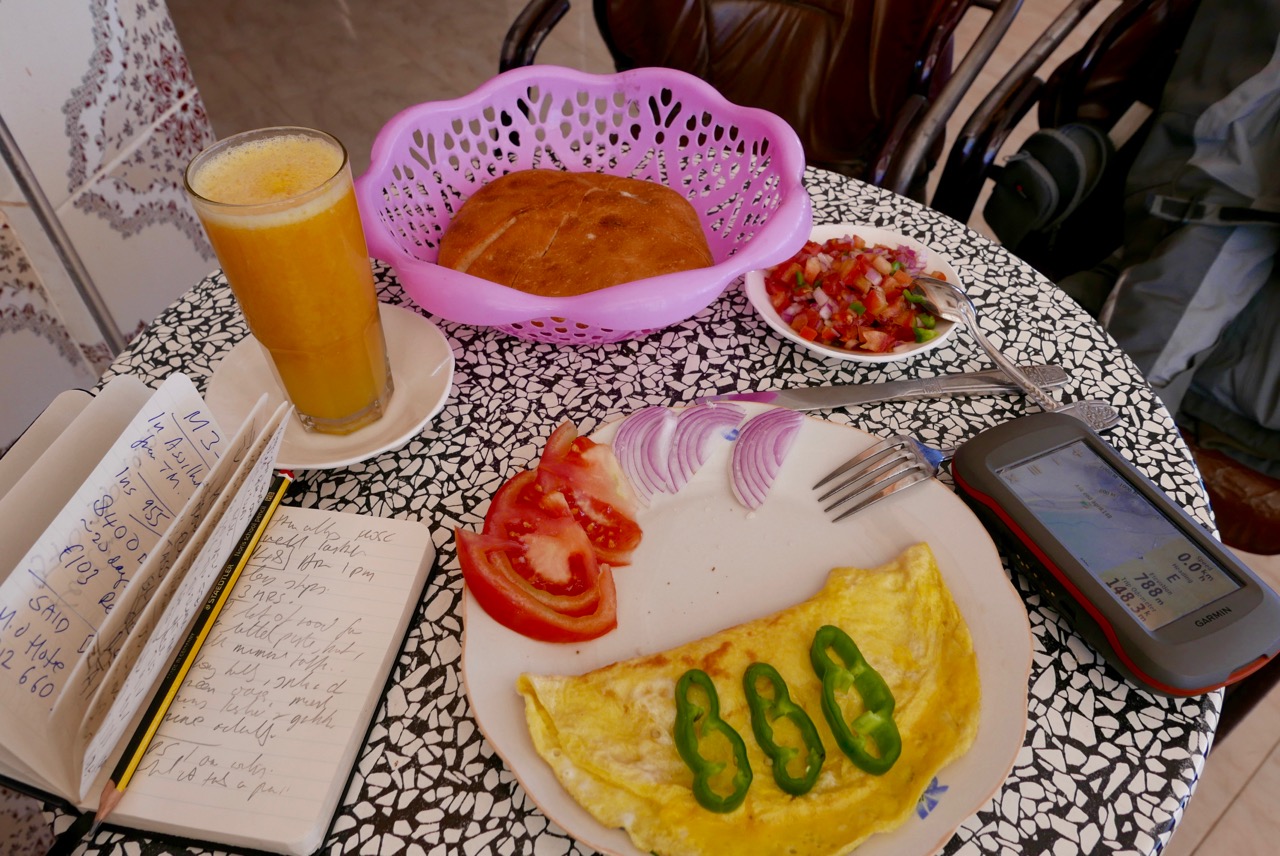
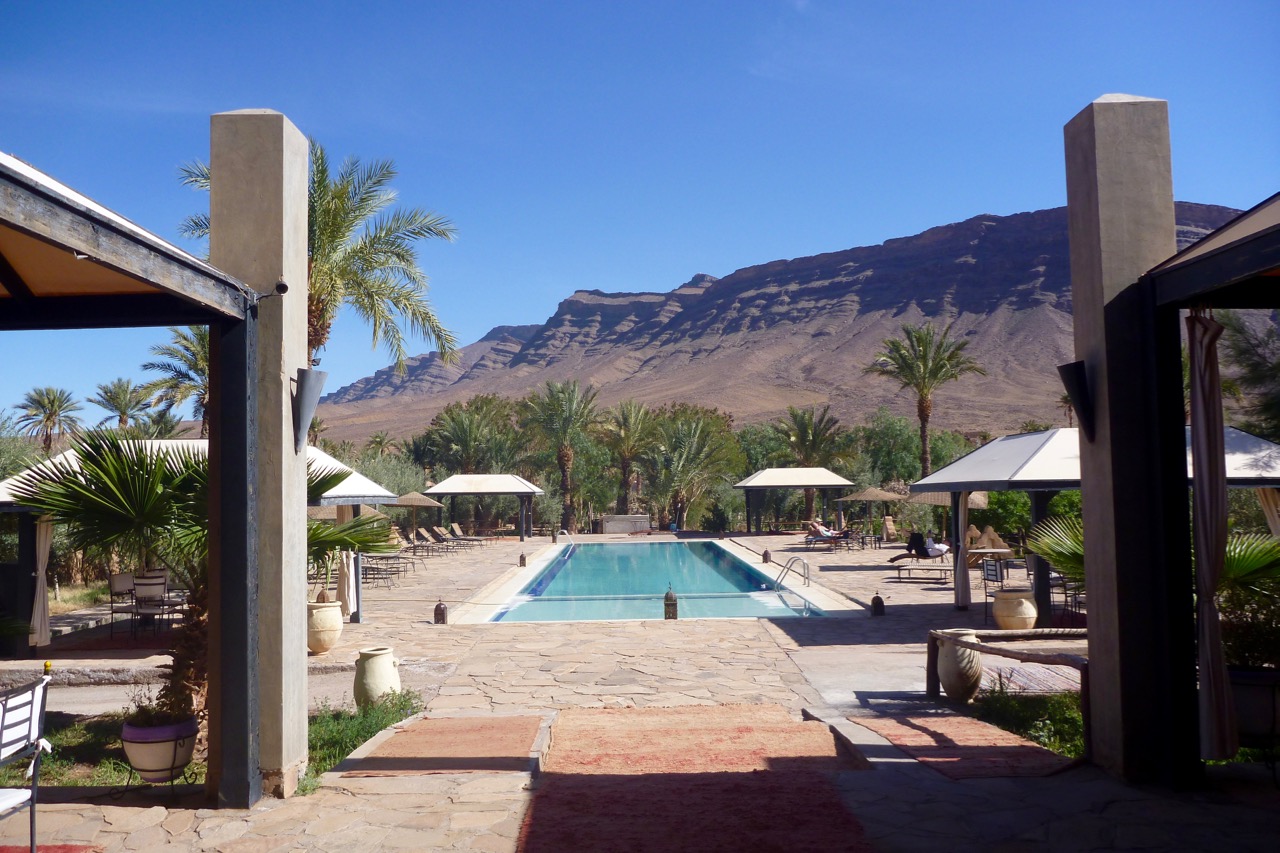
I check out a flash place for a future tour, then head into FZ for my reliable cheapy: 16 quid half board √
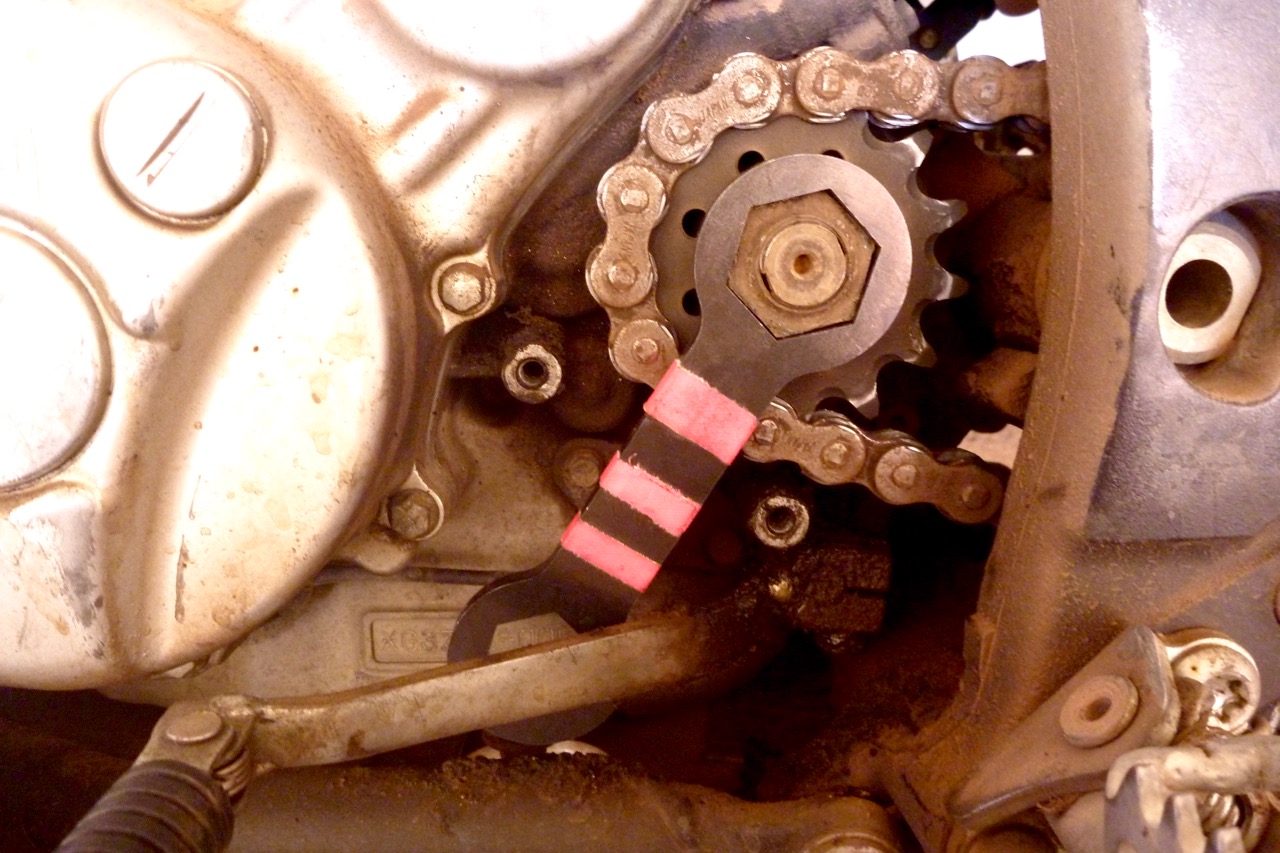
At 14-47 my bike is over geared even on the road, and my weight and wide pans don’t help. But the flat wheel wrench won’t fit – who’d have thought? – so I nip into town to blag a 27 socket as there’s gnarlier dirt to come…
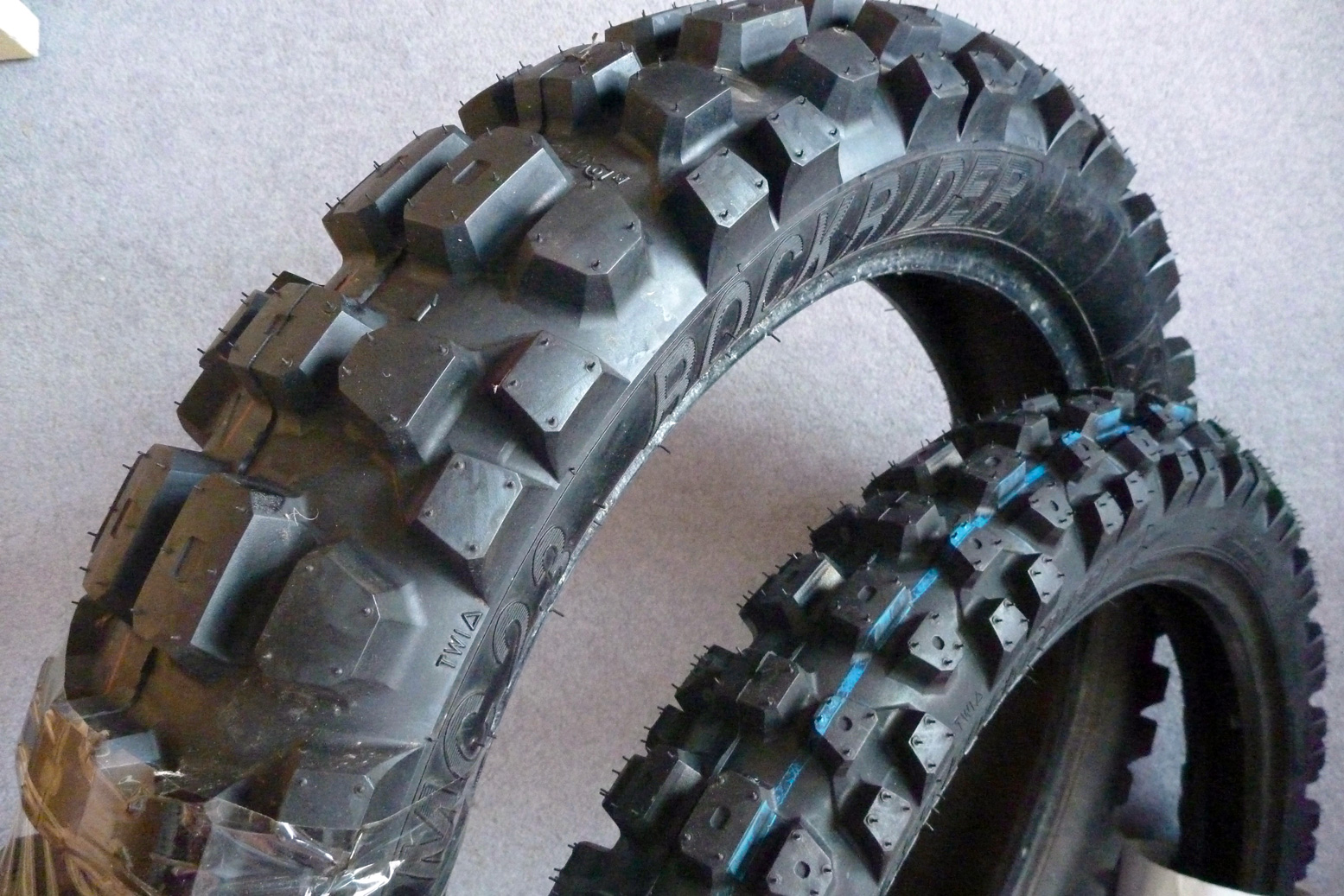
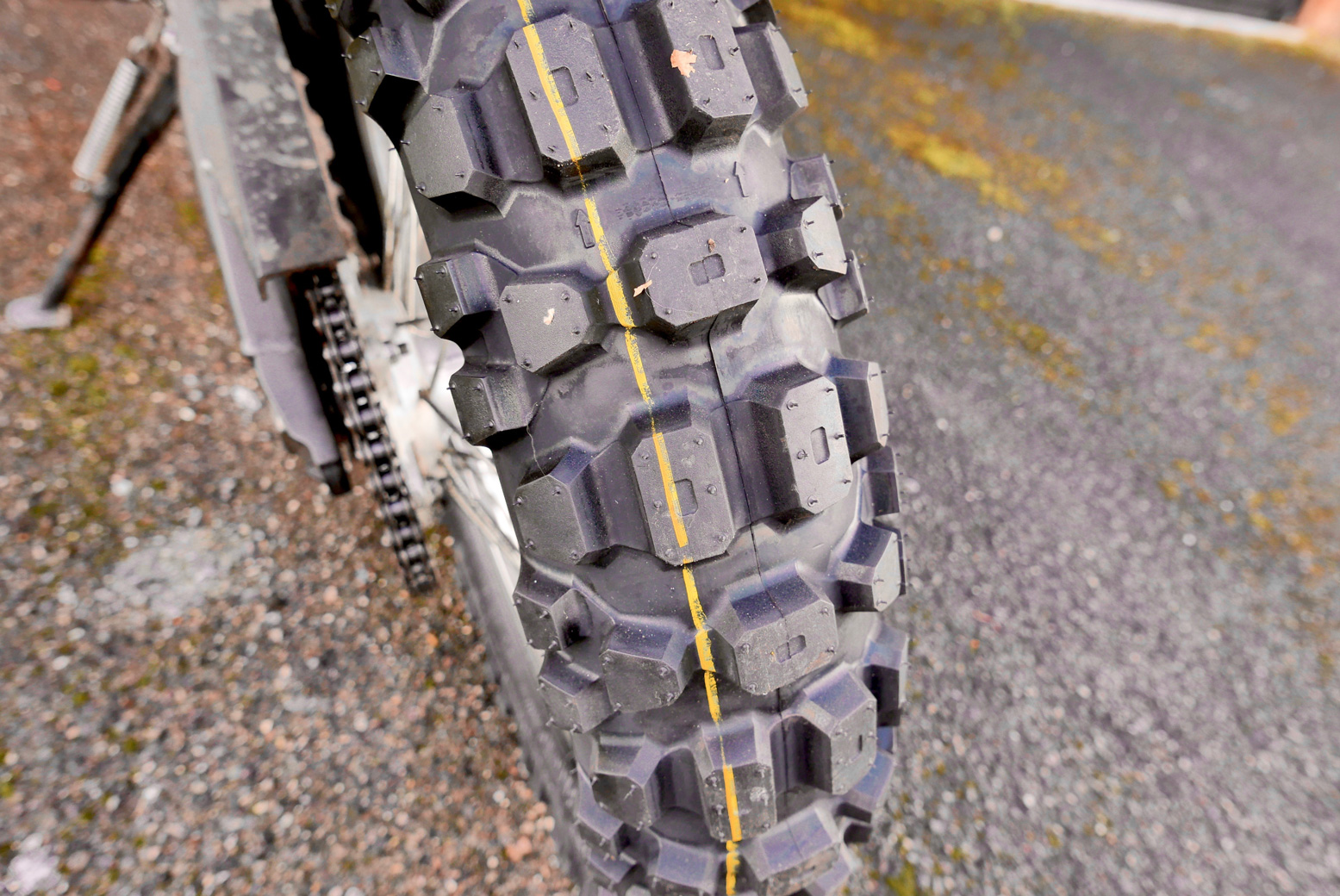
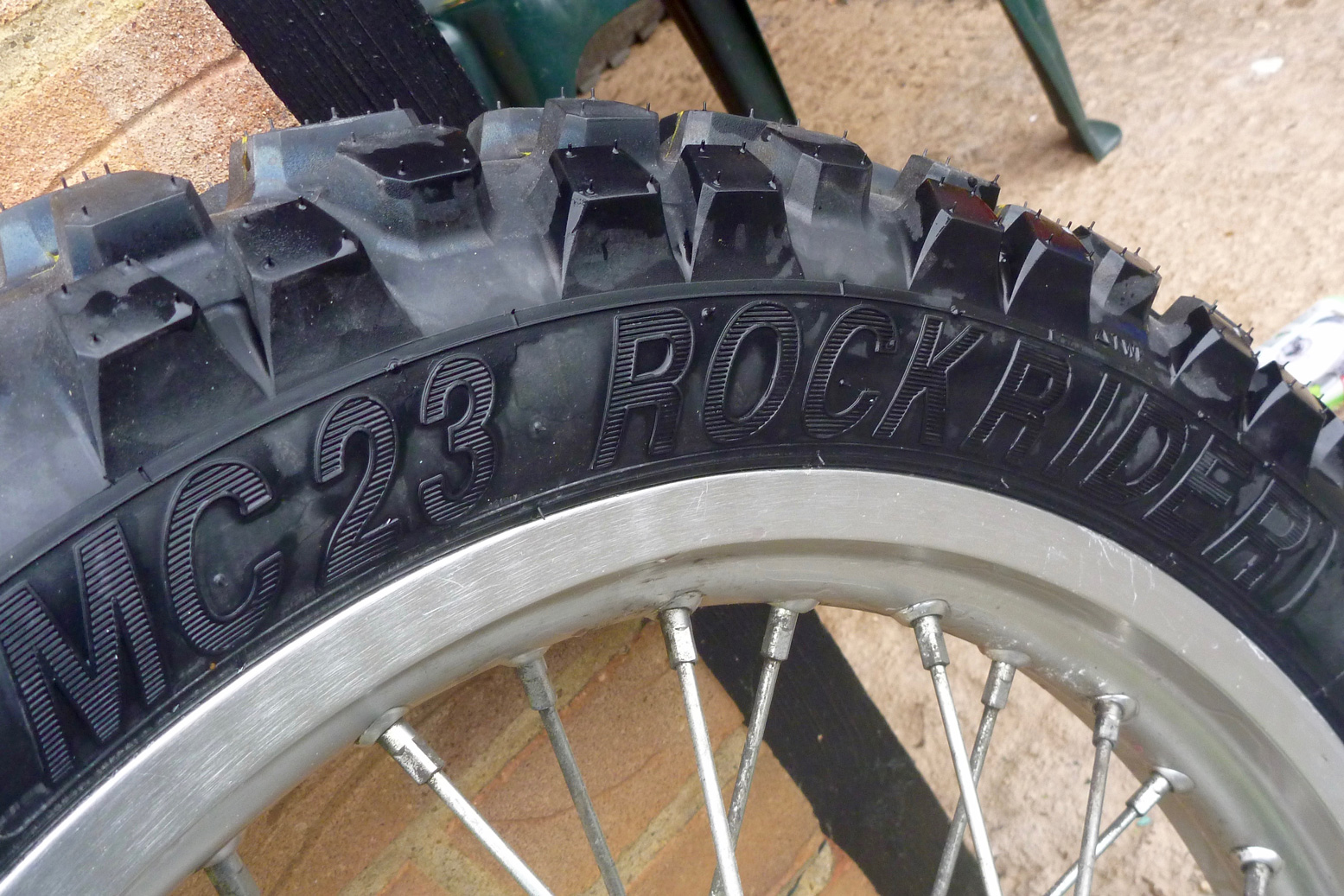
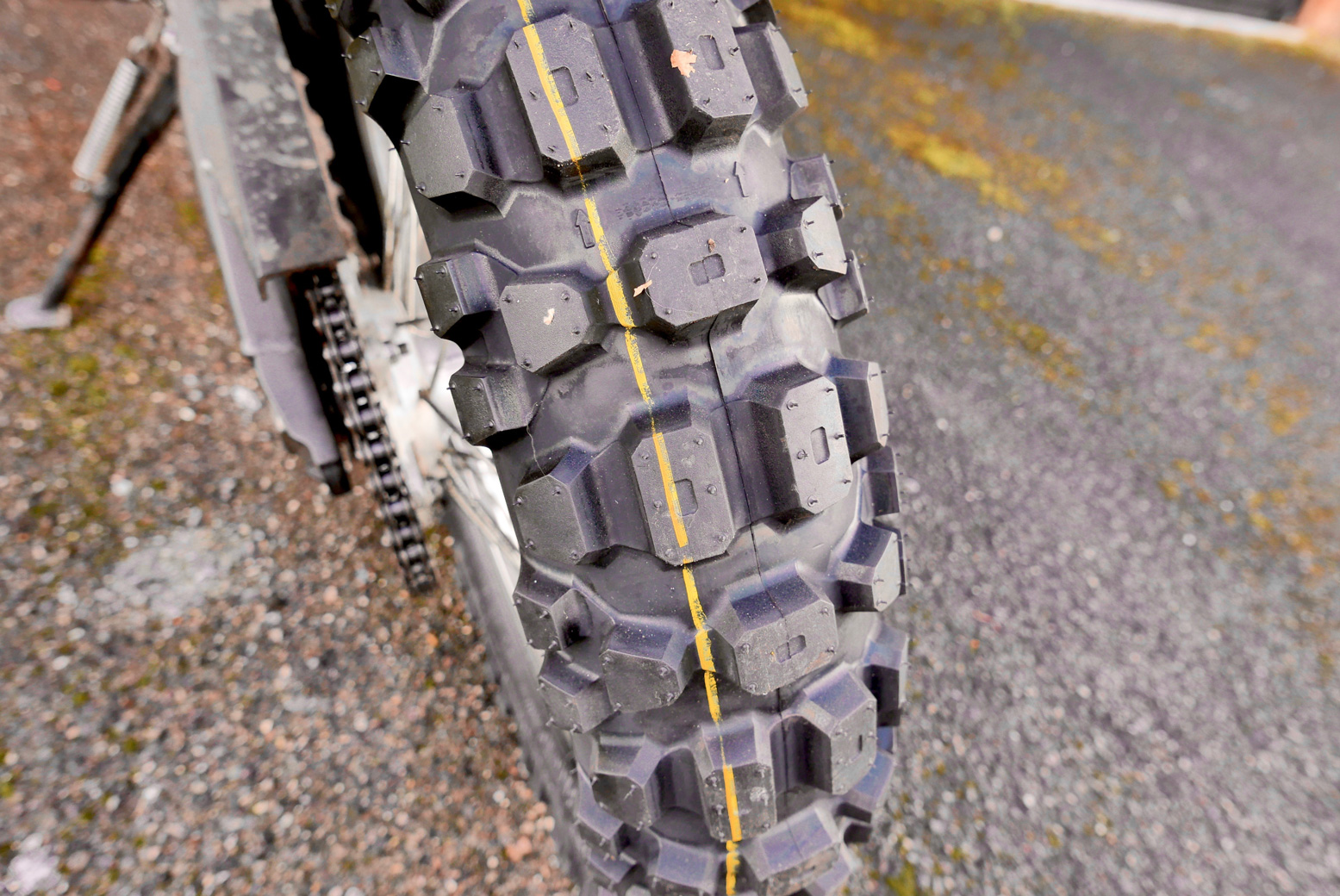
I had the luxury of having my WR trucked down to Malaga and back, so could afford to run street-legal knobblies for my Morocco update trip. The Mitas Rockrider MC23s were recommended by a mate and iirc, cost under £120 the pair. As always, I Slimed them up and also ran them at 30psi, road or trail, except for one sandy oued episode and day overlooked at 25psi.
Long story short: no complaints on road or trail. On a light and relatively low-powered bike riding roads, wet or dry, they never felt sketchy, and on the dirt were of course a lot more secure than a regular do-it-all adv tyre.
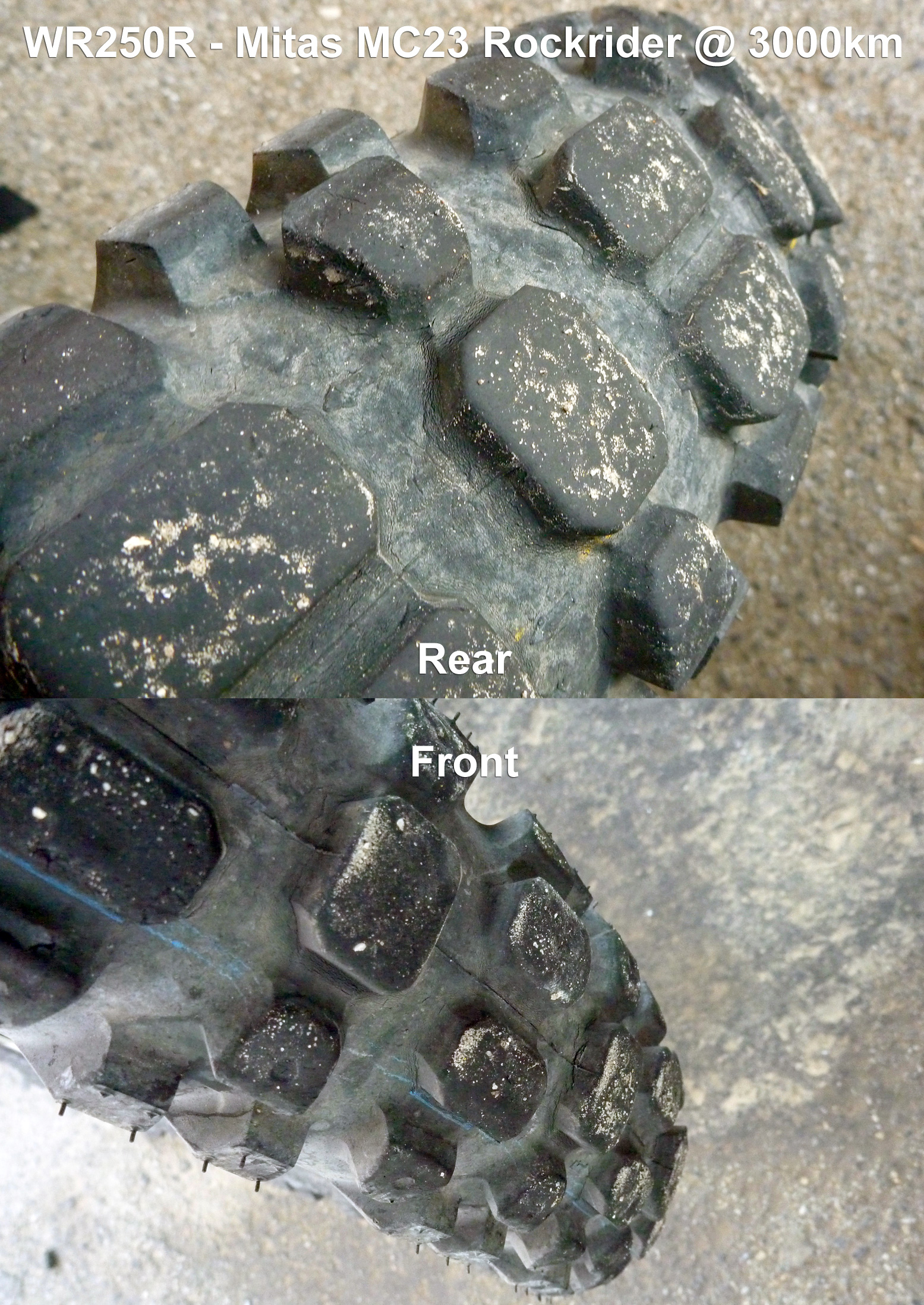
But after only 3000km the back was down to 5mm. I suppose wear will slow down from here on, but I feel that was very similar wear to a ‘soft’ TKC I ran on a Tenere a few years ago, though that was run tubeless which may have extended its life. Incidentally, I’m told the Rockrider is also tubeless. So, I suppose there is no way of having your tyre and eating it, even on a light bike. Grippy dirt tyres will wear fast and so perhaps are a bit of an extravagance on long rides. As always, it depends where your priorities lie: dirt grip or longevity, which is why the less knobbly do-it-alls (right) live up to their name.
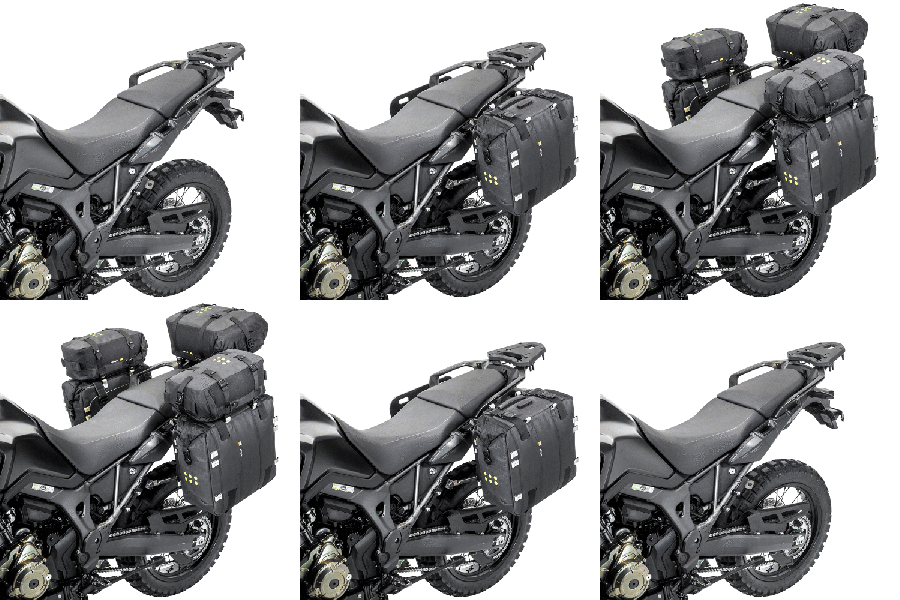
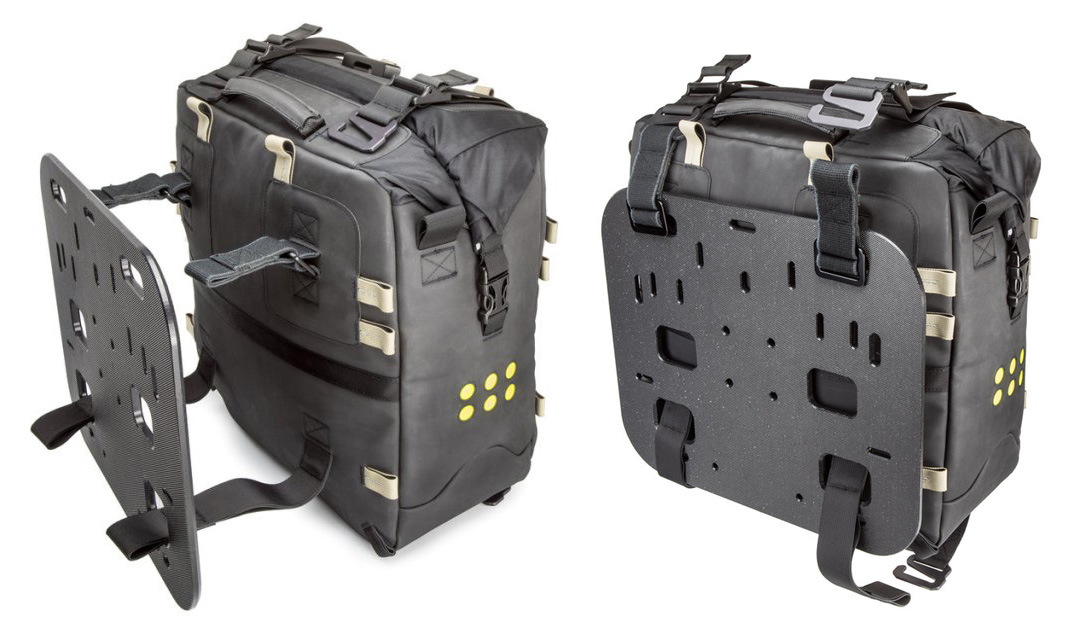
Kriega’s new Overlander-S is their second iteration of a luggage system suited to bike travel. A few years ago they brought out a similar plate-on-rack idea (below right) but, with modularity using their existing 15-litre packs (or Rotopax), which were semi-permanently riveted to the HDPE plate which itself attached to the rack with fiddly skewer clamps. I never used them myself, but has a close look once and it wasn’t really for me. I prefer one big bag, like the Adventure Spec Magadans, and an easier way of getting the bags on and off a rack.
• Good volume
• Rugged construction
• Easy mounting and removal
• Exterior tabs for expandability
• Option to not use platform/plate
• Expensive, once you add it all up
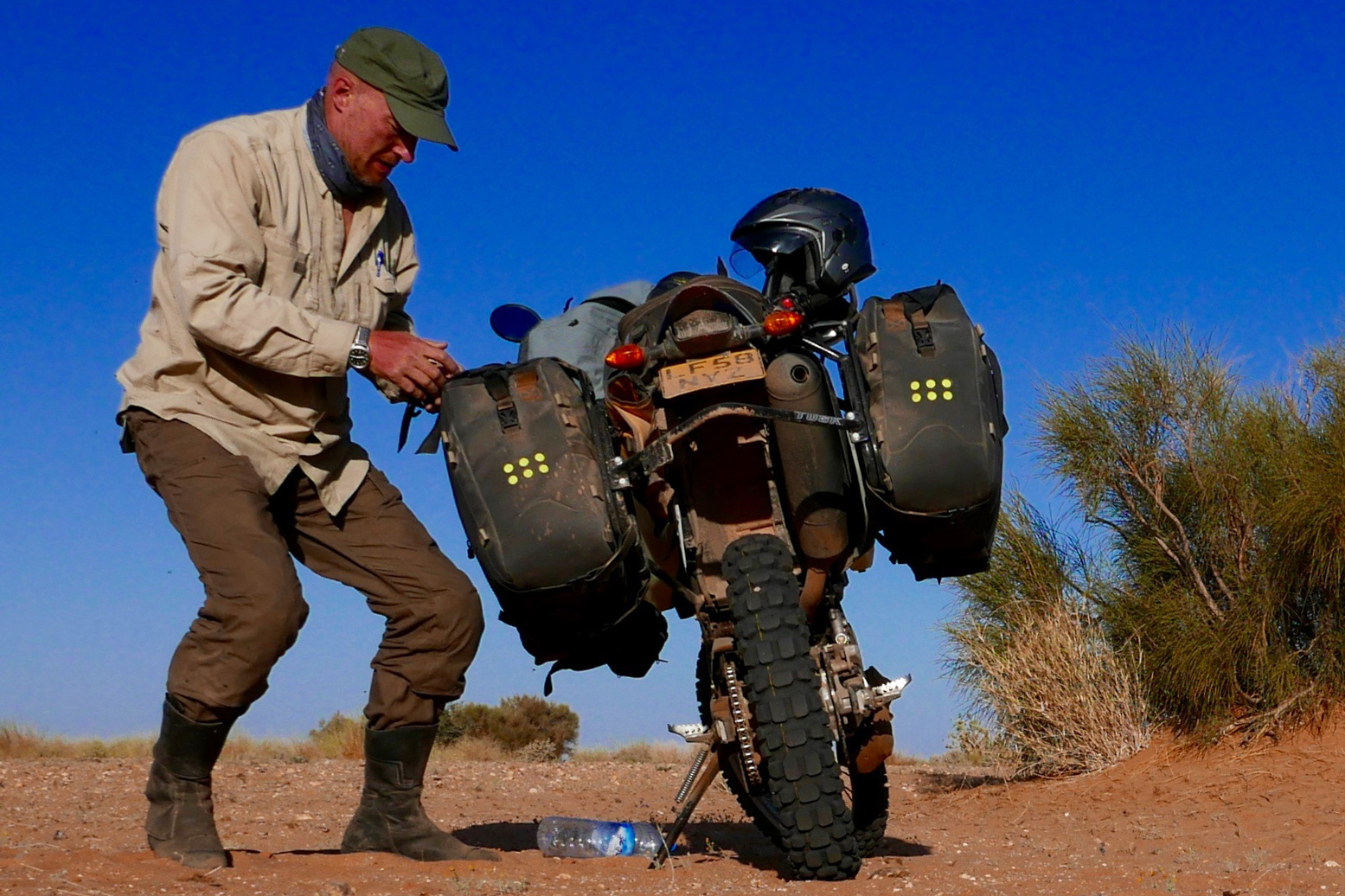
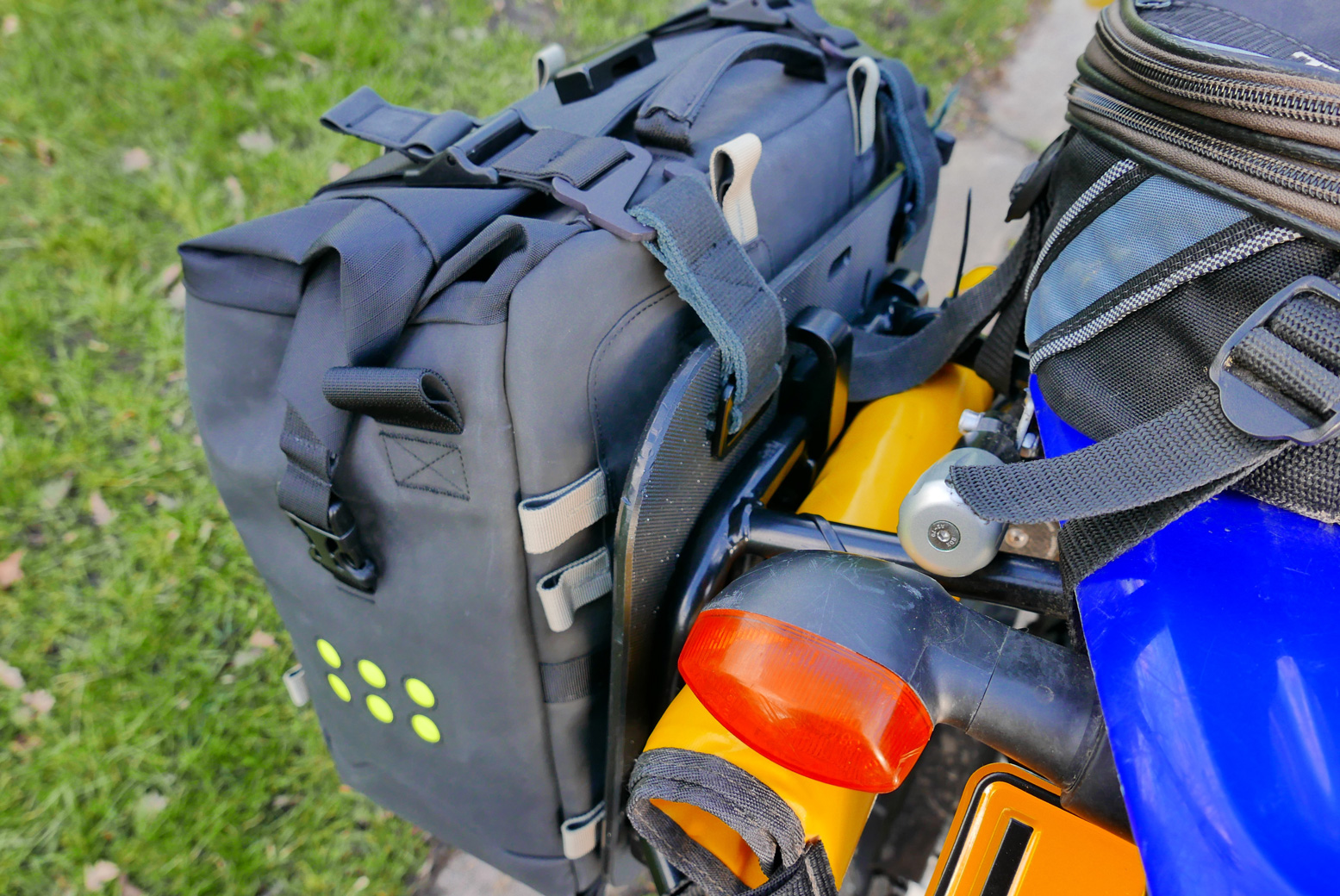
I just spent a month in southern Morocco and Western Sahara with prototypes of Kriega’s new OS-32 panniers, the core of their new Overlander-S system (below right) using a similar bag-on-plate-on-rack system. My load was only about 10-15kgs each side, depending on water, and I was set up for tentless camping with a few days food. A nifty Giant Loop tankbag, a trusty old Touratech tail pouch and Kriega R15 backpack with Hydrapak added up to the rest of my baggage.
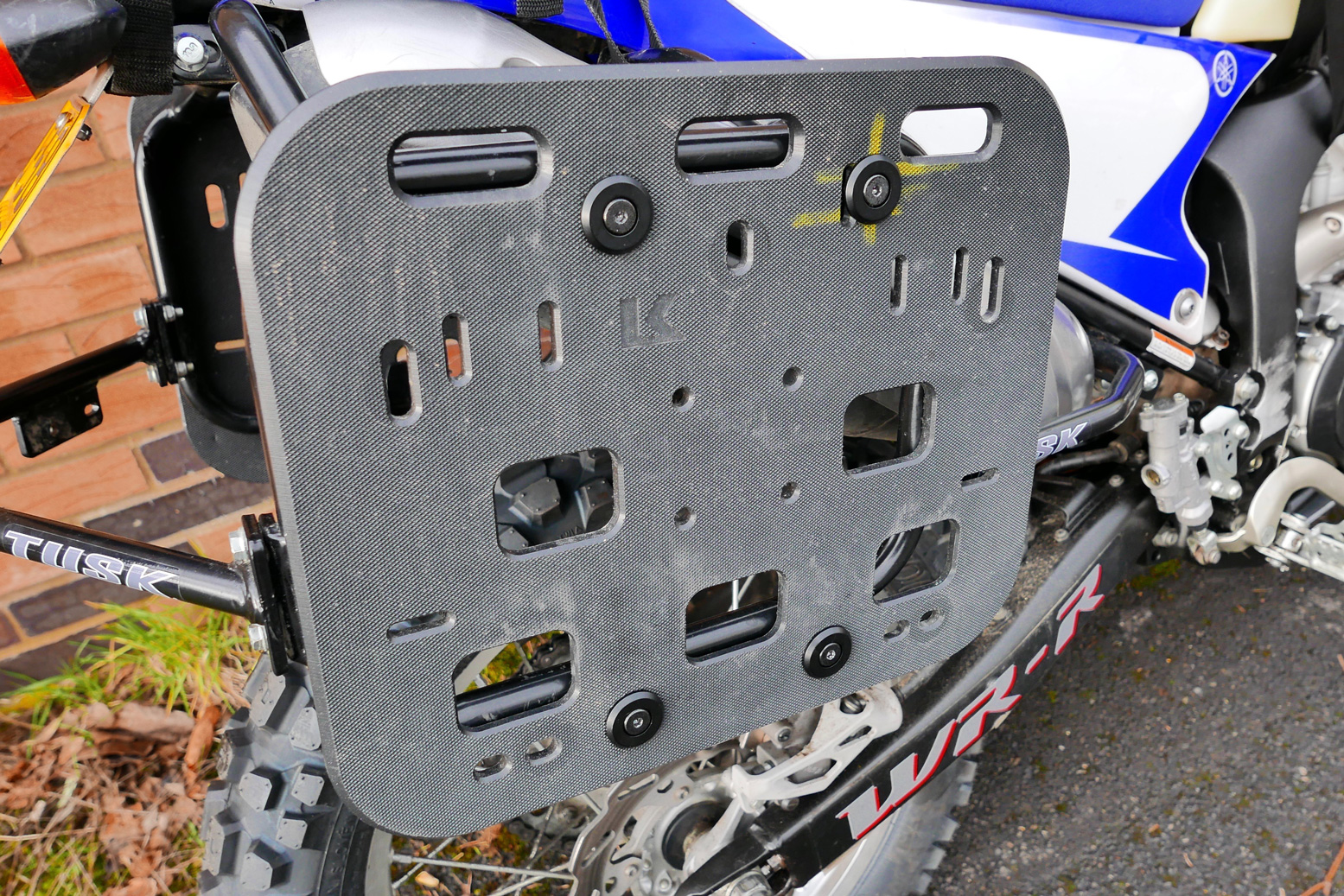
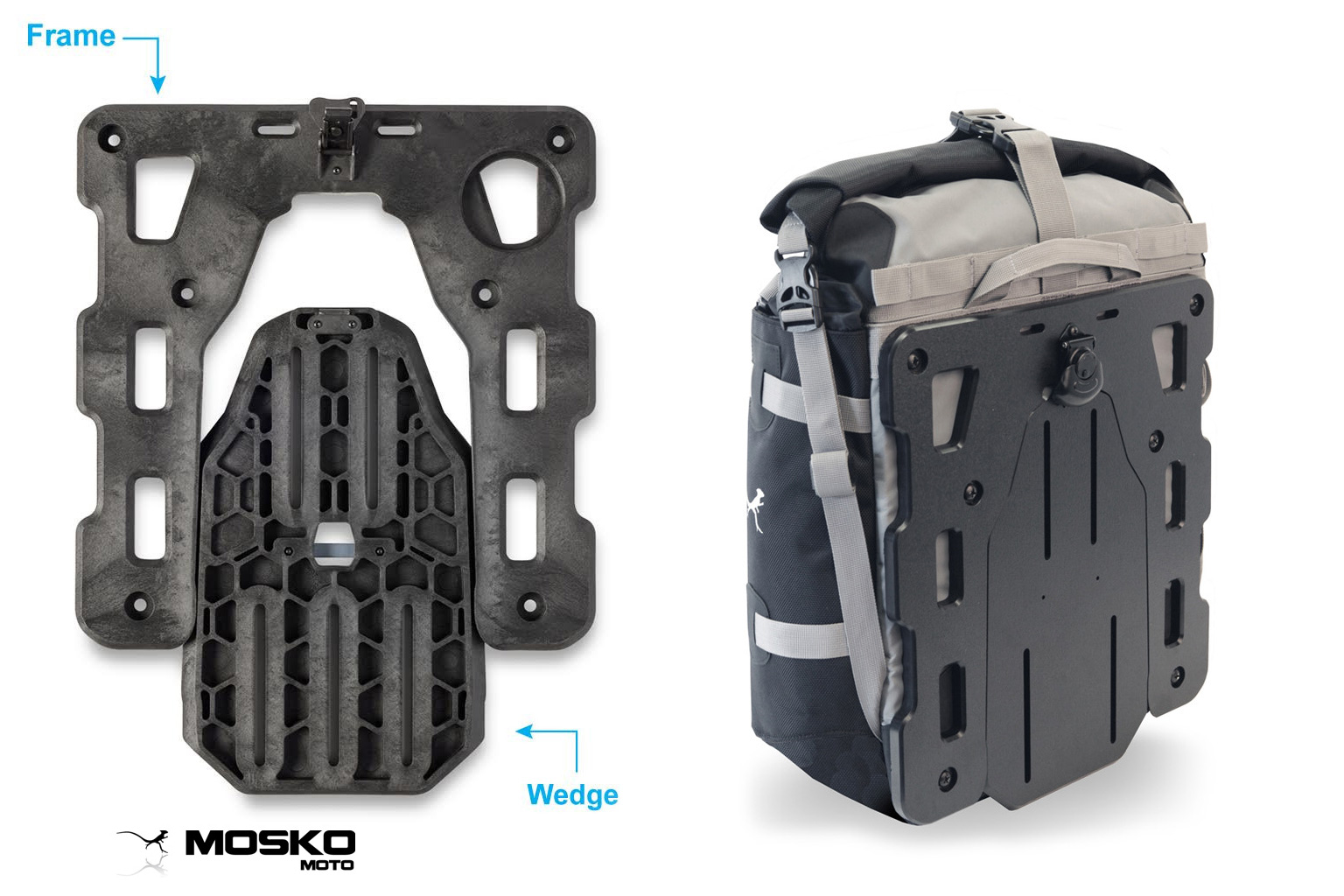
With Kriega OS panniers, an HDPE plate or ‘platform’ in Kriegaspeak (left) can be bolted to a rack. You may think it just adds weight and expense. Both true, but a plate is actually a smart way to fit any rack. HDPE (think: kitchen chopping board) is great stuff, too: light, rigid and dead easy to drill or even just poke with a red-hot skewer. The Kriega plate and its adapter clamps have been designed to fit just about any round-tube, 18mm/¾” rack and offer a broad, grippy surface for the hypalon-backed OS bag to cinch up against. Making your own fitting to fatter or square tubed racks would be easy enough. The Kriega OS bags use a cunning anchor and strap-up system to make a very secure fitting while enabling easy fitting or removal – a key element when on the long road. Strapping the hypalon-backed bag to the grippy plate surface spreads loads over a broad area too, meaning no failure-prone stress points. Mosko Moto also use a plate for their Backcountry bags; a GRP wedge and ‘frame’ (right). The wedge attaches upwards to your bike rack, and the full-width frame permanently to the back of the bag which slides down onto the wedge and clips in with a latch. Originals were also made in HDPE, but either wore too quickly or were too soft. GRP (fibreglass) gets round this, but can be brittle stuff. I’ve not tried Backcountry bags, but intuitively I feel old-school soft-strapping to a plate spreads and secures loads better than two bits of GRP slotting, clipping and grinding together, even if it does just take seconds to fit and remove. It’s probably fine for road riding, less so for off road.
For a big trip with heavy/variable loads, a travel bike is better off with a rack, unless you take very little or can be certain your gear will stay put, be easy to get to and remove, and of course, won’t catch fire off the pipe (left; Niger ’86). It’s a load-carrying interface between your baggage and your bike to enable secure fitting on a variety of bikes, like saddles on a horse, a roofrack on your car, a packframe in a rucksack, or even the shoes on your feet. You can use Kriega’s OS-32s as throwovers, in which case you could dispense with the plate, but you will need some sort of rack to stop them swinging about. You could duplicate the HDPE plate’s strap holes on a rack frame to effectively mount in the same way. It won’t spread the load and secure the bag as well, but it will save 2.4kg of plate and a hundred quid.
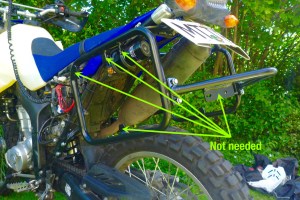
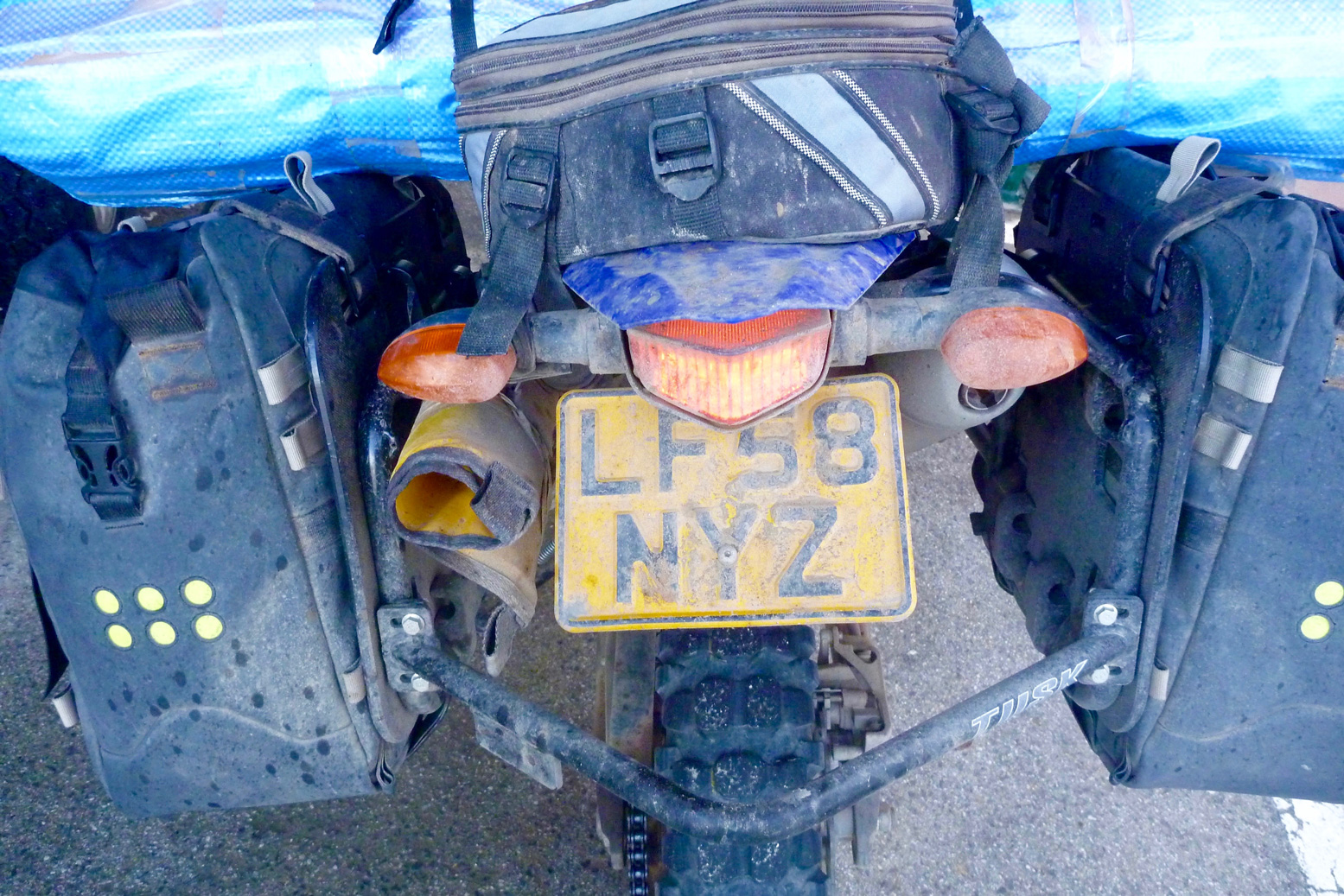
I used a Tusk rack from Rocky Mountain (4kg, left). Great price, well made in ¾” and solid mounting. It stood up to the beating well and was only spoiled by the clumsy extra bracketry for mounting hard cases. I removed what I could from the rack, but some welded-on bits (right) got in the way of mounting the Kriega rack plate as low and far forward as practical. I suppose I could have ground them off.
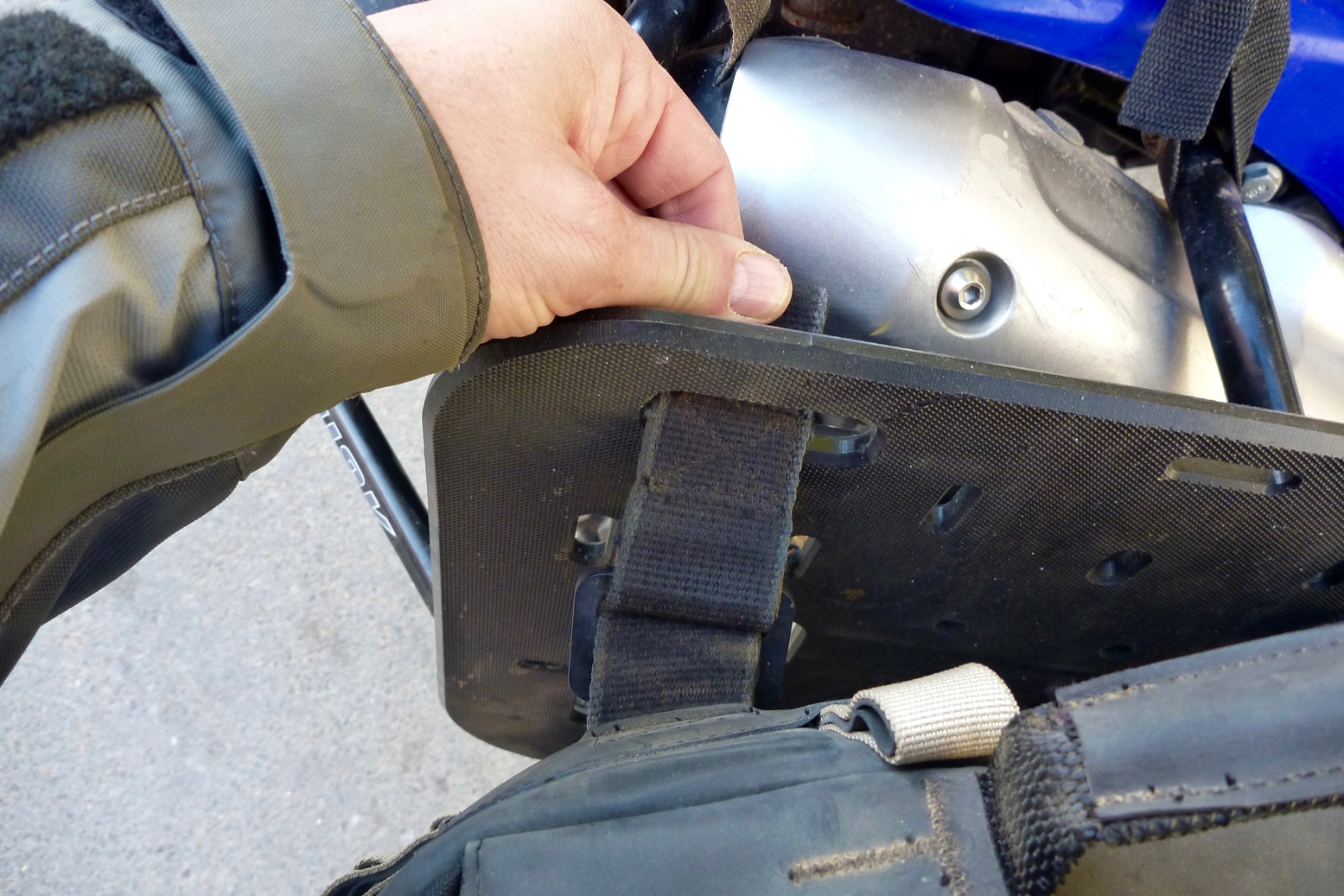
The plates (1.2kg each) have four slots for the upper and lower bag straps. To mount a bag (2.6kg), you rest it on your knee and feed the lower straps through – below.
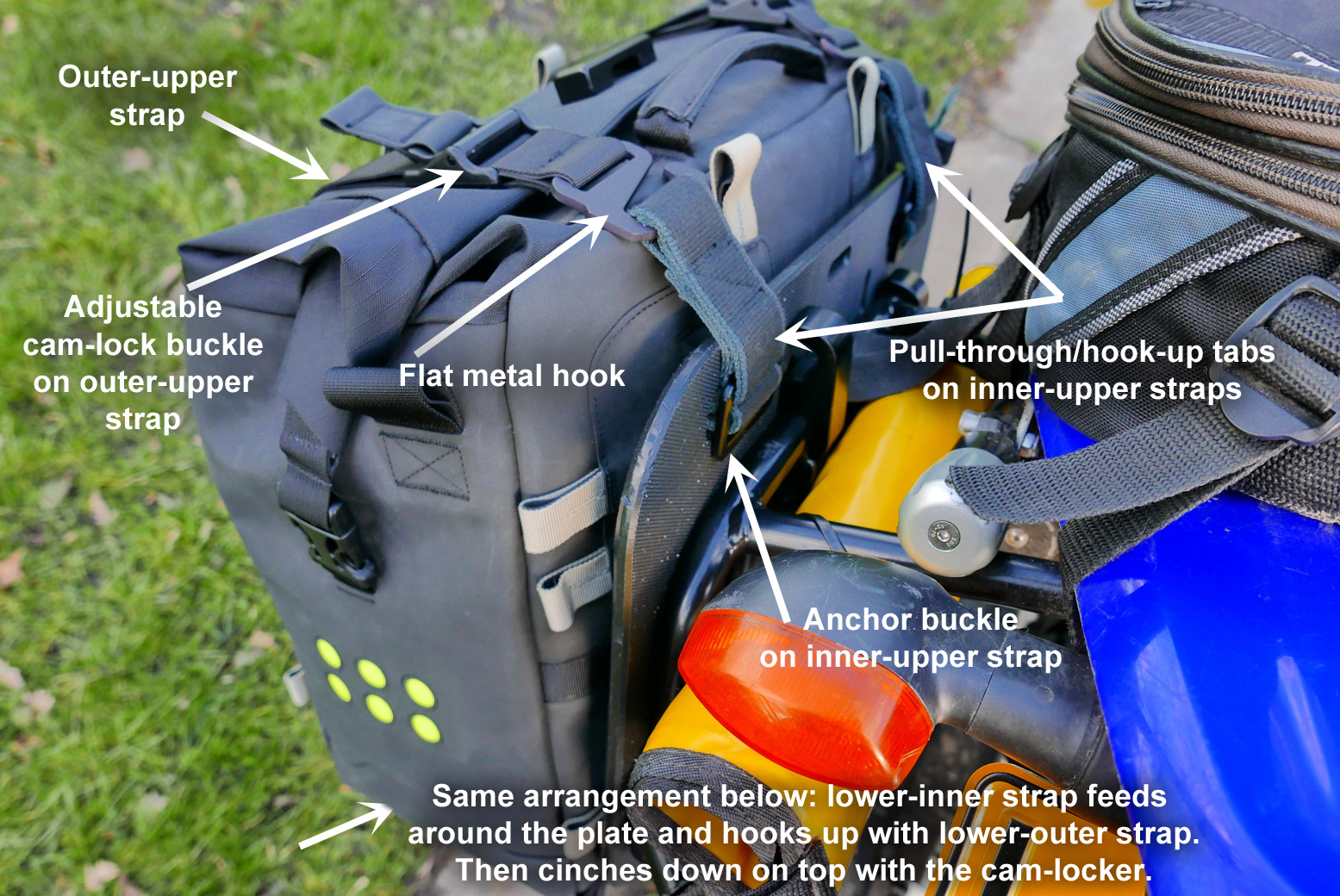
Then you feed the top straps through the slots and pull the ‘anchor buckle’ through – works a bit like a shirt button and similar to Wolfman’s idea which cinched smaller bags directly onto racks.
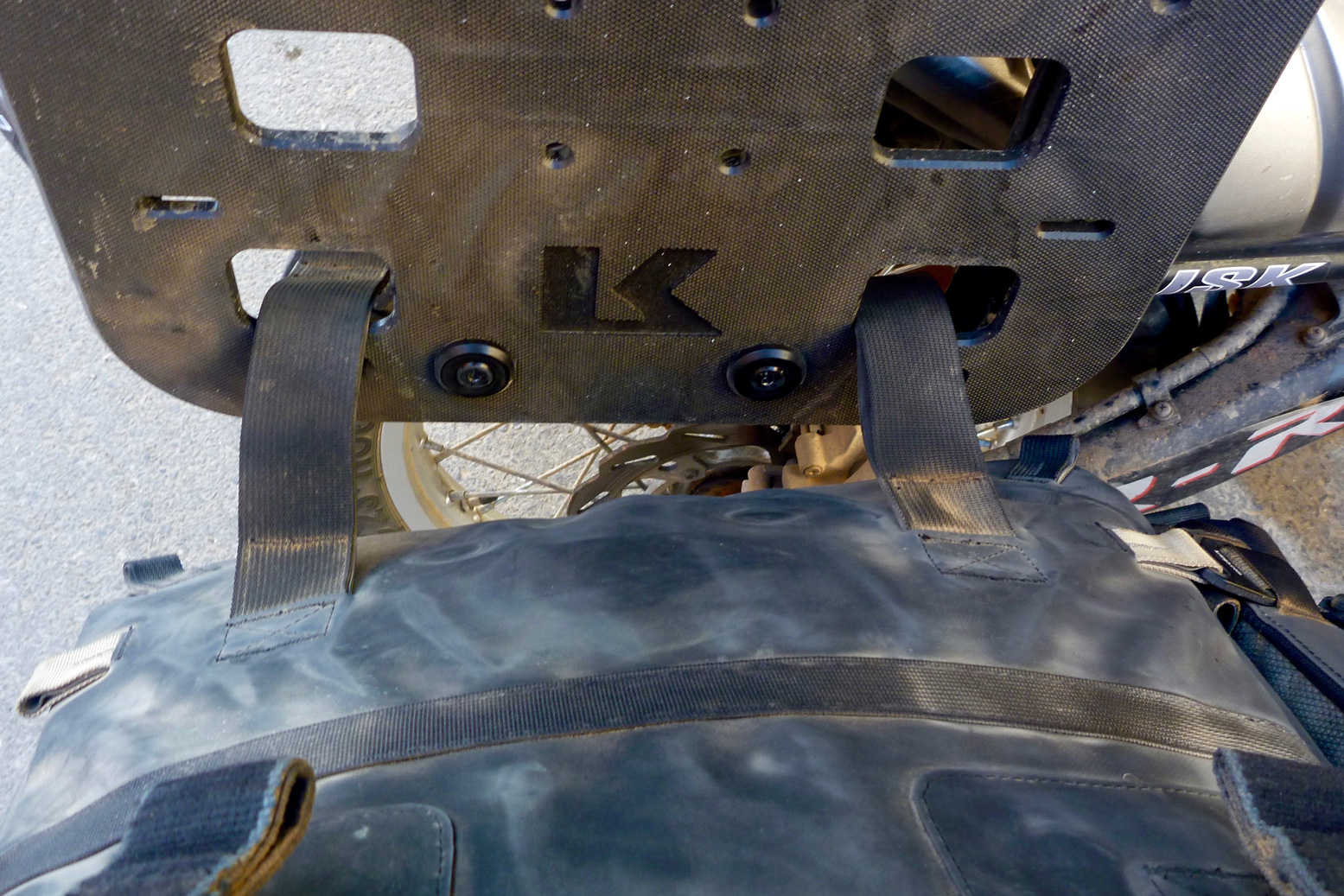
Viewed from behind – the anchor buckles (as I call them) pull through and take the weight.
With those buckles pulled through, the bag now hangs on the plate not unlike a throwover. You could probably ride on roads like that. For a bombproof mounting, you now crouch down and connect the dangling lower straps to the outer strap with a flat metal hook. This is about as arduous and fiddly as the whole bag-mounting process gets. Then, on top you do the same: hook the outer strap to the chunky tab off the anchor buckle, then cinch it all up and lock it down with the cam buckle. Sorted! Mounting takes about 40 secs each side once you’re practised – demounting a bit less.
One of the best things about the Magadans are the big exterior pockets – a lot of soft luggageers dodge this necessity. Kriega supplied me with two OS6, 6-litre strap-on pockets (550g) which are part of the OS system and which I hooked on the front of the bags. They’re ideal for daily or heavy items to keep the CoG central. The OS6s cinch down on themselves to stop stuff shaking about. You could put two more on the back and another on top. There are over a dozen hook-on tabs on the main bags and the system includes an optional pair of shoulder straps which make it easier to do the bike-to-hotel-room-walk in one go.
All bags came with the usual Kriega white liners to enhance rummaging visibility and which are more durable than previous liners. I didn’t use them, and bagged stuff individually. Even then, what rain I got – a few hours a couple of times – didn’t penetrate the bags. They’re covered in hypalon panels (think: whitewater raft fabric; lasts for decades) which slow the wetting out of the bag’s Cordura body and of course will scoff at any abrasion, be it the constant rubbing against the plate, or sliding down the road hoping not to loosen your load. Daytime access requires uncam-locking and loosening the top straps and pushing to the sides, then unclipping the roll top folds from the sides and unrolling – about 15 secs.
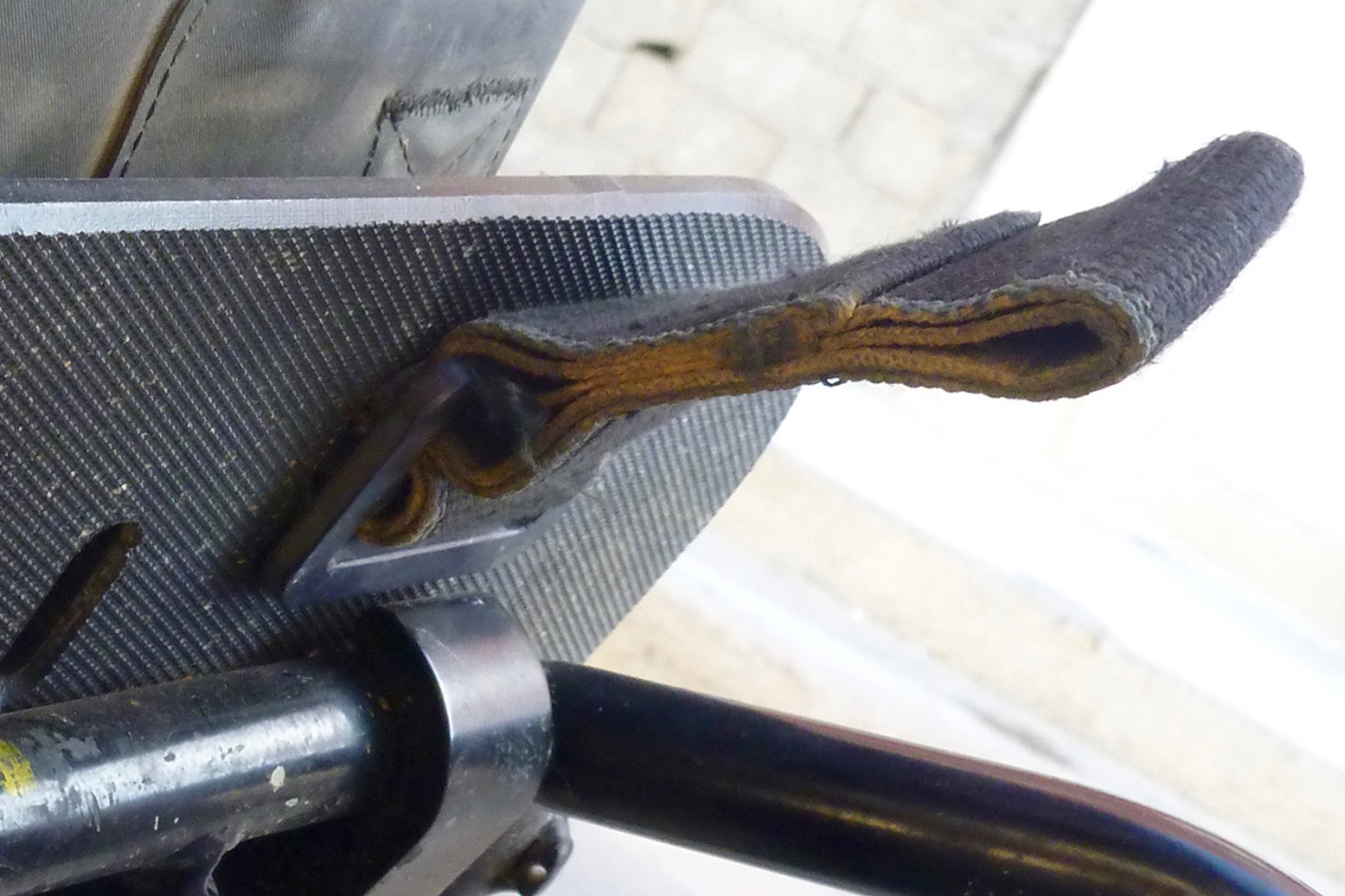
On the top panel you’ll see a chunky metal fitting to feed a cable lock, like the Steel Core recommended by Mosko Moto. I initially just used them to secure the loose strap ends (left). Kriega tell me if I fold the ends over they’ll have the rigidity to slip into the outer sleeves, even when the bags are packed full. I never tried that and in the end just let the straps flap.
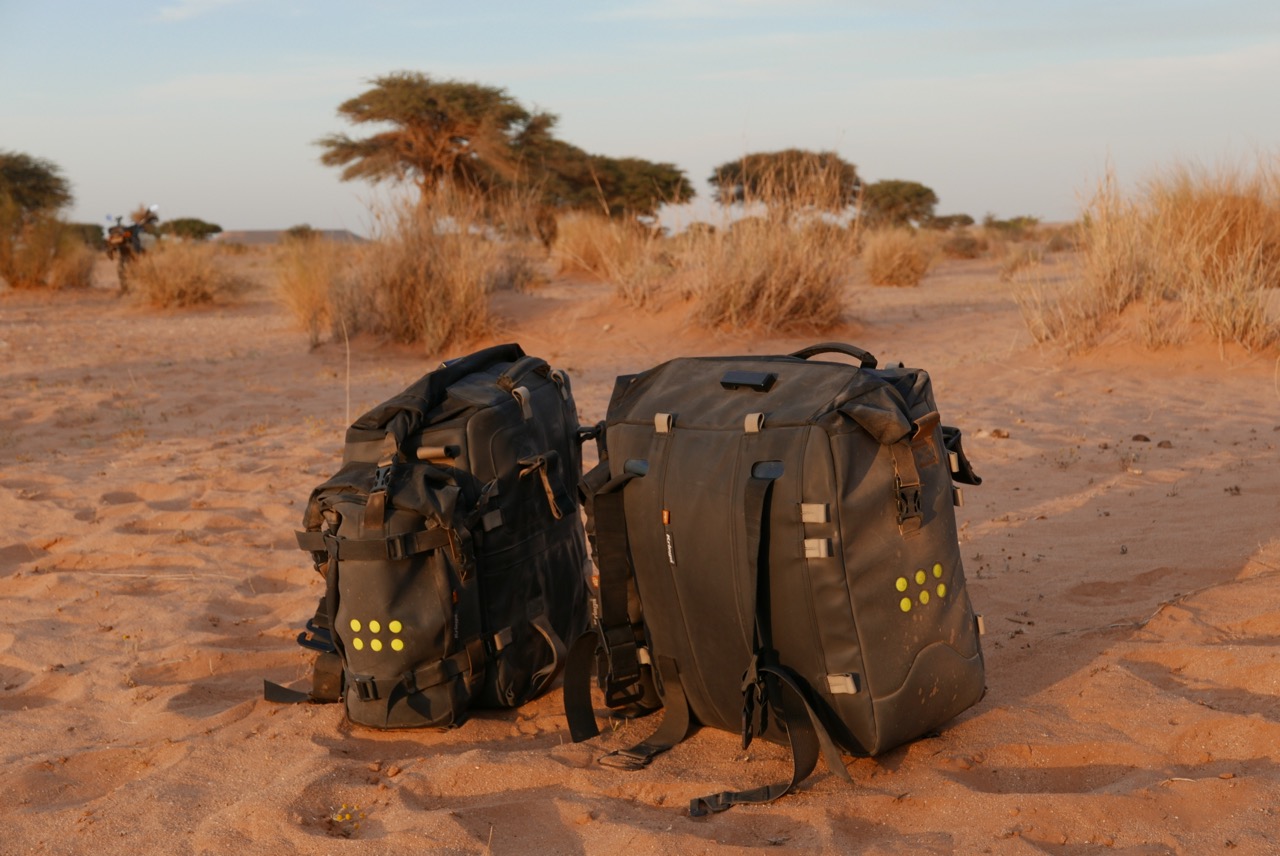
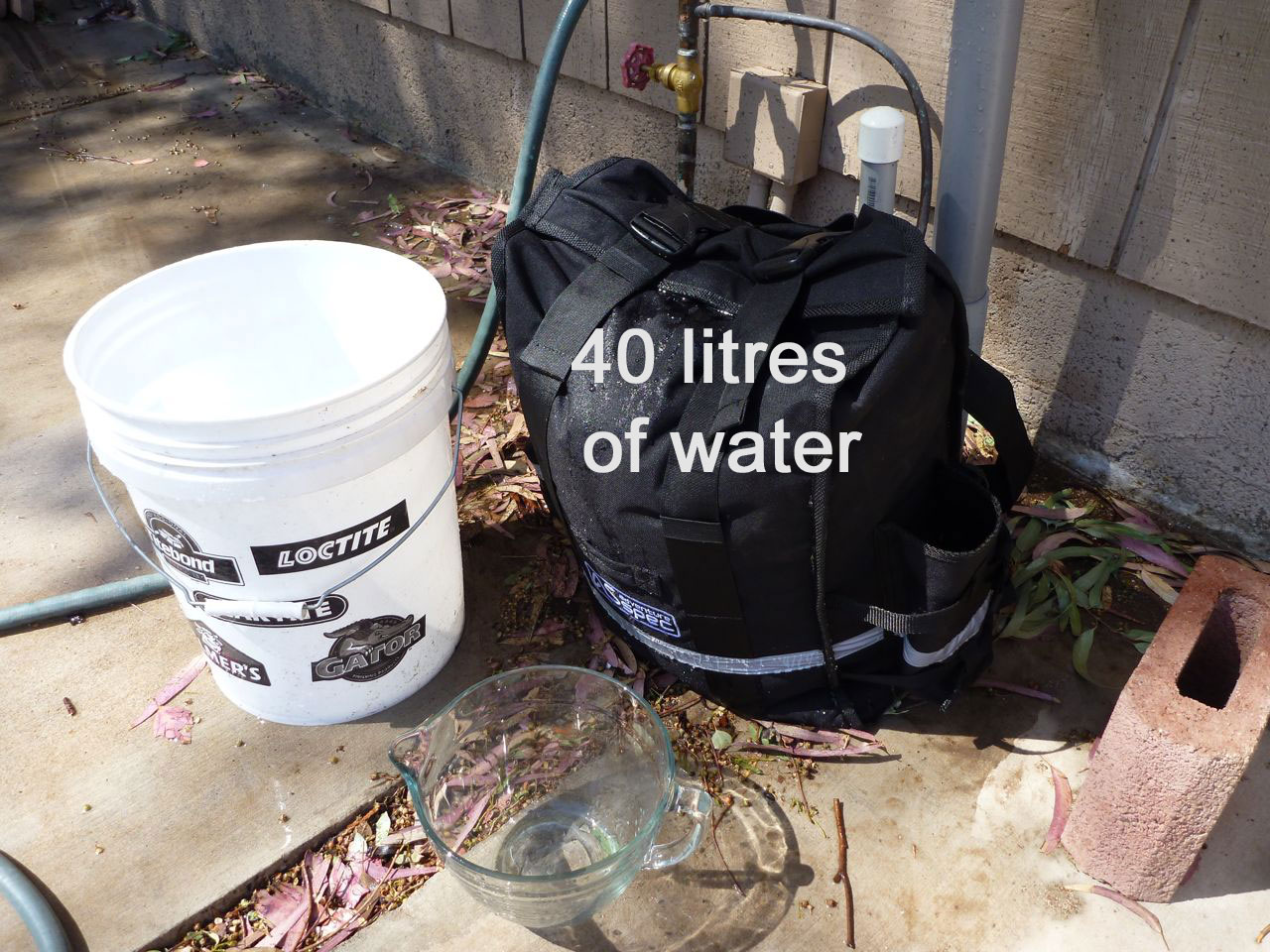
The bags have interior stiffening panels to help give shape, but fold down flat for shipping or shoving under the bed between adventures. The volume is 32 litres according to the brochure, but as I discovered here, a flexible, rectilinear box will actually increase in volume when filled with fluids as it seeks to attain spherical equilibrium. Who wouldn’t want some of that. For example, my notional ’24-litre’ Magadans (right) actually took 40 litres of water, and that increase will be the same with any similar flexible rectilinear pannier.
So, masses of volume meant I didn’t need an annoying tailpack, and low-mounting probably didn’t do any harm to stability either. Yes, they’re wide because the rack is wide. On the chain side I could’ve used the inner space better (just a rolled up 10-L fuel bag, yellow thing on the left). There’s four litres of volume to be had there, easily. A Rotopax won’t fit.
On road and trail the OS-32s never missed a beat or felt annoying to use. In fact the pulling up of the anchor buckles and then cinching up were quite satisfying actions – I suspect ‘actuation gratification’ (the satisfying click of a clip, for example; there’s probably better jargon for it) may be something that better designers think more about than others. With my throwover-on-rack Mags (left) I removed the liner to take indoors as the bags needed careful lashing to the rack to stay put. With the Overlander-S it was no bother to: • lift the cam locks • loosen then unhook the lower straps • unhook the top straps • lift the bag on its handle, release the anchor buckles and carry it away
Your OS32s are a travel solution to long overland journeys. For dirtbike weekends or fast and light BDR-ing, I imagine a GL Great Basin, Mosko Moto Reckless, or alternative Kriega packs will suit riders prioritising agility. Me, I’m more of a traveller and prefer big, side-mounted saddle bags with minimal junk loaded on top. Slimmer would be nice, but that’s just conventional rack design and high dirt-bike pipes for you.
The Mags are still great bags and bound to be cheaper. The OS-32 kit as I used it with plates and two pockets would come to £710. That’s a lot of money, but of all the accessories you lash to a genuine travel bike, surely the baggage system is the most critical and will be the most used. I hope to carry over these OS-32s to my next adv bike. Good job Kriega, a well thought out bit of kit.
For more images from my ride in Morocco, see this.
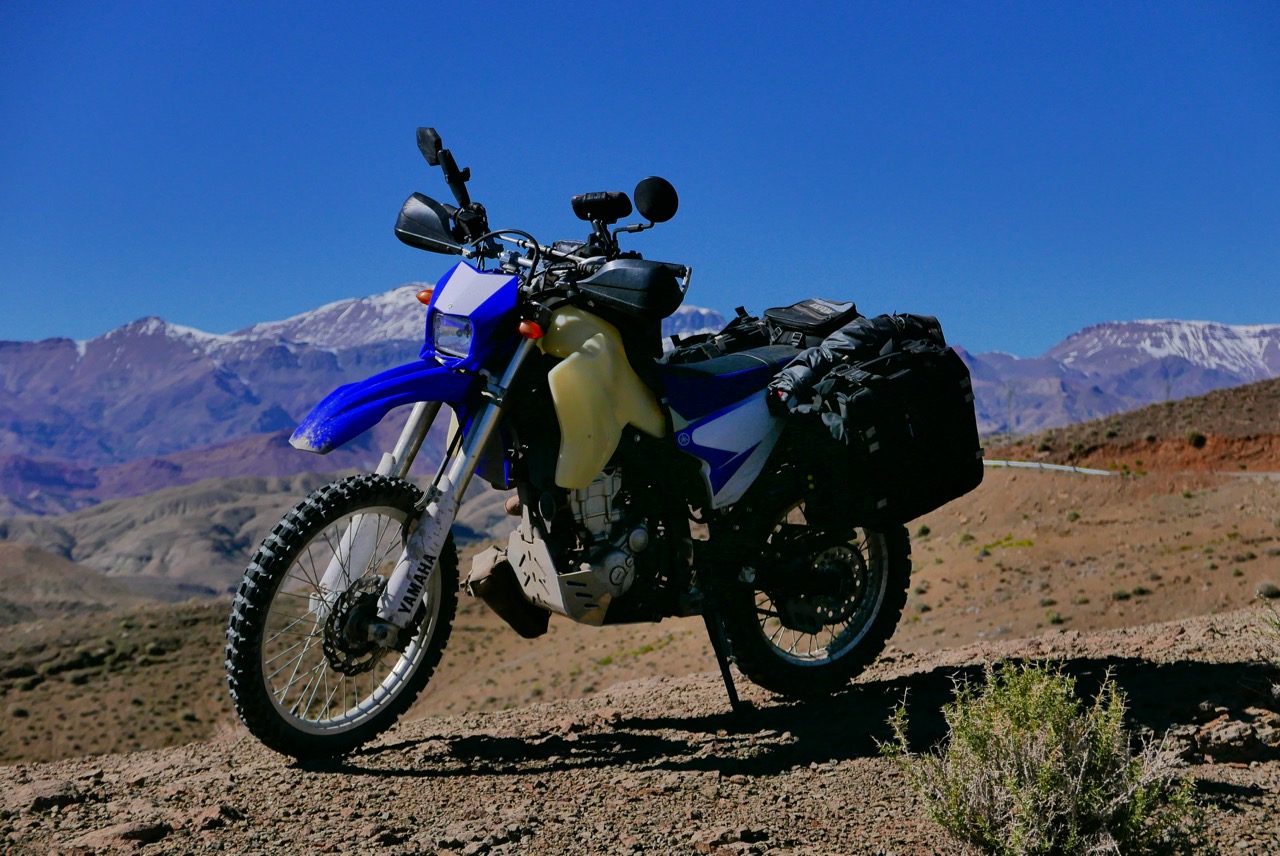
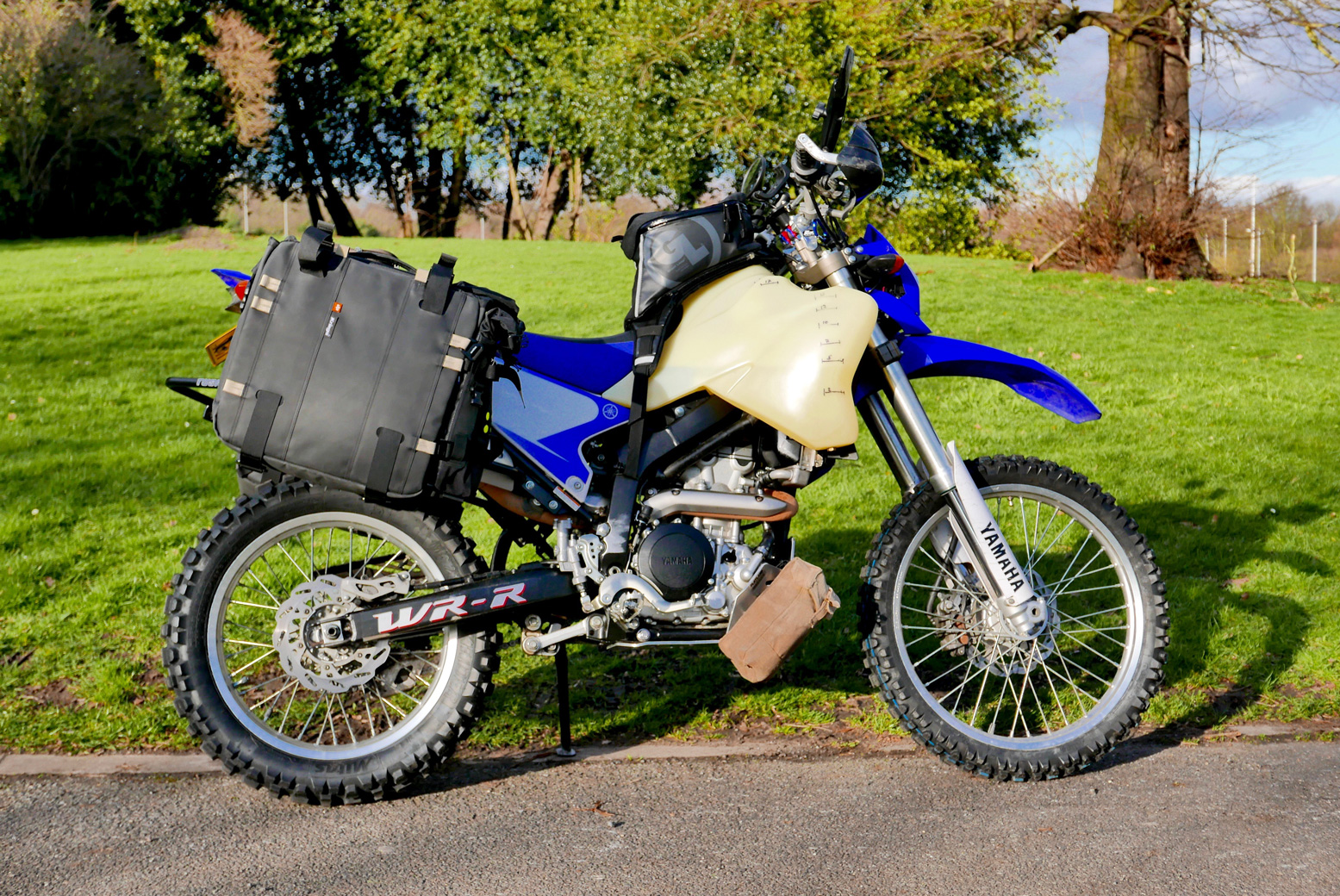
While in Morocco last year and not riding around on my WR250R, I left it with a list and a bunch of stuff with Karim, a desert bikey mate with a lavishly equipped garage and some spare time on his hands. Over the weeks he tinkered away, finishing the job I’d started in the summer, converting the WR into a lightweight desert bike.
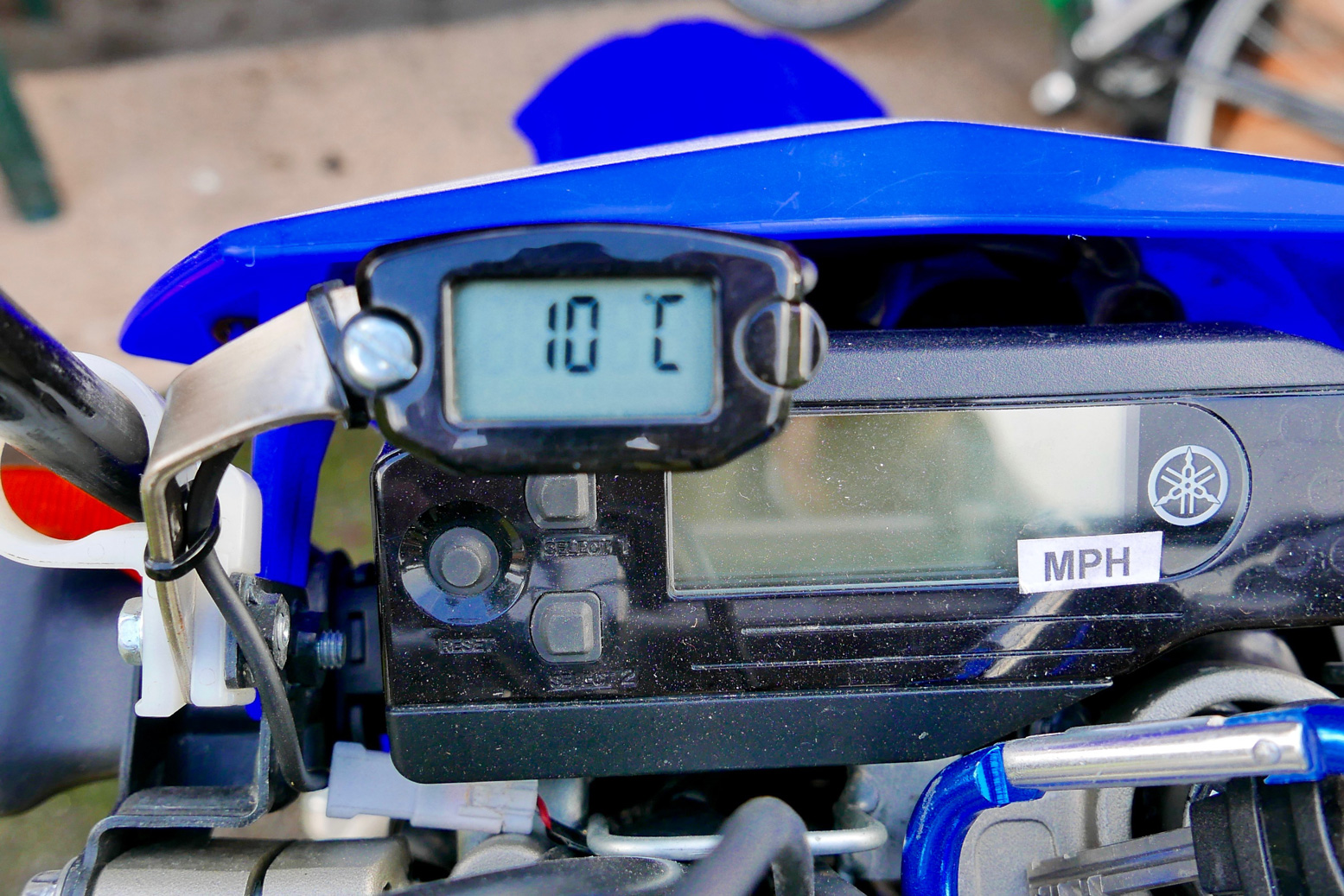
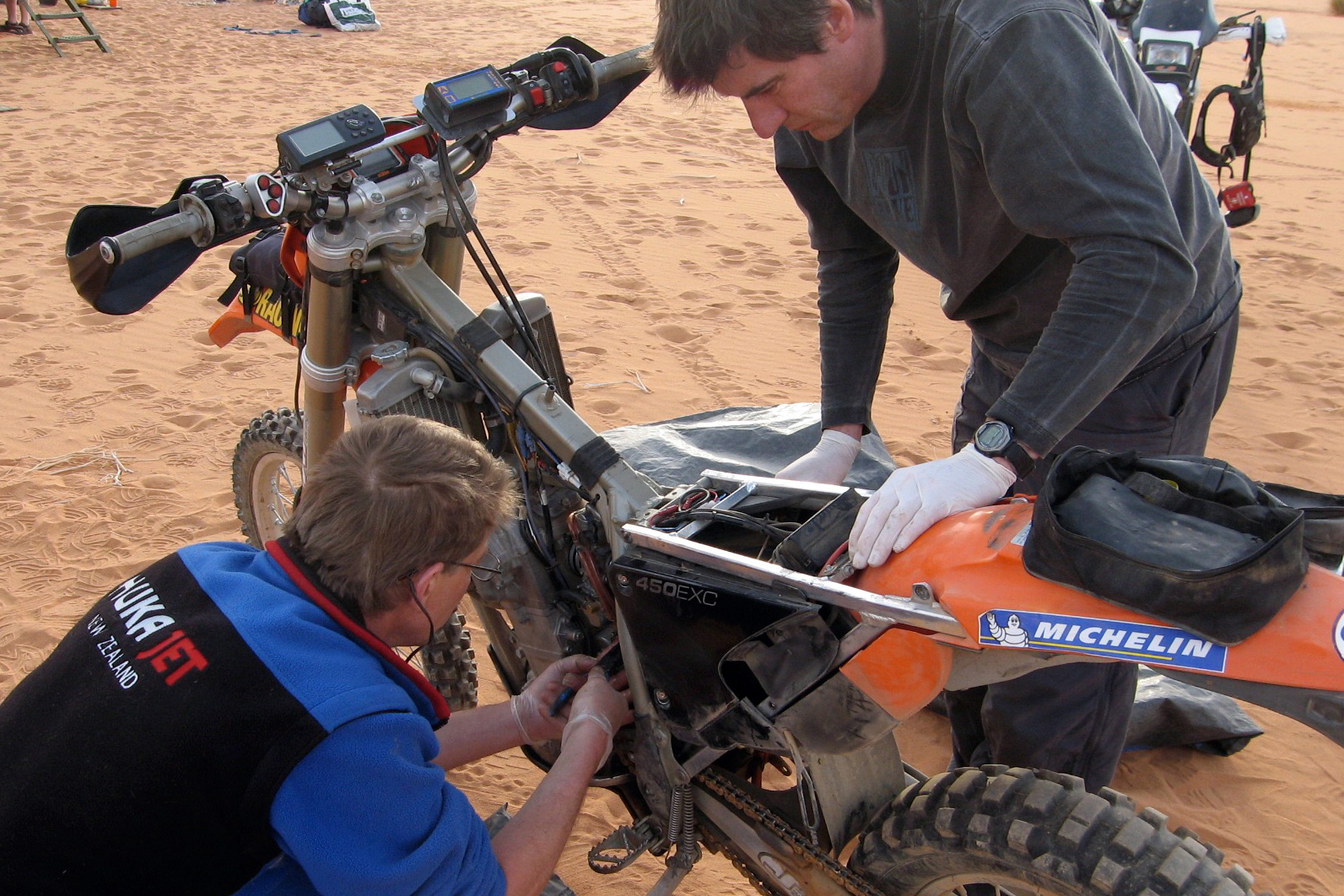
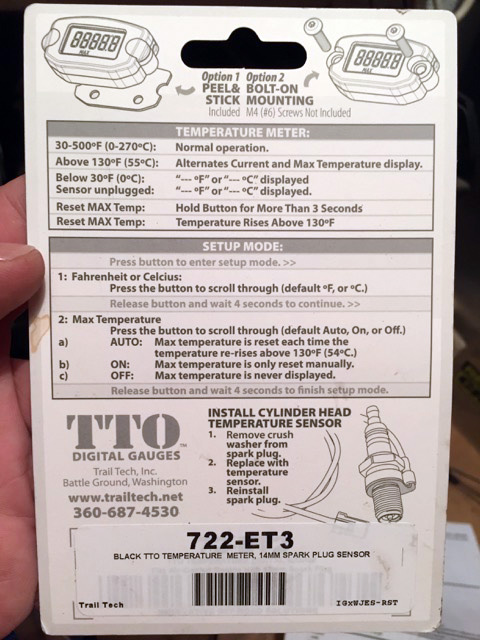
The list included a TrailTech engine temperature gauge (above). IMO it’s vital to be able to know an engine’s temperature – air or water-cooled; I don’t want to hope some warning light might chip in just as steam starts wafting up from under the tank (as happened to a 450 KTM in the desert once, left: engine fried, end of his ride). The gauge’s pick-up sensor can be mounted anywhere very hot including splicing into the radiator hose to read water temps – all you’re really looking for is a representative value from which to evaluate a normal reading.
If it starts straying into unusually high figures you can choose to back off, or even stop and turn into the wind at tickover. On the ride back to London in a backwind gale the temperature varied from 85°C up to 115°C flat out or at the lights, but usually around 100. Another handy thing is it reads even when the engine’s off – a handy air temp reading when camping. At the same time one fan blade got tippexed white to make it easier to see at a glance if it was spinning when it should be.
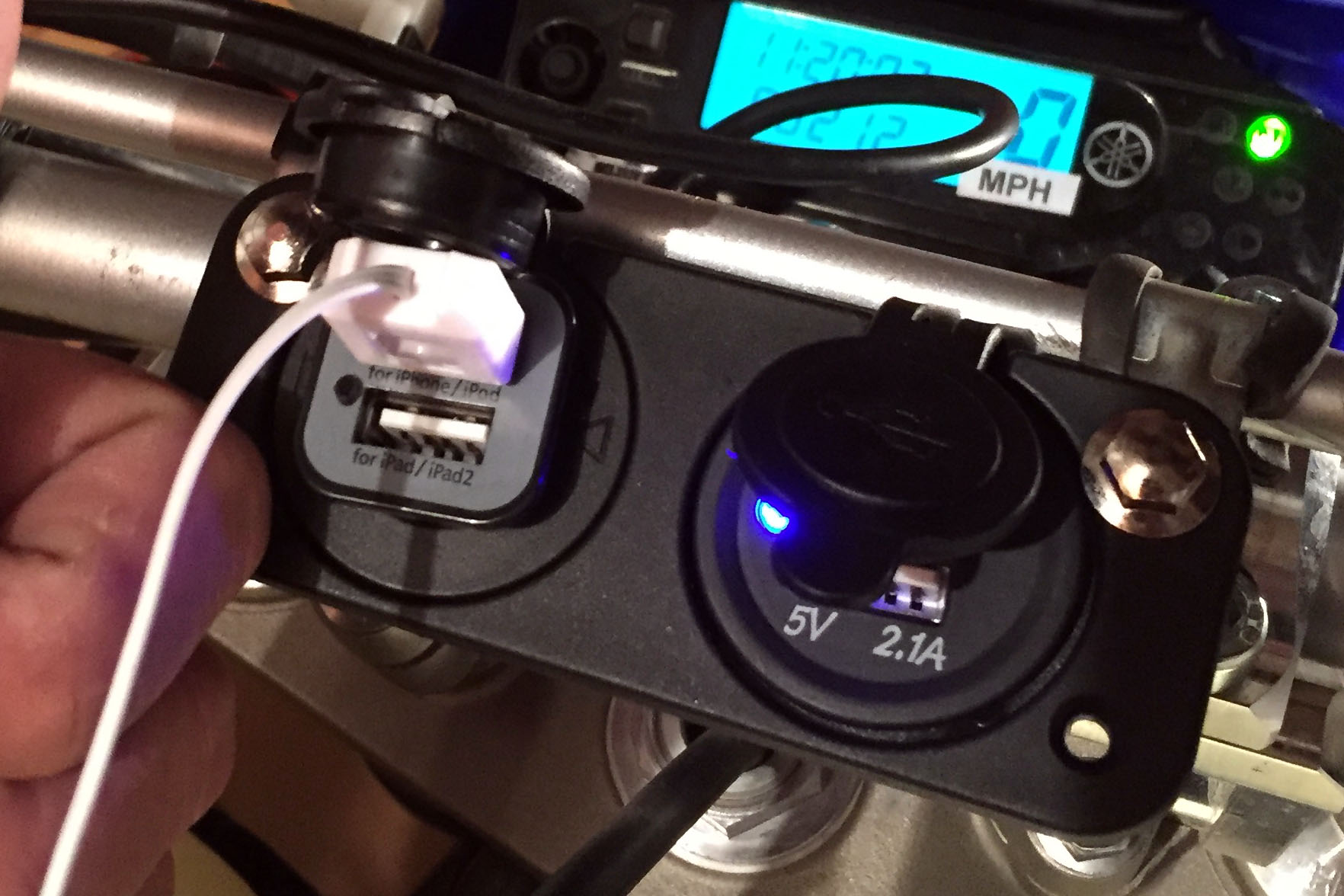
A RAM mount and wire for my Montana got hardwired in (left) to guarantee a reliable, clip-on connection, and some 12-volt and USB plugs got added to the cross-bar (right). Got no actual use for them but handy to have. There’s also a DIN plug tucked in by the seat base to power a heated jacket and the tyre pump.
I’m going to be trying out some new Kriega Overlander-S panniers – OS32 – which mount and strap on quite cleverly to an HDPE platform that’s clamped to the rack. I’ll do a fuller review of the system once on a road a couple of weeks, but as you can see, the volume means a large tailpack isn’t needed, even with basic camping gear. I find that makes swinging a leg over the high saddle easier and a less cluttered look.
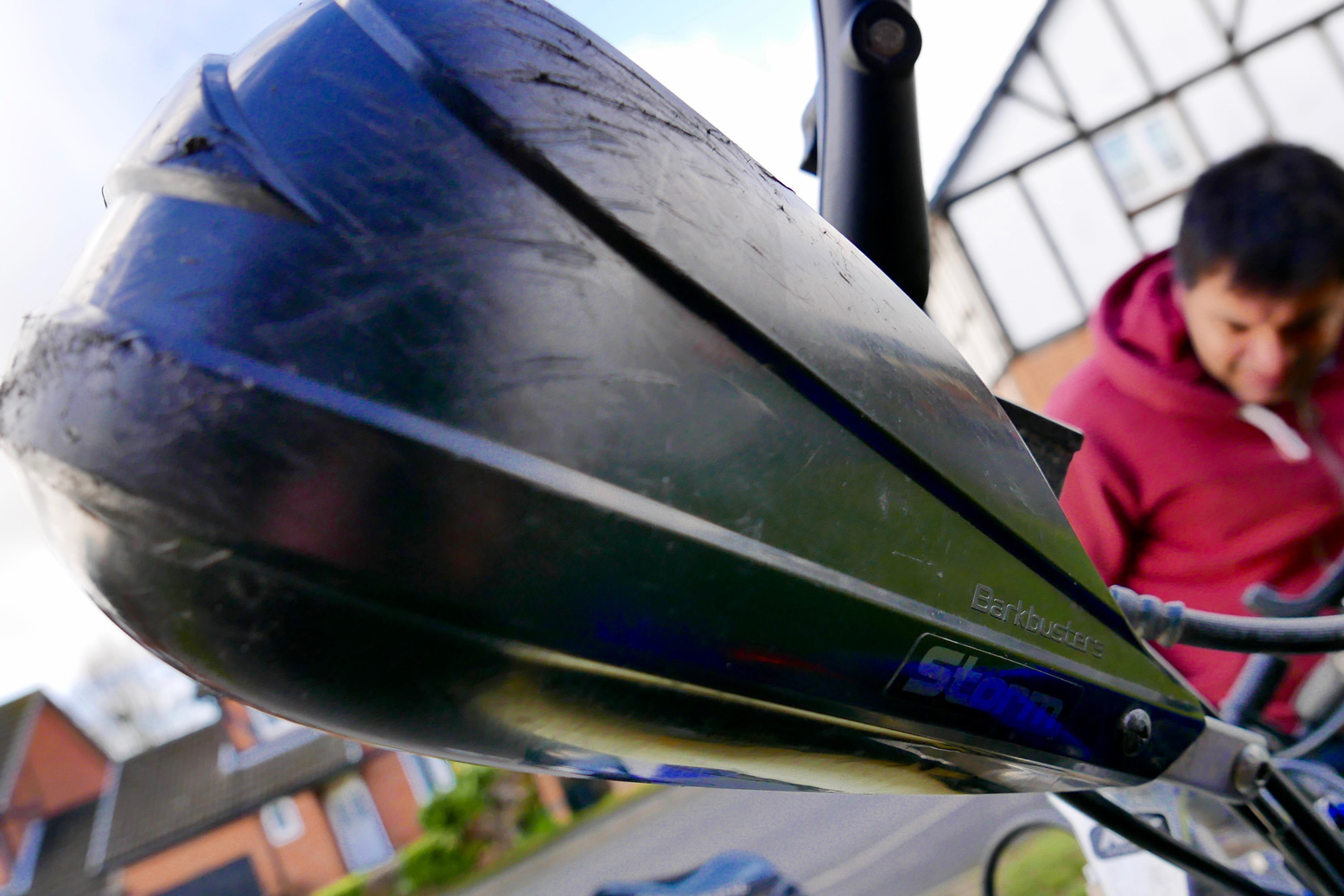
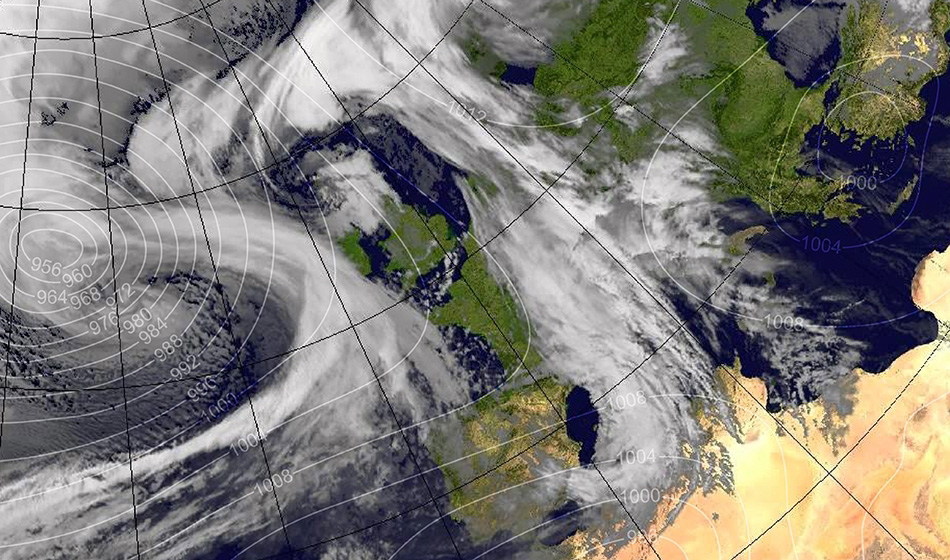
My trusty old Barkbuster Storms are getting what must be their fifth fitting on the WR. Whatever came with the bike was all plastic and not really up to the job. And before I’d even loaded the bike to head back to London, the Barks saved the day when a gust from Storm Doris (right) blew the WR over.
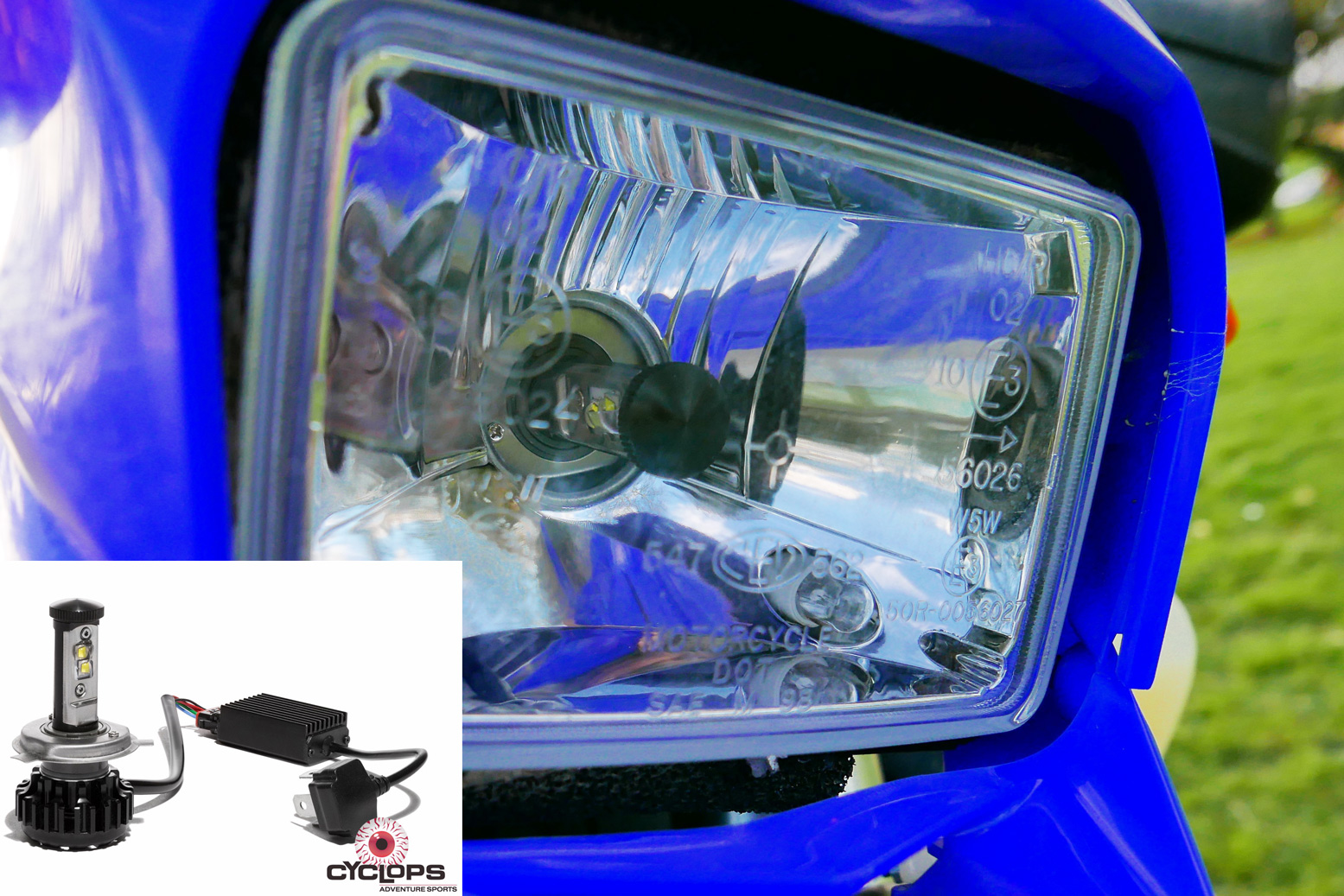
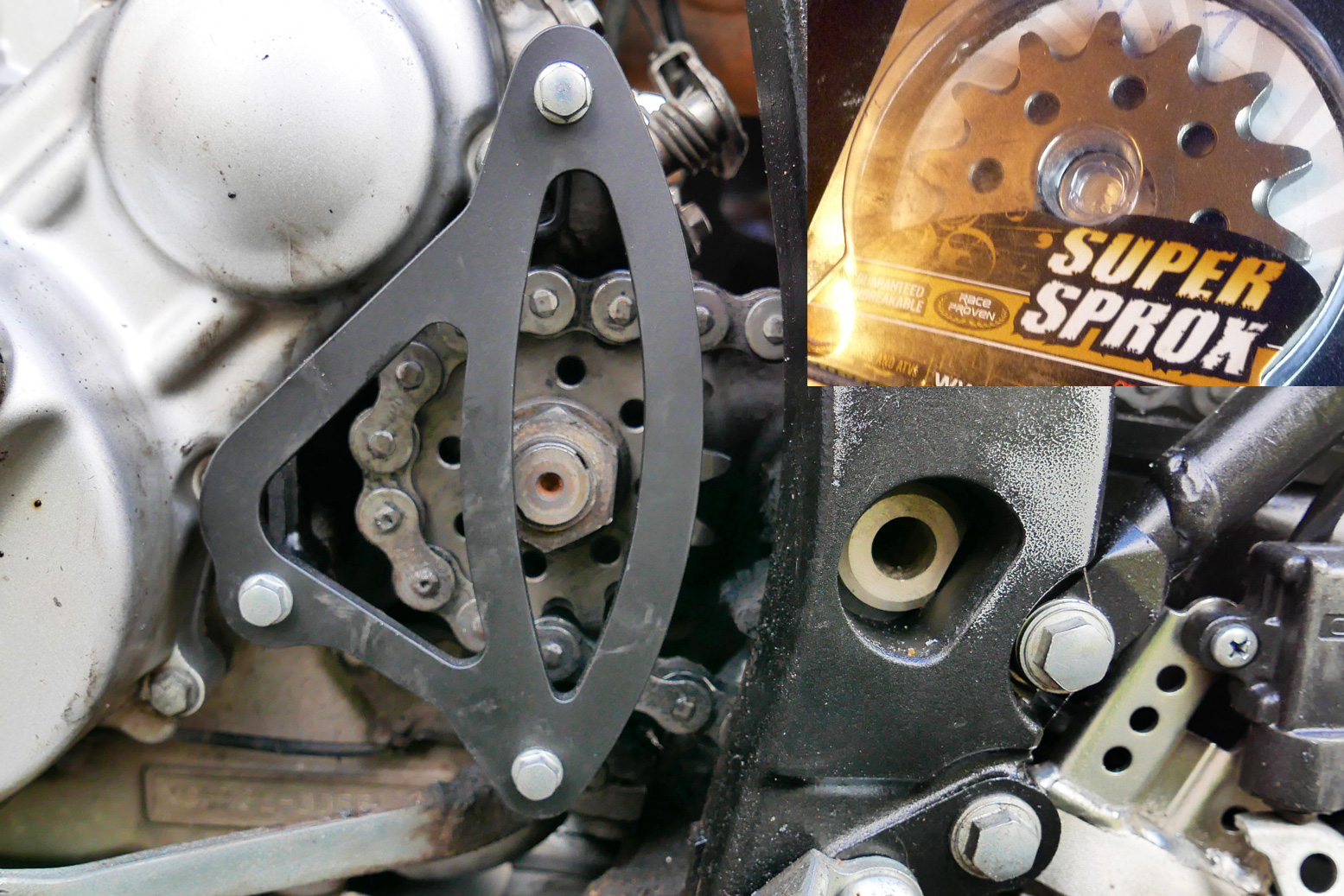
The headlight bulb has been uprated to a Cyclops H4 LED (on ebay) which emits a bluey light, and they promise will cut through the night sky like a meteor shower as well as consume less juice. And down by the front sprocket I added a Sandman case saver kit from Basher in Missouri. I’m starting on a 14T (on 46), and swapping to a 13T (about 10% lower gearing if the speedo error is any judge), should the need arise.
Tyres, you ask: I try never to use the same type twice and this time around I’m on Mitas (formerly Sava) MC23 Rockriders. I was hoping to go tubeless until I saw the back DID rim doesn’t have the lip (in which case this would work, were it in my size). I’m confident the Mitaii will easily last the trip of about 5000km, helped with a splash of Slime and a few Hail Marys.
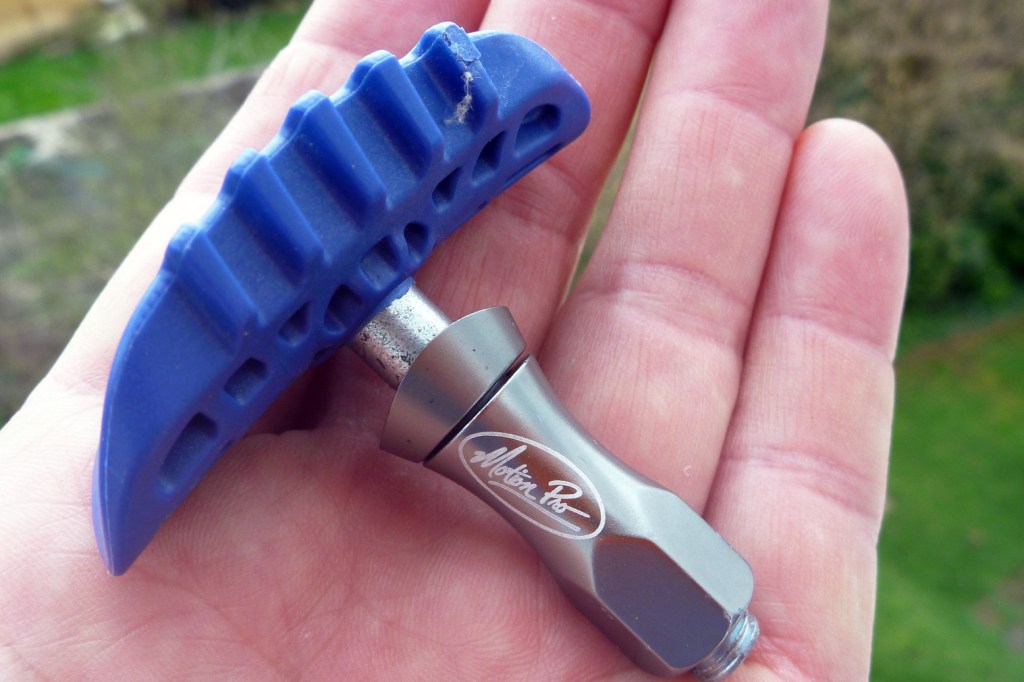
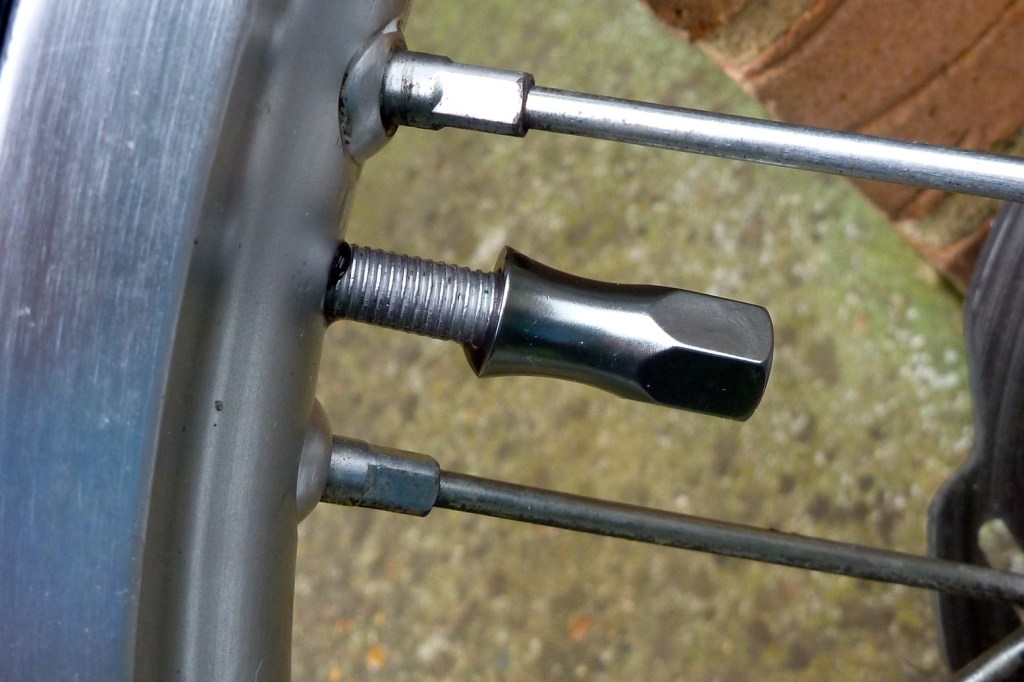
I’ve also added a dinky Motion Pro rim lock on the back which weighs next to nothing, but will hopefully bite when the need arises. I can’t see me running pressures low enough where the scant torque of a WR250 will be able to pull the tyre round the rim. The whole point of running knobblies like the MC23s is – away from deep sand plains and dunes – you will get great grip on the dirt without the need to run them at 1 bar and risk flats.
And that is that. The rest of the adaptions are here. The bike is on its way to Malaga in a Fly and Ride artic which, at £595 return, actually works out quicker and cheaper than a ferry-and-Spain crossing.
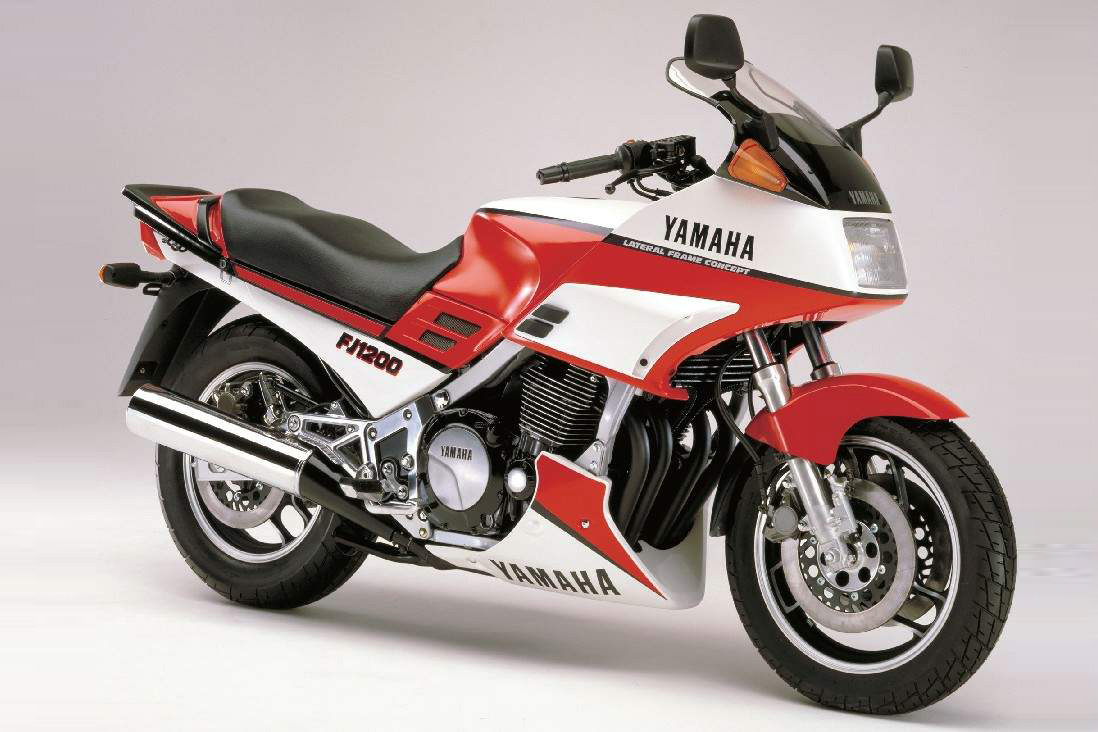
I readily admit the WR is no FJ12 on the open road and makes you feel a bit vulnerable dicing with fast European highway traffic – but then again it won’t be an FJ12 on rough backroads or the pistes either. So far I have a good feeling about the untried WR-R: I love the lightness and the better than average poke for a 250, along with great mpg and desert-ready suspension and tyres. But of course, I’ll miss the comfort of last year’s La Mancha-munching CB500X. What we have here is a specialised, lightweight desert touring bike. Stick around to see how the WR performs in Morocco and, if it behaves, in Western Sahara too.
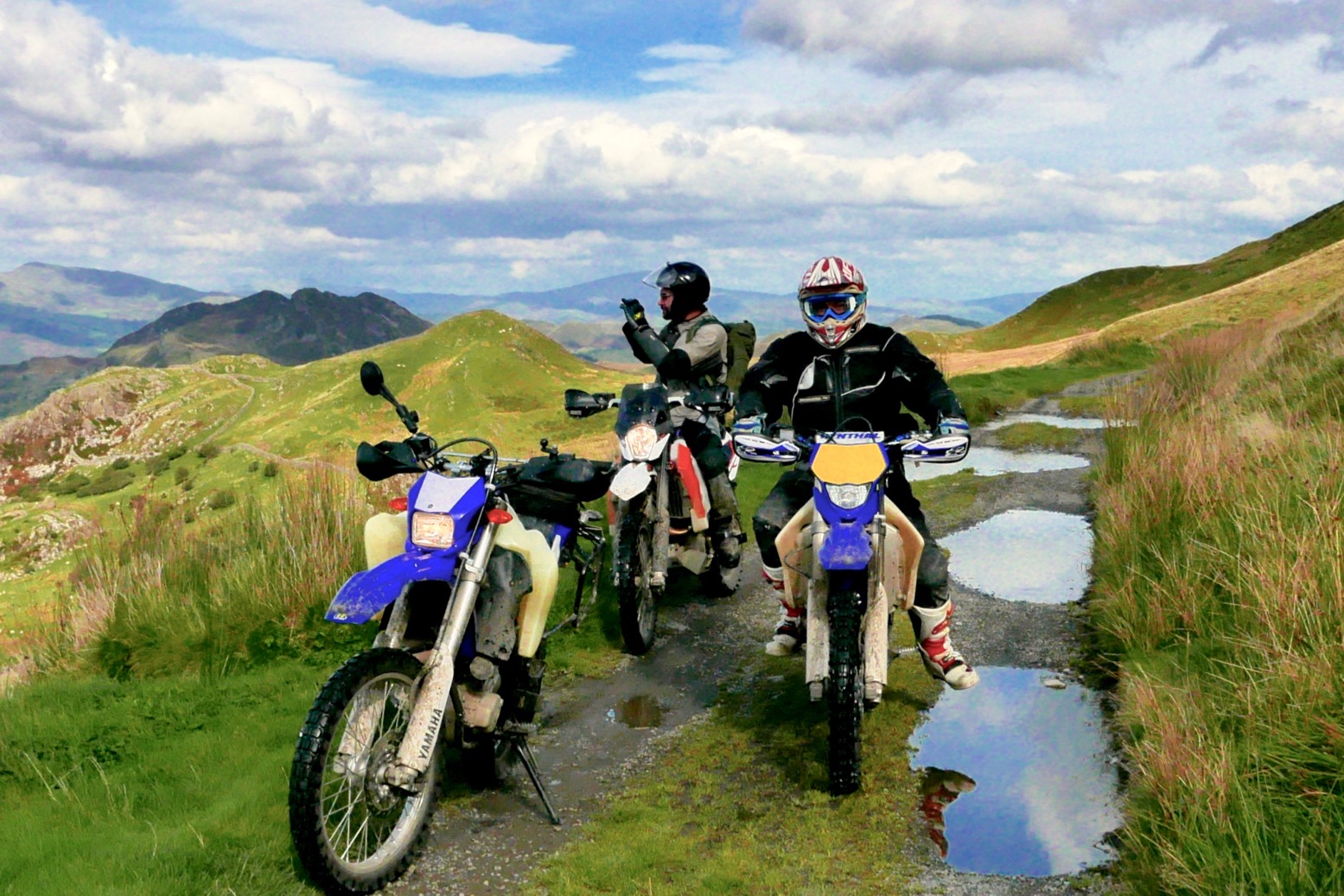
I haven’t been trail biking in Wales since my 20s. Makes me wonder what I’ve been doing all these years. Part of the reason is I’ve not had a bike worth riding up there, and then there’s the issue of untangling where you can ride legally. Desert biking can spoil you, but Wales gets a lot more inviting with a light and pokey WR250R and knowing the right people. Dan and Dave were on my 2007 Algeria tour along with their own trips to all corners of the globe. John, an old mate of theirs, works at the Yamaha Off Road Experience near Llanidloes, and generously offered to take us for a ride out.
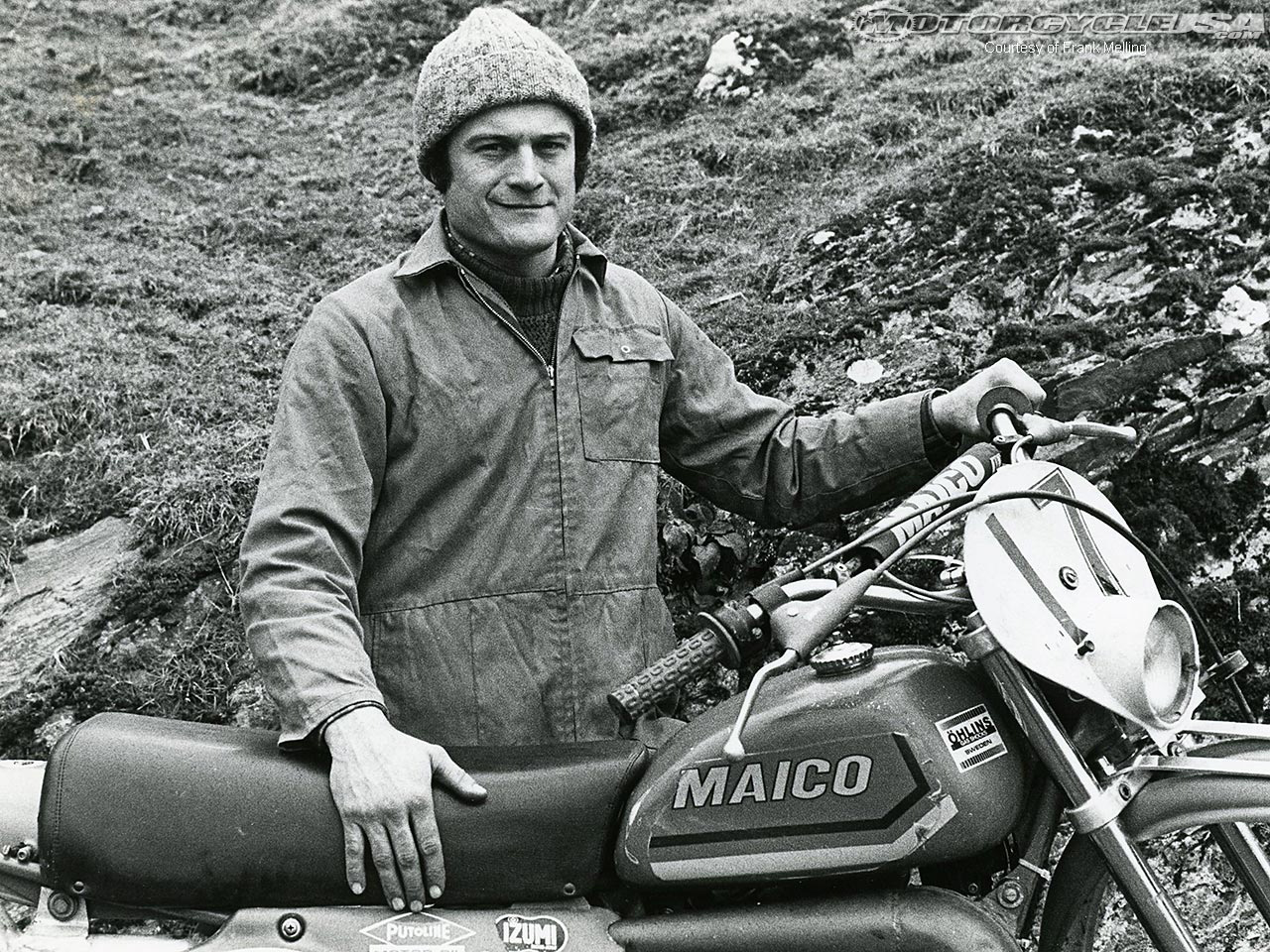
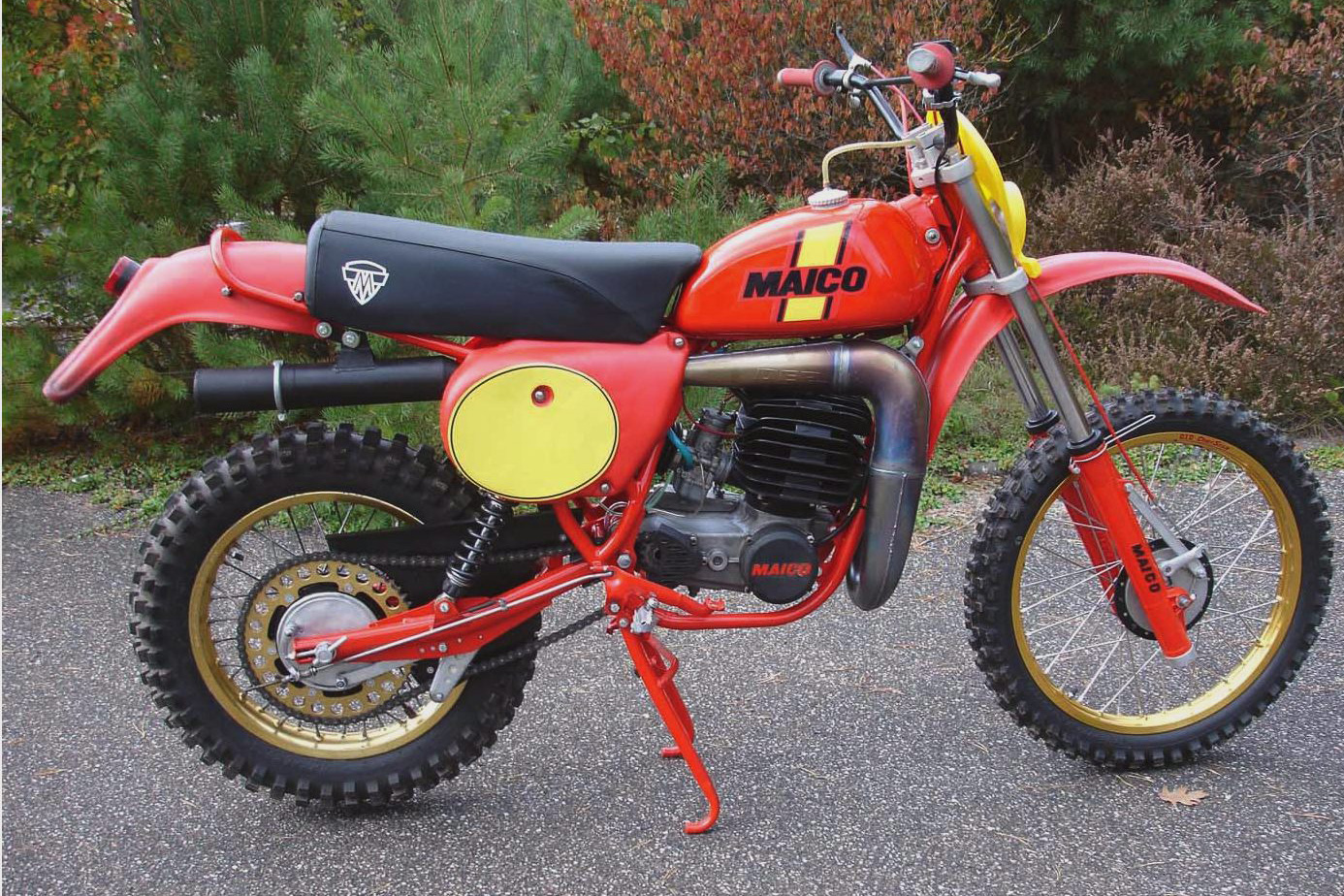
We vanned up to Llani, lubed up the bikes and rode over to Geraint Jones‘ hill farm where the Yam school is based. Back in the late ’70s when I was dirt-bike mad, I remember Geraint Jones (left, old pic) was ‘Mr Maico’. He was to enduros what Graham Noyce was to motocross, Barry Sheene to GPs and Martin Lampkin to trials. In amateur hands the big Maicos he rode had a reputation for being hard to handle. I remember the red devil machines flying overhead as I floundered about during the nearby Plynlimon Enduro in 1981 aboard a KLX250 – the original sheep in wolf’s clothing.
As I recall in Street Riding, I was so slow they were literally packing up as I rolled over the finish line. And if you ever wondered what happened to those red devil machines, this is an interesting read from our man, Rick Sieman.
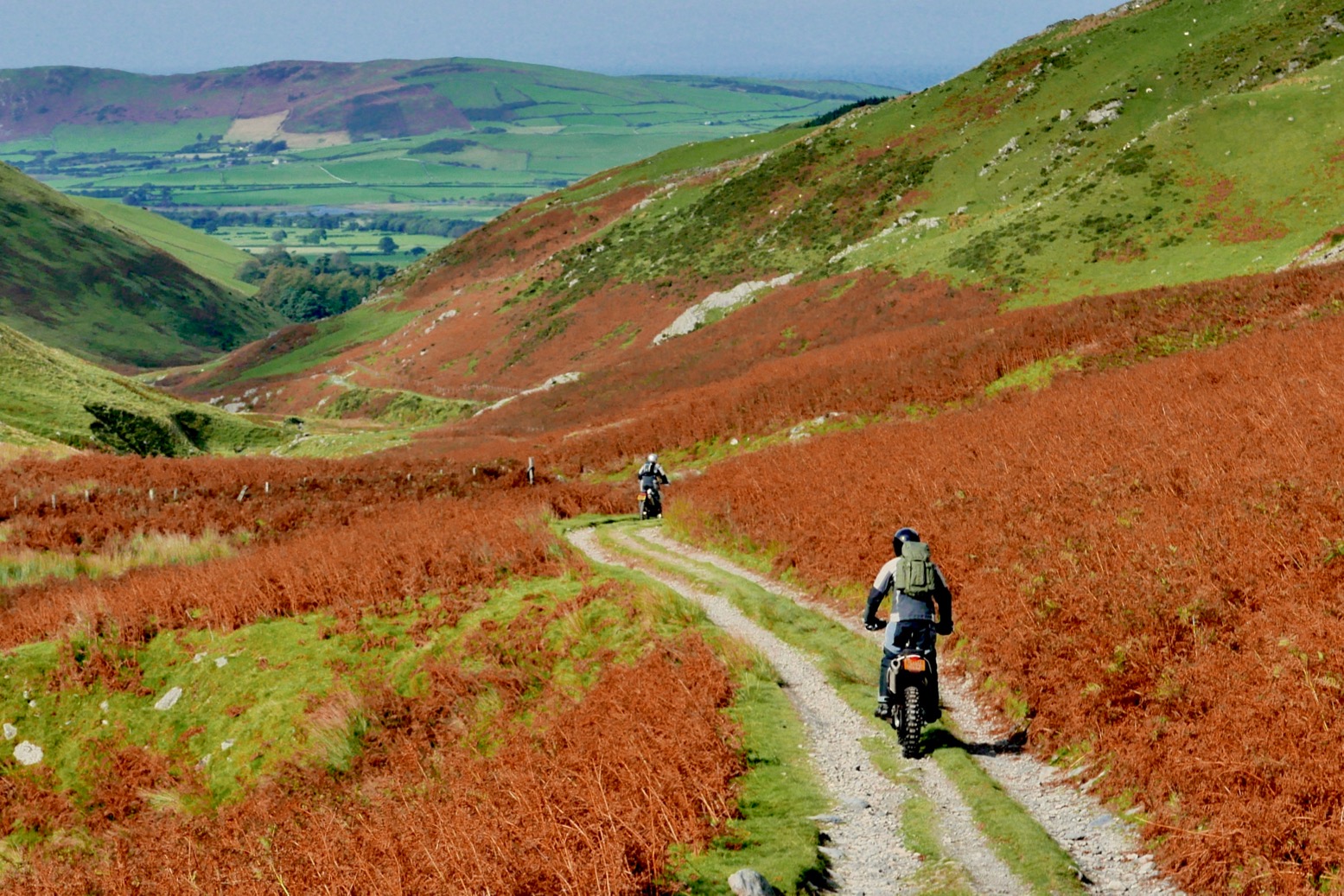
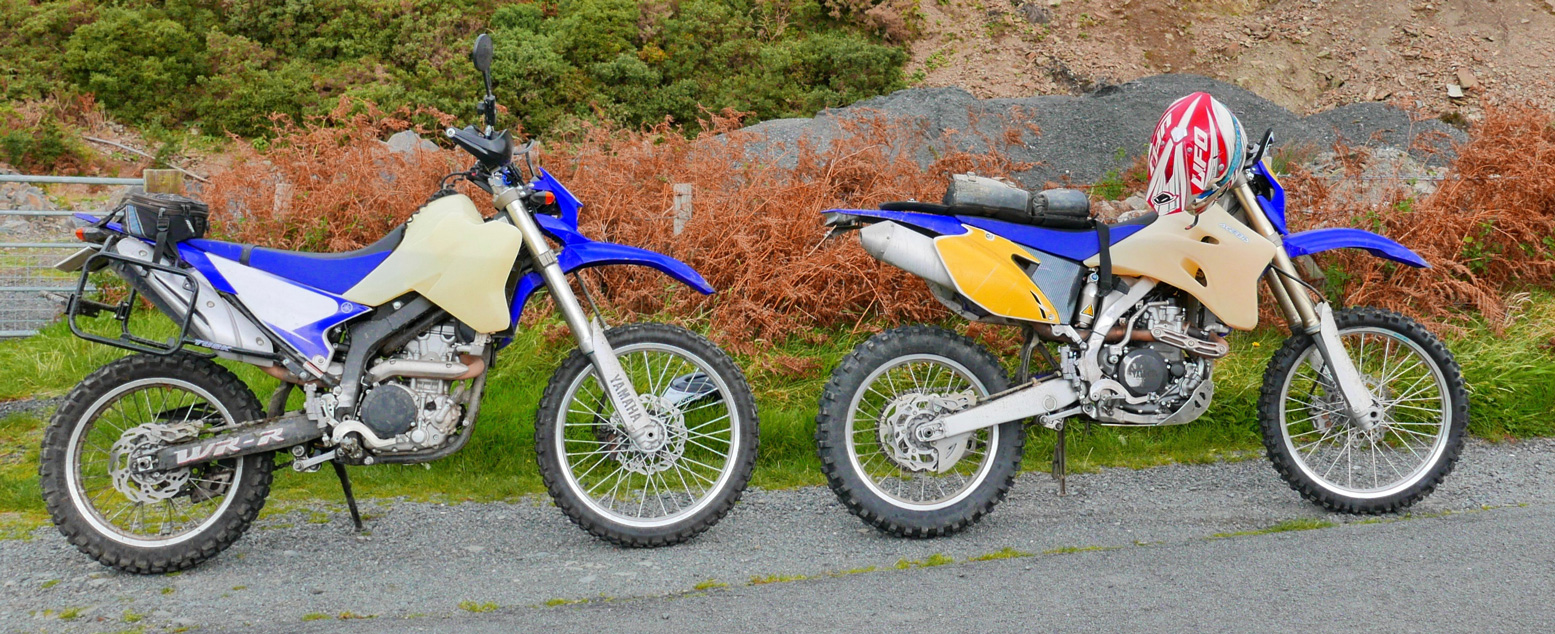
The benefit of riding with John from the school was that he knew the lanes, which ones would suit the day’s weather and the groups’ abilities, plus he had special access to trails in the adjacent Hafren Forest. Hafren becomes ‘Severn’ in English and a few minutes into the ride we passed within a mile of the River Severn’s boggy source on the side of Plynlimon mountain. Dave was on his third and near-new 690, Dan was on a 100-kilo 350 EXC and John was riding a Yam WR250F, as used by the school. This is a full-on, super-light enduro machine and despite similarities is an entirely different bike from my heavier and less powerful 250R, below left.
For me it was a real eye-opener how gorgeous the Cambrian mountain of northern mid-Wales could be. I’d always considered it a No-Mans’s Land between the better know Brecons and Snowdonia to the north which explained why green laning (using off-road vehicles on unsealed but public roads) was permitted to survive here.
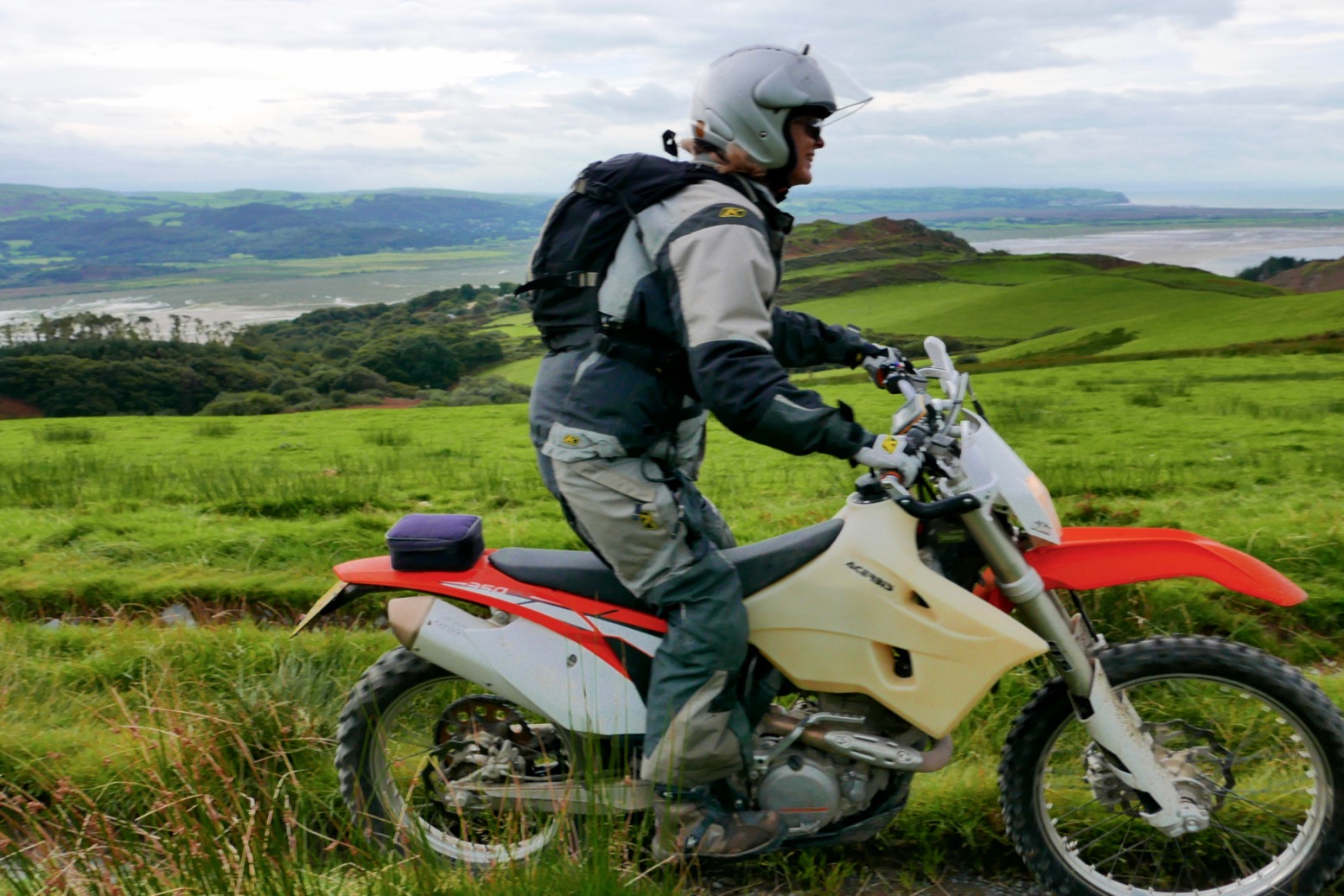
I can now see it as a great destination its own right – a compact Scottish Highlands but without their near-total ban on green laning, and without the rambling crowds of Snowdonia. And never mind the trails, much of the fun to me was cruising the deserted single-track backroads that snaked across the moors – the yellow C roads on the map you could do on any bike.
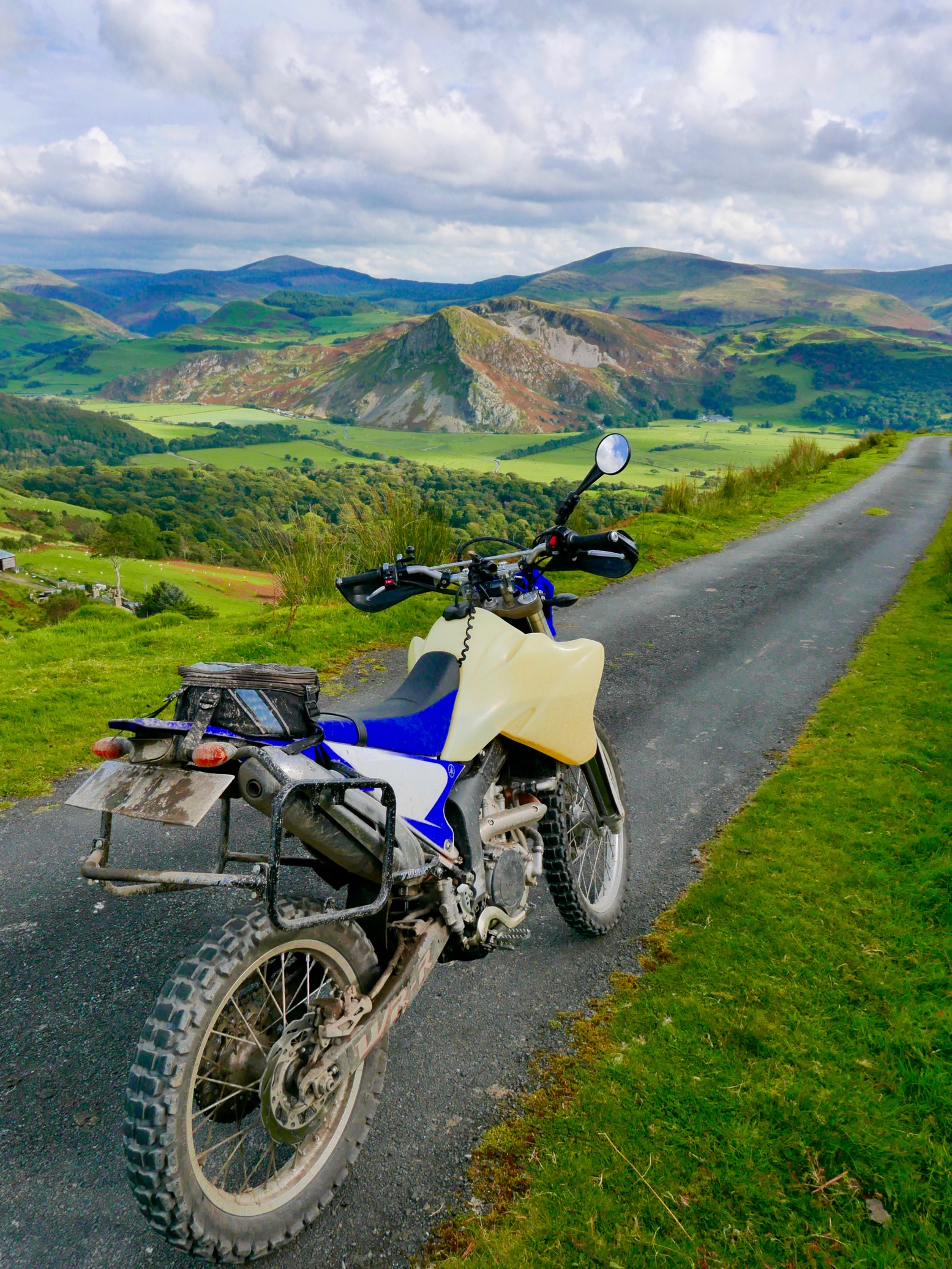
After Machynlleth, heading up the gnarly ‘Happy Valley’ green lane reminded me my WR was still without a proper bashplate (the OE one is seized on). In the meantime I was amazed how well the unfashionable Bridgestone TW301/302s tyres were managing. These came with the bike in 2008, were refitted by Hyperpro on selling it, and I can say did not miss a beat. My snazzy Hyperpro suspension soaked up the easy pace too, just as you’d expect, though I dare say I could have refined it by playing with the knobs. Like the TTR250 I used in Spain in the summer, I never wished for more power on the trails or backroads – but then we did cheat by vanning the 200 miles up from London. The good thing with modest power is the tyre won’t spin out readily, but if caught in the wrong gear that WR still had enough to chug its way out – I never stalled it.
After reading so much about them, Dave let me have a quick spin on his 690 (recently fitted with Evo 2 aux. tanks) but can’t say I’m a convert yet. The KTM’s thumping vibration really struck me, soon followed by realising how quickly the sharp brakes and more than double the WR’s power could turn on me if tired or not concentrating. But the bike had a solid feel that even a new WR might not match, and out in the open desert I bet it would be in its element. A quick spin on Dan’s 350 EXC (right) on soft power setting was much more like it, but that bike needs new oil every 1000 miles so isn’t a contender as a travel bike. What I’d like is a 450 version of the 690, but pitched as a less tyre-shredding travel bike. Press the red button if I’ve said this before.
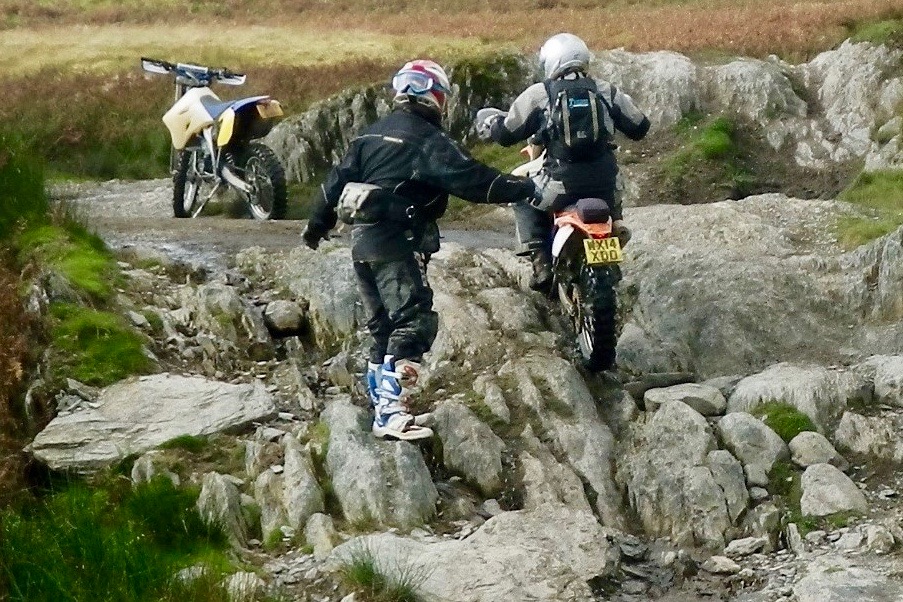
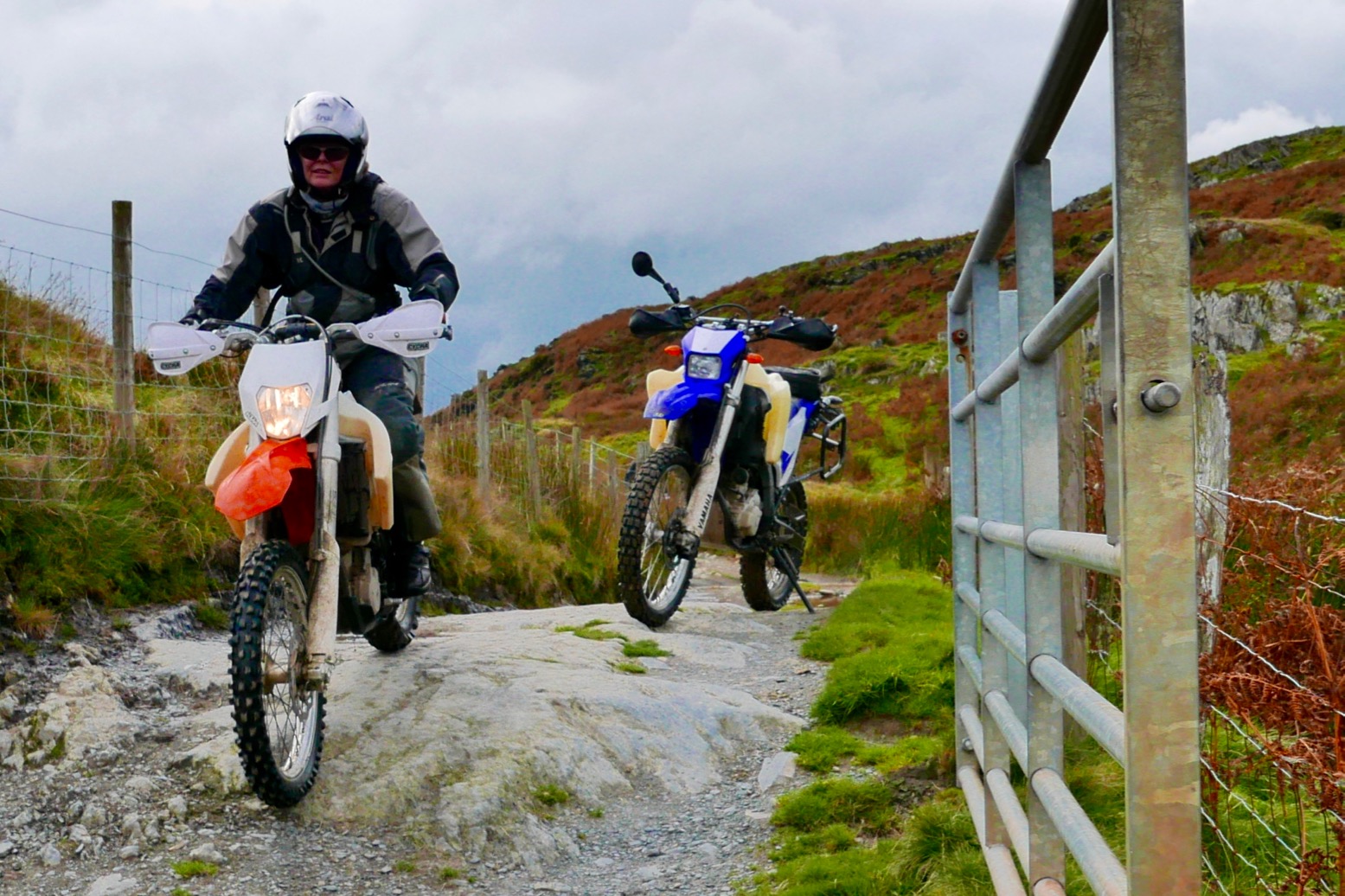
There sure are a lot of gates on the green lanes of the Cambrian mountains. It was rare to ride more than five minutes without doing the gate dance – and sometimes less than a minute. It breaks the rhythm of the ride but they contain the sheep which can easily jump a cattle grid if spooked. The trail north into Dolgellau between Cader Idris and the Barmouth estuary was a notable exception – a good ten minutes riding or more between gates. We came across a few ramblers and dog walkers who didn’t look too put out – they’re walking along a ‘road’ after all, even if they don’t realise it. And we nearly ran into a big group of lads bursting out of the forest on unlicensed dirt bikes. Damage wise, their impact was minimal and who knows, the new Geraint Jones could be among them, but I bet they’d all rather be legit. Wouldn’t be it be great to have a huge trail park out here where people could roll up and ride round at their own pace, instead of the scurrying around on wasteland or dodging the rangers.
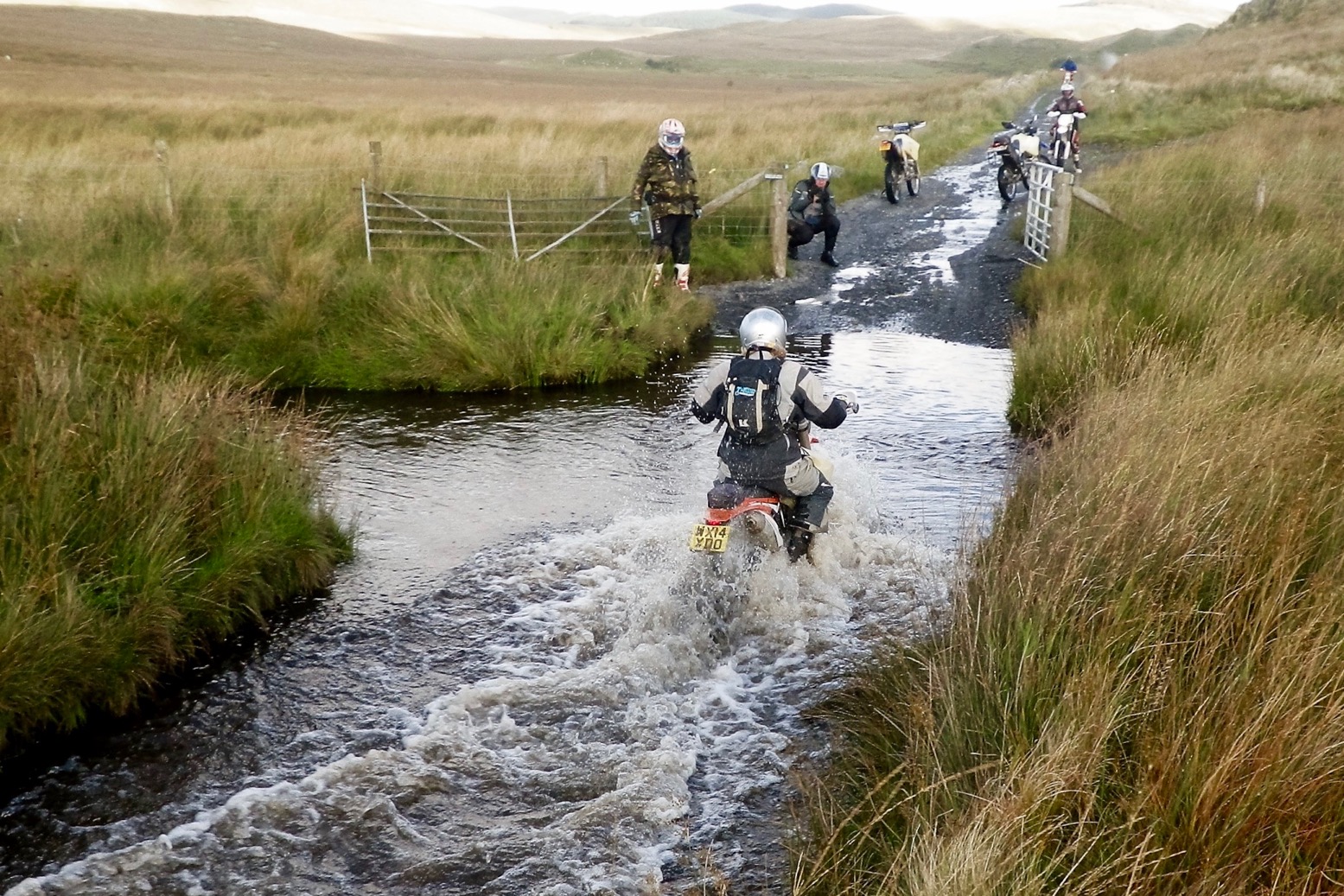
It poured overnight but day two actually dawned even brighter, apart from a well-timed downpour as we ate lunch in Talybont. Either the riding was easier or I was getting to grips with the WR. On rougher trails I did find it hard to ride smoothly; balancing the jerkiness of the engine with the right gear and the rebounding suspension while looking at what’s coming up and steering away from rocks, but this is just the nature riding a light, small-capacity bike at slow speeds. Turn up the wick if there’s room and things would smooth out. After the rain there were some bigger puddles today too. Initially they were a worry as I’d read the WR was prone to cutting out in a splash, but even with the engine note muted in two feet of water, it never even coughed. I don’t know if it’s been a dry spell – in Wales, what are the chances? – but the ride John led us on was pleasingly free of mud and to me was all the better for it. My recollection of bombing around Rhayader on XTs 30 years ago was plunging into one peaty morass after another which just makes a mess of you and the landscape.
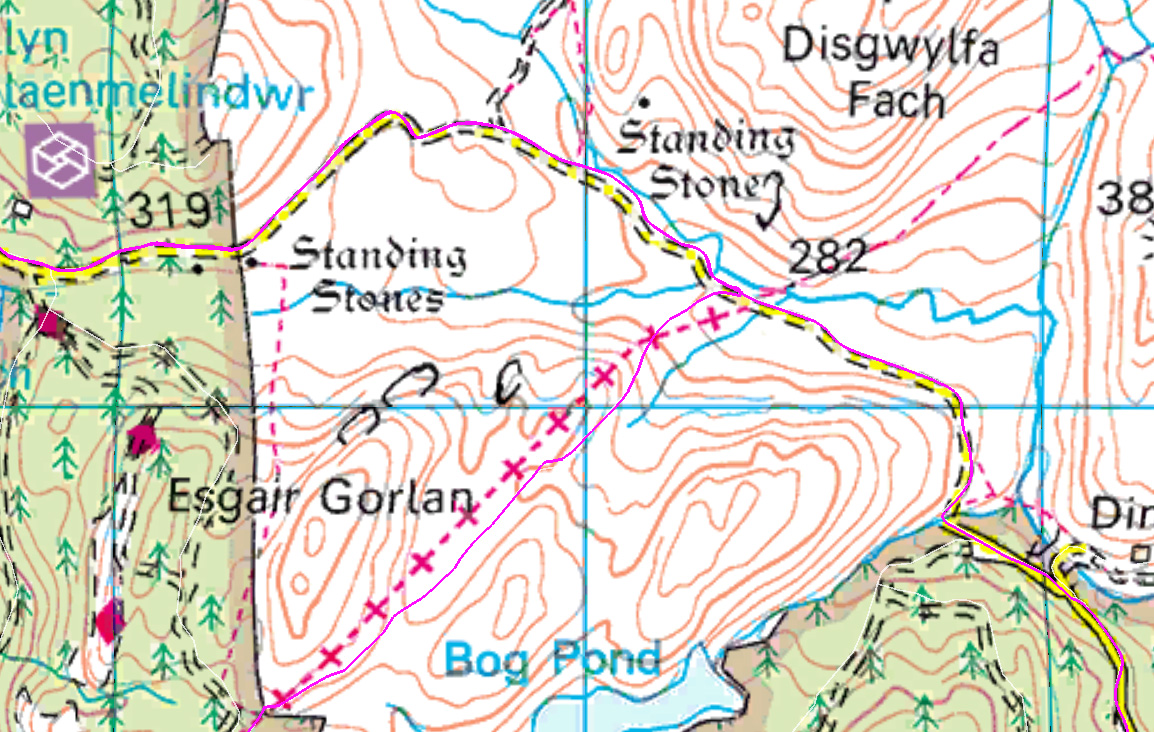
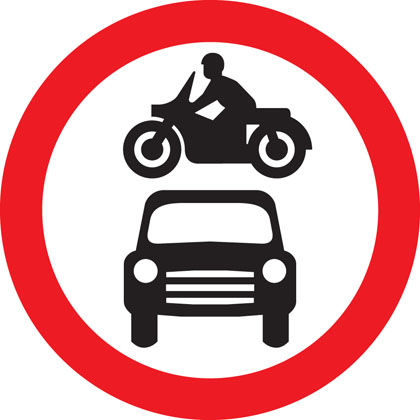
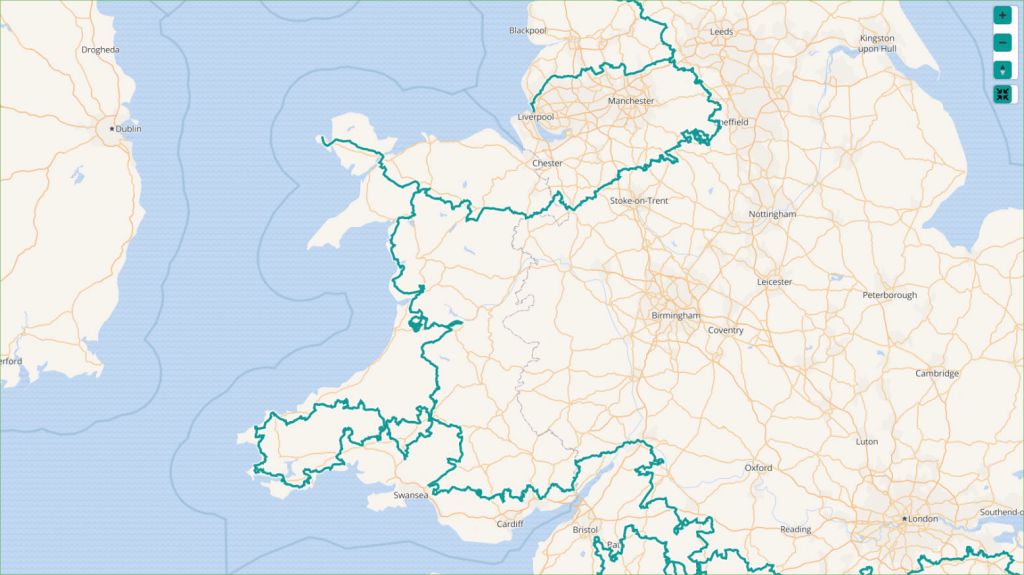
It would be great to do more riding around here on my own, as it’s as wild and extensive as you’ll get in the UK (there’s virtually no green laning in Scotland). But unless you live nearby or do the research, it would be hard to get a handle on which trails are legal and then put together a satisfying two-day route like the one we followed with John. Now of course we have the TET (see map below). Every year more and more green lanes in England and Wales get downgraded to paths. I haven’t a clue which of the trails we did were open to all, but promisingly I only saw one ‘no vehicles’ sign. Lacking a local pro like John, the answer is to hook up with the TRF or join an escorted tour from £50 a day with four of you. That’s just the way it is living in a small, crowded country and why I set off for the wide open Sahara in the first place – and why I’m off to Utah next week!

 • Good volume
 • Expensive, once you add it all up











 Adventure Motorcycling Handbook