Short version: Imo, none of these cores are suited to travel biking.
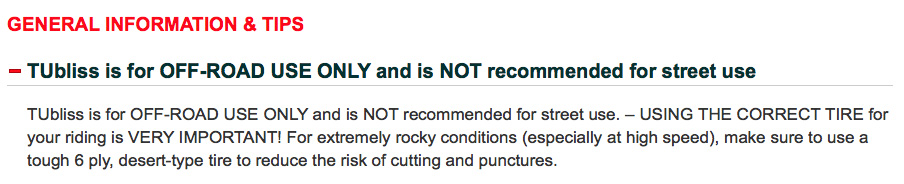
Systems like the US-made Tubliss liner are primarily made for dirt bikes running low-psi. They are not recommended for highway use in the US by the manufacturer, most probably due to homologation issues rather than safety. But I know people who’ve run Tubliss for years on the road with no problems. The main limitations: they’ll only seal properly on WM3 rims (2.15”) or narrower, and they only come in 21, 19 and 18-inch sizes. So like they say: most suited to dirt bikes where such rim widths and sizes are the norm.
Nuetech Prolock In 2025 Nuetech announced the Prolock system: half-a-dozen rubber-backed aluminium clamps you bolt to the rim like a rim lock, via several new holes. The rubber squidges out and seals the spoke nipples, while also sealing and pining the tyre bead in place, so there’s no need to run an MT rim, and low pressures ought to be doable. Each set weighs just under a kilo, but of course you lose a tube. It sure beats the need to run 100psi in the Tubliss system, but on a travel bike where you rarely run very low psi, I’m not sure it’s a huge benefits to simple spoke nipple sealing on an MT-type rim.
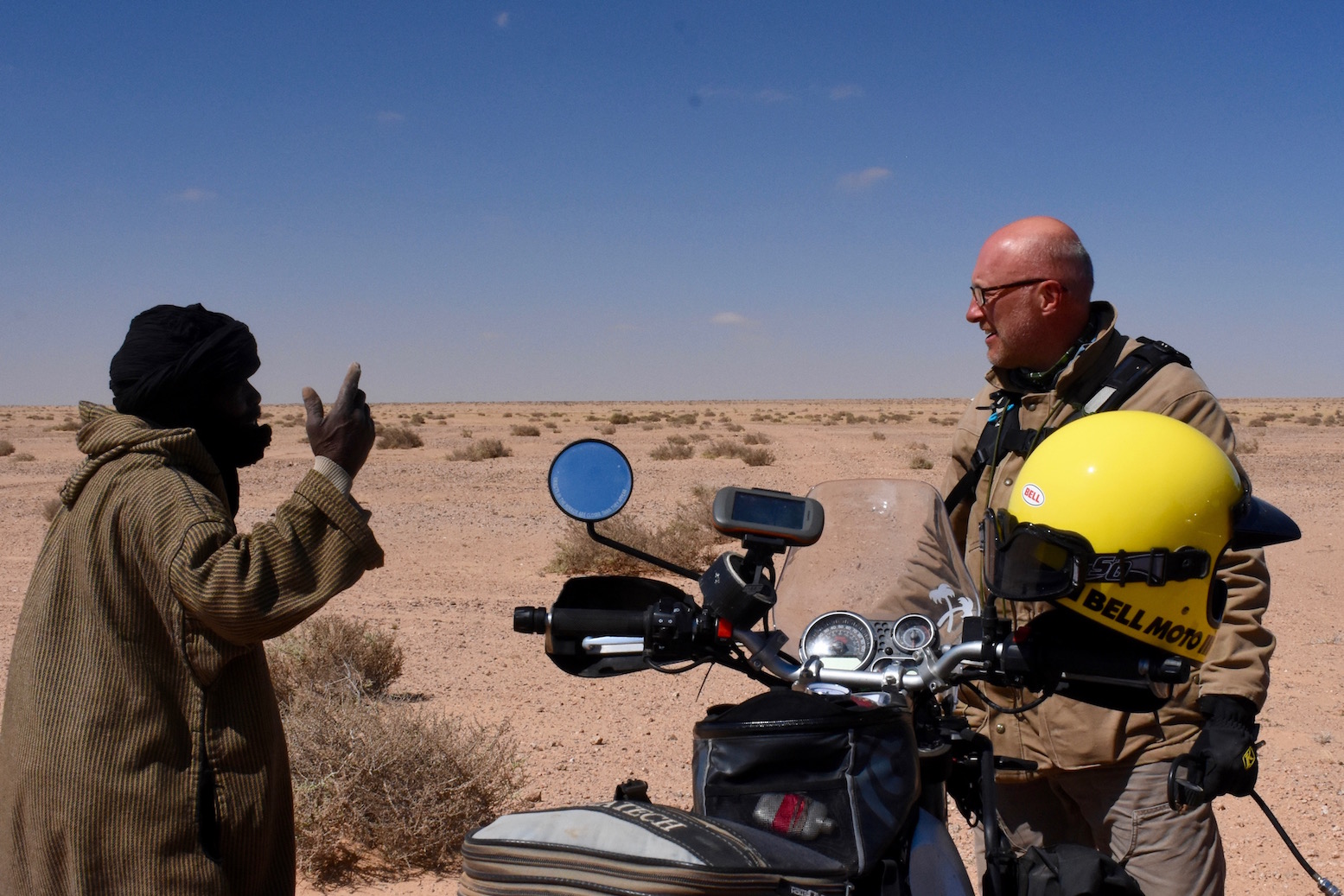
With nothing better available for a 21-inch wheel, in 2019 I reluctantly ran Tubliss on the front wheel of my Himalayan in Morocco. A few days in I’d noticed Slime coming out round the high-pressure core valve body which suggested it was getting from the tublessed tyre cavity past the Tubliss core seal. Then, after about two weeks riding at road pressures and having checked the Tubliss at 7.5 bar just two days earlier, the core went flat in the middle of Western Sahara. It would not hold air and so neither would the tyre. But by luck, the body of the collapsed Tubliss core kept the flat tyre on the rim, so I was able to ride slowly 250km to Laayoune on the coast, find and fit a tube.
Removing the Tubliss (left), it was hard to tell what was wrong as five hours riding at 30mph had probably pulled the valve out of the tube and anyway, I wasn’t planning on refitting it and bought an inner tube instead. I never was that keen on Tubliss for travelling as opposed to recreational dirt biking. Even though mates have used it on the road without problems, I’d not risk it again. Next time I’ll seal an MT rim.
Tubliss and similar work by fitting an inner tube-like ‘core’ (‘HPC’) which inflates up to 110 psi to expand and seal the bead of the tyre firmly against the rim and so sealing off the tyre’s air chamber from the spoke nipples where leakage occurs – the key to converting wire wheels to tubeless. The core is a thick, plastic highly pressurised non-elastic red casing, but it’s kept away from the tyre sidewall or tread where punctures come through.
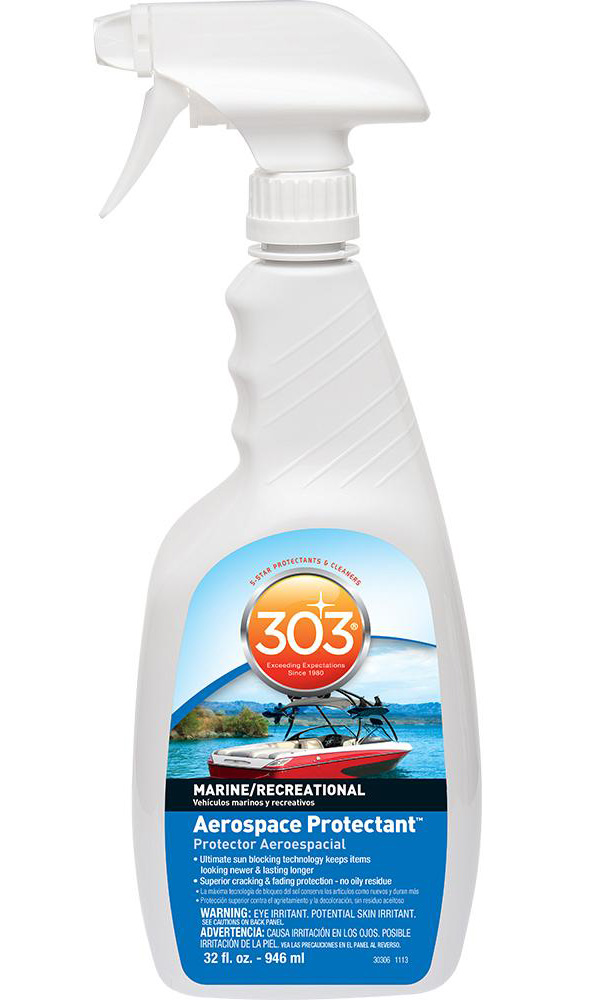
Years ago I fitted a pair to a GS500R project bike running custom 19″ spoked rims. Click the link. Short version: lube the possibly hard-to-fit core with 303 Protectant (right: £15 a pint; same as Armor All in the US). It’s much slippier and longer-lasting than soapy water which is good for the HPC inside. Then run Slime, Stans or similar to ensure sealing (about the same price as 303 but you can MYO). Me, I wasn’t convinced they’re suited to long-range overlanding compared to other simpler systems because of the need to maintain the very high 110-psi pressures in the red HPC with humble mini-compressors. You also need to drill another hole in the rim for the HPC valve/rim lock; no one likes doing that. Long Tubliss thread on advrider; mostly dual-sporters. Some get on with it, some don’t. In 2019 I rather reluctantly fitted a Tubliss to the stock front steel rim of my Enfield Himalayan. But I’m on the lookout for a 21-inch alloy rim with the safety lips to seal myself with adhesive and tape.
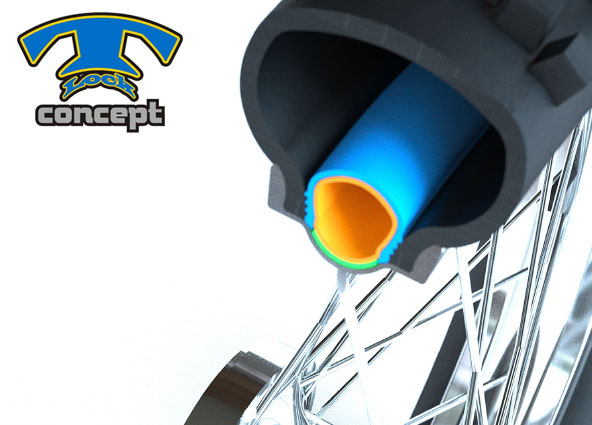
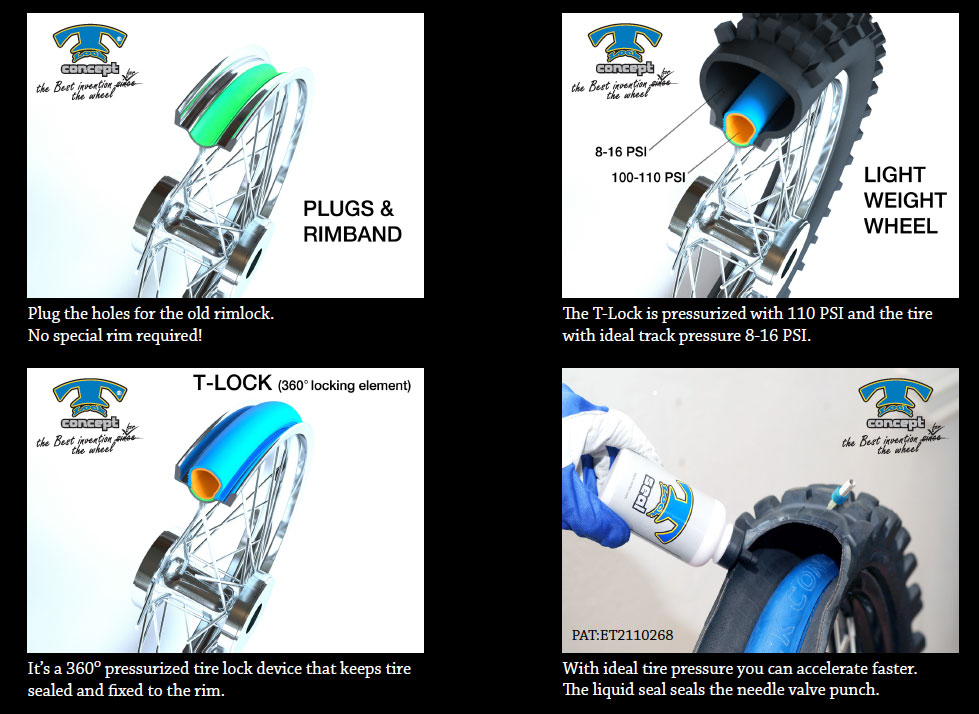
The Swedish T-Lock system is very similar as far as I can tell: the same non-elastic core (blue, left) presses the tyre bead against the rim with very high pressure to seal the tyre’s pressured chamber from the leak-prone spoke nipples and securing the bead to the rim (MT rims not needed?)
The blue tube utilises the rim’s valve hole. This means that unlike Tubliss with its two valves, the tyre must be filled with Slime-like sealant before final mounting and then pressurised by spiking the tyre carcass with a needle valve attached to a Schrader, then letting the sealant plug that hole. This seems to imply you set the tyre pressures once. To modify the pressure you’d have to spike-and seal again. Even more than Tubliss, T-Locks are intended only for motocross use, as the website’s imagery implies. Clearly then, not at all suited to overlanding.
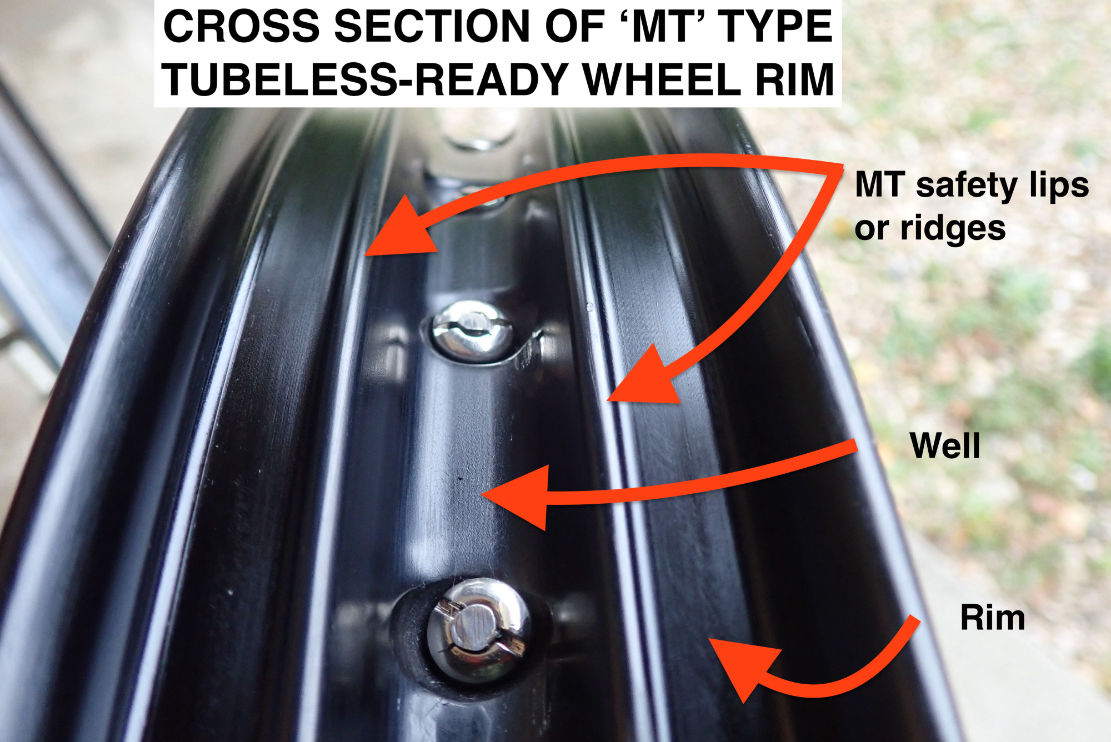
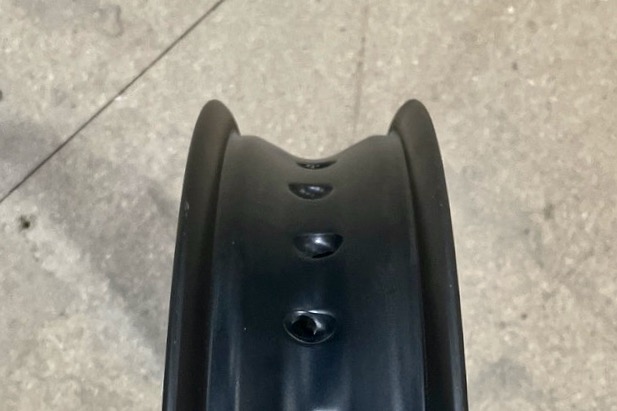
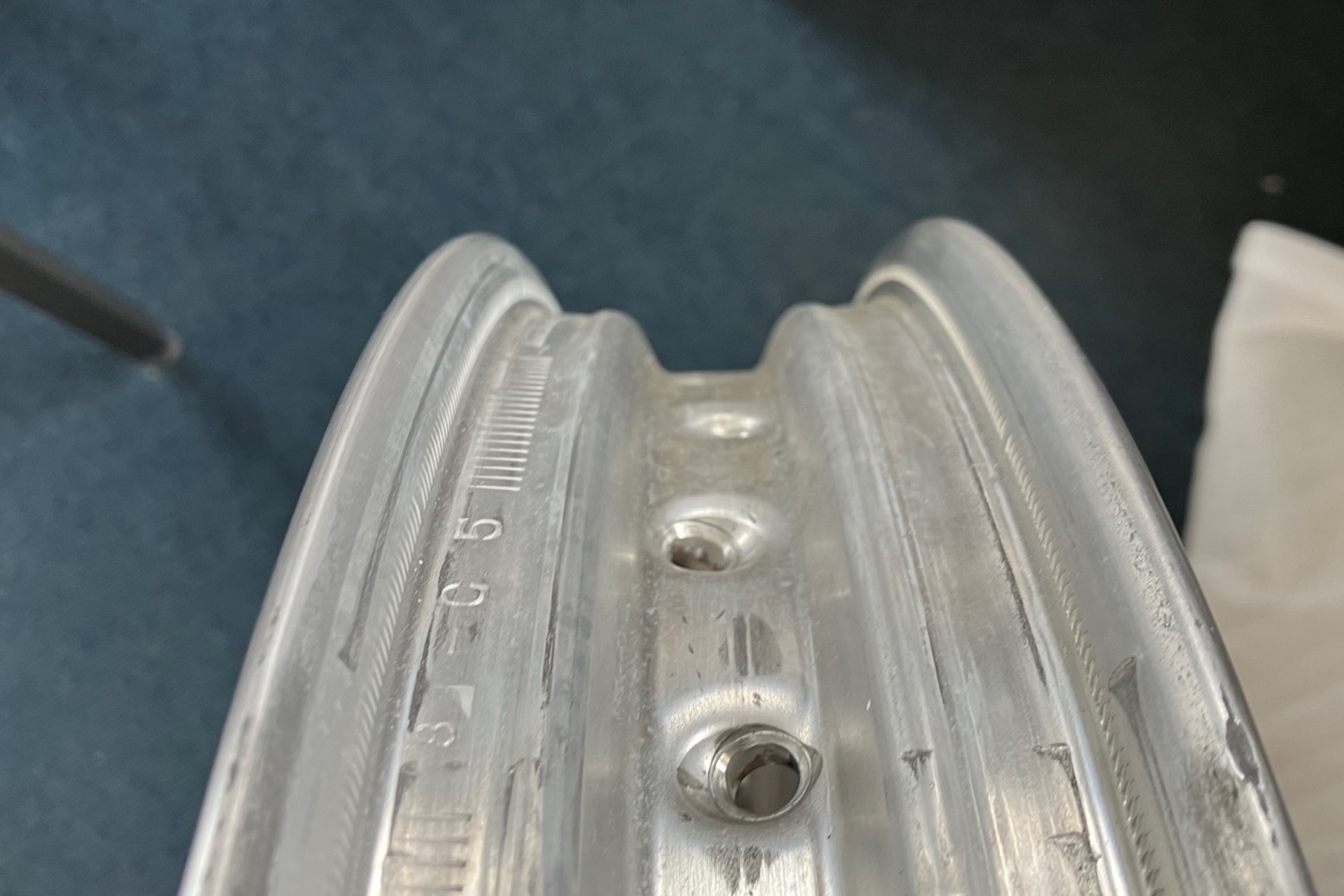
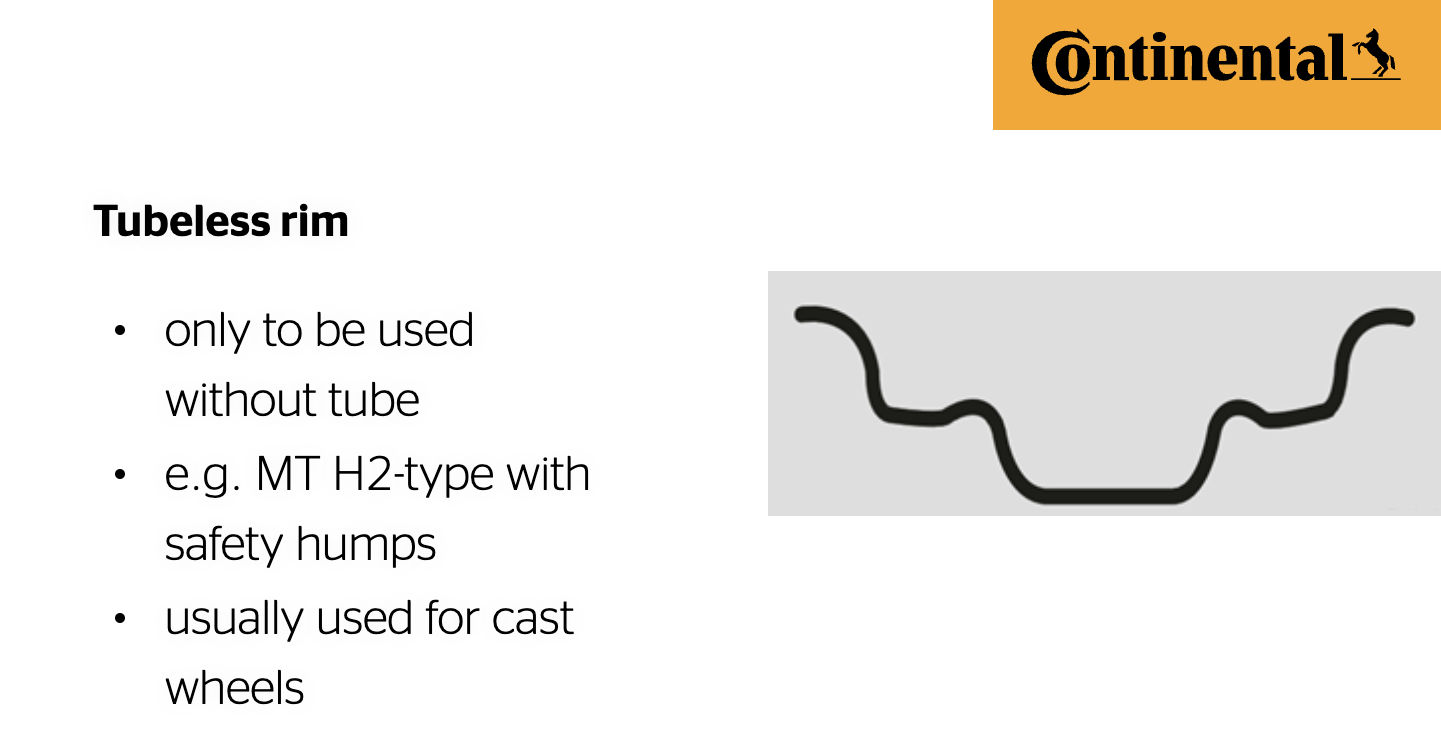
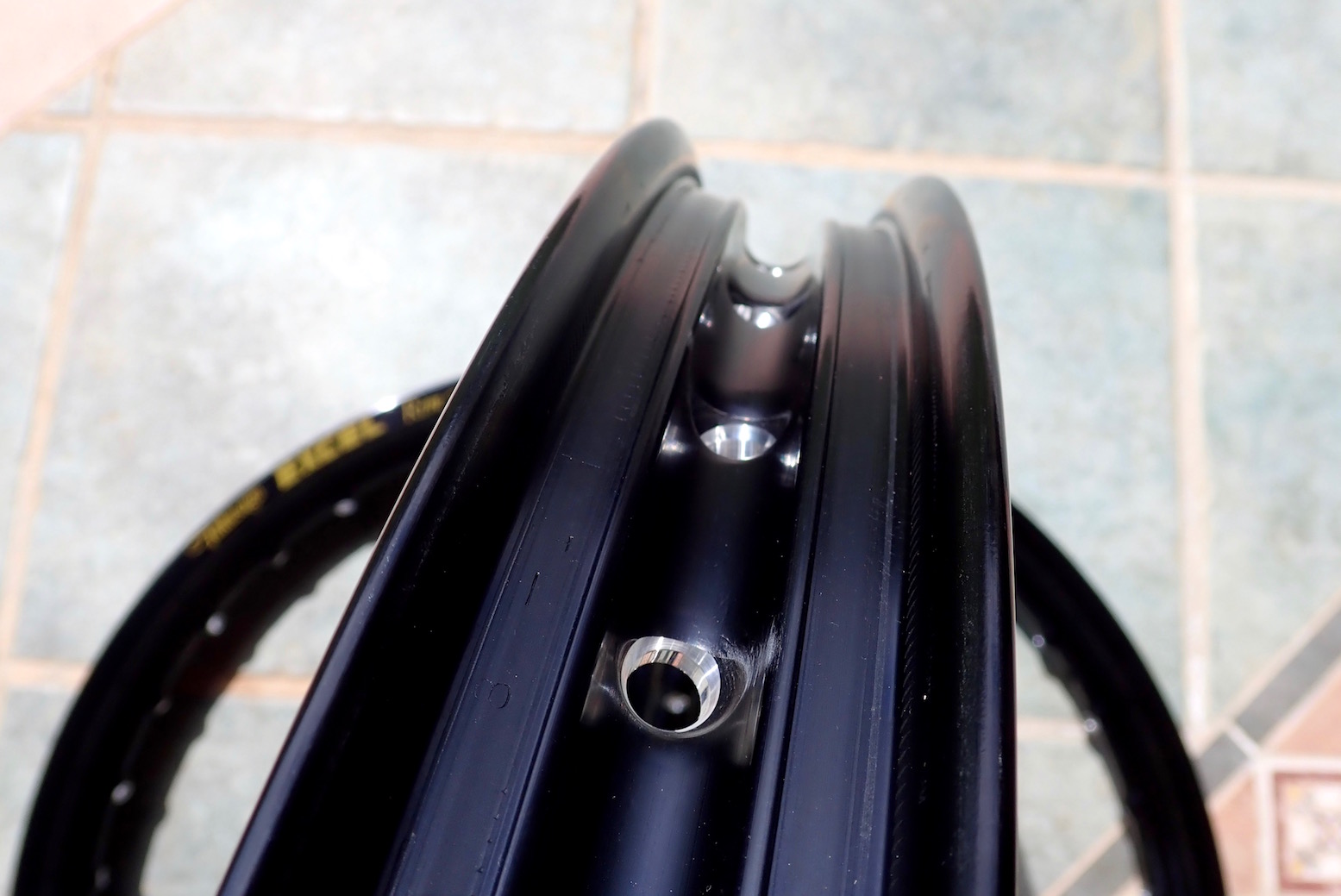
Tubeless rims are usually cast wheels with a lip or ridge (left) to help locate and seal the tyre bead securely on the rim. This lip is also considered a safety feature which stops any tyre coming off the rim should the tyre deflate on the move. In my experience, it works. You will feel the softened tubeless tyre long before it comes off the rim and can keep riding slowly without it coming off. These ridges have been a feature on the rear wheel only of some tubed motorcycles since the 1980s.
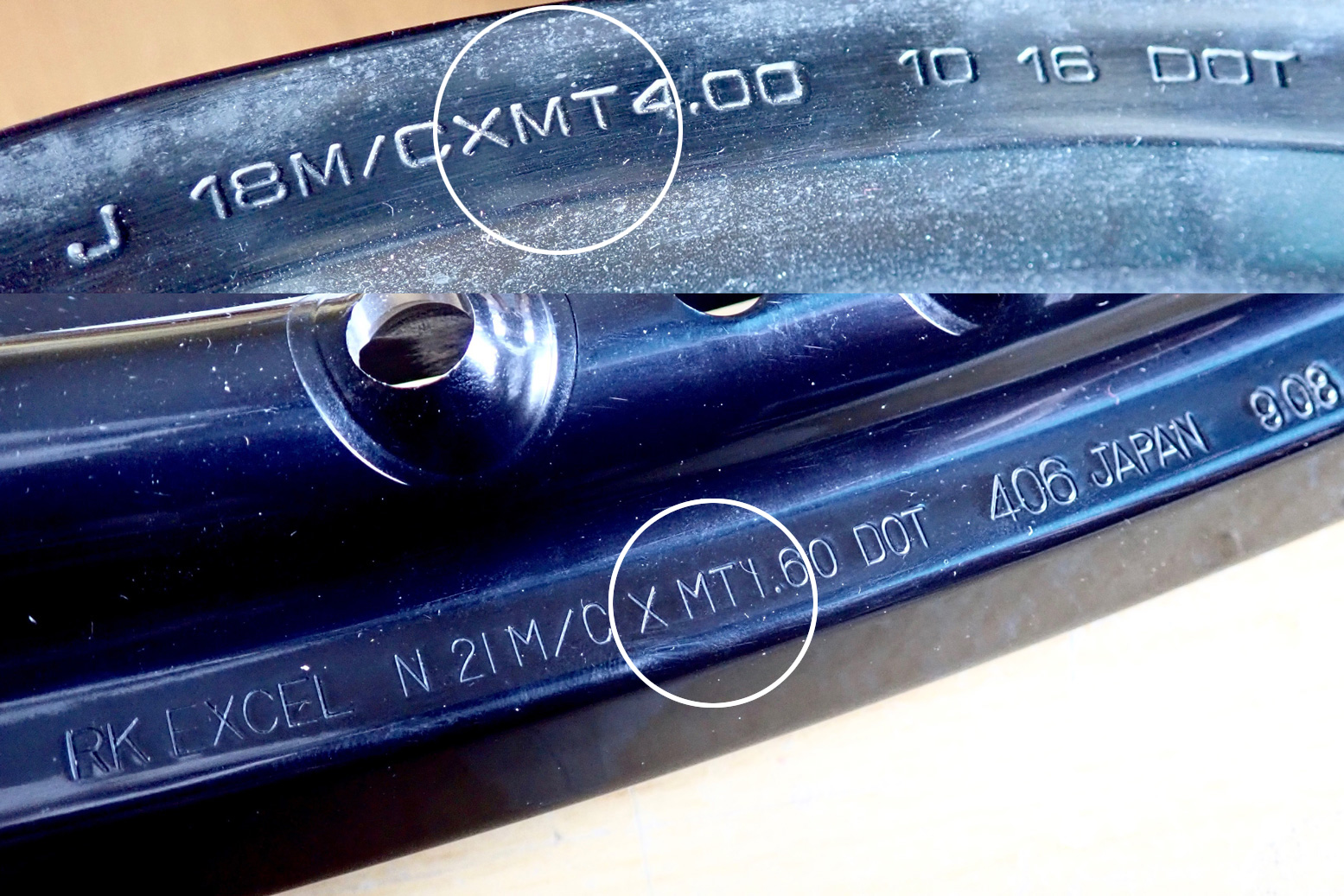
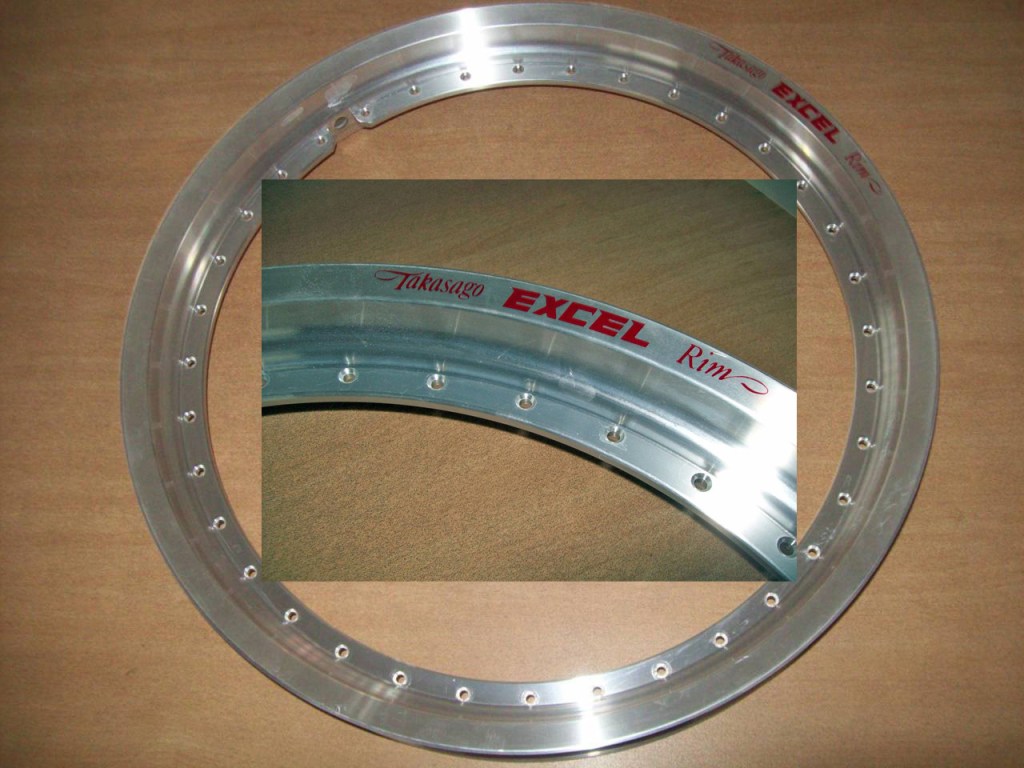
Unbranded, unstamped ‘WM’ no lip rimMT stamped Excel lipped rim
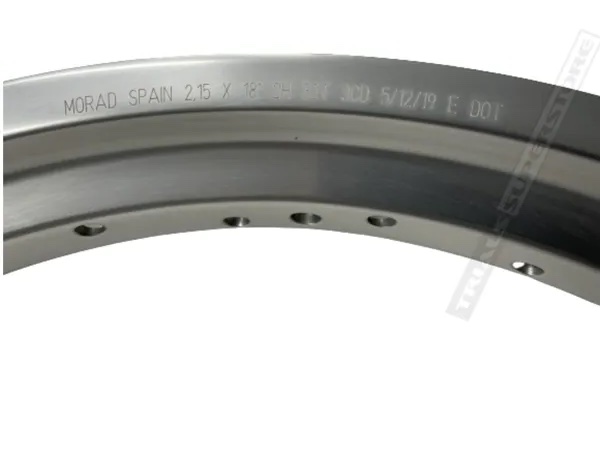
The ‘MT’ or ‘2H’ (‘H2’) rim code Spoked rims with the safety lip suited to TL tyres are often stamped ‘MT’ on the rim, as opposed to ‘WM‘ or nothing, but usually only by Asian rim brands like Excel Takasago, but not SM Pro. As said, even bikes running inner tubes may use an MT-type lipped rim (which questions the claim that ‘you can’t put a tube in a tubeless rim’). European brands may use ‘2H’ (‘2 hump’) to mean the same thing, as with the Motad wheel below right who now own the Akront brand.
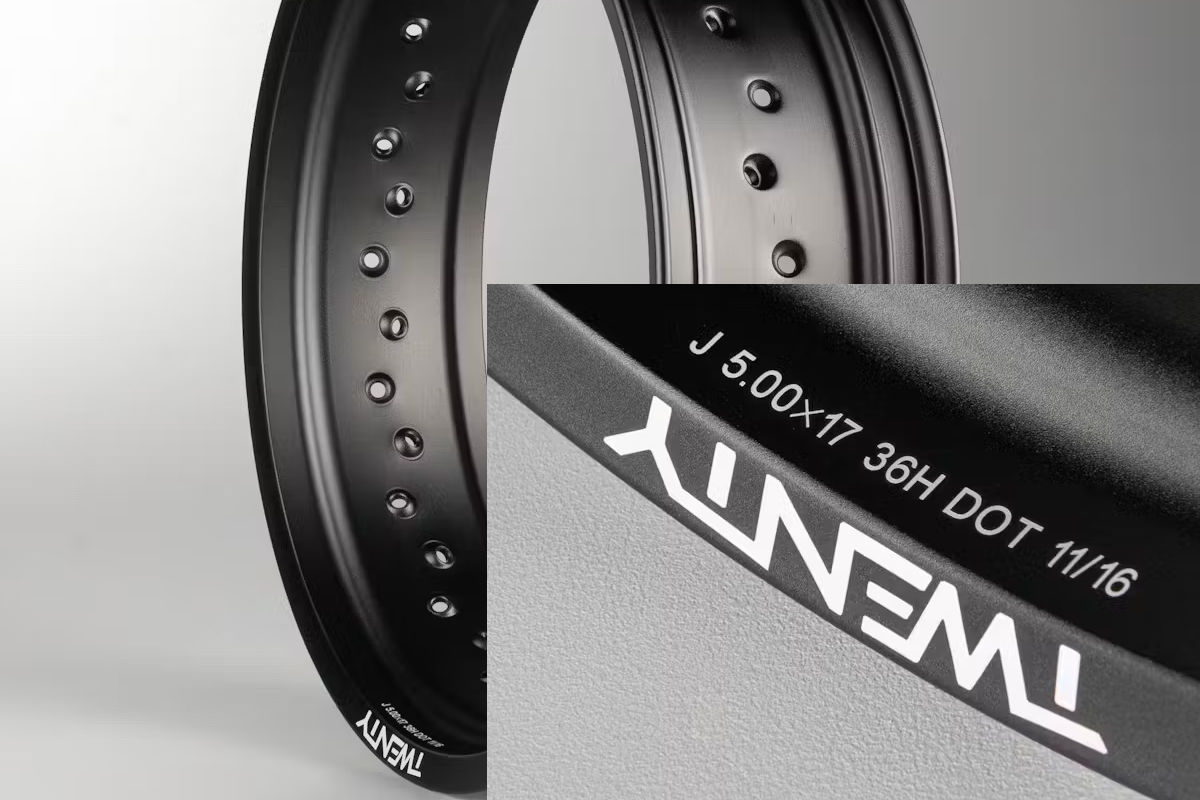
But as AD comments, his 2005 KTM’s German Behr rim (no longer made) was stamped MT but has no lips, so … [not] all MT-code wheels have the safety lip. What’s more, other rim brands like Twenty (below left) may have the lips but don’t use any discernible code on the rim. The only way to know for sure is to verify the profile of the rim.
Twenty: no code but lippedMorad: ‘2H’ code for a lipped rim
This lip also makes removing and mounting the tyre difficult by the roadside if you need to repair an inner tube. It varies from bike to bike and tyre to tyre, but with tubeless you only need to remove a tyre to replace it when it is worn out (or destroyed), not to fix endless punctures. And unlike punctures, fitting a new tyre is usually done at a time of your choosing and in a tyre shop which has the know-how and tools, including a powerful compressor and lube to force the new tyre over the lips and into the rim’s groove with a nice ‘pop’. See this.
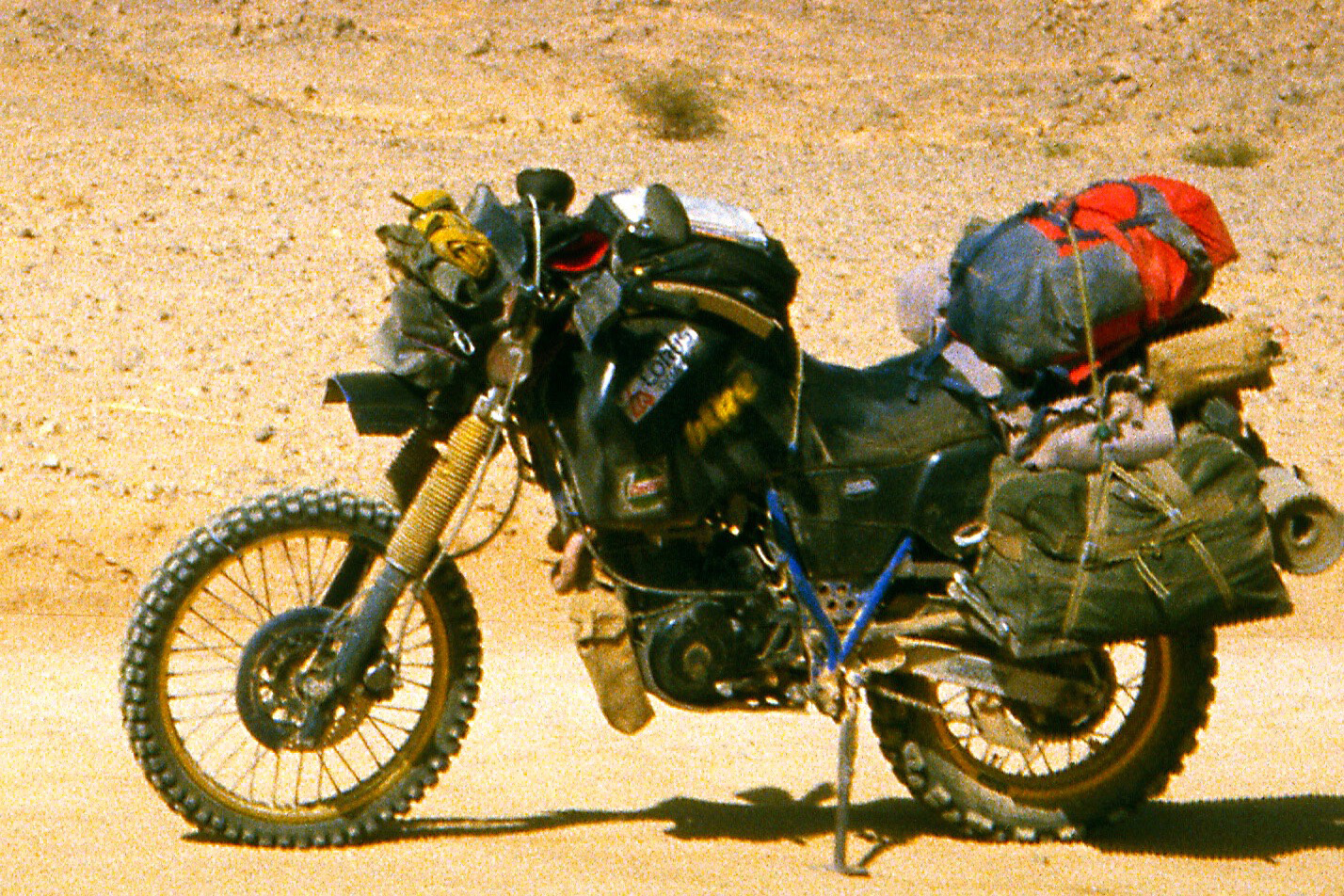
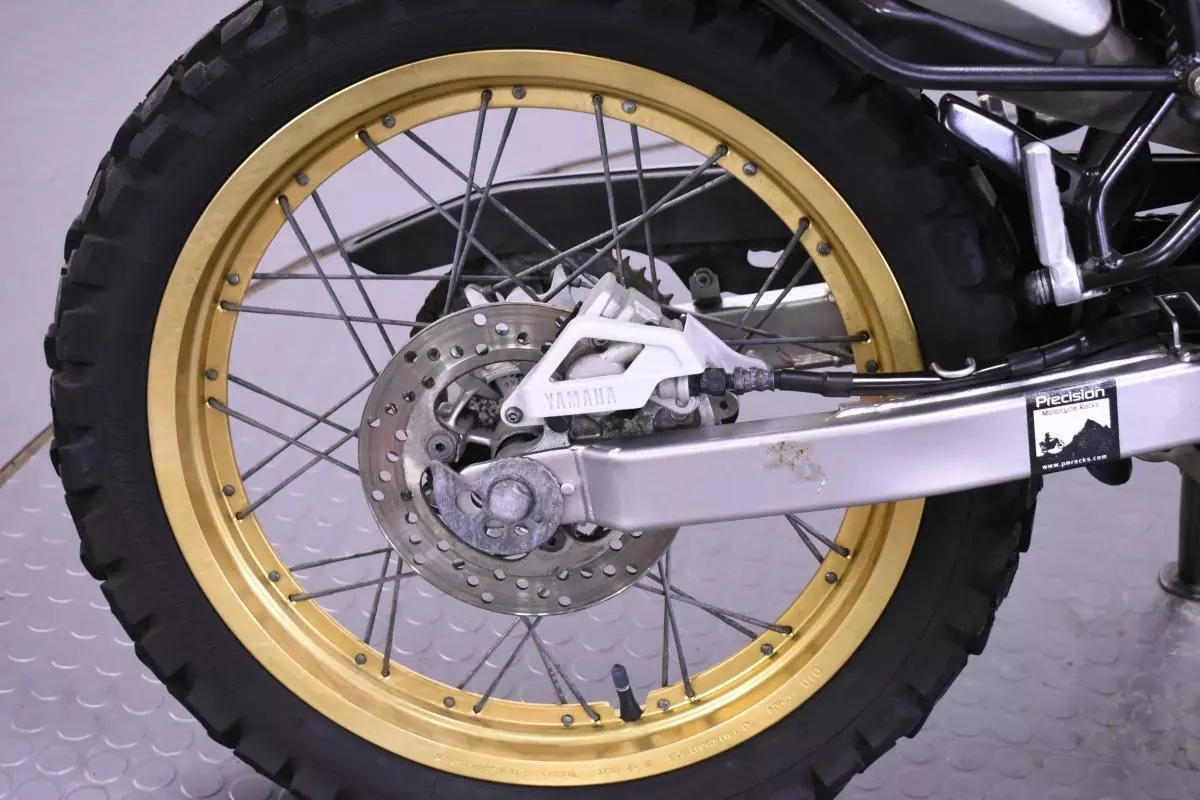
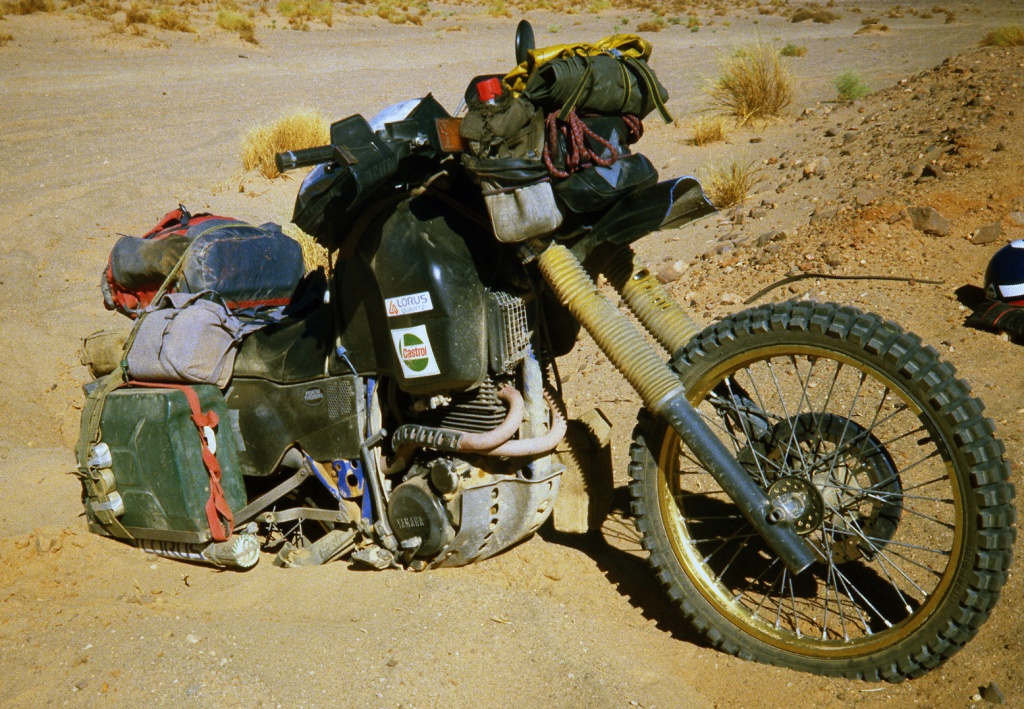
For years and years bikes running tubes also have this safety lip, but never on 21-inch wheels. Old Yamaha XTs like the one above had it on the rear wheel. Out of interest, this disproves another tubeless urban myth: you can only stick a tube in a TL rim to ‘get you home’ because it will eventually rub on the lip and explode with terrible consequences. Well, clearly not on a stock tubed ’86 Tenere with a lipped DID rim (above). I know because I remember putting that bike on a crate with the rear tyre removed, sticking it in gear and ‘hand-lathing’ off that safety lip with a chisel so that I’d not get stuck in the desert trying to break the bead to fix a flat. And as importantly, remounting it with – back then – just a bicycle pump. All this faffing is why we like tubeless!
2008 XT660Z, heavy MT rear wheel but came with tubes
But to convert spoked tube rims to tubeless, these lips are an important safety attribute. My 2008 Tenere (above) had them on the back wheel. The front rim was normal which is a risk when converting to tubeless. But can it be any worse than a tubed tyre puncturing? Tubed tyres deflate faster and therefore more dangerously than tubeless tyres, so even without the safety lips or humps on the front, with tubeless you’re already ahead. But, as I found, with no lips you may get slow leakage along the seal. These days I would not convert any spoked wheel which did not have these lips (usually OEM 21s), even if it gets expensive.
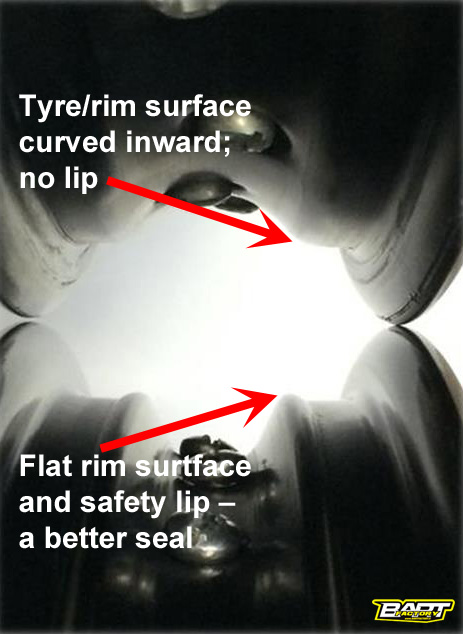
Pictured left: the top ‘WM’ rim has no sealing lip; the lower ‘MT’ rim does. Note also the angle of the tyre bead–rim interface; the lower rim with the lip is flat which helps make a better seal and keep the tyre bead in place. The upper lipless rim slopes into the well making it easy to mount by hand, but it won’t hold or seal a tubeless tyre half as well. My 2008 Tenere front-wheel sealing problems were because the rear wheel was like the lower rim – good for tubeless. The 21-inch front was like the upper rim; less good seal.
21-inch spoke rims with safety lips
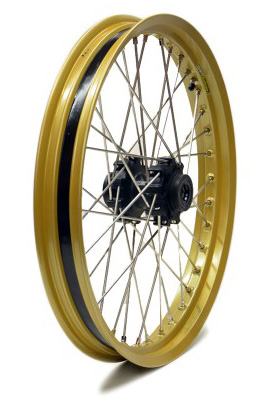
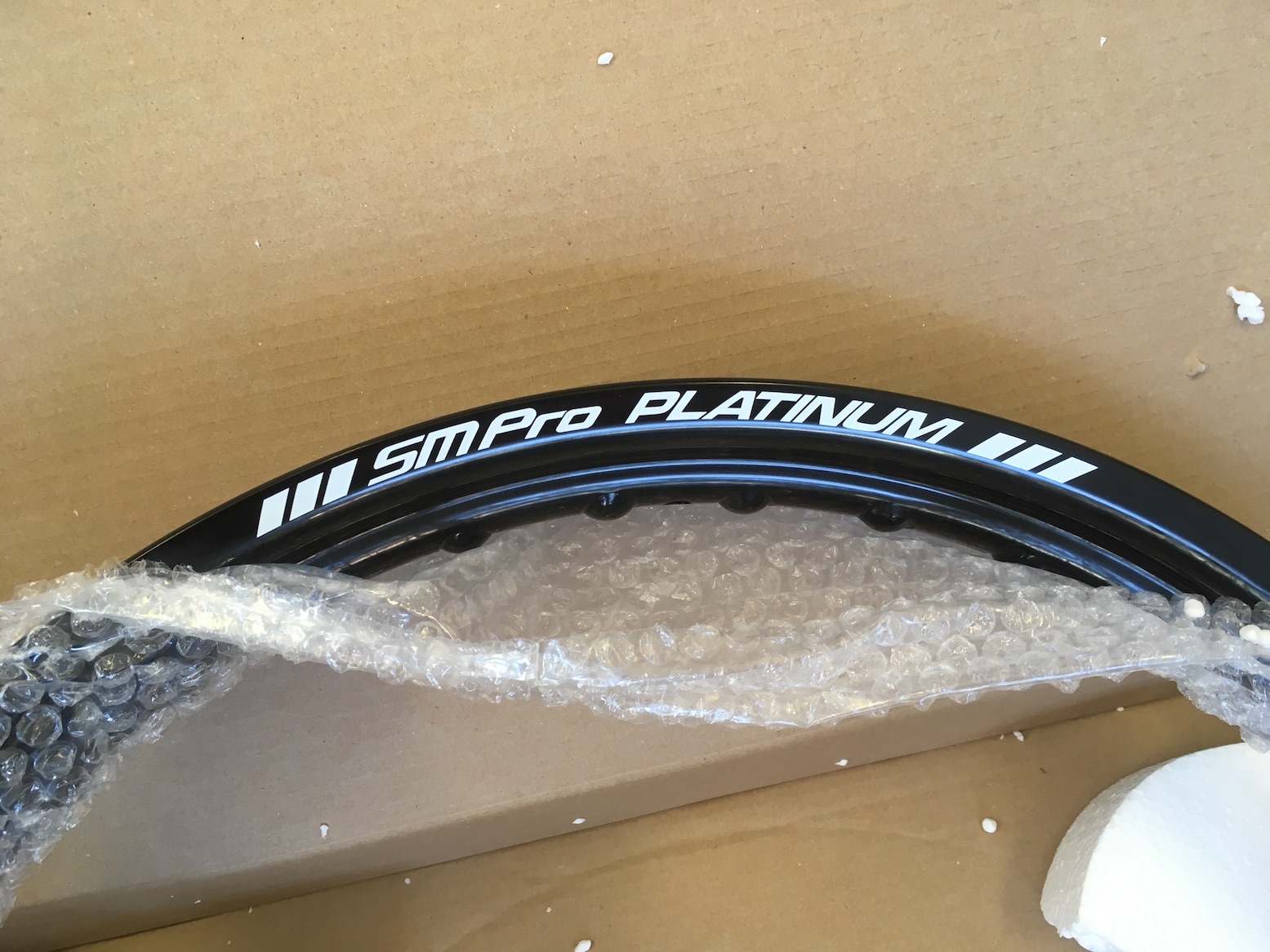
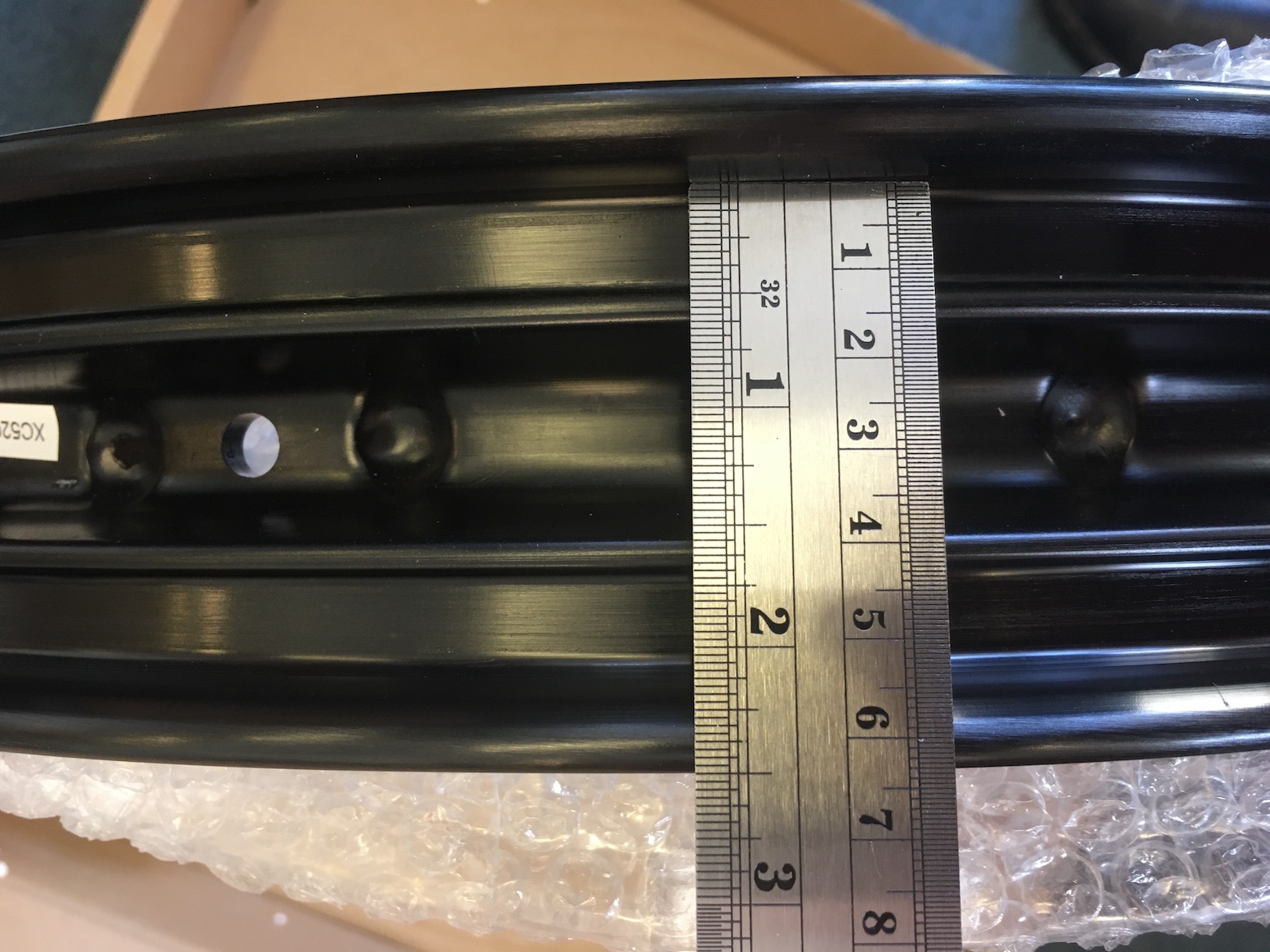
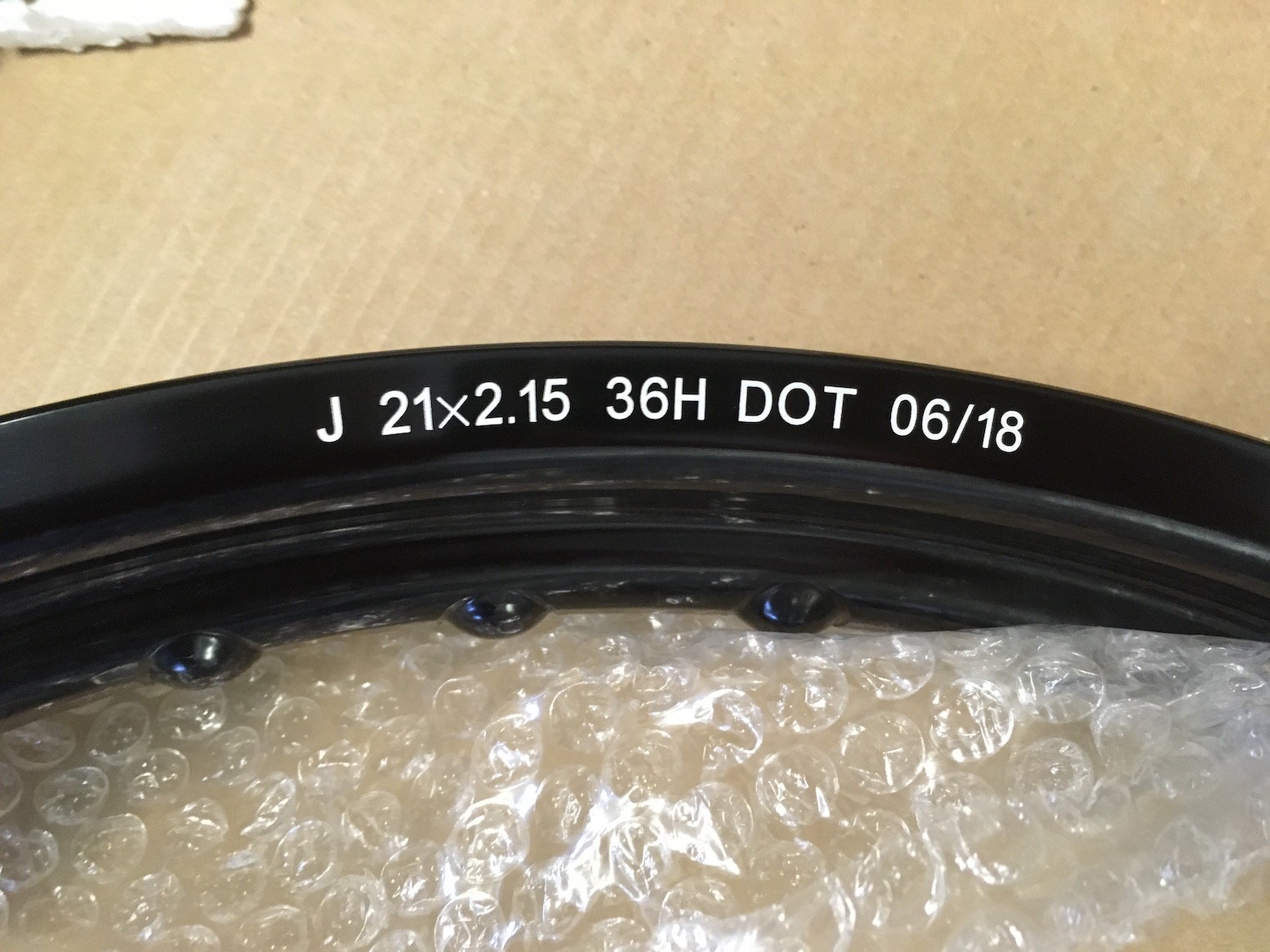
I spent weeks online tracking down a 21-inch alloy rim with the safety lip suited to converting to tubeless. They used to be rare, but not anymore it seems, as OEM spoked tubeless wheels become a ‘thing’ on adventure bikes. Taiwan-based Giant (or GLM) is the biggest bicycle and motorcycle rim manufacturer in the world. They make such a rim in ‘big bike’ 2.15 width with 36 holes (bigger BMWs have 40; lighter trials bikes have 32). In the UK Central Wheel Components sell them for £111 (2.15kg) + 24 quid to anodise. It may be branded SM Pro (see bottom of the page). Rally Raid use this rim on their own wheelsets with BARTubeless conversions for Africa Twins (left) at a staggering £1500 a pair.
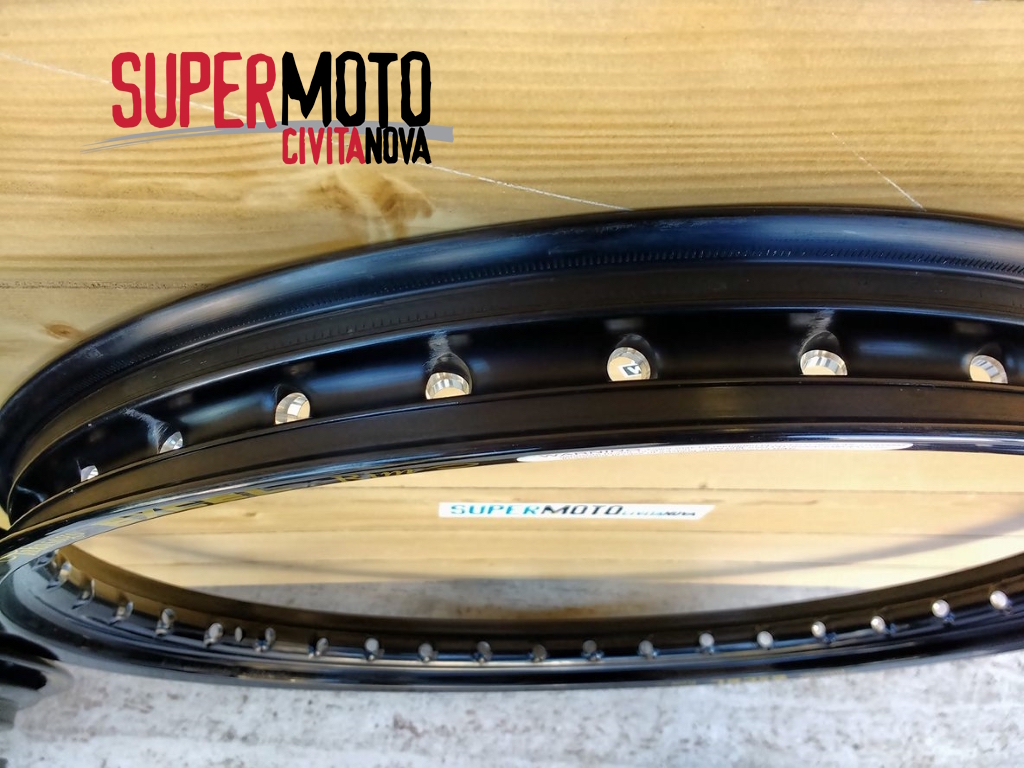
A quote to build that rim onto my Himalayan hub and seal it with BARTubeless (done in Italy) came in at £420. A quote to do the same for my AT: new 2.15 GLM rim £135; S/S spoke set and wheel build £105; Airtight TL band £120; post £21 (£381). Some claim the GLM rim is a bit soft. More research unearthed Japanese Excel Takasago TL rims in 21-inch, but only a 1.60 size (left; p/n ICK408, and below) which is OK for dirt bikes but not adv twins. Talon in the UK import them at £165; I bought a pair in Italy for a lot less and have kept one for a rainy day. This rim has an unusually deep well which should make for easy tyre mounting, even after you’ve sealed it whichever way.
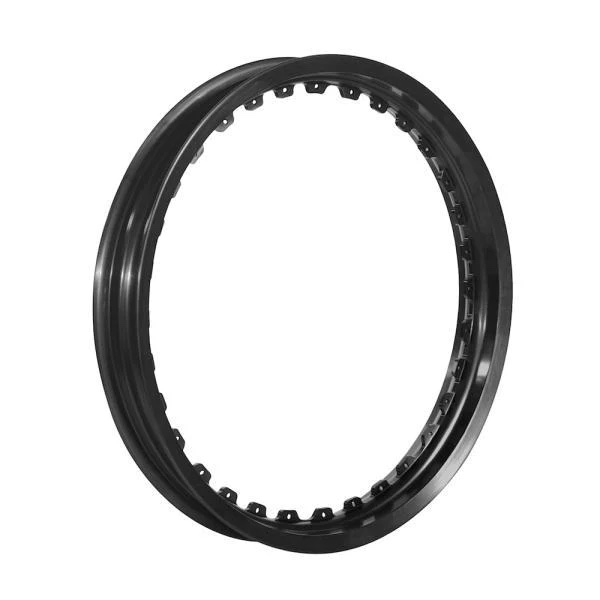
In 2018 there was talk of Excel making a wider 21 x 2.15 suited to bigger bikes and in 2019 it was produced, apparently. And in 2021 a mate bought a 2.15 x 21 SM PRO Platinum from Central Wheel for £135, as mentioned above. So these 21″ MT rims are out there now in black or gold.
Thinking of using these TL rims for your conversion? Be aware that on these rims spoke nipples are in the hub, not the rim. You’ll need to convert the whole wheel to fit your forks / discs / spacers and so on. Suddenly it’s all a bit complicated.
Many flagship travel bikes run ‘adventure-look’ spoked wheels, but OEM spoked + tubeless is only slowly catching on. Usually, they’re non-Japanese premium brands like BMW, Triumph or KTM. I updated a list here in 2023.
The original one-litre Africa Twin and Yamaha’s XT700were two bikes where you‘d have expected tubeless. The 2020 1100 AT featured tubeless (right). Front 21-inch wheels seem to be a problem, but it must well be a cost thing too. Spoked tubeless fronts in 19″ are much more common, even on Jap travel bikes. These days manufacturers use spoked wheels on adv bikes as a signifier of ‘off-road adventure’, as well as the perception of being repairable, lighter, stronger, more shock absorbent and cool looking. Meanwhile tubeless is just plain safer and infinitely easier to repair flats. On a CRF450R motocrosser running rim locks at 10psi, a tube is probably a better idea as the van’s nearby. On a quarter-ton Adv battleship halfway down Patagonia’s Ruta 40, getting a flat is a pain.
OEM spoked tubeless wheels
Making a spoked tubeless wheel rim is expensive but its been done for decades, right back to the mid-1980s Honda XL600M (left), and almost certainly before that.
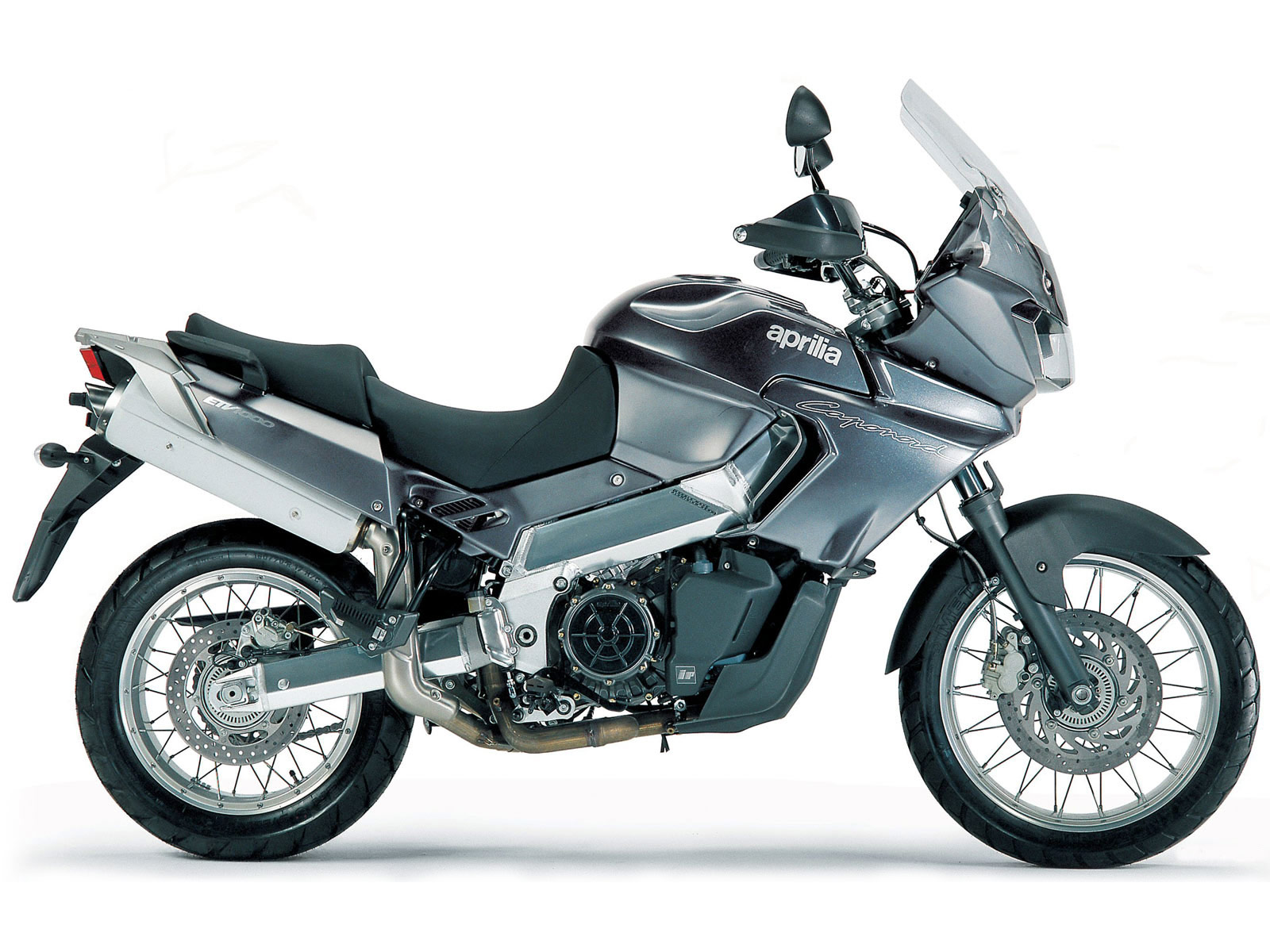
Recent bikes that come with them stock include the BMW 1200GSA, the original Aprilia Caponord (below), Yamaha’s 225 and 250 Serow on the rer only, Suzuki V-Stroms, Yamaha XT1200Z, KTM V-twins, some Triumph Tigers, Explorers (top of the page) and 1200 Scramblers. Even Honda’s oddball X-ADV scooter (right) has small spoked TL wheels.
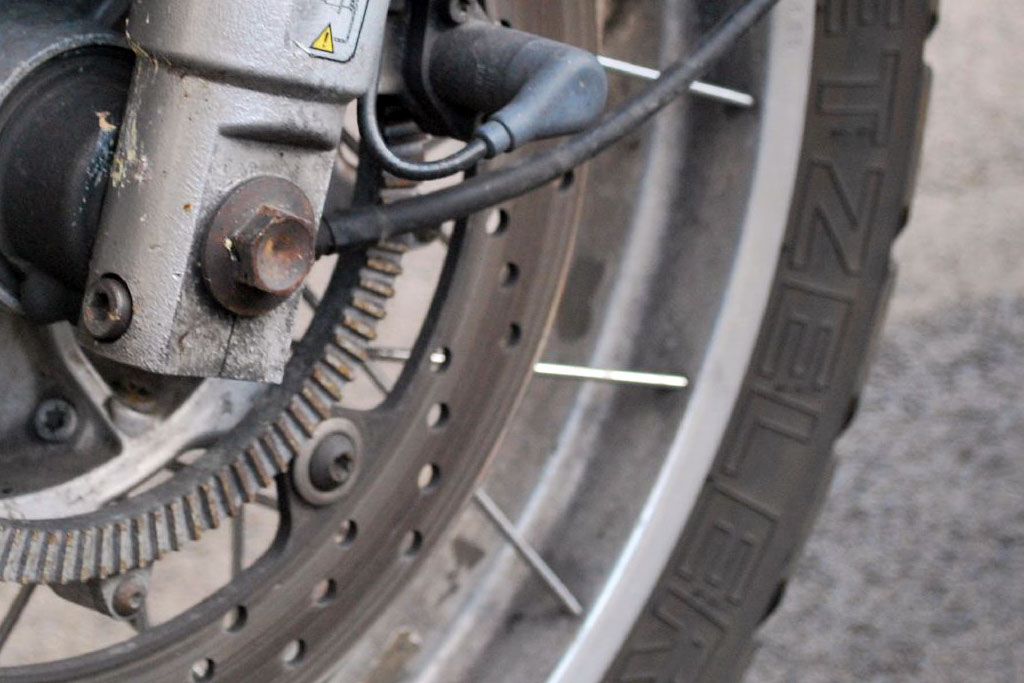
The picture below of a 2005 Caponord shows the main ways of designing a spoked tubeless rim. On the rear: spokes hook to ‘outboard’ flanges on the rim. The front uses a less well triangulated single ‘inboard flange’; V-Stroms (left) have paired inboard flanges up front. Note that the nipples (spokes tension adjustment) are at the hub, behind the rotors.
Yamaha Serow rear
BMWs, including the 850GS twin (below), run 40 straight-pull spokes directly into the protruding rim edge – there is no flange. I’ve noticed this relatively exposed edge can get scuffed about from stony terrain, although it would take a lot to damage the spoke mounts.
Such wheels can be heavier than same-sized cast wheels. Weight is saved by not using inner tubes, but the additional unsprung weight on any wheel is the last place you want it. It takes more force to get that mass turning, more braking to slow it and better suspension to control it.
Trials Tubeless
You could try and track down tubeless trials bike rims; they’re usually 32 spoke which will suit smaller Hondas, but no smaller than 18 inches. They do it with the usual inboard flange with hub-end nipples and straight-pull spokes, as below.
Jitsie Morad inboard flange
A 2017 KTM 1090 Adventure (left) has a similar a regular 21-inch Akront rim but with a band rather crudely vulcanised or otherwise glued into the well.
Most bigger road bikes run 36 spokes or more in the back. DID 36-hole TL rims do or did exist, but so far only in pictures or cruddy, corroded examples on ebay. When changing the spoked rim you’re constrained by the number of spoke holes in the stock hub because changing a hub is a much bigger faff. Fitting a new rim is dead easy. Missing out a few spokes to make a standard 36-spoke hub use a 32-spoke trials rim is a bodge too far, even for me ;-)
Branded or otherwise, it’s hard to find less expensive spoked TL rims off the shelf. The only ones I’ve seen are in China: Risun (Risen?) outboard tubeless rims in 17 or 18 inches only (left) and just $60 a shot. Problem is, you have to order a minimum of 200 units. And there is still the hub-nipple problem.
Especially with 21-inchers, finding an OEM TL rim is difficult or expensive. With 21s you may be better off buying a safety lipped rim (also rare) and sealing it by hand or using the processes described here.
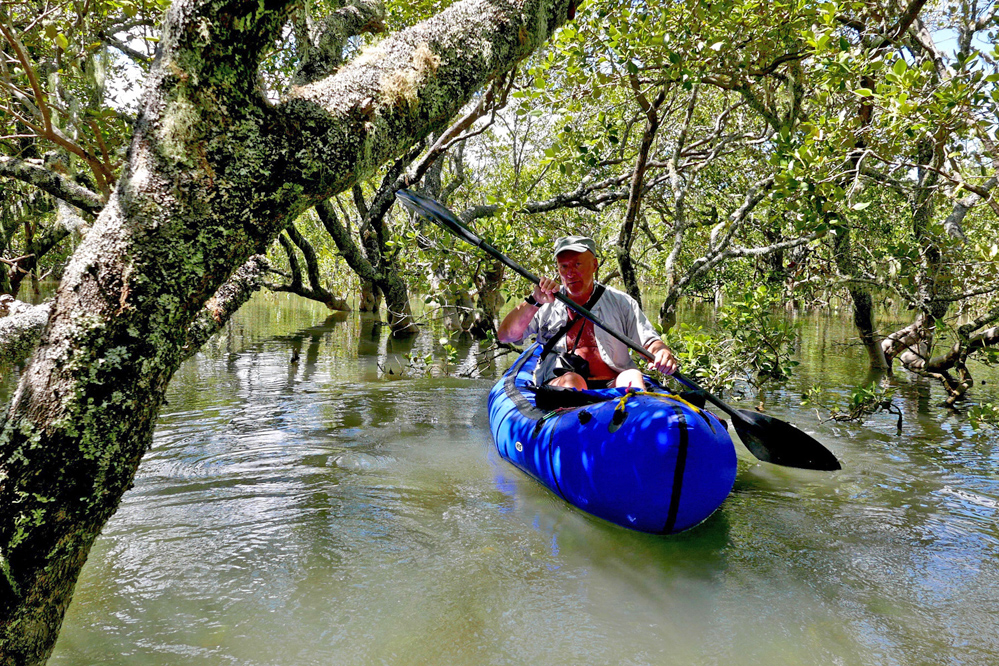
While I was busy dodging the winter under the shady mangroves of the Coromandel peninsula, Simon-with-a-workshop quietly worked on my Himalayan, like a gnome chipping away in a pink rock-salt mine. The long list included:
Bolt-ons
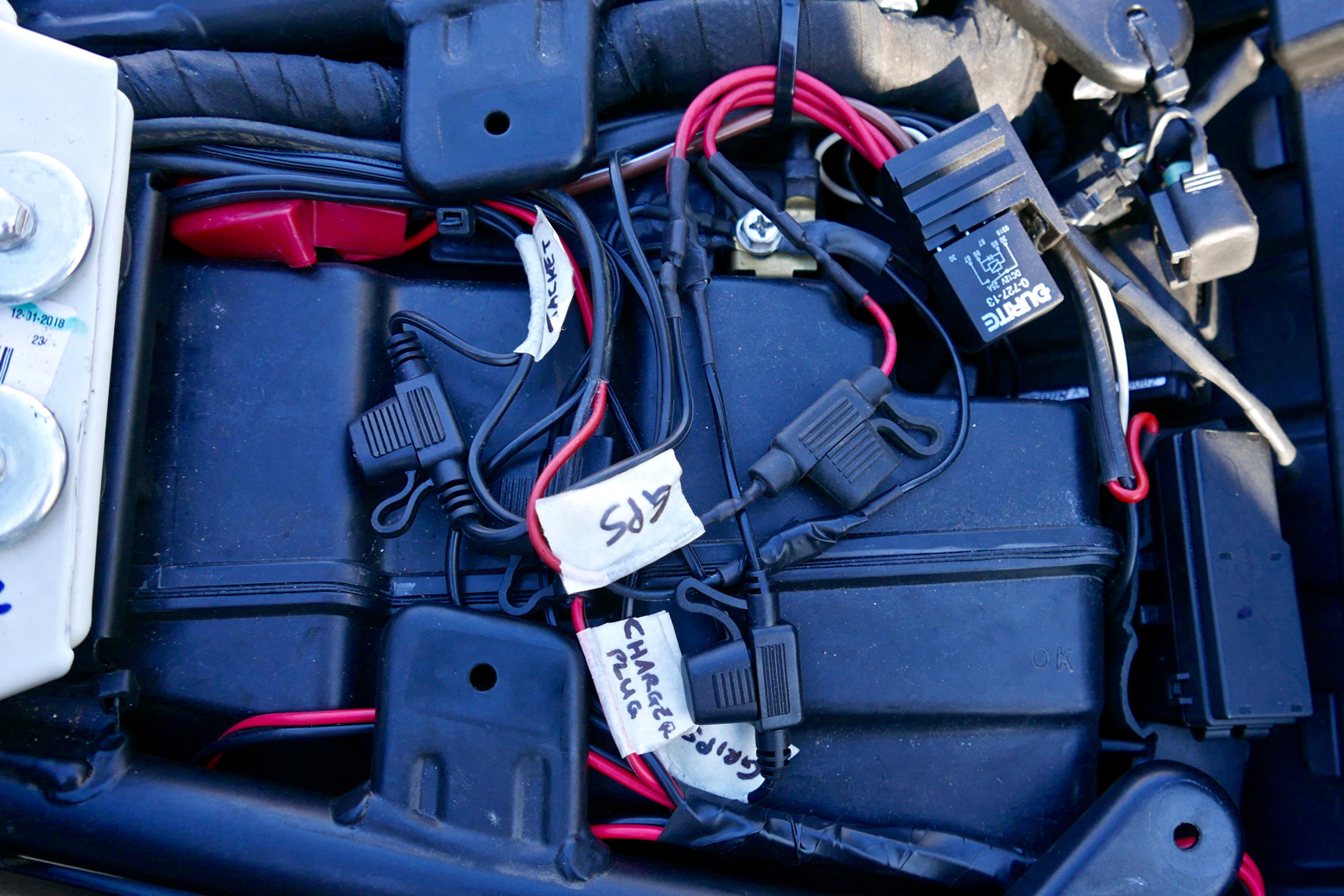
Move the Oxford heated grips control module to an accessible position and rewire it to the ignition, not the battery, as the original owner had done.
Fitting ancillary leads off the battery for my heated jacket and Cycle Pump/battery optimiser.
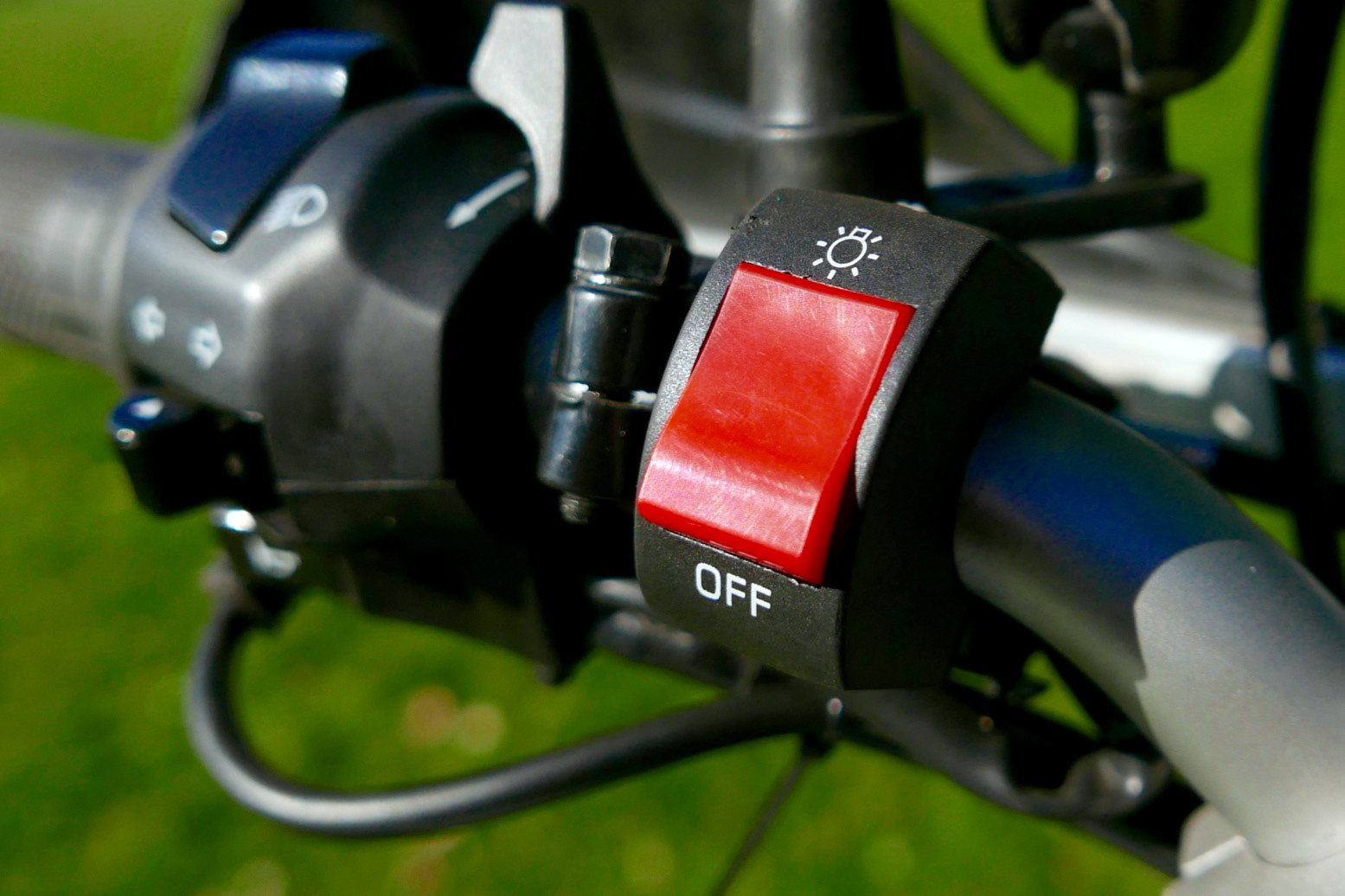
Fitting a switch to kill all lights. Handy for battery saving as well as leaving the highway unnoticed for stealthy wild camping.
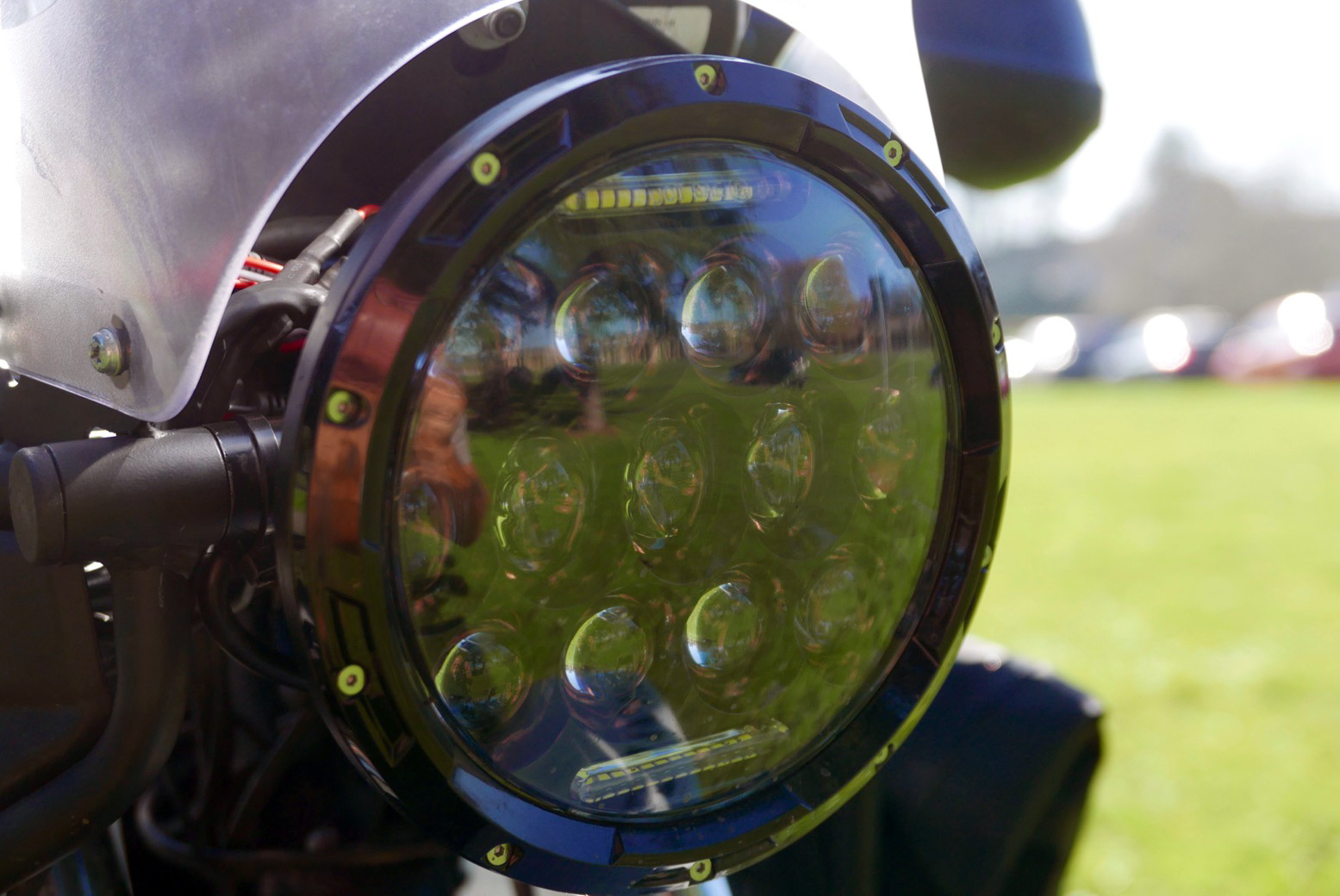
Refitting the cheap LED headlamp which came with the bike. It’s the same one I put on my XScrambleR. Never rode that bike in the full dark but although it saves watts (or is it amps?), I suspect the LED lamp looks better than it shines.
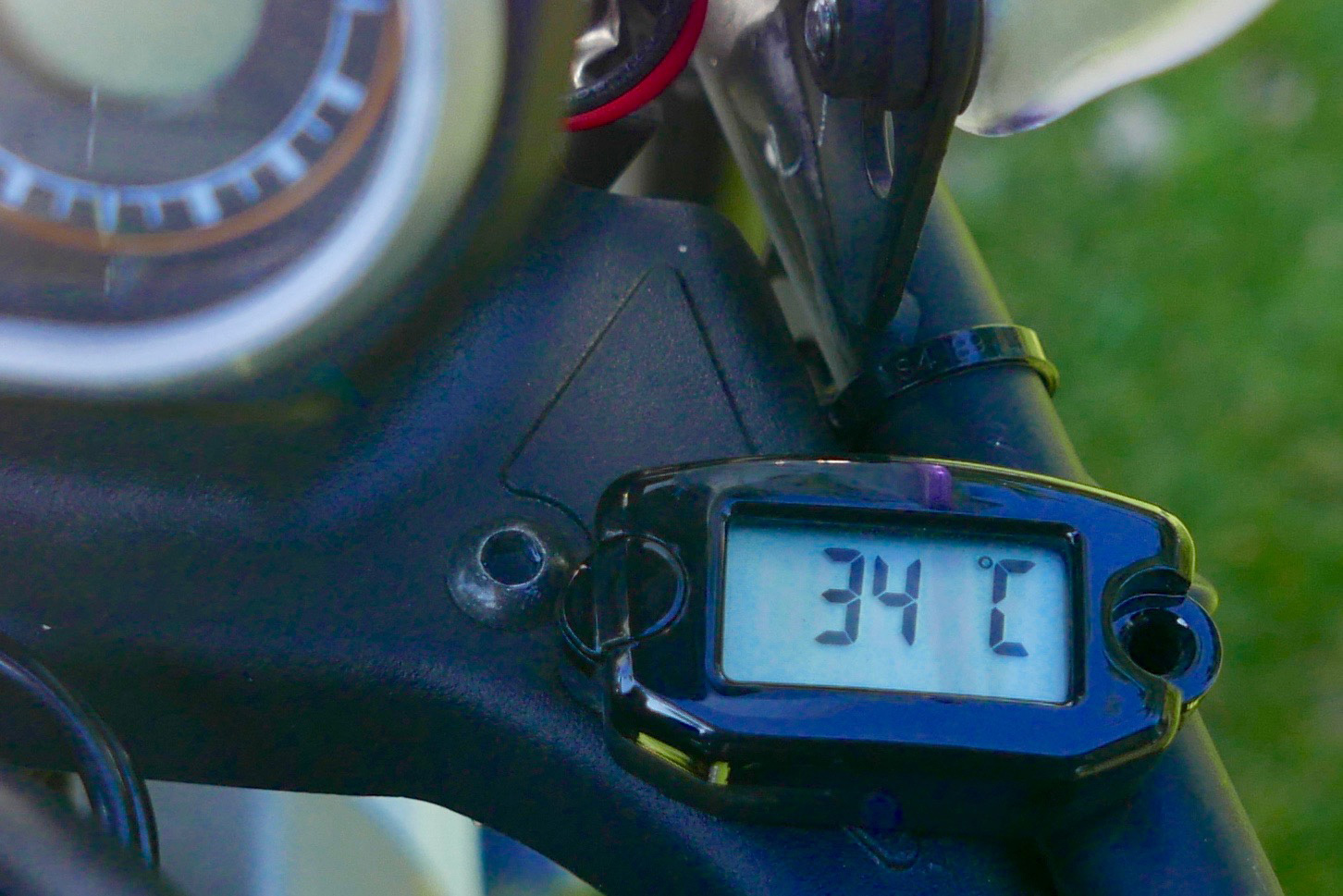
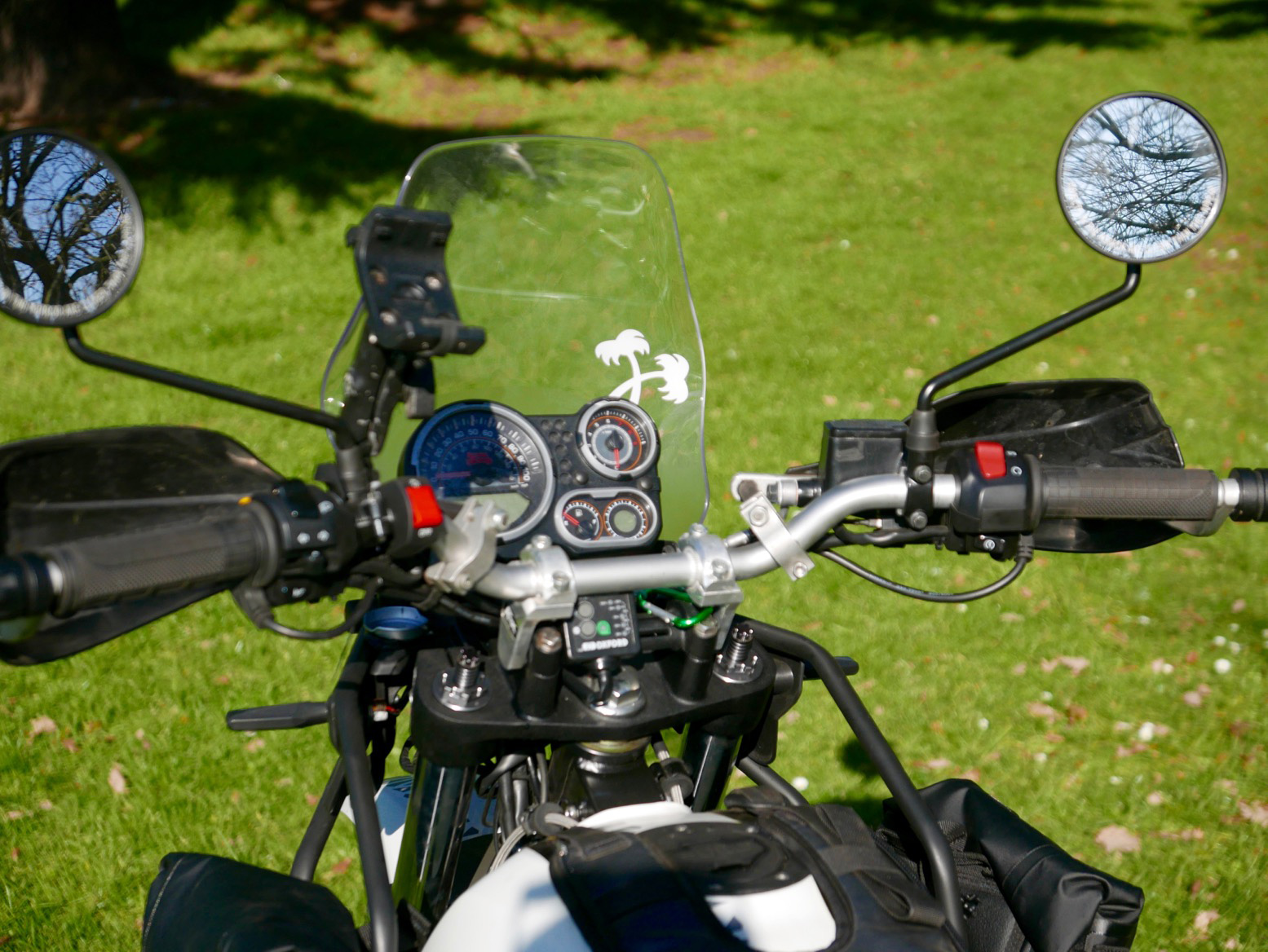
To monitor engine temperature a Trail Tech engine temperature sensor is more useful, accurate and quicker responding than relying on the stock ambient air temp sensor. At a cold start it will show ambient anyway, same as the stock in the dash, but once running, reading off the spark plug, the TTech soon shoots up. Even with the oil cooler and the ‘under piston oil sprays’ we read about, the low-tuned, air-cooled motor’s reading reaches a staggering 240°C at 65mph on the motorway, dropping to around 175°C in town. The spark plug is of course just about at the hottest point of an engine so basically it’s quite normal. ‘They all do that – sir‘. Under the seat the Himalayan’s ambient air temperature sensor got relocated anyway to a position less affected by the motor’s downwind heat flow so it gives a truer ambient reading once on the move. It’s a common mod.
Garmin Montana cradle fitted to left mirror stalk with RAM mounts and hardwired to the ignition. I thought they’d not fit for want of cable slack, but I was wrong and the adjustable Rox Risers have raised the stock bars a healthy 50mm. It required releasing a clip off the braided ABS brake line under the tank somewhere, and the barely needed cold start cable was also on the limit. With the raised seat it’s now easy to stand up and to not stoop once I’m up there. Halleluia.
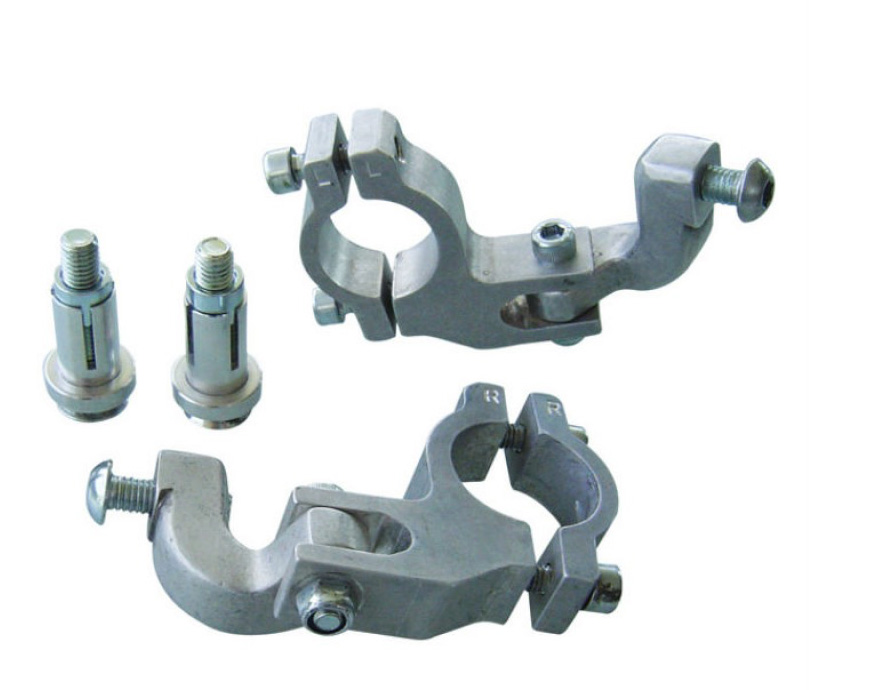
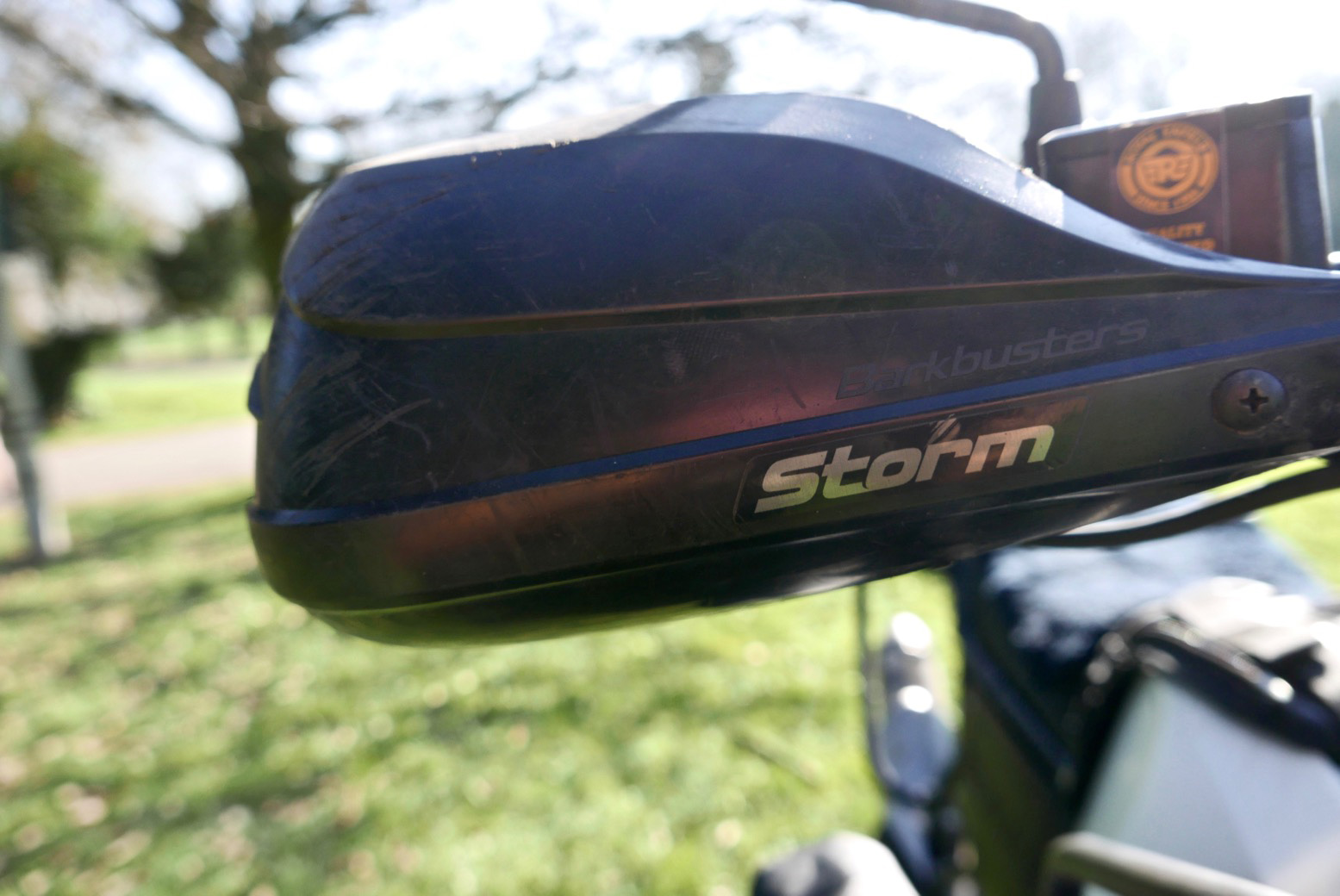
My ancient Barkbuster Storms are now on their 7th outing since fitting to my XT660Z back in 2008. I should win some sort of recycling award. Simon had to make some simple mounts as for some reason, the curvy BTC 06 adaptors (right) which were recommended didn’t fit. Could be that a decade on, newer Barks have changed shape. The Barks require the slightly adjustable stock screen to be set fully forward, but riding back I can’t say the turbulence was any better or worse than in the original position. I think that at the speeds the REH can achieve, it’s all a bit academic. And as it is I’m sat on a motorbike out in the open air. There will be turbulence.
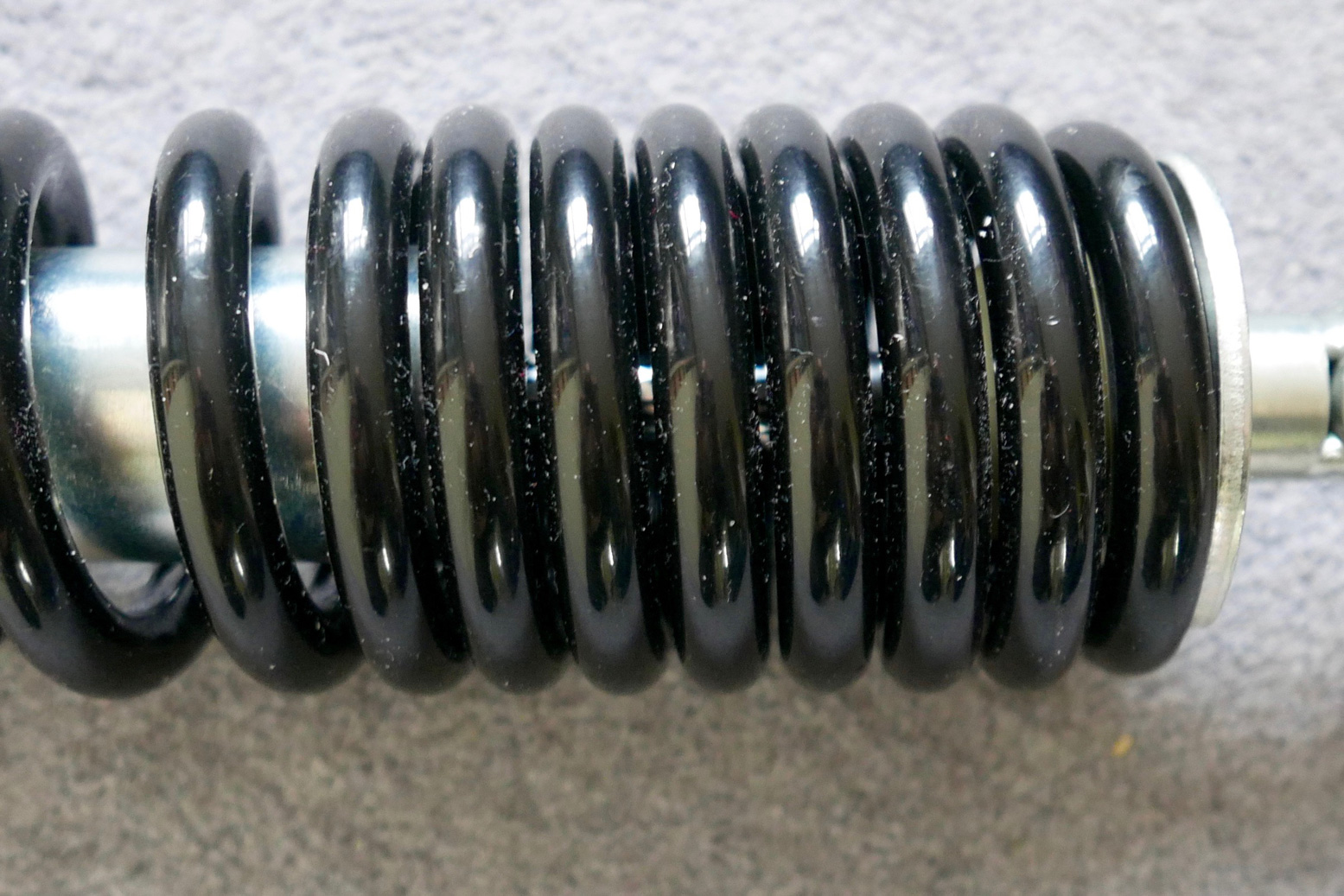
Like so many bikes I’ve owned lately, I assumed the stock shock would be a budget keep-the-fender-off-the-wheel job, so I pre-emptively ordered the Thai-made YSS which took a few weeks. Some reports claim the stocker is too harsh, others say too soft, others just right. On the road it didn’t feel too bad – perhaps the usual mix of over-sprung and under-damped. It weighs over 4.8kg and half appears to be coil-bound, but in fact there’s a couple of mm gap in the coils (left) which adds some progressiveness.
It would have been good to evaluate it properly, but the shiny red YSS is sat there like a cream cake on cushion. Getting it fitted, I asked my LBS to check the linkage grease. Who knows if they did. I may also rivet on a flap to stop it getting plastered with crud spun off the back wheel.
The YSS is about a third lighter at 3.3kg, costs £290, is length adjustable by 10mm, has 35-click rebound damping and will work with an HPA which probably costs half as much as the shock. Out of the box rebound came at 20/35 clicks and with 12 threads exposed below the spring preload collar. Looks like a good place to start. On the short ride back from the LBS I did detect a little more compliance with small irregularities. Otherwise it felt the same. With most suspension upgrades, I’ve found you can’t tell much difference until road surfaces deteriorate or the speeds increase.
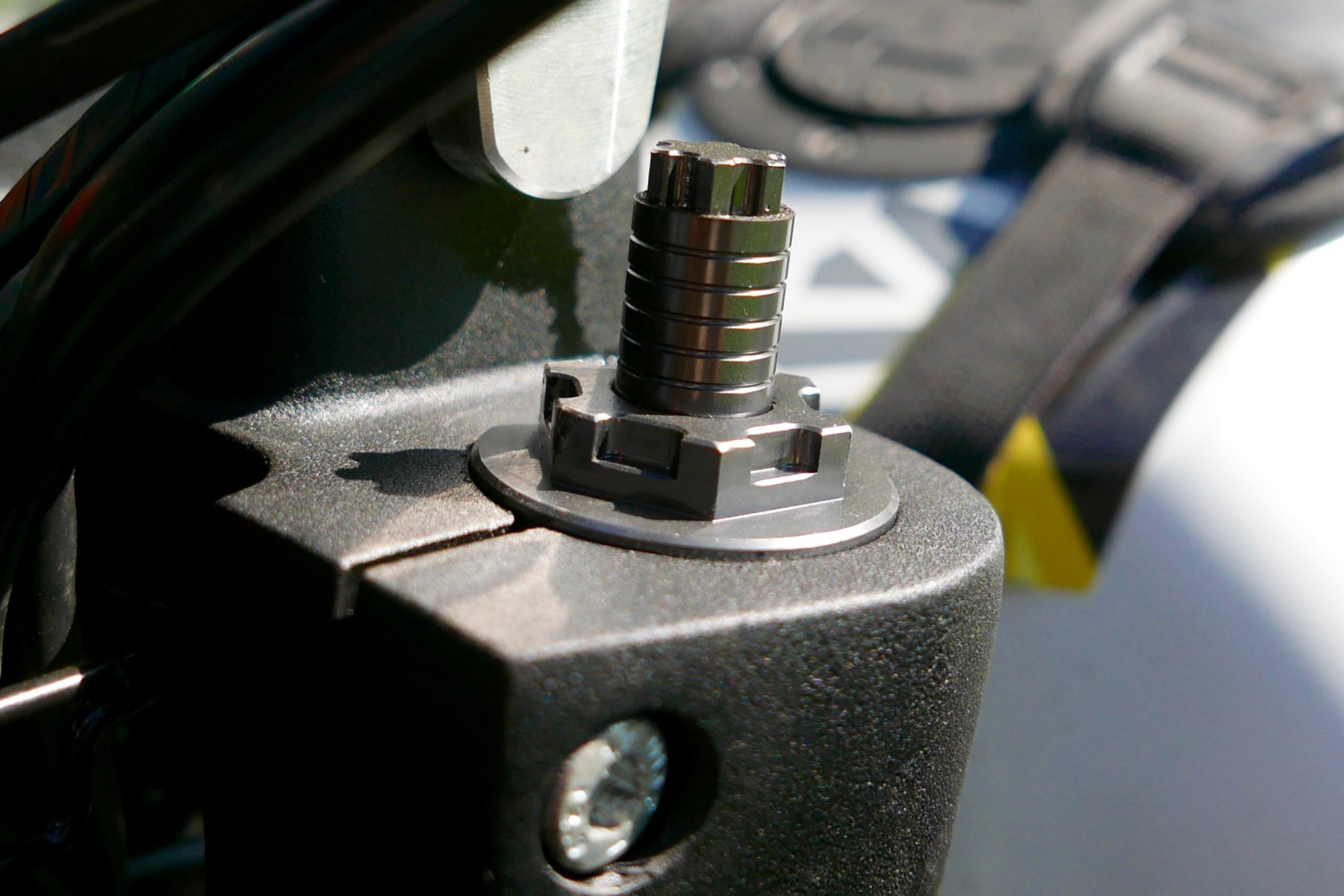
YSS fitting advice: The preload collar at the top of the YSS is now quite hard to access – removing the airbox lid on the LHS may help, as will a shorter, right-sized hex key, as opposed to the rod supplied. There is a tiny hex screw on the collar which locks it to the threads (hex key supplied). Either risk leaving it loose (collar may unwind), or make sure when fitting the shock that it’s in a position where you can get to and loosen it from the LHS – about ‘7 or 8 o’clock’ if 12 = forward. You will then probably need to wind or unwind the collar a full 360° to get the screw back in a lockable position.
A tenner’s worth of Chinese fork preloaders were also fitted on the front but are currently set at zero. The stock spacer inside the top of the fork needed to be shortened.
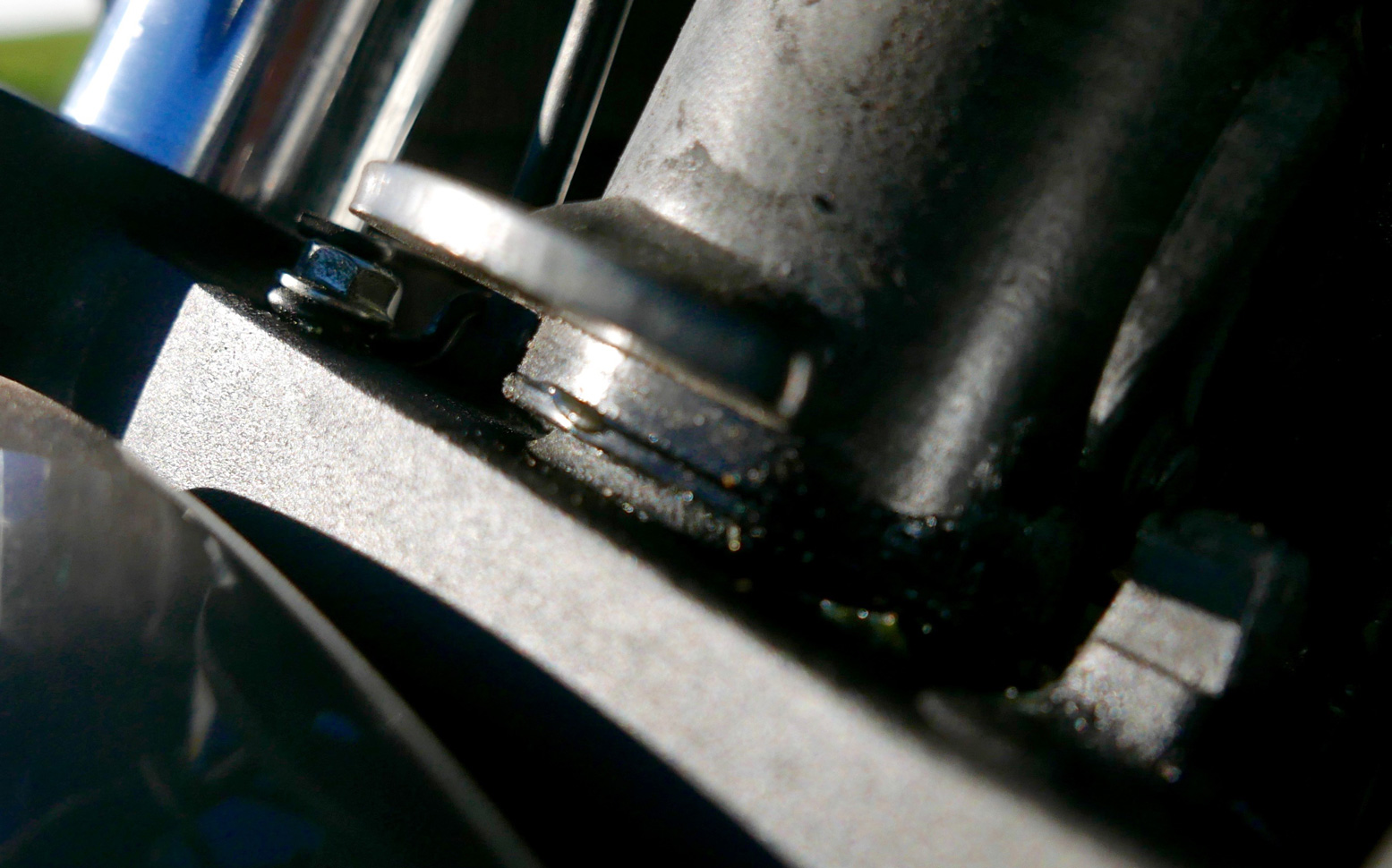
The steering head bearings got regreased. Along with swing-arm linkages, it’s a common precautionary requirement, and not just on inexpensive Indian bikes. My BMW XCountry’s head races were shot at just 6k.
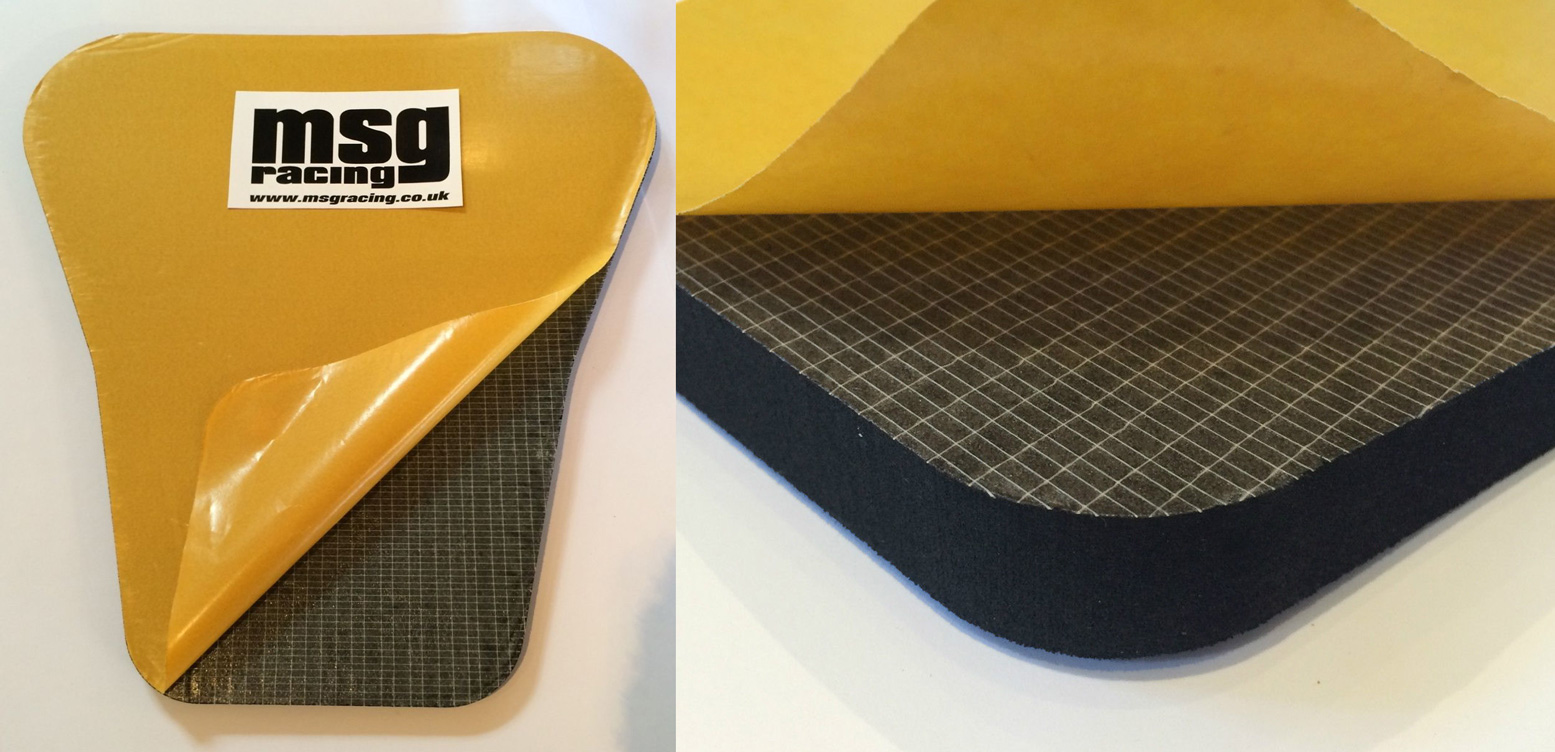
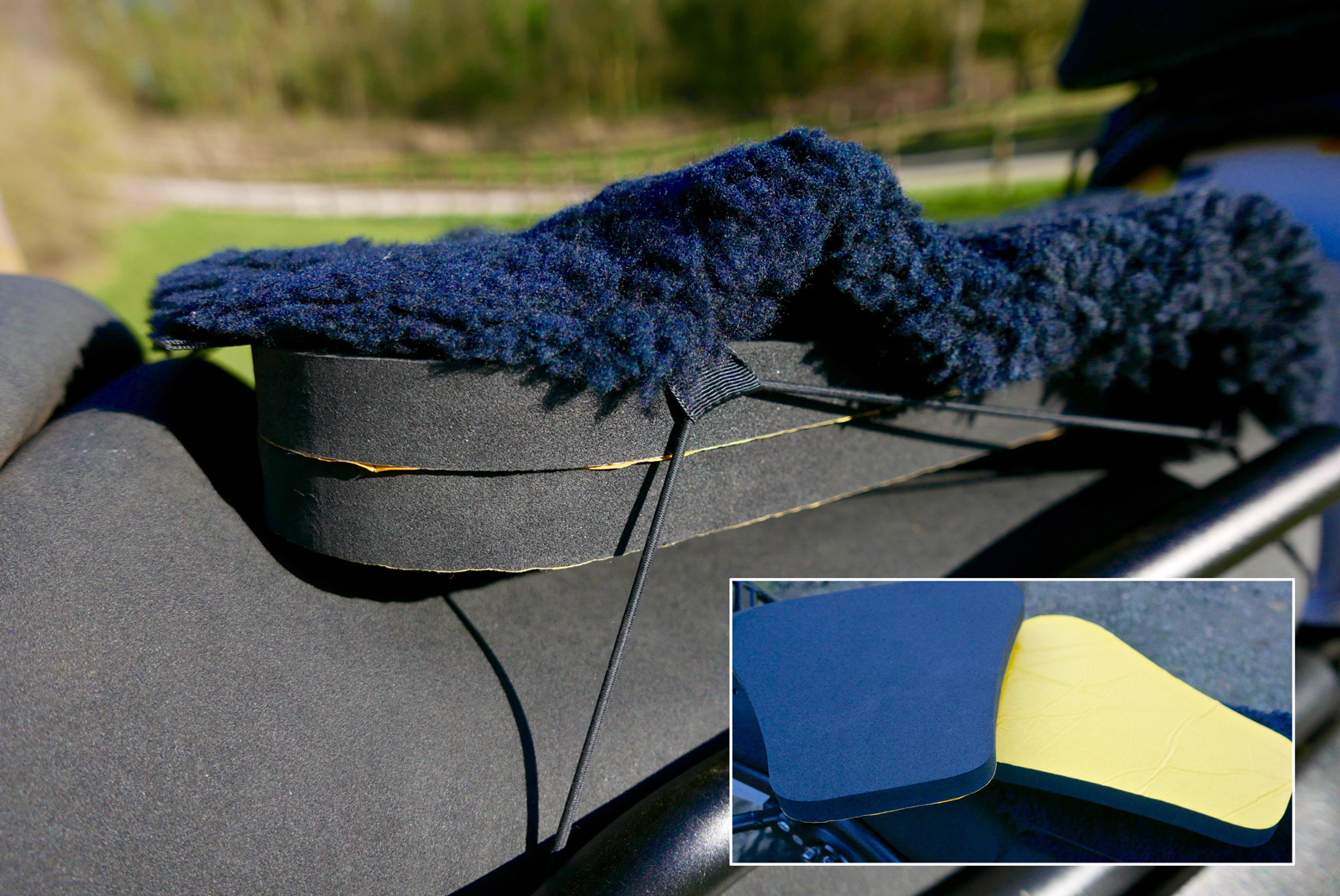
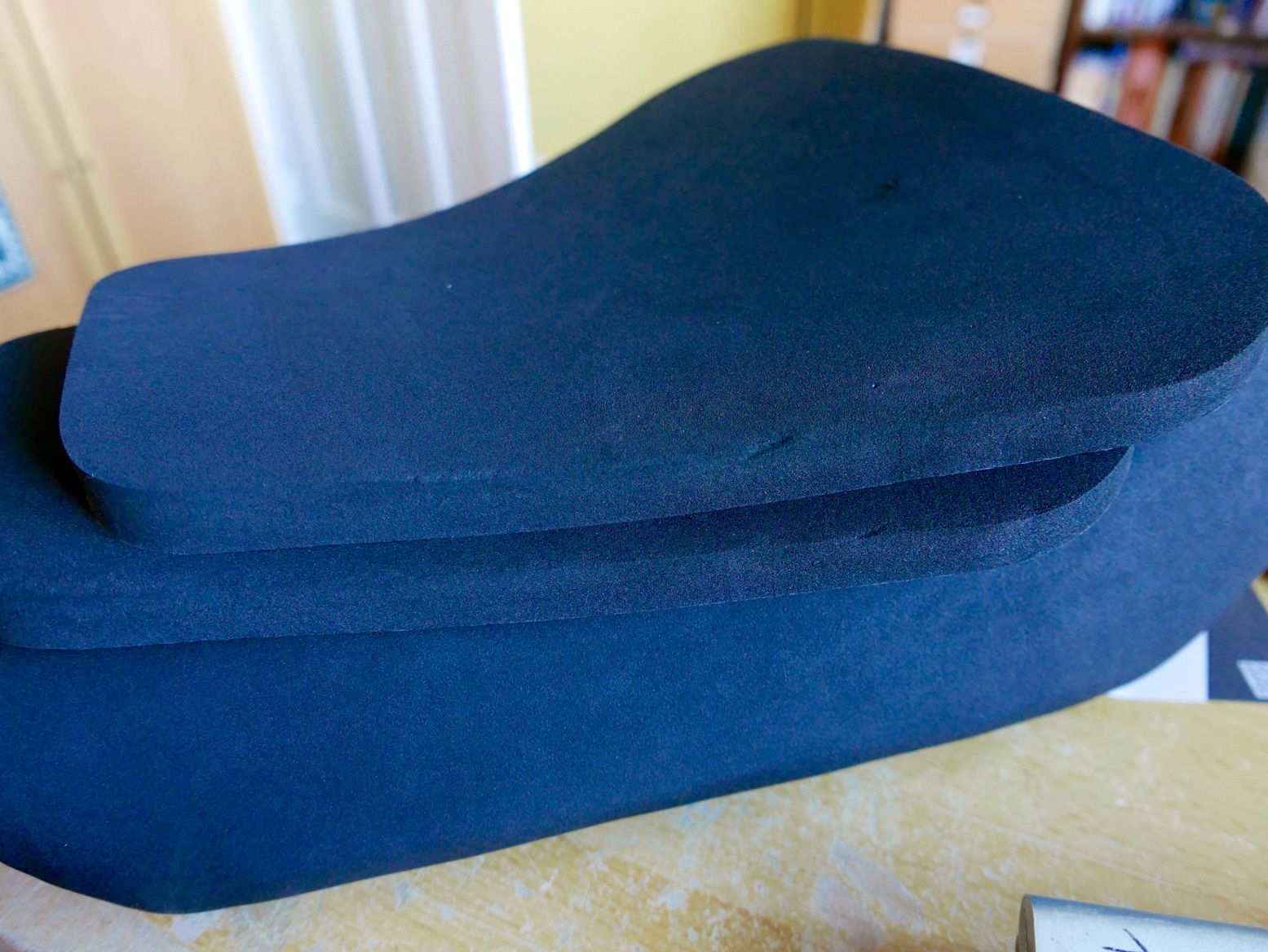
My initial seat foam bodge proved to be poor, mostly because the foam I used had the springiness of Philadelphia cheese. A fellow Himaliste recommended some pre-cut stick-on foam seat pads on ebay (left; £15 each). At 20mm I bought two and rode home with them shoved under the Aero lambswool pad.
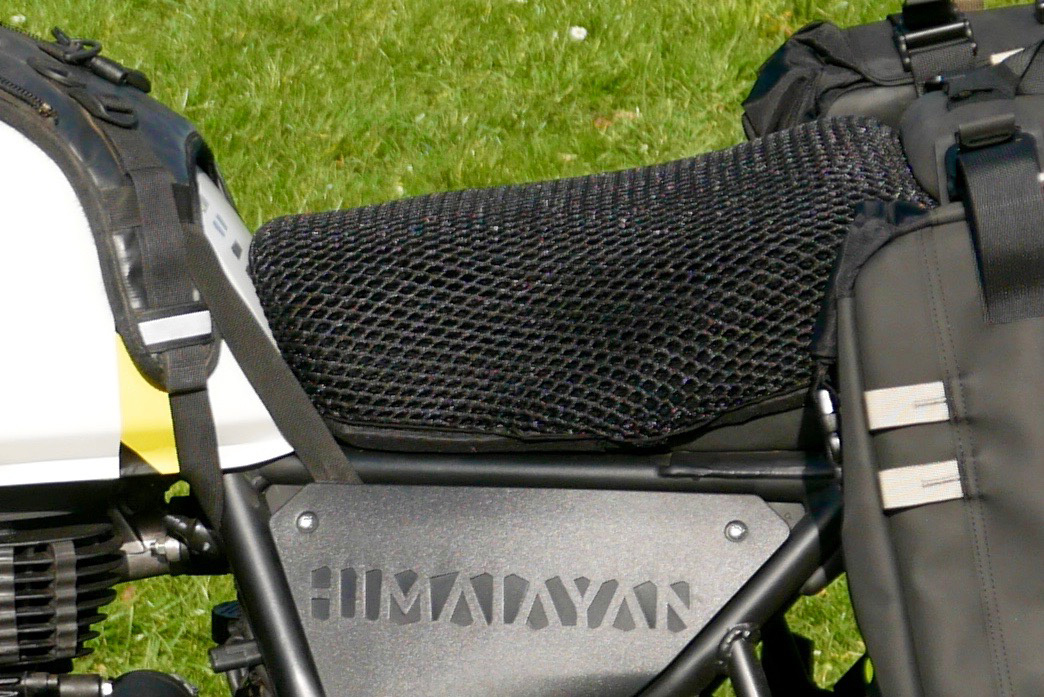
With the yellow backing still on, it all slithered around a bit and after only 120 miles the butt was sore, but I can definitely see the potential in raising the seat height. And I do wonder if the old lambswool pad makes things worse. Cool Covers sent me one of their durable aerated mesh seat covers to try. Like wool, the idea is that air circulation reduces heat and improves comfort, but with bike saddles, one man’s fur-lined throne is another man’s agony. Luckily, the Cool Cover just stretched over the two racing pads now glued to each other and the stock seat. The back edge of the top pad was crudely trimmed to level it off. In the picture below the seat looks like it’s sloping forward – not good – but it’s actually the taut cover over an air gap. The foam below is more level than it looks.
Let’s hope it makes a difference but bike saddles are usually more miss than hit. Seat foam apart, the combination of seating position, bars, footrests and the presence of a screen all have an influence, but it’s also down to tank range – in other words how long you sit riding uninterrupted. My CRF250L should have been the usual agony, but because I could only do 120 miles before reaching for the fuel can, the 5 minutes it took to do that rejuvenated the cheeks. One of the worst saddles ever was the BMW F650GS, probably because it easily did 200 miles between fill ups. One of the best was my GS500R Overlander. I never worked out why.
Wheels and Tubeless Tyres
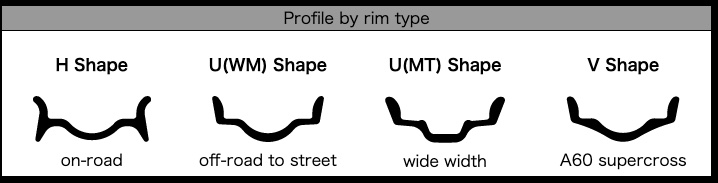
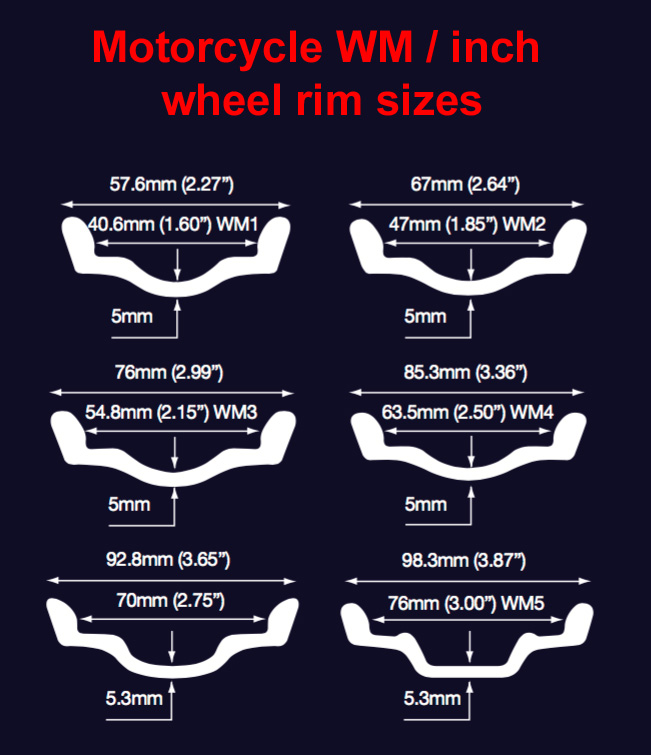
Note: being a maddeningly illogical Imperial British standard, the ‘WM’ wheel rim width designation you commonly see (in the UK at least) doesn’t correlate with actual rim width in inches. But it is close – see table right. They say ‘MT’ is a modern, fully logical (but little seen) equivalent, where the MTxx number refers to the actual rim width in actual inches.
As confusingly, rim width in inches does not correlate with notional tyre width where, for example, a 120 section width (120mm; 4.7”) is converted to inches. But it is close-ish.
Stock REH rims are WM1 (MT1.85) on the front and WM3 (MT2.15 – need to check) on the back with a 120/90 17 tyre.
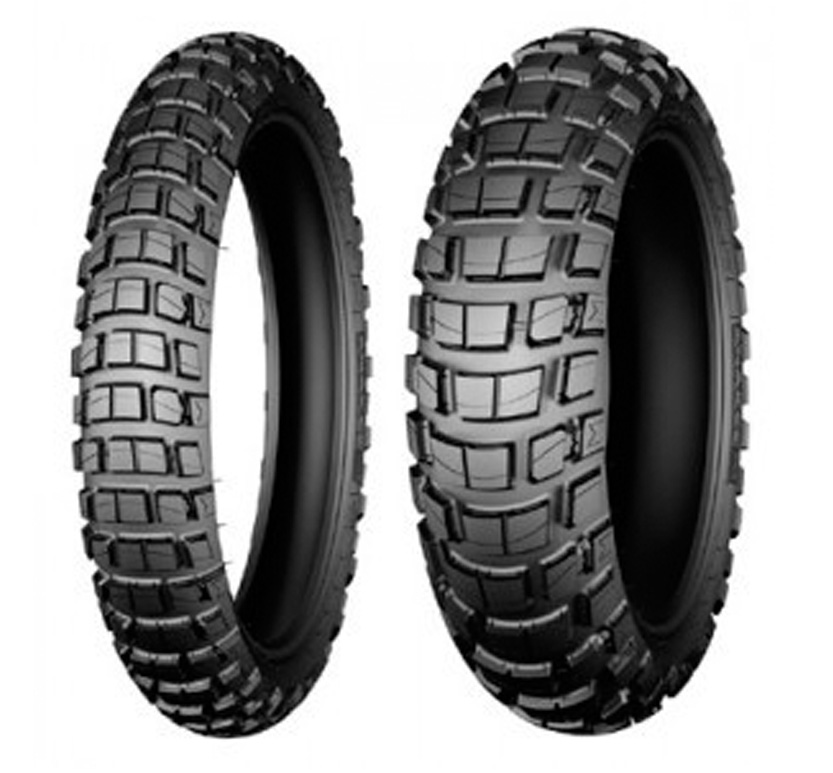
To enable easy puncture repairs I wanted reliable tubeless wheels which meant sealing the spoked rims. Along the way I was happy to ditch the steel rims in the hope of saving unsprung weight which I keep going on about. A mate had given me some ageing 18 and 21 Tubliss. The back was a bit too old to risk; a BNIB front got fitted and Slimed with the new Michelin (left). On the back, for the sake of simplicity I wanted an Excel 18-er with a new Tubliss (Tubliss don’t do 17 size). Then I was told max width for an 18-er Tubliss is 2.15” rim, like the stock, I think. The Anakee Wilds were recommended for a 2.5-inch rim. We’re talking a notional discrepancy of a third-of-an-inch here, but let’s try to do it by the book for once. Shame as an 18-er would have saved a couple of kilos in tyre and rim and greatly opened out the range of off-road tyres. But another problem is tubeless tyres (which do differ significantly from tube type) are rare in 18-inch size. Seventeen TL tyres are much more common.
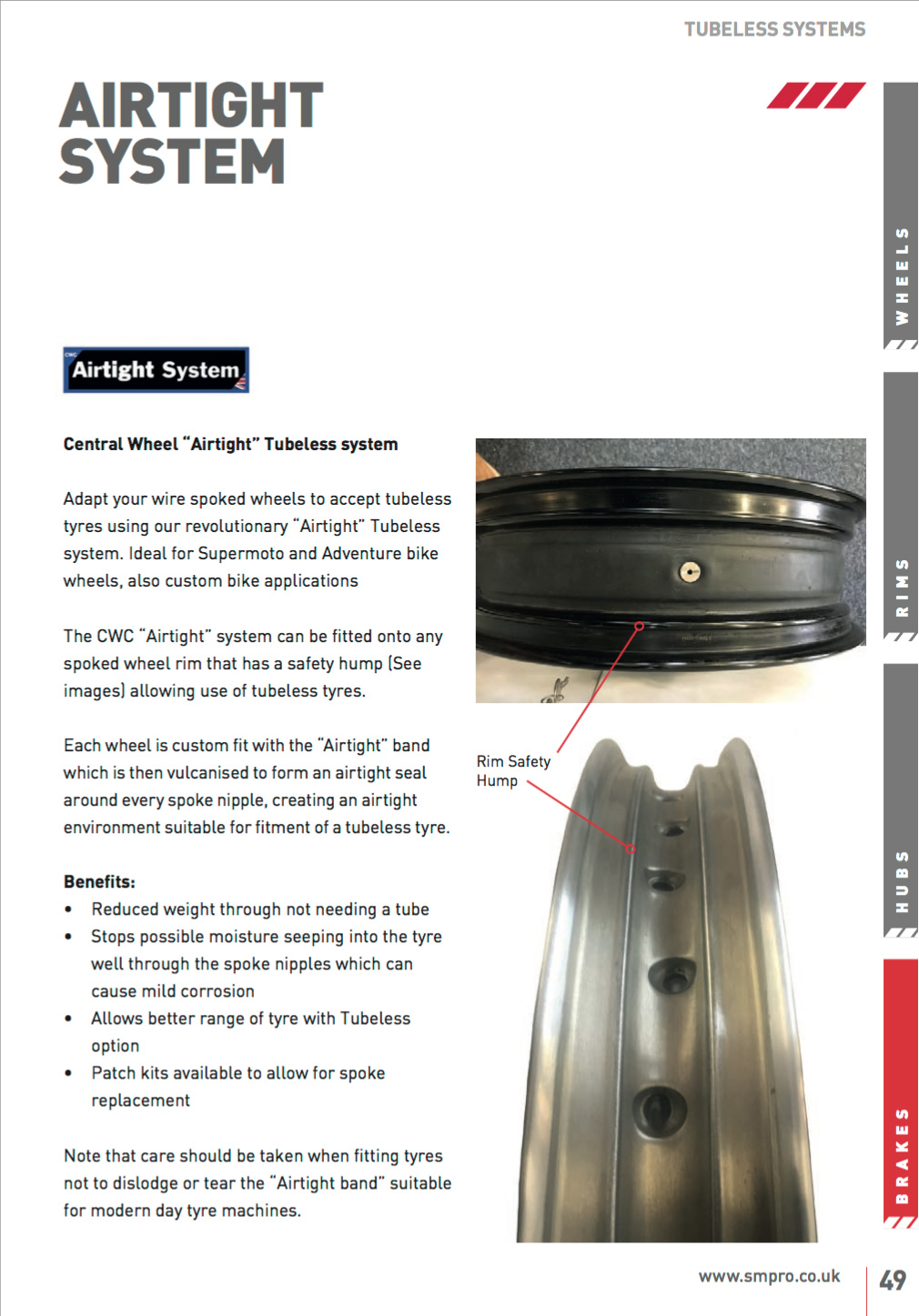
It wasn’t on their website but CWC’s brochure mentions an Airtight™ vulcanised spoke-sealing band (left). It’s similar to the Italian BARTubeless polymer sealing I had on the Rally Raid CB500X of a couple of years back (and which CWC also offer). I’m always keen to try something new for my Ongoing Tubeless Saga, but not so fast, chum! CWC can only Airtight a 3-inch (WM5) or wider rim. Next problem: there were no 18-inch Excel rims in that width, so it was back to a 17-inch rim in WM5 to fit an Anakee Wild. Confused? So was I but we got there in the end.
Tyres were always planned to be Michelin Anakee Wilds, one of the few do-it-all travel bike tyres I’ve not yet tried. On hearing about my plans Michelin kindly supplied them for free, along with a couple of back-up tubes which I hope I won’t need. Rear is a 130/80-17 M/C 65R TL. The front gets the larger 90/90-21 M/C 54R TL to balance the lift on the back. And it all comes with lashings of Slime. Simon did some weighing before Sliming (add about 250g per wheel):
Stock front wheel with Pirelli MT60 90/90 + tube 13kg Front wheel with 90/90 Anakee Wild + Tubliss 14kg (Stock steel front rim 3.77kg – source)
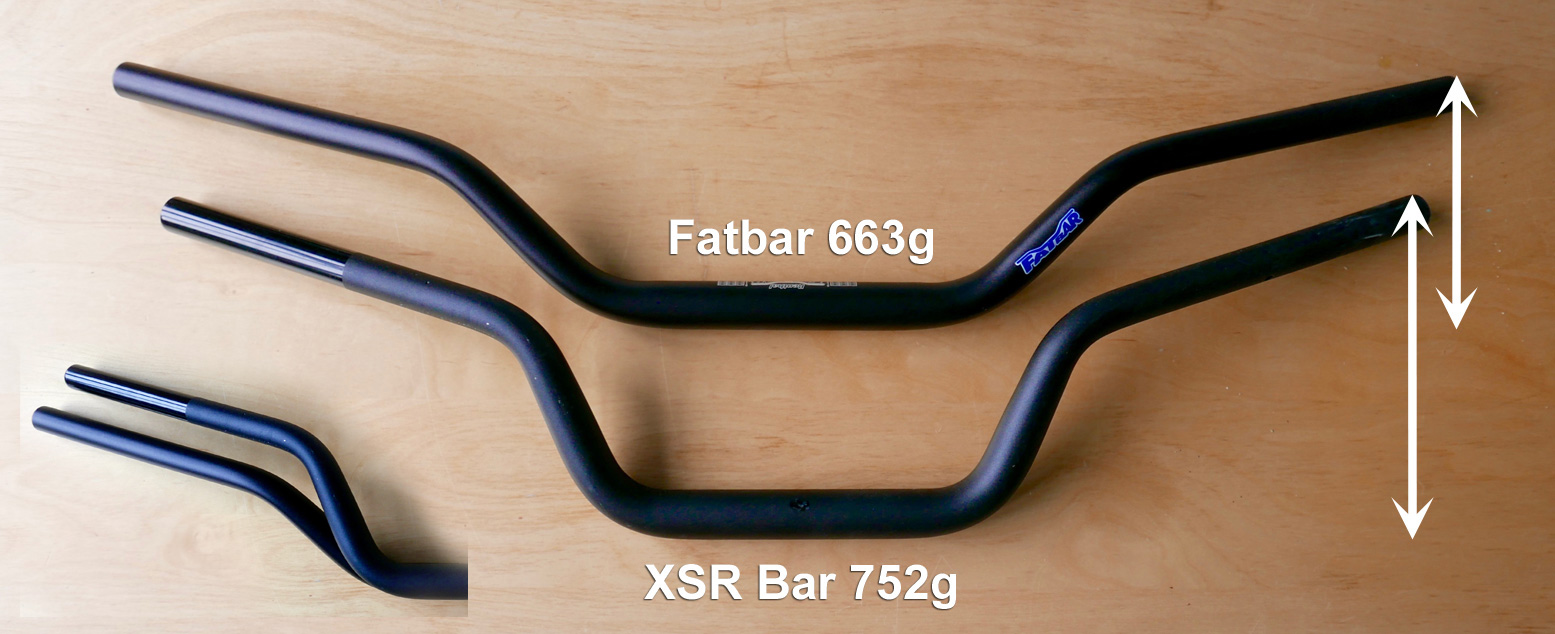
So, a kilo gained on the front due to Tubliss and heavier Wild tyre; a kilo lost on the back despite the wider Excel being barely lighter than the steel stocker. I wonder if there’s an error somewhere, considering the new Michelin is 1.5kg heavier than the stock MT60 and tube. The whole ‘alloy is light’ thing can be a bit of a myth until you get to the exotic stuff. Look at MTB frames or an old, two-ton Range Rover or handlebars (below). But, although it’s been decades since I’ve had wheel problems, I’m pretty sure the CWC-built Excel will be stronger than the steel stocker.
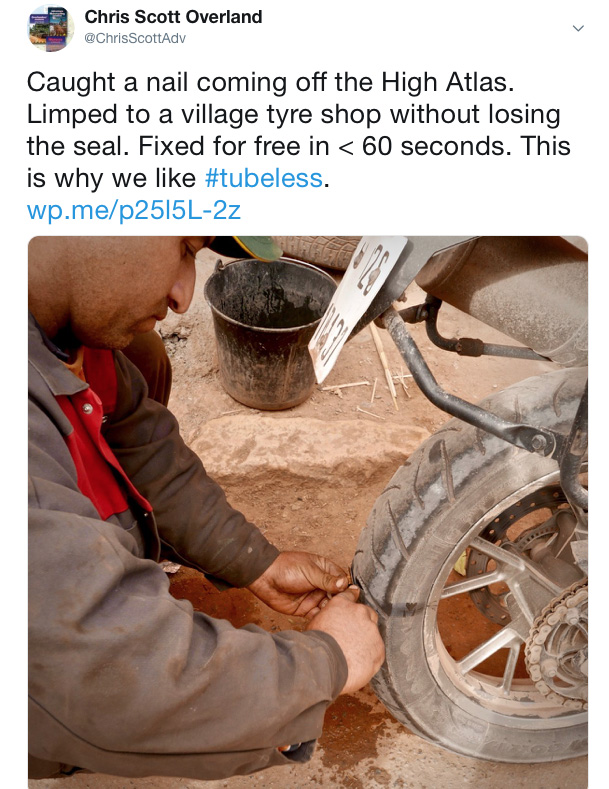
At 7.5kg, the TL Anakee on the back is hefty. I rationalise that the added mass is down to the tougher tubeless carcass. If it’s anything like the punctured Anakee or Tourance I rode on last November, it’ll be stiff enough to cautiously ride airless while staying on the rim until I reach a village tyre menders. Here are some more dims regarding 18 or 17-inch Anakee Wild tyres:
Anakee Wild 120/80-18 M/C 62S TT Max sectional width 131mm, max diameter 663mm, weight 5kg, Recommended rim width 2.75”
Anakee Wild 130/80-17 M/C 65R TL Max sectional width 142mm, max diameter 654mm, weight 7.5kg (verified by SV), Recommended rim width 3.0”
Both will easily fit the width of the Himalayan’s swing arm, but at the front of the swing arm, clearance gets down to less than an inch with the taller 18. A bit of chain wear and you’re good to go. On the front the mudguard now looks fairly close to the new Wild, so for mud clearance I’ll lift it a bit as mentioned below. Riding back 120 miles, the fresh Anakees rode a lot more securely than some also-new K60s I’ve ridden with other bikes. No weirdness in bends and no vibration or noise (a common complaint) that I could tell.
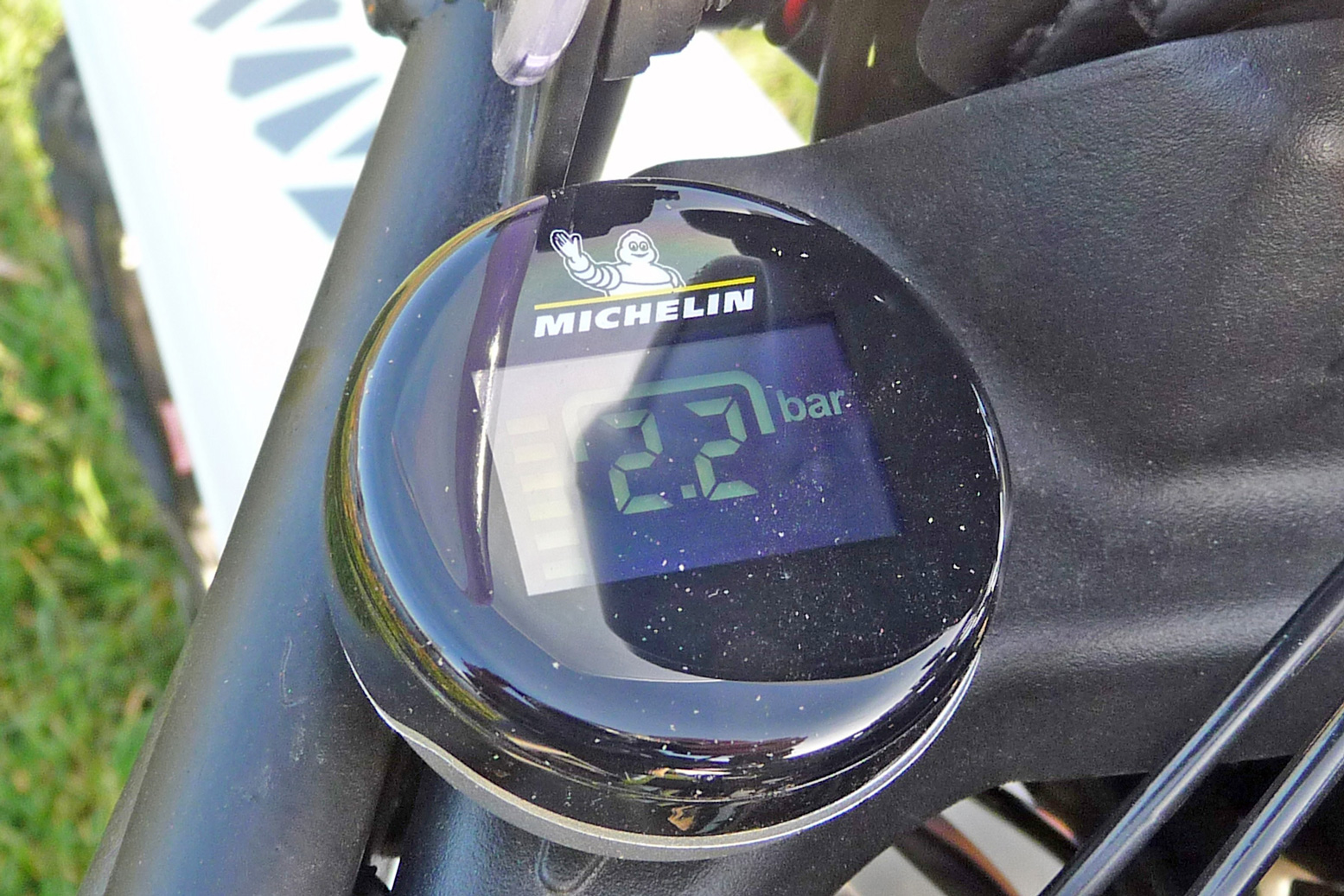
Michelin have just brought out a new TPMS and sent me one to try out. It will be particularly welcome for keeping tabs on my untried tubeless set up. The unit is USB rechargeable and sits magnetically in a stuck-on dish. So it’s easy to remove or nick, and might fall out on rough ground without an extra method of adhesion.
The read-out (psi or bar) flips every few seconds between front (as shown below) and rear. It’s interesting to note how pressure climbs by up to 20% as the tyre warms up.
Fabrications and load carrying
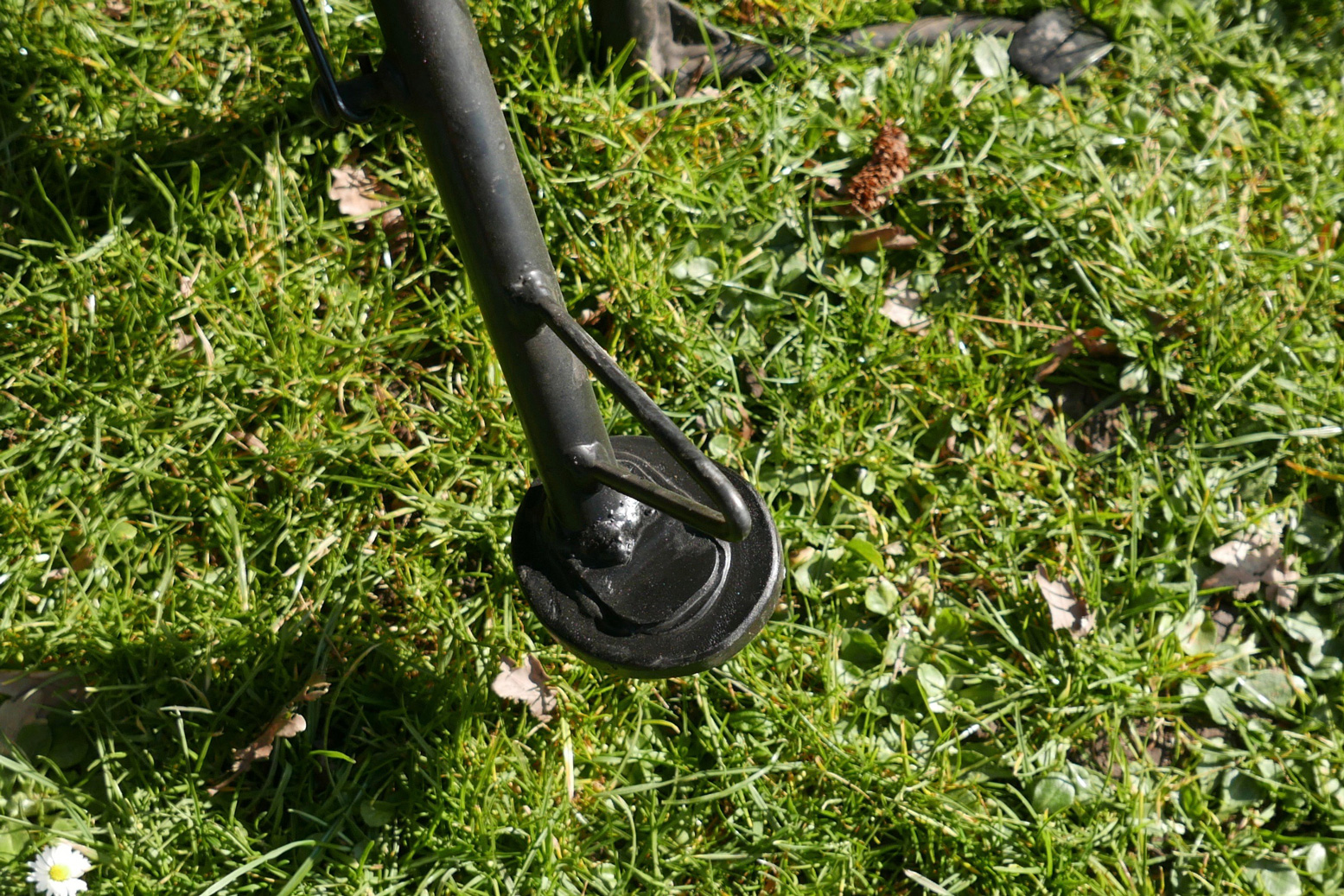
Apart from some custom Bark mounts, all the Him needed made was a sand foot plate welded on the end of the sidestand.
Cheap and hefty
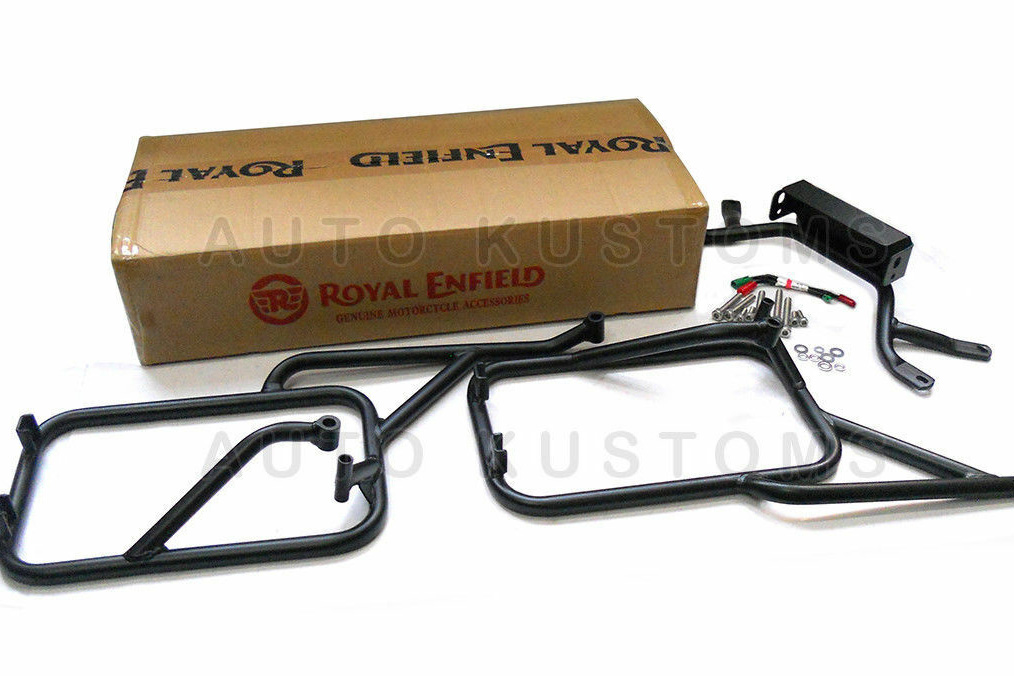
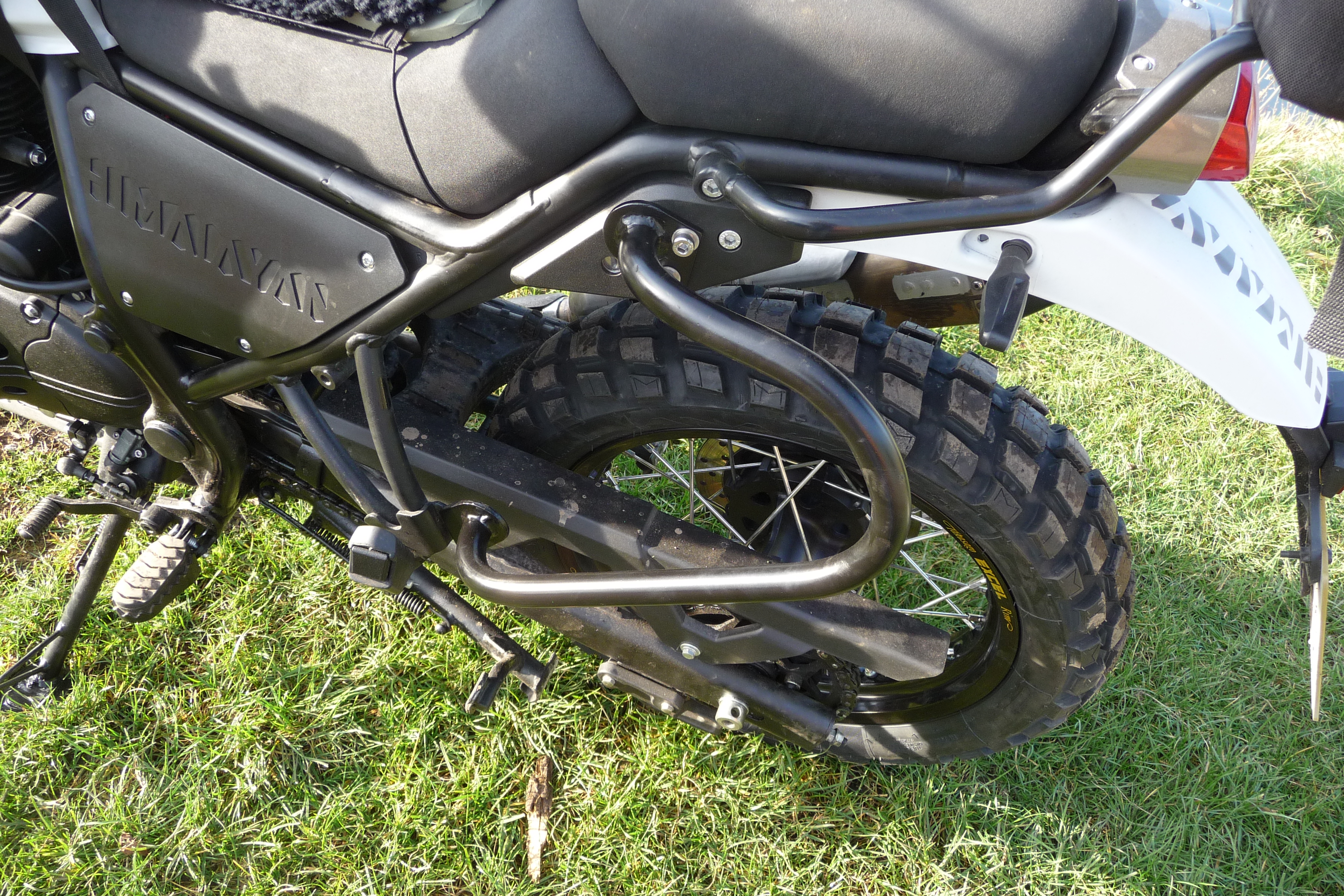
And Simon managed to hand bend and bolt on a pair of very nice unbraced Ear-racks (as I’ve decided to call them). I’d originally bought the RE pannier rack from India for only £77 (right), but while cheap, the thing weighed over 5kg. You don’t need all that metal unless you’re running alloy cabinets. Inset in the circle below, Simon pointed out a weak spot where the lower Ear-rack bolts to the pillion mount which is welded rather bolted to the subframe. But the unbraced rack has some give, plus the soft bags will also absorb impacts, so hopefully it will take quite a crash to break the mount. It actually wouldn’t be hard to brace from the upper curve of the Ear-rack to a point on the stock tail rack, just above the indicator.
Custom-made ‘Ear rack’
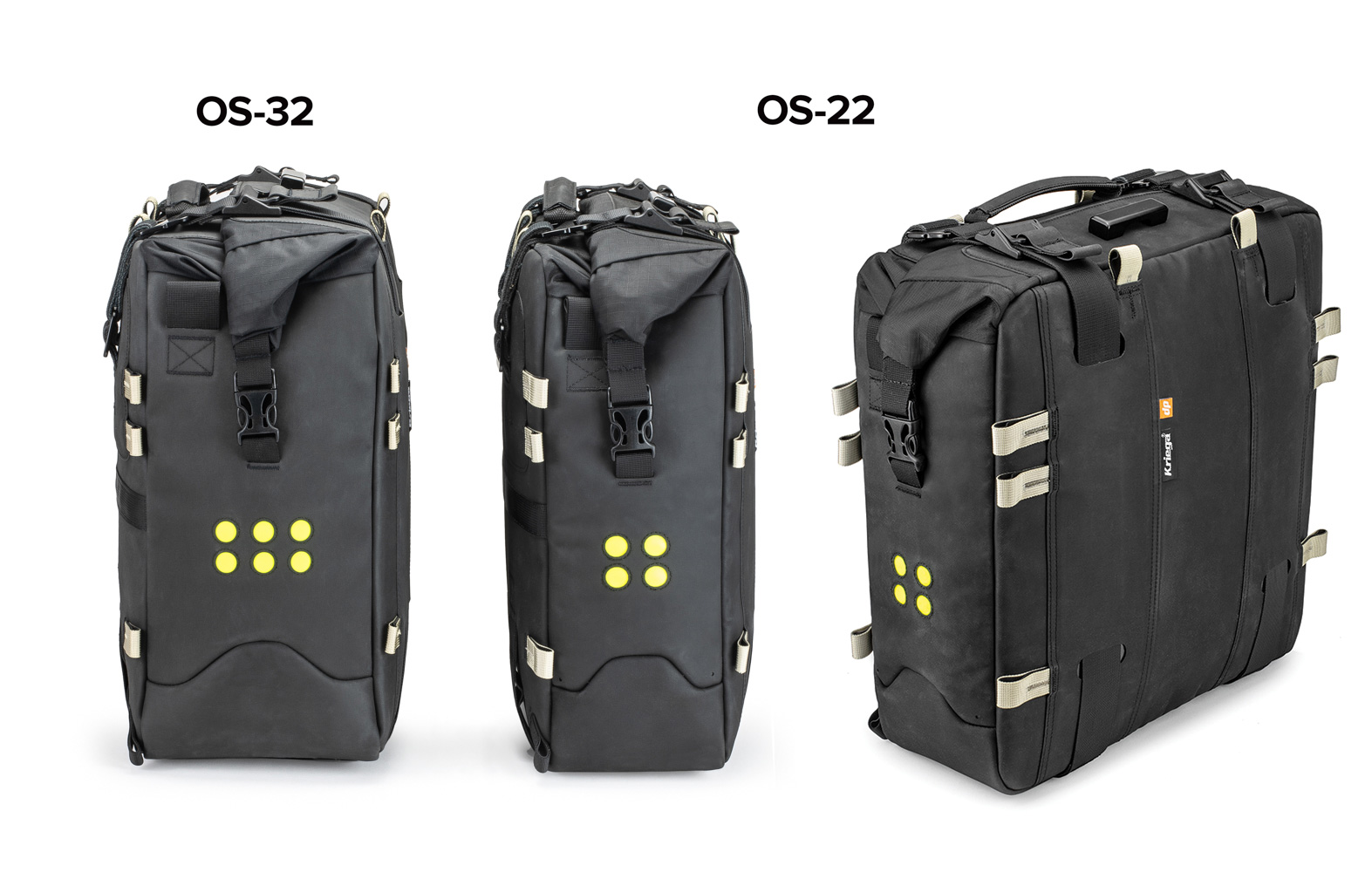
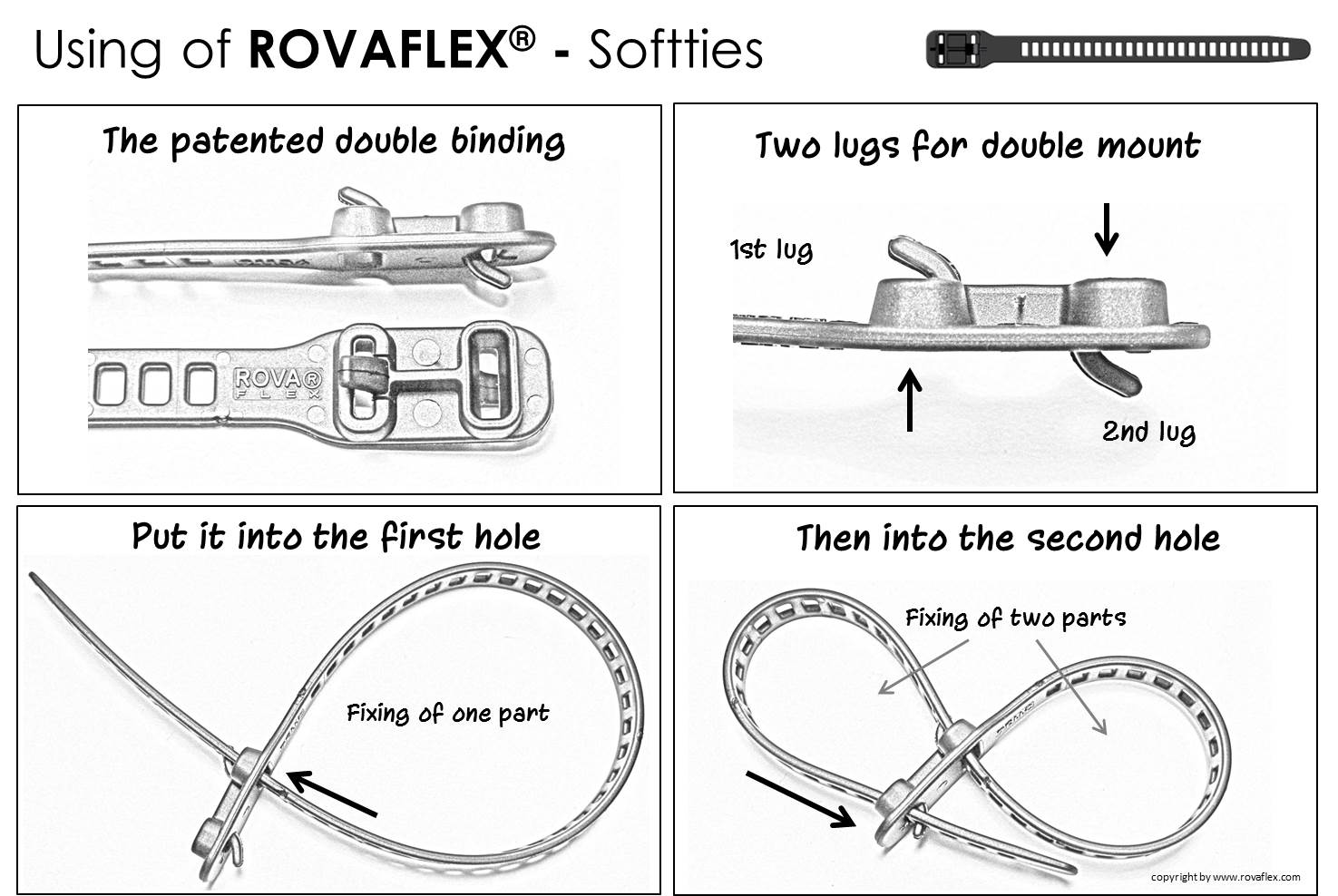
I forget that I’m an unsung Kriega Ambassador; they’ve just sent me a set of their new OS22 throwovers (below) to try out. I was a big fan of the OS32 on my WR250R a couple of years back. The OS22s feel very rugged and weight in at 2.5kg each. This time, to save weight I’ll fit them as throwovers without the platform, and use the tabs on the back to secure it to the Ear-rack with brilliant q/d RovaFlex cable ties (right).
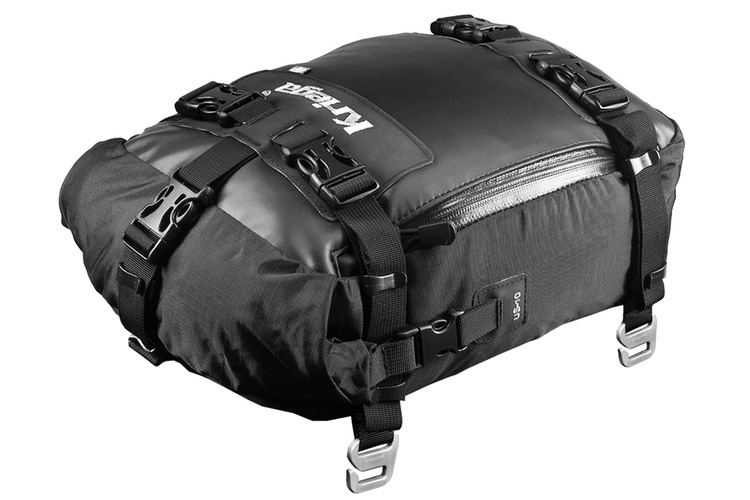
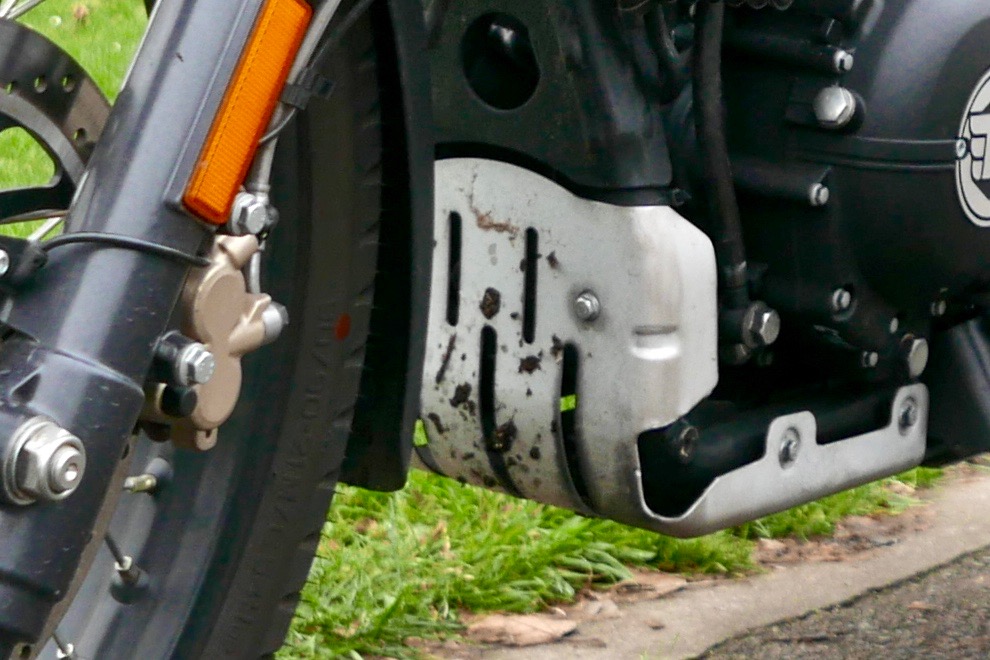
They’re the same size but 40mm slimmer than the 32s which looks quite a lot, but the slack will be taken up on the front by the 6-litre Lomo Crash Bags (left). Hopefully I can get away without my 30-L Ortlieb Travel Zip which can make getting on an off a chore. I have a 10L Kriega Drypack (right) knocking about if I need more capacity.No six-megaton bashplate you say? On the tracks I ride these days they’re more useful at keeping flying gravel from damaging the engine paint. When it gets that gnarly, I’m down to walking pace, ready to deploy outriggers. The new tyres and firmer shock have raised the clearance a bit so the tinny, stock bashplate (below) will do fine for the moment.
Lifting the front mudguard is a good idea now that the fatter 90/90 Anakee Wild is closer to the plastic. One time on the Tenere in Morocco I rode onto recently rained on clay which jammed the front wheel solid. A right faff to clear with Moroccan farm workers milling around saying ‘Oi, you’re front wheel’s jammed, mate!’.
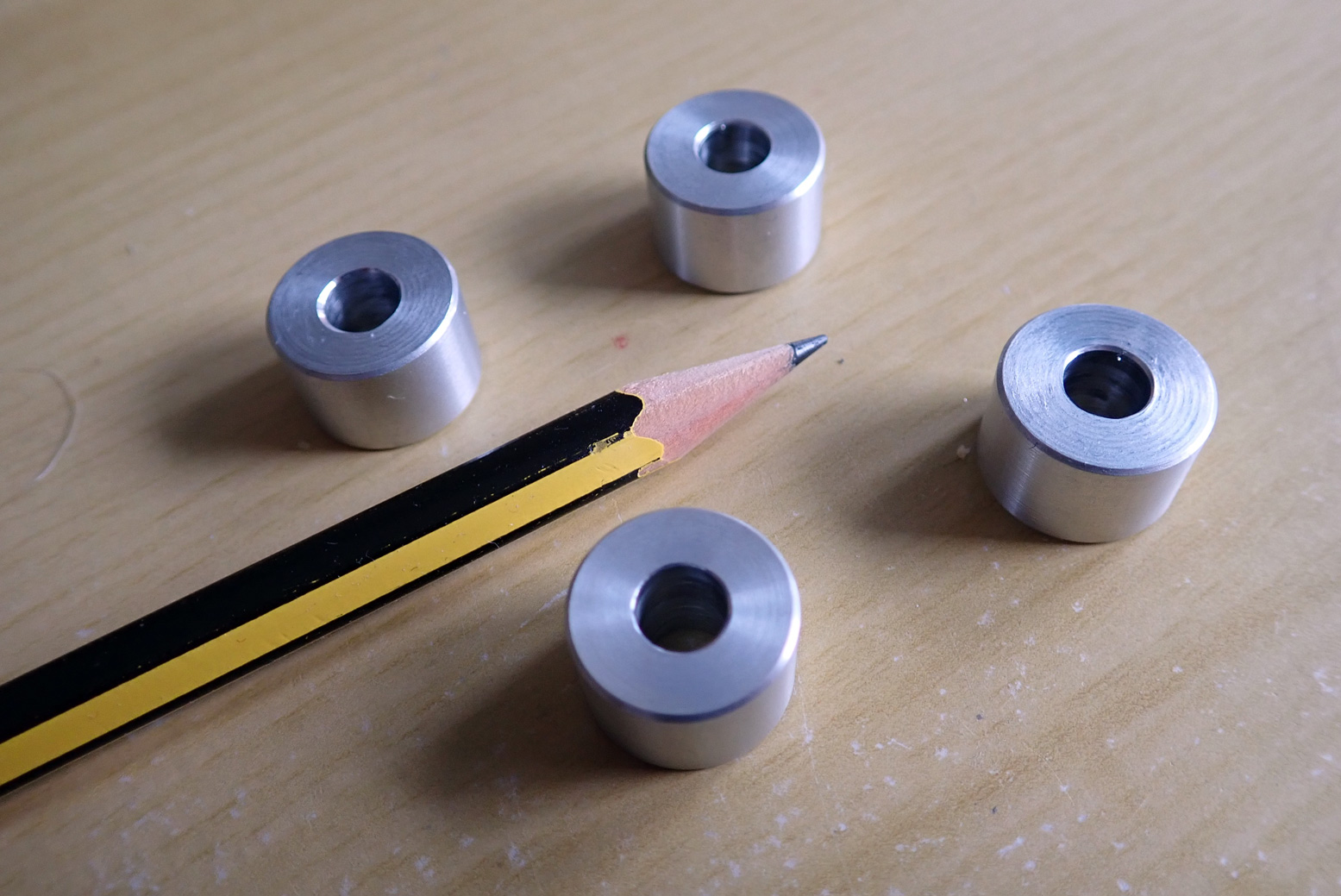
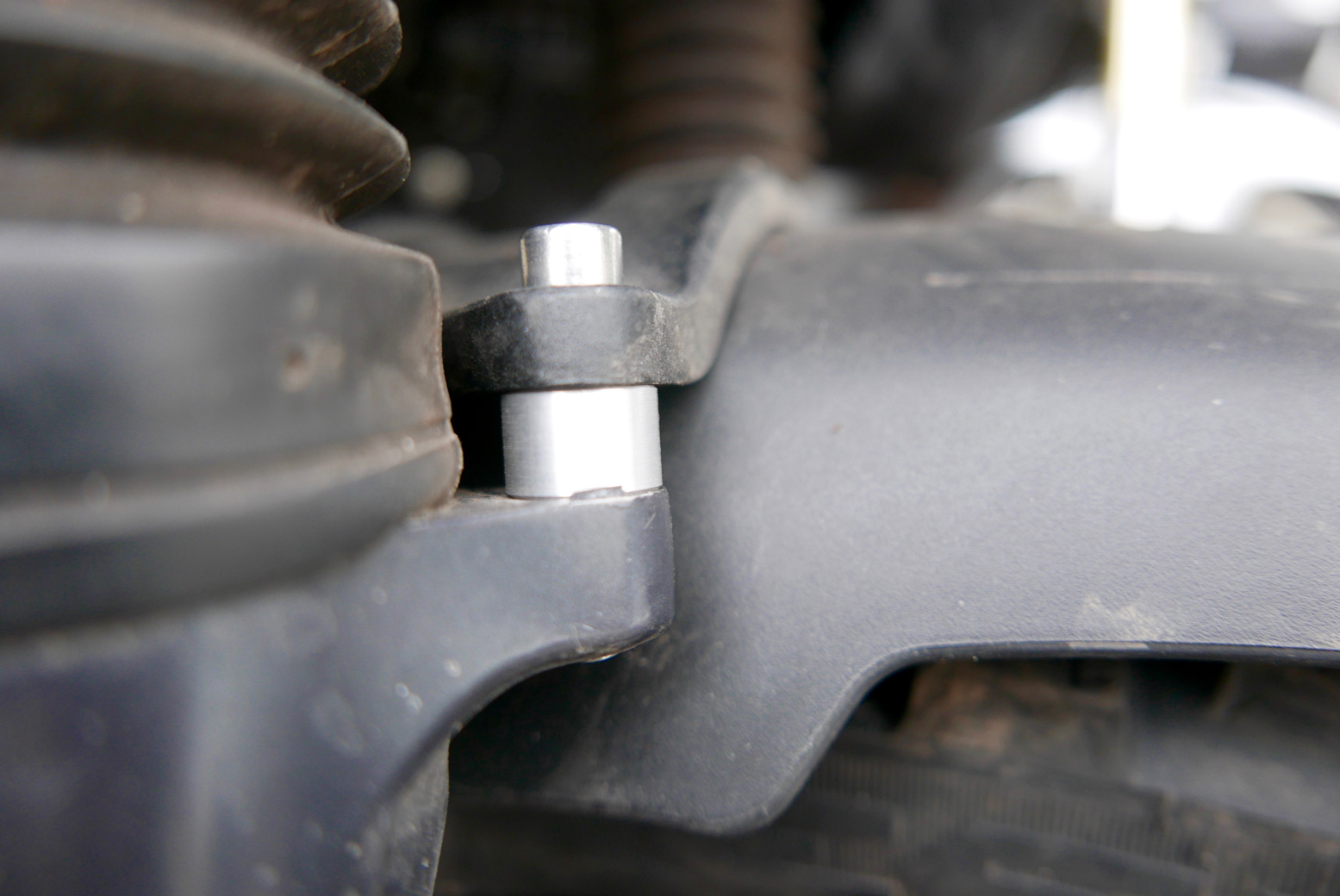
On the Him it’s easily done with slightly longer fork brace bolts (below) and some M6 spacers raising around 10mm, before the mudguard hits the downtube on full compression. It’s worth remembering these spacers (search ebay: ’15mm ø aluminum bushes M6 hole’; right) want to keep a broad contact between the brace and fork mounts as there’s some leverage stress here.
So there it is. Just about all done in one fell swoop, as they say in Simon’s neighbourhood. Riding back to London, initially the Him felt a bit odd as modified bikes always do. The jacked up shock and new Michelins have given the bike an altered stance, but despite the sliding seat pads I soon settled back in to it. It’s not fast, but somehow that’s not frustrating and I’ve yet to put my finger on exactly why. Am I still in the honeymoon period of enjoying the novelty and kidding myself it’s better than it is, as so many owners claim with their bikes? Or with the Himalayan, have Royal Enfield stumbled on some magical combination of looks, gearing, power delivery and value for money which, for the moment ay least, still makes this bike such an enjoyable ride? It’s getting trucked to southern Spain shortly – a liaison stage to Morocco which I’ve done enough times already. We’ll see how I feel once the shine has worn off after a month on the trails and backroads of southern Morocco.
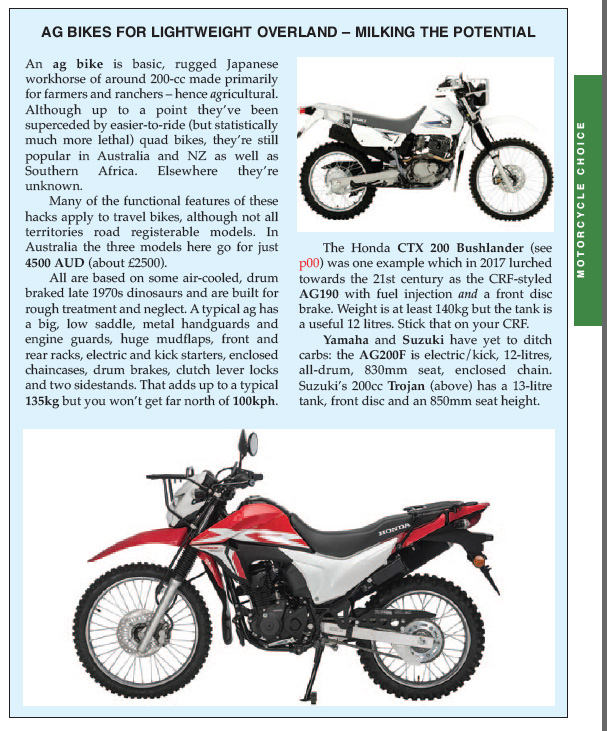
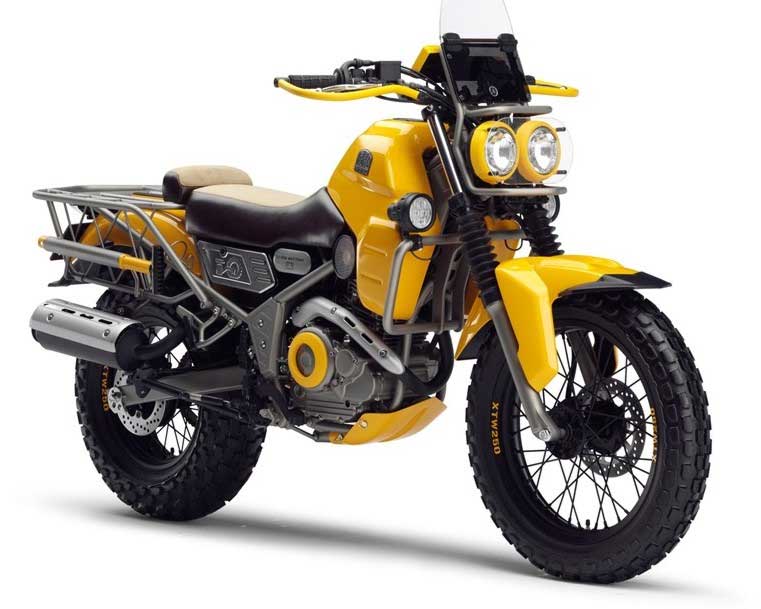
I’ve always liked utility bikes (‘ag bikes’, ‘farm bikes’) where functionality is measured in terms of load carrying and off-road agility, rather than tarmac-creasing acceleration or foot-long suspension travel. They even get their own section in AMH8, left. For the right sort of gnarly adventure, or with a recalibrated attitude towards pace, bikes like Honda’s AG190 (left) could make a tough little travel bike. Ag bikes possess that do-anything, go-anywhere appeal, which must also be behind the adventure motorcycling phenomenon. Yamaha’s TW-inspired Ryoku concept of a few years ago (below right) seemed to bridge both segments.
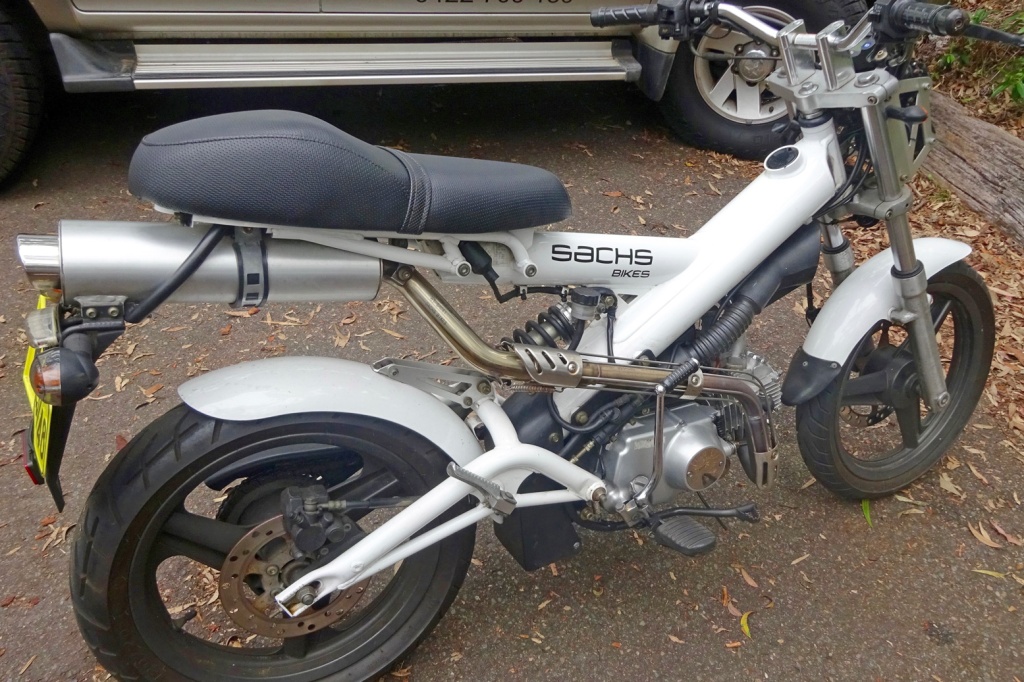
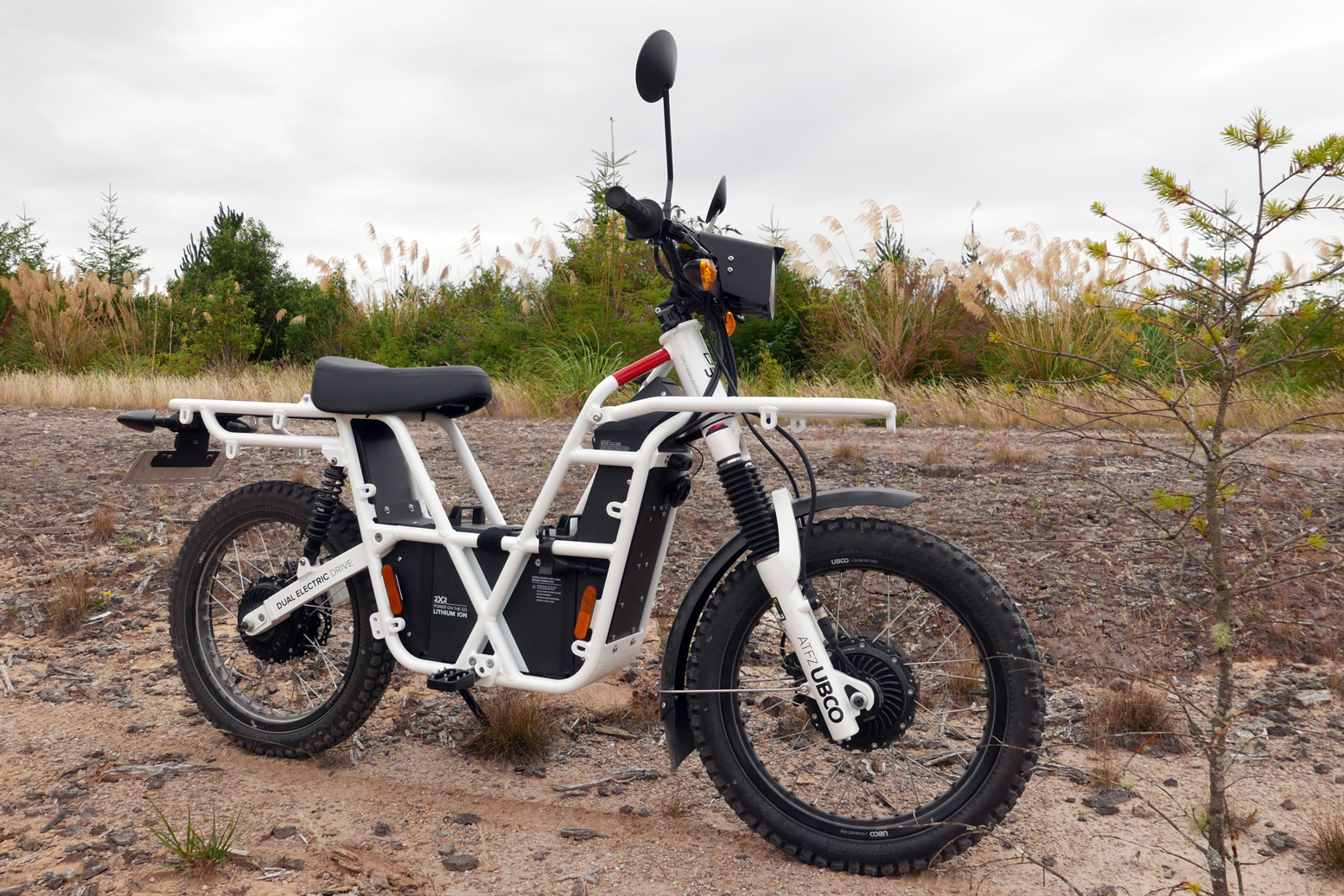
Whether intended or not, UBCO’s 2×2 electric utility ‘moped’ may also benefit from this ‘I-could-if-I-wanted-to’ conceit. People need personal mobility, sure, but many like to be feel cool while doing so, be it in a RAV 4 or on a GS12 or Raleigh Chopper. While staying in an affluent suburb of Sydney recently, along with skimpy urban scoots like the Sachs (above left), Chinese urban retros similar to the Mash Roadster as well as a few XSR7s outnumbered anything else I saw on two wheels there. In fact it’s said bikes like these are now beginning to outsell adventure-styled bikes. Expect Bike Shed franchises to start popping up like Pizza Huts.
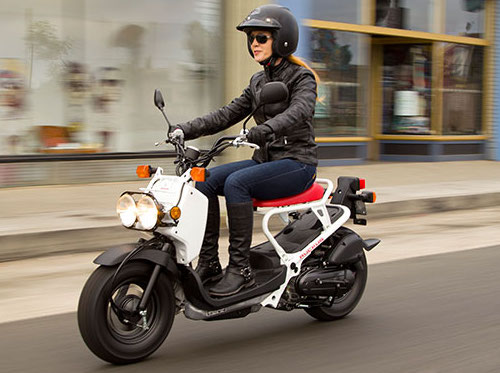
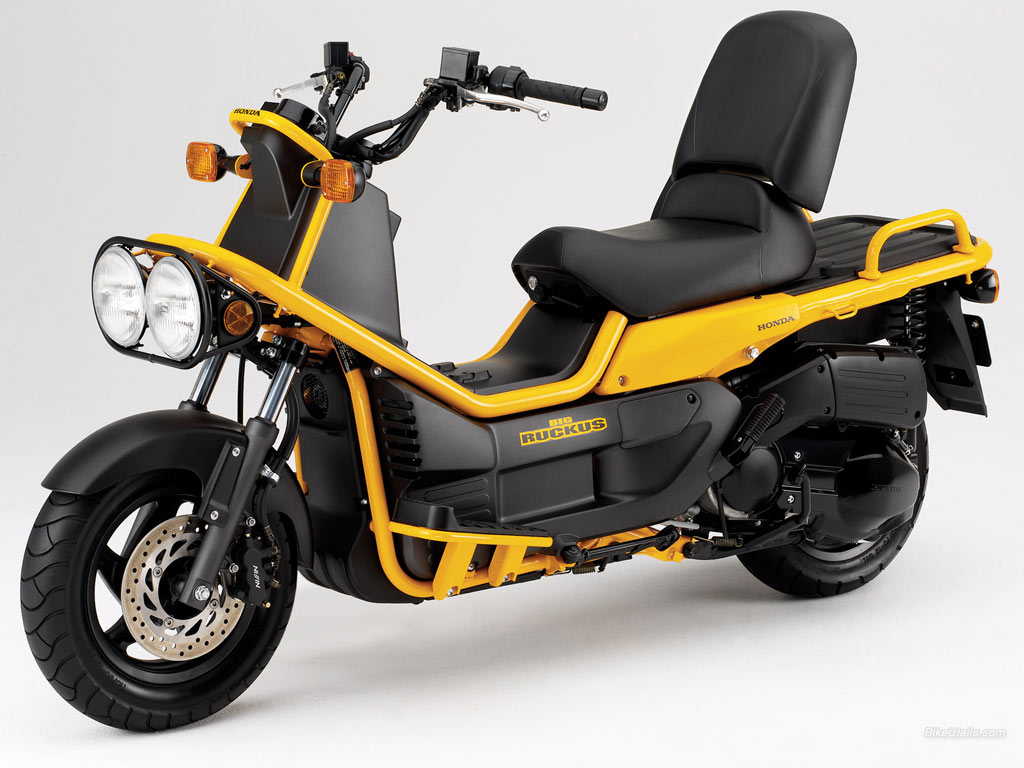
The Ryoku never got off the drawing board, but Honda’s recent X-ADV adventure scooter sought to capitalise on that urban adventure cachet. But after riding one – and even though I now have DCT out of my system – I felt something more akin to the current Ruckus moped (left; not sold in the UK) would have been more fun. In Australasia and South Africa, ag bikes have been on the scene for ever, but have changed little since the 1980s. What you want is an ag bike’s utility with scooter-like ease of getting on and off – a mini X-ADV. But do you also need 2WD and would you choose electric?
2WD motorcycles
You can be sure that one long winter some obscure engineer-farmer has experimented with front-wheel drive long before most of us were born. The vid below is one of many crazy-arsed compilations on youtube. And a couple of years ago Visordown dedicated one of their Top Tens to 2×2 motos, some pictured right.
At that time Visordown said: ... a modern generation of batteries.[…] and hub-mounted electric motors mean that … this must surely be the future of two-wheel drive – allowing almost any bike to be adapted to drive both wheels.
Such predictions proved to be on the money. If AWD is seen to be as desirable as it was when Audi introduced the Quattro road car in the 1980s, then the advent of hub-mounted electric motors is by far the least complicated and most elegant way of doing it. Ask Nasa (above) or even Ferdinand Porsche. The mechanical or hydraulic solutions powered by an ICE (internal combustion engine), as in the vid above, are mostly just too clumsy, expensive, complex or otherwise lacking in real-world commercial potential.
Off-road the benefits of AWD traction is obvious. I can think of many sandy pistes in the Sahara (above; Algeria) which would have been a whole lot easier and therefore safer to ride with the addition of front-wheel drive. Just like in a 4×4, AWD means you can tackle loose terrain like sandy ruts or dunes without resorting to momentum (aka; speed) which will catch you out (right). And in my experience in the desert, a 4×4 with an automatic gearbox is an unbeatable combination, especially on slow rocky climbs or in soft sand. Just the right amount of torque is fed to all the wheels to give traction, and on rocky trails there is no risk of stalling, again allowing you to concentrate on precise wheel positioning and clearance issues.
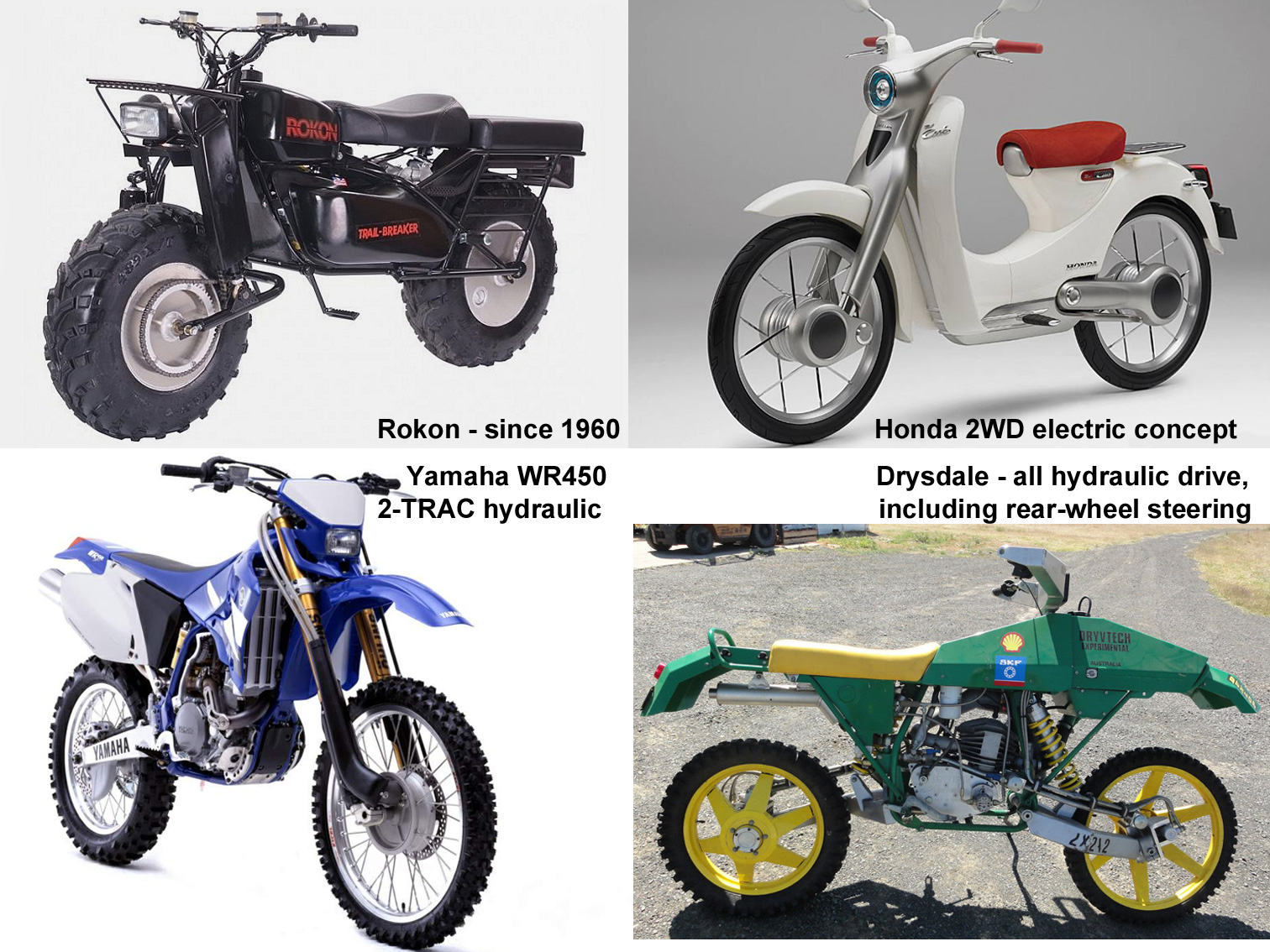
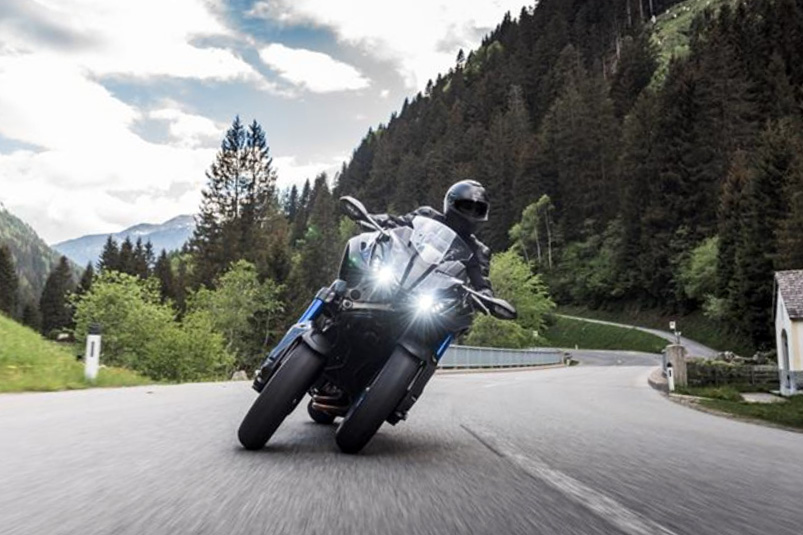
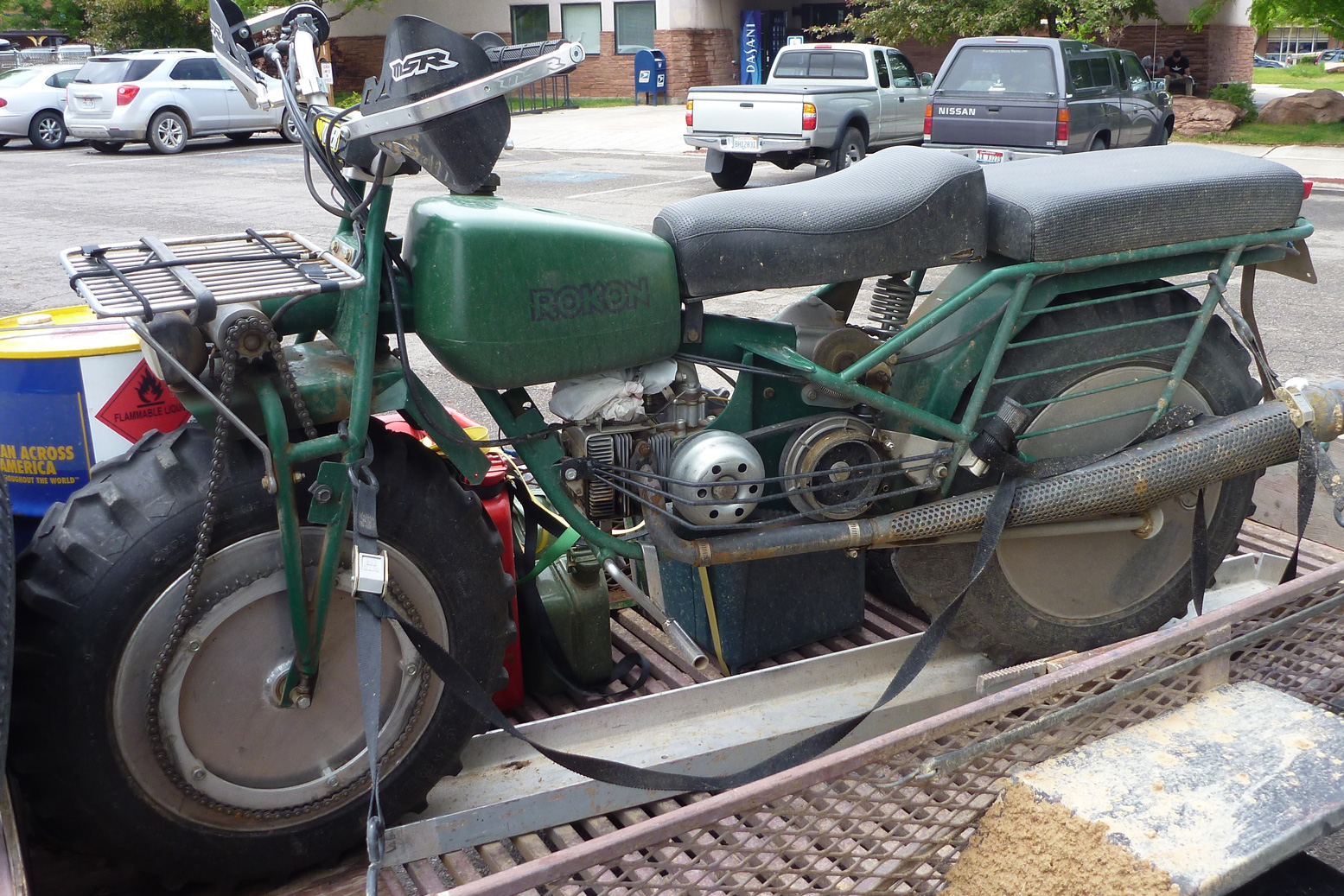
Automatic scooters are common, proper motorbikes less so, but do you even need 2×2 on a road bike? The answer is: not really. While road tests affirm that Yamaha’s recent ‘2FW’ Niken (above) delivers eye-opening improvements in front-end grip, on the road 2×2 would only benefit acceleration, by spreading the torque to both wheels and so limiting wheel spin (just as front and rear brakes improve braking all round). But advances in electronic traction control and tyres to match have proved just as able in optionally eliminating wheel spin. Combined as it is with ABS sensors, TA probably adds just a few ounces to a bike’s weight. Any front-wheel drive system would add several kilos while drawing overall power. All up, the US-built 200-cc Rokon below is the only successful production 2WD motorcycle – a two-wheeled tractor that looks even less comfortable to drive on anything easier than a wooded hillside and for most people has has probably been superseded by AWD ATVs, even if the latest model features the miracle of front suspension.
UBCO: Electro Glide in White
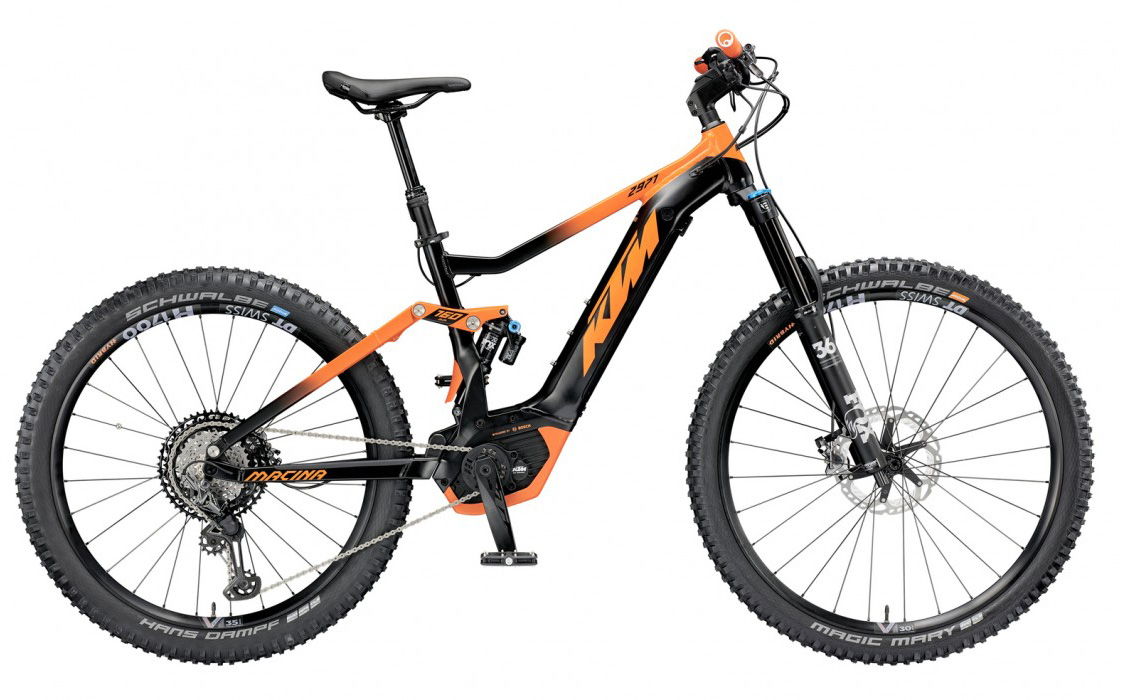
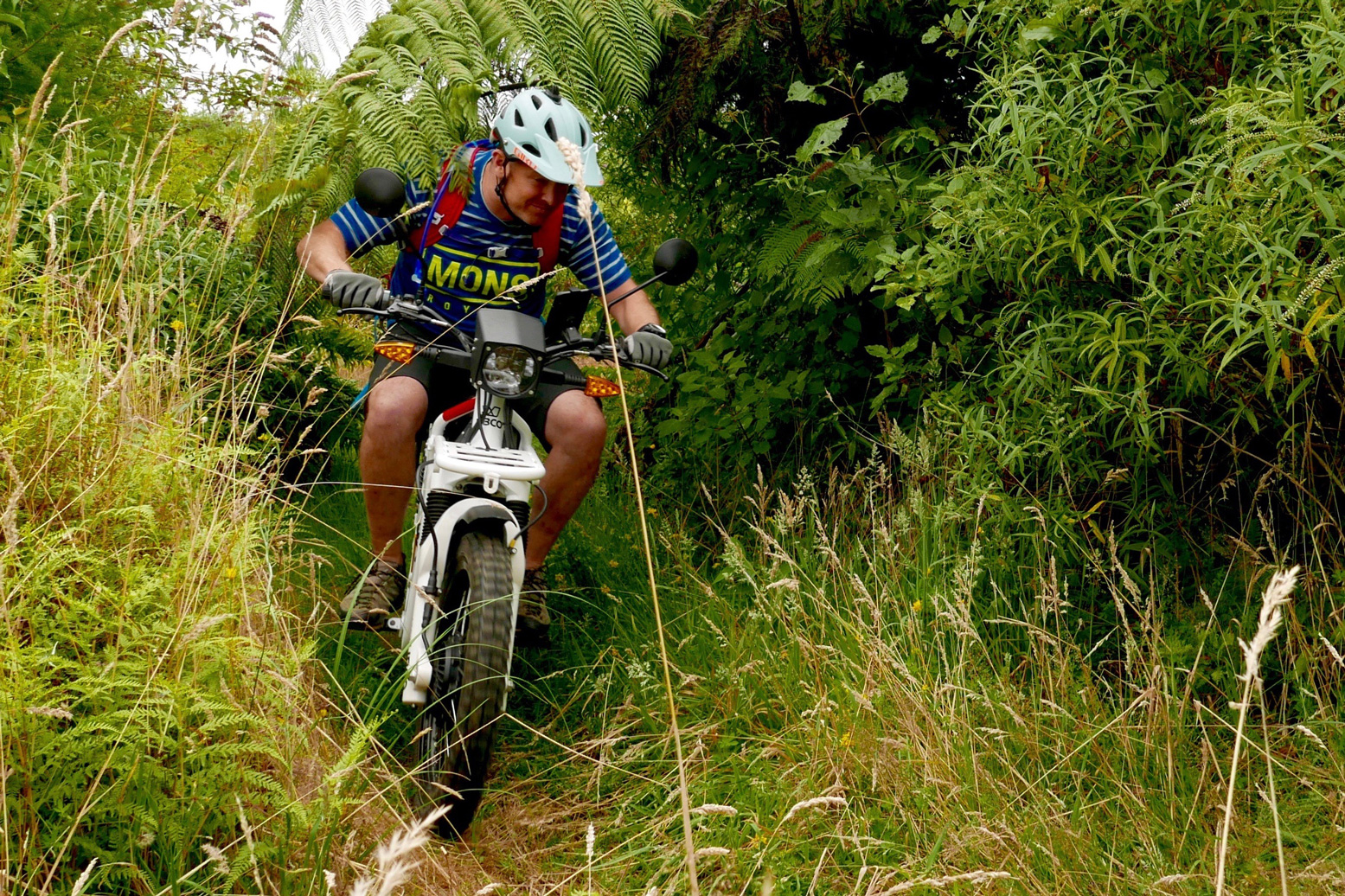
UBCO stands for Utility Bike Company, founded in 2015 when the work of a couple of creative Kiwi engineers got picked up by entrepreneur, Tim Allan (riding, below). In 2018, after the original off-road only model had spent a couple of years in development with Kiwi farmers, a fully road-legal, version was released for global export. It’s the world’s first production 2×2 electric motorcycle aimed at farmers, rangers and forestry, while also being bought for urban deliveries and just plain off-road fun. Being restricted to 50kph, it’s classified as a moped which in many territories means it can be ridden on just a provisional licence. You can add luggage or wider racks and run power tools off it. To recharge the 16-kilo battery takes 6-8 hours. The bike is made in China and in NZ and Australia costs $8000, (about £4200) in the US it’s more. That’s about the same price as a KTM full-suspension e-bike (above right) I saw in an NZ shop window.
Wisely, UBCO dodges competing with the likes of recently folded Alta or Zero who produce(d) full-sized electric road-legal motorcycles. Instead, it’s aiming squarely at the utility market where the benefits of a light, rugged, easy-to-ride and near-silent all-terrain bike outdo its limitations in range and performance.
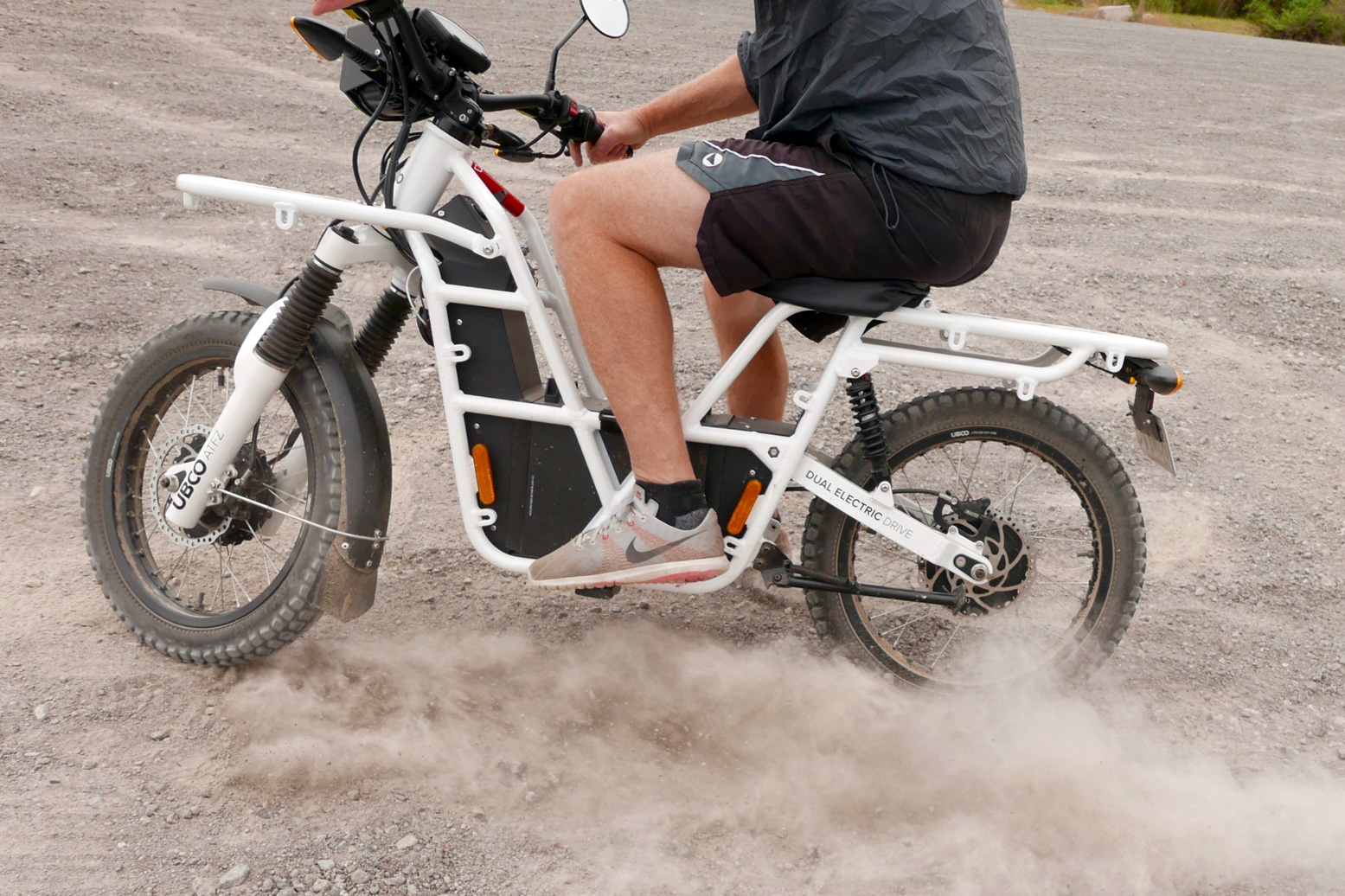
Weight is 65kg and with 2.4kw (3.2hp) via the 48-Ah, 50-V Lithium-ion battery, power is less than an ICE moped. But 90Nm or 66 ft lbs of torque across two wheel is a figure equivalent an 800cc bike, and all that torque is delivered instantly to each wheel so both will spin as you pull away on loose dirt. Electrotoque is not really comparable with ICE torque: old but interesting article. Very few electric motorcycles have motors in the wheel hubs. Once you get beyond a moped power level, they become too heavy and bulky so need to return to the typically central ICE location. Above (the two sides of a hub motor), the number and size of copper windings correlate to the power, and these motors are designed to spin fast, hence the three reduction gears on the left. The UBCO’s motors are about as small and low powered as they get on an e-moto, so hub fitting is not a problem. There’s just the low, centrally positioned battery with a power cable reaching out to each hub. Simple.
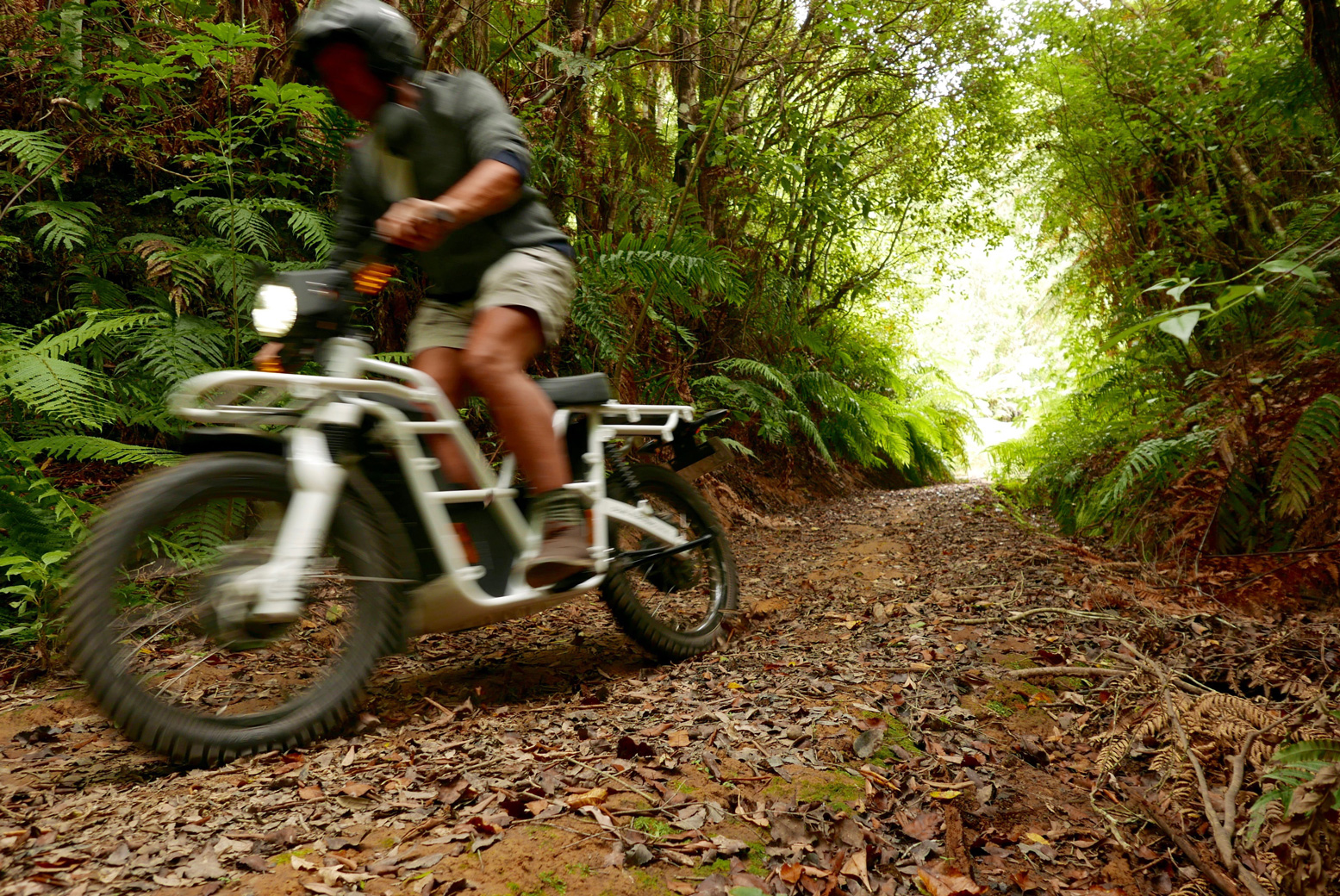
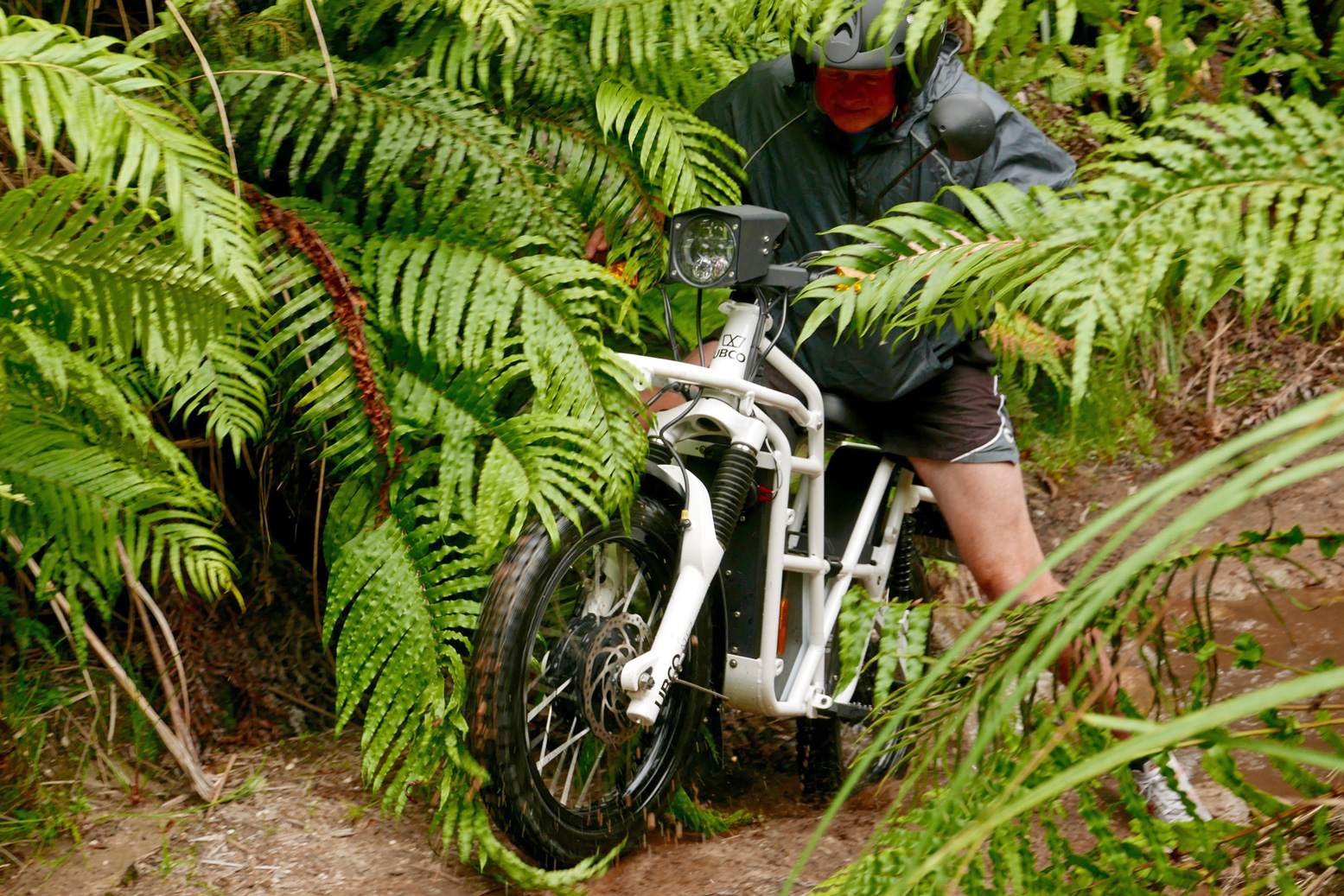
Tim, myself and his mate JB set off along an overgrown MTB trail at the TECT Trail Park close to Tauranga where UBCO are based. No clutch or gears, no heat, drive chains or belts and virtually noise, plus hydraulic MTB brakes, speed-calibrated regenerative braking and low CoG and seat all make the UBCO effortless to ride. Along with the cleated footrests, it all means you can concentrate on fern-dodging and where to put the front wheel.
Unlike an ICE moto, terrain permitting an electic bike is most efficient with the throttle at the stop and hard acceleration doesn’t consume power like it does on an ICE. Despite its optimal traction and light weight, the low power rating means it’ll only climb 1:4 at which point the short-action throttle is pinned. If you run out of go it’s dead easy to hop off and push. Even with my weight, I found what looks like basic suspension well suited to the bike’s speed potential and the terrain we rode. It’s operation never intruded on my ride and it never bottomed out.
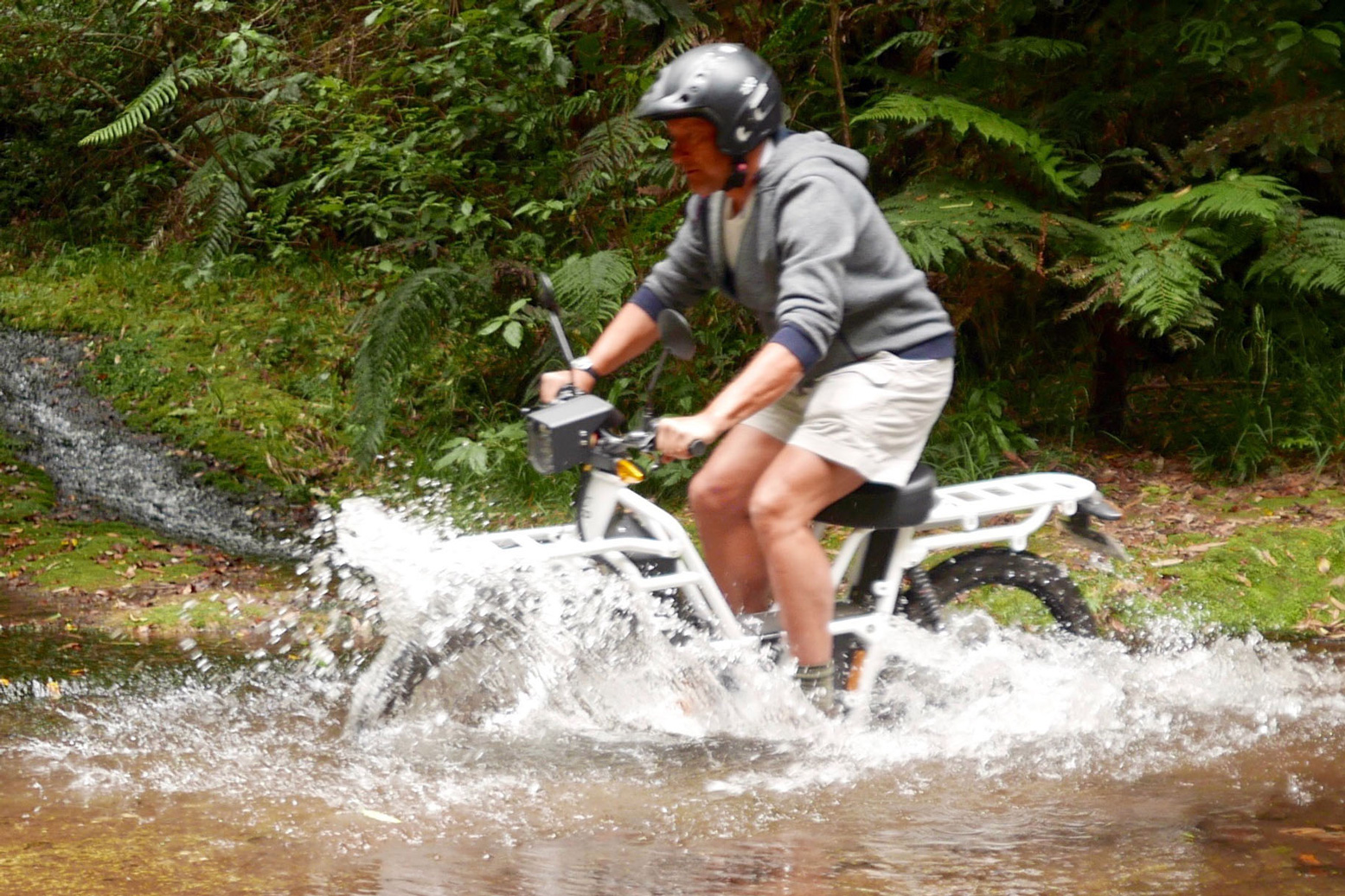
I can’t say I noticed the 2WD, apart from wheel-spinning when pulling away on loose dirt, but it rode as on rails despite the Kenda trials-pattern tyres being at road pressures. The 2×2 has no negative effect on the steering, probably quite the opposite, but you barely notice it. Just like I found myself pressing air for the foot brake, it probably takes a while to believe and then fully exploit the front end’s drive. And no, it won’t be more efficient in one-wheel drive (like old-school 4x4s could be) – the small motors are designed to work most efficiently together. As you can see below, the air-cooled hub motors (the only part of the bike which gets hot) aren’t fazed by shallow water crossings either.
Sure, the MTB handlebars were way too low when standing up, and there was nothing to brace the legs against. But the UBCO is so light and power levels so manageable it didn’t really matter. When sitting down I found my knees banged against the frame, but some trousers or pipe lagging would fix that. Just like a DCT Honda, the lack of gear changing or fear of stalling really frees the mind to deal with other things, meaning you can ride more smoothly and have more fun doing so. Before I got my current Himalayan I considered adapting a DCT NC750X into something akin to the Rally Raid CB500X. To me this is one of the greatest benefits of electric bikes. Doing the same ninety minutes riding on any sort of ICE dirt bike would have left me comparatively worn out. The fast-paced off-roading we did would give you about 40 miles range – you’ll get nearly twice that on a flat road at 20mph. And the regen braking means coming down a long pass actually adds a bit of charge. The dash info is basic and includes the temperature of each motor, but you can change or monitor various functions with the bike bluetoothed (or some such) to a smartphone app. Lights are LEDs up to a very bright 2200 lumens.
At the end of the ride I was able to nose the front wheel against the back of the trailer, turn the handle and let it climb up. But even without the 2×2 or even the utility element, like the Sachs moped above, the UBCO can also pass as a cool-looking urban runabout. In the right setting it would be a great way of nipping around without frightening the horses.
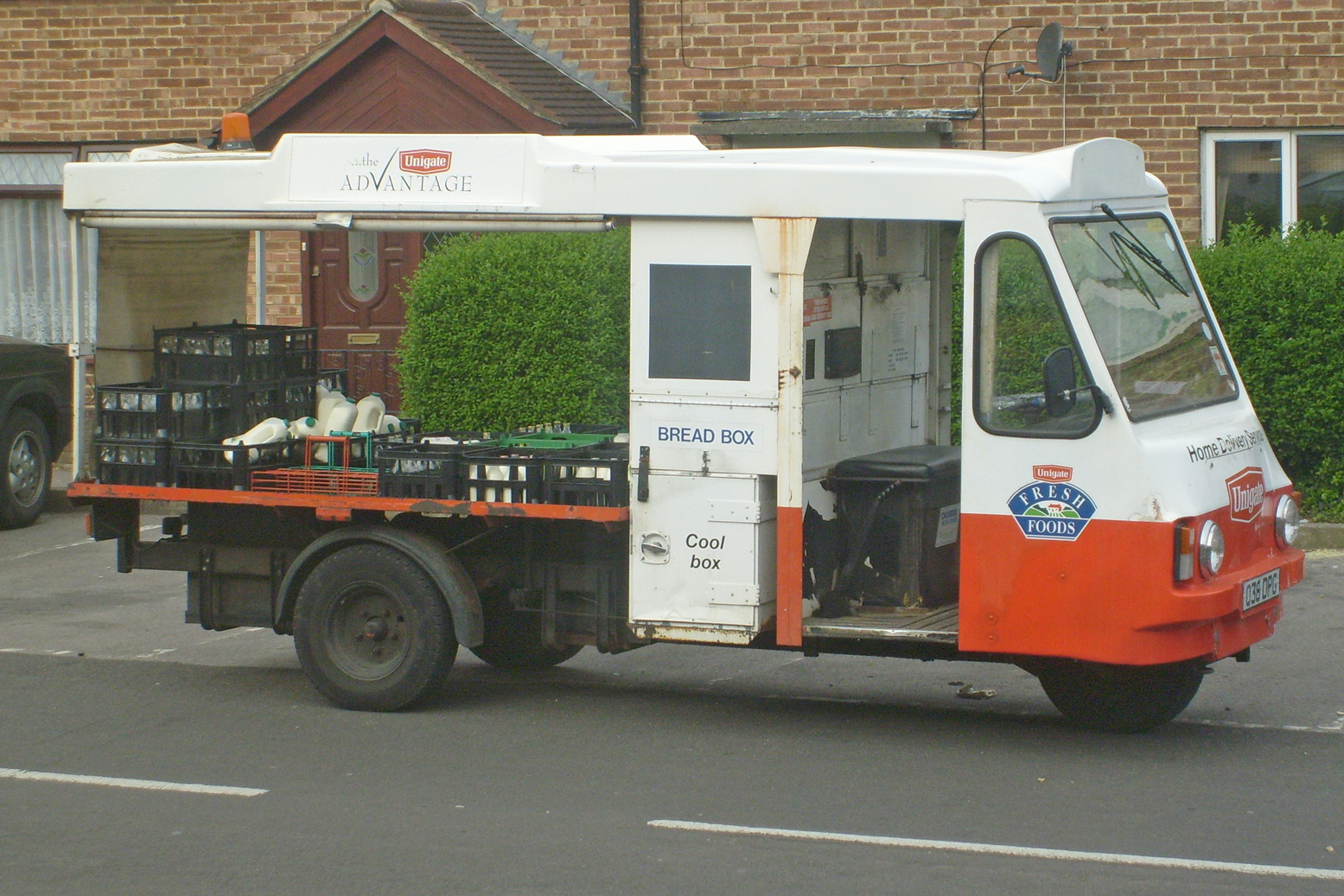
In 1967 the Electric Vehicle Association claimed that Britain had more battery-electric vehicles on its roads than the rest of the world put together. Almost all were milk floats (right) rated at around 8-10Kw and with a range of 50-60 miles. Even then, the first Golden Age of electric vehicles can be dated back to the start of the 20th century when, in the US for example, 40% of cars were steam-powered, 38% were electric (about 34,000 in total), and just 22% were dirty, smelly, noisy, rough-running ICEs. Then major oil fields were discovered around the world and before domestic air travel became the norm, the interstate road network went on to outstrip the railroads. Now there are well over a billion ICE road vehicles in the world, about 20% of which are bikes. The total number of EVs surpassed 3 million in 2018, a 50% increase over 2016.
Electric Bikes
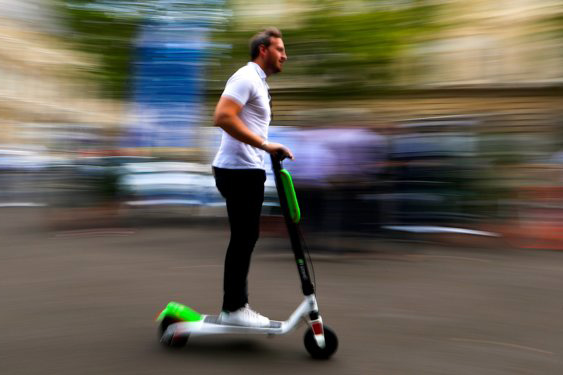
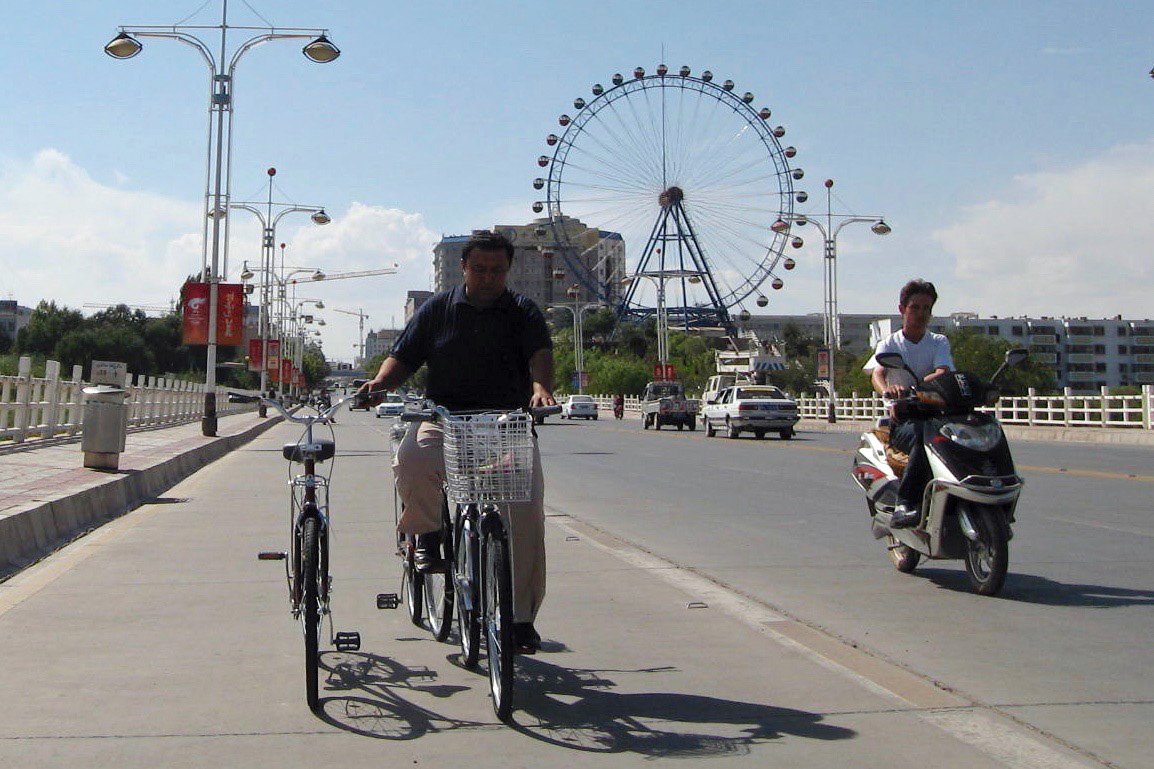
The future will be electric, again. That may well be the case in urban settings or for other short-range applications. In 2008, alongside the more common pushbikes I was amazed to see electric scooters (right) whooshing around the streets of Kashgar, western China. And in Auckland last week I was equally intrigued to see dock-free e-scooters (left) either left on the pavement or whizzing about between pedestrians.
But any form of trans-continental overlanding in the less-rich AMZone will probably be the last place to see e-motos. The world is just too divided between rich and poor, urban or rural. Just as with fast internet or mobile phone masts, the cost of installing the necessary infrastructure everywhere is too great. It’s an overlanding quandary which has become analogous with diesel cars. Low-emission engines designed to run the low-sulphur fuel sold in rich countries will play up on the old, high-sulphur stuff sold in some parts of South America, Africa and Asia where emission regs are less strict and ‘Euro 5’ is a football tournament. So while in the next decade you might be able to ride your e-moto across Europe or North America, as things stand Cairo to Cape or Prudhoe Bay to Ushuaia will be a challenge for a long while.
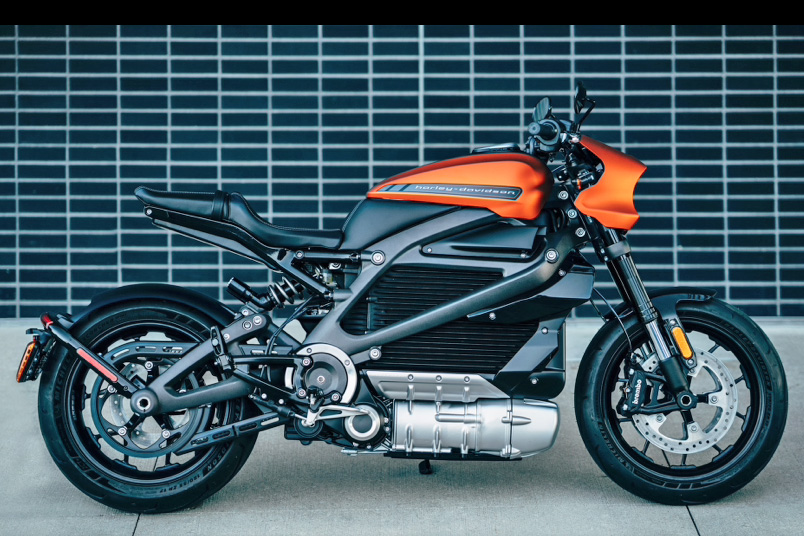
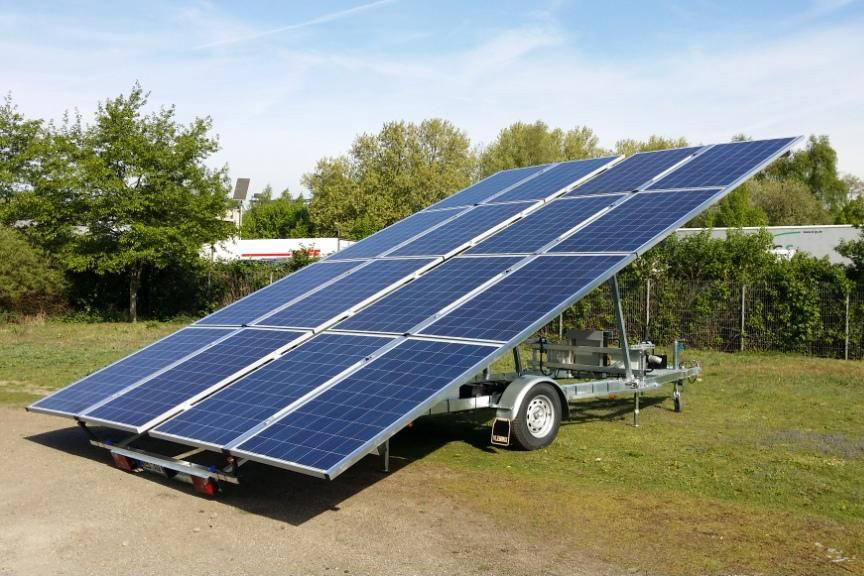
Visualising a sunshine-powered, off-road coast-to-coast traverse of Australia, similar to their World Solar Challenge race, I asked the UBCO tech guy would the necessary 400-w solar trailer (about two panels on the left) do the job? No. A battery can’t be charged and discharged at the same time, but a spare battery could be charged. Broome to Adelaide at 30mph max would sure give you plenty of time to get a nice sun tan. Some say the specific problem with electric motorcycles (as opposed to e-bikes, cars or trams) is that, price apart, with the available technology the weight vs power or range doesn’t add up with current perceived expectations of what a motorcycle can do. It ends up either too heavy, too slow or runs out of charge too soon. But even Harley’s turbine-smooth Livewire (above) only weighs 210kg, does 0-60 like a 701 and might last 100 miles. We’ll know more (or not) when the Long Way Up comes out this autumn. Other electric bikes will do better. As we approach the fabled Tipping Point you’d hope things can only get better.




























 Adventure Motorcycling Handbook