Tag Archives: MRA xcreen

CRF300L: Midsummer ride: saddle, screen & mpg

Project 300L Index Page

You probably know that feeling at the end of a long day’s ride in the UK. You’re tired and butt-sore but the bike is warmed right through and after hours in the saddle you’re in the zone and fully at one with the machine, darting through roundabouts with a flick of the hips and tuned in to the hazards around you.


I left Dorset for the 130-mile ride to the ABR bike show armed for discomfort and a low average speed. The two-lane A350 covers half the ride and there was less than ten miles of dual carriageway on the whole run. Instead it was old-time motoring with frequent roundabouts, occasional traffic lights and small town bypasses, plus the odd individual who thought it best to keep under 40 just in case. Fine by me on a slow bike. With the 300L’s limited ability for decisive overtakes, I sat back and watched the mid-summer verdure inch by and the mpg creep up to over 100.
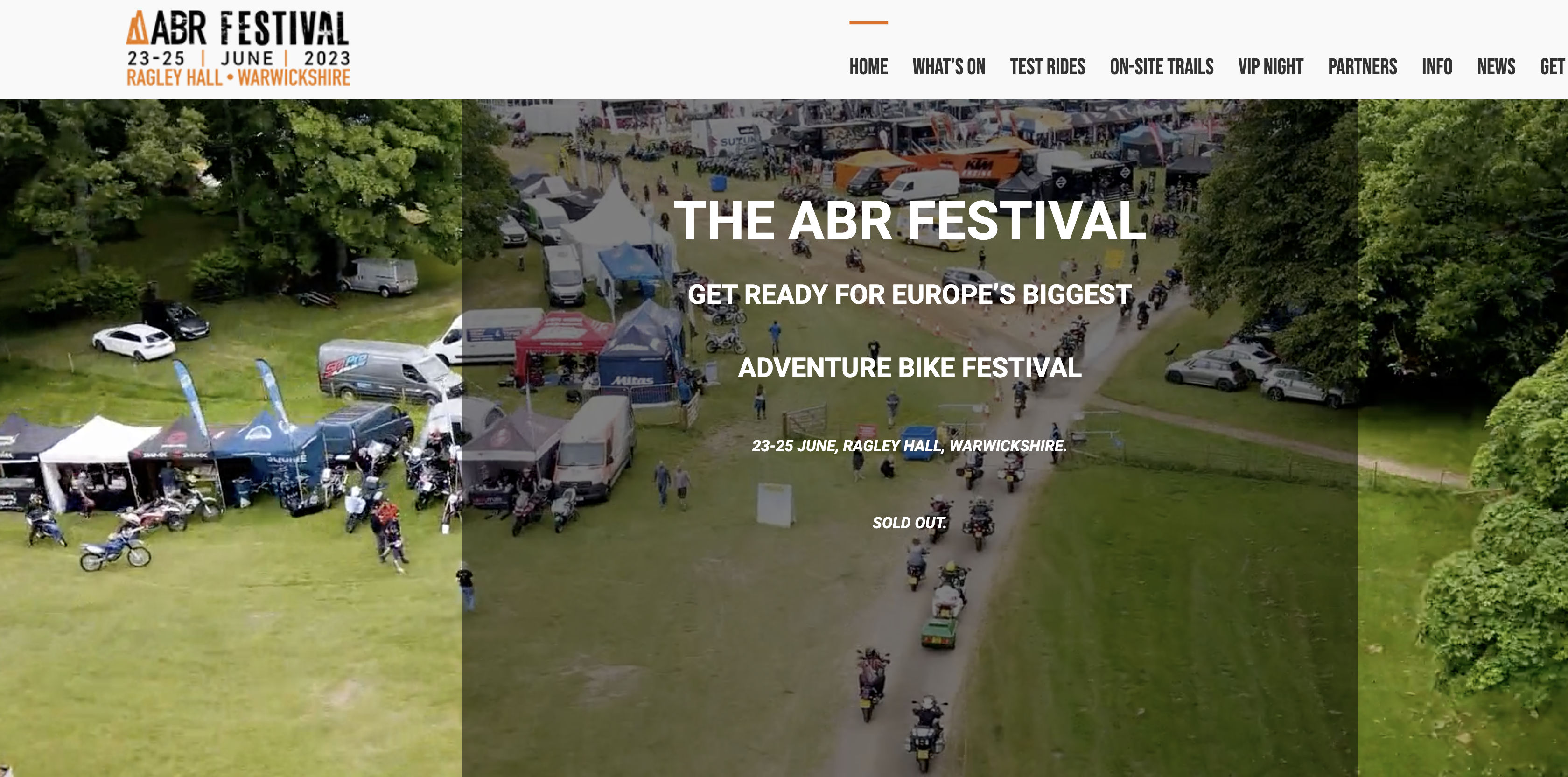
In just a few years the ABR Festival has deservedly become a hugely popular event. And as a regular speaker there, it’s also one of the best organised of its kind with loads of things to actually do and a switched on admin crew inviting some serious people, not the usual Adv-UK suspects like me.

Nearly four hours later I rolled into Ragley Hall much less crippled than I thought I’d be considering my diverse musculoskeletal ailments – aka: getting old. These were the benefits of an enforced slow place. Narrow saddled ‘two fifty’ trail bikes are notoriously uncomfortable over long distances but my one-hour presentation and subsequent chatting proved much more draining, not being used to that either.
I spent the night in a garden in nearby Upton and next day headed off towards mid-Wales to rediscover some of the backroads I’d walked and cycled on the Glyndwr’s Way last summer. At some point I’d need to head back for another ABR talk at 4pm. After yesterday’s ~200 miles, this time the thinned-down seat soon gave rise to that familiar discomfort, a feeling as old as all my biking years. But also one that’s fixable.
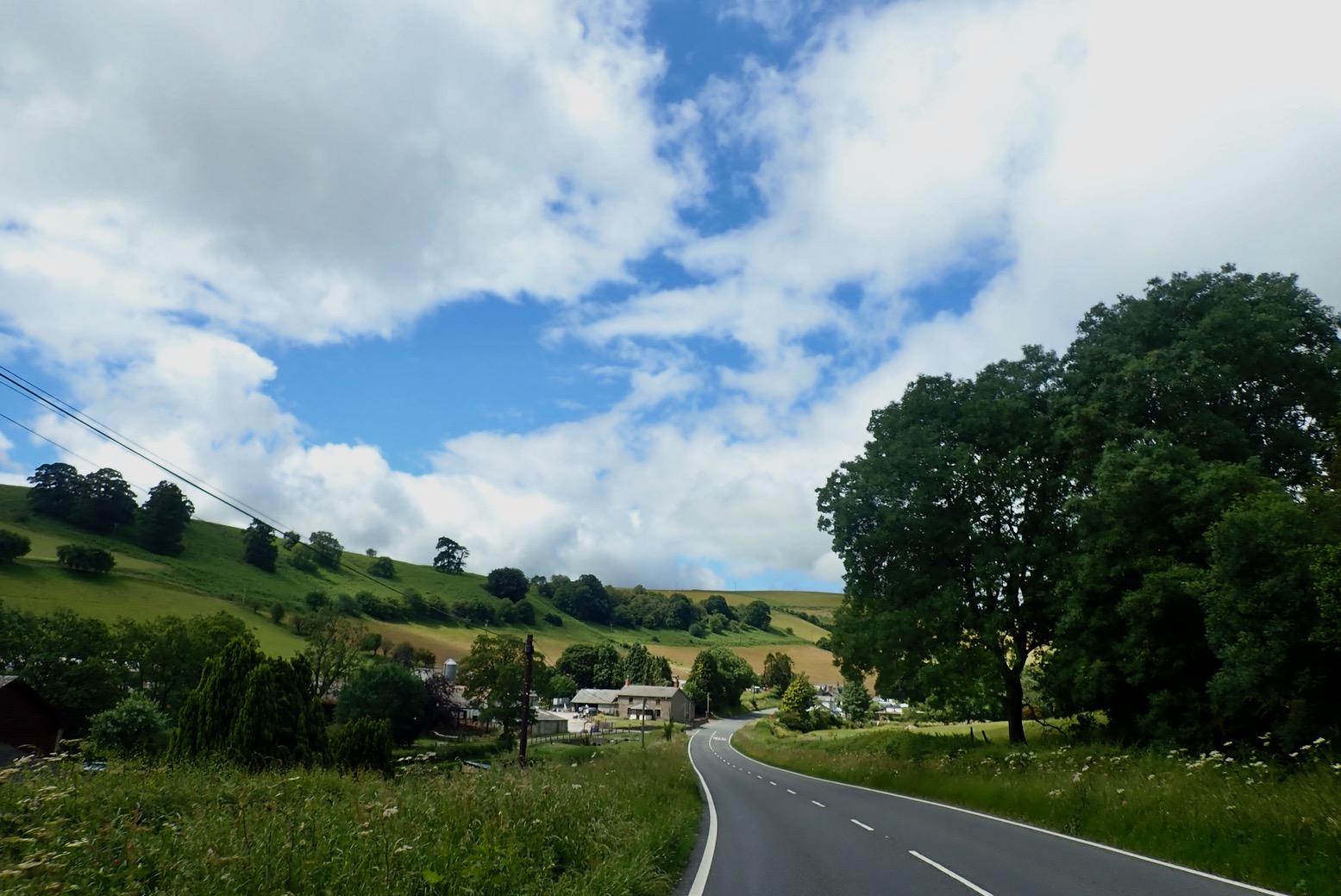
Lovely mid-Wales

Rhayader – Wales’ trail-biking Mecca, such as it is – proved to be that turn-around point, but rolling through the town, no cafe jumped out at me invitingly. So I followed a single track road out towards Abbeycwmhir on the GW and where a back way wound its way on to Llanbadarn Fynydd (GW) which I knew had a cafe.
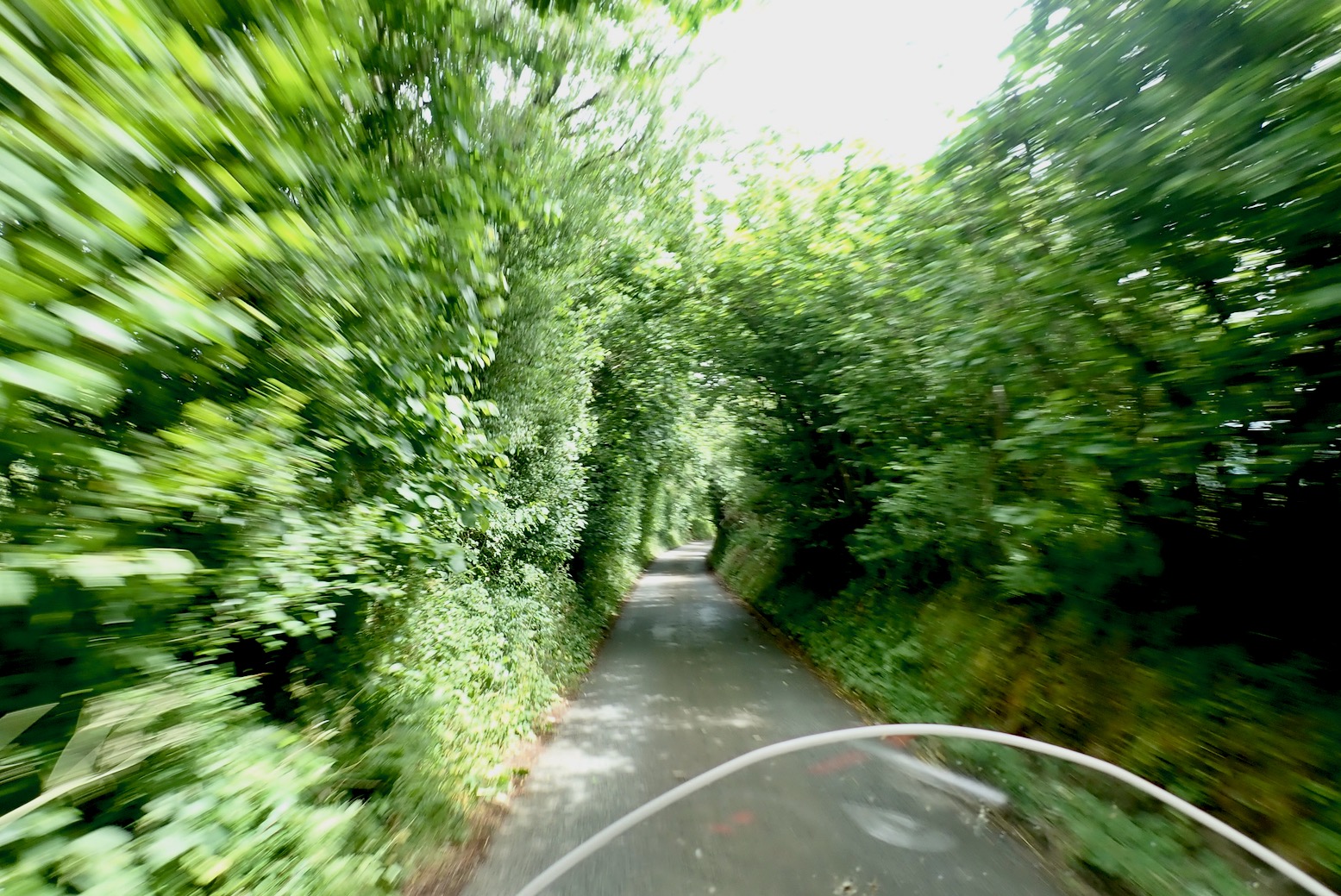
Walled in by lush summer hedgerows, a narrow country lane turned to gravel which led into a forest. Is this a rideable trail I wondered? Why no prohibition signs or locked gates?

My Garmin is loaded with OS mapping which showed this was not* a green lane (‘BOAT’, etc). But it led less than two miles to Bwlch y Sarnau on the Glyn’ Way, a deserted hamlet at over 1000 feet whose name evoked pre-Christian Wales and where there was a self-service ‘porch cafe’. It also saved a long diversion, so unexpectedly I found myself outlaw off-roading in mid-Wales. How thrilling! There were a few MTB tyre imprints in the earth but nothing from a moto. Doing this is bad form and not something I’d knowingly do again, but in just a few minutes I reached Bwlch via a couple of gates. There was no one around, same as last year walking and pushbiking in this area.
* Turns out it was a green lane after all – a UCR or ORPA. Explained here.

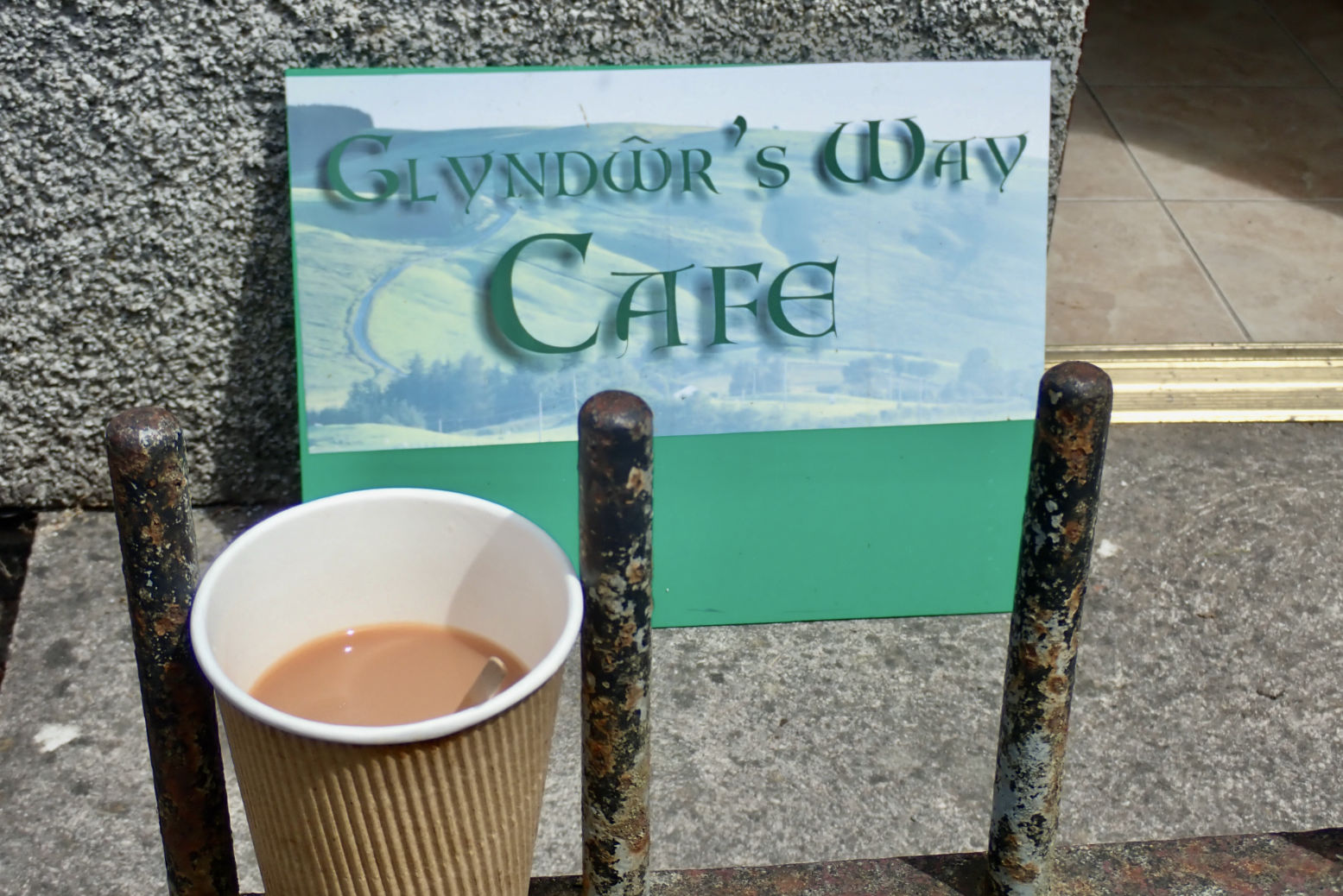
Let’s off road!

At Bwlch cafe I chatted with some bikepackers having a brew during a three-day tour. This is such a great region for that as I found last year. But for legit trail biking, a quick glance at the OS map on my Garmin didn’t reveal many permitted green lanes much longer than what I’d just illegally ridden, In search of uninterrupted off-road adventures, that’s why I went to the Sahara in the first place way back in 1982.
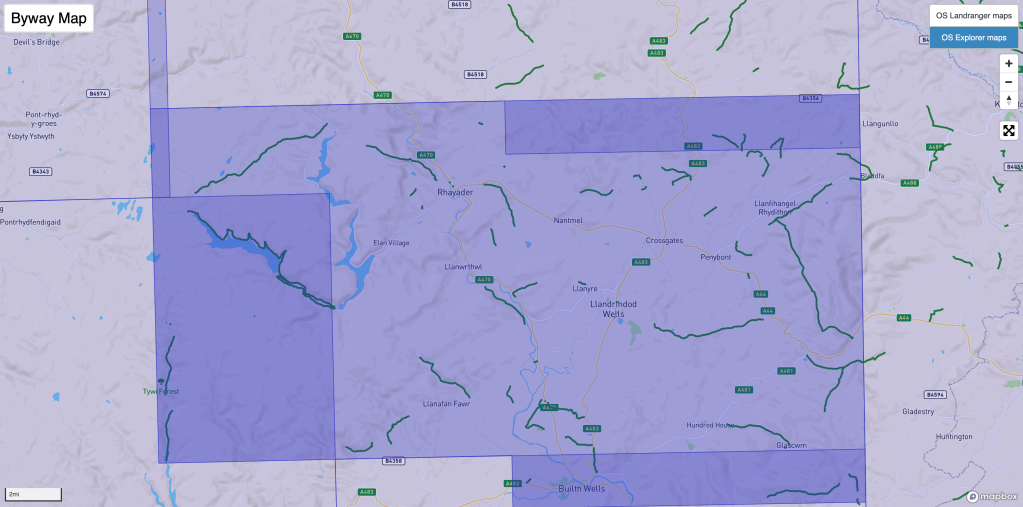
Byways around Rhayader but read this first. Then again, there is always the Welsh section of the TET which will probably be quiet backroads with occasional off-asphalt excursions and doubtless a very nice ride across rural Wales.

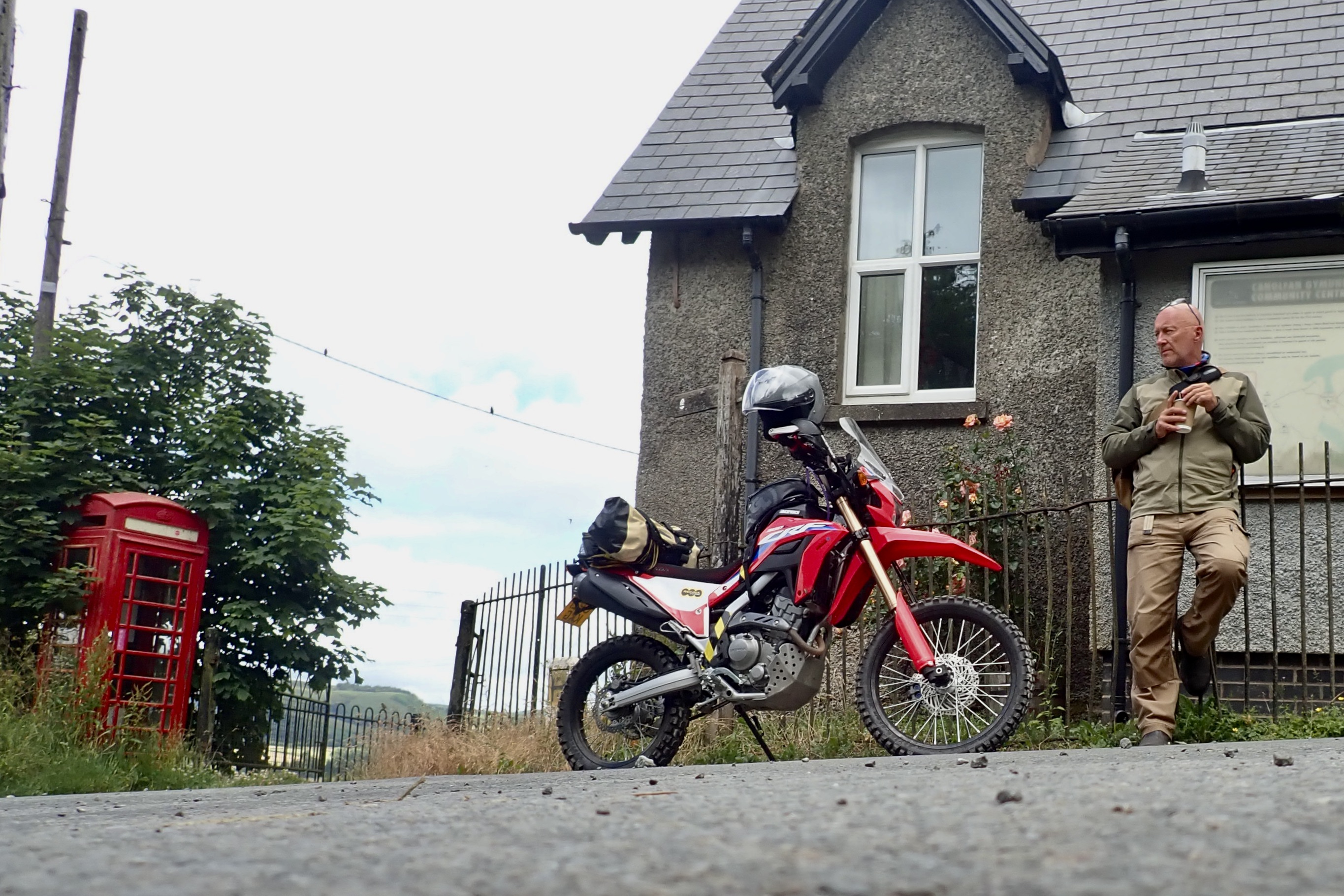
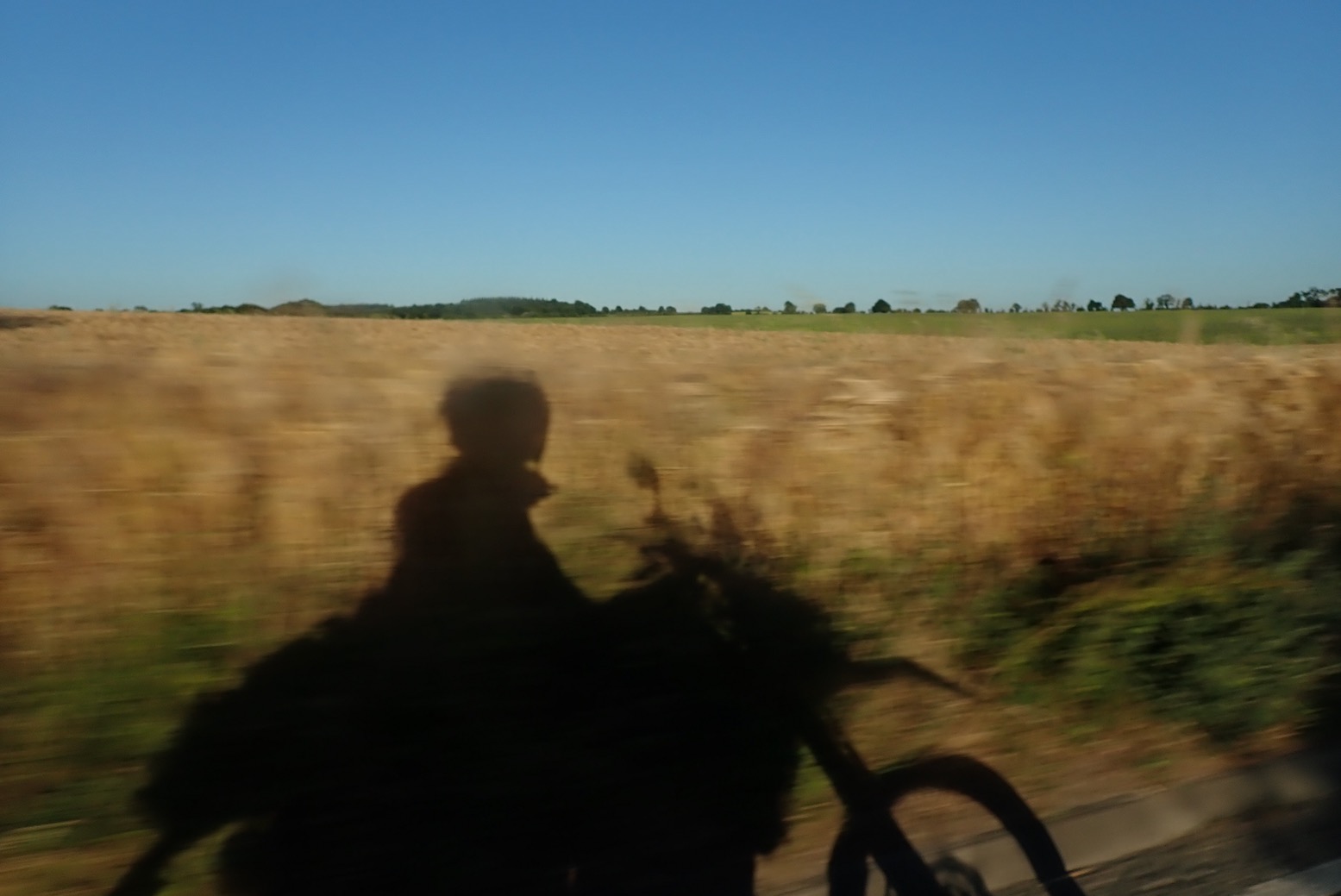
By the time I’d selfied myself and finished my cuppa, the Garmin’s ETA back to the ABR show was cutting it a bit fine. Sod the mpg – I’d have to crack on!
Mamils & Saddle Sores
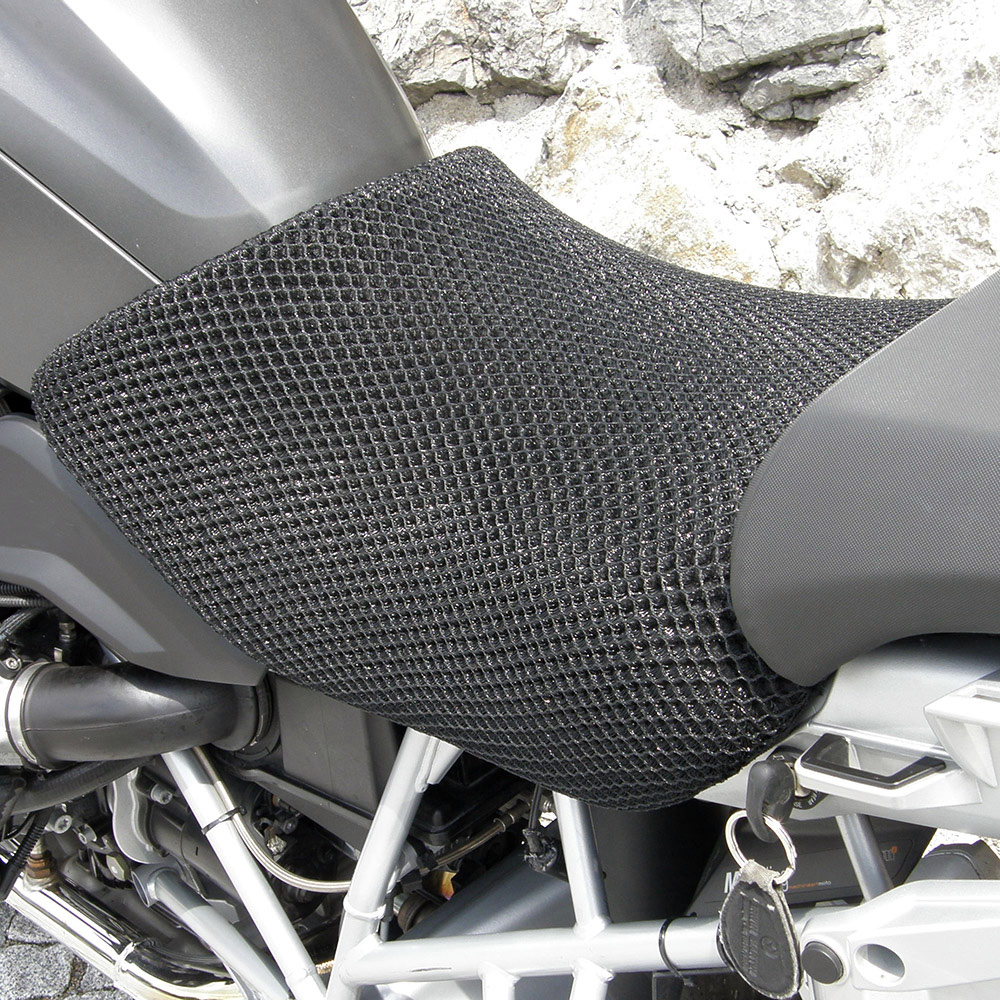
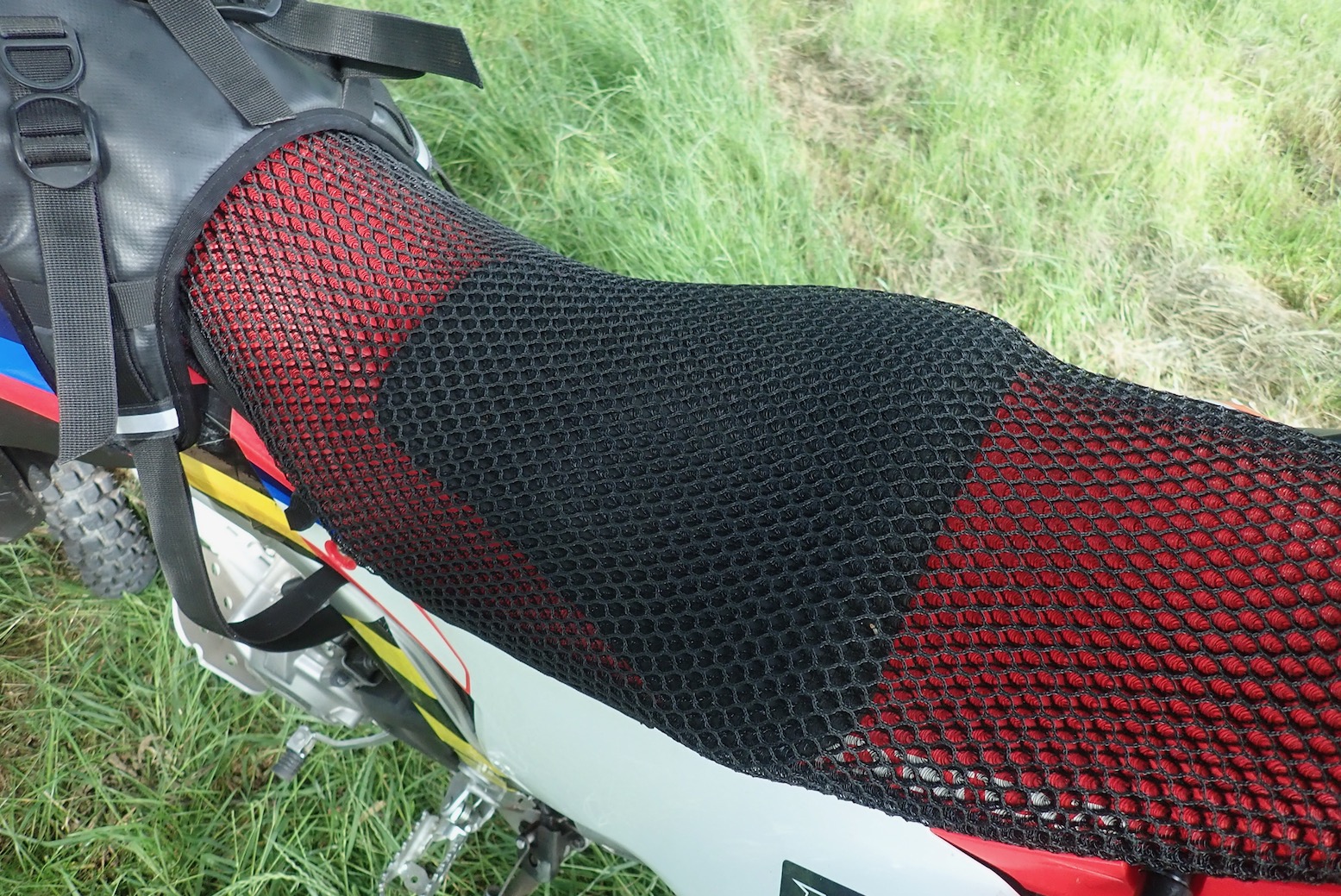
In getting lowered, my seat has lost some padding, and the slippery Cool Cover saw me slide forward on a downslope; a common annoyance with some bike saddles.
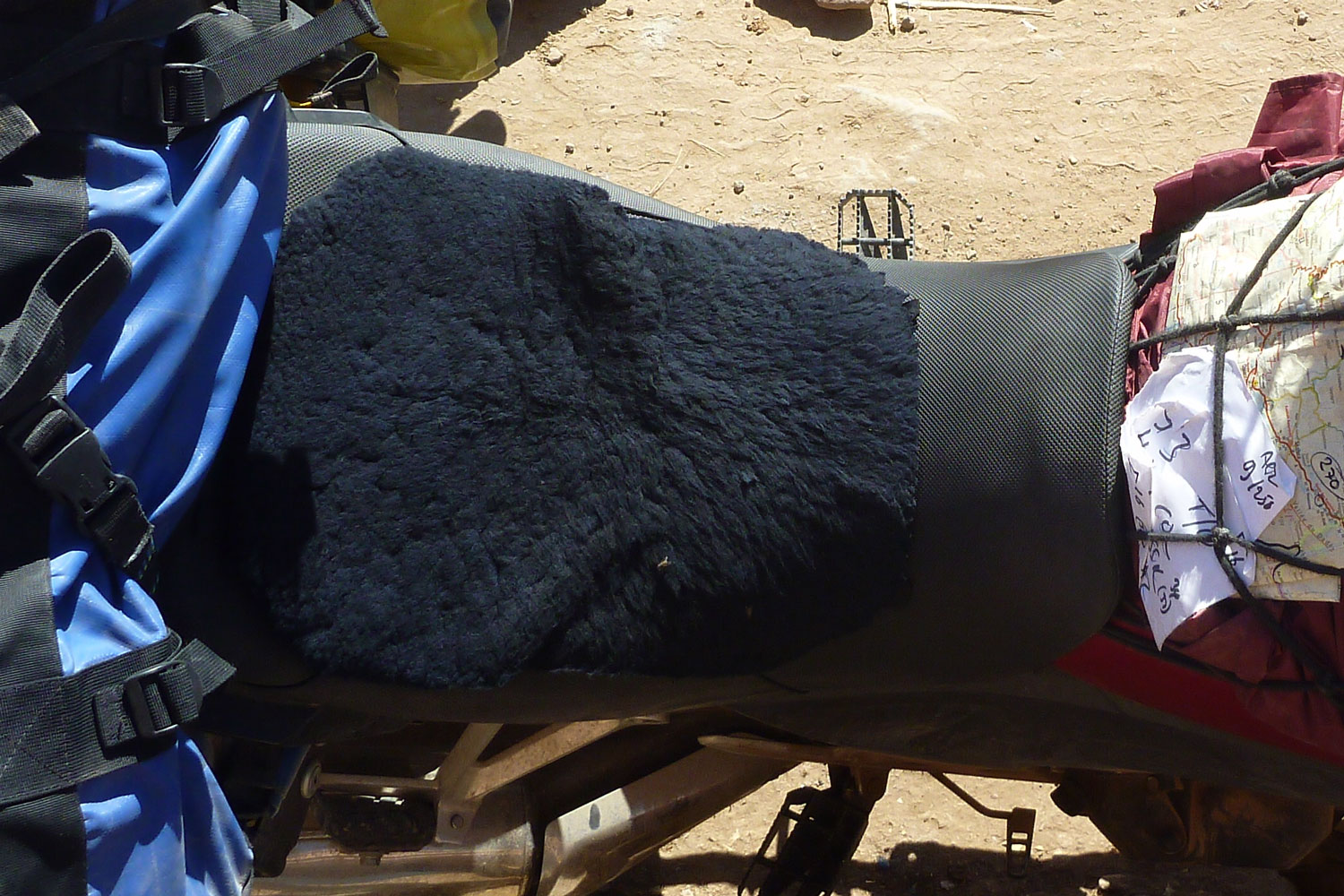
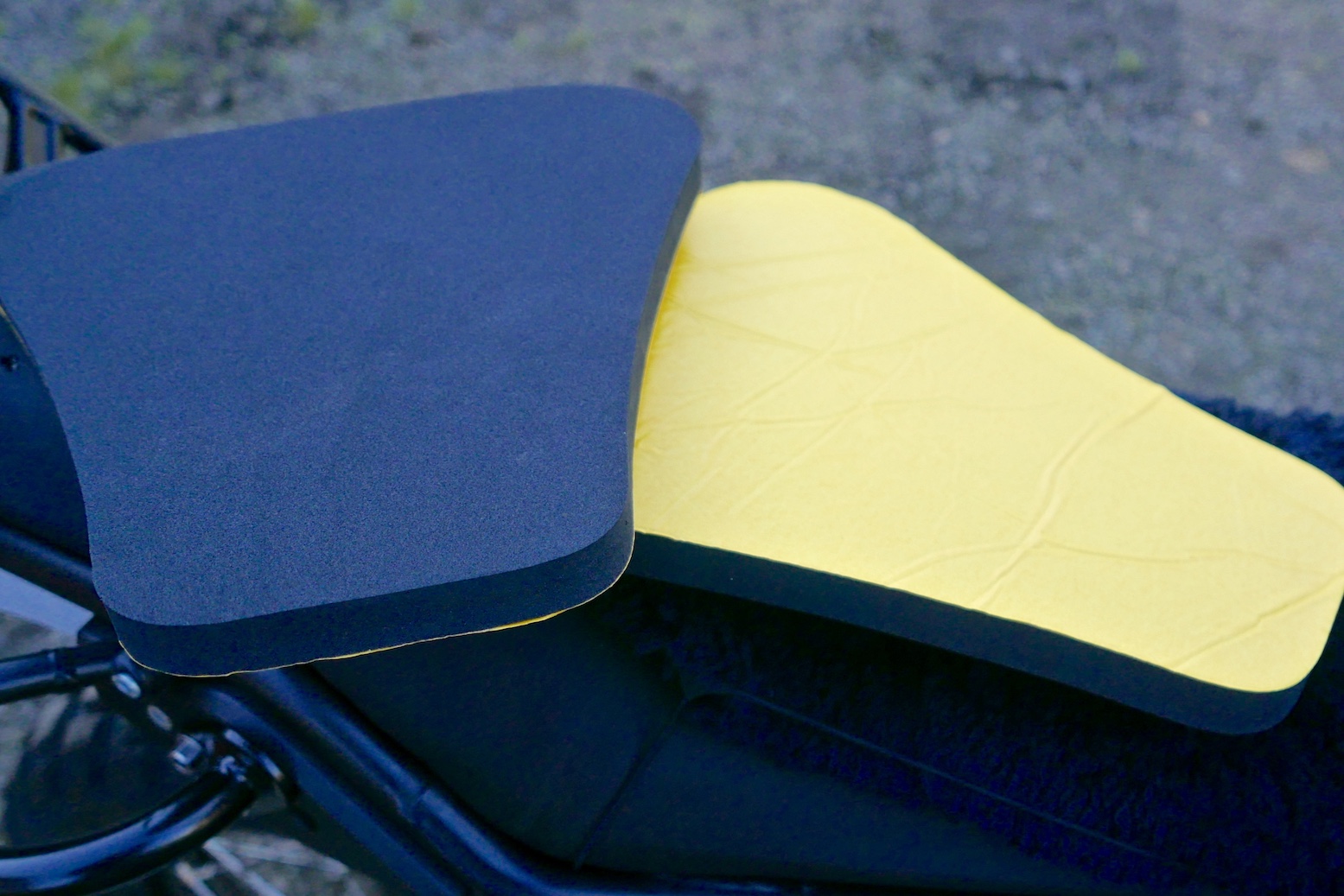
As a back up I’d packed my padded lycra cycling shorts which they say can improve moto saddle comfort, but first I pulled out one of two slabs of 20mm rubber foam (neoprene) last used on my Himalayan, and sat on it for the two-hour ride back to Ragley Hall. The anterior agony slowly subsided but the bare rubber was too grippy so I slid around inside my loose trousers which wasn’t so comfy either. Plus I couldn’t up stand to aire mon derriere as the pad would’ve blown away.
I rolled up to the Bridgestone tent with 10 minutes to spare and did my chat with Simon & Lisa (left), but apart from the fact that it was another lovely mid-summer’s evening, I wasn’t looking forward to the four-hour ride back home. So I decided to do something about it and set about shoving the foam pad underneath the Cool Cover. If it worked well I’d trim it all properly later.
It made me wonder do you want a grippy seat surface or not? I do notice grippy seat covers for trail bikes on ebay. It must be related to riding – active off-roading or low-energy road touring plus what you’re wearing too; how close a fit and the fabric’s own grippiness. With my baggy cotton cargo pants, the Cool Cover is slippery which can cause friction, but sat directly on the neoprene pad back from Wales, the grip was massive and I slide around inside my trousers which was as bad. I do seem to recall leather trousers which I wore for years helped prolong comfort, whether down to good grip on seat vinyl or the close fit.
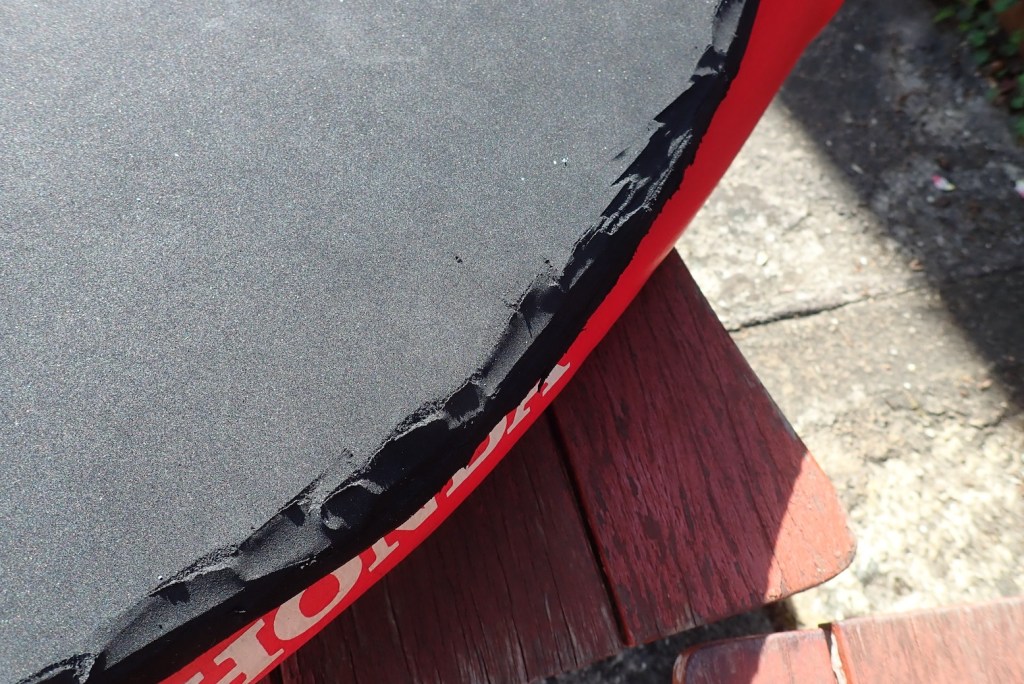
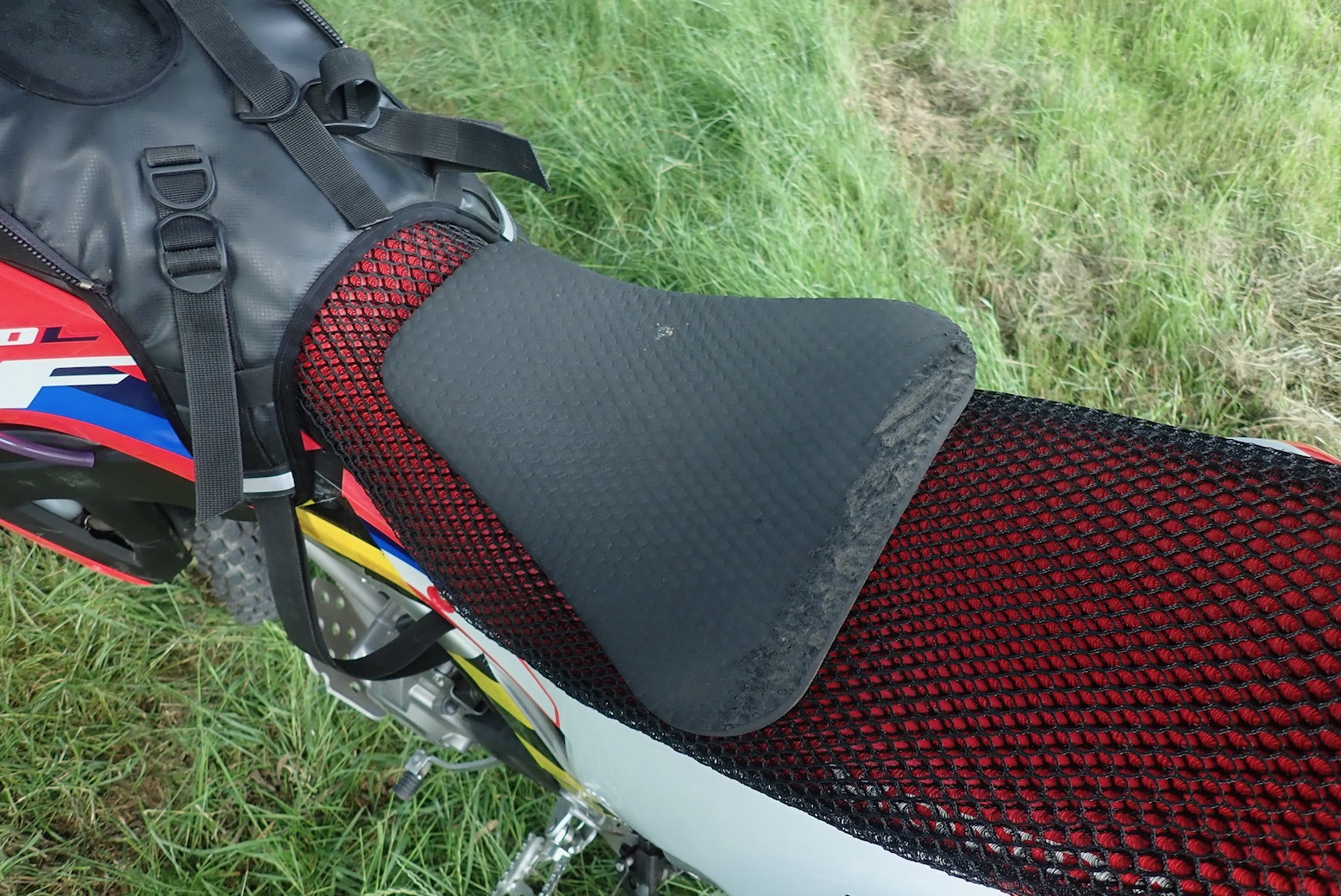
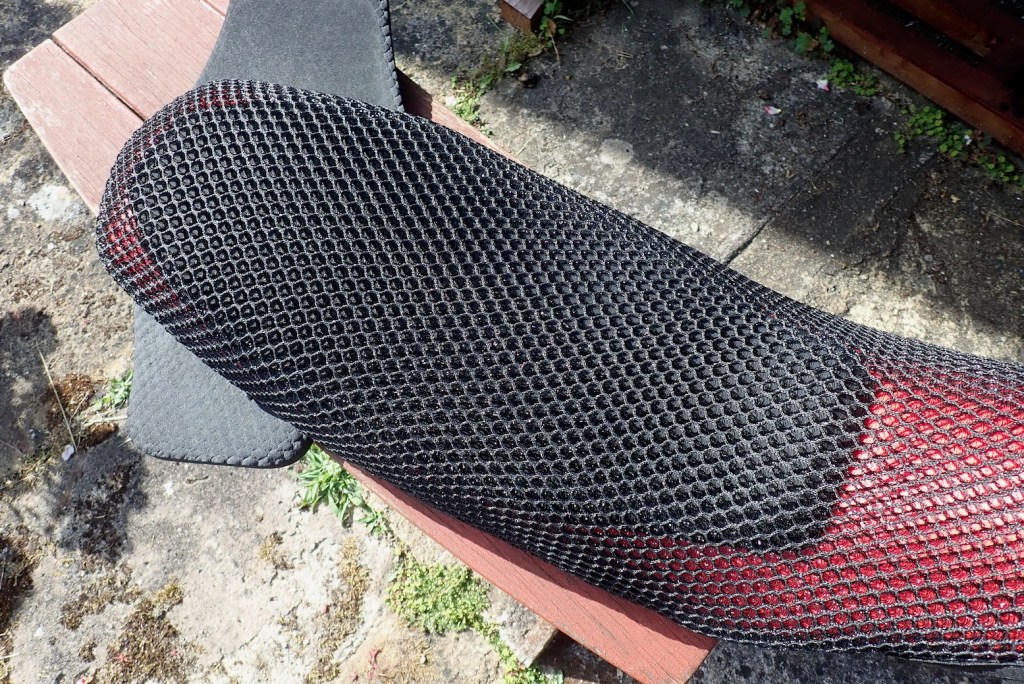
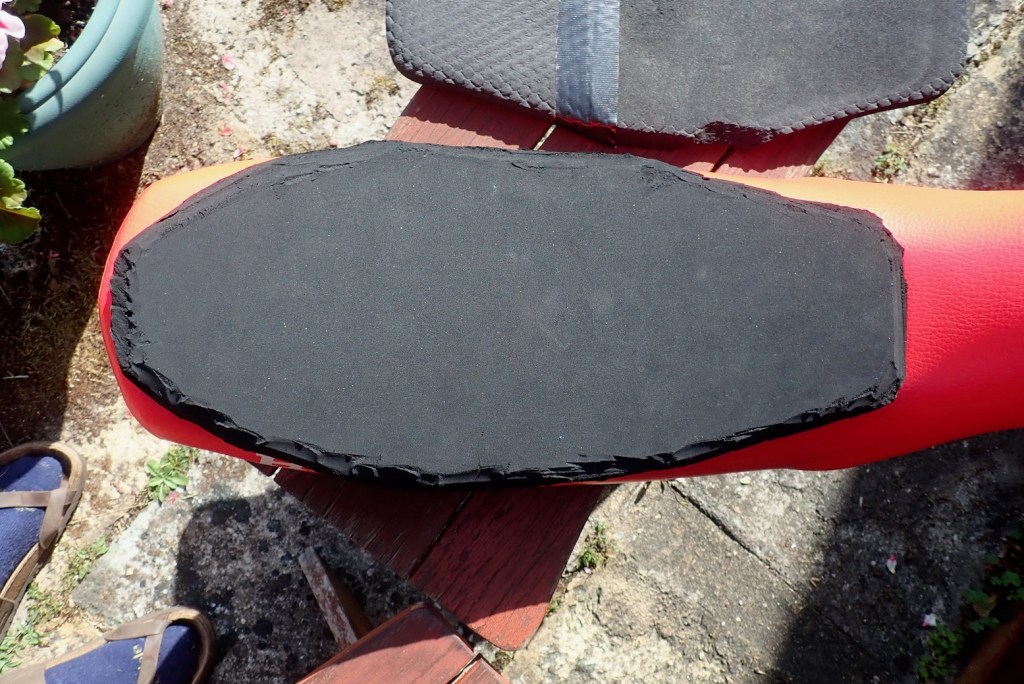
Heading home with the neoprene underneath the Cover, the saddle was levelled off and I slid about less on deceleration. It was all round a big improved on the sore morning’s ride and a few days after I got home I trimmed the two pieces of foam to fit the 300L’s seat, glued them together and fitted them under the Cool Cover. The seat is now about 35″ (890mm), 14mm more than before (half being the airy Cool Cover mesh) but a whole lot more comfortable. See more bottom of the page.
Other comfort matters
Leaving Morocco in March, I retired my old X-Lite X551 after ten years. The vent never worked well (wrong angles for upright trail bikes), the sun-visor lever fell off years ago and after multiple removal and washing, the lining was coming adrift.
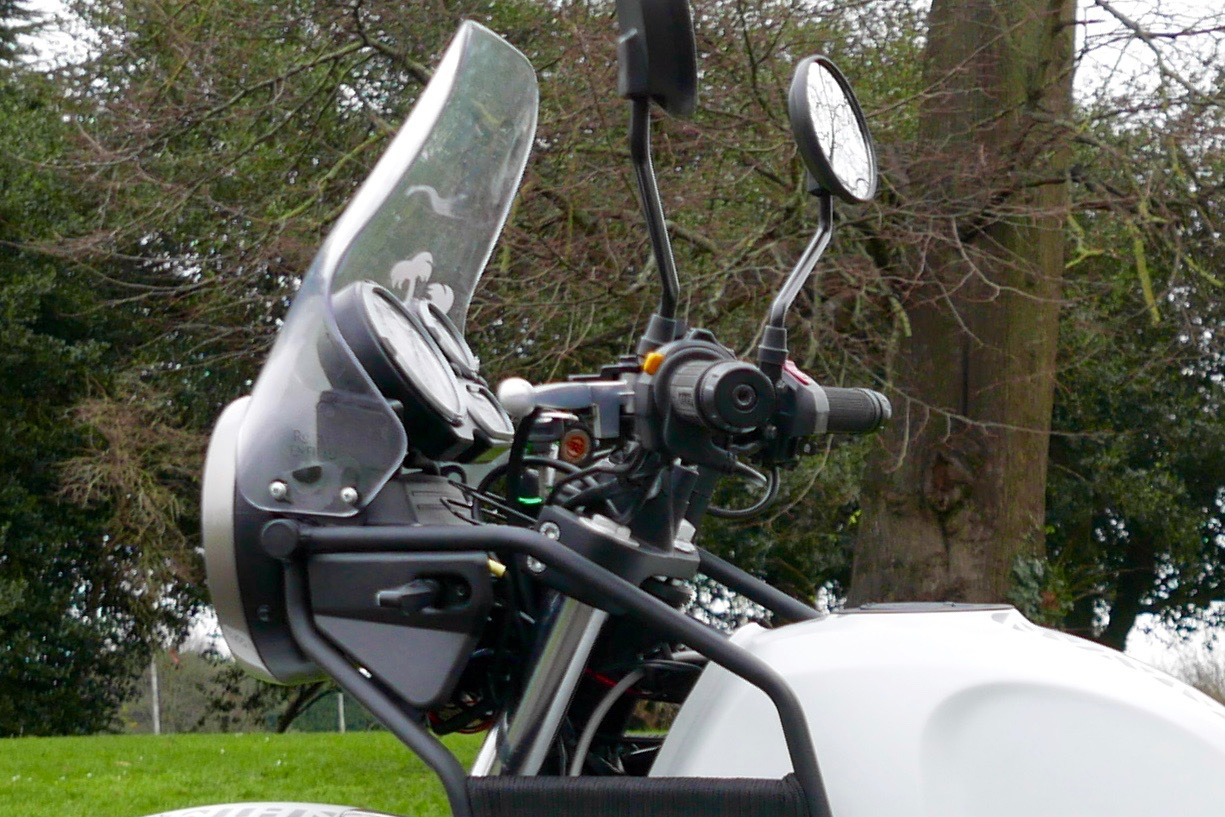
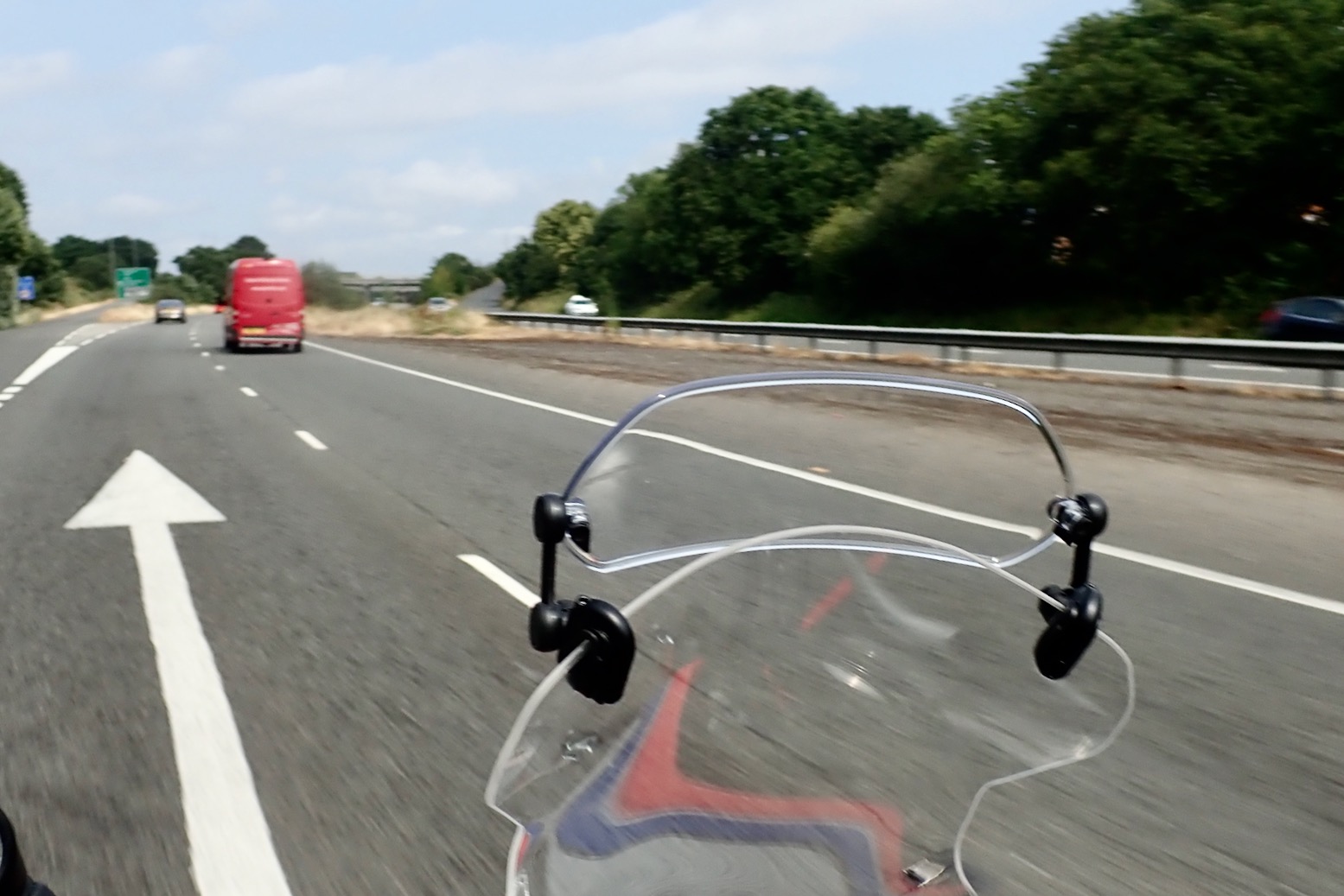
But I’m a longtime big fan of this type of lid so got myself an HJC i30 for about £110. Grey comes shiney not matt as implied online but so far so good. It fits snugly with quick-clip chinstrap, the sun visor lever is much easier to operate and the top air vent is more effective. It remains to be seen how long the lining fittings will last after regular washing. But the HJC not quiet or, to be precise, I’m a bit too tall for the 300L’s unadjustable screen and the buffeting makes a racket, even with earplugs. Crouching down puts me out of the turbulence but is unsustainable.
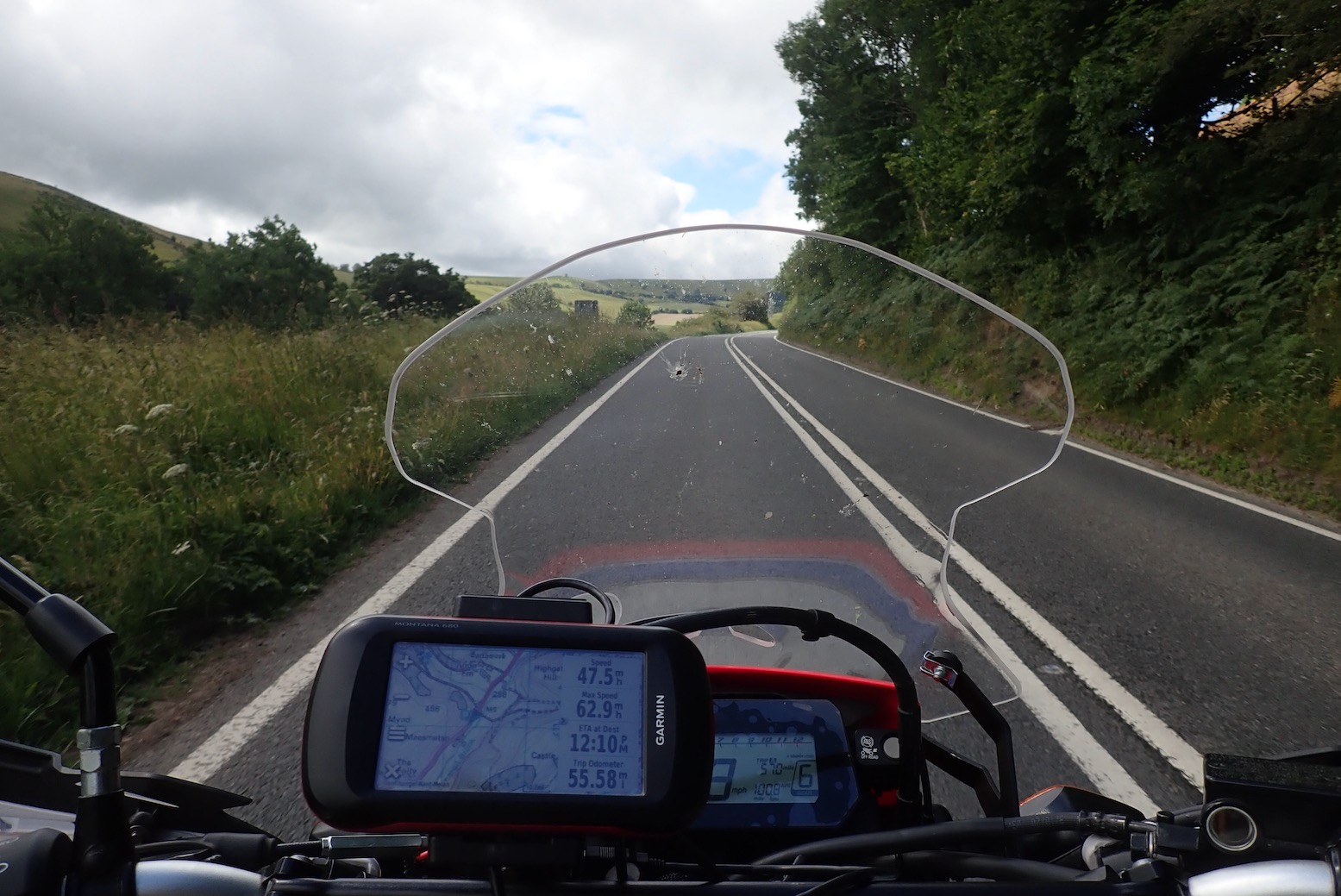
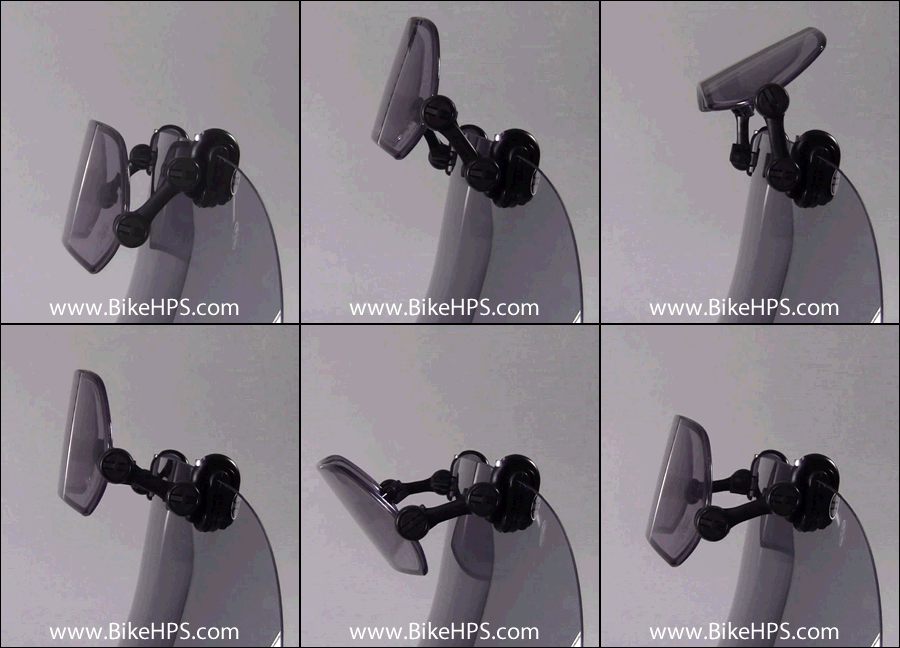
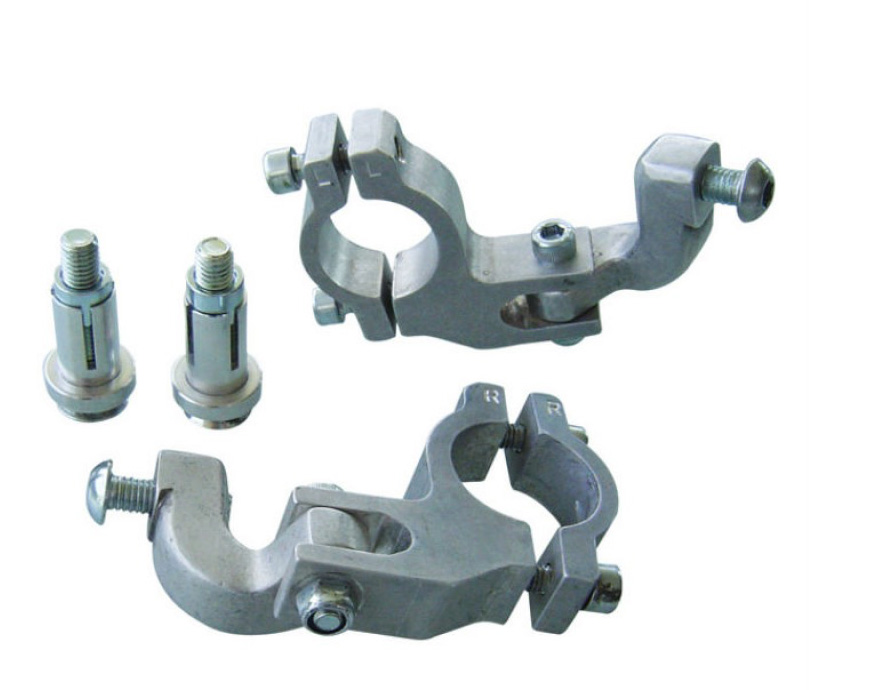
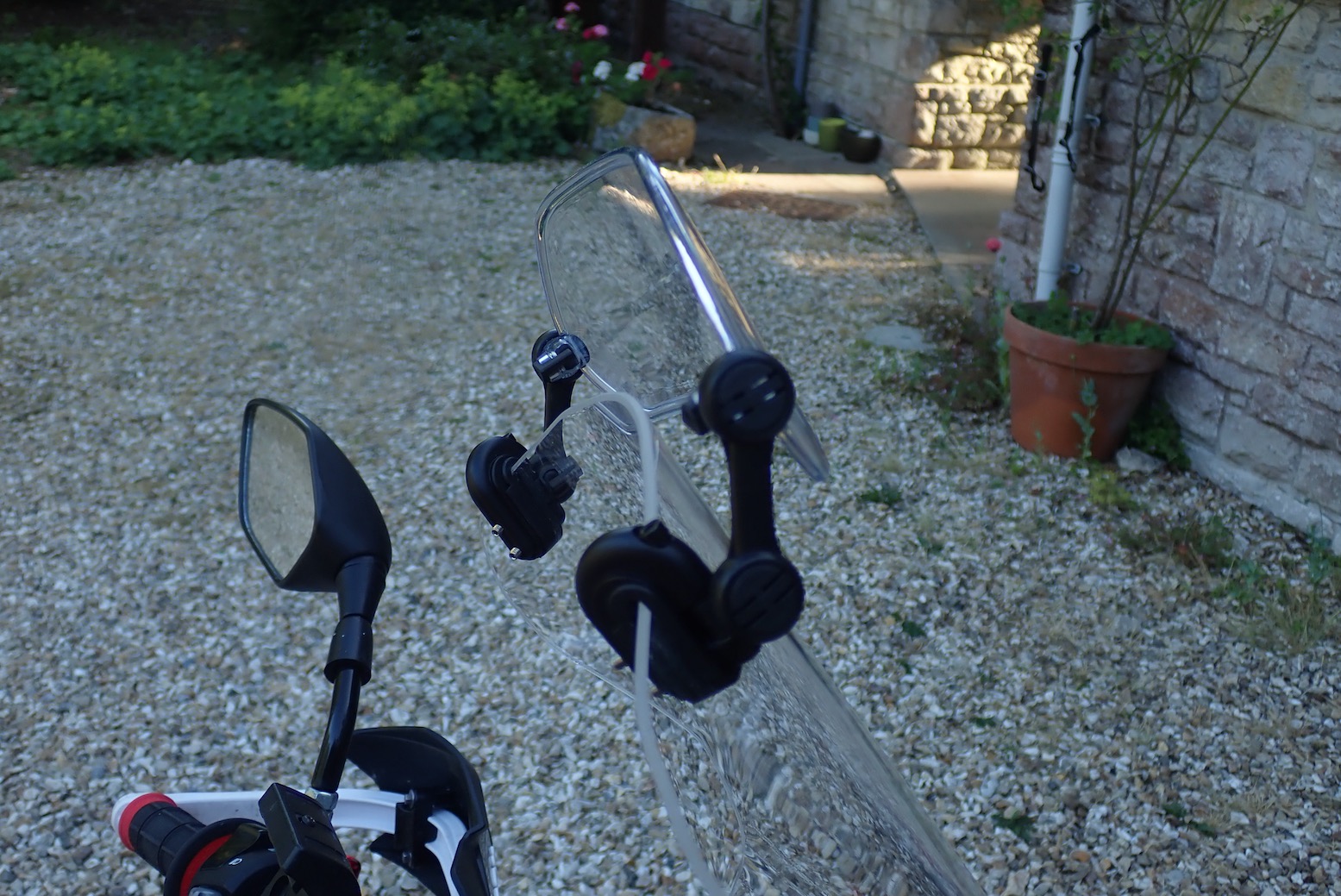
Back home I remembered I bought myself an MRA XCreen adjustable draught deflector (left) for the Him but ended up not needing it.
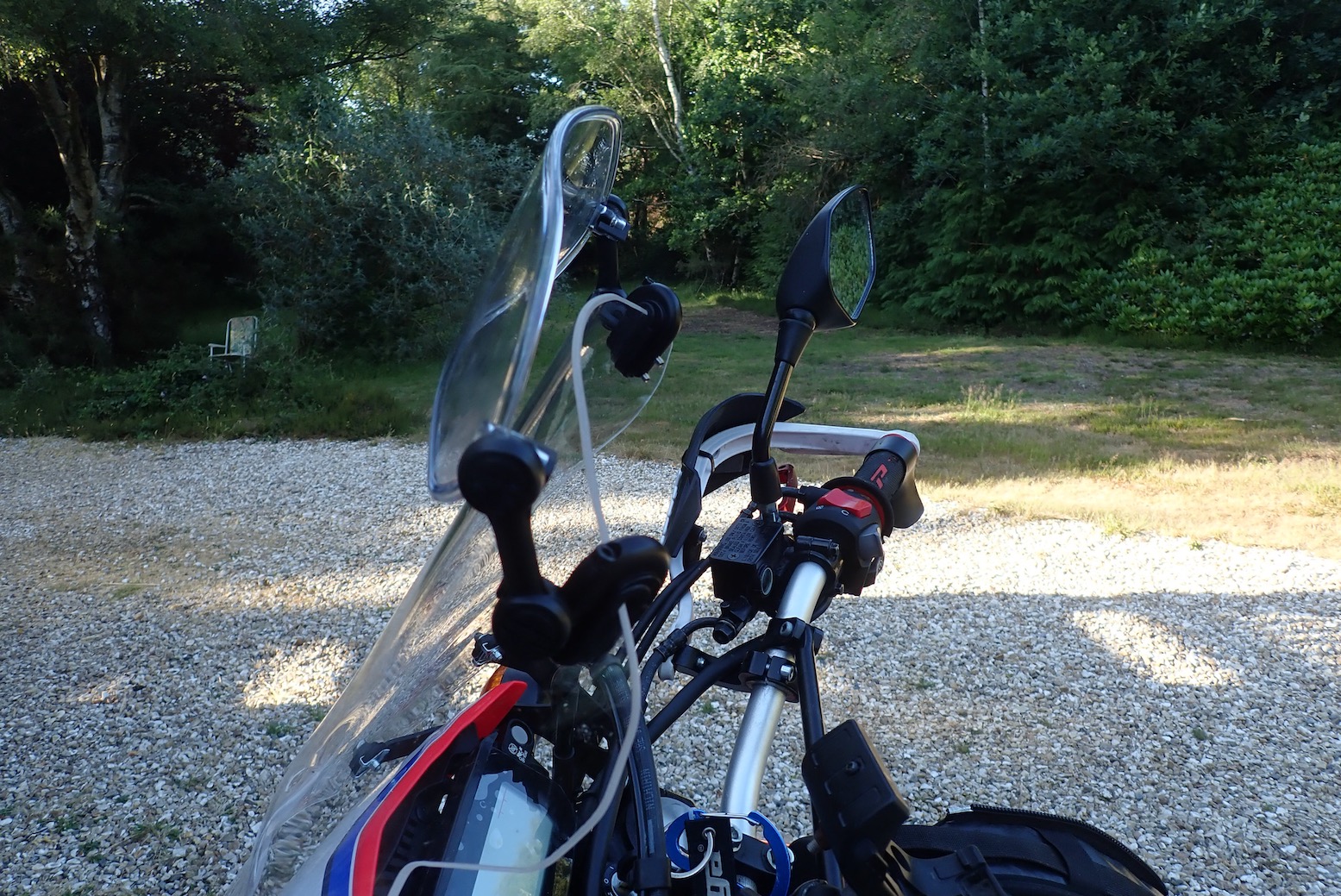
I dug it out, made sense of the instructions and decided to clamp it to the screen with a view to drilling and bolting it on if it proved effective or necessary (you get both options in the mounting kit). Articulated arms on adjustable splines lock it in position so you can set the optimal angle at a standstill. It looks like it ought to work funneling air up and over my head and looks better than the simple spoiler Touratech still sell and which I tried on my XT660Z 15 years ago. You can view my meticulously annoted Mileage Diaries here.
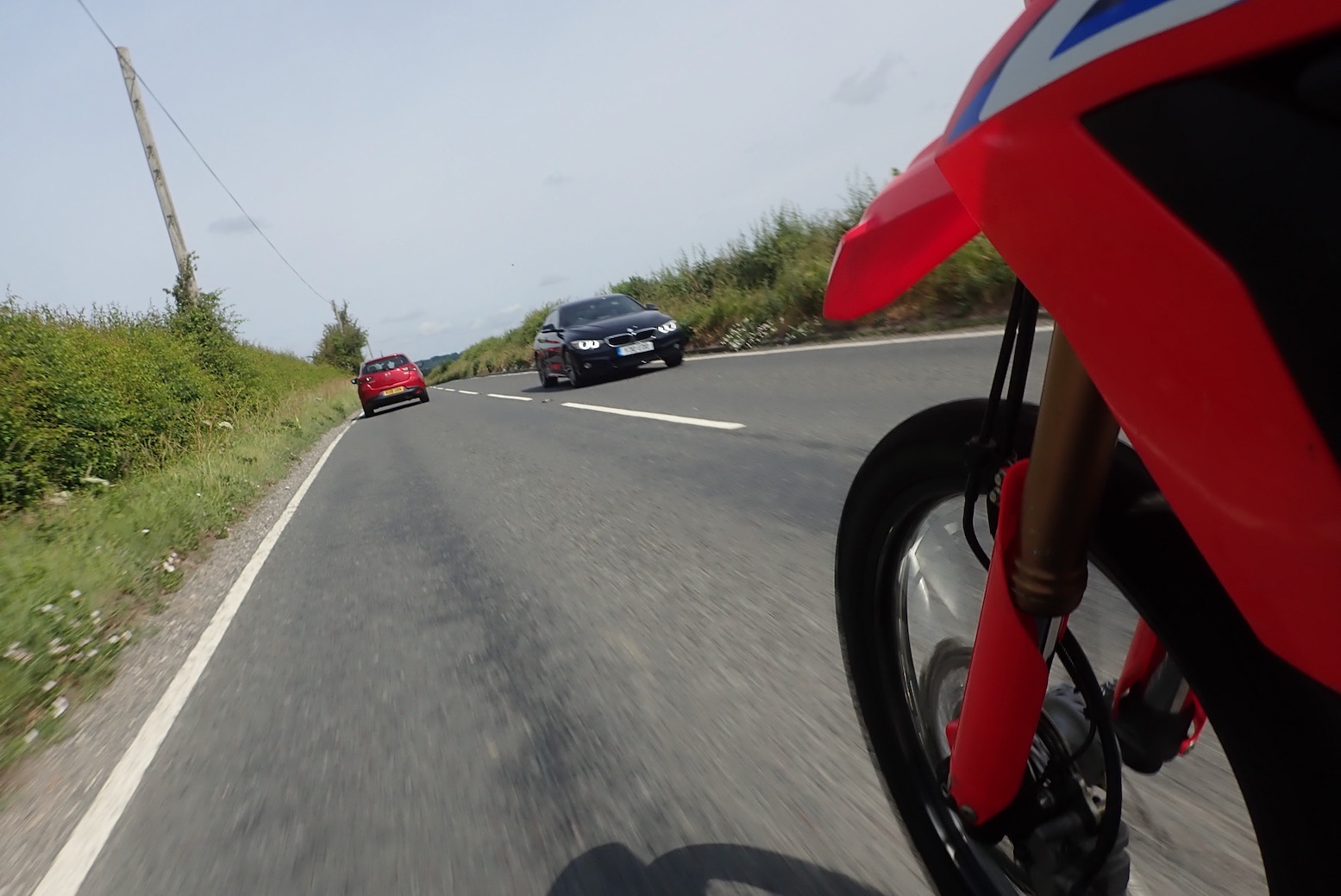
Other than that the ride back with just a refuel break was great. The pad under the Cool Cover soothed the posterior on what ended up being 500 miles of two-lane blacktop over two days. On a bigger bike I don’t think I’d have been that much quicker on these types of roads without lots of speeding and other risks.
I never rode my 300L stock but the Rally Raid suspension definitely keeps the bike in shape darting around roundabouts. I got in about 9pm, visor and screen thick with bug splatter but still with energy to pre-wash the bike with Muck-Off and lube the chain while it was warm. It all bodes well for the long ride to Morocco later in the year.
True mpg
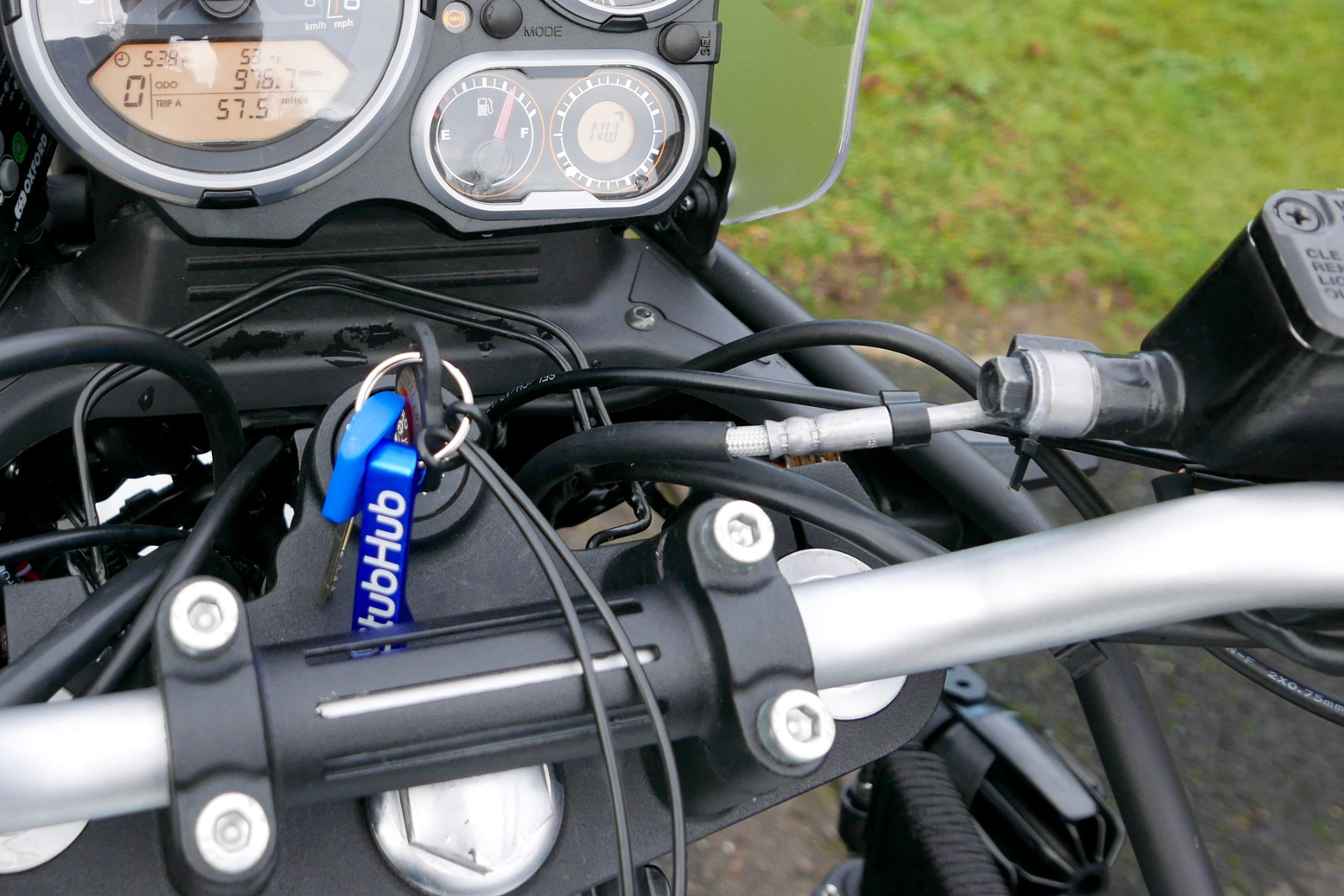
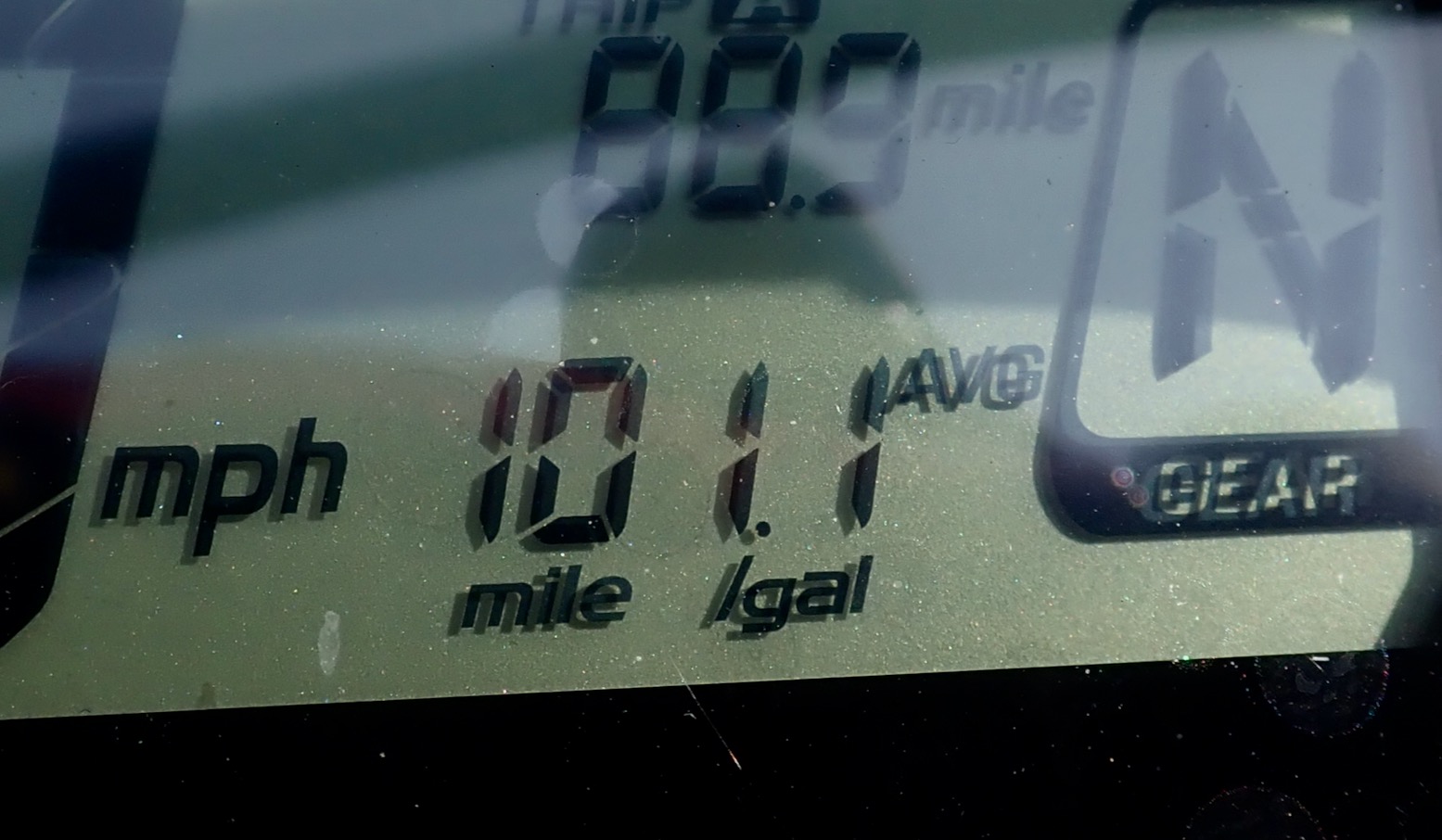
The 300L has one of those handy average fuel consumption displays and my ride up to ABR saw it settle at 102mpg as I rode through the gate. Pretty good but this is an estimate. For the true mpg I evaluated the bike’s odometer error off the GPS over 200 miles. Result: the bike indicated 205.6 miles over a GPS recorded distance of 200 miles. Not bad but 2.5% over.
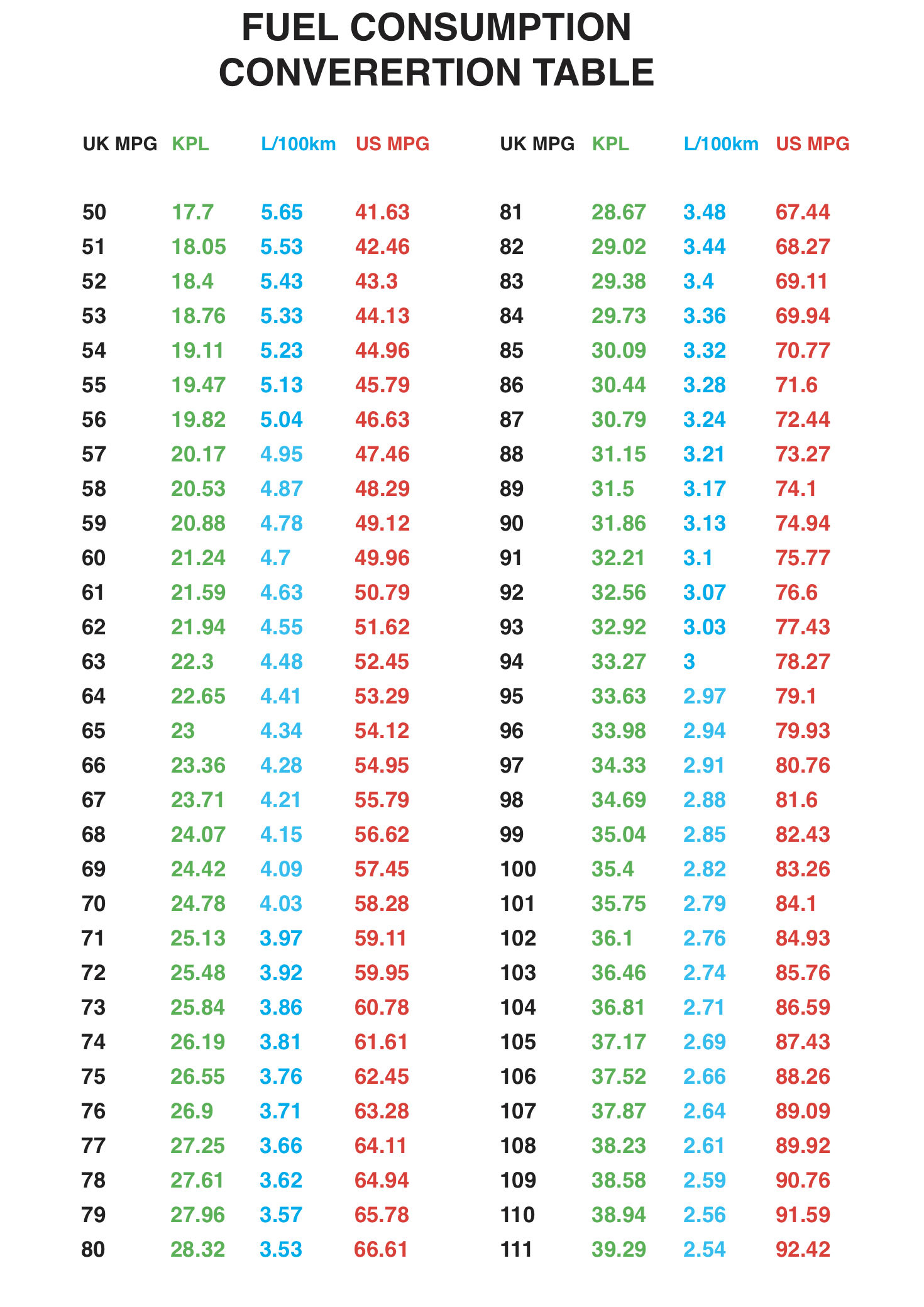
Somewhere on the ride up I topped up with 11.8 litres over a corrected (true) 221 miles. That’s 355km which divided by 11.8 = 30.1 kpl or only 85.5mpg (see table on the left) – over 15% out. On the bright side the two litres left in the 13.8-L Acerbis tank meant another potential 60km which gives a possible range of well over 400km. That will do nicely, whatever the mpg is. It sure is great not having to think about fuel twice a day.
The next fill up on the way home included the rushed ride back from Wales with the display now indicating ’91mpg’. I put in 11 litres over a true 217 miles, which is 350km. That was 31.8kpl or 90mpg. A lot more accurate and oddly, a big improvement on the slow ride up, despite the faster pace. I suppose a full tank’s worth at steady pace may have helped, or could the bike’s computer be ‘learning’, as I’ve read they can do? We shall see but I am still hoping to get a true 100mpg one day.
Update:
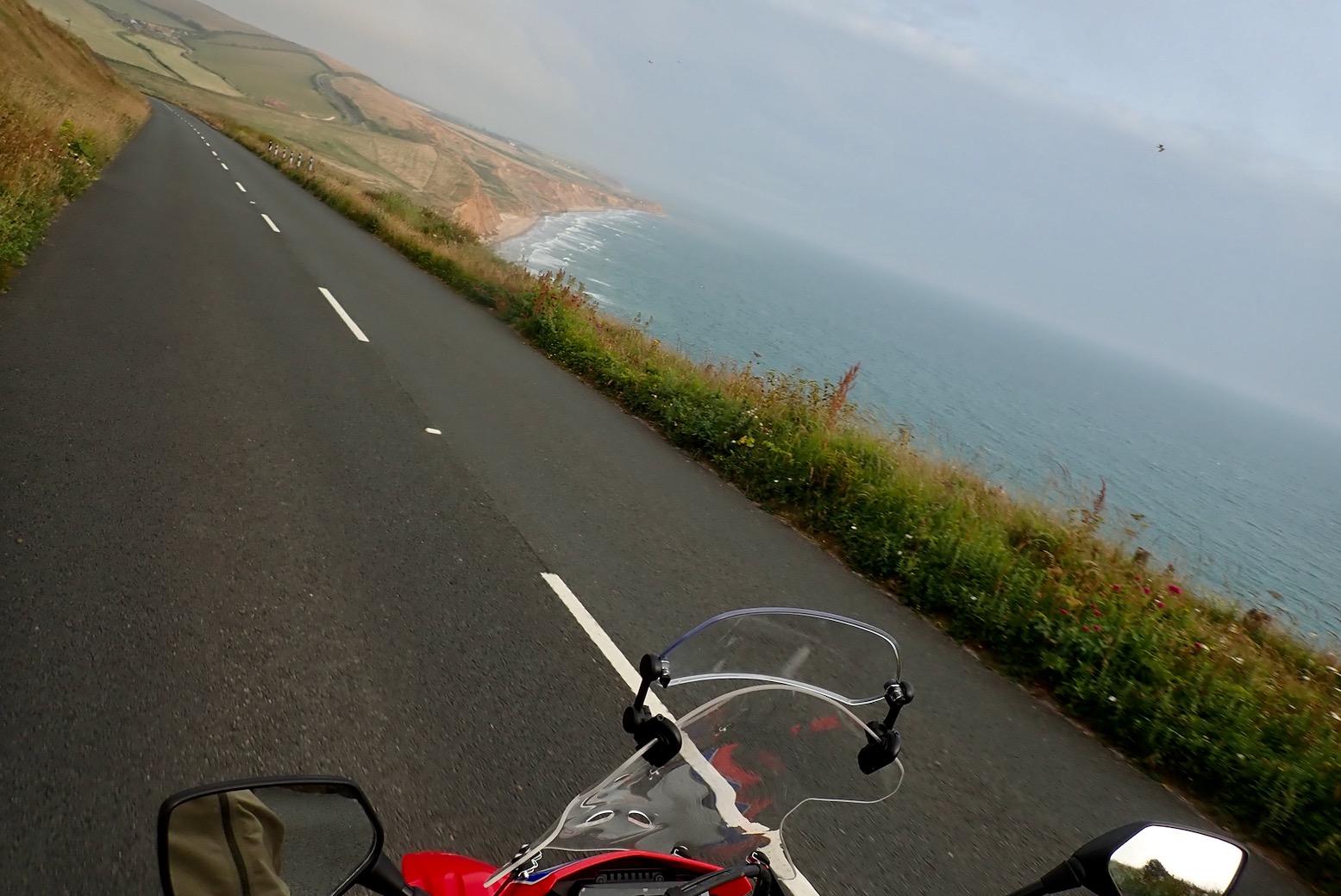
I set off to the Isle of Wight a few days later with the seat padded to full length and the MRA fitted. I soon noticed I was not dropping my helmet visor as soon as possible. With a guesstimated angle set at my eye level the MRA was working just right, shoving the windrush over my head, not into my face. Now all I heard was muted tyre and engine noise instead of wind and a steady 60 was much more tolerable.
Join not good

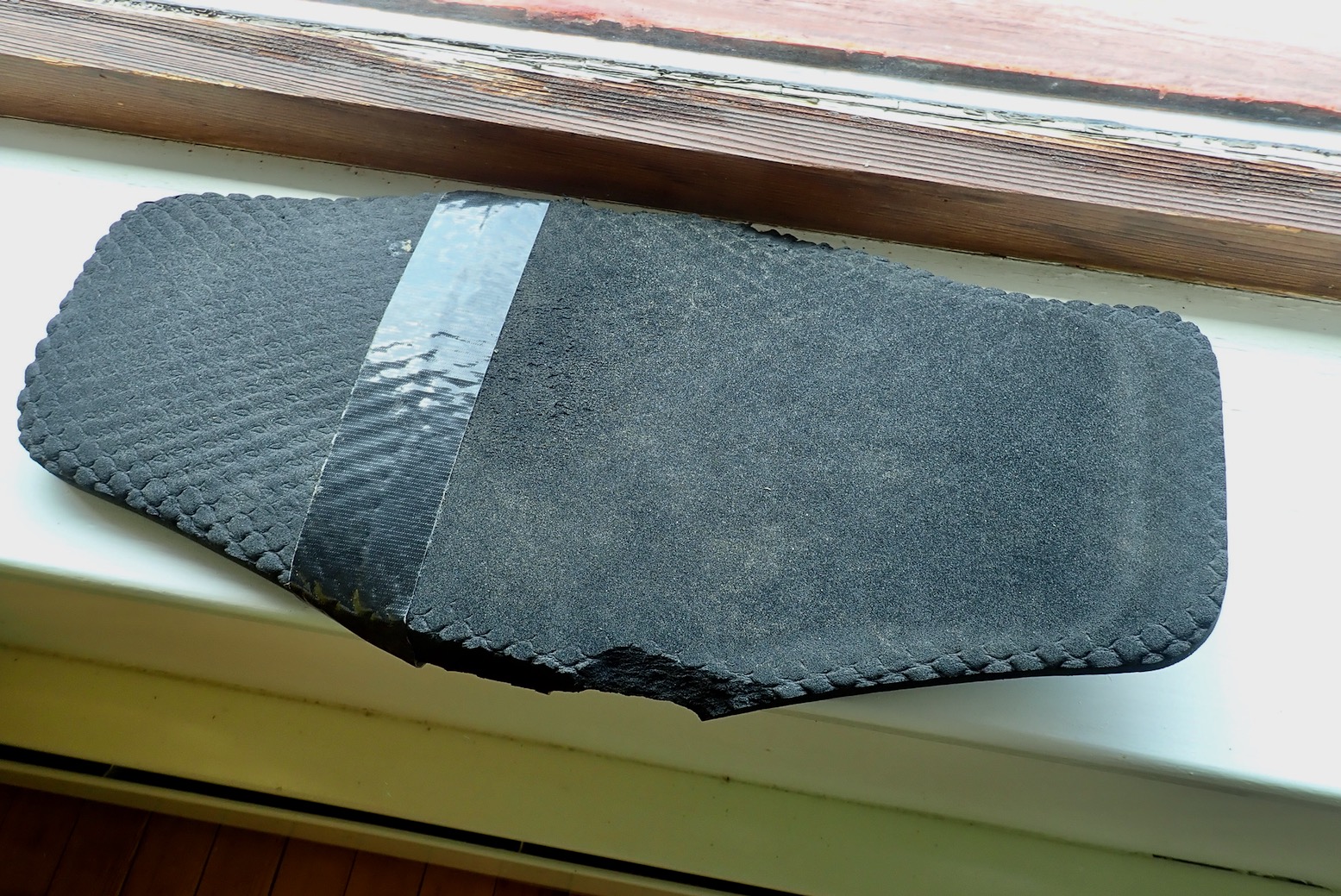
But fix one thing and another flaw becomes more apparent. My glued up join between the two bits of old neoprene was noticeable. Can’t be having that. I have time so may as well spend it trying to get it right.
I replaced it with a single piece of 20mm neoprene: a 250mm x 500 slab was 20 quid. Note, even with a sharp knife or scalpel it’s hard to get a smooth cut. Scissors are better, but anyway the grubby edges are hidden under the Cool Cover.
Adventurising the RE Himalayan

Himalayan Index Page
himalio

For what you pay and compared to vaguely similar bikes, Royal Enfield’s 2018 BS4 Himalayan comes very well equipped: centre stand; small tail rack plus tank sideracks; small screen; 15-litre tank giving a 400-km range; a small bashplate plus suspension that need not be instantly written off.
Most of those items won’t need improving, but when did that ever stop anyone? Below, I throw out some ideas to help turn the Himalayan into a functional overlander. As with all my project bikes dating right back to the XT500 of 1982, I like to experiment with new stuff and new ways of doing things, much like Enfield’s Himalayan itself.
It’s all part of the adventure and if nothing else, it’s good for the book.

MT60

Wheels & Tyres
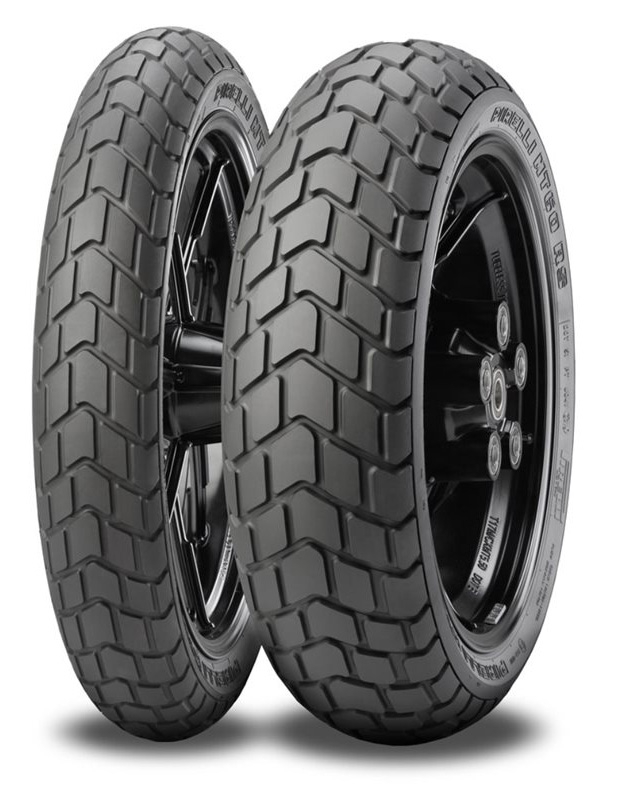
Out of the showroom REH’s come shod with Brazilian Pirelli MT60s (right; mine stamped ‘2012’…). The spoked rims are steel: 21 front, 17 on the back. The Pirellis would have been OK for a regular Moroccan ride, but because I’ll be heading into the sands this time, tread becomes a little more critical. Below, some tyres of interestMotoz Tractionator Adventure; Anlas Capra X and Michelin Anakee Wild.

himtyre
unsprungweight
him-17-18
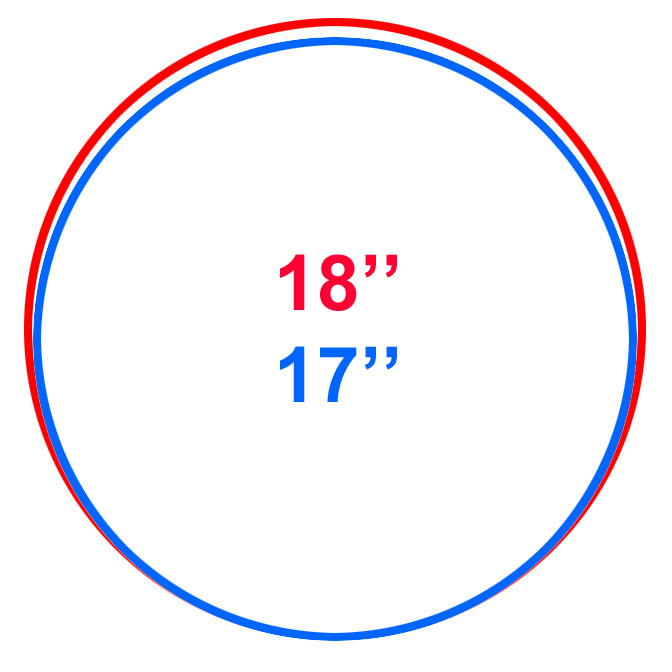
Confirmed: 17 is smaller than 18!
him-swingspace

One thing I’ve quickly discovered is that none of the above tyres come in the stock 120/90 17 size. The only similar tyre I know of is Mitas’ E-09 which I tried on the XR400 in Algeria; a great desert tyre. Generally 17s tend to be low profile tubeless-ready adventure tyres suited to bigger, more powerful machines, and 18s are for traditional dirt bikes with taller profiles giving more sidewall ‘suspension’ or ‘footprint’ at low pressures. The above trio come no smaller than 130/80 17. There’s probably only a few mil in it, but I’d rather not go overboard with a ‘bigger-must-be-better’ rear tyre. Too much rubber to rotate will make the Him even more sluggish.
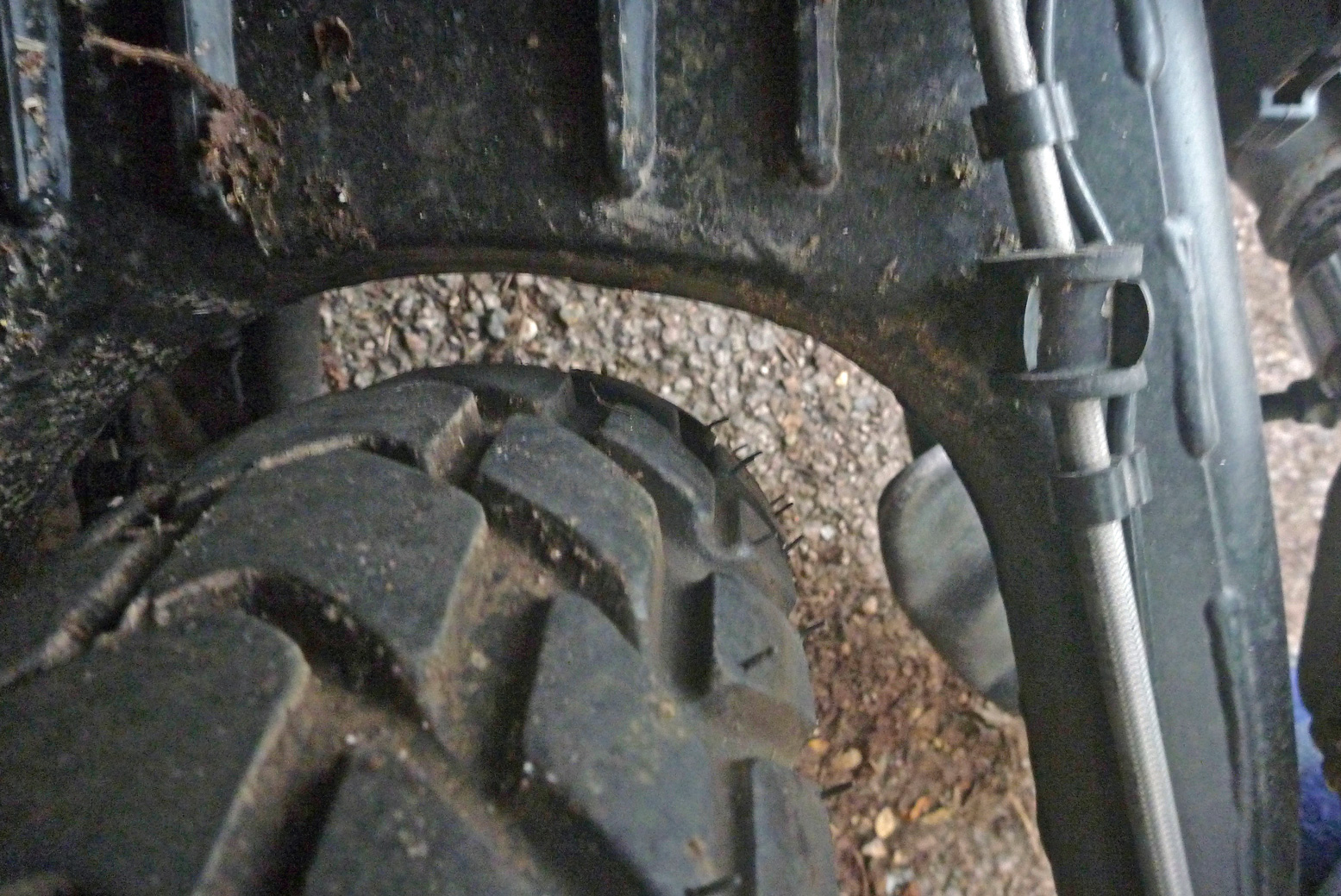
Swingarm space with the stock MT60s (left) shows plenty of room to the sides but about an inch at the front, so for a replacement, actual dimensions may matter. The MT60 is 122mm wide and currently 93mm high from the edge of the rim. The swingarm gap will increase a little as the tyre wears and the chain stretches. Ratio-wise, 120 x 90% technically = 108mm tyre height, while 130 x 80% = only 104mm, so a 130 ought to have a lower profile or height. So even a 10mm wider 130/80 17 tyre will easily fit the Himalayan. Interestingly, an Anakee Wild 130/80-17 M/C 65R TL weighs nearly 50% more than a Wild in 120/80-18 M/C 62S TT (5kg) because the former is tubeless and aimed at heavier 17-rear bikes. An  Anlas CapraX 130/80 B17 weighs 6.1kg. Motoz don’t know yet.
Fitting an 18-inch rim might expand tyre choice at the slim 120/90-ish end. But with half an inch more radius in the rim, taller 18s could become a squeeze against the front of the swingarm unless a chain link is added to move the wheel back a bit.
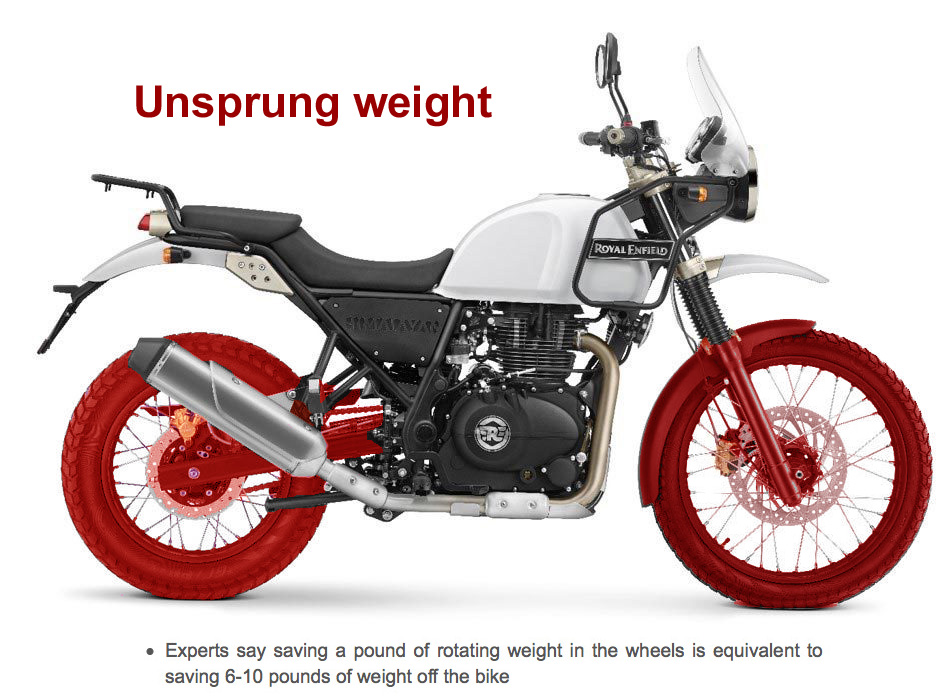
An additional incentive to move to an 18 is a chance to replace the stock steel rim with an alloy rim which will be a bit lighter. Suspension and steering, as well as acceleration/braking all react more readily if the unsprung weight red, below – is kept to a minimum.

I read on the internet that the effects of unsprung weight includes the rotational mass of the gyroscoping wheel, plus – at non-rallying speeds – the less critical up-and-down mass the suspension has to control (image below). Additional unsprung weight takes more power to turn that mass, more brakes to slow it and better suspension to control it. This mass can be reduced by carefully considering tyre weight, not just the size, tread and price, going tubeless (eliminating heavy-duty inner tubes), as well as lighter rims, chain, rear sprocket materials; forks/swing arms and braking components.
I’ve always thought this is a much overlooked area of weight saving on bikes, where changing a pipe is often used as an excuse to save weight. I remember the alloy front wheel on my XT660Z weighed a ton, partly because of the OTT twin discs when one good disc was all that was needed. Cheap stuff can be heavy, even in alloy.
The image below illustrates how much greater the reaction forces are with heavier wheels. Put another way, it’s why your trainers weigh only 320g. ‘Add lightness’ as the old racing adage goes.

him-unsprsus
Unsprung durch Technik
tubliss-section

And if I’m messing about with rims it would be a shame not to go tubeless, for all the usual reasons. See the link, but basically it’s: DIY mastic as on my 660 Tenere, Outex tape (~£70, never tried), BARTubeless (~£320, as on the 500X RR) and Tubliss (~£180 a pair; as on my GS500R), or a suitable rim (rare/expensive).
If I go to an 18 I’m thinking of giving the 2nd generation Tubliss (right) another go as it’s an easy and inexpensive fit, but they only come in 21, 19 and 18 inch, not 17.

Is this all going a bit far with a humble Himalayan, or making the most of its potential? Will I or the bike notice the difference of a lighter wheelset, once all the other junk is added? Unfortunately I don’t have enough time to get a solid riding impression of the stock bike before setting off.

him-tankrak

Load Carrying
One of the REH’s distinctive features are the tank racks which some mistake for tank protectors. They’ll do that too but to me they’re clearly a handy place to lash items or bags. The previous owner had a similar set-up using Kriega drypacks and helpfully wrapped the Royal Enfield badge in string to stop it getting worn away.

rigg
Lomobags

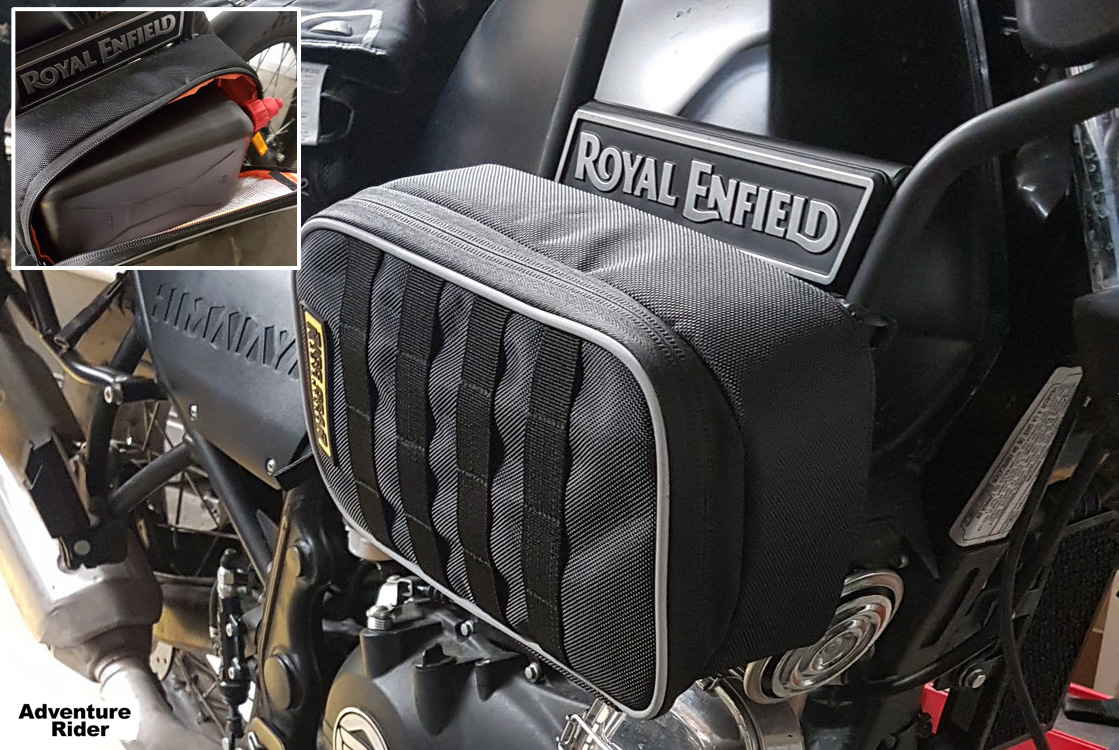
Kriega is one way of doing it, so is Lomo who’ve sent me a pair of their PVC roll-top crash bar dry bags to try (£39 pair). At around 6 litres each they look ideally suited to the racks. I plan to mount them semi-permanently and will use Lomo’s same-sized orange ultralight dry bags (£3) to lift everything out easily when lodging. In the US the more boxy, 3L Rigg fender bags (right) look like a neat fit too.

Then, once I zip on my Giant Loop tank bag, most of my daytime needs will be in view and at arm’s reach, meaning what’s behind can be left strapped in place. It may even mean I can do without a daypack on my back, plus the crash bags will keep the wind and rain off my creaking knees.

him-rak

For the back an Enfield pannier rack is has just turned from India for under 80 quid. Looks like a hefty set up – it weighs over 5kg. You’ll find them sold on ebay, or at twice the price from UK sellers. I’ve not decided what bags I’ll use on the side. At the simplest I can just lash on a couple of rugged PVC dry bags, as I did with the Rally Raid 500X a couple of years back.

him-tail

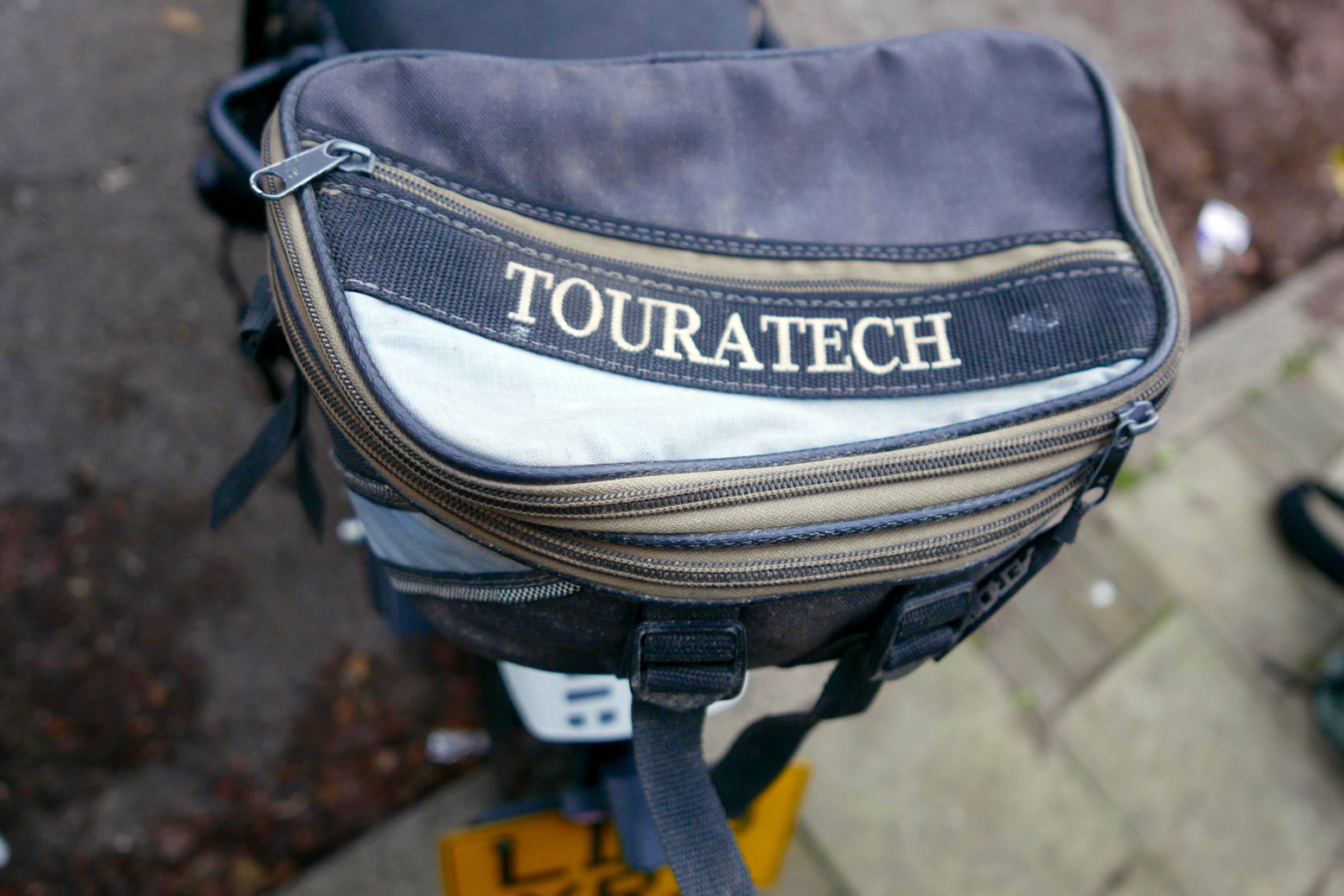
And right at the back the narrow tail rack has taken my long-suffering Touratech tail bag – one of my all-time travel luggage favourites.
Having all these bags spread around the bike is handy for access, compartmentalisation and weight distribution but at, quite literally, the end of a day, it does mean more faffing about to get it all indoors when the parking is less than secure.

barkbt06

Comfort: handlebars; screen; saddle
The bike came with Oxford heated grips – luvlay juvlay. My old Barkbuster Storms will also get their nth outing on an AMW project bike, but it looks like they’ll require BTC 06 curved adaptor clamps (right) to get under the brake lines and so on (they didn’t fit).

him-bars

Talking of which, with this ABS model (brake line goes under tank to the pump, not straight down to the wheel) I’m not sure there’s enough slack to get much more than an inch of lift on the bars, which means my 50mm Rox Risers may have to sit this one out (they didn’t). Non-ABS Hims ought not have this problem. As it is the stoop for me isn’t too bad and the general position is of course much better than the XSR. I only tend to stand when I must, but that’s partly because I rarely ride a bike where prolonged standing off road is comfortable. One way to dodge the stoop is to lower my height by removing footpeg rubbers. Wearing very thin socks also helps. Fyi: ABS switch hack.

him-screen
mra_x-creen_sport_xcsa_spoiler_animation

The screen is better than nothing and has a tiny bit of fore and aft adjustment. It’ll be all that’s needed off-road; less so for a long cross-country ride. You can get those clip-  or bolt-on deflectors like the adjustable MRA Xcreen (below right) which I had on a recent Tiger (we don’t talk about that bike) and which worked well for what it was. Or Hitchcocks Enfield specialists do a taller version, but only by 60cm. Changing a fixed screen is a gamble while others have found chopping it right down greatly reduces buffeting. Much depends on your helmet, height and attitude to discomfort. You’ll never get it right all the time and it’s all part of the biking experience, so unless you know what works for you, by far the best screen is something adjustable like the Xcreen or the Palmer I had on the CB-X.

aerosheepad
coolcover

It doesn’t feel like the seat will sustain my post Xmas mass, sprung or otherwise, for more than an hour or two. Nothing new there.
I’m getting a mesh Cool Cover to test. One good thing with fitted covers like this, as opposed to airbag seat bags, is that you can securely stuff added padding underneath without having to do a reupholstery job. I’ve got an old Aerostich lambs wool seatpad (left) which used alone may have had its day, but under the Cool Cover may add a bit more cushioning. One good thing on the REH is the two-part seat; it makes any foam-hacking job a bit less terminal.

Suspension
I’ve often wondered how much more it costs in time and money to make stock suspension which works out of the crate. There must be no shortage of data and algorithms, so maybe it’s the time in fine tuning an individual model where the costs pile up. We’re so used to regular bikes coming with great engines which can sing and dance in four time zones, but have adequate suspension which presumably is expected to work for most riders at moderate speeds. Crank up the speed or reduce the surface quality and composure soon slips away as suspension travel gets eaten up, as I found on my CB500X and XSR700. But on my BMW XCountry I discovered what decent suspension actually meant: not that obvious on road, but a whole new world of control as dirt turns gnarly. Problem is that’ll be no change from €1000 and trip to Holland, please.

him-shock
yss himalayan
hypershock

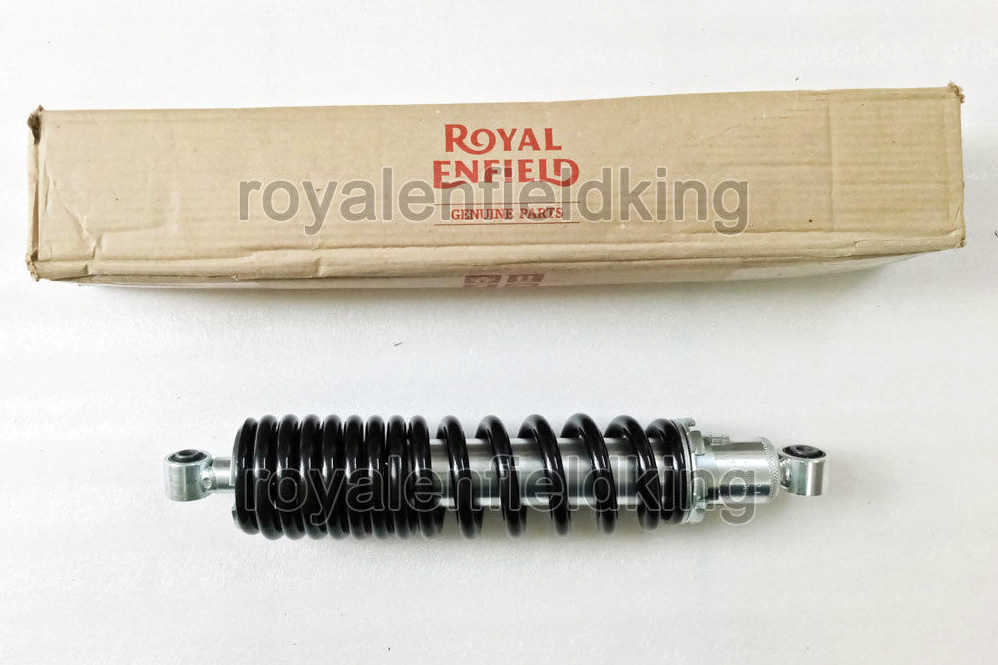
Many reviews say the Himalayan’s suspension is pretty good for what it is, which is all the more surprising when you look at the seemingly spring-bound stock shock above. I read it’s not trying to be progressive but a dual rate spring and in fact there is a 2mm gap between the closely set coils.
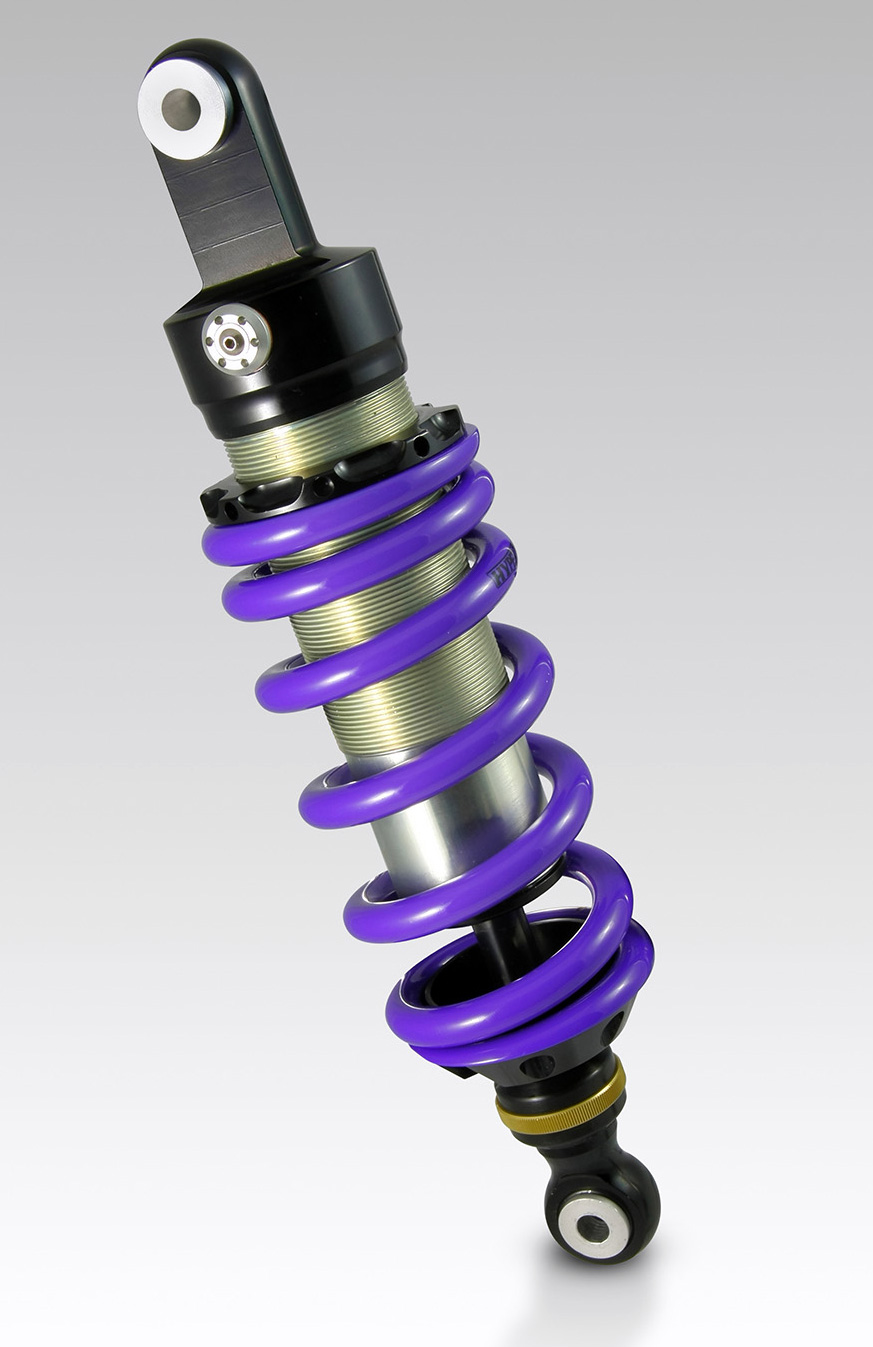
Currently the only outfits offering shocks are Hyperpro (right; €500) and YSS (left; made in Thailand). Unusually, both come with rebound damping but the YSS also has adjustable height and was just £270 from Wemoto on special. For that price it’ll be worth a shot and the option of dialling in a bit of extra height will be handy. As it is, the bike tends to sit a little too upright on the sidestand and adding a sandfoot won’t help. And also if I do go for an 18-inch rim where the tyre range is taller, a bit more space will be handy

him-fkprl

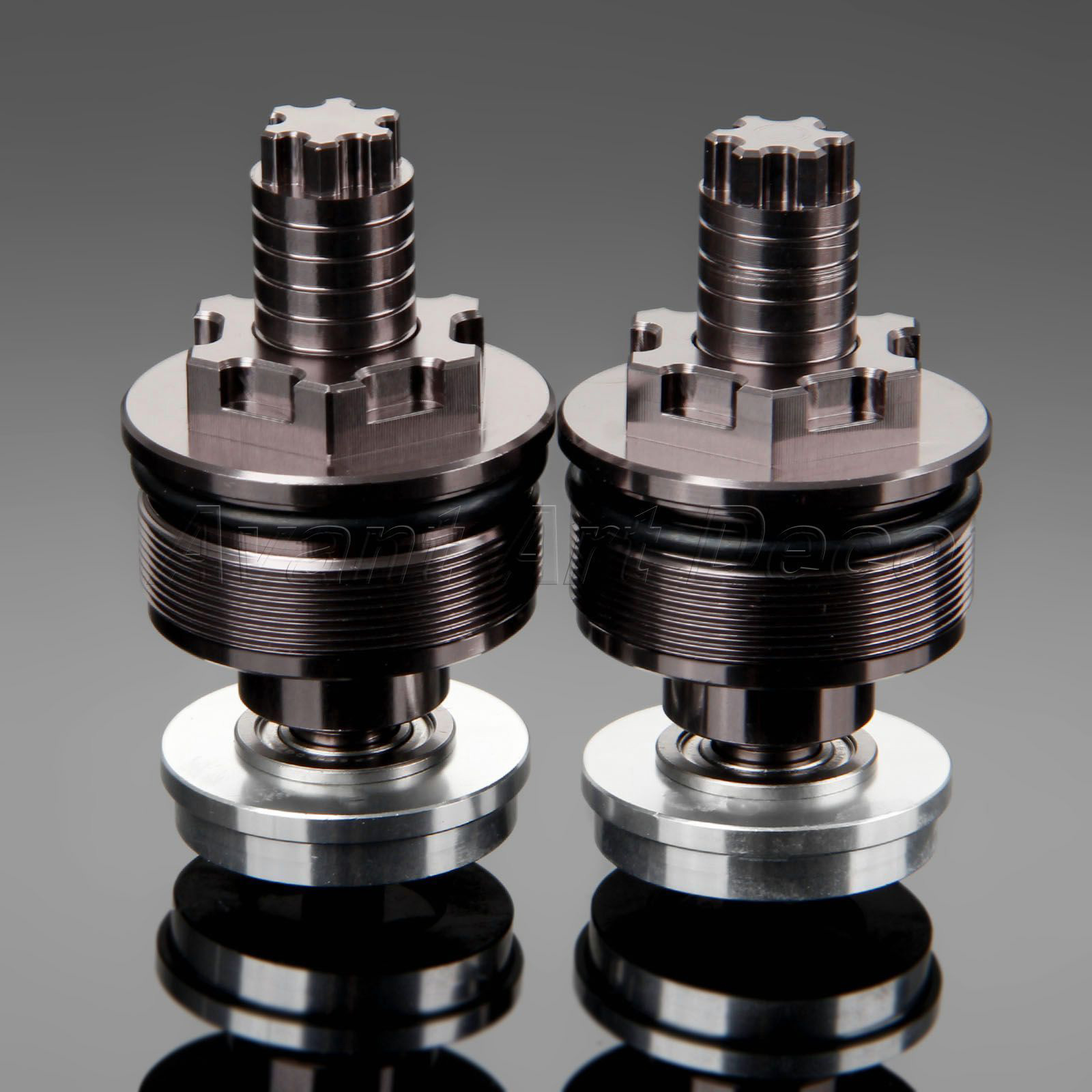
For the fork YSS also make a kit (above left) costing not much less than the shock. It includes valve emulators (available separately for around £80), something I’ve read of but never tried. For the moment there’s nothing to be lost by starting with some Chinese ebay fork pre-loaders (£10; left; as tried on the XSR). After that I may move up to a firmer K-Tech spring if they’ll make me one. Firmer springs may be enough to bring the front end back up if an 18-inch rear rim is fitted.

temp

Ancillaries
I’ll hard wire the trusty Montana in and fit a RAM mount on the bars. I’ll also add a PTO for the Powerlet heated vest and type pump. The claimed 220w alternator output is nothing special, but some wattage has been freed up with dinky LED indicators and there’s a spare LED headlamp which came with the bike. Otherwise I plan to add a switch so the lights aren’t on 24/7. There are times when you don’t want to be seen too easily.
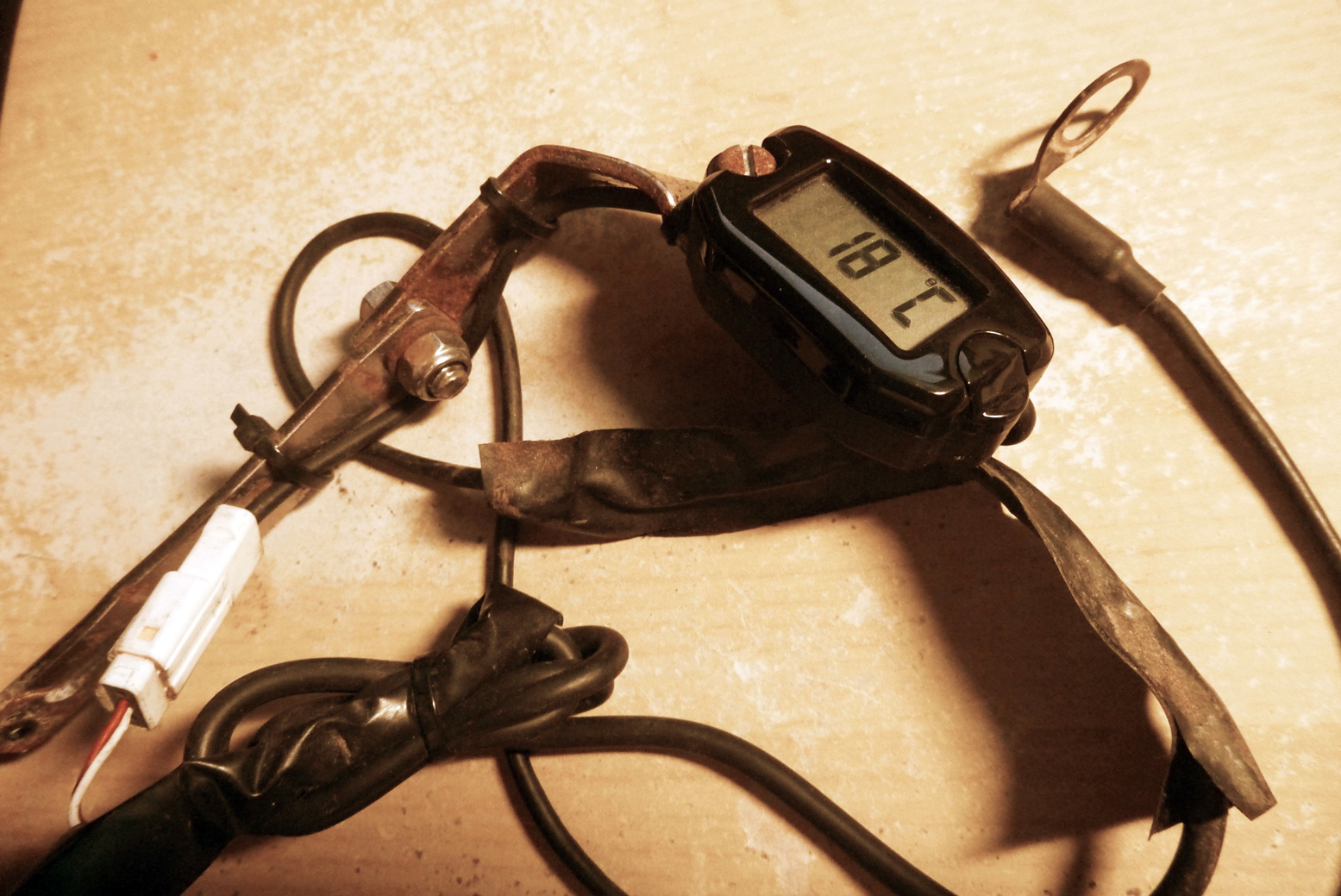
Last but not least, the Trail Tech engine temperature gauge from last year’s XR will get wired on to some very hot part of the Enfield’s engine. With an oil and air-cooled motor, even a low output one like the REH, it’s all the more important know how hot things are getting down in the engine room.

Himalayan Index Page