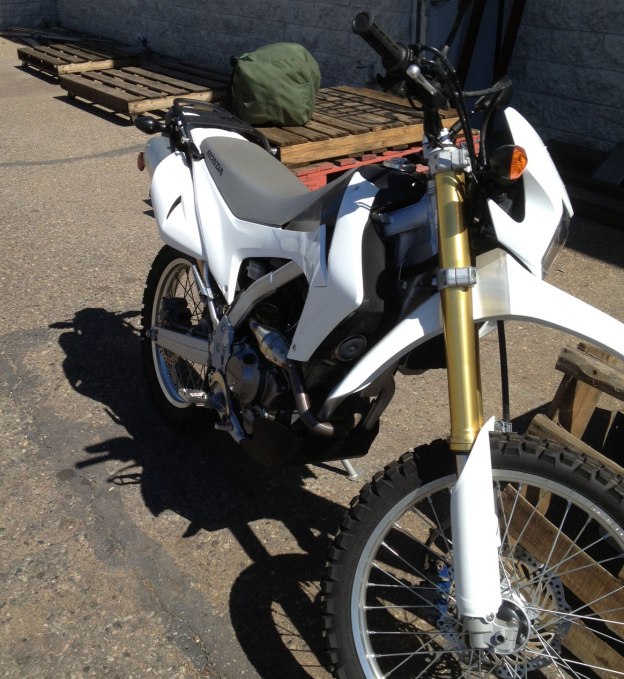
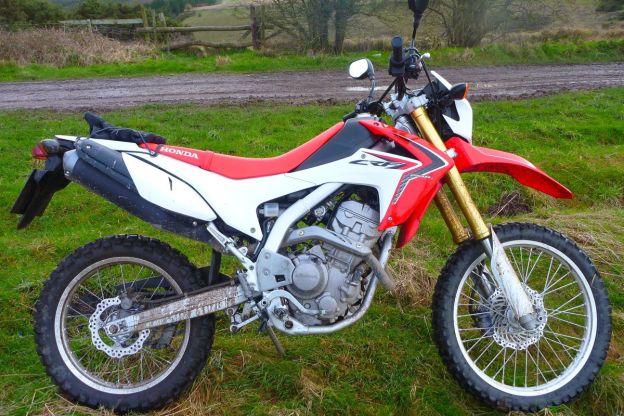
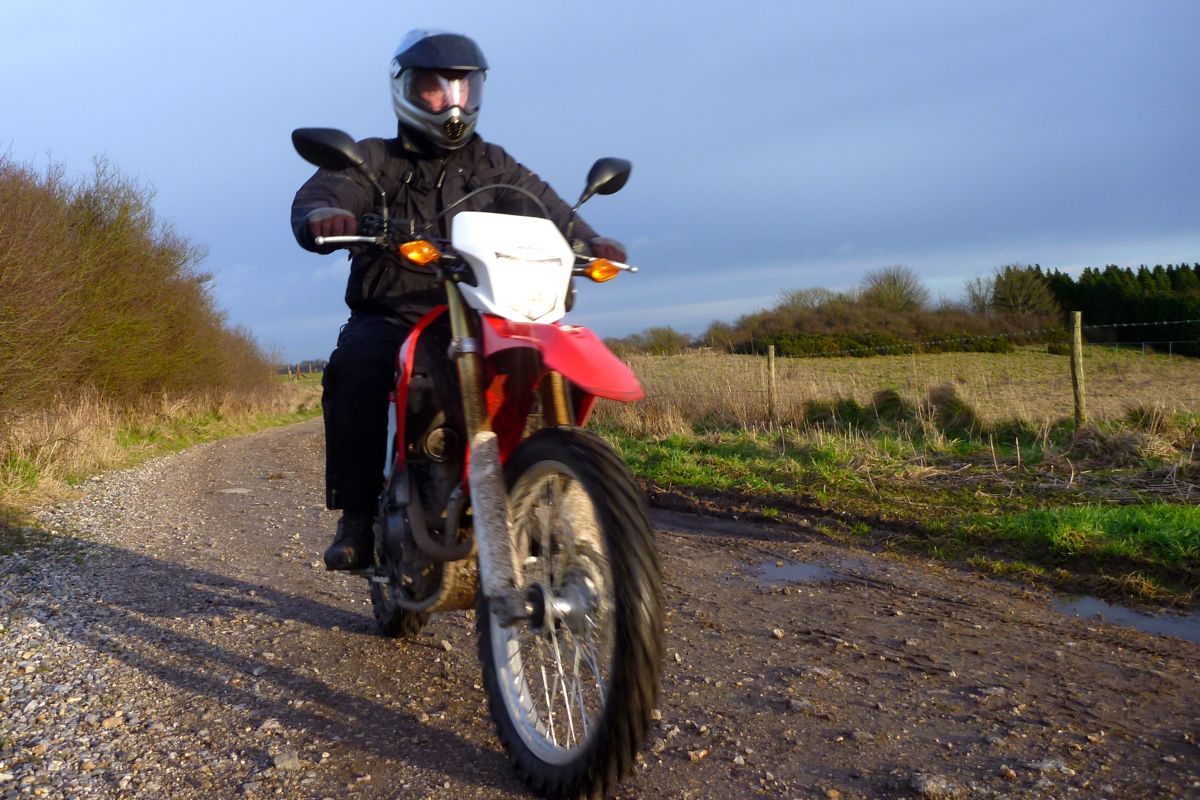
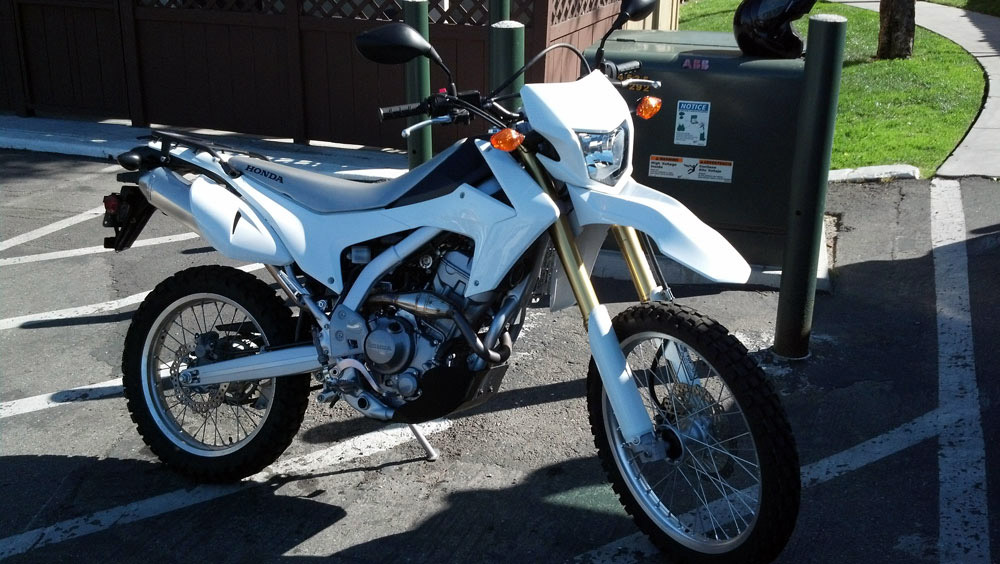
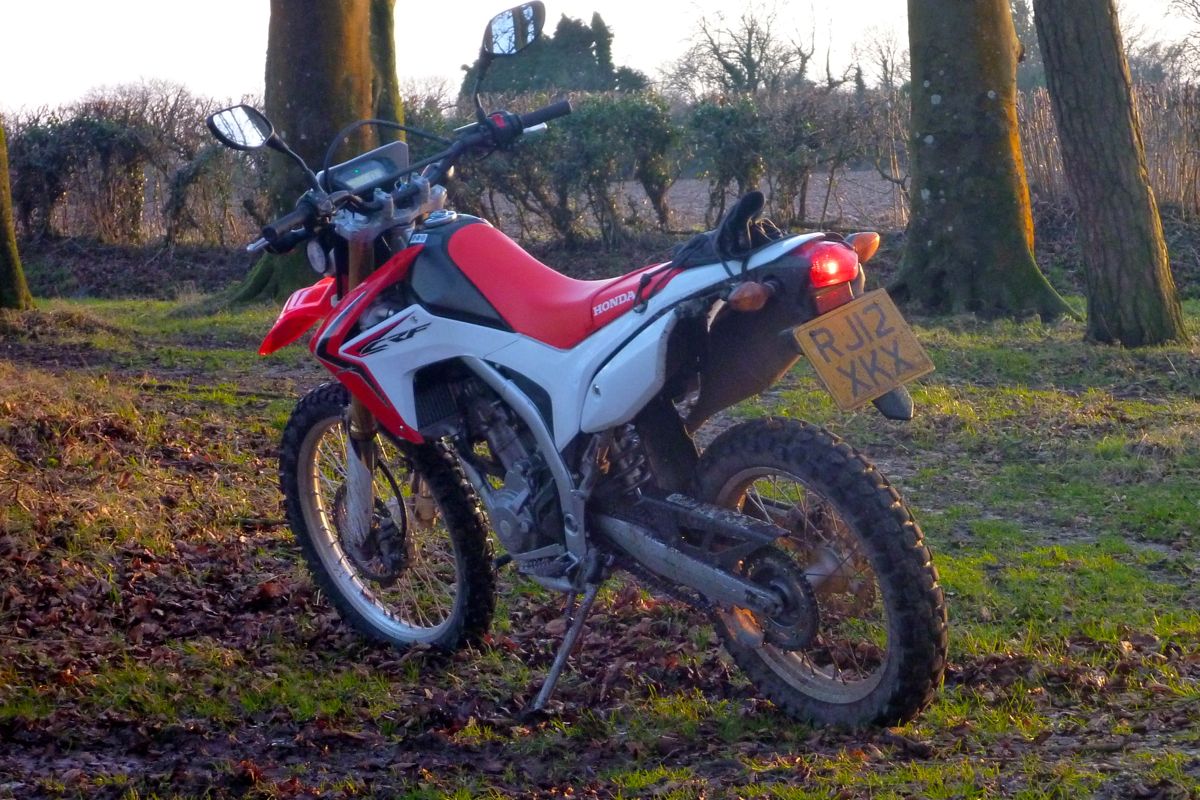
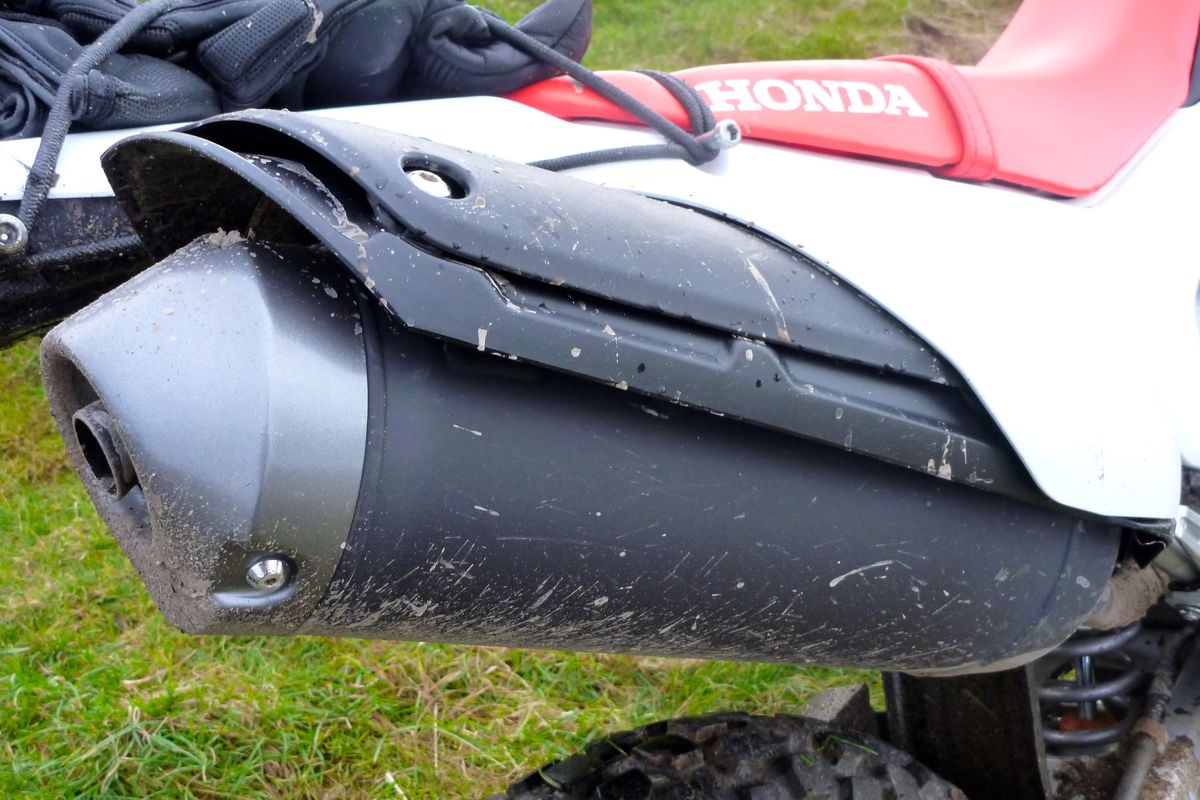
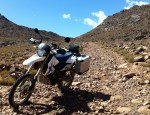
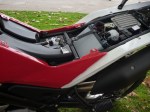
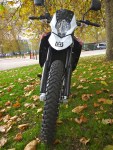
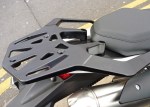
Following my UK test ride on the CRF a few weeks later I bought a lightly used one blind off San Diego Craigslist and got it trucked to Phoenix. CRF’s had sold well in the US and were getting hard to find new at the time, but $4500 got me one with under 1000 miles and about $1000 of accessories, including what looks like a BDSB Stage 1 kit (pipe, fuel programmer, 13T), Shorei battery, bash plate, tail rack and maybe some other bits too. As you can see the first owner swapped the red plastics for ‘export white’ which suits me fine. Buying barely used seem by far the best way to go. New with taxes was actually way over $5000 with $1000 of depreciation right there before you spend a typical $1000+ to get it in shape for dirt touring.
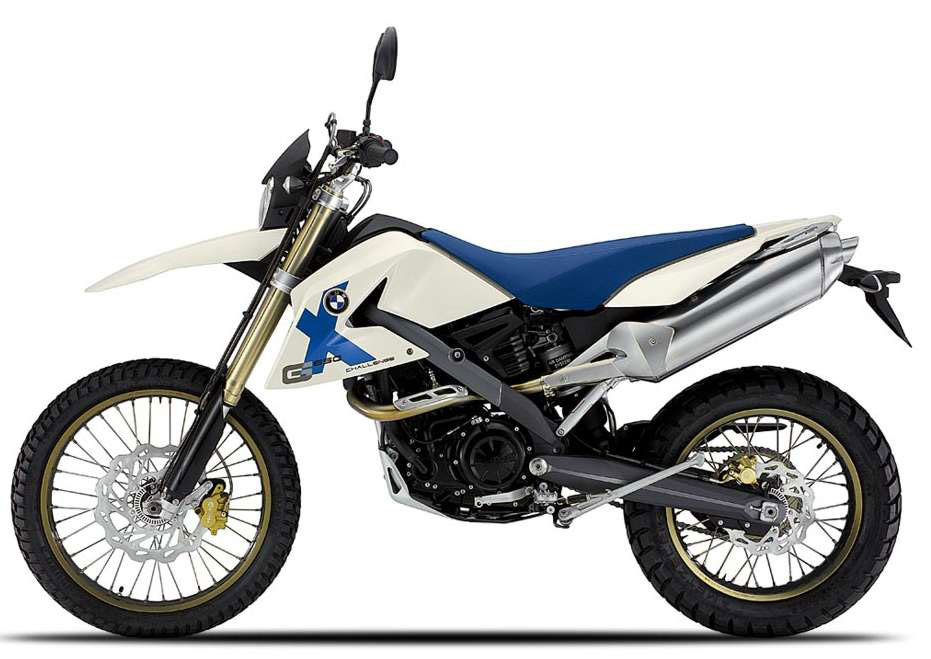
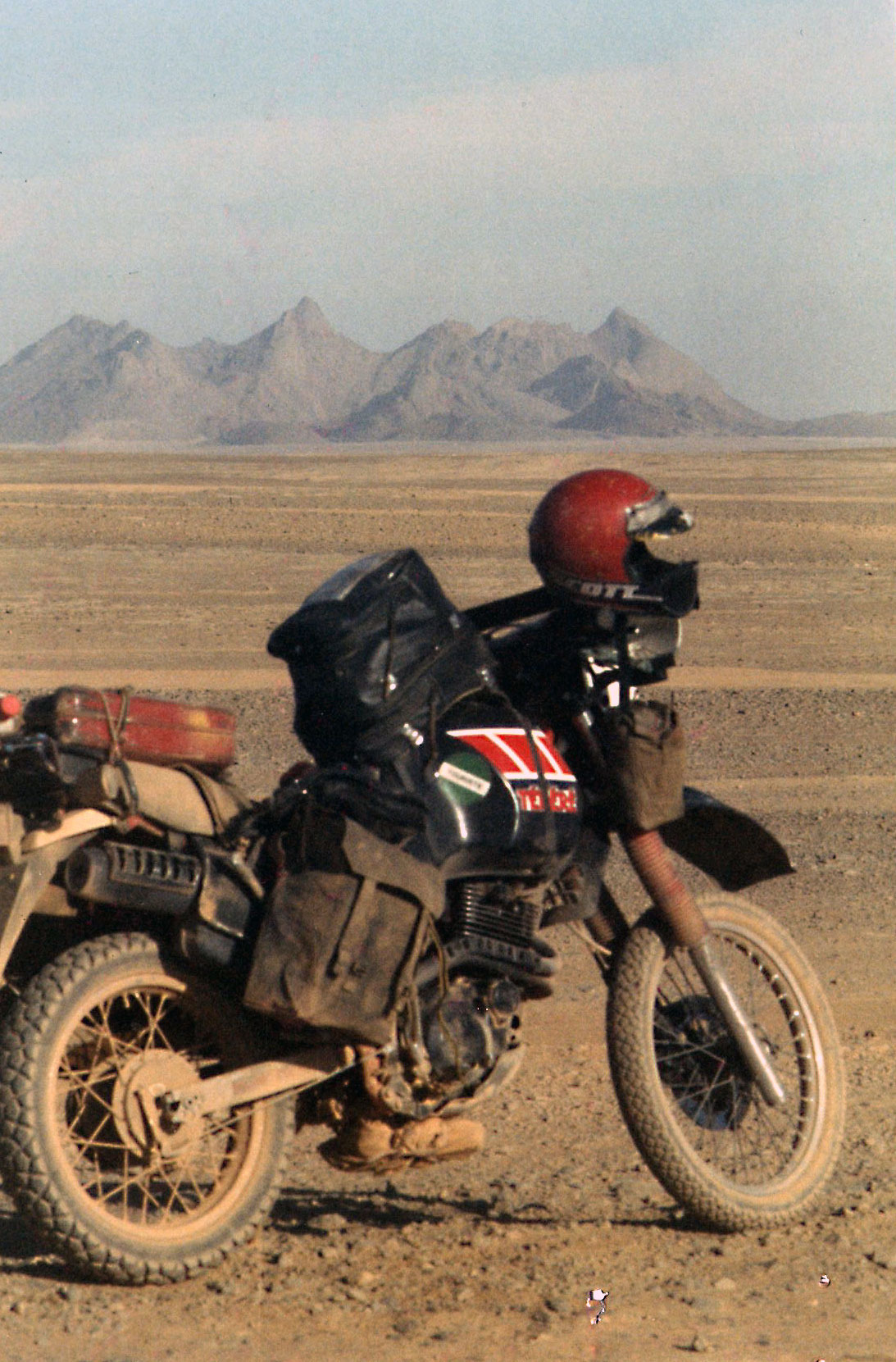
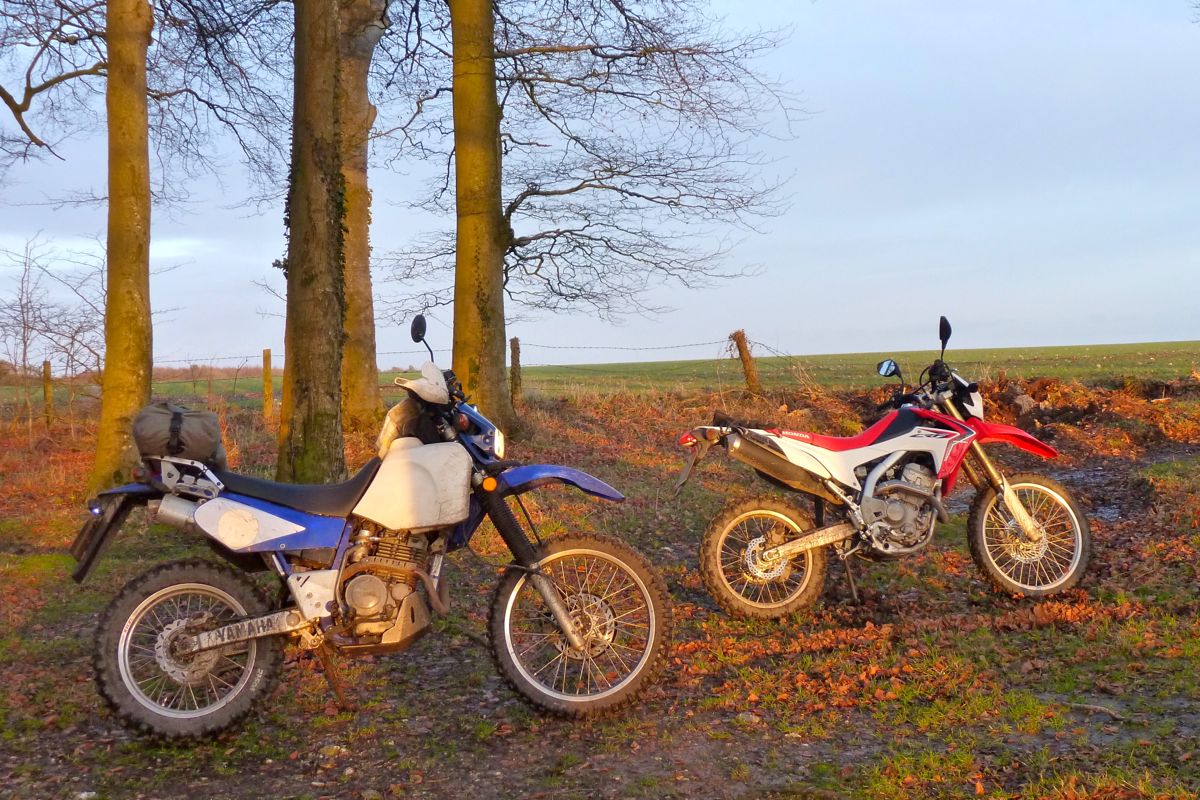
While I was looking for a machine I was kindly offered the loan of a near-new XR650L by Scott Brady at Overland Int. (publishers of Overland Journal which I write for occasionally). But having used an XRL for Desert Riders some ten years ago (left) I felt that was too much like going backwards. For me the point with AMH project bikes is to try new stuff or new ways of doing things. The other option was getting a used 650 Xchallenge (right) for about $5500. I suspect they’re much under-rated but a scan of what happens when they’re not made it a bit of gamble to simply fly in, load up and ride off into the southwestern deserts, hoping for the best and with no support to speak of. (Since then I bought an XCountry in the UK).
With the little Honda 250 I have no such reliability worries, even if the usual calamities can befall me. I was also considering trying to get my hands on the opposite extreme to a CRF, a CB500X but jumped the gun – it’s not out till May. According to stats it’s said to be significantly lighter than the flashier NC700X which has been out a while, but with a pair of K60s the 500X would most likely be quite tolerable on the sort of dirt I plan to ride, while undoubtably being an armchair on the blacktop. It is of course a 21st-century iteration of my GS500-R project bike; a mid-sized adventursome twin – and allegedly ‘all the bike you need’. Hauling the Suzuki over to the US to put it through its paces was the original plan, but the cost of getting it there and the need to bring it back would have more than the bike’s worth, unless I was heading on to South America. Fast forward three years and I bought a CB500X. I was also told of this guy who put a 500X motor in a CRF frame (left). What will these bikers think of next!
But will the 250 CRF be enough of a do-it-all travel bike? At least I can convince myself that no reasonable trail need hold me back and am already cooking up killer routes in the Sahara should I bring it back. The combination of light weight, reliability, enough power and excellent economy is unbeatable out there, while I like to think it’ll do the business on the highway. The trick will be to cruise the backroads and enjoy the view, between the off-road spells.
What’s the plan? Early April I’ll arrive in the US and set about further adapting the CRF for the ride:
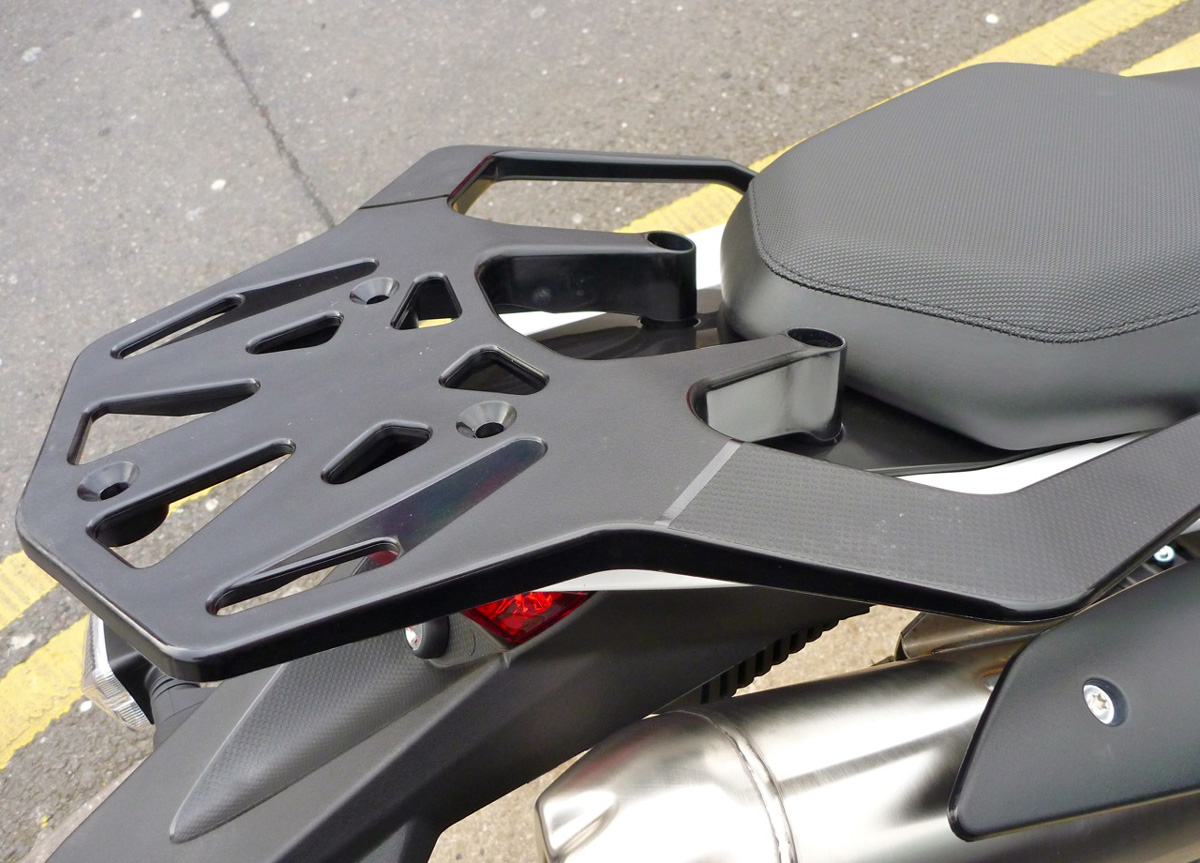
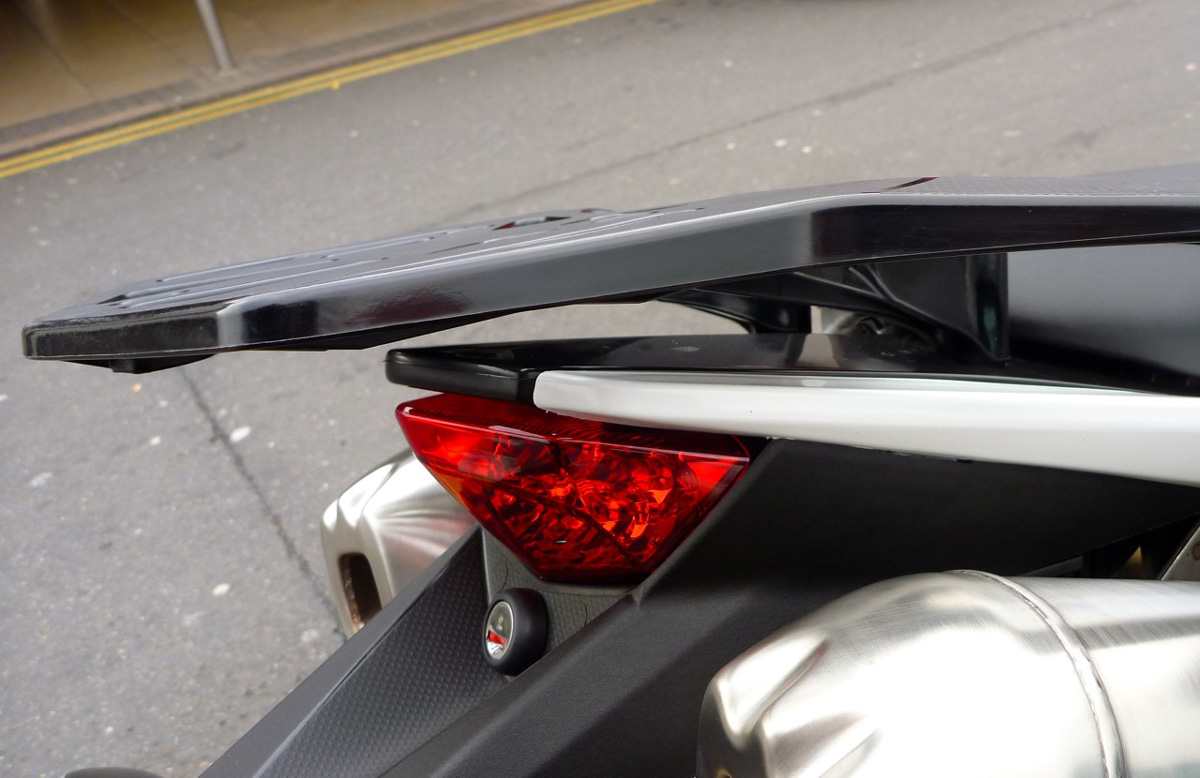
make a pannier rack to keep my Magadans in place – something not at all like the Sequoia rack (right) currently sold by crfsonly but something more like this.
small screen
bar risers
folding gear lever
12v/USB socket and a couple of Ram mounts
handguards
I’ve also been sent a TrailTech Vapor. I liked their Voyager unit on my GS-R except for the token GPS element which is better addressed with a dedicated GPS unit, plus the fact that it couldn’t be quickly removed to avoid theft like most GPS units or similar gadgets. Among the Vapor’s functions are ambient- and water temperatures, a rev counter (missing on a CRF) and a very accurate wheel-calibrated speedo/odo. It tells the time too.
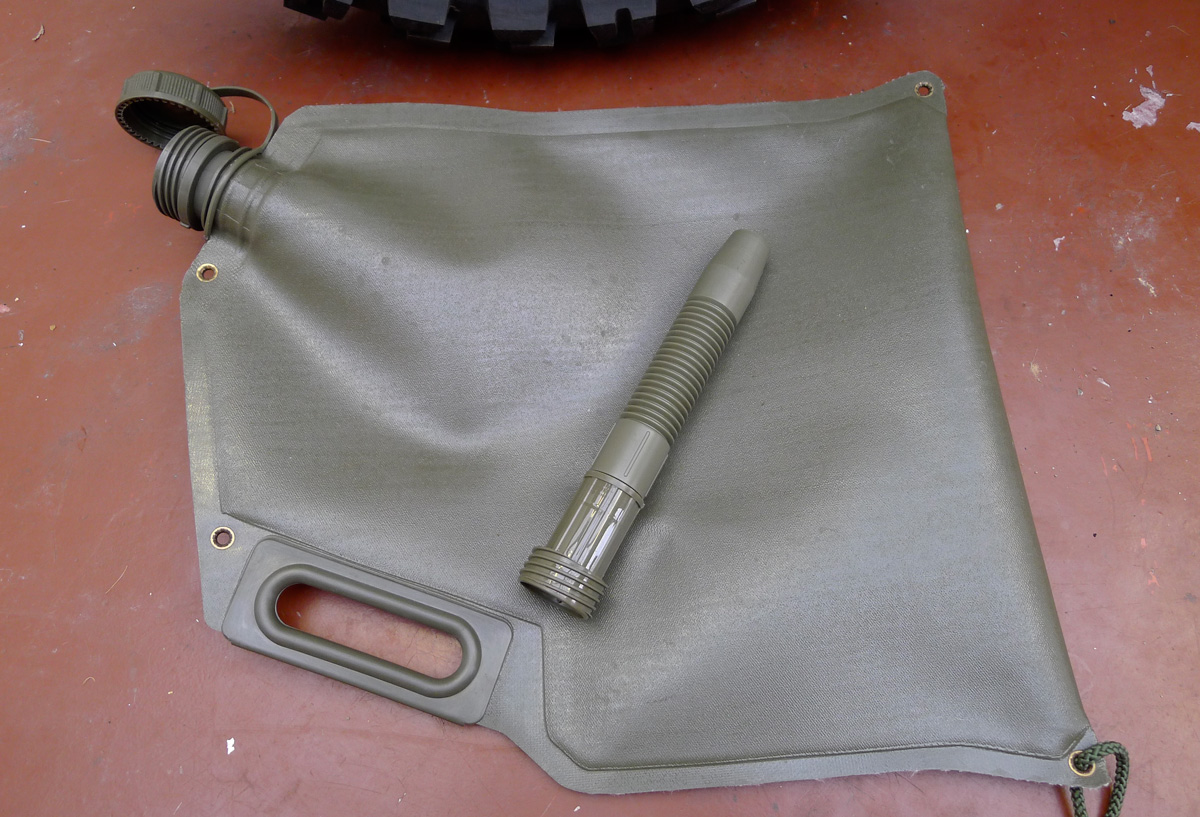
The OE tank is just 7.83L or 2.07 US gallons. Long after I came back an IMS tank for the Honda came out in October 2013 but our friend Rick Ramsey has proved that at 2.95US or 11.16L it’s only about 3.33L or 42.5% bigger than standard. For $270 and all the faffing that wasn’t useful enough for me so I’ll make use of a 10-litre fuel bag I have knocking about.
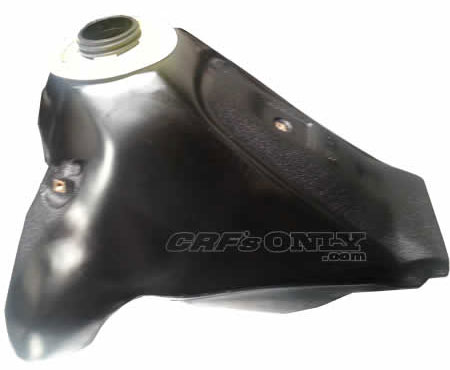
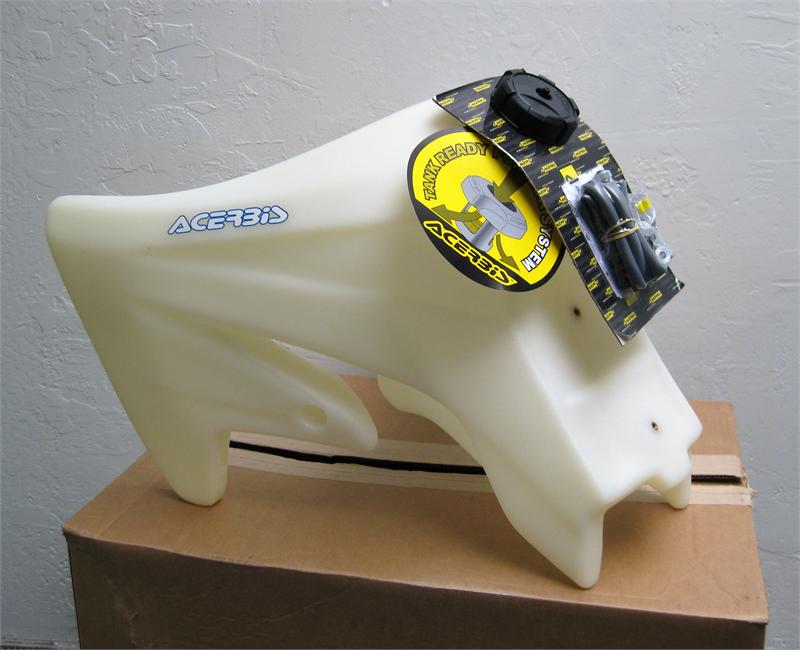
That may not prove to be so neat so I might try and get hold of a used OE tank (left) to weld up into something bigger, or see if some other 4gal+ tanks can be made to fit, like the 18-litre Acerbis unit (right) for the CRF450X which has a vaguely similar layout.
I plan to give the original seat a go too. I can’t think it’ll do the job over 3000 miles or more, but while in the US I’ll at least have a chance to get an alternative or adapt it. I may even refit the OE pipe and unplug the efi controller to wring out better fuel economy and a little less noise for the ride. I want to try and squeeze 100mpg out of that thing one time.
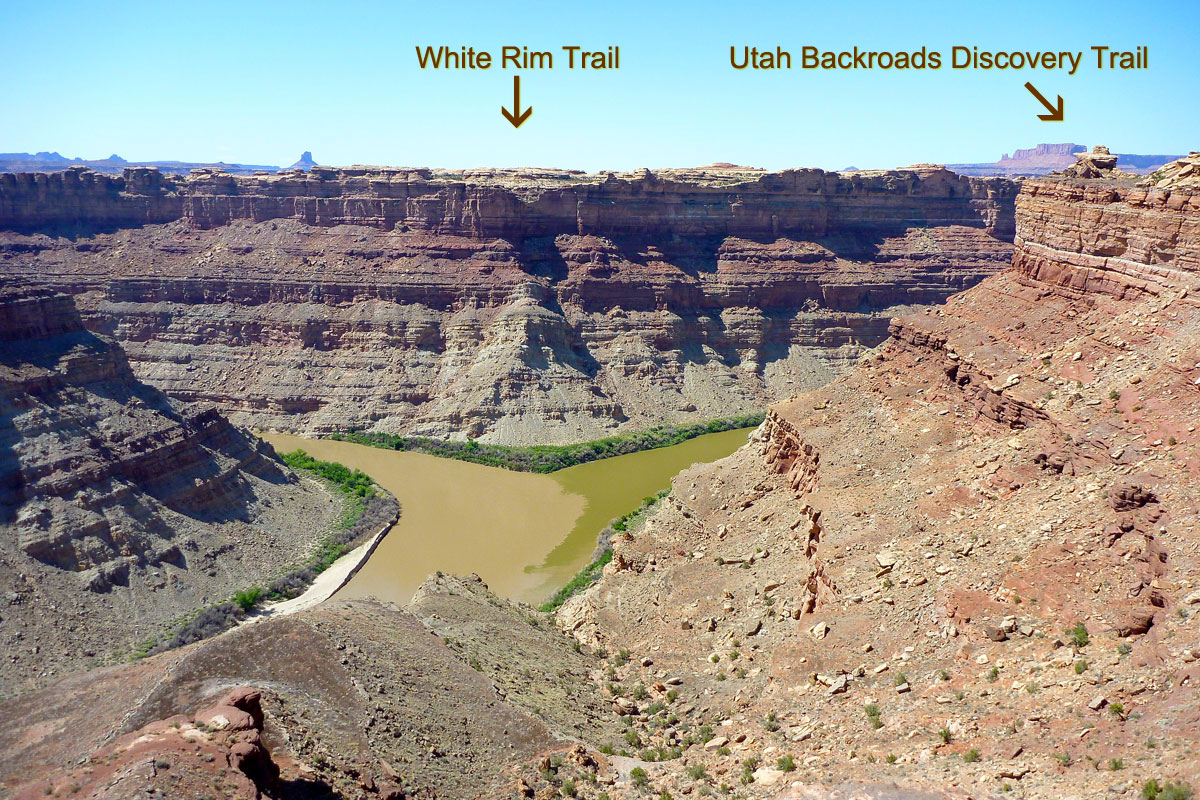
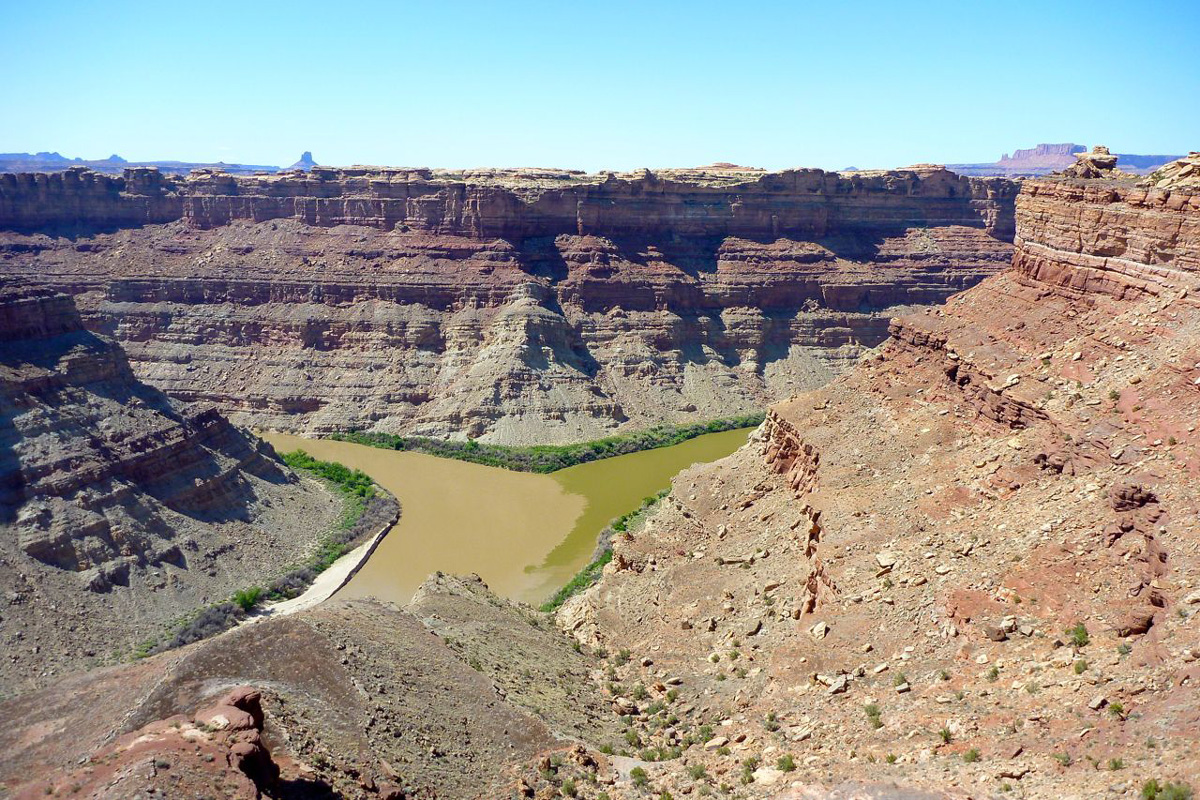
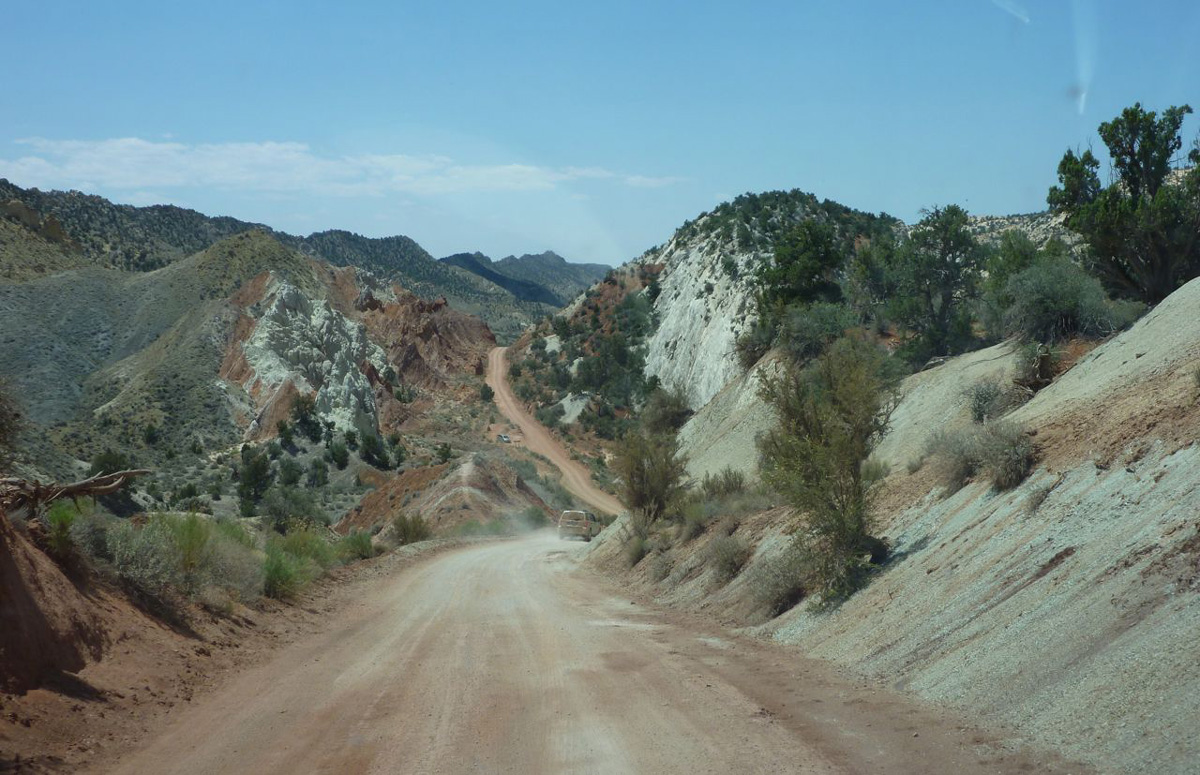
With the prep done and the bike licensed and insured, I’ll head up to Tacoma for presentation at South Sound BMW via a bit of Trans Am Trail through the Black Rock Desert. After Tacoma I have another couple of talks in North Cal and once they’re all done I can come back towards southeast Utah. Plan here is to explore some slickrock trails including the famous White Rim, then hop over the Colorado river (left) and follow the UTBDR south down to Monument Valley (left) via the Lockhart Basin. Whatever happens elsewhere, that’s going to be a fabulous few day’s riding.
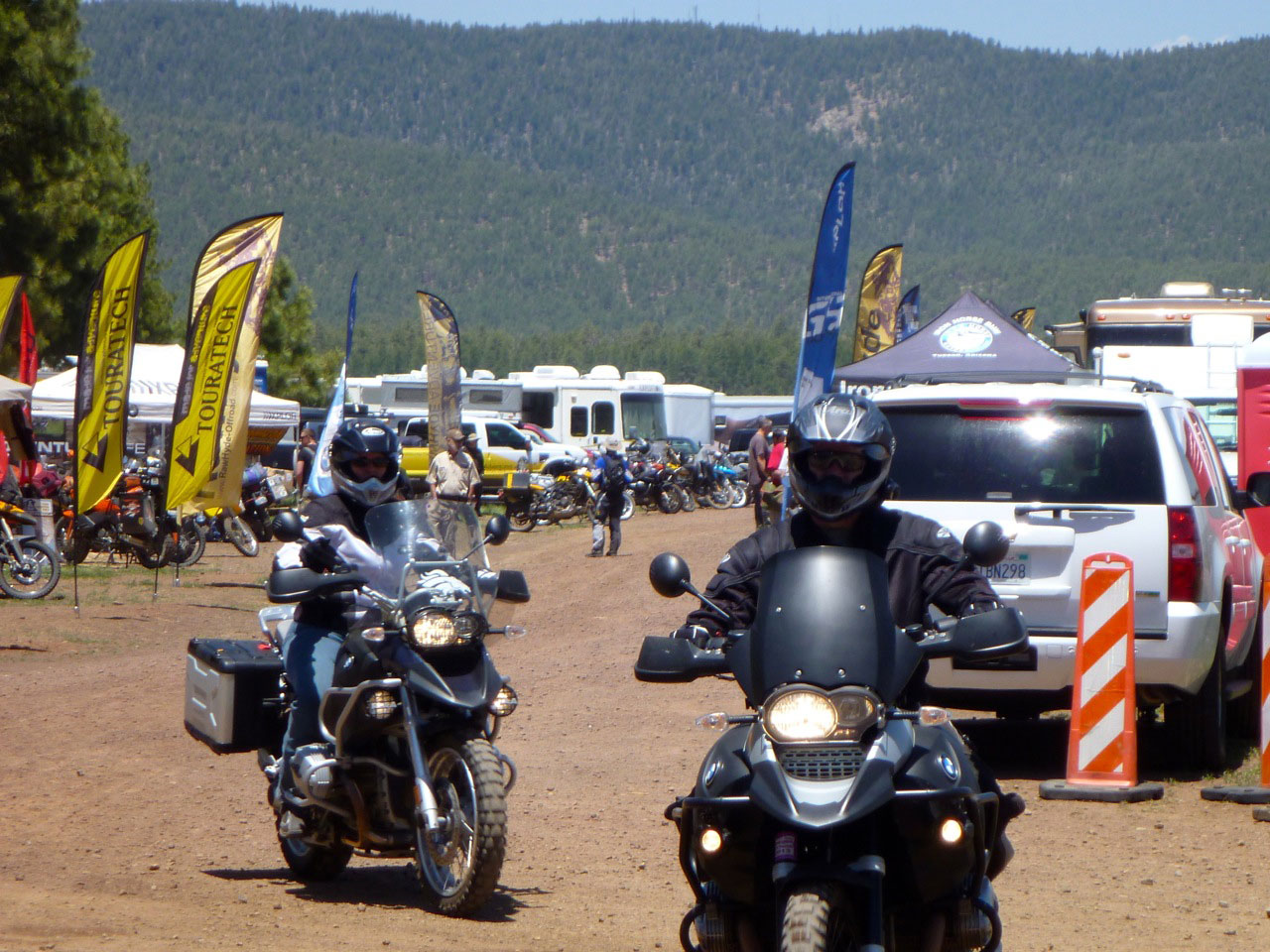
I’m due at the Overland Expo (right) in mid-May for a few more presentations and book selling, but if there’s time to pack in a bit of Baja then so much the better. That’s the plan; tune in from early April to the end of May to see what I do and how I get on with the CRF.
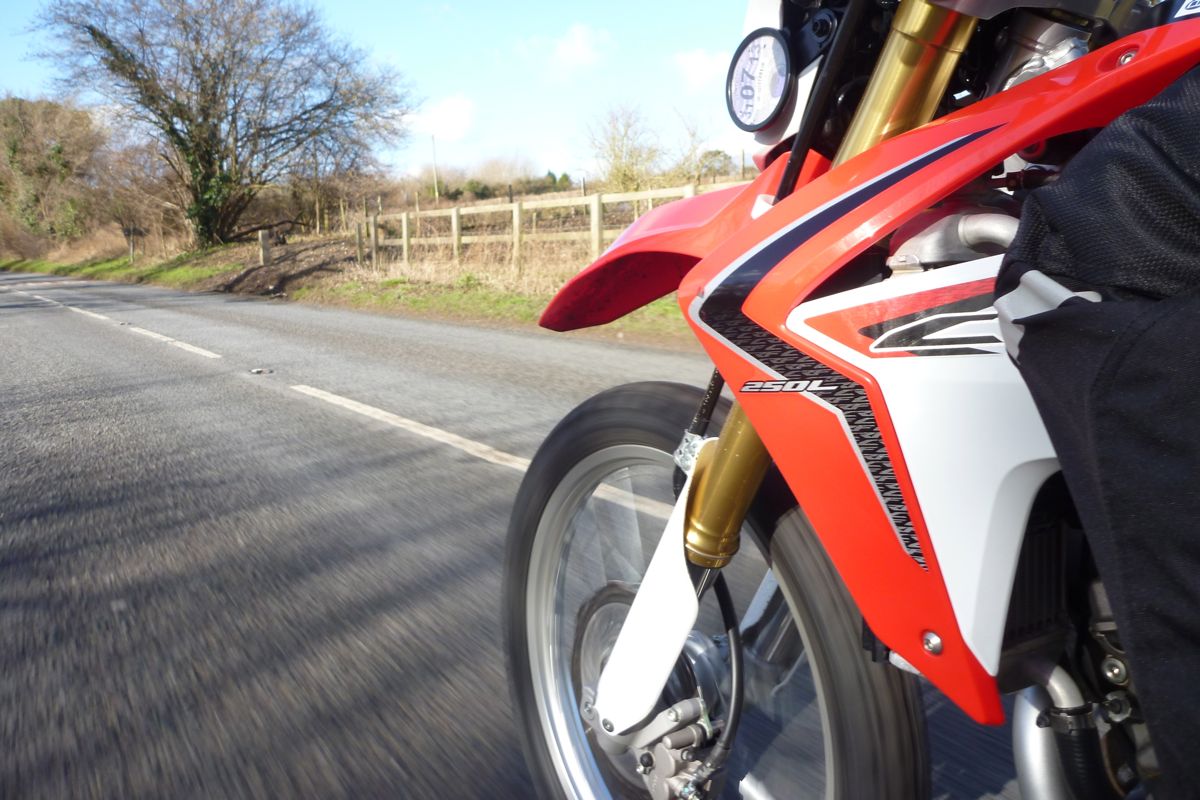
Since it came out in 2012 Honda’s CRF250L has been hailed as the long-lost return of the humble trail bike; a light, road-geared, do-it-all, low-spec dual sport being sold for a great price. For me, eyeing up a modern bike for some planned desert tours, the latest CRF seemed to tick the boxes. Apart from an old XR400, nothing else – DR, WR, KLX – seemed to inspire.
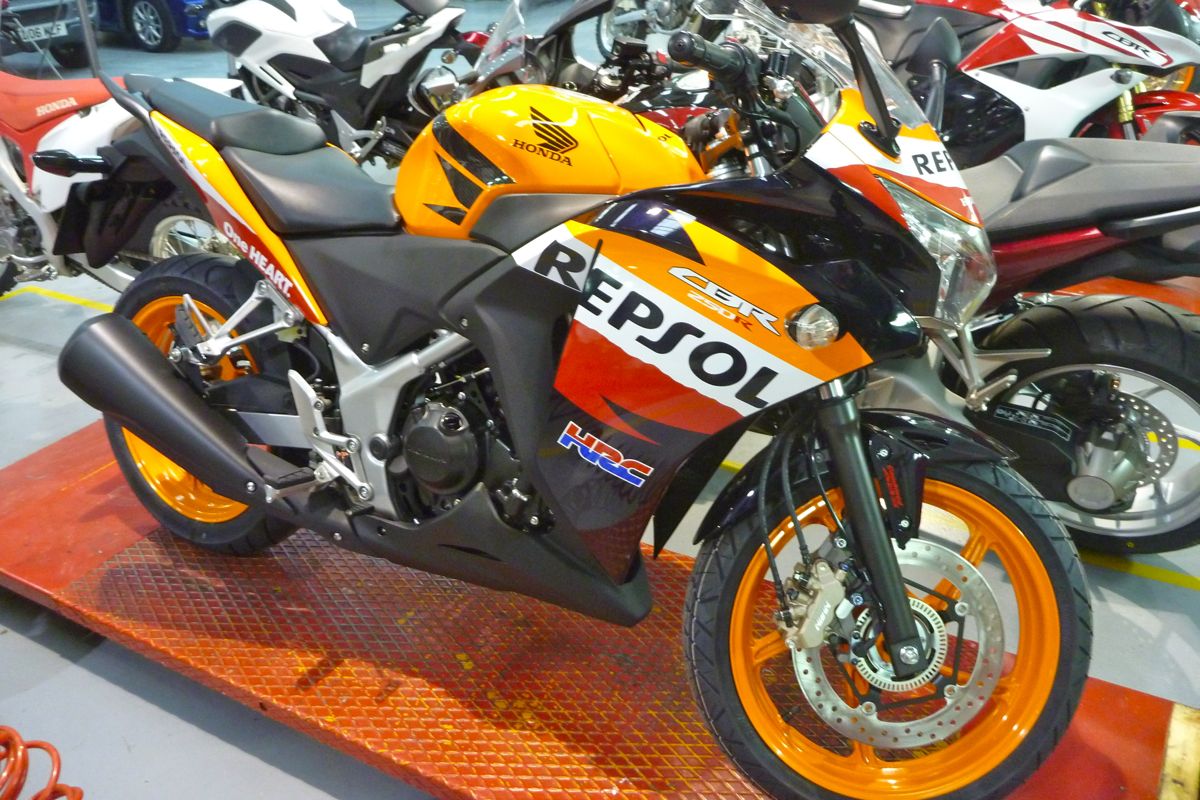
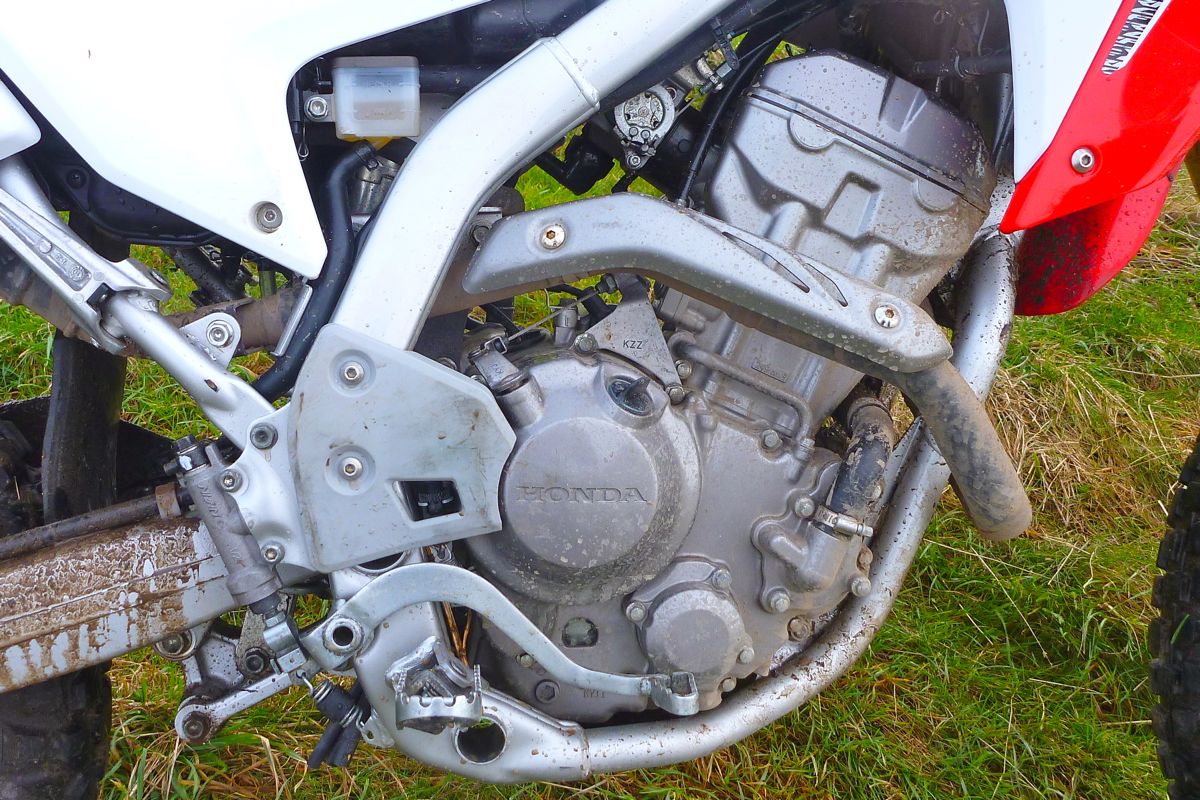
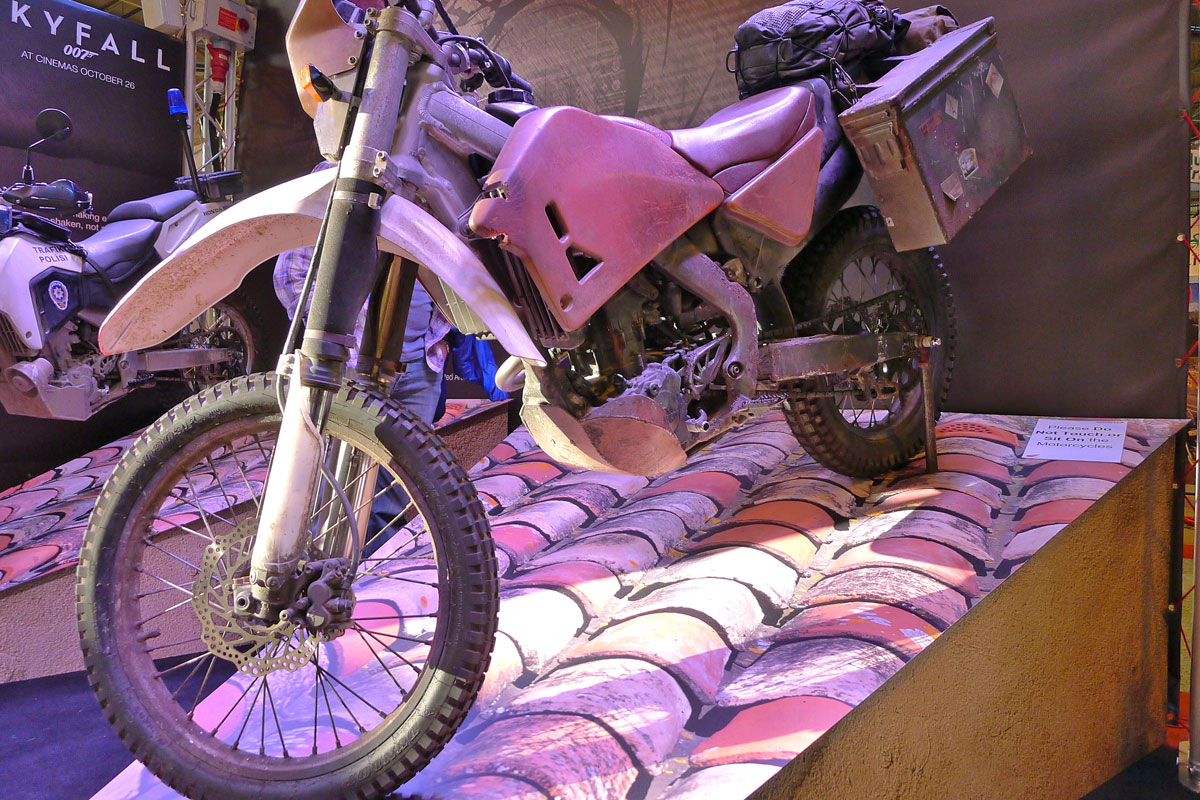
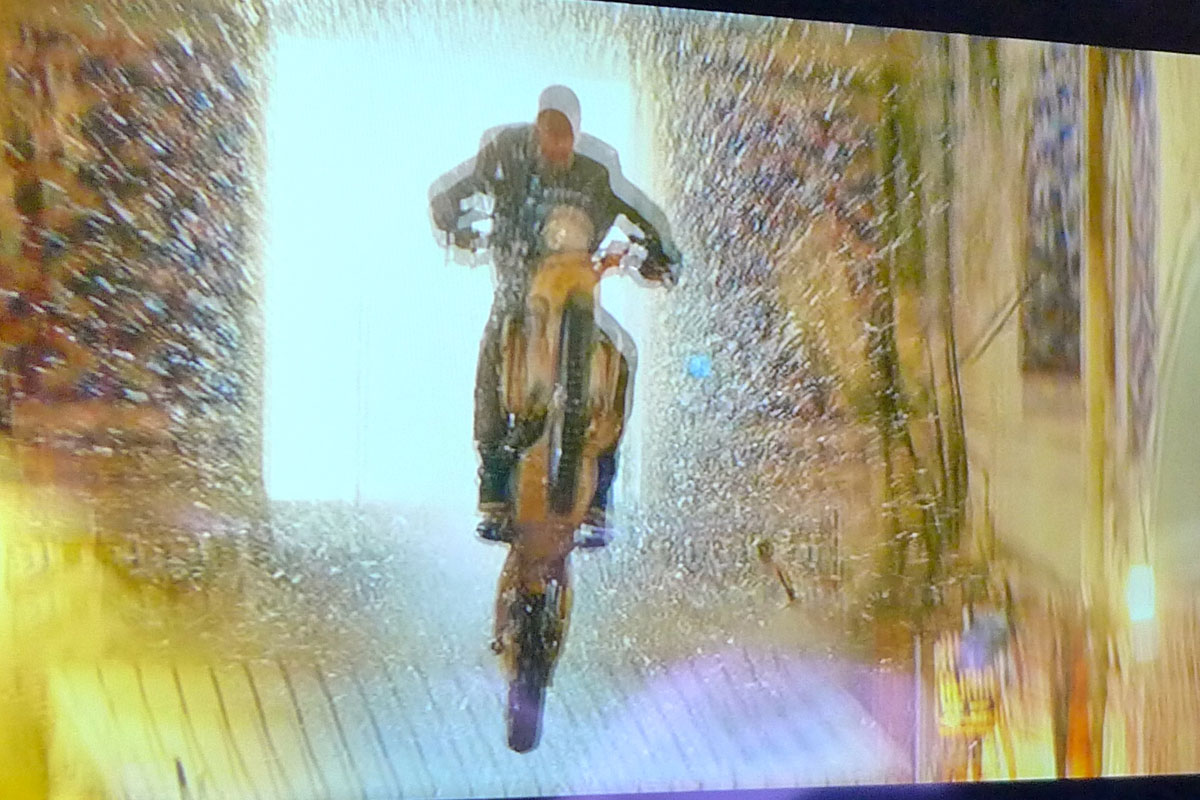
It’s no coincidence that a CRF250L could be easily mistaken for a detuned ‘street’ version of the alloy-framed, 115-kilo, 32-hp, CRF250X or -250R dirt racers. An adapted X was used in the recent Skyfall and Bourne movies (left), something that Honda was not shy to associate with the new L model. In fact the L is more of an upgrade to the old tech, 121-kg, 14hp CRF230L (below right) which isn’t far removed from ancient XL185/XR200s. The new model also runs a steel frame but takes a hefty motor derived from the CBR250RR sports bike (above right) while having the motor in the trail bike detuned some 20%. And although the resemblance with the X-racer is similar right down to the UPD Showas, the L actually weighs 144kg wet (138kg no fuel); 30 kilos more than a 250X and some 23kg more than a 230L. This excess baggage is one of the things people who’ve not ridden the bike understandably complain about, but the fact is you don’t feel that weight on the trail at all, as Cycle News testers also found (see right). Swapping the street battery and the can can lose nearly 6 kilos (13lbs) and if you add a fuel controller (fuelling remapper) and airbox mods you can gain some 6hp, making 24hp though you’ll have spent a few hundred quid. (For a great US-based CRF resource see Thumper Talk) And the best bit is that in the UK it goes for £4000 on the road; and in the US from $5000 plus, (still $2000 less than an albeit higher spec’d Yamaha WR – see Comment link). In the US the 250L sits alongside Honda’s air-cooled 230 CRF and the positively ossified XR650L which we used for Desert Riders in 2003.
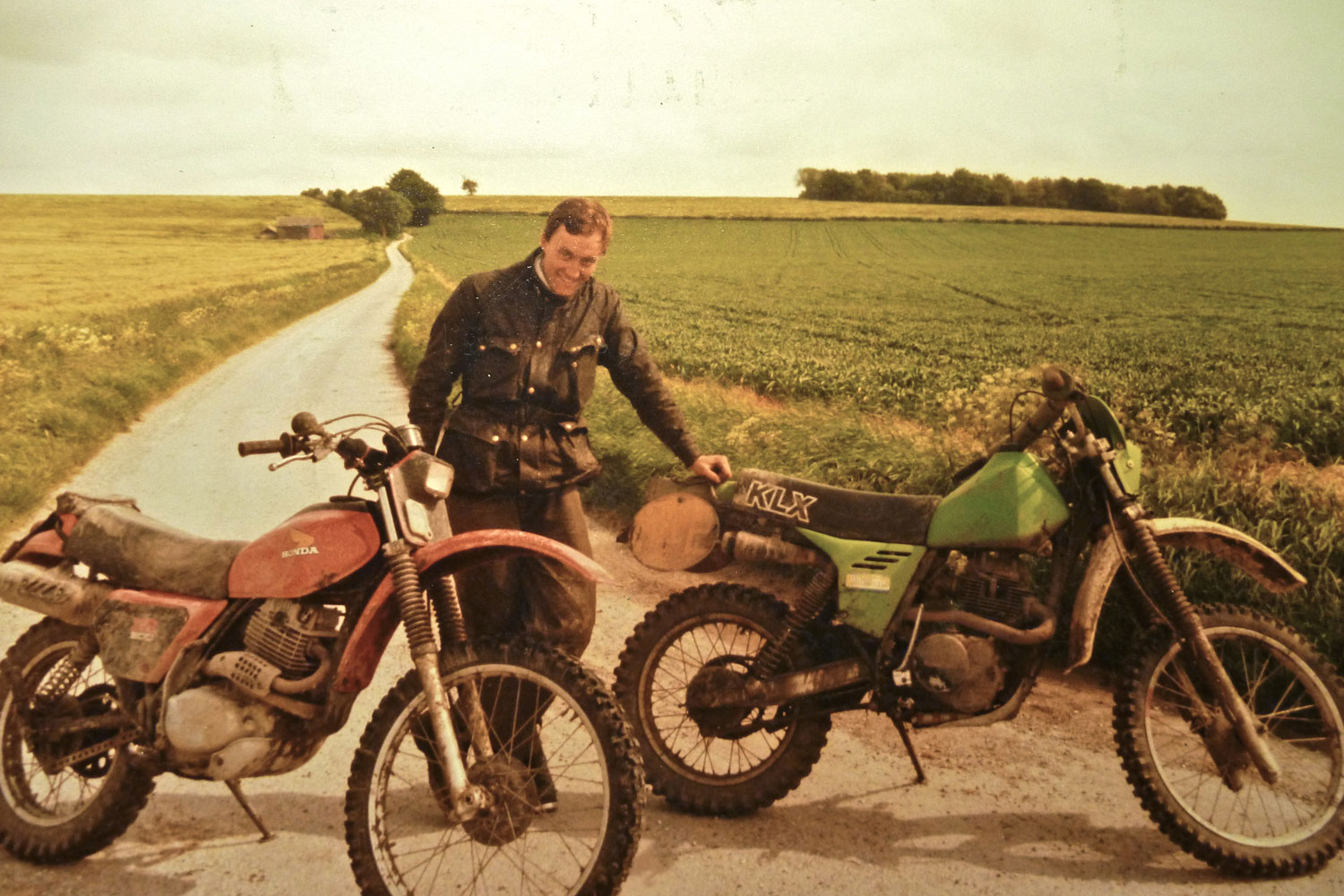
The early 80s on the Ridgeway.
The last 250 trail bike I recall owning was a KLX (left) in the early 80s – the original ‘sheep in wolf’s clothing’ which proved that slapping a lame 250 engine into a snazzy-looking KDX-derived chassis made nothing more than an over-sprung slug. I recall a Welsh moorland enduro; Maicos flew overhead and by the time I came in off the last lap they were already packing up and going home. A couple of years later I picked up a DR250 in Australia before I moved onto bigger-engined Teneres for desert travels. But with support and therefor no need to carry a huge load, could a modern FI 250 trail bike make an adequate and responsive desert bike? Or would I feel like I was sat on a skimpy, revvy-engined trailie more suited to less girthsome riders?
My local dealer set up a two-day loan from Honda and I arranged to meet a mate down in Wiltshire for a ride around Salisbury Plain, criss-crossed with several chalky tracks when the army isn’t using it for exercises. Robin rides a TTR250 bored out to 315cc which he’s used on my desert tours and elsewhere in the world, including the Morocco Overland research trip I did in 2012. He believes that ‘250’ is all the travel bike you need and by the time I returned the CRF-L I felt he had a point, but now see that his 315 rebore is significant…
Exercise PASHTUN DAWN will continue during the first week of February with communications and logistic assets working on the training area. [There will be] major armoured … and artillery live firing exercises across the whole Plain… the public are asked to stay well away.
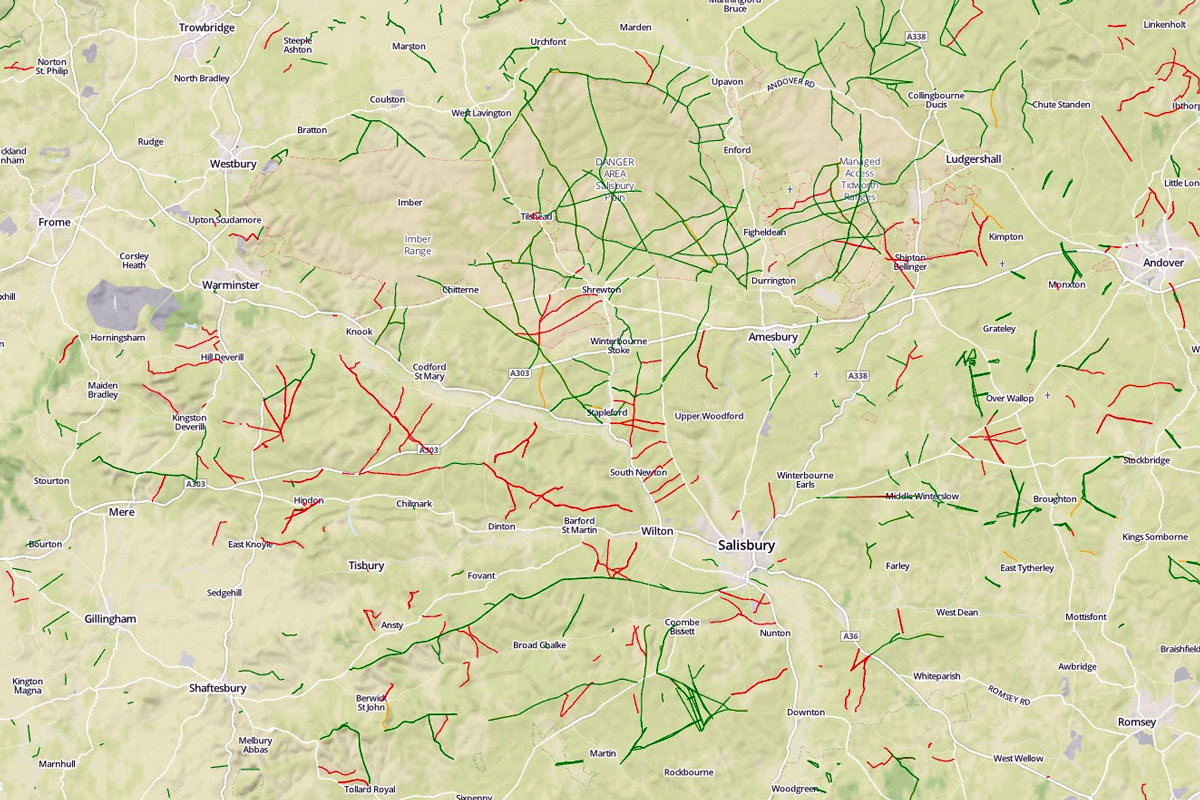
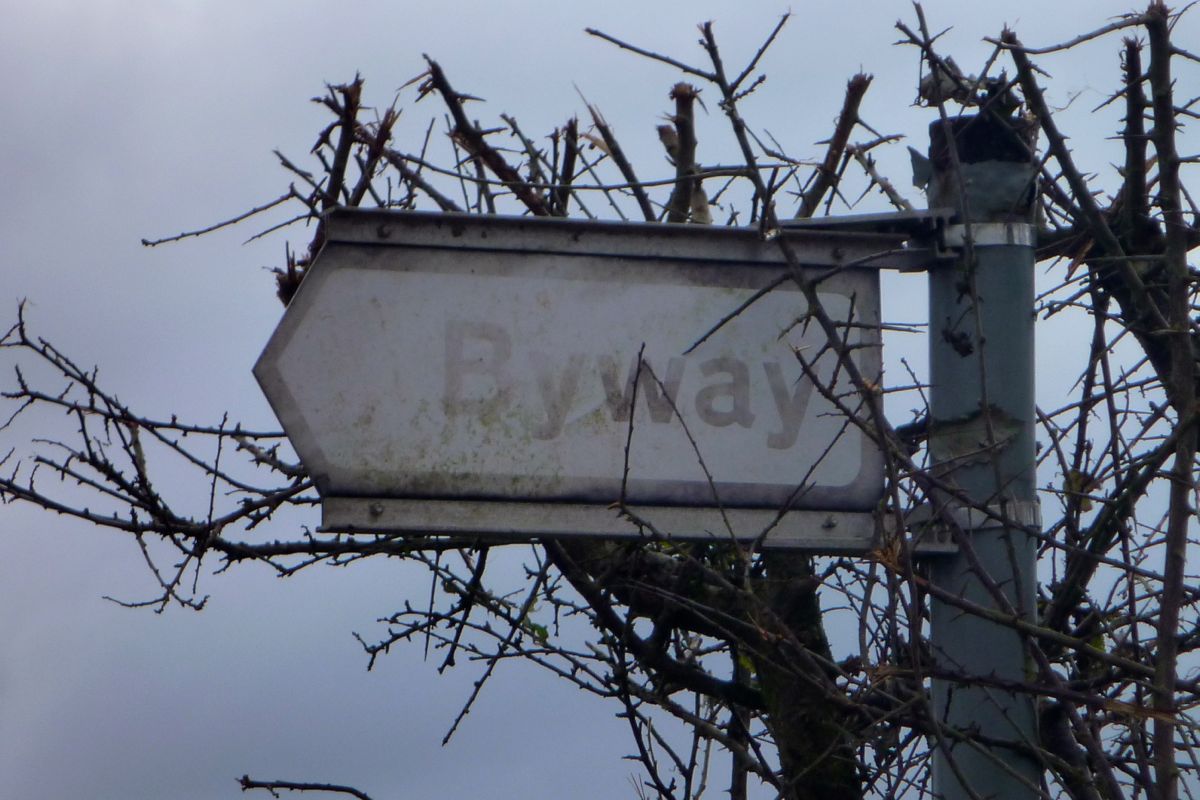
That was the link that Robin sent me the night before our meet in Andover. Oh dear – not a time to riding around the Plain then; you forget there’s a war on. I may have missed the MoD newsletter but at least I’d found bywaymap.com (right) which showed the unusually dense network of off road trails strung right across Wiltshire and not just Salisbury Plain.
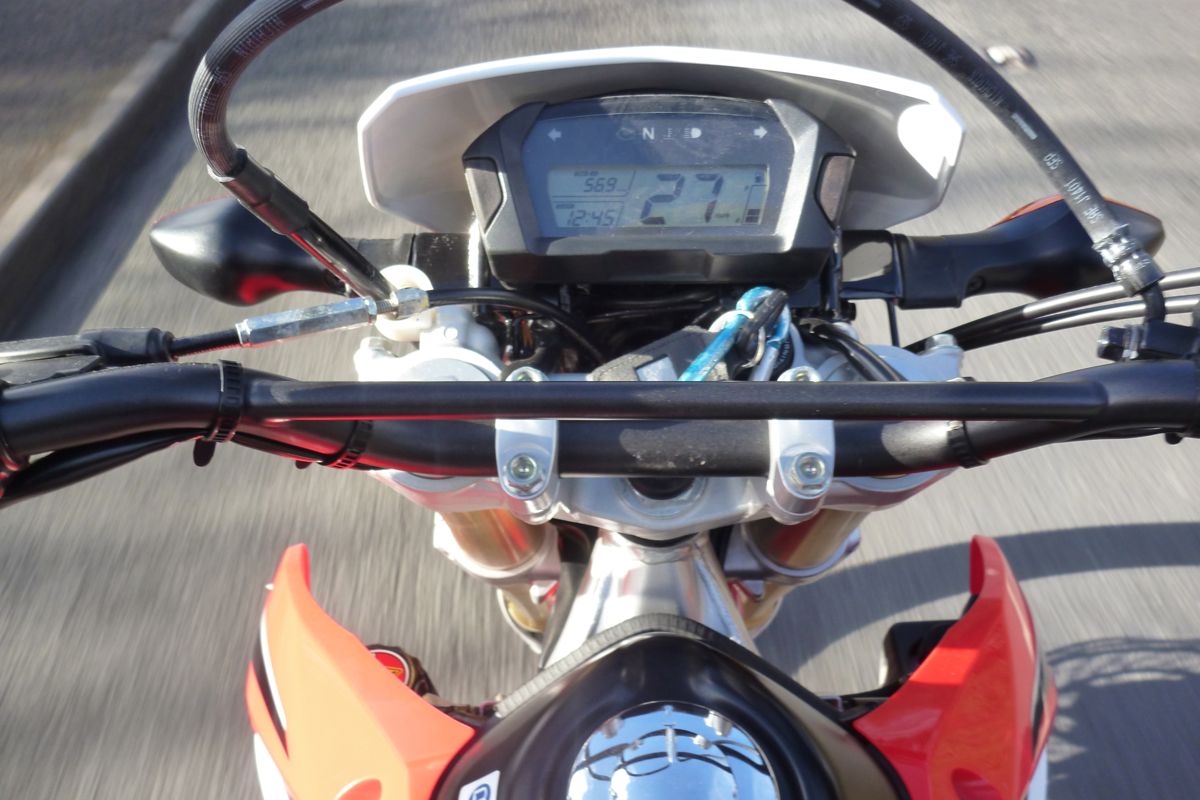
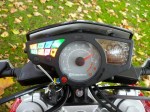
Collecting the near-new bike from Honda in Slough, first impressions were relief that it wasn’t annoyingly high; I could get feet flat on the ground. And after a while I was also pleased it didn’t necessarily need its neck wrung to make progress through traffic. Sat on the mostly flat M3 motorway at an indicated 65mph the CRF felt planted and with enough poke to pass lorries without risking getting splatted on the windshield of a fast moving car coming up from behind. A hill, a load and a stiff headwind might change all that, and the skimpy bike’s exposure to the wind blast meant that to keep upright I slid back (that annoying seat strap needs to go…) and hung on – not very sustainable. The digital dash (right) covers what you need to know: odometre, 2 trip metres, clock, speed read-out and fuel level, but something like a TrailTech Vapor would do well here. Meddling with the two function buttons allowed me to reset the trips and switch from mph to kph, though without RTFM I couldn’t work out how to correct the clock. Providing you’re not lugging in the wrong gear there was no vibration to speak of. Little 250 singles don’t hammer like a bigger 600+, something which I’m sure helped the seat feel better than it looked. The IRC GP21/22 tyres – a notch up in knobbliness from my K60s – felt secure on the roads too.
Not so promising was the fuel gauge which by 60 miles was down to 2 of 5 bars. Filling up in Andover revealed only 66mpg which barely improved on subsequent fills, even following hours of tame green landing (69mpg). The bike had only 600 miles on the clock but that economy was still way short of the 90mpg quoted on Honda UK and the 80+ I was expecting (Imp/US/kpl fuel conversion table here, btw). Could the press test bike I’d been lent be running a little richer to survive the thrashing a magazine might give it? Or were the speedo and odometre out? After all, when’s the last time any Brit bike mag paid any attention to detailed fuel consumption figures, rather than estimating ‘xx many miles to a tank’? [For the record the CRFL I went on to buy in America averaged 86.7UK mpg over 3000 miles),
Other impressions: brakes felt well matched for the bike’s weight and power, suspension felt reassuringly firm though it’s doubtless far less flash or adjustable than whatever’s on a CRF-X/R; fuelling was pretty flawless with only a couple of cut-outs in the lanes which may have been water related. And like I said the bike has a low seat (right) which greatly boosts confidence as you slither towards a muddy rut or even just want to get off. Robin’s TTR had been lowered and had an alternative seat, but for me was still a pain to swing a leg over. As for the engine and gearbox, well of course the acceleration won’t give you a dizzy spell, but it gets up to speed and holds it without the impression of ragging the engine, just as long as you’re in the right gear. And without too much load, clutchless up-changes were as clunk-free as stirring a creamy cappuccino.
Two hours after setting off, we managed to evade the harassment of traffic wardens and other municipal jobsworths in Andover long enough to text each other, meet up and head out to a warm country pub for lunch. That done, we scooted on to Salisbury where I noted the TTR was keeping up with the CRF rather effortlessly. I guess Robin’s 315cc upgrade balances out the years. The Honda is said to make 18hp at the wheel with 10.7 compression, but it’s how it responds that counts. Owners in the US are doubtless adapting air filters, swapping pipes and tuning the ECU, but for the long road I’d be tempted to leave it largely standard to improve longevity and cool running.
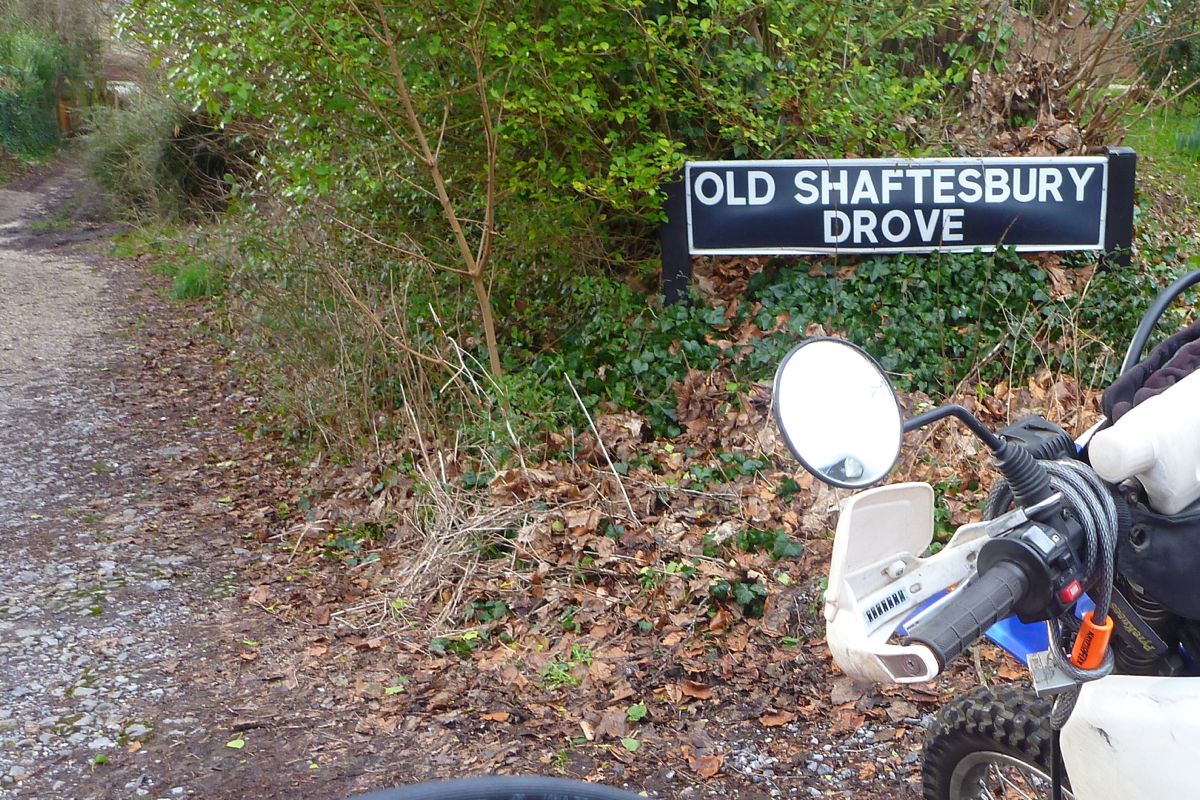
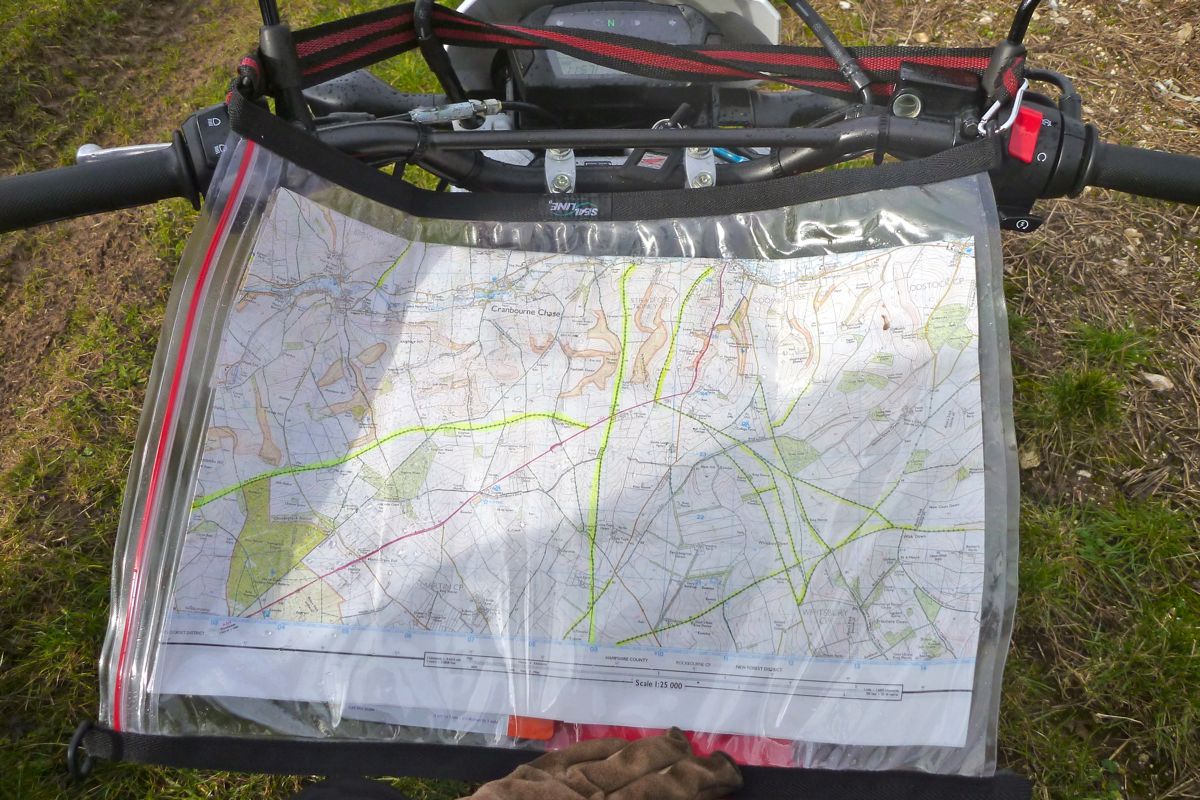
Robin had marked-up 25k OS maps plus had a worthwhile OSM map in his Garmin and so managed to pinpoint the street on the south side of Salisbury where the encouragingly long Old Shaftesbury Drove ran west for a good 15-20 miles, one of the longest byways around. Better still, on arrival there was no ‘no motor vehicles’ sign with adjacent CCTV and tripwires. In congested southern UK I’d pretty much given up on green laning years ago.
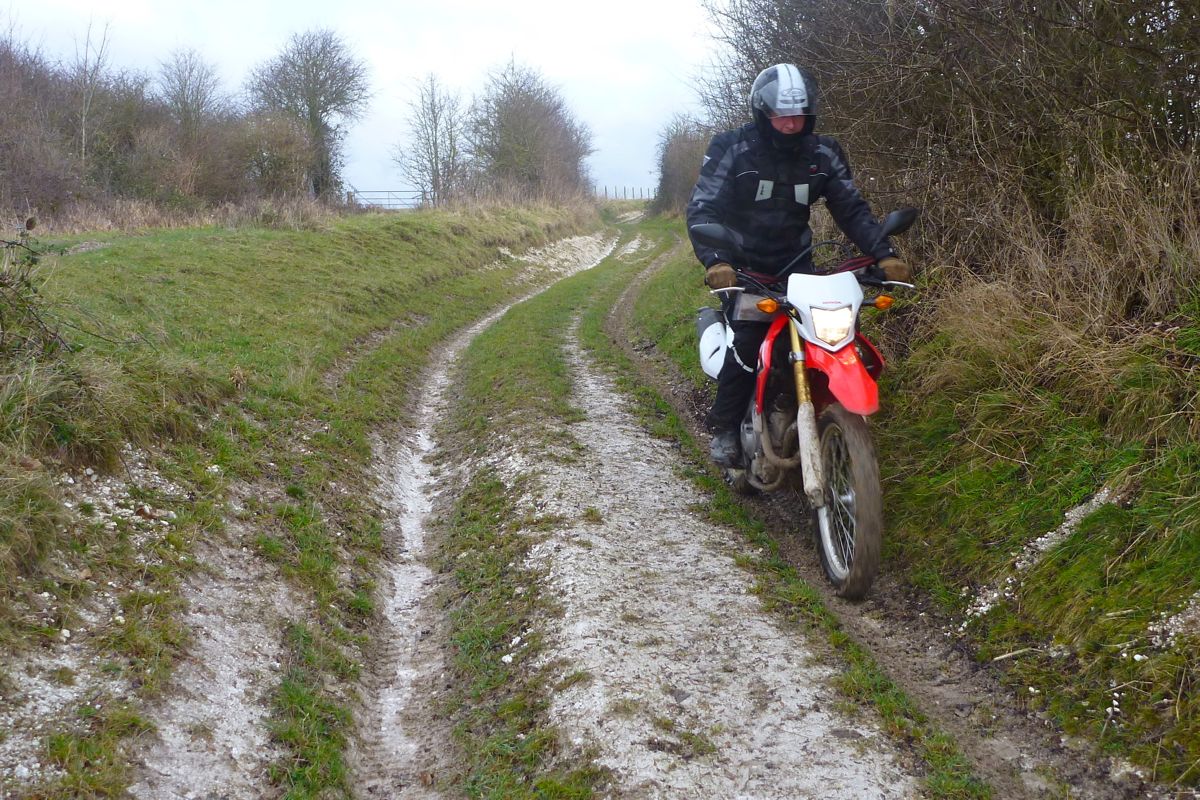
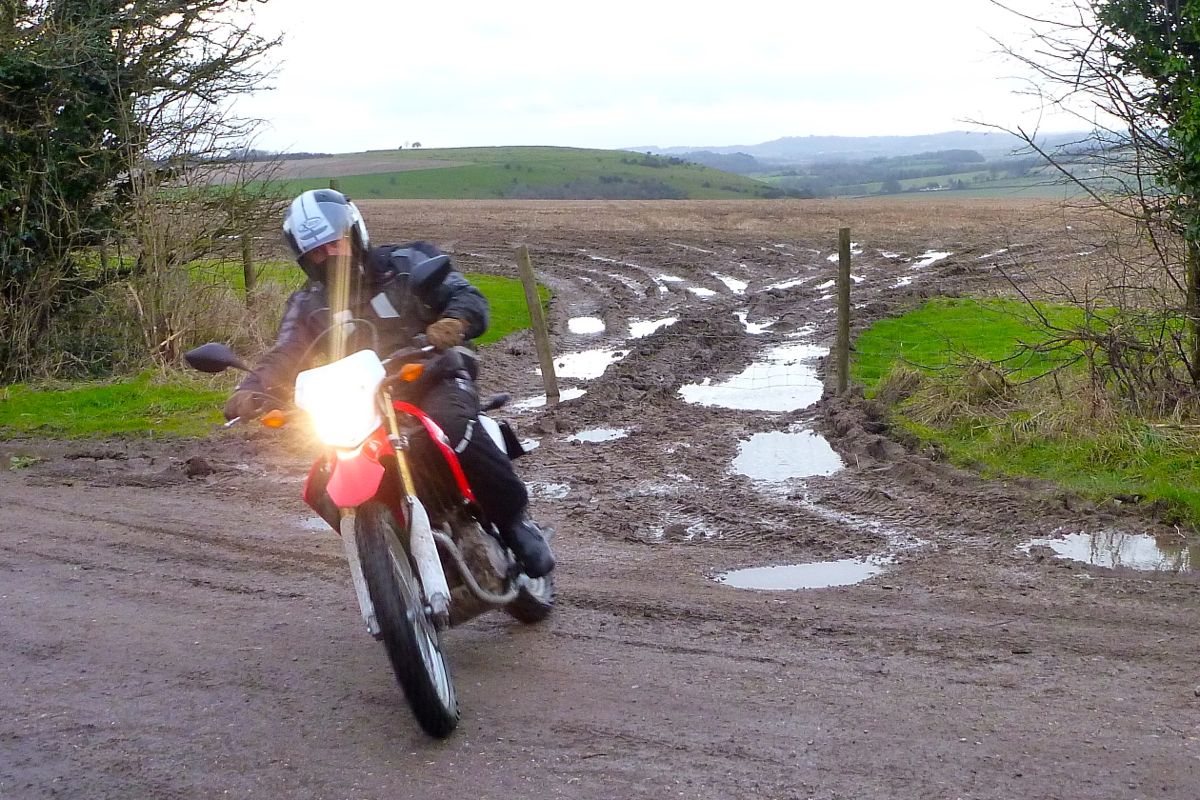
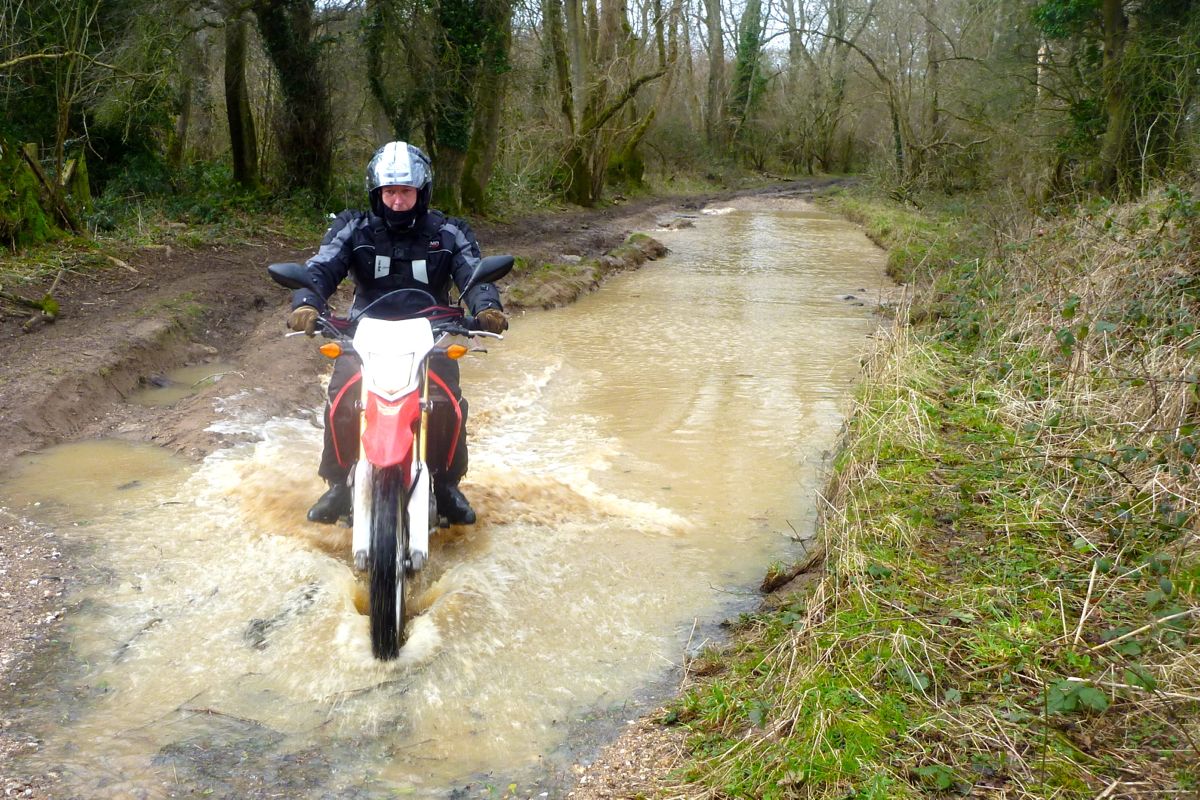
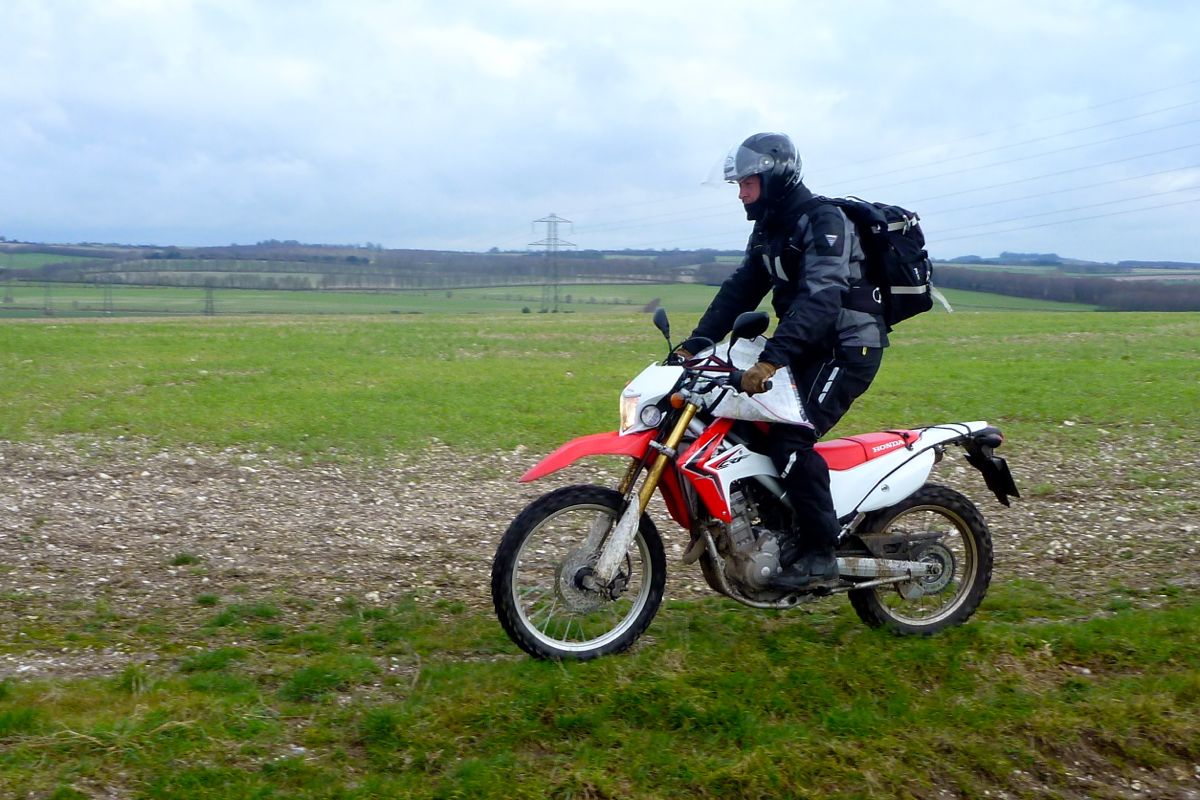
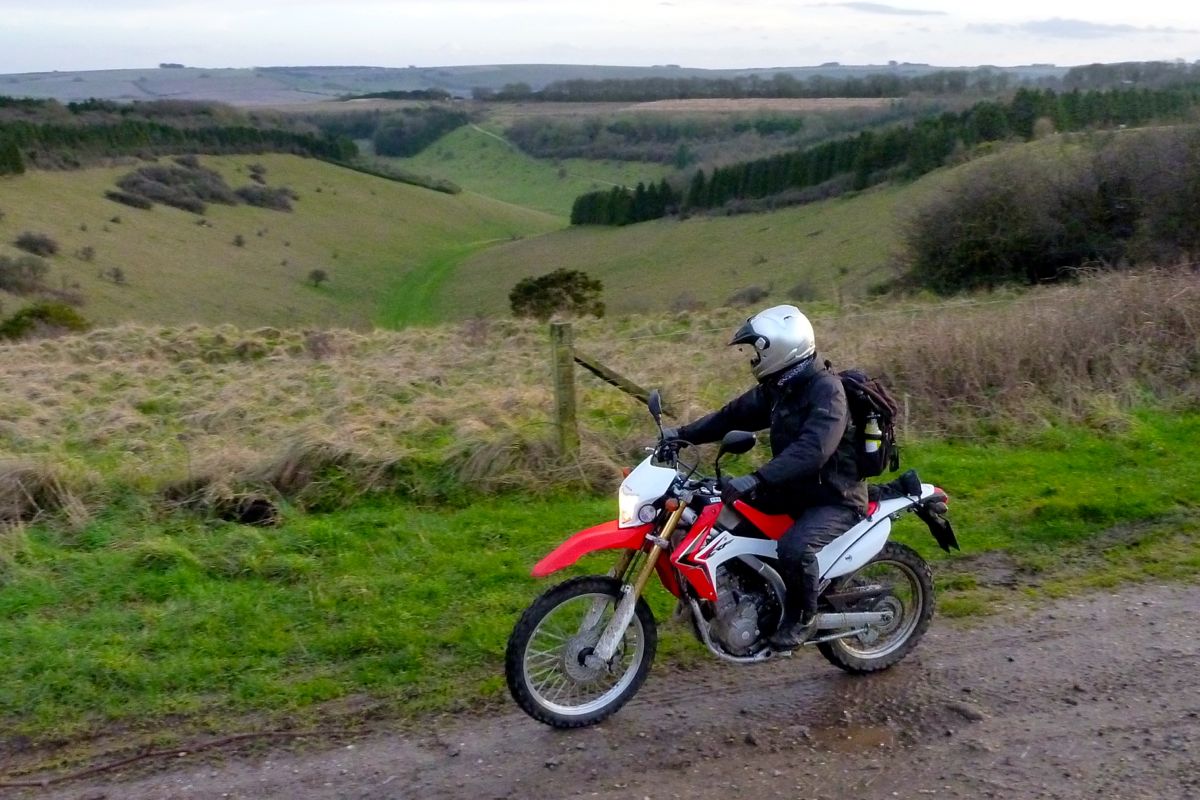
Running a stiff Michelin Race rear, Robin dropped his tyre pressures while I decided to keep the Honda’s IRCs at whatever they were and see how I managed. It’s good to have something in reserve if things get very slick. The initial grassy, rutted path would have been hard to ride all day but at the right speed the CRF managed fine and did so all day and the next. The key has to be light weight with a low seat, but also modest power and of course speed. I could imagine with a typical 600 single the power pulses alone would be that much harder to control as the bike ran on. Not so the CRF – it was nearly as easy as riding an MTB and I never got close to getting out of shape or falling off.
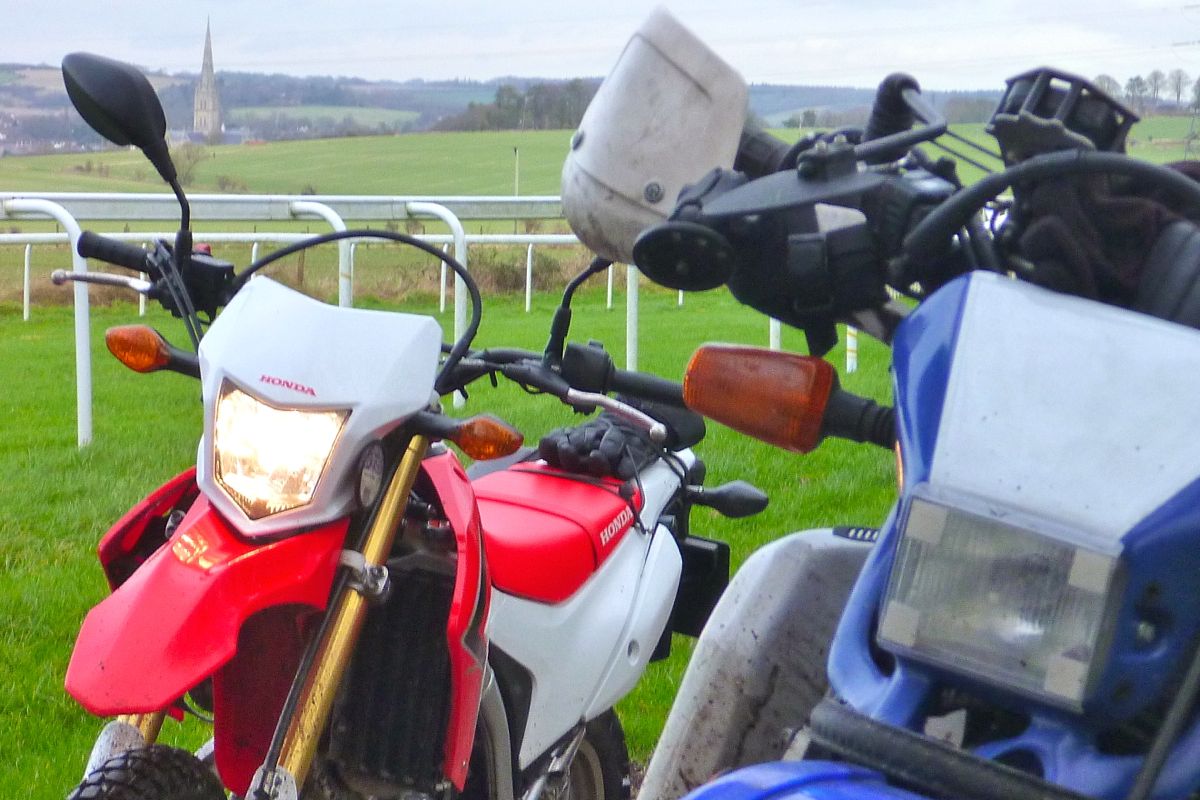
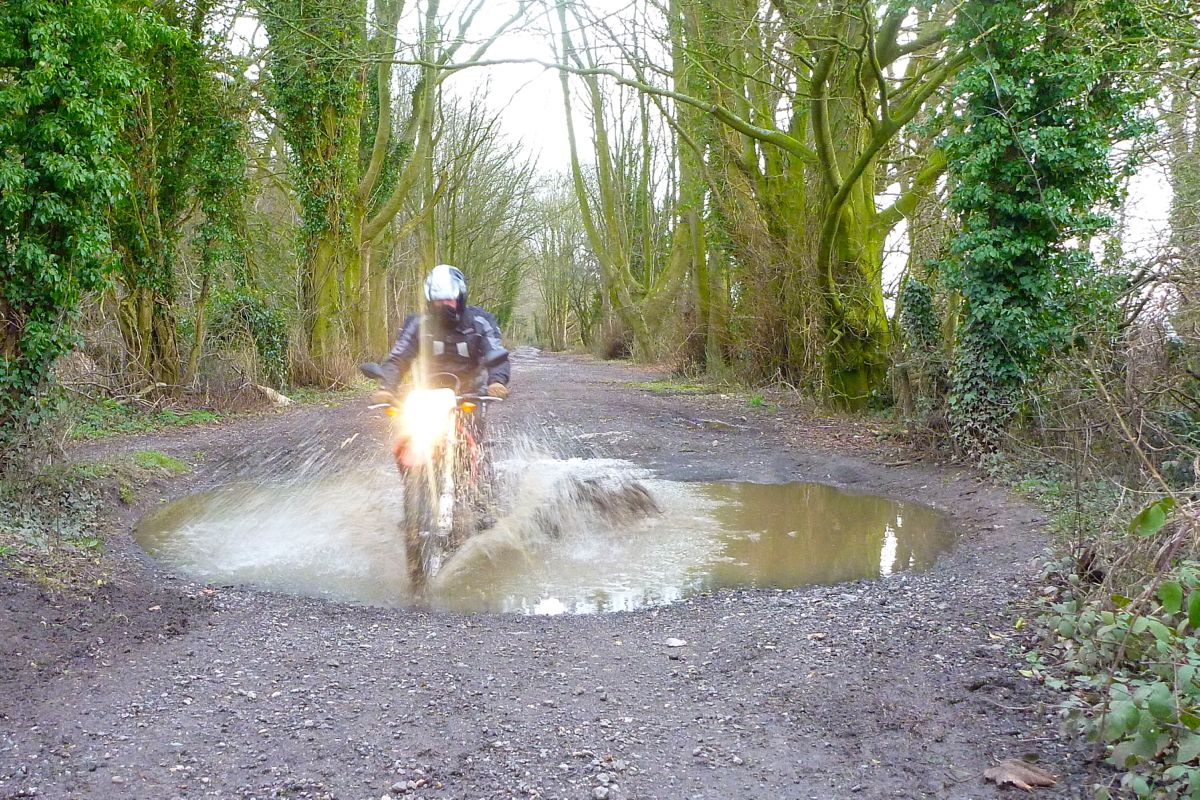
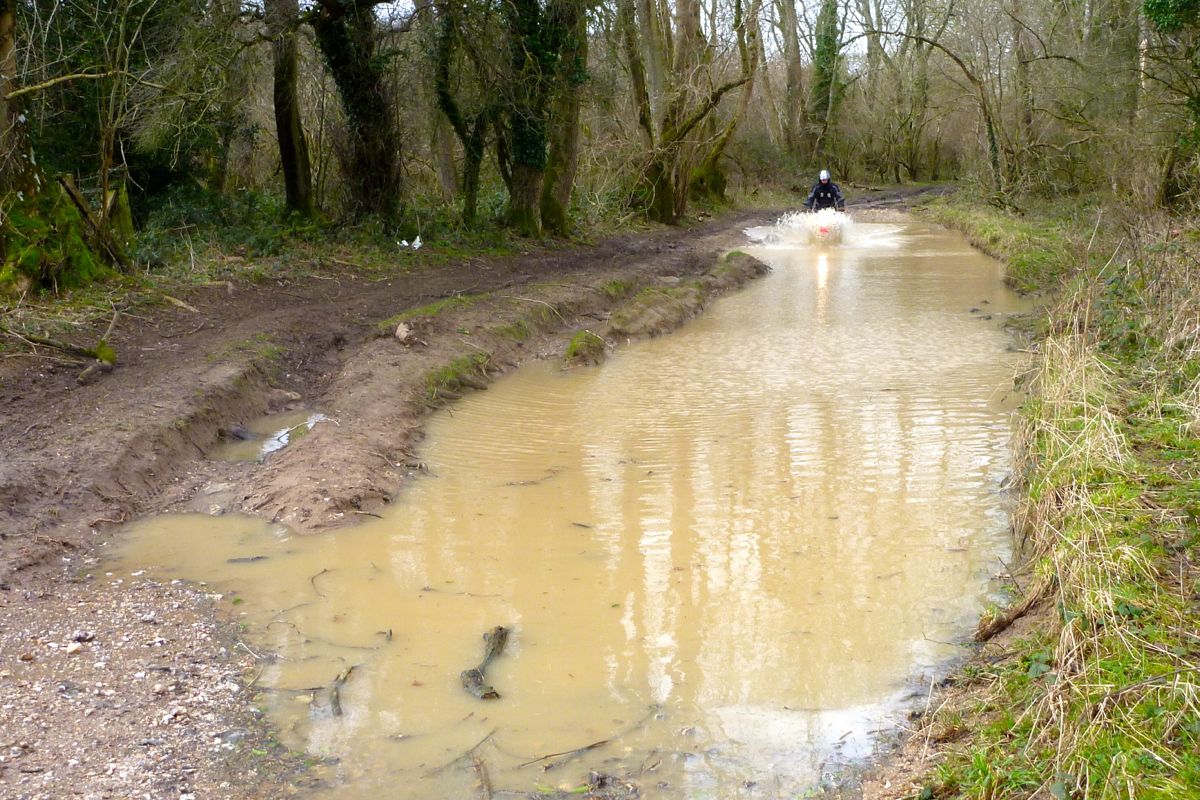
The Old Drove soon grew into an easy wide track, passing a racecourse on Warren Down overlooking the nearby city and its famous cathedral spire. Occasionally puddles and churned up ruts would require some thought, but both the TTR and the Honda chugged on through. I couldn’t get over how easy it was. People are complaining about the weight for a skimpy 250 trail bike (my original trans-Sahara Tenere – right – was weighed about the same with the same fuel load, iirc), but it just wasn’t noticeable to me – perhaps it’s the relatively low centre of gravity (aka: short suspension). And as on the 660Z Tenere if that mass adds up to a tough frame and general robustness then so much the better.
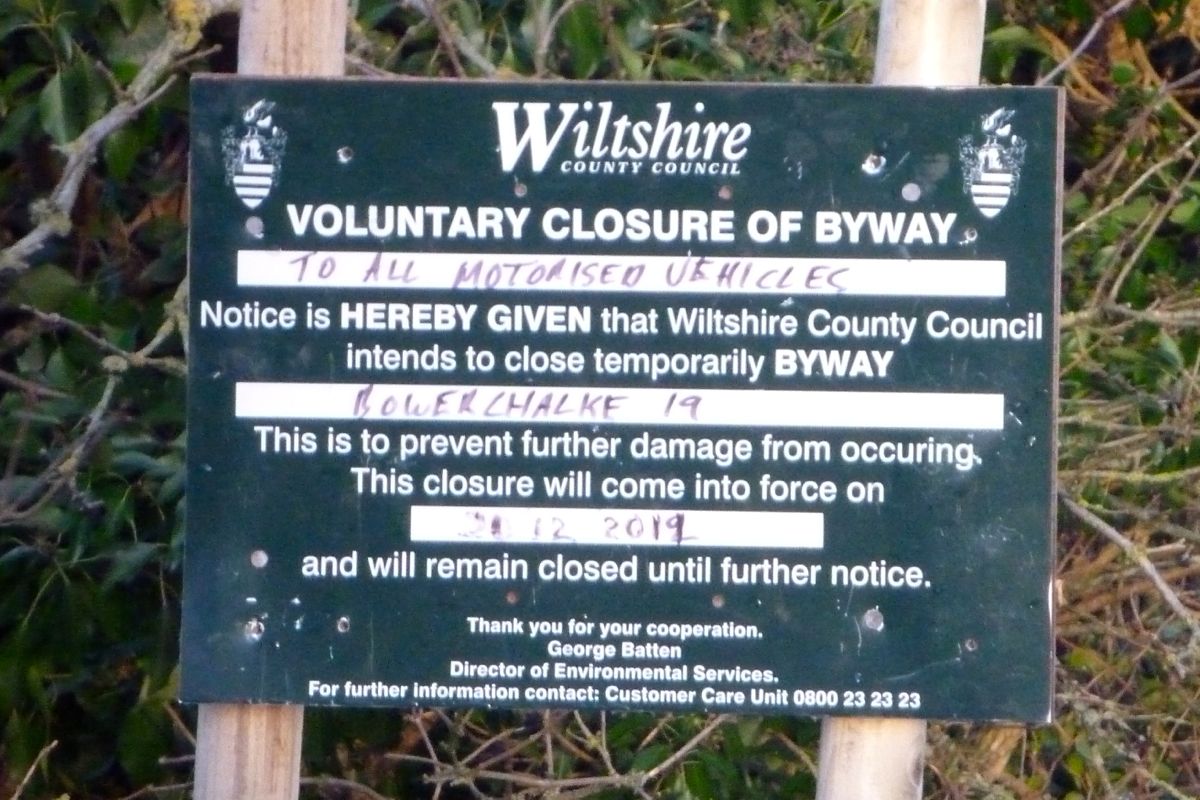
After a couple of crossroads we came up against a voluntary byway closure sign. Not knowing that it was in fact an optional request to limit erosion to part-flooded tracks, we spun off south looking for alternatives. Whenever we stopped to check the map we could hear the booms and thuds of live rounds detonating on the Plain a few miles to the north. The Pashtuns were getting it in the neck.
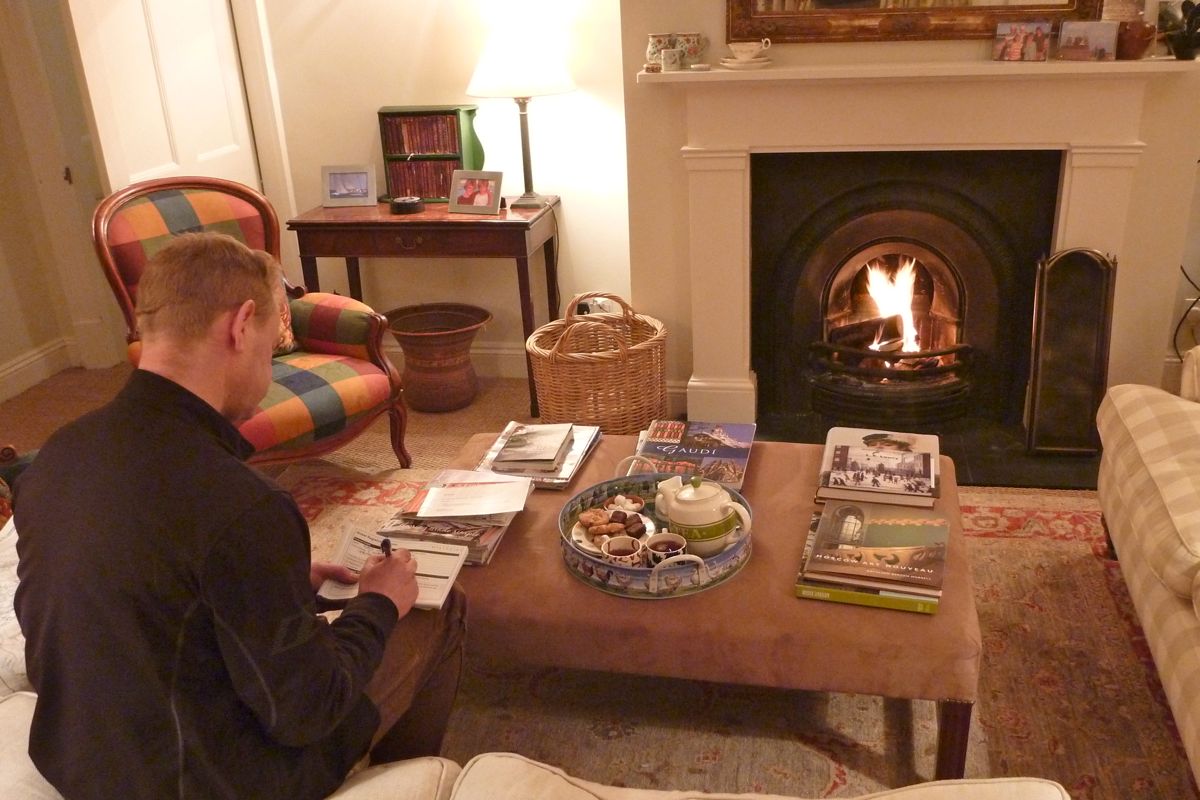
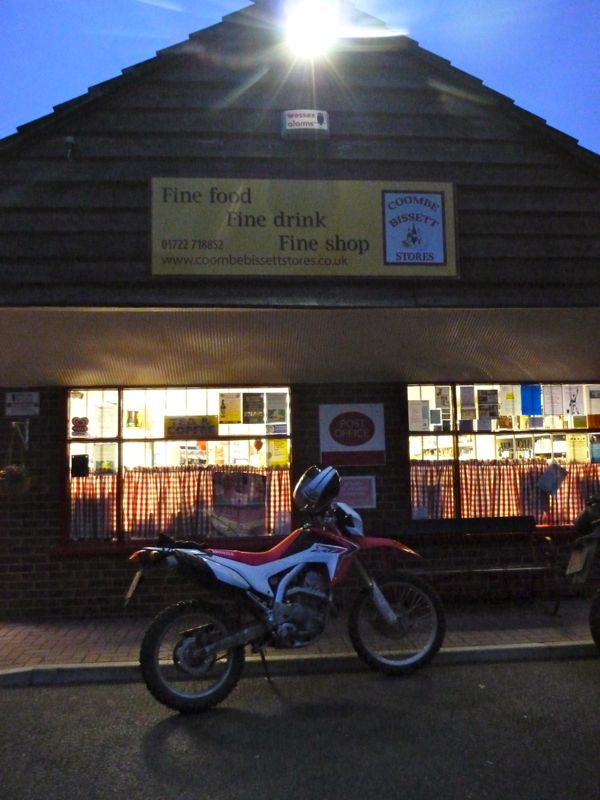
We prodded at a few more byways but one after another they were all closed and by now the sun was getting low. Time to find a cosy inn or B&B. Round here all you have to do is ride through a village or two to find a something like that and sure enough the shop in Compton Bisset pointed us to a perfect place just up the road. Soon we were shacked up by an open fire and pouring a brew.
Next day we had a longer than expected chat with the land lady over breakfast. She happened to know both my former and current publishers, and sadly was also due at a funeral of another acquaintance who’d been killed at the In Amenas gas plant a few weeks earlier. I’d been in the Algerian Sahara during the siege and had passed through In Amenas many times over the years.
A byway led right out of Compton where like in much of the area, the roadside streams were close to spilling over and many fields were flooded. That lane too was signed off and down the road so was the next, but the one opposite wasn’t so we slipped and slid over Rockbourne Down to another quaint, thatched village. If nothing else, tooling around the back lanes of Wiltshire wasn’t so bad – as pretty as adjacent Dorset but much less visited. Normally Wiltshire passes in a blur either side of the A303 as I belt further west.
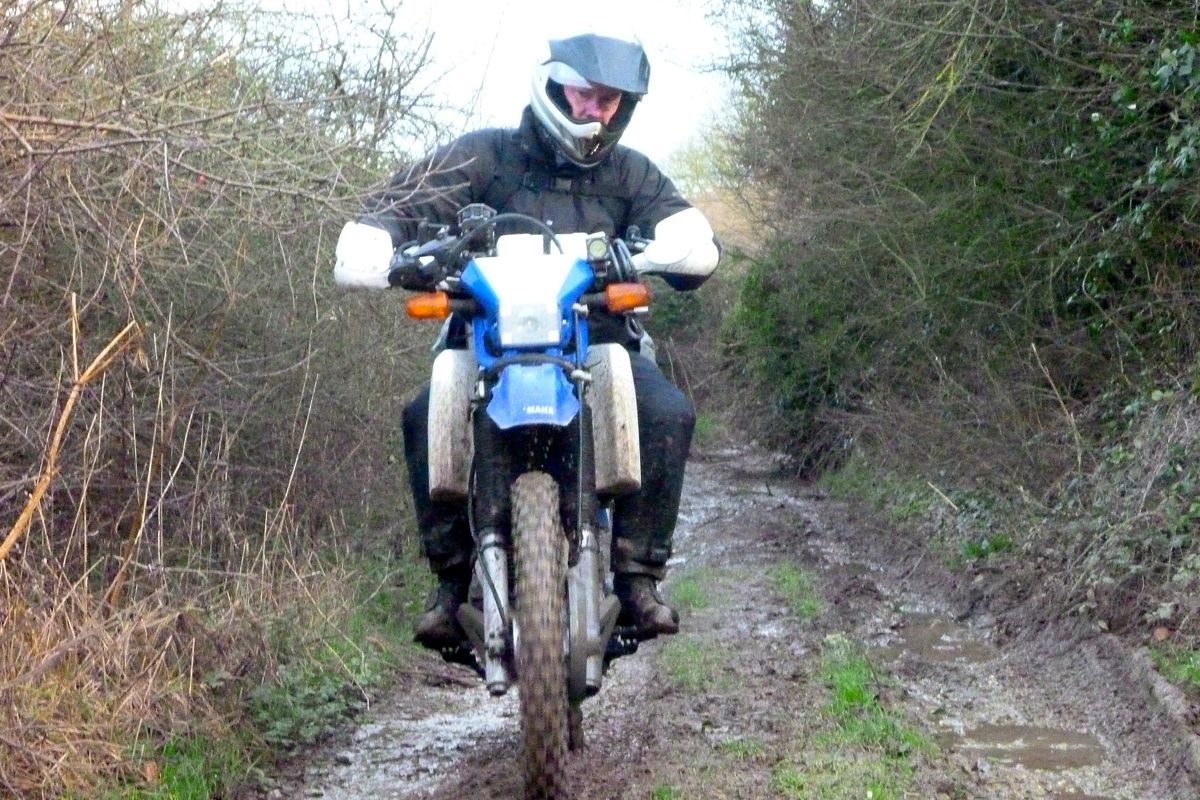
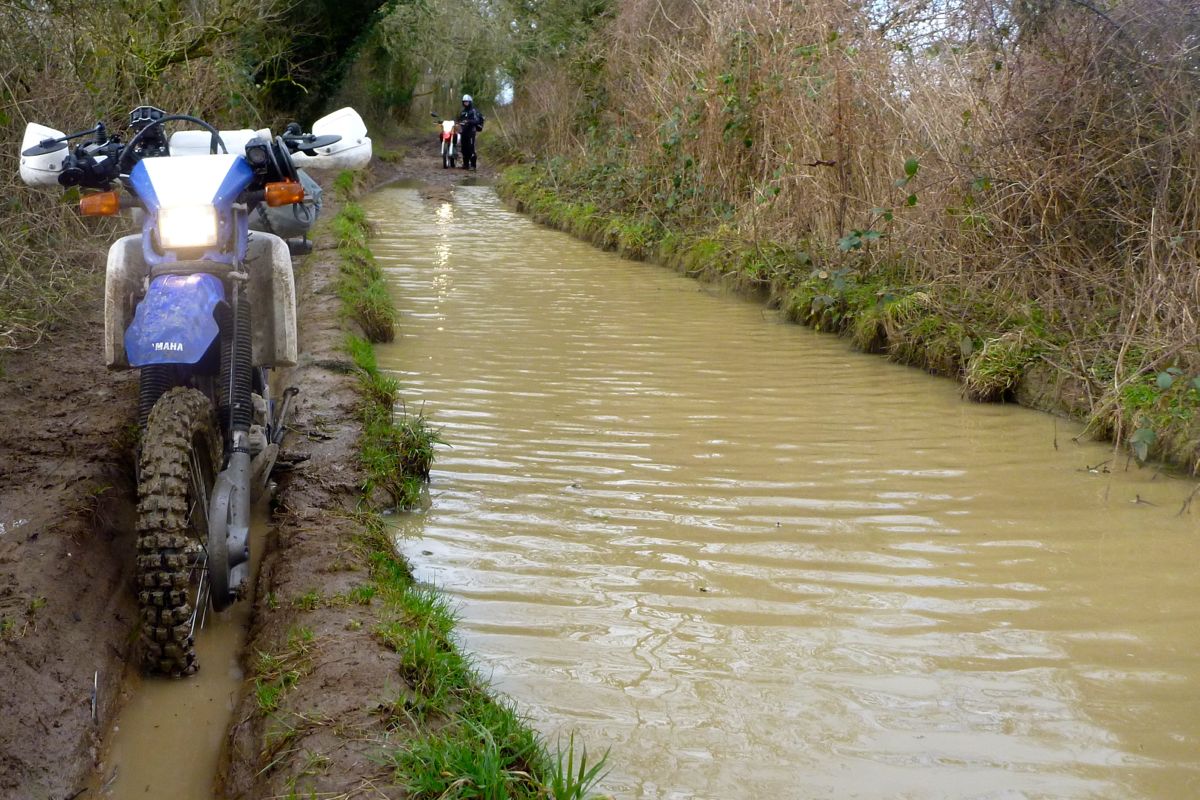
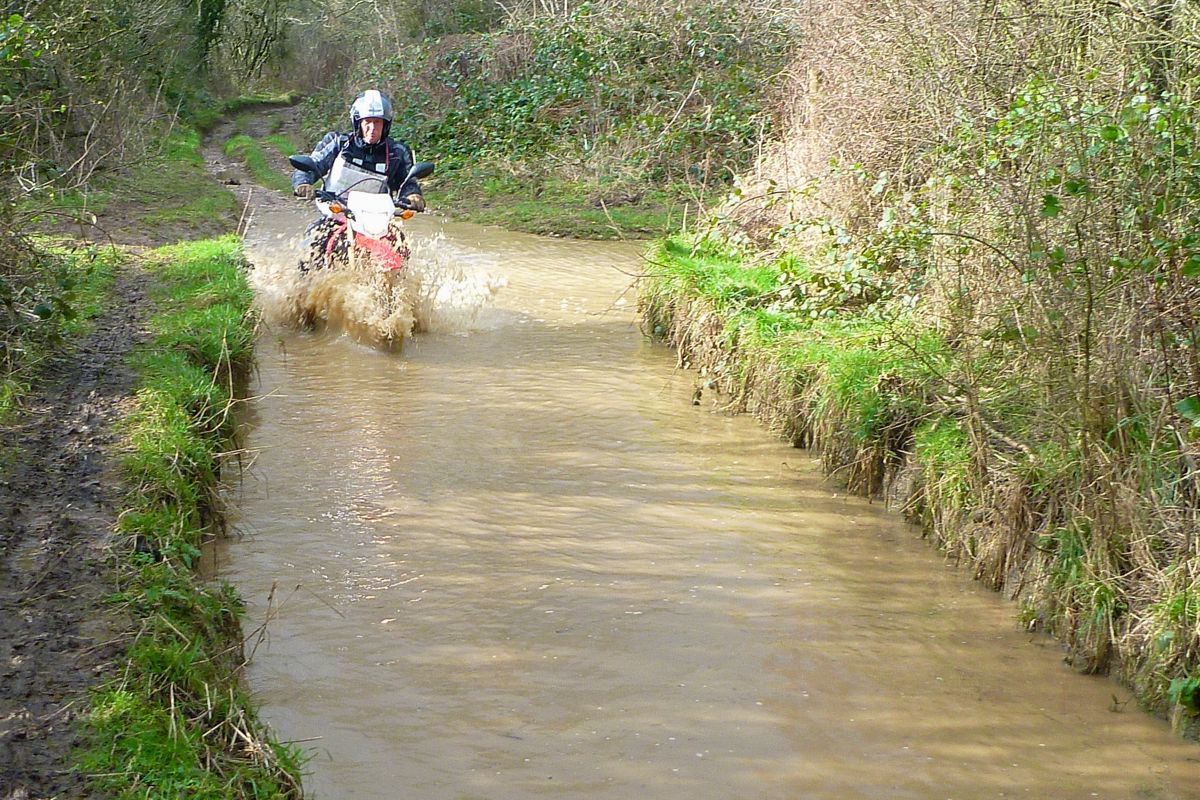
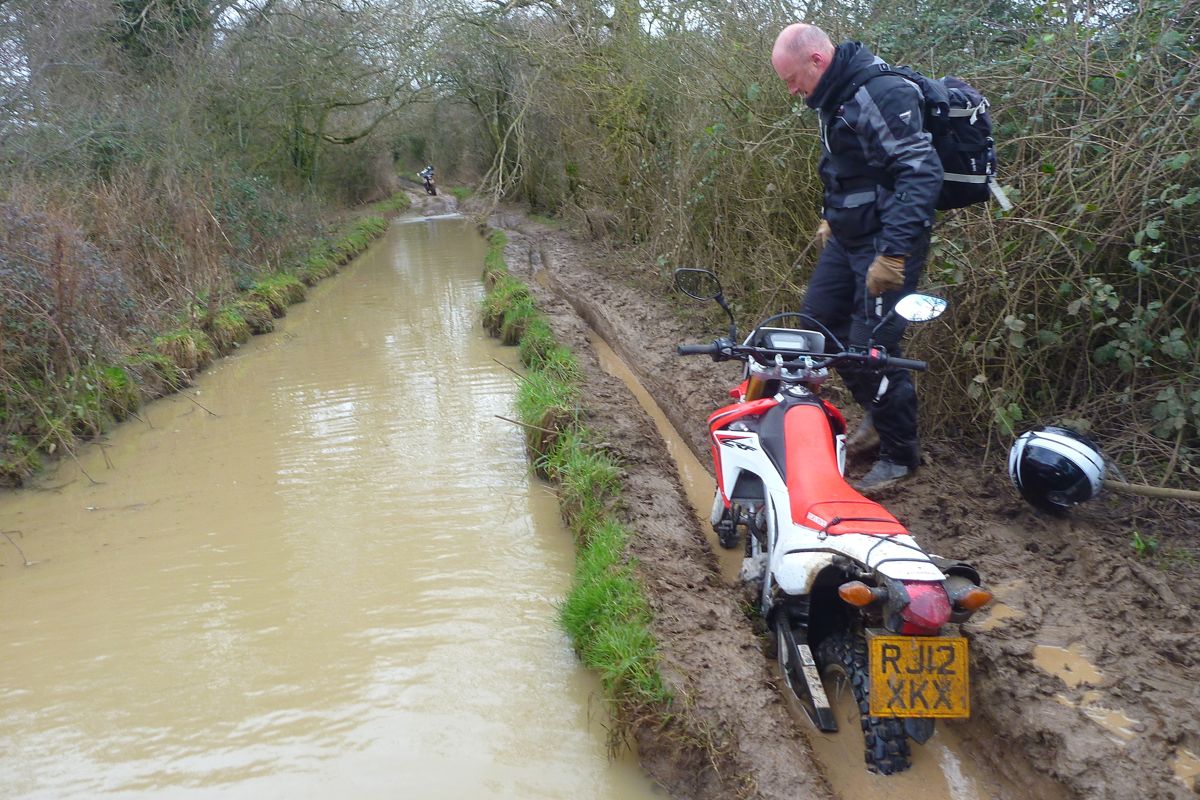
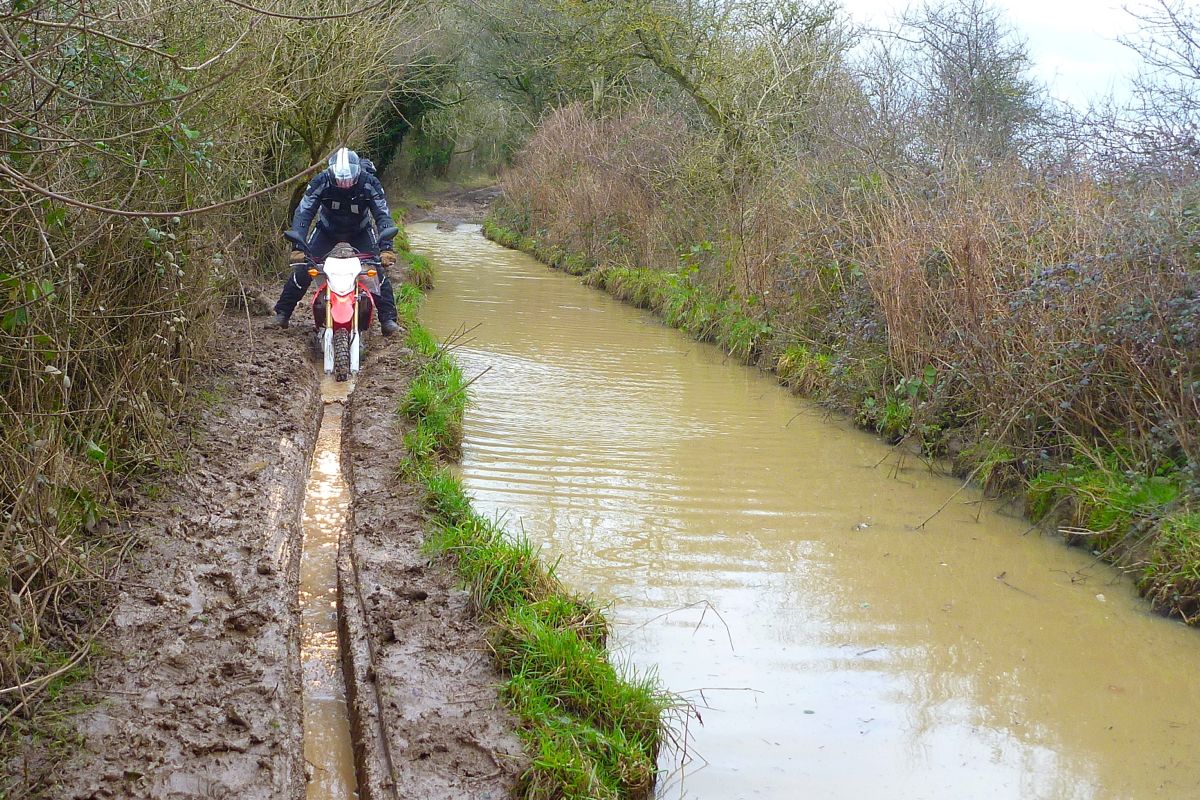
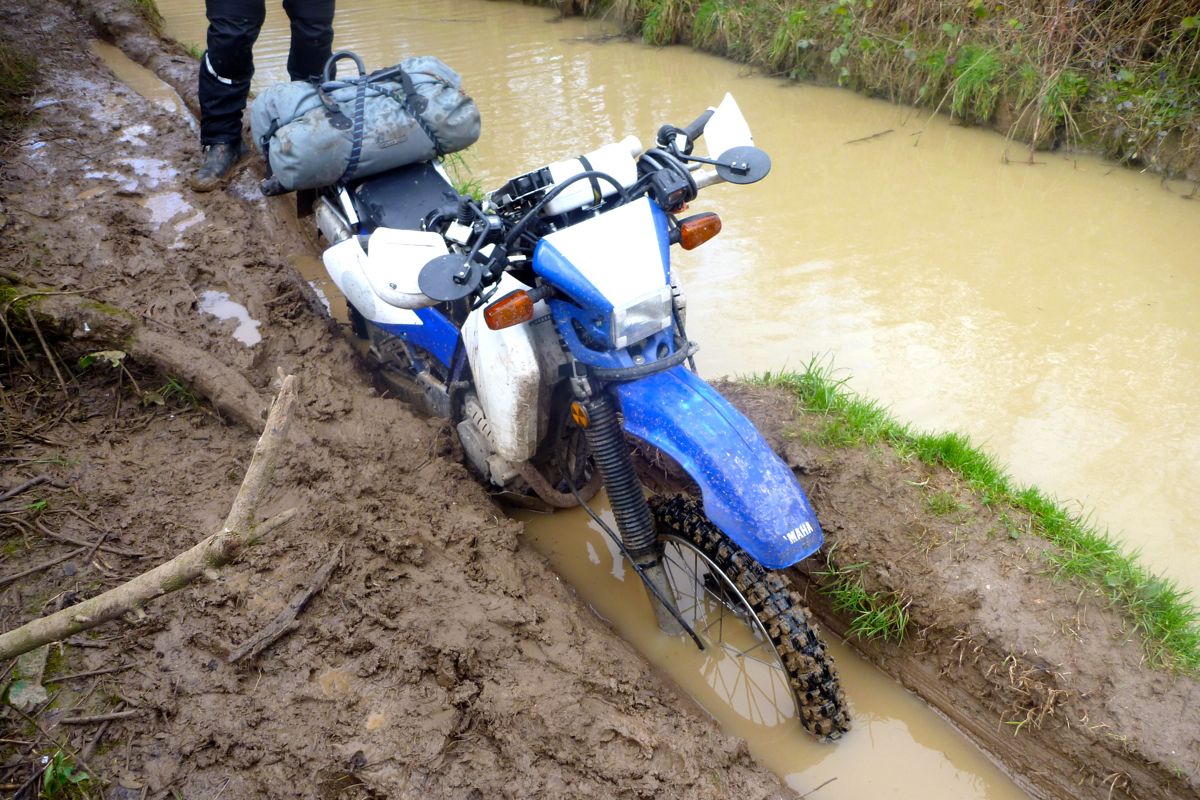
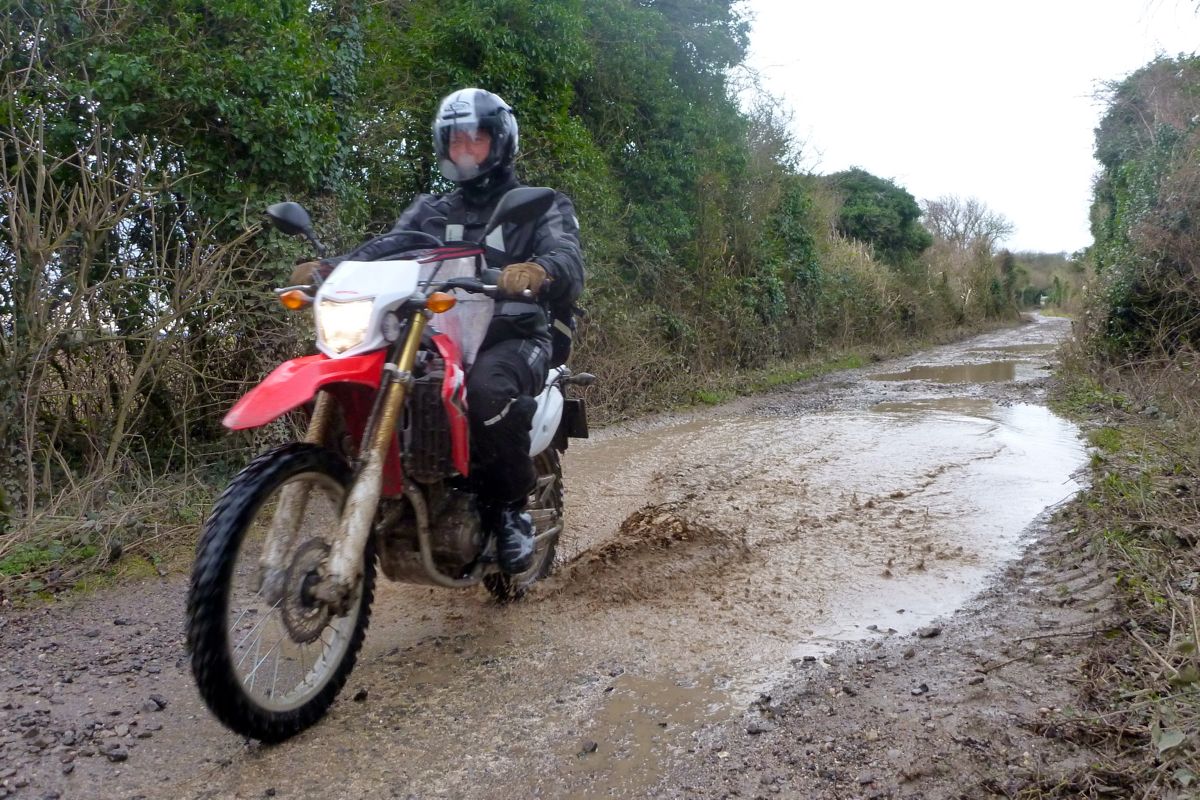
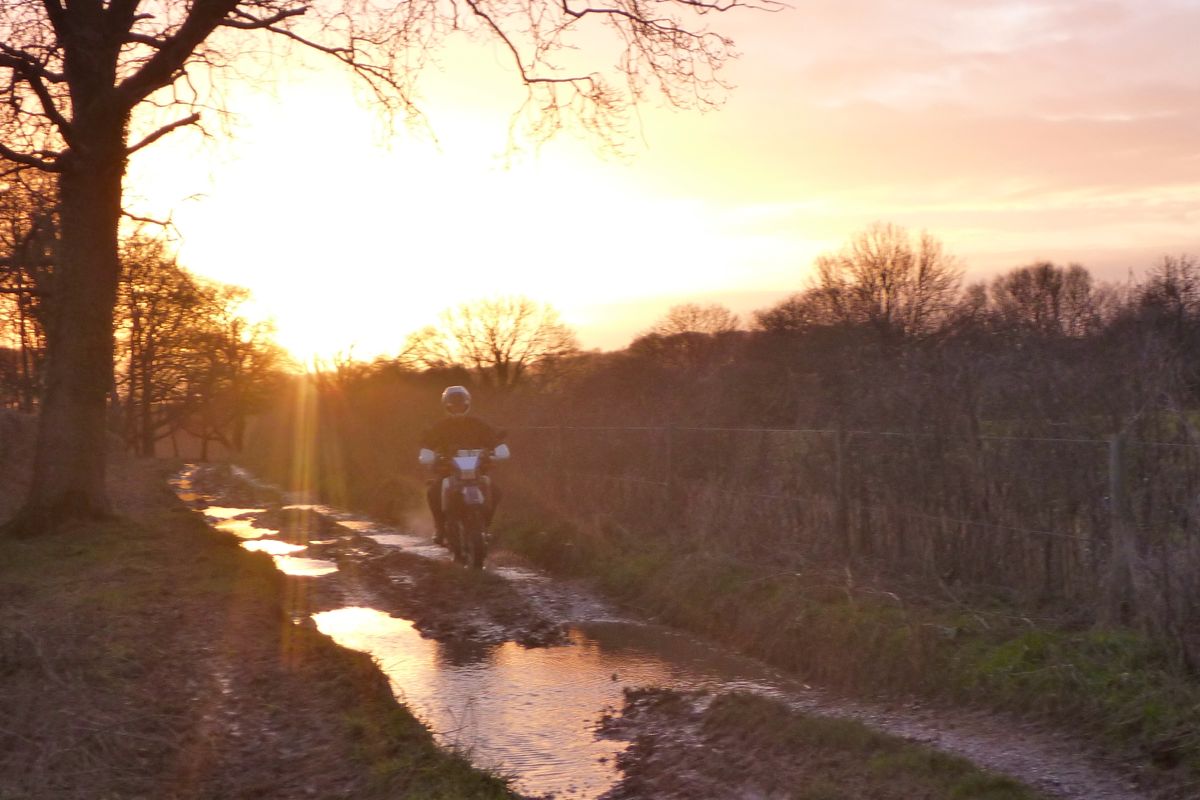
But what we needed was a bit more byway action and finally we clocked a muddy lane with no closure signs and set off to see how far we’d get. This one soon got pretty waterlogged and after a while we came to a long water-filled trench alongside which ran a single moto-sized rut (right). Prodding the main channel with a stick proved the water would probably reach the tank once we’d spun ourselves down into the silt. Neither was keen to do try it, but the bike slot alongside was clearly was doable.
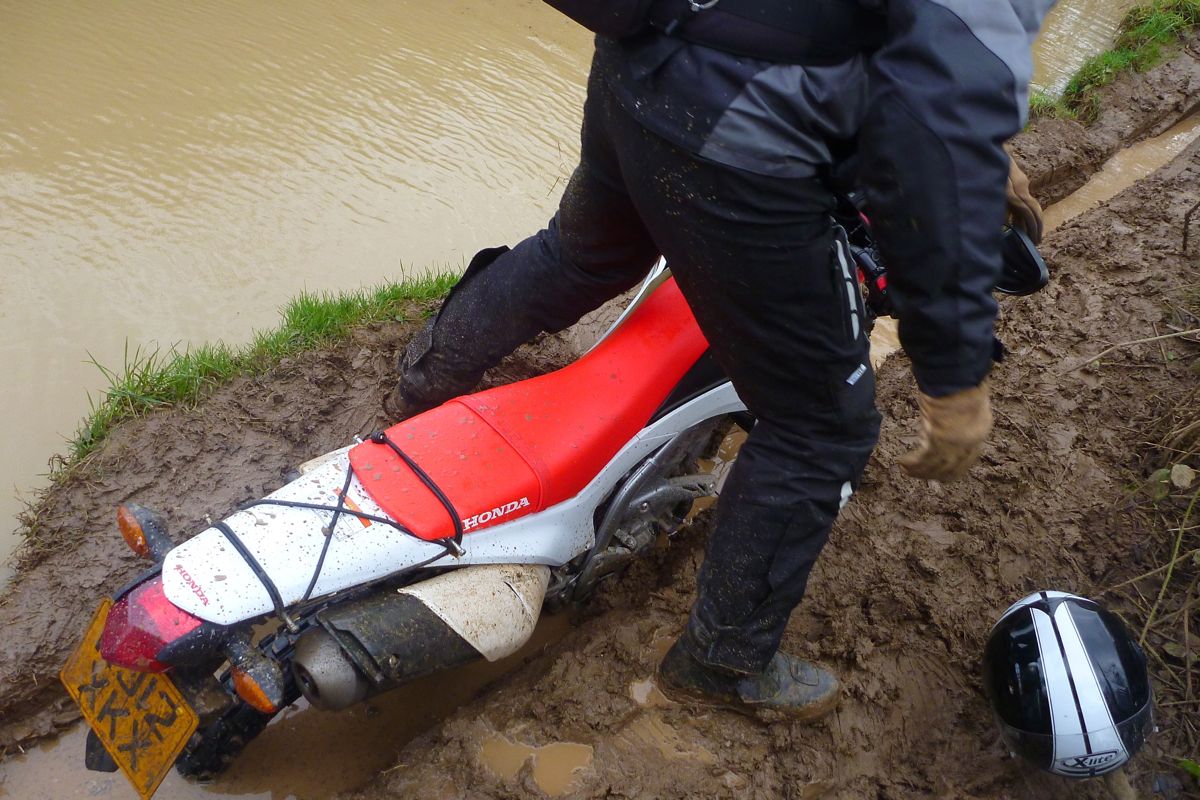
Or so we thought. In fact that slot had been spun so deep by passing bikes that the TTR got jammed into the rut by its foot pegs. Robin laboriously lifted each end over the tight spot, observing how easy it was to manhandle our bikes. Add another 50 kilos, 30°C and a set of alloy panniers astride a 650 bogged down in some equatorial morass and it’s all much less of a lark.
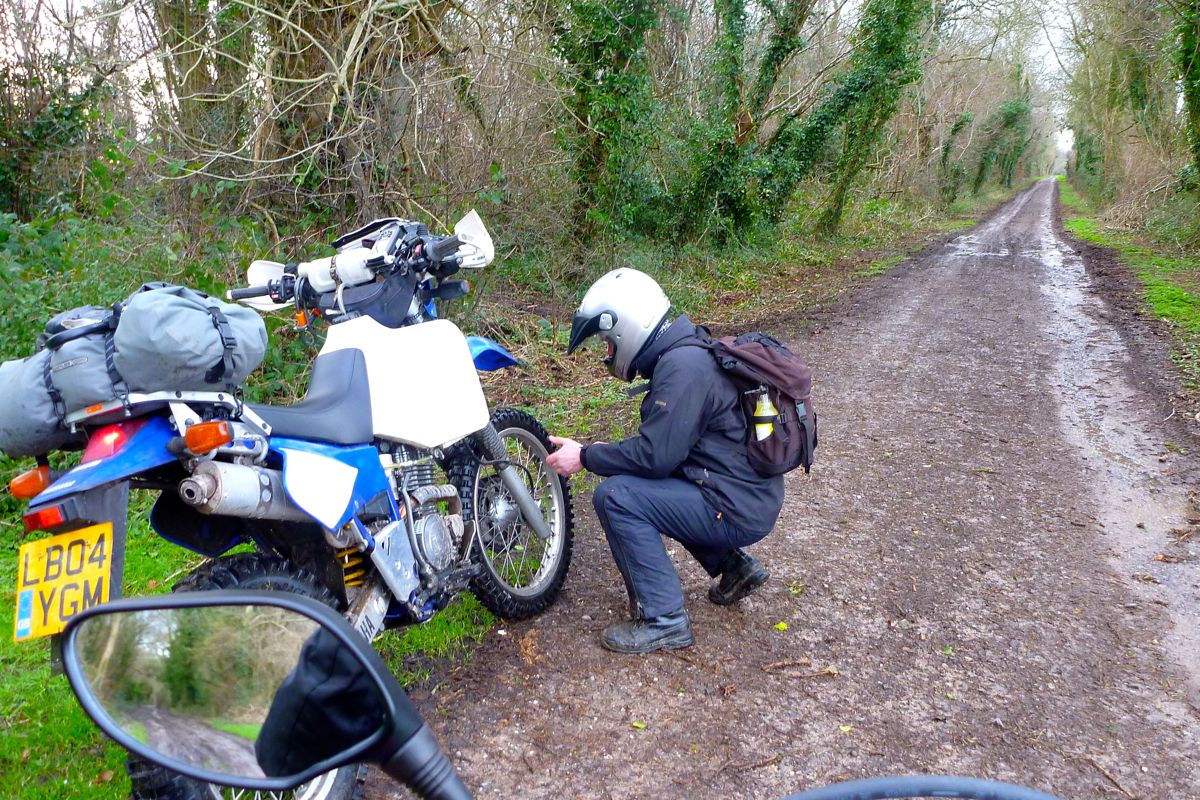
Having seen where the TTR got jammed, I thought with a bit more momentum and judicious bar hauling I’d slide the Honda through, but I didn’t even get close before I too was uselessly spraying crap all over my back with the CRF firmly nailed by its pegs. A bit of synchronised wheel lifting soon saw us on the way to the next puddle which led to a fast A road leading back to Salisbury for a refuel (69mpg), coffee and a jet wash before blasting back up to Slough.
Summing it up If you can cruise at a real world 65mph and tackle any reasonable off-road trail, it makes you wonder if a bike like this could indeed be a contender as a lightweight, load-carrying overlander – and not just for short people. Robin obviously thinks so and had invested a lot in optimising his TTR, but his cleverly refined minimalism might a bit more than most could endure.
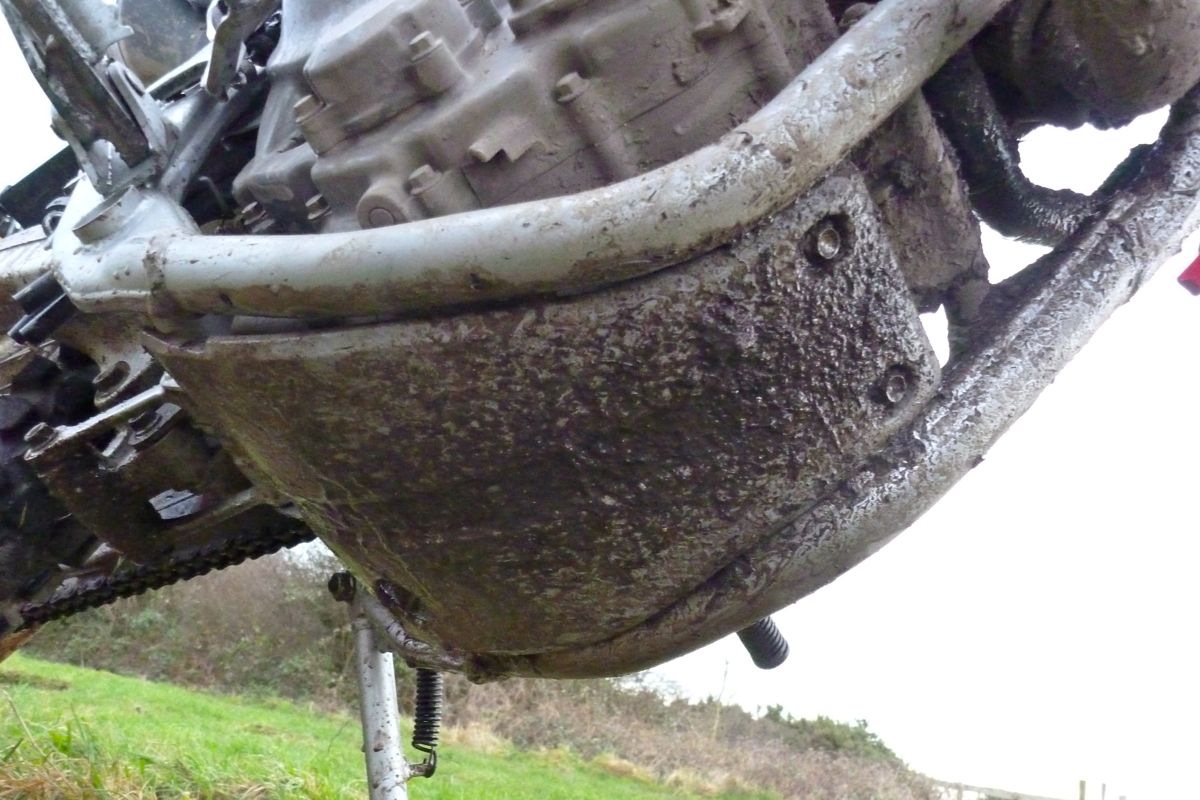
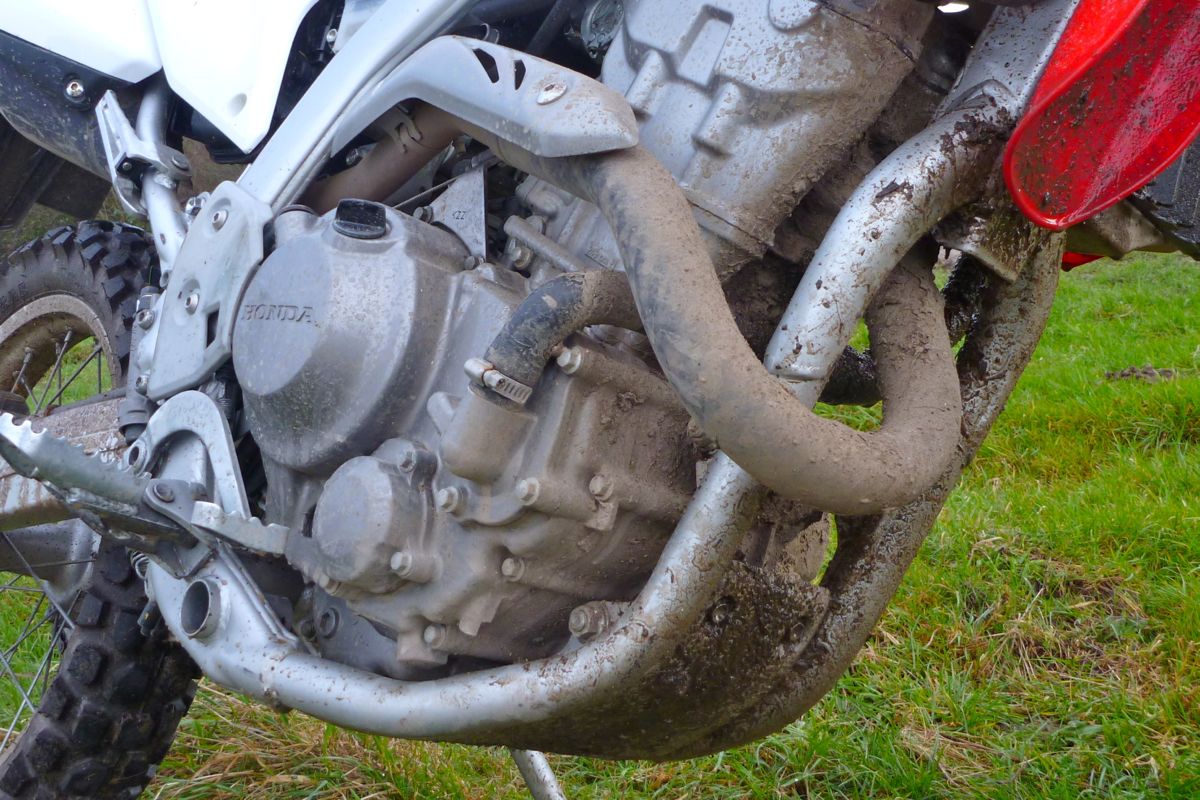
At 6′ 1″ I didn’t feel too cramped nor vulnerably underpowered on the motorway and only the unexceptional mpg (and therefore feeble range on the tiny 7.8-litre tank) was a disappointment. Assuming that was an aberration that might pass or be tuned out, all this bike would need is more of a bashplate to protect the engine sides, hand guards, a tail rack and a windscreen. I’d need some 2-inch bar risers too. Most of all though, at just 7.83L or 2.07 US gallons, it needs a bigger tank or more fuel capacity. At $300 an aftermarket IMS tank adds only 3.33L or 42.5% more capacity, totalling 2.95US/11.16L/2.45gal Imp. For the equivalent of about £180 not sure that’s worth it. I’d sooner get a 7-litre Liquid Containment bladder (as pictured in the book and left ) for about £70 in Ozzie of a ten-dollar 5L fuel can. At my mpg readings I’d have a range of just 111 miles (180km) and even at a more normal 85mpg that’s still only 225km or 140 miles (This guy is averaging 78US or 94mpg). Another 5 litres capacity would boost the range to nearer 400km (at optimal mpg figures). There’s plenty of room where the unused front ‘tongue’ of the seat goes, or with extended rad scoops as on the XR tank fitted on Robin’s TTR which would also protect the ever-vulnerable radiator.
I didn’t get the chance to have a closer took at the bolt-on subframe which is rated as ‘rider, passenger + 5kg’. That ought to be enough to carry a load when solo riding and being steel and detachable, modifying it wouldn’t be so hard, though perhaps not to carry a set of full size Metal Mules. To me all this complaining about the weight misses the point – it feels light to ride and light to lift and doubtless light to pick up too. Robin’s modified TTR weighed the same. An alloy framed 250X may be a whole lot lighter and better sprung but needs a head job every 100 hours while a 250L needs servicing every 8000 miles.
None of the above adaptions are hard to do. Me, I think I’d try and get used to living with 18hp and get over not being able to dig up the turf or wheelie at will. There’s talk of people waiting for a 450 version, because there’s a CRF250X and a 450X. Those are similar looking but quite different bikes. Back at Honda I asked the guy if there was indeed a bigger version in the works; they might bring out a 300 to match Kawasaki’s KLX300 he said, though that’s been out for years so has hardly caught Honda by surprise. But then again, seeing as trailing CRFs include a 150, 230 and now a 250, maybe a 300 might be the next step. Depending on how my desert tours develop, I might be getting a CRF in a few months.
March 2013: I just bought a used and functionally accessorised 250L in California for a two-month ride around the Southwest. More news on the latest AMH Project bike here.
2015 – It seems these Huskys are being reborn by Shineray under the old SWM brand.
As long as it’s smooth, a big single comes close to the optimal configuration for a do-it-all travel bike, especially if you intend to ride dirt roads occasionally. You’ve enough power to pull a load, the economy to carry it a long way, and all without too much mass making the rig hard to handle on muddy or sandy tracks. And these days efi has managed to introduce smoothness and hopefully seamless starting too.
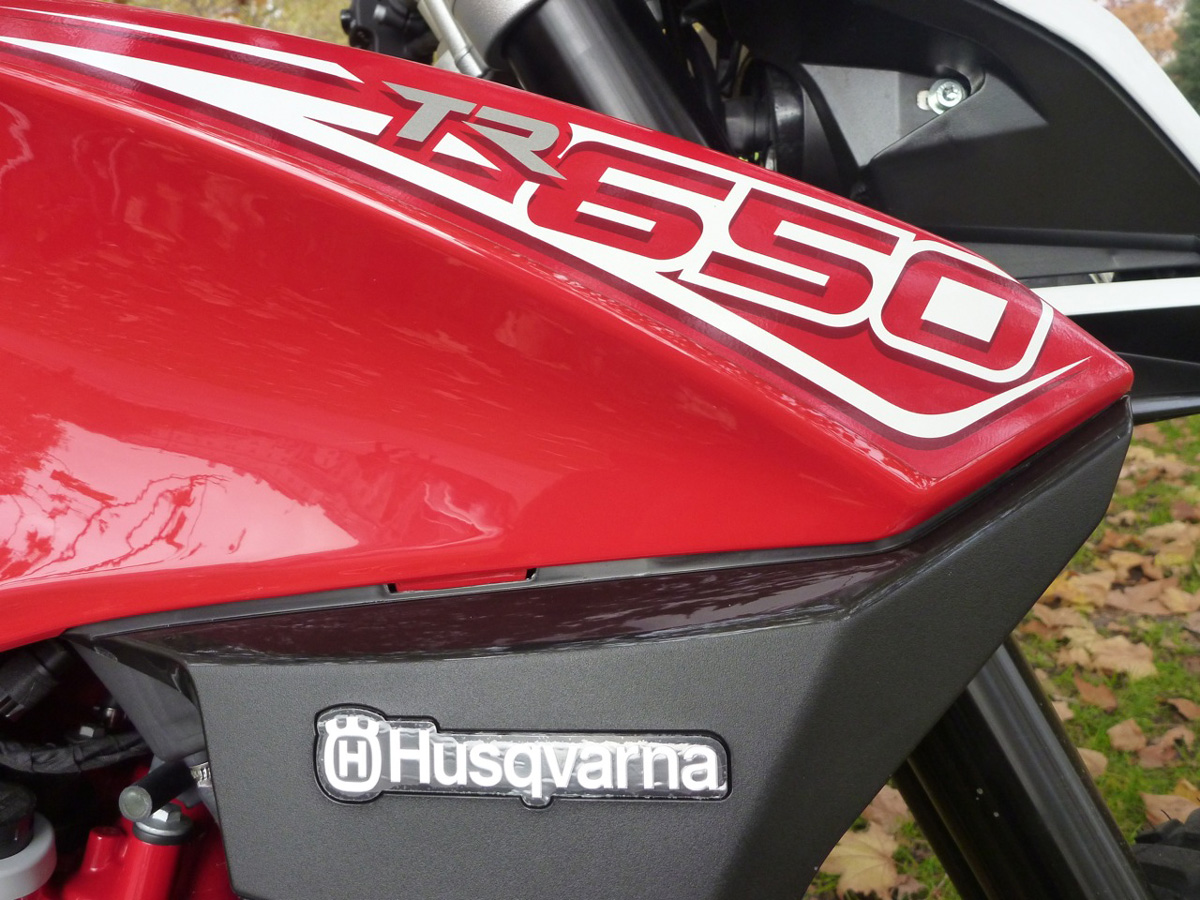
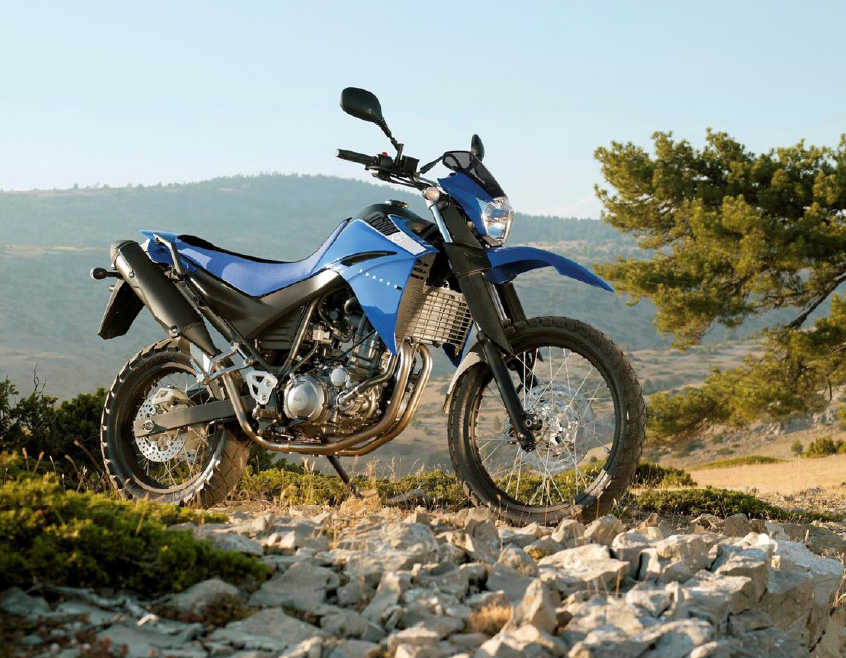
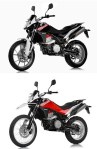
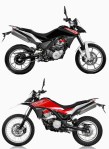
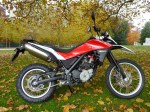
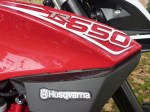
I’ve done Sahara trips riding, or riding with just about every big four-stroke single going, so when I read of Husqvarna’s new TR650 Terra and Strada I was curious to see if I might like to add one to that list. There are no press bikes in the UK for a couple of months so I paid up and took a short test ride from a BMW dealer in central London. FYI, this review adds up to no more than an hour’s ride around west London on a 650 Terra.
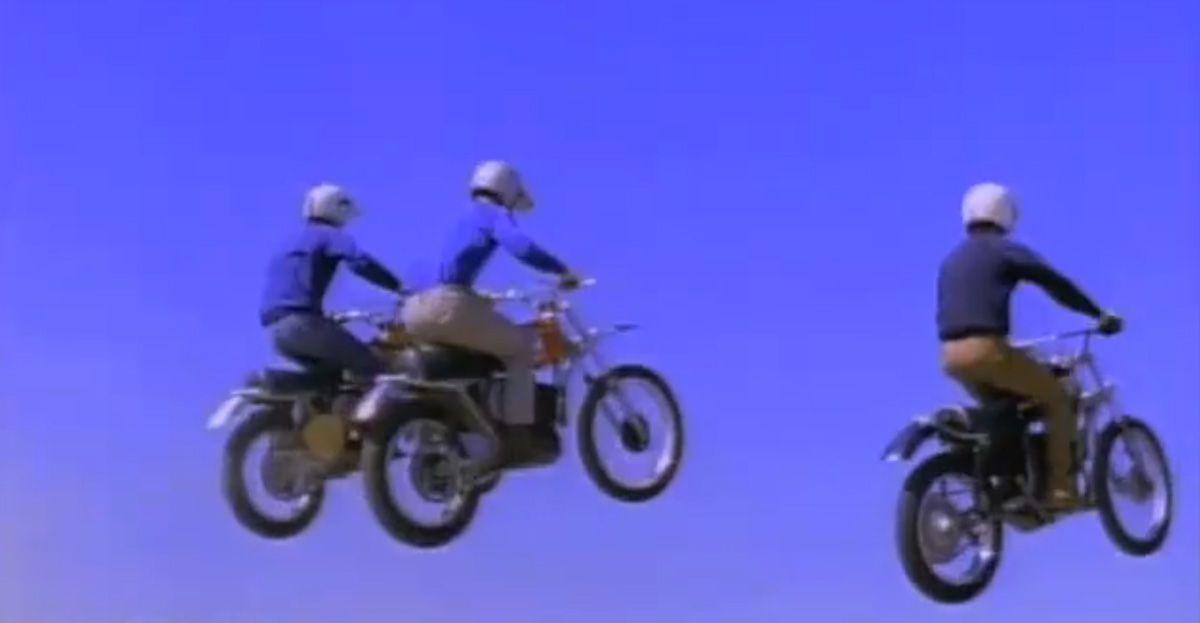
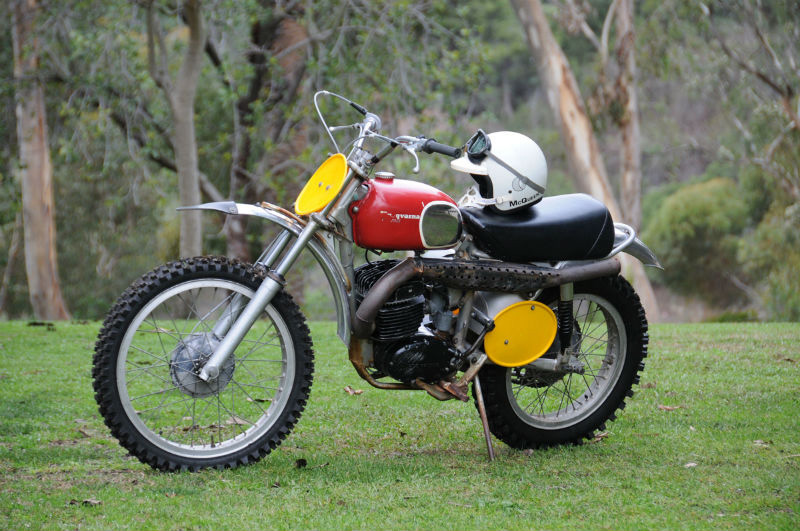
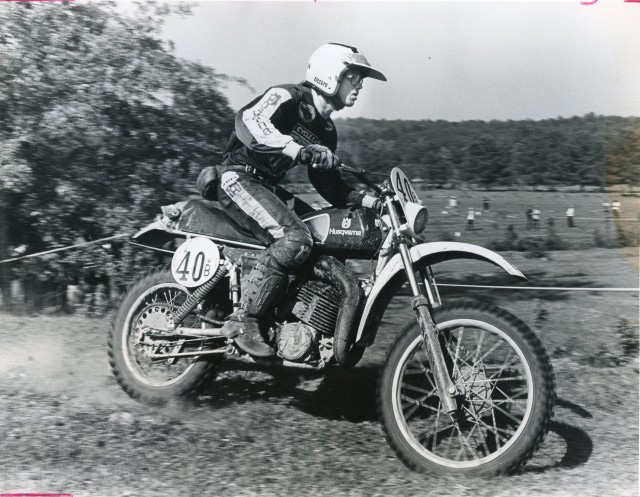
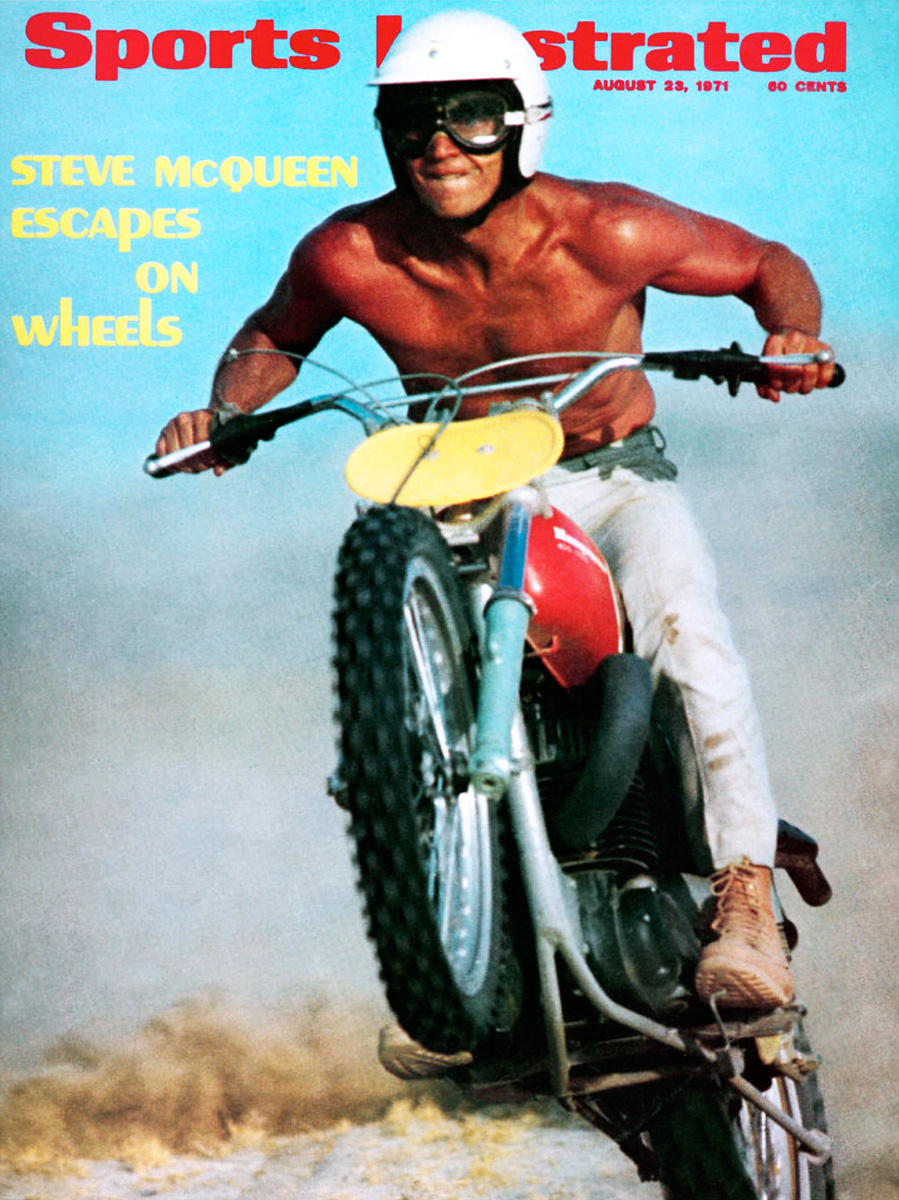
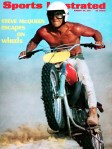
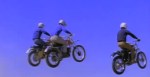
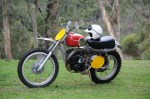
I’ve never owned a Husky, but it’s quite likely that in their 1970s heyday they were a better known brand in the US than the UK. I recall in the late 70s and early 80s reading in Dirt Bike magazine about US enduro champion Dick Burleson’s epic annual battles with the Blackwater 100 enduro aboard a two-stroke Husky 390WR (below left). And a few years earlier we had no less than Malcolm Smith, flat tracker Mert Lawill and the ‘Cooler King’ Steve McQ (all flying above left) hooning around in On Any Sunday – a film so good I’m going to slap in a clip right here. In fact his 400 Crosser (right) was up for auction soon after I wrote this.
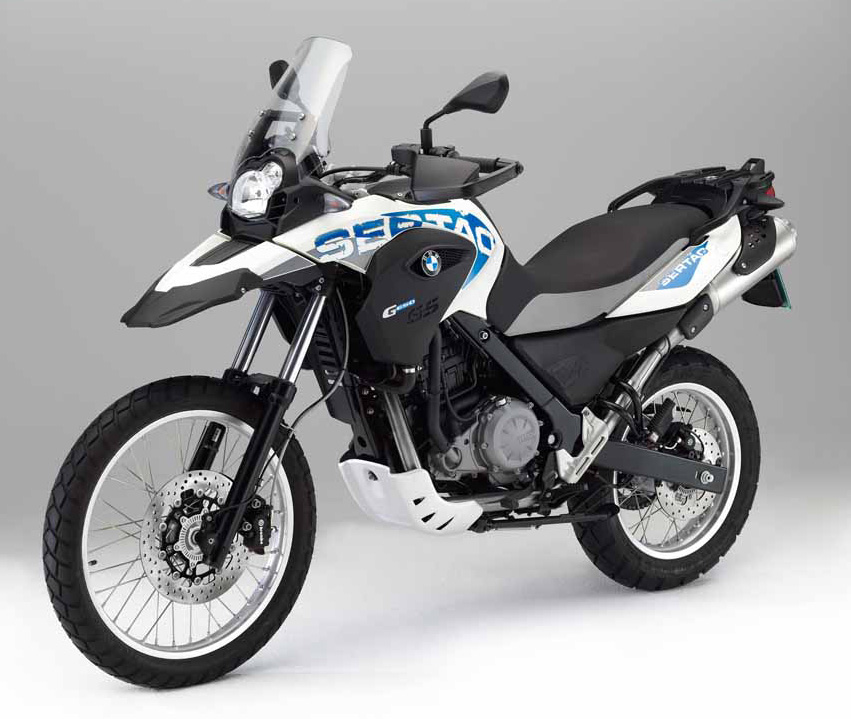
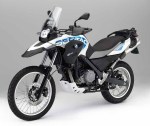
Globalise it Husqvarna is the name of the former Swedish maker of off-road competition racers who were bought off Italian owners Cagiva (MVA) by BMW in 2007; it’s said to give the German marque a bit of dirt bike credibility. Then in early 2013, in the course of realignment towards urban mobility and nothing less than e-mobility, BMW Motorrad sold the brand to Pierer Industrie AG, a private company owned by Stefan Pierer, the CEO of KTM. As things stand Huskies continue to be made in northern Italy, with the new TRs using the Chinese-assembled 650 engine made by Rotax that appears in BMW’s Sertao and GS650G among others, two models more or less separated by wheel size with the implied trail- or road bike use. It’s a common ploy these days; use one motor/chassis platform to sell two or more options.
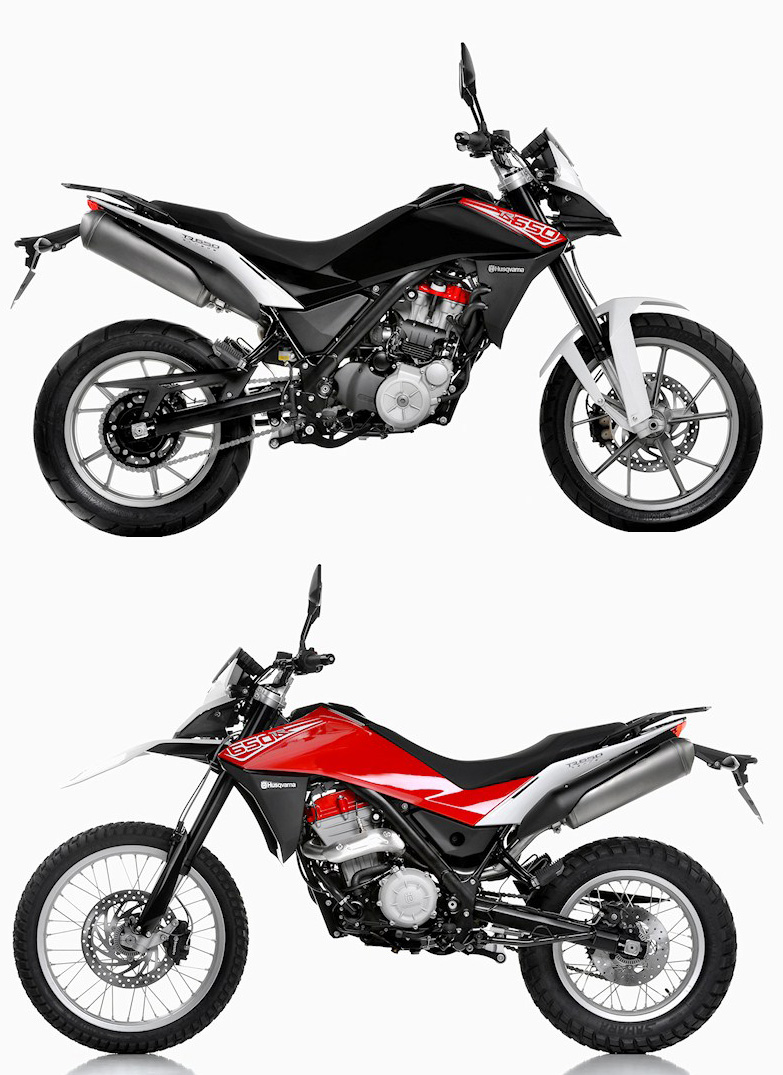
The two TRs are in this mold; identical frames and motors with the road-oriented Strada running 19/17 cast wheels and tubeless tyres (left) and the Terra trail bike with 21/18-inch spoked rims. In the UK the Strada gets ABS as standard; on the Terra it’s an option. Most expect the Terra will be the better selling of the two, although I’ve found a 19-inch front wheel rides fine on the sort of unsealed roads you do when overlanding. I believe tubeless tyres are better too. Don’t think you’ll be doing the modern version of the Blackwater 100 on a Terra just because it has a 21-inch front wheel.
Replace ‘X’ with TR? I wondered whether the two Husky TRs were reiterations of the failed X-series of 650-single BMWs from around the time BMW bought Italian-owned Husky in 2007.
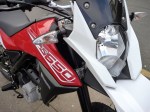
That may be the vague idea, but in fact the new TRs bear a closer resemblance to a previous Husqvarna, the 2010 TE630 (right: 160kg wet; up to 57hp claimed; £6200 in 2010). Only now they’ve moved away from the TE’s off-roader attributes towards a trail and road bike using a significantly worked over BMW engine, which may help explain the drop in price.
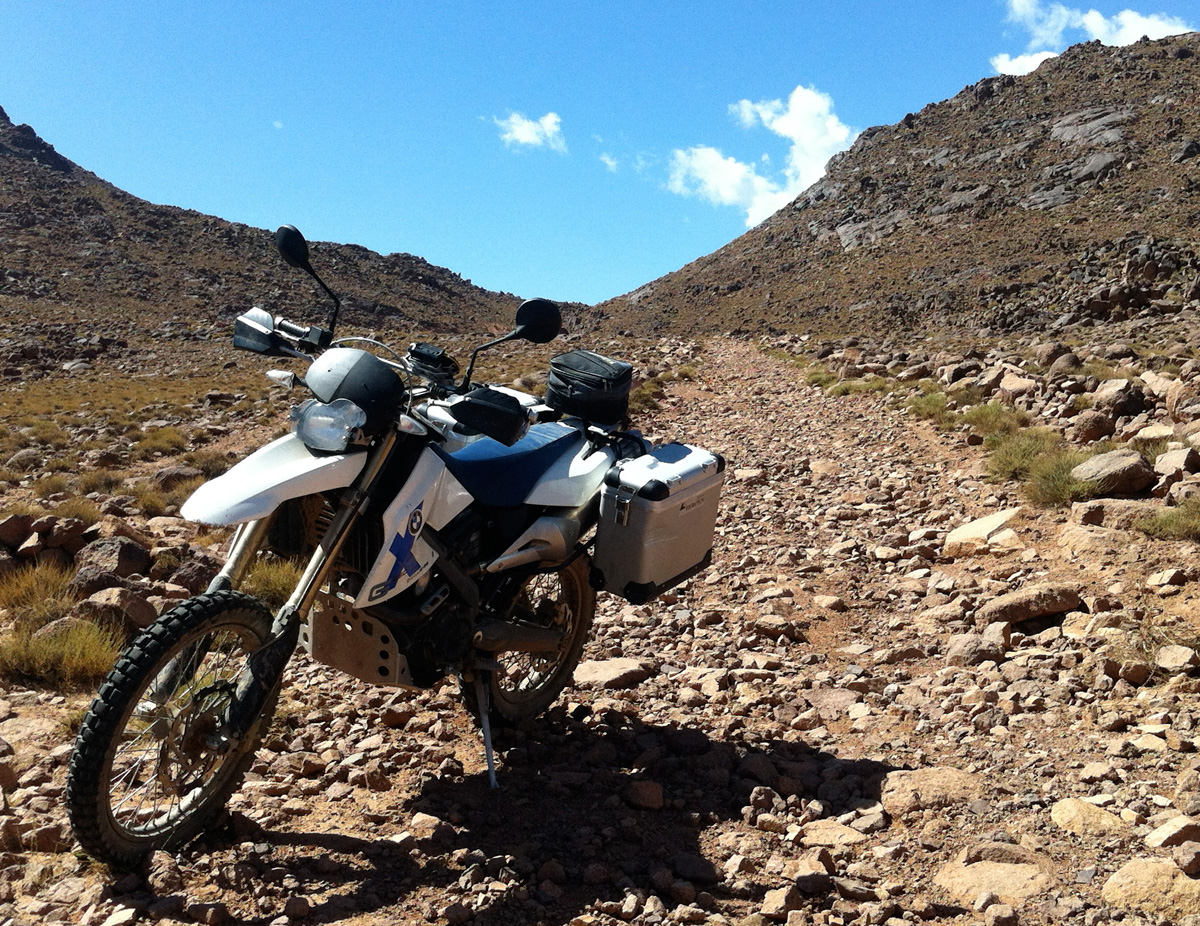
Using this same base engine, in this respect the Terra would compare with the old X-challenge (left, on the gnarly MH5 piste in Morocco) while the Strada would equate with a 19-inch X-country. In AMH, Walter ‘Sibersky’ Colebatch describes the substantial mods he made to his air-shocked X-challenge to create a hardcore overlander, while I myself might have erred towards a tubeless 19-inch X-country.
I still haven’t got to the bottom of why the X bikes were a flop other than perhaps looks and that buyers didn’t associate BMW with light trail bikes. As far as I know it certainly wasn’t down to a disastrous reliability record out of the crate. I always thought BMW gave up on the Xs too soon – or did so to focus attention on the new 800cc twins which came out around that time (and initially had more teething problems than a chocolate gearbox).
According to the power specs issued on the TRs’ launch in Spain a couple of months ago, the Huskies both claim a notably higher 58hp over the 650GS BMWs’ 48hp, but for many the weight specs were disappointing. At 186kg a Terra with the ABS option is said to weigh just 6 kilos less than the portly Sertao (right) and some 26kg more than the preceding TE. The old BMW X-challenge with its air suspension but no ABS clocked in at just 156kg wet. And yet looking at a Sertao while sat on the Terra in BMW Park Lane’s underground hangar, it’s hard to believe there’s only 6kg or 13lbs in it. The Terra is slinky slim alongside the Sertao – like an old TT600 sat by a Tenere. And it can’t be that the motor is inherently heavy if they managed to get an X-challenge some 30 kilos lighter. This all assumes the factory figures are correct – one day some diligent publication will spend some quality time with a pair of scales. Yes we all know that the weight of something even as large as a GSA1200 magically evaporates once on the move along a nice road, but in the real word of overlanding there will be muddy diversions or gravel track opportunities where that weight (combined with tyre choice) becomes very much apparent. When the going gets tough, weight does matter.
Claimed kerb weights (wet)• TR650 Terra 186kg (with ABS)• BMW Sertao 192kg • Yamaha XT600R181kg (no ABS) • BMW X-Challenge 156kg (discontinued) • Husqvarna TE630 160kg (discontinued)
The KLR650, and pre-Cambrian DR650 and XR650L continue to be churned out for the US and maybe other markets.
Testing testing Like I say I’d sooner run a 19-inch front-tyred bike for long distance travels which are mostly roads, but figured more would be interested to read about the Terra. Apart from appearance, only the handling would differ; according to the specs seat height is just half an inch and non adjustable.
Manoeuvring out onto Park Lane, first impressions where of a slim, small bike with what felt like an oddly heavy front end. That and the conspicuous thud from the high-compression engine. High comp motors don’t do so well with low octane fuel out in the world, but up to a point modern computerised ignition and efi systems can cope with it. As for the heavy front, I don’t know if the Sachs UPDs and the rim are cheap items, but at least they’ve not lumbered the TRs with an unnecessary second front disc as on Yamaha’s Tenere. Even at 180 kilos, a bike can surely manage with a single, well calibrated front disc, especially when you have ABS as a back up.
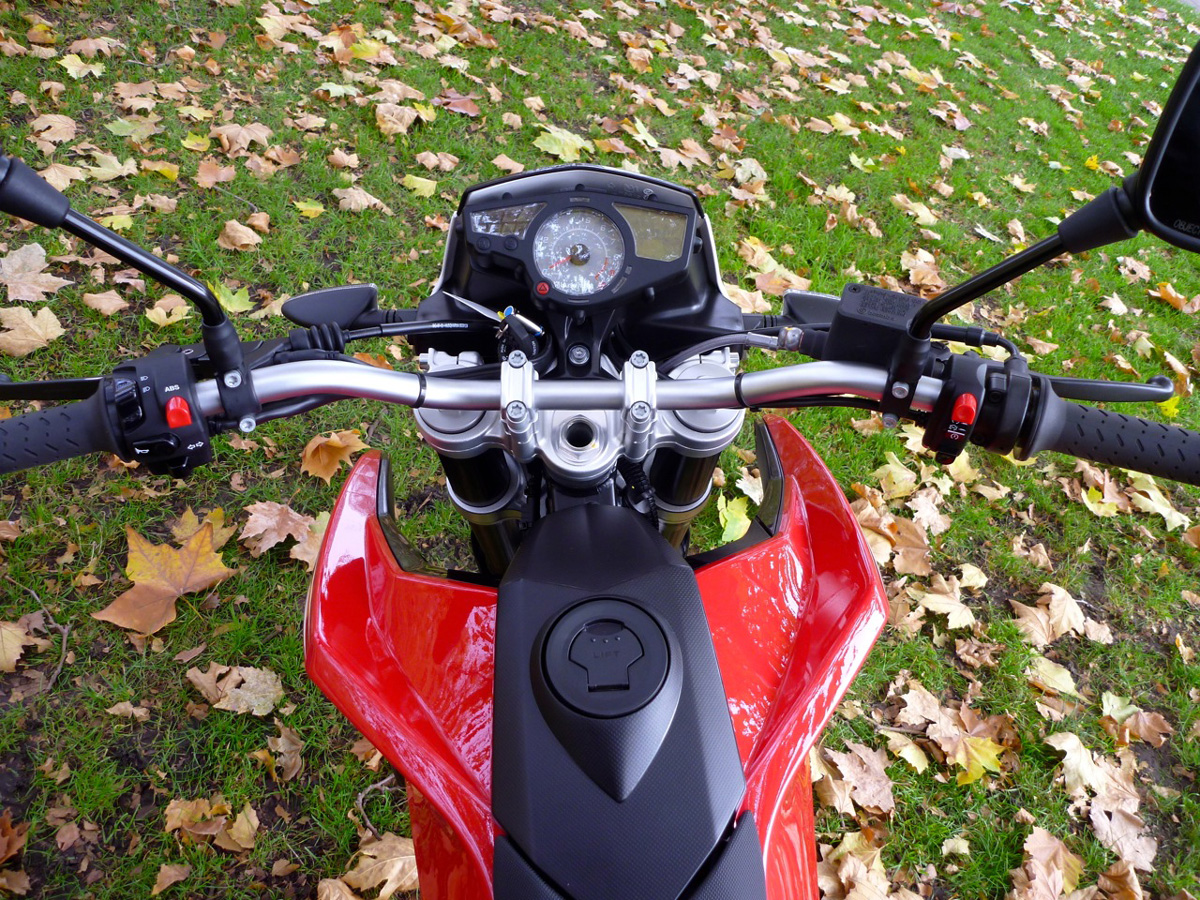
The Terra is as slim as a rake (right) – my knees were about 8 inches apart which gave confidence to split the West End traffic like a pushbike. Even the pipes are slim and tucked in, compared to some cans you get. The Terra’s agile dimensions and snappy engine helps here too in a point-and-squirt sort of way, while popping on the over-run as some efi does. The high-comp blat reminding me of a TT600 from years back.
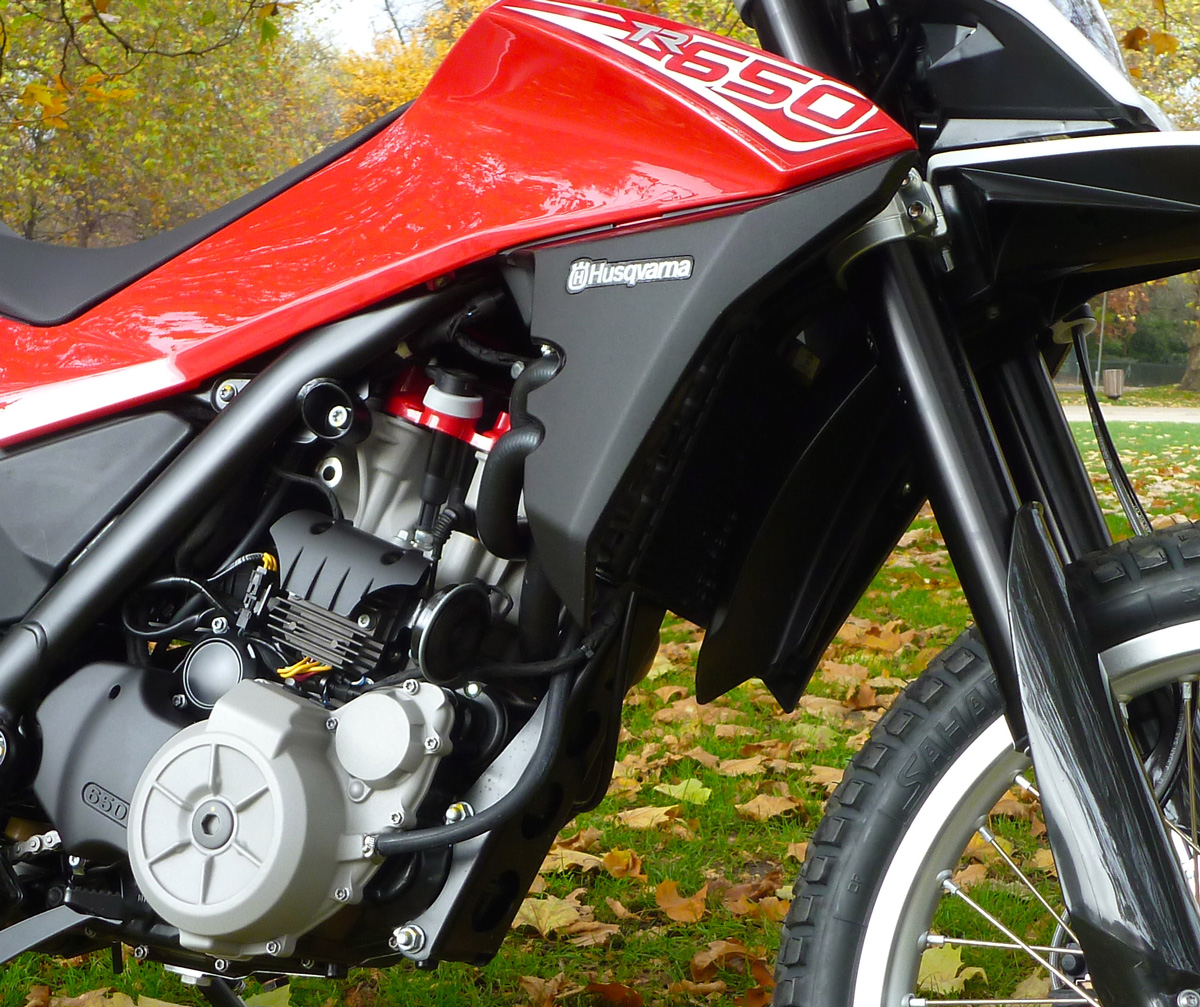
I pulled over in the park to have a closer look over the TR650. There’s really not much to it; you can see they’ve equipped it down to a price (the rack – more below – is about the sum of it) although the fit and finish were of a high standard compared to some Jap bikers I’ve owned.
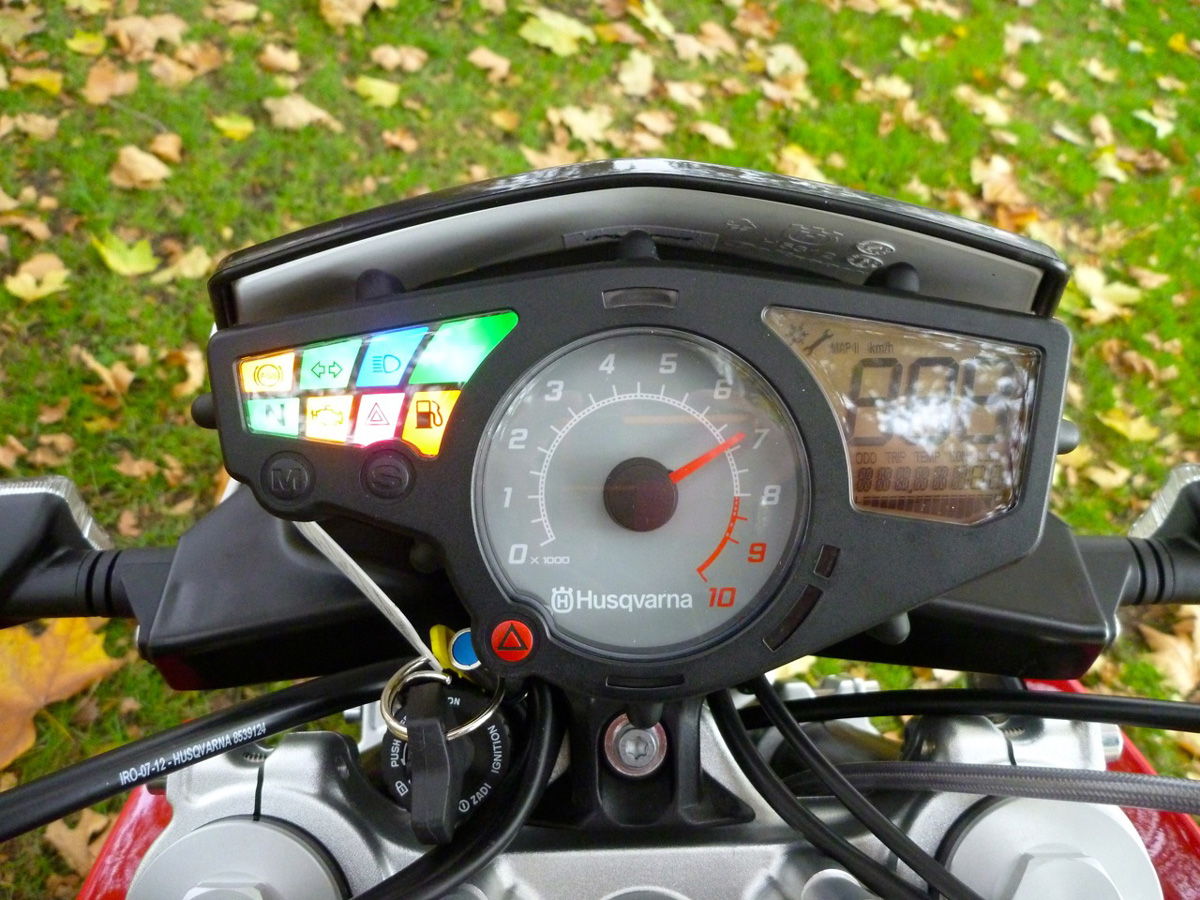
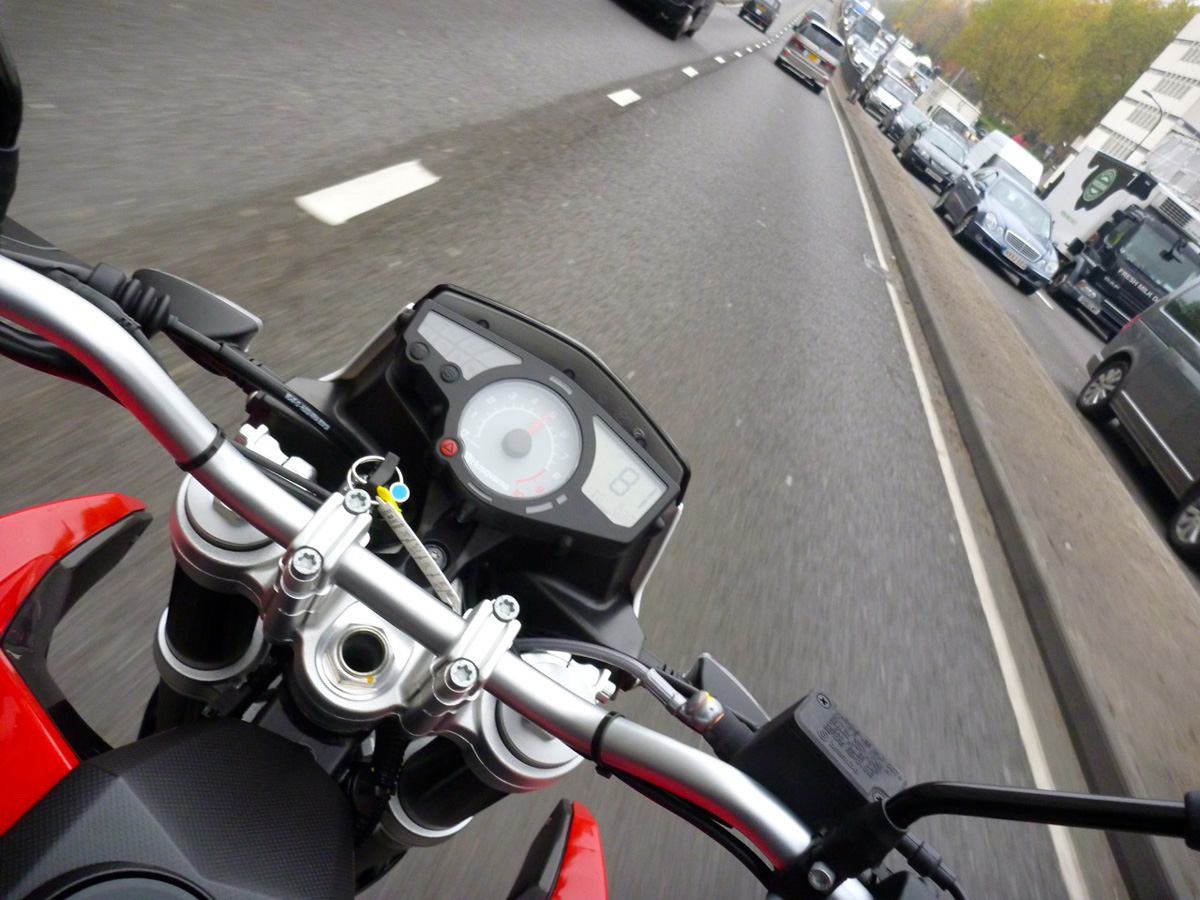
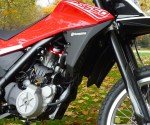
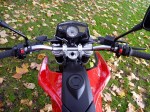
The dashboard has the usual array of Christmas lights which chime up on ignition as the rev counter needle does its sweep. The salesman had inadvertently set it up to read kilometres and I couldn’t work out how to reset to mph without RTFM. (The salesman also said one of the menu buttons was a redundant ‘mapping’ button, although the LCD on the right indicated an enigmatic ‘Map II’…). All I could do was scroll the LCD read-out below the speedo between temperature, trip and odometer. A light also comes on when ambient temperature nears freezing, you need a service or the fuel gets low. The ABS can be disengaged in the usual way with a button on the bars (right). I was also pleased to see non-BMW indicator switchgear: left, right and press to cancel like my aged Suzuki. The radiator (left) is wide and when you fall hard the plastic wing scoops may not protect it.
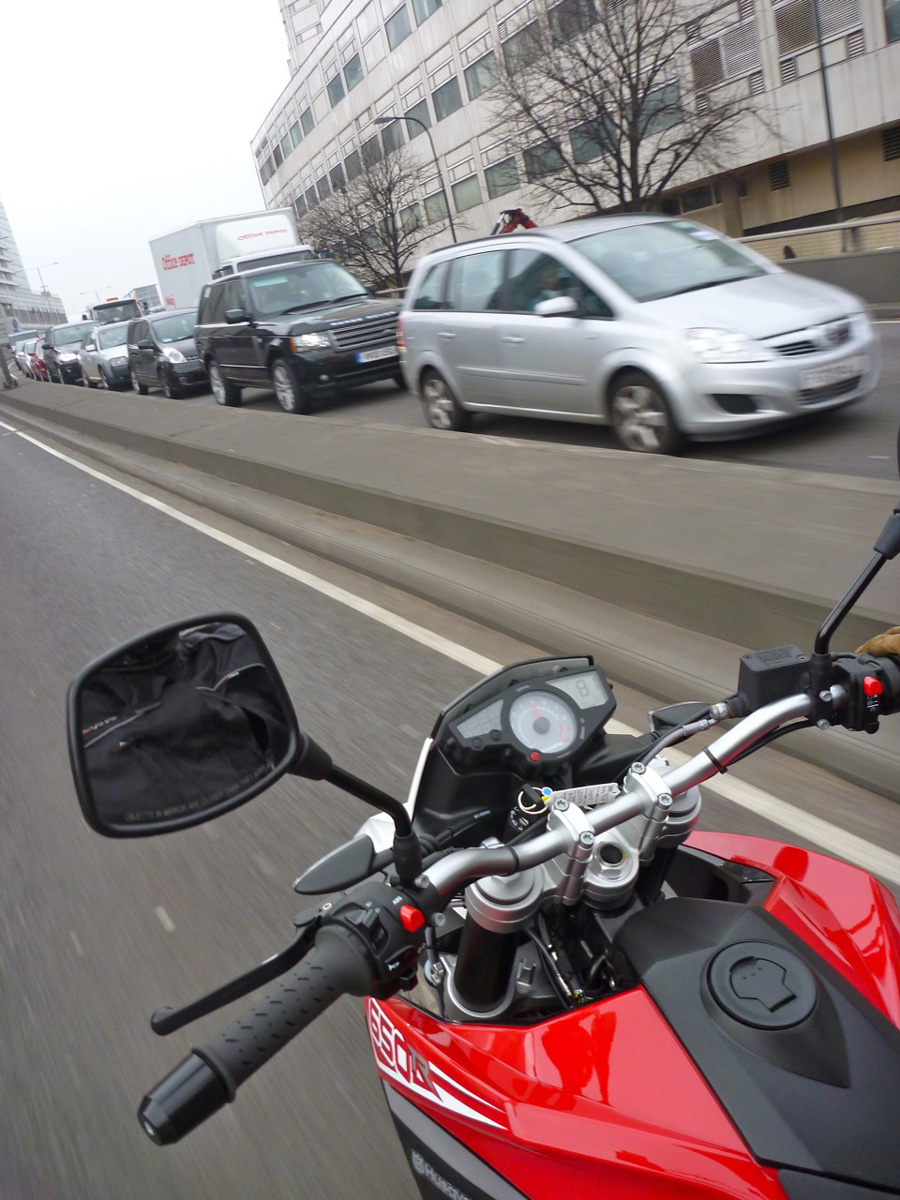
Where trail bikes or 21-inch-tyred bikes with high mudguards often lose their composure is at higher speeds, so I swung up onto the urban Westway freeway to see how the Terra responded. Back in my despatching days this was always a welcome blast out from the heart of town. Up to around 70 the Terra felt stable, though of course without any protection, sitting like that for a while would have its limits. The step-free MX-style seat plank felt firm, though as we know it takes an hour or two for a saddle’s true measure to shine through too. As in town, out on the flyover’s expansion joints the suspension felt reassuringly firm, but I don’t recall seeing any adjustment other than preload and maybe damping on the back. When needed, the brakes pulled the big single up sharply, though with suspension dive I couldn’t manage to get the front to ABS. Again, as in town at lower speeds the five speed gear change was slick and notch free. And on the short high-speed run along the flyover I can’t say I noticed any vibration from the seat or even the tell-tale mirrors. Despite its high-comp motor, this must be one of the smoothest big singles around which bodes well for long-range comfort. My test bike had 19 miles on the clock.
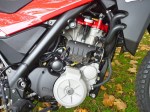
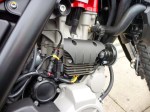
Further down the A40 I pulled over again for another look over the bike. The lack of any protection around the engine jumps out at you – though of course a bashplate will be on the options list which includes luggage, a tiny fly screen, hand guards, heated grips and other stuff (see below). With drain plugs (below right), oil lines and exposed brake linkages (left), you’d think a chunky bash plate is one thing they could slap on, out of the crate, if for no other reason than to make the Terra look the part, alongside the Strada.
Oddly, the Terra never starts first dab of the button as you’d assume efi bikes would; it takes a few churns. It stalled on me only once. Unexplained stalling was the bane of the early F650s and could be extremely dangerous when it happened as you pulled out onto a major road. Big singles especially seem prone to efi anomalies – the big swept volume of the single cylinder makes it tricky to get it right first time, though it can be done (on an XT660Z for example, despite ropey fueling on earlier 660 XTs). Trickling through traffic on a near-closed throttle I did detect a very slight unevenness, but nothing as bad as has been said of the previous TE630 – or on my carb’d GS500 for that matter. And though I’ve not read up on it yet, there’s been a lot of talk about hot-starting issues with the new Sertao; you’d hope Husqvarna have worked around that using their own efi and ignition combination.
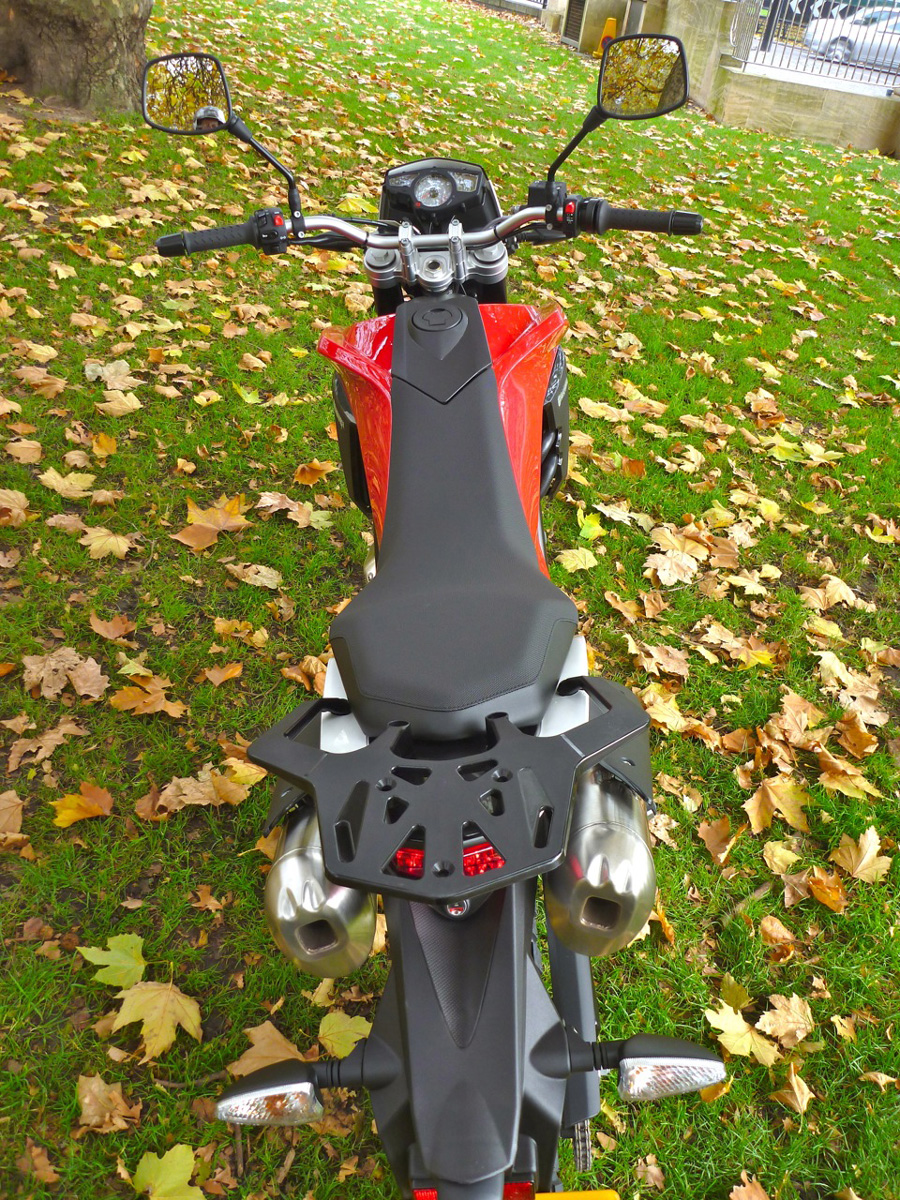
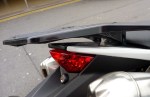
On the back what feels like an alloy rack doubles as a pillion grip and baggage loop, but it hangs way out behind the fixtures; a weighty box combined with a sudden thud might just snap it. As mentioned, the Terra appears a basic package after looking over the better equipped Sertao back at the shop. Even with its comparatively flabby looks, it did look like you get more of a bike with the Sertao, especially when I was told by the salesman they were about the same price.
In fact the original price difference was huge – at £6700 the Sertao costs some 28% more than a Terra without ABS at £5271. ABS manages to raise that by a rather staggering £700 to £5971 – making the Sertao now 13% pricier. Factor in the Sertao’s screen, fatter seat, thin bash plate and hand guards and you may still be ahead with a Terra if choosing better or better value third party equipment as opposed to what are often lame or over-priced OE accessories (see below).
In the UK, at around £5300 the Husky Terra matches up very well against say, Yamaha’s XT660R at £6500 (right). There’s no ABS and the weight is similar at a claimed 181kg while making only 47hp on the 10:1 compression ratio (actually better for running on low octane fuel). If you can live without the ABS, the grand-plus saved over the XT or Sertao buys a lot of equipment for a Terra. First though, I’d like to be sure that seat delivers the miles. Cushier looking pads such as on the BMW twin I rode in Morocco proved to be a disaster.
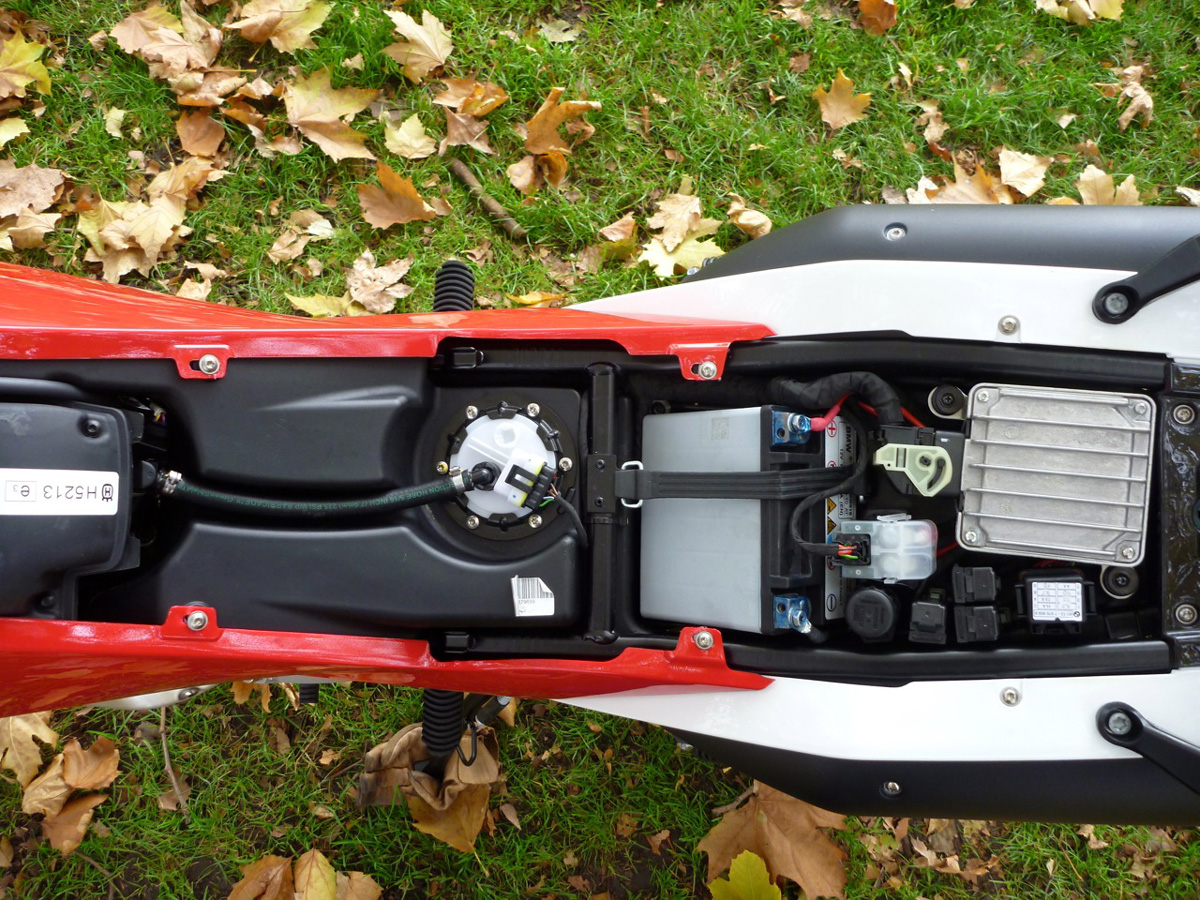
The 14-litre under-seat tank (left, filled up from a conventionally located filler cap) is the same size as on the Sertao and so is difficult or costly to enlarge, but at what you’d expect will be a reliable 23kpl (65 mpg UK) it should be good for over 300km or nearly 200 miles. Another 3 or 4 litres would see it up to my overlanding benchmark of 400km/250 miles.
So at around five grand in the UK or under $7000 in the US they’ve pitched the Terra as a minimally equipped, budget priced, big single trail bike with an exotic Nordic pedigree and the highest power in its class. For overlanding the same-engined Sertao may be better equipped, but that comes at quite a premium, while losing the Terra’s perceived agility.
The British press have been typically lukewarm about the new Huskies, but in the US they seem to get it as a close competitor to their ageing KLRs and DRs. This massive Adv Rider thread has plenty to read, including recent owners’ reports, and there’s more TR chat on this thread at Cafe Husky. Official parts are listed on the right – or click this.
Me, what I’d like to see is a direct competitor to a Tenere, KLR or the old KTM 640 Adventure; a big tanked, out-of-the-crate overlander with an all-day seat and the necessary protection from wind, rocks and falls (a bit like this mock up).
It’s unlikely Husqvarna are going to go that way, but at the currently reasonable price without the ABS, you do have something a bit pokier and different from the usual XTs, BMWs and (in the US) KLRs, XRLs and DRs. Just remember in the UK the Italian-built Tenere was a £4500 bargain when it came out in 2008 – now it’s £7k…
It’s a shame that turning the Husky TE into a TR added so much weight without any noticeable substance, but as on a Tenere if that means a chunkier, load-carrying steel frame, then it’s weight in the right place. It’s hard to think where else it can be on the Terra. As one guy on Adv observed “Maybe this is good enough with the typical $2000 thrown at it…”
Looks Smooth, responsive engine ABS and brakes Firm suspension No detectable vibration at speed Slick gear change Slim profile Competitive price Useful rack
Heavy, for what it is At the very least, needs engine protection Needs a windscreen too – OE accessory fly screen looks way too small Tank a bit small.
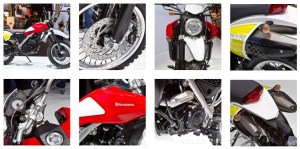
Husqvarna Baja
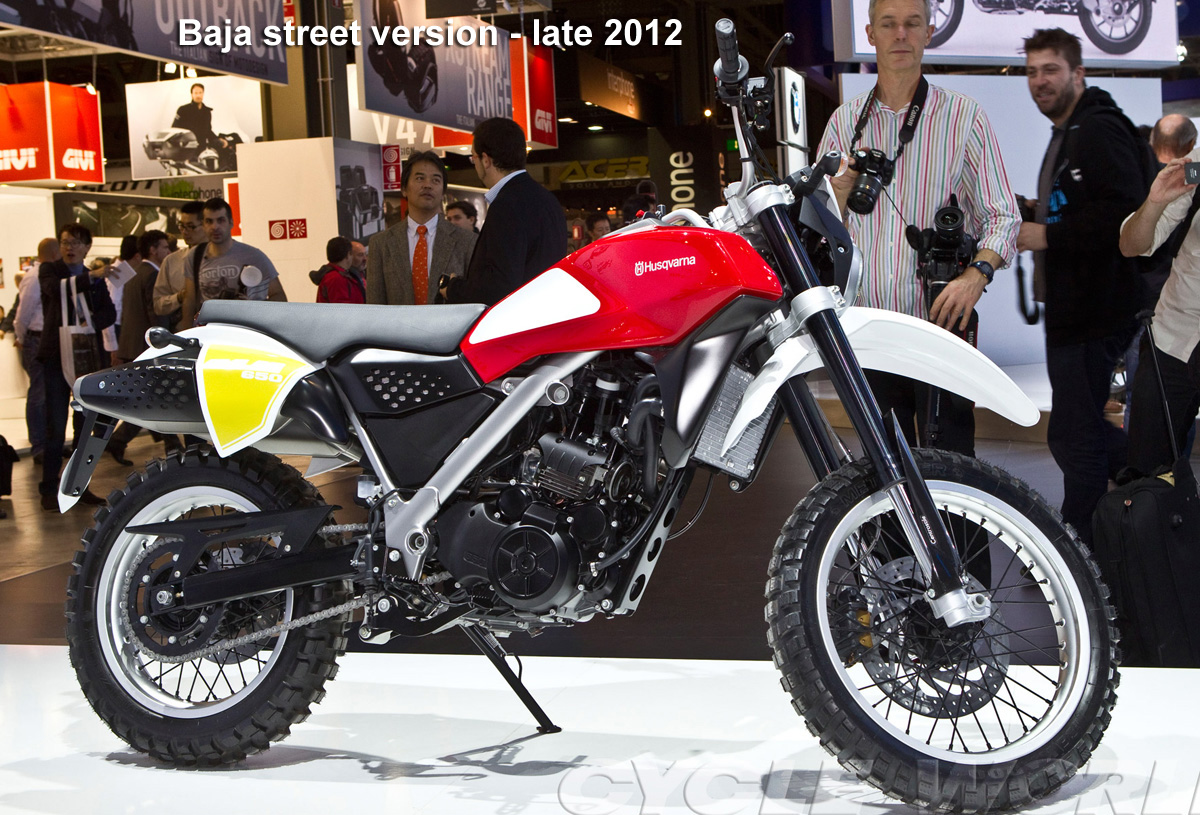
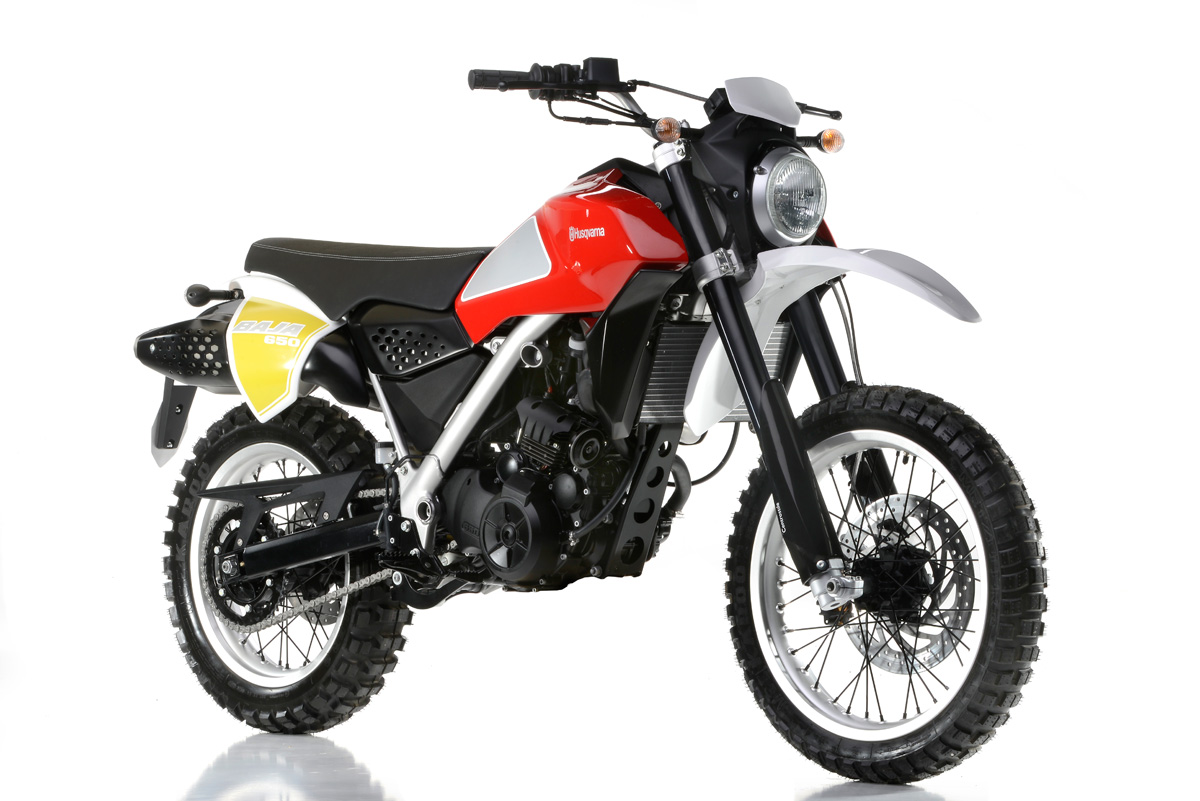
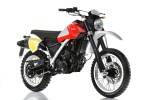
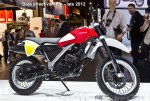
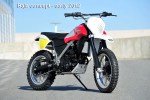
If you’ve managed to read this far, hang around and check out the Husqvarna Baja retro desert racer. The concept bike from early 2012 is here and the top pic below. Then in November 2012 at the Milan Show Cycle World, among others, reported on a street-ready Baja with all the necessary paraphernalia and twin pipes. There are several more studio pix of the street scrambler on the BMW press site where you can be assured that ‘the multi-section architecture of the body displays a very clear, purist style’. Now you know.
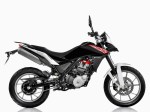
Looks good and low with a fat 19 on the pointy end (I told you 19s are the future!) and retro Husky styling, but with the BMW engine and chassis from the TRs. Had Husky not folded it seems likely the Baja will have reached the US where Husky is better known. But, like the Yamaha Ryoku, it looks like just another interesting concept bike that will never make it to the showrooms. Good on Husky for joining the retro bandwagon with an original and cool looking machine.
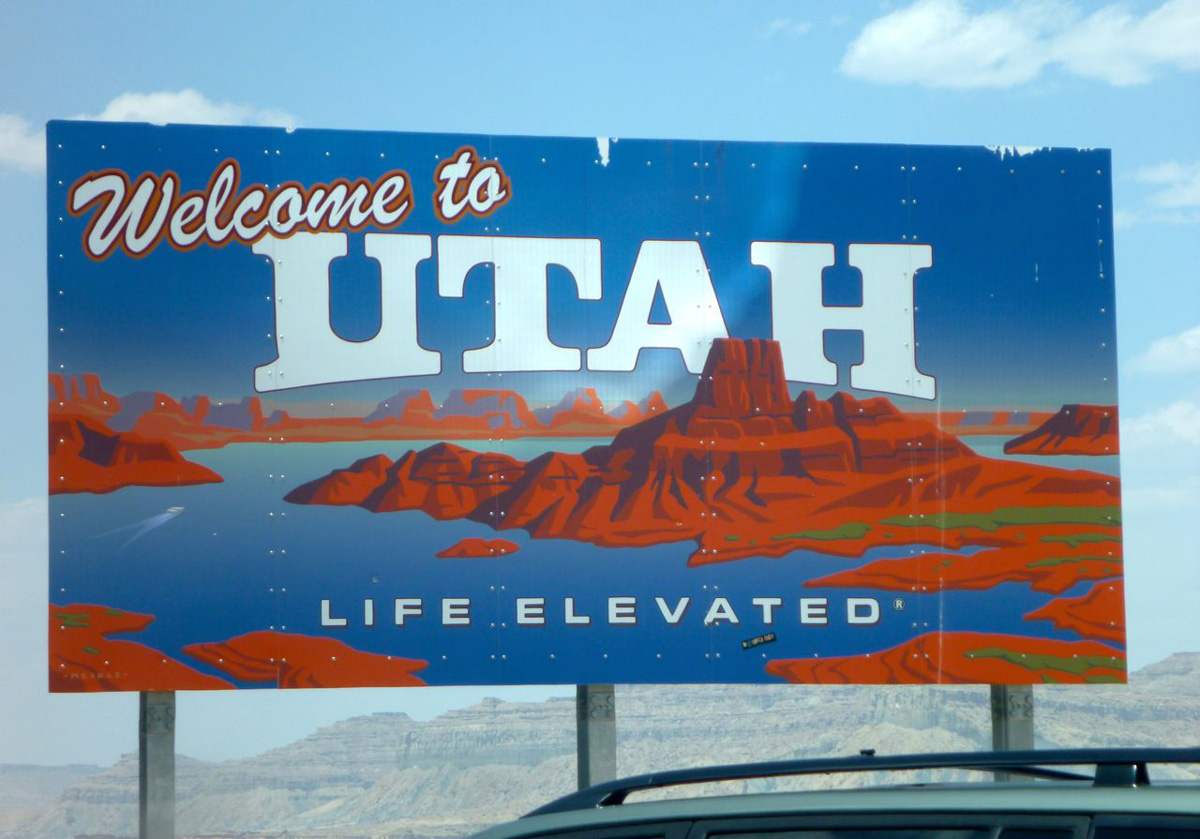
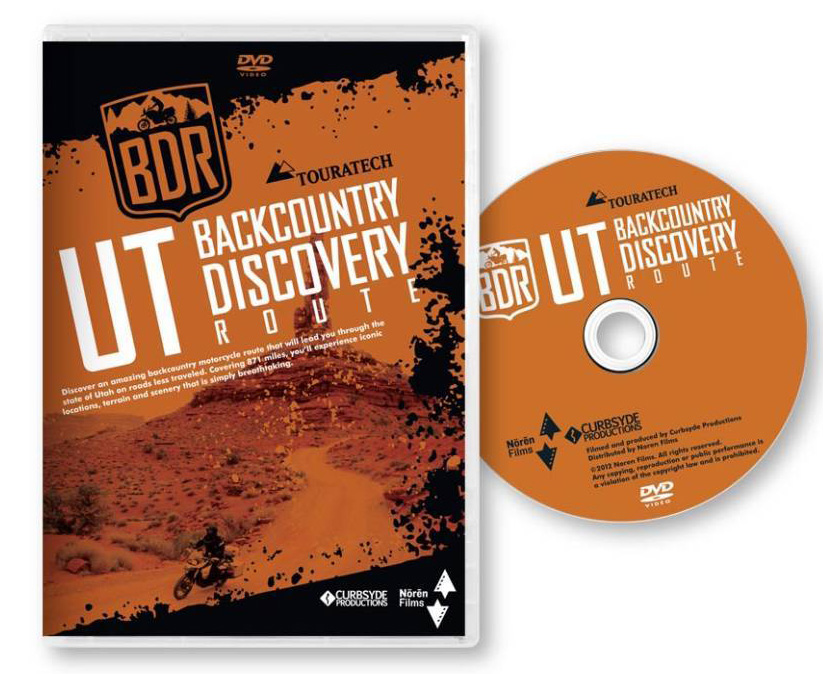
This package caught my eye the other day: a trans-state, mostly dirt road adventure across Utah, comprising of a dedicated paper map, an hour long dvd and track logs on the Utah BDR webpage to put it all together.
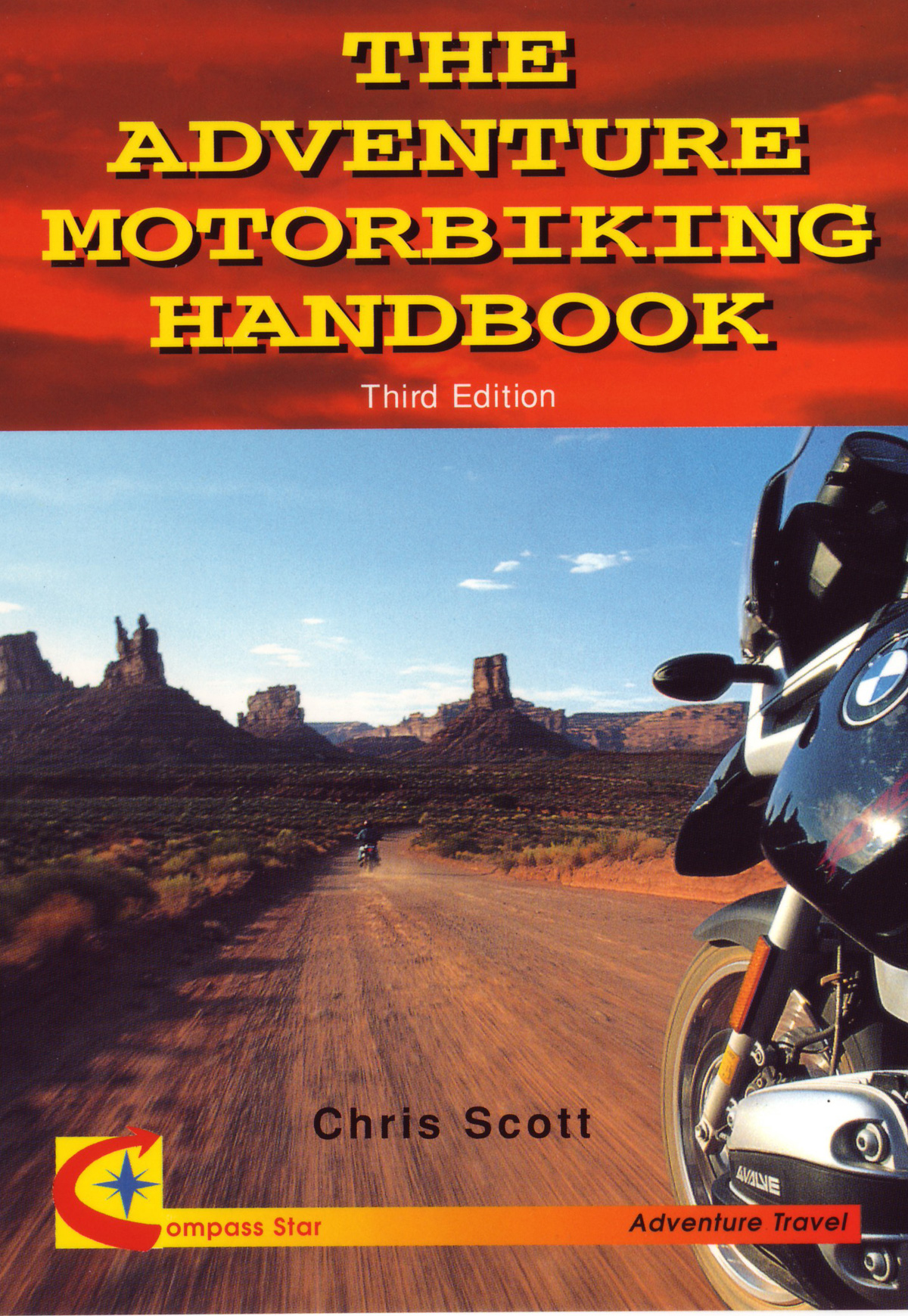
With the Colorado river cutting through the Canyonlands on its way to the Grand Canyon, southern Utah must be one of the most photogenic places on earth. It’s a wilderness spectacle I’ve visited a few times, and one that’s exemplified by the iconic buttes of Monument Valley (or is it Valley of the Gods, nearby?) which featured on the cover of an earlier edition of AMH in the late 90s.
The Backcountry Discovery Route project seems to have been cooked by Touratech USA’sPaul Guillien, describing the idea as ‘a community based effort dedicated to establishing and preserving off-highway routes for adventure motorcycle and dual-sport travel’. It recces, plots and describes itineraries on public roads across the wild corners of the western states. They’ve done Washington in Touratech USA’s back yard. Here is Utah with the Colorado BDR out in February 2013 and other western states like Arizona, Oregon and Montana in the pipeline.
It’s a concept which reminds me of what may well have proved to be the over-ambitious Great Western Trail, itself parallel to the Can to Mex Great Divide Route (GDR) mapped by the Adventure Cycling Association. They may not have planned it that way, but much of the GDR happens to be usable by road legal vehicles and was featured in earlier editions of AMH.
I’ve always thought the GWT or GDR were much more inspiring rides than the better known Trans Am Trail. Surely the mountains, deserts and history of the American west trounce the interminable prairies and agri monoculture east of the Rockies?
Years ago I had an idea to make a guidebook to the region, but knew it would need an online, track log and video element which was all beyond me at the time. So it’s great to see someone with the resources of Touratech and the associated BDR supporters taking on the task, state by state, to map and log the sort of multi-day mini-adventures that adv bikes are made for. And if Touratech, Klim and whoever else supports the project sell a bit more stuff to wannabe BDRoutards, then good luck to them.
The DVD The film was shot over a nine-day period as eight riders followed the trail from the Arizona border near Monument Valley up to Bear Lake which spills into Idaho. In the credits I recognised the name Stirling Noren who made a great film for Helge Petersen in Iceland a few years ago, though it seems his role with this production is merely as distributor. As you’ll read below, that’s a shame.
I don’t watch many dvds these days – does anyone? – but what immediately struck me having just watched Richard Grant’s sublime American Nomads doc on TV was the comparative ropiness of standard definition. How quickly we’ve got used to HD, but AFAIK you can’t make old tech dvds in HD unless they’re Blue-Ray. And although the original footage was almost certainly shot in HD, only the online trailers can depict the benefits of HD’s much greater resolution, as you can see here.
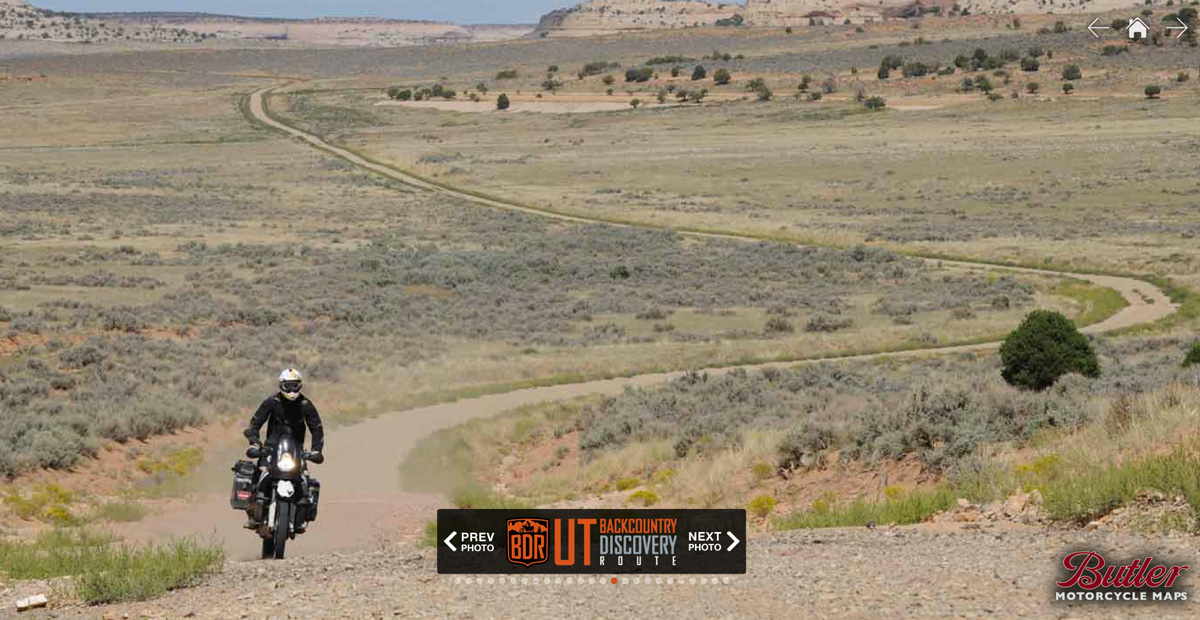
And so we set off to follow the octet of Routards aboard well-laden BMWs and KTMs, none smaller than an F800GS. It’s great to see big adv bikes actually being put through the paces which their marketing claims they excel at; fully loaded for days riding the dirt highways of the American west. The film was presumably shot in high summer but the weather was not so summery, or maybe that’s normal for Utah which, despite its association with red rock desert canyons, is actually quite high. And with the shooting understandably taking place in the mid part of the day when desert light can be harsh, I missed what I knew to be the golden glow of Utah’s desert scapes.
So when you consider they’re riding though some of the planet’s most striking vistas I have to say I found the film a little disappointing for its hour’s length. Riding for several days is repetitive of course, but a little creativity in the shooting would have lessened this impression. I also thought the drama got a little overcooked at times, not helped by the occasionally portentous ‘my god, will we make it?’ score. I know from my own experience that getting a good score can be one of the most challenging aspects of editing a film, but when you get it right it can hugely improve a film’s watchability. The UTBDR film makes all this a little more difficult by dropping the ambient background soundtrack, except when the riders are doing their ‘P2C’ camera chats. This may have been a wind noise issue (a Jeep support vehicle was used), but you do miss the growl of the big twins hauling along the trail while the wind whistles across the mesas.
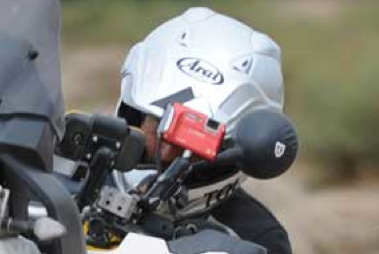
This film was directed, scored and edited by Curbsyde Production’s Flora and Joe Lloyd who seem to have developed a certain look of long, low shots in slo-mo. These work well in demonstrating the pounding suspension of the heavyweight adv bikes, but alternative views on the action would have made the dvd more involving to the target audience. We’re riding motorcycles here, not watching lions stalk their prey on the Serengeti. More on-bike or alongside-bike PoVs could have been mixed in with the long shots to emphasise the dynamism of big bikes rolling through the landscape. There are a couple of these and from one shot (right) there’s what looks like a Lumix FT mounted on the bars – a great little camera which I now prefer over my recently sold GoPro. With this sort of hardware and some RAM mounts it’s not difficult to film anything moving from any angle.
I suspect the tight schedule and at times poor weather made all this too difficult. No one ever quite manages to shoot the film they hoped. Many of the better slo-mo shots are used over and over again in the hour-long film with what feels like 90% taken locked off on a trackside tripod with the bikes passing through the frame. That’s the stock shot in films of this type and works well in a short, youtube promo vid but as I said, over an hour there could have been more creative shooting: high on poles, low on the ground, anywhere you like on the bike or alongside it. I may have got the wrong end of the stick, but Flora Lloyd didn’t make the best of this opportunity.
Film the journey not the ride The film sticks solely to the trail. Let’s see the mud-spalttered posse rolling in to a Ma and Pa fuel station, cutting loose in a cantina in Moab, or chatting with locals. Film the journey not the ride, with less of the straight-backed campsite asides about the awesome day’s ride – we know, we just watched it. I think the group was too big to be able to achieve this, but perhaps the many necessary supporters involved in the project wanted to be sure they got their share of face time in the finished product.
No one ever appears tired, hungry, fed-up or even dirty, heavily clad as they are in pristine Touratech or Kilm apparel. The cramming home of the corporate sponsors’ message gets a bit disengaging – at least to a UK viewer. Possibly in the US – where they’ve just spent $2bn promoting an election – this sort of hard sell is normal.
You’ve got to see it all to know it all of course, but once the riding is over many viewers would have wanted to see something like I tagged onto the end of my first moto video shot in western Canada in 2001: the group sat around discussing how their gear and their huge bikes performed following their 900-mile backroad adventure. Perhaps that all features on some blog somewhere, but if it exists you’d think it’d be linked off the BDR website.
The BDR is not all dirt either, and so I think it would have be fun and no less ‘on message’ to see the big twins carving up a bit of Utah’s blacktop from time to time. The film has some great moments and there are some slick time lapse shots too, especially at night, that seem to be over too quickly. But all up it didn’t make the UTBDR look half as good as I bet it is, given the huge task of herding eight trail weary cats to try and grab a killer shot.
Clips like ‘I don’t know much about Newspaper Rock [Indian petroglyphs, Canyonlands] but that is where we are‘ and ‘… where we saw some great… err, I believe Anasazi… err, petroglyphs on the wall?’ would have been better left on the cutting room floor. If you’re going to talk about that sort of stuff, know what your talking about, otherwise it comes across as a lame token filler. Luckily the following voiceover claws back some credibility. The bonus material includes only adverts from the sponsors and supporters, plus some stills from the mission’s photographer, Jonathan Beck. You’ll get no goofy outtakes here!
It’s easy to be sniffy about paying for dvds these days when great stuff like the Nomads doc above can be found online for free. We’ve all become mini Spielbergs too, spotting flawed filming even if we couldn’t do any better. I recognised myself a few years ago that the effort required to shoot worthwhile footage and then assemble it into a sellable film takes up much more time and resources than you’re ever likely to earn back. Although the vid was disappointing, there can be no better format in vividly giving you an idea of what to expect on the trail, short of slapping it on youtube. As it is they give away the GPS tracklogs for free, so I don’t resent paying for the vid. Exploring southern Utah on a bike, including the Lockhart Basin, Onion Creek and the nearby White Rim Trail are certainly something I hope to have a crack at some time soon (I did: here and here).
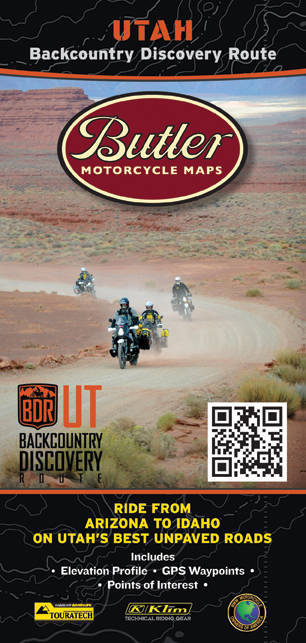
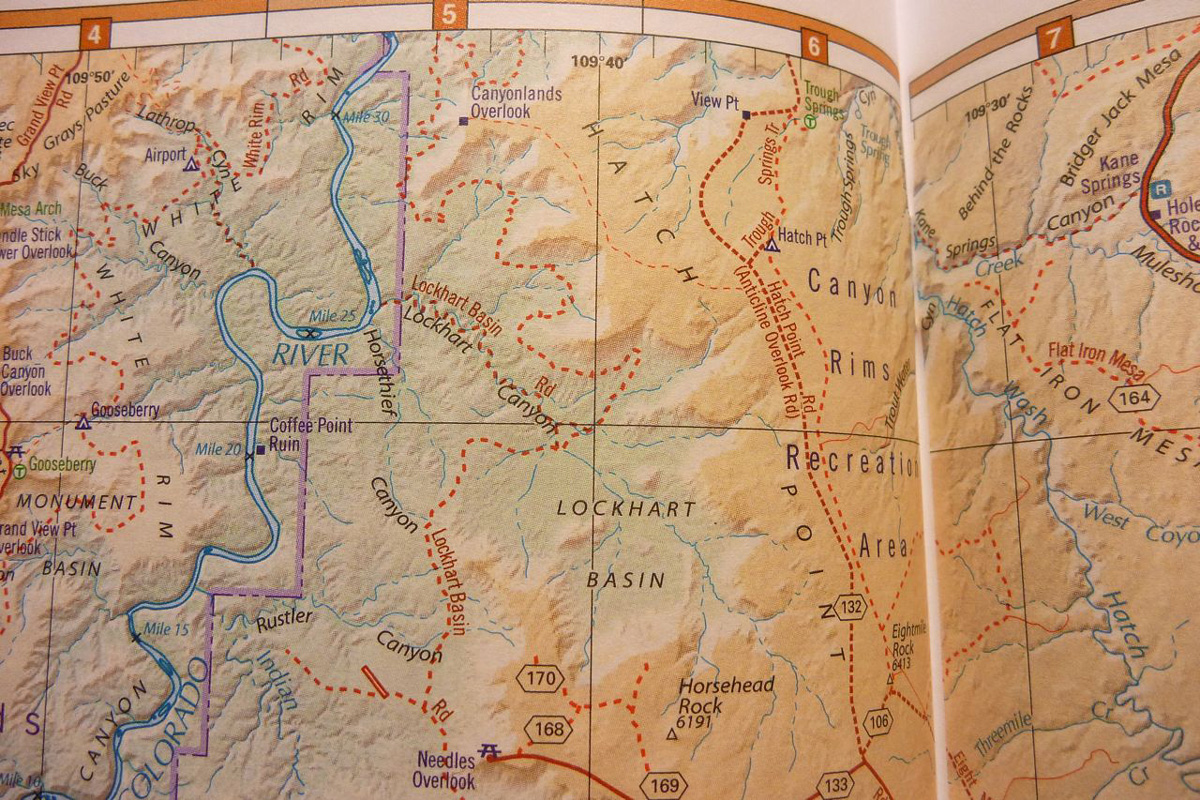
The Butler Map Butler’s double sided map of the UTBDR covers the whole state at a scale of 1:714,000 which for some reason adds up to 11.2 miles to an inch (US map scales have always baffled me). The map measures just over 3 feet by just over 2 feet and is printed on tough plastic paper. As I’ve found in Morocco, this is the way to go with maps that’ll get rough use, specially on a moto. You can use such a map hard and it won’t fall apart like a Michelin.
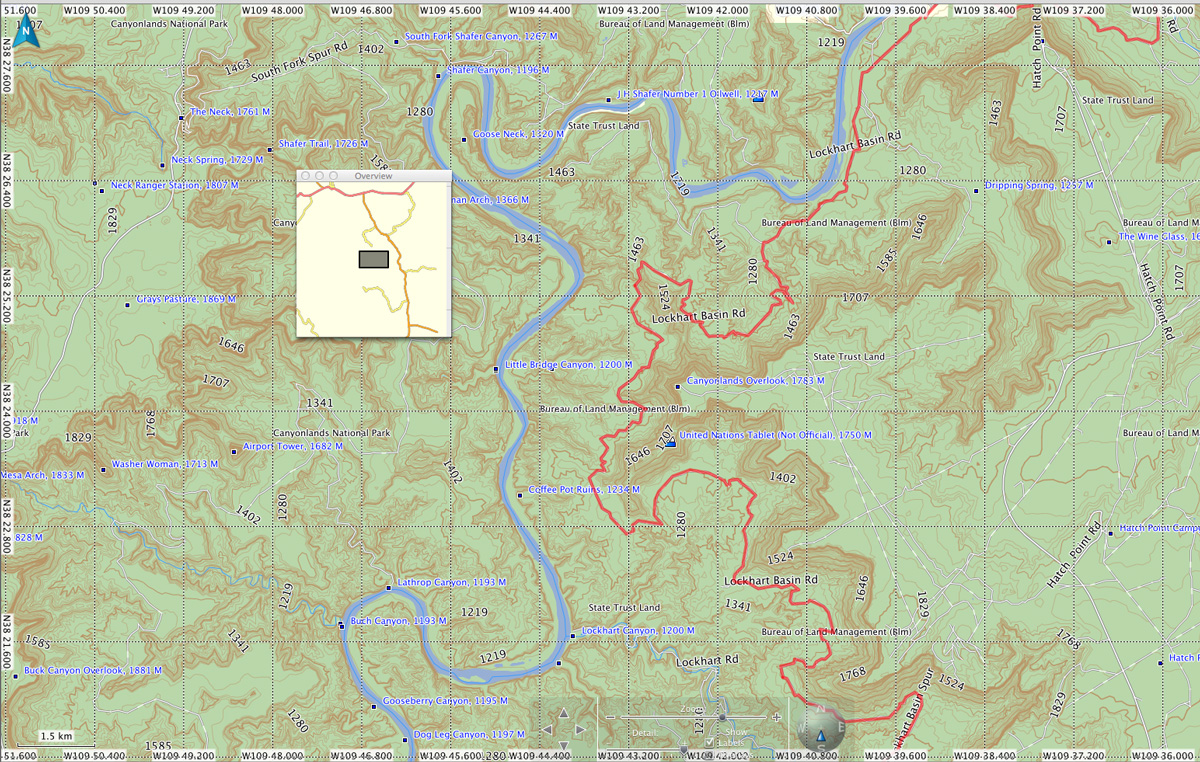
Clearly you’re expected to rely on the track logs downloaded from the UTBDT website; the Butler map probably won’t be enough to navigate with, but it gives you the big picture that a GPS screen never can. If you’re a heretic with something against satnavs (or your unit packs up…) you could try printing off Google maps, more accurate Utah topo GPS maps (left, with the UTBDR displayed using Garmin BaseCamp) or drawing the trail along something like a large-scale Delorme or Benchmark atlas (right) which goes down to 4 miles to an inch (1:250k) and provides a whole lot of guidebook-like info too, even if they are too bulky to sit on a tank like a Butler map. More on this below.
The map breaks the 870-mile trans-Utah route into six sections, although it’s not clear what separates these sections – it doesn’t seem to be obvious places like reprovisioning points. Nor could I find exactly how many miles are dirt, dirt options or sealed roads, all of which help get a measure of the task ahead. Another thing that would be useful are incremental mileage markers along the trail, starting at zero in Goulding and appearing at say, at every key junction such as Valley of the Gods start on US 163 (28.6m) and then another at where VotG Road joins UT 261 below Moki Dugway (54.1m), meaning you can work out that VotG dirt road between those two points is about 26 miles, or an hour or two’s riding.
Another thing that’s immediately apparent is the lack of a lat-long grid, something I go on about with Morocco maps used for similar sort of riding adventures. The 1:714k-scale may be a bit small for this, but with a lat-long grid and a back up GPS (like a smart phone) you can pinpoint your position should your satnav go up the onion creek. Until there are helpful BDR signposts at each junction, this ability could help you avoid making a mistake by following the wrong track. Along the Route there seem to be several alternative dirt trails and countless junctions where a long-lat grid would be a useful navigation aid.
On the reverse side of the map you get a very neat elevation profile using the full width of the paper (although they miss out depicting the alternative routes which could mean the difference between going high or staying low). There are also a dozen or so insets of what you presume are tricky unsealed sections enlarged to 4 miles to an inch and which seem to use the same base map and scale as the Benchmark atlas mentioned above. I feel they could have dumped the rather lacklustre moto-action photos which haven’t printed very well on the plastic paper, and made those map insets either larger scale, or have them cover a larger area. Maybe I’m old fashioned, but on a ride I’m used to getting involved with the nav and tracking my route on a map, rather than relying solely on a line on a satnav screen. Out here a good paper map is vital.
A handful of QR codes lead you to online videos of each section, or are promotional/commercial links. You’d think it would be handy to have say, accommodation and eating options in the few towns along the route, even if it was just a third party site such as a local tourist board. One QR indicates gas, food and lodging, another links to ‘route conditions’, but there’s no indication of a url so if you don’t have a QR-reading smart phone you’re in the dark. There’s no indication on the UTBDR website what these links might be.
You have to congratulate Touratech, Butler and all the rest for coming up with a great concept that will be a shot in the arm for dirt road exploring in the western US: ready-made, bite-sized, week-long adventures that are guaranteed to get you riding your machine into the heart of the wilderness without inadvertently ending up at the end of a rancher’s shotgun, a dead end or in a ranger’s citation. Despite my criticisms the dvd and map are well worth $40 as it’s hard to think anyone’s going to make much on this whole deal when all the work is done – the value will be mostly promotional to all concerned. Yes you could pick over the web for days to get this all for free, but like a good guidebook, sometimes it’s just easier to pay up a little to gain a lot of inspiration from someone else’s hard work. I’m looking forward to the rest of the BDT series.
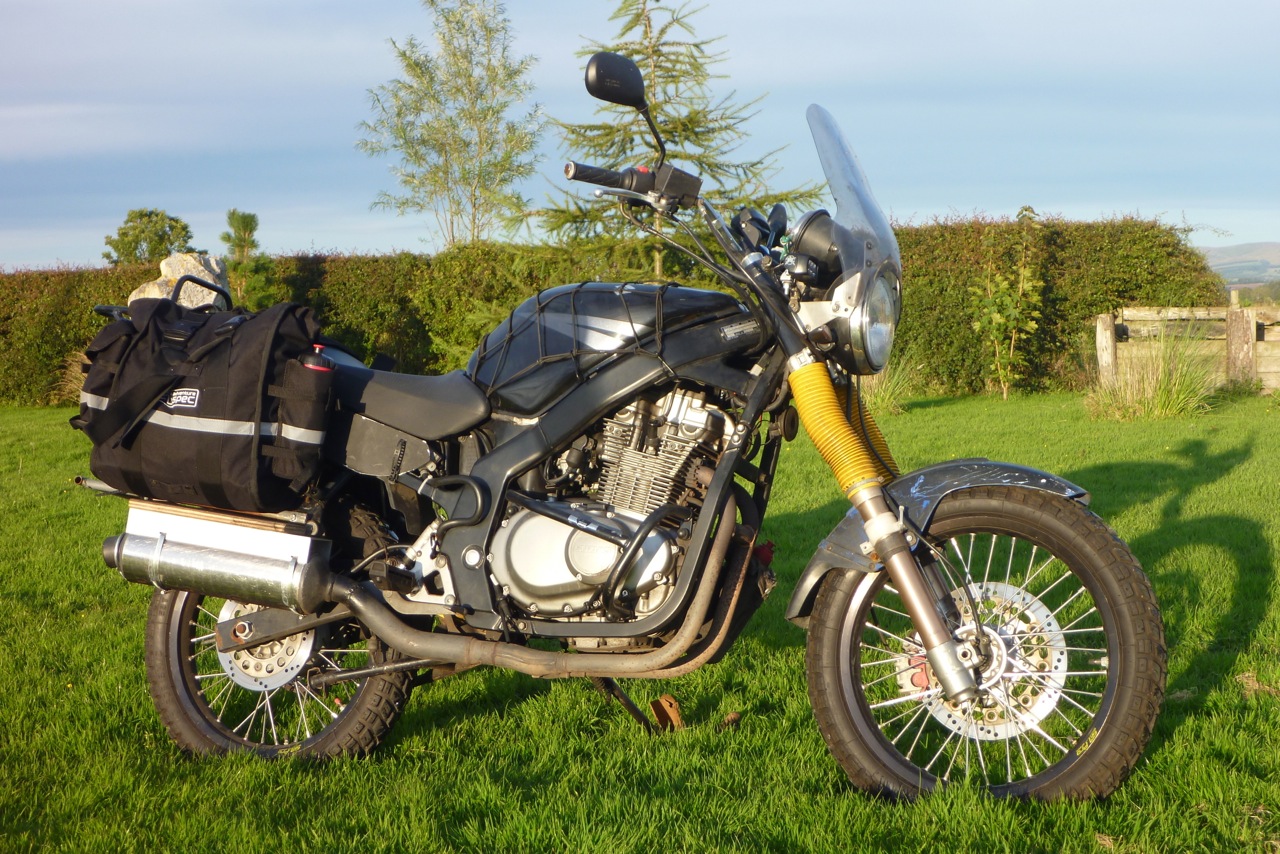
Since I rode the GS up to Scotland in June it’s received a few mods and the 700 mile ride back south (right) was a chance to put them to the test. Among other things I’d fitted K60 tyres on Tubliss liners with a splash of Slime. I made the back brake work, nearly finished my piperack, fitted flat track bars and an LED riding lamp.
Setting off for the first 250-mile stage to a mate’s near Stirling west of Edinburgh was a sparkling day (left), but already there were warnings that an incoming storm would wipe any traces of late summer warmth off the face of Britain. Any chance of enjoying a slow ride home would be better compressed into the usual dash. A day after I got back it was another ‘month’s rain in a day’ story we’ve been hearing all summer. Roads I’d ridden hours earlier were closed by flooding or high winds, the trains stopped running to Edinburgh and a coastal town near Aberdeen got caked in wind-borne sea foam.
Backing up, the ride over the Cairngorms proved I really should have remembered my Aero Kanetsu electric vest. Running it off the GS’s battery was one reason for fitting the SR-M LED lamp (to reduce the alternator load). Even in the sun the Trail Tech Voyager (to be reviewed) barely reached 9°C, so a hot soup in Aviemore spread a bit of warmth back into the limbs.
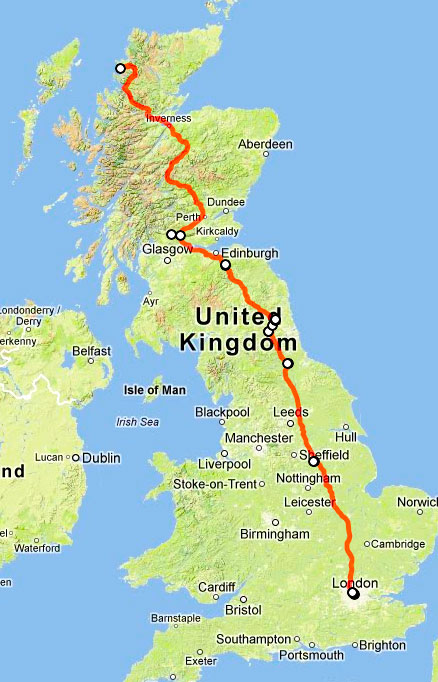
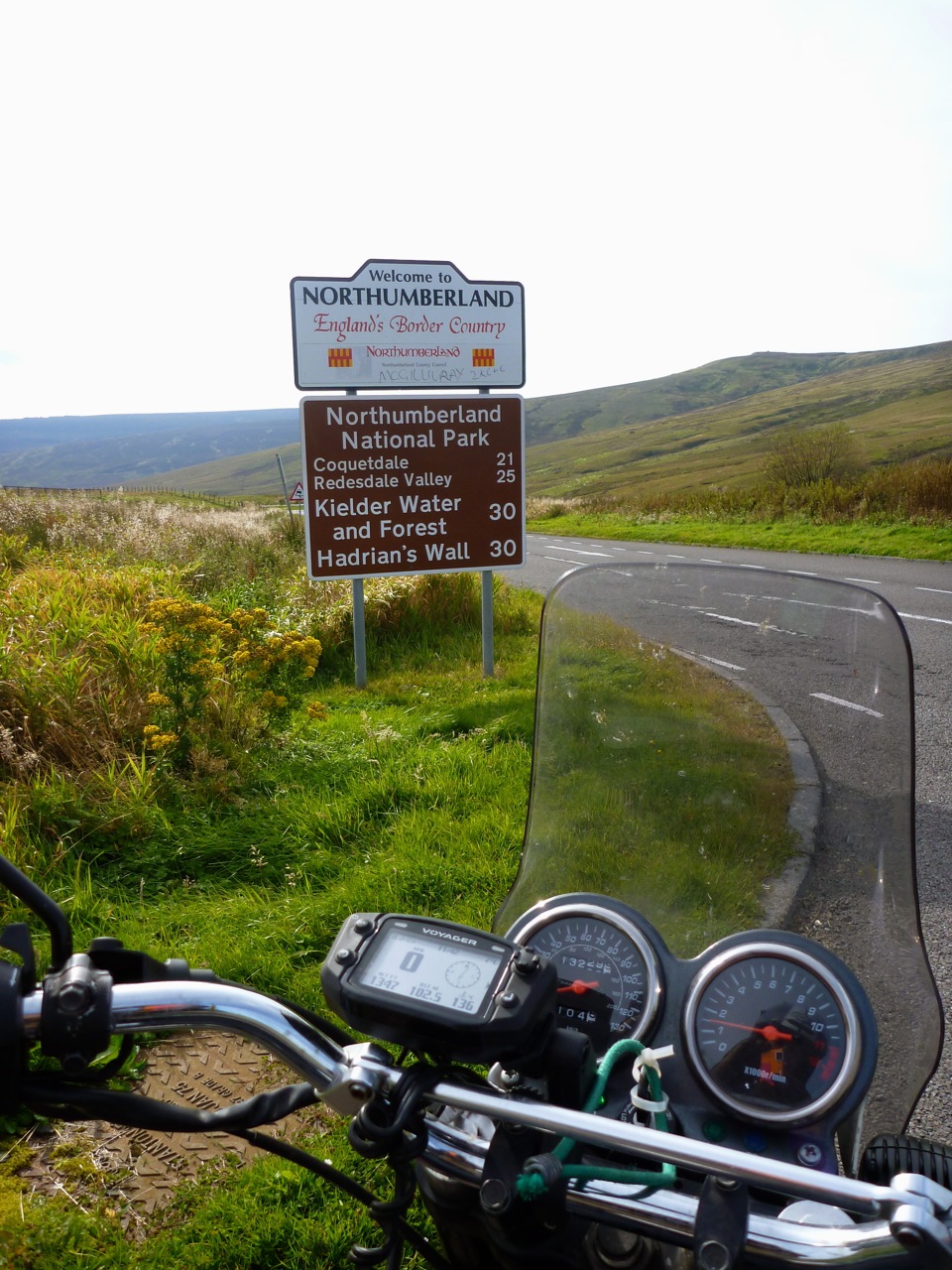
Day two was going to have to be a 10-hour, 450-mile haul right through to London if I was to miss the much forecast gales. Even then, I could’t bare the thought of the dreary but functional M6 and M1 motorways, with the statutory pile-up/hold-up somewhere in the Northamptonshire area. Instead, a more interesting line jumped off the map: A7 from Edinburgh to Galashields, hop over to the A68 which led over the border to Darlington, and from there slot onto the A1 to London. The variety made covering the necessary distance satisfying and I knew the run through Northumberland and County Durham would be fun.
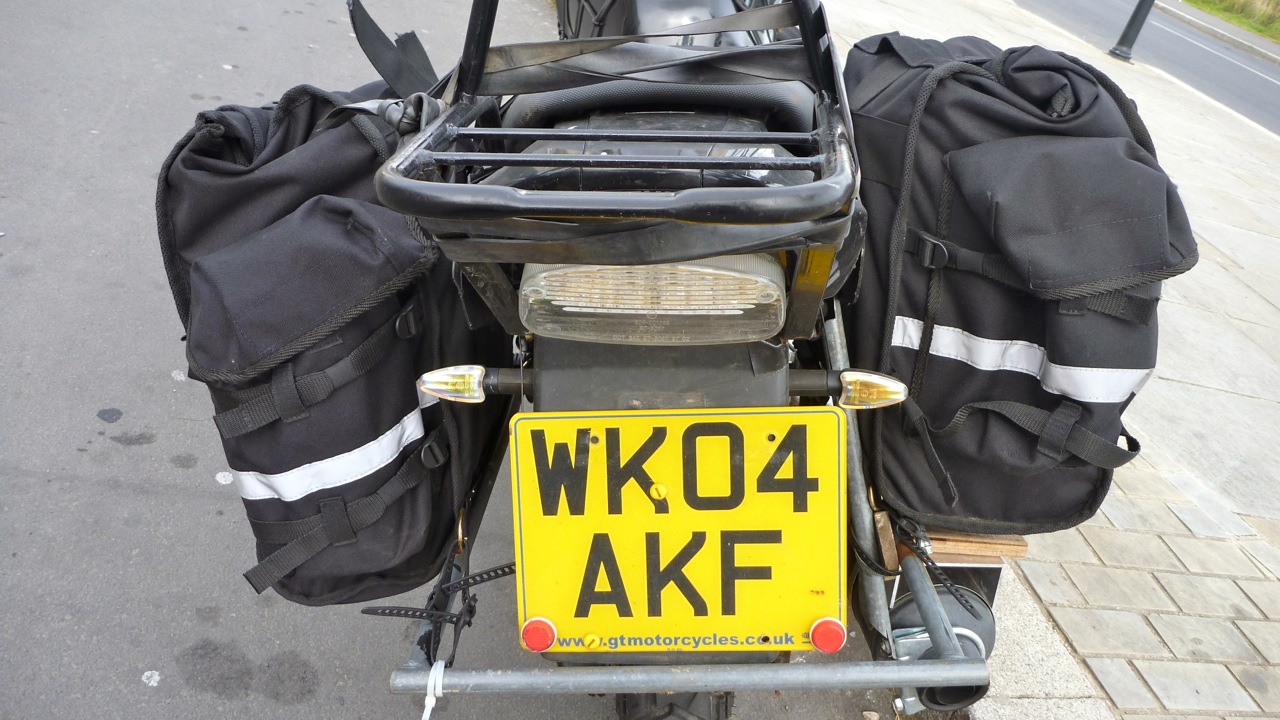
The miles piled on and the GS got notably smoother, as engies do. The lightly loaded Magadans sat behind me, tucked well in and attached or resting on the piperack, while the Voyager kept tabs on various aspects of my progress as I rode up some sweepers to the English border strung across the Cheviot Hills (right).
It was a sunny Sunday and there seemed as many road bikes out as cars, but it has to be said cars do get in the way of enjoying a smooth ride, even on a GS500. I must have been stuck behind one of these or eyeing up the Voyager when the A68 took an sneaky right just before Otterburn while I blundered on along the A689 towards Newcastle. Didn’t want to go there so I turned right onto single track farming roads which I knew would lead to the A68 somehow. Without maps or a satnav, the Voyager’s compass proved a handy aid to negotiating the angular byways until I popped out back on track near Corbridge where the weekend throng were enjoying pub lunches. A fill up saw the mpg improve to 62mpg after yesterday’s all time low of 57 (conversion table here).
I was due for a feed myself but wanted to catch up on my error and find an ambient eatery for a quick and casual refill. That turned out to be a Sunday bakery in a place called Tow Law near Consett. Consett I’d heard of – your man Edmund Blackadder (right) was born there, and in 1980 its steel mill – one of the oldest in the country – was not so much closed down as eradicated. The inevitable social consequences became a byword for post-industrial collapse.
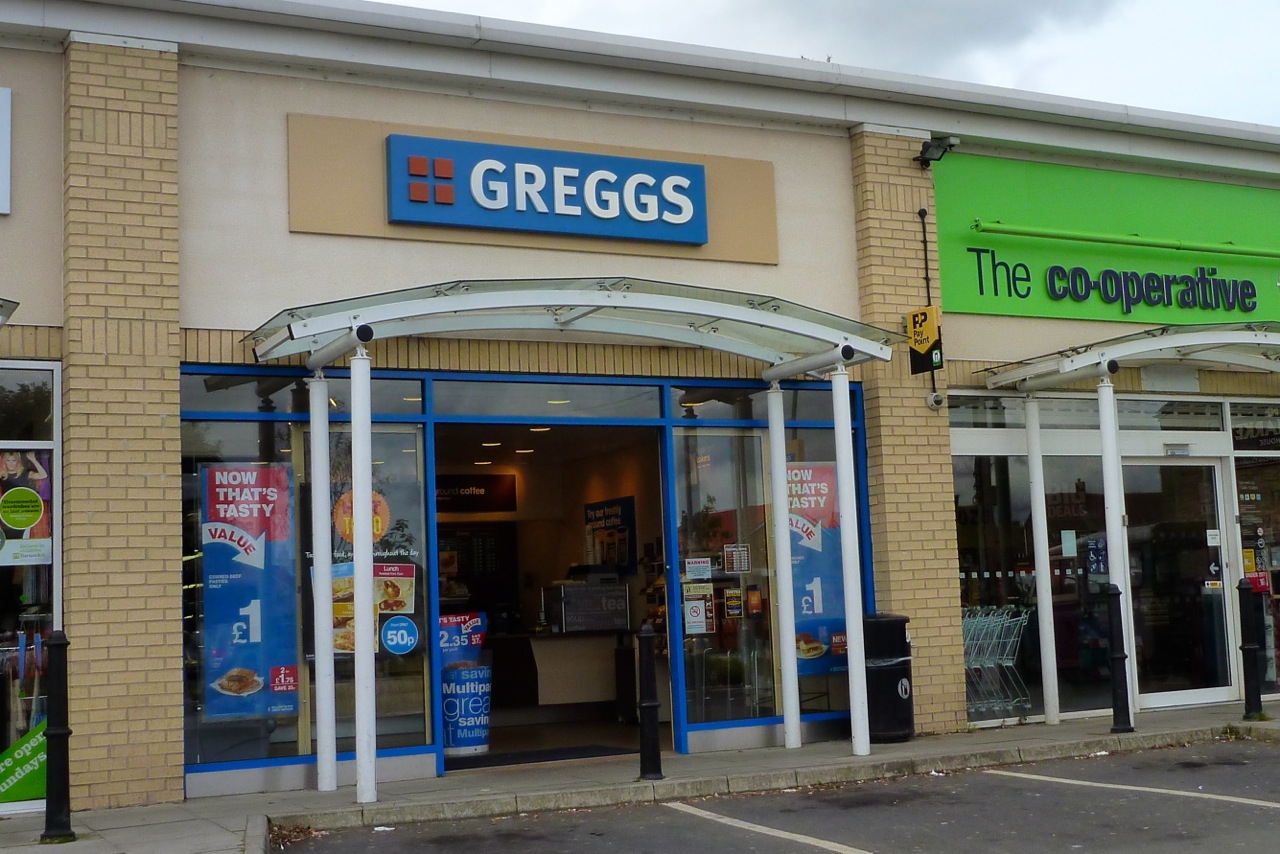
Sat at over 1000 feet in the east Pennines, nearby Tow Law was a smaller version of Consett, established after a Victorian era coal rush but now plateauing out following a steep decline at the end of the last century. But it had a Greggs (left) – the first I’d seen in months, so Tow Law is alright by me. Two hot pies, a cream cake and a coffee. I was primed for the next 6 hours.
Soon enough the A68 ran into the A1, the Great North Road built by the Romans. The better part of the day was over now, all that remained was to ride into the rain. That started somewhere in Lincolnshire, a light drizzle that the winds kicked up into a full-on lateral hosing. Like many bikers before and since, I sat on some Armco pulling my Rukka one-piece over my legs and wrapped the top half under the waxed Falstaff which was to be put to the test, along with the Magadans, the Rukka itself, the GS with it’s new K60 tyres and my X-Lite. I was also seeing how neoprene kayaking gloves worked as wet weather gloves (short answer: they don’t).
What rider isn’t familiar with that trance of concentration that envelopes you when riding a busy road in the wet. The bike is humming as you try to maintain momentum while knowing it takes just one slow- or too fast reaction by you or others to become the unwelcome filling in a pile-up sandwich. Meanwhile your gear slowly begins to succumb or resist the 70-mph onslaught. If I was looking at myself behind the cosy flip-flap, flip-flap of some wiper blades I’d be thinking ‘cripes, rather you than me, mate’. The temperature dropped to 6 degrees, not a long way from snow, and the rain washed off the bugs but started running down the inside of the X-Lite’s visor, further reducing visibility while I bored through the spray. It was the autumnal equinox and luckily some sort of daylight shone through the murk. The thin neoprene gloves were proving to be a fast track to rheumatism, but the PVC Rukka lowers and even my old Altberg boots stayed immune. So too were the Magadans it turned out later. The insides got damp (they don’t claim to be waterproof) but barely a drop licked the outside of the thick inner bags. And the K60 tyres never missed a beat on the motorway or while cutting across Sunday night traffic through the middle of London.
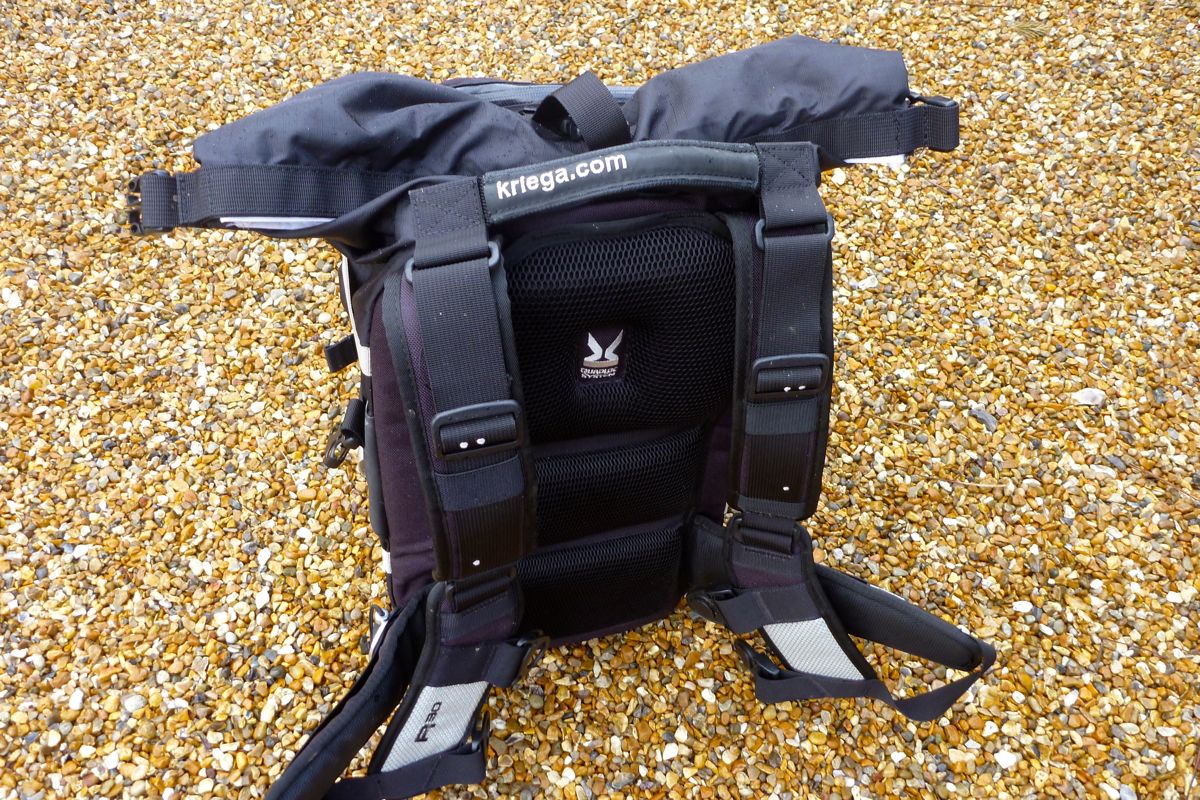
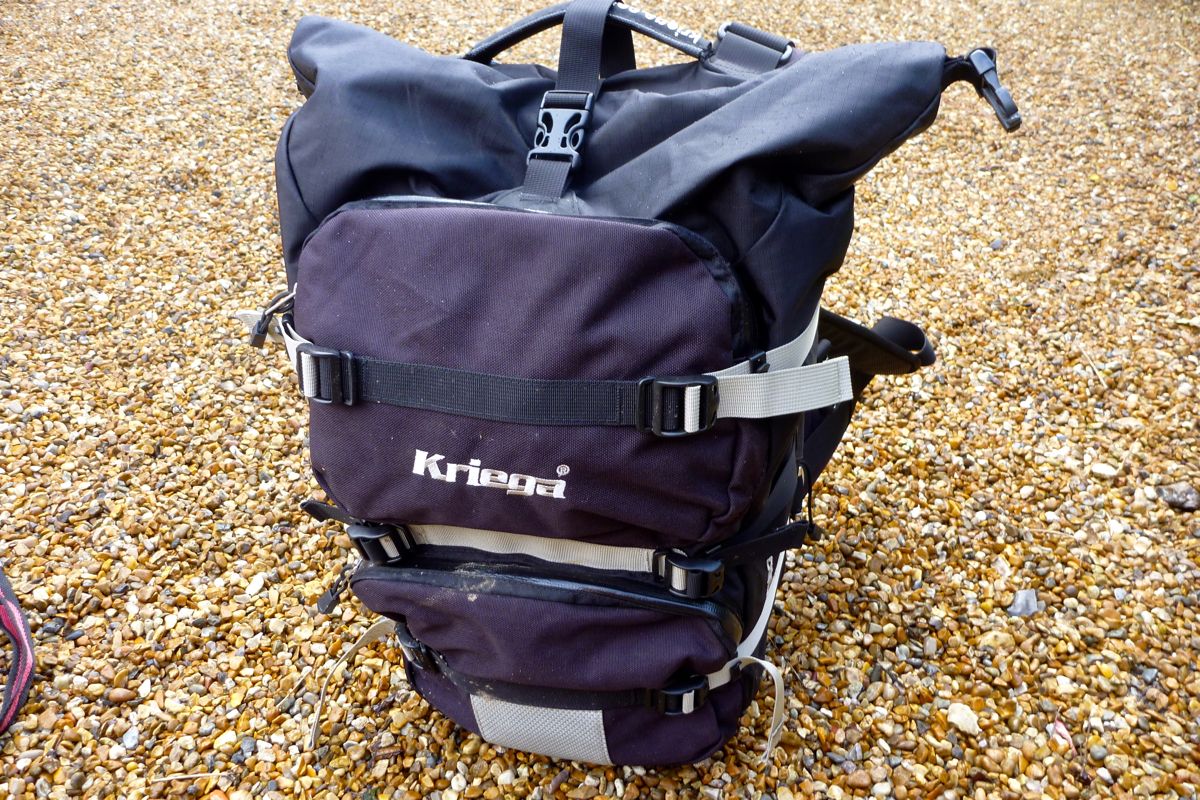
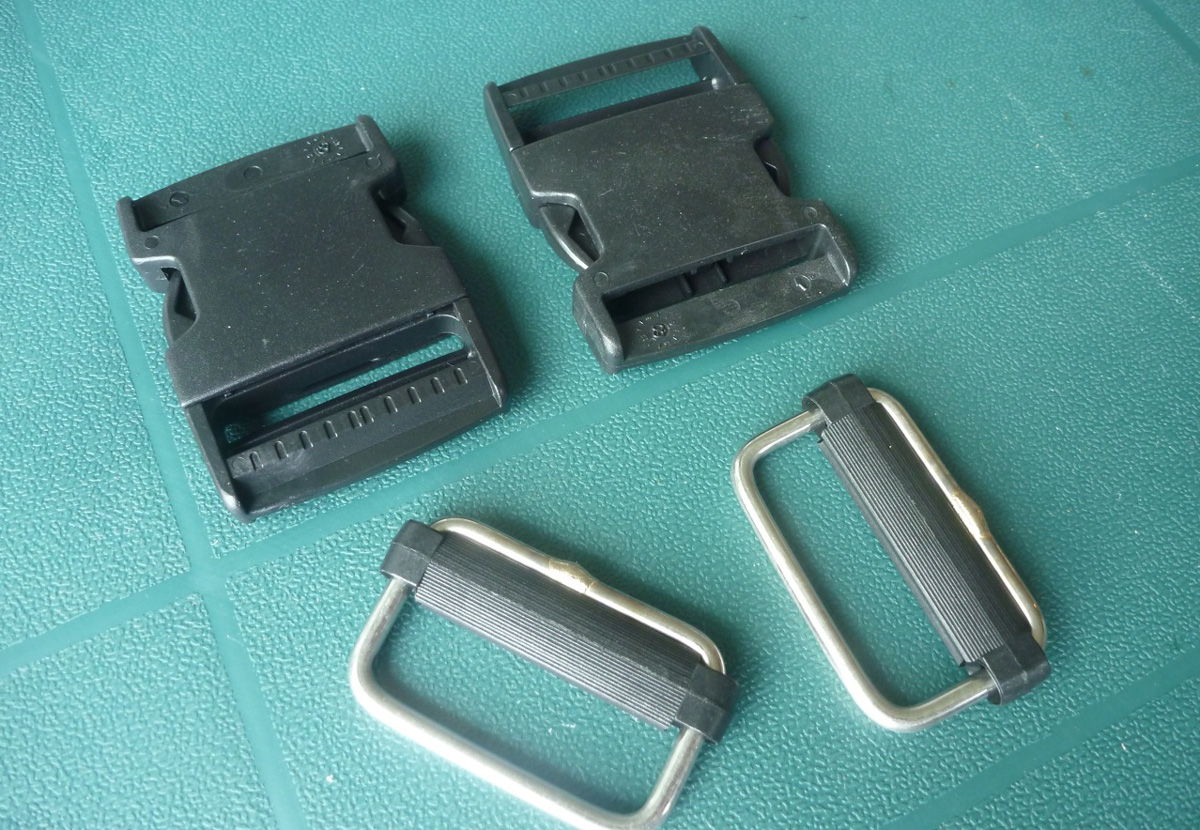
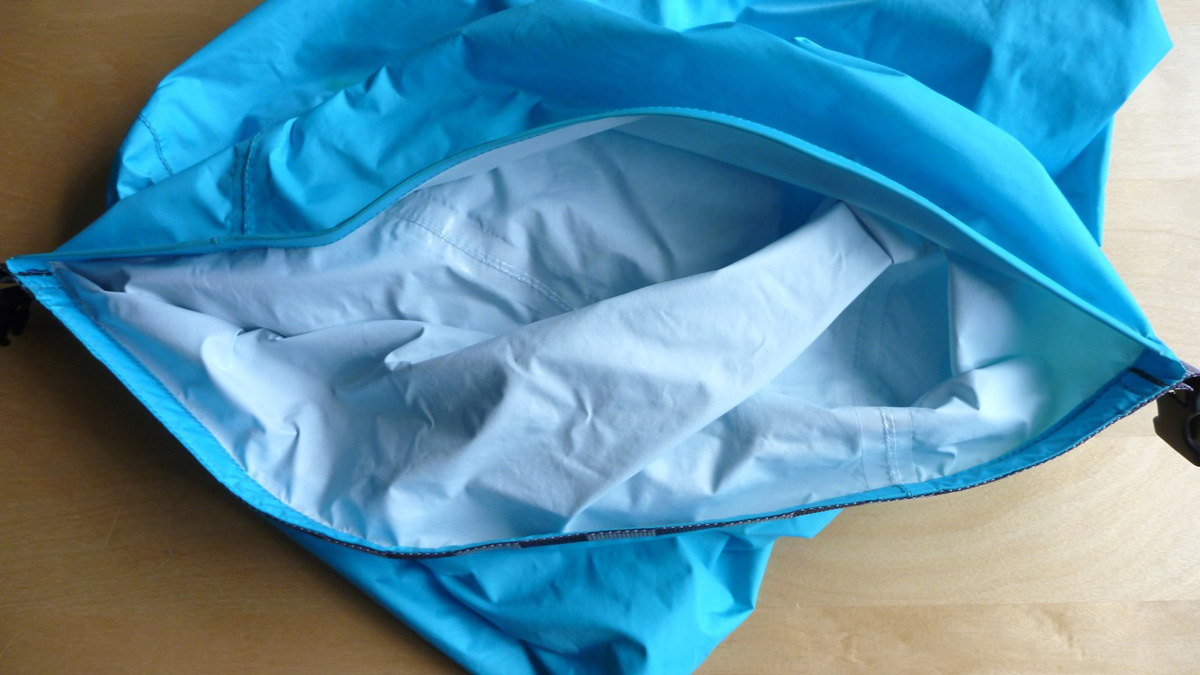
Using the Magadans Although it was only a short ride, I got a bit more of a feel for using the Magadans. The buckle idea I mentioned is definitely the way to go to replace the over-seat velcro. As the bags sag or lift with different payloads you want to make small adjustments and doing that accurately with the double-sided velcro is a pain. With a ‘friction-bar’ buckle (right) a quick tug or release and you’re done. Opening the bags for access is of course easy but the inner bags are rather stiff when cold and so difficult to roll up and clip while complying with the outer form. But it was a cold day and anyway, the are scores of roll-top dry bags available, either full-size singles, or smaller multiples to help compartmentalise. Though it’s much thinner coated taffeta nylon, Exped make a light blue XXL 40-litre rucksack liner dry bag (left) with taped seams and a white interior. As with the Kriega Overlanders, a white or light colour would make digging around to find stuff a little easier. I lashed on my sewn on D-rings to the rack rather crudely and with numb hands had to yank them off when I got home. Once I have the rack finished I’ll be able to make some permanent attachment points on it and figure out a quick clip-on system, probably a smaller, one-inch version of the black clips pictured right.
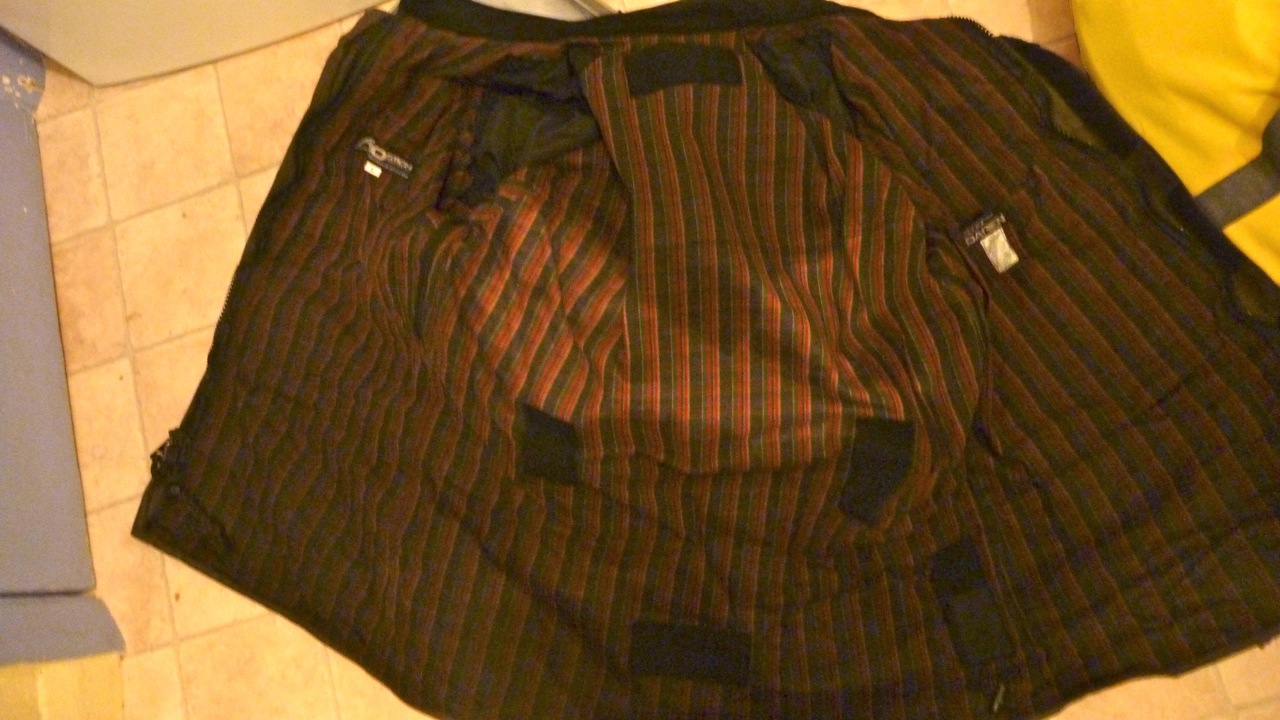
Not so amazing or surprising, was the Falstaff’s performance. After an hour I could feel the wet against my arms just as I’d done in Spain months earlier, but more so. It was only when I got home that I saw the entire lining bar a small patch on the back (right) was soaked. My wallet and phone in the inside pocket were on the way to saturation. What a shame. Design and construction wise it’s a great bit of kit, but it doesn’t do what it needs to so I won’t be wearing that again.
Still, now I know what works which so far still includes the Suzuki GS-R. I can’t say I notice any negative roadholding or handling issues from what might be seen as a thin rear tyre or indeed running identical tyres front and rear like an old Lambretta. Again I’m surprised how comfortable and endurable long days are on this bike, even in sub-optimal clothing. A big part of it must be the seat which engages well with the corresponding part of my anatomy, but I also wonder if it’s something to do with a modest engine and braking power which puts little stress on the body, while being enough not to feel vulnerable and under pressure in traffic. That was the reason for choosing and adapting an otherwise ordinary machine.



 make a pannier rack to keep my Magadans in place – something not at all like the Sequoia rack (right) currently sold by crfsonly but something more like this.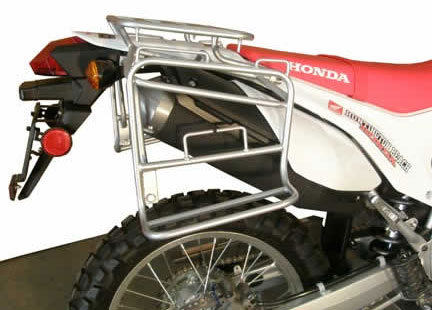






















 Adventure Motorcycling Handbook