Category Archives: Bikes

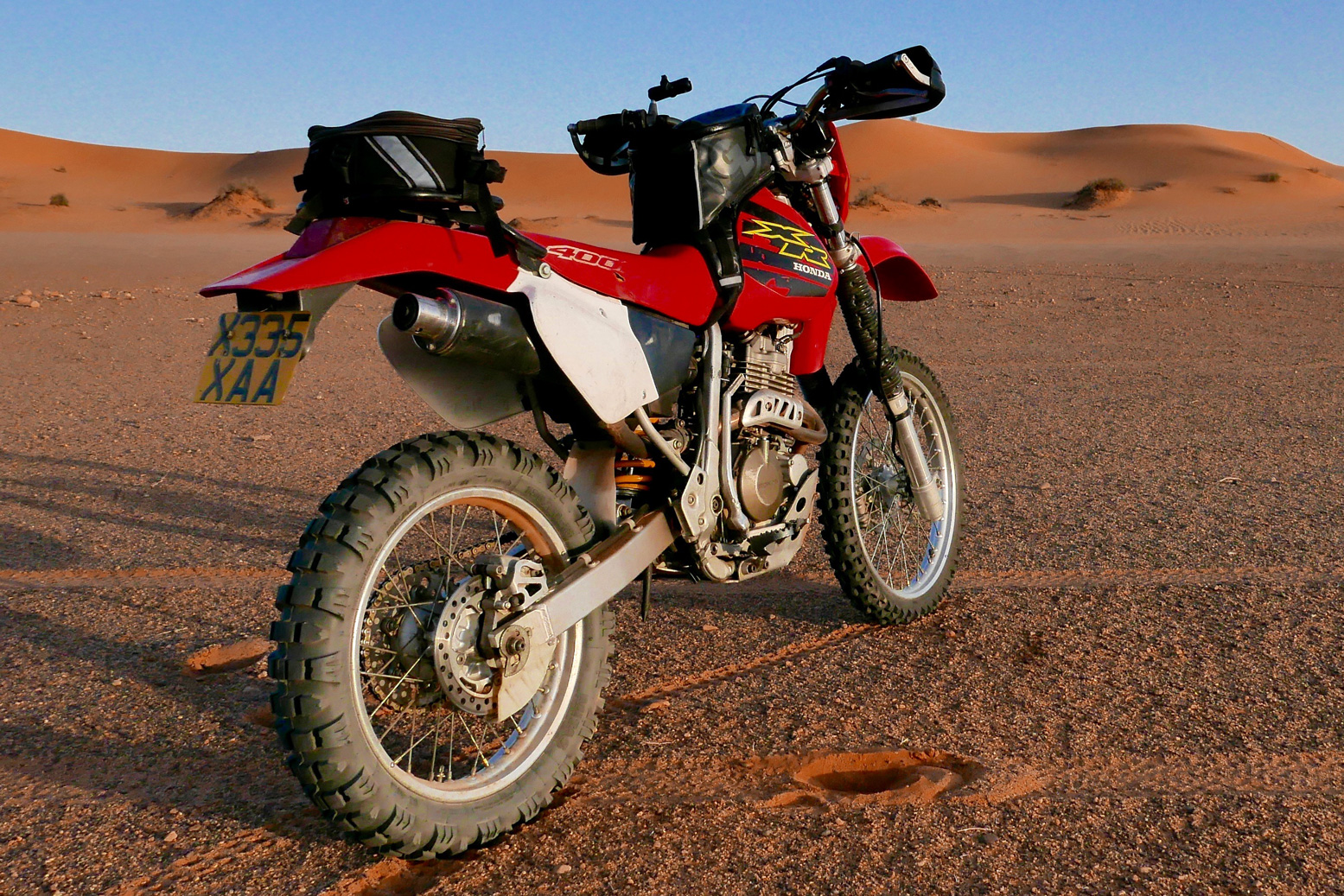
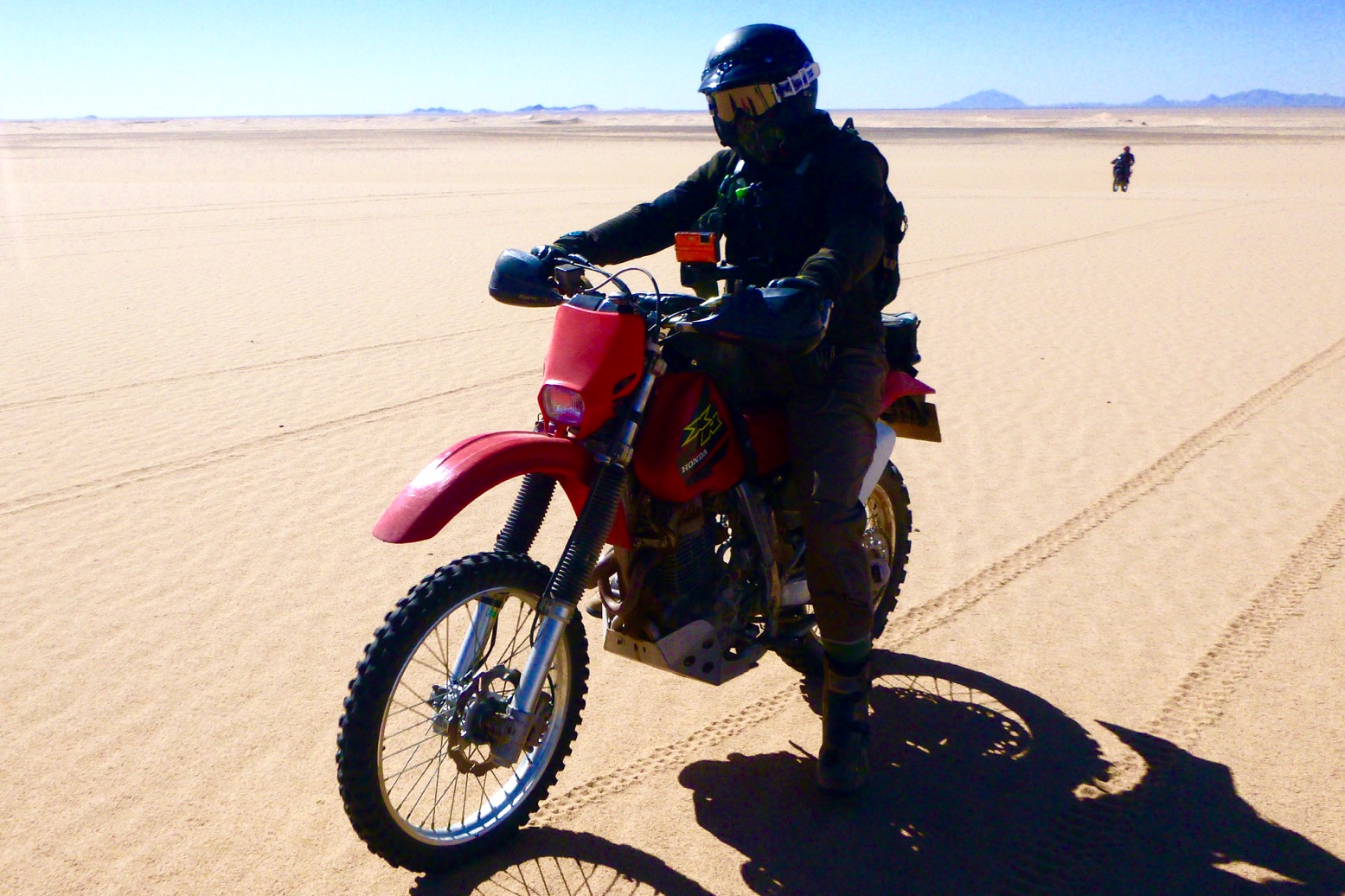
Honda XR400 in the Algerian Sahara

Additional pix by Dan W, Dave K and Robin W.
For the full story on our tour read this.
xr400r

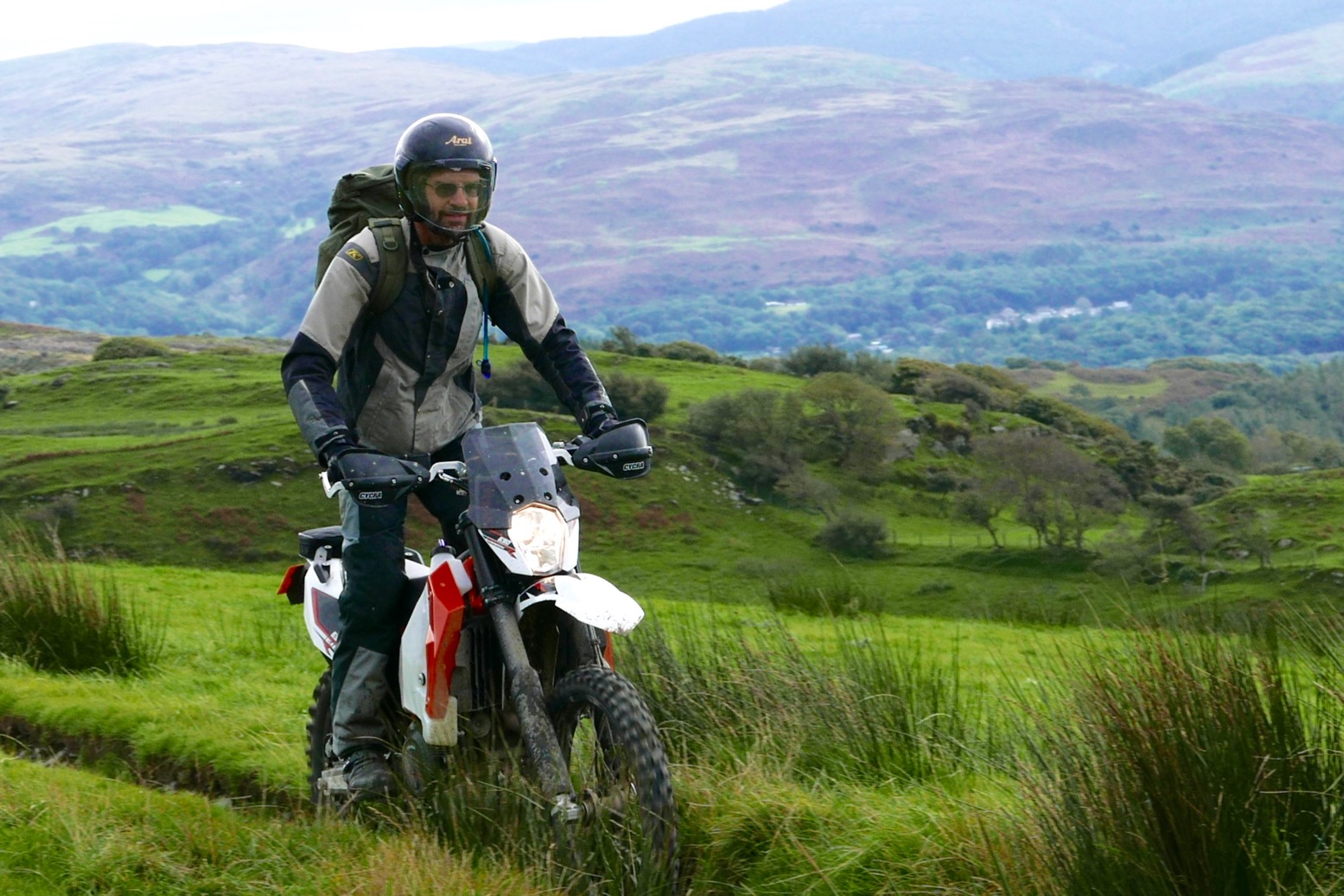
Having had a couple of XR400s on previous desert tours, I’ve long wanted to try one for myself and finally got a MY 2000 model in late 2017. I rode it up and down the road, got some man-caving mates to fix a few things up, then loaded it into a van bound for Germany and Algeria.
Even if they’d have made easier work of it, I couldn’t bring myself to splash out at least twice as much for a KTM and the like. There’s very little in this old category but the XR was a safe, undemanding choice which I was pretty sure wouldn’t disappoint me on the sort of riding I was expecting.

Quick stats
• Produced from 1996-2004
• Air-cooled, dry-sump, RFVC, 5-speed
• 34hp @ 6500rpm
• 116kg dry
• 36.6” / 930mm claimed seat height
• 9.5 litre tank (~150km range)
• Disc brakes and 18/21-inch wheels
• Go from around £2000 used in the UK

tik • Light
• Easy kick starting
• Enough power
• Great suspension, all things considered
• Looks great if you’re of a certain age

cros • Tall seat height
• Unimpressive, carb-era economy
• Kick only
• Dry-sump oil-level checking faffery
• Was never a contender as a good travel bike (skimpy subframe)
• No modern version exits

Some other bikes I considered were:

DRZ400
Has the button but 15-20kg heavier, more trail bike less dirt bike and finding a decent one with few owners and that’s not covered in naff Monster stickers is tricky.

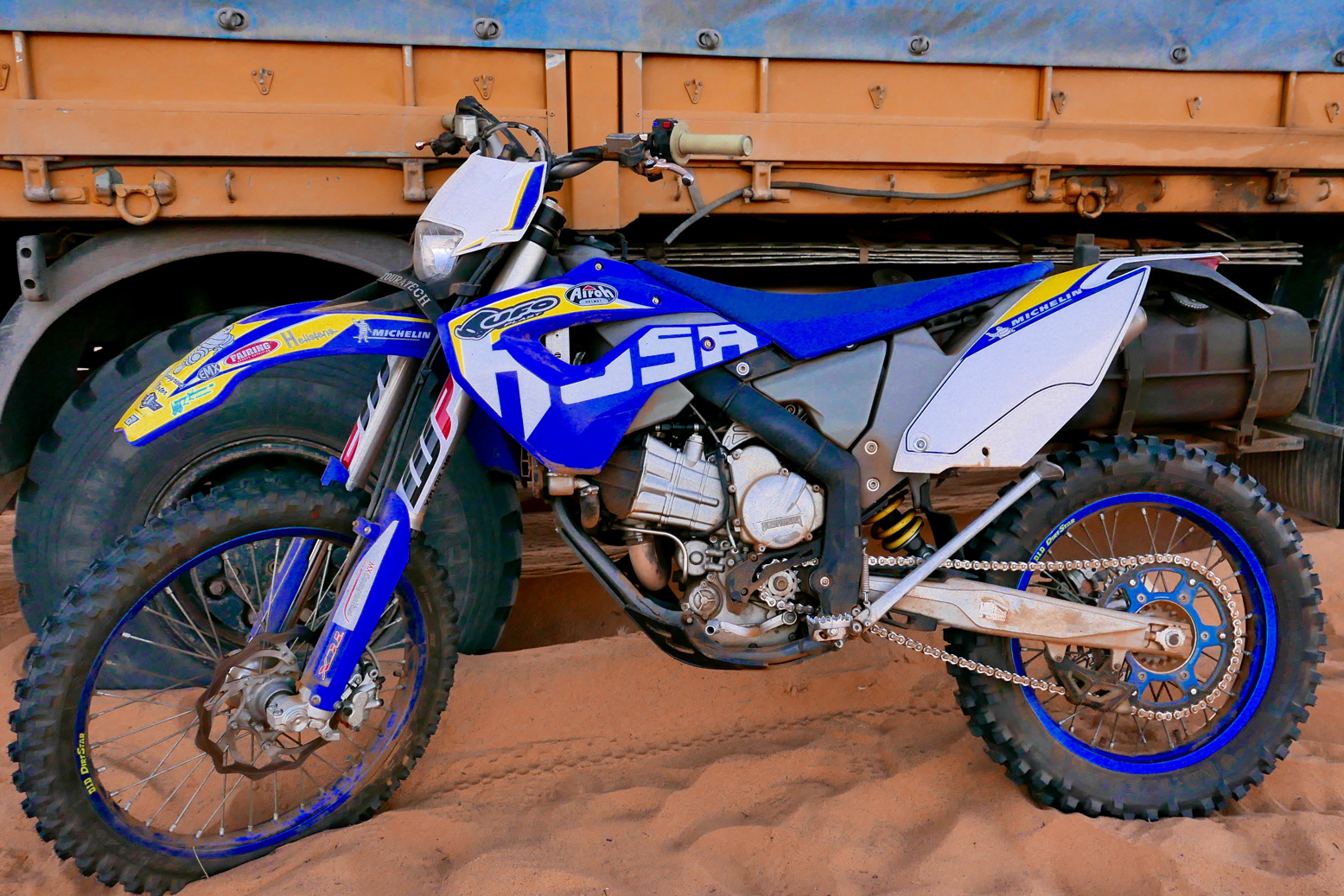
Husaberg FE450  husaberg450
Liked the unusual engine and good reputation of later models but obscure = hard to sell on and anyway, it’s a hardcore enduro racer.

KTM 500 EXC`
Less frantic than a 450, lighter than a 690 and easy to sell on, but efi ones cost thousands and anyway ‘KTM relaxed’ ≠ XT500.

KLX450R
Unchanged since 2008 and said to be the ‘softest’ of the Jap 450 enduros but carb’d and rare in the UK. But again, softest is all relative.

KLX250S
Better suspension than a CRF-L but it’s still only a 250. I’ve had enough 250s for the moment.

xr4 - 1

My XR showed 8550km (5300m) on the clock and looked in good nick. It had a small rack, bashplate and an OK front tyre so not much needed adding of fixing for a fortnight in the desert: a new Mitas E09 on the back with Slime in the tubes and self-tapers through the rims to stop tyre creep.
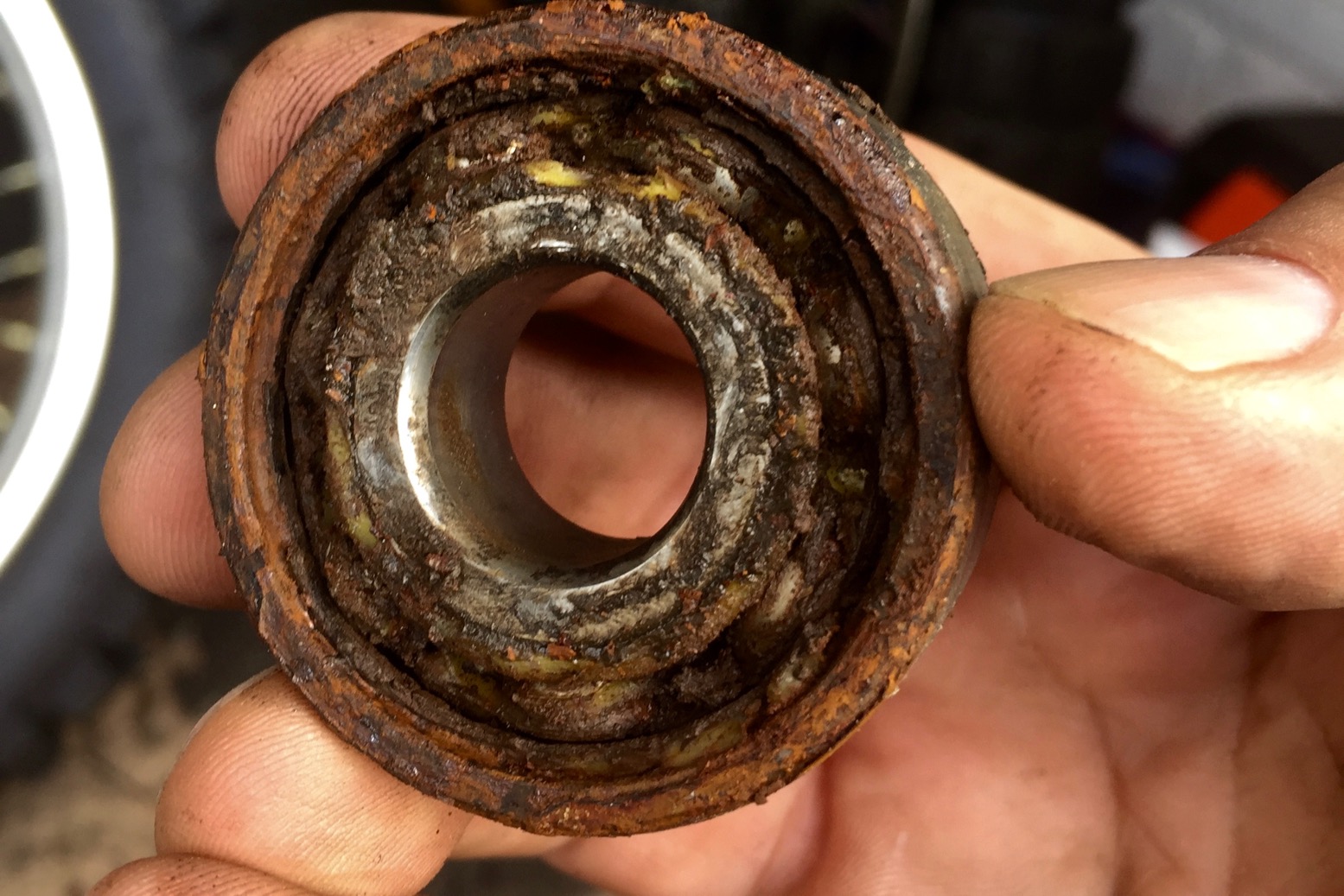
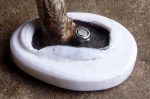
New wheel bearings (old ones rusted right up – jet wash victims, I guess) plus fatter pegs and a Trail Tech temperature gauge. Air- or water-cooled, I’m a believer in closely monitoring actual engine temps in the desert. I also got TTR-Simon (on the tour) to add my old Barkbuster Storms and Rox risers, plus a disc of HDPE (chopping board plastic) melted and bolted under the side stand foot – a light and simple way of doing it.
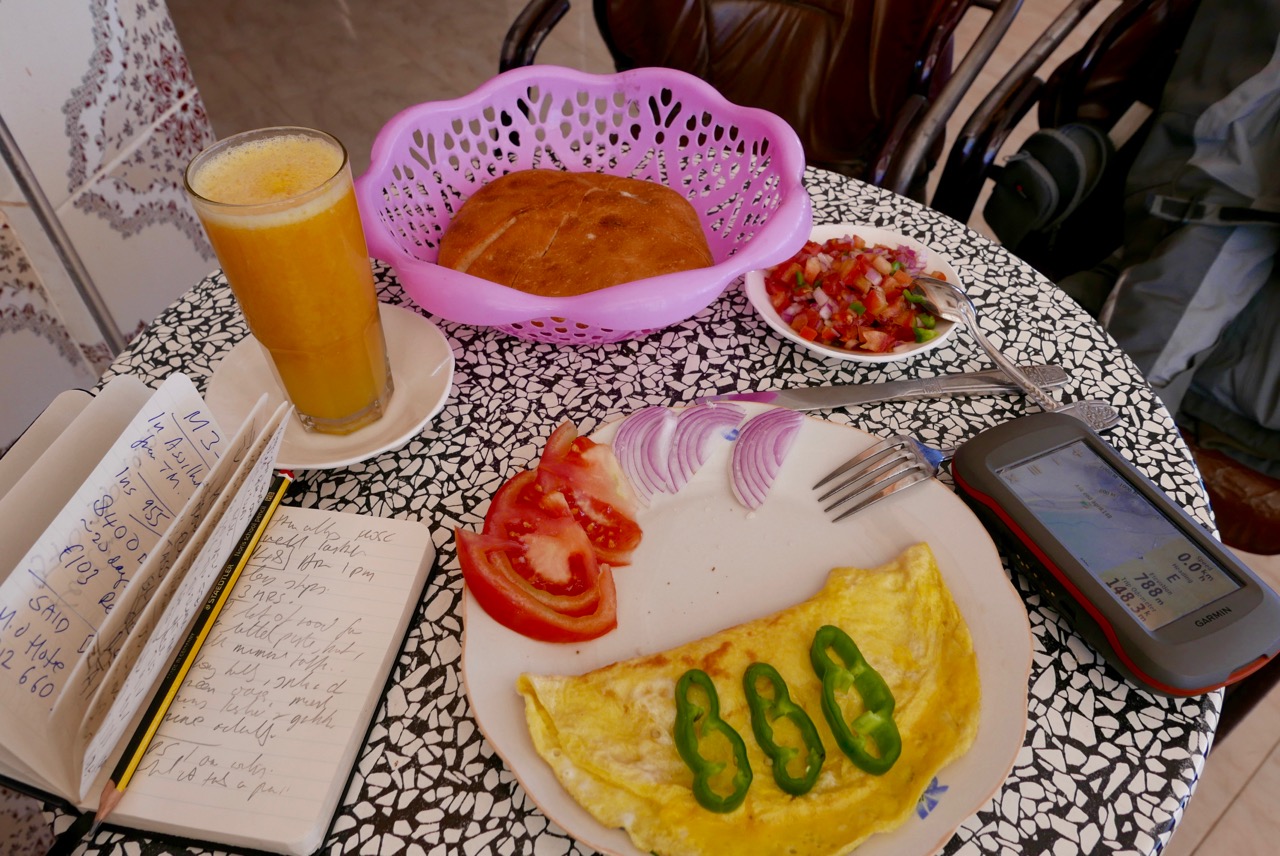
Before flying out to Algeria I had a thought that my kick-only XR might take a lot of starting after being transported across the freezing Alps, the salty Med and half the dusty, arid Sahara. But came the day in Illizi I nearly fell off the seat when it lit up first kick and proceeded to do so throughout the rest of the trip, whether baking hot or freezing cold.

Once geared up, leaving Illizi we were thrown in the deep end with a short but sandy ride to our first dune camp. Those new to sand or who’d not ridden it for ages – like me – were a bit startled but eventually remembered what to do: gun it and hold on. The XR felt light, well sprung and reasonably responsive (this was on road pressures), though not enough to make me want to blast up wayside dunes for the hell of it. Most of us felt the same way; there was plenty of rugged riding ahead.
FYI, the other bikes on the tour were a CRF250L (DNF); two BMW XChallenges (1 DNF; injury), two KTM 690s, Husaberg 450, two bored-out 315-cc Yamaha TTR250s, KTM 350 EXC, Husqvarna TE300 2T, XR250R and an old KTM 640 Adventure. All of these bikes appeared to cope as well with the riding and, like the XR, none of them needed anything more than the slightest attention. Read the full ride report on advrider.

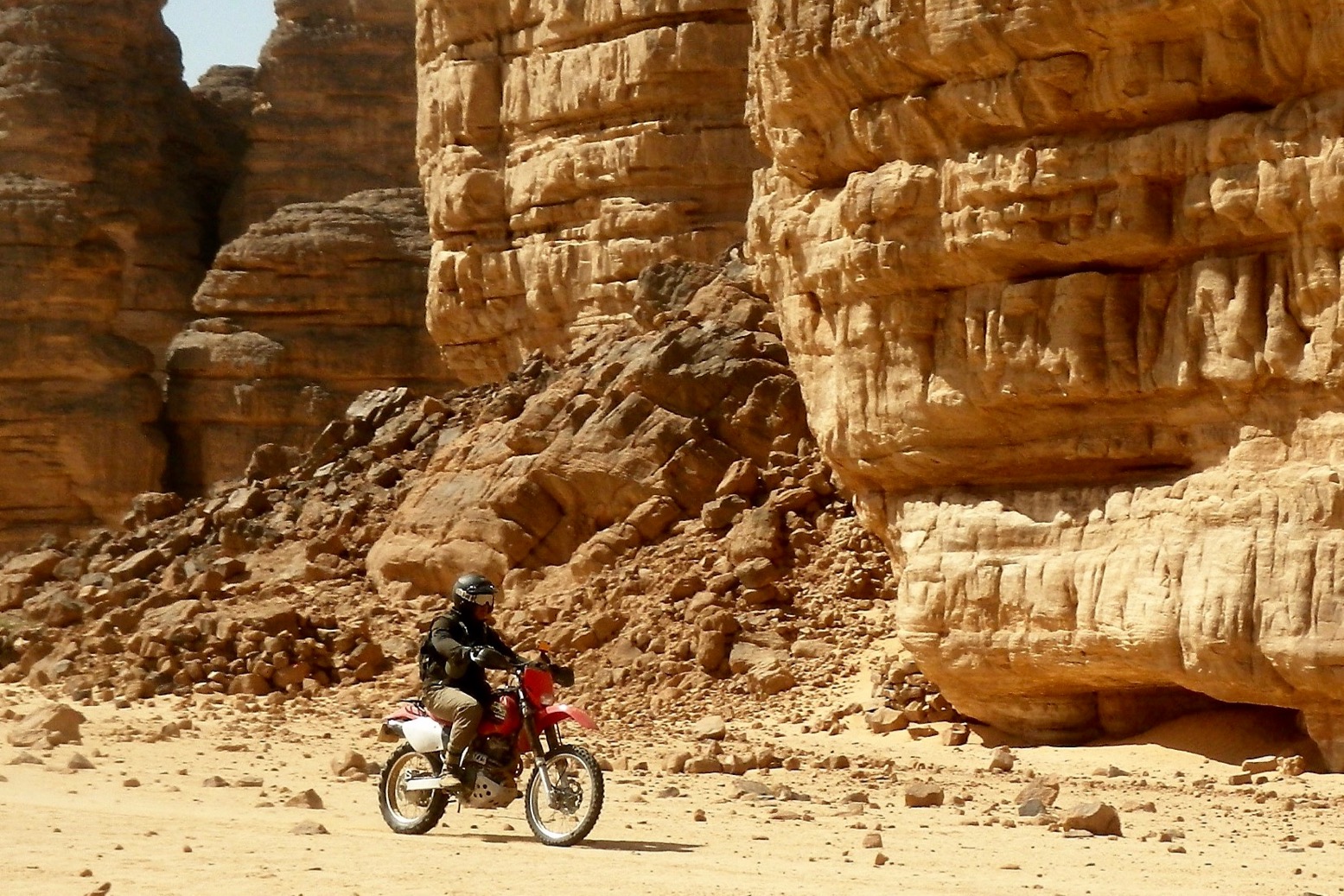
Fast forward a few days and my XR had impressed me and saved my arse many times; most commonly when I was certain I was about to go over the bars following an unexpected drop-off, trench or general gnarliness. I thank the light weight – it really is the answer to so many issues on the dirt – and the Showa forks on whatever setting the bike came with. The rebuilt rear Showa shock also did a great job without any meddling. It goes to show that good quality suspension on a light bike works well over a broad spectrum – or how easily pleased I am.
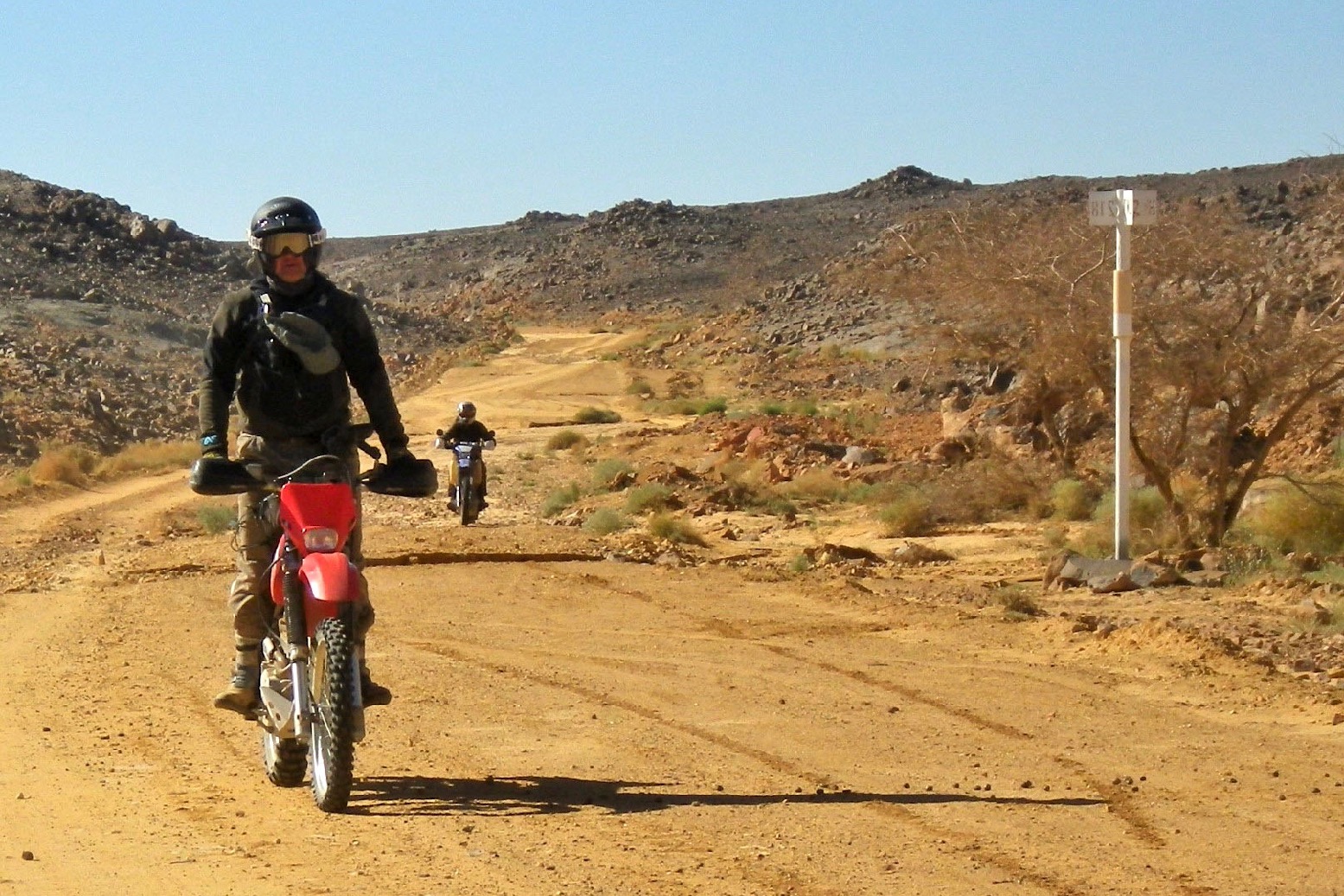
The XR is relatively short and tall and George (who followed us in the pickup over the tour) observed that the Jap bikes (XRs and TTRs) appeared relatively less stable compared to the generally racier European bikes. My XR does look short and high alongside a long-swingarmed 690 and I can’t say it rode the sand seas like an ocean liner, nor trickled through grassy tussocks like a Montesa. That may have caused fatigue and palm blisters after a few days, but the relative skittishness never made me to crash outright.

Version 2

Dave (690 fan) and I have an ongoing banter about why I should get ‘the best trail bike ever’. While the 690 KTM does appear to give you your cake (lightness, economy, power, tough build) so you can eat it; I still find it and the similar Husky 701 I rode in Morocco too full-on, narrow-saddled and vibey; still more enduro racer than trail bike. A quick spin on Rob’s 690 (left) didn’t change my mind and anyway, for the use I’d give it, with the attention it needs and my lack of secure parking/well-lit workshop space, such a bike would be an extravagance.

Kick-starting may be old school but the only time my XR took some starting was after it fell over long enough to drain the carb. Soon enough I learned to just keep kicking away whereupon it eventually coughed then fired up. This can be awkward (on a dune) or just plain tiring after a couple of minutes, so a button would be great. It can be done on an XR by fitting a motor (or crankcase?) from a Honda TRX400 quad – try and find one of those on ebay in good nick. TTR-Simon is currently engaged in such a project; he’s also producing a 350 barrel kit for the electric TTR 250s. Neither job’s an easy solution, but both these bikes – one too small cc, the other unbuttoned – comes with the great suspension and to make it worthwhile – possibly.

A couple of days in, looping some loops I smelled burning oil which turned out to be my bike. Dave (690 and ex-XR400) said the ‘RFVC‘ radial valve set-up tends to ovalise the valve guides due to non-inline forces. Sounds plausible and as the motor never started rattling as long as I kept the oil level up, I was sure it would complete the ride. The strain on the motor and transmission when hauling me over deep, soft sand or up a dune slope is not what I’m used to in the desert, but I never felt the XR needed to be nailed WFO to get the job done. That’s why we like 400-450s over 250s.
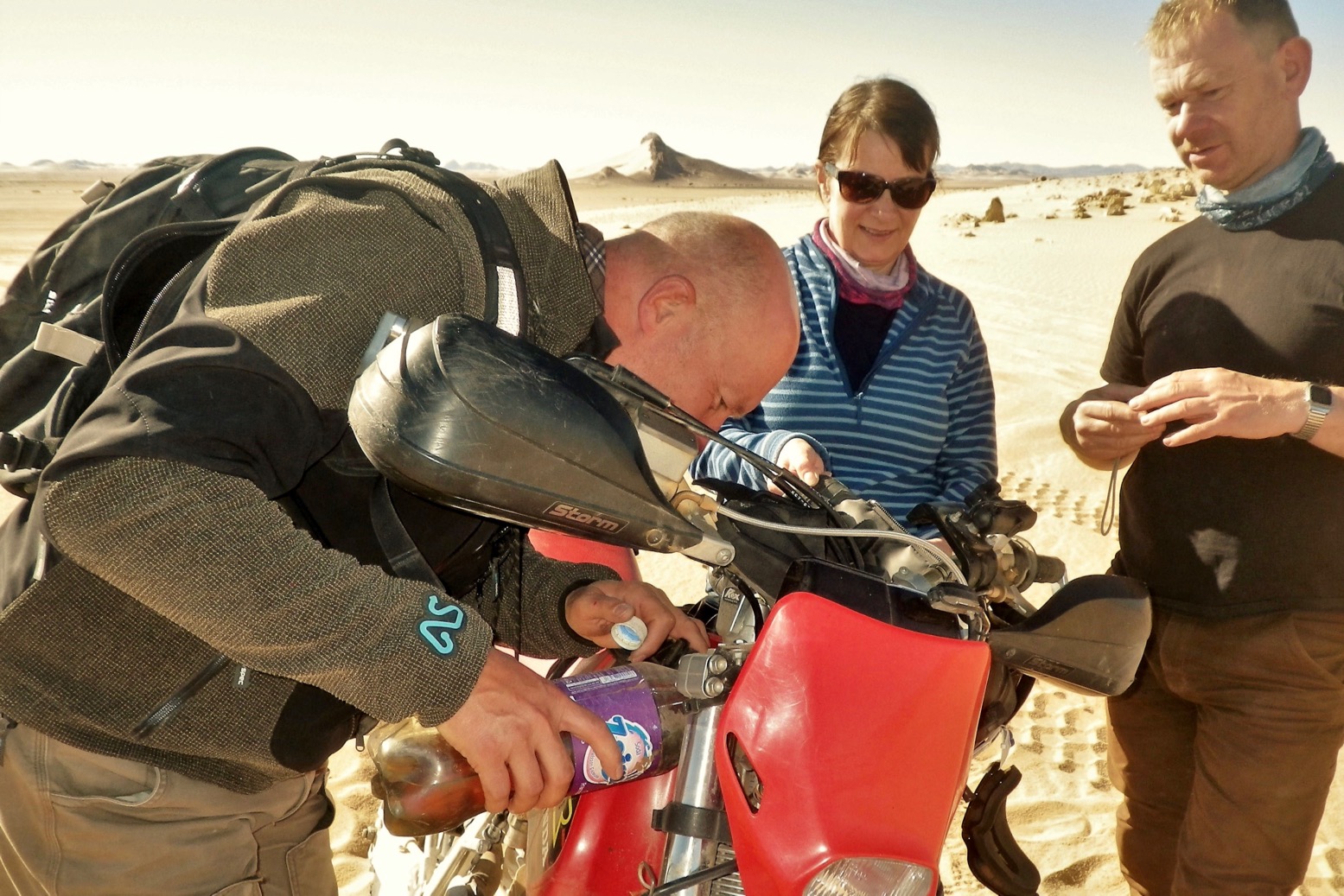
I’m guessing RFVC was an over-complicated way of optimising power by improving gas flow with the biggest possible valves. I was also told I might have released more power by easily removing the baffle, but I doubt it would’ve made a noticeable improvement – just a lot more noise which is often mistaken for the same thing.
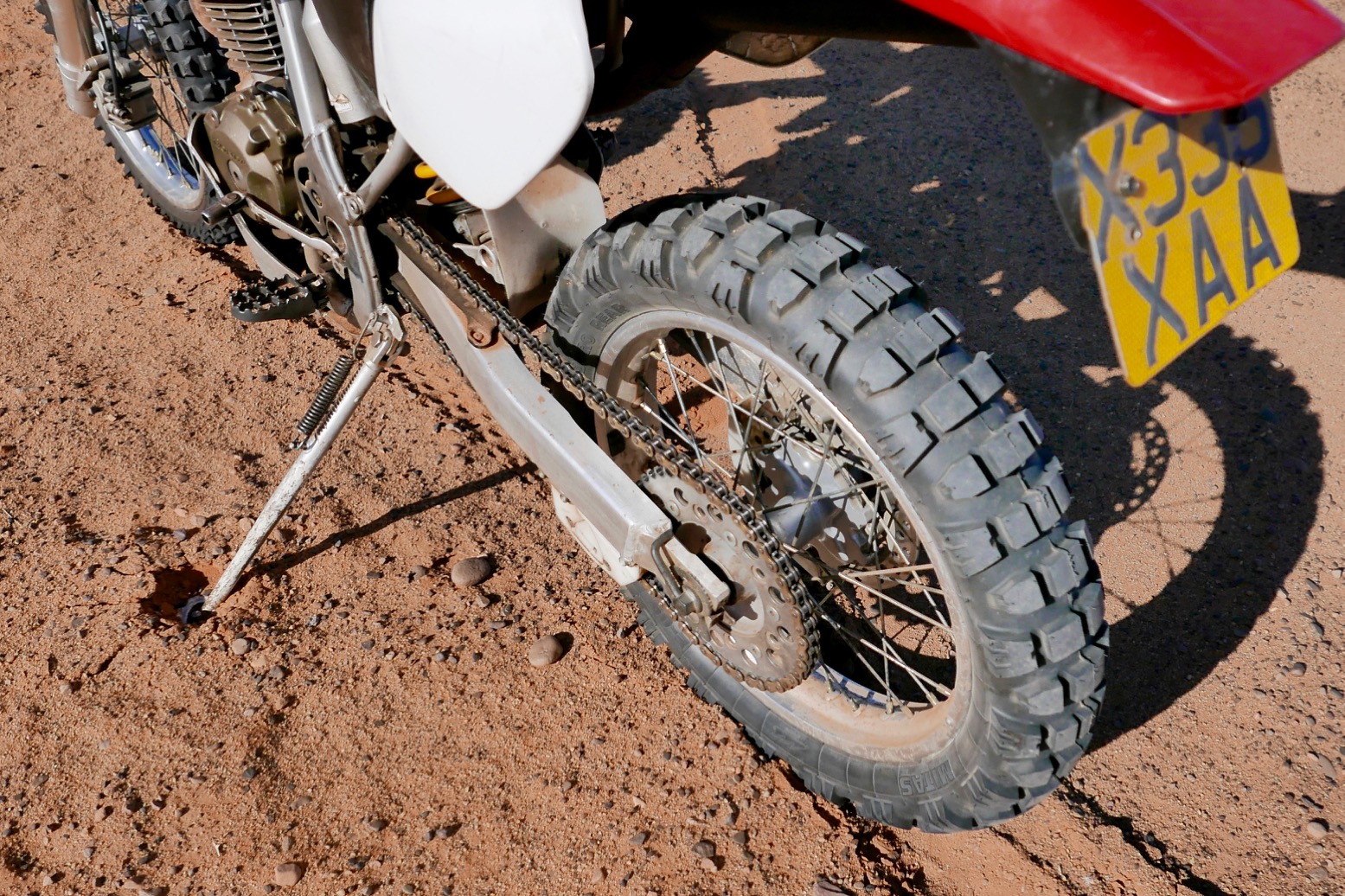
Though I forgot to consider it before departure, the 14/45 gearing on my XR turned out to be spot on for what we were doing; ie: on the low side. On the road, 90kph and once or twice 100 felt like enough and the close-ratio, 5-speed box never bogged (the XR250’s gearing was a lot wider). The chain was feeling the strain too, and needed two clicks during the 1600-km trip; what a pleasure those old school snail cams are to use. Low and close gearing also meant the clutch was never under strain.
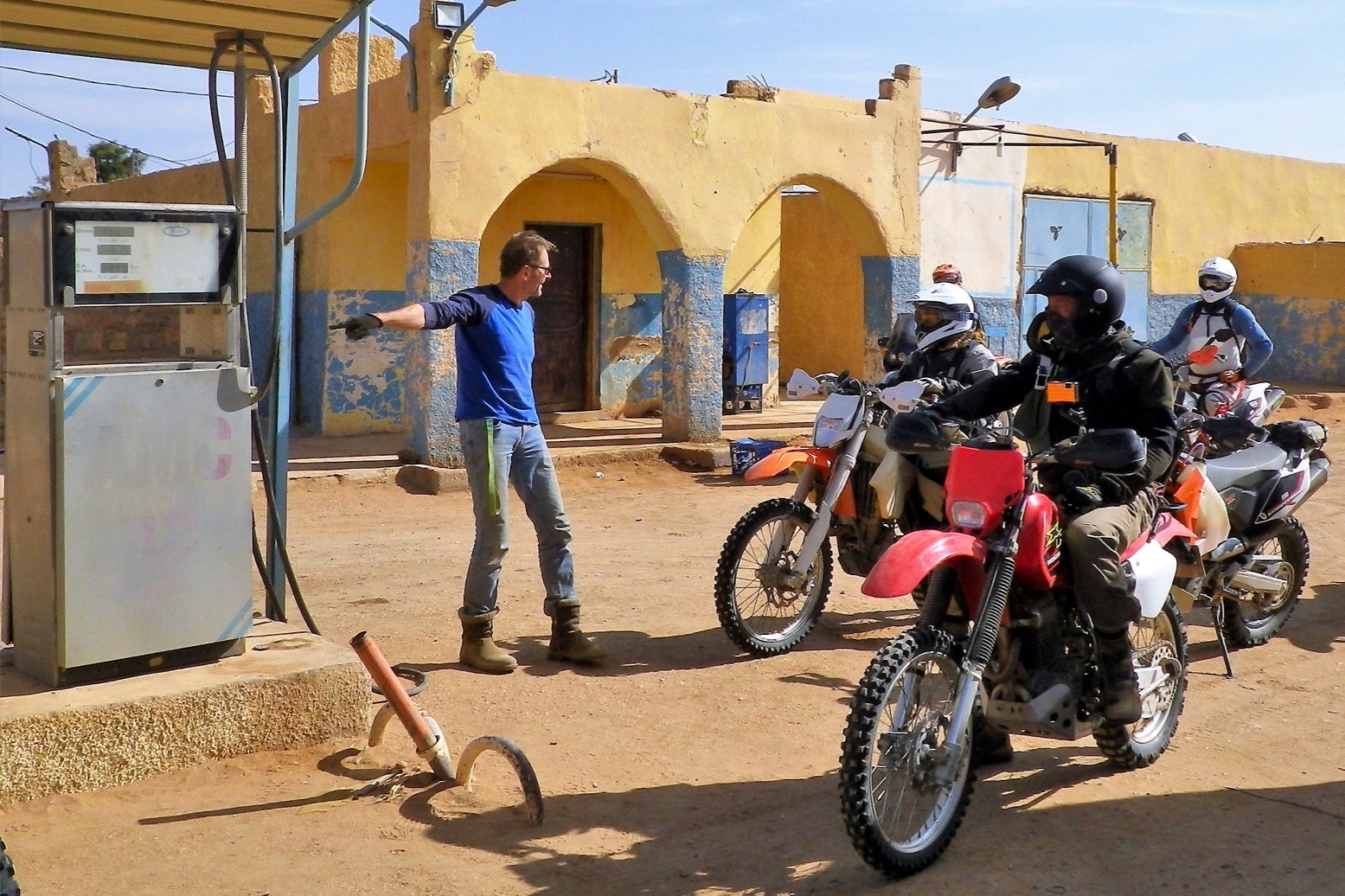
Fuel consumption was pretty poor by my recent standards – down to just 100km to a tank or 150 to dry (45mpg). I bet the bigger efi 650s and 690s were doing much better – small engines aren’t always more efficient when you take into account power-sapping terrain or high-speed roads. I didn’t pull the spark plug but the bike did feel like it may have been running rich, even if starting and carburation were spot on. Better to leave it that way in the desert, even at the cost of mpg as the engine runs a little cooler.

Measured off the cylinder head, that temp gauge was handy for reading overnight ambients down to zero. On the road the bike ran in the 80s °C and up to 120 when pushed hard on slow dirt, heating briefly up another 10C or more when stopped or ticking over after a hard run. Though I didn’t like doing it, switching off after a couple of minutes seemed best as ticking-over saw the temps climb and climb, even with a breeze. Turned off, it only rose for a few minutes then dropped away quickly. I seemed to be the only one pre-occupied about cool running, but for an old, air-cooled engine I’m sure it’s important. Mechanic Simon (who knows XR4s and engines more than me – since diagnosed light glazing on my XR’s bore which will hone out with new rings and a lapping of the valve seats with new seals. As he says: ‘I think when stationary the engine should be off unless there’s a strong breeze. Combustion chamber temp should not rise further with no source of heat, but the temperature [spike] will move towards the outside of the engine as the temperature gradient changes (imagine it like a wave [of heat] radiating from the plug to the fins) which is why the sensor [briefly] records a continued rise.
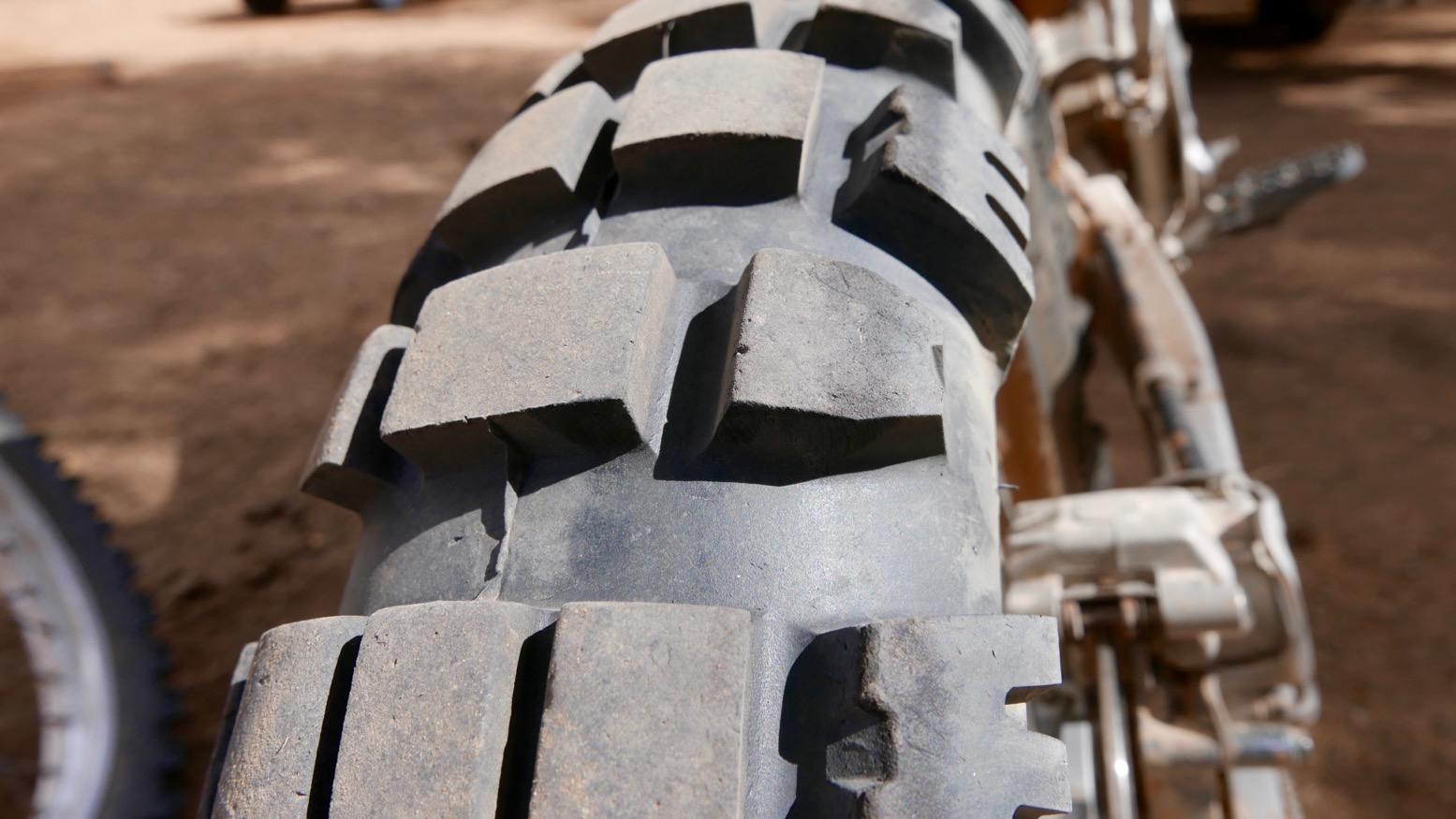
The rear Mitas E09 (non Dakar; 1 less ply and a bit lighter) wore very well, (right: after 1000 miles), but on the sands 1 bar / 15psi was still too hard for this stiff tyre on a light  bike, even with my weight. On the last day on sand I tried 12psi (~0.8 bar) and noticed less squirreling when pulling away and improved traction elsewhere. Tough as a Michelin Desert but less than half price, I’d use one again for similar riding. I had no punctures (nor did anyone else on this trip).
xr4 - 30

So thumbs up for the classic XR4; one of the best trail bikes of its day and still with nothing newer taking its place, including the so-called 450L. I’m pretty sure that motor-wise, it was a better ride than the slightly heavier WR250R I used last year.
The other day I put out a daring Twitter: ”Like’ if you want to see a modern XR400 such as a CRF450L’. I got the most responses to anything I’ve ever posted. Let’s hope that bike might come one of these years, while not weighing a ton. (It did, but it wasnt).

xr4 - 14

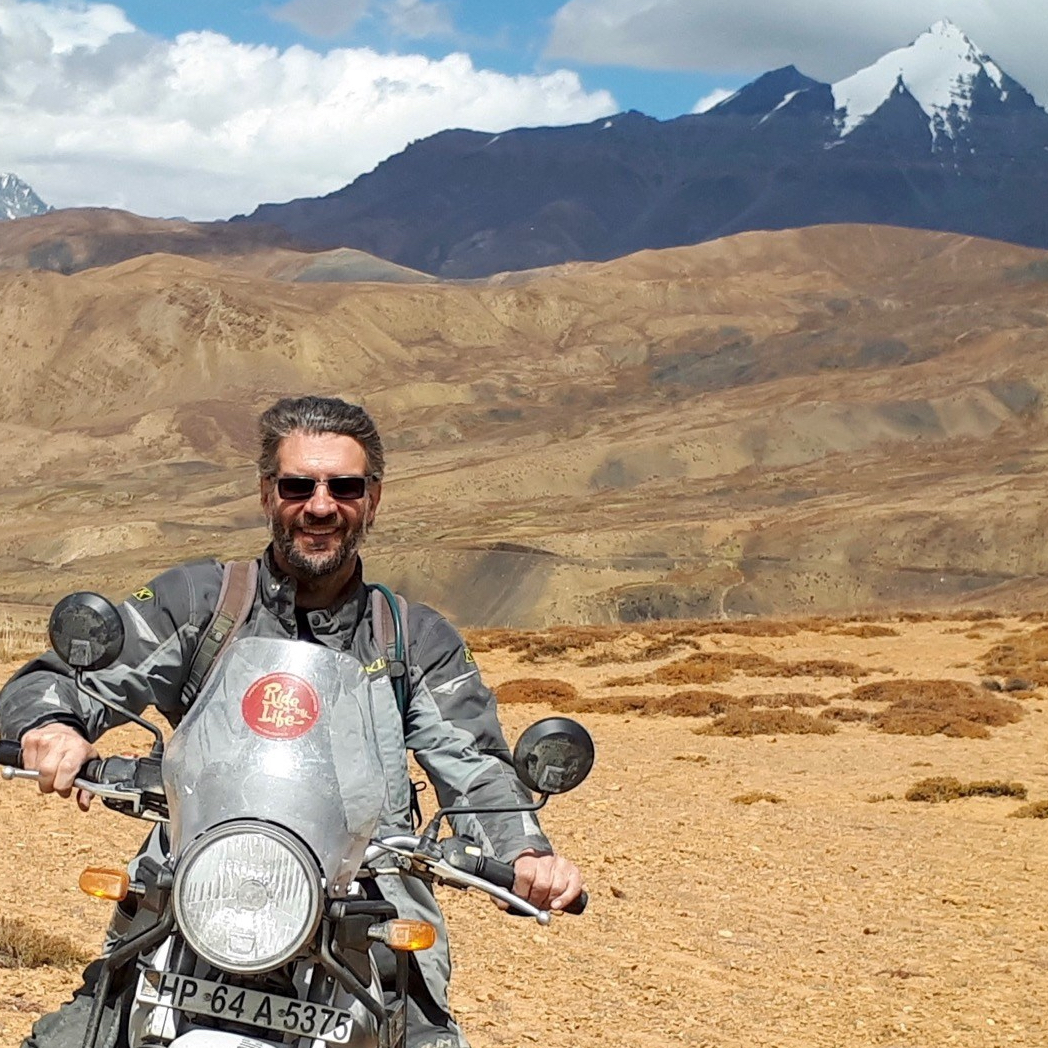
Royal Enfield Himalayan tested in the Himalaya

My Enfield Himalayan Index Page

Dave King

“Our single biggest insight in all these years of riding has been that the best motorcycle for the Himalayas is not one that tries to dominate its landscape, but one that is able to go with its flow. … ​With its purpose-built ground-up design, the Himalayan is a simple and capable go-anywhere motorcycle that will redefine adventure touring…”
Siddhartha Lal, CEO, Royal Enfield

himsdd- - 22

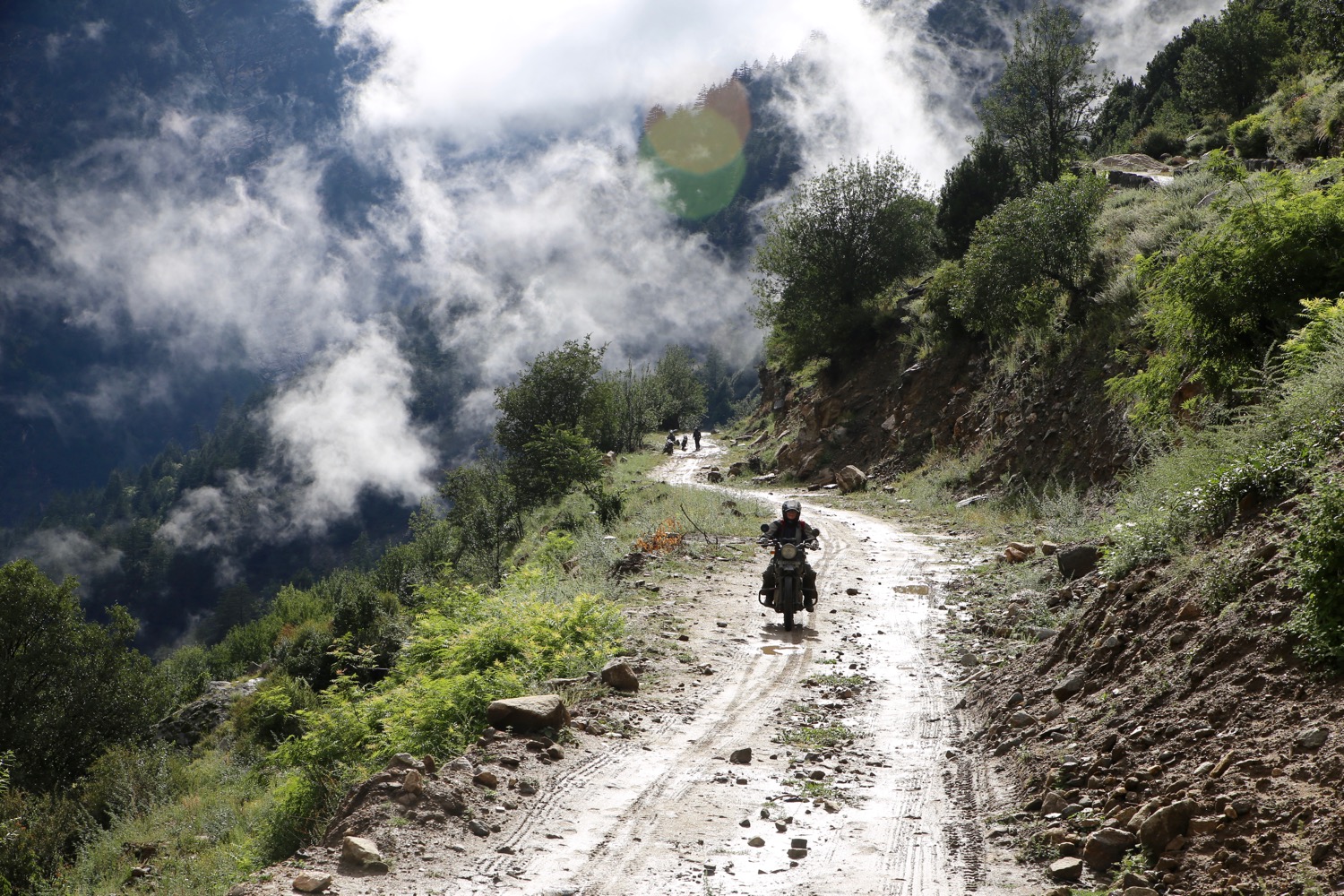
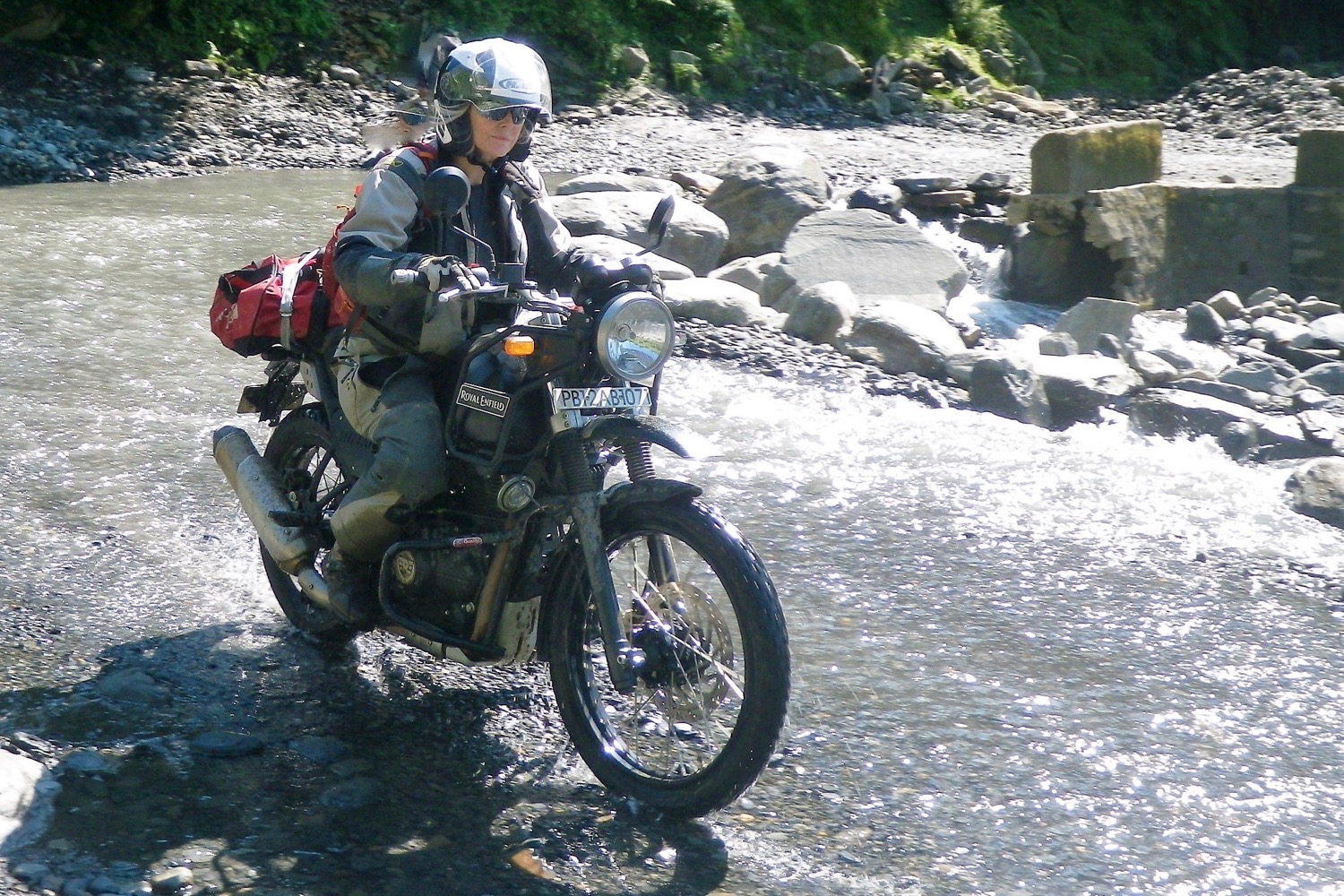
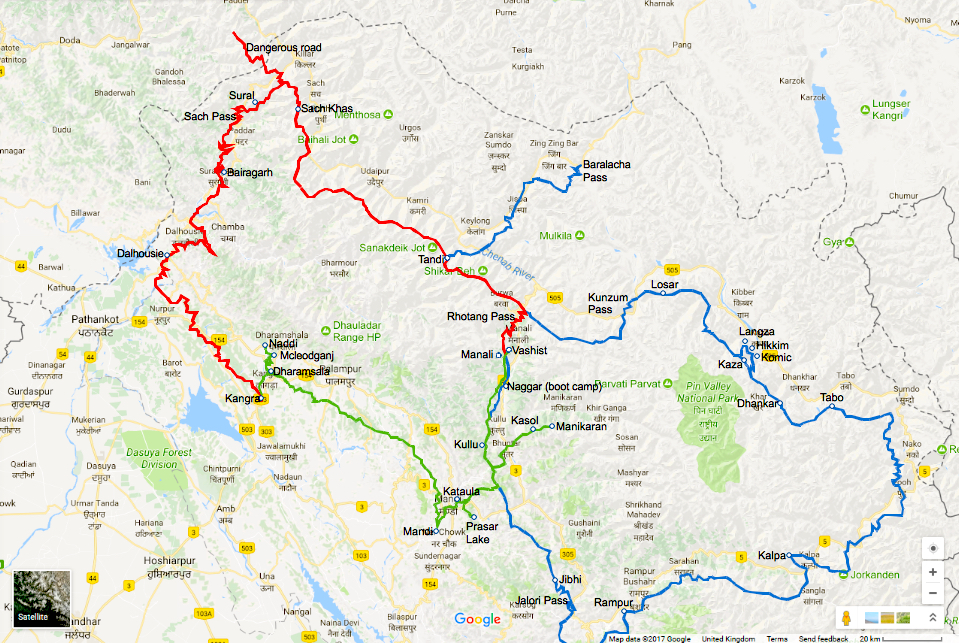
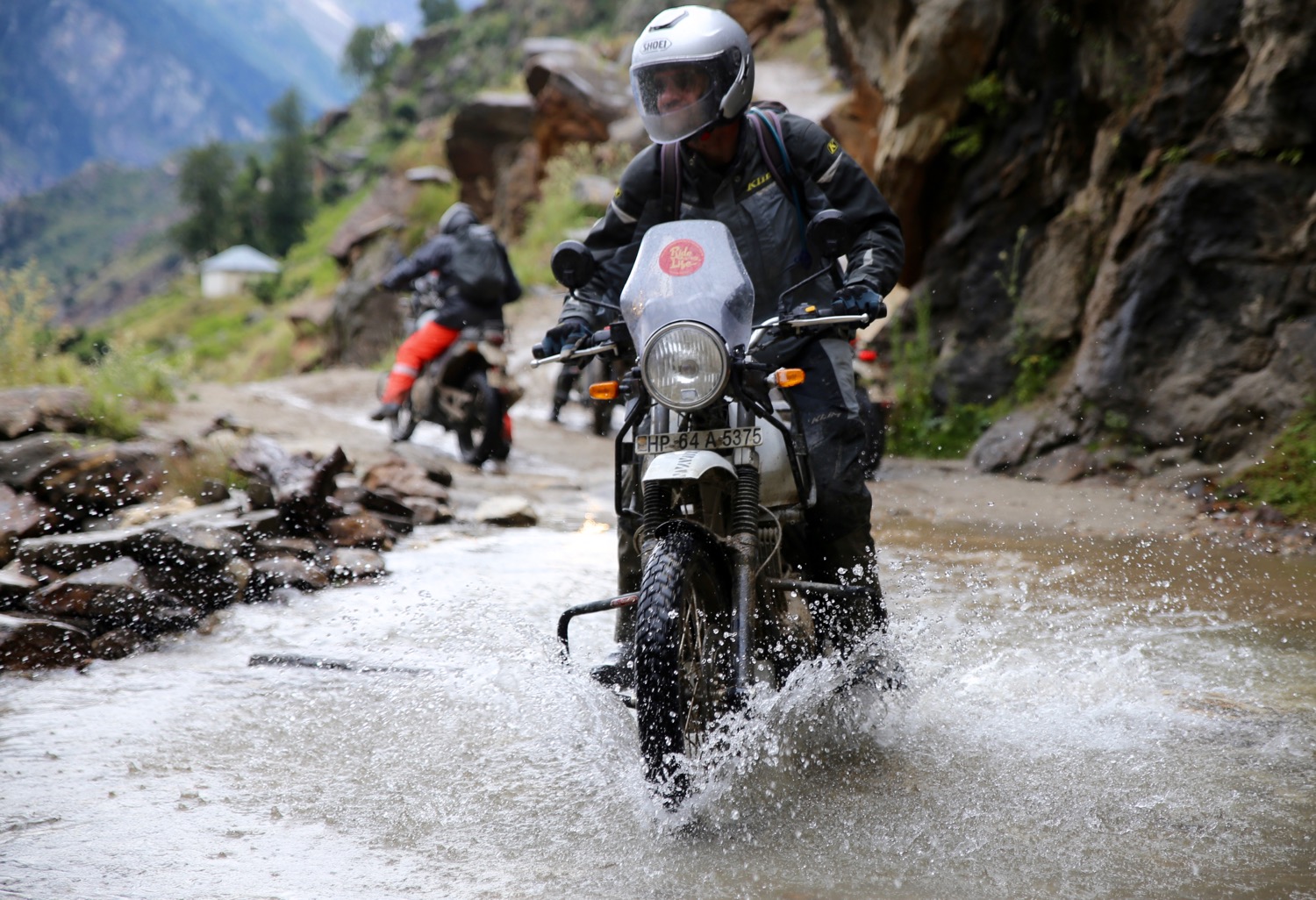
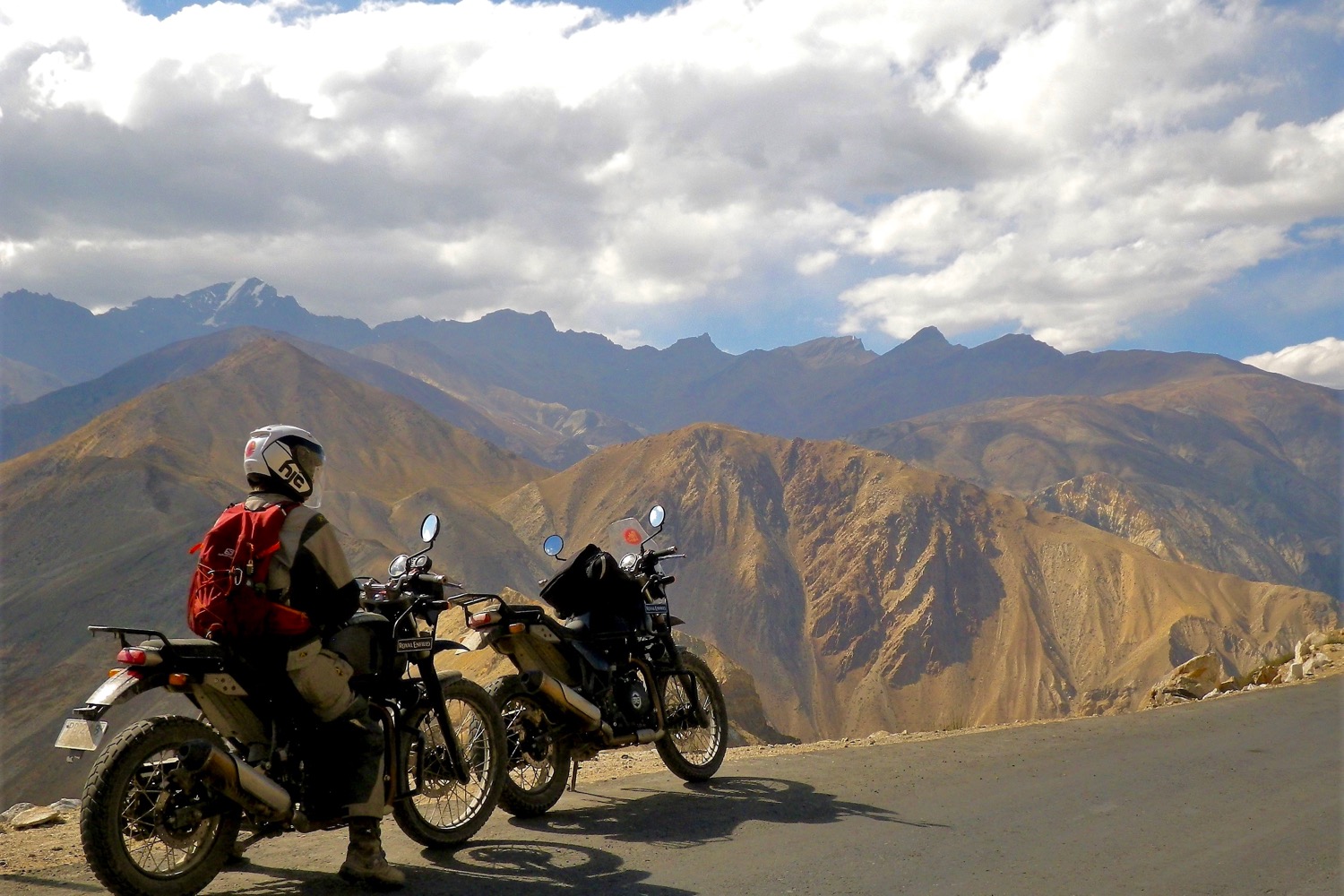
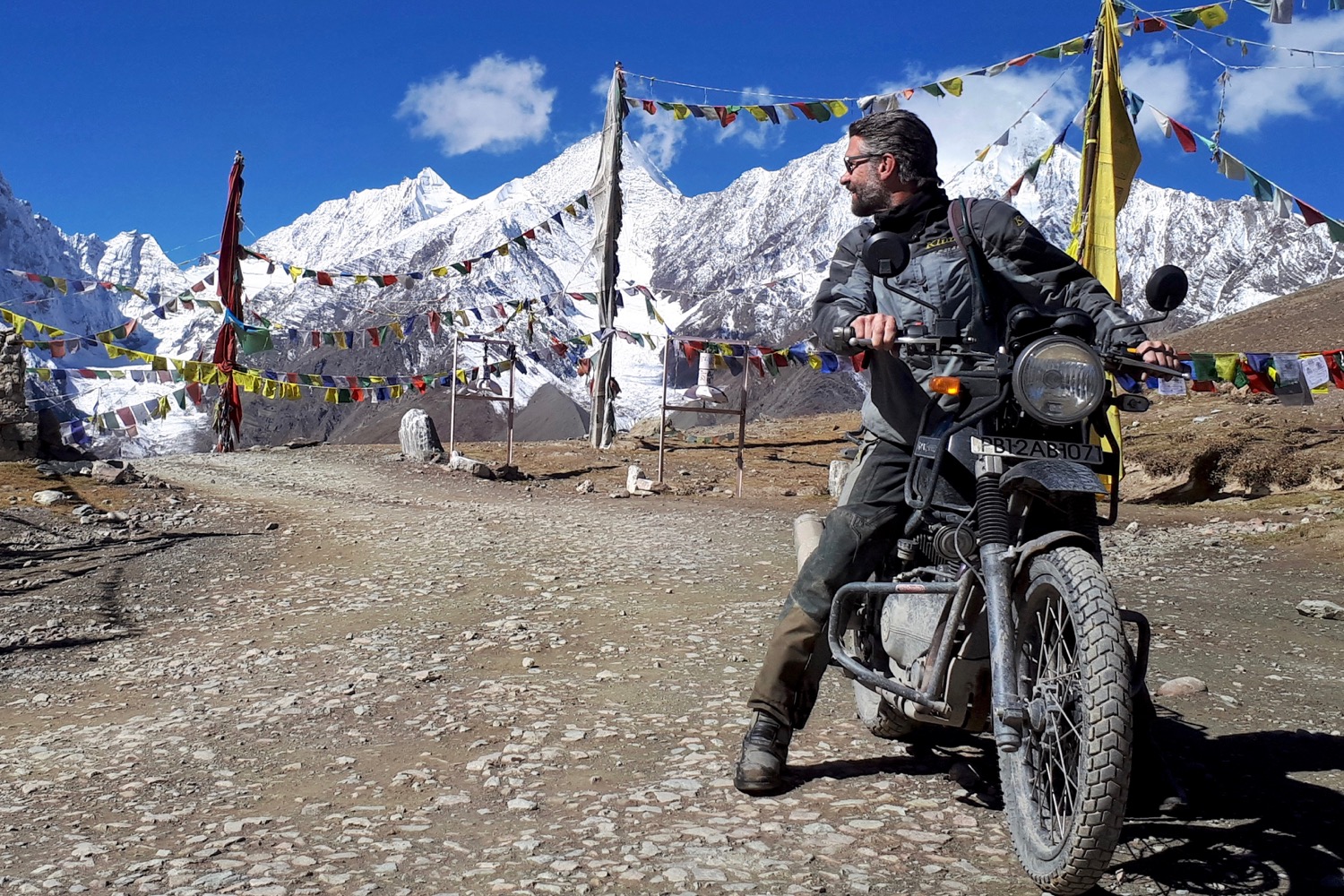
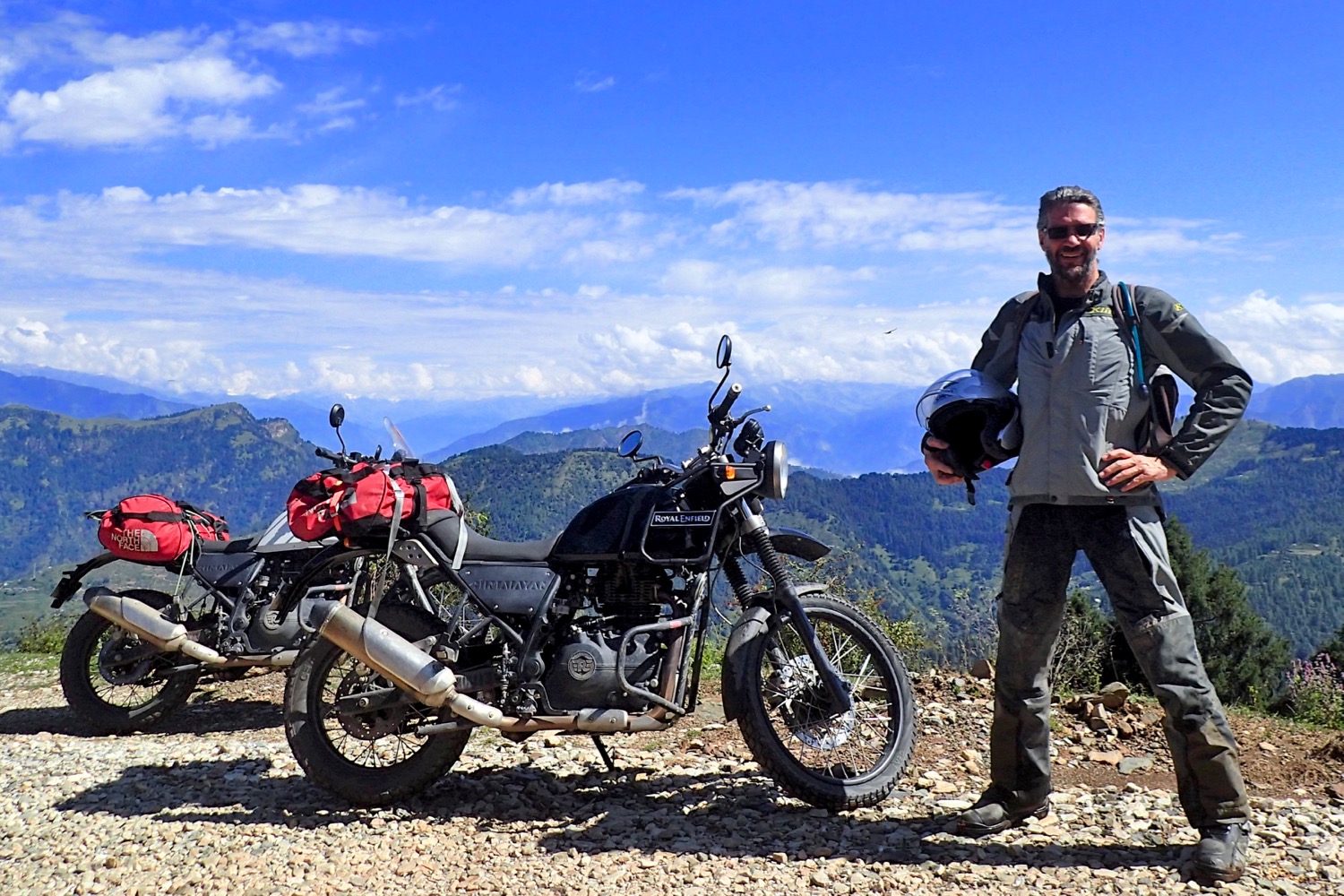
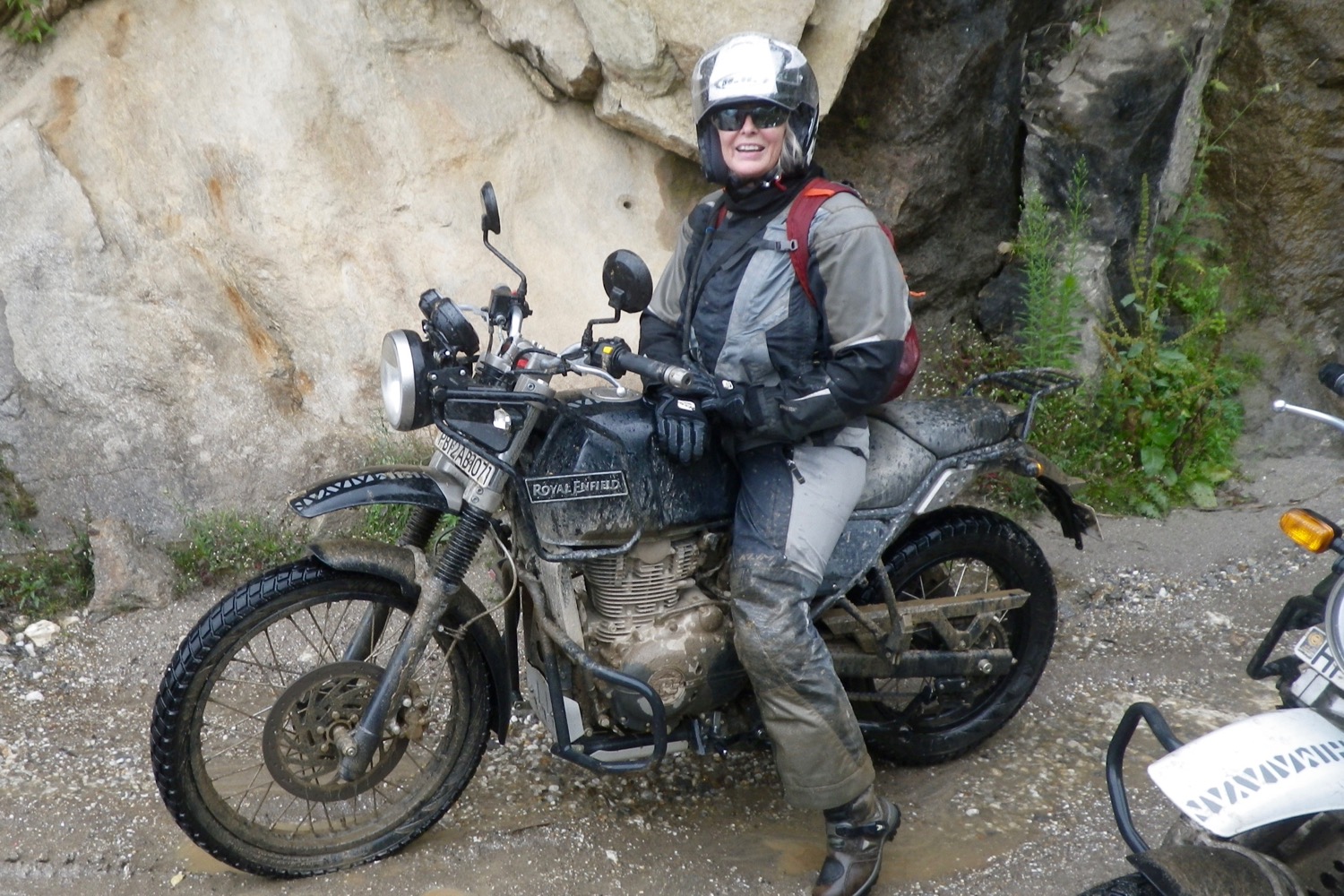
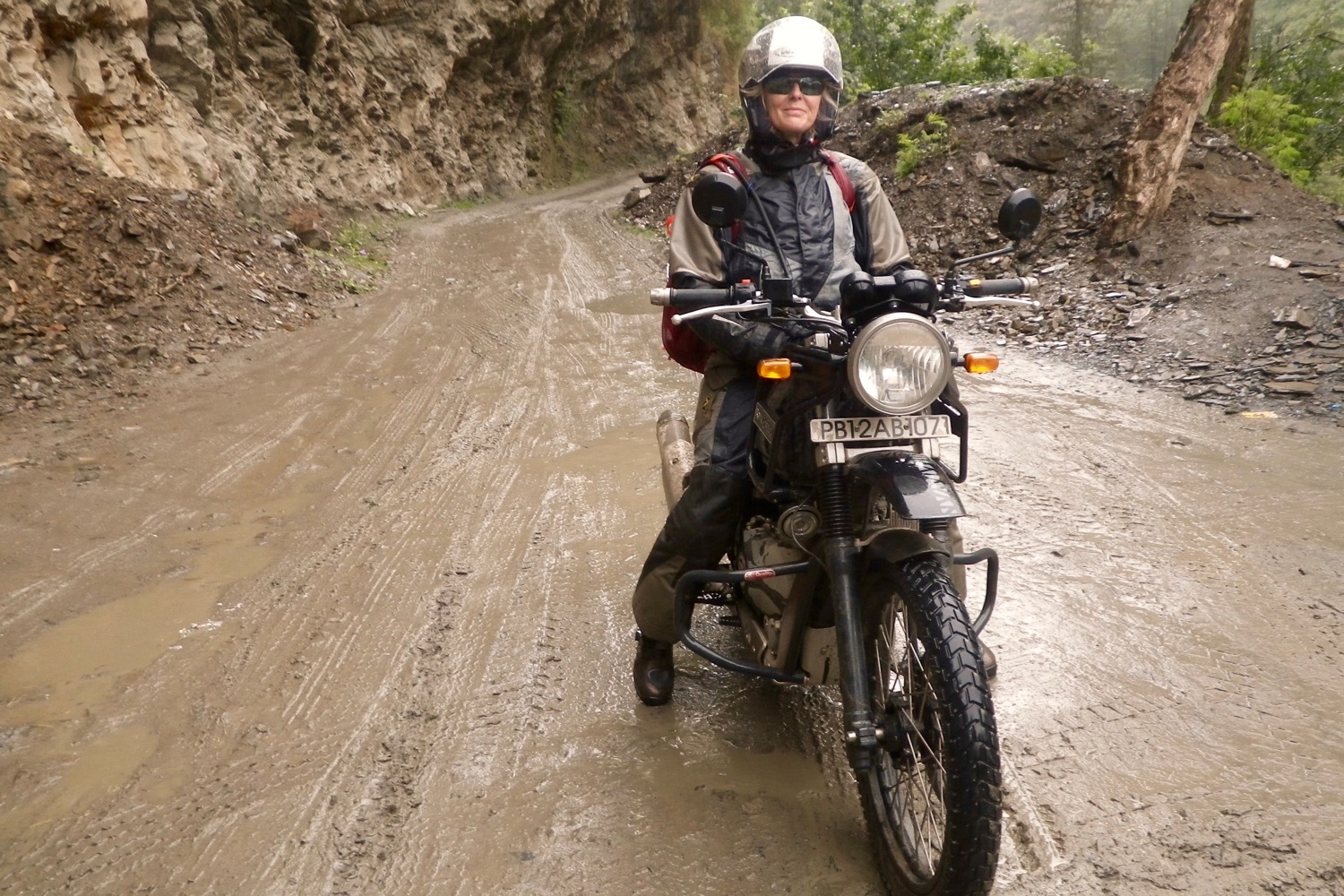
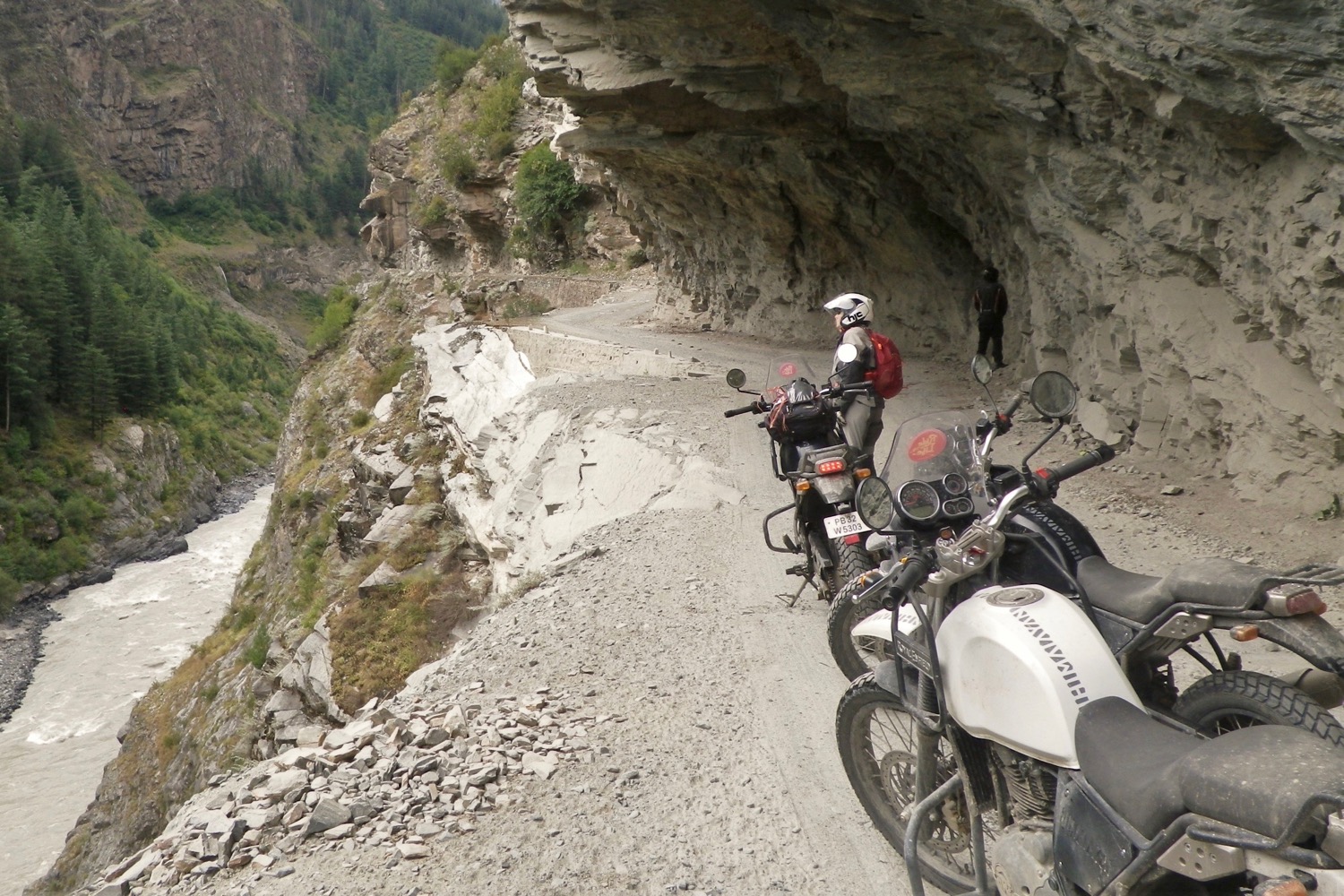
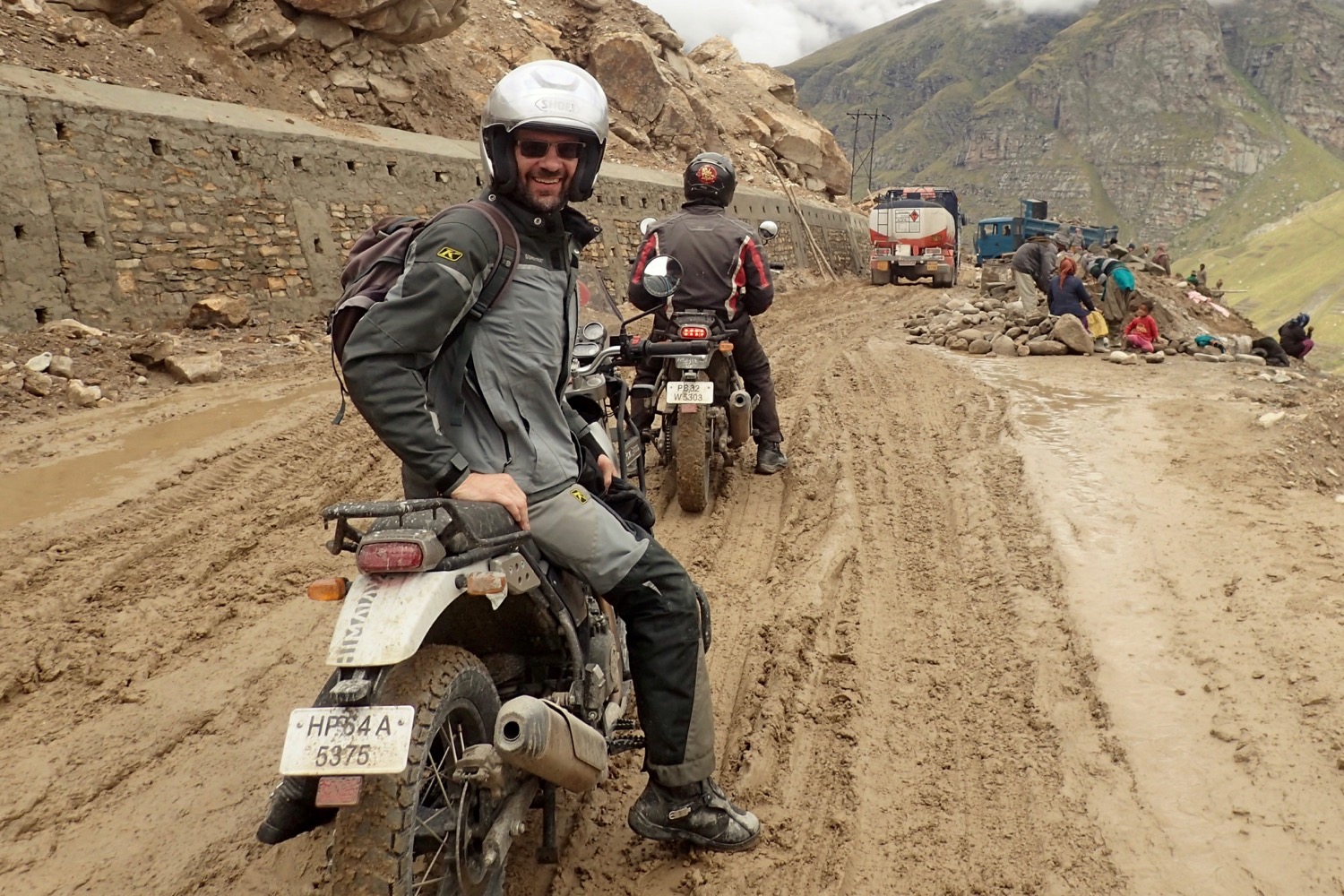
The climb ahead of us resembled something I’ve encountered many times trail riding in Wales or Devon; a steep, rocky ascent of loose stones with mud, water and a thought-provoking drop to one side. The difference here was that the drop to my left was at least 1000′ straight down to a distant river, and the tyres on our bikes didn’t look like they could grip their way out of a wet paper bag. Despite that, the Enfields bounded up the slope like a Himalayan oryx, quite an achievement considering that some in our tour party had little off-road riding experience.

himsdd- - 9
himspex

The new Himalayan is the first completely new bike from Indian Royal Enfield company. The well-known Bullet and its many derivatives can trace their ancestry back to the original British-built thumper from the 1950s. Danielle and I have done several Bullet tours in Rajasthan, Arunachal Pradesh, Ladakh and Nepal. It’s a fantastic bike but when the terrain gets really rough and the riding technical, the lack of ground clearance and poor ergonomics on the pegs expose its limitations.

himsdd- - 16


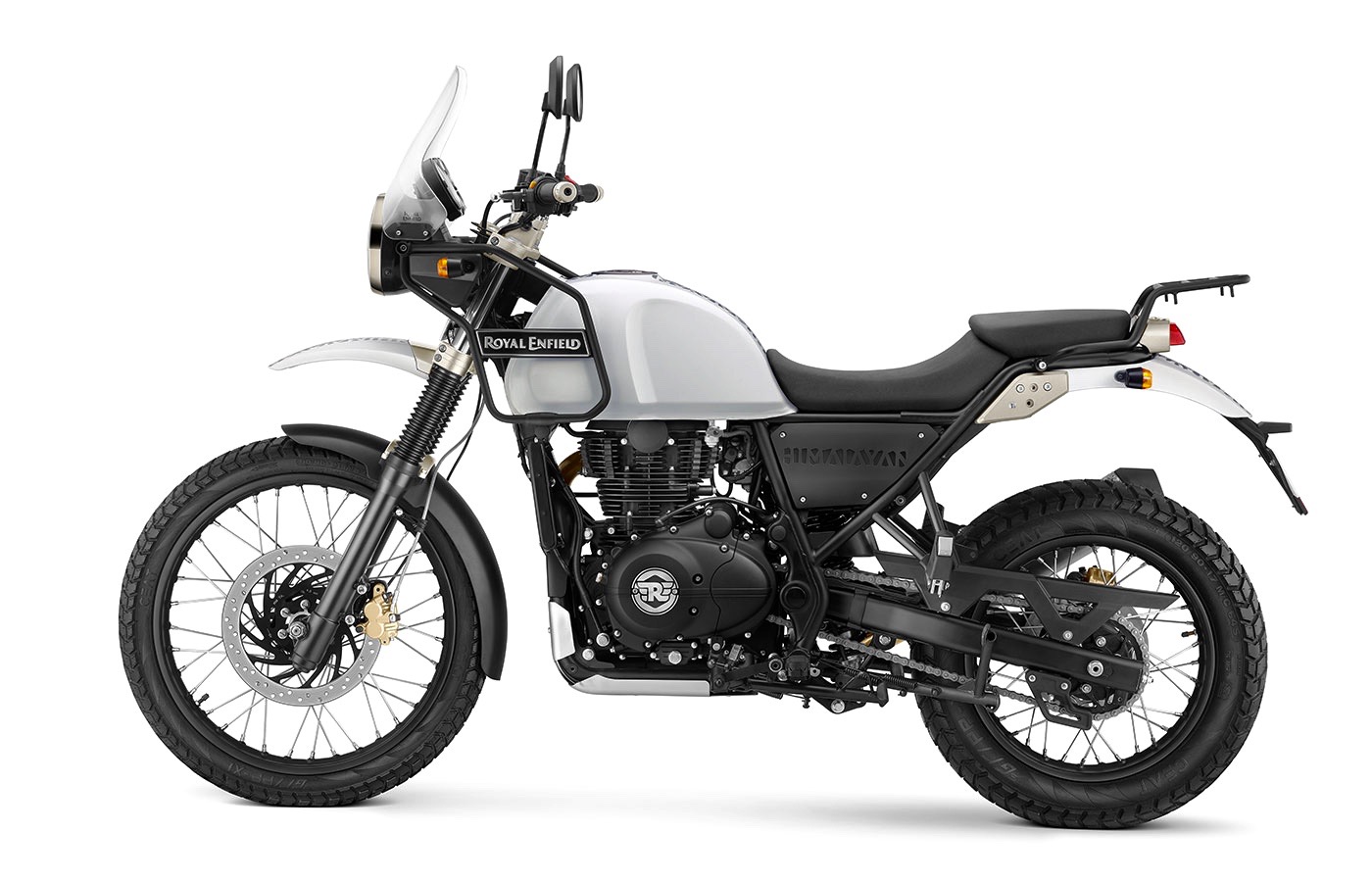
In contrast the Himalayan has been designed to be ridden sitting or standing. It has much better ground clearance of 8.6” (220mm) but a modest seat height of just 31.5″ (800mm); which potentially opens the bike out to many less tall riders. It was also designed to be comfortable on the road over long distances, handle  the twisties (lots of these in the Himalayas) and have a fuel range of over 250 miles from the 14-litre tank, (sounds like at least 70mpg). If this sounds like an adventure bike as opposed to another adventure-styled bike, then you’d be right. What it’s not really suited to is cruising all day at European motorway speeds, but then India isn’t known for this sort of riding. In India in 2017 it sells for 155,000 INR, or under £1900. When it arrives, UK efi Euro 4 prices are quoted at £3999. Below, a 2018 US review of the efi model.

himsdd- - 18

Styling
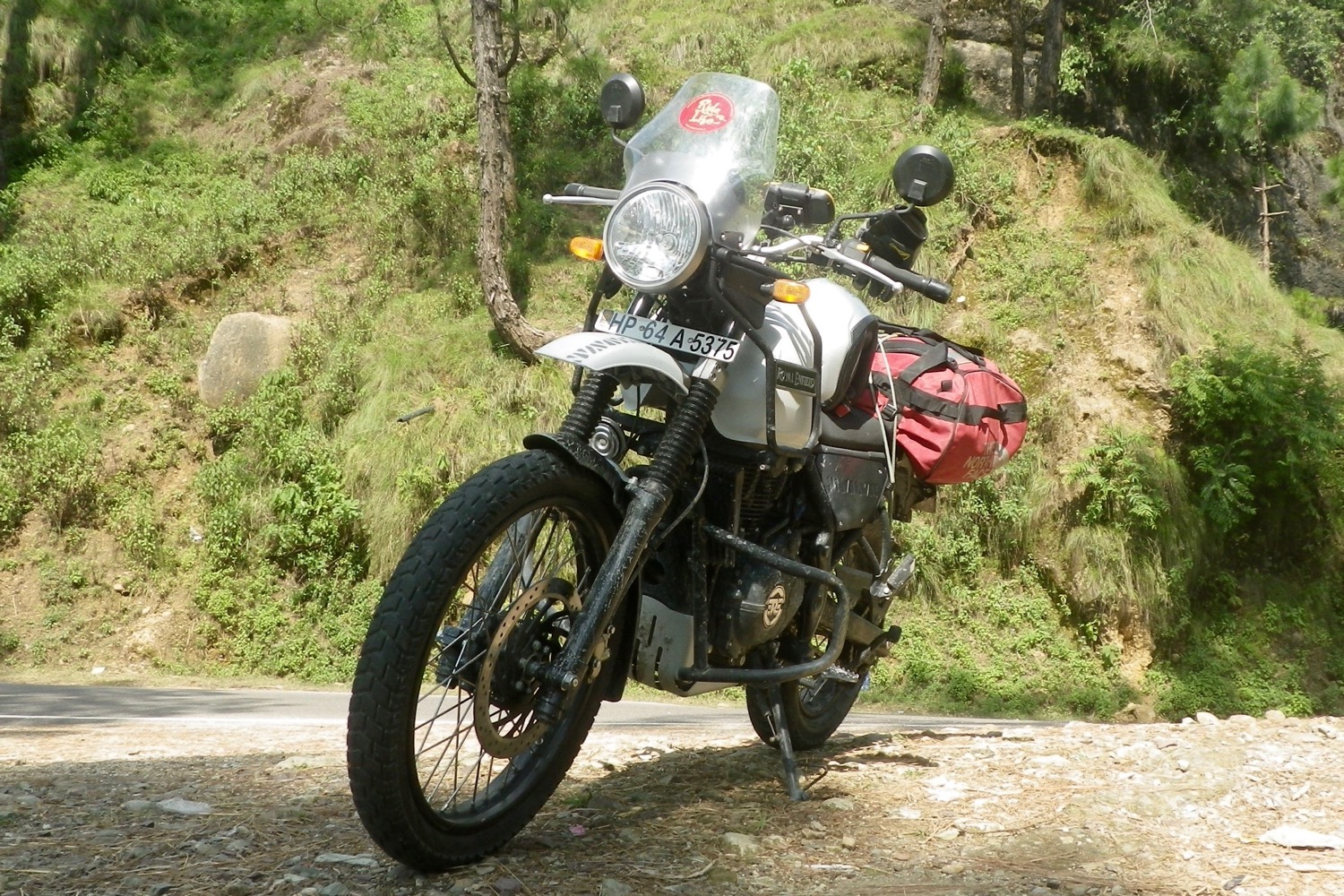
The look is a bit 1980s, recalling the Suzuki DR400 or DR600, although the headlight and instrument cluster are mounted on the frame, not the forks. There’s an element of BMW F650GS Dakar in there too.
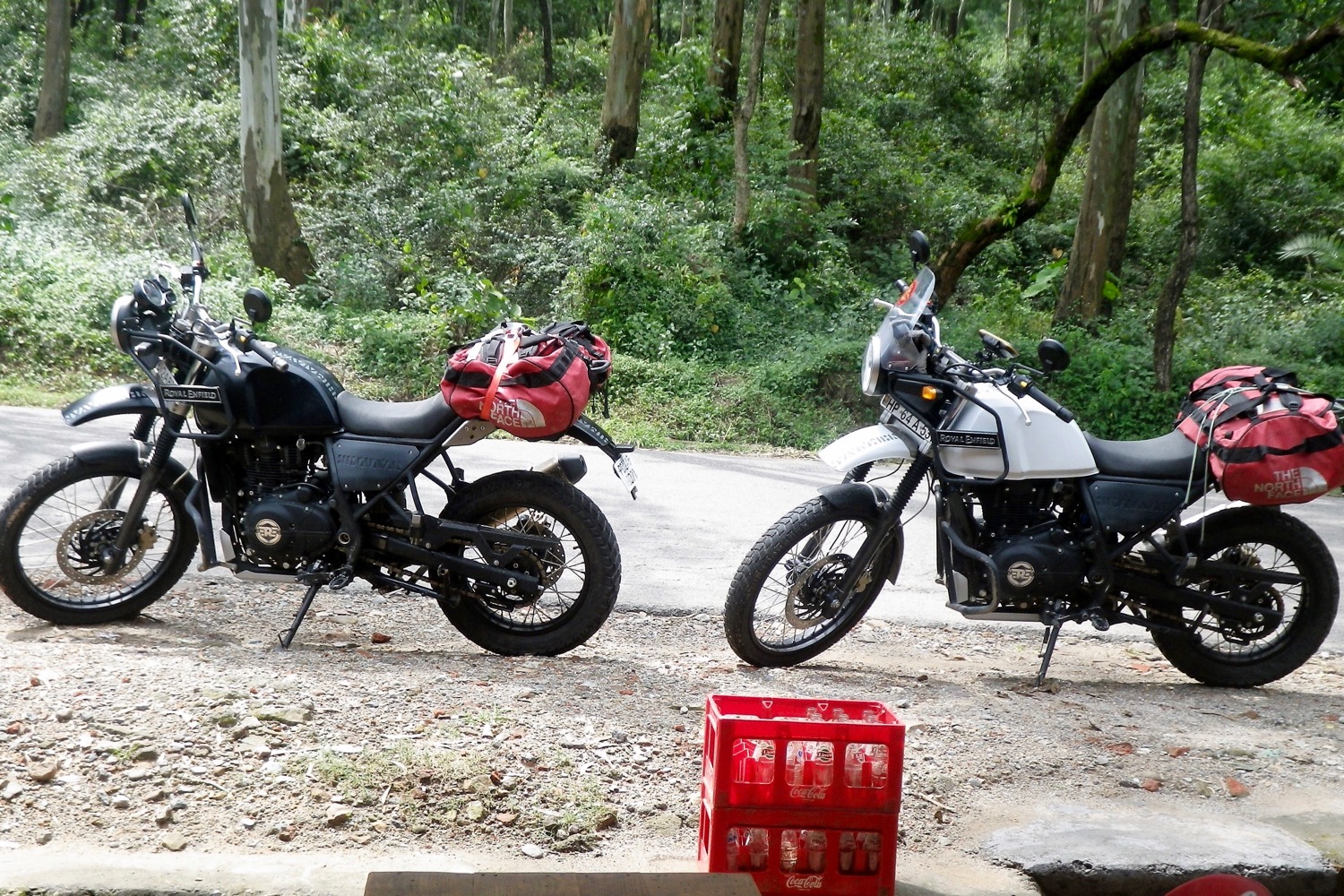
For me the greatest impression was one of practicality and quality, from the solid paint finish to the alluringly cryptic HIMALAYAN logos on the tank, mudguards and side panels, as well as the large LED tail light. It comes in appropriately mountainous Granite or Snow (black or white to you and me) and looks purposeful in either.

himsdd- - 10
himsdd- - 11

Engine
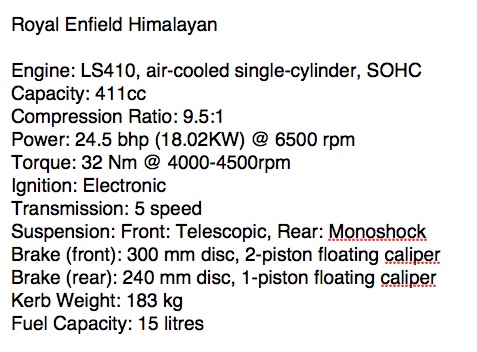
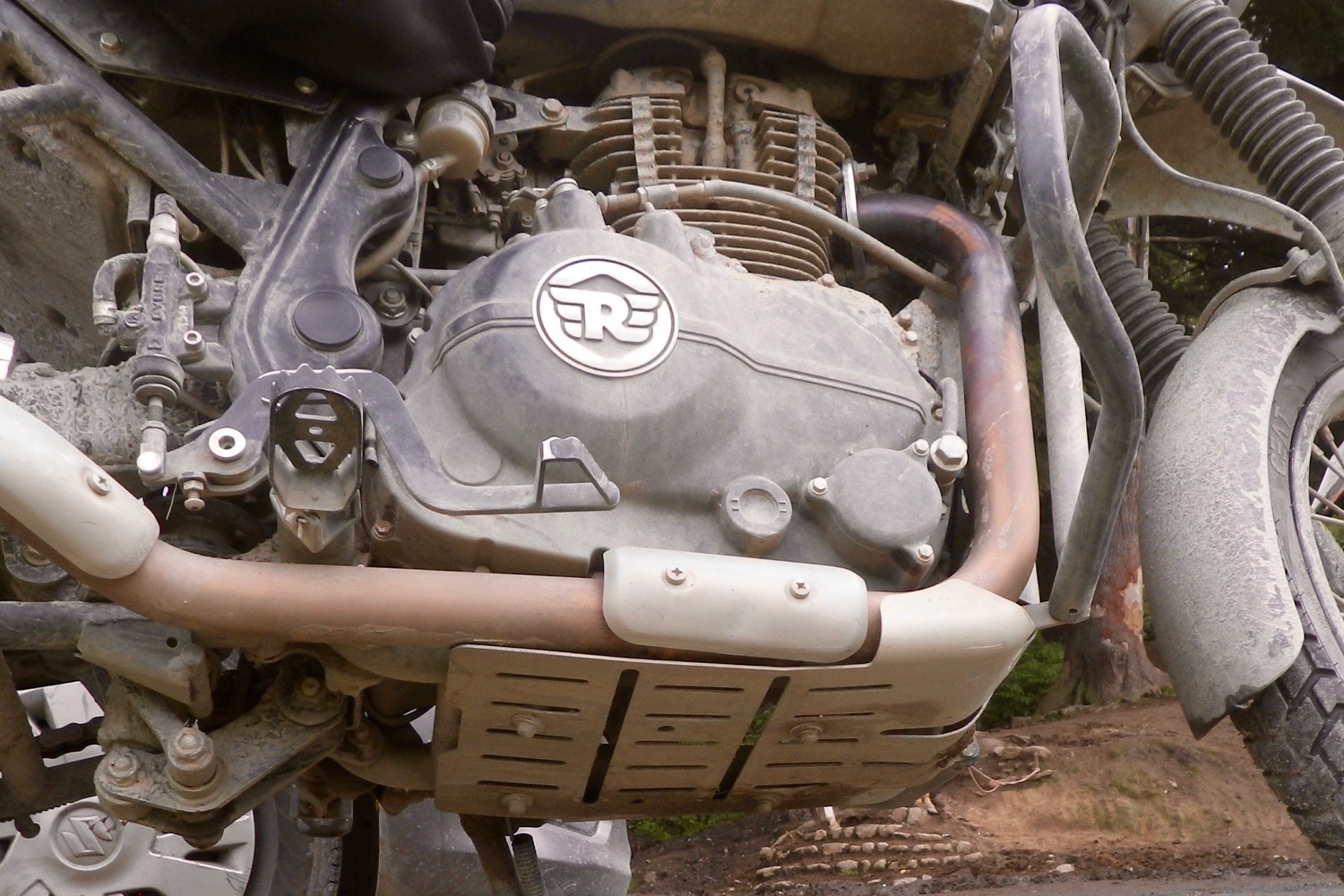
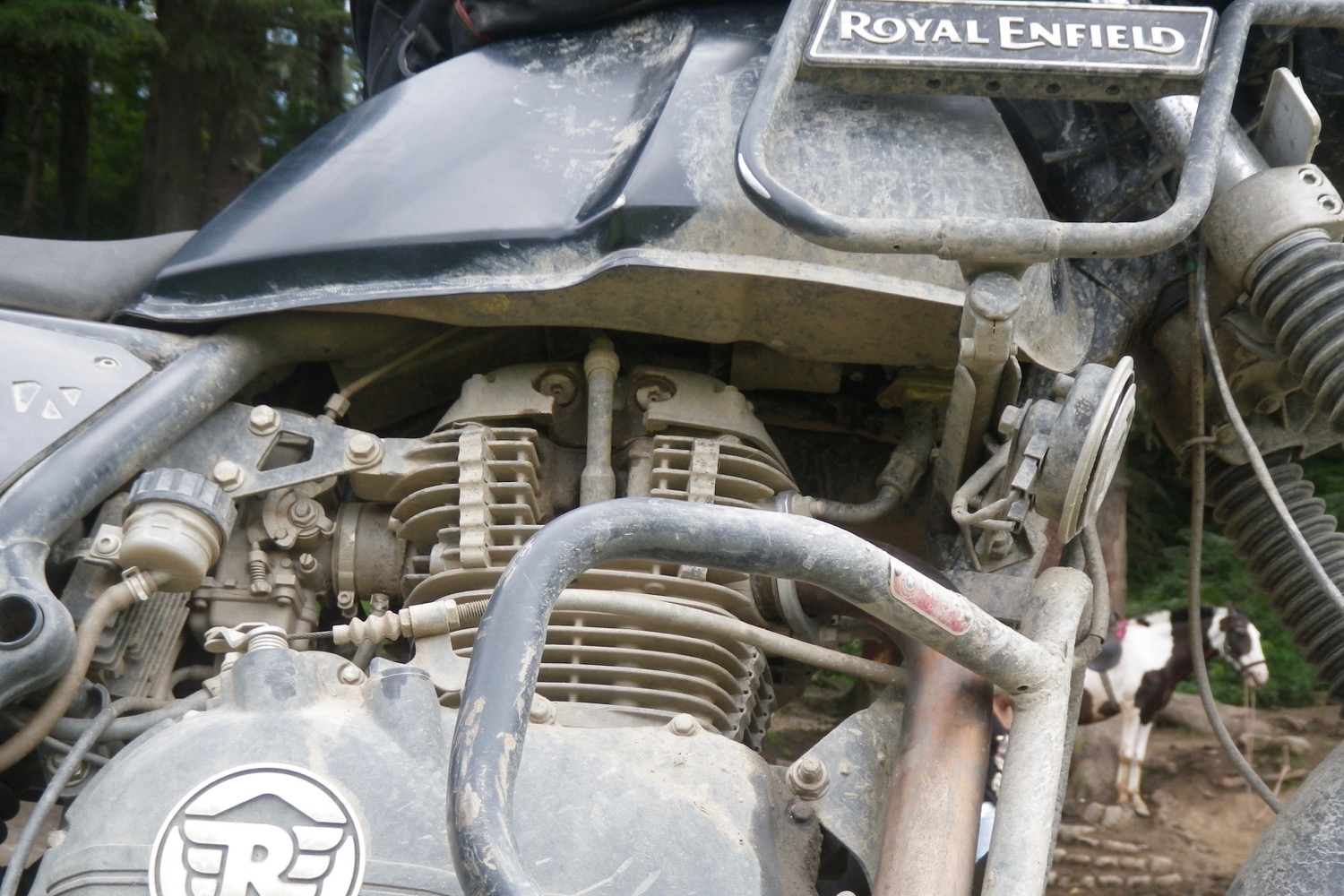
The engine is a long-stroke 411-cc air and oil-cooled lump with a balancer shaft. The word ‘lump’ being appropriate, as the crankcases appear to be off a much larger bike; maybe they intend to produce a large capacity version in the future?
Peak horsepower is claimed to be 24.5 bhp, about the same as the 2017 Honda CRF250L, but there’s 50% more torque, and crucially it’s all delivered at much lower revs.

Coming off my 70-bhp KTM 690R (left) and a R1200GS, I didn’t find the lack of power a problem. The bottom-end torque and smooth power delivery made that modest power very usable. The only glitch with the engine was a flat spot around 4000rpm, most noticeable at altitude (we rode up to 16,000ft/4870m on this trip). You soon learn to ride round it and I suspect a good engine tuner could sort the carburetted version we rode. The fuel-injected version to be sold both in India and globally is bound to  be better in this respect.
On the left of the front down-tube is a good-sized oil cooler, and there’s an all-stainless exhaust with a nicely shaped, cat-free silencer. I imagine the UK version will need a bulky cat. At the other end is a well-sealed airbox with a high air intake and a large, cylindrical dry-element filter.
Top speed is claimed to be 134kph or about 84mph, but the nature of the terrain we rode meant the most I saw was just under 100kph. It’s a long old way down.
Some riders thought the 5-speed gearbox was a little stiff, but on our bikes the clutch cable had been routed around the outside of the aftermarket crash bars causing a bit of cable drag.

himsdd- - 25

Frame
The frame is a conventional steel-tube cradle designed by Harris Performance (who Enfield bought out in 2015) and finished in satin black. The rear end is monoshock and perhaps the only unconventional feature are the subframes either side of the tank which support the headlight and instruments. Each includes a series of threaded mounts to attach extra tanks, luggage carriers or an aftermarket fairing.

himroot
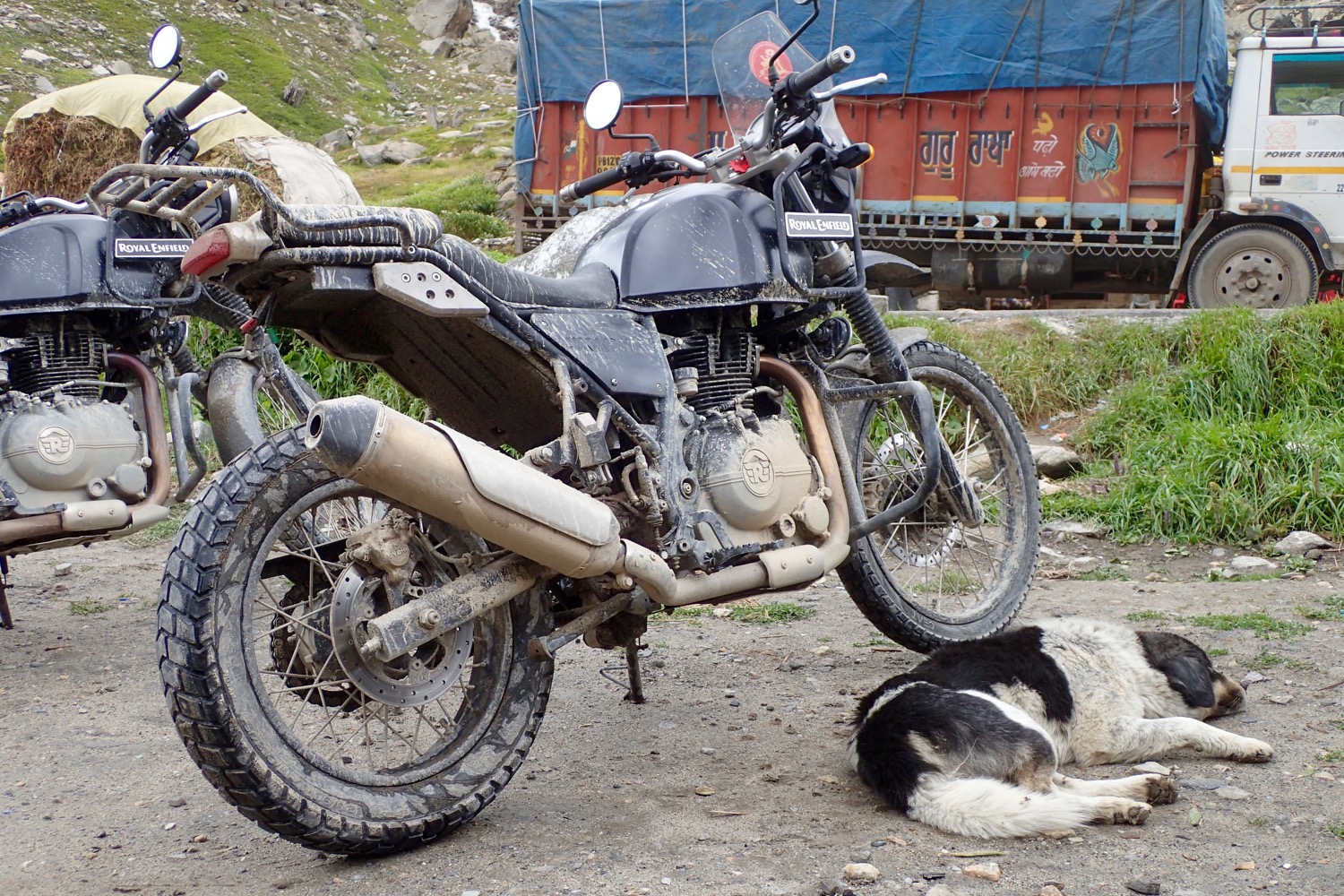
The aluminium bash plate looks a bit flimsy, but proved to be up to the job as the clearance was generous. Surprisingly, hand guards are not standard, though our rental bikes did have poorly fitted aftermarket crash bars which clanged over bigger bumps. I cured this by jamming a wooden wedge into the mounting assembly. You also get sturdy centre- and side-stands which tuck out of the way.

OLYMPUS DIGITAL CAMERA
himsdd- - 8

Wheels and tyres
Wheels are 21” front and a 120/90 section 17” at the rear on black alloy rims shod with Indian Ceat Gripp XL trail tyres which resemble Dunlop Trailmaxs. On rocks, gravel and dry mud, they worked well enough if pressures were dropped to 20 psi.
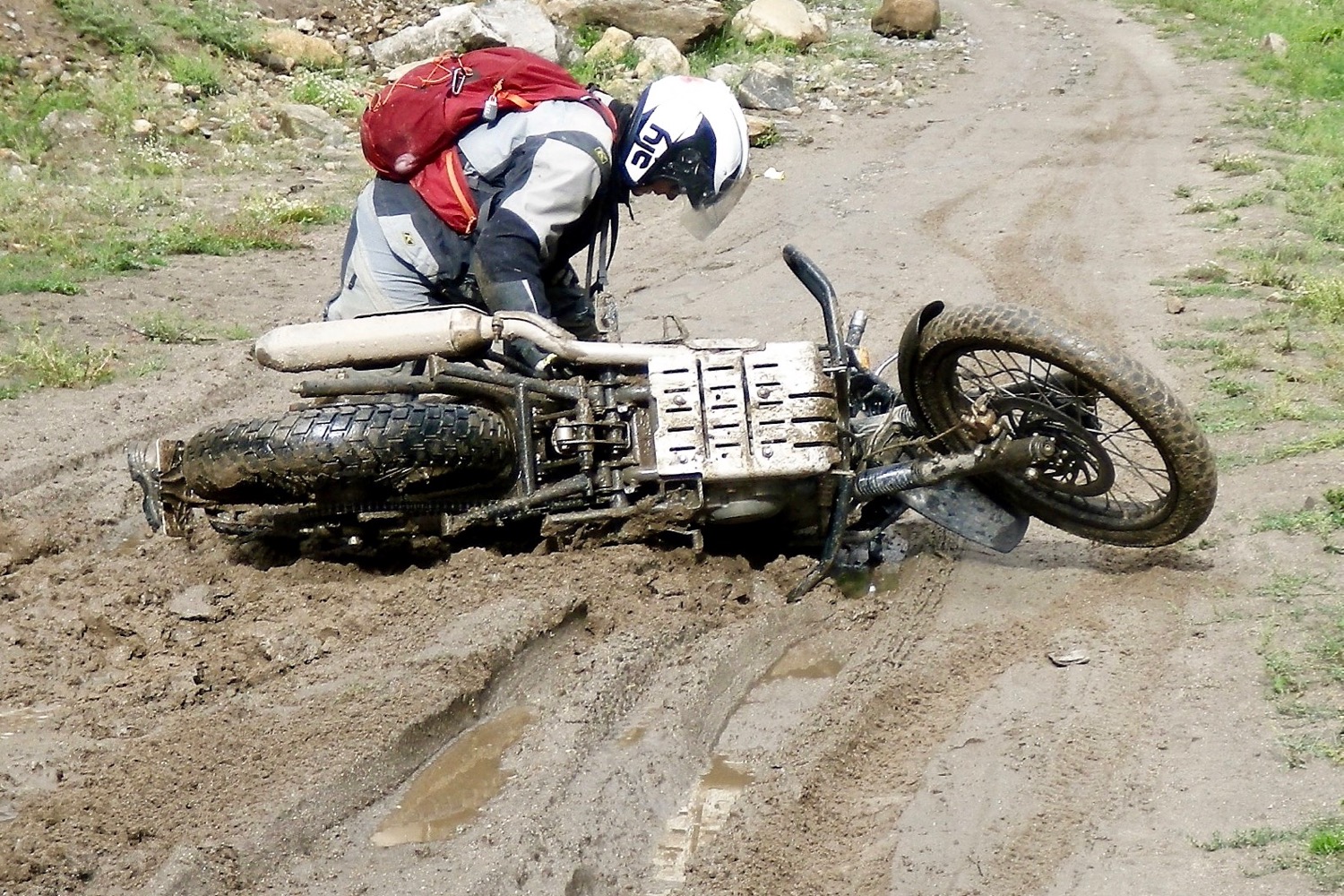
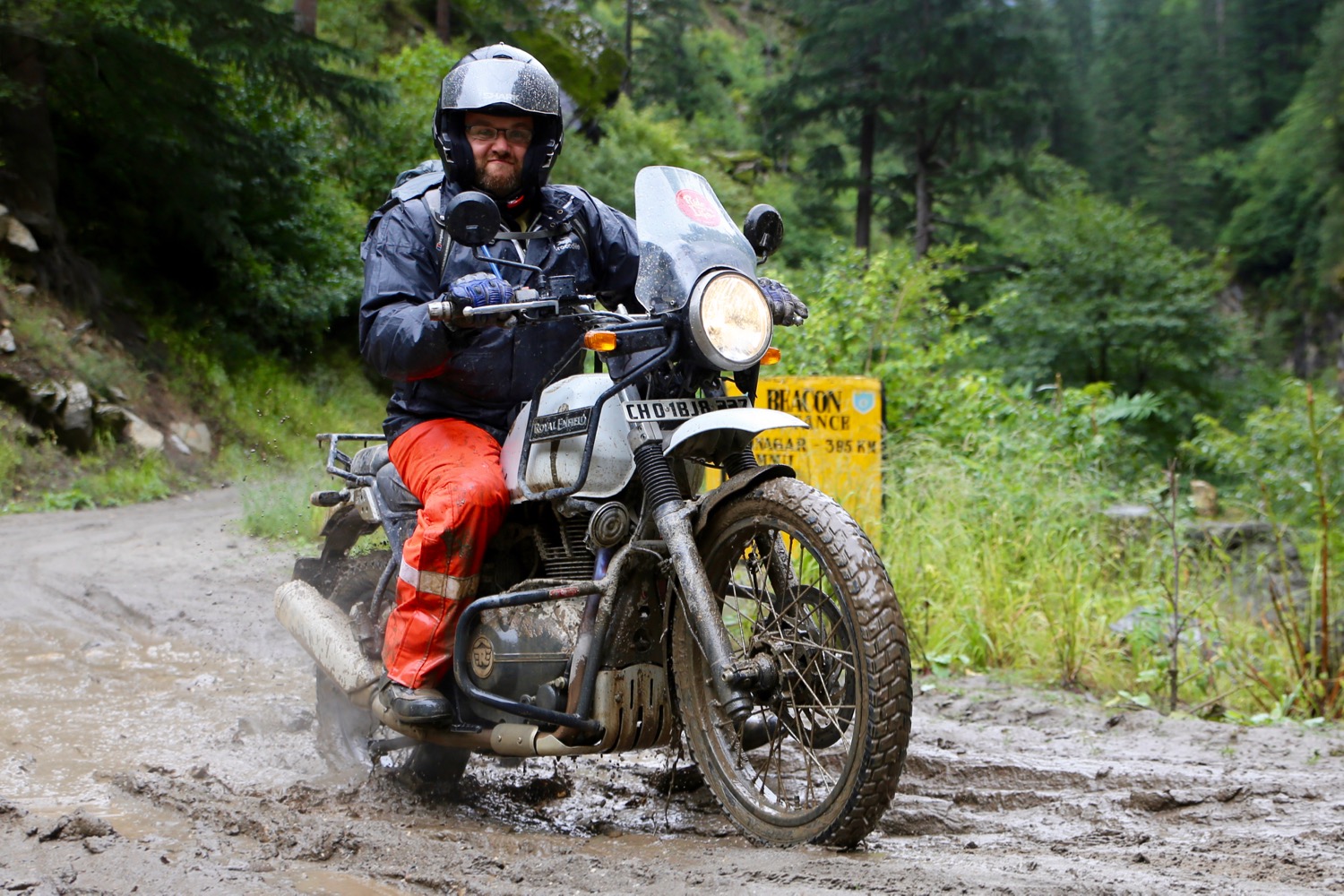
On muddy ruts and wet grass you just have to take it easy or you’ll end up as on the right, but they’re helped by the gentle power delivery; it’s almost like having traction control. The Himalayan does not, of course, have traction control, ABS (in India at least), power modes, suspension modes or any a la modes, but manages fine without them.

Suspension and brakes
Initially the forks (180mm) felt very softly sprung; far more trail bike than my hard-charging 690 enduro. However, the springing and damping were well matched making riding over rocks very easy; the bike always went where it was pointed. There’s no adjustment on the 200-mm-travel rear shock except preload. The brakes look like Brembo copies with braided, stainless brake lines. At the speeds attained they worked for me.

himsdd- - 20

Ergonomics
If the bike were mine, I’d fit one-inch bar risers, but then I am 6’ 1” and fit risers to all my dirt bikes. The 31.5-inch seat is low for an off roader which makes standing up a bit more of an effort, but was comfortable enough for all-day riding. Before the trip Dan (5’ 6”)  had some concerns that the 182-kilo Himalayan would be too tall and heavy but she easily got both feet on the ground and loved the bike too.
The bike is fitted with a small screen to help reduce the wind pressure at speed (or at least the speeds we reached on this trip). Dan removed hers to improve visibility on dirt roads. It can make a real difference to confidence.

himsdd- - 17

Instruments
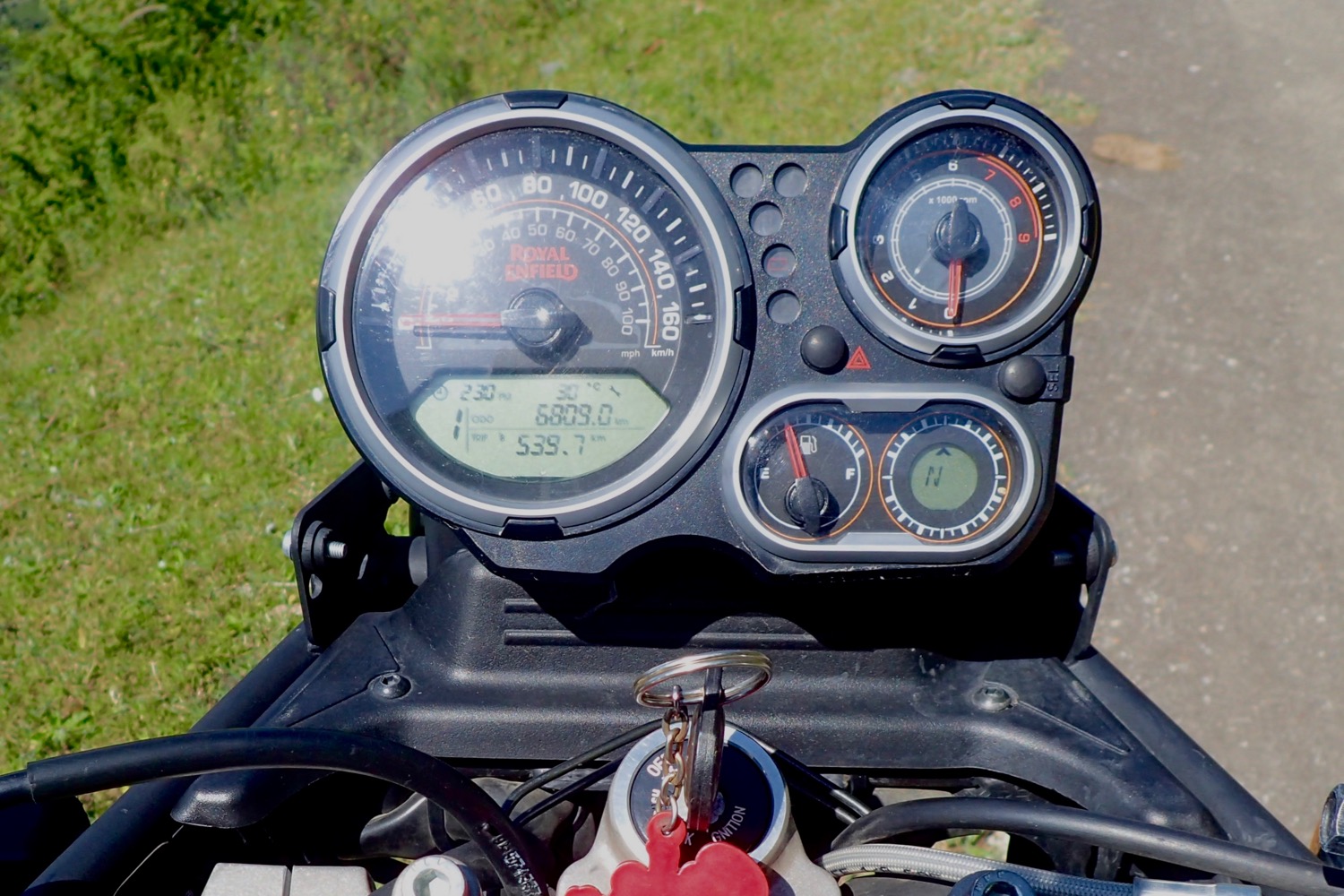
The analogue instruments have enough of the information and features you’d expect of a modern bike, plus a couple you wouldn’t: oil temperature and an electronic compass. I love the latter idea; in a country where fitted GPS is rare, it helps affirm you’re heading in the right direction.

Luggage attachment
Besides the tank frames the bike also comes with a small rear rack and several points to attach pannier frames. Some people complained the upswept exhaust made mounting luggage more difficult than on a Bullet, but if they stall in a river at least it won’t fill with water.

Maintenance
Compared to most modern bikes the Himalayan is basic, but everything appears readily accessible with a comprehensive tool kit sits under the lockable back seat. According to the service interval, the 2.6 litres of oil needs changing every 6000 miles or 10,000km.

Summary
I’ve ridden all sorts of bikes in all sorts of places and am convinced Royal Enfield have done something special with the Himalayan. There’ve been a few teething troubles, as you’d expect for a new design from any manufacturer, but Royal Enfield have been responsive and you’d hope by the time we get the Himalayan in the UK, these will have been sorted.

himsdd- - 24


The suitability of the bike for India and specifically the Himalayas is undeniable, but would it be suitable elsewhere?
After a month and a few thousand kilometres in India, I’ve no doubt that given a set of better tyres it would be able to tackle the majority of the UK trails I regularly ride. At over 180 kilos it is significantly heavier than other trail bikes of this capacity, even a KTM 690R or BMW XChallenge, but the low seat combined with the soft suspension and progressive power delivery make it very easy to ride.
Would I enter it in an enduro? Only if I felt like winding people up. Would I ride the Trans-Am Trail on it? Absolutely. Round the World? Maybe, once I assessed long-distance, all-day road comfort and reliability. Is it fun? Yes!

tik
• General off-road rideability
• Ergonomics
• Functional looks
• Luggage attachment points
• Compass
cros
• Flat spot at altitude (carb model)
• Lack of top-end power (but yet to test above 60 mph)
• Lack of hand guards
• Wretched aftermarket crash bars
• Will cost twice as much in the UK
 

WR-ing about in Morocco – 1/9

 
WR250R 4000-km review
WR Introduction
WR250R Stage 1
WRing about in Wales
WR250R ready for the desert
Morocco trip report, 1–9
Fuel log

A trip report from March 2017 while updating my Morocco Overland book.
It got very hot in the desert for a while which wore me right out, but I rested in Tan Tan where it cooled off for a few days, so I dived back in before the heat came back for good.

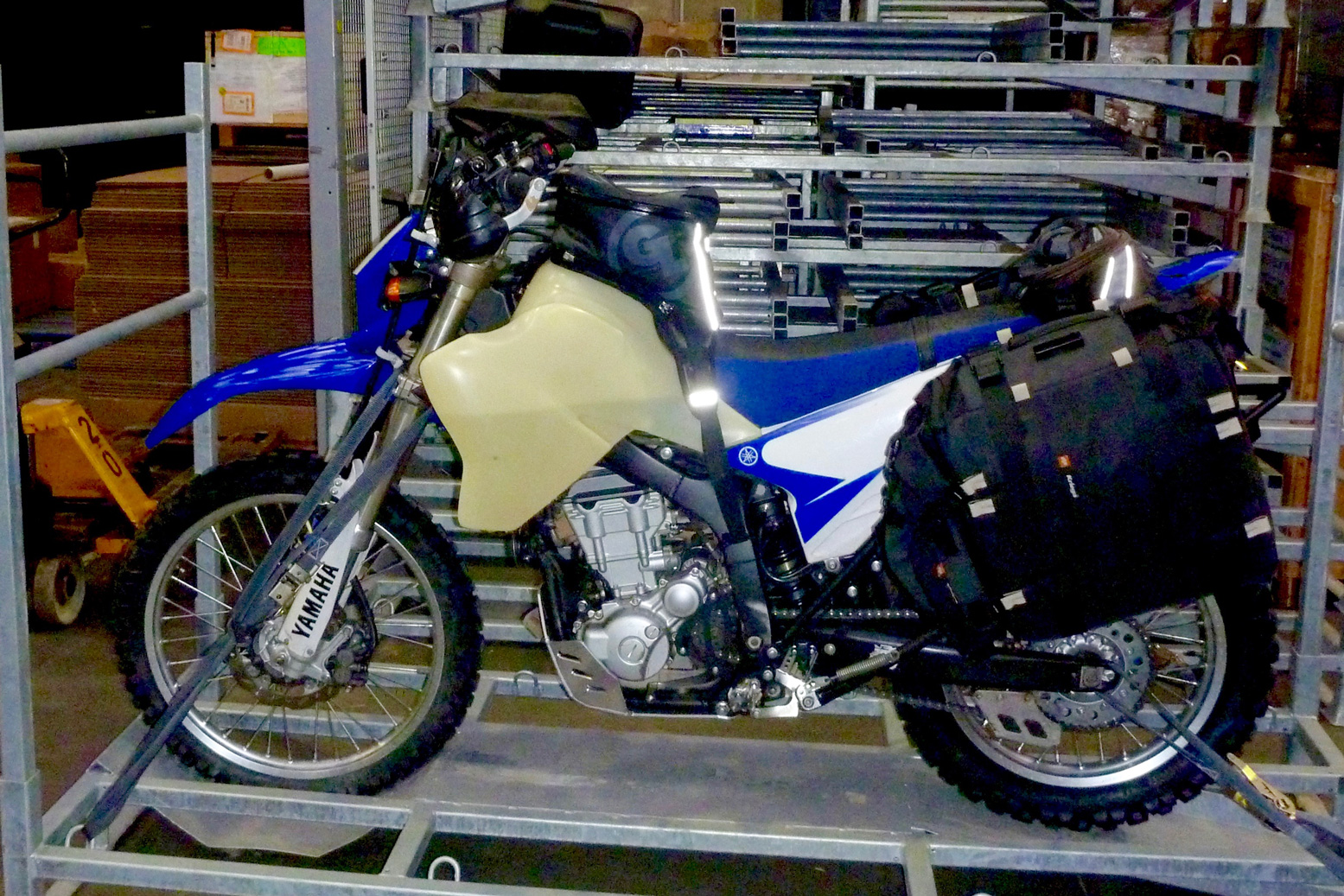
This time I used Fly & Ride to get the 250 to Malaga.
Didn’t fancy Spain at 57mph. Works out cheaper too when you add it all up. Done trans-Spain enough times.

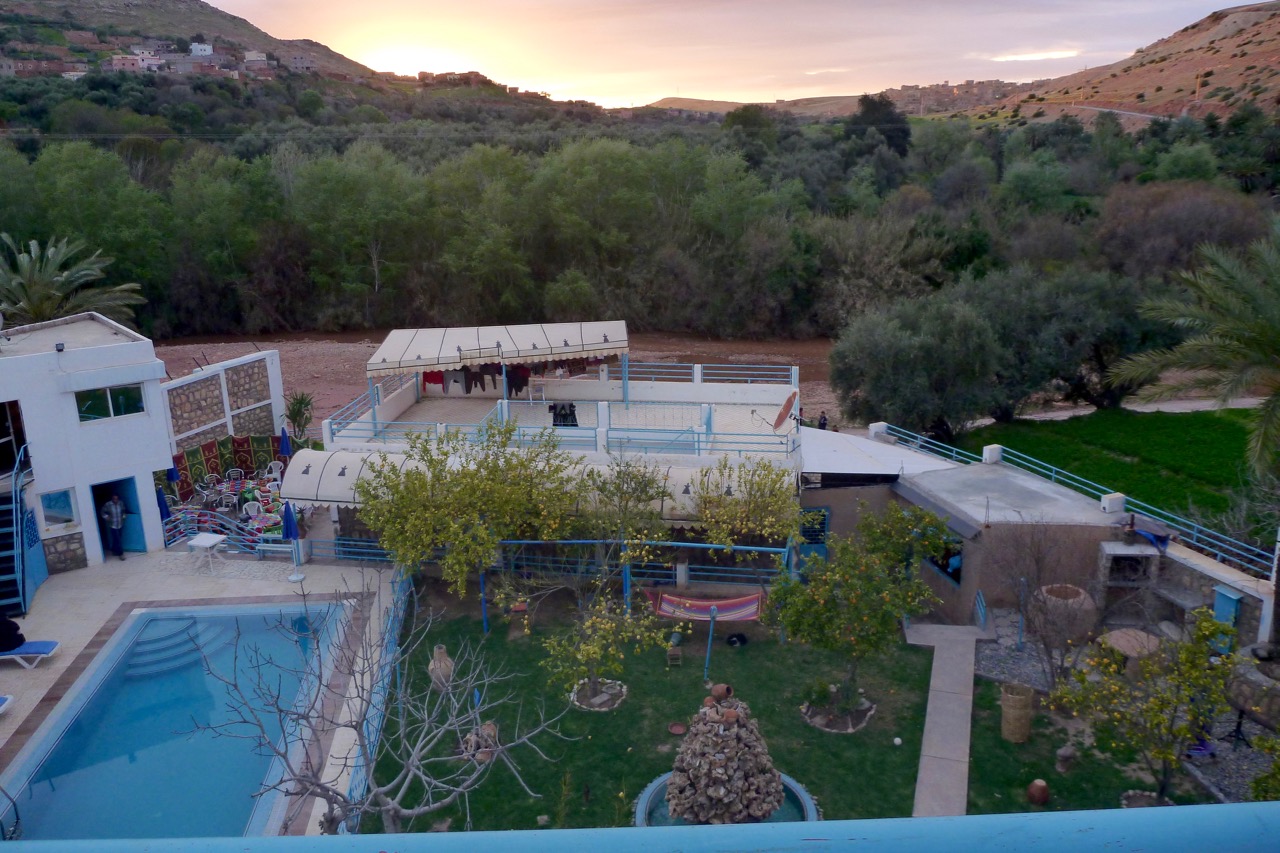
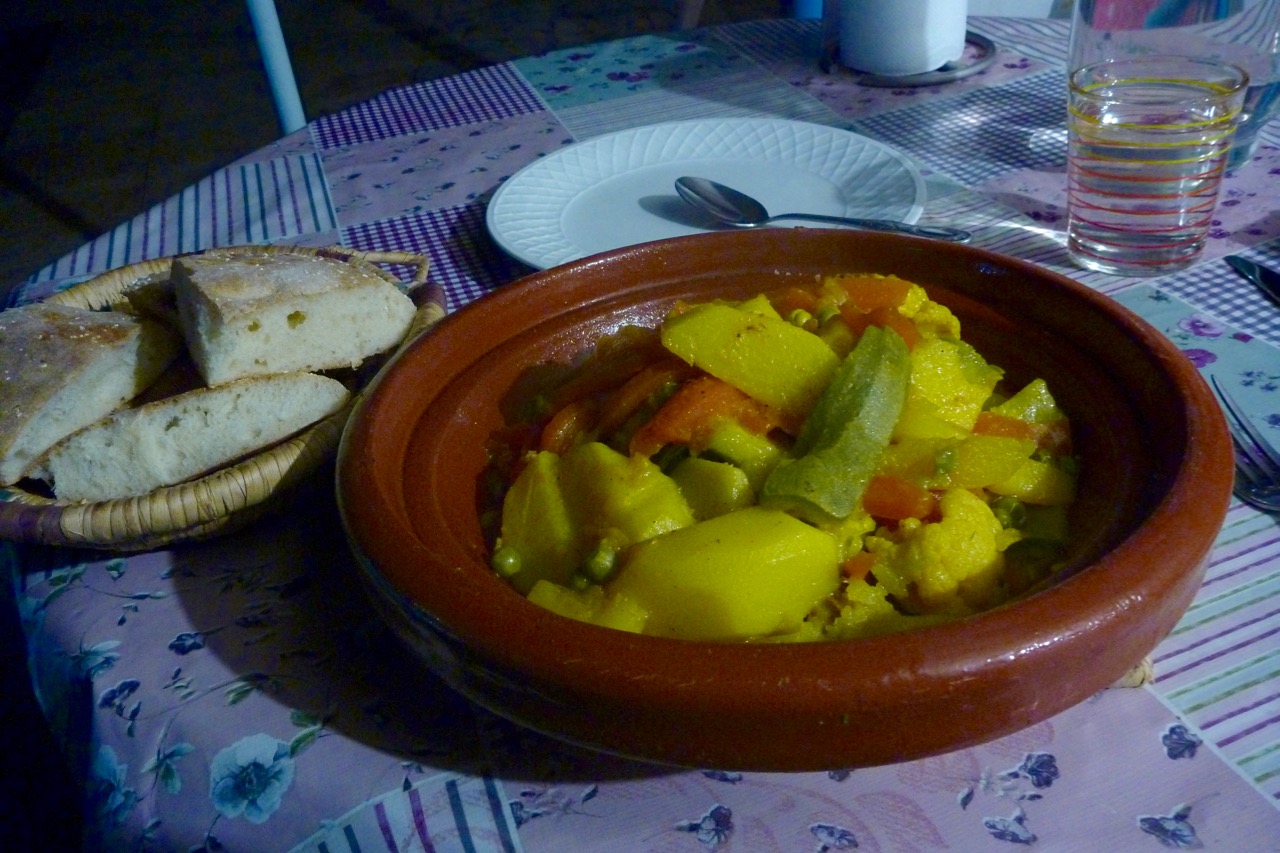
Gales meant the ferry took over an hour to dock at TanMed, and next day was miserable – down to 45 in 4th at times. But there’s no quick way to get south as nothing was going to Nador. I try Airbnb and find this lost resort up a valley near Bzou.

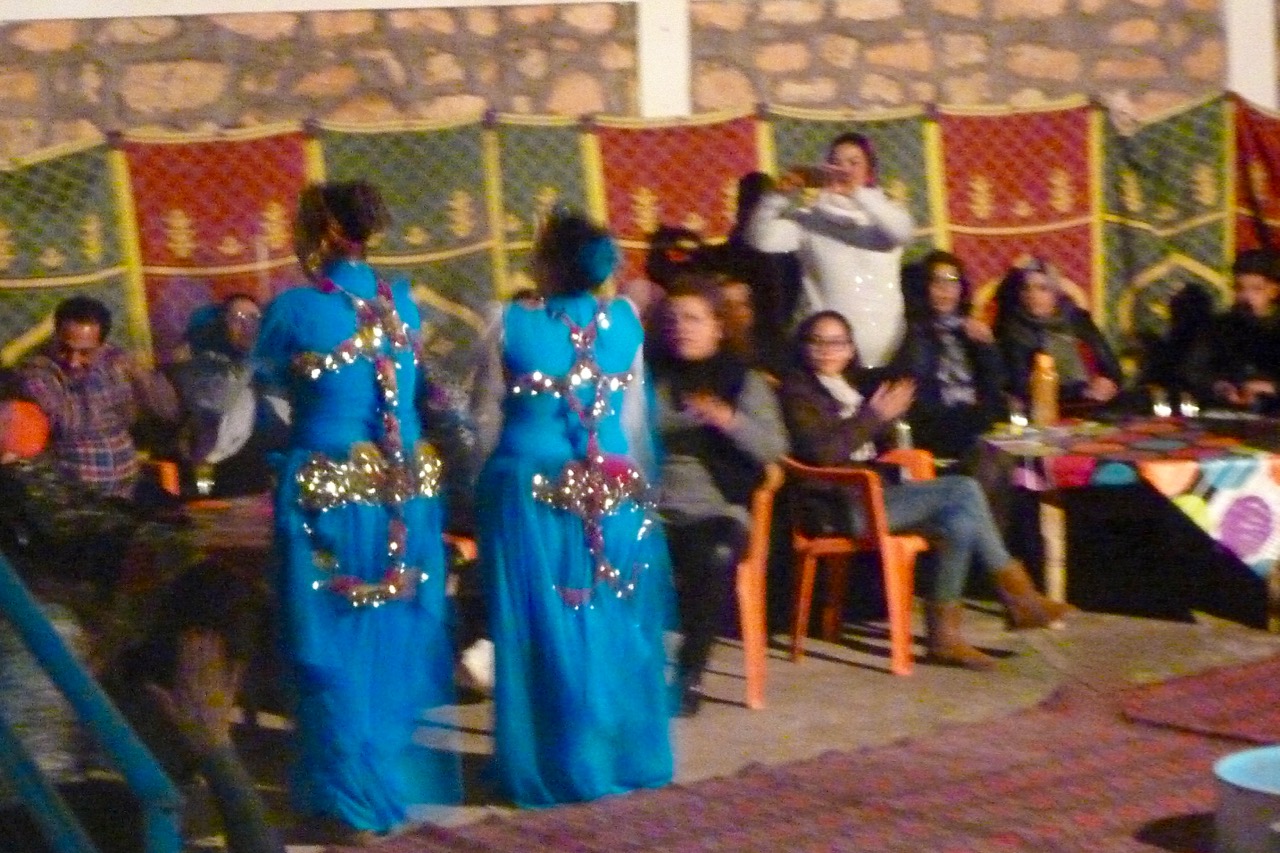
I inadvertently gatecrash a Berber soiree. No room at the inn so he feeds me and puts me up down the road.

My first tajeeen of twenty-seventeeen.

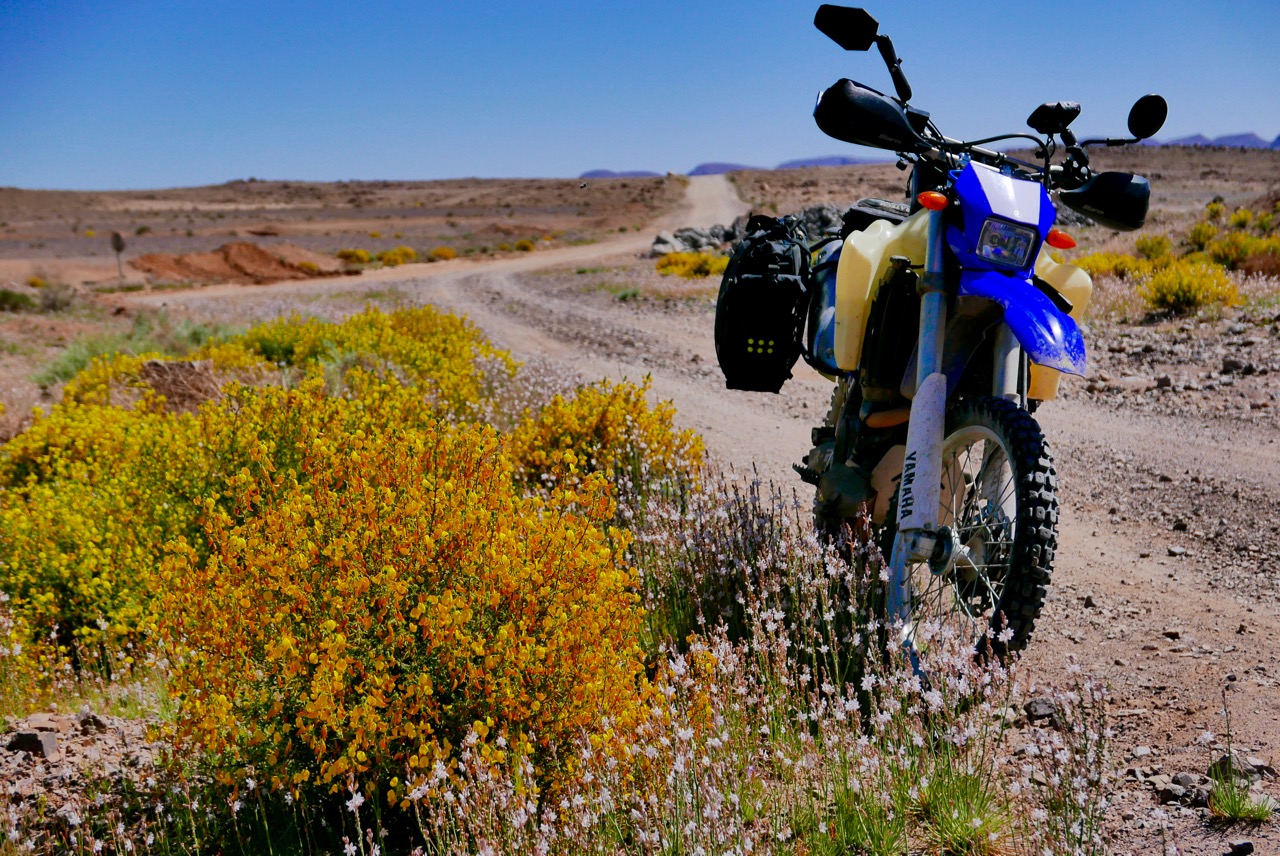
Next day I got my bike back – pootling though the springtime Middle Atlas without fighting gales and showers and trucks. 95mpg thankyouverymuch.

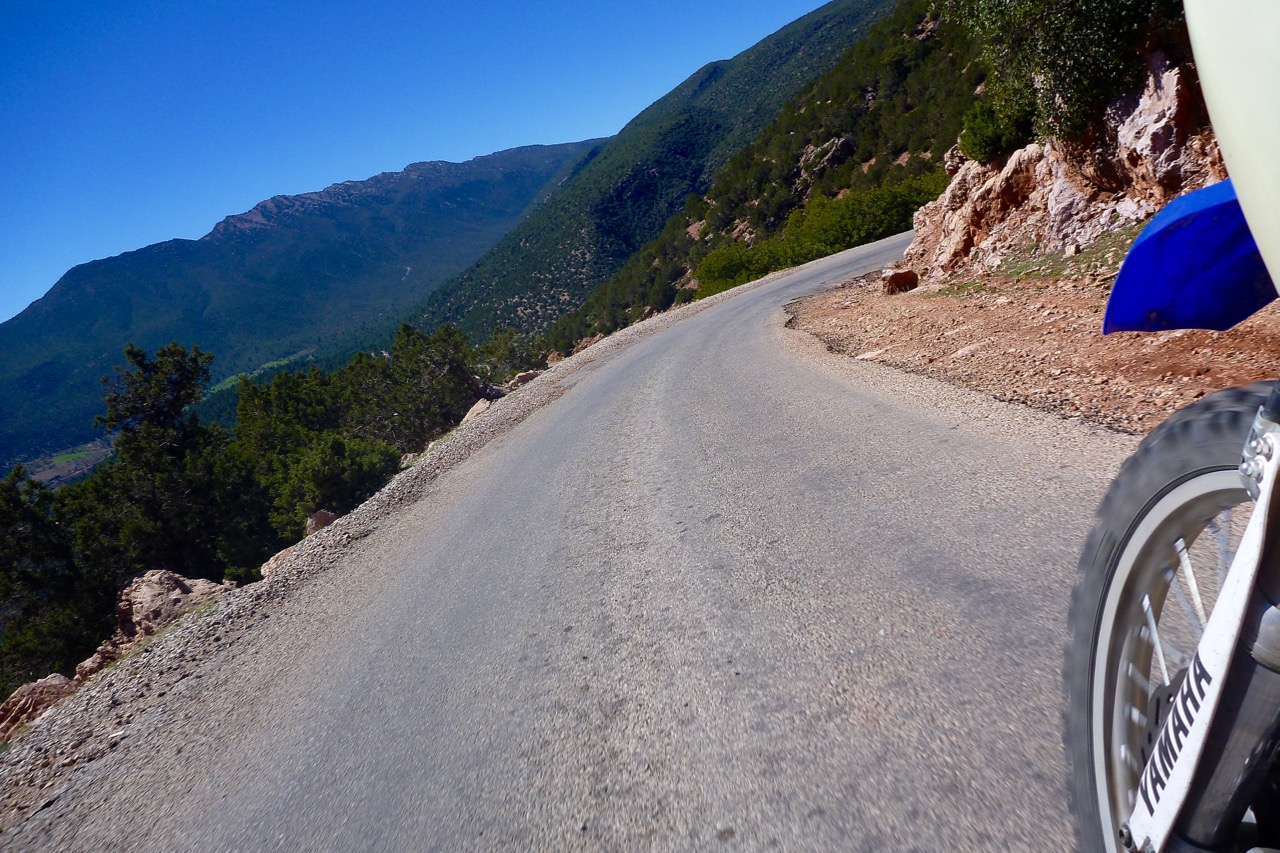
I take the old Demnate route over the High Atlas. Last did it on the XT660Z in 2008

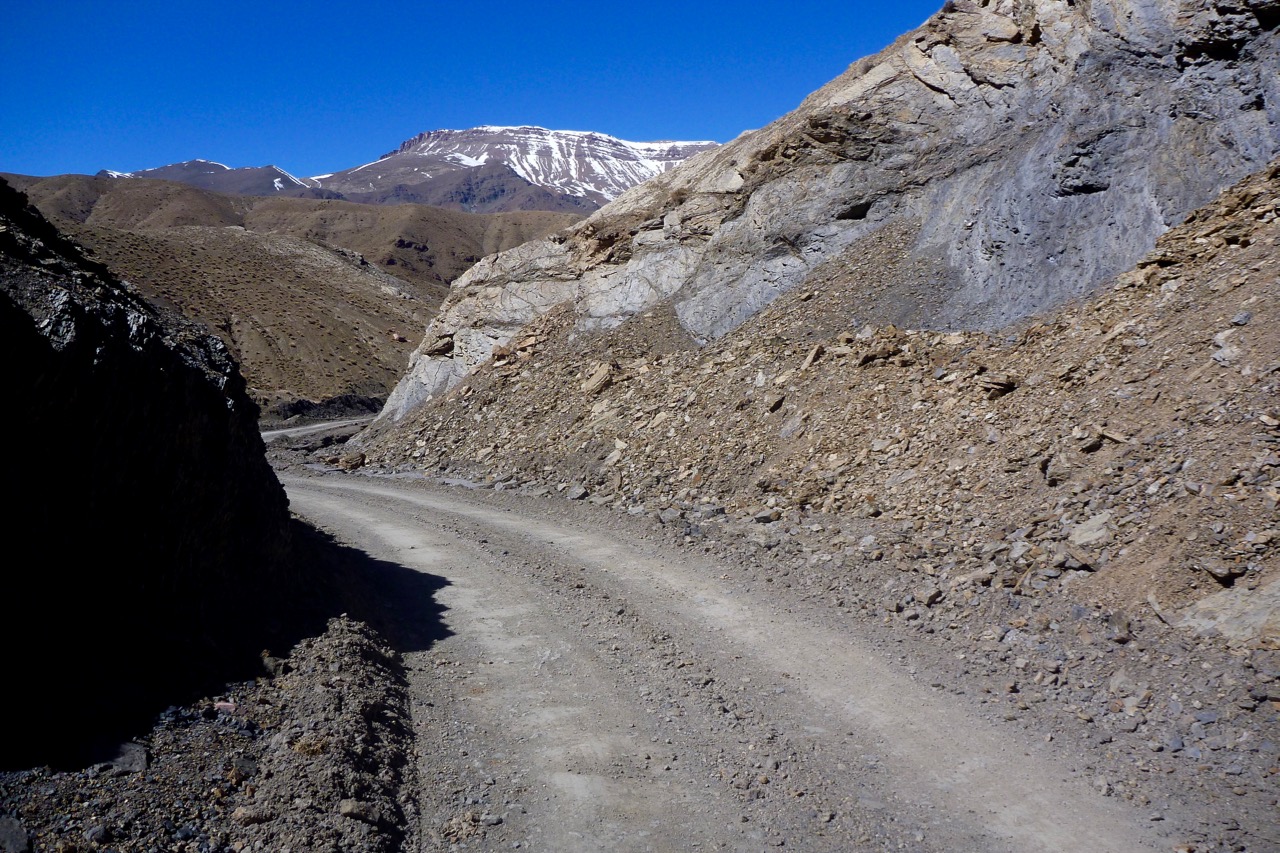
The road deteriorates in places. Lots of landslides. Near zero traffic.

I pop out on the south side overlooking the headwaters of the Oued Draa near Ouarzazate. There’s a huge new solar farm down there.

After some fumbling about, I pick up a new piste from Ouarzazate to Tazenacht.

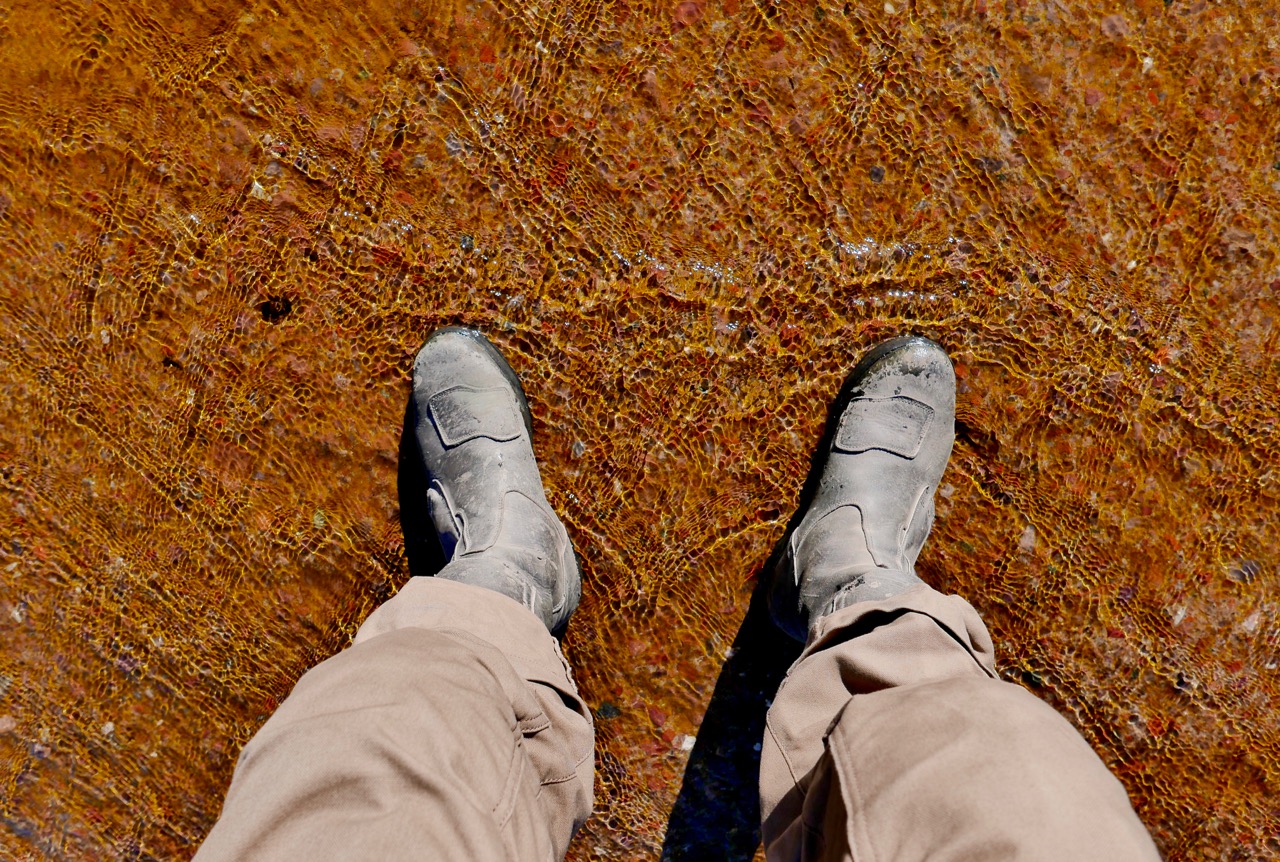
Nice colours on the ford

Next day another new piste I’ve been wanting to unravel for ages. Olaf map is confusing, but an old man in a village puts me straight
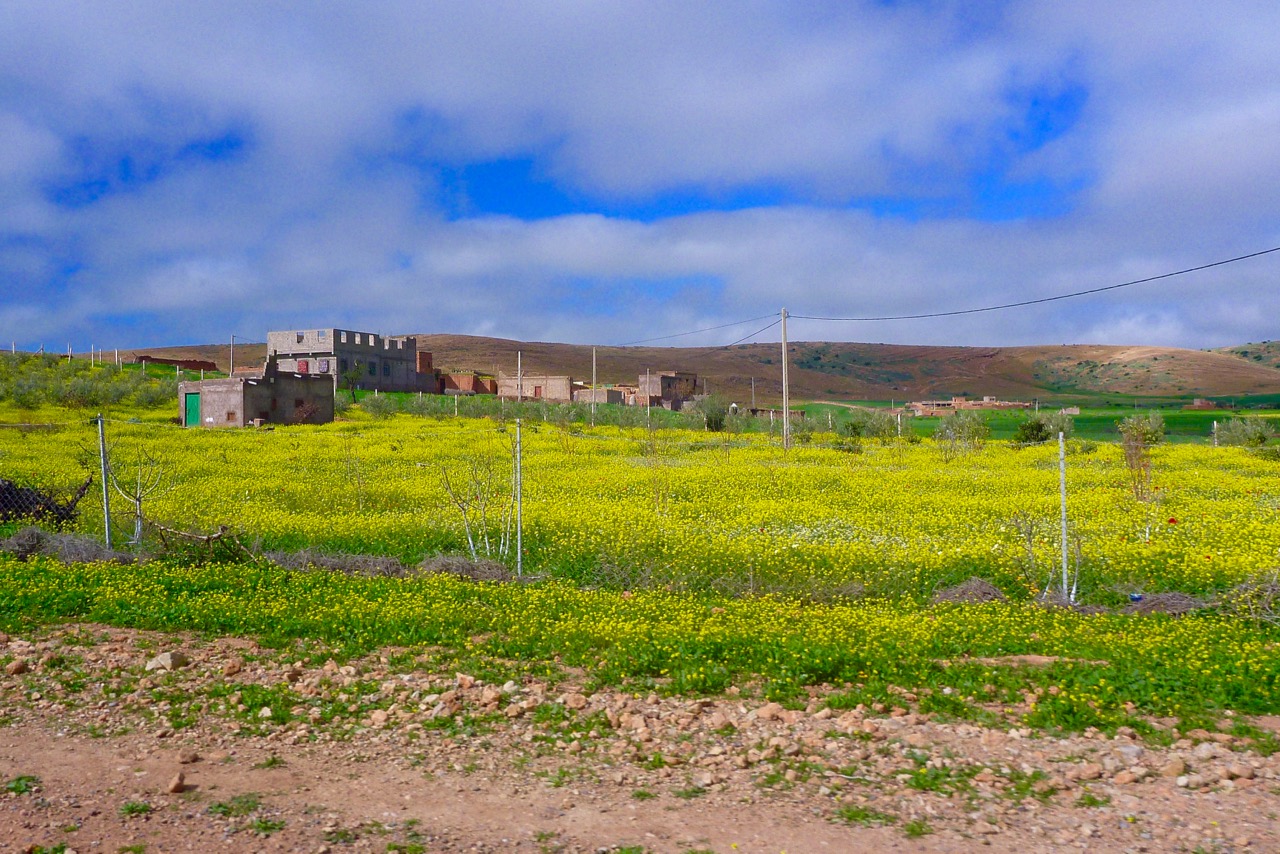
Wildflowers are out.

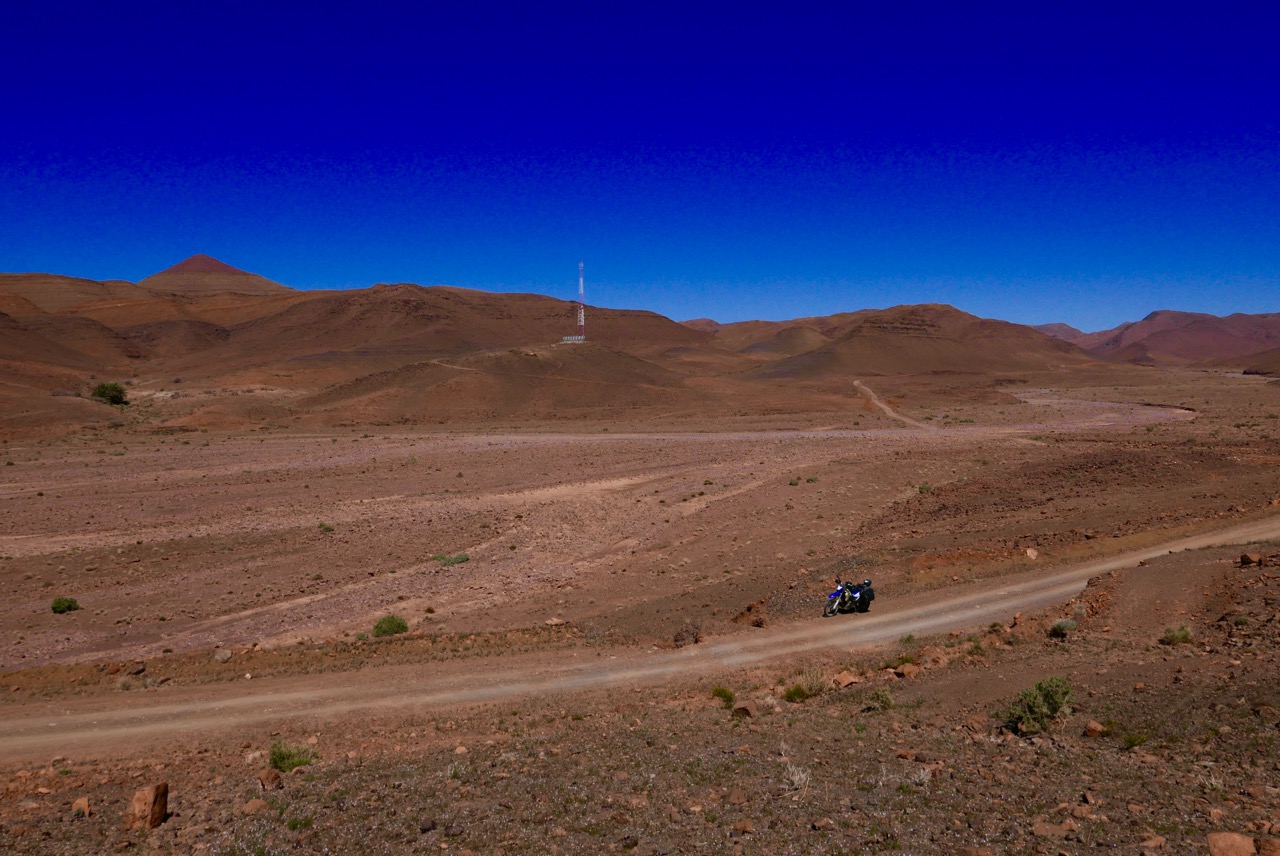
I’ll take the odd mast over photo-bombing telegraph lines any day

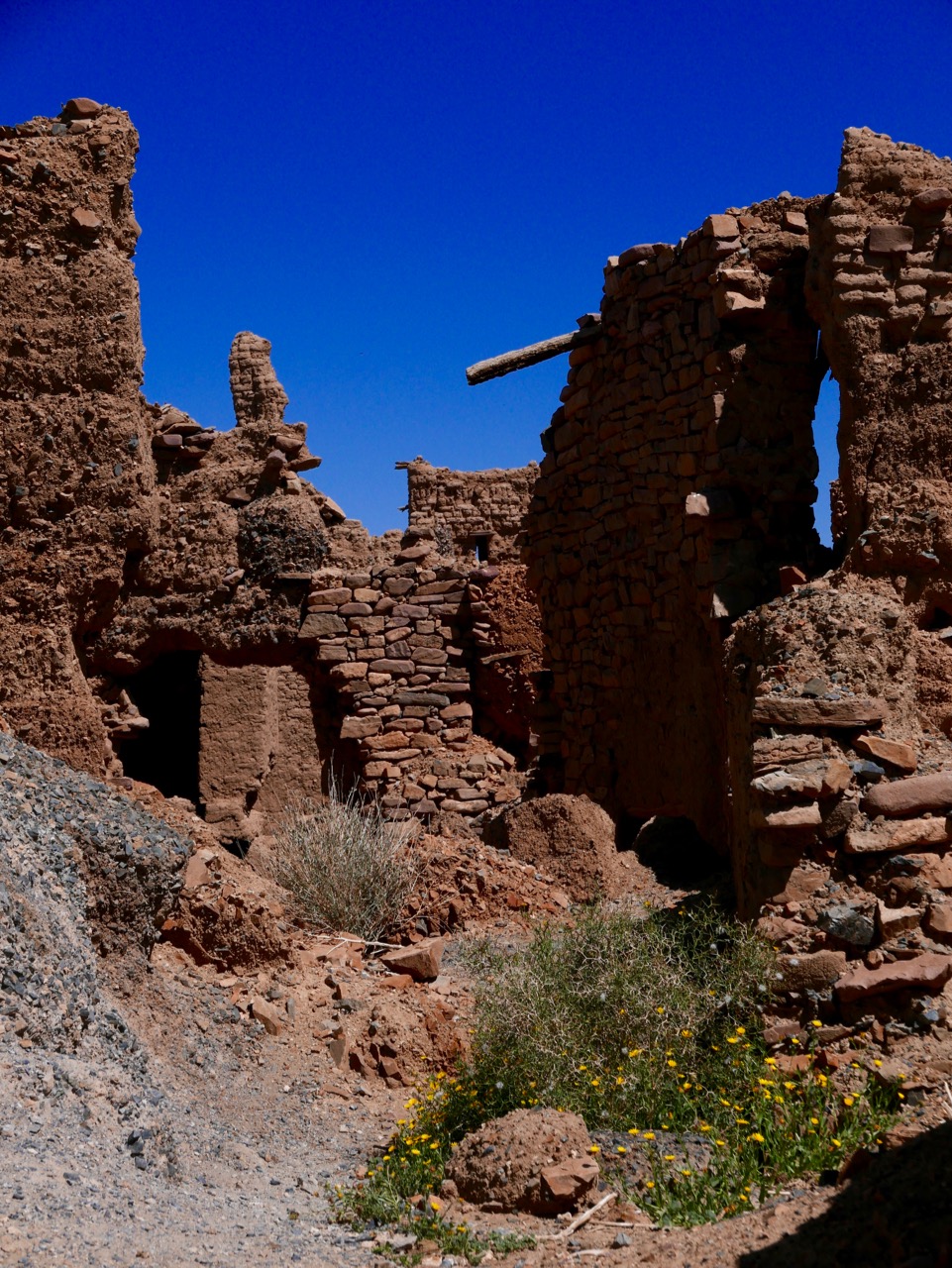
The ruins of Assaka ksar.

No Canoeing? Shame.

Perfect lunch at Foum Zguid roadhouse

A good morning’s work – but it is now as hot as.

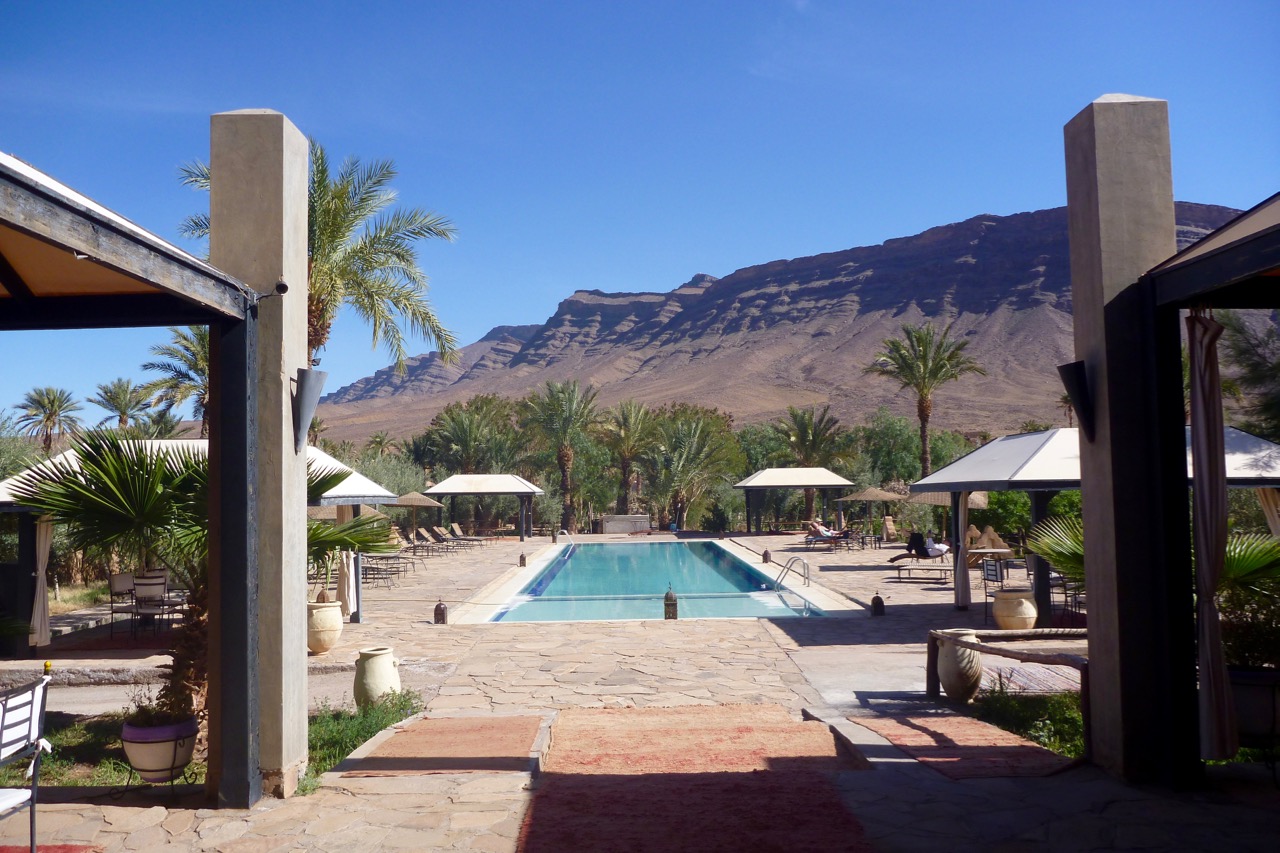
I check out a flash place for a future tour, then head into FZ for my reliable cheapy: 16 quid half board √

At 14-47 my bike is over geared even on the road, and my weight and wide pans don’t help.
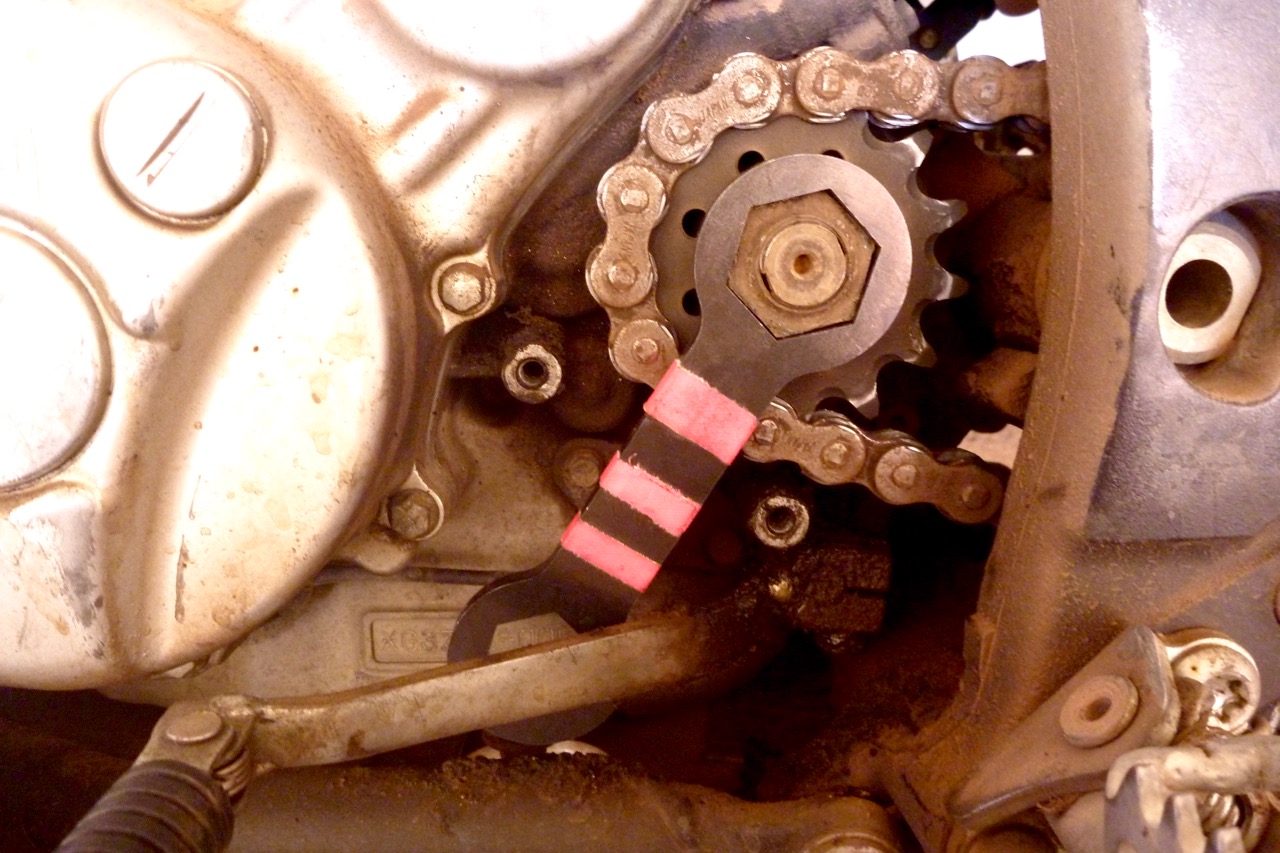
But the flat wheel wrench won’t fit – who’d have thought? – so I nip into town to blag a 27 socket as there’s gnarlier dirt to come…

Part 2  > > >

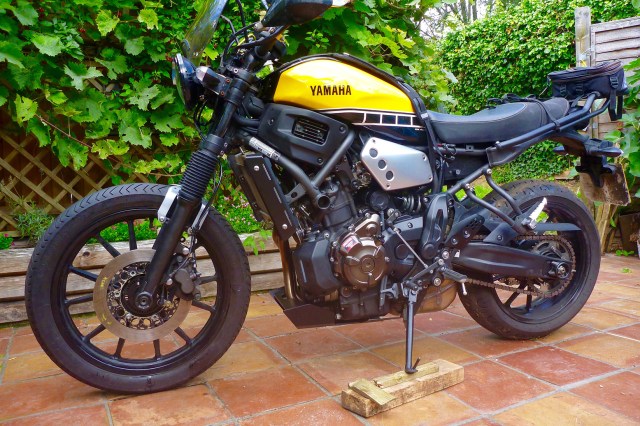
XSR 700 Scrambler – XVS 950 front wheel

XSR 700 Scrambler index page

bolt-xvs950r

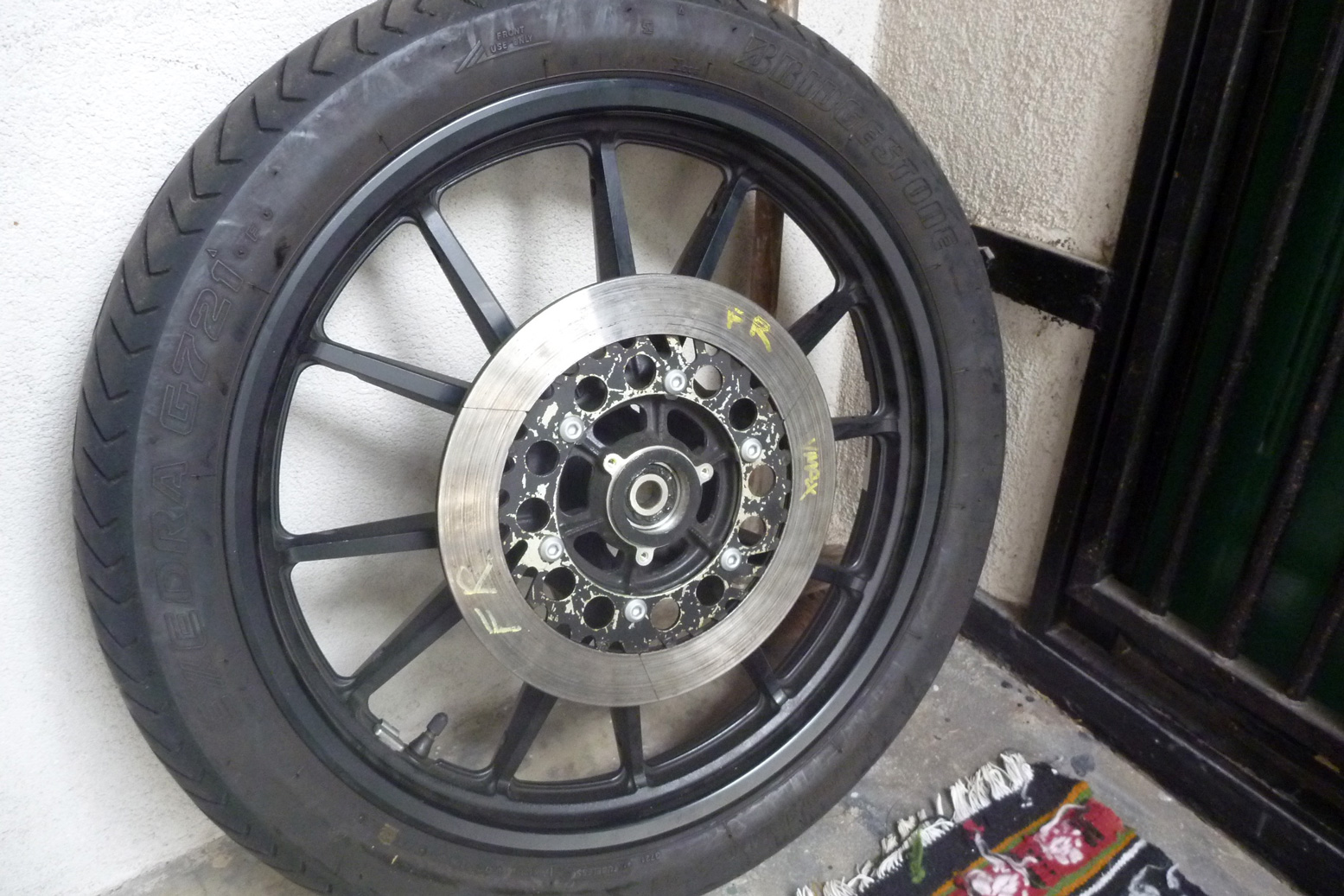
This whole project kicked off by taking a chance on the front wheel of an XV950 V-Star Bolt (left). It’s what Americans call a ‘compatability swap-out’ and the wheel had been sitting on ebay for months; £130 with tyre and one bearing.
scr950

No wonder there were no takers; a V-Bolt is a mock-Sportster – something which proper Brit bikers would probably scoff at (while secretly fancying). Being V-twins, ‘Sports Heritage’ XVs are of course very popular in the US and the recently released, 250-kilo wire-wheeled SCR 950 Scrambler (right) is virtually the same thing, but about as ‘scrambler’ as Triumph’s effort (or mine), and I suspect doomed to low UK sales. The recent Ducatis and BMWs are much cooler.
Boredom alert: I learned things the hard way doing all this so go into unusual detail to save others on similar projects from making the same mistakes.
xsr19

An XV runs one, 298mm disc on six bolts. I needed a 282mm-rotor if I was to try and reuse my calipers. Many internet hours passed – distant stars exploded; babies were born; a celebrity sneezed. I discovered that FJ1300 and V-Max rear rotors, and good old XT660Z fronts come in 282mm/6 bolt. Cheapest was a V-Max for 40 quid; new OE bolts were another £10.

xsrtwowheels
tracerbrake

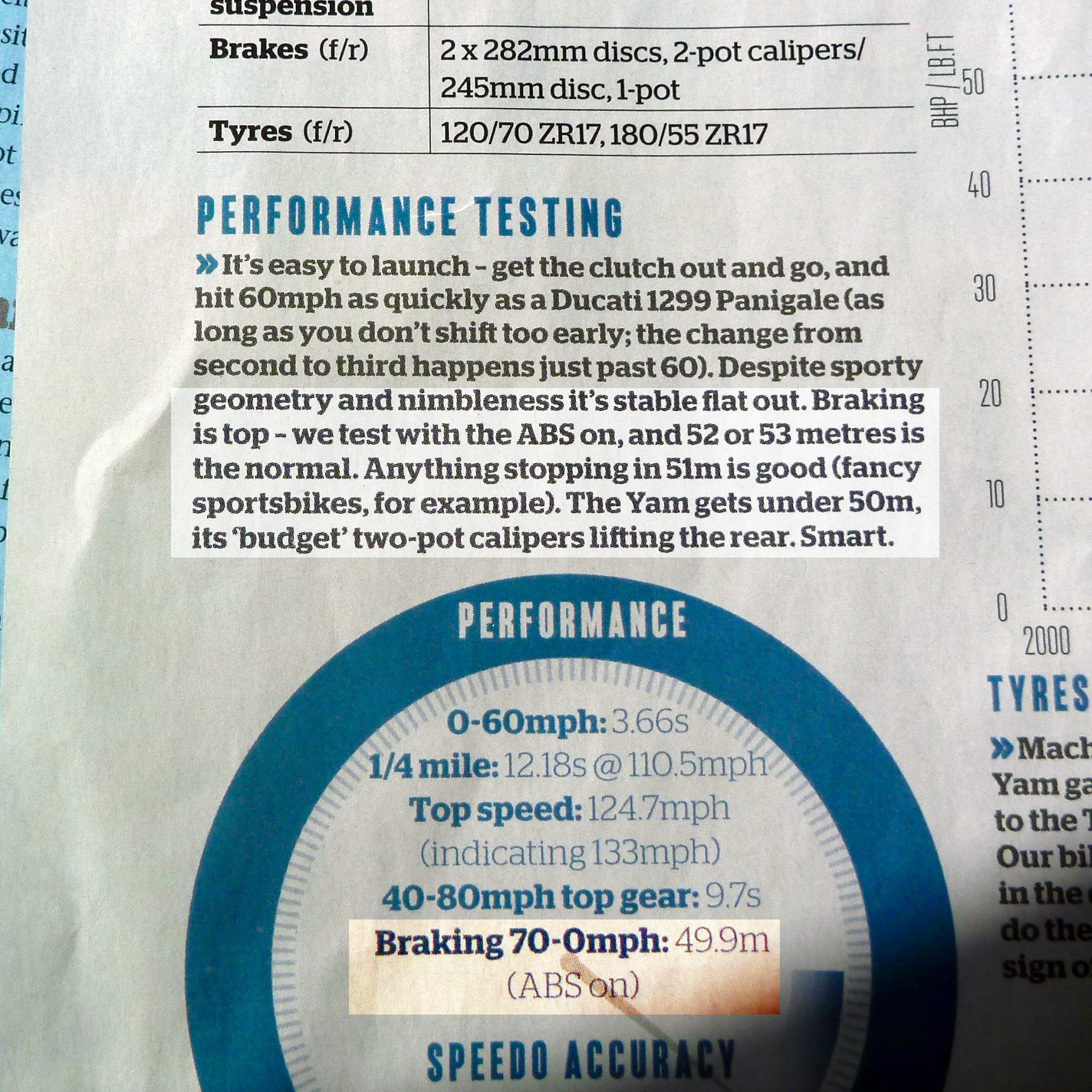
Notice I say ‘disc’ not discs. The XSR and many other bikes get unnecessarily fitted with twin discs. It must be some sort of marketing cue which goes over my head and is certainly not related to outright performance. Discontinued XT660Z: twin front rotors; forthcoming T7 with 50% more power: single front rotor; HP2 Enduro/GS12 is another example. No denying it; XSR brakes are great; Bike mag (left) recently logged a Tracer 700 pulling up just as well as high-end sports bikes. On my XSR I believe they’re overkill and add unsprung weight. With a single braided line and 3-4kg saved, the suspension will like it.
In fact (and annoyingly), the XV wheel is nearly a kilo heavier, even with one disc. Oh well, I’ll save by ditching the second caliper.

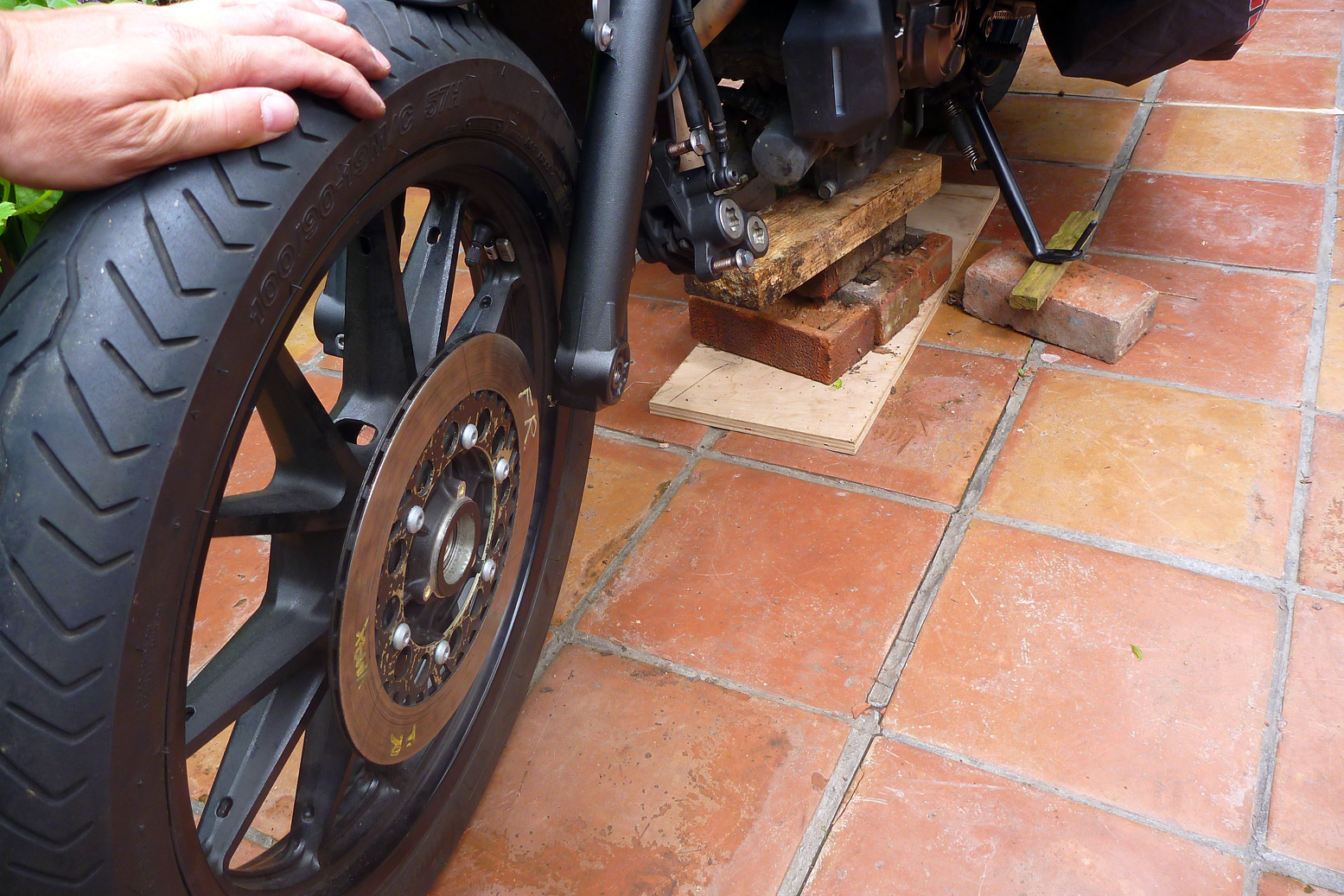
Getting to the point of removing one wheel to offer up the other had taken quite a while. I live on a hill and have nowhere to work but the street. Luckily a neighbour let me use her back garden if I didn’t mind removing and replacing the alleyway fence. A scan on Gumtree brought up an trolley jack down the road for 20 quid and at last I was in business.

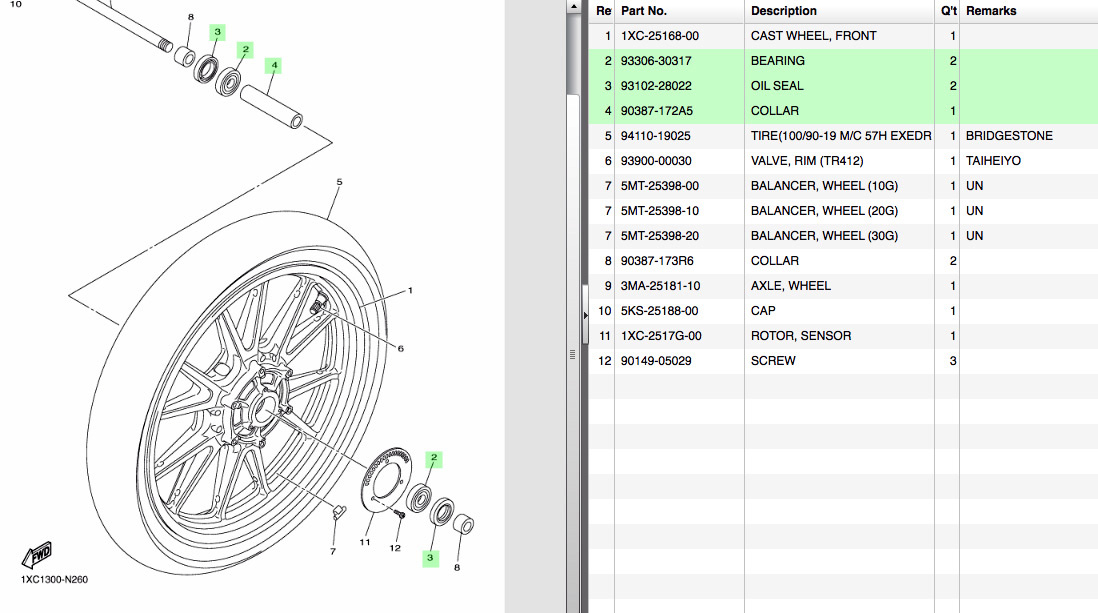
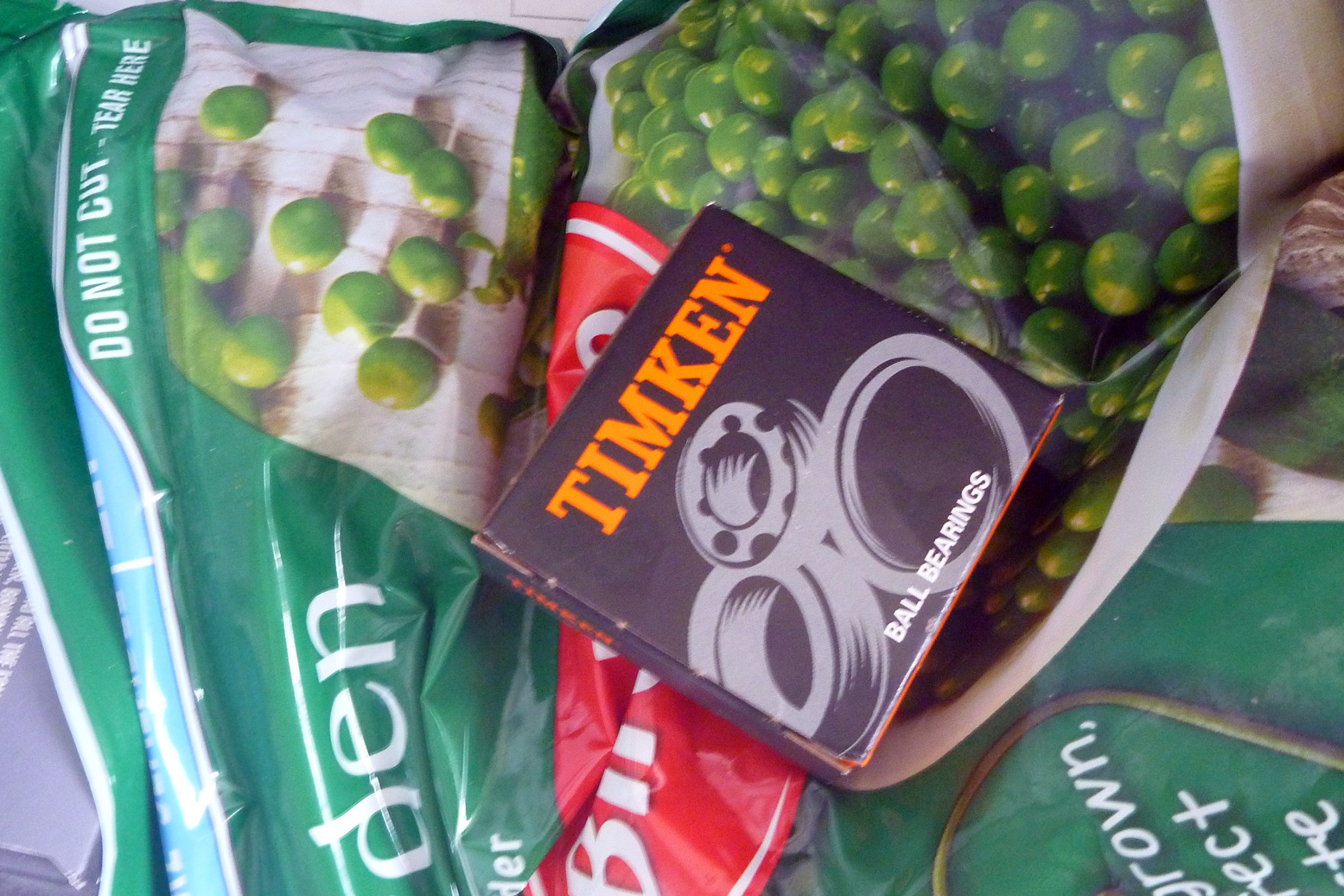
I’ve long known OE bearing prices are an easily dodged scam (see this vid). Down the Yamaha dealer that’ll be 21 quid for the missing wheel bearing, but this commonly sized bearing is classified as a 6303. Seven quid for a top-of-the-range Timken jobby (right) from a bearing shop in Croydon, or about the same posted online. These places might have done dust seals too, but I didn’t want to push my luck; they must match the wheel spacer ø, so that’s a tenner for a pair posted from Wemoto.

I also needed the in-hub collar/spacer that goes between the bearings. I tried used online but couldn’t find the exact width (fyi: 70mm x 24mm out ø x 17mm in ø) so succumbed to new for £13 posted from Fowlers – the Partzilla of the UK, but without competition-driven discounts. Another ten days pass by.

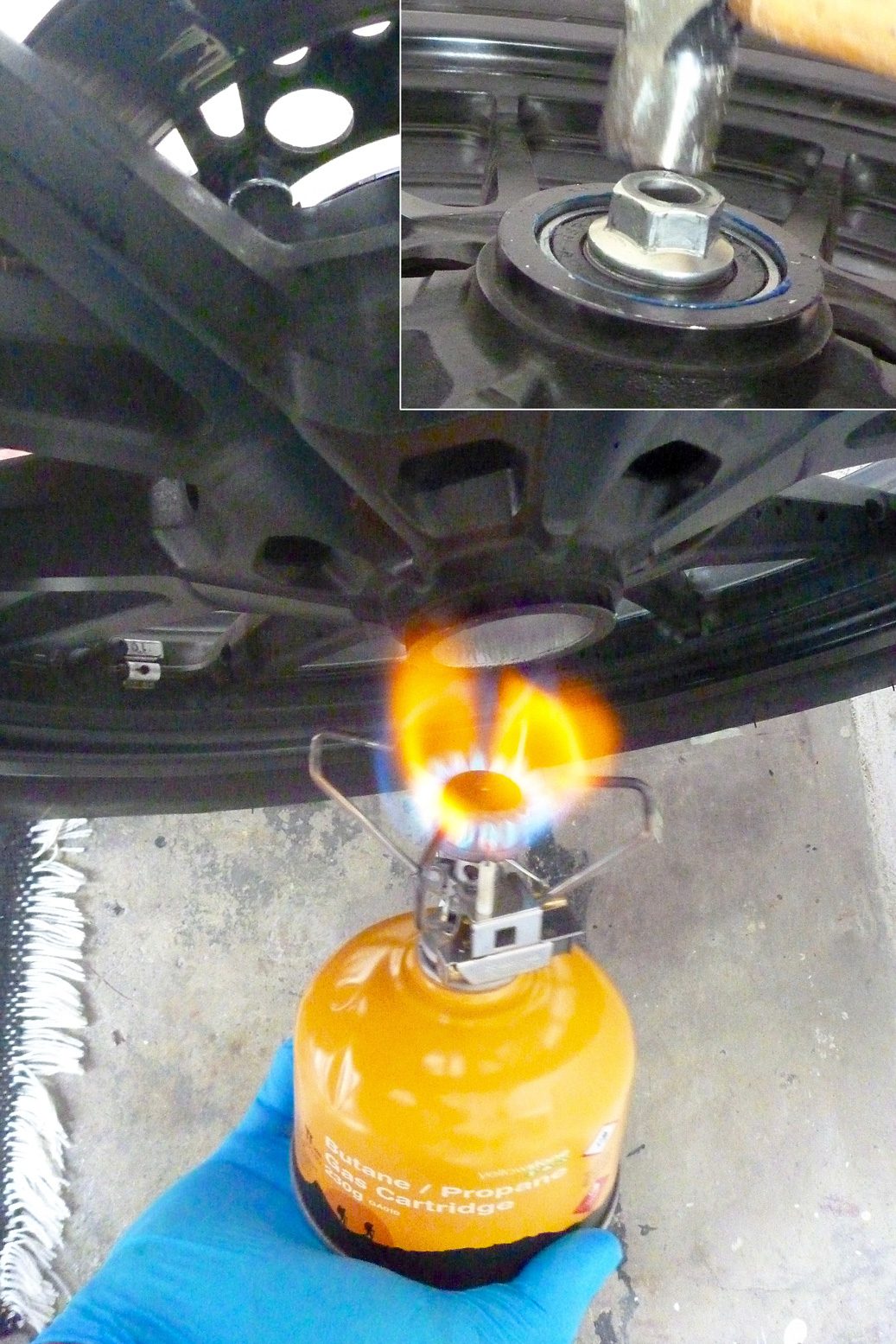
Good video below on wheel bearing removal and installation. With one bearing already installed, I was able to use the spindle as an alignment guide, gently tapping the frozen and greased bearing round the outer edges with a 22mm socket for the final push into the frame heated hub.

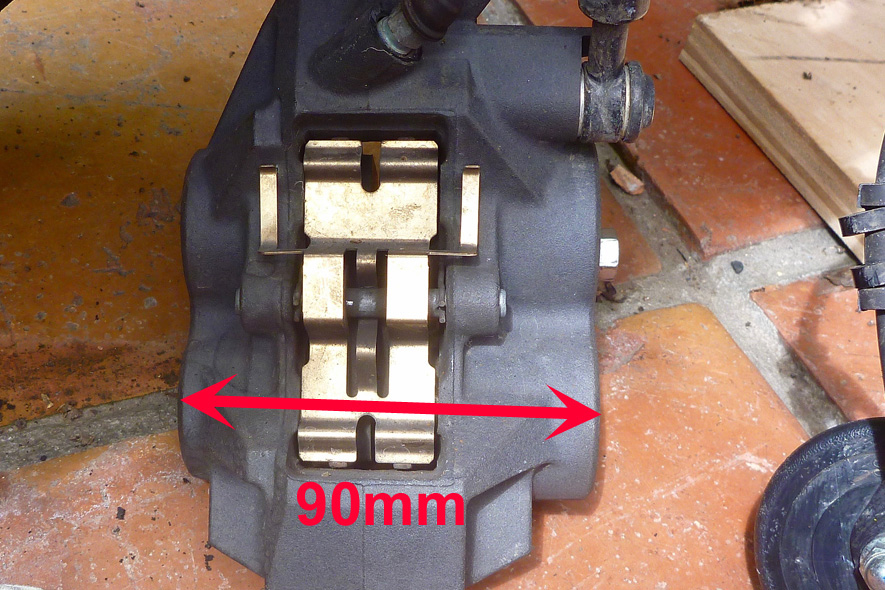
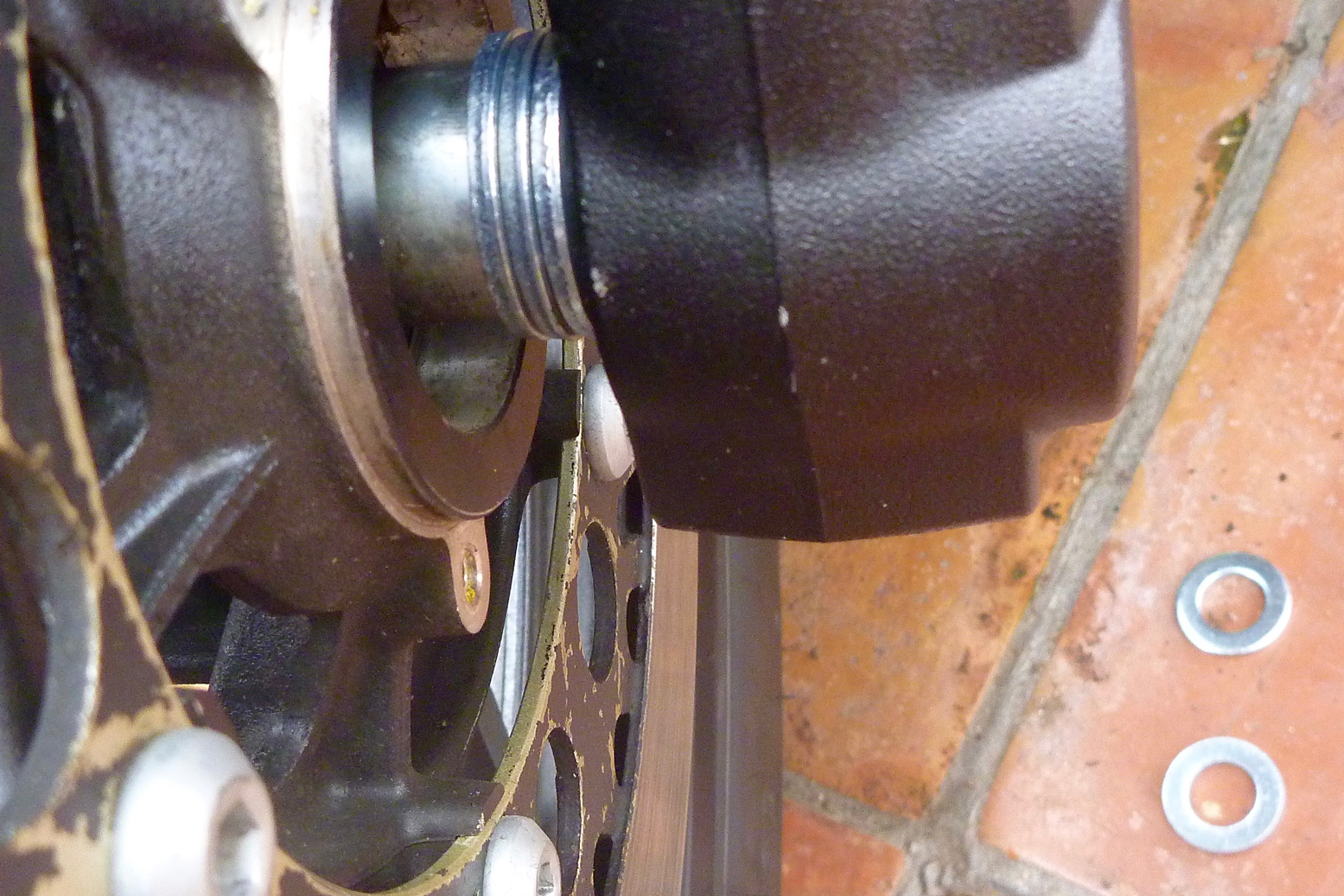
The XSR’s calipers are so fat that you have to remove both to get the fat OE wheel out – never seen that before. But offer up the XSR rotors with the new wheel loosely in place and – CLANG! – the 90-mm wide four-pot XSR caliper fouled the XV cast spokes.

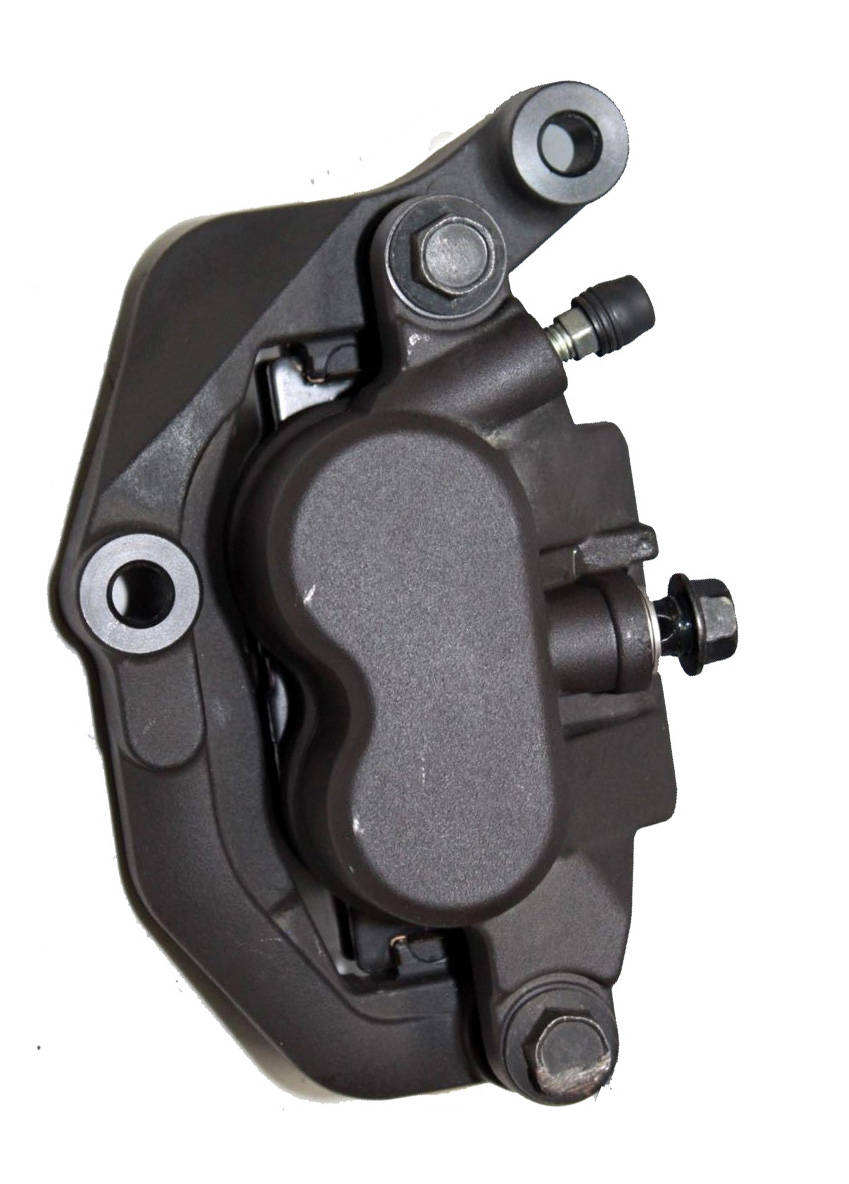
Stars exploded, babies were born… and many hours and Photoshop alignment estimates later (right), I decided an XV950 caliper (below right) would probably fit my fork mounts. I tracked one down in Texas for just $25 + the same again in post and tax. Stars… babies… celebrities… Another ten days pass.

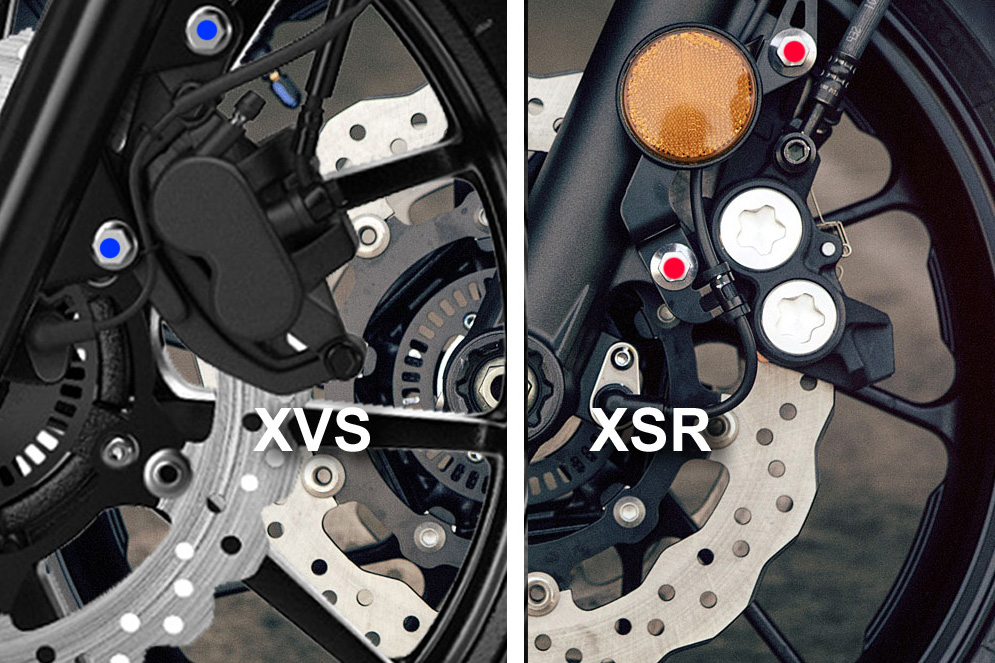
For a while I’d got hung up trying to track down a used Blue Spot caliper like my TDM900 had. R1s had them too; best brakes I ever did use. But it slowly dawned on me there are two (maybe more?) types of Yamaha disc brakes. Your cruisin’ XVs run slimmer, sliding twin-piston calipers (above left). An XSR’s opposed 4-pot unit is Blue Spot in all but name; very powerful but bulky. The less powerful sliding-caliper hydraulics are mildly compensated by the larger, 298-mm XV rotor (more retardation). My 282-mil vented V-Max (left) disc is smaller, but my bike is at least 60-kg lighter.

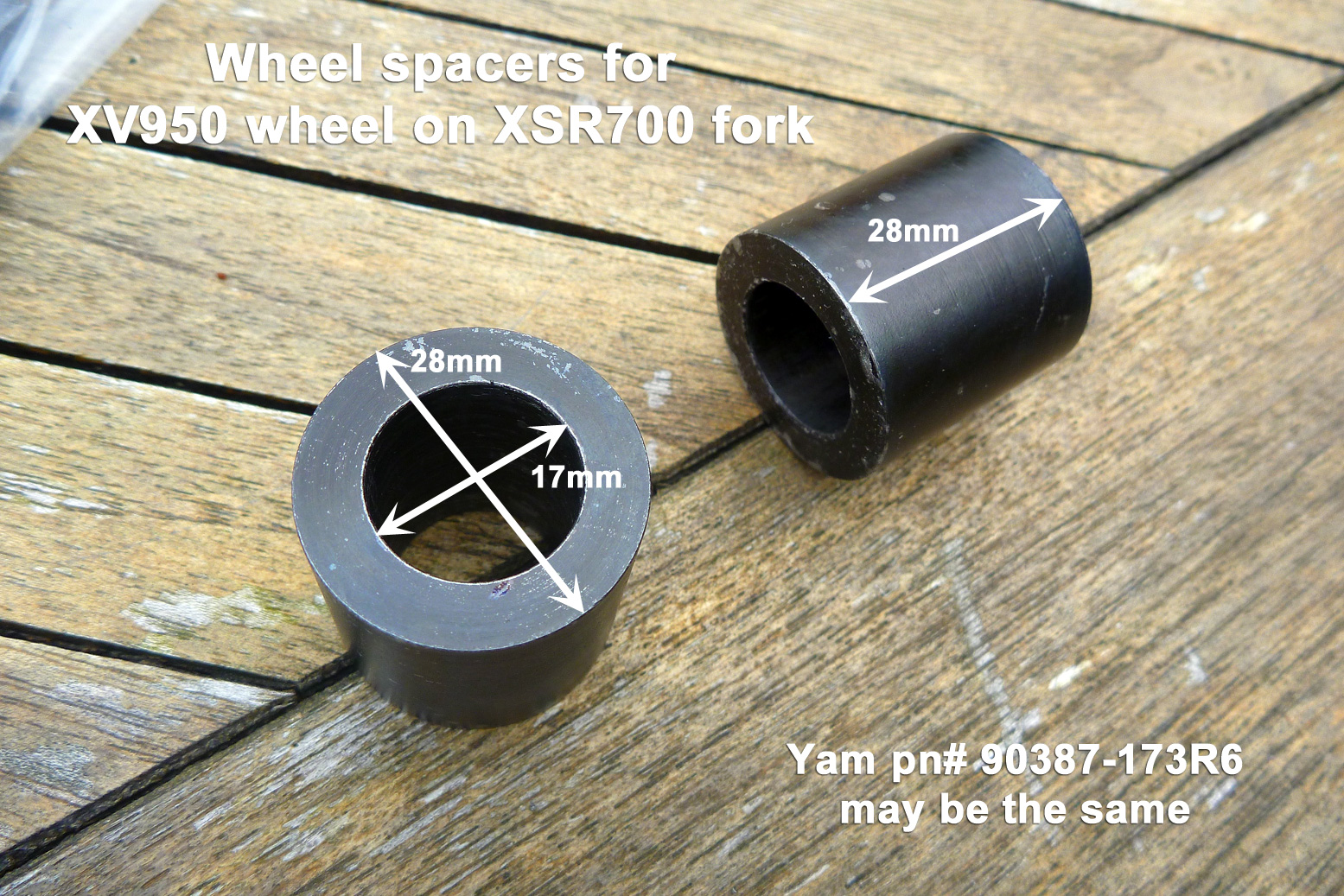
All lined up well on the same-diametre 17-mm XSR spindle by adding three and a bit 3mm washers to centre the wheel. The XSR’s spacers are 20mm ø x 17mm long (with a 17mm bore). What’s needed here is 28 x 28 on 17. Such wheel spacers are probably the same as XV items (see below left for pn) but the only way to find out was buying and waiting another ten days. Luckily, Desert Rider Jon is a mate with a lathe who likes this kind of challenge and made them almost overnight.

xsrdiscspacer

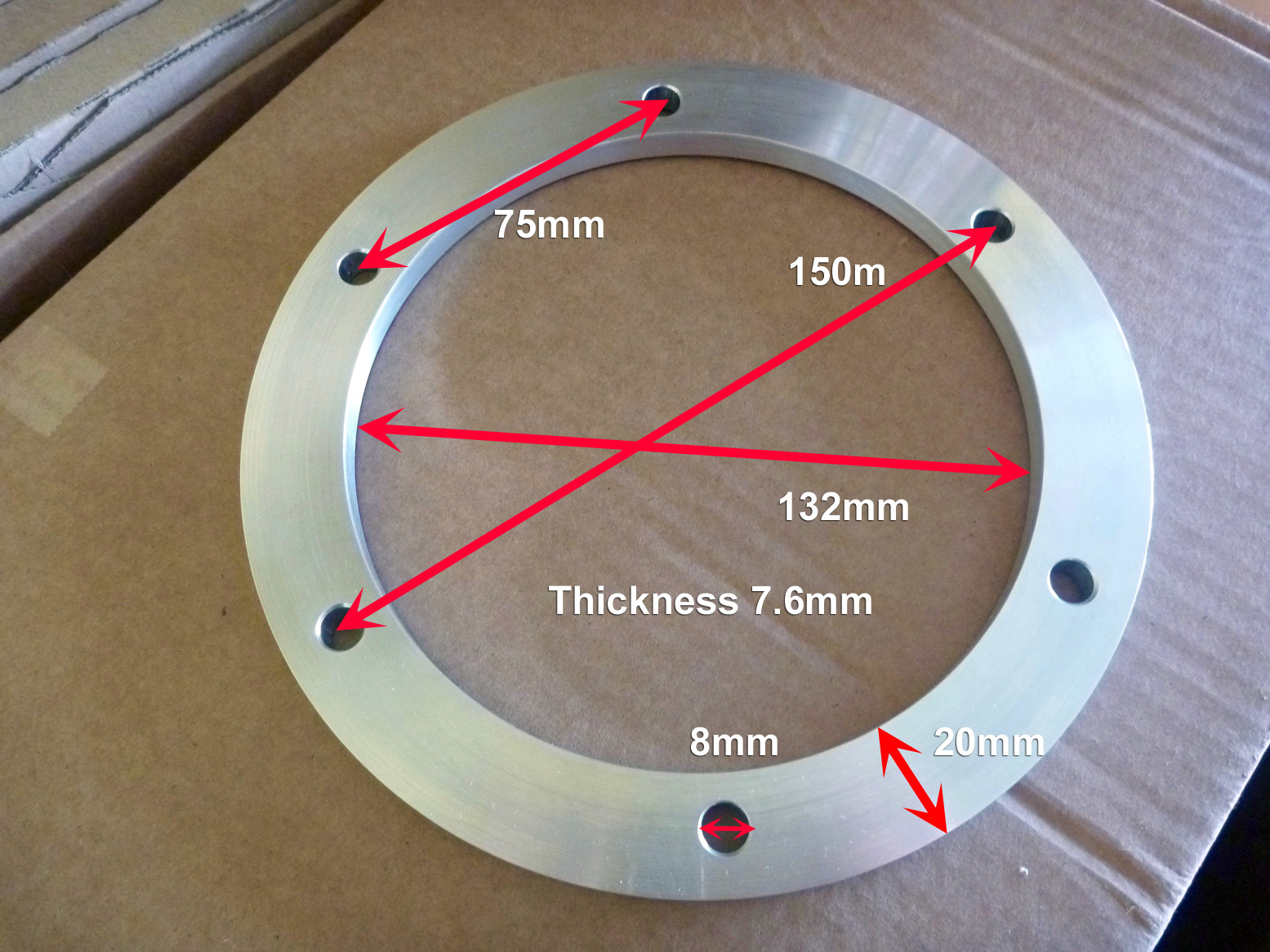
All this requires a 7.6mm rotor spacer to move the V-Max rotor out to line up with the XV950 caliper bolted to the XSR forks while avoiding caliper-spacing washers. Don’t know if the vented V-Max rotor is thicker or undished unlike an XV, but you only have a mm or two to play with for clearance in the caliper’s jaws.

Jon is milling one out in alloy for me. So this 7.6mm rotor spacer (right) is just about the only custom part needed to marry up an XVS wheel, spacers and caliper with an XSR fork and a 282mm V-Max rotor. You could use nuts as rotor spacers but I figured a fully surfaced spacer would be better at transferring the heat.

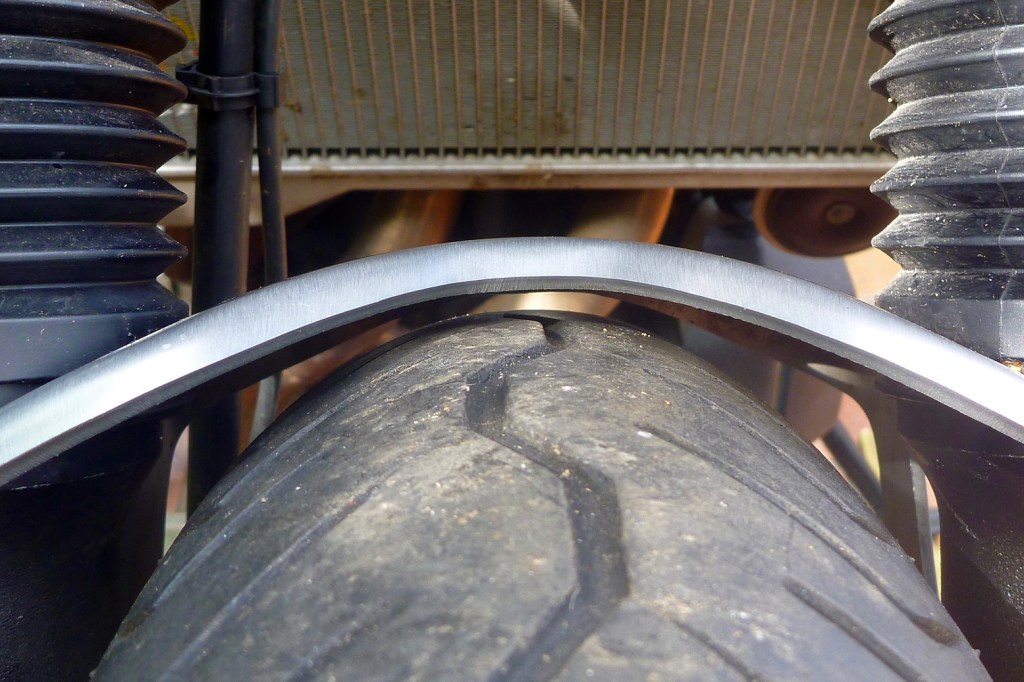
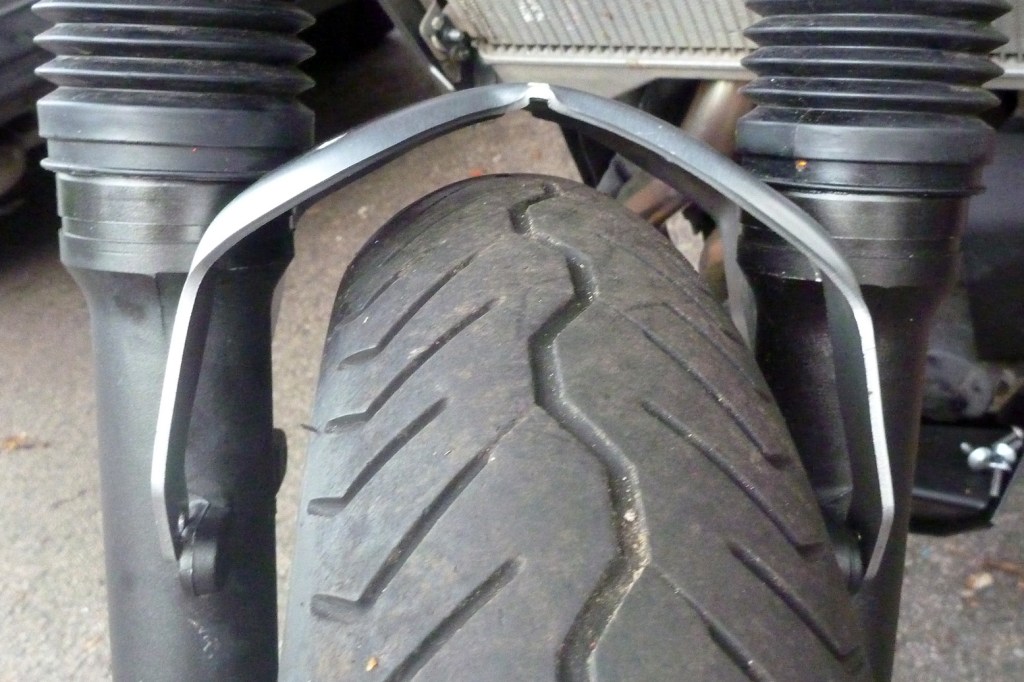
Sorting the caliper and spacing was the main challenge in this 19er swap-out. The brace now has only 5mm tyre clearance (above left). Mounting the trials guard on top will be easy, but I may get the brace re-done too – also an easy job.

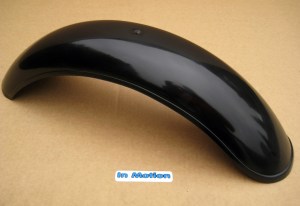
Or, with a bit of a nick, I may just bend it in to give it more lift and more curvature (above right) to take the rear fender; a plastic universal trials rear for £28 from In Motion.
I estimated the tyre to radiator lower edge clearance was 180mm; the forks are said to have 150mm of travel which leaves 30mm; just enough for the slim, plastic  mudguard. This trials guard will be way wider than the new tyre so won’t look that great but will sure keep the muck off. Skimpy front fenders are for the beard & tatts brigade.

I was now ready to unbolt the XSR brake lines and calipers, feed in and bolt up a single 850-mm braided Venhill brake hose (£30), top up with DOT 4 (£2.99) and bleed.

xsr-abslhs

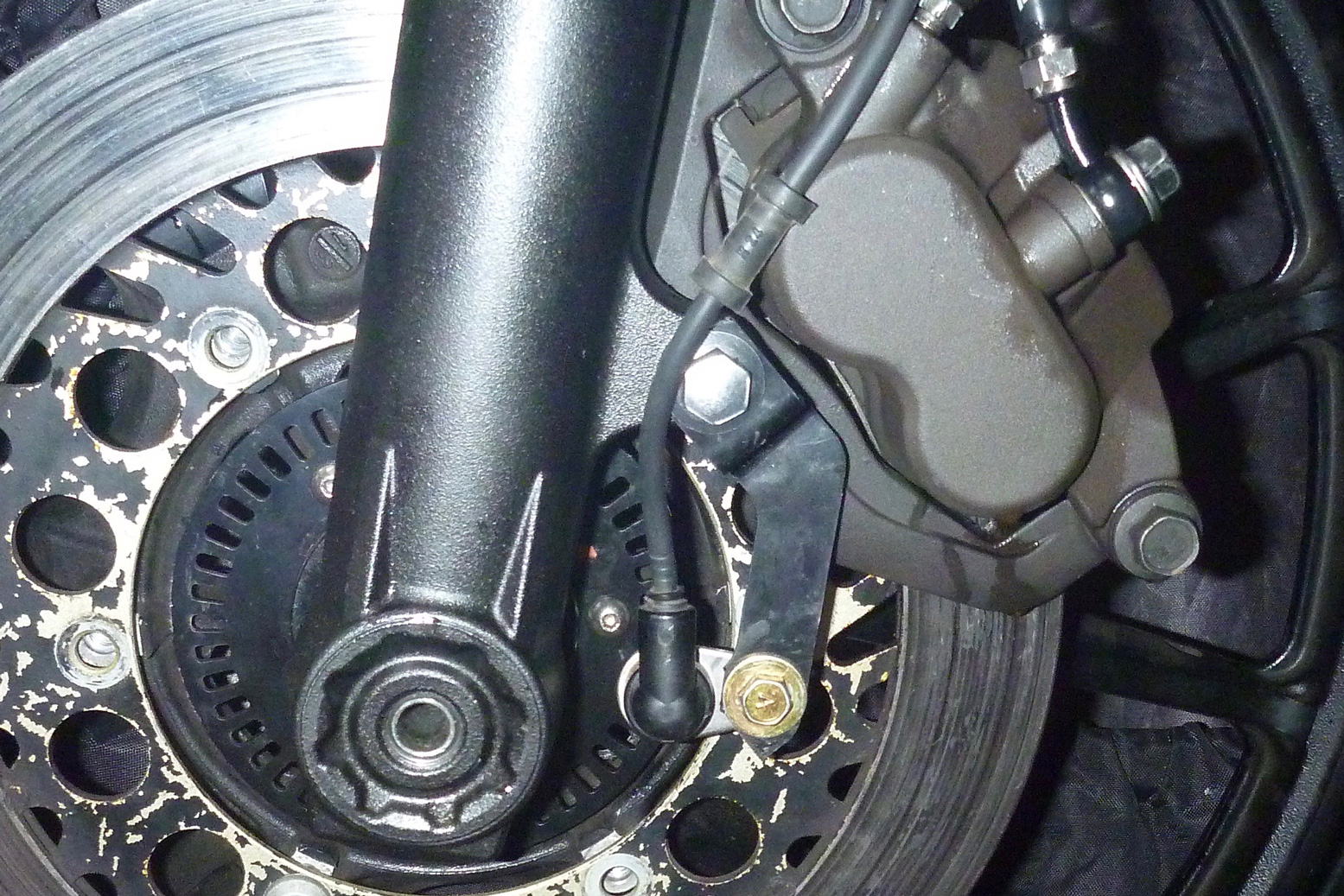
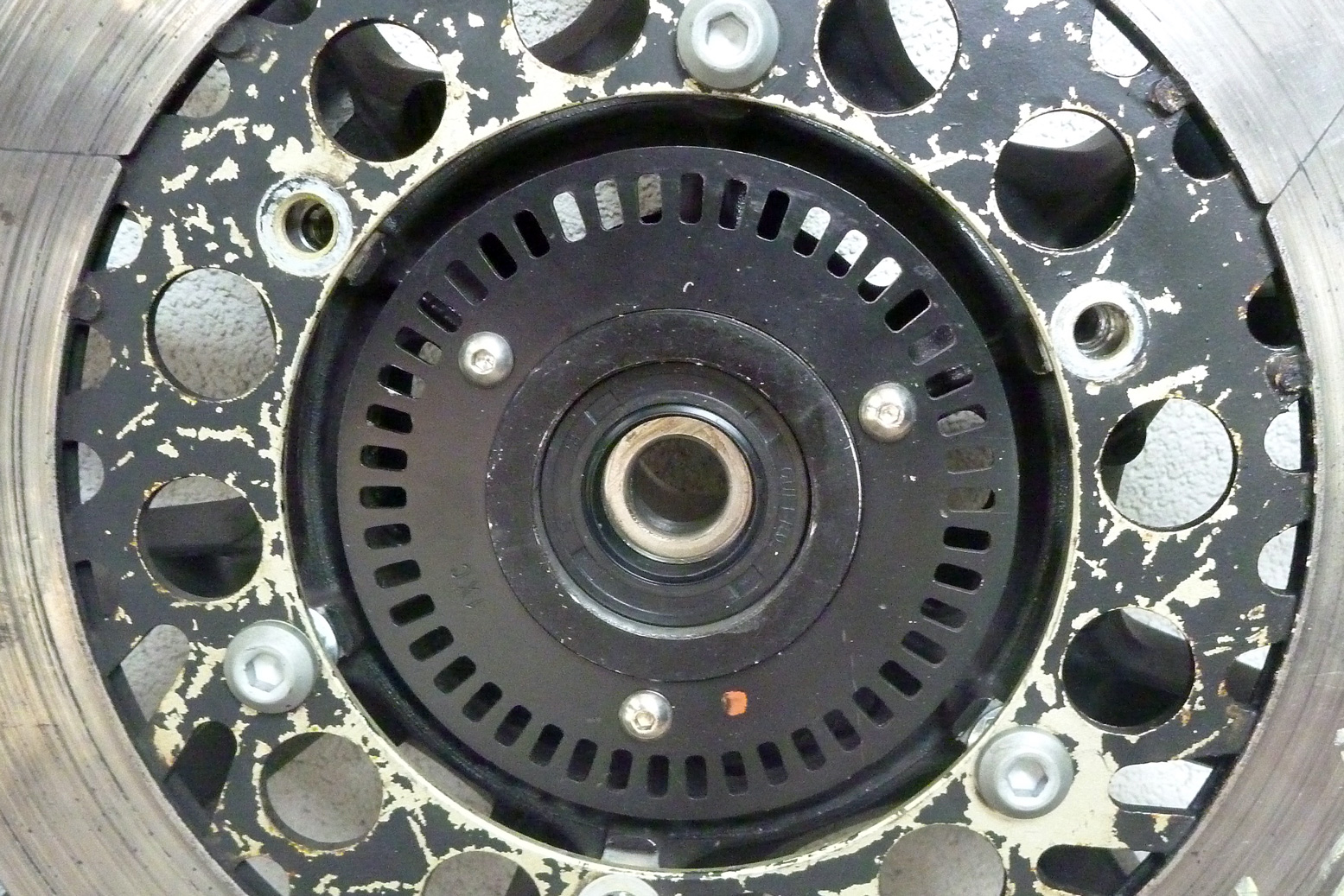
By chance the ABS sensor fitted by reusing a sawn-down reflector bracket (left). Only one washer and no bending required. The XV’s ABS ring (£40 new; £20 used from Germany) is on the disc side and a bit larger than the XSRs (originally on the other side) and in the 400-m ride back to my place it seems the XSR’s ABS computer didn’t like it and the light stayed on. That may take some sorting, but at least I have brakes.

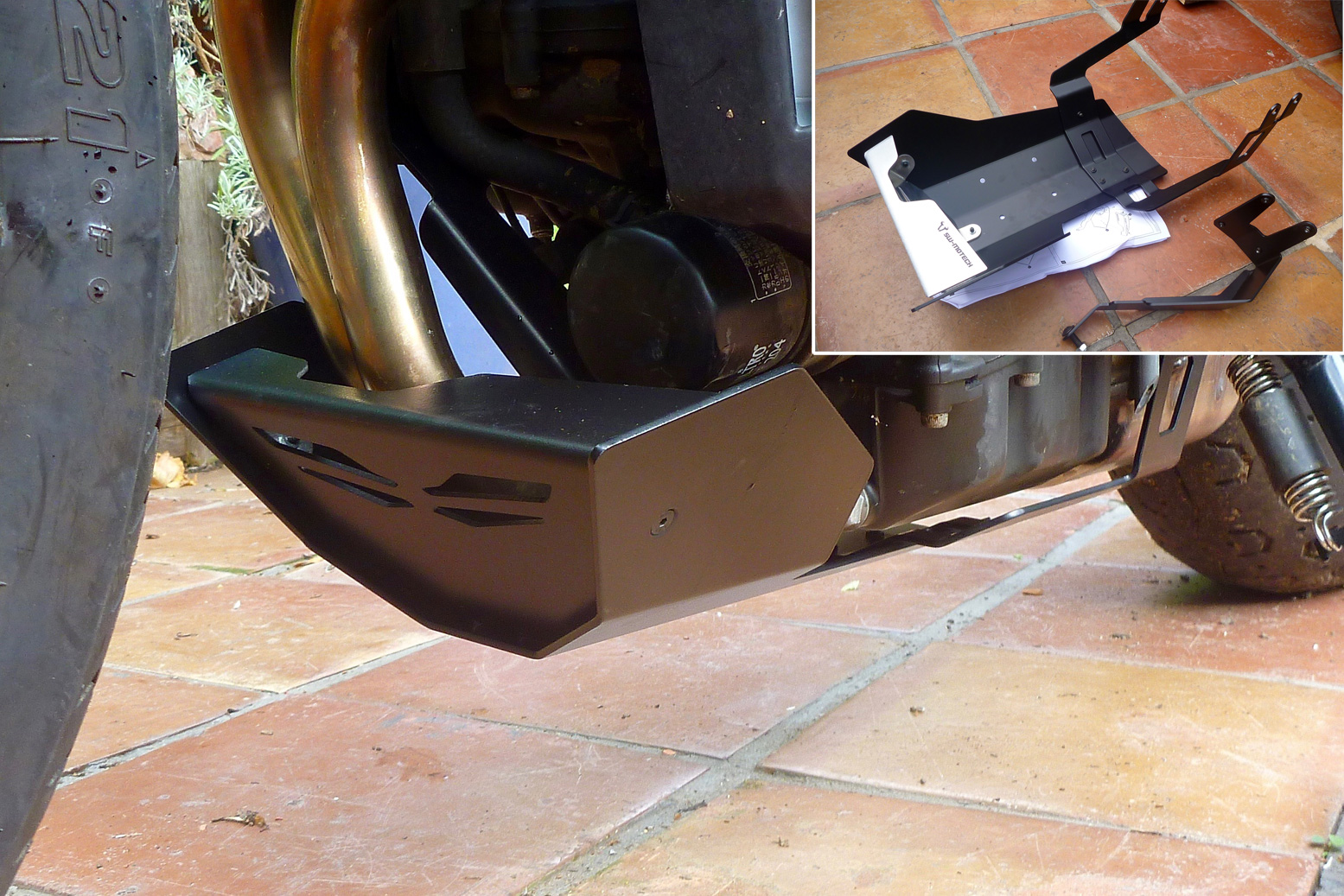
Other stuff. I bought a SW Motech ‘spoiler’ (£120) to double up as a sump guard. It’s pretty flimsy in 3mm alloy, and I think after Morocco will be wrecked, but that’s all there is and better a bashed bashplate than an unguarded sump. I may rivet on some more plate. As you can see, I sprayed the front unpainted bit with a few coats of plastic paint (and did the radiator covers while I was it it).

xsrtnj

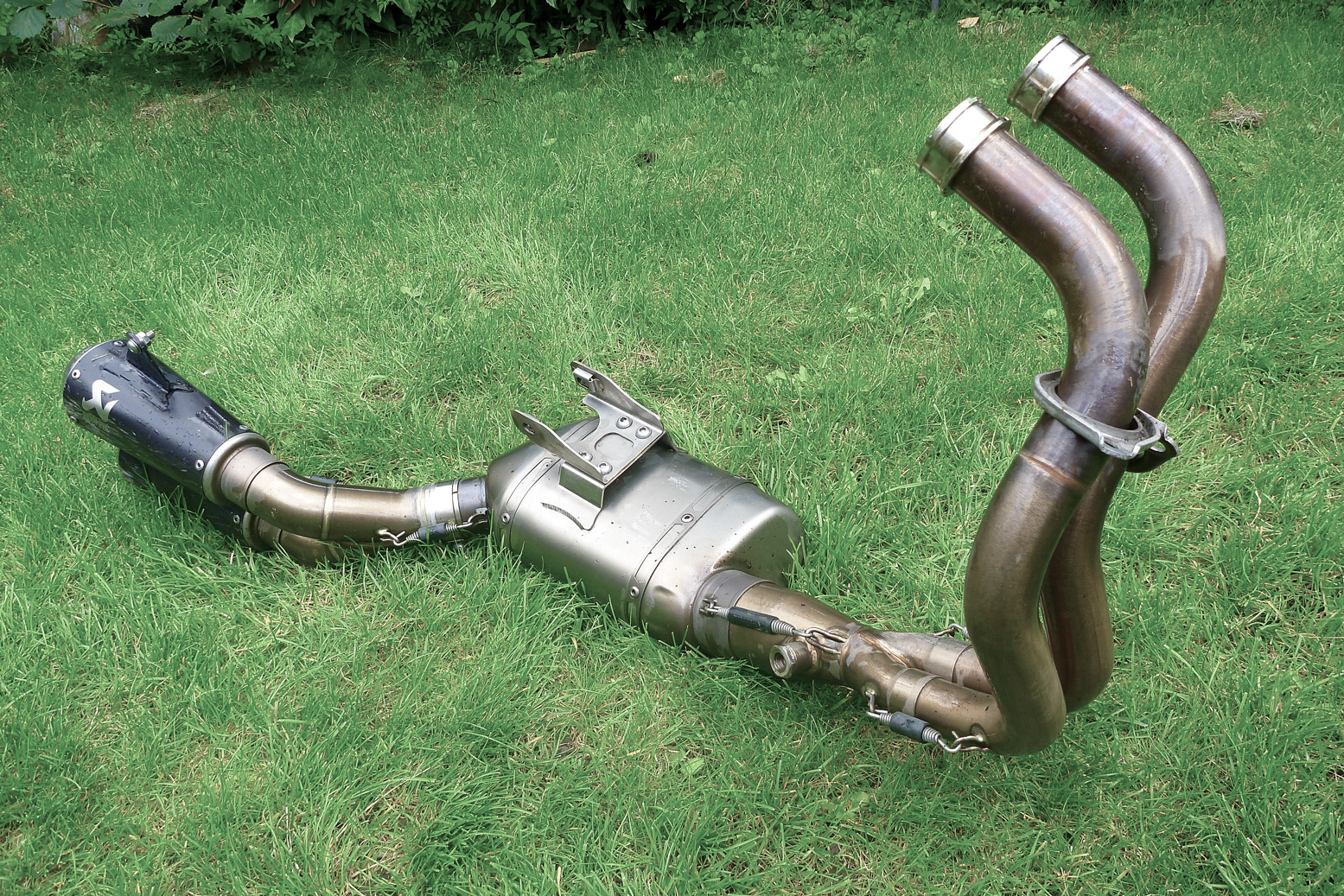
As expected, the Motech spoiler didn’t fit around my Akra pipe, but months ago in anticipation I’d bought a ‘sacrificial’ OE pipe off a new bike for £100. There are heaps on ebay right now (as with shocks) and the under-motor mass makes a good sump guard. Better a bashed cat than an unguarded sump. Interestingly, the OE pipe is the same weight (7kg) as the £1100 Akra which is now on ebay. My neighbour’s got her garden back now.

Final jobs: fit the rotor spacer and mudguard (maybe a taller fork brace?); try and sort the ABS light, if needed. Then take the brakes for a test run and consider a rear shock with a bit of lift, and extend the sidestand to suit. If it all goes or feels wrong it’s all easily reversible.

WR250R – Ready for the Desert

wrr-label
WR250R 4000-km review
WR Introduction
WR250R Stage 1
WRing about in Wales
WR250R ready for the desert
Morocco trip report, 1–9
Fuel log

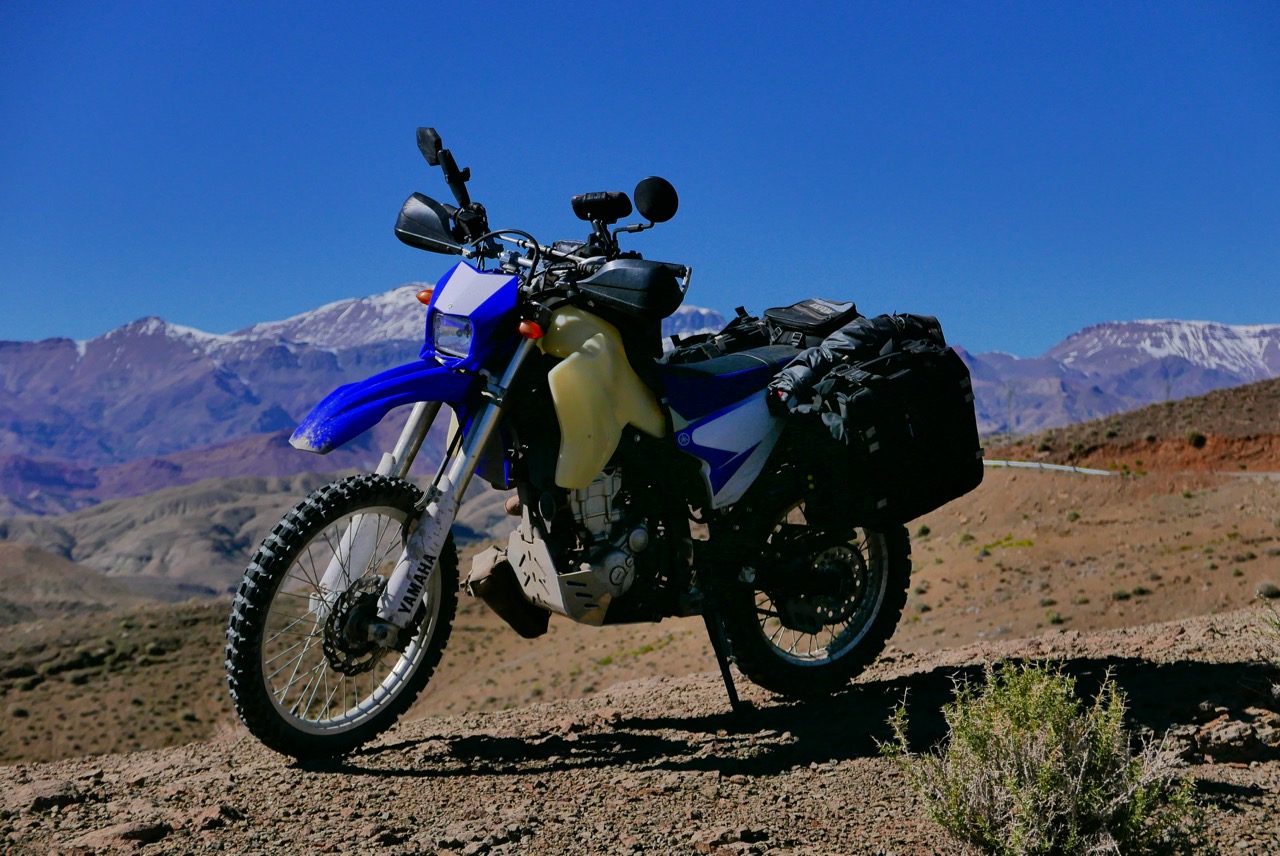
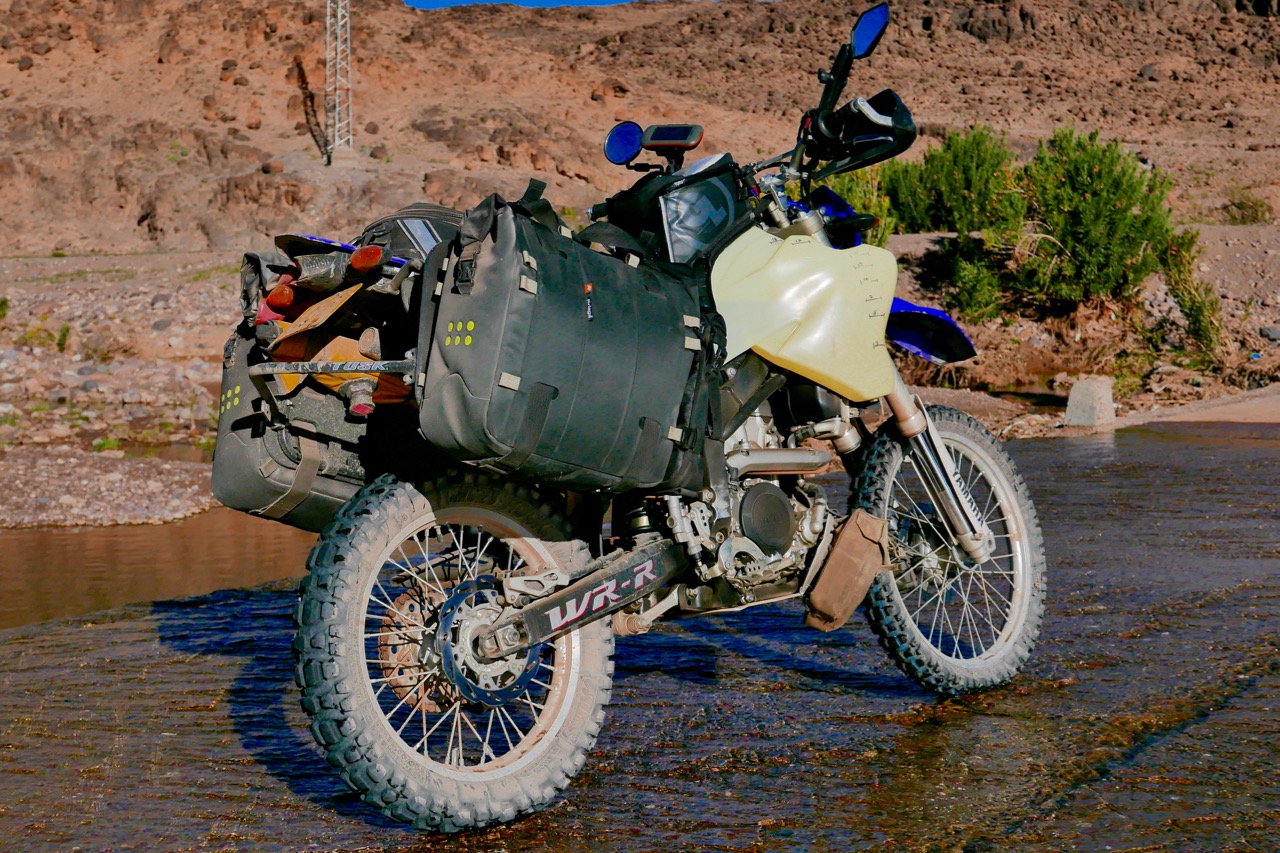
While in Morocco last year and not riding around on my WR250R, I left it with a list and a bunch of stuff with Karim, a desert bikey mate with a lavishly equipped garage and some spare time on his hands. Over the weeks he tinkered away, finishing the job I’d started in the summer, converting the WR into a lightweight desert bike.

tektemp
ktmfry

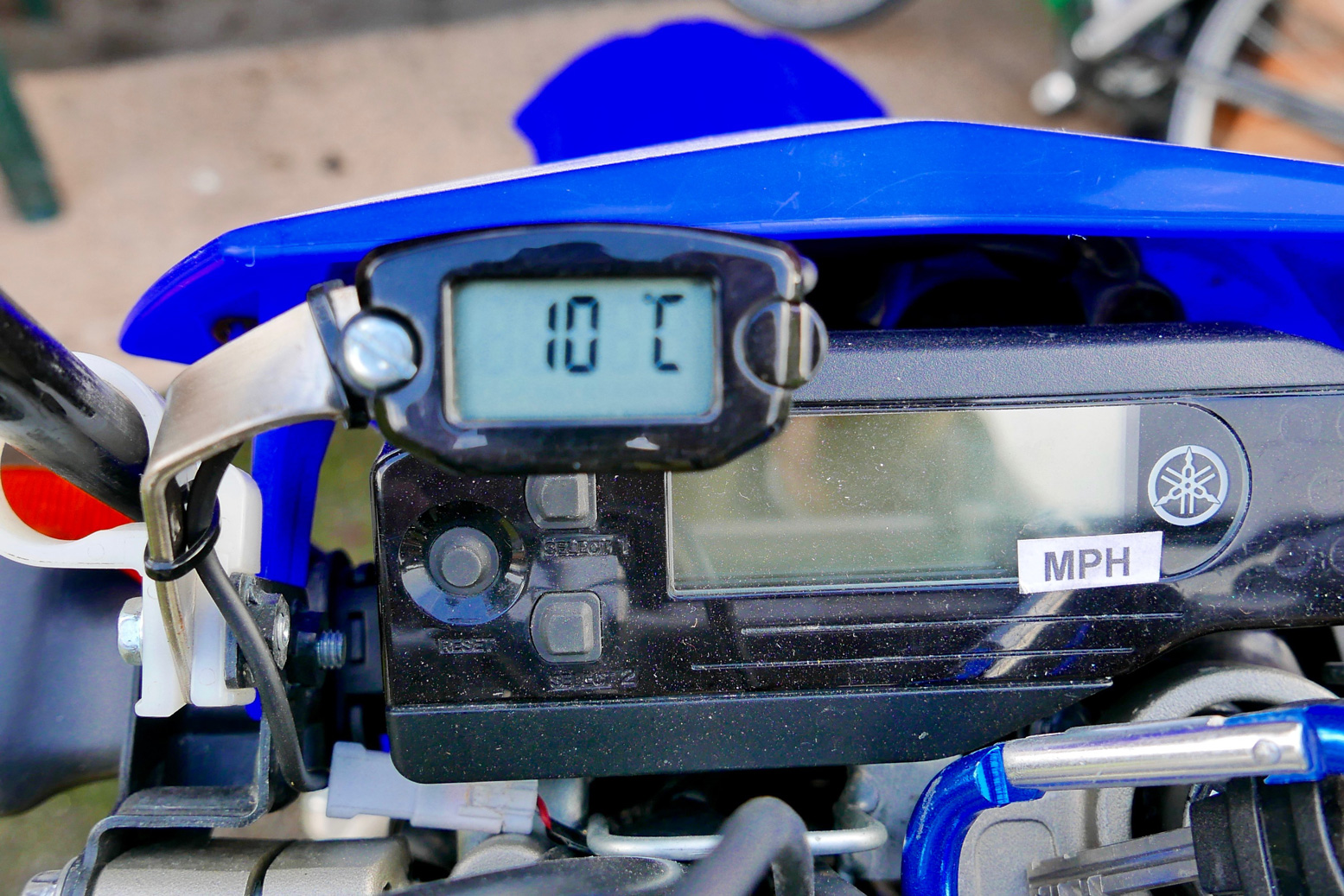
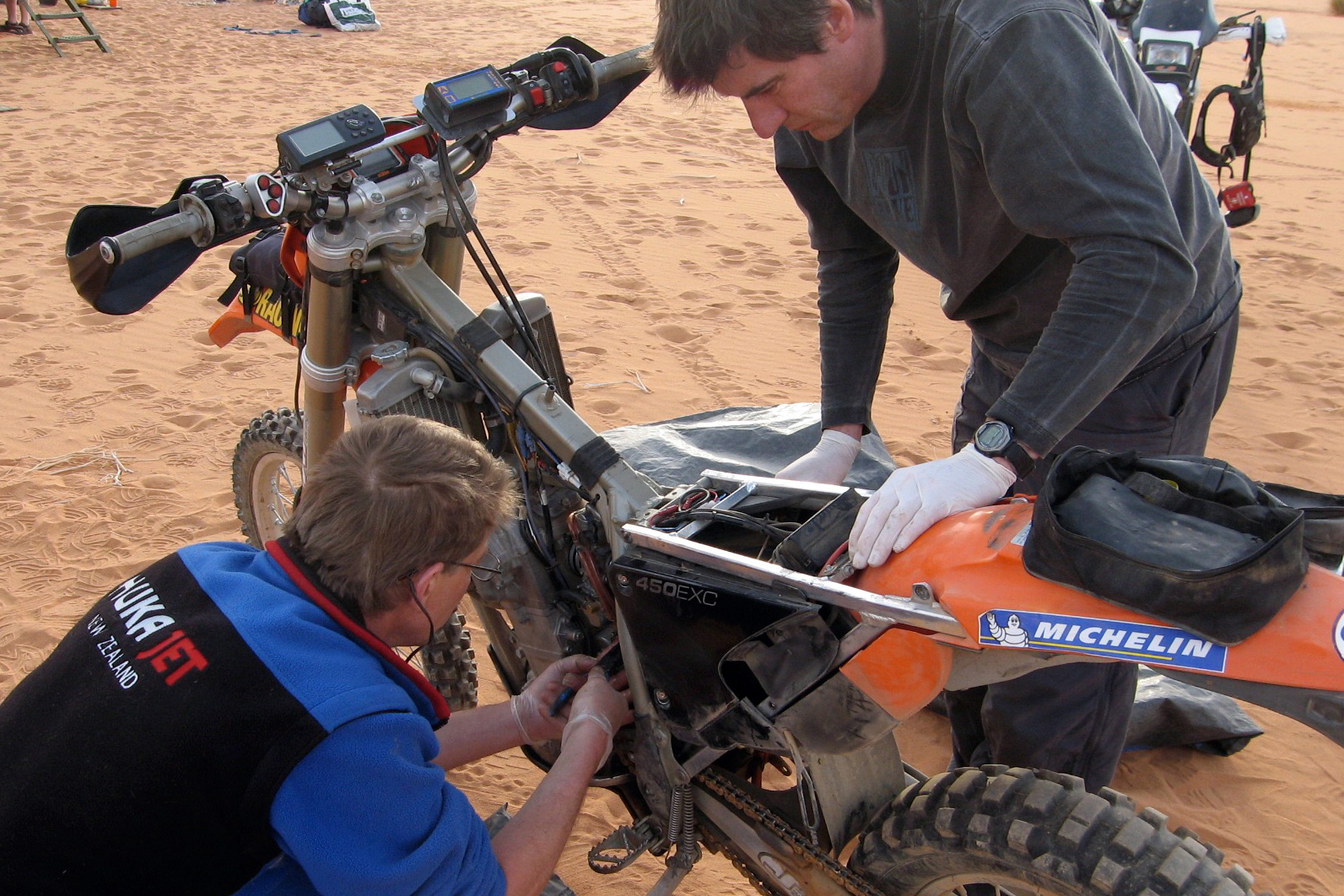
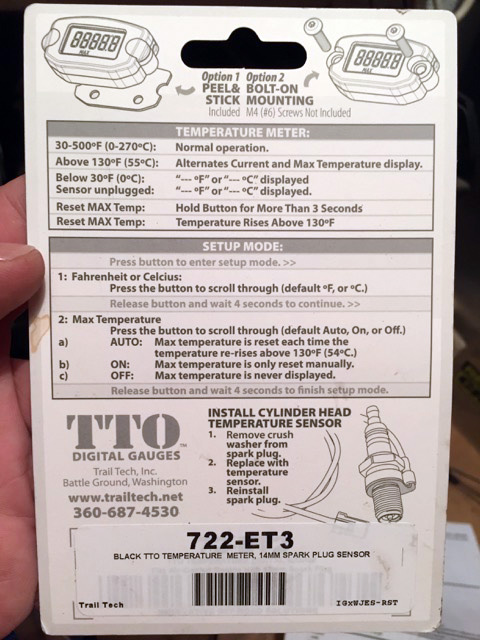
The list included a TrailTech engine temperature gauge (above). IMO it’s vital to be able to know an engine’s temperature – air or water-cooled; I don’t want to hope some warning light might chip in just as steam starts wafting up from under the tank (as happened to a 450 KTM in the desert once, left: engine fried, end of his ride). The gauge’s pick-up sensor can be mounted anywhere very hot including splicing into the radiator hose to read water temps – all you’re really looking for is a representative value from which to evaluate a normal reading.

tecktemp

If it starts straying into unusually high figures you can choose to back off, or even stop and turn into the wind at tickover. On the ride back to London in a backwind gale the temperature varied from 85°C up to 115°C flat out or at the lights, but usually around 100. Another handy thing is it reads even when the engine’s off – a handy air temp reading when camping.
At the same time one fan blade got tippexed white to make it easier to see at a glance if it was spinning when it should be.

wr3-12v
wrr-ram

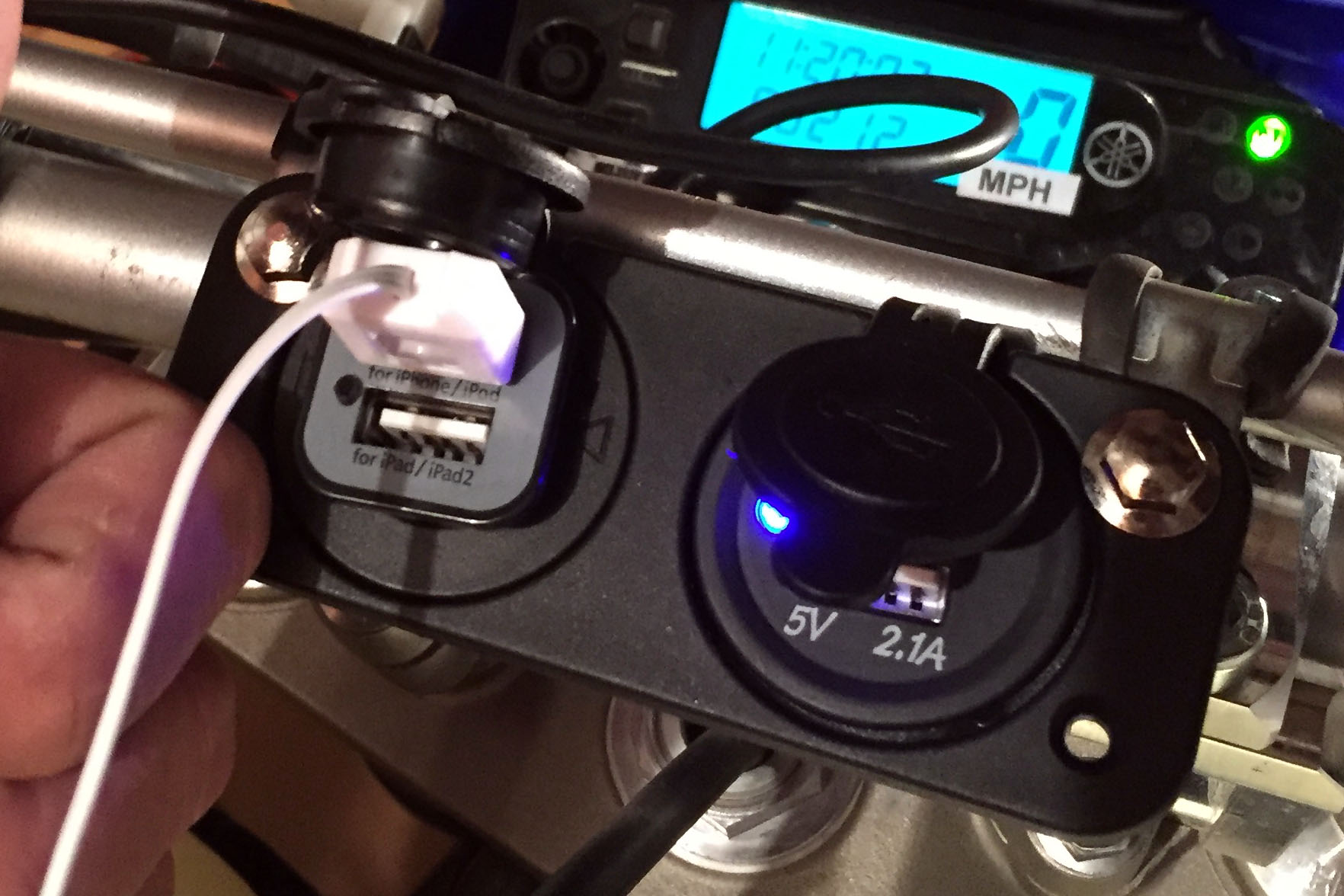
A RAM mount and wire for my Montana got hardwired in (left) to guarantee a reliable, clip-on connection, and some 12-volt and USB plugs got added to the cross-bar (right). Got no actual use for them but handy to have. There’s also a DIN plug tucked in by the seat base to power a heated jacket and the tyre pump.

wrr-krigovls
wrr-krigstrap

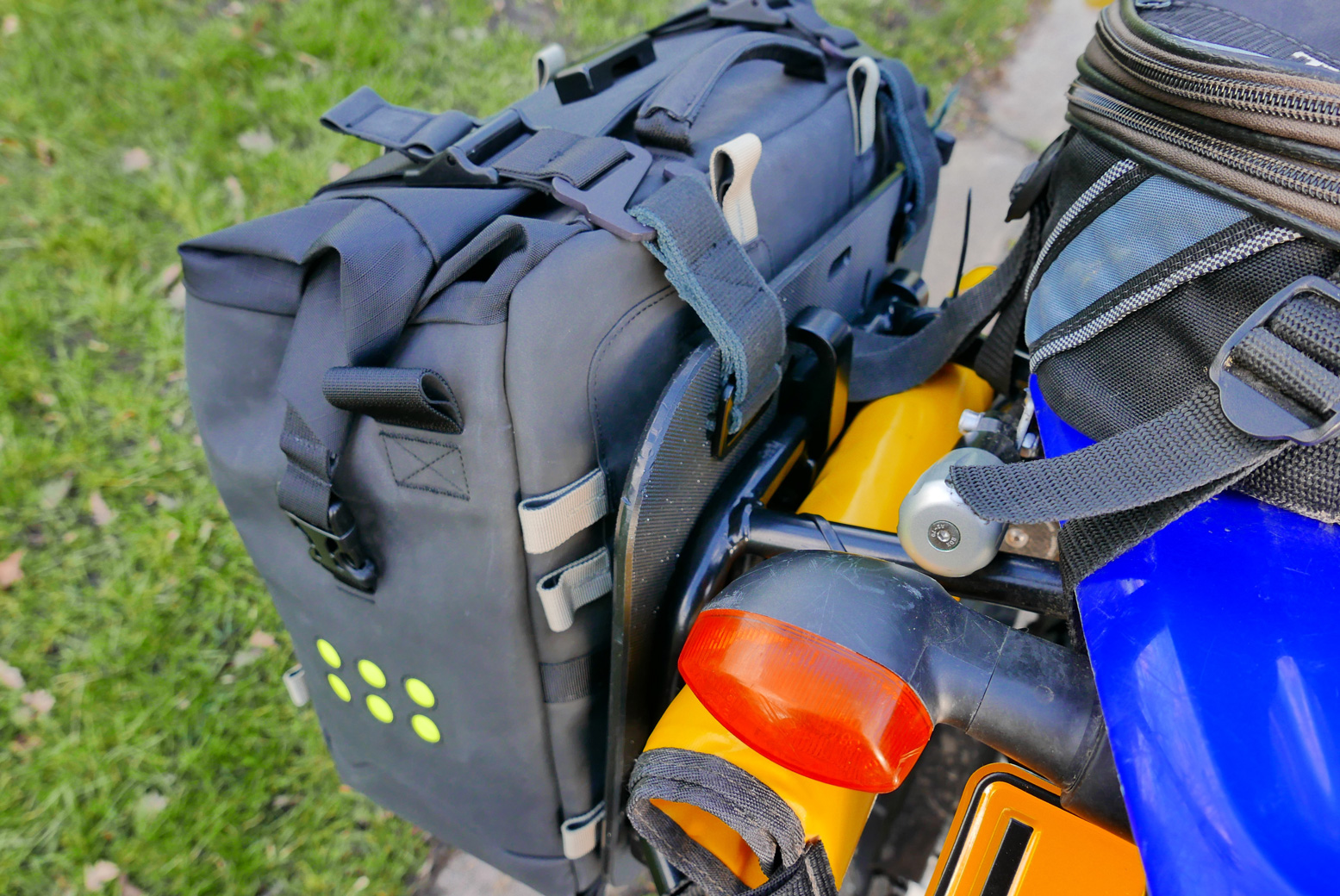
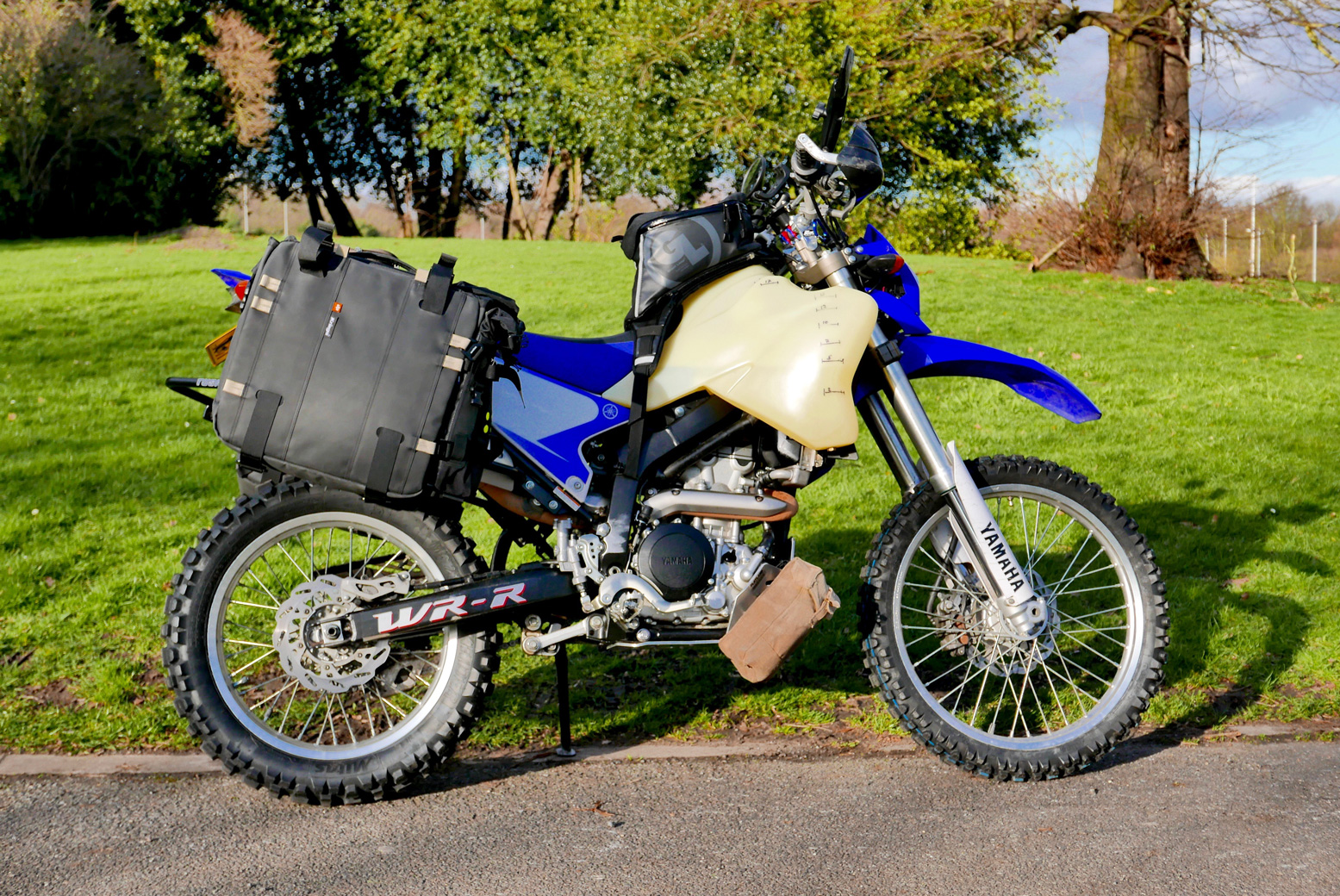
I’m going to be trying out some new Kriega Overlander-S panniers – OS32 – which mount and strap on quite cleverly to an HDPE platform that’s clamped to the rack. I’ll do a fuller review of the system once on a road a couple of weeks, but as you can see, the volume means a large tailpack isn’t needed, even with basic camping gear. I find that makes swinging a leg over the high saddle easier and a less cluttered look.

wrr-bork
doris

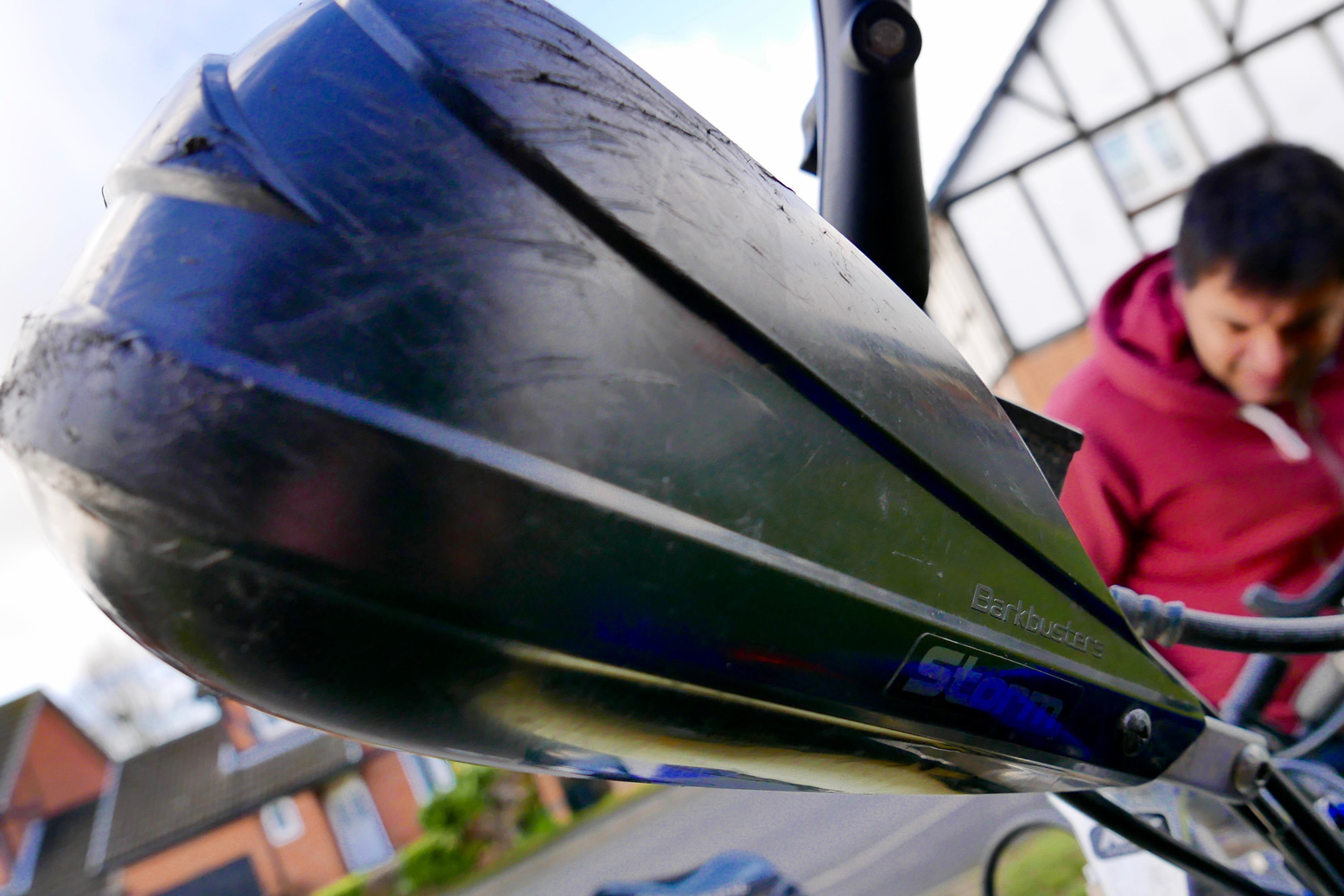
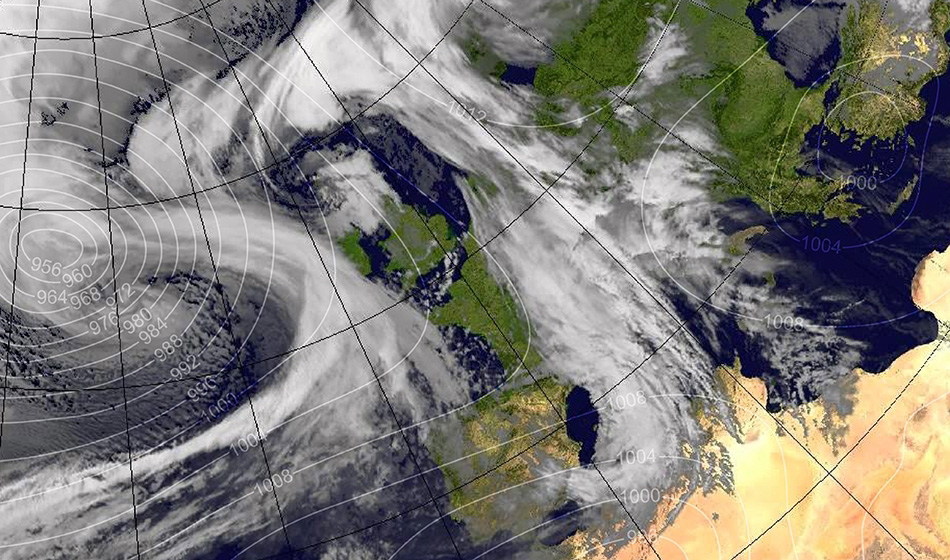
My trusty old Barkbuster Storms are getting what must be their fifth fitting on the WR. Whatever came with the bike was all plastic and not really up to the job. And before I’d even loaded the bike to head back to London, the Barks saved the day when a gust from Storm Doris (right) blew the WR over.

wrr-lamp
wrr-sand

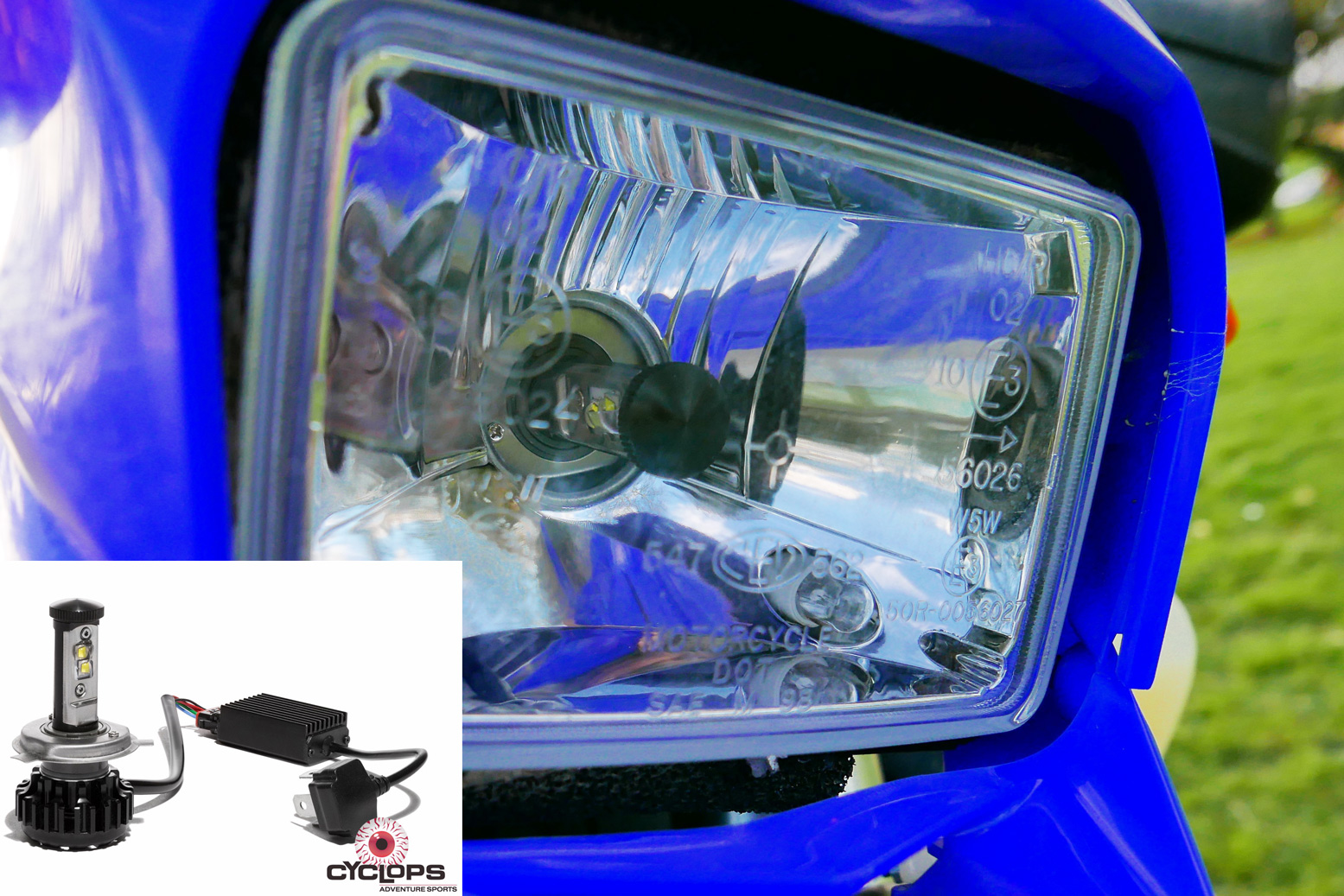
The headlight bulb has been uprated to a Cyclops H4 LED (on ebay) which emits a bluey light, and they promise will cut through the night sky like a meteor shower as well as consume less juice.
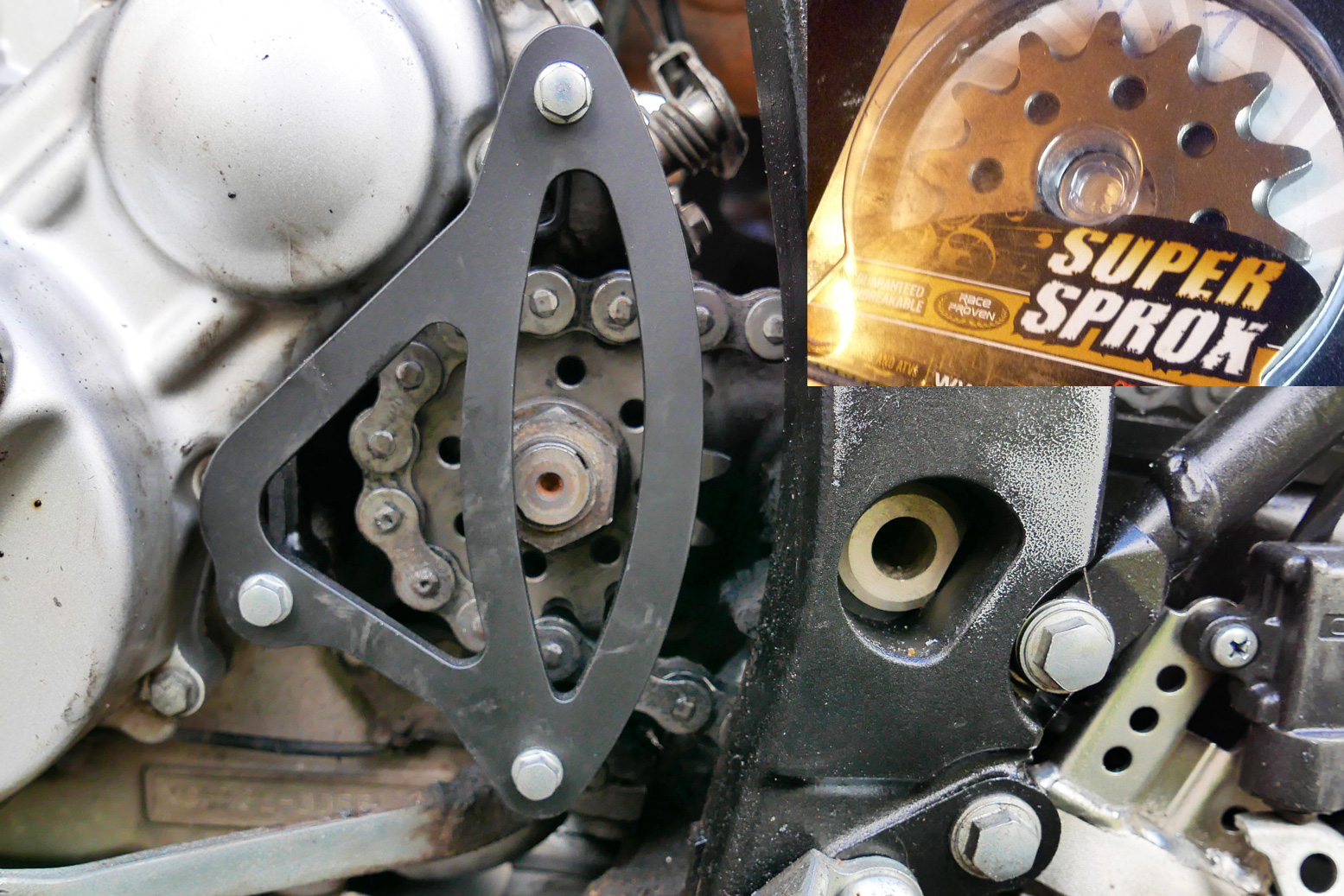
And down by the front sprocket I added a Sandman case saver kit from Basher in Missouri. I’m starting on a 14T (on 46), and swapping to a 13T (about 10% lower gearing if the speedo error is any judge), should the need arise.

wrmc23fr
wrr-rokrider

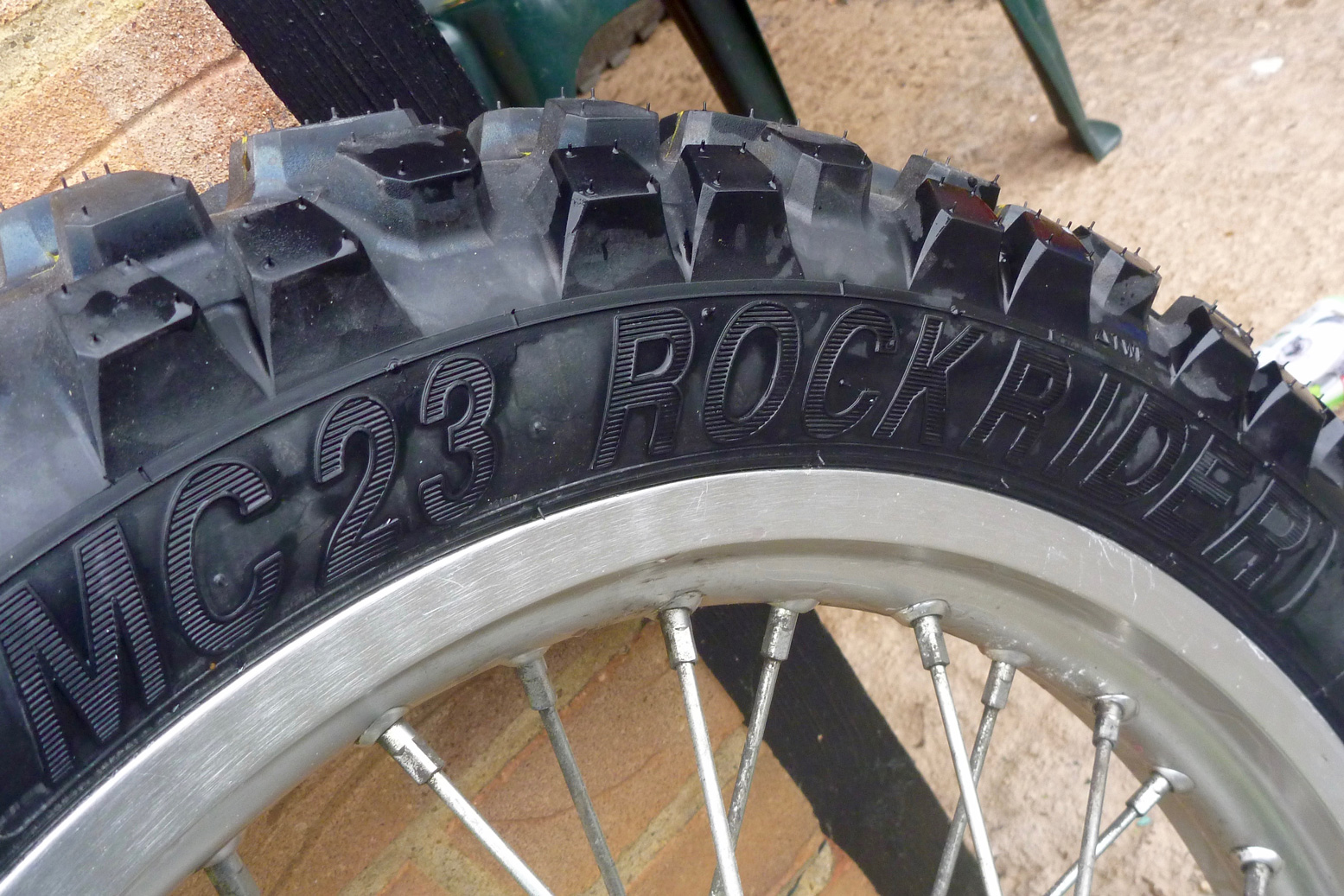
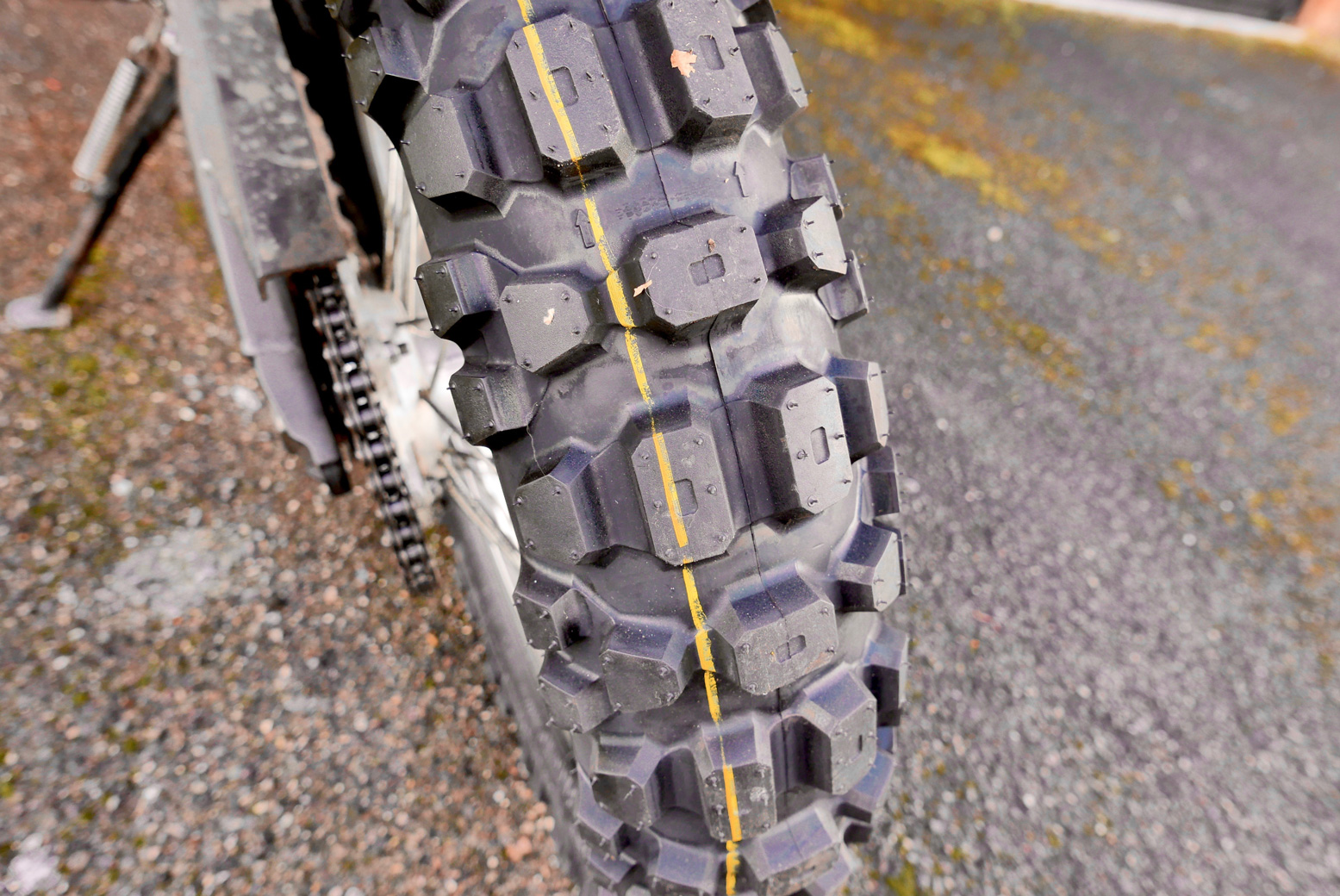
Tyres, you ask: I try never to use the same type twice and this time around I’m on Mitas (formerly Sava) MC23 Rockriders. I was hoping to go tubeless until I saw the back DID rim doesn’t have the lip (in which case this would work, were it in my size). I’m confident the Mitaii will easily last the trip of about 5000km, helped with a splash of Slime and a few Hail Marys.

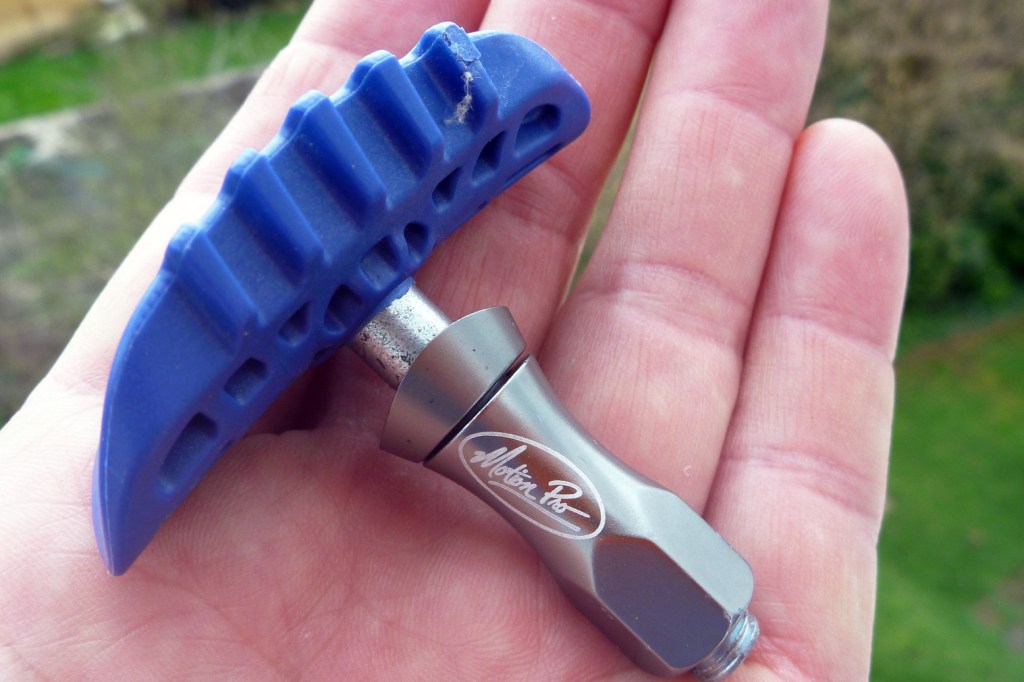
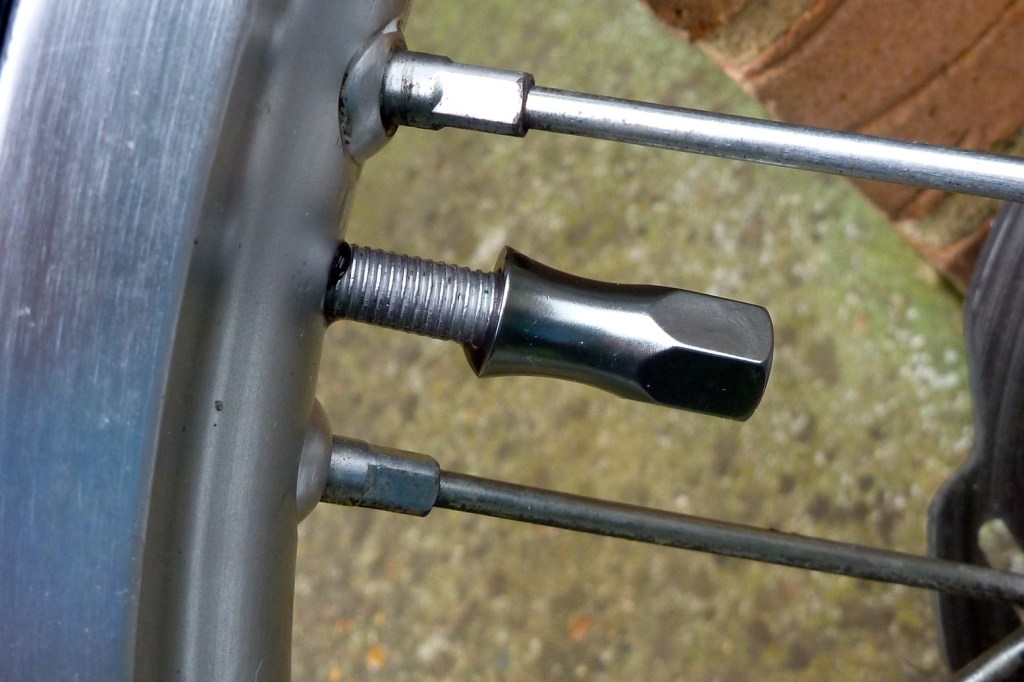
I’ve also added a dinky Motion Pro rim lock on the back which weighs next to nothing, but will hopefully bite when the need arises. I can’t see me running pressures low enough where the scant torque of a WR250 will be able to pull the tyre round the rim. The whole point of running knobblies like the MC23s is – away from deep sand plains and dunes – you will get great grip on the dirt without the need to run them at 1 bar and risk flats.

wrr-fandr
flyandride

And that is that. The rest of the adaptions are here. The bike is on its way to Malaga in a Fly and Ride artic which, at £595 return, actually works out quicker and cheaper than a ferry-and-Spain crossing.

fj12

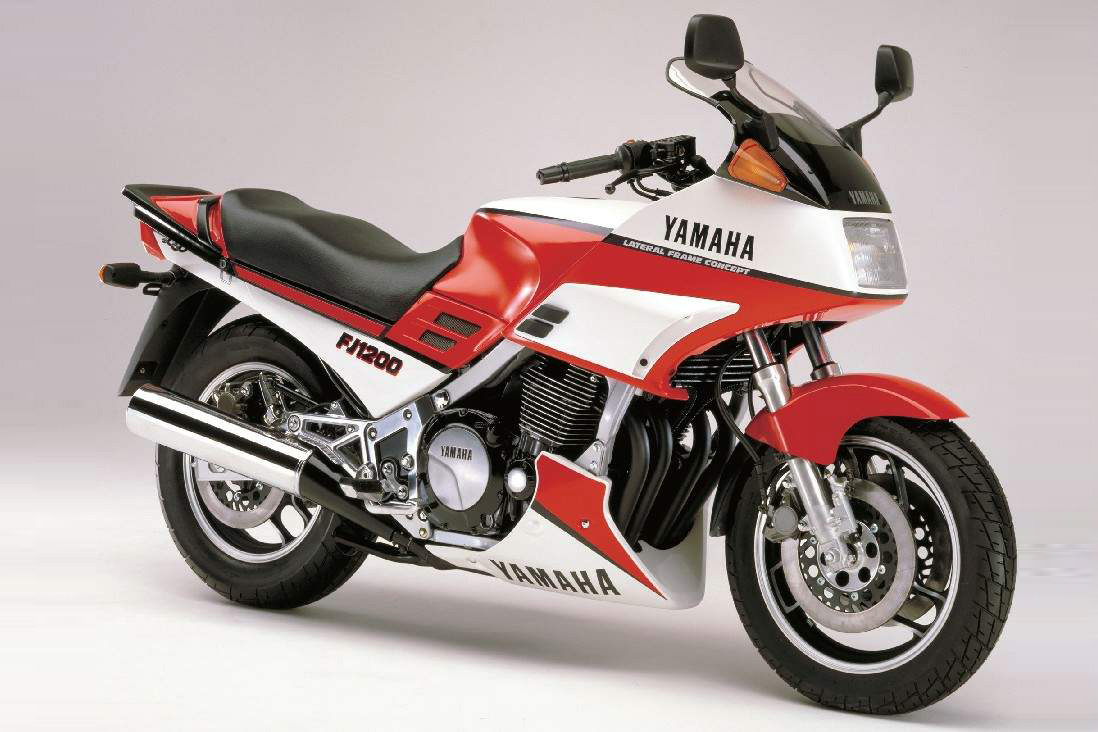
I readily admit the WR is no FJ12 on the open road and makes you feel a bit vulnerable dicing with fast European highway traffic – but then again it won’t be an FJ12 on rough backroads or the pistes either. So far I have a good feeling about the untried WR-R: I love the lightness and the better than average poke for a 250, along with great mpg and desert-ready suspension and tyres. But of course, I’ll miss the comfort of last year’s La Mancha-munching CB500X. What we have here is a specialised, lightweight desert touring bike.
Stick around to see how the WR performs in Morocco and, if it behaves, in Western Sahara too.

wrr-wrr