Category Archives: Adventure Motorcycling Gear Reviews

Stuff I’ve actually used

Tested: Michelin TPMS review

Product withdrawn

After problems with the original 2019 kits (explained below), Fit2Go (who sold the Michelin branded product) updated their TPMS software for 2020. They also redesigned the magnetic mounting following negative reviews on amazon. In 4000 miles of riding on and off road, the magnetic fitting wasn’t a problem for me.
I tried the seemingly identical Mk2 version in March 2020. See pros and cons, below.

Update Summer 2023: UK Michelin no longer list TPMS for bikes and the Fit2Go page says a new version is due in 2023 after the original Michelin branded product was discontinued following scathing reviews.
michelin-tpms

Tested: Michelin TPMS (tyre pressure management system)

Where: Spain and Morocco 2019 and again in 2020 and 2021

Cost: £80 (kits suppled free by Michelin for review)

Weight: Negligible

In a line: Once you discover TPMS there’s no going back. (More here)

michtpms1

What they said
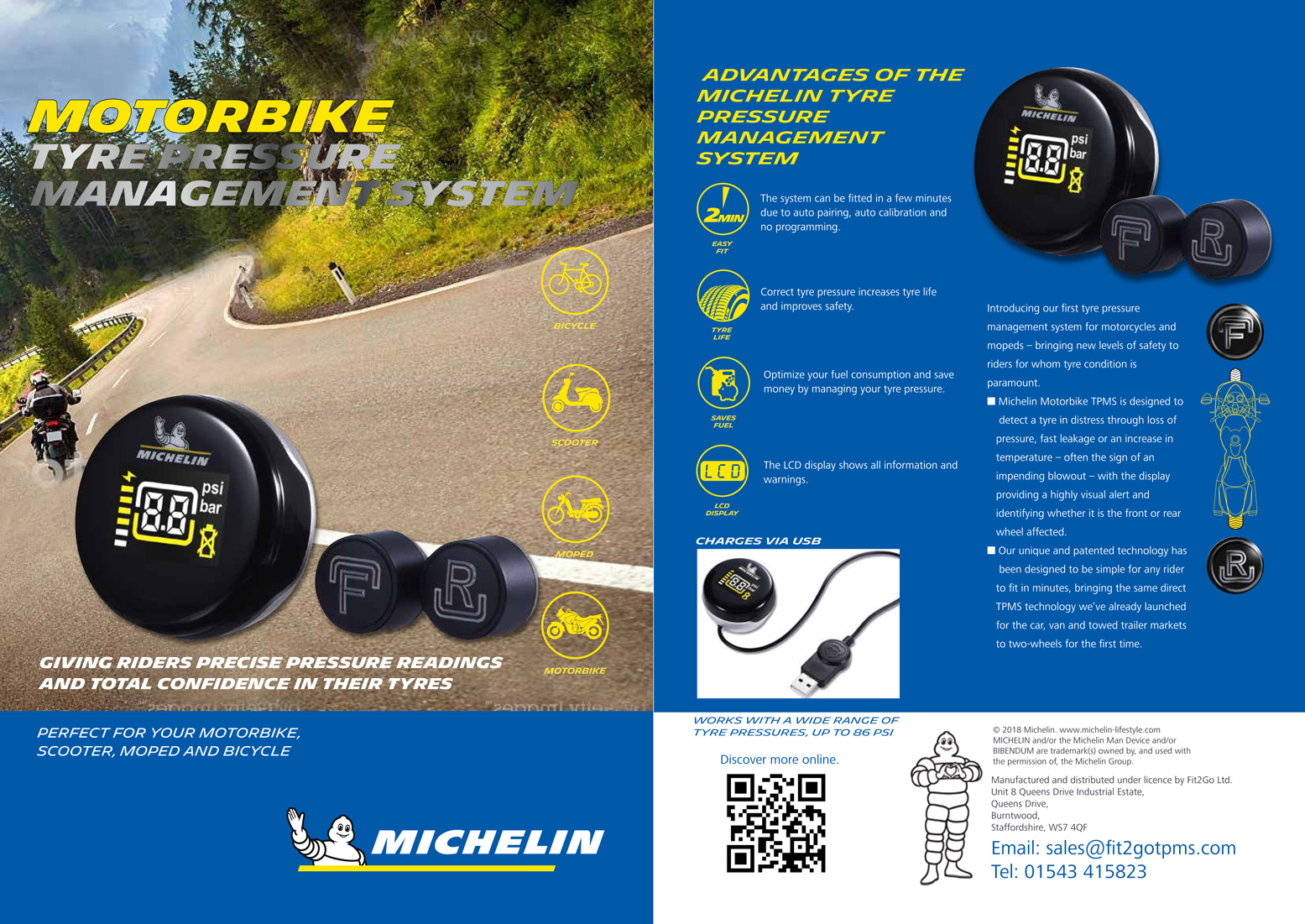
Introducing our first tyre pressure monitoring system (TPMS) for motorcycles, mopeds, scooters and all two-wheel modes of transport – bringing new levels of safety to riders for whom tyre condition is paramount.
MICHELIN TPMS – Bike detects a tyre in distress through loss of pressure, fast leakage or an increase in temperature – often the sign of an impending blowout. Its compact display flashes as brightly as a mobile phone torch if it detects an issue, plus identifies whether it is the front or rear tyre affected.
Our patented solution can be fitted in less than two minutes, bringing the same direct TPMS technology already proven in the passenger car and van markets to two-wheels for the first time.

This wireless system needs no programming and features a compact LCD screen which fits into a magnetic mount placed on a prominent part of the bike. The fully sealed and buttonless device can be quickly removed for security and is small enough to fit in a pocket. The display offers a battery life of up to three months, with the USB-powered inductive charger making it simple to top-up.
Once fitted, the unit displays the pressure of both tyres, in either psi or bar, toggling between the front and rear at set intervals.
Riders will see a low-pressure warning if a tyre becomes under-inflated by 15%, an enhanced alert when the pressure either drops by 25%, or if over-inflated by 35% or more. There are also alerts for high tyre temperatures or fast leakage (at least 2 psi per minute).

What I think:

tik

• Real-time tyre pressure data at last
• USB rechargeable – should last a couple of months
• No hard-wiring so fits in a couple of minutes
• Magnetic retaining dish secure off road
• Reads bar or psi
• Rated up to 7.5 bar (100psi+)
• Various warning displays
• Mk2 2020 kit paired up fast and worked seamlessly

cros

• In 2019 original and replacement units played up after a few days (see below)
• Doesn’t live-read from a static start (e.g.: overnight). Wheels need to turn first
• Expensive at £80, but there are both less elegant kits and pricier kits out there
• Green/yellow on black background hard to read unless under your nose
• Valve-cap lock-nuts complicate tool-free topping up of air
• The valve caps can be too shallow (not enough threads to grip the valve body)
• On the 2020 version the F&R display interval was too slow for a quick glance
Review
There are some metrics I like to know while riding: speed, engine temperature, fuel level are the obvious ones.
Now wireless technology has enabled inexpensive TPMS kits to display live tyre pressure readings, too. This is something that’s really useful to.

tpmsp1

I only realised how much I missed my Michelin TPMS kits once they both packed up mysteriously after a few days in Morocco.
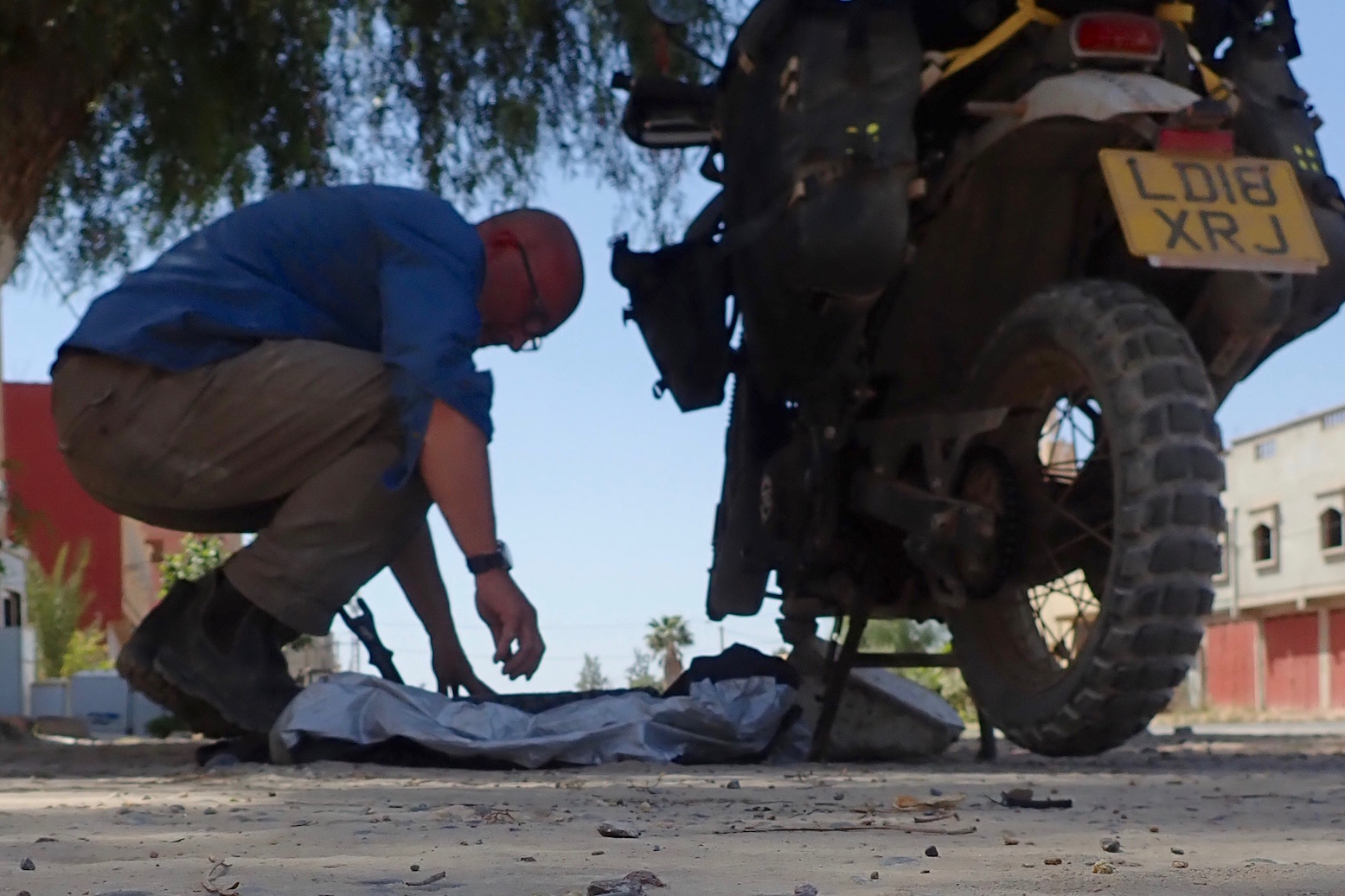
A few days later I hit Tubliss tyre troubles in the middle of the desert. Luckily I wasn’t alone, there was a road 25kms back, and I was able to ride on the flat tyre slowly for hours to the coast and fit an inner tube. But being forewarned of low pressures or other tyre anomalies is what TPMS is all about.
I headed back north and a day or two later the tube slow punctured, then went suddenly after a dirt road short-cut pushed it over the edge. This time I couldn’t ride the collapsed tyre ten feet. Cue more laborious roadside repairs. This is why we like tubeless.
Because you never, ever get just a single puncture, I’d wisely bought a spare tube and was back on the road in 40 sweaty minutes. But especially with a slow puncture, with a TPMS I’d have been aware of it much earlier.
michtpms1
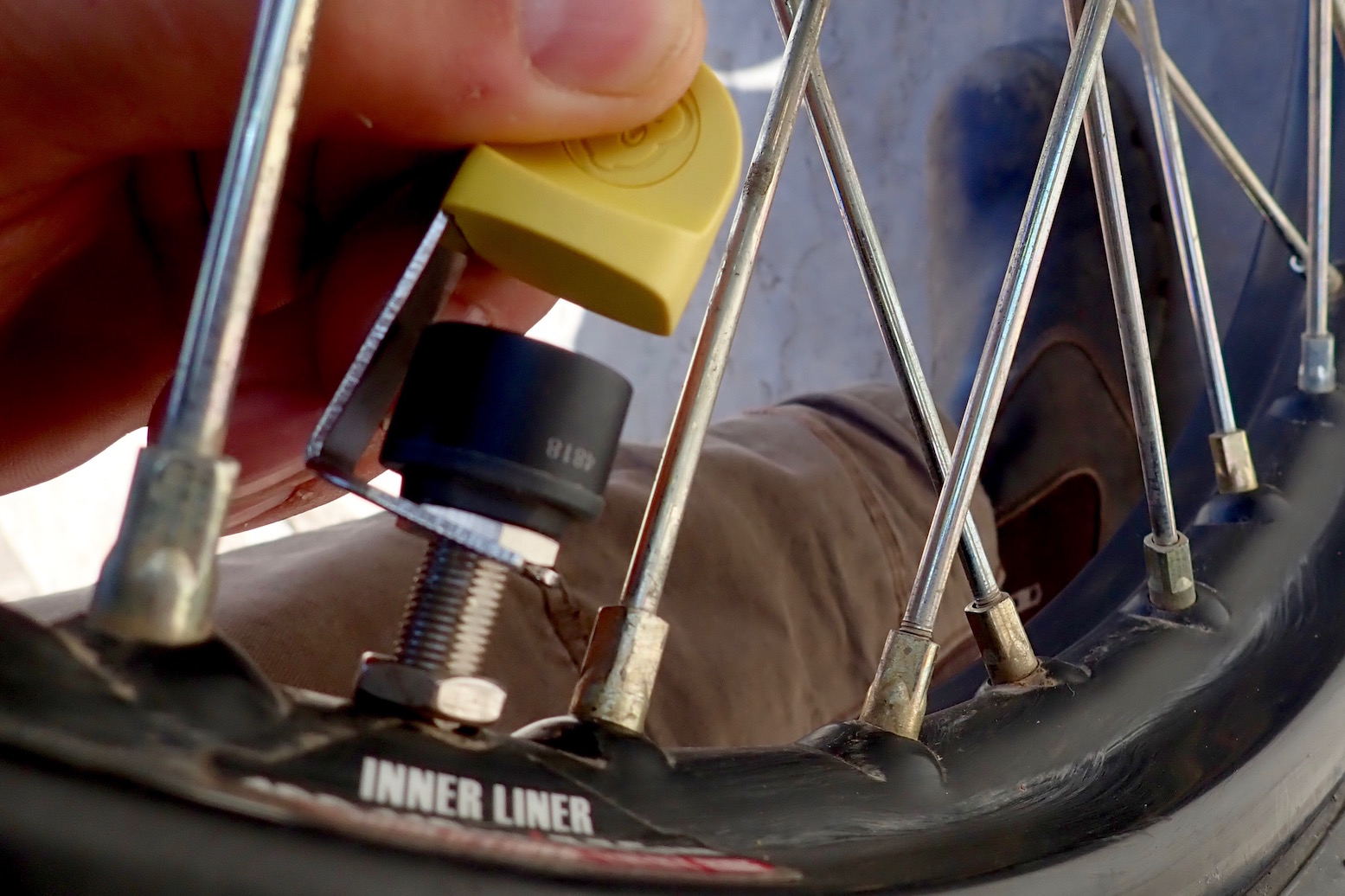
Lock nut is a faff

Michelin TPMS
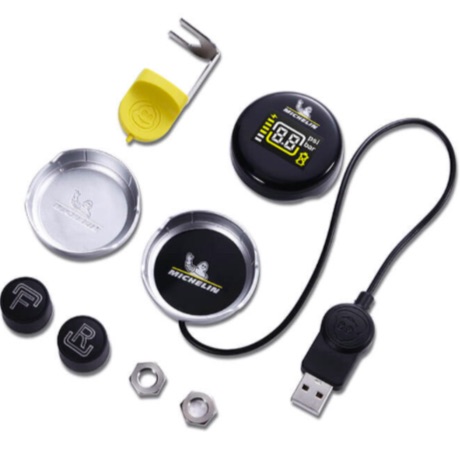
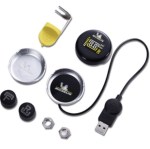
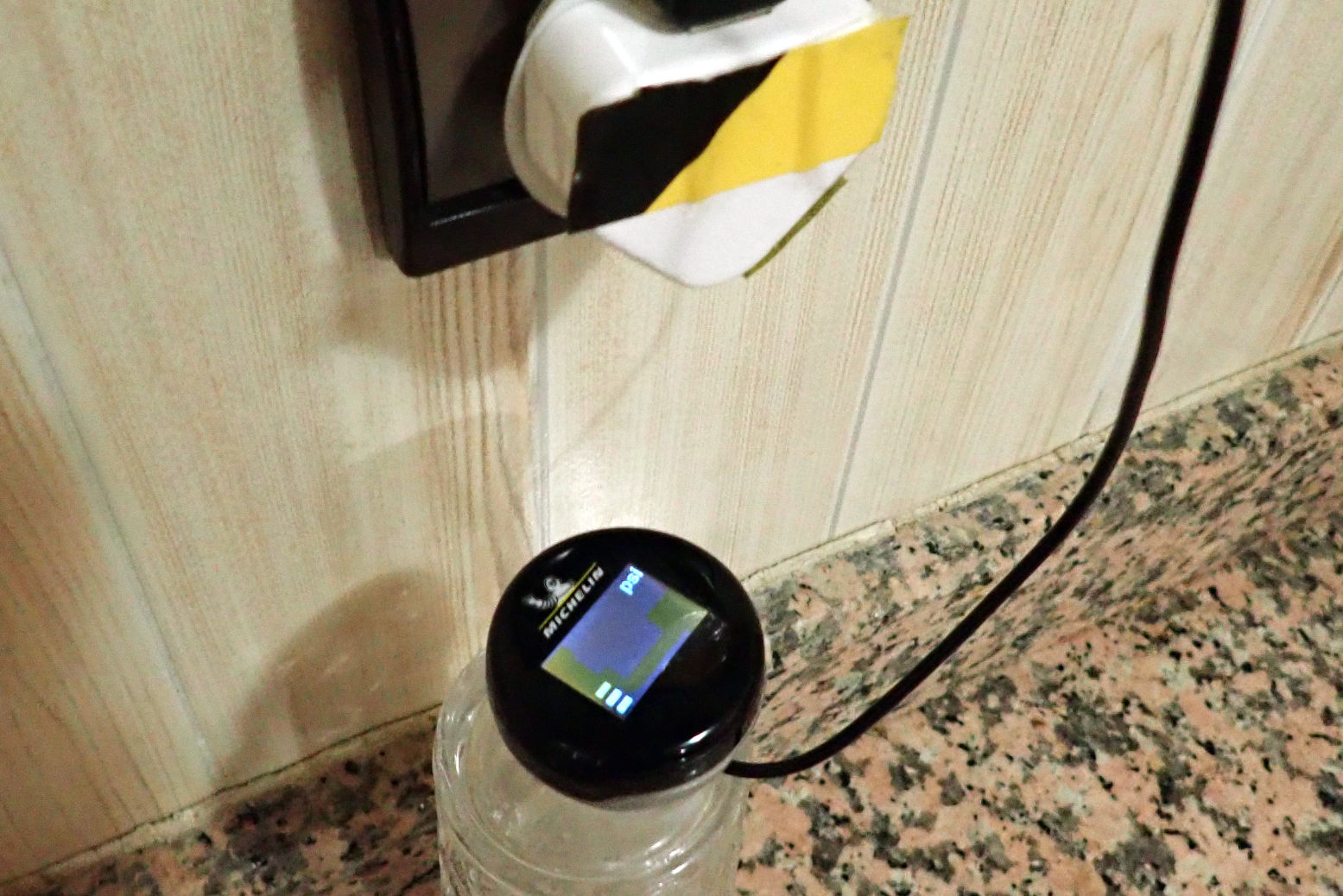
The Michelin kit was made by Fit2Go TPMS, an official global licensee of Michelin. It was composed of two over-sized valve caps marked F and R. You screw them on finger tight to the appropriate wheel and lock them off with a valve stem nut (yellow tool and nuts supplied; left). The round display module sits in a stick-on magnetic dish fitted wherever suits your eyeline and an appropriate surface. Putting the module in the dish activates the display: usually battery level (said to last for 3 months) plus front and rear pressures which flash up alternatively every few seconds. You may not get a pressure reading until the wheels are turning. There are no buttons or switches; place the module in and out of the dish three times and the display changes between bar and psi, though it may take a few minutes to read.

Playing up
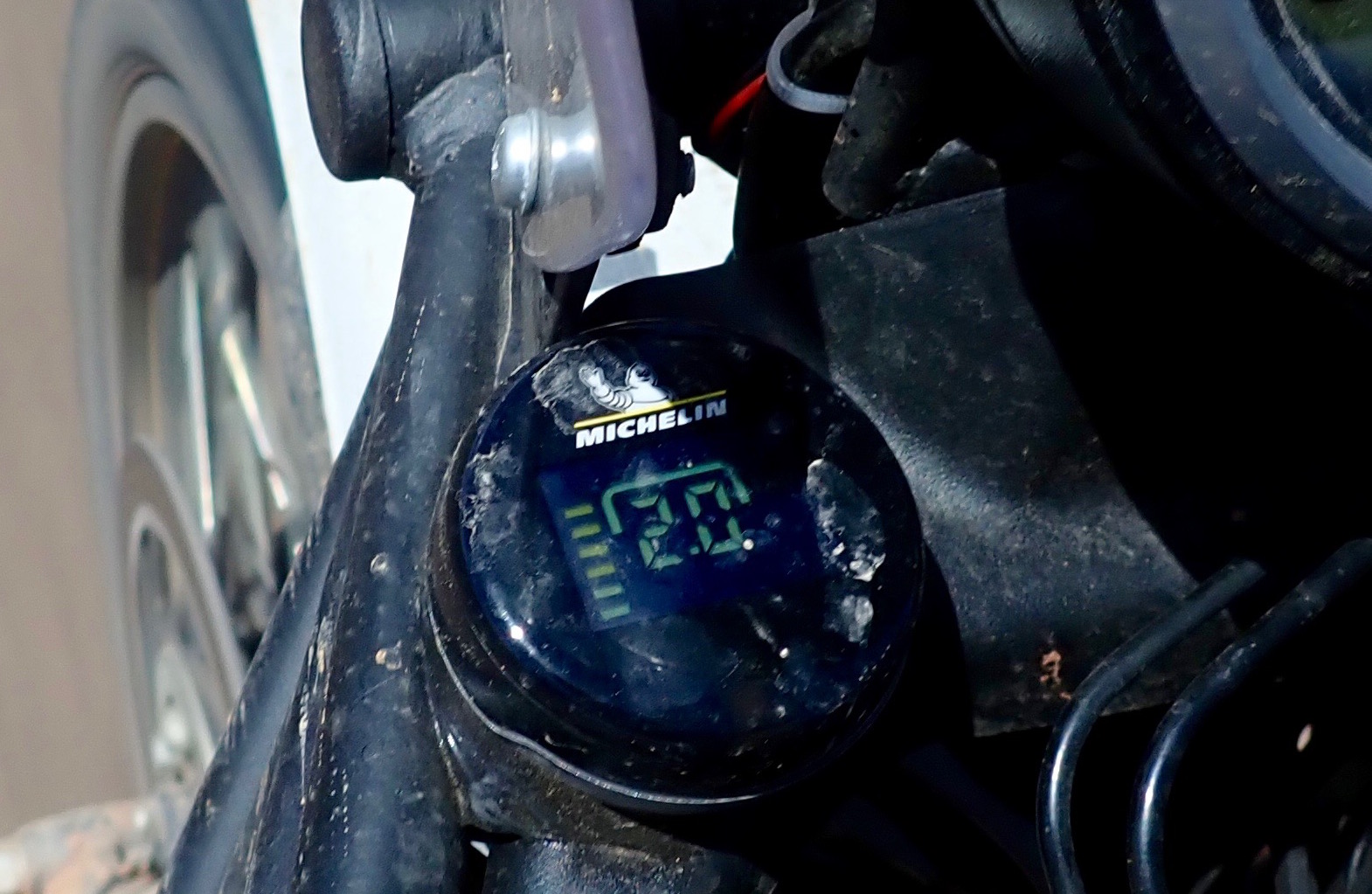
The first kit I had was fully charged by me, but on fitting in Spain took many hours of riding to pair up and show pressure readings. That would be inconvenient if you regularly removed the module to save it getting pinched. Once things worked, I left it in place. (As I was only out for a month, I’d not brought the USB recharge dish.) Fitted flat like a plate on a table, it didn’t budge on rough tracks but was hard to read at a glance; at an angle like the bike’s clocks would be better, and probably still secure. Or there’s always the tank bag. I’d also find black digits on a light background easier to read – like my Trail Tech temperature gauge, below right. Ten days in, after briefly removing it, the module went blank.
A replacement kit was brought out to Morocco, appeared to show a nearly full charge, and this time paired up in seconds and flipped to psi with no bother. But it also went blank after just five days. Neither unit was more than half discharged. I decided to put the original unit into the USB recharging dish from the replacement kit on the off chance, and it responded by charging from ¾ full (as it had been when it went blank). After just half an hour it was fully charged. Back on the bike it showed pressures in the original bar, and on changing to my preferred psi, displayed that too after about 20 minutes of being blank.
This suggests the display modules might discharge in a few days rather than three months, but while still indicating they’re more than half charged. Popping it in the recharge dish revives it, but it can be slow to pair up. This discourages you from removing it, if it indeed discharges when immobile. The blurb doesn’t advise removing it when not riding, but if it does discharge unused, it’s not reflected in the battery level status display.
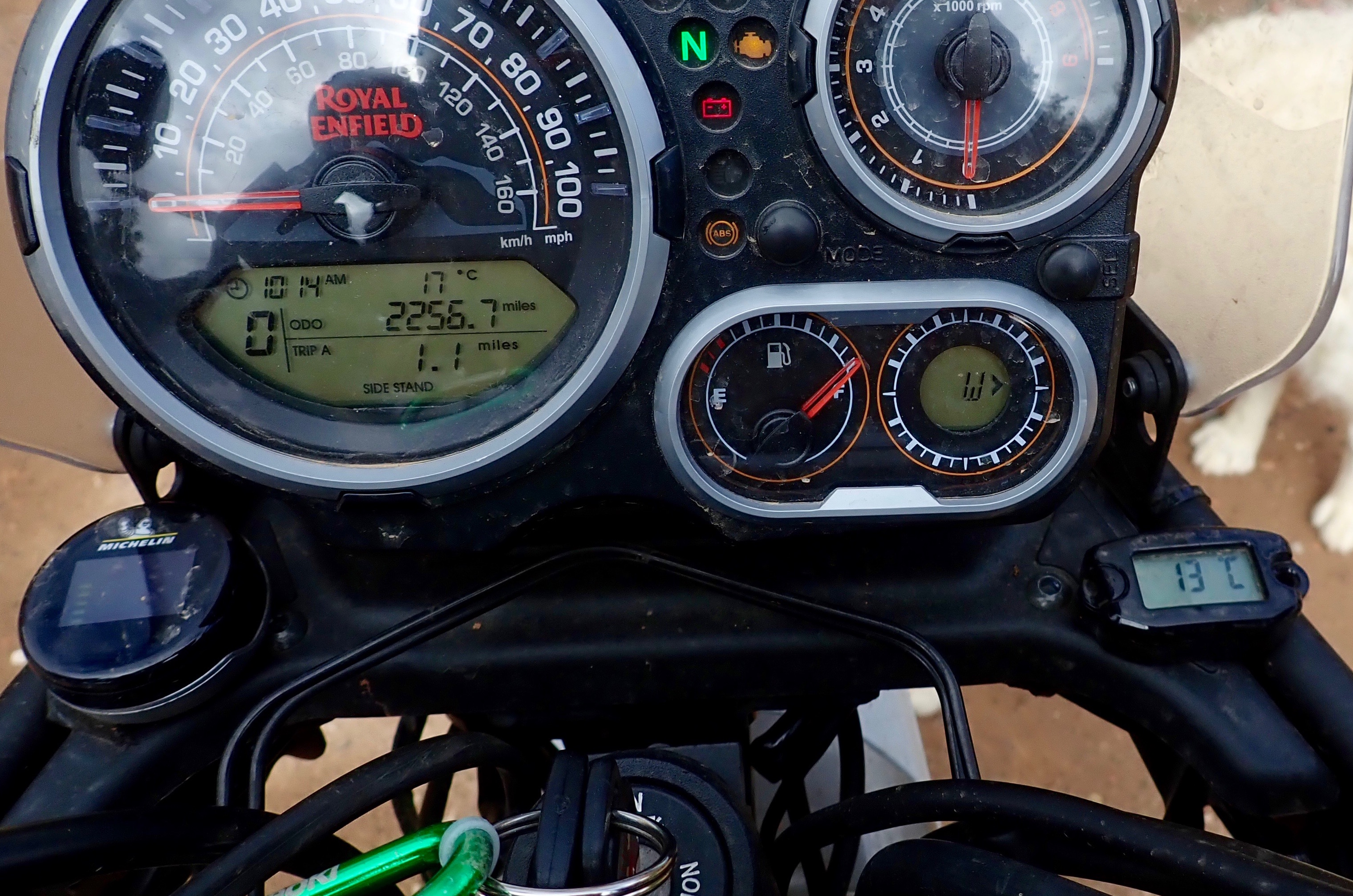
Especially when travelling in the AMZ where – as I found – tyre troubles can leave you up the creek, knowing the state of your tyre pressures is less a convenience and more an important safety measure. Now, when I could swear I have a puncture, I glance at the TPMS and relax; it’s just the road surface and my paranoia. Very reassuring. Best of all, the easily fitted and recharged Michelin TPMS kit now makes maintaining your tyres at optimal levels a whole lot easier.
But because my two kits seem to play up, I’d wait a bit before buying one. They sort of work, but not as they should. I sent both kits back to Fit2Go for analysis and will update this review with any news.

Updated kit – 2020

Fit2Go sent me their revised kit which I used on my Africa Twin ride in Morocco in March 2020. The kit was welcome as again, I’d DIY converted my rear tyre to tubeless and so wanted to keep tabs on pressures. (The wheel lost 20% over a few days – fixed by adding Slime).
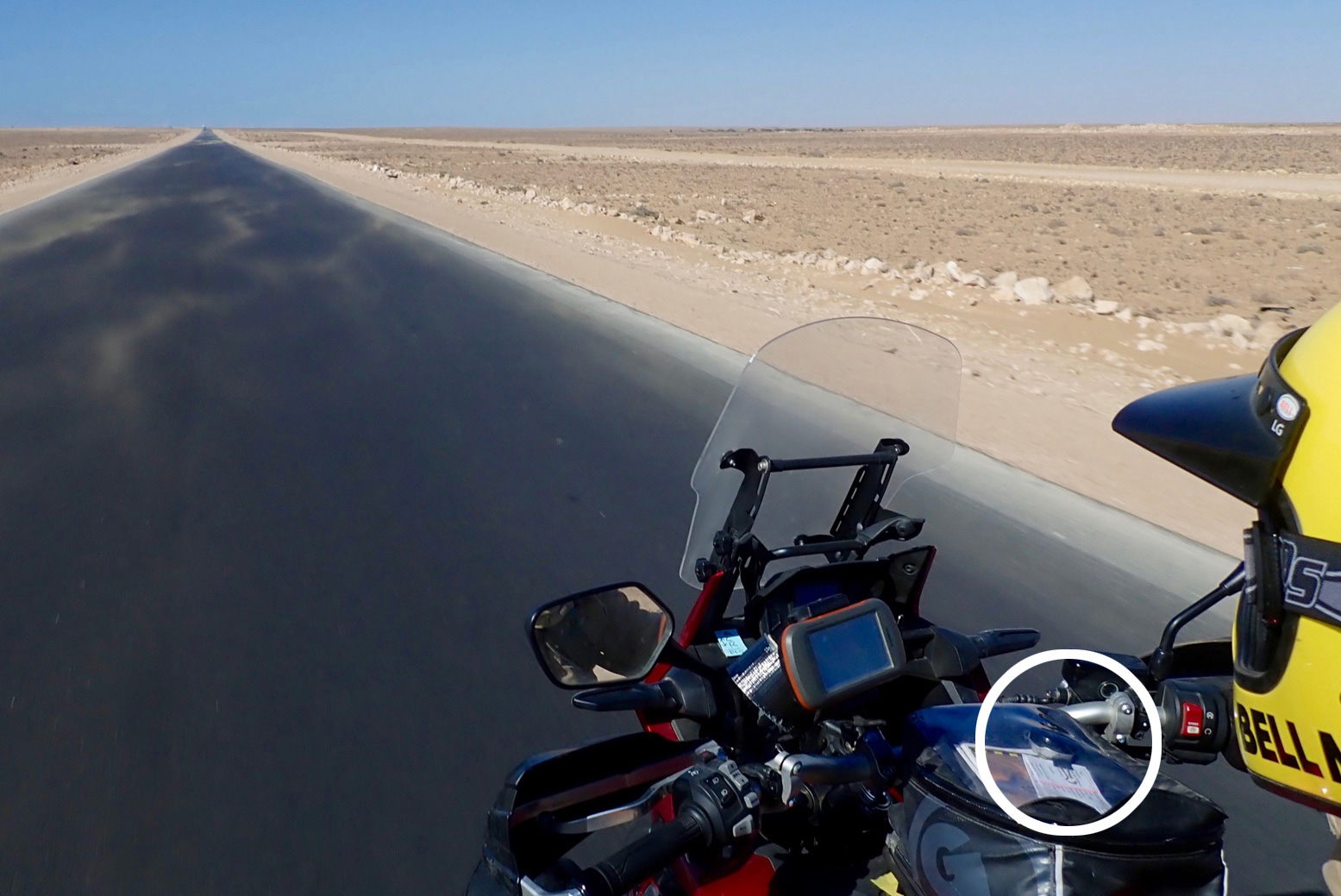
The kit looks identical but no problems at all this time. Without making an angle bracket, I couldn’t find a secure and legible position on my AT (red arrows, left inset below) so put the display and dish inside the clear lid of my tank bag (below right). The opaque vinyl made it hard to read easily but there was no danger of it falling off. Had that ride not ended prematurely I’d have worked out some legible-angle bracket in the cockpit or stuck the dish on top of the tank bag.
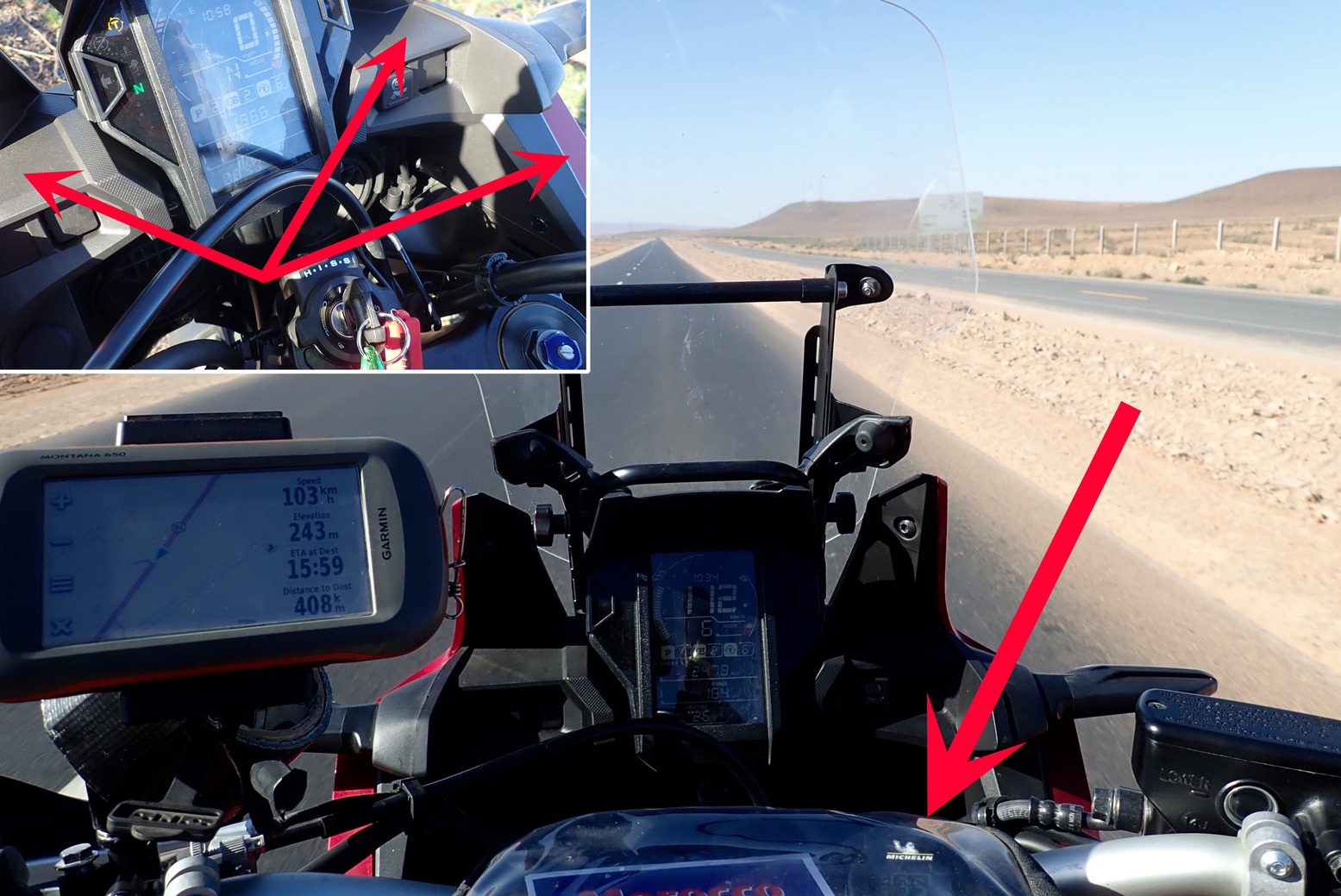
Places to fit on a AT

The only complaint is that the display intervals seem slower than before: 10 seconds on Front then 10 on the Rear. It means you need several glances to ascertain both pressures, whereas a higher flip-count might mean you catch both in one glance. I still think the display could be brighter, too. Other than that and the high price (which dropped for a while), all good.
Update 2021
I got my AT running again in October 2021 and needed to recharge the TPMS unit which after 18 months would have been flat. It recharged in less than two hours.
But when it came to topping up the tyres after 20 months, I had to faff about with that cheap valve cap locknut removal tool, and then found the rear TPMS valve cap wouldn’t screw on to the rear tyre’s valve body. I remember having this problem last time I topped up in Spain, February 2020. It felt like the TPMS valve cap was too shallow: there were not enough threads to bite onto the tubeless tyre valve before the pin in the cap pressed on the tyre valve stem and let the air out.
It could be a problem with whatever TL valve I have on my tyre. In Spain I’d managed to over-inflate the tyre and then cram the cap on before too much air escaped. This time in baking hot Marrakech, I didn’t have the patience to re-learn the knack and gave up on re-fitting the TPMS.
But travelling alone on road and trail over the next week, I sure did miss not knowing what my tyre pressures were doing, just as I’d miss not knowing what my fuel level or engine temperature were.
I’m not finished with TPMS yet: I will give it another go on the 300L once it gets its tubeless wheels.
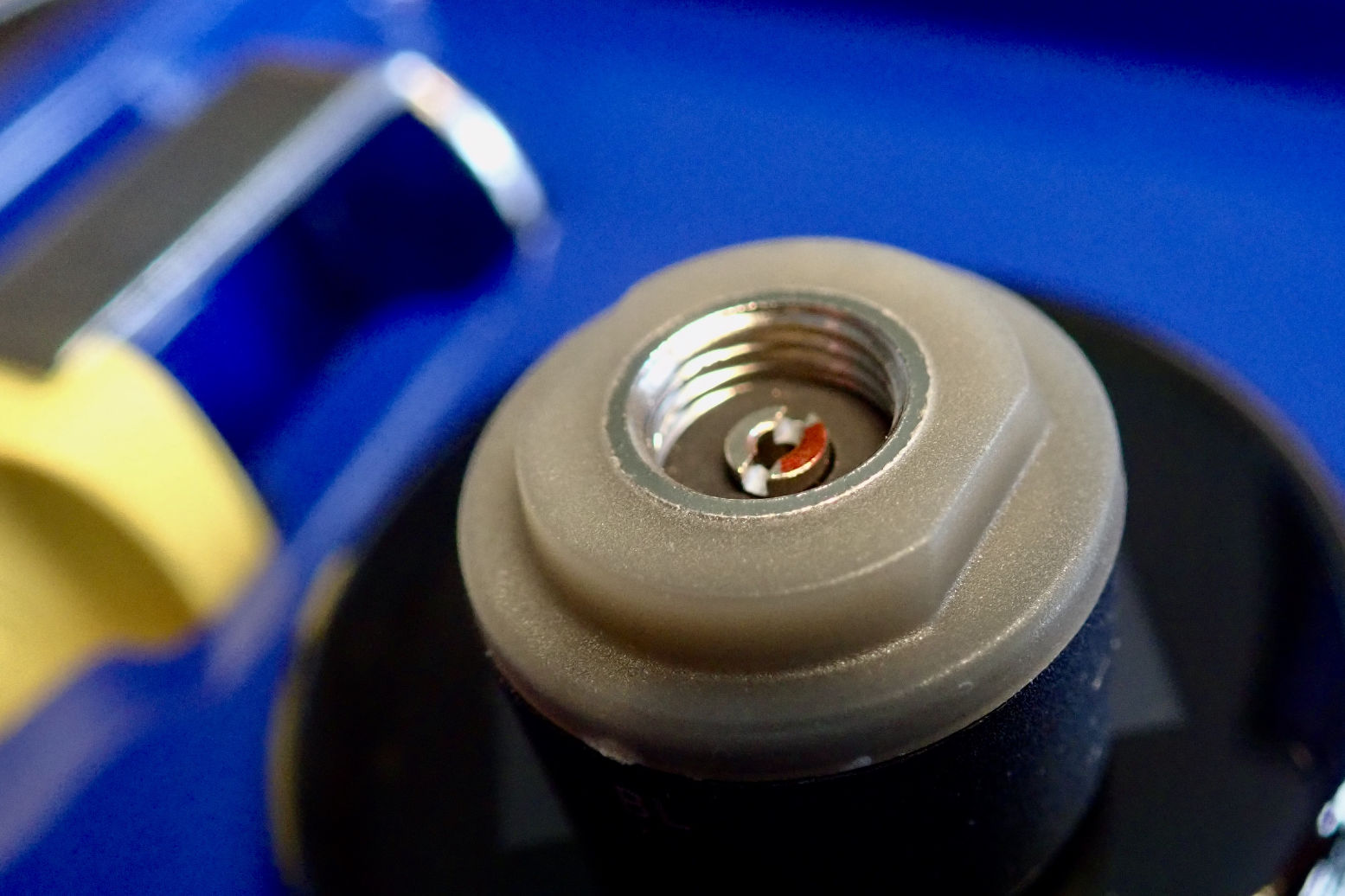
Not enough threads in the TPMS cap to grip the valve before air is released

Tested: Bell Moto III review

See also:
Airoh TR1
XLite X420 GT
Bell Mag 9
HJC i30

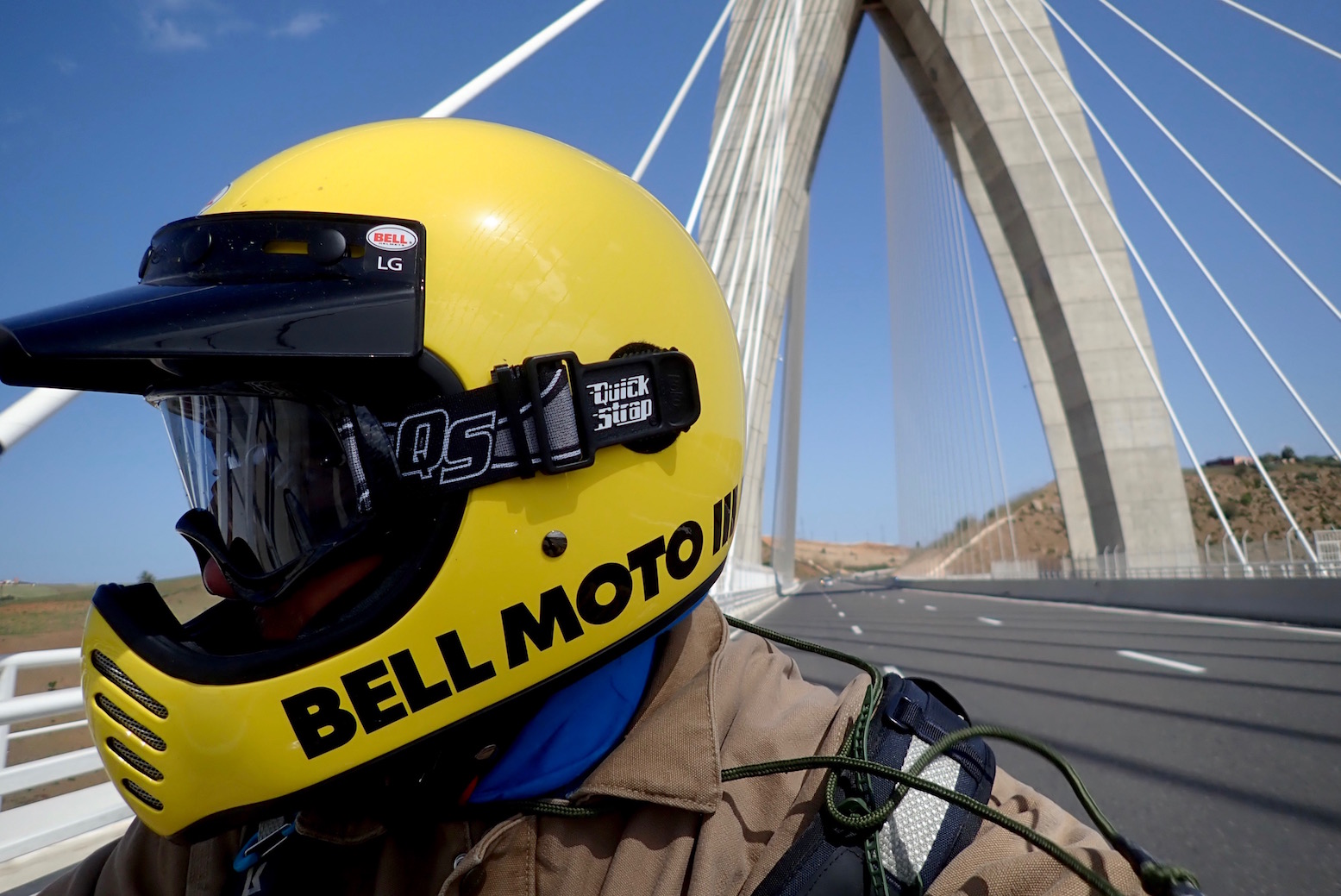
OLYMPUS DIGITAL CAMERATested: Bell Moto 3 helmet

Where: Spain and Morocco

Cost: £185 ebay

Weight: 1650g

In a line: Looks cool and works great with Qwik-Strap goggles, but not practical.

OLYMPUS DIGITAL CAMERA

What they say
The iconic legend has returned! When the original Moto-3 was created back in the late 70s it was a product ahead of its time. Quickly becoming the industry standard in performance and style, today’s Moto-3 is everything it was style-wise, with the added benefits of modern safety and production advancements. From the fiberglass composite shell to the EPS-lined chin bar, we left no detail unpolished. The solid colors use the original style terrycloth liner, which is removable and washable.

What I think:

tik

• Looks cool
• Feels light
• Chin guard not too close
• No visor hinges or other fittings to break
• Works well with Qwik-Strap goggle straps
• Good price, compared to recent X-Lites
• Yellow

cros

• D-rings a bit fiddly and pin-down stud came away
• Not full visor protection; the old bug or chip will get through
• As unaerodynamic as it looks


OLYMPUS DIGITAL CAMERA

Review
For years I’ve been mostly wearing a costly open face X-Lite 402 or an inexpensive Bell Mag 9 with full face visors. Best thing is the great visibility and protection plus you leave it on to talk to people (less faff with glasses, too). But sometimes I miss a full face’s ability to be securely cable-locked to the bike via the chin bar (doing so via the D-rings never fooled anyone). And it has to be said thee types lids look good too.
I don’t usually get on with ‘in your’ full face lids like an X-Lite X551 I tried, but after  few thousand miles the Bell Moto III has suited me just fine. The wide aperture and the fact that the chin guard isn’t right in against your mouth makes it unobtrusive on the road while not feeling too claustrophobic when not on the move. Usually I can’t wait to get a full face helmet off my face.
I’ve been riding a Himalayan with a low screen at no more that 65mph, and at that speed buffeting or neck strain hasn’t been a problem. There’s no annoying bobbing around and the wind noise is what you’d expect when riding a motorbike.
Inside the lining has a nice, towel-like surface (terrycloth they call it) and all of it removed and refitted easily after washing – not all lids manage that. Only the double D-rings can be a bit fiddly – I seem to recall the X-Lite does it better.

bell84

I had an original, but beaten up old Moto III in the early 1980s – a nice-looking lid but as cozy as a brick-like inside. Goggles were always a bit awkward to move easily one-handed while riding. Decades later we have Qwik-Straps which I tried in Algeria last year and bought again for the Moto III.

bell1

As you can see in the pictures, two short straps fit in your regular goggle anchor slots, then two separate attachment pads glue to the side of your lid. One is velcro (best fitted on the left); the other is a clip-and-pivot stud. Clip the right strap to this pivot then pass the goggles over your face attach to the velcro. Undo the velcro and the goggles swing down to the right. Or – as I got used to doing – unvelcro and swing the goggles over to the back and re-velcro. Goggles are securely out the way but not dangling. It’s a clever system which definitely helped make the Moto III a much better travel lid than I expected.

I enjoyed riding around in my Moto 3 but after one final ride in Morocco in 2025 (below), I sold it. For what I do: stopping frequently, riding slowly, taking pics and making notes, an open face full visor lid like my HJC suits my needs much more.

ROK Straps – why they work

ROK_LogoWhite_x100

‘Click – Yank; Click – Yank’.
That 4-second procedure is all it takes to securely mount a tailbag or duffle to your bike using a pair of RokStraps. The click of the plastic clips; a yank on the strap’s loose end to tension it against the elastic.
It’s not ROKet science, but watching some riders faff about mounting or removing tailbags by other means makes me realise how brilliant two-part ROK straps are.

Regular adjustable webbing straps also work but fail to account for a loose bag’s tendency to ‘shift & shuffle’ on the back of a bike, which tensioned elastic reliably compensates for. And you effectively need double the length of webbing to loop across frame loops and back.

flintmoto
bung

Before ROK
Back in the Flintstone era but after the invention of string and mild steel, bungies were the next best thing; a bunch of elastic strands encased in a jaunty woven nylon sheath tipped with two coiled and plastic-coated metal hooks. Bungies were such a hit they spawned the daredevil activity of bungy jumping.
BungyBut even then we knew bungies were a cheap and nasty convenience, and sometimes it was the bungy that was jumping back at you. Because they were way too stretchy you had to tension them to the max to eliminate movement of anything heavier than a copy of MCN, and there was no adjustment other than knotting them. Add some UV, rain, more UV plus persistent over-stretching, and over the years several unfortunates have suffered nasty injuries from a stray hook recoiling into their face at 350mph. It’s said that was the motivation behind the invention of ROKs in Australia back in the 1990s.

rok.jpg

Stiff elastic + clips + adjustable strap + tethering loops = ROK Strap

ROK Straps come in two parts: a shorter sheathed section of thick, flat rubber producing minimal recoil. It clips to a regular webbing strap with an adjustment buckle and best of all, both chunky sections end with a sewn loop to thread round a subframe or rack tube. Result: all pieces of ROK Strap are always attached to the bike (but remove easily) for lashing down loads quickly and reliably.
At the end of a long ride when you can often be weary or forgetful, just click your two straps apart, lift off your bag and stroll into a velvet-lined riad for a poolside aperitif while others are still fumbling with buckles or stumbling around clutching their eye in agony. It can be that simple. A pair of 16mm, 1.1 metre (42″) ROKs (above left) got for 15 quid discounted at SportsBikeShop. Rok On.

ort - 3

Tested: Ortlieb 30L Travel Zip review

ort - 2

Tested: Ortlieb 30L Travel Zip

Where: Morocco, France, NZ, Spain, Sardinia (on bike and kayak) for several years

Cost: 105 euro from NL

Weight: 870g + shoulder strap

In a line: Road or trail, river or sea, plane or train, the Travel Zip is a handy, waterproof day or overnight bag.

ort30s

What they say
Ortlieb’s 30L Travel Zip Waterproof Duffel is a versatile bag you can use for sports, weekend outings or business trips. The extremely durable and abrasion-resistant Cordura fabric is waterproof, dirt repellent and easy to clean.

What I think:

tik

• Light, airplane carry-on size (unlike Duffle, see below)
• Submersion proof Tizip (unlike roll-tops)
• Zip is less faff than roll-tops
• Grippy, indented shoulder strap pad – it really works
• Easy-to-clean PVC body
• Nifty but small outside mesh pockets. Another one inside
• Clever rigid carry handle set up

cros

• Discontinued. Hard to find new and nothing similar around
• Pricier than roll-tops
• TiZip requires cleaning in dusty conditions

ort - 1
duffle

Review
It took a bit of searching to track down one of the last of Ortlieb’s 30-litre Travel Zip (search in NL shops). But in the minimum size of 40-litres, the current Duffle Zip (right) is too big for my needs, even if it’s only a little more expensive.
And although they’re simple and bombproof, I’ve become less of a fan of the roll-top Rack Packs since I’ve needed bags like this for paddling. The submersion-proof TiZip offers useful emergency buoyancy if my packraft gets attacked by a school of irate swordfish.
On the back of a bike an immersion-proof seal is not that critical unless you’re enduring monsoonal conditions, but the simple zip opening is less faff then the roll-up and clip-down of a typical roll-top.

ort - 4

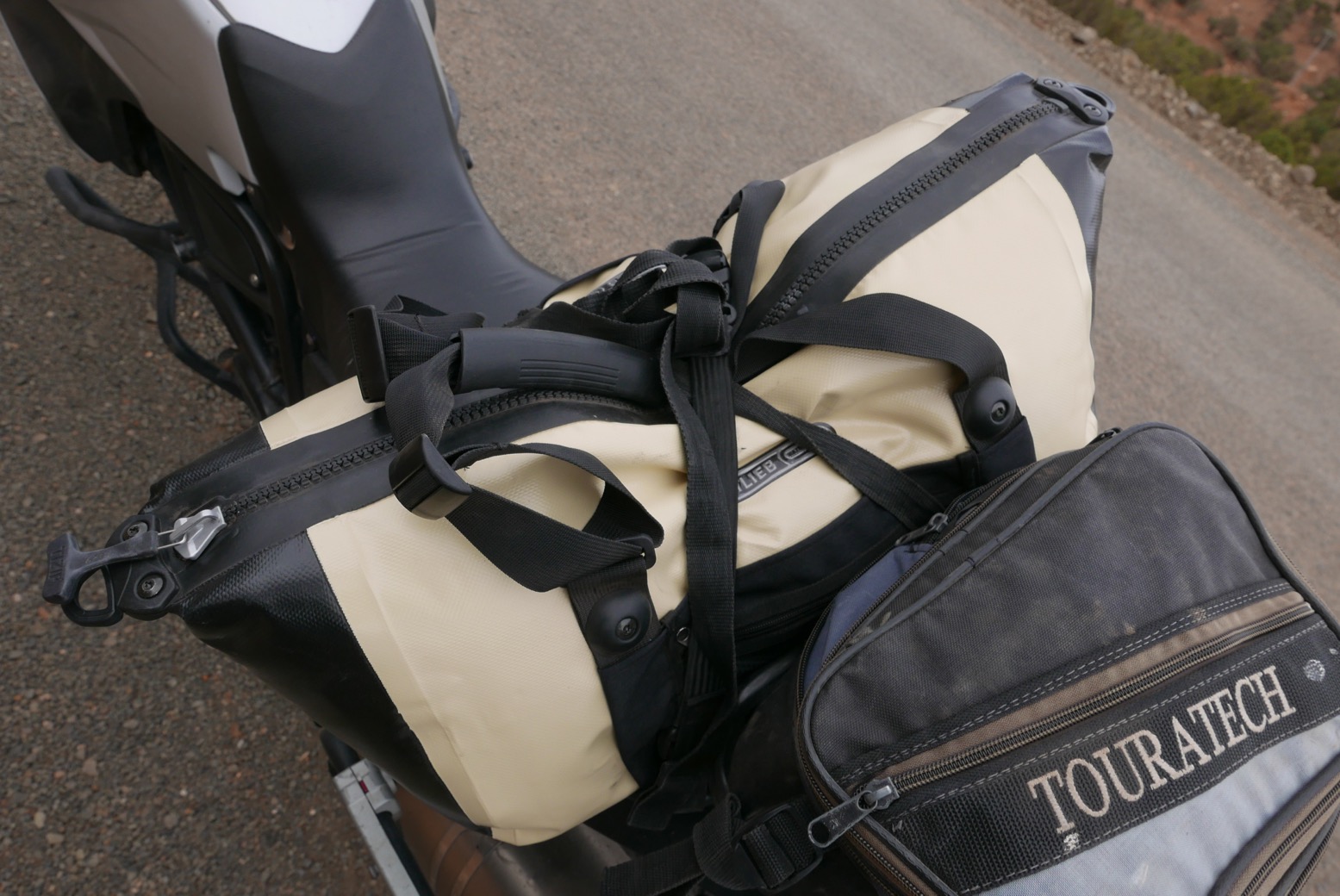
In Morocco the Travel Zip was big enough for my overnight needs once tools and other quick-access stuff were stashed in my old Touratech Tailbag, and mucky spare oil, a one-piece wet suit and spare inner tubes were lashed around the 700GS and 310GS I used.
A waterproof Tizip adds quite a cost and complexity to bag construction, but with the wipe-clean and easy repair PVC body, the bag has an airtight seal. I can vouch for that because after zipping the bag closed in the desert, by the time we reached 2000 metres it was bloated out from the lower air pressure.
It’s only a bag: you put things in, carry it around, and then take things out. But I like the clever hard-handle carrying arrangement, rugged-enough build and most of all, the easy opening. The small exterior pockets may prove more handy in a boat than on the back of a bike, and there’s no harm in the other pocket inside. For a dry-suit zip, the TiZip runs smoothly after a wipe of silicon grease out of the box, and this ease of access in a big improvement over the same-sized Watershed ZipLoc duffle that I used for years. The Watershed fabric is way tougher, but used as a boating day bag, doing the seal up properly as the next rapids approached became a pain. For a boat or a bike, I’m sure the Travel Zip will do me nicely.

ort - 5

Review: Aerostich AD-1 Light Pants

Updated 2025

aeroferi

Tested: Aerostich AD-1 Light overtrousers.

Where: Spain, Morocco, France, Ireland, Morocco and Spain.

Price: $367 $427 from Aerostich

image.png

Weight 1220g + armour. Available in grey, black and tan.

See also: Rukka PVC onesie.

aeroad1

What they say:
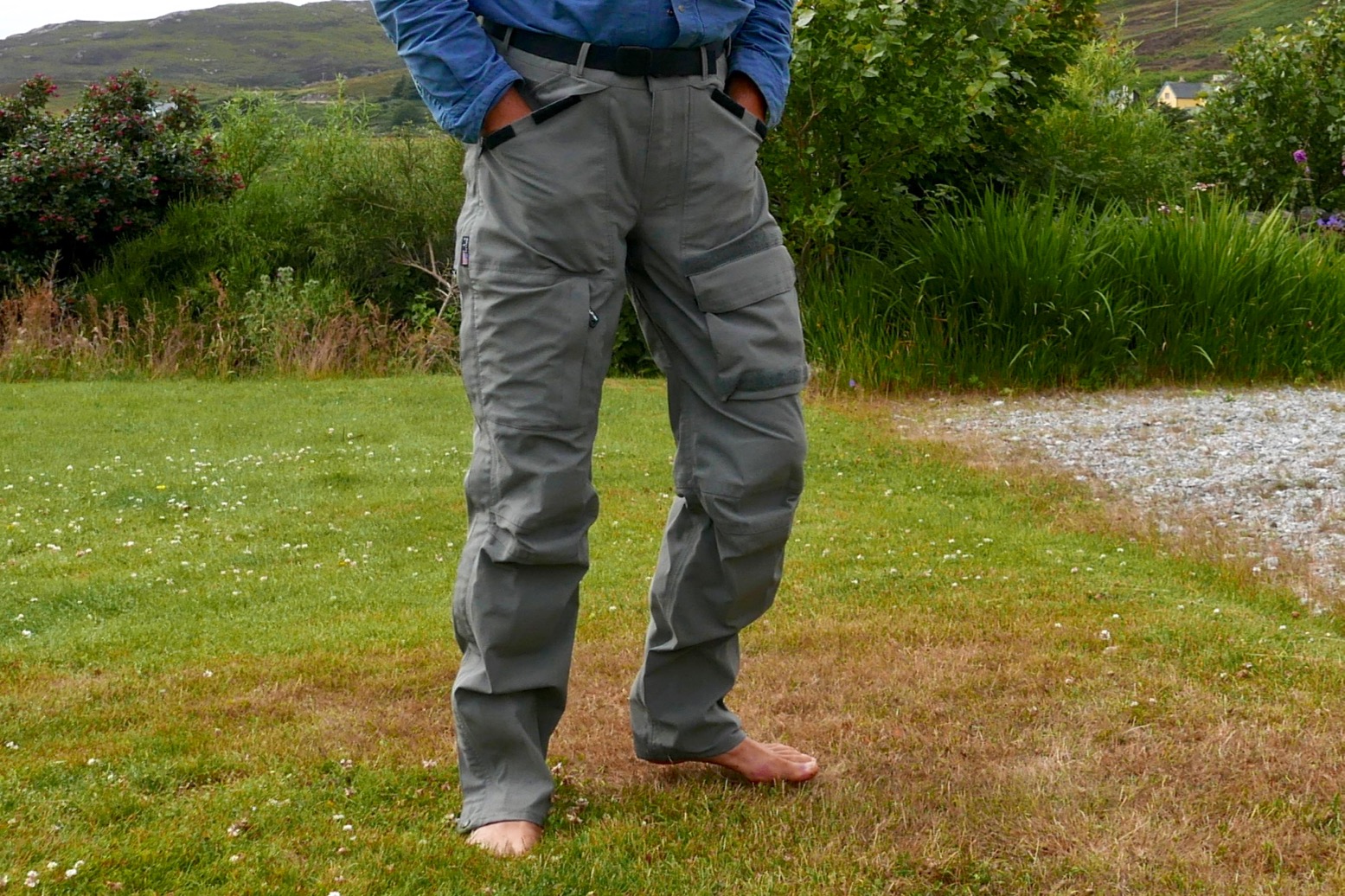
Perfect for dual-sport, adventure, touring and daily riding. Fully seam taped, unlined, HT200D Nylon GORE-TEX® jeans-cut pant with full length separating side zips inner and outer weather flaps to help the pants go on and off fast yet keep rain and wind out.

tik

• Usual excellent Aero taped-seam quality
• Dead easy to put on and take off
• The right amount of useful pockets
• Great contoured cut; don’t feel bulky
• Breath well and waterproof so far
• Long, but OK because ankle can be cinched in
• No complicated washing requirements

cros

• Quite pricey from the UK
• Sold only via Aerostich USA
• TF3 armour pads too bulky (others available)
• Bulky to stash when not wearing, but isn’t everything
• Need to be hot-ironed or tumble dried to revive the DWR

aerowaiter
aeroadd1

Review
About time I reviewed my Aerostich AD-1 Light pants. They’re pitched as lighter weight 200D Cordura Gore-tex overtrousers; less stiff to suit the occasional rider rather than ice-road commuters who’ll want Dariens or Roadcrafters in heavyweight 500D; two names which helped make Aerostich’s name in the US among Iron-Butt long-haul pros. Riding hard, fast and often, a 500D Roadcrafter is the best thing for 85-mph slides down the highway.
But who does that any more? Indeed, unlike many riders it seems, I rarely wear overtrousers at all, unless it’s actually pouring or very chilly. I don’t mind getting wet legs if the end is nigh, but when it isn’t I like the fact that I’m tucked, zipped, studded and velcro’d into my AD1s. Strict trademark laws make casual use of the V-word forbidden in the US. Jeez – and I thought I making a quick joke! Looks like I guessed right: in the US they must say ‘hook-and-loop’ which rolls off the tongue like a mouthful of old wool.

aeroad1 - 9
AeroSizingCharts

On me the AD-1s fit is just right: comfy and unobtrusive – as high praise as you can bestow on motorcycle clobber. You don’t feel like you’re schlepping around in a pair of baggy, swish-swooshing bin bags. The curved cut of the double-stitched seat and knees all help, and Aerostich do go out of their way to give you more than just S, M, L and XL. With their detailed sizing chart (right) you have little excuse to not get the right fit.
No complaints with breathability or waterproofing either – legs don’t really sweat or get cold. But when they do, one of the best things is with the full-length side zips the ADs are easy to put on and take off; a big incentive when you really ought to pull over and do one or the other, but don’t want to faff about or risk tripping over, banging your head on your rocker cover and waking up in a hospital corridor. 

aeroad1 - 2
aeroad1 - 6

What you get
I chose my ADs in ‘long’ to get right down over the boot. They have two-way 47-inch zips right down the outside of each leg, so if you want to vent you can modulate down from waist or up from ankle (or just use Twitter like everyone else).
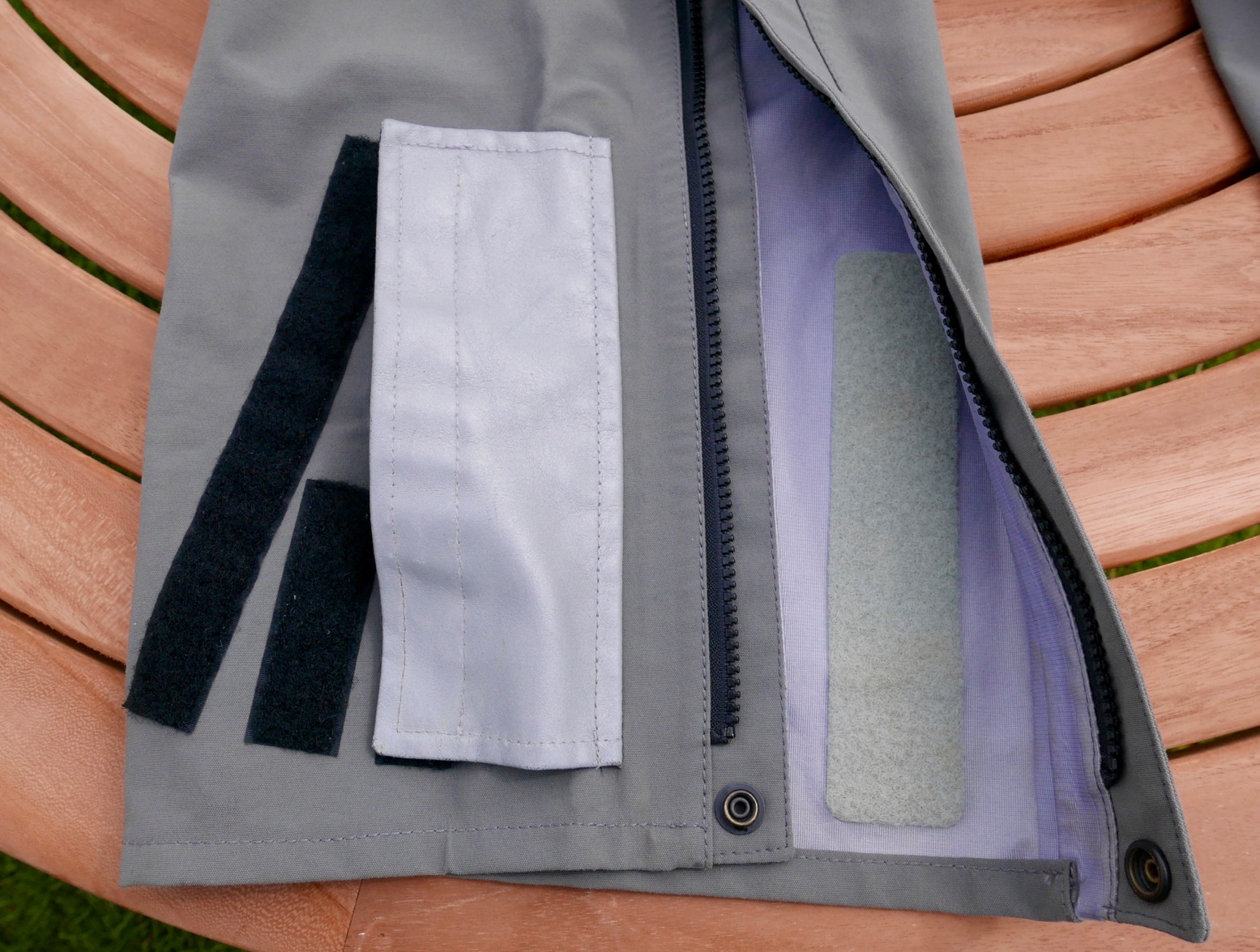
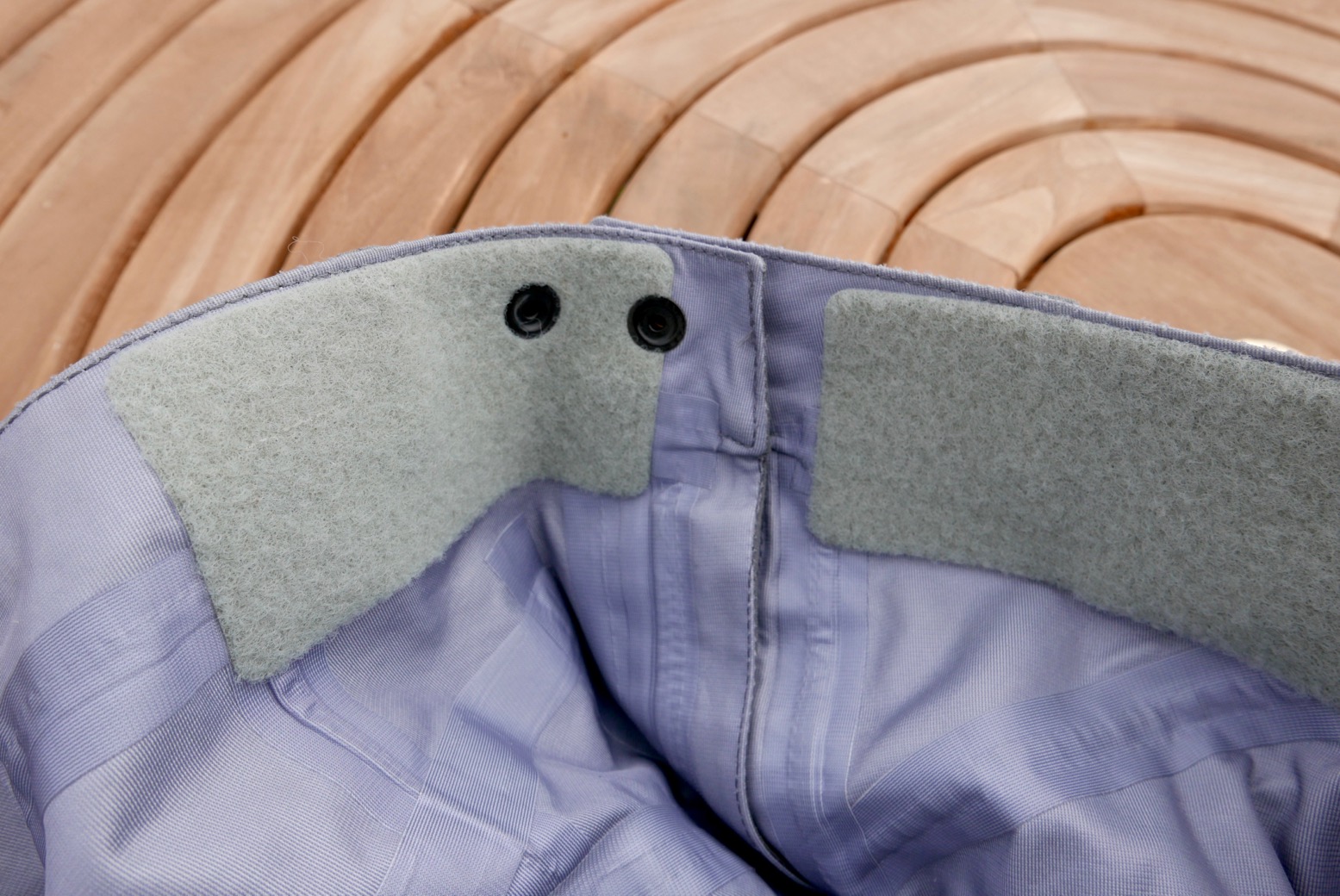
At the top you can also reset the waist circumference with studs by an inch on each side (above right). I have my 38″ Ls on the bigger setting and there’s a short elastic triangle at the back to take up the slack when lunch catches you with your trousers down. The zips have a full length rain flap of course, and the ankles have a big reflective panel (above left) allowing you to pull them in over boots or whatever. This is also effective in taking some of the 1220-g weight off the knees, especially as they’re so long (on my 38 Ls the inside leg is 34″). I wish my Klim Outriders did that (before I got it done myself). This support also avoids the need for braces.

aeroad1 - 8

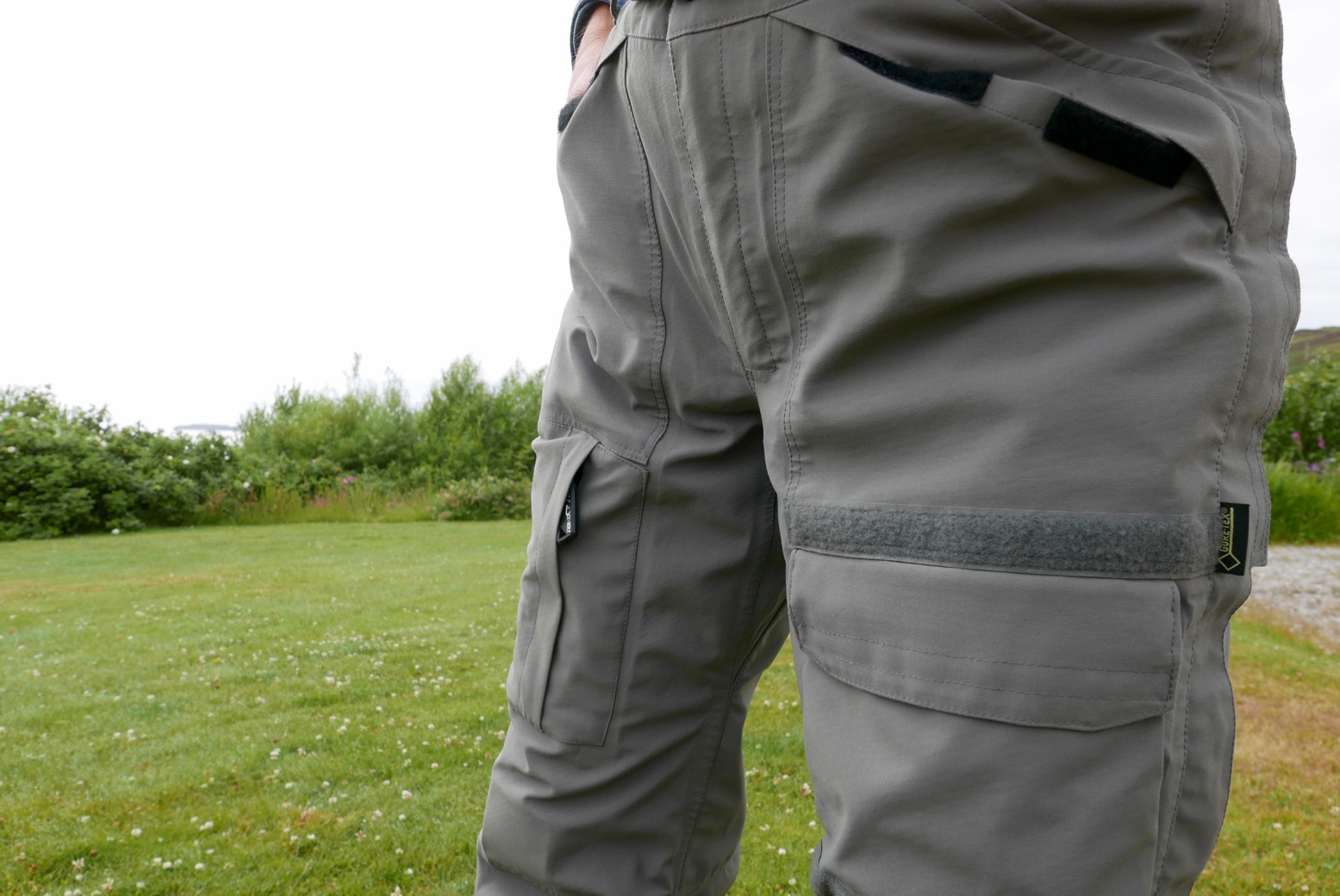
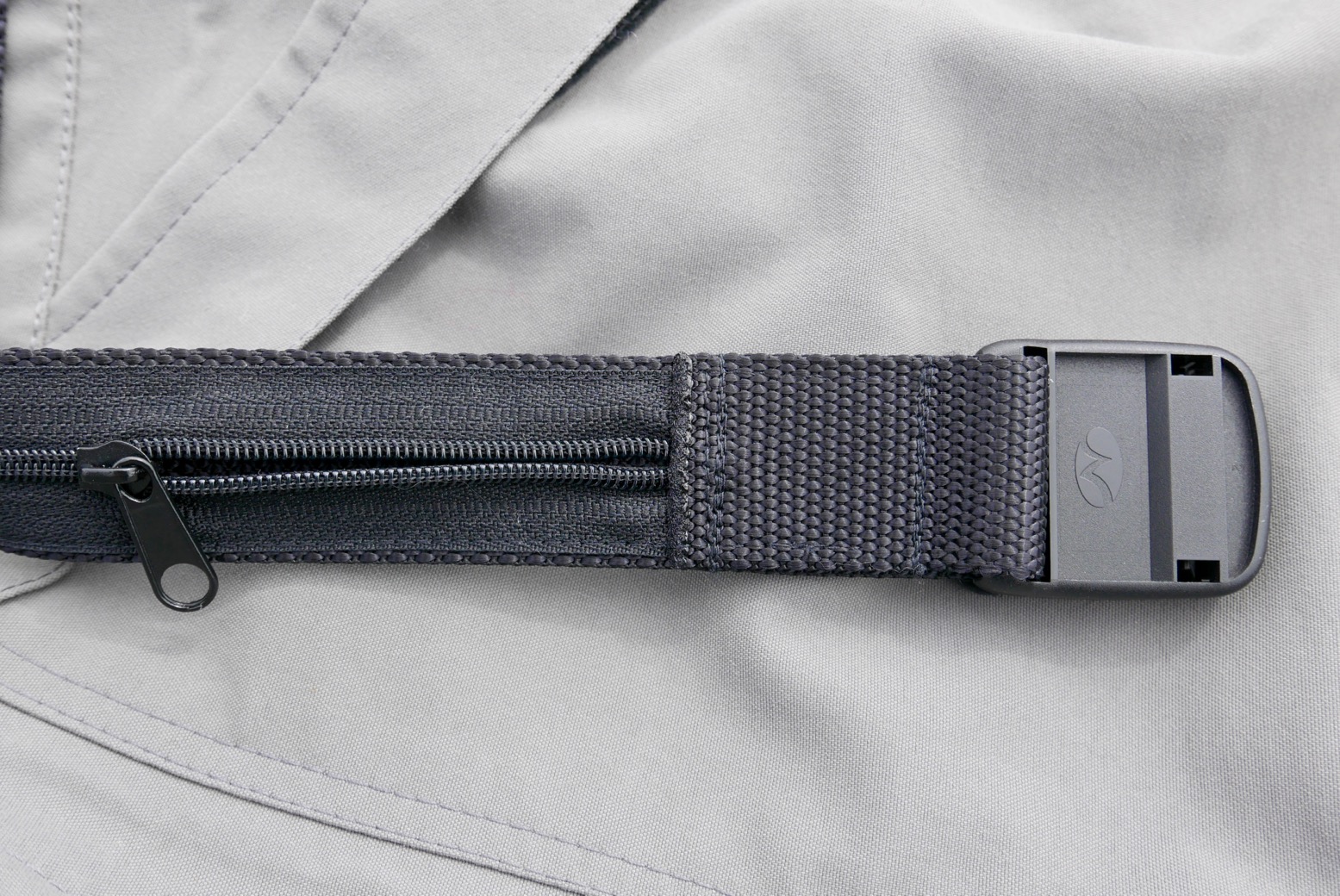
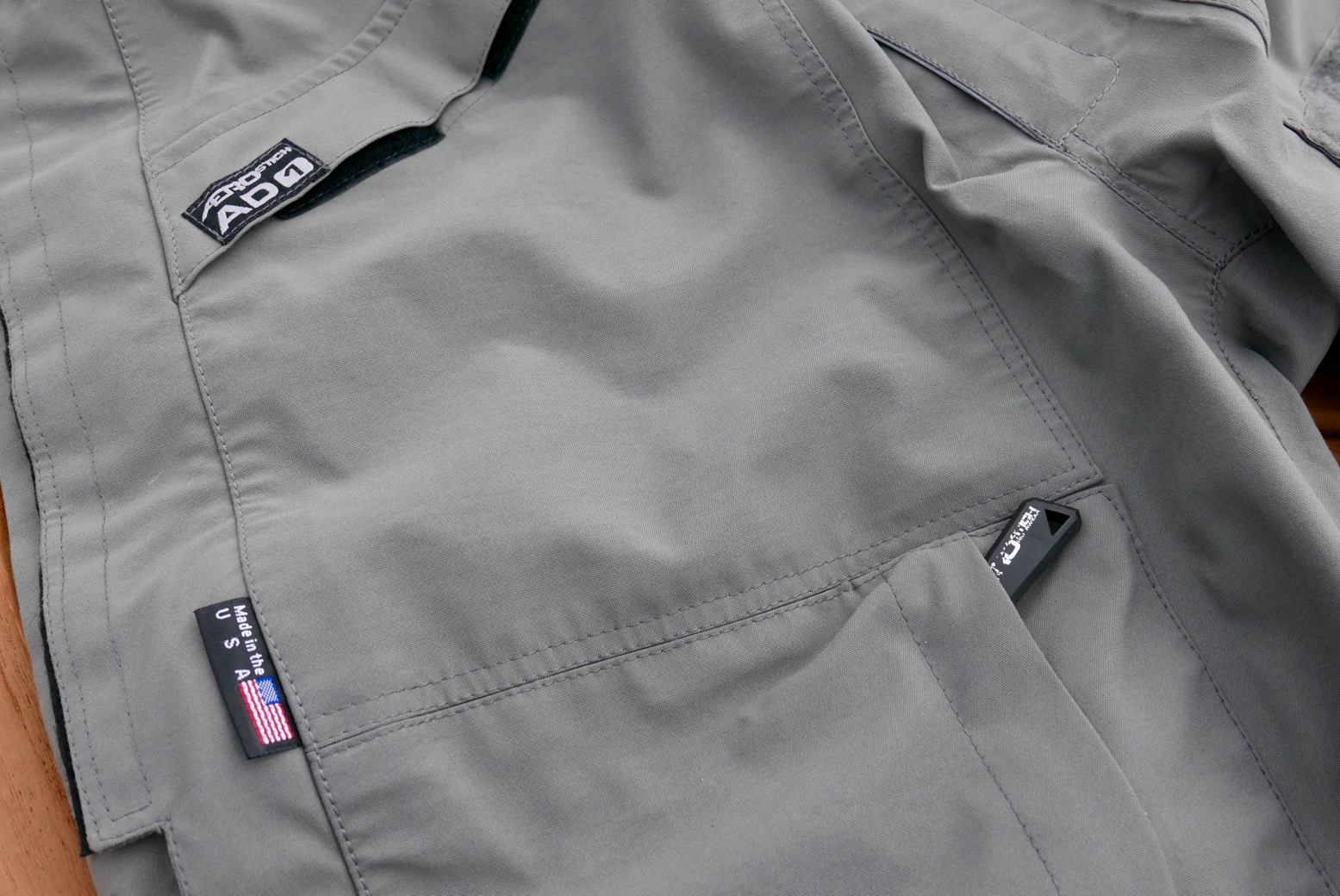
This is Aero County, Minnesota so you know there’ll be a few pockets knocking about. Left thigh has a 8 x 7-inch velcro™ flap pocket with more v*****™ over the top to take a map pocket. On the other thigh is a same-sized pocket with a water-repellant side zipper. At the hips are two more velcro™ flap pockets and there’s another v-free open pocket at the back, plus a cunning, easily missed SAS-style zipped stash belt (below).

tf33
kor-mr

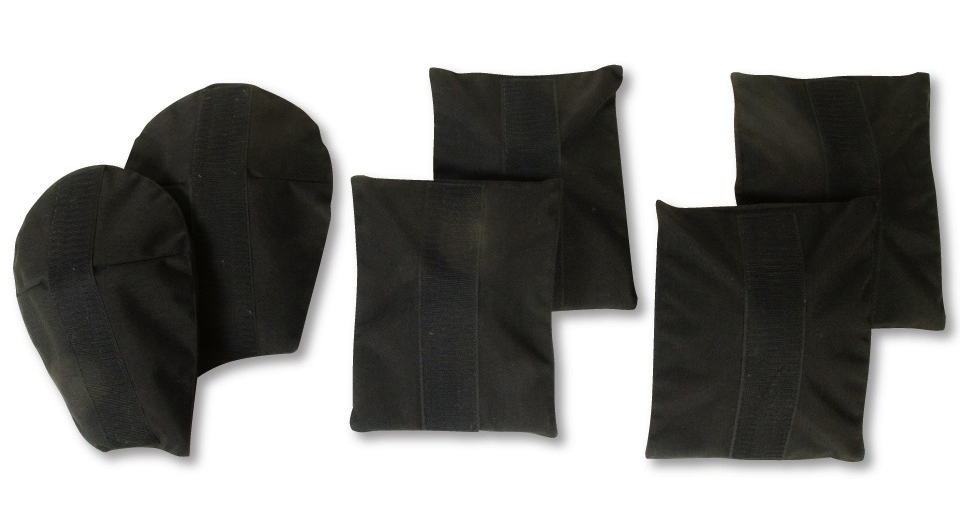
I’m not a great fan of the bulky TF3 Aero-armour (left), even if it might be technically better than slimmer examples like D30 (right) which will attach to the velcro™ inside the knee, or ForceField lattice armour which won’t. Knee pads are handy for kneeling by the bike of course, not just crashing. There’s more you-know-what™ along the sides of the waist hem and inside the shins, for more armour perhaps.

WI-map
aerojetta

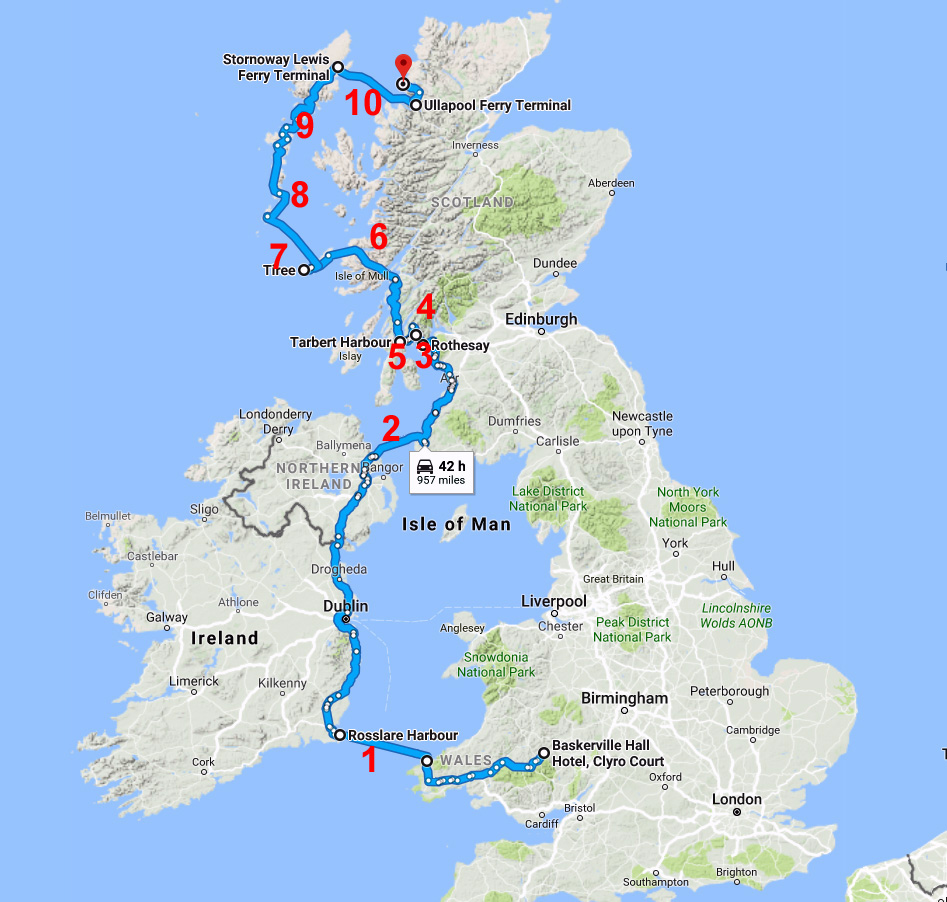
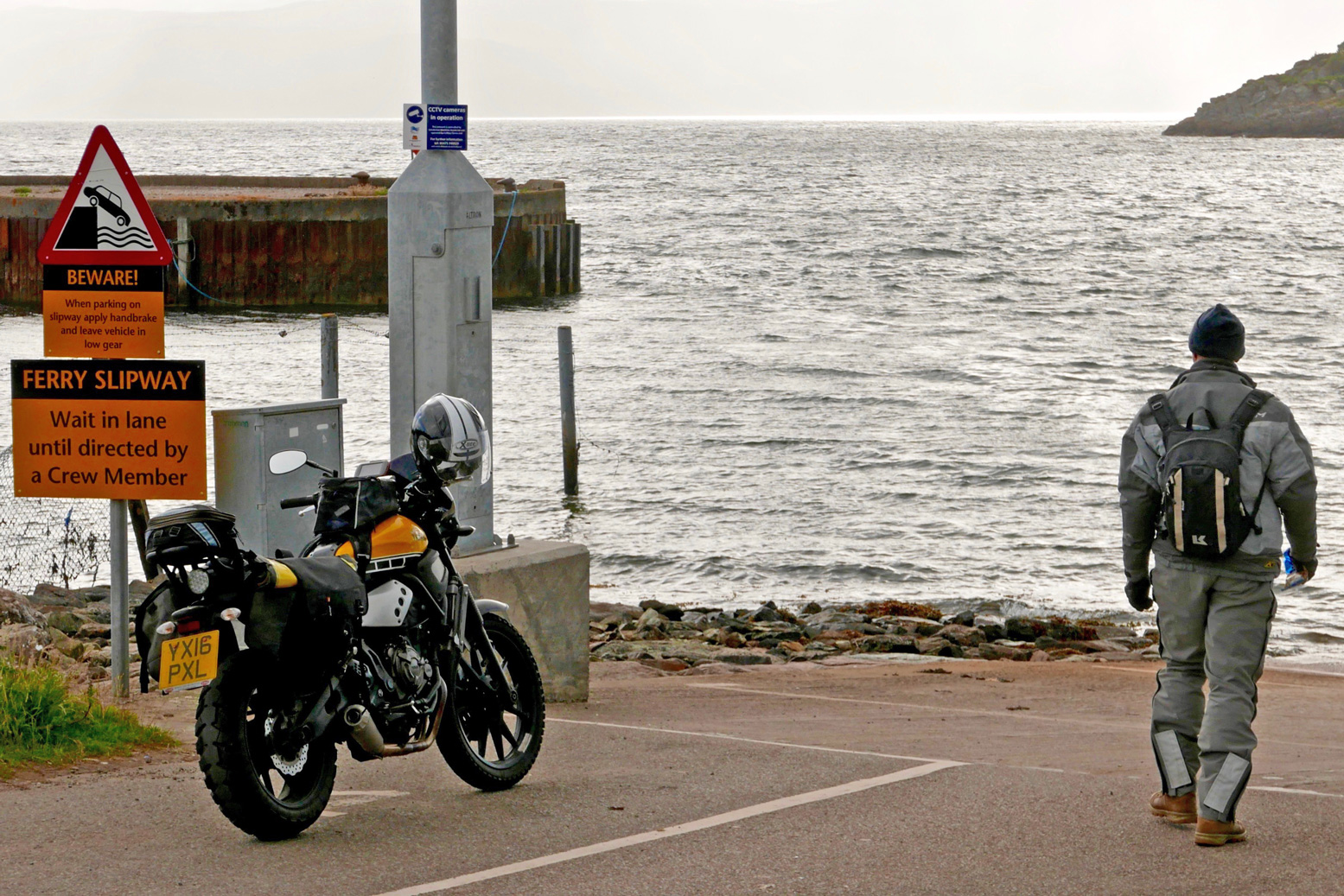
Recent trips have included coming back across close-to-freezing then rainy Spain one December, a dawn-to-dusk mid-summer ride up the left side of the British Isles where in June the chances of rain were high, a freezing ride across France in late 2021 on the Africa Twin,and see below 2024.
On all occasions the AD-1s did the job unobtrusively, keeping the chill out, the rain off and the stuff in [the many pockets]. A classic unfussy and functional design as you’d expect from Aerostich, and quite probably comparable with any other high-end membrane rainwear out there.

Update 2024-5
After ditching my well-worn Klim Outriders and waiting for some ASpec Linesman pants, I wore my much underused AD-1s (on bare legs) for a fortnight’s riding in Jan-Feb in the mountains of Morocco. It was expected to be a chilly trip up to 3000m and down to 0°C some mornings, but was never that cold in the sun (it was in fact the warmest February ever in Morocco and RTW).

I was surprised how comfy and unobtrusive the AD-1s were. I never felt like I was wearing heavy nylon trousers. Part of this may have been good quality Gore-tex breathing away quietly, but more likely it was those close ankle closures which lifted the weight off the spacious knees while riding, reducing drag when getting on and off. I’m not sure they would have been so comfy in March, or if I had to get physical, but at least you have a full-length zip down the sides so can open them out like a dress and vent yourself into a trance. Having now tried the AS Linesmans, I prefer AD1s for what I do.
October 2024 I rode my 450MT down across Spain and left it in Morocco for the winter. February 2025 was a lot chillier than 2024, and for the first time in a decade, I wore my AD1’s over my trousers every day, even down in the desert. Like I say, I barely notice I’m wearing them. Normally I sell stuff to try new, different or better. But I’m holding on to the 10-year-old AD1’s until they’ve had it.

Thanks for the pants, Aerostich

aerolderie