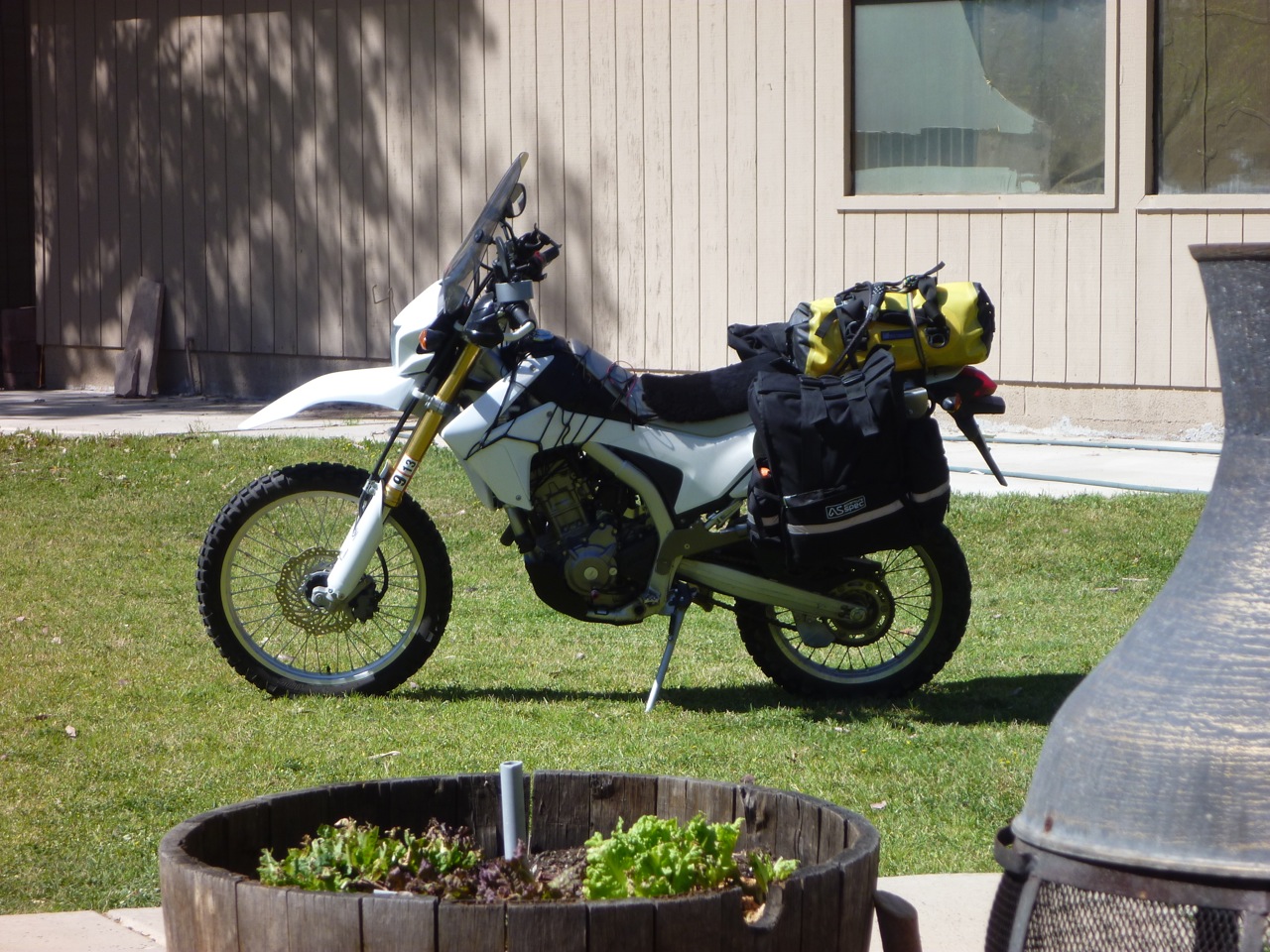
CRF250L Mile 358: “Which pump number, sir?”

CRF250L INDEX PAGE

Let me tell you, I am meeting a lot of gas station cashiers. My UK cards can’t pay at the pump and out here if it’s cash you gotta pay first. So until I can guess the exact cost of a fill I need to trot back in to get my change. Two or three times every day…
c-leavingp

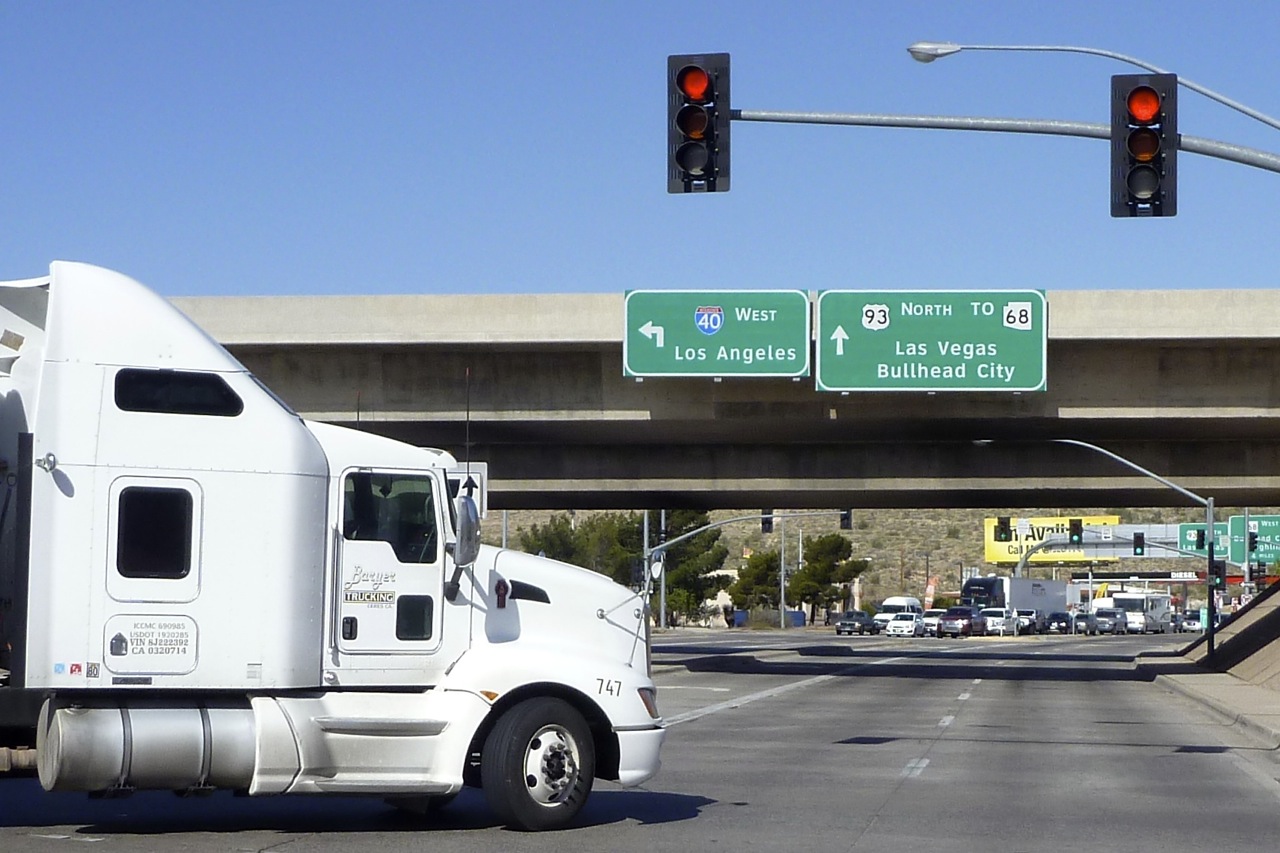
Leaving Phoenix I had two days unavoidable road riding during which to pin down the odometre error and so establish true fuel consumption and so my possible range. Also, the bike had been brought back from Stage 1 mods (extra airbox holes, noisy pipe, smaller front sprocket) and with the quiet OE pipe refitted, the air box taped back up to but the EJK fuel controller still plugged in and unmodified, chances are the bike would run rich but I thought I’d give it a try as who knows, the ECU might somehow compensate. I’m not sure how all this stuff works.
c-lqbag

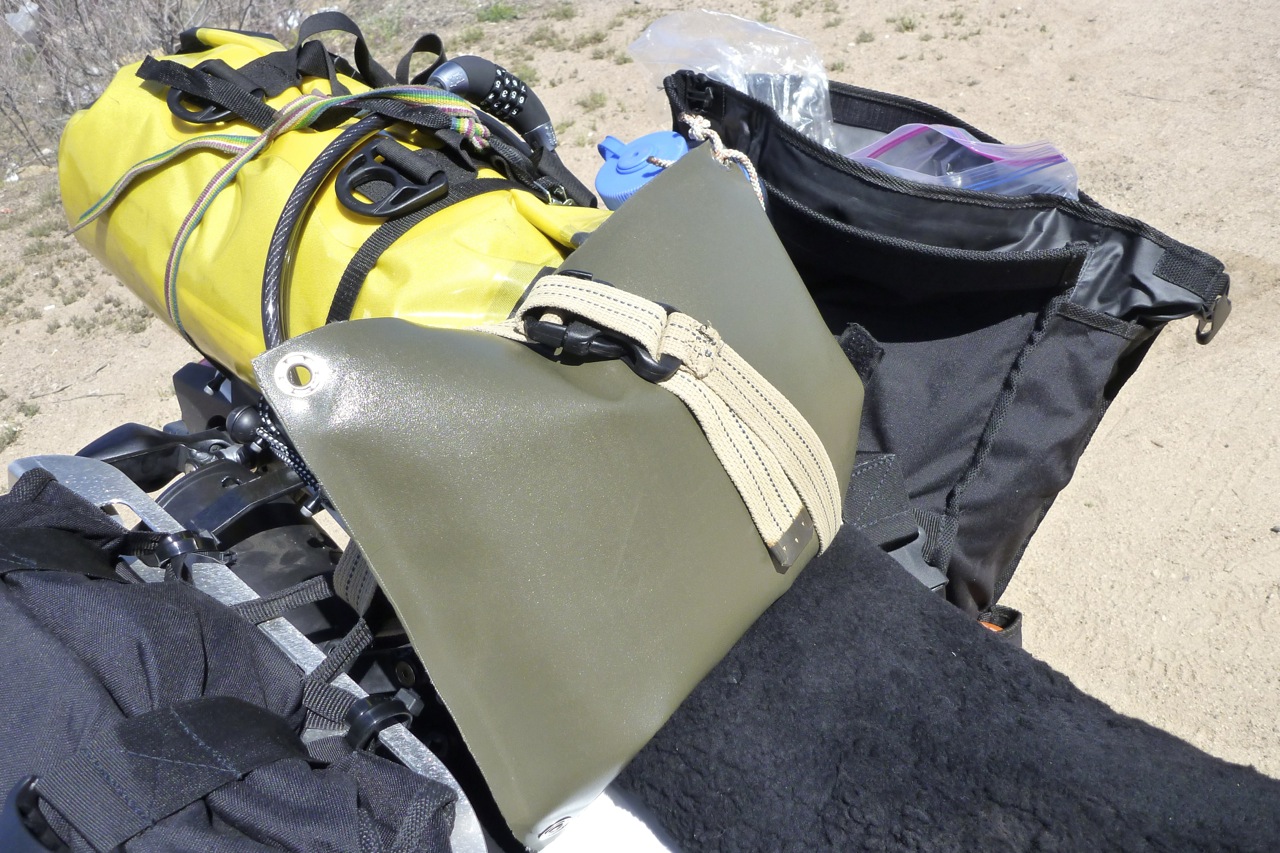
Riding out of town, strong head/side winds sprung up and at only 73 miles the fuel warning came on. Already? We all know that feeling of tensing up to will the bike on while counting off the miles. I was convinced I’d not make the ten miles to Wickenburg and once I did, I made sure I filled up that Liquid Containment fuel bladder right there (it took 1.42 US or 5.3L). And one day soon I’d better run the main tank dry  to see what it really takes – supposedly 2 USg or 7.7L.

I recorded an average of 57.1 US (68.5 UK – see this) on day 1, at around 55mph – the slowest thing on the road. Arriving in Kingman the winds were howling out of the southwest and riding the Honda was like piloting a hang glider into a gale. Drivers behind me kept their distance, but I actually felt a lot safer than in similarly strong cross winds on my XT660Z a few years ago in southern France. It was way too windy to camp and anyway parks out here are exposed and grassless – not really set up for ambient tenting. A chummy Gujaratti guy at a motel made me smile and gave me a deal.

c-nought

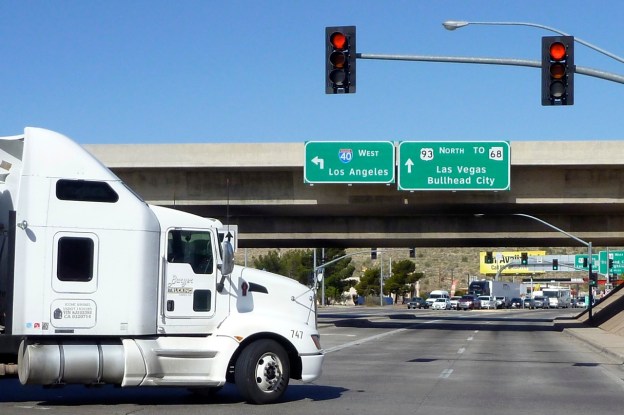
Out towards Vegas next day I still had trucks breathing down my neck, but there was no other way to get north to Beatty. I ran dry on the freeway cutting through Vegas with the Honda showing just 100.3 miles, but all the signs suggested that was not an accurate figure even if empty was still empty. The F-L somehow reads speed off the gearbox – never heard of that before and surely reading accurately off a tiny gearbox cog compared to a big front wheel will take some precision, even if it;s all cheaper and tidier than a mechanical speedo cable.
c-navtek

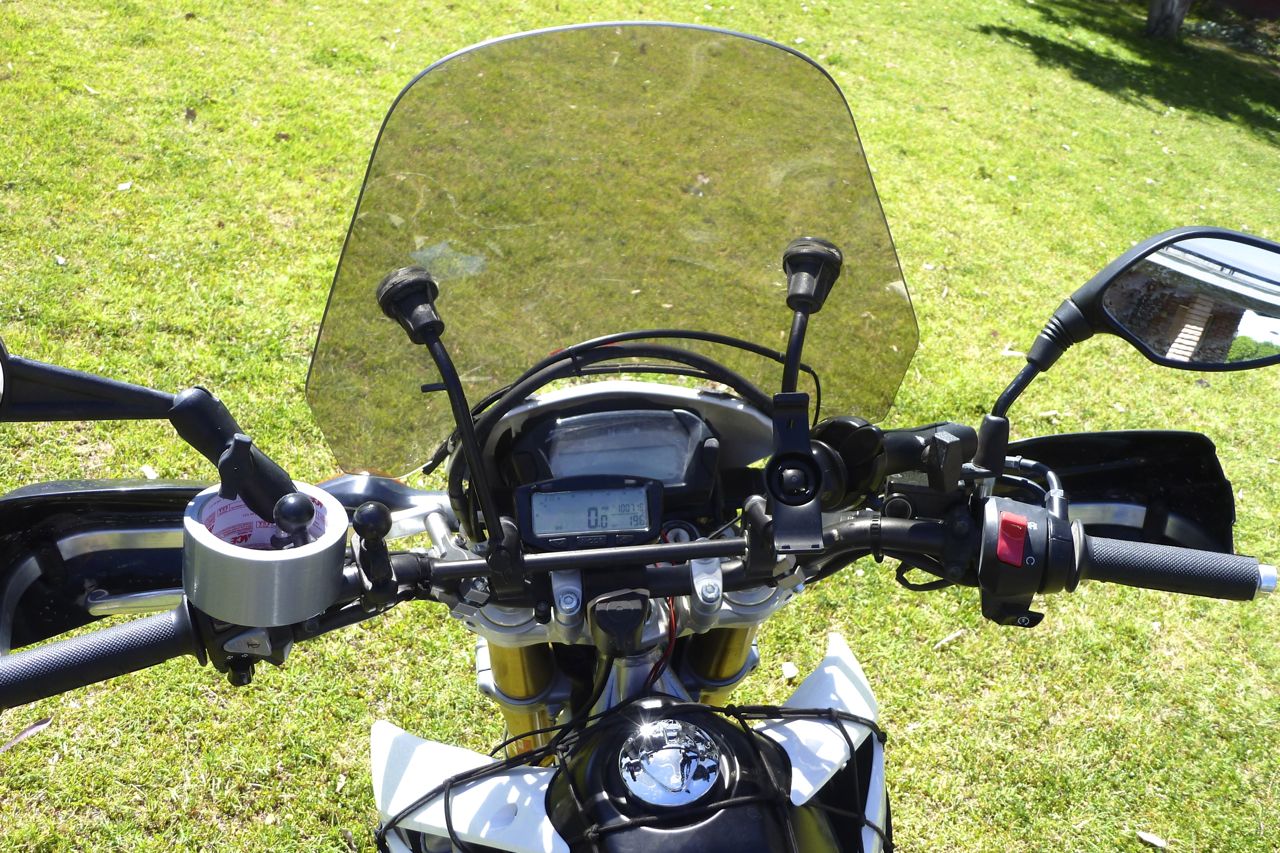
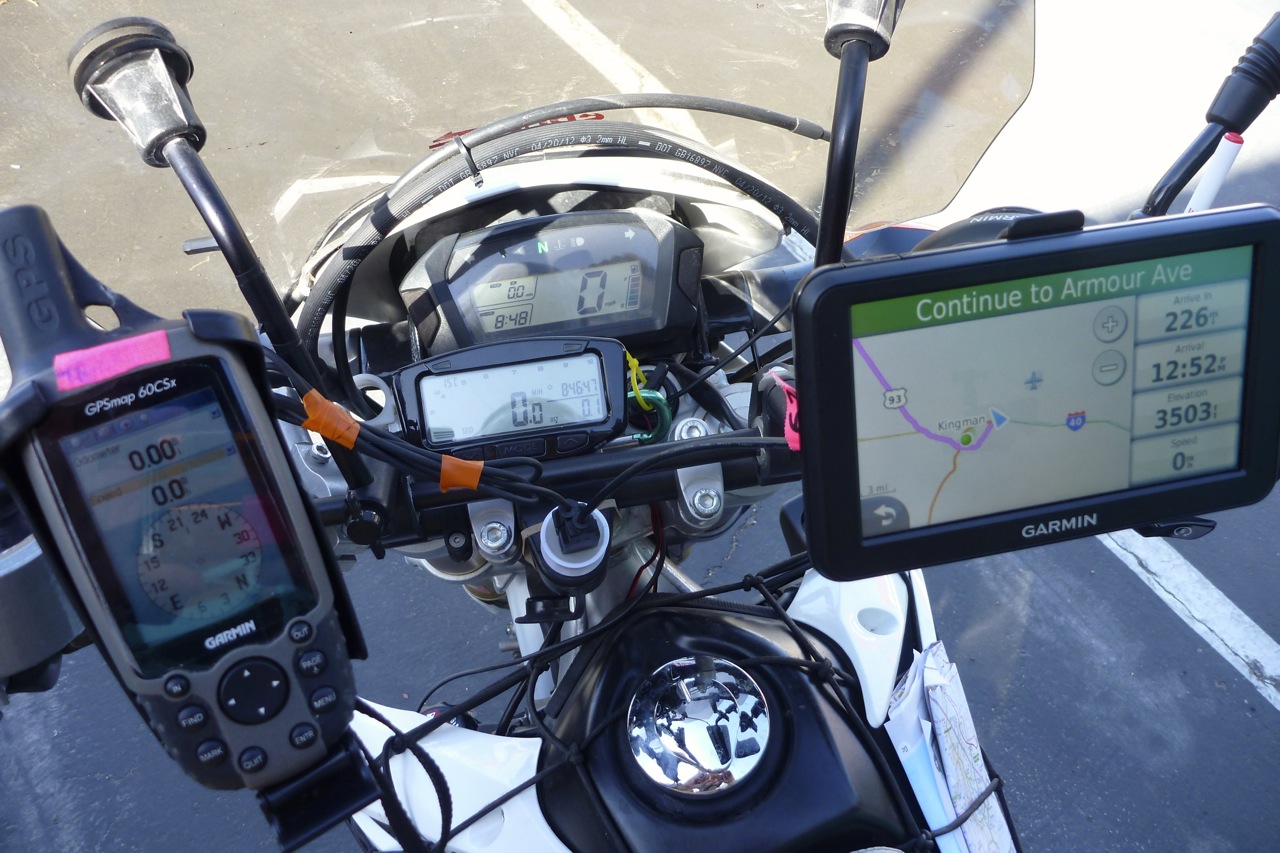
The Trail Tech Vapor I’d wired in requires you to precisely measure front wheel diameter and fit a sender wire to the fork tube opposite  a magnet on a rotor bolt to calibrate the speedo. It’s a system they claim is more accurate than GPS and on  that day I was running the Garmin 62 GPS, a Garmin satnav and the Vapor – all up enough nav gadgetry to invade a small country.

I knew well from logging routes in Morocco that for a GPS track log to show accurate distance, the ‘pings’ have to be set very high – say every 2 seconds or 50m. Doing so eats up GPS memory and most are not concerned with measuring accurate distances, but that is the only way to do it with a GPS. Otherwise, with less frequent pings, the series of straight lines between the recorded time or distance points cuts corners and gives a shorter distance than true over a day;s riding, especially on a bendy track. GPS speed readings are not affected like this.

The road to Vegas had been straight enough and when the Honda ran dry at 100.3 miles, the Trail Tech Vapor showed 112.3 and the Garmin 62 was on 111.2, about 1% out. So the Honda odometre is 11-12% short on distance while the speedo (less important) is 8-9% under; both unusually inaccurate compared to recent bikes I’ve run. Relying on Honda data, my mpg would be reading 11% worse (assuming gas station pumps are all accurate of course – I’m not always sure they are).

Out of Vegas
The bike seemed slow but I’d hardly ridden it and assumed it was the strong winds and the load. But leaving Las Vegas, on a whim I tried 89 RON fuel instead of 87. As 95 turned west, I braced against cross winds and at times the Honda was rolling along at 65. The manual says use 86 RON or more, so it’s probably not octane but something occasionally made it run much better. Could it be Nevada fuel? Al had told me they put ethanol in AZ fuel (E10?). Who knew all the variables but I wasn’t making any mpg records today.
c-cathouse

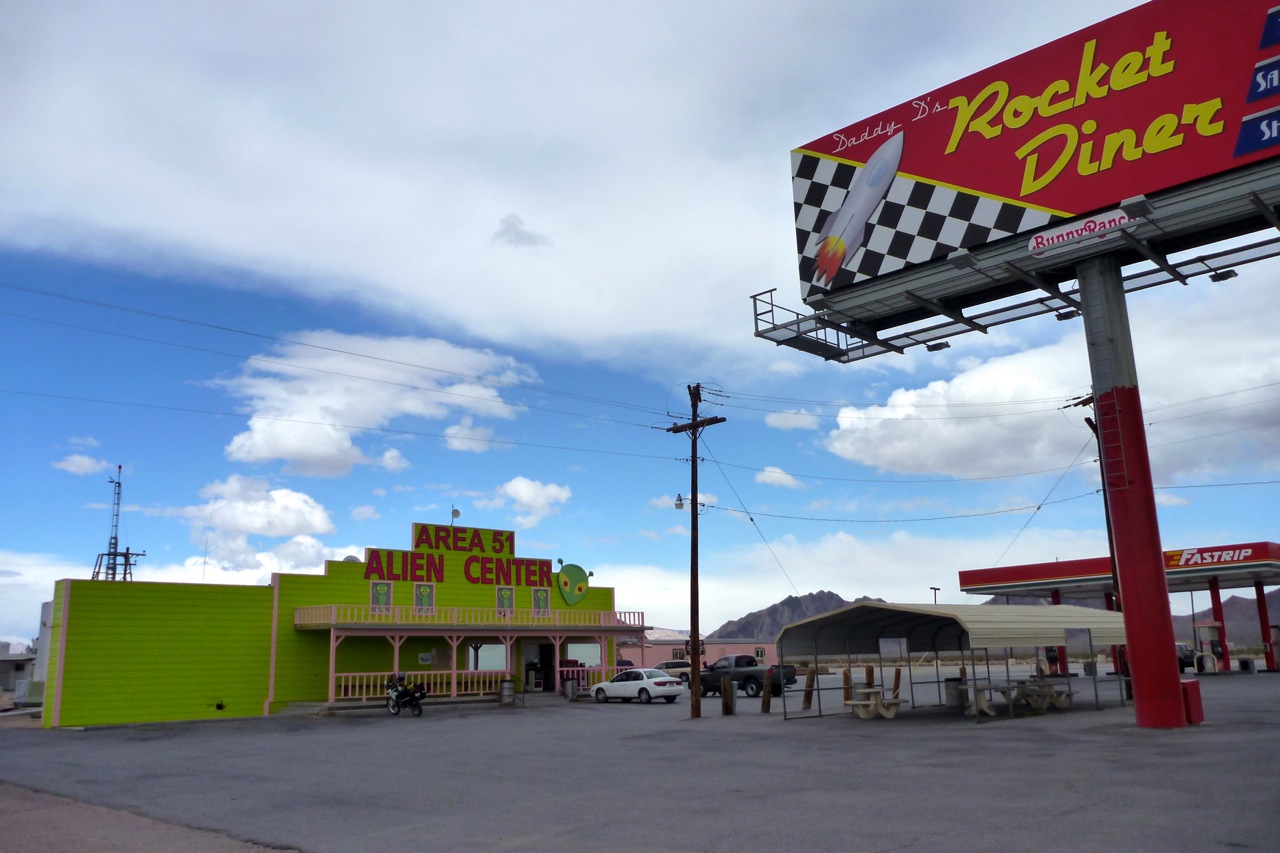
With one eye on the mirrors and the other on the speedos and passing  ranges, up ahead a sign proclaimed  ‘BROTHEL’ in big red letters. I’d arrived at the Alien Cat House, a roadhouse/whorehouse which it owner suggests (see vid below) is well suited to the socially stunted individual who spends too much time playing space games on his PC and likes his women sprayed green and with pointy ears.

Inside, past masses of pointy-chinned alienobilia alongside sexy towels, rough-looking guys slouched in the diner – I guess any passing holiday-making families get scared off; ‘Mummy, what’s a brothel?’ They reminded me of the sleeveless, Blunnie-shod, truckers from the Northern Territory and hadn’t dropped in to get an update on the chances of anything coming from Mars. Then I realised that just over the hill was the huge Nellis AFB or ‘Area 51’ on whose secret experimental activities the region’s UFO reputation is surely based.
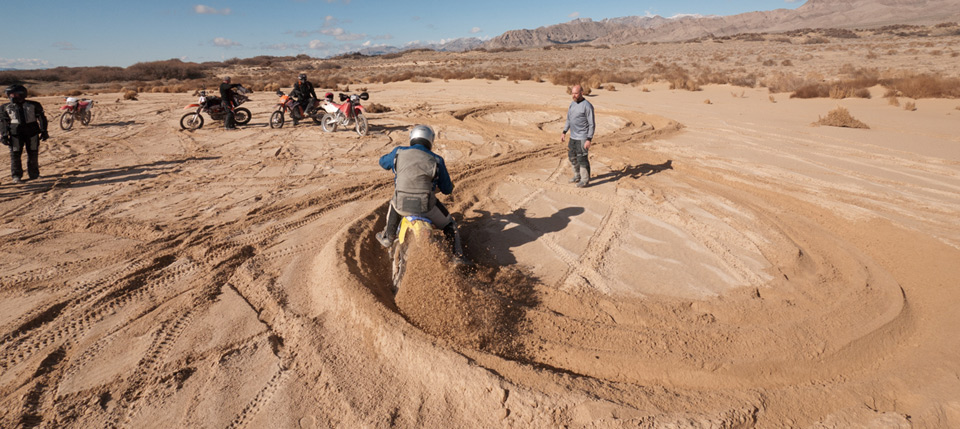
slider-img-4

On the counter was a copy of the local paper, the Pahrump Valley Times. Headline: a local guy got drunk, flipped and tried to strangle his girlfriend. As it happens a couple of days earlier I’d read that ex-Dakar racer Jimmy Lewis was doing a two-day dirt riding session the following weekend. (That’s his old Dakar BMW desert racer from ’83 below let, on display at an open day recently).
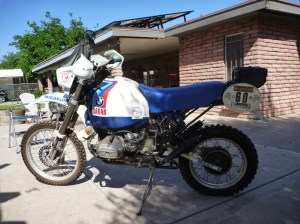
jimmybmw

There had been some discussion about him versus what was claimed as themore promo-savvy Rawhyde outfit over the border. I considered about attending, like you do when you’re abroad and can get away with doing something spontaneous. It would be good to learn how to ride properly and I was bound to learn something, but I had the wrong tyres, no MX gear  the CRF would get a hammering and it was $600 plus lodging. Maybe another time.

Out of the Cat House I tried 91 RON but battling the wind, in nearby Beatty that added up to an all time low of 42 US mpg (50.5 UK). Even my Tenere didn’t get that bad in similar conditions. And to cap it all the fuel bladder had leaked and  everything reeked of gasoline.
c-cancan

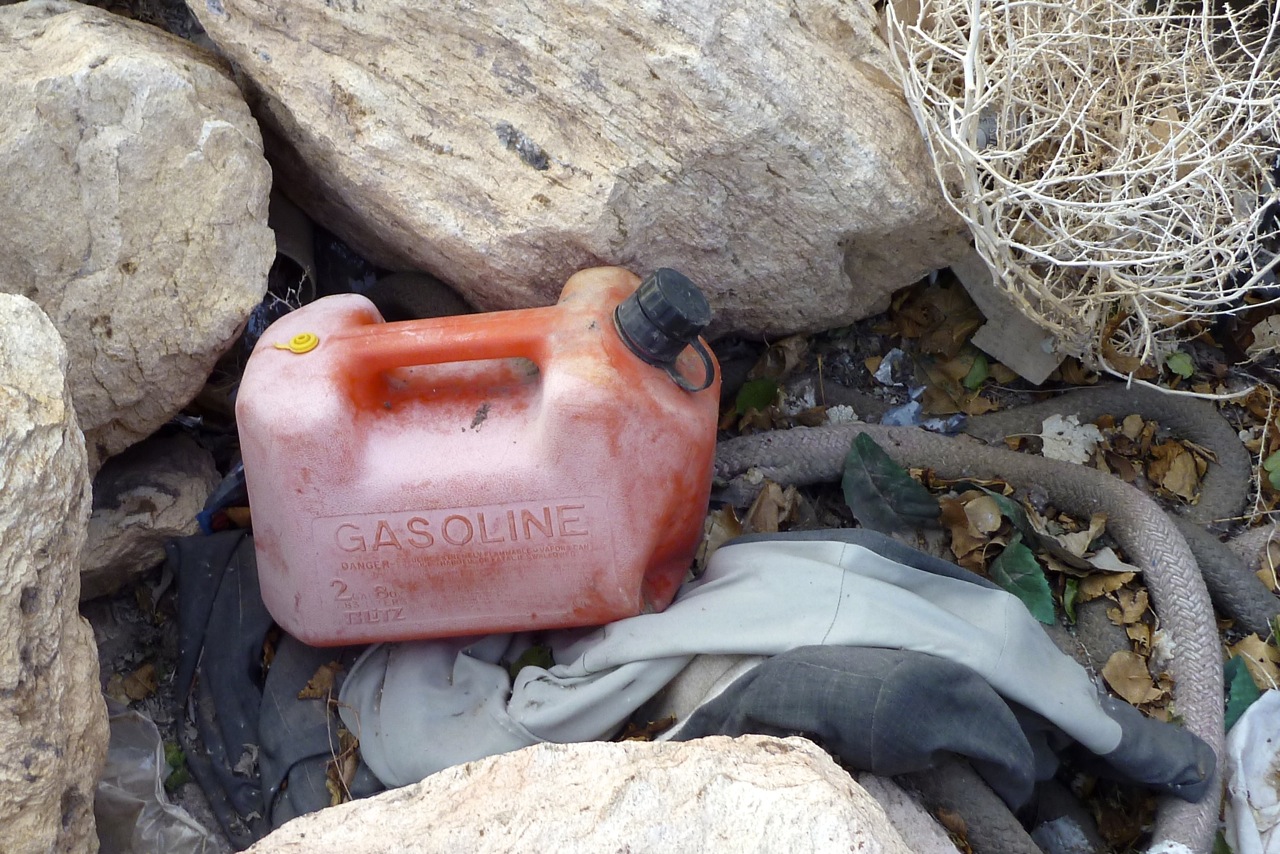
Out on the street an old guy had a huge range of ex-military ammo boxes but no small fuel cans and Lou’s Hardware up the road had baffling stick-out spout cans. Over the road a semi derelict casino looked like a tornado had passed over it. My scavenger antennae twitched and out among the debris of fridges and furniture lay a 2 gallon can. I sized it up, unsure if I was breaking some local anti-vagrancy bylaw, but decided by the time I’d flushed it and filled it to find a leak I’d waste more gas. I was on the California border, a better can could be found I was sure. Until then I sealed the fuel bladder  as best I could and perched it on the back where it could drip harmlessly.
c-3legged

Beatty seemed a bit beaten up and neglected, but no more so than your average South London high street these days. Generations of autos rotted in front yards, the old clapboard church looked a bit shaky and it seemed this town was only big enough for one casino to prosper. Shelling out too much for motels, that casino did at least have a Subway which became my sustenance on the road, a six-incher for lunch and another for dinner. Less than $8.

While I’m prepared to sacrifice bit of mileage from the EJK as others report, I need to get to the bottom of this fuel consumption. An FI 250 ought to do 65 US (80 UK) – that plus dirt lightness is why we make the compromise after all. Is a smaller engine more sensitive to large loads – me probably 110kg in all my gear + 25kg of baggage. Is it down to different fuel qualities from state to state? Actually, I don’t believe baggage or screen have any real aerodynamic effect at the speeds I go – they certainly didn’t on the XTZ or BMW in Morocco. Winds are a more likely cause, as Al had warned me, and maybe elevation too. But I think the bike is simply running rich, as with the noisy Q4 and opened airbox (but no baggage) it had run 62US on that day in the dirt. The fuelling is off for sure and our CRF-L man Rick R has all the answers on the EJK ‘black box’ under the seat. In the end I knew all I had to do was return it all to stock by unplugging the EJK, or less easily but perhaps more effectively, try to lean out the adjustable EJK to run with the stock pipe.
c-cali

Plenty of time for all that. Tomorrow I will at last able to get off these truck highways and ride some dirt roads at my own pace and without battling the winds. We’ll see if that makes a difference.

Next?

Mile Zero: CRF250L hits the road

CRF250L INDEX PAGE

l-louver

Only a week later than planned the Honda and I now are on the road for a month or more’s riding around the fabulous Southwestern USA. How long had that been on the ‘to do’ list?

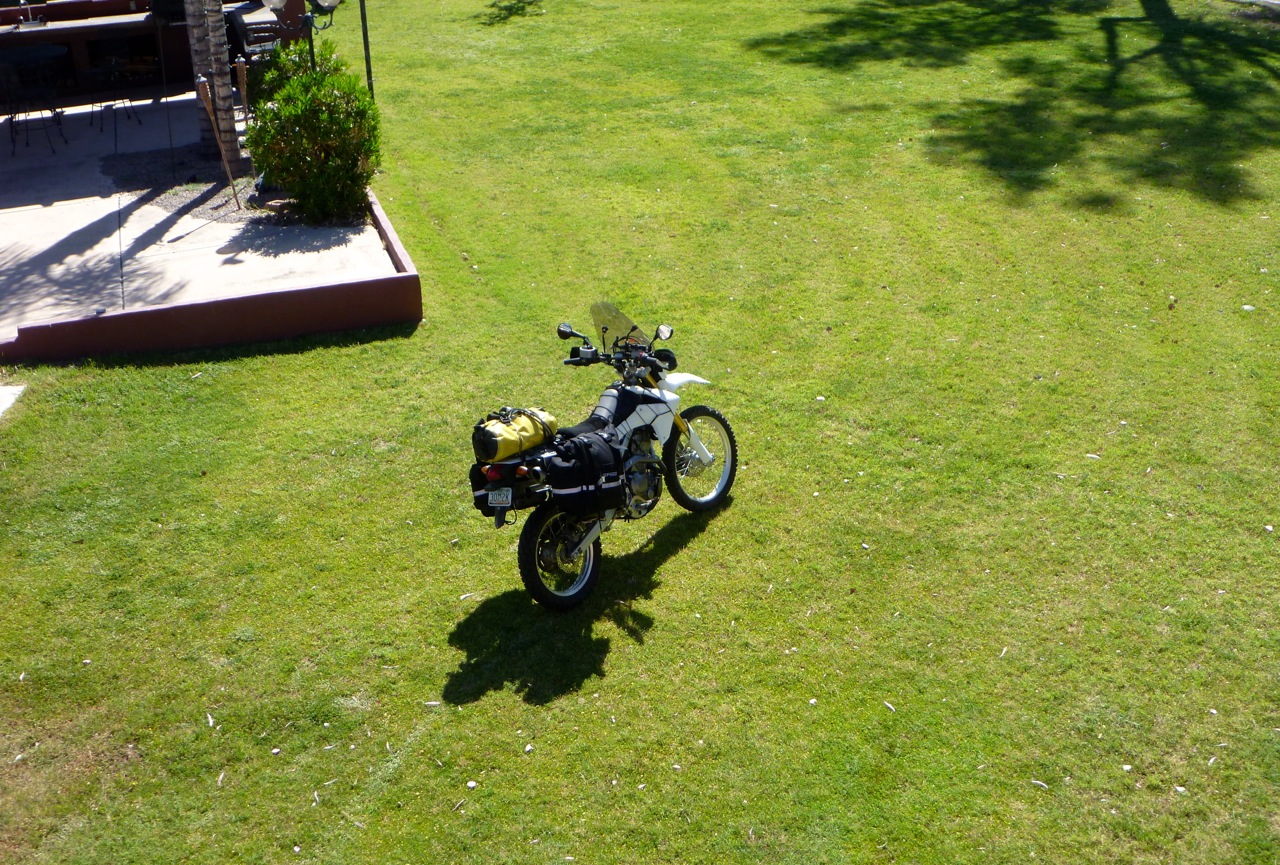
The Magbags filled up without too much compression or compromise and of course riding it out onto the lawn the bike flapped around like a three-wheeled shopping trolley full of cement – just as do all loaded bikes at Mile Zero.

l-coloriver

Yesterday I flew back from a talk near Tacoma where I met Tom Grenon, just back from Baja and with whom I KLR’d through BC and Yukon back in 2001 and where I confirmed what it is I like about deserts! The plane flew via SLC and across southern Utah and some place called the Grand Canyon (right) where I’ll be in a couple of weeks. But first it’s west to Vegas and Death Valley, the accessible corners of the Sierra Nevada and Northern California. Then maybe up to the BR Desert in northwest Nevada and down to southern Utah. After that who knows, New Mexico or maybe even Baja Mexico.

Tune in for time to time to see how it all pans out and how the bike and gear perform. Or see you on the trail or at the Overland Expo around 18 May, near Flagstaff.

Bismilah, as they say in the Sahara.

Next instalment.

l-leaver

Exactly how big is soft baggage?

See also: Soft Baggage Comparison

packer

I said this already: soft bags may be ancient, pack animal-era technology but they have very much caught on in advworld. Some are little different to the things I was throwing over my bike 40 years ago; one or two feature significant innovations in mounting, fabrics, lockability and more.

On advrider (as well as in my own review) questions got asked about the volume claims of the GL Siskiyou pannier: 34L said GL, while me and another guy measured l x h x w as near as we could and came up with 24L.

‘Aha!’ the bloke from GL replied – we establish volume by filling out our bags with beans until they bulge out and that way get 35 litres so that’s what we rate them at. It sounded plausible and got me thinking: what is the maximum volume of a shaped, non-elastic but flexible rectilinear container like a motorcycle side pannier? Logic suggests as the box form flexes out sideways under the weight on contents, the shorter side will pull in and the volume will remain constant.

lomo
Envelope

But intuition (or maybe logic too) suggests capacity ought to increase: the classic Envelope Test performed by an obscure Cartesian monk, Antoine de Connerie in front of a disbelieving King Philippe V in 1444:
An envelope is a flat container with a volume of next to nothing; open it a little and volume increases, open it a lot and volume increases some more up to a point when opening it out too much will reduce volume to near zero again as it folds back in on itself.

Al Jesse [Luggage] and I discussed this: he reckoned volume of a rectilinear vessel is fixed, but I was not convinced and now I have the answer: If the flexible container is a cube (l x h x w all the same) volume when filled (with beans, water, anything non-compacting) will not be altered much. There may be some fabric bulge.

magdims

But a rectilinear flexible box (‘suitcase’) seeks to attain the geometric nirvana of cubic equilibrium and does deform and expand substantially. L x w x h on my Magadans rolled up and clipped came in at 24L (left). It doesn’t sound so much and would be identical to a 24L metal box.

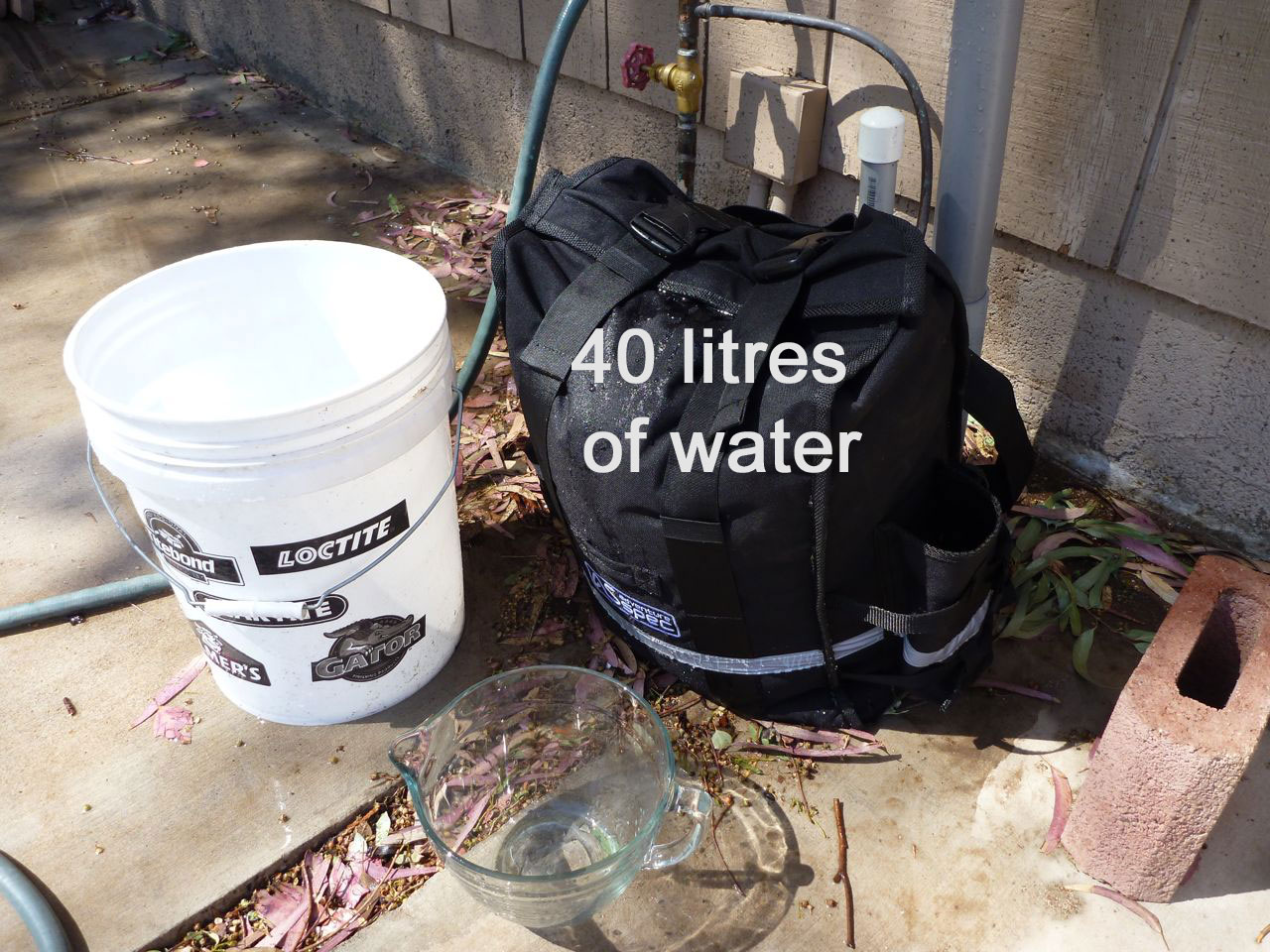
But, fill the Mags with water and you’ll easily get 40 litres in each side, as the pictures right and below show. Seems hard to believe but there are no less than two fills of that 20L white bucket inside the Mag bag, rolled up, clipped down and ready to roll were it not for the fact that it would give me a hernia trying to lift 40kg (88lbs).

magwalter

Does this all really matter? Yes, it does because for a start, the l x w x h method doesn’t truly represent the maximum potential volume (MPV) of a flexible, non-cuboid container, even if the maxed-out 40L capacity demonstrated on the left is unlikely to be achieved in the real world of packing your panniers with normal travel stuff.

It matters all the more when trying to compare stated fabric pannier volumes with rigid metal or plastic boxes as a guide to buying one or the other. My comparisons in the table at the bottom uses the l x w x h method but that only compares like against like. In all cases you can get more in your bags.

monbaguette

Even then, I think the dimension ratios of a flexible container may also have something to do with it. I recall the guy from Enduristan saying something like the reason their original Monsoons (left, reviewed here) are wide (closer to a cube form) is that they have/can make more volume (by presumably having less far to go to reach ‘cubic optimisation’).

But on a motorcycle I still believe slimness is a desirable attribute and is something that for example, Jesse Luggage strive to maintain in their mounting systems and cases. Al likes to boast that some of his rack and box setups are narrower than competitors’ racks alone.

So, in summary, think carefully when comparing stated rigid box volumes against fabric panniers. A rigid box’s capacity is immutable but a soft bag may be more than you think.

The Magadan was used because it was the pannier I used at the time, but this test would work and give similar results with any similar product. 

Setting up the CRF250L

CRF250L INDEX PAGE
Original pics for this post sadly lost in the clouds
20130408-025454-PM.jpg

In Phoenix the CRF was waiting for me, as were a dozen boxes of accessories to finish off the job the first owner had started before he flogged it with less than 1000 miles.

As a reminder, he fitted a pipe, plate, EJK fuel controller, tail rack, 13T, Shorei battery and the white plastics. Most of the original bits were there too.

Lying on the floor there on the left I had a set of Aussie Barkbusters with the large Storm handguards, a Spitfire screen, some bar risers, a 12V socket, a couple of RAM mounts and some Double Take mirrors along with lube, filters, a Trail Tech Vapor and some maps.

The cheap risers and 12V socket were clearly sourced from the reject bin in some Guandong factory and needed redrilling; the 12v socket even had the blue and brown wires the wrong way round which caused a small bang and some smoke! At least there was enough cable on the Honda to get 2 inches out of the risers. The Barks went on easily enough; I refitted the original 14T, replaced the shift lever with a folder, got an AZ plate and some insurance ($28 for half a year!) and then we set about the shock and the side racks.

crgr-shockload

On the plane over I had a thought that the shock wouldn’t be up to my weight and the load. The L I’d tested in February had been reassuringly firm but when it came to loading the rear spring on my Phoenix bike the collar adjustment rings were factory-set solid. We unbolted the shock (the usual near blind nuts make it easier with two people and the battery out) and Al whacked the collar rings apart. He pointed out a useful trick in turning the loose top sleeve out of it’s notch to give another 5mm of tension, but on bounce testing we decided to go all the way and fabricate an additional half-inch sleeve, splitting a right-diametre tube, fitting it and tacking it in place to rack the preload right up and have a bit more to spare. That required compressing the spring in a press but the shock is otherwise unmodifiable and a decent compression damped unit starts at $600.

Al Jesse was also using my bike to try out the prototype of  the new MonoArm rack he’s designed. Jesse mount systems are typically cunning affairs with minimal metal; my version is a bit heftier until the final form is pinned down.

I didn’t know what to expect but what we have here is a q/d platform rack no less (he must have read my mind) onto which I’ve chosen to semi-permanently attach my Magadans (I could as easily remove the pans from the plate, but the whole point is the rack itself is q/d). Each side plate locates into corresponding slots and the mounting system’s special feature you’ll learn about later makes it particularly well suited to slinky sub-framed dual sporters like the L. Removal of the platform with bags attached is with a nut and spacers, but production versions will use the tamper-proof QRDP lock by the time it’s all out.

Sunday Al put a cooler full of water in his KLX 250 S’s top box and we went for a ride up in the Weaver Mountains around Castle Hot Springs to see how my adaptions weighed up and pull off an mpg test. I was concerned the EJK black box might might have affected this as the original owner had intimated. Even then, with the Honda’s tiny tank (I’ll have a 5-litre fuel bag and may need another) it’s going to be stops every two hours to pay out for 8 bucks of fuel at a time.

cc-airbox

First impression was a lot of noise and no jaw-dropping gobs of extra power over the Honda test bike I road in February (I do wonder if that press bike had been fine tuned…). With pipe and airbox and EJK, power should have been up some 30% (18 to 24hp supposedly) but Al’s Kawasaki was having no difficultly keeping ahead. We’d already tried to quieten the FMF ‘Q-Pipe’ by fitting a restricting washer up it’s spout and though it made a small difference in the garage, once on the road I couldn’t see myself living with that racket. Acceleration was especially noisy; we hoped the holes that had got drilled into the airbox side might address that, but back at Al’s, tapping them up made no difference. Luckily the stock pipe was at hand and easy to refit.

32-screen

Other than that all was well. By the end of four hour’s riding the old backside was getting warm; that shock is pretty firm now and chattered into bends, but should be on form with a load. Standing up the bars were still two inches too low – Al’s KLX by comparison was just right. Not sure how to get around that without cable issues. Tyres at street pressures were OK and the brakes a bit touchy on the loose gravel inclines, but that will just be me getting used to the bike. The Slipstreamer Spitfire screen too felt a bit close to my face when bashing over ruts but the ‘pressure balancing’ gap at the base caused no turbulence on the highway. I did think it could pull still more gearing but there’s no room in there for a 14T so it will have to be 3 or 4 teeth off the back end. Unfortunately it was the din that left the biggest mark.

As for mpg. Al’s KLX recorded 96 miles on the loop; the Honda 83.5 – an unlikely 15% discrepancy so one odometre was out; tyres and gearing were standard on both our bikes. Assuming the Kawa’s distance reading was correct then the Honda was doing an impressive 62.3 US or 75UK mpg. If the Honda’s 83.5 miles is in the ballpark it’s more like 54.2 US but still 65UK mpg, what I recorded last March on the stock press bike. We were going pretty slowly (no more than 55mph on the KLX or 50 on mine) so I suspect somewhere in between is right.

Back at base I checked the speedo against a Nuvi satnav and up to 30mph it seemed spot on for speed  though over a mile the odo was 10% under. A closer test with my Garmin 62 or even the Trail Tech Vapor unit will get to the bottom of it. And it sure was nice to ride the back streets with that quiet stock pipe back on, even if at 12lbs it’s double the weight of the Q Pipe.

Unfortunately the proto side rack doesn’t fit round the fat OE can and needs to be modified a bit. That and the fact that my  ‘two-day’ helmet delivery is still with UPS meant I was running out of time to get to South Sound BMW for Saturday. We talked about good routes on the weekend but a 250 is not the best machine when you need to cross a continent in a hurry.
The northwest was never my plan on this trip and my decision to fly up north (about the same price when you add it up) was made easier by today’s weather warnings across the Southwest. Here in Phoenix it’s been baking at over 30 Celcius last few days but today in Flagstaff it was snow and 60mph gusts –  undesirable conditions aboard a skimpy 250.

It all gives me more time to get the Honda in shape for a shorter ride for a presentation at Roseville, CA before swing back through Utah’s Canyonlands.

Next instalment here.

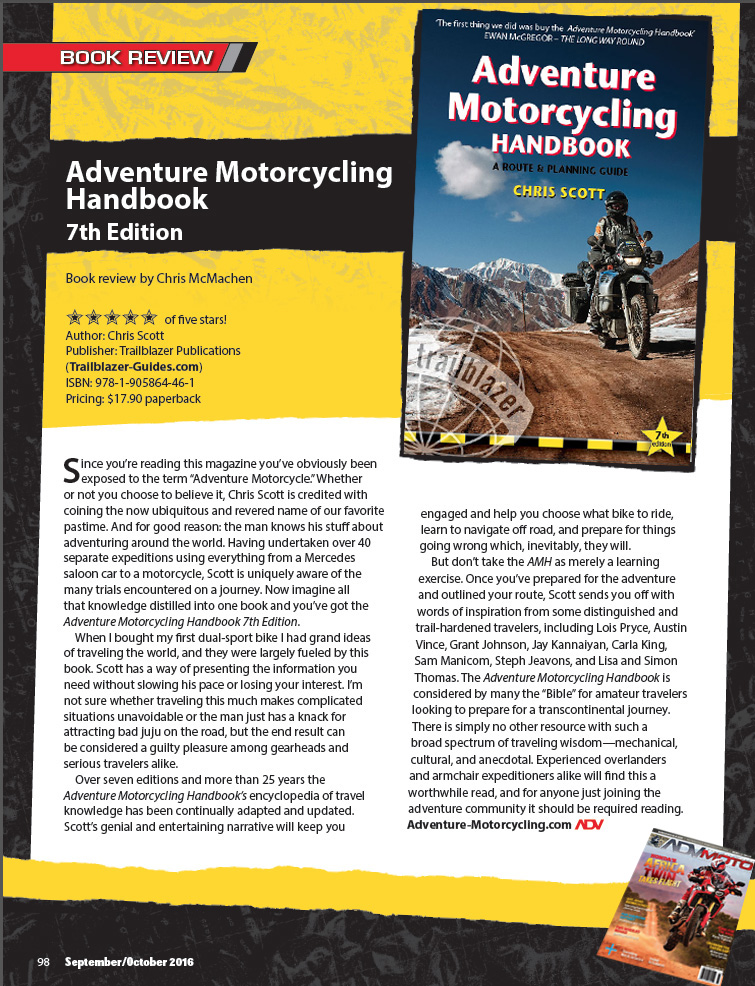
AMH7 Reviews

AdvMotoAMH7

bike500Fortunately, I had Chris Scott’s indispensable Adventure Motorcycling Handbook up my sleeve, which clearly outlines the unwritten rules.

Dan Walsh [in the Sahara], Bike magazine 500th issue

Continue reading