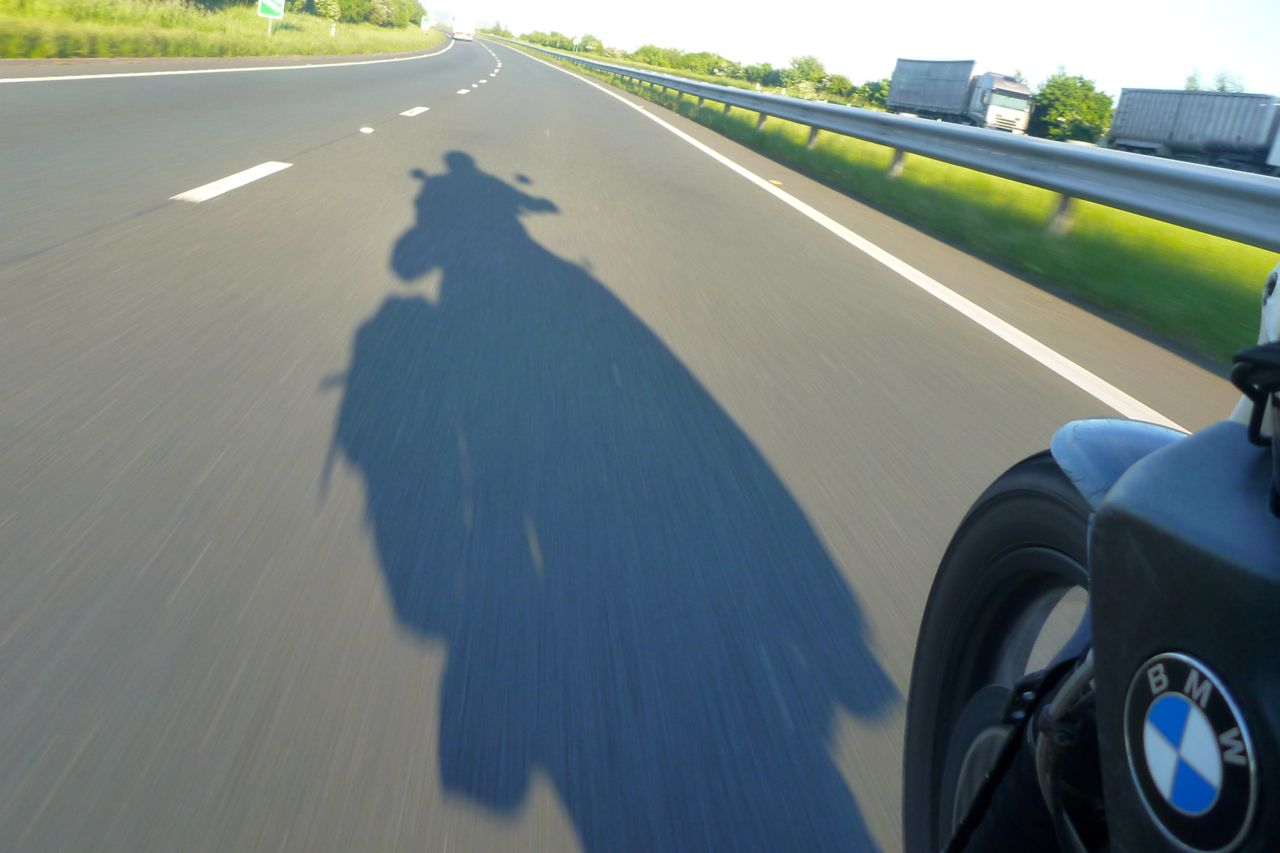
Today the XCo was humming away like a generator, covering 760 clicks of deserted dual carriageway and Autovia strung out in an arc between Madrid and the Portuguese border. All at a 95kph average but never exceeding 110. A week ago I was bracing against deeply unnerving gales in northern Scotland. Today it was the easiest 470 miles I’ve ridden since I came back this way from Morocco on the F650 twin a couple of years ago. No wonder Spain went bust – they spent it all on great roads and I passed more unfinished. They say motorways are boring, but they’re also free of any ‘sorry-mate-I didn’t-see-you’ perils and so quite restful if the bike is comfy and the weather fine.
It’s good to be reminded what it’s like to leave for distant lands, even if it’s only Morocco. All the usual anxieties flit about, then – with years of doing this under your belt – you relax until the next challenge and the one after that. And so it could go all the way to Cape Town or Vladivostok. Gaining confidence with each new hurdle as you master the game with satisfaction, energised by the newness of things. It’s what they call adventure motorcycling.
The fuel consumption has taken a hit – down to 20kpl or 56.5mpg – nearly the X bike’s lowest ever figure. But that’s the only way to eat the miles if I’m to be in Marrakech by Tuesday. Partly this may be down to the fuel richening booster plug I fitted at the start of the summer, though I realised the the tyres were a bit low. I won’t begrudge the engine-cooling properties of a richer fuel mixture down in Morocco, but when I come back in December I’ll temporarily unplug it and see if I can detect the slightly harsher engine response along with better fuel consumption.
As always I fail to get into Spain, and I’ve been trying long enough. This time I’m on a mission, but over the years I’ve taken various cross-country routes looking for something arresting. But it’s the same old high plains – farmed or grazed and interspersed with higher ranges or deeper valleys. What few towns and villages there are tightly clustered around a hilltop church. Ride in and no one’s around.
I’m reading a book about an 18-year-old Scottish anarchist who came here in the 1960s with a bomb in his backpack to do in Franco. He found something arresting all right. Lucky not to be executed or simply disappeared as 1000s of others were, he got 20 years but was out in three and seemingly had a great time in jail advancing his political education. Ironically back then prison was the only place in Spain where people could talk freely away from the secret police. They’d already been caught. Our man was sorry to say goodbye to the inmates. Less Midnight Express – more Express Checkout. Perhaps in Spain it’s the people more than the land that give the place its appeal – not something you’ll encounter averaging 95 clicks to an hour. But right now with a Euro 25 to a pound, Spain is as cheap as ever. Did the acute financial collapse here bear down on prices? Two lip-smacking coffees, big bun and a fresh OJ – 2 quid por favor. Overnight hostal around £25. Fuel about 20% less than the UK. And at a balmy 20 degrees plus few tourists to be seen, big bike touring here right now could be a treat.
Another interesting X-factoid for you. Using a satnav reveals the speedo is about 8% over – you’re not going quite as fast as you think. But today I finally got round to calibrating the odometer against the roadside PKs which are accurate to within ambient thermal tolerances (and more accurate than a GPS for this task). It’s how you establish your true mpg and so, range. Over 180kms the odometer was just 3 miles out, reading 109 for the 112 miles I actually covered. It makes you think if they can get it that accurate, the over-reading speedo must be deliberate and factory set just within the (UK) legally allowed error of 10%. So you always think your bike is a tad faster than it is.
The big question is how will the X machine manage Morocco’s rocky pistes. Somehow I’m not convinced it will be an improvement over the rorty 21-inch Husky Terra I used last year. I had a blast on that bike – same engine and power, near enough – but as heavy as my modified X bike is now. As always the compromise is in the getting there as well as the being there. I’m just about to cross from one to the other.
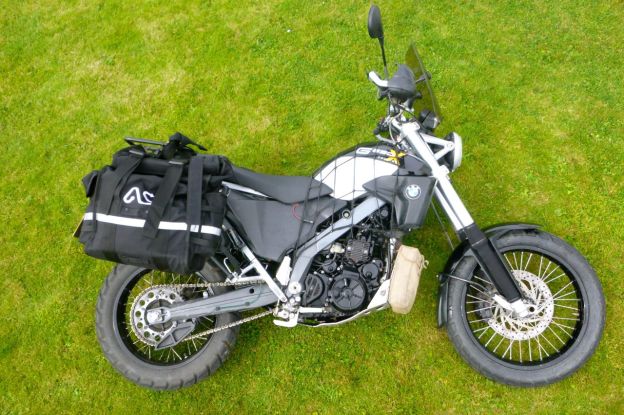
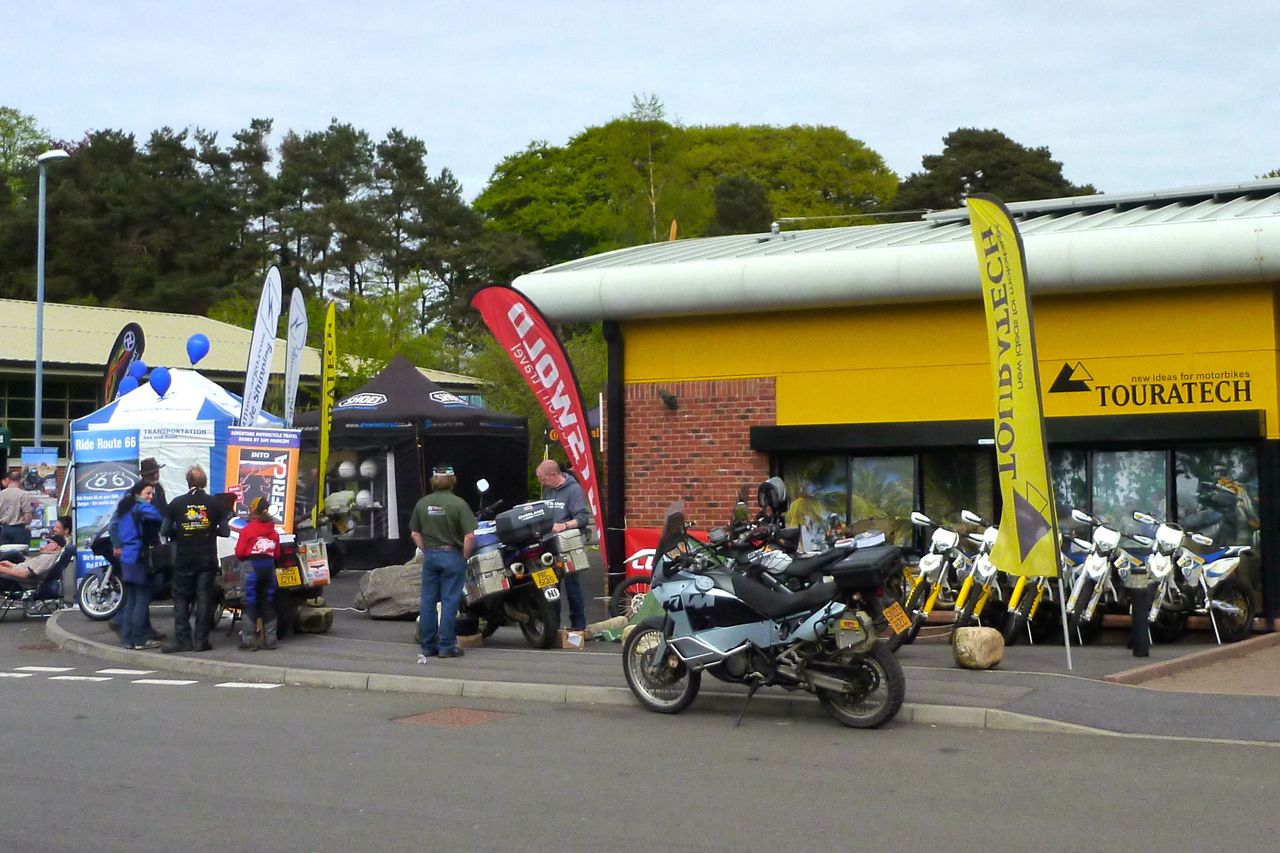
In the last couple of months I’ve racked up a few more thousand miles in the X bike. In May I had a chance to test the new suspension on a heavily loaded ride to the Touratech event in south Wales. A twist on the pre-load knob on the Hyperpro shock dealt with 20kg of books with all the rest. The Adv Spec Magadan IIs I’d bought weren’t in yet so I lashed up some all-weather luggage using Watershed kayak bags of which I’m a big fan.
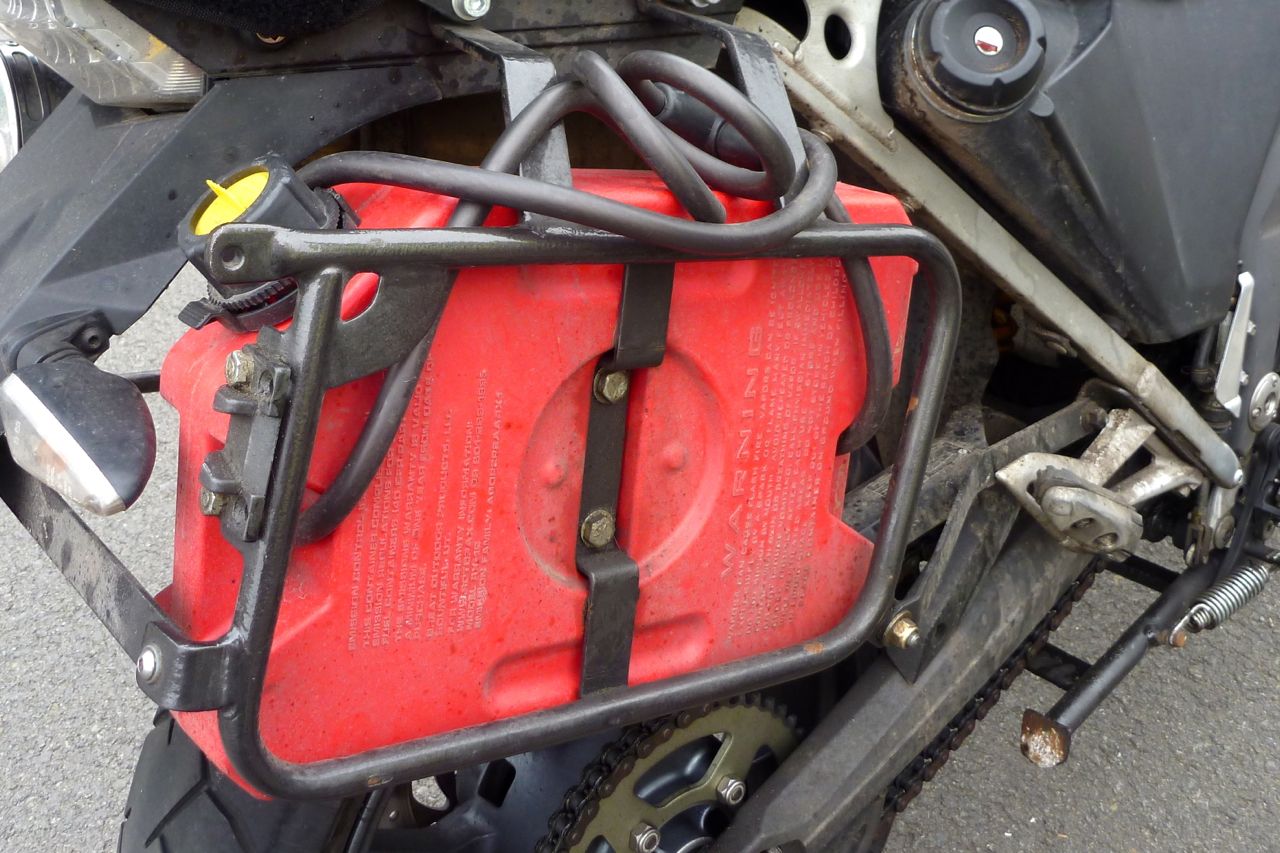
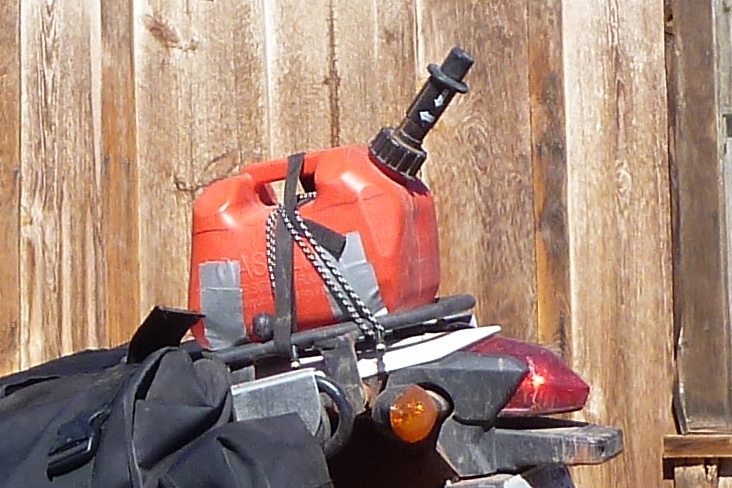
At the rally I met another bloke with an XCo who’d made a neat job of slotting in a Rotopax can. With a siphon, it’s not as handy set up as my Xtank, but it could easily be adapted to work just as seamlessly. This guy also gave me a tip about fitting a Booster plug to richen up the mixture and smooth out the engine a bit. Some days I think it’s something the bike could use.
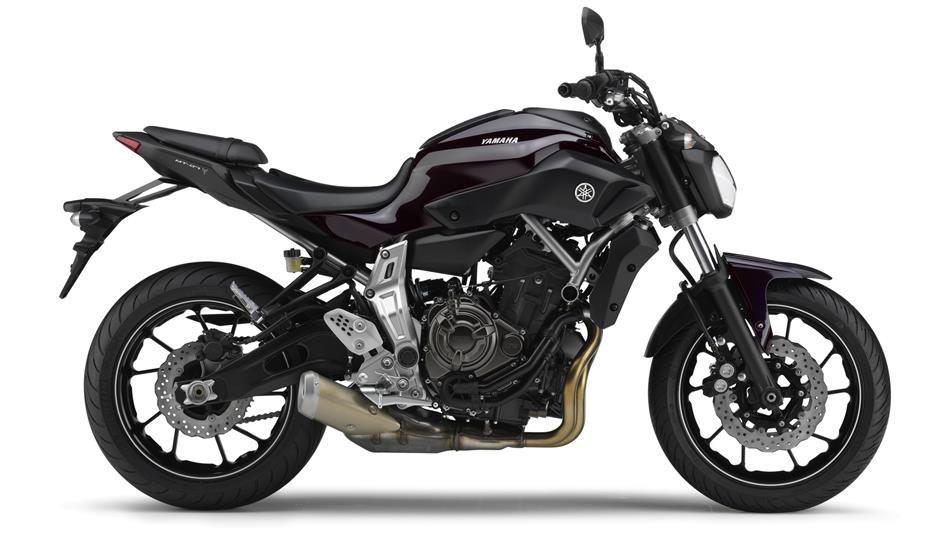
I also had a ride on Nick Plumb’s Super Tenere (left) which had been blinged to within an inch of its life. What a stonking motor that is! The secret: 270° cranks for that lovely V-twin feel. They say the new Tenere may be based on the current Yamaha MT-07, 700cc, 270° twin (right). The MT seems to be going down well with the testers as a return to simple and cheap fun biking. new Tenere or something else, my next bike is going to be a 270.
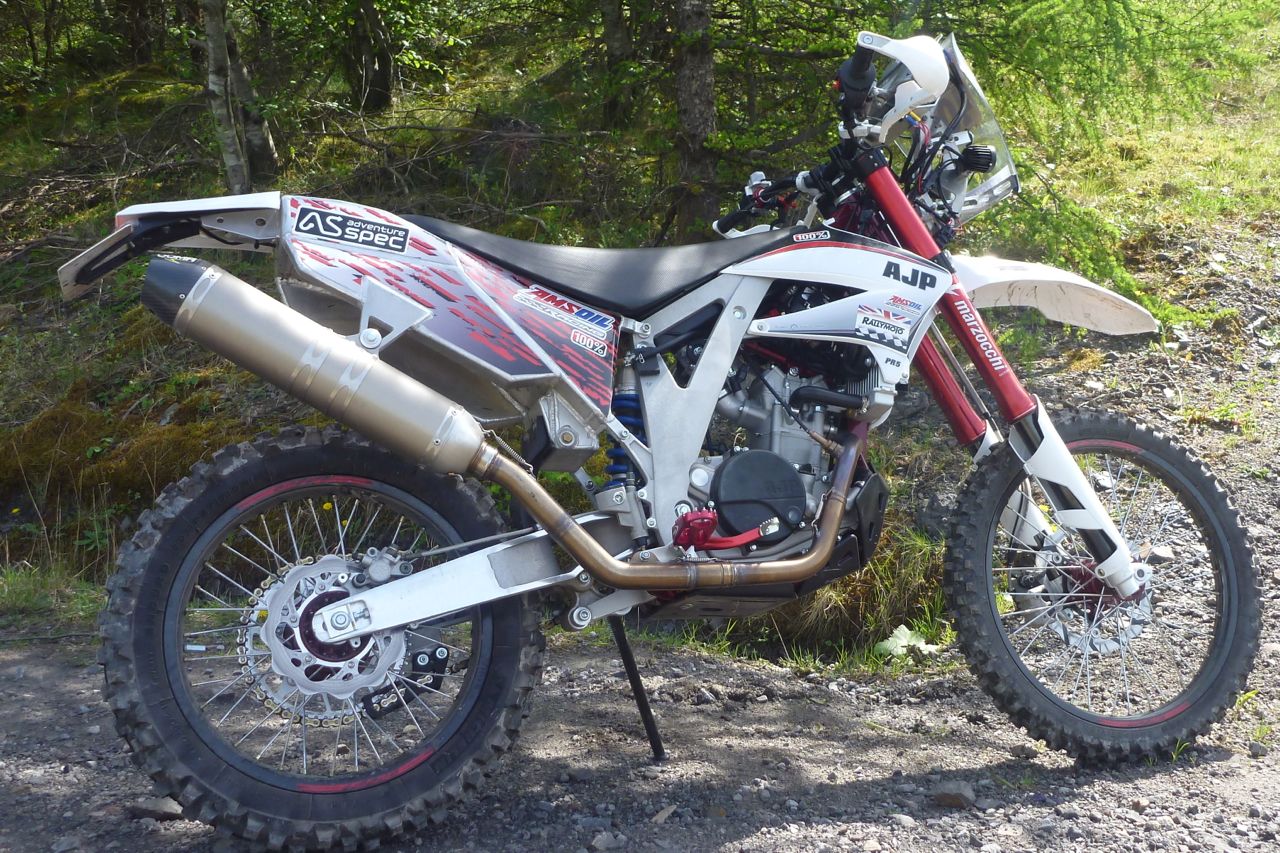
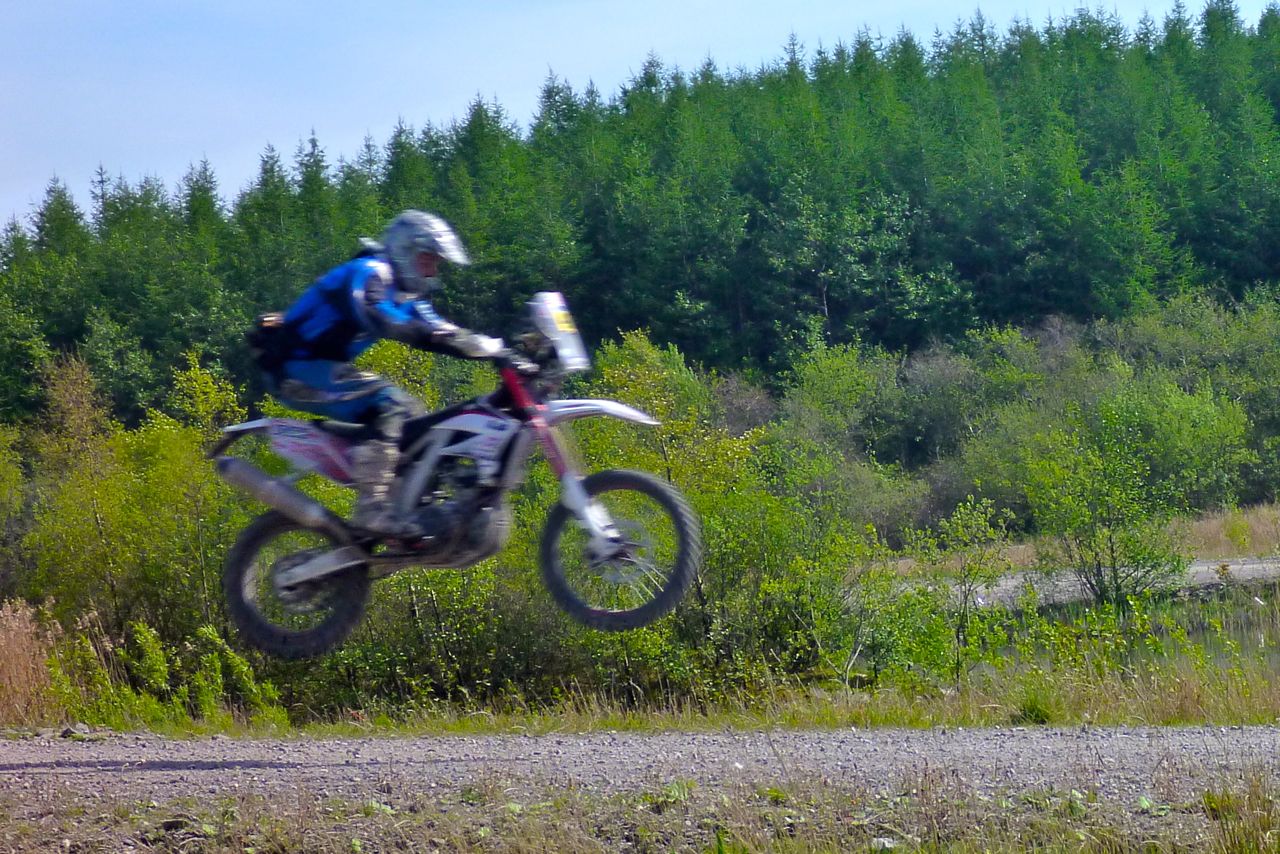
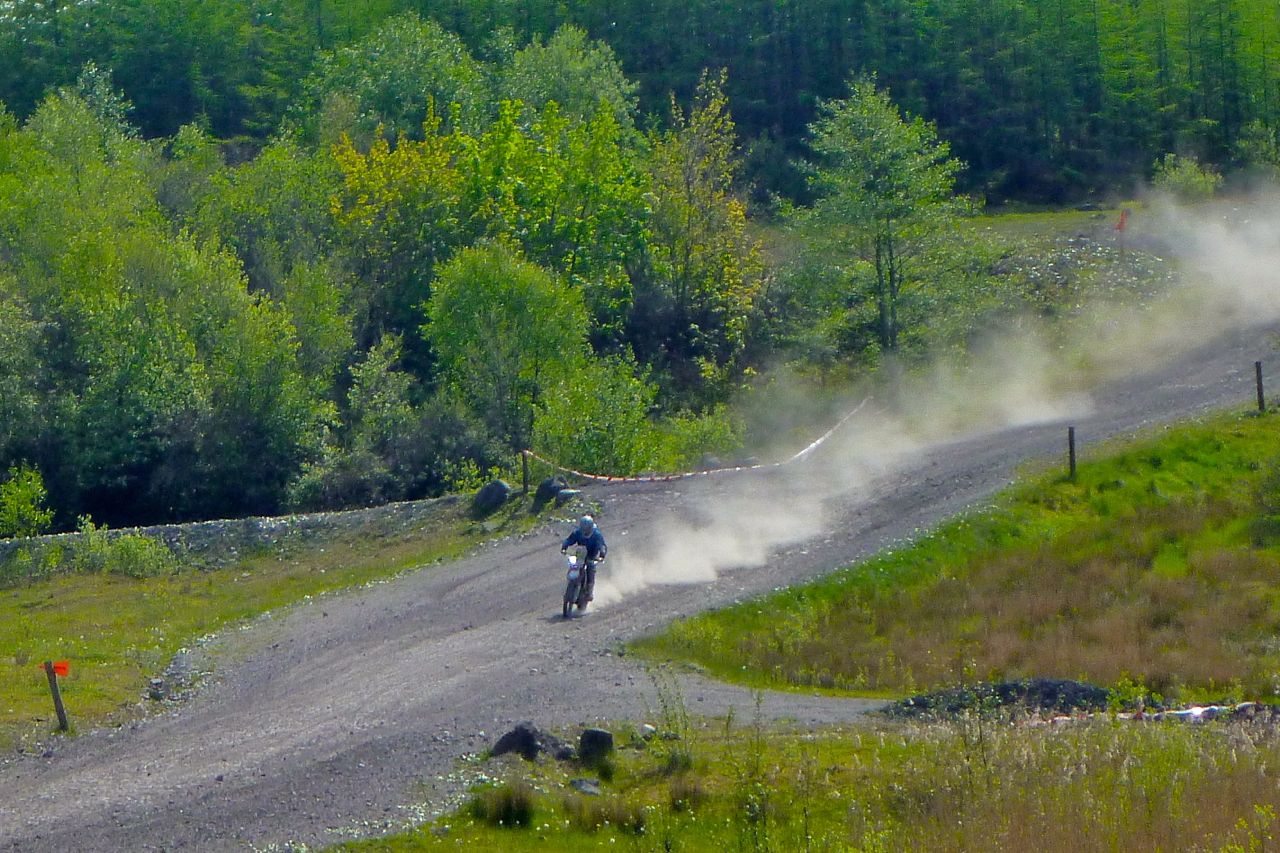
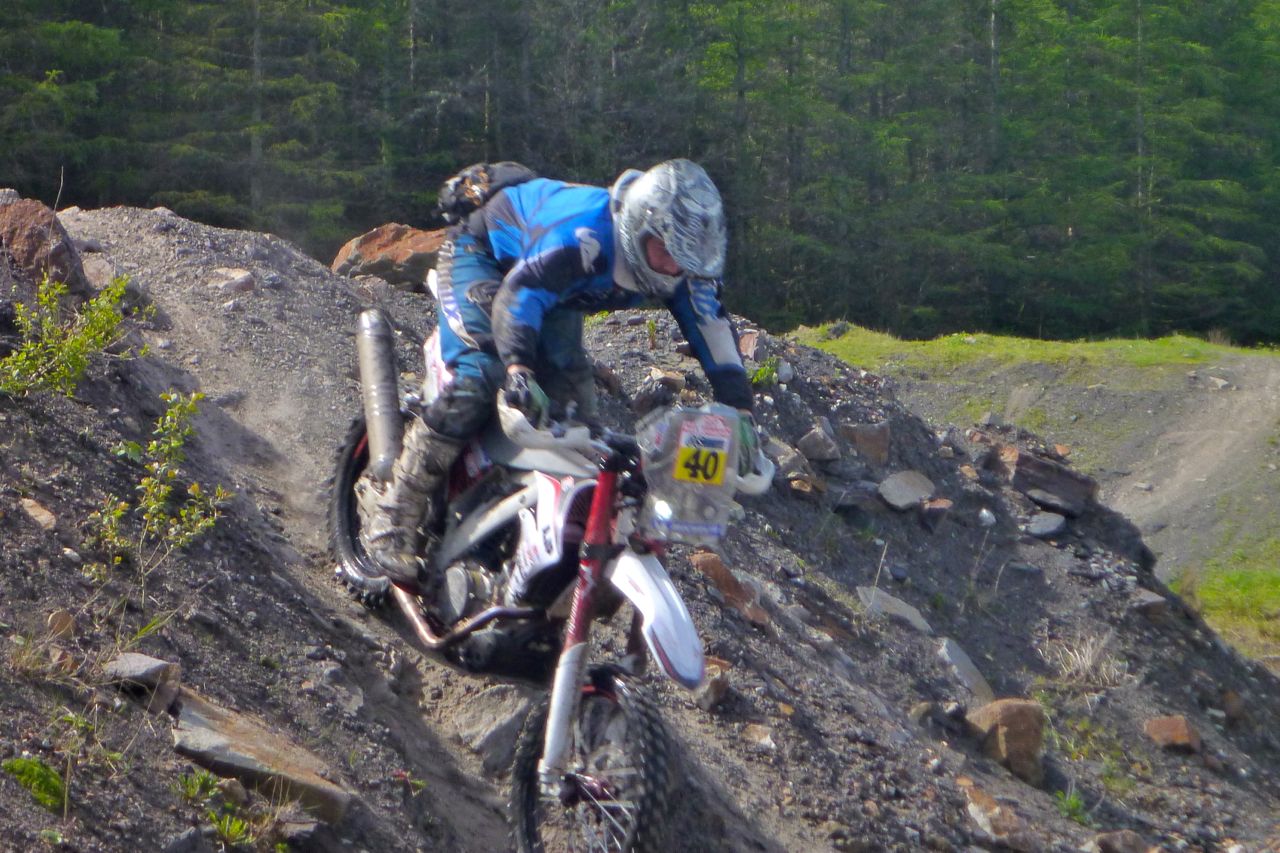
The other bike I tried was some sort of AJP 250 enduro racer (right) with a bloke who interviewed me for TBM. We were up at the BMW off-road course, a brilliant venue with excellent traction and all sots of levels of challenge. That’s not me hooning about in the other pictures, but one of the BMW testers in full neck brace.
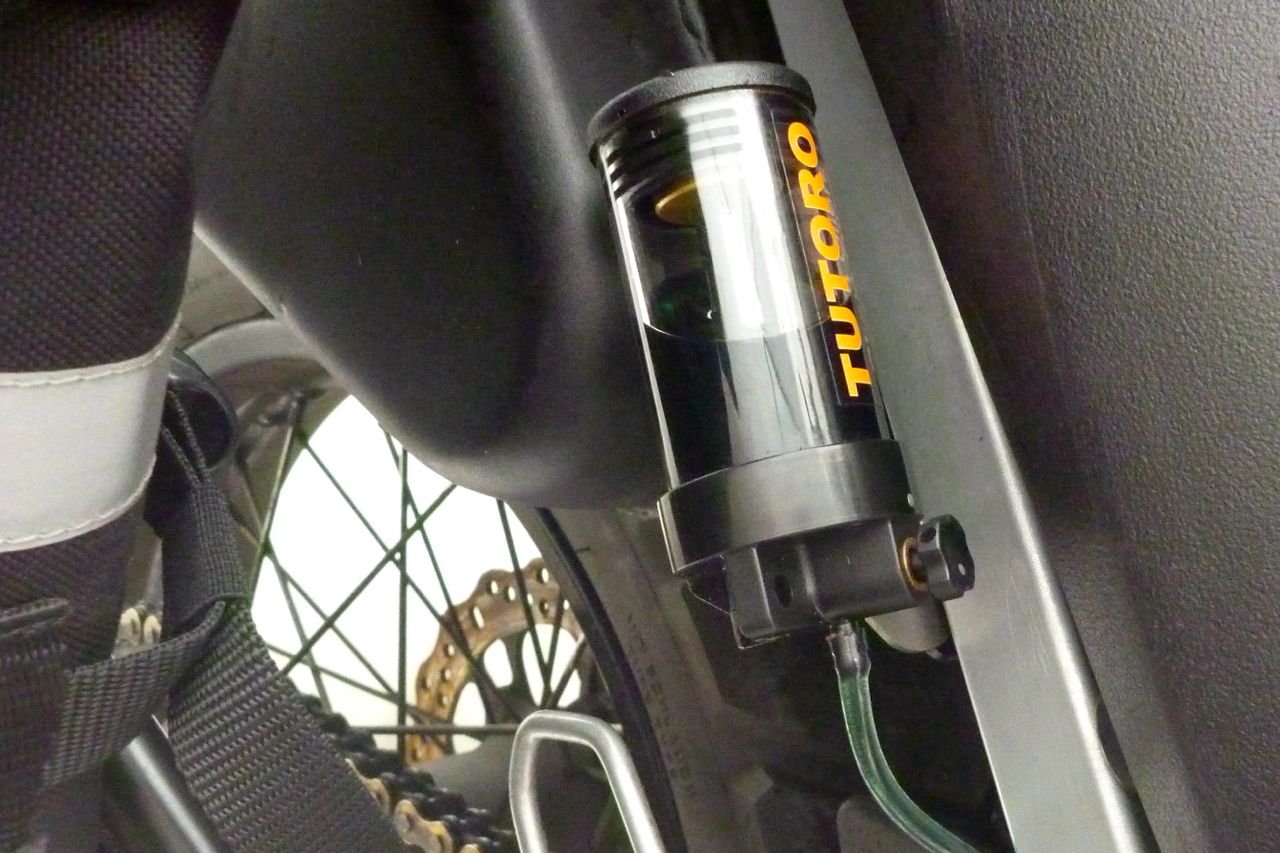
While at Touratech I fitted a Tuturo automatic chain oiler (left). For the full review click the link, short version: for me it the best solution to that necessary task.
After the event I sped off north through Wales trying to give my new springs a work out. The back ends works well, as you’d expect, but the refined front end (new Hyperpro springs and oil, seals and gaiters) has the effect of making the front tyre more sensitive to road irregularities. More information is good I suppose.
Crossing the border and filling up south of Glasgow a day or two later, I pulled away on a lovely smooth engine. I often get this with big singles and can only put it down to varying fuel quality, or perhaps a long motorway blast then cooling off? Either way, I knew the annoying big-single lumpiness would return after more docile riding. Maybe the ECU resets following in town riding? I have a hope that Booster plug will make a difference as this as, along with the horrible 1st to 2nd gear change, it spoils this bike.
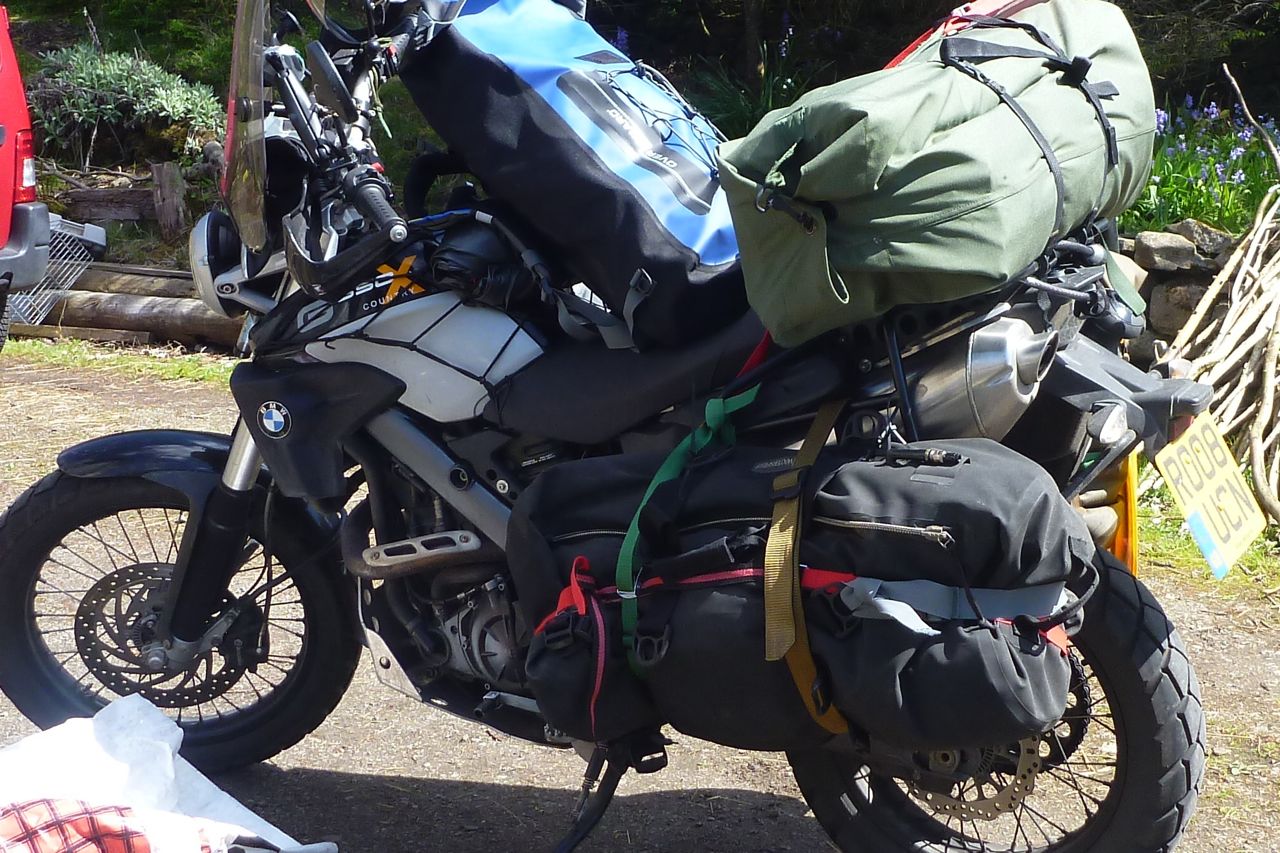
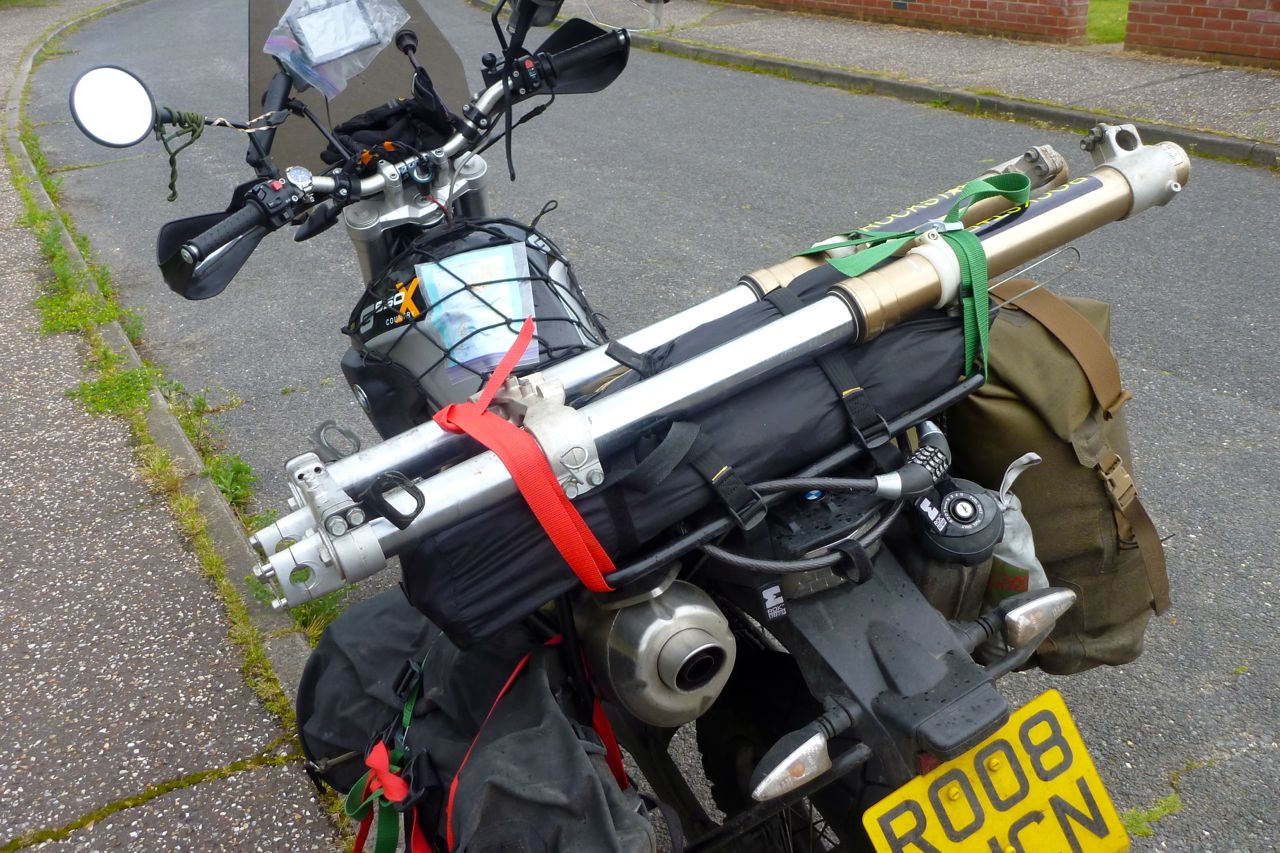
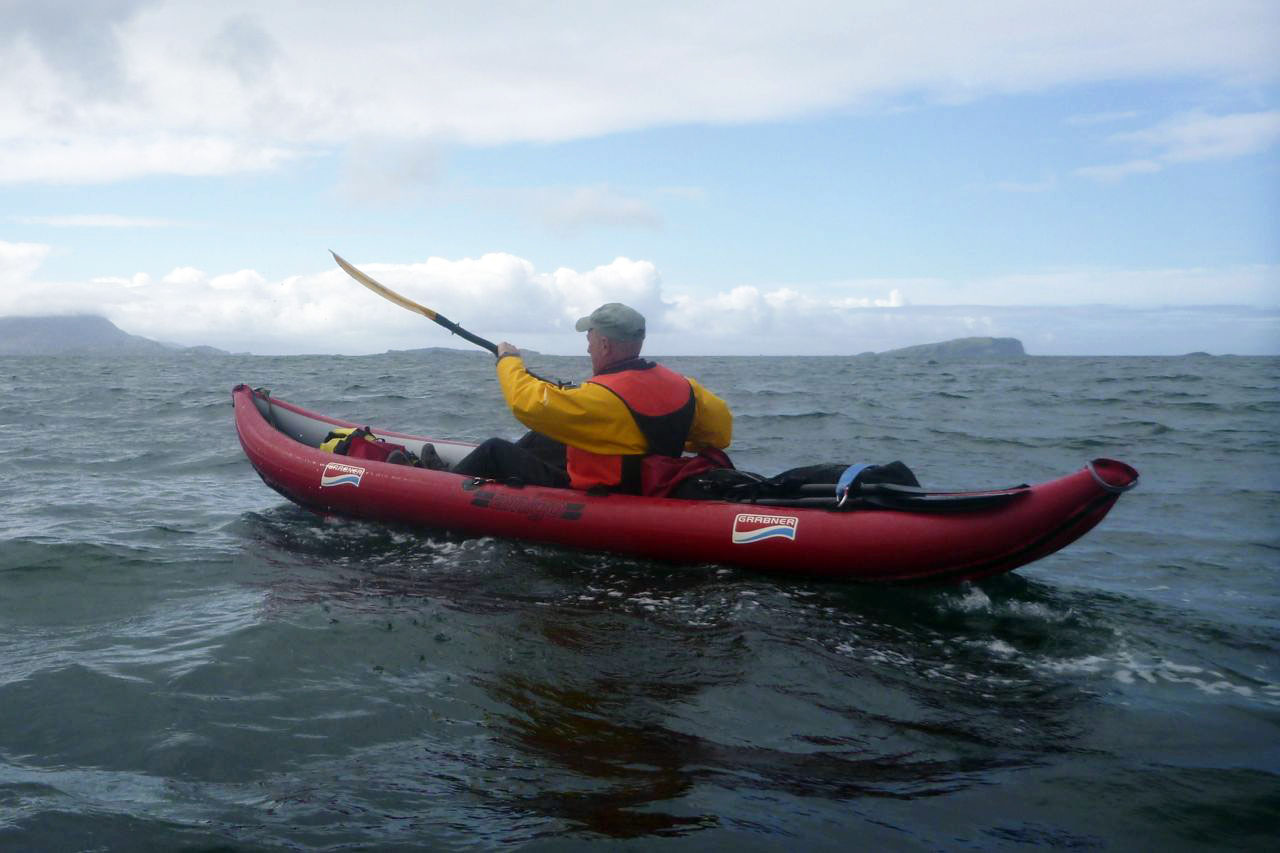
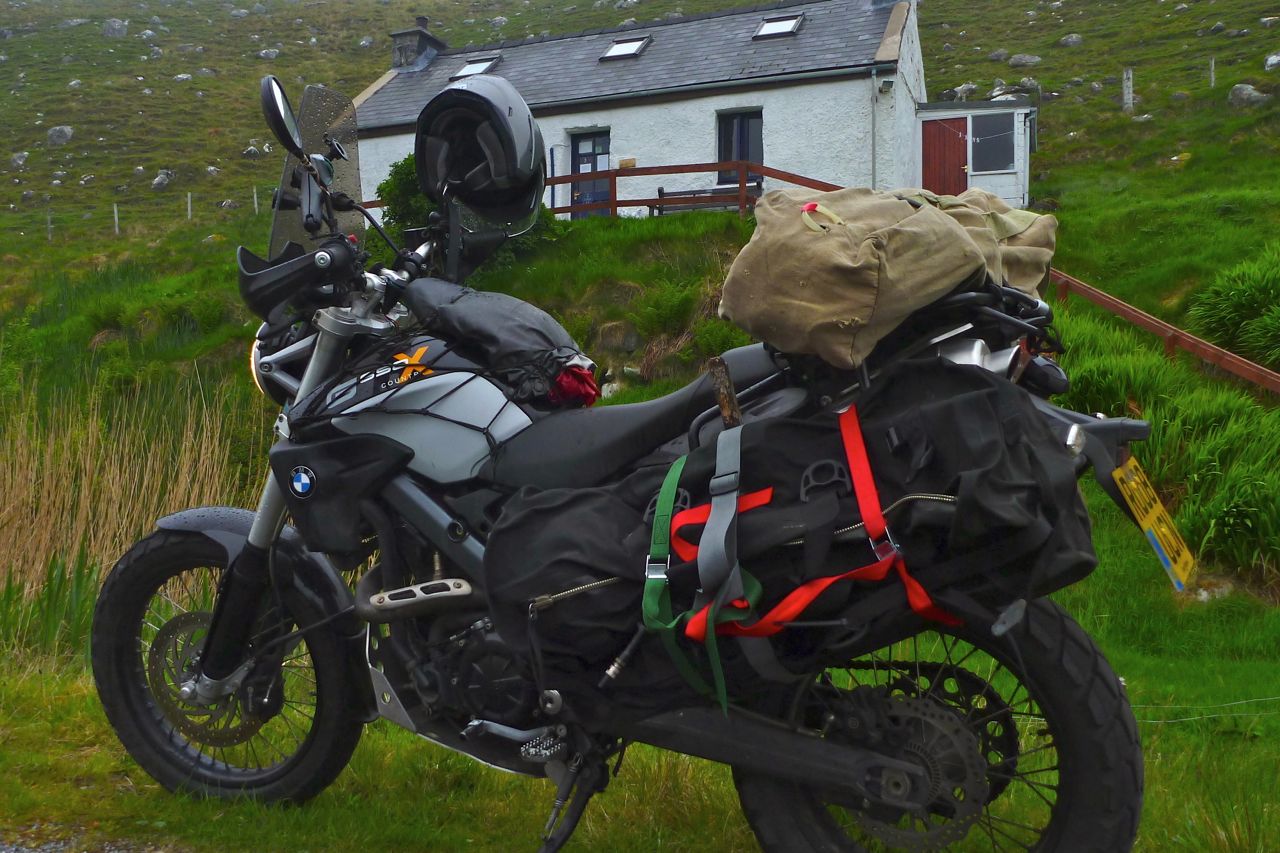
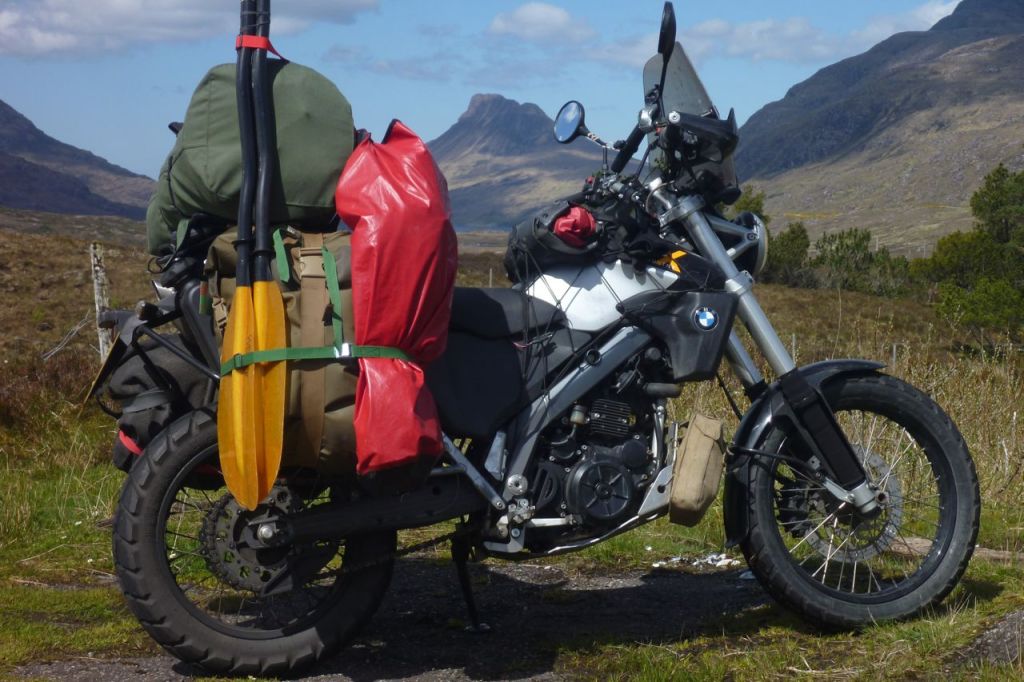
I rode into Oban, parked the bike in a hostel and spent four days kayaking round the Slate Islands with a French mate who’d brought my boat and kit up in his car. When that was done, I piled my 14-foot kayak, packraft, and a whole lot of other stuff (left) on the X machine for a cautious ride up beyond Ullapool. Here I hooked up with Desert Riders Jon for an overnight packraft trek across the lochs of the Assynt. Very nice indeed.
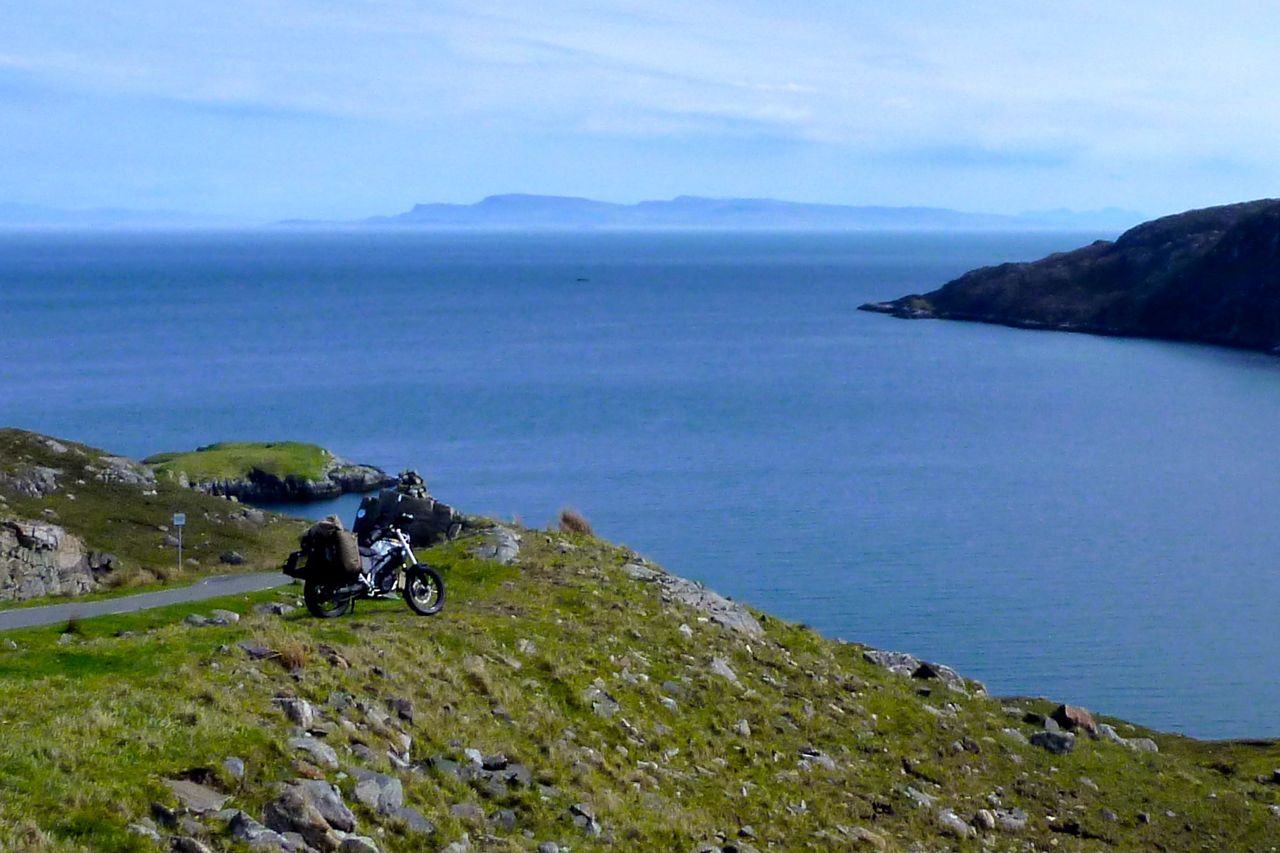
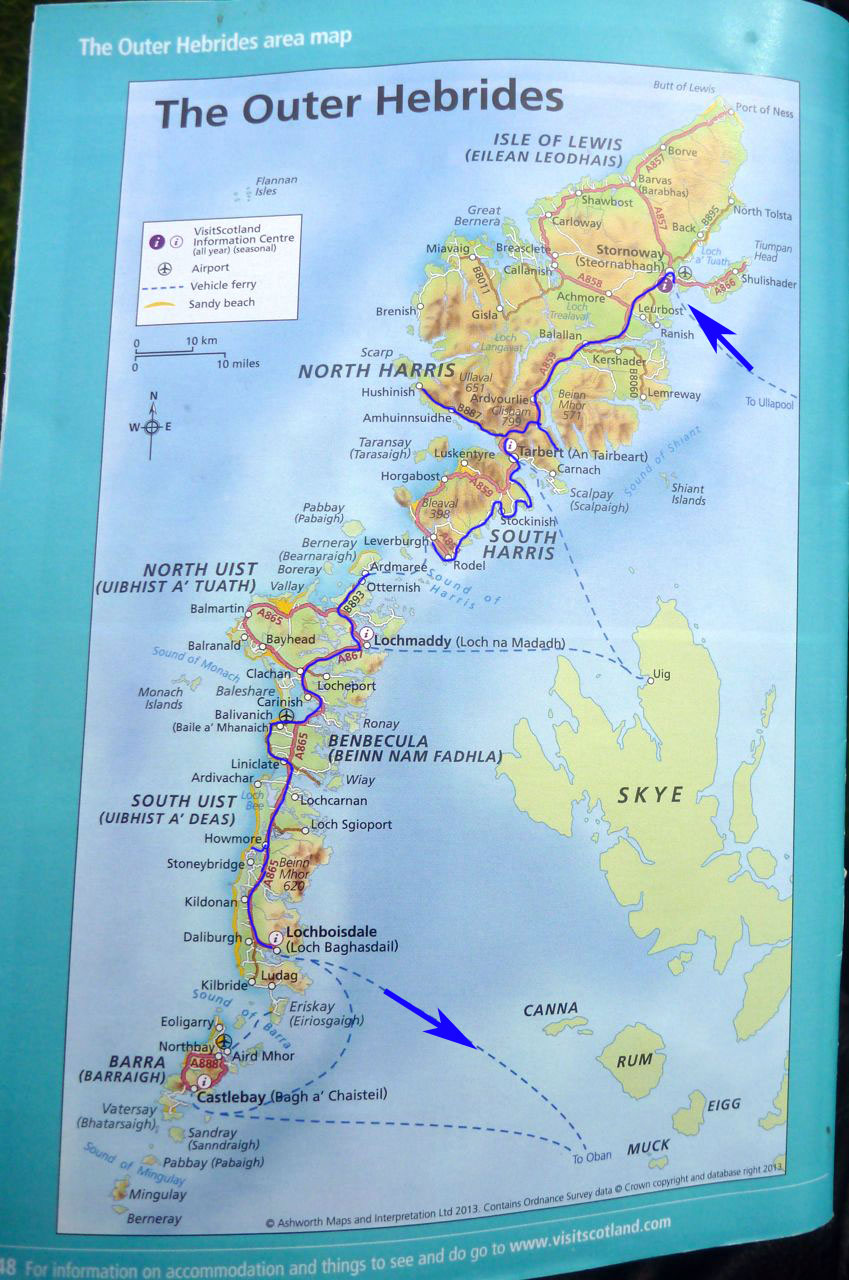
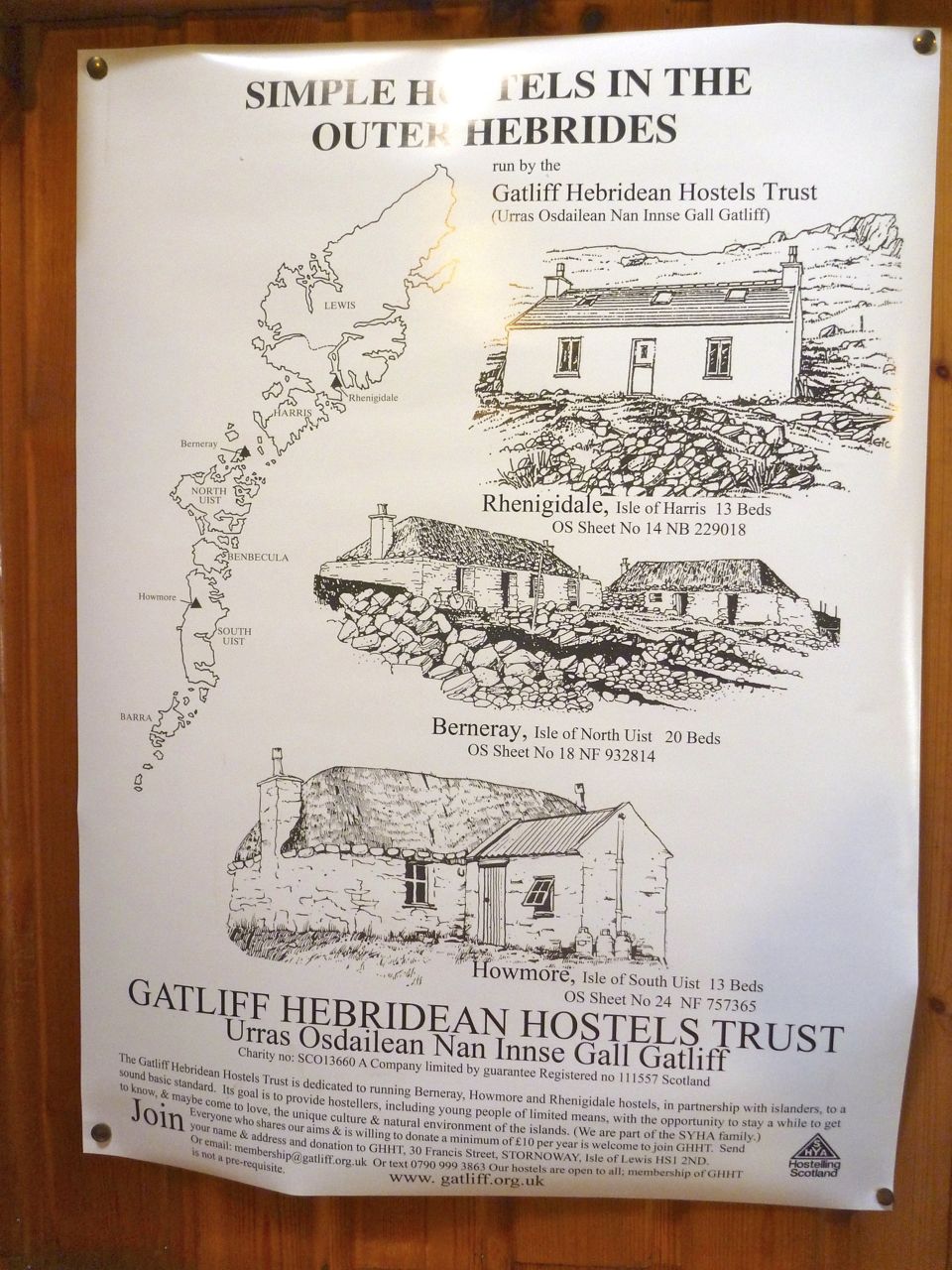
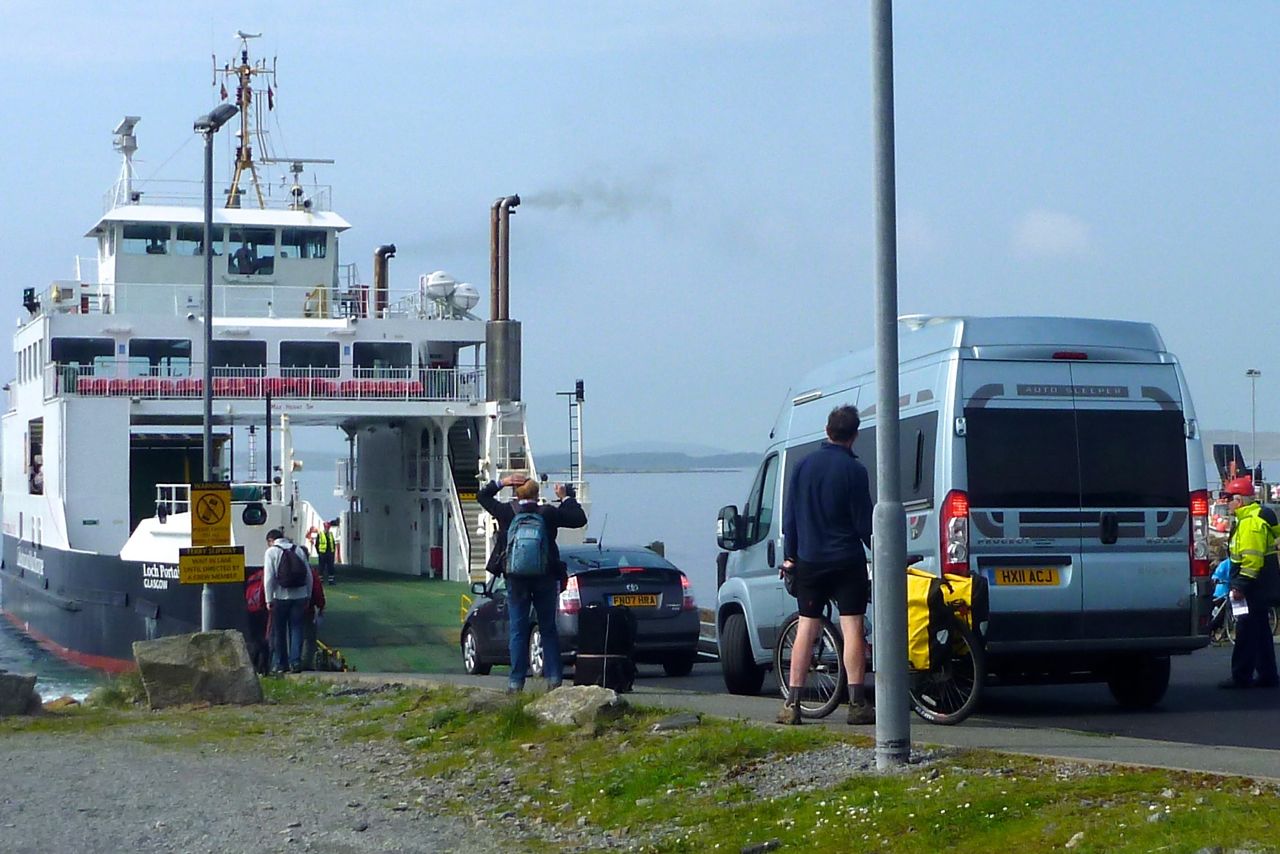
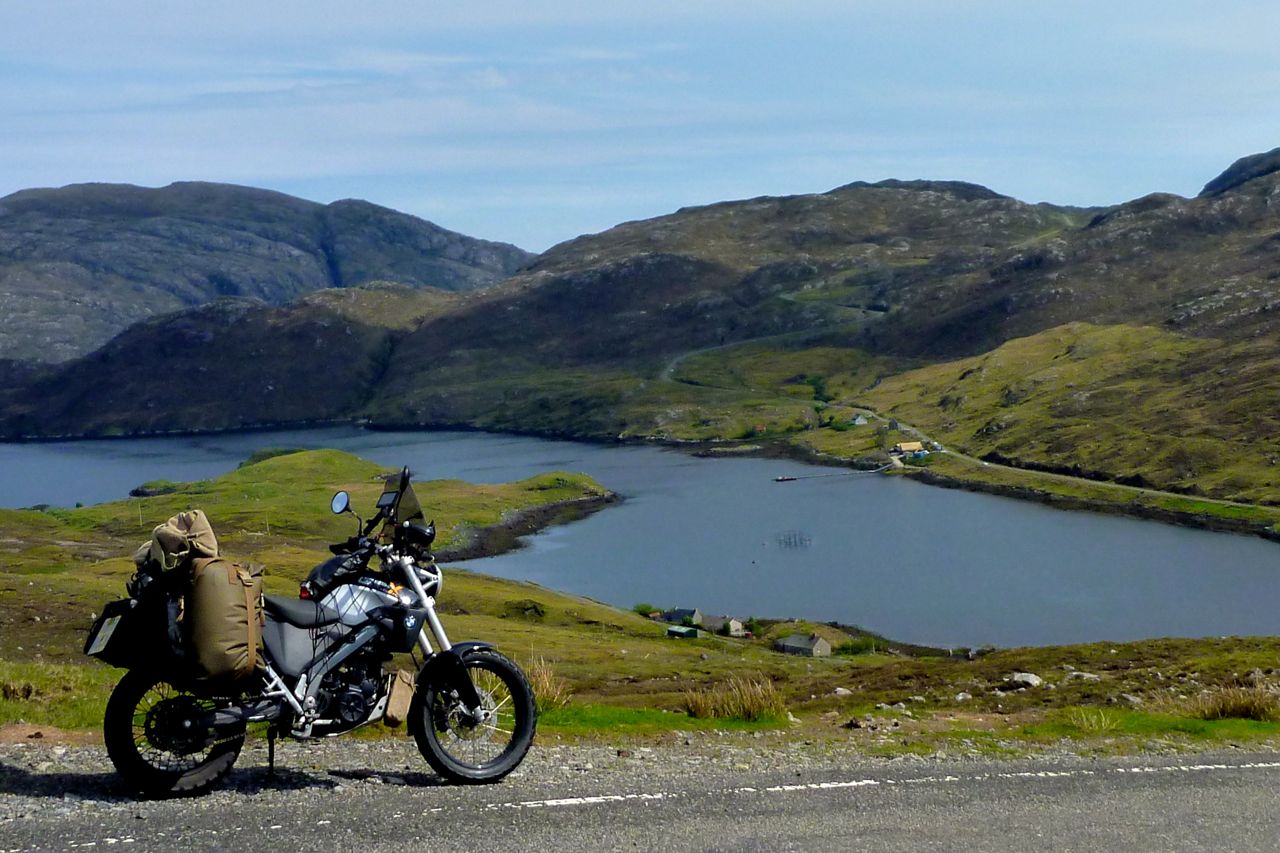
I left my boats up there for later, then ferried from Ullapool to Stornoway for a run down through the Outer Hebrides; one of Britain’s must-do rides. The CalMac ferry network gives you all sorts of options to return to the mainland or visit the other islands.
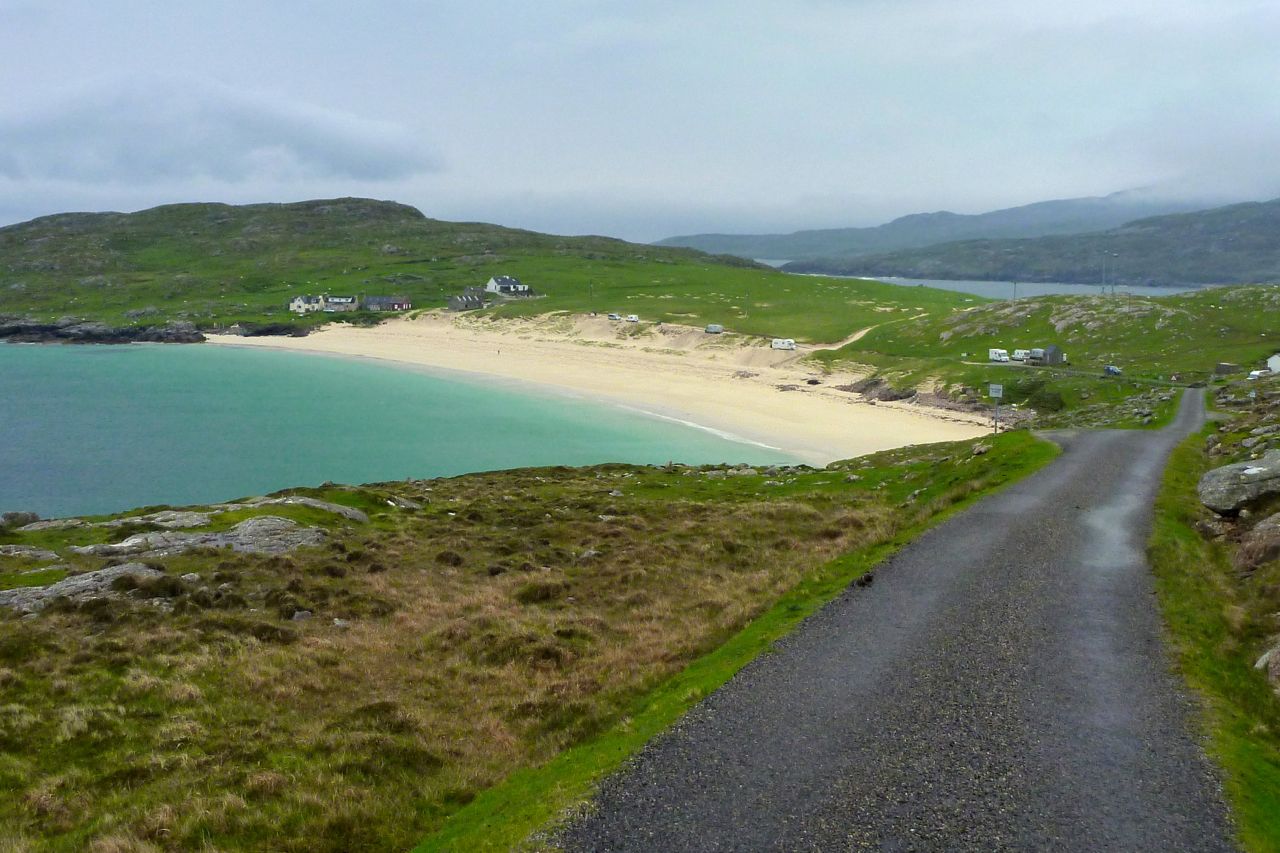
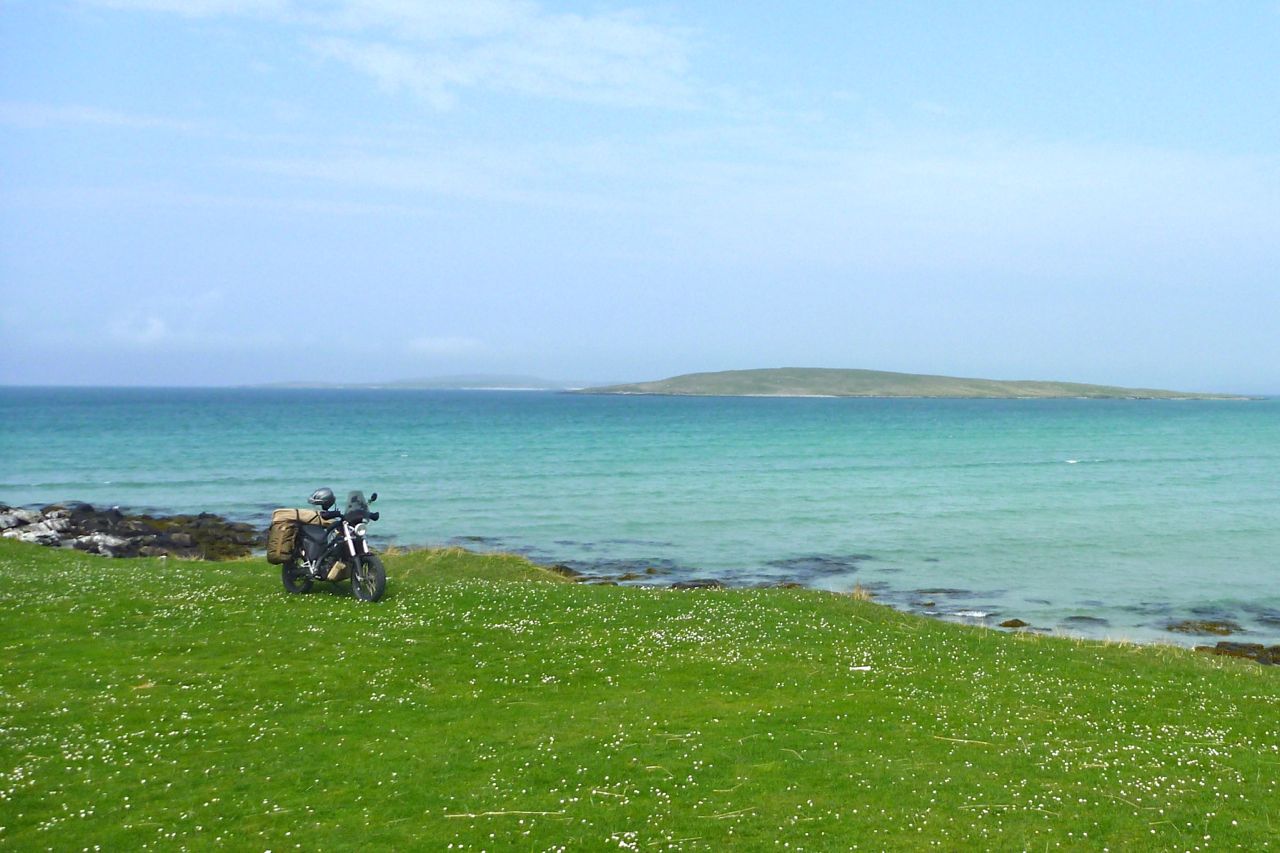
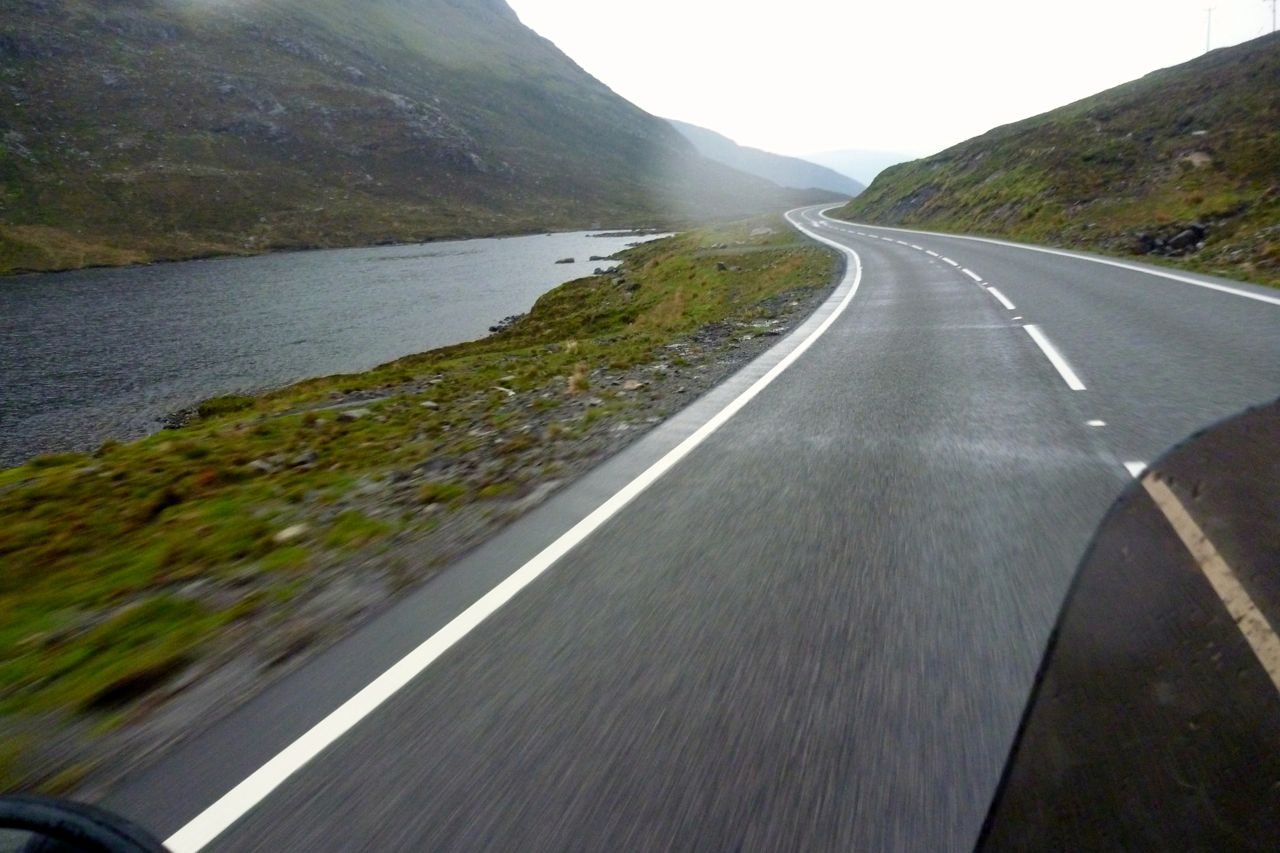
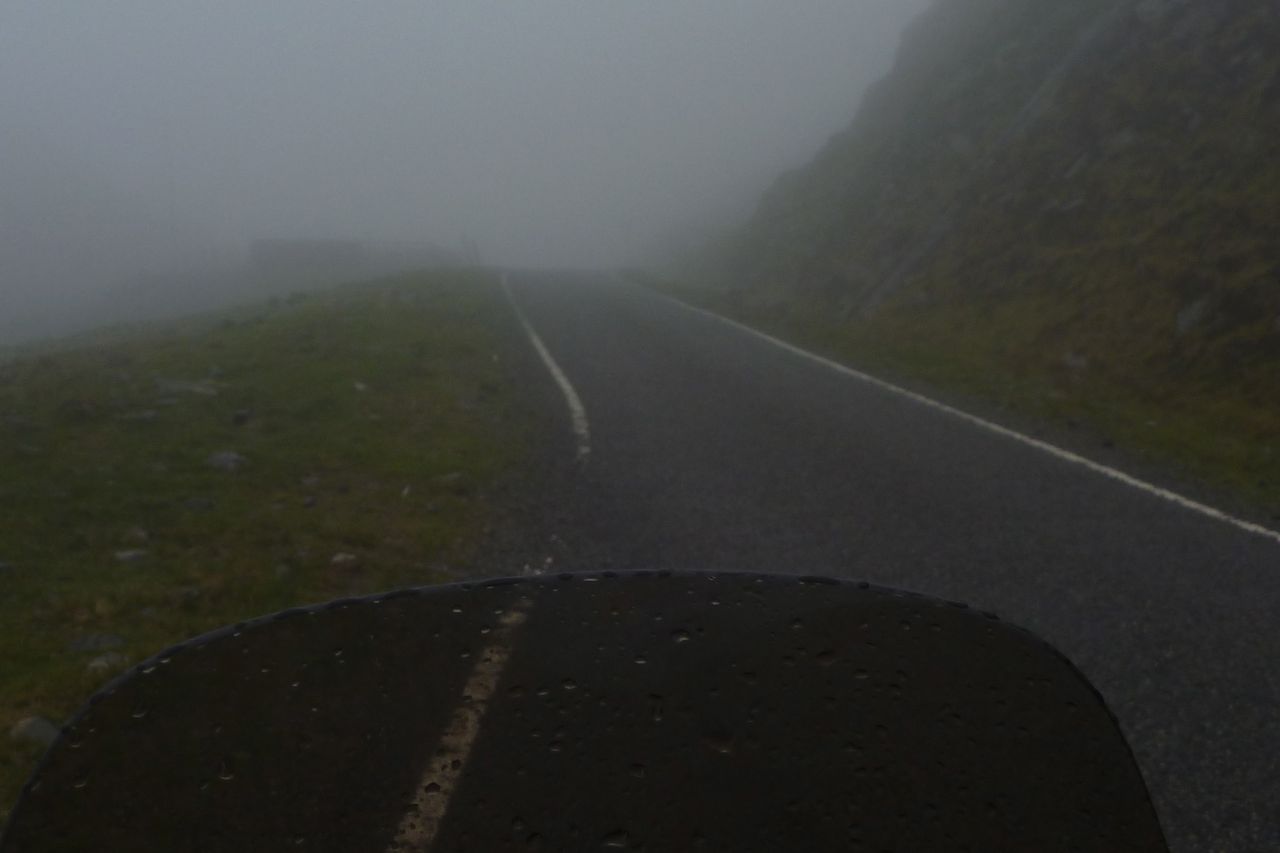
On Harris (left) I spent the night at the lovely Rhenigidale hostel, before riding back through the mist to the remote Hushnish beach (below right) which includes the odd experience of riding through the grounds of a baronial mansion. I then followed the single width roads on the west side of South Harris to the ferry at Leverburgh, but have to confess it’s had to get a rhythm going on such winding roads, even on a small 650.
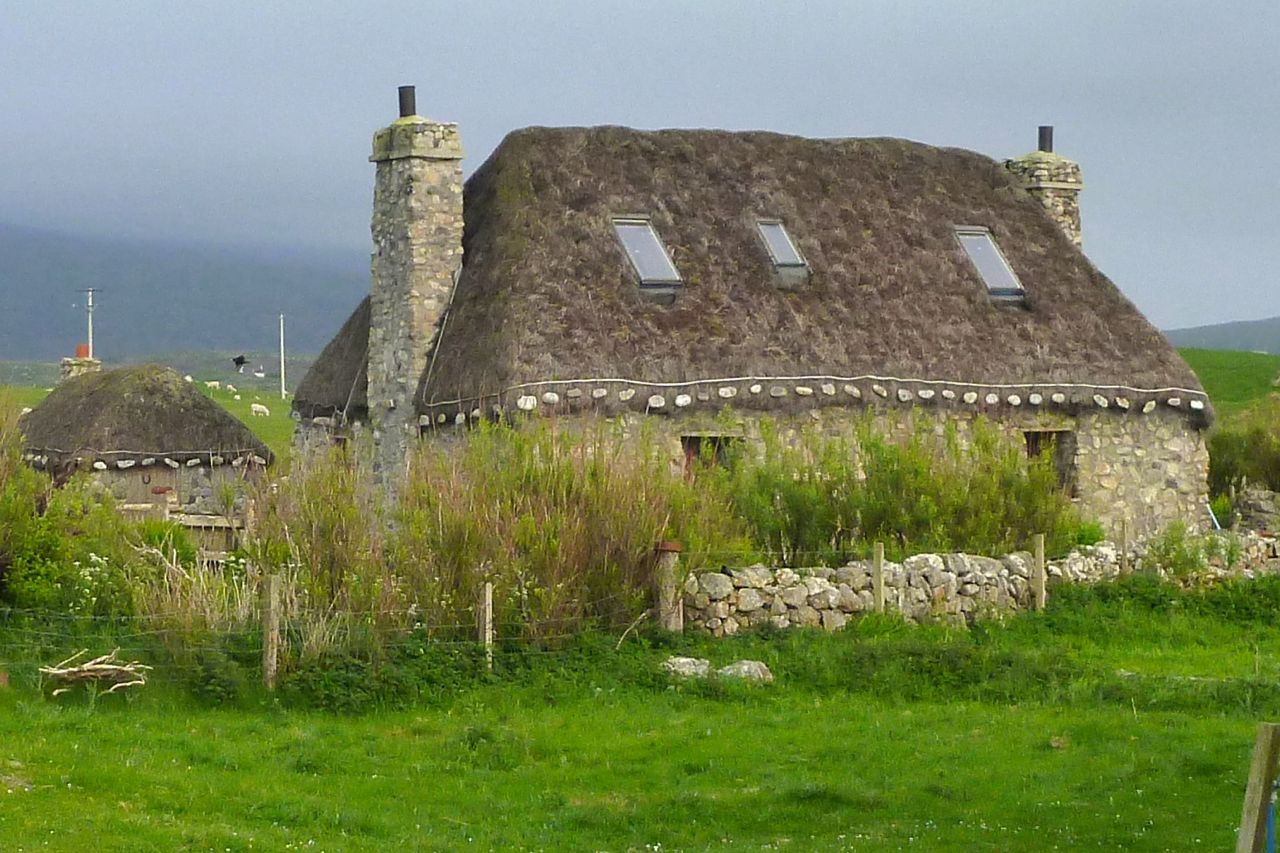
North Uist’s lovely beaches led to Benbecula and causeways to South Uist and another cute thatched Gatliff hostel at Howmore. The weather was closing in now and next day’s ferry back to Oban beat through a Force 5 chop. Incredibly, from Oban I then rode all the way to Scarborough, a fabulous ride across northern England and the North York Moors.
Next day I diverted via David Lambeth’s neat Boston to make an flash inspection, then over to Norwich to pick up some cheap DRZ forks to consider fitting to the Xcountry or just keep for a rainy day. It was around here, tooling through the showers, that I recorded a phenomenal 108mpg. By the end of this cross-country ride there was a noticeable step in the seat where the foam had become compressed. But I’ve since found the wide seat remains comfortable for 400-mle days.
More recently I fitted the Booster Plug but can’t say the difference is huge for £90. Tick over feels a big less harsh, but overall I’m not as amazed as the bloke at TTech promised. The unit is dead easy to fit: remove the left side ‘tank’ cover, unplug a lead to the air box, then splice in the booster box while running the air sensor cable out to hang behind the headlamp. The black box works by reading a lower air temp than in the air box, and richening the mixture at low rpm and on acceleration, as most modern bikes run very lean. I would hope it might also cool the bike a bit (had a mysterious drop in the expansion tank level but seems to have stabilised now). Next longish ride I may unplug then replug to compare.
I’m now back in far north Scotland and after a great southern summer it seems autumn is here already, but I can say the mpg doesn’t seem to be affected. Got a pretty poor 61.5 leaving London with loaded Magadans, but next two fill were low 70s, same as usual. Talking of which, finally got to use my Magadan IIs – as good as the old ones but better with the lower attachment rings.
Pre-Booster plug mpg (26 fill ups) Best 108 – Worst 53 (both may have been miscalculations)
After Booster plug mpg (4 fill ups) Best 73 – Worst 61.5
Now I have 11,111 miles on the Xco I’ve changed for fully synthetic oil. Next things will be a pair of tyres for Morocco in November and hopefully the VisionX 5-inch Narrow Beam LED.
I have to say I’m not really into the Xco. My feeling is in squeezing every last ounce of power out of it, they’ve made a sometimes harsh engine. And sadly all the necessary travel junk I’ve fitted to it has robbed it of its original lightness. Plus that gear change is awful at times the looks haven’t grown on me and I realise that matters more than I used to think. Still, rufty-tufty tyres may cure that, and for the Morocco tours it’s well equipped for the job.
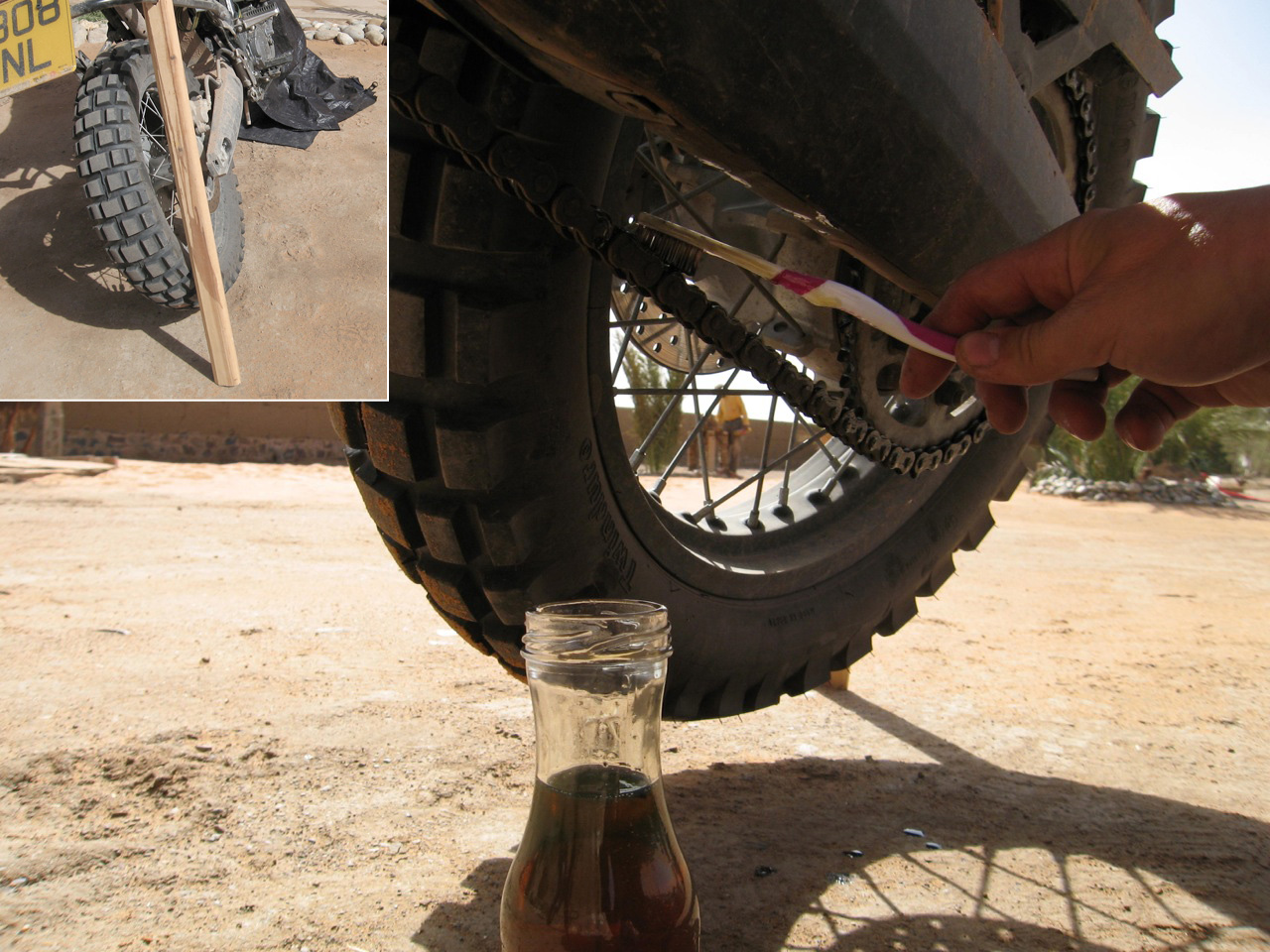
Although I haven’t scoured the internet to establish every possible alternative, to me the Tutoro auto luber is all you need to get the job done at a reasonable priceand without unnecessary complications. But because nozzles get knocked off and lost off-road, in 2023 I have reverted to simply brushing the chain with good (Tutoro) oil, as shown below left (2008)
Brush on – but now I use proper chain lube oil.
It’s not sprocket science Even if your bike has a centre stand, some sort of automatic chain oiler is the best way to keep you chain lightly lubed all the time if you do a lot or riding. On the long road a bulky aerosol will eventually run out and while brushing on manually (left), is as good if not better, it’s a faff to do regularly. Sealed-ring chains are amazingly durable, but that range can easily be doubled if they’re coated in a near-constant film of oil, and cleaned once in a while.
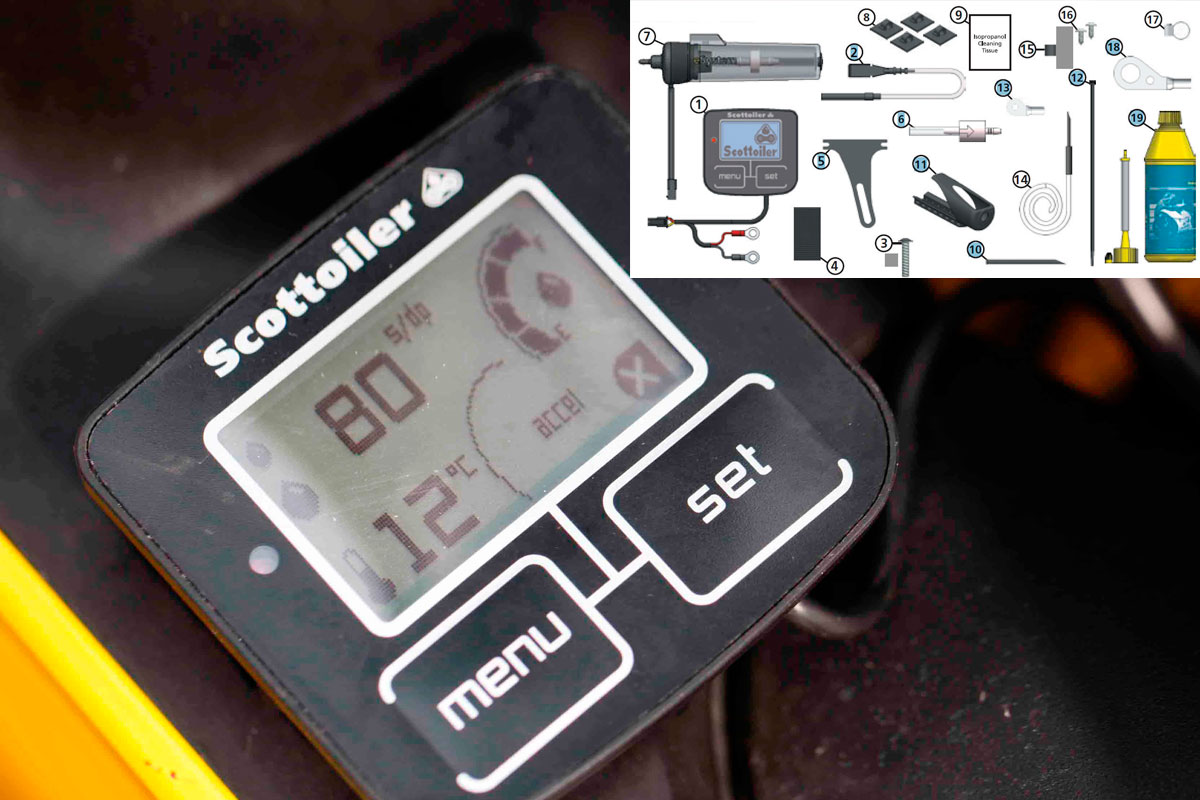
Scottoilers have been around since I started biking – or so it feels – but I never bought into their idea of plumbing the unit into the carb vacuum, or these days, using electronics. Why complicate things, it’s just an oil dripper? Do you really need a £240 piece of kit including a digital read-out on ambient temps and G-force (left), when you can make your own crude manual oiler with a squeezy bottle and a tube? Fit-and-forget automation is great of course, but I prefer an autonomous set up which, should it pack up up the Khyber, will be independent of other bike systems. It’s one less thing to eliminate when fault finding.
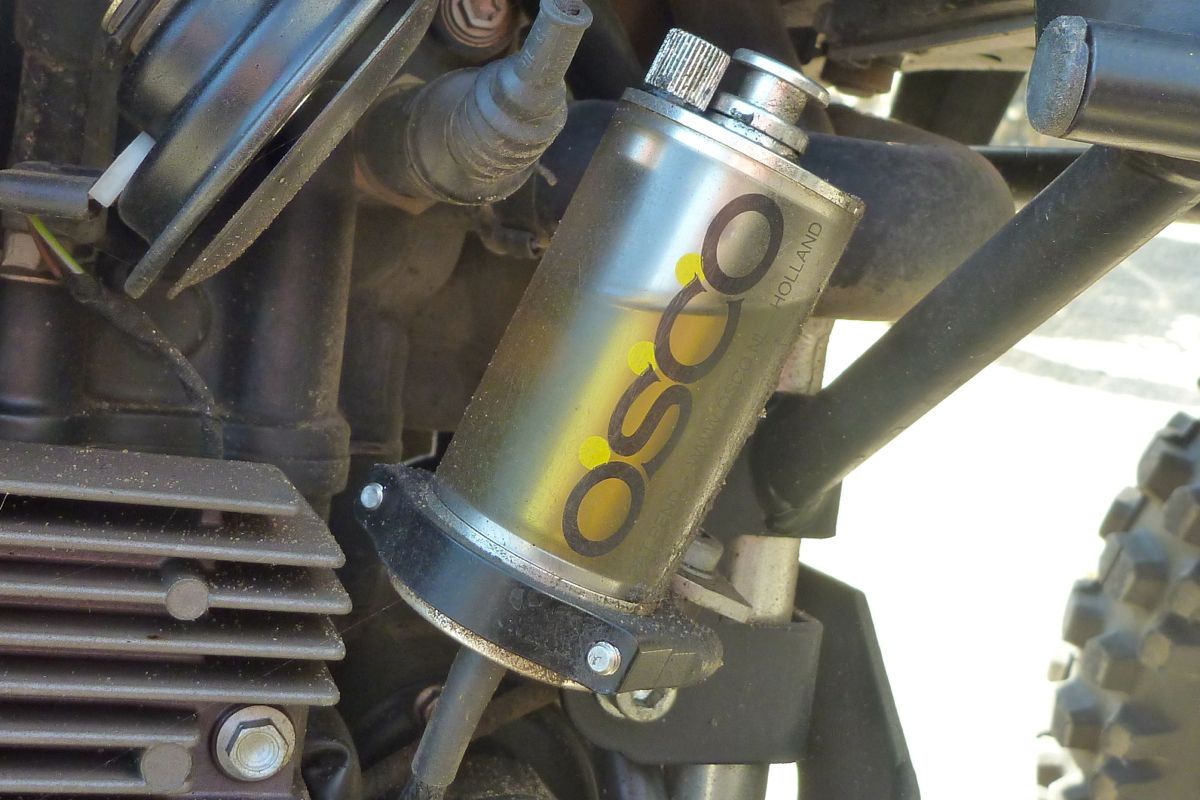
At Hyperpro one time I saw an 650Xcountry with the Dutch Osco system. It’s a stand-alone unit but turned out to be a manual, ‘actuate-the-plunger-once-in-a-while’ operation (see instructions below right) . Way too much faffing to remember at the end of a long ride. At less than 20 quid, the Loobman is another manually actuated dispenser of chain oil which, for that price, is probably less hassle than making your own. But the word seems to be that Loobs don’t survive rugged riding and there’s the problem with all manual oilers: remembering to use them regularly or forgetting they’re on and losing all the oil/making a mess.
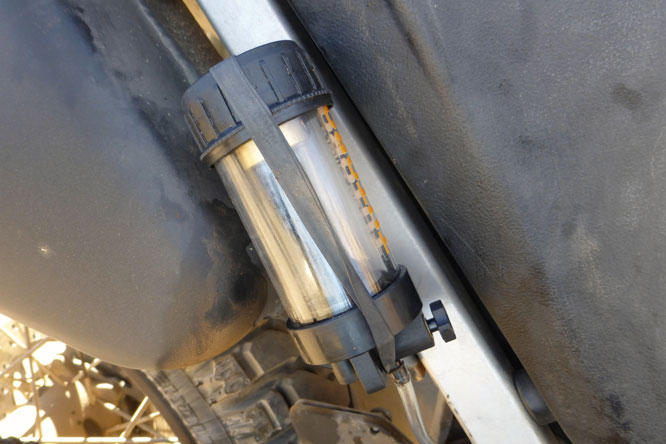
A bit of research led me to Tutoro oilers who’ve come up with the best solution to motion-actuated and adjustable chain oiling at a reasonable price, as well as offering manual drippers costing little more than a Loobman. The auto Tutoro (left) uses a finely balanced weight which moves up and down a stem, reacting to the movement of the bike and pumping or releasing oil as it goes. It might well resemble the ‘triple-axis accelerometer’ that Scott mention on their e-oilers, but without all the electronics. The Tutoro uses the free kinetic energy of your moving bike. Set the reservoir’s drip dial (reachable on the move) at whatever level is needed to oil the chain. If it starts raining maybe turn the wick up. Heading for the desert sands? Shut off the drip valve. Other than that, you don’t have to remember to do anything: when the bike’s at rest the plunger weight blocks flow – no drips. Once on the move again the bike’s motion and road irregularities will set it off. Simple and ingenious.
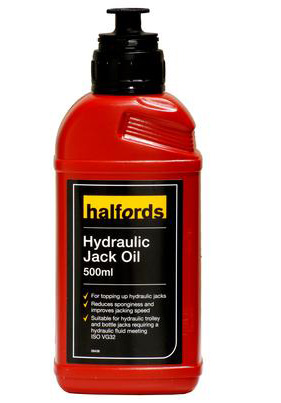
The Auto Delux edition I was sent came with a 100mm x 45mm reservoir (above left), delivery hose, a variety of reservoir mounting brackets, a forked nozzle, zip ties and cable guides, the helix flexible tube, a small top up can and 500 mil of Tuturo oil. And this is not just any oil, this is a lushly blended, thick and sticky blue goo, just like you get from the best spray cans. They now offer two weights of oil, depending on ambient temperatures in your locality. And if you run out, Tutoro specifically advise mineral hydraulic oil (example right). I bet you’ll find that cheap anywhere where there are cars or machines. Other stuff like ATF, EP gearbox oil, or any oil with additives may degrade the unit’s plastic and acrylic parts (but are all fine for the chain, as is waste motor oil).
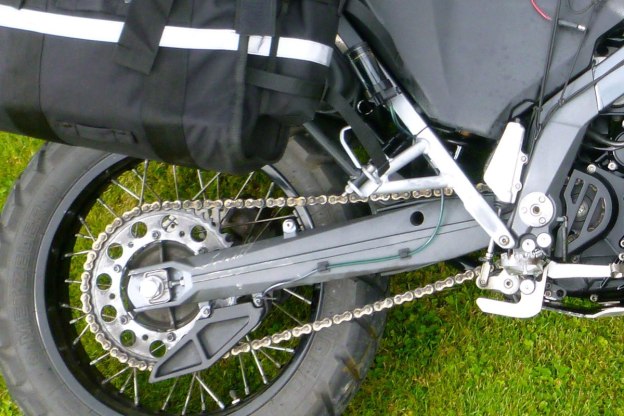
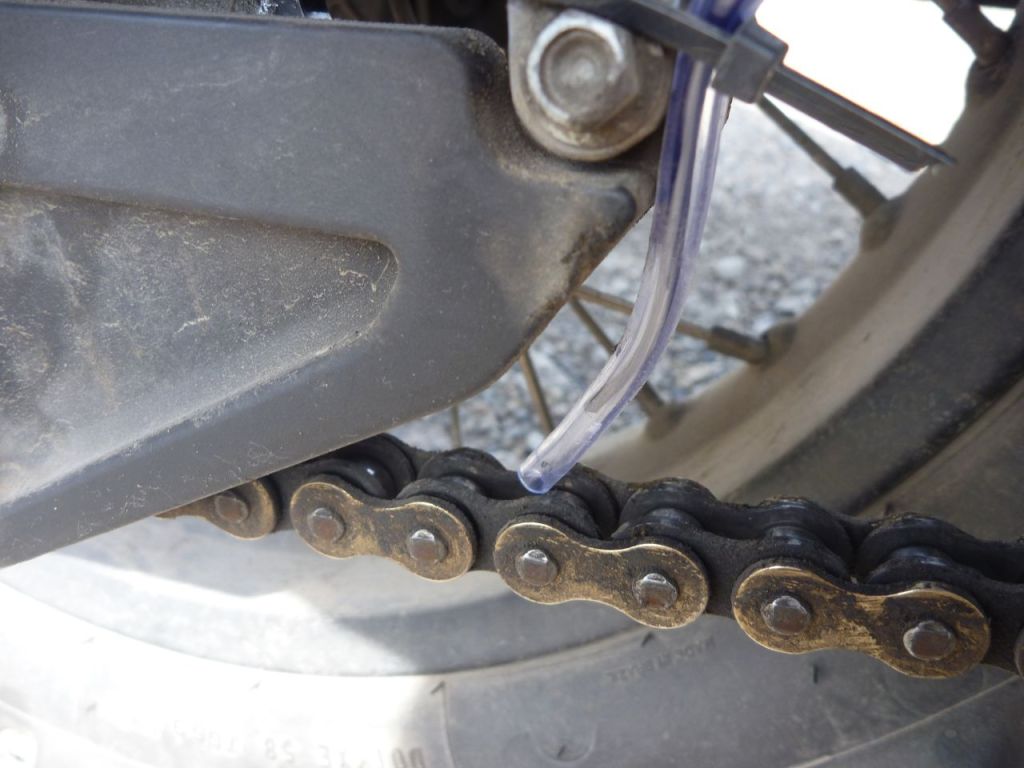
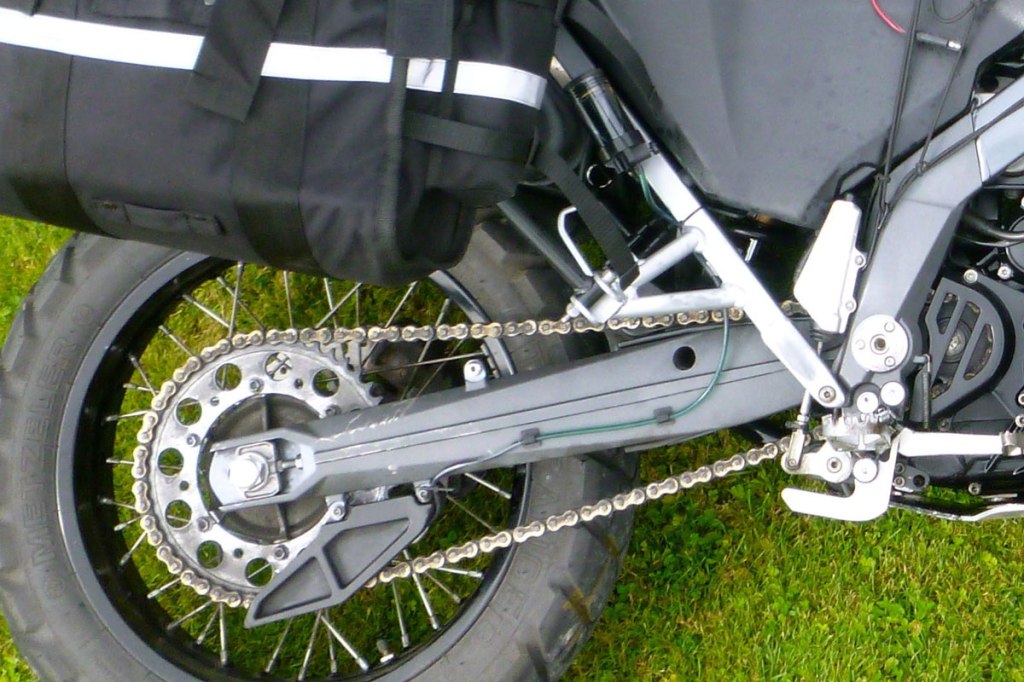
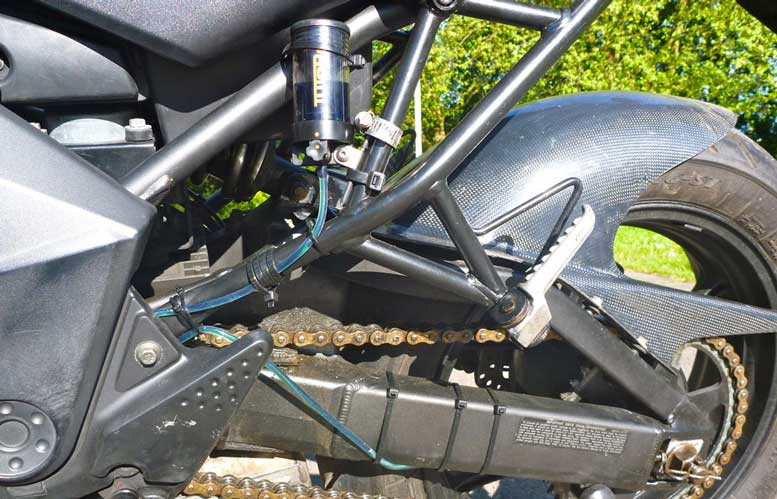
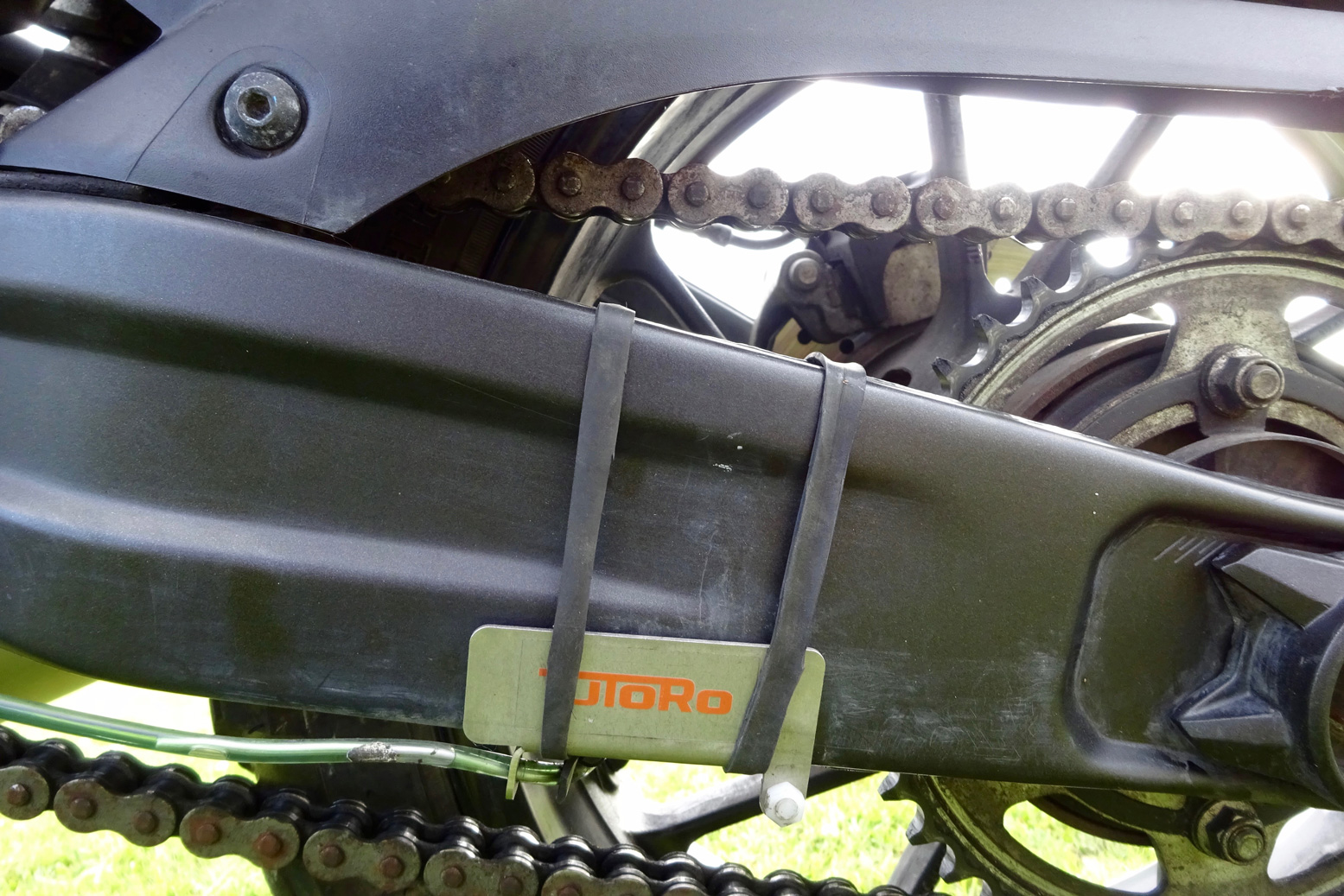
Fitting the oiler I fitted mine on the pavement in a bit of a rush, while at a Touratech travel event. On my GS650X there was a way of routing the hose neatly in and out of holes in the swing arm, but that looked a bit tricky to pull off in my situation. With just the zip ties, the reservoir was easily fitted to a bolt on the subframe down tube: out of the way but easy to reach and about 20° off vertical which is probably outside recommended operational limits, but worked OK for me. Vertical is best, even taking into account your typical 11-12° sidestand lean. The hose ran along the outside of the swingarm using stick-on hose clips (below). I thought they would be vulnerable off road (a slab of gorilla tape over the hose may help), but months of riding later, including Morocco and back and everything remained intact.
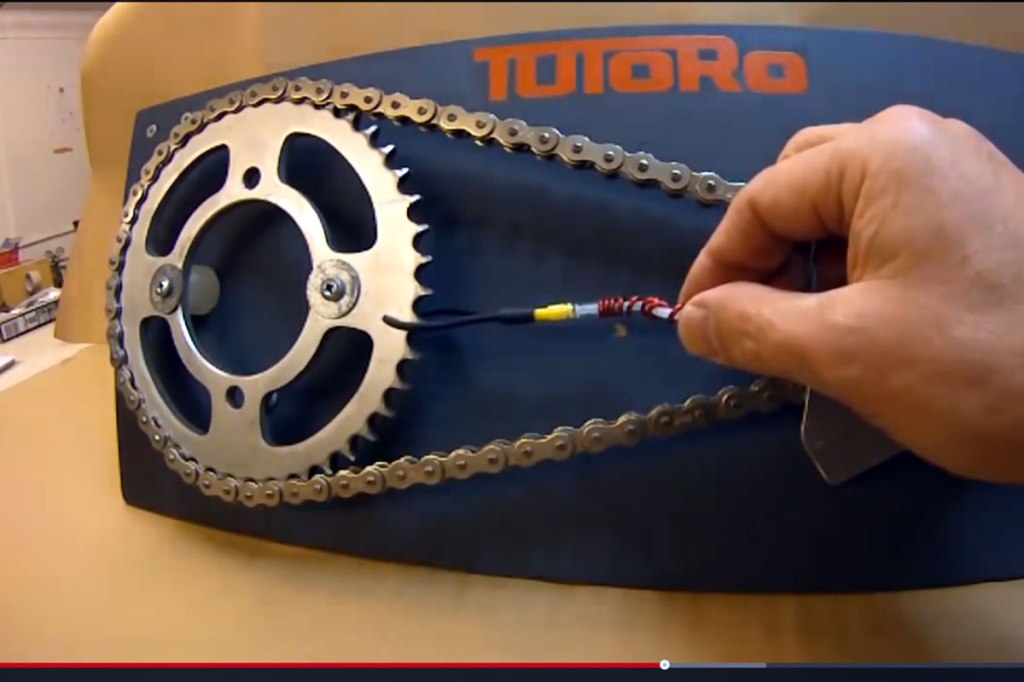
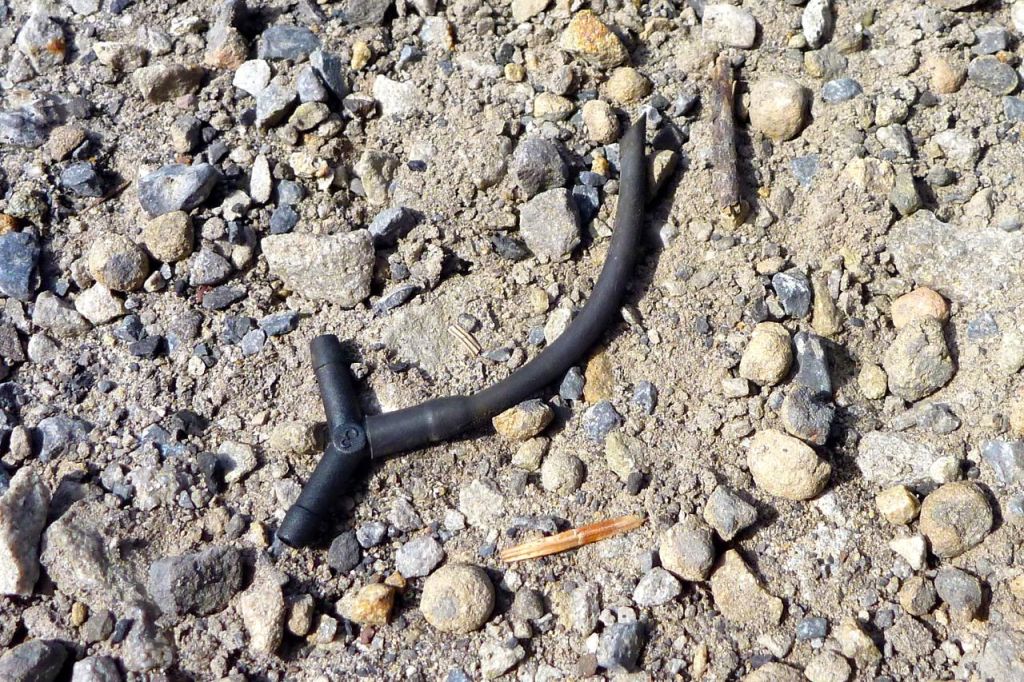
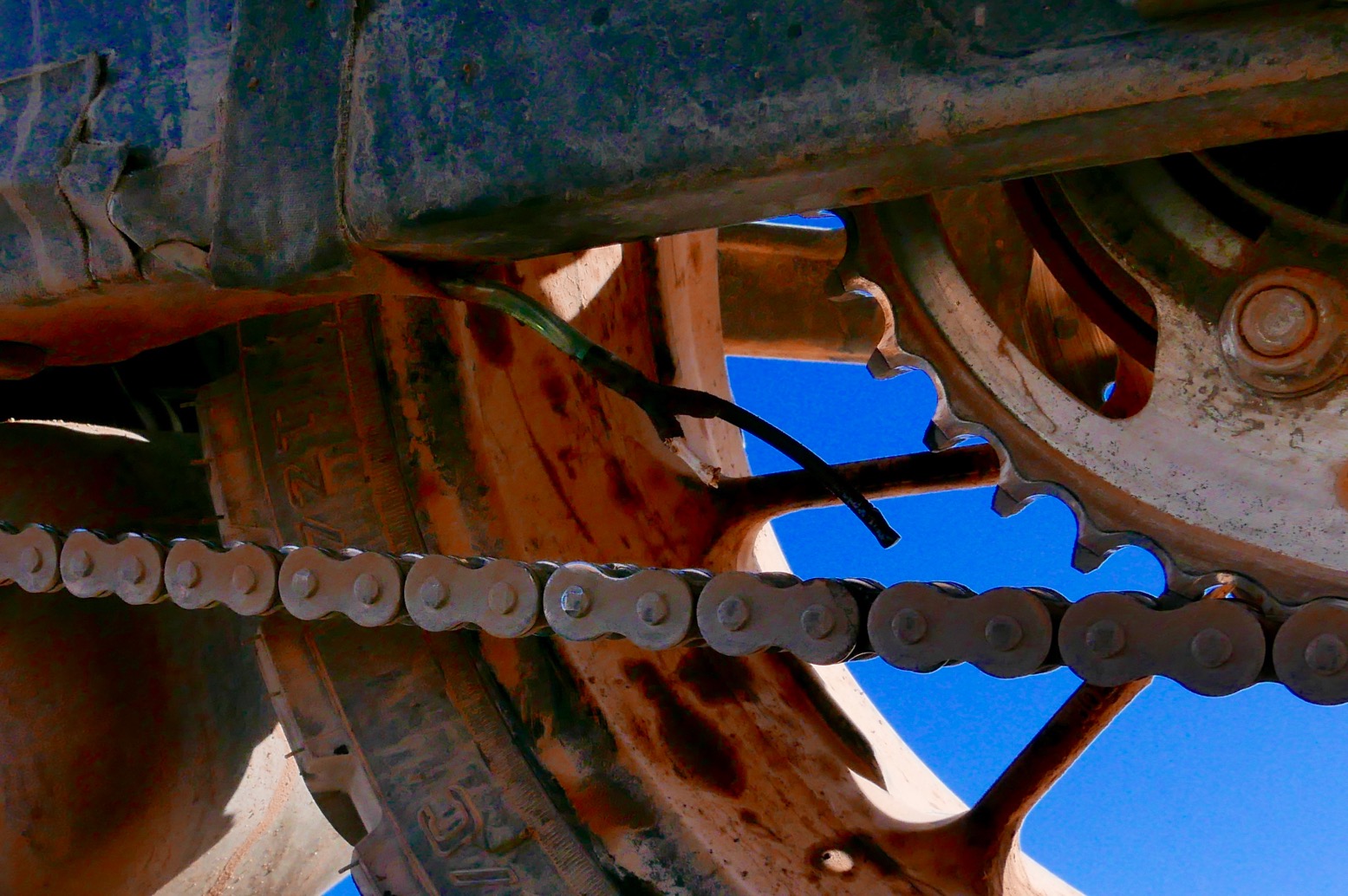
On the road Some Tuturos come with a rubber forked nozzle which I thought was to get the drips close to the o-rings on either side of the chain. I guessed wrong. Due to unavoidable chainslap, my nozzle got damaged almost straight away (right). Had I seen this later video, I’d have seen the forked nozzle is supposed to ‘bite’ either side of the sprocket at ‘3 o’clock’ (left) and well out of the way of the slapping chain. From here the oil gets thrown out onto the chain. No matter; it’s only a bit of hose dripping oil. Zip-tied to the chain guard, I repositioned my single hose feed at the back of the lower chain run, just as it goes onto the sprocket (the place they tell you to spray a chain). Tutoro say a single feed is as effective but a bit more wasteful at lubing the chain than forked, and there’s nothing to get damaged or pulled off.
Setting the feed dial positioned at the bottom of the reservoir took some experimenting, or it’s quite possible that again, I didn’t rtfm. I didn’t bother priming the unit and just left the valve wide open to let it happen on the road. From Touratech I set off north for a early morning ride through mid-Wales and forgot all about the oiler until fuelling up in north Wales. Here I noticed the reservoir was empty, oil was all over the back wheel and the chain glistened like an eel that had just stepped out of a steaming shower. With enough lube on the chain to last a few days, I shut it off then forgot all about it again as I rode up to northwest Scotland and then rode back home to London via the Outer Hebrides. Over the weeks and months, I’ve settled on about one turn out from fully closed; perhaps a bit more in chilly conditions.
Lately I came across Motobriiz (right; $92) which similarly uses motion-actuated automation: this time wind pressure off an intake tube pushing oil out of a reservoir down another tube and into a felt pad tucked under the chain on the slider. There are no moving parts at all. In the US one time I was offered a kit by a distributor, but wasn’t convinced the way they do it was that much better than Tutoro. The best thing is that, like some Scottoilers, the reservoir mounts on its side and out of the way and under the seat (but also where it’s easily forgotten about). Less good is the oil-soaked felt pad you glue to the chain slider needs regular replacement. Plus I have to say I’m not fully sold on the wind idea – won’t riding fast into a headwind prematurely empty the tank? I prefer the Tutoro’s adjustable valve. All the ideas gadgets on this page are better than no oiling and less faff that manual application, but for me Tutoro’s simplicity combined with mechanical fit-and-forget ‘autonomous motion-actuation’ works best. And compared to the other products mentioned above, I think they’re a bargain.
Update after Morocco with XSR The benefits of a chain oiler are greatest on a long trip covering big mileages. A bulky aerosol won’t last and you don’t have to prop up your bike and get on your knees every morning to give the chain a squirt. I topped up my Tutoro and left for Morocco with a 200ml bottle of oil. All went well until I had to give someone a lift off a mountain pass one evening when things turned a bit epic. Because there were no pillion footrests on my Xbike, her feet flailed around and knocked the reservoir about, losing its cap and contents. A flush out with petrol and an oil bottle cap with a bit of inner tube worked for the rest of the trip. That’s what I mean about simple, in-the-field repairability. I came back with Morocco with the reservoir half full. I adjusted the BMW chain twice in the 10,000 miles I had the bike (8000 miles with the oiler). The chain looked like is has 1000s of miles left in it. Pictured left is the same type of unit fitted with a little more know-how to my Kawasaki Versys. I then took the unit off that bike and put it on the CB500X (above left) and fitted what bits I had lying around to my XSR700 Scrambler.
I should have remembered that the anchor plate or helix they offer are both useful devices to keep the forked nozzle in position, biting the sprocket at ‘7 o’clock’, especially on rough roads and tracks. Tbh, I expected a stone to knock off my nozzle much sooner than it did.
Instead, the hammering regularly twisted the nozzle arms out of position on their forked mount attached to the delivery hose, and by the end of my third lap one nozzle arm was MiA. I plugged it up with a twig and pointed the remaining ‘single feed’ nozzle arm onto the chain (below). If the forked nozzle was a single piece, this would not be a problem. I’ve since ordered the anchor plate which I used on my CB500X RR and fitted it in with a strip of inner tube (the supplied zip ties didn’t stay in place on my tapering swingarm). That’s about all there is to say on the subject.
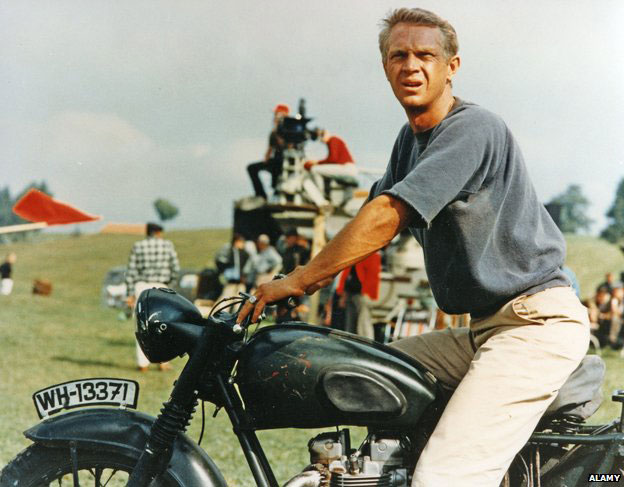
When I imagine a good handling bike I often visualise Steve McQueen in The Great Escape. Not the famous barbed wire jump which was actually done by a mate of his, but the riding he does beforehand while trying to outrun the jerries along the lanes and across the fields. The way he chucks that 170-kilo TR6 around on ordinary tyres and suspension, skid-turning with the back brake and sliding around but in control, always struck me as optimal moto/rider interaction. With a hefty old dog like the Triumph it must be down to skilful riding too, as well as a low slung machine, but if a bike can bring out that sort of confidence I’d be pleased with it.
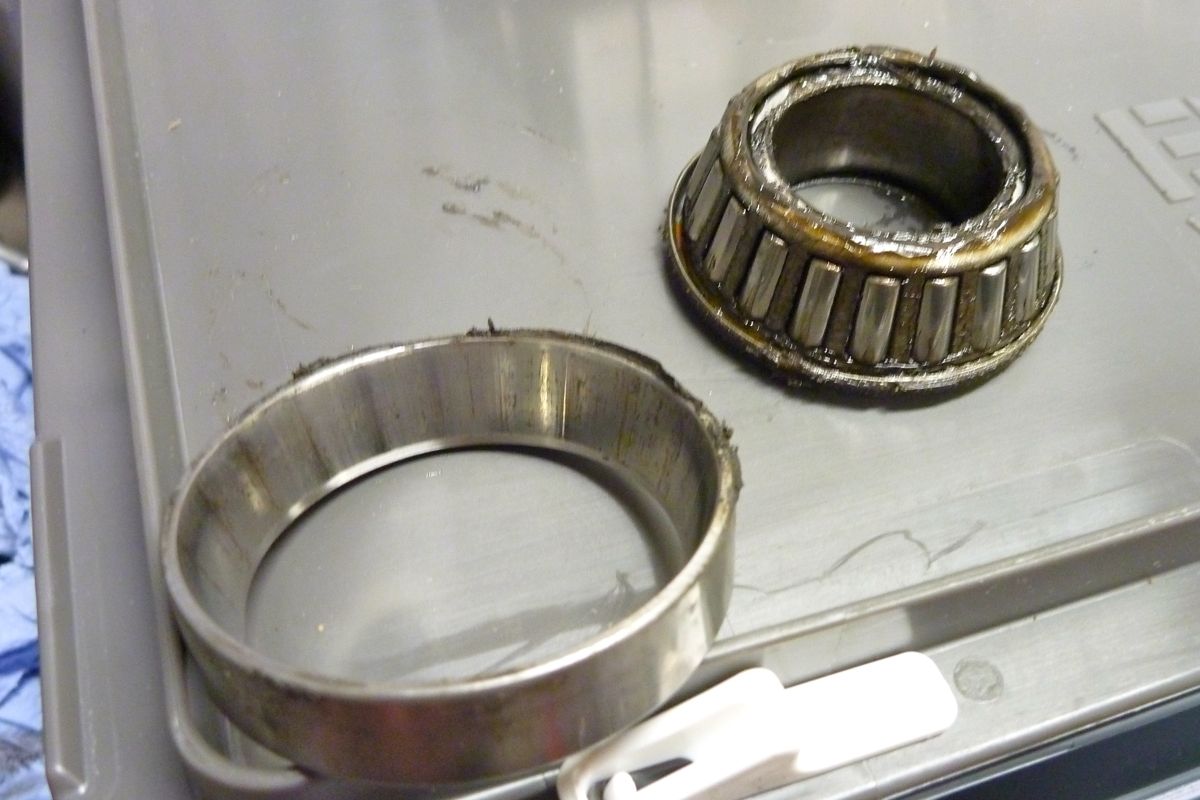
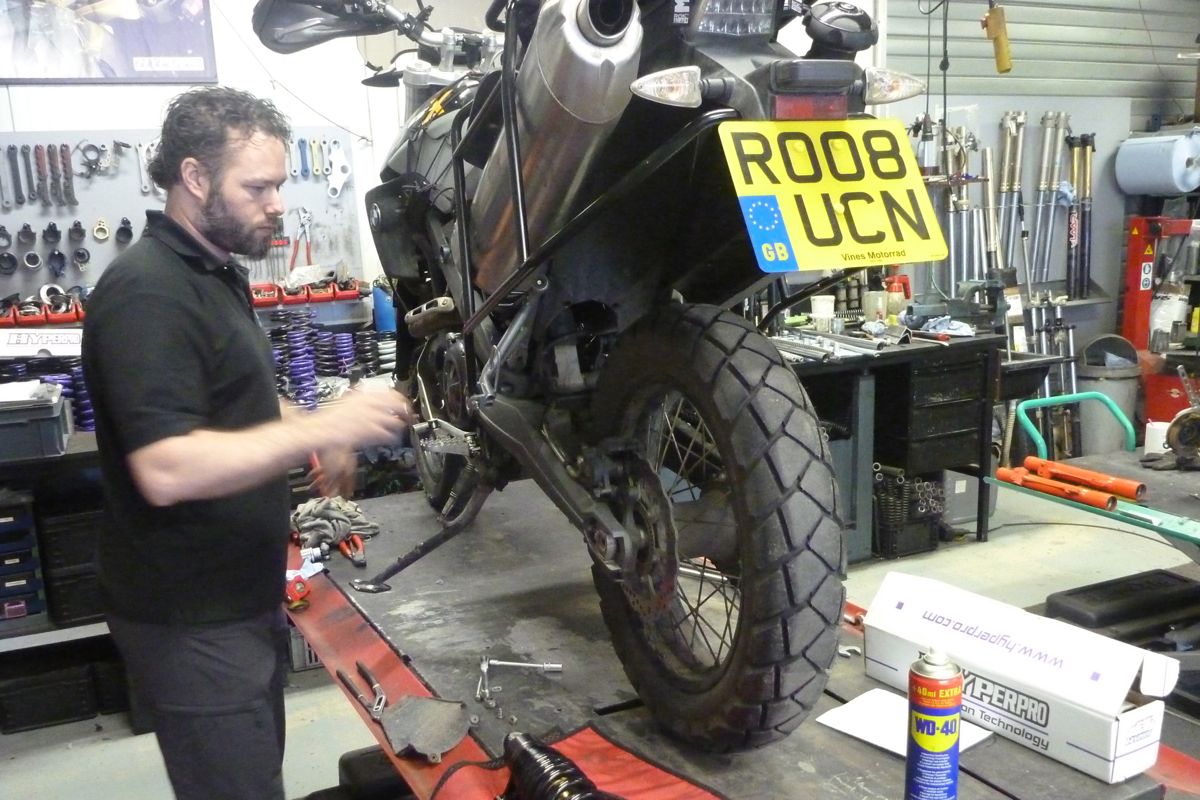
My 650X wasn’t in such good shape when I rocked up at Hyperpro’s workshop, halfway between Erik’s Hot Rod Bar and the Hook van Holland ferry port. It felt like the head bearings were notching, and in the last 1000 miles the shock felt shot too. I didn’t feel like the Cooler King throwing it into roundabouts while in fact heading for the kerb. I thought oh well, I’ve finally lost much touch but at least the Xco is jolly economical and the switches fall easily to hand. Bas at Hyperpro suggested I came over for a custom suspension fitment. In his experience, being there with your bike makes all the difference. Everyone told me I’d spend the whole day at his workshop watching him work and they weren’t wrong.
For weeks I’d suspected the head bearings were gone, something most noticeable at low speed. But lifting the front wheel I couldn’t detect anything and thought it might just be tension from the brake hose arrangement. Erik suggested cupping from the Tourance which was down to 2-3mm. With the bike yanked over, it took Bas a couple of seconds to diagnose the notch in the bars’ arc and which now felt obvious. During suspension transplants he told me they get through a lot of headsets at the HP workshop. The Xco’s relatively elastic alloy stem doesn’t help in this regard, though Bas admitted his hard running BMW G/S (see below) eats a set every 5000km or so.
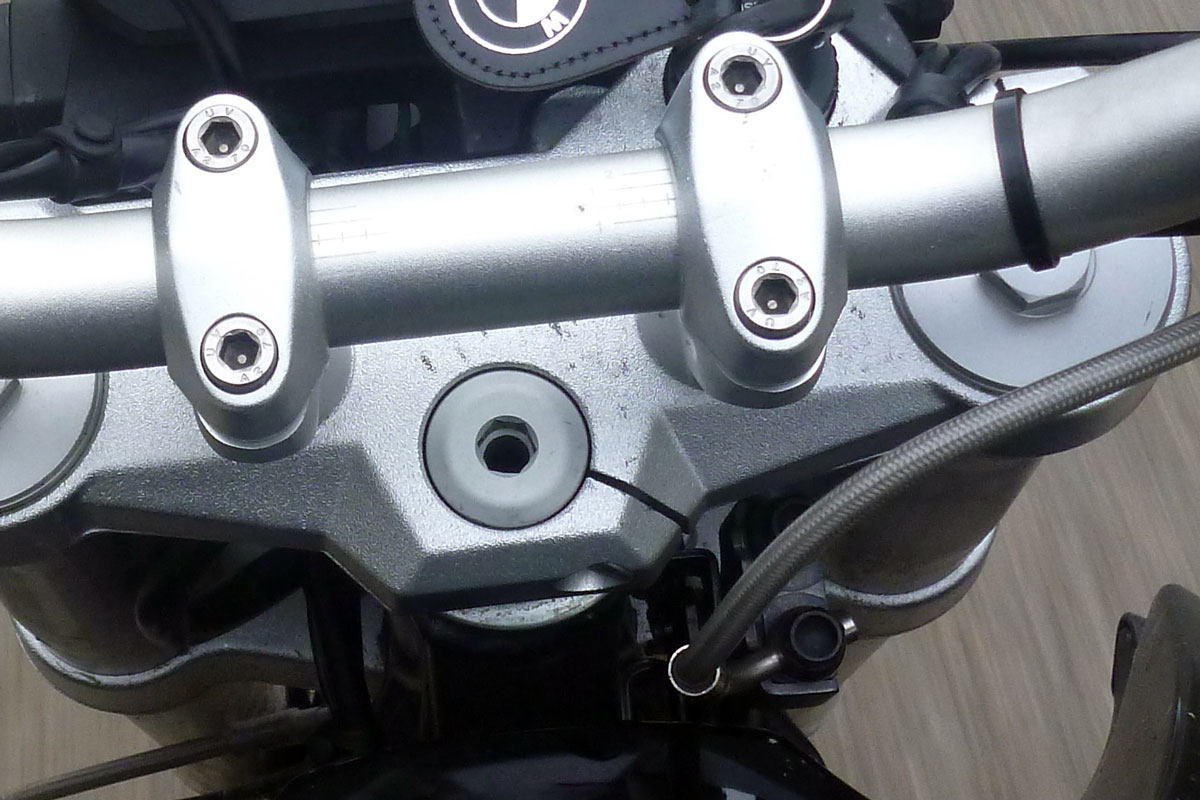
I wasn’t expecting it, but Bas got stuck in and replaced my worn bearings. I still don’t get how this notching occurs; fork impact + wear + lack of care and grease I guess. Once fitted, he pointed out the noticeable change in resistance when tightening the 10mm hex headstock adjustment nut (left) by just a couple of degrees. That’ll need doing in 1000 miles as the bearings bed in.
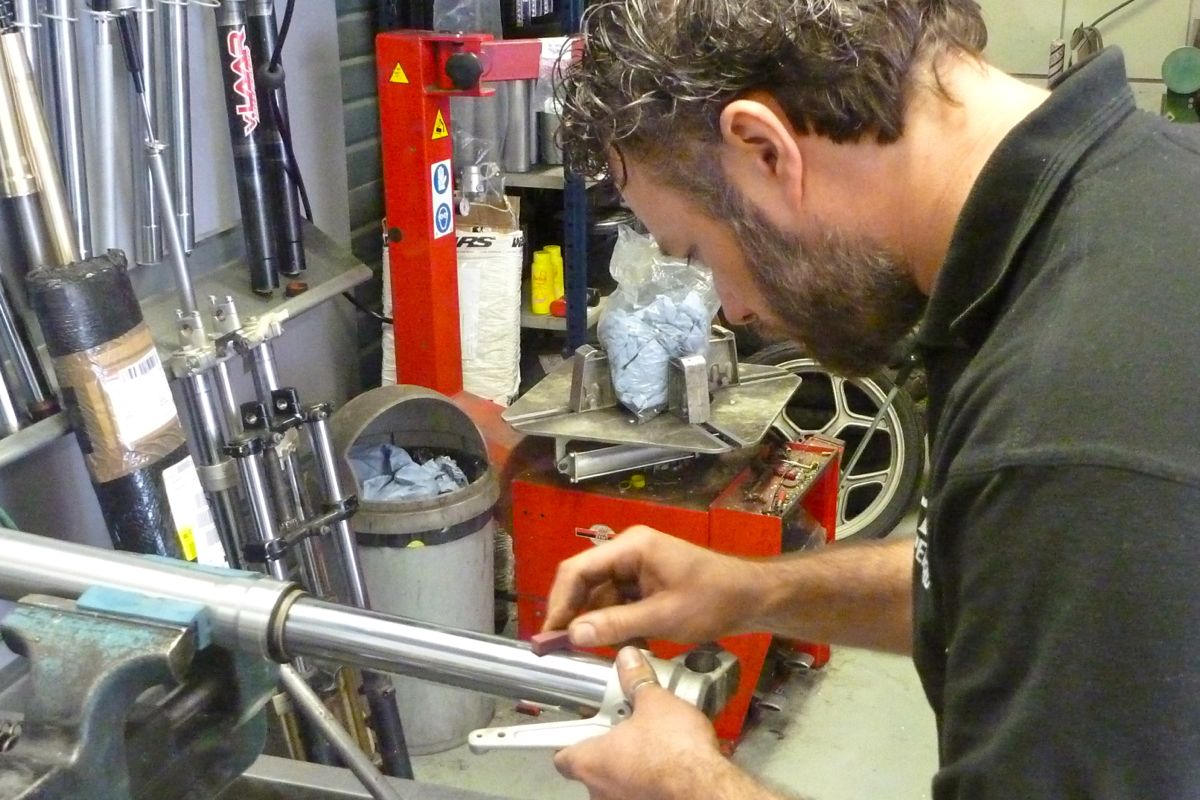
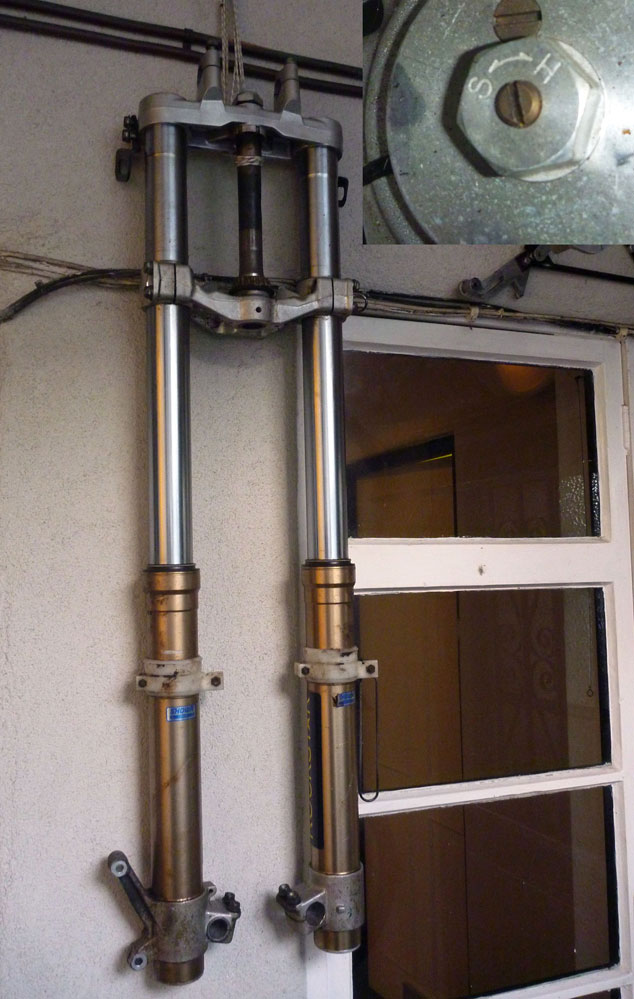
He then got to work on my forks, identifying barely visible scratches on the chrome sliders which he buffed out with a strop and a file (right). I’ve always doubted the genuine advantage of USD forks. The best explanation I recall reading is that the heavy steel slider element sits lower for lower CoG, but then the alloy needs to be thicker to withstand the triple clamps and the steel is undesirable unsprung weight. I’ve also since been told it was a way to get more travel. To me they just look ‘upside down’ with a vulnerable slider out in the stone-strewn breeze. It’s well know that telescopic forks are a regretable compromise on a bike: neat and cheap to make but with drawbacks that we all learn to ride around. In fact I’m convinced a huge part of a GS12’s appeal is the poise it gains from its Telelever front end. To paraphrase something I read recently on adv ‘For a two-story building a GS handles pretty well’.
There’s only so much you can do to Xforks unless you replace them with something else. It doesn’t have to be anything flash either, Bas recommends a 48mm right-way-up 48mm DRZ400 forks (right) which are easily found on ebay for around 100 quid plus clamps. I bought a set and plan to get them Hyperpro’d and fitted to the X. [In the end kept them for another project].
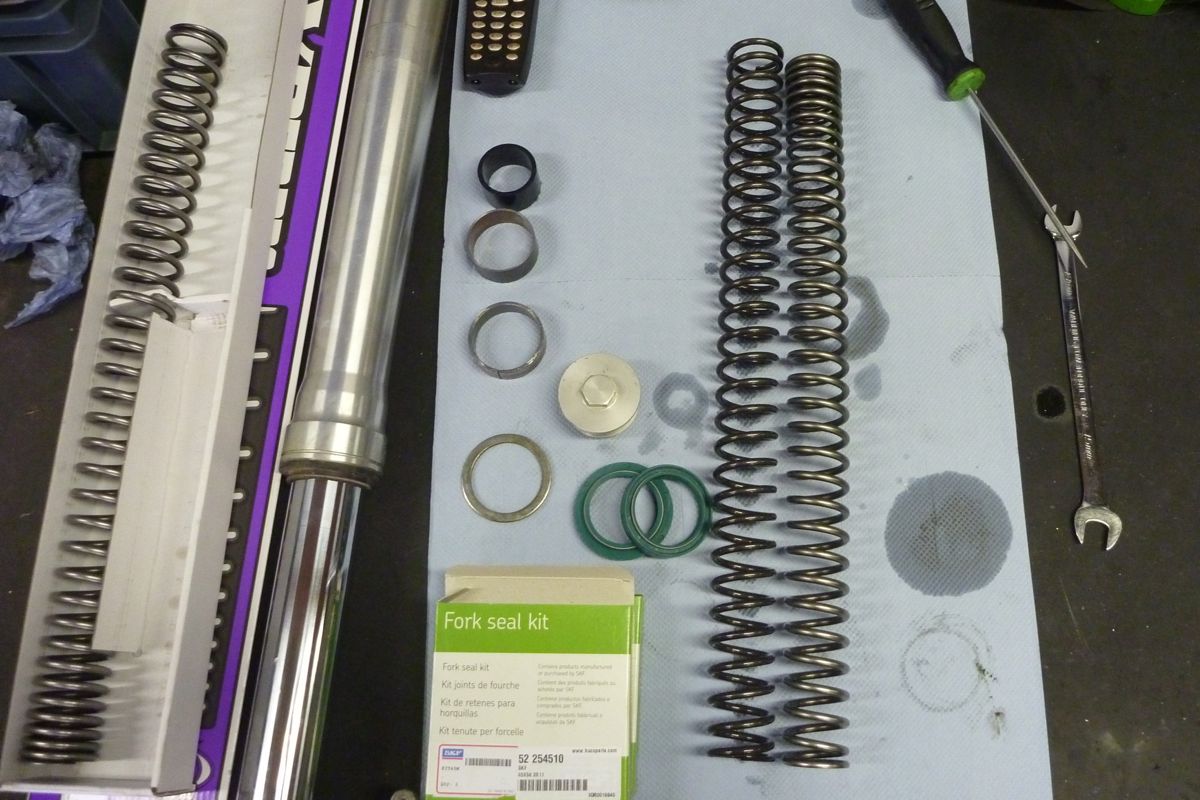
Once the sliders were as clean as they could be, Bas renewed the seals and cleaned up the bushes which run between the telescoping sections. He then slotted in the appropriate Hyperpro forks springs (left) and slipped in a lesser quantity of lighter oil (heavy oil is used to disguise soft forks). Bas explained why fork oil should be changed; not so much because it breaks down like motor oil but because it collects contaminants and humidity so needs flushing if you’re to avoid tedious seal failure. To stop that happening too soon, before remounting the forks Bas slipped on a pair of neoprene socks to protect the sliders.
A quick word on progressive springs. Most bike springs are linear; wound at a consistent rate end to end. While some riding applications are said to benefit from linear springs (road racing on smooth tracks, for example), the main reason we get linear is cost, as with so much in bike suspension. Up to a point, the pivot on a mono rear ends adds a progressive element, and in the 70s twin-shock era it was thought laid over shocks had a similar effect.
Also from the twin shock era, you may recall dual rate springs which at a glance look progressive, but merely have a more dense section at one end. Only progressive springs have a constantly variable spring rate right across their length. Because of this the spring can react to small surface irregularities, full-on hits and everything in between. Linear springs can be factory wound by the mile and then chopped up like salami, but each progressive spring has to be made individually; it’s a more sophisticated and higher end solution and Bas had a good trick to demonstrate their efficacy: two little finger springs (above), one linear, one progressive. The purple progressive spring is easier to compress initially but, unlike the yellow linear one, is impossible to compress fully. Progressive compression in a nutshell. Looking into suspension earlier I noticed the ‘P’ word bandied around disingenuously. Hagon’s aftermarket monoshocks claim ‘fully progressive spring pre-load adjustment’. Examine that phrase closely and you’ll see it means not much at all, but I bet a few have been caught out.
According to Bas, stiction is the nemesis of smooth suspension response and the reason many riders misdiagnose ‘harshness’. Of course ensuring friction-free operation while hammering your telescoping tubes over corrugations or flexing them under hard braking is all asking a bit much, but with careful assembly and maintenance, stiction can be minimised. Only then can the full effects of a finely tuned shock be appreciated.
Now for the shock. I’d felt the Sachs unit go on a recent ride up to Scotland. Perhaps the bike’s early life at the BMW Off Road School had included more than the usual amount of play jumping. It certainly had when I’d visited. The headlight beam now shone higher than it used to, but when I tried to adjust the shock, the preload was maxed out and I didn’t even notice the rebound damping which was ineffective anyway. I’d originally planned to just whack on a Hyperpro spring on the shock body, but that would have been a mistake. It’s not the spring that wears out (though the original may be too soft for your needs, especially when loaded), it’s the seals and gas and ill-specified valving inside.
Most bikes run what they now call emulsion shocks, as that’s what happens to the oil and gas once it all froths up following a series of bumps. Once the oil is aerated much of the damping effect gets the lost until it all settles down and the gas and oil separate. An emulsion shock will be fine for regular road riding, but soon reaches its limits when you add heavy and variable loads and rough terrain.
All these years I managed fine on my Teneres and whatnot, just jacking them up at the back and stuffing a bit of sawn off bar end under the fork caps for some pre-load. The one bike I had with good OE suspension – the XRL650 for Desert Riders – was notably better than the previous XTs. Many times I’d get out of shape and expect to be going over the bars, only to have the superior front forks save the day. On that trip we all fitted K-Tech progressive springs.
The problem had always been on the back where nothing short of several hundred quid’s worth of WP or Ohlins seemed a lot of money for an uncertain result. As long as it didn’t bottom out, that was fine with me. The fatigue and boat-like handling just came with territory when riding heavily laden travel bikes in the desert.
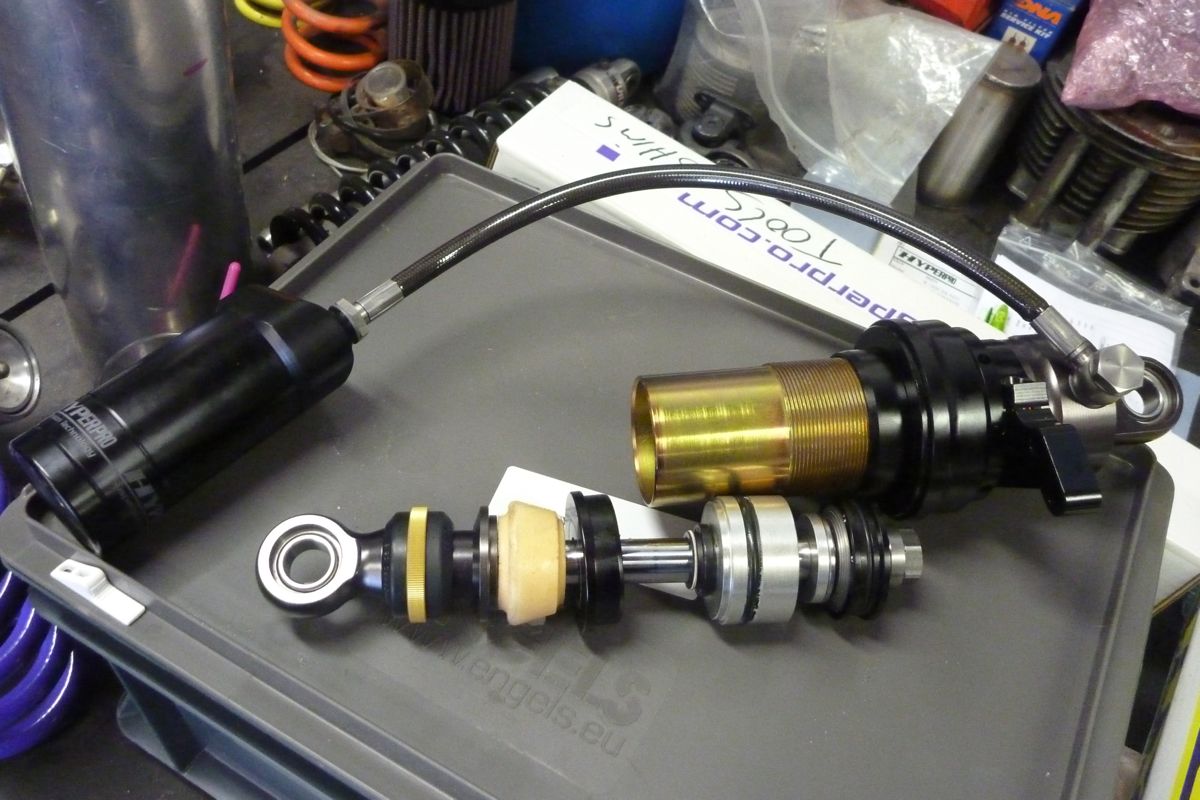
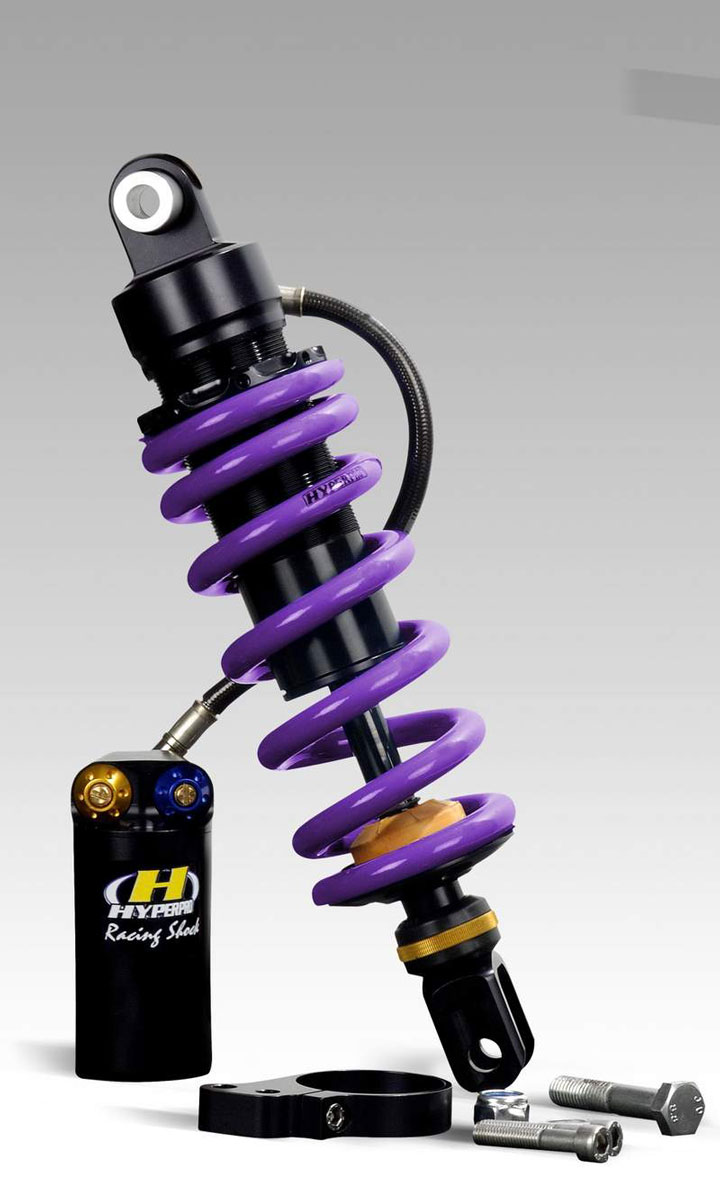
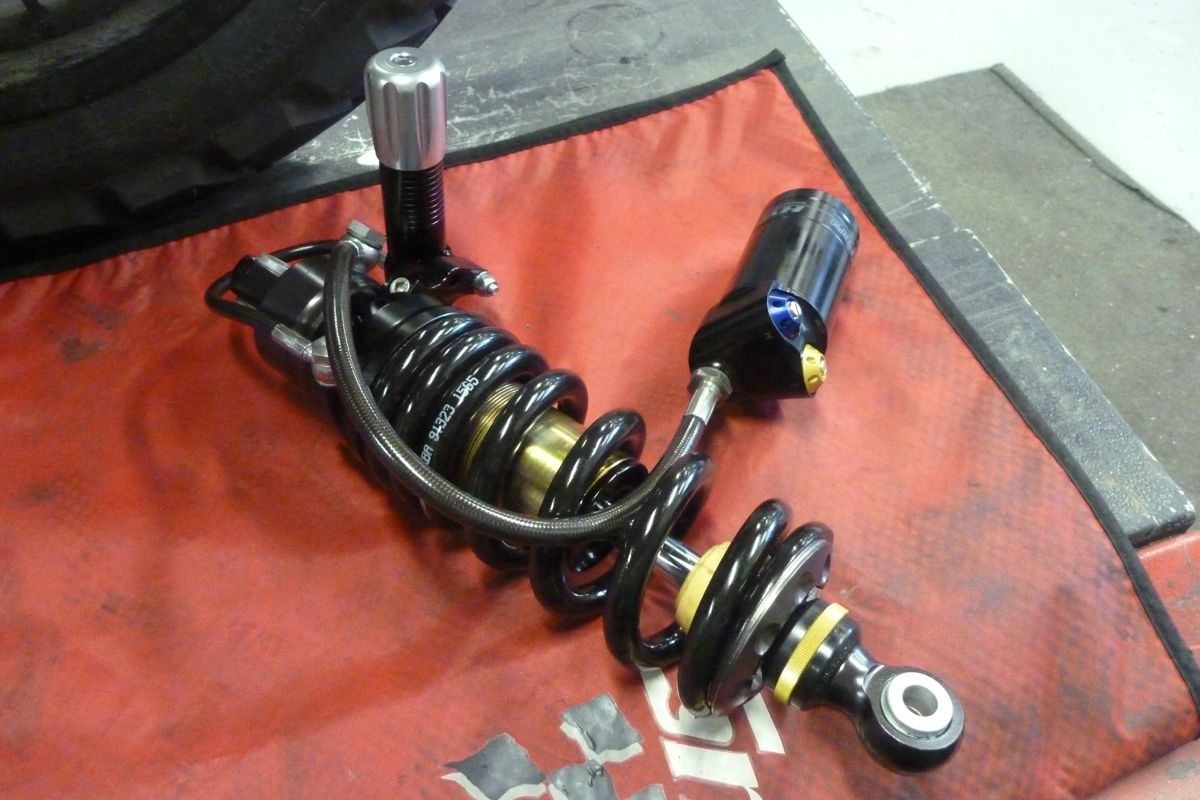
Bas doesn’t just invite you to lounge by the coffee machine while he whips a shock off the shelf and pops it on your bike. He builds the unit up from scratch, adding in shims across the damping apertures to suit your bike, weight, riding style and anticipated loads. I was getting Hyperpro’s top end 461 model (similar to left) with hydraulically adjusted preload (like the OE Sachs unit), 45 clicks of rebound damping at the base, and two settings covering low-speed plus high-speed compression damping on the remote reservoir. This latter feature is what’s missing from most average shocks but adds to the spring’s downward resistance and is what makes a big difference to fine tuning with changing loads.
The hydraulic preload adjuster at the top
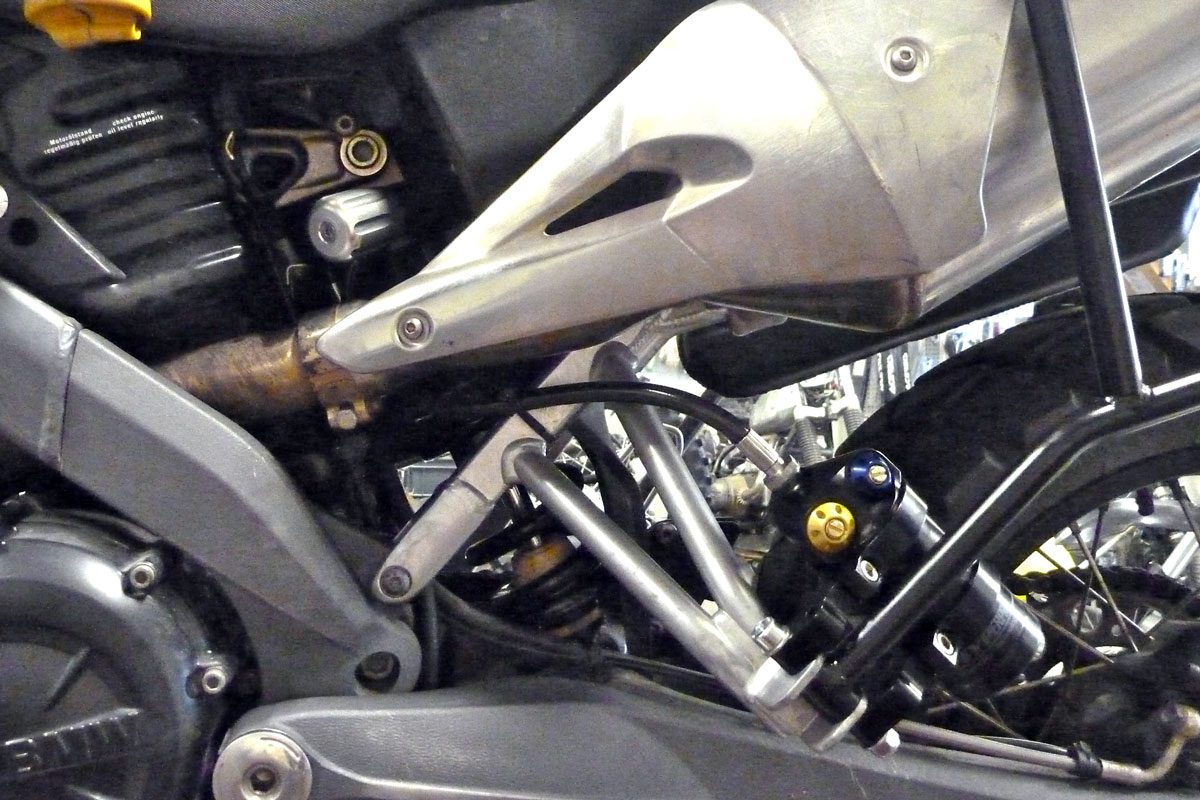
Once the insides were assembled, the unit was charged with oil and the remote reservoir attached. In here there’s a bladder of nitrogen gas separated from the shock’s oil which feeds into the reservoir via the hose. A separate gas bladder can just as easily be located in the body of the shock if there’s room, though it runs cooler outside. Nitrogen is used as it’s dense and so less prone to leaking away, compared to regular air (which is 78% nitrogen anyway). Once a location was fixed for the remote reservoir with its high/low-speed comp damping dials, the static sag was assessed; about 3cm felt at the tail rack. Sag is important as it sits you midway (more or less) in the shock’s stroke so it can extend fully before settling down. The whole point of suspension is to allow the wheels to move up and down as much and as responsively as necessary while the sprung weight (bike and rider) remains isolated and level.
After at least ten hours of methodical work, my Xco had been resprung. It sat maybe half an inch higher, though I could still get both feet flat on the floor. A quick blast round the block wasn’t night and day but revealed improved steering on the first bend; it went where I wanted in a predictable manner. Then a few dried mud bumps along the edge of a field got both ends pumping smoothly. All well there. A 461 shock for the Xco costs about €950 with the optional hydraulic preload adjuster (miles better than using the supplied C spanner). A set of fork springs is €150 plus €50 for a pair of fork seals. Custom fitment is well under €200 for both ends (not including head bearings). If you’re planning a day visit to Hyperpro you may like to know that the overnight ferry from Harwich arrives around 8am local time and returns at 10.30pm, so you can get Hyperpro’d in a day. I paid £220 for the boat with cabin.
Having no less than four adjustments on the shock is going to take some experimentation to see the best results, and they’ll vary with load and terrain. That will be something I’ll get to grips with in North Africa later in the year.
XCountry in Morocco. Hyperpro made all the difference.
In return for the work and suspension Hyperpro have been offered an advert in the future 6.2 reprint of AMH.
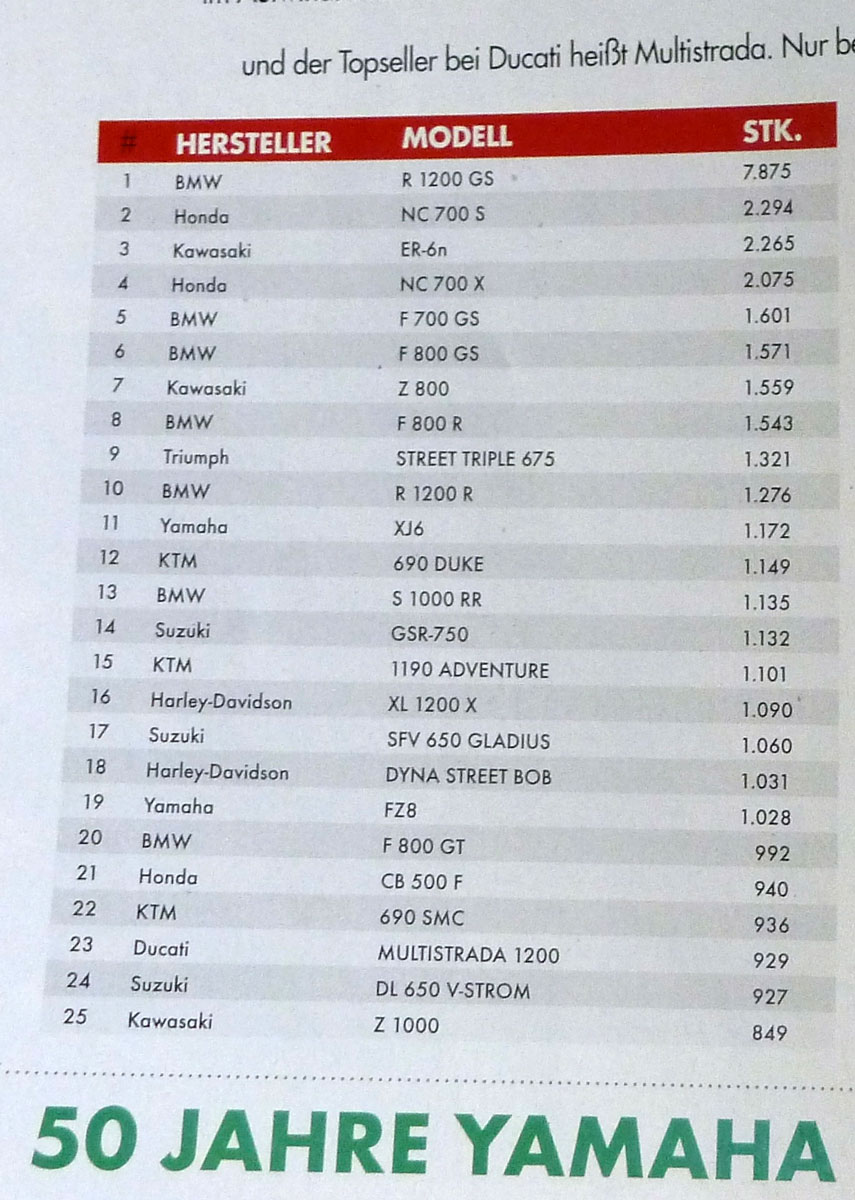
Other stuff I saw at the Hyperpro workshop Though he’s a big fan of the early 90s R80 Monolever (the post 7 series Boxers), one of Bas’ bikes is a cool 800 G/S from the previous decade. Alongside a parked up GS12 you can see the different paths that ‘adventure motorcycling’ has taken over the intervening years. Actual adventure and the other type. Where did BMW go so wrong? Well, look at the table on the right and you’ll see that perhaps they’ve got it very right. The 12 is by far the most popular big bike in Germany and many other places too, including the UK. But the Kawa ER-6 third? Perhaps they were on special in 2013.
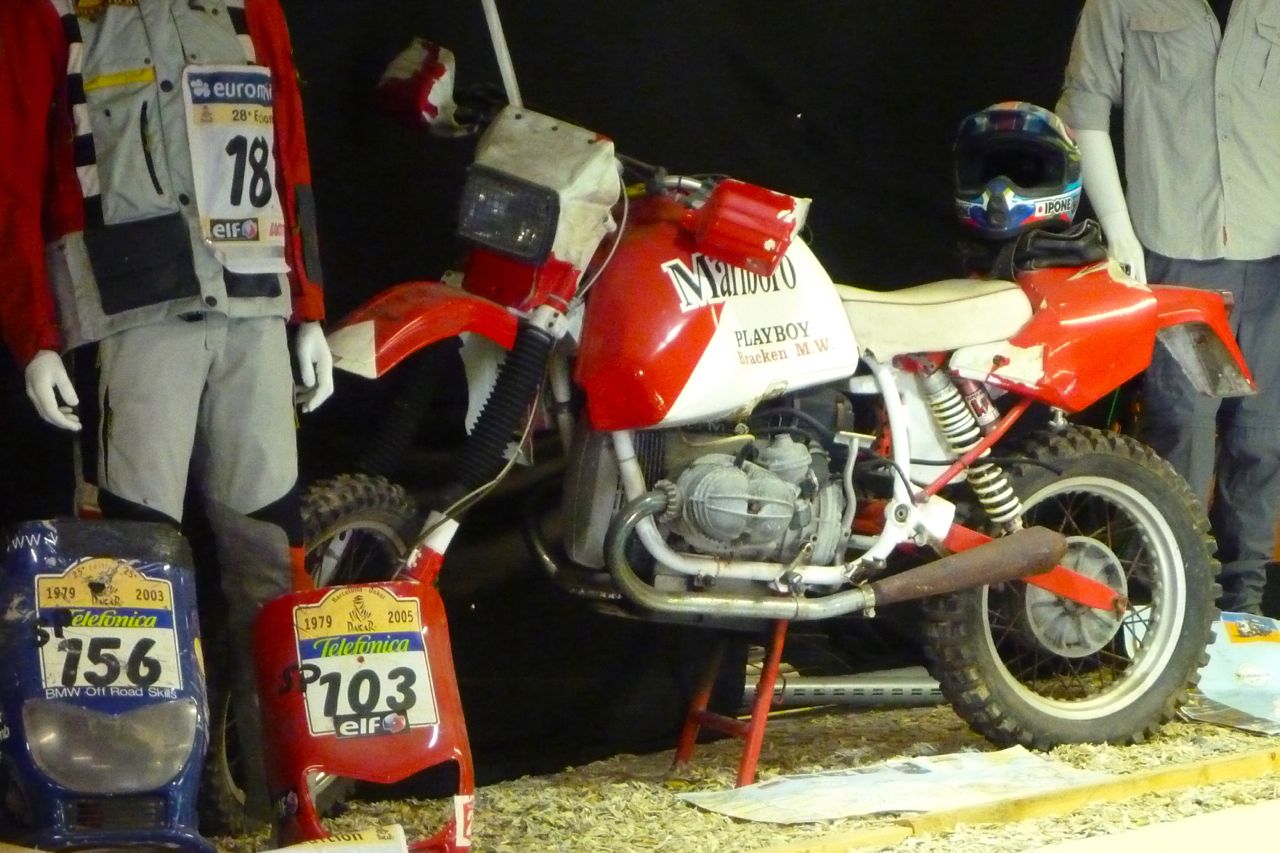
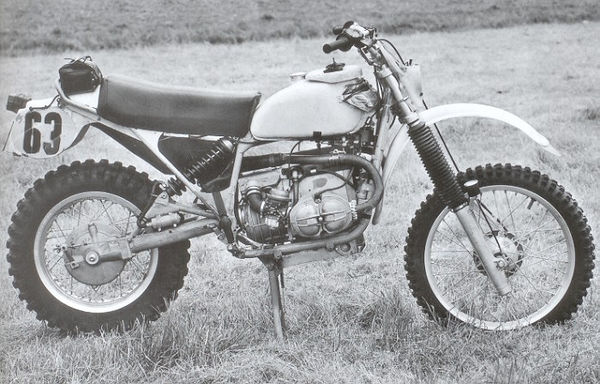
Bas’ 180-kilo G/S reminded me of those ISDT enduro racers from the 1970s (left) from which the Dakar desert racers took their lead. His G/S has a longer swing arm, possibly a one-litre motor, forks from a dirt bike, Excel rims and a mini tank behind the battery in the space opened out by the longer swing arm. Best of all, it just looked like you could take it anywhere you can manage with an XChallenge. In 2012 he did just that, riding with Walter in Mongolia and Far Eastern Russia for five weeks. Walter’s pics and report start here. Bas is currently rebuilding Walter’s tired old Xch around an Xco donor bike.
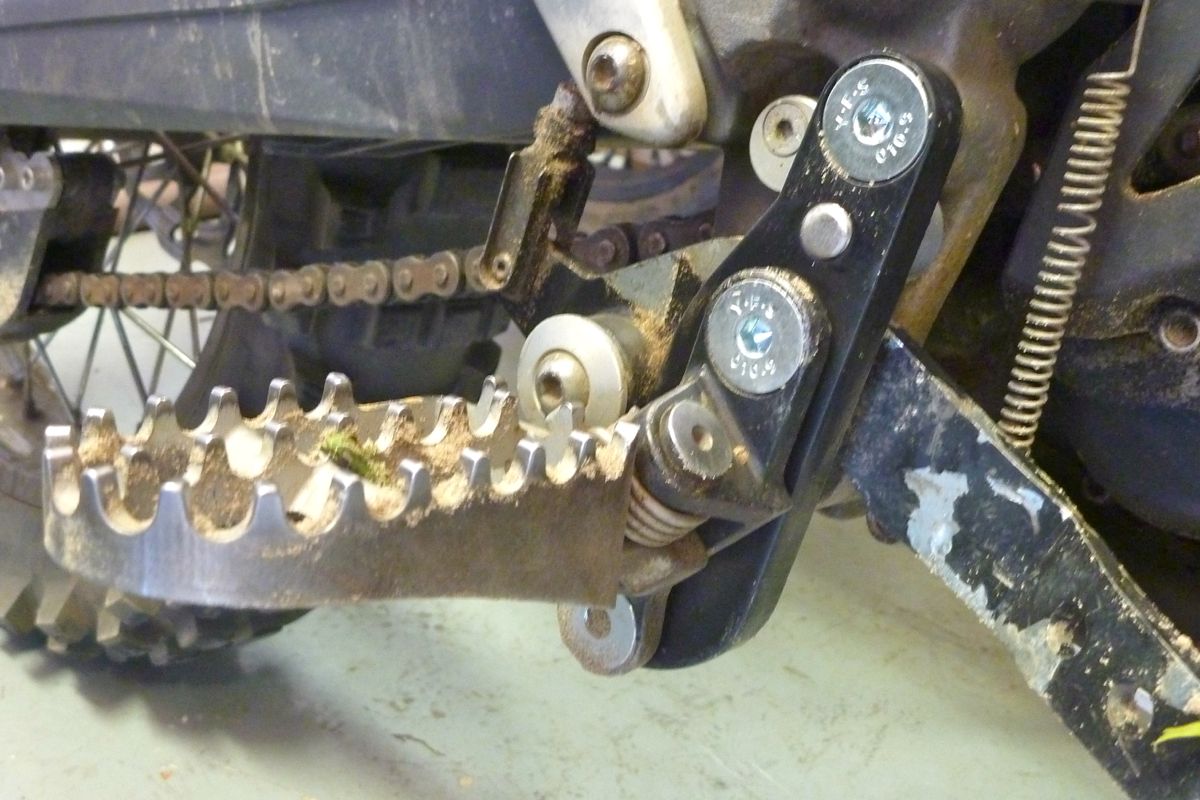
Bas’ g-friend Linda was also on that Russian ride with her Xco and when she turned up at the shop I took a close look at her set up. All the Xs in the shop seem to be running lowered footrest plates, (left), either DIY jobbies or made by Erik. Seems to improve comfort despite the greater chance of rut bashing. I may look into a set myself, as it’s easy to do.
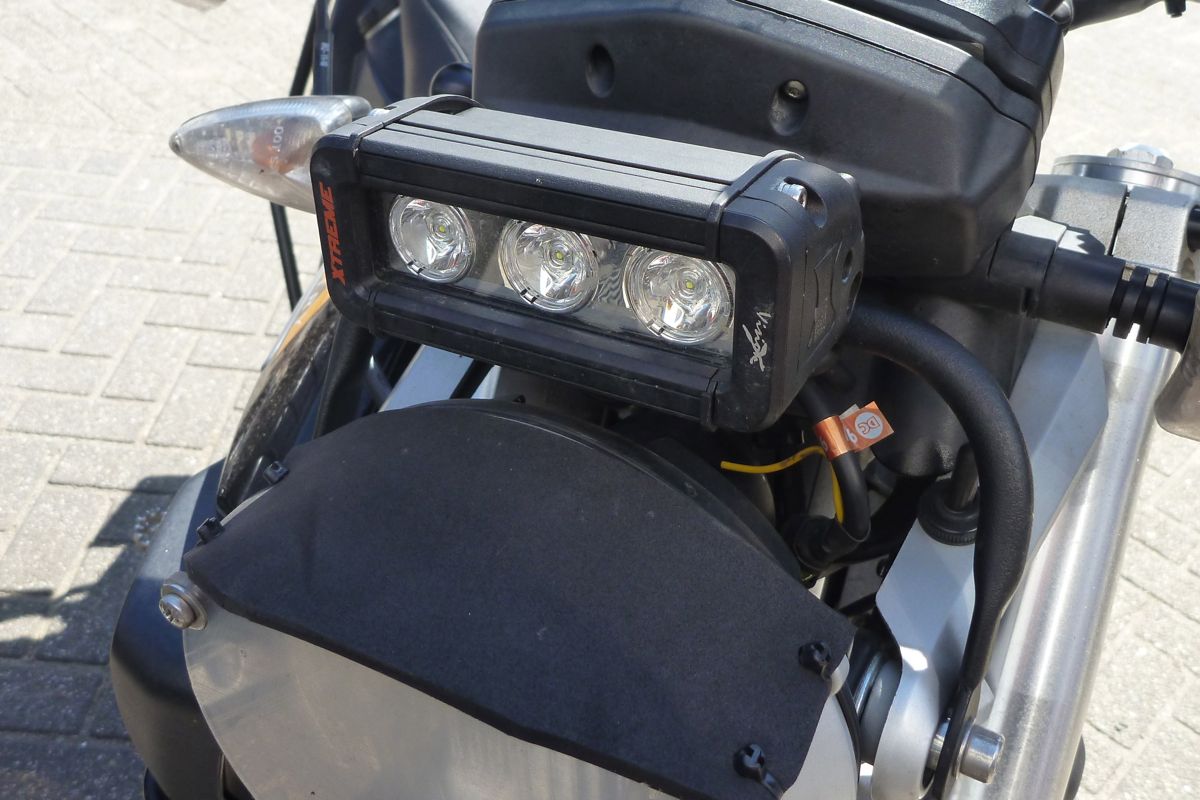
Both their bikes were also running a 5-inch VisionX Xtreme 3 x 5w LED light bar as sold by Adv Spec. Narrow beam is the one to go for according to Bas; it still puts out plenty of light to the sides and is what I feel my bike needs. I haven’t been so inspired to refit the Rigid SR-M light from my GS-R, bright though it was.
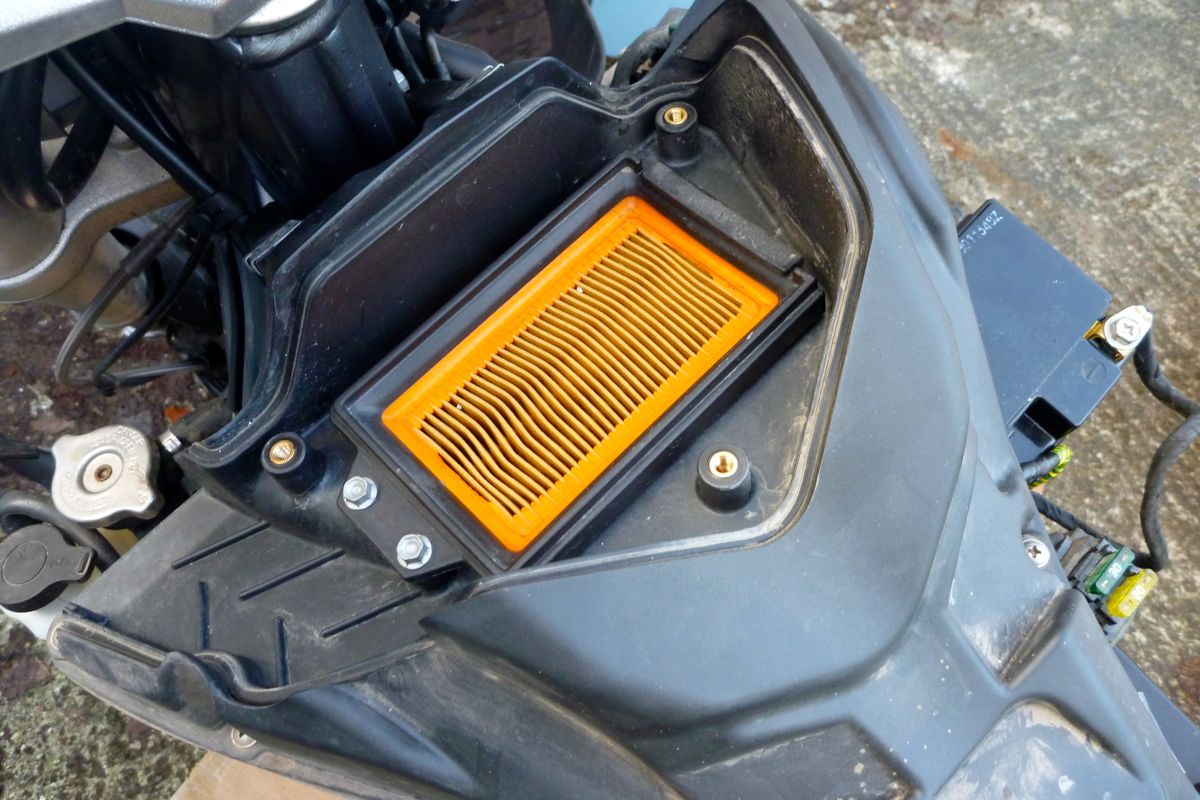
One thing Erik mentioned the day earlier was that the flat upper face of the OE paper air filter tends to shake and sieve desert dust in desert areas. So even though paper works well, oiled foam cleaned regularly is a better way to go on this bike.
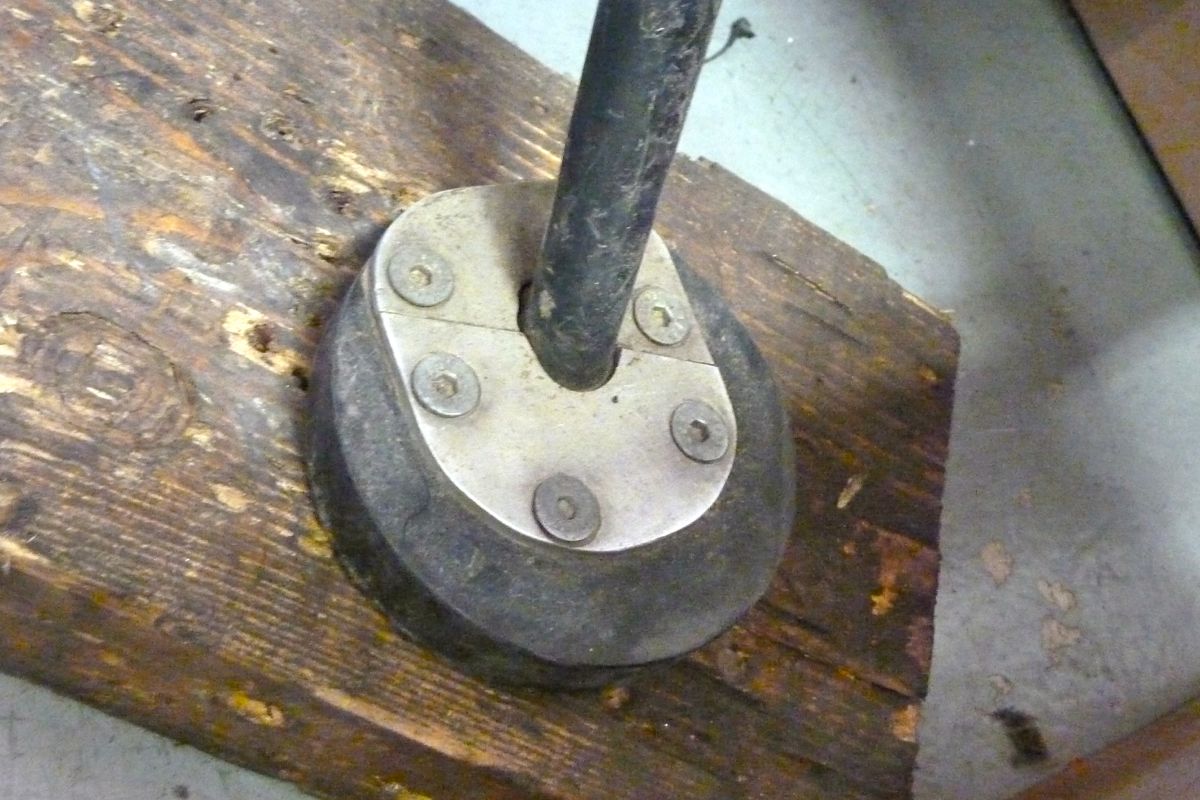
Though my screw on side stand foot plate was just a temporary measure added to a Wunderlich order, Bas was not such a fan of these as they come loose and fall off. I noticed one of the bikes had done a clever DIY job (right) giving the stand extra height to cope with the taller suspension, but it seems welding, just like I did in the old days, is the best way to do it. I now need to position a new plate carefully so as not to foul the shock’s reservoir.
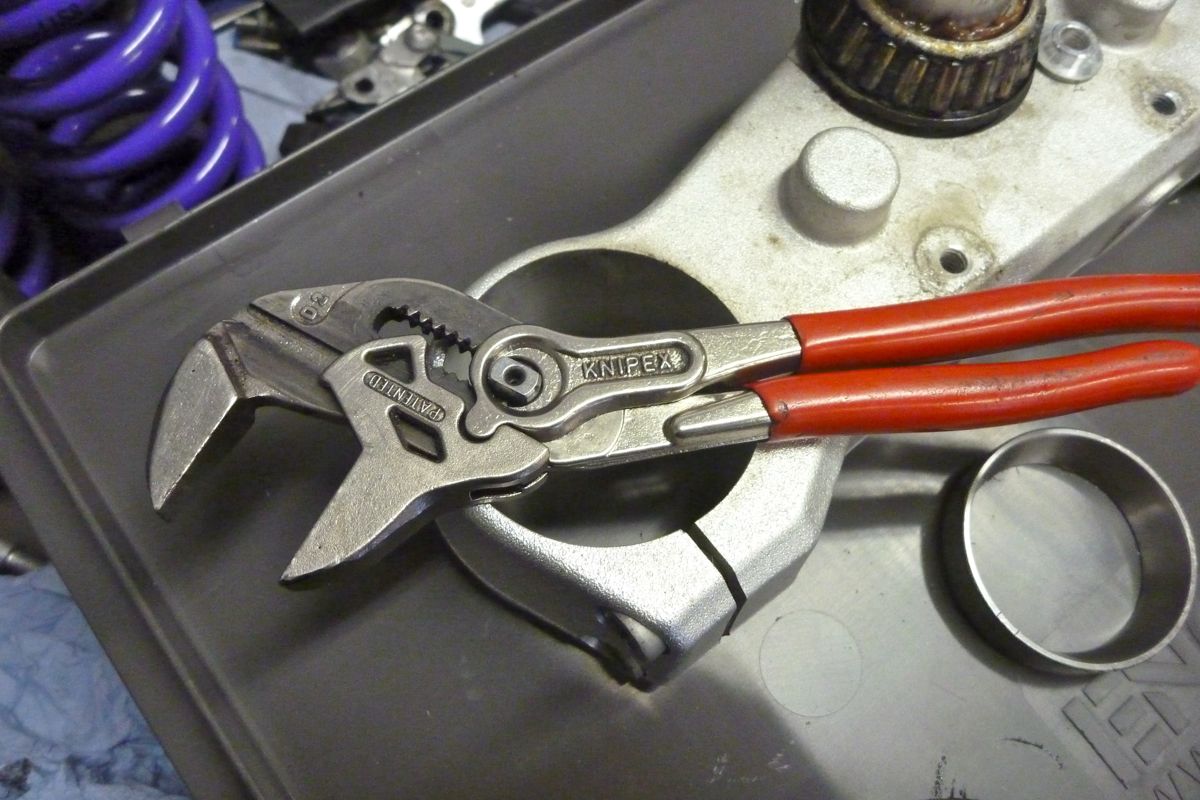
All the chain bikes in the shop were running chain oil drippers and I finally concede this is a way to go and plan to fit one in the near future. For a job that needs doing daily on the road, a can of Wurth Dry lube is just too bulky to carry around and anyway, without a centre stand, hand oiling is a pain. Among the array of fine tools in the Hyperpro shop was this Knipex adjustable spanner that uses grooves and a push button location to eliminate play, unlike those old knurled screw types. It looks like a very nifty general purpose too; I just ordered me the 86 05 180mm model off amazon for £34.
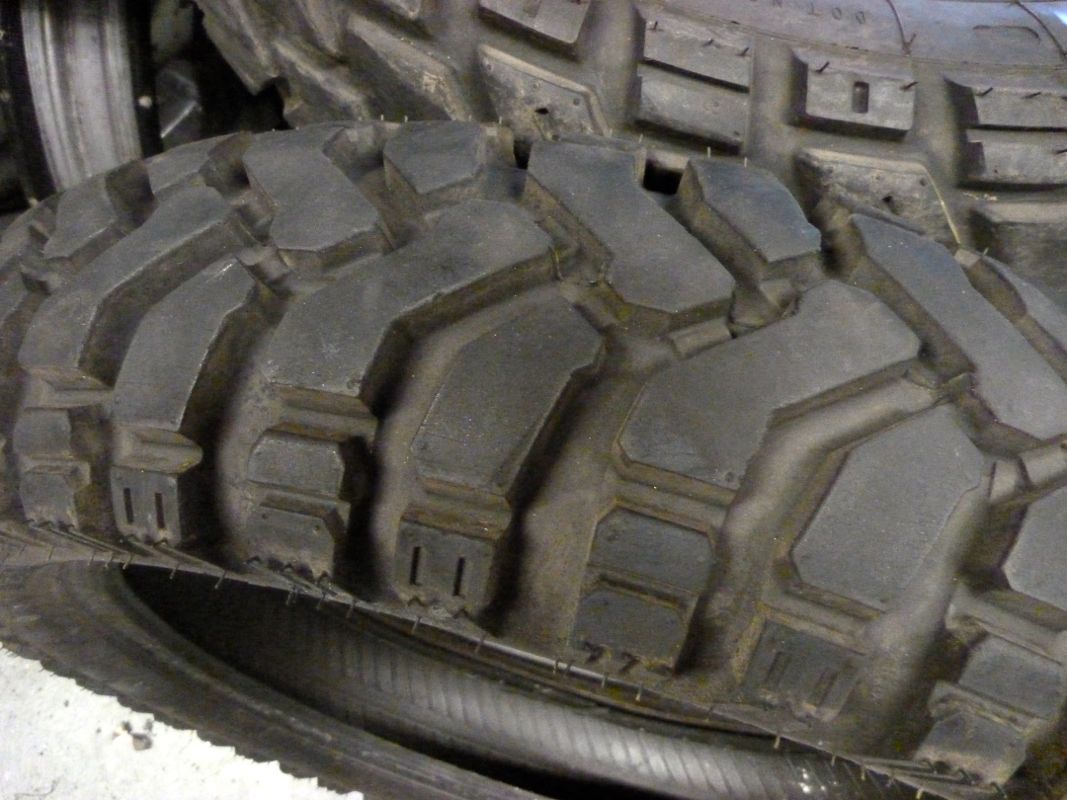
Talking tools, nice case on this XCh’s bash plate (right), though now I’m not putting a tank there my tool pouches are as good I’ve decided. And I had a closer look at a Mitas E07 tyre which is what I’ll try for the next trip, at least for the back. Same properties as the Heidi K60, but possibly better.
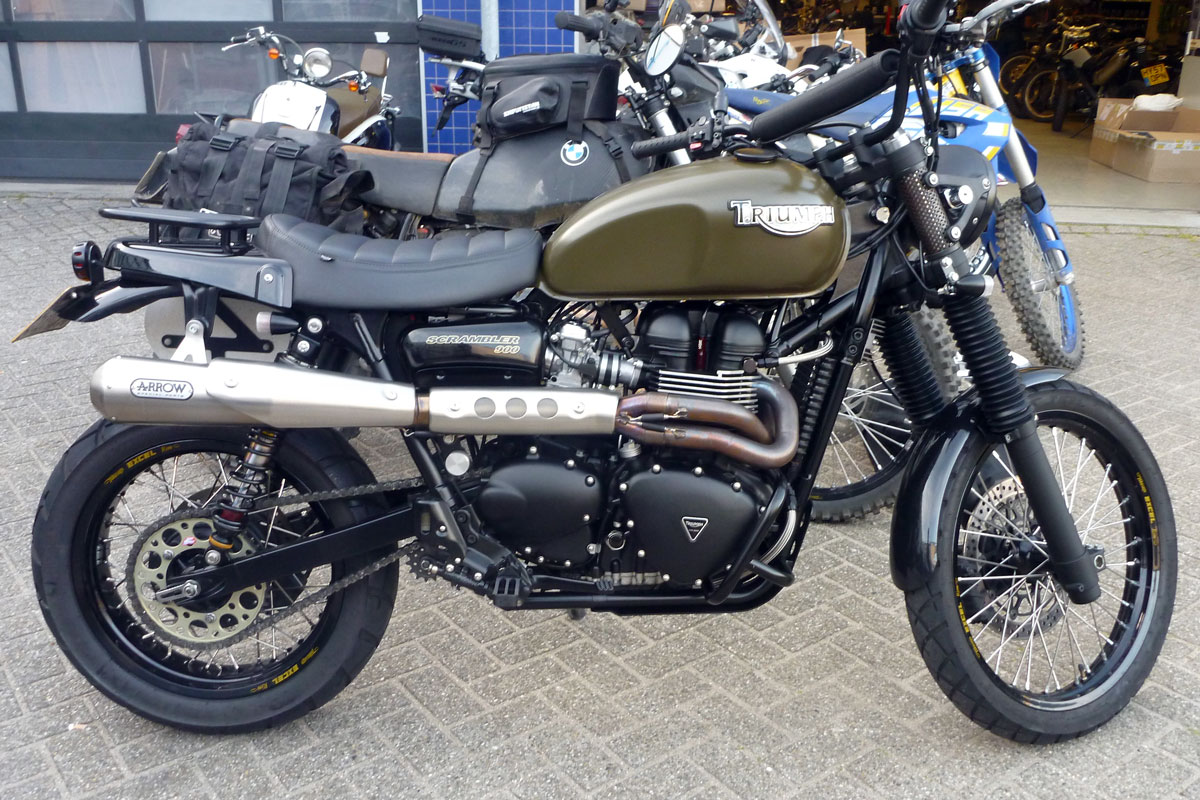
Finally, talking of Steve McQueen, a customer turned up on a Triumph Scrambler 900 similar to the McQueen Special produced last year to commemorate the film’s half-centenary. Great looking machine, like most Triumph twins, but heavy and when I briefly sat on it it didn’t feel right; seat way too wide. Couldn’t see me sliding confidentially around alpine meadows on that one. I’ll take a regular Bonneville or Bas’ elongated G/S.
“frequent refuelling interruptions are not the journey”
The Xmachine is a pretty economical bike – over the last 2500 miles I’ve averaged nearly 74mpg (26 kpl) with backwind best of 83.5 (29.5kpl) while cruising at 70 where possible. Even then, with the 9.5-litre tank the light comes on at around 120 miles with a potential range of 150 miles before you suck crap into the fuel filter and start pushing. Not enough on a bike like this.
The simple and cheap solution is a 5-litre can on the back (left). I managed fine like this with the even-smaller tanked CRF-L in the US last year as there were no larger tanks available. But on the faster X bike the refuelling interruptions are not the journey.
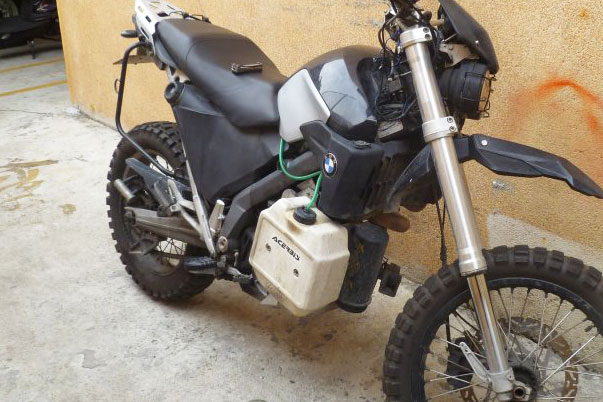
My original plan was to either build a 6-7 litre tank onto the bash plate, nice and low and out the way. Others have fitted side tanks (left), another good way of keeping things low, but none gets around the need to stop at 120 miles unless some sort of pump is organised (the one left may be auto sucking, see below).
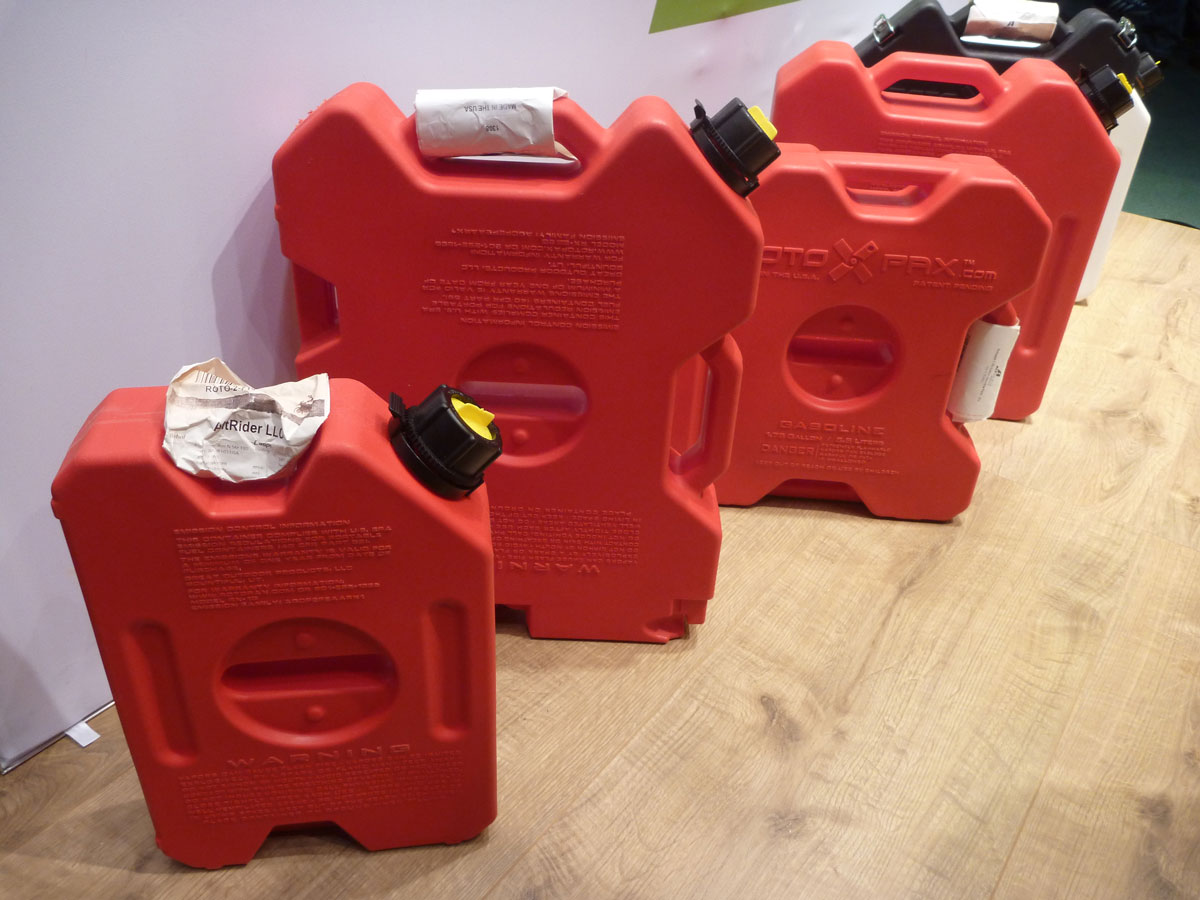
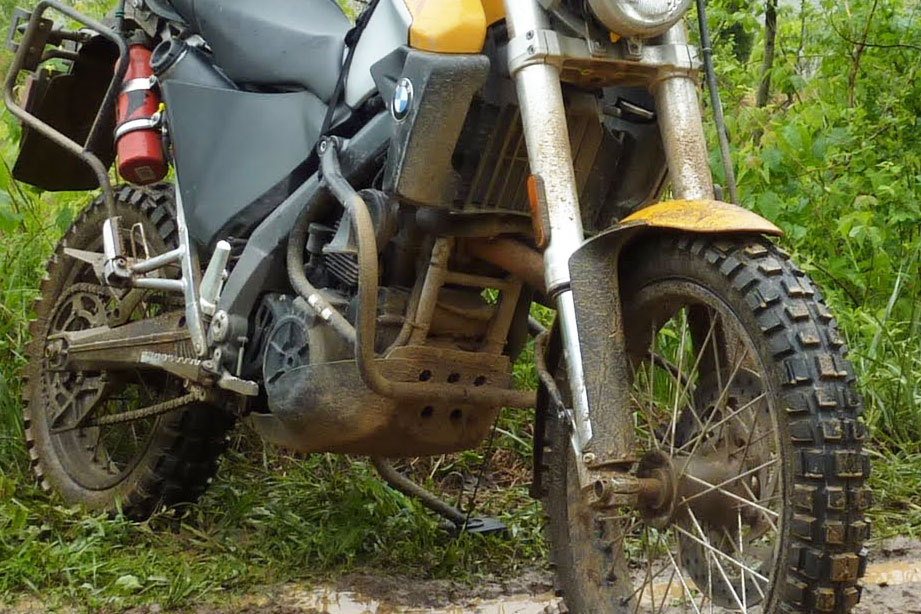
Then I thought fit a 6.6-litre Rotopax can (left, 3rd along) either under the bash plate with added protection, or one each side of the engine on H&B crash bars (right). The 6.6 can is 9cm thick which would cost clearance, be less work than building in alloy but still require decanting.
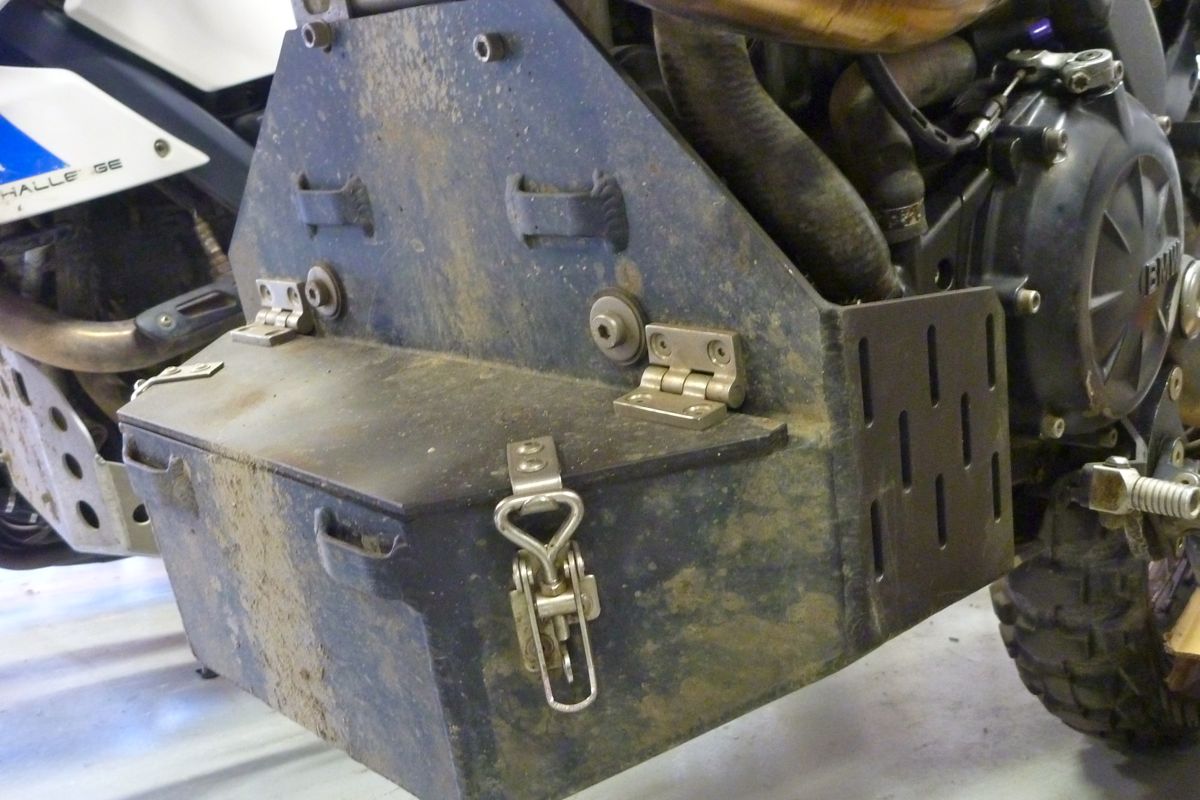
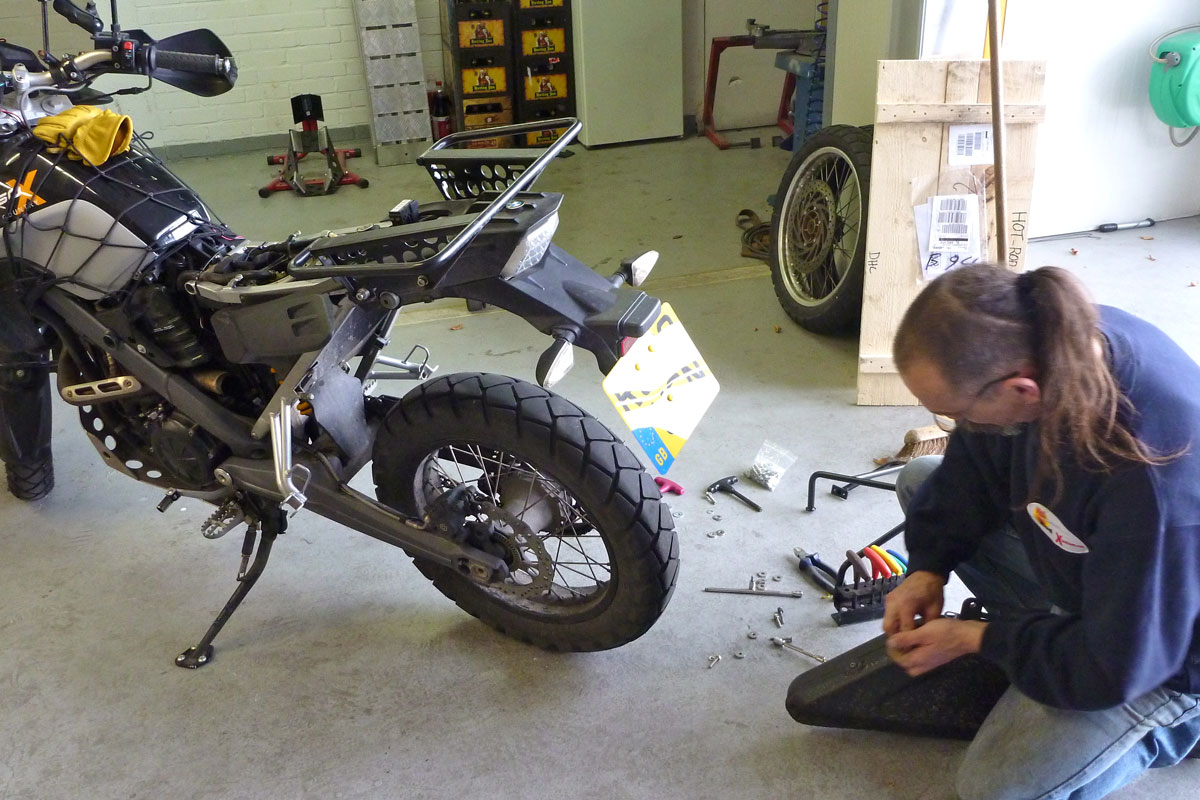
Those were my plans until AMH-contributor Walter Colebatch suggested to fellow xfan Erik from Hot Rod Welding in NL that he may like to supply an Xtank and an Xrack for my bike, as well as hard part xplates to project the underparts (see bottom of page). Erik runs his own XCh and happened to know the X series’ production volume. The first batch of Xbikes – Cha, Co and little Mo – were all built at once in 2006 and flogged from 2007, then the Xcountry was built in China for 2008. All up the run amounted to 13,000 bikes. Good to know.
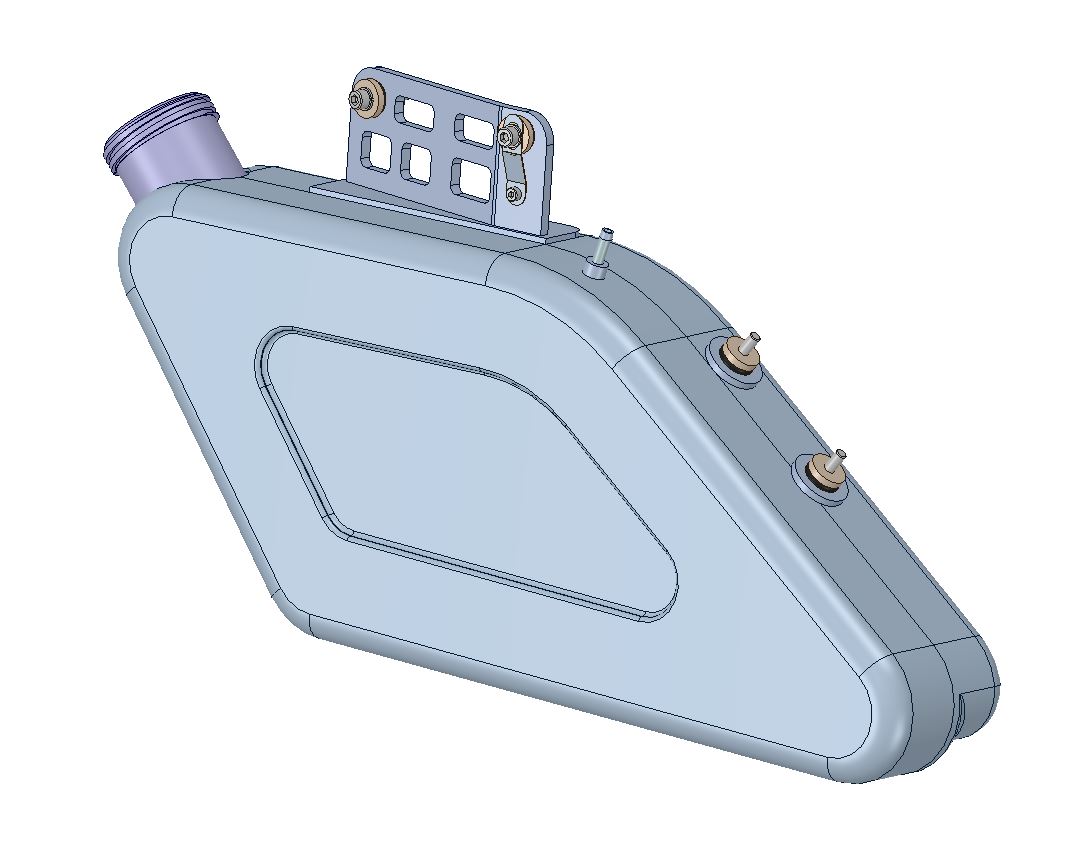
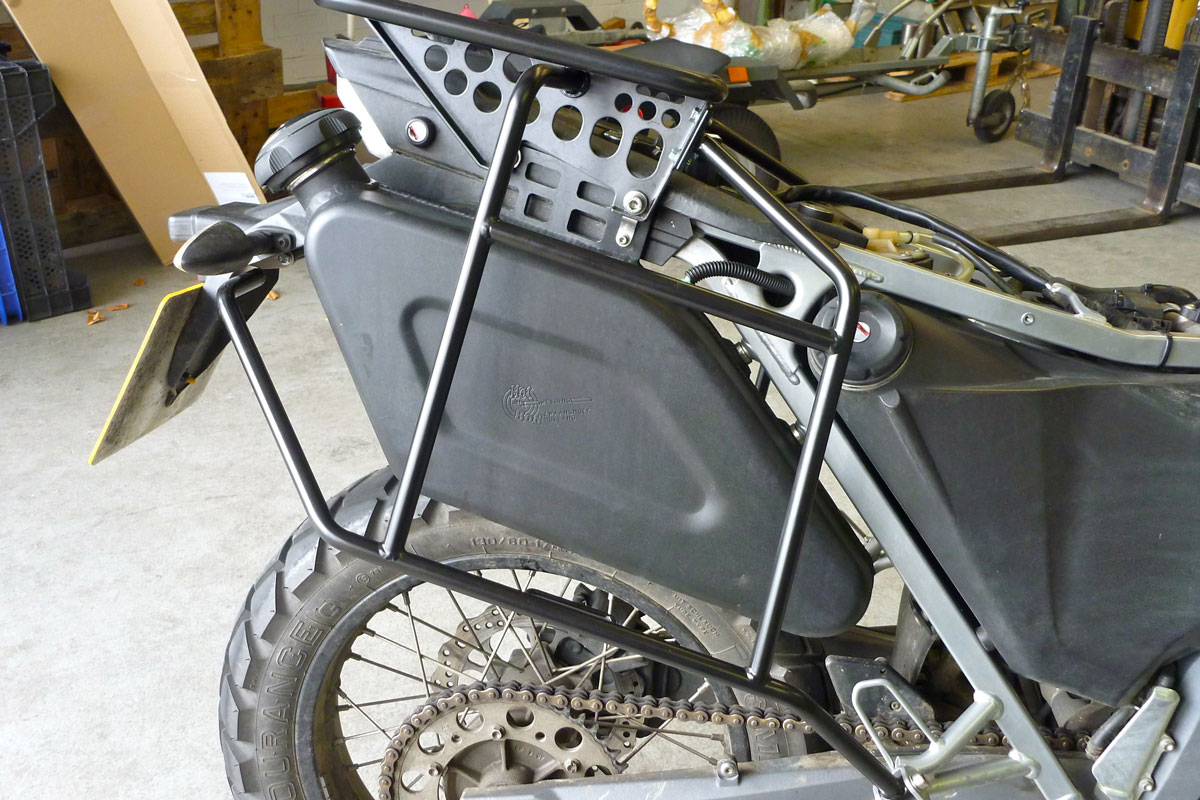
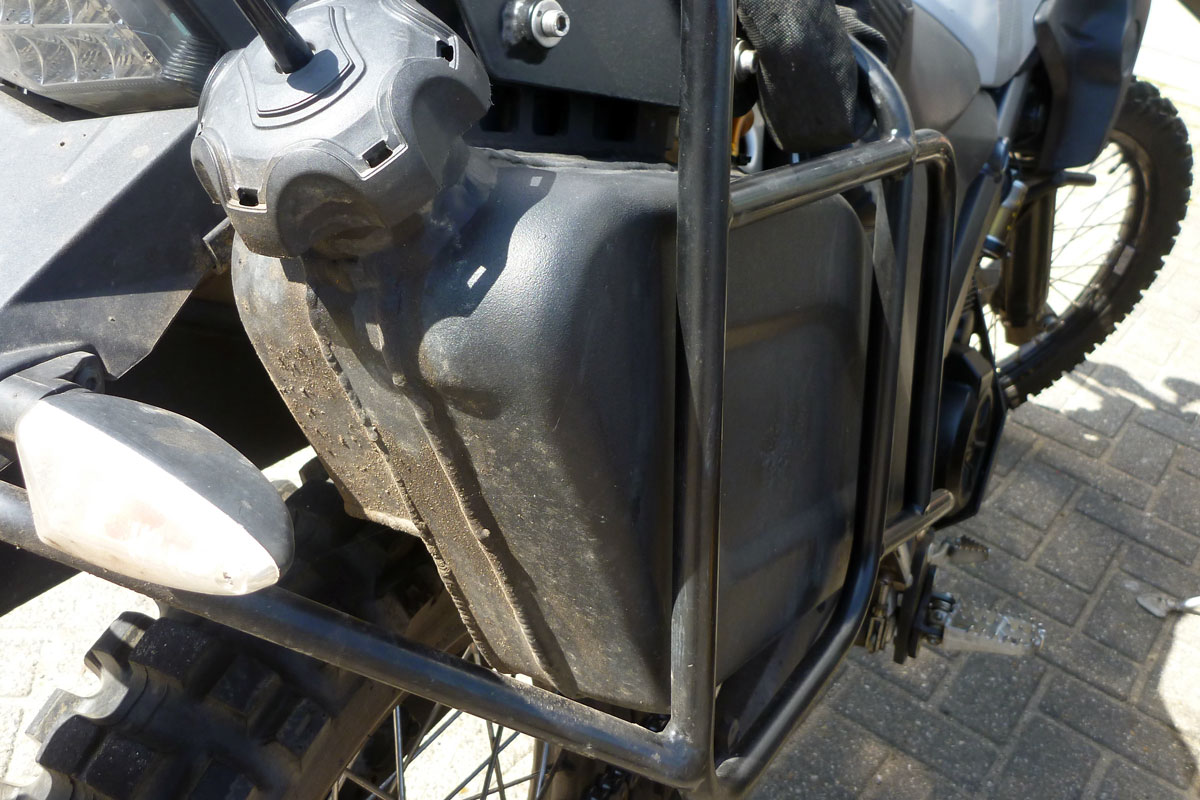
The €500 Xtank fits in the crook of the RHS subframe – mine is the regular 6.5-litre size (a wider 9.5-litre version also available for not much extra cost, pic below. And fyi I regularly got 6.7 litres in mine). The tank hangs from the former back handle mooring points and then plugs into the diagonal beam, adding a bit of support to the subframe while being less wide than the pipe on the other side. Better still, all it needs to flow in series with the main tank is the main tank’s black breather pulled off and the clear xhose plugged in.
That black breather happens to suck and once sucking on the Xtank’s fuel pick up at the base of the Xtank, it will create a syphon and drain that tank before seamlessly moving onto the main tank. Result: 200 miles doable without thinking and a potential range with 9.5 + 6.7 = 420km or 260 miles which happens to be my ideal suggested fuel range in AMH. That will do nicely.
The tank requires removing the chain guard which sits quite high, and even then it’s said the chain can hit the tank on hard compression of a bottomed-out shock. That’s no longer an issue for me, and even then, I’m sure my shagged-out OE shock bottomed a couple of times without touching the underside of the xtank.
If your injected bike runs a subseat tank and has a similar sucking breather, this principle of a second tank working on a suction feed may be worth investigating on non Xbikes.
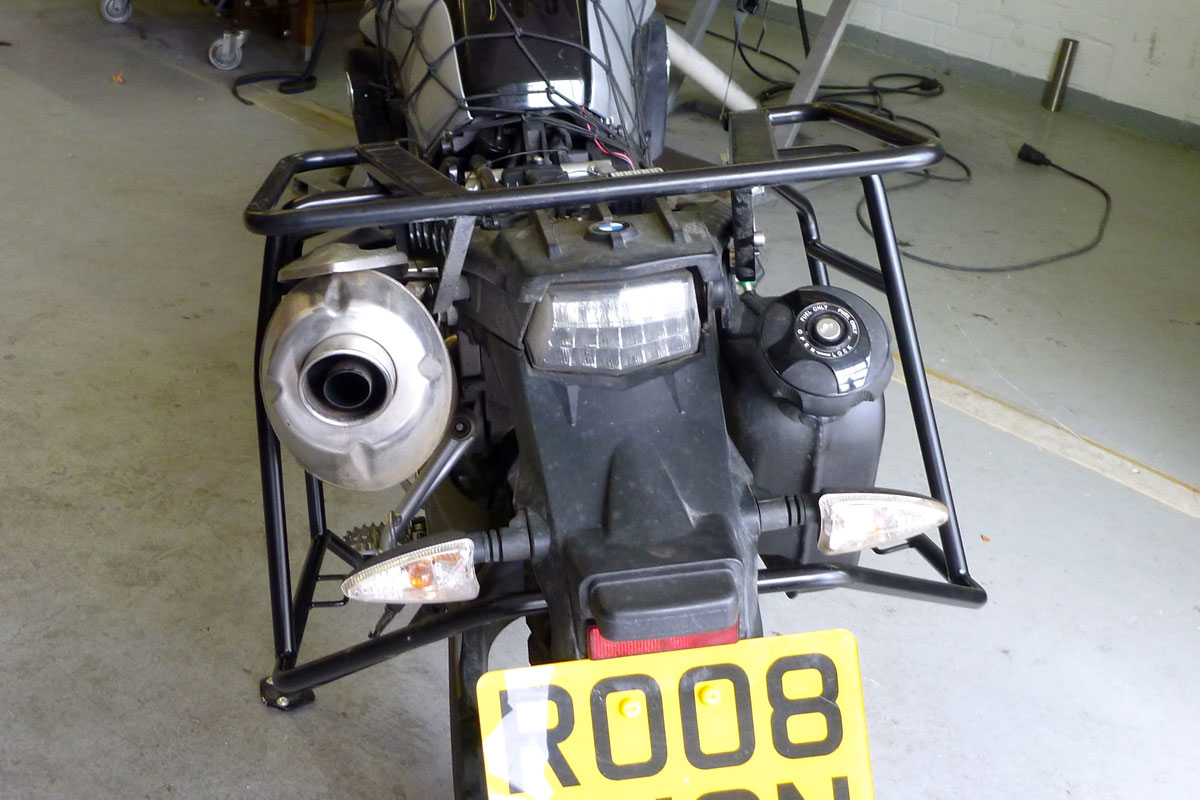
Xrack Although I prefer soft luggage I still believe a light side rack is worthwhile to keep bags in position come rain or shine. For his Siberian travels, Walter C also got Erik to build him a rack to keep his excellent Magadan bags (now in MkII form) out of the back wheel. The racks, 2.2kg for both sides, follow the standard formula of mounts near the pillion footrest, the back of the subframe plus a link underneath to stop them caving in. I like that Erik doesn’t just flatten tube ends and drill a hole through – he does a proper job. And the back cross brace mounted behind the number plate performs the useful function of reducing lethal number plate waggle over rough ground. I’m sure without support that thing would have broken off at the first sight of corrugations.
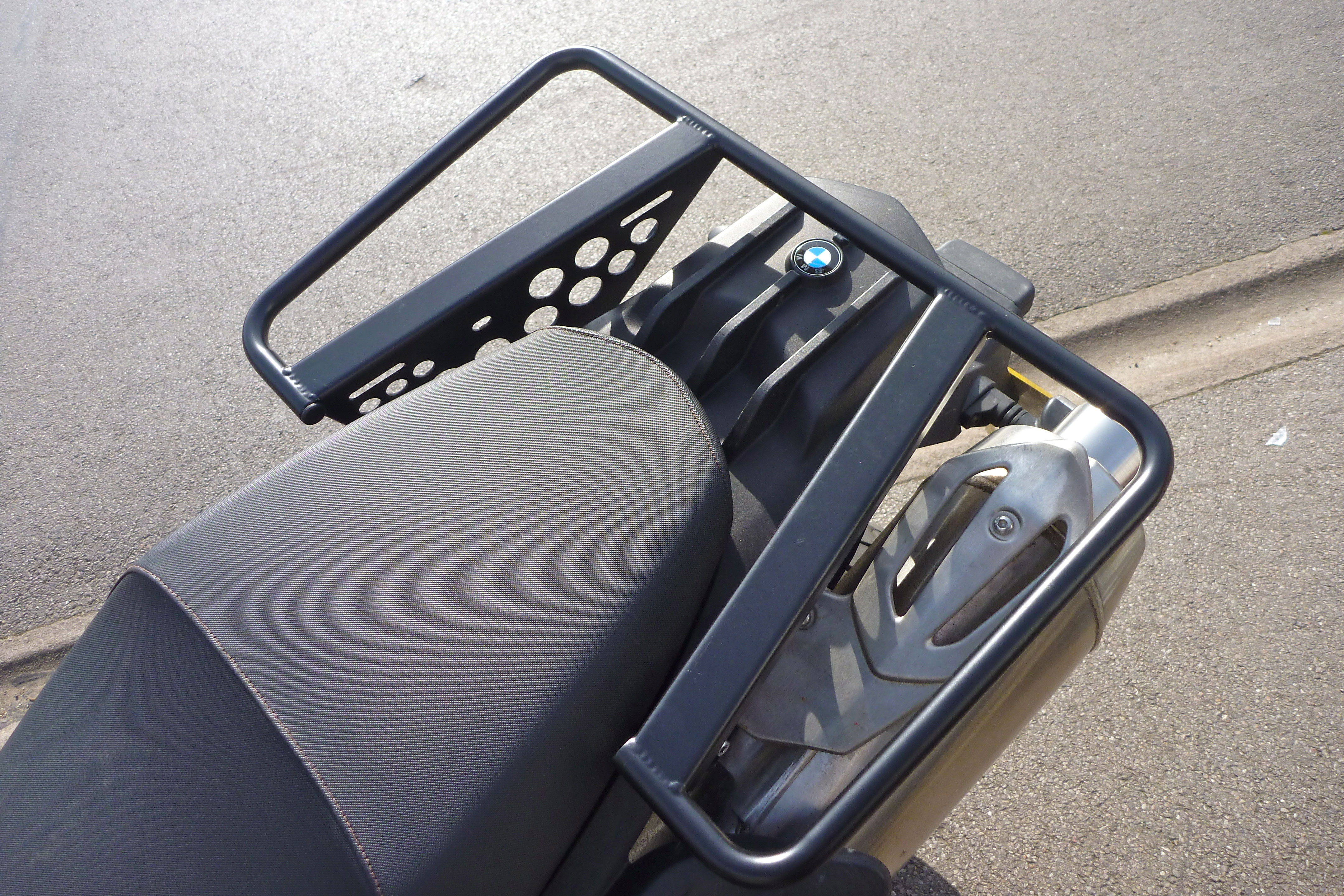
Erik and Walter also seem to have adopted the ‘sheep rack‘ platform idea which I mentioned in AMH6. That is, a substantially wide rack, not these skinny ‘flower pot stands’ like I had on my CRF-L, or nasty edged CNC plates that have become all the rage because they look flash and are cheap to mill. With a roll bag across the back you want a w i d e base to spread the load and reduce rubbing. Plus it can make a good table or work surface. Ingeniously, Walter and Erik went one better and designed the tail rack to come forward round the back of the seat (right). Again, this compels you to mount stuff as forward as possible, at the very point where you don’t want weight hanging out back. The 1.7kg tail rack doesn’t interfere with passengers and makes a good solid grip when you end up with the bike in a ditch.
On the right side (left) you’ll see the side rack sticks away from my xtank so there’s room to fit the larger 9.5-litre Xtank (below) should you wish, or just slot stuff behind it. The whole rack assembly comes in at just 3.9kg. These light racks are designed only to support and secure soft bags. They wouldn’t be suitable for mounting hefty ammo boxes, but Erik can build you a light, soft bag rack for any bike. On the right, a rack he made from some trans-Africa CRFs.
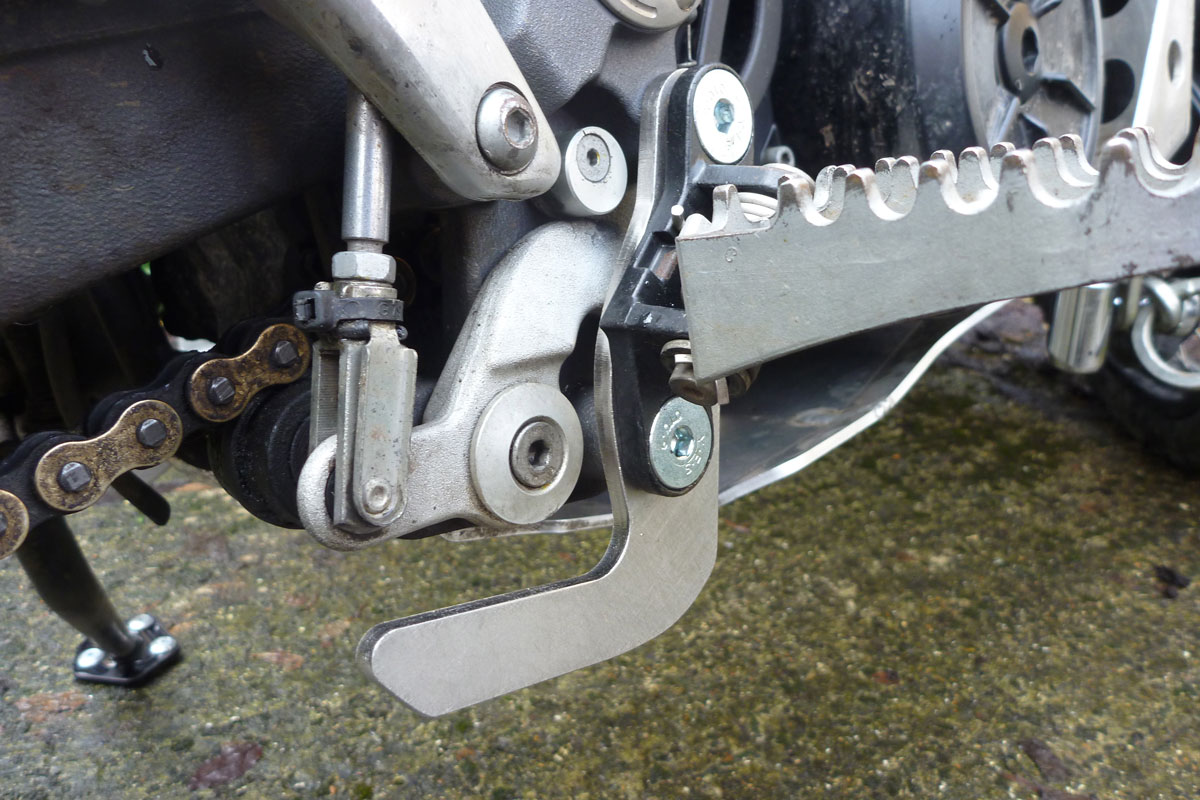
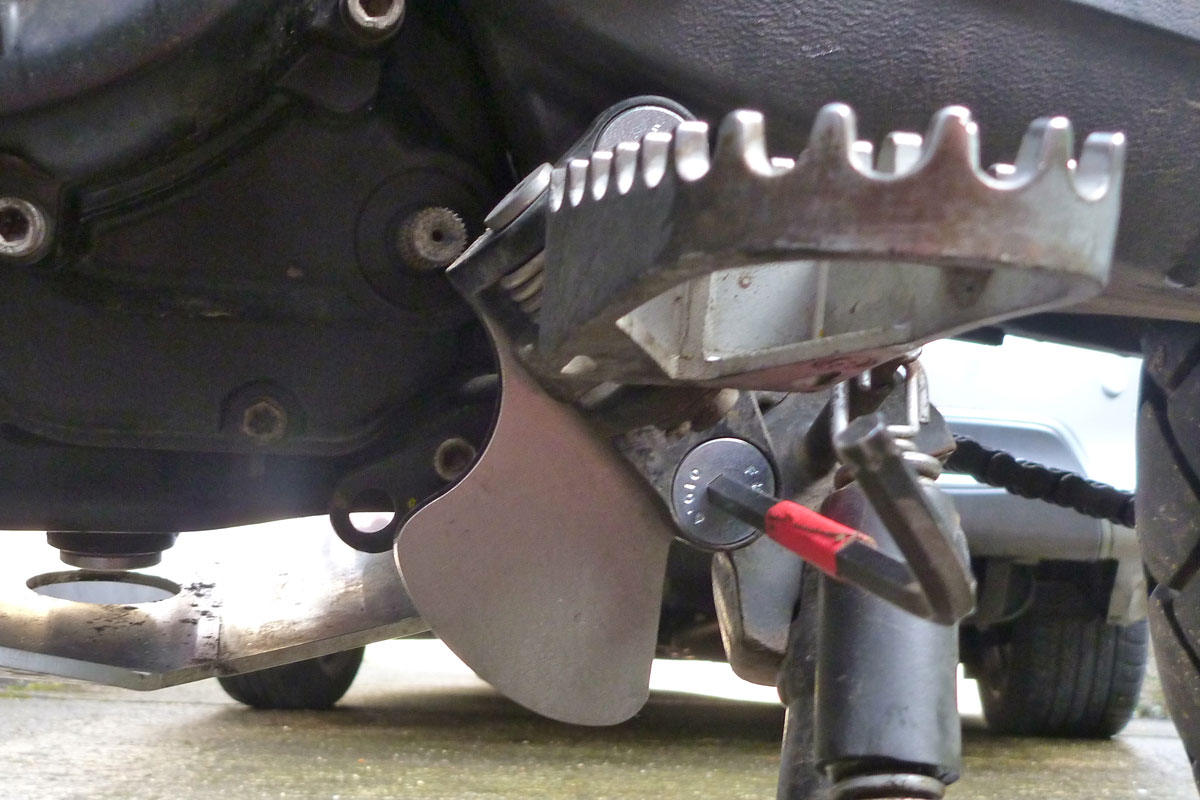
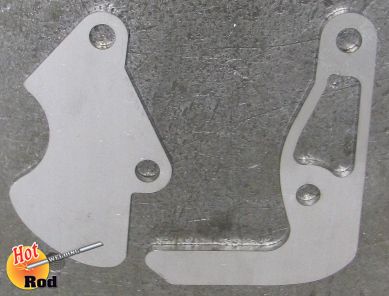
Left and right are Erik’s hard parts to protect the vulnerable rear brake assembly in particular. As for panniers, the MkII Magadans would be the obvious choice, but my contract penalises me from using the same thing twice. I have an idea I’ve been wanting to try. More about that later.
Erik at Hot Rod supplied his Xparts in return for an advert in AMH.














 but turned out to be a manual, ‘actuate-the-plunger-once-in-a-while’ operation (see instructions below right)
  . Way too much faffing to remember at the end of a long ride.















 Adventure Motorcycling Handbook