September 2025. After less than 2 years the pump’s battery would not hold its charge. I suppose that was my 20 quid’s worth.
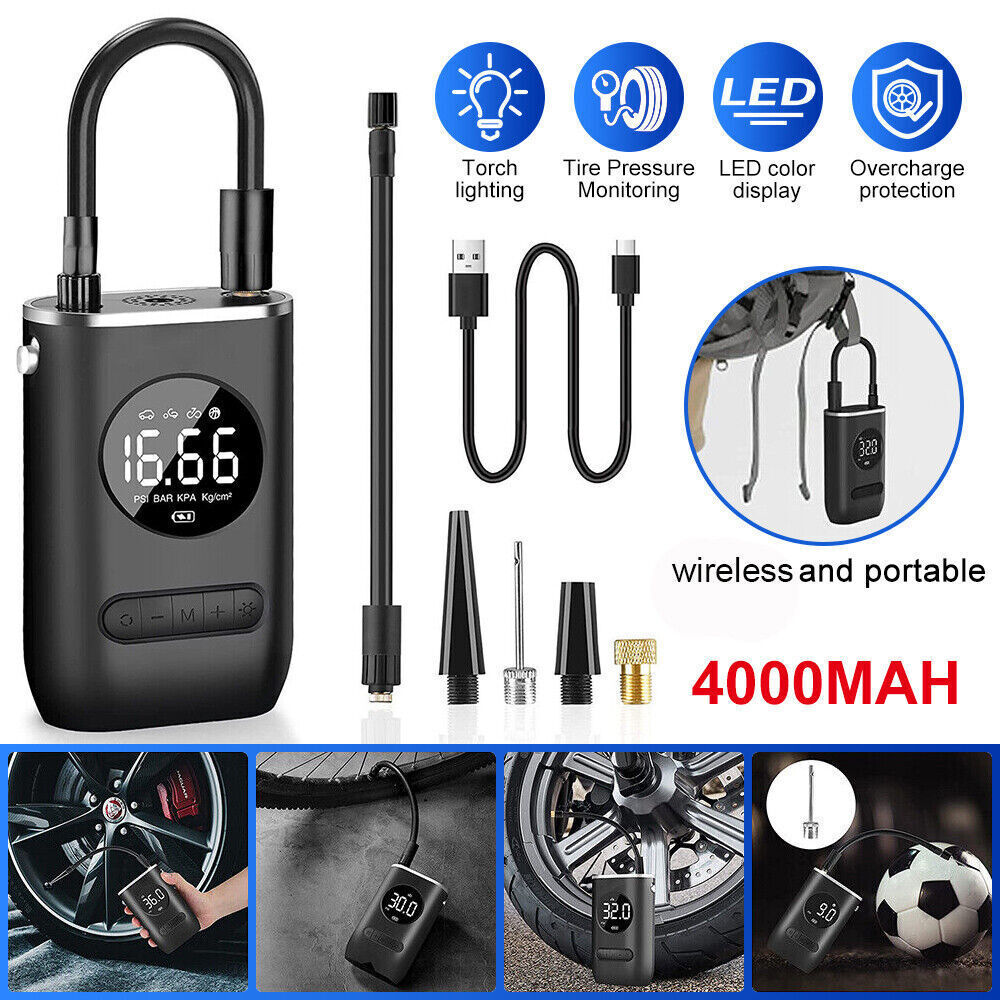
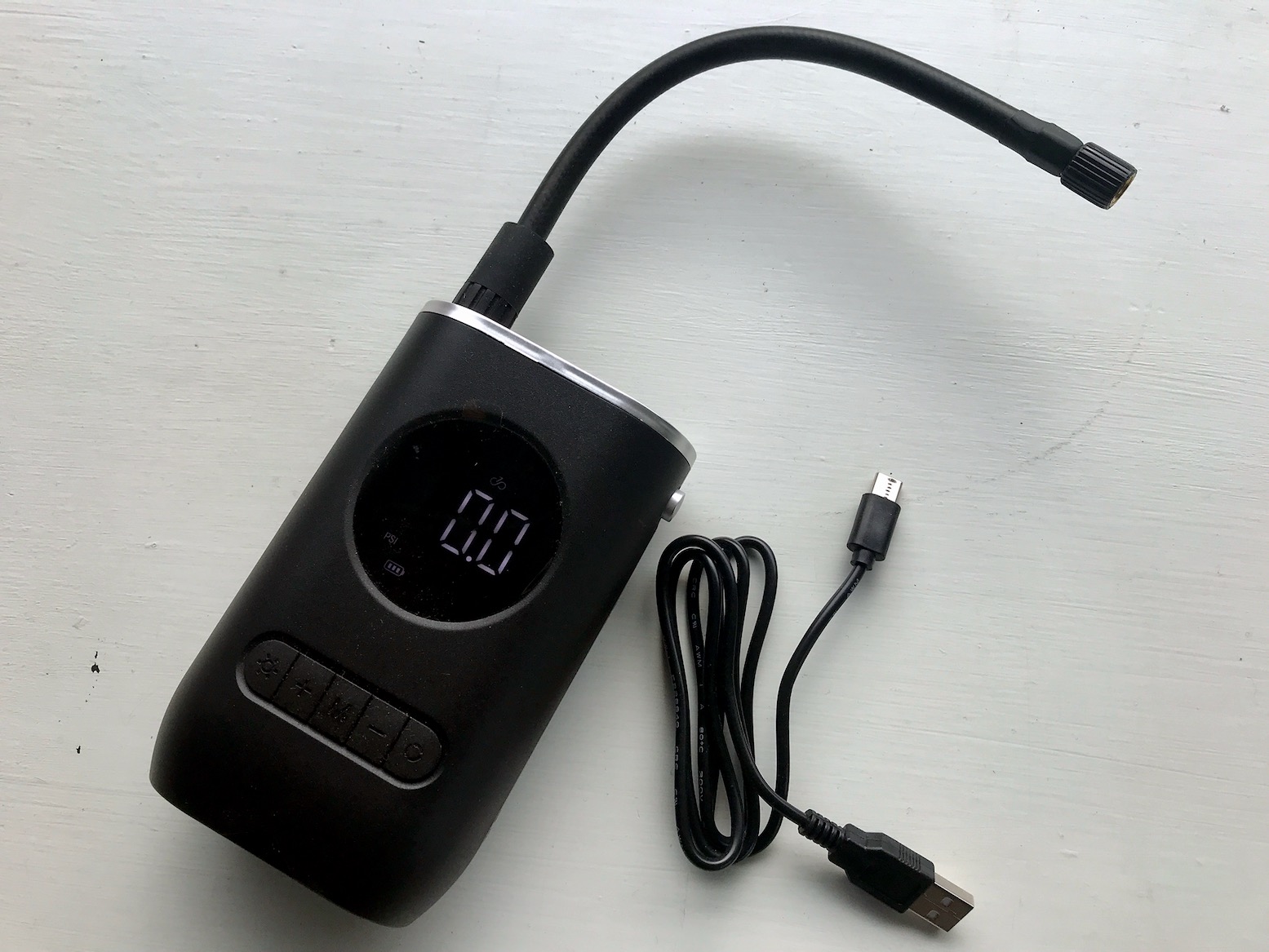
Robbo put me on to me this unbranded 4000 mAh USB rechargeable tyre pump. You’ll find the usual clones of clones of clones on ebay from around for even less now. Tbh, I don’t know exctly what 4000 mAh means in the grand scheme of things – battery capacity probably, not power, but it worked well for me.
Mine came with a bunch of unneeded nozzles and a Samsung-type USB-C? recharge cable. You turn it on, set the pressure you want (which stays in the memory) and press the middle button. Off it goes, pumping up a G310GS rear tyre from zero to 27psi in about 5 minutes without getting hot and while being dead easy to read. There’s a torch, too. It weighs 420g. A handpump fyi, weights 100g. Remember, with pumps ignore some notional ‘150psi!’ figure which they might manage in a small-volume pushbike tyre. It is the much less often quoted flow rate or cfm that counts. This one is probably a lot less than < 1cfm and all pumps will slow down as they pass 1 bar or so. It’s how fast they can keep pushing to a typical 25-30 psi (2 bar) that counts.
I also used it daily to top-up the slow-leaking rear tubeless tyre on my CRF. Yes, a bike-battery 12-volt powered compressor like my 2002 Best Rest Cycle Pump (left; 760g) is about the same size, weight and power, but for quick, cable-free top-ups it’s one less thing to wire-up or plug in. It vibrates less and makes less noise than my old Cycle Pump too, and recharges off mains in a couple of hours. I’d guess it would take at least 30 minutes of pumping to flatten the battery. I never got close, and of course you could do it on the move via a bike’s USB plug or off a power bank.
The elephant in the pump house is of course the durability of unbranded Chinese gadgets, but that applies to 12-volt pumps too, if not everything. I tumbled one time in front of some impressed village boys and rolled on my back which cracked the pump’s housing but it kept going fine. On a long trip I’d pack a manual back-up pushbike pump (search ‘Crank Bros’ and go from there). But for what I do in Morocco I retired the Best Rest and relied on this handy USB pump in the tank bag until it dies on me. That day has come: two years in it’s not holding its charge. But the 20 investment has paid back. Next one will be a bit more compact
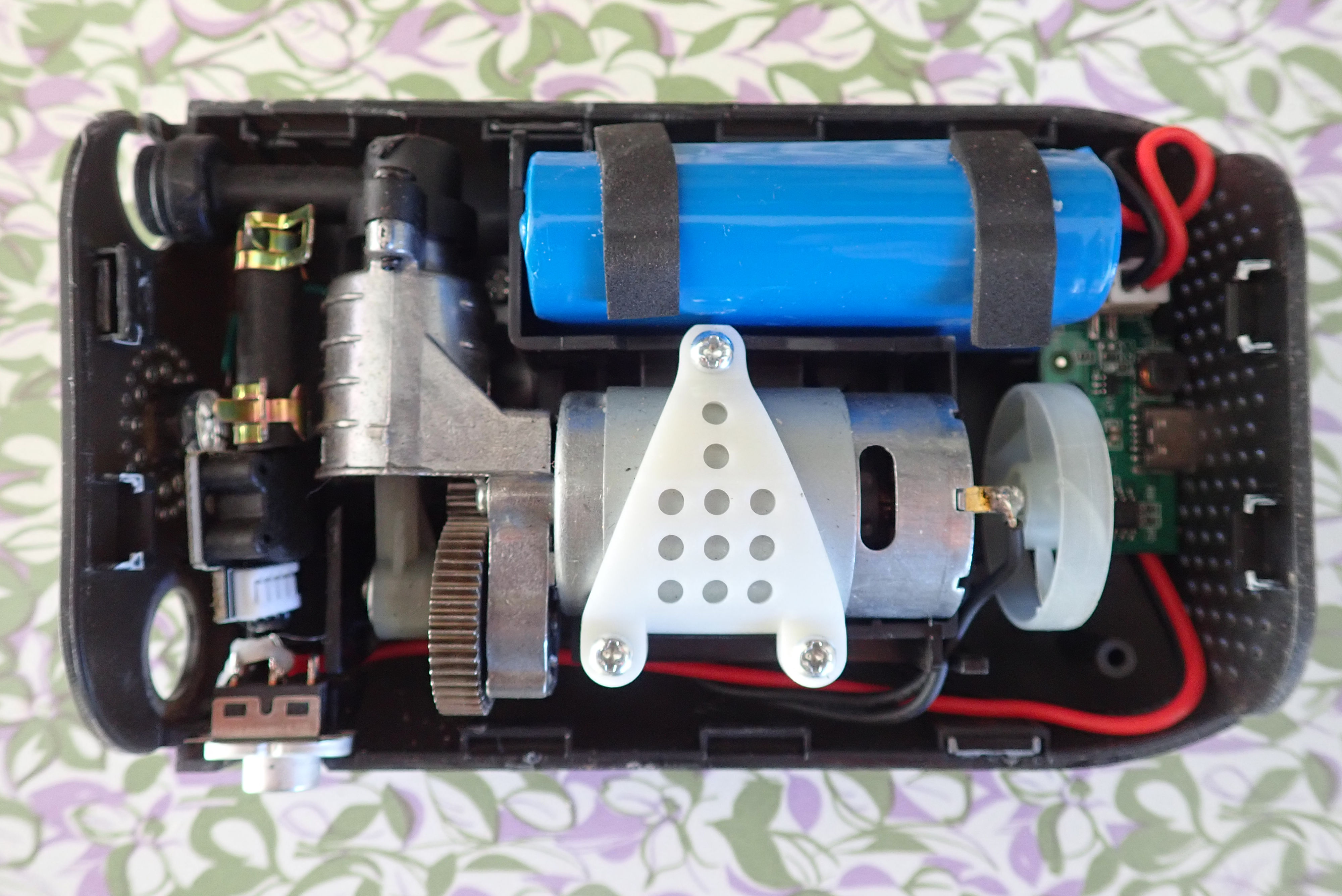
I can probably dig the pump out of the dead unit and wire it to the bike battery.
After a summer of tinkering and trail riding, my desert-ready 300L sits in the corner of a foreign carpark that is forever Malaga, washed by fluorescent lighting, blest by the suns of Andalucia. Ahead of me, weeks of piste logging broken up by a couple of tours to help pay for it all.
For nearly a year I’ve been scouring aerial images and OSMs while building up Google My Maps to five new regions for my next Morocco guidebook. I’m amazed how many pistes there are out there if you look closely. Many lead into areas where I’ve long thought ‘I wonder if there’s anything down there?’. Usually there is, as well as a number of new asphalt backroads not yet on any maps. I won’t be able to cover it all in the next few weeks, but I’ll leave the bike in Marrakech and come back for more later in the winter. Although I cheated and got it trucked across Spain, once in Morocco the 300L should be the ideal bike for this job. Sure, less seat height would be nice. but it’s light, economical, nimble and should be reliable. Let the winter games commence ;-)
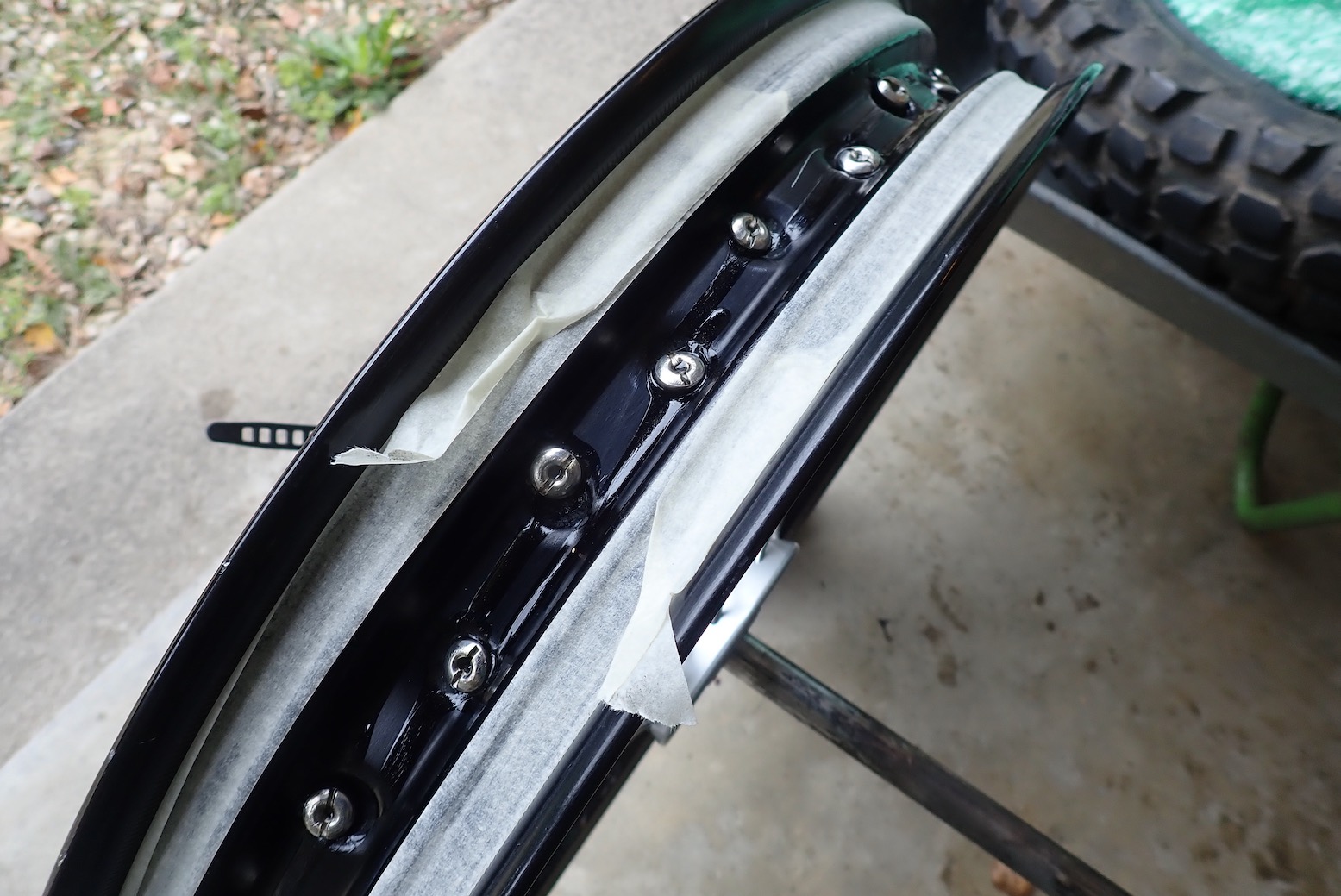
Note: I rushed this job below and had a manageable slow leak from the 17, a meltdown on the 19 front arriving in hot Marrakech (fitted a tube), but the 21 I left at home has held its air fine for months. In Marrakech the mechanic re-sealed the rear in between my trips, cleaning then applying a continuous band of Puraflex. He’s doing the same to my 19 front. Summary: technique works if you take your time – days of curing – and do it right.
Note: I rushed this job
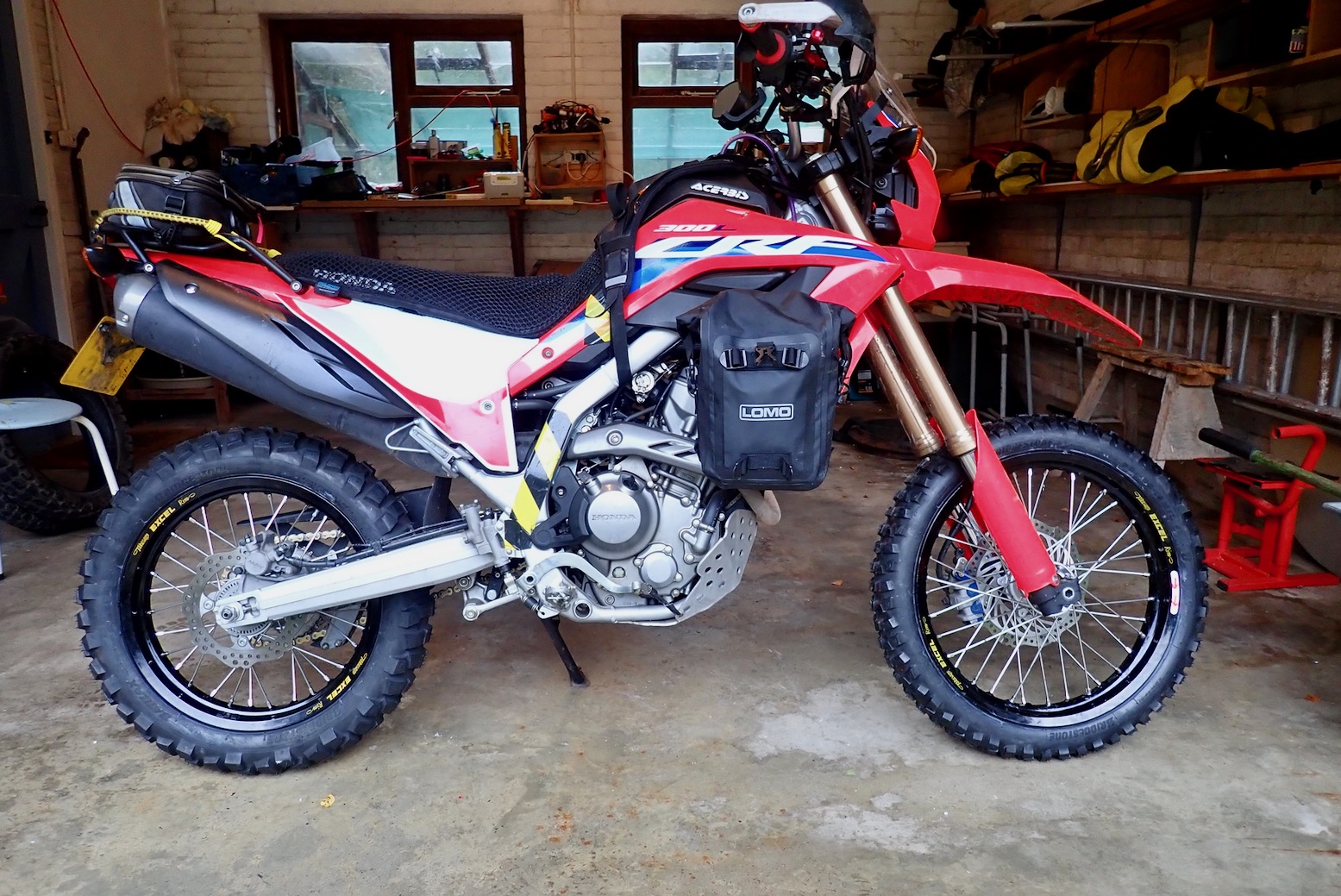
Rims are smaller but the 300L is no lower and rests the same on the side stand
It took so long to get my three new tubeless wheels made I’d forgotten quite why I did it. Oh, yes, the clear desirability of tubelessness, plus some experimentation with wheel sizes, notably a 19-er front which is 38mm less tall, 7mm wider and the same weight as the stock tubed wheel. Wheel builders seem to have long lead times, rims are not in stock, custom spokes need to be made and holiday needs to be taken. Once everything was in place and my slot came up, the actual job took a couple of days.
Waiting for that reassuring pop.
The Fly & Ride transporter was leaving for Malaga next week so I had to get cracking. Ideally I’ve have had a month or more to sort any sealing issues and get a feel for the new sizes. The 19-inch wheel arrived so I got stuck in but rushed it. I didn’t wait a day for the glue to cure, then fatally used slippery 303 UV Protectant to help mount the very stiff AX41. Works great on tubed wheels but I suspected it was a bad idea for MYO tubeless. Once mounted, when I spotted 303 bubbling out of a spoke thread I knew the game was up.
What a mess. Return to Go.
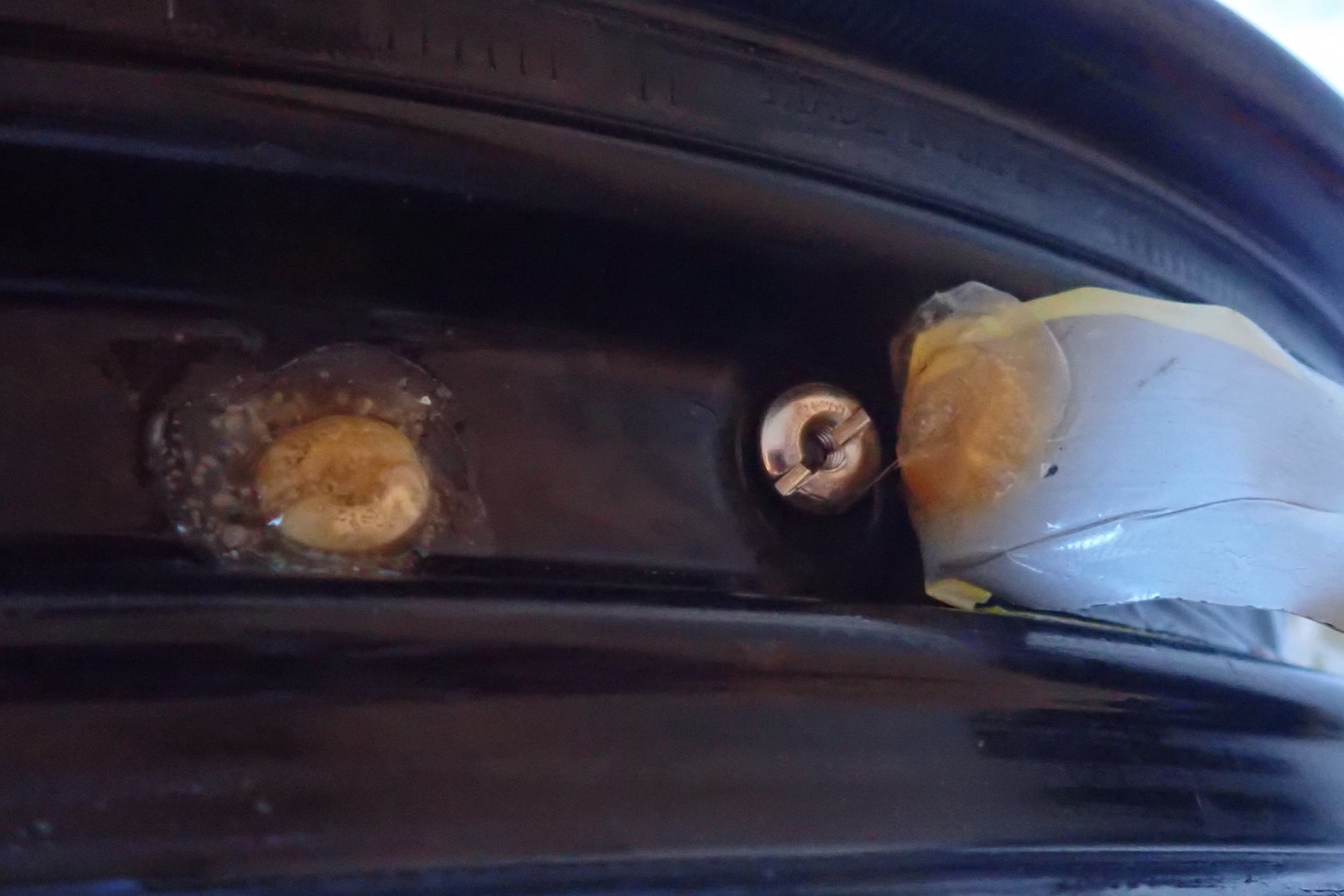
With the tyre off, my glue blobs had gone soft (left, from 303 contact?) and peeled off like soggy plasters. To be fair, one problem with this used 19-inch rim was that the pre-existent spoke holes (from a KTM?) had to be reamed and re-angled to fit the Honda hub. It made for bigger gaps so I tried to seal the outside of the nipples with Stormsure where water might run in, but should have done a better job all round. This is the gamble of marrying pre-drilled rims with non-matching hubs. Angle-wise, there can’t be that much in it, but in this case it was enough to misalign the pull of the spokes. Some wheel builders like CWC keep drilling patterns or templates to precisely drill a rim to match a given hub. This used Excel rim saved me £150 which I easily paid back with re-drilling and custom spokes. Oh well, the perils of experimentation.
Next day I needed to get my ducks in a row. Typically for me, I wasn’t repeating the proven system from the Africa Twin, but trying a new idea suggested by a mate. I spent a couple of hours in Poole sourcing components and by the time I got back, the other two wheels had arrived. After cleaning the 303 off yesterday’s mess, I started over.
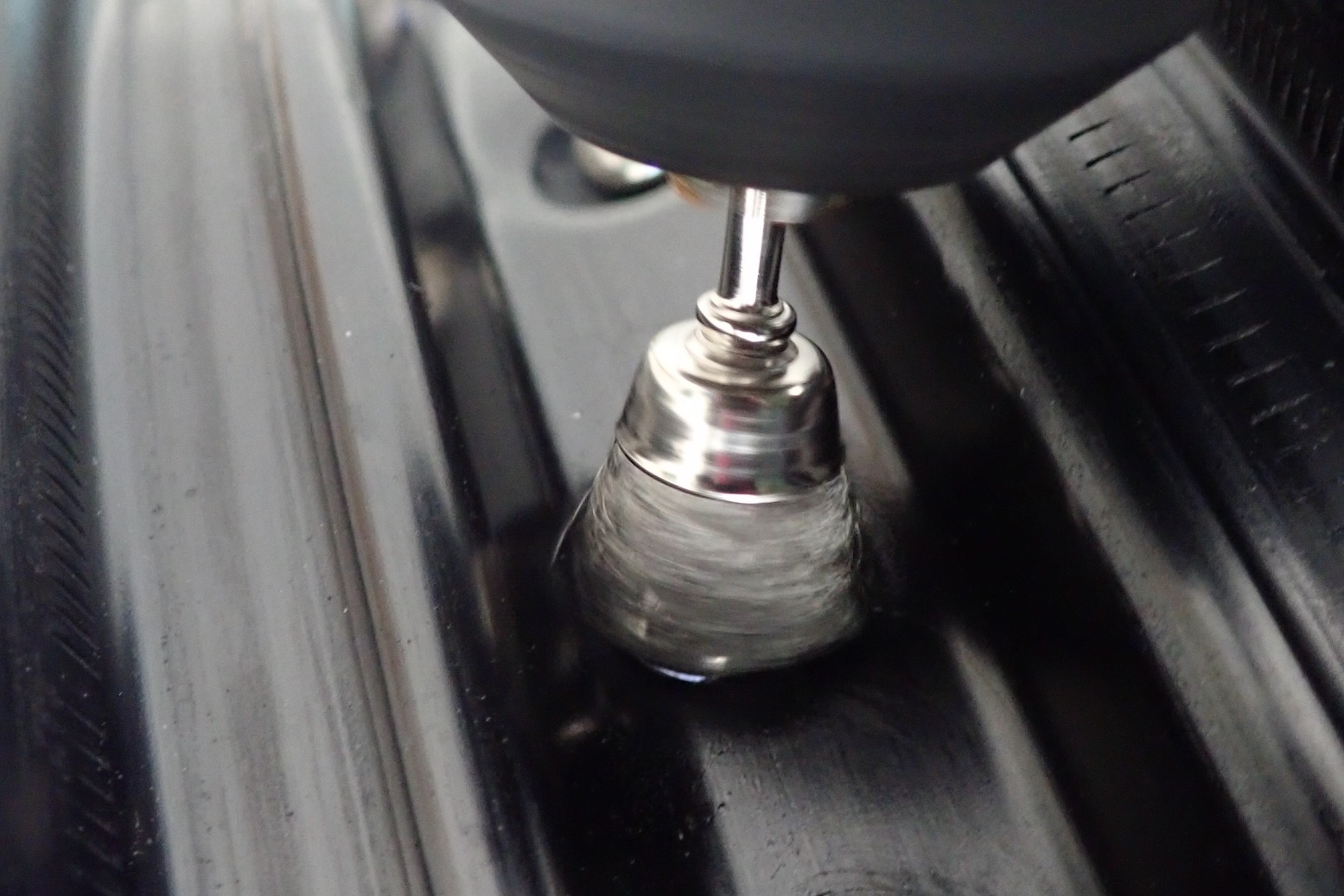
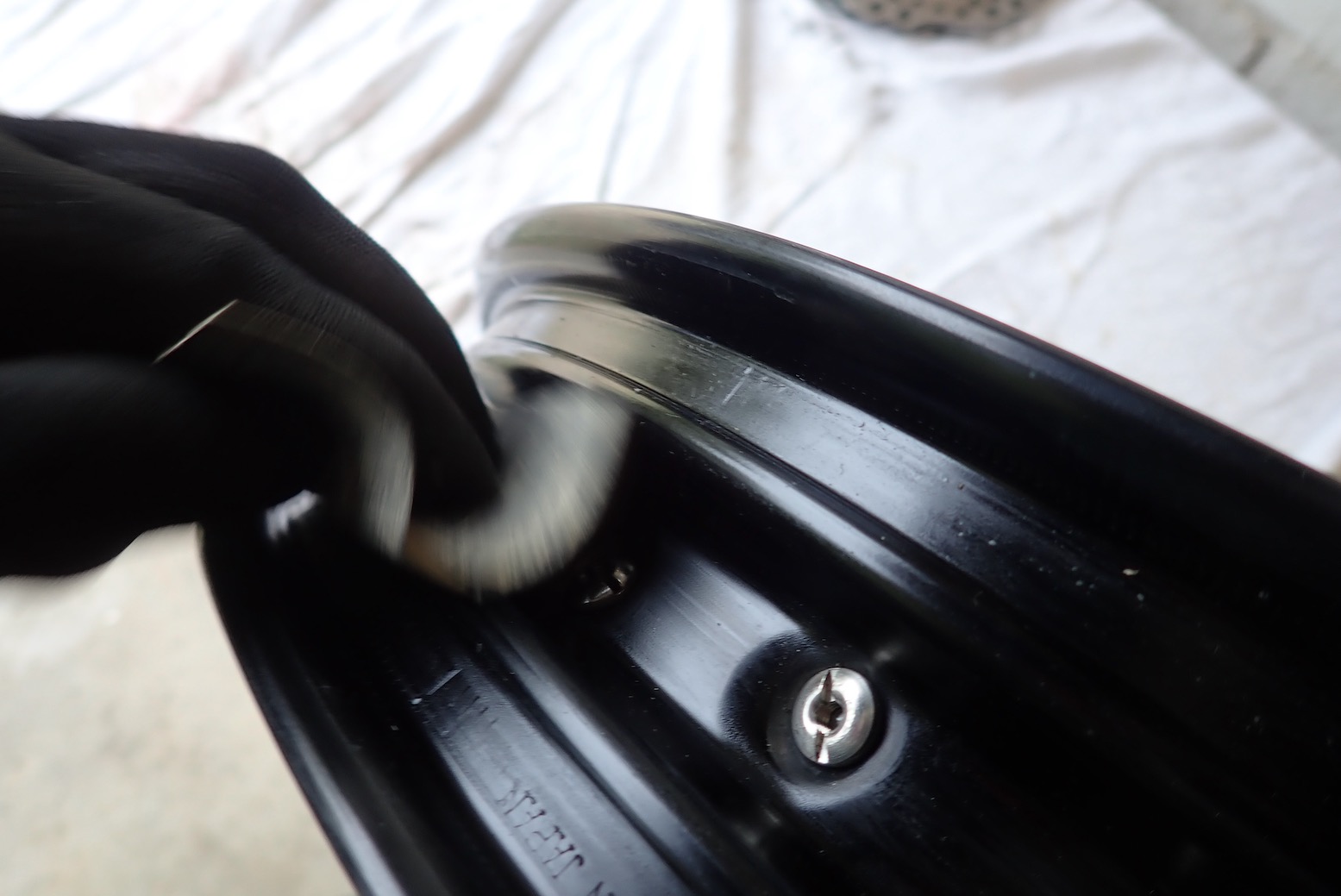
Wire brush each spoke nipple. Didn’t really do much as rims were in good shape but worth a go. Mini drill brushes on ebay.Rinse& DryRough up the rim’s black painted well with sandpaper then wipe it down with gas-o-lene.Mask off the bead and lip with tape (did this a bit late).Drip runny Superglue around the edges and into the thread hole of each nipple. Should pre-penetrate the cavities.
Spray the rims’ well with etching primer. Halfords were out so I paid £21 down the road. All for 60 secs of spraying ;-/ I presume the idea is the sealant sticks better to the primer than the glossy black rim.
Once dry, apply a blob of Puraflex 40 to each nipple. That’s 104 blobs for 3 wheels but still < half an £8 tube, fyi. Individual blobs as opposed to a continuous band like here are better for isolating leaks, as will soon be shown. But a continuous band ought to mean a guaranteed and complete seal. Decisions, decisions.Let the Puraflex cure overnight, light a few candles and hope for the best.
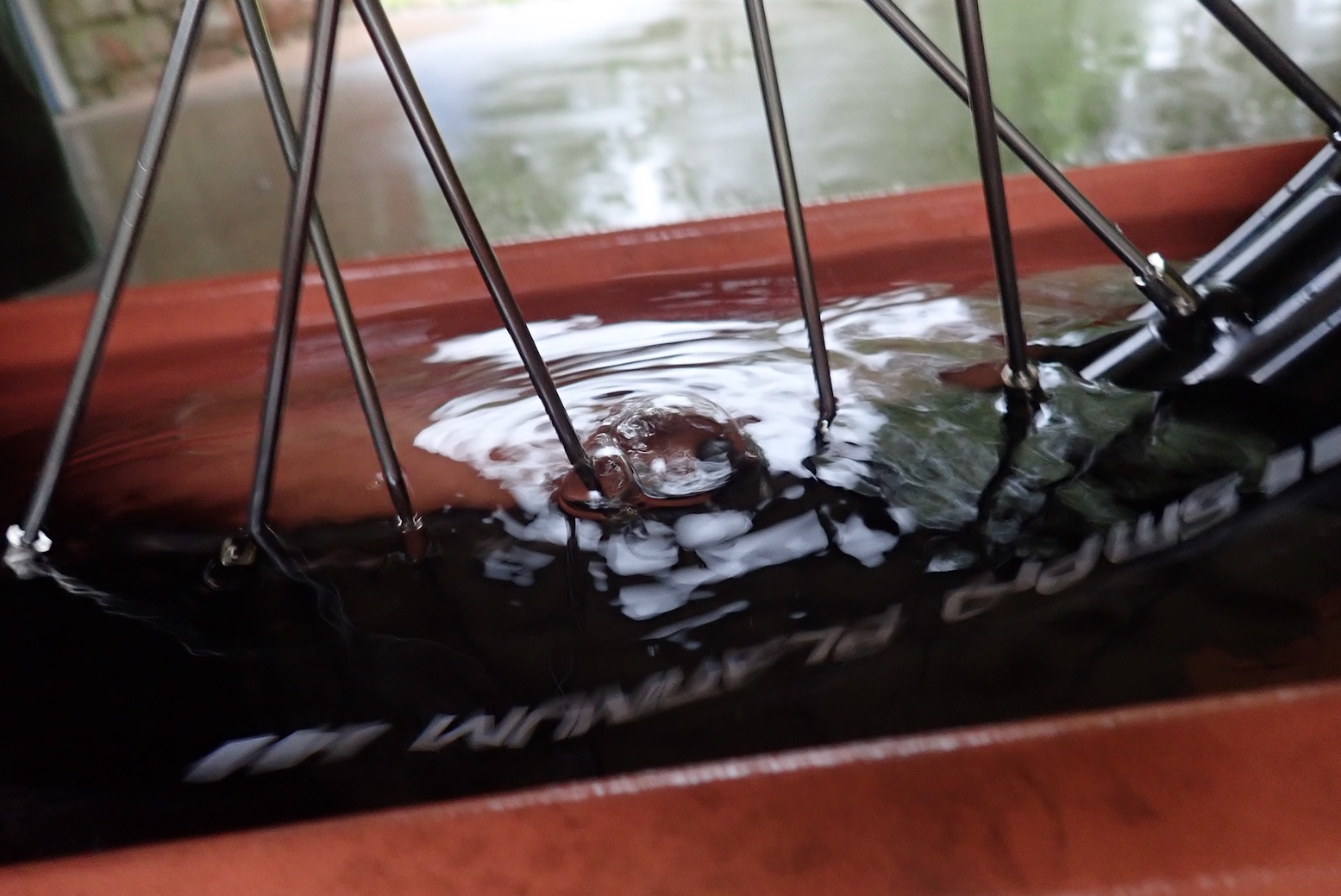
Next day I felt fairly confident I’d sealed all three wheels but had some heavy tyre wrangling to do. Sod it I thought, why not support the local economy and let my LBS mount the tyres. They’ll have a tyre machine and a compressor with enough poke to shove the tubeless tyres onto the bead before they know what’s happening. With 30 quid well spent, the tyres came out the shop rock hard. But would they stay that way? No, the two fronts were losing air. Casting aside seal damage during mounting, what were the chances of 104 blobs and 3 valves all being perfectly sealed? Only about 98% it seems. I turned the leaking wheels slowly through a trough of water and isolated a leaking spoke on each. I marked the spokes and whipped off the tyres, much easier now they’d been pre-flexed at the shop.
Bubbles of unhappiness
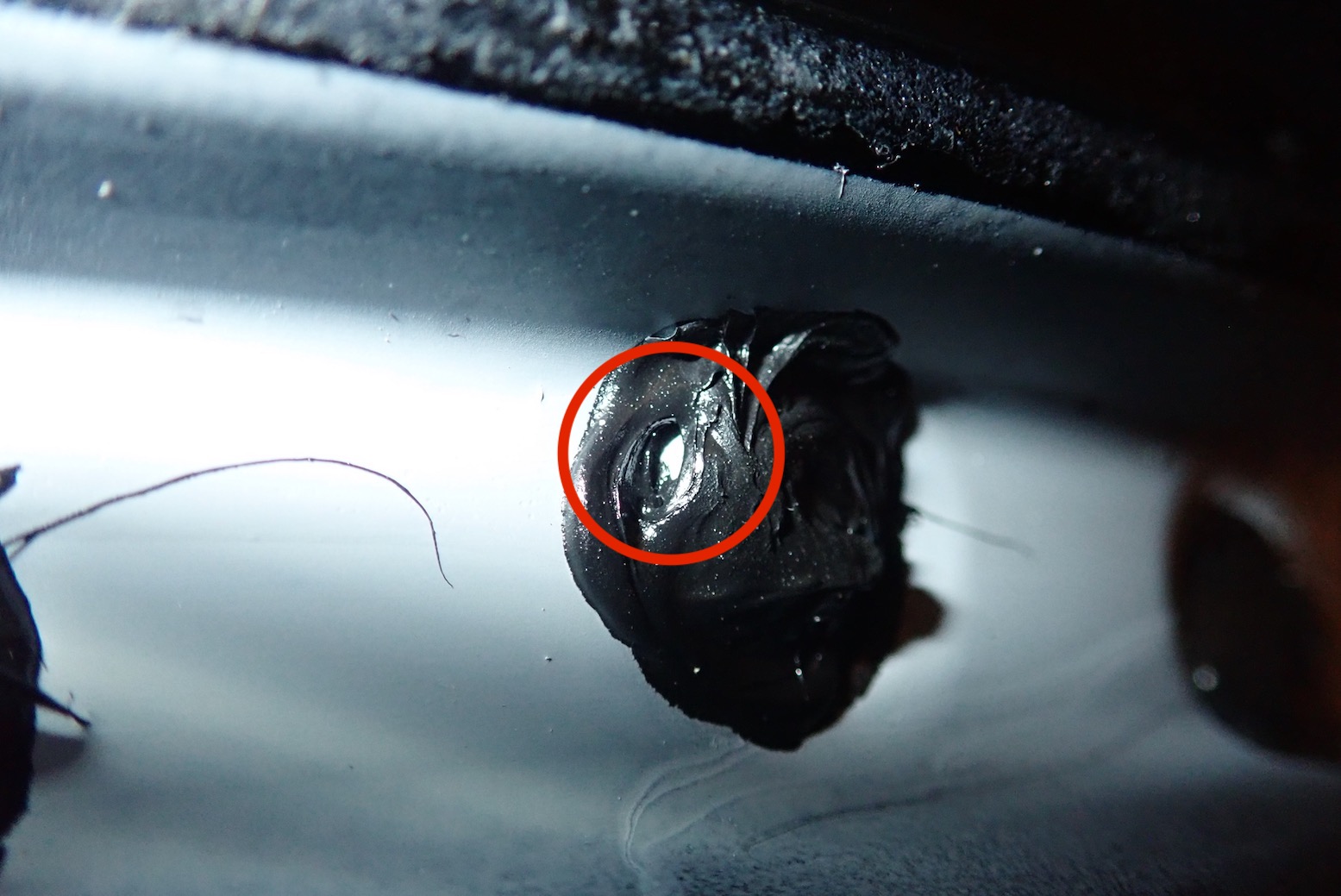
Seal gap
On the 19er I spotted a millimeter wide hole in the Puraflex (left) which the dab of Superglue underneath had also not sealed. I’ve not used Puraflex before – it’s not like a bathroom sealant and is PU, not silicon, based. Not sure what that means – the stuff was good and hard but had shrunk a bit as it dried. Perhaps the hole had opened up on curing, or perhaps I should have inspected each blob with a magnifying glass or given them all a pre-emptive second swipe of Puraflex once dried – that would take another day to dry. On the 21 incher I couldn’t see the hole under the corresponding spoke’s blob which underlines the idea of a second coat or even a continuous band. So I second-coated all the blobs and left it for another night. Weeks later the 21 (left at home) had lost just a couple of pounds so I’ll take that as a win.
N-n-n-nineteenDorset pines
All bolted on and first thing I noticed was the bike leant the same on the side stand, so clearly was no lower. Not that bothered as it’s one less thing to meddle with and the narrow saddle means my feet touch down OK. I guess the AX41s have high sidewalls; good for off-road and rim protection. I went for a lovely evening ride. On the road the fresh tyres didn’t exhibit any anomalies, nor did the handling feel much different. I think it might take a more spirited ride through some bends to highlight any improvements in the steering. In Morocco I know just the spot, several in fact. The 19 is only 7mm wider than the 21, while the back 17-incher is the same as the stock IRC.
CRF300L 2023
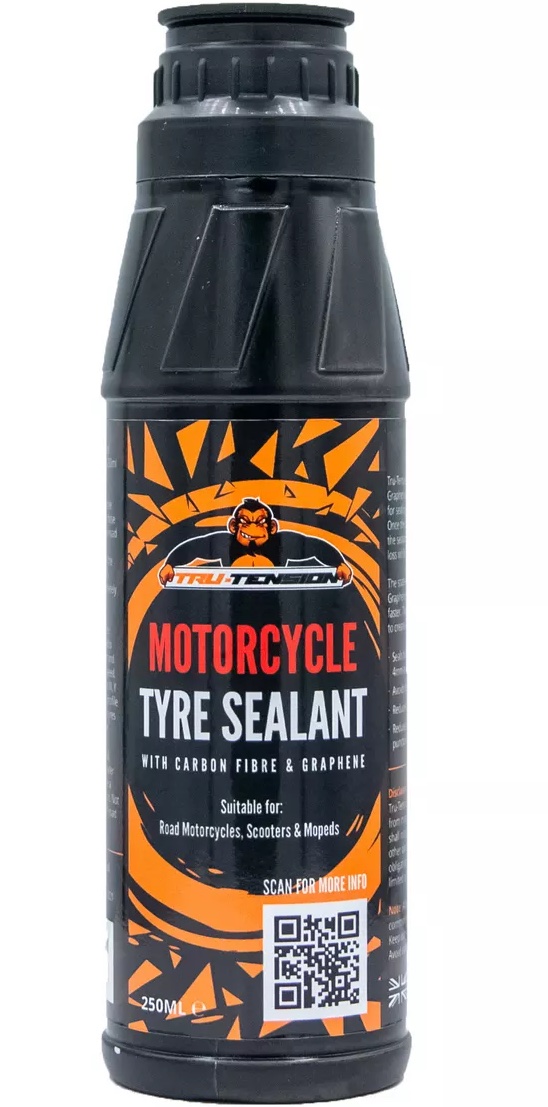
In Halfords I’d bought some Slime for later, but also carefully applied a shot of similar Tru-Tension tyre sealant (left) in the front wheel, squeezing it up into the valve set at 12 o’clock so it would dribble down along the rim’s well. This stuff contains ‘carbon fibre and graphene’ which are such cutting edge compounds I fell for it. Slime or similar have helped permanently seal other imperfect MYO TL jobbies, even though it shouldn’t be necessary if the job has been done well. I rode back to London and then on to Fly & Ride near Gatwick. Whatever fuel I picked up in Poole, the CRF (now with 2200 miles on the clock) belted along like it was on methanol, holding an indicated 70 much of the time. But both tyres were still losing a bit of overnight air so I may have to spend a day in Morocco sorting it all out. I’ve packed Puraflex, some more Slime and a pair of tubes and levers.
Robbo, a fellow MYO TL experimenter does wonder whether Slime etc can soften rim sealants. These goops work under pressure but also centrifugally, getting flung out onto the inside of the tyre where punctures occur, but away from the hand-sealed rim well where, in my case, it’s as needed. Much as Sixties psychedelic guru Tim Leary proposed that enlightenment and self-awareness must eventually be sought without the aid of drugs, so MYO TL should endeavour to seal without Slime. Tune in. Glue Up. Ride out.
Best Rest Cycle PumpRechargeable lithium batt pump. £20
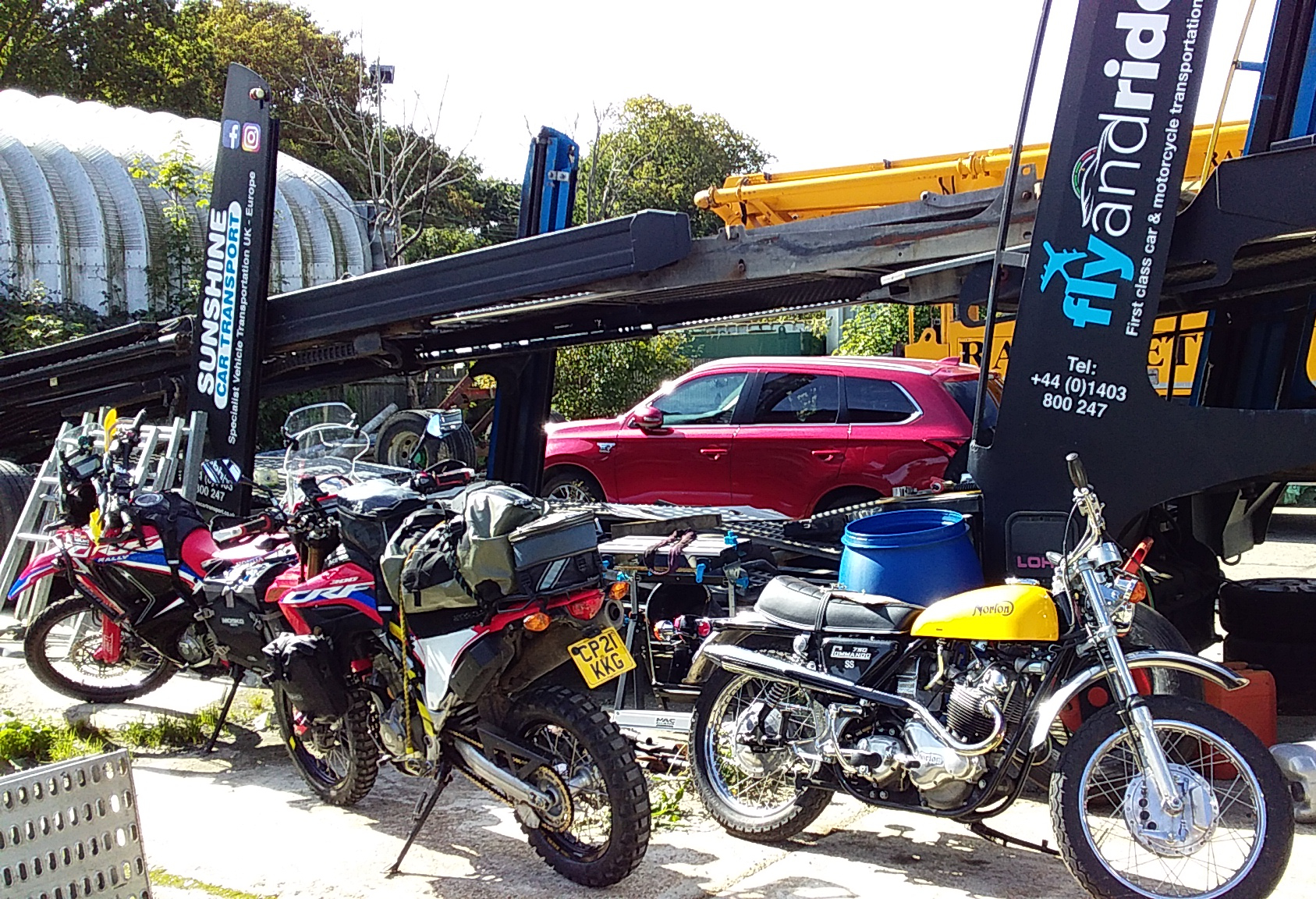
Robbo showed me a niffy USB rechargeable 4000MAH tyre pump (above right) which topped my overnight tyres up quickly. I have my aged 12-volt Cycle Pump packed on the bike, but if I’ll be topping up regularly until they’re fixed, the 20-quid hand pump off ebay will be easy to whip out and use each morning. Let’s make rumpy pumpies while the lithium lasts. I left my 300 in Fly & Ride’s yard alongside a cool ’72 750SS Commando. The period image on the left exists solely to highlight Norton’s questionable use of an apostrophe. It turned out the nicely set up 300 Rally also parked up belonged to another Robbo who was on my tour a year ago and by now is halfway to Dakar, or however far suits him.
So, a bit annoying to be flying out to Malaga next week to imperfect wheels, but what trip ever kicks off without some T’s uncrossed and I’s undotted? At least I have the means to fix it.
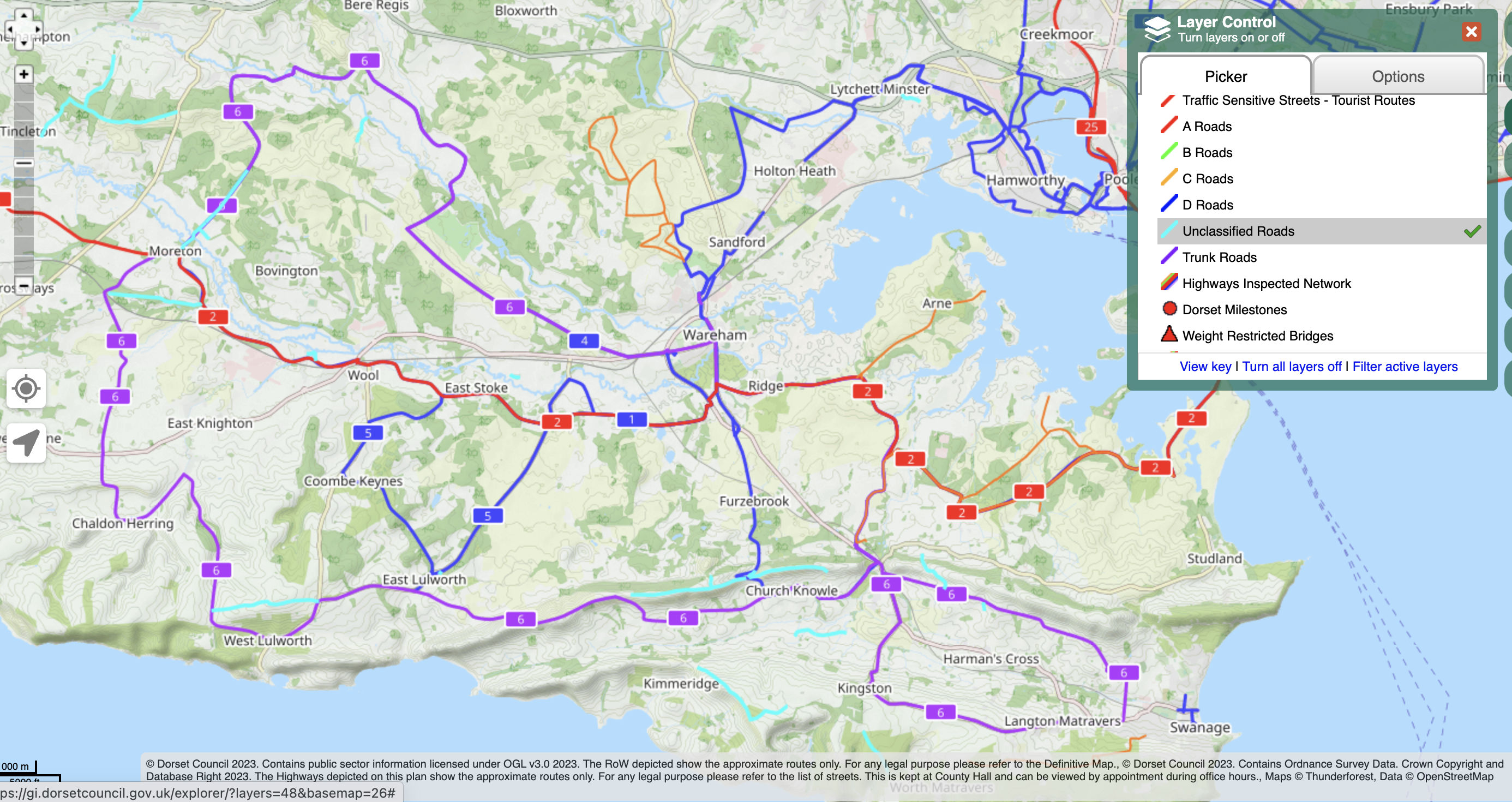
Isle of Purbeck according to Dorset CC’s Definitive Map. Free for all online, same as most county councils.
TRF GRM: 6000 miles of green roads
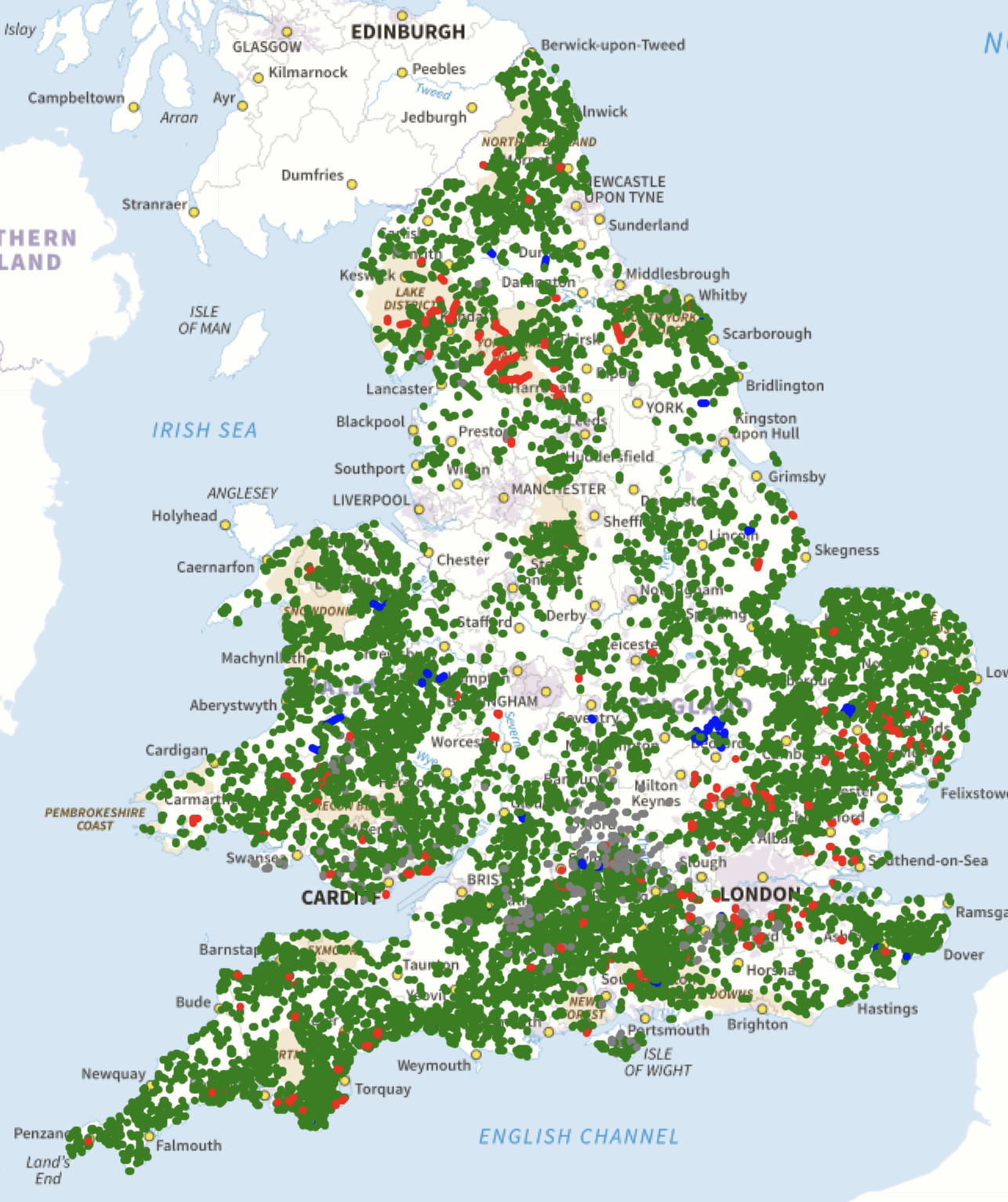
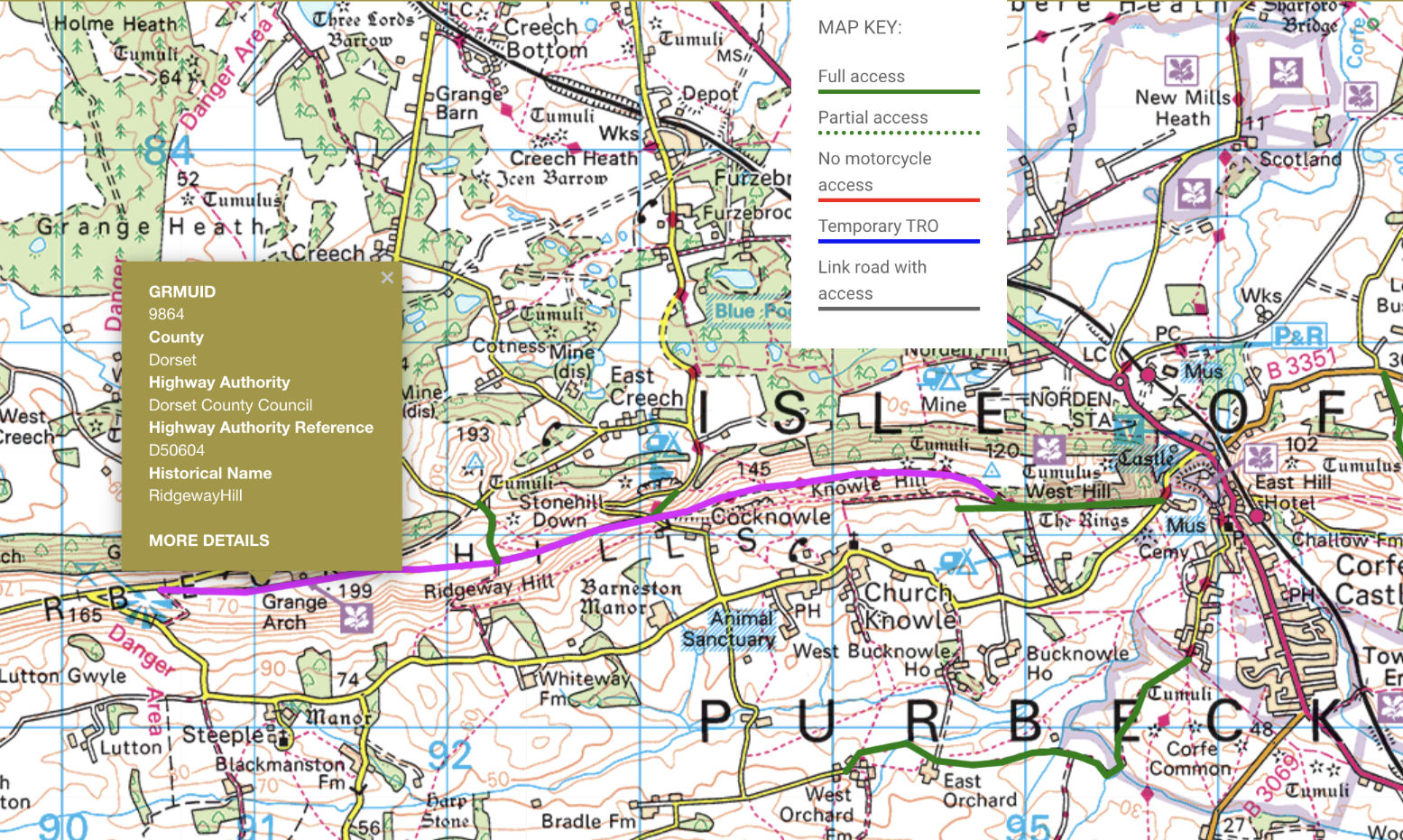
After my enjoyable runs along the TET’s Great West Trail in Dorset I cracked and joined the TRF to verify what else there might be in the area, particularly around the Isle of Purbeck. The TRF’s websites look smart, so does their quarterly Trail magazine now edited by Jon Bentham, formerly of Rust Sports, plus there’s a regular column by TRF ambassador, his excellency Austin Vince. They say membership has doubled in recent years to 8000 – now 8001. You wonder why; it’s not like trail biking in England and Wales has become popular all of a sudden, has it? Of course what I’m really signing up for is not so much the Brotherhood of the Byway, but access to their Green Roads Map (above left), covering England and Wales. It’s similar to a local council’s Definitive Map (top of the page; explained previously) but maintained and updated by regional TRFers.
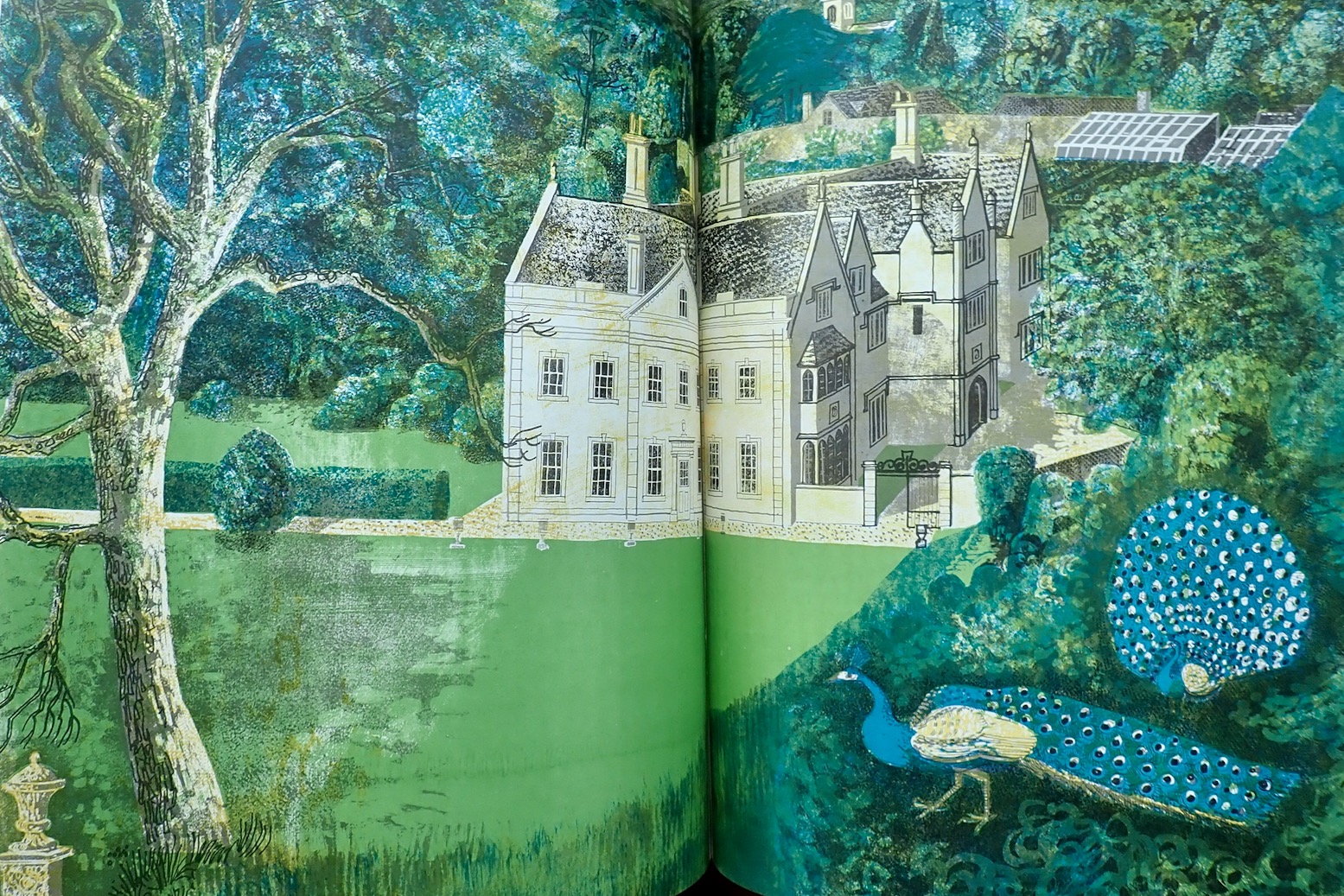
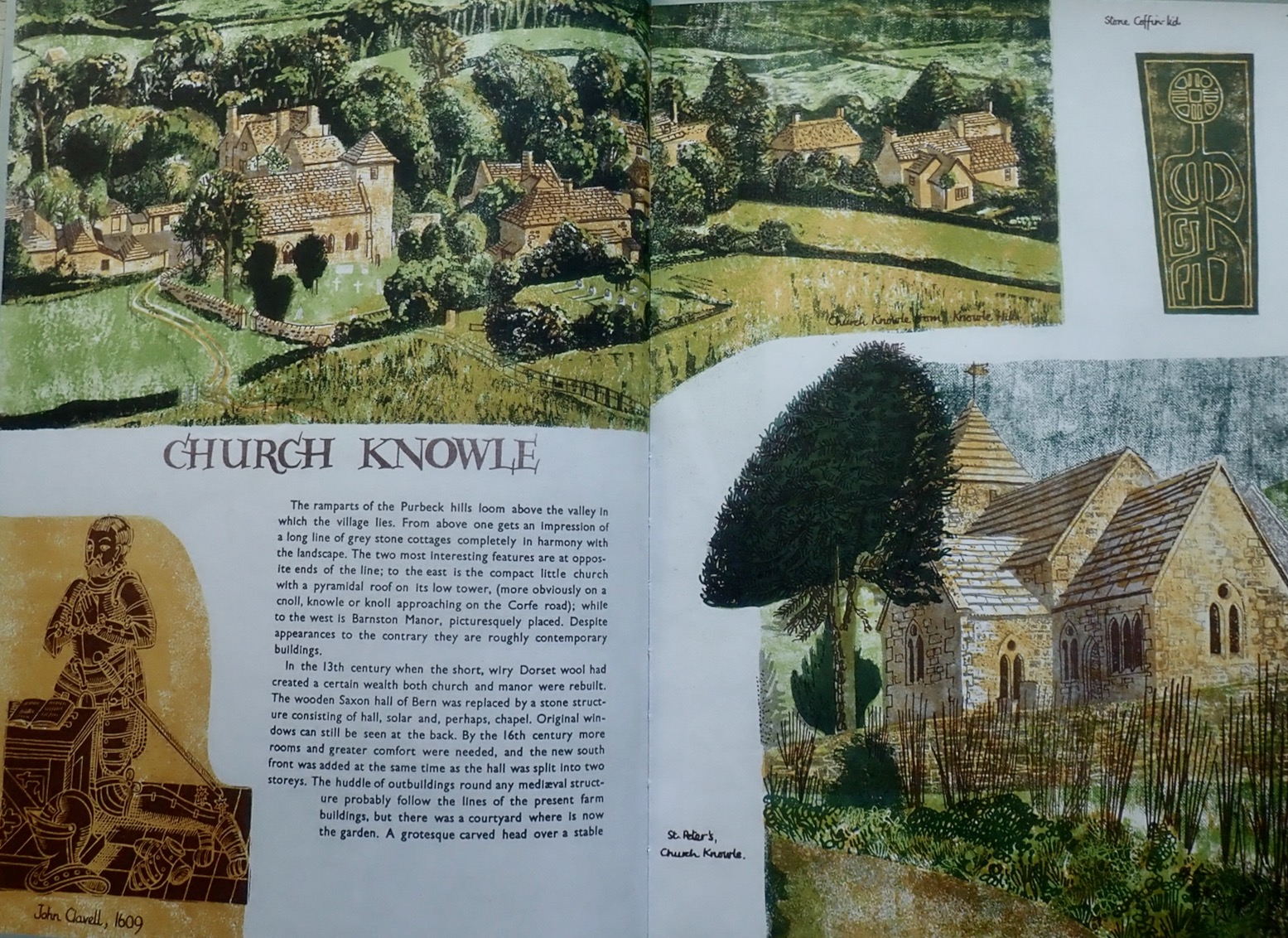
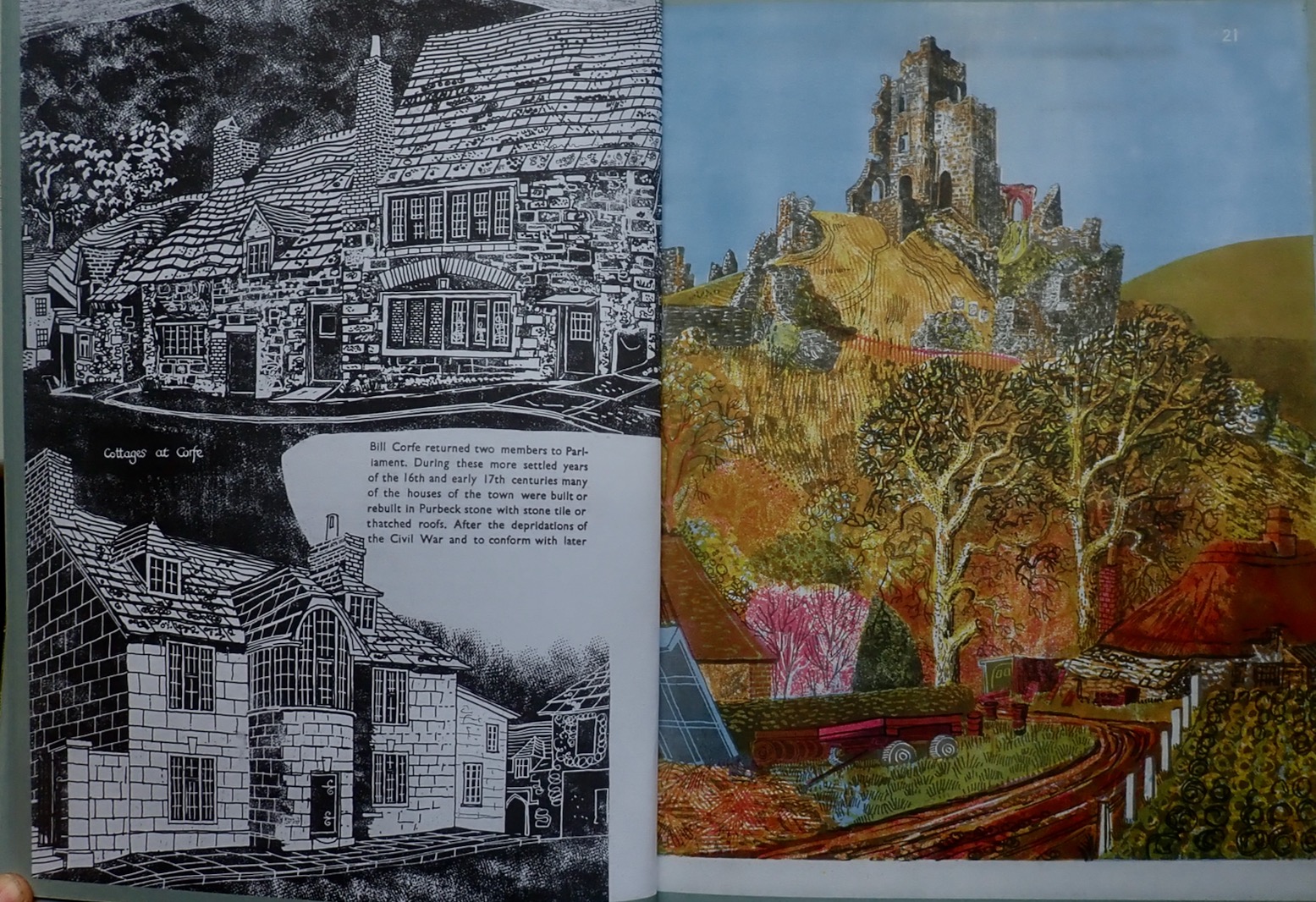
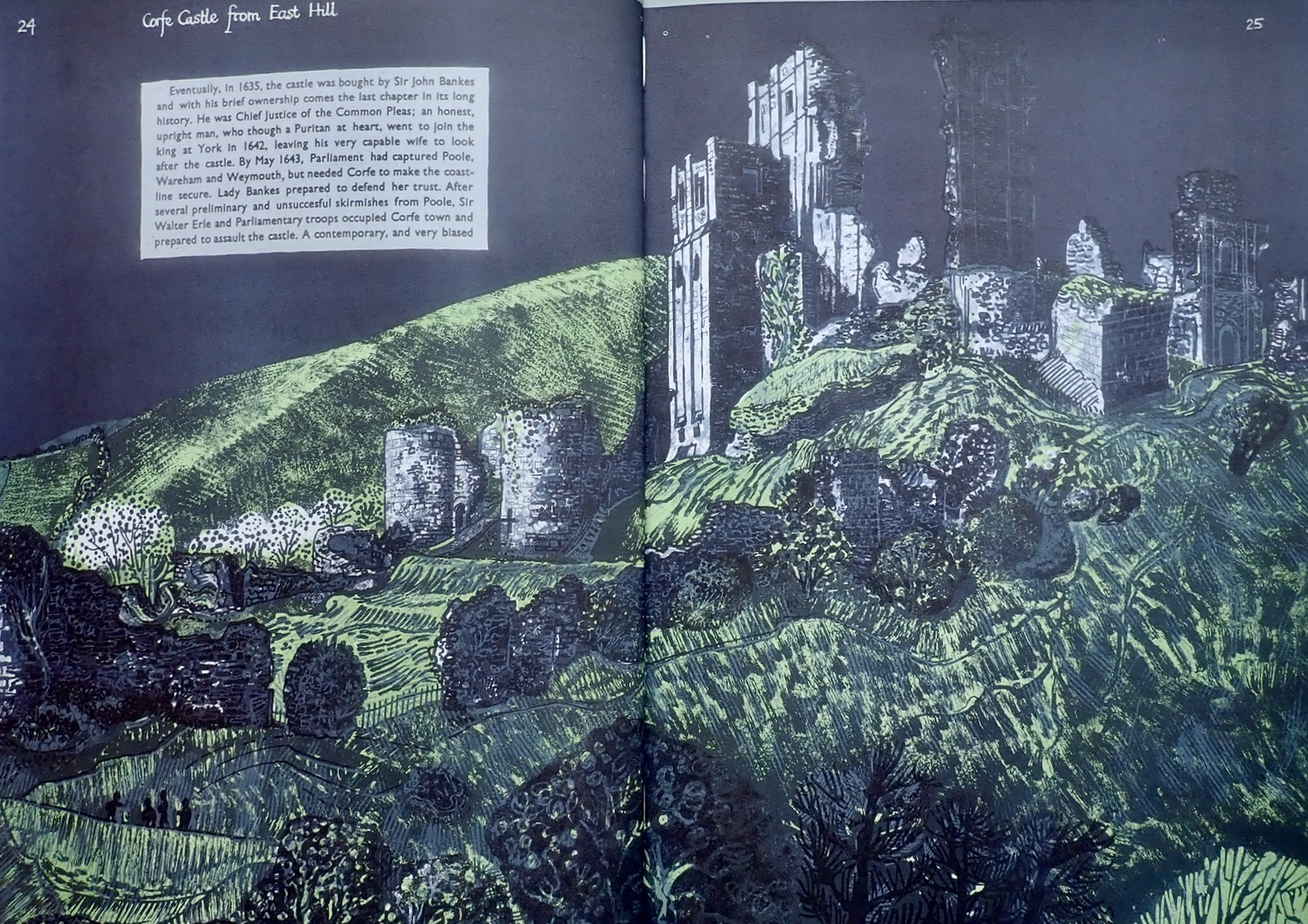
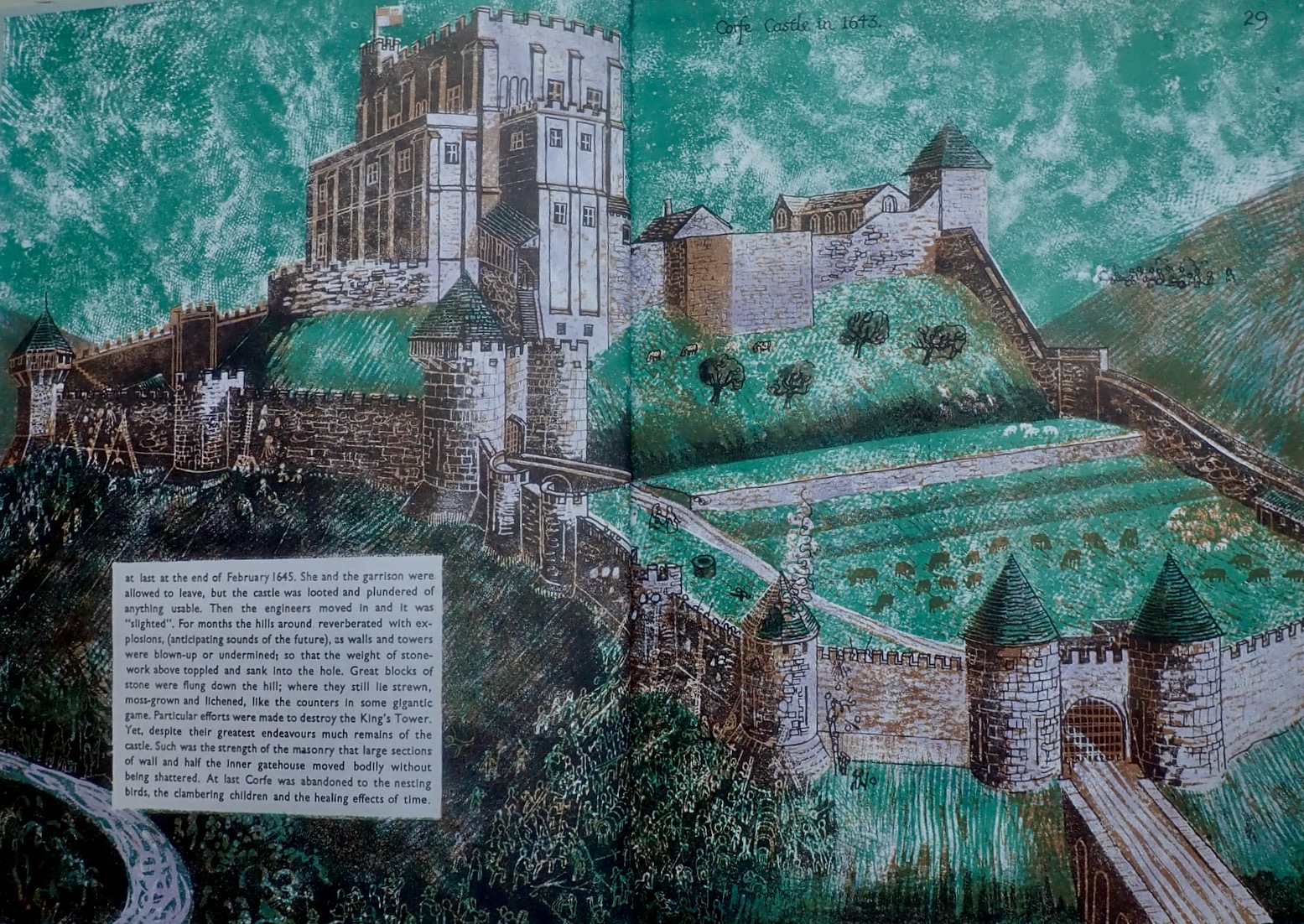
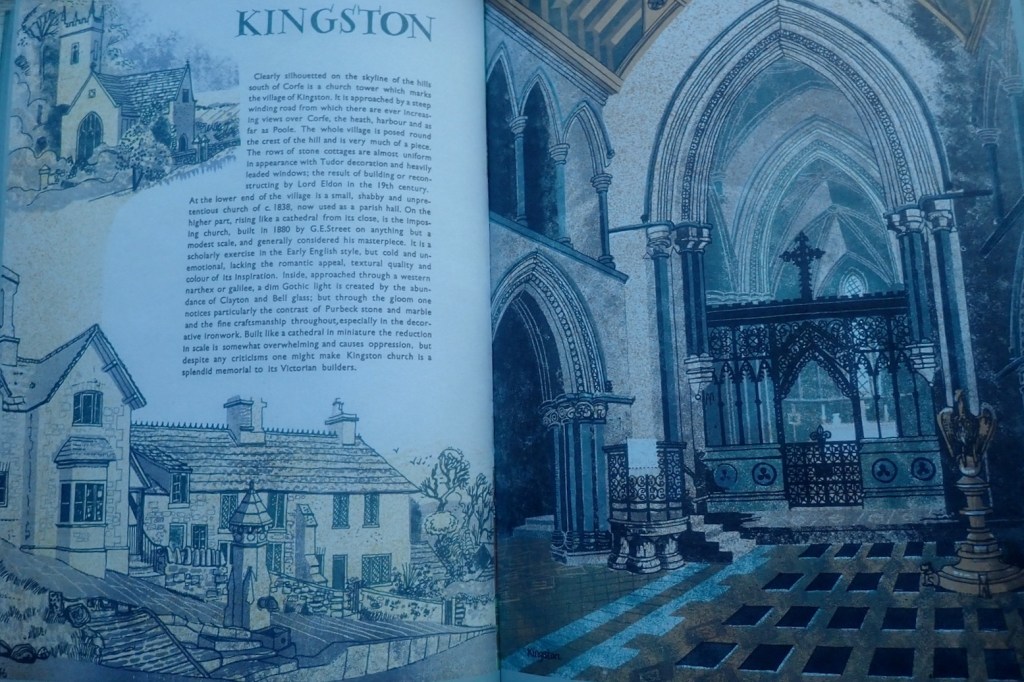
My Purbeck recce was largely inspired by finding a richly illustrated 1960s guidebook called Dorset, the Isle of Purbeck (above) by Rena Gardiner. One might call her artistic style expressionist (like Van Gogh), and in her prime she was a one-woman printing press and former Lambrettista. On my rides through Purbeck I’d pass many of the places she illustrated.
One thing with Purbeck as opposed to inland Dorset which the GWT traverses, is that it’s a lot more touristy. The road from Wareham via Corfe Castle to Swanage Bay is often clogged, probably like much coastal access in the West Country at this time of year. That means ramblers and dog walkers are afoot, not all of them conversant with the legal status of Byways, ORPAs, collectively: Unclassified Country Roads (UCR). It still felt unnerving setting off to trail ride in sleepy, bethatched Dorset as opposed to the peaty wastes of mid-Wales.
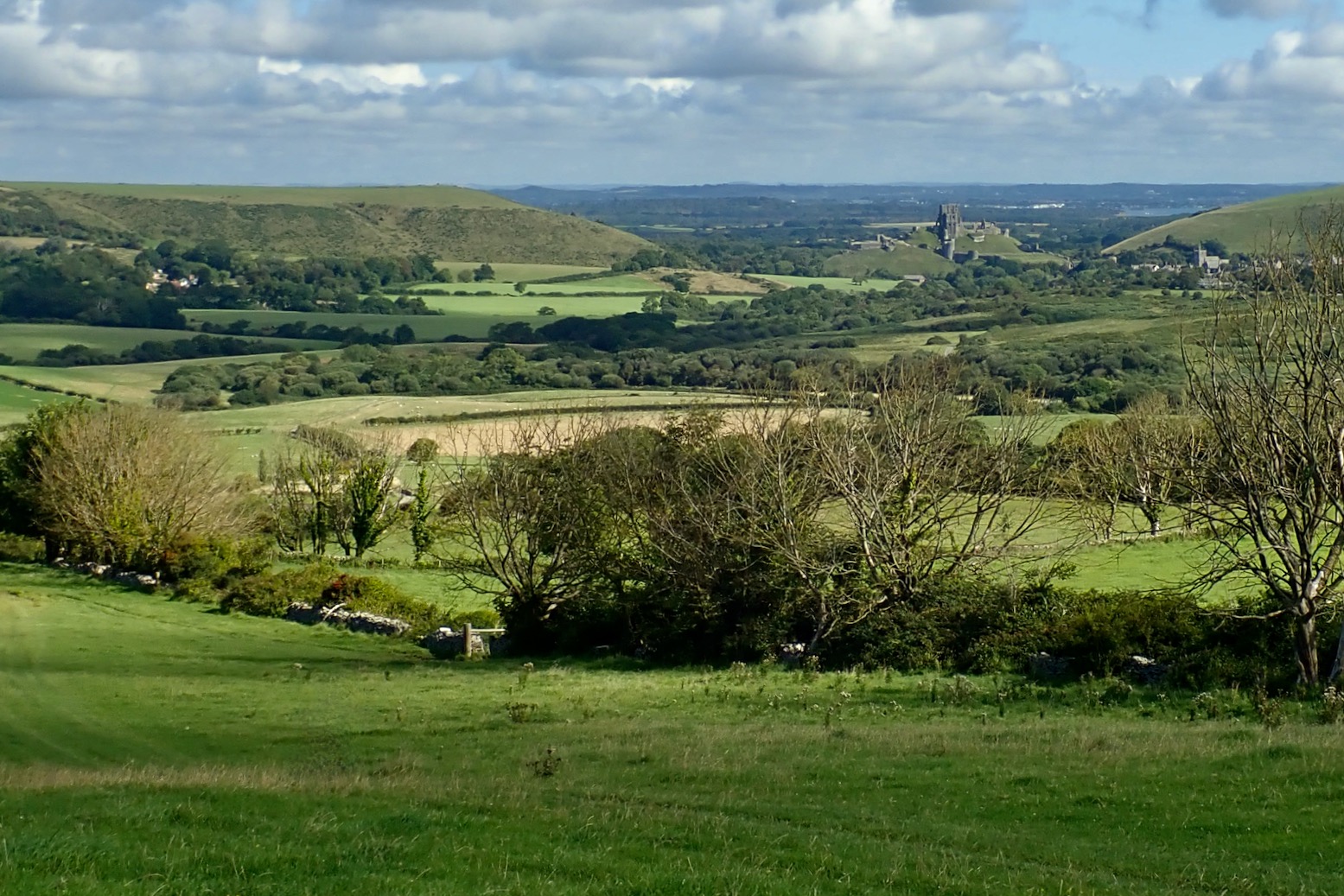
The rolling Purbeck hills below Kingston with Corfe castle straddling the gap.
After the hottest June since the Devonian Schism, followed by the wettest July since the Paleogene Upheaval, the Purbeck Hills were greener than a car-sick toddler. I left it a few days for the jet stream to shimmy off somewhere else, but it’s now August and upcountry campervanners are parading around with their dogs. So I decided to recce some bits by stealth on the MTB. It was a good idea.
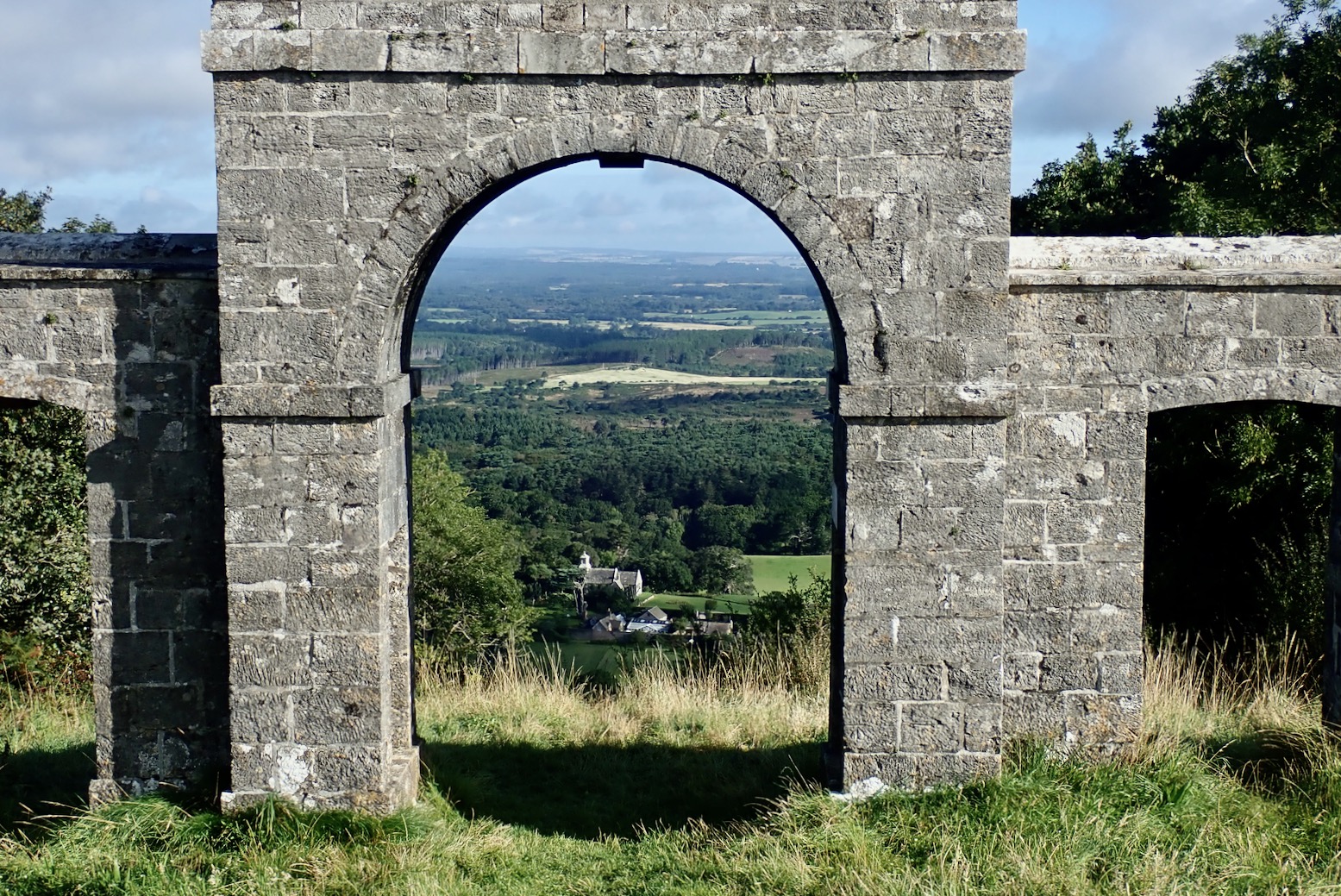
Grange Arch – said to be the inspiration of Ian Fleming;s ‘arch villains’.
Right on the eastern edge of the Lulworth Firing Range army land, Ridgeway Hill leads east from Grange Hill viewpoint to Corfe Castle (left). At a deliriously long 4.4km it’s probably a county record. After a shirt while it passes the 18th-century folly of Grange Arch (above), looking down on Creech Grange, as drawn by Rena G, below.
‘The name is Purbeck, James Purbeck.’ Nope, doesn’t work.
Creech Grange was once the family seat of the Bond family who still own a lot of land on Purbeck, and after whom Ian Fleming named his famous agent, 007. Before attending the towel-flicking precincts of Eton, fledgling Fleming endured the character-forming torments of a Purbeck boarding school.
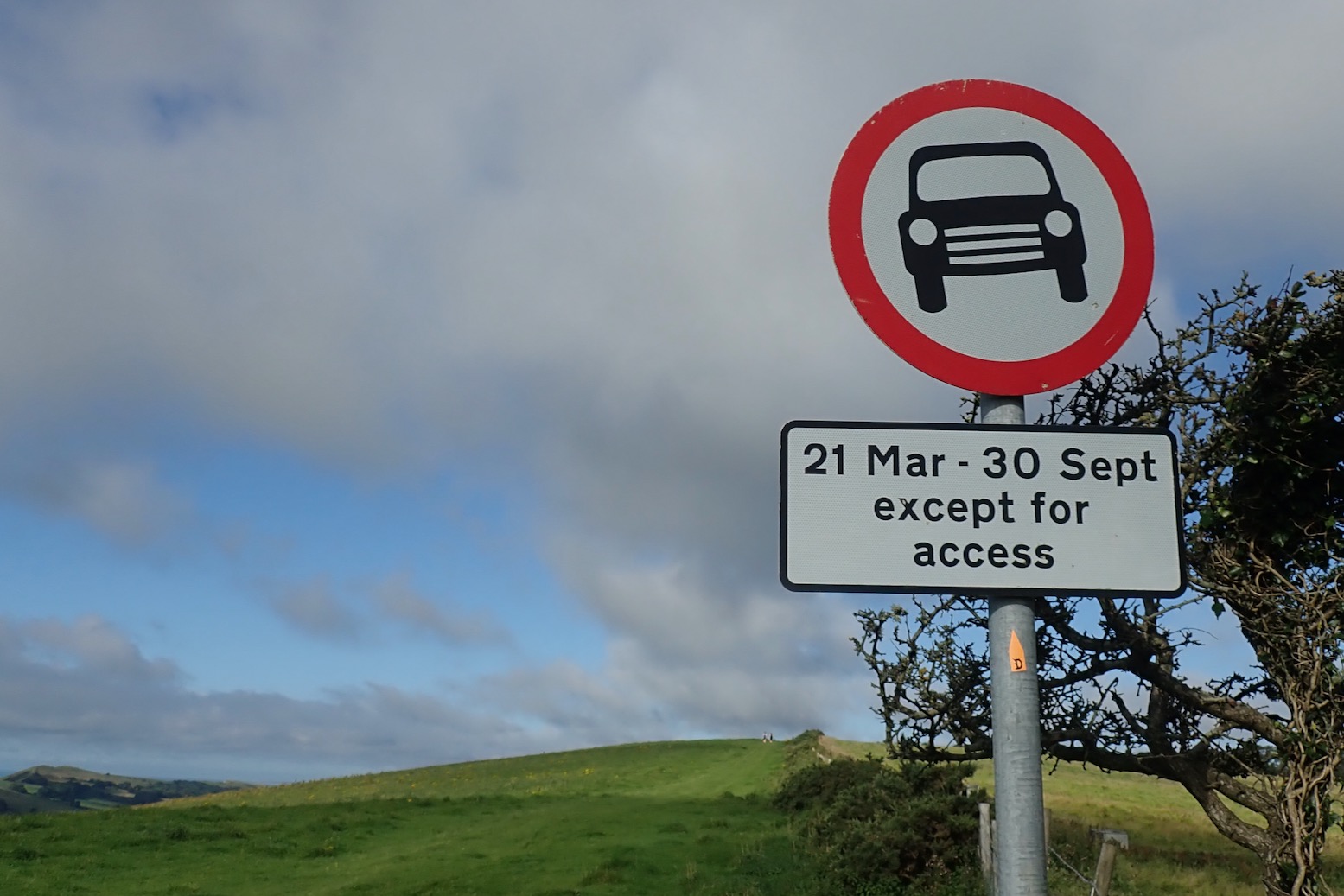
But what the TRF’s GRM or the Dorset DM don’t tell you is that the first 1.75km of this UCR, from the viewpoint past the Arch to a gate, is closed to motors from March till October. (I sent this info in to GRM updates but as before, no response.) But with the clear suggestion of (albeit seasonal) vehicle access, these two signs (left) were the only incontrovertible admissions that rideable Purbeck Trails even exist.
From the 500′ ridge there are great views south to the Jurassic Sea and north to Poole Harbour. At a gate an all-year UCR branch comes up from Stonehill Down to the north (above). It joins the Ridgeway and continues east (below) to cross a road snaking over a dip. Nice, wide open, hill top trail riding. Plenty of room for all.
Ridgeway hill east to Corfe. Let it roll.
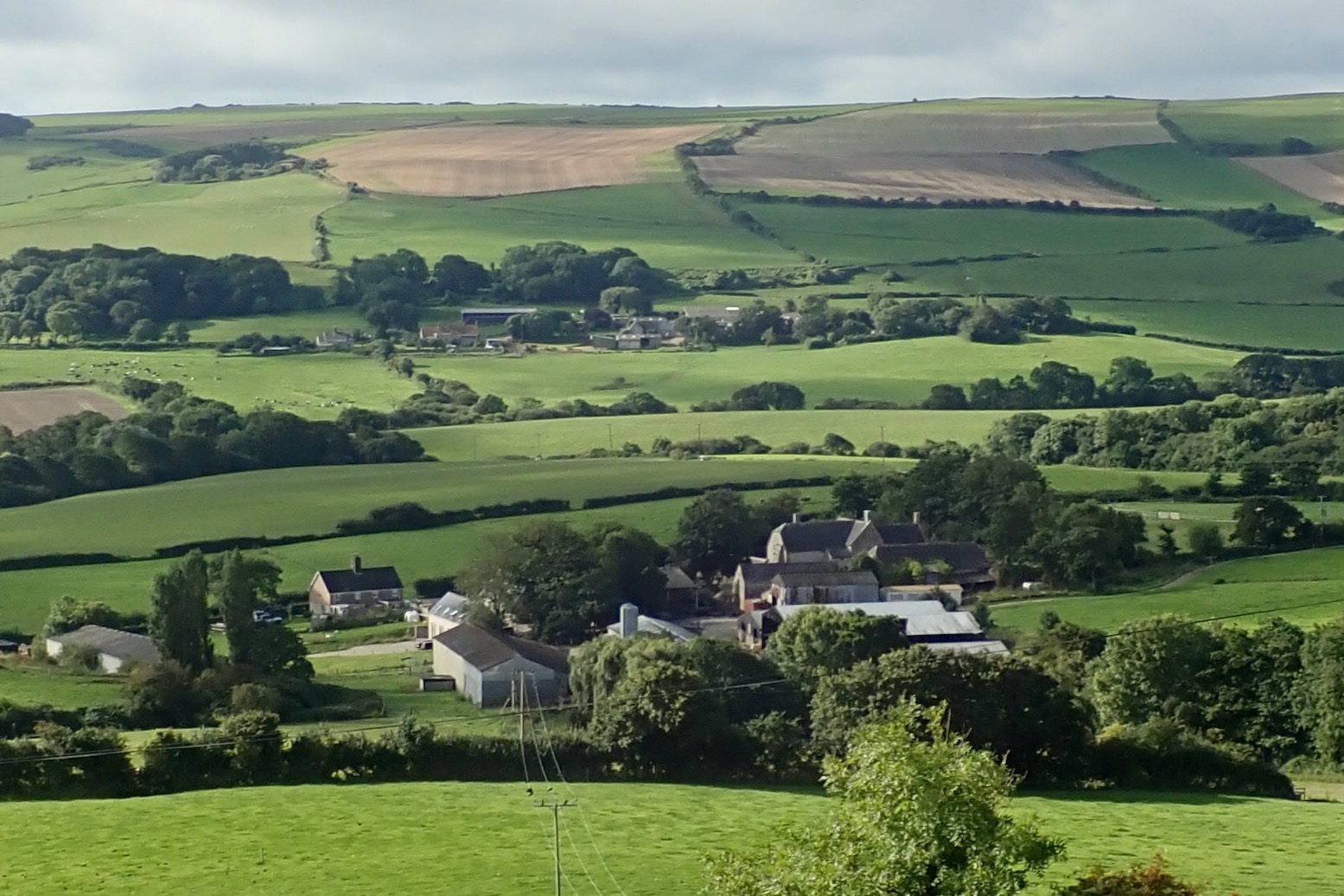
At the road I chanced on the giant hillside lizard (left) that made the news the other day. Having pedalled the following section a few days earlier (shoo-ing away a herd of cows blocking the gate), I didn’t have the heart to re-ride it on the moto, as being close to Corfe’s congested campsites, it’s relatively busy with high summer ramblers. From the top the wide open trail looks down on Church Knowle (below) and the 700-year-old Barnstone Manor which, according to the DM, is Britain’s oldest inhabited house.
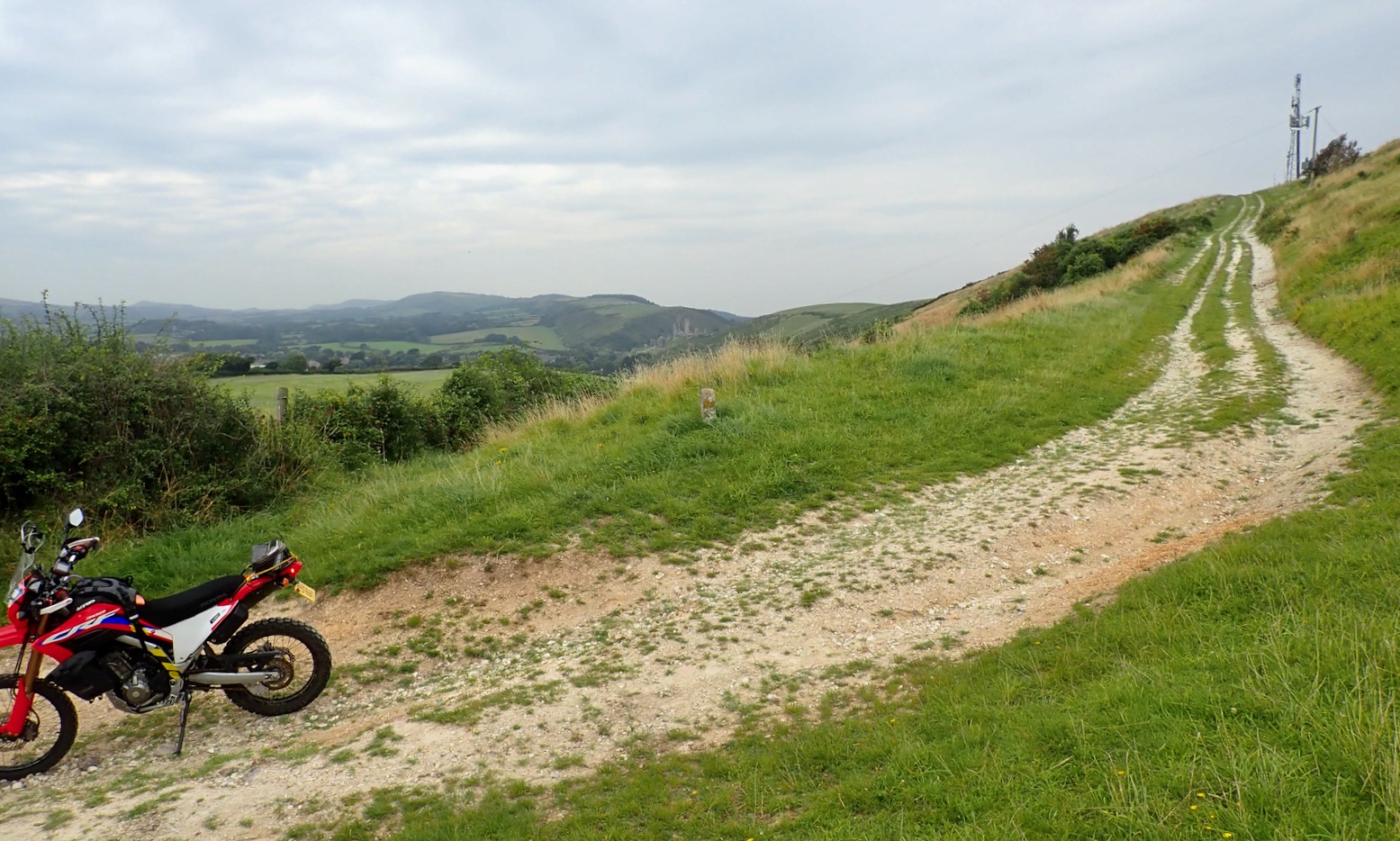
This UCR eventually drops off the spine of Knowle Hill and finds a back way into Corfe Castle, catching the castle ruins from a little seen aspect (left). Built soon after 1066 and a strategic Royalists hold-out during the English Civil War, it was besieged and finally destroyed by Cromwell’s New Model Army in 1643. From any angle the imposing castle towers over the Purbeck Stone clad village that takes its name, and in her book Rena G expended many pages on both (below). You wouldn’t know it but Purbeck has several still active quarries and many of England’s medieval cathedrals were clad in distinctive Swanage marble. Unusually, the roofs of Corfe’s houses use thick, Purbeck stone tiles.
Corfe in August is not a place to linger, unless you’ve no choice in a steaming traffic jam. On the far side of the gap which the castle once defended, the ridge rises again towards Swanage. Here Rollington Hill UCR switchbacks south over the ridge via a farm of that name. I pull up at the turning where a sign (left) glared ‘No Access to Water Park, Turn Around’ along with a No Entry sign for good measure. I hesitate. I’m pretty sure it’s a public right of way and I’m not lost so I ride up the track towards the farm yard, any minute I’m expecting an ‘Oi!!, gerrof moi….’. With relief I reach the safely of a gate where the track rises up to a hilltop mast.
Coming down Rollington Hill with the castle in the background.
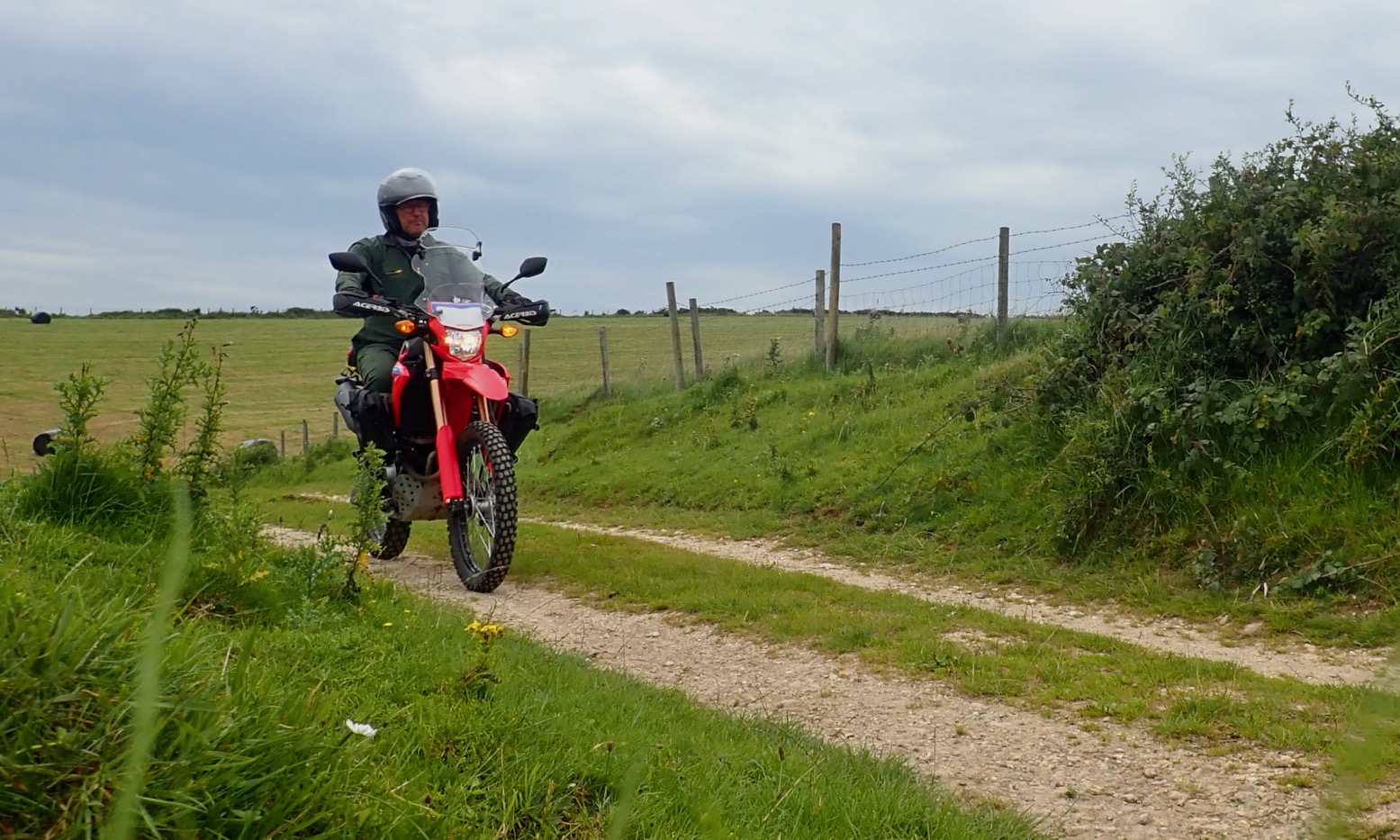
At another gate a grumpy looking rambler is tucking into her sarnies, blocking the way. I give her a cursory nod and use the walkers’ gate instead. Darlingly, this is a virgin trail I didn’t pre-ride on the MTB, but today am emboldened by a novel ruse: I’m dressed in my cheapo overalls which I like to think make me look like a farm worker looking for lost lambs, or a contractor for English Heritage seeking new Areas of Outstanding Natural Beauty. And it worked too. A few days later I was connecting another trail near Tolpuddle when I came across some young Hiluxers doing a suspension twisting turn in a bomb hole. Though they had just as much right to be here as me, they initially mistook me for some sort of warden.
Trail Warden coming through!
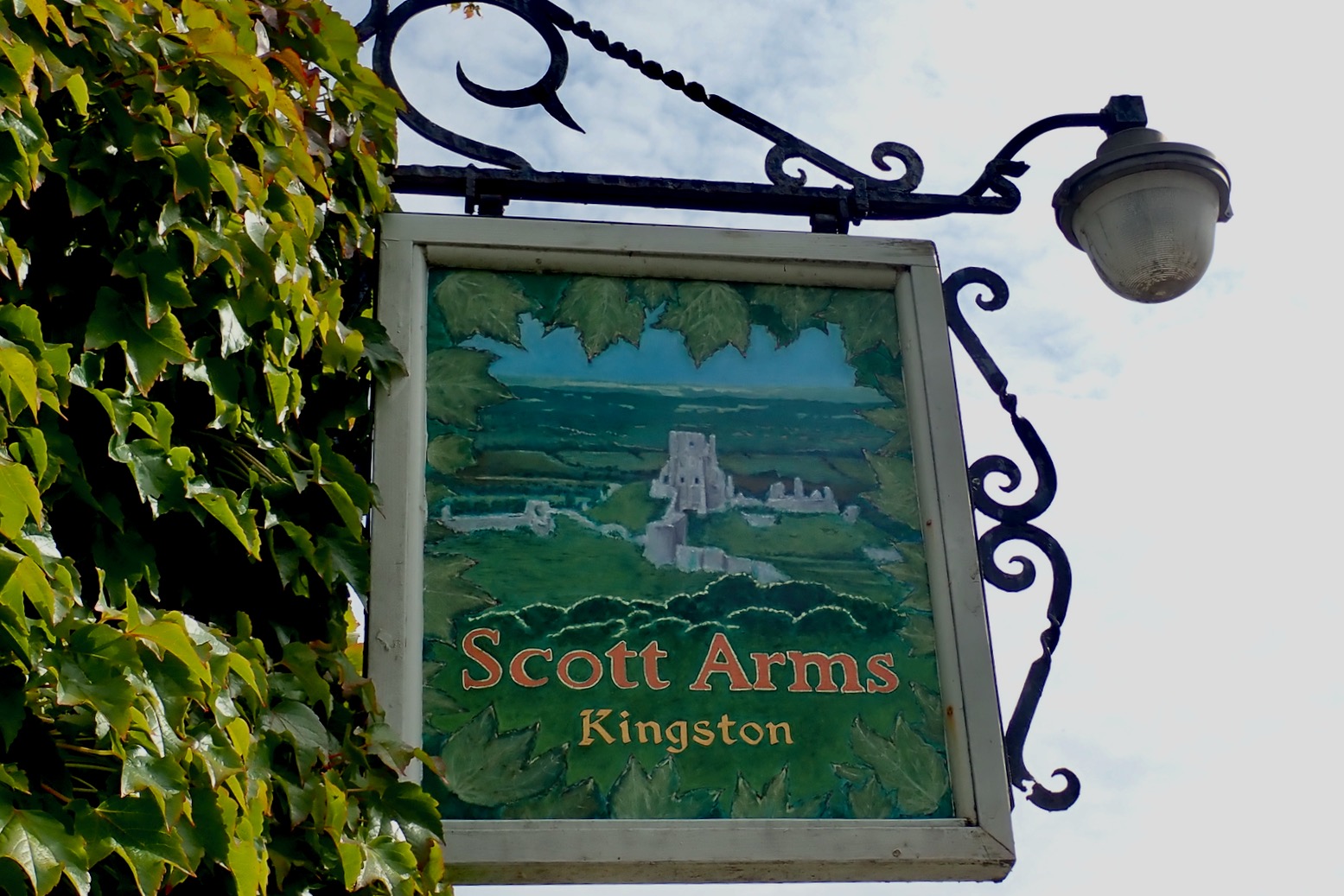
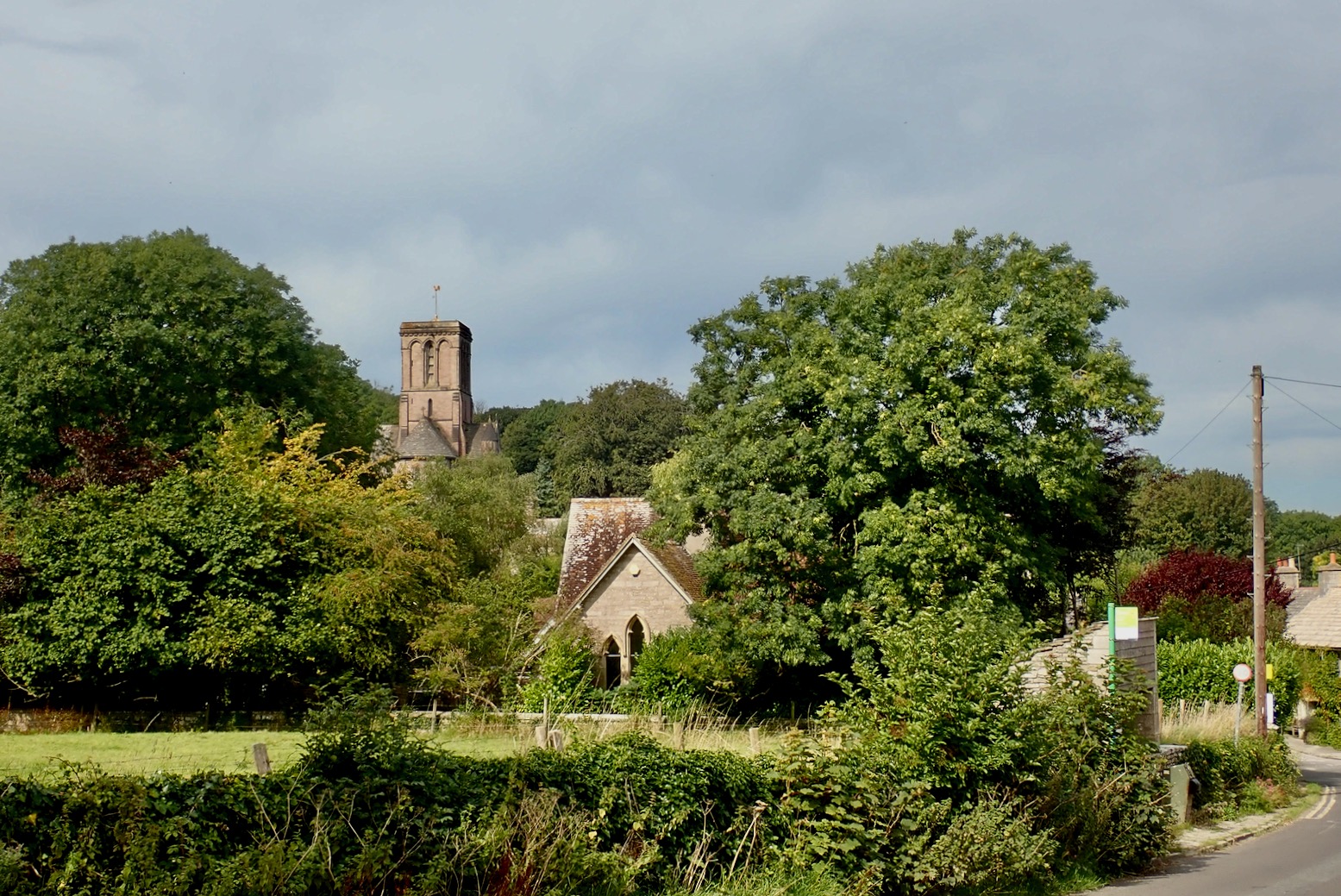
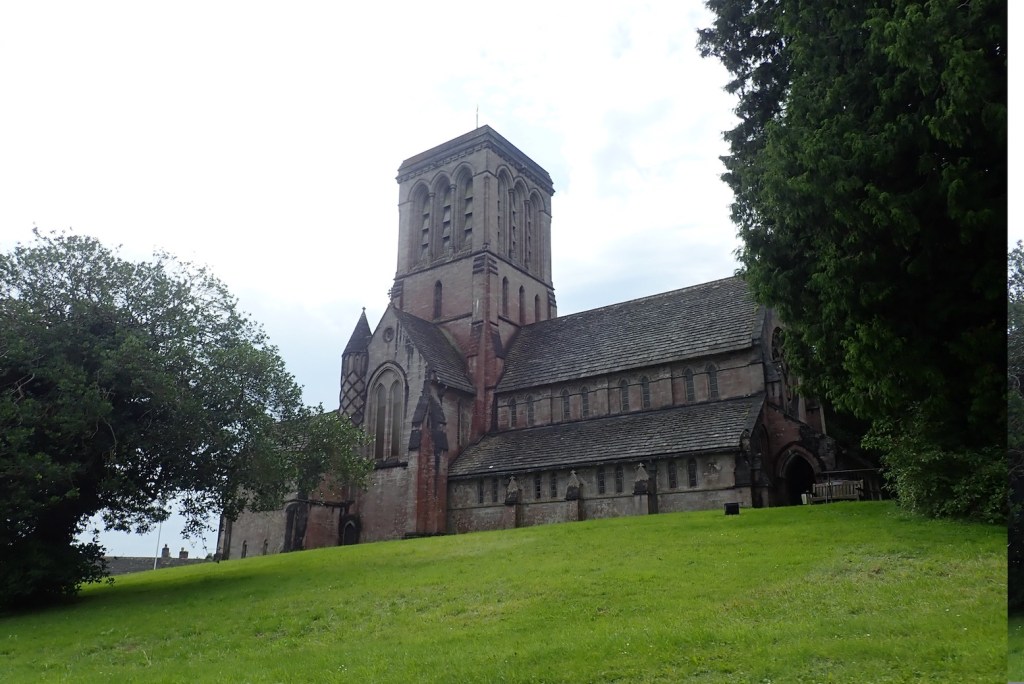
Some 1300 metres later I’m on the asphalt and riding back into Corfe. Southwest of here lies the hilltop village of Kingston with it’s old-looking 19th century church poking out of the trees, and the ivy-clad Scott Arms pub below. According to ancient genealogical conventions, if I whisper the secret family motto I’m entitled to a free pint and a quarryman’s pasty.
Kingston
Kingston was another popular subject for Rena Gardiner, particularly the ‘mini cathedral’ church in the New English Style, whatever that was. Inside there’s a superb array of stained glass from which it is fun to play Guess the Biblical Figures from their accoutrements. See how many you can guess.
Two UCRs span out near Kingston, but were it not for the GRM or DCC DM, you’d have no idea you could legally ride them. A footpath or bridleway sign might be the best you’ll see, which are clearly no invitation to motards. This patchy signage to discourage motos is to be expected. If you want to trail ride in the UK you need to ‘do your own research’ as Q-Anon-ers like to say. Fair enough – any journey or adventure needs planning.
South of Kingston an ORPA (UCR) turns off a valley running south to Chapmans Pool on the coast, and traverses some cow fields before dropping off the ridge along a gully which lead to what looked like an isolated farm on Google Earth. On the way I passed an ambiguous sign (left) which I’ve now taken as code for a UCR. On the pushbike the gully gets a bit stony, so easier down than up on a gangly moto, but the ‘hillbilly farm with rabid dogs’ was just a harmless terrace of stone cottages before a road turned up to Renscombe Farm and Worth Matravers beyond.
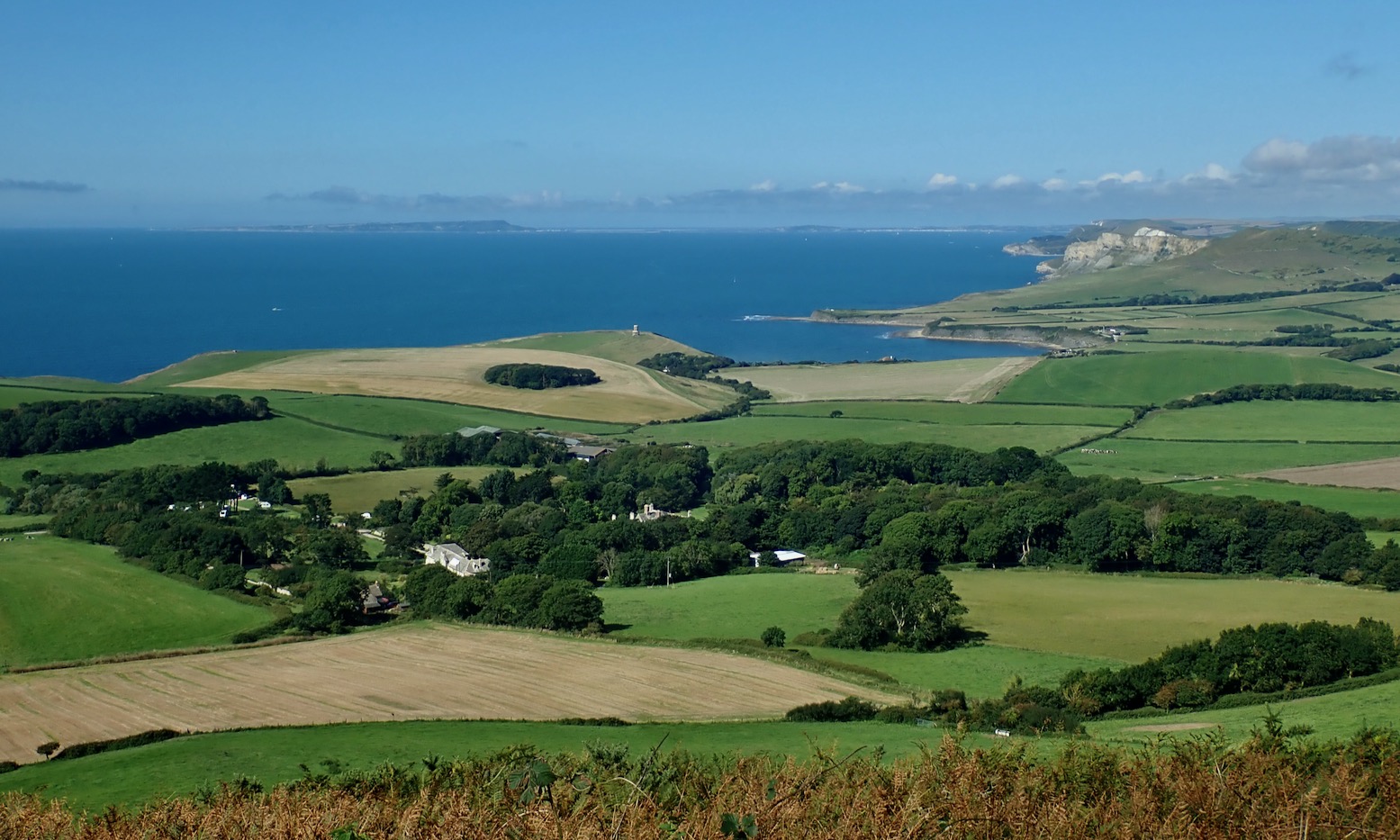
I’ll come back on the 300L one time for that one. Another UCR runs west of Kingston to Smedmore Hill, navigating tall grass and deep ruts (above). It arrives at a gate near popular Swyre Hill walkers’ viewpoint, but a bench here overlooks Kimmeridge Bay and distant Portland Bill with views just as good (below). The GRM shows it as green (‘full access’) but following notes say the west end – a stony descent towards Kimmeridge village – is ‘non-vehicular’, so I guess it’s a legal dead end on a moto. On both the GRM and Dorset CC maps, the last kilometre of this UCR strays oddly across a cultivated field before rejoining the actual track close to the road. Could you push your bike down to the road to make the connection?
View from Smedmore Hill over Kimmeridge. But the moto trail ends here.
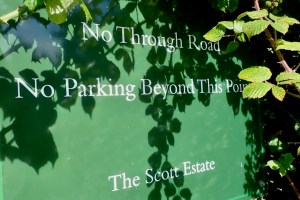
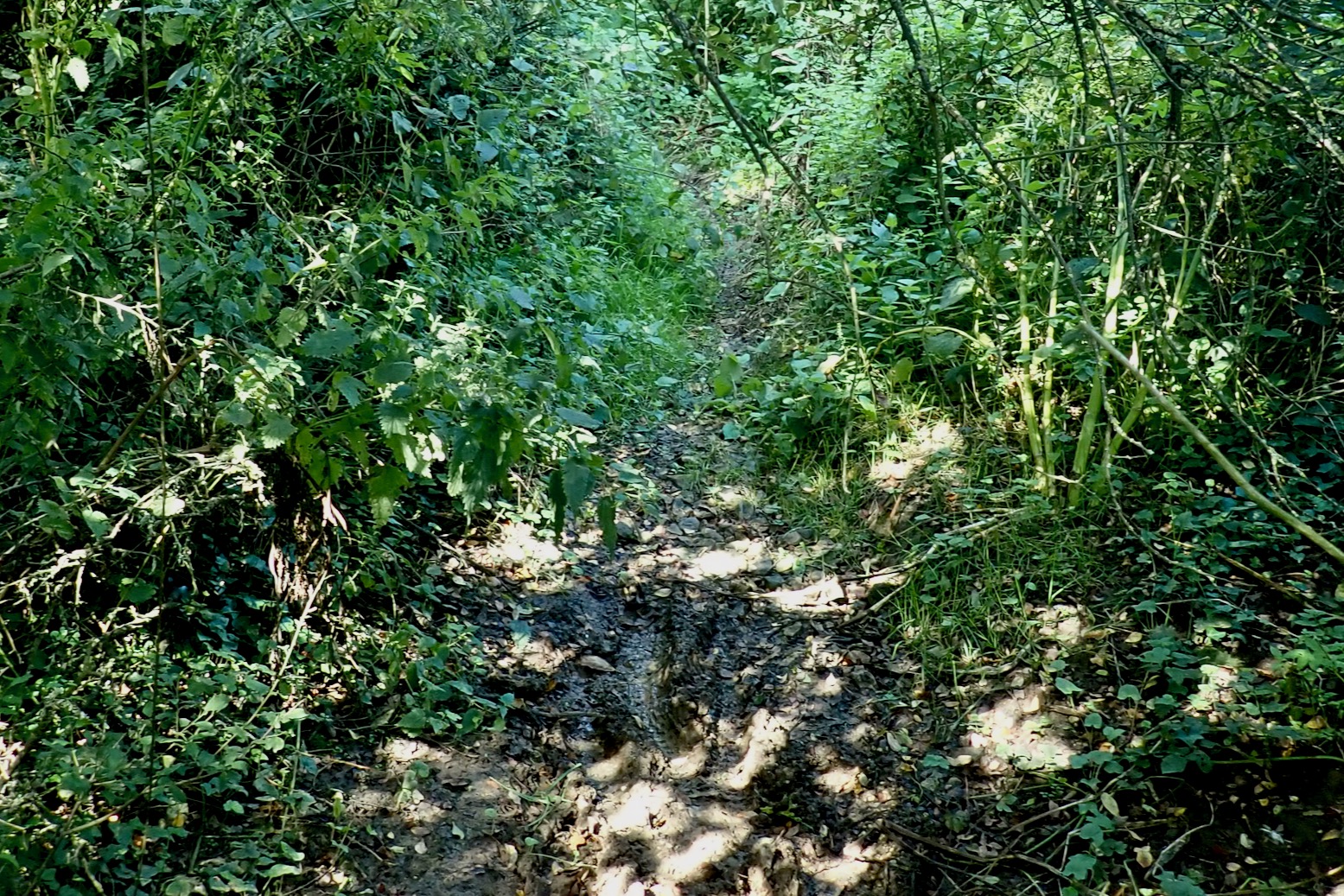
One UCR I definitely won’t bother riding on a Honda runs via East Orchard Farm just out of Corfe. Near the end of the road to Blashenwell a private sign advises ‘No Through Road’ (left). You can see curious holidaymakers straying out of Corfe and three-poing turning in Blashenwell farm yard, though technically there is a through road via East Orchard, it’s just a muddy UCR. At a bend before Blashenwell, easy cow field tracks and gates lead to East Orchard Farm, but from here the UCR – signed as a footpath – becomes an overgrown, muddy stream bed, in places barely wide enough for an MTB. I get nettled and scratched and sodden. ‘Deep mud on some sections caused by agri-traffic…’ warns the GRM, but you wouldn’t even get a farmer’s quad in here. Only motos will make it worse. With the racket and spray a moto would make trying to push through the 500m to West Orchard Farm, honestly, it ain’t worth it, even if it’s allowed.
East Orchard? Leave it – it ain’t worth it!
My recce of the Trails of Purbeck is done: adding up to less than clicks (seasonal restrictions permitting) or nearly 6 miles off-asphalt over as many separate trails. It sounds pathetic but, like the GWT, on road or trail it sure gets you into some lovely countryside.
Just beyond the ‘Isle’s’ vague western perimetre near Lulworth Camp, another UCR called Daggers Hill Drove scoots up and over a hill in 2.4km. On top an army Landrover was watching, but you could drive this easy track in a Micra to avoid the traffic streaming out of nearby Lulworth Cove. North of here, near the little-known Winfrith nuclear plant which they’ve been decommissioning for 20 years, is a 2km trail west to Redbridge. I took a chance down it coming back from the GWT a few weeks back, only to discover later it was a kosher UCR after all. I must be getting a good nose for Dorset UCRs! Reversing it today while dodging a few big puddles, I pass a fellow trail biker on a KLX250! Good on him, exercising his ancestral right to ride this route.
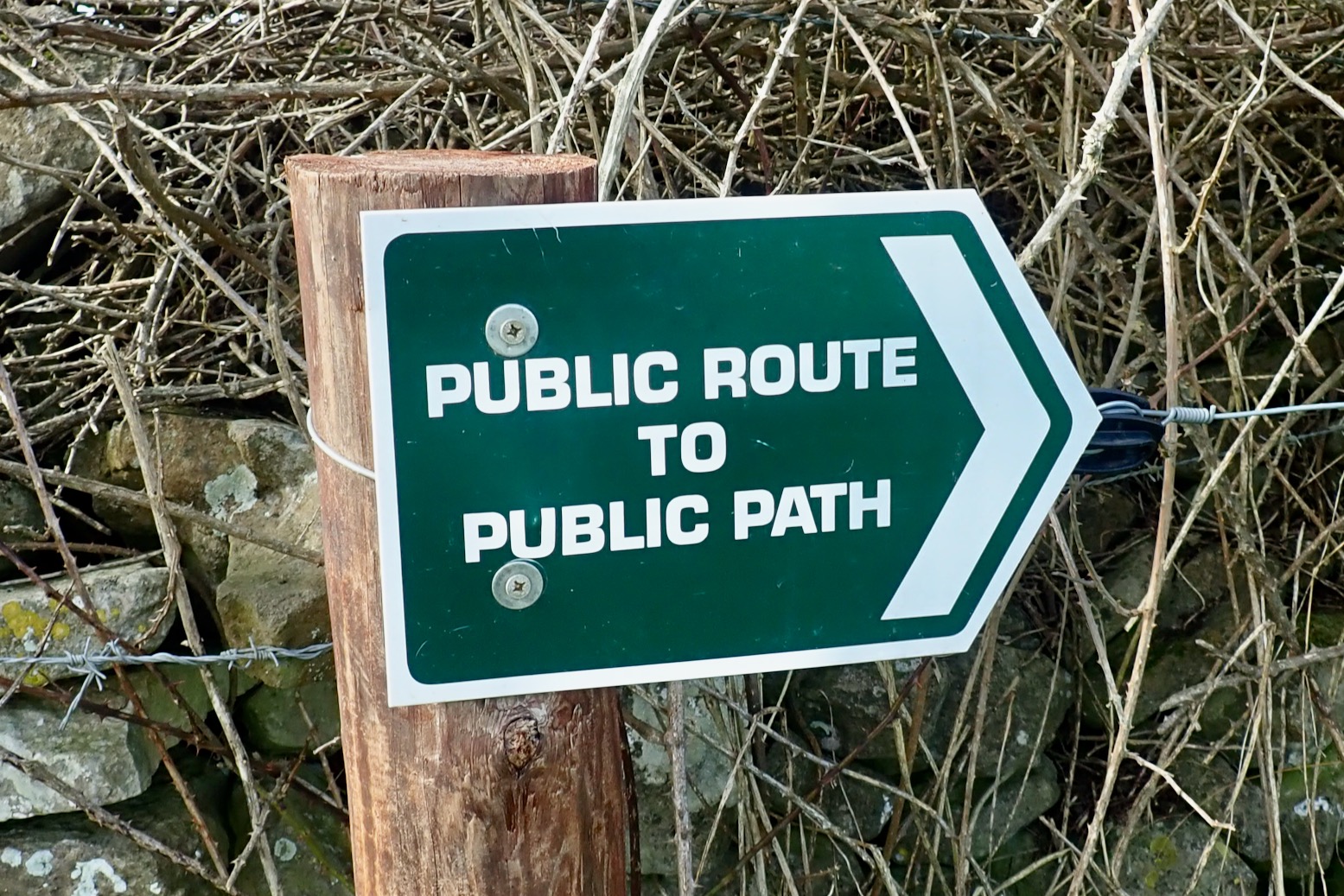
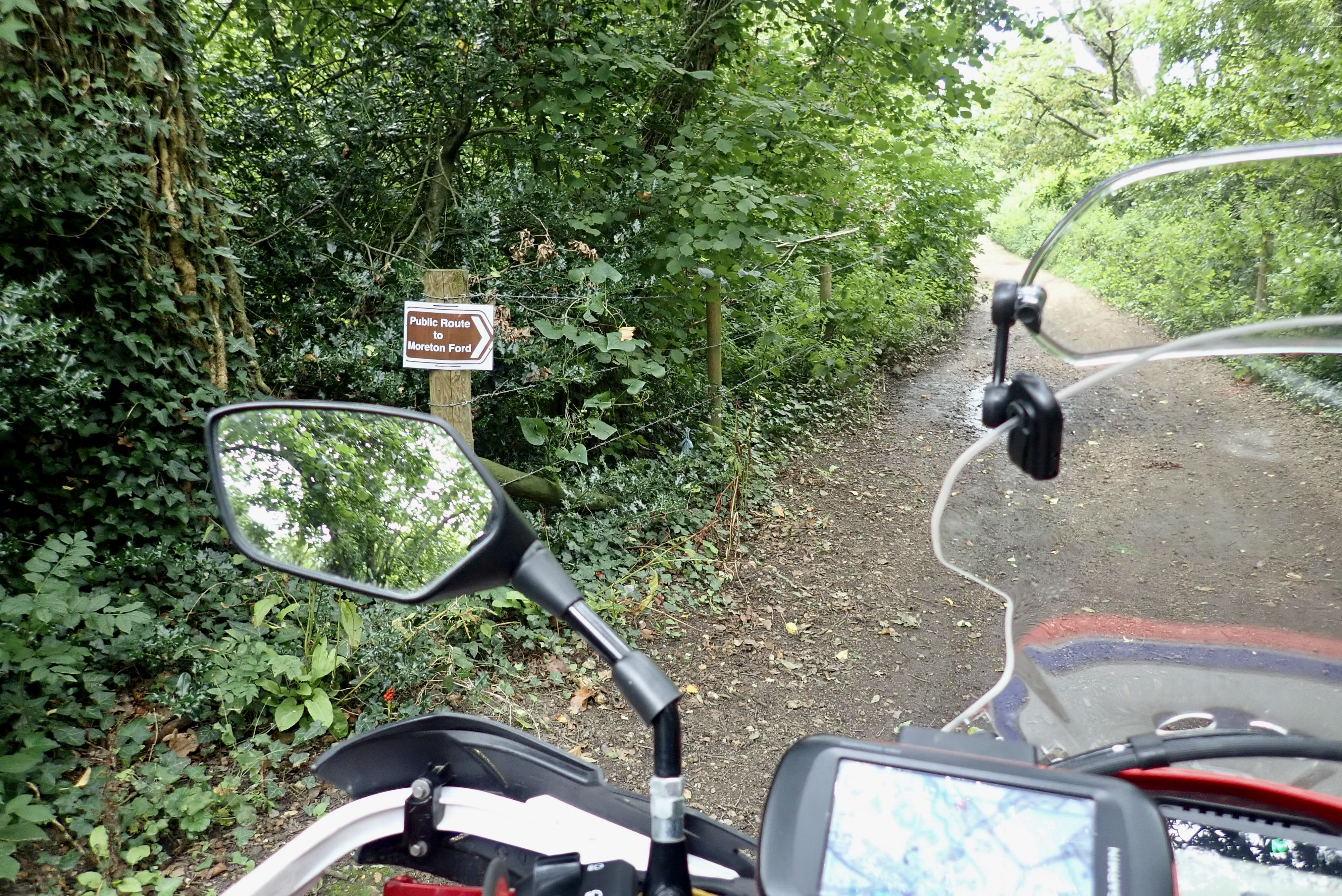
‘Public route’ on Moreton Drive – code for ‘road’
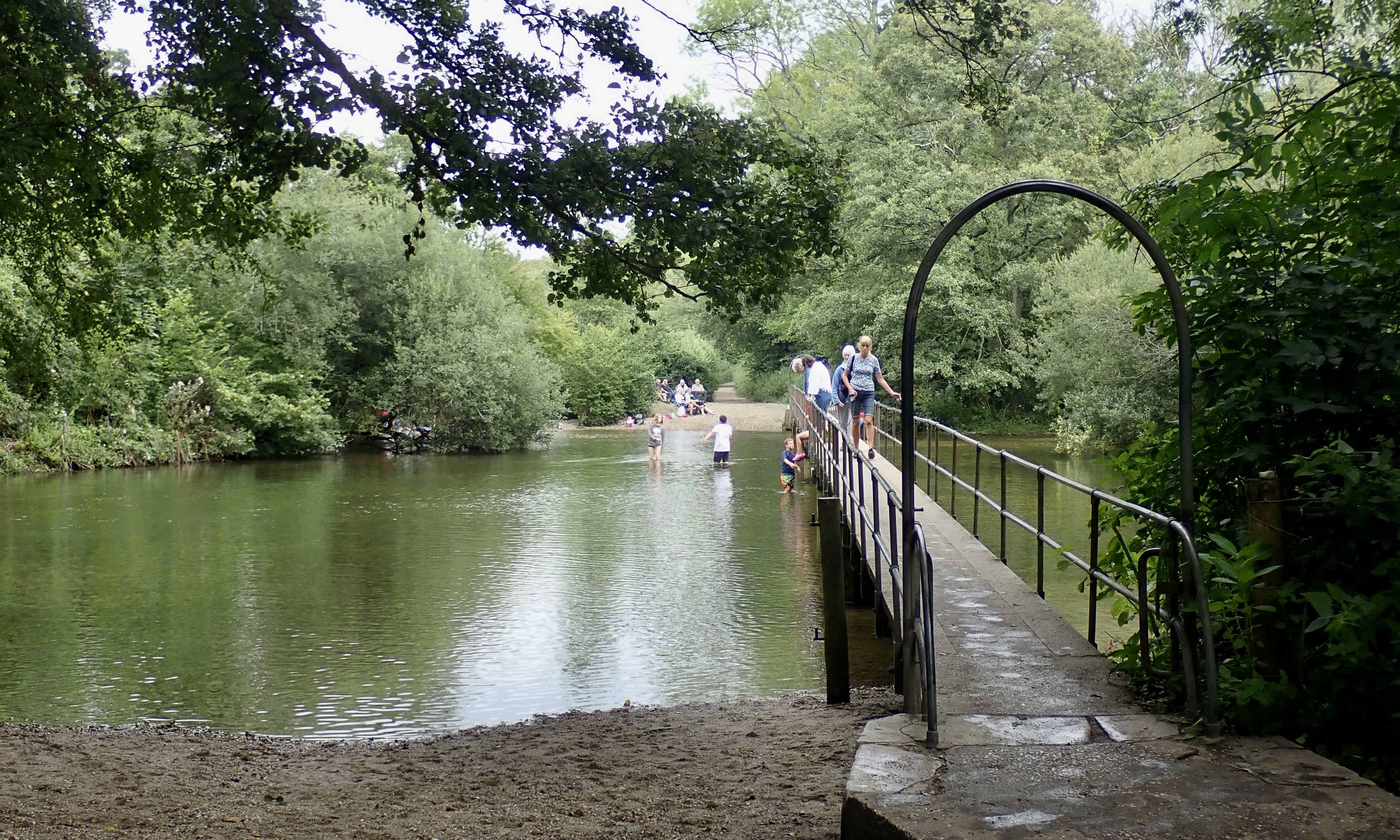
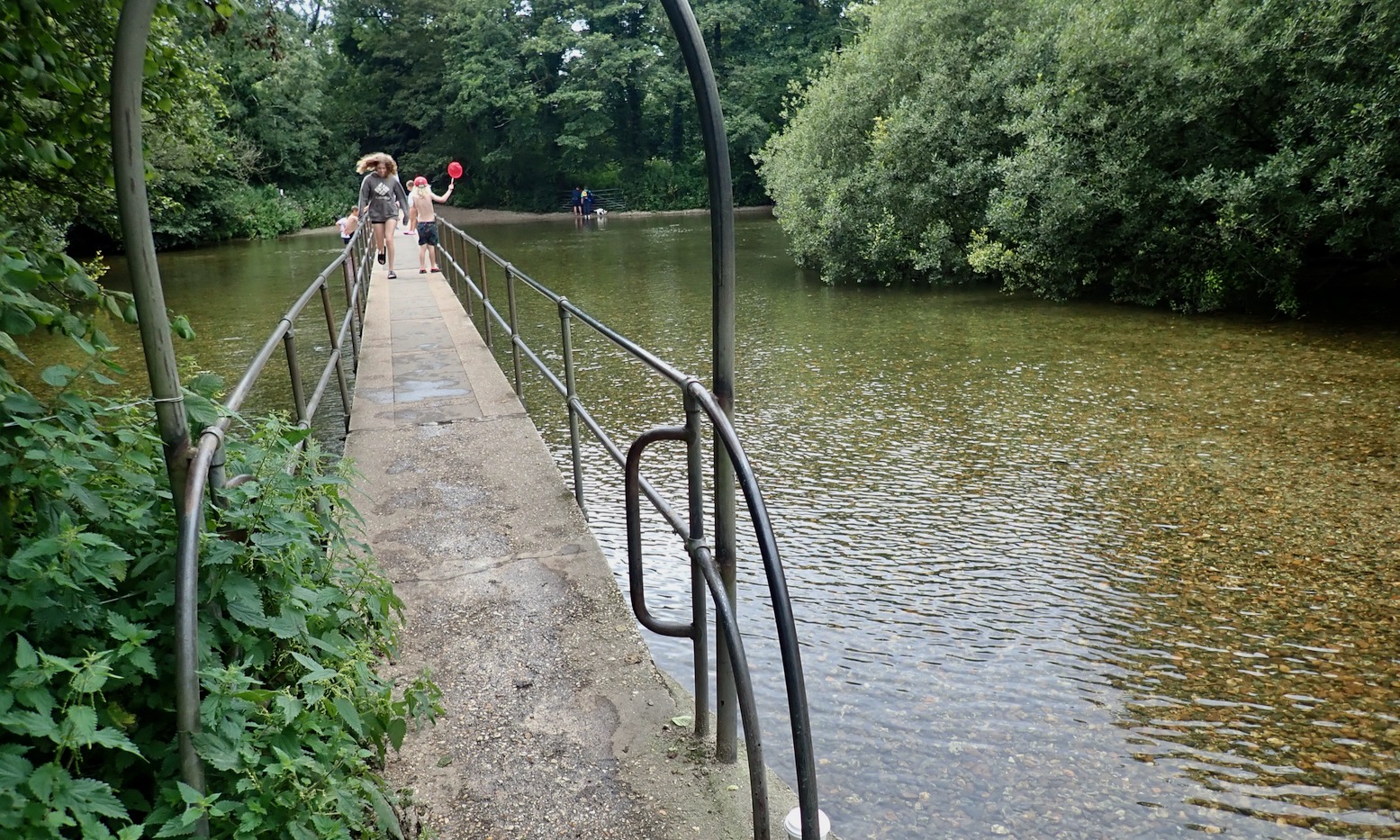
The day’s last trail was an intriguing 2.3 clicks straight through a forest north of Moreton village. Only, not for the first time I didn’t scrutinize the map forensically enough and clock the F-word buried deep in the detail. F for ‘ford’ that is – across the River Frome which delineates Purbeck’s northern boundary. I rolled up to a scene of kids splashing about while parents scrutinised their phones on deckchairs (below) I observed the kids’ knees as closely as was appropriate, and in my head extrapolated probable leg length from teenage anatomy (based on current dietary trends) and decided not to risk it, even pushing. Deep fording can ruin engines and is something I save for absolute necessity. The other day our old Rover car died after bombing through a six-inch ford near the house. It dried off and restarted after 15 minutes, but now I crawl through at walking pace. Had no one been around, at Moreton I might have hopped onto the footbridge which looked rideable on a small bike. I’ll test wade it one time. ‘Deep ford in winter’ warns the GRM. Deep enough in summer too. Not to be thwarted, I scooted around a couple of miles to the northern end of the Moreton Drive – you could ride it on a RD350LC – and arrived at the ford from the other side. It didn’t look any shallower, so I turned round and headed home.
Moreton ford from the southfrom the north; just as deep
Riding back through Bovington Camp I clocked a Costa / Greggs combo – always good to know out here in the sticks.
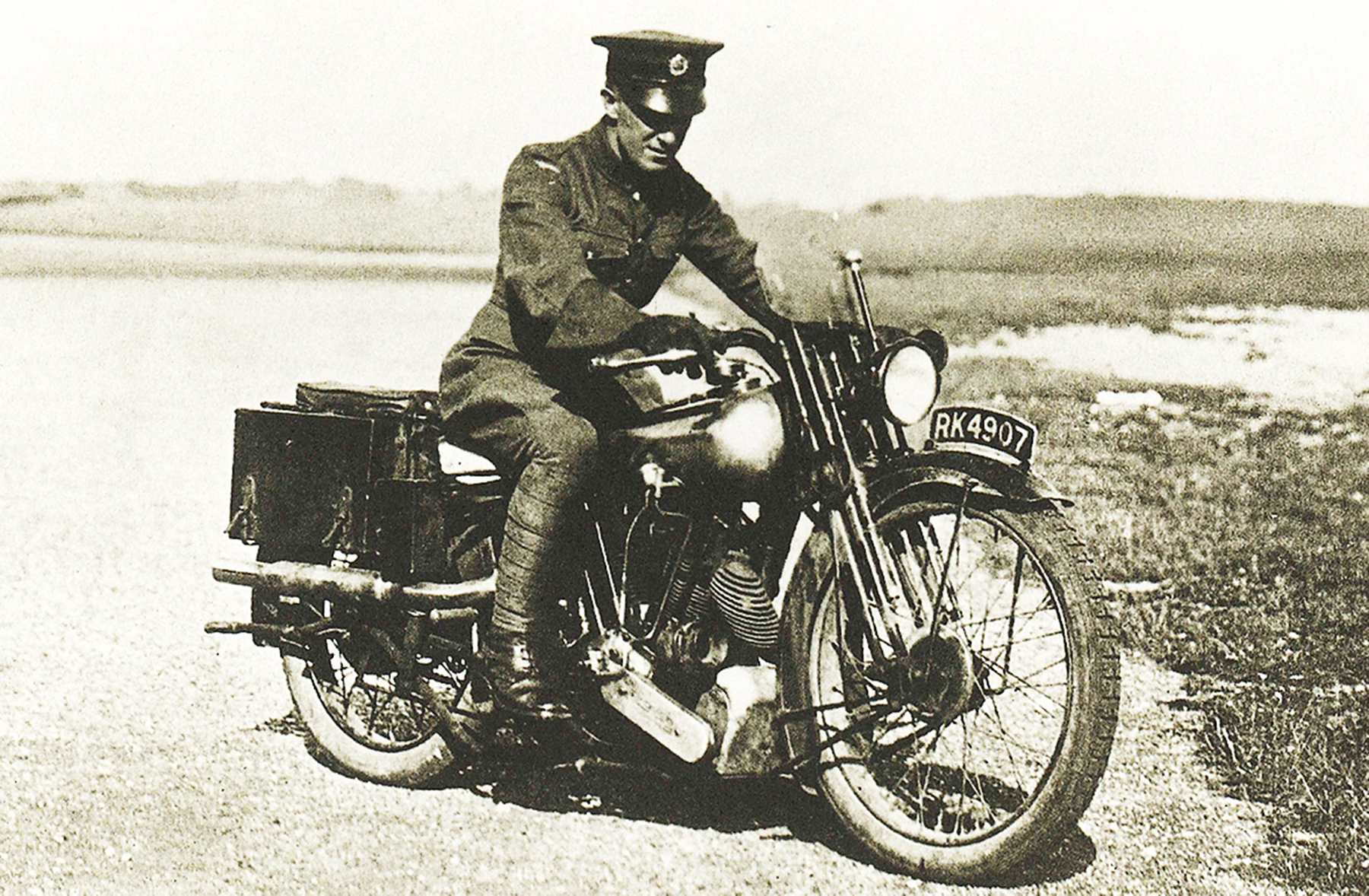
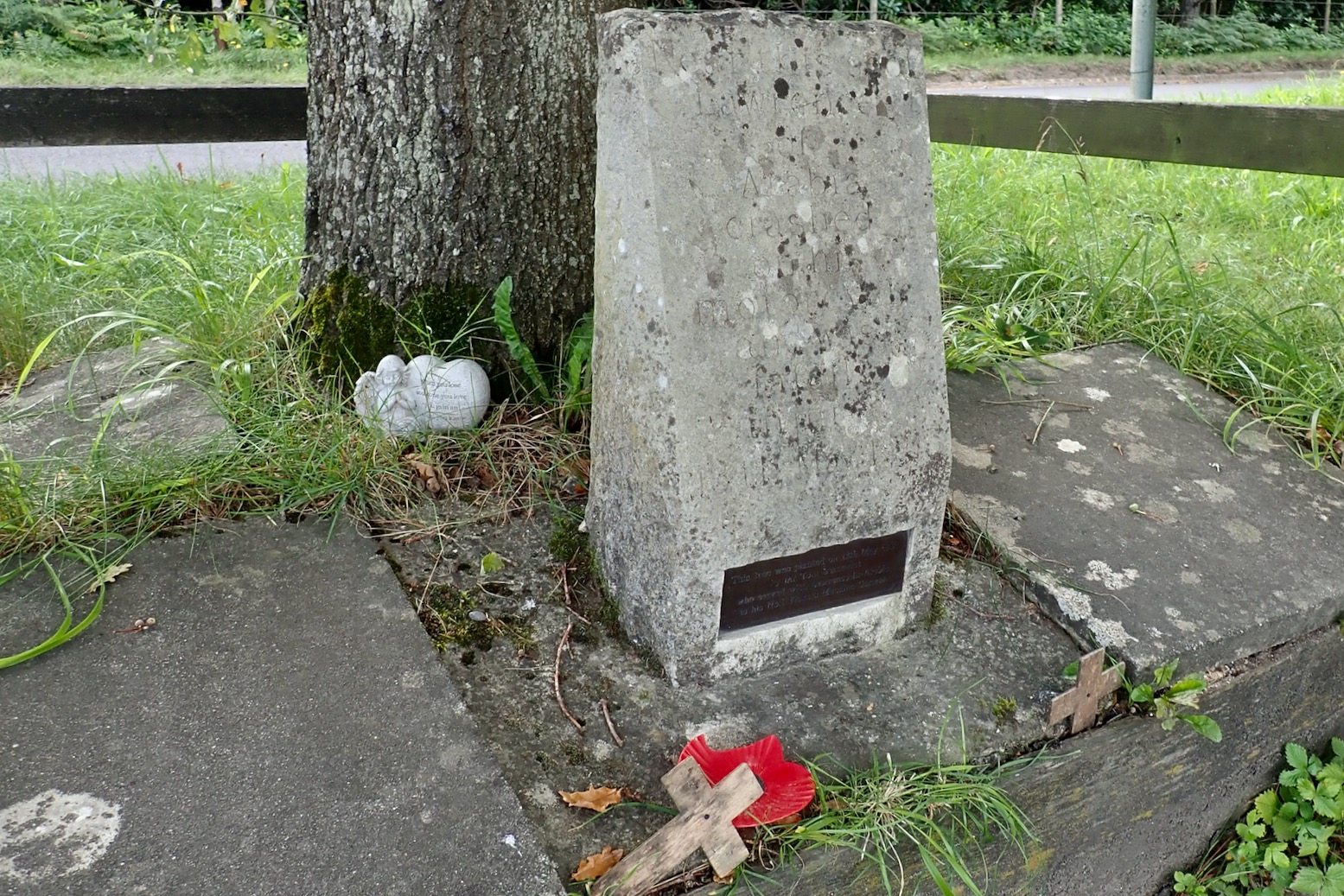
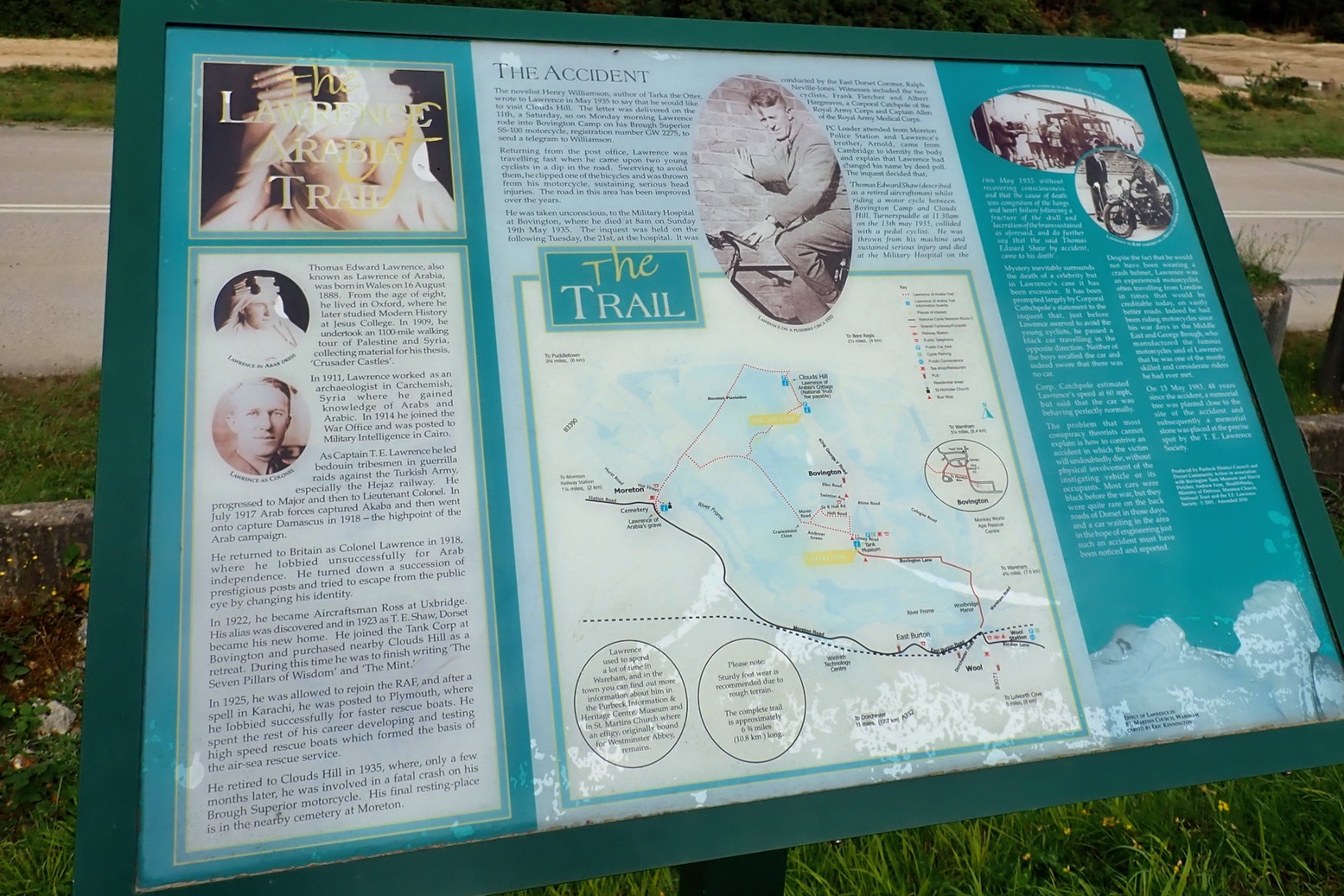
I also passed the point where, in 1935, T E Lawrence (left) had his fatal crash on what was his seventh Brough Superior SS100 – the ‘Rolls Royce’ of motorcycles in the inter-war era. Lawrence just left the military a few months earlier and was heading back to his humble cottage up the road at Clouds Hill. You probably know the rest.
Crash site memorial near Clouds HillT E Lawrence info board. He lived up the road.
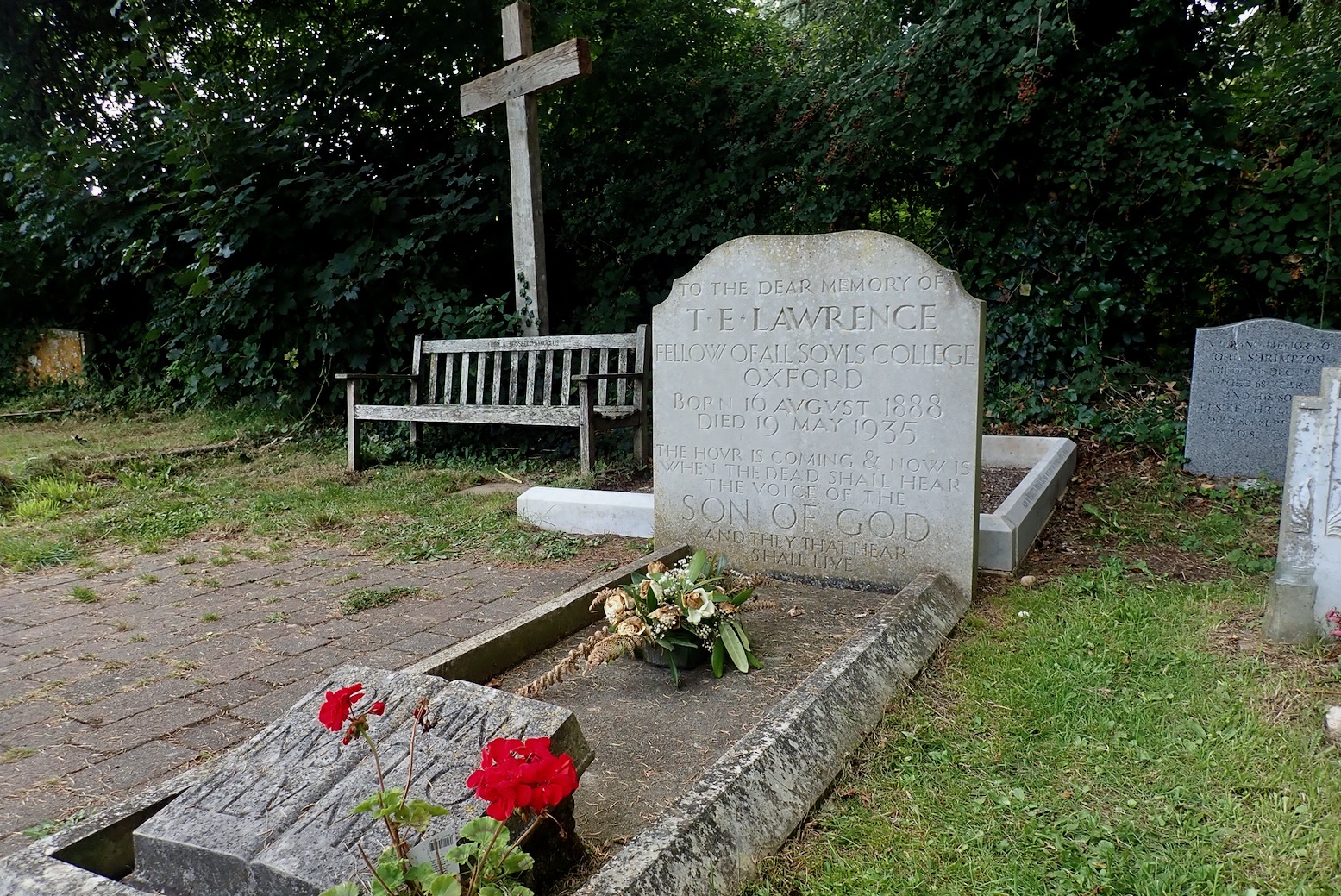
T E Lawrence’s grave in Moreton cemetery
At what appears to be a roadside tank training viewing area/car park, there’s a low-key memorial stone by a tree, plus a well-written info board about Lawrence (above right) which also addresses the enduring ‘Catchpole Conspiracy‘. It turns out Lawrence is buried at the cemetery back in Moreton, and it’s said the neurosurgeon who attempted to treat his terrible head injuries went on to recommend the use of crash helmets for WW2 army despatch riders, and here we are today.
I’ll have spent a staggering £550 each on three handbuilt ‘MT’ wheels for my 300L, all so I can seal the rims and fit tubeless tyres for easy repairs and greater longevity. Oh well, it’s good to support the economy. When it comes to tyres, people love to fit fatter but I aim to get the closest-to-stock size tubeless tyres that’ll fit the new rims. But as mentioned previously, the smallest available tubeless-ready, ‘MT’ rims are a size or two wider than stock 300L wheels which may mean wider / heavier tyres too. FYI my MT-type tubeless ready wheels will be: Excel17 x 2.50 SM Pro 21 x 2.15 (£50 cheaper than Excel equivalent) Excel 19 x 2.50
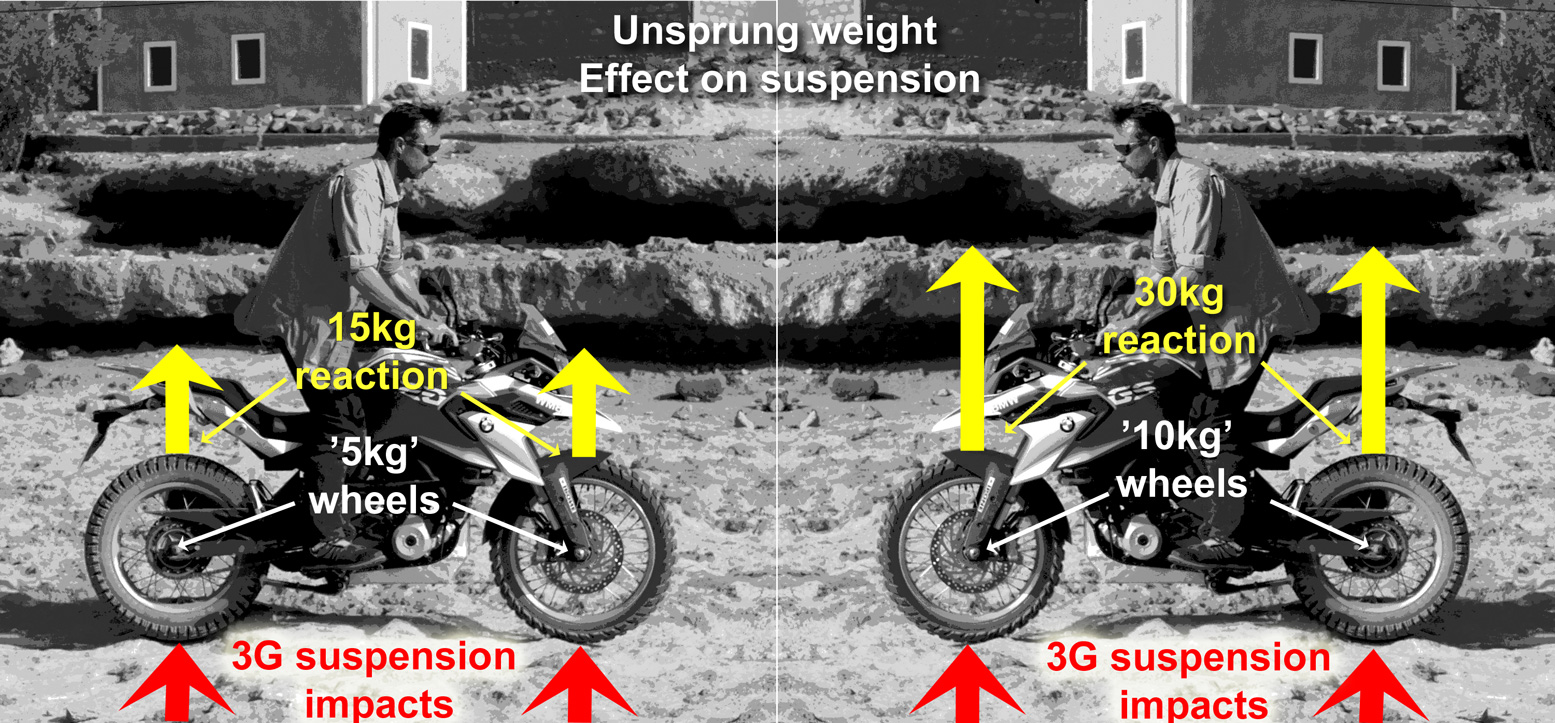
Unsprung durch Technik With wheels (not least pushbikes), unsprung weight (parts not supported by suspension, mostly wheels) exponentially affects acceleration/braking as well as suspension response and probably mpg and appetite. You know how I feel about mpg. Imo, efforts to limit rotating mass are worthwhile on a 150-kilo bike with only 28 horsepower. As I wrote while preparing the Him “… it’s why your Hoka trainers weigh only 320g [i.e: as little mass/inertia as possible to do the job]”. Adv riders go on about swapping pipes and ‘bars and batteries to save weight (while having to add it elsewhere), but tyre weight is rarely considered and can vary quite a lot. My wider rims may weigh more, so might the slightly over-sized tubeless tyres. Overall, my tubeless conversion may barely save weight.
‘What tyres do you recommend?’ In line with EU diversity initiatives, I try and never use the same tyre twice. It’s good for the book, too. But when a mate donated a new Michelin Anakee Wild 120/70 R19, I thought I may as well go all-Wild, as I did with no regrets on the heavy Himalayan a few years back (left).
Barman, double hernias all round!
I was risking EU sanctions until I was reminded of my own words: a rear Anakee Wild to match the 19 comes no smaller than 130/80-17 but weighs a staggering 7.5kg – enough to give my poor Honda a hernia.
I don’t know if being a radial adds weight – apparently not according to this albeit contradictory article I found on the internet. And then I clocked my fat-tyre mate’s front 19er at a hefty 5.2kg – more suited to a CB500 than my simpering trail puppy. Barman, double hernias all round!
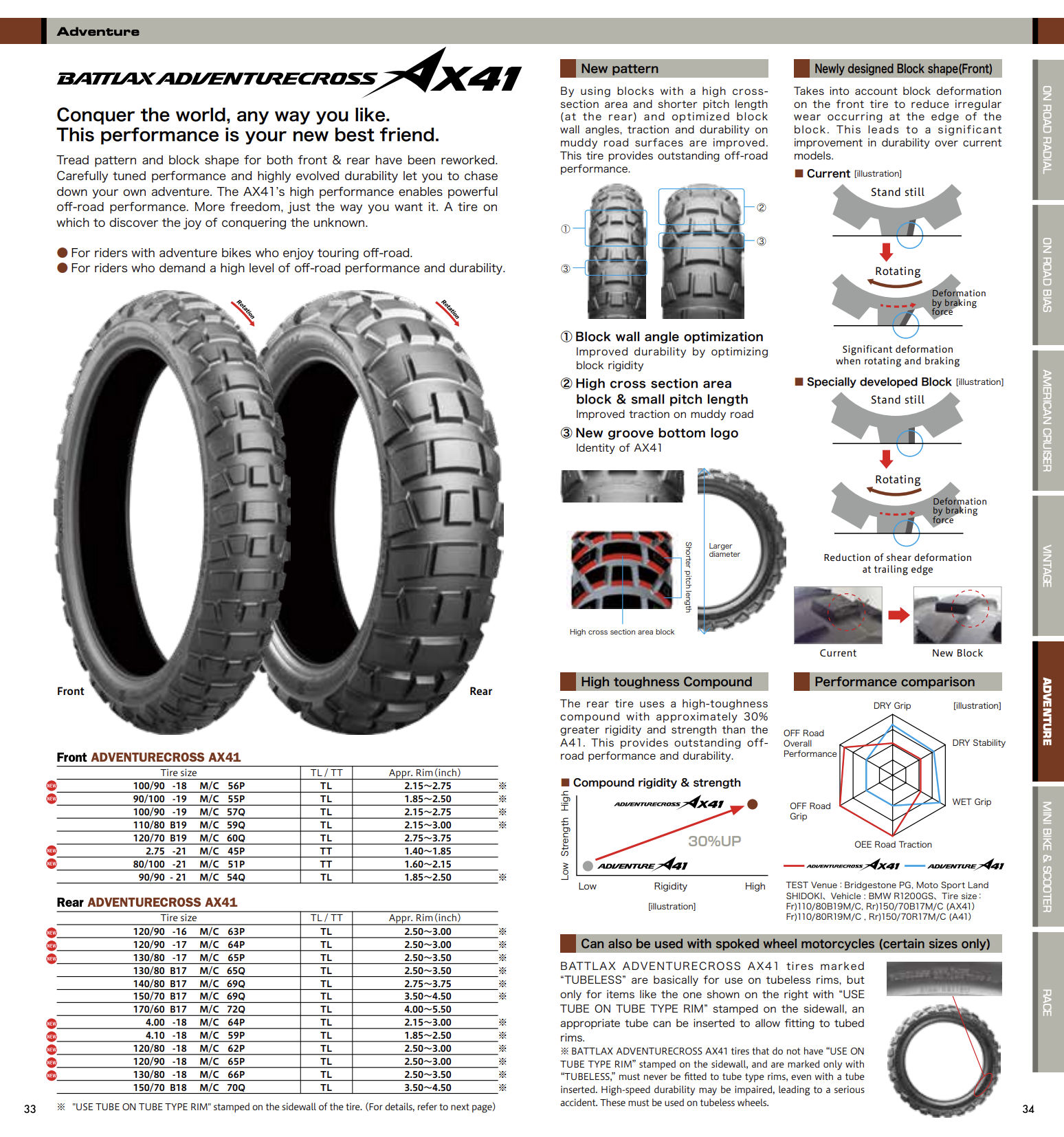
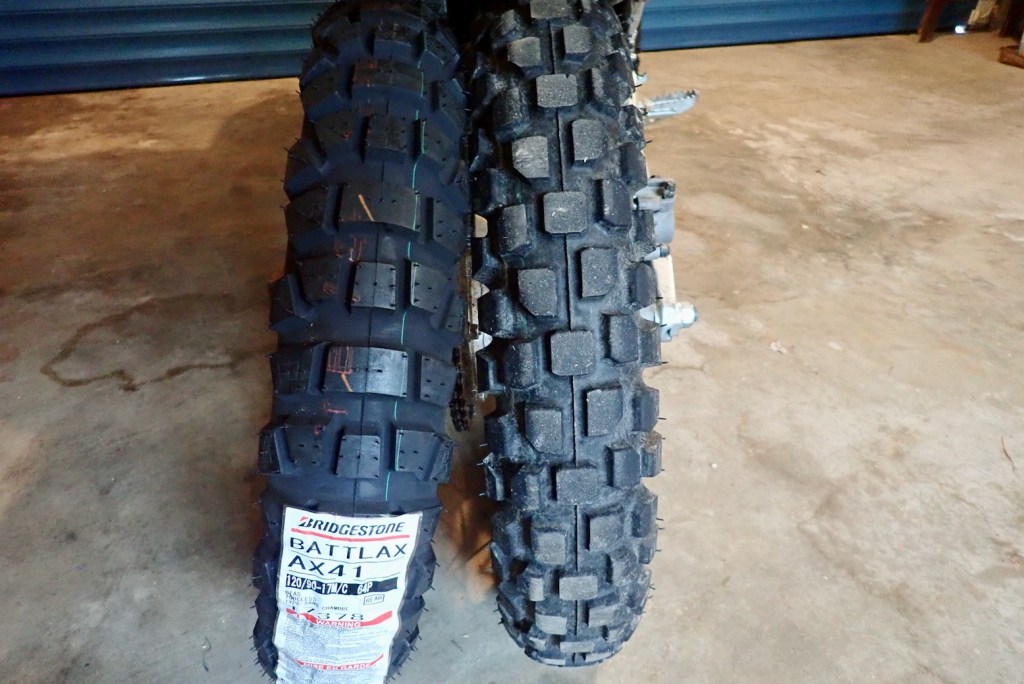
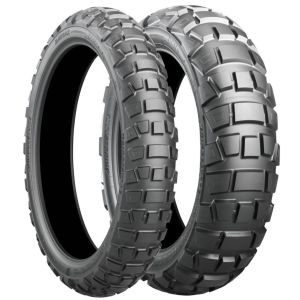
Back to the drawing board. Along with Kenda K784 Big Blocks, Bridgestone’s AX41 Adventure Cross (left) is a do-it-all 50/50 jobby I’ve been wanting to try. The advent of the AX41 a few years ago culled Bridgestone’s range of Trail Wings, some of which I’d have happily chosen for the 300L. What’s left in TWs are tube type and pitched as ‘retro’ (pre-Adv era) tyres. Best of all, unlike Mich, Bridgestone do an AX in 120/80 17 TL (118mm wide – 1mm more than the stock IRC) as well as a nicely slim, 92mm-wide90/100 19, plus a regular 90/90 21 at 85mm wide. These widths are all verified; you’ll find broadly similar AX41 width datalisted here, but tyreweights are something you rarely find listed publicly, even in pdf online catalogues. I had to email Bridgestone Technik in the Netherlands who, to my surprise, promptly responded down to 3 decimal points:
Nice numbers but as usual, manufacturers’ weighing devices seem to be calibrated sunny side up. Using the same scales, the rear 120 AX41 comes in at 6kg, still 1.5 kilos or 20% lighter than a 130 Mich Wild. My current rear IRC also weighs 6kg with tube – and such OEM set ups are often the lightest possible to eek out good performance figures from reviewers to whom longevity is not an issue. More numbers you say? The little used Mitas 4.00 18 trials tyre my 300 came shod with weighed 6.9kg with tube. And out of interest, I’m told the old favourite Conti TKC which I last used on a 660Z Tenere 15 years ago, weighs 4.1kg for a 90/90-21 TL and 5.4kg for a 120/90-17, but I recall they are quite soft or flexible tyres whiuch is why people love them on the dirt. As mentioned earlier, these tyres and tube combos work out heavier than the back wheel, at 5.4kg with a 40T sprocket and rim lock.
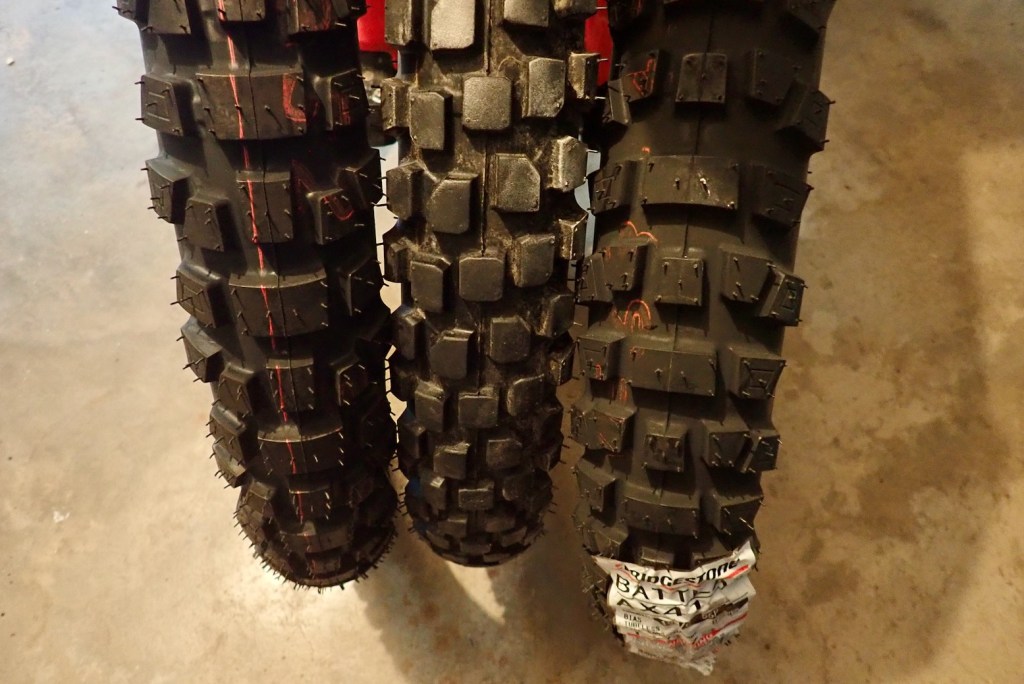
3.00 21 left and 90/100 18 rightRear AX41 – same weight and 2mm wider
Meanwhile, the fatter 21-inch AX41 front weighs a true 4.6kg, 170g heavier than claimed and 200g more than current IRC with tube at around 4.4kg. The 19er is just what I was hoping for, it’s slim at 92mm and feels light, also at pretty much what Bridgestone say: 4.4kg. Height wise, unmounted the 21’s diameter is 27.4″ (696mm) vs 25.9″ (658mm) on the 19, at 38mm a bit less than the 2 inch/51mm variation you’d expect. And it only cost £83! Interestingly, all three tyres are Made in Japan. Not even Honda can manage that with a whole 300L!
Honda 21 wheel
SM Pro 21 TL
EXCEL 19 TL
Honda 18 rear
EXCEL 17 TL
3.9 kg
4.6 kg
4.4 kg
5.4 kg
5.6 kg
IRC 80/100 21 + tube
AX41 TL 90/90 21
AX41 TL 90/100 19
IRC 120/80 18 + tube
AX41 TL 120/90 R17
4.4 kg
4.6 kg
4.4 kg
6 kg
5.5 kg
Wheels (with rotors etc) and tyre weights. Spokes on new TL wheels are thicker
It’s eye opening that a set of wheels on a dinky, 150-kilo bike can weigh over 20kg, but they’re right at the coal face, dealing with all sorts of forces and impacts. I think that on anything from 500cc and 45hp upwards, all this gram counting is unnecessary, but unsprung weight on a 300L matters. Will the seat of my pants notice the difference between a 7.5 kilo Wild and the 6-kilo AX41? Probably not without bluetooth telemetry, but I’d sooner take the lighter AX which still feels pretty rugged for a ‘250’ trailie.


























 Adventure Motorcycling Handbook