Original pics for this post sadly lost in the clouds
In Phoenix the CRF was waiting for me, as were a dozen boxes of accessories to finish off the job the first owner had started before he flogged it with less than 1000 miles.
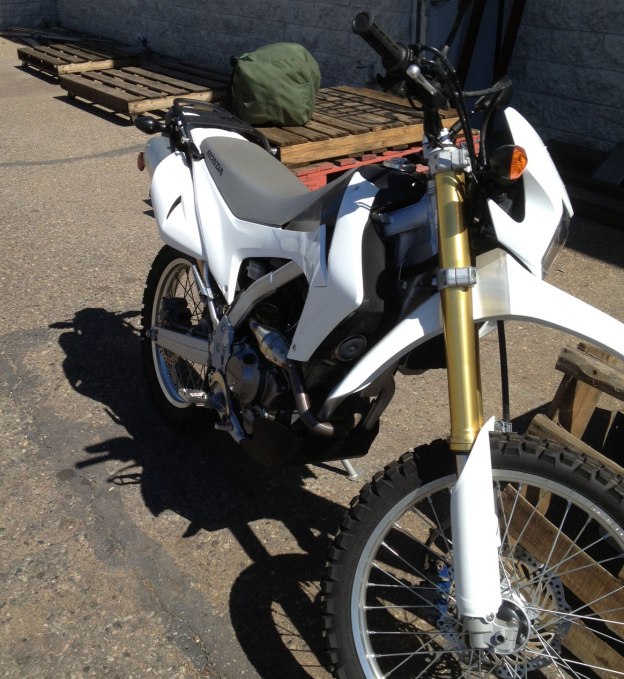
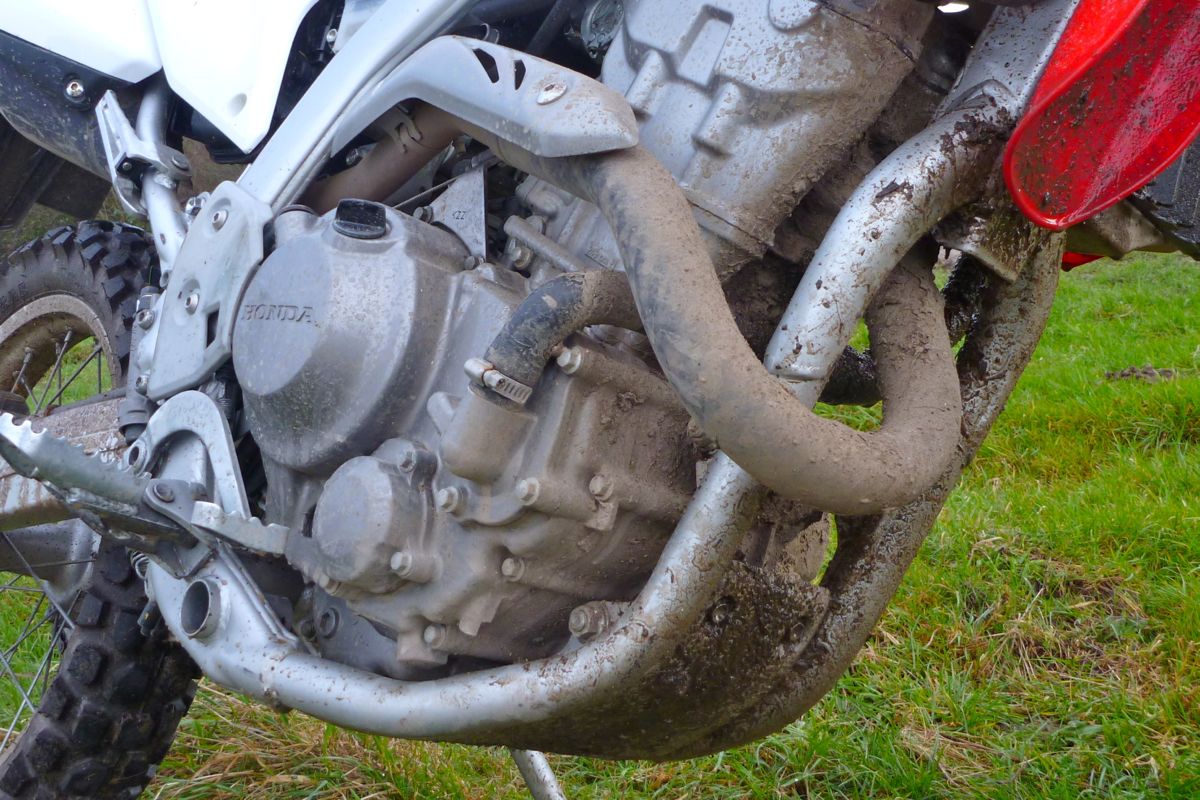
As a reminder, he fitted a pipe, plate, EJK fuel controller, tail rack, 13T, Shorei battery and the white plastics. Most of the original bits were there too.
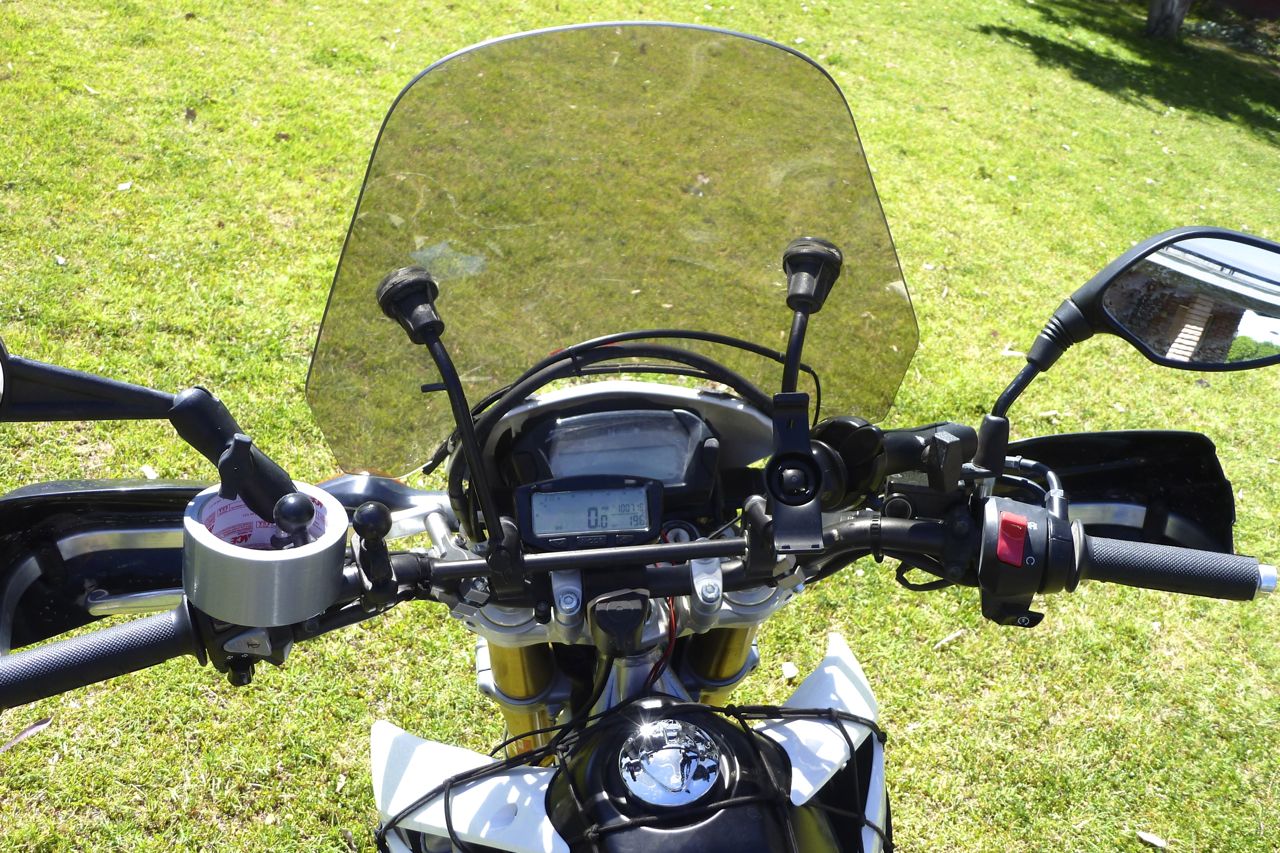
Lying on the floor there on the left I had a set of Aussie Barkbusters with the large Storm handguards, a Spitfire screen, some bar risers, a 12V socket, a couple of RAM mounts and some Double Take mirrors along with lube, filters, a Trail Tech Vapor and some maps.
The cheap risers and 12V socket were clearly sourced from the reject bin in some Guandong factory and needed redrilling; the 12v socket even had the blue and brown wires the wrong way round which caused a small bang and some smoke! At least there was enough cable on the Honda to get 2 inches out of the risers. The Barks went on easily enough; I refitted the original 14T, replaced the shift lever with a folder, got an AZ plate and some insurance ($28 for half a year!) and then we set about the shock and the side racks.
On the plane over I had a thought that the shock wouldn’t be up to my weight and the load. The L I’d tested in February had been reassuringly firm but when it came to loading the rear spring on my Phoenix bike the collar adjustment rings were factory-set solid. We unbolted the shock (the usual near blind nuts make it easier with two people and the battery out) and Al whacked the collar rings apart. He pointed out a useful trick in turning the loose top sleeve out of it’s notch to give another 5mm of tension, but on bounce testing we decided to go all the way and fabricate an additional half-inch sleeve, splitting a right-diametre tube, fitting it and tacking it in place to rack the preload right up and have a bit more to spare. That required compressing the spring in a press but the shock is otherwise unmodifiable and a decent compression damped unit starts at $600.
Al Jesse was also using my bike to try out the prototype of the new MonoArm rack he’s designed. Jesse mount systems are typically cunning affairs with minimal metal; my version is a bit heftier until the final form is pinned down.
I didn’t know what to expect but what we have here is a q/d platform rack no less (he must have read my mind) onto which I’ve chosen to semi-permanently attach my Magadans (I could as easily remove the pans from the plate, but the whole point is the rack itself is q/d). Each side plate locates into corresponding slots and the mounting system’s special feature you’ll learn about later makes it particularly well suited to slinky sub-framed dual sporters like the L. Removal of the platform with bags attached is with a nut and spacers, but production versions will use the tamper-proof QRDP lock by the time it’s all out.
Sunday Al put a cooler full of water in his KLX 250 S’s top box and we went for a ride up in the Weaver Mountains around Castle Hot Springs to see how my adaptions weighed up and pull off an mpg test. I was concerned the EJK black box might might have affected this as the original owner had intimated. Even then, with the Honda’s tiny tank (I’ll have a 5-litre fuel bag and may need another) it’s going to be stops every two hours to pay out for 8 bucks of fuel at a time.
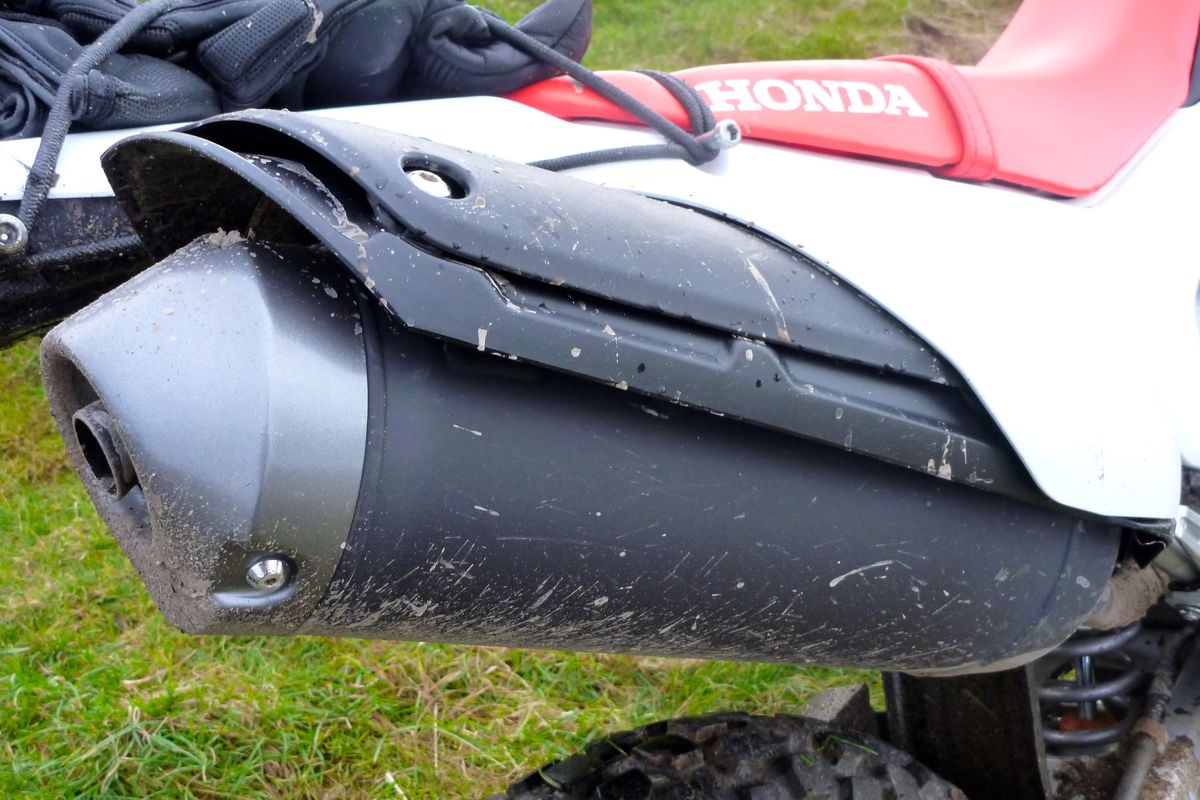
First impression was a lot of noise and no jaw-dropping gobs of extra power over the Honda test bike I road in February (I do wonder if that press bike had been fine tuned…). With pipe and airbox and EJK, power should have been up some 30% (18 to 24hp supposedly) but Al’s Kawasaki was having no difficultly keeping ahead. We’d already tried to quieten the FMF ‘Q-Pipe’ by fitting a restricting washer up it’s spout and though it made a small difference in the garage, once on the road I couldn’t see myself living with that racket. Acceleration was especially noisy; we hoped the holes that had got drilled into the airbox side might address that, but back at Al’s, tapping them up made no difference. Luckily the stock pipe was at hand and easy to refit.
Other than that all was well. By the end of four hour’s riding the old backside was getting warm; that shock is pretty firm now and chattered into bends, but should be on form with a load. Standing up the bars were still two inches too low – Al’s KLX by comparison was just right. Not sure how to get around that without cable issues. Tyres at street pressures were OK and the brakes a bit touchy on the loose gravel inclines, but that will just be me getting used to the bike. The Slipstreamer Spitfire screen too felt a bit close to my face when bashing over ruts but the ‘pressure balancing’ gap at the base caused no turbulence on the highway. I did think it could pull still more gearing but there’s no room in there for a 14T so it will have to be 3 or 4 teeth off the back end. Unfortunately it was the din that left the biggest mark.
As for mpg. Al’s KLX recorded 96 miles on the loop; the Honda 83.5 – an unlikely 15% discrepancy so one odometre was out; tyres and gearing were standard on both our bikes. Assuming the Kawa’s distance reading was correct then the Honda was doing an impressive 62.3 US or 75UK mpg. If the Honda’s 83.5 miles is in the ballpark it’s more like 54.2 US but still 65UK mpg, what I recorded last March on the stock press bike. We were going pretty slowly (no more than 55mph on the KLX or 50 on mine) so I suspect somewhere in between is right.
Back at base I checked the speedo against a Nuvi satnav and up to 30mph it seemed spot on for speed though over a mile the odo was 10% under. A closer test with my Garmin 62 or even the Trail Tech Vapor unit will get to the bottom of it. And it sure was nice to ride the back streets with that quiet stock pipe back on, even if at 12lbs it’s double the weight of the Q Pipe.
Unfortunately the proto side rack doesn’t fit round the fat OE can and needs to be modified a bit. That and the fact that my ‘two-day’ helmet delivery is still with UPS meant I was running out of time to get to South Sound BMW for Saturday. We talked about good routes on the weekend but a 250 is not the best machine when you need to cross a continent in a hurry. The northwest was never my plan on this trip and my decision to fly up north (about the same price when you add it up) was made easier by today’s weather warnings across the Southwest. Here in Phoenix it’s been baking at over 30 Celcius last few days but today in Flagstaff it was snow and 60mph gusts – undesirable conditions aboard a skimpy 250.
It all gives me more time to get the Honda in shape for a shorter ride for a presentation at Roseville, CA before swing back through Utah’s Canyonlands.
Giant Loop are well known for their innovative ‘horseshoe’ bags which wrap around the back of a dirt bike but which, in my opinion, are not especially easy to use day-in, day-out and have been proven not to be waterproof and have zips which can be weak points. That may not matter for a weekend run with your mates in the hills, but does on the overland.
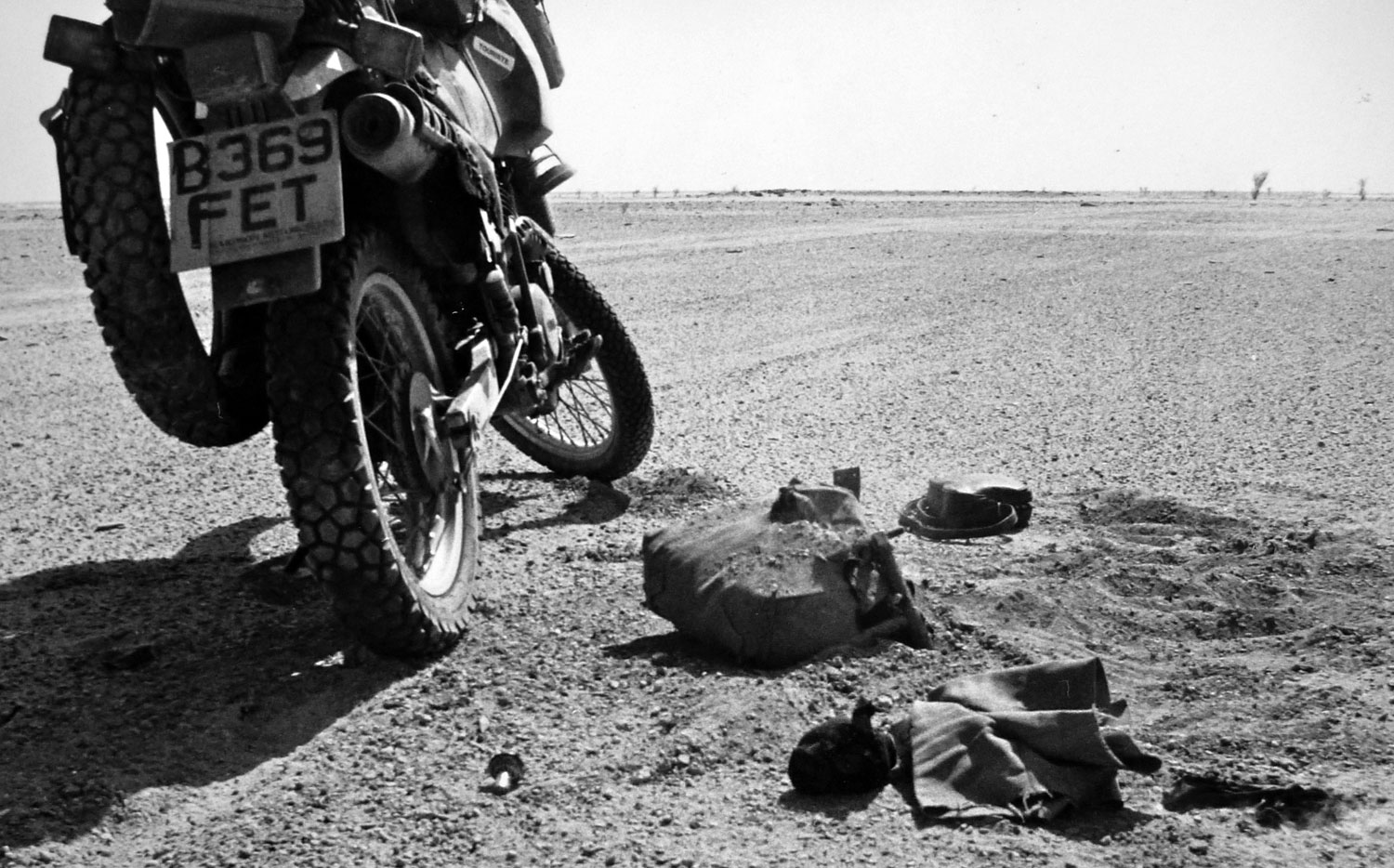
Now Giant Loop have joined the likes of Enduristan, Adventure Spec and a few others in producing a conventional throwover pannier, the Siskiyou, named after a mountain range in southern Oregon. These types of panniers are just about as old as motorcycling of course, up till a few years ago Ortliebs were widely used by moto travellers. I recall my first pair of ‘soft bags’ in the late 70s, elegant lightweight cases (left) crafted from a lustrous space-age combination of vinyl-coated cardboard. But this was the advent of the monoshock era where soon they’d be no more twin shocks to keep the swinging pannier backs out of the rear wheel or final drive. As I say elsewhere, over the years I’ve melted my fair share of soft panniers and even dealt with small luggage fires (right). Nevertheless, I still prefer soft luggage for overland or adventure travel despite the drawbacks of security, perhaps combined with one small detachable hard case for valuables.
These panniers were sent to me for a quick look by Adv Spec
WHAT GIANT LOOP SAID AT THE TIME … A ‘round-the-world contender, Giant Loop’s Siskiyou Panniers™ combine the convenience of hard panniers with all of Giant Loop’s performance advantages. Rugged, rackless, lightweight — and damn sexy…. Backed by a Limited Lifetime Warranty…
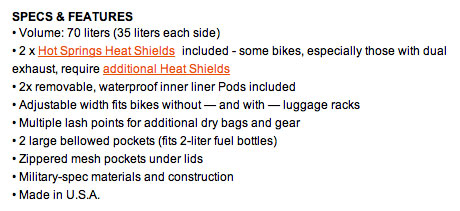
The GL website specs shown above left also claim each pannier has a volume of ’35 litres’. I’m not the first person to question how they arrived at this figure; my calcs put it at more like 24 litres. We’re all used to exaggerated claims, but that was quite a discrepancy. I read that they measure their luggage products by filling them with beans and doing so I suppose it’s possible that a soft fabric pannier would bulge out. In fact I’ve since found that that is exactly the case so Giant Loop’s estimate of 35 litres is right in the ball park.
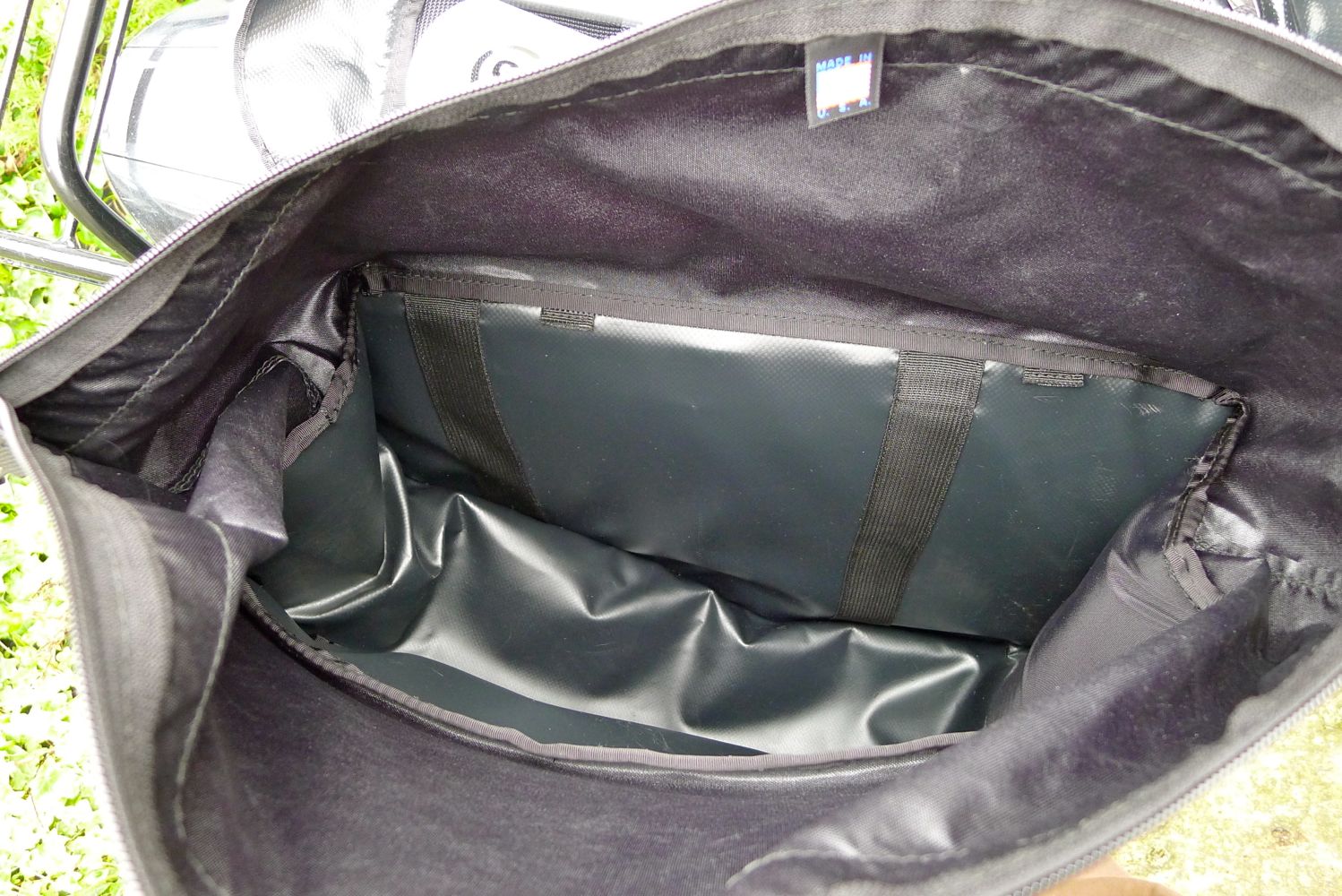
GL are fairly ambiguous about what they’re made from other than ‘military-spec materials and construction‘, but it looks like the well-proven and widely used combination of a Cordura shell with a vinyl back, interior and lid. Unusually, sandwiched inside this thick shell is an unseen additional layer of closed cell foam, or something similar. It helps shape the bags and also reduce damage by padding the contents when you crash. GL wisely suggest that any hard-edged items in the baggage are well wrapped for such an eventuality: it’s standard practice in packing soft baggage.
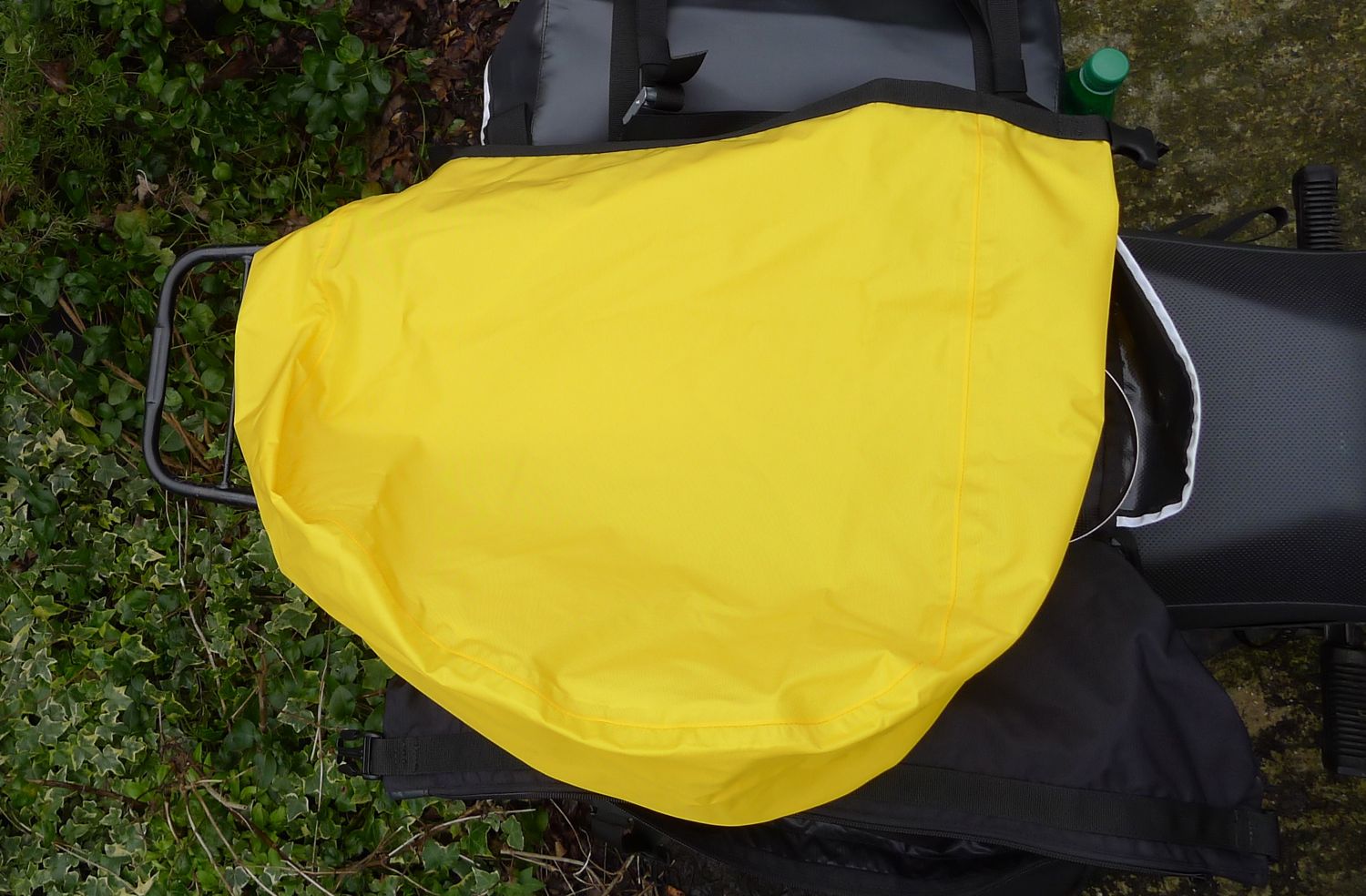
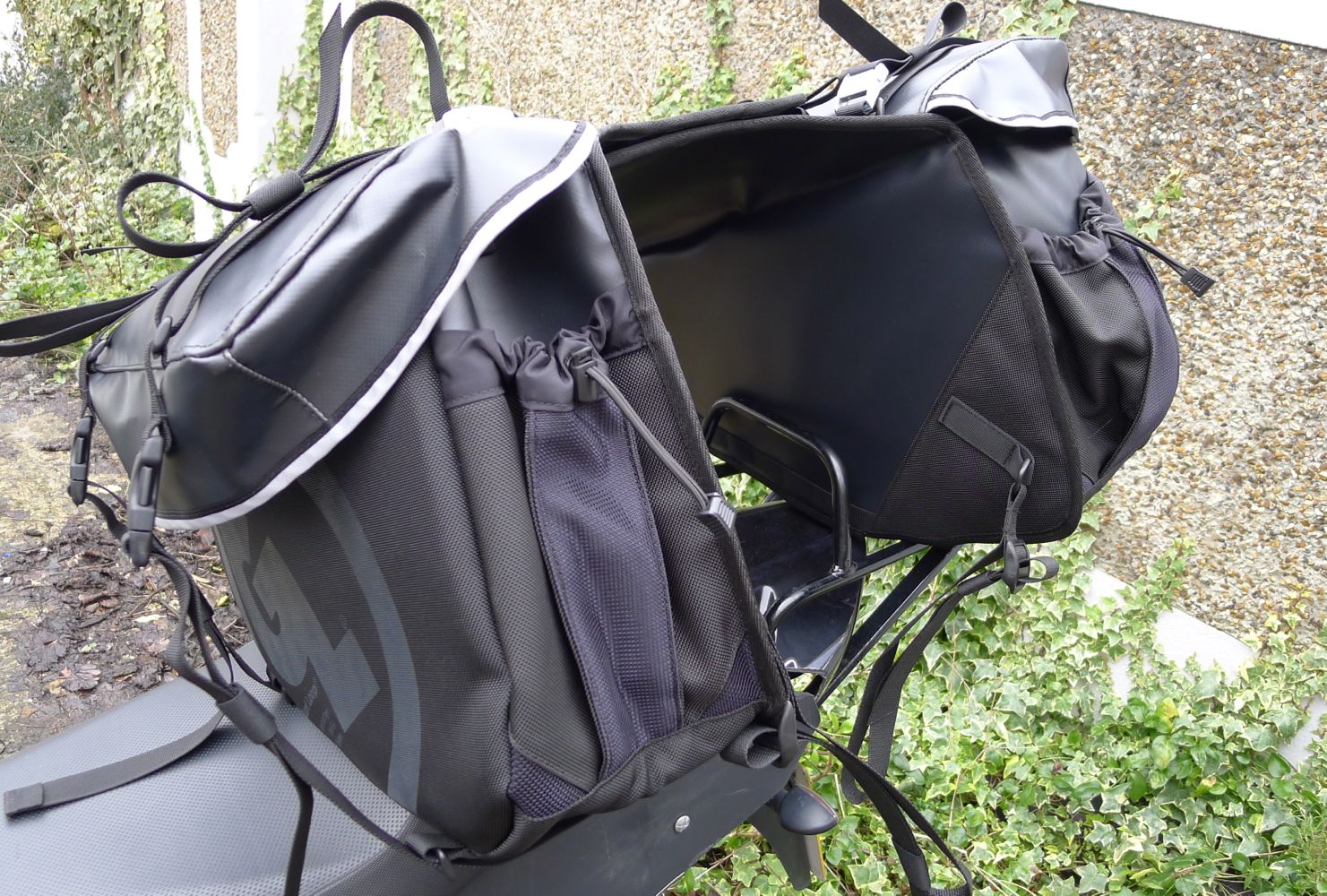
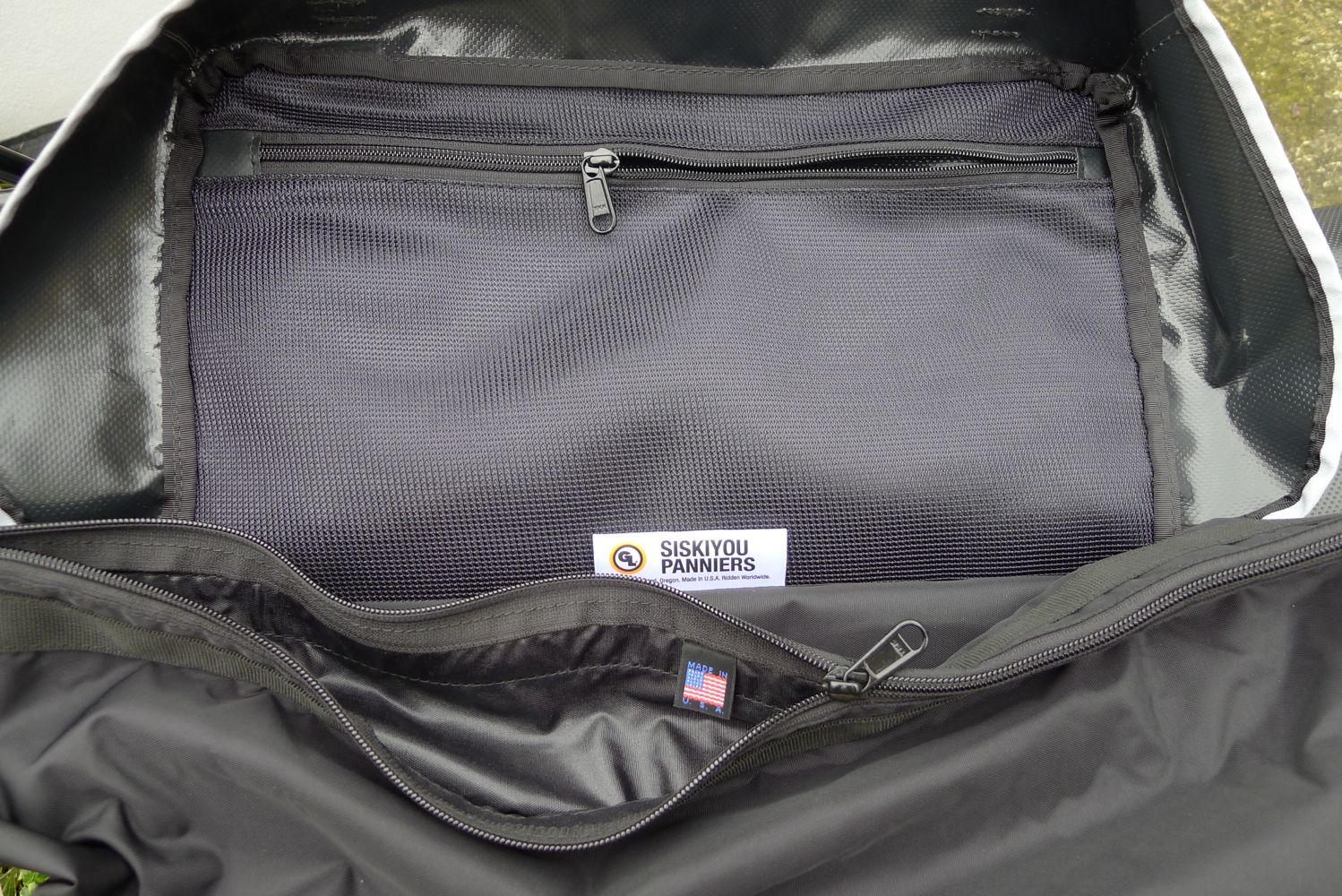
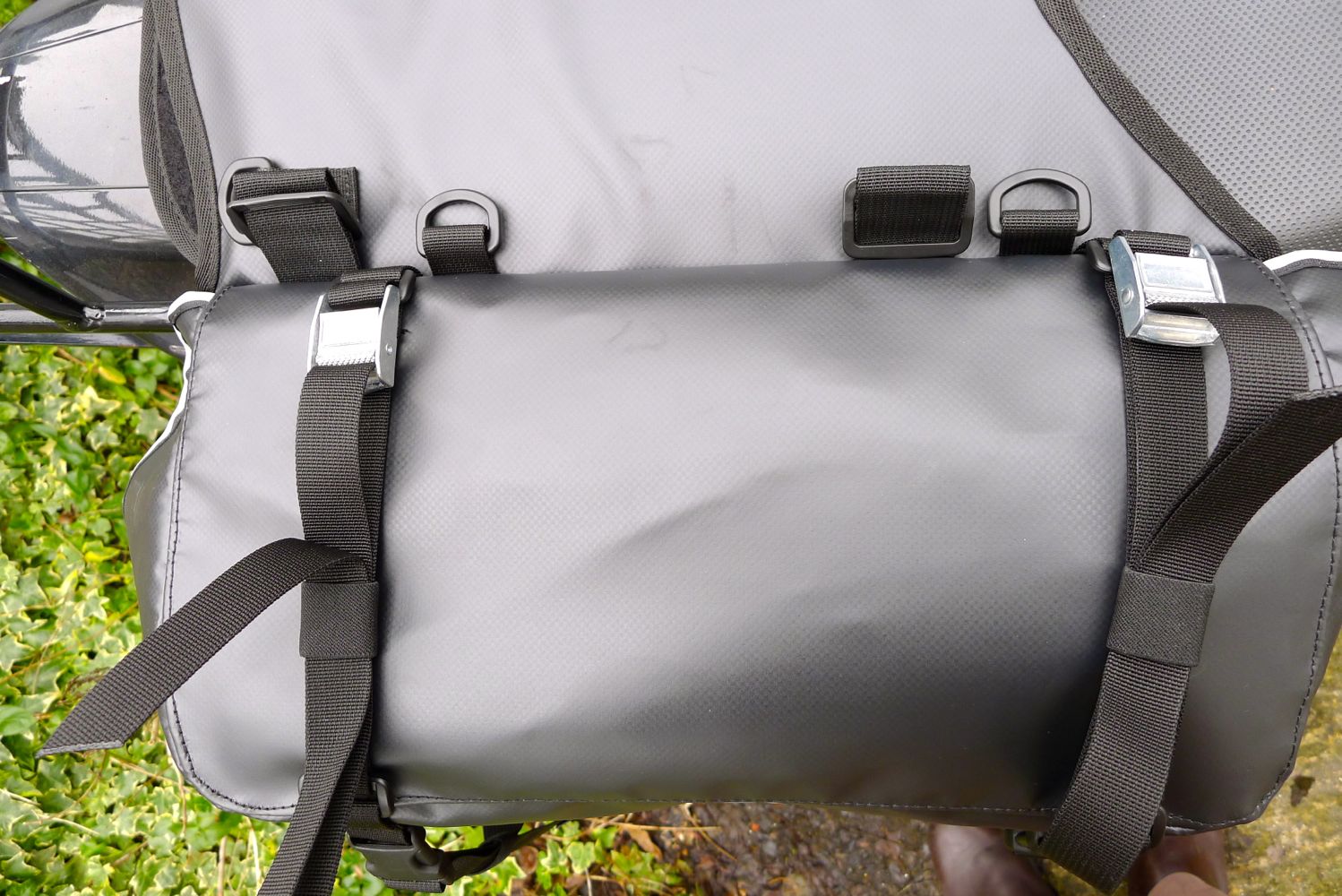
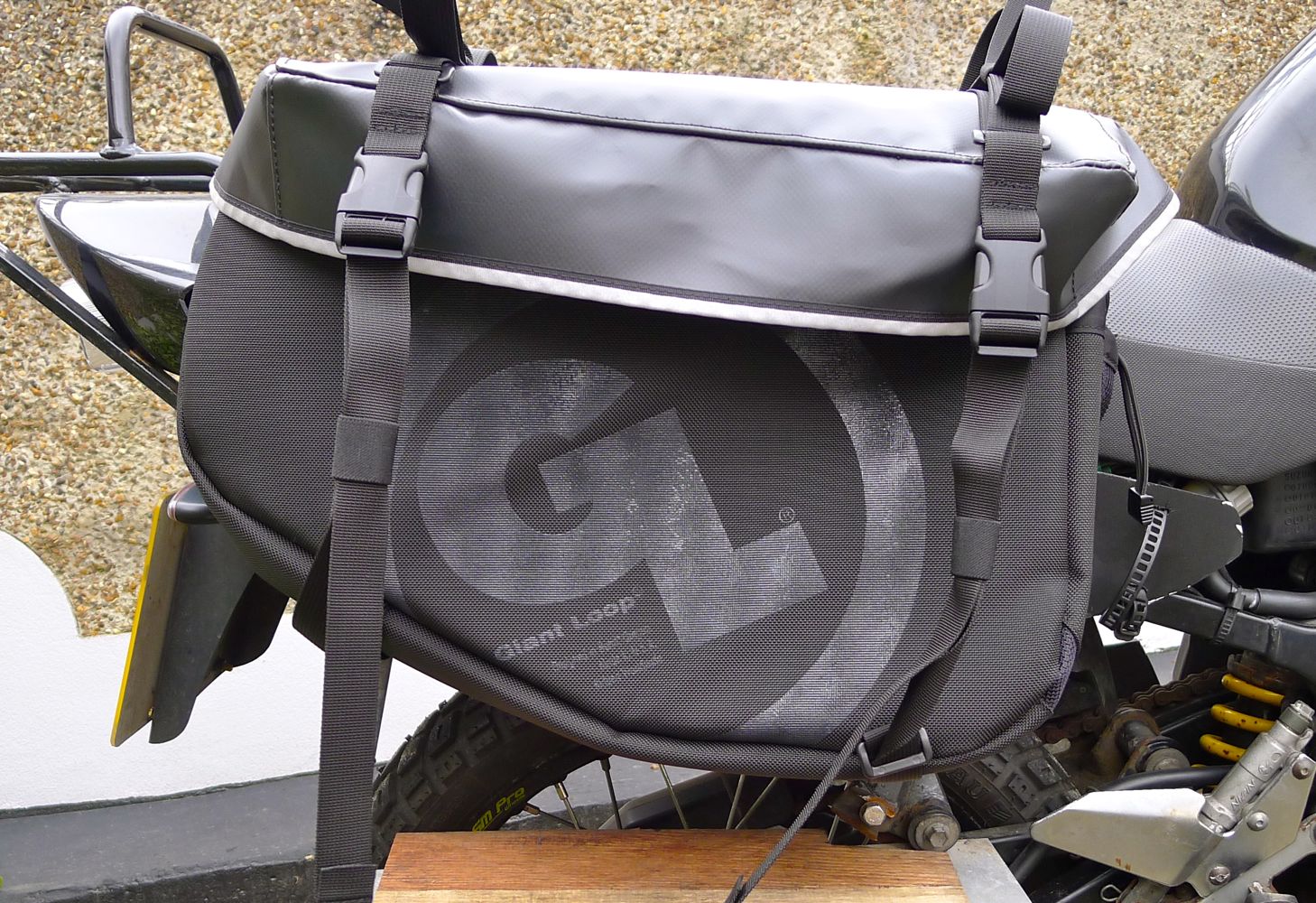
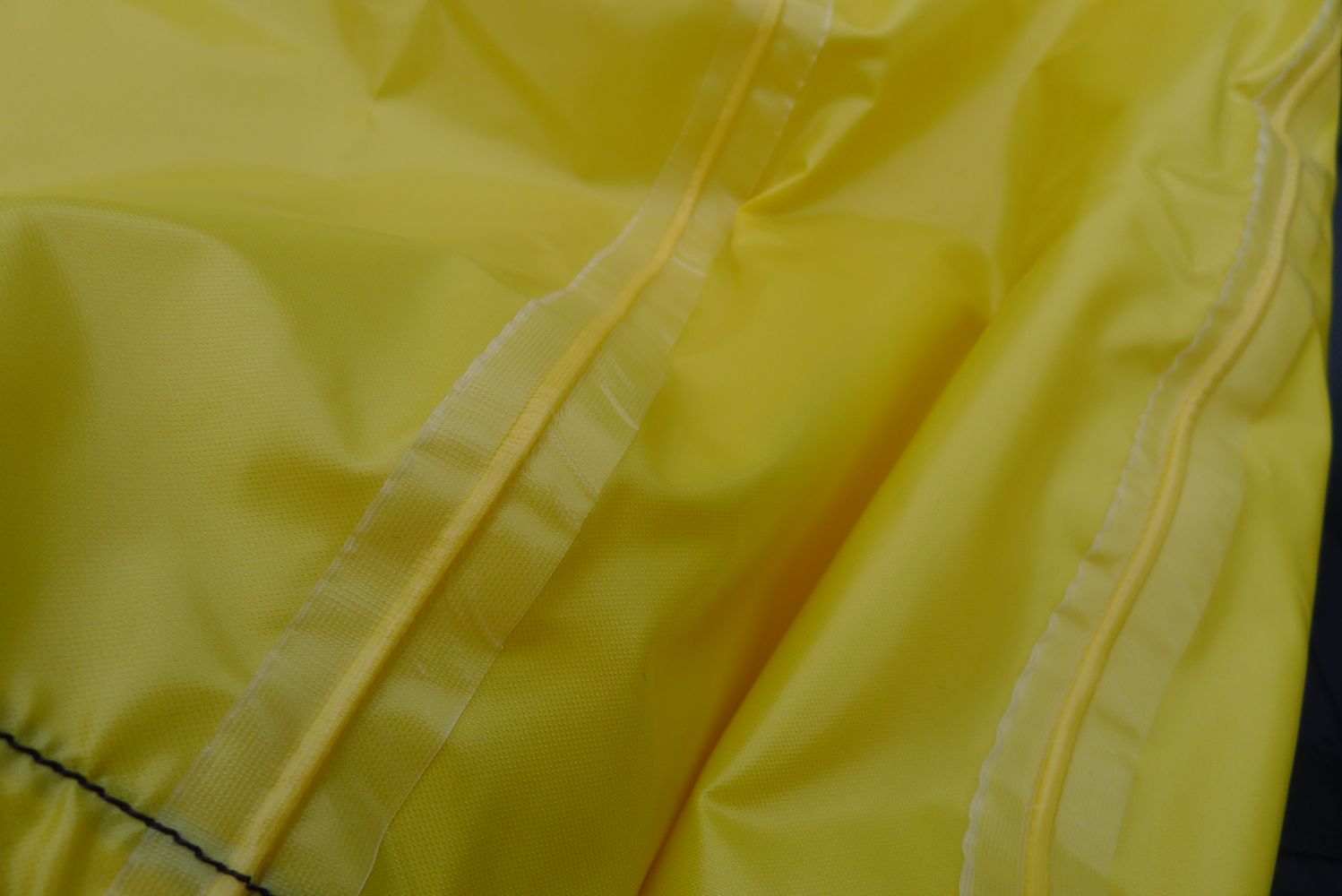
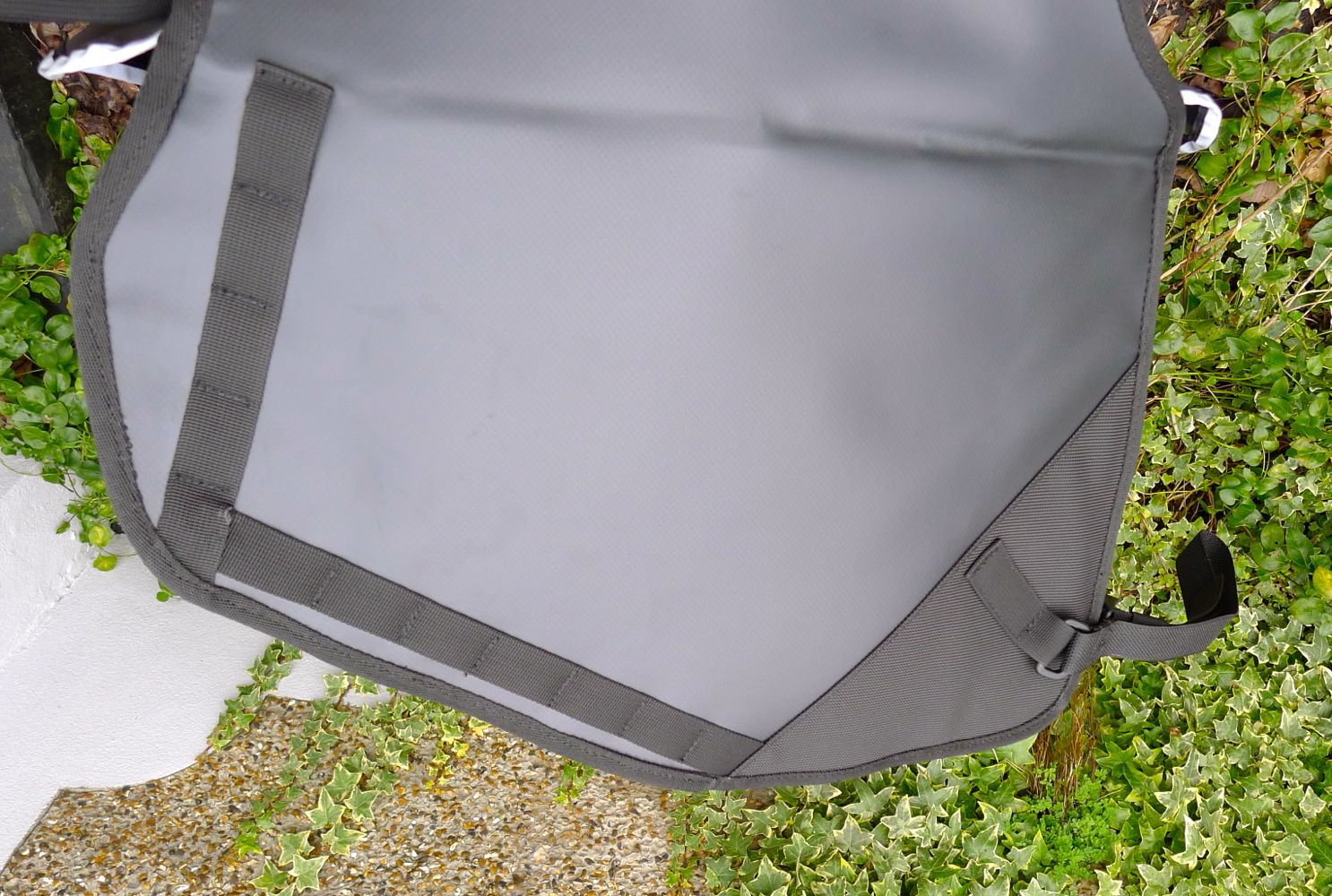
Rather like the Monsoons, the top edge of the Siksiyou’s shell has a sewn-on sleeve of coated nylon with a thin zip and roll-up clips, similar to a dry bag. Inside you get a separate yellow nylon liner (below right) cut more or less to fit in the panniers, with well-taped seams, a thick layer of TPU coating on one side, plus another thin zip and roll-top clips. Over the top of this drops the thick PVC lid which clips down on straps, with additional separate straps for attaching stuff to the top of the lid rather than tucking it under the lid straps – another nice touch. Inside the lid is a flat zipped mesh map pocket.
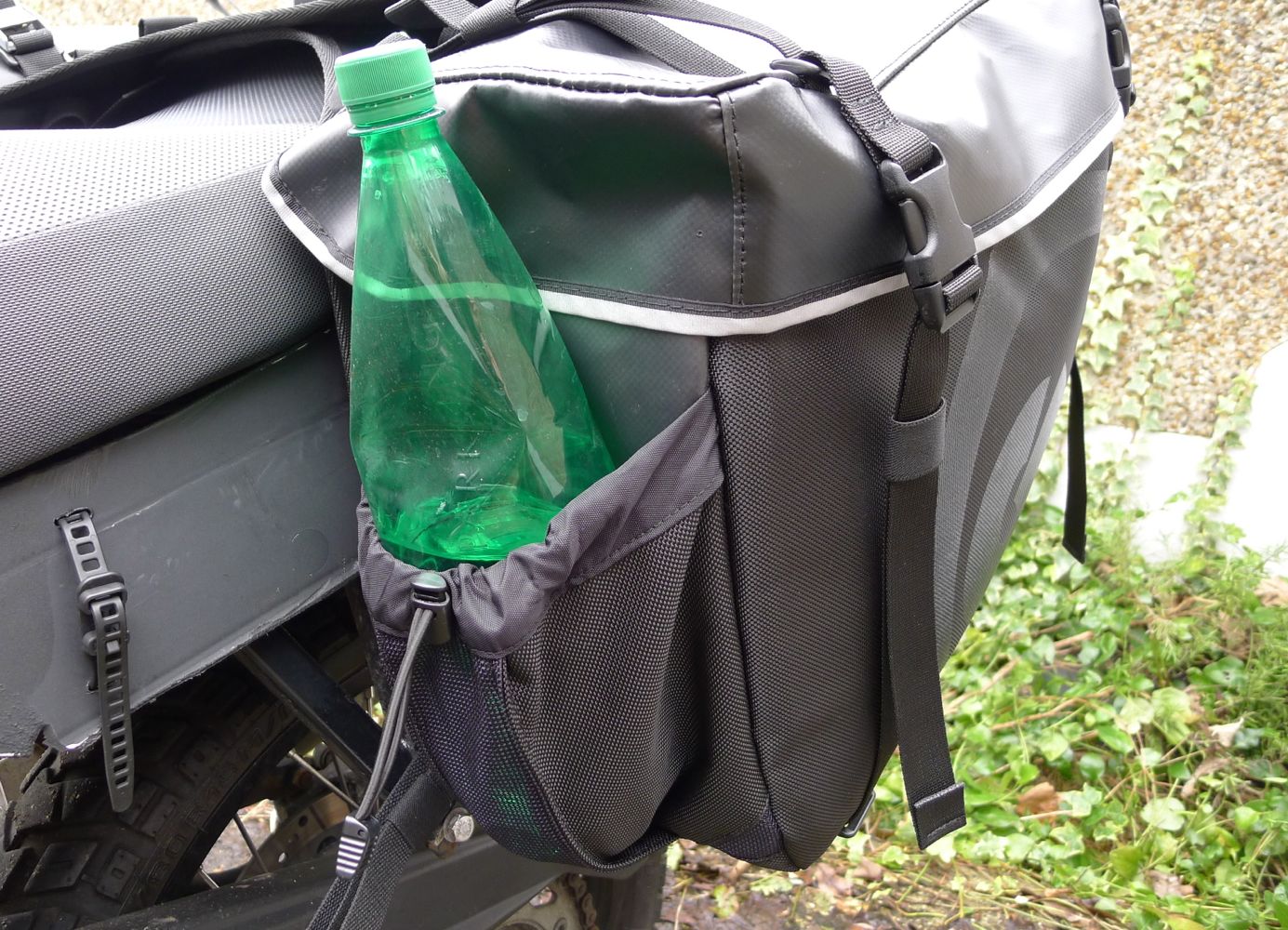
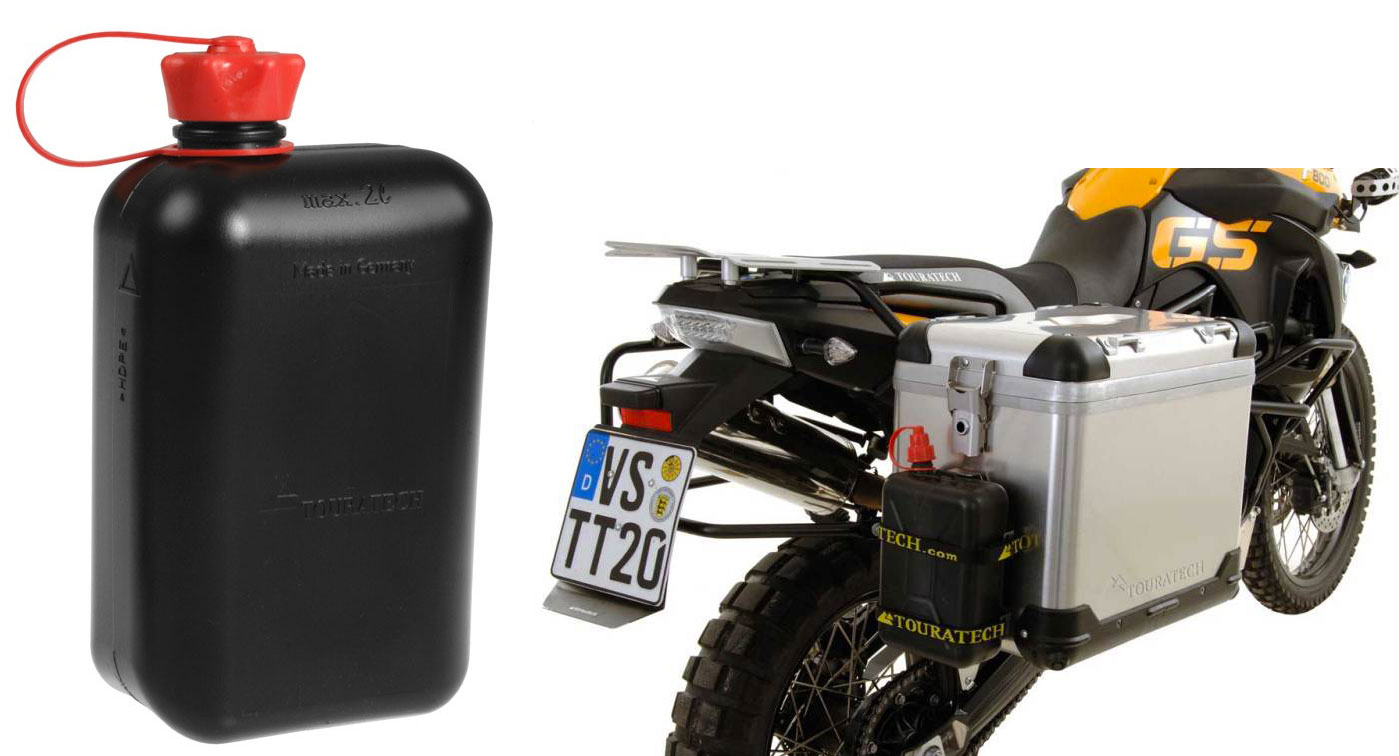
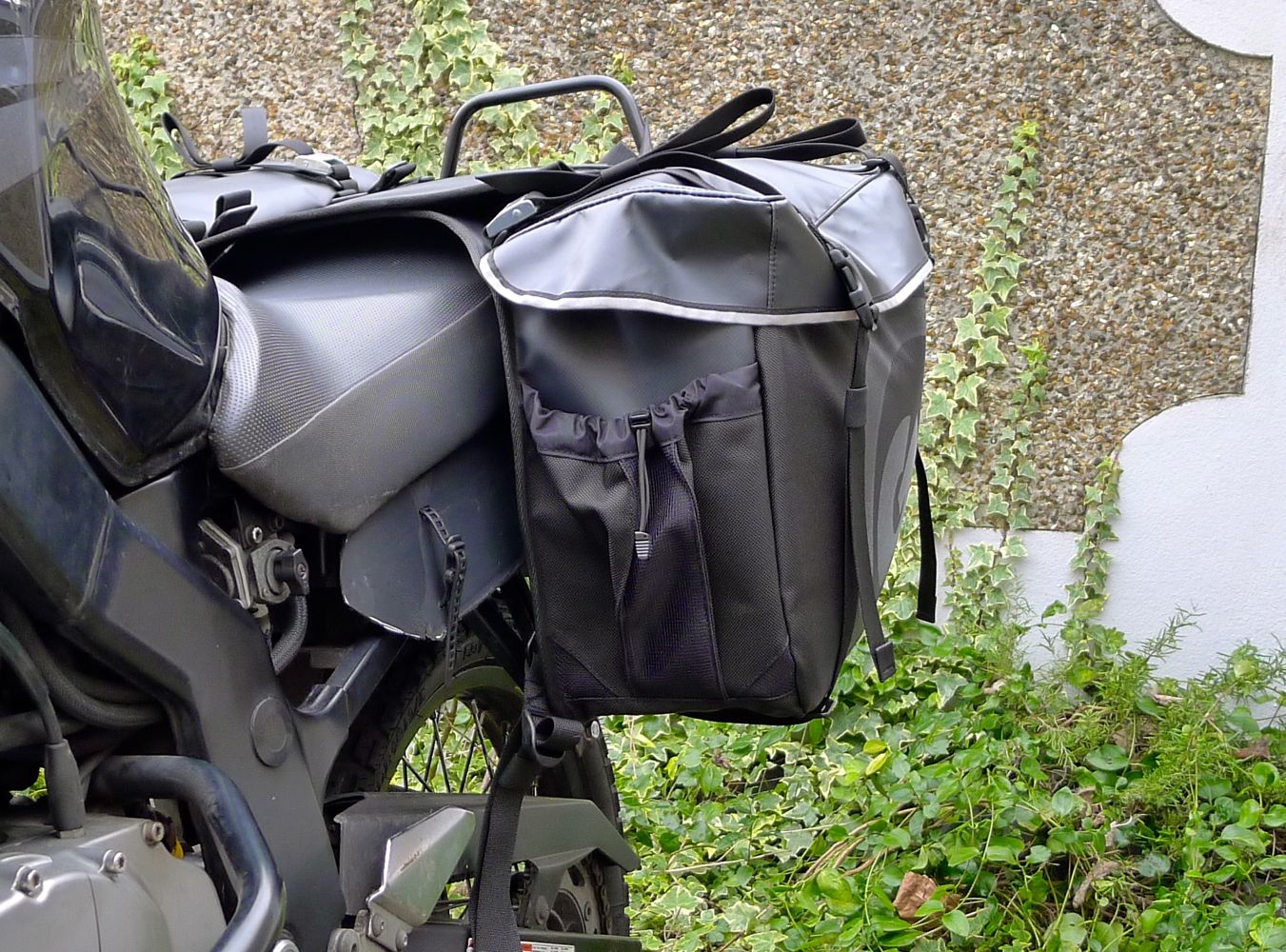
There’s also a small cinch-cord pocket on the front of each pannier, but although they describe it as ‘bellowed’ it’s actually a simple wedge that’s nowhere near as big nor usefully box-shaped as the four pockets you get on Magadans although it’s said they’ve been designed to take 2-litre Touratech cans, as pictured left. On the right, a 1.5 litre water bottle in the pannier’s pocket.
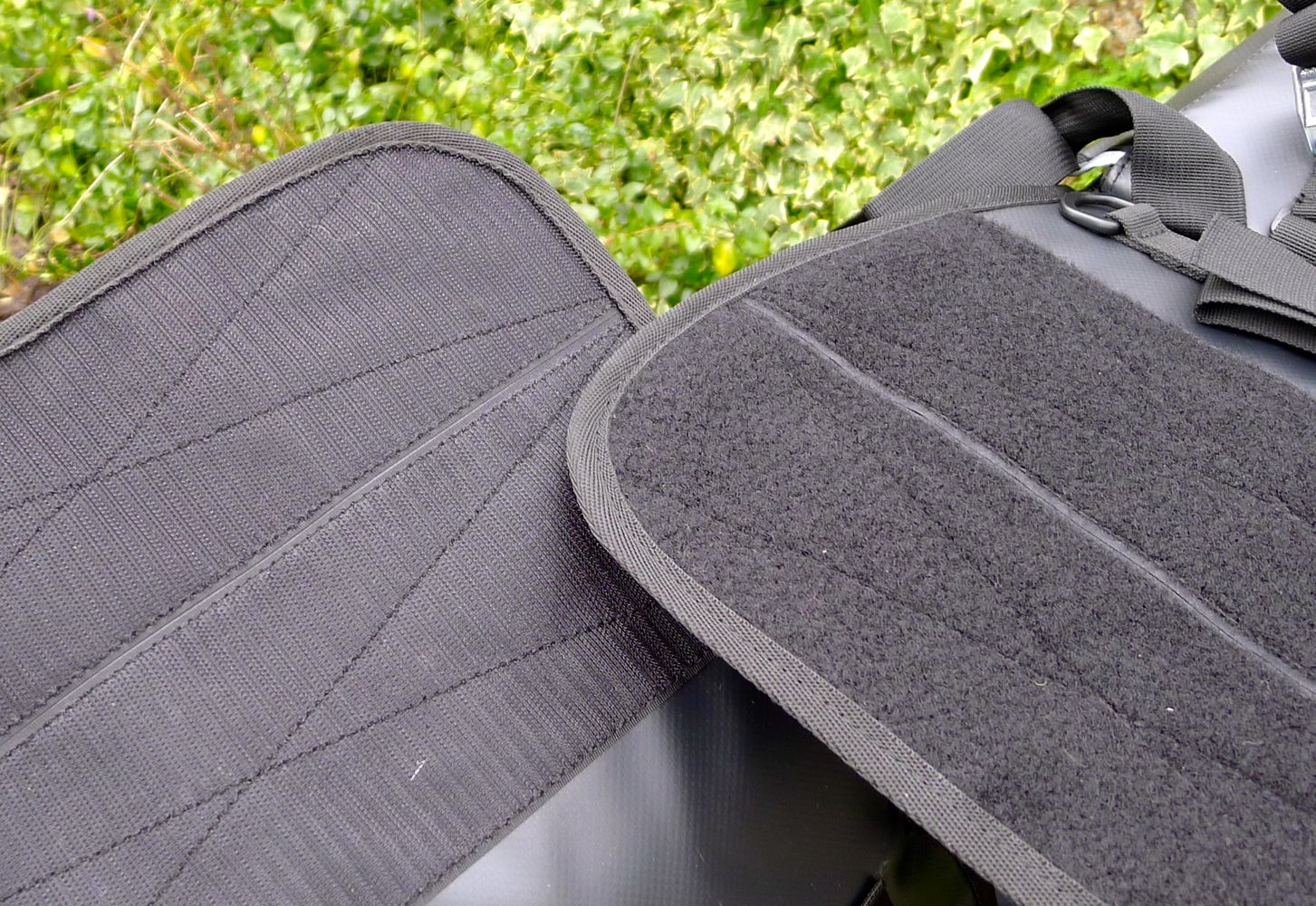
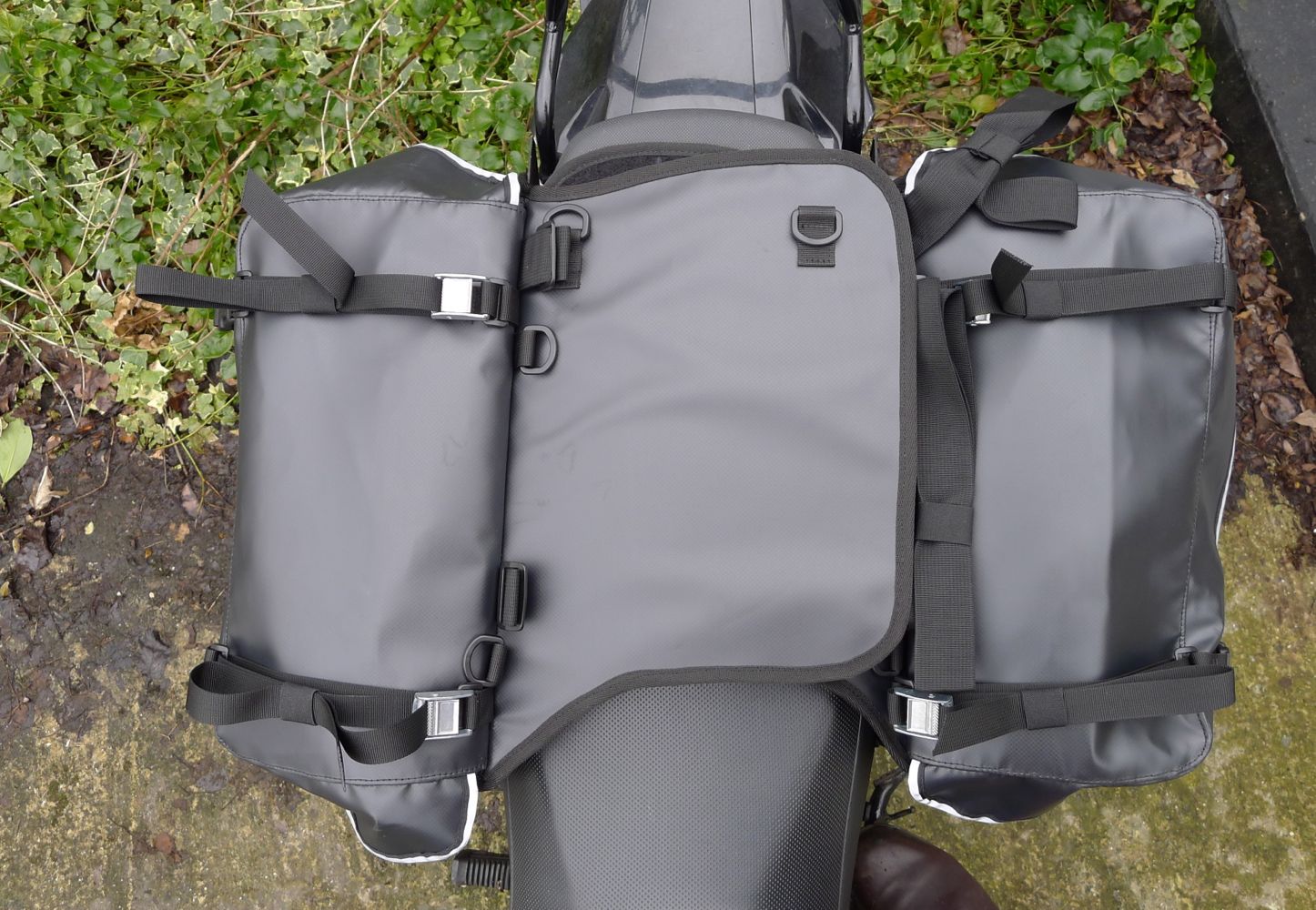
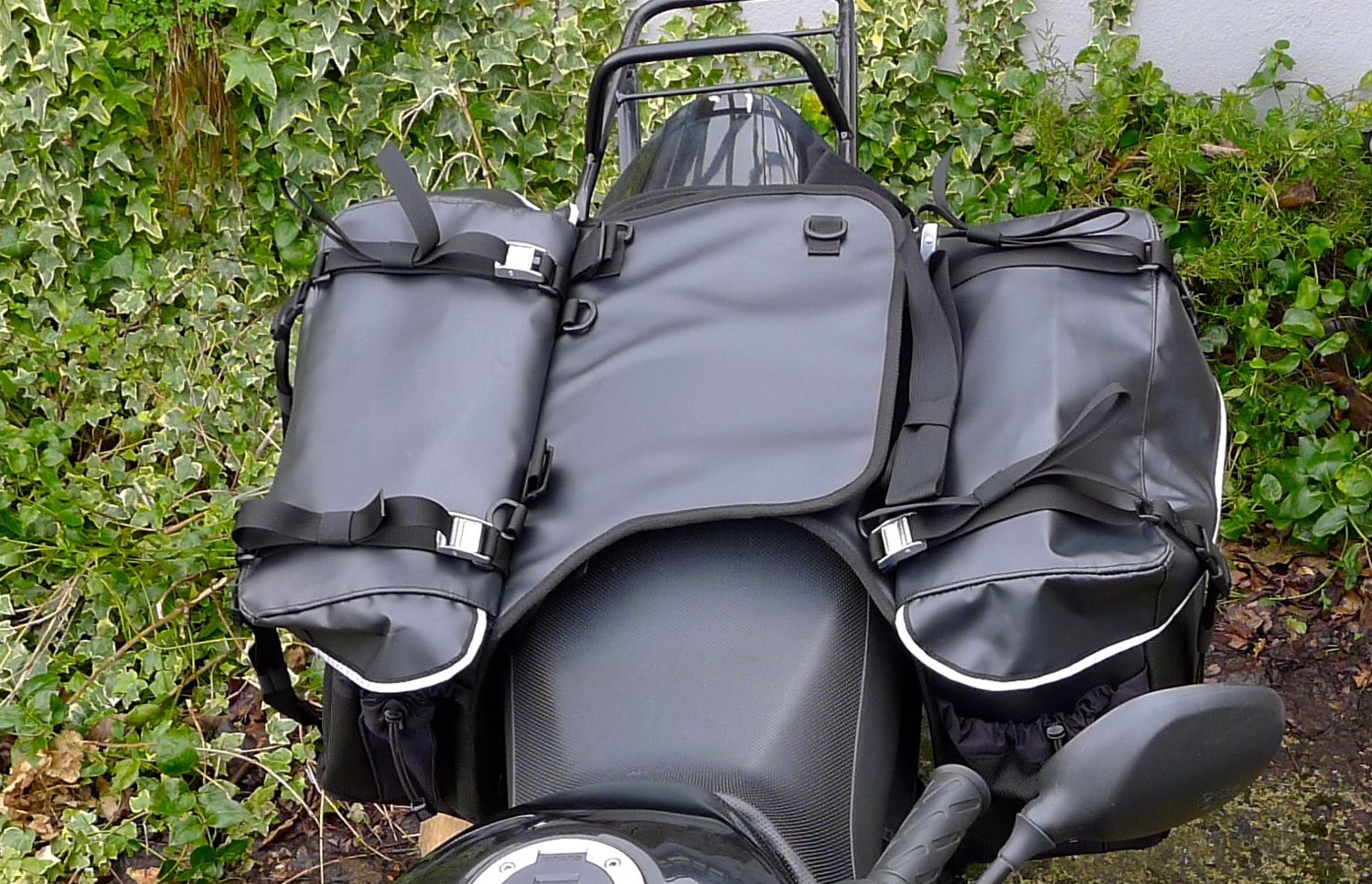
The two bags join together using broad vinyl velcro pads. These pads feature additional lashing rings to secure other luggage or to fix it all to your bike. The Magadans use the same system, but with a pair of wide velcro straps rather than full-width pads which seems bit OTT. Me, I’d prefer buckles and straps over velcro anyway, because as the volume of your load changes or rough roads take their toll, fine tuning the tension may be required – and that’s much more easily done with adjustable buckles that super sticky velcro, be it strap or pad. On the Mags such a buckle mod is easy to do – with the Siskies you’re stuck with the pad which I’m also not sure would be great to sit on on a hot day. The GL installation page suggests: “For 2-up riding, affix a small seat cushion to the top of the Siskiyou Panniers“.
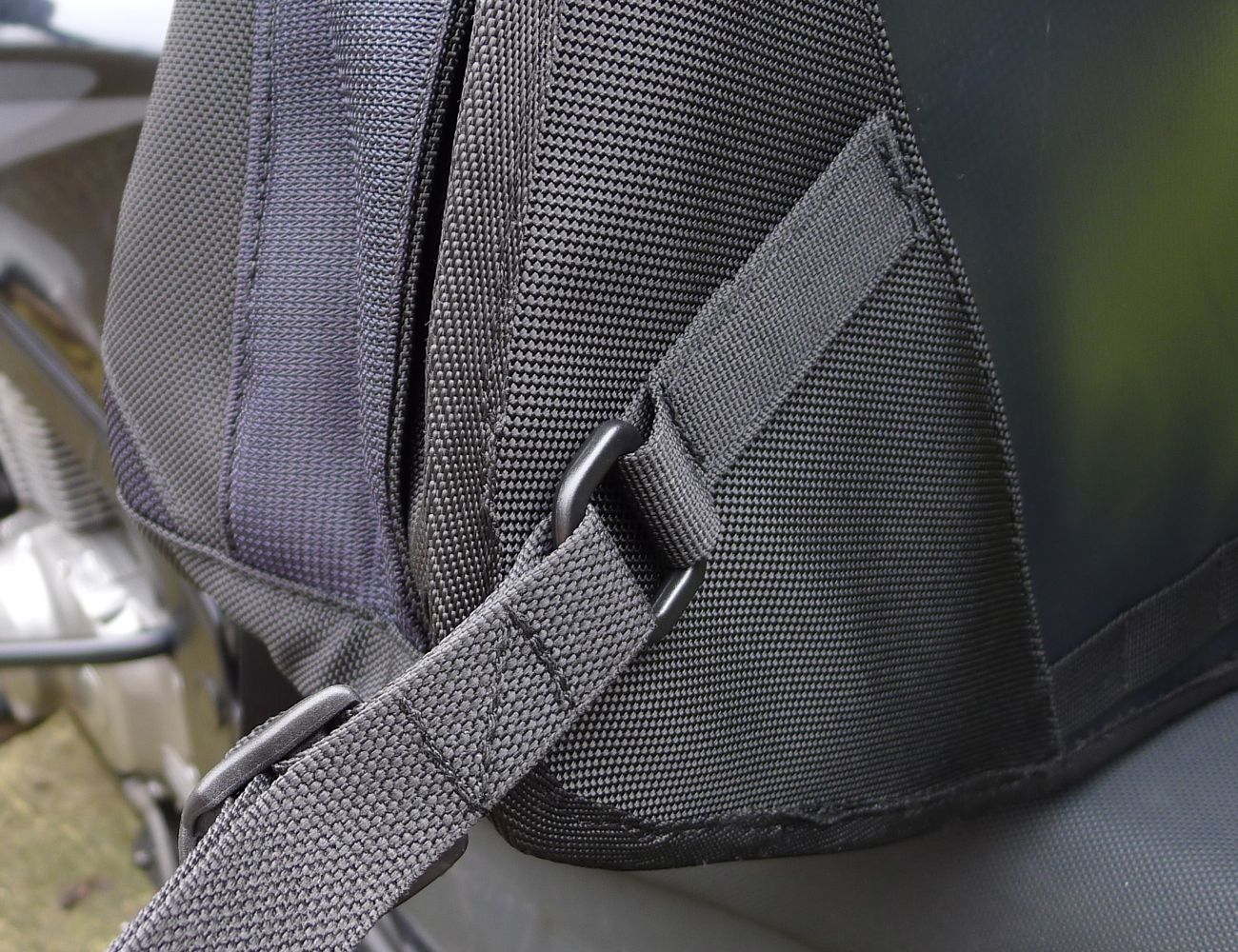
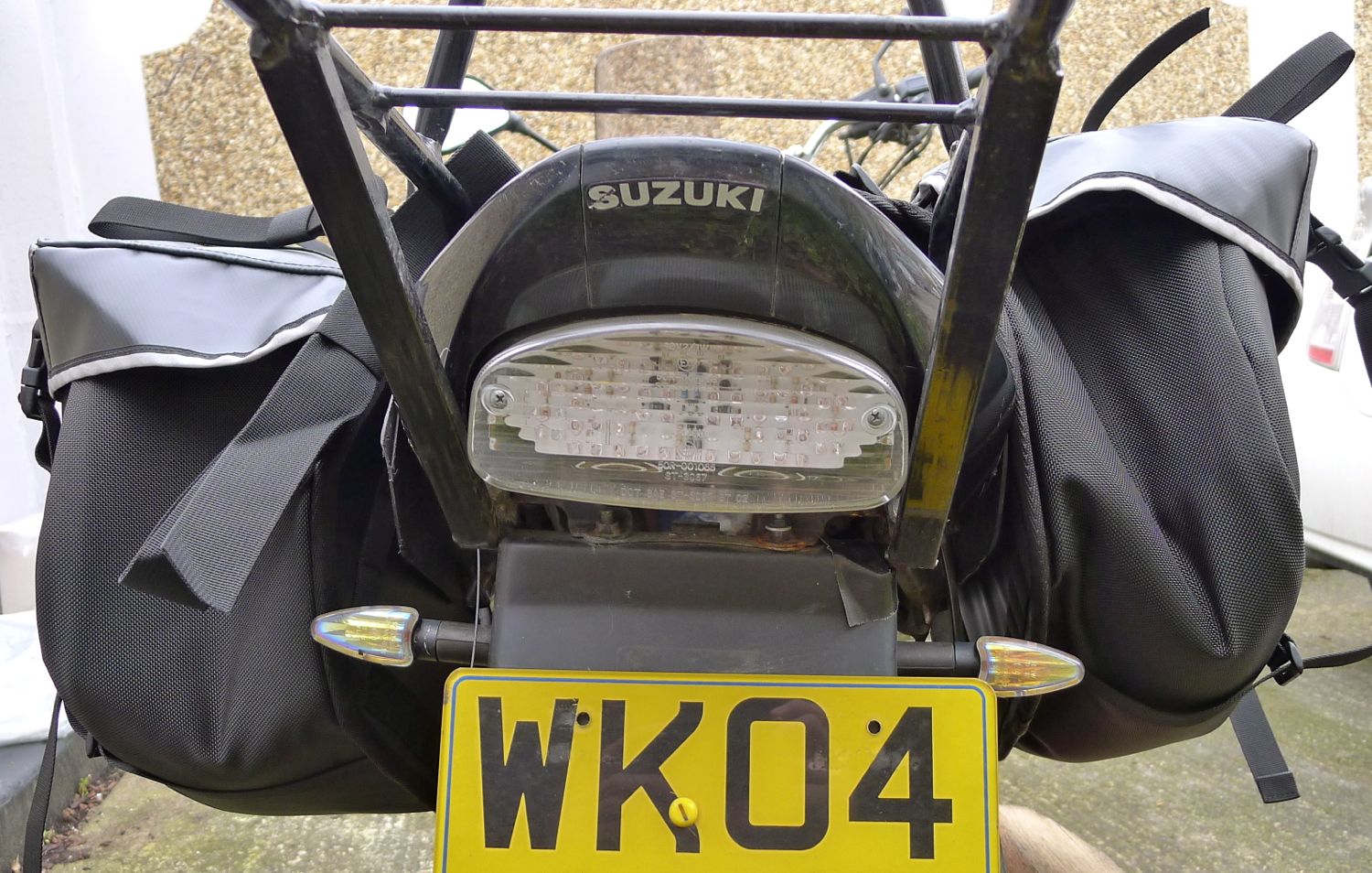
To stop the bags sliding back you get a strap to attach to the pillion footrest or thereabouts (left), as on the Monsoons but something that was missing from the Magadans’ first version. Subsequent versions low have a tie-off D-ring.
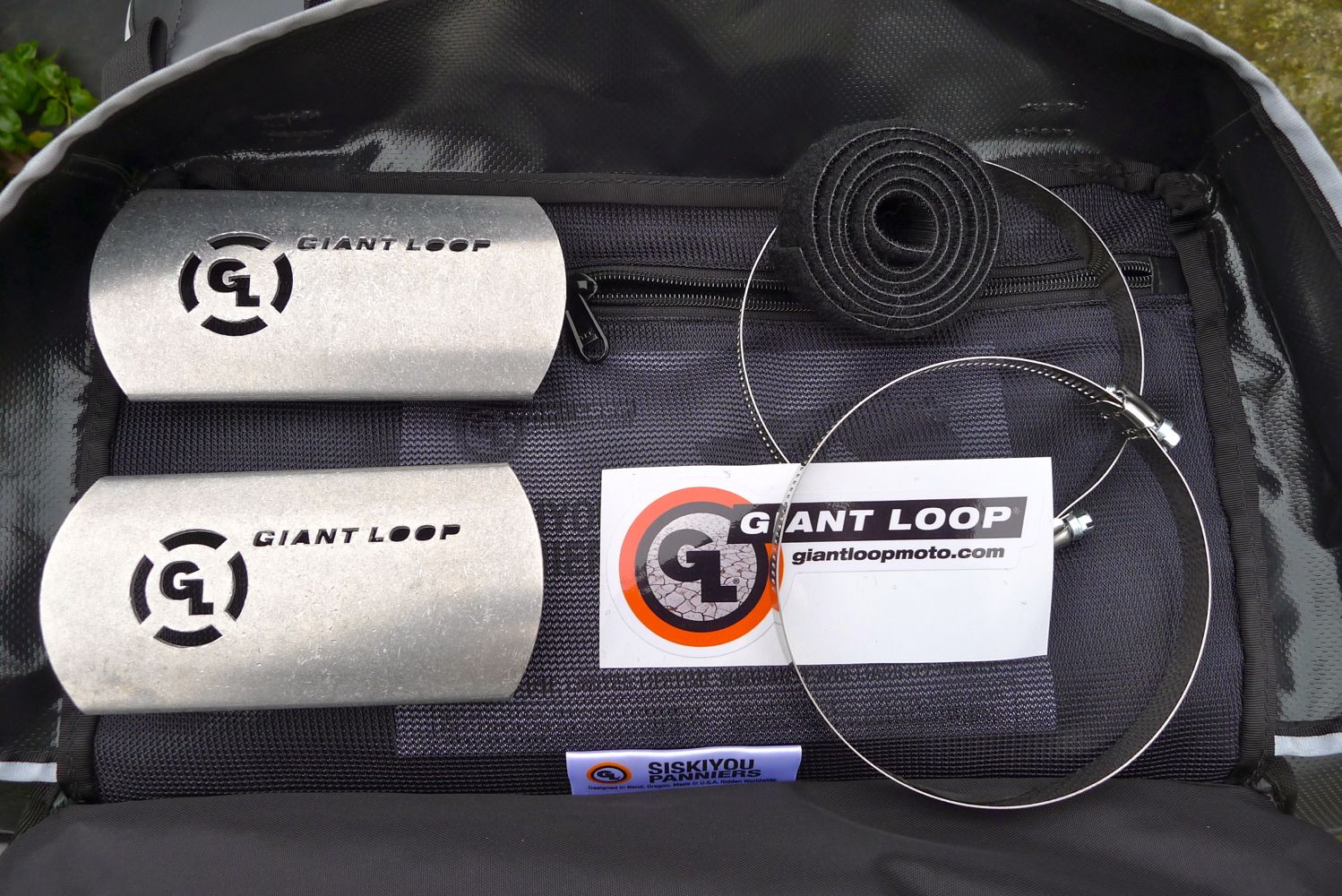
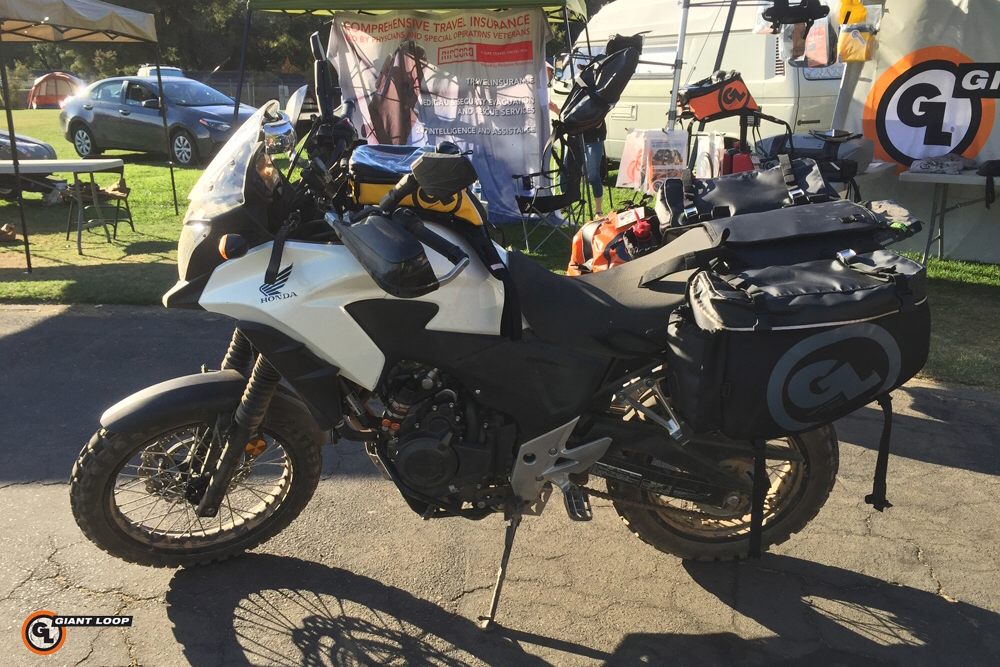
Included with the Siskiyou bags are a pair of alloy exhaust guards (rather like I bodged on my Suzuki – I got the idea from GL). You also get two hose clips, some instructions and a sticker and to stop your sidepanels getting scuffed GL can also supply some protective vinyl film. The exhaust guards are an admission that many a soft pannier has melted like a Cornetto when it shifted or otherwise got too close to the pipe. Modern efi bikes with catalysers run especially hot and indeed the Siskiyou panniers tested on a Husky Terra by Cycle World magazine (April 2013) melted. So like GL say, additional guards may be needed. On any bike you need to think carefully how loaded throwovers will react when they shift on rough roads against a hot pipe. This need avoid or deal with meltdowns with soft bags is why some riders understandably prefer hard alloy or firm resin boxes, although in my opinion mounting soft bags on some sort of rack is the way round this flaw.
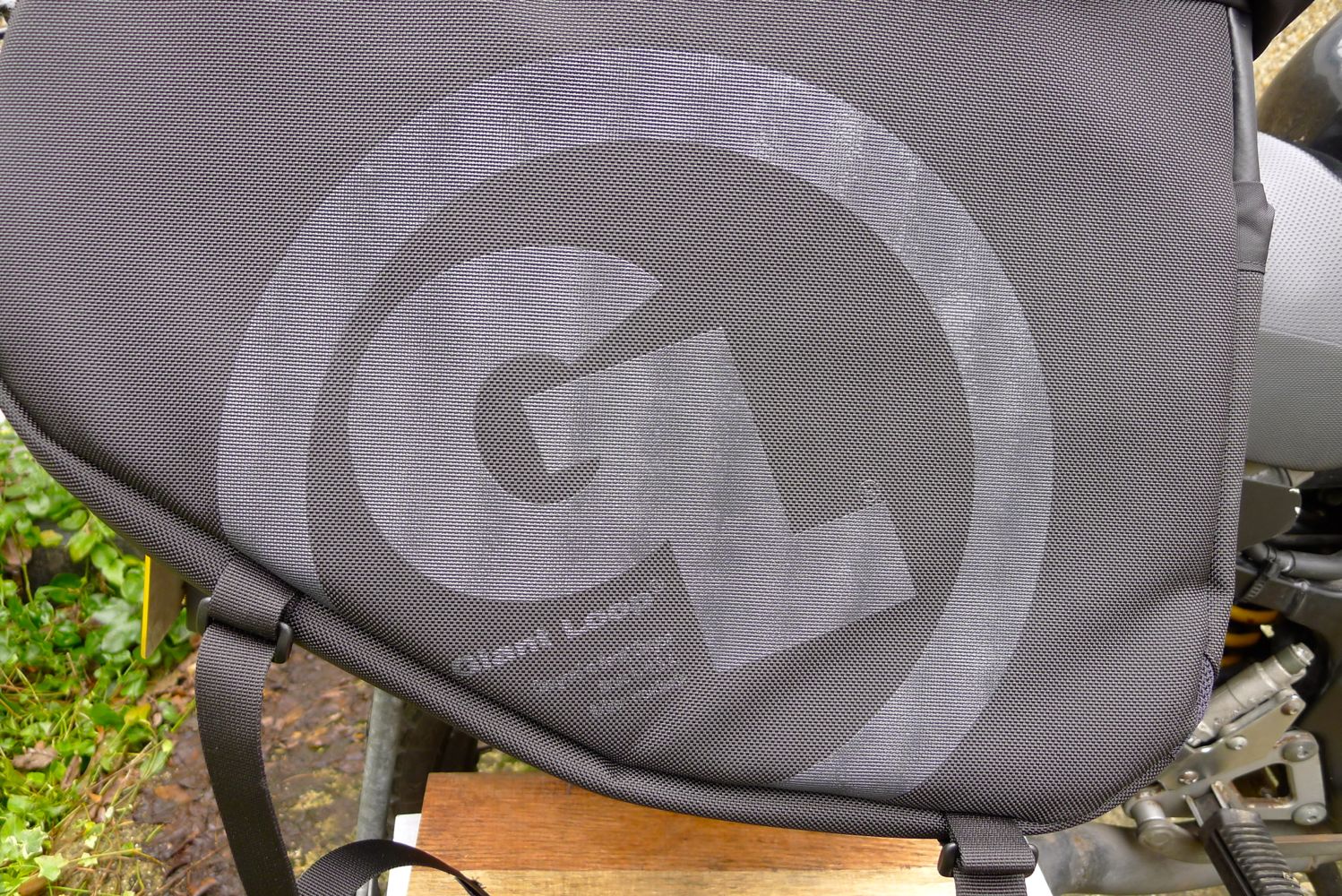
The Siskiyous have a sporty cutback base which makes them more suitable for regular bikes with low, upswept pipes. Whatever, this shape will greatly increase the Siskiyou’s fitting options to many more bikes than the usual adv suspects. The GL logo is emblazoned on the sides, but in a pleasingly understated way. Unless that ‘GL’ logo glows, I’m not sure there any reflective surfaces as found on the Mags and Monsoons – possibly the thin edge of the lid?
I did also wonder if access would be a bit of a faff. If they’re fully locked down you unclip the two lid straps, unclip and unroll the outer bag and unzip it, then unclip and unroll the inner bag and unzip that – and you’re in! Of course you don’t need to use those zips; their protection against waterproofing is minimal and zips can jam or break when dirty or used carelessly. In this respect I prefer the bomb-proof, roll-top simplicity of the Magadans and the Monsoons.
So all up you’re getting a good sized touring pannier that looks well made and is usefully featured. The foam protection sandwich is a nice touch, as is including exhaust guards and several lashing points on under and behind the bags; you get a feeling they took a lead from Enduristan here. But – is this £475 ($700) worth of pannier when in the UK Magadans go for £350 and Monsoons for just £230? I wondered that perhaps if you’re paying for the ‘limited lifetime warranty‘ but that only covers the “original purchaser… against … defective materials and craftsmanship only, and does not include damage due to normal wear and tear or misuse“, so no big deal there; after a year they could just put any failure down to wear or misuse.
Siskiyous look like they were designed for on a Honda CB550X Rally Raid
The Siskiyou panniers certainly feel like they’re up to the rigours of overland travel and design and features fit the bill without any radical innovation. You just need to ask yourself in turn whether the bill for a set lives up to your expectations.
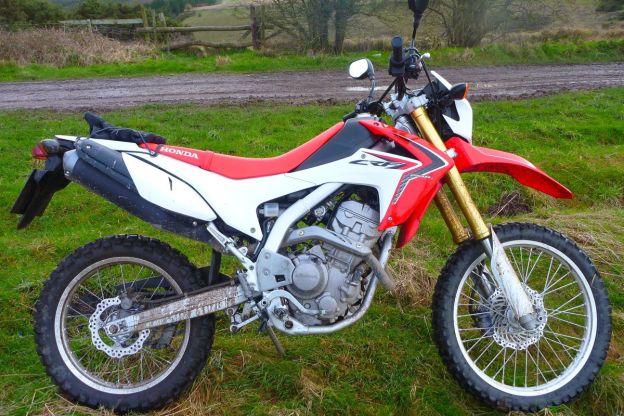
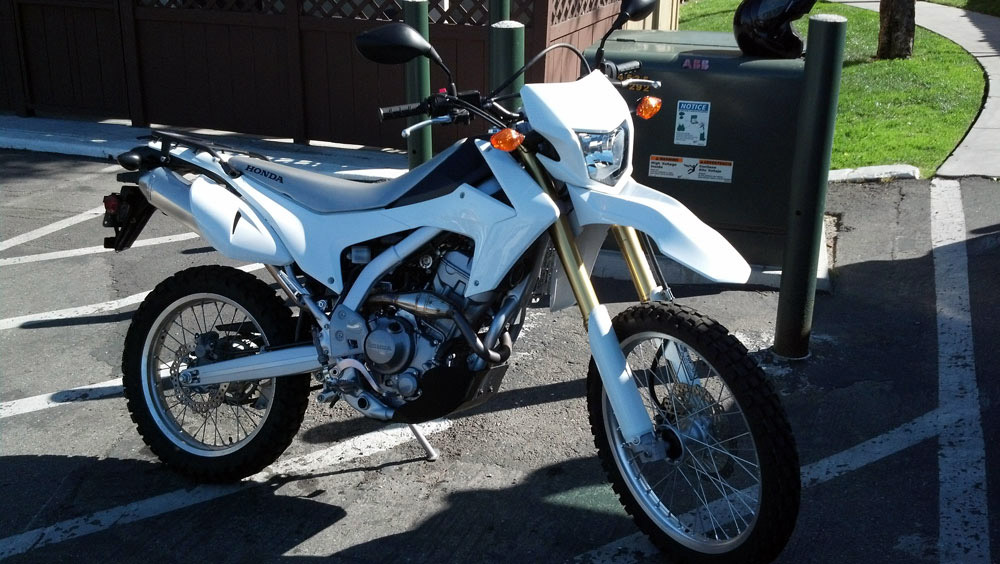
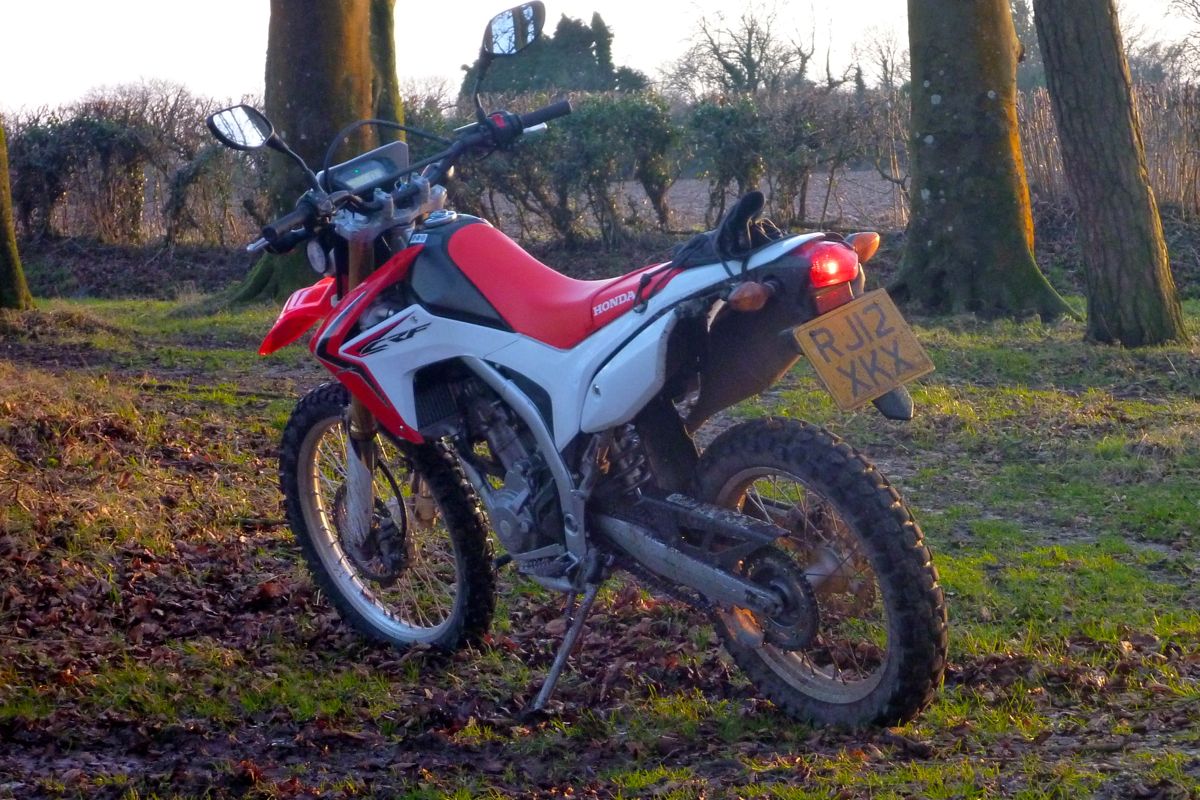
Following my UK test ride on the CRF a few weeks later I bought a lightly used one blind off San Diego Craigslist and got it trucked to Phoenix. CRF’s had sold well in the US and were getting hard to find new at the time, but $4500 got me one with under 1000 miles and about $1000 of accessories, including what looks like a BDSB Stage 1 kit (pipe, fuel programmer, 13T), Shorei battery, bash plate, tail rack and maybe some other bits too. As you can see the first owner swapped the red plastics for ‘export white’ which suits me fine. Buying barely used seem by far the best way to go. New with taxes was actually way over $5000 with $1000 of depreciation right there before you spend a typical $1000+ to get it in shape for dirt touring.
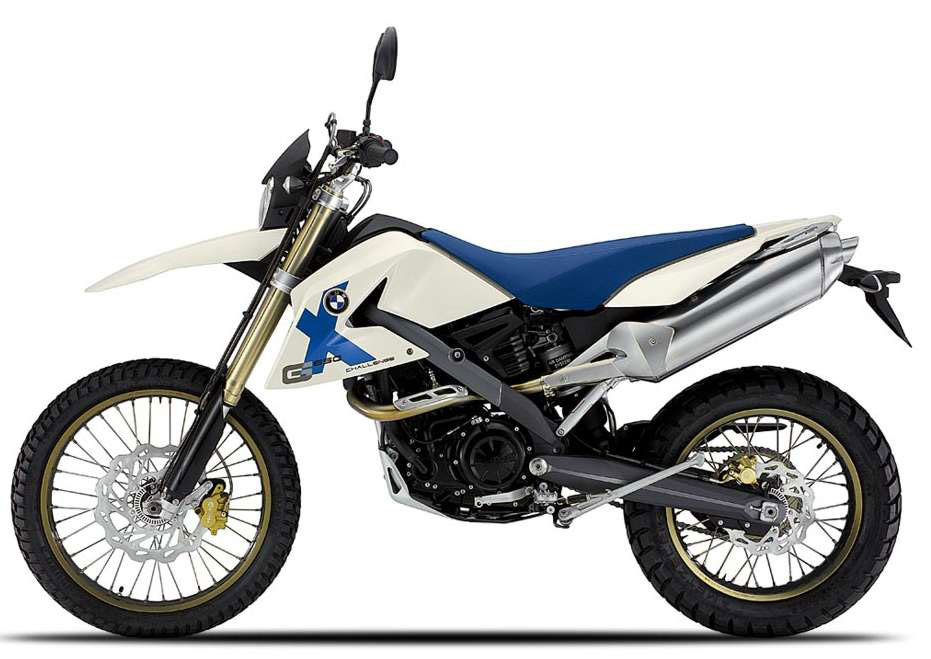
While I was looking for a machine I was kindly offered the loan of a near-new XR650L by Scott Brady at Overland Int. (publishers of Overland Journal which I write for occasionally). But having used an XRL for Desert Riders some ten years ago (left) I felt that was too much like going backwards. For me the point with AMH project bikes is to try new stuff or new ways of doing things. The other option was getting a used 650 Xchallenge (right) for about $5500. I suspect they’re much under-rated but a scan of what happens when they’re not made it a bit of gamble to simply fly in, load up and ride off into the southwestern deserts, hoping for the best and with no support to speak of. (Since then I bought an XCountry in the UK).
With the little Honda 250 I have no such reliability worries, even if the usual calamities can befall me. I was also considering trying to get my hands on the opposite extreme to a CRF, a CB500X but jumped the gun – it’s not out till May. According to stats it’s said to be significantly lighter than the flashier NC700X which has been out a while, but with a pair of K60s the 500X would most likely be quite tolerable on the sort of dirt I plan to ride, while undoubtably being an armchair on the blacktop. It is of course a 21st-century iteration of my GS500-R project bike; a mid-sized adventursome twin – and allegedly ‘all the bike you need’. Hauling the Suzuki over to the US to put it through its paces was the original plan, but the cost of getting it there and the need to bring it back would have more than the bike’s worth, unless I was heading on to South America. Fast forward three years and I bought a CB500X. I was also told of this guy who put a 500X motor in a CRF frame (left). What will these bikers think of next!
But will the 250 CRF be enough of a do-it-all travel bike? At least I can convince myself that no reasonable trail need hold me back and am already cooking up killer routes in the Sahara should I bring it back. The combination of light weight, reliability, enough power and excellent economy is unbeatable out there, while I like to think it’ll do the business on the highway. The trick will be to cruise the backroads and enjoy the view, between the off-road spells.
What’s the plan? Early April I’ll arrive in the US and set about further adapting the CRF for the ride:
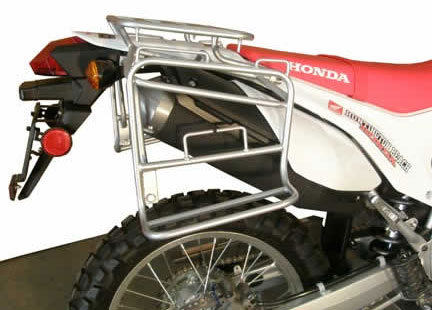
make a pannier rack to keep my Magadans in place – something not at all like the Sequoia rack (right) currently sold by crfsonly but something more like this.
small screen
bar risers
folding gear lever
12v/USB socket and a couple of Ram mounts
handguards
I’ve also been sent a TrailTech Vapor. I liked their Voyager unit on my GS-R except for the token GPS element which is better addressed with a dedicated GPS unit, plus the fact that it couldn’t be quickly removed to avoid theft like most GPS units or similar gadgets. Among the Vapor’s functions are ambient- and water temperatures, a rev counter (missing on a CRF) and a very accurate wheel-calibrated speedo/odo. It tells the time too.
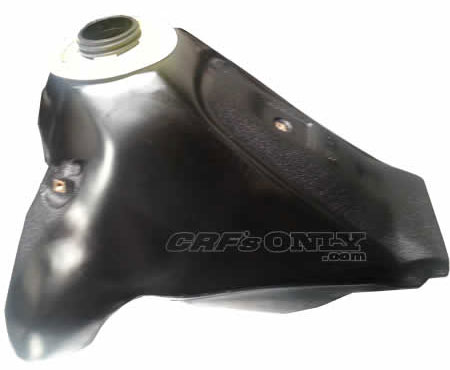
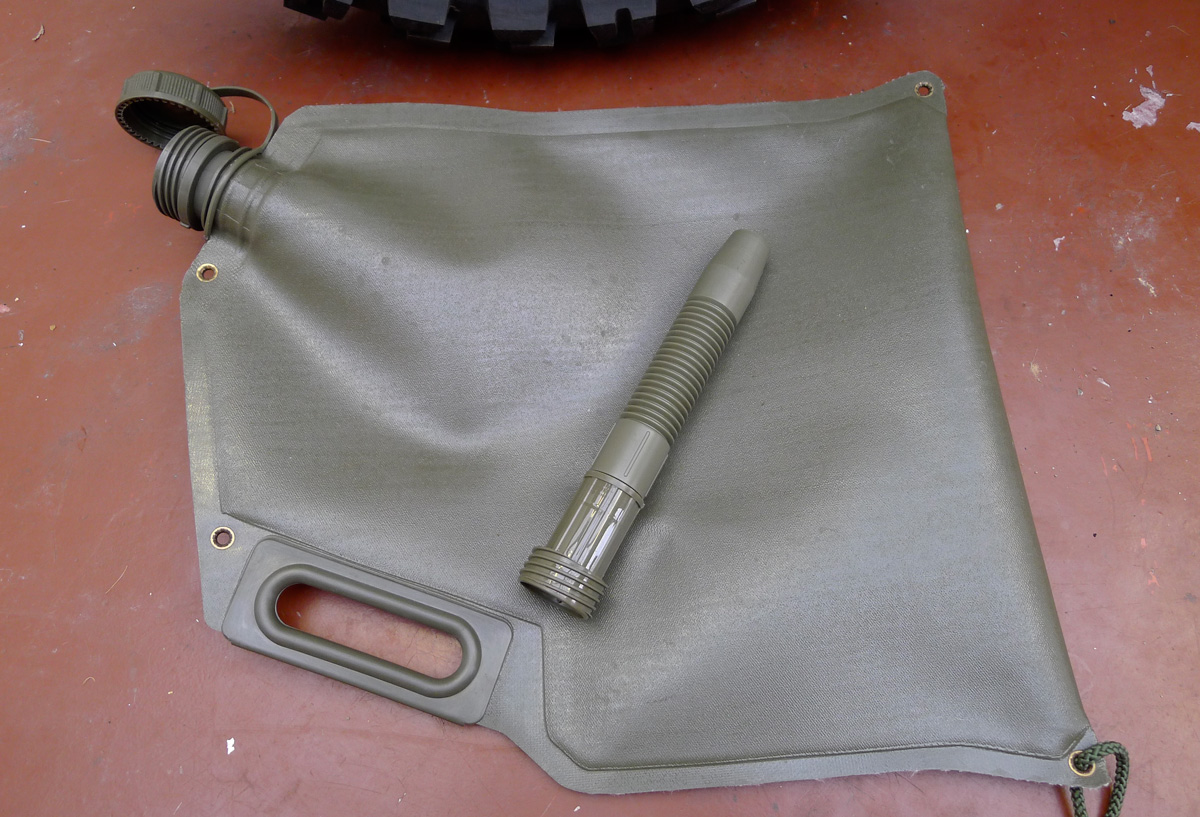
The OE tank is just 7.83L or 2.07 US gallons. Long after I came back an IMS tank for the Honda came out in October 2013 but our friend Rick Ramsey has proved that at 2.95US or 11.16L it’s only about 3.33L or 42.5% bigger than standard. For $270 and all the faffing that wasn’t useful enough for me so I’ll make use of a 10-litre fuel bag I have knocking about.
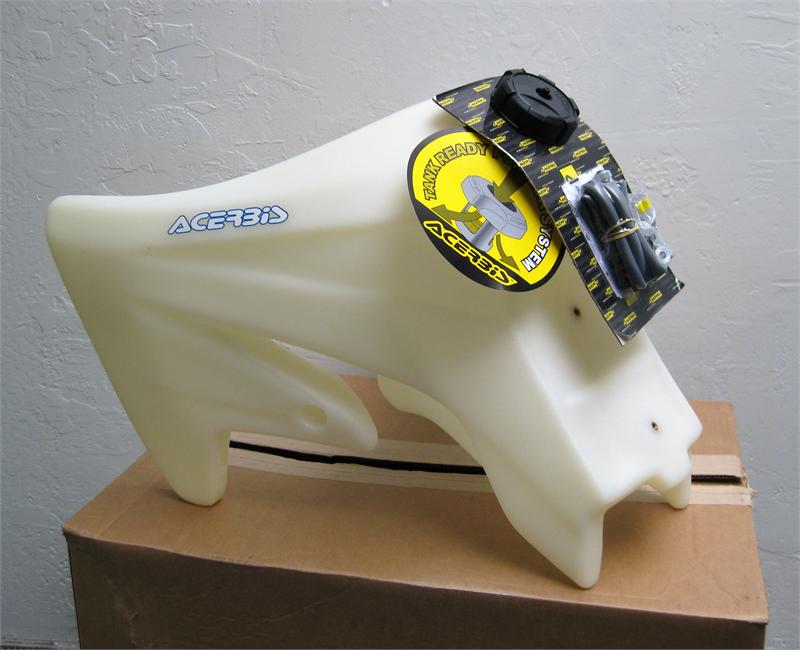
That may not prove to be so neat so I might try and get hold of a used OE tank (left) to weld up into something bigger, or see if some other 4gal+ tanks can be made to fit, like the 18-litre Acerbis unit (right) for the CRF450X which has a vaguely similar layout.
I plan to give the original seat a go too. I can’t think it’ll do the job over 3000 miles or more, but while in the US I’ll at least have a chance to get an alternative or adapt it. I may even refit the OE pipe and unplug the efi controller to wring out better fuel economy and a little less noise for the ride. I want to try and squeeze 100mpg out of that thing one time.
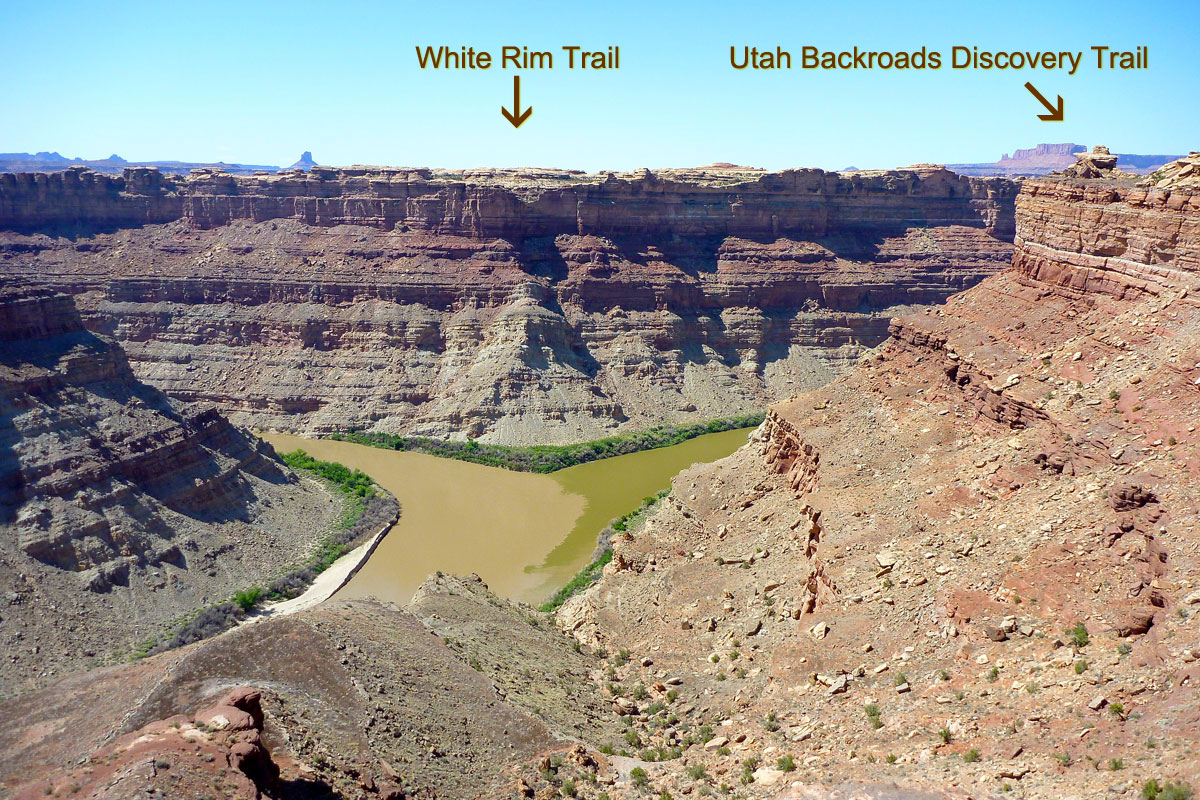
With the prep done and the bike licensed and insured, I’ll head up to Tacoma for presentation at South Sound BMW via a bit of Trans Am Trail through the Black Rock Desert. After Tacoma I have another couple of talks in North Cal and once they’re all done I can come back towards southeast Utah. Plan here is to explore some slickrock trails including the famous White Rim, then hop over the Colorado river (left) and follow the UTBDR south down to Monument Valley (left) via the Lockhart Basin. Whatever happens elsewhere, that’s going to be a fabulous few day’s riding.
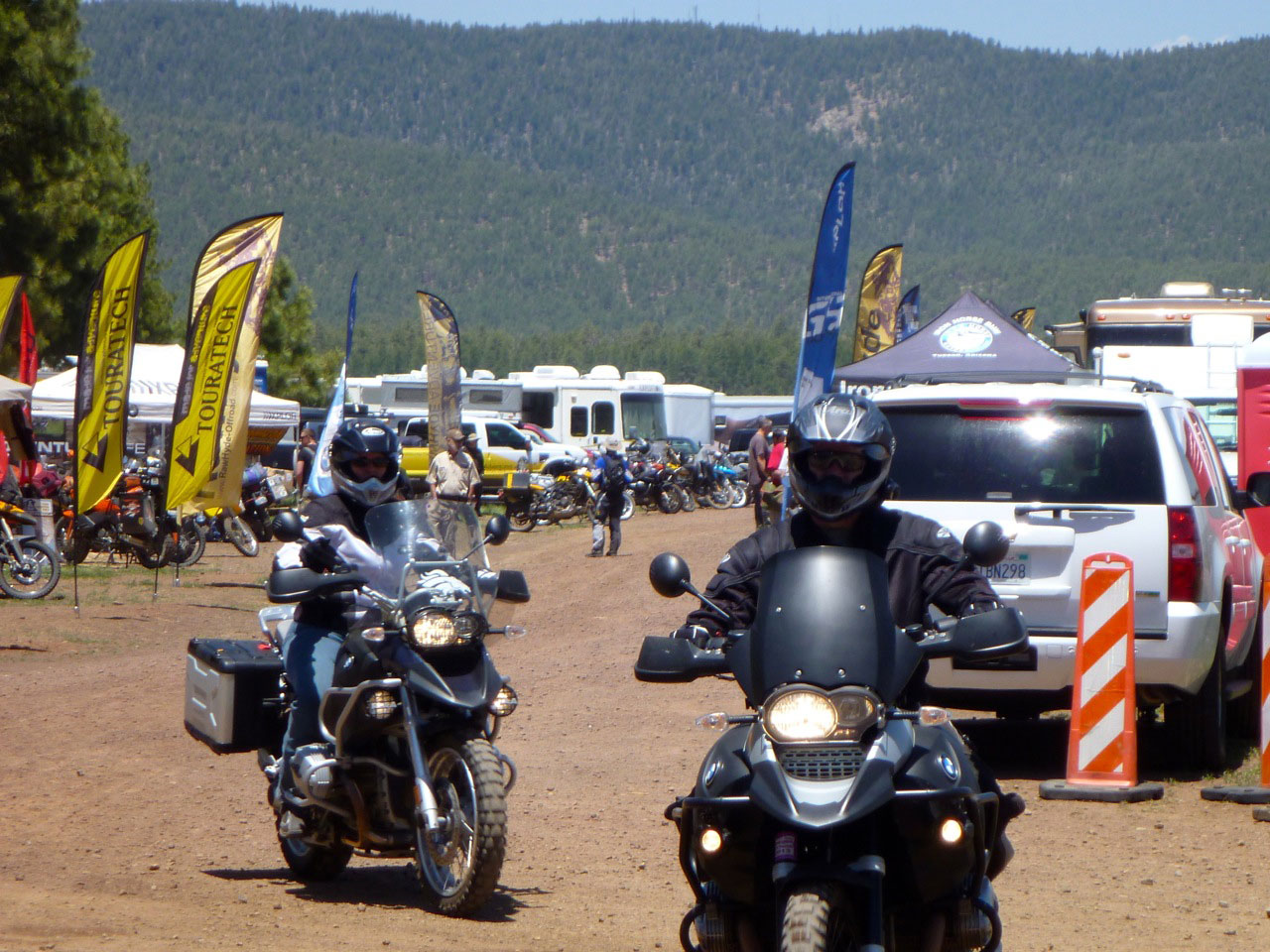
I’m due at the Overland Expo (right) in mid-May for a few more presentations and book selling, but if there’s time to pack in a bit of Baja then so much the better. That’s the plan; tune in from early April to the end of May to see what I do and how I get on with the CRF.
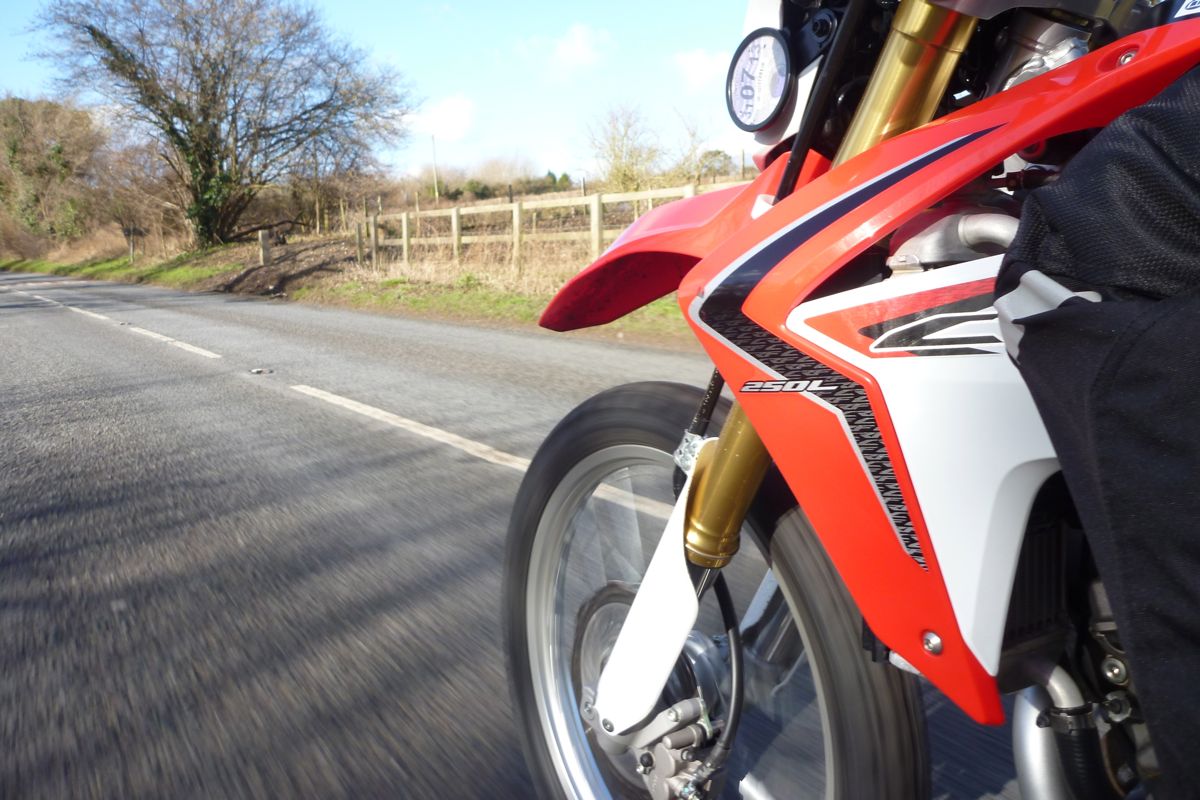
Since it came out in 2012 Honda’s CRF250L has been hailed as the long-lost return of the humble trail bike; a light, road-geared, do-it-all, low-spec dual sport being sold for a great price. For me, eyeing up a modern bike for some planned desert tours, the latest CRF seemed to tick the boxes. Apart from an old XR400, nothing else – DR, WR, KLX – seemed to inspire.
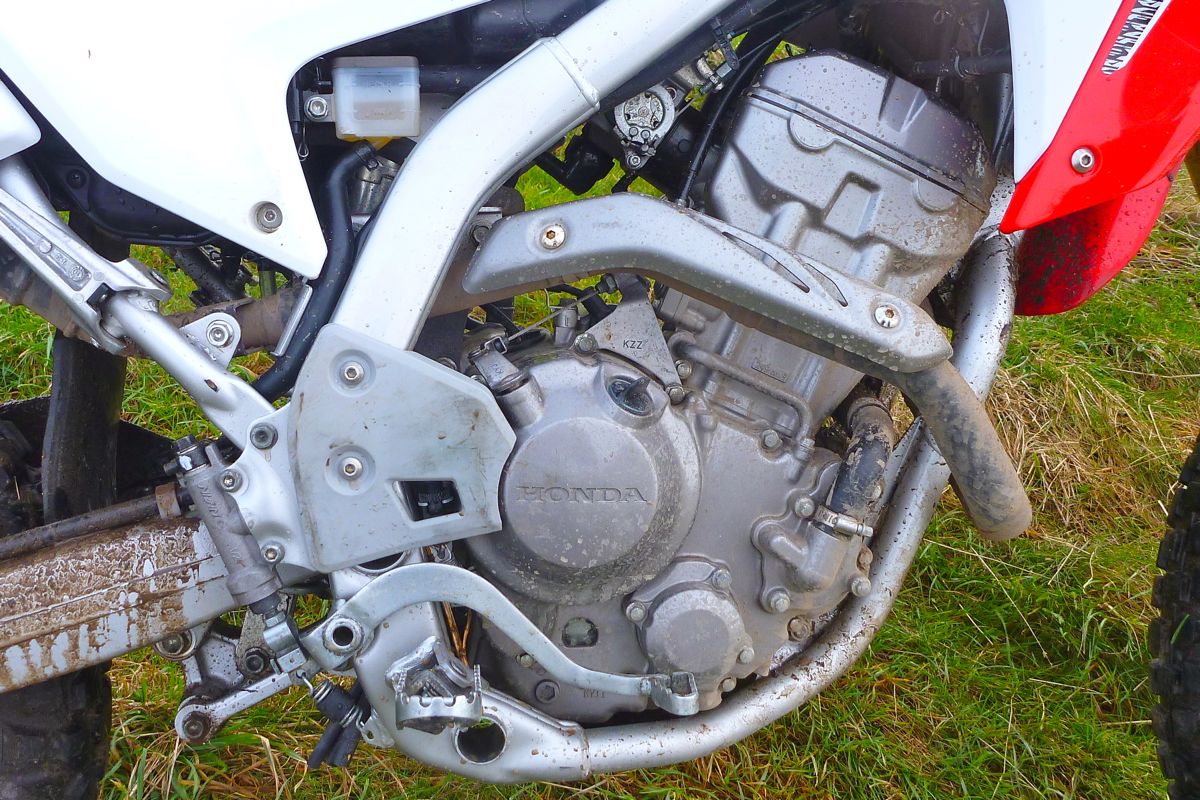
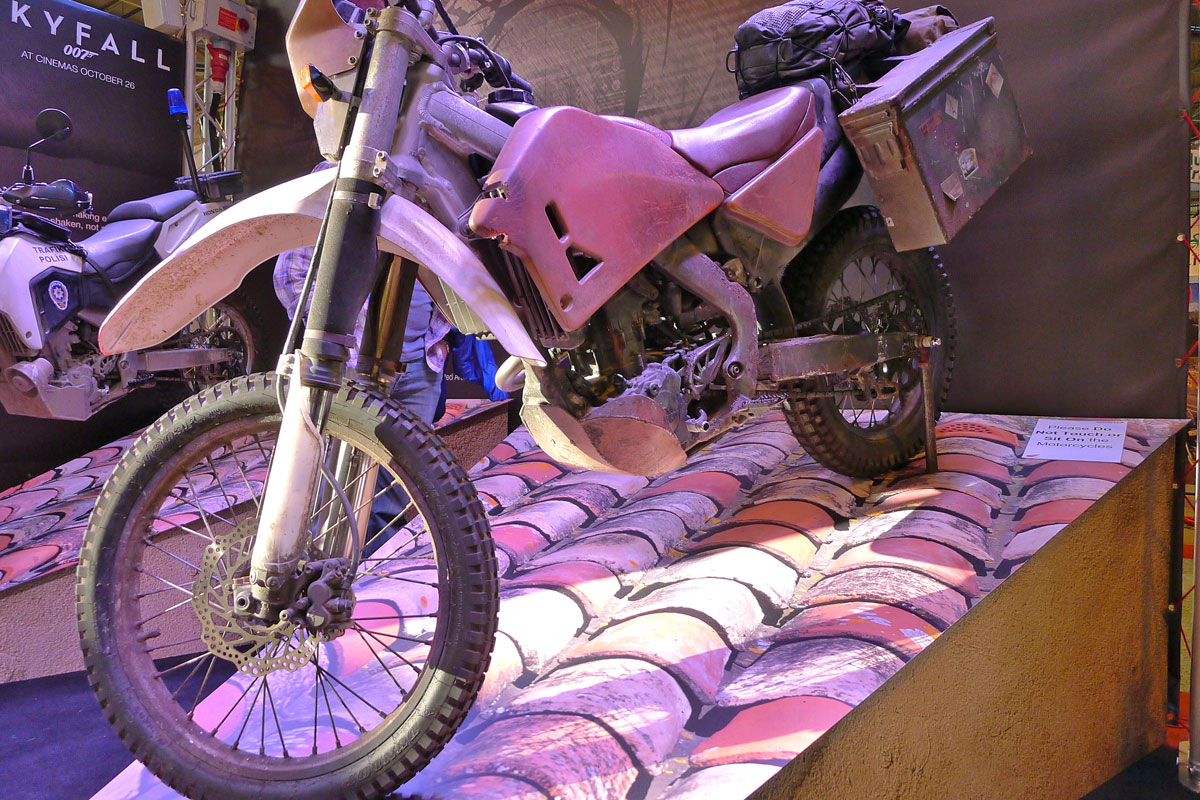
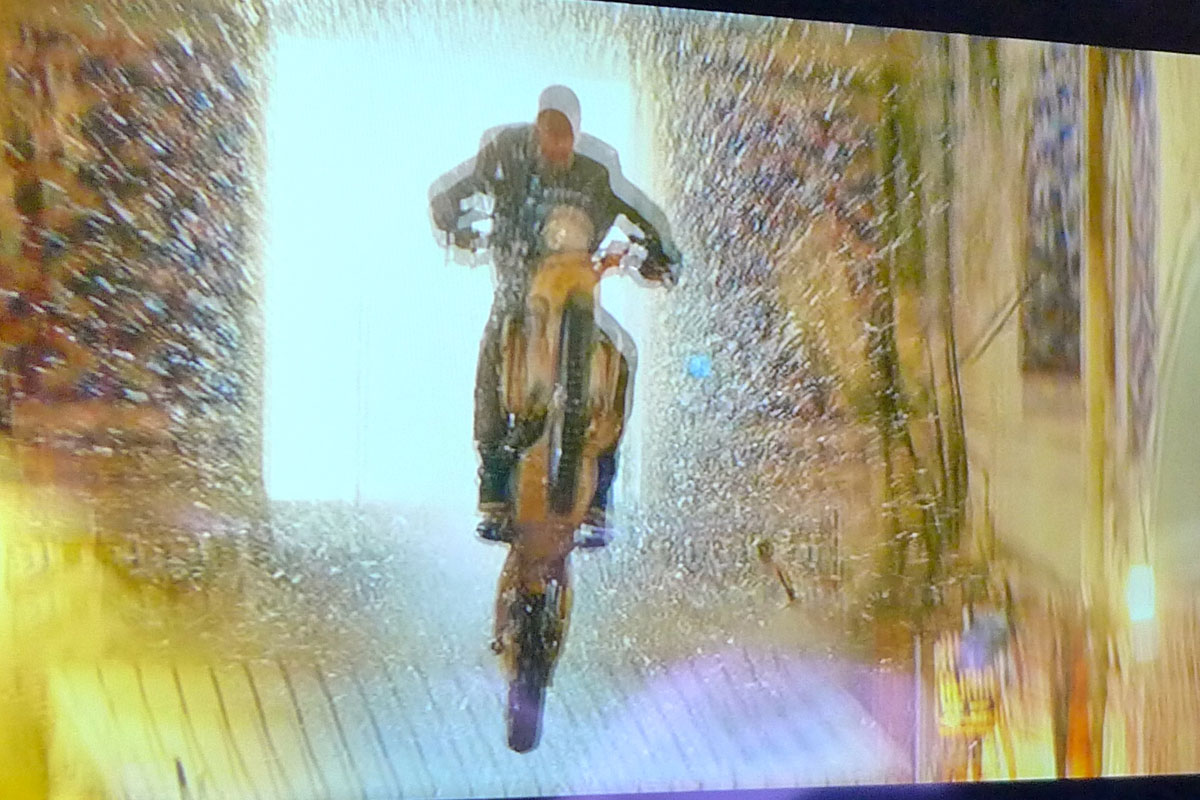
It’s no coincidence that a CRF250L could be easily mistaken for a detuned ‘street’ version of the alloy-framed, 115-kilo, 32-hp, CRF250X or -250R dirt racers. An adapted X was used in the recent Skyfall and Bourne movies (left), something that Honda was not shy to associate with the new L model. In fact the L is more of an upgrade to the old tech, 121-kg, 14hp CRF230L (below right) which isn’t far removed from ancient XL185/XR200s. The new model also runs a steel frame but takes a hefty motor derived from the CBR250RR sports bike (above right) while having the motor in the trail bike detuned some 20%. And although the resemblance with the X-racer is similar right down to the UPD Showas, the L actually weighs 144kg wet (138kg no fuel); 30 kilos more than a 250X and some 23kg more than a 230L. This excess baggage is one of the things people who’ve not ridden the bike understandably complain about, but the fact is you don’t feel that weight on the trail at all, as Cycle News testers also found (see right). Swapping the street battery and the can can lose nearly 6 kilos (13lbs) and if you add a fuel controller (fuelling remapper) and airbox mods you can gain some 6hp, making 24hp though you’ll have spent a few hundred quid. (For a great US-based CRF resource see Thumper Talk) And the best bit is that in the UK it goes for £4000 on the road; and in the US from $5000 plus, (still $2000 less than an albeit higher spec’d Yamaha WR – see Comment link). In the US the 250L sits alongside Honda’s air-cooled 230 CRF and the positively ossified XR650L which we used for Desert Riders in 2003.
The early 80s on the Ridgeway.
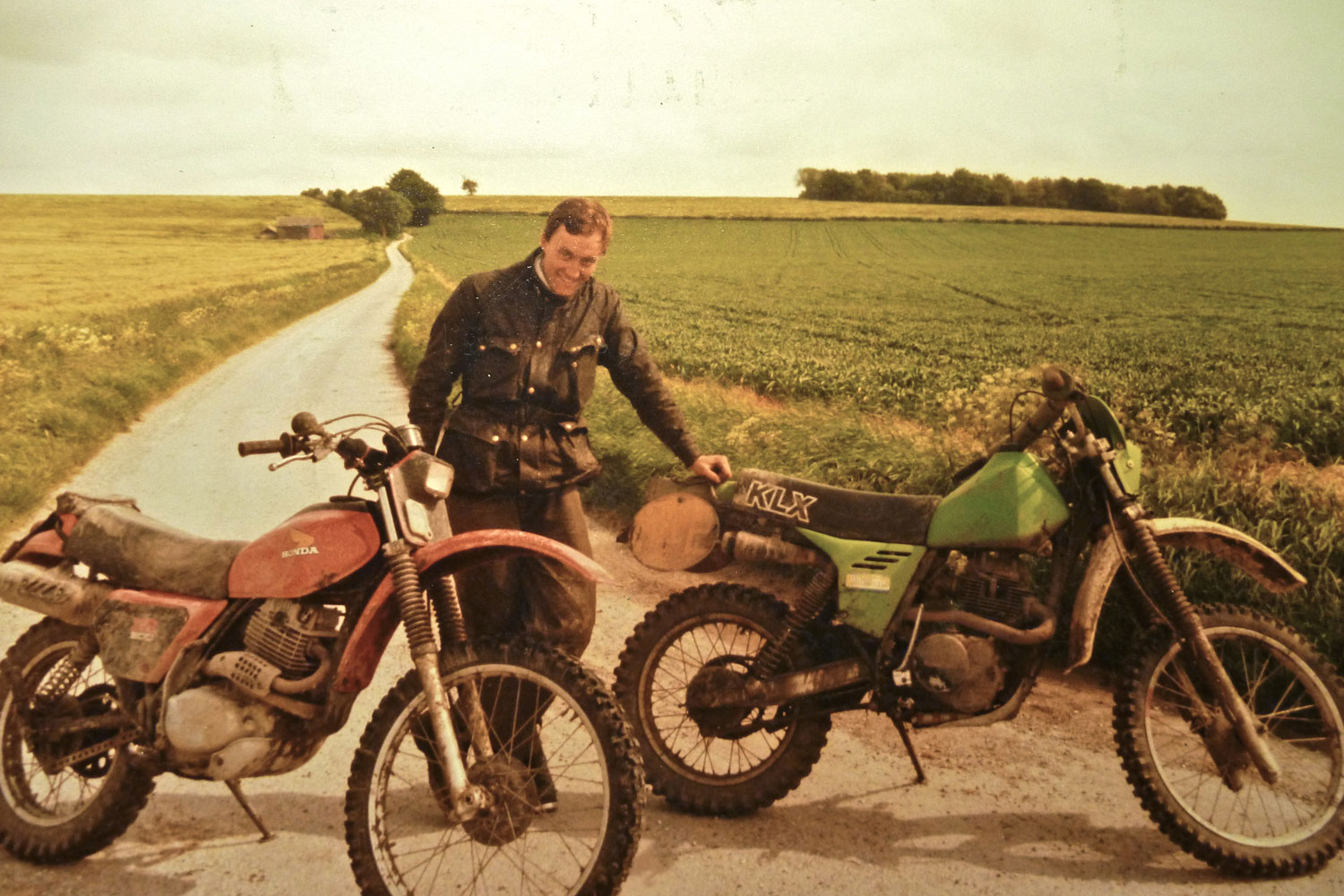
The last 250 trail bike I recall owning was a KLX (left) in the early 80s – the original ‘sheep in wolf’s clothing’ which proved that slapping a lame 250 engine into a snazzy-looking KDX-derived chassis made nothing more than an over-sprung slug. I recall a Welsh moorland enduro; Maicos flew overhead and by the time I came in off the last lap they were already packing up and going home. A couple of years later I picked up a DR250 in Australia before I moved onto bigger-engined Teneres for desert travels. But with support and therefor no need to carry a huge load, could a modern FI 250 trail bike make an adequate and responsive desert bike? Or would I feel like I was sat on a skimpy, revvy-engined trailie more suited to less girthsome riders?
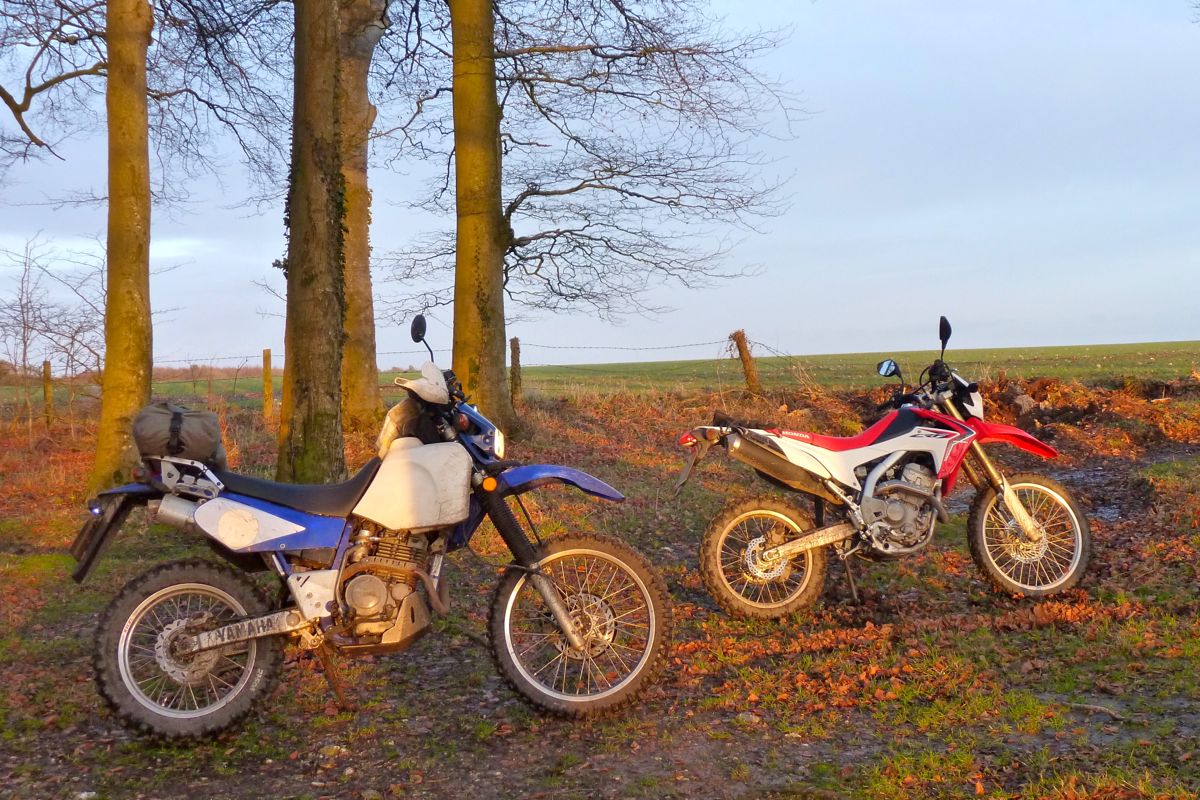
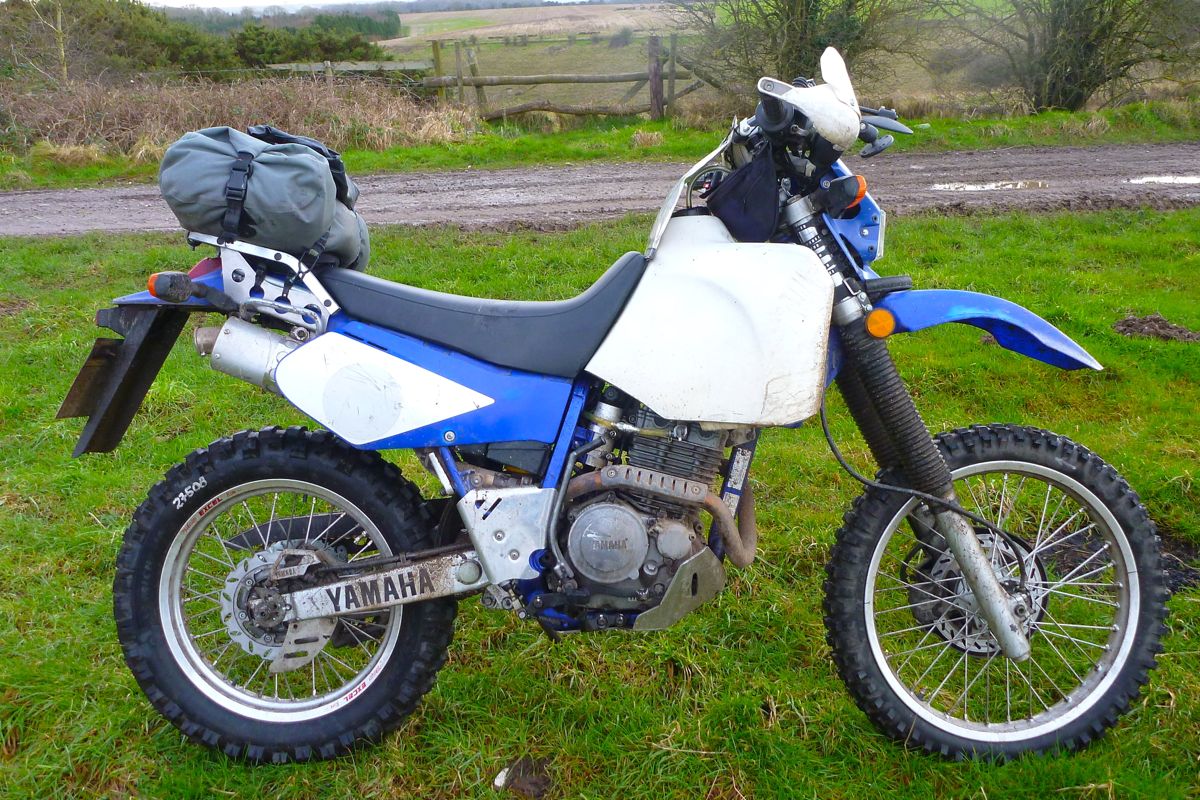
My local dealer set up a two-day loan from Honda and I arranged to meet a mate down in Wiltshire for a ride around Salisbury Plain, criss-crossed with several chalky tracks when the army isn’t using it for exercises. Robin rides a TTR250 bored out to 315cc which he’s used on my desert tours and elsewhere in the world, including the Morocco Overland research trip I did in 2012. He believes that ‘250’ is all the travel bike you need and by the time I returned the CRF-L I felt he had a point, but now see that his 315 rebore is significant…
Exercise PASHTUN DAWN will continue during the first week of February with communications and logistic assets working on the training area. [There will be] major armoured … and artillery live firing exercises across the whole Plain… the public are asked to stay well away.
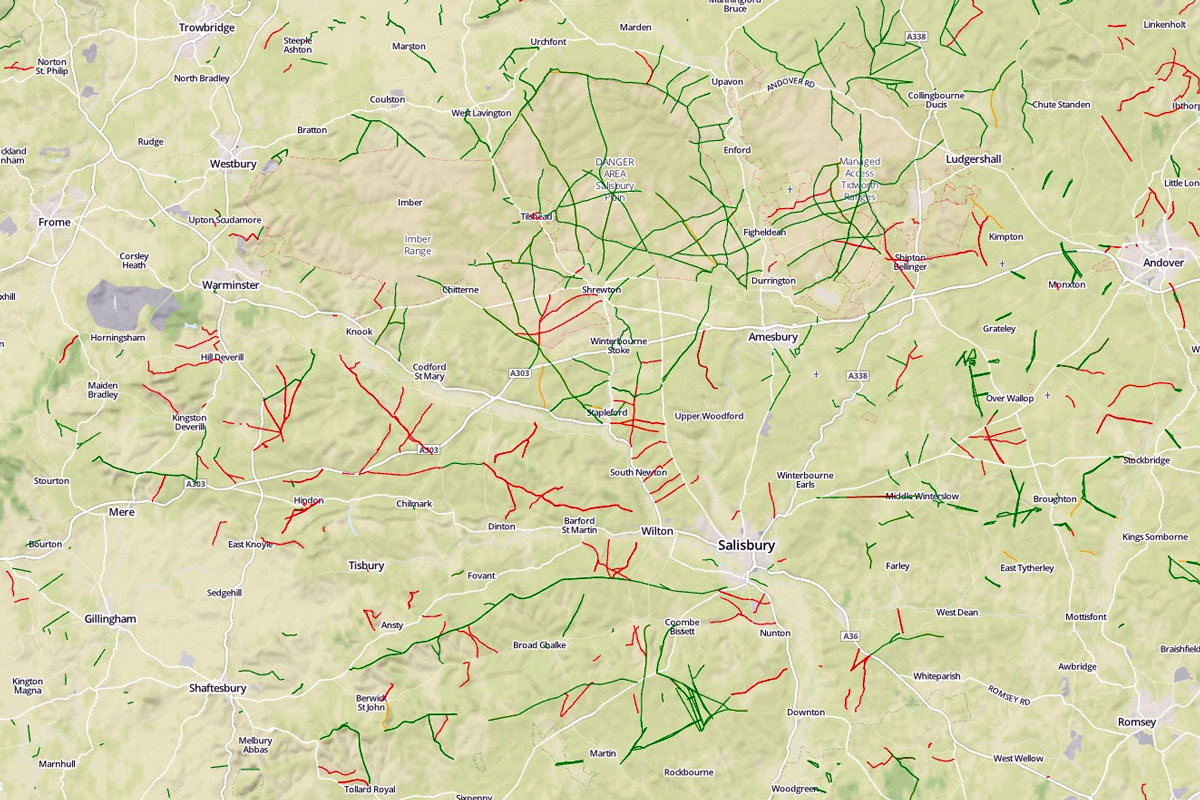
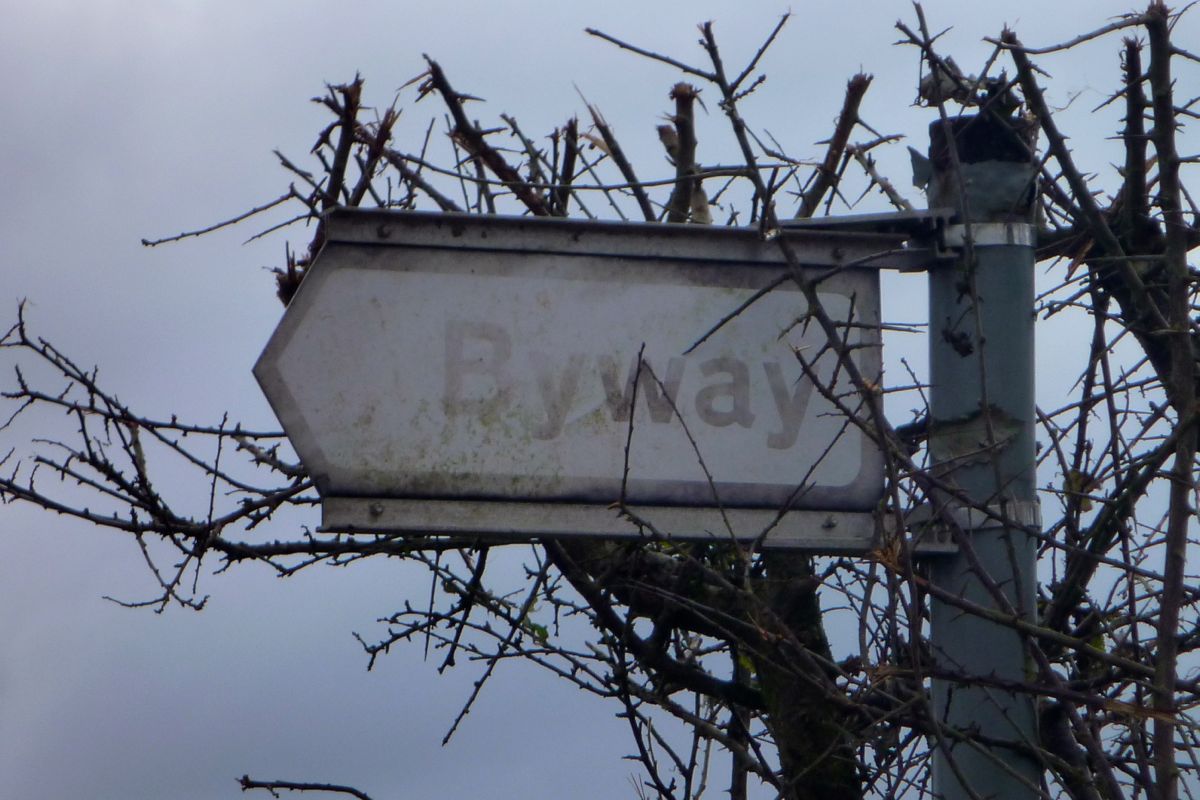
That was the link that Robin sent me the night before our meet in Andover. Oh dear – not a time to riding around the Plain then; you forget there’s a war on. I may have missed the MoD newsletter but at least I’d found bywaymap.com (right) which showed the unusually dense network of off road trails strung right across Wiltshire and not just Salisbury Plain.
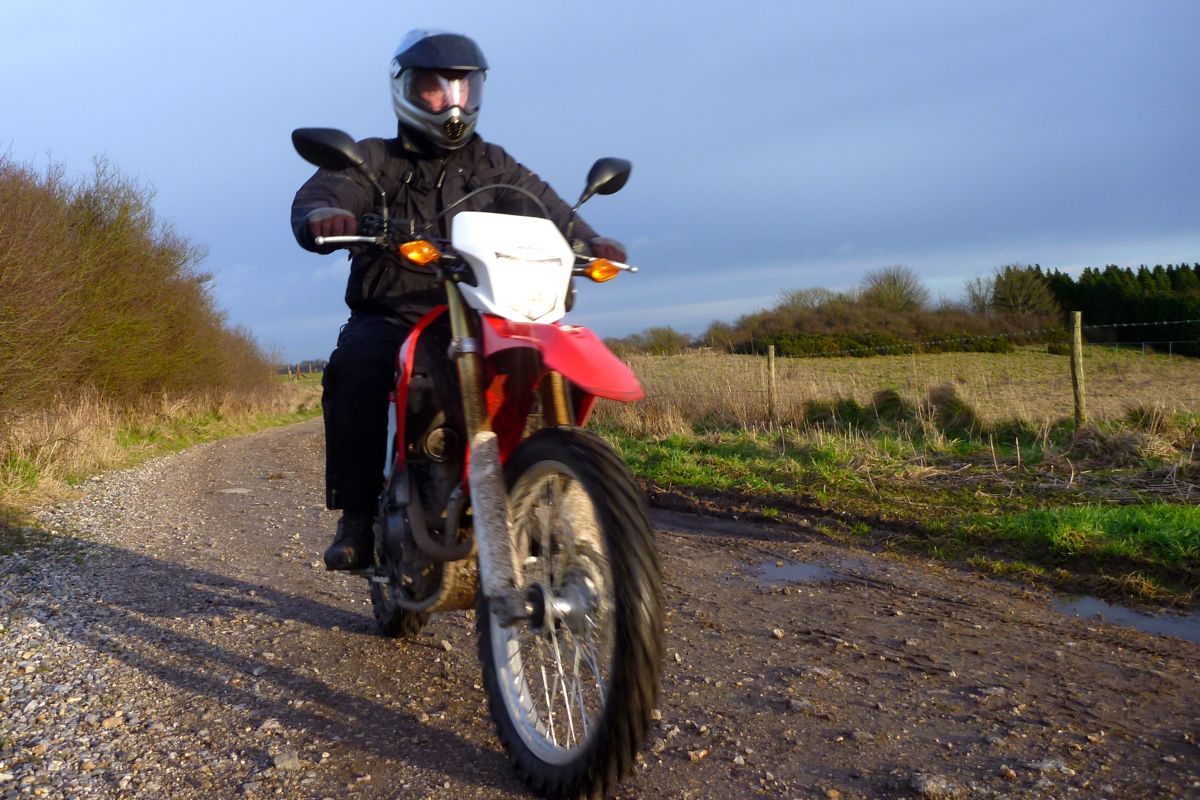
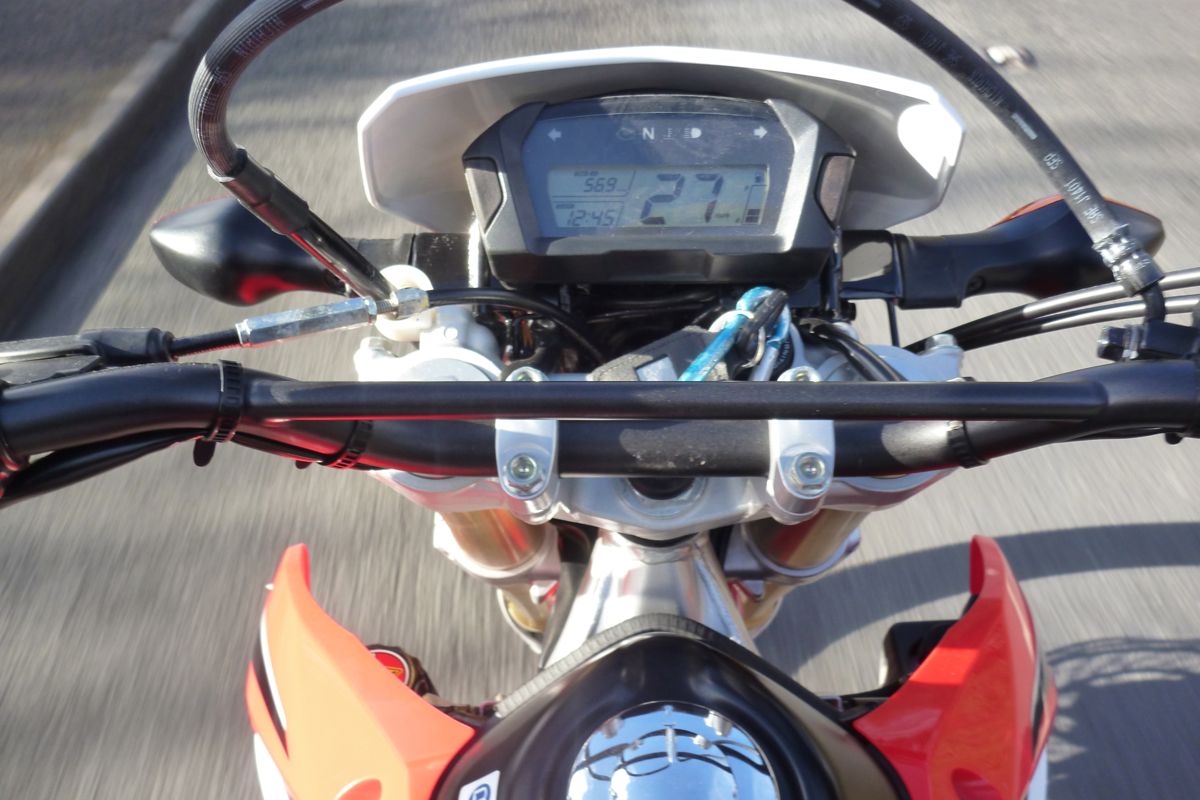
Collecting the near-new bike from Honda in Slough, first impressions were relief that it wasn’t annoyingly high; I could get feet flat on the ground. And after a while I was also pleased it didn’t necessarily need its neck wrung to make progress through traffic. Sat on the mostly flat M3 motorway at an indicated 65mph the CRF felt planted and with enough poke to pass lorries without risking getting splatted on the windshield of a fast moving car coming up from behind. A hill, a load and a stiff headwind might change all that, and the skimpy bike’s exposure to the wind blast meant that to keep upright I slid back (that annoying seat strap needs to go…) and hung on – not very sustainable. The digital dash (right) covers what you need to know: odometre, 2 trip metres, clock, speed read-out and fuel level, but something like a TrailTech Vapor would do well here. Meddling with the two function buttons allowed me to reset the trips and switch from mph to kph, though without RTFM I couldn’t work out how to correct the clock. Providing you’re not lugging in the wrong gear there was no vibration to speak of. Little 250 singles don’t hammer like a bigger 600+, something which I’m sure helped the seat feel better than it looked. The IRC GP21/22 tyres – a notch up in knobbliness from my K60s – felt secure on the roads too.
Not so promising was the fuel gauge which by 60 miles was down to 2 of 5 bars. Filling up in Andover revealed only 66mpg which barely improved on subsequent fills, even following hours of tame green landing (69mpg). The bike had only 600 miles on the clock but that economy was still way short of the 90mpg quoted on Honda UK and the 80+ I was expecting (Imp/US/kpl fuel conversion table here, btw). Could the press test bike I’d been lent be running a little richer to survive the thrashing a magazine might give it? Or were the speedo and odometre out? After all, when’s the last time any Brit bike mag paid any attention to detailed fuel consumption figures, rather than estimating ‘xx many miles to a tank’? [For the record the CRFL I went on to buy in America averaged 86.7UK mpg over 3000 miles),
Other impressions: brakes felt well matched for the bike’s weight and power, suspension felt reassuringly firm though it’s doubtless far less flash or adjustable than whatever’s on a CRF-X/R; fuelling was pretty flawless with only a couple of cut-outs in the lanes which may have been water related. And like I said the bike has a low seat (right) which greatly boosts confidence as you slither towards a muddy rut or even just want to get off. Robin’s TTR had been lowered and had an alternative seat, but for me was still a pain to swing a leg over. As for the engine and gearbox, well of course the acceleration won’t give you a dizzy spell, but it gets up to speed and holds it without the impression of ragging the engine, just as long as you’re in the right gear. And without too much load, clutchless up-changes were as clunk-free as stirring a creamy cappuccino.
Two hours after setting off, we managed to evade the harassment of traffic wardens and other municipal jobsworths in Andover long enough to text each other, meet up and head out to a warm country pub for lunch. That done, we scooted on to Salisbury where I noted the TTR was keeping up with the CRF rather effortlessly. I guess Robin’s 315cc upgrade balances out the years. The Honda is said to make 18hp at the wheel with 10.7 compression, but it’s how it responds that counts. Owners in the US are doubtless adapting air filters, swapping pipes and tuning the ECU, but for the long road I’d be tempted to leave it largely standard to improve longevity and cool running.
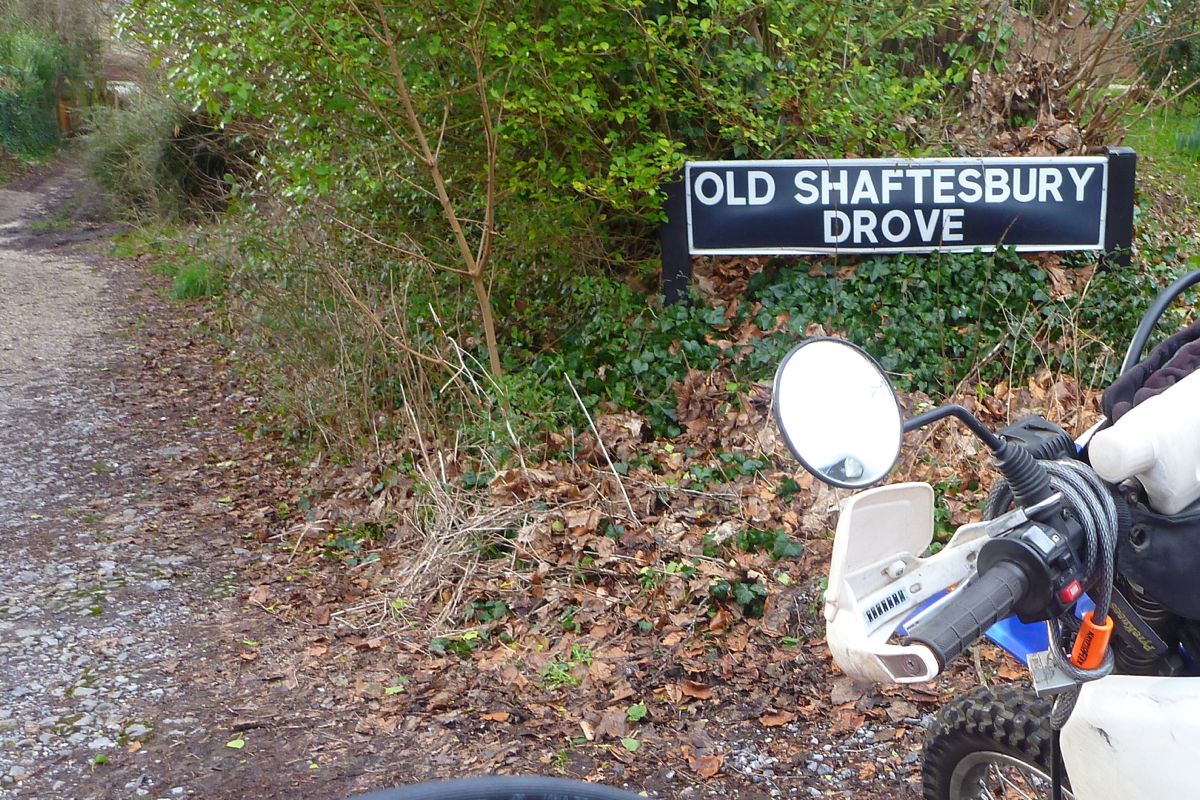
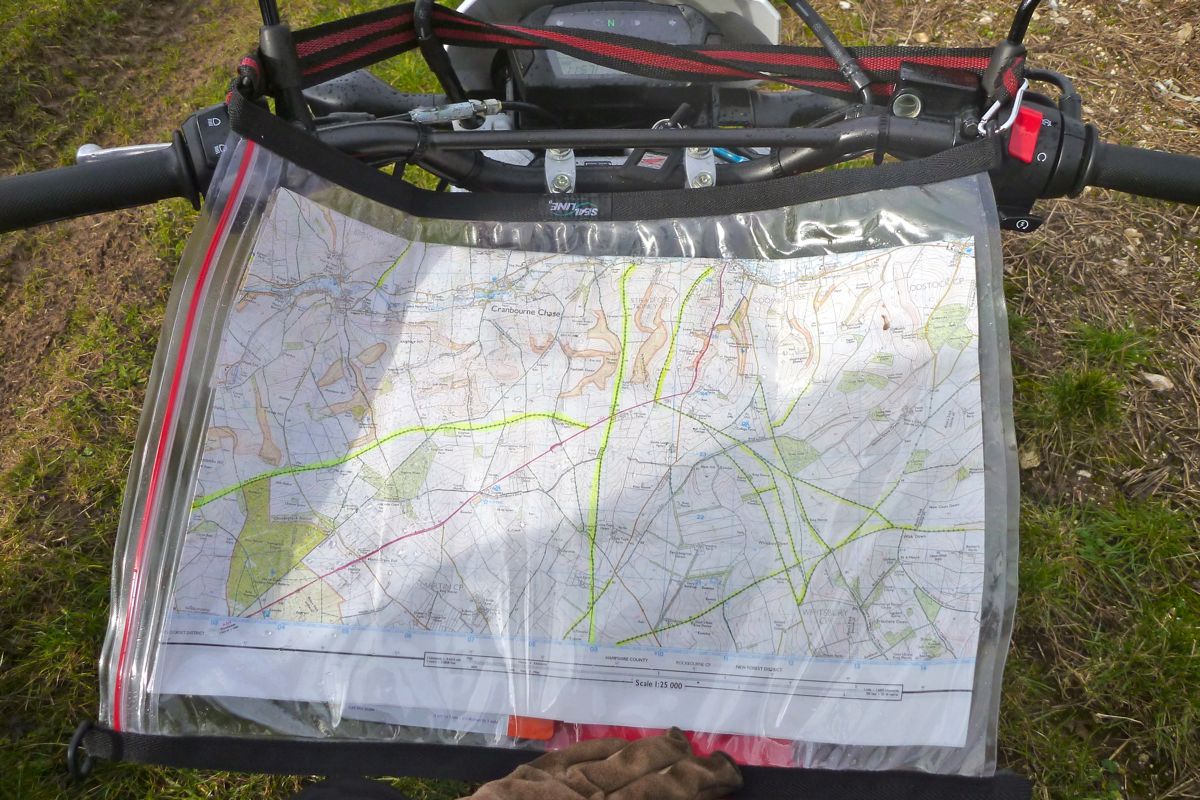
Robin had marked-up 25k OS maps plus had a worthwhile OSM map in his Garmin and so managed to pinpoint the street on the south side of Salisbury where the encouragingly long Old Shaftesbury Drove ran west for a good 15-20 miles, one of the longest byways around. Better still, on arrival there was no ‘no motor vehicles’ sign with adjacent CCTV and tripwires. In congested southern UK I’d pretty much given up on green laning years ago.
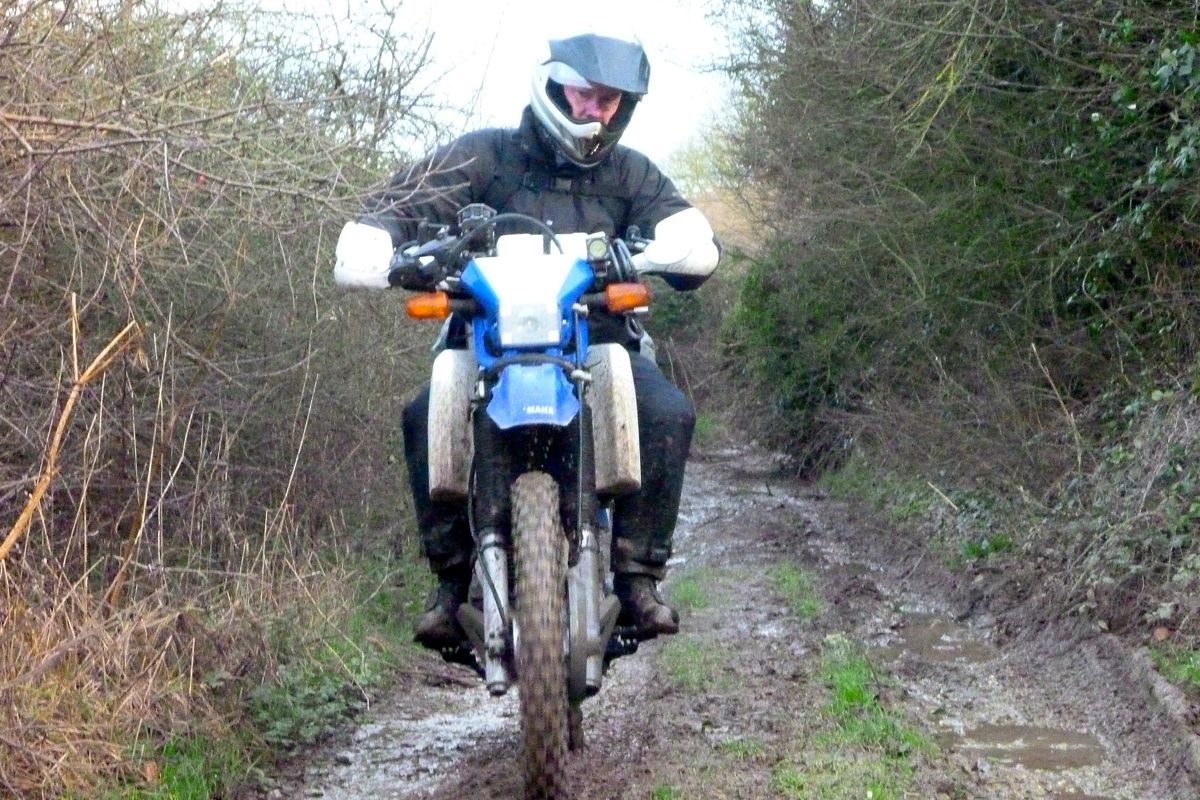
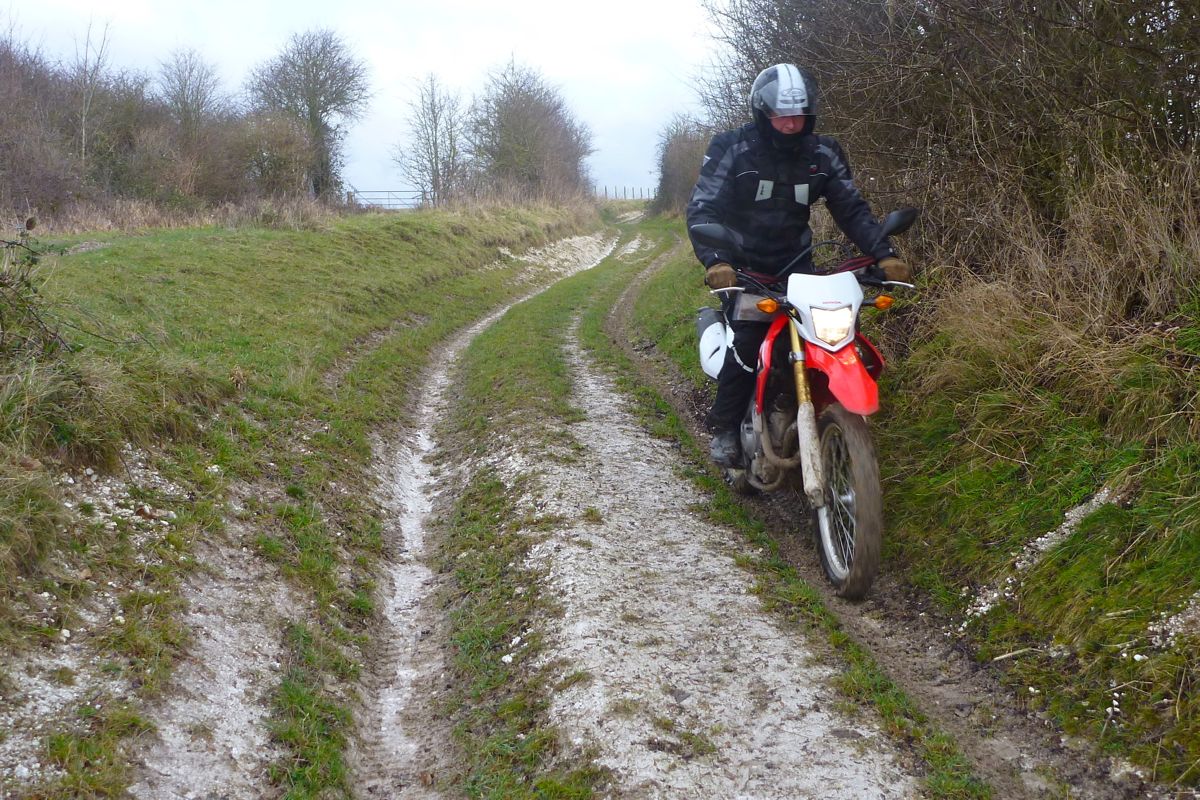
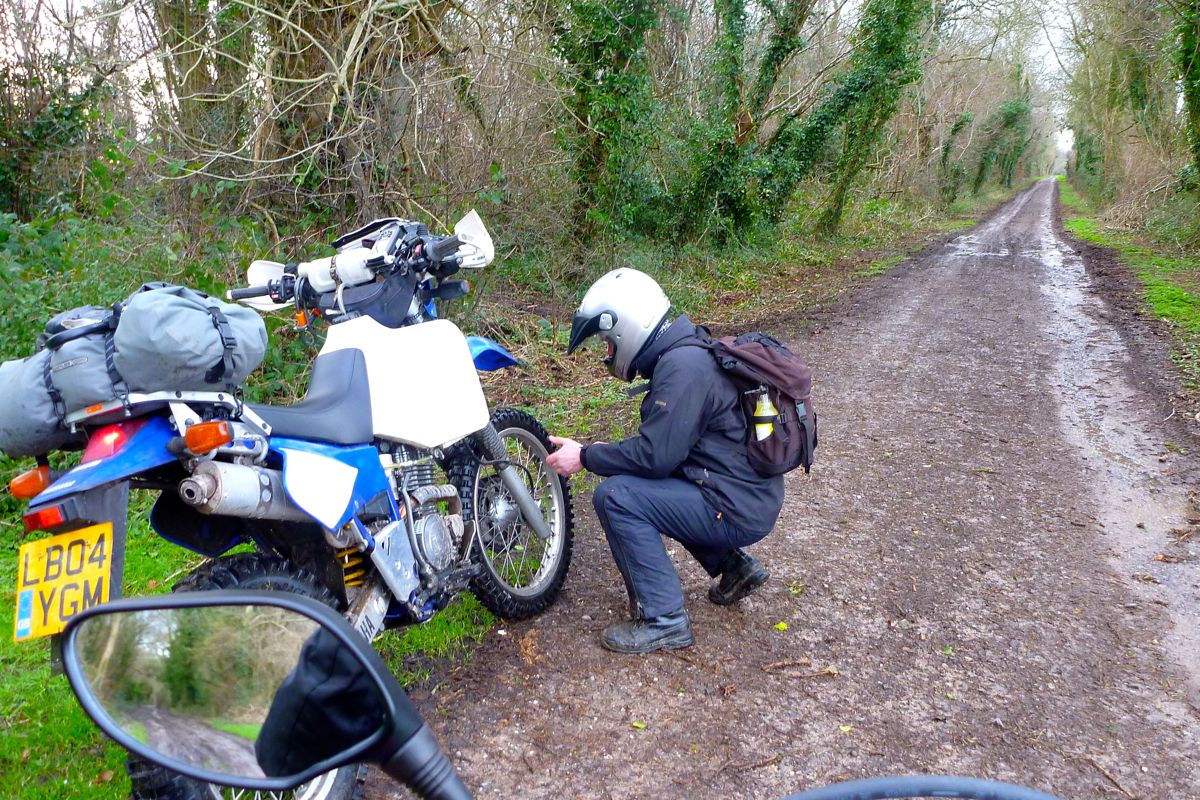
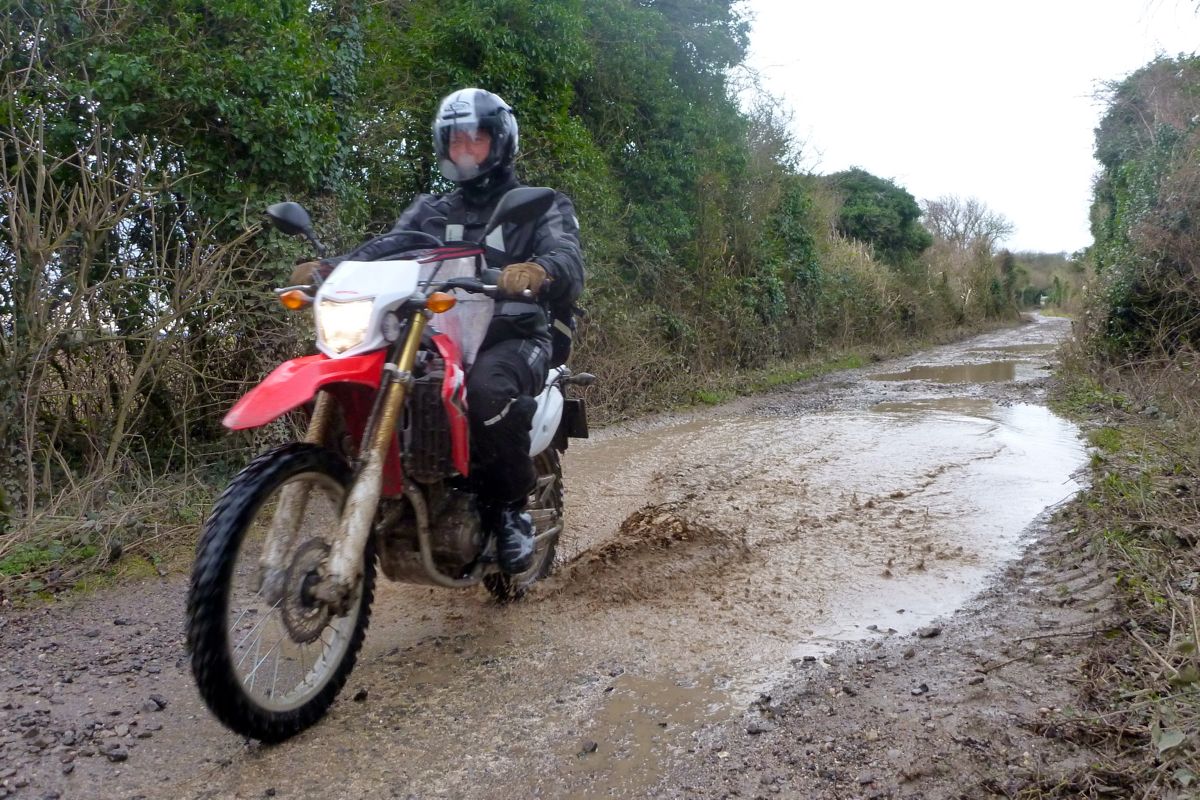
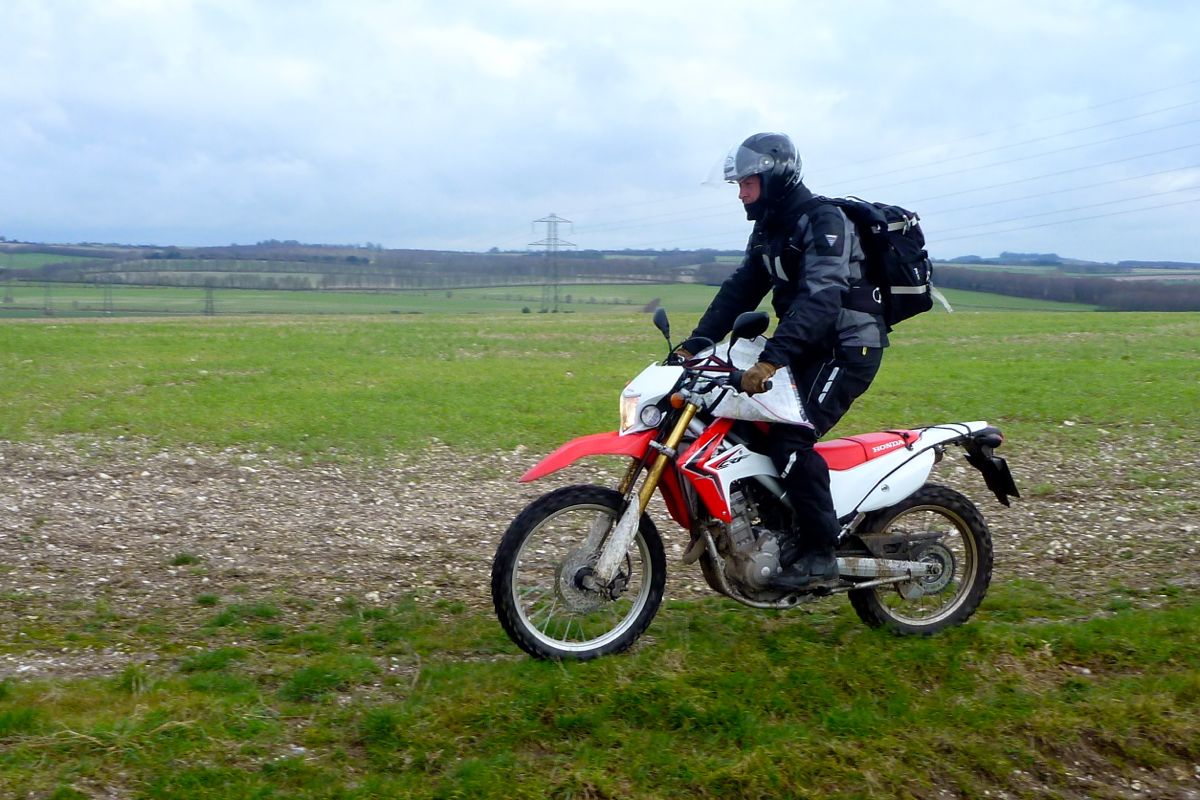
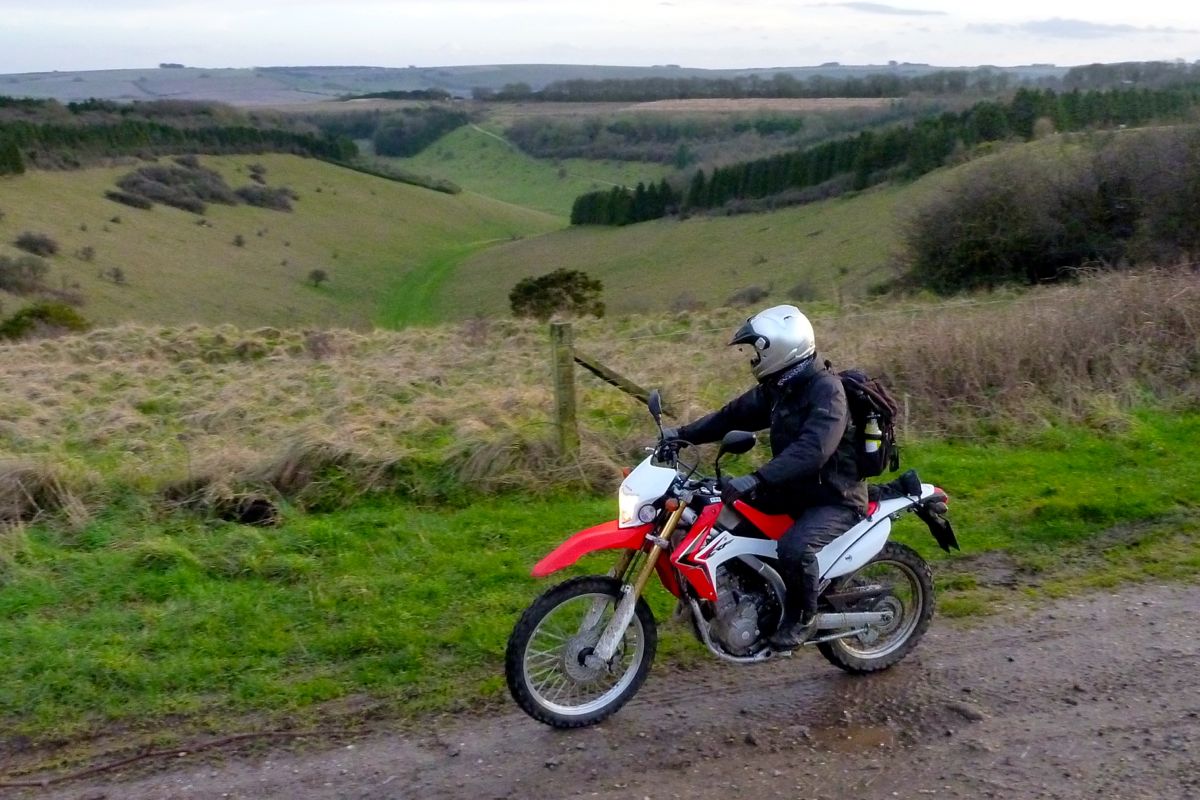
Running a stiff Michelin Race rear, Robin dropped his tyre pressures while I decided to keep the Honda’s IRCs at whatever they were and see how I managed. It’s good to have something in reserve if things get very slick. The initial grassy, rutted path would have been hard to ride all day but at the right speed the CRF managed fine and did so all day and the next. The key has to be light weight with a low seat, but also modest power and of course speed. I could imagine with a typical 600 single the power pulses alone would be that much harder to control as the bike ran on. Not so the CRF – it was nearly as easy as riding an MTB and I never got close to getting out of shape or falling off.
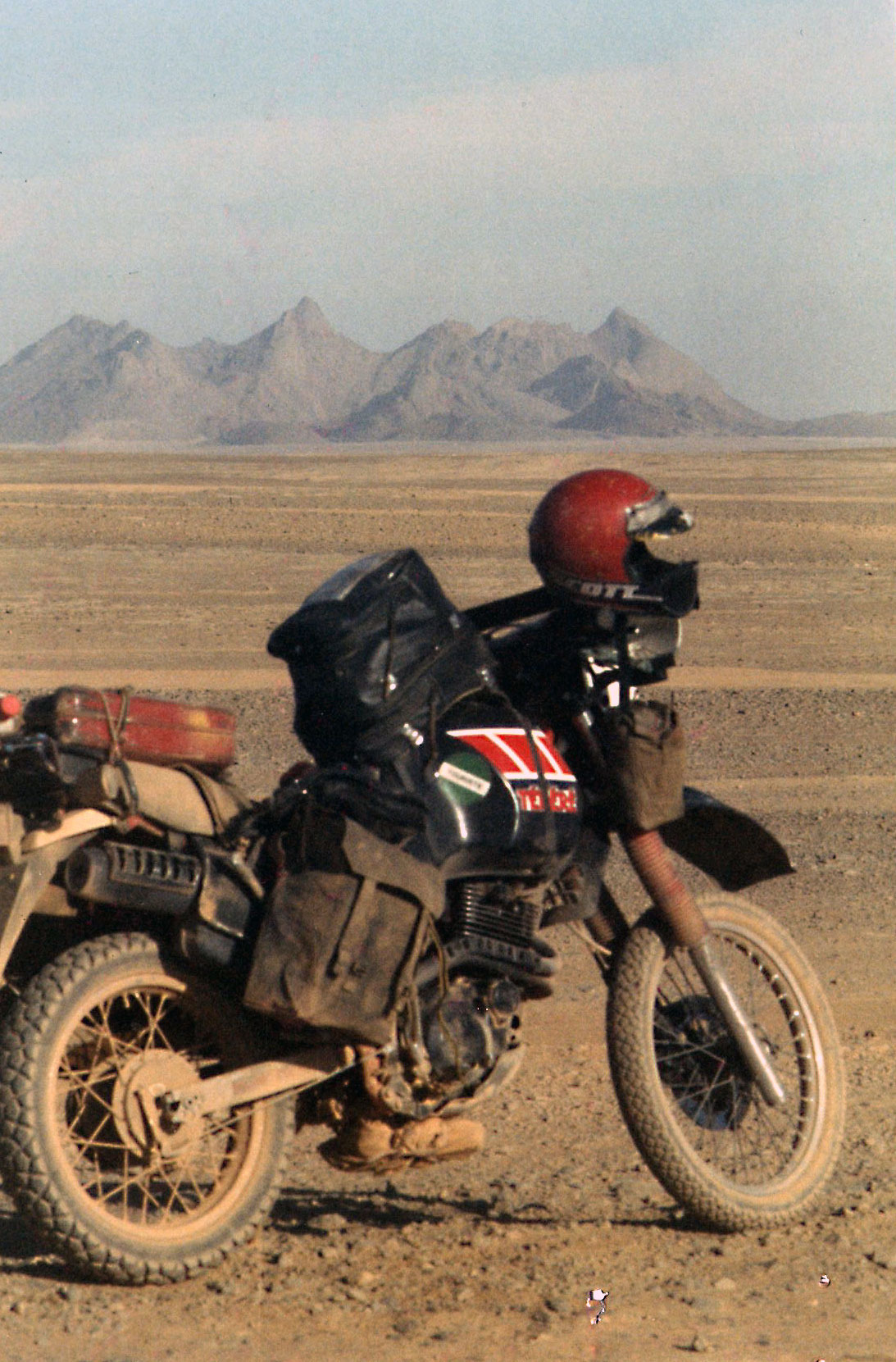
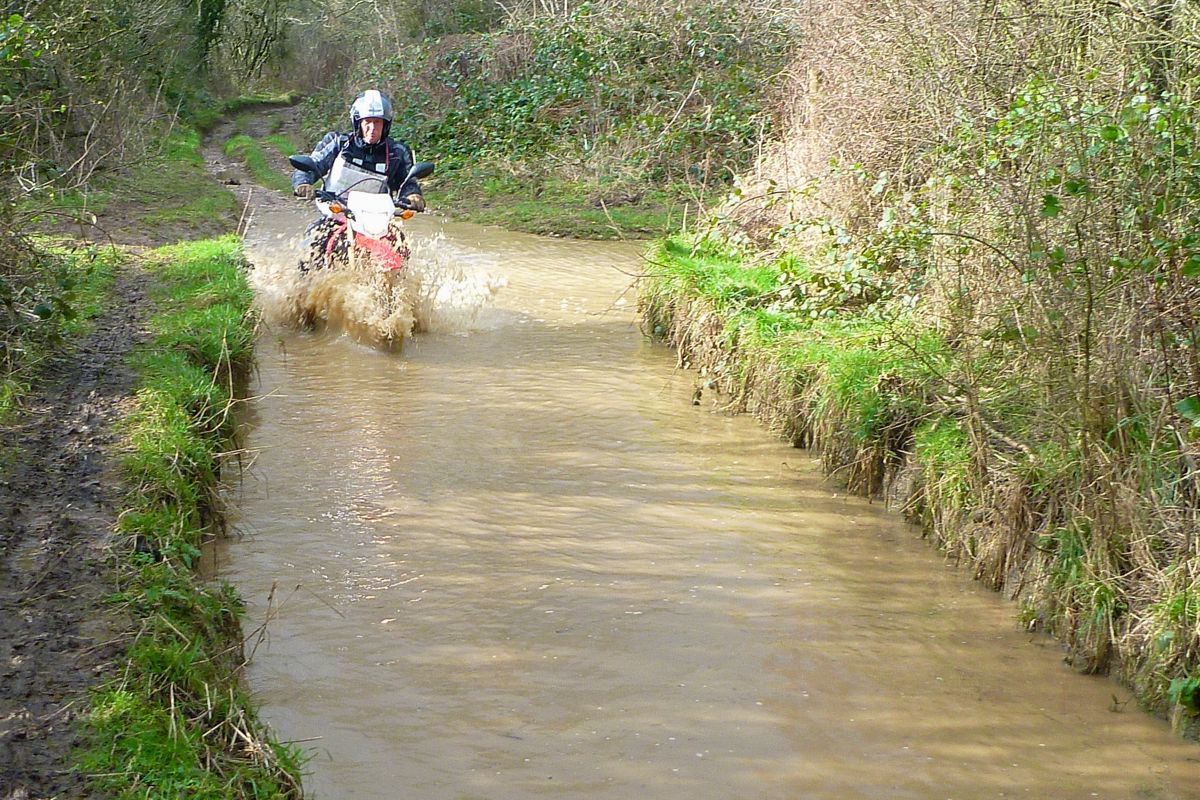
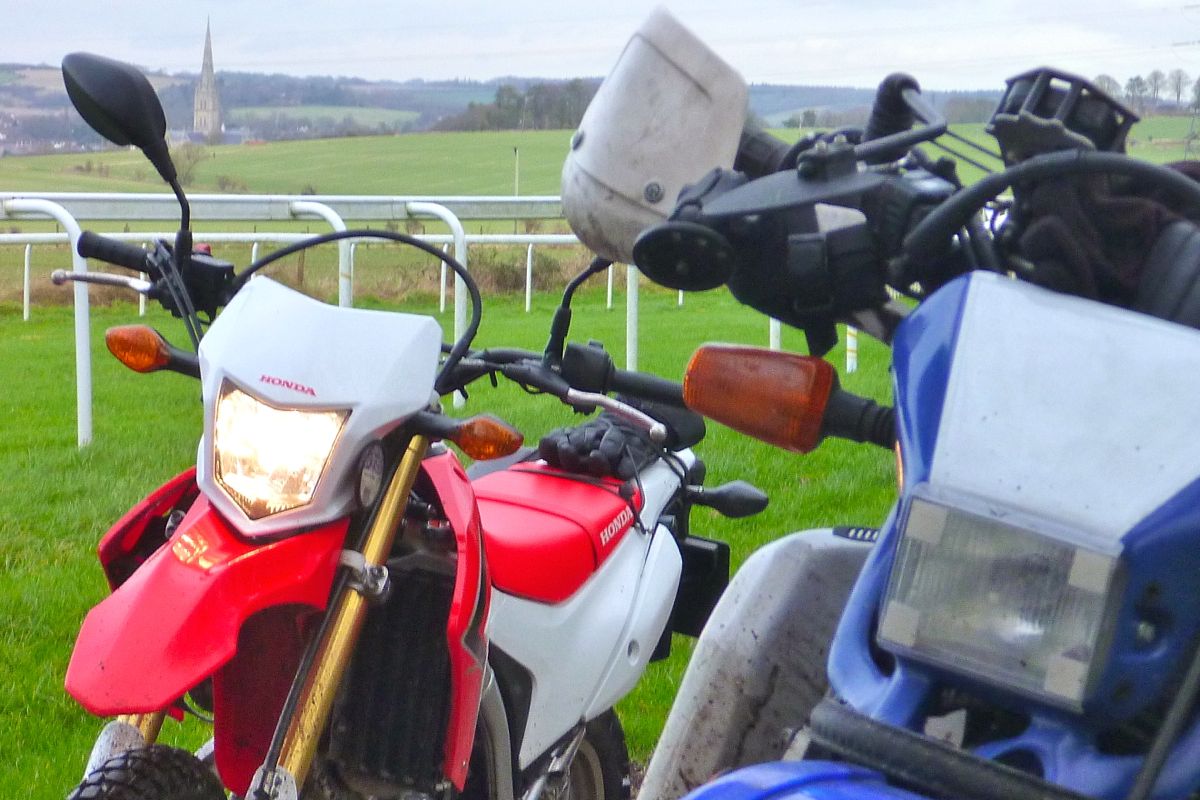
The Old Drove soon grew into an easy wide track, passing a racecourse on Warren Down overlooking the nearby city and its famous cathedral spire. Occasionally puddles and churned up ruts would require some thought, but both the TTR and the Honda chugged on through. I couldn’t get over how easy it was. People are complaining about the weight for a skimpy 250 trail bike (my original trans-Sahara Tenere – right – was weighed about the same with the same fuel load, iirc), but it just wasn’t noticeable to me – perhaps it’s the relatively low centre of gravity (aka: short suspension). And as on the 660Z Tenere if that mass adds up to a tough frame and general robustness then so much the better.
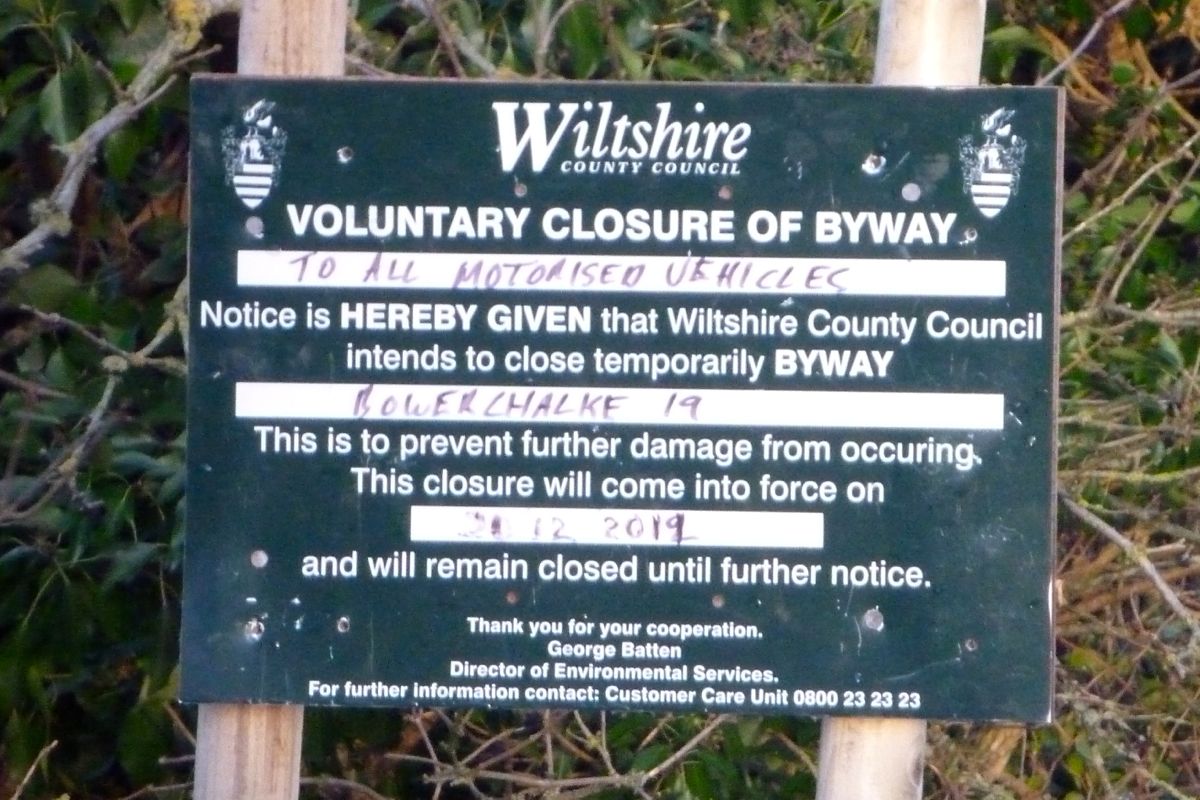
After a couple of crossroads we came up against a voluntary byway closure sign. Not knowing that it was in fact an optional request to limit erosion to part-flooded tracks, we spun off south looking for alternatives. Whenever we stopped to check the map we could hear the booms and thuds of live rounds detonating on the Plain a few miles to the north. The Pashtuns were getting it in the neck.
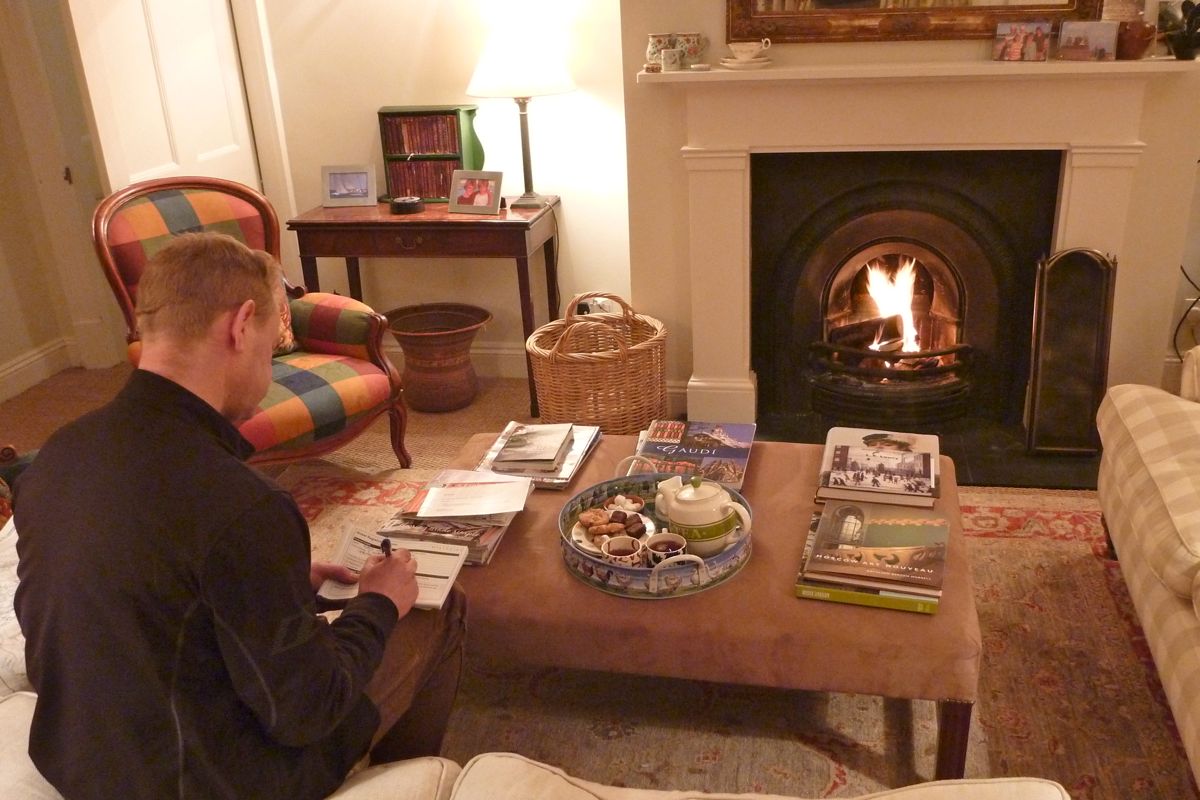
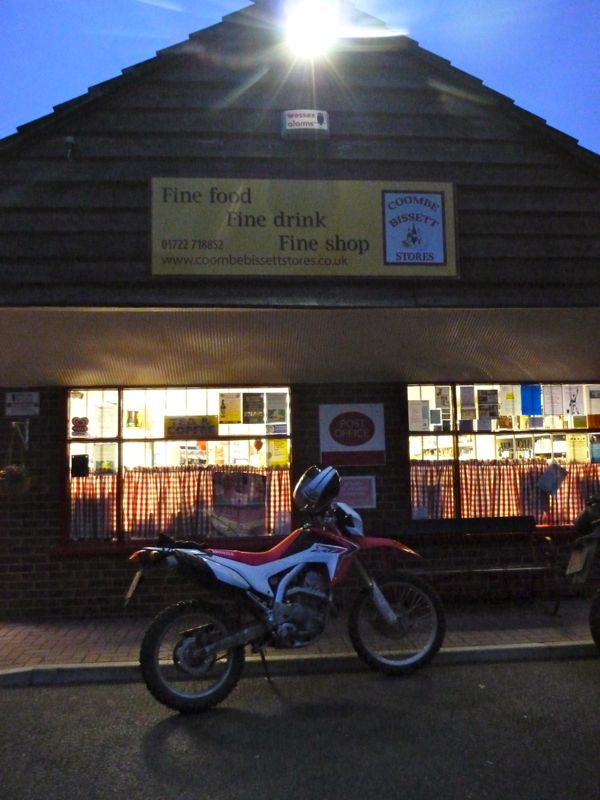
We prodded at a few more byways but one after another they were all closed and by now the sun was getting low. Time to find a cosy inn or B&B. Round here all you have to do is ride through a village or two to find a something like that and sure enough the shop in Compton Bisset pointed us to a perfect place just up the road. Soon we were shacked up by an open fire and pouring a brew.
Next day we had a longer than expected chat with the land lady over breakfast. She happened to know both my former and current publishers, and sadly was also due at a funeral of another acquaintance who’d been killed at the In Amenas gas plant a few weeks earlier. I’d been in the Algerian Sahara during the siege and had passed through In Amenas many times over the years.
A byway led right out of Compton where like in much of the area, the roadside streams were close to spilling over and many fields were flooded. That lane too was signed off and down the road so was the next, but the one opposite wasn’t so we slipped and slid over Rockbourne Down to another quaint, thatched village. If nothing else, tooling around the back lanes of Wiltshire wasn’t so bad – as pretty as adjacent Dorset but much less visited. Normally Wiltshire passes in a blur either side of the A303 as I belt further west.
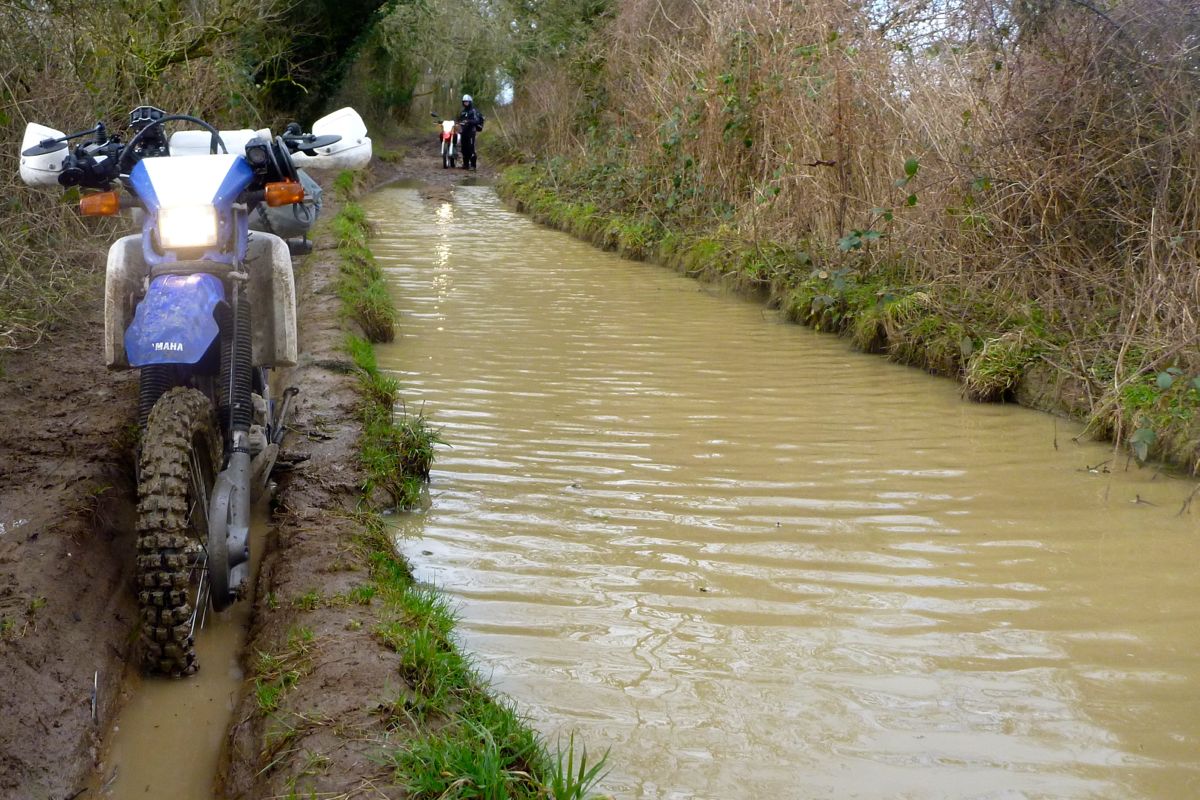
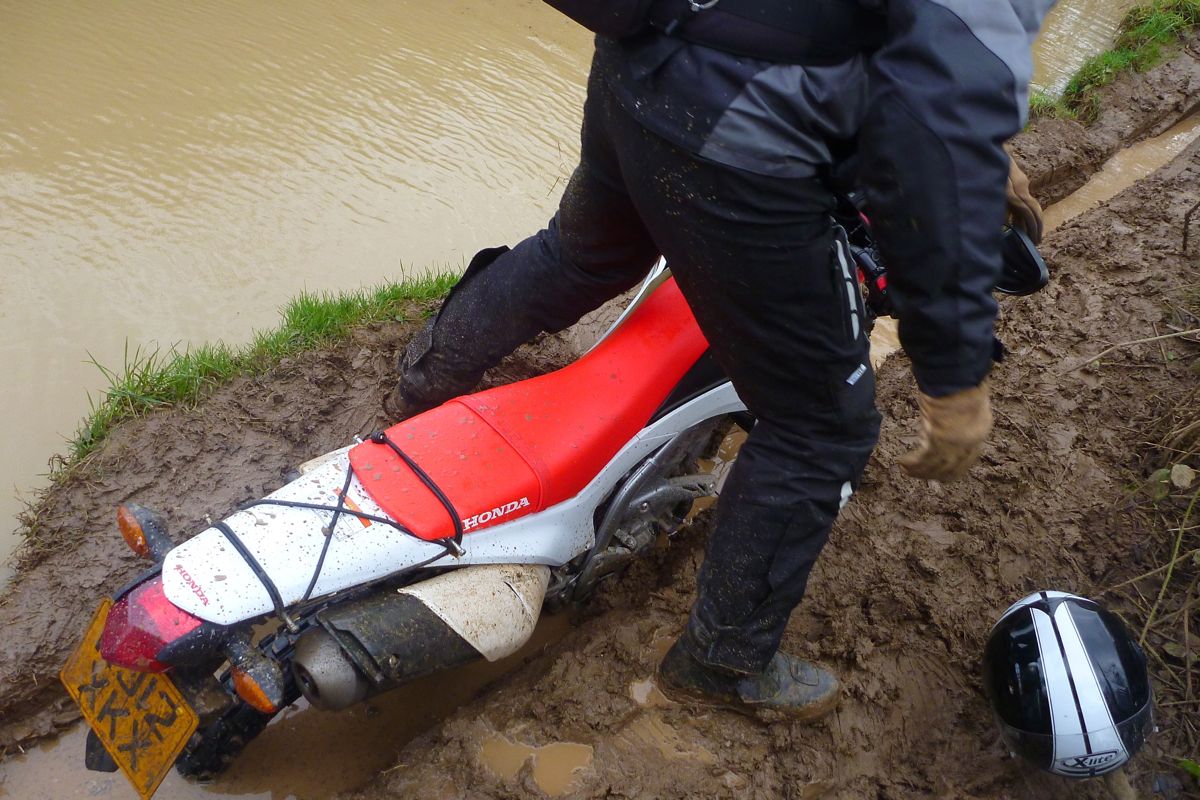
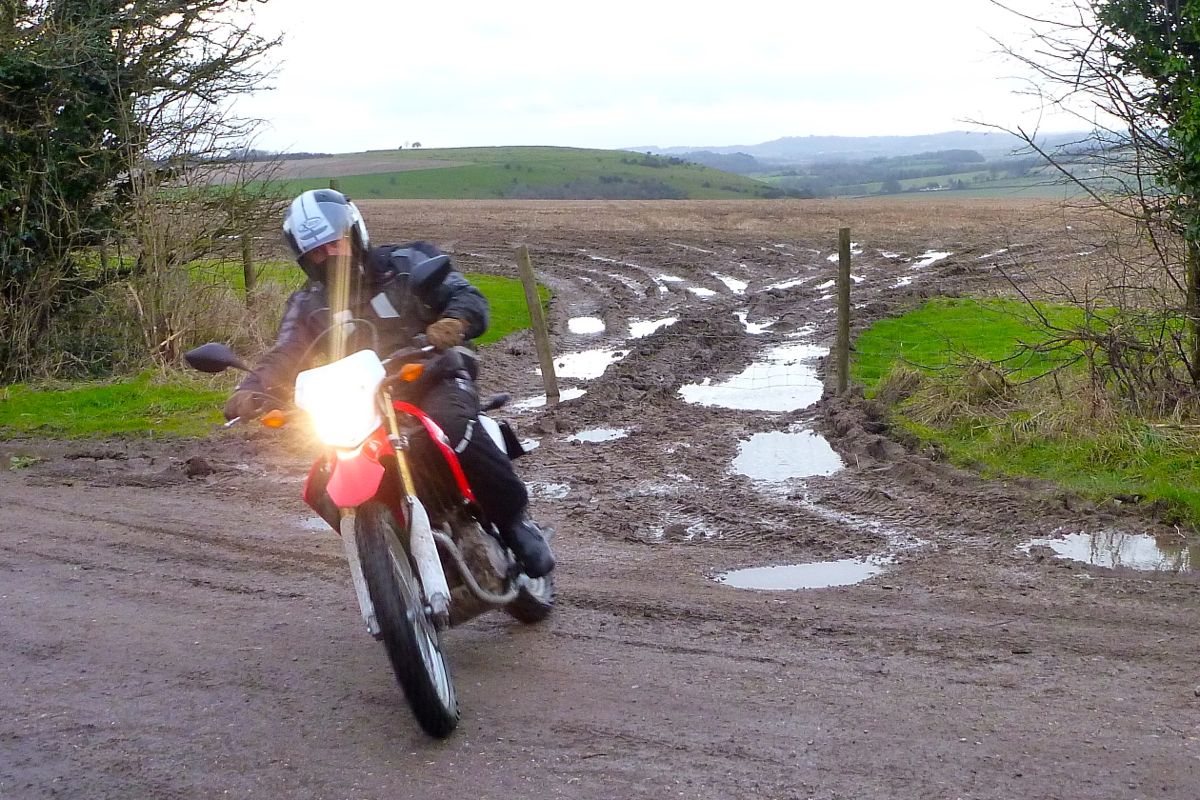
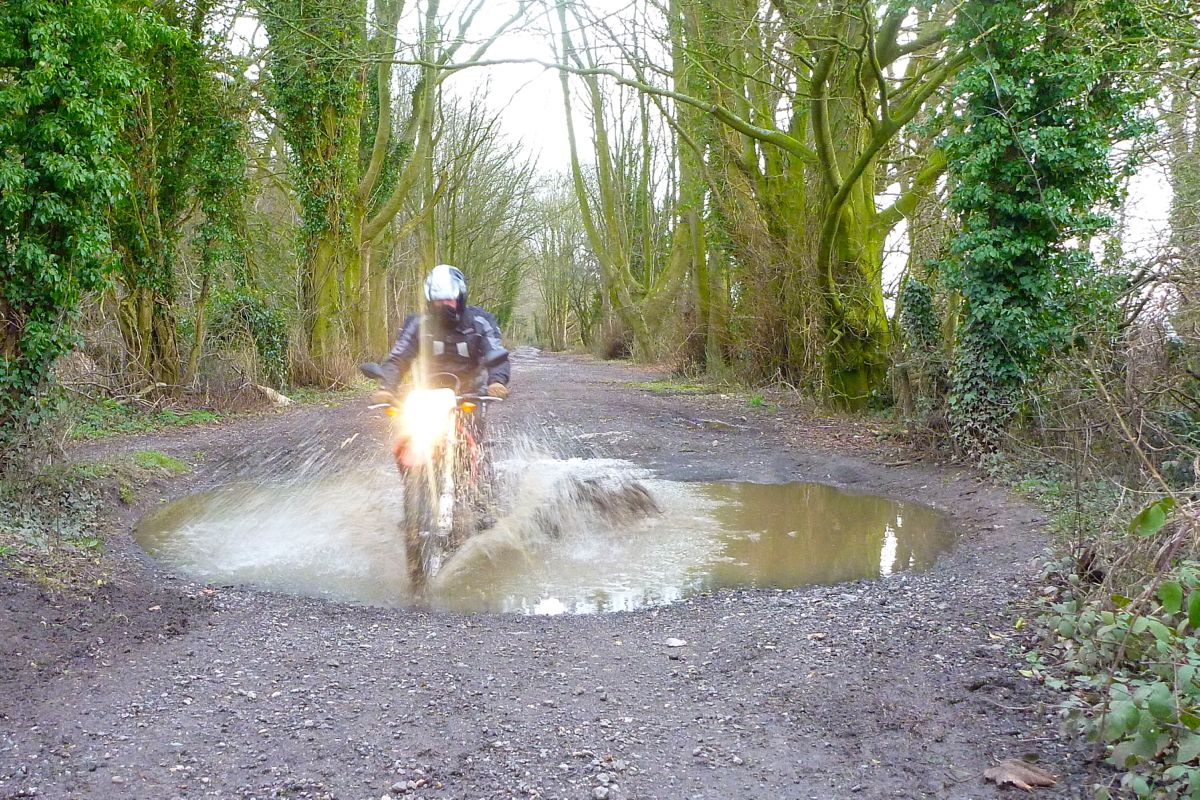
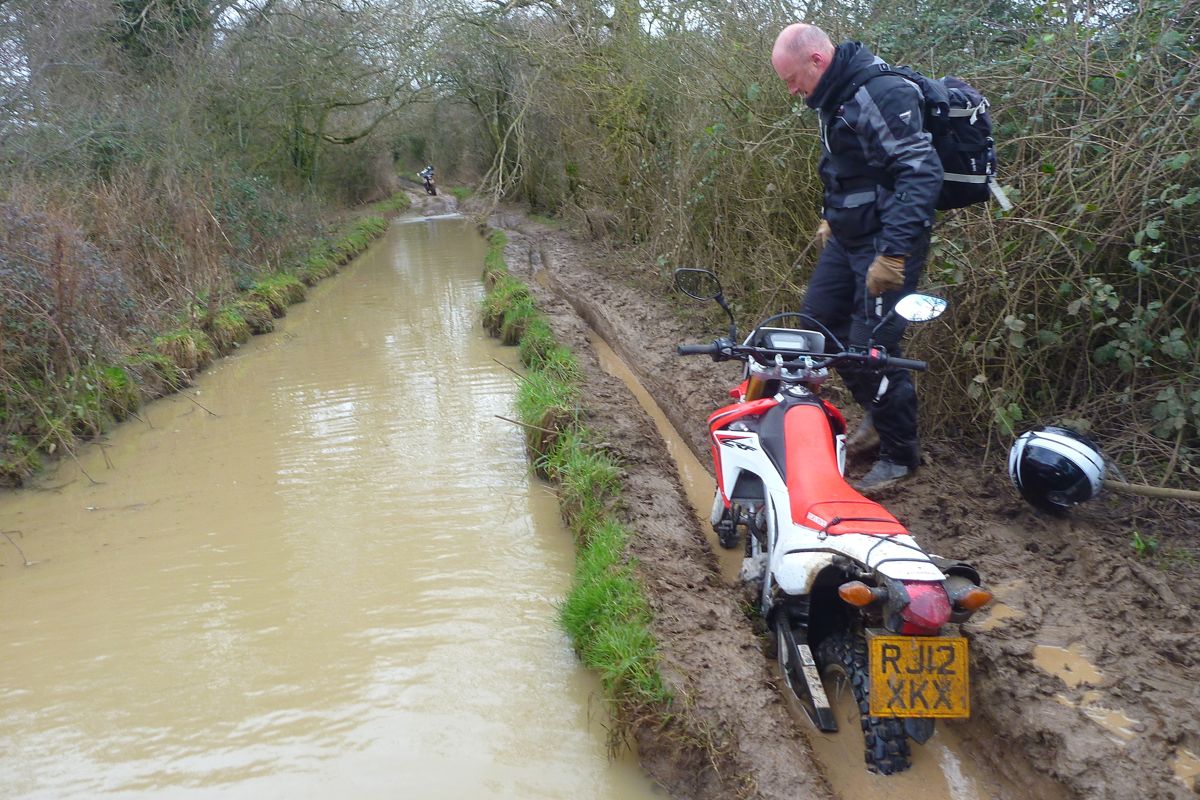
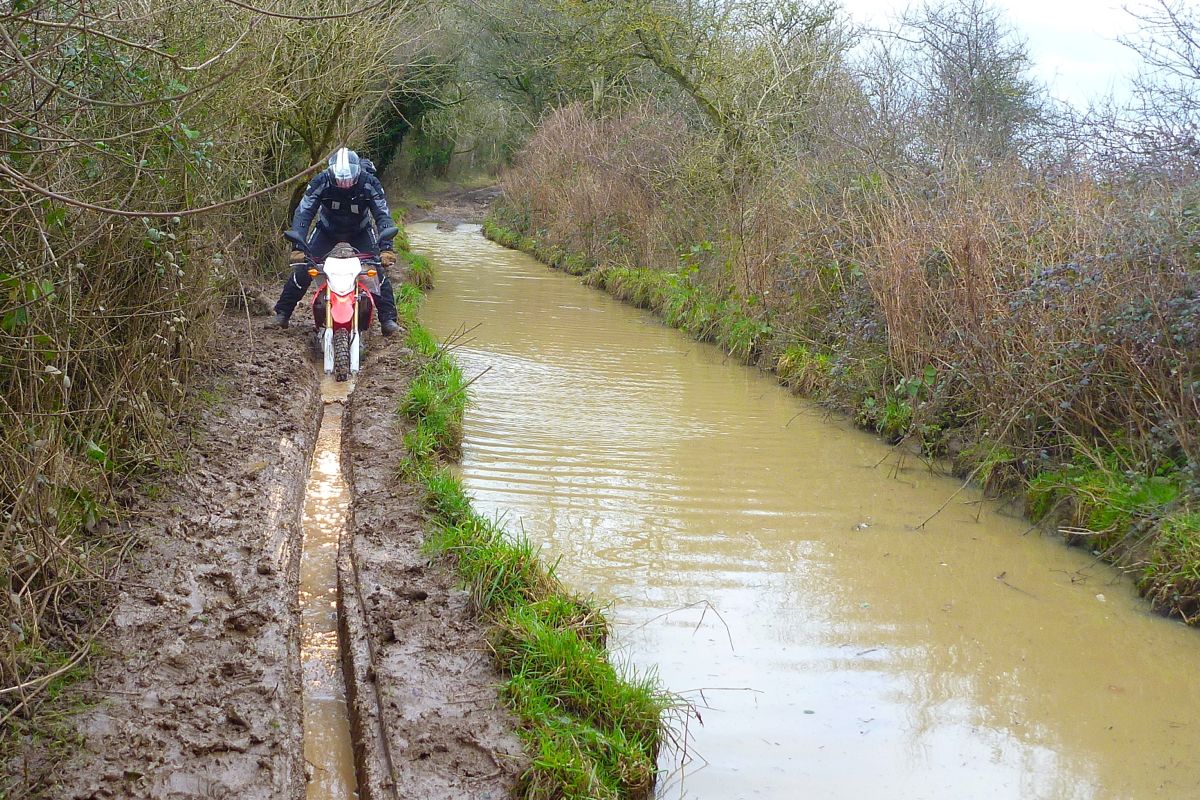
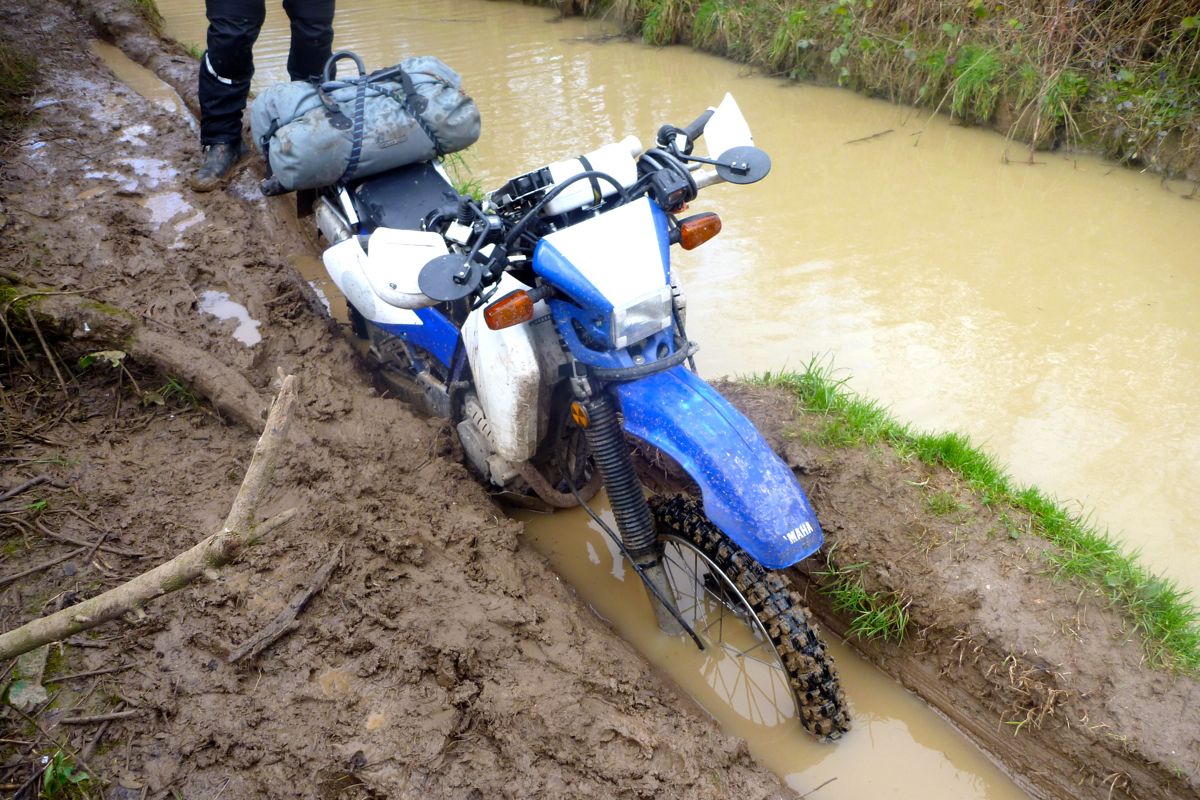
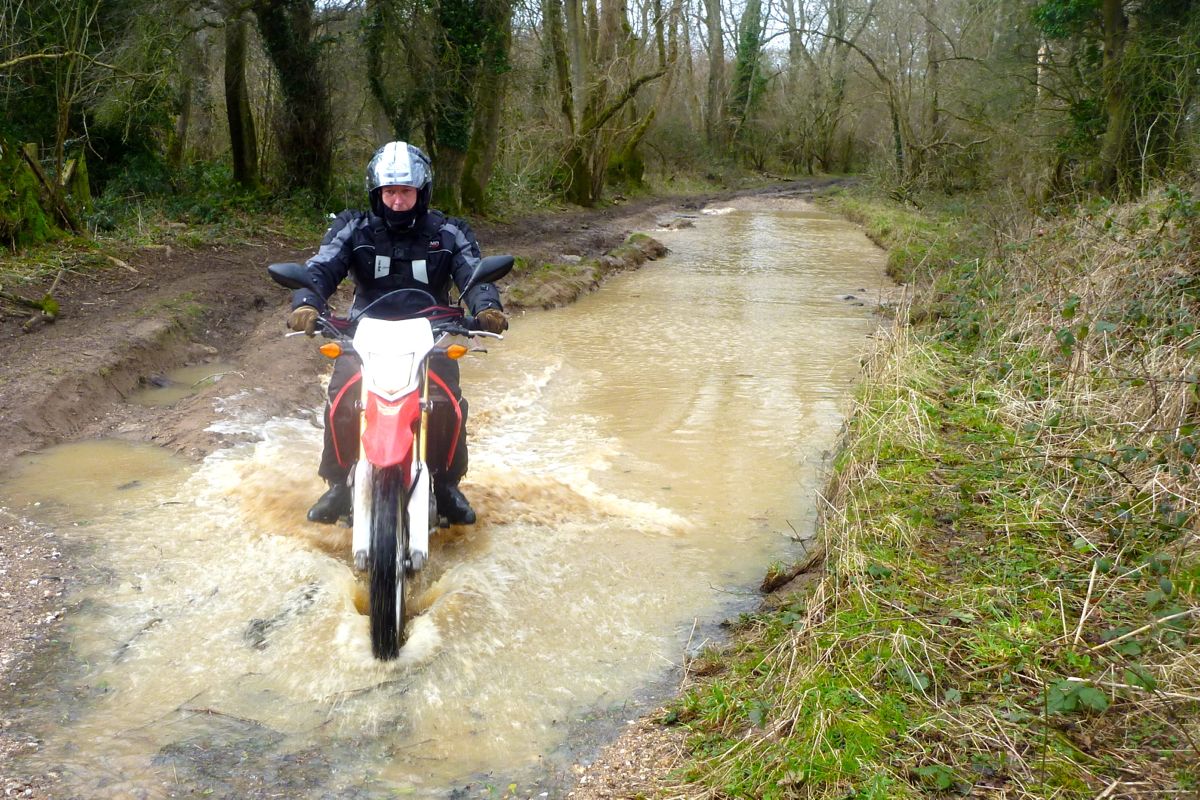
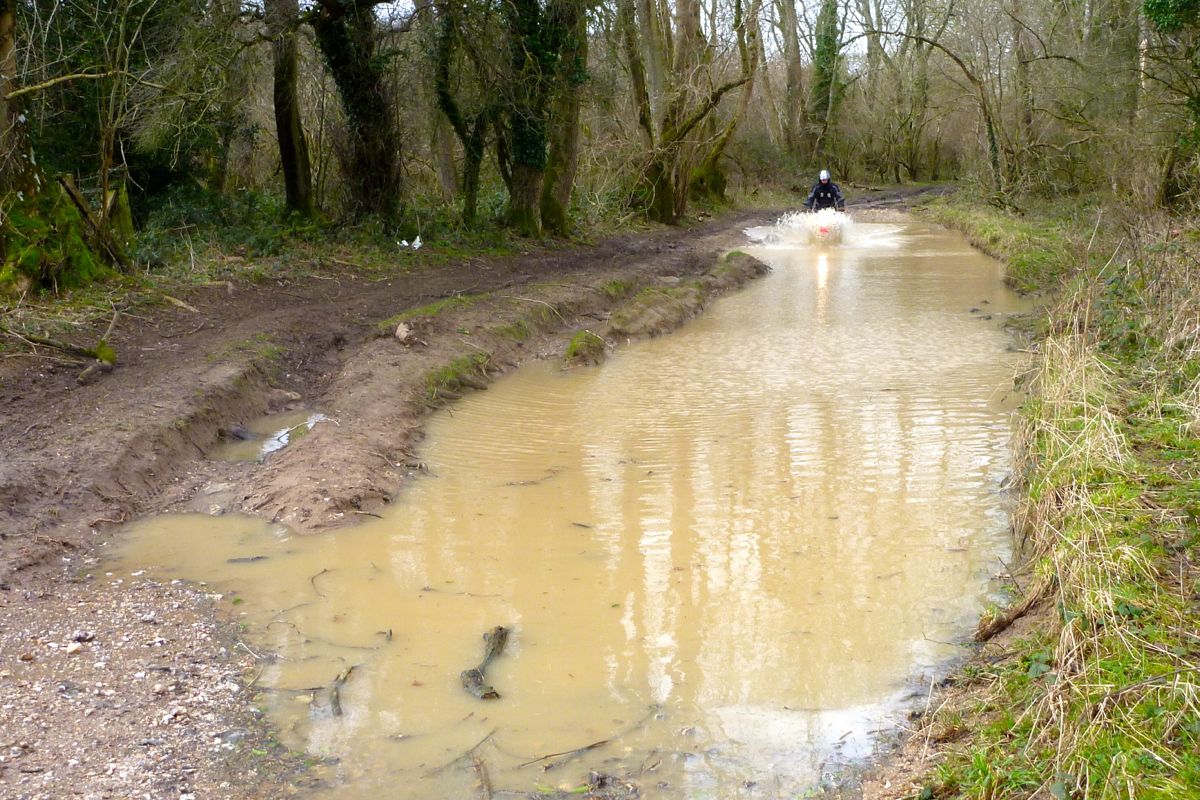
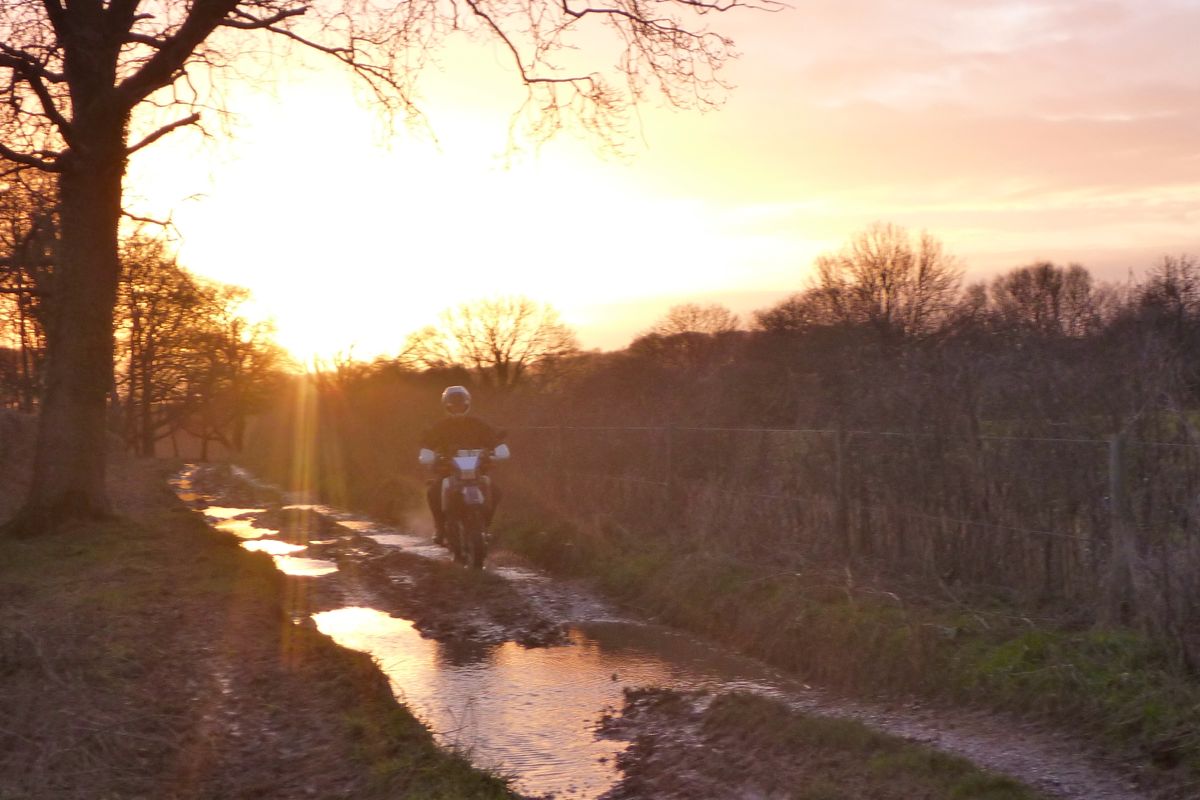
But what we needed was a bit more byway action and finally we clocked a muddy lane with no closure signs and set off to see how far we’d get. This one soon got pretty waterlogged and after a while we came to a long water-filled trench alongside which ran a single moto-sized rut (right). Prodding the main channel with a stick proved the water would probably reach the tank once we’d spun ourselves down into the silt. Neither was keen to do try it, but the bike slot alongside was clearly was doable.
Or so we thought. In fact that slot had been spun so deep by passing bikes that the TTR got jammed into the rut by its foot pegs. Robin laboriously lifted each end over the tight spot, observing how easy it was to manhandle our bikes. Add another 50 kilos, 30°C and a set of alloy panniers astride a 650 bogged down in some equatorial morass and it’s all much less of a lark.
Having seen where the TTR got jammed, I thought with a bit more momentum and judicious bar hauling I’d slide the Honda through, but I didn’t even get close before I too was uselessly spraying crap all over my back with the CRF firmly nailed by its pegs. A bit of synchronised wheel lifting soon saw us on the way to the next puddle which led to a fast A road leading back to Salisbury for a refuel (69mpg), coffee and a jet wash before blasting back up to Slough.
Summing it up If you can cruise at a real world 65mph and tackle any reasonable off-road trail, it makes you wonder if a bike like this could indeed be a contender as a lightweight, load-carrying overlander – and not just for short people. Robin obviously thinks so and had invested a lot in optimising his TTR, but his cleverly refined minimalism might a bit more than most could endure.
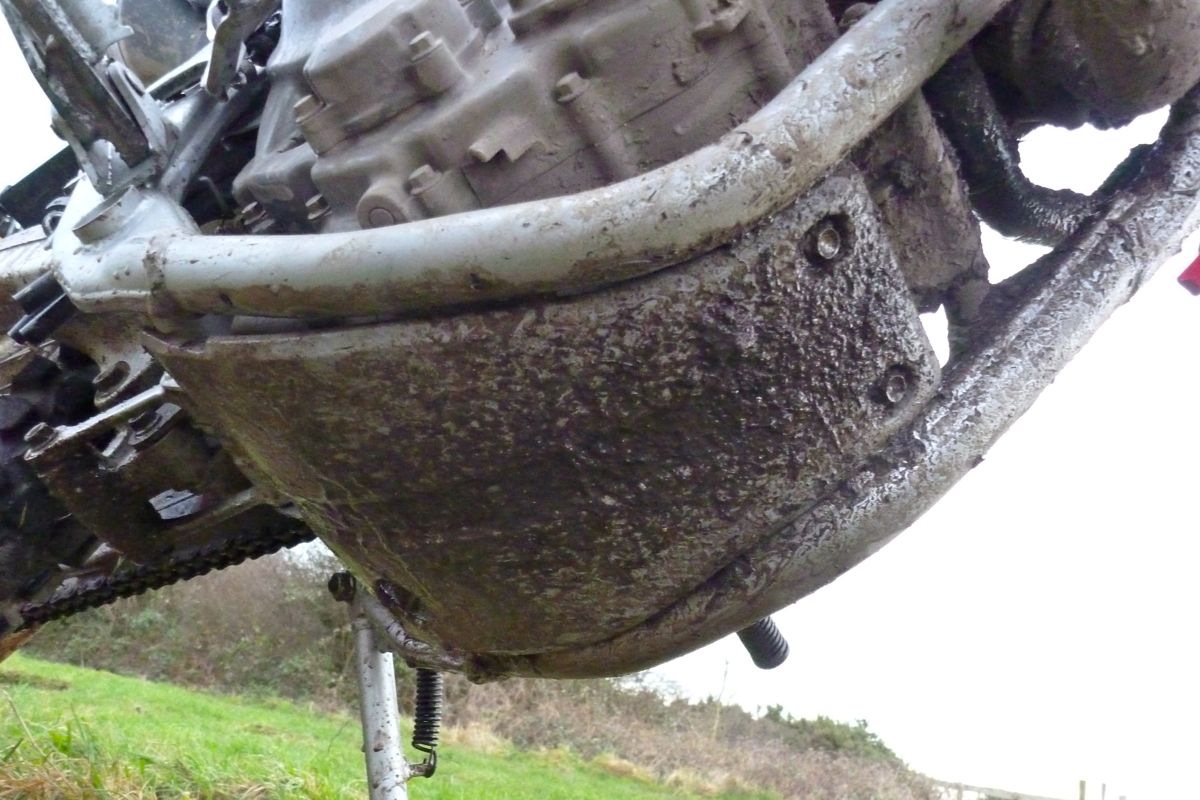
At 6′ 1″ I didn’t feel too cramped nor vulnerably underpowered on the motorway and only the unexceptional mpg (and therefore feeble range on the tiny 7.8-litre tank) was a disappointment. Assuming that was an aberration that might pass or be tuned out, all this bike would need is more of a bashplate to protect the engine sides, hand guards, a tail rack and a windscreen. I’d need some 2-inch bar risers too. Most of all though, at just 7.83L or 2.07 US gallons, it needs a bigger tank or more fuel capacity. At $300 an aftermarket IMS tank adds only 3.33L or 42.5% more capacity, totalling 2.95US/11.16L/2.45gal Imp. For the equivalent of about £180 not sure that’s worth it. I’d sooner get a 7-litre Liquid Containment bladder (as pictured in the book and left ) for about £70 in Ozzie of a ten-dollar 5L fuel can. At my mpg readings I’d have a range of just 111 miles (180km) and even at a more normal 85mpg that’s still only 225km or 140 miles (This guy is averaging 78US or 94mpg). Another 5 litres capacity would boost the range to nearer 400km (at optimal mpg figures). There’s plenty of room where the unused front ‘tongue’ of the seat goes, or with extended rad scoops as on the XR tank fitted on Robin’s TTR which would also protect the ever-vulnerable radiator.
I didn’t get the chance to have a closer took at the bolt-on subframe which is rated as ‘rider, passenger + 5kg’. That ought to be enough to carry a load when solo riding and being steel and detachable, modifying it wouldn’t be so hard, though perhaps not to carry a set of full size Metal Mules. To me all this complaining about the weight misses the point – it feels light to ride and light to lift and doubtless light to pick up too. Robin’s modified TTR weighed the same. An alloy framed 250X may be a whole lot lighter and better sprung but needs a head job every 100 hours while a 250L needs servicing every 8000 miles.
None of the above adaptions are hard to do. Me, I think I’d try and get used to living with 18hp and get over not being able to dig up the turf or wheelie at will. There’s talk of people waiting for a 450 version, because there’s a CRF250X and a 450X. Those are similar looking but quite different bikes. Back at Honda I asked the guy if there was indeed a bigger version in the works; they might bring out a 300 to match Kawasaki’s KLX300 he said, though that’s been out for years so has hardly caught Honda by surprise. But then again, seeing as trailing CRFs include a 150, 230 and now a 250, maybe a 300 might be the next step. Depending on how my desert tours develop, I might be getting a CRF in a few months.
March 2013: I just bought a used and functionally accessorised 250L in California for a two-month ride around the Southwest. More news on the latest AMH Project bike here.


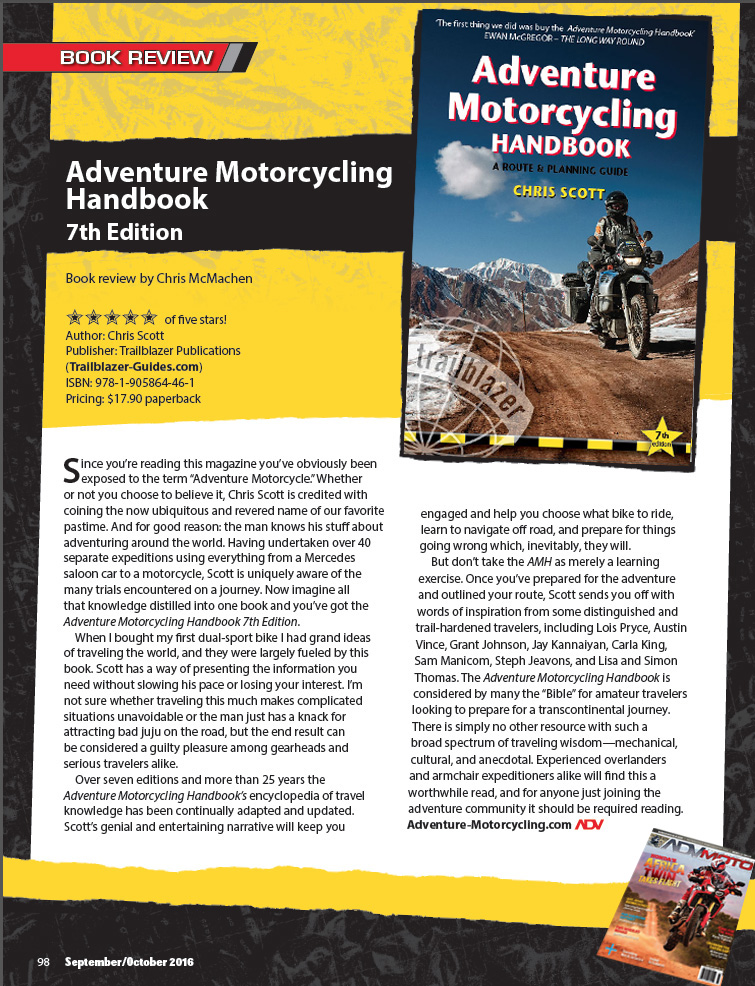
 Fortunately, I had Chris Scott’s indispensable Adventure Motorcycling Handbook up my sleeve, which clearly outlines the unwritten rules.

















 Adventure Motorcycling Handbook