Author Archives: Chris S

XSR 700 Scrambler: the plan

Scramlogo
XSR 700 Scrambler index page
jigsawtracker

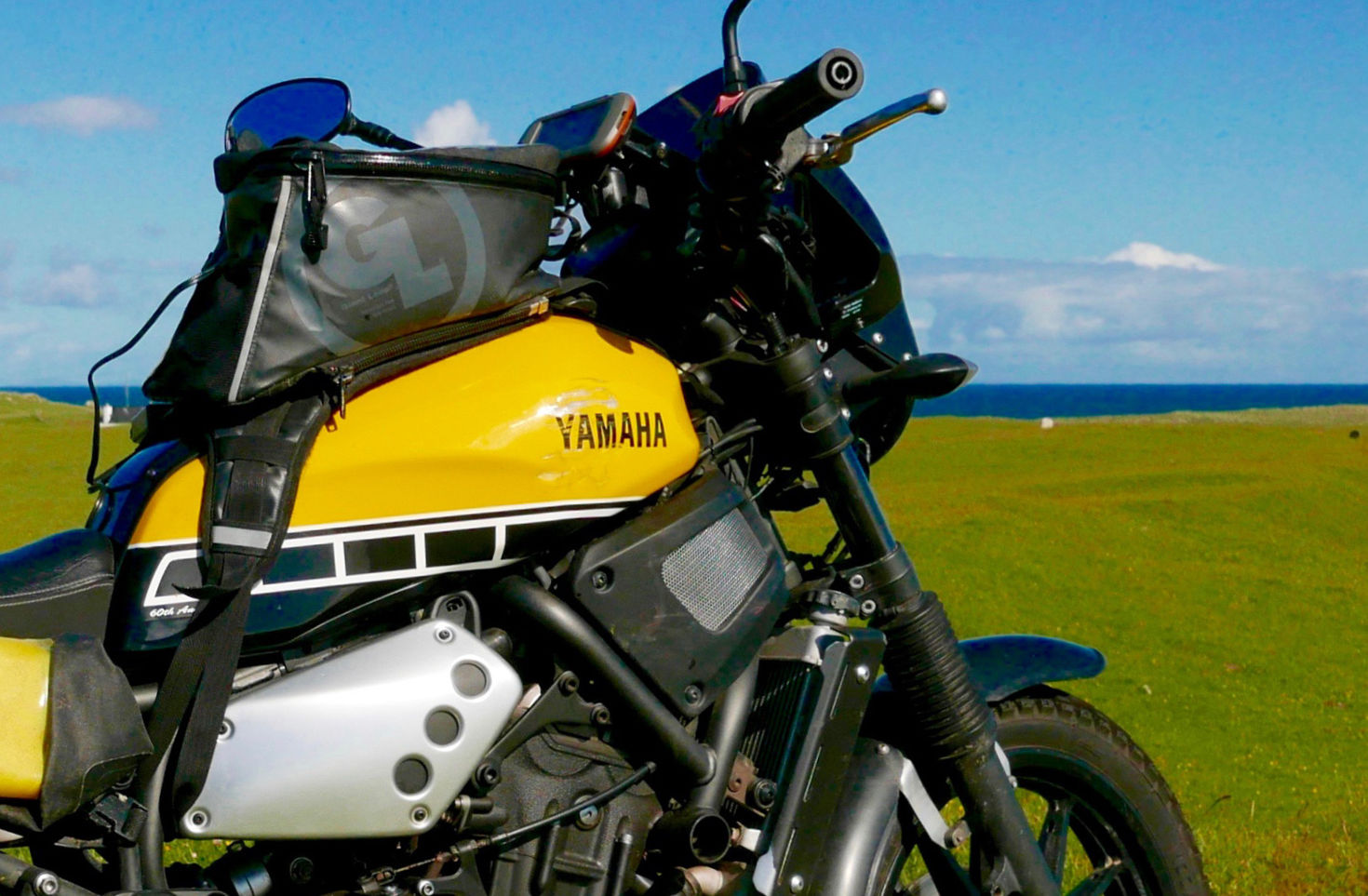
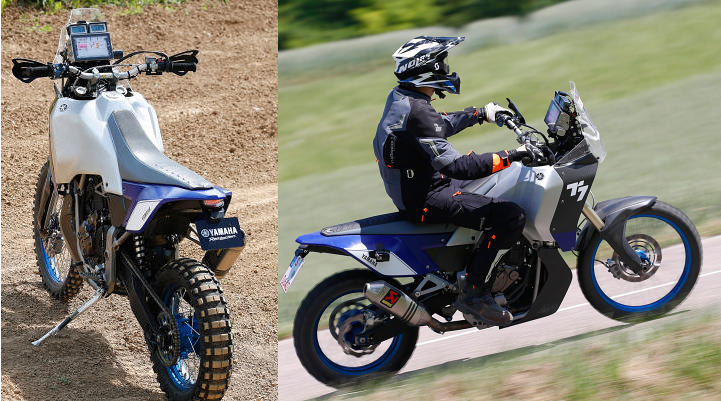
Yamaha’s XSR 700 is my sort of bike: the great motor from the MT07 in a more comfortable and better-looking package, and with the potential to become something more dirtsome, like the Jigsaw Customs flat tracker (right, and in the vid below). Plus I got it cheap so I can afford to experiment :-D
t77

I’m taking ideas from Rally Raid’s innovative CB500X RR I rode in 2015, but am hoping to end up with something more like Ducati’s inspired Desert Sled (below). Like many riders my age, that’s a bike that, if I’m honest, appeals to me more than the forthcoming, over-tall, razor-saddled T7 (right) which I’m sure will also be a hit.

dezled


Obviously, your superbly detailed, BikeEXIF-type ‘urban scrambler’ (see video below) is not what I’m about. I want an actual scrambler, not just ‘the look’ while dodging the elephant in the bike shed: the huge costs for the huge amount of work required. Note that many, if not all of the bikes and OE parts in the promotional video below were supplied by Yamaha to promote their ‘Yard Built‘ program at the 2017 Wheels & Waves show.

What’s the plan?
Function first – form will be as it comes. The harmless scratches and dents remaining on my repaired bike can stay for the moment. I need my XSR to get me down to Morocco this autumn, run a few thousand clicks leading my tours, then fetch me back as winter sets in over the sierras. The mods that it adds up to are:
• tyres – easy
• protection – advisable
• lift – optional
• luggage – useful
• engine – unnecessary

The XSR doesn’t lend itself to these adaptions half as well as Honda’s CB500X. So the plan is to spend carefully, then if the machine shows promise and I’m still interested, finish the job with a fork transplant and a new wheels.

xsr-derest

My bike is restricted from ~74hp to ~46hp (numbers vary) for A2 license holders. I have a full license so can run it unrestricted but to be honest it runs great at 46hp and a year later I feel the same: loads of satisfying grunt where you want it. It just goes to prove the old adage: ‘50hp is all you need‘.
The way the restriction works on early model XSR/MT07s like mine is mechanical: a simple plate (left) stops the throttle opening fully. I read recently in a magazine somewhere that later model XSRs and MT07s had a detuned ECU, not the mechanical restrictor and which, I imagine, is less easy to derestrict. And in poor old Ozzie they get a reduced power 655-cc learner version. Got luck changing that!
As I’ve never come against the restricted throttle’s stop in over a year’s riding my XSR. Derestricting it by unbolting that plate doesn’t seem worth the bother as there’s no power or torque to be gained in the throttle and rpm-range I ride at. I only wish I could have got cheaper insurance by running it like this.
Tyres
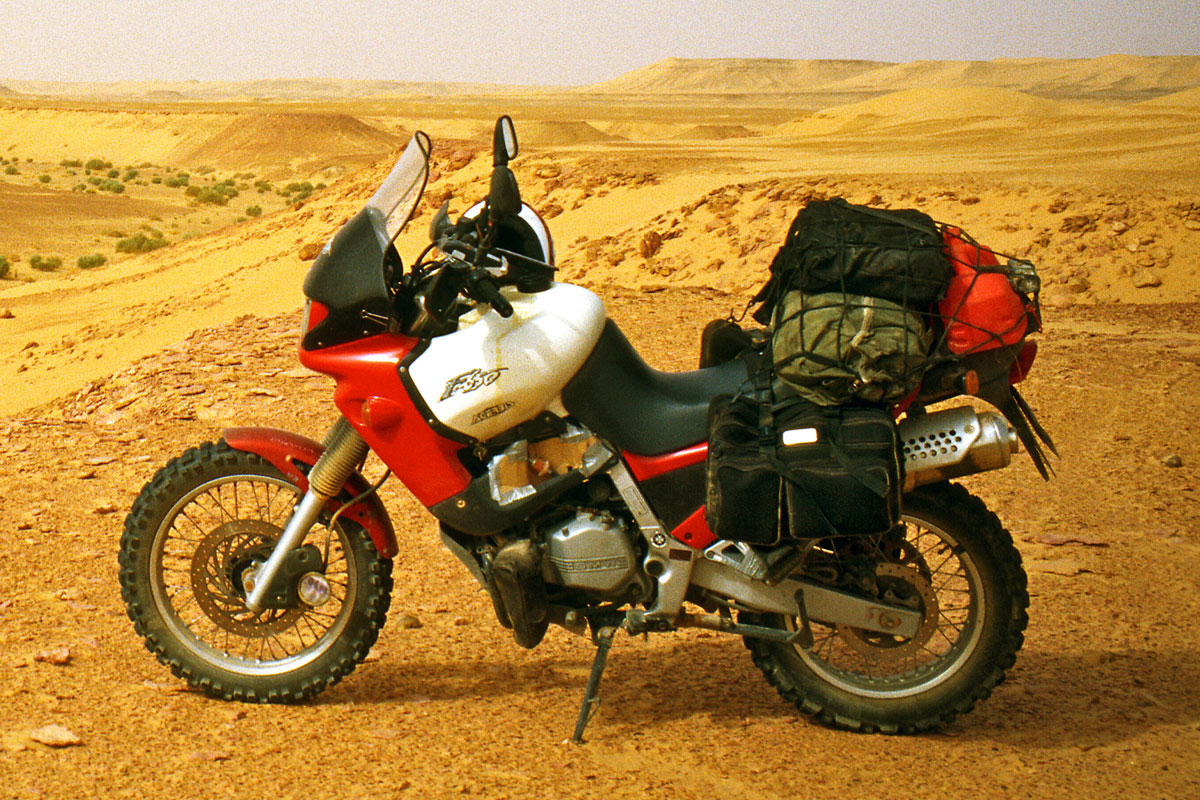
As the vid above reminds us, anyone can slap on some TKCs, but would you want to corner on a fat, 17-inch front Conti? I recall years ago a disgruntled mechanic told me off; he’d just shat himself taking my Pirelli MT21-shod Funduro (left) out for a spin. You need to ride on eggshells until you get a feel for such tyres. Cool-looking thought it may be, I just can’t see a rear TKC or similar put on a 17-inch XSR front wheel working well on loose surfaces. I’m certain the CB500X RR rode better on road and track with the 19-inch front wheel, so that’s the plan with my Yam. A good old Heidi-Hi K60 will do me.

Protection and racks
I bought my XSR in a bit of a state (right), but it only took a day or two to fix up once the parts were in (with ‘Woodcutter‘ Kev’s help).
A lack of frame tubes under the engine complicates sump protection, but SW Motech make an alloy spoiler (left; top left; £120). Otherwise I’ve picked up an OE exhaust system which could be extended forward as a sacrificial bashplate to protect the more important sump and exposed oil filter. Doing this will probably lose any height gains from tyre and suspension. And if the OE system gets ruined I have the scratched but fruity Akrapovic which came with the bike. In the end the spoiler never bottomed out and barely scrapped once over a hump, but it fought off showers of stones.

xsrakanbar

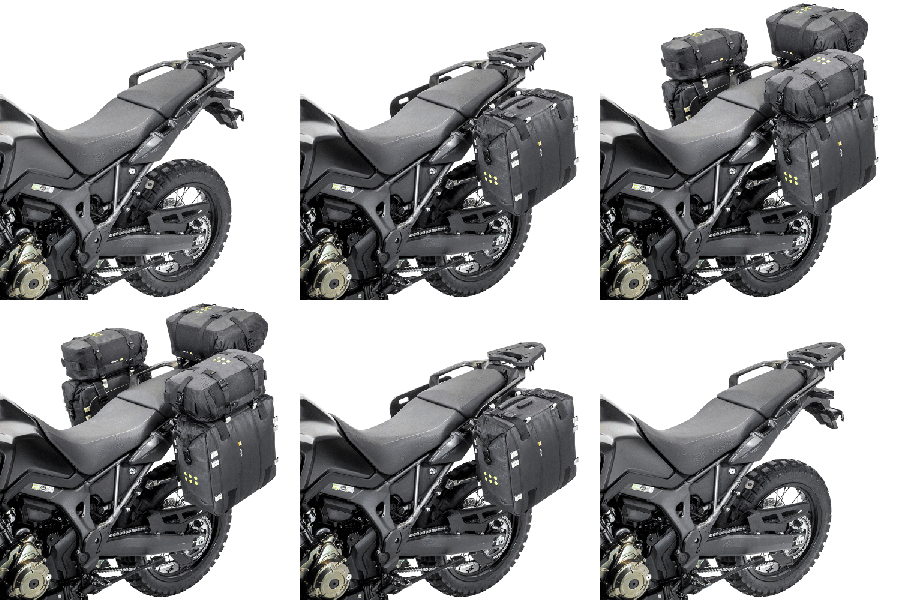
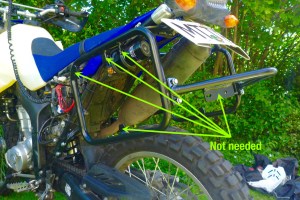
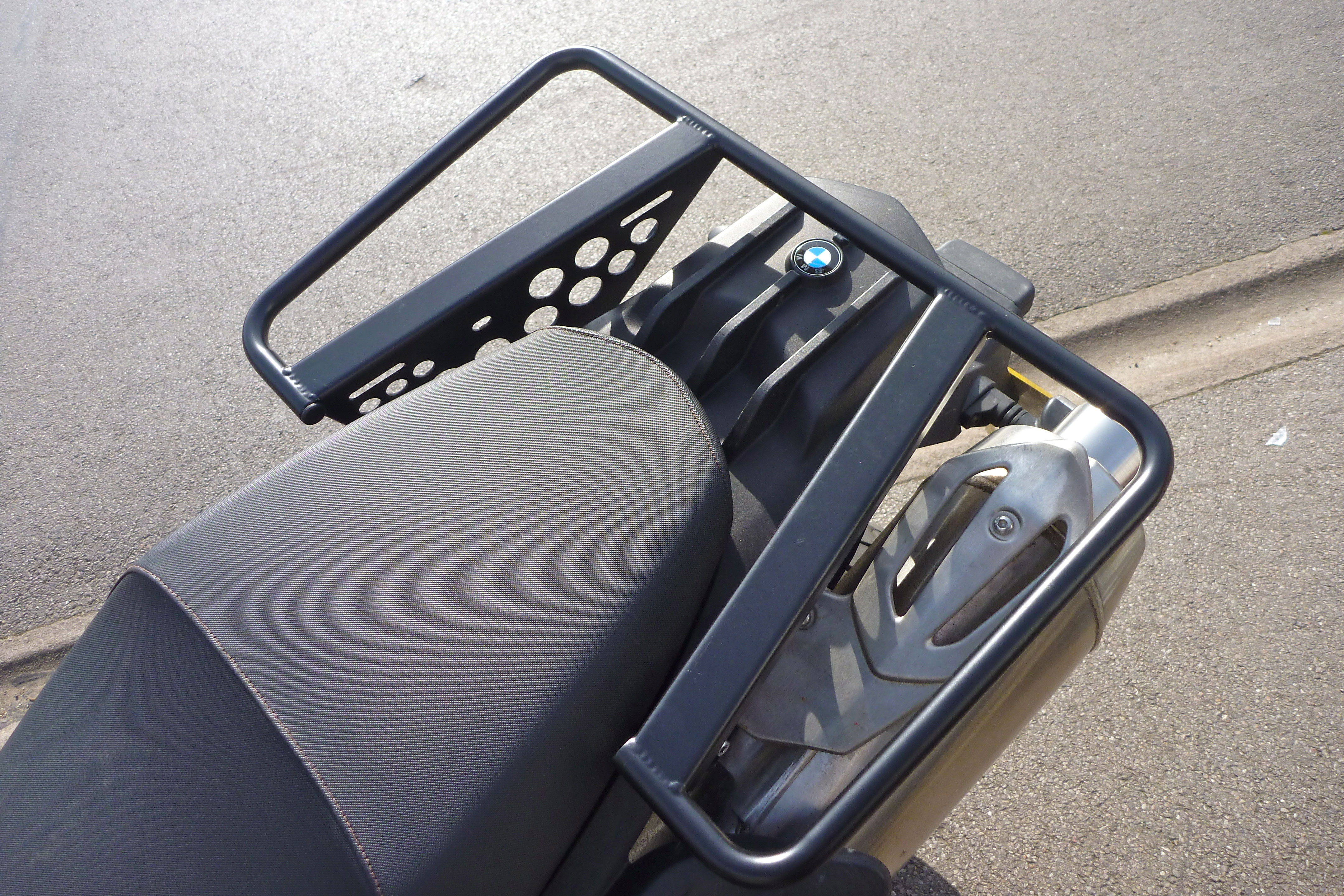
Crash bars from 3Rmoto (above left; top right; £106) look better at protecting the lower engine than offerings from Hepco or SW Motech. Small side pannier racks from Motech (above left; bottom left) could be fitted (or copied without the unnecessary fittings) for some Kriega Duos bags (right) or similar, with a wider tailrack in the style of the HotRod rack I  had on my BMW XCountry (left).

krigduo

Lift
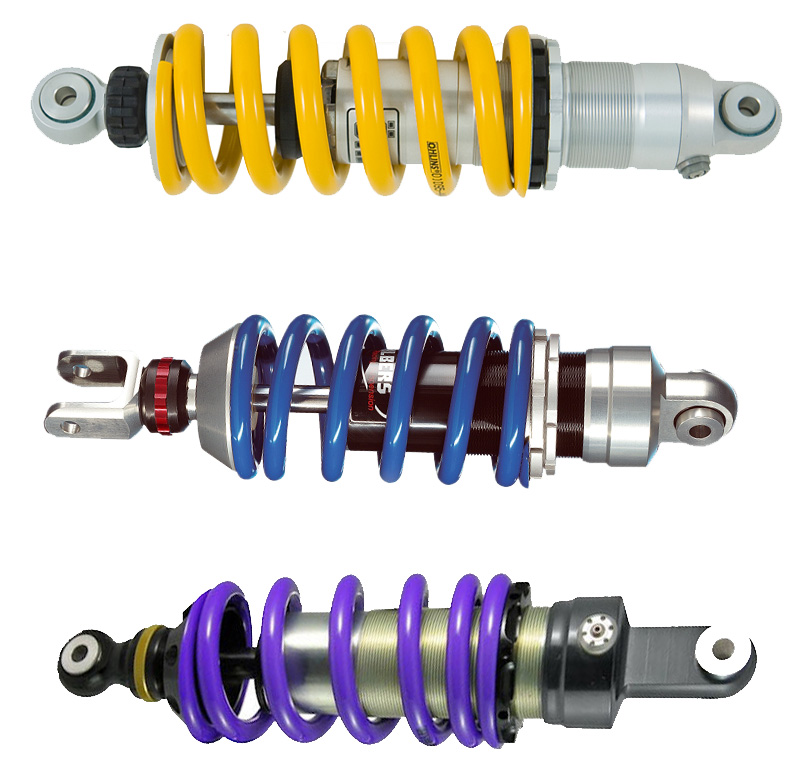
You can gain clearance with taller suspension or, at the back, modifying the rear linkage. Or it can be raised with taller tyres or wheels. This is the route I’ll follow, along with uprated standard suspension from Ohlins, Wilbers or Hyperpro which ought to maintain clearance and of course control the bike better on the rough. (Hyperpro don’t officially make a shock for an XSR; the MT07 one is the same).
forkpreloaders
cartfork

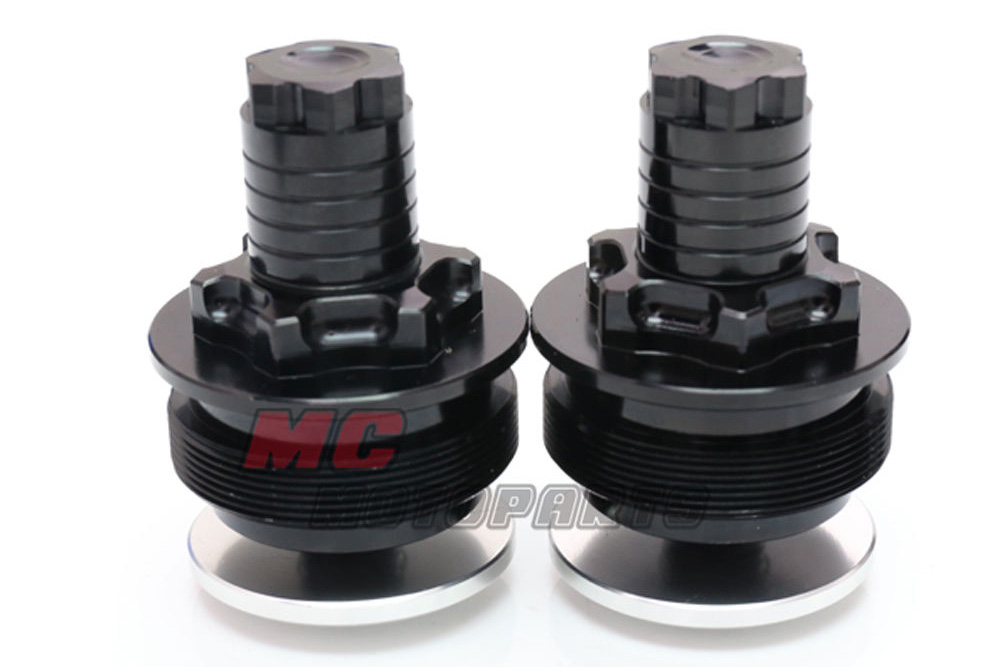
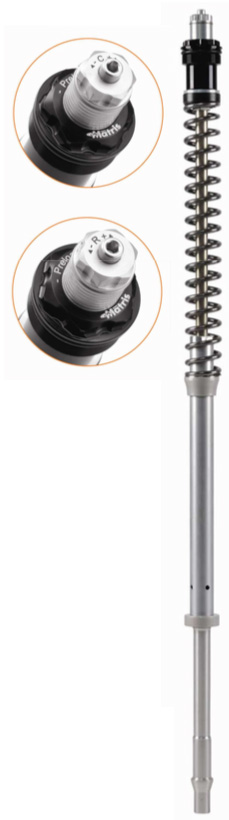
On the front I’m going to try out some inexpensive fork preloaders (left; £28) before probably resorting to an aftermarket spring (Got KTechs in the end, < £100), after which the preloaders will be a good back-up. There are also cartridge fork inserts (right) from the main suspension makers enabling preload and various damping adjustments, but they go for a staggering £500. Like the CB500X, the XSR comes with short springs plus a long plastic spacer. Seeing as aftermarket springs are the same, I assume this isn’t the cost-saving bodge it appears to be. Weight is certainly saved, though you’d think a full-length spring would have a more supple, progressive action,

xsr-shoklug

The XSR/MT07 come  with a preloadable shock with the usual deficiency of  rebound damping that goes back to as long as I’ve ridden Jap bikes. You can now buy used MT shocks on ebay for a fiver. Meantime, I’ve learned the value of a shock with adjustable rebound damping (around £500). I can hardly tell on good roads at normal speeds, but sure can on rough backroads and tracks.
80-xtjumper

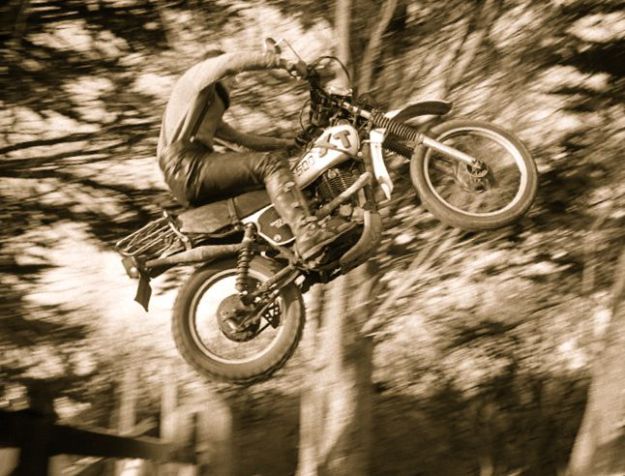
One important point that Jenny Morgan (Rally Raid 500X developer) notes with the XSR/MT07 is that the top of the near-horizontal shock (above left) mounts to a bracket bolted to the crankcase, not a frame member. A very hard bottoming-out could possibly damage the crankcase; a very complicated and costly repair. All the more reason then to fit a good shock, keep preload and tyre pressures on the high side (as I tend to do anyway), and where possible, resist jumps as pictured.
wr-hpa

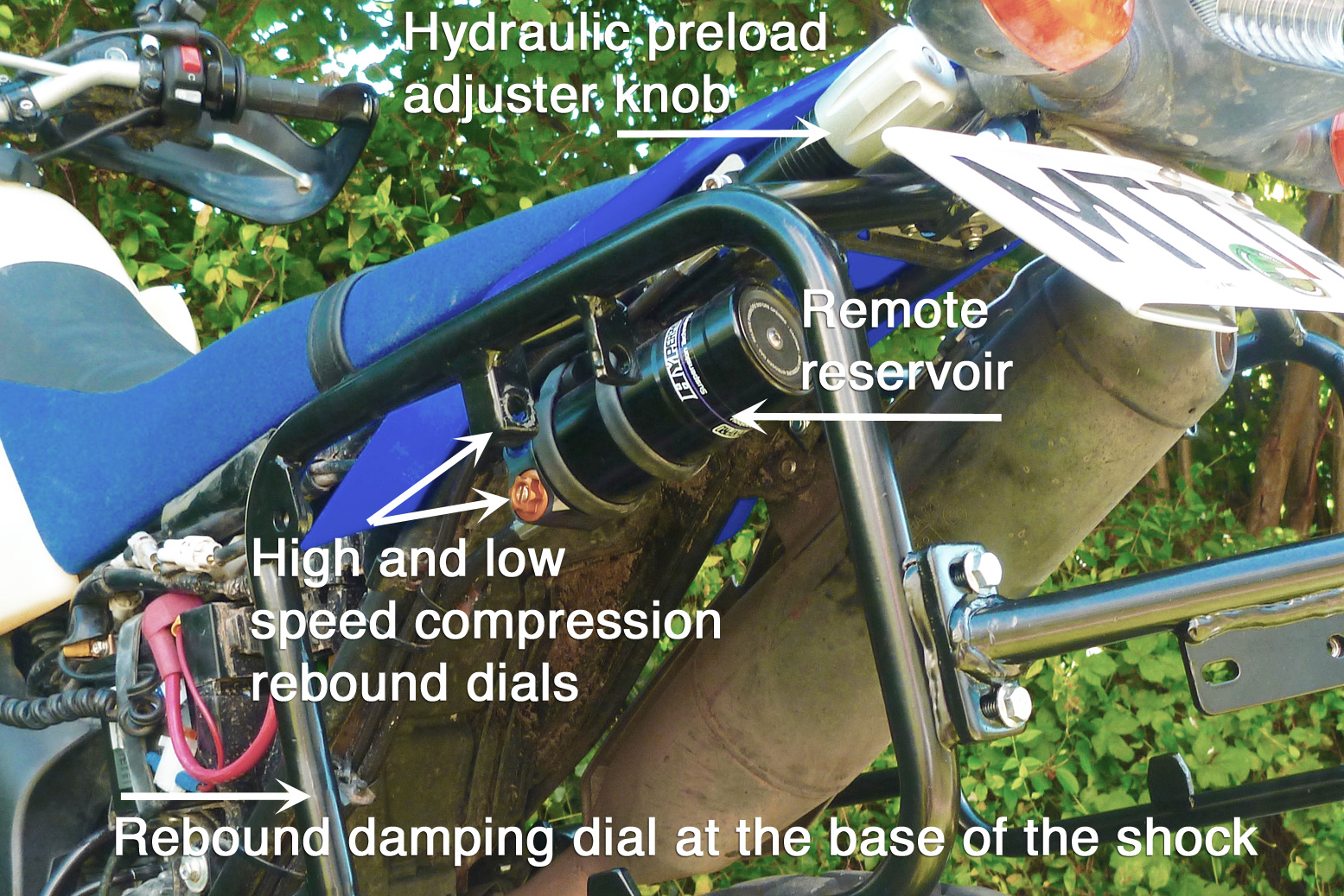
The Hyperpro on the WR (right) had rebound damping as well as low- and high-speed compression damping, though adjusting all these permutations, I got in a twist on the last big piste in Morocco while heavily loaded. I think what was actually needed was the maxed-out HPA (hydraulic preload adjuster) collar screwing down the shock body a bit to reset the preload at a higher rate. Turn-knob HPAs are great; give me one of those (or a mechanical version) any day before three types of damping and different coloured springs. An HPA replaces C-spanners and skinned knuckles; when I jacked up my XSR I made sure I wore gloves.
linkers
Arm-relay

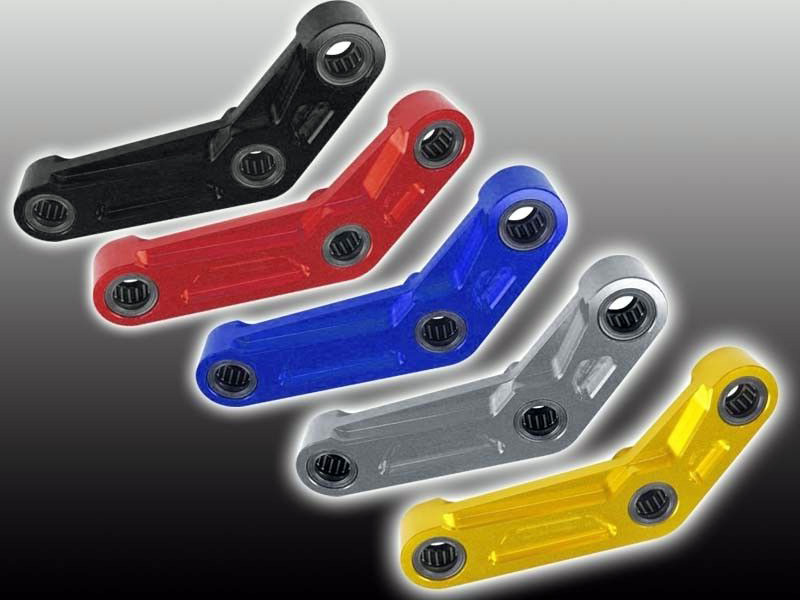
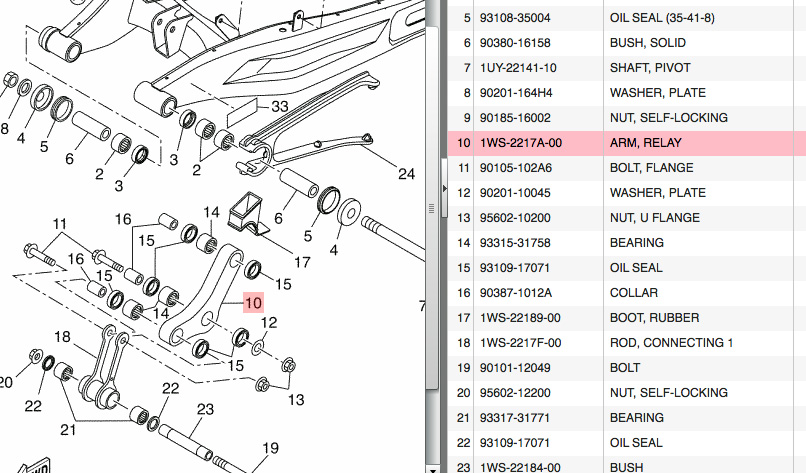
Among others, at the ordering stage only Wilbers offer varying shock lengths to modify standard ride height (most want a lower bike). With other shocks once you’ve spent your £500 you’re stuck with the length. You can get ride-lowering ‘dogbone’ linkages on ebay or, for the 700s, the ‘relay link’ (right) in an array of anodised colours (left). Fitting looks quite a faff and again, like a longer shock, you’re stuck with what you’ve got.
KLX1 - 10

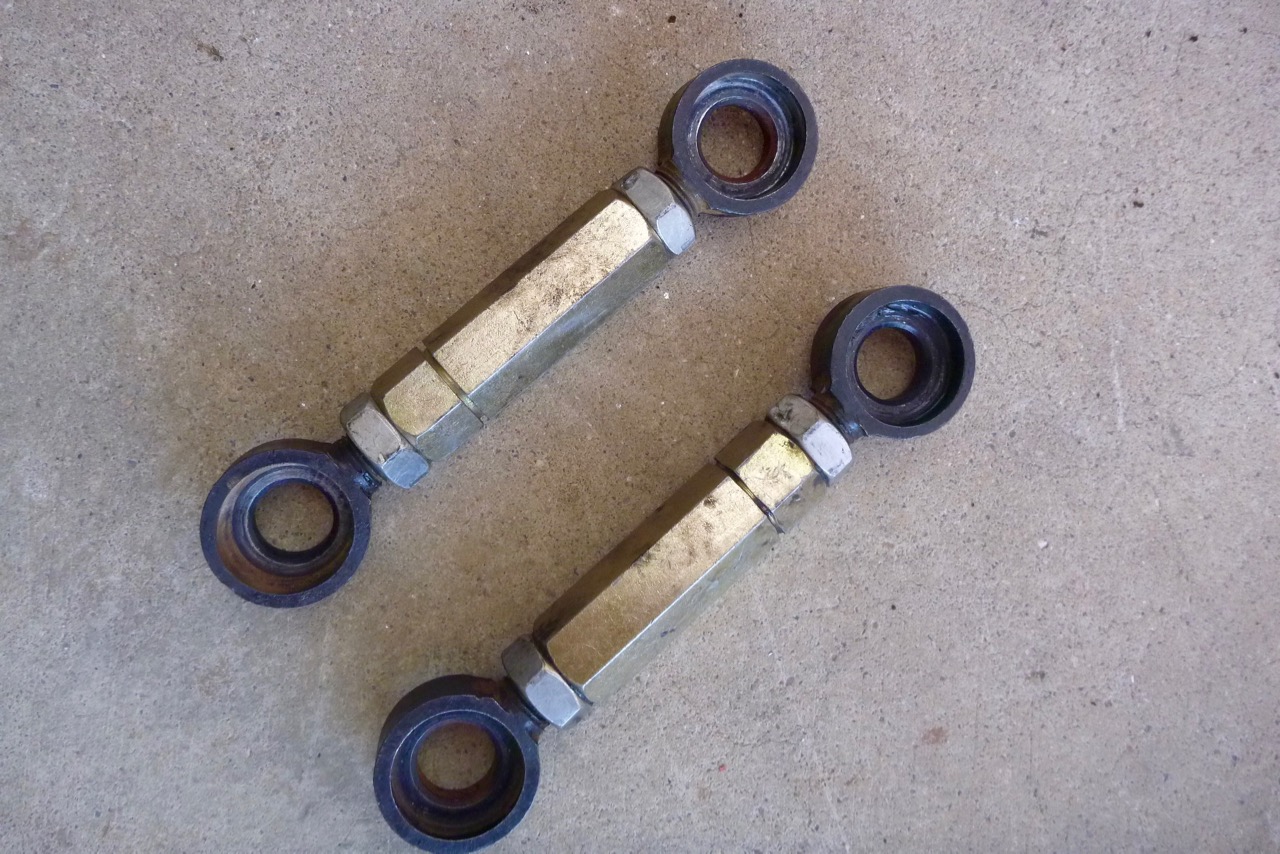
If taking this route I much prefer the idea of variably adjustable links, aka turnbuckle links (left). I first came across them on a KLX250 I had in the US in 2016.  They’re only made in the US by this lot, afaict, and cost four up to times more than a fixed link. And the problem is they only make them to go standard or lower by lengthening the link. To gain ride height you need to shorten that link, which requires chopping maybe 10mm off the body and perhaps 5mm off the threaded ends too. One flaw with messing about with linkage length it that it also messes with the carefully calculated progressive action of the whole system. Rally Raid noticed this shortcoming early on in the 500X’s development and after some calculations, milled a new ‘relay link’ for the Honda.
Up to a point, clearance could also be improved by making the sump shallower and/or rerouting the pipe. The latter is actually the lowest point, but moving it is complicated and expensive. As mentioned, a used OE system can do the job providing the sump’s protected. With the sump, every 10mm less sump depth loses about 280cc or 10% oil capacity, raising temps and reducing oil life. Maybe OK for a racer; not so good on a travel bike, let alone the fabrication effort involved. Better all round to fit solid protection here and achieve / maintain lift from wheels and suspension.

Small jobs already done
My old Spitfire screen fitted, as you can see. I’m getting my money’s worth out of that one and again, I’m amazed how securely the basic fitting works at up to 90mph. The screen can be removed in a minute.
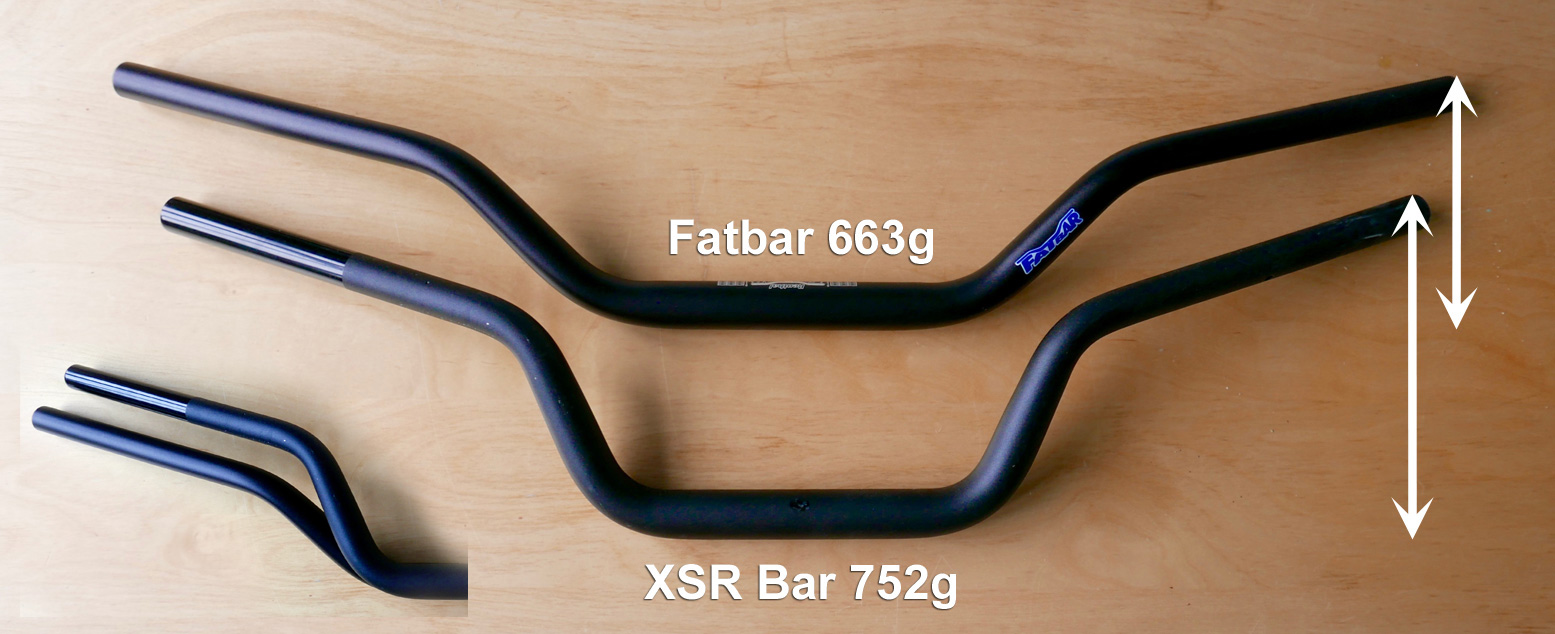
xsrbar

Something was bent up front, but it wasn’t the forks, tfft. I bought a new/removed OE bar, but a closer look showed on of  the bar risers was a little bent; they’re both part of one block (£80). The so-called Yamaha accessory knuckle guards (£160!) absorbed the impact. It’s actually a pretty good fatbar, 2 inches taller and narrower and only 90g heavier than my Renthal fatties (right) which still wait to make their debut.
ledlamper
xsrlampers

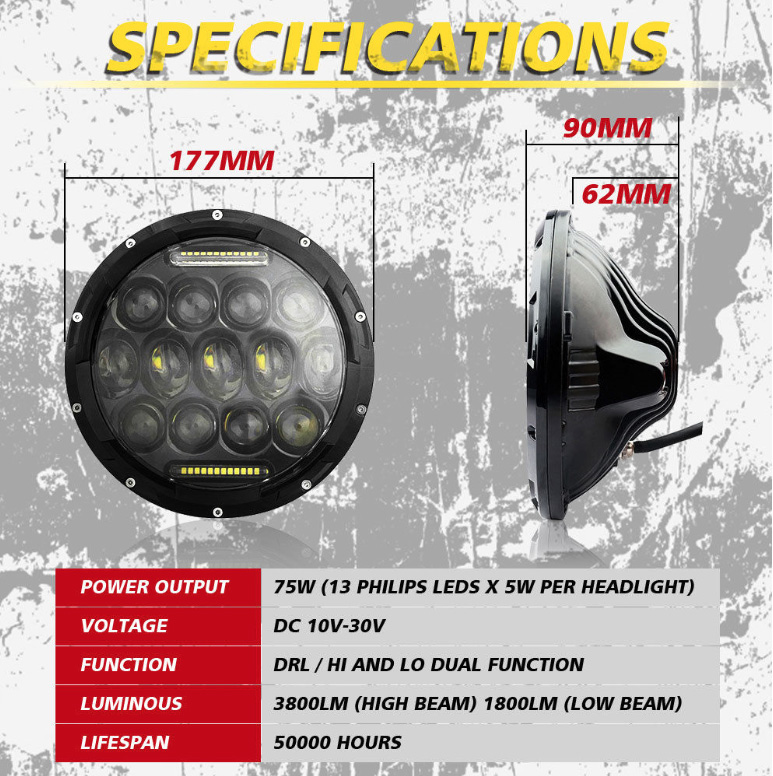
The headlamp shell was caved in and the rim was gouged. That’s about £130 quid’s worth and many agree, the OE lamp is not a great look. Instead, I bought a 2000-lumen LED off ebay, and some steel, fork-rubber-mounting brackets for £25. Removing the OE headlamp mounting frame, the cast alloy indicator brackets and a couple of other fittings saves weight overall but leaves nowhere to mount the indicators. I knocked some up from some scrap formica to get me home, but later got the lamp brackets remade properly in alloy with holes to fit the indicator rubbers.
evotech

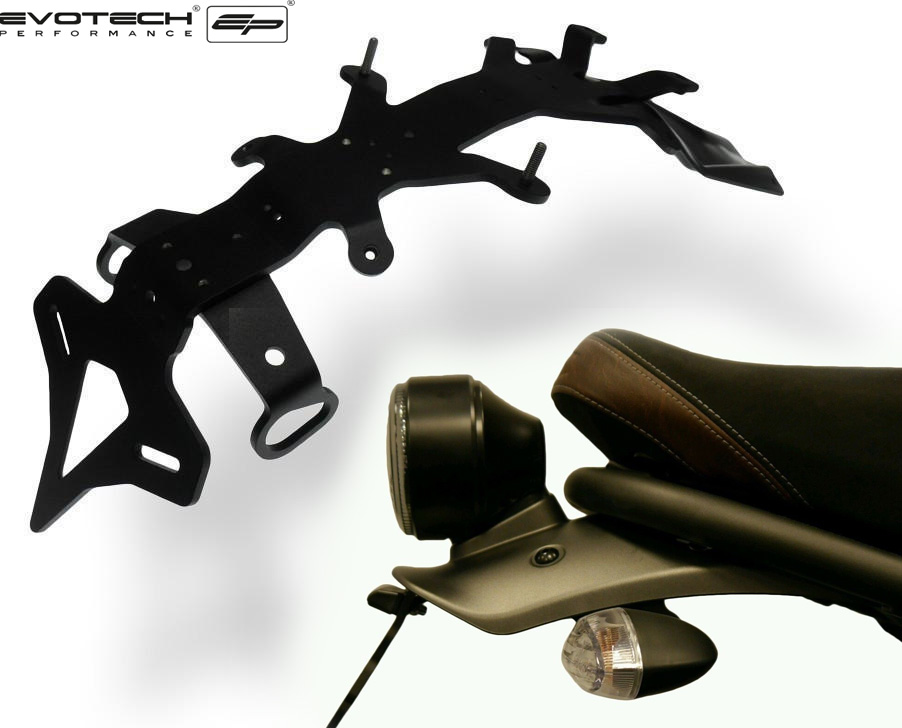
I’m tempted to fit an Evotech tail tidy (using OE indicators) as I know well that running on corrugations and rough tracks can stress taillight mounts which way out back.
strapon

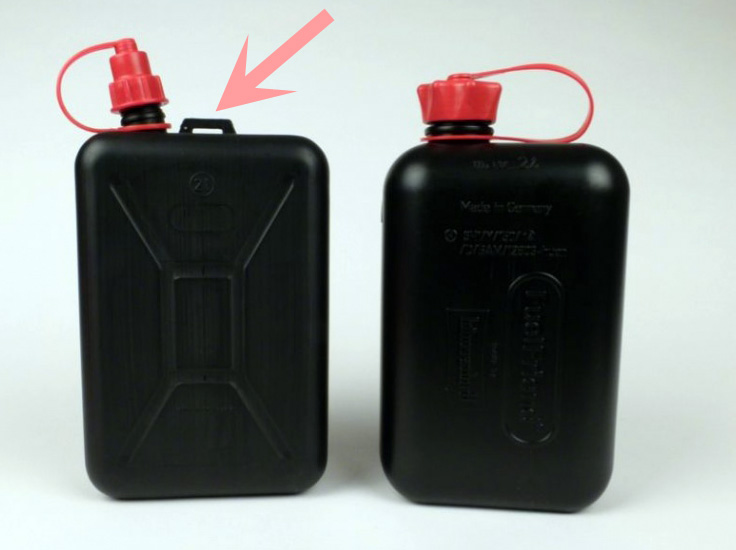
The ‘tank‘ is ally panels covering a 14-litre steel reservoir. One of mine was dented; I tapped it out with a hammer. Right now I get 200 miles to a tank. A little more would be better and looking underneath it appears it would be quite easy to enlarge the tank but really, for 2-3 extra litres I’m better off with some £10 fuel cans.
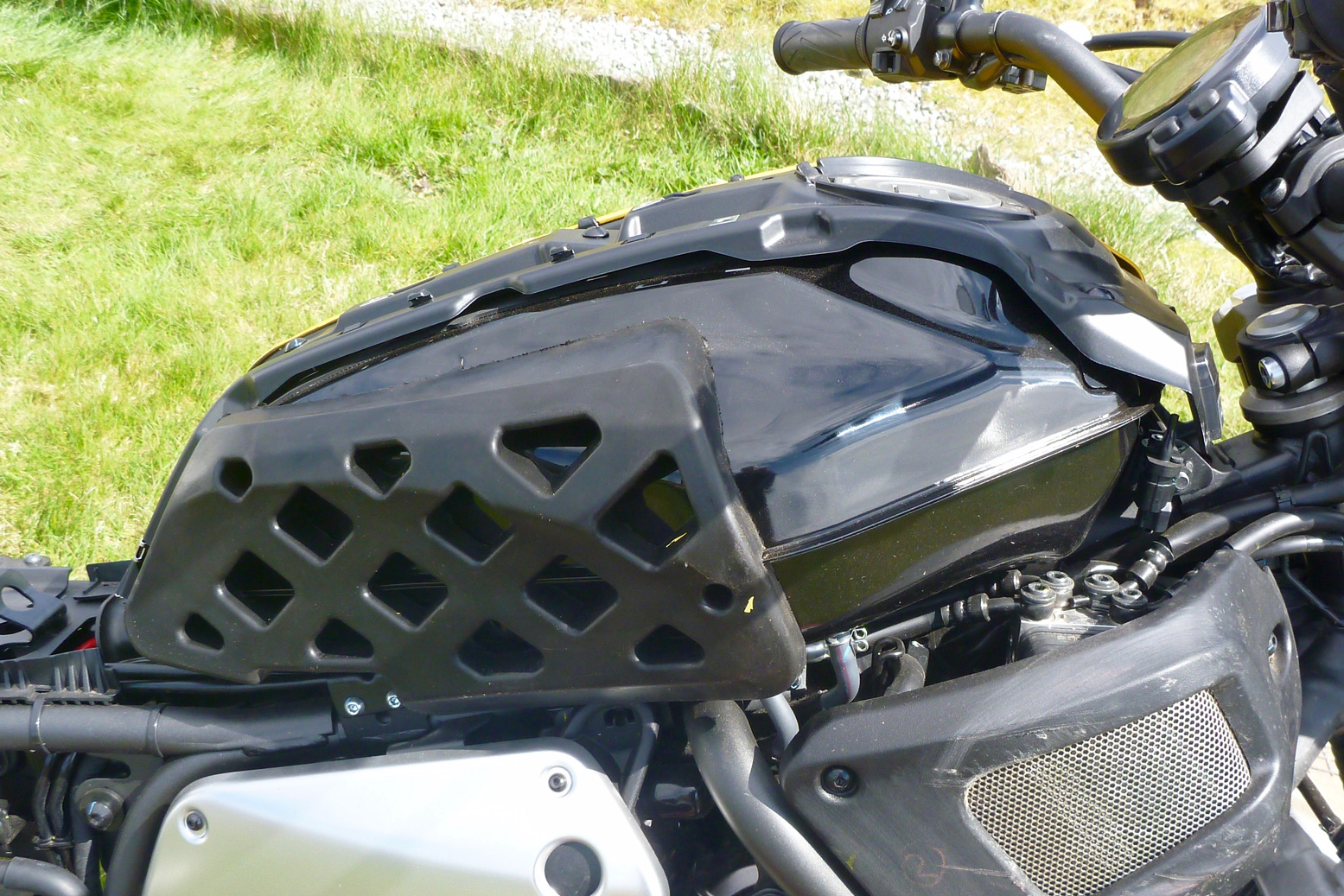
xsrtank
bolt-xvs950r

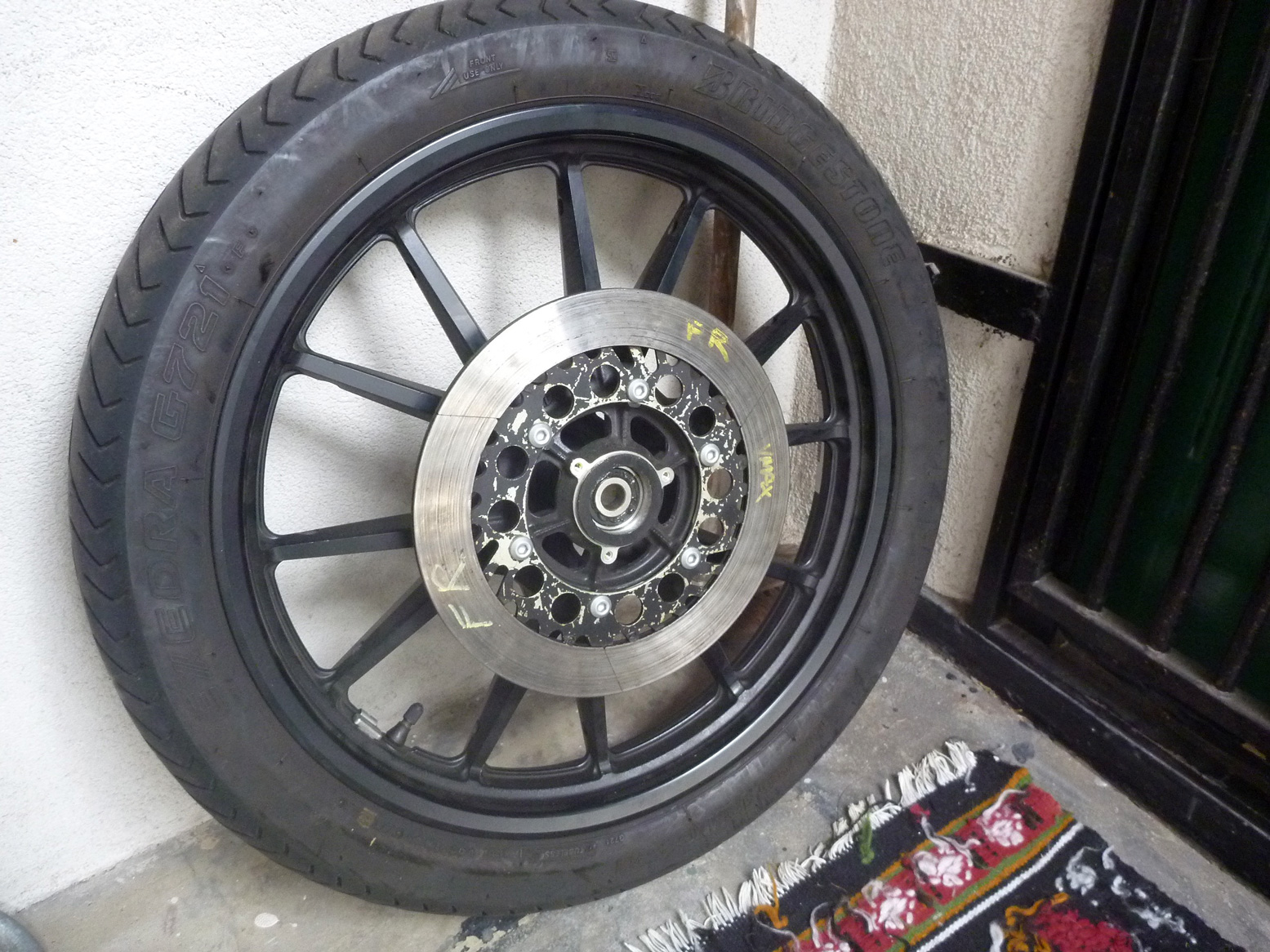
First main job: fit the wheel off a 2016 XVS950R (right). Spindles are the same diameter, but almost certainly new spacers will be needed as well as probable brake caliper spacing to line it up with the V-Max rotor. Luckily the ABS ring may fit – a benefit of using parts from a similar/same era bike. One disc you say? All will be explained.
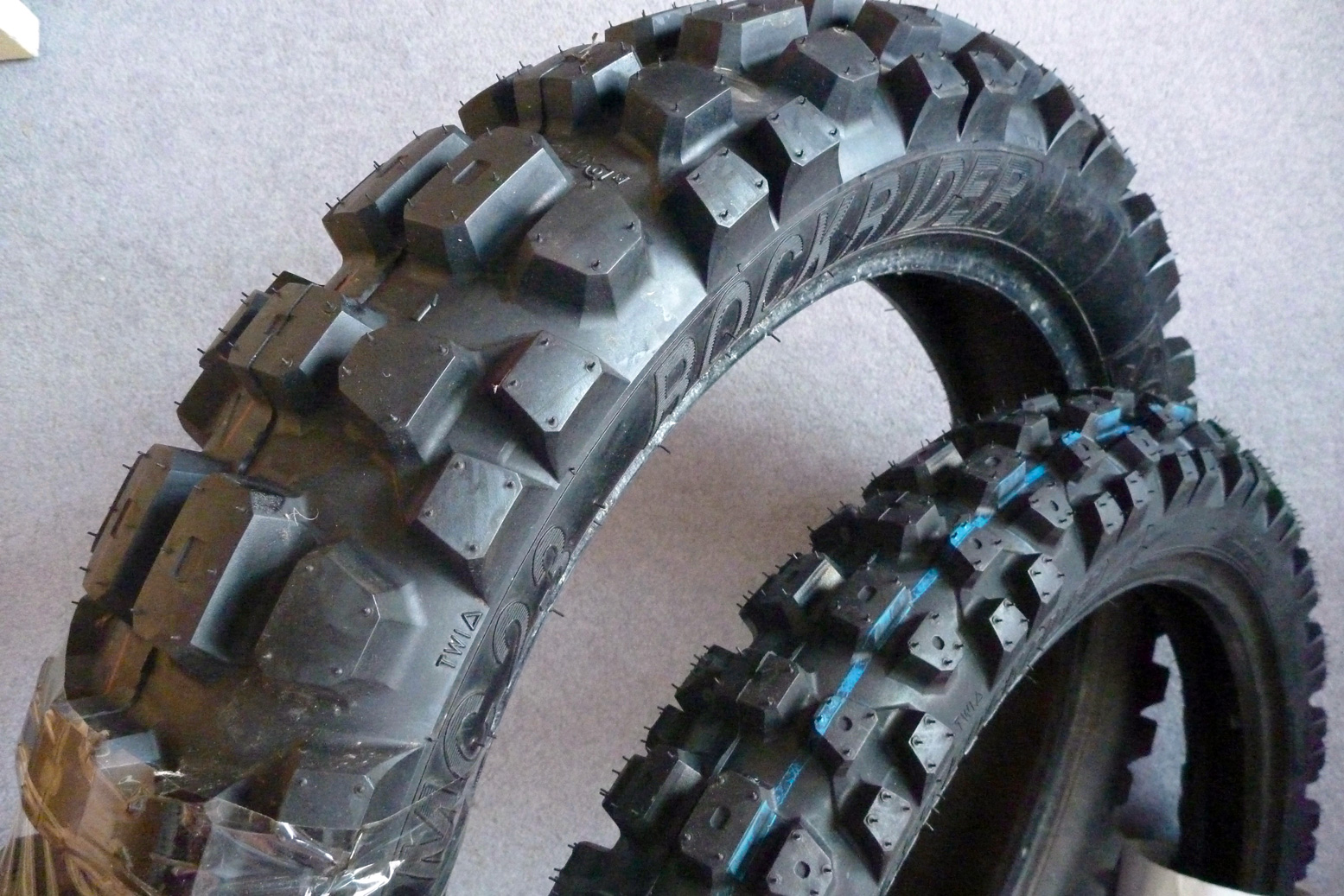
Tested: Mitas MC23 Rockrider tyre on WR250R

Best Adventure Tyres

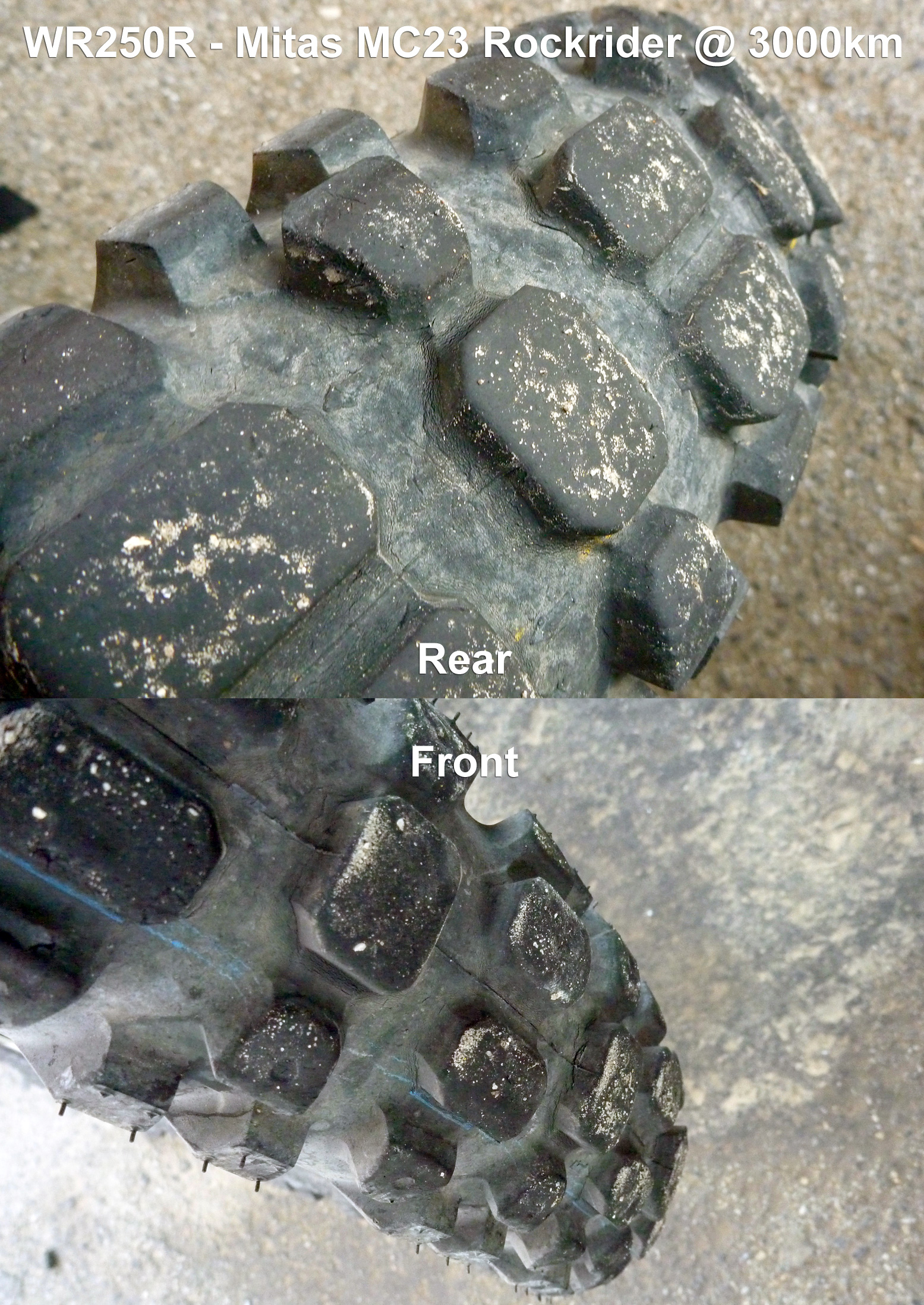
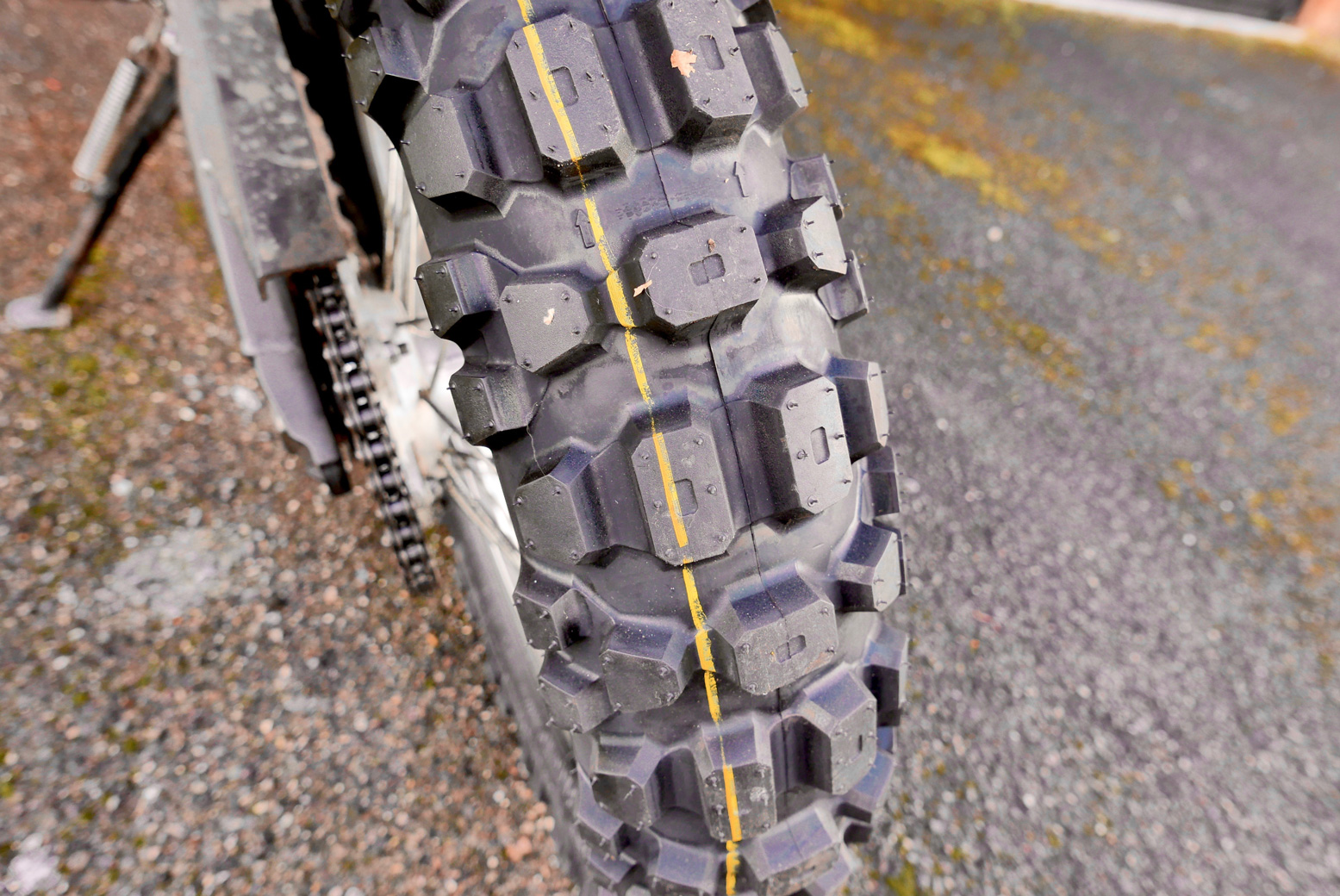
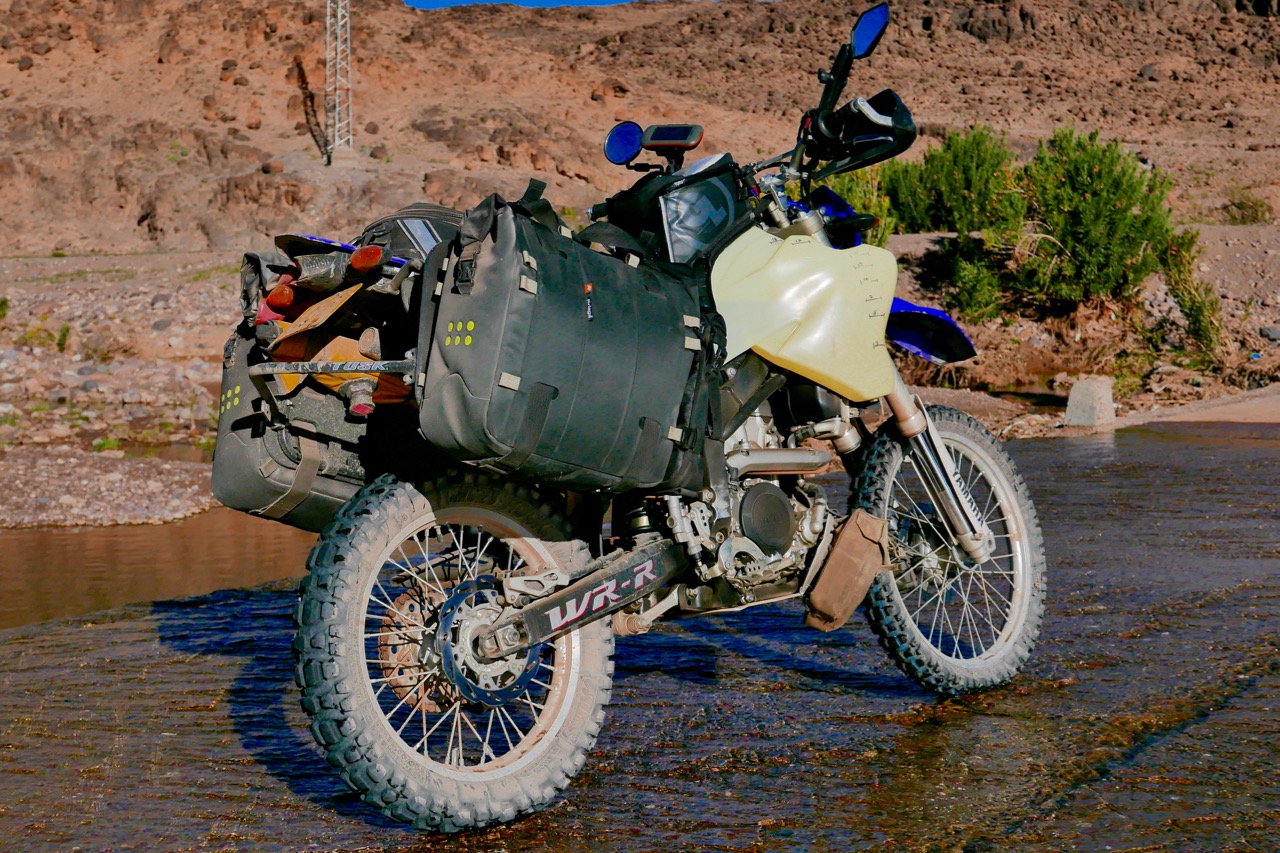
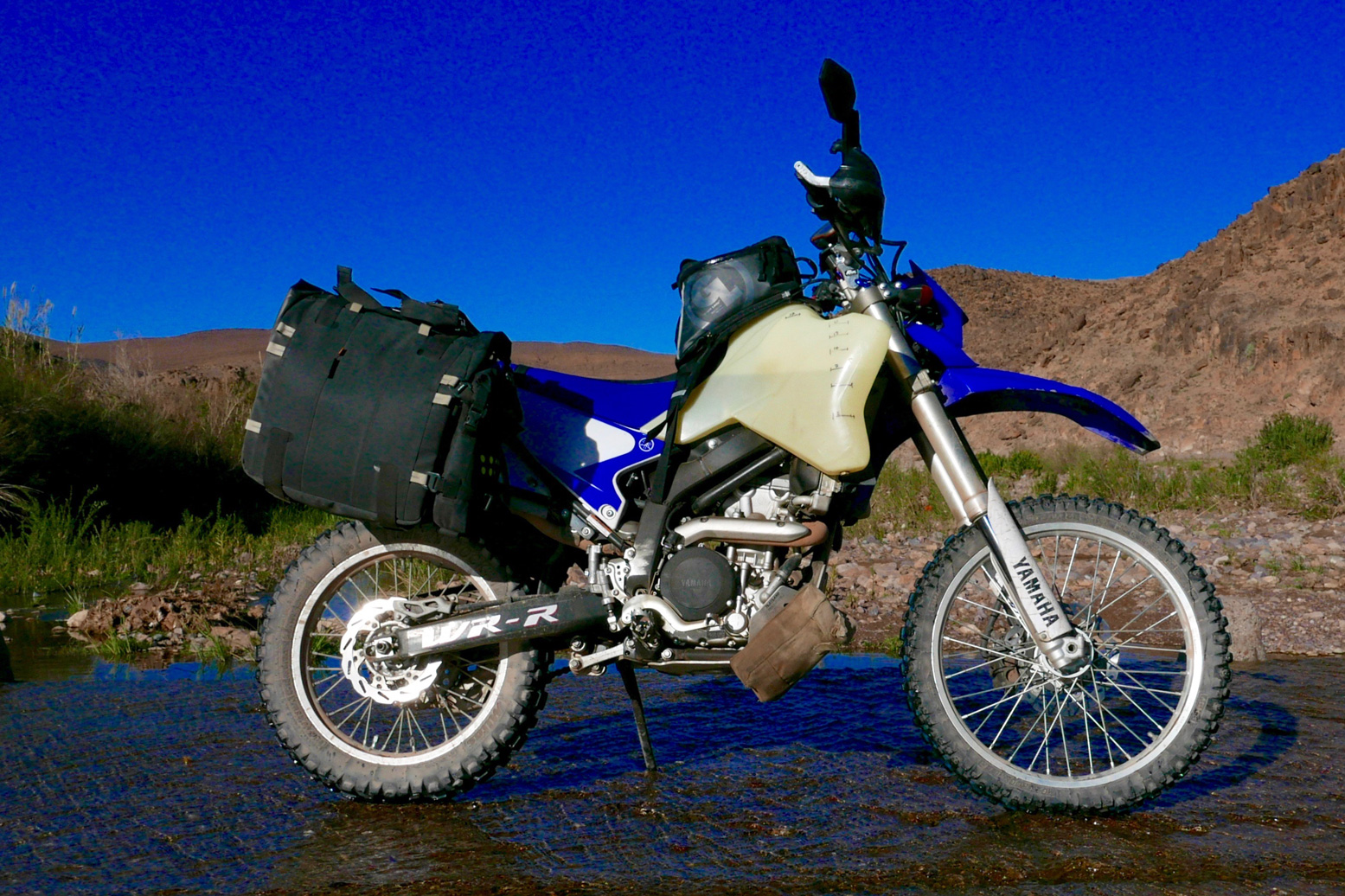
I had the luxury of having my WR trucked down to Malaga and back, so could afford to run street-legal knobblies for my Morocco update trip. The Mitas Rockrider MC23s were recommended by a mate and iirc, cost under £120 the pair.
As always, I Slimed them up and also ran them at 30psi, road or trail, except for one sandy oued episode and day overlooked at 25psi.

WRtyres
mitasrok

Long story short: no complaints on road or trail. On a light and relatively low-powered bike riding roads, wet or dry, they never felt sketchy, and on the dirt were of course a lot more secure than a regular do-it-all adv tyre.

AMH-Tread-Chooser-Adv

But after only 3000km the back was down to 5mm. I suppose wear will slow down from here on, but I feel that was very similar wear to a ‘soft’ TKC I ran on a Tenere a few years ago, though that was run tubeless which may have extended its life. Incidentally, I’m told the Rockrider is also tubeless.
So, I suppose there is no way of having your tyre and eating it, even on a light bike. Grippy dirt tyres will wear fast and so perhaps are a bit of an extravagance on long rides. As always, it depends where your priorities lie: dirt grip or longevity, which is why the less knobbly do-it-alls (right) live up to their name.

M3-17 - 9

Tested: Kriega Overlander S – OS-32

See also:
Soft Baggage Comparison
Overlander OS-22, on a Himalayan 410 in Morocco

klou14
krig

Kriega’s new Overlander-S is their second iteration of a luggage system suited to bike travel. A few years ago they brought out a similar plate-on-rack idea (below right) but, with modularity using their existing 15-litre packs (or Rotopax), which were semi-permanently riveted to the HDPE plate which itself attached to the rack with fiddly skewer clamps. I never used them myself, but has a close look once and it wasn’t really for me. I prefer one big bag, like the Adventure Spec Magadans, and an easier way of getting the bags on and off a rack.

OVERLANDER

tik • Good volume
• Rugged construction
• Easy mounting and removal
• Exterior tabs for expandability
• Option to not use platform/plate

cros • Expensive, once you add it all up

M3-17 - 43

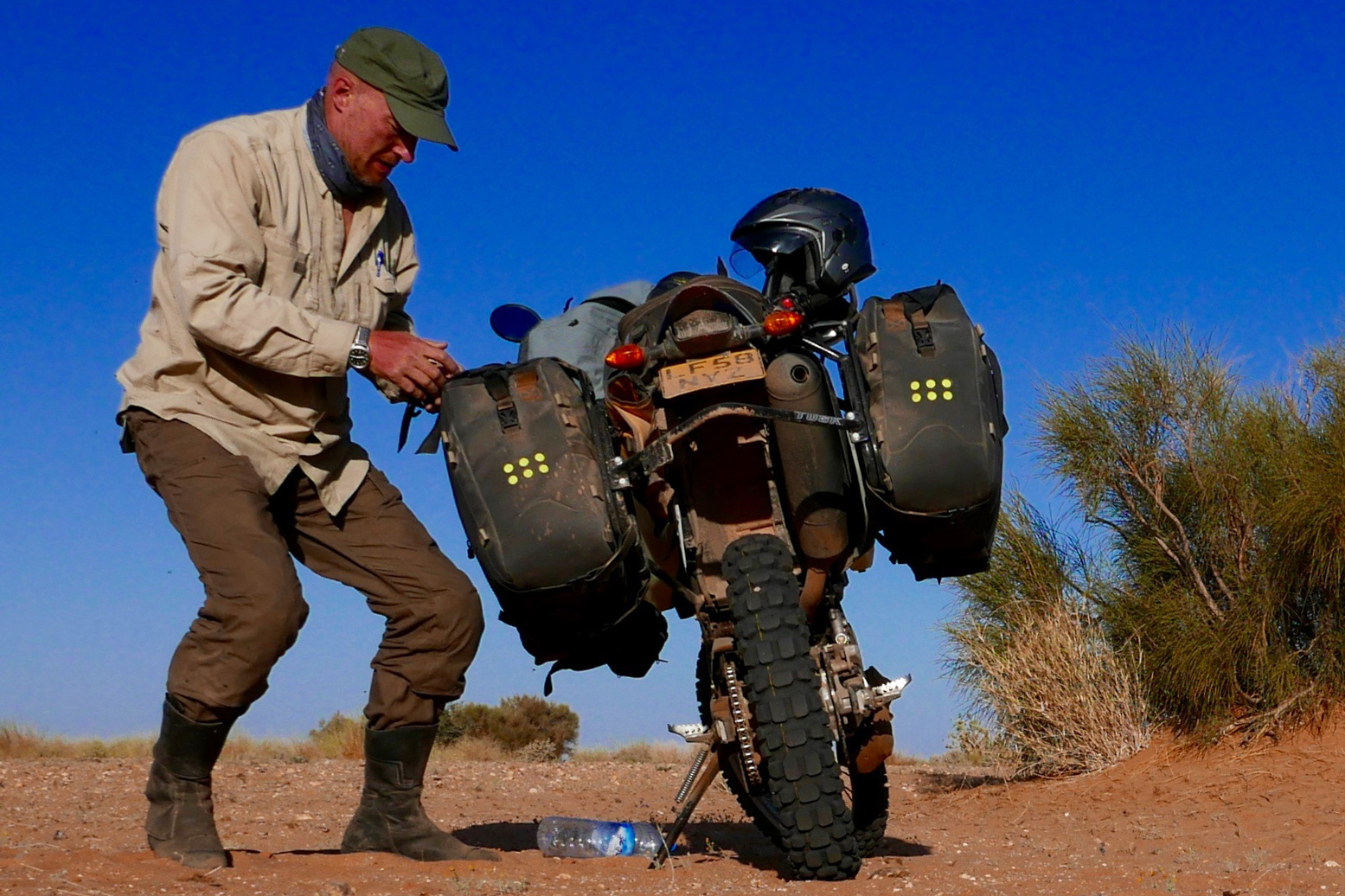
I just spent a month in southern Morocco and Western Sahara with prototypes of Kriega’s new OS-32 panniers, the core of their new Overlander-S system (below right) using a similar bag-on-plate-on-rack system.
My load was only about 10-15kgs each side, depending on water, and I was set up for tentless camping with a few days food. A nifty Giant Loop tankbag, a trusty old Touratech tail pouch and Kriega R15 backpack with Hydrapak added up to the rest of my baggage.

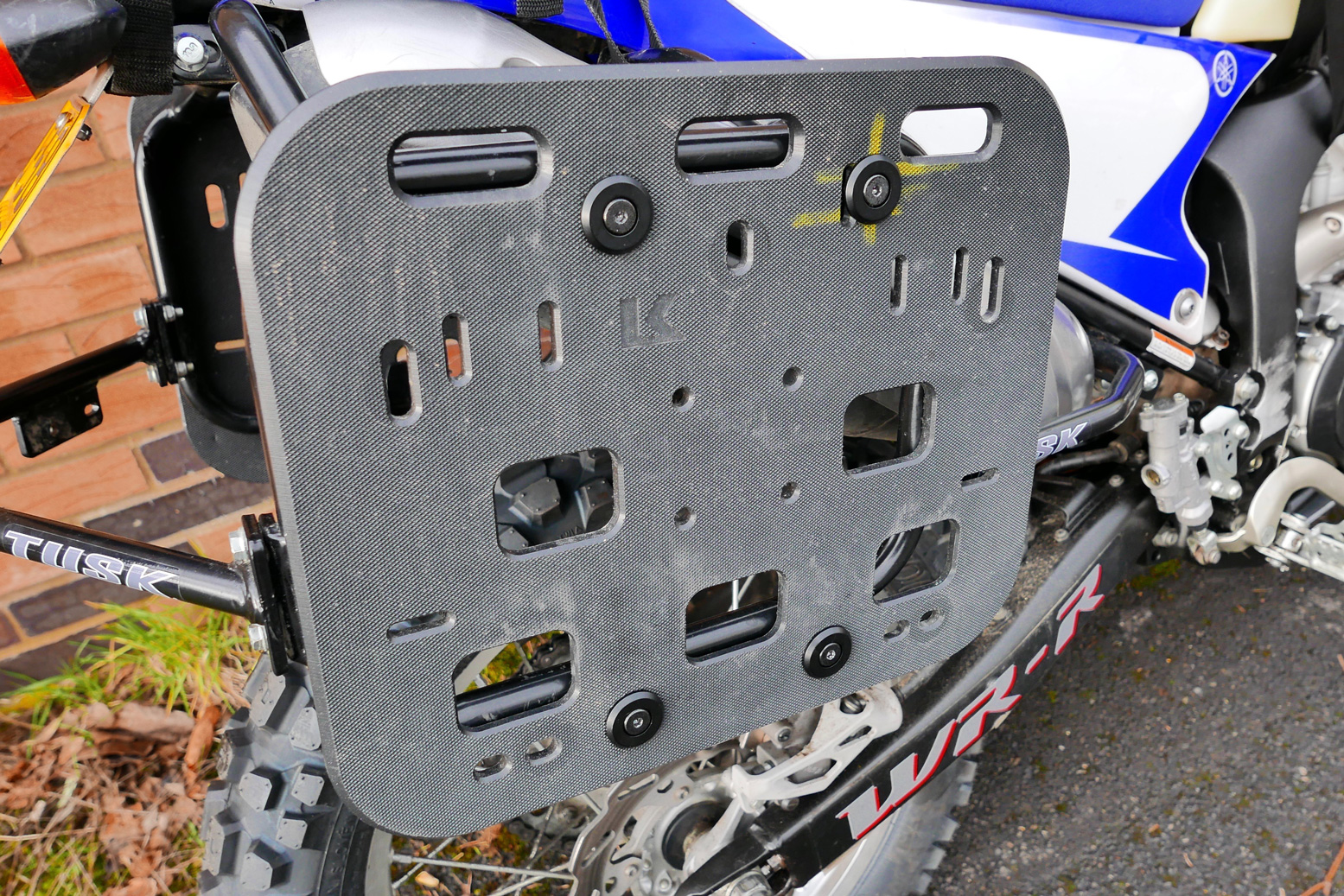
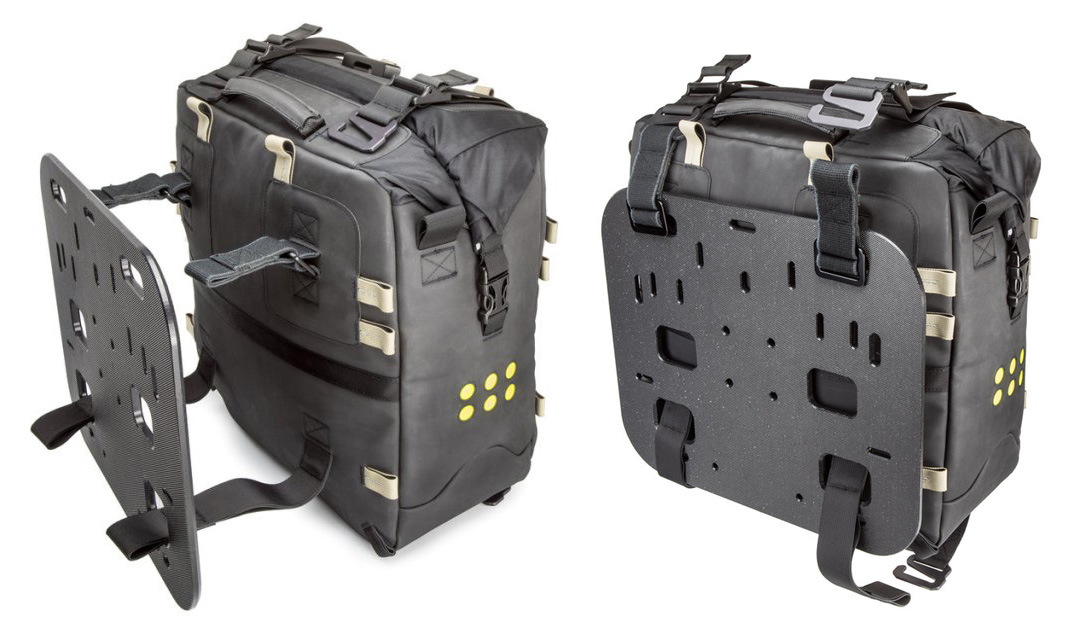
With Kriega OS panniers, an HDPE plate  or ‘platform’ in Kriegaspeak (left) can be bolted to a rack. You may think it just adds weight and expense. Both true, but a plate is actually a smart way to fit any rack. HDPE (think: kitchen chopping board) is great stuff, too: light, rigid and dead easy to drill or even just poke with a red-hot skewer.
The Kriega plate and its adapter clamps have been designed to fit just about any round-tube, 18mm/¾” rack and offer a broad, grippy surface for the hypalon-backed OS bag to cinch up against. Making your own fitting to fatter or square tubed racks would be easy enough. The Kriega OS bags use a cunning anchor and strap-up system to make a very secure fitting while enabling easy fitting or removal – a key element when on the long road. Strapping the hypalon-backed bag to the grippy plate surface spreads loads over a broad area too, meaning no failure-prone stress points.
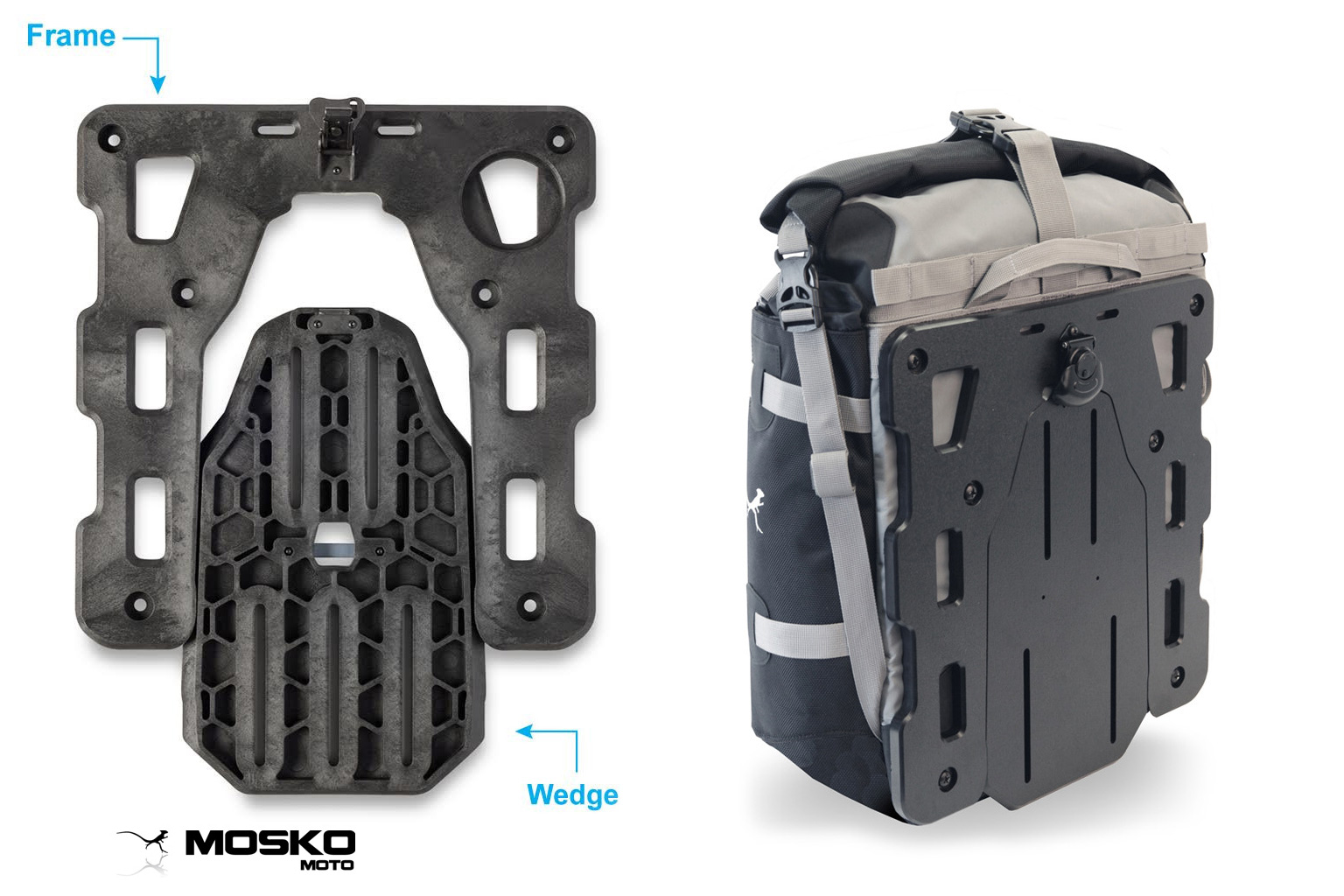
moskrackMosko Moto also use a plate for their Backcountry bags; a GRP wedge and ‘frame’ (right). The wedge attaches upwards to your bike rack, and the full-width frame permanently to the back of the bag which slides down onto the wedge and clips in with a latch. Originals were also made in HDPE, but either wore too quickly or were too soft. GRP (fibreglass) gets round this, but can be brittle stuff. I’ve not tried Backcountry bags, but intuitively I feel old-school soft-strapping to a plate spreads and secures loads better than two bits of GRP slotting, clipping and grinding together, even if it does just take seconds to fit and remove. It’s probably fine for road riding, less so for off road.

86-agadez

For a big trip with heavy/variable loads, a travel bike is better off with a rack, unless you take very little or can be certain your gear will stay put, be easy to get to and remove, and of course, won’t catch fire off the pipe (left; Niger ’86). It’s a load-carrying interface between your baggage and your bike to enable secure fitting on a variety of bikes, like saddles on a horse, a roofrack on your car, a packframe in a rucksack, or even the shoes on your feet.
You can use Kriega’s OS-32s as throwovers, in which case you could dispense with the plate, but you will need some sort of rack to stop them swinging about. You could duplicate the HDPE plate’s strap holes on a rack frame to effectively mount in the same way. It won’t spread the load and secure the bag as well, but it will save 2.4kg of plate and a hundred quid.

wrs1-13
wrs1-133

I used a Tusk rack from Rocky Mountain (4kg, left). Great price, well made in ¾” and solid mounting. It stood up to the beating well and was only spoiled by the clumsy extra bracketry for mounting hard cases. I removed what I could from the rack, but some welded-on bits (right) got in the way of mounting the Kriega rack plate as low and far forward as practical. I suppose I could have ground them off.

krigfeed

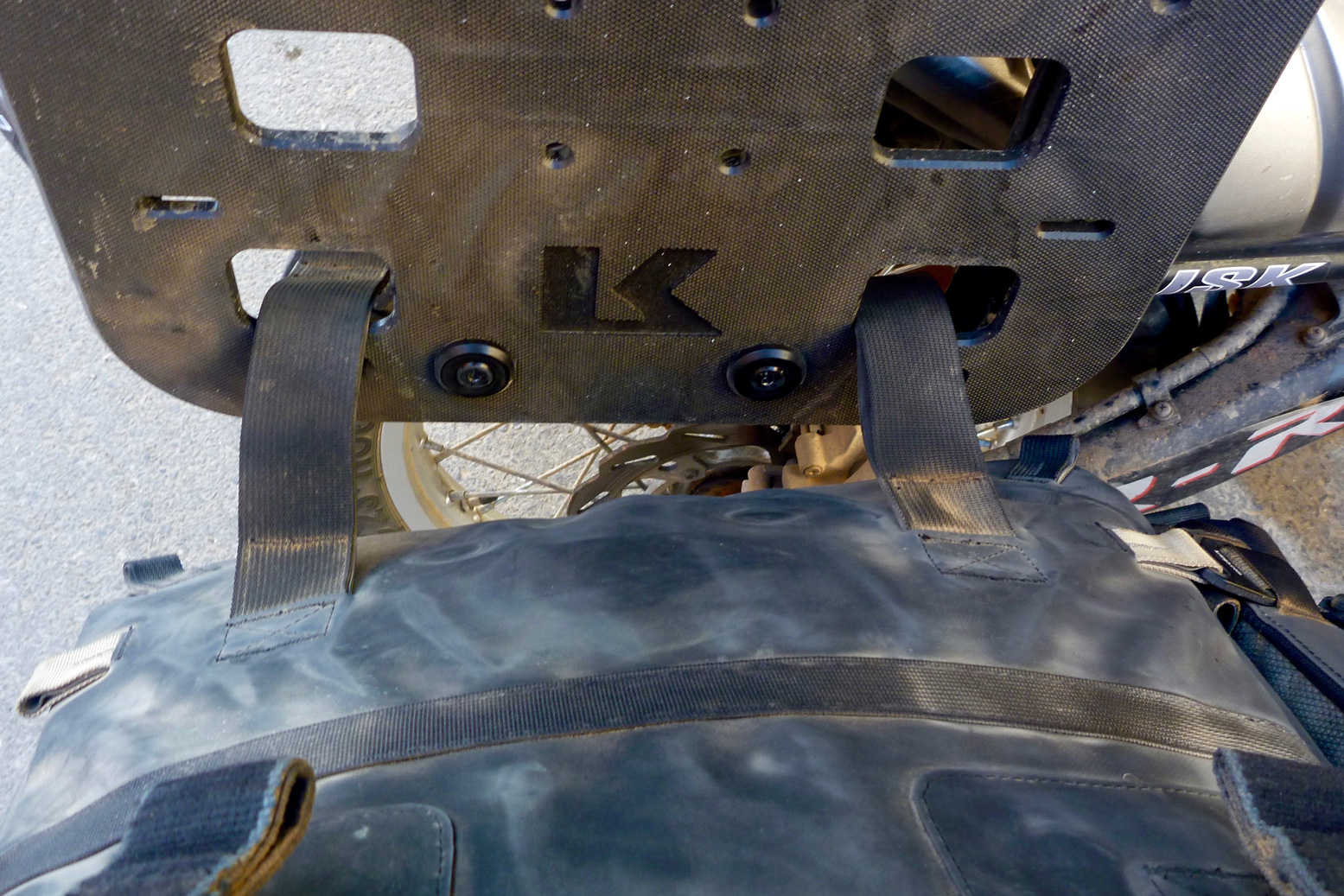
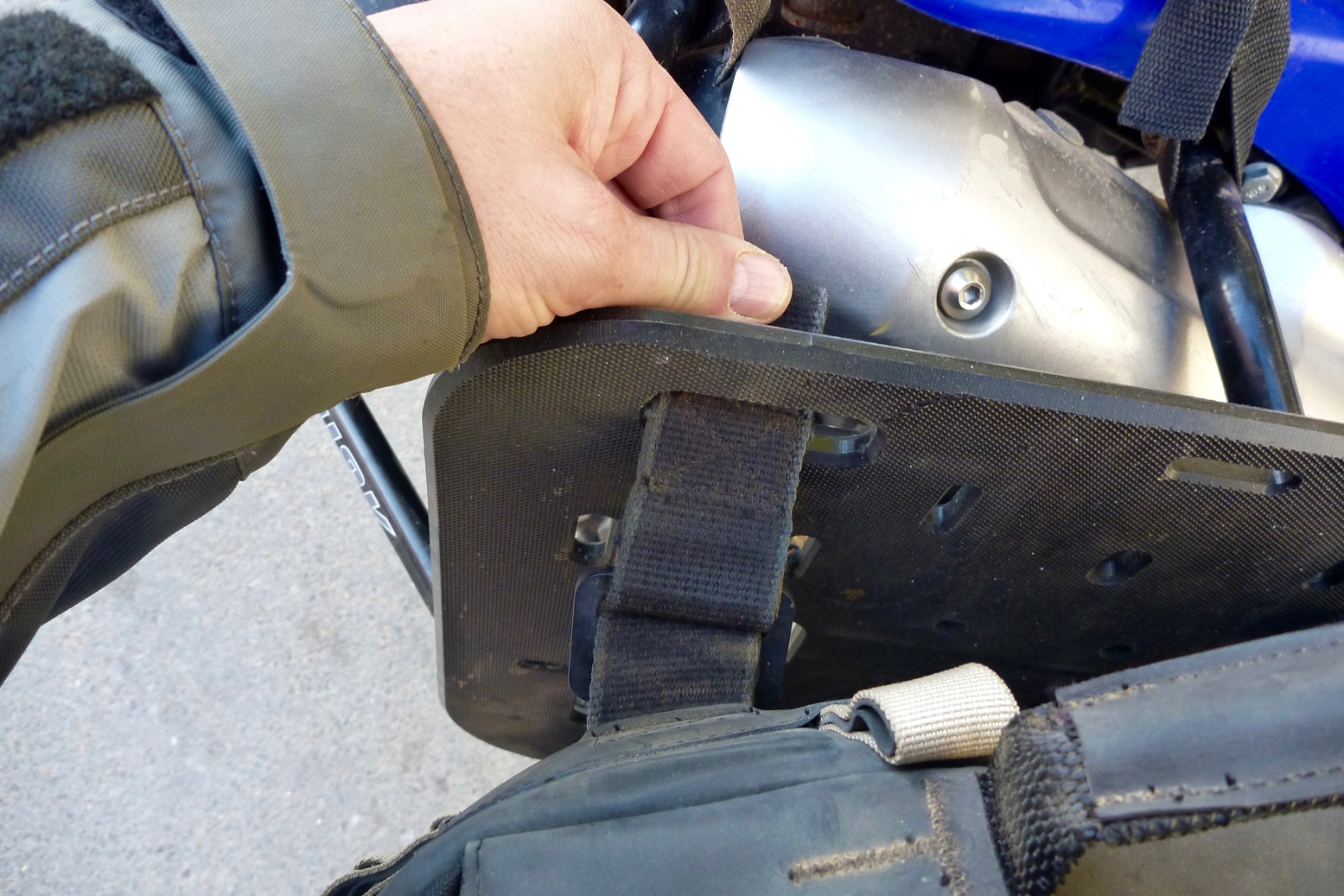
The plates (1.2kg each) have four slots for the upper and lower bag straps. To mount a bag (2.6kg), you rest it on your knee and feed  the lower straps through – below.

krigtopfeed

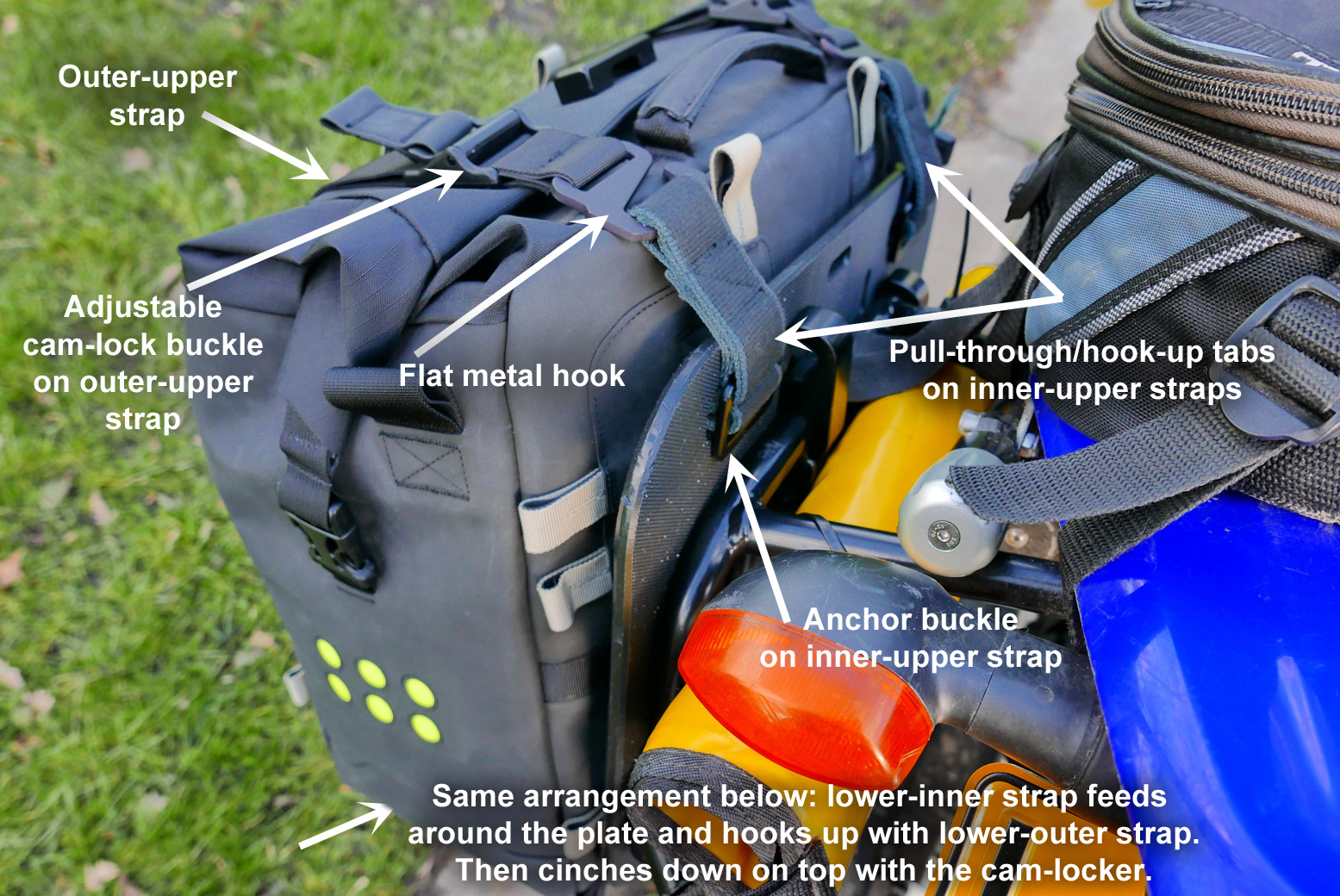
Then you feed the top straps through the slots and pull the ‘anchor buckle’ through – works a bit like a shirt button and similar to Wolfman’s idea which cinched smaller bags directly onto racks.

krigbukview

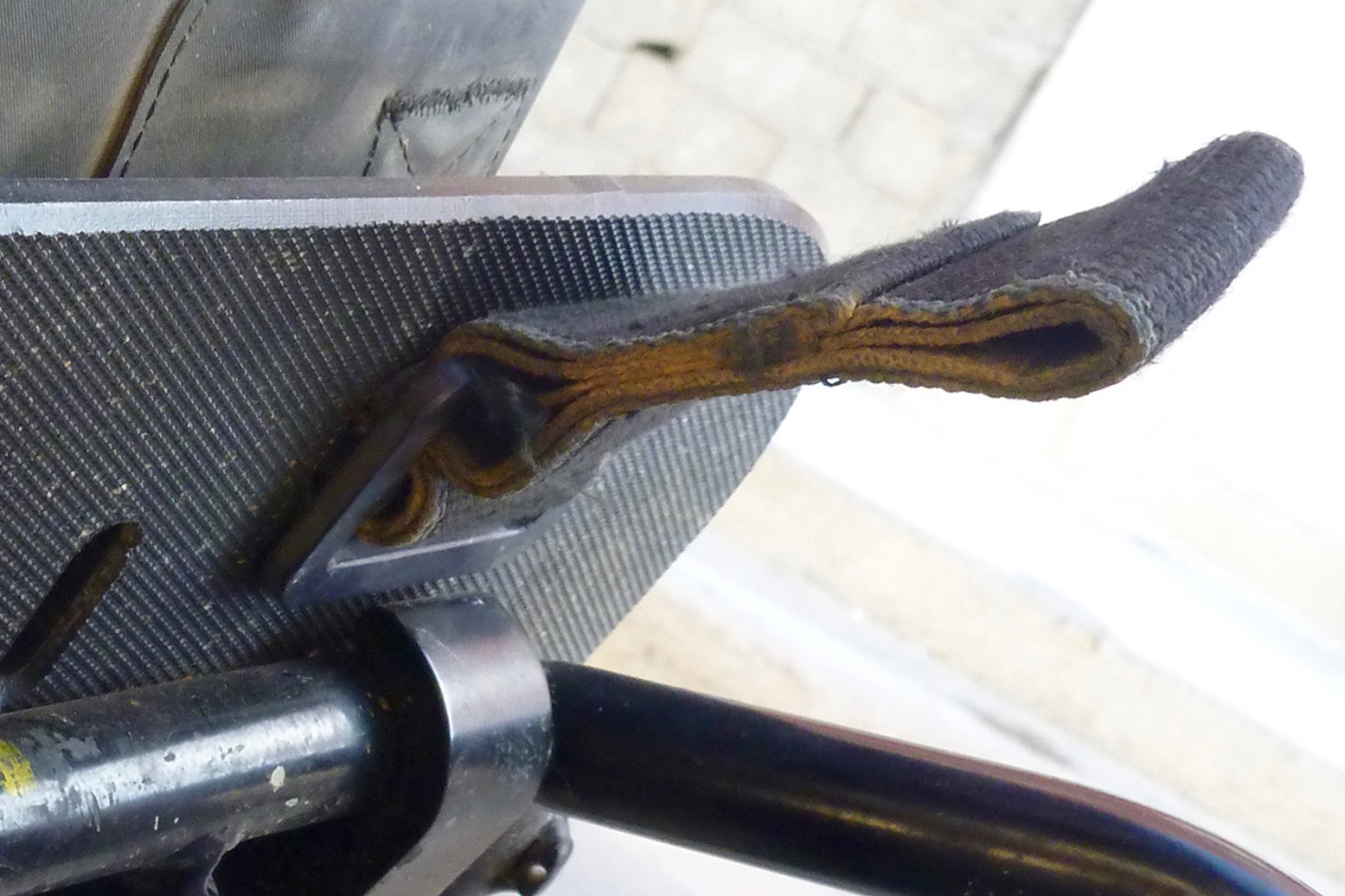
Viewed from behind – the anchor buckles (as I call them) pull through and take the weight.

kriega-os32-fit1


With those buckles pulled through, the bag now hangs on the plate not unlike a throwover. You could probably ride on roads like that. For a bombproof mounting, you now crouch down and connect the dangling lower straps to the outer strap with a flat metal hook. This is about as arduous and fiddly as the whole bag-mounting process gets. Then, on top you do the same: hook the outer strap to the chunky tab off the anchor buckle, then cinch it all up and lock it down with the cam buckle. Sorted!
krigstrappMounting takes about 40 secs each side once you’re practised – demounting a bit less.

klou10
krigpokit

One of the best things about the Magadans are the big exterior pockets – a lot of soft luggageers dodge this necessity. Kriega supplied me with two OS6, 6-litre strap-on pockets (550g) which are part of the OS system and which I hooked on the front of the bags. They’re ideal for daily or heavy items to keep the CoG central. The OS6s cinch down on themselves to stop stuff shaking about. You could put two more on the back and another on top. There are over a dozen hook-on tabs on the main bags and the system includes an optional pair of shoulder straps which make it easier to do the bike-to-hotel-room-walk in one go.

M3-17 - 40

All bags came with the usual Kriega white liners to enhance rummaging visibility and which are more durable than previous liners. I didn’t use them, and bagged stuff individually. Even then, what rain I got – a few hours a couple of times – didn’t penetrate the bags. They’re covered in hypalon panels (think: whitewater raft fabric; lasts for decades) which slow the wetting out of the bag’s Cordura body and of course will scoff at any abrasion, be it the constant rubbing against the plate, or sliding down the road hoping not to loosen your load. Daytime access requires uncam-locking and loosening the top straps and pushing to the sides, then unclipping the roll top folds from the sides and unrolling – about 15 secs.

magwalter
krigsecure

On the top panel you’ll see a chunky metal fitting to feed a cable lock, like the Steel Core recommended by Mosko Moto. I initially just used them to secure the loose strap ends (left). Kriega tell me if I fold the ends over they’ll have the rigidity to slip into the outer sleeves, even when the bags are packed full. I never tried that and in the end just let the straps flap.

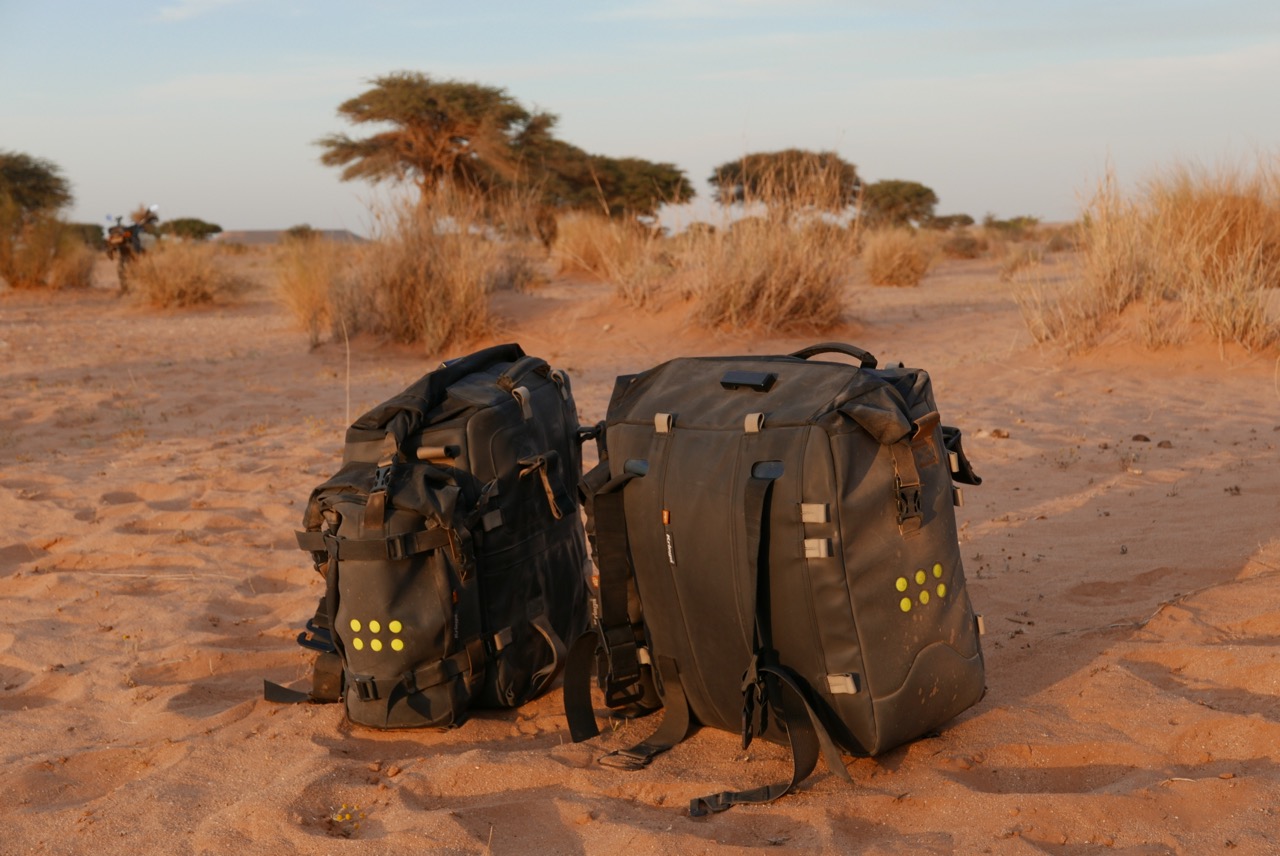
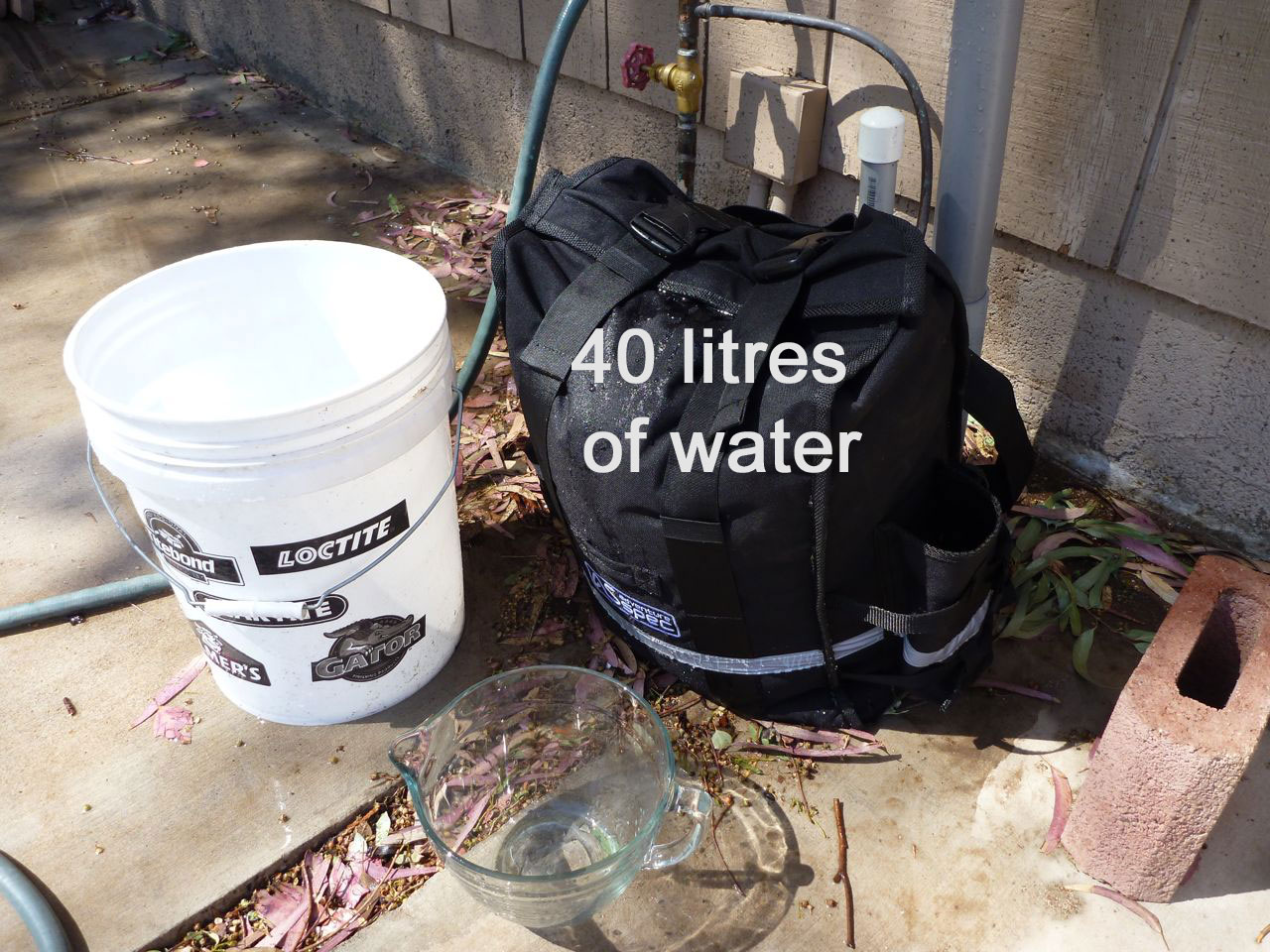
The bags have interior stiffening panels to help give shape, but fold down flat for shipping or shoving under the bed between adventures. The volume is 32 litres according to the brochure, but as I discovered here, a flexible, rectilinear box will actually increase in volume when filled with fluids as it seeks to attain spherical equilibrium. Who wouldn’t want some of that. For example, my notional ’24-litre’ Magadans (right) actually took 40 litres of water, and that increase will be the same with any similar flexible rectilinear pannier.

So, masses of volume meant I didn’t need an annoying tailpack, and low-mounting probably didn’t do any harm to stability either. Yes, they’re wide because the rack is wide. On the chain side I could’ve used the inner space better (just a rolled up 10-L fuel bag, yellow thing on the left). There’s four litres of volume to be had there, easily. A Rotopax won’t fit.

On road and trail the OS-32s never missed a beat or felt annoying to use. In fact the pulling up of the anchor buckles and then cinching up were quite satisfying actions – I suspect ‘actuation gratification’ (the satisfying click of a clip, for example; there’s probably better jargon for it) may be something that better designers think more about than others.
With my throwover-on-rack Mags (left) I removed the liner to take indoors as the bags needed careful lashing to the rack to stay put. With the Overlander-S it was no bother to:
• lift the cam locks
• loosen then unhook the lower straps
• unhook the top straps
• lift the bag on its handle, release the anchor buckles and carry it away

Your OS32s are a travel solution to long overland journeys. For dirtbike weekends or fast and light BDR-ing, I imagine a GL Great Basin, Mosko Moto Reckless, or alternative Kriega packs will suit riders prioritising agility. Me, I’m more of a traveller and prefer big, side-mounted saddle bags with minimal junk loaded on top. Slimmer would be nice, but that’s just conventional rack design and high dirt-bike pipes for you.


The Mags are still great bags and bound to be cheaper. The OS-32 kit as I used it with plates and two pockets would come to £710. That’s a lot of money, but of all the accessories you lash to a genuine travel bike, surely the baggage system is the most critical and will be the most used.  I hope to carry over these OS-32s to my next adv bike. Good job Kriega, a well thought out bit of kit.

For more images from my ride in Morocco, see this.

M3-17 - 19

Review: Giant Loop Fandango Pro Tank Bag

gl-fangoo

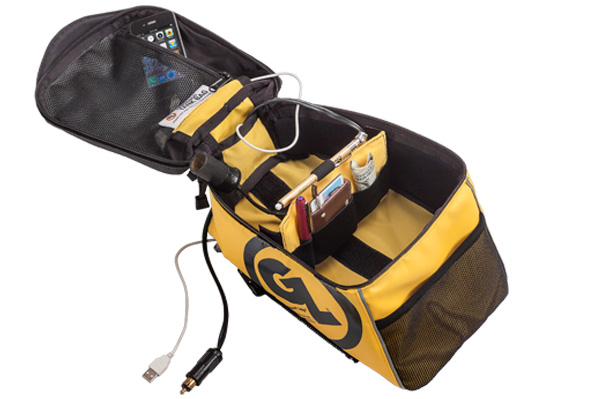
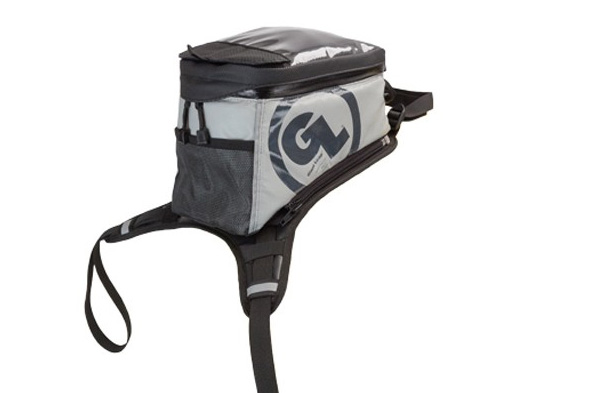
For my kind of riding I’ve not been a great fan of tankbags. When you get off the bike it’s another thing to unclip and lug around with you, along with your lid. For the stuff you can’t afford to lose I find a backpack like Kriega’s R15 more functional – it stays with you on or off the bike, but over nearly a decade I’ve reluctantly gelled with my ‘dango.

Fyi: I bought this Fandango Pro used off ebay for £35.
gl-fango

What they say:
Fandango Tank Bag PRO™ (8 litres) represents a major upgrade of Giant Loop’s largest, most popular tank bag. Expandability, electronics compatibility, and features driven by rider feedback inspire this adventure-proof state-of-the-art design.


What I think:

tik

 • Solid and well made
• Still using it on all sorts of bikes 5 years later
• Perfect size for my needs – not too big
• More handy compartments than Secret Squirrel

cros

• A hundred and sixty quid for a PVC tank bag? Nope, now £220!
•  Mounting zips are a faff when filling up; would prefer clips or even velcro

fangogo
himfandang

Review
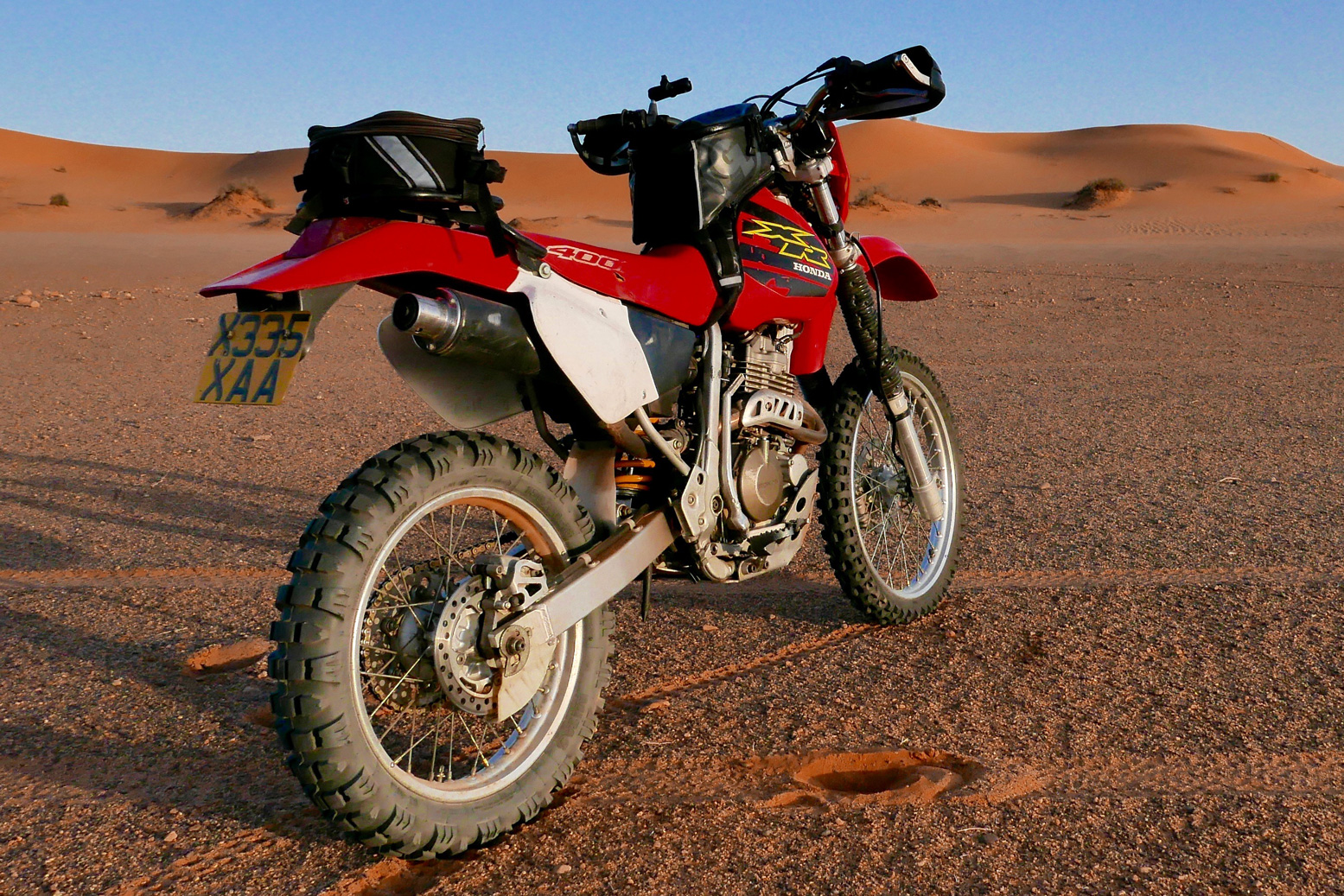
I like to try new stuff, or up to a point, retry ideas I’ve given up on. Once I strung some high-end Rova-Flex zip ties round the frame and headstock the Fandango perched securely on my WR’s big IMS tank. It stayed there for a month, zipped off every 4-500kms to refill the tank, or right off when overnighting in lodgings. Since then I used it on an XR400 in Algeria, on my XScrambleR 700 in Morocco and on my Himalayan.

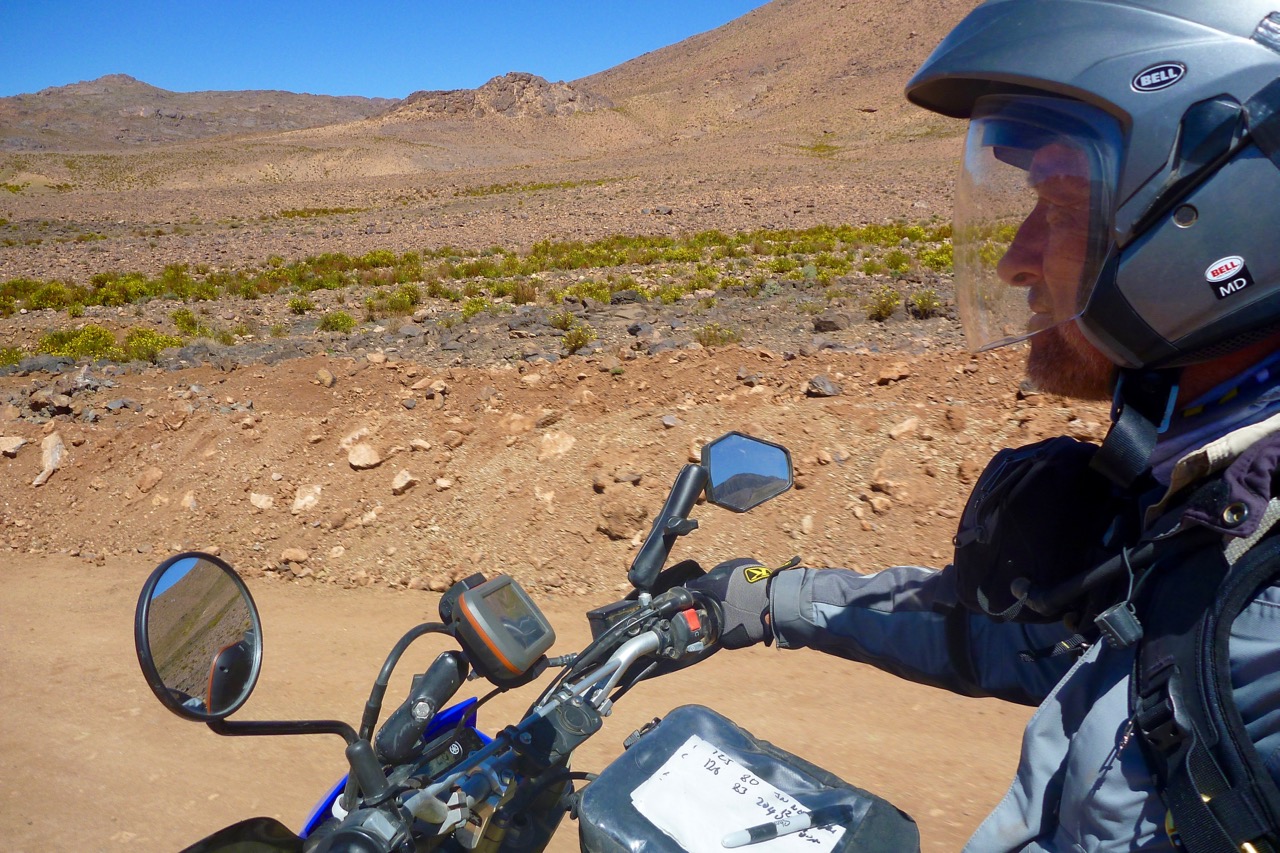
The volume is just right for me, though the map pocket’s surface area os a bit small. It closes with a velcro patch, but that wasn’t enough to stop my vital notebook falling out while battling through a oued on the Western Sahara border. Going back to look for it was just ‘too hot, too hard, too far’, to paraphrase GL’s motto. Make sure you velcro down well, especially with toll-highway tickets.
The back mesh pocket was great to whip out my P&S camera on the move, and inside under the top is a nifty hidden zip pocket, but it’s starting to fray. There’s another under the base (may get wet) and inside the body is a velcro divider I have no use for as the bag is not that big. I just stuff in what’s needed.

xr400r
XR4 in Algeria

There’s a port to let a cable out so your phone can recharge, and they’ve neatly addressed securing the loose ends of the harness to eliminate flapping.
As expected, the zips can be a pain some days. It takes just a few seconds of fiddling to get them to hook up, but I got things to do and places to ride! I’d prefer clips. The breather hose from my WR’s fuel cap didn’t get affected by the bag pressing on it, and lightly loaded as it was, the sat stayed in place over rough terrain.

890R in Morocco

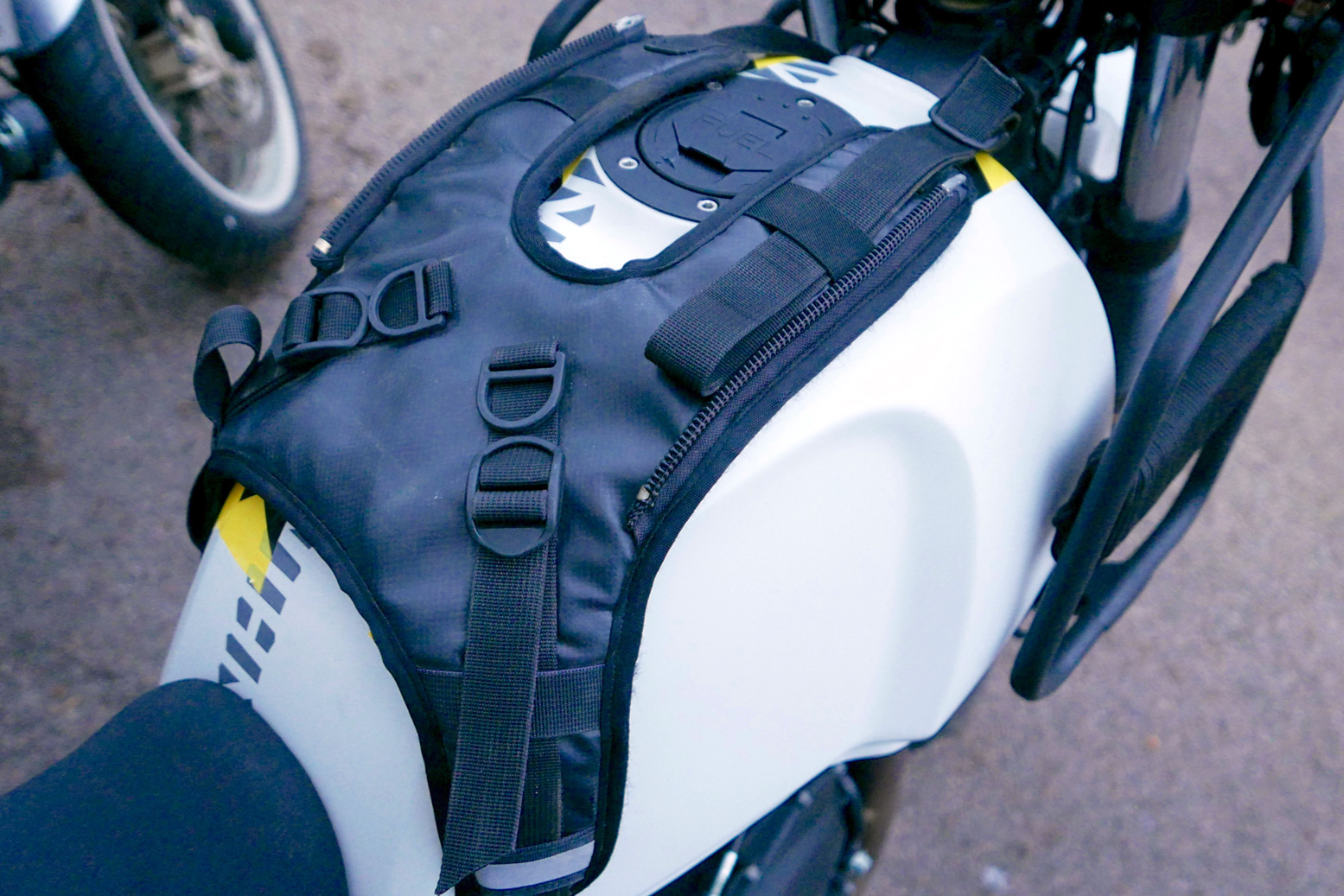
Once the harness is on the bike, it will be nice to ditch the backpack and just use the ‘dango like a small top box as it’s been a dead handy accessory on my trips. Lately I’ve fitted it to my Himalayan where it sits nicely with some more Rova-Flex zipped round the frame tubes. Only this time I’ve taped some tape to the tank top to stop the base vinyl from scuffing the pristine white paint.
Just remember all this goodwill is based on the great price I paid for it used.

XScrambeR on Tiree

R

Tested: Klim Outrider pants review

updated 2023
klou10

Tested: Klim Outrider pants.

Where: 3000km over a month in southern Morocco. Then another 5000 in Morocco and Spain, another 1000km in Algeria in 2018 and for a few weeks every year in Morocco till late 2023.

UK price: £165 at Adventure Spec.

kot-3

See also: Klim Dakar ITB; Aerostich AD1s Adventure Spec Lineman (soon)

tik

• Usual Klim quality
• Not plastered in Klim branding
• Exterior knee sleeves make armour easily removable
• These also make handy stash pockets
• Can pass as slightly unusual normal jeans
• They didn’t go cargo-pocket-mad, as many do
• Cotton-Cordura fabric feels tough, but breathes well
• Dry fast

cros

• Regular length was too long in the leg (shortened mine)
• Way too baggy at the shins for riding bikes too, even OTB. I cut a wedge out and zip put in
• Expensive, but lasted years

klou13
klou11

As I wrote, I’ve been looking for some riding pants that make me feel protected but don’t weigh a ton like my old leathers, and aren’t sweaty, bulky, membrane overpants. There are those kevlar-impregnated demin jeans, but who actually wears jeans these days?
After a while I decided my Klim Dakar ITBs were just too race-focussed, under-pocketed and too nylony for my tame level of desert touring. At the 2016 NEC Adv Spec put me onto Klim’s forthcoming Outriders – normal looking, jean-like riding pants with well-thought-out armour. Something you can wear on or off the bike. In other words: ideal do-it-all travelling trousers.
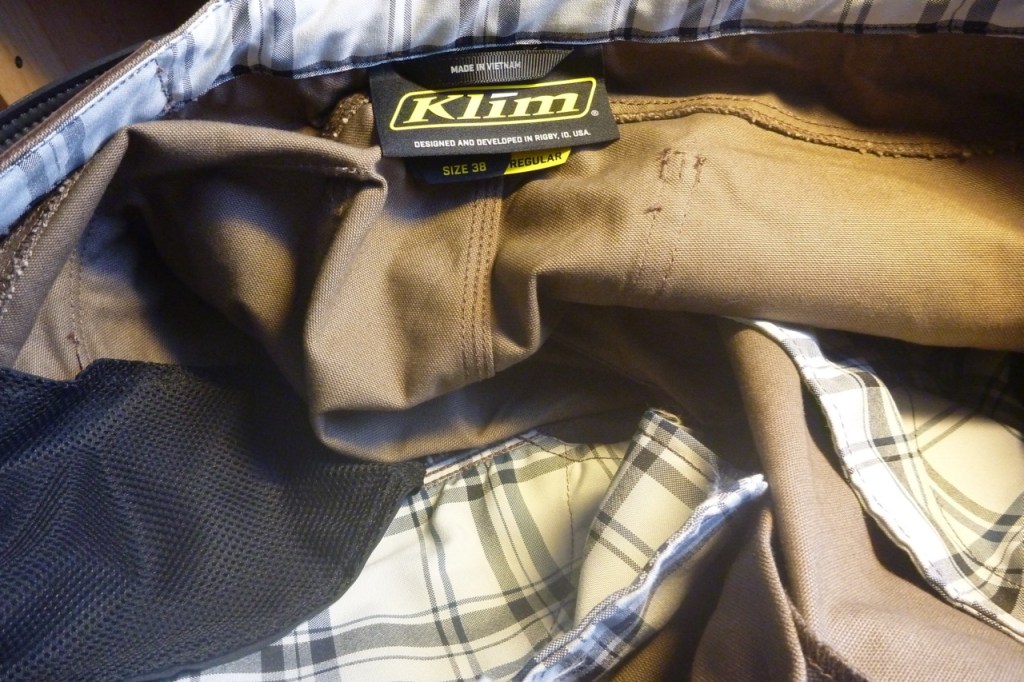
When they arrived my 38″ Regulars weigh 1440g with the armour, or 1090g without. More than half that of my leathers and a bit less than the chunky Dakar ITBs.

 Fyi: I bought these Outriders at a discount from Adventure Spec in return for advertising in my books 


kot-jak

What they say:
The Outrider is designed to traverse the environments and demands of the multi-sport enthusiast. Scrambling out to your favorite fishing spot, hiking from the trailhead to the lake at 9,000ft, or cruising the boulevard to the pier at sunset. Wherever your next odyssey takes you, the Outrider is ready for anything. Built with the quality you expect from KLIM®.

klou15

Review
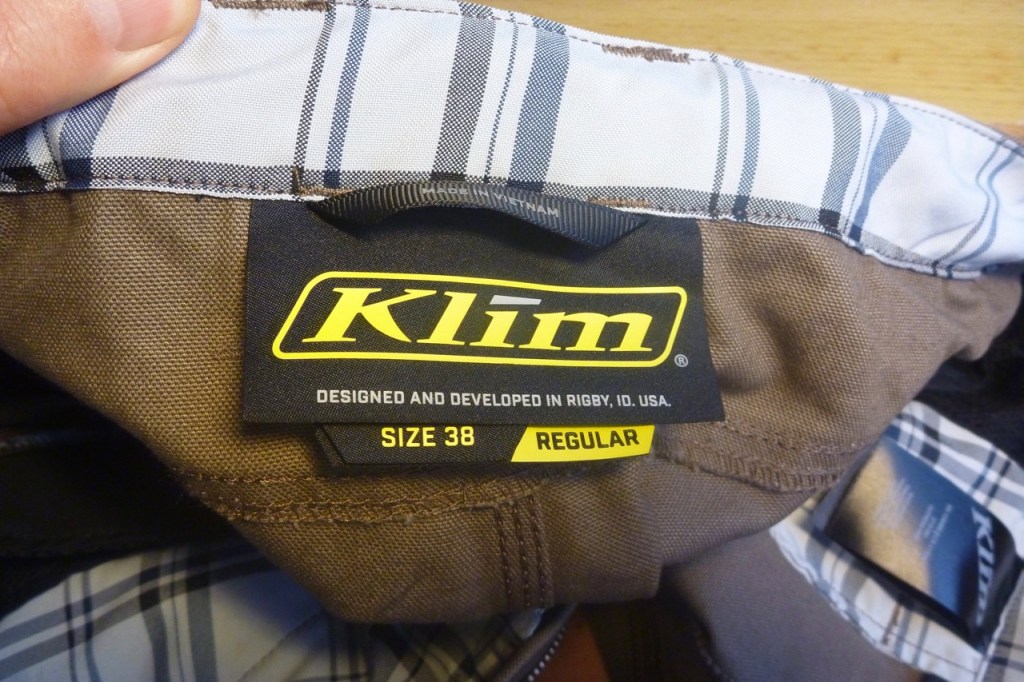
I was pretty sure I’d like the Klim Outriders and out of the box I wasn’t disappointed. I’m around 6′ 1″ and 94kg, 37″ waist (when I left for Morocco), and an inside leg of 32″ (unchanged). So ’38 x 32 Regular’ was my size.

klou1


But these pants are actually a yard long in the leg and once worn standing up, sag at the heel, like the image right, but more. Once the armour’s in and with some riding up when sat on a bike, they actually look correct. And if you wear them ITB (in-the-boot) to eliminate snagging the baggy ends, it ought not matter (or so I hoped). Better too long than too short, I suppose.

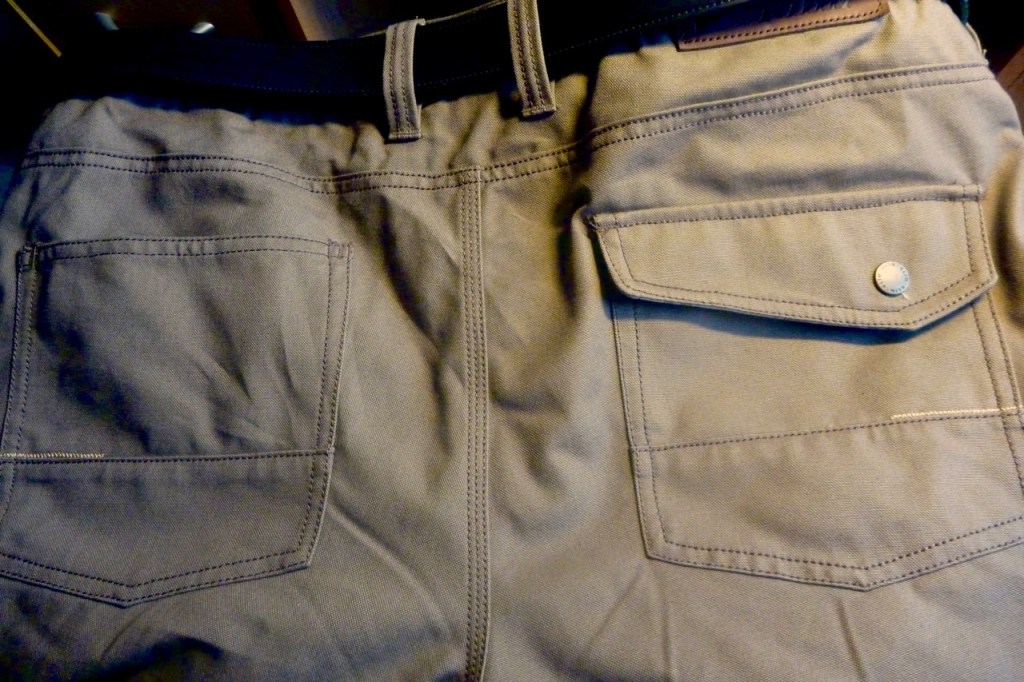
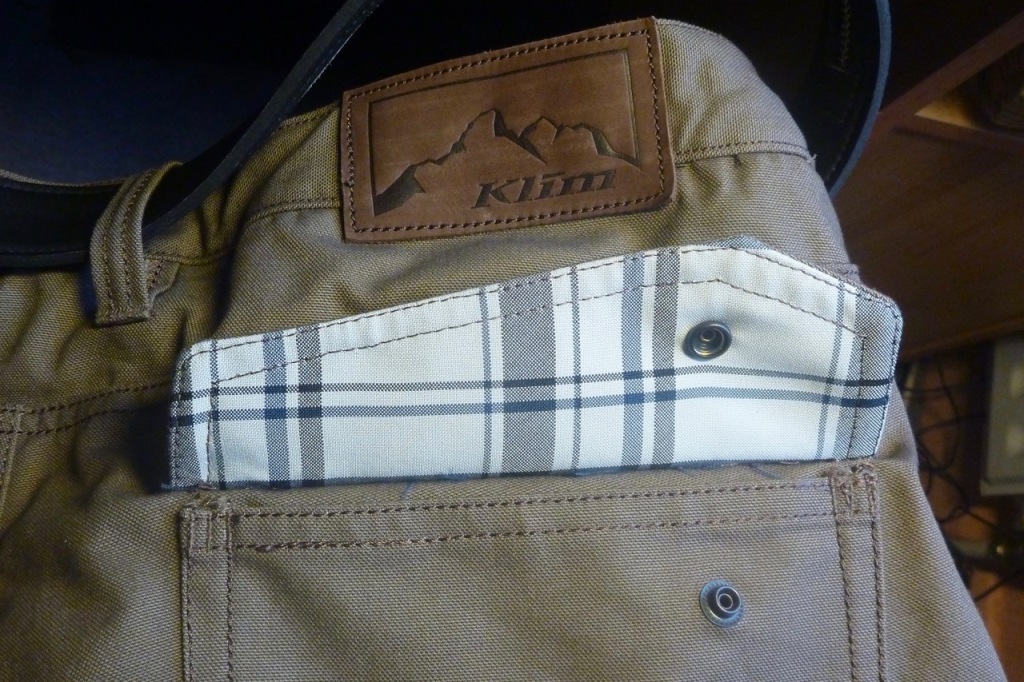
You get two front pockets with a jean-like coin slot inside one; two at the back, one with a flap and stud, and a smartphone slip-in on the left thigh so you can check in without taking your hand off the throttle.

out-alg
kor-mr

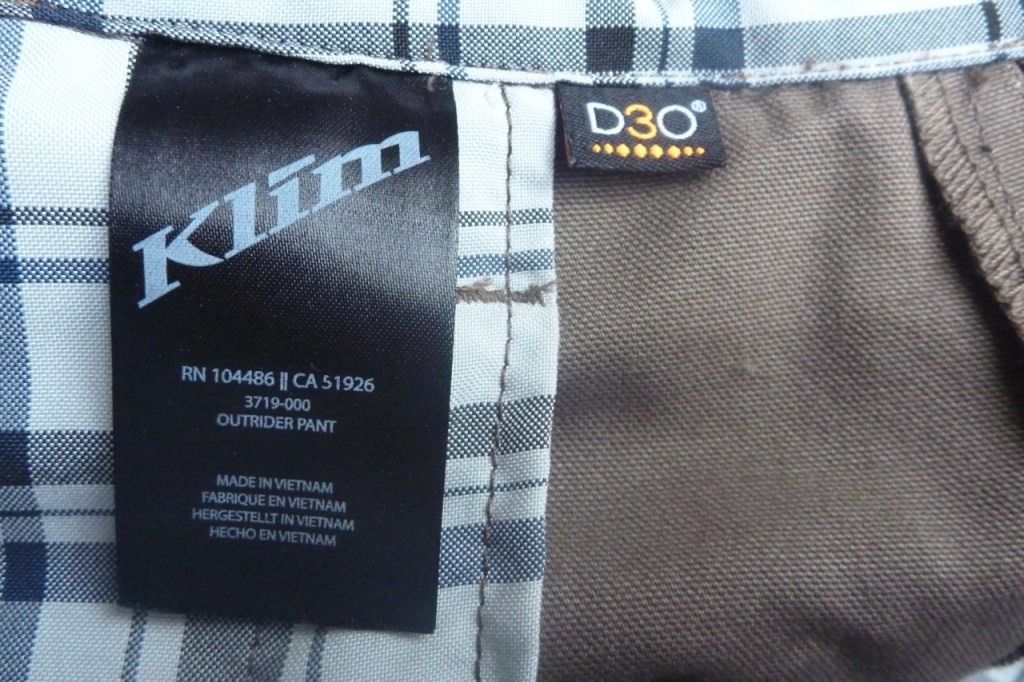
Inside, mesh takes the slim D3O hip armour pads (left; I didn’t use them on my trip), and at the knees you slip the armour in from the top, position with unobtrusive velcro and do up a stud.
Even without the armour these long, double thickness knees will give some extra protection, and feature drain holes at the lower ends for those deep BAM crossings (right).

klimoutriders

The 75% Cotton-Cordura fabric is hefty without feeling like scout tent fabric or being unduly sweaty. The attention to detail and triple-stitching is confidence-inspiring and the shade of dark brown works for me. Maybe it was all part of the grand business plan, but it’s good to see Klim getting away from the sporty racewear and into more mainstream riding gear which will have many more buyers.

Before I even got to Morocco my Outriders got soaked while waiting in the rain to board the ferry at Algeciras. A good test to see if they’d dry on the hour’s crossing. They did.
Over the next month, I rode in temperatures from 35°C in Western Sahara to close to freezing in the High Atlas (with runner’s leggings underneath). In all that time the Outriders never felt too hot and sweaty, nor chilled my legs out of proportion to the rest of me. On the very hot days, just stopping for a minute in my Overland jacket, with all vents and zips open, saw me start sweating; my legs in the Outriders remained stable.

klourip

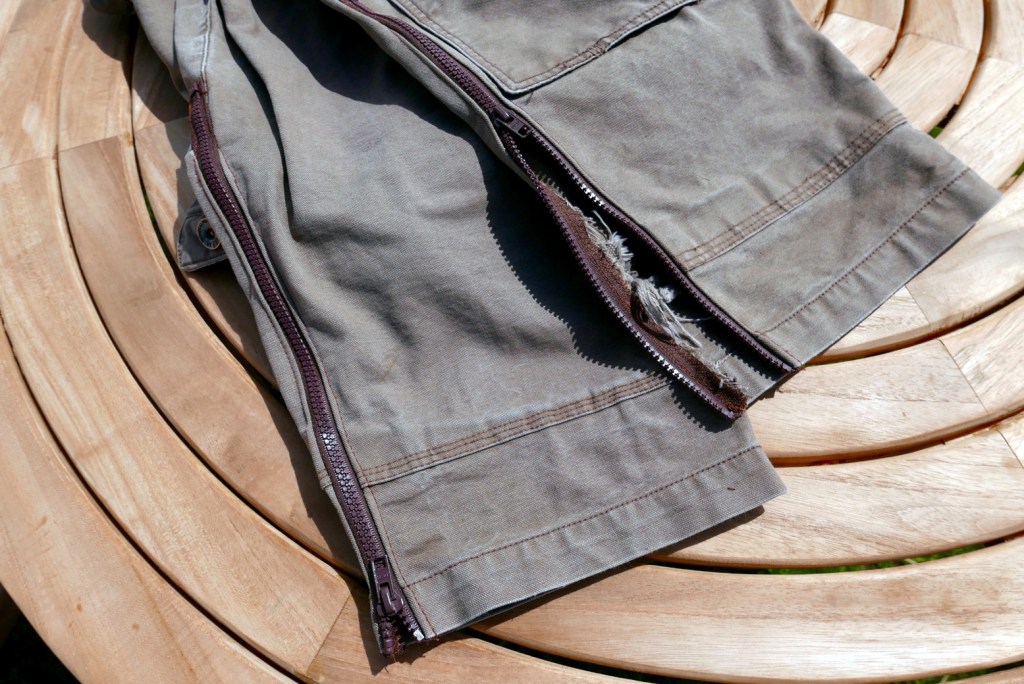
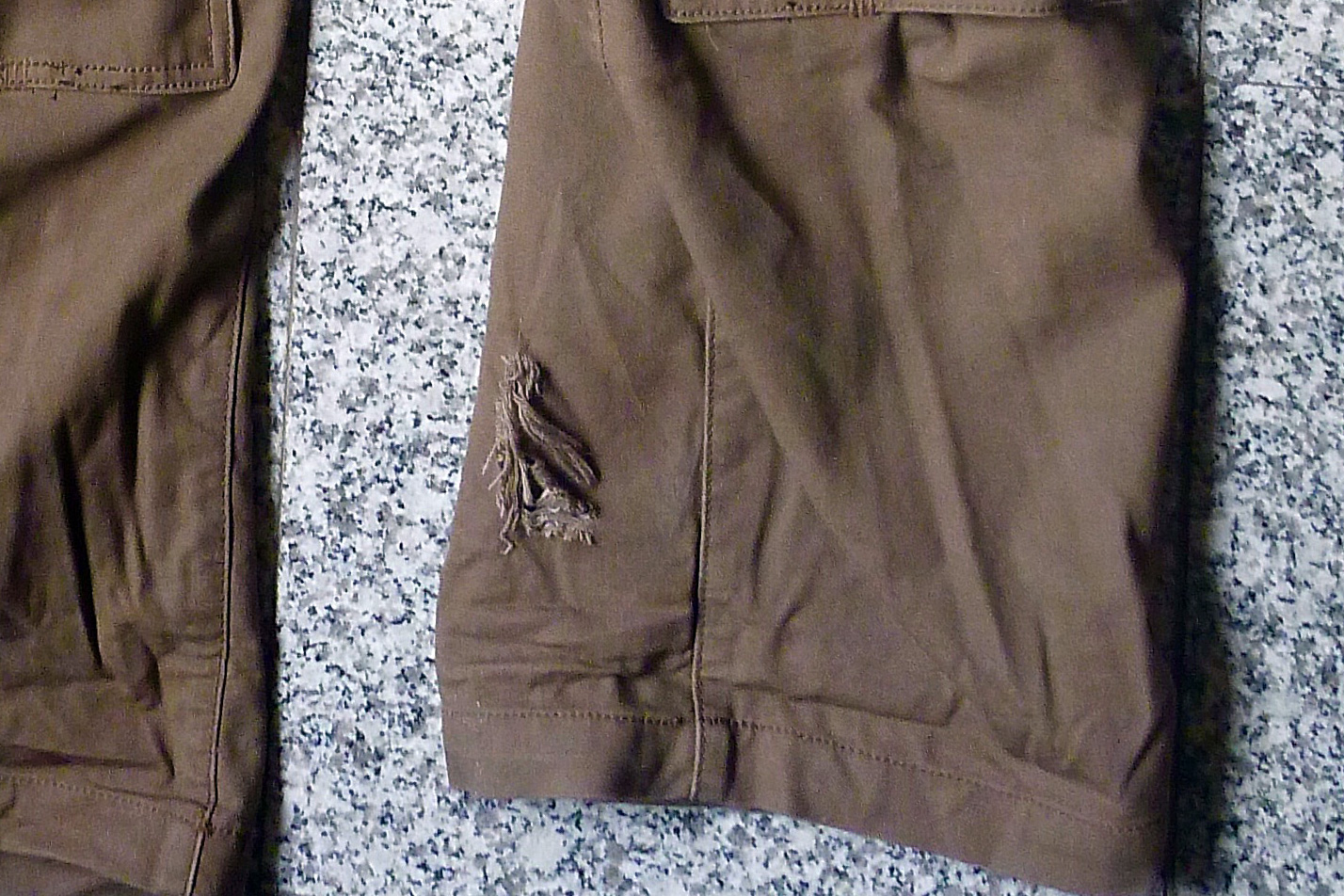
Because they’re so long, tucking the rolled-up ends into my boots and then doing the boots up became a chore on some days. And, perhaps because my boots aren’t full knee height and clamped to my leg, over the course of a day getting on and off the bike they’d work their way out and need stuffing back in. I could have worn them ‘OTB’ but I’m sure they’d have snagged on something and got oily or ripped. As it was, they got ripped anyway while paddling hard through a sandy oued – didn’t notice till later as I was slightly desperate at the time. I suppose they caught the footrest or gear level on a forward lunge.

klou6

I got them machine-washed once – probably high temp and not inside out, contrary to instructions. I can’t say I noticed any shrinkage, if that is the reason (in fact I would have welcomed a bit). I didn’t crash in them either, though I dare say something closer-fitting like the Dakar ITBs would keep the knee armour in place better.

klimoutzipp

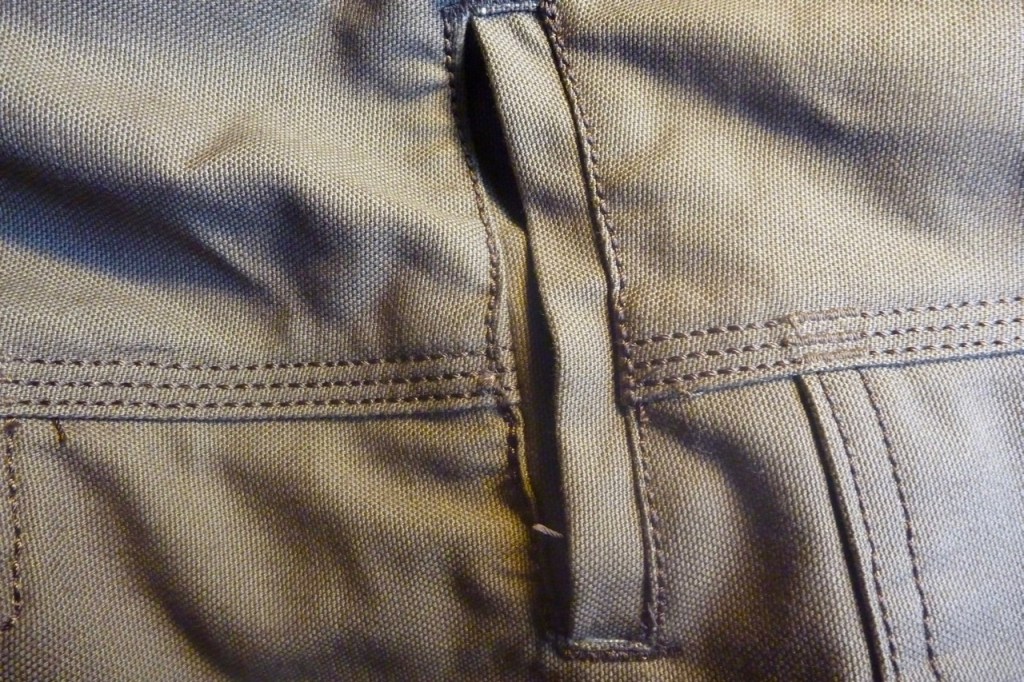
Back home I got them shortened by 2 inches (using the off-cut to patch the tear), and a few months later cut a wedge out of the lower leg to get a slimmer shin fit and installed a zip along the inside. A side-benefit of the zip makes them easy to pull- or roll up to the knee for wading or general airing-off. But all up that’s a lot of after-market sewing for an expensive pair of trousers. I know the American fit is typically larger than in Europe, but an inch is still an inch.

After another wash or three, the Klims are fading but are in good shape. For the moment they are my general riding trousers, quick-drying and without the weight of leathers, the sweatiness of the ITBs or synthetic-ness of membrane over-trousers.

klimotrs