Category Archives: Luggage

Tested: Kriega OS22 pannier review

Himalayan Index Page
Soft Baggage Comparison
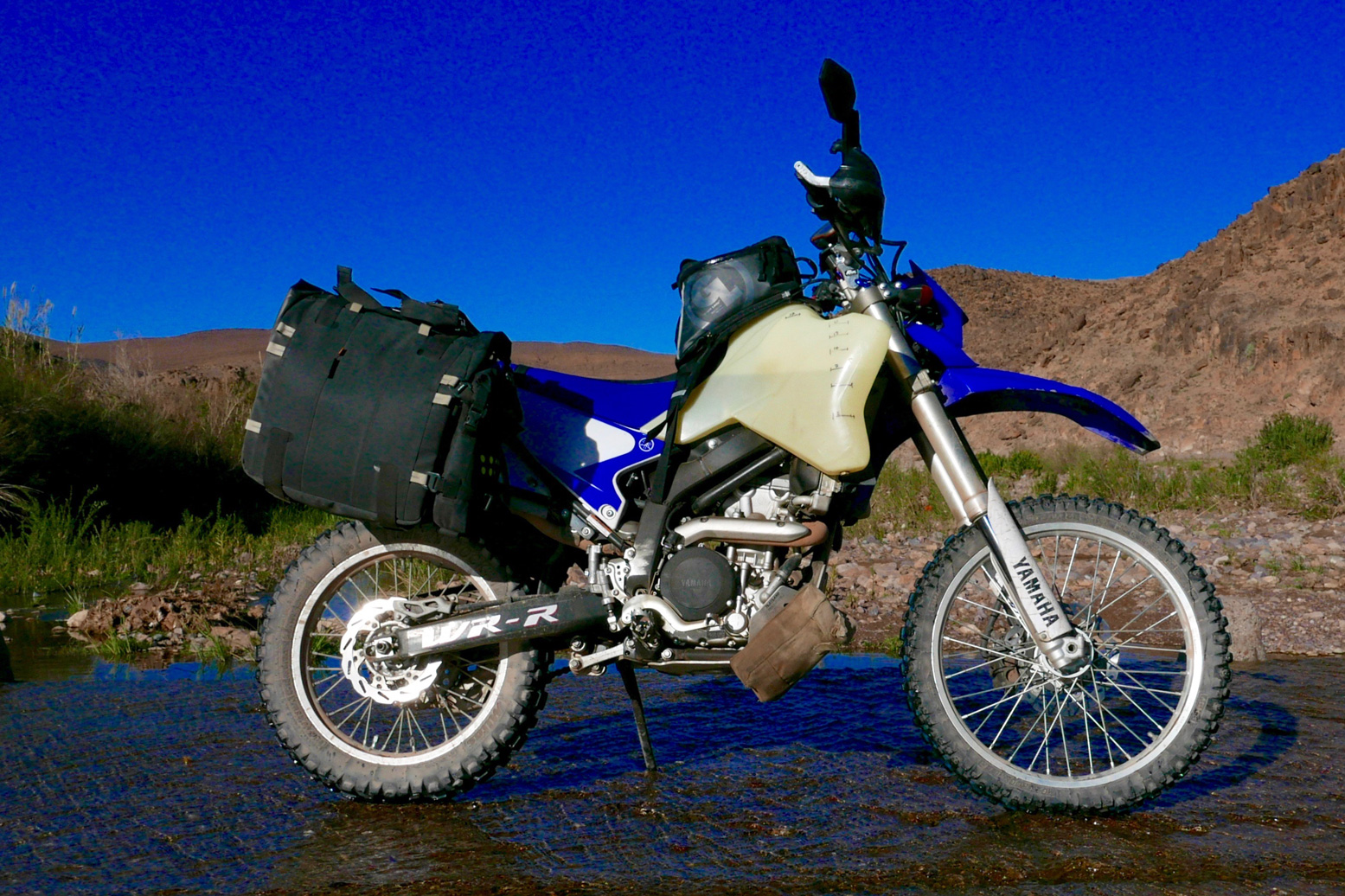
Overlander OS-32 tested in Morocco on a Yamaha WR250R

OLYMPUS DIGITAL CAMERA

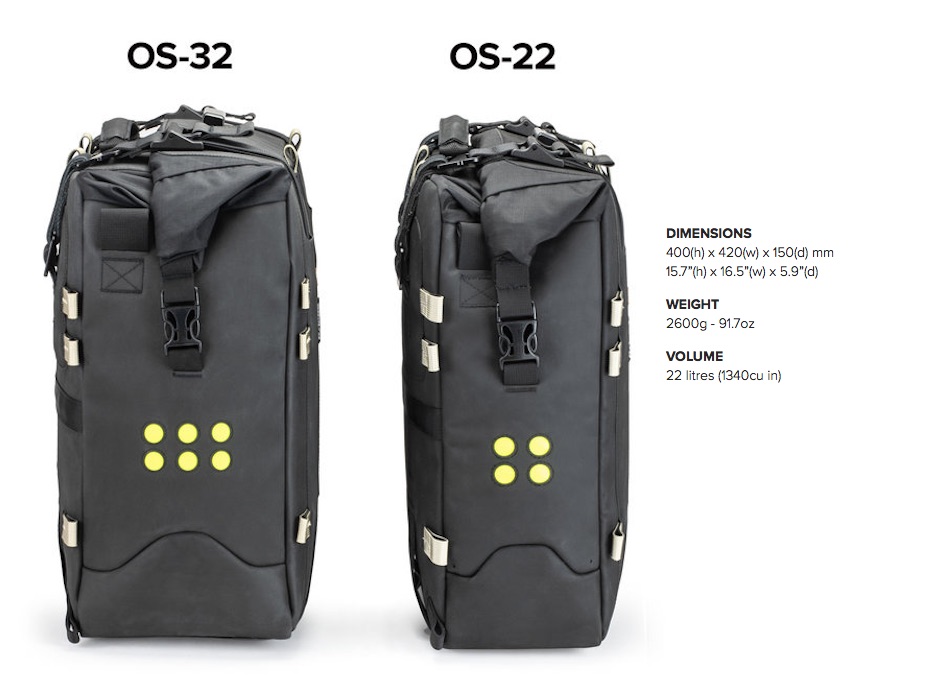
The new OS22 pannier from Kriega is the mini version of their OS32 I tried on a WR250 a couple of years back. The OS22 has the same proportions up-down, left-right but is 40mm thinner, reducing each bag’s capacity by 10 litres. It also retains the same uabrasion resistant Hypalon casing on a 1000D Cordura shell impreganted with aramid webbing to resist slash and grabs. An alloy block allows you to wrap a cable lock round the bag for added security. Each bag folds out to a formed box shape, costs £215 and weighs a hefty but durable 2.6kg.
The OS22s just happened to be ideal for my Himalayan, destined for a similar trip through the Atlas and on into the deep south of Morocco.

k2232

tik • Slim
• Rugged, quality construction
• Easy removal from plate, or just lift out the liners
• Lots of exterior tabs for expandability or securing the bags
• Option to not use platform

cros • Expensive

OLYMPUS DIGITAL CAMERA

Most riders don’t seem too bothered, but I like a bike to be as slim as possible and ideally never wider than the bars. Whether splitting city traffic, riding against the wind, squeezing through a hotel door  and not least, teetering along a narrow and gnarly mountain track with a big drop to one side – in all cases excessive width holds you back. Keeping away from the edge of a drop is instinctive and increases the margin of error, but stray too close to a cliff face opposite and you risk snagging over-wide panniers on a rock, losing your balance, over-correcting and taking a dive, just like that viral bike-in-a-boat video of a few years ago (below).

monwide
GS500wide

High and fat silencers can force racks to be annoyingly wide (especially when attempting to be needlessly symmetrical from the rear). Soft or hard, add a plain, box-shaped pannier and the bike can be half as wide as it is long, like the F650GS fitted with Enduristan Monsoons (right), or my all time favourite, the GS500 on the left.
On a travel bike, I feel panniers are best when ‘suitcase’ shaped: longer front-to-back than top-to-bottom and no more than a hand’s span wide. This helps centralise the weight but is an unpopular format because, presumably, it interferes with pillion riders. Many aftermarket racks don’t help either, being set too far back for optimal weight centralisation, as mentioned in this old post.
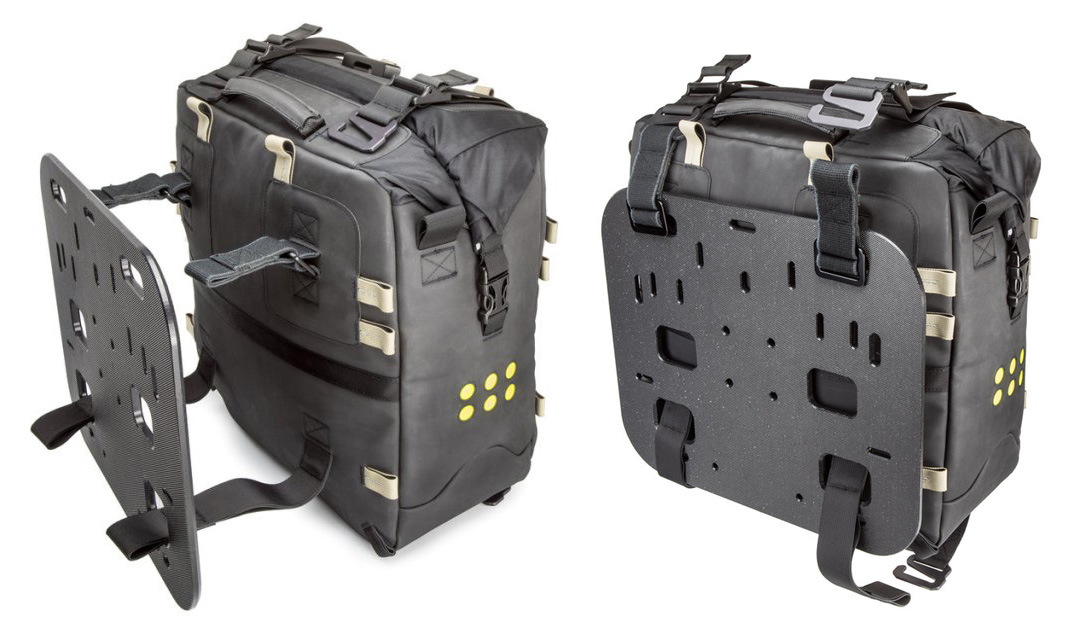
kriega-os32-fit1With Kriega OS panniers, an HDPE plate  or ‘platform’ in Kriegaspeak (left) can be bolted to a rack. You may think it just adds weight and expense. Both true, but a plate is actually a smart way to fit any rack. HDPE (think: kitchen chopping board) is great stuff, too: light, rigid and dead easy to drill or even just poke with a red-hot skewer. The Kriega plate and its adapter clamps have been designed to fit just about any round-tube, 18mm/¾” rack and offer a broad, grippy surface for the hypalon-backed OS bag to cinch up against. Making your own fitting to fatted or  square tubed racks would be easy enough. The Kriega OS bags use a cunning anchor on and strap-up system to make a very secure fitting while enabling easy fitting or removal – a key element when on the long road. Strapping the hypalon-backed bag to the grippy plate surface spreads loads over a broad area too, meaning no failure-prone stress points.

shoppingbag

Like the 32s, the OS22s can be hooked on and lashed down to the Kriega HDPE platform or plate (see above). It’s a very solid off-road-proof mounting system which I also found dead easy to use. But this time round, on the Himalayan I chose to use the 22s as plain throwovers, like Adventure Spec’s Magadans, Doing it this way meant that once the bags were lashed down securely to the bike, I found it less hassle to simply remove the waterproof, velcro-rimmed white liner bags to carry stuff indoors when not camping, rather than unrigging the whole bag. As such, a couple of shopping bag handles wouldn’t have gone amiss on the liner bags.
A rack is still needed to constrain any swinging and shuffling. I initially bought an Enfield rack from India but despite being cheap, I sold it unopened once I saw how heavy it was; it’s more suited to alloy cases. All I needed was something to support the bags, so Simon made me what I call C-racks (below) in one-inch tube. They’re only mounted at each end and are unbraced against so could bend in a heavy crash, but I tend not to do that so much these days.

him-raker

Adjusting the strap length for the throwovers is easily done. A horizontal strap round the bag and rack kept it located and another (yellow) strap from the rear rack stopped the bags sliding forward. There are plenty of attachment points all over the outer bags to refine your strapping set up if not using the platforms, or of course to add additional Kriega bags.

OLYMPUS DIGITAL CAMERA

It all worked well for me once I pinned down the strapping arrangement. Access was as simple as undoing or just loosening the two big hook straps then unclipping the side cinch-down clips. I never got to test the bags in prolonged rain, not did I test the rugged hypalon panels by sliding down the road. My load in the bags was about 15kg overall. The RHS pipe-side pannier was hitched high enough to avoid the silencer, but just in case, I had a long jubilee clip to attach some sort of metal heat guard round the pipe, had it been necessary.

OLYMPUS DIGITAL CAMERA

Lomo Crash Bar Bags

Product Image

Forty four litres may not sound enough for a month-long trip involving camping, but the Himalayan benefits from tank racks which are ideal for adding a pair of small bags like the tough, 7-litre PVC Lomos (£40 a pair). In this position they’re easy to access from the saddle, and up to a point protect your knees from an oncoming downpour or chilly wind. They also help give the bike a soft landing when you don’t quite swing your leg high enough while getting on or off.
Access is roll top with clip down sides, like the Kriegas. Two additional horizontal straps fix or pull the bags in, but I didn’t use them.

OLYMPUS DIGITAL CAMERA

The combination of Lomo and Kriega gave me a massive capacity of 58 litres and meant no bag was ever jammed packed and I needed no bulky tailpack other than the trusty old Touratech zip pouch I’ve reused over the years from bike to bike. Add the small Giant Loop tank bag and my Himalayan always had room to spare. One drawback with several bags hanging all around the bike means there’s more to empty and take in to a hotel of an evening. But on the road having the load spread evenly across the bike is better for access and weight distribution.

The Kriega and Lomo bags were supplied free for testing.
k22ender.jpg

ROK Straps – why they work

ROK_LogoWhite_x100

‘Click – Yank; Click – Yank’.
That 4-second procedure is all it takes to securely mount a tailbag or duffle to your bike using a pair of RokStraps. The click of the plastic clips; a yank on the strap’s loose end to tension it against the elastic.
It’s not ROKet science, but watching some riders faff about mounting or removing tailbags by other means makes me realise how brilliant two-part ROK straps are.

Regular adjustable webbing straps also work but fail to account for a loose bag’s tendency to ‘shift & shuffle’ on the back of a bike, which tensioned elastic reliably compensates for. And you effectively need double the length of webbing to loop across frame loops and back.

flintmoto
bung

Before ROK
Back in the Flintstone era but after the invention of string and mild steel, bungies were the next best thing; a bunch of elastic strands encased in a jaunty woven nylon sheath tipped with two coiled and plastic-coated metal hooks. Bungies were such a hit they spawned the daredevil activity of bungy jumping.
BungyBut even then we knew bungies were a cheap and nasty convenience, and sometimes it was the bungy that was jumping back at you. Because they were way too stretchy you had to tension them to the max to eliminate movement of anything heavier than a copy of MCN, and there was no adjustment other than knotting them. Add some UV, rain, more UV plus persistent over-stretching, and over the years several unfortunates have suffered nasty injuries from a stray hook recoiling into their face at 350mph. It’s said that was the motivation behind the invention of ROKs in Australia back in the 1990s.

rok.jpg

Stiff elastic + clips + adjustable strap + tethering loops = ROK Strap

ROK Straps come in two parts: a shorter sheathed section of thick, flat rubber producing minimal recoil. It clips to a regular webbing strap with an adjustment buckle and best of all, both chunky sections end with a sewn loop to thread round a subframe or rack tube. Result: all pieces of ROK Strap are always attached to the bike (but remove easily) for lashing down loads quickly and reliably.
At the end of a long ride when you can often be weary or forgetful, just click your two straps apart, lift off your bag and stroll into a velvet-lined riad for a poolside aperitif while others are still fumbling with buckles or stumbling around clutching their eye in agony. It can be that simple. A pair of 16mm, 1.1 metre (42″) ROKs (above left) got for 15 quid discounted at SportsBikeShop. Rok On.

ort - 3

Tested: Ortlieb 30L Travel Zip review

ort - 2

Tested: Ortlieb 30L Travel Zip

Where: Morocco, France, NZ, Spain, Sardinia (on bike and kayak) for several years

Cost: 105 euro from NL

Weight: 870g + shoulder strap

In a line: Road or trail, river or sea, plane or train, the Travel Zip is a handy, waterproof day or overnight bag.

ort30s

What they say
Ortlieb’s 30L Travel Zip Waterproof Duffel is a versatile bag you can use for sports, weekend outings or business trips. The extremely durable and abrasion-resistant Cordura fabric is waterproof, dirt repellent and easy to clean.

What I think:

tik

• Light, airplane carry-on size (unlike Duffle, see below)
• Submersion proof Tizip (unlike roll-tops)
• Zip is less faff than roll-tops
• Grippy, indented shoulder strap pad – it really works
• Easy-to-clean PVC body
• Nifty but small outside mesh pockets. Another one inside
• Clever rigid carry handle set up

cros

• Discontinued. Hard to find new and nothing similar around
• Pricier than roll-tops
• TiZip requires cleaning in dusty conditions

ort - 1
duffle

Review
It took a bit of searching to track down one of the last of Ortlieb’s 30-litre Travel Zip (search in NL shops). But in the minimum size of 40-litres, the current Duffle Zip (right) is too big for my needs, even if it’s only a little more expensive.
And although they’re simple and bombproof, I’ve become less of a fan of the roll-top Rack Packs since I’ve needed bags like this for paddling. The submersion-proof TiZip offers useful emergency buoyancy if my packraft gets attacked by a school of irate swordfish.
On the back of a bike an immersion-proof seal is not that critical unless you’re enduring monsoonal conditions, but the simple zip opening is less faff then the roll-up and clip-down of a typical roll-top.

ort - 4

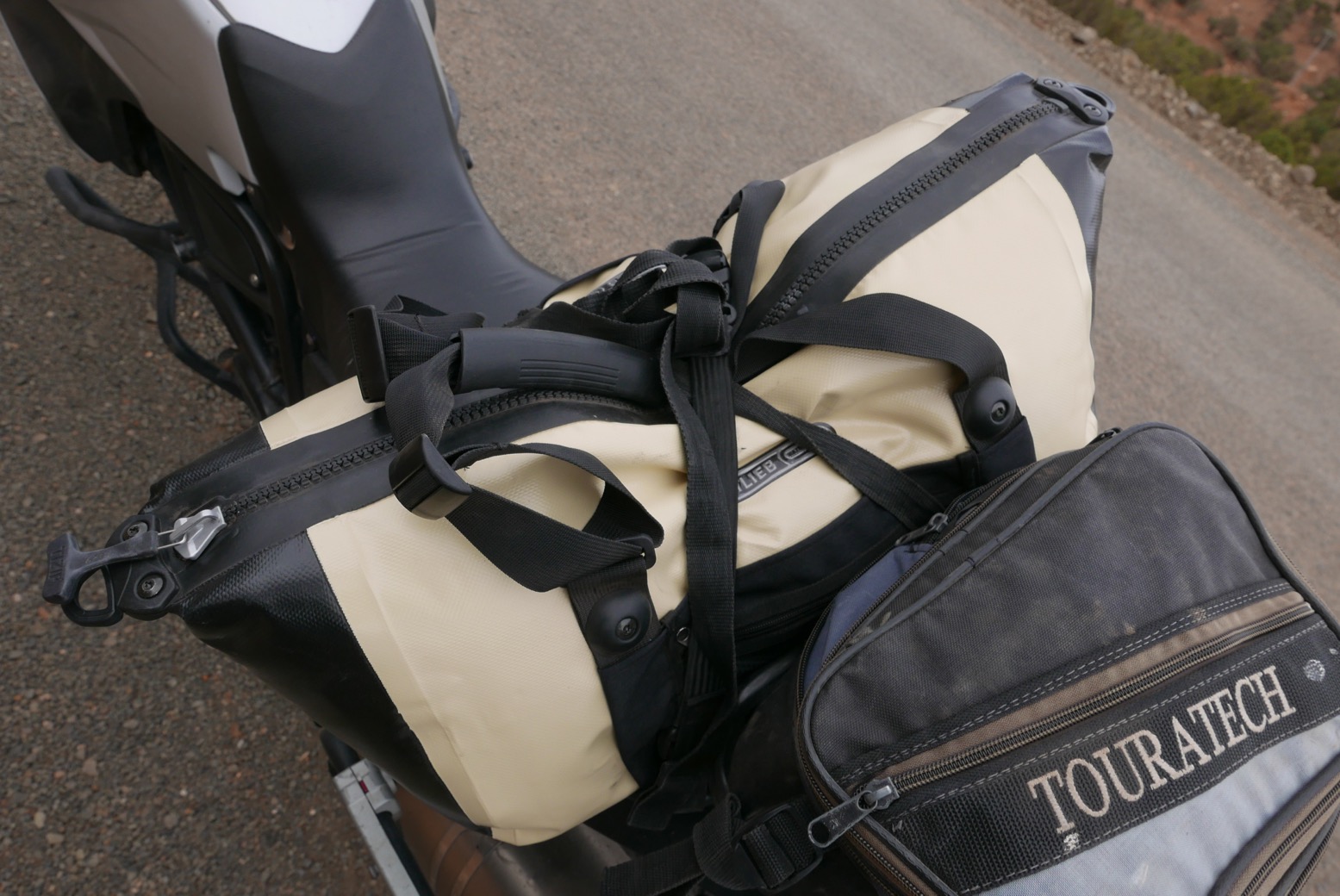
In Morocco the Travel Zip was big enough for my overnight needs once tools and other quick-access stuff were stashed in my old Touratech Tailbag, and mucky spare oil, a one-piece wet suit and spare inner tubes were lashed around the 700GS and 310GS I used.
A waterproof Tizip adds quite a cost and complexity to bag construction, but with the wipe-clean and easy repair PVC body, the bag has an airtight seal. I can vouch for that because after zipping the bag closed in the desert, by the time we reached 2000 metres it was bloated out from the lower air pressure.
It’s only a bag: you put things in, carry it around, and then take things out. But I like the clever hard-handle carrying arrangement, rugged-enough build and most of all, the easy opening. The small exterior pockets may prove more handy in a boat than on the back of a bike, and there’s no harm in the other pocket inside. For a dry-suit zip, the TiZip runs smoothly after a wipe of silicon grease out of the box, and this ease of access in a big improvement over the same-sized Watershed ZipLoc duffle that I used for years. The Watershed fabric is way tougher, but used as a boating day bag, doing the seal up properly as the next rapids approached became a pain. For a boat or a bike, I’m sure the Travel Zip will do me nicely.

ort - 5

XSR 700 Scrambler – ready for Morocco

XSR 700 Scrambler index page

Just flown back from a quick tour in Morocco and setting up the XSR for departure in a couple of days. It was handy pre-running my routes last week; despite recent heavy rains which has seen some places re-mudding their adobe roofs, all my tracks with the exception of Jebel Sarhro were in pretty good nick, including MH19 Trans Atlas which we managed to cram in on the last day.

Getting back on my XSR after riding XR250s with 70,000kms on the clock, the Yamaha feels amazingly taut. On the weekend I nipped down to Surrey to buy an XR400 for Algeria (more about that later).

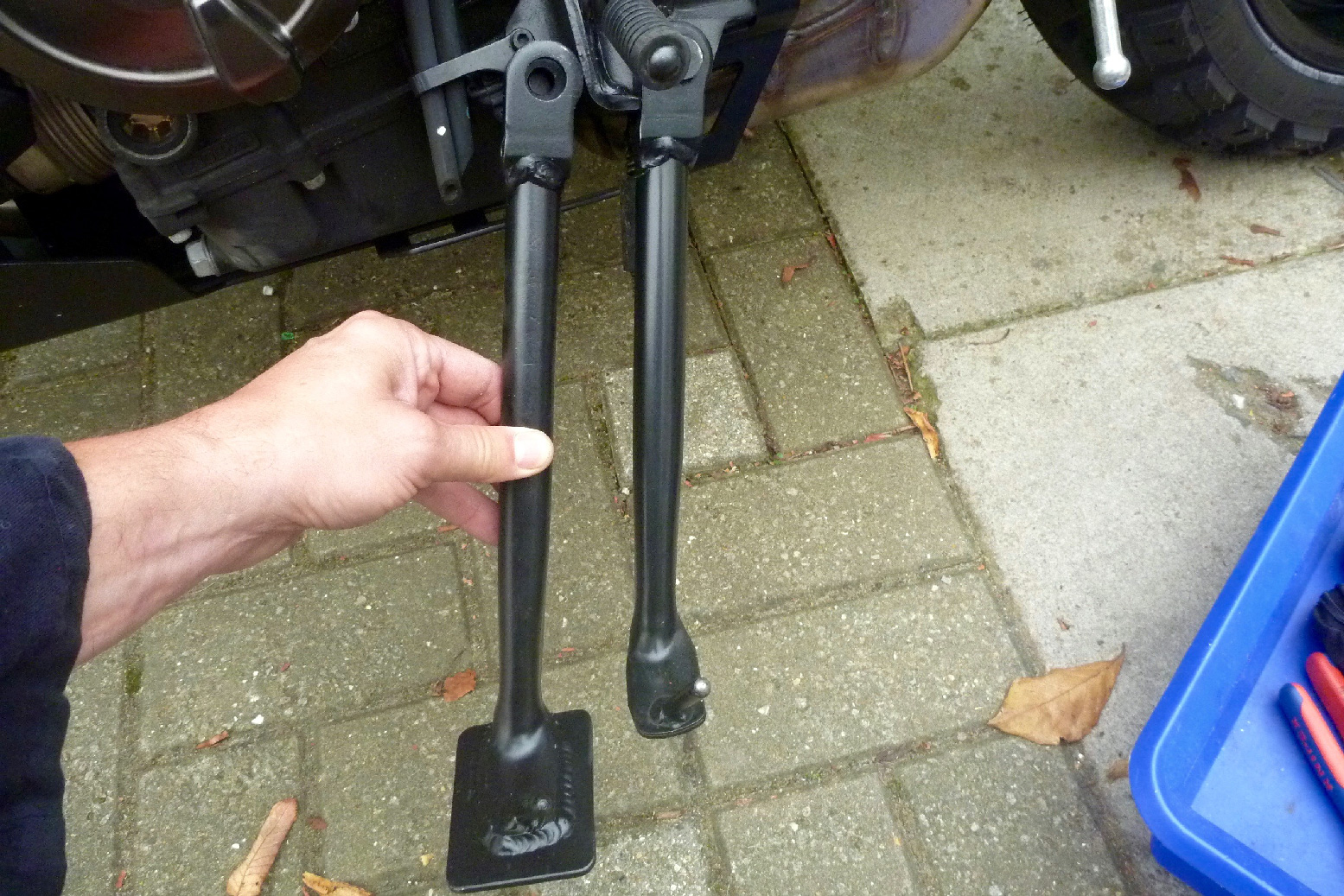
All that needed doing to the XScrambleR was fitting an elongated and bigfooted sidestand adapted from an MT-07 stick (£20 used on ebay + £25 labour). A seamless job by my weldy mate, Jon. That took 10 minutes and a wall to lean on.
Next, see how the Kriega Duo 36 Saddlebags fit over the back. My pillion-to-rack spars are better than nothing but aren’t brilliant at limiting swing into the wheel; they’re too high and forward. A proper rack is best, but a bit of stick and zip tie from pillion-to-indicator may do the job.

cbxender

And so here it is, another AMH projectile ready for three laps of Morocco and a dash home. Looking forward to it, just as long as it handles OK on the dirt. I’m pretty sure it won’t be much worse than the heavier CB500X Rally Raider from 2015 (right).

Tested: Kriega Overlander S – OS-32

See also:
Soft Baggage Comparison
Overlander OS-22, on a Himalayan 410 in Morocco

klou14
krig

Kriega’s new Overlander-S is their second iteration of a luggage system suited to bike travel. A few years ago they brought out a similar plate-on-rack idea (below right) but, with modularity using their existing 15-litre packs (or Rotopax), which were semi-permanently riveted to the HDPE plate which itself attached to the rack with fiddly skewer clamps. I never used them myself, but has a close look once and it wasn’t really for me. I prefer one big bag, like the Adventure Spec Magadans, and an easier way of getting the bags on and off a rack.

OVERLANDER

tik • Good volume
• Rugged construction
• Easy mounting and removal
• Exterior tabs for expandability
• Option to not use platform/plate

cros • Expensive, once you add it all up

M3-17 - 43

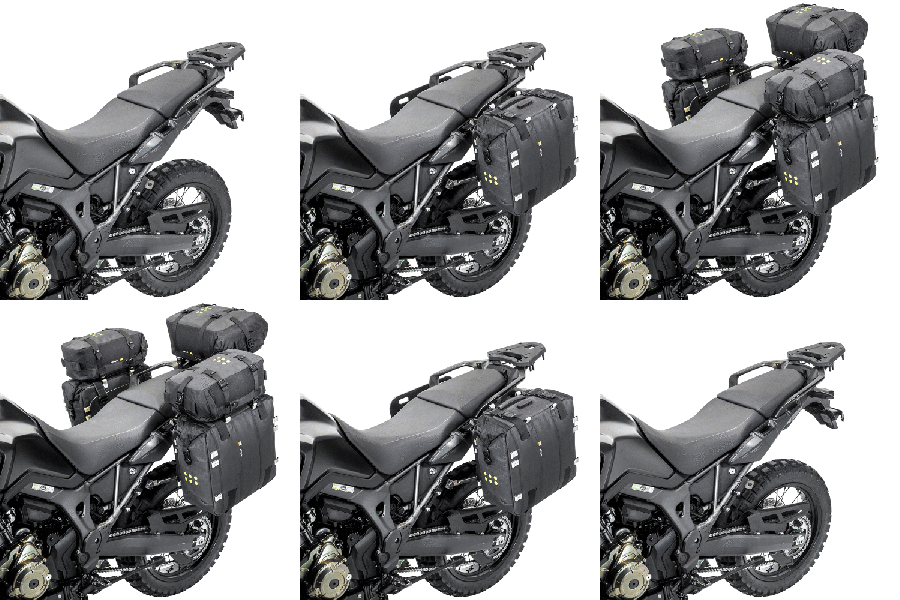
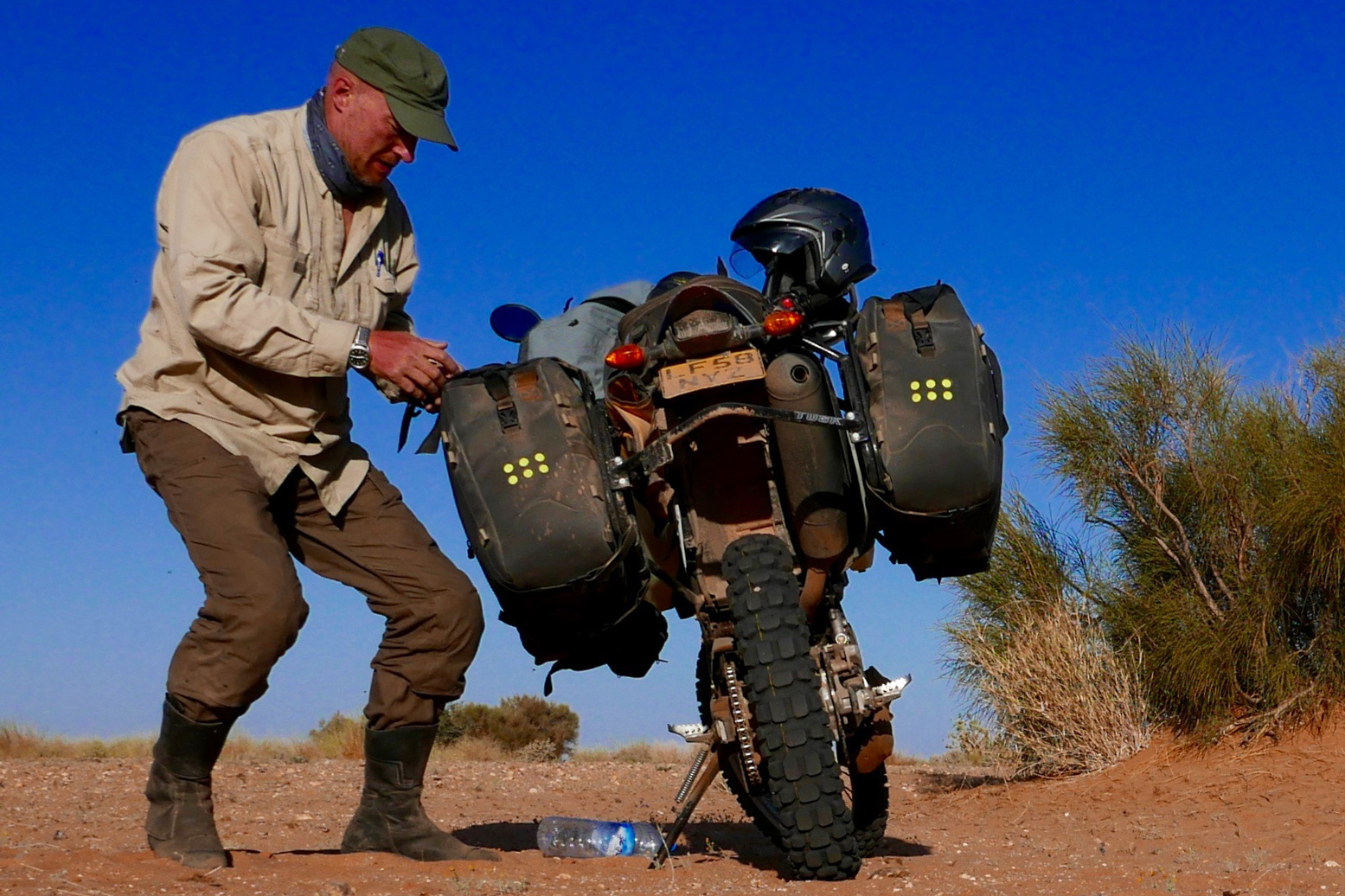
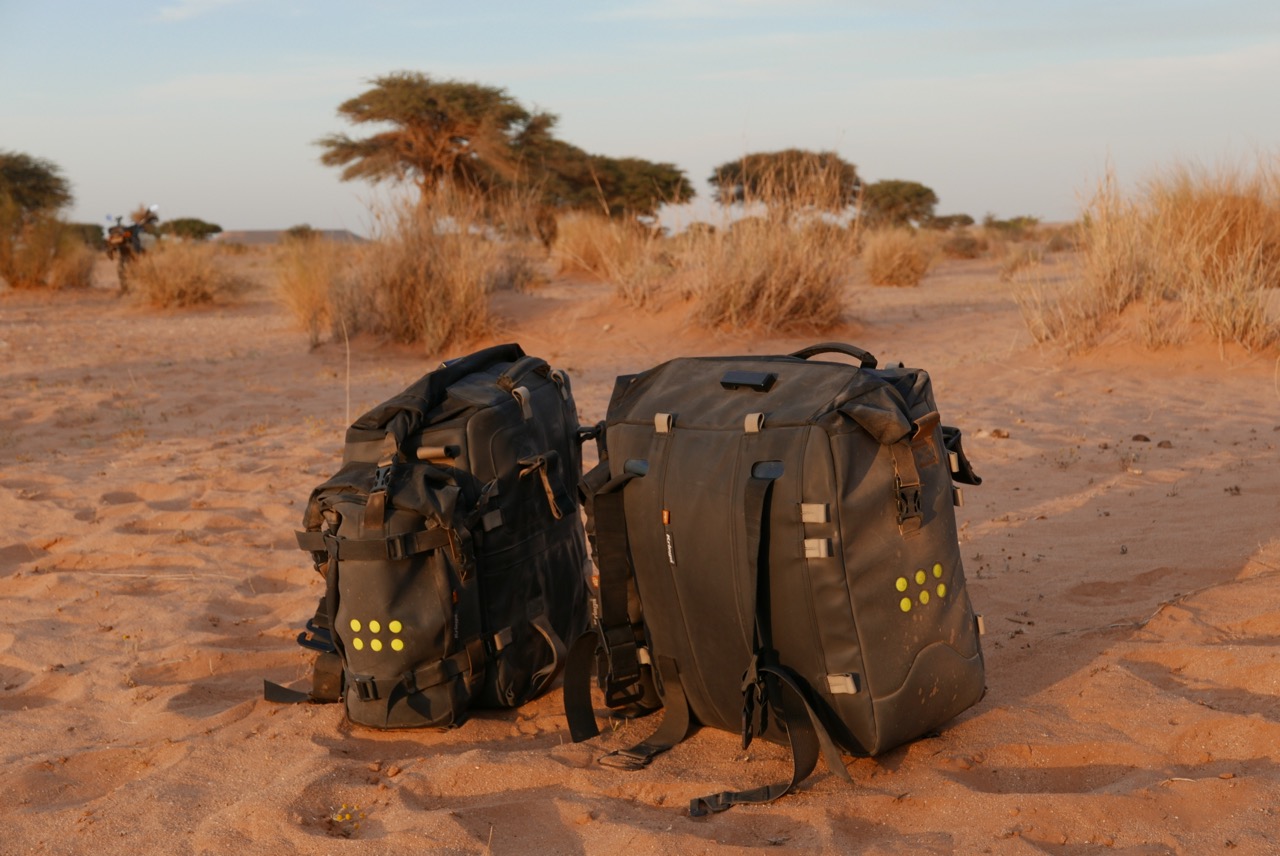
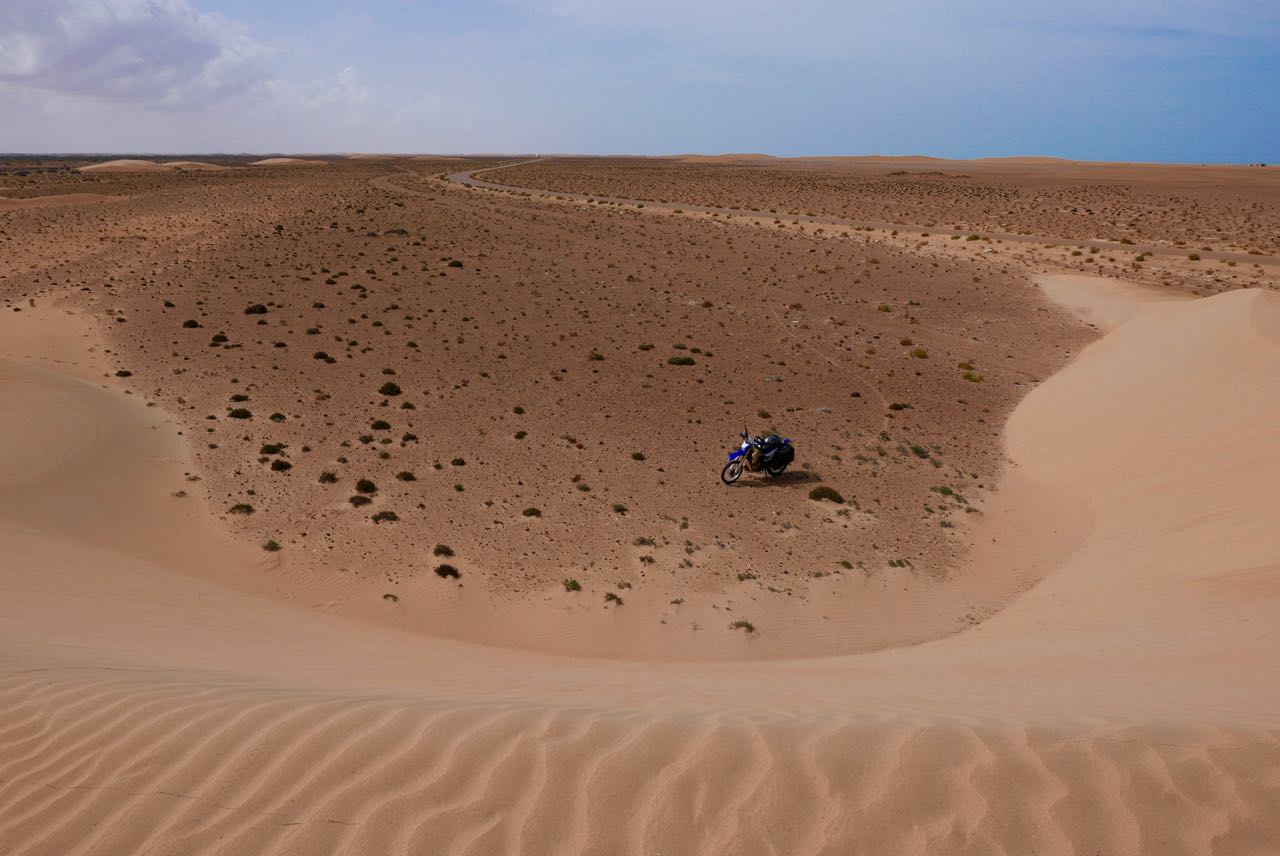
I just spent a month in southern Morocco and Western Sahara with prototypes of Kriega’s new OS-32 panniers, the core of their new Overlander-S system (below right) using a similar bag-on-plate-on-rack system.
My load was only about 10-15kgs each side, depending on water, and I was set up for tentless camping with a few days food. A nifty Giant Loop tankbag, a trusty old Touratech tail pouch and Kriega R15 backpack with Hydrapak added up to the rest of my baggage.

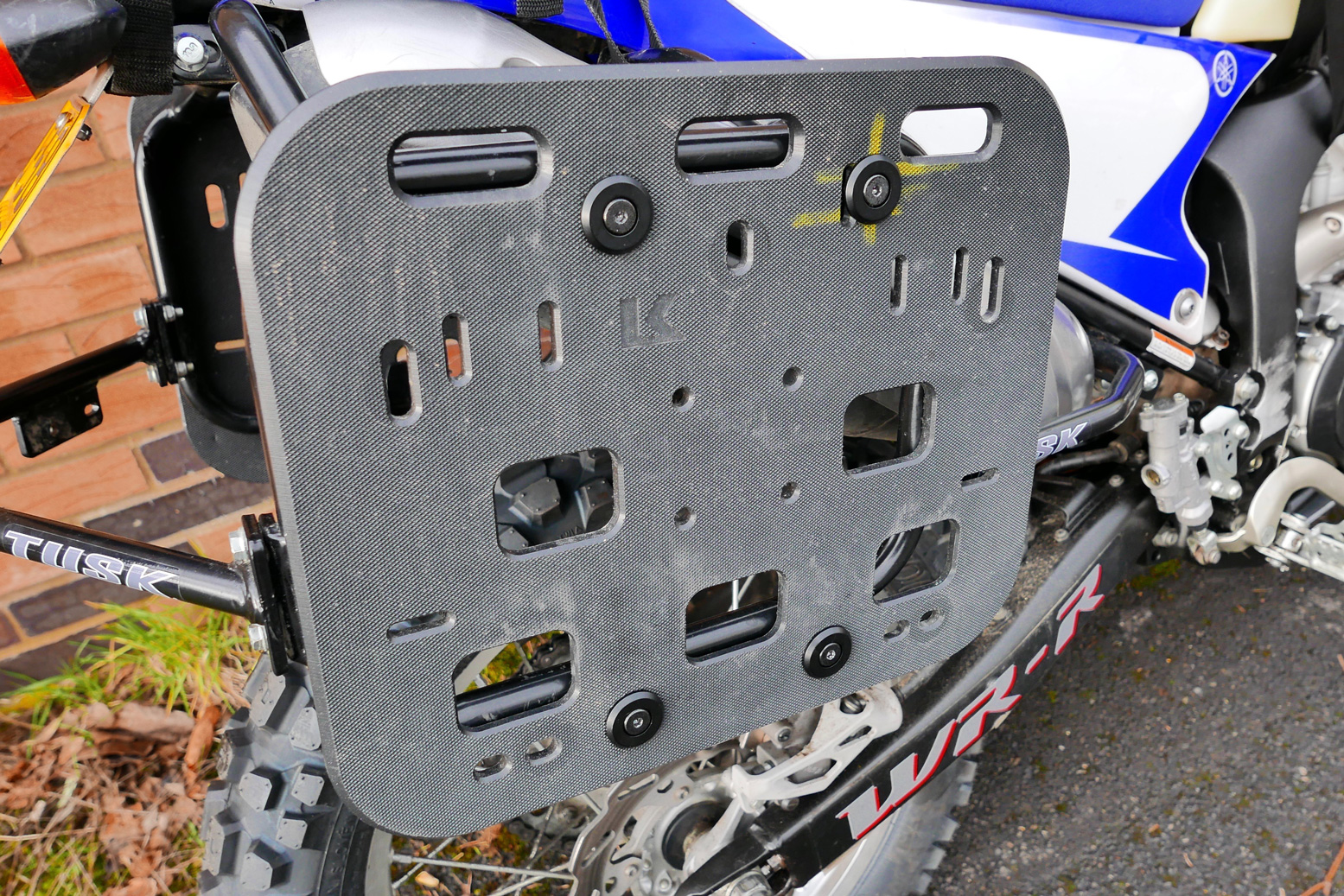
With Kriega OS panniers, an HDPE plate  or ‘platform’ in Kriegaspeak (left) can be bolted to a rack. You may think it just adds weight and expense. Both true, but a plate is actually a smart way to fit any rack. HDPE (think: kitchen chopping board) is great stuff, too: light, rigid and dead easy to drill or even just poke with a red-hot skewer.
The Kriega plate and its adapter clamps have been designed to fit just about any round-tube, 18mm/¾” rack and offer a broad, grippy surface for the hypalon-backed OS bag to cinch up against. Making your own fitting to fatter or square tubed racks would be easy enough. The Kriega OS bags use a cunning anchor and strap-up system to make a very secure fitting while enabling easy fitting or removal – a key element when on the long road. Strapping the hypalon-backed bag to the grippy plate surface spreads loads over a broad area too, meaning no failure-prone stress points.
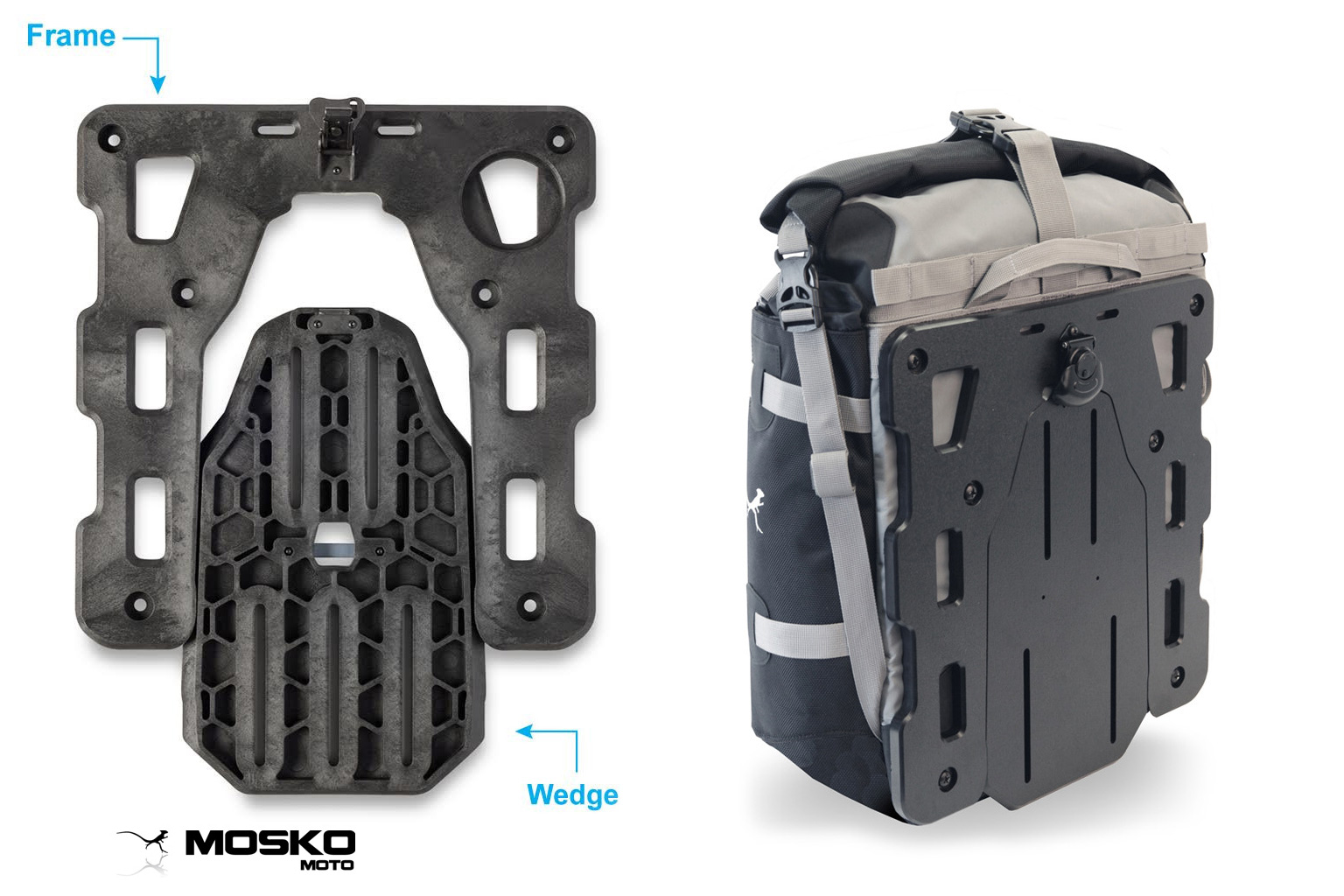
moskrackMosko Moto also use a plate for their Backcountry bags; a GRP wedge and ‘frame’ (right). The wedge attaches upwards to your bike rack, and the full-width frame permanently to the back of the bag which slides down onto the wedge and clips in with a latch. Originals were also made in HDPE, but either wore too quickly or were too soft. GRP (fibreglass) gets round this, but can be brittle stuff. I’ve not tried Backcountry bags, but intuitively I feel old-school soft-strapping to a plate spreads and secures loads better than two bits of GRP slotting, clipping and grinding together, even if it does just take seconds to fit and remove. It’s probably fine for road riding, less so for off road.

86-agadez

For a big trip with heavy/variable loads, a travel bike is better off with a rack, unless you take very little or can be certain your gear will stay put, be easy to get to and remove, and of course, won’t catch fire off the pipe (left; Niger ’86). It’s a load-carrying interface between your baggage and your bike to enable secure fitting on a variety of bikes, like saddles on a horse, a roofrack on your car, a packframe in a rucksack, or even the shoes on your feet.
You can use Kriega’s OS-32s as throwovers, in which case you could dispense with the plate, but you will need some sort of rack to stop them swinging about. You could duplicate the HDPE plate’s strap holes on a rack frame to effectively mount in the same way. It won’t spread the load and secure the bag as well, but it will save 2.4kg of plate and a hundred quid.

wrs1-13
wrs1-133

I used a Tusk rack from Rocky Mountain (4kg, left). Great price, well made in ¾” and solid mounting. It stood up to the beating well and was only spoiled by the clumsy extra bracketry for mounting hard cases. I removed what I could from the rack, but some welded-on bits (right) got in the way of mounting the Kriega rack plate as low and far forward as practical. I suppose I could have ground them off.

krigfeed

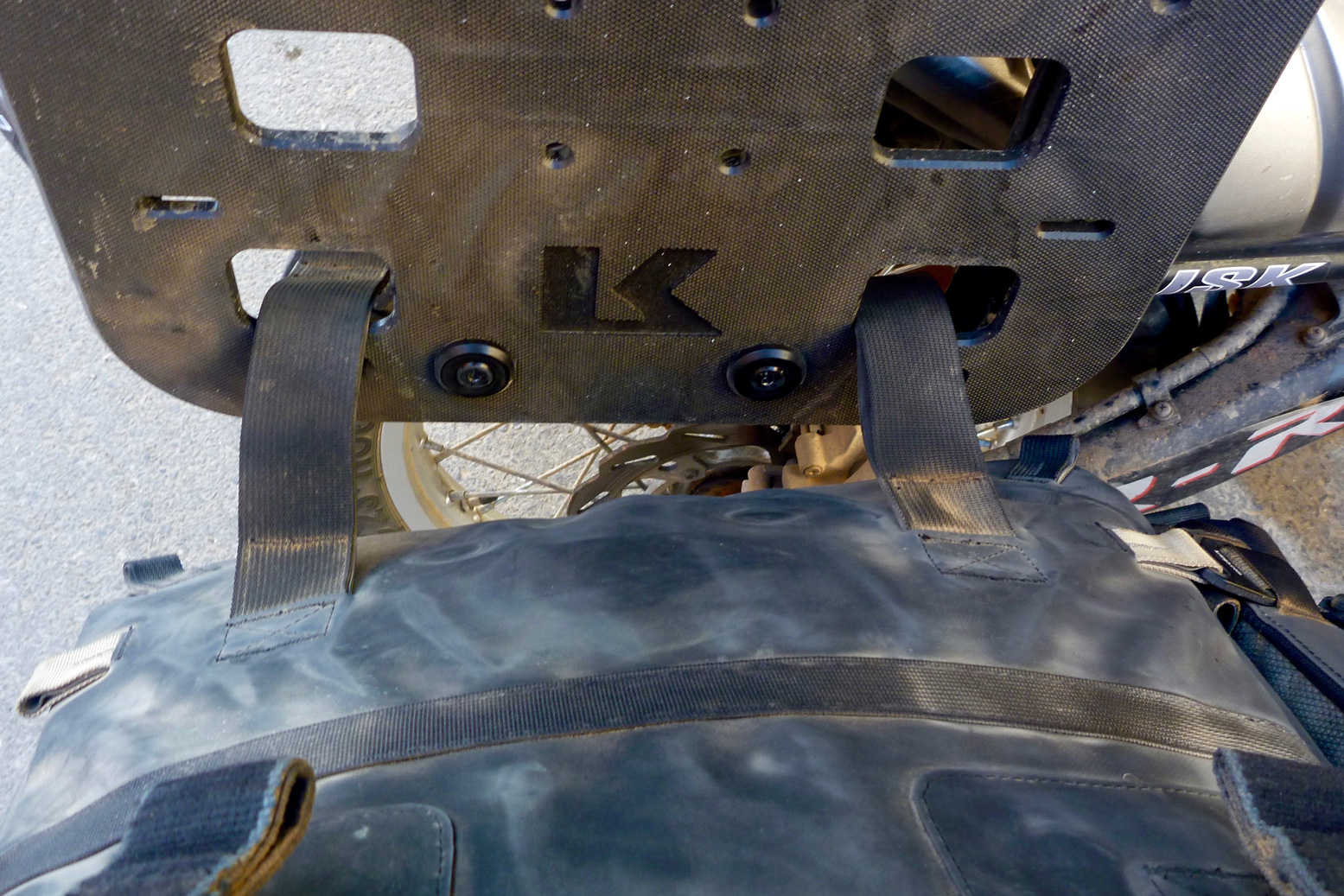
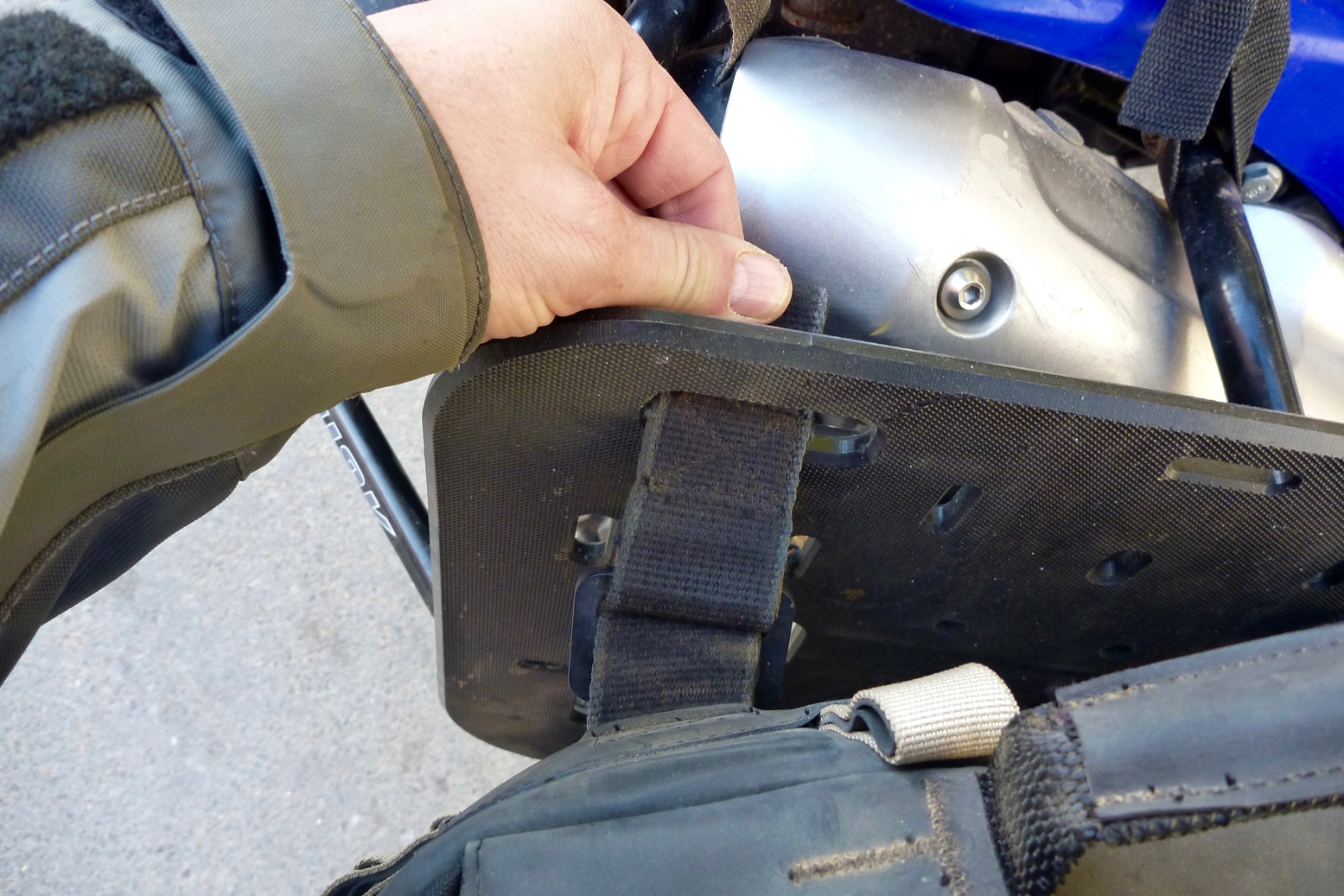
The plates (1.2kg each) have four slots for the upper and lower bag straps. To mount a bag (2.6kg), you rest it on your knee and feed  the lower straps through – below.

krigtopfeed

Then you feed the top straps through the slots and pull the ‘anchor buckle’ through – works a bit like a shirt button and similar to Wolfman’s idea which cinched smaller bags directly onto racks.

krigbukview

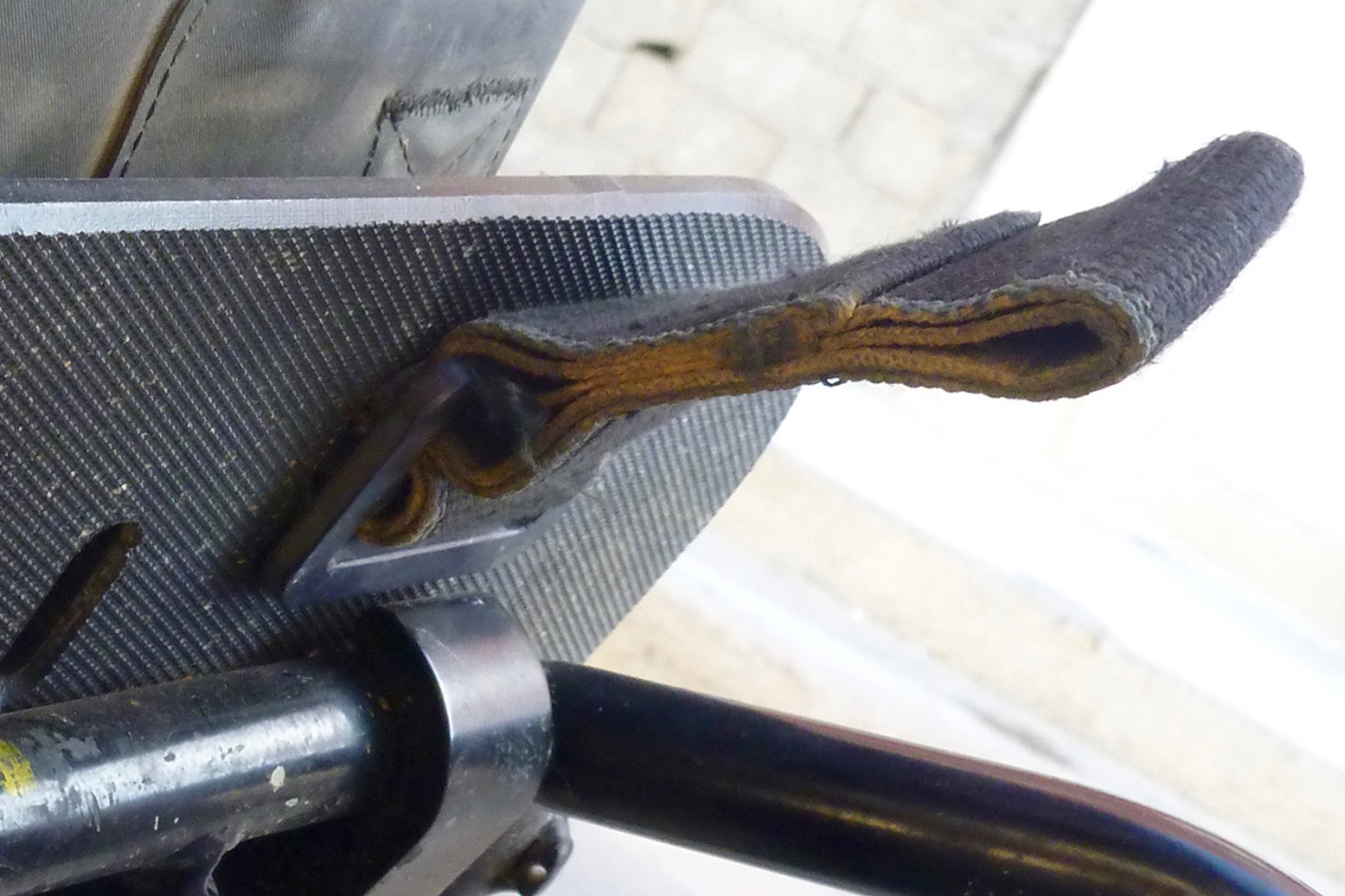
Viewed from behind – the anchor buckles (as I call them) pull through and take the weight.

kriega-os32-fit1


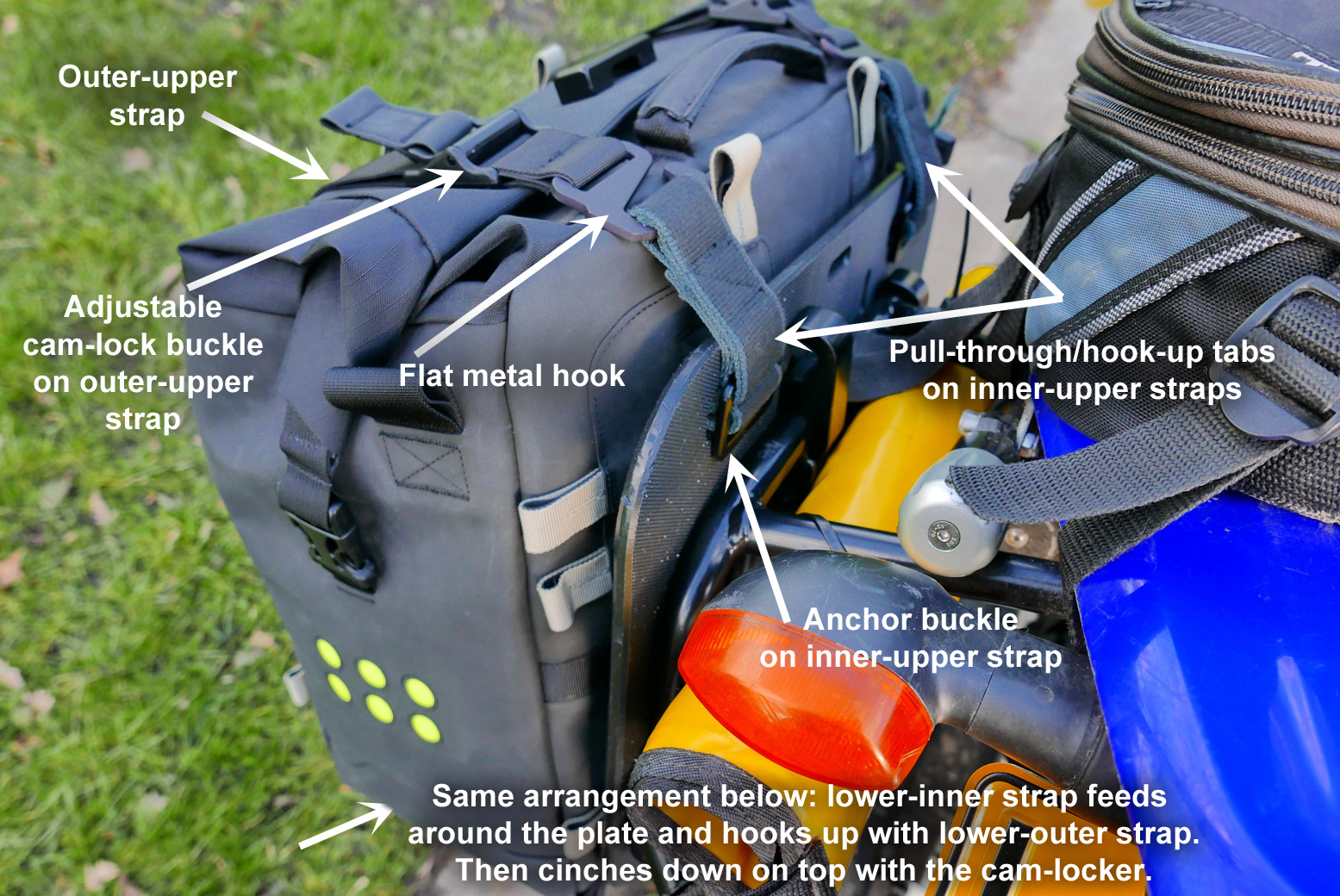
With those buckles pulled through, the bag now hangs on the plate not unlike a throwover. You could probably ride on roads like that. For a bombproof mounting, you now crouch down and connect the dangling lower straps to the outer strap with a flat metal hook. This is about as arduous and fiddly as the whole bag-mounting process gets. Then, on top you do the same: hook the outer strap to the chunky tab off the anchor buckle, then cinch it all up and lock it down with the cam buckle. Sorted!
krigstrappMounting takes about 40 secs each side once you’re practised – demounting a bit less.

klou10
krigpokit

One of the best things about the Magadans are the big exterior pockets – a lot of soft luggageers dodge this necessity. Kriega supplied me with two OS6, 6-litre strap-on pockets (550g) which are part of the OS system and which I hooked on the front of the bags. They’re ideal for daily or heavy items to keep the CoG central. The OS6s cinch down on themselves to stop stuff shaking about. You could put two more on the back and another on top. There are over a dozen hook-on tabs on the main bags and the system includes an optional pair of shoulder straps which make it easier to do the bike-to-hotel-room-walk in one go.

M3-17 - 40

All bags came with the usual Kriega white liners to enhance rummaging visibility and which are more durable than previous liners. I didn’t use them, and bagged stuff individually. Even then, what rain I got – a few hours a couple of times – didn’t penetrate the bags. They’re covered in hypalon panels (think: whitewater raft fabric; lasts for decades) which slow the wetting out of the bag’s Cordura body and of course will scoff at any abrasion, be it the constant rubbing against the plate, or sliding down the road hoping not to loosen your load. Daytime access requires uncam-locking and loosening the top straps and pushing to the sides, then unclipping the roll top folds from the sides and unrolling – about 15 secs.

magwalter
krigsecure

On the top panel you’ll see a chunky metal fitting to feed a cable lock, like the Steel Core recommended by Mosko Moto. I initially just used them to secure the loose strap ends (left). Kriega tell me if I fold the ends over they’ll have the rigidity to slip into the outer sleeves, even when the bags are packed full. I never tried that and in the end just let the straps flap.

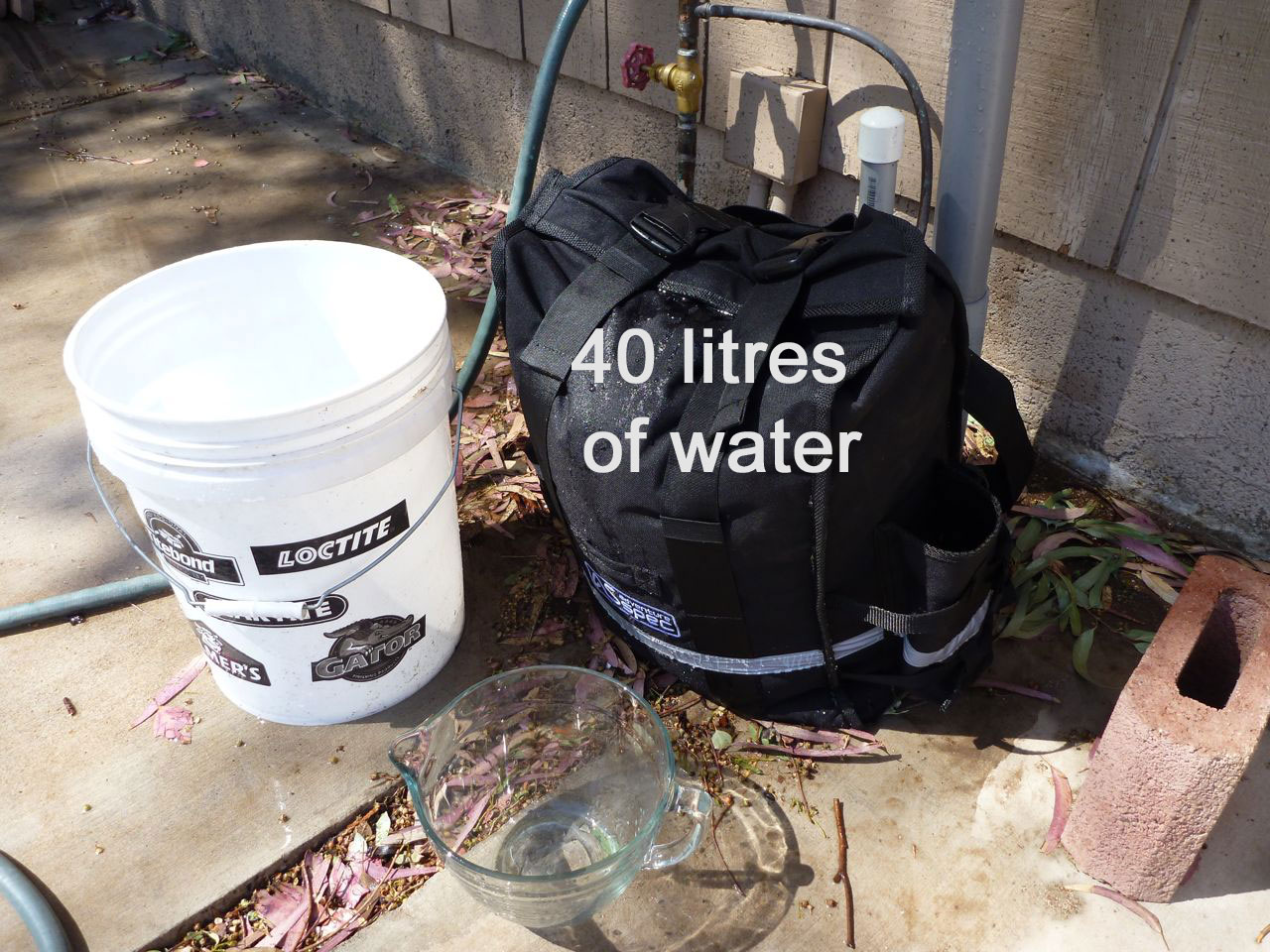
The bags have interior stiffening panels to help give shape, but fold down flat for shipping or shoving under the bed between adventures. The volume is 32 litres according to the brochure, but as I discovered here, a flexible, rectilinear box will actually increase in volume when filled with fluids as it seeks to attain spherical equilibrium. Who wouldn’t want some of that. For example, my notional ’24-litre’ Magadans (right) actually took 40 litres of water, and that increase will be the same with any similar flexible rectilinear pannier.

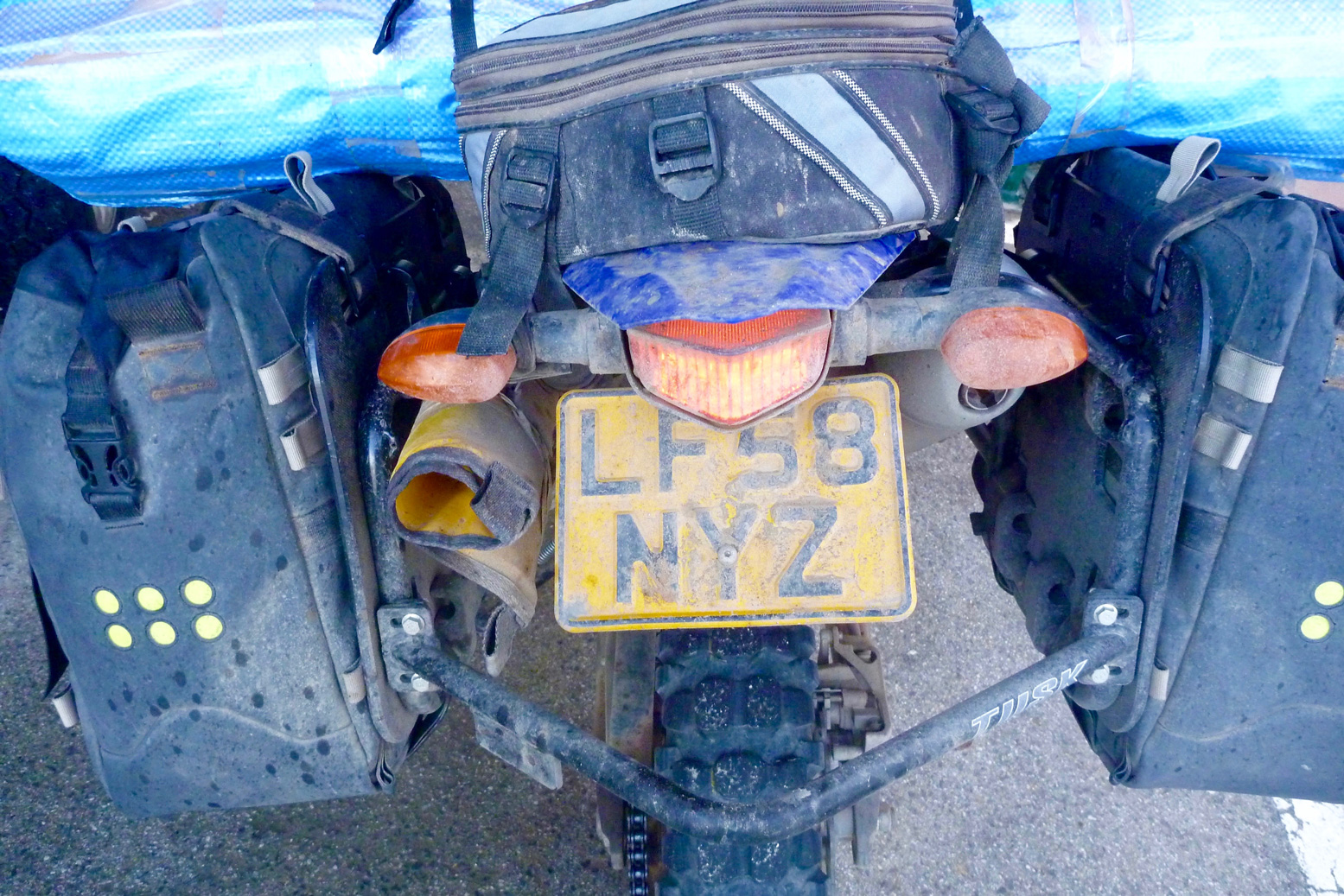
So, masses of volume meant I didn’t need an annoying tailpack, and low-mounting probably didn’t do any harm to stability either. Yes, they’re wide because the rack is wide. On the chain side I could’ve used the inner space better (just a rolled up 10-L fuel bag, yellow thing on the left). There’s four litres of volume to be had there, easily. A Rotopax won’t fit.

On road and trail the OS-32s never missed a beat or felt annoying to use. In fact the pulling up of the anchor buckles and then cinching up were quite satisfying actions – I suspect ‘actuation gratification’ (the satisfying click of a clip, for example; there’s probably better jargon for it) may be something that better designers think more about than others.
With my throwover-on-rack Mags (left) I removed the liner to take indoors as the bags needed careful lashing to the rack to stay put. With the Overlander-S it was no bother to:
• lift the cam locks
• loosen then unhook the lower straps
• unhook the top straps
• lift the bag on its handle, release the anchor buckles and carry it away

Your OS32s are a travel solution to long overland journeys. For dirtbike weekends or fast and light BDR-ing, I imagine a GL Great Basin, Mosko Moto Reckless, or alternative Kriega packs will suit riders prioritising agility. Me, I’m more of a traveller and prefer big, side-mounted saddle bags with minimal junk loaded on top. Slimmer would be nice, but that’s just conventional rack design and high dirt-bike pipes for you.


The Mags are still great bags and bound to be cheaper. The OS-32 kit as I used it with plates and two pockets would come to £710. That’s a lot of money, but of all the accessories you lash to a genuine travel bike, surely the baggage system is the most critical and will be the most used.  I hope to carry over these OS-32s to my next adv bike. Good job Kriega, a well thought out bit of kit.

For more images from my ride in Morocco, see this.

M3-17 - 19