Enduristan Monsoon review

See also: Soft Baggage Comparison

DESCRIPTION
Thirty-litre, nylon and TPU-coated fabric, roll-top, throwover panniers.
Enduristan web page.

WHERE TESTED
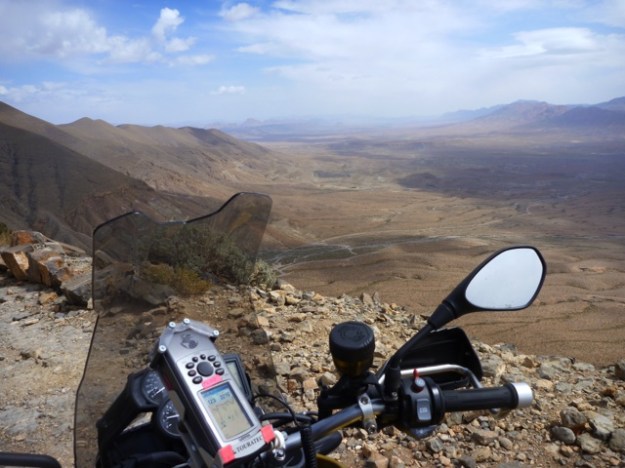
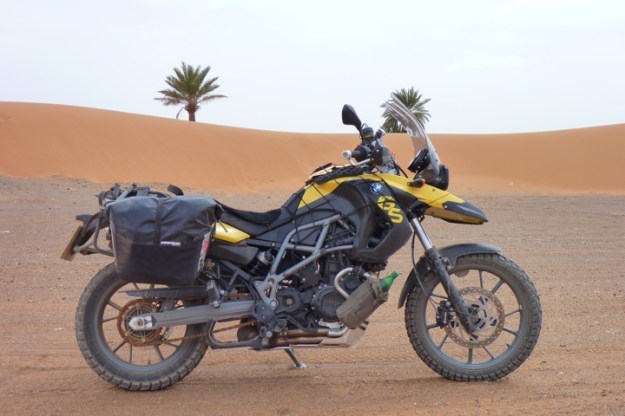
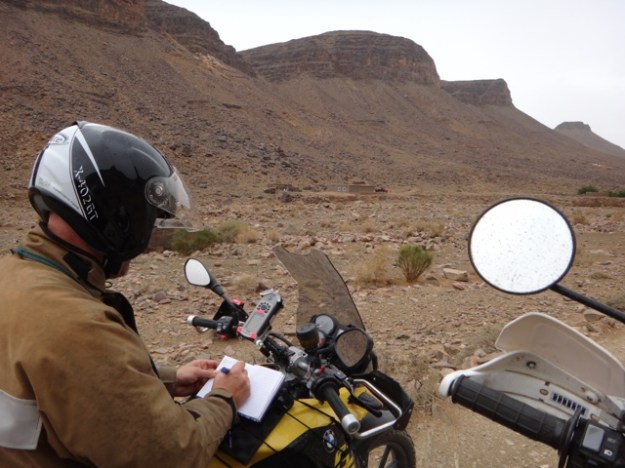
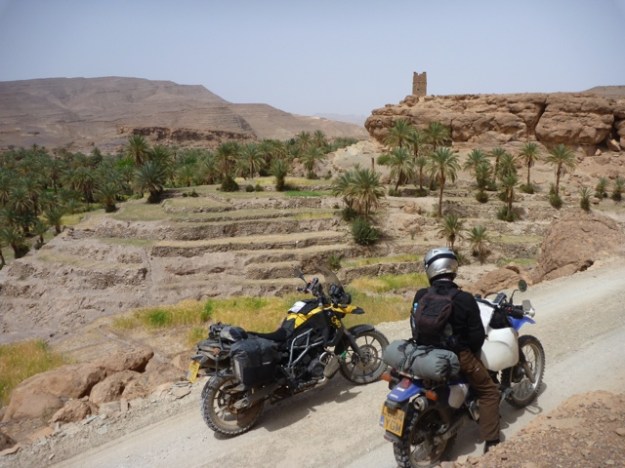
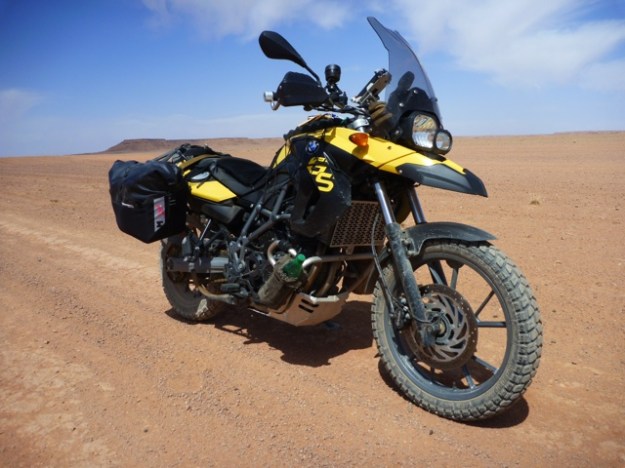
Spain and Morocco in March 2012 on a BMW F650GS SE. to update my Morocco book. The bags were used with a kit bag of camping stuff across the back seat but that got stolen early on so most of the time I just had the Monsoons along, plus a small tent and bag I got lent.

IN A LINE
Good volume and details, but too wide on this particular bike

PRO
• Will mount on most bikes
• Locate securely (against a rack)
• Well made
• Secure stiffener keeps shape well
• Several external attachment loops

CON
• Velcro straps were too short (but they now sell extensions for £8)
• A bit small, or could use a few more inches in roll-up height
• Wide. I’d prefer a slimmer, longer profile shape (don’t start me on that…)
• Not unique to Enduristan, but fabrics a bit light for long-range durability
• Lacks useful external pockets

COST
€290
Bags supplied in exchange for an Enduristan advert in AMH

monbaguette

DETAILED DESCRIPTION
According to my measurements the Monsoons are 33 tall x 25 wide x 36cm long so do have a genuine maximum capacity of about 30 litres as claimed which makes them a very useful four litres bigger than the Ortlieb Saddle Bags, their main throwover competitor in Europe at a stated 33 x 21 x 38cm or 26 litres. Australian Steel Pony Gascoyne’s are listed as 37 x 23 x 44 = 37 litres plus the nifty outer bottle holders. Andy Strapz Expedition Panniers say they are 30 x 18 x 33cm which comes out at 18 litres plus the outer mesh pocket, though they still claim up to 35 litres volume. I used a pair once in the desert and don’t recall them being anywhere near 35 litres when rolled up, but that was several years ago. Since I wrote this Adv Spec Magadans are around at 32 + 3 with the pockets.
Monattach

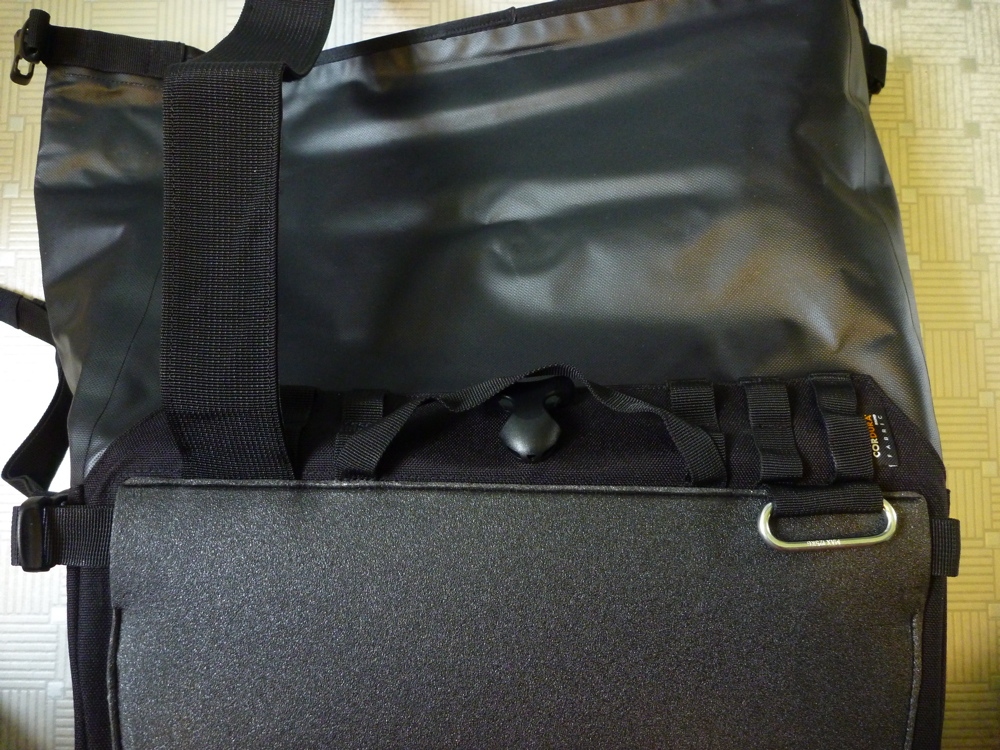
The Monsoons throw over and adjust with two-inch wide velcro straps, and to stop them moving forward or back an elasticated strap at the front lower edge attaches to a pillion footrest mount, while another non-elasticated adjustable strap runs across the back from the top of each corner to limit forward movement which studies have shown to actually be the greater dynamic load when riding.
Moninner

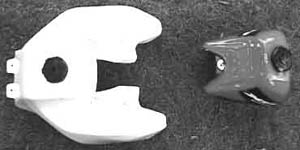
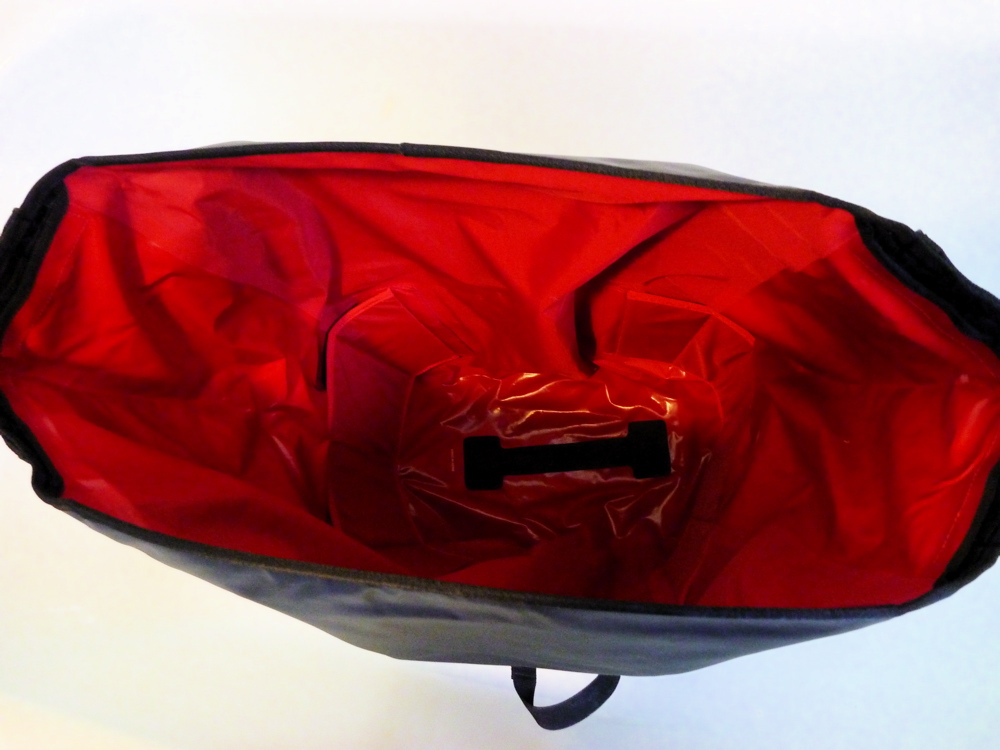
The outer bags are made of an unproofed 1000D nylon lower which is sewn to a thermally coated polyurethane (TPU) fabric upper for the rolling section which is welded to itself to make a cylinder. The top edge of the outer is then partly sewn to the inner, red TPU coated, thin nylon-like fabric lining (left). This waterproof red liner is also RF welded into a bag shape which I feel is better than stitching, and then taping. Separating outer abrasion from inner waterproofing differs from say Ortlieb Saddle Bags where the bag is made of thicker waterproof vinyl that is probably less resistant to abrasion than nylon.

Monisolater

In between the Monsoon’s inner and outer layers you slip in a flexible plastic panel (not pictured) which fixes into position neatly with velcro tabs to give the bag its boxy shape. Enduristan claim that this panel gives a ‘third’ layer of protection from flung up debris which I suppose is true, but let’s face it, it’s really a shaping panel, like the Zegas had in box form. What’s more important is the front outer corner of any pannier which takes the brunt in a fall, and this vulnerable area was not reinforced.
The waterproof red lining had a pair of clever, flip-out dividers to make optional compartments in the lower half and into which slips the 7.5-litre Isolation Bag accessory (right). Unused, these dividers take up virtually no space.
There are no actual pockets inside on the red lining though up to a point you can slip stuff between the lining and the outer – a hidden compartment of sorts, but it won’t be within the waterproof inner. No pockets on the outside either, but plenty of attachment loops (left) for mounting stuff over the top. That’s not so convenient for easy bag access; I’d have prefered attachment points on the front/back panels as well, but  the clip down points for the roll-top get in the way which is why Steel Ponys roll tops clip as they do.

REVIEW
First up I must admit that while I like soft baggage, throwovers are not my preference for the age-old reasons. But although I had three offers of hard luggage for my Morocco guidebook updating trip, I was keen to compare these new Monsoons to the well established and recently redesigned Ortlieb Saddle Bags. Perhaps unusually, I used these bags over a Metal Mule rack. Had I not had this rack the bags would have swung around much more and probably got stressed or damaged on the wheel/swingarm. Or, to limit that would have had to be mounted awkwardly high. (Since writing this review Enduristan have told me that they testing a rack adapting kit for Monsoons). It’s notable that Andy Strapz now suggests that his bags mount much more securely on a light rack (which he can also sell you). He’s right; a pair of Andy Strapz panniers I lent someone melted in a short run on the back of an XR650L one time, though that would have happened to any throwover, as many, many of us have found over the years.

Mondriveby

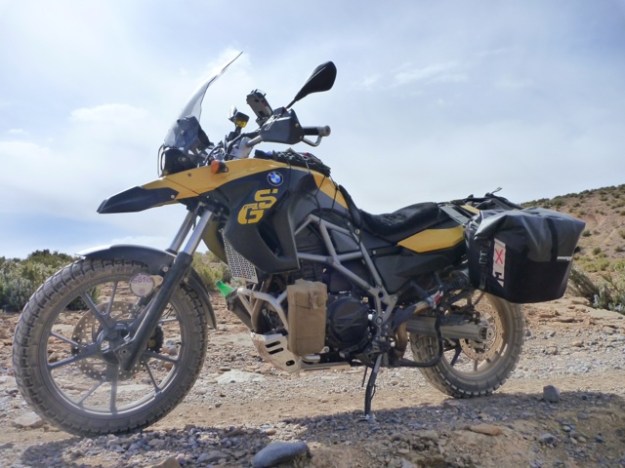
With its wide, sub-seat fuel tank the F650GS may not have been an ideal candidate for Enduristan throwovers; it just doesn’t have the nice flat sides to suit them. Even then, I mounted the bags as low and as far forward as possible to centralise the weight and was typically running up to 10kg in each bag. Even in that position they never got in the way when I was paddling the bike hard through soft sand. Pushing the bike through even softer conditions was made awkward by the width of course, but better that than an alloy pannier’s hard edge. It never crossed my mind that the Monsoons might hurt me as it often did on Desert Riders with alloy Touratech Zegas.

At 30 litres I’d say they’re still a bit small. The fact is there’ll be times on the road when you want 40 litres and other days when 20 will do. I prefer bigger bags low down and as far forward as possible on the sides, then something small over the back seat/rack – a bag or even a small lockable box. At least with roll-tops you have the capacity to deal with varying volume needs, although to me the shape is not optimal – too wide. I’d have preferred a longer, slimmer profile, though it seems most soft panniers use width or height to gain volume, keeping the front-to-back length short presumably so as not to interfere with passenger legs, where present.
Moncrab

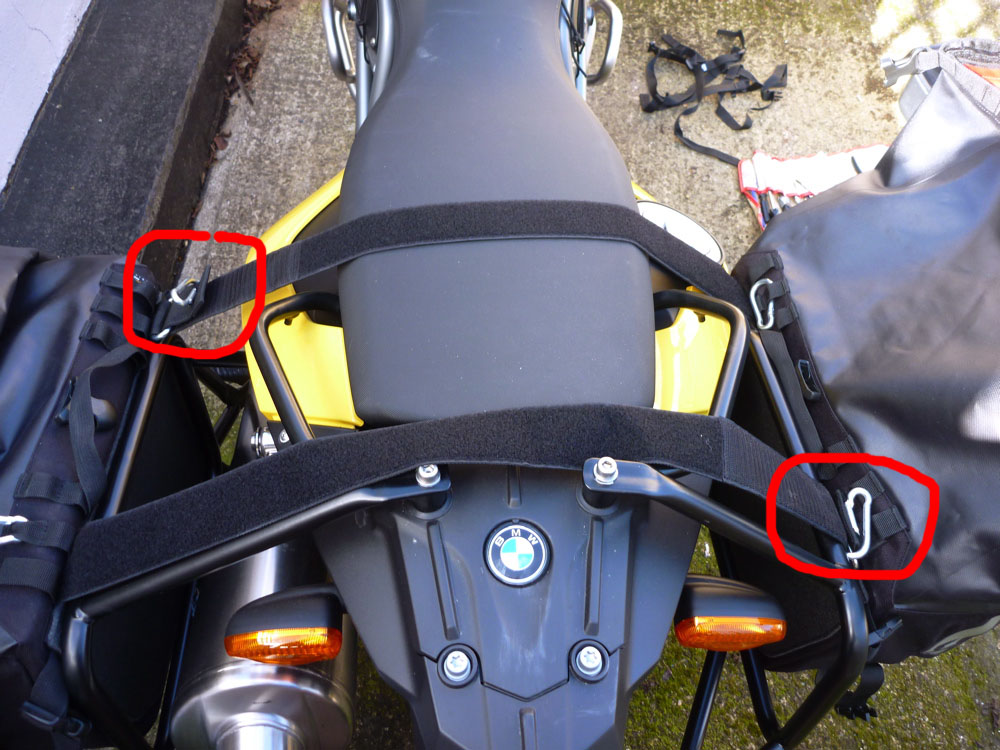
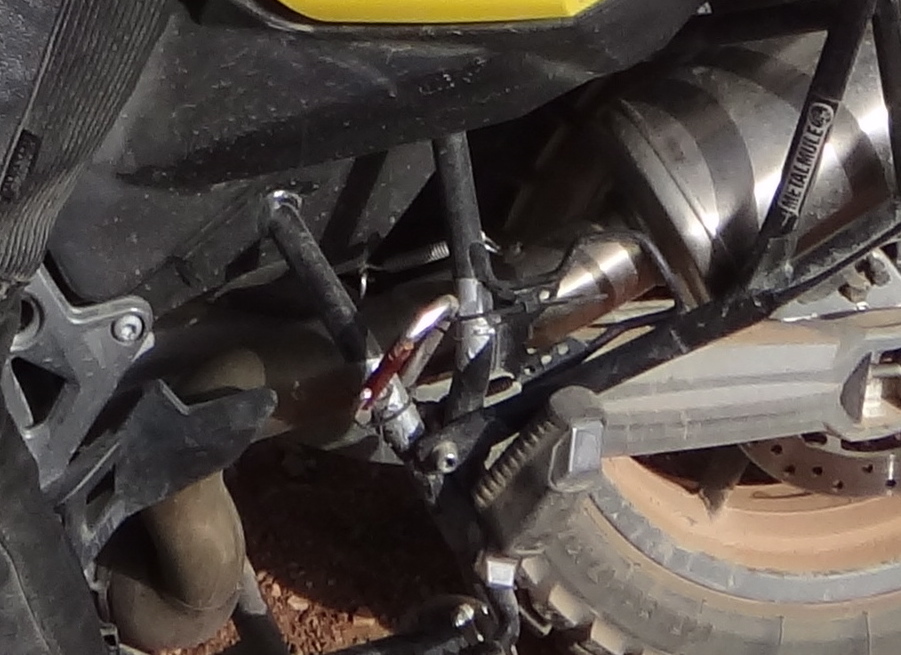
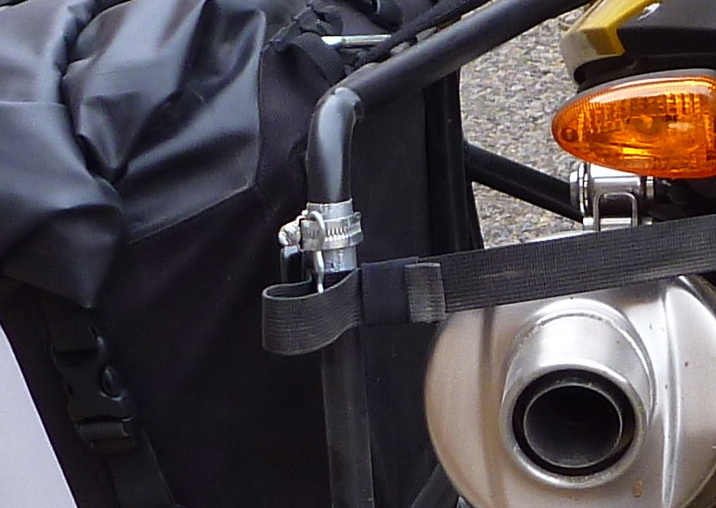
My first problem was finding that the velcro straps were way too short (right) to fit the F650, and would have been barely long enough even without a rack. I extended them by making two loops of two-inch strap I had lying around and adding some mini carabiners as buckles; that worked fine. On the GS the forward pillion footrest straps lined up just right, but on the exhaust side would have been way too close to the pipe, so I clipped and zip-tied a carabiner in there (left) to move the strap point further away. The back strap also wouldn’t have worked on my bike as it was set up had I not fixed on some R-clips with jubilee clamps on the back of the rack to keep the strap in position (right). That was a temporary fix which may have eventually worn through the strap. Had it been my bike I’d have come up with a better long-term solution.
Monstrapon

Once I did all that I have to say the bags never shifted in all the rough riding I did in Morocco or <80mph riding on the way back, although on the dirt I did use an extra belt between each bag’s handles (left) as I wasn’t convinced the velcro would hold. I’ve taken the same precaution on many other panniers I’ve used over the years.

monwide

I complain about them being too wide on the GS (right), but it’s just occured to me that the stiffening plate you insert to give the bags form could easily be trimmed or even removed altogether to make a more saggy but less wide profile. I wish I’d thought of that in Morocco. As it is, my bags picked up passing thorns as well as tears and scuffs off passing rock faces and were a nuisance on narrow mountain tracks where I was forced onto lines I’d have preferred to avoid. They are I suppose no wider than a hard-cased GS1200, and at least a soft bag deflects you less when you bump into something hard, and hurts less when you bump into someone soft or have the bike fall on you, all of which is reassuring and the reason we go soft, is it not?
Monbakpan

At the end of the day the bags clipped off easily and could be heaved over a shoulder to walk into a hotel, hands-free. Ortlieb QL2 Side Bags (31 x 18 x 43cm – 28L) would have clipped off a rack effortlessly. I’ve used smaller Ortlieb QLs on pushbike tours in the Himalaya and I can tell you when you’re shagged out it’s so nice to just lift the bag off the rack with the handle and then slot it on again next morning; no grubbing about with straps. Had it been a wet and muddy you’d get all mucky undoing the Monsoons, but that’s the way it is with all soft bags on motorbikes. Eventually, the bags got quite grubby and dusty, but so was the bike – hosing it all down at a car wash fixed that.
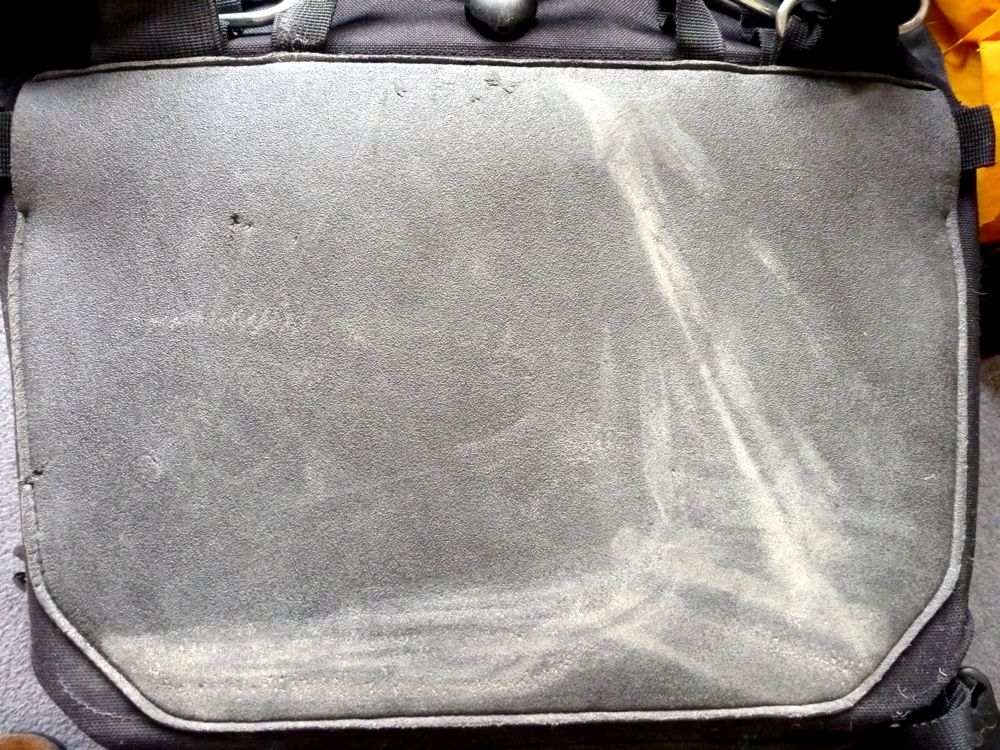
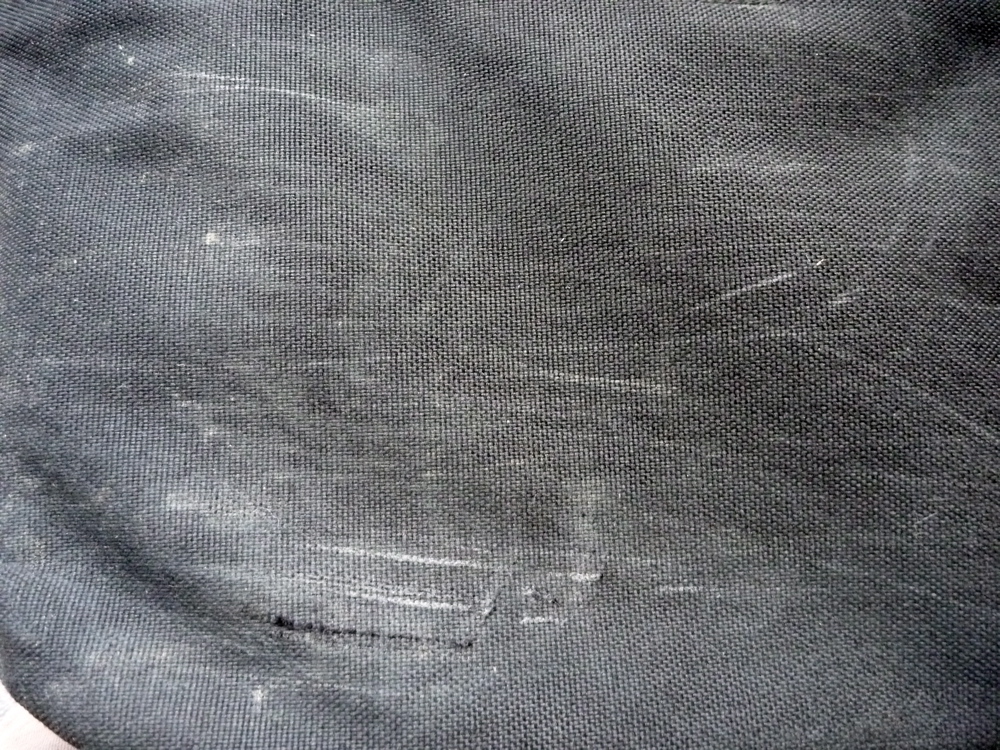
The back panel – a sort of dense closed-cell foam (left) – stood up pretty well to being rubbed on the rack for weeks. But the outer face of the left pannier (right) which stuck out more because of the pipe, had a harder time of it, even though I was trying to be careful and never consciously felt myself barge into the scenery.

The only chance I got to really test the Monsoon’s waterproofness was on an 800km-day back across Spain through several showers and one mega downpour with flooded roads with run-off. Even though I’d been expecting this and cinched the bags up nice and tight, when I got to the hotel that night there was some wetness inside the red liner along each forward end of the roll top where it clips down to the front panel of the bag. I’m not too surprised by this; roll top closures can’t really claim to have a waterproof seal, for that you need something like submersible Watershed Dry Bags (my 30-litre Watershed with new tent, bag and mat was among the stuff that got pinched off the ferry). Water being what it is, by pelting a roll-top bag at 70mph capillary action will eventually see it seep through to the insides. The top outer panel of the bag has a lightly textured exterior surface (uncoated side of a fabric?) which I believe may exacerbate this. A smoother surface to roll up (like thick PVC SealLine Baja bags) might help reduce ingress. It also occurred to me that the flat, flexible plastic, inch-wide stiffening ‘blade’ that’s sewn along the top edge to give you something to roll against might be better off being a piece of flexible tube or hose. That would be much easier to roll up tightly and without creases to stem the ingress of water.

So, all up I’m a bit lukewarm about the Monsoons even though nothing broke or failed in three weeks of hard use. The initial strap shortage was annoying, the width was also annoying and was made only a couple of inches so by the rack. I believe for actual overlanding rather than weekend camping, a soft pannier is much better off resting securely against a rack, or better still sitting on a platform rack (more about that later). Enduristan can’t be blamed for making a boxy shape like Ortlieb, but I’d much prefer a longer, thinner shape like the Steel Pony Gascoyne (seen but not tried), or a ‘suitcase’ shape (more about that later, too).

I also think the fabrics are a bit thin to survive a tough, trans-continental trip – that is the perspective taken and intended use for all gear reviews on this ‘website of the book’. I never fell off the GS or had it fall over but that, as well as rough use, is all part of motorcycling across the wilds of Africa, Asia and Latin America. The Morocco ride gave a good snapshot of that and if I was doing a longer trip with Monsoons I’d consider sewing on a second layer of material to protect the base and the damage-prone leading outer corner from wear and road slides. The fact that the Monsoon’s nylon lower is not waterproof makes sewing onto it no problem.(it doesn’t claim to waterproof; the base filled up as it seeped through when I washed them in the bath back home). Pockets could also be added here now I think about it. But making the bags slimmer as I suggested earlier by trimming/removing the flexible panel may not be that effective as the bags are cut to fit that panel.

Zip-free, roll-top is definitely the way to go, but what we want are big side bags mounting low down but without pedestrian-menacing width. I’d like to see Enduristan or anyone make a full-on, rack-mounting or rack-resting expedition pannier at 35 litres slim and in OTT tough abrasion-resistant fabric and similarly tough vinyl inner liners; separating the two is a good way of doing it because for resistance to rain and abrasion you need something like hypalon raft fabric (more about that another time). Since I wrote this Adventure Spec Magadans have come on the scene and answer many of my above requirements.

BMW F650GS 4000-mile review

Released in the UK in February 2012, the ‘SE’ suffix in BMW’s F650GS added up to a new paint job and an array of optional Special Equipment.
As a reminder, the ‘650’ uses the same 795cc engine as the more popular F800GS, but detuned to be more tracable and more economical, with higher, road-oriented gearing, shorter suspension travel, a lower seat, cast wheels with a single front disc and tubeless tyres.

The bike was loaned by BMW Motorrad and I rode it from new for over 4000 miles from London across Spain to Morocco and back in March 2012 to update my Morocco Overland book. I set off with around 600 miles on the clock, just after the first service and was out for three weeks.

My bike came with a batch of these optional extras: main stand, trip computer, heated grips and ABS, all of which I learned to appreciate. At the first service it was additionally accessorised and modified as follows:

  • Heidenau K60 tyres
  • Metal Mule rack, tall screen and rad guard
  • BMW bash plate, engine protection bars and hand guards
  • Touratech sidestand foot
  • 1 tooth smaller 16T front sprocket
  • 12v plug
  • Ram mount
  • Aerostich wool seat pad

Why the ‘650’, anyway?
Now they’ve had their teething problems sorted, I believe the ’650′ is the best of the two F-GSs twins for real-world overlanding. I wrote as much in the AMH6, even before I rode the bike.
BMW Motorrad did suggest I might like a new Sertao for the Morocco job, but that bike overweight slug has little to prove. Overall, I prefer the unsnatchiness of a twin over a big single, and there’s apparently less than 10 kilos weight difference, while you get a more smooth power and nearly-as-good economy. With damage protection, moderate speeds and alternative tyres, the 650 twin was fine on dirt roads and, with the exception of gearing, everything that differentiates the 650 from the 800GS makes it more suited to overlanding.

Comfort
On collection, the BMW felt comfy and natural to sit on, but I was warned by another 800 rider that the seat would be uncomfortable. Though I’m sure one man’s sofa is another man’s slab of coarse granite, for me at well over 100kg in all my riding clobber, the seat was the bike’s biggest flaw, just as I’d speculated while running in. Sadly, the Aerostich wool pad made little difference.
I put in a 600-km run across Spain on the way out from which my butt probably never recovered. That was followed by mostly sitting down on the pistes to spare the bike and baggage too much of a hammering (and standing was a bit awkward without bar risers), all of which probably helped beat the seat’s foam into powder.

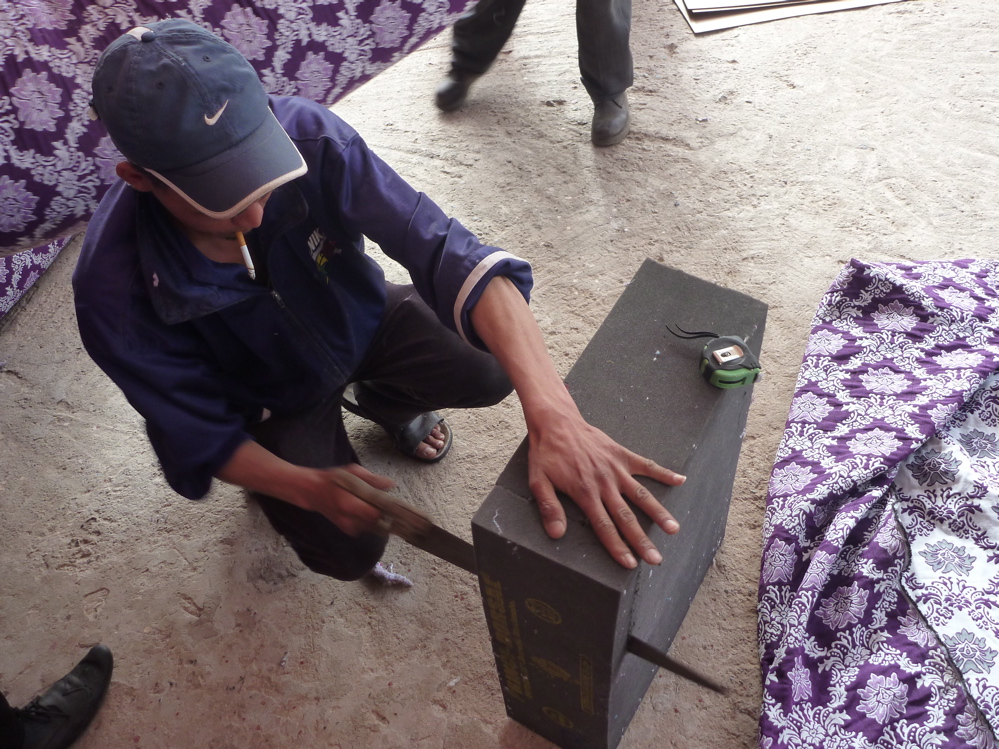
By the time I turned back from southern Morocco, soreness returned so soon that when coming over the High Atlas, I couldn’t face the 1500 mile ride home. I pulled up at a village mattress shop and bought a 50mm slab of foam (left) which tucked in easily under the Aero pad (below). The soreness passed in a few days and Spain was crossed in an 800-km stage without agony. I recall the same discomfort on a GS1100 I borrowed years ago (confirmed by an 1100 rider I met on the Bilbao ferry) and even a GS1200A rider we met in Morocco said his seat was not up to the bike, and he was a light guy.
What is wrong with this seat – surely it’s something they’ve got to the bottom of (boom-boom) over the years? I suppose function may have suffered in the face of slim design to complement the bike’s looks, just as a Triumph Rocket III has a huge saddle to emphasise its bulk. It’s not all about width though, it must be foam quality or density. The Tenere’s saddle was no wider as I recall and was even hampered by a lip which stopped you moving back, but it was nowhere near as painful to sit on after two hours. There’s a bit of buried chat here on UKGSers about F-twin seats. It seems the inflatable Airhawk pad is the simplest solution if you ride long hours.

Even though I’m 6′ 1”, the low seat height was just right, if a bit low for easy standing up. It meant dabbing and paddling in sand or steadying over rocks was easy, but didn’t make the bike vulnerably low; the bashplate very rarely bottomed out, though caught plenty of flying hits.
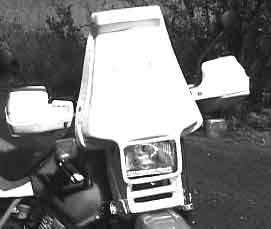
The OE high option screen was way too short for me and without the taller Metal Mule item (left) the ride would have been grim, as I realised when I returned the bike without the screen and felt my arms lengthen by an inch. But as mentioned, I feel the top edge of the MM screen curves back too much and anyway, it’s still a little too low for me. Although it caused no buffeting, any clouds of bugs got splatted straight onto my visor rather than blown over like they’re supposed to. A couple of inches longer and it would have been perfect.
I never felt the screen was a distraction on the piste, though if I’d gone over the bars I’d have ripped it off for sure. For me, the Tenere’s screen – more upright and further forward like a Dakar racer worked better once I clipped on the clunky Touratech extension (it was too heavy to fit on the MM screen). But as with seats, finding or adjusting a screen to suit your exact prefs can take a while. One size does not fit all.
It may be lower spec’ and shorter than the 800 model, but the firm suspension suited me fine, giving predictable behaviour in bumpy bends with no wallowing – better that than too soft, although taking the bike back the thought ‘harsh’ cropped up again. The only time I meddled with it was a rocky day’s riding without baggage when I wound the back out with the handy pre-load adjusting knob and lowered the tyres a bit more to soften the ride.
While you do feel the engine vibration at higher revs, it never intruded on comfort, nor did engine noise which either sounded great at town speeds, or was drowned by the helmet din. The light clutch was a real pleasure to use too, and got plenty of use at low speeds, feathering in first to get round the still-tall gearing. Despite that it never needed adjusting, neither did the foot controls. Some days my right knuckles got very sore from the holding the throttle open while keeping two fingers over the brake lever, but other days they didn’t, so it must be me.

Economy
The BMW comes with a 16-litre underseat tank. I was expecting excellent economy and most of the time I got it, though the average of 68.2mpg / 56.8US / 24.16 kpl / 4.14/100km over 23 fill ups was about 4% less good than the XT660Z’s 72mpg or 25 kpl. Of course, you get a smoother and more powerful engine. Worst result was a 51mpg on a partly sandy piste where I stuck with street pressure tyres for too long and so wasted a lot on wheelspin while pushing and paddling. Best was an 80mpg (28.3kpl) coming off the Middle Atlas, with quite a few 70mpgs when riding at <60mph with my mate on a Yamaha TTR250, much of which included piste stages with hours in first or second gear.
I don’t believe the wide baggage, tyres, high screen, heated equipment or the slightly lowered gearing had any real effect on fuel consumption, and like the Tenere, it seemed to be getting better and better as the miles wore on. Full records, here.

There was some pinking in deep sand, partly due to the hot conditions, tall gearing and the 12:1 compression ratio. With the fan whirring and the throttle virtually closed in 1st or 2nd, the fuelling would start surging, but it was never uncontrollable, just mildly annoying, although it did seem to coincide with higher fuel consumption figures.

Oil, water, drive chain
In 4000 miles no oil was used and I didn’t even think to check the water. I adjusted the chain once and even that may have been premature, which means BMW may have gone OTT to fit a quality chain after the early breakage issues. I oiled the chain most days with engine oil, but on reflection, this did little long-term good as it was soon thrown off. Next time I’d brush on thicker Tutoro oil.

Performance
The 650 has all the power I need and in fact I’d have liked to have tried it in the detuned 34hp version, assuming there are notable benefits in fuel consumption or cool running. I never needed to rev over 4000 while accelerating, and with the lower gearing, 5000rpm at 80mph was as fast as I went. The red line is at 8500.
The low rpm power really helped on the piste, pulling out of deep sand, even if the high, road gearing was not ideal here. Like I say, I’d spend all day in first or second.
Fuelling was smooth and very responsive, although this made the bike a bit of a handful the one time we rode a day on the piste with no baggage to damp the response. As mentioned it would start surging when it got hot – a slow track with a backwind – but that never lasted more than a few minutes until a higher speed cooled it down. Running at very low rpm with high gearing meant slow oil and water circulation speeds may not have aided cooling as much as they could.
With just a single disc on the front, the brakes were well matched to the bike’s performance. At least once the ABS stopped me from skidding over the edge while checking out the scenery, though I’m told the mass of brake fluid pumping around for ABS can contribute to the slightly woolly feeling at the lever. I never thought to turn the ABS off on the piste, and can’t imagine it would be necessary at the speeds I rode, as it came on reassuringly late on the dirt.
And as for the twin bulb front headlight, that was pretty good too on the few occasions I rode a night.

Road riding
On the road in Morocco I rarely exceed 60mph. At this speed riding is less tiring, safer, the cops won’t nail you and economy stays good. I felt the bike was stable up to 70mph on the K60s though at times there was a very slight wobbling from the headstock (as opposed to a weave), and possibly only on concrete highway surfaces in Spain. With the upright seating position, wide luggage, trial tyres and tall screen, I can’t say this bike felt that surefooted at high speed on the way out, though by the way back I was able to sit up to 80 with more confidence, either because the Heidenau tyres had worn in or I was more in tune with the bike’s movements. I also think saddle comfort makes a bike handle better; when you’re tensed up in pain, your rigidity can affect a bike’s response. I met a GS1200 Adv rider who’d ridden both models and said getting back on his big 12, it just sat on the road like a wet pizza, however, you loaded it, largely down to its mass and the telefork.
Loaded up, the F-GS was hard to turn on hairpins, both on or off-road, just like the Tenere it tended to run wide or understeer. The Tenere was a tall bike but on the BM I attributed this to the seemingly long, 1575mm (62 inch) wheelbase. The bags were slung as far forward as possible. Early on I noticed the bike’s balance at sub-walking pace was very good; you can easily keep your feet up at 1mph and this must have helped with low-speed control on the piste.
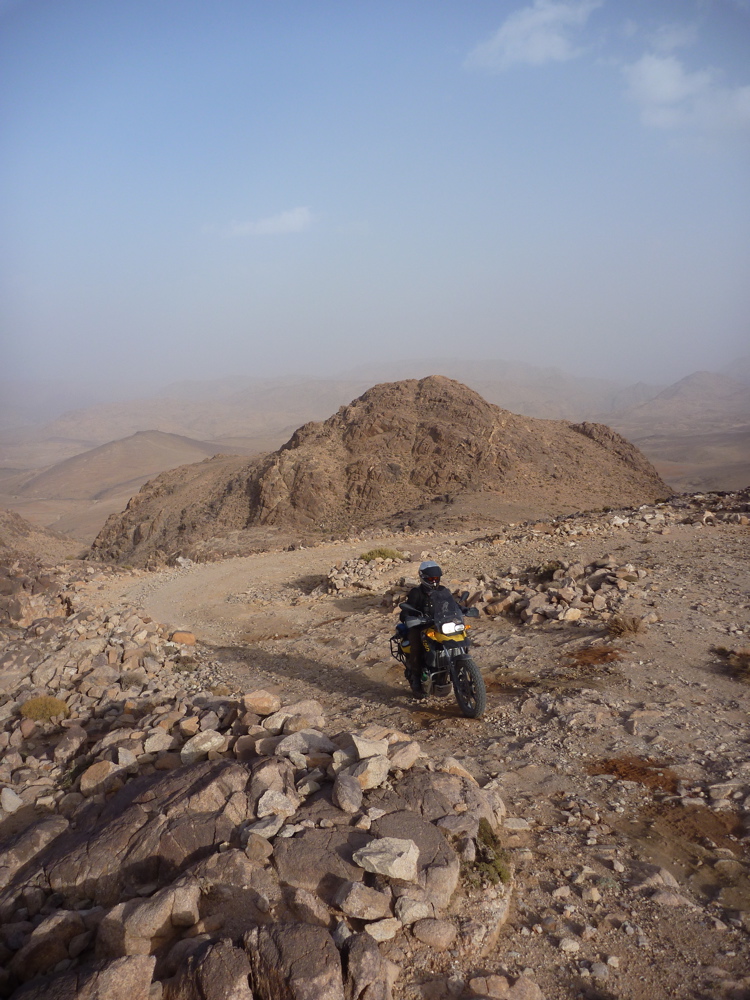
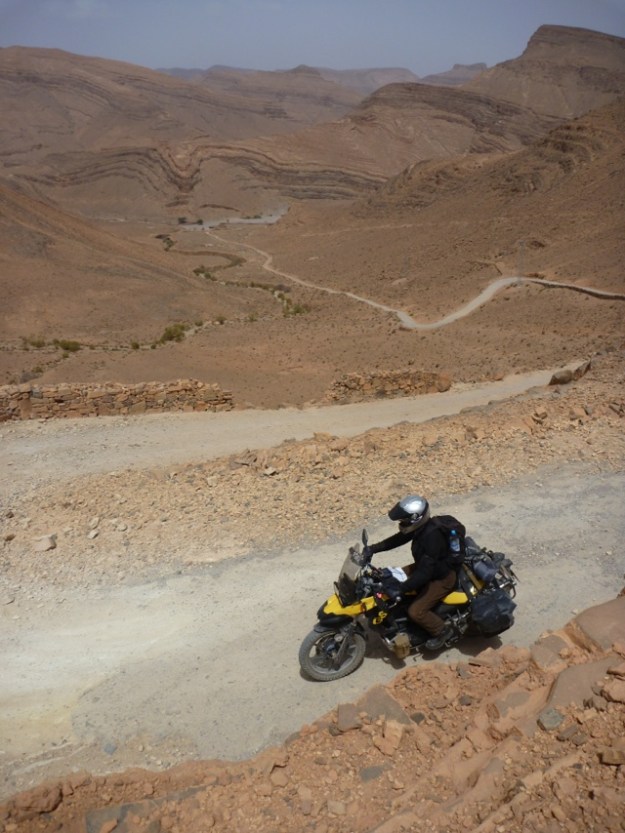
To be fair, some of the roads and tracks in Morocco are very narrow and tight, with the wide baggage pushing you out towards thought-provoking drops. Even some mountain back roads have strips of gravel down the middle from uncleared landslides where any big, loaded bike would struggle to progress quickly and smoothly. One time I found a well-surfaced road tar in the Middle Atlas and blasted along from bend to bend around 60 or 70, but you can’t forget this is a relatively tall bike for that sort of spirited riding.

Off road riding
Dirt biking in Morocco is mostly on rocky or gravel tracks, and much to my relief the K60 tyres were uncannily good. I’m sure the OE Tourances or whatever they were, would have been less effective.

I take it fairly easy when riding alone on the piste, for safety and to spare the hammering on what is really a road bike. Within these limits I was amazed to find how easy the bike was to handle with its low seat, light clutch, ABS, firm suspension great tyres and good clearance – and all despite the tall gearing, occasional hot surging and tight turning limitations.

Early on it was quite disorienting how well the bike would track straight in deep sandy ruts, right up to the point where I lost my nerve, or less often, when the front tucked in. When this happened the instinct was to lean with it while standing up and gas it, all in one swift movement, to which the bike responded correctly every time, surging forward to regain its steering composure. The full-length bash plate meant you could do this confidently on any rideable surface and take the hits. Though I had my share of these moments, I never fell off the GS or got so wildly out of shape that I thought I might do.
Not surprisingly I found the handlebars were too low when standing up off-road, causing me to crouch unsustainably. Most bikes are like this at my height, though handlebar risers would have easily fixed it; something I forgot to address before I left.
Of course dry dirt and even sand are fairly easy to ride on any bike with clearance and the right technique and tyre pressures. I’m sure the K60s would have clogged up and the weight got to me on very muddy tracks, but all in all, I was pleasantly amazed how well the GS coped off-road in Morocco.

OE and extra equipment
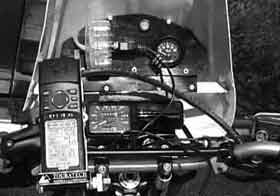
The dashboard was slightly harder to read compared to the higher rally-style layout on the Tenere. Speedo numbers were a bit small, and the computer lacking in contrast and clarity in sub-optimal conditions.
The computer is pretty good though, and besides the total mileage, two trip metres, clock, fuel and water temperature levels and nice big gear indicator, a button on the left bar lets you toggle between air temperature, average speed or mpg (both resettable though I couldn’t work our how) and live mpg which could dip down to the high 40s uphill at 70mph, or give a maxed-out figure of 199mpg cruising downhill on a shut throttle. Interestingly, it must be all pretty accurate as the computer’s average mpg of 68 matched my own figure which was calculated from actual volume and distance at each fill up.
I’d have preferred a digital speedo that can switch to kph like the Tenere, while the indicators and other switchgear I eventually got used to, though in a panic, might well get it wrong.
The temperature gauge never budged, but the fan came on quite a lot. I do wonder if the close-fitting Metal Mule radiator guard may have exacerbated this. I’d be tempted to mount it an inch forward to get some more circulation behind it without losing protection. I’ve heard the fans or fan switch packs up on F-GSs when they get clogged with grass or mud – but that’s not unique to this model
The fuel goes to reserve at round 12 litres, or between 180 and 222 miles. The furthest I ran the tank was 238 miles at which point it took 14.3 litres. There are 16 useable litres says the handbook, but the capacity is 18 – I’m never sure which is which.
Checked against a GPS over 34 miles, I found the odometre (distance recorder) to be a mile over so about 3% out, though I’m not convinced GPS distance recordings are always that accurate as it depends on the set-up in recording frequency. This means that my mpg readings are a tad optimistic assuming all fuel bowsers were correctly calibrated; on some fill-ups in Morocco I did wonder. As for the speedo, at an indicated 60 or 70 it’s 5% out according to GPS, so the bike reads a little faster than it is.
Non-OE equipment besides what’s been mentioned all did the job, the BMW bashplate took a lot of flying clunks and clangs on the chin but rarely landed hard, their engine bars were only used as pouch racks I’m pleased to say, same with the lever guards, though the handguards could have been much bigger against driving rain, like the Acerbis Rally buckets of old. The Metal Mule rack was never taxed, helping merely to keep 20kg of throw-overs off the bodywork, and as said, the Aerostich wool pad couldn’t disguise a seat fit for the welcome centre at Guantanamo Bay.
As always my nifty tank net, this time used with a foam pad to protect the paintwork, was a great idea, and the Touratech GPS holder on a RAM mount held up (the Nuvi satnav I laid on the tank foam when off-road). The Garmin 12v cig plug leads both on the 76csx and the Nuvi began playing up. Hardwiring as we know is the answer to that one. My engine side pouches were dead nifty for handy access to water, oils or stuff in general, even if they are more Steptoe & Son than Rally Pro.

Durability
Not a single thing malfunctioned, broke, came loose or fell off and so I feel the BMW has been very well screwed together.

Summary
The Morocco run confirmed my early impressions while revealing how well the GS coped with dry dirt tracks. I feel the same way about what I liked and disliked at 500 miles but have proved that this ‘650’ doesn’t just look like an adventure touring bike; with appropriate tyres it performs like one too. Once that seat is fixed (there must be several solutions out by now) the 650 GS ought to offer continent-crossing comfort with adequate fully loaded off-road ability. With the smooth and tracable twin-cylinder engine and nearly as good economy, I’d say it makes a great all-rounder.
The only truly unresolvable fly in the off-roading ointment was the tall gearing. Dropping a tooth on the front sprocket didn’t really fix that, fitting a couple of teeth more on the back would – but the clutch didn’t complain. Now the 650GS SE looks less drab, that’s the only thing I can see that works better on the more powerful 800 model.

Since I wrote this the newer ‘700’ model (left and below) has come out alongside the new 800. With revised styling, a bit more power, a second front disc but barely modified gearing. It’s also sai the 650 runs better on low octane fuel which is a big plus in the AMZ. More 650 vs 700 here.

A few years later I rode a well-used, rental 700 for a week and liked it as much as the 650. And a year after that tried the new F750GS too.

X-Lite X402-GT modular helmet review

updated 2023

See also:
HJC i30
Bell Moto 3
Bell Mag 9
Airoh TR1

… full face visor protection without the ‘in your face’ visibility issues

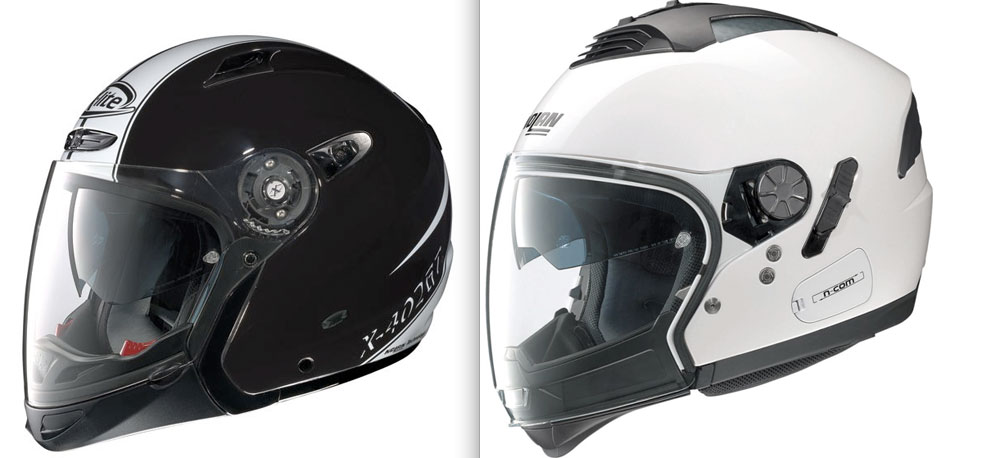
I’ve never seen one in use but I’m a fan of the Airoh TR1 (now called a J106) modular helmet which came out in 2008. But as you can read in my updated review of it, I rather hoped someone would come along and make a plusher, less plasticy version with the same features. Well Nolan (above right, white), X-lite (upmarket brand of Nolan, left; black), Caberg and others did just that.

What is a modular helmet?
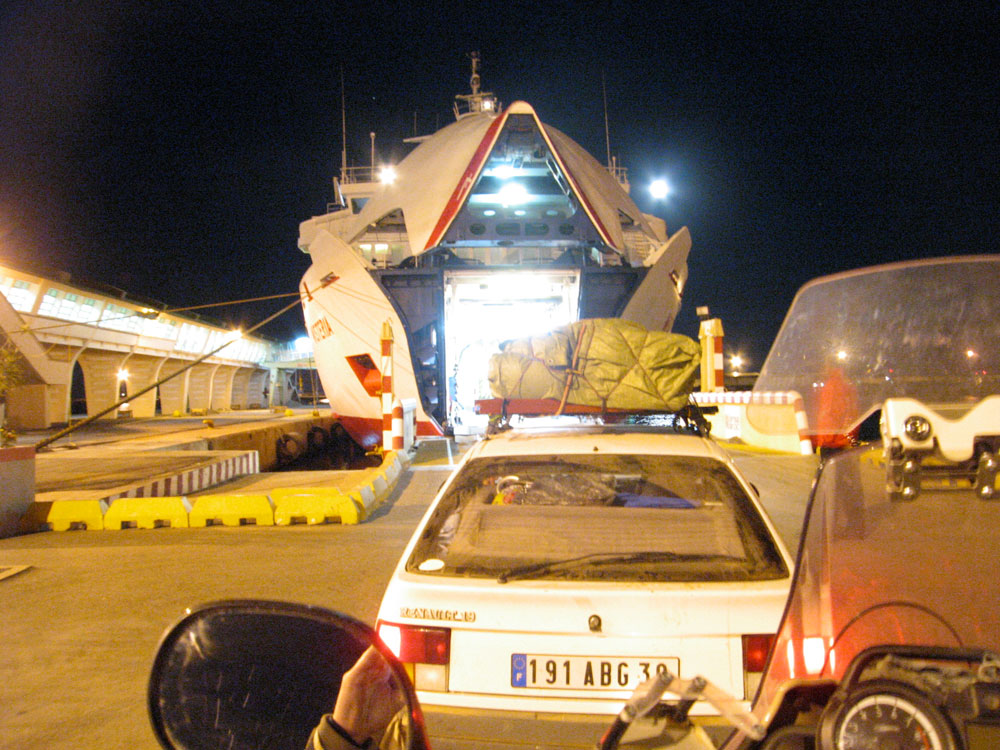
The way I see it, it’s a full-face lid with a removable chin piece, and specifically not one that hinges up ‘like a ferry bow door’ (left), as I say in my Airoh review. The appeal is you get the protection you want on fast roads, but can unclip and stash the small chin piece to have an elegant open face helmet with a proper visor for whenever it suits you: in town or on dirt tracks. I prefer open face any day but recognise the advantages of full face.

First impressions
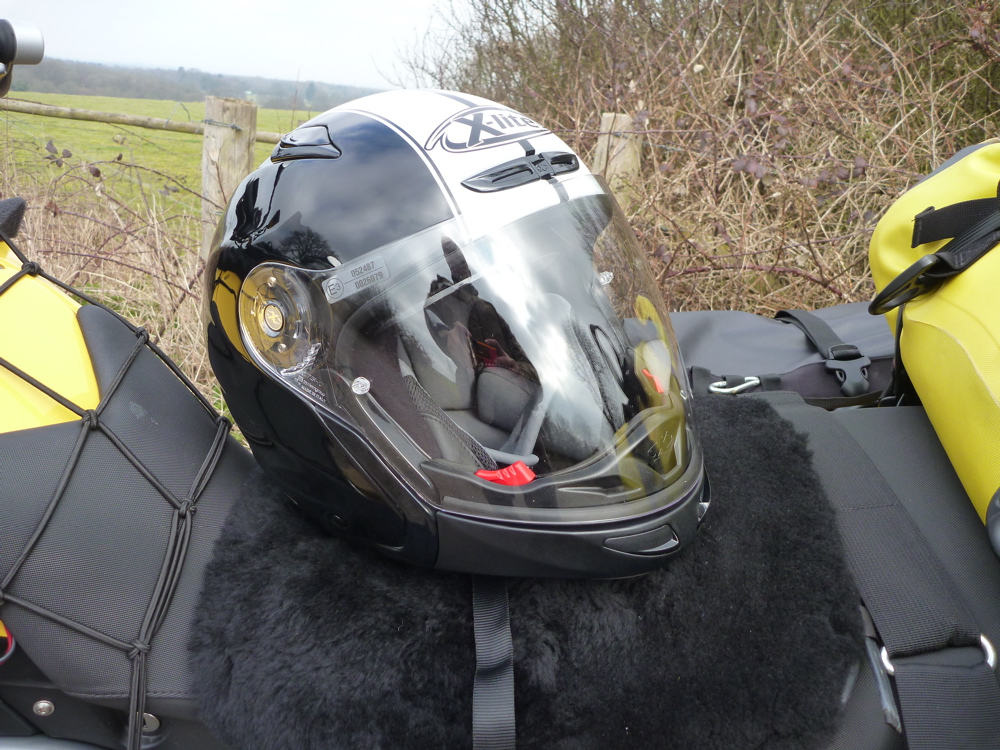
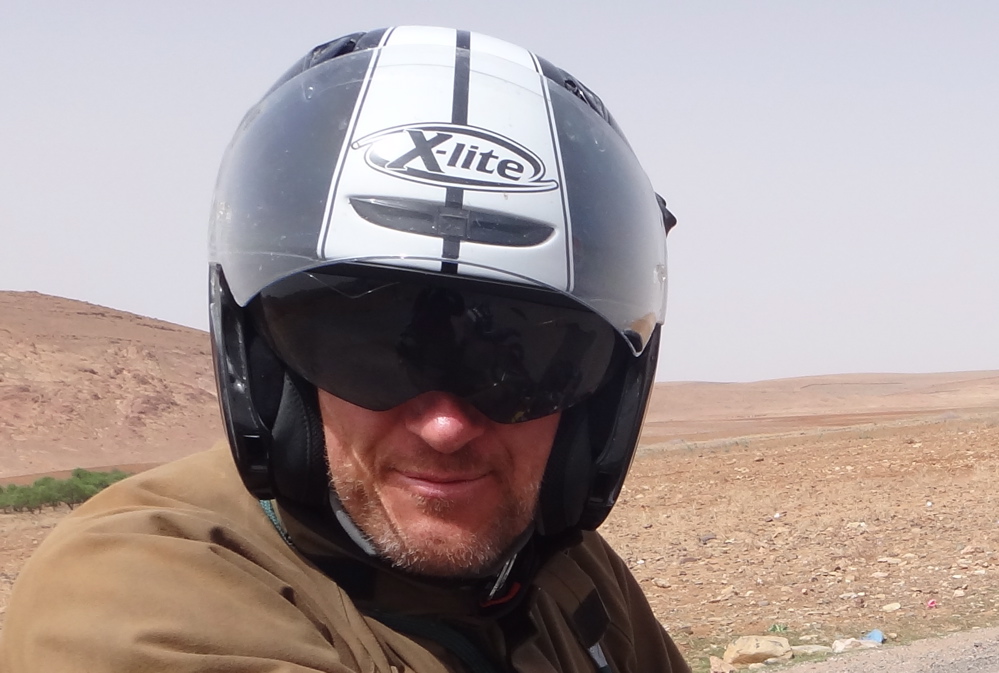
I’ve only worn it for an hour (on an F650GS with a low Metal Mule screen), but first impressions are that it’s clearly better made than my £100 Airoh – and so it should be at nearly £300. Cushiness seems on a par with velvety Arais I’ve owned in the past, and although I wasn’t belting along motorways as I have been recently with the Airoh, it does seem quieter, which was the point of getting it.

Part of that must be down to the big, flat visor as on the Nolan N30, a less complex shape than the Airoh moulded visor so making less turbulence. That, and the much softer, enveloping interior puts it on another level. The noise is a bit like the inside of a cruising airliner; it’s there but not a deafening roar. I don’t use earplugs.
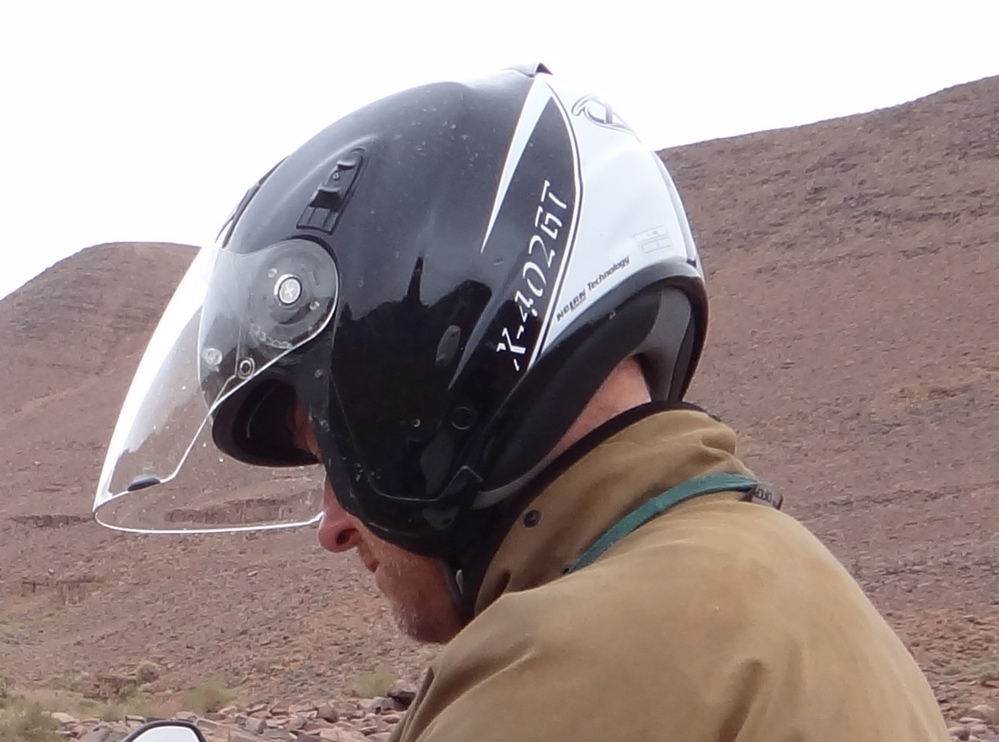
On the way back I removed the chin piece and stashed it (it detaches much more easily than the Airoh’s creaky, jam-prone fittings) and immediately recognised the full-viz appeal of open face, but with a crystal clear (for now) brow-to-chin visor. At <50mph there seemed very little extra noise.
Looks-wise I’d say the Airoh still takes the prize, probably because it’s smaller at the cost of having the sculpted chin piece a little too close to the mouth. Both helmets have the integral sun shade with drops down using a left side lever, but a quick try of the X-Lite’s sun visor today proved it was much clearer, quality lexan and came right down to the nose too, not halfway like the Airoh, although the leverage is a bit inadequate (see below).

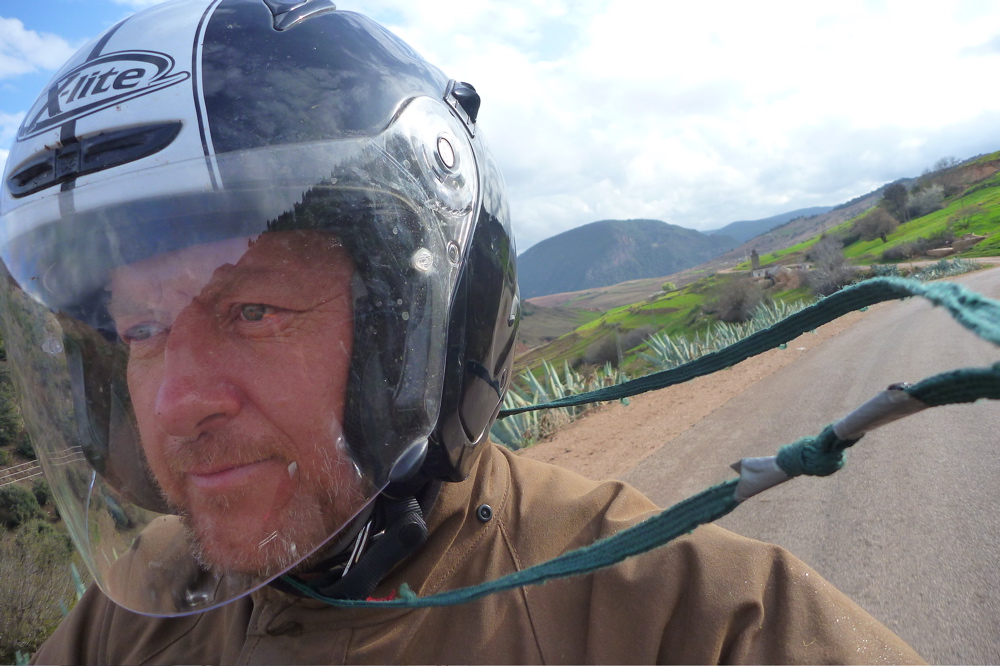
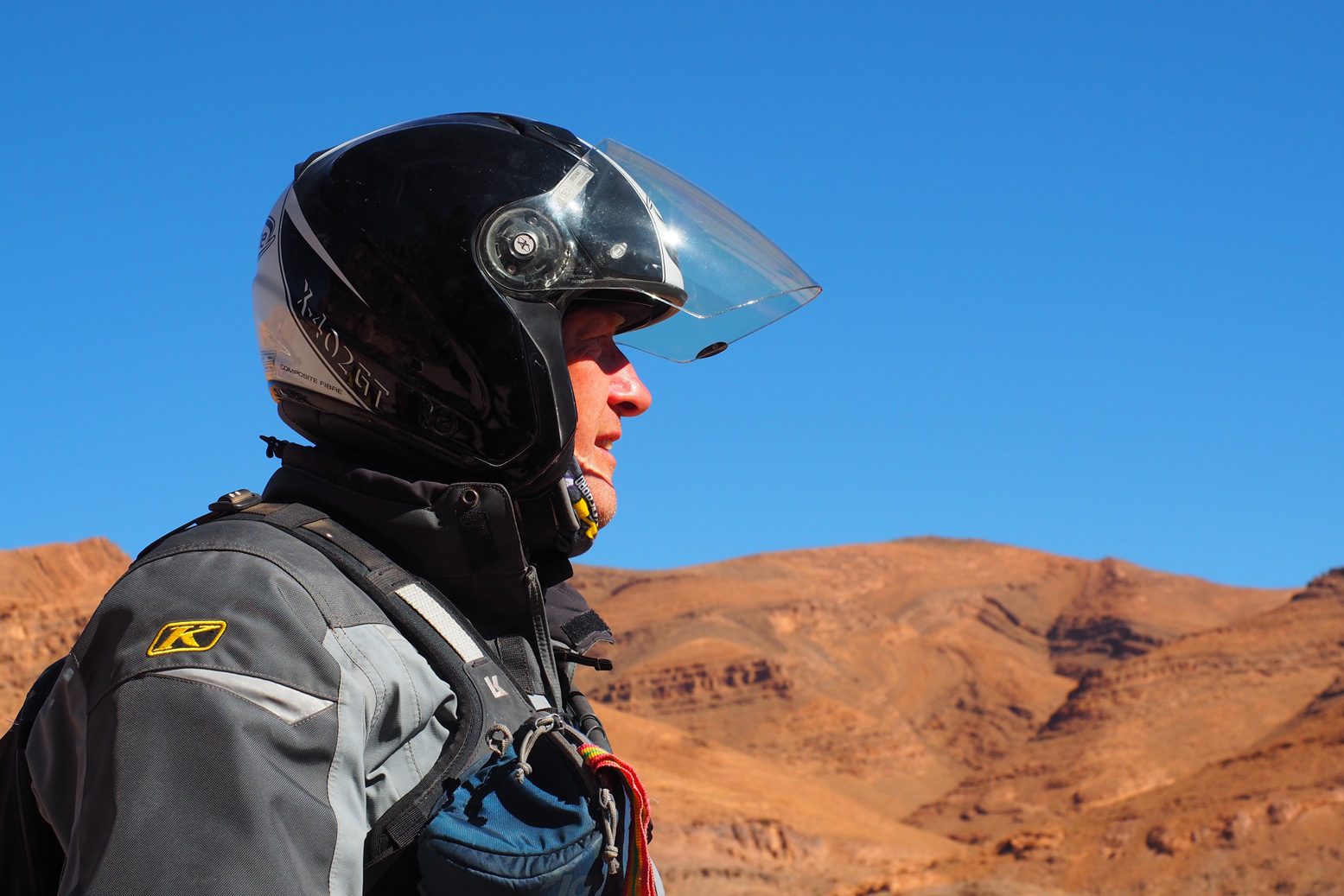
Across Spain the X-Lite was fine considering I don’t use ear plugs. Once I got to Morocco I removed the chin guard (which soon got nicked), and was very comfortable using the helmet in open face mode. The visor cleaned easily without scratching, and coming back across Spain at higher speed and downpours, I didn’t miss the chin bar that much, it can exacerbate steaming up.

The dark visor was great too at times, though you do feel that the leverage on the slider is a bit short and it might fail one day (it did). Also it sure would be nice to have the ratchet clip or the Airoh than the old style double D-ring buckle.
The vents worked pretty well without contributing to the noise, with a sweaty head you can briefly feel the cooling effect.

As mentioned, the dark visor lever on the left has become stiff to the point that I feel it would break if pushed hard, so I just pull it down by hand. But very often when the low sun comes out it is handy to have it there rather than grope around for shades. I still don’t miss the chin piece, but do miss a peak for low sun angles. D-ring is a fiddle but I suppose could be modified. Best of all: it’s got the full face visor protection without a full face helmet’s poor visibility.
So there it is, X-Lite modular, a versatile touring and off-roading lid that means you can take it off less because it lacks the annoying ‘in-your-face’ element of a full face lid. Not as snazzy looking as the Airoh, but much better made and more comfortable too.


xlii
x420buto

Updated 2018
Five years on I’m still wearing it for most trips. I gave up on a replacement chin guard but don’t miss it. I prefer the wide view over the dash and the road ahead, plus the easy flip up. Great for work too (jotting down notes, fiddling with camera or GPS while logging routes, but just noticed the slide-button for the sun visor (right) had broken off.     7/10

I recently bought a full face X-Lite 551 GT. Didn’t get on so well with that one.

In 2023 I replaced the X-Lite with an HJC i30.

xliter.jpg

Honda XR650L – 4000 mile report

XRL Choice • XRL Preparation • Desert Riders

Despite early reservations in Tunisia (it’s always the way on your first ride fully loaded), we agreed the bikes made a good alternative to a KTM 640 Adventure which was our second choice.

What we liked

  • Descent suspension (but see below)
  • Economy (but Andy’s was mysteriously 15% down on ours)
  • Clutch and gearbox took the hammering well
  • Engine never baulked at crap fuel
  • Despite low bhp, it was never lacking
  • Very accurate speedo/odo
  • Anvil-like reliability – worth a lot out in the desert

What we didn’t like

  • Too high and top-heavy with that giant tank (oh really?)
  • ‘Sternwheeler’ steering (due to oversprung front end)
  • Rough riding with alloy panniers – smaller and soft next time
  • Accurately measuring the oil level
  • Skinny rear subframe
  • Accessibility for rear spring adjustment

Worthwhile mods/gear

  • Tough tank and rack fabrication
  • Nifty Petzl Zipka head torches
  • Michelin Desert/T63 knobblies
  • DID gold-plate chains
  • Foam Unifilters
  • Renthal bars and Acerbis Pros
  • My rally screen
  • Andy’s IMO
  • My tank net
  • Our bashplates!
  • Reduced gearing (14/48 – never changed it back after Oued Samene)
  • I liked my Q/D Zega panniers
  • RAM mount
  • My trusty Coleman Dual Fuel 533 stove
  • Backpack hydrators (but my Platypus bladder leaked)
  • My Altberg boots – light enough to swing over and to walk in
  • Aerostich Darien Light jackets
  • Bel Ray synthetic oil – didn’t do the engine any harm
  • Thermorest mats (a three-quarter Ultralite was fine)
  • Hardwiring the GPS

Note: by now some of this gear has become obsolete or a lot better

Sub-functional mods/gear

  • Fitting heavy front springs (without doing the same on the back)
  • My GSX-R seat (barely better than the Honda plank)
  • My RK (Tagasako) chain stretched quicker than the DIDs
  • A few of my rear alt spokes snapped – the others’ OEs were OK
  • Those 10L Ortlieb water bags are hard to use and one leaked from new
  • MSR ‘RBJ’ stoves – both packed up but not designed for regular ‘desert’ fuel anyway
  • My Renthal grips – as bad as Honda (but I used ordinary gloves)
  • Canvas tool bag on my bash plate – nice idea but metal would be better
  • A lower tank with a fuel pump would lower CoG and improve handling
  • My car type oil temp gauge never worked
  • 12v cig lighter PTOs – unreliable contact on the rough terrain – hardwiring or DINs is best
  • Enlarged sidestand foot was not big enough in soft sand

Equipment failures (not including crashes)

  • Some of my rear spokes
  • Andy’s rear T63 (rock damage)
  • Jon’s tank bungs
  • One Orlieb bag
  • MSR stoves
  • Rear subframes found cracked on Jon’s and possibly Andy’s bike.

Other than that, these XRLs came back running much better than my previous Yamaha Teneres, but they were new and run on good oil.

I’ve lately been told that the Desert Riders boots I had custom made by Alt-Berg are now part of their line up.

Honda XR650L set up

XRL Choice • XRL 4000-mile report • Desert Riders

Written before the advent of blogs, these instalments run from the first one at the bottom of the page (receiving the new bike) to the last report at the top, just prior to departure on Desert Riders in early 2003.

Final preparations, January, 2003

I gave up waiting for the rain to stop and got on with changing the tyres (Mich Desert front, T63 rear) in my room. They mount fairly easily on the XRL’s rims. I’ve drilled self-tapers into my rims to stop tyre creep (an alternative to a rim lock). Andy’s riding down on an old tyre and fitting his T63 at the last minute as he’s not so sure it will last the full 7000km. I think he may have a point but as long as there is some rubber left between the road and the rim, we’ll make it back to Tunis.

I’ve modified the gearing now to 48/15 (with a 14T option) with a new RK ‘XW’ 110L chain and the gearing feels much more normal now. I’ve also been zip-tying on bits and pieces around the bike to keep the cases free of clutter: tyre levers and tent poles along the rack, spare levers and canvas bags on the rack and one on the bashplate for oil and tools.
The freshly oiled UniFilter has been stuffed into the greased airbox. Ernie made an extra plate to keep the back wheel spin from chucking too much crap into the intake and anyway, it’s running too rich now as it’s a pretty substantial air filter. Hopefully a good blast down the road will suck some of the extra filter oil out or it will be a re-jet job.

Jon’s going to be dyno-ing his next week to try and get it right so we can copy. He came over yesterday on his machine which looks a lot lower than mine – and even then he can’t reach the ground with both feet! We slipped in the heavier fork springs which should keep some daylight between the front tyre and fender at full tank. As expected, wet road riding on the new front Desert is good for Andrex plc shares.

The TTech Zega cases are now in my room and I’m experimenting with getting all the stuff in with only a gnat’s width of wasted space.
Getting on with this reminds me of the commitment needed to keeping things light. Various items have dropped off my kit list but I don’t doubt when the day comes, it will still be a struggle getting it all in and more stuff will be dropped.

XMAS INSTALMENT

We went to Overland Solutions to pick up Jon and Andy’s bikes just before Xmas (Tip of the Day: never try to get to the Elephant on a #322 bus). As with mine, Ern did a brilliant job on the bikes. J & A have chosen to bolt their larger Tesch boxes to the racks whereas I think the q/d ability of mine will be handy in the evenings (table and chair) as long as the mounts withstand prangs. Their tanks are lower mounted too (they got scoops melted into the underneath), but as mentioned below, this could be a problem with using the full volume of the tank. Talking of which Rich Lees, who is out there now, got 41 litres from his tank – I got 37 so I may check mine again at the petrol station down the road. Rich also got his dyno tested before he left. Guess what an XRL puts out at the back wheel standard… 41hp?… 35 maybe? Try 22 bhp! It’s amazing the things manage to go forward at all, but if it means the engines last longer before blowing up, it’s OK with me.

November 10
So, our man Ernie of the Overland has not been sparing his welder and angle grinder these past weeks. My T-Tech travel tins are now sitting snuggly in a nest of powder-coated tubing that has already borne the weight of Desert Rider Escombe without a creak. Ernie’s work ran late but I now have confidence in rack and tank and frame to take the beating. In fact, it’s the first time in 20+ years I’ve had a decent machine for a desert trip and not my usual Dexion and bubblegum arrangements. Just as well too as the DRP is going to test these machines hard.

Ern did a neat job of holding up and protecting my tank – but I reckon 37 litres of slosh will need it. Jon and Andy are using the mushrooms and plates supplied in the Acerbis kit, moving the regulator and blow torching a dimple under the tank at point X. Idea of Richard Lees’ (RL’s in the same area on an XRL a month before us), but I can’t help thinking it may not be enough: all that weight on two mushies off the frame. The advantage is it’s certainly lower and more forward than my set up – ideal in fact, but I think a bit of undersupport would not go amis. Among other things Ern also fabricated lifting/dragging handles on the back rack and a revolutionary front towing/dragging handle for winching the bike out of sticky or steep situations. Expect to see it imitated on 2003 production models. The rear frame – a possible week point – has also been cleverly strengthened (hard to see in the photos) Ern also tidy up many of my bodges detailed below. It’s not light but all in has been short listed for the Fitter & Turner Prize. The cost of my work was at least a thousand quid – 20% on the cost of the bike, but undeniably worth it.
Over Xmas there will be some hasty experimentation with loading, slipping in some heavier front springs, changing the tyres and drilling the back rim (AM p.51), lowering the gearing to 14/15-48 (standard 15-45), linking up the oil temp and finding places to attach things externally. Oh for a heated and well-lit garage instead of the mossy cave in which my XRL rots quietly…

July 9
I’m off to the Outback now for 3 months work with most of the easy mods done to the XRL. Interestingly enough, fixing the seat on properly had made the bike much more likeable – makes sense really as it was like riding around with loose wheels. I took it for a 200k ride over the weekend and I can’t say the wider GSX saddle is a 3-berth suite with Jacuzzi and room service, but it has surely got to be better than the original which I did not want to chop up. Indeed all the ugly bodges I’ve done to my XRL so far are entirely reversible without trace should it not be sellable in overland format.
On the weekend trip I wired up the GPS to check odometer accuracy (very important in the DZ). Incredibly that cranky old cable drive set up gained only 1.2kms over 100 clicks – so it will be good to be able to rely on the bike’s trip meter if the GPS cuts out.
I’ve also chopped the rear light down a bit further and made it into quite a neat unit – without spending a penny! All the indicators are off but a good brake light may save a few pile ups in the canyons. I also replaced my Barkbuster buckets (for sale, 20 quid) with slinkier Acerbis Rally Pros – much better made these, but the clamps still nail the tank and reduce lock severely. The answer will be another 10 mm raise on the handlebars – so far the cables have not complained. And one thing I must do is get ride of those horrible ridged grips.
As you can see I have a giant cargo net hooked around the tank – proved very handy already this for tucking in things like gloves, small roadkill or a U-lock. I’ve also put a switch on the front light as there may be times when we want to signal to each other with the lights (normally permanently on on XRLs).
I also spent a couple of messy hours calibrating the 37-litre tank so I can pull off the cap and estimate the capacity inside against the levels marked on the outside. Useful with a massive tank like this. While I’m away Ernie the Rack will be fabricating my forward tank mounts properly – and boy will the bike need them when full. Riding it full in sand does not bear thinking about, but our first dirt section of the trip will be just that: 300kms through big dunes.
Next instalment in November when I collect the racked-up bike. By then it will finally be looking desert-ready just before I set off in the Land Cruiser to lay the fuel dumps.

July 8
I picked up my respoked rear wheel from Roger last weekend. The gauge is the same but he’s fitted less brittle galvanised items which screw in fully to the nipples. The standard stainless items only screwed in about half way – a common occurrence with Jap bikes reckons Roge.
While the wheels was off I lined up the T61 rear tyre we’ve got from Michelin. Once that alloy chainguard carrier inside the swingarm was sawn off, it fitted in fine and is about 2cm wide than the standard tyre. Hopefully, it should last the 7000km, although we may ride out on near worn out rears and fit the 61s near Hassi bel Guebbour where the dunes start.
This morning a bash plate landed on the doormat. XR650R it said. Groan… I keep getting this. No matter how many times you tell a UK bike shop it’s an XR650LLLLL, Dommie engine, XR6 frame “oh yeah, I know the one”, they send you XR600 or 650R bits.
But I could be wrong because the plate fitted just fine, with seemingly lots of air where a 650R’s water pump would go. A little tool box on the Dommie would fit in nicely.

June 7
The 37-litre (8 imp. gallon) tank is now in place and in the manner I planned. I’ve had to remove the front indicators and the screen which will need to be cut back if it’s to go back on. It took a lot of experimenting with the tank’s position to get the height at the front so that the taps are the lowest point without the front fouling the bars – we need to get full use of those 37 litres. As it is, the lock is reduced by maybe 10 degrees, but still usable. A GSX-R seat crams in nicely for the moment, although I’ve yet to take it for a decent ride to see if it’s any more comfy. It certainly sits lower, which, with the Dakar High bars cranked forward gives a kind of Dennis-H-in-Easy-Rider seating position – cool, not so hot for standing up fast.
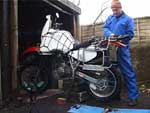
It took a lot of staring and thinking to work out the front mounts under the front/sides of the tank, but in the end I just glued on two bits of hardwood and into these screwed two rubber exhaust mounts from a Land Cruiser. Don’t know if the picture makes this clear at all. These will then attach properly to the arms coming off the front of the bikes downtube – at the moment they sit on two bits of pipe lagging. (In the end the tank has cleared the black box near the headstock). I’ve also bodged up a tank support frame from scrap metal. It will get re-done properly by Overland Ernie when he builds the rack. at the back a block of 2 by 4 lifts the tank high enough to clear the frame. It doesn’t make for a smooth seat-to-tank interface but crudely and simply made is easily repairable out there. Now the tank should have enough movement while still being firmly located in all planes, so that it doesn’t damage itself when it takes a fall.
As things stand now, the whole bike can be returned to the original standard tank/seat format in 20 minutes plus indicators.
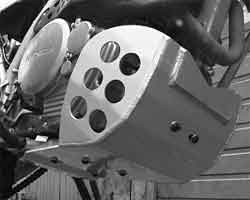
Meanwhile Andy has found out the hard way that XR6 bash plates don’t fit – Dommie engines are wider. Me, I was lucky enough to find the only XRL bash plate in UK captivity made to the Baja-D/Moose pattern (left).
But Andy’s installed his IMO gadget without any difficulties. It was a lot easier than I assumed: speed sensor, temp sensor and rpm sensor. that’s it. I’m a bit jealous now as even I could have managed that and may yet get one. He’s also fitted a neat Acerbis back guard which is a whole lot better than the TV-set sit dangling on my machine.
Off on some hols now – back in a couple of weeks. While I’m away Roger the Wheel will be serving my back wheel a plateful of galvanised spokes to replace the stainless. The galvanised items are no thicker, but they’re stronger. And we’ll be getting a set of 25%-over fork springs wound for us in Holland via K-Tech so the front doesn’t sink when we dare fill the tank.

May 9
Picked up the big tank from Bert Harkins today, putting on the final couple of hundred kms to run the XRL in, in readiness for a weekend’s derestricting. (Fuel = 17.8 kpl , 51 m/ukg). And the good news is the ’40-litre’ XR600R tank (actually it turns out to be just under 37) fits the XRL pretty damn well. All the fitting problems can be fixed. If you’re interested they are:

  • Still higher bars needed (ie Dakar Highs on 40mm risers)
  • Indicators restrict lock
  • Standard seat won’t fit (what a terrible blow!)
  • Side panel fronts need to be chopped off
  • Front frame lugs don’t line up – but I have a better idea…
  • Regulator (or some finned black box) is a bit close, may have to move down a bit
  • New rear tank mounting will have to be fabricated further back
  • Clutch cable is a bit close as it passes the cylinder head

The tank sits fully above the carb feed so no fuel pump needed. Nor does it shroud the barrel unduly – far from it, if anything there is more air around the frame’s oil tank and the dipstick is still easy to get to – so no extra overheating worries there. Even the taps line up with the XRLs carb hose! A quick sit on the bike with everything thrown on feels good – nifty cut outs for the knees means one’s legs are not too splayed.
The tank comes with chunky moulded back mounting lugs for which a new rear tank/frame mount will have to be fixed to the chassis rails above the airbox. This won’t be too hard, especially if it’s made out of wood (one of my favourite fabri-bodging materials, not having access to a welder). The wood mount can be easily taken off too, should the original tank/seat be refitted.
At the front I plan to improve things by supporting the tank underneath each side from a cross bar, like too-high highway footrests, which for the moment will be attached to the tabs which held on the air scoops. These tabs will almost certainly not be strong enough in a full-tank/corrugation scenario, but they’re in just the right position so I’ll get something stronger welded on at the rack-building stage. Under the front of the tank I’ll glue on some locators which will somehow lock or screw into the carrier bar. IMHO, the good thing with this system is that it that the huge tank’s mounts are triangulated, rather than in a single plane along the frame backbone. This way when the bike falls the side of the tank is not pushed into the bike (I hope ;-), stressing the plastic. And anyway, welding new front tank lugs onto the frame would be tricky.
The standard seat has to be junked of course, and good riddance to it. I picked up the front bit of a GSX750R saddle which is twice as wide and will get crammed in there somehow. I have some concerns that, with the recommended removal of the airbox snorkel during derestriction, along with the ill-fitting GSX seat base (the original seat is part rear mudguard), there will be a gap with sand getting chucked straight into the airbox. Once that is sealed off, I’ll try and make an alternative wide-mouthed snorkel that runs forward a bit under the tank, away from the spinning back wheel’s dust cloud.

While I’m waiting for the tank to turn up I’ve bodged on a ‘rally screen’, mainly to house a dashboard for some dials and switches. Fitting the cheap ABS item was easy (made for XRs) – fitting it well will take a bit longer. I kid myself that my NPF (non-permanent fastenings) system will cleverly limit damage in a crash, but it’s really just a fast and easily repairable way of slapping bits on.
Apart from a burning about the knees and rattley noises, who knows when an air-cooled engine is too hot, so I’ve half fitted an electric oil temperature gauge. Plumbing in the sender will be a bit tricky, hopefully there’ll be room to incorporate a ‘T’ with the sender stuck it into the oil outlet hose below the oil filter. If nothing else, the gauge gives you a relative reading to get used to. Bel Ray have supplied us with a few litres of their synthetic their EXC oil.
On the dash I’ve also fitted a 3-way cig lighter PTO with a switch for running and recharging various gadgets. I’ve replaced the battery with a better sealed Hawker battery – who knows if its better than standard. And I’ve welded butterflies to make QD seat retaining bolts. I haven’t got the knack of fitting the air-filter sidepanel quickly and whipping off the seat
makes it easier. Keeping this poxy arrangement well sealed will be vital of course. But now I think about it the seat certainly won’t fit with the big tank and I’m reluctant to hack it up, so I picked up a couple of cheap GSX front saddles at a motojumble. Fitting will be another zip tie and hacksaw bodge, but one of those arse-wide items will be mated to the frame and hopefully provide day-long comfort while maintaining narrowness at the knees when standing.
Recent fuel consumption figures have gone down to 50 and 52 m/ukg (17.6, 18.1 kpl) – not so impressive, and the XRL still runs like a cheese grater. Any day now Mr Postie will deliver a jetting kit. Word is, it will transform the bike.

May 1
Well this XRL is not so bad, is it. Popped down to David Lambeth’s Overland R&D establishment hidden in the Sussex Weald to deliver some books and see what there was to scrounge – a 150km round trip of town country and motorway riding. The ride revealed that:

  • The gear change feels unusually good.
  • The brakes are still nothing special.
  • The seat is about half the width it needs to be for an adult human.
  • The pipe is as noisy as I want it to be so, apart from dumping the restrictor washer half way along, I won’t be messing around with removing baffles.
  • The suspension seems pretty firm as standard, but this is only unloaded on the highway.
  • It’s higher than it needs to be – there may be room under the bash plate (to be fitted) for heavy stuff (a trick used on my Benele desert bike)
  • It ran onto reserve at 140kms, returning 21.2kpl (60.5 mpUKg) which is not bad and looking good for our desert target of 17kpl.
  • The jetting feels a bit uneven with some backfiring, to be sorted when it’s run-in.
  • The gearing is pretty high – loaded up in the sand and rocks it will need to be lowered to pull without stressing the clutch.
  • It’s nice and light to handle, more skittish XR than stable NX. And although you can feel the engine running, vibration is not a problem.
  • Power, well the jetting, pipe and filter will get sorted in a few hundred kms.

DL also pointed out some things on the XRL:

  • XR wheels with straight-pull spokes good (thought I plan to fit thicker on the back. The rims are DID which are presumably OK.
  • Skimpy XR subframe with pillion footrest mounts drilled – not so good.
  • He didn’t like the battery box arrangement either, and suggested a sealed unit laid on its side in the back guard. As it happens I have a sealed Hawker bat looking for a new home
  • Twinlamp Tenere tank supports would adapt well to supporting a 40-L XR6 Acerbis from each side – should it fit the XRL

In his bunker there wasn’t much useful Honda stuff – mostly Yam of course. He kept trying to trick me into buying stuff which he should know by now is a waste of time. He had an interesting ABS XR rally screen which looked like a flimsy baby bath. Not sure about that one…
On the way home I got caught in a storm. The Darien miraculously became waterproof following the last time I used it in the Yukon, but otherwise I was soaked. Oddly exhilarating, it took me back to the old days when I rode every day for years at a time.

Late April
While I’m waiting for a plate I’ve spent a few afternoons poking about the bike. A guy suggested I block the smog thing off myself – the Baja Designs kit being nothing special. Sure enough, once I unravelled the windings of the octopusian gadget, it all came away easily revealing a carb, no less. In keeping with the environmental ethos of the smog pump, I reused one of the hoses to re-attach the crankcase breather back to the air-box and stuffed an old ear plug into the other hole left in the airbag. On the lower front barrel the two holes feeding the smog pump were blanked off using some strips from the metal frame the bike came in. Any more of this and I’ll applying for a recycling grant.
The smog contraption appears to be ‘powered’ by vacuum hose off the carb. This hose may well prove useful to power a Mikuni fuel pump, should the 40-litre Acerbis tanks we’ve dug up require it. For the moment though, it’s on standby, plugged up with a screw.

A crate of Touratech goodies arrived the other day. A couple of Zega boxes, frames, mounts and a bunch of misc. items. The telescopic tyre pump looks nifty and I especially like the ‘GPS holder arm’ – or ‘Ram Mount’ as they thrustingly call it. It’s a very neat way of making a small-screened GPS readable and adjustable. I plan to get another one for the other side of the bars for the minicam.
I also picked up a bag of used XRLeries from an ex-Trans Am Trailer whose XRL got pinched. A couple of sprockets, cables, another tank and some bucket-sized hand guards with bark busters have nearly gone onto the Renthal Dakar Medium bars. These turned out to be no higher than the steel originals, so if you want high bars – go for the ‘Dakar Highs’. Luckily Touratech included some 40cm bar raisers which should make standing less of a stoop and will help clear the big tank.
Unable to wait any longer, I made up a cardboard number plate and went for a quick scoot to the bank. First riding impressions? Snatchy, not much low-rpm pull, brakes not so hot, but the bike is nice and slim (not for long…). And there is no speed bump in town that can faze the XRL. It feels a bit choked, but so would you with 6km on your clock. As we all know there are various ways of perking up an XRL, jetting – pipe – foam filter – but I’ll give it a few hundred clicks to run-in before ripping off the pipe and fitting a bottle of nitrous oxide.

First instalment – April 2002
The bikes are here. Not having bought a new bike for nearly 20 years, it was fun picking a crate and putting my machine together. Jon and Andy will be collecting their crates shortly.  First impressions? Well if Honda have the best ‘attention to detail’ of the Jap Four (as they say in the mags) then I’m sure glad we didn’t buy a Suyamsaki! I guess the XRL is a mongrel, but crappy fittings and half-baked afterthoughts make you think a KTM is worth the extra grand…

So far I like:

  • Adjustable suspension.
  • DID rims.
  • Disc brakes all round.
  • Relatively light silencer.

Not so impressed by:

  • Ridiculous smog thing.
  • Flimsy fork gaiters, handlebars, lever mounts, chain guard, shock mud flap and tool bag.
  • Useless engine bars.
  • Battery compartment hanging off the back.

Still, I haven’t ridden it yet as I want to take my time, have a good poke around and knock out some obvious jobs while it’s still half-built and clean.