Category Archives: Project Bikes

What I’ve ridden and what I’m riding

Honda XR650L set up

XRL Choice • XRL 4000-mile report • Desert Riders

Written before the advent of blogs, these instalments run from the first one at the bottom of the page (receiving the new bike) to the last report at the top, just prior to departure on Desert Riders in early 2003.

Final preparations, January, 2003
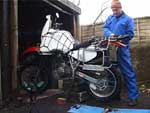
I gave up waiting for the rain to stop and got on with changing the tyres (Mich Desert front, T63 rear) in my room. They mount fairly easily on the XRL’s rims. I’ve drilled self-tapers into my rims to stop tyre creep (an alternative to a rim lock). Andy’s riding down on an old tyre and fitting his T63 at the last minute as he’s not so sure it will last the full 7000km. I think he may have a point but as long as there is some rubber left between the road and the rim, we’ll make it back to Tunis.

I’ve modified the gearing now to 48/15 (with a 14T option) with a new RK ‘XW’ 110L chain and the gearing feels much more normal now. I’ve also been zip-tying on bits and pieces around the bike to keep the cases free of clutter: tyre levers and tent poles along the rack, spare levers and canvas bags on the rack and one on the bashplate for oil and tools.
The freshly oiled UniFilter has been stuffed into the greased airbox. Ernie made an extra plate to keep the back wheel spin from chucking too much crap into the intake and anyway, it’s running too rich now as it’s a pretty substantial air filter. Hopefully a good blast down the road will suck some of the extra filter oil out or it will be a re-jet job.

Jon’s going to be dyno-ing his next week to try and get it right so we can copy. He came over yesterday on his machine which looks a lot lower than mine – and even then he can’t reach the ground with both feet! We slipped in the heavier fork springs which should keep some daylight between the front tyre and fender at full tank. As expected, wet road riding on the new front Desert is good for Andrex plc shares.
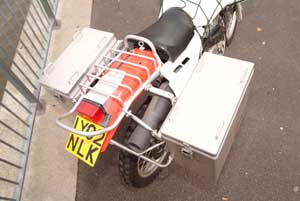
The TTech Zega cases are now in my room and I’m experimenting with getting all the stuff in with only a gnat’s width of wasted space.
Getting on with this reminds me of the commitment needed to keeping things light. Various items have dropped off my kit list but I don’t doubt when the day comes, it will still be a struggle getting it all in and more stuff will be dropped.

XMAS INSTALMENT
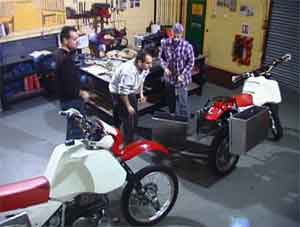
We went to Overland Solutions to pick up Jon and Andy’s bikes just before Xmas (Tip of the Day: never try to get to the Elephant on a #322 bus). As with mine, Ern did a brilliant job on the bikes. J & A have chosen to bolt their larger Tesch boxes to the racks whereas I think the q/d ability of mine will be handy in the evenings (table and chair) as long as the mounts withstand prangs. Their tanks are lower mounted too (they got scoops melted into the underneath), but as mentioned below, this could be a problem with using the full volume of the tank. Talking of which Rich Lees, who is out there now, got 41 litres from his tank – I got 37 so I may check mine again at the petrol station down the road. Rich also got his dyno tested before he left. Guess what an XRL puts out at the back wheel standard… 41hp?… 35 maybe? Try 22 bhp! It’s amazing the things manage to go forward at all, but if it means the engines last longer before blowing up, it’s OK with me.
November 10
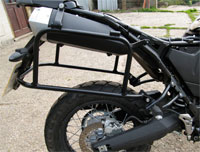
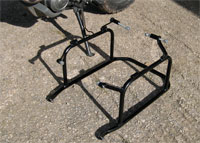
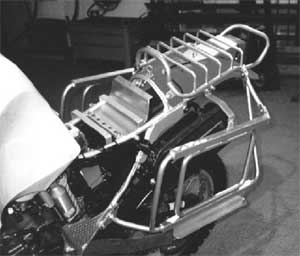
So, our man Ernie of the Overland has not been sparing his welder and angle grinder these past weeks. My T-Tech travel tins are now sitting snuggly in a nest of powder-coated tubing that has already borne the weight of Desert Rider Escombe without a creak. Ernie’s work ran late but I now have confidence in rack and tank and frame to take the beating. In fact, it’s the first time in 20+ years I’ve had a decent machine for a desert trip and not my usual Dexion and bubblegum arrangements. Just as well too as the DRP is going to test these machines hard.

Ern did a neat job of holding up and protecting my tank – but I reckon 37 litres of slosh will need it. Jon and Andy are using the mushrooms and plates supplied in the Acerbis kit, moving the regulator and blow torching a dimple under the tank at point X. Idea of Richard Lees’ (RL’s in the same area on an XRL a month before us), but I can’t help thinking it may not be enough: all that weight on two mushies off the frame. The advantage is it’s certainly lower and more forward than my set up – ideal in fact, but I think a bit of undersupport would not go amis. Among other things Ern also fabricated lifting/dragging handles on the back rack and a revolutionary front towing/dragging handle for winching the bike out of sticky or steep situations. Expect to see it imitated on 2003 production models. The rear frame – a possible week point – has also been cleverly strengthened (hard to see in the photos) Ern also tidy up many of my bodges detailed below. It’s not light but all in has been short listed for the Fitter & Turner Prize. The cost of my work was at least a thousand quid – 20% on the cost of the bike, but undeniably worth it.
Over Xmas there will be some hasty experimentation with loading, slipping in some heavier front springs, changing the tyres and drilling the back rim (AM p.51), lowering the gearing to 14/15-48 (standard 15-45), linking up the oil temp and finding places to attach things externally. Oh for a heated and well-lit garage instead of the mossy cave in which my XRL rots quietly…
July 9
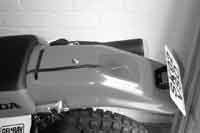
I’m off to the Outback now for 3 months work with most of the easy mods done to the XRL. Interestingly enough, fixing the seat on properly had made the bike much more likeable – makes sense really as it was like riding around with loose wheels. I took it for a 200k ride over the weekend and I can’t say the wider GSX saddle is a 3-berth suite with Jacuzzi and room service, but it has surely got to be better than the original which I did not want to chop up. Indeed all the ugly bodges I’ve done to my XRL so far are entirely reversible without trace should it not be sellable in overland format.
On the weekend trip I wired up the GPS to check odometer accuracy (very important in the DZ). Incredibly that cranky old cable drive set up gained only 1.2kms over 100 clicks – so it will be good to be able to rely on the bike’s trip meter if the GPS cuts out.
I’ve also chopped the rear light down a bit further and made it into quite a neat unit – without spending a penny! All the indicators are off but a good brake light may save a few pile ups in the canyons. I also replaced my Barkbuster buckets (for sale, 20 quid) with slinkier Acerbis Rally Pros – much better made these, but the clamps still nail the tank and reduce lock severely. The answer will be another 10 mm raise on the handlebars – so far the cables have not complained. And one thing I must do is get ride of those horrible ridged grips.
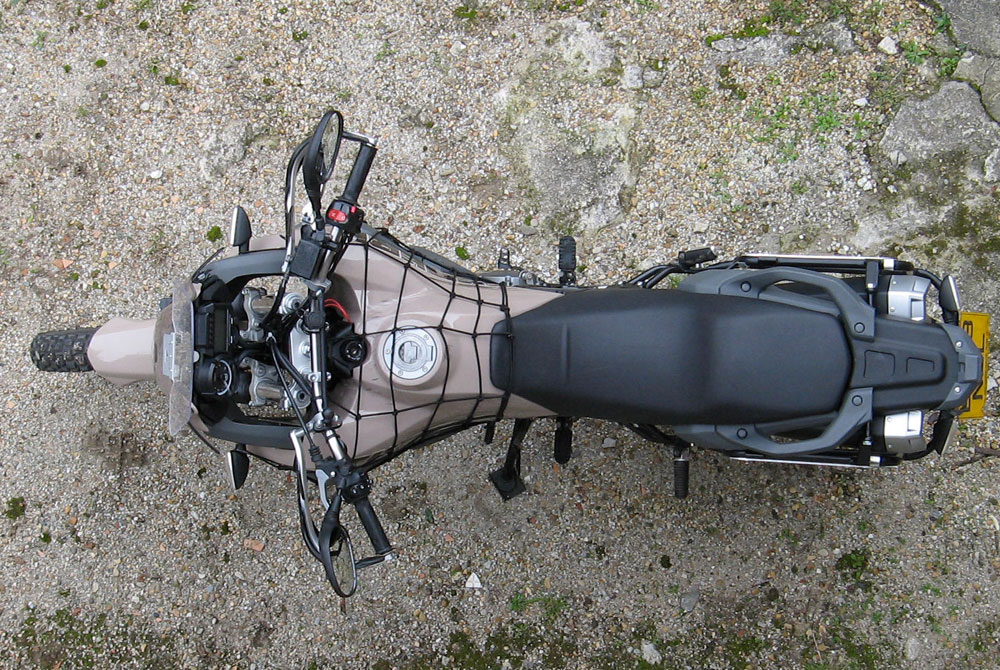
As you can see I have a giant cargo net hooked around the tank – proved very handy already this for tucking in things like gloves, small roadkill or a U-lock. I’ve also put a switch on the front light as there may be times when we want to signal to each other with the lights (normally permanently on on XRLs).
I also spent a couple of messy hours calibrating the 37-litre tank so I can pull off the cap and estimate the capacity inside against the levels marked on the outside. Useful with a massive tank like this. While I’m away Ernie the Rack will be fabricating my forward tank mounts properly – and boy will the bike need them when full. Riding it full in sand does not bear thinking about, but our first dirt section of the trip will be just that: 300kms through big dunes.
Next instalment in November when I collect the racked-up bike. By then it will finally be looking desert-ready just before I set off in the Land Cruiser to lay the fuel dumps.
July 8
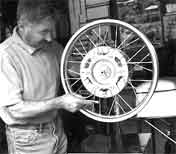
I picked up my respoked rear wheel from Roger last weekend. The gauge is the same but he’s fitted less brittle galvanised items which screw in fully to the nipples. The standard stainless items only screwed in about half way – a common occurrence with Jap bikes reckons Roge.
While the wheels was off I lined up the T61 rear tyre we’ve got from Michelin. Once that alloy chainguard carrier inside the swingarm was sawn off, it fitted in fine and is about 2cm wide than the standard tyre. Hopefully, it should last the 7000km, although we may ride out on near worn out rears and fit the 61s near Hassi bel Guebbour where the dunes start.
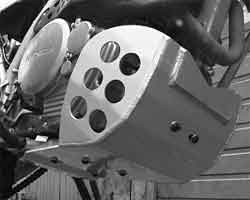
This morning a bash plate landed on the doormat. XR650R it said. Groan… I keep getting this. No matter how many times you tell a UK bike shop it’s an XR650LLLLL, Dommie engine, XR6 frame “oh yeah, I know the one”, they send you XR600 or 650R bits.
But I could be wrong because the plate fitted just fine, with seemingly lots of air where a 650R’s water pump would go. A little tool box on the Dommie would fit in nicely.
June 7
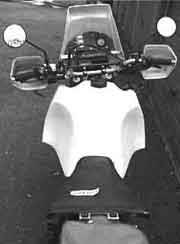
The 37-litre (8 imp. gallon) tank is now in place and in the manner I planned. I’ve had to remove the front indicators and the screen which will need to be cut back if it’s to go back on. It took a lot of experimenting with the tank’s position to get the height at the front so that the taps are the lowest point without the front fouling the bars – we need to get full use of those 37 litres. As it is, the lock is reduced by maybe 10 degrees, but still usable. A GSX-R seat crams in nicely for the moment, although I’ve yet to take it for a decent ride to see if it’s any more comfy. It certainly sits lower, which, with the Dakar High bars cranked forward gives a kind of Dennis-H-in-Easy-Rider seating position – cool, not so hot for standing up fast.
It took a lot of staring and thinking to work out the front mounts under the front/sides of the tank, but in the end I just glued on two bits of hardwood and into these screwed two rubber exhaust mounts from a Land Cruiser. Don’t know if the picture makes this clear at all. These will then attach properly to the arms coming off the front of the bikes downtube – at the moment they sit on two bits of pipe lagging. (In the end the tank has cleared the black box near the headstock). I’ve also bodged up a tank support frame from scrap metal. It will get re-done properly by Overland Ernie when he builds the rack. at the back a block of 2 by 4 lifts the tank high enough to clear the frame. It doesn’t make for a smooth seat-to-tank interface but crudely and simply made is easily repairable out there. Now the tank should have enough movement while still being firmly located in all planes, so that it doesn’t damage itself when it takes a fall.
As things stand now, the whole bike can be returned to the original standard tank/seat format in 20 minutes plus indicators.
Meanwhile Andy has found out the hard way that XR6 bash plates don’t fit – Dommie engines are wider. Me, I was lucky enough to find the only XRL bash plate in UK captivity made to the Baja-D/Moose pattern (left).
But Andy’s installed his IMO gadget without any difficulties. It was a lot easier than I assumed: speed sensor, temp sensor and rpm sensor. that’s it. I’m a bit jealous now as even I could have managed that and may yet get one. He’s also fitted a neat Acerbis back guard which is a whole lot better than the TV-set sit dangling on my machine.
Off on some hols now – back in a couple of weeks. While I’m away Roger the Wheel will be serving my back wheel a plateful of galvanised spokes to replace the stainless. The galvanised items are no thicker, but they’re stronger. And we’ll be getting a set of 25%-over fork springs wound for us in Holland via K-Tech so the front doesn’t sink when we dare fill the tank.

May 9
Picked up the big tank from Bert Harkins today, putting on the final couple of hundred kms to run the XRL in, in readiness for a weekend’s derestricting. (Fuel = 17.8 kpl , 51 m/ukg). And the good news is the ’40-litre’ XR600R tank (actually it turns out to be just under 37) fits the XRL pretty damn well. All the fitting problems can be fixed. If you’re interested they are:

  • Still higher bars needed (ie Dakar Highs on 40mm risers)
  • Indicators restrict lock
  • Standard seat won’t fit (what a terrible blow!)
  • Side panel fronts need to be chopped off
  • Front frame lugs don’t line up – but I have a better idea…
  • Regulator (or some finned black box) is a bit close, may have to move down a bit
  • New rear tank mounting will have to be fabricated further back
  • Clutch cable is a bit close as it passes the cylinder head
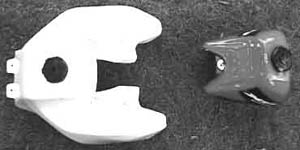
The tank sits fully above the carb feed so no fuel pump needed. Nor does it shroud the barrel unduly – far from it, if anything there is more air around the frame’s oil tank and the dipstick is still easy to get to – so no extra overheating worries there. Even the taps line up with the XRLs carb hose! A quick sit on the bike with everything thrown on feels good – nifty cut outs for the knees means one’s legs are not too splayed.
The tank comes with chunky moulded back mounting lugs for which a new rear tank/frame mount will have to be fixed to the chassis rails above the airbox. This won’t be too hard, especially if it’s made out of wood (one of my favourite fabri-bodging materials, not having access to a welder). The wood mount can be easily taken off too, should the original tank/seat be refitted.
At the front I plan to improve things by supporting the tank underneath each side from a cross bar, like too-high highway footrests, which for the moment will be attached to the tabs which held on the air scoops. These tabs will almost certainly not be strong enough in a full-tank/corrugation scenario, but they’re in just the right position so I’ll get something stronger welded on at the rack-building stage. Under the front of the tank I’ll glue on some locators which will somehow lock or screw into the carrier bar. IMHO, the good thing with this system is that it that the huge tank’s mounts are triangulated, rather than in a single plane along the frame backbone. This way when the bike falls the side of the tank is not pushed into the bike (I hope ;-), stressing the plastic. And anyway, welding new front tank lugs onto the frame would be tricky.
The standard seat has to be junked of course, and good riddance to it. I picked up the front bit of a GSX750R saddle which is twice as wide and will get crammed in there somehow. I have some concerns that, with the recommended removal of the airbox snorkel during derestriction, along with the ill-fitting GSX seat base (the original seat is part rear mudguard), there will be a gap with sand getting chucked straight into the airbox. Once that is sealed off, I’ll try and make an alternative wide-mouthed snorkel that runs forward a bit under the tank, away from the spinning back wheel’s dust cloud.
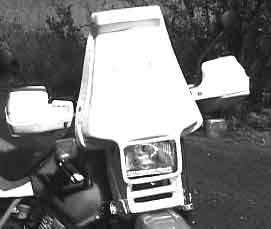
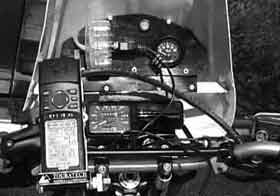
While I’m waiting for the tank to turn up I’ve bodged on a ‘rally screen’, mainly to house a dashboard for some dials and switches. Fitting the cheap ABS item was easy (made for XRs) – fitting it well will take a bit longer. I kid myself that my NPF (non-permanent fastenings) system will cleverly limit damage in a crash, but it’s really just a fast and easily repairable way of slapping bits on.
Apart from a burning about the knees and rattley noises, who knows when an air-cooled engine is too hot, so I’ve half fitted an electric oil temperature gauge. Plumbing in the sender will be a bit tricky, hopefully there’ll be room to incorporate a ‘T’ with the sender stuck it into the oil outlet hose below the oil filter. If nothing else, the gauge gives you a relative reading to get used to. Bel Ray have supplied us with a few litres of their synthetic their EXC oil.
On the dash I’ve also fitted a 3-way cig lighter PTO with a switch for running and recharging various gadgets. I’ve replaced the battery with a better sealed Hawker battery – who knows if its better than standard. And I’ve welded butterflies to make QD seat retaining bolts. I haven’t got the knack of fitting the air-filter sidepanel quickly and whipping off the seat
makes it easier. Keeping this poxy arrangement well sealed will be vital of course. But now I think about it the seat certainly won’t fit with the big tank and I’m reluctant to hack it up, so I picked up a couple of cheap GSX front saddles at a motojumble. Fitting will be another zip tie and hacksaw bodge, but one of those arse-wide items will be mated to the frame and hopefully provide day-long comfort while maintaining narrowness at the knees when standing.
Recent fuel consumption figures have gone down to 50 and 52 m/ukg (17.6, 18.1 kpl) – not so impressive, and the XRL still runs like a cheese grater. Any day now Mr Postie will deliver a jetting kit. Word is, it will transform the bike.

May 1
Well this XRL is not so bad, is it. Popped down to David Lambeth’s Overland R&D establishment hidden in the Sussex Weald to deliver some books and see what there was to scrounge – a 150km round trip of town country and motorway riding. The ride revealed that:

  • The gear change feels unusually good.
  • The brakes are still nothing special.
  • The seat is about half the width it needs to be for an adult human.
  • The pipe is as noisy as I want it to be so, apart from dumping the restrictor washer half way along, I won’t be messing around with removing baffles.
  • The suspension seems pretty firm as standard, but this is only unloaded on the highway.
  • It’s higher than it needs to be – there may be room under the bash plate (to be fitted) for heavy stuff (a trick used on my Benele desert bike)
  • It ran onto reserve at 140kms, returning 21.2kpl (60.5 mpUKg) which is not bad and looking good for our desert target of 17kpl.
  • The jetting feels a bit uneven with some backfiring, to be sorted when it’s run-in.
  • The gearing is pretty high – loaded up in the sand and rocks it will need to be lowered to pull without stressing the clutch.
  • It’s nice and light to handle, more skittish XR than stable NX. And although you can feel the engine running, vibration is not a problem.
  • Power, well the jetting, pipe and filter will get sorted in a few hundred kms.

DL also pointed out some things on the XRL:

  • XR wheels with straight-pull spokes good (thought I plan to fit thicker on the back. The rims are DID which are presumably OK.
  • Skimpy XR subframe with pillion footrest mounts drilled – not so good.
  • He didn’t like the battery box arrangement either, and suggested a sealed unit laid on its side in the back guard. As it happens I have a sealed Hawker bat looking for a new home
  • Twinlamp Tenere tank supports would adapt well to supporting a 40-L XR6 Acerbis from each side – should it fit the XRL

In his bunker there wasn’t much useful Honda stuff – mostly Yam of course. He kept trying to trick me into buying stuff which he should know by now is a waste of time. He had an interesting ABS XR rally screen which looked like a flimsy baby bath. Not sure about that one…
On the way home I got caught in a storm. The Darien miraculously became waterproof following the last time I used it in the Yukon, but otherwise I was soaked. Oddly exhilarating, it took me back to the old days when I rode every day for years at a time.
Late April
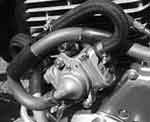
While I’m waiting for a plate I’ve spent a few afternoons poking about the bike. A guy suggested I block the smog thing off myself – the Baja Designs kit being nothing special. Sure enough, once I unravelled the windings of the octopusian gadget, it all came away easily revealing a carb, no less. In keeping with the environmental ethos of the smog pump, I reused one of the hoses to re-attach the crankcase breather back to the air-box and stuffed an old ear plug into the other hole left in the airbag. On the lower front barrel the two holes feeding the smog pump were blanked off using some strips from the metal frame the bike came in. Any more of this and I’ll applying for a recycling grant.
The smog contraption appears to be ‘powered’ by vacuum hose off the carb. This hose may well prove useful to power a Mikuni fuel pump, should the 40-litre Acerbis tanks we’ve dug up require it. For the moment though, it’s on standby, plugged up with a screw.
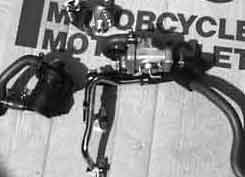
A crate of Touratech goodies arrived the other day. A couple of Zega boxes, frames, mounts and a bunch of misc. items. The telescopic tyre pump looks nifty and I especially like the ‘GPS holder arm’ – or ‘Ram Mount’ as they thrustingly call it. It’s a very neat way of making a small-screened GPS readable and adjustable. I plan to get another one for the other side of the bars for the minicam.
I also picked up a bag of used XRLeries from an ex-Trans Am Trailer whose XRL got pinched. A couple of sprockets, cables, another tank and some bucket-sized hand guards with bark busters have nearly gone onto the Renthal Dakar Medium bars. These turned out to be no higher than the steel originals, so if you want high bars – go for the ‘Dakar Highs’. Luckily Touratech included some 40cm bar raisers which should make standing less of a stoop and will help clear the big tank.
Unable to wait any longer, I made up a cardboard number plate and went for a quick scoot to the bank. First riding impressions? Snatchy, not much low-rpm pull, brakes not so hot, but the bike is nice and slim (not for long…). And there is no speed bump in town that can faze the XRL. It feels a bit choked, but so would you with 6km on your clock. As we all know there are various ways of perking up an XRL, jetting – pipe – foam filter – but I’ll give it a few hundred clicks to run-in before ripping off the pipe and fitting a bottle of nitrous oxide.
First instalment – April 2002
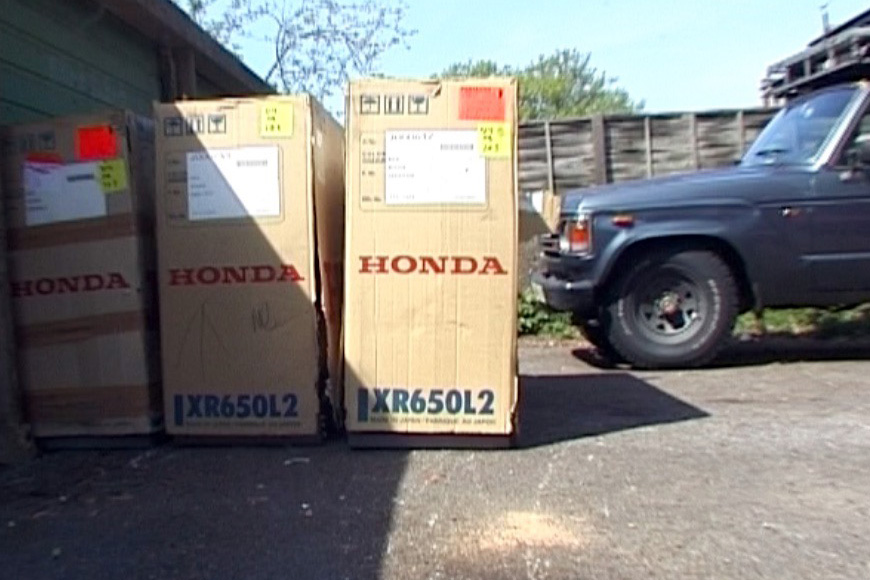
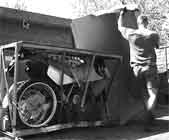
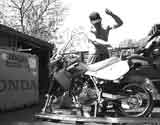
The bikes are here. Not having bought a new bike for nearly 20 years, it was fun picking a crate and putting my machine together. Jon and Andy will be collecting their crates shortly.  First impressions? Well if Honda have the best ‘attention to detail’ of the Jap Four (as they say in the mags) then I’m sure glad we didn’t buy a Suyamsaki! I guess the XRL is a mongrel, but crappy fittings and half-baked afterthoughts make you think a KTM is worth the extra grand…

So far I like:

  • Adjustable suspension.
  • DID rims.
  • Disc brakes all round.
  • Relatively light silencer.

Not so impressed by:
  • Ridiculous smog thing.
  • Flimsy fork gaiters, handlebars, lever mounts, chain guard, shock mud flap and tool bag.
  • Useless engine bars.
  • Battery compartment hanging off the back.

Still, I haven’t ridden it yet as I want to take my time, have a good poke around and knock out some obvious jobs while it’s still half-built and clean.


Yamaha ‘XTZ550’ – Lonely are the Brave

What motorcycle do you despise? 
It’s harsh, but let’s gratuitously ridicule the Yamaha XZ550, surely one of the ugliest bikes ever made.
Hugo Wilson, editor Classic Bike (2011)

loot
XTVV

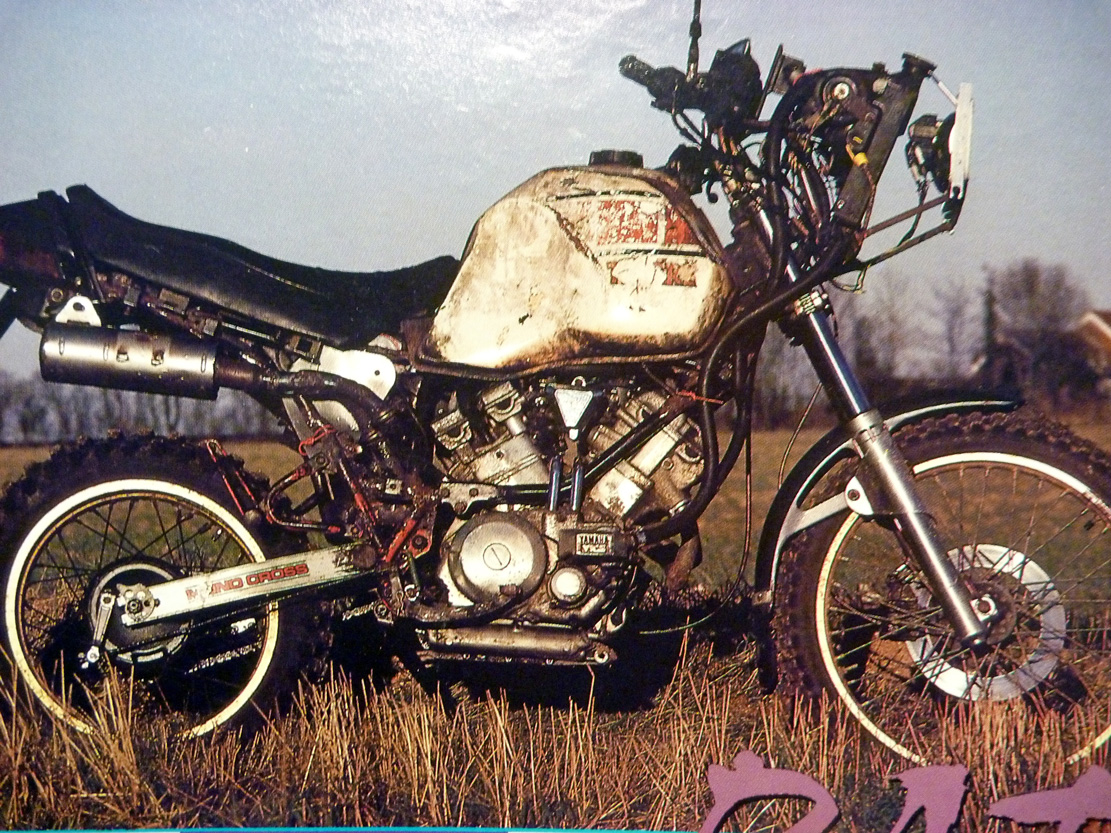
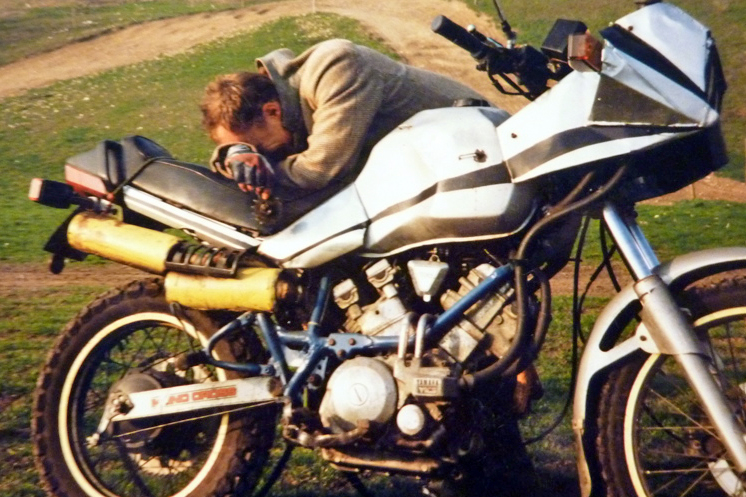
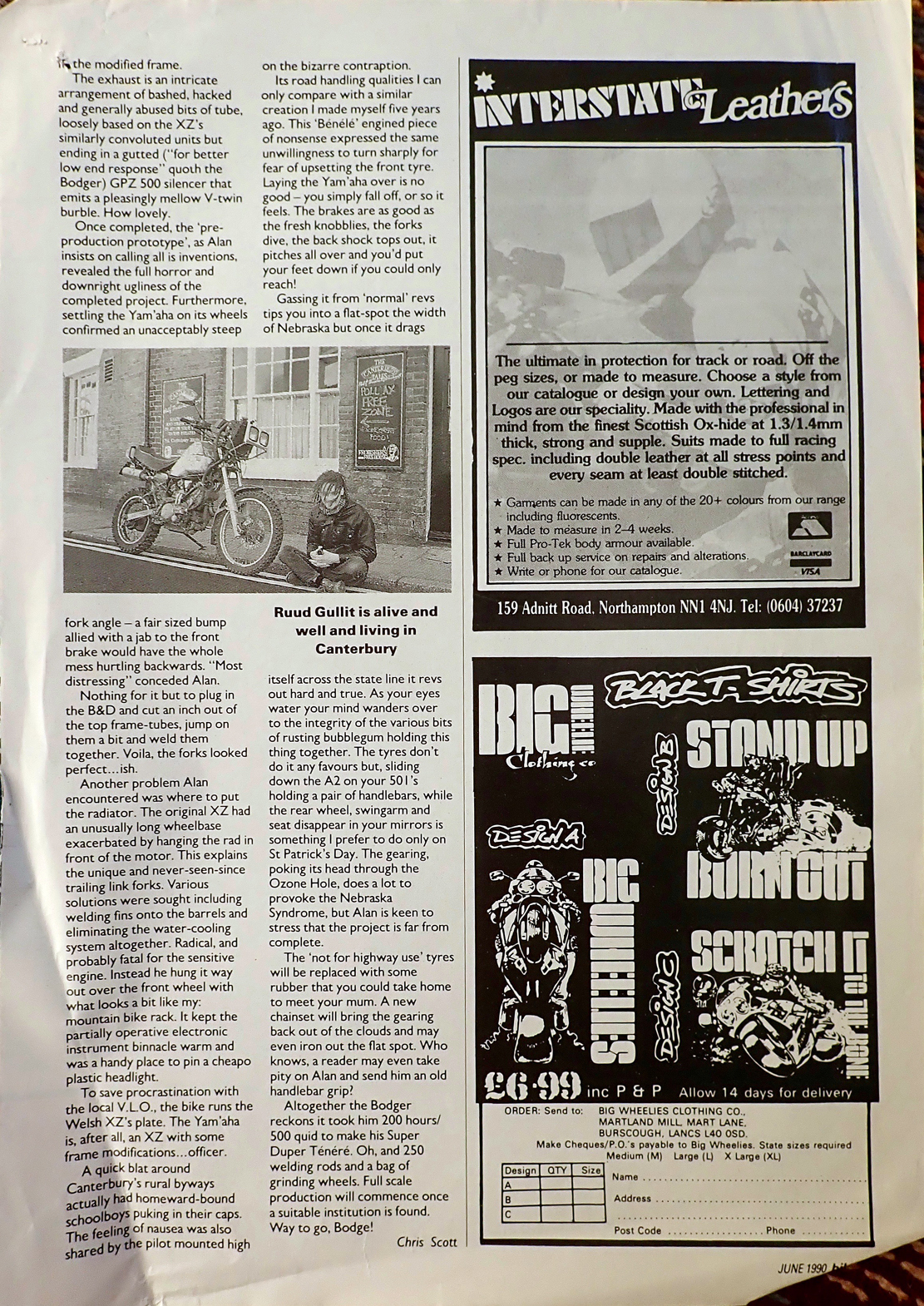
It’s the late 1980s. Pal Alan B had too much time and space when two things collided: a stolen-burnt-recovered Tenere, and Yamaha’s stillborn XZ550.
Me, I had too much space between my ears and 400 quid to waste. Which was how I ended up buying his char-grilled bitsa.
But when I came to sell Alan’s sprayed-up XT-V frankenbike in Loot (the pre-internet ebay) the phone fair blew off the wall!

Click below for readable size.
xtvc
Yam-XT-V
OLYMPUS DIGITAL CAMERA

YAMAHA XT660Z Ténéré preview and mods

Skip to 5000-mile report

I’ve been a long-time Tenere fan. Before the XT600ZE which is featured on the front of my Desert Travels ebook, I owned the first-generation kickstart model, and like everyone else of a certain age, in the 1980s adapted XT500s in the days when there was nothing better.
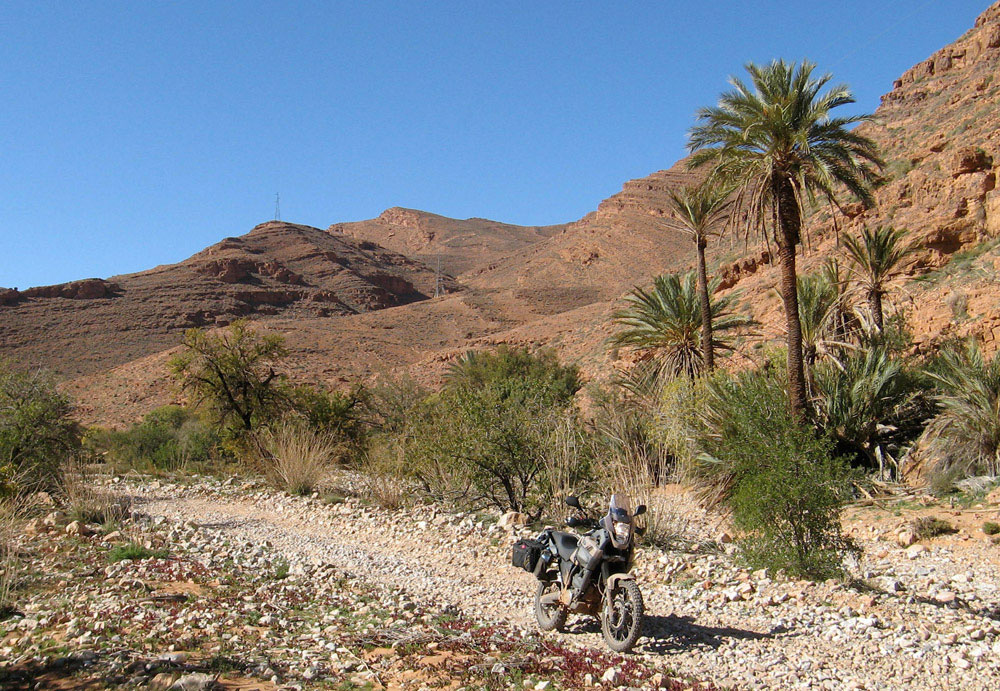
The British biking press didn’t get it with the new Tenere when it came out in 2008. No surprise there, but owners’ impressions were better than expected so I got one to finish researching my Morocco Overland guidebook. I bought the bike used but not even run in, for £4200. A year or two later the price jumped to an astronomical £7000, but for a Jap overlander it’s still in a class of its own back then.
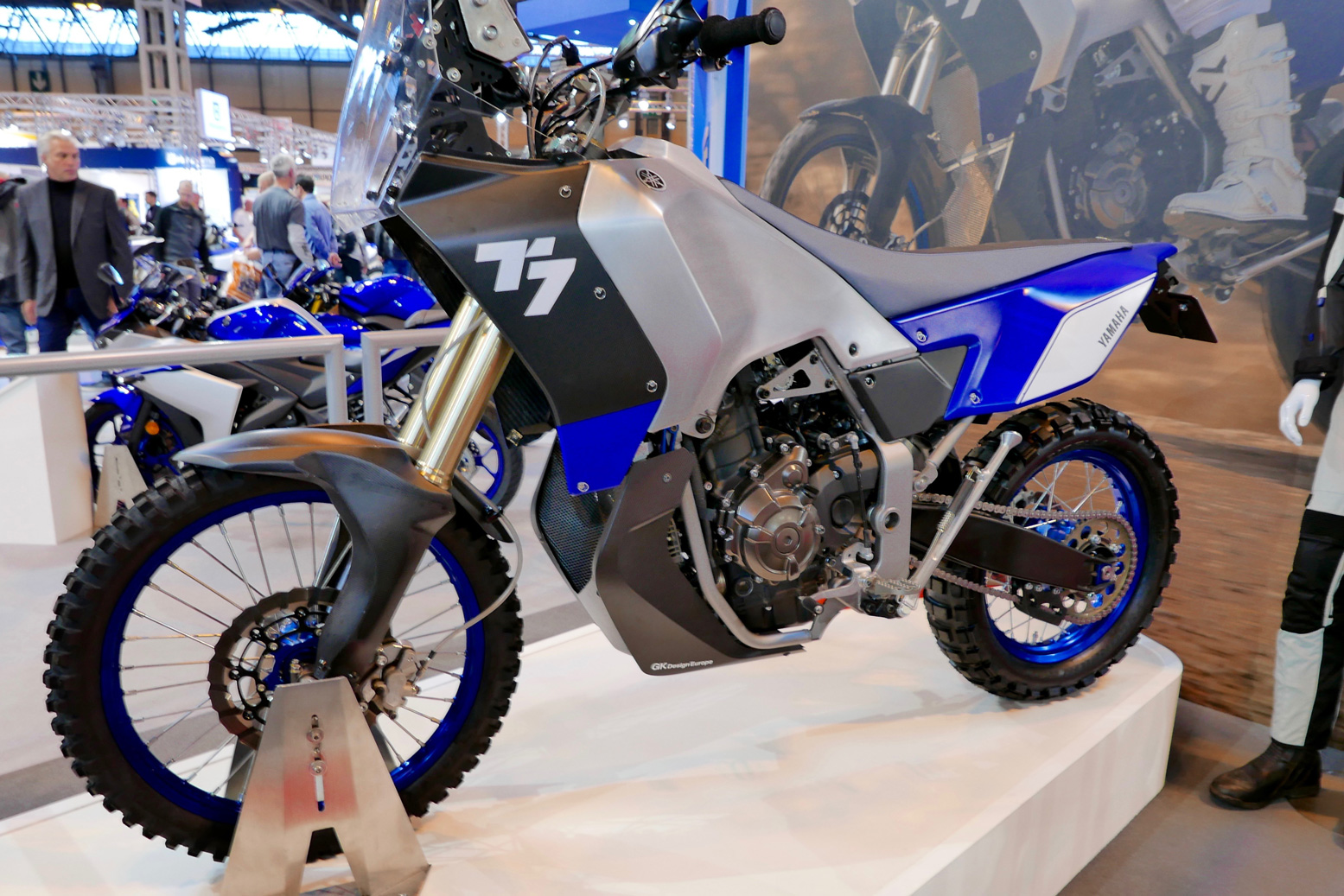
Early impressions and modifications

After less than 500 miles I found I liked:
• Engine and FI /ECU problems ironed out on the 660X and R models
• Pulls smoothly and feels nippy in town and stable at speed
• Fuel consumption (71.7 mpg/25.4kpl so far = 380-mile/610km tank range)
• Can change speedo/odos between mph and kph (but not as described in ‘TFM’)
• Clear, eye-level dashboard display
• Good-sized 23-litre tank
• Seat seems good by trail bike standards after a 300-mile day
• Screen
• 9:1 comp ratio: good for crap fuel and long engine life
• Fall over tank protection
• Suspension seems good and firm
• 6000-mile service intervals (on semi-synthetic oil)
• It doesn’t look too bad, either

… Don’t like:
• Screen is too low – buffets my head
• Feels heavy to wheel around – it probably weighs 200kg wet
• Twin front discs seem OTT
• Fuel gauge is way out – the digital bars disappear at around 240 miles with at least 100 miles left (common to many bikes, tbh)
• Little bits of rust already – naturalmentefatto in Italia!

MODIFICATIONS
The great thing with bikes like Ténérés, KTM- and BMW Adventures is that, unlike my previous Honda XRL, they’re pretty much ready to go out of the crate. Assuming you have all the bits at hand (tyres, luggage, etc), the bike can be prepared in a few days for, in my case, a month in Morocco.
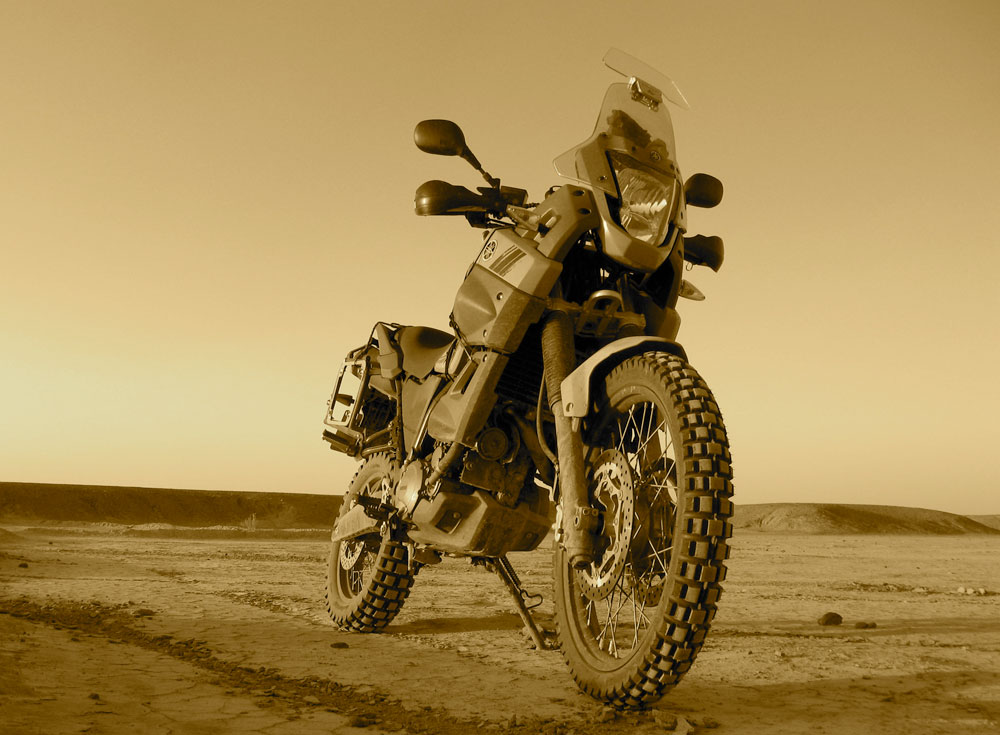
Although they’ve long been the adventure pneu de jour I’ve never tried Conti TKCs before, usually settling for more dirt-oriented T63s, MT21s or full-on Deserts. So it’ll be interesting to see how they perform on the ride down and the pistes and how long they last.
So far on the road you can hardly tell the difference from the Metz Tourances which came with the bike, but those tyres would surely be hopeless in the dirt. The Contis seem a good compromise while they last. Mine of course got Slimed and are now tubeless on spoked rims.
The front wheel weighs a ton. I’ve never has such a heavy wheel on a trail bike. I hope it corresponds to a strong wheel too (it didn’t). I do wonder if 48hp really needs two front discs. It wouldn’t be hard to remove one disc and its carrier, stick something in the empty caliper and see if the bike can manage safely with one front disc.

I chose Barkbuster Ego handguards, because everyone else seems to be going for Acerbis which are 30% more expensive and have tedious drilling issues. The Barks went on OK (covering the tank with a towel helps avoid scratches). I had to remove the cross brace and move the brake olive down a bit – and of course remove the bar-end weights which I’m told will expose some vibration. And I had to cut the end of the clutch lever.
By chance the Bark mounts lined up with the old cross brace mounts which I had to break off, so although the alignment is far from perfect at the moment, the brace went back on and might stop the bars folding up. Hand protection from the elements isn’t great but it’s easily improved.
You’ll notice I’ve made some throttle position markers (pink tape) – an old trick from the twin-carb Tenere days to watch your economy, though at a regular 25kpl (low 70s mpg), with this bike, it won’t be so critical.

I got the German Off The Road rack for 200 quid (no longer made?). It’s similar to many other designs and goes to show how simple and light a strong rack can be – as long as you’re hanging bags off them and not trying to support them.
Fitting was a bit tricky – nothing new there then! You may need help lifting the back of the bike to get the front pillion mounts to line up and you’ll have to remove the fuse box and loosen the nearside rear wiring loom and the back rack/plate thing to move the rear light hanger back to get the nuts on for the back mounts.

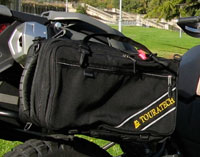
I’ve always fancied some TT Zega Flex fabric panniers (full review). Compared to the ubiquitous alloy Zegas, I’ve never seen a set of the much smaller Flexes in action. ‘Semi rigid’ means they keep their shape but won’t bite at my shins when I take a dab through a oued. The TT catalog says they can only take 5kgs which must be a misprint. Whatever, I’ve weighed them packed for departure and there’s 9kg in each one, plus 6kg in the Ortleib on the back.
The adapter plates supplied didn’t fit my OTR rack (as expected – they’re for TT racks). I managed to get 3 of 4 mounting hooks on; the last mount point needed a coat hook from B&Q. Nice, light bags, abouy 25 litres capacity; a bit expandable, an outside zip pocket and a less useful under pocket too. I don’t expect they’re waterproof so will use bin bags. An Ortlieb bag goes across the back for light/soft stuff.
The Zegas are supposed to join together to make a backpack – how often will you use that compared to carrying them into a hotel? So I cut off the backpacking straps and knotted on a pair of holdall-style handles (top right) with the spare strapage left over. Looks messy but much more functional for carrying the bags or getting inside them. I can also tighten a strap across the back seat to join pull up handles and so take the strain off the mounts frame mounts. This makes them ‘assisted-throwovers and on the dirt is bound to help while barely getting in the way.
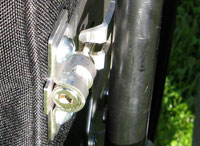
The locking device (left) is pretty flimsy but let’s face it, it’s only there to stop them falliing off. Anyone could get into these with a sharp, hot knife. Once you have the knack, mounting on and off is a breeze. Hopefully the bags will absorb the shock and preserve the mounts when the bike falls over.

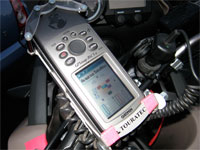
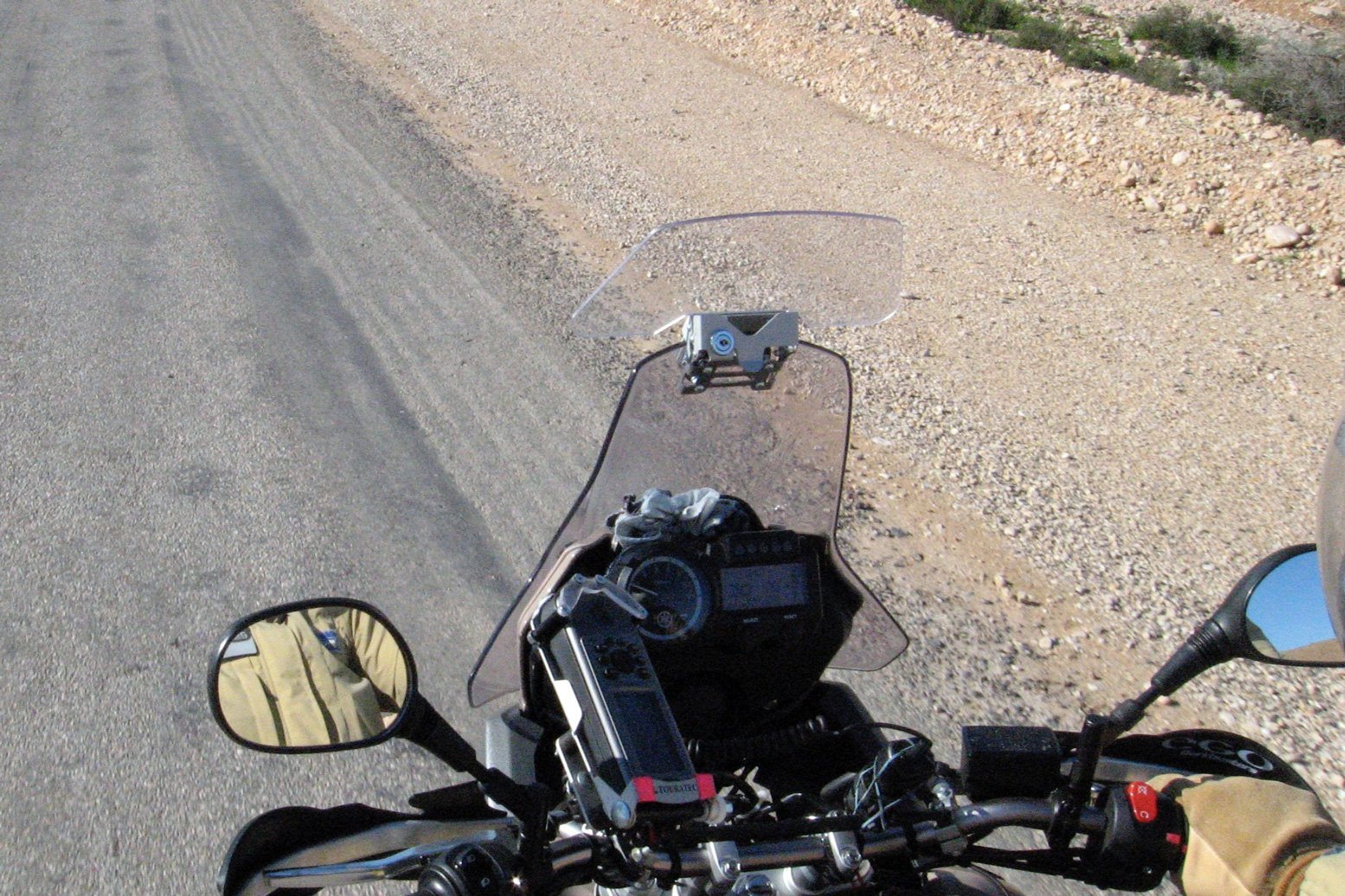
There is a small bar above the clocks/display for GPS mounting but space is limited and my bulky Garmin 76 set up (right); it would obscure the clocks and probably shake loose so it’s gone down on the bars; not so line-of-sight but closeat hand to work the buttons. There is a power take-off plug behind the headlight cover I’m told but it’s some odd connection apparently, so until I have a chance to make something neater, I kept it simple and wired an old 12v cig plug from the bars under the tank to the battery with a fuse nearby. It means stuff can be run with the bike electrics turned off

I’ve also got a Touratech Windscreen Spoiler as my first abiding impression of this bike was how noisy it was at speed. The screen is great for sure but at 6′ 1″ (186cm) it’s too low for me – and as far as the ears go is actually worse than nothing. Hopefully this quickly removable gadget will ease the transit across Spain. It may need bending and curving which can be easily done with perspex with something like a hair dryer, commonly found in the sort of hotels I frequent. It’s the sort of thing I would have spent a day making myself badly out of an old bit of aquarium. How times change…

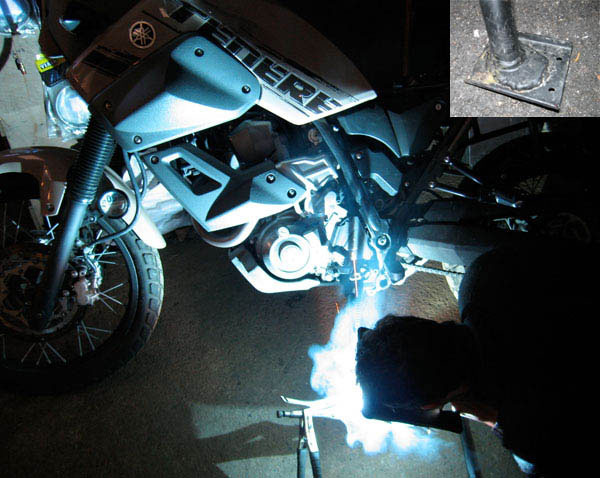
Oh, and Matt welded on the all important side stand foot while I stood by and took a picture.

Yamaha Tenere XT660Z 5000-mile review

Updated 2023
See also: Yamaha’s Tenere

My impressions of the XT660Z Tenere after riding from London to Morocco and halfway back in November 2008, soon after the new bike came out. I’d only owned it a couple of weeks before setting off and happened to sell it a couple of weeks after I got back.

xt6-86

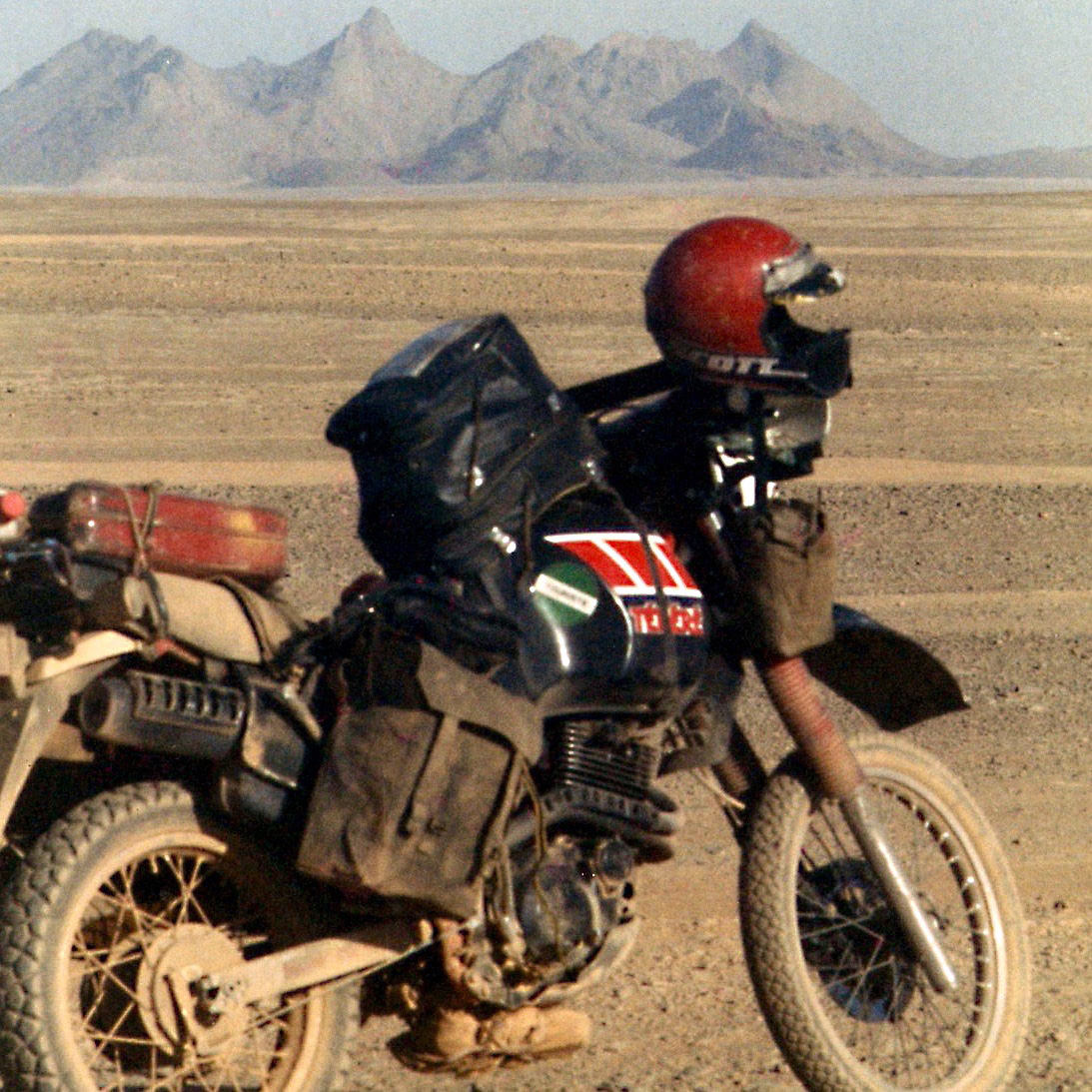
In Europe Yamaha’s Dakar-inspired Tenere has long been the definitive bike for desert travels. In the mid-1980s I rode the original kickstart XT600 Tenere across the Sahara to Dakar (right), and a year or two later I rode the electric-start 1VJ model (below) around southern Algeria.

87-tenere
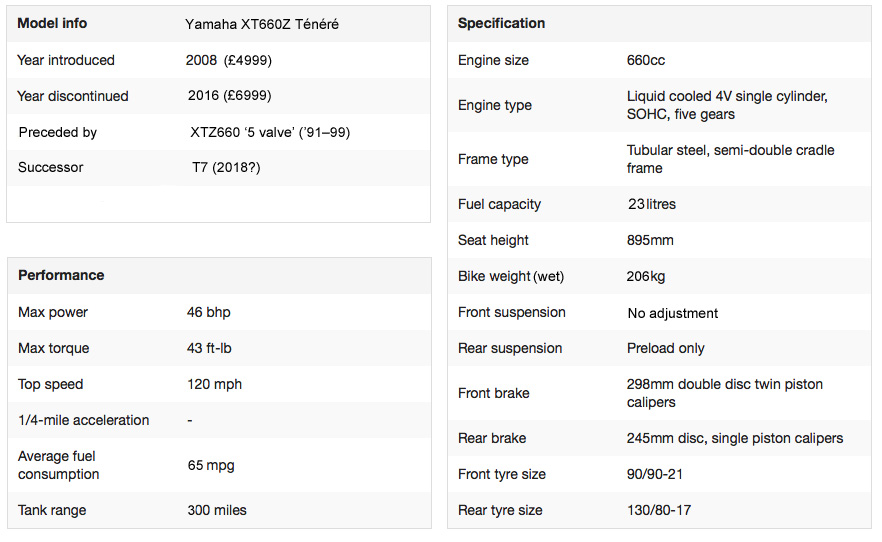
660spex

As a comparison, you may like the read a report on an XR650L, a BMW F650GS SE which I used for a similar Morocco trip from 2012, as well as G650 Xcountry I rode in 2014, a CB500X in 2015, a Husky 701 in 2016 and a WR250R in 2017. I make several comparisons with the Tenere.

  • For my detailed review of the Touratech Zega Flex panniers I used, click this.
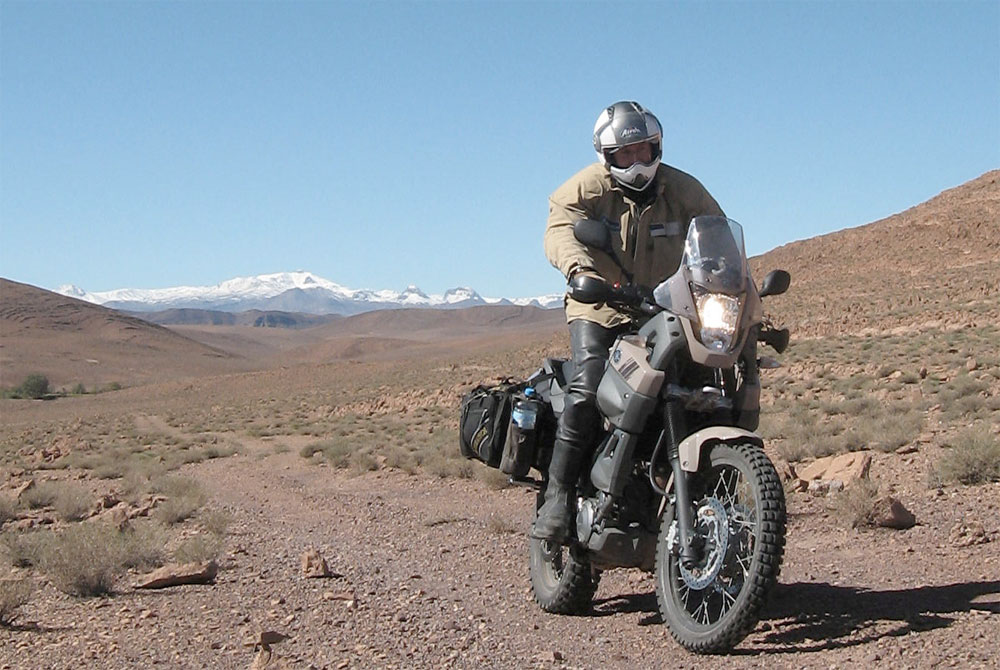
  • For my detailed review of the Airoh TR1 helmet I wore, click this.
  • To read about my continuing experiment with tubeless tyres, click this.
Teneredakar86.jpg

• Engine and FI /ECU problems from the 660X and R models ironed out
• Pulls smoothly and feels nippy in town and stable at speed
• Fuel consumption (71.7 mpg/25.4kpl = 380-mile/610km tank range)
• Can change speedo/odos between mph and kph (but not as described in ‘TFM’)
• Clear, eye-level dashboard display
• Good-sized 23-litre tank
Seat seems good by trail bike standards after a 300-mile day
• Screen
• 9:1 comp ratio: good for poor fuel and long engine life
• Fall-over tank protection
• Suspension seems good and firm
• 6000-mile service intervals (on semi-synthetic oil)
• It doesn’t look too bad, either

• High centre of gravity
• Heavy for what it is – it weighs over 200kg wet•
• Screen too low – buffets my head
• Twin front discs are OTT – look at a CB500X
• Fuel gauge is way out – the digital bars disappear at around 240 miles with at least 100 miles left (common to many bikes, tbh)
• Little bits of rust already – naturalmentefatto in Italia!

5k-comf

Comfort
All things considered I found the seat OK for days of up to 300 miles or more when you simply sit on the thing for hours. On the dirt it’s not so relevant as you stop and move around more. I agree with some that the scoop/two level is a bad thing and a fully flat seat would be better, but it seems the back of the seat has to be raised to get over the cat which is over the back tyre. Because of this scoop you can’t slide back and move around to reduce the aches or crouch down easily behind the screen. I also found that pushed forward like this, my ankles point down too much to use the foot controls. If I could slide back, my feet would be more horizontal and line up with the foot brake, already adjusted as low as it can go. But you get used to it.
The foam I think is OK but like many bikes, may have softened after a few thousand rough miles. I like the neat and quick way the seat comes off. I’ve never had a pillion on it long enough to get an opinion on the back’s comfort. Usually, on these sorts of bikes it’s not so good.

5k-blade

5k-sideblade

I believe some sort of screen is essential for long-range travels and it’s great that the new XTZ came with a good one fitted. Unfortunately for me at 6’ 1”/185cm, it’s still too low and buffets my head worse than if it wasn’t there. A crude, q/d Touratech extension clamped on well enough – a proper taller screen would have been better. On the dirt I found the extension got in the way for good visibility, especially if dirty, but I could quickly clip it on the side of the screen (above left).

Even at my height (or perhaps because of my age) I found the 895mm/35.2″ seat too high to get on and off easily, and too tall on the dirt. Of course this can be fixed by lowering the suspension of which there is more than enough. I do also wonder if the suspension is too firmly damped from stock. I didn’t meddle enough with it other than cranking up the back 2 or 4 clicks to take my luggage. I never weighed my bike myself, but they say it comes in at 206kg wet – a staggering 40kg more than the original 600 Tenere of 1983 which carried 18% more fuel.

I can’t say it was any more vibey than any other big single I’ve had (the Husky 701 was a shocker) and taking the bar end weights off at 500 miles to fit the Barkbusters didn’t make it any worse. As with many big singles, I find some days at some speeds/temperature/load/fuel/whatever it feels harsh – and at other times at the same conditions, it’s smooth. For a modern, water-cooled bike the engine does seem quite noisy. Maybe it’s just a big thumping single.

afriquia

Economy
I never had such variable results from a carb’ bike. it must be an efi thing – but overall it’s very good and was getting better. About time. For overlanding mpg is more important than mph. On previous Teneres I’ve got up to 80+ mpg in ideal conditions (backwind @ 50mph) but generally under 60mpg was normal, as I recall. My near-new XTZ averaged just under 72mpg or 25.5kpl for the last ten fill-ups.
The worst figure was an as-expected riding all day into a gale-force dust storm at around 50mph: 52mpg or 18.3kpl. The best was interestingly, a necessarily slow ride over the High Atlas one bend-swinging night resulted in 86mpg or 30kpl. Nice. For my full records, see this.

fuellers

Low-quality fuel
Once or twice I had to resort to low-octane fuel in Morocco (‘essence’) but didn’t notice any difference in performance. I imagine this is a benefit of having a low compression ratio. I’ve also read that after a spell of leaded fuel, the Tenere’s catalytic converter ‘self-cleans’ when running on unleaded again, so technically no need to change the pipe to spare the cat, though you’d think several months on leaded would take some cleaning to return the cat to full low-emission efficiency. I never noticed any pinking or over-heating.

scrub

Oil and water consumption; drive chain
In 5000 miles no oil was used, apart from a few drips out of the engine crack when it fell over at 2mph. What was interesting was that the semi-synthetic Petronas they put in at the first service still has some good colour in it after 4500 miles; ie: it wasn’t black. Along with the 6000-mile service intervals, this would convert me to semi-synthetic, despite the price. I wonder if efi helps in this regard: clean emissions = clean oil for longer? Water consumption was zero and once or twice the fan came on, but only in conditions you’d expect it too.
I tried to keep on top of the chain with oiling but it still needed adjusting 3 or 4 times so it doesn’t seem to be as good as the best DIDs I’ve used in the past. At the end there were still several thousand miles left in it.

Performance
It doesn’t feel that much more powerful than previous big singles I’ve had, but on the trip I never felt I needed more. Very rarely do I rev over 4000 rpm. In my opinion a low-tuned, 600 single or twin is just the right size for loaded, all-roads travel so I’m happy to give up KTM levels of power for a long-lasting and fuel-efficient engine.
Inevitably I’m sure I’d have got round to tuning it a bit (while also trying to save weight), but only if the great mpg was not compromised.

screener

The front twin discs feel pretty ordinary and surely one good SM-style disc would be adequate and save a lot of sprung weight? Were Brembo doing a 2-for-1 deal? For a trail bike, the front wheel weighs a ton, but it wouldn’t be hard to remove one disc and carrier, put a block in that side’s caliper and see how it stops. Most probably the other caliper is designed to work as one of two small units and may get over-worked so it’d be best replaced with a larger, 4 piston unit. Is it all worth it? Not really unless you’re greatly improving the fork.
I have to say the flashy-looking twin bulb front headlight is not that brilliant in terms of spread, compared to less impressive-looking setups I’ve run before.

From first impressions the suspension felt firm front and back which makes a nice change from older Teneres and gave good road manners. When I loaded up with 25kg of baggage I turned the back up by 2 full- or 4 half-clicks. Hard to tell exactly, but neither end never got near bottoming out on the piste. I wish I’d experimented more with backing off both ends on the dirt.
The front I left as it was, but one evening after a very rough rocky climb that punctured the front tyre and all the rest, to add to my woes the front forks ‘collapsed’. I could squash them right down. There were no leaks. I’ve never had this before on a bike and though an air or oil damping valve may have ‘burst’ or a spring broken from the hammering – or possibly the fork oil had become aerated. But I wasn’t exactly ripping across corrugations at MX speeds in 40°C.
Next day I turned the fork up 5 turns (5 x 360°) to compensate but soon regretted it. The bike became even slower to turn on the dirt and on the road. In fact, the forks self-recovered and I wonder if I was making it all up as the shit had hit the fan at that stage and some of it may have lodged in my brain. Anyway, the fork was back to normal next day. I suspect aeration or hallucination.

Road riding
Generally on the road I sit at an indicated 65mph or so – not so fast. At this speed riding is less tiring and safer and economy is good. With the screen extension this could be sustained all day with only the usual discomfort.
Many road testers used to brilliant GSXR’s and the like don’t get on with the handling of 21”-wheeled trail bikes and in response many manufacturers chose 19” fronts for their bigger adventure bikes. They have a point: a 21”shod bike never feels planted in the bends and adding a semi-knobbly tyre doesn’t help. Fwiw, I felt the bike handled pretty well on the TKCs. On the highway they didn’t feel any worse than the original Tourances used for running in, though I don’t exactly throw the XT around like a super moto.
Loaded up, I found the bike was sometimes hard to turn on tight bends and hairpins, both on or off road, as if the front was raked out too much or the weight was too high (it is). Short of getting your weight over the front end, MX-style, the usual way to tune this out is to soften the front- or jack-up the back. I don’t recall having this impression on previous bikes like this; they’re usually too softly sprung. So I blame the higher than average CoG (centre of gravity) not helped by the cats stuck way high out the back, along with my high luggage set up, and the firm suspension. If I’d kept the bike I’d have experimented with softening the springs and even lowering the bike (and possibly getting rid of the heavy twin cats for a lighter pipe).
To be fair, some of the roads and tracks in Morocco are very narrow and tight, with thought-provoking drops. Even some tarmac mountain back roads have strips of gravel down the middle on which any bike would struggle to progress smoothly.

Cross winds
One early owner’s impression I read said how great the bike was in high winds. Head winds maybe, but coming back over the edge of the Pyrenees towards Perpignan there were violent gusts coming from the west and I don’t recall ever feeling so unsafe on a bike and being on the verge of crashing. All the other road users were giving me a wide berth as I tried to predict the gusts and control the wildly bucking bike from running over the hard shoulder and off the edge.
It may have been the same for all bikes that day, but keeping down to 50mph, a 600cc UJM passed me without any drama. Again I feel my high baggage set up would not have helped, but do wonder if again, this high CoG is to blame. We are talking about exceptionally strong gusts here, but I must have ridden in those sorts of conditions before and survived.

5k-rmerid

Off-road riding
Off-roading in Morocco is mostly on rocky or gravel tracks as above and the TKCs made this much more predictable, easier and safer. The good thing with semi-knobbly road tyres like these is that you can keep the pressure high to avoid rock punctures while still benefiting from the aggressive tread pattern on loose surfaces. The idea of riding the trails on the OE Tourances doesn’t bear thinking about.
I’ve never had a Jap trail bike with too firm suspension and I think I was a bit slow to recognise this. Although I take it fairly easy riding alone on the piste, the bike didn’t really respond to off-roading well enough to give confidence to ride it towards the limits – and with all that weight that can’t be that far off. Maybe just as well.
Not surprisingly I found the handlebars were too low when standing up off road, causing me to crouch unsustainably. Most bikes are like this at my height and handlebar risers would have easily fixed it.
I also found the gearing too high for slow off-roading – again, as expected. I’m not sure what the standard gearing is, but the bike does 8mph at the 1500rpm tickover which is too fast for some steep hairpins or loose descents. With a heavy load, the clutch would have got hot from slipping on the hairpins but the only time this happened – a bit of slack at the lever – was when the front mudguard jammed with mud for a couple of kilometres passing south of Jebel Sirwa.

5k-wide

Loading
Along with the economy and low-stressed engine, the seriously strong subframe is one of the best things about the XTZ. It has to be twice as thick and much stiffer than the steel straws which held up the back of my XR650L, or indeed previous Teneres I’ve owned. This is one part of the bike I don’t mind being over weight.
Adding the simple, functional and tough Off The Road rack only made this better and is all the metalwork you need to pile it up with the heaviest alu boxes.

5k-dashbars

Equipment
I like the near eye-level dashboard and digi speedo, even if it’s a bit basic. I would have liked an oil or water temp gauge. I didn’t discover till I got back that the Yam handbook and not the bike is at fault wrt changing from mph to kph. Click this for how to make this very useful feature work (as well as all the 660 chat that’s fit to print). I wired up my own 12 volt PTO plug directly from the battery onto the handlebars for the GPS.
Everyone complains how way out (pessimistic) the fuel gauge is but at least it’s consistent! Once you get used to this you’ll know that if it re-zeros itself at around say 230 miles, you’re doing a good 70mpg and have at least 100 miles left in the tank. The tank is plastic by the way and notably warm on the leg.
Checked against a GPS over 100 miles I found the odometre (distance recorder) to be accurate to within 1%. This means that the mpg readings are also virtually true. The same cannot be said for the speedo which, like all bikes at an indicated 70mph = 64mph true = 8.5% over. According to the speedo then, the bikes feels faster than it is.

5k-palm

Durability
If you think about it, it’s asking a lot to take an untried bike just 500 miles old out for a 4500-mile off-road hammering with no preparation to speak of and to expect nothing to break. Nothing did and to this end I feel the Yam is well screwed together. The only things that came loose and fell out were a couple of screws holding on the screen, but this was almost certainly due to the extra leverage put on them by the TTech screen extension.
Obviously I could have done with engine bars or a proper bash plate, as would any bike of this kind (they’re available for the XT-Z now, but weren’t then). The tank/radiator protectors are a nice touch and the Barkbusters are a no-brainer to the mods list. So, I still like everything I liked at 500 miles. Not so keen that it’s higher than it needs to be – but it can be easily lowered. Plus it feels heavy for what it is – a tall CoG not helped with my high luggage set up, but that usually comes with the territory.

nec-t7

Bikes like this will always be a compromise but for the Morocco job, when you think of the cost of the machine [in 2008] and the minimal ‘kerbside’ levels of preparation, the 660Z offered an ideal balance of continent-crossing comfort with adequate fully loaded off-road ability. Just like the Tenere always did in fact, only more so.

Can’t wait for or afford the 700 Tenere twin? Check out my XSR Scrambler project.

Honda XR650L for Desert Riders

XRL preparation • 4000-mile reportDesert Riders 
dr-xrl650

Back in 2002 the criteria for our ideal desert machine for Desert Riders added up to those listed on p.208 of my Sahara Overland book:
• Lightness
• Economy
• Comfort
• Robustness
• Agility
• Reliability
• Mechanical simplicity

To give ourselves a good chance of success we wanted to buy new bikes and so the list was narrowed down to:
• KTM 640 Adventure
• Kawasaki KLR 650 (imported from Canada)
• Honda XR650L (imported from Australia)
• Yamaha TT600E (imported from Italy)
• BMW F650GS Dakar

In recent years I’d travelled with all these machines, either on my desert tours or my own travels. The way we saw it then, in 2002 these were the pros and cons of each machine:

 ForAgainst
KTM 640
Adventure
27L tank, desert-ready components, suspension and build qualityExpensive in the UK, variable economy, vibration and exceedingly poor comfort
Kawasaki
KLR 650
23L tank, inexpensive, economical, reliable, good kit in the USImport and registration hassles, average suspension
Honda
XR650L
Inexpensive, economical, reliable, good suspension, proven air-cooled engineImport and registration hassles, small tank, seat height.
Yamaha
TT600E
Easy to import, air-cooled, well known in UK and EuropeImport and registration hassles, dated design, small tank, leaky USDs, ‘non-Japanese’ build quality?
BMW
F650 Dakar
UK model, comfort, very good economyHeavy, complex, pricier than Japs

In a Burger King one evening we narrowed it down to a KTM or Honda with large fries. Then, once we considered the importance of economy and got a good price from Australia (about £4000 delivered), the Honda XR650L was the choice we were all confident with (until we rode them…).
In case you don’t know, the XRL is an NX650 Dominator engine in an XR600 frame ~ more or less. With good springs and a trail bike motor, it’s the ideal set-up for a desert bike, even if we had to buy a tank and get racks made. In our opinion, for this ride Honda’s proven, decade-old technology was an asset.
And now, they still sell them new in the US!

Proceed to XRL preparation

dr-crates