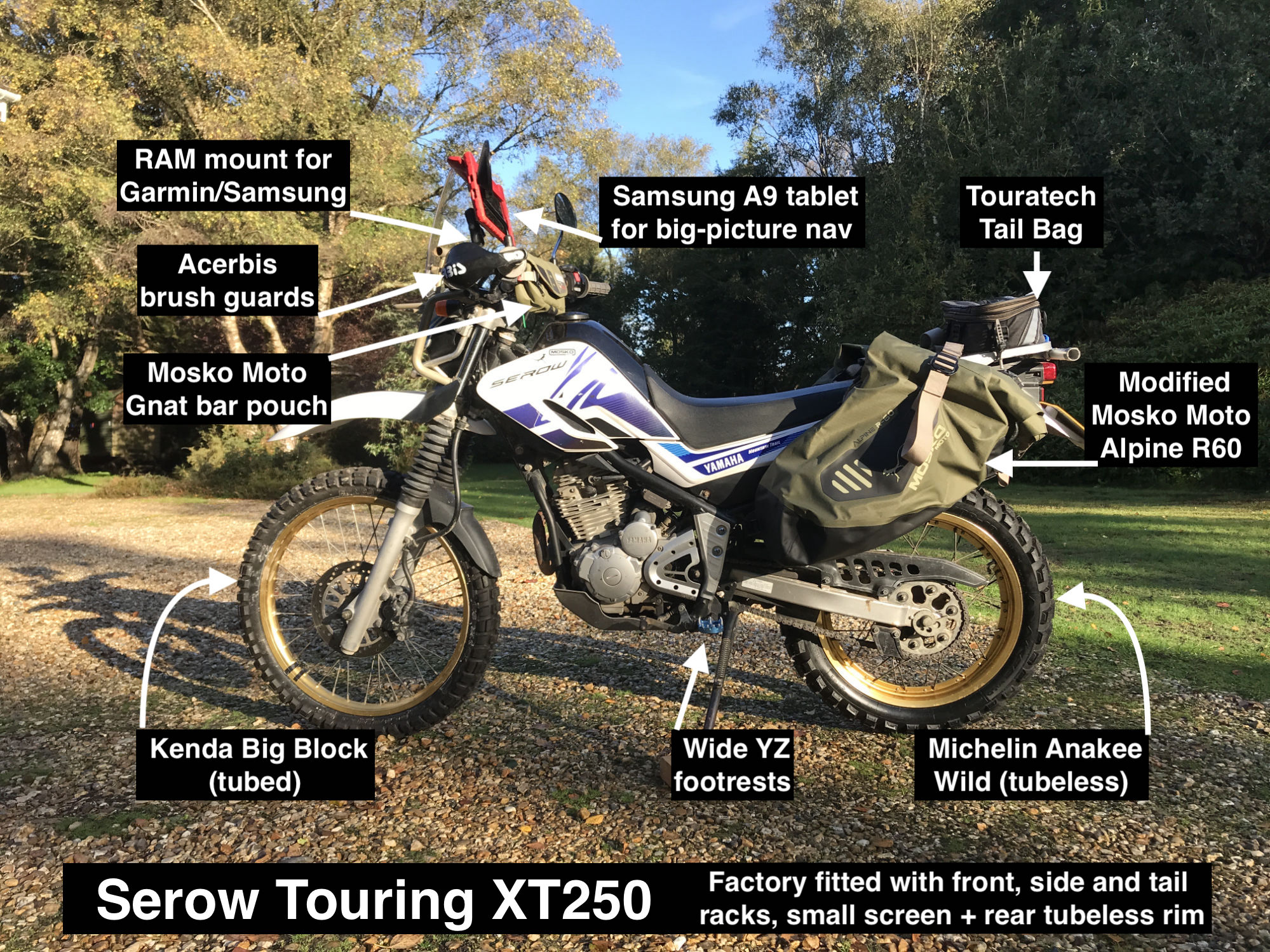
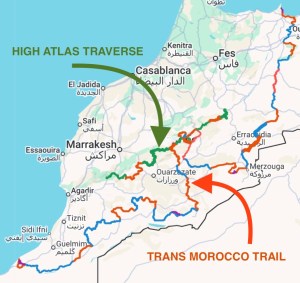
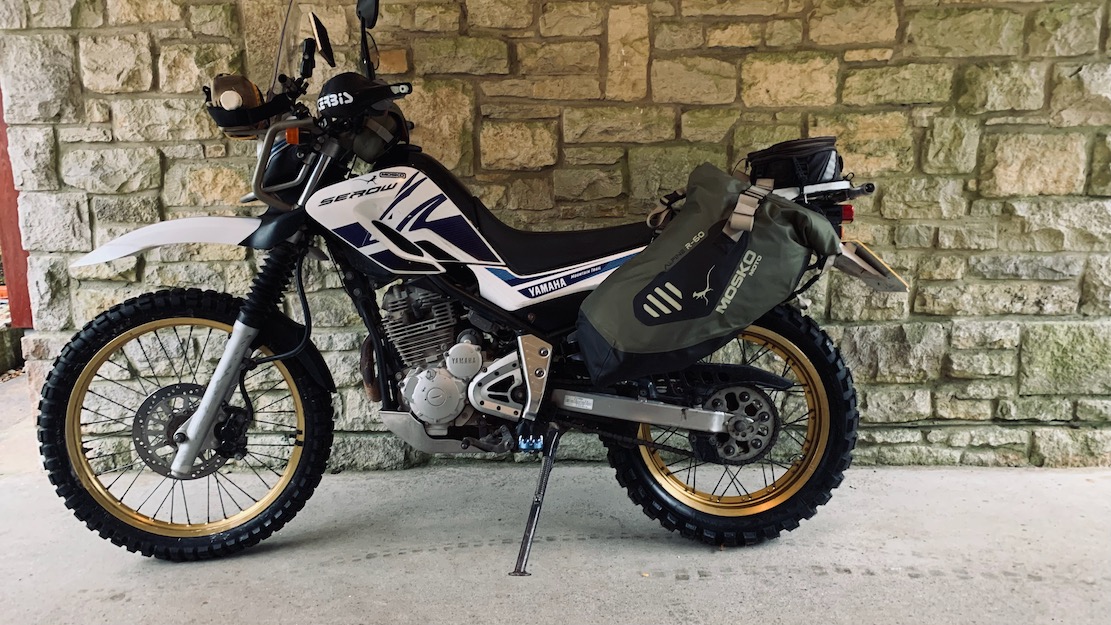
It didn’t take much, but my 250 Serow Touring is ready to wheel into a van and head down to Morocco for a recce of the High Atlas Traverse (left). The H.A.T is a new route I’ve cooked up to parallel our very popular, coast-to-coast Trans Morocco Trail. When the H.A.T map and tracklogs are up, they’ll be hosted on the same TMT website.
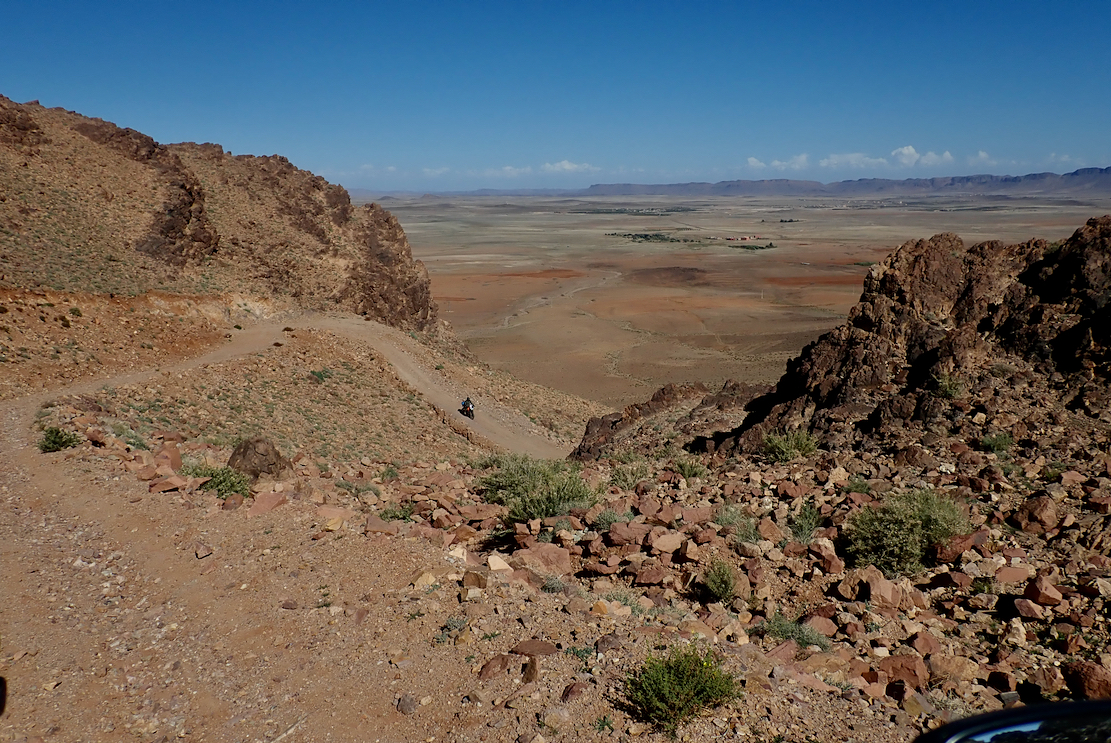
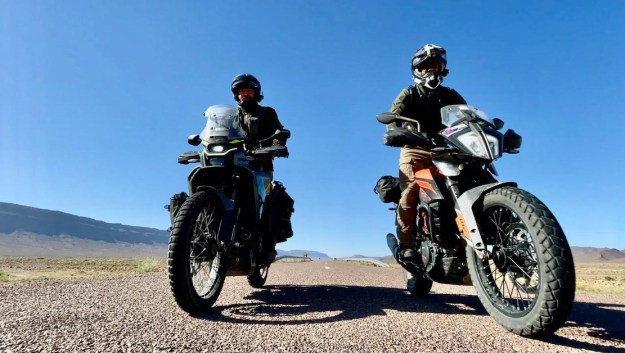
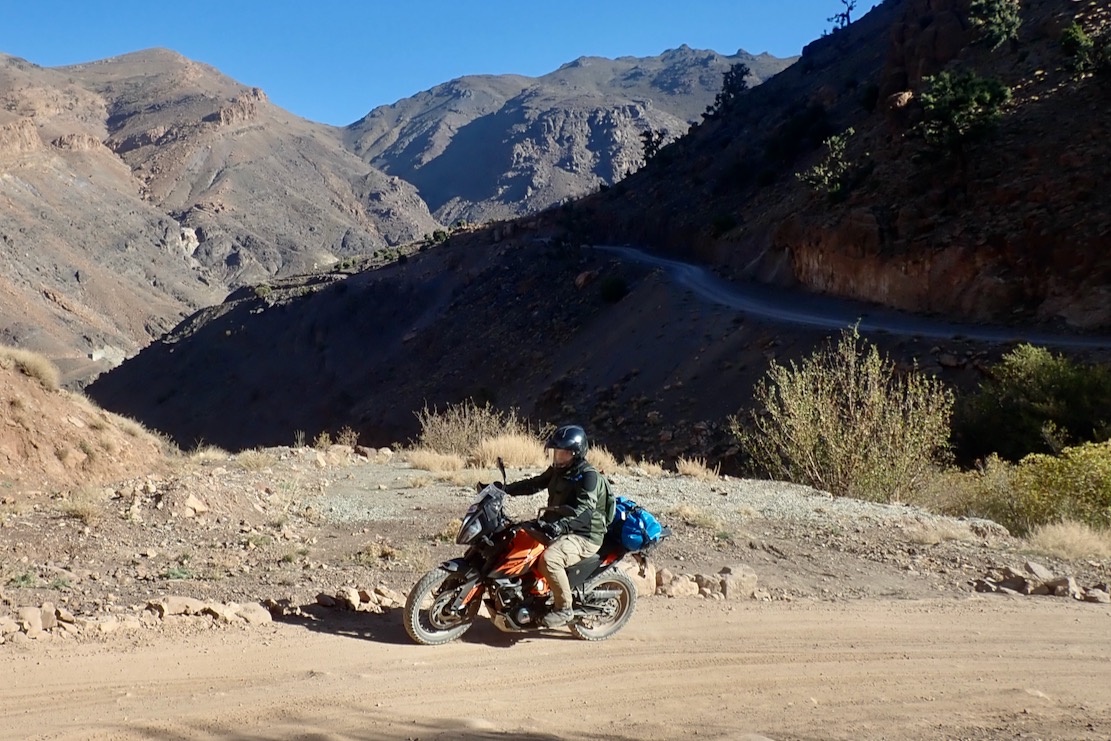
Following the Atlas watershed over the highest motorable peaks and passes for 900km, the H.A.T will probably become harder than the TMT. With elevations exceeding 12,000′, we’re not certain every planned track will be passable, but that’s why they call it a recce. Whatever happens, my lithe, low-saddled Serow ought to be ideal for the task, joined by Simon on his TTR 333 and Bob on a brand new KTM 390 Enduro R to add some Vit C to the photos. I’ll be posting the odd photo on the TMT Insta page and maybe elswhere. If it all pans out, the route will be online to download for free by the New Year.
What they say Gone are the days when going from A to B [missing word]. The 2024 KTM 390 ADVENTURE rewrites the rulebook on what the daily commute needs to be. Merging all-road versatility and proven reliability with real-world performance, not to mention adventure-ready spoked wheels, a proven 373 cc powerplant, and a class-leading chassis, the KTM 390 ADVENTURE not only seeks out new adventures – it leaves no path unexplored. This motorcycle is designed and developed in Austria, and assembled in India.
What I think:
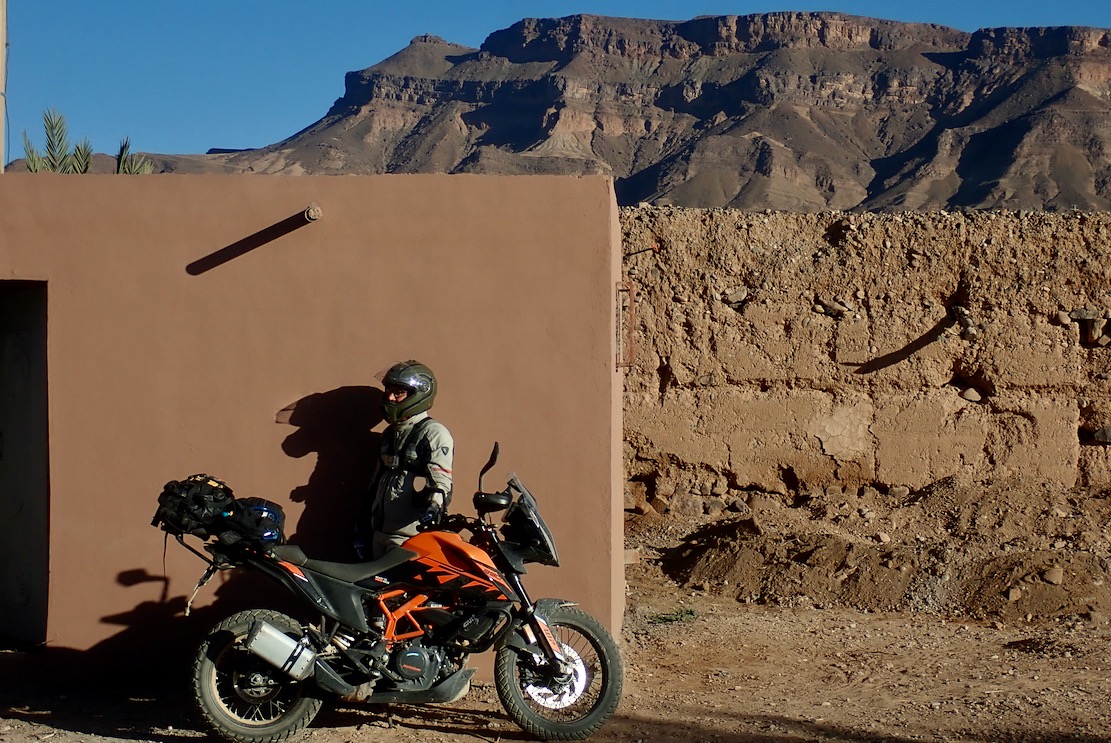
2025 390 X, much more like it
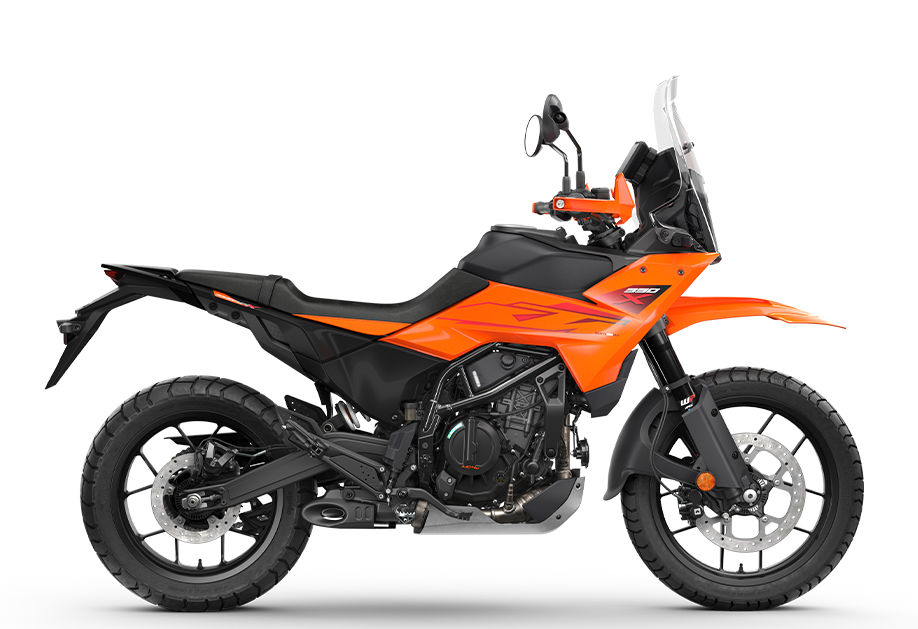
• Light • Nice gear change (Quickshifter+) • Great range from 25kpl up • Adjustable WP APEX suspension • A 390 Adventure X (right) came out in 2025
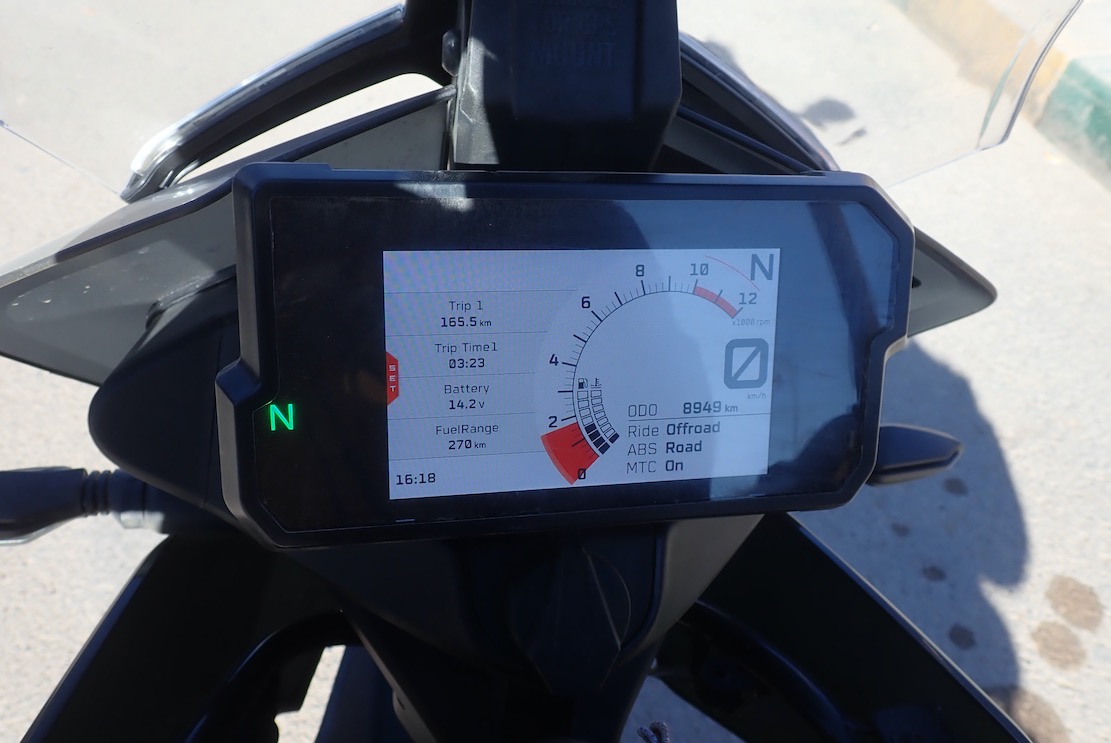
• Grabby front brake • Tubed tyres • Very pessimistic fuel warning (loads left) • Small display figures illegible on the move • Engine rougher than a 310GS • Seat is hard – and wide at the front • Bars way too low for sustained standing • No USB port, but there is a 1980s-style 12-v cig plug • Negligible wind protection for an ‘Adventure’ styled bike • Not a look I warm too
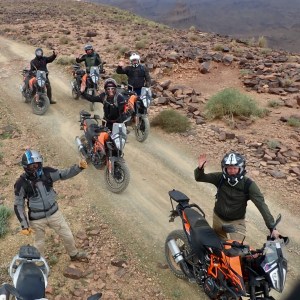
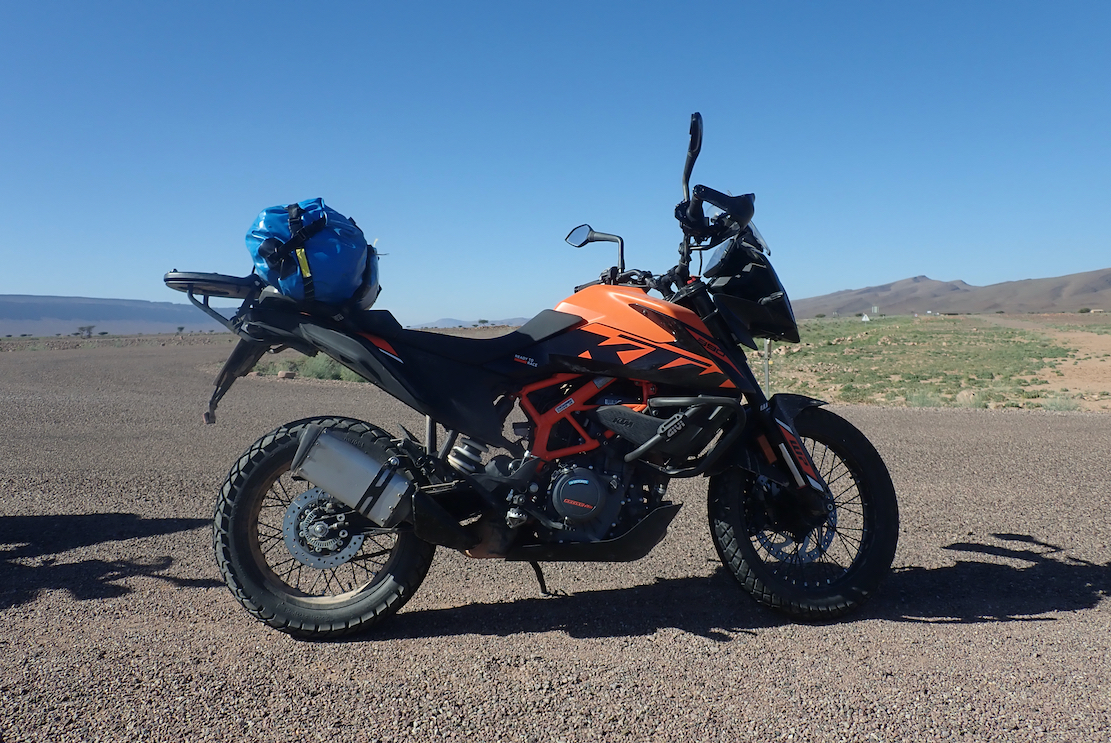
Review I’ve led a few tour groups riding KTM 390 Advs late 2024/early 2025 and tried one for a couple of hours on the open road. I didn’t expect to get on with it. On paper it never added up to any kind of bike that suits my riding, and coming off my CFMoto 450MT twin just enhanced that impression. My twin’s creamy, low-down torque which makes it so easy to ride is entirely absent from the KTM, as you’d expect. A 400 single can be torquey, but only a 410 Himalayan takes that route, losing out on higher speeds. First impressions: the seat is hard and wide at the front, splaying the legs uncomfortably when still (and I’m 183cm). It is wide and spacious at the back where it needs to be, but after a short while the butt gets sore. Standing up an hour in for some posterior relief, I found the bars way too low: just wide bars clamped to a stock Duke chassis/headstock. A 50mm rise (more than the stock cables have to give) is a minimum needed. All the riders large and small complained about this.
It’s really a quick-shifting road bike and feels like a supermoto or a scrambler, but without a latter’s cool retro looks. While the 170-mm of WP APEX suspension travel is firm, adjustable and well damped (one good thing about all KTMs off the shelf), the stance is all wrong for off-roading, despite the wide bars. The same can be said for the six-year-old BMW 310GSs which these bikes replaced at the Marrakech rental agency, and we got used to those too. The returning group I was guiding rode 310s last time, and one rider was given a 60,000-km example when his unridden, zero-mileage 390 developed a front brake problem leaving the garage.
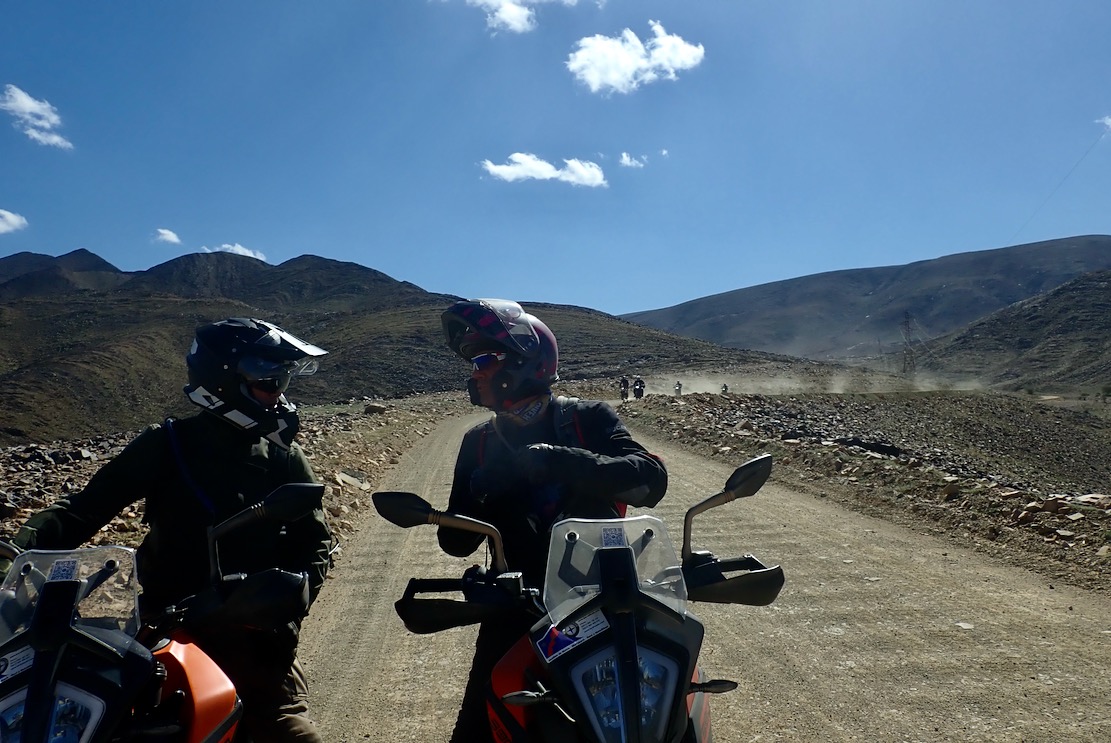
Part of the reason is the 390’s grabby front brake would need careful operation on the dirt, or just mean you have to take it easy. I didn’t feel inspired to try a 390 on the trails; it would be too tiresome managing the stock Conti TKC70 tyres, touchy brake and stance. Actually I did for a few hundred metres and thought something was bent. We did navigate some sandy and rough tracks in the Anti Atlas and everyone got through with a few fall overs. There, and on easier trails I did notice myself pulling ahead on my 450MT. I suspect the group couldn’t relax and flow on the stock tyred 390s like I could on my grunty CFMoto, even with a 25-kilo penalty. Most in the group who’d been before recall preferring the 310GS.
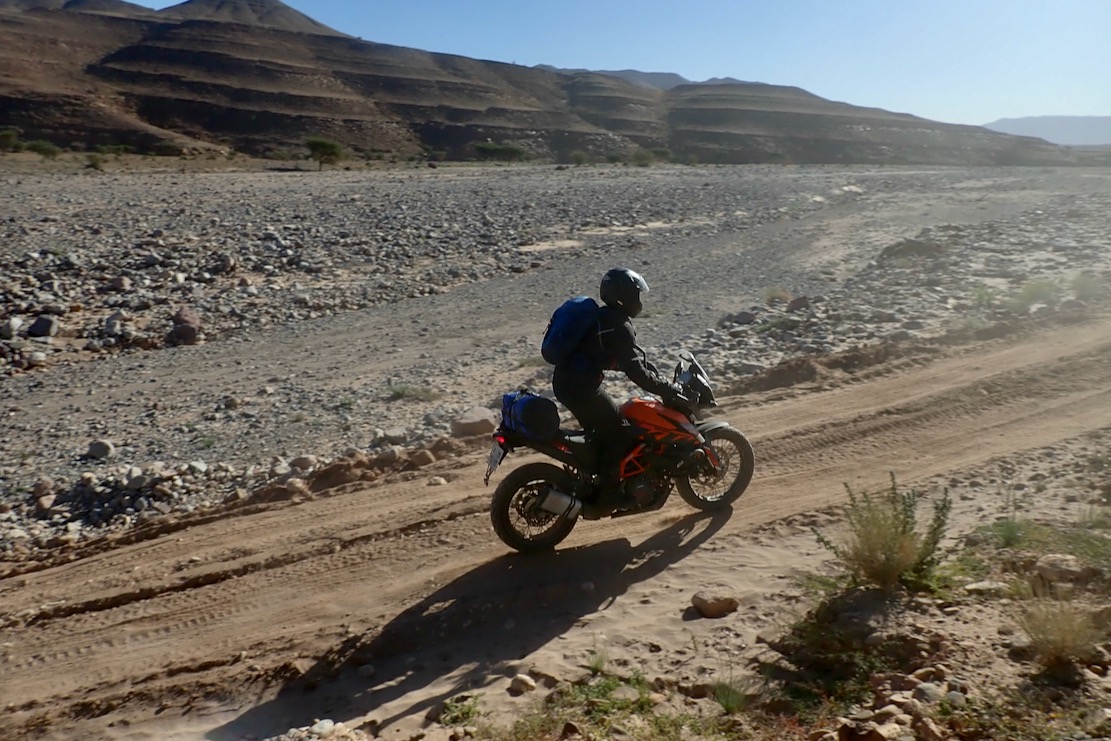
For me my 450MT trounces a 390 road or dirt, despite the 25-kg penalty and poorer economy. Pic: Keith Betton
There’s leaning ABS and traction control, though I didn’t sense activating either; maybe they worked seamlessly as I suspect they on on my MT. I always leave ABS on and the TC helps keep the rear tyre in line leaving loose bends with barely any annoying intervention. A 390 hasn’t go the controllable, low-down grunt to do that, and anyway ‘Off Road’ mode disables the TC a bit. But some riders found using Off Road stopped the ABS stalling the engine – if that’s possible. Road or trail, good luck trying to see how well the cornering ABS works. It’s hard to see any benefit of this ‘Adventure’ 390 SW over a road bike. I don’t even know what ‘Adventure’ signifies any more, but for travelling I’d happily take the extra 2 kilos of the cheaper, tubeless, cast wheel version, even if the good suspension might inspire some to hammer the wheels harder. That apart, both these 2024 models seem identical, but Triumph’s Scrambler X looks like much more fun to own, once you raise suspension to KTM levels.
With some amazement, we all decided KTM’s Quickshifter+ was fitted and working, though annoyingly I kept using the clutch out of habit. I know that on bigger KTMs quickshifting (and other added features) cut off 1000km from new after which you to have to pay to unlock it. Presumably Quickshifter+ is supplied free and permanently on these Moroccan-sourced 390s as it’s hard to see the rental place paying extra for it. Anyway, clutchless changing helps keep the engine in the sweet spot and when standing off-road, makes up for the awkward stance. I wish my CFMoto changed gears like that.
My eyes aren’t great but the tiny text on white screen is impossible to read on the move. It’s not great on my 450MT either, but white text on a black b/g works better. You wonder why they bother with the waist high screen which merely funnels the wind blast into your face at adjustable angles.
You can stand until the back hurts
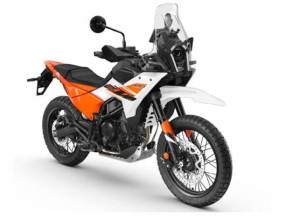
Adventure R. More like it!
You can get used to anything, including the Chinese 125 mules every local tools about on in southern Morocco. But if you like exploring gravel tracks there are better small travel bikes out there – and more on the way, including KTM’s 2025 390 Adventure R (left) you’ll have read about and priced at just £5700. About time they did that; hopefully Triumph will follow now they’re back into MX. That’s what any bike calling itself an ‘Adventure’ should have been all along, instead of just lamely pandering to the buzzword de jour. I recall I didn’t take to the 890R first time but then I did. If I ended up riding a 390SW again, I might come round to it, but I doubt it. These 390 SWs are just not suited to the sorts of tours I like to run in Morocco.
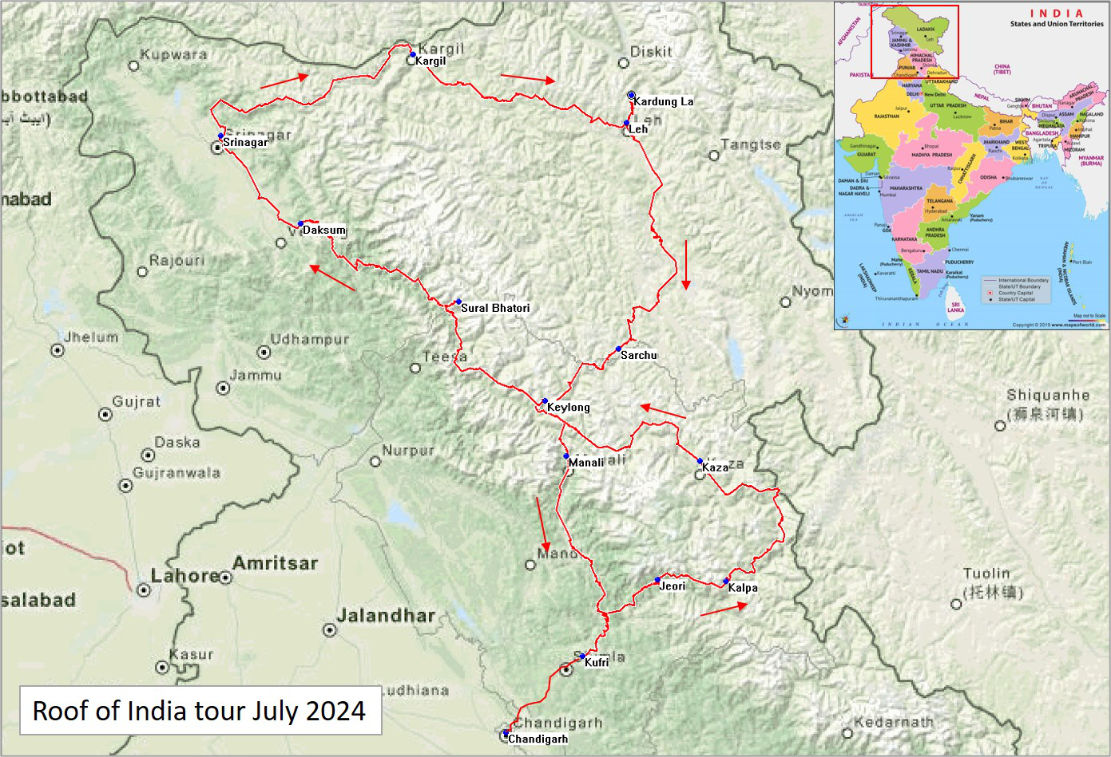
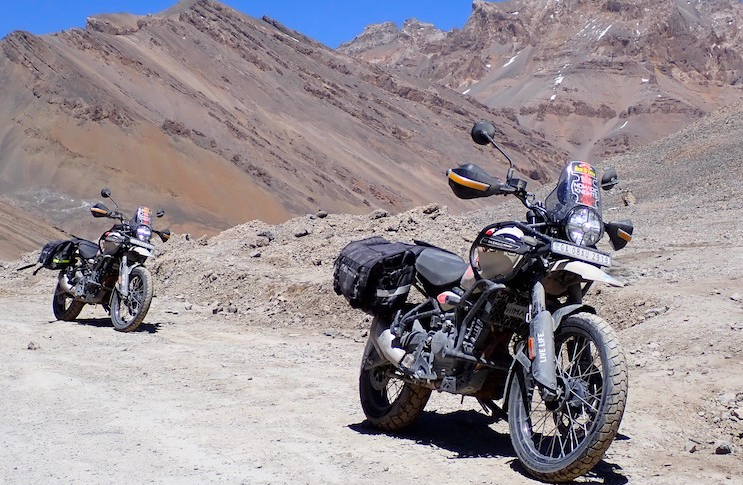
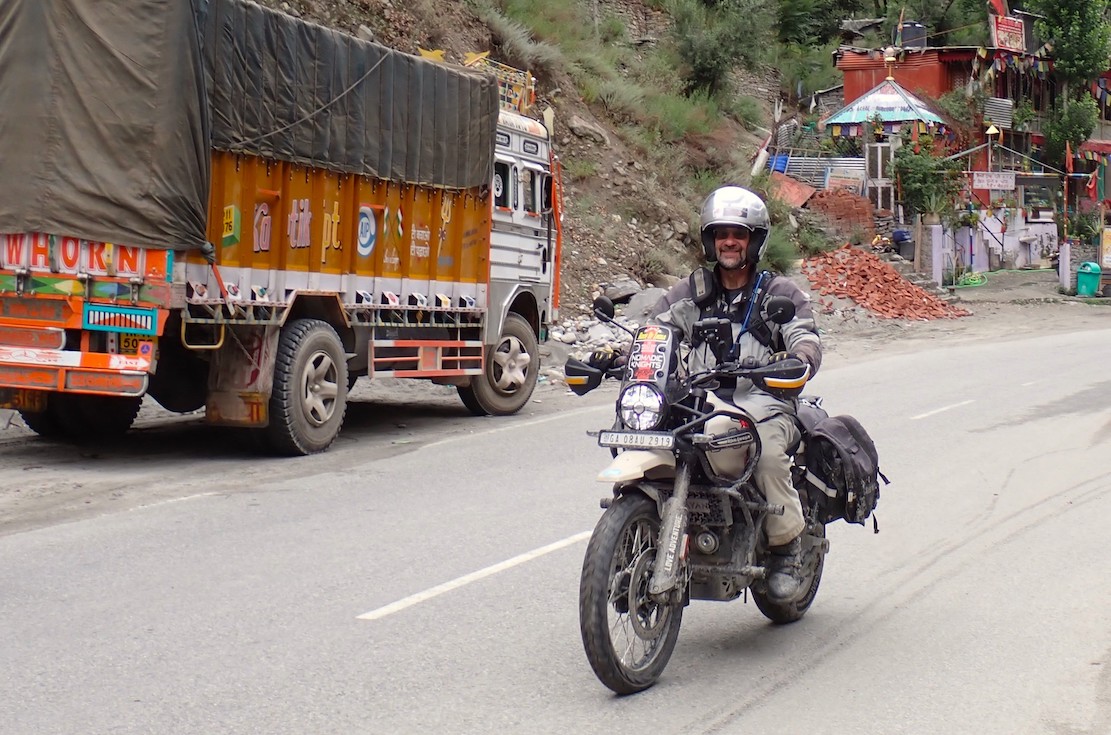
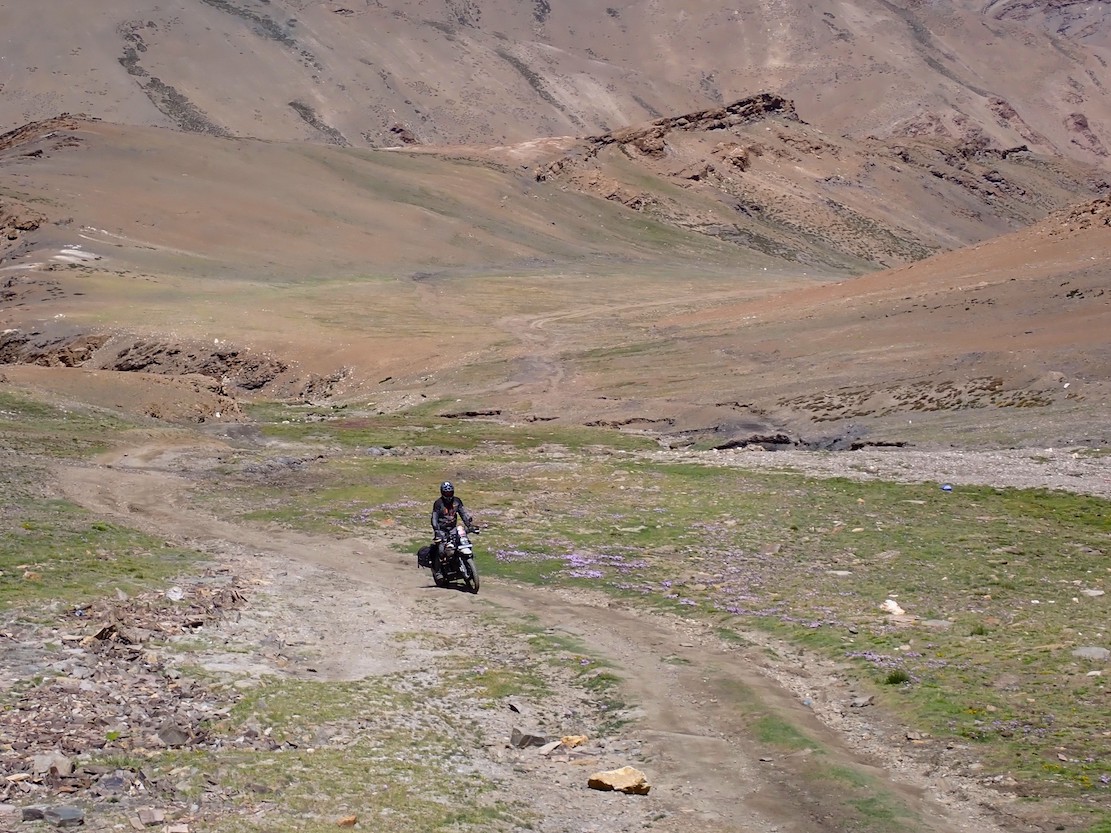
Danielle (Dan) and I recently returned from a two-week bike tour round the Indian Himalayas, riding the new Himalayan 450 adventure bikes. The Roof of India tour, organised by Nomadic Knights, was billed as ‘extreme adventure’, rather than a holiday. It certainly lived up to its billing, with a faster pace, greater distances, and longer days than previous trips we have undertaken in the Himalayas, including the month-long trip we undertook in 2017 on the original Himalayan 411s (left).
The new 450s were perfectly suited to the trip. They had better engines and suspension than the Himalayan 411s, although were noticeably heavier and (arguably) less attractive to look at. According to the Royal Enfield website, the 450 has a kerb weight of 196kg, which is actually lighter than the 411 kerb weight of 199kg. However, the 450s we rode on this tour had substantial additional crash bars (with steel bobbins), a rear racking system, stronger hand guards and a larger bash plate. I suppose if you are encouraging punters to have an extreme adventure, you can expect them to crash from time to time. The weight is felt most when using the side stand or centre stand. The bike leans over a long way on the sidestand but this does result in it being quite stable when parked on uneven ground.
Once the handlebar levers had been rotated down a bit and the seat raised to the higher position, the ergonomics were very good, both standing and sitting. Because of my height (a bit over six foot) I fit bar raisers to most of my bikes but didn’t feel this to be necessary with the 450. The seat was very comfortable, although this would have been helped somewhat by the padded cycling shorts I always wear under my enduro jeans. The engine feels quite torquey and pulls strongly between 4000 and 6000rpm. My first impression was that first gear was rather too tall but this is countered by the engine’s reluctance to stall at low revs and so I soon got used to it. Tight manoeuvres require a bit of clutch work but that is also true of the Husqvarna 701 I ride at home.
Him 450 vs MT450 vs KTM390 vs 300 Rally
The bikes we were using were new and the fastest I saw on the speedo was 122km/h. I didn’t want to push it further than this because the engine still felt a little tight and it was just not appropriate for most Indian roads. A top speed of ‘over 150km/h’ (94mph) has been quoted by Bike India magazine and I have no reason to doubt this. Other reports have suggested that the 450 is more than comfortable on UK dual carriageways, which, from personal experience, was not really the case with the 411.
The brakes were fitted with braided lines and were very good. Like many modern adventure bikes, the rear ABS can be switched off for off-road use. This is done using the Mode switch on the right switch cluster. However, if the ignition is switched off then on again, the system reverts to full ABS. This feature resulted in my only concerning moment of the trip. I applied the brakes while traversing loose stones in an off-road section and the bike took an uncomfortably long time to come to a halt. The suspension on the 450 is made by Showa. The only adjustment is the rear preload but I found the default spring rate and damping to be perfect for me. It might have helped that I am close to the ‘standard’ weight of 75kg but nobody in our group had any complaints about the handling or stability. The standard SEAT tyres are not particularly knobbly but worked very well on this trip, both off-road and on. The only time they were a bit challenged was on a short section of snow and soft mud. For UK trail riding, I would replace them with something slightly knobblier, probably Michelin Anakee Wilds, but for the roads and tracks in the Himalayas, the original tyres were perfect.
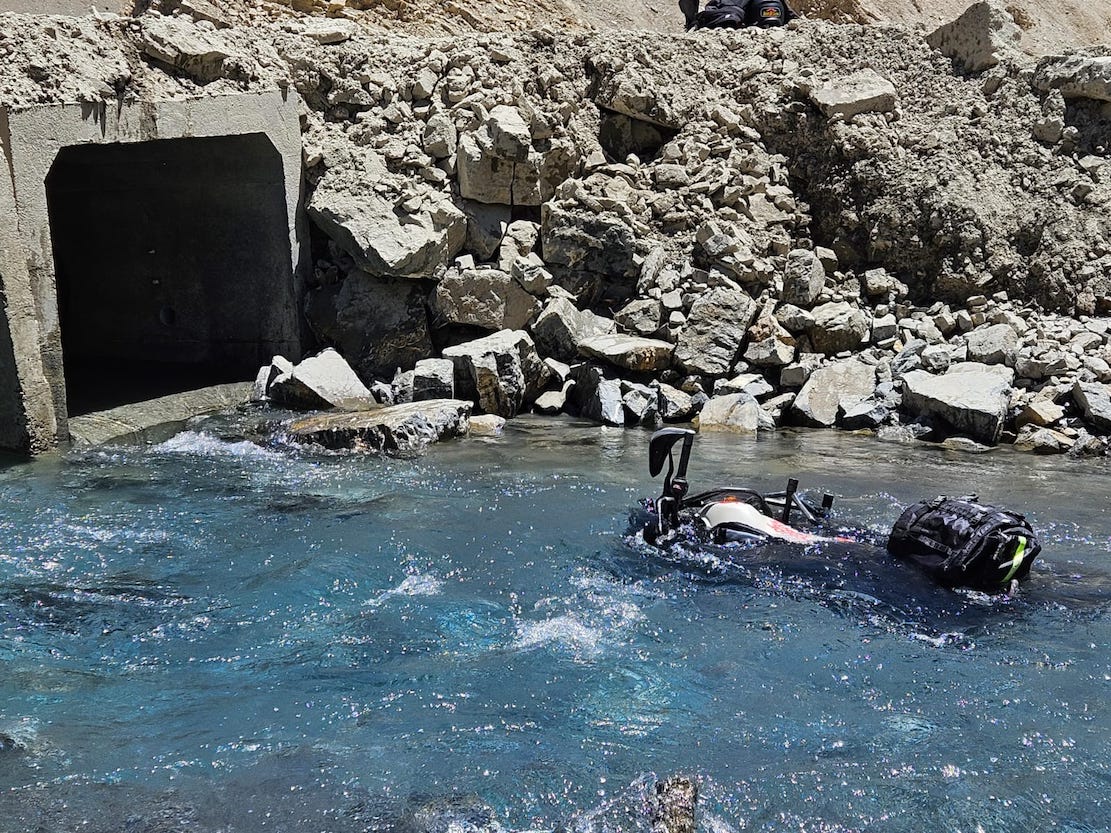
The clear screen is quite small but, being located fairly far forward, did a good job of reducing wind blast without excessive wind roar. Most of the time I didn’t use or need ear plugs although I put them in before a couple of relatively fast road sections, just in case. None of us had punctures and the only reliability issue was a dodgy fuel pump on Bob’s bike. Benny damaged his bike by riding off the road and into a water-filled culvert but that was not the bike’s fault.
New water-cooled 450 Him
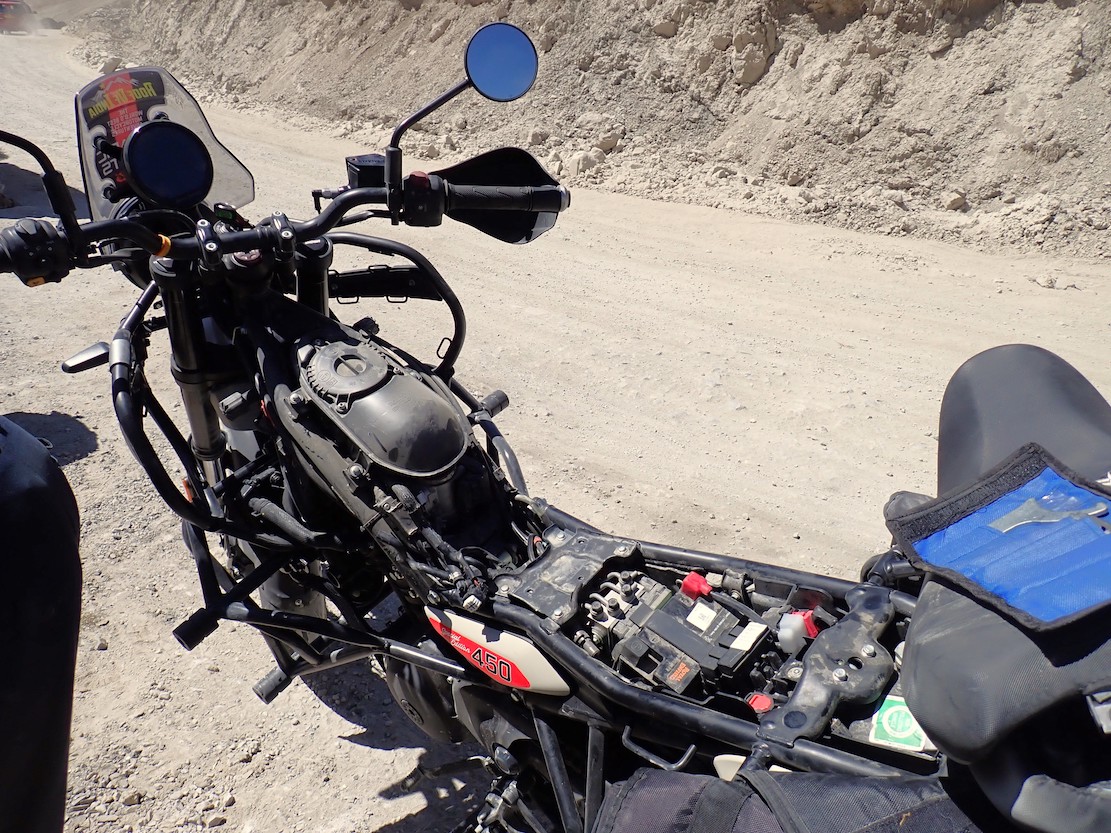
Royal Enfield had quite a large stand at the 2024 ABR Festival, which included a Himalayan 450 without its tank, seat, side panels etc. to make the frame more visible. The stand also included a sectioned 450 engine. The impression given by both frame and engine was of components relatively cheap to make, designed to last, and easy to work on, with a fine finish only applied where functionally necessary. It made an interesting comparison with KTMs, where components are made as light as possible and appear delicate and almost watch-like compared to their Royal Enfield equivalents.
I toyed with the idea of buying a Himalayan 450 in the UK and stripping off the tank crash bars, centre stand, etc, to reduce the weight a bit. However, I already have a Husqvarna 701 and I have no doubt that this would always outperform the 450 off-road. However, I also considered what would happen if relatively inexperienced rider were let loose on 701s in the Himalayas. I suspect it would be expensive carnage. So, for trips like the one we just completed, the 450 is just about perfect. Out of interest, the Himalayan has a similar weight and power to an old KLR650, which I rode across Tibet one time. So much for forty years of progress. Soon after the India trip, I rode my CRF1000L Africa Twin on two days of the UK ACT in Wales. It felt significantly more top-heavy than the 450 and, overall, didn’t appear to be as good off-road. Also, during the Wales trip, my friend and I had cause to pick up his Tenere 700 from flat on the ground. This took about as much effort as doing the same thing with my Africa Twin. Certainly the 450 has a lower centre of gravity than both the Japanese bikes and is easier to pick up.
So, in summary, I rather liked the new Himalayan 450. The Indians appear to have thought long and hard about what people need and done their own thing, rather than make a copy of somebody else’s design. I’m also getting more used to the way it looks and might still buy one.
While editing this post, out of interest I decided to click this option which has cropped up on WP lately (and in many other places like ebay): “Create and use an AI generated featured image for your post.” Below is what it came up with, presumably based on the post’s words and pictures. As bad as expected – or have I accidentally rendered RE’s imminent 650 twin Himalayan! Who knows but I won’t bother again.
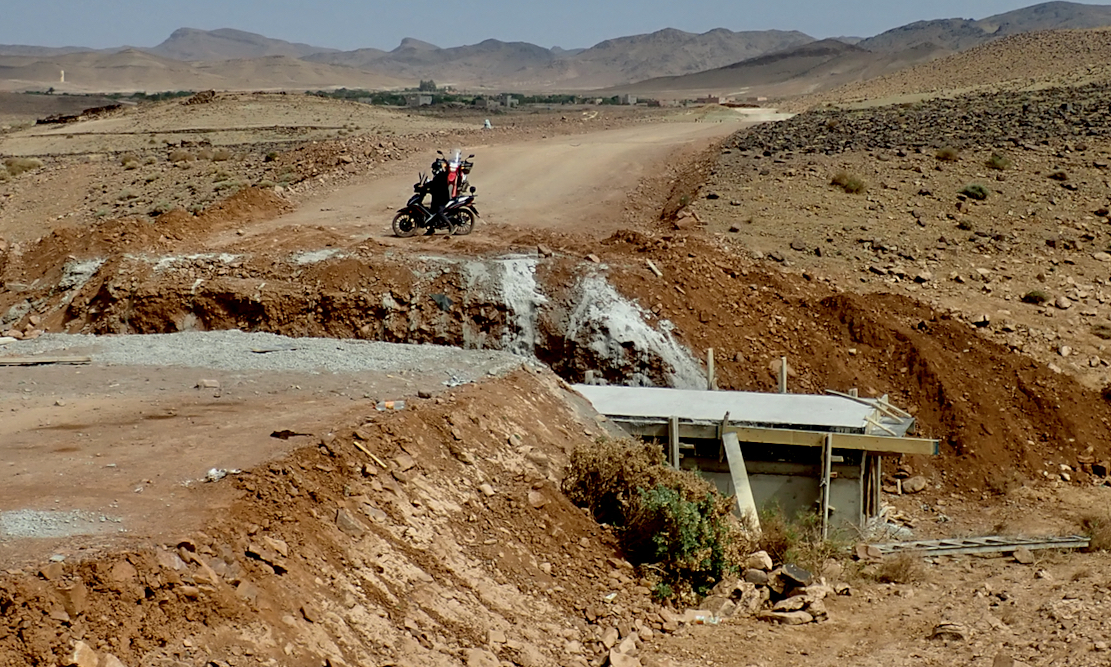
After a year of logging routes in southern Morocco – most intensely with several visits since last October (including occasionally renting 4x4s) – just a mile from completing my final piste on Jebel Ougnat I came across a pipe trench dug across the track that had yet to be filled in. They were improving this entire route but oddly, there was no way round this one. To one side, a local on a 125 had slithered down the steep bank and up the other side. I scrambled down to see if it would be rideable, and as I did so, a guy on a moped turned up, took one look and turned back (below).
Hmm. Would those planks take the weight of a jury-rigged launch ramp?
I cleared a few stones and figured I could do it, getting off and pushing if I had to. It’s always easier than it looks and anyway, I was one sodding mile away from finishing months of research. I wasn’t going to turn back now and mess up my final hard-won GPS tracklog! I managed it with ease, but it was the anticipation of tackling such rare obstacles – not least an exhausting riverbed in the Anti Atlas a few months earlier – which validated my choice of getting the 300L for this big Morocco guidebook update. Whatever its other shortcomings, the CRF was as light and lowered as practicably possible, while having enough power, range and protection, plus more than enough suspension and clearance to complete the task.
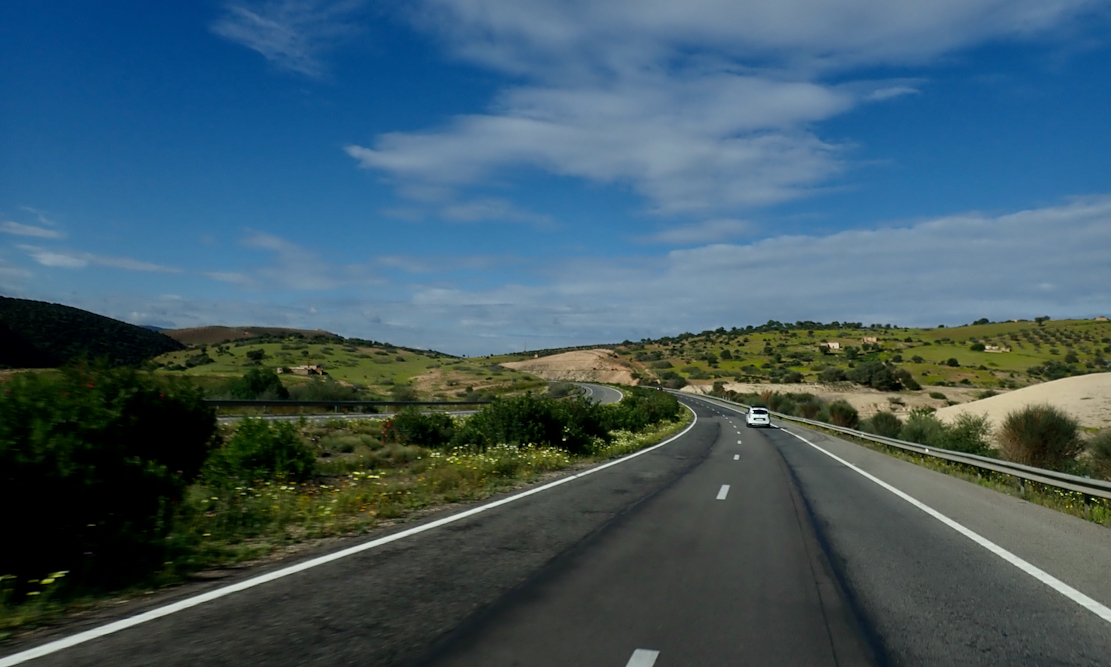
Full-frame greenery near Meknes. Quite a shock on the eye after a month down south
Another late revelation came on the ride back across Spain which I was dreading, principally at the thought of enduring saddle soreness while wanting to get the miles in with a ferry to catch. I gave myself spare days just in case, but came the day that agony never materialised. I got another agony instead.
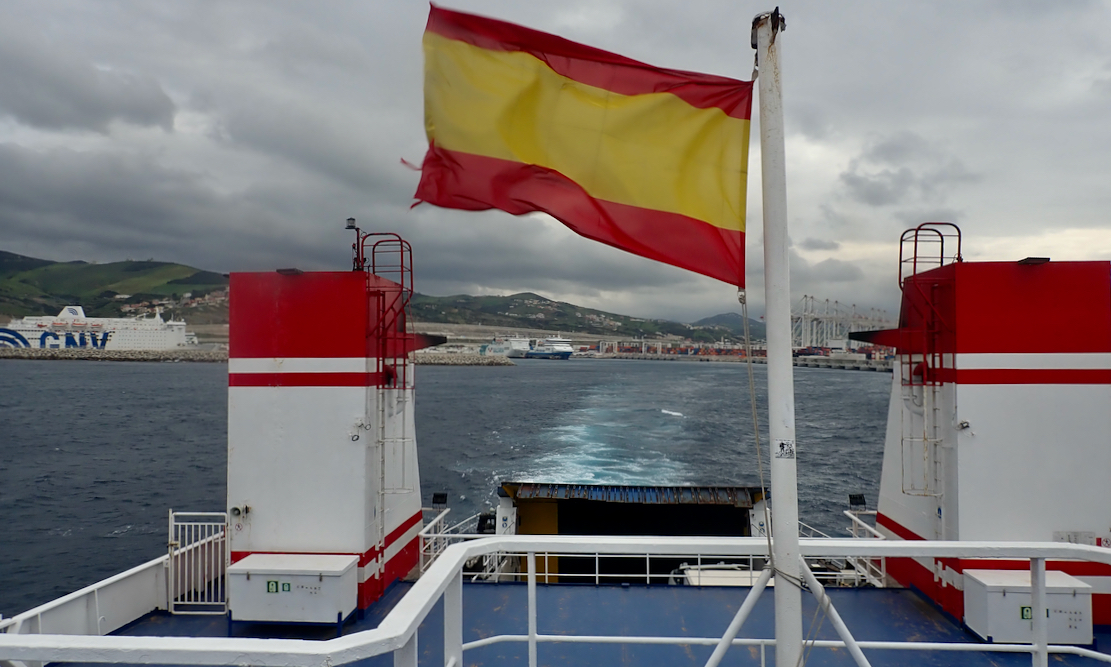
I’d had an amazingly good run this winter, often achieving more than I planned, but the turbulent springtime weather had broken in Morocco, with a violent overnight dust storm sweeping through Tinejdad. That meant I had to abandon a final high-altitude recce on Jebel Ayachi so, lacking the time to sit it out and wait, I may as well head home. I started with a 400-km day from the desert up to Meknes, covered it with ease and getting in just as a hail storm rolled off the hills and hammered at the hotel room windows. Next day, neither of the forecast heavy downpours (one said morning, the other, afternoon) materialised, so I whizzed past the Hotel Sahara in Asilah to Tan Med and caught the next ferry to southern Spain, ending in wind and rain to Alcala.
I’d underestimated the Honda and my ability to cover distance, so decided to put it all on red and next day went for 600km along the familiar and effortless A66 ‘Ruta de la Plata’ to Salamanca – effectively a deserted motorway. It was a gamble made easier by knowing fuel and leche bars were frequent, as well booking a couple of days at a roadside hotel in Mozarbez, while in a holding pattern for the Santander ferry. Unfortunately I didn’t anticipate single-figure temps and a numbing southwesterly. I was cold for the entire 9-hour ride to Mozarbez which ended in sleet at around 3°C. I arrived seriously frozen, but comfort-wise, had magically acclimatised to the CRF’s seat with the help of the Moto Skiveez.
Putting it all on red
I was grossly under-dressed for all this, recalling teenage biking sufferings when I knew no better. Increasingly desperate stops for fuel and hot food were needed. On-bike exercises – a new ploy – eased the long distances in the bitter cold and occasional showers, which saw me edging towards hypothermia. I rarely exceeded a true 100kph, but had the weather been what I’d hoped for in March, that 600-km ride might have been stretched to 700 or around 440 miles. A pretty amazing distance on a 286cc donkey. All you need to do is try not to ride for more than two hours at a time. That said, even with the strong southwesterly pushing me, fuel consumption was down to 70mpg/25kpl; an all-time low. (Fuel log here). Imagine what a CB500X would return holding a true 100kph in the same conditions? My guess is a lot more – or a much faster transit if riding at whatever 70mpg is – probably 120kph. This is the often overlooked payback with small motos. The only benefit is lightness, but of course that matters a whole lot when roaming around alone on the dirt. Sadly, you don’t gain good economy at highway cruising speeds as well. After >10,000km the 300L averaged a verified 30kpl / 85mpg / 70.8US. I tried but never quite managed to get a true 100mpg, but I think a lighter rider could. I was the slowest private vehicle on the Plata, inching past trucks while cars raced up to my mirrors, but the Honda did a lot better than I expected. Was I wrong about the 300L being a compromised travel bike?
Stepping back a bit The bike I rode home was a little modified to what I’d ridden out from Malaga in October. By now both tubeless wheels had been properly sealed with a continuous band of Puraflex 40 by the mechanic at Loc in Marrakech. I’m a bit slack on checking; turns out the tyres still lose a bit of air, same as I’ve found with proprietary sealing systems like BARTubless. But on typically stiff TL tyres, it has to get really low – 1 bar or less – for you to notice. It might be leaking from the bead/rim face and it might settle down. DIY TL sealing needs to be checked regularly, just like tubed tyres. Or fit TPMS.
Pic: Matt W
By now the stock-sized AX41s had worn out and I was running over-fatMitas E07s as that’s all they had in Marrakech. These bigger tyres – 130 80 17 and 110 80 19 – improved cornering confidence on the road and were fine on the dirt for what they are. The front did slip a bit more on the loose stuff than the knoblier AX41, but felt more reassuring on wet or dry asphalt. By the time both fat Mitaii had been fitted, the NiceCNC ‘Schmouba’ link didn’t lower the bike that much. And the Skiveez ended up the best all round solution to saddle woes. That and trying to stand more which is actually quite enjoyable until my insteps start to ache. Refitting rubber inserts into the pegs didn’t solve this; it must be my TCX boots or I need massively wider pegs.
The Rally Raid suspension hasn’t sagged that I can tell. The fork seals have held up amazingly, and the DID chain has been adjusted once in 10,000 miles with hand cleaning and lubing as often as practicable. The lame front brake holds me back from going full WFO supermoto in the canyons – well, that and a lack of nerve and skill. There’s still loads left, but I’ve ordered some EBC pads even though I may not reap the full benefit before the bike gets serviced and sold. I tried swapping the grips in a bid to reduce vibration at the bars, but fell for some ‘duo-foam’ marketing with no improvement. Perhaps fatter, Moto Gloveez are a better idea.
Sothe answer is no, I wasn’t wrong about the 300L as a travel bike. It’s still a 28-hp ‘300’, bought for on-trail lightness, not it’s ability to generate motorcycling joy as you pull away or power out of a bend. It’s about where you can take it with confidence. Thanks to the low first gear (resorted on fitting the same-tyre-ø-as-OE Mitas) the power is absolutely adequate on the sort of dirt I ride and loads I carry. But I bet most 300L owners have another bigger ride or two in the garage. Satisfaction may be found with something with a bit more poke, machine #65 I think it’ll be. As I won’t be off-road exploring so much and my skills in recognising what’s doable will have improved over the last year, the expected added weight of <200kg juiced up will have to be manageable, providing the seat height isn’t in the clouds. And ideally, unlike the Honda, it won’t need masses of added kit and mods to turn it into a good traveller for road and trail. What is that bike, you ask? Click this.
Writing up my 9000-km review over Christmas, I realised how much the Honda’s verified 35.2″/894mmseat height was bugging me. And it wasn’t just me. In 2023 Honda introduced a 2-inch-lower CRF300LS model, achieved by using slightly shorter suspension components. An appealing non-red colour scheme apart, it’s otherwise identical, though currently not sold in the UK.
According to the guy above, no seat foam was harmed in producing the LS: ‘Honda shortened the suspension…’. But he then goes on to say ’rear travel is reduced by 1.2”’. Does he actually mean shock length is reduced by 1.2”’ (to make 2” less vertical travel)? Probably. Riding the trails, my suspension travel is way more than I ever need – an LS would have done me nicely – though once compressed the height’s rarely an issue unless I tackle technical terrain. Very occasionally the back bottoms out as it should; the front not yet. With me it’s more the getting on and off, which I do a lot of and gets more tiresome as the years pile on. Along with comfort, these two things hold back my enjoyment on the L. Fitting the 17/19 wheel combo didn’t lower the bike significantly.
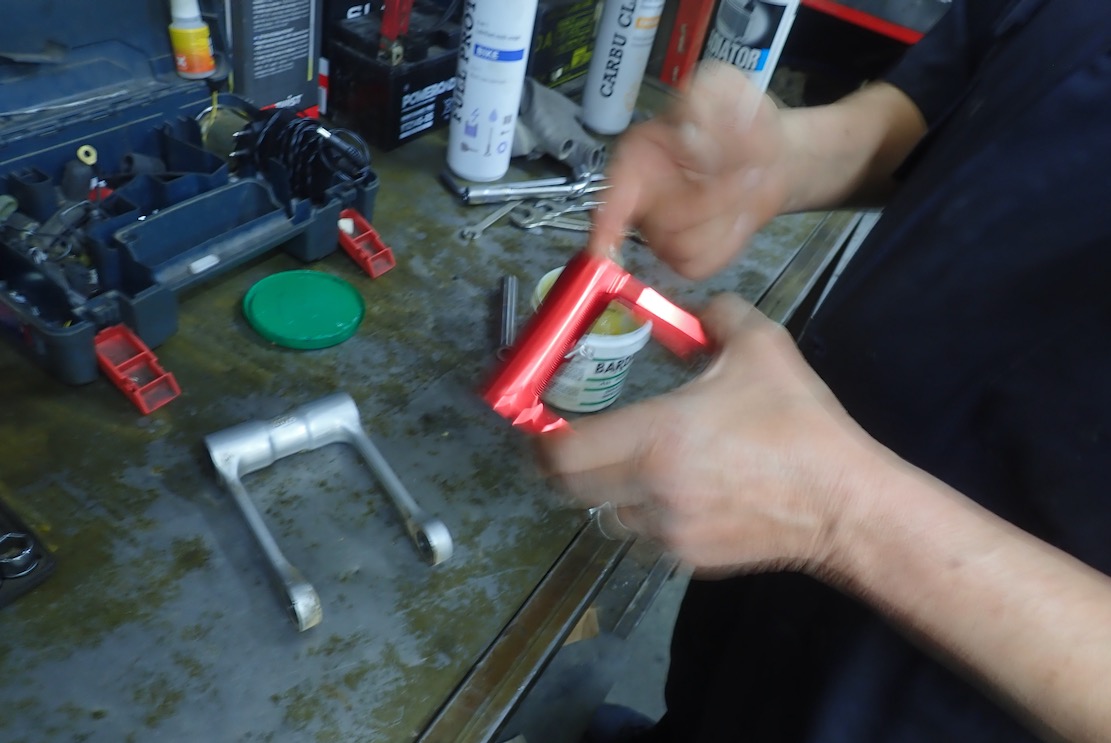
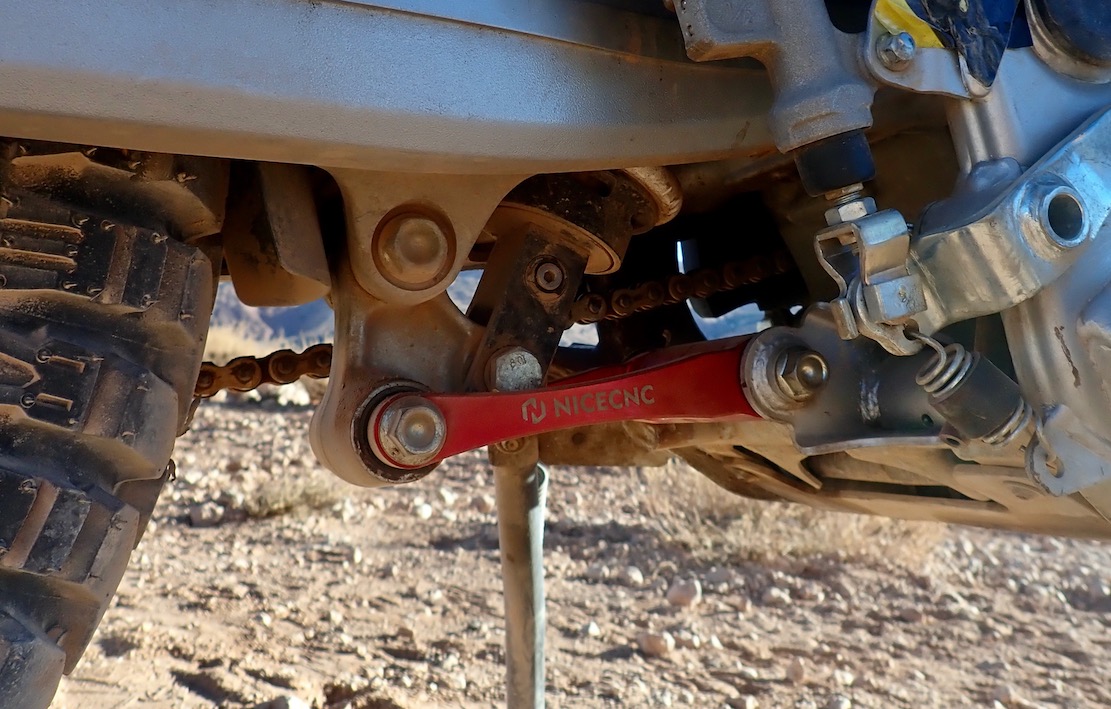
So I bought one of those suspension lowering links which I’ve read about for years. I recall my KLX had a clever adjustable link. US-made Kouba Link is the well known brand, but costs nearly £200 in the UK. I settled on a similar looking ‘Schmooba Link‘ off ebay for just £42 with the same needle bearings and grease nipple. NICECNC may be made in China but have a decent-looking website and a huge range of parts. They say these links can mess up the carefully mapped factory linkage ratios working on the shock spring. That may be an urban myth or something that only applies to performance-sensitive racers. The link swap took just 10 minutes with a helping hand of Larbi in Marrakech.
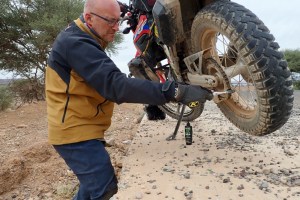
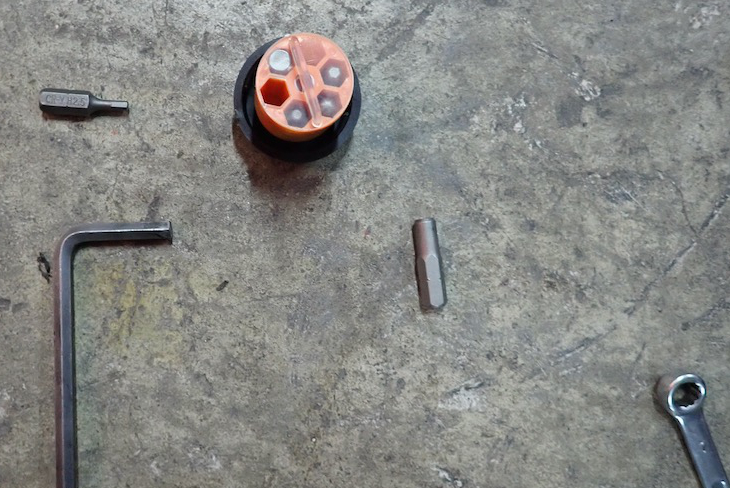
My Schmooba claims to lower the bike by 1.75″ (44mm; identical to Kouba) which is a bit more than I need, but tbh it didn’t look that much lower. Once fitted, I jacked the Tractive shock preload up a turn and a bit. What a faff that is. The shock is clearly made for an HPA and not manual adjustments. The job is made harder with the need to loosen a grub screw locking the preload collar in place. The supplied multi-bit tool has a 2-3mm bit to get in there (left); you then need a 5mm spanner to turn it, as long as the screw is in an accessible location.
There is no crenelated preload ring to hook with a c-spanner, but a series of holes in the collar, like on a wagon wheel hub (above). The multi-bit tool is too short and bulky; a 5mm rod or screwdriver works better, you inch the ring round; it’s easier on the RHS, and I found it best with a 5mm L-shaped Allen key and an additional extension/lever. Give it all a squirt of WD40 too. It takes about 12-15 micro-adjustments to get a full turn of the collar. I kept going until the annoying grub was accessible again and hope that’s enough.
Of course the forks need sliding up the triple clamps to match the rear drop – easily done. But without risers, the stock height bars limit the drop to about 25mm. So 25mm it will have to be; I hoped the jacked-up shock would compensate for the now moderately raked out fork.
RRP <20mm
If you’re lowering your 300 you’ll need a shorter side stand. RRP do 20mm shortie for £88. Or so I thought. With forks raised and link fitted it actually didn’t lean too bad. It turned out a new oversized Mitas E07 tyre on the back raised the bike back up an ~inch. Then, offering up the RR short stand, it turned out to identical. Have I been on a short side stand all this time or did they send the wrong one? Oh well, one less job to do.
Fatter Mitas 130/80 17 TL E07; actually a good idea.
Is an OEM stand for the 300LS on Partzilla US shorter? Two are two stands listed but which was which? Knowing that the 300LS model code is probably CRF300LDAABS is helpful.
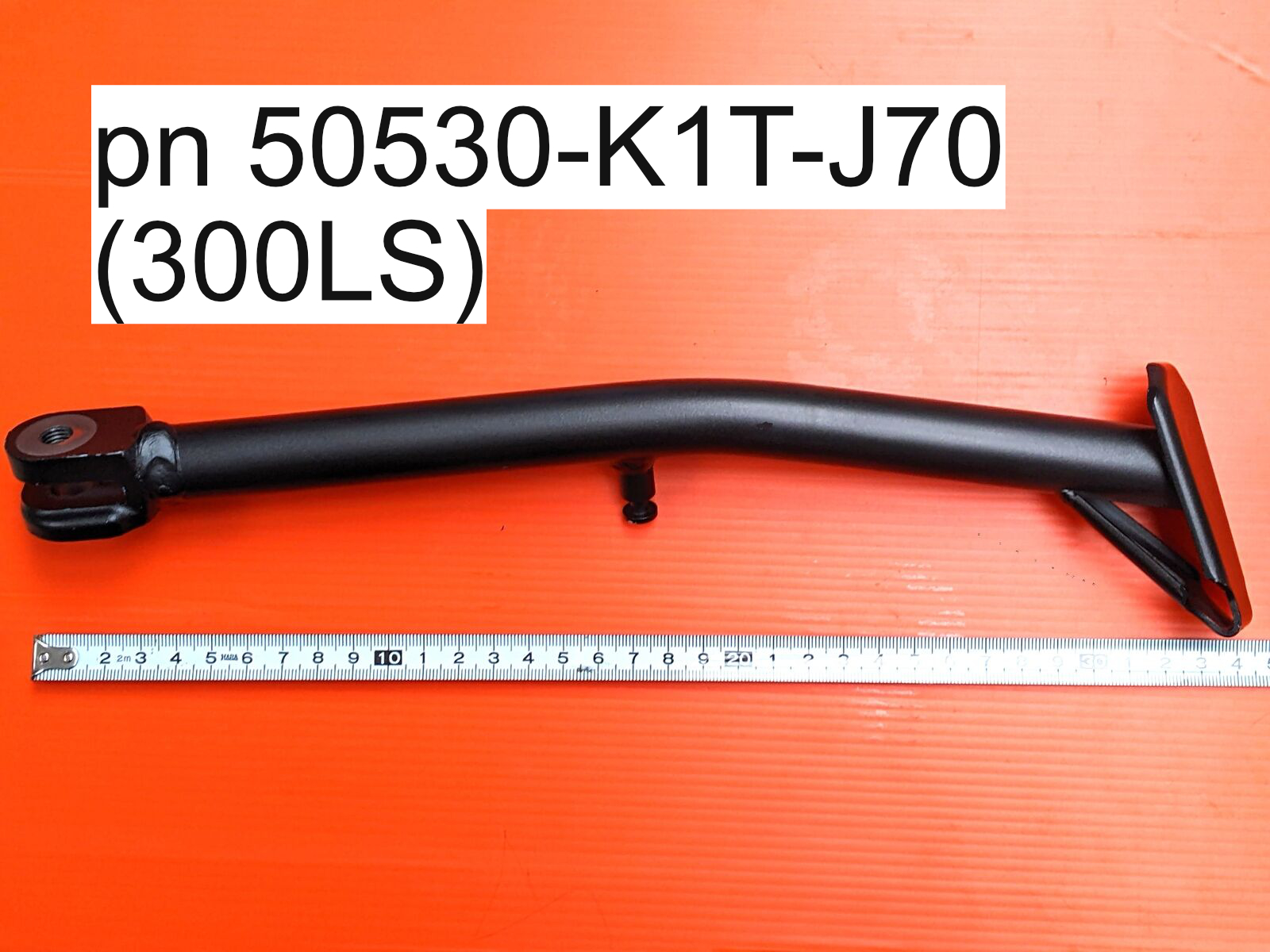
Lowered 300LS CRF300LDA ABS side stand: 50530-K1T-J70
My bike 300L ABS side stand: 50530-K1T-E50
In fact a -J70 shortie is bent; the normal height -E50 is straight. And if you look up 300LS reviews online you’ll see they have a bent side stand, unlike a normal 300L, even though the Honda parts fiche shows a straight stand for both parts. Hence my fiche confusion.
300LS stand is bentBut appears straight on the fiche
A J70 is discounted to $35 on Partzilla US. In the benighted UK an E50 is £48 but I actually got offered a bent J70, which was actually what I was looking for. Fascinating a?! But wait, there’s more! A bent J70 is shorter. The reason it was bent because a straight stand on the lowered LS might drag on full suspension compression. So it seems Honda bent and shortened a stock 50530-K1T-E50 to make 50530-K1T-J70 for the 300LS, but online fiche images appear identical.
Now, about an inch lower, I can afford to take some of it back with some neoprene seat padding, as before. But first I tried a pair of Moto Skivvies (review) – padded undershorts made for motos not cycling. I’ve known the name for years but the 300L has pushed me over the edge and into their shopping cart.
Loadsa legbend
Riding the lowered bike By the time I’d jacked up the rear preload a bit and had a 130/80 17 Mitas E07 fitted, the bike didn’t feel a whole lot lower. Measured, it’s now33.5″/851mm with the forks raised up in the clamps all the way, so almost exactly the 1.75″ claimed. For the next 4000km over a month, the bike rode the same on the dirt; maybe a bit better all round with a fatter Mitas all round (now properly sealed for TL by the mechanic).
Getting on and off still wasn’t a whole lot easier. I use the footrest where possible, but having the tail pack on the side would ease a leg swing. Thing is, a tailpack is so darned easy; on/off in 4-5 seconds with a pair of Rok Straps. No other actions required and no side-panel scuffing.
The suspension still works great, just like it always did. I think the taller tyre may have touched the mudguard on one or two bottoming outs. I have to take a little more care when stopping and putting the stand down, but all in all, an easy, inexpensive and recommended mod if your stock L is giving you nosebleeds.














 Adventure Motorcycling Handbook