Here in the south of England, 2012 had the rainiest April and June ‘since records began’. It hardly ever rains in the southern UK these days, but when it does I still can’t resist looking out of the streaming window and delight in the fact that I’m not out riding for a living anymore. Although, in a way, I suppose I still am.
I still recall a despatching June in the late ’70s or early ’80s when it rained every single day. At some point every day of that month I had to haul myself into my plastic body sack and splash about the streets of greater London, delivering stuff. I still hate wearing waterproofs any longer than absolutely necessary, but if you’re riding 10 + hours a day you’ve got to at least try and keep dry.
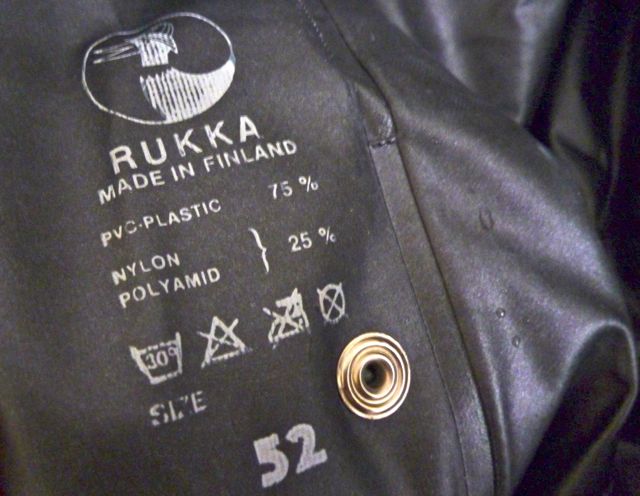
EU52 = UK 42″ chest. Caveat emptor.
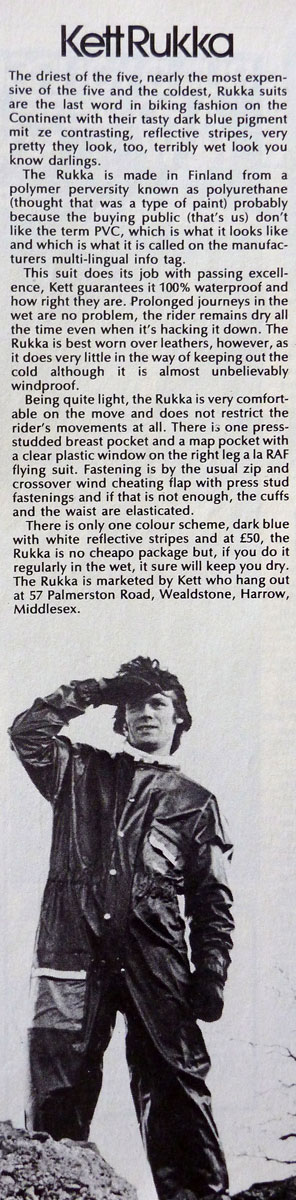
Back in the late 70s, before Gore Textiles pulled off one of the biggest illusions in the history of rainwear, London despatchers by choice wore the classic silver-grey Rukka PVC waterproof, most commonly the lightweight jacket, or the one-piece (left). Have a look at this gallery of despatchers from 1986 and spot the Rukkas.
As elegantly cut as you can expect, neither took too much space in a top box, nor constricted you too greatly once worn. I myself was too dim or tight to make this smart choice; I can’t recall what I wore, either a £5 trawlerman’s PVC smock, or a compressed polystyrene, one-piece balloon which, when allied with the ring-ding-ding of my MZ, would quite rightly irritate nearby drivers so much that they couldn’t resist taking a swipe at me just on general principles. On the right: 1980 review of the Rukka one piece from Bike magazine.
PVC seems to get singled out for not being ‘green’ but it is waterproof like a bottle of beer is beer proof. If it has a hydrostatic head, like proofed nylon or polyester tent fabric, it would be measured in miles, not inches. Of course PVC breathes as well as a canary in jam jar and so what you perspire stays locked in your own muggy microclimate which I grew to detest, especially when schlepping artwork up to the 5th floor with no lift to some receptionist that I thought I fancied.
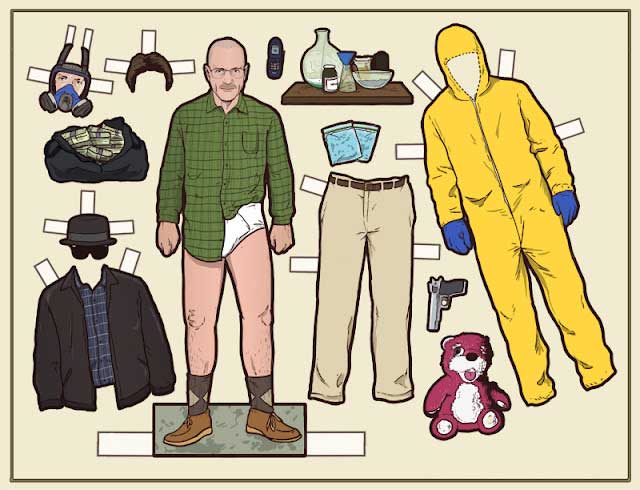
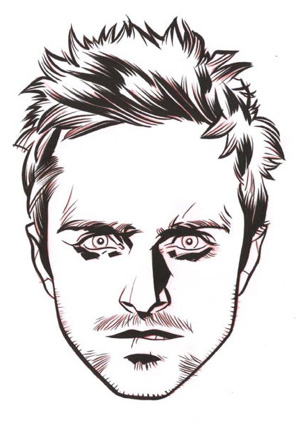
Actually I’m not sure it was just the inner damp that put me off. My sartorial vanity could also not bear being swathed in the amorphous, baggy blob. Whatever I looked like, it certainly wasn’t Tom Cruise out of Top Gun. More like Walter White (right) suiting up prior to cooking up another batch of Blue in the superlab.
Now I’ve finally caught up with my sodden past and picked up a used Rukka one-piece off ebay. First one at EU52 was too tight as an oversuit. I wore the legs only with the top wrapped underneath my waxed Falstaff jacket through a 3-hour downpour and from the waist down at least, I wasn’t surprised to get home completely dry.
Who says men are crap at buying clothes, but I now know EU52 equals UK chest 42 inches – a common trap when buying Rukkas. So I sat on ebay until an XXL EU 58 turned up (left). Loads of space to easily climb in fully clothed with boots on without stressing the welded seams.
Construction-wise, what a great garment it is! I don’t know when they stopped making them (now they only produce dog cags in probably the same PVC polyamid fabric), but let’s assume my one-piece is from the 80s. The material is still pliant, the leg map pocket has yellowed but other than that, the studs are all still there, the half zip runs smoothly and you have an overall feeling of quality that I’m not sure you’d get today in the similar, proofed-nylon one-piece suits. PVC is thickly layered from the outside and is easy to repair with glued patch or piece of tape.
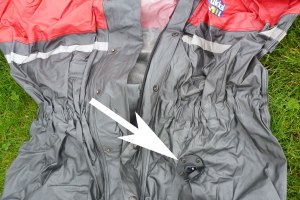
The front of the Rukka one-piece has an ingenious sewn-in, chest-high tongue/bellows (above), a bit like a hiking shoe, to eliminate anything getting past the studs or zip, bringing on that unwelcome cold-drip-in-the-crotch sensation. It rolls up and tucks in behind the studs with a zip, effectively making a chest-high Not sure if anyone still makes anything like the classic Rukka. Cheaper proofed nylon seems the current way, and what Rukka make today for bikers is the usual over-designed, over-techincal and over-priced gear which, being based on breathables, will fail in the long run and requires special cleaning. One problem was running my Aerostich Kanetsu electric vest without wires coming out the sleeves. Solution on the left below and detailed here.
If you’re looking for used Rukka pvc on ebay they usually turn up in great, barely used condition as anything less is barely worth selling. Avoid anything heavily repaired, dirty or with rusty studs.
And also search under ‘Protectorl (of London)’. They seemed to make identical garments in blue – same fabric, quality and era. I came across a brand new Protectorl lined jacket for 25 quid (abov) but again, it was a little too small. Both brands come with quilted linings. Me, I prefer unlined to roll up into a compact waterproof for rainy days only. My onesie weighs 1300 grams. The day I start wearing a Rukka as a regular bike jacket is the day I start eating with a spoon.
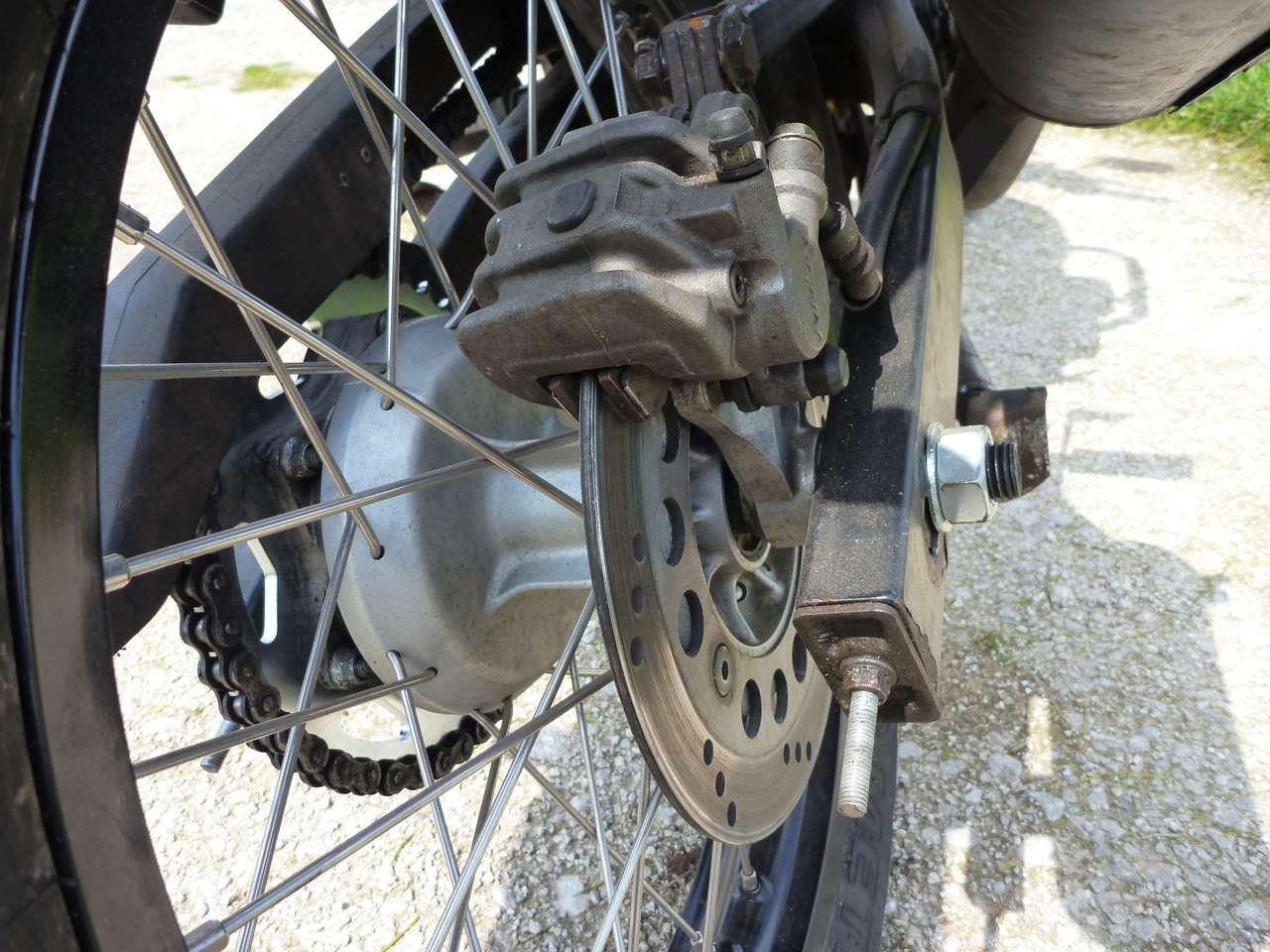
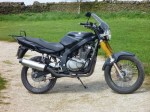
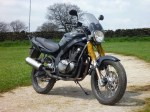
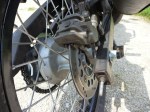
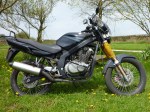
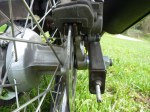
The GS500R Overlander project bike is taking shape, although it’s not quite a fully set jelly. The critical mod: adapting the rear DR650 hub and brake to fit the donor bike’s swing arm and chain run has been completed pretty seamlessly by Matt and his team of farmyard engineers (see pic below).
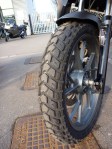
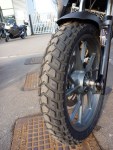
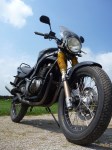
I know what you’re thinking: why does the front tyre look fatter than the back – is it the camera angle? No, it’s just that at the time I didn’t want to waste money on new 19-inch tyres in case the GS turned into what the French would call, unpiège de mort. So I bought used cheapies just to get the thing rolling, first for the front, and a while later another for the back which was not identical. Just as well really, as following my recent Morocco trip I’ve discovered that Heidenau K60s are the ‘bomb’, as the bloke on the right would say.
Half-built impressions of half-baked bike It took a bit of firing up off Matt’s V8 Landrover offroader to get the GS running while whipping out a plug to dry and blowtorch. Even then the GS didn’t seem to run well. Was there a badger nest in the air filter? I could barely pull up the track to the road, and while slipping the clutch mistakenly thought it was because the gearing was way off. As with most things on this build, we took an educated guess here, but at 42/16 the gearing’s actually turned out to be in or around the ball park.
Running down to the village to top up on fuel I thought, jeez, this 500 really is a lot slower than the BMW FGS650 twin I’ve been riding lately. Of course that bike has got at least twice the horsepower and 20 years of development on the G. Heading back, the weight of that extra tenner of unleaded in the tank saw the bike struggle to escape the dale. Something was not right. I pulled over and pulled off the left plug cap – no difference. A ha! as the bloke on the right would say. A little bit of fiddling with the plug cap got past more cobwebs, the second barrel fired up like a Saturn V and suddenly the GS500 was running like… a GS500.
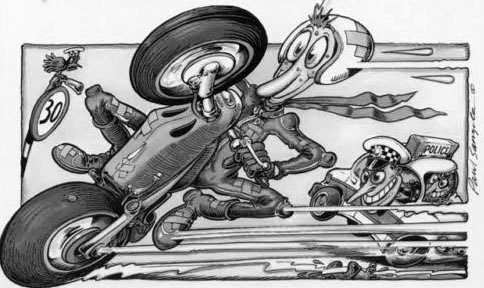
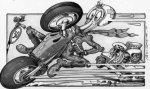
I tore off up the lane like a teenager on his first moped, awestruck at the feeling of raw power. Like Ogri’s beaky-nosed mate Malcolm (left) I was heading for a prang, so it was time to consider braking. The DR650 front end’s disc had been binding a bit as the pads off one scrapped DR got to know the disc rotor from another. A quick check at the fill up proved that the rotor wasn’t getting hot and causing the lame performance. In fact, yanking the lever did see the forks dip hard in response so it can get there if it has to. I guess it’s just not the quality of braking I’d got used to while running the 2012 BMW. The back brake was considerably slacker, partly we suspect because the DR650 calliper which had to be used to clear the Talon spokes, may not compliment the bore of the GS’s master cylinder. So the back brake is mushy and with a long throw. Maybe a bleed or a braided hose will bring it round, or a master cylinder off a DR.
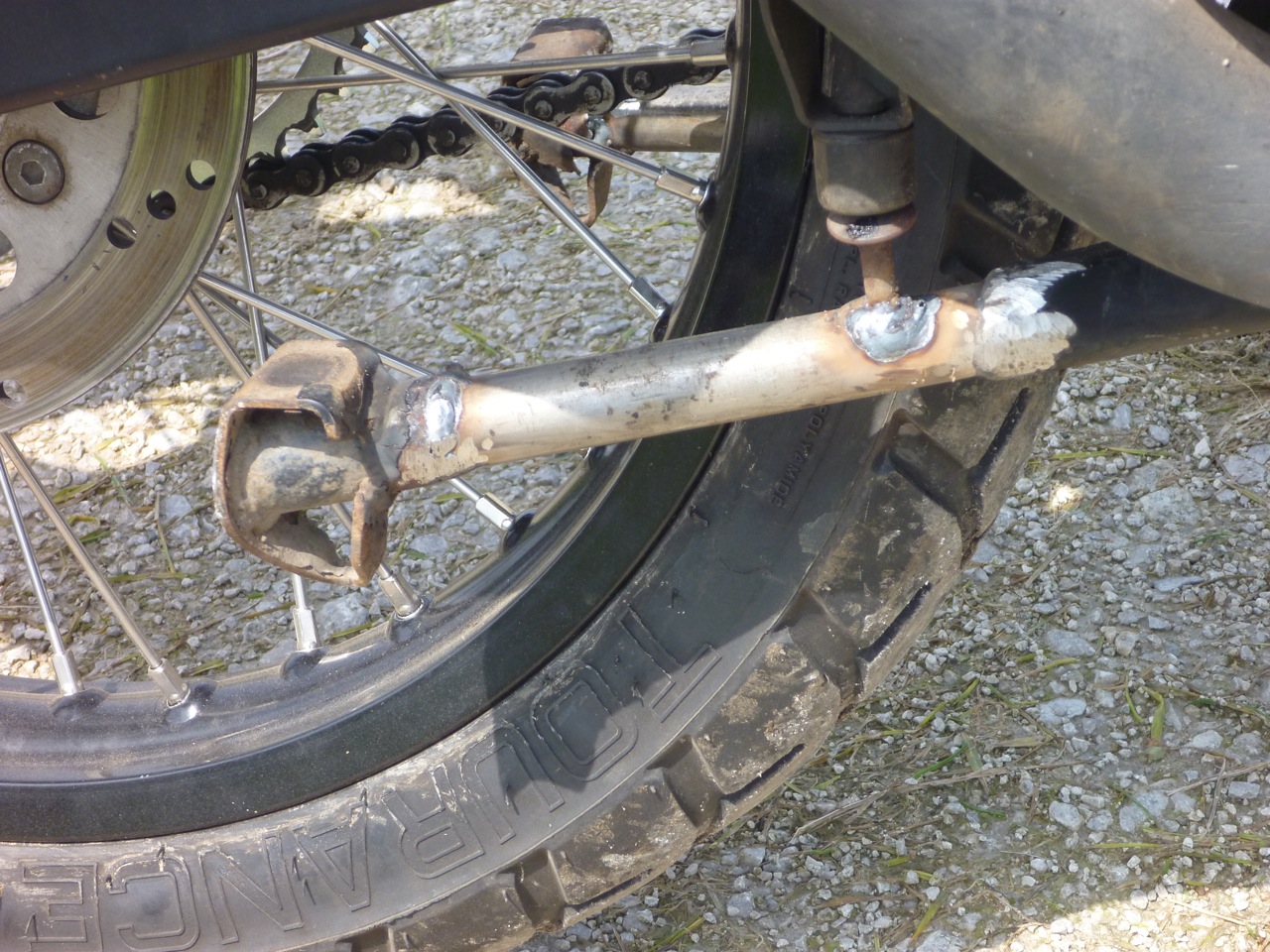
Another problem. The main stand had to be extended by several inches (right) and it now takes an extreme heave to get the bike up; not something I could see myself being able to do with baggage at the and of a tough day on the road. The feet are now clearly too far back from the pivot point for the factory-set leverage. And yet it’s as long as it needs to be, lifting the back a couple of inches off the deck, like a normal stand. Curved stand feet could get round this.
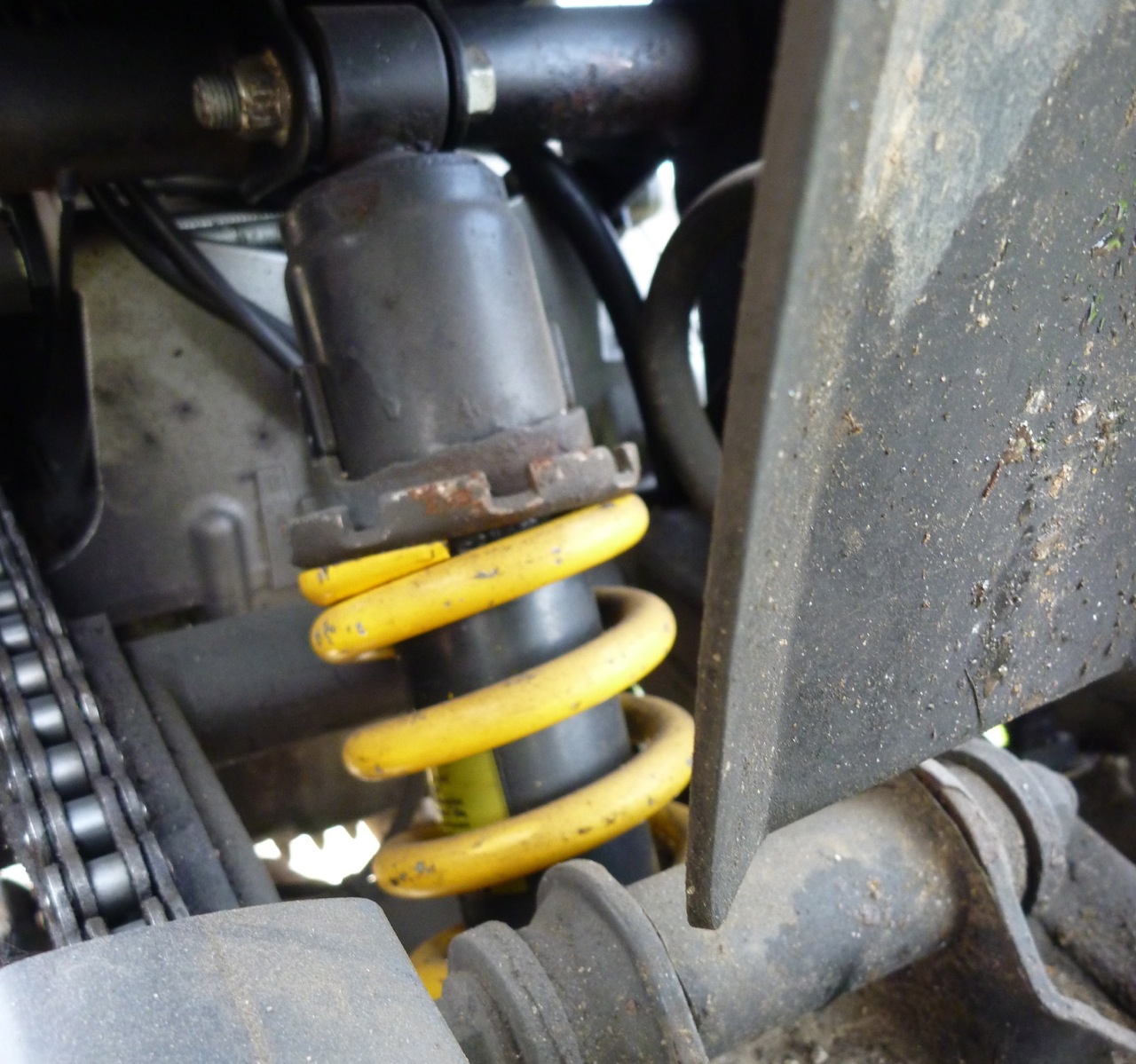
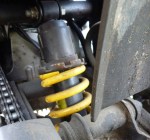
But in fact when I think about it, the GS is a bit too high; I can’t get my feet flat on the ground. With the new suspension and the 19s it’s probably jumped up at least four inches judging by at the extended stand. I really appreciated the BMs low height on the dirt in Morocco and am not looking for masses of clearance on the GS-R. In fact this will be easy to modify: slide the forks up the clamps and back the shock off max preload where it is set now (left). Didn’t get a chance to do all that, as it was a flying visit to the Mattlabs.
Steering feels a bit slow too, but I think the height may have something to do with that. As it is I don’t think the steering of a regular GS500 would get a job in a bread slicing factory. Getting used to the bike and modulating suspension levels may fix all that, and anyway there are new tyres to come. The dirt bars too felt a bit narrow for my liking, or no wider than stock and maybe could do with a lift. Again, easily done. It’s hard to tell if a thinner back tyre greatly affected the steering or ride, not having ridden a bike with back-to-front tyres before. My plan is to run identical-sized tyres front and back. One thing’s for sure, the seat feels great, although as mentioned earlier, the rear-set pegs could stitch the knees up on a long day – and that could be crippling. So maybe some sort of highway peg off the crash bars will work. One good thing, even though it’s tall right now the GS feels pretty light for what it is and a good 20 kilos lighter than the BMW GS650 which was at least 200kg. Might try and weigh it one time.
What’s left to do Once the above mods are seen to Matt the Mig or Andy the Arc are going to fabricate a rack, but not just another off-the-shelf, too-far-back, 18-mil loop jobbie like I used on Morocco on the BMW. Something as securely mounted, but with a hinged or somehow retractable platform plus a ‘sheep rack’ platform on the back – always handy. That way the pans can sit rather than hang – a much better arrangement for an overland load, IMHO.
I was going to fab’ some PVC pannier liners with a heat gun and roller, and a mate had offered to sew me up some Cordura outers. I would have kept the Monsoons I used in Morocco if only they had been my ‘Fibonnacci shape’: less wide, more long and bigger, but since writing this Adventure Spec have started selling a ‘Magadan bag‘ with input from Walter Colebatch and based on the Steel Pony Gascoyne he’s used in Russia and a bag whose dimensions I’ve admired myself, if not the canvas fabric. If all the hard work’s been I’m be happy to order me a pair.
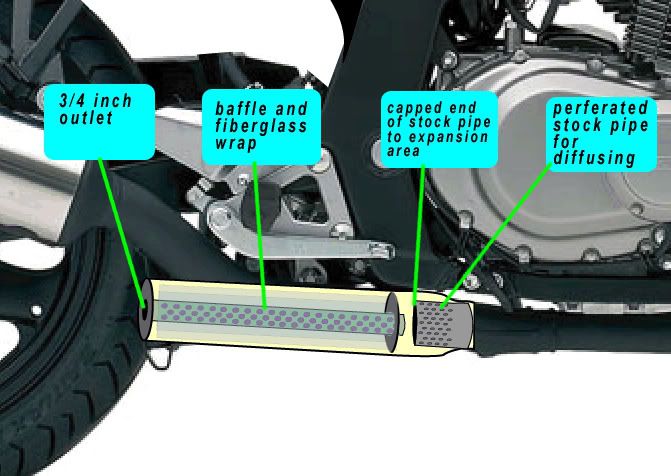
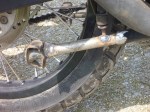
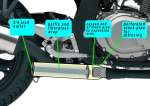
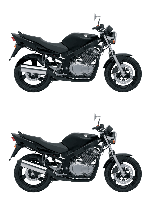
One thing I was also thinking of is junking the fat OE pipe and fitting something like this (right). A cheap ‘one-size-fits-all’ mega can be bought of ebay for 30 quid but I’m not 17 anymore and couldn’t bear a loud pipe or unravelling all the jetting and valve-burning issues. It seems the GS muffler only weighs some 5 kilos anyway so if pannier space is so important why not just chop the regular pipe at the neck and drop the angle as in the gif below. It’ll be good to have the bags in close and the pipe underneath, and its an easy job, giving what, at least four inches more bag space. After my over-width Morocco experience and seeing how slim the GS is, it would be nice to keep it that way.
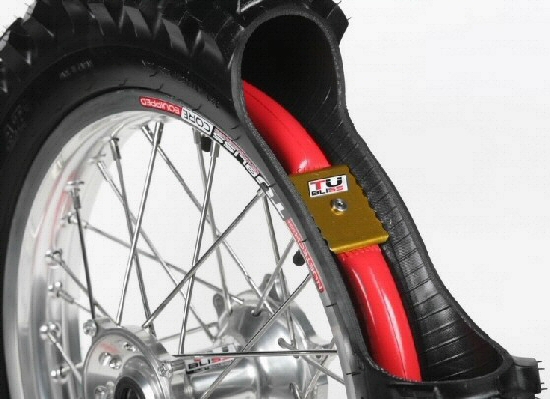
Anyway, I’m off to the Overland Expo in Arizona in a couple of weeks, a great chance to pick up some goodies in the US, including a pair of Tubliss liners (left)which enable you to run tyres tubelessly on spoked rims. As you may know, I tried doing that before without complete success.
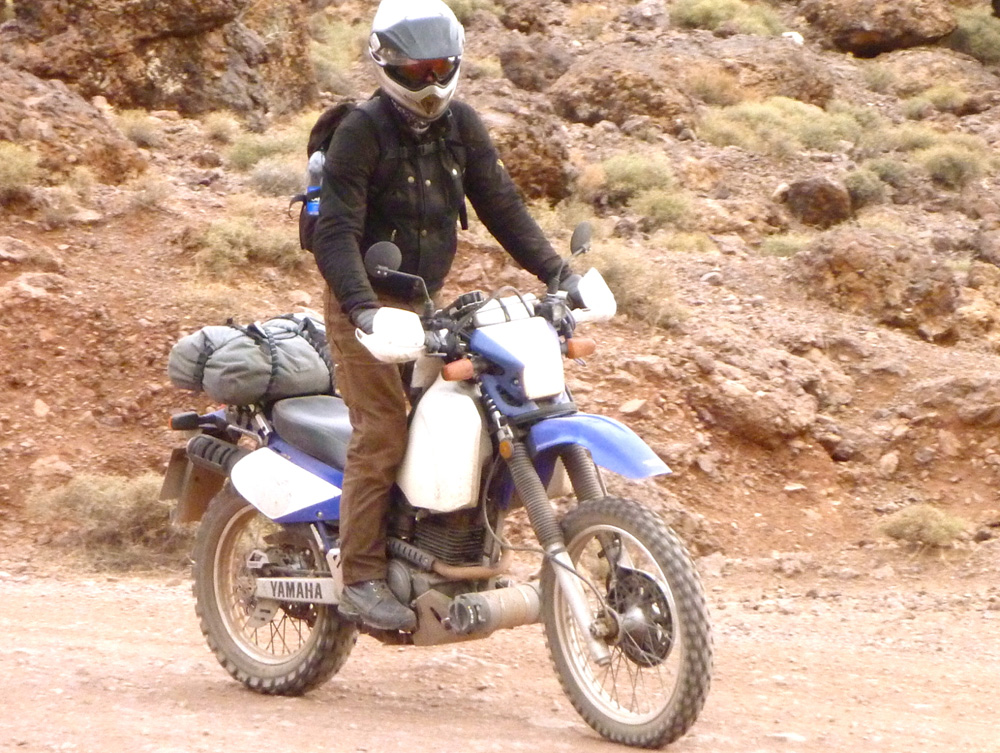
I know Tubliss are said to be for off-road use only, but I’ve interpreted this to be an issue of legal liability on the pubic highway rather than anything to do function or real-world safety. Robin, with whom I rode in Morocco last month has run Tubliss on his TT250R all over the world for years (that’s him right with all his kit – including full camping gear).
A meekly powered GS500 with a modest payload isn’t going to tie the tyres in knots. I plan to fit the front 110/80B (59 T) K60 Scout (my review) I used on the BM in Morocco (left) and another new one for the back. The 100/90 57 H is a tempting 30% cheaper and still with a load index 230 kilos and a 130mph rating, neither of which the GS will see in its lifetime, but I’d need two so I’ll stick with the wider 110/80 at another 100 quid.
IN A LINE
Chunky, well featured waxed cotton touring jacket, but fabric coating may not suit everyone and mine leaked through the arms.
WHERE TESTED
From new on a 4000-mile ride to Morocco and back across Spain in Spring 2012 riding a BMW F650GS SE. Worn around Britain since.
• Plain, elegant design
Fits me just right
Well thought out features: velcro belt, vents, storm flap, chunky two-way zip, water-resistant zips on outer pockets and vents – and no less than 12 pockets
A rugged organic compromise between leather and Cordura
Feels more windproof than Cordura
Wax coating feels mucky and soon acquires a grubby, blackened patina where it wears on itself
Leaks through the velcro arm-cinching straps
Soon loses it good looks from new and can’t be washed
Less good in temperature extremes than alternatives: stiff when cold and sweaty when hot and humid, but bulky cut enables layering
Heavier than a Cordura equivalent
Abrades less well than Cordura or leather when sliding down a road, although the protector pads are more useful in most crashes
COST
Aerostich Falstaff page. Only sold in the US, as far as I know. This jacket was supplied free in return for Aerostich advertising in my books.
DESCRIPTION
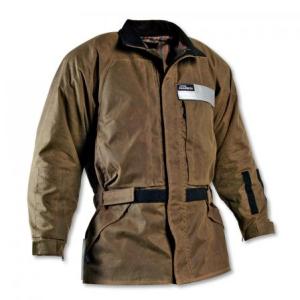
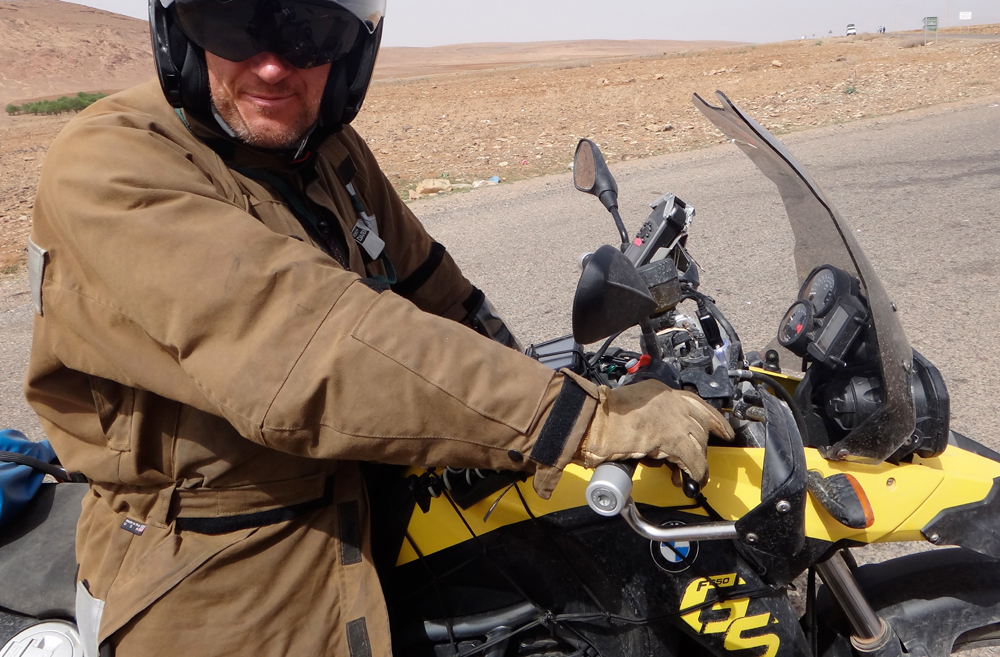
The fittingly-named Falstaff evokes a solid British tradition and is Aerostich’s only waxed cotton jacket, cut to their classic Darien pattern in a dark tan waxed cotton. Inside is a tartan or plaid cotton lining that’s de rigeur with waxed leisure clothing. The Falstaff has under-arm and a back-width vents with water-resistant exterior pocket zips and pockets galore, large and small. I was still finding new pockets weeks after receiving it. I read that the Darien is a baggier and longer cut to Aero’s other popular suit, the shorter and closer fitting Roadcrafter which you commonly zip to Roadcfrafter pants. Like all Dariens there are elbow and shoulder pads and I was also sent a spine protector, but preferring a less bulky jacket, I didn’t take any of these pads on my ride to Morocco. There are four 3M reflective patches too, though you can specify ‘no reflection’ for a subtler appearance. (I read that France now requires riders to have a certain area of reflectiveness on their clothing – hopefully no more than a typical ‘Stich jacket). In fact with Aerostich you can specify any mod you like – with a few clearly labelled exceptions it’s all made in Duluth, MN and they’re happy to oblige. Great customer service plus the cool cataloguis one of Aero’s hallmarks. The size I have is large which weighs about 2.3 kilos or just over 5lbs without the padding. Though I read complaints in reviews about short arms, they were just fine on me.
REVIEW
The Falstaff replaced my 9-year old Aerostich Darien Light. There was nothing wrong with my little-used DL, but I fancied a change and wanted to see what was new and so gave it away a an auction for the Ted Simon Foundation. On the big night my DL scored the second highest bid just behind Ted’s famous Jupiter’s Travels open face helmet. Before the Darien Light I also owned a Darien which is identical but made from a heavier Cordura fabric. I used that in BC on a very rainy ride, but found it a bit too stiff (they say they do give over time). Scanning the web for a replacement in the understated and functional Darien style was much less successful than expected. Obviously there’s plenty of cheap stuff out there, but also too much over-designed or over-priced gear for my taste or wallet. And then there’s this new trend for separate breathable liners that you wear if it’s raining/cold, or not if it’s warm. That means the outer jacket gets soaked or ‘wetted-out’ in rain which makes the inner liner’s job of breathing through it all the more difficult. As it is, I suggest in the new AMH that I doubt membrane type clothing works that well when applied to relatively passive motorcycling; sitting still in the rain at 70mph is less effective in getting the membrane working than hiking up a hill which produces sufficient energy to purge the built-up moisture as the active body generates heat. I suspect this separate breathable liners trend is nothing more than a cost saving measure that’s being sold as a ‘have your cake and eat it’ option, but I’m happy to be corrected on that.
Anyway, after an afternoon’s browsing, on looks alone I think I was heading towards a Dainese Evo or whatever cropped up used in my size on ebay when Aero offered another Darien. I like to keep trying new stuff as it’s good for the book so after some discussion we settled on a Falstaff – an ‘organic’ Darien. So you know, the Falstaff and other gear I get from Aero is a contra deal in return for an advert in my AM Handbook and associated titles. Having worn waxed cotton Belstaff clothing back in the 1970s and avoided it since, I was a bit ambivalent about going down that road again with the Falstaff but hoped things may have changed. My recollection was a robust-feeling material (compared to a regular nylon Belstaff of the era), but with a messy coating that left indoor smears on my mum’s prize-winning wallpaper, felt unpleasant to touch and was not so snug in the cold. This was all just before the Cordura + Goretex revolution in moto clothing. Out of the box the Falstaff looked great – I like that tan deserty colour, what a shame it’s now mostly gone under an oily brown patina. The fit too was just right for me once the TF3 pads warmed up.
A functional touring jacket has to be at the core of your overlanding gear; a place to stash stuff and feel protected from the elements and possible crashes.
On my ride the temperatures ranged from 1°C with snow flurries while crossing the High Atlas, to about 30°C (86°F) on the hotter days down on the Sahara’s edge; days which also coincided with slow riding and pushing the bike through the sands. I also wore heavy leather trousers, and under the Falstaff either the electric Kanetsu liner over a thick shirt, or just the shirt.
Above all I love the array of pockets – no less than a dozen, but you don’t have to use them all. I don’t like to wear daypacks or use a tank bag and so my jacket becomes a kind of ‘ditch bag’ containing everything I think I need or can’t afford to lose. It’s all there in the pockets at hand’s reach, not in a backpack that needs talking off, or a tank bag that needs removing when you’re stray from the bike. I especially like the big ‘Napolean’ pockets inside and out, and just as I was thinking of getting a pocket sewn into the back lining to carry my iPad while away from hotel rooms, I realised there was a huge net pocket inside the back vent which could take a 17-inch MacBook Pro if need be. It’s an Aerostich, I should have known they’d not waste that opportunity! (In fact it mentions that pocket on the website, so RTFM). As expected, the strong initial whiff of wax or paraffin lessened after a few weeks in Morocco, though it took a good few months to go away. It’s just about gone now but if it smelled of warm leather there’d be no complaints here! In Morocco I was deliberately wearing only a shirt plus my Aero Kanetsu electric liner to put it all to the test, and never got chilled except when I got in a muddle with the Kanestu’s switches. Even then I do wonder if a Kanetsu is essential with a chunky Falstaff. Depends where you live and when you ride of course, but if your bike can’t handle the output I suspect a thick fleece and a Merino under layer would still keep you warm – the waxed cotton feels very wind-proof, even if in itself it can’t be described as a cozy garment.
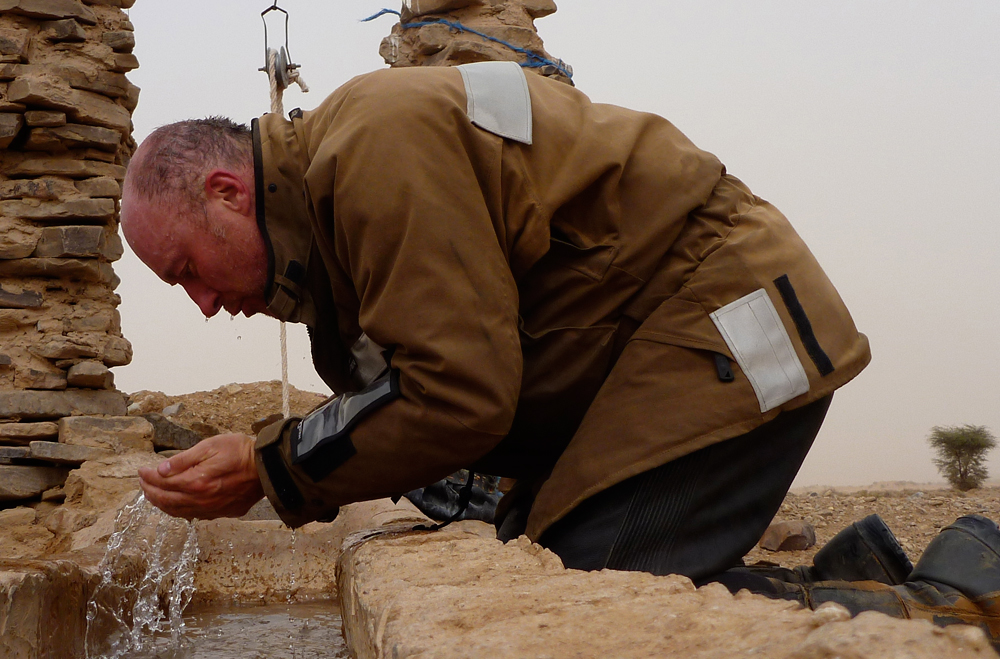
One piste I did in Morocco was a hot day which ended up with a lot paddling and pushing the GS through soft sand. At this time the Falstaff was just too hot and all the vents in all the world, including the front zipped down made little difference with a hot backwind and speeds of less than 10mph. I ended that afternoon with the liner soaked and evaporated sweat encrusted as salt on my shirt. I have to say it would probably have been the same with any jacket, but I have a feeling my nylon Darien Light might have been less sweaty or maybe just less heavy. The Falstaff can feel as hot as a leather jacket. As I neared my destination that evening and got onto easier terrain, I undid the front zip completely and let the jacket flap around and air itself out. By the time I got to my lodgings it and I were almost dry. I do wonder though if something different – more modern dare I say – could line the jacket interior instead of cotton plaid and if, as the blog guy suggests below, it might even be removable for washing, so you don’t get bogged down in washing the whole garment. As it is waxed cotton doesn’t seem to be washable with any detergent, all you can do is wipe it down with a sponge which won’t shift road grime. Something wickable maybe? Cotton is notorious for sapping away body heat when wet and had I had a long ride in colder temps following that sweaty afternoon I might have got really quite chilled. Of course powering up the Kanetsu electric vest would have seen to that.
All of which makes me wonder, does waxed cotton breathe? Intuitively I’d say no and if it does then it’s at the cost of waterproofedness, but Aero and this googled blog post (worth reading, plus his half-dozen follow-up posts) suggests it does a bit, while the chat here says not really. If it does breathe then I’d say not as much as Goretex in optimum conditions and circumstances, but a lot better than a PVC bin bag sealed up with duct tape. I must admit I never felt sweaty on the ride as I’d have done in an impermeable PVC mac, so perhaps it breathes better than I think. Knowing what wax is, I find it hard to see how while retaining waterproof qualities, unless the wax-impregnated cotton fibres swell when wet (like cotton tents supposedly do) to seal against rain, then as it dries a little porosity returns. Interestingly, I’ve also learned that ‘oilskins’ is another name for waxed cotton.
My thoughts on Goretex
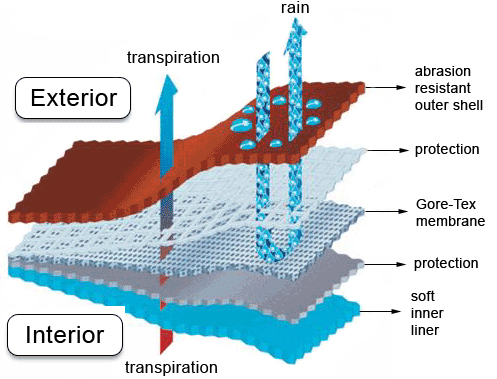
Like the blogger, part of my rationale in thinking the Falstaff was a good choice was that unlike GoreTex, wax cotton can be reproofed indefinitely, just like an old pair of leather boots. (Have you tried getting a pair of non-membrane hiking footwear lately, btw? – near impossible). Goretex might work well when it’s new, clean and undamaged, but as far as I know we’re talking about a cling-film-like miracle pore layer bonded onto the inside of the jacket onto which is bonded a permeable inner liner, more or less (left). Although in the middle of a sandwich, once that film gets damaged or the nylon either side gets clogged with body oils or grime, it will let in water for good and/or it won’t breathe like it did.
Goretex seems a short-term solution but you still have to marvel in how WL Gore have managed to so dominate the market in ‘waterproof’ leisure wear, although work wear, I’m no so sure. There must be something to it but I do remember thinking when it came out in the late 70s that the whole ‘condensation vapour out / no water in’ malarkey sounded a little far-fetched and I think the same now.
I really wasn’t keen on buying another expensive GTX jacket, even an Aerostich, that would require washing in special soaps and curing with DWR (surface water repellent) only to know the ‘magic film’ would eventually fail. This is a jacket that I like to think I’ll be wearing on a long trans-continental trip, not a touring holiday. The infinite reproofability of the Falstaff was an attraction and as the chat site above notes, it’s tough (maybe no more so than a 500-weight Darien; Aero say it’s a bit less abrasion proof) but also immune to melt holes from campfire sparks.
Waterproof?
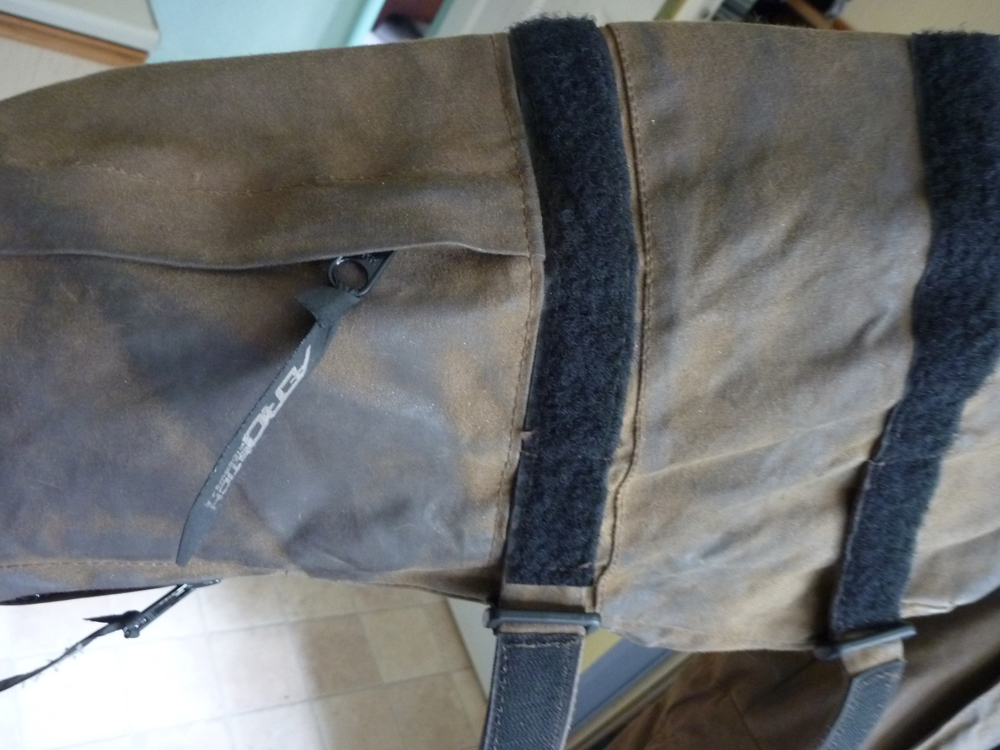
In Morocco there were a few showers. Unlike Cordura once it’s lost it’s DWR treatment, water rolls off the waxy Falstaff as off a duck’s back. There seems little possibility of the fabric letting any rain through (but see below), but of course on any garment the stitching is the weak point. I know Aero’s synthetic clothing is finely sealed with taped seams, but I’m not sure how the Falstaff’s panels are joined together and sealed. Maybe the wax impregnation takes care of it. It was on a long day across Spain that I had a chance to put the Falstaff to the rainproof test. Several short spells of heavy rain had no effect but a huge deluge let rip by early evening at which time both lightning and a rainbow where arcing across the stormy sky simultaneously. I turned off into some town to pull on the €3 waterproof leggings I’d bought in Fez (my ageing Darien pants got stolen on the Morocco ferry – I’ll miss those). By the time I turned the bike around the roads were ankle-deep in run-off and commuters were inching through the flood. Back on the motorway the rains pelted against the screen which admittedly largely protected the front of the jacket, but after maybe half an hour I felt the tell-tale twinge of wetness at the more exposed right elbow. Getting to a hotel that night after the 800-km day, I pulled the jacket inside out and the cotton lining of both arms was damp. It had then come through the Kanetsu vest (not turned on) and a thick cotton shirt. Nowhere else had let the rain through, neither pockets or front zip nor even the cuffs exposed by the BM’s undersized hand guards, nor the neck with its suede trim. The front inside lining had soaked up some run-off from the overtrousers. (Amazingly the cheap overtrousers held up and so did my leather boots which I’d waxed before departure and got quite a beating on the dirt in Morocco. I attribute it to wearing thin socks that day which were loose and so are slow to wick in any leaks – or perhaps the well waxed boots just simply worked – like a waxed jacket should…) My theory is that the rain leaked through the sewn-on velcro straps (left) which cinch in the sleeves to stop them flapping, hold the elbow pad in place or to reduce the air gap to keep you warmer. Many bike jackets seem to have this feature now. Without cutting the lining open it’s hard to tell if the velcro seams are glued and taped from behind. It doesn’t feel like it and on the inside of waxed cotton that would be tricky anyway. But if that’s a weak spot it’s surprising Aero didn’t think of it or owner reviews mention it.
In summary, my reticence with the Falstaff is the same as with any waxed garment, the ‘ickyness’ of the weatherproof coating. It’s something you only notice when putting it on, using the pockets or walking around, but you wouldn’t want to slump onto your mother-in-law’s albino calfskin sofa in it. Like leather it certainly steadily acquires characterful creases, unlike a nylon Darien or any other synthetic moto jacket.
Update
Six months from originally writing this, I have to say the Falstaff hasn’t grown on me. I don’t particularly relish putting it on as I do with favourite clothing, because of the feel and appearance of the waxed cotton; that stuff won’t wash off with soap. The jacket now looks like I’ve used it to make several messy oil changes under a car. Waxheads know it’s just the polished wax coating, but some civilians will just perceive you as another grubby biker. Then there was the annoyance of popping a car satnav into one of the outer chest pockets during a downpour – it never recovered. The pocket was wet inside; now I know I should have used an inside pocket, but as you’ll see below, even that is not immune. I’ve since performed a EU-accredited suction test: clamping your mouth around a bit of fabric and sucking. On a plastic bag – full seal of course, no breathing possible; on unpolished parts of the Falstaff like the back, slow suction possible, but slightly more than on my near-new breathable Rab Bergen Event™ jacket. On the grubbier, patina’d front pocket of the Falstaff, notably more suction possible – the fabric here is more breathable and so less waterproof than other sections. Perhaps it all just needs a light reproof on the shiny sections followed by a hair dry, as this article recommends.
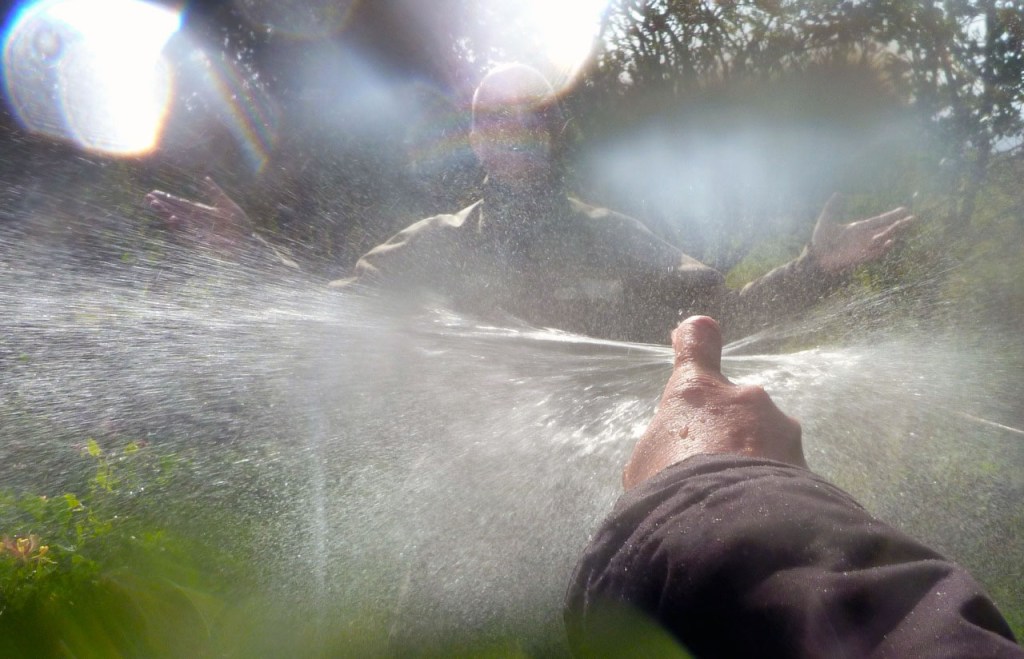
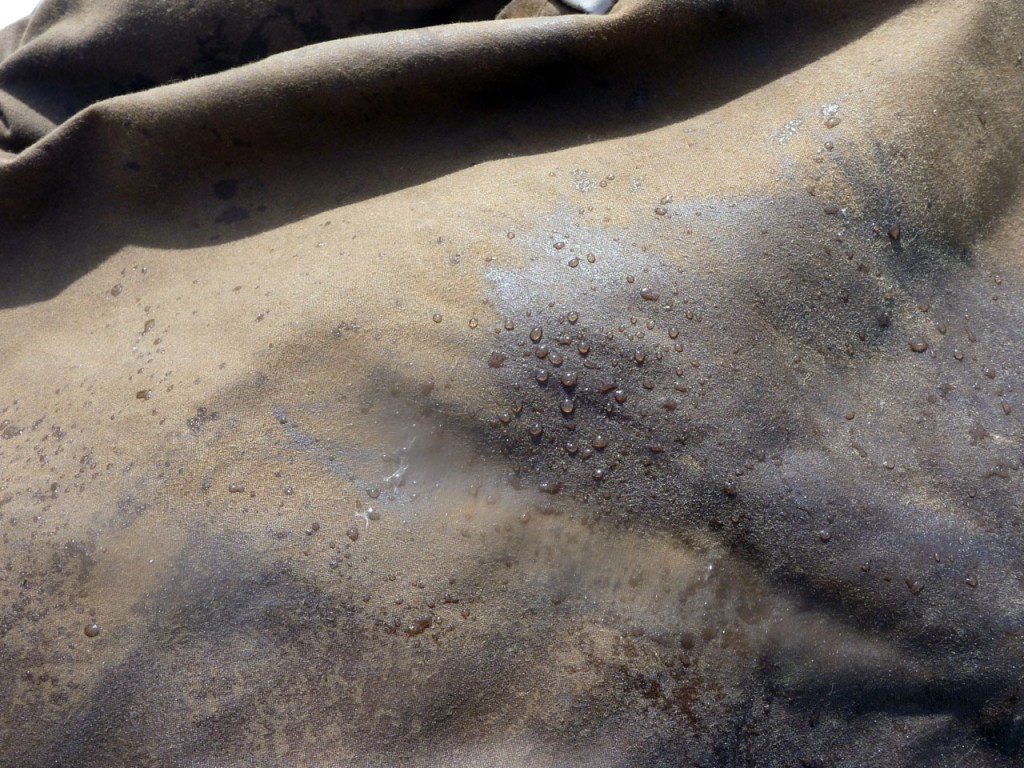
I’ve since carefully reproofed the pockets on one side of the front with Granger’s Waxed Cotton Dressing which as expected failed to resort the Aero’s original sandy colour – in fact it’s gone quite dark and shiny, but at least dried to a less waxy mess than I anticipated. It certainly doesn’t look as good and smart as when it was new, but I got the g-friend to give me a damn good hosing (above) and the re-waxed outside pocket was dry inside, the patina’d one on the other side damp. And on the shoulder where I reproofed a bit, the droplets clearly pool on the wax while they get absorbed into the original, unpolished matt, tan section. So reproofing looks like it works but will re-patina and in my opinion ruin the jacket’s original appearance.
In a couple of weeks I’ll be riding back south to London during which time I’m bound to get rained on. More news then but as I’ve written elsewhere, to keep dry from all-day rain, whatever you wear, get an impermeable one-piece riding suit in coated nylon or better still, PVC, like the old style Rukka (left).
A couple of weeks later…
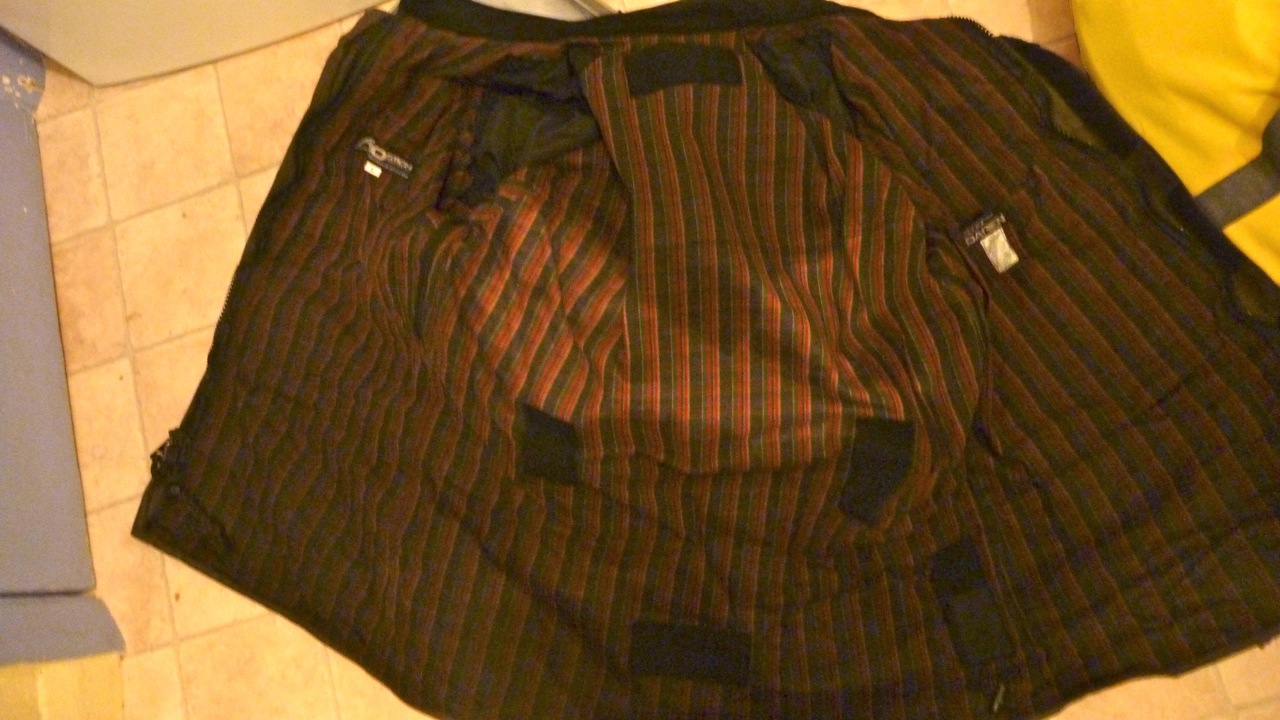
I got rained on. At the end of a cold, 450-mile day, for two hours on the motorway and another two across town the skies let go. I pulled on my Rukka one-piece over my legs which stayed as dry as, same as my boots which I waxed months ago. But within an hour I could feel wet arms, as in Spain months earlier. And when I got back home I found the entire lining of the jacket was wet apart from a small patch in the middle of the back (below).
The inside pocket was wet with my phone and wallet – one place you hope to be dry. My thick merino cardigan was damp but kept the wet off my trunk, but the arms were soaked right through. Exterior pockets that I had judiciously wax-proofed a fortnight earlier also had wet contents, maybe through the zip. The jacket took a day or more to dry. Imagine being mid-trip and having to put on a sodden Falstaff for another long day at 6–9°C. It’s possible that seepage through the jacket’s leaking arms may have spread right across the lining, but whatever the reason, it was soaked inside. Not good.
PS. I’m informed the similar £500 Belstaff Trailmaster comes with a ‘waterproof seam-sealed jacket in light coated nylon‘ … and in the US this Melville wax jacket from Rev’It comes with a removable Hydratex waterproof membrane liner. I believe ‘oilskins’ must work on a certain level but there’s a message in there somewhere.
DESCRIPTION Thirty-litre, nylon and TPU-coated fabric, roll-top, throwover panniers. Enduristan web page.
WHERE TESTED Spain and Morocco in March 2012 on a BMW F650GS SE. to update my Morocco book. The bags were used with a kit bag of camping stuff across the back seat but that got stolen early on so most of the time I just had the Monsoons along, plus a small tent and bag I got lent.
IN A LINE Good volume and details, but too wide on this particular bike
PRO
• Will mount on most bikes
• Locate securely (against a rack)
• Well made
• Secure stiffener keeps shape well
• Several external attachment loops
CON
• Velcro straps were too short (but they now sell extensions for £8)
• A bit small, or could use a few more inches in roll-up height
• Wide. I’d prefer a slimmer, longer profile shape (don’t start me on that…)
• Not unique to Enduristan, but fabrics a bit light for long-range durability
• Lacks useful external pockets
COST €290 Bags supplied in exchange for an Enduristan advert in AMH
DETAILED DESCRIPTION According to my measurements the Monsoons are 33 tall x 25 wide x 36cm long so do have a genuine maximum capacity of about 30 litres as claimed which makes them a very useful four litres bigger than the Ortlieb Saddle Bags, their main throwover competitor in Europe at a stated 33 x 21 x 38cm or 26 litres. Australian Steel Pony Gascoyne’s are listed as 37 x 23 x 44 = 37 litres plus the nifty outer bottle holders. Andy Strapz Expedition Panniers say they are 30 x 18 x 33cm which comes out at 18 litres plus the outer mesh pocket, though they still claim up to 35 litres volume. I used a pair once in the desert and don’t recall them being anywhere near 35 litres when rolled up, but that was several years ago. Since I wrote this Adv Spec Magadans are around at 32 + 3 with the pockets.
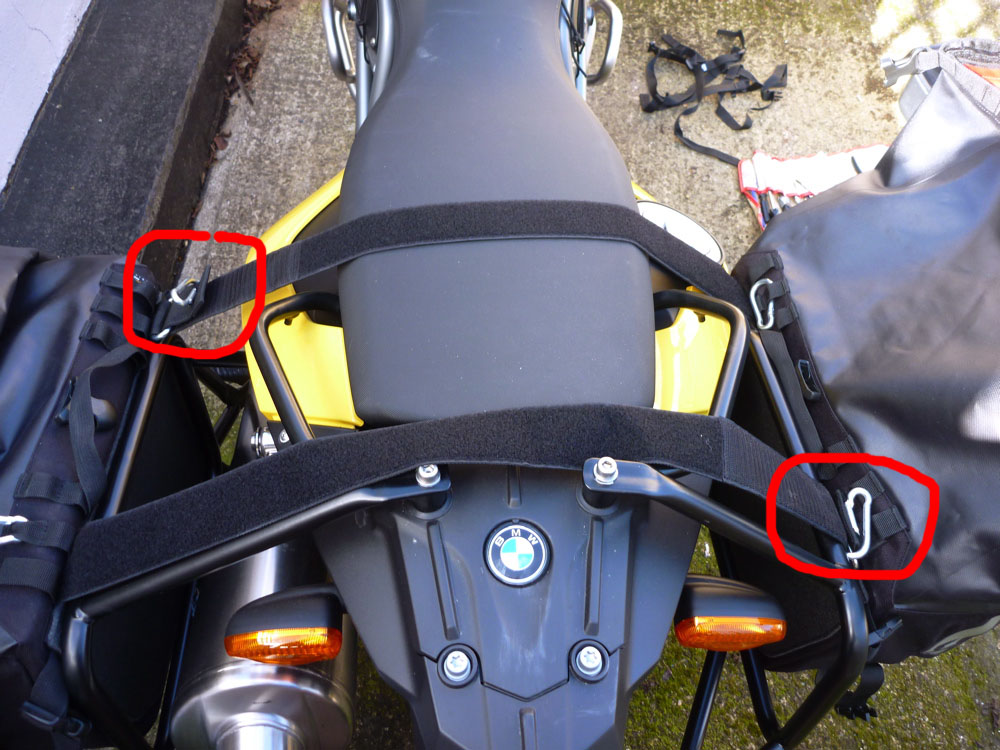
The Monsoons throw over and adjust with two-inch wide velcro straps, and to stop them moving forward or back an elasticated strap at the front lower edge attaches to a pillion footrest mount, while another non-elasticated adjustable strap runs across the back from the top of each corner to limit forward movement which studies have shown to actually be the greater dynamic load when riding.
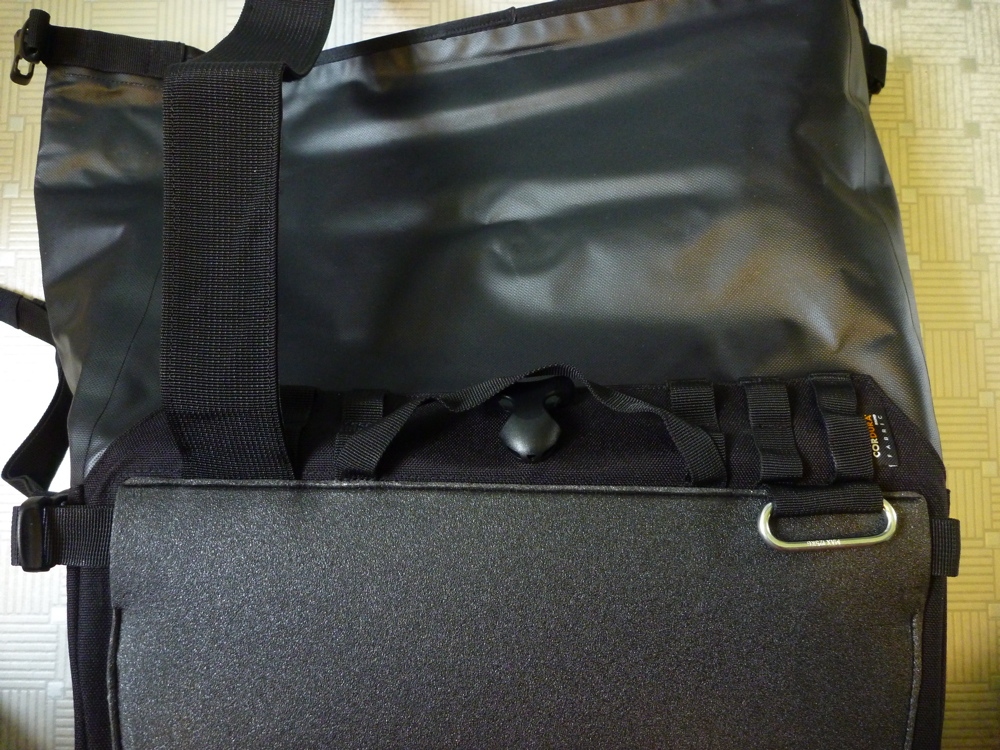
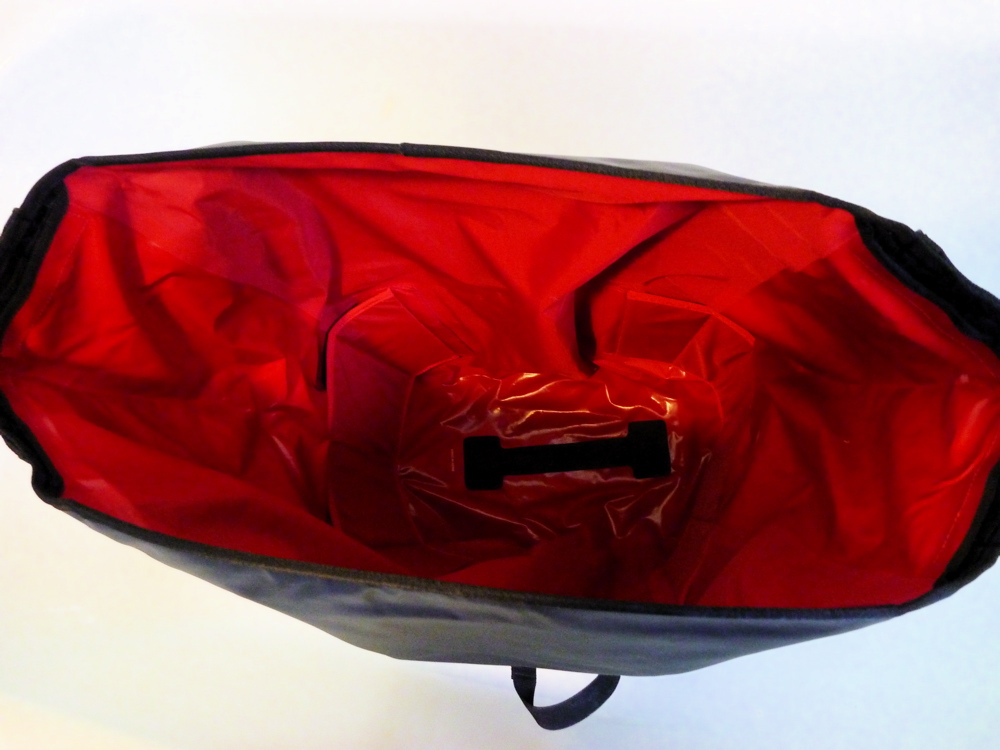
The outer bags are made of an unproofed 1000D nylon lower which is sewn to a thermally coated polyurethane (TPU) fabric upper for the rolling section which is welded to itself to make a cylinder. The top edge of the outer is then partly sewn to the inner, red TPU coated, thin nylon-like fabric lining (left). This waterproof red liner is also RF welded into a bag shape which I feel is better than stitching, and then taping. Separating outer abrasion from inner waterproofing differs from say Ortlieb Saddle Bags where the bag is made of thicker waterproof vinyl that is probably less resistant to abrasion than nylon.
In between the Monsoon’s inner and outer layers you slip in a flexible plastic panel (not pictured) which fixes into position neatly with velcro tabs to give the bag its boxy shape. Enduristan claim that this panel gives a ‘third’ layer of protection from flung up debris which I suppose is true, but let’s face it, it’s really a shaping panel, like the Zegas had in box form. What’s more important is the front outer corner of any pannier which takes the brunt in a fall, and this vulnerable area was not reinforced. The waterproof red lining had a pair of clever, flip-out dividers to make optional compartments in the lower half and into which slips the 7.5-litre Isolation Bag accessory (right). Unused, these dividers take up virtually no space. There are no actual pockets inside on the red lining though up to a point you can slip stuff between the lining and the outer – a hidden compartment of sorts, but it won’t be within the waterproof inner. No pockets on the outside either, but plenty of attachment loops (left) for mounting stuff over the top. That’s not so convenient for easy bag access; I’d have prefered attachment points on the front/back panels as well, but the clip down points for the roll-top get in the way which is why Steel Ponys roll tops clip as they do.
REVIEW First up I must admit that while I like soft baggage, throwovers are not my preference for the age-old reasons. But although I had three offers of hard luggage for my Morocco guidebook updating trip, I was keen to compare these new Monsoons to the well established and recently redesigned Ortlieb Saddle Bags. Perhaps unusually, I used these bags over a Metal Mule rack. Had I not had this rack the bags would have swung around much more and probably got stressed or damaged on the wheel/swingarm. Or, to limit that would have had to be mounted awkwardly high. (Since writing this review Enduristan have told me that they testing a rack adapting kit for Monsoons). It’s notable that Andy Strapz now suggests that his bags mount much more securely on a light rack (which he can also sell you). He’s right; a pair of Andy Strapz panniers I lent someone melted in a short run on the back of an XR650L one time, though that would have happened to any throwover, as many, many of us have found over the years.
With its wide, sub-seat fuel tank the F650GS may not have been an ideal candidate for Enduristan throwovers; it just doesn’t have the nice flat sides to suit them. Even then, I mounted the bags as low and as far forward as possible to centralise the weight and was typically running up to 10kg in each bag. Even in that position they never got in the way when I was paddling the bike hard through soft sand. Pushing the bike through even softer conditions was made awkward by the width of course, but better that than an alloy pannier’s hard edge. It never crossed my mind that the Monsoons might hurt me as it often did on Desert Riders with alloy Touratech Zegas.
At 30 litres I’d say they’re still a bit small. The fact is there’ll be times on the road when you want 40 litres and other days when 20 will do. I prefer bigger bags low down and as far forward as possible on the sides, then something small over the back seat/rack – a bag or even a small lockable box. At least with roll-tops you have the capacity to deal with varying volume needs, although to me the shape is not optimal – too wide. I’d have preferred a longer, slimmer profile, though it seems most soft panniers use width or height to gain volume, keeping the front-to-back length short presumably so as not to interfere with passenger legs, where present.
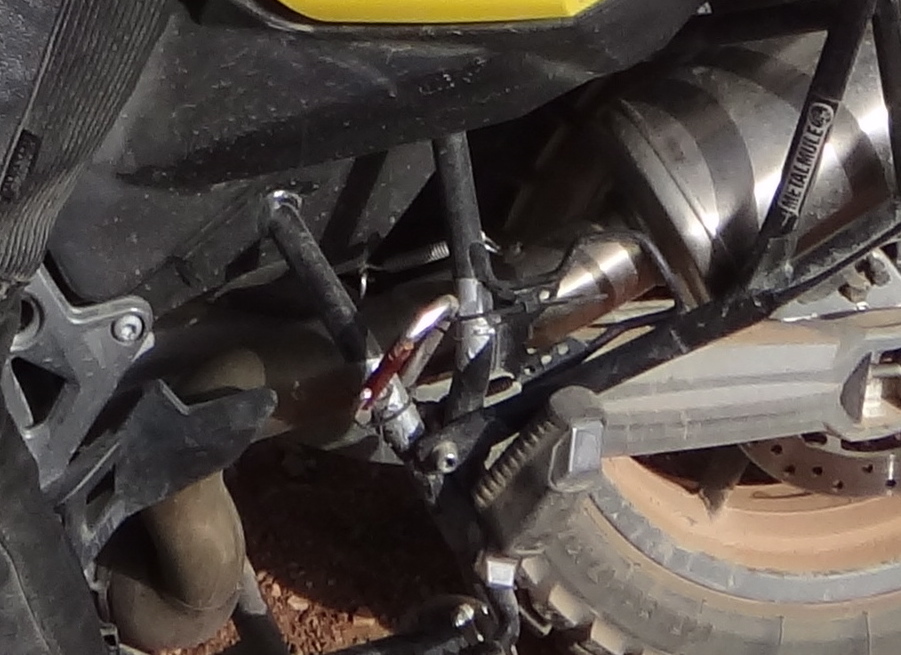
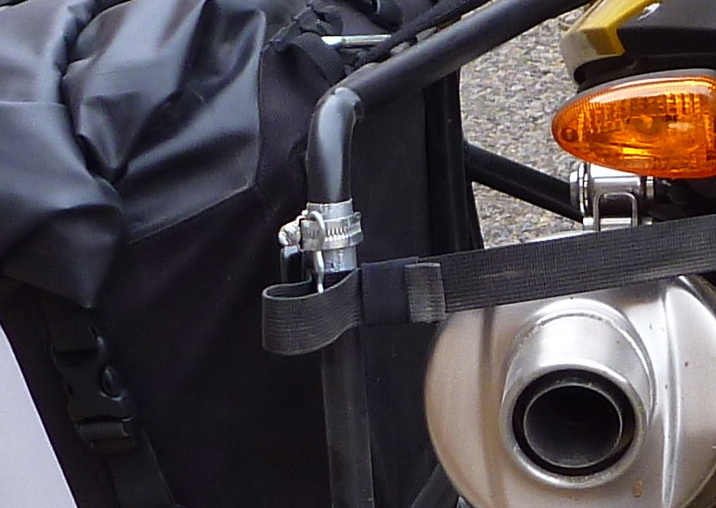
My first problem was finding that the velcro straps were way too short (right) to fit the F650, and would have been barely long enough even without a rack. I extended them by making two loops of two-inch strap I had lying around and adding some mini carabiners as buckles; that worked fine. On the GS the forward pillion footrest straps lined up just right, but on the exhaust side would have been way too close to the pipe, so I clipped and zip-tied a carabiner in there (left) to move the strap point further away. The back strap also wouldn’t have worked on my bike as it was set up had I not fixed on some R-clips with jubilee clamps on the back of the rack to keep the strap in position (right). That was a temporary fix which may have eventually worn through the strap. Had it been my bike I’d have come up with a better long-term solution.
Once I did all that I have to say the bags never shifted in all the rough riding I did in Morocco or <80mph riding on the way back, although on the dirt I did use an extra belt between each bag’s handles (left) as I wasn’t convinced the velcro would hold. I’ve taken the same precaution on many other panniers I’ve used over the years.
I complain about them being too wide on the GS (right), but it’s just occured to me that the stiffening plate you insert to give the bags form could easily be trimmed or even removed altogether to make a more saggy but less wide profile. I wish I’d thought of that in Morocco. As it is, my bags picked up passing thorns as well as tears and scuffs off passing rock faces and were a nuisance on narrow mountain tracks where I was forced onto lines I’d have preferred to avoid. They are I suppose no wider than a hard-cased GS1200, and at least a soft bag deflects you less when you bump into something hard, and hurts less when you bump into someone soft or have the bike fall on you, all of which is reassuring and the reason we go soft, is it not?
At the end of the day the bags clipped off easily and could be heaved over a shoulder to walk into a hotel, hands-free. Ortlieb QL2 Side Bags (31 x 18 x 43cm – 28L) would have clipped off a rack effortlessly. I’ve used smaller Ortlieb QLs on pushbike tours in the Himalaya and I can tell you when you’re shagged out it’s so nice to just lift the bag off the rack with the handle and then slot it on again next morning; no grubbing about with straps. Had it been a wet and muddy you’d get all mucky undoing the Monsoons, but that’s the way it is with all soft bags on motorbikes. Eventually, the bags got quite grubby and dusty, but so was the bike – hosing it all down at a car wash fixed that.
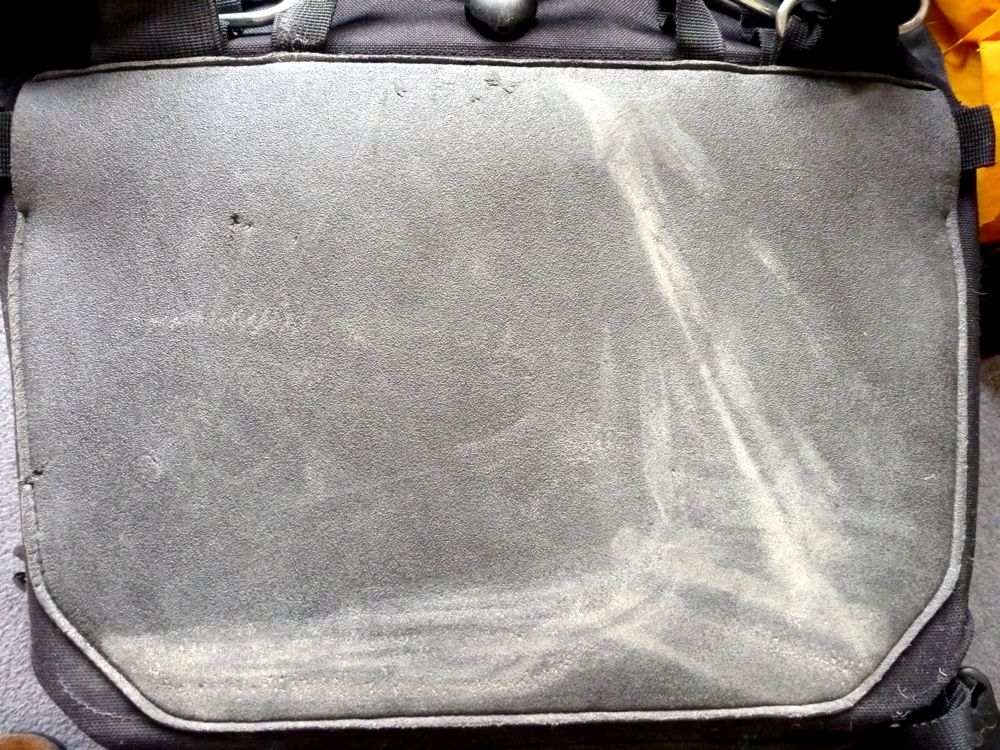
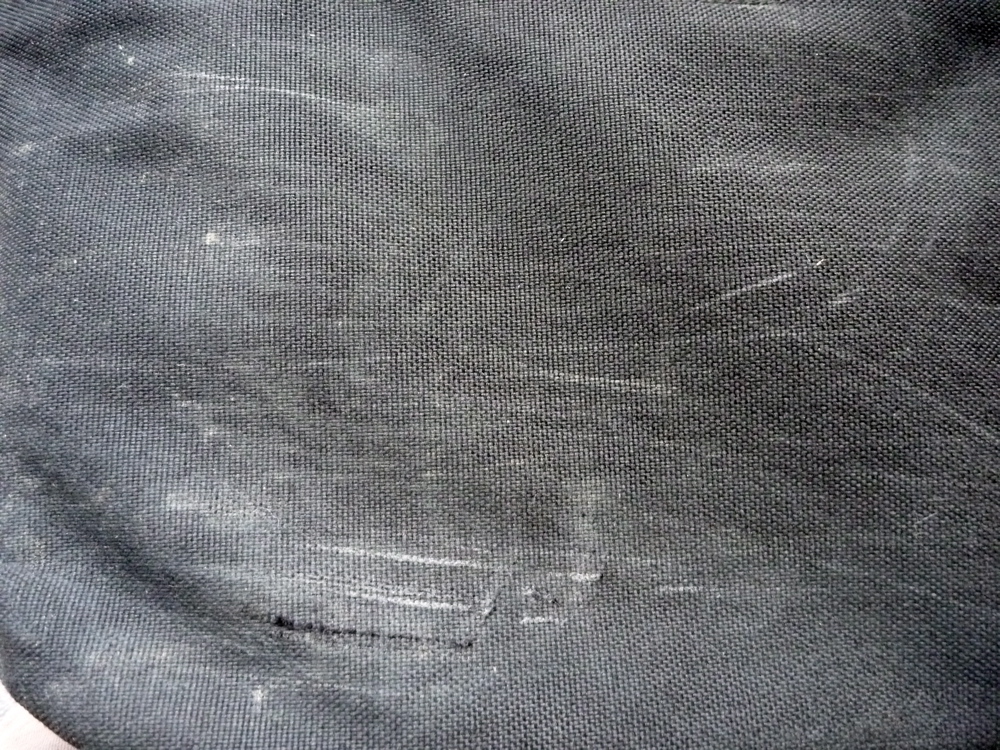
The back panel – a sort of dense closed-cell foam (left) – stood up pretty well to being rubbed on the rack for weeks. But the outer face of the left pannier (right) which stuck out more because of the pipe, had a harder time of it, even though I was trying to be careful and never consciously felt myself barge into the scenery.
The only chance I got to really test the Monsoon’s waterproofness was on an 800km-day back across Spain through several showers and one mega downpour with flooded roads with run-off. Even though I’d been expecting this and cinched the bags up nice and tight, when I got to the hotel that night there was some wetness inside the red liner along each forward end of the roll top where it clips down to the front panel of the bag. I’m not too surprised by this; roll top closures can’t really claim to have a waterproof seal, for that you need something like submersible Watershed Dry Bags (my 30-litre Watershed with new tent, bag and mat was among the stuff that got pinched off the ferry). Water being what it is, by pelting a roll-top bag at 70mph capillary action will eventually see it seep through to the insides. The top outer panel of the bag has a lightly textured exterior surface (uncoated side of a fabric?) which I believe may exacerbate this. A smoother surface to roll up (like thick PVC SealLine Baja bags) might help reduce ingress. It also occurred to me that the flat, flexible plastic, inch-wide stiffening ‘blade’ that’s sewn along the top edge to give you something to roll against might be better off being a piece of flexible tube or hose. That would be much easier to roll up tightly and without creases to stem the ingress of water.
So, all up I’m a bit lukewarm about the Monsoons even though nothing broke or failed in three weeks of hard use. The initial strap shortage was annoying, the width was also annoying and was made only a couple of inches so by the rack. I believe for actual overlanding rather than weekend camping, a soft pannier is much better off resting securely against a rack, or better still sitting on a platform rack (more about that later). Enduristan can’t be blamed for making a boxy shape like Ortlieb, but I’d much prefer a longer, thinner shape like the Steel Pony Gascoyne (seen but not tried), or a ‘suitcase’ shape (more about that later, too).
I also think the fabrics are a bit thin to survive a tough, trans-continental trip – that is the perspective taken and intended use for all gear reviews on this ‘website of the book’. I never fell off the GS or had it fall over but that, as well as rough use, is all part of motorcycling across the wilds of Africa, Asia and Latin America. The Morocco ride gave a good snapshot of that and if I was doing a longer trip with Monsoons I’d consider sewing on a second layer of material to protect the base and the damage-prone leading outer corner from wear and road slides. The fact that the Monsoon’s nylon lower is not waterproof makes sewing onto it no problem.(it doesn’t claim to waterproof; the base filled up as it seeped through when I washed them in the bath back home). Pockets could also be added here now I think about it. But making the bags slimmer as I suggested earlier by trimming/removing the flexible panel may not be that effective as the bags are cut to fit that panel.
Zip-free, roll-top is definitely the way to go, but what we want are big side bags mounting low down but without pedestrian-menacing width. I’d like to see Enduristan or anyone make a full-on, rack-mounting or rack-resting expedition pannier at 35 litres slim and in OTT tough abrasion-resistant fabric and similarly tough vinyl inner liners; separating the two is a good way of doing it because for resistance to rain and abrasion you need something like hypalon raft fabric (more about that another time). Since I wrote this Adventure Spec Magadans have come on the scene and answer many of my above requirements.
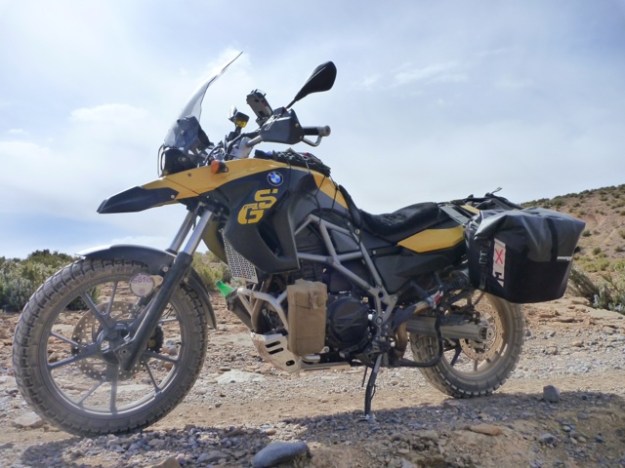
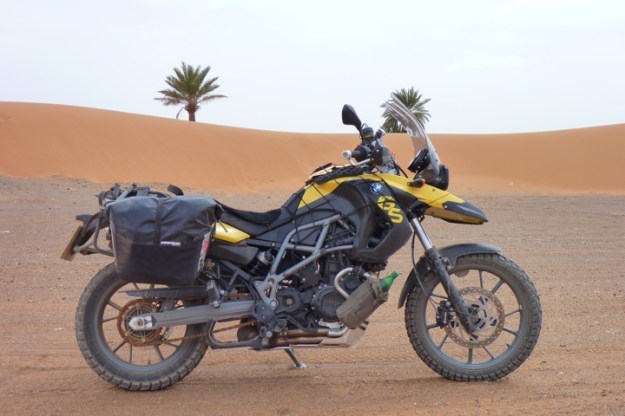
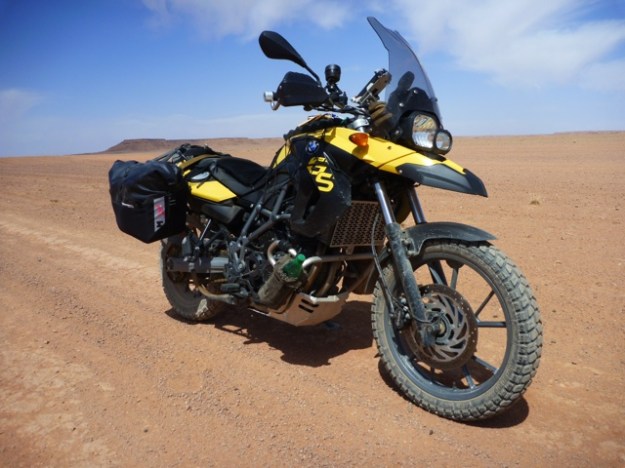
Released in the UK in February 2012, the ‘SE’ suffix in BMW’s F650GS added up to a new paint job and an array of optional Special Equipment. As a reminder, the ‘650’ uses the same 795cc engine as the more popular F800GS, but detuned to be more tracable and more economical, with higher, road-oriented gearing, shorter suspension travel, a lower seat, cast wheels with a single front disc and tubeless tyres.
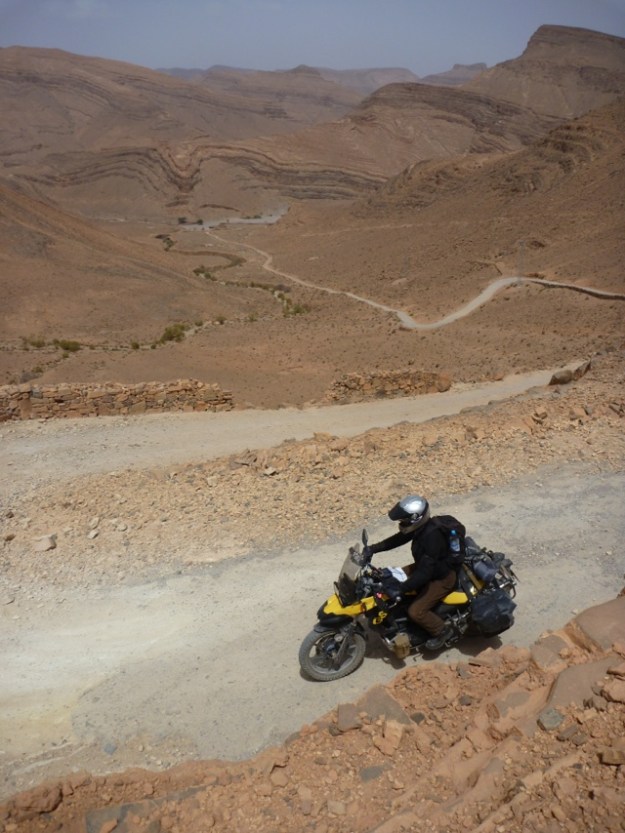
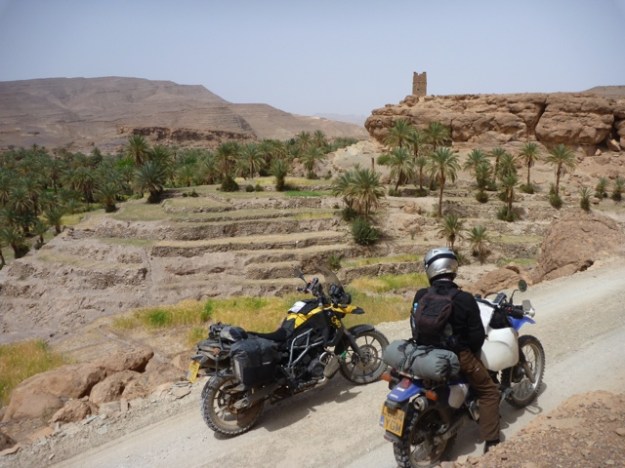
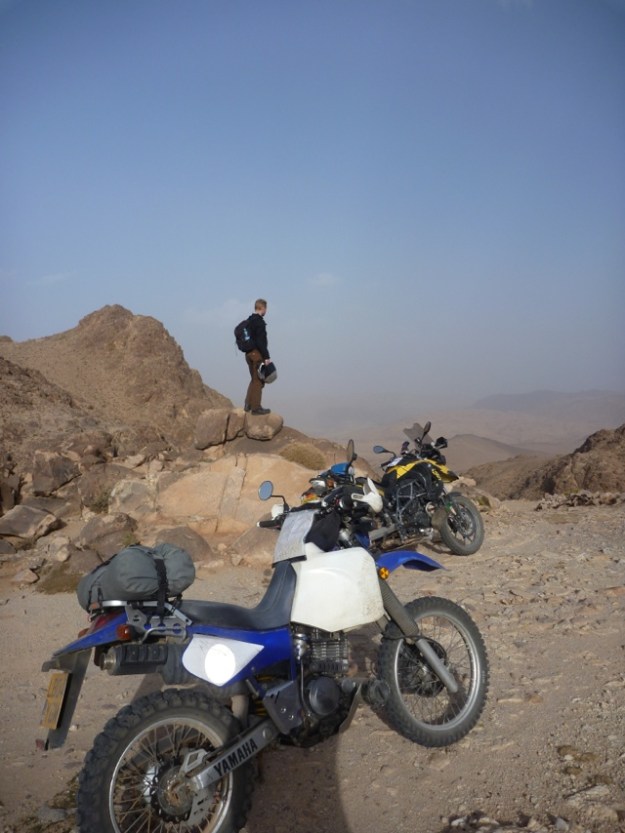
The bike was loaned by BMW Motorrad and I rode it from new for over 4000 miles from London across Spain to Morocco and back in March 2012 to update my Morocco Overland book. I set off with around 600 miles on the clock, just after the first service and was out for three weeks.
My bike came with a batch of these optional extras: main stand, trip computer, heated grips and ABS, all of which I learned to appreciate. At the first service it was additionally accessorised and modified as follows:
Heidenau K60 tyres
Metal Mule rack, tall screen and rad guard
BMW bash plate, engine protection bars and hand guards
Touratech sidestand foot
1 tooth smaller 16T front sprocket
12v plug
Ram mount
Aerostich wool seat pad
Why the ‘650’, anyway? Now they’ve had their teething problems sorted, I believe the ’650′ is the best of the two F-GSs twins for real-world overlanding. I wrote as much in the AMH6, even before I rode the bike. BMW Motorrad did suggest I might like a new Sertao for the Morocco job, but that bike overweight slug has little to prove. Overall, I prefer the unsnatchiness of a twin over a big single, and there’s apparently less than 10 kilos weight difference, while you get a more smooth power and nearly-as-good economy. With damage protection, moderate speeds and alternative tyres, the 650 twin was fine on dirt roads and, with the exception of gearing, everything that differentiates the 650 from the 800GS makes it more suited to overlanding.
Comfort On collection, the BMW felt comfy and natural to sit on, but I was warned by another 800 rider that the seat would be uncomfortable. Though I’m sure one man’s sofa is another man’s slab of coarse granite, for me at well over 100kg in all my riding clobber, the seat was the bike’s biggest flaw, just as I’d speculated while running in. Sadly, the Aerostich wool pad made little difference. I put in a 600-km run across Spain on the way out from which my butt probably never recovered. That was followed by mostly sitting down on the pistes to spare the bike and baggage too much of a hammering (and standing was a bit awkward without bar risers), all of which probably helped beat the seat’s foam into powder.
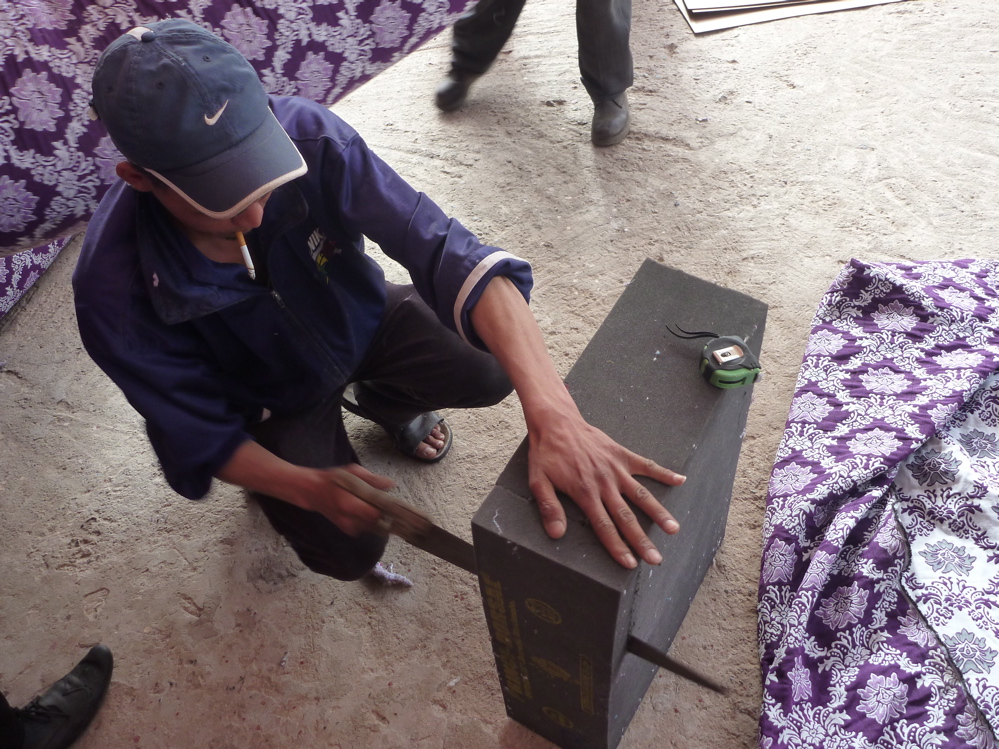
By the time I turned back from southern Morocco, soreness returned so soon that when coming over the High Atlas, I couldn’t face the 1500 mile ride home. I pulled up at a village mattress shop and bought a 50mm slab of foam (left) which tucked in easily under the Aero pad (below). The soreness passed in a few days and Spain was crossed in an 800-km stage without agony. I recall the same discomfort on a GS1100 I borrowed years ago (confirmed by an 1100 rider I met on the Bilbao ferry) and even a GS1200A rider we met in Morocco said his seat was not up to the bike, and he was a light guy. What is wrong with this seat – surely it’s something they’ve got to the bottom of (boom-boom) over the years? I suppose function may have suffered in the face of slim design to complement the bike’s looks, just as a Triumph Rocket III has a huge saddle to emphasise its bulk. It’s not all about width though, it must be foam quality or density. The Tenere’s saddle was no wider as I recall and was even hampered by a lip which stopped you moving back, but it was nowhere near as painful to sit on after two hours. There’s a bit of buried chat here on UKGSers about F-twin seats. It seems the inflatable Airhawk pad is the simplest solution if you ride long hours.
Even though I’m 6′ 1”, the low seat height was just right, if a bit low for easy standing up. It meant dabbing and paddling in sand or steadying over rocks was easy, but didn’t make the bike vulnerably low; the bashplate very rarely bottomed out, though caught plenty of flying hits. The OE high option screen was way too short for me and without the taller Metal Mule item (left) the ride would have been grim, as I realised when I returned the bike without the screen and felt my arms lengthen by an inch. But as mentioned, I feel the top edge of the MM screen curves back too much and anyway, it’s still a little too low for me. Although it caused no buffeting, any clouds of bugs got splatted straight onto my visor rather than blown over like they’re supposed to. A couple of inches longer and it would have been perfect. I never felt the screen was a distraction on the piste, though if I’d gone over the bars I’d have ripped it off for sure. For me, the Tenere’s screen – more upright and further forward like a Dakar racer worked better once I clipped on the clunky Touratech extension (it was too heavy to fit on the MM screen). But as with seats, finding or adjusting a screen to suit your exact prefs can take a while. One size does not fit all. It may be lower spec’ and shorter than the 800 model, but the firm suspension suited me fine, giving predictable behaviour in bumpy bends with no wallowing – better that than too soft, although taking the bike back the thought ‘harsh’ cropped up again. The only time I meddled with it was a rocky day’s riding without baggage when I wound the back out with the handy pre-load adjusting knob and lowered the tyres a bit more to soften the ride. While you do feel the engine vibration at higher revs, it never intruded on comfort, nor did engine noise which either sounded great at town speeds, or was drowned by the helmet din. The light clutch was a real pleasure to use too, and got plenty of use at low speeds, feathering in first to get round the still-tall gearing. Despite that it never needed adjusting, neither did the foot controls. Some days my right knuckles got very sore from the holding the throttle open while keeping two fingers over the brake lever, but other days they didn’t, so it must be me.
Economy The BMW comes with a 16-litre underseat tank. I was expecting excellent economy and most of the time I got it, though the average of 68.2mpg / 56.8US / 24.16 kpl / 4.14/100km over 23 fill ups was about 4% less good than the XT660Z’s 72mpg or 25 kpl. Of course, you get a smoother and more powerful engine. Worst result was a 51mpg on a partly sandy piste where I stuck with street pressure tyres for too long and so wasted a lot on wheelspin while pushing and paddling. Best was an 80mpg (28.3kpl) coming off the Middle Atlas, with quite a few 70mpgs when riding at <60mph with my mate on a Yamaha TTR250, much of which included piste stages with hours in first or second gear. I don’t believe the wide baggage, tyres, high screen, heated equipment or the slightly lowered gearing had any real effect on fuel consumption, and like the Tenere, it seemed to be getting better and better as the miles wore on. Full records, here.
There was some pinking in deep sand, partly due to the hot conditions, tall gearing and the 12:1 compression ratio. With the fan whirring and the throttle virtually closed in 1st or 2nd, the fuelling would start surging, but it was never uncontrollable, just mildly annoying, although it did seem to coincide with higher fuel consumption figures.
Oil, water, drive chain In 4000 miles no oil was used and I didn’t even think to check the water. I adjusted the chain once and even that may have been premature, which means BMW may have gone OTT to fit a quality chain after the early breakage issues. I oiled the chain most days with engine oil, but on reflection, this did little long-term good as it was soon thrown off. Next time I’d brush on thicker Tutoro oil.
Performance The 650 has all the power I need and in fact I’d have liked to have tried it in the detuned 34hp version, assuming there are notable benefits in fuel consumption or cool running. I never needed to rev over 4000 while accelerating, and with the lower gearing, 5000rpm at 80mph was as fast as I went. The red line is at 8500. The low rpm power really helped on the piste, pulling out of deep sand, even if the high, road gearing was not ideal here. Like I say, I’d spend all day in first or second. Fuelling was smooth and very responsive, although this made the bike a bit of a handful the one time we rode a day on the piste with no baggage to damp the response. As mentioned it would start surging when it got hot – a slow track with a backwind – but that never lasted more than a few minutes until a higher speed cooled it down. Running at very low rpm with high gearing meant slow oil and water circulation speeds may not have aided cooling as much as they could. With just a single disc on the front, the brakes were well matched to the bike’s performance. At least once the ABS stopped me from skidding over the edge while checking out the scenery, though I’m told the mass of brake fluid pumping around for ABS can contribute to the slightly woolly feeling at the lever. I never thought to turn the ABS off on the piste, and can’t imagine it would be necessary at the speeds I rode, as it came on reassuringly late on the dirt. And as for the twin bulb front headlight, thatwas pretty good too on the few occasions I rode a night.
Road riding On the road in Morocco I rarely exceed 60mph. At this speed riding is less tiring, safer, the cops won’t nail you and economy stays good. I felt the bike was stable up to 70mph on the K60s though at times there was a very slight wobbling from the headstock (as opposed to a weave), and possibly only on concrete highway surfaces in Spain. With the upright seating position, wide luggage, trial tyres and tall screen, I can’t say this bike felt that surefooted at high speed on the way out, though by the way back I was able to sit up to 80 with more confidence, either because the Heidenau tyres had worn in or I was more in tune with the bike’s movements. I also think saddle comfort makes a bike handle better; when you’re tensed up in pain, your rigidity can affect a bike’s response. I met a GS1200 Adv rider who’d ridden both models and said getting back on his big 12, it just sat on the road like a wet pizza, however, you loaded it, largely down to its mass and the telefork. Loaded up, the F-GS was hard to turn on hairpins, both on or off-road, just like the Tenere it tended to run wide or understeer. The Tenere was a tall bike but on the BM I attributed this to the seemingly long, 1575mm (62 inch) wheelbase. The bags were slung as far forward as possible. Early on I noticed the bike’s balance at sub-walking pace was very good; you can easily keep your feet up at 1mph and this must have helped with low-speed control on the piste. To be fair, some of the roads and tracks in Morocco are very narrow and tight, with the wide baggage pushing you out towards thought-provoking drops. Even some mountain back roads have strips of gravel down the middle from uncleared landslides where any big, loaded bike would struggle to progress quickly and smoothly. One time I found a well-surfaced road tar in the Middle Atlas and blasted along from bend to bend around 60 or 70, but you can’t forget this is a relatively tall bike for that sort of spirited riding.
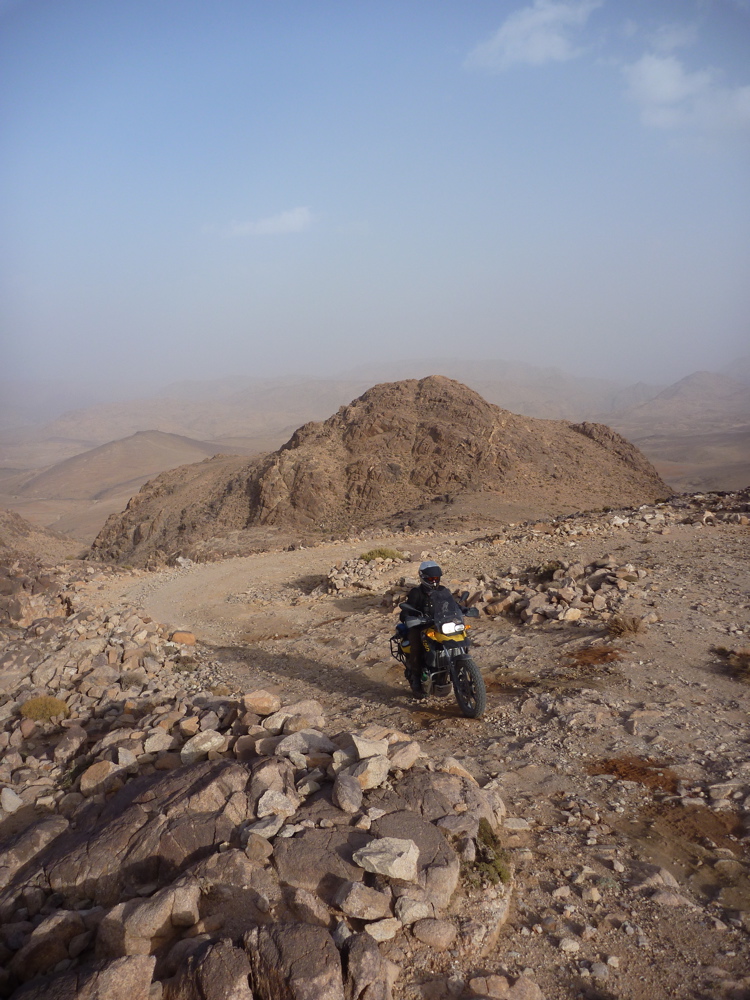
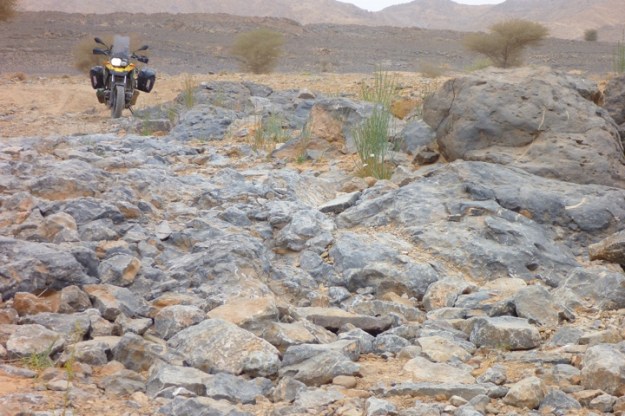
Off road riding Dirt biking in Morocco is mostly on rocky or gravel tracks, and much to my relief the K60 tyres were uncannily good. I’m sure the OE Tourances or whatever they were, would have been less effective.
I take it fairly easy when riding alone on the piste, for safety and to spare the hammering on what is really a road bike. Within these limits I was amazed to find how easy the bike was to handle with its low seat, light clutch, ABS, firm suspension great tyres and good clearance – and all despite the tall gearing, occasional hot surging and tight turning limitations.
Early on it was quite disorienting how well the bike would track straight in deep sandy ruts, right up to the point where I lost my nerve, or less often, when the front tucked in. When this happened the instinct was to lean with it while standing up and gas it, all in one swift movement, to which the bike responded correctly every time, surging forward to regain its steering composure. The full-length bash plate meant you could do this confidently on any rideable surface and take the hits. Though I had my share of these moments, I never fell off the GS or got so wildly out of shape that I thought I might do. Not surprisingly I found the handlebars were too low when standing up off-road, causing me to crouch unsustainably. Most bikes are like this at my height, though handlebar risers would have easily fixed it; something I forgot to address before I left. Of course dry dirt and even sand are fairly easy to ride on any bike with clearance and the right technique and tyre pressures. I’m sure the K60s would have clogged up and the weight got to me on very muddy tracks, but all in all, I was pleasantly amazed how well the GS coped off-road in Morocco.
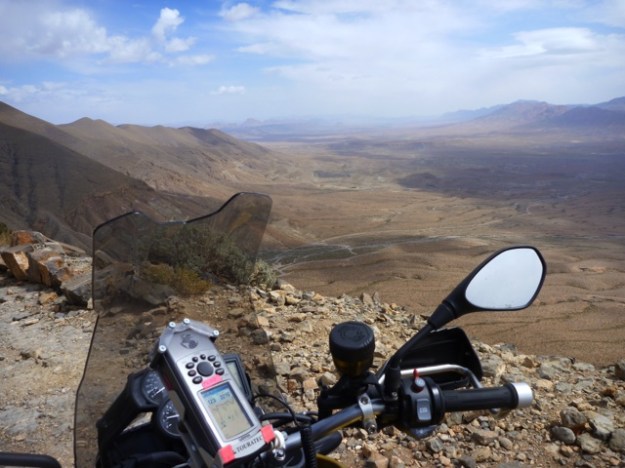
OE and extra equipment The dashboard was slightly harder to read compared to the higher rally-style layout on the Tenere. Speedo numbers were a bit small, and the computer lacking in contrast and clarity in sub-optimal conditions. The computer is pretty good though, and besides the total mileage, two trip metres, clock, fuel and water temperature levels and nice big gear indicator, a button on the left bar lets you toggle between air temperature, average speed or mpg (both resettable though I couldn’t work our how) and live mpg which could dip down to the high 40s uphill at 70mph, or give a maxed-out figure of 199mpg cruising downhill on a shut throttle. Interestingly, it must be all pretty accurate as the computer’s average mpg of 68 matched my own figure which was calculated from actual volume and distance at each fill up. I’d have preferred a digital speedo that can switch to kph like the Tenere, while the indicators and other switchgear I eventually got used to, though in a panic, might well get it wrong. The temperature gauge never budged, but the fan came on quite a lot. I do wonder if the close-fitting Metal Mule radiator guard may have exacerbated this. I’d be tempted to mount it an inch forward to get some more circulation behind it without losing protection. I’ve heard the fans or fan switch packs up on F-GSs when they get clogged with grass or mud – but that’s not unique to this model The fuel goes to reserve at round 12 litres, or between 180 and 222 miles. The furthest I ran the tank was 238 miles at which point it took 14.3 litres. There are 16 useable litres says the handbook, but the capacity is 18 – I’m never sure which is which. Checked against a GPS over 34 miles, I found the odometre (distance recorder) to be a mile over so about 3% out, though I’m not convinced GPS distance recordings are always that accurate as it depends on the set-up in recording frequency. This means that my mpg readings are a tad optimistic assuming all fuel bowsers were correctly calibrated; on some fill-ups in Morocco I did wonder. As for the speedo, at an indicated 60 or 70 it’s 5% out according to GPS, so the bike reads a little faster than it is. Non-OE equipment besides what’s been mentioned all did the job, the BMW bashplate took a lot of flying clunks and clangs on the chin but rarely landed hard, their engine bars were only used as pouch racks I’m pleased to say, same with the lever guards, though the handguards could have been much bigger against driving rain, like the Acerbis Rally buckets of old. The Metal Mule rack was never taxed, helping merely to keep 20kg of throw-overs off the bodywork, and as said, the Aerostich wool pad couldn’t disguise a seat fit for the welcome centre at Guantanamo Bay. As always my nifty tank net, this time used with a foam pad to protect the paintwork, was a great idea, and the Touratech GPS holder on a RAM mount held up (the Nuvi satnav I laid on the tank foam when off-road). The Garmin 12v cig plug leads both on the 76csx and the Nuvi began playing up. Hardwiring as we know is the answer to that one. My engine side pouches were dead nifty for handy access to water, oils or stuff in general, even if they are more Steptoe & Son than Rally Pro.
Durability Not a single thing malfunctioned, broke, came loose or fell off and so I feel the BMW has been very well screwed together.
Summary The Morocco run confirmed my early impressions while revealing how well the GS coped with dry dirt tracks. I feel the same way about what I liked and disliked at 500 miles but have proved that this ‘650’ doesn’t just look like an adventure touring bike; with appropriate tyres it performs like one too. Once that seat is fixed (there must be several solutions out by now) the 650 GS ought to offer continent-crossing comfort with adequate fully loaded off-road ability. With the smooth and tracable twin-cylinder engine and nearly as good economy, I’d say it makes a great all-rounder. The only truly unresolvable fly in the off-roading ointment was the tall gearing. Dropping a tooth on the front sprocket didn’t really fix that, fitting a couple of teeth more on the back would – but the clutch didn’t complain. Now the 650GS SE looks less drab, that’s the only thing I can see that works better on the more powerful 800 model.
Since I wrote this the newer ‘700’ model (left and below) has come out alongside the new 800. With revised styling, a bit more power, a second front disc but barely modified gearing. It’s also sai the 650 runs better on low octane fuel which is a big plus in the AMZ. More 650 vs 700 here.
A few years later I rode a well-used, rental 700 for a week and liked it as much as the 650. And a year after that tried the new F750GS too.




























 Adventure Motorcycling Handbook