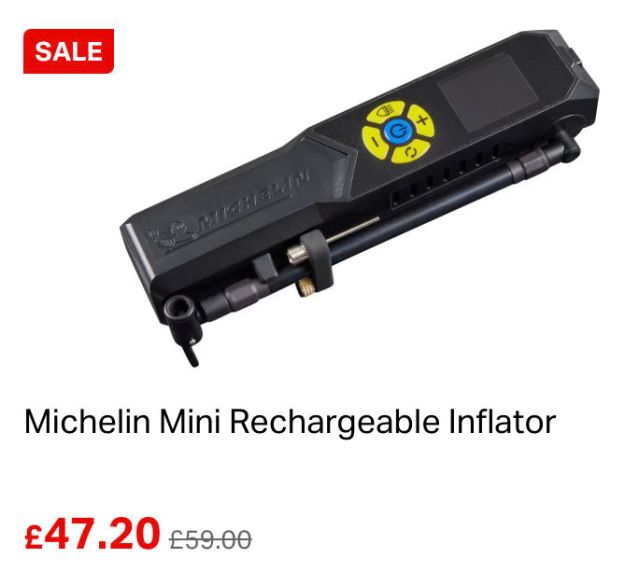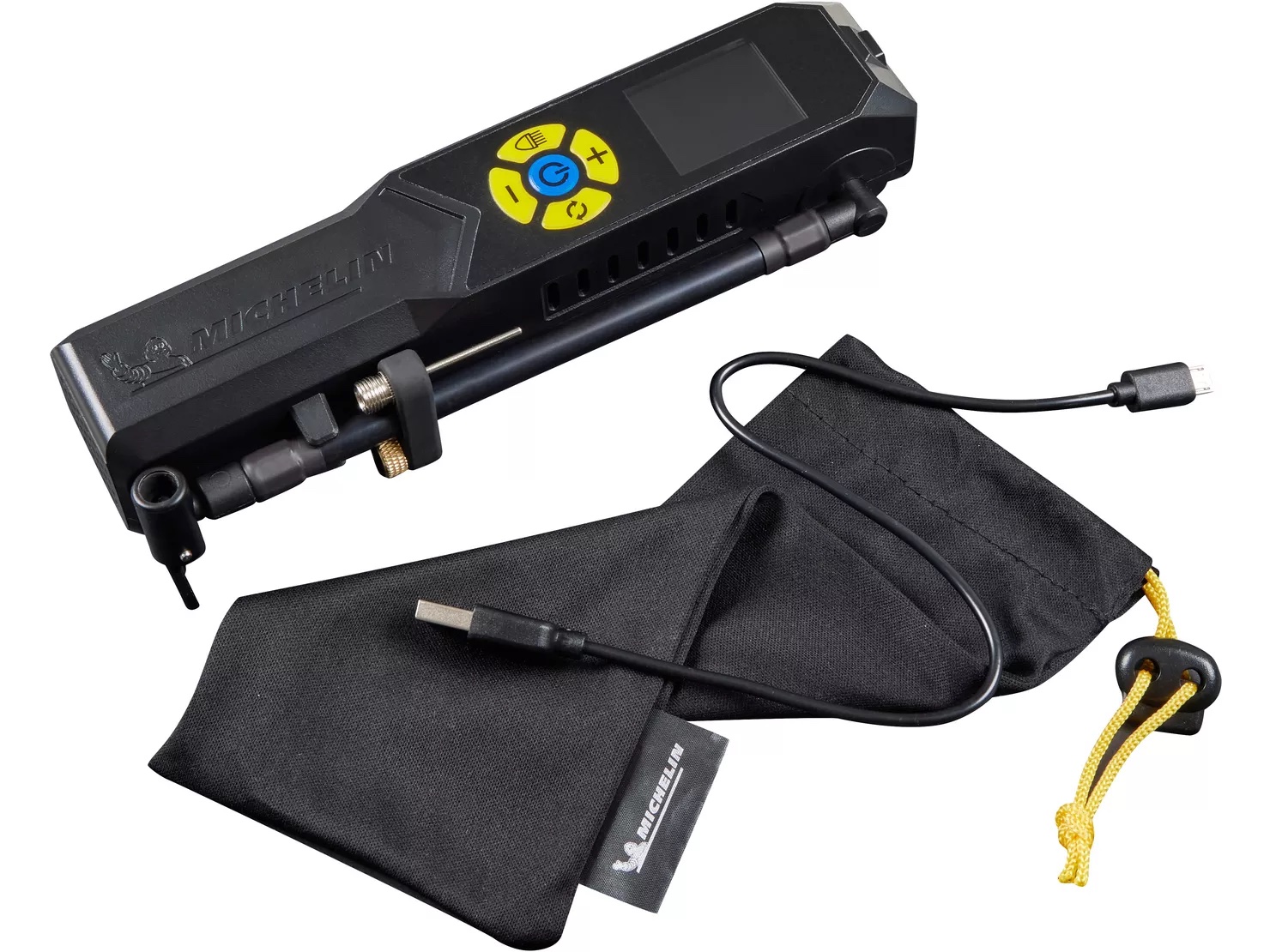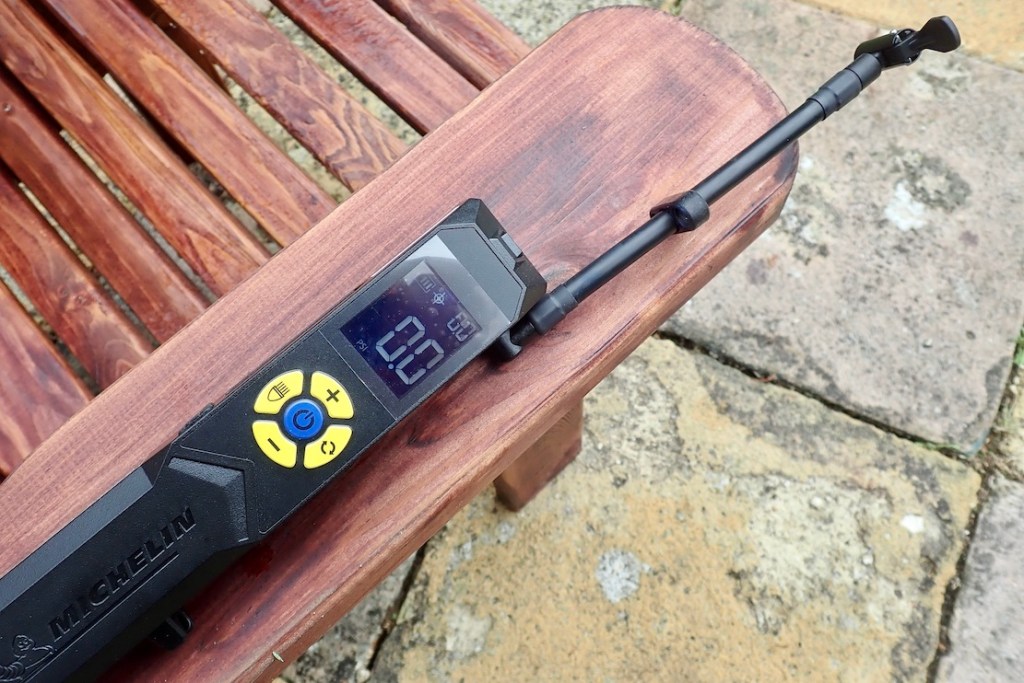
IN A LINE Handy Mich-branded tyre inflator with Presta adaptor, clear LED display and a light.
WHERE TESTED At home and on the road in Morocco.
COST & WEIGHT £47 discounted at Halfords. 450g verified.
WHAT THEY SAY Compact design fits in the glove box. Designed for topping up tyre pressures. Digital gauge is accurate to +/- 1 PSI up to 50 PSI. Switchable between PSI, BAR & KPA. Cordless, lightweight and portable, the Michelin Mini Rechargeable Inflator is remarkably easy to use. With four programmable pre-set pressure settings the cordless inflator is ready to inflate bicycle, motorbike and car tyres as well as a sports balls and other small leisure accessories. It’s [sic] integrated lithium battery is rechargeable in aprox. 3hrs. Built-in high intensity LED light at the top, enables for use in emergency or low light situations.
OK price at Halfords
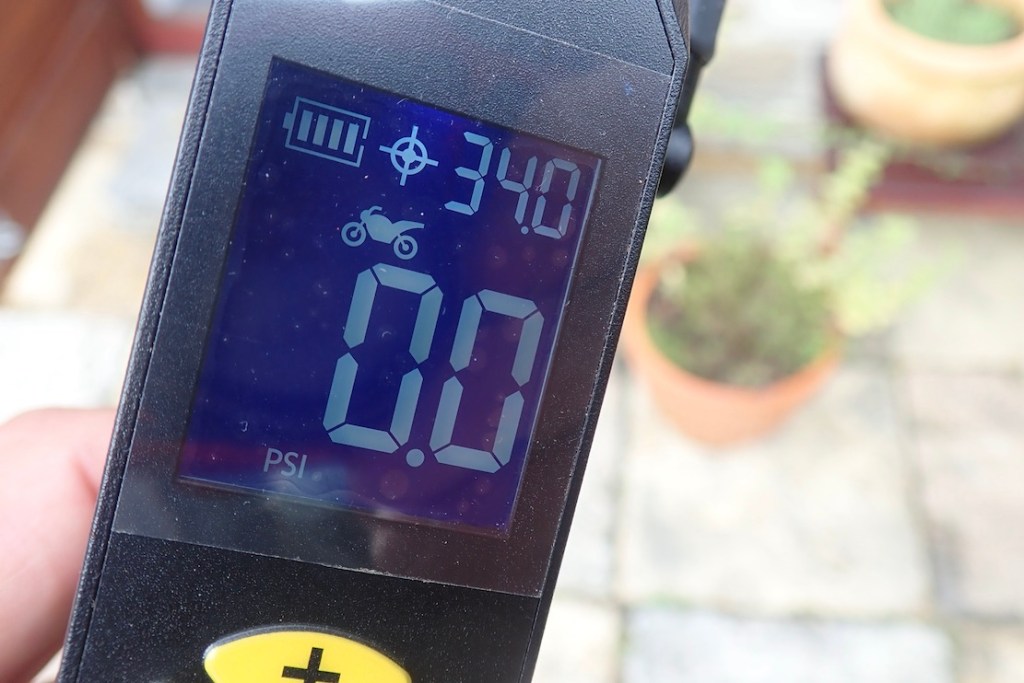
Clear, simple display and function buttons
Dead easy to use
Fairly quick fill for it’s size
Can’t turn on accidentally once hose is folded back in place
Presta pushbike adaptor included
Works as a tyre gauge too
Vibrates a bit
The lever-down valve clamp is hard to detach quickly without losing air
None of the presets can be stored after changing (I did RTFM)
Play up occasionally but always works in the end
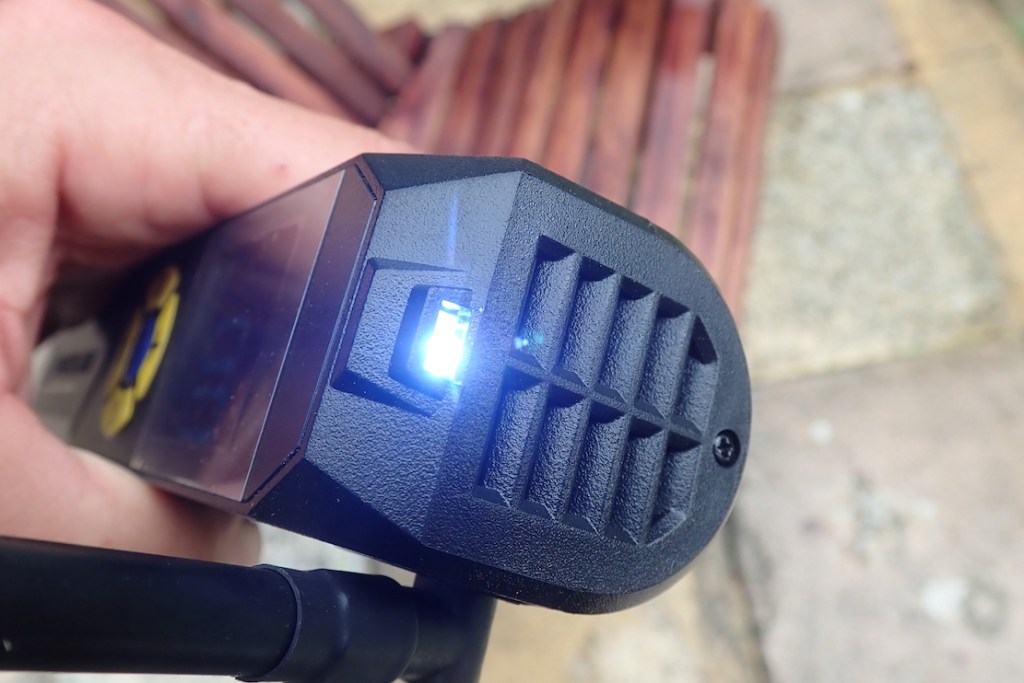
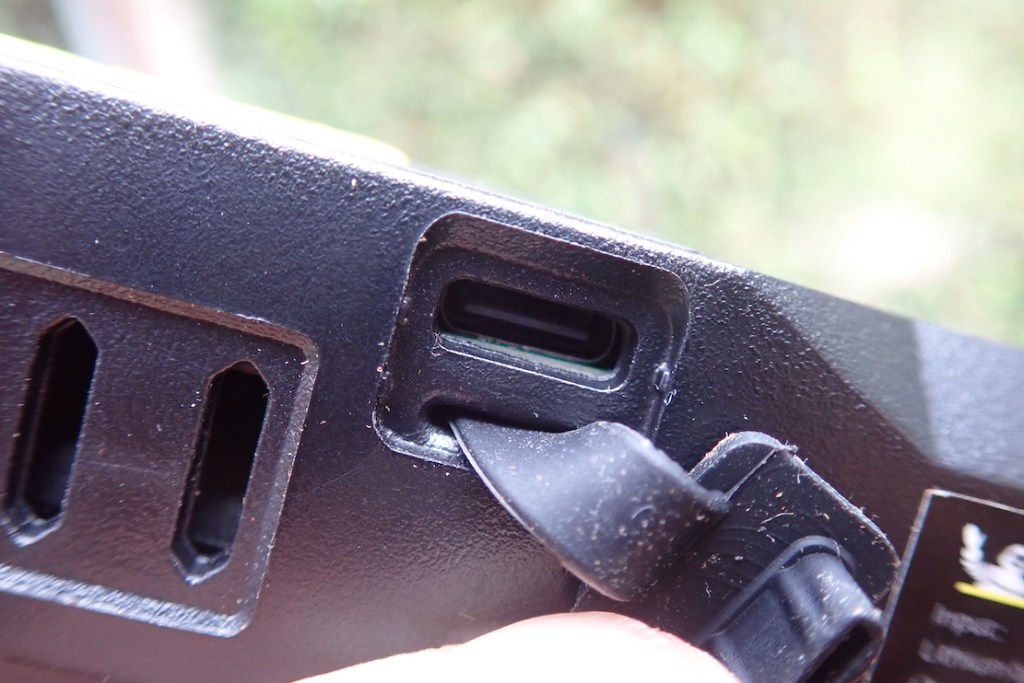
REVIEW My £20 ebay cheapie died after two years, longer than expected. And the bulk and faff of my ancient, 12-volt wired Cycle Pump remains off putting. Once you go wireless it’s hard to go back. Bring on the day when all electrical household items are cable-free! I like to think the 20% saving at Halfords on the Michelin Mini Rechargeable Inflator covered the premium for Michelin branding. The handy pump is about 8 inches or 20cm long, and comes with a tiny LED ‘phone’ light, and adapter nozzles for pushbike Presta valves and a football clipped to the swing-out hose with a fold-lever tyre valve connector. Plus there’s a flimsy bag.
Clear displayLED lightType C USBUnfold hose to wake the display
Jabbing the blue button won’t work. You wake it up by swinging out the hose at which point the LED lights up and the thing is live. Only then does the blue button set it off. You can scroll through four fixed-psi presets (bike 45, moto 34, car 32, football 8psi). It says adjustable which is true but that doesn’t mean ‘storable’ afaict. There’s a fifth, empty one to set as you like. But that isn’t stored either. I did read the leaflet and tried a few times. This all reminds me of the TPMS glitches (see below). Or maybe it’s as it was supposed to be. But honestly, you don’t really need presets. Just clip on, hit the blue button and watch the numbers rise to the pressure you want. Then hit the blue button again and it stops.
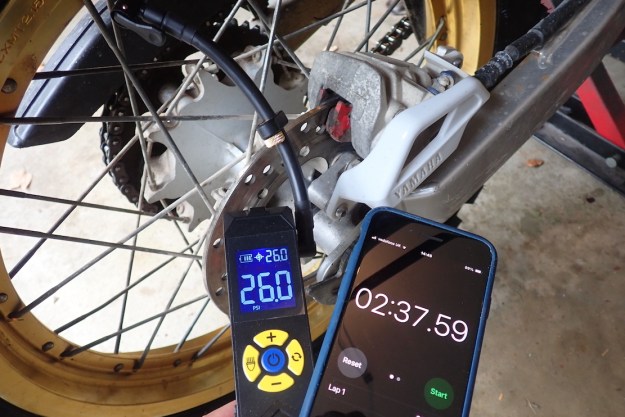
Zero to 26psi in 2:38
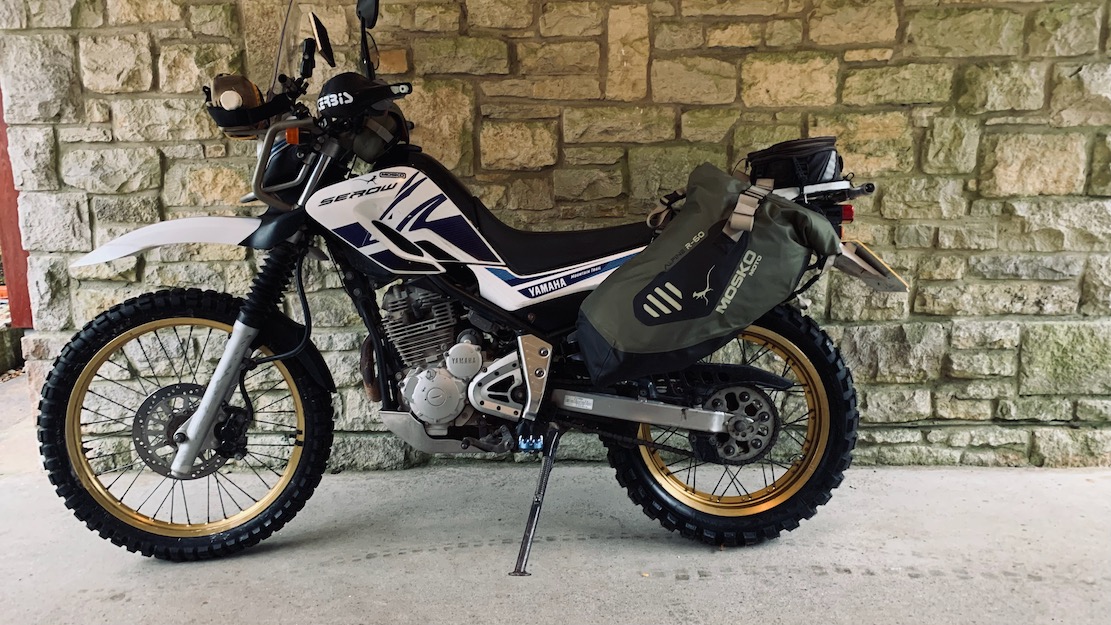
Fully charged out of the box, I inflated the new rear Michelin Wild tyre on my Serow from empty to 26 psi in 2:38s. The gadget vibrated a bit but didn’t get too hot. The battery dropped to ¾, but recovered back to full four bars in a few minutes. In Morocco my Serow’s stick tubeless rear leaked on most days – as some do. The Mkch pumped up up, though some days it didn’t light up and I was reminded of the flakey Michelin branded TPMS I tried a few years ago. But maybe it was a knack I needed to learn. I’ve never been a fan of these fold-down clamps on any inflator and this one was a tight fit on my valves which made quick removal without losing air tricky. Maybe it’ll loosen up or I’ll get used to it. but so far so good for the Mich pump.
Garmin’s dominance in satnavs has surely peaked now that offline nav is yet another task we can do on our phones. I’ve been moaning about my flakey Garmin Montana 680 for years: screen too small and murky, occasional freezing, slow loading, and newer Garmins way too pricey for what they are. But along with travel biking, the rugged Montana remains usable for green laning, walks, MTBing and even paddling, while shrugging off the shaking, occasional dropping and salt water. It won’t overheat in the sun and batteries last all day, but trying an app on an inexpensive device I already own and use is a low risk experiment. Recently I bodged a way of attaching my £85 Samsung A9 tablet in its child-proof case to RAM handlebar hardware using velcro, plywood and sticky-backed plastic. The A9 has loads of screen space – a bit too much, even; a 7-incher would do. A trail ride round the local lanes on the Serow and MTB proved my fittings held up, though weather and time might see to all that.
That done gave me a chance to try GaiaGPS (~£60 a year) which I know a little from Morocco, plus Ordnance Survey (£35) and DMD2 (£19) which I don’t. This isn’t really a like-for-like comparison. The OS is pitched at non-vehicular, UK-only recreation, GaiaGPS and DMD2 maps cover the world; the former again more for hikers but with overlandy adds-ons, the latter is made by and for motards. But you can use switch from app to app on your device.
Ian Haslop
DMD do make their own DMD-T865Xrugged tablet (right) for 850 quid. A mate is already on his second one. Then again, I’m on my third A9 in as many years; the motherboard or something packs up doing nothing more rugged than sitting on the bedside table.
Based on the crowd-sourced or volunteer contributed Open Street Mapping database (‘the free wiki world map’), in the UK, neither Gaia or DMD2 accurately differentiate between the few legal byways and the zillions of footpaths.
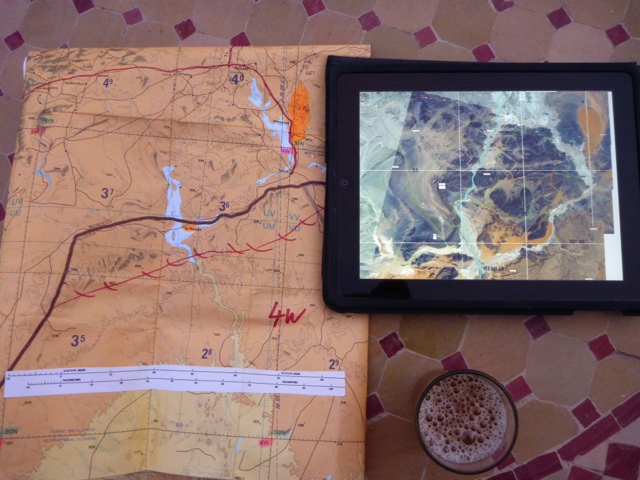
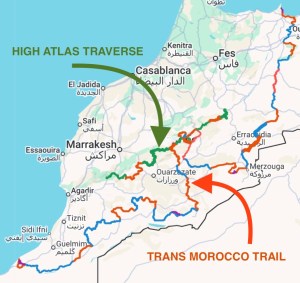
That said, with an imported and verified green lane gpx tracklog, you’re probably following a legal trail, so how the background map looks is less important. Meanwhile in southern Morocco and similar places, whether a track is actually passable on your machine is more important than rights of way – and that can change from season to season. Even in Morocco I nearly always ride new routes with tracklogs traced off sat imagery in advance (above left), sometimes even the night before. As you’ll read, the trails that appear on OSM-derived maps out there are too inconsistent and unreliable.
Ordnance Survey (£35 a year) For UK green laning Ordnance Survey mapping is a no brainer, even if you didn’t grow up using OS paper maps and can still read them like a copy of the Beano. Thirty five quid a year is a great deal if you do a lot of UK outdoorsing in addition to motorbiking, I’ve found myself referring to it nearly daily, either planning MTB rides from home, or when out and about to check directions with the A9 or the Mrs’ phone (it will run on multiple desktops and devices). One reason I stick with my Montana is that it came with a ropey old copy of OS 50k UK mapping (new, an ‘all UK maps’ miniSD from OS costs 300+ quid). On an OS I know what most things mean at a glance, and in the UK Rights of Way (RoW) are important when it comes to touchy Byways and similar off-road trails. Tap Map and the OS app transitions from the big-picture/motoring 250k map to the well known 50k and 25k sheets, The image on my Samsung (below) is crystal clear, although the red location/direction arrow is fixed at a tiny size (usually in the middle, of course). If you forget your RoW hierarchy, the OS legend tab is easily accessed offline, and downloading a map for offline use is also dead easy, though it’s limited to about 45km wide or ~300mb.
Importing a gpx file is also intuitive and once loaded, you can view an elevation profile in a side bar (like on Garmin BaseCamp and Google Earth), plus do a 3D fly-through over aerial imagery (internet needed). I couldn’t work out how to do this over a less gimmicky OS map, not aerial – I think it’s not possible. Another thing OS won’t do is show more than one of your imported routes at a time. Nor will it do A to B road directions like a sat nav; it’s a recreational mapping app. But using the ‘road cycling’ option under Activities will snap to roads and so could work for motos, though it might be scenic backroads rather than ‘shortest’ or ‘fastest’, like a satnav. One thing I often use on my Garmin is tapping the screen to instantly get the straight line distance to a nearby point from my location. On the OS app you have to go to Create Route, then select a non trail Activity like `Paddle’ or ‘Other’ which won’t snap to a path or roadway. This ‘snap to path’ (or byway) feature can be hard to control off road, though I’ve learned small hops work. Set on MTB (roads/tracks), it routed me into an army tank training area, though it did try and keep me out of a nearby firing range – and to be fair the map was plastered with ‘Danger Area’ labels and irl there would be similar signs and fences. Recording your own route, saving it and sharing/exporting is also intuitive. Because the mapping is so familiar to most Brits, for UK use it’s easy to get your head round the OS app, and unlike DMD it knows when to draw a line with ‘just-because-we-can’ added features which can just go too far. But other Open Street Map based apps will have endless POIs, and more functionality, like directions. You can of course switch to other apps on your device to find nearest fuel, for example.
GaiaGPS ($60 p/a subscription) Produced (or owned) by Outdoor magazine in the US, normally I’d not look twice at Gaia, assuming, like other US entities, they don’t ‘get’ mapping in my parts of the world. But their Morocco Topo map is preternaturally better than many other also OSM based maps, showing loads of real trails with outstanding legibility. Someone there gets how to design a map. And there are loads more in the layers.
Gaia: nice enough but unlike OS, you can’t tell the BOATs from the trees.
While offering routing options for every scenario under the sun (‘ice fishing’, ‘turkey hunting’, ‘streaking’ and ‘white water’), the app interface is clearly pitched towards hikers who can easily read the screen on the move with device in hand. On a moto (or anything similar at speed) the info across the top (speed, distance, etc) is just too small to be easily read and can’t be enlarged. Even the Montana is better at this.
Top info data designed for phones in walker’s hand; barely readable on a moving moto
But it sure is nice to have all that space to foresee the twists and turns of a loaded gpx trail, and with good brightness. Wearing a dark main visor on the HJC took the edge off this; next time I’ll fit the clear visor and use less good but in-built tinted visor. When I’d done enough green lane exploring I decided to try out the routing feature to get me home. It didn’t seem to work, even when set for ‘buffalo rustling’. I worked out later you need to tap the map exactly on a road for it to calculate a route. There’s probably a very lengthy list of other features on GaiaGPS, but me I’m just navigating trails from A to B, not trying to calculate my average elevation while ice fishing before the sun sets. All I know is that the Morocco map is one of the best out there.
DMD (£19 p/a map subscription) Made by motorbikers and loved by motorbikers. How would DMD2 stack up for UK green laning? £19 is quite cheap but this is only to open the maps and route yourself – good enough for most. There’s a Roadbook plug in to save on lunchboxes and rolls of paper, and an OBD plug which opens up the whole world of bike telemetry – TPMS, coolant temp, mpg – a lot of stuff that’s probably on your dash menu, assuming you’re not riding an air-cooled dinosaur. You download maps by the country. I did UK and Morocco, some parts which I know well, and did a test. It looks like DMD have simply loaded everything off the OSM base map with little filtering. In Morocco it’s evident from the many disconnected scraps of track added by pedantic contributors misinterpreting aerial imagery or the meaning of useful contributions. What use is 450m of ‘track’ on a remote hillside going from nowhere to nowhere? Actually, I see Gaia (below right) is the same, but makes them far less conspicuous – the key to legible cartography – while often managing to get the real, useful or main tracks right. This extraneous clutter is something that’s unique to little-scrutinised Morocco on OSM. In Europe, such nonsense would never go unchallenged, as the UK map below shows.
The comparative screenshot in the UK below looks a bit skimpy compared to the Gaia and OS versions above, but two zooms in shows a lot more track detail. I do like the ‘globe’ icon which toggles when online, most usefully satellite view as well as ‘OS Maps’ in the UK (not real OS maps, as above, who protect their copyright like the crown jewels), plus wind, rain and temperature (aka: ‘weather’).
DMD2 UK map. Not so legible
Even then, I find DMD2 look cluttered compared to the Gaia and in the UK would obviously use OS, Amazingly, there is no key or legend built into the app to work out what the multi-coloured tracks mean. Searching online gives this page, and a DMD Facebook user condensed it into the image below left.
Condensed DMD2 legendMasses of brown tracks; none moto legal
It seems difficulty – always subjective, weather and moto dependant – is prioritised over rights of way, but my UK DMD2 map certainly doesn’t relate to what I know locally. Green and blue are footpaths, purple is supposedly a bridleway, but rarely corresponds with OS data. Meanwhile, there are masses of brown tracks (as in southern Morocco). Of brown tracks DMD says: …it should be unpaved but no further information is present. Difficulty: Some of the hardest tracks are ungraded, so expect anything!‘ Afai can see, there’s no designation for a legal UK Green Lane/Byway. I know the few around and they’re all brown or don’t exist. So without a verified gpx to follow, DMD2 would be unusable for off roading on UK Byways, but in Morocco (for example) a brown track ought to be a real track. Just make sure it is connected to other roads or trails.
I’ll be trying to get to grips with DMD2 and Gaia on my tablet this winter, while having my long proven Montana loaded with a couple of good maps as back up. More later.
IN A LINE Quality, heavy duty off-roading Mids with Gore-tex. Tall on the shin but narrow across the foot.
WHERE TESTED For the moment, just local lanes.
COST & WEIGHT £280 rrp (from £210). Mine used for £86. Weight: 1100g per boot.
Used bargain!
Very solid build
Stiff instep for standing on pegs
Grippy, Vibram-like sole
Mil green version looks best
Gore-tex membrane
Comes with detailed manual in 13 languages
Mine in boring black but price was right
Right now heavy, stiff and clumpy, but may ease up
On the narrow side
Like all Mids, the top edge can chaff on the shin
What They Say A shorter, more practical version of Adventure 2 Gore. While the non-slip rubber outsole provides optimum grip and total control in all situations and terrain, the micro-adjustable buckle system ensures total comfort. Versatile and untiring, the special Gore fabric is a bonus for the best possible exploration, even in rain and muddy conditions. • Full grain microfibre and suede construction • Waterproof Gore-Tex breathable membrane • Non-slip rubber sole • Hook and loop strap and buckle closure system • Inner gaiter • Plastic support on ankle area • Back reflective inserts for night-time riding • Nylon inner sole with removable arch support
REVIEW After seven years my TCX Baja Mids were as comfy as old slippers but wearing out. One buckle clamp was bodged from something else, then recently in Morocco an unnoticed flying stone poked a hole in the toe like it was cardboard. No longer listed by TCX, remnants crop up from £190.
Forma Adventure Low – too soft
For my next pair of Mids I definitely wanted a less mushy instep for standing up foot-ache free. And a treaded sole would be better too; I’m forever slipping around when clambering on the roadside to shoot a quick pic. Similarly good looking Forma Adventure Lows (left; rrp £214) caught my eye until I clocked the unusual warning on SBS about the soft instep. The current trend for wider pegs helps spread the load of course, but if they’re advising this upfront, the Formas were no longer contenders. There’s an ‘Adventure look’ with boots that doesn’t correspond with actual all-terrain adventuring – a parallel to the entire ‘style before function’ Adventure Motorcycling Phenomenon some might say! My old Bajas may have been in this category, and so might similar, two-clamp Gaerne G-Dunes, cheaper LS2 Adventures and the even cheaper RST Adventure-X (below; left to right).
They all have the appearance of MX boots – rugged clamps and ankle protection – but underneath aren’t really up for it. This shop product video review seems to confirm this lamentable trend while claiming these Sidis are a cut above.
I thought I’d treat myself to some Sidis who, like Alpinestars, have had a solid rep in off-road moto footwear as long as I’ve been riding. Or should I say, some turned up in my size dead cheap ;-). They certainly look like they could give and take a good kicking, have a Vibram-style sole and, in ‘military green’ (left) looked way more interesting than ‘tobacco’ or boring black.
I’d have sized up a green pair from SBS, then waited for a sale or used, but as said, my size in black and used once was ending soon on eBay for just £86. Boring black it would have to be, but at least they’re better than the ‘messy coral’ Crossair X for just £630 (right).
Narrow
Sidi Mid Adventure 2s Out of the box the 11s (46) looked solid but unnervingly narrow. Once on my feet they felt the same, initially pressing on my small toe, even with thin socks. I didn’t get the chance to read before buying but many reviews and customer reviews on SBS (left) testify to this. But had I gone up a size to 47s they’d be way too long. I’ve had width issues forever with hiking boots, but with the Sidis the pressure goes away after a while, and it’s not like I’m heading up the Pennine Way with a full pack for a fortnight. If they’d been that bad I’d have put them straight back on eBay and might even have made a few quid.
Note that the video above compares the Mids with the full-height version with an ankle hinge for full articulation. The Mids don’t have this but being tall for Mids, lose out on that ankle movement when walking or sliding into a corner, extended inside skimming over the dirt. The simpler, one piece body will probably do me, plus there are bellows above the heel for a bit of give.
Green laning locally on the Serow, the Sidis proved they had what the Formas, my Bajas and maybe the other softies all lacked: a rock-hard MX instep offering pain-free standing support on the narrowest, spiked footpeg. And the lugged ‘Vibram’ sole (left) will add grip when paddling or scrambling about off the bike. My smooth-soled Bajas were a pain in this regard, though a real dirt racer’s boot would have a smooth sole for crossed-up broadsides, like I was practising below (1970s Alpinestars Super Vics).
The Sidi’s straps clamp down securely with a bumper protecting the lower one, and ought not fall off like the Bajas. With the unusually tall height (300mm in my 46s), they could be run ITB (tucked in), and ought to keep the feet dry in downpours and through fords. The Bajas were too short for reliable ITB; these taller Sidis ought to hold the tucked in trousers. Plus you get an actual Gore-tex membrane for as long as it lasts, not some no-name ‘SplashBack™’ version, though the vid review above notes the membrane ends about halfway between the top edge and the upper buckle.
Inside you get the usual cheap, thin removable insole (left). I’might put in one of the better ones I’ve lying around, or if you need more volume you could ditch it; it’s not like to need the all-day walking support. One thing with Mid height boots like this is that the top of the boot can chaff on your shin – my Bajas were like this too. It’s one reason to go ITB or wear knee-height socks.
Weighing 1100g each (only 80g more than my Bajas), they don’t feel anywhere near as comfy right now, but will hopefully respond to breaking in. To speed that process up, I bought some boot spreaders (left). We’ll see how effective they are, but once that’s done the Sidis look like they’ll take whatever terrain and weather’s thrown at them. More to come.
Do we have PotWs here on AMW? We do now. You know a good shot when you see one, even if you don’t know the backstory. I happen to know Karim H, and this shot led a selection of his 20 favourite photos on his Insta page covering his west coast trans Africa earlier this year on his ’84 XT600Z. Looks like a hot, dusty day somewhere in Mauritania, probably the roadhouse midway to Nouakchott which doesn’t always have pump fuel. The Moorish bloke on the right sets off the symmetry with the bike as well as the two green pumps – probably the only greenery for miles. The pinkish haze over the dunes reflects the maroon signage mast. It’s the desert at its least glamorous: choking, dreary hot middle of the day but with the vital fuel to keep the show on the road.
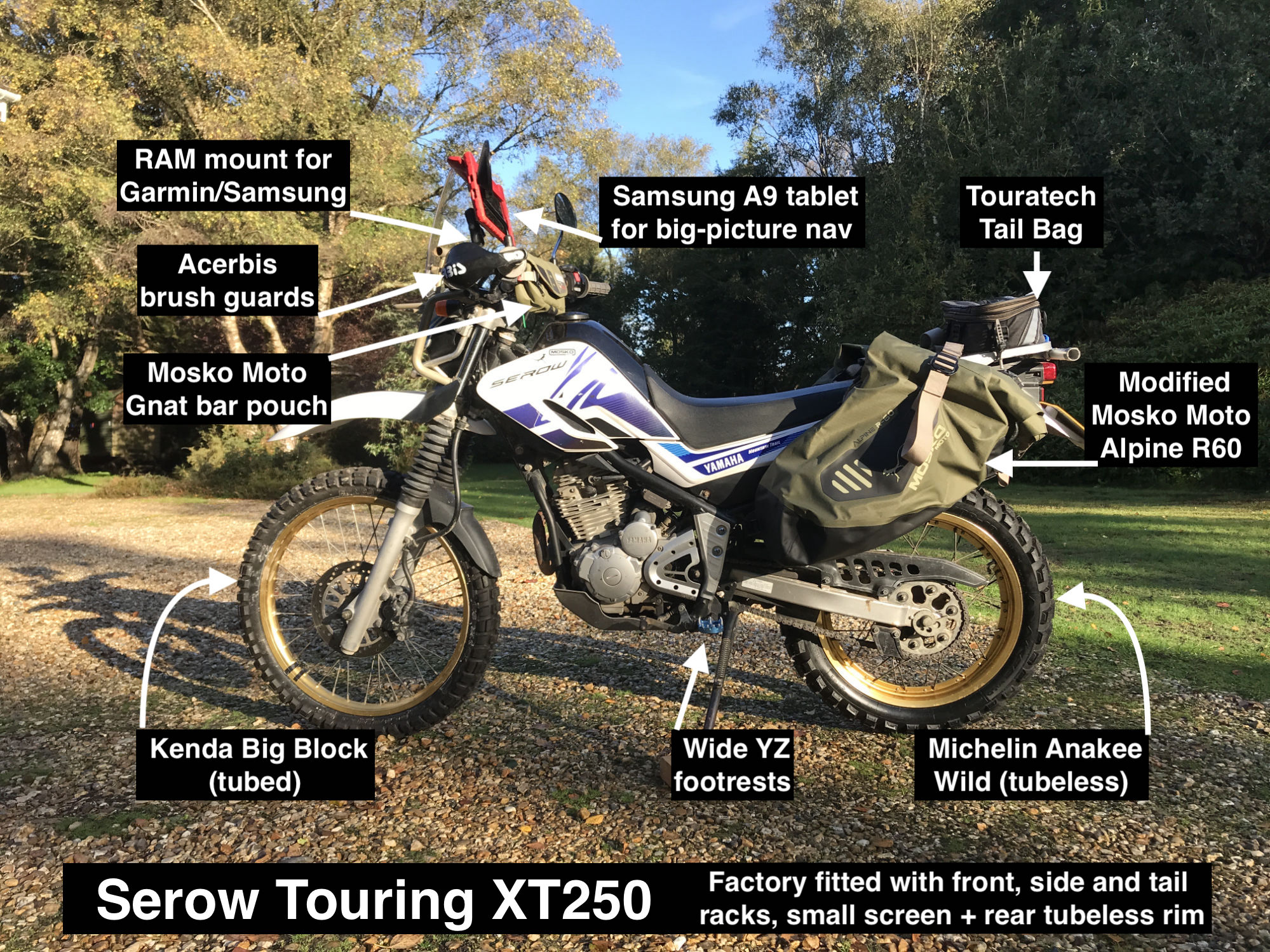
Not being a UK model, it can be a bit of a lottery ordering parts for the Serow, but generally it seems any XT250 from the same years is near identical. They’re not UK models either, but there seems enough around online in the UK. Webike.jp is the best I’m told, and pretty fast. Procycle in the US was amazingly fast for some TW200 parts. Oregon to my door in 3 days with a free sonic boom! The chain is only a skinny 428 (next size down from 520), but a heavy duty got fitted which looks nearly the same as a 520. There’s a lot of caked-in Salisbury Plain mud splattered all around the nooks and crannies and a bit of surface rust, but nothing drastic.
• XT250 air filter for a tenner off ebay. Never seen one that small.
Three bearings and two seals
• Rear wheel bearings. The bike was used for muddy UK trail rides and the bearings didn’t feel that smooth and solid. Again a lottery if not buying factory parts; I took a chance and these were the ones. I did some front bearings once but not rear bearings – never knew there were three in there (two on the chain side; no cush drive, like the CRF). I expected the usual gnashing of teeth, but it was dead easy after a quick YouTube and and no special tools required. I peeled out the rubber seals with a tyre lever, heated the area over a camp stove, then used a thin, long, round rod with a freshly-sawn sharp end to tap one out, starting on the brake side (single bearing). There is a spacer tube between the bearings along which the axle normally slides, but the bearing’s inner diameter is 1mm or less smaller, which provides a smidge of a lip for the rod’s edge to work on. Once the spacer drops out, the chain side bearings are easier to tap out. Once greased up, the new ones gently tapped in easily (no need for freezing to shrink them), using a large socket on the bearing to spread the load evenly, and the bikes axle to help line up the last bearing and spacer tube. So satisfying when it all goes to plan.
• Trail Tech engine temperature read-out. There are Chinese cheapies on ebay for 20 quid but for 3 times the price, I know well that a T’Tech will last (left: WR250R). Clamp the wire anywhere very hot then learn a median reading so you know what’s excessive. Air-cooled run hotter so it’s good to keep an eye on things and slow down if needed. My Him 411 got up to 270°C on the motorway. The battery powered read out is handy to read ambient morning temps too (left), before starting the engine.
• Replaced the stock cheesecutter pegs with some full-fat WR footrests I had left over. They only came in blue – or black costs loads more.
Well hidden
• As usual I wonder about upgrading the shock; an easy way to improve the off road ride. But I forget that stock Yam 250 suspension is not necessarily the soggy mush off a CRF. The TTR had great suspension, and it seems Serow (especially the previous 225) is closer to TTR than the 250 Serow which has no damping adjustment. In the RM vid below, matey is swapping out a stock 6.7 kilo spring from a US-model XT250 for a Racetech 9.8. It seems a pretty easy job with no deadly compression required. I don’t know what my spring rate is and whatever damping I have left comes free.
The YSS shock is the cheapest at £330 with compression damping and a juicy red spring which must be worth 50 quid alone. A YSS was OK on my Himalayan 411. Internally I’m told they’re crude, but YGWYP4. I thought about it, then held off and instead chipped away at the preload rings with a hammer and old screwdriver, assuming I need more than the orevious owner who was probably half my weight. The rings were now ⅔s down the threads but adfter a ride along a bumpy lane it was way too much. Back home more chipping to back off a bit. The unadjustable front fork also seems usefully firm. So maybe the suspension is not so bad after all, and now knowing the shock can be easily removed and taken apart and the spring is firm, it would be great to fit a hydraulic preload adjuster (HPA; above left). I’ve had them on previous bikes: just turn a knob to vary the spring preload depending on loads or terrain. You can almost do it while you ride. Who needs ESA? The problem is finding one that will fit what is probably a KYB shock. There is space enough around the shock for the hose and mechanism, but along with the exact diameter, I’m told there is no commonality with shock body threading like there is with other screwed fittings.
If I don’t manage to find an HPA, I’m eyeing up a Hagon shock with combined damping/compression adjustment and an optional HPA (left), all made to measure in merry old England for 600 quid with a plain black spring. Back in the 1980s I used to get the fragile stock wheels respoked at Hagons when they were in Leytonstone, in the day when I rode full-sized XTs.