Tag Archives: Himalayan 450

Himalayan 450 in the Himalaya

by Dave K

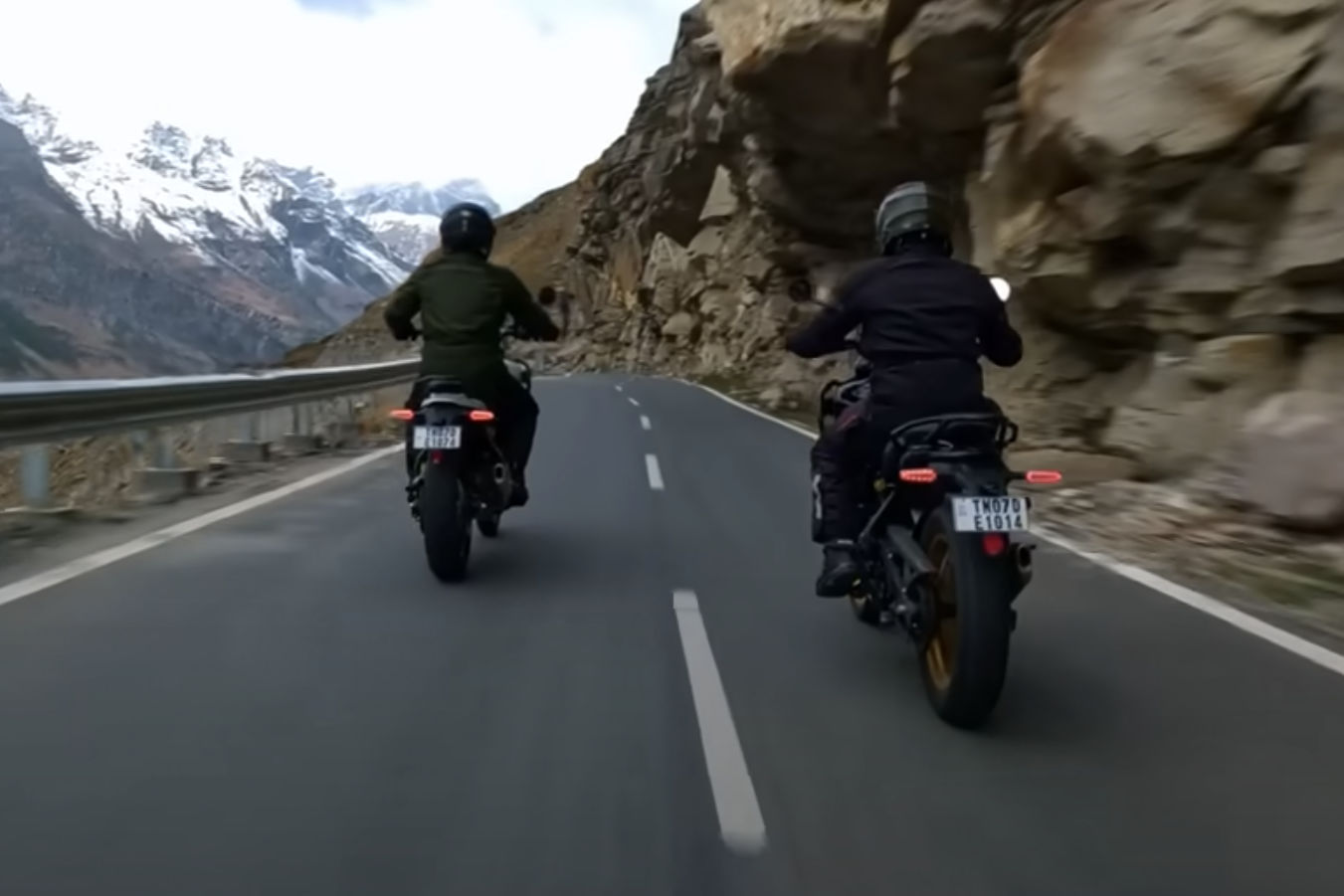
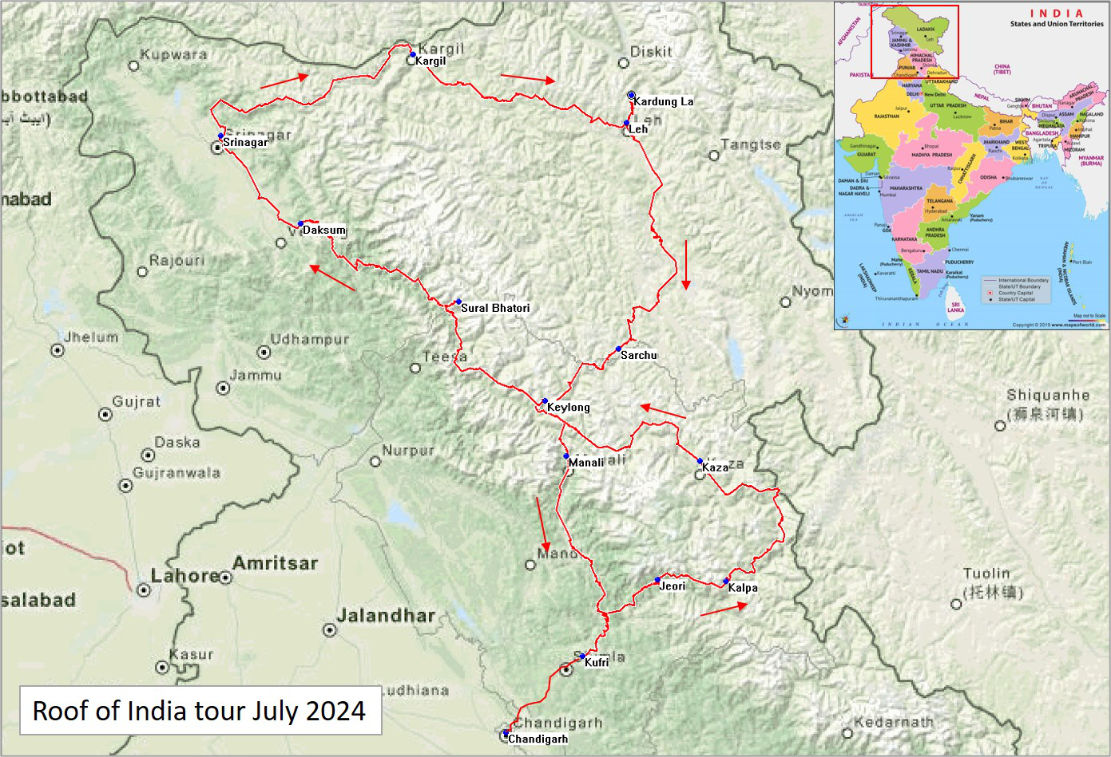
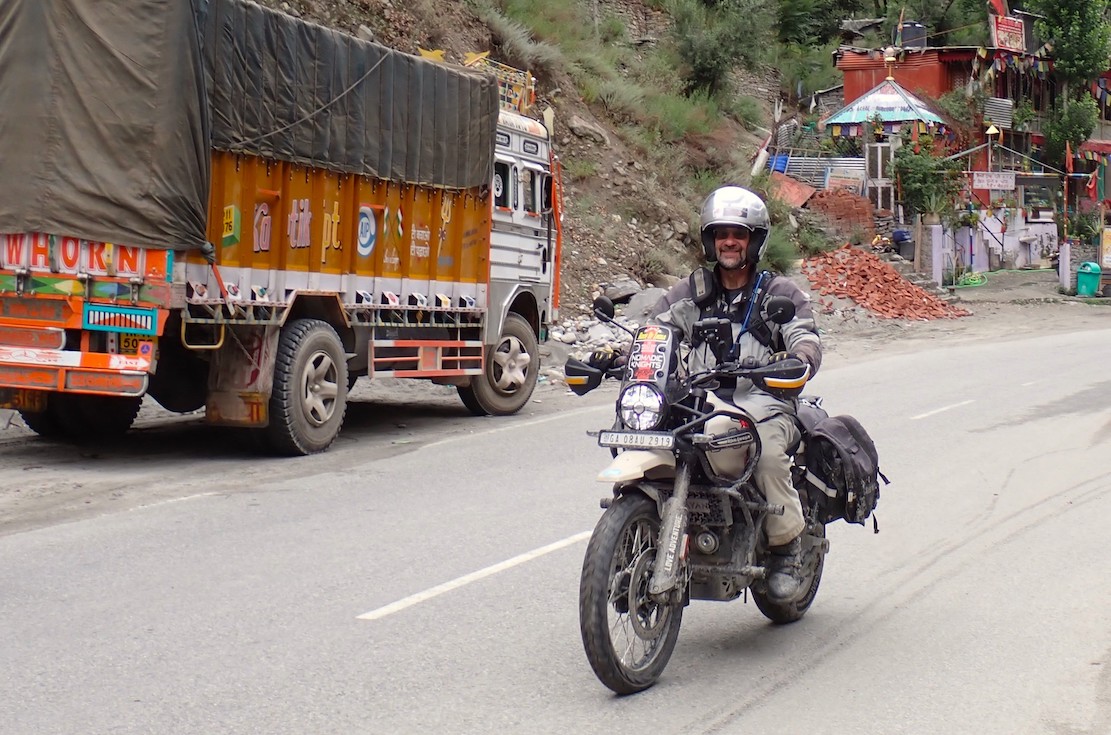
Danielle (Dan) and I recently returned from a two-week bike tour round the Indian Himalayas, riding the new Himalayan 450 adventure bikes. The Roof of India tour, organised by Nomadic Knights, was billed as ‘extreme adventure’, rather than a holiday. It certainly lived up to its billing, with a faster pace, greater distances, and longer days than previous trips we have undertaken in the Himalayas, including the month-long trip we undertook in 2017 on the original Himalayan 411s (left).
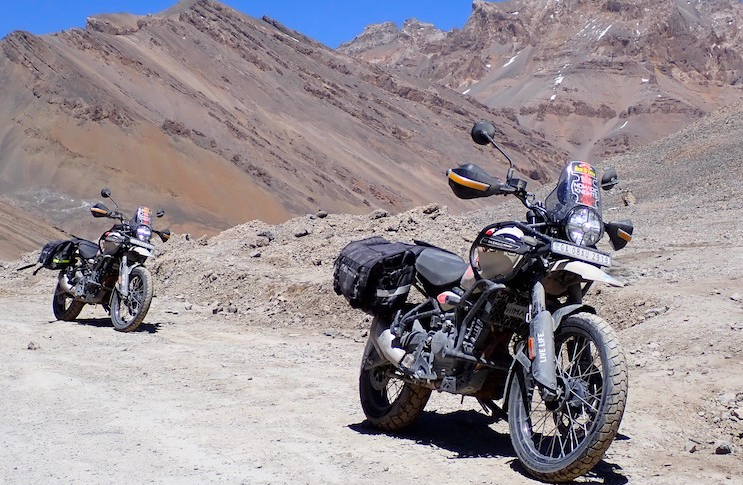
The new 450s were perfectly suited to the trip. They had better engines and suspension than the Himalayan 411s, although were noticeably heavier and (arguably) less attractive to look at. According to the Royal Enfield website, the 450 has a kerb weight of 196kg, which is actually lighter than the 411 kerb weight of 199kg.
However, the 450s we rode on this tour had substantial additional crash bars (with steel bobbins), a rear racking system, stronger hand guards and a larger bash plate. I suppose if you are encouraging punters to have an extreme adventure, you can expect them to crash from time to time. The weight is felt most when using the side stand or centre stand. The bike leans over a long way on the sidestand but this does result in it being quite stable when parked on uneven ground.
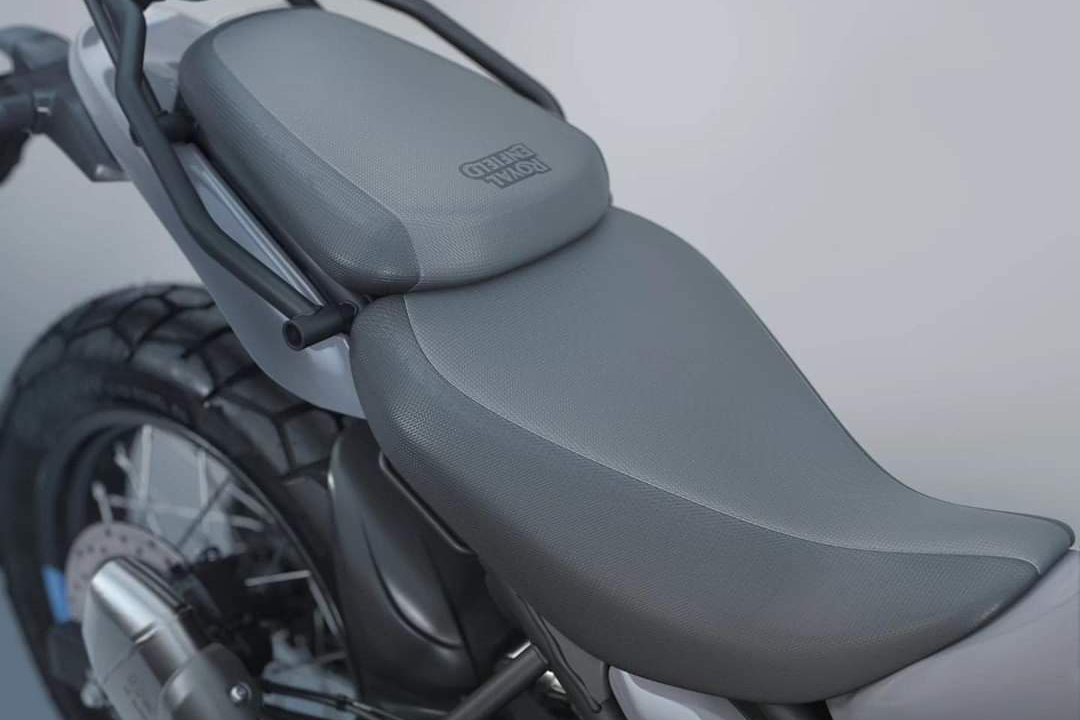
Once the handlebar levers had been rotated down a bit and the seat raised to the higher position, the ergonomics were very good, both standing and sitting. Because of my height (a bit over six foot) I fit bar raisers to most of my bikes but didn’t feel this to be necessary with the 450. The seat was very comfortable, although this would have been helped somewhat by the padded cycling shorts I always wear under my enduro jeans.
The engine feels quite torquey and pulls strongly between 4000 and 6000rpm. My first impression was that first gear was rather too tall but this is countered by the engine’s reluctance to stall at low revs and so I soon got used to it. Tight manoeuvres require a bit of clutch work but that is also true of the Husqvarna 701 I ride at home.

Him 450 vs MT450 vs KTM390 vs 300 Rally

The bikes we were using were new and the fastest I saw on the speedo was 122km/h. I didn’t want to push it further than this because the engine still felt a little tight and it was just not appropriate for most Indian roads. A top speed of ‘over 150km/h’ (94mph) has been quoted by Bike India magazine and I have no reason to doubt this. Other reports have suggested that the 450 is more than comfortable on UK dual carriageways, which, from personal experience, was not really the case with the 411.
The brakes were fitted with braided lines and were very good. Like many modern adventure bikes, the rear ABS can be switched off for off-road use. This is done using the Mode switch on the right switch cluster. However, if the ignition is switched off then on again, the system reverts to full ABS. This feature resulted in my only concerning moment of the trip. I applied the brakes while traversing loose stones in an off-road section and the bike took an uncomfortably long time to come to a halt.
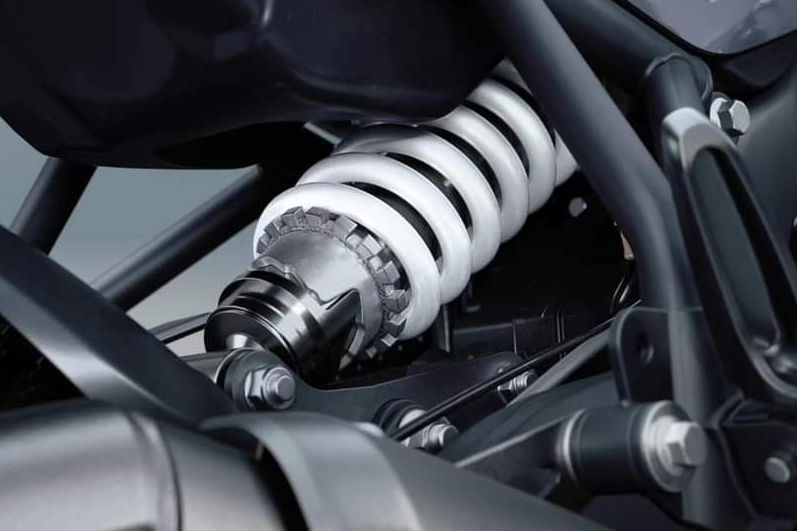
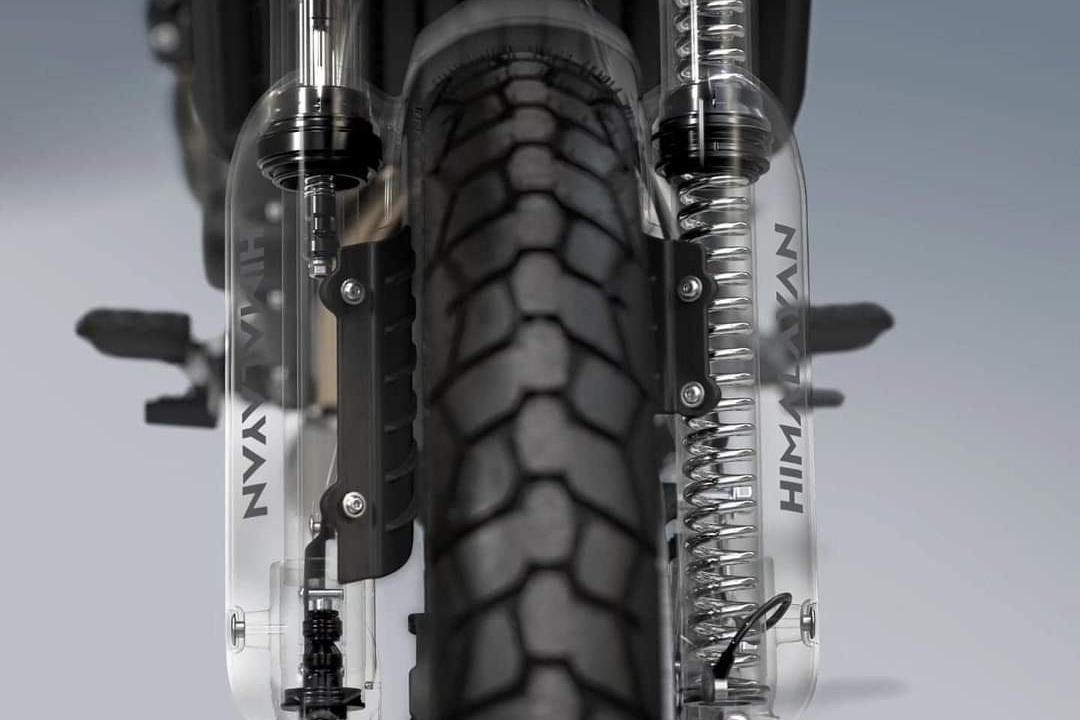
The suspension on the 450 is made by Showa. The only adjustment is the rear preload but I found the default spring rate and damping to be perfect for me. It might have helped that I am close to the ‘standard’ weight of 75kg but nobody in our group had any complaints about the handling or stability.
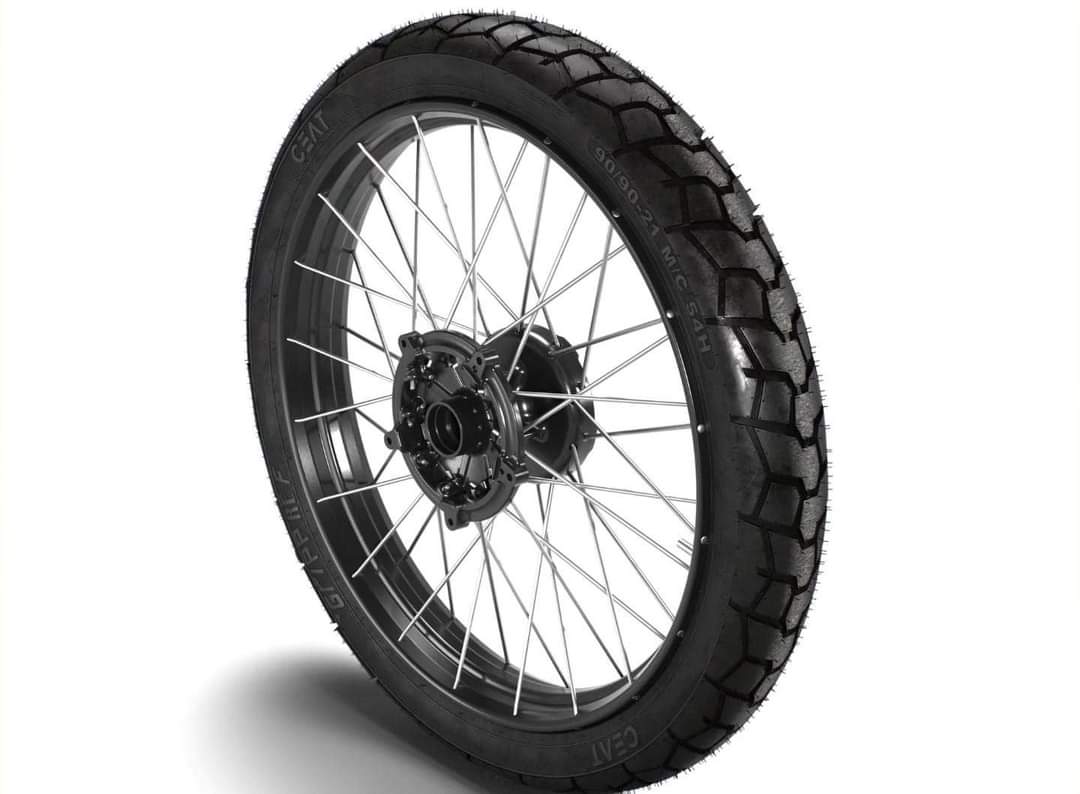
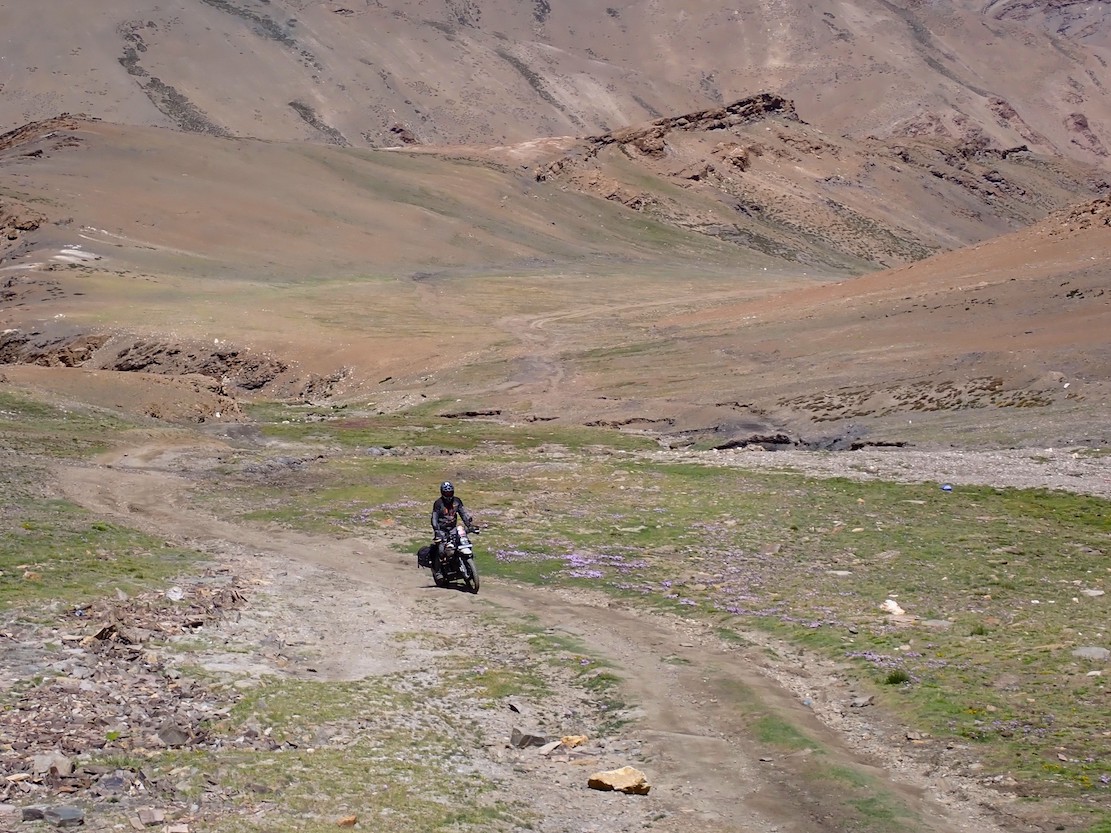
The standard SEAT tyres are not particularly knobbly but worked very well on this trip, both off-road and on. The only time they were a bit challenged was on a short section of snow and soft mud. For UK trail riding, I would replace them with something slightly knobblier, probably Michelin Anakee Wilds, but for the roads and tracks in the Himalayas, the original tyres were perfect.
The clear screen is quite small but, being located fairly far forward, did a good job of reducing wind blast without excessive wind roar. Most of the time I didn’t use or need ear plugs although I put them in before a couple of relatively fast road sections, just in case.
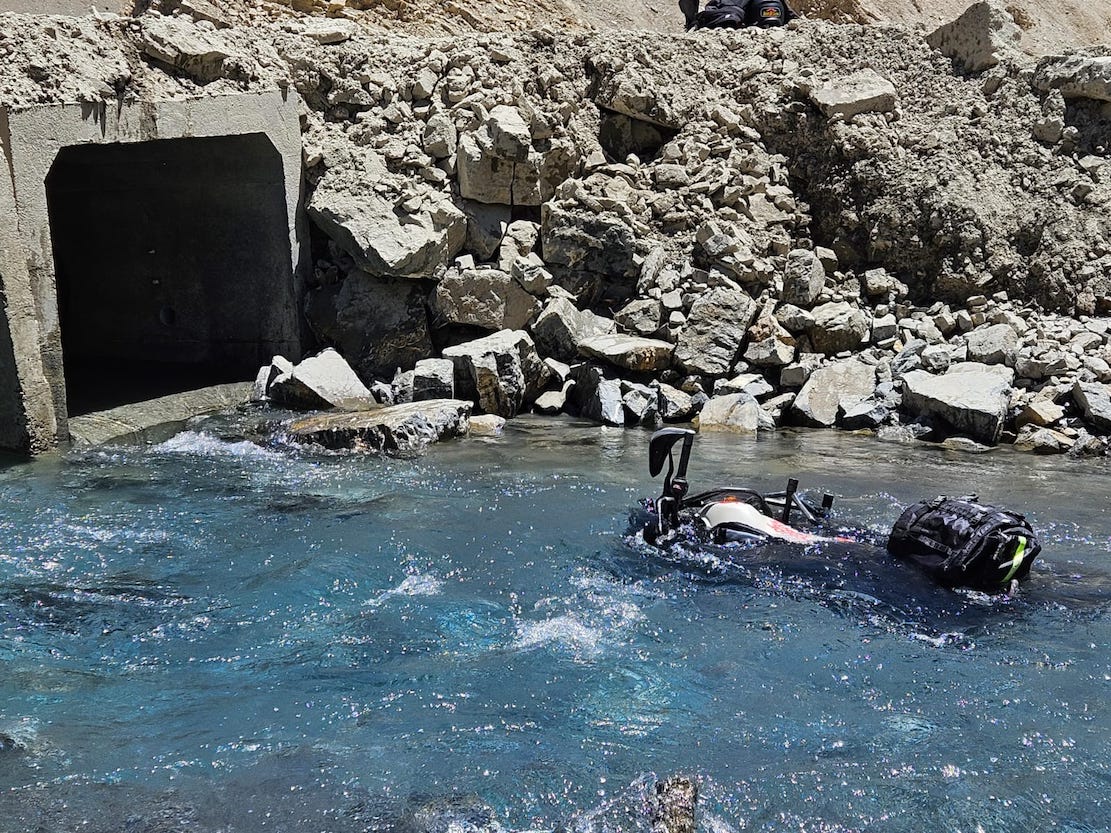
None of us had punctures and the only reliability issue was a dodgy fuel pump on Bob’s bike. Benny damaged his bike by riding off the road and into a water-filled culvert but that was not the bike’s fault.
New water-cooled 450 Him

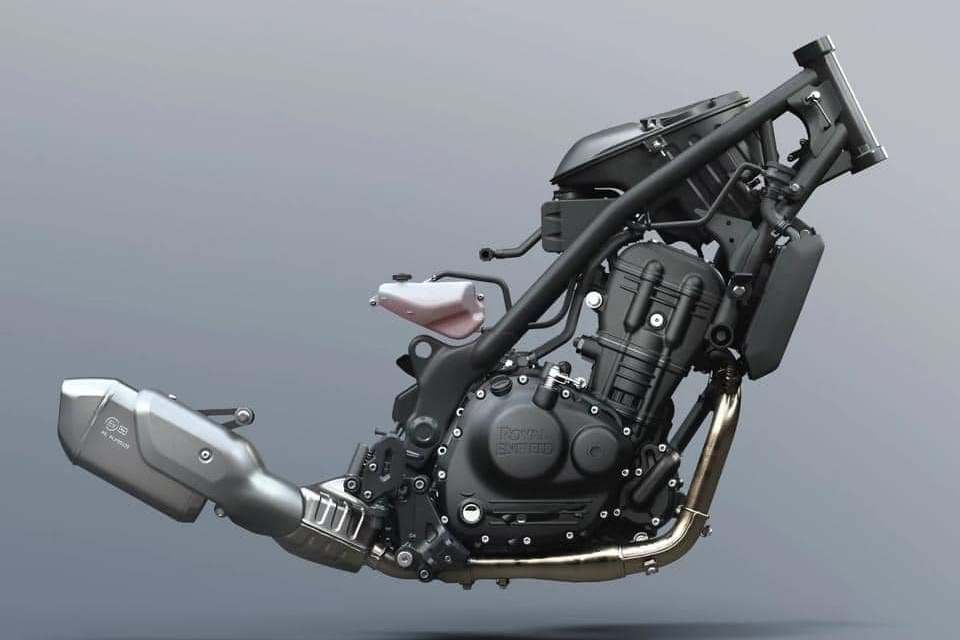
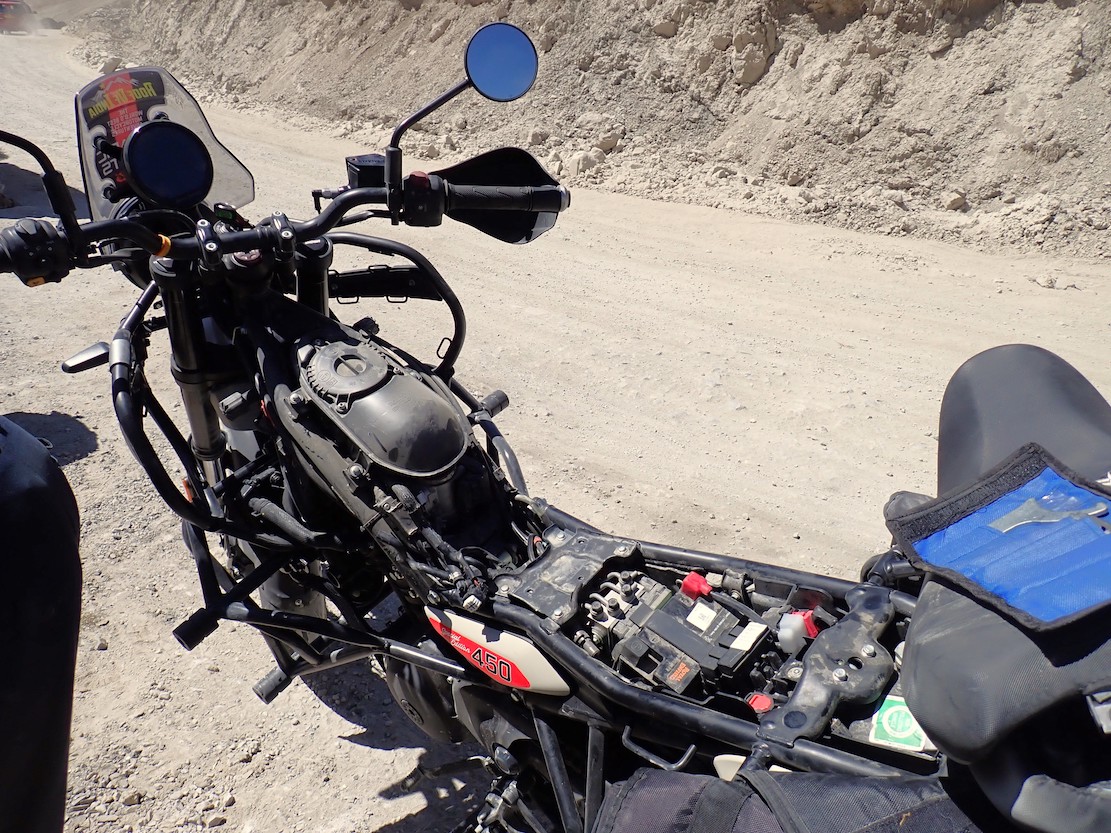
Royal Enfield had quite a large stand at the 2024 ABR Festival, which included a Himalayan 450 without its tank, seat, side panels etc. to make the frame more visible. The stand also included a sectioned 450 engine. The impression given by both frame and engine was of components relatively cheap to make, designed to last, and easy to work on, with a fine finish only applied where functionally necessary. It made an interesting comparison with KTMs, where components are made as light as possible and appear delicate and almost watch-like compared to their Royal Enfield equivalents.
I toyed with the idea of buying a Himalayan 450 in the UK and stripping off the tank crash bars, centre stand, etc, to reduce the weight a bit. However, I already have a Husqvarna 701 and I have no doubt that this would always outperform the 450 off-road. However, I also considered what would happen if relatively inexperienced rider were let loose on 701s in the Himalayas. I suspect it would be expensive carnage. So, for trips like the one we just completed, the 450 is just about perfect. Out of interest, the Himalayan has a similar weight and power to an old KLR650, which I rode across Tibet one time. So much for forty years of progress.
Soon after the India trip, I rode my CRF1000L Africa Twin on two days of the UK ACT in Wales. It felt significantly more top-heavy than the 450 and, overall, didn’t appear to be as good off-road. Also, during the Wales trip, my friend and I had cause to pick up his Tenere 700 from flat on the ground. This took about as much effort as doing the same thing with my Africa Twin. Certainly the 450 has a lower centre of gravity than both the Japanese bikes and is easier to pick up.

So, in summary, I rather liked the new Himalayan 450. The Indians appear to have thought long and hard about what people need and done their own thing, rather than make a copy of somebody else’s design. I’m also getting more used to the way it looks and might still buy one.

While editing this post, out of interest I decided to click this option which has cropped up on WP lately (and in many other places like ebay):
“Create and use an AI generated featured image for your post.”
Below is what it came up with, presumably based on the post’s words and pictures. As bad as expected – or have I accidentally rendered RE’s imminent 650 twin Himalayan! Who knows but I won’t bother again.

Preview: Himalayan 450

See also:
Himalayan 450 3000km review
Himalayan 411

Royal Enfield scored an unexpected success with 2016’s Himalayan 410, selling some 200,000 units worldwide. Despite early issues, a 23-hp, 200-kilo, air-cooled single worked for many people, including me. Now they’ve responded with a load more power from the modern, higher-revving, 6-speed, 11.5:1, DOHC, water-cooled Sherpa 452cc motor.

New DOHC Sherpa 452; 10kg lighter than the 410LS

Claimed weight of the bike is still around 195kg tanked up, but that’s with an extra 2 litres of fuel and the same screen, tank bars, tail rack and centre stand. Though an inch higher, the stock adjustable saddle remains low at 825/845mm (32.5″/33.3″), with an even lower 805/825mm option. RE gets it with the Him; leave the yard-high seats to 690s and clowns on unicycles.

There’ll even be optional tubeless spoked rims. Again RE responds by offering what some real-world riders want: the confidence that roadside flats can be fixed quickly and easily. And unlike the steel rims on the 410, wheels are now alloy, though weight wise, you may find there’s only about 10% in it.

Suspension is in the same 200-mil ballpark too, but with USD cartridge Showas up front and a link-less shock with easy preload adjustment access. Neither have damping adjustments, but presumably there’s a benefit to cartridge forks. I forget what it is, exactly.

All change please

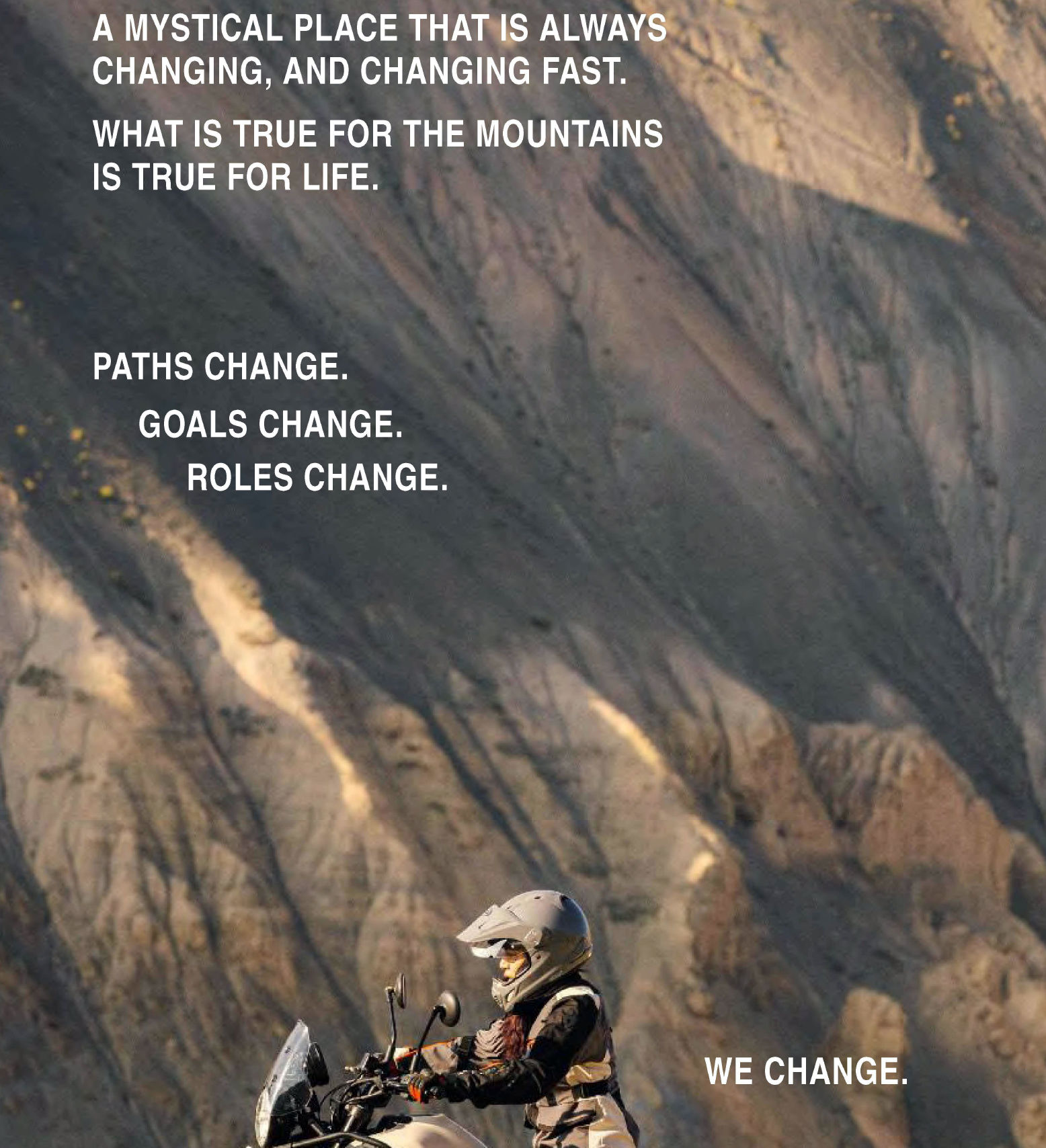
‘We change’
The 410’s air-cooled appeal lay in its plodding motor combined with a low centre of gravity. Experienced or newb, it made the original Him easy and fun to ride, despite the tedious 3000-mile valve checks (450: 6000m).
It’s hard to think the new 450 will match the 410’s characteristics, including the low-slung weight [actually it does], even if it’s said ‘90% of the extra torque is available at 3000rpm’. You often read claims like that, but it’s very unlikely the higher-revving 452 will have the tractor-like chug of the long-stroke 410 which made it so satisfying on backroads and easy trails. As a road bike, the new 450 will be a whole lot better.

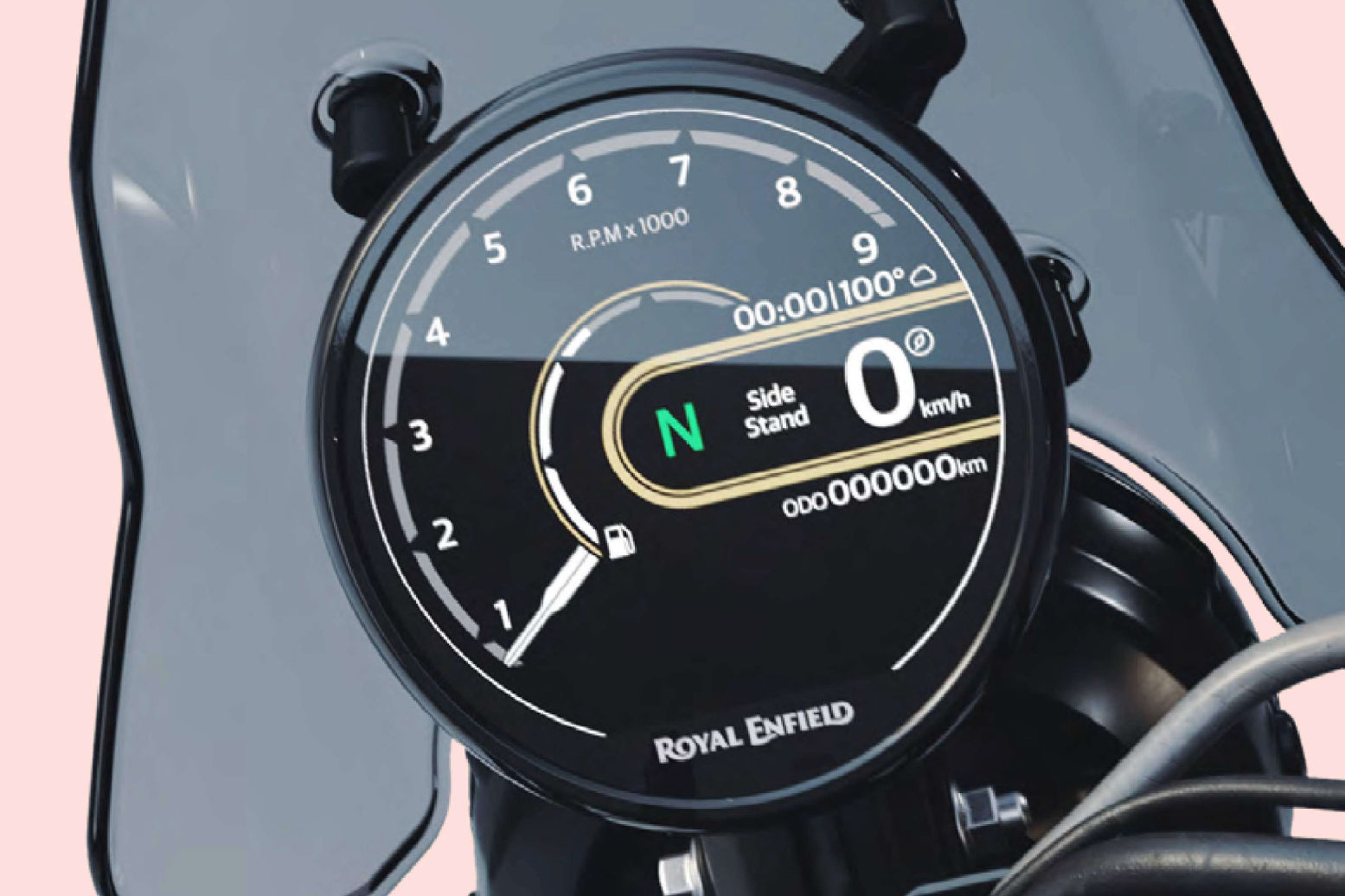
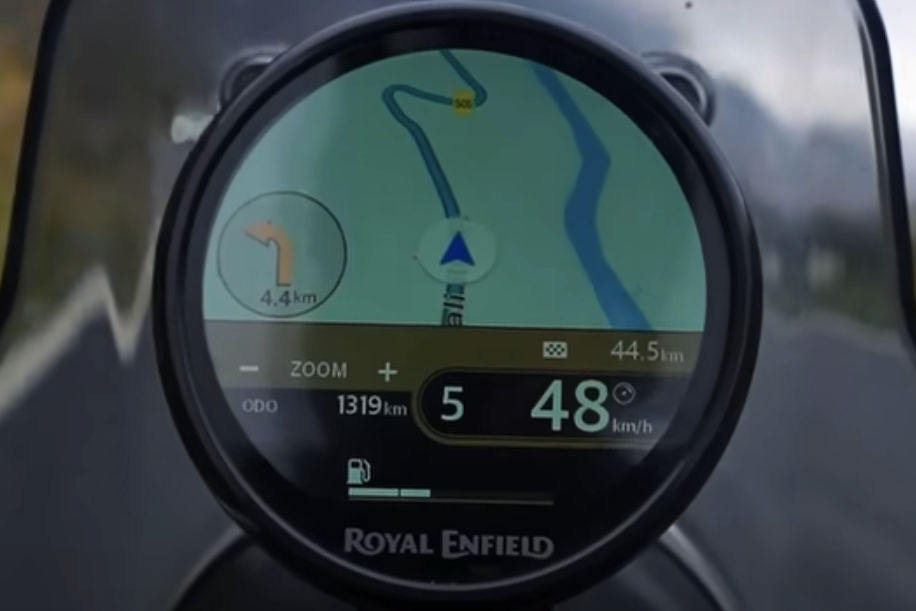
The round, 5-inch TFT, Tripper Dash is another big improvement over the 410’s dial, looks clear and has a good range of info across various toggle-able screens. But I’m not convinced by the integration with Google Maps when it comes to serious exploring as opposed to basic road nav.

Photo: MCN video still

The idea is it replaces your vulnerable [Android only] smartphone which still needs to be in your pocket and paired to the display via wi-fi and using an RE app and plugged in. Afaict, the Tripper is merely displaying a simplified version of GM to suit the bike’s round display. And will a map downloaded in the phone for offline (no 4G) use display on the Tripper? I doubt it. I’ve read these in-built, phone-pairable nav systems aren’t always so seamless or versatile. But I’ve never actually used G Maps or even a smartphone for moto nav either. Anyway, if the Tripper proves to be an unworkable backcountry navigator, just revert to a cheap Android phone, a bigger tablet or handheld GPS, all with more readable and free OSM mapping.
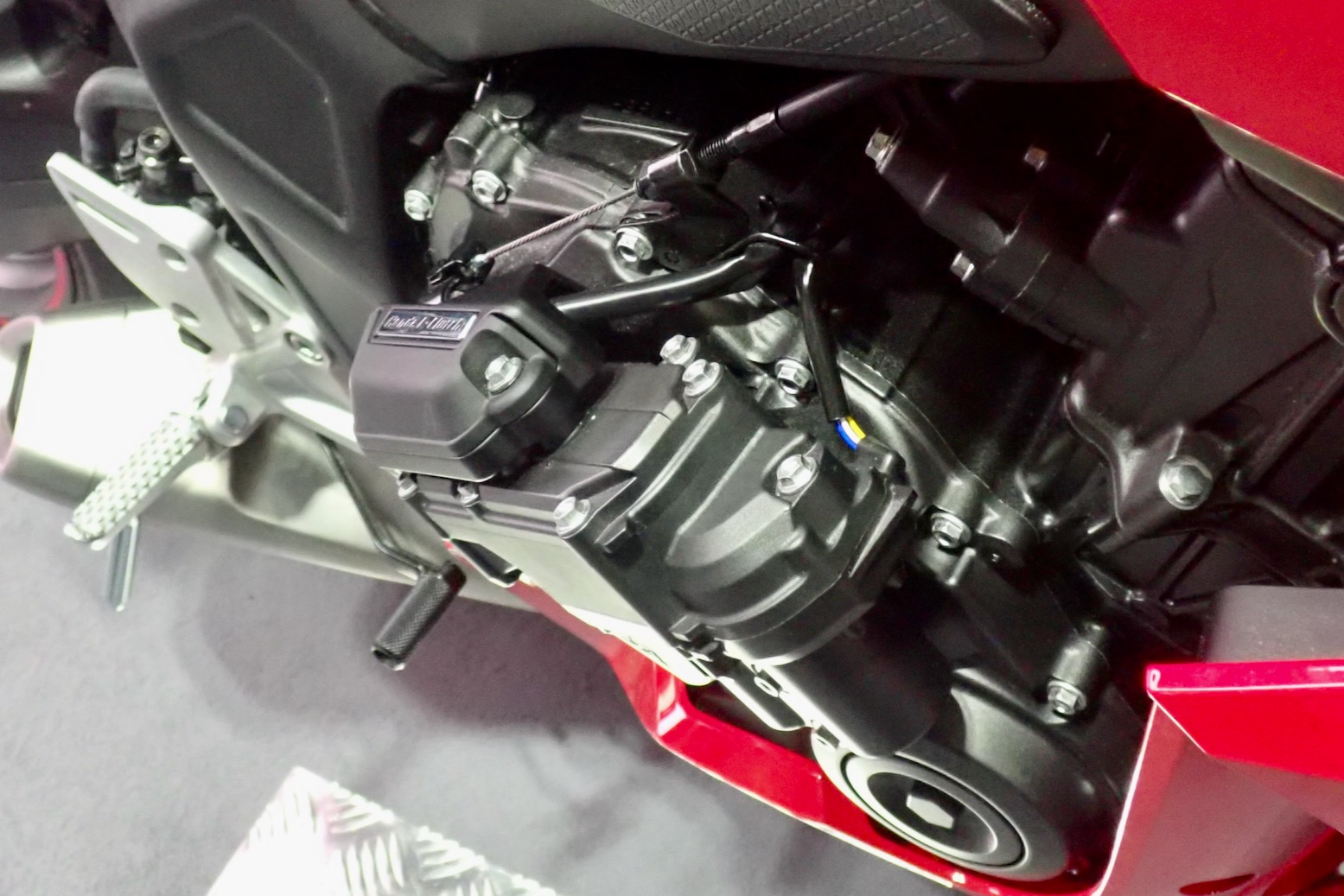
Photo: MCN video still

The 40-hp bike also comes with a somewhat superfluous Eco mode (unless economy really does leap up), switchable ABS (another thing I never switch off), and LED lighting. There’s no rear light (left); it’s integrated into the LED indicators. Not seen that before but I can tell you it actually works quite well. Just the other day I was noticed how car tail lights have all gone freestyle.

The only other fly in my soup is the design and paint choices; not as cool as the original 410 Him.
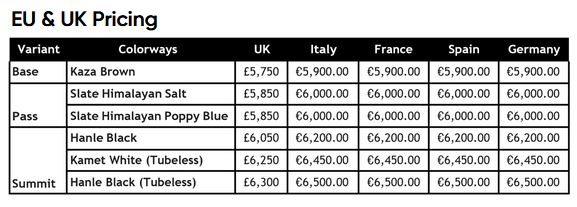
They say bikes will be in UK shops in April 2024 from £5700 depending on colour choice, and from £6250 for tubeless spoked wheels. With the 410 now at £5050, that’s a great price. As the bike’s are bound to be so different, you do hope they’ll keep selling the air-cooled Himalayan.
After years, bikes like 2024’s CFMoto 450MT and even the Triumph 400X, are opening up the 400cc Adv class alongside KTM’s decade-old 390.
Newsflash! It’s spring 2025! Read my Him 450 review.

Triumph Scrambler 400X and other travel contenders

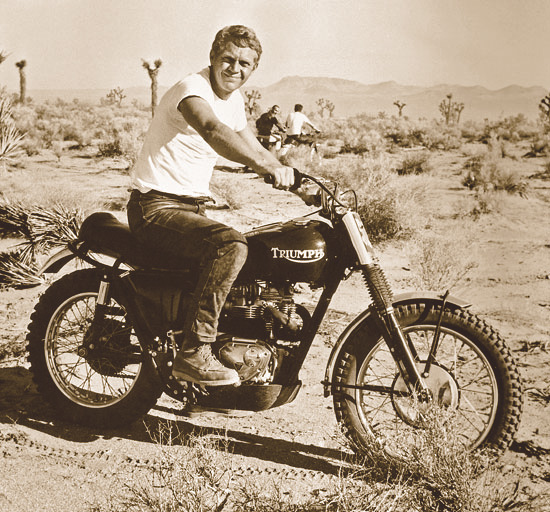
Everybody loves a scrambler, always have, always will. It’s no new thing, just an old trend coming back round. Street scramblers were invented in southern California in the 60s; Mojave desert racers – cool as you like. Slap on some wide bars and trail tyres, lower the gearing and you’re street scrambling for real. On Any Sunday.
Project XScrambleR 700

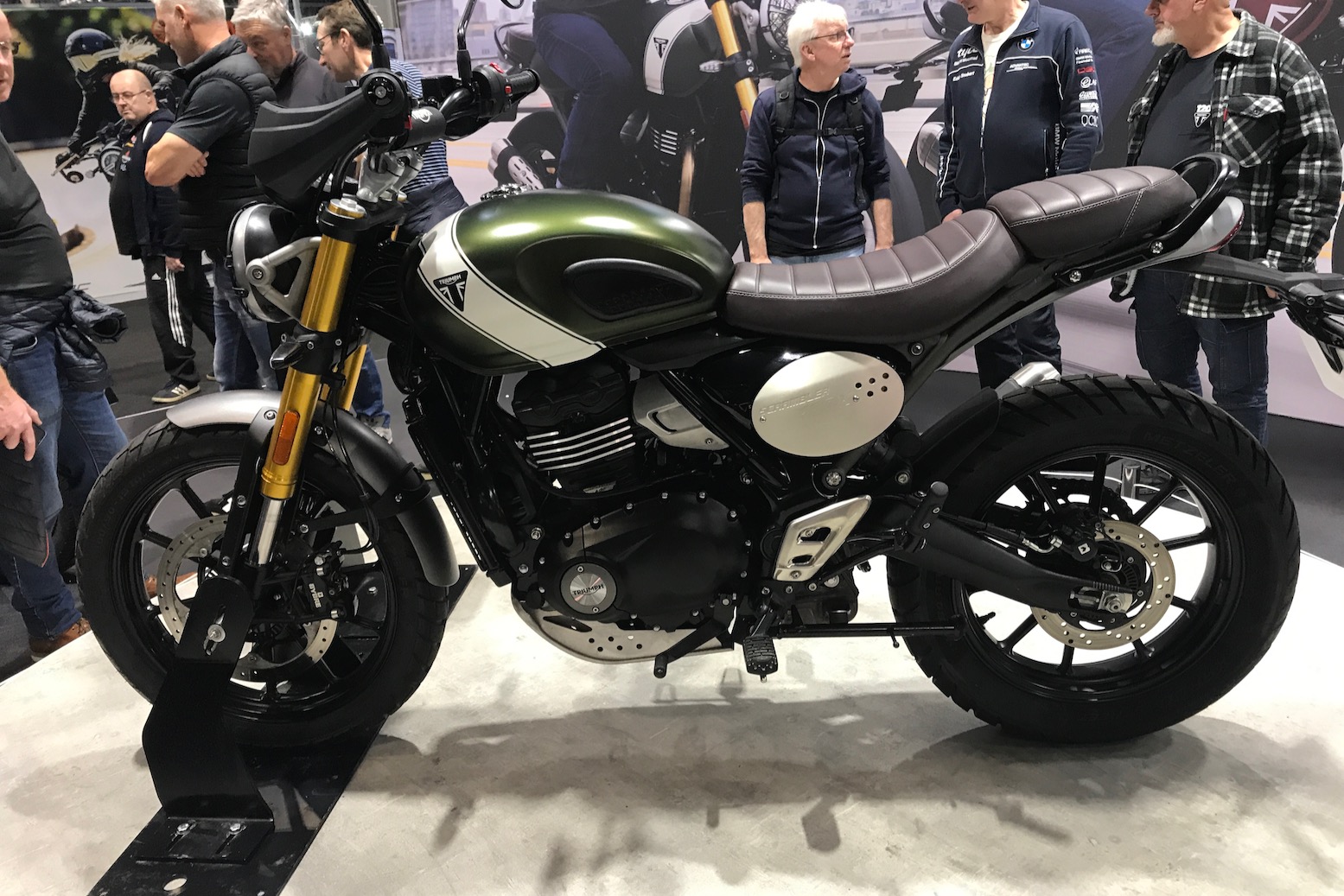
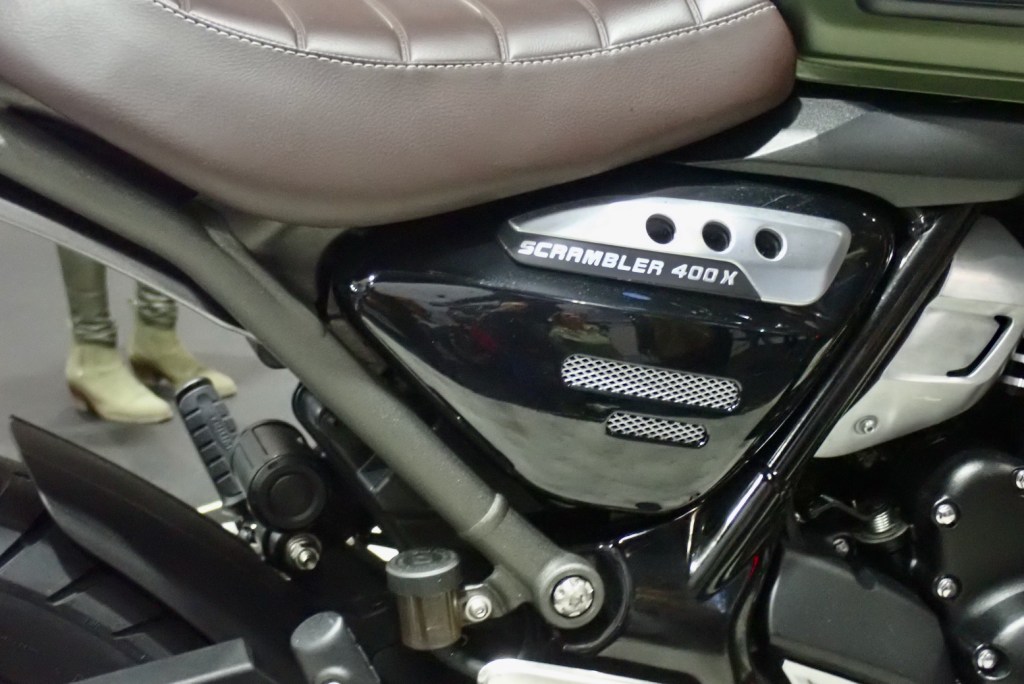
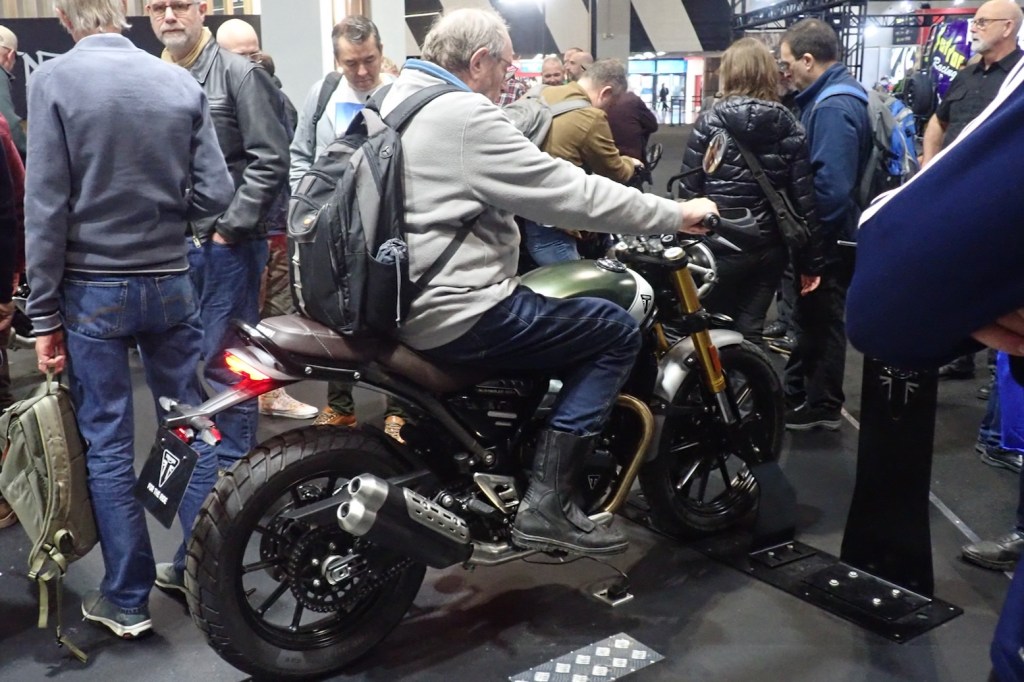
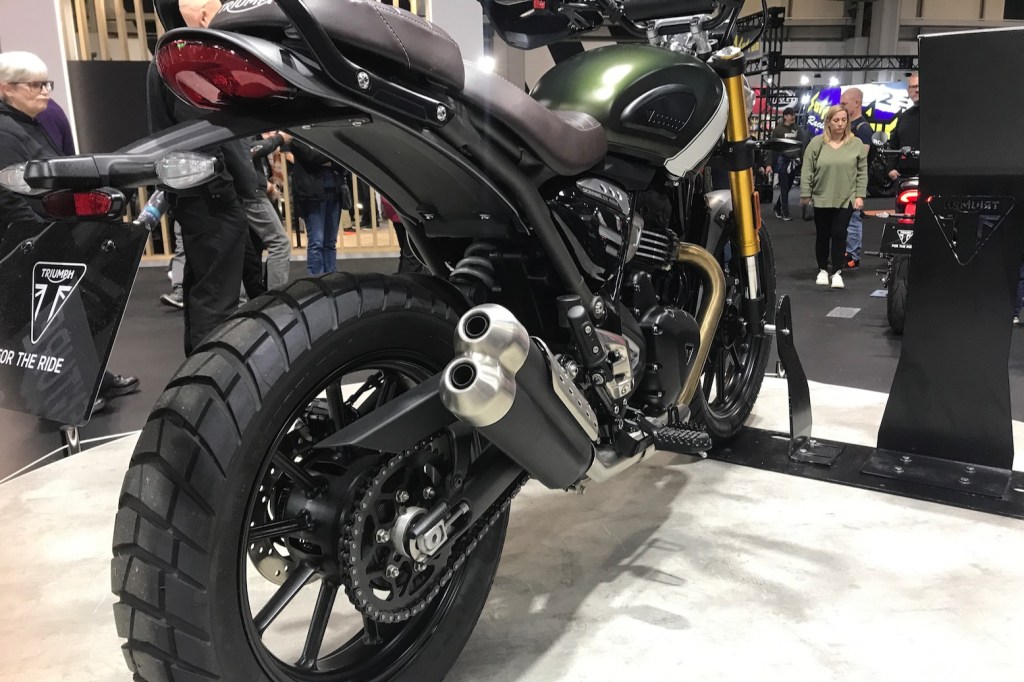
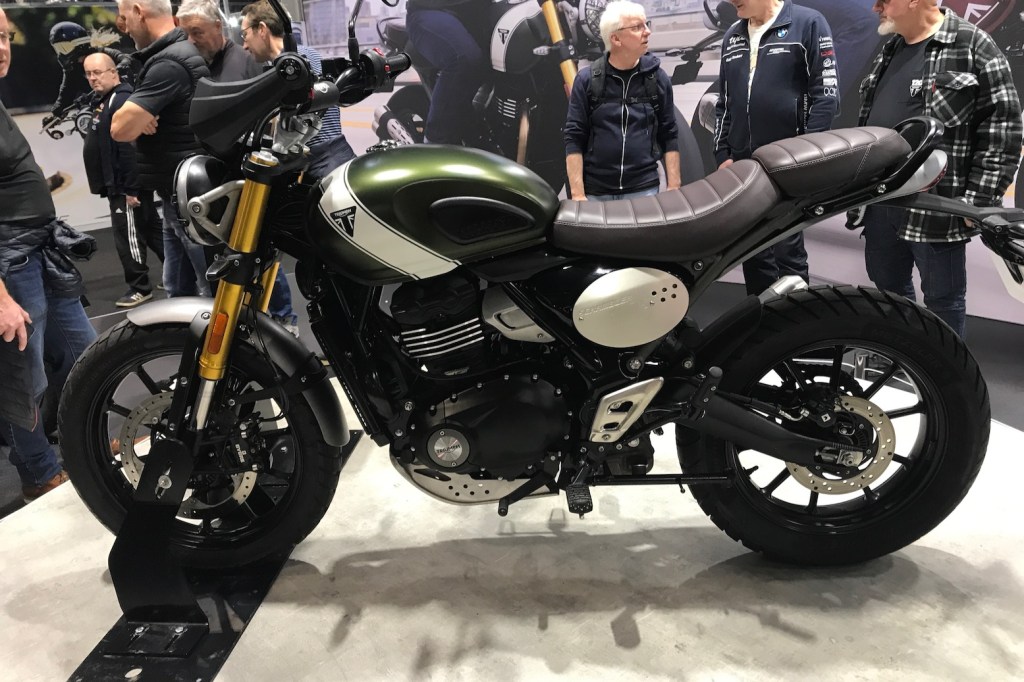
Triumph’s new Scrambler 400X caught my eye at the Birmingham bike show. And I wasn’t the only one. Every few seconds another individual closely resembling my mature demographic swung a leg over the Scrambler to bounce up and down and twiddle the controls.
Like me, they may have been fondly recalling their teenage Triumph days in the 1970s. Along with its modern triples, the reborn brand has successfully capitalised on that proud heritage with a line of modern classic big twins. Matching that visual ‘DNA’ very closely, the smaller 400s are said to be pitched at attracting image-conscious young blood into biking, but judging by the leg-swingers above, most customers may prove to be more bike-in-a-shed oldies looking for a lighter ride than well-groomed Bike Shed hipsters.

Along with a road-oriented Speed 400 with 17-inch wheels and a 45mm lower seat height, the 400X Scrambler gets a 19 inch front with a bigger rotor, 150mm of travel, switchable rear ABS and largely cosmetic protection. The stock alloy sump plate is a necessity to disguise and protect the low-slung coolant reservoir.

All that somehow manages to cost an extra £600 (£5600) over a Speed 400 – as with Honda’s 300L/Rally price chasm, the off-road aspirational look always costs more.
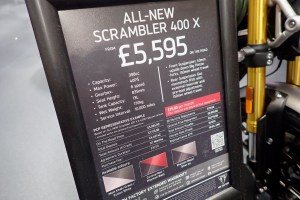
Claimed wet weight varies even within the brand’s source material: the show board left claims 170kg, the Triumph website says 179kg and Indian reviews (see below) come in at 185 kilos, though it’s said Indian spec tyres and wheels will be heavier to cope with the sub-continental pounding. Both bikes get switchable traction control – for 39hp? – and lengthy 10,000-mile service intervals.

The 400s are being assembled in India by Bajaj who among other things, also produce KTM’s 390s while probably selling more of their own branded bikes in a year than all European manufacturers combined.
I read 400s will also be made in Thailand (where bigger Triumphs are assembled) and Brazil. Wherever UK units come from, if the 400s’ durability proves to be anything like the also-Indian-made BMW 310GS we use in Morocco – some now on 80,000 rental kms – there’ll be little to worry about.

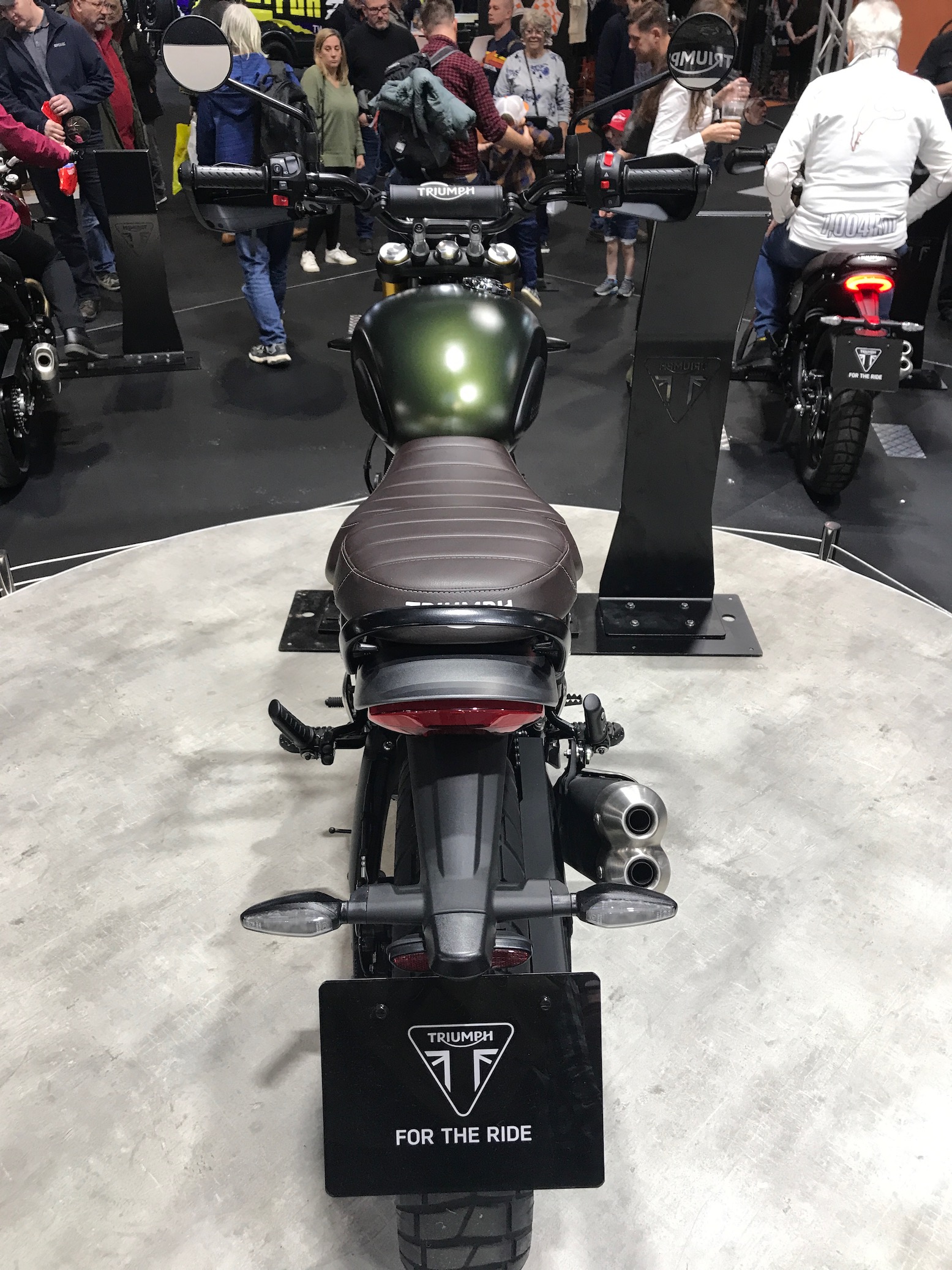
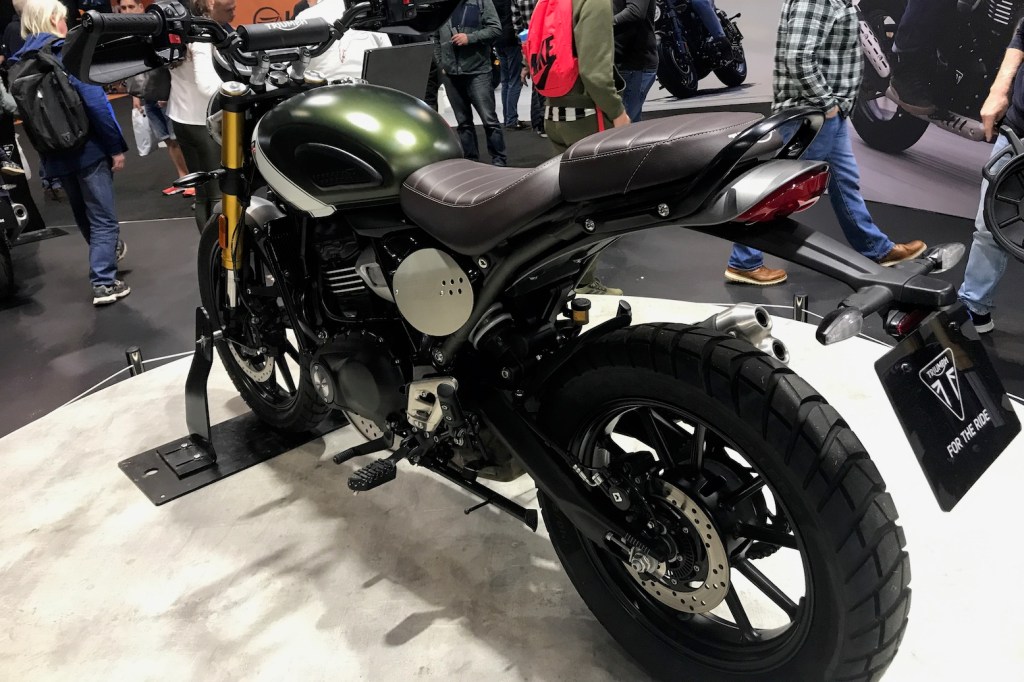
For me scramblers have always been Goldilocks travel bikes – fine on the road, at home on gravel and OK on the dirt. And they look like a proper motorbike. So along with its cool retro look, the 400X ticked a lot of boxes for me at the NEC: tubeless wheels, adequate suspension travel, basic metal bash plate (an uprated £130 accessory is fitted on the green show bike) and a ‘portrait’ aspect radiator tucked out of the way on the front down tubes, like an RE Interceptor. The seat looks promisingly wide, though CTXP (below) found the forward slope annoying. You do wonder if the pillion perch is detachable. If yes, it could be removed to sit a tail pack lower, another win. At a potential 90mpg (32kpl; 75US), the 13-litre tank will return over 400km. Most of these stock features were mods I had to make to my current 300L to make it a functional travel bike, not least a £300 tank and some £200 crash bars to protect the vulnerable radiator. I’ve not managed to improve the seat.
Interestingly, UK-based Rally Raid, who a decade ago found a wide audience with their popular CB500X upgrade kits (which I used myself in prototype form in Morocco), are planning to develop kits for the 400X too: tubeless spoked wheels, suspension, sump guards, risers. They already run a range of such accessories for the similar G310GS.

Some reviewers grumble about the lack of spoked wheels to complete the retro look. Spoked or alloy, I’m not bothered as long as they’re tubeless for easy repairs. These days just about all alloy wheels are tubeless, but to make spoked TL wheels requires expensive assembly and tensioning of outboard spokes, being optionally offered on the new Himalayan 450 (left). I’ll take the Scrambler’s 10-spoke alloys; with a good set of tyres and location-appropriate riding they ought to resist leak-inducing dings. Got a bad leak? Bung in a tube.

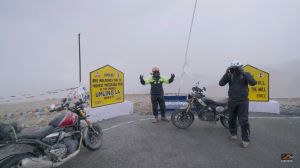
There are a couple of actual riding reviews from BHP India and Autocar India matched with equally wordy video reviews. A couple of months back US-based Common Tread XP took a pre-production Speed and Scrambler on a 2000-mile round trip from Delhi via Zanskar Valley to the ‘highest motorable [asphalted] road in the world’ which these days is the 19,024’/5798m Umling La in southeastern Ladakh (left) close to the Chinese border.
This was not another of CTXP’s goofy, Top Gear-like stunts, but a proper travel adventure that snatched some of the wind out of Enfield’s 450 Himalayan sails – and maybe sales too. RE also chose Umling La as the destination of their Final Test, and their drone heavy YT vid (see below) trounced CPXP by a couple of weeks. Currently both vids are neck-a-neck at about half a million views.
Watch the Triumph Himalayan vid here or listen to Zack C’s honest, post-trip appraisal of the Scrambler below. It’s not all rosey – no small bike every is once you’ve ridden big – but the aroma’s promising enough. Both are on about half a million views right now.

Other things I saw at the NEC
I’d have liked to have had a closer look at the new Chinese-engined, water-cooled 350 Beta AlpX which had been presented at the EICMA show in Milan. They claim about 155kg juiced up, but Beta didn’t attend the NEC and tbh, it’s probably on the tall side for me and dynamically no better than my sported 300L.

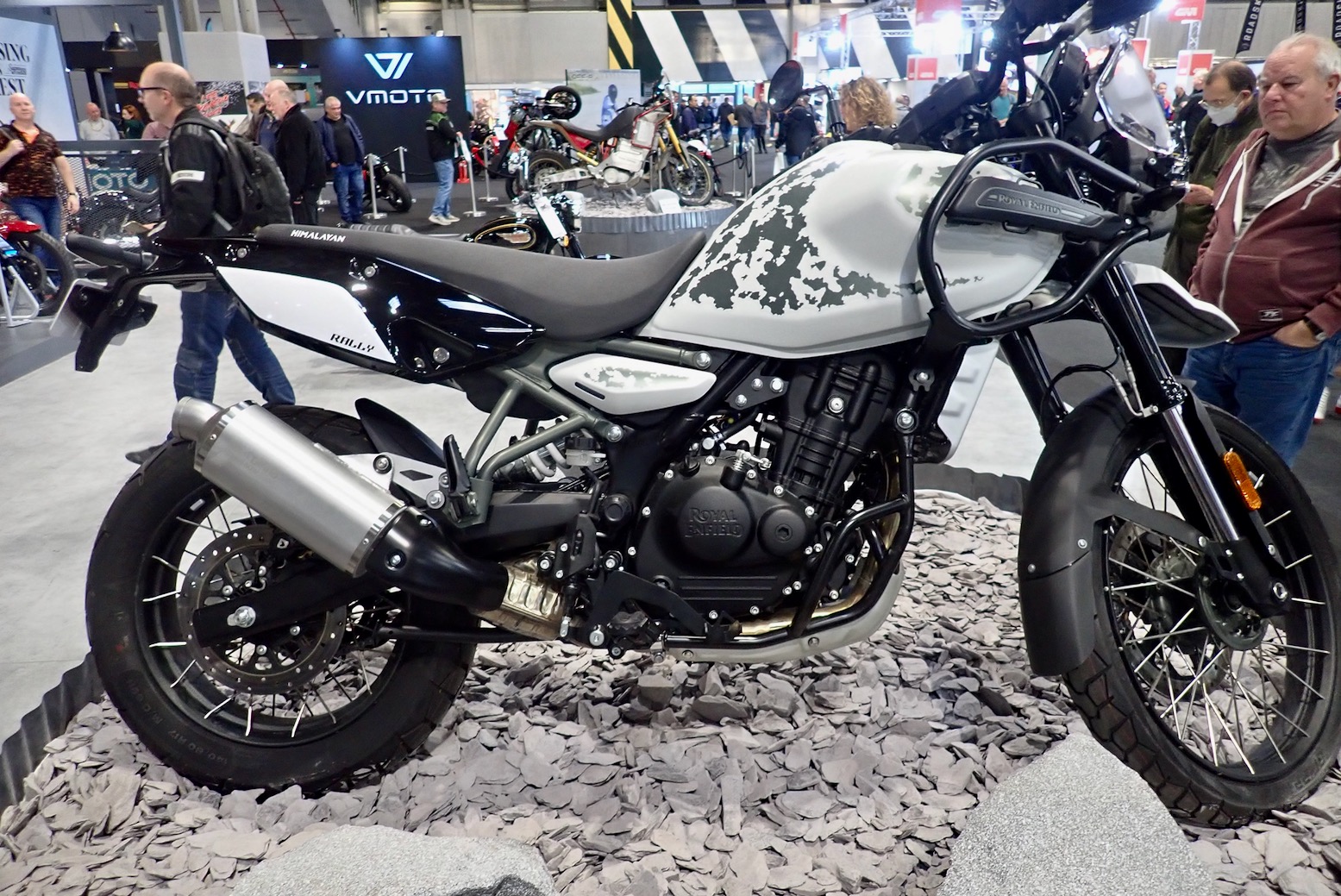
A few years back I got on well with my old 400 Himalayan in Morocco so I cast a look at RE’s much revised water-cooled 450 Himalayan which will doubtless soon be pitted against Triumph’s 400X. Same price, same claimed 40hp at 8k, but with 10% more torque at 1000rpm lower down. Front and rear remain 21/17 (greater rear do-it-all tyre choices) and with tubeless spoke wheels an option. It’s at least 15 kilos heavier than the 400X, though that includes a centre stand, 50mm more travel (200mm all round) and those nifty tank racks alongside the 17-litre tank. The small 4″ console/dial pairs with a phone to show Google Maps or similar; though it’s on the small side let’s hope that proves to be as seamless and reliable as it could be.

My old Him 400’s gimmicky digital compass rarely pointed north. But as one tester observes in the vid below, he’s lost loads of smartphones clamped to the bars as nav devices; for me that’s always been a sketchy idea. I feel they’ve lost out on the great look of the old 400 (right); Triumph’s understated style works better for me, but the drastically improved 450 Him will be a travel contender for sure. Read impressions from a two-day Himalayan test ride from AdvPulse or my chin-rubbing preview here. It’s great to see the ‘400cc’ class opening up at last.

For nearly three times the price of either I could have a beautifully made, 150-kilo CCM Tracker or any of their other scrambly iterations around the pokey, ex-Husky 600-cc motor. There are loads of low milers on sale now for around half the new price which, not matter how good they are, suggests they’re weekend playthings.

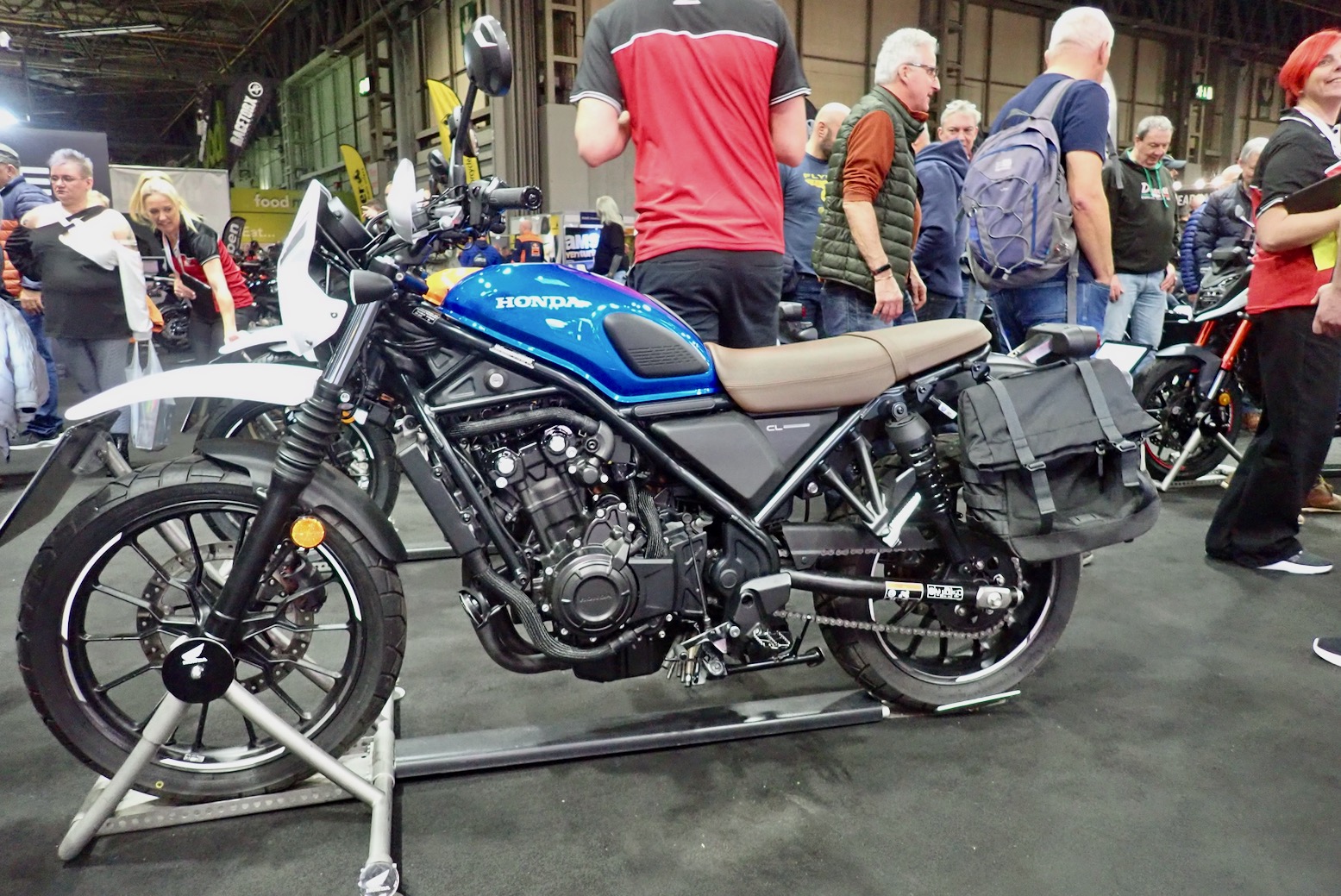
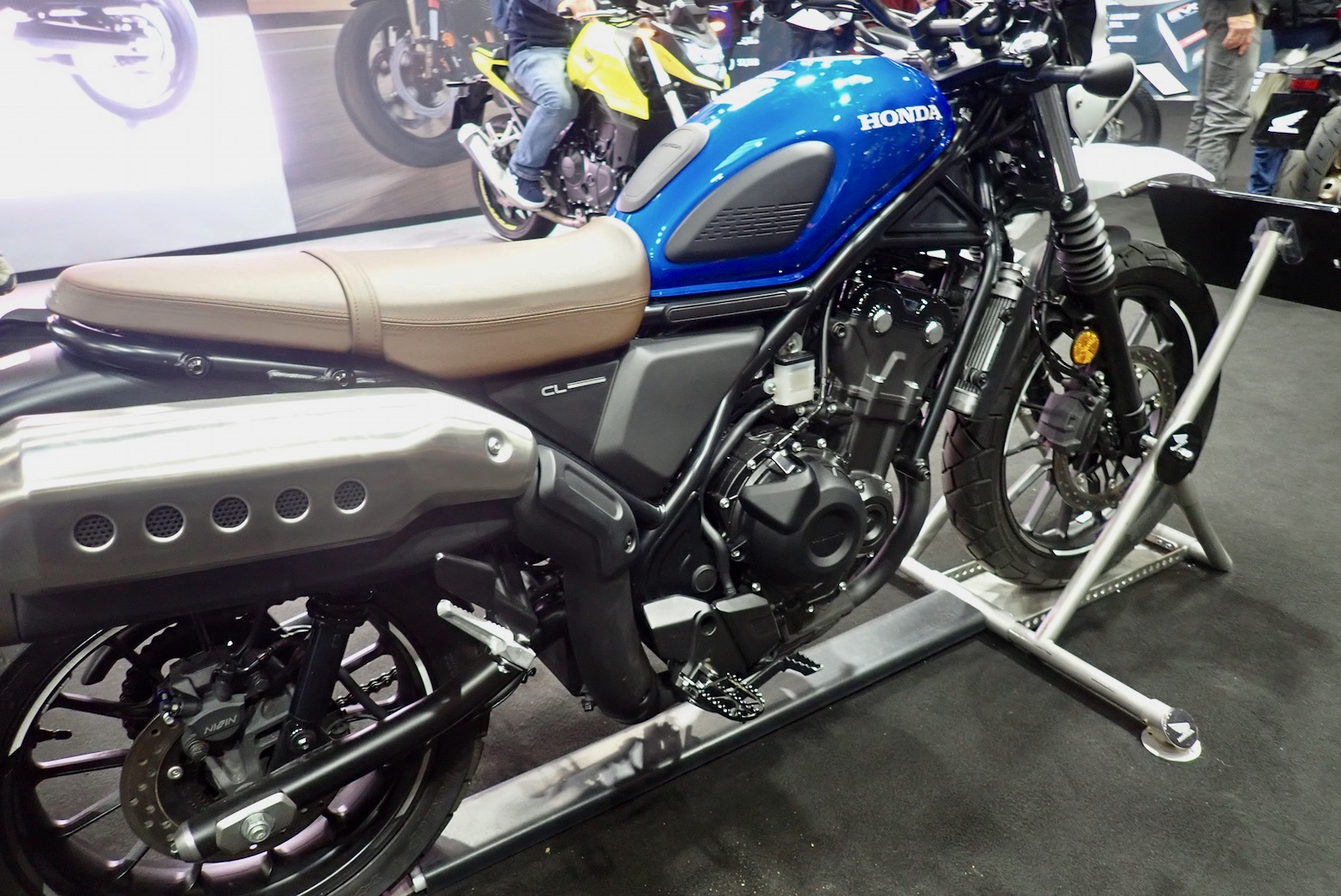
What a shame Honda’s CT500 scrambler spin on its 500 platform looks a bit too much like their Rebel cruiser or just not as good as it could have been. There’s no doubt it would be a better all-rounder than the Triumph, with effortless cross-country speed, near-as-good economy and low, flat-seat comfort. But it would need the usual grand or more of extras to be a traveller. And that gigantic pipe!?

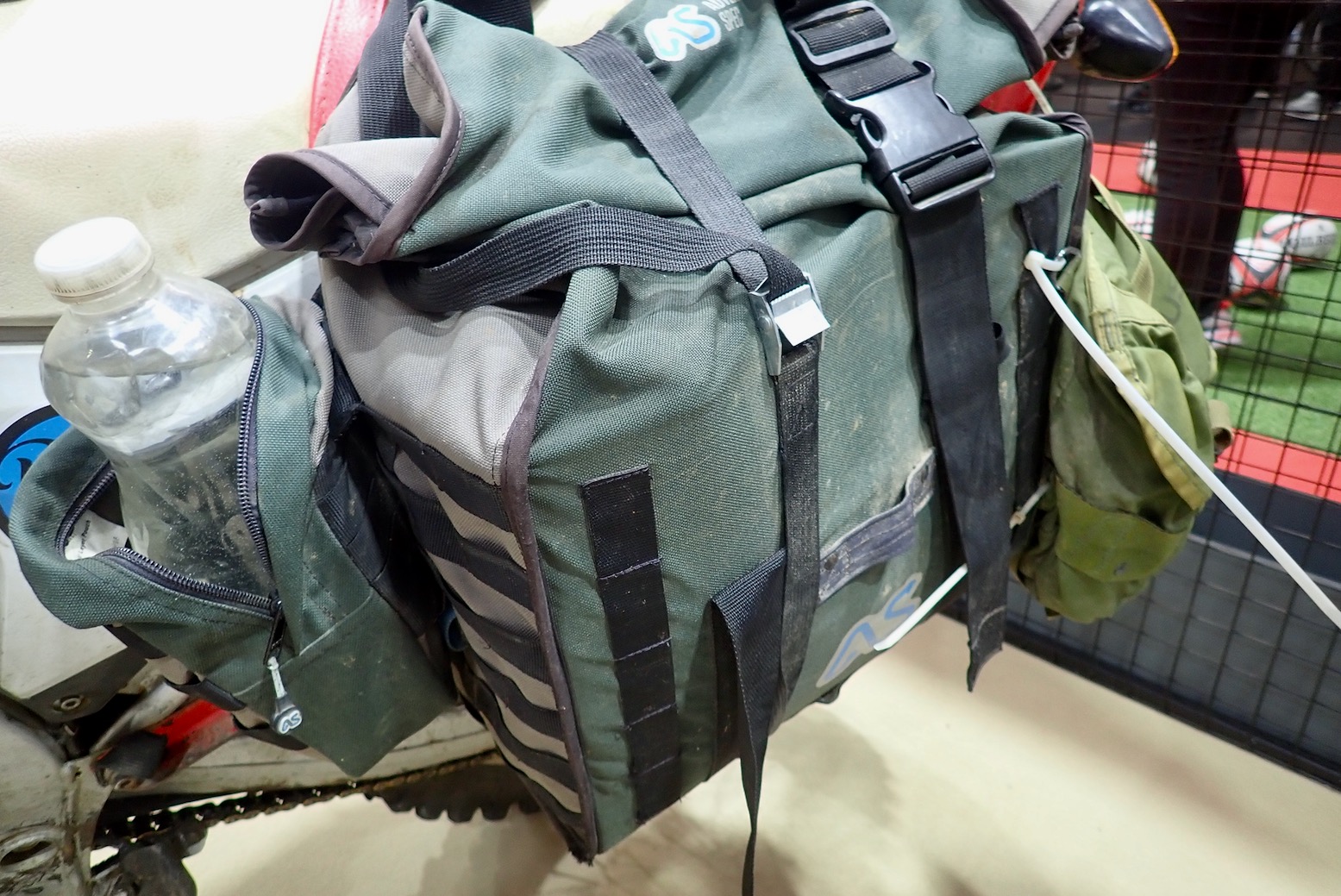
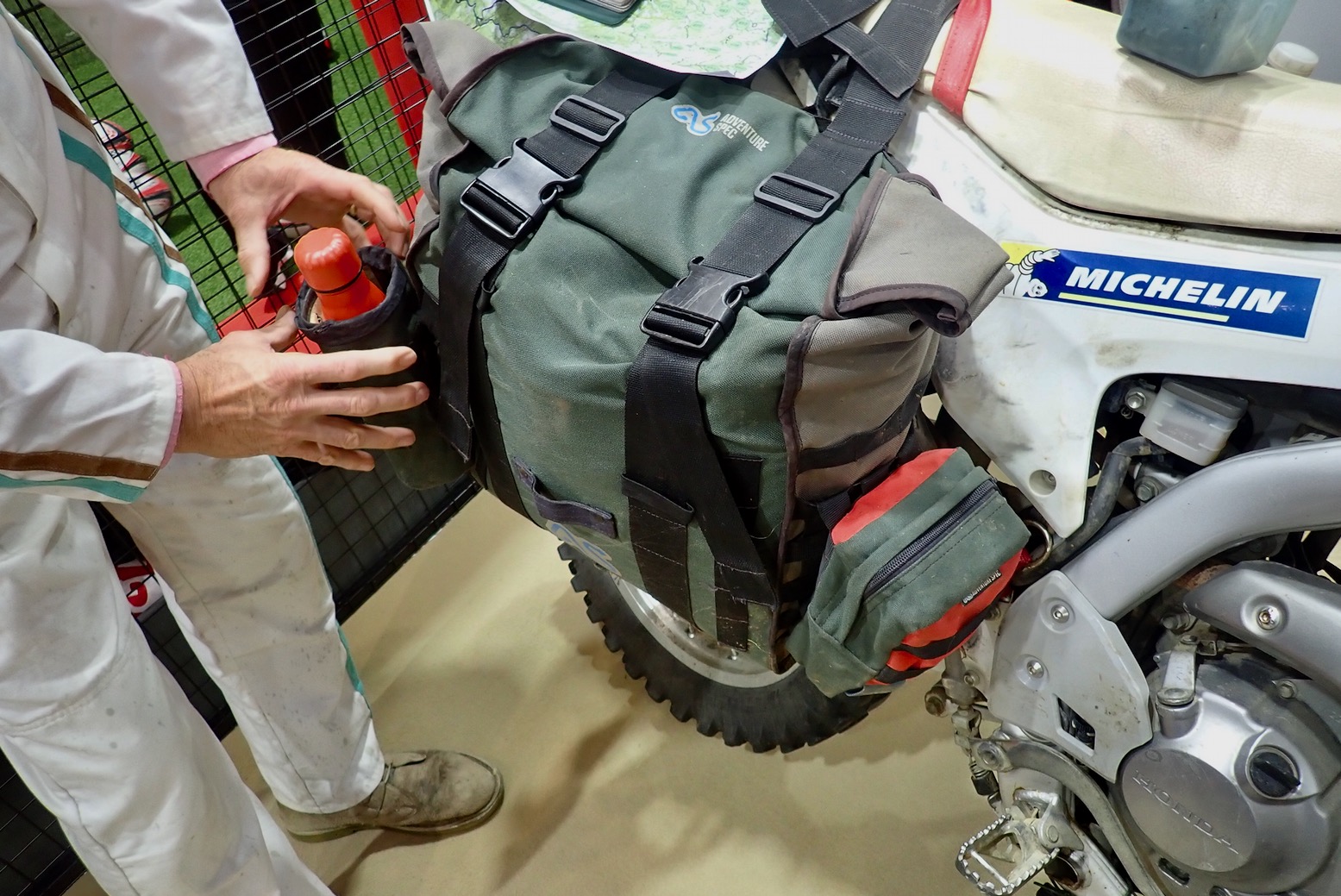
Austin Vince was on duty on the Honda stand and showed me round his Adventure Spec Magadan 3 panniers now with Molle strapping and non-black fabric, but no longer featuring the novel slash-proof aramid lining. Right now they’re on sale at 20% off at ASpec. That’s about 260 quid.

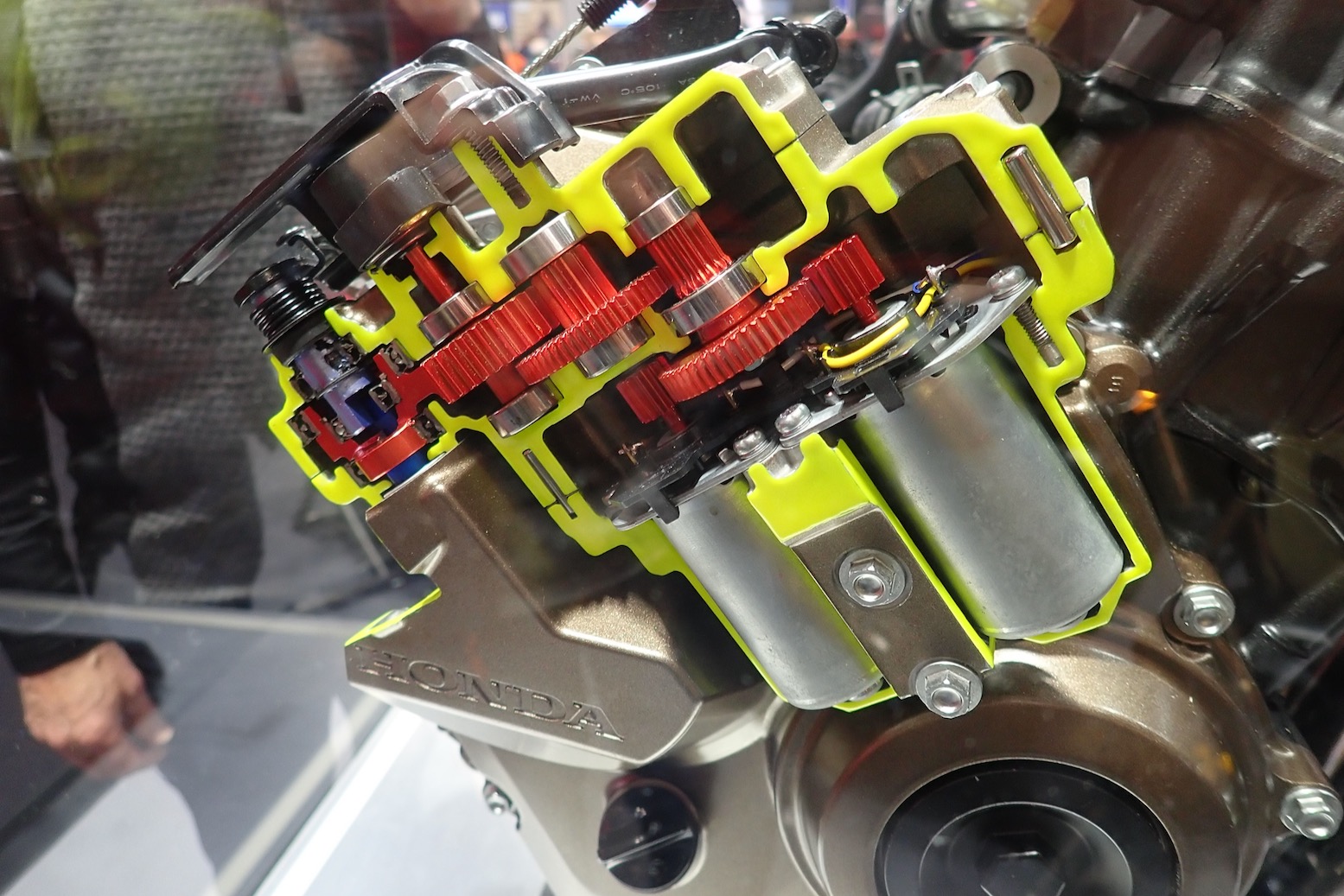
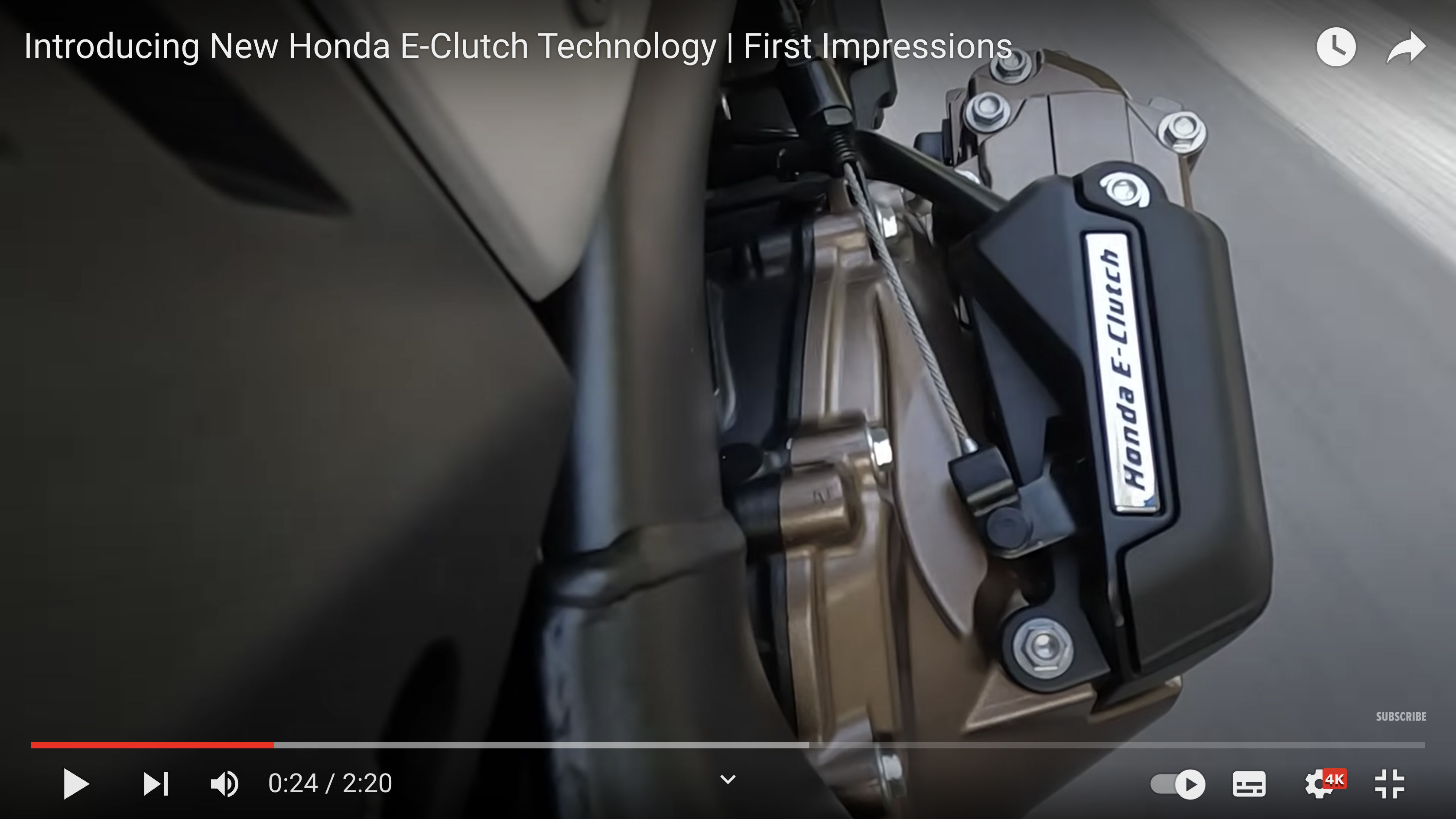
Being a fan of DCT but not its 10-kilo added mass, I also had a look at Honda’s new E-clutch. It’s an ingenious system of ECU-controlled servos to enable clutchless foot changing and even pulling away (while retaining a clutch lever), but as others have noted, it stills look a bit clamped-on and bulky. It’s only on the CB650 for now, but you can be sure it will spread to other models if it goes down as a smooth operator. I bet I’d be a convert.

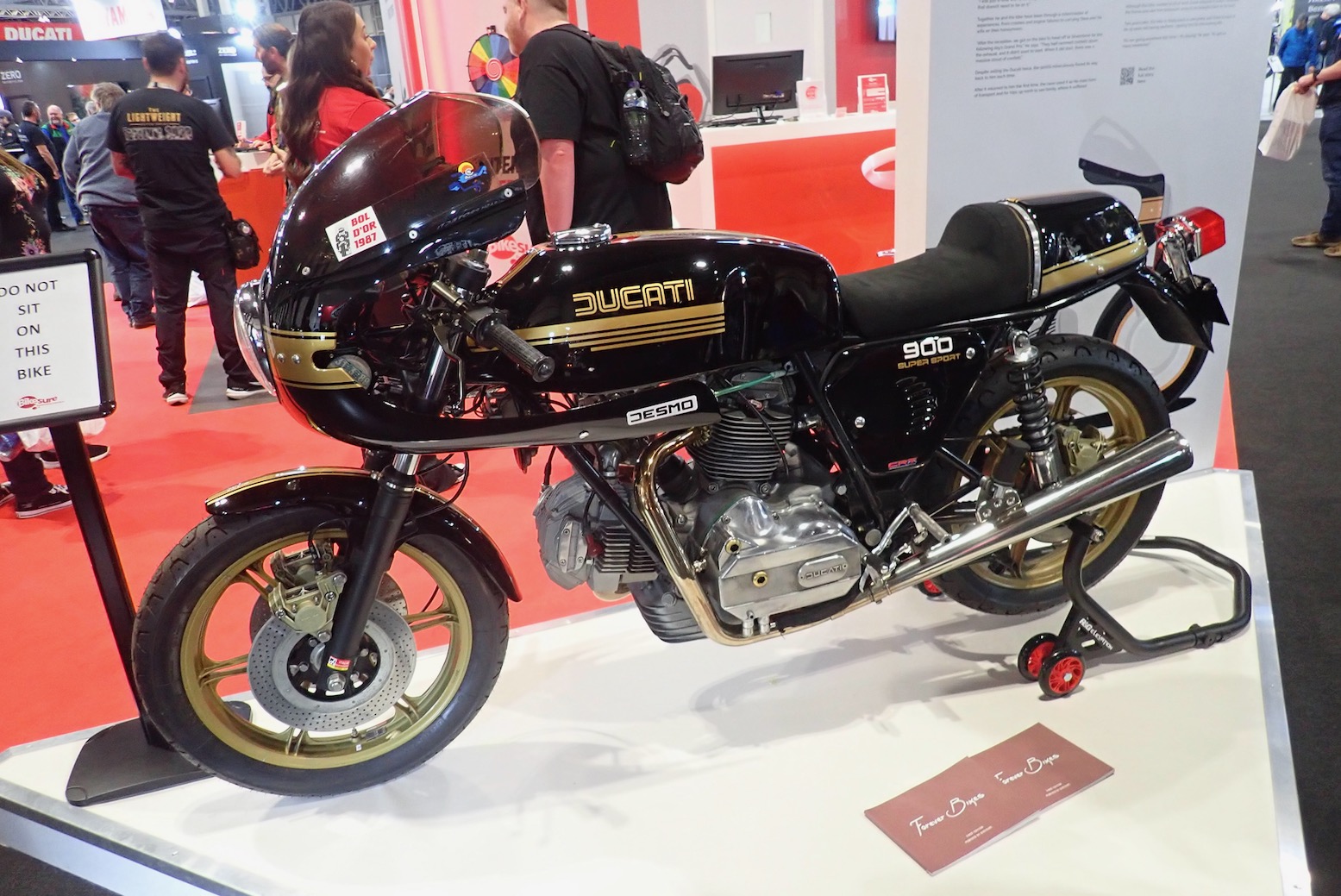
Nice also to see an example of my late 70s Ducati 900SS. What a machine to have at just 18 years old!
Mosko Moto have a snazzy new range of colours in their apparel. I like this Rak pullover anorak idea as a bombproof, no-front leakage solution with a big roo pouch and other thoughtful detailing. For the last few weeks I’ve been wearing my MM Surveyor softshell jacket in Morocco which works just right in the warm temps down there. I’m considering going softshell on my trousers too – my sun-bleached, 6-year-old Klim Outrider jeans are now on ebay. I’ve deduced it’s not just the weight of the jeans, but the drag when getting on an off the bike. Stretchy fabric will see to this but without armour, won’t quite offer the same feeling of rugged Cotton-Cordura protection.
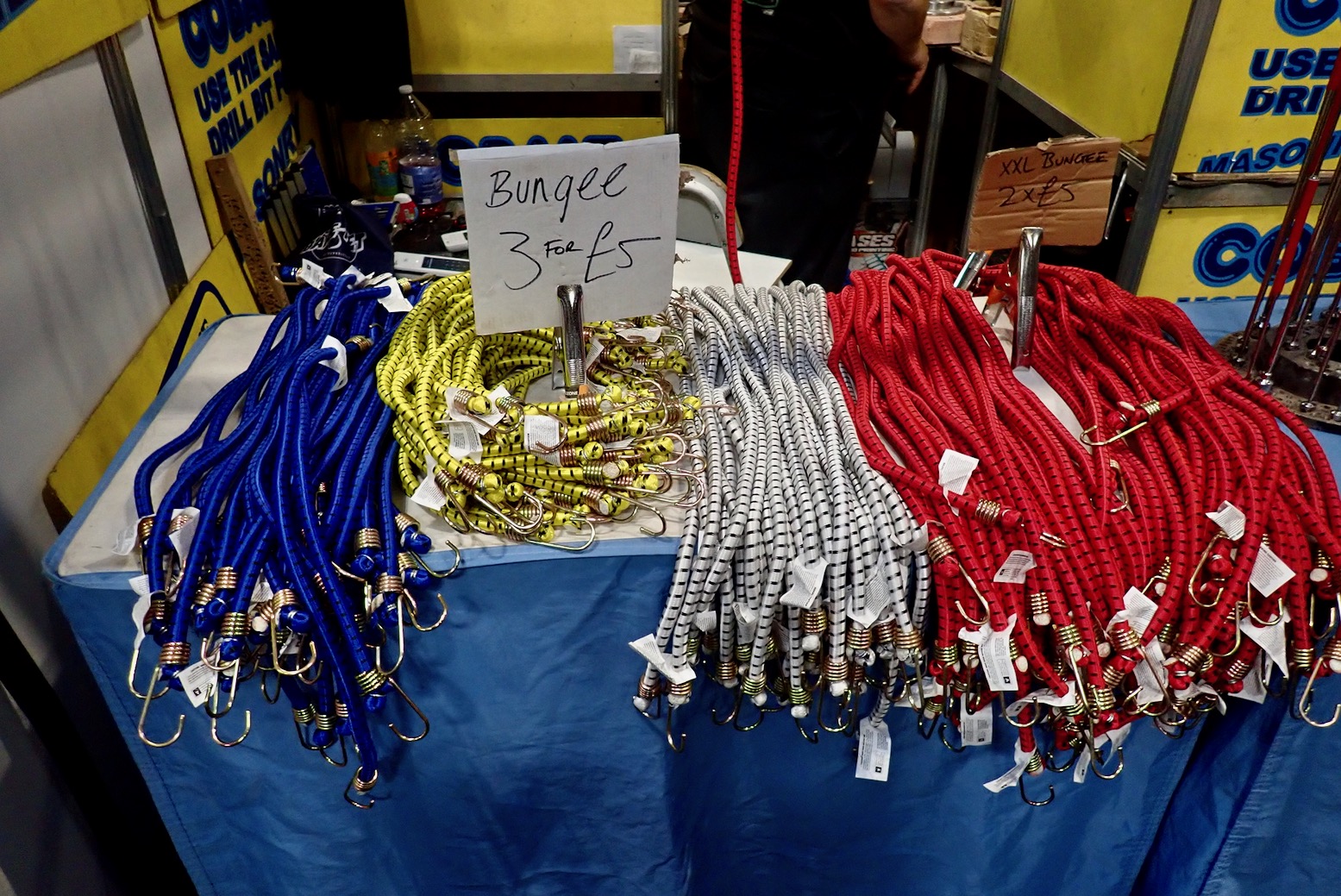
Bungeeeeee!!