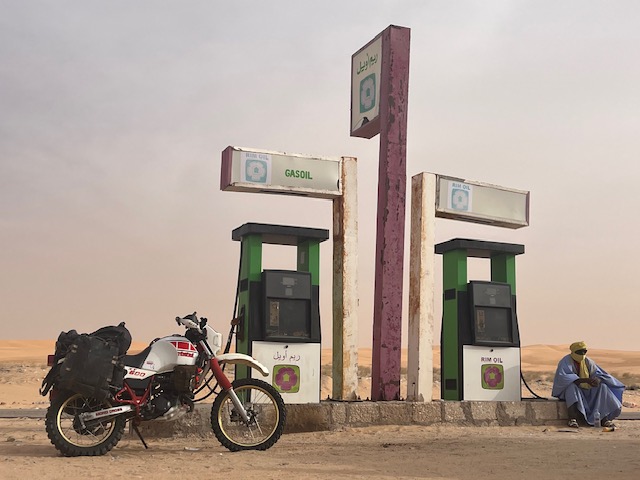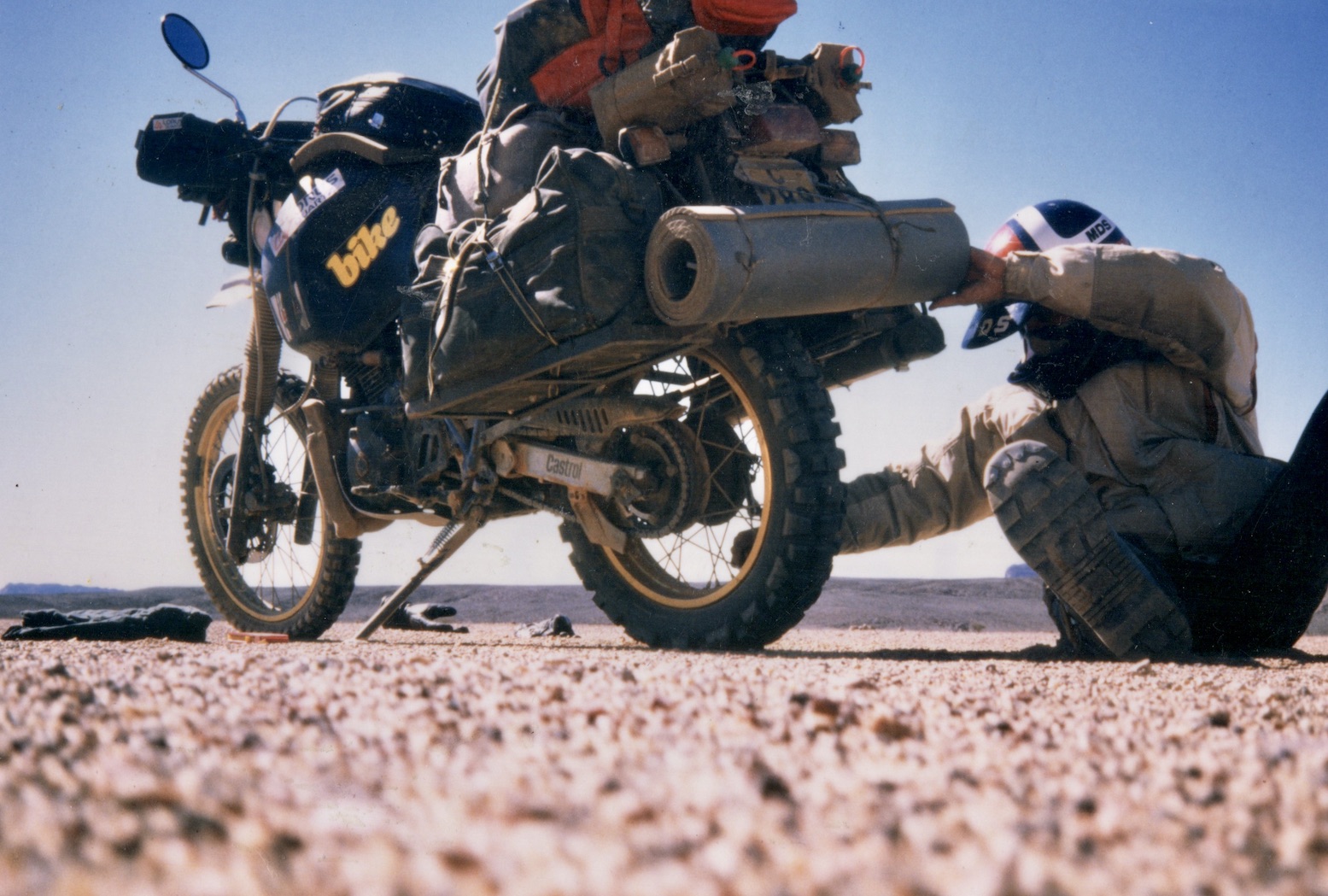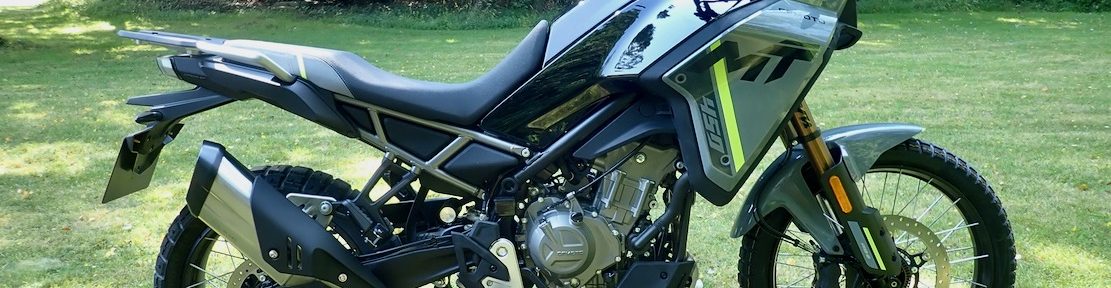
Do we have PotWs here on AMW? We do now. You know a good shot when you see one, even if you don’t know the backstory. I happen to know Karim H, and this shot led a selection of his 20 favourite photos on his Insta page covering his west coast trans Africa earlier this year on his ’84 XT600Z. Looks like a hot, dusty day somewhere in Mauritania, probably the roadhouse midway to Nouakchott which doesn’t always have pump fuel. The Moorish bloke on the right sets off the symmetry with the bike as well as the two green pumps – probably the only greenery for miles. The pinkish haze over the dunes reflects the maroon signage mast. It’s the desert at its least glamorous: choking, dreary hot middle of the day but with the vital fuel to keep the show on the road.
Not being a UK model, it can be a bit of a lottery ordering parts for the Serow, but generally it seems any XT250 from the same years is near identical. They’re not UK models either, but there seems enough around online in the UK. Webike.jp is the best I’m told, and pretty fast. Procycle in the US was amazingly fast for some TW200 parts. Oregon to my door in 3 days with a free sonic boom! The chain is only a skinny 428 (next size down from 520), but a heavy duty got fitted which looks nearly the same as a 520. There’s a lot of caked-in Salisbury Plain mud splattered all around the nooks and crannies and a bit of surface rust, but nothing drastic.
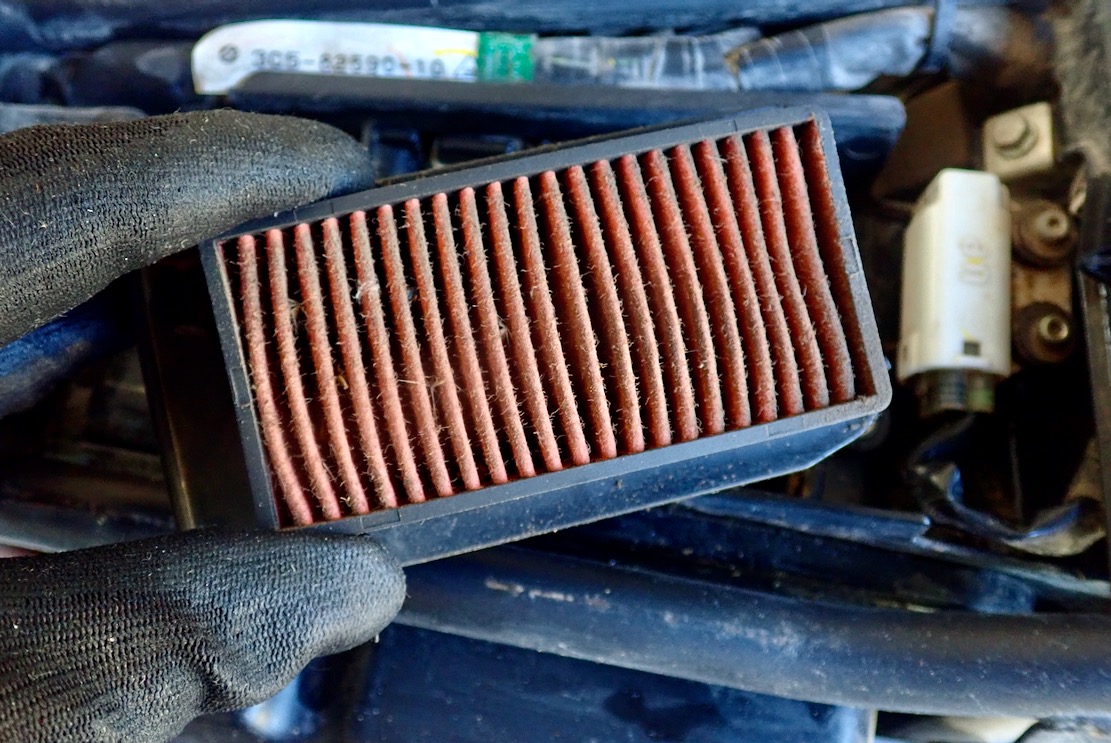
• XT250 air filter for a tenner off ebay. Never seen one that small.
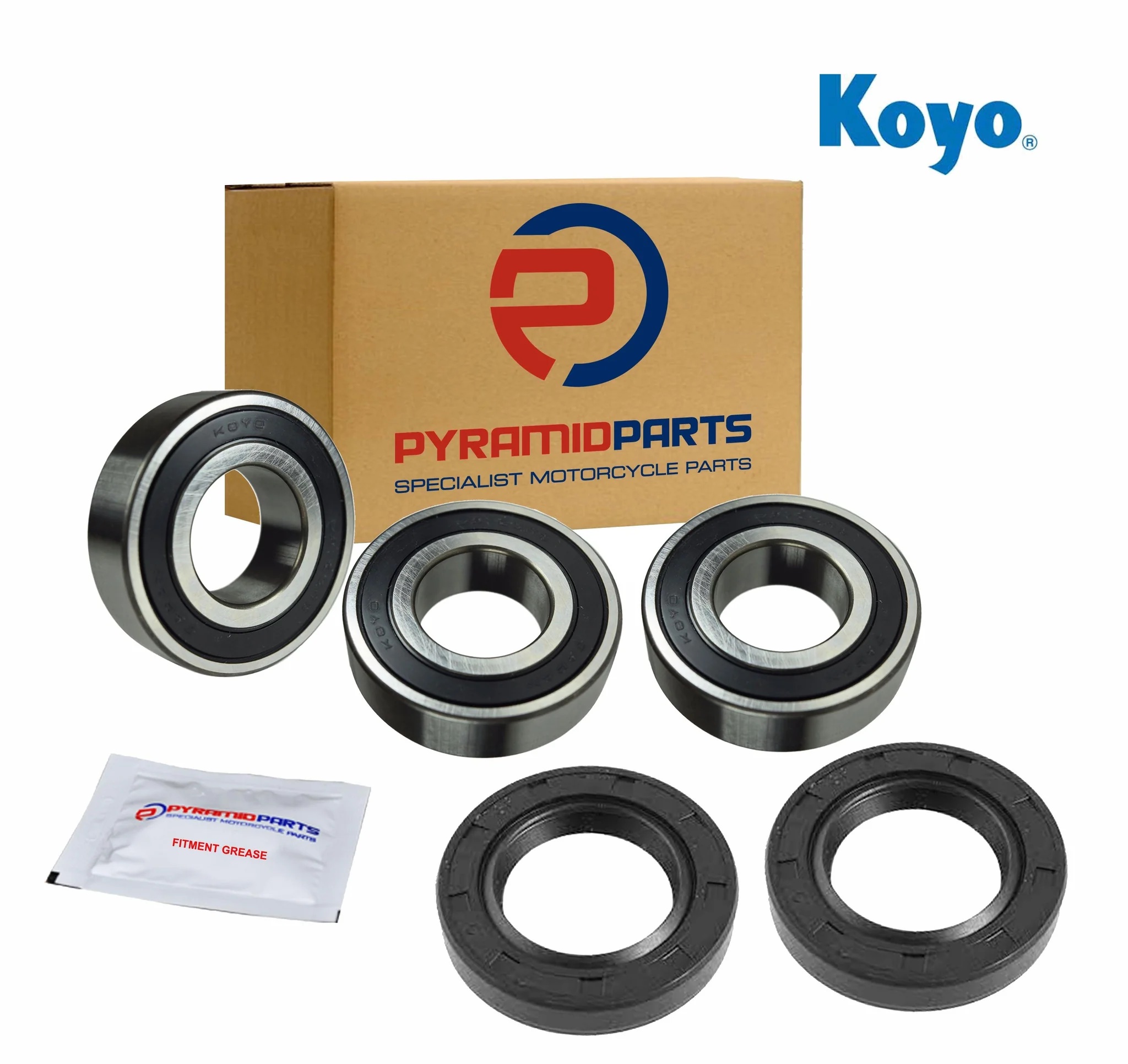
Three bearings and two seals
• Rear wheel bearings. The bike was used for muddy UK trail rides and the bearings didn’t feel that smooth and solid. Again a lottery if not buying factory parts; I took a chance and these were the ones. I did some front bearings once but not rear bearings – never knew there were three in there (two on the chain side; no cush drive, like the CRF). I expected the usual gnashing of teeth, but it was dead easy after a quick YouTube and and no special tools required. I peeled out the rubber seals with a tyre lever, heated the area over a camp stove, then used a thin, long, round rod with a freshly-sawn sharp end to tap one out, starting on the brake side (single bearing). There is a spacer tube between the bearings along which the axle normally slides, but the bearing’s inner diameter is 1mm or less smaller, which provides a smidge of a lip for the rod’s edge to work on. Once the spacer drops out, the chain side bearings are easier to tap out. Once greased up, the new ones gently tapped in easily (no need for freezing to shrink them), using a large socket on the bearing to spread the load evenly, and the bikes axle to help line up the last bearing and spacer tube. So satisfying when it all goes to plan.
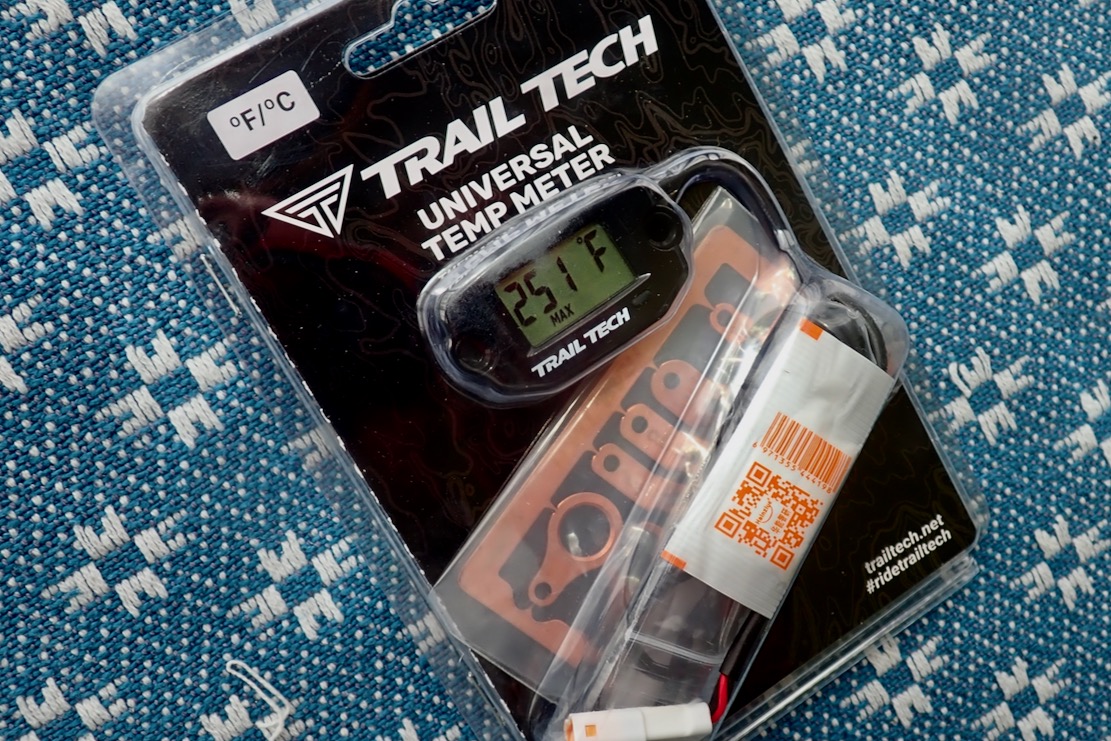
• Trail Tech engine temperature read-out. There are Chinese cheapies on ebay for 20 quid but for 3 times the price, I know well that a T’Tech will last (left: WR250R). Clamp the wire anywhere very hot then learn a median reading so you know what’s excessive. Air-cooled run hotter so it’s good to keep an eye on things and slow down if needed. My Him 411 got up to 270°C on the motorway. The battery powered read out is handy to read ambient morning temps too (left), before starting the engine.
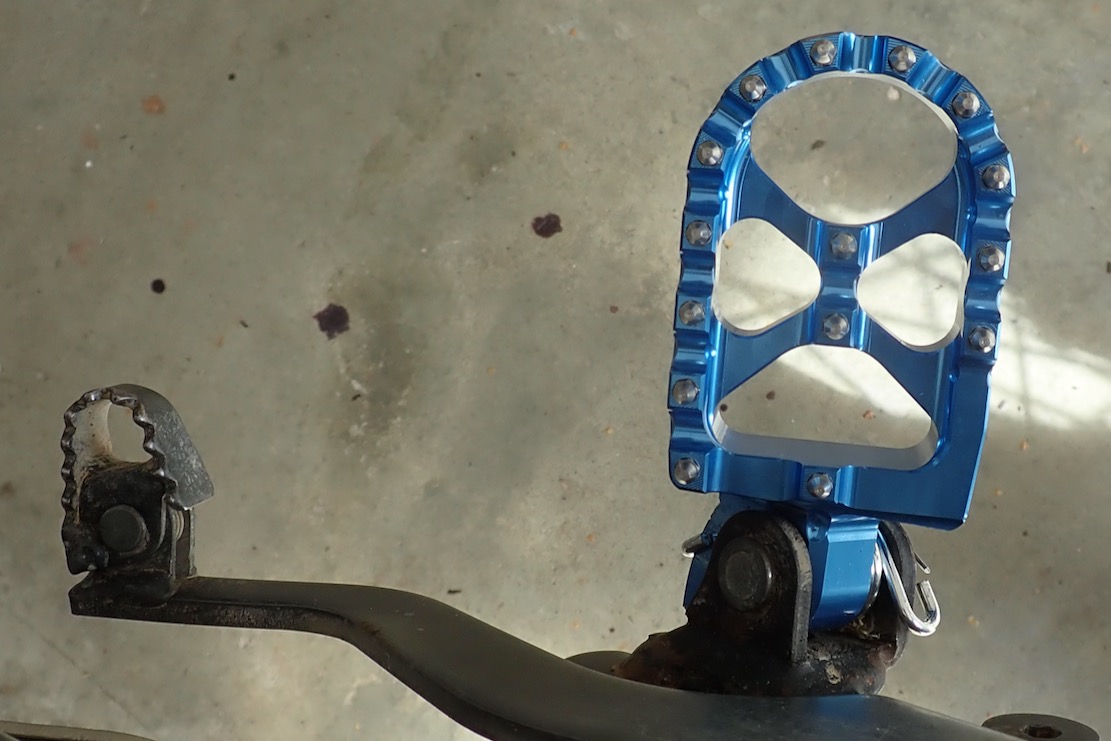
• Replaced the stock cheesecutter pegs with some full-fat WR footrests I had left over. They only came in blue – or black costs loads more.
Well hidden
• As usual I wonder about upgrading the shock; an easy way to improve the off road ride. But I forget that stock Yam 250 suspension is not necessarily the soggy mush off a CRF. The TTR had great suspension, and it seems Serow (especially the previous 225) is closer to TTR than the 250 Serow which has no damping adjustment. In the RM vid below, matey is swapping out a stock 6.7 kilo spring from a US-model XT250 for a Racetech 9.8. It seems a pretty easy job with no deadly compression required. I don’t know what my spring rate is and whatever damping I have left comes free.
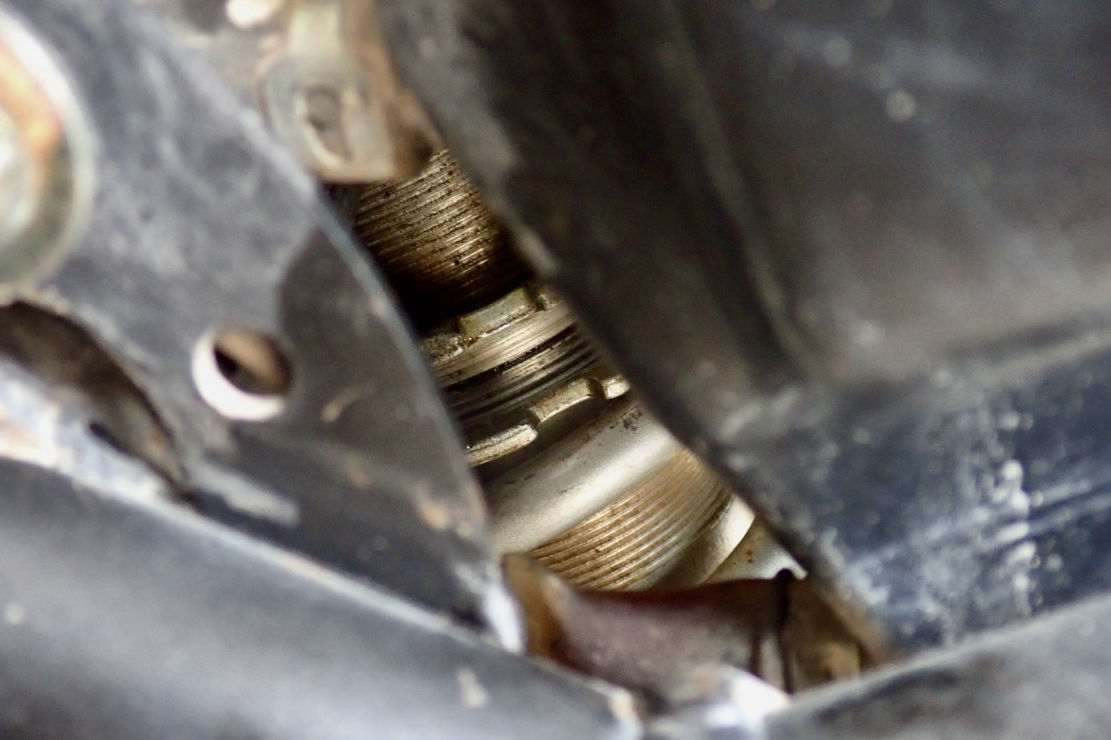
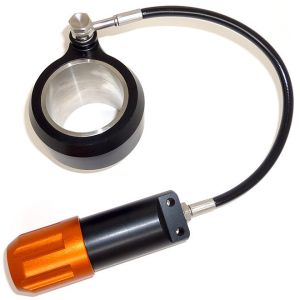
The YSS shock is the cheapest at £330 with compression damping and a juicy red spring which must be worth 50 quid alone. A YSS was OK on my Himalayan 411. Internally I’m told they’re crude, but YGWYP4. I thought about it, then held off and instead chipped away at the preload rings with a hammer and old screwdriver, assuming I need more than the orevious owner who was probably half my weight. The rings were now ⅔s down the threads but adfter a ride along a bumpy lane it was way too much. Back home more chipping to back off a bit. The unadjustable front fork also seems usefully firm. So maybe the suspension is not so bad after all, and now knowing the shock can be easily removed and taken apart and the spring is firm, it would be great to fit a hydraulic preload adjuster (HPA; above left). I’ve had them on previous bikes: just turn a knob to vary the spring preload depending on loads or terrain. You can almost do it while you ride. Who needs ESA? The problem is finding one that will fit what is probably a KYB shock. There is space enough around the shock for the hose and mechanism, but along with the exact diameter, I’m told there is no commonality with shock body threading like there is with other screwed fittings.
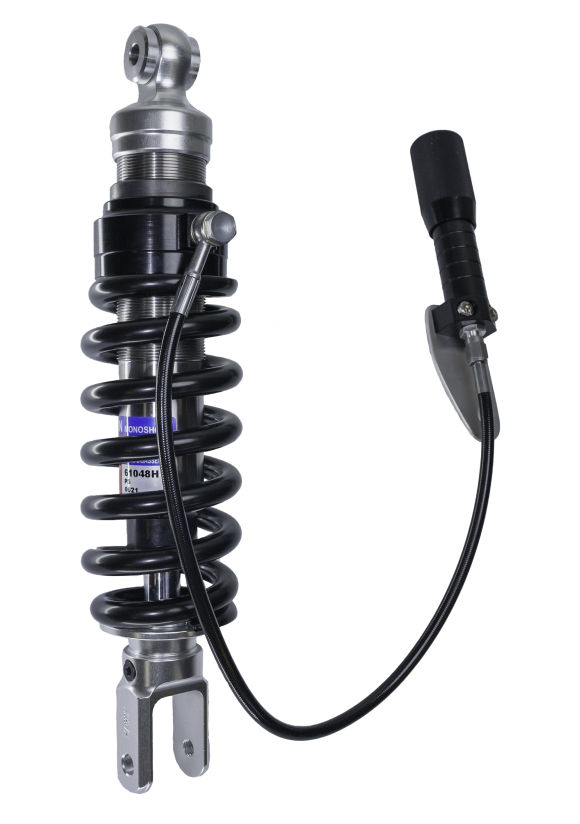
If I don’t manage to find an HPA, I’m eyeing up a Hagon shock with combined damping/compression adjustment and an optional HPA (left), all made to measure in merry old England for 600 quid with a plain black spring. Back in the 1980s I used to get the fragile stock wheels respoked at Hagons when they were in Leytonstone, in the day when I rode full-sized XTs.
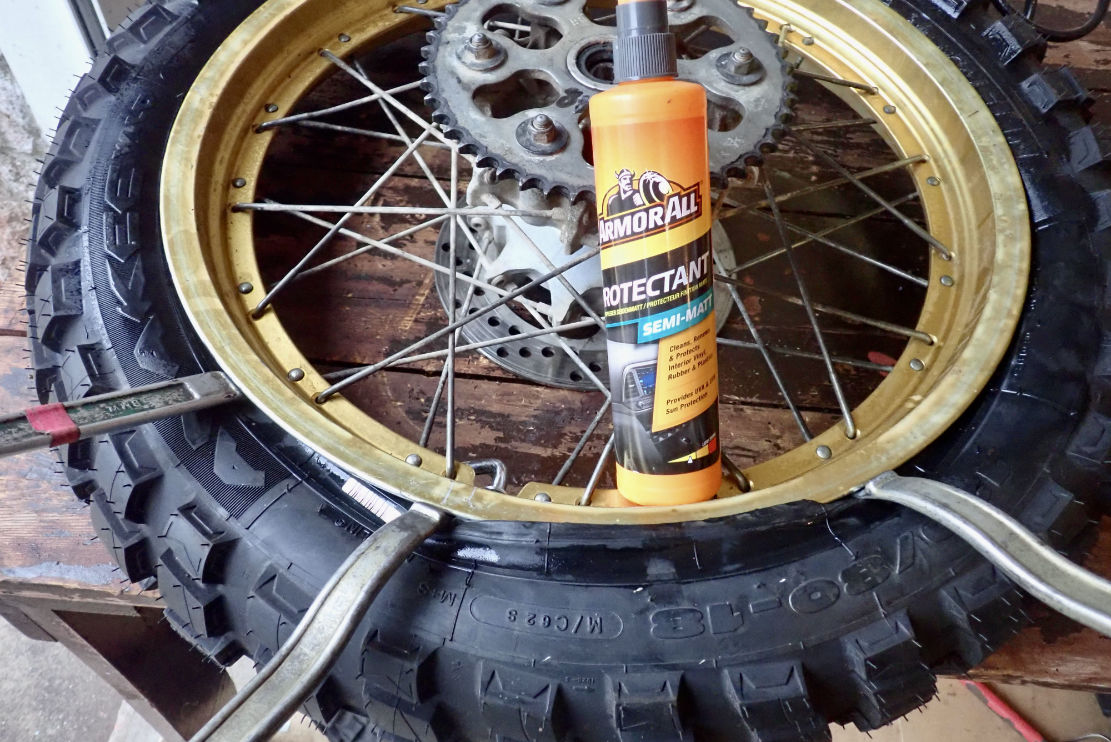
Update: fitting a new Mich Wild months later, none of the tricks below worked. The answer was one of these. I should have bought one years ago.
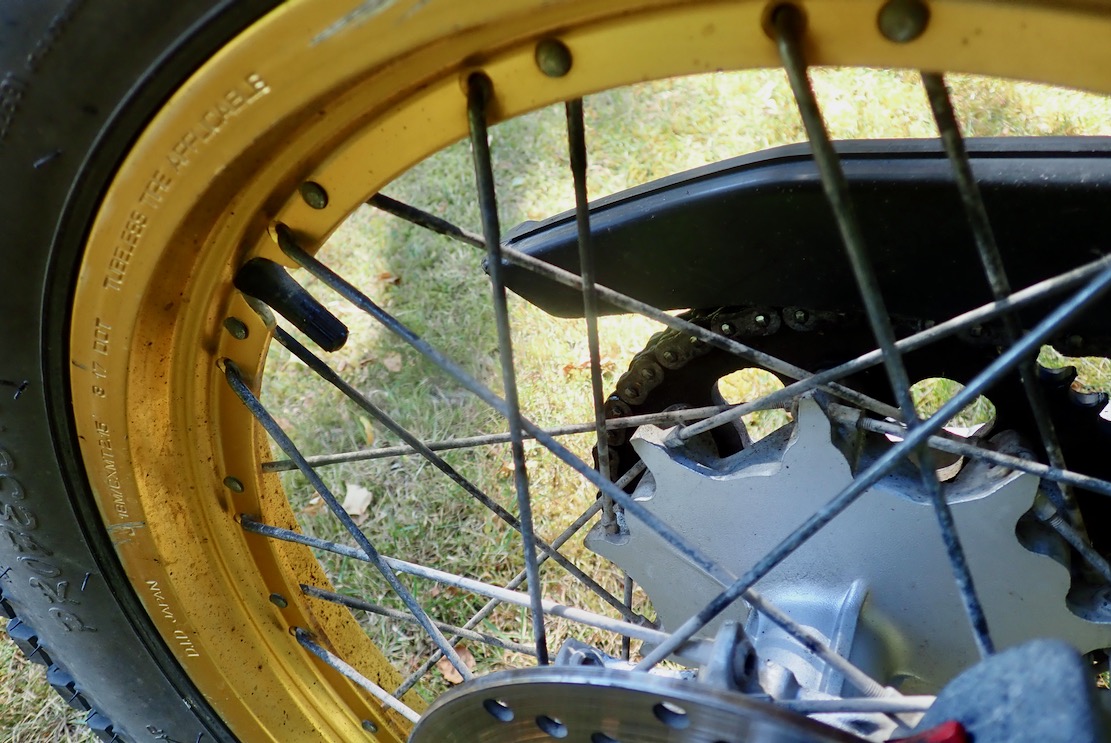
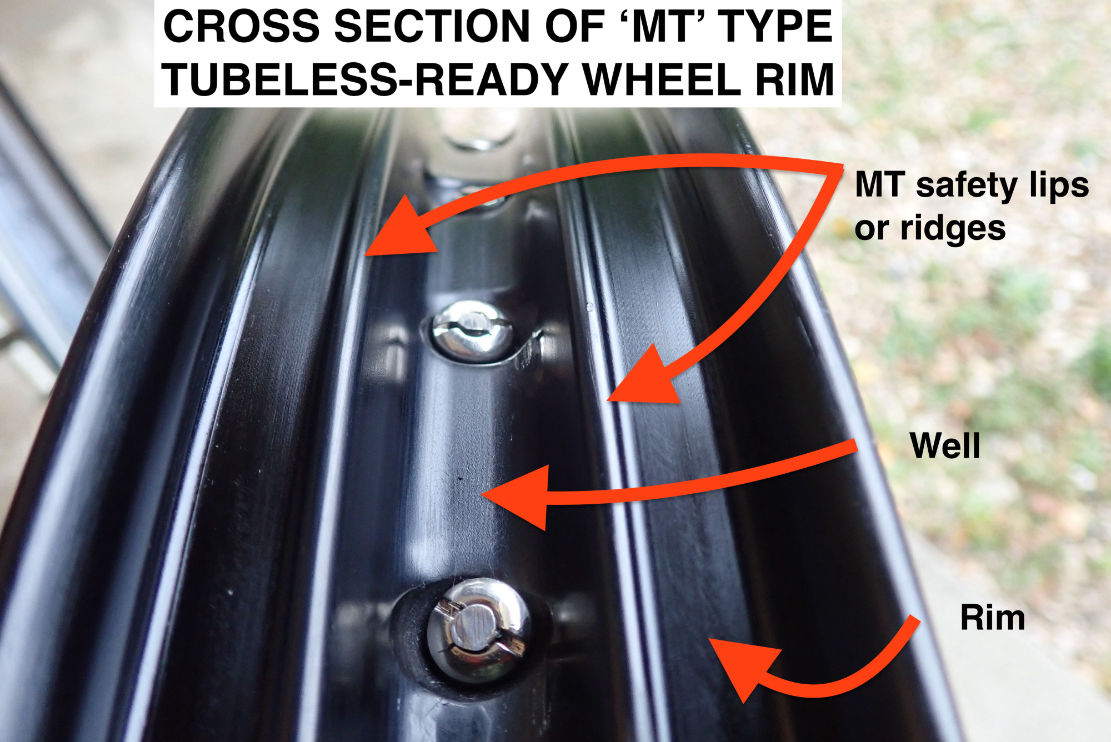
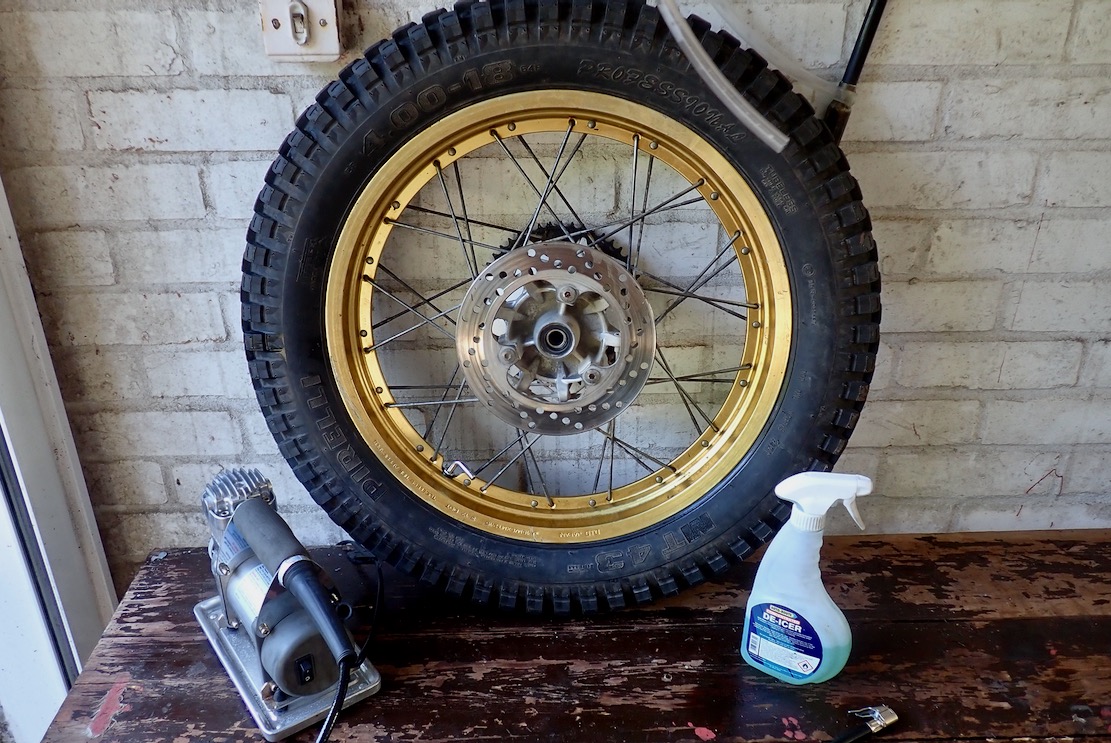
With the rear wheel off to check over and fit new bearings, I removed the Serow’s tubeless Pirelli MT43 trials tyre to fit a right-angle valve so as to end airline forecourt faffing once and for all. The Serow’s rear wheel only is an early example of OEM spoke tubeless. It’s even stamped with ‘tubeless tire applicable’. Levering the tyre back on, as I aired it up the tyre beads (edges) would not seal and mount onto the rim. With no inner tube to push it out, more pumped air was escaping than stayed in. It’s a common thing fitting tubeless, but with the valve core removed to maximise airflow, a bit of jiggling and pushing usually gets air going in faster than leaking out, pushing the beads against the rim’s MT lip. Once that happens, pressure quickly builds up, forcing the beads to ease over the lip and onto the rim with a ‘pop’. The job’s helped with a fast compressor like my 2.3 cfm Viair.
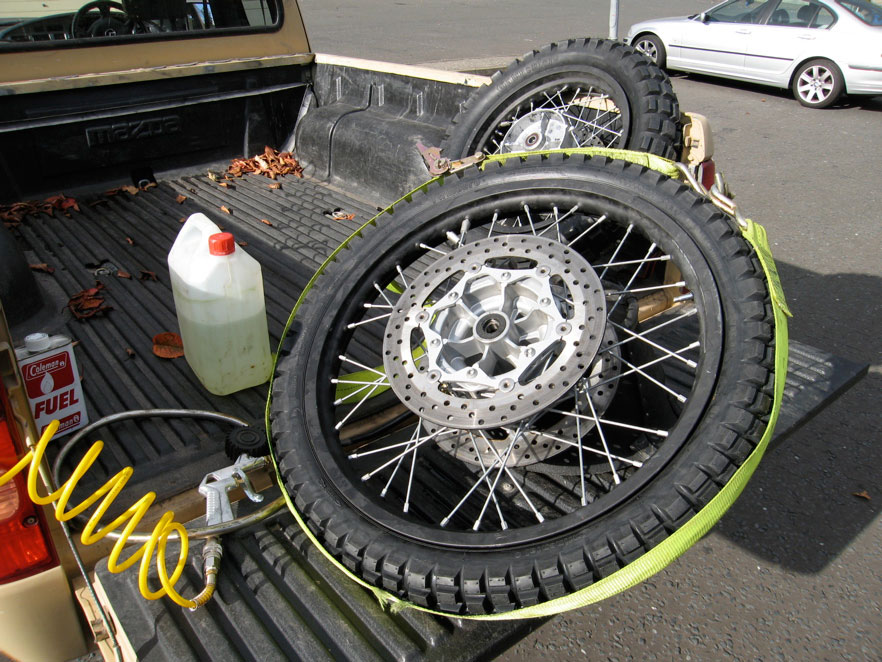
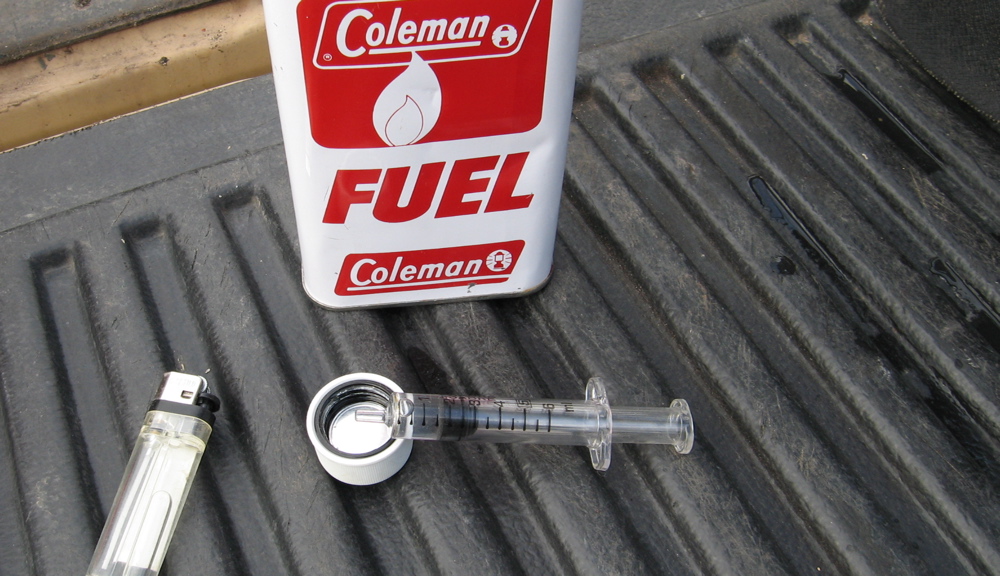
But not this time. Maybe it was something to do with the 4.00 18 Pirelli’s tall, thin sidewalls. Next, I tried the well known ratchet strap method, as I did on my XT660 years ago (below left). No luck. Rubbing my chin, I thought about the Icelandic method: injecting fuel through the valve hole, followed by a lit match. But that hadn’t worked on the XT either (below right). With the XT it had been just a matter of hours jiggling, pushing and pulling with the ratchet on, although having the brains to turn the car engine on gave the pump the extra poke it needed.
RatchetIcelandic
Bits of tube
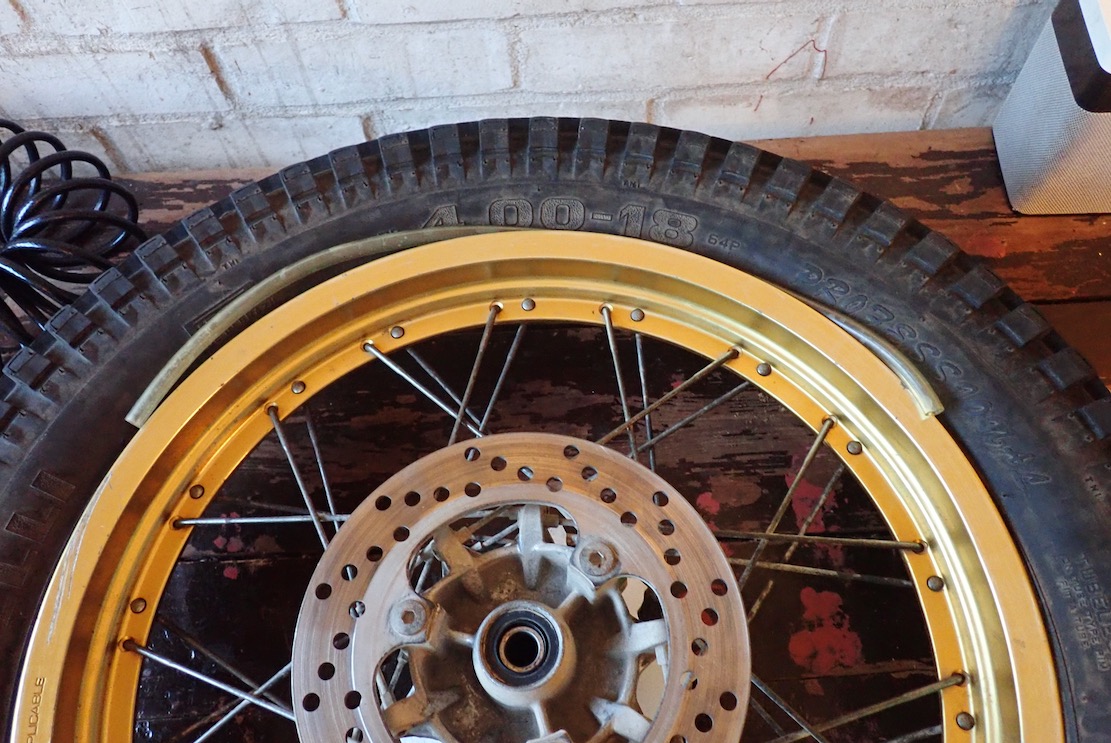
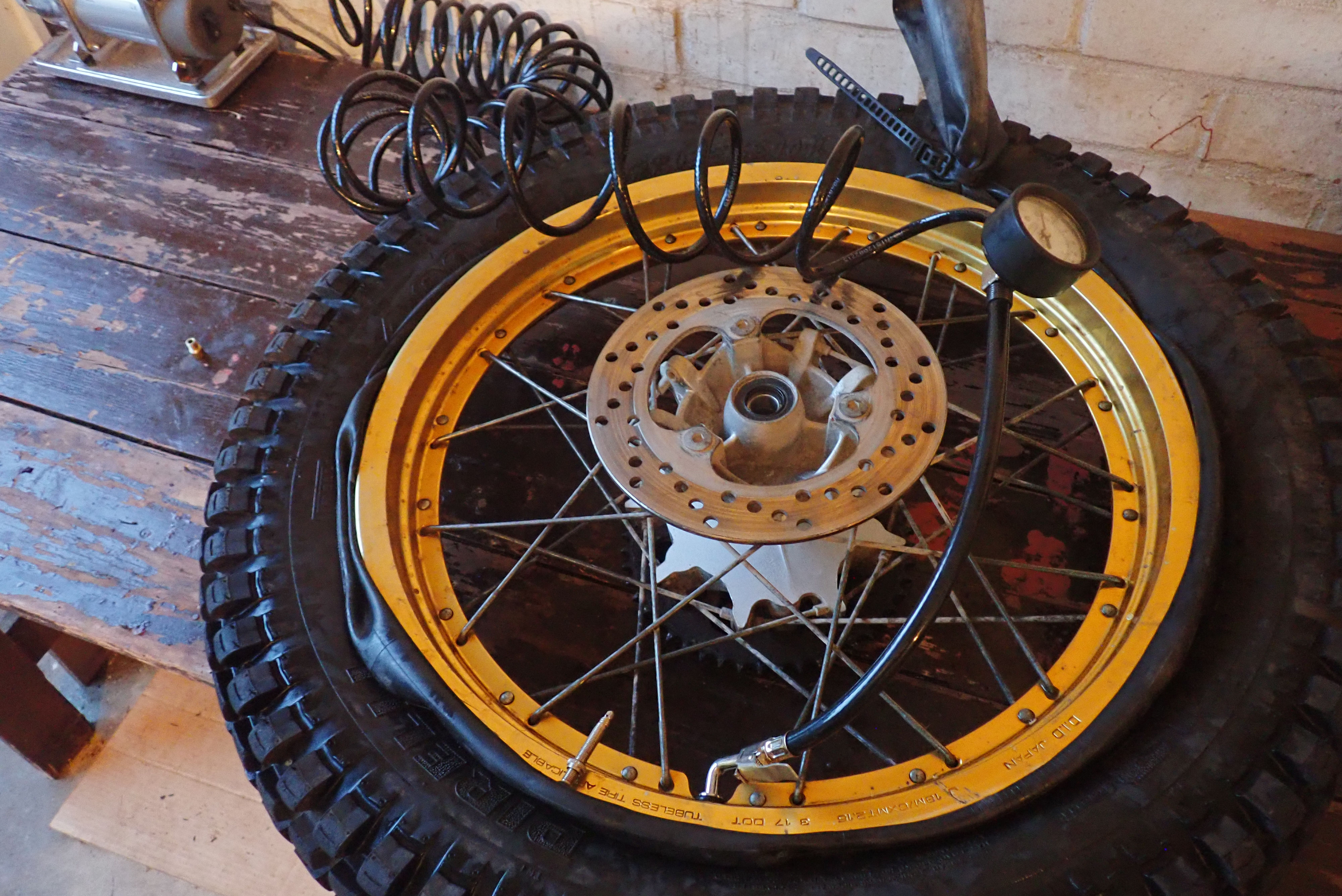
After doing a bit more of that on my Serow wheel without success, I tried jamming bits of plastic tubing into the unmounted gaps (left). They should slow the escaping air enough for pressure to build up inside for the beads to catch. Not this time (have I said that already?). All they did was push the bead further down into the well. So I turned to the bicycle inner tube method which years ago worked on my Land Cruiser, fitting five tubeless tyres by hand in the back yard. Lay the wheel rim flat on a bench so the tyre is unsupported and the lower bead presses down onto the rim’s lower edge. When a moto wheel rests on its disc rotor or sprocket, this happens anyway. That should get the lower tyre bead to press or at least rest on the wheel rim, reducing air loss. On the upper side, jam a soapy bicycle inner tube into that gap. I didn’t have an 18″ tube so I knotted a 29er, lubed it up, shoved it in and gave it some air. I tried for ages but this didn’t work either. I tried another compressor – same. It was the end of a hot day; perhaps the low air density was having an impact? I whacked in some CO2 cartridges I’ve had lying around for years. No change.
18-inch inner tube method
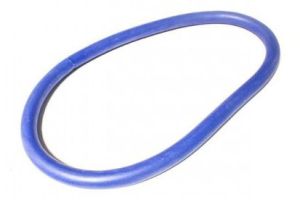
I emailed a pal who’s Mrs also runs a 250 Serow. He confirmed that for some reason, it’s near impossible with this rim/tyre combo, even with something called a beader mousse. Take it to a bike shop, he said. I’ve not heard of beaders. He linked to a Trials shop which sold them for 30 quid: basically an 18-inch neoprene ring, like a solid pushbike inner tube mousse and a bit like the pushbike inner tube trick. Maybe it’s needed with modern trials bikes which these days run 18-inch rear tubeless and like me, have mounting issues. Note in the video below how the well-lubed ring handily squeezes itself out as the tyre pressure builds up, even with a handpump. Iirc, with inner tubes you have to pull them out before they get jammed.
It cannot be that hard so next day I gave it another go, hoping some knack might have manifested overnight, as often happens. I tried rings on both sides with whatever I had lying around. No good. But this is what worked. With the wheel flat on a bench and the tyre pressing down on the lower rim, as described above, where the upper tyre’s well-lubed bead was clearly off the rim, I lifted it out with a tyre lever then slowly levered it back down onto the rim. This either put it closer to the rim or right on it. No inner tubes, ratchets or mousse rings. With the tyre well lubed this simple move did the trick. Turning the pump on, in seconds the motor’s drone strained reassuringly as bead caught, and a few seconds later both beads popped in place. Now we know.
Pumped!!
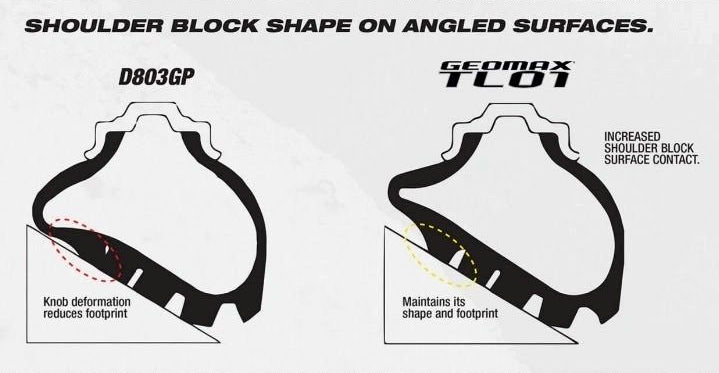
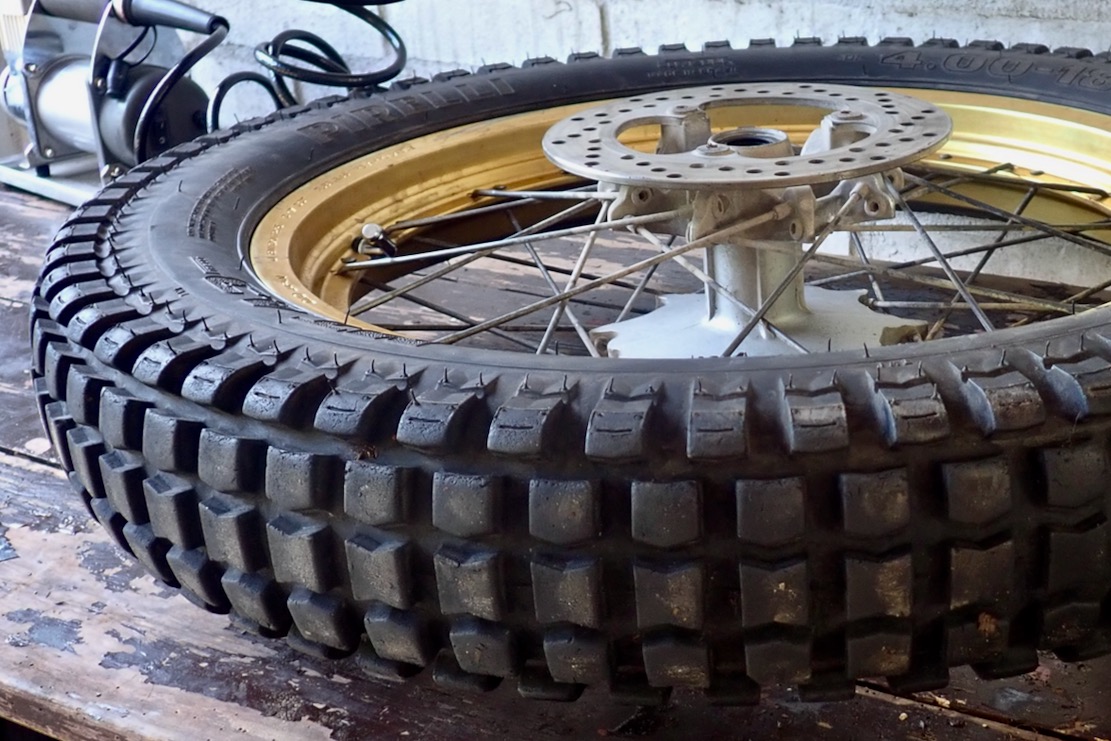
Blocky trials tyres are actually pretty effective for technical UK trail riding, as opposed to the more obvious knobblies, though neither are great for setting IOM record laps and wear fast.
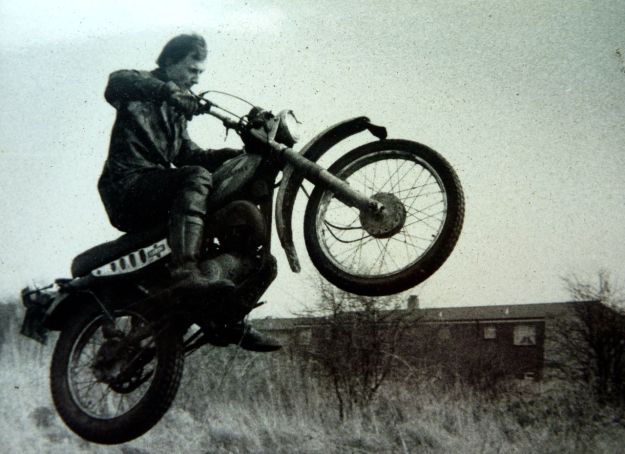
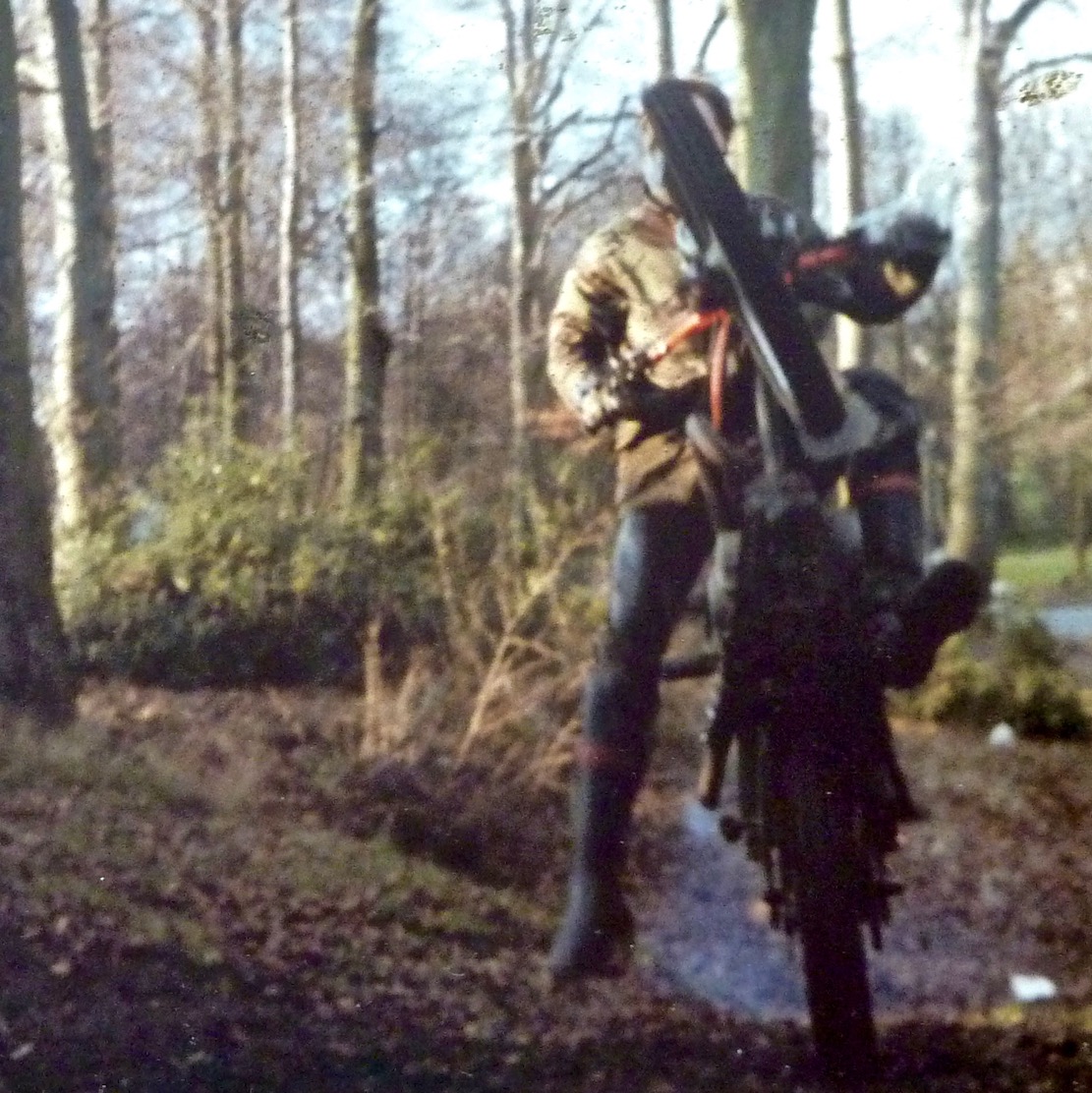
Like a 4×4 sand tyre, at very low pressures the thin sidewalls flex out to e l o n g a t e the tyre’s footprint, giving tank-track like traction. In the late 70s I remember doing a little enduro at Badgers Mount in Kent on my TS185 (above left and below). Against PEs, Bultacos and the like, I wasn’t a contender of course, but in the muddy woods at jogging speeds my trials-tyre shod TS had grip like no other tyre I’ve ever tried.
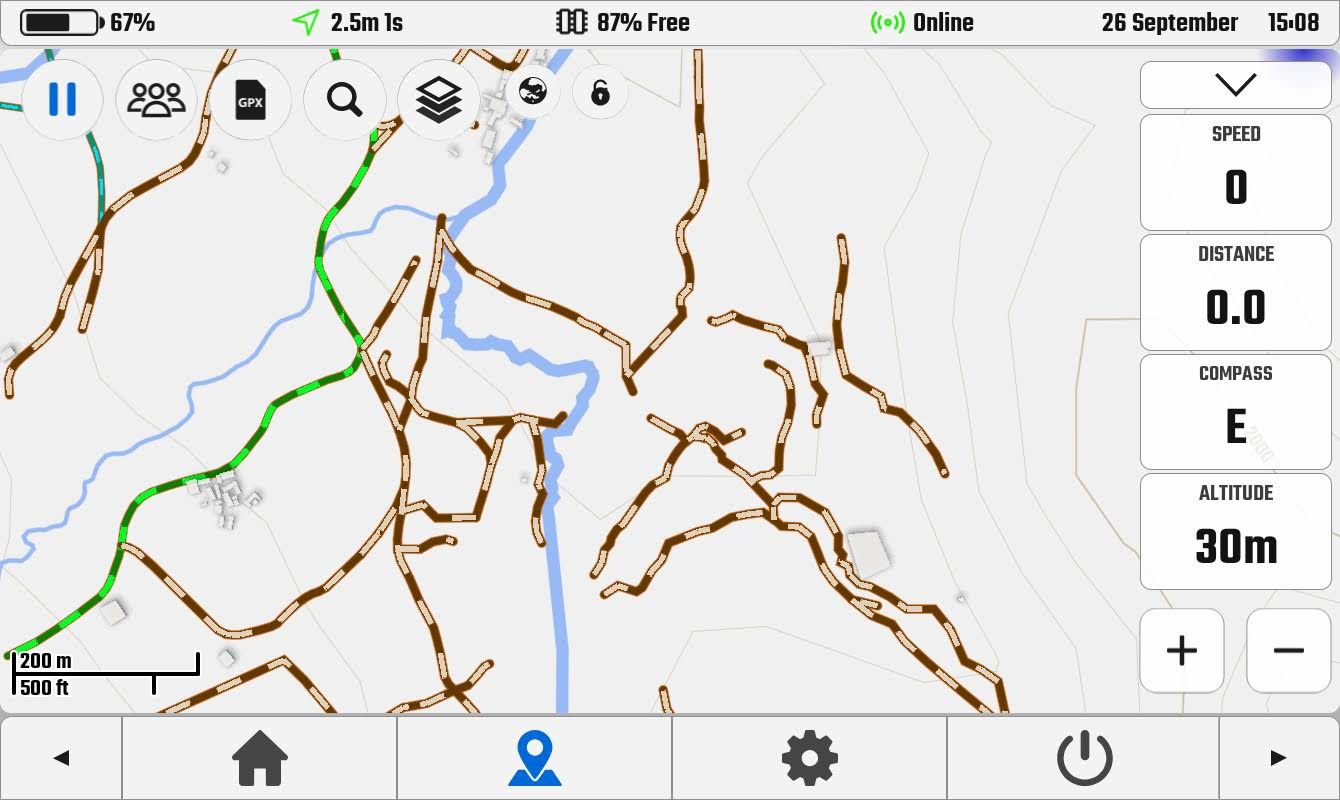
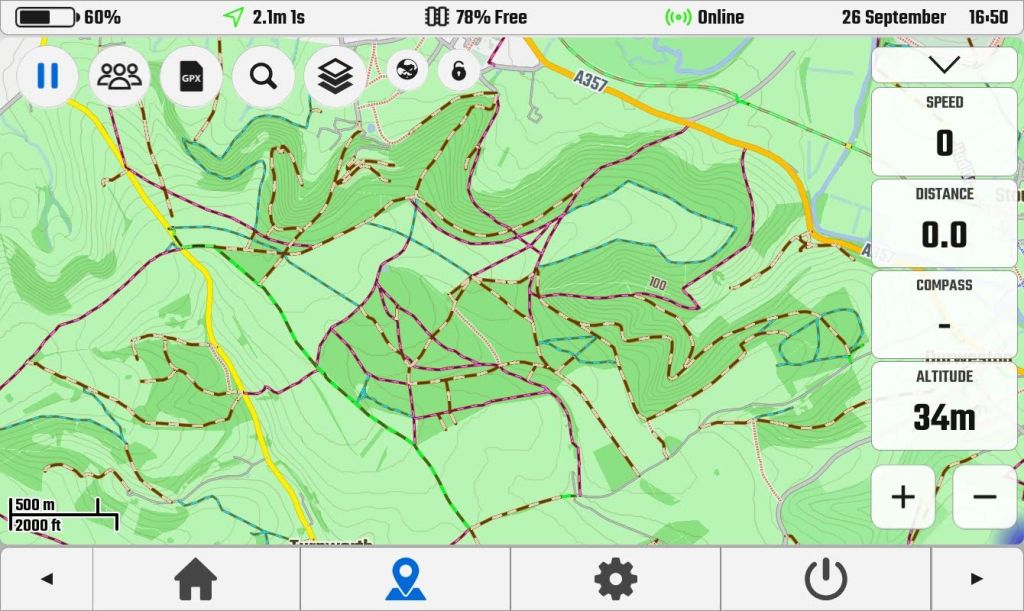
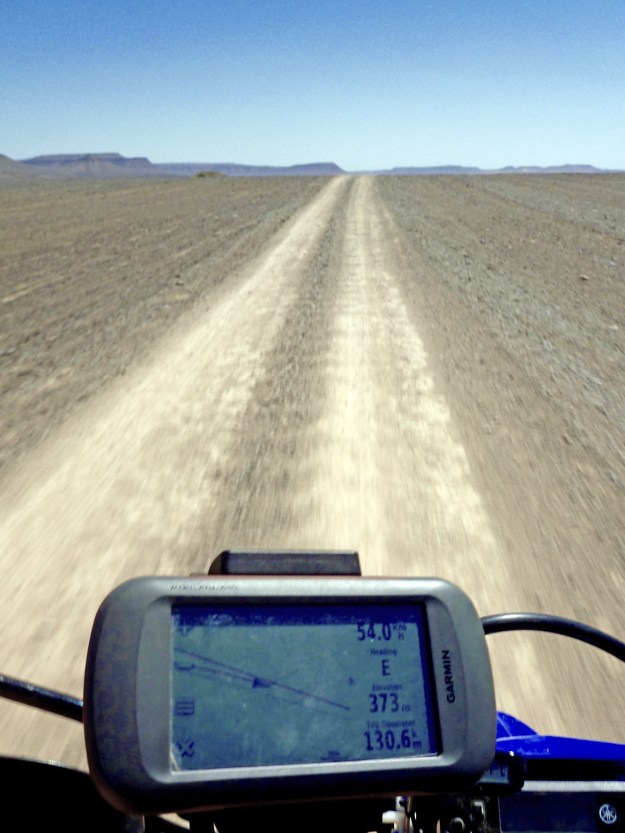
My well-used Montana 680 (above) is playing up more than usual. Like most of my Garmins it’s always been flakey, crashing, freezing, or dying outright (I’ve got through a couple). But now it’s routing illogically. It happened in Morocco on the Himalayans in April, putting us in a right tangle trying to get out of Marrakech. I should have pre-visualised the exit route on a map the night before; as we know, second guessing a GPS’s routing is part of the game. A quick Morocco map switch – such a great feature which set Montanas apart back in 2011 – fixed that. I assumed the OSM map had some flaw with main roads wrongly classified as mule tracks, flipping us up some diversion then coming back to the main road. Then the other day riding my new Serow back from Wiltshire via backroads, it was routing me all over and even onto tracks fluttering with red flags and low flying tank shells.
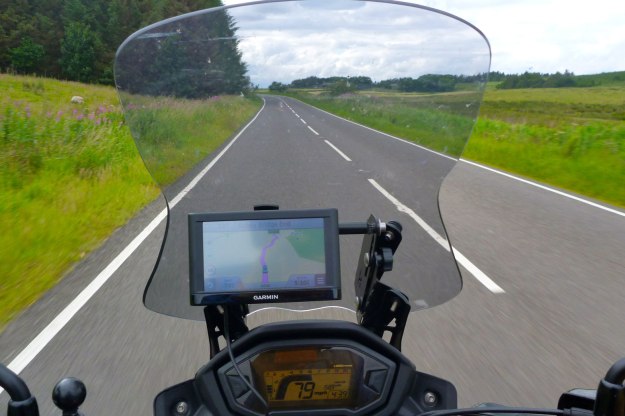
Cheapo Nuvi car satnav. Better than a Garmin handheld on the road.
Back home I reset the Montana, updated the software, installed the latest UK OSM, changed my underwear, moved/deleted maps off the internal storage and took out/put in the mini SD card. And I’m always disabling unused maps to free up whatever needs freeing up. This routing anomaly might have sorted itself out but even then, compared to a tablet or phone, the 4-inchMontana screen is small, murky and my eyes less good, made worse by using full dark visor these days.
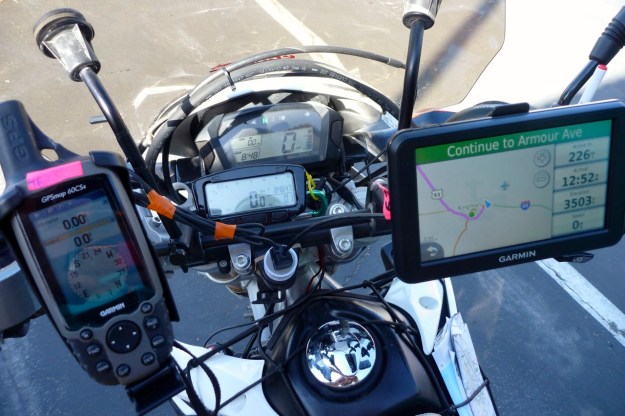
Handheld Garmin dark, Nuvi (right) bright (2012, USA)
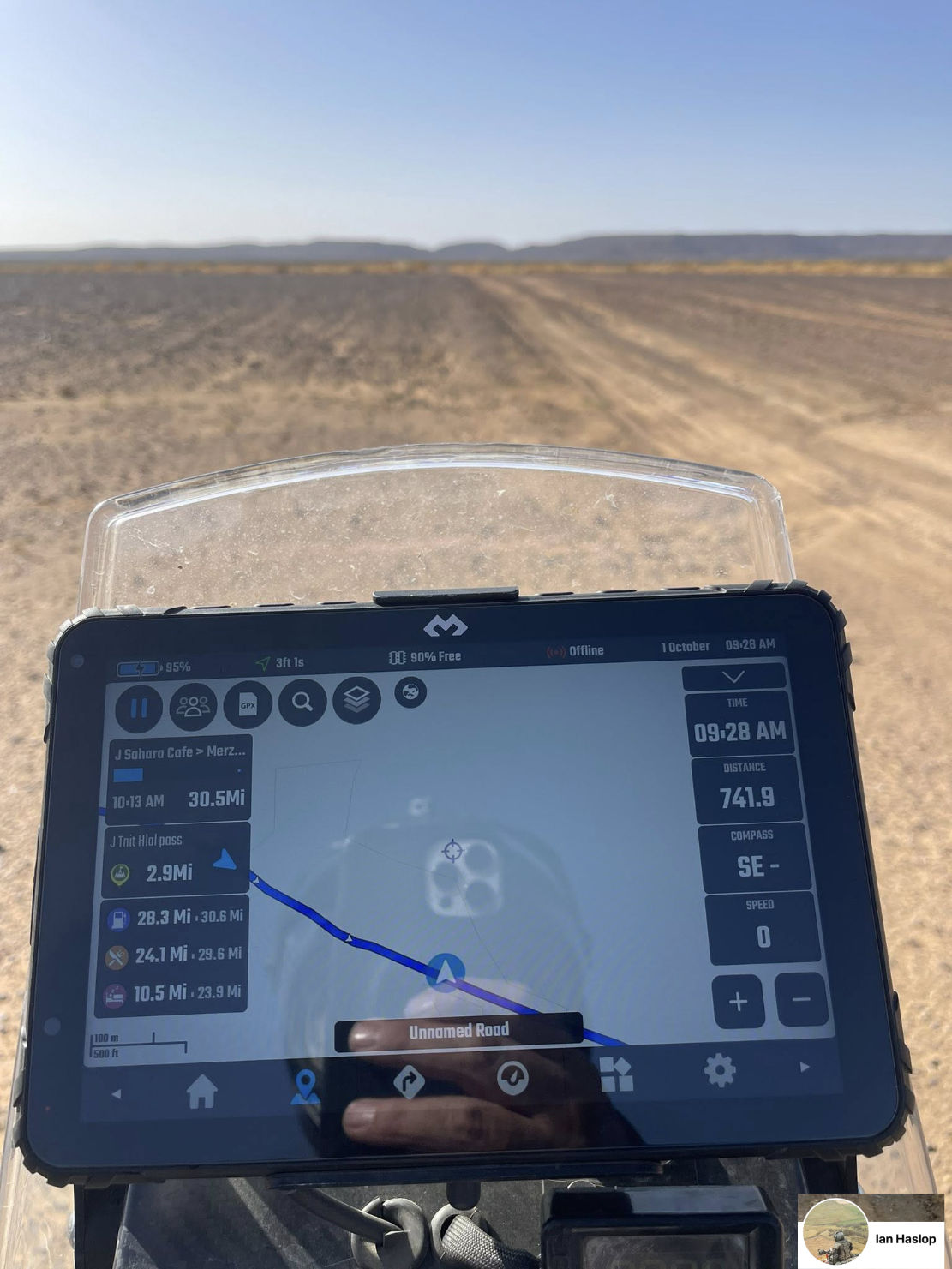
So once again I find myself looking for an as-functional alternative: a satnav that routes reliably when not in North Africa, but that switches maps and records tracks and waypoints with ease when out there, has an all-day battery for UK walks/MTB exploring (with the benchmark OS map), but doesn’t cost 700 quid like the Garmin 710i/Tread or a full DMD/Thork set up. I don’t need to listen to music, answer calls, run dash cams, talk to other riders, integrate Group Rides, receive fun road suggestions, log my lean angle and tyre pressures, or get traffic and weather notifications. These clever do-it-all-and-more app tablets are impressive like a phone, but right now I’ll just settle for nav.
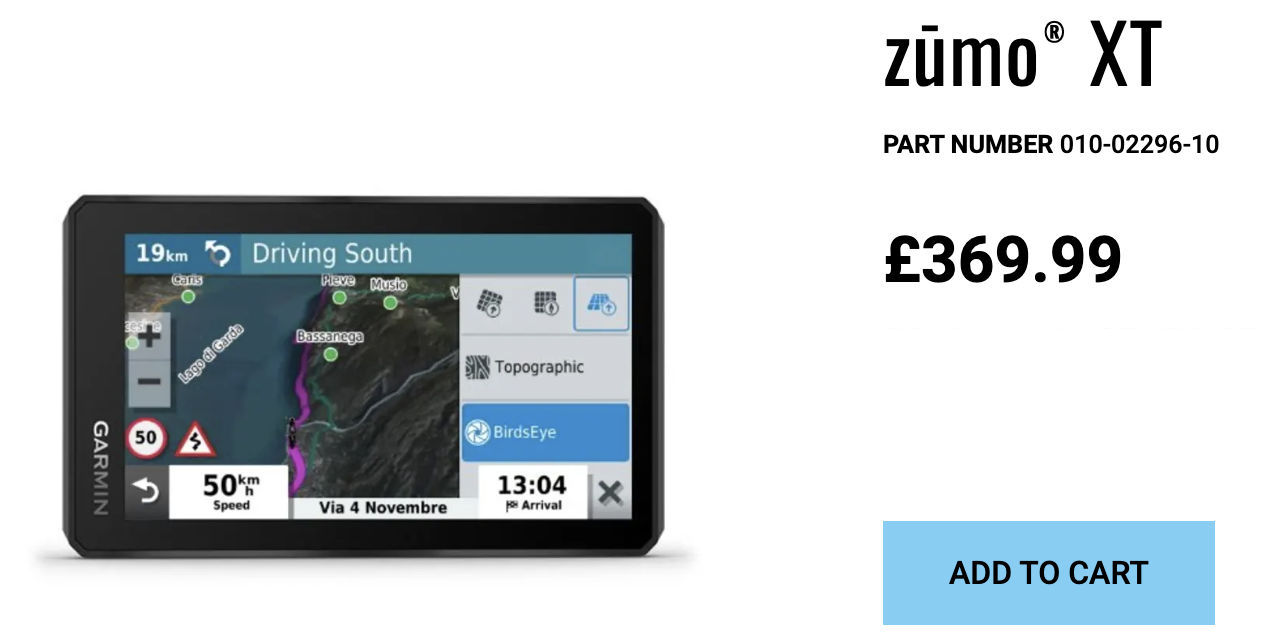
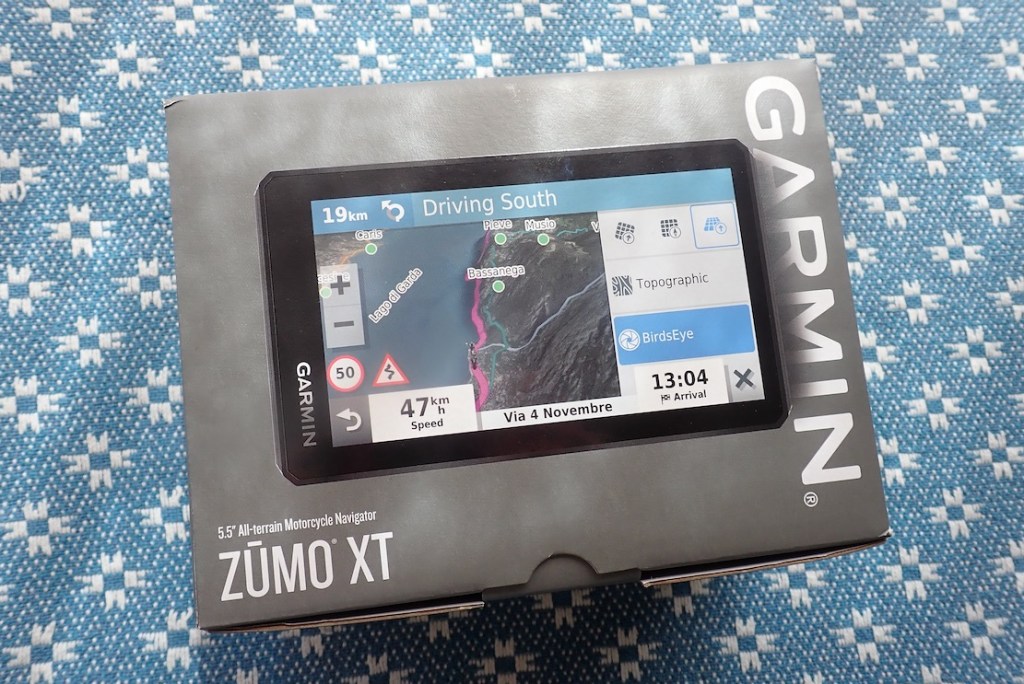
Garmin Zumo XT
What they say The rugged zūmo XT motorcycle sat nav is built for adventure. Its ultrabright 5.5-inch display is glove-friendly, rain-resistant and shows you the adventurous way — on and off the beaten path.
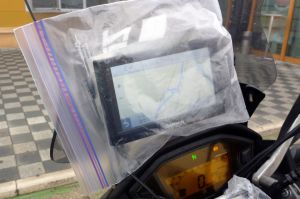
Zumo? Schmumo! £50 Nuvi + ZipLoc
Superseded late last year by the XT2 (from £530), the 2021 Zumo XT came out in 2021 and goes discounted to £304 at SportsBikeShop with 77% 5-star reviews on amazon. I intended to try and see if it would do the things I needed, then either keep it or send it back. Way back, I was lairy of Zumos when I realised they were nothing more than a Nuvi car satnav in a rugged package with moto routing gimmicks and a jacked-up price. I’m sure the XT has moved on from that era, but being cheap myself, for around £50 used on ebay I took to using used Nuvis (now called Drive), as for plain road nav the map display is far superior to any Garmin handheld, while still keeping a Montana for recording trails. A Nuvi required a plastic bag for rain, but even then one drop off it’s flimsy car mount, drop of rain, or even just pocket dampness saw it off.
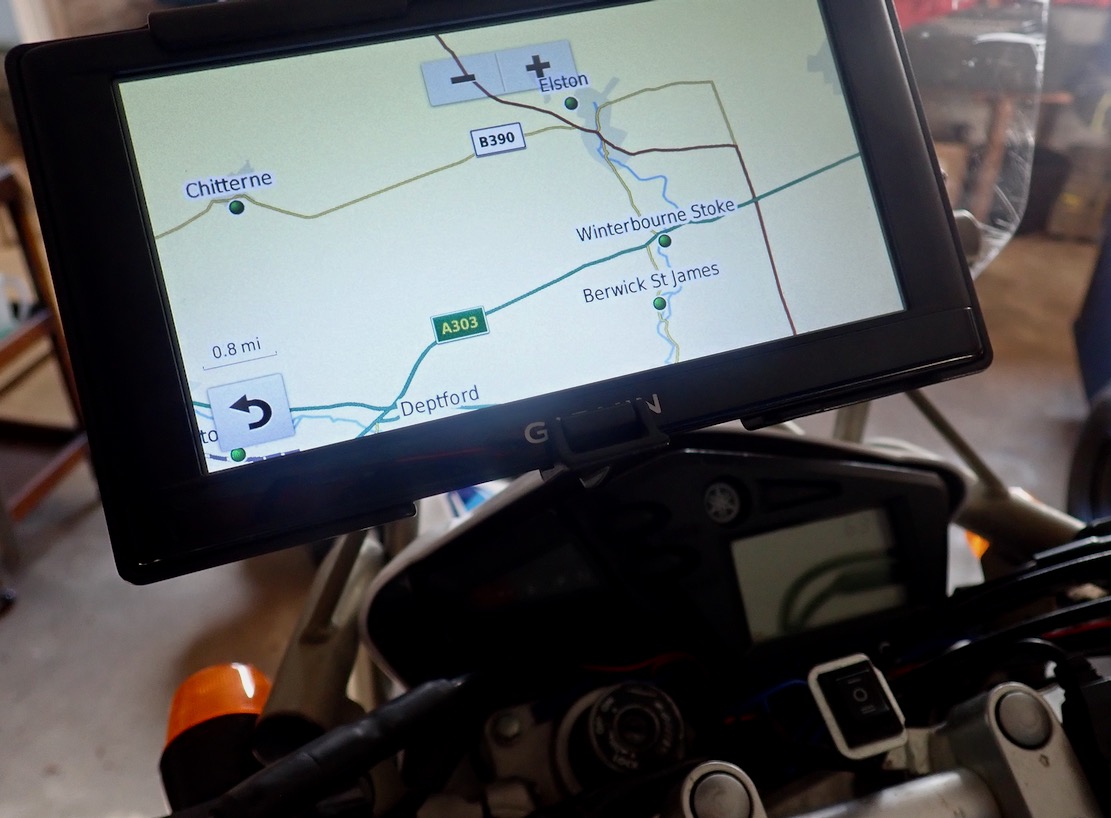
In the box You get a lot with the Zumo XT: proper RAM ball mounts (nice), suction mounts with the old Garmin ball plus a cig plug lead for car use, long 12-v power cable and solid looking clip mount plus the charging/data cable. The unit is rated IPX7 which is rain resistant, with thick rubber caps to protect the miniSD and USB ports, though I read that rain drops can set off the sensitive touch screen. The XT2 has a way of disabling this. Likje a Montana, you can run an XT off the battery, via a USB cable or off the charging mount hard wired to the bike. This clip-off mount feels quite solid and may do for off road use, though generally clamping around the whole body (like Montana) is more secure. The unit was dead out of the box so I plugged it into a power bank via its ancient USB mini A slot and started looking around. All very Nuvi like but a nicer lay out. There’s a lot of added crap on there too, but isn’t there with everything these days? Basic set up was dead easy (compared to a Montana after a reset). Then came the moment of truth: slotting in my Montana’s miniSD loaded with my .img custom maps. “Alert! Alert!:Maps are corrupt and cannot be used. Go to http://www.garmin.com/express to download [AKA: buy] the latest maps. Alert“ I did manage to get one UK map to load, but not the more useful OS 50k mapping (I was told OS 50k wouldn’t work on an XT, even newer ones). And a Moroccan one appeared at some point, all before I learned to store the maps in a folder called ‘Maps’ on the mini SD card (not ‘Garmin’ folder as before). So there was potential there but crucially, I could not see how to switch from one map to the other – so easily done on the Montana. Often in Morocco one of my maps will show more or better detail of what’s ahead. Switching between multiple maps is important. I suppose I could have ploughed on for a few more hours trying to unravel it all via the Zumo forum. But it reminded me of the bad of ~Garmin years of try to get custom maps to show up, plus I wasn’t convinced I’d not come up against some other game-ending anomaly. So with no great surprise I declare the Zumo XT a great passive satnav. For 300 quid it’ll spare you mobile but does not answer my nav needs. Recording a track and saving a waypoint looked pretty easy, and the screen was a bright as. Unlike a like a Montana, it was getting pretty hot in the hand charging off the powerbank, but once separated, it did look like the battery had a few hours in it, unlike any Nuvi. You’d hope wifi import/export/updates will be seamless. – didn’t try but I hope it’s not like baffling camera wifi. Right now I have a RAM cradle for the car’s Nuvi for UK road nav (below left), and will stick with the Montana whose routing might be magically fixed.
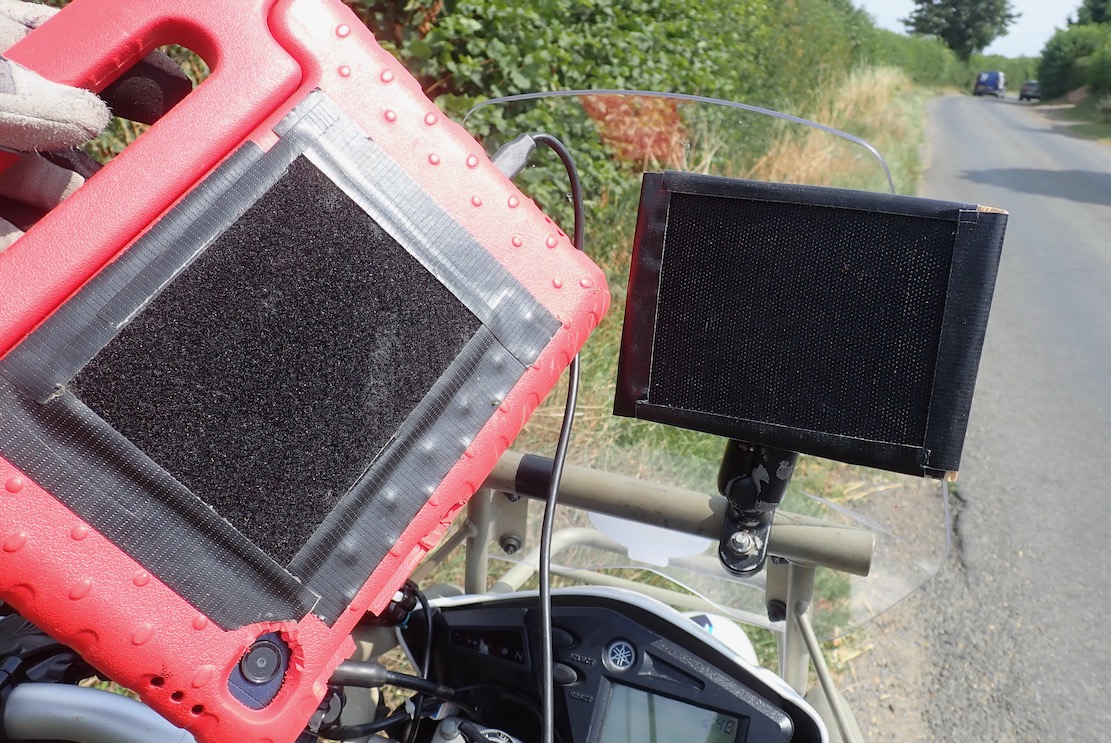
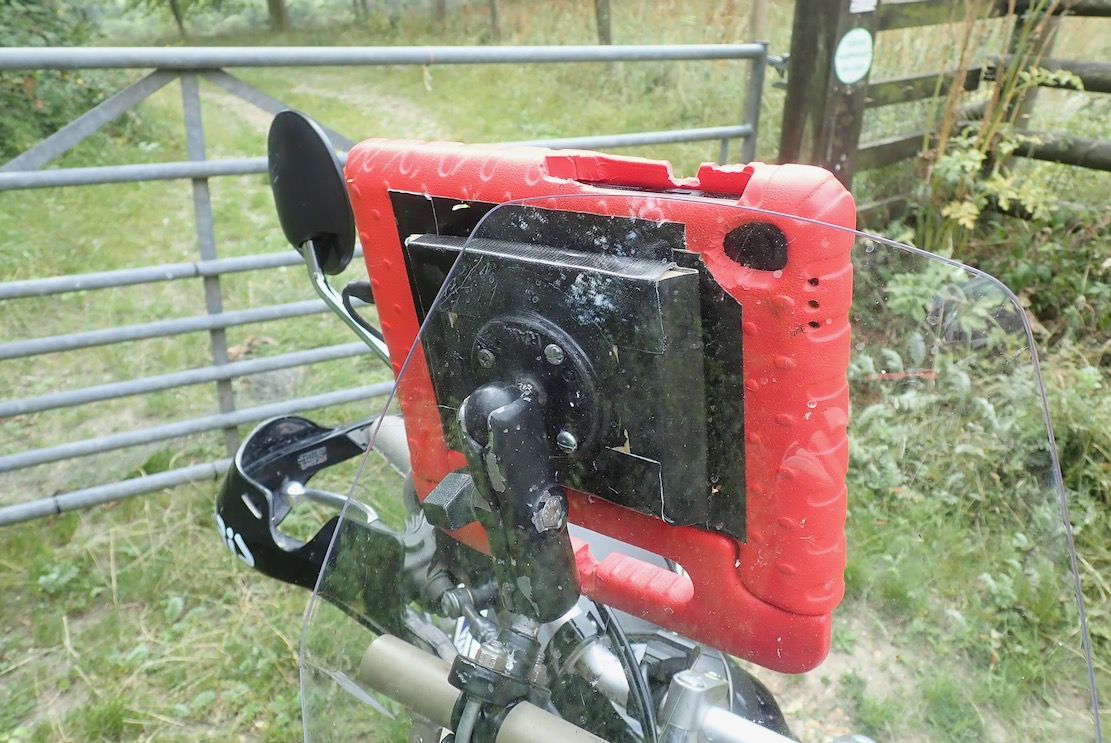
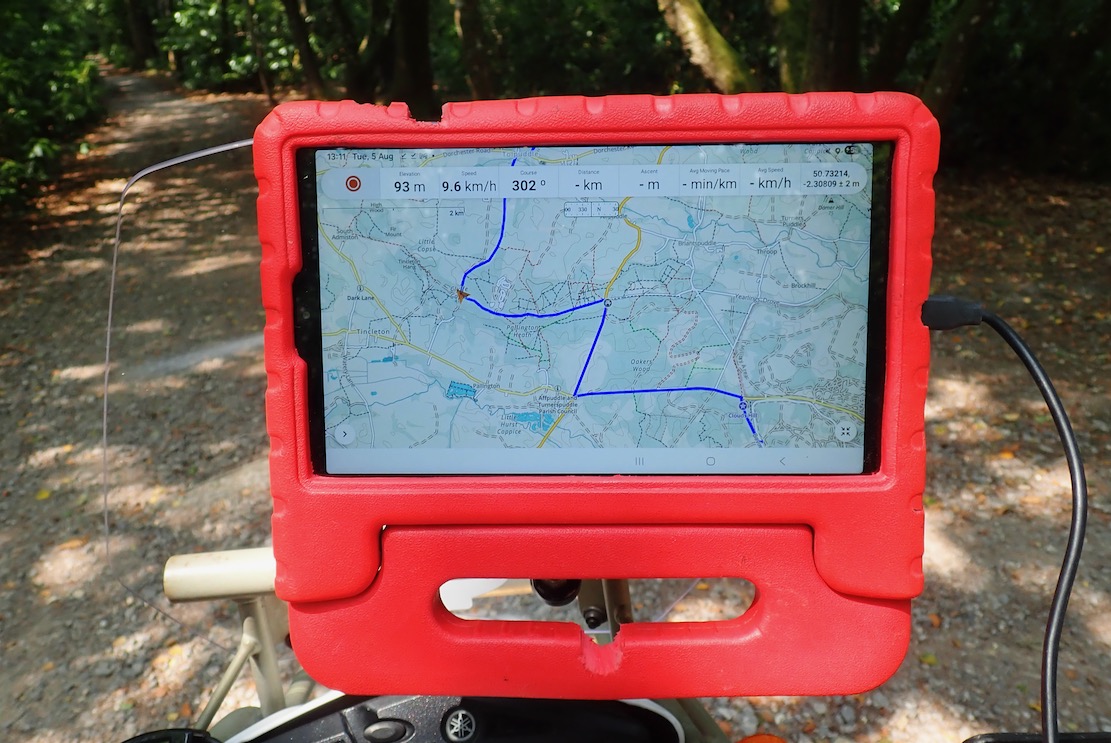
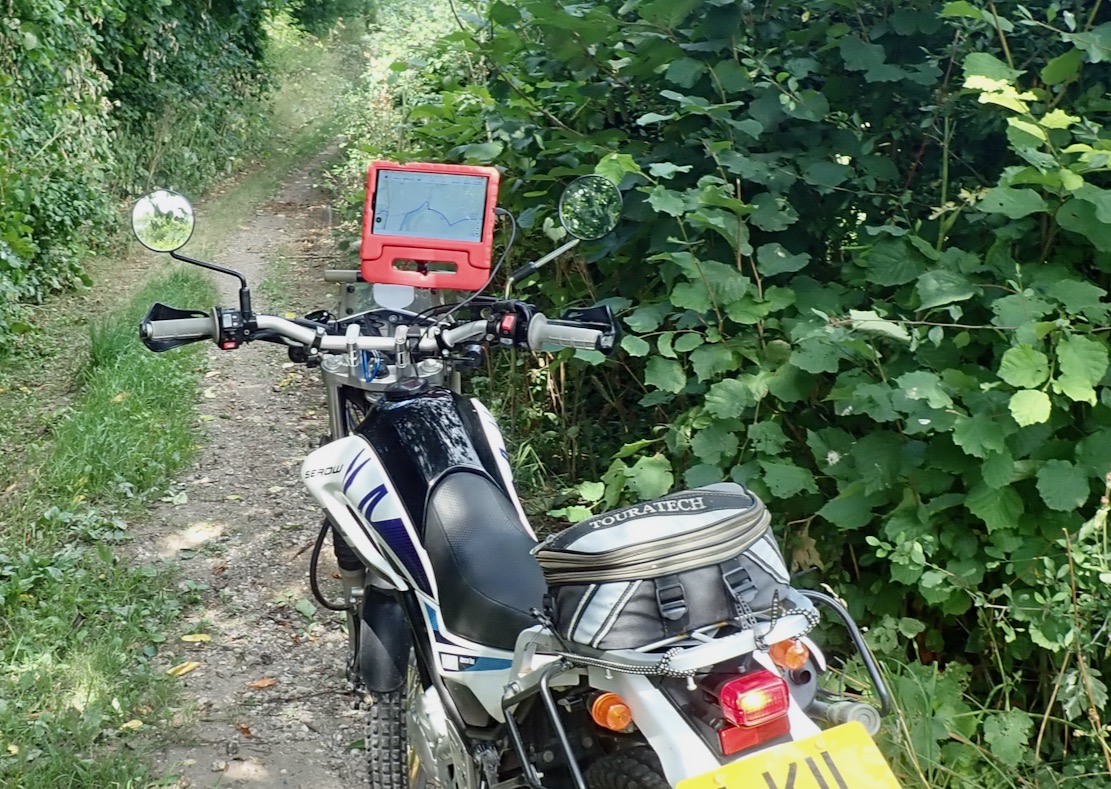
NuviVelcroChildproof tablet + DMD
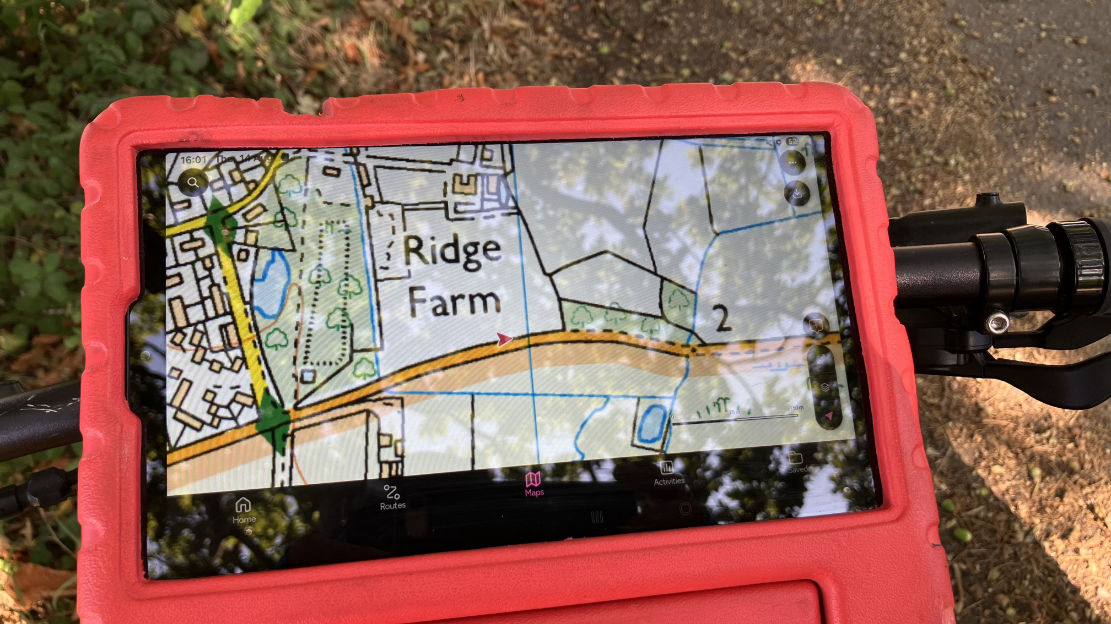
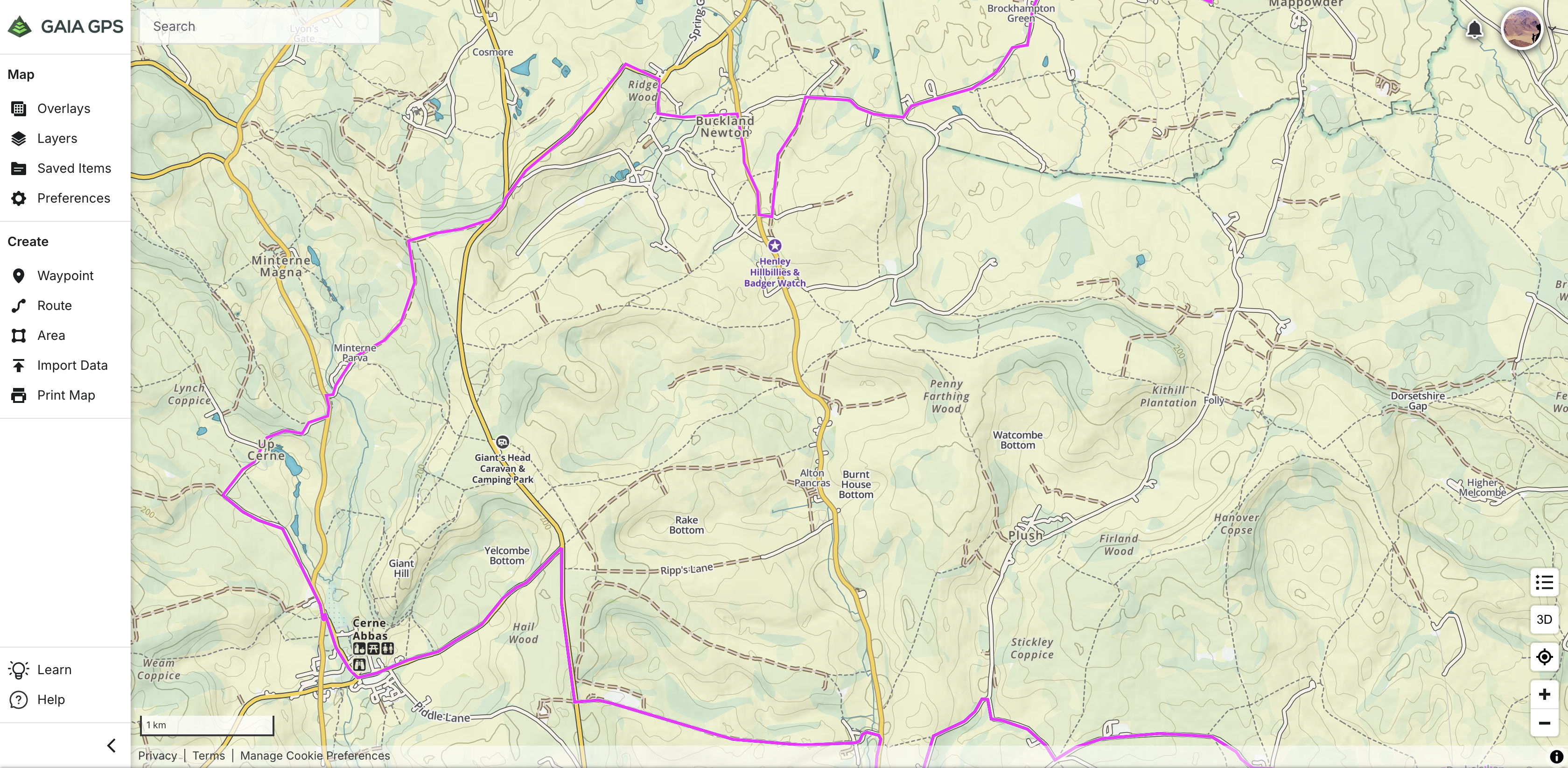
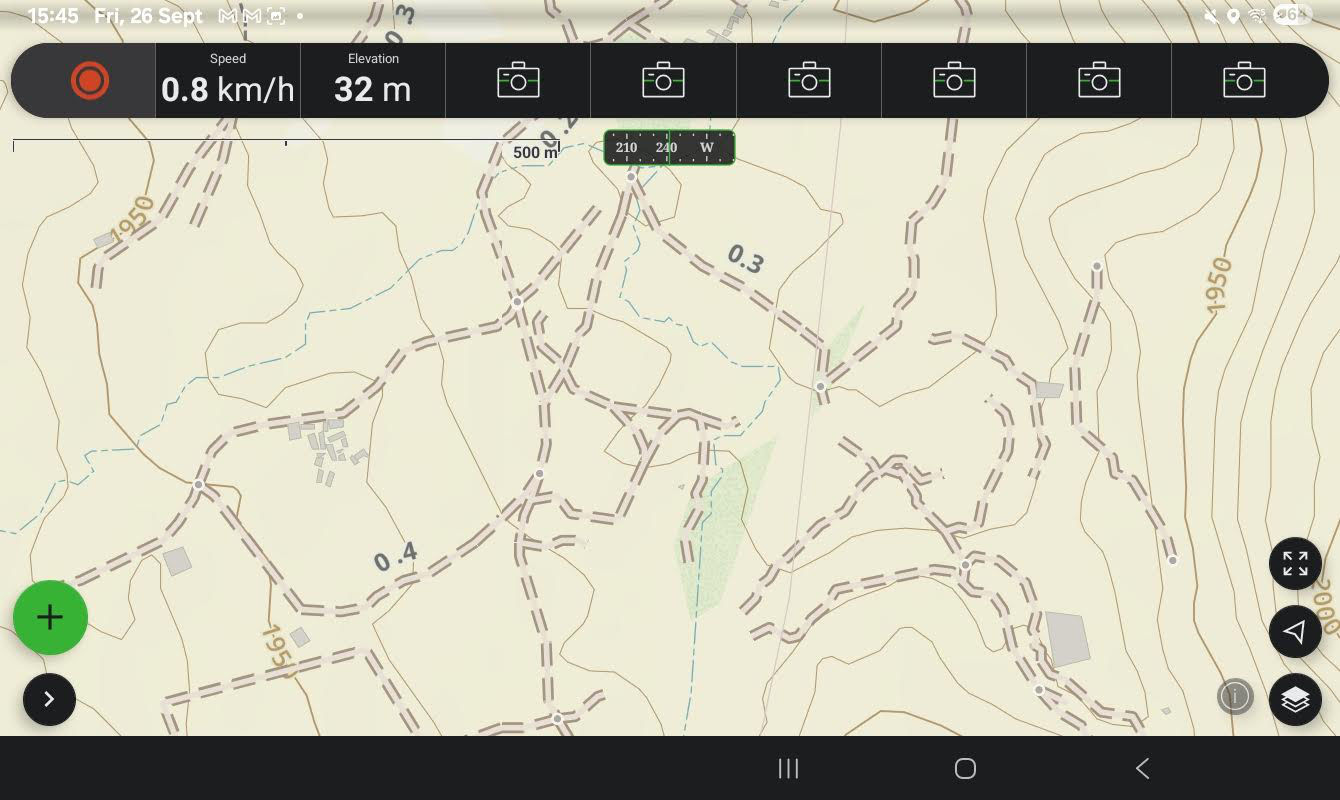
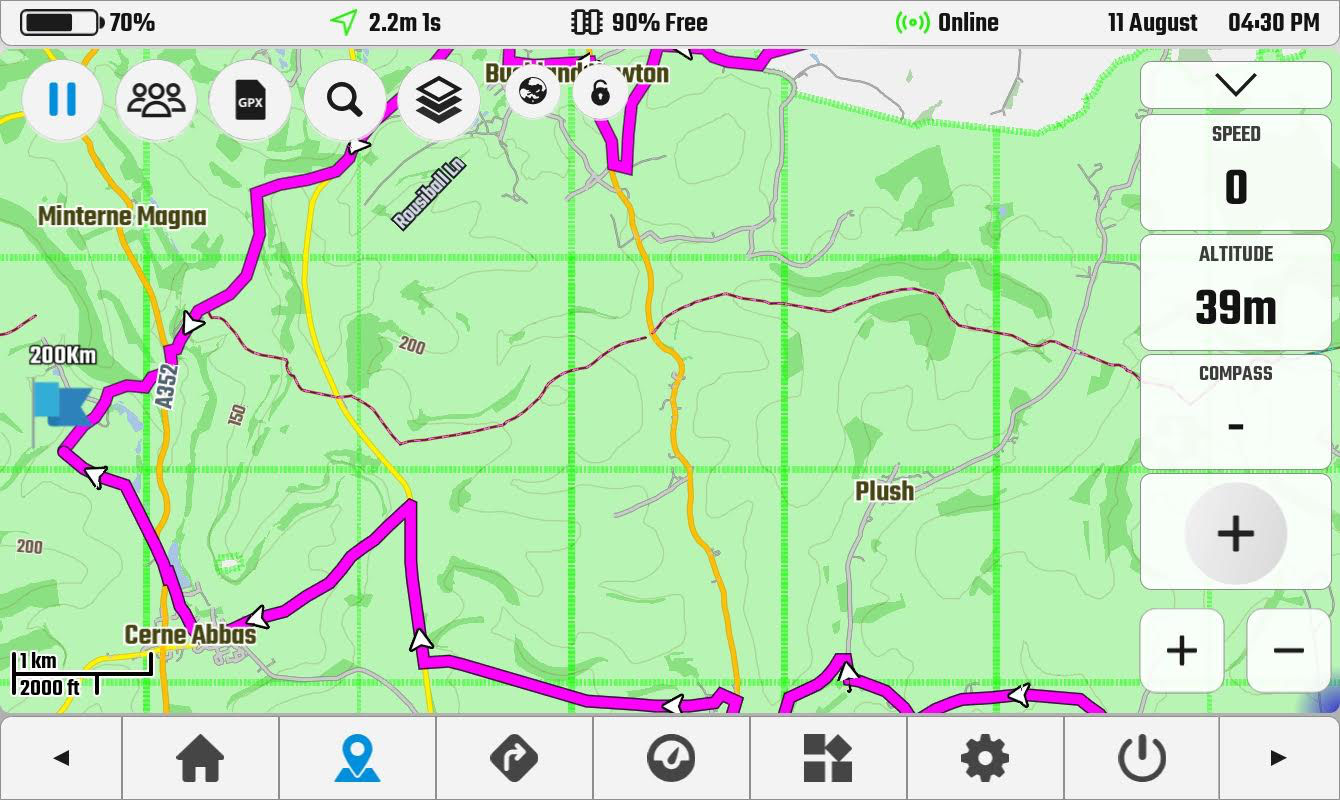
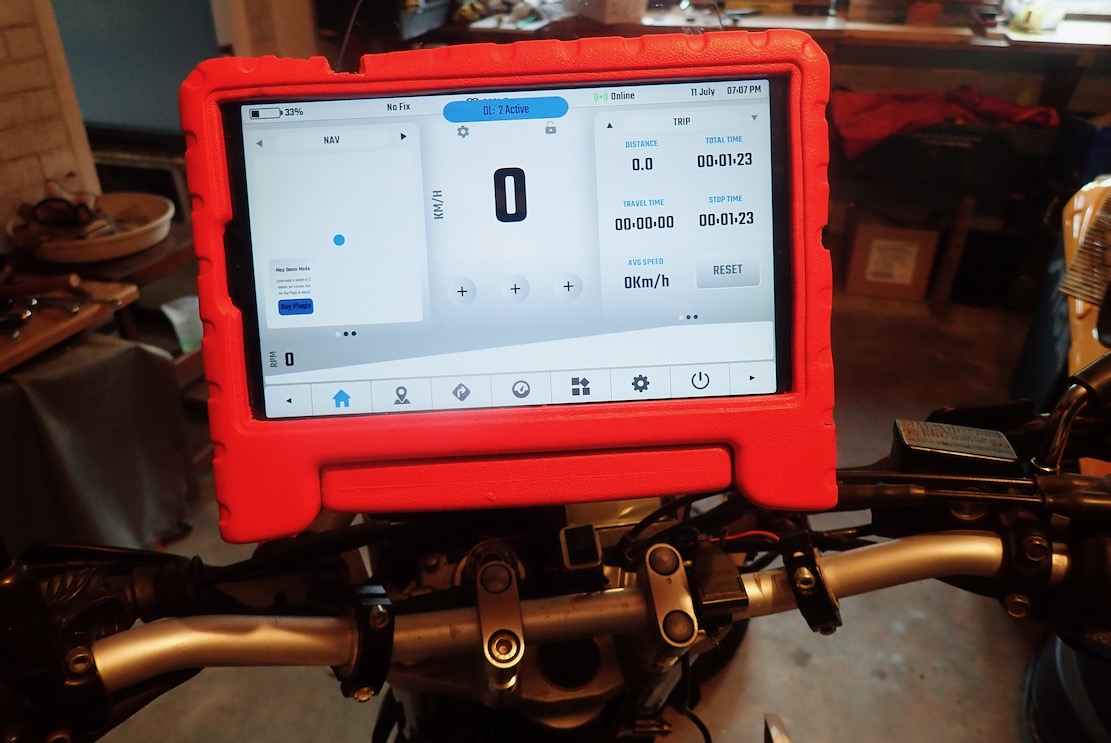
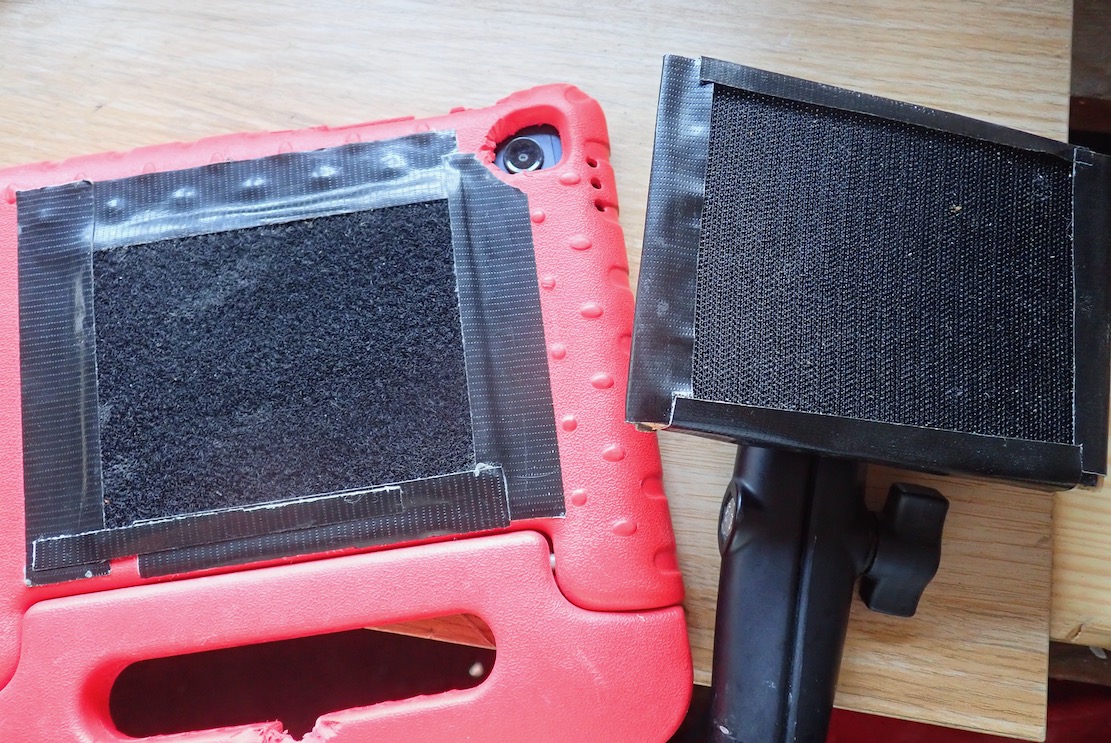
Next, I might sharpen the crampons and try to ascend the DMD2 learning curve using my 9″ Samsung tablet (above right) before considering something normal sized. I’ll even have a chance to try out my recently bodged velcro & RAM set up. Intended more for cars, it might do pootling about on the Serow to see if DMD2 with a rugged 6-inch tablet is worth the plunge. I have not arrived at my destination.
In a line: Smart lightweight Gore-Tex shell with unobtrusive armour.
Price: £350 from FC Moto.de + ~30% taxes
Weight: 1400g (verified)
Size tested: XL (me: 6″1’/95kg)
• Just enough to do the job • Looks smart • GTX Performance ought to keep me dry • Unobtrusive armour included • Inner pocket quite big
• For the money you could probably get something as good in the UK • Inferior venting to previous version • A bit too black irl – will get hot • XL = ‘US XL’ so a bit baggy on me
What they say: The redesigned [2020] Traverse is engineered to meet the demands of unpredictable weather conditions found in full seasons of dual-sport riding. Redesigned with a focus on increased comfort and reduced bulk, you get full weather protection with more durability than a regular rain jacket and less bulk than a fully built adventure jacket. The lightweight waterproof jacket will let you ride all season long with the confidence to conquer the weather.
Review This is my second Traverse, after owning Klim’s original Overland which got revised to become the Traverse 2 in 2016.
Though I haven’t crashed fast for decades, and fall over at low speed once or twice a year, I never felt protected in my two recent Mosko Surveyors. I’m not sure the Surveyors’ thin, elastic fabric would abrade that well, compared to what we call Cordura. They were perhaps an over-reaction to baking in the chunky Mosko Basilisk, better suited to harder-crashing rallying or non-tropical overlanding. Of course on my 800g Surveyors I could have worn on-body armour or an armoured pullover, like Adv Spec’s Supershirt 2 (right), but who wants yet more clobber? And even then, it didn’t claim to be showerproof so needed something else. What I really wanted was my old Traverse 2 back. I left it in a Spanish hotel to save weight on a ride to Mauritania that got nixed by Covid. Two years later I’m sure the Klim was long gone. For what I do (mostly to and from Morocco in the cooler months), a minimalist, wear-all-day, hard rain/rare crash protective shell suits me, with room underneath for layers, when needed.
Your Traverve GTX comes in a ‘lightweight’ shell/body (200D?) with the black areas in tougher 500D – and all of it more robust than my Surveyor. The Gore-Tex Performance is I think one of the better levels. I find expensive membranes breathe properly while still being genuinely waterproof, where cheap membranes err towards waterproofness, and so soon get clammy. I expect the GTX to confidentially shrug off long downpours, at least for a couple of years.
Size wise, XL is a bit big on me; as we know US sizes are bigger than UK. The right fit would be best, but better too big than too small, and my Large T2 was on the tight side. XL will make room for my Mosko electric puffa.
For the first time I’m not drawn to removing bulky shoulder and elbow armour which is unobtrusive, D3O Level 1 LP1. The whole elbow/shoulder armour thing is over-rated: it won’t stop broken collar bones, but will of course lessen more common low sides onto your pointy joints. The four pieces of armour weigh 380g; once removed the GTX weights 1020g, a bit less than the T2 previous version.
Venting may work on a basic dirt bike where you might be better off with a full breathing mesh jacket. I’m usually on a light travel bike with a screen which minimises any venting benefits, unless standing up.Unlike the huge front and rear ports on the old Traverse 2, the T-GTX merely gets two-way armpit vents, but my new small-screened Serow home the other day, I did notice the vents airing when I sat right back to try and ease saddle aches. I can already tell that on hot days, the black will generate more heat than the vents can purge, but online I liked the colour combo, so that’s what I have.
Pockets on the GTX are basic too: a couple at the hem, another outside on the chest, and all behind water-resistant zippers which will get clogged by dust until wiped down with a damp rag. Inside is a biggish zipped pocket that’ll easily take a passport, wallet and phone.
I’ll miss a rear game pocket which, on the Mosko’s, I found it handy to stash stuff you don’t need frequently but always want with you. The Traverse’s mesh sleeve for the back protector could be put to similar use and I’ll probably get round to installing a big inner drop pocket, as I did on my Overland (left).
The jacket is good and long at the back and in the arms and adjustability to keep out draughts and cold adds up to cinch cords at the hem and on the lined collar, plus velcro cuffs. More impressions of my Traverse GTX once I actually get to use it.